
TL;DR: The US Department of the Treasury’s Office of Financial Crimes Enforcement Network (FinCEN) has issued for the first time a list of priorities for Anti-Money Laundering and Countering the Financing of Terrorism (AML/CFT Priorities). This guide explores the top 8 priorities all businesses must know to get ahead of AML compliance.
What are the Recent AML/CFT Priorities by FinCEN?
FinCEN issued its latest guidelines on 30th June 2021 under the Bank Secrecy Act (BSA) Section 5318(h)(4)(A) in order to address several new and long-standing threats facing the US national security and financial system. These threats include attempts to exploit or circumvent the US financial system’s legal, regulatory, supervisory, or enforcement vulnerabilities.
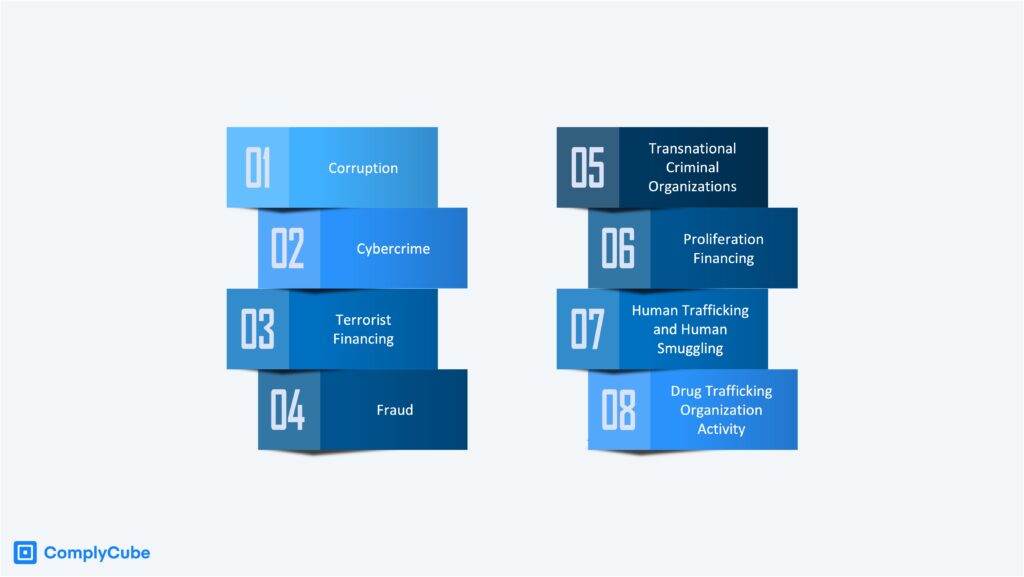
These guidelines aim to help the BSA-covered financial institutions (FIs) in their efforts to comply with the set AML/CFT policies. Although these Priorities may not apply to all organizations, institutions must comply with those related to their operations. The 8 Priorities addressed in this list include:
1. Corruption
Bribery and misappropriation of public funds, among other forms of corruption, threaten the US national security and financial system. Typically, such actions degrade the rule of law, deprive innocent citizens of their fundamental human rights, and undermine democratic institutions.
In fact, according to the 2025 Corruption Perception Index (CPI), the USA’s overall CPI score came in at 64, its lowest level ever on a scale where 100 is very clean, and 0 is highly corrupt.
FinCEN issued advisories on human rights abuses facilitated by corrupt foreign political figures and their financial promoters concerning South Sudan, Venezuela, and Nicaragua to combat corruption.
FinCEN requires all covered financial institutions to consult advisories regarding corrupt foreign entities and human rights abuse.
The guidelines also require these financial institutions to reconsider their particular AML/CFT policies. For instance, increasing the robustness of programs related to high-profile foreign political figures.
2. Cybercrime
FinCEN describes cybercrime as illegal activities involving computers, computer networks, or other digital devices.
The cybercrimes covered here include network attacks, phishing, and other cybercrimes targeting organizations’ Software as a service (SaaS) and Application Programming Interface (API) software.
These crimes target the confidential information of specific institutions, threatening the national security and financial system. For this reason, FinCEN has issued advisories warning addressed institutions of the predominant cybercrime frauds. This includes illegal use of convertible virtual currencies (CVCs), ransomware attacks, and FinCrime, to mention a few.
FinCEN also urges institutions to be vigilant in sharing information on suspected cybercrime activities.
3. Terrorist Financing
Both domestic and foreign terrorism is a threat the US national security.
Terrorist groups require funding to recruit members, support training and other logistics and execute their operations, thus creating a chain of illegal terror funding activities. Preventing such funding is crucial in helping the US government in its fight against terrorism.
For this reason, FinCEN requires covered institutions to identify and file Suspicious Activity Reports (SARs) on potential terror funding. Furthermore, this government bureau urges the involved institutions to comply with the set sanction programs regarding the AML/CFT risk-based policies.
4. Fraud
Organizations such as consumer banks, healthcare, and tax institutions generate the highest percentage of illicit funds through fraud. For instance, Pew Research Centre notes that in 2025, 73% of U.S. adults have experienced an online scam or attack, common across all age groups.
The most common fraud activities include corruption, drug smuggling, human trafficking, and organized crime, to mention a few.
Fraudsters launder their proceeds through methods such as transfers through accounts of established offshore legal entities, money mules, or accounts controlled by cyber actors, etc.
Therefore, FinCEN has categorized fraud under its list of Priorities and advises the involved organizations. These advisories emphasize email account compromise and Business Email Compromise (BEC).
5. Transnational Criminal Organization Activity
Transnational Criminal Organizations (TCOs) are included in the Priorities list because they are involved with several criminal activities that threaten the US national security and financial systems.
In particular, common TCOs activities include human trafficking and smuggling, drug trafficking, wildlife trafficking, and weapons trafficking.
FinCEN urges the covered financial institutions to be vigilant in identifying and reporting such criminal activities. In addition, the Priorities guidelines require involved institutions to re-evaluate the robustness of the AML/CFT policies regarding these illegal activities.
Also, financial institutions must monitor suspicious activities, trace the transactions, and comprehensively clarify Suspicious Activity Reports (SARs) filings.
6. Proliferation Financing
Proliferation financing comprises activities that exploit the United States’ financial infrastructure in an attempt to exchange illicit funds. These funds might, in turn, be used for violent actions such as purchasing mass destruction weapons or developing Artificial Intelligence/ Machine Learning (AI/ML) tools for evasion of US or UN sanctions.
For this reason, FinCEN requires the covered institutions to review the sanction programs, especially those involved with trade and economy. Moreover, reviewing these programs is essential in identifying and reporting suspicious criminal activities.
Most importantly, financial institutions, especially those that facilitate international transactions, must perform Customer Due Diligence (CDD) and Know Your Customer (KYC) protocols to identify criminals who seek to engage in proliferation financing.
7. Human Trafficking and Human Smuggling
Financial proceeds from human traffickers and smugglers can intersect with the US formal financial system at any point during the execution of these illegal activities.
The human trafficking and smuggling networks use various mechanisms to move their illicit proceeds, such as the standard cash smuggling by individuals, to more sophisticated channels, such as professional money laundering networks.
These proceeds may be from income associated with logistics and gains from exploiting victims.
FinCEN has issued advisories to help covered organizations identify behavioral and financial red flags associated with human smuggling and trafficking activities.
8. Drug Trafficking Organization Activity
Drug trafficking continues to generate enormous proceeds for Drug Trafficking Organizations (DTOs). Trafficked drugs and the proceeds laundered through trafficking often trigger public health emergencies in the US.
These drugs are brought to the US from countries such as Mexico, China, and Columbia. Here, DTOs use professional money laundering networks to exchange their cash proceeds or pose as money brokers in several trade-based money laundering (TBML) schemes.
In line with this, FinCEN urges the concerned institutions to refer to the existing FinCEN advisory regarding the trafficking of synthetic opioids such as fentanyl and red flags to detect such illicit transactions.
Key Takeaways
- Recent AML/CFT priorities include eight focus areas that will shape how businesses must comply with AML laws.
- The focus areas include long-standing threats to US security, which have been issued by the Financial Crimes Enforcement Network (FinCEN).
- Major focus areas include corruption, cybercrime, terrorist financing, proliferation financing, human trafficking, and fraud.
- Companies that fall under the Bank Secrecy Act (BSA), including accountancies and insurance firms, must align their efforts with the priorities.
AML/CFT Priorities in Driving Compliance and Security
Lately, criminal activities such as corruption, fraud, drug trafficking, and terrorism, to mention a few, have become rampant in the US. Such illicit activities undermine the US financial system and national security.
And for this reason, FinCEN has issued guidelines known as The Priorities to reduce the threats these illegal activities pose to the US financial system.
All eyes are now on the covered financial institutions to see how well they comply with the set guidelines in the fight against money laundering and financing terrorism.
Need more information on FinCen’s AML/CFT priorities? Speak with an expert.
Frequently Asked Questions
What are FinCEN’s 2021 AML/CFT priorities?
The FinCEN’s AML/CFT priorities fall under the US Anti-Money Laundering Act and list key focus areas that are the biggest threat to US security. The eight areas are: (1) corruption, (2) cybercrime, (3) domestic and international terrorist financing, (4) fraud, (5) transnational criminal organization activity, (6) drug trafficking, (7) human trafficking and smuggling, and (8) proliferation financing.
When does the 2021 AML/CFT priorities launch?
The 2021 AML/CFT priorities were issued on June 30, 2021, through official FinCEN publication. The focus areas took immediate effect, serving as guidelines for risk assessments and future KYC and AML regulations.
Which companies fall under FinCEN’s AML/CFT guidelines?
The companies that must comply with FinCEN are those that fall under the US Bank Secrecy Act (BSA). The broad range of firms includes financial institutions, Money Services Businesses (MSBs), crypto platforms, insurance companies, and more.
What is the significance of the US AML/CFT focus areas?
The focus areas act as a guide for firms to prioritise their efforts on the biggest threats to the US financial system. It leverages a risk-based approach to AML frameworks. Additionally, they shape oversight by FinCEN and are refreshed every four years under the US AMLA.
Are there any recent FinCEN guidelines in 2026?
As of 2026, there have been no updates to the original 2021 AML/CFT priorities. Instead, US regulators are focusing on heightened AML enforcement, increasing scrutiny and fines over failures.