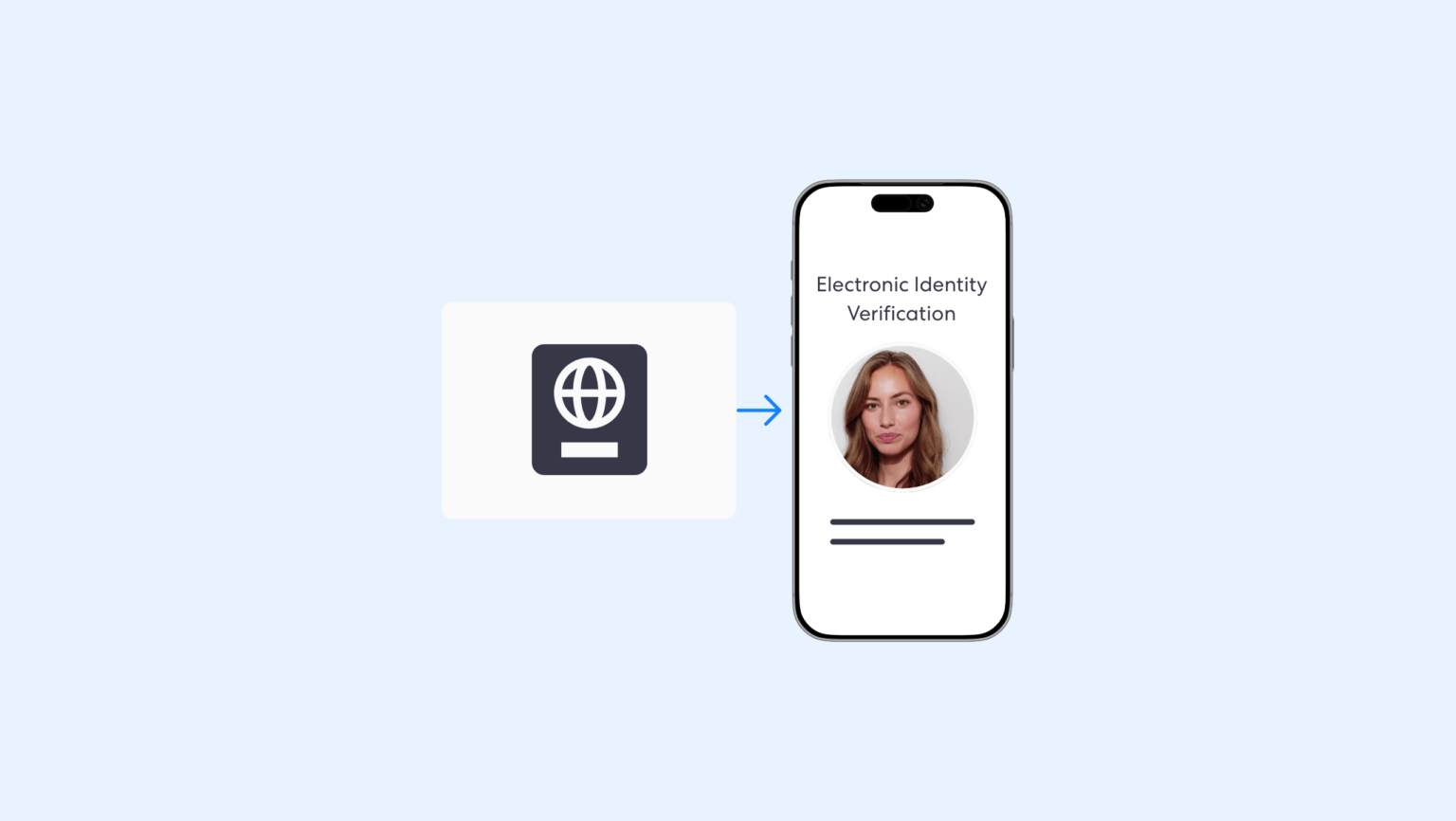
TL;DR: Electronic identity verification (eIDV) and Know Your Customer (KYC) document verification processes both help businesses confirm a customer’s identity during AML onboarding. While they share similar goals, they differ in operational costs and effectiveness. This guide compares eIDV’s database-based identity check approach against manual verification.
What are Electronic Identity Verification Processes?
Electronic identity verification, also known as eIDV, is the process of digitally verifying a customer’s identity through complete database searches. eIDV forms a key part of the broader KYC process and supports organizations in complying with Anti-Money Laundering (AML) regulations.
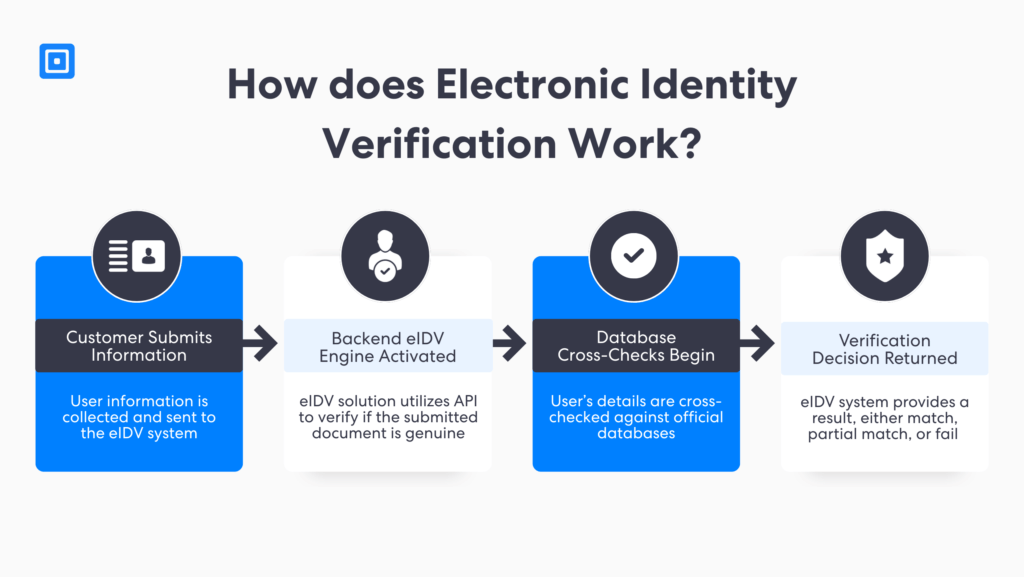
The eIDV process leverages digital analysis, allowing businesses to verify identities against authoritative databases remotely. Unlike legacy document checks, eIDV aims to shift away from physical document uploads or manual verification. Some benefits of eIDV include faster database checks and seamless customer onboarding.
Speedy Database Checking
The eIDV process involves gathering a customer’s basic demographic information, including name, address, date of birth, and Social Security number. Next, this customer information will be verified against trusted records, such as government databases, credit bureaus, and utility databases.
The system cross-references data against multiple databases simultaneously. While geographic coverage can vary across providers and sources, several vendors maintain relationships with numerous data providers to ensure maximum accuracy. Since eIDV leverages automation and Application Programming Interfaces (APIs), it accelerates customer verification and validation.
Seamless Customer Onboarding
Unlike manual identity verification of customer data, eIDV uses automated verification to confirm a customer’s identity within seconds. For example, during address verification, a customer’s residential address can be cross-checked against multiple databases simultaneously.
Moreover, customers can receive immediate feedback about their verification status during the KYC onboarding process. Thus, customers can achieve more accurate, faster onboarding, enabling rapid access to online services. This significantly improves customer satisfaction and supports business growth, particularly for global financial institutions.
Legacy Document Verification in KYC Procedures
The traditional document checking method requires customers to submit physical identification documents, such as passports, driver’s licenses, or government-issued IDs. Next, organizations will need to manually analyze these documents to extract user identity information and verify their authenticity.
The primary advantage of this method is its universal applicability and independence from database coverage limitations. Customers can verify their identities regardless of their geographic location. Document checking is essential for KYC onboarding and synthetic identity fraud prevention. A document check is typically combined with other methods or includes additional features:
- Biometric Verification: Combining document and biometric verification provides an additional layer of security that can help prevent identity theft more robustly. Selfie checks and liveness detection prevent spoofing attempts using deepfakes.
- Advanced Security Features: Modern identity documents include security elements such as watermarks, holograms, microprinting, and embedded chips. Enhanced verification tools analyze these features to effectively detect forged or altered documents.
- Optical Character Recognition (OCR): Modern businesses leverage OCR technology to extract customer information from uploaded documents. While this simplifies data extraction, human oversight is needed to analyze information accurately. You can learn more here: OCR Technology.
Electronic Identity Verification vs Traditional Document Verification
Both eIDV and document checks enable companies to deter identity fraud and terrorist financing. Also, they align with key regulations, including the European Union’s Anti-Money Laundering Directive (AMLD), the US Bank Secrecy Act (BSA), and the Financial Action Task Force (FATF).
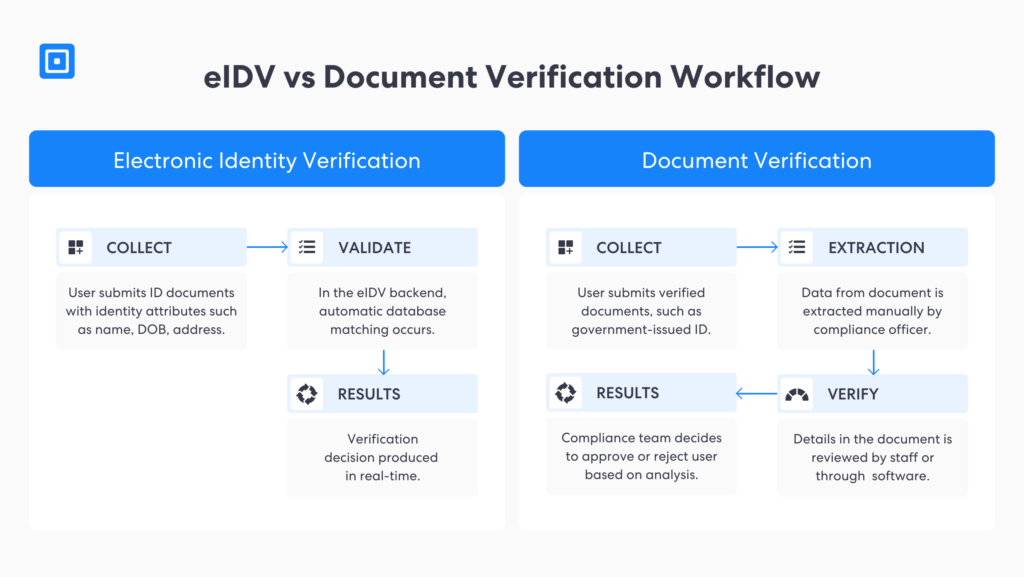
Processing time considerations are the primary challenge with document-checking methods. Customers must locate appropriate documents, capture clear images, and submit them. Regulated companies, such as financial institutions, tend to lean towards document checks as it provides clear audit trails and evidence of activities to meet reporting requirements.
On the other hand, eIDV is favored by fast-scaling companies that need speed and have high-volume verification requirements. Since manual processes can risk additional delays due to human verification, companies in the fintech and crypto industries typically utilize eIDV. eIDV is best suited for firms that prioritize quick AML onboarding over extensive staffing.
Electronic Identity Verification
- Streamlined customer onboarding: Provides a straightforward customer onboarding process, removing the need for manual document uploads.
- Integration: Electronic identity verification typically offers simpler API integration than traditional verification systems and integrates seamlessly with mobile applications.
- Younger demographic: Younger customers often prefer electronic identity verification for its minimal effort requirements and convenience.
- Accessibility considerations: This method may be complex for customers with technical limitations, thus needs additional support.
- Low friction: Customers avoid fumbling with documents or dealing with image quality issues, reducing abandonment rates.
Traditional Document Checking
- Universal accessibility: Works in different countries without reliance on database coverage or internet access, ideal for diverse or remote customers.
- Strong audit trails: Provide tangible, visual evidence of documents reviewed, simplifying compliance and audits to meet AML requirements.
- No data privacy risks: Avoids third-party database sharing, enhancing data security over sensitive information, such as GDPR.
- Older demographic: Less tech-savvy customers may prefer this approach as it does not require digital knowledge.
- High fraud resistance: Manual inspection detects forgeries and alterations that might be missed if eIDV does not have adequate sophisticated technology.
Regulatory Compliance and AML Requirements
AML is the overarching legally required regulatory framework that both eIDV and traditional document checks must follow to prevent money laundering, terrorist financing, and other financial crimes. It supports KYC and AML regulations by onboarding legitimate customers once a business relationship is formed. A Customer Identification Program (CIP) must be implemented at the outset, in which companies collect and validate data to create customer profiles.
A CIP helps organizations protect themselves from bad actors who use stolen identities and other disguises.
Next, businesses must conduct Enhanced Due Diligence, including screening against the Financial Crimes Enforcement Network (FinCEN) lists for high-risk customers. Compliance teams are recommended to adopt a risk-based approach under the FATF to build an effective Customer Due Diligence (CDD) process. Also, ongoing monitoring is critical for identifying suspicious activities or changes in a user’s risk profile.
Case Study: Tampered Documents and Fake Accounts
How GenAI Erodes Digital Trust and Reputation
Bad actors are becoming more technologically savvy, exploiting GenAI to create false documents. Such forgeries are a huge threat to the security of digital firms. TrustVerifi, the reputation platform, faced the challenge of fake accounts, undermining credibility and trust.
Combatting Illicit Activity without Sacrificing Customer Experience
TrustVerifi had to rely on KYC solutions that enable high trust and speed. The firm uses ComplyCube’s eIDV tools for reliable verification. ComplyCube offers high integration, automation, and a compliance-ready infrastructure to help global firms scale compliantly.
Solutions & Outcomes
TrustVerifi increased its client onboarding by 5x, with rapid adoption in Brazil, the UK, and India.
The leading startup reduced manual verification by less than 1%, significantly speeding up operations and enhancing security.
As a result, TrustVerifi experienced higher customer satisfaction, user trust, and increased adoption of its Trust Score activation.
Cost Analysis, Scalability, and Implementation Considerations
Digital and traditional verification approaches can have very different operational costs, depending on automation levels, integration, and pricing structures. Due to its automated processing capabilities and minimal infrastructure requirements, eIDV is highly scalable. Also, eIDV requires minimal staff training and human review, thereby significantly lowering costs. However, eIDV processes require broad API integrations and database connectivity.
On the flip side, document-checking systems must have greater oversight to handle increased verification volumes, storage, and manual review activities as a business scales. It also requires secure storage systems and robust staff training to ensure AML compliance. If not implemented well, document checks can be complex and lead to reputational damage caused by not meeting compliance requirements.
Making the Choice
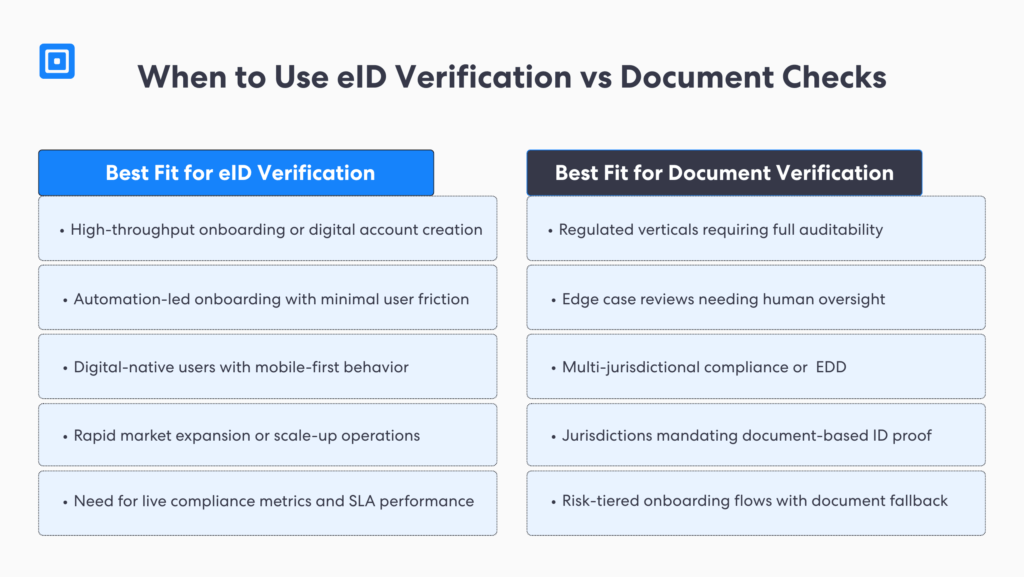
The choice between electronic and traditional identity verification can look different for each organization. Multiple factors play a role, such as customer demographics, risk tolerance, regulatory requirements, and business structure. A balance of thoroughness with user experience will deliver the best business outcomes.
Customer journey mapping can make the decision easier. It reveals how verification choices impact overall onboarding experiences and business conversion rates. Organizations that stay up to date with emerging technology deliver the best customer experience while maintaining compliance.
Do a Competitive Analysis
Competitive analysis provides insights into industry standards and customer expectations. Organizations operating in highly competitive markets may prioritize database-based identity checks to accelerate customer onboarding. Alternatively, regulated industries and financial institutions may favor document-based checks to emphasize reliability and audit trails.
Perform a Risk Assessment
Conducting a risk assessment helps organizations select appropriate verification methods based on fraud exposure, regulatory requirements, and business model characteristics. Higher-risk businesses, particularly the financial sector, typically require multilayered compliance measures regardless of the user experience during KYC onboarding.
Implement Performance Monitoring
Performance monitoring will highlight KYC and AML pass rates, customer satisfaction, fraud rates, and operational efficiency. Regular assessment can help organizations refine their approach and identify opportunities for improvement. Thus, over time, this leads to closing gaps, reducing false positives, and improving long-term ROI.
Key Takeaways
Electronic Identification Verification (eIDV) empowers businesses to verify users online, removing human intervention and customer friction.
eIDV and legacy document checks differ in verification speed, level of human review, accuracy, and user experience.
Long-term cost savings can be achieved with eIDV through faster onboarding and lower labor costs, thereby enhancing customer satisfaction and conversions.
Enhanced due diligence and ongoing monitoring support the identity verification process, ensuring alignment with the FATF’s global recommendations.
To analyze the effectiveness of IDV services, firms must perform ongoing competitive analysis, risk assessments, and performance monitoring.
Ensure AML Compliance with Enhanced eIDV Solutions
Organizations must factor in coverage, integration, automation level, and costs to choose the right identity verification solution for the business. To maximize customer onboarding rates, investment in IDV solutions with high automation, flexibility, and scalability is crucial for long-term growth. ComplyCube supports empowers compliance teams to prevent fraud effectively with its enhanced eIDV and AML software. Get started with ComplyCube today, click here.
Frequently Asked Questions
What is electronic identity verification?
Electronic Identity Verification (eIDV) is the process of verifying a customer’s identity online. During this process, important identity attributes such as a customer’s full name, address, and date of birth are validated against trusted databases. eIDV enables companies to verify a customer’s legitimacy remotely, eliminating the need for physical document checks.
Are KYC and eKYC the same?
KYC and eKYC confirm that a customer is who they say they are and are crucial in preventing money laundering, identity fraud, and financial crimes. eKYC focuses specifically on verifying information using digital, automated technologies such as AI and machine learning rather than manual checks.
How does eIDV enable AML compliance?
eIDV is a key component of Know Your Customer (KYC) processes, supporting firms in Anti-Money Laundering (AML) compliance. It provides a secure and rapid way of identity verification through critical technology, including Optical Character Recognition (OCR). eIDV helps firms identify, detect, and prevent synthetic identities and tampered documents.
Why is electronic identity verification (eIDV) important?
eIDV is critical because it enables companies to prevent identity theft and comply with KYC/AML regulations. Since it enables remote identity verification, eIDV supports a quicker, more seamless, and compliant AML onboarding process. Furthermore, eIDV leverages automation and cutting-edge technology to enhance check accuracy.
How does ComplyCube’s eIDV process work?
ComplyCube’s eIDV process validates users via document checks, biometrics, or proof of address verification. Its platform leverages automation technology, including OCR and liveness detection, to ensure businesses meet stringent global regulations seamlessly. Additionally, with cutting-edge integrations, customers and businesses can onboard more securely, accurately, and quickly.