
TL;DR: Online fraud is at an all-time high in 2026, necessitating stronger security measures for digital platforms. As KYC requirements and AML compliance standards evolve, businesses must keep Know Your Customer procedures strong while maintaining seamless user journeys. This guide explores how firms can meet compliance requirements without adding unnecessary friction.
Mitigating Fraud to Protect Customers with KYC
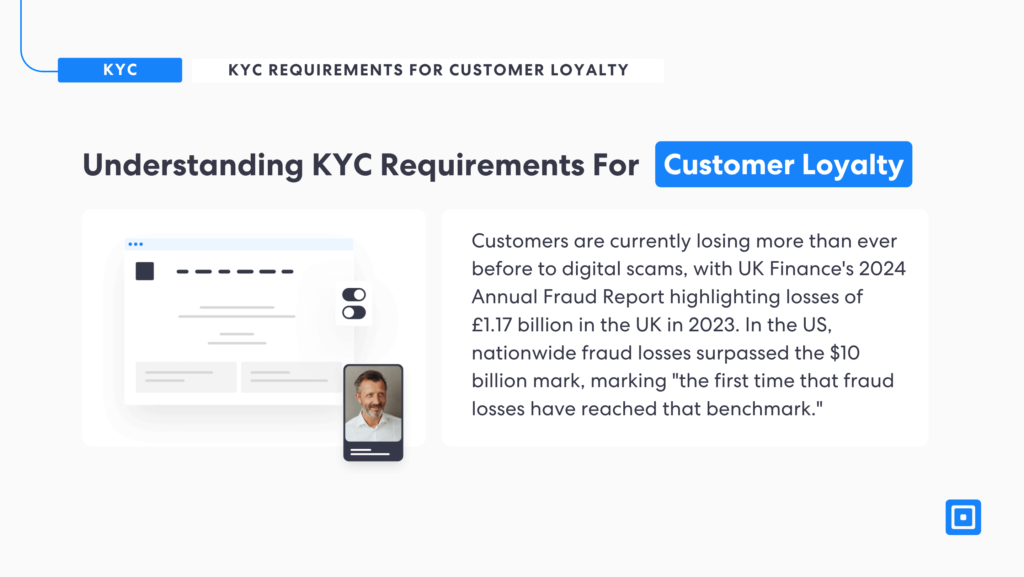
Customers are currently losing more than ever to digital scams, with the CIFAS Fraudscape 2026 Report highlighting 444,000 cases in the UK in 2025. In the US, nationwide fraud losses surpassed the $20 billion mark, marking a sharp rise from the previous year.
According to the Federal Bureau of Investigation (FBI), the U.S. has seen over 1 million complaints of crime reported in 2025, with phishing, extortion, and investment fraud topping the charts.
Financial institutions have been especially targeted, with money laundering, terrorism financing and other financial crimes taking places within these platforms at an all-time high. KYC standards must be rigorous to quickly detect customer risk profiles and suspicious behaviour, with risk-based customer due diligence being at the forefront of a robust KYC process.
Proactive Risk Management
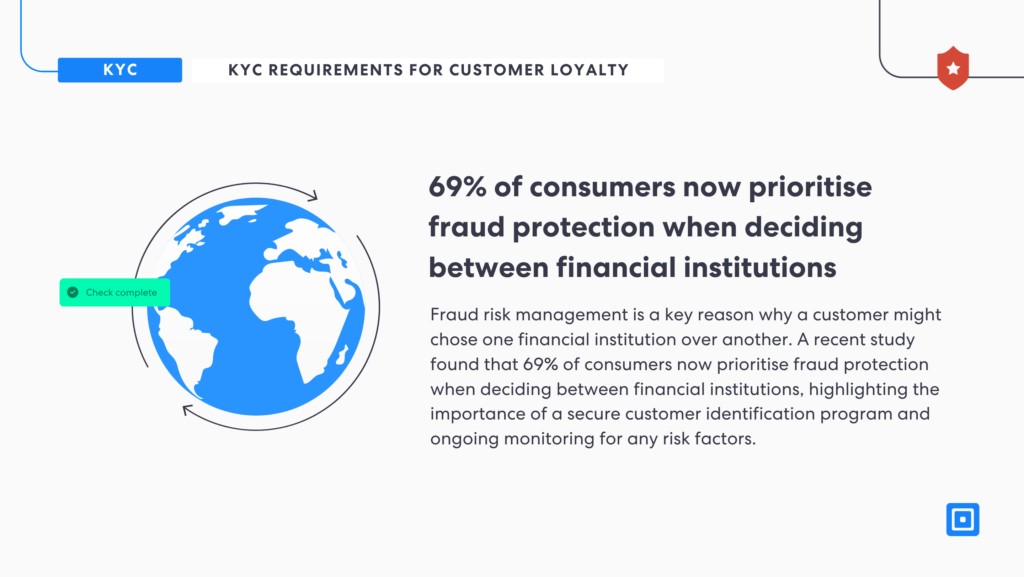
Fraud risk management is a key reason why a customer might choose one financial institution over another. A recent study found that 69% of consumers now prioritise fraud protection when deciding between financial institutions, highlighting the importance of a secure customer identification program and ongoing monitoring for any risk factors.
There are many kinds of scams that take place on financial platforms, including the creation of new accounts using a false or stolen identity, account takeovers, unauthorised credit or loan applications, and more. Some of the critical protections needed to instil loyalty and trust amongst customers might include:
- Safeguarding accounts with biometric authentication, making account takeovers much more difficult to carry out.
- Secure identity verification leveraging liveness detection technology to identify synthetic identities, stolen identities, or false identities. This allows for businesses to quickly stop fraudsters from applying for credit or loans, as well as stopping them from opening an account in someone else’s name.
- Ongoing monitoring with fraud alerts and notifications. Providing customers with real-time alerts when potentially fraudulent activities are detected on their accounts is crucial to building customer trust.
In addition, strict AML screening which might include sanctions and PEP screening, adverse media checks, watchlist screening and continuous monitoring ensures full AML compliance, fostering increased digital trust.
Advanced Fraud Detection
Fraud detection has come a long way with new AI-powered technologies. Powering KYC processes with market-leading AI tools helps build a trustworthy global reputation. Some of the latest technologies include:
Liveness Detection
Liveness detection can identify stolen or false identities, using AI to pull biometric data from a submitted video during customer onboarding to verify whether or not the individual is a real live person. Leveraging liveness detection ensures that businesses spot deepfake technologies during these onboarding processes, analyzing subtle micro-expressions and skin texture to ensure liveness. The customer’s identity is verified effectively, meeting KYC regulations when used with an advanced document verification check.
Optical Character Recognition
Optical Character Recognition (OCR) helps extract data from images of KYC documents quickly and effectively, verifying a client’s identity. OCR technology extracts key data points (e.g., name, date of birth, address) from identity documents, ensuring no manual errors or inconsistencies occur.
This extracted information can then be cross-checked against databases, such as sanctions lists, politically exposed persons (PEP) lists, and watchlists, to identify high-risk individuals. OCR can identify anomalies within images of government-issued KYC documents, which might indicate fraudulent tampering.
Case Study: Leading Crypto Platforms Face $3 M Fine
Coinone, South Korea’s leading cryptocurrency exchange, was fined $3 million for breaching KYC and AML compliance requirements. The South Korean Financial Intelligence Unit (FIU) found multiple lapses in the company’s compliance infrastructure.
Failure in Customer Verification
The FIU found that Coinone failed to verify more than 70,000 customer identities, including 40,000 cases with unverified or incomplete ID documents. It also allowed 30,000 customers to trade without completing proper Know Your Customer procedures.
Solutions & Outcomes
Coinone was fined $3 million, with a 3-month partial business suspension.
Its CEO, Cha Myung‑hoon, was formally reprimanded for the lack of oversight.
The case highlights the regulatory push for non-financial services to align with strict KYC standards.
KYC Requirements as a Competitive Advantage
In the past couple of years, sophisticated KYC compliance processes within financial institutions to prevent financial crimes such as money laundering has now become a clear competitive advantage. Customers look for platforms that can protect them at all times, especially since so many financial institutions have recently been victims of large-scale scams.
45% of all adverse contributions in the finance sector in 2023 were linked to stolen identities and identity fraud.
The banking sector has emerged as a key target for identity theft and synthetic identity fraud. According to Synectics Solutions, which manages the UK’s largest syndicated risk intelligence database, 45% of all adverse contributions in the finance sector in 2023 were linked to stolen identities and identity fraud. Fraudsters leverage falsified or stolen identities to drain funds from accounts, make unauthorized purchases, or secure loans fraudulently.
Differentiating Through Compliance
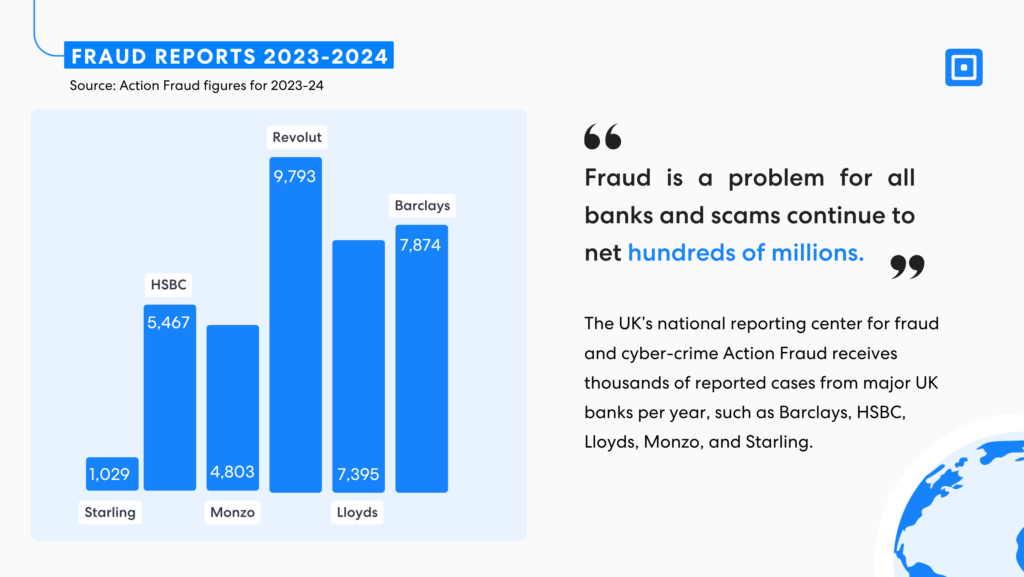
Between 2023 and 2024, fraud reports surged across major financial institutions, with HSBC receiving 5,467 reports, Revolut 9,793, Lloyds 7,395, and Barclays 7,874. These figures highlight the pervasive and sophisticated nature of modern fraudulent practices, underscoring the urgent need for financial institutions to reassess their priorities in order to win over customer trust and loyalty. For more information on identity fraud within UK financial institutions, read “Revolut Falls Victim to Identity Fraud.”
Stringent KYC processes will also enable businesses to operate in highly regulated markets, supporting global market expansion. This positions organisations as reliable international players, providing reassurance for investors and instilling confidence in customers and stakeholders.
Businesses that can differentiate themselves through reliable fraud defences will continue to hold a competitive advantage within their industry, as customers continue to prioritise security. An organisation that remains compliant with worldwide KYC and AML regulations, maintaining a strong reputation of security, is far more likely to win over a customer.
What Does a Comprehensive KYC Process Look Like?
For a KYC process to be a robust defence against fraud and ensure compliance, several key steps must be implemented. Some of these include:
Advanced Document Check: A document check will verify a government-issued identity document, checking for signs of tampering and extracting key information with OCR technology.
Biometric Verification with Liveness Detection: Biometric verification will quickly identify presentation attacks such as those using deepfake technology. Biometric data samples are pulled from submitted images and videos to be examined, as well as analysing details such as skin texture and subtle involuntary movements.
Multi-Bureau Checks: With a Multi-Bureau Check, businesses can verify customer details, such as name, address, date of birth and social security numbers against trusted authoritative sources such as government and credit bureaus.
Key Takeaways
- KYC compliance acts as a deterrent against sophisticated fraud and a driver of trust.
- Proactive risk management is increasingly prioritized to boost customer loyalty.
- Liveness detection and OCR technology supports earlier detection of identity fraud.
- KYC requirements support businesses in meeting global compliance obligations as they scale.
- ComplyCube supports end-to-end detection and ongoing monitoring of suspicious activities.
Compliance with ComplyCube
ComplyCube offers state-of-the-art KYC solutions to help businesses safeguard their customers and their platform from fraud. Achieving compliance across complex regulatory structures enables businesses to scale quickly and seamlessly, which ComplyCube’s platform supports.

For more information on fortifying your business with a robust KYC process, get in touch with one of our compliance experts.
Frequently Asked Questions
What are KYC requirements?
KYC requirements are mandated across various jurisdictions to verify a customer’s identity and support AML compliance. Typically, requirements include identity verification, proof of address checks, document verification, and ongoing monitoring for suspicious activity.
Is KYC mandatory?
Yes. KYC is mandatory in most regulated businesses and is required under several laws, including the EU’s AML Directives (6 AMLD), the U.S. Bank Secrecy Act, the UK’s Money Laundering Regulations 2017 and more. The exact process depends on the country, sector, and level of risk present.
What documents are needed for KYC?
In a typical KYC process, accepted documents include a passport, driving license, and national ID cards. For businesses, further documents are required to prove beneficial ownership and evidence business relationships.
What happens if a business does not follow KYC requirements?
A business can face massive negative consequences from non-compliance with KYC requirements. This ranges from million-dollar regulatory fines, legal action, reputational damage, and potential exposure to fraud and money laundering risks.
What role does ComplyCube play in preventing fraud?
ComplyCube is an all-in-one platform providing AML and KYC solutions for businesses to detect fraud. Its automated platform provides comprehensive checks to meet global regulations, including ongoing monitoring, sanction and PEPs checks, CDD, and more to detect and prevent suspicious users from onboarding.