TL;DR: The true AML check cost is not just a per-search fee. Often, the cost of AML grows through hidden spend. This means more manual review time, review backlogs, and the breakdown of reporting workflows. Manual screening and slow onboarding can raise the AML check burden through opportunity costs and higher error risk.
What is AML Check Cost?
Anti-Money Laundering (AML) check cost is the total price of running AML screening and monitoring. This looks at cost across onboarding and ongoing customer activity. It includes the most obvious, direct spend. For example, per-search pricing for sanctions and Politically Exposed Person (PEP) screening, data coverage, and vendor licensing. Moreover, it adds on the hidden costs that usually dominate total spend at scale.
Three layers push the cost of AML: technology, operations, and risk. First, technology covers the platform fees and integrations. Secondly, operations addresses analyst time for investigations, escalations, and audit evidence. This grows fast when false positives create alert backlogs. Finally, risk is the cost of control failure. Weak systems and governance trigger remediation programmes, independent oversight, and enforcement outcomes that can impact the original tooling budget.
Recent examples include the UK FCA’s £44.1 million fine against Nationwide for financial crime control failings. Another story to consider is the FCA’s £42 million fine against Barclays for poor handling of financial crime risks.
In 2025, firms also had a clearer view of how remediation becomes a long-running cost centre. TD expected to spend $500 million on AML remediation as well as governance and control investment in fiscal 2025. It shows how “AML check cost” can go far beyond per-check pricing when programmes require structural fixes and more oversight.
The Real Drivers of AML Check Costs for Financial Institutions
Compliance with AML regulations is now a baseline expectation. Regulators require firms to prove they run effective controls, including reliable customer verification and transparent monitoring. Many organisations still don’t know what actually drives AML spending. Particularly, this is important when they lack visibility into an AML check cost breakdown or how costs accumulate.
Financial institutions should be clear on what they are paying for and why. When building AML programmes, they must reduce financial crime risk and meet regulatory rules. Manual checks can appear cost-effective at first because there is no subscription. However, costs often shift into staffing, repetitive steps, slow reviews, and rework caused by human error. Automated AML solutions can reduce this drag by standardising screening and monitoring. It helps improve decision consistency, and enabling compliance teams to scale without adding the necessary overhead.
The same cost discipline applies when choosing an AML platform. Some providers price core screening competitively while charging separately for features that teams rely on in practice. This includes solutions such as adverse media checks, ongoing monitoring, case management, workflow approvals, or expanded data coverage. This guide compares manual and automated approaches, looks at cost add-ons that are easy to miss, and sets out criteria for choosing the right AML platform for your needs.
The Hidden Costs of Manual AML Checks and AML Compliance
The cost of AML compliance includes the investment in technology and the training required to reduce human error. By using technology, institutions can smooth their compliance processes. It can lower the associated risk of non-compliance and improving efficiency. However, AML check costs are still a big challenge. Now, companies may feel the need to use manual processes to achieve AML compliance. Especially, if their budget is tight and they’re looking for a cost-effective solution.
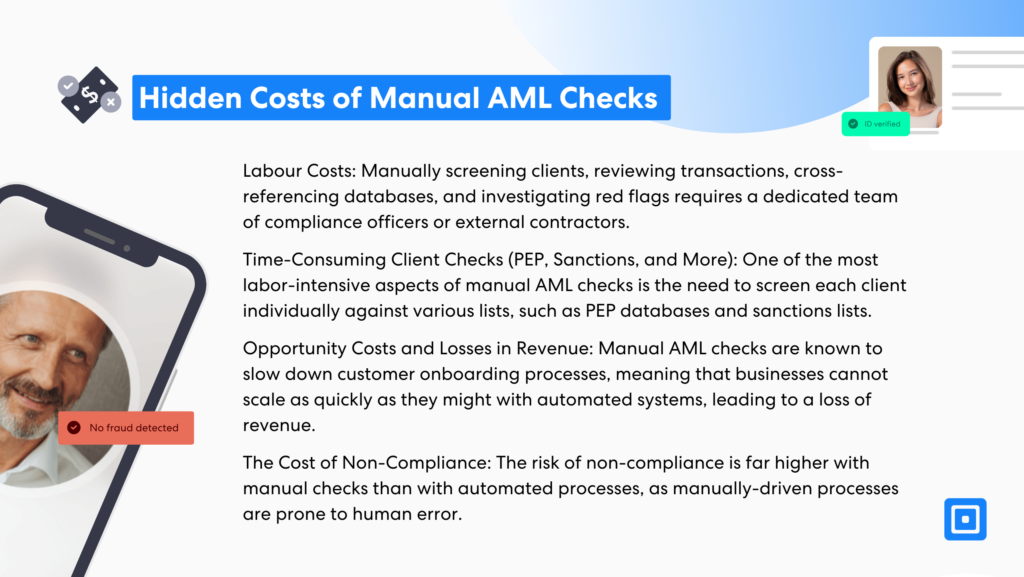
Yet, the hidden costs associated with manual checks can quickly spiral out of control. A long list of unexpected expenses can very quickly drain resources and put companies at serious risk of non-compliance. Some of the hidden costs associated with these kinds of checks include:
Additional Hidden Costs for Manual AML Checks
Labor Costs: Manual AML checks hide an obvious cost: the labour needed to perform the checks. This means ongoing wages and benefits for staff performing these tasks, along with the added administrative costs of managing them. Over time, this can become a huge recurring expense that many businesses don’t think about when first considering manual AML processes.
Time-Consuming Client Checks (PEP, Sanctions, and More): One of the most difficult aspects of manual AML checks is the need to screen each client one-by-one against various lists, such as PEP databases and sanctions lists. For businesses with high volumes of clients, this means going through each person’s profile, cross-referencing them against national and international lists, and often conducting a deeper dive into adverse media reports or their sources of wealth.
Opportunity Costs and Losses in Revenue: Manual AML checks are known to slow down customer onboarding processes, meaning that businesses cannot scale as quickly as they might with automated systems, leading to a loss of revenue. Similarly, time spent on reviews on high-risk customers can take long periods. Consider, processes such as manual collection and analysis of additional information, such as the client’s transaction history, geographical links, and political affiliations.
The Cost of Non-Compliance: The risk of non-compliance is far higher with manual checks than with automated processes, as manually-driven processes are prone to human error. A team member may easily miss a flag or fail to see a suspicious pattern that an AI-powered process would never miss. These mistakes, however minor they may seem, can lead to huge penalties and legal fees due to non-compliance.
You can name many more hidden problems in manual AML processes. Consider broken down record-keeping or reporting, lack of real-time monitoring, and proactive risk management. All of these examples can lead to big fines. Thus, it proves the importance of investing in a trusted platform that can provide expert checks.
Case Study: Nationwide’s £44m FCA Fine and the Hidden Cost of AML Checks
In December 2025, the UK Financial Conduct Authority (FCA) fined Nationwide Building Society £44 million for inadequate anti-financial crime systems and controls. This was over October 2016 to July 2021. This shows how AML check cost goes beyond screening fees. Such weak controls create operational drag, remediation work, and sustained governance overhead.
Stepping up check controls
Following the identified weaknesses, Nationwide started a large-scale financial crime change programme in July 2021, reflecting the path firms take when systems and controls are not working well. This means tightening customer risk assessment, improving due diligence refresh discipline, strengthening monitoring, and making evidence capture auditable.
Outcomes
The FCA fined Nationwide £44 million for financial crime control failings.
The FCA said the failings spanned October 2016 to July 2021.
Nationwide launched a financial crime transformation programme in July 2021.
Hidden AML Check Cost to Look Out for When Partnering With A Compliance Platform
The AML compliance process includes customer due diligence, risk scoring, and onboarding processes to assess high-risk customers and identify suspicious activities. These measures are essential for creating a secure financial environment, but they also drive up compliance costs, particularly when considering the cost of AML compliance across all stages of the AML compliance program.
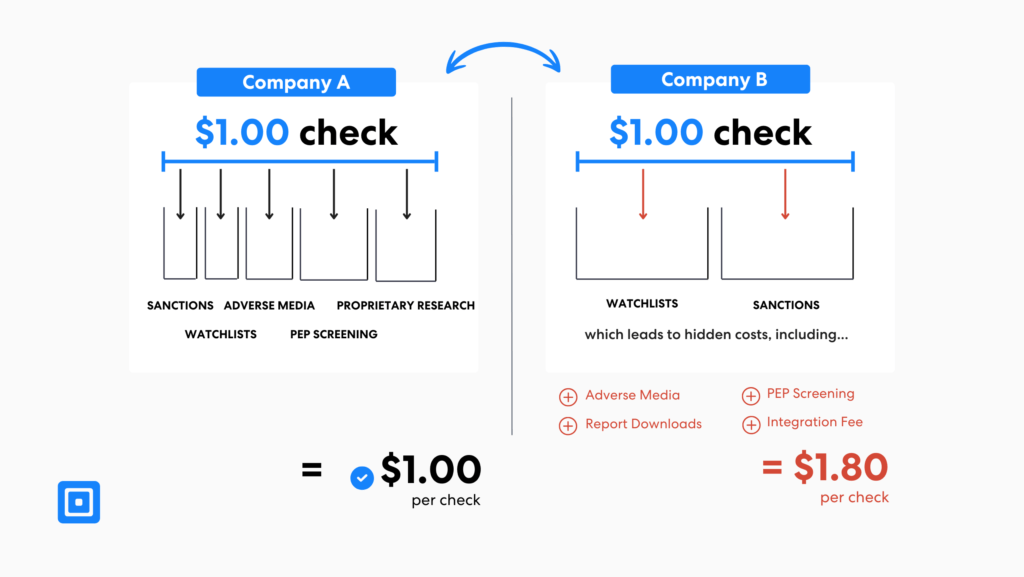
Whilst partnering with an automated platform is definitely necessary, it’s important to be aware of hidden fees within different pricing structures to ensure an optimal return on investment. Whilst checks may be priced similarly, for example at $1.00 per check, when businesses break down what is incorporated within that bracket they often find that necessary features are not included. Therefore, the cost of AML checks are far more expensive than anticipated.
Set-up fees can amount to £20,000.
Fees and Hidden Expenses to Consider
Harry Varatharasan, Chief Product Officer at ComplyCube, states, “Many AML providers market their services as cost-effective solutions, but businesses are often caught off guard by hidden expenses that escalate quickly. From third-party fees to unexpected setup and support costs, these hidden charges can turn what initially seemed like an affordable option into a significant financial burden.”
Some examples of hidden fees to look out for are:
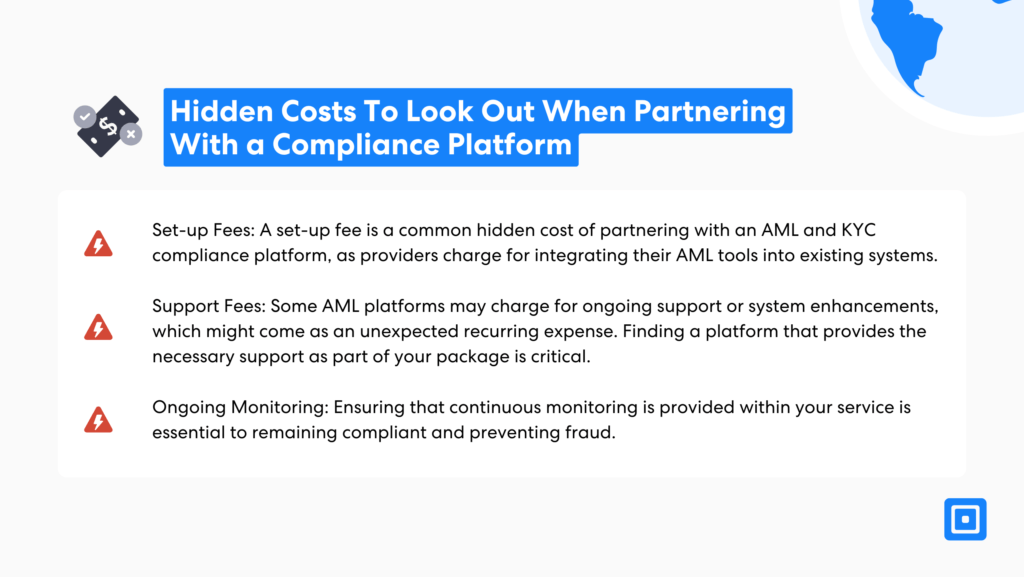
- Set-up fees: A set-up fee is a common hidden cost of AML partnering and KYC compliance platform, as providers charge for integrating their AML tools into existing systems. Set-up fees can amount to £20,000, a noteworthy expense for most businesses.
- Support fees: The cost of AML platforms vary and they may charge for ongoing support or system enhancements, which might come as an unexpected recurring expense. Finding a platform that provides the necessary support as part of your package is critical.
- Lack of Proprietary Data: Some providers access only public sanctions data, with propriety data increasing AML screening costs a drastic 5x.
- Data Retention and Report Downloads: Another hidden cost is not including data retention and the ability to download reports in a standard package. Some providers offer this only as an add-on, which can be an unexpected expense for the customer.
- Lack of Volume-Based Pricing: Providers that offer volume-based pricing are often far more economical for businesses that need to carry out a large number of checks.
- Ongoing Monitoring: Ensuring that Ongoing Monitoring is included within your package is critical, as trying to do this manually can be extremely expensive and time-consuming. is essential to conduct a new screening in accordance with your ongoing monitoring policy. This may require performing a new manual check on a daily basis.
As Harry notes, businesses must thoroughly understand the full cost structure before committing to an AML provider, as overlooking these expenses can lead to compliance challenges and unanticipated financial strain. Transparency regarding the pricing breakdown is critical to making the right decision.
Key Takeaways
AML check cost goes beyond per-search fees.
False positives inflate analyst time and queues.
Manual investigations raise the cost of AML fast.
Disconnected tools add duplication and audit rework.
Tuning, risk scoring, and EDD reduce total AML check spend.
Maximizing AML Check Cost With the Right Provider
Choosing the right AML and KYC provider is a big step for businesses to make sure they get a positive return on investment in their solutions. Providers that lack transparency around pricing, such as what might be classed as an “add-on” or an ongoing support fee, often lead to businesses avoiding adding important services to their package that they would otherwise have included with another provider. Or, if they do decide to add additional services, they are often paying an unnecessarily high price point.
For more information about ComplyCube’s AML platform and pricing, get in touch with one of our compliance experts.

Frequently Asked Questions
What is AML check cost and what does it include?
Anti-Money Laundering (AML) check cost includes vendor fees for screening and data coverage, plus analyst time for triage, investigation, escalation, and reporting. It also includes governance effort such as QA and audit evidence capture. The most overlooked part is the cost of rework when evidence is fragmented.
Why does the cost of AML increase even if per-check pricing stays low?
The cost of AML rises when alert volumes increase, false positives create queues, and manual reviews expand. Fragmented tooling adds duplication and slows decisions, which increases analyst time per case. This is why the cheapest scan price can still produce the most expensive programme.
What are typical cost ranges for an AML check?
Low-volume sanctions name screening is often $1.50–$2.00 per scan, while monthly name screening plans can run $50–$300+ depending on scan volume. EIV can range $1.50–$15 per check, and high-risk EDD manual checks can exceed $100 per check. Total cost is shaped by operational overhead, not just the scan price.
What hidden fees should firms look for in an AML check platform contract?
Common hidden fees include add-ons for ongoing monitoring, adverse media, case management, workflow approvals, retention, and report exports. Set-up fees can also be significant, sometimes around £20,000, depending on integration requirements. Total cost of ownership analysis reduces surprises.
How does ComplyCube help reduce AML check cost without weakening compliance?
ComplyCube reduces AML check cost by combining IDV, AML screening, and ongoing monitoring in one workflow, cutting false positives, duplicate reviews, and audit rework while supporting scalable, evidence-ready compliance.