
TL;DR: In 2026, automated age verification works best when it mixes low-friction checks with step-up controls that protect minors. The best automated age verification solutions blend selfie-based age estimation with audit trails and modular workflows. A modern age assurance solution also reduces data collection, adapts to changing requirements, and gives instant results.
What Is Automated Age Verification?
Age verification solutions in 2026 are judged on practical outcomes and overall fit. They must stop underage access to age-restricted content and products while keeping conversion rates high. As enforcement rises, the market has moved away from basic age gates to automated systems.
These systems can check age, give audit-ready proof, and scale across many regions. They are expected to maintain compliance with consistent decision-making and clear audit trails. Also, they need to work across different user bases and regional rules without creating unnecessary friction.
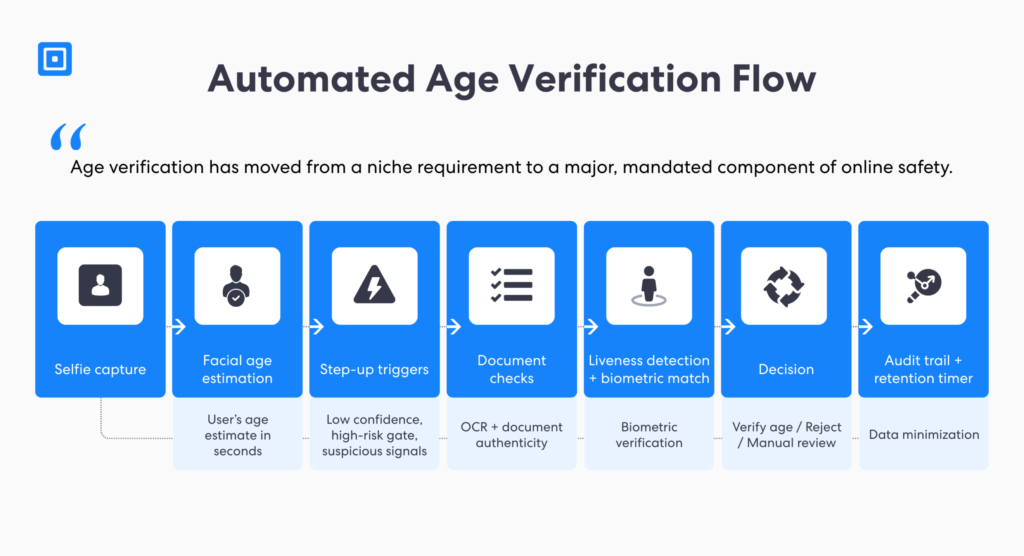
Automated age verification is technology-driven. This verification process confirms a user against age requirements without manual review. Automated checks leverage the use of cutting-edge artificial intelligence and machine learning algorithms. They mix facial age estimation, document checks, and database checks against authoritative sources. High-assurance flows add biometric verification and liveness checks. This verifies identity documents and ensures the person submitting the ID is present. It prevents users from using spoofed images or false documents.
In 2026, programmes are also judged on privacy, equality, and security. This includes data minimization to limit Personally Identifiable Information (PII) retention. The best age assurance solution delivers instant results for legitimate users. In particular, the Challenge 25 policy, whereby UK retailers are “challenged” to verify users appearing under the age of 25, is a prominent example of risk-based escalation that these systems implement.
What “Best” Means for Automated Age Verification Solutions
Today, the best age verification solutions or age checks create measurable outcomes that safeguard young people. They can more accurately estimate age. They also show how many underage users are blocked and how many real users pass quickly.
Additionally, age verification software can track any user drop-off points and overall conversion rates by device type and region. Therefore, strong age verification platforms expose pass rates and escalation rates as key performance indicators (KPIs). This makes optimization proactive rather than reactive.
Measurable Protection with Automated Age Verification
For this reason, a reliable age verification programme also provides audit proof. It logs the verification journey, decision policy, and any relevant timestamps for overall compliance needs. The idea here is that manual review should be relative to the risk to the user and business.
Age checks also support a privacy-first design by proving eligibility without collecting too much data from users. This balance is crucial for any services aiming to meet global compliance regulatory requirements, which include the EU’s GDPR.
The Need for Globally Ready Automated Age Verification
Another example of what is considered “Best” in 2026 are product solutions that work across many regions. Keep in mind that age thresholds often vary by country and product category. This covers industries such as online gaming, adult content, purchasing alcohol, and more.
As a result, modular workflow builders allow policy teams to set appropriate age limits without completely rebuilding customer journeys. This speed of change is critical for global compliance when product teams ship very quickly. It also reduces general operational risk when legal requirements change.
The Global Regulations Shaping 2026 Programmes
The challenge when it comes to scaling globally is turning overlapping rules into consistent build requirements. Different systems prioritize effectiveness, child safety outcomes, and privacy-by-design using different implementation options.
Teams need one clear map from “what we must do” to “what we can prove.” It helps product, compliance, and engineering teams align on a shared control set without rewriting rules for every region. This makes it easier to demonstrate compliance consistently.
Strong Age Assurance Methods in 2026
Age assurance works best in 2026 when the method matches the risk. Low-risk journeys should start with low-friction checks to keep conversion rates healthy. Then, teams can escalate only when confidence is low or the user is trying to access higher-risk content or products. This tiered approach to estimating age helps services stay compliant and prove effectiveness. You can learn more here: Achieving Age Assurance: Online Age Verification Solution
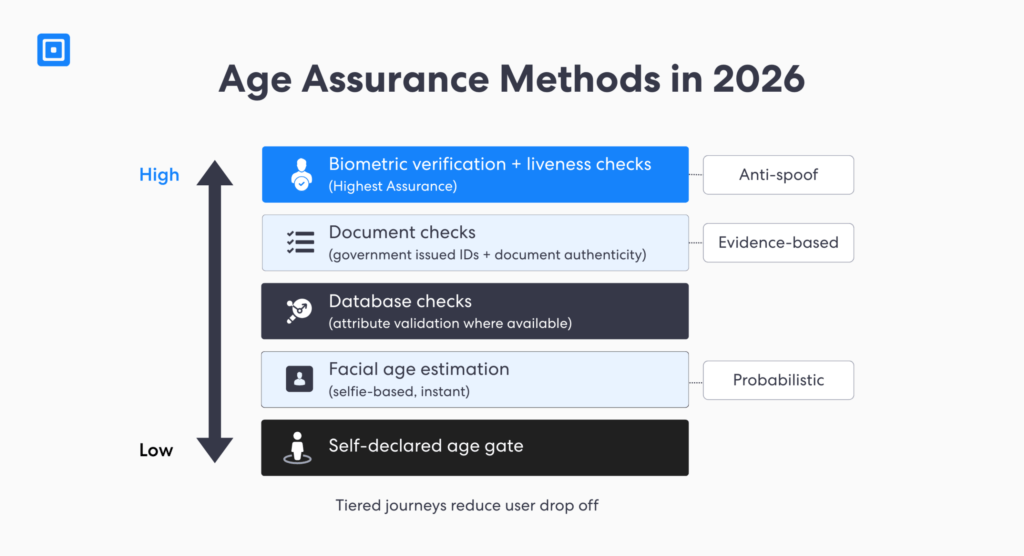
The ladder above shows the trade-off between friction and assurance. Self-declared age gates are the weakest. Then comes facial age estimation, which is fast but probabilistic. Database checks are put in place to add extra validation where available. Document checks provide evidence-based assurance, and biometric verification with liveness detection offers the highest protection against spoofing and underage access. This progression aligns with the European Union (EU) push to strengthen protection for minors online.
Use Cases for Automated Age Verification Processes
Automated age verification can look different across each sector. Thus, adapting age estimation process to each industry’s compliance needs and user expectations is crucial. For example, in regulated industries, robust audit trails and fraud prevention are also required. Another example includes tweaking workflows or adjusting age checks to fit specific service offerings.
Customizable age verification software is critical for adapting to regulatory requirements.
Robust age verification processes support companies in meeting compliance and avoiding fines. According to ComplyCube’s Chief Product Officer, Harry Varatharasan, the importance of tailored age checks cannot be ignored. He states, “To support sector-specific compliance and business goals, adopting tailored age verification tools can enable quick integration and sustained regulatory alignment while preserving user trust.” Here are the most common sectors that require these solutions:
Online gaming
Online gaming faces strict legal requirements in many markets. It often includes social interaction, monetisation, and user-generated content. That combination raises regulatory compliance expectations.
A famous case study involves the company Valve. The Attorney General of the State of New York filed a lawsuit against Valve, alleging that the company operates illegal gambling through paid loot boxes that give players a chance to win valuable virtual items. A tiered approach can reduce friction for most users, while still blocking underage access to restricted features.
The online gaming sector benefits from instant age verification results. These checks cut sign-up abandonment and speed up first-play access. They also enforce parental consent where required, with configurable workflows for varying age thresholds. This approach meets global regulations while keeping growth metrics stable.
E-commerce and age-restricted products
E-commerce platforms selling age-restricted products must verify age reliably. Common examples include purchasing alcohol and other regulated goods. Checkout is highly sensitive to friction. That is why automation and smooth onboarding matter. The goal is to verify age without harming conversion rates.
A typical stack uses facial age estimation for low-friction screening. It then uses document checks for higher assurance when needed. It may also use database checks depending on the region and data availability. Liveness detection helps prevent fraud and spoofing. This supports compliance needs without excessive user drop-off.
Adult content and legally restricted services
Adult content is one of the clearest use cases for high-assurance age verification. The UK Office of Communications (Ofcom) guidance on highly effective age assurance is relevant for services that must restrict children’s access. That makes evidence-based methods central, not optional. It also increases the need for audit trails. These services must plan for enforcement scrutiny.
High-assurance stacks typically rely on age verification identity documents. They combine document authenticity checks with liveness detection. Risk-based re-authentication spots repeat abuse. Solutions must also prioritize data minimization and limited retention. This reduces privacy risk while ensuring compliance.
Dating apps
Dating apps must balance safety and privacy. Users can be vulnerable, so anonymity and data security matter. Blanket ID collection can create safety risks if data is exposed. A tiered age assurance solution reduces that risk. It also supports a better user experience.
A common model uses age estimation as a first step. Then, it escalates to biometric verification or document checks when risk is higher. It also uses configurable workflows for different regions. It can also support manual review for difficult edge cases. This supports regulatory compliance while onboarding low-risk users quickly. You can learn more here: Online Dating Identity Verification Measures.
Stopping Fraud Tactics with Age Verification Software
Automated age verification only stays reliable when it is built for adversarial behaviour. Attackers do not just try to guess a date of birth. They test controls using Virtual Private Network (VPN) circumvention, borrowed adult devices, deepfakes, and synthetic identity tactics. That is why fraud prevention needs to be treated as part of the verification process, not a separate add-on. The goal is to block underage access without forcing heavy checks on every user.
For example, device intelligence reduces repeat attempts and automated abuse, while behavioural analysis flags suspicious patterns across sessions. Liveness detection and biometric verification raise assurance when a selfie is presented, and document authenticity plus registry or database checks reduce acceptance of fraudulent documents.
Case Study: Reddit, Age Requirement Checks, and Enforcement
In 2026, the UK ICO fined Reddit £14.47 million for children’s privacy failures after it relied on self-declared age, highlighting that weak age gates can be bypassed and create regulatory risk while raising tensions around anonymity and data minimization.
Achieve Cross-Border Compliance at Scale
To avoid the “self-declared age” gap, businesses must enforce risk-tiered automation: start with facial age estimation, with step-ups to document checks and biometric verification when required. This method minimises retained PII and focuses on where risks are highest.
Outcomes
Reddit was penalized a £14.47 million fine by the ICO for children’s privacy failures.
Age verification was introduced in July 2025 after a period of reliance on self-declared age.
Failure window reported as May 2018 to July 2025, showing multi-year enforcement exposure.
Evaluate Automated Age Verification Platforms
Accuracy, coverage, and fairness
Reliable age verification depends on measured performance, not assumptions. Teams should test pass rates, false reject rates, and escalation volumes. They should also evaluate different regions and device conditions. They should measure the impact on conversion rates. This makes procurement evidence-based.
Fairness testing is also essential for facial age estimation. AI-based age estimation can show higher error rates for darker skin tones or facial differences. Teams should request evaluation data and run their own pilots. They should also provide clear fallback options for users who fail. This protects both inclusion and trust.
Audit trails and risk-based authentication
Age verification systems must provide audit trails and risk-based authentication. Audit trails should explain which method was used and why. They should show timestamps, policy versions, and outcomes. They should also support regulator-facing reporting. This reduces compliance uncertainty.
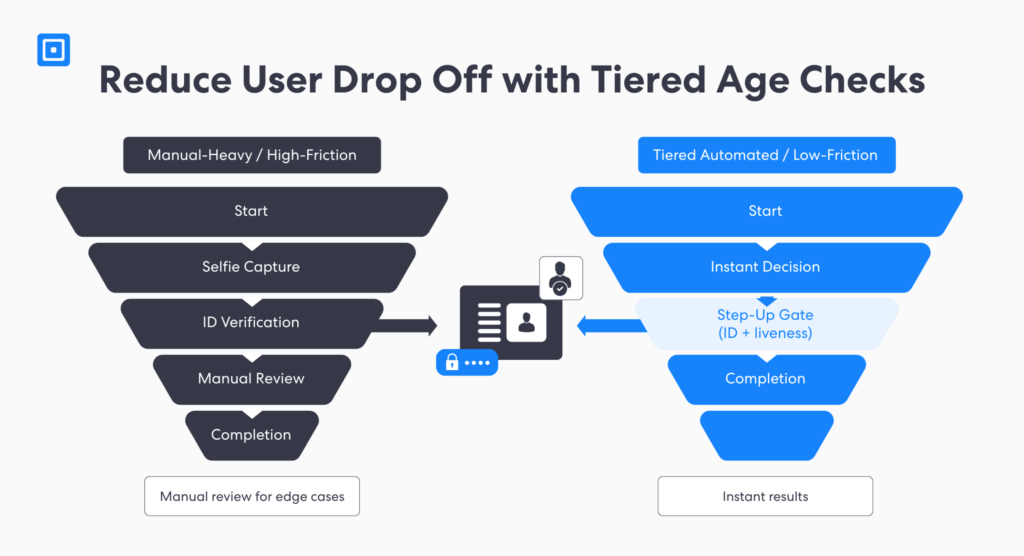
Risk-based authentication also supports long-term resilience. It allows step-up checks when risk changes, such as for higher-value transactions. It also helps manage fraud prevention without harming UX. Standards and guidance on reliable identity proofing can help frame assurance approaches. The Financial Action Task Force (FATF) digital identity guidance reinforces risk-based thinking for identity verification systems. You can learn more here: What is a Risk-Based Approach (RBA)?
Security and breach risk management
Many automated age verification systems involve sensitive user data. This increases the risks of data breaches and misuse. Teams should evaluate encryption, access control, and retention policies. They should also assess vendor incident response and auditability. This is part of ensuring compliance.
Fraud signals also matter in high-risk sectors. Identity fraud and misuse are well-documented concerns in government contexts, which are relevant for threat modelling. This context helps justify layered controls and monitoring.
Key Takeaways
Automated age verification performs best when it is tiered.
Document-based age verification with biometric verification is the most defensible option.
Regulations are tightening, with UK fines up to 10% and EU DSA penalties up to 6% worldwide.
Privacy-by-design requires data minimization, limited retention, and careful handling of anonymity.
ComplyCube’s age estimation uses APIs and SDKs, audit trails, and modular workflows for robust compliance with age verification requirements.
ComplyCube’s Automated Age Verification
ComplyCube delivers scalable age assurance that protects minors, cuts user drop-off, and ensures global compliance. Choose the right age assurance methods for your sector and integrate age verification software through a single, unified KYC platform. Speak with the ComplyCube team about our comprehensive suite today.

Frequently Asked Questions
What is automated age verification in 2026?
Automated age verification uses AI and biometrics to confirm a user meets age requirements without manual review. The process typically starts with a low-friction selfie check and escalates to additional verification, such as document checks when risks are higher.
What are the leading automated age verification solutions in 2026?
The best solutions reduce underage access while keeping conversion rates high. Leading age verification providers are ones that support configurable workflows so policies, age thresholds, and evidence requirements can be applied consistently across markets.
Is age estimation and age verification different?
Age estimation provides a fast, probabilistic selfie-based result, while age verification uses higher-assurance evidence such as document checks and biometric verification, which is more suitable to meet stringent regional requirements.
How does automated age checks prevent fraud?
Automated age checks layer with other verification, including document and biometric checks with liveness detection. In turn, these checks can detect replayed selfies, deepfakes, and fraudulent documents, deterring fraud and identity theft effectively.
How can ComplyCube support privacy-first, global age assurance?
ComplyCube enables tiered age assurance through its no-code workflows, audit-ready logs, and vast API and SDK integrations. Organizations can roll out consistent age checks across jurisdictions while meeting data privacy regulations too.