TL;DR: Today, startups do not want KYC providers for startups based on compliance alone. They look at infrastructure that allows for growth, confidence, and global expansion. Choosing fintech compliance tools that helps AML for fast-growing companies is the most strategic choice companies could make
Why does KYC and AML Matter for Startups?
In 2020, companies could treat compliance as an afterthought. In 2026, that strategy is not possible anymore. Regulators are expecting early-stage companies to put in place more thorough identity verification (IDV) and anti-money laundering (AML) processes from the very beginning. In particular, FinTech startups are under scrutiny to put in place thorough compliance programs to boost money laundering and fraud prevention efforts.
In the UK alone, the Financial Conduct Authority (FCA) has issued over £176 million in fines within 2024. This marks the start of a new era towards more strict enforcement. As a result, choosing the right Know Your Customer (KYC) providers for startups is all about strategy. This directly impacts a company’s ability to grow globally, and build trust with investors and customers alike.
Over £100 billion is annually lost to money laundering, underscoring the urgency of robust anti-money laundering measures.
In short, Know Your Customer (KYC) and Anti-Money Laundering (AML) compliance are foundational to businesses looking to scale in today’s environment. Taking advantage of KYC and AML is essential for startups due to many factors such as:
Regulatory Scrutiny for FinTech and SaaS Firms
First and foremost, startups must put in place thorough compliance and risk management controls from day one. These measures will help avoid enforcement actions and licensing setbacks. Particularly, startups must focus on compliance with local and global KYC, KYB, and AML standards to find their way through complex regulatory environments.
Risks of Fines for Non-Compliance
Secondly, startups that do not meet AML or KYC compliance standards risk severe financial penalties. In addition, they also risk public reputational damage, loss of customers, and investor trust. In short, non-compliance can throw off growth or trigger operational shutdowns entirely.
Investor and Partner Due Diligence Expectations
Finally, venture capital firms, banking partners, and payment processors are expect more early-stage companies to show strong compliance maturity. In particular, they are look for real dedication to prevent money laundering and other financial crimes. Without this level of commitment, startups can often lose out on partners and funding.
The 4 Essential Capabilities of Modern AML & KYC Providers for Startups
Unlike traditional financial institutions, SaaS and FinTech startups must avoid manual processes such as running basic identity checks. Verifying a customer’s identity is a crucial part of the KYC process. It often involves official documents and digital technologies to ensure accuracy and security. Fast-growing startups need a smarter and flexible compliance infrastructure that can grow with product changes and high user volume.
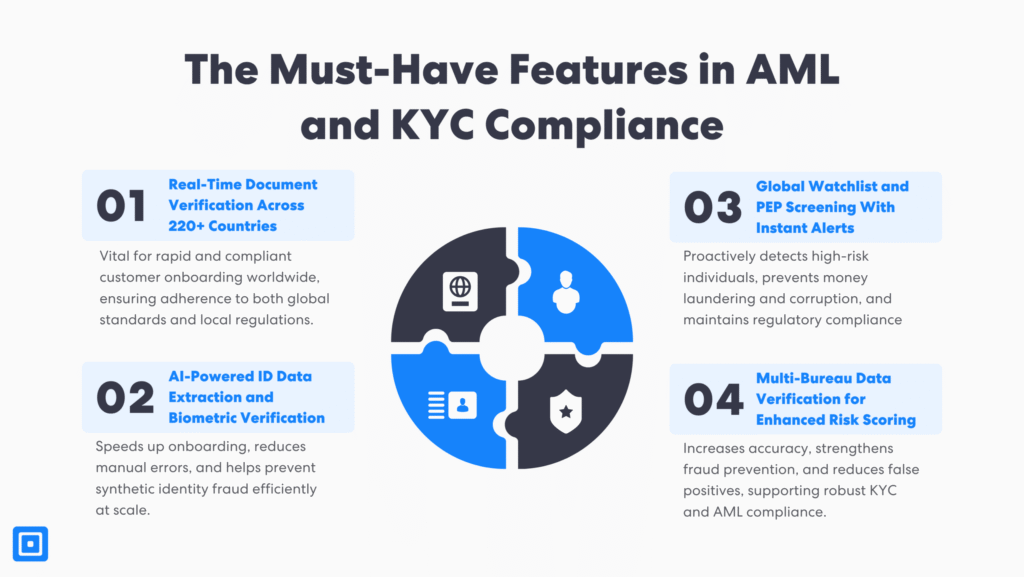
Most early-stage companies take advantage of modern AML and KYC processes from the beginning. This approach helps them to stick by complex compliance requirements and prevent operational drag. Additionally, automation in KYC and AML processes also helps smoothen operations and lower operational complexity. Some of the key features to look for include:
Real-Time Document Verification Across 250+ Territories and Countries
Startups need rapid and global customer onboarding processes. When operating globally, ongoing compliance across many jurisdictions is vital. Hence, choosing KYC providers for startups that offer real-time document verification of government-issued IDs from various countries is key. This is more true for FinTech and SaaS platforms working cross-border in the payment and financial sectors.
AI-Powered ID Data Extraction and Biometric Verification
Today’s AML and KYC software now blends artificial intelligence and machine learning models. This model is trained on millions of identity documents to automatically extract PII (Personally Identifiable Information) with deep precision. For startups, this can deliver faster customer onboarding rates and a reduction of synthetic identity fraud during biometric authentication.
Global Watchlist and PEP Screening With Instant Alerts
In the current regulatory landscape, continuous monitoring and due diligence processes are non-negotiable for startups. AML and KYC software that integrates with real-time global sanctions and watchlists to make sure that high-risk situations, such as Politically Exposed Persons (PEPs), do not go past controls. Instant notifications help mitigate risk and strengthen financial security via swift responses.
Multi-Bureau Data Verification for Enhanced Risk Scoring
A digital identity verification process that covers customer data across multiple national ID registries, credit bureaus, and utility databases supports startups in fraud prevention more efficiently. For example, multi-bureau data matching strengthens regulatory compliance under KYC and Customer Due Diligence (CDD) requirements and lowers false positives that can alienate real users.
Cost-Efficient AML for Fast-Growing Companies
As a result, SaaS and FinTech startups need to balance fast expansion demands with disciplined resource allocation in their existing systems. Adding an Anti-Money Laundering (AML) compliance process that gives enterprise-grade protection without draining capital is no longer a luxury; it’s a competitive advantage. The right KYC and AML solutions shield startups from regulatory blowback and help unlock leaner, cost-effective, and scalable multi-jurisdictional compliance operations:
- Pay-as-you-go Pricing Versus Subscription Models: Startups might find themselves in inflexible annual contracts that fail to align with changing user checks or evolving use cases. Modern RegTech providers offer specific, pay-as-you-go pricing, allowing startups to scale verification and screening activity together with customer acquisition, seasonal peaks, or product rollouts.
- ROI of Automation and No-Code Workflows: Using low-code or no-code compliance solutions helps startups to automate workflows without having coding knowledge. This lowers time-to-deployment from weeks to hours and cuts operational overhead.
- Avoiding Hidden Costs: Startups, particularly those in the financial services industry, might encounter unexpected, abrupt fees from certain AML and KYC vendors. To stop this, startups must have clear discussions and look at insights from leading review platforms before purchase.
Key Factors to Consider when Selecting Top KYC Providers for Startups
When selecting compliance providers, a thorough understanding of evolving regulatory standards and KYC regulations, ensuring solutions can adapt to changing requirements and support ongoing compliance, is crucial. Here are the key factors for startups to consider:
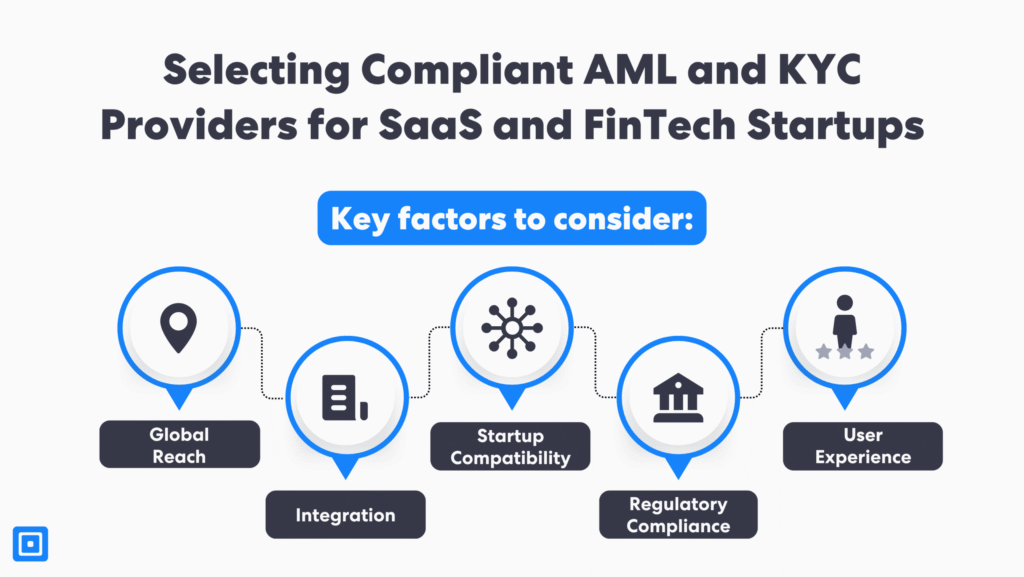
- Global Reach: Startups with international ambitions need the ability to perform digital identity verification and business verification across multiple countries. As a result, helps them maintain compliance with international regulations and regulatory authorities.
- Technology Integration: Advanced technologies such as machine learning, AI, and biometric authentication are leveraged for accurate and efficient identity verification, ongoing monitoring, and transaction monitoring, ensuring a robust verification system that adapts to emerging risks and regulatory changes.
- Startup Compatibility: Flexibility in integrating existing systems (APIs, SDKs), scalable solutions, and startup-friendly pricing models is key. Consequently, startups can implement effective compliance programs and KYC processes without hindering growth.
- Regulatory Compliance: Adherence to global regulatory requirements, including GDPR, AML, the Bank Secrecy Act, and KYC compliance, is fundamental. It ensures that startups meet the expectations of regulatory bodies and authorities while protecting data integrity and complying with data protection laws.
- User Experience: A seamless verification process and customer onboarding journey are prioritized to enhance user satisfaction and retention, while maintaining rigorous security measures and risk intelligence data to detect politically exposed persons and prevent financial crime such as money laundering.
By focusing on these criteria, startups can select Know Your Customer (KYC) processes and AML solutions that ensure compliance with regulatory reporting and standards. Therefore, firms can strengthen their defenses against financial crime, support fintech compliance, and build trust with customers and financial institutions.
Case Study: How ComplyCube Supports GRVT’s Next Million Crypto Users
Fraud and deepfake attacks are more common in the crypto sector. For startups, this can have negative impacts on growth. For GRVT, a leading DEX firm, this meant it had to choose the right compliance solutions to combat this threat and support trusted onboarding.
The Need for Speed, Compliance, and Agile Operations
GRVT needed to partner with an AML and KYC vendor that matches its compliance-first culture. To meet its large onboarding demands while keeping accuracy and sticking to global regulations, GRVT took advantage of ComplyCube’s unified automated regtech platform.
Outcomes
ComplyCube’s proprietary technology meant that GRVT did not rely on third-party data or vendors, enhancing cost-effectiveness.
The platform’s automated and tailored workflows enabled rapid and agile onboarding without compromising security and user experience.
Advanced AML and KYC checks included sophisticated EDD and real-time monitoring, achieving proactive fraud prevention.
Comparison of Top KYC and AML Providers for Startups
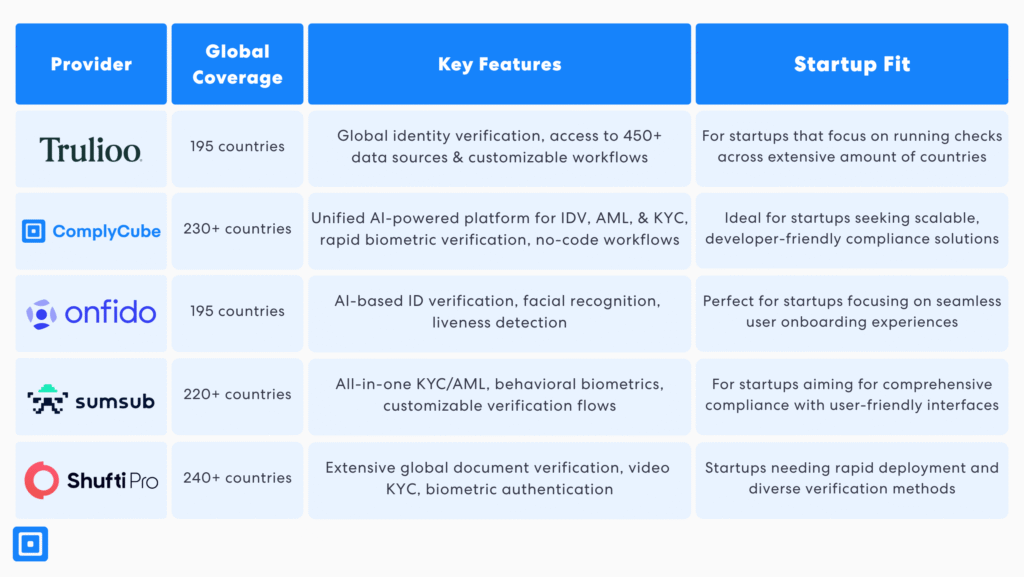
The best KYC and AML providers deliver a thorough fraud prevention framework, effective risk management, and customizable workflows for smooth customer onboarding. Ultimately, the right KYC and AML Vendor for startups will rely on the type of checks, verification process, and compliance operations desired. This section highlights the top KYC solutions and AML providers, particularly for SaaS and FinTech startups, based on the evaluation factors above and popular SaaS review sites such as G2 and TrustRadius:
Key Takeaways
- Fintech startups face high regulatory scrutiny due to sector-specific vulnerabilities, including large and rapid transaction volumes across borders.
- Startups with strong AML and KYC compliance benefit from strategic advantages, such as investor trust, customer loyalty, and regulatory satisfaction.
- Real-time document checks, biometric verification, watchlist, and PEP screening are must-have features for fast-paced startups to avoid fines.
- Choosing KYC providers for startups depends on business-specific needs, including geography, verification volume, and technology integration.
- ComplyCube provides AI-driven tools to help startups detect risk, automate workflows, and align with global regulatory standards at an accessible pricing plan.
Safeguarding Startups with Advanced AML and KYC Solutions
In short, navigating KYC and AML requirements doesn’t have to slow down growth for SaaS and FinTech startups. By leveraging KYC providers for startups with strong identity verification and biometric authentication, firms can stay compliant while reducing fraud risks. Continuous monitoring also helps them quickly adapt to changing regulations and maintain customer trust.
Additionally, effective risk management, transaction monitoring, and business verification ensure compliance with regulatory reporting, boost trust with financial institutions, and protect against financial crime in the evolving financial services landscape. Speak to a member of the team today or sign up for ComplyCube’s Startup Program.

Frequently Asked Questions
Who are the best KYC providers for startups
The best KYC providers for startups are those that offer global coverage, startup-friendly pricing, and easy API integrations. Leading providers support quick ID verification, biometric checks, and robust AML screening. Startups must prioritize vendors with no-code workflows, strong customer support, and transparent pricing to enhance compliance.
How to choose the best KYC providers for startups?
Startups that need to choose KYC providers must map out their risk profile, target market, and regulatory obligations. They must perform comparison analysis on factors, such as country coverage, supported document types, depth of AML screening, and integration capabilities. These factors help startups avoid costly vendor migrations later.
How can startups stay compliant with AML regulations?
To stay compliant with AML rules, startups must satisfy jurisdiction-specific regulations. According to FATF, these include applying risk-based AML policies, ongoing monitoring, and performing KYC and KYB checks. Additionally, keeping real-time records and audit trails of compliance activities is crucial for compliance.
Why is KYC important for startups?
KYC is crucial for startups. It helps prevent fraud, money laundering, and other financial crimes. In addition, the best KYC providers for startups support building trust with customers, investors, and regulatory authorities. For startups, this is vital as it helps protect brand reputation and enhance customer acquisition.
What is ComplyCube’s startup program?
ComplyCube’s Startup Program offers early-stage companies access to cutting-edge, automated KYC and AML solutions on startup-friendly terms. Under the program, startups can benefit from discounted credit and expert guidance on building a strong, compliant onboarding journey.