TL;DR: To meet complete compliance requirements, insurance companies must go beyond identity verification. Ongoing AML monitoring for insurers enables firms to continuously identify, prevent, and escalate high-risk customers. This guide provides a deeper exploration of AML meaning in insurance and how to implement ongoing monitoring in insurance efficiently.
What is Ongoing AML Monitoring for Insurers?
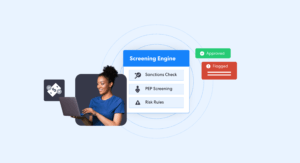
Ongoing Anti-Money Laundering (AML) monitoring is the continuous detection and prevention of suspicious activities that can potentially cause fraud, money laundering, and other financial crimes. In insurance, the process involves performing real-time Politically Exposed Persons (PEP) checks, adverse media coverage, and sanctions screening to identify high-risk customers as they evolve.
$80-100 billion is laundered every year through insurance.
Typically, ongoing AML monitoring for insurers makes use of automated tools to fetch instant results, such as changes in a customer’s risk profile. Reports estimate criminals launder $80–100 billion through insurance, mostly via life insurance products. Ongoing AML compliance not only prevents fraud but also safeguards the financial system and integrity of the sector. As a result, strong safeguards protect investors, insurers, and policyholders from illicit activity.
Ongoing Monitoring for Global Compliance
Several major regulators and jurisdictions mention the requirement of ongoing AML monitoring for insurers to satisfy AML and Know Your Customer (KYC) laws. Although the terminology varies across regulatory bodies, each recognizes the concept as essential to combating terrorist financing and money laundering.
To achieve compliance, insurance companies align their operations with sector-specific regulatory requirements. Leading regulatory frameworks include the UK’s Financial Conduct Authority (FCA) Handbook, European Insurance and Occupational Pensions Authority (EIOPA), and the US National Association of Insurance Commissioners (NAIC) Model AML Regulation. Below are key examples that show how major jurisdictions implement these standards:
United Kingdom’s FCA Handbook
In the UK FCA Handbook, insurers must actively monitor relationships with policyholders and intermediaries. For example, insurance companies are required to provide evidence of consistent customer risk profiles and customer due diligence activities. Additionally, it involves strong case management, where high-risk scenarios must be logged and escalated.
The EIOPA
The EIOPA provides insurance-specific AML supervisory expectations. In its guidelines, the EIOPA recommends ongoing due diligence for policyholders and beneficial owners. In particular, strong risk assessment for high-risk products, such as premium or life insurance. It details steps for suspicious activity monitoring, which includes unusual premium patterns or rapid changes in beneficiaries.
United States NAIC Model AML Regulation
The Financial Crimes Enforcement Network (FinCEN) oversees anti-money laundering compliance for insurance companies in the U.S. On the other hand, the NAIC Model offers a straightforward template that state insurance regulators use when enforcing AML laws. It emphasises a risk-based AML program, where due diligence is proportional to an individual or business’s risk status.
Monetary of Singapore Notice 314
MAS Notice 314 requires life insurers to continuously monitor relationships and transactions to effectively detect suspicious activity. Insurers are recommended to perform transaction monitoring, maintain current customer due diligence information, and apply enhanced monitoring for higher risk statuses, such as complex structures and jurisdictions.
AUSTRAC AML and Counter Terrorist Financing (CTF) Rules
Under the Australian Transaction Reports and Analysis Centre (AUSTRAC) AML and CTF Act, insurers must establish robust ongoing customer due diligence. This includes monitoring transactions and relationships on an ongoing basis to identify suspicious patterns. Additionally, it calls for periodic audits of KYC information for high-risk individuals and filing suspicious matter reports (SMRs).
Robust Ongoing AML Monitoring for Insurers
The insurance sector faces significant vulnerabilities that enable bad actors to funnel dirty money for criminal activity. One of the main reasons is due to legacy insurance systems, which heavily depend on manual reviews and investigations. Because of this, money launderers can easily seek short-term insurance options with quick one-off access to funds to avoid long-term investments. Ultimately, these weaknesses undermine effective fraud prevention.
However, an ongoing monitoring approach supports insurance companies in proactively identifying suspicious customer behavior or ownership changes. Real-time monitoring blocks criminals who aim to use insurance products that involve large, one-time payments and cash-out features to launder money.
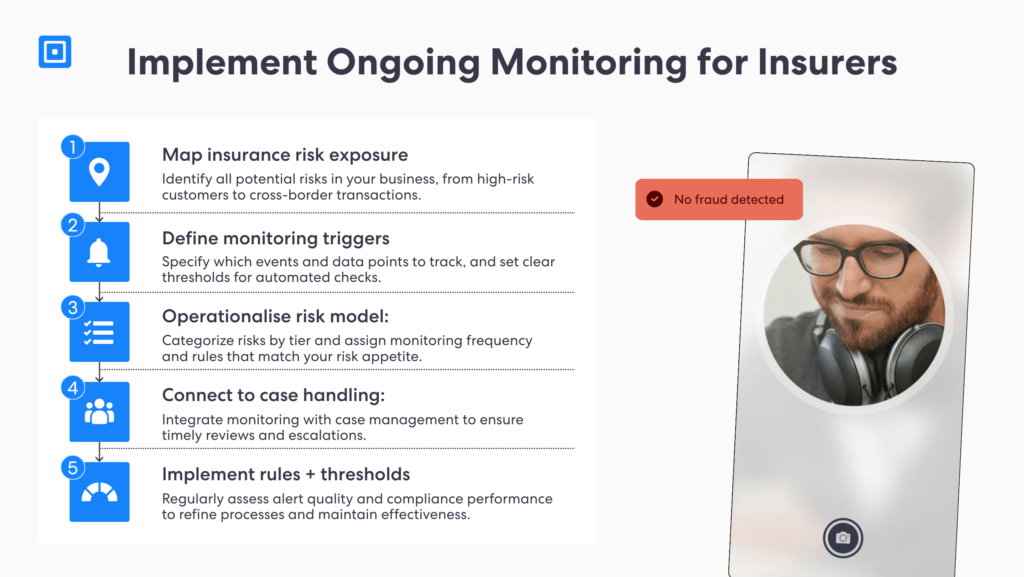
Steps for an effective ongoing monitoring process:
1) Map insurance risk exposure: List down all the risk exposures involved in your specific business. This includes high-risk user segments, cross-border jurisdictions, risky products with large deposits or easy liquidity, and third-party exposure such as intermediaries or brokers.
2) Define monitoring triggers: Develop event logs for each typical activity, such as onboarding, premiums, claims, and policy cancellations. Next, define exactly what data is collected at that moment, which checks can run automatically, and what thresholds to apply for each risk tier.
3) Build an operational risk model: Set risk tiers, for example, low, medium, and high, and define the triggers and frequency of monitoring for each. Implement rules and thresholds proportionate to the organization’s risk appetite.
4) Connect screening to case handling: Link transaction monitoring with internal case management. For example, when a policyholder makes repeated refunds, make a decision, either to close, refresh customer due diligence, or escalate to senior management.
5) Monitor metrics: Analyse the effectiveness of ongoing monitoring by looking at key metrics. These include the number of false positives generated, the volume of alerts, and backlogs. AML compliance is subject to constant changes; thus, regular monitoring of compliance activities and metrics is critical.
Risk-Based Ongoing Monitoring for Insurers
Criminals often exploit the insurance industry, necessitating strong defenses against money laundering. According to reports, 74% of insurers report facing stagnant or rising fraud cases. You can learn more here: “What is Insurance Fraud?” A Risk-Based Approach (RBA) enables insurers and financial institutions alike to identify areas of highest money laundering risk in insurance companies.
Under regulatory frameworks, such as the US Bank Secrecy Act, an RBA supports insurance companies in meeting AML compliance while enhancing customer onboarding. Insurers must scale their AML controls according to its products, customers, services, and geographies, shifting away from a one-size-fits-all approach.
A risk-based compliance program enables companies to allocate compliance resources commensurate with their risk.
For example, upon detecting suspicious customer behavior, insurers must implement enhanced due diligence. This may include verifying a legitimate source of funds or requesting additional information until concerns are resolved as a minimum standard. You can learn more here: “What is a Risk-Based Approach (RBA)?”
Case Study: Scale Operations with Fraud Prevention Solutions
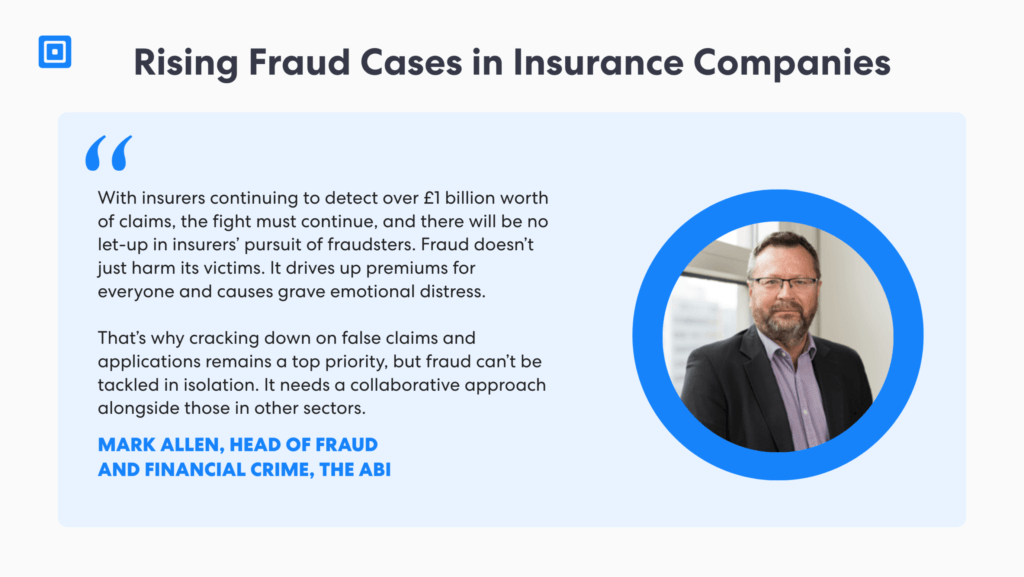
Fraudulent insurance claims continue to top over £1 billion annually. According to the Association of British Insurers, bad actors are using AI to further generate false documents, synthetic identities, and deepfakes to deceive insurers for their financial gain.
Achieve Cross-Border Compliance at Scale
Hayah, the leading digital insurer in the UAE required compliant and robust fraud prevention tools that can scale with the firm. The company partnered with ComplyCube’s AML software, leveraging comprehensive ongoing screening of its clients against trusted databases.
Outcomes
Hayah was able to screen its policyholders against ComplyCube’s trusted databases of PEP, sanctions, and watchlists in over 250+ countries and territories.
With ComplyCube’s AML fraud prevention suite, the organization automated key compliance obligations, such as enhanced due diligence, on one platform.
ComplyCube empowered Hayah to meet cross-border, insurance-specific compliance, implementing a risk-based approach to KYC and AML.
Common AML Pitfalls for Insurers
While comprehensive identity verification and anti-money laundering processes are critical, they can lead to customer friction during onboarding. For example, multiple steps and complex risk thresholds in the KYC process can lead to policyholder drop-offs and high false positives.
Instead, insurers must balance security, compliance, and seamless customer onboarding through transparent documentation, clear thresholds, and scalable processes. Additionally, training and awareness for staff are essential components of an effective AML program and build a culture of continuous improvement.
1. Bank-style rules copied into insurance: Insurance firms might apply monitoring logic from banks to policy data. This can lead to no alerts or irrelevant ones, as insurance events differ from bank payments. Instead, insurers must design rules around specific events, which include premium spikes, irregular top-ups, and failed payment attempts, et cetera.
2. Monitoring only the policyholder: Another pitfall is focusing on policyholders and excluding other partners, parties, or third-party entities. Risk can appear within the premium payer or ultimate beneficiary. Insurers must expand monitoring parameters to all relevant parties, such as controllers and beneficial owners, to receive alerts on risk changes.
3. No clear thresholds by risk tier: Next, treating all customers as the same can create rules that are either too light for high-risk scenarios or too aggressive for low-risk ones. As a result, potential threats are hidden, and genuine customers may feel alienated. Thus, firms must keep a clear document of each risk tier, low, medium and high and put them in actual insurance-based events practice.
4. Weak documentation: Lastly, monitoring can be futile without strong documentation. Authorities expect transparent audit trails to support regulatory decisions. Insurers should build documentation from day one. This includes maintaining real-time logs of available data used, rules triggered, escalations, and suspicious activity reports outcomes.
Insurance-Specific AML Software
Technology modernization plays a crucial role in managing and mitigating money laundering risks in insurance companies. Thus, many insurers are leveraging Regulatory Technology (RegTech) providers to automate and streamline compliance obligations. The key factors to look out for when choosing AML software tailored for insurance include coverage, detection quality and customization, case management and auditability, and integration and operations:
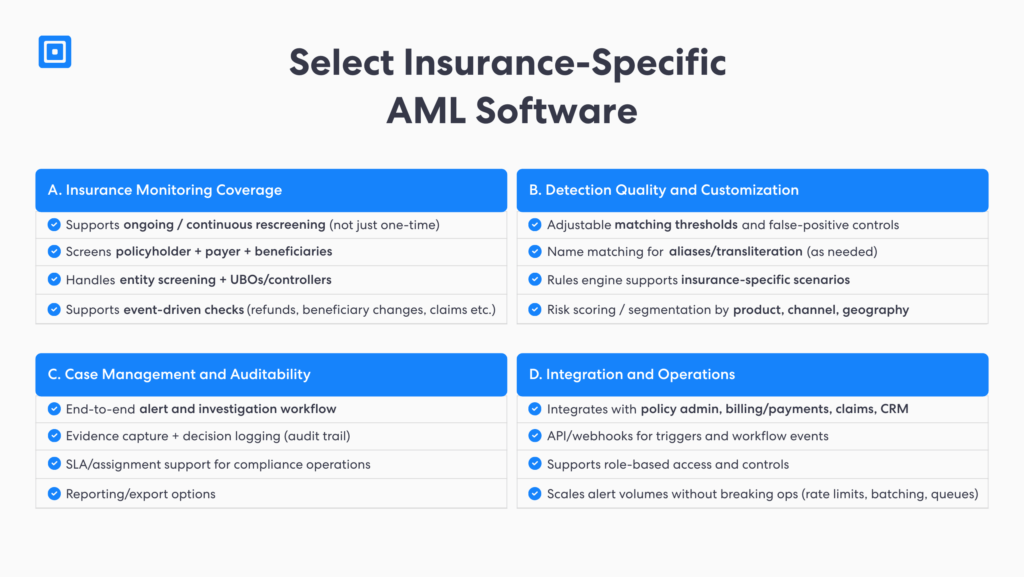
Particularly for ongoing monitoring, companies can integrate RegTech tools to track the presence of their clients in the news or on sanctions lists instantly. These providers use machine learning and AI-driven solutions to streamline the AML process, from automating data collection to advanced analytics.
Key Takeaways
Ongoing monitoring in insurance is the real-time screening of customer interactions and relationships to detect suspicious behavior in customers’ accounts.
Effective AML measures protect insurers from severe penalties, including fines and criminal prosecution, for non-compliance.
Understanding customer relationships is crucial for identifying hidden risks in money laundering activities.
Suspicious activity reports must be submitted to the appropriate authority to halt potential illicit funds and threats from further exacerbation.
Companies can integrate RegTech tools to track the presence of their clients in the news or on sanctions lists.
Meet AML Compliance Requirements for Insurance
In conclusion, ongoing AML monitoring for insurers is essential for effective fraud prevention and regulatory compliance with laws. Thus, financial institutions and insurance firms must implement robust real-time screening of business relationships and customer information to protect the integrity of financial systems. Insurers must adopt a risk-based approach to AML and are encouraged to utilize automated RegTech tools to meet stringent requirements across global jurisdictions. Contact a member of the team to learn more about how you can implement effective ongoing monitoring solutions today.

Frequently Asked Questions
What is AML meaning in insurance?
Anti-Money Laundering (AML) meaning in insurance refers to the regulations and frameworks firms must meet to prevent insurance services from being used for financial crime. It involves customer due diligence, ongoing monitoring to screen for politically exposed persons or sanctioned individuals, and reporting suspicious activities to the appropriate authorities.
Is ongoing monitoring in insurance required?
Yes. AML ongoing monitoring in insurance is required to combat money laundering and terrorism financing. AML regulations vary across jurisdictions. For example, the US FinCEN and UK FCA require insurers to implement regular reviews of written AML programs and report suspicious activity.
How often should ongoing monitoring run?
Businesses must conduct ongoing monitoring with a risk-based approach, instead of intervals. Screening must be proportional to the risk status of a product, customer, and geography. High-risk financial transactions will require granular monitoring, tighter thresholds, and faster alert escalation, while lower risk can be monitored with lighter controls.
What’s the difference between ongoing monitoring and periodic reviews?
Ongoing monitoring is the real-time screening of transactions and events to spot immediate suspicious patterns. On the other hand, periodic reviews are scheduled at intervals to ensure customer information and risk profiles are updated.
Does ComplyCube provide ongoing AML monitoring for insurers?
Yes. ComplyCube delivers automated ongoing monitoring solutions tailored for the insurance sector. Businesses can screen against trusted databases of sanctions lists, PEPs, and adverse media to meet regulatory compliance. Additionally, its no-code workflows deploy layered verification solutions to combat financial crime and money laundering effectively.