
TL;DR: As the Mobility as a Service (MaaS) sector continues to evolve, safety and compliance must take priority. MaaS operators must use the right Driver’s License Verification Service to verify a driver’s license. Beyond compliance, Driver’s License Verification Service boost passenger trust and driver retention, enhancing revenue.
Why has Driver’s License Verification Service Gained Popularity?
With several high-profile news outlets calling out industry giants (Deliveroo, Uber, etc) for illicit practices such as underage drivers over the past few years, it seems the MaaS industry is finally moving towards increased regulatory pressures and verified profiles. This gives rise to the usage of a compliant and secure Driver’s License Verification Service. Coupled with a facial biometric verification process, MaaS platforms can provide an unparalleled level of security to their customers when screening drivers. This not only protects passengers but also safeguards MaaS businesses from being vulnerable to costly penalties.
In the UK, several watchdogs have set mandates for UK drivers and residents, such as The Road Traffic Act (1988), which helps ensure that drivers have valid documentation. Increased regulatory pressures have entered the sector, with Transport for London (TFL) requiring thorough DBS for all taxi and private hire vehicle drivers within the city.
The Rise of Mobility as a Service (MaaS)
McKinsey’s quarterly report on the future of mobility emphasizes the sector’s innovative potential and significant growth prospects. It provides insights into forecasts for 2035 and details the current growth trends within the industry. The report states, “Mobility is one of the hottest sectors, with start-ups and traditional OEMs constantly developing new technologies and transportation options.”
Mobility is one of the hottest sectors, with start-ups and traditional OEMs constantly developing new technologies and transportation options.
Companies like Uber and Lyft have driven the expansion of the ride-hailing market, with many people relying on these services for their everyday transportation needs. In 2025 alone, Uber generated over $50 billion in revenue, with more than 40 million trips taken daily. The growing demand for convenient, time-saving transportation, coupled with the rising costs of vehicle ownership, fuels the continued growth of these services.
However, with the rise of these new services, MaaS operators must ensure they have the right processes to remain compliant with legislation regarding driver’s license verification. In the UK, there are several mandates that require compliance.
UK Driver’s License Verification Service
Drivers within transport services are subject to DBS checks, as well as driver’s license checks for black cab drivers. The Department for Transport (DfT), a UK government agency, published the “Statutory Taxi and Private Hire Vehicle Standards” in 2020, providing national guidance for local authorities on improving safety and standards in the taxi and Private Vehicle Hire (PVH) industry. Each local council then takes these mandates and applies them as they see fit, ensuring driver’s license data verification takes place.
Private Hire vs Taxi Licenses
In the UK, drivers may apply for either a Taxi License or a Private Hire License. The difference between these is that the latter forms part of London’s network of registered black cabs, while the former is the necessary license to work for private organizations such as Uber.
In both cases, drivers are required to undergo DBS checks to remain compliant with mandates such as the “Statutory Taxi and Private Vehicle Standards.” However, the responsibility for verifying identities often lies with the MaaS employer, as the Corporate Manslaughter Act of 2007 states that businesses that require employees to drive as part of their work (examples include MaaS platforms like Uber, Deliveroo or even Amazon), must monitor their employees’ entitlement to drive and verify driving licenses.
UK Legislation and Driver’s License Verification Service
Similarly, the DVLA states in the UK that “All employers have a responsibility and duty of care to ensure that any employee required to drive on behalf of the organization is correctly licensed and entitled to drive. Ignorance is no defense. Employees driving without a valid license may also invalidate your company insurance.” MaaS platforms must ensure their compliance with this mandate, which stems from two critical UK laws:
The Corporate Manslaughter Act 2007: Mandates that organizations that require employees to drive as part of their work must monitor their employees’ entitlement to drive and verify driving licenses.
Section 87 (2) of the Road Traffic Act 1988: This regulation makes it a crime for someone to allow another person to drive a vehicle of any type on a road if that other person does not hold a license that authorizes them to drive a motor vehicle of that class.
Unfortunately, these laws have been breached by MaaS platforms several times, with mobility giants such as Uber and Deliveroo often being named and shamed in mainstream media. A common crime amongst these delivery services is account renting, which often goes hand in hand with underage driving. Even if drivers undergo initial DBS checks, accounts are often shared with underaged drivers, pointing to a need for ongoing identity verification.
The Need for Ongoing Verification
The BBC released a news article, which highlighted the amount of underaged drivers working within Deliveroo. Whilst drivers must undergo checks when signing up to the MaaS operator, illegal account sharing with underage drivers often takes place once these checks have been carried out.
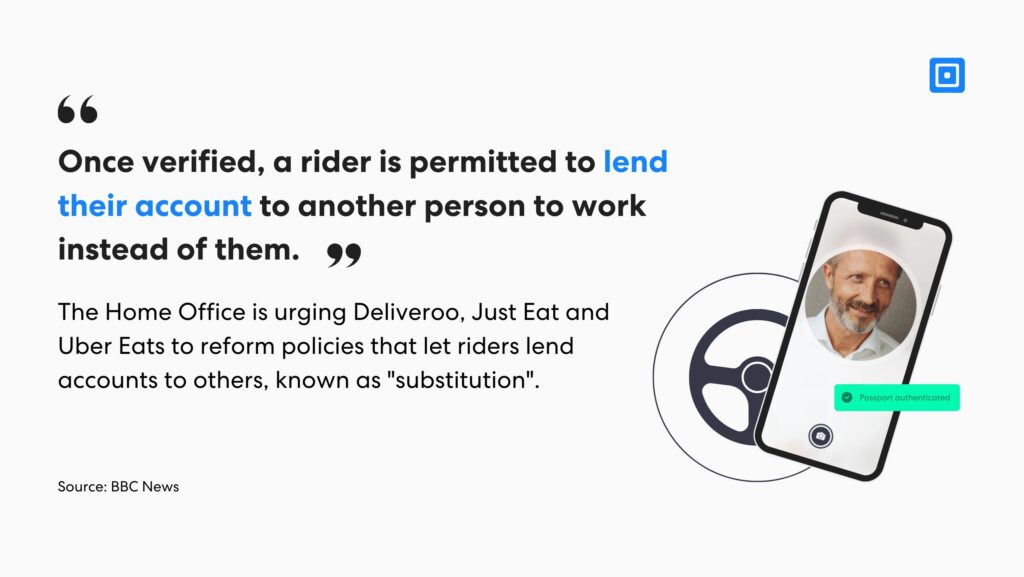
The article underlines that the Home Office are urging Deliveroo, Just Eat and Uber Eats to reform policies that let riders lend accounts to others, known as “substitution”. Ongoing identity verification could provide a legitimate solution.
Once verified, a rider is permitted to lend their account to another person.
The article reads, “Riders who sign up to work for the big food delivery apps have to pass background checks. They must verify their age, that they have no convictions, and that they are allowed to work in the UK. But once verified, a rider is permitted to lend their account to another person to work instead of them.” The piece continues on to tell the story of a seventeen-year-old who died whilst delivering food, doing a job that he should not have been able to legally do.
This is not a victimless activity.
Home Office Minister Robert Jenrick stated the following to the BBC: “This is not a victimless activity; we’ve seen a young person die when he was doing a job that he shouldn’t have been doing.” The safety within these services, in this case for drivers, is compromised without these platforms ensuring that they are investing in the right security infrastructure. However, this risk could be increased if these practices were occurring on platforms such as Uber. In this case, not only the driver is at risk, but passengers are as well.
A driver’s license verification process should be carried out continuously rather than just once once a driver has been onboarded. For optimal safety, a biometric facial verification process can be coupled with this.
Case Study: The Home Office Crackdown on Illegal Workers
In 2025, the UK’s Plan for Change was set to crack down on illegal working, particularly focused on the high-risk gig economy roles, such as ride-sharing and food delivery. The Home Office worked collaboratively with three giants in the industry, Uber, Just Eat, and Deliveroo, to close loopholes in existing identity and right-to-work controls.
The plan called for stringent security measures in the ride-sharing sector, calling for increased facial verification checks and fraud detection tools to block account sharing and document fraud. Thus, the initiative plans to protect passengers, couriers, and the wider public.
The government further seeks to tighten the law, making it a legal mandate for all firms to perform robust verification on an employee’s legal right to work in the UK before granting access to services. The failure to carry out these checks can lead to hefty penalties, including criminal liability and reputational damage.
Driver’s License Verification Service: DVLA Integration
The Driver and Vehicle Licensing Agency (DVLA) is a UK government organization responsible for maintaining records of drivers and vehicles. It issues driving licenses, collects vehicle excise duties, and ensures that drivers and vehicles meet safety and environmental standards.
ComplyCube’s enhanced driver authentication solution, powered by DVLA integration, delivers swift and accurate driver screening, a critical need for industries like Mobility-as-a-Service (MaaS), vehicle rentals, fleet management, logistics, delivery services, and ride-hailing. In these sectors, ensuring driver suitability and competence is essential for both safety and compliance. The DVLA integration enables comprehensive background checks, verifying key credentials such as license validity and driving history, ensuring that only qualified and legitimate drivers are approved, thus fostering greater safety and trust within the industry.
Key Takeaways
- The advancement of technology and growth within the gig economy have spurred expansion in the ride-sharing industry, followed by stricter regulations.
- The UK’s Corporate Manslaughter Act of 2007 mentions that businesses requiring employees to drive must monitor driving entitlement and validity.
- Ride-sharing drivers must undergo DBS checks and driver license verification to prove driving competence and a clear background history.
- Ongoing driver’s license verification service detects suspicious behaviours, including account takeovers, in real-time.
- ComplyCube integrates with the UK’s DVLA to provide MaaS firms with instant driving license status and records.
ComplyCube’s Biometric Verification
ComplyCube’s own biometric verification can also be used to ensure driver identities match ID documentation, with active liveness detection leveraged to detect attempts of presentation attacks, such as deepfakes.
From advanced document verification and biometric checks to Right to Work, DBS checks, and AML screening, ComplyCube offers a robust platform for secure driver credential verification. The integration of the DVLA API further strengthens its capabilities, cementing ComplyCube’s position as a trusted market leader for businesses focused on building secure and compliant digital ecosystems.

For more information on how to safeguard your MaaS platform, reach out to one of our Mobility compliance experts.
Frequently Asked Questions
What is mobility as a service?
Mobility as a Service (MaaS) operators integrate multiple transportation services into one application or platform for seamless passenger booking and payment. Some examples of these services are bike-sharing, public transit and ride-hailing, including firms like Uber and Deliveroo.
How does online driver’s license verification work?
Online driver verification includes document screening, whereby a driver scans their driver’s license using a camera and biometric selfies to match the license holder. Additionally, it includes database checks where the driver’s information is cross-referenced against trusted databases such as the UK’s DVLA or US DMV. These checks ensure a driver is licensed to operate a vehicle.
Is driver’s license verification required in the UK?
Yes. In the UK, ride-sharing and private hire companies must perform driver’s license verification alongside DBS checks to prevent unlicensed driving. Under the Road Traffic Act 1988 and Corporate Manslaughter Act 2007, operators must enforce license validity checks with ongoing monitoring for compliance.
What is compliant driver license verification?
Compliant driver license checks must meet state or country-specific legal standards to ensure road safety by preventing unlicensed driving. Typically, verification must confirm driver status, entitlements, and records to support compliance.
Does ComplyCube provide driver’s license verification service?
The ComplyCube platform integrates with the DVLA for instant driver license checks. Additionally, ComplyCube provides PAD Level 2-certified biometric liveness technology, DBS checks, and ongoing monitoring for MaaS operators to automate driver onboarding more securely while meeting local and global compliance requirements.