👋 Welcome back to CryptoCubed! In this CryptoCubed March 2026 Newsletter: JPMorgan Ponzi Scheme and SEC Rules edition, we see regulators’ efforts to stabilize the crypto sector. We explore dreadful fines, license revocations, and new guidance to tame fraud risks and clarify rules.
This month, we cover JPMorgan’s lawsuit, Canada’s crypto purge, Japan’s increasing crypto scrutiny, Bithumb’s $25 million fine, and the US SEC’s new token taxonomy. Let’s unpack the impact of the hottest crypto news!
JPMorgan’s Alleged Ties to Crypto Ponzi Scheme
United States, March 10, 2026 🇺🇸: JPMorgan Chase is facing a proposed class action by the California District Court for enabling a $328 million crypto Ponzi scheme to flow through the company without adequate Anti-Money Laundering (AML) guardrails.
This case revolves around Goliath Ventures, a cryptocurrency investment firm, now defunct after its CEO and founder were arrested for wire fraud and money laundering. Between 2023 and 2025, the firm made $328 million, involving 2000 investors who were lured into promises of high returns. Goliath funnelled new investor money to satisfy earlier participants, a key pattern in crypto Ponzi schemes.
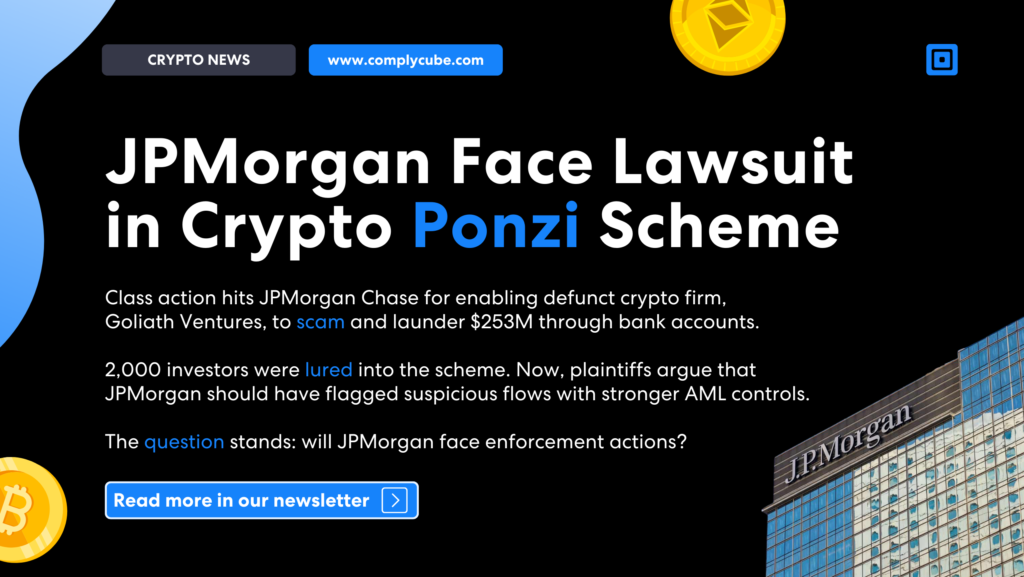
Reports indicate over $253 million flowing into JPMorgan accounts and $123 million then sent to crypto wallets at Coinbase. Plaintiffs argue that the bank overlooked Goliath’s suspicious transactions, including its rapid, high-volume flows to crypto exchanges and absence of genuine revenue.
Under FinCEN, these red flags should have been submitted in its Suspicious Activity Reports (SARs). Just last year, JPMorgan SE faced a €45 million fine (USD $52 M) for breaching Germany’s Money Laundering Act. The question remains: could this lawsuit trigger additional regulatory fines?
For more on this story, click here.
Canada Sternly Revokes 23 Crypto Firms’ Licenses
Canada, March 18, 2026 🇨🇦: The Financial Transactions and Reports Analysis Centre of Canada (FINTRAC) retracted 23 cryptocurrency-linked Money Services Businesses (MSBs) in the country. This action reflects the country’s stern stance on AML compliance in crypto firms.
Our government will continue to monitor and pursue new measures to address risks posed by virtual currency businesses.
In its reports, FINTRAC noted that these firms significantly violated AML obligations, preventing effective mitigation of fraud and money laundering in the country. Out of the breaches mentioned, the majority were related to the failure to file necessary Suspicious Transaction Reports (STRs) or Large Virtual Currency Transaction Reports promptly.

Further violations include not meeting registration eligibility requirements and the inability to update records on time. 2 of the 23 firms were based outside Canada: Slovakia and the United Kingdom. Without registration, these firms must cease and freeze all operations. Canadian crypto firms are now facing the intensity, marking their shift towards automated, proactive KYC and reporting for compliance.
For more information, click here.
Japan Triples Prison Time and Fines for Crypto Services
Japan, March 16, 2026 🇯🇵: Japan’s Financial Services Agency (FSA) launches a new proposal, indicating tougher enforcement action on unregistered crypto sales. This move aims to increase the protection of investors against fraudulent or unregistered crypto operators.
In 2025, the crypto exchange market size reached $3,657 million, with Japanese investors’ crypto assets surpassing a record 5 trillion yen (USD $33.16 B).
Against rising cryptoasset ownership, Japanese regulators have found a surge in complaints regarding fraudulent investments in the sector. The objective of the Financial Instruments and Exchange Act (FIEA) framework is to close these persistent gaps in illicit crypto trading.

Payment Services Act (Current) vs Financial Instruments and Exchange Act (Proposed):
- Penalties increased from 3 years to 10 years’ jail time for non-compliant crypto firms
- Monetary fines now shift from ¥3 million to a hefty ¥10 million (USD $67K)
- Crypto firms now face heightened disclosure obligations to users, such as the nature and functions of the cryptoasset, supply volume, technology, and inherent risks
- Disclosures must be provided at the point of selling a cryptoasset, and on an ongoing basis, including updating users on any changes promptly
- Investment seminars and similar advisory-style activities could be treated as regulated investment businesses
For more on this, click here.
Bithumb’s Long-Awaited $25 M Fine Matches Earlier Predictions
South Korea, March 16, 2026 🇰🇷: The past few months have been daunting for South Korean crypto firms, as the country’s Financial Intelligence Unit (FIU) slams multi-million dollar fines on leading crypto services, one by one. We’ve covered Upbit’s $25 million penalty last November and Korbit’s $1.9 million fine this January. Now, Bithumb joins the list with a brutal $24.6 million for AML failures.
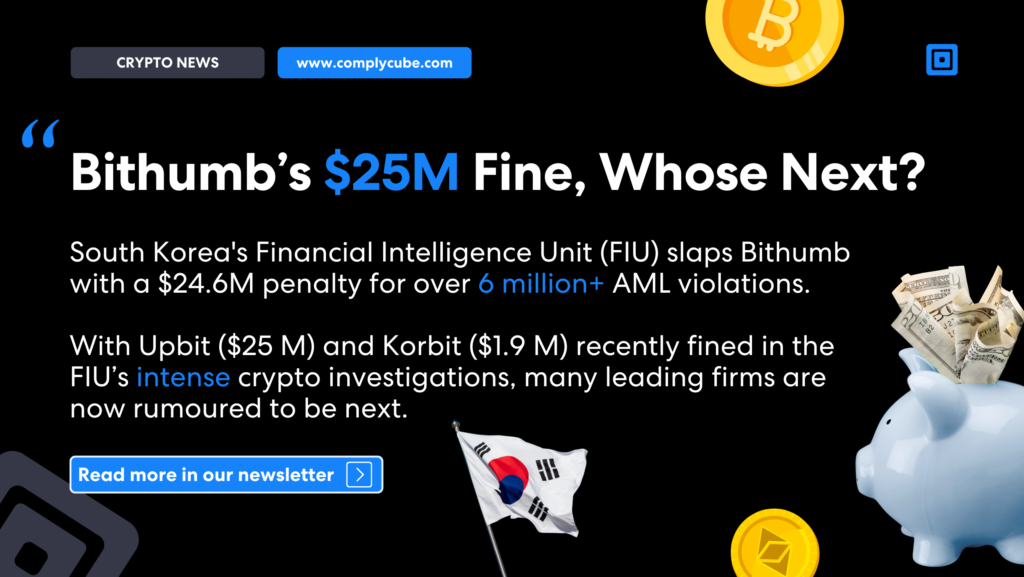
Investigations by the FIU found over 6 million AML violations. Out of them, the company failed to verify customer identities in 3.55 million cases and made 45,772 dealings with 18 unregistered foreign exchanges. These breaches left Bithumb’s customers and South Korean citizens exposed to terrifying fraud and money laundering risks.
The company now faces a six-month suspension, whereby new users are blocked from onboarding, deposits, and withdrawals. The fine matched many industry insiders’ predictions of a $25 million plus penalty, given the scale of the business. Now, many are waiting to see which company will be next.
Find more on this story here.
Securities and Exchange Commission (SEC) Refines Crypto Law
United States, March 17, 2026 🇺🇸: The US SEC has launched its new guidance on how securities laws apply to crypto firms. Crypto is now segmented into five categories, with securities laws applicable to only digital securities, ending years of confusion around regulations.
The United States is home to the largest crypto market globally, with over $1 trillion in transaction volume in only 7 months last year.
The new framework proposed by the SEC will now help crypto providers understand what is regulated and not. As a result, these firms can better improve their compliance framework and avoid risky lawsuits that undermine operations. Tokens are now split into five sections according to their functionality:
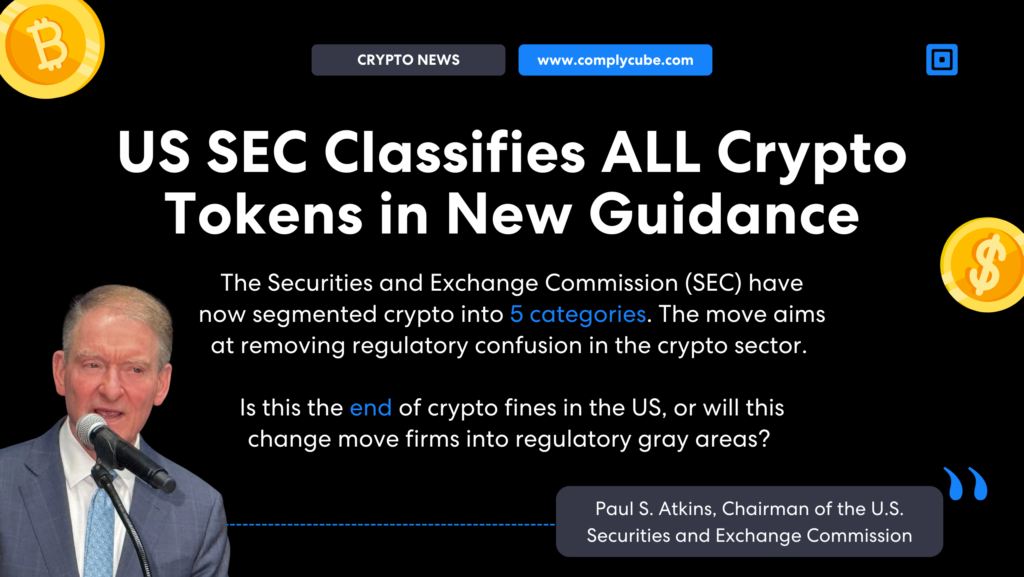
Tokens are now split into five sections according to their functionality:
- Digital Commodities: These are freely tradeable assets deemed “digital gold,” and are not controlled by a central company. The value comes from market supply and demand.
- Digital Securities: These act as investments, as customers expect profits driven by a team’s ongoing efforts. Thus, it’s treated as shares which require full SEC registration and disclosure.
- Stablecoins: Refers to digital tokens linked to a currency, such as the US dollar. They are used more for payments and not to generate investment returns.
- Collectibles: Unique items, including art or gaming assets. These are exempt under the SEC unless they are being sold as investment shares, where users expect profitability from them.
- Digital Tools: Users buy tokens or assets to access software or digital services. There are no profit expectations present.
This distinction matters as under US securities laws, crypto firms face tougher AML implications. However, many are still challenging the vagueness and the practicality of the proposed changes. Will this move lead to significant innovation in the crypto scene, or will it lead to the proliferation of compliance uncertainty?
Find more on this story here.
Time for Some Light-Hearted Creative Criticism?
So you’ve made it to the end of our newsletter. It’s time to enjoy a little satire, worthy reader, you’ve earned it.
🔥THE CRYPTO CUBED POEM: MARCH🔥
JPMorgan faces stumbles, as Ponzi funds flow free,
Goliath’s promises lure investors, blind to AML debris.
Canada revoked plenty of licenses, with 23 firms grounded cold,
FINTRAC’s blade falls swiftly on suspicious activities untold.
Japan triples penalties for crypto shadows sly,
The FSA fortifies, no unregistered high.
Bithumb’s billions fined match whispers long foretold,
While the SEC carves five paths for crypto firms bold.
Stay tuned for our April newsletter, and have a great month!