TL;DR: With financial crime at an all-time high, AML watchlist screening software has become a critical tool for financial institutions, fintech, and regulated enterprises. The tools are designed to proactively identify and mitigate money laundering risks against vast global watchlists. This guide explains watchlist checks and how to ensure AML compliance.
What Is AML Watchlist Screening?
Anti-Money Laundering (AML) watchlist screening is the automated matching of customer data, names, addresses, and identification numbers against authoritative lists. Individuals and entities on this watchlist are considered high risk by authorities due to their potential connection with criminal activities. Key examples of this list include:
- Sanctions Lists: Government and international issuances.
- Politically Exposed Persons (PEPs): Individuals with public influence worthy of note.
- Adverse Media: Media sources that could be indicative of potential risk.
- Law Enforcement and Enforcement Actions: Agencies under investigation or the subject of enforcement.
Scanning customers against updated global lists enables firms to maintain compliance with regulatory requirements. Additionally, real-time, automated screening is performed for organizations to instantly detect high-risk individuals, supporting financial crime prevention.
Major Features of AML Screening Solutions
Sophisticated AML watchlist screening software has advanced capabilities to enhance compliance processes. They include critical features that empower businesses to meet anti-money laundering obligations and make informed decisions quickly. For example, these key features include extensive databases, artificial intelligence, and customizable no-code workflows:
1. AI-Based Matching and Minimal False Positives
Fuzzy matching, phonetic verification, and other automated workflows run on sophisticated AI engines that accurately identify potential matches. Additional machine learning algorithms strengthen and sharpen screening tools. As a result, businesses minimise manual review workloads and reduce false positives.
2. Monitoring in Real-Time and Ongoing
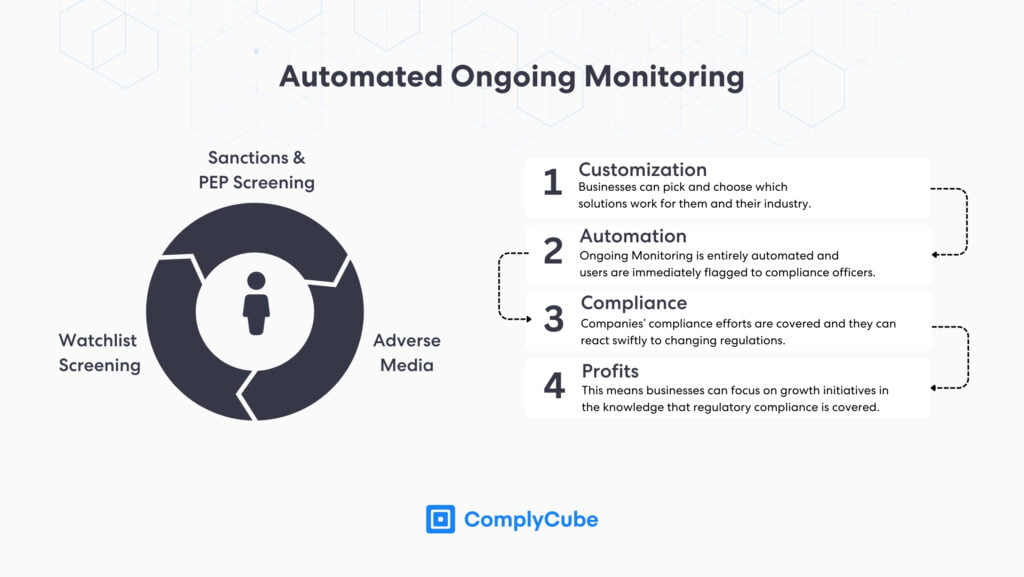
Real-time monitoring capability allows rescans of customer data daily against updated watchlists. This allows any changes to a customer’s risk profile to be automatically identified, allowing timely compliance action. Ongoing monitoring helps businesses stay within their risk tolerance by detecting any changes in risk. These changes include a client appearing in adverse media or being added to a sanctions list.
3. Customizable Risk Scoring and Workflows
AML screening solutions allow organizations to make risk scoring and screening logic customizable by jurisdiction, customer type, and so on. Strong case management can route alerts to the correct teams so that investigations can be effective and contextual. Most regulators suggest following a risk-based approach to AML, which is why creating segmented risk profiles and customizable workflows is critical to meeting compliance requirements.
High-risk individuals can be identified based on a wide variety of data points obtained from watchlist screening. High-risk profiles often require enhanced due diligence to verify that the business or individual is not tied to any illegal activities. You can learn more here: “What is a Risk-Based Approach (RBA)?”
4. Audit Trails and Reporting
Comprehensive audit capabilities are critical for demonstrating a strong screening process. Leading organizations automatically logs all screening activities and updates. As a result, businesses build a defensible, tamper-proof audit trail. Built-in reporting tools enable firms to track decision-making and outcomes across customer onboarding and beyond.
5. Database Coverage
Effective AML watchlist screening software offer access to global watchlists data, such as the UK HM Treasury, U.S. Department of the Treasury’s Office of Foreign Assets Control (OFAC), European Union Consolidated Financial Sanctions List, and more. Leading organizations integrate global sanctions list, enforcement databases, watchlists, and politically exposed persons registries for robust screening processes. With large breadth of data sources, companies gain an overall view of risk across their customer base.
Best Practices for Successful AML Watchlist Screening
Effective and secure watch list screening processes ensure compliance. Compliance teams are better equipped to detect and prevent money launderers and financial crime from further damage. However, effective screening processes go beyond just technology.
Industry experts recommend a proactive, disciplined approach to compliance. According to Chief Product Officer and AML Specialist, Harry Varatharasan, “Organizations can significantly enhance AML and sanctions programs through well-trained teams, risk-based screening, and key data points.” To achieve positive outcomes from AML watchlist screening software, implement the following best practices:
- Periodically Update Watchlists: Ensure watchlists are updated periodically to reflect the latest sanctions and regulatory information.
- Emphasize Risk-Based Screening: Focus on more risky customers and transactions to optimize compliance measures.
- Compliance Staff Training: Train personnel with the capability to interpret the output of screening and process alerts in a proper manner.
- Leverage Sophisticated Analytics: Employ data analytics to identify patterns and trends that can indicate future risk.
Apply Industry-Specific AML Watchlist Screening Software
Different industries face varying risks of financial crime, requiring tailored screening solutions to meet specific needs. For example, regulated entities, such as those in crypto and banking typically face higher risk due to large volume and rapid transactions. Thus, tailored solutions and resources are needed to screen payments, customers, and sector regulations effectively:
1. Financial Institutions (Banks & Credit Unions)
Banks use AML software to screen new and existing customers against global watchlists (sanctions, politically exposed persons) during onboarding and transactions. The finance sector is the main target of AML related crimes, so this sector specifically must ensure a strong risk-based approach during identity verification and ongoing monitoring to be notified of changes in customer risks.
2. Fintech Companies (Payment Platforms & Digital Wallets)
Fintech platforms must screen customers during account creation and for large transactions, matching their data against sanctions and PEP lists. This is because fintechs operate in fast-moving environments, where rapid customer onboarding increases exposure to risk. Companies in this industry can integrate risk scoring to focus resources where risk is highest, thereby reducing false positives.
3. Casinos & Gambling Platforms
Casinos use AML screening to monitor large bets and withdrawals, screening players against sanctions lists. Due to the cash-intensive nature of this industry, comprehensive watchlist screening is mandated by several regulations. High-value bets, deposits, and withdrawals from players can be cross-checked against global sanctions, adverse media, and PEP databases to effectively deter fraud.
4. Real Estate
Real estate agents screen buyers and sellers against sanctions lists to prevent money laundering through property investments. High-value deals trigger enhanced due diligence for flagged individuals or entities. Screen real estate buyers, sellers, and ultimate beneficial owners (UBOs) against sanctions, enforcement, and PEP lists.
5. E-commerce
E-commerce platforms screen sellers and large transactions for potential money laundering risks, especially in cross-border sales. These platforms manage diverse participants and large volumes, making them susceptible to AML risks. Thus, comprehensively screen merchants, international transactions, and large volumes to identify suspicious activity.
6. Insurance Companies
Insurance providers screen policies during underwriting and claims processing to ensure clients avoid involvement in fraud or money laundering. Screening applicants and beneficiaries during underwriting and claims processing is essential for insurance-specific regulations. Additionally, automated screening can simplify compliance processes and lower operational costs. You can learn more here: “Ongoing AML monitoring for insurers.”
Select Top-Rated Watchlist Screening Software
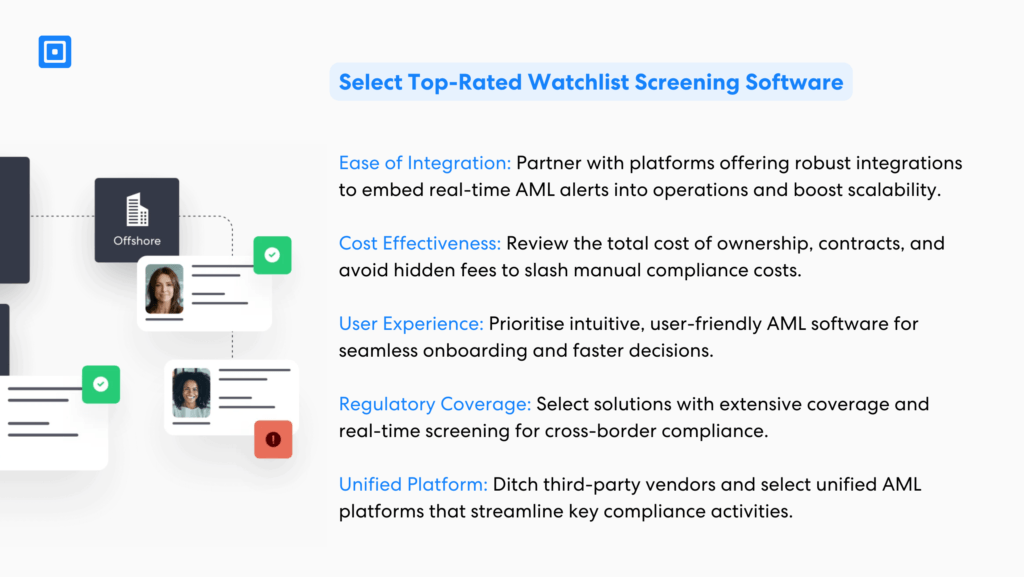
To select the best watchlist screening software for your business, an understanding of integration requirements, regulatory obligations, and customer segments is key. The most suitable software supports a smooth customer experience and boosts long-term operational efficiency:
1. Ease of Integration
New solutions are smoothly incorporated into existing systems through APIs and SDKs. This scalability enables AML screening to grow in tandem with the organization, accommodating expanding volumes of transactions and rising regulatory pressures.
Partner with a compliance platform that integrates easily with your technology to embed real-time alerts directly into your operations. This strengthens risk detection across the customer lifecycle and maintains a holistic approach towards compliance management.
2. Cost Effectiveness
Cost-effective watchlist screening software offers highly customizable automated screening tools, so compliance teams can further reduce manual compliance costs. Additionally, review platforms and contracts to avoid complex pricing or hidden costs.Thus, it is crucial to evaluate the total cost of ownership (TCO), including setup fees, data resources, and refreshes according to business needs.
3. User Experience
The most important factor to grow a business is a satisfied customer base. Organizations should opt for software with a clear, intuitive design for seamless customer onboarding. A platform that provides customizable interfaces and access to real-time data enables faster decisions, enhancing customer satisfaction during onboarding.
4. Regulatory Coverage
Comprehensive international, regional, and local watchlists encompass over 250 countries and territories. This ensures that businesses can carry out needed risk assessment on each client through global sanctions screening to ensure regulatory compliance. A reliable provider updates global sanctions, PEP, enforcement, and adverse media lists regularly, reflecting the latest changes from authorities.
5. Unified Platform
Rather than using third-party screening vendors, modern watchlist screening solutions unify AML compliance obligations. They provide access to unified onboarding checks, ongoing monitoring, and reporting to ensure compliance. This centralised approach enables teams to manage decisions by date to maintain accurate audit trails. Ultimately, an all-in-one platform with artificial intelligence and automation helps fetch faster data sources, further unifying AML compliance.
Key Takeaways
Modern watchlist screening software enables businesses to cross-check customers and entities against sanctions, watchlists, PEP, and adverse media coverage.
Watchlist screening is required for businesses to detect and prevent money laundering, fraud, and terrorism financing.
AI-powered automated screening empowers quicker and accurate detection of risky individuals, reducing manual reviews and enhancing efficiency.
Regulated markets such as fintech, crypto, and banks are subject to stringent AML screening requirements due to sector-specific vulnerabilities.
Regulatory coverage, integration capability, pricing model, and user experience must be accounted for when choosing watchlist software for business needs.
The Future of AML Screening Software
The future of AML Watchlist Screening Software rests on how fast and deep the adoption of new technologies such as machine learning, natural language processing, and blockchain analytics takes place. These technologies can potentially drive screening accuracy and efficiency even higher, and organizations will be able to stay ahead of evolving financial crime schemes.
Businesses that want to stay ahead of their competition in terms of both security and compliance should prioritise meeting AML standards globally, and using sophisticated AML watchlist screening software is a great place to start. For more information on how to integrate AML watchlist screening and fortify your business operations, get in touch with one of our compliance experts.
Frequently Asked Questions
What is a screening software?
In compliance, a screening software equips firms to automatically check customers and entities against trusted databases, including sanctions and watchlists, to uncover high-risk parties. Screening software streamlines AML compliance and enables the prevention of fraud, money laundering, and terrorist financing.
What could be the most important objective of watchlist screening?
The main objective of watchlist screening is to enable companies to detect and prevent themselves from forming relationships and doing transactions with sanctioned or high-risk individuals and entities. Therefore, safeguarding the business from potential crime and fines, as well as protecting customers.
What is a watchlist in screening?
In screening, watchlists are a database that includes individuals, entities, or countries listed due to being sanctioned, having political exposure, or adverse media. These lists help prevent companies from engaging with risky individuals and entities, a key aspect of Anti-Money Laundering regulations.
What does it mean if someone is on a watchlist?
When an individual or entity is on a watchlist, it means they have been flagged as risky for either being sanctioned, politically exposed, or associated with financial crime. To stay compliant, businesses must use watchlist screening software to detect and prevent engaging with these individuals.
Which screening solution is best for your business?
The best screening solution for your business is the one that matches your sector, geography, and risk appetite. To choose the best solution, opt for real-time screening, broad coverage, seamless integration, and strong case management, such as ComplyCube, to support scalability.