# ComplyCube | Leading Identity Verification, KYC, KYB & AML Screening Platform
> ComplyCube is a leading, award-winning global RegTech and verification platform offering identity verification, KYC, KYB, AML screening and fraud prevention, with expert content, API guides & insights
> Generated by All in One SEO Pro v5.0.4, this is an llms-full.txt file, used by LLMs to index the site.
## Posts
### [FlexAML and ComplyCube Tackle Compliance Gaps ](https://www.complycube.com/flexaml-and-complycube/)
**Published:** October 22, 2026
**Author:** Rithu Jagannath
**Excerpt:** ComplyCube partners with FlexAML to help UK TCSPS tackle growing Anti-Money Laundering through automated business verification, individual authentication, tailored risk assessments and compliance-driven onboarding workflows.
**Content:**
LONDON, OCTOBER 22, 2026 – [ComplyCube](https://www.complycube.com/en/), a global IDV and compliance automation platform, has partnered with FlexAML, a specialist [Anti-Money Laundering (AML) consultancy](https://flex-aml.com), to help Trust and Company Service Providers (TCSPs) turn regulatory requirements into practical, scalable compliance processes. FlexAML and ComplyCube work together to let clients build instant global verification, authentication, and risk-based onboarding in one compliance platform.
## Growing AML Pressure on UK Corporate Services
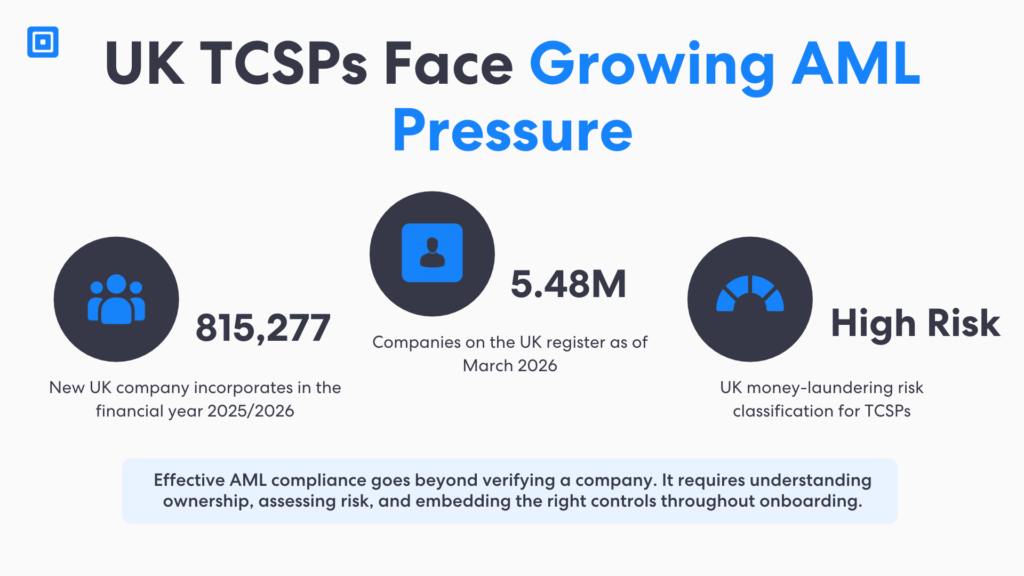
Regulatory scrutiny has increased in the UK corporate services sector due to the proliferation of financial crime. In March 2026, [Companies House](https://www.gov.uk/government/statistics/companies-register-activities-statistical-release-april-2025-to-march-2026/companies-register-activities-statistical-release-april-2025-to-march-2026) reported 815,277 new incorporations, which brought the register to approximately 5.48M companies. Meanwhile, the [UK National Risk Assessment in 2025](https://www.gov.uk/government/publications/national-risk-assessment-of-money-laundering-and-terrorist-financing-2025) classified TCSPs as a high-risk sector for money laundering.
For virtual office operators, company formation agents, and registered address providers, this misuse points to a larger and more complex operational issue. Verifying company validity is the starting point, but businesses must also determine who owns and controls it. They must also assess the individuals involved and figure out whether the company’s activities or ownership structure need more scrutiny.
[Francesca Dixon](https://coworkingeurope.net/team/francesca-dixon-founder-of-flex-aml-co-founder-of-whoeverly-uk/), founder of FlexAML, is a certified AML specialist who has encountered these issues several times over her decade-plus experience in the virtual office industry. FlexAML was established in 2025 to help operators understand regulatory requirements and implement them through practical compliance processes.
Most businesses can read guidance but don’t understand what it means for the customer journey. The challenge is creating a risk-based process. Not every customer should go through an unnecessarily difficult onboarding journey. However, they must recognize higher-risk situations and understand when additional checks are necessary.
## Helping FlexAML with Business Verification & Risk Management
FlexAML partnered with ComplyCube to help TCSPs that are seeking to strengthen their compliance operations. By combining the consultancy’s specialist industry guidance with an award-winning platform, teams can better orchestrate business verification and risk assessments. This seamlessly embeds compliance into every step by design.
Businesses can instantly verify companies worldwide. They can also authenticate [Ultimate Beneficial Owners (UBOs)](https://www.complycube.com/en/what-is-ultimate-beneficial-ownership-ubo/), directors, and company secretaries. Moreover, they can screen both corporate entities and associated individuals against sanctions lists, politically exposed persons (PEPs), databases, and proprietary financial crime intelligence sources.
So, instead of managing these checks across many different fragmented systems, ComplyCube brings everything into one onboarding journey. Through our [Policy Assurance](https://www.complycube.com/en/solutions/compliance-suite/policy-assurance/) capabilities, businesses can also incorporate Companies House data into their compliance workflows. This lets companies apply tailored rules to assess company data, ownership, and jurisdictional exposure.
This information feeds into a specialized risk matrix, allowing compliance teams to trigger more due diligence or human review when significant risks arise. For example, sanctions matches will be flagged, while lower-risk applicants can move through a streamlined onboarding process.
This gives compliance teams much greater control over the required checks, how risks are reviewed, and when cases must be escalated. [Francesca](https://www.linkedin.com/in/francesca-dixon-862699154/) is particularly interested in how FlexAML can turn a client’s AML framework into a practical workflow. Her TCSP experience directly helps teams design their compliance logic based on real-world experiences. ComplyCube provides the technology required to put compliance frameworks into practice.
## Strengthening Compliance Beyond Initial Verification
Centralized risk management is necessary for customer relationships. Changes in company ownership, directors, business activities, or sanctions exposure may require further [Customer Due Diligence (CDD)](https://www.complycube.com/en/solutions/due-diligence-compliance/customer-due-diligence/) well after onboarding. ComplyCube’s ongoing AML screening and configurable risk management give businesses full visibility into relevant screening risks, support periodic reviews, and route cases needing human judgment to compliance professionals.
For TCSPs, using business verification, authentication, screening, and risk assessment all in one system can reduce fragmented processes. It also supports more consistent, explainable compliance decisions.
> For TCSPs, compliance is about verifying who is behind a business.
[Milosh Caunhye](https://www.complycube.com/en/solutions/due-diligence-compliance/customer-due-diligence/), Solutions Consultant at ComplyCube, also said, “Compliance is also about finding potential risks, and having the right controls to act on them. We are giving compliance teams greater control over every onboarding decision. Our relationship with FlexAML bridges the gap between regulatory expertise and technology.
By advocating for ComplyCube’s capabilities, FlexAML helps UK corporate service providers strengthen their financial crime controls without sacrificing operational efficiency.
## About ComplyCube
[ComplyCube](https://www.complycube.com/en/contact/), a global leader in IDV, KYC, and AML screening, empowers businesses to build trust at scale. Using advanced biometric authentication, global business verification, and fraud intelligence, it enables businesses to manage risk. ComplyCube’s cutting-edge technology and configurable workflows help organizations strengthen regulatory compliance, fight financial crime, and deliver seamless digital customer experiences.
## About FlexAML
Founded in 2025, FlexAML [specializes in AML compliance](https://flex-aml.com/contact-us/) and operational support for TCSPs, primarily virtual office and flexible workspace operators. With more than a decade of experience, FlexAML helps businesses build practical, deliberate compliance frameworks.
**Categories:** News
**Tags:** Announcements
---
### [Top 6 AML KYC Solutions for Unified Compliance in 2026](https://www.complycube.com/top-aml-kyc-solutions-for-unified-compliance/)
**Published:** September 18, 2026
**Author:** Dini Habib
**Excerpt:** An AML/KYC comparison matrix helps firms choose vendors that best support their sector, customer, and country-specific risk-based workflows. Compare the market-leading regulatory SaaS platform against current regulatory mandates.
**Content:**
**TL;DR:** An AML KYC SaaS platform helps **reduce fragmented** compliance operations. The best **AML KYC solutions unify** identity verification, screening, and monitoring. Regulated businesses can compare KYC AML solutions based on coverage, automation, and risk controls.
## What Does Unified Compliance Mean?
Unified compliance combines Know Your Customer (KYC), Anti-Money Laundering (AML), risk assessment, and monitoring processes into one single platform. This unified approach lets firms manage AML and KYC compliance needs through a connected workflow.
For example, identity verification establishes trust during onboarding, while sanctions and Politically Exposed Persons (PEPs) screening, risk-based checks, and ongoing monitoring help identify changes after onboarding. When these signals feed into the same framework, teams can apply proportionate controls and maintain clear decision-making records.
For teams evaluating AML KYC solutions, the value of unified compliance is hard to ignore. It eliminates fragmented workflows, strengthens regulatory coverage, enables policy consistency, and boosts operational efficiency. The best platform thus goes beyond merely stitching these tools together. Instead, it connects customer identity, risk signals, and compliance controls within one operating model.
## How to Evaluate Unified AML KYC Solutions
To evaluate AML KYC solutions, businesses should use established AML and Counter Terrorism Financing (CFT) regulatory principles, along with a practical criteria matrix to assess how a platform connects compliance controls. The Financial Action Task Force (FATF) Recommendations have [over 200 countries](https://www.fatf-gafi.org/en/countries/global-network.html) committed to its AML and CFT guidance.
This guide uses FATF’s risk-based approach and [Customer Due Diligence (CDD)](https://www.complycube.com/en/what-is-customer-due-diligence/) principles as a reference, alongside relevant UK, EU, and US regulatory expectations. In particular, it will evaluate a platform based on how well it applies the risk-based approach, CDD, and ongoing monitoring.

To reflect today’s regulatory landscape, it also considers the UK’s latest AML and Asset Recovery Strategy, the European Banking Authority (EBA) Risk [Factor Guidelines](https://www.eba.europa.eu/legacy/regulation-and-policy/regulatory-activities/anti-money-laundering-and-countering-financing-1), and also the US Bank Secrecy Act (BSA) Customer Identification Program (CIP) [guidance](https://www.regulations.gov/document/FINCEN-2024-0009-0001).
The factors taken into account when evaluating AML KYC solutions include:
**1. KYC and Know Your Business (KYB):** Customer and business verification, including document and non-doc checks such as [liveness detection](https://www.complycube.com/en/solutions/due-diligence-compliance/know-your-customer/liveness-detection/), electronic identification (eID), and beneficial ownership.
**2. Ongoing AML screening:** Screening for sanctions, PEP, watchlists, and adverse media to detect changes in risks over time.
**3. Risk-based workflows:** Customizable checks, risk factors, weightings, and thresholds to apply appropriate due diligence and reflect a company’s risk appetite and operating model.
**4. Clear audits:** Review alerts, manage escalations, and maintain a [time-stamped](https://www.complycube.com/en/solutions/due-diligence-compliance/case-management/) record of every compliance decision made.
**5. Fraud intelligence:** Block suspicious users via risk signals from device, email, and phone usage and behavior.
**6. Regulatory coverage:** The platform supports specific regulatory mandates across business jurisdictions, customer types, documents, and verification methods.
## Key Differentiators in AML KYC SaaS Platform
The best AML KYC solutions isn’t one with the most features. Instead, it connects multiple compliance signals to trigger faster, more proportionate due diligence and decision-making. After meeting core KYC and AML requirements, several differentiators stand out in market-leading platforms.

These solutions combine high-quality screening data, [configurable risk scoring](https://docs.complycube.com/documentation/product-guides/due-diligence-tools/risk-profile), and automation.
- **Screening data quality and freshness:** Buyers should examine the accuracy, depth, and update frequency of the data sources used during AML screening.
- **AI, machine learning, and automation:** [Automated KYC solutions](https://www.complycube.com/en/the-importance-of-automated-kyc-verification/) can reduce manual effort by up to 94% and enable smarter alert prioritization, decisioning, and risk analysis.
- **Scalability and performance:** How the platform can handle sharp increases in check volume, new markets, or complex requirements without operational blockers.
- **Policy assurance:** Businesses can translate internal compliance policies into operational controls and apply the required checks consistently.
- **Integration and usability:** How the platform integrates with existing systems via APIs, SDKs, and hosted workflows as well as how user-friendly it is to customers.
- **Total Cost of Ownership (TCO):** Cost, installation effort, internal resources, ongoing operational costs, and hidden costs.
### **Case Study: New UK AML and Asset Recovery Strategy**
This month, the UK’s Home Office and HM Treasury presented its UK’s AML and Asset Recovery Strategy. The aim of it is to establish smarter risk-based decisions, quicker recovery of illicit assets for victims, and to dismantle complex criminal networks.
##### **Empower, Target, and Integrate**
Specifically, the [strategy](https://www.complycube.com/en/uk-aml-and-asset-recovery-strategy/) relies on three core principles. Namely, empower businesses and technology to boost AML intelligence, target resources on high-risk activity, and integrate synchronicity to take down large money laundering operations.
##### **Outcomes**
- The strategy establishes risk-based programs as crucial, echoing many other leading regulations.
- A risk-based framework improves the experience for low-risk customers while increasing scrutiny where risk is higher.
- Businesses should expect more documentation on the effectiveness of their risk-based framework, including decision and escalation evidence.
## The 6 Best Unified AML KYC Solutions Providers in 2026
The six providers that stand out in 2026 differ in how they combine identity verification, AML screening, ongoing compliance, and policy assurance. Businesses evaluating an end-to-end compliance provider must clearly understand how those capabilities work together across the entire customer lifecycle.
ComplyCube offers the broadest combination of KYC, [KYB](https://www.complycube.com/en/use-cases/process/know-your-business/), ongoing AML screening, risk decisioning, and compliance workflows. Meanwhile, SEON, NICE Actimize, ComplyAdvantage, Sumsub, and Persona have different specialist focuses on fraud prevention, monitoring, and workflow orchestration.
For businesses prioritizing a connected AML/KYC operating model, ComplyCube ranks first in this guide because of its combination of identity and business verification, ongoing AML screening, configurable risk decisioning, and Policy Assurance.
### 1. ComplyCube: Unified Regulatory Compliance and Risk Assurance
ComplyCube helps businesses consolidate their core compliance infrastructure on one platform while maintaining consistent, explainable controls over their risk policies and appetite. The platform supports KYC, KYB, ongoing AML screening, configurable risk decisioning, and fraud intelligence.
In particular, its [Policy Assurance](https://www.complycube.com/en/solutions/compliance-suite/policy-assurance/), KYC Smart Forms, and advanced case management solutions help businesses confidently meet regulator-aligned AML and KYC compliance across 250+ jurisdictions.
### ComplyCube provides end-to-end financial crime, risk, and compliance infrastructure:
- **High Identity Assurance:** ComplyCube offers document verification with support for over 14,000 document types, proof of address, liveness checks, age estimation, 2+2 multi-bureau, driver verification, right to work, eIDAS-compliant [eID verification](https://www.complycube.com/en/what-is-digital-identity-verification-fintech/) for KYC compliance in every market.
- **Regulatory and Policy Assurance:** The platform maps regulatory requirements and internal policies into automated user journeys. It provides ready-to-use, compliant policy templates for specific regulatory frameworks, such as the Monetary Authority of Singapore (MAS) CDD rule.
- **Deep Risk Decisioning:** Its Custom Risk Engine solutions let businesses apply their own approved risk methodology via configurable risk factors, weightings, and thresholds. Automated risk ratings reflect changes in customer risk instantly.
- **Fraud Intelligence:** Email, device, and phone intelligence that can detect high-risk users via granular behavioral and network analysis. Additionally, its OTP verification solution adds another layer of trust, blocking fraudsters at the source.
- **Operational Efficiency:** No/low-code workflows, [KYC smart forms](https://www.complycube.com/en/what-are-smart-forms/), integration options, and [esignature verification](https://www.complycube.com/en/solutions/compliance-suite/esignature/) allow businesses to gather critical identity attributes, adapt to evolving compliance mandates, and build regulatory trust.
A key differentiator is ComplyCube’s Policy Assurance capability, which helps businesses translate regulatory requirements and internal compliance policies into operational verification journeys. Combined with KYC Smart Forms, risk-based workflows, and case management, this helps teams apply appropriate checks, maintain decision records, and adapt compliance processes across markets.
Furthermore, ComplyCube has a transparent TCO structure, with pricing at $99/month for Starter and $299/month for Core. Moreover, it maintains enterprise security and assurance credentials, including ISO 27001 certification, ISO 30107 PAD Level 2-certified liveness detection, and certification against the UK Digital Verification Services (DVS) Trust Framework.
### Takeaway
ComplyCube offers every core capability assessed in this guide. The depth of tools supported by the AML KYC SaaS platform is undeniable. Moreover, businesses can fully satisfy compliance obligations by applying regulatory policies and risk methodologies consistently and at scale.
### 2. SEON: Fraud Prevention Approach
SEON focuses on fraud prevention and financial crime risk detection, combining digital footprint analysis, device intelligence, behavioural indicators, and screening. Its strength lies in helping businesses identify suspicious activity/behaviour across multiple signals during customer interaction.
The firm helps businesses manage money laundering and terrorist financing risks. However, jurisdiction-specific regulatory coverage, KYC control depth, and policy assurance must be evaluated thoroughly for a broader, unified AML/KYC solutions platform.
### 3. NICE Actimize: Financial Crime Infrastructure
NICE Actimize acts as a broad financial crime platform. It has a Client Lifecycle Management suite which supports [due diligence checks](https://www.complycube.com/en/enhanced-due-diligence-edd-insights-challenges/), watchlist screening, transaction monitoring, and risk assessment. Its CDD capabilities include multi-dimensional customer risk ratings, sanctions and PEP screening, adverse media checks, and behavioral transaction analytics.
However, that enterprise sophistication can also act as a trade-off. Therefore, it is crucial to consider the breadth and complexity of the required infrastructure. This matters most for businesses that need a quick, lightweight, API-first KYC implementation and simpler day-to-day compliance operations.
### 4. ComplyAdvantage: Risk Intelligence
ComplyAdvantage specializes in financial crime intelligence, covering [sanctions](https://www.complycube.com/en/global-sanctions-check-2025-essential-updates/), PEP, watchlist, adverse media, and ongoing customer monitoring. Its Mesh platform combines customer and payment screening with ongoing monitoring. One differentiator is its screening data. For example, the company says sanctions list changes can be reflected within minutes.
Its APIs also let organizations tailor screening parameters and risk controls. However, buyers seeking unified compliance should consider how much additional technology is needed to support identity verification, KYB, policy assurance, and end-to-end onboarding.
### 5. Sumsub: Broad Compliance Stack
Sumsub has a broad compliance stack, covering [AML](https://www.complycube.com/en/aml-compliance-software-solutions/), identity verification, and case management. Its Workflow Builder allows firms to create conditional verification journeys. Additionally, its case management solution connects screening alerts and suspicious activity to structured investigations.
However, the trade-off can be its commercial complexity. For example, in 2026, the company integrated ComplyAdvantage Mesh to support its financial crime risk intelligence. For businesses, the key question is how much regulatory logic and risk governance can be controlled natively within the platform, rather than by feature count.
### 6. Persona: Configurable Workflows
For [workflow](https://www.complycube.com/en/aml-with-no-code-compliance-workflow-software/) customization, Persona stands out. Its no-code and code-extensible workflows can combine internal information, risk signals, and external data before applying custom decision rules, triggering re-verification, or opening cases for investigation. Moreover, the platform offers core AML tools, such as sanctions, PEP, and Suspicious Activity Reporting (SAR) workflows.
Persona’s workflow flexibility suits advanced teams. However, firms should consider the implementation effort required to configure and maintain those workflows. This is especially true for businesses that need quick, ready-to-use regulatory policies to operationalize AML and KYC compliance.
### Key Takeaways
- **Unified AML KYC** solutions combine identity verification, screening, and monitoring together.
- **Non-negotiable** AML/KYC capabilities include risk-based workflows and ongoing monitoring.
- **Regulatory and country** coverage, screening quality, and automation differentiates vendors.
- **Full AML lifecycle** streamlines risk management and strengthens financial crime compliance.
- **ComplyCube stands** out for unified compliance due to its end-to-end AML compliance suite.
## Evaluate and Compare AML KYC Solutions in 2026
Leading compliance solutions help businesses cut costs, enhance efficiency, and tailor controls as risks and regulations change. Thus, buyers evaluating the right platform will need to shift from feature breadth to how the platform supports policy assurance, identity assurance, and risk controls.
A structured comparison of AML KYC solutions such as the one above can help firms choose technology that meets not only today’s requirements, but also evolving financial crime threats. Learn how you can satisfy KYC AML compliance with ComplyCube’s [advanced solutions today](https://www.complycube.com/en/contact/contact-sales/).
[](https://portal.complycube.com/signup)
## Frequently Asked Questions
How long does it take to implement a unified AML KYC SaaS platform?
Implementing an AML KYC SaaS platform can take from just a day to several weeks. The time taken will depend on factors such as integration capability and compliance requirements. However, API-first platforms and no/low-code workflows can speed up the set-up process.
Can we rely on a single vendor for all AML KYC needs?
Yes, a single AML KYC vendor can combine identity verification, AML screening, and suspicious activity reporting in one platform. To ensure compliance, firms should assess jurisdiction coverage, data sources, and other checks required under their risk-based compliance framework.
What are the top AML software vendors for banks?
The top AML software for banks are those that support enhanced due diligence, sanctions and PEP screening, risk assessment and ongoing monitoring. Banks should compare these providers against their AML requirements, such as regulatory coverage, screening data, and total costs
How to track the success of our AML KYC solutions?
The success of your AML KYC solutions will depend on onboarding completion rates, verification success rates, false-positive rates, manual review rates, average onboarding time, and cost per customer. Additionally, alert resolution times and the effectiveness of ongoing risk monitoring is critical to preventing financial crime and strengthening AML KYC compliance.
Can we migrate our solutions to ComplyCube?
Yes. Businesses can migrate existing KYC and AML processes to ComplyCube to consolidate identity verification, AML, KYB, and risk-based workflows within a unified platform. It offers the widest breadth of integration, including APIs, SDKs, and hosted workflows to accelerate setup within your existing compliance infrastructure.
**Categories:** Guides
**Tags:** Anti-Money Laundering
---
### [KYC Risk Assessment for Crypto Businesses](https://www.complycube.com/kyc-risk-assessment-for-crypto/)
**Published:** October 15, 2026
**Author:** Dini Habib
**Excerpt:** KYC risk assessment is a key process in an effective AML program. It identifies, assesses, and classifies customer and business risk. They are crucial for cryptocurrency businesses to prevent financial crime and ensure compliance.
**Content:**
**TL;DR:** Crypto KYC risk assessment involves identifying **high-risk customers** to prevent financial crime and meet AML obligations. An effective KYC risk assessment for crypto evaluates a user’s exposure to money laundering and terrorism financing. It includes AML risk scoring to support **ongoing monitoring** and due diligence.
## What is KYC Risk Assessment for Crypto?
Know Your Customer (KYC) risk assessment is the process of measuring a customer’s risk of involvement in financial crime. Crypto firms use risk scores from crypto KYC risk assessments to determine the level of due diligence required. KYC risk assessments are essential in ensuring regulatory compliance. They are especially crucial for cryptocurrency businesses as they operate in a high-risk sector.
> In 2025, crypto money laundering [hit $82 billion](https://www.reuters.com/legal/government/crypto-money-laundering-hit-82-billion-2025-researchers-say-2026-01-27/).
Harry Varatharasan, Chief Product Officer at ComplyCube, notes, “Crypto exchanges offer an attractive channel for bad actors to launder money and engage in illegal activity. The quick, high-volume, and anonymity of cryptocurrency transactions makes it particularly difficult to track illicit funds.” According to Reuters, crypto money laundering reached $82 billion in 2025.
More recently, Ukrainian authorities shut down a crypto scam network that made [over a million](https://www.complycube.com/en/crypto-september-news-uk-p2p-trading-crackdown/) each month. The scale of these crimes can even lead to more harmful illicit activities. For example, in 2025, Coinbase was fined $25 million, with over [2,700 potential transactions](https://www.complycube.com/en/cryptocubed-newsletter-november-edition-2025/) linked to financial crime, drug trafficking, and sexual exploitation.
## Crypto AML and KYC Risk Assessment Rules
Anti-Money Laundering (AML) and KYC obligations now extend beyond financial institutions. Regulatory bodies around the world require Virtual Asset Service Providers (VASPs) to enforce strong AML frameworks. AML regulations help prevent criminals from converting illegal cryptocurrencies into fiat. Consequently, the failure to assess high-risk customers can lead to fines and operational shutdowns.
Regulators require crypto exchanges to maintain strong AML and KYC programs:
### Global, Travel Rule
The Financial Action Task Force (FATF) implemented global AML regulations for cryptocurrency in 2018. Particularly, the Travel Rule extended to VASPs in 2019, providing guidance on risk-based approaches and identity verification. Moreover, it calls for robust collection, verification, and sharing of customer information.
### European Union, Markets in Crypto-Assets Regulation (MiCA)
The MiCA rule sets out key authorization and operational requirements for Crypto-Asset Service Providers (CASPs), including the Transfer of Funds Regulation for transaction screening. It works alongside the Sixth AML Directive to oversee risk management, suspicious activity reporting, and identity verification. You can learn more here: [Understanding AML European Crypto Regulation](https://www.complycube.com/en/understanding-aml-european-crypto-regulation/).
### USA, Bank Secrecy Act (BSA)
In the US, crypto exchanges are classified as Money Services Businesses (MSBs) and must comply with the BSA. The Financial Crimes Enforcement Network (FinCEN) requires crypto exchanges to identify money laundering and meet [U.S. Travel Rule](https://www.fincen.gov/system/files/advisory/advissu7.pdf) mandates, including collecting customer information for transactions over $3,000.
### Singapore, Payment Services Act (PSA) 2019
The Monetary Authority of Singapore oversees crypto AML compliance. [The PSA](https://www.mas.gov.sg/regulation/acts/payment-services-act) deems crypto as Digital Payment Tokens (DPTs). Firms operating as DPTs, including token dealers, brokerages, and custodial services, must meet stringent registration, transaction monitoring, and customer due diligence rules.
### UK, Financial Conduct Authority (FCA)
The [FCA Crypto Gateway](https://www.fca.org.uk/news/press-releases/fca-opens-gateway-regulated-crypto) broadens authorization and compliance rules for crypto firms. The regime launches in October 2027 and signals higher expectations around governance and risk management. It calls for stronger demonstration of how KYC, risk profiling, case management, and ongoing monitoring feeds into financial crime prevention.
In addition, depending on the service, stablecoin issuers, crypto ATM kiosks, crypto-to-fiat platforms, and custodial wallets may face KYC/AML mandates. While regulatory classification may differ, it is clear that crypto compliance rules are expanding globally.
## Core Risk Factors for Crypto KYC Risk Assessment
A typical risk-based KYC assessment for firms in the crypto industry evaluates customer risk across [five factors](https://www.complycube.com/en/what-is-aml-risk/). Compliance teams can specify the risk weighting and threshold for each of these dimensions, which feeds into an overall risk rating of low, medium, or high. This risk rating is then used to route customers into Simplified Due Diligence (SDD), [Customer Due Diligence (CDD)](https://www.complycube.com/en/what-is-customer-due-diligence/), Enhanced Due Diligence (EDD), or rejection.
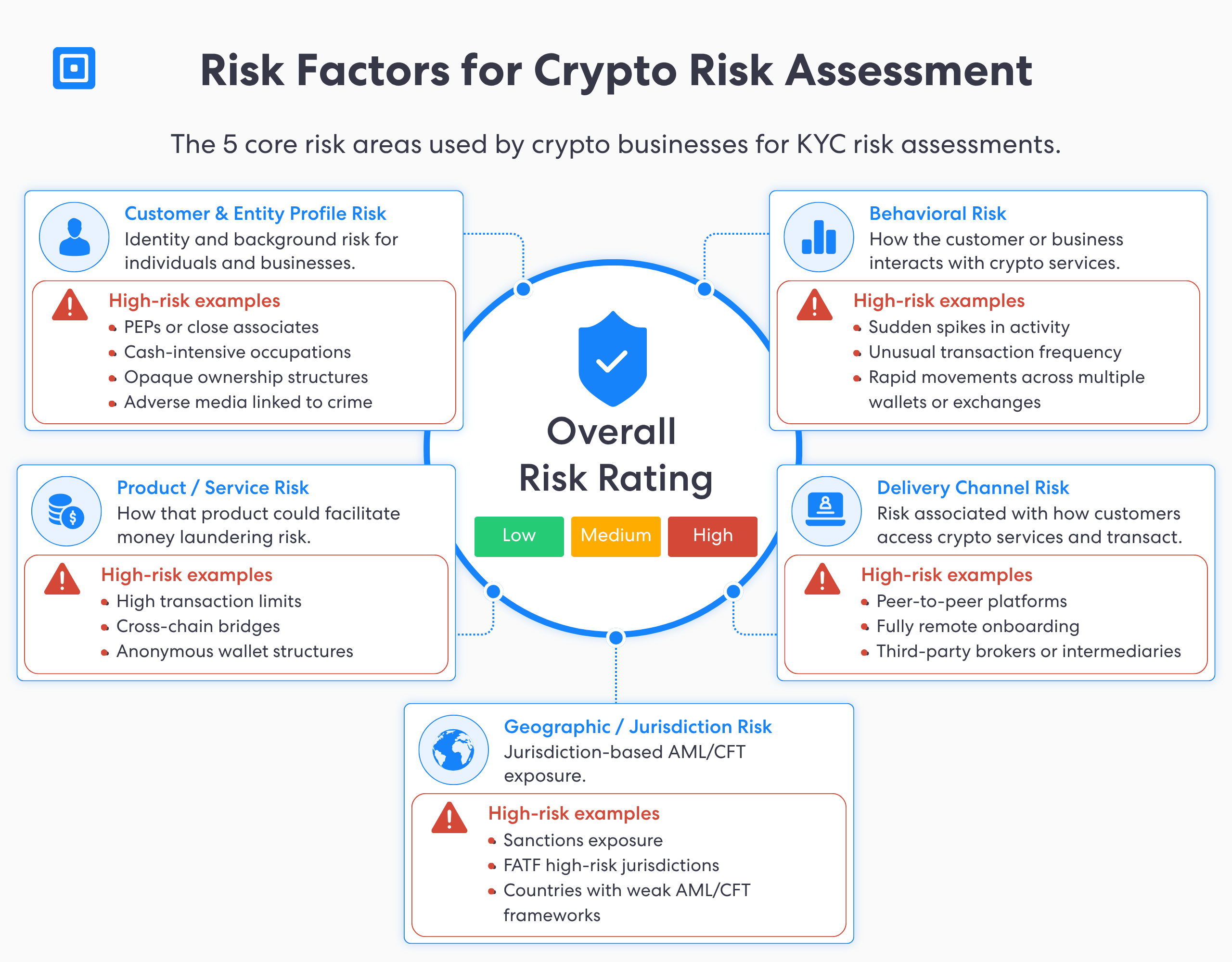
These five risk dimensions are:
### 1. Customer and Entity Profile Risk
This includes identity and background risk signals of those seeking crypto services. KYC requirements involve determining the business or individual customer’s identity by gathering critical information. Additionally, AML screening identifies exposure to [Politically Exposed Persons (PEPs)](https://www.complycube.com/en/solutions/global-screening/sanctions-pep-screening/), sanctions, and adverse media.
For individuals, this includes performing document checks and biometric verification to collect customers’ names, dates of birth and addresses. For businesses, it can extend to corporate registry, background checks, and [Ultimate Beneficial Ownership (UBO)](https://www.complycube.com/en/what-is-ultimate-beneficial-ownership-ubo/) verification to determine company operations.
### 2. Behavioral Risk
This assesses how a customer interacts with crypto services and whether the nature of their transaction matches account behavior. Behavioral risk assessment goes beyond identity verification. It can include transaction monitoring, [device intelligence](https://www.complycube.com/en/solutions/fraud-intelligence/device-intelligence/), and blockchain analytics to detect suspicious patterns.
### 3. Product or Service Risk
These refer to the potential risks that can be facilitated via the specific product or service offering. For crypto exchanges, this can include rapid, high-value transactions such as high-leverage derivatives, cross-chain bridges, and OTC block trading.
### 4. Delivery Channel Risk
Delivery channel risk are the vulnerabilities present in the channels used to deliver a product. For example, remote onboarding, peer-to-peer (P2P) platforms, and tumbling services provide heightened anonymity, which can conceal identities and make illicit crypto transactions difficult to monitor.
### 5. Geographic or Jurisdiction Risk
Certain jurisdictions are deemed as high-risk due to the higher threats of money laundering, sanctions exposure, and tax evasion. For example, the FATF and EU compiles high-risk jurisdictions under the grey or increased monitoring list. Therefore, crypto KYC risk assessments should consider residence and nationality.
### **Case Study: AUSTRAC Warns Against Blanket De-Risking**
The Australian Transaction Reports and Analysis Center (AUSTRAC) published a warning on 30th September 2026, urging companies not to [indiscriminately](https://www.complycube.com/en/austrac-warns-against-blanket-de-risking/) restrict or reject high-risk customers. Instead, businesses must assess various risk signals before making a compliance decision.
##### **Automated Rejection and Increasing Risks**
Crypto service providers must document clear evidence and justify proportionate compliance controls. Consequently, blanket de-risking can push legitimate crypto customers or businesses to less-regulated platforms, making financial crime even harder to detect.
##### **Outcomes**
- High-risk classification does not equal automatic rejection or account restriction.
- Crypto KYC risk assessment must distinguish manageable risks from unacceptable threats.
- The risk-based approach should trigger appropriate due diligence measures.
## Connecting AML Risk Scoring for Crypto to Due Diligence
Crypto KYC risk assessment must connect to the wider [AML infrastructure](https://www.complycube.com/en/solutions/due-diligence-compliance/anti-money-laundering/). Consequently, after evaluating the risks present, compliance professionals should determine the appropriate level of due diligence. This includes basic verification for low-risk customers, standard CDD, EDD for high-risk customers, or rejection where risks cannot be mitigated.
**Simplified Due Diligence:** Reduced due diligence measures for very low-risk customers or entities. For example, light-touch identity verification applies to basic student savings accounts or publicly listed companies that have already undergone rigorous public disclosures.
**Customer Due Diligence:** Standard due diligence checks for low- to medium-risk customers. It includes full identity verification to establish whether the user is legitimate. For instance, common examples are opening a standard bank account or registering with a cryptocurrency exchange.
**Enhanced Due Diligence:** Requires [deeper checks](https://www.complycube.com/en/enhanced-due-diligence-requirements-guide/) for high-risk profiles. This includes gathering proof of funds documentation, UBO verification, and AML screening. For example, PEPs, high-risk countries, complex ownership structures, and unusual transaction volumes call for EDD.
**Rejection:** Where there are clear links to criminal activity, including sending funds to sanctioned entities or use of mixers, it should be escalated to Suspicious Activity Reporting (SAR). This is vital, as law enforcement agencies rely on this information to effectively dismantle illicit activities.
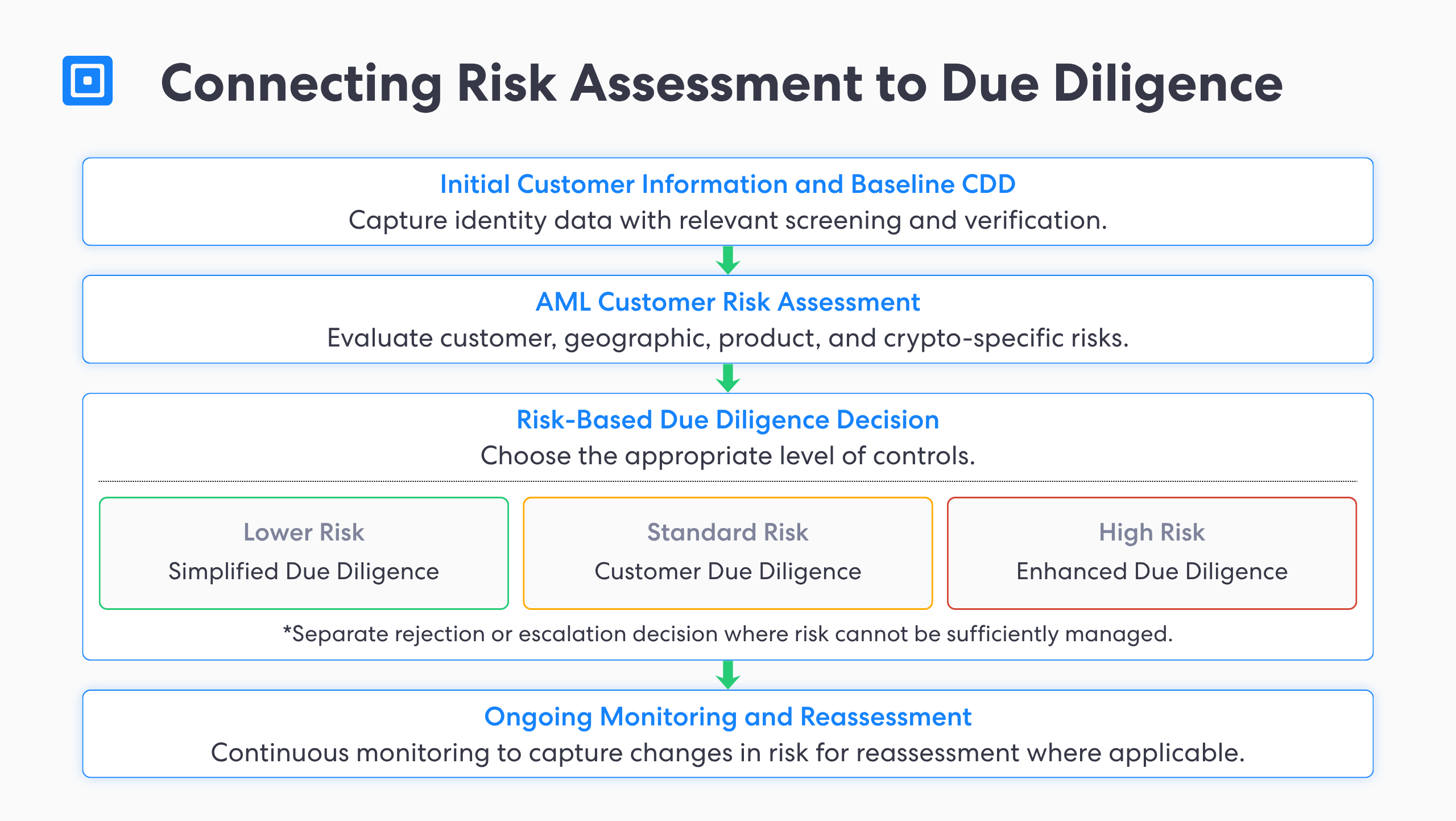
The graphic included above is a simplified representation of standard CDD. In practice, verification, risk scoring, and due diligence can happen simultaneously or iteratively. Additionally, [real-time monitoring](https://www.complycube.com/en/solutions/global-screening/continuous-monitoring/) is a crucial tool in AML processes. It ensures these measures evolve as customer risk profiles change.
## Design Customizable AML Risk Scoring for Crypto
Typically, AML software standardizes risk factors, weights, and thresholds across organizations. However, this can be challenging because every company has varying operating jurisdiction and risk appetite. For example, a risk model used by a cryptocurrency exchange differs largely from one used by a retail firm.
Platforms such as ComplyCube enable crypto firms to build and apply their own [customizable risk model](https://docs.complycube.com/documentation/product-guides/due-diligence-tools/risk-profile) consistently and at scale. Crypto firms can choose to assign, add, or remove their own risk factors. Additionally, risk weights and thresholds can be set independently. Thus, this will form the risk scoring logic that underpins due diligence and ongoing monitoring.
- Risk rating: How severe is the identified risk?
- Risk weight: How much should that indicator influence the final score?
- Risk threshold: What action should the business take based on the result?
A [Custom Risk Engine](https://www.complycube.com/en/solutions/due-diligence-compliance/risk-scoring/custom-risk-engine/) model is crucial for crypto exchanges. It significantly reduces false positives, streamlines case reviews, and builds a targeted approach to financial crime prevention. To achieve this, firms can develop a tailored risk scoring model in three simple steps.
### Step 1: Assign weight and rating to each risk indicator
Based on the company’s risk appetite, operating country, and regulatory obligations, assign specific weight and rating to each risk indicator. Higher-weighted dimensions contribute more significantly to the final result. Moreover, the risk rating is continuously recalculated as risk changes.
### Step 2: Total risk score calculation
Subsequently, once the company assigns a risk rating and weight, the model calculates the weighted score for each factor. This weighted score will be added up automatically by the risk scoring model, producing a total risk score, typically assigning an overall low, medium, or high risk.
### Step 3: Define the risk thresholds and escalation rules
Consequently, the total risk score must trigger a compliance decision. Businesses must set their own risk thresholds (for example, a score of 0-39 is classified as low risk, 40-69 as medium risk, and 70-100 as high risk) and escalation flows that will define the compliance outcome.
It is important to note that risk scores do not operate in isolation. For example, a confirmed sanctions match should trigger mandatory controls regardless of the weight score. AML compliance tools analyze data faster than human professionals. Also, choose solutions that support trusted regulatory reporting and audit trails. For example, ComplyCube’s AML Custom Risk Engine offers fully explainable risk assessments and traceable AML decision-making.
## Operationalizing KYC Risk Assessment for Crypto
Consequently, to achieve an effective KYC risk assessment for crypto, the next step is integration. Cryptocurrency exchanges should continuously calibrate, reassess, and pivot risk logic to reflect current customer, channel, product, jurisdiction, and behavioral risks.
**1. Integrate logic into KYC onboarding:** Embed the risk scoring model into customer onboarding.
**2. Connect risk data:** Ensure data captured from identity verification and AML screening continuously feed back into the scoring model.
**3. Route to proportional due diligence measures:** Configure workflows to automatically apply verification steps aligned to level of risks.
**4. Ongoing assessment:** Implement ongoing monitoring and event-driven triggers to reassess customers as risk evolves.
**5. Maintain audit trails:** Use real-time audit logs that document rationale, evidence outcomes, and manual overrides.
### Key Takeaways
- **KYC risk assessment** for crypto involves assessing risks to determine appropriate due diligence.
- **Robust KYC** **processes** help connect cryptocurrency addresses to real-world identities.
- **CDD verifies** **identity** details and assesses user activity’s consistency with expected behavior.
- **Effective risk** **assessment** includes ongoing monitoring to identify emerging financial crime risks.
- **Evolving global requirements** demand documented and explainable risk assessments.
## Strengthen KYC Risk Assessment for Crypto
Effective risk scoring prevents fraudulent funds from entering liquidity pools and preserves institutional trust. As such, crypto businesses must implement robust, effective KYC risk assessments to stop money laundering and terrorist financing at the point of entry. ComplyCube’s AML lifecycle compliance capabilities offer crypto firms a trusted financial crime prevention layer in one platform. [Speak to a member](https://www.complycube.com/en/contact/contact-sales/) of the team to learn more today.
[](https://portal.complycube.com/signup)
## Frequently Asked Questions
What is an AML rating in crypto?
In crypto, an Anti-Money Laundering (AML) rating is the risk score assigned to a customer or business that uses crypto services. Crypto businesses calculate this risk rating by assessing a user’s or entity’s exposure to money laundering and terrorism financing. Typically, the risk rating derives from five factors: customer profile, channel, product, geography, and behavioral risk.
How do crypto firms score new customers with limited historical data?
To score new customers with limited historical data, crypto businesses can make use of other risk signals. These include device, mobile, and email intelligence solutions that detect suspicious browser or network activity. Additionally, using KYC smart forms, firms can collect additional information, including transaction activity, intended purpose, and source of funds.
How often do crypto exchanges need to re-score customers?
There is no standard timeline for re-scoring customers. Instead, cryptocurrency exchanges should adopt a risk-based approach, scoring based on the risk level. Additionally, event-driven Anti-Money Laundering (AML) programs automatically re-score customers when there is a material change in their information or behavior.
What evidence do regulators expect to see for a crypto AML risk scoring model?
Regulators increasingly demand an Anti-Money Laundering (AML) risk scoring model that can proactively prevent money laundering. Crypto firms must provide clear audit trails of compliance rationale, onboarding decisions, and rule configurations. It must prove that the data used is accurate and that systems are recalibrated regularly to reflect current risk.
How does ComplyCube’s solutions support crypto KYC regulations?
ComplyCube provides a full KYC lifecycle compliance infrastructure to help crypto businesses meet regulatory requirements across 250+ countries and territories. The platform offers advanced identity verification, ongoing AML screening, and customizable risk models to help crypto firms accelerate onboarding and build regulatory trust based on their own risk infrastructure.
**Categories:** Guides
**Tags:** Know Your Customer
---
### [What Are Dynamic Workflows?](https://www.complycube.com/what-are-dynamic-workflows/)
**Published:** October 16, 2026
**Author:** Rithu Jagannath
**Excerpt:** Discover how Dynamic Workflows transform KYC onboarding with tailored verification journeys, conditional routing, and no-code automation. Learn how businesses reduce friction, improve efficiency, and maintain compliance controls.
**Content:**
**TL;DR:** In dynamic workflows for KYC, teams can **route customers** through verification journeys based on identity data, customer preferences, and compliance requirements, rather than asking **users to complete** the same process. This guide will teach compliance teams dynamic workflows for onboarding and how to simplify **processes with no-code**.
## Why Traditional KYC Onboarding Is No Longer Enough
Imagine a genuine customer trying to open a bank account but is unable to complete identity verification (IDV) because they lack the required documents. Meanwhile, another customer has access to an approved digital identity service but still needs more verification steps. Both are ready to onboard, but a rigid process creates unnecessary barriers.
Even in 2026, this remains a challenge. According to the UK government’s 2026 Inclusion Monitoring Report, only 49% of organizations using biometric technology offer an alternative route for users who do not wish to provide biometric data. It also found that 80% of organizations collect data on incomplete user journeys, although only 66% of those collect information on why users drop out. This demonstrates growing attention to the reasons why users struggle to complete identity verification.
> Digital identity can make some services easier, and more accessible, but only if services are designed around people’s real lives.
[James RJ Brown](https://enablingdigitalidentity.blog.gov.uk/2026/07/08/a-maturing-market-digital-identity-sectoral-analysis-2026/) from the Office for Digital Identities and Attributes (OfDIA) also notes, “That includes people with lower digital confidence, lower digital access, fewer identity documents, disabilities, or other circumstances that make standard verification routes harder.”
The consistent issue is that while IDV technology advances, many onboarding journeys cannot meet different customer needs. For businesses operating across multiple markets, the challenge is even more complex. Customers may have different identity documents, verification preferences, and regulatory requirements. However, traditional workflows force people through the same pipeline. This creates unnecessary friction, higher operational costs, and missed opportunities to onboard real customers.
Dynamic workflows offer a far more [flexible approach](https://www.complycube.com/en/solutions/compliance-suite/kyc-workflow/dynamic-workflows/). They use predefined conditions aligned with company policies to select the right onboarding process. They rely entirely on available customer data and approved verification methods. For regulated businesses, dynamic onboarding workflows offer more customer choice while maintaining consistent identity assurance and compliance controls.
## How Do Dynamic Workflows Work?
Unlike static workflows, which follow a fixed sequence of tasks, dynamic Know Your Customer (KYC) or onboarding workflows use logic to determine which route a customer must follow. For instance, one customer with access to an approved electronic identity (eID) service can verify their identity through a national digital identity scheme.
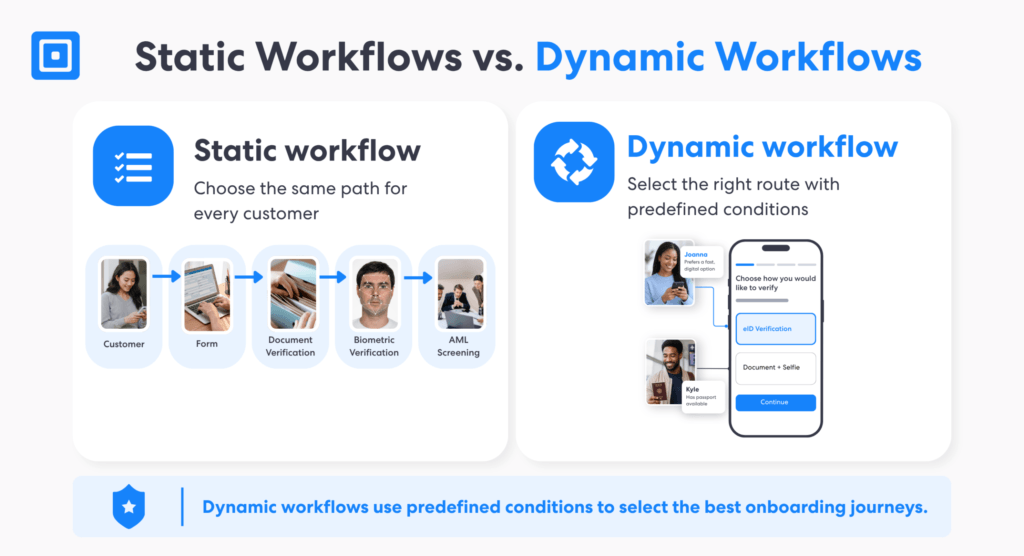
Someone else may need to upload an official identity document and go through biometric verification. The procedure varies depending on what data is available to confirm the customer’s identity. This is because dynamic workflows combine control flow and conditional logic.
### Understanding Control Flow and Conditional Logic in Dynamic Workflows
Control flow is the order in which a system carries out tasks and figures out what happens next. In a traditional workflow, that sequence is fixed; dynamic workflows introduce conditional routing. It allows different paths based on predefined rules that follow an “if-then” structure. For example, if an eligible customer selects eID verification, then direct them to the electronic identity journey.
This routing mechanism evaluates supported information against the configured parameters. Dynamic execution allows the platform to select the right journey without manually assigning each customer to a separate process. This approach lets organizations create tailored experiences while keeping control over the verification steps each customer must complete. Moreover, dynamic workflows improve exception handling by routing anomalies to the right handlers seamlessly. They can also apply to multiple business functions, including finance, HR, and logistics.
## Why Are Dynamic Workflows Important for KYC Compliance?
Dynamic workflows are crucial for KYC and Anti-Money Laundering (AML) regulations. They require businesses to identify customers, verify their identities, and apply the necessary due diligence measures. However, onboarding requirements can vary by jurisdiction, customer profile, and the nature of the business relationship.
For organizations that operate globally, implementing these requirements in a single fixed process can create too much complexity. Dynamic workflows help businesses deal with this challenge by supporting different approved verification journeys within a consistent compliance framework.
### Supporting Risk-Based Customer Onboarding
The [Financial Action Task Force (FATF)](https://www.fatf-gafi.org/) promotes a risk-based approach to AML compliance. It requires regulated organizations to identify risks and apply proportionate controls. In practice, due diligence that is needed for one customer may differ from that required for another. You can learn more here: [What is a Risk-Based Approach (RBA)?](https://www.complycube.com/en/what-is-a-risk-based-approach/)
Dynamic workflows support these policies by helping organizations configure verification routes aligned with their identity assurance requirements. Identity assurance refers to the level of confidence a business needs to establish that a customer is exactly who they claim to be. An organization can use different verification methods as long as they satisfy the identity assurance standard needed by its onboarding policy.
Flexible workflows allow customers to follow an approved route without completing extra steps not needed for that journey. Yet, conditional routing should not be mistaken for automated customer risk assessment. Risk scoring, Enhanced Due Diligence (EDD), and decisions based on completed verification results are separate compliance functions.
### Adapting to Changing Regulatory Requirements
Regulatory requirements are constantly changing, with new legislation, updated guidance, and emerging fraud risks. This requires businesses to revise their existing customer verification procedures. Many companies rely on hard-coded workflows, so implementing even a small change can require several development resources.
[No-code workflow](https://www.complycube.com/en/aml-with-no-code-compliance-workflow-software/) configuration provides a much more adaptable alternative. If a jurisdiction introduces new identity assurance requirements, compliance teams may need to add verification steps or adopt an approved identity verification method. With a visual workflow builder, companies can implement these changes without writing an entirely new process from scratch. This improves speed and helps businesses keep consistent policies across various markets.
Although dynamic workflows support regulatory adaptability, they don’t automatically mean they are compliant. Organizations still need to define the appropriate controls and verify that their procedures meet regulatory requirements.
## How Dynamic Workflows Improve Operational Efficiency
Beyond compliance, dynamic workflows reduce the complexity linked with managing different onboarding journeys. Traditional processes often involve repetitive administrative tasks, manual handoffs, and disconnected verification tools.
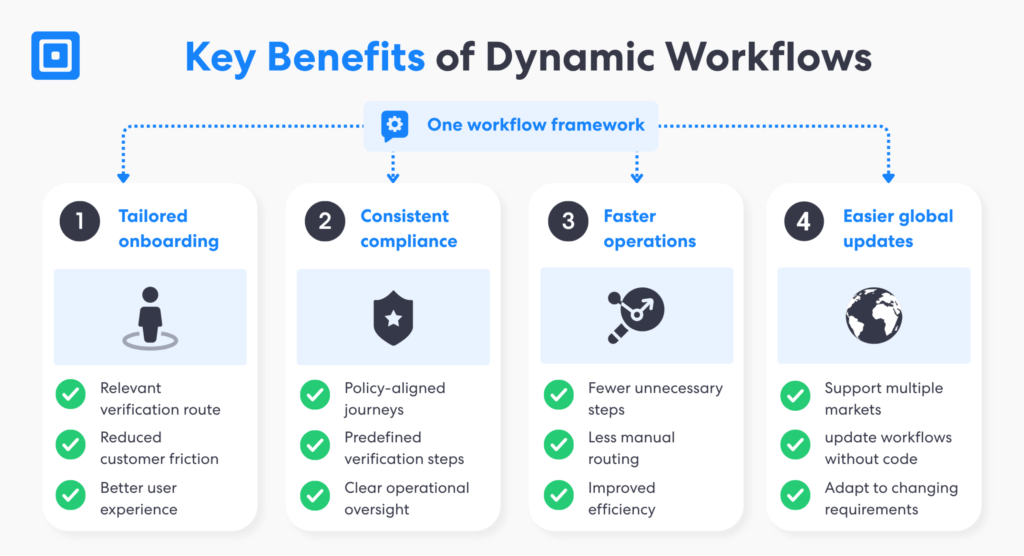
As onboarding volumes grow, inefficiencies can place more pressure on compliance teams and operational budgets. Automating the selection of predefined verification routes allows dynamic workflows to help teams coordinate onboarding activities more efficiently.
### Reducing Manual Work and Processing Costs
Imagine if a financial services provider is supporting many identity verification methods across different regions and jurisdictions. Without a centralized routing mechanism, separate processes or additional coordination is needed to determine which verification method works for each customer. Dynamic workflows bring multiple onboarding journeys into one system, but also greatly lower the cost and resources linked with keeping disconnected workflows.
Without a centralized routing mechanism, the organization may need separate processes or additional coordination to determine which verification method applies to each customer. Actual savings depend on factors such as verification volumes, workflow design, operational structure, and the costs of the checks performed.
### Improving Workflow Visibility and Management
Operational efficiency depends on understanding where customers struggle. Without enough visibility, businesses can struggle to find incomplete applications, processing delays, or recurring onboarding errors.
A centralized workflow management system provides a clear view of how verification journeys are structured and executed. Workflow activity records and session insights also help companies understand how customers move through an [onboarding process](https://www.complycube.com/en/use-cases/process/customer-onboarding/). They can also learn where completion issues arise. This greatly helps improve verification instructions, customer-facing descriptions, and workflow configurations.
Platforms with more advanced automation can also use real-time alerts or event-driven exception handling. This notifies teams when a process needs more attention. Yet, because these capabilities depend on specific solutions, you should not assume they’re part of every dynamic workflow implementation.
## Dynamic Workflows vs. AI Agent Workflows
Dynamic workflows exist outside regulated customer onboarding, especially in AI-powered applications and software development. In these environments, an AI model can create a plan, assign tasks to specialized agents or sub-agents, and use external tools to complete the actual work. A great example is a research app that coordinates several digital workers to gather information, verify sources, generate descriptions, and write a report.
Unlike a predefined onboarding sequence, an [AI-agent workflow](https://www.ibm.com/think/topics/agentic-workflows) can adapt its execution plan when new data becomes available or an unexpected event occurs. Such systems require developers to manage context, function calls, runtime parameters, error handling, and task completion across various agents. Though both involve automation and control flow, their decision-making mechanisms differ.
AI-agent workflows can choose or create new actions during execution, while dynamic workflows select from predefined KYC verification routes based on supported customer inputs. For regulated onboarding, this provides structure where compliance teams can define the available journeys and the conditions under which each applies.
## Dynamic Workflows Use Cases
Dynamic workflows are especially helpful for organizations serving customers with different identity evidence, verification preferences, and regulatory requirements. They apply across several industries where a flexible onboarding process can improve accessibility without compromising established controls.
### Financial Services and Digital Banking
Digital banks often onboard customers across multiple jurisdictions, each with different identity documents and electronic identity systems. For instance, a bank operating in Europe will likely support national eID verification in certain markets. Others may offer a combination of document and biometric verification.
Dynamic workflows let [financial services and institutions](https://www.complycube.com/en/kyc-vs-aml-compliance-for-finance/) build these journeys within a single onboarding environment. This reduces unnecessary verification steps while helping the bank maintain consistent identity assurance policies.
### Cryptocurrency and Digital Assets
Cryptocurrency exchanges and [Virtual Asset Service Providers (VASPs)](https://www.complycube.com/en/crypto-aml-compliance-securing-the-sector/) need to verify customers while managing jurisdiction-specific AML and KYC obligations. A global exchange may need to support different identity documents and approved verification methods by jurisdiction.
Dynamic KYC and onboarding workflows help organize these routes within a structured onboarding framework. When combined with AML screening and other compliance services, this can simplify managing international customer verification.
### Online Marketplaces and Gig Economy Platforms
Online marketplaces frequently onboard different participant groups. This includes buyers, sellers, freelancers, and business representatives. For example, an individual seller may experience a personal IDV process, but someone acting on behalf of a business might need to provide company information.
Dynamic workflows for online marketplaces and gig economy platforms can use supported onboarding inputs to guide customers into the right predefined journey. It helps reduce unnecessary information collection.
### Recruitment and Employment
Another important use case is recruitment agencies and employers. They often need to verify candidates with different identity documents, nationalities, and eligibility requirements. When multiple approved verification methods exist, dynamic workflows help candidates follow a route based on the evidence they can provide.
A candidate eligible for a supported digital identity method may follow a different verification journey than someone using physical documents. This can provide a more accessible candidate experience while keeping applicable verification controls.
### **Case Study: India Targets 15 Crypto Exchanges Over AML Compliance Failures**
In September 2026, India’s Financial Intelligence Unit (FIU-IND) issued non-compliance notices to [15 cryptocurrency exchanges](https://www.complycube.com/en/india-blocks-15-crypto-exchanges/) and sought to restrict access to their websites and applications. It reinforced that overseas crypto platforms serving customers in India need to comply with India’s AML requirements, regardless of their physical location.
##### **Adapting Onboarding to Different Jurisdictions**
This case shows why global businesses cannot rely on identical compliance procedures across every market. Cryptocurrency exchanges need to identify applicable local requirements and dynamic workflows can help companies configure jurisdiction-specific verification journeys, using customer data to select predefined onboarding routes.
##### **Outcomes**
- 15 crypto exchanges received non-compliance notices with potential restrictions.
- India’s AML guidance reinforced requirements around CDD, monitoring, and other controls.
- The case shows the importance of workflows instead of one fixed process globally.
## Core Features of Dynamic Workflows
Not every workflow automation platform provides the same functionality. Businesses evaluating a solution should focus on capabilities that support flexibility in customer journeys. The right dynamic workflow solution should also retain operational and compliance oversight.
### No-Code Workflow Configuration
A visual workflow builder allows compliance and operations teams to build, test, and update verification processes without writing custom code. This reduces pressure on development teams for configuration changes and helps organizations implement new onboarding requirements more efficiently.
### Conditional Routing Logic
Another key feature to look out for is [conditional routing logic](https://www.complycube.com/en/solutions/compliance-suite/smart-forms/). It uses predefined rules to select the appropriate verification journey based on supported customer inputs. So, instead of following a default process, customers can be routed into different approved paths based on data collected during onboarding.
### Flexible Verification Methods
Different types of customers may have access to different identity documents and verification services. This is why dynamic workflows need to accommodate approved alternatives, including eID verification, document checks, and biometric [verification](https://docs.complycube.com/documentation/product-guides). This lets businesses provide more accessible onboarding while meeting their defined assurance requirements.
### Integrated Compliance Tools
A unified workflow platform can bring together Smart Forms, IDV, biometrics, and AML screening. It can also accommodate registry checks and other compliance services. It lets organizations manage multiple onboarding activities in one environment instead of relying on disconnected systems.
### Global Workflow Management
For organizations operating internationally, a centralized framework can help manage verification journeys across jurisdictions and markets. By building routes according to supported customer information and business policies, compliance teams can maintain greater consistency while accommodating local requirements.
### Key Takeaways
- **Use predefined conditions** to help customers follow the appropriate verification journey.
- **Conditional logic and control flow** help tailor onboarding with customer information.
- **No-code workflows** help companies adapt verification journeys without extensive development.
- **Flexible** **IDV** lowers friction and improves accessibility helping customer onboarding procedures.
- **Dynamic workflows** use smart forms, IDV, and integrated compliance tools in one platform.
## Create Smarter KYC Dynamic Workflows With ComplyCube
As businesses expand across markets, dynamic workflows provide a more adaptive approach than fixed verification processes. It allows organizations to tailor onboarding journeys to customer circumstances while keeping control over their compliance requirements.
ComplyCube combines no-code configurations, conditional routing, and integrated verification to simplify customer onboarding and improve operational efficiency. Dynamic workflows for KYC help businesses achieve this through a unified workflow environment designed for modern KYC and compliance operations. [Explore ComplyCube’s Dynamic Workflows](https://www.complycube.com/en/contact/contact-sales/) to discover how flexible verification journeys can help your business.
[](https://portal.complycube.com/signup)
## Frequently Asked Questions
What are dynamic workflows in KYC onboarding?
Dynamic workflows are automated processes using conditional logic to guide customers through a tailored identity verification journey. They select predefined paths based on customer information, identity documents, and verification preferences.
How do dynamic workflows improve the customer onboarding process?
Dynamic workflows improve the customer onboarding process by guiding users to appropriate verification methods instead of needing everyone to follow the same process. Using predefined routing rules, businesses reduce friction, minimize manual intervention, and improve onboarding.
What is the difference between static and dynamic workflows?
Static workflows follow a fixed order of verification steps. Dynamic workflows use conditional logic to trigger predefined routes based on customer data. They support multiple verification methods within one onboarding framework, lowering complexity, and improving the customer experience.
How do dynamic workflows support KYC and AML compliance?
Dynamic workflows help support KYC and AML compliance. It enables businesses to create IDV journeys based on policies and regulatory requirements. It also supports consistent due diligence while allowing compliance teams to adapt workflows as expected requirement change.
How does ComplyCube help businesses implement dynamic workflows?
ComplyCube enables businesses to create tailored dynamic workflows for KYC and onboarding journeys through its no-code solution. Using conditional logic, companies can route clients or customers based on supported data, and selected verification methods.
**Categories:** Guides
**Tags:** Know Your Customer
---
### [ComplyCube Puts Businesses in Control with Custom Risk Scoring Engine](https://www.complycube.com/custom-risk-scoring-engine/)
**Published:** October 15, 2026
**Author:** Rithu Jagannath
**Excerpt:** ComplyCube launches its Custom Risk Scoring Engine, empowering businesses to automate risk assessments, apply tailored scoring models, and make explainable, auditable decisions as customer risks evolve over time.
**Content:**
LONDON, OCTOBER 15, 2026 – Risk-based approaches are central to Anti-Money Laundering (AML) and Know Your Customer (KYC) compliance. As regulatory expectations change, businesses are facing more pressure to show how customer risk is assessed, justified, and kept up to date. Static assessments can quickly become outdated, and that is why continuous, explainable risk evaluation becomes important. [ComplyCube](https://www.complycube.com) has expanded its risk management capabilities with its [Custom Risk Engine](https://www.complycube.com/en/solutions/due-diligence-compliance/risk-scoring/custom-risk-engine/). This risk scoring engine automates assessments using models aligned with individual policies, risk appetite, and decision-making needs.
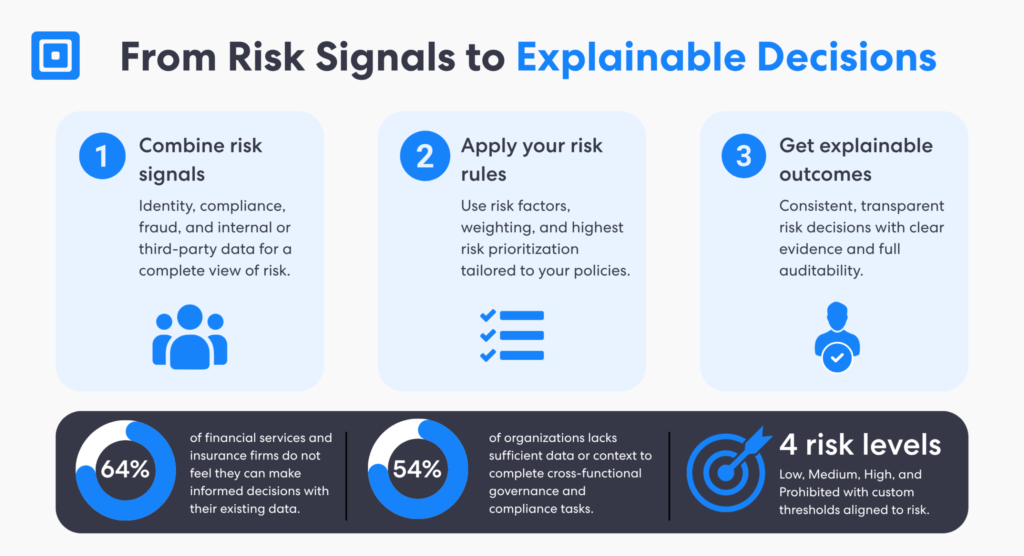
This risk scoring engine blends identity, fraud and compliance with both internal and third-party data. Through adaptable risk factors, weightings, and decision logic, teams can produce consistent and explainable risk scores that change based on new information. From [Customer Due Diligence (CDD)](https://www.complycube.com/en/solutions/due-diligence-compliance/customer-due-diligence/) to ongoing monitoring, companies can have greater control over how risk is measured, prioritized, and managed over the entire customer journey.
## Why Fragmented Risk Data Demands Smarter Decisioning
More than half of surveyed organizations by [Thomson Reuters](https://legal.thomsonreuters.com/en/insights/white-papers/from-fragmented-to-frictionless) lack enough context to complete cross-functional compliance tasks, highlighting the difficulties of disconnected systems and fragmented data points. For businesses looking to manage risk across verification platforms, internal databases, and third-party providers, this fragmentation leads to inconsistent assessments, manual intervention, and limited visibility into how decisions are reached.
Traditional risk scoring frameworks present a challenge especially when predefined rules do not reflect an organization’s specific risk appetite. As risk environments become more difficult to navigate, businesses need more than just access to data. They need flexibility to understand which risk signals matter, how they are assessed, and when real action is required.
## From Fixed Models to Automated Risk Scoring
ComplyCube’s custom risk scoring engine looks at the gap by translating an organization’s own risk methodology into automated, explainable decision logic. Unlike some scoring approaches that rely on weighted averages, the risk scoring engine supports hybrid calculation methods. It blends weighted scoring with the highest-risk prioritization. This allows critical indicators, such as confirmed sanctions matches, to take precedence instead of being diluted by otherwise low-risk attributes. It delivers three core capabilities:
- **Configurable risk models:** Blend native and external intelligence with tailored risk factors, weightings, and decision thresholds.
- **Automated risk reassessment:** Re-assign classifications based on changes in customer information and verification results. This allows risk assessments to stay up to date over the whole customer lifecycle.
- **Explainable risk scoring:** Link any risk scoring outcomes to underlying risk rules and evidence. It also supports documented analyst overrides to keep human judgement and accountability.
Configurable risk models, automated risk assessments, and explainable risk scoring come together to help organizations replace any static, fragmented risk assessments. It puts companies into the driver’s seat with more consistent, adaptable risk decisions.
## Custom Risk Models Built for Real-World Complexity
These risk scoring engine applications go across various industries with completely different risk priorities and requirements. Some financial institutions such as banks may want sanctions exposure and customer due diligence coverage, whereas marketplaces can ask for identity and fraud indicators.
Spanning geographical exposure, products, and services, the risk engine’s framework shows how complex risk policies can inform structured and automated decisioning. It also considers factors such as transaction size, customer affordability, customer characteristics, and delivery channels. Instead of forcing businesses to adapt established methodologies to fixed technology, ComplyCube enables risk models to reflect the policies that organizations already use.
## Advancing Explainable Risk Intelligence with the Custom Risk Scoring Engine
This expansion speaks to the broader evolution of ComplyCube’s platform. The custom risk scoring engine is extending ComplyCube’s identity verification, fraud intelligence, and compliance capabilities into configurable risk decisioning.
> Risk isn’t one-size-fits-all. The technology businesses rely on shouldn’t be either.
[Harry Varatharasan](https://www.itpro.com/security/cyber-crime/your-customers-just-gave-a-bot-access-to-their-wallet-are-your-controls-ready), Chief Product Officer of ComplyCube, said, “Every organization has its own risk appetite, data, and decision-making requirements. ComplyCube’s custom risk engine provides businesses with a way to turn intelligence into automated, explainable decisions. They can choose a solution that truly reflects how they operate instead of forcing them to adapt to rigid predefined models.”
ComplyCube helps businesses move toward making decisions they can understand internally, justify to regulators, and control. Uncover how ComplyCube’s [custom risk engine](https://www.einpresswire.com/article/949300275/complycube-puts-businesses-in-control-with-custom-risk-scoring-engine) can help your company automate risk scoring, implement custom risk models, and strengthen decision-making.
## About ComplyCube
[ComplyCube](https://www.complycube.com/en/) is an award-winning global identity verification, fraud prevention and compliance platform helping organizations build trust at scale. Its solutions cover KYC, KYB, and AML screening. It also empowers businesses to make smarter compliance decisions with biometric verification, fraud intelligence and risk management which empower businesses. Companies can streamline onboarding, strengthen risk controls and navigate evolving regulatory requirements.
**Categories:** News
**Tags:** Announcements
---
### [Bank of America $1.2bn Fine Exposes Years of AML Failures](https://www.complycube.com/bank-of-america-1-2bn-fine-aml-failures/)
**Published:** October 14, 2026
**Author:** Dini Habib
**Excerpt:** Bank of America’s $1.2 billion fine follows years of unresolved AML and sanctions compliance failures. Despite prior warnings, the bank had failed to implement sufficient remediation, amounting to the scale of the penalty imposed.
**Content:**
On 13 October 2026, the U.S. Department of the Treasury fined Bank of America $1.21 billion following multiple violations of Anti-Money Laundering (AML) and sanctions laws. Notably, regulators found over $5 billion in unreported suspicious activity and more than 475 apparent sanctions violations.
The fine is the third-largest penalty in Treasury history, after Binance ($3.4 billion in 2023) and TD Bank ($1.3 billion in 2024). It also represents the largest enforcement penalty in the Office of the Comptroller of the Currency (OCC) history.
## The Key Regulatory Players
Three critical regulatory players enforced the penalty. These include FinCEN, OCC, and OFAC. All three regulators imposed separate settlements on the bank, totaling $1.21166 billion in fines. Most importantly, Bank of America has had significant AML deficiencies for years. Despite warnings, including one in December 2024, the company failed to deliver sufficient corrective action.
- Financial Crimes Enforcement Network (FinCEN): Imposed a $1.2 billion penalty due to the bank’s failure to report high-priority security risks, such as Chinese Money Laundering Networks.
- Office of the Comptroller of the Currency (OCC): Fined the bank $750 million for significant weaknesses in its AML infrastructure.
- Office of Foreign Assets Control (OFAC): Penalized the bank $11.66 million over major sanctions violations, including on Iran, Russia, and global terrorism.
The lesson for financial institutions is clear. Simply acknowledging and implementing a corrective action plan is not enough. However, this challenge can be especially complex for large banks. Notably, Bank of America is the second-largest bank in the United States, serving over 70 million global customers and businesses.
The biggest question remains: What should you do when you identify deficiencies in your compliance program but can’t show you’ve actively remediated them?
## Bank of America Prior AML Warning in December 2024
On 23 December 2024, the OCC issued a cease-and-desist order against Bank of America. Supervisory oversight and examinations found that the bank had multiple weaknesses in its AML infrastructure:
- **Transaction monitoring** was severely deficient, leaving trillions of transactions inadequately monitored. This meant the bank could not effectively identify, review, prevent, or report potentially illicit transactions.
- **Suspicious activity** was not reported to investigators consistently or in a timely manner. The bank knew about this problem for years yet failed to close the gap. This meant regulators could not pursue potentially damaging money-laundering and terrorist-financing risks.
- **Staff training** remained persistently weak. The bank did not train employees on critical AML areas, including internal auditing, reporting, and monitoring. This contributed to errors and late suspicious activity reports.
The OCC required the bank to conduct an independent assessment of its AML and sanctions compliance programs. It also explicitly requested robust testing to prove that remediation measures were effective, including independent validation of transaction-monitoring data, models, rules, and thresholds.
From 2025 to 2026, regulators noted that the bank still fell short of rectifying these deficiencies despite remediation, as material gaps remained. In 2026, Bank of America willfully admitted to violations of the Bank Secrecy Act.
The case highlights an important lesson. Compliance failures do not always mean the absence of strong compliance policies. Instead, they can happen when several factors fail to work together effectively. In this case, the domino effect is clear. Monitoring technology, staff expertise, escalation procedures, and independent assurance failed to work together.
## How to Demonstrate Compliance Remediation Effectively?
After the OCC’s 2023 cease-and-desist order, regulators shifted from identifying the bank’s deficiencies to actively evaluating whether it made progress against the previously agreed regulatory framework. This emphasizes the direction of AML compliance.
> When a bank of this size fails to meet its AML and sanctions obligations, the consequences extend far beyond its own walls.
Authorities expect financial institutions to proactively identify, investigate, and prevent financial crime. This is especially crucial today, as AI and newer technologies are driving more complex financial crime typologies. How financial institutions can avoid similar failures:
### 1. Implement ongoing risk assessment
Businesses should connect Customer Due Diligence (CDD) with ongoing risk assessments. Capture robust customer information, including expected transaction volume and intended purpose of the account. Next, ensure that this information feeds into [ongoing risk assessments](https://www.complycube.com/en/solutions/due-diligence-compliance/risk-scoring/). Any material changes in customer information or risk must trigger proportionate [due diligence measures](https://www.complycube.com/en/solutions/due-diligence-compliance/customer-due-diligence/). Where risks cannot be mitigated effectively, report, reject, or restrict the user account on time.
### 2. Test screening and monitoring effectiveness regularly
Notably, Bank of America’s screening system flagged high-risk individuals with sanctions matches as low-priority alerts. It is important to test known enforcement scenarios rather than relying solely on routine system testing. For example, businesses can add new sanctioned users to a test environment to confirm the right escalation workflow triggers. Additionally, regularly evaluate [AML screening](https://www.complycube.com/en/solutions/due-diligence-compliance/anti-money-laundering/) data, such as sanctions and watchlist information, to ensure it is accurate and up to date.
### 3. Document strong and demonstrable remediation
Bank of America says it heavily invests billions of dollars in combating financial crime. However, gaps in its governance are clear. To demonstrate strong remediation, financial institutions must assign accountable owners, set structured deadlines, and independently retest corrective actions. This must be [documented clearly](https://www.complycube.com/en/solutions/due-diligence-compliance/case-management/), with evidence of resolution retained, including clear timestamps and audit trails.
[](https://portal.complycube.com/signup)
Find out more AML news in ComplyCube’s [Trust Edition newsletter](https://www.linkedin.com/newsletters/the-trust-edition-7103022355722981376/). We explore the latest in developments across identity verification and AML globally.
**Categories:** News
**Tags:** Anti-Money Laundering
---
### [AMEX Fined $350M For Systemic AML Failures](https://www.complycube.com/amex-fined-350m-for-aml-failures/)
**Published:** October 12, 2026
**Author:** Rithu Jagannath
**Excerpt:** AMEX faces a $350M fine after regulators uncovered systemic AML failures linked to $13B in suspected money laundering activity. Discover how compliance gaps persisted for over a decade and what financial institutions can learn.
**Content:**
On 8 October 2026, the Office of the Comptroller of the Currency (OCC) fined American Express National Bank (AMEX) $350M for systemic weaknesses in its Anti-Money Laundering (AML) program. These weaknesses led to approximately $13B in suspected money laundering activity going insufficiently identified, evaluated, and reported.
These AML failures included risk assessments, Customer Due Diligence (CDD), and suspicious activity monitoring. Most notably, these failures persisted for approximately a decade. This enforcement action against AMEX raises concerns over how the bank overlooked significant financial crime risks. What happens when an institution’s AML controls struggle to keep up with the risks of its own business?
## How Did American Express’s AML Controls Fail?
The OCC found several shortcomings in how American Express found, assessed, and managed financial crime risks across its operations. Yet, the most alarming finding was the allocation of the bank’s compliance resources. While AMEX operated extensive credit-card and charge-card businesses, its AML risk assessments focused disproportionately on its smaller deposit-taking activities.
AMEX did not adequately address weaknesses in its main business activities. The regulators became aware of a number of shortcomings, such as a lack of staff expertise, inadequate employee training, and gaps in independent testing. These flaws in the bank’s [Customer Identification Program (CIP)](https://www.complycube.com/en/customer-identification-program-what-is-cip/) and CDD procedures led to major failures in the monitoring of any suspicious activity and caused disruptions in reporting.
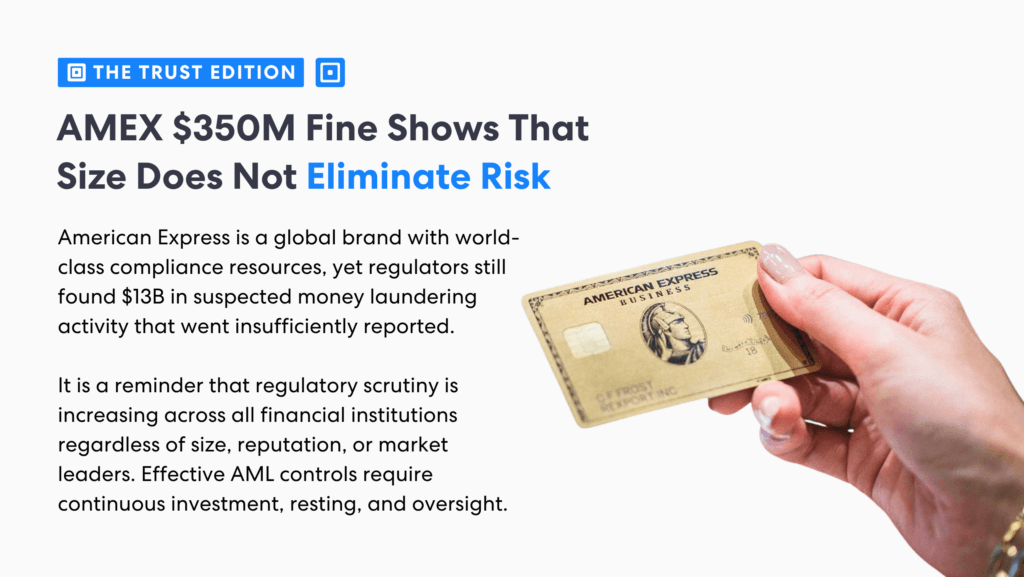
From June 2014 to May 2025, AMEX also did not identify, assess, and report about $13 billion of suspected trade-based money laundering activities on time. The fact that the institution did not properly evaluate its exposure to financial crime instead relied on compliance policies that existed. It is therefore necessary that the policies be designed, maintained, and consistently applied throughout the institution’s operations if financial crime risk is to be managed.
## Regulators Demand Stronger AML Oversight for AMEX
Moreover, the [$350 million penalty](https://www.bankingexchange.com/news-feed/item/10706-american-express-fined-350m-over-aml-failures) was followed by a cease-and-desist order. The order asked AMEX to address deficiencies in its Bank Secrecy Act (BSA) and AML compliance program. The Federal Reserve also issued an enforcement action against American Express Company and American Express Travel Related Services Company. It cited huge issues in the implementation of the group’s overall AML framework.
> The OCC expects banks of American Express’s size and complexity to devote sufficient resources.
Comptroller of the Currency [Jonathan Gould](https://www.occ.gov/about/who-we-are/comptroller/index-comptroller-of-the-currency.html) also said that these resources should ensure compliance with laws and regulations designed to detect and prevent money laundering. This is essential to both economic and national security.
Furthermore, [Stephen Squeri](https://www.linkedin.com/in/stevesqueri/), who is the CEO of American Express, admitted that further improvements were necessary and said that the company was determined to deal with the regulators’ concerns. American Express has indicated that it has achieved progress in strengthening its compliance controls. This situation shows that AML programs must be constructed according to an institution’s real exposure rather than just on its size or regulatory classification.
## Why Suspicious Activity Reporting Matters
This AMEX case shows the increasing pressure US financial institutions face to spot and report possible financial crime. The Financial Crimes Enforcement Network’s FY2025 Year in Review states that 4.8 million Suspicious Activity Reports (SARs) were submitted throughout the US in 2025, as compared with 4.3 million in 2022; this amounts to an increase of about 11.6% over the three-year period.
Yet the enormous amount of reporting only gives us a partial view of the situation. The degree to which these reports are effective has a direct impact on the results of law enforcement investigations. The same FinCEN publication showed that 38.8 percent of the active investigations in the Federal Bureau of Investigation (FBI)’s Complex Financial Crime Program were linked to [SARs](https://www.forvismazars.us/forsights/2026/03/suspicious-activity-report-sar-filings-hit-record-in-2025) or Currency Transaction Reports (CTRs) in FY2025.
The FBI stated that it made 5,957 arrests of individuals who were the subject of investigations in its various case programs as a result of BSA reports over that period. These figures show how important it is to have financial intelligence that is both timely and accurate when carrying out investigations into possible illegal activity.
The duties of a large number of regulated institutions go beyond that of identifying suspicious transactions; effective compliance with anti-money laundering rules also demands strong investigation, escalation, documentation, and reporting procedures. Warning signs will be more likely to go unnoticed when monitoring systems and customer risk evaluations work separately.
## The Growing Challenge of Trade-Based Money Laundering
A major part of the AMEX enforcement action was concerned with issues regarding [trade-based money laundering (TBML)](https://www.gov.uk/guidance/trade-based-money-laundering-tbml-handbook). TBML consists of using international trade transactions to hide the movement or source of illegal funds. The Financial Action Task Force (FATF) states that TBML usually includes the use of manipulated invoices, the misrepresentation of goods and services, and complicated commercial arrangements designed to conceal financial activity.
While many suspicious transactions are direct and obvious, the TBML scheme can mix real business activity with illegal financial flow. For many banks and payment providers similar to AMEX, this leads to extra issues when customer data, business relationships, and transaction behavior are evaluated separately.
The AMEX example shows the necessity for financial companies to make sure that their risk assessments take into account the products, services, customer types, and financial activities which result in the highest level of exposure.
## Three Lessons from AMEX
The AMEX enforcement action is a strong reminder that AML compliance requires more than keeping regulatory documentation. For financial firms reviewing their own controls, three very important questions stand out:
- **Are risk assessments aligned with the institution’s business?** AML programs must consider the risks associated with every significant product, service, customer segment, and jurisdiction. A narrow assessment can leave whole business lines exposed to a lot of risk.
- **Does customer risk influence ongoing due diligence?** Customer identification, Know Your Customer (KYC) checks, Enhanced Due Diligence (EDD), and ongoing screening must inform decisions throughout the customer lifecycle.
- **Can suspicious activity be identified, investigated, and escalated effectively?** Financial institutions need clear escalation procedures, sufficiently trained teams, effective monitoring controls, and auditable records that demonstrate how potential risks were reviewed and addressed.
These ideas go well beyond traditional banking to payment providers, fintechs, and other regulated organizations operating across complicated financial ecosystems. The main lesson from the AMEX case is that an AML program should be evaluated against the risks it is intended to manage continuously.
[](https://portal.complycube.com/signup)
Find out more AML updates in ComplyCube’s [Trust Edition newsletter](https://www.linkedin.com/newsletters/the-trust-edition-7103022355722981376/). We explore the latest developments across identity verification and AML globally.
**Categories:** News
**Tags:** Anti-Money Laundering
---
### [A Developer's Guide to MRZ Verification for KYC](https://www.complycube.com/developers-guide-to-mrz-verification/)
**Published:** October 9, 2026
**Author:** Rithu Jagannath
**Excerpt:** A developer-focused guide to MRZ verification. This guide covers what it takes to have successful checksums, data mismatches, passport fraud, NFC chip data, and biometrics to demonstrate why MRZ by itself cannot prove identities.
**Content:**
**TL;DR:** Machine-readable zone (MRZ) verification allows teams to **validate identity documents** in a standardized format. Learn how a **machine-readable zone check** can fail, and why an MRZ **passport verification** does not prove authenticity. Developers can understand how combining checks can build strong verification journeys to prevent fraud.
## Why MRZ Verification Alone Cannot Prove Identity
Automated identity checks decide whether a customer can open a bank account. Checks also help determine if they can gain access to a fintech service, join a marketplace, or complete any other regulated flow. Developer teams must turn complex evidence into an approve, reject or refer decision in seconds.
The Machine Readable Zone (MRZ) is helpful because it is predictable. MRZ codes often use a standardized format of key features. They carry structured data, and have mathematical check digits that many automated systems can confirm very quickly. However, a valid MRZ does not necessarily mean a valid identity. One of the main reasons is that MRZ lacks encryption, making it easy to forge.
> MRZ verification tells you whether the data is internally consistent.
[Mohamed Alsalehi](https://www.europeanbusinessreview.com/how-ai-agents-are-redefining-digital-trust-and-identity-verification/), Chief Technical Officer at ComplyCube said, “MRZ does not tell you whether the document is genuine, whether it has been tampered with, or whether the person presenting it is the rightful holder.”
## What Is MRZ Verification for Identity Documents?
MRZ is the area of a travel document designed to allow machines to capture a standardized data set. MRZ is a mandatory element of identity documents such as machine-readable travel documents. The [International Civil Aviation Organization (ICAO)](https://www.icao.int) began work on machine-readable documents in 1968 with the first edition of Document 9303 published in 1980. These specifications became the foundational international standards for early machine-readable passports issued by Australia, Canada, and the United States.
ICAO Document 9303 governs machine-readable travel documents such as passports (TD3), ID cards (TD1/TD2) and visas. ICAO currently has 193 member states, so MRZ verification can speed up immigration and customs clearance lines.
In real terms, MRZ verification is the process of reading, parsing, and validating a passport’s MRZ codes against its expected structure and respective check digits. Effective MRZ machine reading simplifies automated data capture, reducing manual entry errors and detecting fraud.
### What Data Is Encoded in MRZ Codes?
MRZ data encoded in a passport includes key identity and document attributes for integrity verification. It often depends on document type and includes personal data such as the document holder’s name, passport number, and date of birth. It also includes information such as nationality, sex, expiration date, issuing country, and any other optional data.
MRZ places these values in fixed positions, which means that software can interpret them consistently. A parser does not have to guess whether six digits represent a date of birth, an expiry date, or a personal number; the document specification defines the field. Other data that also follow standardized formats include the country code and nationality values.
Machines read MRZ codes through [Optical Character Recognition (OCR)](https://www.complycube.com/en/solutions/due-diligence-compliance/know-your-customer/optical-character-recognition/) technology. ICAO specifies the OCR-B typeface for machine-readable data. This standardized format helps support an accurate reading across different countries and issuing systems.
### MRZ Formats for Passports and ID Cards
The three main ICAO formats that developers run into are [TD1, TD2, and TD3](https://www.linkedin.com/posts/mrz-td1-td2-share-7503364487488413696-rTTX/). TD1 is associated with card-sized travel documents and occasionally national identity cards that have three lines of 30 characters. TD2, a slightly smaller card format, uses two lines of 36 characters. TD3, used by machine-readable passports, uses two lines of 44 characters. That is why an MRZ consists of two or three lines depending on the type of document.
Standardized layouts help support global interoperability. However, country-specific or non-standard machine-readable schemes can exist outside of ICAO travel-document standards. Developer teams must then identify the document type before applying parsing rules.
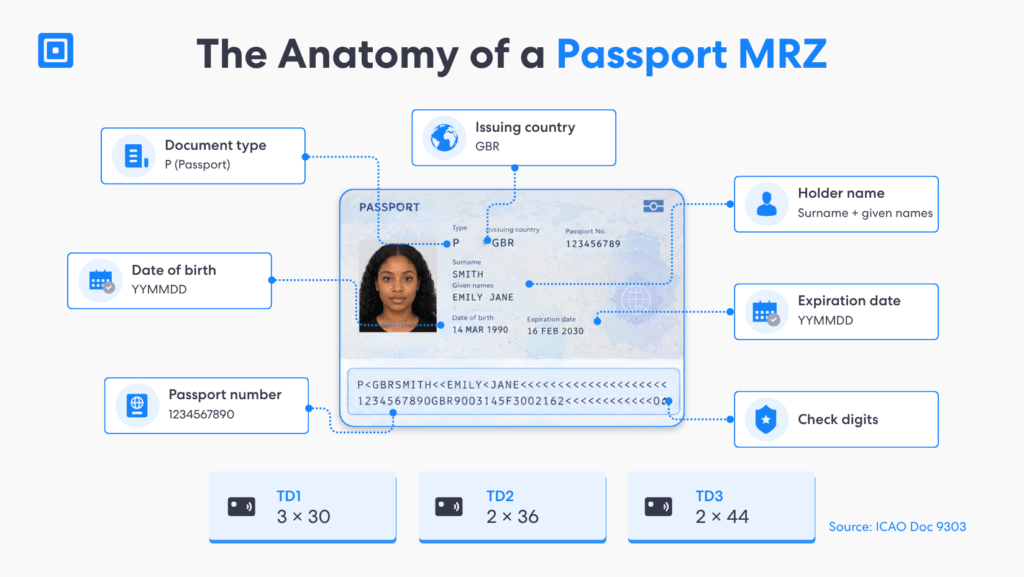
For some driver’s licenses or vehicle registration certificates, they may contain barcodes or other machine-readable elements. They must not automatically be treated as ICAO MR documents. [ICAO 9303](https://www.icao.int/publications/doc-series/doc-9303) only governs machine-readable travel documents.
Additionally, non-machine readable passports and other legacy identity documents need different verification approaches because they do not provide the same standardized MRZ structure.
## How Does MRZ Data Verification Work?
The MRZ does more than organize information into predictable positions. Selected fields contain check digits which allow software to find inconsistencies in the data that it has read. The MRZ verification system determines data integrity by applying a mathematical algorithm to the relevant field. So, if the calculated result does not match the digit found within the document, something in the input has changed from what was originally encoded.
This is pivotal in preventing identity theft, as MRZ helps catch corrupted extraction, transcription errors, or alteration. However, it is a data verification method rather than a full authentication of the overall document.
### What is a Checksum in MRZ Verification?
A correctly calculated [checksum](https://www.techtarget.com/cybersecurity/definition/What-is-a-checksum) shows that specific encoded data is internally consistent. However, it does not prove whether an original document was genuinely issued. Also, it does not show if security features remain intact, valid, or if the person presenting at verification is the real document holder.
### Convert Encoded Data Into Numbers
Each permitted character from the encoded data is automatically assigned a numerical value. For example, digits 0 through 9 keep their value, letters A through Z map from 10 to 35, and the filler character < is assigned zero. In the case of a document number such as L898902C3, it becomes 21, 8, 9, 8, 9, 0, 2, 12, 3.
### Apply the 7-3-1 Checksum
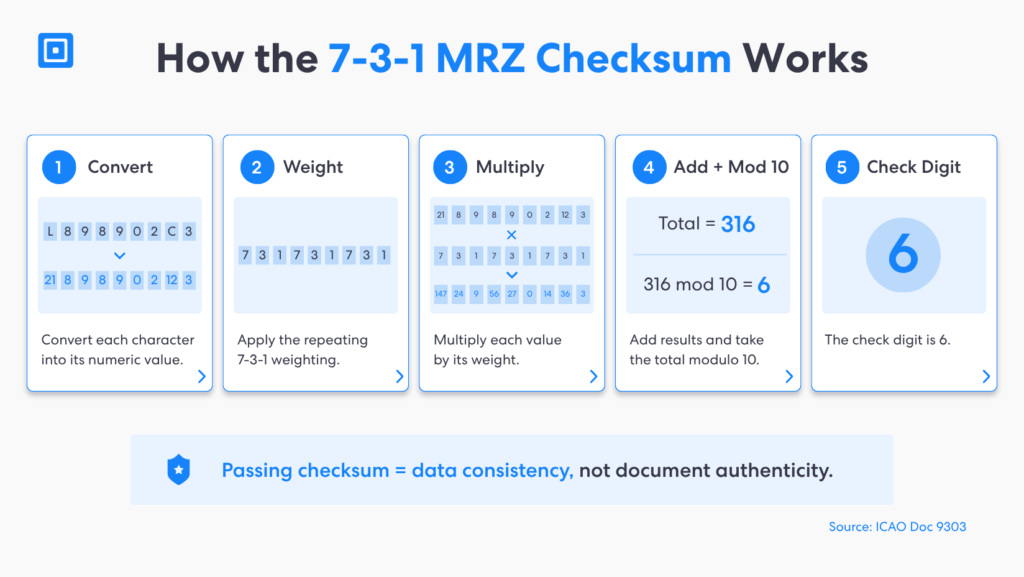
Then, ICAO applies a repeating weighting sequence of 7, 3, and 1. Here, each numerical value is multiplied by the corresponding weight, and the sequence continues to repeat until every character in the field has been processed. The document number L898902C3 has a weighted value of 316.
### Calculate the Check Digit
The [MRZ verification system](https://www.gov.uk/government/publications/identity-document-validation-technology/identification-document-validation-technology) then applies modulo 10, which means that it takes the remainder after dividing the result by 10. In this case, 316 divided by 10 leaves a remainder of 6, making it the expected check digit. If the MRZ contains the exact same digit, the field is then mathematically consistent. If it has a different value, the check fails. This is how checksums help verify the data integrity of MRZ codes.
### Individual and Composite Check Digits
It is important to understand that a passport MRZ does not rely on just one checksum. Fields that can also provide check digits include the holder’s date of birth and expiration date. A composite check digit also validates a wider combination of MRZ fields.
[Check digits](https://www.gs1.org/services/check-digit-calculator) provide automated systems with more precise information so instead of returning only “MRZ failed”, the verification process can find which field actually caused the data discrepancy. A failed field does not automatically mean that the underlying document is fabricated.
## Why Extracted Data Can Fail on Genuine Identity Documents
Often, an MRZ checksum is deterministic, but the information that is fed into it may not be. The first point of error is [document capture](https://nhimg.org/faq/what-are-the-signs-that-mrz-verification-is-failing-in-a-document-onboarding-flo/). For instance, if a user who completes digital onboarding photographs an ID card or passport with their phone camera, the image may suffer from poor lighting, be at an angle, or have a glare across the MRZ. Good systems guide users to capture clear, well-lit images.
### OCR and Accurate Reading
It is the OCR’s responsibility to convert visible MRZ characters into structured data. Even with OCR-B, one individually misrecognized character can change the whole checksum. In some cases, 0 may be confused with an O, 1 with an I, or any other visually similar character can be misread.
For this reason, MRZ recognition should preserve confidence information instead of immediately converting every data discrepancy into a fraud outcome. A checksum failure from a low-confidence OCR read does not carry the same meaning as a consistent and persisting failure from a clear image with a higher extraction confidence.
### Physical Damage and Wear
[Physical wear](https://smartengines.medium.com/problems-of-machine-readable-zone-recognition-on-mobile-devices-8e70fe62a21a) is another common cause. It can make part of the MRZ completely unreadable to optical scanners. It is common for passports to spend several years moving through pockets, bags, and airports across border checkpoints. Passports can easily develop scratches, creases, dirt, fading, or other damage that can impact capture.
MRZ reduces the problem but does not eliminate it. It just moves the challenge towards capture quality, extraction accuracy, and interpretation. The goal is to understand what a successful checksum actually tells you.
## What Does Successful MRZ Verification Actually Prove?
A successful checksum only proves that the characters supplied to the algorithm have the correct mathematical relationship as expected by the check digit. It demonstrates internal consistency, but does not prove that the underlying identity document is real.
A genuine machine-readable passport can occasionally fail an [MRZ check](https://docs.complycube.com/documentation/product-guides/identity-verification/document-check) due to many reasons. This can be because of glare, blur, physical wear, or OCR changing a single character from the extracted data. The National Institute of Standards and Technology (NIST) has up-to-date identity-proofing guidance that separates evidence validation from identity verification. You can learn more here: [Identity Document OCR for KYC Compliance](https://www.complycube.com/en/identity-document-ocr-kyc/).
In NIST’s 2025 guidance, identity evidence validation is necessary in order to determine whether evidence is real, correct, and valid. It must also check for signs of counterfeiting and tampering, and for the presence of security features. A strong security system must use MRZ verification along with additional security features or solutions and independent verification methods.
### Why MRZ Codes Cannot Establish Document Authenticity
[MRZ data](https://dailyemerald.com/191985/promotedposts/what-is-a-machine-readable-zone-mrz-and-why-do-id-documents-have-one/) is not encrypted. It is meant to be visible and machine-readable. The checksum algorithm is publicly specified. This is deliberate, to ensure interoperability. It also means the MRZ is not cryptographic proof of origin.
MRZ data can be copied or altered, and a forger can simply recompute the check digits. In short, a valid checksum does not mean that the document is authentic. This is where another source of information on the same identity document is incredibly useful.
## MRZ, VIZ, and Document Authenticity
A passport provides another useful source of data to corroborate against called the [Visual Inspection Zone (VIZ)](https://microblink.com/resources/glossary/what-is-a-visual-inspection-zone/). This is the human-readable area that has personal information such as the passport holder’s name, document number, date of issue, date of birth, and expiration date. NIST requires that MRZ or barcode data be checked against printed information on the evidence for consistency where such machine-readable data is present.
### Comparing MRZ Verification Data With the Visual Inspection Zone
For example, the MRZ may report one passport number while the VIZ shows another. Sometimes, the inconsistency only becomes visible when the MRZ is compared against an independent representation of the same field. That is why checking identity documents needs verification against more than one dataset.
There are times when a mismatch can have a benign cause such as transliteration or normalization. ICAO notes that names may appear differently in the MRZ simply because they are restricted to a specific OCR-B subset and national characters may need to be transliterated.
The important questions arise around which fields differ, how confidently [data can be extracted](https://www.complycube.com/en/solutions/identity-assurance/document-verification/) and whether other security measures support one version. This layered logic becomes important in verifying identity documents especially as we move beyond the printed passport itself.
### **Case Study: Genuine Passport, Wrong Holder at Border Control**
In June 2026, the [Crown Prosecution Service (CPS)](https://www.cps.gov.uk/national-news/news/fake-passport-gang-leader-jailed-ps1-million-immigration-scam) uncovered a UK-based organized crime group using real Gambian passports to commit fraud. These passports with British visas had been doctored by replacing photographs with those of customers.
##### MRZ Verification Checks and Fraud Detection
Though a passport can have real underlying document data, it can still be altered or used by someone other than its real passport holder. By combining MRZ verification checks with document-authenticity analysis, teams can detect more fraud.
##### **Outcomes**
- 559 passports were found on the UK gang leader’s phone
- CPS discovered several hundred people entered the UK between 2022 and 2025.
- Verification must preserve each signal instead of collapsing it all into one outcome.
## Identity Verification Is Moving Beyond the Physical Passport
Modern identity verification also looks at electronic and biometric signals. For example, the [EU Entry/Exit system (EES)](https://travel-europe.europa.eu/ees) records travel document data along with facial images and fingerprints for eligible non-EU travellers at external Schengen borders.
In terms of border control, identity checks need not rely on visual inspection or stamps on a physical travel document. Biometric information used along with document information can improve identification to help combat identity fraud.
### Biometric Passports and Chip Data
Modern biometric passports add a layer through an embedded contactless chip. ICAO’s logical data structure specifies that the chip contains Data Group 1 with MRZ information, while other groups can hold biometric and supporting data.
Unlike a checksum, chip data can be subjected to cryptographic verification. Systems can verify the chip’s data integrity and issuing authority. Chip verification doesn’t replace MRZ. MRZ remains the fast, standardised first step that is used to derive the access key for the [Near-Field Communication (NFC)](https://www.complycube.com/en/what-is-nfc-id-verification/) chip read. [NFC](https://www.complycube.com/en/solutions/identity-assurance/document-verification/nfc-verification/) is a short-range wireless technology that lets two electronic devices communicate and share data. Chip verification allows for stronger evidence about digital provenance.
## MRZ Verification in a Secure Identity Verification Process
In a secure identity verification workflow, MRZ is one layer in a chain of identity evidence. The first stage is document capture where the system determines whether the passport or identity card has been captured clearly enough for processing. Next, OCR and MRZ recognition convert the document into extracted data in a structured machine-readable format. The system then checks the expected MRZ format and validates check digits.
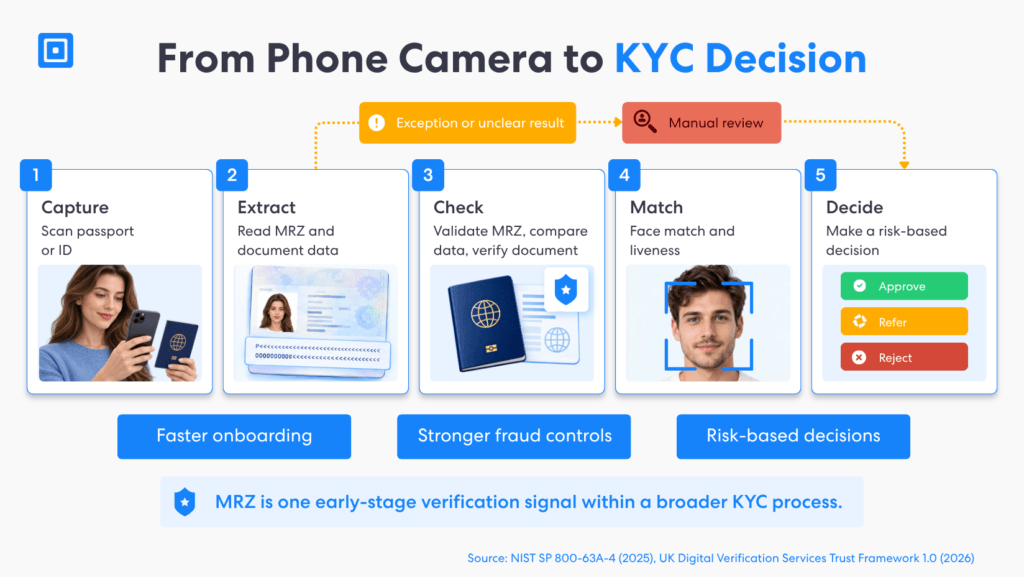
Then, overlapping MRZ and VIZ fields are compared. Document authenticity technology or software can assess other security features for any signs of manipulation. For supported biometric passports, [NFC](https://docs.complycube.com/documentation/product-guides/identity-verification/document-check/nfc-chip-verification) can provide access to cryptographically protected chip data. Finally, facial comparison and liveness can establish that the applicant is the real holder of the identity.
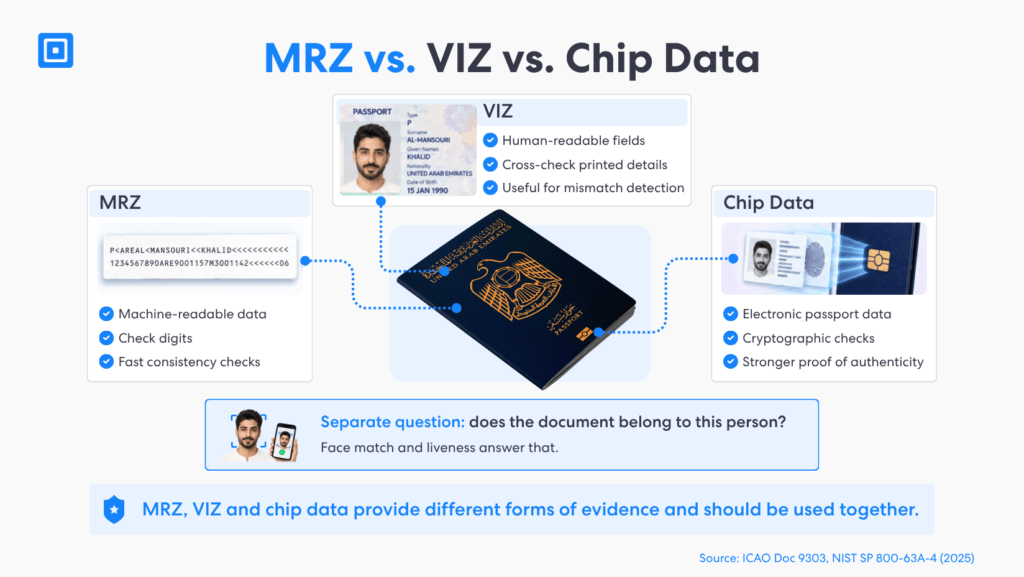
The UK’s 2026 [Digital Verification Services Trust (DVST) Framework](https://www.gov.uk/government/collections/uk-digital-verification-services-trust-framework) reflects this approach. It lists passport-chip reading, identity-fraud services and biometric verification as specialist capabilities. MRZ delivers the most value by accelerating the early stages of identity checking without pretending to answer every downstream trust question.
MRZ codes also help facilitate customer onboarding within financial institutions because onboarding has to balance speed, fraud controls, and larger [Know Your Customer (KYC)](https://www.complycube.com/en/solutions/due-diligence-compliance/know-your-customer/) obligations. MRZ verification can automate KYC checks for banks and applications. However, it cannot replace document-authenticity checks, biometric verification, or other risk controls.
## 5 MRZ Verification Mistakes Developers Should Avoid
Though MRZ verification and codes are simple at the checksum level, there are larger implementation challenges that come with it for developer teams. They especially struggle when deciding what the MRZ verification result means in context. Here are five MRZ verification mistakes that developers must avoid:
### Treating a Failed Checksum as Fraud:
A failed checksum signals an inconsistency but not its cause. Often, the cause is a glare, blur, a worn-out passport, or an OCR engine that misreads a single character. Here, developers must check capture quality and OCR confidence before drawing any conclusion. A failure on low-confidence must trigger a recapture request. Developers must use field-level results to see which field failed, instead of returning a generic “MRZ failed”.
### Treating a Passing Checksum as Proof of Authenticity:
MRZ checksums are often used to prove internal consistency, but not origin. MRZ verification was designed for interoperable data verification, so developer teams must not use it as a singular source of authentication. Data is unencrypted and the algorithm is public. Pair it with document-authenticity analysis, biometric matching, and liveness detection. Do not let MRZ alone make the final approval decision.
### Not Comparing MRZ and VIZ Data:
MRZ and VIZ carry overlapping fields of information. If you only read one, an altered field can slip through the cracks. Mismatches between the two is one of the clearest signals that you can get from the document itself. It is important to extract both zones and compare. Look at benign differences first and flag what matters. Weigh them alongside extraction confidence and other security checks.
### Collapsing Results into a Single Pass/Fail Value:
Boiling every outcome down to one disregards the information you need to make a good decision later on. A clean pass, a pass on low-quality images, and a field-level mismatch can all look the same once flattened. Store capture quality, OCR confidence, field-level check results, and MRZ/VIZ comparison outcomes as separate signals. Use them to build a risk-based decision with three outcomes: approve, reject, or refer.
### Skipping Chip and Biometric Checks Where Available:
Though MRZ cannot prove origin, a biometric passport’s chip can. Chip data can be verified for integrity and issuing authority. The MRZ can be used to derive the acces key for reading it over NFC. Developers should add chip reading, face matching, and liveness detection to flows where the document and devices can support it. MRZ should be used as the standardized first step, not just the last one.
### Key Takeaways
- **MRZ checks** prove data consistency, but do not provide document authenticity.
- **Checksum failures** can result from poor MRZ capture or OCR issues.
- **Comparing MRZ and VIZ data** helps corroborate customer identity.
- **Chip, document, and biometric checks** provide identity assurance.
- **Preserve OCR confidence** and field-level results instead of reducing them to pass/fail.
## Building Reliable MRZ Verification for KYC
Strong MRZ verification goes beyond validating a checksum. ComplyCube brings MRZ verification and validation together with document-authenticity checks. Our platform also checks MRZ and VIZ consistency, biometric face matching, liveness detection, and NFC verification where supported. Configurable risk decisioning helps businesses build a more thorough identity verification process.
Developers can combine these signals into one workflow by separating the technical extraction problems from genuine risk signals. This reduces the need for manual review and strengthens fraud prevention without adding friction for the users during digital onboarding. Use MRZ alongside additional security measures to support faster and more reliable KYC decisions with [ComplyCube](https://www.complycube.com/en/contact/contact-sales/?_gl=1%2A3okbsl%2A_up%2AMQ..%2A_gs%2AMQ..&gclid=CjwKCAjwoaLWBhAWEiwAnyituwhovtF6GuybQUoabklFW0sUiyMQxx-dgNMifZe2i-k4G_dzPw4C8xoCYqwQAvD_BwE&gbraid=0AAAAAoJigppyPxEx89AlmTYeEORzpz5o-).
[](https://portal.complycube.com/signup)
## Frequently Asked Questions
How do MRZ codes help verify passport data?
MRZ codes have identity information in a standard machine-readable format. It also has check digits that allow software to find any discrepancies or inconsistencies in selected fields. MRZ supports automated data capture and lowers the need for manual entry.
Can fraudulent identity documents pass MRZ verification?
Yes, because a mathematically valid MRZ can establish internal consistency, but not document authencity. MRZ data can be copied or altered, needing further verification because it may still contain structured MRZ data. Verification needs independent security and identity signals.
Why can a genuine machine-readable passport fail verification?
Poor lighting, blur, and glare as well as damaged characters, OCR errors, or physical wear can impact accurate reading of the MRZ. Developers need to consider if the image quality and extraction confidence before treating a failed checksum as evidence of fraud.
How does chip data improve identity verification?
Chip data from biometric passports provide electronically protected data that can be cross-checked using cryptographic methods. It also typically offers stronger evidence about data integrity, and provenance than a visible MRZ checksum would alone.
How does ComplyCube strengthen MRZ verification for KYC?
ComplyCube offers MRZ extraction and validation combined with document-authenticity analysis. Our platform also offers MRZ/VIZ comparison, biometric matching, liveness detection and NFC verification where needed as well as configurable risk decisioning.
**Categories:** Guides
**Tags:** Identity Verification
---
### [Identity Document OCR for KYC Compliance](https://www.complycube.com/identity-document-ocr-kyc/)
**Published:** October 8, 2026
**Author:** Dini Habib
**Excerpt:** Identity document optical character recognition solutions automates KYC data extraction, reduces manual errors, and supports faster, accurate customer onboarding. It uses advanced technologies to support precise data recognition.
**Content:**
**TL;DR:** Document Optical Character Recognition (OCR) supports **quicker onboarding** through smarter data extraction and validation. With **identity document OCR** solutions, regulated businesses can lower manual intervention, cut verification time, and reduce operational costs.
## What Is Identity Document OCR?
Identity document OCR is a tool that reads and extracts information from various identity documents, including passports, driver’s license, and national ID cards. Organizations use OCR solutions during Know Your Customer (KYC) flows to support identity verification.
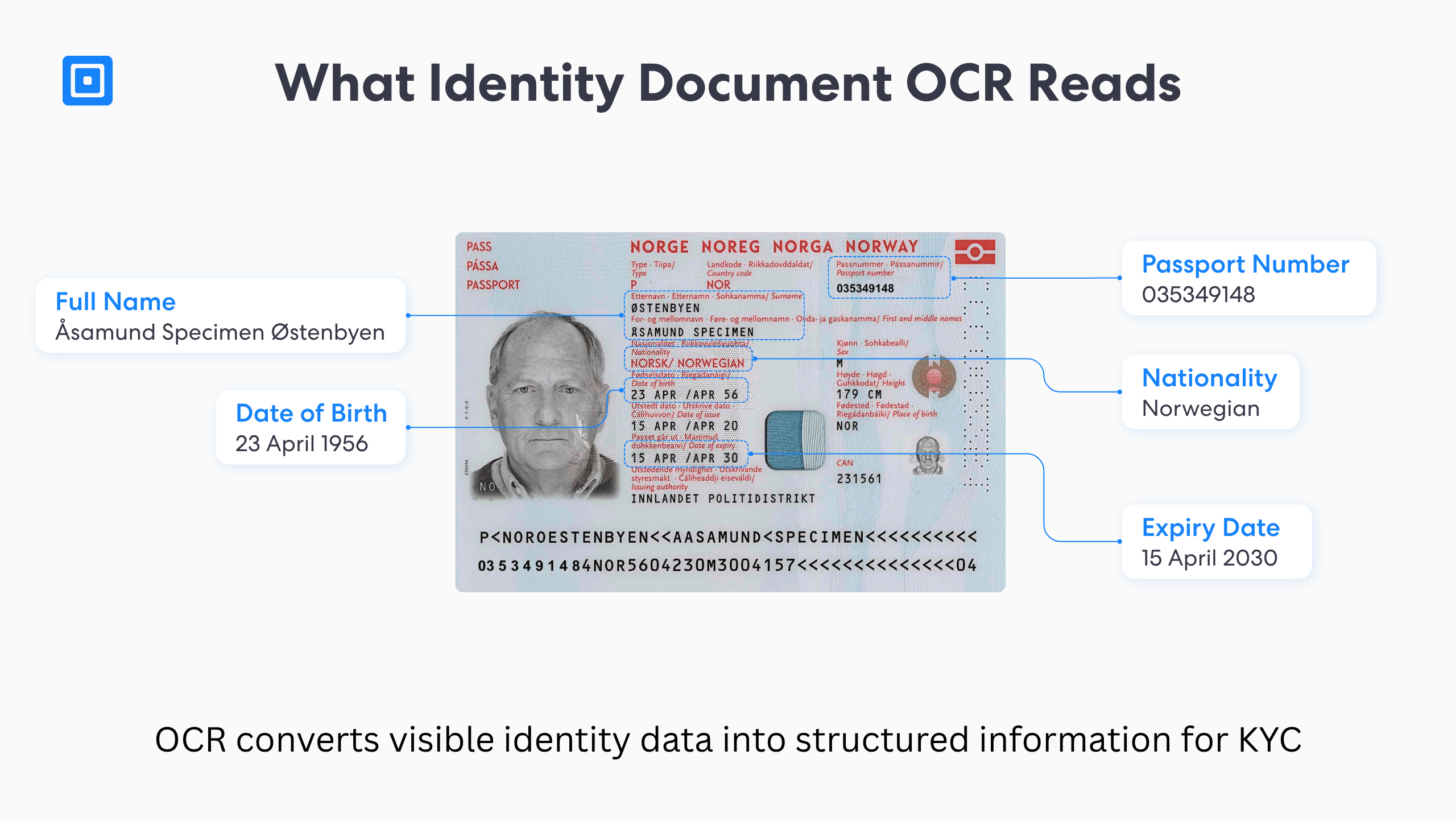
AI-powered document OCR solutions can scan and understand the structure of an ID. They can determine where specific information is located, then provide it as structured data. This can include critical identity attributes used for customer due diligence, such as:
- First and last name
- Birth date
- Nationality
- Issue and expiry dates
- Address, where present
- Machine-Readable Zone (MRZ) data
- Other document numbers such as Social Security Numbers (SSNs)
What this implies is that a business doesn’t need to manually copy details from an identification document into its onboarding or KYC system. Instead, the system automatically extracts data from the scanned documents in the backend and passes it directly to the verification, screening, and risk-assessment process. No manual typing required.
### What is the difference between identity document OCR and generic OCR?
The difference between identity document OCR and generic OCR lies in context. Generic OCR reads and extracts text from any image or document. On the other hand, identity document OCR goes further by scanning for specific layouts, fields, and formats found on documents.
Moreover, it’s essential to differentiate OCR systems from [document verification](https://www.complycube.com/en/solutions/identity-assurance/document-verification/). Although often used interchangeably, OCR is the feature that extracts information from a document, while verification determines whether a document is genuine, such as through security feature analysis. Simply put, OCR supports automated data entry in document verification, which speeds up onboarding. You can learn more here: [What is document verification?](https://www.complycube.com/en/what-is-document-verification/)
## Identity Document OCR for KYC Compliance
Digital onboarding plays a leading role in compliance and fraud prevention. It enables real-time identity verification. However, because it happens remotely, bad actors can now create and scale fake identities behind a screen. According to UK Finance, payment fraud losses reached [£1.28 billion in 2025](https://www.ukfinance.org.uk/policy-and-guidance/reports/annual-fraud-report-2026), and the US Federal Trade Commission recorded [$15.9 billion in fraud](https://www.ftc.gov/news-events/news/press-releases/2026/03/ftc-testifies-joint-economic-committee-agencys-efforts-combat-fraud) losses that same year.
> Slow or inaccurate identity data capture is no longer merely an operational inconvenience.
OCR works by turning the visible information on passports, driver’s licenses, and national identity cards into structured data that KYC systems can then process automatically. Instead of manually extracting and re-entering data, firms can capture the necessary information consistently and at scale.
An [identity document OCR solution](https://www.complycube.com/en/solutions/due-diligence-compliance/know-your-customer/optical-character-recognition/) enables compliance teams to:
### 1. Enhance data accuracy
OCR technology uses artificial intelligence solutions and machine learning for smarter data recognition and extraction. For example, it can use context clues to differentiate characters such as the number one (1), lowercase letter L (l), and uppercase letter I (I) in identity and business documents. It also removes common human errors, such as spelling mistakes or transposed digits. As a result, OCR improves screening performance and minimizes false positives from poor-quality or incorrectly entered information.
### 2. Strengthen privacy
Identity document OCR software transforms complex image files and PDF documents into machine-readable text, allowing automatic redaction in line with data privacy laws. For example, the Netherlands treats the Burgerservicenummer (BSN) as a highly sensitive government identifier. OCR can locate this data, enabling separate redaction or data-masking controls to meet privacy rules.
### 3. Scale verified onboarding
OCR can scan through thousands of documents in multiple languages at the same time. It can scale to large increases in verification volume without creating operational bottlenecks. OCR reduces the need for human review, typing, and verification, which drastically reduces processing time and compliance costs. This enables regulated businesses to scale onboarding while ensuring consistent data capture.
### 4. Helps detect fraud
OCR provides structured identity data that can be compared with other document and identity information to detect and prevent fraud. This extracted data can be cross-referenced against other known information such as biometric, NFC, or MRZ data to identify image tampering and anomalies like mismatched fonts, manipulated portraits, or inconsistent shadows, which are missed by manual checks. You can learn more here: [How Document Fraud Software Works](https://www.complycube.com/en/document-fraud-detection-software-guide/).
## When to Use Identity Document OCR
The real value of identity document OCR isn’t just to scan and read an ID. It’s the ability to move critical customer due diligence identity attributes through onboarding, review, and ongoing [KYC processes](https://www.complycube.com/en/solutions/due-diligence-compliance/know-your-customer/) without any need for manual entry.
Document optical character recognition powers several KYC touchpoints:
- **Remote onboarding:** It allows financial institutions to onboard customers without the need for a physical office or interaction. Since verification happens remotely, it can be done in seconds.
- **Assisted or branch onboarding:** IDs can be scanned instantly, instead of keying in data one by one, which removes human error and increases the efficiency of day-to-day business processes.
- **Automated KYC workflows:** Document information, such as from loan documents or financial statements, can feed immediately into CRM, case management, and other digital workflows.
- **High-risk reviews**: Where there are high-risk cases that need step-up checks, OCR can be used for enhanced due diligence, re-verification, and exception handling easily.
- **Cross-border verification:** OCR can standardize data capture across global document types that contain varying formats, images, or languages.
- **Periodic KYC refreshes:** During KYC refreshes, OCR can automatically re-scan and keep all identity documents up-to-date, with any changes flagged in real-time.
## Typical Identity Document OCR in a KYC Workflow
A typical KYC workflow starts when a user takes a photo or uploads their ID. It is at this stage that OCR extracts the information in that document and turns it into readable data that teams can view. This data is then verified for accuracy. This can be done via cross-verifying with other customer data provided or captured during the KYC journey, including [biometric verification](https://www.complycube.com/en/solutions/identity-assurance/biometric-verification/) and multi-bureau verification.
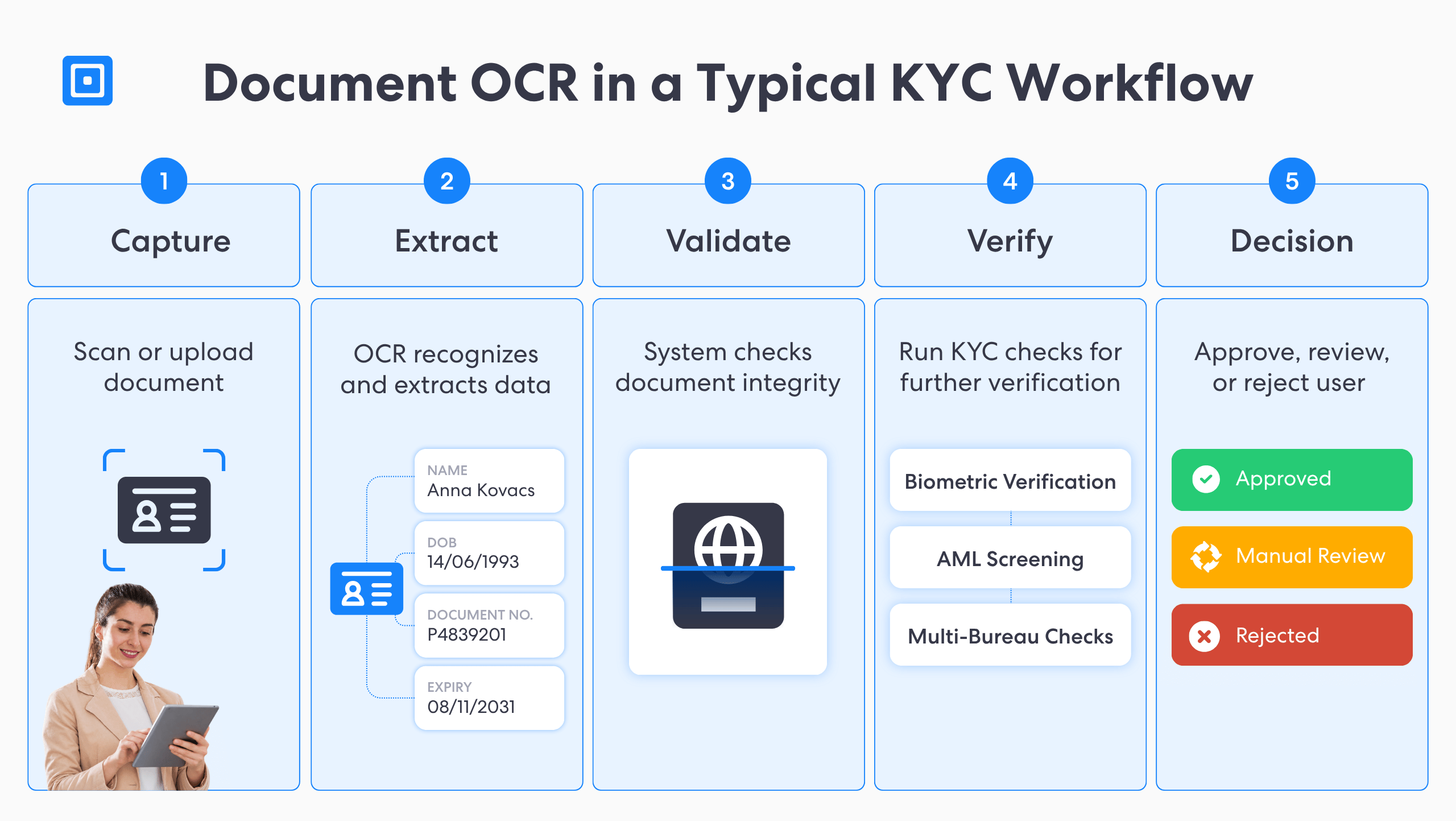
However, it is important to remember that document OCR does not determine compliance outcomes itself. Instead, its core function is to quickly and reliably produce usable data from ID information. The main outcome is to remove manual data entry, fast-track onboarding, and capture better data for [Anti-Money Laundering (AML)](https://www.complycube.com/en/solutions/due-diligence-compliance/anti-money-laundering/) controls.
## Common OCR Document Processing and Data Extraction
OCR is a foundational technology. However, its value really depends on how well it handles different ID formats, security features, and languages. Unlike basic OCR for printed paper documents, handwritten notes, or invoice processing, identity verification requires highly accurate text detection across complex, domain-specific documents.
The common identity documents that [OCR software can detect](https://docs.complycube.com/documentation/product-guides/identity-verification/document-check) include:
- **Passports:** Feature a standardized MRZ layout for easy OCR extraction. In particular, its stored glyphs and standardized OCR-B font are designed to be easily read by computer systems.
- **NFC chips:** Reads and extracts embedded RFID chips in electronic identity documents, such as ePassports. Confirms that a document is genuine and not altered.
- **Driver’s licenses:** Driver’s licenses vary across countries in background, holography, and layout. A strong template library and classification model is key to handling varying layouts.
- **Paper-based documents:** Other document types that can be processed include handwritten notes or aged paper, such as birth certificates, tenancy agreements, or bank statements.
Beyond that, modern document verification solutions include other data extraction technologies:
- **NFC chips:** Reads and retrieves [embedded RFID chips](https://www.complycube.com/en/solutions/identity-assurance/document-verification/nfc-verification/) in electronic identity documents, such as ePassports. Confirms that a document is genuine and not altered.
- **Barcode and QR code:** Scans and extracts encoded information from machine-readable patterns such as QR codes in digital identity credentials.
To measure the effectiveness of OCR tools on real-world images, businesses can perform testing and controlled benchmarking. For example, they can analyze field-level extraction accuracy, processing speed, and manual review rates across the various document types above.
## The Mechanics Behind Identity Document OCR
Identity document OCR is able to transform scanned images, TIFF files, and image-only PDFs into structured, machine-readable text data. A robust OCR process turns complicated document images into well-structured identity data that KYC systems can then process automatically.
However, OCR relies on a number of different stages functioning together:
- **Image acquisition:** When it comes to capturing images, web and mobile SDKs assist users in taking clear images of documents by minimizing glare, blur, and poor framing. Good image acquisition is a necessity because it directly affects output quality.
- **Image pre-processing:** The document image gets cleaned up first before starting text recognition via advanced techniques such as resizing, noise reduction, contrast adjustment, or even color normalization.
- **Document and layout detection:** Pattern recognition and computer vision determines the type of document used and identifies relevant areas such as the MRZ, address fields, photo, or barcode. Neural networks can help interpret complex layouts found on various documents.
- **Text recognition and extraction:** Modern OCR models transform visible characters into editable text data, while Intelligent Character Recognition (ICR) can handle more difficult cases, such as irregular or handwritten text where appropriate.
- **Structuring and validation:** The information extracted is arranged in the form of key-value pairs, for example, those relating to the name, the date of birth, and the document number. Format rules and checks can then detect any inconsistencies before the data is passed downstream.
### **Case Study: Ukrainian KYC Crypto Scam Network**
In September 2026, Ukrainian watchdogs found an alleged crypto scam network targeting over 20 countries and generating [over $1 million](https://www.complycube.com/en/ukrainian-crypto-scam-network-shut-down-by-authorities/) per month. The network bypassed onboarding by stealing victims’ passport, photograph, and other information.
##### **Why Document Verification is Critical**
Effective KYC programs do not stop at OCR data entry. They combine multiple risk signals to determine if a customer is real. In this case, businesses must connect OCR technology with multi-layered fraud detection tools, such as document verification, biometric check, and AML screening.
##### **Outcomes**
- Over 62 victims were identified with 34 searches leading to seized devices and documents.
- Identity data can be stolen and reused to appear as genuine account holders.
- Firms must verify extracted ID data against other fraud signals before approving customers.
## How to Evaluate Identity Document OCR Solutions?
The effectiveness of identity document OCR solutions can vary across software vendors. For example, factors such as multi-language support and ID coverage can impact output quality. This section covers the key criteria to consider when choosing document optical character recognition software.
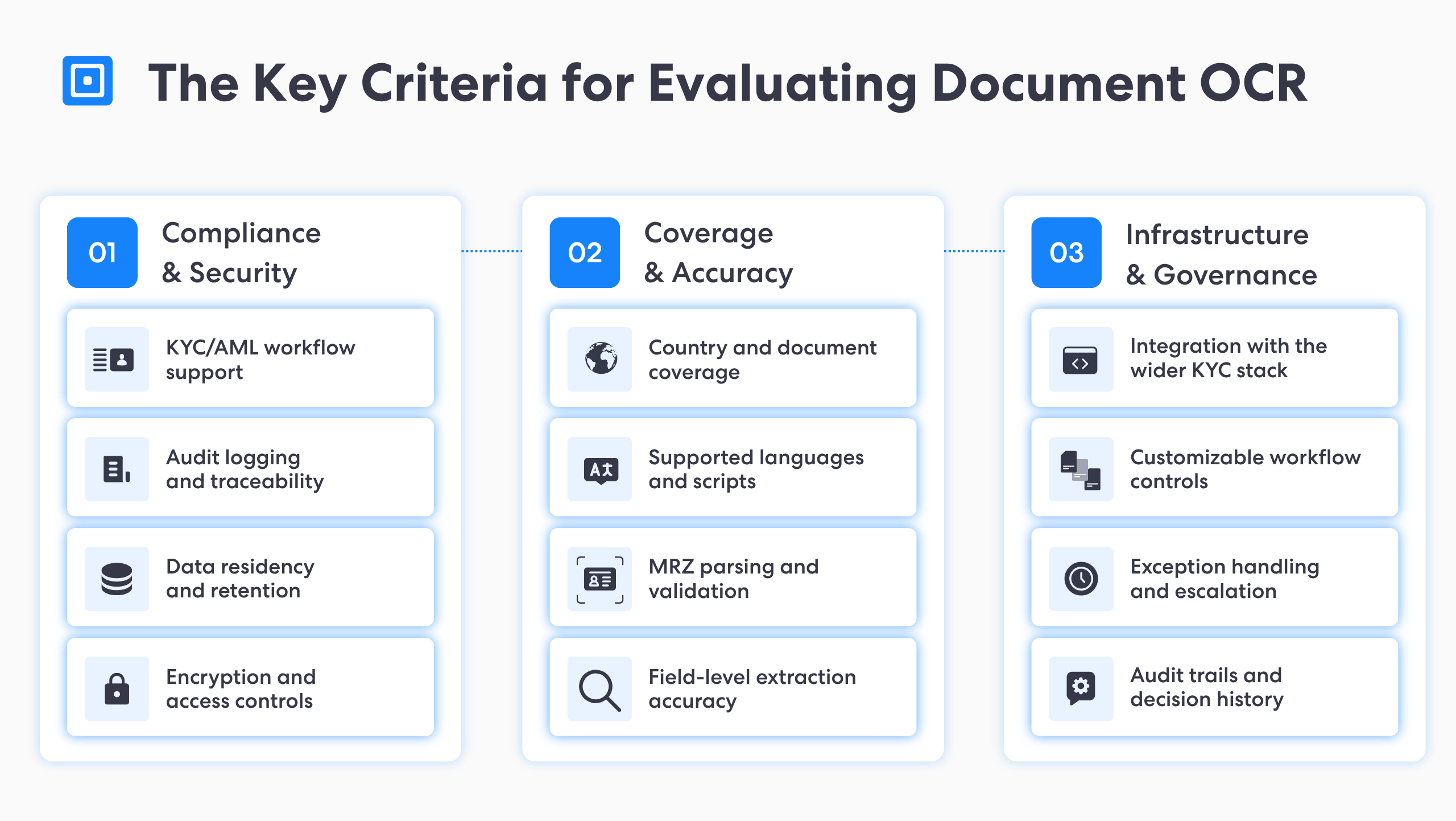
**1. Document and Language Coverage:** Ensure the solution provides coverage in the relevant countries your users are in. Additionally, confirm that it can process the specific document type in the particular jurisdiction, as well as support for multi-scripts (Latin, Chinese characters etc.) and languages.
**2. Privacy and Security:** Verify that the identity document OCR provider has clear audit logging, data residency controls, and adherence to privacy rules such as the EU GDPR and US NIST. Check for encryption, retention settings, and role-based access controls to understand how data is handled.
**3. Regulatory Assurance:** Consider whether the OCR capability supports the wider KYC/AML process. Look for providers that connect OCR outputs with AML screening, [ongoing monitoring](https://www.complycube.com/en/solutions/global-screening/continuous-monitoring/), and risk assessment to strengthen compliance and reduce fragmented systems.
**4. Integration:** Look for identity document OCR solutions with well-documented APIs and SDKs. Compatibility with existing document workflows, CRM, and cloud environments, including cloud storage and platforms such as Google Cloud, is critical to seamless deployment.
**5. Document AI capabilities:** Strong document AI solutions stand out in their precision. It can classify document type, locate relevant fields, and return usable identity attributes. Also, it can support handwritten text, read unstructured and printed documents, which overall reduces manual intervention.
### Key Takeaways
- **Modern document OCR** solutions recognize and extract key identity attributes in real time for verification.
- **OCR enhances data** accuracy and privacy by reducing human error and exposure to sensitive data.
- **Regulated businesses** use identity document OCR to accelerate onboarding and strengthen compliance.
- **Advanced image acquisition**, pre-processing, and text recognition support accurate data extraction.
- **Document coverage**, integration, and regulatory assurance must be considered during OCR evaluation.
## Strengthen KYC Compliance with Advanced OCR Solutions
Document optical character recognition is most useful when integrated into the full KYC process. The best identity document OCR software is one that can automate KYC compliance, offer regulatory assurance, and support faster compliance decisions. [Learn more](https://www.complycube.com/en/contact/contact-sales/) about how you can strengthen regulatory alignment and fraud prevention with AI-powered identity document OCR solutions today.
[](https://portal.complycube.com/signup)
## Frequently Asked Questions
What is the best OCR software for KYC?
The best Optical Character Recognition (OCR) software for Know Your Customer (KYC) compliance supports accurate document data extraction, robust identity verification, and fraud detection. Businesses should compare false positive rates, document coverage, processing speed, and manual review rates.
Does document OCR solutions replace human compliance officers?
No, identity document Optical Character Recognition (OCR) automates repetitive data-entry tasks. OCR processing allows compliance teams to focus on suspicious activity rather than manual data entry. However, human compliance officers should investigate and escalate complex, high-risk cases.
Can OCR-based KYC work with low-quality or damaged documents?
OCR can still convert low-quality or partially damaged documents into machine-readable text. Advanced methods, such as pre-processing, multiple image captures, and fallback strategies, can improve OCR accuracy where the ID document is particularly weak. However, exceptionally poor quality cases must be routed to manual review.
How long does it take to integrate identity document OCR into onboarding?
It can take a few hours to several weeks to integrate identity document Optical Character Recognition (OCR) into onboarding. The time depends largely on integration, testing, and compliance sign-off. For example, basic SDK integration into a mobile app can take a few hours, while integration into a full KYC lifecycle verification stack can take a few weeks.
How does ComplyCube’s identity document OCR support KYC programs?
ComplyCube’s identity document Optical Character Recognition (OCR) automatically extracts key identity attributes to support fraud prevention and KYC compliance. It uses an advanced AI OCR engine to analyze over 14,000 document types, detect sophisticated fraud anomalies, and meet Customer Due Diligence (CDD) requirements across 250+ territories and languages.
**Categories:** Guides
**Tags:** Identity Verification
---
### [Rank Group £5M Settlement Exposes AML Gaps](https://www.complycube.com/rank-group-5m-settlement-exposes-gaps/)
**Published:** October 7, 2026
**Author:** Rithu Jagannath
**Excerpt:** Rank Group’s £5M settlement case has put land-based casino Anti-Money Laundering controls under the spotlight. Learn how this settlement exposed serious gaps in risk scoring, source-of-funds checks and Enhanced Due Diligence.
**Content:**
On 7 October 2026, the UK Gambling Commission announced £5M (~$6.6M USD) in regulatory settlement involving three Rank Group-owned casinos after finding Anti-Money Laundering (AML) failures in their operations. It covers Grosvenor Casinos Limited, Grosvenor Casinos (GC) Limited, and Gaming Group Limited. All of these companies operated 51 casinos across Great Britain.
An independent third-party auditor will assess whether the businesses are implementing their AML and safer gambling controls effectively. However, beyond the size of the settlement, the most important part of the case is understanding where the controls completely broke down.
## What Happened to the AML Controls of Rank Group?
The Gambling Commission found several significant weaknesses in the casino operators’ AML framework. The operator has not updated its policies to reflect changes introduced by the UK Money Laundering Regulations from 2020. Unclear procedures caused staff to make inconsistent decisions for customers who carry elevated money-laundering risk.
The operators wrongly assigned higher-risk customers to inappropriate risk levels while accepting other high-risk funds without any issue or further scrutiny. The Commission also found cases where operators failed to carry out [Enhanced Due Diligence (EDD)](https://www.complycube.com/en/enhanced-due-diligence-edd-insights-challenges/), despite their own policies requiring it.
Reporting on the investigation provides an especially useful example. Policies around crypto lacked clarity, with converted crypto funds reportedly accepted without sufficient examination of their original provenance. Venue managers could not be consistent without any clear guidance around Source of Funds (SoF) and Source of Wealth (SoW). Now, finding risk is not enough if that risk does not consistently change the checks a customer receives.
## Land-Based Casinos Face the Same AML Scrutiny
[Large gambling enforcement cases](https://news.sky.com/story/grosvenor-owner-rank-pays-5m-penalty-for-casino-failures-13596016) such as that of Rank Group and its £5M settlement could draw attention toward online casino operators. It does not reduce the larger AML obligations that these physical venues face on a regular basis.
> Anti-money laundering and social responsibility failures are equally alive in the land-based sector.
Executive Director of Operations at the Gambling Commission, [Sue Young](https://www.gamblingcommission.gov.uk/about-us/person/sue-young), said, “We would advise all premises-based operators to take a careful look at this case and ensure their own business is not making the same mistakes, and therefore they do not face costly and inevitable Commission action”.
Physical casinos blend several characteristics that are interesting to financial criminals. There are several high-value transactions, cash, fast movement of funds, and customers whose financial behaviour changes significantly over time. The real compliance challenge is around building AML controls that are capable of detecting when behaviour, funding sources, or customer circumstances no longer match the original risk assessment.
## Lessons From The £5M Rank Group Settlement
The Rank Group [case](https://focusgn.com/rank-group-casinos-agrees-to-5m-fine-over-regulatory-breaches) highlights the gaps between having an AML policy and the practical challenge of executing it consistently. For many gambling operators that are reviewing their own controls, teams must look at these three questions:
- Does customer risk change the workflow? Higher-risk indicators should trigger proportionate EDD SoF or SoW checks instead of leaning on staff interpretation.
- Can funding risk be traced? Turning an asset into GBP does not remove the risk linked to its source. Compliance teams need evidence to understand the origin of higher-risk funds.
- Can every decision be defended later on? Risk classifications, escalations, supporting evidence, and compliance choices must have a clear audit trail. It must show why a customer was approved, challenged, or restricted.
These principles extend beyond casinos and gambling operators. Across many regulated industries, gambling enforcement truly focuses on whether AML controls work in reality. The existence of policies on paper does not mean much in the grand scheme of AML frameworks.
## Turning AML Policies Into Decisions
Modern AML programs need to link Customer Due Diligence (CDD), risk assessment, screening, ongoing monitoring, and EDD into one risk-based process. ComplyCube can support businesses looking to build [dynamic compliance workflows](https://www.complycube.com/en/solutions/compliance-suite/kyc-workflow/dynamic-workflows/). They can create customer and fraud risk signals that trigger additional verification, AML screening, document collection, or EDD. Decisions and supporting evidence can then be maintained within an auditable investigation workflow.
The Rank Group £5M settlement sets out a timely warning for gambling operators. AML risk does not go away at the casino door, and neither does regulatory scrutiny. Businesses should review cases such as these carefully to ensure that they are not at risk of making the same mistakes.
[](https://portal.complycube.com/signup)
Find out more AML updates in ComplyCube’s [Trust Edition newsletter](https://www.linkedin.com/newsletters/the-trust-edition-7103022355722981376/). We explore the latest developments across identity verification and AML globally.
**Categories:** News
**Tags:** Anti-Money Laundering
---
### [CryptoCubed September Newsletter: UK P2P Trading and CoinFlip AML Case](https://www.complycube.com/crypto-september-news-uk-p2p-trading-crackdown/)
**Published:** September 30, 2026
**Author:** Dini Habib
**Excerpt:** September's crypto news digest covers the latest enforcement action and regulatory updates. It explores the UK's P2P trading crackdown, offshore VASPs targeting Indian customers, AUSTRAC's suspension of 45 crypto firms, and more.
**Content:**
👋 Welcome to the September CryptoCubed edition. From unregistered UK P2P trading crackdown to offshore VASPs targeting Indian customers, this month’s crypto news digest is packed with the most interesting developments across Anti-Money Laundering (AML) controls and governance.
Take a look at the latest enforcement cases shaping AML regulations in crypto and what compliance teams should start taking seriously before officers start knocking on their doors.
## Ukraine Shuts Down Crypto Scam Network
Ukraine, September 1, 2026 🇺🇦: Ukrainian National Police officially announced the dismantling of a fake crypto investment platform network. According to reports, the network used a crypto drainer, a form of malicious software that plugs in and steals assets from customers’ cryptocurrency wallets.

A crypto drainer can be potent. It uses advanced fake websites to lure users into connecting their wallets, draining funds instantly. Over $1 million was stolen from victims in a month. Ukrainian regulators have identified 62 victims so far, and confirmed over 46 citizens operating in the network.
### *Compliance Takeaway:*
Crypto scams often rely on highly convincing impersonation. This can make Know Your Customer (KYC) alone insufficient. As such, adopting a multi-layered approach is crucial to preventing fraud and money-laundering risks. This includes transaction screening, [device intelligence](https://www.complycube.com/en/solutions/fraud-intelligence/device-intelligence/), and mobile verification, which use multiple risk signals to flag potentially suspicious destinations.
For more on this story, click [here](https://www.complycube.com/en/ukrainian-crypto-scam-network-shut-down-by-authorities/).
## India Blocks 15 Virtual Digital Asset Service Providers (VDASPs)
India, September 9, 2026 🇮🇳: India’s Financial Intelligence Unit (FIU) issued a formal warning to 15 VDASPs after finding out that these firms did not comply with the country’s Prevention of Money Laundering Act, 2002 (PMLA) regulations. These firms include Weex, BloFin, RezorEx, and more.

Notably, most of these companies do not have physical offices in India. Instead, they operate globally, serving customers worldwide, including in India. While the exact violations have not been stated explicitly, this case signals India’s strong stance around businesses operating in the crypto sector.
### *Compliance Takeaway:*
For global firms, this case highlights growing concern about generic AML/KYC processes. Businesses operating offshore must still map obligations by customer jurisdiction, not office location. Notably, [Policy Assurance](https://www.complycube.com/en/solutions/compliance-suite/policy-assurance/) and [Custom AML Risk Engine](https://docs.complycube.com/documentation/product-guides/due-diligence-tools/risk-profile) solutions let businesses tailor risk factors at a granular level while ensuring compliance in each jurisdiction.
For more on this story, click [here](https://www.complycube.com/en/india-blocks-15-crypto-exchanges/).
## Ongoing UK P2P Trading Crackdown
United Kingdom, September 17, 2026 🇬🇧: The Financial Conduct Authority (FCA), together with HM Revenue & Customs (HMRC) and the Metropolitan Police Service, issued formal cease-and-desist orders to three premises suspected of engaging in peer-to-peer (P2P) crypto trading.
> Anyone running an unregistered peer-to-peer crypto business should assume we are looking at them.
In the UK, there are no P2P firms that are legally registered. This is because the country deems crypto a high-risk sector, with P2P trading often providing a quick and easy way to move illicit funds.
FCA executive director of enforcement and market oversight Steve Smart notes, “Working with partners, we continue to track and disrupt illegal crypto activity. Anyone running an unregistered peer-to-peer crypto business should assume we are looking at them.”
### *Compliance Takeaway:*
Unregistered or cash-heavy P2P trading can be especially high-risk as it can conceal who is behind a transaction and the source of funds. For example, countries such as China and Bangladesh impose blanket restrictions on crypto trading. Firms that facilitate crypto trades should register under the appropriate jurisdiction and uphold source-of-funds checks, Customer Due Diligence (CDD), and regulatory reporting.
For more on this story, click [here](https://www.fca.org.uk/news/press-releases/fca-and-partners-continues-crackdown-illegal-crypto-trading).
## Australia Refuses Renewal for 45 Virtual Asset Service Providers (VASPs)
Australia, September 7, 2026 🇦🇺: The Australian Transaction Reports and Analysis Center (AUSTRAC) recently issued a powerful warning in a media release. In the past year, AUSTRAC has suspended or refused the renewal of 45 remittance and VASP registrations.
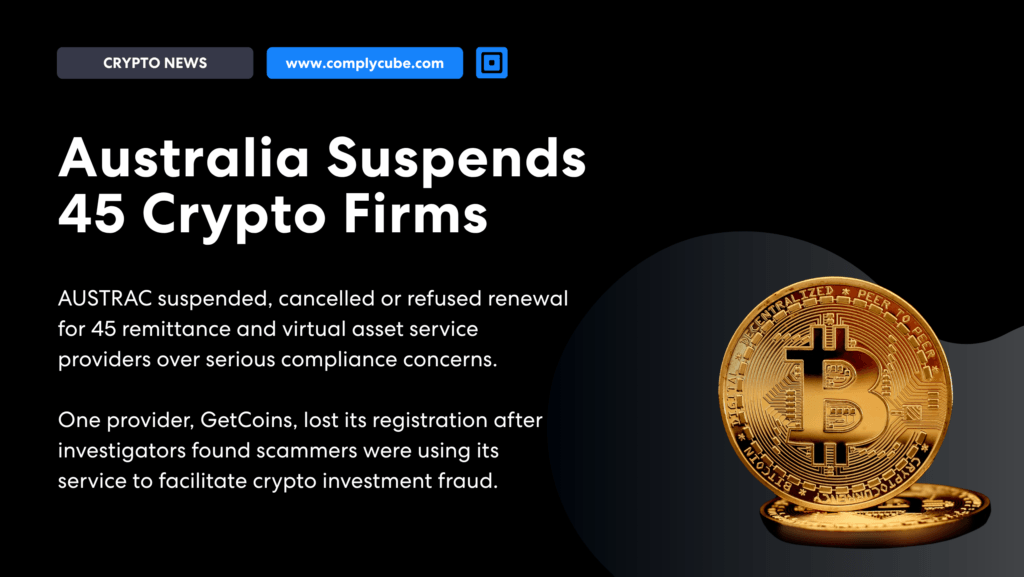
In Australia, firms must be registered to operate. According to reports, these 45 firms failed to meet AUSTRAC’s mandates, including inadequate operational capacity to begin or continue trading and the inability to effectively identify and investigate money laundering or terrorism financing risk.
In one case, the cryptocurrency service provider GetCoins had its registration canceled after customers complained to the National Anti-Scam Center (NASC). Investigations found that bad actors were targeting GetCoins to run crypto investment scams.
### *Compliance Takeaway:*
AUSTRAC’s sweeping action shows that registration is only the first step to implementing AML/CTF controls. It does not automatically translate into defensible, effective systems. In this case, regulators may suspend or cancel a firm’s registration if fraudsters repeatedly exploit it, as this provides reasonable grounds to conclude the firm cannot operate at the required level.
For more on this story, click [here](https://www.austrac.gov.au/news-and-media/article/austrac-removes-45-businesses-scrutiny-intensifies-high-risk-payments).
## Crypto ATM CoinFlip Fined Over $1M for Poor Compliance Controls
United States, September 3, 2026 🇺🇸: The Washington State Department of Financial Institutions (DFI) ordered a $1,029,600 fine against CoinFlip after investigations found significant lapses in the crypto kiosk’s compliance and risk management processes.
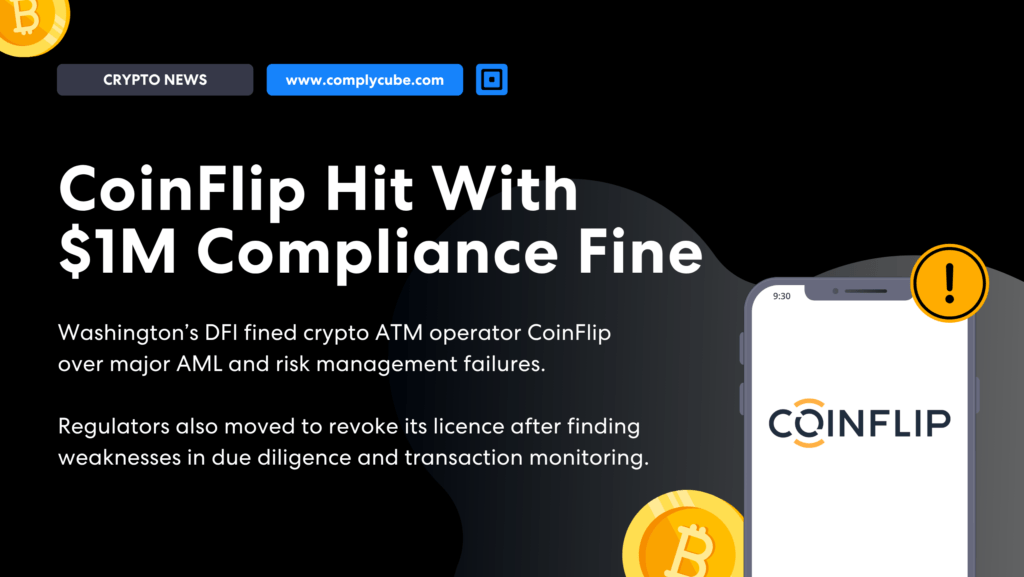
This is particularly harmful because 50% of its customer base consists of senior citizens. Notably, the Federal Trade Commission reports that older adults are more likely to suffer losses ranging from [tens of thousands](https://www.ftc.gov/news-events/data-visualizations/data-spotlight/2025/08/false-alarm-real-scam-how-scammers-are-stealing-older-adults-life-savings) of dollars lost to scammers.
According to the DFI’s Statement of Charges, CoinFlip violated multiple AML laws. This includes inadequate due diligence processes, and insufficient transaction monitoring. Additionally, the DFI seeks to revoke CoinFlip’s license, particularly due to the severity of the violations.
### *Compliance Takeaway:*
Crypto ATMs can be particularly high-risk because they allow anonymous, irreversible, and real-time cash-to-crypto conversions. That is why jurisdictions such as the FCA outright ban them. For crypto firms that provide remote services, basic identity verification may not detect high-risk activity. Instead, implementing strong [Enhanced Due Diligence (EDD)](https://www.complycube.com/en/enhanced-due-diligence-edd-insights-challenges/) triggers, scam-specific transaction rules, and intervention before suspicious transfers are completed is crucial.
For more on this story, click [here](https://dfi.wa.gov/news/press/washington-state-dfi-takes-action-against-coinflip).
## Time for Some Light-Hearted Creative Criticism?
So you’ve made it to the end of our newsletter. It’s time to enjoy a little satire, worthy reader, you’ve earned it.
### 🔥THE CRYPTO CUBED POEM: SEPTEMBER🔥
Wallets move fast, but regulators quickly follow,
Weak controls leave compliance processes hollow.
Offshore borders offer little defense,
While customer risk demands more diligence.
From crypto kiosks to P2P, the message is clear,
Monitor the transactions, not just who appears.
Crypto may change how money can flow,
But understanding the risks must grow.
### Stay tuned for our October newsletter, and have a great month!

**Categories:** News
**Tags:** Crypto Regulations
---
### [Top 5 Right to Work Compliance Software for UK Employers in 2026](https://www.complycube.com/top-5-right-to-work-compliance-software-for-uk-employers-in-2026/)
**Published:** September 29, 2026
**Author:** Rithu Jagannath
**Excerpt:** Compare the top right to work compliance software for UK employers, including provider coverage, employment checks, operational costs, workflows, evidence management, and what buyers should assess before choosing a platform.
**Content:**
**TL;DR:** The best right to work provider is one that is certified for the identity documents your candidates hold. Compare **Right to Work compliance software** providers on **certified coverage**, data retention, and audit trails. The 1 October 2026 rules change the scope of who carries out **employment checks**, so the choice is more important than ever.
## Why Certified Coverage Is Important
Two separate providers can be certified, yet still cover different ground. Certified identity profiles set out which combinations of identity evidence that a provider is capable of verifying. Moreover, depending on the certified profile, they can also provide a certain level of assurance. Typically, the more profiles held, the wider the range of candidates a provider is approved to check.
The most important part to understand is whether a provider’s certified profiles match the candidates that you hire. As the rules and scope expand on 1 October, this is the lens through which providers should be compared.
## What Is Right to Work Compliance Software?
Good Right to Work compliance software helps employers verify and manage evidence of whether a person is [legally permitted to work](https://www.complycube.com/en/verify-right-to-work-checks-for-contractors/). Depending on an individual’s immigration status, documents, and nationality, the process may involve digital Right to Work checks, a Home Office share code, or another valid route. You can learn more here: [What Changed in 2026 Right to Work Legislation?](https://www.complycube.com/en/what-changed-in-the-2026-right-to-work-legislation/)
Right to Work software aims to standardise checks for candidates who have received conditional offers. However, it does not remove the employer’s legal requirements to complete the full and correct process. Employers that cannot provide statutory excuses are liable and can face civil penalties of up to £60,000 per illegal worker for repeated offences. The 1 October legislation changes also extend liabilities to broader working arrangements such as subcontracting, labour supply chains, and online matching platforms.
## Pre-Employment Checks Go Beyond Right to Work Compliance Software
Right to Work is one part of [pre-employment checks](https://www.gov.uk/government/publications/right-to-work-checks-employers-guide) before a binding employment contract. An organisation typically verifies work status, qualifications, previous employment, and references. They also look at any professional licences or other documents containing identity information before a new employee starts. For [certain roles](https://www.complycube.com/en/right-to-work-digital-identity-checks/), employers carry out criminal record checks through the Disclosure and Barring Service (DBS). Roles involving children or vulnerable adults may need additional screening.
> Pre-employment screening works best when treated as a connected process.
[Harry Varatharasan](https://www.itpro.com/technology/artificial-intelligence/what-happens-to-consent-when-the-keys-are-handed-to-machines), Chief Product Officer at ComplyCube says, “When employers bring multiple checks into a single onboarding flow, it becomes easier to reduce delays for employee verification and allows teams to maintain a clear audit trail for future reviews”. A criminal record does not necessarily stop someone from getting a new job. The screening process needs to be appropriate and lawful with written consent obtained wherever it’s needed.
## What Should Be Compared in Right to Work Compliance Software?
Digital Right to Work services must slot into the [wider recruitment process](https://www.complycube.com/en/check-employee-right-to-work-for-recruitment/). Providers are certified against Good Practice Guide (GPG) 45 identity profiles under the UK Digital Identity and Attributes Trust Framework (DIATF). Although,[ certification comes first](https://www.access-dvs-register.service.gov.uk) as it defines the candidates that providers are allowed to check, providers must also check across several key categories:
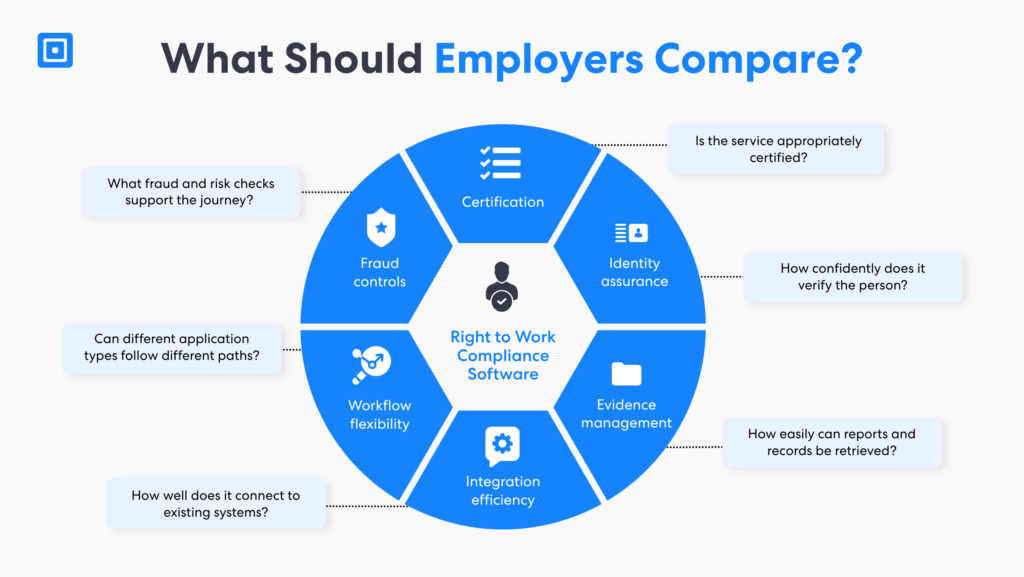
- Certification
- Fraud controls
- Identity assurance
- Workflow flexibility
- Evidence management
- Integration efficiency
All of these factors allow employers to move candidates from a conditional offer to final approval without any extra manual labour. It should be noted that though certification shows what a provider is approved to verify, it doesn’t outline how it performs day-to-day. Ensure to ask every provider for its onboarding completion data.
### ComplyCube
ComplyCube is a standout. Its sheer breadth of UK DIATF certification can speak for itself. [GOV.UK](http://gov.uk/) registration lists 23 certified identity profiles of which 21 are available for Right to Work. It covers a much wider range of identity evidence and assurance options that the remaining providers in this shortlist.
Beyond certification coverage, ComplyCube provides flexible workflows, advanced biometric detection, and fraud prevention controls. They also give employers thorough audit logs and flexible deployment. ComplyCube is best for those who want to incorporate more than just a singular Right to Work into their workflow.
- **Certified coverage:** 23 overall, including 21 Right to Work profiles.
- **Beyond certification:** Blends document verification, biometrics, fraud controls, and reports. Also provides audit logs, APIs, SDKs, and hosted workflows all within one platform.
- **Buyer consideration:** Employers that need broad certified coverage and the flexibility to blend employment, identity, and compliance, ComplyCube is the right choice.
### TrustID
TrustID takes a specialised approach to employment screening. The platform provides Right to Work, Right to Rent, and DBS supplementary certifications across four certified identity profiles. Its value lies in employment-focused verification with analyst-assisted review.
- **Certified coverage:** Four profiles – M1A, M2C, H1A, and H2B – spanning medium and high assurance.
- **Beyond certification:** Offers automated employment verification with analyst support for cases requiring further review.
- **Buyer consideration:** Compare TrustID’s employment-focused and evidence-retaining process against platforms offering broader fraud, workflow, and identity infrastructure.
### Veriff
Veriff has a strong global Identity Verification (IDV) platform, its certified profile coverage is more concentrated. Their registration lists three certified identity profiles, two of which that apply specifically to Right to Work. Therefore, buyers who want a recognised IDV platform with a narrower UK certified profile set should consider Veriff.
- **Certified coverage:** 3 profiles, with 2 Right to Work profiles.
- **Beyond certification:** Can add document verification, biometrics and fraud detection to a wider global IDV platform.
- **Buyer consideration:** Assess if Veriff’s smaller certified profile set and more fixed certified journey allows for flexibility as needed.
### Entrust IDV
Entrust provides the Right to Work with a wider enterprise identity and security ecosystem. Two identity profiles are listed: M1A and H2B. Both of these profiles are available for Right to Work and cover both medium and high assurance levels. This offers a greater variety of assurance levels than some competitors, but the range of certified profiles is still relatively narrow.
- **Certified coverage:** Two, M1A and H2B certified profiles across medium and high assurance.
- **Beyond certification:** Sits within Entrust’s broader enterprise identity, authentication, and security infrastructure.
- **Buyer consideration:** Organisations should weigh the value of Entrust’s wider ecosystem against more concentrated certified profile coverage and long-term integration requirements.
### Persona
Persona is best known for its configurable identity orchestration. Its one certified identity profile, M1C, applies both to Right to Work and Right to Rent. There is an important distinction between the flexibility of Persona’s wider platform and the breadth of its certified UK employment check journey.
- **Certified coverage:** One Right to Work profile – M1C.
- **Beyond certification:** Provides conditional workflow logic, cases, manual review, and broader identity orchestration.
- **Buyer consideration:** Consider the difference between Persona’s broad platform configurability and the narrower certified profile coverage available.
### **Case Study: The Cost of Non-Compliance for Right to Work**
In 2026, [Al Balad Restaurant](https://www.standard.co.uk/news/london/west-london-restaurants-illegal-workers-b1270375.html) faced a review after Immigration Enforcement (IE) officers found illegal workers without the correct Right to Work status. After several enforcement visits, the business faced penalties exceeding £200,000.
##### **Reading Biometric Identity Documents to Access Control**
Employers need a consistent process for verifying status before work begins. If IE or any other regulatory body reviews the business, correctly completing Right to Work checks as prescribed builds a statutory excuse against civil penalties.
##### **Outcomes**
- Illegal-working breaches resulted in penalties over £200,000.
- Non-compliance created operational consequences beyond fines.
- An auditable Right to Work process with checks, evidence, and follow-up can be retrieved fast for an investigation.
## The Seven Questions Every Buyer Should Ask
There are many questions every employer should ask of their Right to Work compliance software provider. Certification is a great starting point and these remaining questions test what it cannot tell you. Bring these to every provider:
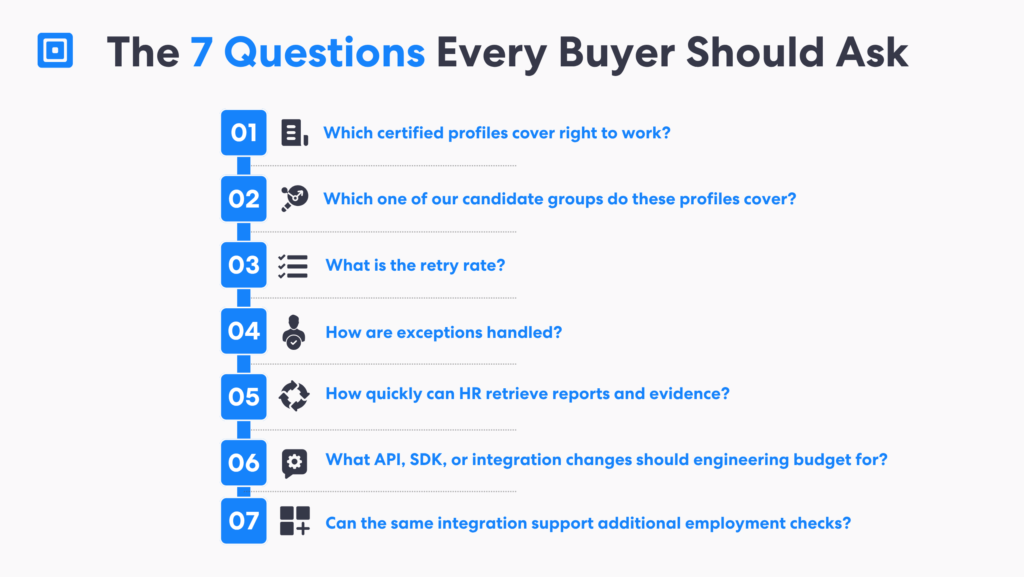
- Which certified profiles cover Right to Work?
- Which of our candidate groups do they cover?
- What is the retry rate?
- How are exceptions handled?
- How quickly does the Right to Work compliance software retrieve evidence for HR?
- What integration changes must be accounted for by the IT team?
- Can additional employment checks use the same Right to Work workflow?
Strong answers across all of these questions show consistent performance across automation, data retrieval and long-term operations, without unnecessary overhead. It is crucial to ask them before your team makes a final decision on how to comply with the updates on Right to Work legislation.
### Key Takeaways
- Right to Work compliance software** checks need strong certified coverage.
- Certified coverage** should match your candidate mix.
- **Assurance, evidence, and flexibility** impact long-term value.
- Criminal record, identity, and DBS checks** are part of a wider employment process.
- **ComplyCube has 23 certified identity profiles** and conduct certified employment checks and fraud controls within one platform.
## Right To Work Compliance Software with ComplyCube
When choosing which Right to Work compliance software is best, teams should look to reduce compliance risk and the amount of operational work. To learn more about your Right to Work requirements, [get in touch with ComplyCube](https://www.complycube.com/en/contact/contact-sales/). Find out how you can blend verification, assurance, and Right to Work compliance using an award-winning modular platform.
[](https://portal.complycube.com/signup)
## Frequently Asked Questions
Can a share code prove Right to Work for new employees?
Yes. Eligible workers can use a Home Office share code to prove their immigration status. Employers use the codes and detials to access official records. This route often differs from passport-based digital identity verification.
Can a criminal record affect a job offer for a job applicant?
Having a criminal record does not necessarily impact someone from being employed. The impact it would have truly depends on the role, offence, and any applicable rules. Employers must keep decisions proportionate and relevant to the job at hand.
Can digital Right to Work checks be completed remotely?
Most applicants are able to carry out the verification process remotely if they have the proper documents. The process as a whole is based on the applicant’s employment situation and the documents they have available. Employers should obtain advice from the appropriate trust framework and comply with any further requirements set by the Home Office.
What pre-employment checks can a new employer carry out for a new job?
Pre-employment checks cover Right to Work, references, qualifications, identity or DBS screening. Additionally, health checks can be conducted when relevant to the position. Every Right to Work request needs to be necessary, transparent, and appropriate to the level of work.
Why consider ComplyCube for Right to Work compliance?
ComplyCube combines Right to Work with document, biometric and fraud-verification workflows. It has APIs, SDKs, hosted journeys, reports and audit logs that sits within one platform.
**Categories:** Guides
**Tags:** Regulations
---
### [G2 Fall 2026 Shows ComplyCube Winning Where It Matters](https://www.complycube.com/g2-fall-2026/)
**Published:** September 17, 2026
**Author:** Rithu Jagannath
**Excerpt:** ComplyCube’s G2 Fall 2026 results highlight growing strength across regional verification, enterprise relationships, and compliance, with 12 #1 rankings, 28 #2 positions, and strong results across key categories.
**Content:**
London, September 17, 2026 – [ComplyCube](https://www.complycube.com/en/) earned 150 badges in the G2 Fall 2026 Report, including 12 #1 rankings and 28 #2 rankings across various categories such as identity verification, address verification, age verification, and biometric authentication. Moreover, ComplyCube earned badges for Anti-Money Laundering (AML), digital customer onboarding, and reference checks.
These new rankings highlight a key point for digital identity. According to the UK government, 77% of consumers have now used digital identity for at least one purpose, while 81% report some general understanding of it. The real challenge is what happens next. Digital identity must work across various use cases, markets, and complex customer journeys.
## Digital Identity Has Moved Into Everyday Life
Digital identity is becoming increasingly difficult to separate from the wider digital economy. According to gov.UK’s [Digital Identity Sectoral Analysis Report 2026](https://www.gov.uk/government/publications/digital-identity-sectoral-analysis-report-2026/digital-identity-sectoral-analysis-report-2026), the UK sector generates approximately £2.03 billion in annual revenue. The report also found almost 4,700 customer relationships and partnerships across industries ranging from financial services to healthcare, government, and transport.
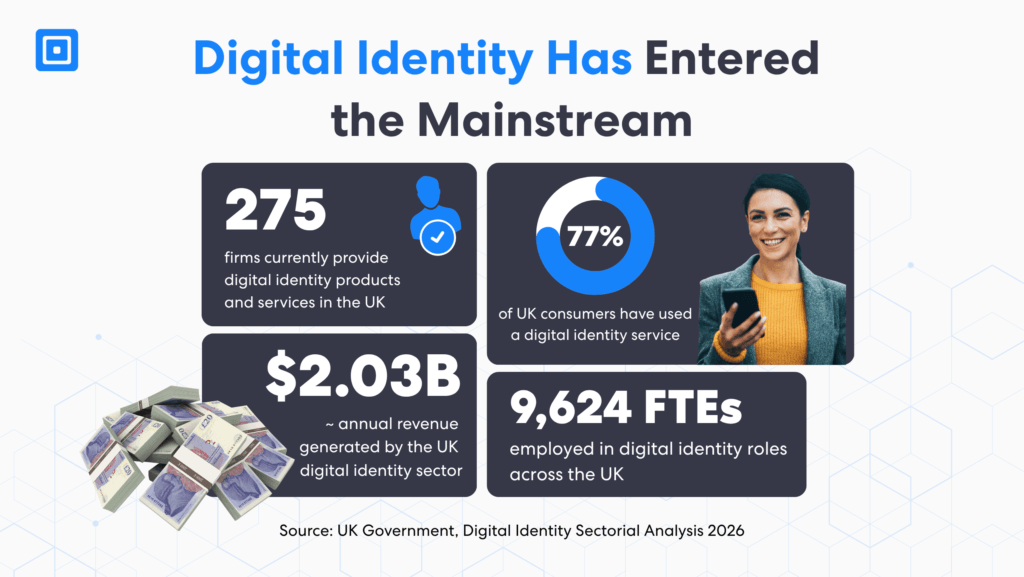
Consumers also expect it, as usage has reached 77%, while 71% believe digital identity services will be important over the next five years. This proves that greater adoption does not make verification simpler. It only creates more situations in which businesses need to establish something different about a customer. The challenge is therefore shifting from simply verifying an identity to establishing the right level of trust for each interaction. That shift is beginning to reshape what businesses expect from digital identity providers.
## One Identity is Creating More Verification Questions
UK government research also shows that the share of digital identity providers supporting age assurance increased from 23% to 31%. Meanwhile, professional and credential verification rose sharply from 28% to 55%, and age verification for online services has also doubled to 33%.
This growth strongly indicates a broader shift in how identity is used. A business may need to know whether someone is genuine, old enough to access a service, their address can be corroborated, the credential is valid, or whether their risk profile needs additional due diligence.
This means each question requires a different level of identity assurance. Businesses need to determine the appropriate level of due diligence and at which stage. ComplyCube’s newest regional G2 Fall 2026 rankings reflect that shift.
## Regional G2 Fall 2026 Rankings Show Why Context Matters
ComplyCube is ranked #1 for UK Address Verification and #2 for Age Verification across Europe in G2 Fall 2026. It also remains #2 for Digital Customer Onboarding, and those categories intersect. Customer onboarding in one country may require different evidence, assurance levels, age controls, or address checks than in another. A single rigid journey becomes harder to maintain as businesses enter more markets and regulations become more specific.
The goal is to make verification more tailored to the customer and the context. That means connecting identity, address biometrics, screening, fraud signals, and risk-based decisioning so the journey can change without the entire compliance process changing with it. Once those decisions are made at enterprise scale, technology quality is only part of the equation.
## Enterprise Recognition Shows What Happens After Go-Live
The G2 Fall 2026 enterprise results tell a different side of the story. ComplyCube was ranked #1 in the Enterprise Relationship Index for Reference Checks and #2 for Enterprise Relationship in Identity Verification. It also ranked #5 for both Enterprise Usability and Results in Reference Checks. These metrics matter because enterprise compliance rarely stays still.
As volumes grow, policies change, and new jurisdictions are added, fraud patterns evolve too. What initially was one onboarding journey can quickly become dozens of variations. The real test of compliance technology is quickly becoming dozens of variations. The question is whether teams can continue adapting it without making their operations much harder to manage.
> Digital identity is being asked to solve more specific problems.
[Harry Varatharasan](https://www.itpro.com/technology/artificial-intelligence/what-happens-to-consent-when-the-keys-are-handed-to-machines), Chief Product Officer at ComplyCube, says, “For enterprise teams, the goal is to bring those requirements together in a way that remains manageable as the business grows. That is where flexibility, usability, and the relationship between the technology become critical.” This explains why the G2 Fall 2026 results extend well beyond one verification category.
## The G2 Fall 2026 Numbers Tell a Wider Story
ComplyCube now holds five top-two positions across regional, enterprise, and onboarding reports for G2 Fall 2026. The breadth mirrors where digital identity itself is heading. The UK government found that 53% of digital identity providers now support KYC and AML use cases, 50% support fraud prevention, and 41% support Right to Work checks. Identity is increasingly becoming the layer that connects multiple decisions, rather than a single moment at the beginning of onboarding.
That is what makes the G2 Fall 2026 results more interesting than the badge count alone. Digital identity has already moved into the mainstream. Now businesses need it to work across more specialized use cases, more markets, and more complex risk decisions.
ComplyCube’s G2 Fall 2026 reviews also show growing recognition across exactly those layers. They cover everything from regional verification and customer onboarding to enterprise relationships, usability, and results. The next phase of digital identity will not simply be about verifying more people. It will be about making better decisions about what to verify, when, and why.
## About ComplyCube
[ComplyCube](https://www.complycube.com/), three-time RegTech Partner of the Year, supports businesses and firms where trust and compliance cannot be an afterthought. ComplyCube’s platform pairs first-class compliance infrastructure with enterprise-level certifications including ISO 27001:2022, ISO 9001:2015, and SOC 2.
## About G2 Reviews & G2 Fall 2026 Report
[G2](https://www.g2.com/) helps evaluate technology through verified customer feedback and independent market reports. Their badges and category rankings are globally recognized, giving businesses a trusted view of which software products stand out for customer satisfaction, market presence, and real-world performance.

**Categories:** News
**Tags:** Announcements
---
### [Closing the AML Gap in Risk-Based Monitoring](https://www.complycube.com/aml-gap-in-risk-based-monitoring/)
**Published:** September 11, 2026
**Author:** Dini Habib
**Excerpt:** Risk-based AML frameworks can become difficult to execute, especially across different spreadsheets and workflows. Discover how custom risk engines can transform documented methodologies into consistent, auditable risk decisions.
**Content:**
**TL;DR:** Risk-based monitoring is a core principle in AML regulation. However, risk-based AML programs can be **complex** because they involve multiple components. This includes company policy, risk assessments, and documented methodologies spread across separate spreadsheets. Custom **risk engine** solutions can close the gap present in a legacy risk-based framework.
## How Does Risk-Based Monitoring Work in AML?
Risk-based monitoring in Anti-Money Laundering (AML) directs compliance resources to customers, transactions, and activities that present higher money laundering or terrorist financing risk. Instead of putting every user through the same workflow, companies assess and route customers to the appropriate verification step based on the risk level.

There are typically four broad risk factors that compliance teams consider:
- **Customer and third-party risk:** The risks associated with customers and other parties.
- **Product and service risk:** The risks associated with the products and services a firm provides.
- **Delivery channel risk:** Risks arising from how an organization delivers its products and services.
- **Geographic risk:** Risks associated with the jurisdictions connected to a customer or service.
A practical risk-based monitoring framework usually includes Customer Due Diligence (CDD), ongoing monitoring, customer risk assessments, and Enhanced Due Diligence (EDD) when we find higher risks. A well-designed risk-based AML approach can improve the effectiveness of financial crime controls by focusing compliance resources where they are most needed.
However, firms should not treat it as a one-time exercise. Customer risk can evolve as circumstances, transactions, ownership structures, or geographic exposure change, so continuous monitoring is necessary. The goal is not just to create alerts, but to detect and respond to potential risks effectively.
### Risk Assessment vs Transaction Monitoring
It is critical to differentiate between customer risk assessment and transaction monitoring. Customer risk assessments consider a customer’s characteristics and activities to assess the level of financial crime risk they present. These risks determine the required levels of CDD, EDD, and ongoing monitoring. Transaction monitoring, by contrast, analyzes transactional activity against scenarios, thresholds, behavioral indicators, and other relevant signals. Compliance teams should integrate the two processes into an overall risk-based AML framework.
## Regulatory Drivers Behind a Risk-Based Approach
Regulators rely on a risk-based approach as a fundamental principle of modern financial crime compliance. For instance, the [Financial Action Task Force (FATF) Recommendation 1](https://www.fatf-gafi.org/en/publications/Fatfrecommendations/Guidance-rba-supervision.html) requires firms to identify, assess, and mitigate money laundering and terrorist financing risks proportionately.
Risk-based monitoring can vary across regulatory agencies, but the direction is consistent:
- **Financial Crimes Enforcement Network (FinCEN):** In the US, financial institutions are recommended to implement a [risk-based approach](https://www.fincen.gov/news/news-releases/fincen-proposes-rule-fundamentally-reform-financial-institution-programs) to CDD, including understanding customer relationships and conducting ongoing monitoring to identify and report suspicious activity.
- **Financial Transactions and Reports Analysis Center of Canada (FINTRAC):** Firms must [assess](https://fintrac-canafe.canada.ca/businesses-entreprises/assessment-evaluation-eng) customer risk and apply enhanced measures to high-risk situations. This can include more frequent monitoring and updates to customer information.
- **Monetary Authority of Singapore (MAS):** [Financial institutions](https://www.mas.gov.sg/regulation/anti-money-laundering/ml-tf-pf-risk-assessments) must conduct ongoing monitoring of business relationships and scrutinize transactions against their knowledge of the customer, with enhanced measures where higher risks are identified.
- **Financial Conduct Authority (FCA) and HM Treasury:** Firms subject to the UK Money Laundering Regulations must conduct [risk assessments](https://www.fca.org.uk/publications/finalised-guidance/fg24-6-guidance-firms-enables-risk-based-approach-payments) and maintain policies, controls, and procedures proportionate to their money laundering and terrorist financing risks.
## The Consequences of Weak Risk-Based Monitoring
Regulators are increasingly assessing how effective risk-based monitoring is, not just whether a firm has an AML monitoring system. A weak risk-based framework can face unintended consequences. Compliance teams may become overwhelmed by false positives, genuine risks can slip through the cracks, and firms can face financial penalties.

For example, in 2024, the UK FCA fined Metro Bank [£16.7 million](https://www.fca.org.uk/news/press-releases/fca-fines-metro-bank-16m-financial-crime-failings) over failures relating to its automated transaction-monitoring system. The FCA said the bank failed to adequately monitor approximately 60 million transactions with a total value exceeding £51 billion.
> Firms are expected to know their risk exposure.
A control can be on paper and still ineffective. Solutions Consultant at ComplyCube, [Milosh Caunhye](https://www.linkedin.com/in/milosh-caunhye/) notes, “The expectation is that firms know what their risk exposure is, build their monitoring around that risk, and test to see if those controls actually work.”
### **Case Study: Risky Customers After Successful Onboarding**
In July 2026, the Dutch central bank (DNB) fined CCV Netherlands B.V. [€2.65 million](https://www.complycube.com/en/netherland-fines-ccv-2-65m-for-monitoring-gaps/) for long-standing gaps in its AML infrastructure. According to DNB, CCV Bank has multiple deficiencies in its customer due diligence and transaction monitoring systems.
##### **The Blindspot in Monitoring Controls**
CCV did not properly load customer risk profiles for approximately 4,200 merchants into its monitoring system for 23 months. This case is relevant to risk-based monitoring as it highlights the importance of connecting customer risk information to the controls used to monitor activity.
##### **Outcomes**
- Beyond the fine, CCV had to commit to a recovery plan to address its AML deficiencies.
- CCV also faced a higher penalty because of prior sanctions violations.
- Firms need to demonstrate that AML controls are not only documented, but effective in practice and responsive to changing risk.
## Key Challenges in Executing Risk-Based Monitoring
For many organizations, the challenge is not defining a risk-based AML model. It is turning that model into a risk assessment that applies consistently. Compliance teams can spend a lot of time manually translating policies into risk scores, pulling data from different systems, and determining what the resulting risk rating means for the customer.
The organization might document the risk-based monitoring methodology well. At the same time, the information required to apply those rules is dispersed across [Know Your Customer (KYC)](https://www.complycube.com/en/solutions/due-diligence-compliance/know-your-customer/) systems, customer records, and external data providers. This creates a mismatch between the methodology approved and the risk assessment applied.
### This creates several repeated challenges:
- **Disconnected risk factors:** An organization has its own risk appetite and internal customer risk methodology. However, many existing systems apply predefined scoring models. This means the final customer rating may not reflect the firm’s risk factors, weightings, and escalation rules.
- **Static risk-scoring:** A customer’s risk rating can evolve as their information or exposure to money laundering risk materially changes. However, a risk score calculated during onboarding may remain the same unless the firm manually reviewed or recalculates it.
- **Inconsistent calculations:** Compliance teams using spreadsheets and formulas to apply risk factors may interpret the same methodology differently or produce different outcomes.
- **Weak auditability:** The best practice is to document all compliance decisions for regulatory reporting clearly. However, this requires firms to explain all factors, weightings, data, and methodology behind a decision. This also includes how that assessment changed over time.
- **Limitations in risk model:** Changes to a firm’s risk appetite can trigger multiple updates across spreadsheets, workflows, and downstream processes. This can create additional work and increase the chance that new rules are implemented inconsistently.
The gap is thus not a lack of data analytics or effective risk modeling. The organization must translate that methodology into a dynamic, explainable risk model that it can apply automatically, consistently, and at scale.
## How Can a Custom Risk Engine Bridge the Risk Scoring Gap?
The solution does not necessarily lie in replacing an existing AML risk methodology. But often the bigger opportunity is to make that methodology easier to execute. A bespoke risk engine takes an organization’s own risk policies and translates them into an automated, configurable risk-scoring model.
Rather than maintaining calculations across spreadsheets and manually combining different sources of information, compliance teams can define the exact factors, weightings and thresholds that determine how customer risk is assessed and let the system apply the findings consistently. This can be particularly useful when an organization already uses established industry risk assessment approaches.
### Common risk assessments:
- **Business-Wide Risk Assessment (BWRA):** Identifies potential risk across products, jurisdictions, and delivery channels. It informs where controls and monitoring should be most sensitive.
- **Enterprise-Wide Risk Assessment (EWRA):** A broader assessment that may be used by larger or more complex organizations to assess risk across business lines, entities, products, and jurisdictions.
- **Institutional Risk Assessment (IRA):** Evaluates risk within individual business lines or units. For instance, a crypto business unit carries significantly different potential risk than a retail operation.
- **Customer Risk Assessment (CRA):** Assesses risk for an individual using factors such as Politically Exposed Person (PEP) status and expected activity to determine the CDD route.
- **Risk Management and Compliance Program (RMCP):** Brings together broader governance structure, including policies, internal controls, and staff used to manage the risks identified through these assessments.
Ultimately the results of risk assessments must impact how individual customers are assessed and what level of due diligence they are subject to. A [custom risk engine](https://docs.complycube.com/documentation/product-guides/due-diligence-tools/risk-profile) helps create that connection. The team translates business-level risk findings into customer-level factors, rules, and thresholds to ensure the organisation’s documented risk appetite is reflected in actual scoring decisions.
Additionally, when relevant information changes, the engine re-evaluates customers and prevents risk ratings from being locked at onboarding. As such, the risk engine becomes the execution layer between an organization’s risk framework and its day-to-day compliance decisions.
## The Importance of Governance in Risk-Based Monitoring
Technology is not a substitute for governance. Firms should continue to set their risk appetite, approve their methodology, test changes, monitor effectiveness, and review whether controls continue to reflect their financial crime risk. Therefore, a [risk engine](https://www.complycube.com/en/solutions/due-diligence-compliance/risk-scoring/custom-risk-engine/) must be an enabler of appropriate governance, validation, change management, and oversight, not a replacement.
Firms must show:
- **Ownership:** Who owns the risk methodology?
- **Approval:** Who is responsible for approving changes to risk factors, weightings, thresholds and escalation rules?
- **Testing:** How will changes be tested before implementation?
- **Validation:** How does the firm ensure the methodology remains appropriate?
- **Data Quality:** Are the inputs used to calculate risk accurate, complete, and current enough?
- **Change Management:** Can the firm demonstrate when and why the methodology changed?
- **Oversight:** Do the right functions review the risk outcomes and control performance?
- **Effectiveness:** Does testing show that the controls are working as intended?
This is particularly important where automated scoring influences CDD, EDD, monitoring intensity, or other compliance decisions. Consequently, automation should make the methodology more consistent and auditable, not less transparent.
### Key Takeaways
- **Risk-based monitoring** should reflect the firm’s actual risk profile, rather than generic models.
- **Manual spreadsheets** and disconnected workflows can create critical AML implementation gaps.
- **Inconsistent scoring**, outdated risk ratings, and weaker auditability are common consequences of weak monitoring.
- **Effective AML controls** require more than documented policies to identify and manage financial crime risks.
- **ComplyCube’s custom risk** engine can operationalize an organisation’s AML methodology consistently.
## Strengthen Risk-Based AML Controls
An [AML framework](https://www.complycube.com/en/solutions/due-diligence-compliance/anti-money-laundering/) is only as good as its implementation. The challenge for compliance teams is to reflect their risk methodology consistently in the systems, decisions and controls used across the customer lifecycle. A configurable risk engine can help bridge that gap by taking an organization’s approved methodology and turning it into a dynamic, explainable execution layer.
With the right governance, testing, data controls, and ongoing reviews of effectiveness, this can help firms ensure their AML controls align with their actual financial crime risk. [Learn more](https://www.complycube.com/en/contact/contact-sales/) about how you can build your own custom risk engine today.
[](https://portal.complycube.com/signup)
## Frequently Asked Questions
How is risk-based AML monitoring different from rules-based monitoring?
Risk-based Anti-Money Laundering (AML) monitoring uses an organisation’s assessment of financial crime risk to determine the appropriate level and intensity of controls. However, rules-based monitoring uses predefined rules or scenarios to identify activity that meets specified conditions.
Can smaller financial institutions implement a custom risk engine?
Yes. Smaller financial institutions can adopt a custom risk engine solution to automate, scale, and manage risk methodologies effectively. This is particularly for regulated financial services that rely heavily on spreadsheets or have limited compliance headcount. These firms can benefit from a risk engine that applies the same factors, weightings, thresholds, and escalation rules consistently.
How often should we update our AML risk assessment?
An AML risk assessment has no universal update frequency that applies to every organisation and jurisdiction. Instead, regulators expect you to update it whenever there is a significant change in your organization’s financial crime risk. However, you should review it periodically to ensure it stays current and reflects current risks.
How do we measure whether our risk-based AML monitoring is effective?
To measure the effectiveness of your risk-based AML monitoring, useful metrics to track include false positives, time-to-detection for high-risk scenarios, and escalation outcomes. Businesses should shift away from measuring the number of alerts generated and focus on whether they can identify, investigate, and perform due diligence on meaningful risk.
Does ComplyCube offer custom risk engine solutions?
Yes. ComplyCube offers bespoke risk engine solutions to help businesses translate their AML risk methodology into an automated, scalable customer risk-scoring model. Firms can define their own risk guidelines, including scoring logic, weightings, and thresholds tailored to their AML framework rather than relying on a fixed vendor risk model.
**Categories:** Guides
**Tags:** Anti-Money Laundering
---
### [Changes In Right to Work Digital Identity Checks for Gig Platforms](https://www.complycube.com/right-to-work-digital-identity-checks/)
**Published:** September 10, 2026
**Author:** Rithu Jagannath
**Excerpt:** With October 2026 right to work reforms, gig platforms face new responsibilities. Learn how identity, access, substitutes, and proportionate re-verification can help reduce huge compliance gaps to protect against illegal working.
**Content:**
**TL;DR:** Right to work digital identity checks are **a necessary part of the gig-economy**. In October 2026, a **digital right to work check** centres on how platforms keep users confident that the verified person is the one actually carrying out each job. This guide demonstrates how account sharing, substitution, and **worker identity continuity matter**.
## Why Right to Work Digital Identity Checks Change for the Gig Economy
To work in the UK, employers have to meet certain legal requirements to [prevent illegal working](https://www.complycube.com/en/check-employee-right-to-work-for-recruitment/). Moreover, right to work checks need to be completed before any actual working begins. It is an employer’s responsibility to establish a statutory excuse against any potential civil penalties. For example, they must check a Home Office share code for non-British citizens to prove right to work.
UK employers have a legal responsibility to prevent illegal working. Prescribed right to work checks should be completed before relevant work begins. This way an employer can establish a statutory excuse against a potential [civil penalty](https://www.davidsonmorris.com/civil-penalty/). Today, UK employers can face a civil penalty of up to £45,000 (up from the initial £20,000) per worker for the first breach, and up to £60,000 per worker for repeated breaches in 2026.
Another major change is that the right to work framework covers more working arrangements. Though every worker does not automatically become an employee under wider employment law, gig economy right to work incorporates more platform models into the scheme. That is where the problem begins, after the job applicant’s right to work has been already established.
## What Are Right to Work Digital Identity Checks?
According to the UK government, right to work digital identity checks allow eligible British and Irish citizens to establish identities through a prescribed digital route. [Identity Document Validation Technology](https://www.gov.uk/government/publications/identity-document-validation-technology/identification-document-validation-technology) also known as IDVT, was established on 6 April 2022. It authenticates eligible British passports, Irish passports, and passport cards. They help confirm that the evidence actually belongs to the applicant with most digital checks being completed in under 12 seconds.
It sits alongside manual checks and the free Home Office online checking service. Document authentication checks and facial comparison can strengthen identity assurance, but digital identity checks act as only one part of the whole prescribed Right to work check process.
## Right to Work Digital Identity Checks Can Fail After a Worker Passes
If a courier completes the onboarding process, they also need to pass identity verification, prove their right to work, and activate an account. However, weeks later, another person could begin completing deliveries through that profile. The original checks may have been correct, however, the platform no longer knows who is actually working.
> The ability to work illegally is a driver of illegal migration and exploitation.
Alex Norris, MP, Minister for Border Security and Asylum goes on to state, “Illegal working undermines honest businesses and exposes vulnerable individuals to exploitation. This Government are clear that such activity will not be tolerated.”
The new rules in October 2026 extend the UK work scheme to more areas. This includes qualifying online matching services, individual subcontractors, and some agency workers. For many impacted platforms, the goal is around determining whether the identity approved during the onboarding process actually matches the person presenting or showing up to perform the work later on.
## Digital Identity Certification Sets the Baseline
Digital identity verification is integrated into immigration and employment law. Generic digital identity checks are not automatically compliant Right to Work checks. Digital Verification Services (DVS) need to meet the relevant trust framework and supplementary-code requirements.
With these new changes, employers that are choosing the DVS route need a certified identity service provider registered against the [UK Digital Attributes Trust Framework](https://www.ukas.com/accreditation/about/developing-new-programmes/development-programmes/uk-digital-identity-and-attributes-trust-framework/). They also need to have a relevant code in order to obtain a statutory excuse through that route. Digital identity certification does not transfer any employer’s legal responsibility to the certified provider.
## Digital Right to Work Depends on Immigration Status
There is no single digital right route for every worker in gig economy right to work verification schemes. Eligible British or Irish citizen passport holder can use the relevant DVS route, while many non-British workers with an e-Visa can use the Home Office online service to prove their online immigration status.
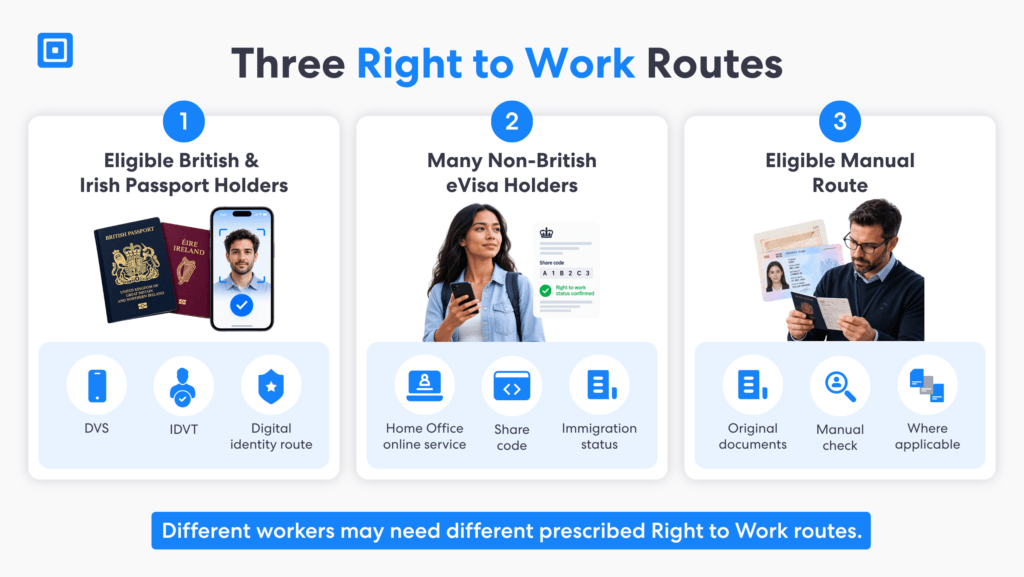
For many e-Visa holder, instead of presenting physical documents, the worker can generate an online share code which is typically valid for 90 calendar days. The employers use this code with the person’s date of birth through the Home Office online service.
Forcing every job applicant’s Right to Work through one commercial digital route where other permitted routes applies. Depending on the person, the process may instead involve the Home Office service or [eligible physical documents](https://www.complycube.com/en/solutions/identity-assurance/document-verification/).
## Right to Work Digital Identity Checks After Onboarding
The current Home Office guidance says that relevant businesses need to have the appropriate systems. These systems must assure the person carrying out services is the right person. That is when a valid passport, work visa, [biometric comparison](https://www.complycube.com/en/solutions/identity-assurance/biometric-verification/), or confirmed Home Office status provides proof in the moment, but does not know who controls the account weeks later.
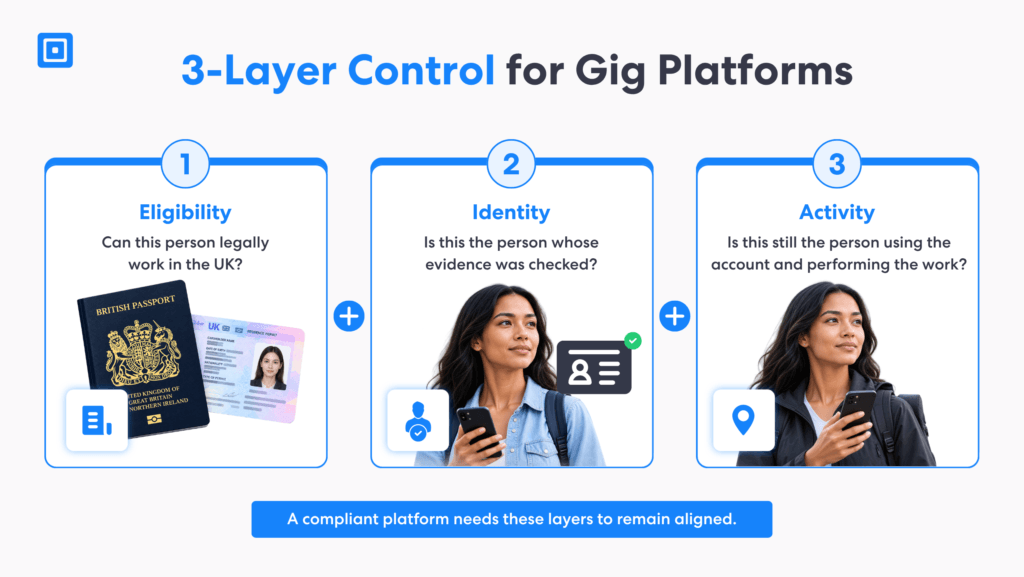
Even then, [a verified profile](https://www.dock.io/post/verifiable-credentials) is not a permanently transferable credential. Any identity assurance from the initial onboarding process is broken when someone who has not completed the required work checks ends up using another worker’s account.
## Identity Verification Turns Account Sharing Into an Illegal Working Risk
One of the biggest issues with account sharing is how much it can disconnect compliant work verification from the person that is earning through the gig platform. This is where platform fraud and illegal working come into play.
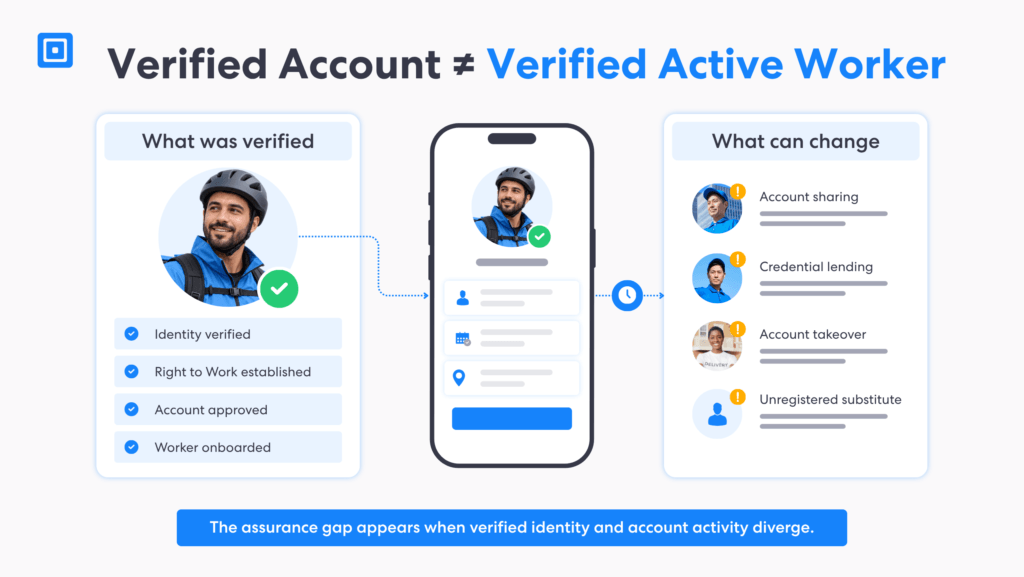
For instance, an illegal worker need not provide fraudulent documents for an onboarding process if they can gain access to an already-approved account. This is exactly why digital controls need strong privacy, cybersecurity, and accessibility safeguards.
### **Case Study: Food Delivery Platforms Strengthen Digital Identity Checks**
Most [food-delivery platforms](https://questions-statements.parliament.uk/written-questions/detail/2026-05-13/hl10) such as Deliveroo and Uber Eats have a huge post-onboarding identity verification problem. They often have one person verified with account sharing resulting in another person performing deliveries.
##### **Home Office Fraud Detection Signals**
By May 2026, Home Office found platforms had increase the quantity and quality of their facial recognition and fraud prevention software. It gave greater confidence that account holders and the registered substitutes were the people working through those accounts.
##### **Outcomes**
- Food delivery applications conducted facial and fraud checks on a daily basis.
- They also increased how sophisticated their verification processes were.
- New fraud prevention controls focused on verifying right to work across account holders and registered substitutes.
-
## Right to Work Digital Identity Checks for Registered Substitutes
Any and all registered gig worker substitutes need their own prescribed Right to Work check before performing any work. The original employee or worker’s right to work authorization does not transfer to another person.
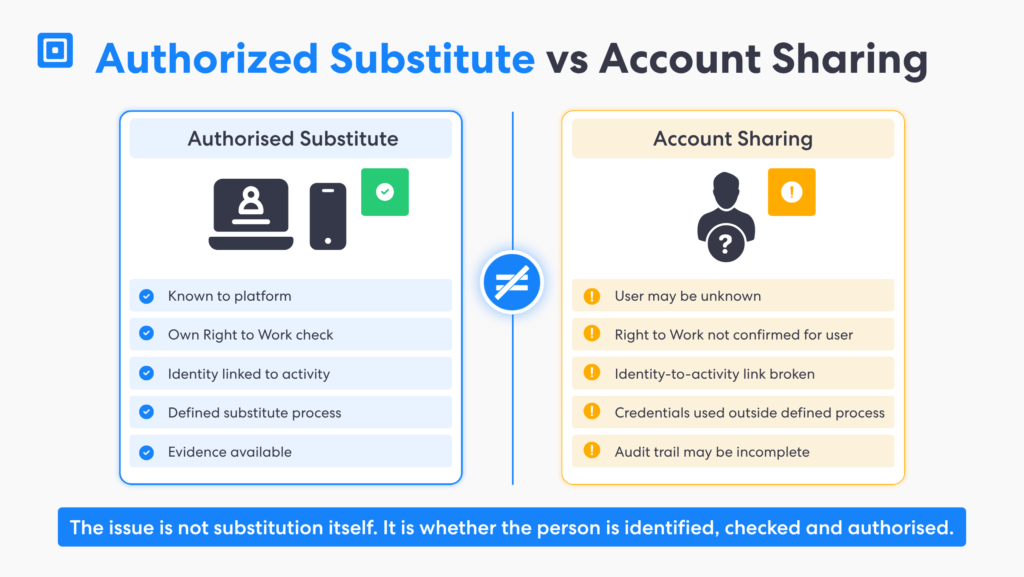
That is why it is crucial to have a distinct identity and eligibility record for original workers and authorised substitutes for these platforms. Ensuring that substitution is part of the full platform onboarding process helps distinguish any real activity from uncontrolled credential sharing.
## Right to Work Digital Identity Checks Need Proportionate Re-Verification
Increasingly, platforms are re-checking identities at the start of shifts or after prolonged inactivity. Home Office guidance recommends that there be at least one check in during a 24-hour period or shift. Other times, they recommend re-checking identities are when [registering a substitute](https://help.uber.com/en-GB/driving-and-delivering/article/registering-a-substitute---uk?nodeId=904c081f-f925-48ec-aac3-5fbc553d3d49), or for a particular assignment. The goal is to link platform activity with a previously verified digital identity instead of starting the onboarding process all over again.
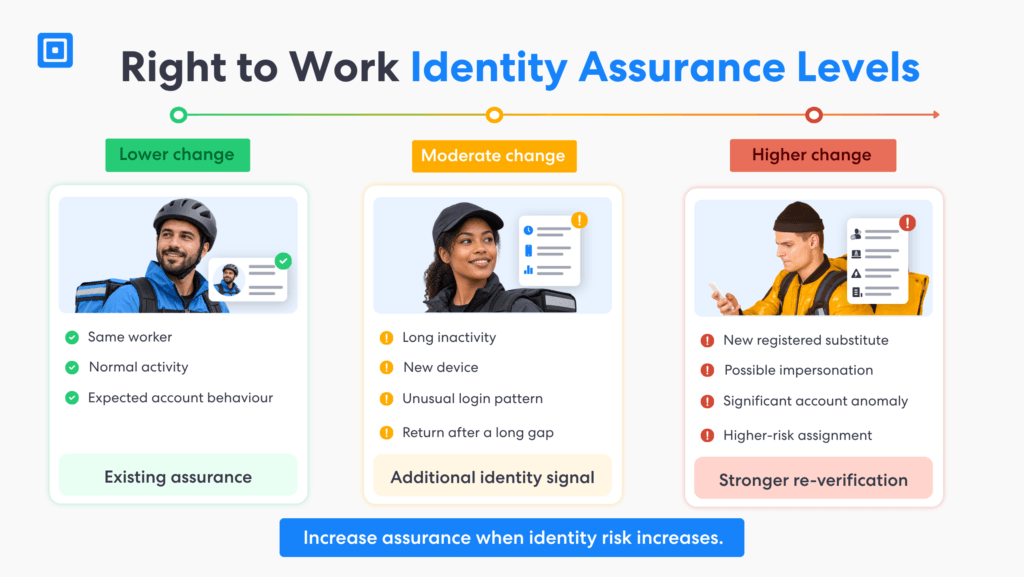
The frequency of checks need to be appropriate to the likelihood of impersonation or risks associated with substitutions. With many teams trying to make their work checks more digital, there needs to be stronger identity assurance when the worker-to-account relationship becomes murky or uncertain.
## What Evidence Supports Right to Work Digital Identity Checks?
It is important for digital reports to remain securely stored and easily accessible if requested by regulators. Evidentiary support is incredibly important to retain during the working relationship and up to two years after much like they are for contractors. You can learn more here: [The Ultimate Guide for Right to Work Checks for Contractors in 2026](https://www.complycube.com/en/verify-right-to-work-checks-for-contractors/).
As with most original documents, employers need to follow the manual process which includes checking original copies, making duplicate, and recording relevant dates. In this case, scanned copies, generic work documents, or showing identification at a Post Office will not serve as an approved statutory excuse.
A strong audit trail can connect the initial identity verification, worker profile, any authorised substitutes, and any other later identity events. This provides more clear evidence of who was truly authorized to carry out any work.
## Illegal Working Makes Identity a Legal Responsibility
Serious cases of illegal working can lead up to criminal prosecution, which includes up to five years’ imprisonment and an unlimited number of fines. With the Home Office issuing 2,438 [civil penalties worth more](https://www.quastels.com/civil-penalty-notice-for-illegal-working-what-uk-employers-should-do-now/) than £130 million in 2025 alone, gig platforms need to ensure compliance. They must connect identity, immigration status, account access, and actual work activity.
The issue is bigger than just border security or document verification. That is why a platform’s legal position largely depends on the prescribed checks and controls being applied to the gig workers they employ.
### Key Takeaways
- **Right to work digital identity checks** involve identity assurance after onboarding.
- **The DVS/IDVT, share-codes, and ongoing assurance** are three distinct processes.
- **All registered substitutes** need their own right to work verification before working.
- **Re-verification as a chosen control** must be proportionate to risk.
- **Platforms ensure compliance** by linking identity, status, access, and evidence.
## Choose ComplyCube for Right to Work Digital Identity Checks
In short, gig platforms need more than a point-in-time verification. ComplyCube helps platforms build in right to work digital identity checks into a onboarding process built for growth. It helps organisations link worker eligibility while keeping up stronger identity assurance over who is getting access to work through gig platforms. Learn [how ComplyCube](https://www.complycube.com/en/contact/contact-sales/) can support right to work digital identity checks for gig platforms to meet the October 2026 reforms.
[](https://portal.complycube.com/signup)
## Frequently Asked Questions
When do the new gig-economy Right to Work rules start?
The expanded Right to Work rules take effect on 1 October 2026. They extend responsibilities into additional working models, including qualifying online matching services and individual subcontracting arrangements.
Can every job applicant’s Right to Work be checked digitally?
No. The appropriate route depends on nationality, immigration status and the evidence available. Eligible British and Irish passport holders can use the relevant DVS route, while many non-British workers use the Home Office online service.
Is a Right to Work share code valid for 90 days?
Yes. A Right to Work share code is valid for 90 days from the date it is generated. It is primarily used by eligible workers whose immigration status can be viewed through the Home Office online checking service.
How long should employers retain Right to Work evidence?
Employers should retain the prescribed evidence throughout the relevant employment or working period and for two years afterwards. Records should be sufficient to demonstrate that the correct check was performed in the prescribed manner if the Home Office later reviews the case.
How will ComplyCube support right to work digital identity checks?
ComplyCube helps businesses integrate right to work digital identity checks into a scalable onboarding process. This helps gig platforms confirm worker eligibility, manage verification routes and apply stronger assurance where identity, substitution or account-access risks change.
**Categories:** Guides
**Tags:** Identity Verification
---
### [What is a Qualified Electronic Signature (QES)?](https://www.complycube.com/what-is-a-qualified-electronic-signature-qes/)
**Published:** September 4, 2026
**Author:** Dini Habib
**Excerpt:** A QES signature offers the highest levels of assurance under the EU eIDAS regulation. It enhances secure remote onboarding, non-repudiation, interoperability across EU member states, and can legally act as a handwritten signature.
**Content:**
**TL;DR:** A Qualified Electronic Signature (QES) provides one of the **highest levels** of assurance for signature verification under the eIDAS regulation. It offers the same legal equivalent as a **handwritten signature.** For regulated industries, QES signatures can support stronger remote onboarding and secure identity assurance.
## How Did Qualified Electronic Signatures Originate?
Before the European Union (EU) harmonized electronic signature rules, each member state had its own framework. This changed with [Regulation (EU) No 910/2014](https://eur-lex.europa.eu/legal-content/EN/ALL/?uri=CELEX%3A02014R0910-20240520) (eIDAS), which came into full force in July 2016. The eIDAS regulation defined common terms for electronic signatures, qualified electronic seals, trust services, and Qualified Trust Service Providers (QTSPs). It also established QES as the most secure and highest-assurance electronic form of signature under EU regulation.
The ecosystem has changed fast since then. The number of certified remote Qualified Signature Creation Device (QSCD) products increased from around [five in 2016 to around 40](https://ec.europa.eu/digital-building-blocks/sites/download/attachments/930448024/QES%20-%20Signatures.pdf) at the end of 2025. Some Italian public-sector services process about 577 million remote signatures monthly.
QES will also be further embedded in daily digital interactions through the EU Digital Identity Wallet (EUDI Wallet) framework. [Imp](https://eur-lex.europa.eu/legal-content/EN/TXT/)[lementing Regulation 2024/2979](https://eur-lex.europa.eu/legal-content/EN/TXT/) requires wallet solutions to support qualified electronic signatures and to interface with QSCDs.
## The Requirements for a Qualified Electronic Signature (QES)
A qualified [electronic signature](https://docs.complycube.com/documentation/product-guides/compliance-studio/e-signatures) is a special, regulated type of digital signature and has the strongest legal effect under the eIDAS regulation. The term “qualified” is not a marketing label. Instead, signatures that satisfy all eIDAS requirements and possess a valid qualified certificate may use that term.
A QES must:
- Be uniquely linked to the signatory and created under their sole control.
- Be created using a QSCD, which protects the signature creation data and private key.
- Be issued by a Qualified Trust Service Provider that is listed in national Trusted Lists.
QES signatures operate on three principles. Firstly, it has the same legal effect as a handwritten signature. Secondly, it supports non-repudiation, acting as irrefutable legal proof in the event of litigation. Third, its interoperability means it is mutually recognized across the EU. As such, EU member states must accept qualified electronic signatures as valid.
## SES, AES, and QES Differences and Legal Implications
The eIDAS regulation divides electronic signatures into three main security levels: Simple Electronic Signatures (SES), Advanced Electronic Signatures (AES), and Qualified Electronic Signatures (QES). The use case for each signature type will largely depend on the level of identity assurance, security, and legal certainty a business needs.
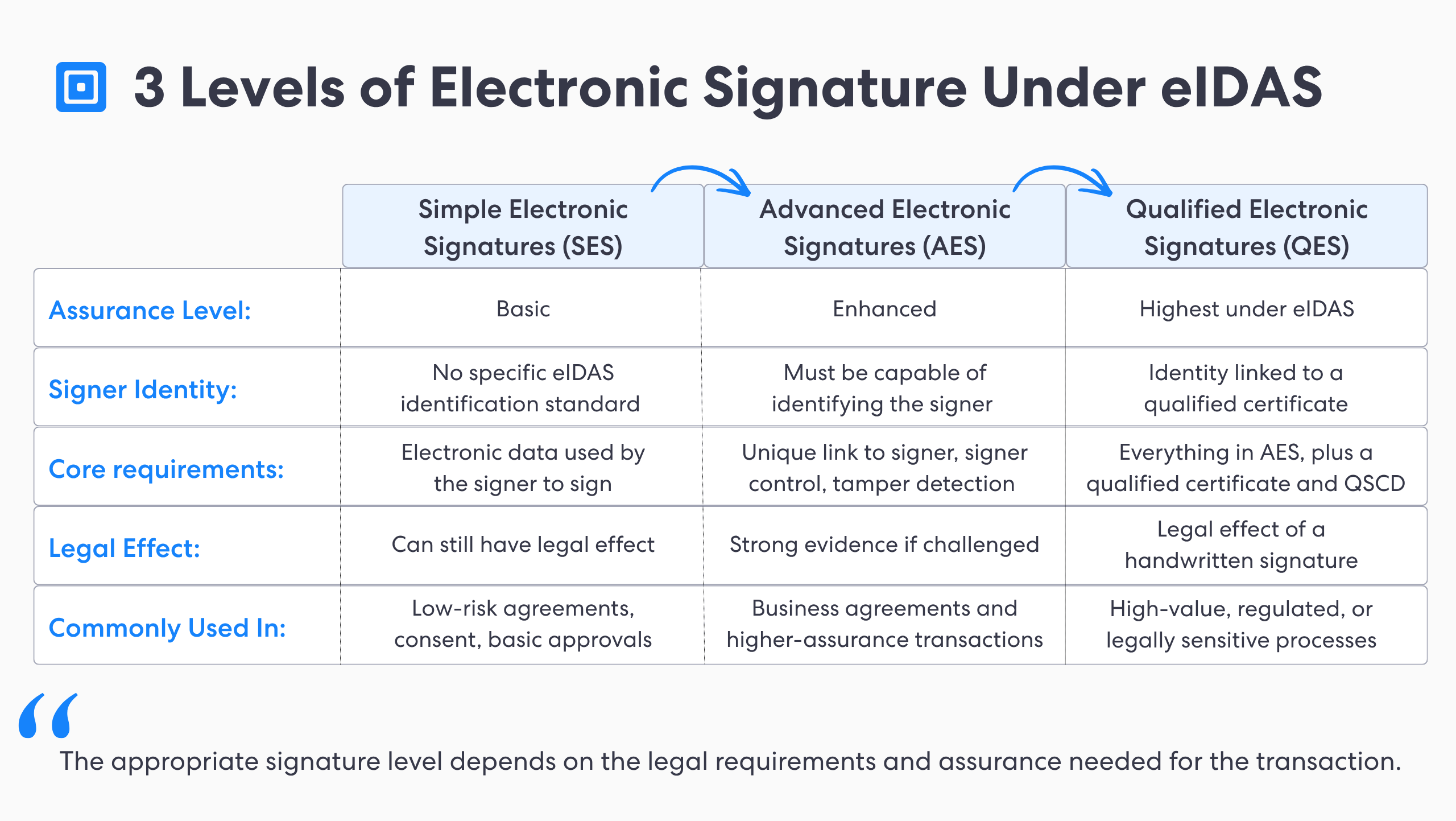
To simplify, **SES** typically indicate a customer’s intent to sign or approve something electronically. They do not require strong identity verification or cryptographic protection. Common use cases for SES include low-risk agreements, online acceptances, internal approvals, and basic contracts.
One level of assurance up is **AES**. These signatures uniquely link to the signer, identify the signer, and detect changes to the signed data. Organizations rely on AES for employment documents, business agreements, and financial transactions that require stronger evidence of identity and authenticity.
On the other hand, the **QES** offers the highest assurance. It uses a qualified digital certificate issued by a provider with qualified status, created using a QSCD. These QTSPs, which provide qualified trust services, are also subject to regulatory supervision. Regulated transactions or government services typically require a qualified electronic signature to ensure higher legal certainty.
### SES vs QES: Does the Difference Matter?
Simple electronic signatures have fewer prescribed technical and identity-assurance requirements than the QES. It is important to note that eIDAS does not permit refusal of legal effect solely because the signatures do not meet the stricter requirements for a QES, meaning SES is still legally valid. SES is often enough when the risk present is low, and the main outcome is to record a person’s intent.
However, if someone disputes the signature, the company must rely on other supporting records, such as directly contacting the customer to establish who signed and their intent. QES strengthens this evidence by linking the signature to a verified signatory, a qualified certificate, and a regulated trust framework. In practice, SES serves low-risk transactions, while QES serves regulated, high-value, or legally sensitive processes.
### AES vs QES: What Does QES Add?
To start, AES already offers strong security controls. The AES must be uniquely linked to the signatory, using their signature creation data under control, with high confidence. However, a QES signature satisfies several additional criteria. A qualified electronic signature must use a qualified certificate from a certified provider, and a QSCD must generate it.
This added regulatory layer is a key difference. EU member states recognize only QES as having the same legal effect as a handwritten signature. While AES can provide strong technical evidence of identity and integrity, QES adds a formally regulated trust framework across the EU.
## AI, Deepfakes, and the Role of QES in Fraud Prevention
[Generative AI](https://www.complycube.com/en/generative-ai-fraud-and-identity-verification/) has made it easier to create false IDs, selfies, documents, deepfakes, and even voice calls at scale. In 2025, scammers using sophisticated AI tools stole at least [£1.3 billion](https://www.bbc.co.uk/news/articles/cwykp9ygxlvo). As such, it paints a problematic picture in which visual proof is becoming easier to fake.
> Individuals can mass-produce a pasted signature image in seconds
QES helps reduce that risk by linking a signature to a verified identity, offering stronger signer authentication and cryptographic evidence of document integrity. As such, it reduces reliance on weaker trust signals, making account takeover and fake documents more difficult to carry out.
For example, take a deal worth $10 million. With a basic SES, a signer might claim that someone accessed their email account and approved the agreement. AES provides stronger evidence of identity and document integrity by linking a signature to the verified owner and detecting signs of tampering. With QES, you add another layer of compliance. To put it simply:
**SES:** “Do you have evidence of this person’s intent to sign?”
**AES:** “Can we prove beyond doubt who signed and that no one changed the submitted document?”
**QES:** “Can all the above be done with an EU-regulated trust framework and offer statutory handwritten-signature equivalence?”
Harry Varatharasan, ComplyCube’s Chief Product Officer, notes that individuals can mass-produce a pasted signature image in seconds. He adds, “This is exactly why the cryptographic backbone of QES can be a non-negotiable for building a critical defense layer.” However, QES signatures are not the one-all to stopping deepfake or AI fraud attacks. Instead, their value lies in lessening reliance on trust signals that are increasingly easy to fake.
## When Do You Need a Qualified Electronic Signature?
A QES signature may not be necessary for every single agreement. Instead, compliance teams should collaborate with legal and information security to define exactly when SES, AES, and QES are appropriate. Matching the security level of each electronic signature to the risk of the transaction or relationship helps businesses achieve a risk-based framework.
Common questions to consider when designing a signature process include regulatory requirements, formal requirements, and risk appetite:
- **Regulatory Expectations:** Leading regulators, including the Financial Action Task Force (FATF), the Monetary Authority of Singapore (MAS), and the U.S. Financial Crimes Enforcement Network (FinCEN), expect higher identity assurance where the risk of financial crime is high. These scenarios include transactions involving [Politically Exposed Persons (PEPs)](https://www.complycube.com/en/what-is-a-politically-exposed-person/) or complex ownership structures.
- **Formal Requirements:** Certain supervisory bodies require QES signatures for legal compliance. For example, the European Commission requires documents submitted electronically in certain [competition proceedings](https://eur-lex.europa.eu/legal-content/EN/TXT/) to be signed using at least one QES signature compliant with eIDAS.
- **Internal Risk Appetite:** Many organizations choose to use QES signatures to meet internal risk management and compliance standards. Although not required by law, these businesses choose qualified electronic signatures for scenarios involving multiple documents containing sensitive information, high-value transactions, or corporate actions such as board resolutions.
Additionally, to establish a strong governance framework, businesses should document all electronic signature decisions and supporting evidence in internal records. This includes defining when AES versus QES is required, aligning signature requirements with the organization’s risk assessment and [Anti-Money Laundering (AML)](https://www.complycube.com/en/solutions/due-diligence-compliance/anti-money-laundering/) policies, recording exceptions and the rationale behind them, and maintaining sufficient evidence to demonstrate these decisions to regulators or auditors.
## Common Documents and Scenarios for Using QES
Furthermore, organizations can apply a qualified electronic signature at specific control points in [Know Your Customer (KYC)](https://www.complycube.com/en/solutions/due-diligence-compliance/know-your-customer/) processes, rather than every interaction. This allows businesses to strengthen identity assurance for higher-risk or legally significant documents while keeping the wider signing journey user-friendly, reducing unnecessary face-to-face checks, and decreasing friction for customers.
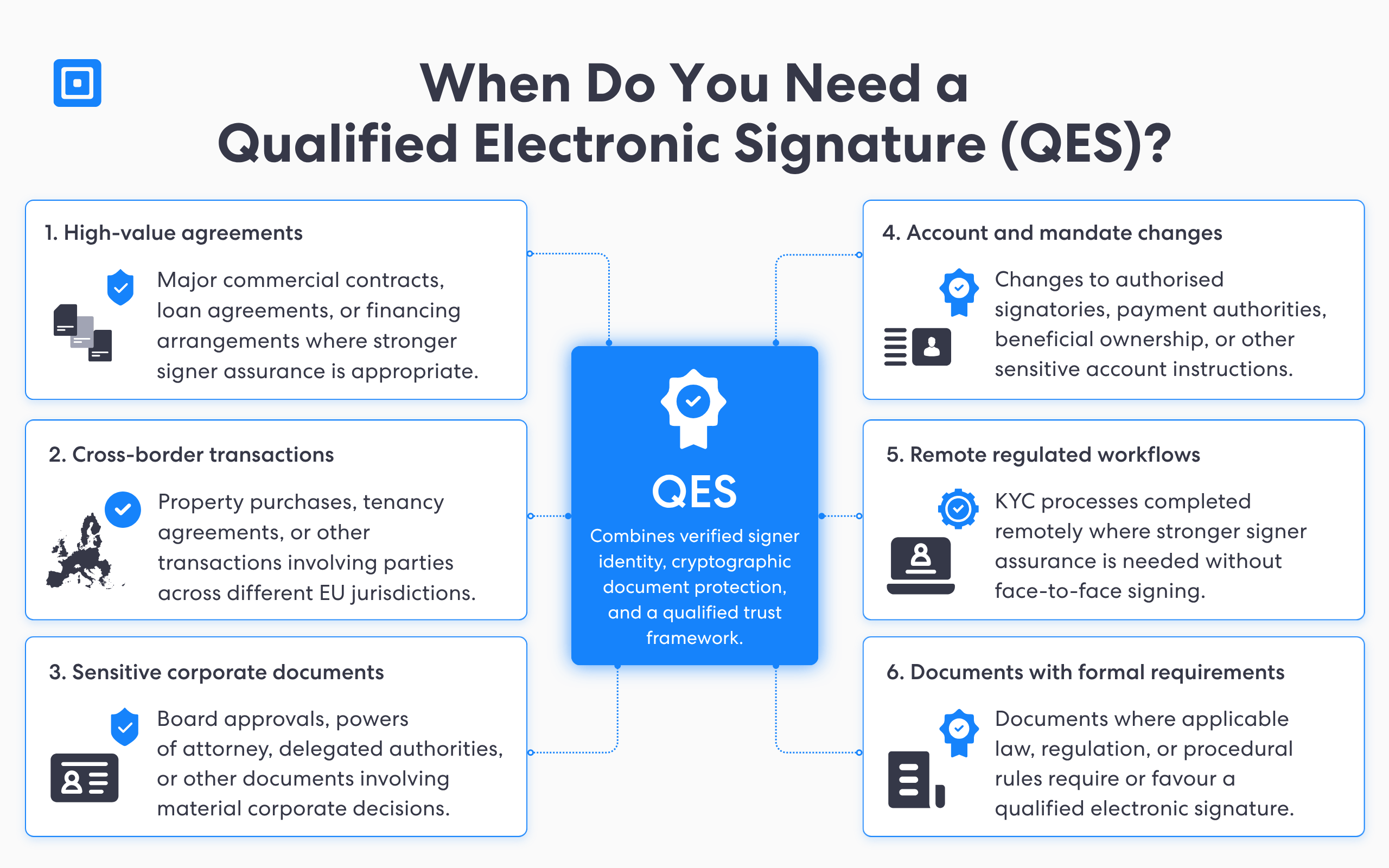
Common documents and scenarios that may warrant QES signatures include tenancy agreements with a significant rental value, cross-border property purchases, sensitive internal documents, loan agreements involving complex financing arrangements, and major changes to account mandates.
### Key Takeaways
- **Qualified Electronic Signatures** have the same legal effect as a handwritten signature in the EU.
- **eIDAS regulates** the criteria that QES signatures and Qualified Trust Service Providers must meet.
- The EU framework** regards the legal evidentiary value of a QES signature as very high.
- **A QES is essential** in regulated industries that require high-level document integrity and assurance.
- **A Simple Electronic Signature** offers the lowest level of identity assurance, followed by AES, and QES.
## Strengthen Assurance with Qualified Electronic Signature Verification
A QES signature eliminates reliance on physical document printing and accelerates contract execution. It provides legal equivalence, strong identity assurance, document integrity protection, and strengthens operational efficiency. Because the eIDAS regulation recognizes it, businesses can obtain approvals, agreements, and consent within a single trust framework rather than rely on country-by-country paper-based processes.
Most importantly, QES should complement, rather than replace, AML/KYC controls. While an advanced electronic signature can provide strong evidence of the signer’s identity and safeguard the integrity of a document, it cannot verify other information, such as the source of funds, the source of wealth, [beneficial ownership](https://www.complycube.com/en/what-is-ultimate-beneficial-ownership-ubo/), or sanctions status.
ComplyCube offers a secure and trusted end-to-end AML platform, equipped with three levels of electronic signatures that are fully compliant with the EU eIDAS framework. Reduce customer friction while strengthening trust in remote transactions. [Get started](https://www.complycube.com/en/contact/contact-sales/) by speaking with one of our experts today.
[](https://portal.complycube.com/signup)
## Frequently Asked Questions
Can an Qualified Electronic Signature (QES) expire?
Not necessarily. A Qualified Electronic Signature (QES) does not automatically become invalid just because a document or certificate expires. Instead, its validity will be assessed at the point of signing. Businesses use qualified timestamps or long-term validation evidence to prove that the certificate was valid when the QES was created.
Can you mix QES and AES signatures on a single document?
Yes, a single document may contain both Qualified Electronic Signatures (QES) and Advanced Electronic Signatures (AES). Each signed documents will retain its own validity, however whether the document is legally binding depends on the law and the formal signature requirements that apply.
Are QES recognized outside the EU?
Qualified Electronic Signatures (QES) are automatically recognized across the EU under the eIDAS framework. However, this does not necessarily apply outside the EU. Recognition in non-EU jurisdictions will depend on local laws and any applicable international or mutual-recognition arrangements.
What is the difference between digital signatures versus electronic signatures?
While digital signatures and electronic signatures may be used interchangeably, they are different terms. To put simply, digital signatures uses cryptographic technology to authenticate a signer and protect the integrity of signed data. An electronic signature is a broad legal concept under eIDAS that indicate agreement or intent to sign.
How does ComplyCube’s QES signatures meet regulatory requirements?
ComplyCube’s electronic signature solutions supports SES, AES, and QES assurance levels around the requirements of the eIDAS framework. Its unified AML platform combines verified identity, cryptographic protection, and QES-level signing within the same customer journey. It supports non-repudiation and maintains tamper-evident and timestamped records.
**Categories:** Guides
**Tags:** Regulations
---
### [The Ultimate Guide for Right to Work Checks for Contractors in 2026](https://www.complycube.com/verify-right-to-work-checks-for-contractors/)
**Published:** September 3, 2026
**Author:** Rithu Jagannath
**Excerpt:** Understand how UK businesses should classify contractor relationships, apply Right to Work checks, manage evidence and substitutes, and prepare for the expanded contractor rules taking effect from 1 October 2026. more confidently.
**Content:**
**TL;DR:** Right to work checks for contractors all depend on the working relationships. It is necessary for **UK businesses to classify** the working engagements before they **verify contractor identity** and working permissions. Learn how **contractor right to work obligations** extend to qualifying worker arrangements and individual subcontractors from 1 October 2026.
## Right to Work Checks for Contractors Are Important in 2026
UK businesses that are using contractors, subcontractors, and labour providers are facing a very big problem. Sometimes, the person named in the contract may not always be the person who actually does the work. This is especially important when illegal work is discovered.
In 2026, [Immigration Enforcement](https://www.bbc.co.uk/news/articles/ce3qzd9932do) made 7,270 illegal-working visits which resulted in 4,756 arrests. Over 1,200 businesses received civil penalties worth over £74 million and construction visits went up 150% in comparison to the same period in 2025. Today, current civil penalties start from £45,000 per illegal worker for a first breach, and £60,000 for a repeated breach. Knowingly employing someone without the right to work in the UK can result in up to five years in prison and an unlimited number of fines.
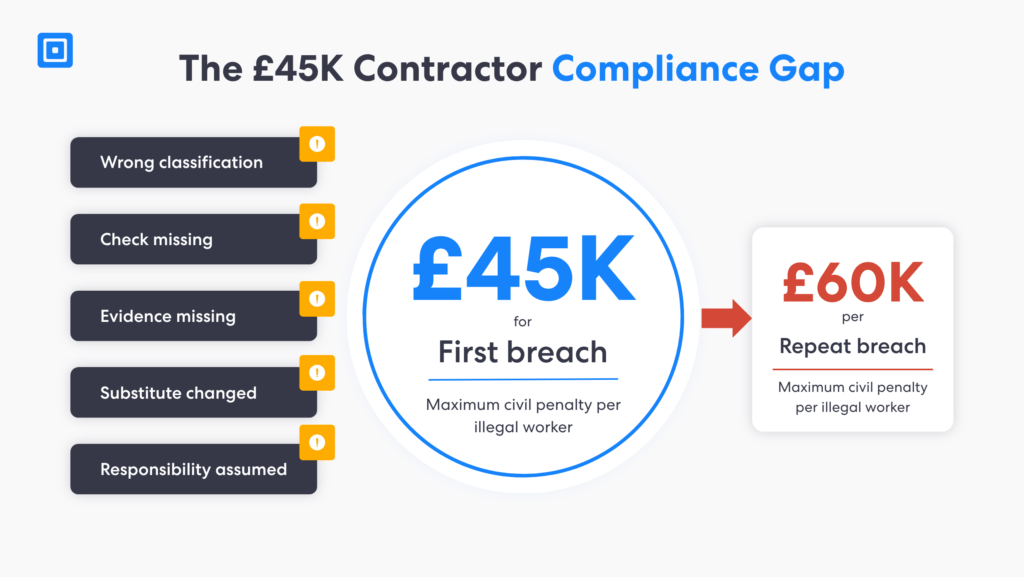
However, from 1 October 2026, section 48 of the [Border Security, Asylum, and Immigration Act 2025](https://www.legislation.gov.uk/ukpga/2025/31/contents), will broaden employer liability regarding right to work checks. Right now, statutory checks mainly apply to employees and apprentices, but by extending the framework, UK Home office will be accounting for other working arrangements as well.
It is important for many businesses to look at their list of contractors now well ahead of the new work rules being implemented. Typically, there is no grace period that allows newly in-scope work to start without the right process in place after the implementation date.
## How Do You Check Employee Right to Work?
In order to conduct a compliant [right to work check](https://www.complycube.com/en/proof-of-right-to-work-in-uk-with-idsp/) for contractors, the process must begin with the relationship instead of the passport. It is important for businesses to establish who will provide work and decide if current legislation puts that person within scope. Only then will companies be able to conduct the prescribed right to work checks. Here are steps that must happen during a right to work check:
### Understand if the person is genuinely self-employed
The first step is to understand if a contractor is genuinely self-employed or working for a company. For example, individual subcontractors are often sole traders operating in their own name. As a result, a written contract does not define the status of a worker by itself. It is important to find out the real nature of the relationship between the person and business.
### Establish whether the Right to Work scheme applies
When a working arrangement falls within the scheme, businesses need a statutory excuse well before the work starts. From October onwards, this analysis needs to account for any subsequent arrangements under a worker’s contract instead of assuming that every contractor will fall outside of the rules.
### Implement the correct work checks
Depending on the person’s circumstances, companies and employers may take advantage of a Home Office online check. They can also use permitted manual check using acceptable documents, an eligible certified digital service, or the [Employer Checking Service](https://www.gov.uk/check-job-applicant-right-to-work). These work checks need to be completed through the right prescribed process. Commercial credentials do not replace the evidence of a legal right to work.
### Retain evidence in a secure manner
It is important for businesses to retain evidence around people that underwent a check. This includes the date when it happened, the process used, the subsequent result, and any relevant restrictions. Under the existing employer’s guide, right to work check documentation needs to be kept over the duration of employment as well as two years post-engagement. Failure to keep the necessary information will leave an employer in a tough position. They will then be unable to show any defense in the midst of a Home Office investigation or review.
## Why Contractor Status Comes First in Employment Law
Employment law is important because the word “contractor” does not sit as one legal category. For instance, a person can be self-employed, have worker status or, depending on the actual relationship to the company, be an employee.
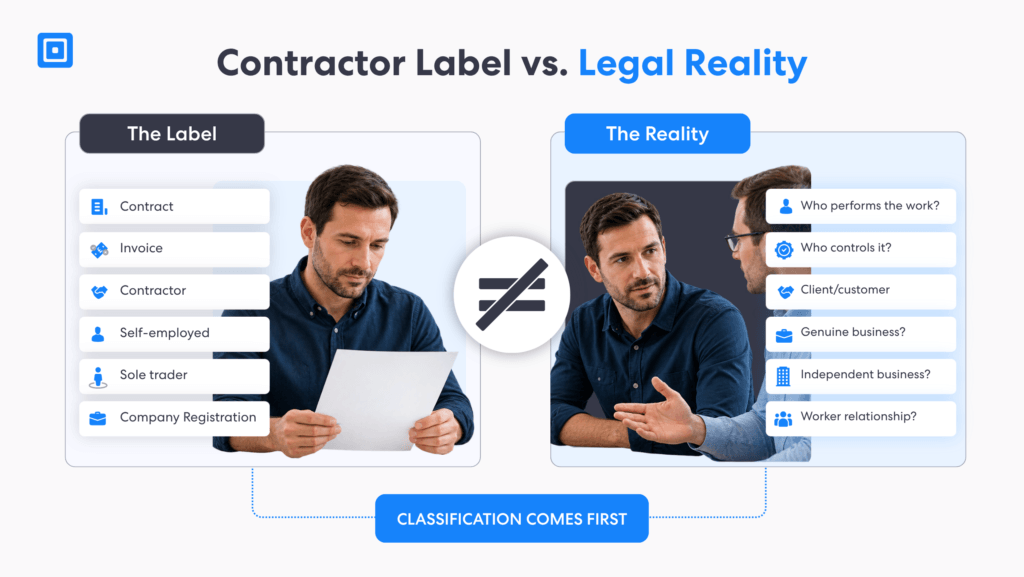
Someone who is genuinely self-employed may deal with many clients, carry financial risk, and control the ways in which they deliver their services. This is very different from an indiviual who is taking on work when the other party is not simply a customer of an independent business. The label of contractor cannot provide a proper [right to work](https://www.complycube.com/en/use-cases/process/certified-digital-right-to-work-checks/) permission on its own. The classification allows teams to determine which compliance question they need to focus on next.
## Self Employed Contractors and Right to Work Evidence
Many contractor files contain tax and commercial documents that look authoritative but do not prove any relation to [immigration permission](https://www.gov.uk/hmrc-internal-manuals/employment-status-manual/esm0003). In this case, teams must look to a National Insurance number, Unique Taxpayer Reference (UTR), UK bank account, or Companies House registration. Even then, it does not establish a person’s right to work in the UK.
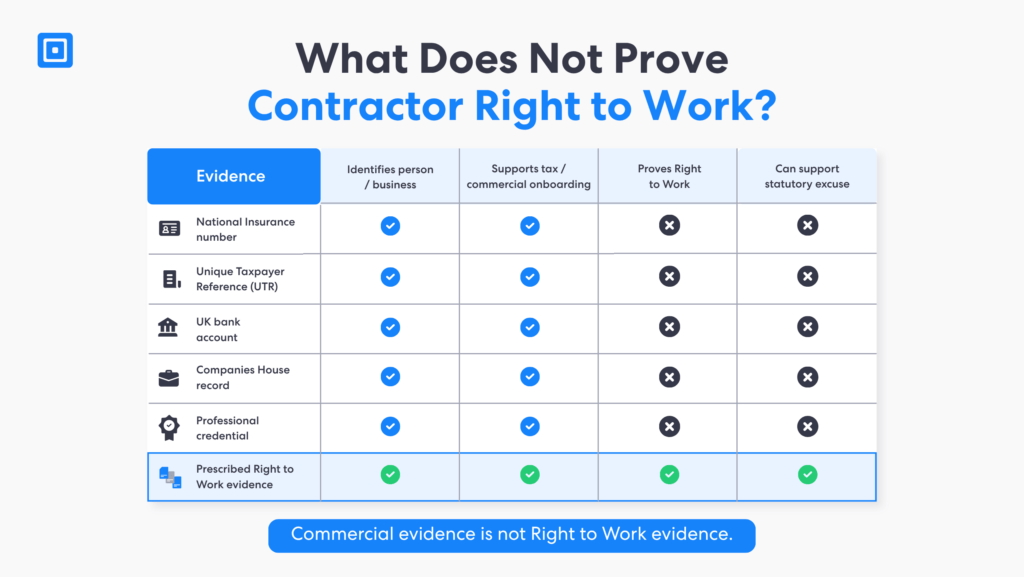
The UK Home Office has found several cases where businesses assumed that another government agency or previous employer may have already checked an individual just because such records existed previously. However, the best practice is to obtain any [prescribed evidence](https://docs.complycube.com/documentation/product-guides/identity-verification/document-check/document-types-per-country) through the appropriate route instead of inferring right to work permissions from unrelated records.
## The Employer’s Guide To Applying Right to Work Checks
Currently, the UK Home Office [employer’s guide](https://www.gov.uk/government/publications/right-to-work-checks-employers-guide) asks employers to conduct right to work checks before employment begins. It also explains how those checks provide a strong statutory excuse. The checks must be applied consistently instead of based on assumptions about nationality. This lowers discrimination risk while helping prevent illegal working.
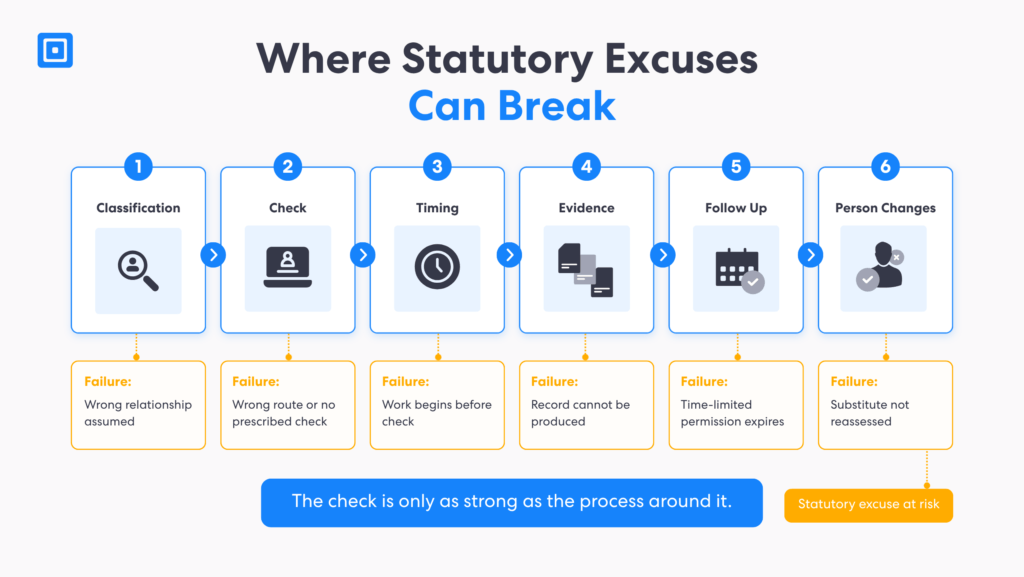
Though evidence is temporary, ongoing work compliance involves keeping strong records and completing future right to work checks at the appropriate date. As a result, onboarding will not be treated as a one-off event.
## Agency Workers, Agency Staff and the Supply Chain
Risk is much harder to see when contractors are sitting inside a wider labour supply chain. In some cases, a business may contract with labour providers who deploy agency workers, agency staff, or individual subcontractors.
More often than not, labour providers carry out checks. However, the end user must understand which party has the statutory responsibility. Certain contractual terms can ask labour providers to carry out the appropriate checks and retain evidence. They cannot transfer an obligation that current legislation places directly on another business. You can learn more here: [How UK Recruitment Firms Can Check Employee Right to Work](https://www.complycube.com/en/check-employee-right-to-work-for-recruitment/)
## Sponsor Licence Holders and Sponsor Duties
Sponsor license holder must keep [sponsor duties](https://www.davidsonmorris.com/home-office-reverses-sponsor-right-to-work-changes/) separate from the wider contractor changes. A UK business immigration team may manage sponsored employees while procurement might manage independent contractors.
Those two functions should share enough workforce information to identify gaps without assuming the two compliance regimes are identical. European Economic Area (EEA) and Swiss nationals who need sponsorship are subject to the necessary immigration and sponsorship requirements. Any further guidance on sponsorship duties need dedicated time and treatment.
## Gig Economy and Online Matching Service Models
The new right to work framework also covers specified online matching service arrangements. This is particularly important for those who are participating in the [gig economy](https://littler.co.uk/insights/new-right-to-work-checks-for-gig-economy-workers/). The legislation addresses businesses that link service providers with any potential clients or customers for a specific fee or cut.
However, this does not mean that every single gig worker somehow becomes an employee. The most important change here is that the law can extend way beyond what is considered to be conventional employment to more flexible labour models.
### **Case Study: 36 Arrests at Belfast Construction Site**
In March 2025, the Home Office made 36 arrests connected to a [Belfast Titanic Quarter](https://www.itv.com/news/utv/2025-03-23/home-office-raid-for-illegal-workers-in-belfast-results-in-36-arrests "https://www.itv.com/news/utv/2025-03-23/home-office-raid-for-illegal-workers-in-belfast-results-in-36-arrests") construction site. This involved people working for a subcontractor. The list of suspected offences included breaches of visa conditions and working without permission.
##### **Labour and Supply Chain Controls in Right to Work Checks for Contractors**
The issue is that public reporting does not identify the subcontractor or prove which specific controls failed. The best course of action is to maintain visibility over individuals deeper within the supply chain. The goal is to define checking responsibility contractually and conduct the prescribed process correctly.
##### **Outcomes**
- 36 people were arrested during the UK Immigration Enforcement operation.
- Majority of the arrested were reported as working for a subcontractor.
- This shows the commercial risk of limited workforce visibility between the end user and worker.
## Right to Work Supply Chain Risk When Contractors Use Substitutes
Substitution is one of the clearest contractor-specific risks. A business may check on one contractor’s permission, but instead another person can arrive later on to prove the actual work. The statutory excuse or evidence for the first person cannot establish the permission for the substitute. The Home Office enforcement policy looks at transparency across the whole labour supply arrangement.
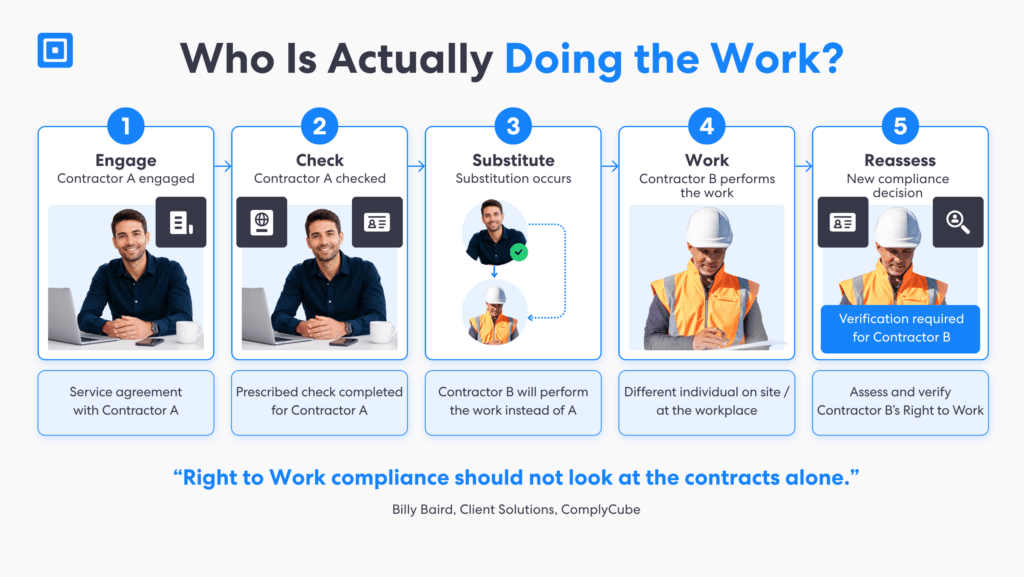
> Right to work compliance should not look at the contracts alone.
[Billy Baird](https://www.linkedin.com/in/billy-baird-a6a943120/), Client Solutions at ComplyCube, adds, “The practical question they are trying to answer is around who is doing the work. That is why compliance requirements for contractors must follow the person that provides the work.” The best right to work processes link the person, their classification, their evidence, and any later substitution.
### Key Takeaways
- Contractor labels cannot prove if someone is self-employed or covered by the right to work scheme.
- Professional documents cannot replace the prescribed Right to Work evidence.
- Labour providers, agency staff and substitutes need clear ownership and visibility.
- Businesses must have classification, checks, evidence, and follow-ups in one process.
- In October, the framework adds qualifying worker arrangements, individual subcontractors, and specified online matching services.
## Conduct Right to Work Checks for Contractors Through ComplyCube
With legally required right to work checks extending to non-employee worker contractors from 1 October 2026, it is important for businesses to manage flexible labour at scale in a compliant manner. ComplyCube can support right to work checks for contractors through [certified digital identity capabilities](https://www.complycube.com/en/company/security-compliance-center/uk-diatf-certified-idsp/), document and biometric verification, configurable workflows, APIs, SDKs and audit-ready records.
These [controls](https://docs.complycube.com/documentation/product-guides/biometric-and-liveness-verification/identity-check) can help standardise verification while keeping employment-status decisions and statutory responsibility with the organisation. [Contact ComplyCube](https://www.complycube.com/en/contact/contact-sales/) to discuss contractor Right to Work compliance for your business.
[](https://portal.complycube.com/signup)
## Frequently Asked Questions
Do Self Employed Contractors Need Right to Work Checks?
Before 1 October 2026, genuinely self-employed contractors generally sit outside the existing statutory excuse scheme. From October, organizations should verify credentials directly to avoid operational disruption or penalties. Employers are liable for checks on agency workers in certain conditions.
What Happens if a Contractor Has No Valid Right to Work?
Where a prescribed check applies and permission cannot be established, the in-scope work should not begin. Knowingly allowing illegal work can expose a business to civil penalties and potential criminal liability.
What Happens if a Contractor Uses a Substitute?
If a different person performs the work, the original contractor’s Right to Work evidence does not automatically apply to the substitute. Businesses should reassess who is actually providing the service and whether a new check is required.
Are Businesses Liable for Checks Conducted by Labour Providers?
The liability wholly depends on the relevant legal relationship. Contractual requirements can strengthen any supply chain practice. However, they do not automatically transfer a statutory duty that is imposed directly on another organisation.
How Can ComplyCube Support Right to Work Checks for Contractors?
ComplyCube supports eligible digital Right to Work verification, document and biometric checks, configurable workflows and auditable evidence. These capabilities help businesses standardise verification while retaining control of contractor classification and compliance decisions.
**Categories:** Guides
**Tags:** Identity Verification
---
### [AUSTRAC Western Union Ongoing Investigation](https://www.complycube.com/western-union-austrac-investigation/)
**Published:** September 2, 2026
**Author:** Dini Habib
**Excerpt:** AUSTRAC has launched an enforcement investigation into Western Union, putting its AML programme, transaction monitoring, and governance under scrutiny. In July 2025, the firm faced similar scrutiny over its compliance processes.
**Content:**
Australia’s financial intelligence regulator, the Australian Transaction Reports and Analysis Center (AUSTRAC), announced on 1 September 2026 the opening of an enforcement investigation into Western Union Financial Services Australia and its US parent, the Western Union Company.
For compliance officers, this is more than just another enforcement headline. The research paints a useful picture of what regulators consider when assessing whether an Anti-Money Laundering (AML) framework works in practice, not just whether policies exist.
## The AUSTRAC Western Union Investigation Backstory
Western Union runs the world’s biggest international money-transfer networks. While, the scale of that is commercially valuable, it can equally pose as a major financial crime challenge.
Cross-border payment providers operate where large cash sums, international transfers, customers, and varied jurisdictions meet. This mix yields diverse risk profiles. Notably, AUSTRAC says clearly that international payment providers are vulnerable to criminal exploitation. However, its worries about Western Union didn’t come overnight.
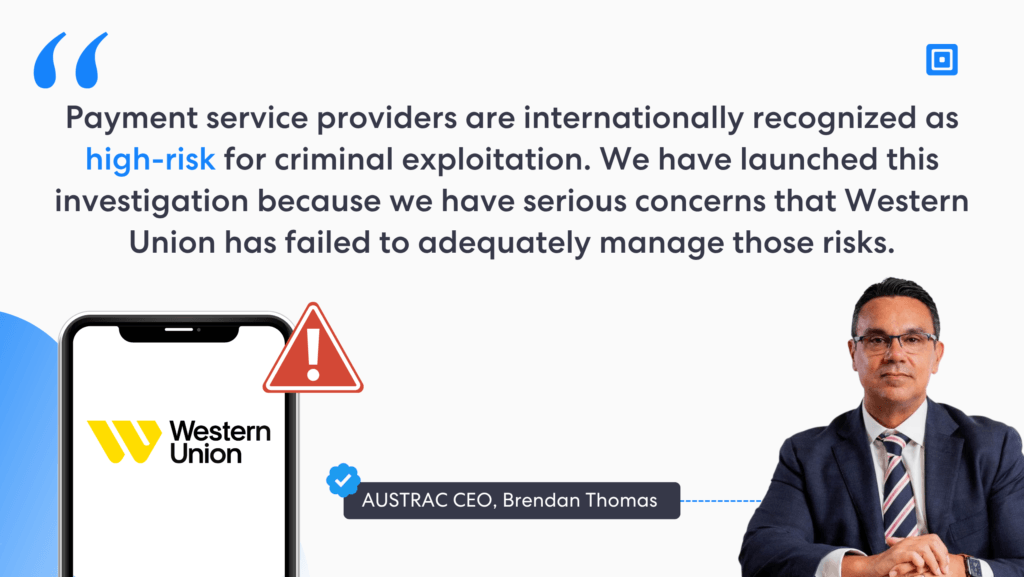
In July 2025, AUSTRAC identified several concerns in the effectiveness of the company’s Customer Due Diligence (CDD), suspicious matter reporting, and AML and Counter-Terrorism Financing (CTF) program. The regulator then ordered Western Union Financial Services Australia to appoint an external compliance auditor. Subsequently, the audit findings escalated into an enforcement investigation.
> We launched this investigation because we have [serious concerns](https://www.austrac.gov.au/news-and-media/media-release/austrac-initiates-investigation-western-union) that Western Union has failed to adequately manage risks.
Although the company has not faced enforcement action, AUSTRAC underscores the significance of the investigation. Its CEO, Brendan Thomas, notes, “The risks facing this sector include terrorism financing, human trafficking, fraud and child sexual exploitation. We launched this investigation because we have serious concerns that Western Union has failed to adequately manage those risks.”
## What is AUSTRAC Investigating?
AUSTRAC is pushing for one statement: that having a global AML control framework cannot excuse a company from being able to explain why its controls are appropriate to its own risks. Multinational firms often centralize technology, risk models, alert thresholds, and compliance decisions. However, businesses must remain accountable for meeting their jurisdiction-specific obligations.
### AUSTRAC Identified Three Focus Areas in This Case:
- **First**, the adequacy of Western Union’s AML and CTF program in supporting its ability to identify, assess, and mitigate financial crime risks.
- **Second** is its transaction monitoring effectiveness. Notably, AUSTRAC wants to know if Western Union’s systems can identify known money-laundering typologies. This is especially true where activity pertains to terrorism financing and child sexual exploitation.
- **Third** is governance, including the influence of Western Union’s global headquarters on decisions affecting its Australian operation.
## This is Not Western Union’s First AML Reckoning
In 2017, Western Union settled with the US Department of Justice (DOJ) and Federal Trade Commission (FTC) for [$586 million](https://ir.westernunion.com/news/archived-press-releases/press-release-details/2017/Western-Union-Reaches-Agreements-to-Resolve-US-Investigations/default.aspx). The company admitted criminal violations as part of its plea deal with the DOJ. This included failing to maintain an effective AML program and abetting wire fraud.
The conduct at issue relates to the failures of agents involved in suspicious transactions and consumer fraud. US authorities said Western Union had information pertaining to these suspicious activities but, in some cases, failed to take sufficient corrective action.
The lesson remains very relevant: having risk information is not the same as acting on it. Modern compliance programs generate large volume of alerts, customer risk scores, and management information. Regulators are increasingly looking for evidence that those signals result in decisions.
## The Warning Hidden Inside Transaction Monitoring
During a broader supervisory campaign involving payment platforms, AUSTRAC found low levels of reporting of suspicious matters, weak transaction monitoring, and failures to identify high-risk customers.
> There is no single indicator that can immediately point to criminal activity.
Some relevant transactions can also appear deceptively ordinary. AUSTRAC has identified common low-value transactions, often below AUD500, paired with factors such as sending funds to higher-risk jurisdictions and benign payment descriptions.
However, there is no single indicator that proves criminal activity. The point is that monitoring should combine transactional, behavioral and customer information rather than simplistic value thresholds. That is an important distinction for compliance teams, that a transaction-monitoring system should detect risk, not merely process rules.
## How to Avoid Becoming AUSTRAC’s Next Investigation
To avoid regulatory scrutiny, there are several practical lessons from the Western Union case worth taking on board. These takeaways are especially critical as regulation intensifies, scrutiny of payment providers heightens, and there is greater emphasis on high-quality controls capable of identifying real-world criminal typologies.
### AUSTRAC Western Union Investigation Practical Insights:
- **Make sure controls are relevant to current risks:** Risk assessments should take into account how customers use a specific product, the jurisdictions in which they are based, or where your highest-risk channels are located. Assess if risk assessment is directly incorporated into customer risk scoring, [Enhanced Due Diligence (EDD)](https://www.complycube.com/en/enhanced-due-diligence-requirements-guide/) triggers, and transaction monitoring scenarios.
- **Test transaction monitoring against known typologies:** Monitoring controls should not outdated or copied from industry norms. Instead, it has to clearly show that it can detect suspicious activity specific to your business. Thus, it is crucial to test them against different scenarios, track the trends of false positives and false negatives, and make sure that each rule is fed with the right data.
- **Treat suspicious matter reporting as an intelligence function**: Regulators not only demand timely submission of reports, but also whether firms are identifying meaningful suspicious activity. Very low reporting volumes can be a warning sign if they are inconsistent with the firm’s risk profile. Businesses should benchmark reporting volumes against customer activity and risk exposure, and also do a quality-check on suspicious activity reporting narratives.
- **Test remediation for effectiveness, not completion:** Closing an audit finding because a policy was updated or a control was added does not prove that the underlying weakness has been fixed. Instead, implement post-remediation testing, assign clear control owners, track measurable outcomes, and independently verify that the risk has genuinely reduced before closing the issue.
[](https://portal.complycube.com/signup)
Find out more AML news in ComplyCube’s [Trust Edition newsletter](https://www.linkedin.com/newsletters/the-trust-edition-7103022355722981376/). We explore the latest in developments across identity verification and AML globally.
**Categories:** News
**Tags:** Identity Verification
---
### [CryptoCubed August Newsletter: €2.2M Crypto Seizure and Binance Arrest](https://www.complycube.com/cryptocubed-august-newsletter-2-2m-crypto-seizure-and-binance-arrest/)
**Published:** September 1, 2026
**Author:** Dini Habib
**Excerpt:** Crypto enforcement is accelerating across the globe. From seized assets and shuttered ATMs to sanctions, investigations, and high-profile deals under scrutiny, this edition tracks the cases reshaping risk across digital finance.
**Content:**
👋 Welcome to the August CryptoCubed edition. This month, we see crypto enforcement moving at the speed of light! From a €2.2M crypto seizure and 96 ATM shut downs to sanctions, and high profile deals under renewed scrutiny, regulators are looking far beyond the transaction itself.
The biggest story is who is behind the money, where it is moving, and what happens when critical Anti-Money Laundering (AML) controls fail.
## Aqua 1’s $100M WLFI Deal Faces New AML Scrutiny
United States, August 10, 2026 🇺🇸: In June 2025, Aqua 1, a UAE-based crypto fund, acquired WLFI governance tokens. The deal involved a $100 million investment in World Liberty Financial, the Trump family-linked crypto venture. This month, this investment came under scrutiny again.
Reports indicated that Guren Bobby Zhou, the businessman behind Aqua 1, was linked to an ongoing UK money-laundering probe. Authorities arrested Zhou in Britain in 2021, and he continues under investigation with no criminal charges.

The case has refocused attention on the original $100 million deal and, crucially, the source of capital behind it. Blockchain analytics reveal transactions between wallets. They do not show who controls an investment vehicle. It also does not reveal how the capital was obtained or whether the transaction aligns with the investor’s financial profile.
### ***Compliance Takeaway:***
For compliance teams, this serves as a reminder that tracking where crypto moves does not reveal who owns the funds. Tracking movement alone may miss ownership details. Effective verification links on-chain activity to ownership checks. It highlights the potential gap in wallet monitoring. As such, it is crucial to connect on-chain activity with other forms of verification, including [beneficial ownership](https://www.complycube.com/en/what-is-ultimate-beneficial-ownership-ubo/), adverse media, and source-of-funds checks, to form a complete picture of financial crime risk.
For more information, click [here](https://www.complycube.com/en/wlfi-100m-crypto-source-of-funds/).
## Knaken’s €2.2M Crypto Seizure After Failed MiCA License
Netherlands, August 17, 2026 🇳🇱: Dutch regulators liquidated roughly €2.2 million ($2.5 million) in cryptocurrency seized from the crypto platform Knaken, which went bankrupt last month. This case brings a key question into focus: what happens to customers’ money when a platform fails?
Just last year, Knaken failed to obtain the EU’s Markets in Crypto-Assets Regulation (MiCA) license. This meant the company could not operate as a crypto-asset service provider across the EU market. As a result, the company ceased its operations and started winding down.
Who will the $2.5 million go to? How Knaken held, recorded, and separated customer assets could now determine whether users can retrieve their holdings directly or must compete with other creditors for what remains.
### ***Compliance Takeaway:***
The case reinforces the need for firms to treat MiCA readiness as a business-critical priority. Beyond licensing, maintaining clear ownership records and having credible wind-down plans are no longer just compliance requirements, as they can directly affect a firm’s ability to remain in the market and protect customers if things go wrong.
For more information, click [here](https://www.complycube.com/en/knaken-crypto-enforcement-sells-2-2m-in-assets/).
## Binance Employees Face UAE Interrogation
United Arab Emirates, August 20, 2026, 🇦🇪: Binance is facing renewed scrutiny in the UAE after two of its employees were detained and interrogated separately as part of a wider financial crime investigation. According to Binance, the employees were asked for information about the flow of funds from third parties through a Binance client-money account.
Officials detained one employee in Sharjah and questioned another at a police station before releasing them. Notably, Binance holds an active Virtual Asset Service Provider (VASP) license from Dubai’s Virtual Assets Regulatory Authority (VARA).
The episode also comes against a much broader backdrop of regulatory scrutiny. Binance has faced major AML and sanctions-related probes in the US, Australia and Nigeria, including a landmark $4.3 billion US settlement in 2023.
### ***Compliance takeaway***
The Knaken case highlights crypto licensing’s importance, while the Binance case indicates licensing cannot serve as a shield. Businesses must demonstrate that their AML controls can remain defensible against evolving risks. Furthermore, Binance’s history shows that regulatory issues do not remain confined to a single jurisdiction. Consistent global controls, documented remediation, and strong governance are critical in preventing sustained scrutiny.
For more information, click [here](https://www.complycube.com/en/two-binance-employees-detained-in-the-uae/).
## 96 Crypto ATMs Closed Over AML Issues
Australia, August 9, 2026 🇦🇺: Australian crypto ATM operator Cryptolink has been ordered to take all 96 of its machines offline after the Australian Transaction Reports and Analysis Center (AUSTRAC) suspended its registration due to ongoing AML and Counter-Terrorism Financing (CTF) concerns.
In October 2025, AUSTRAC revealed that the company failed to submit large cash transaction reports on time and identified multiple weaknesses in its financial crime risk assessments. Cryptolink paid an infringement notice of $56,340 and entered an enforceable undertaking to strengthen its controls.
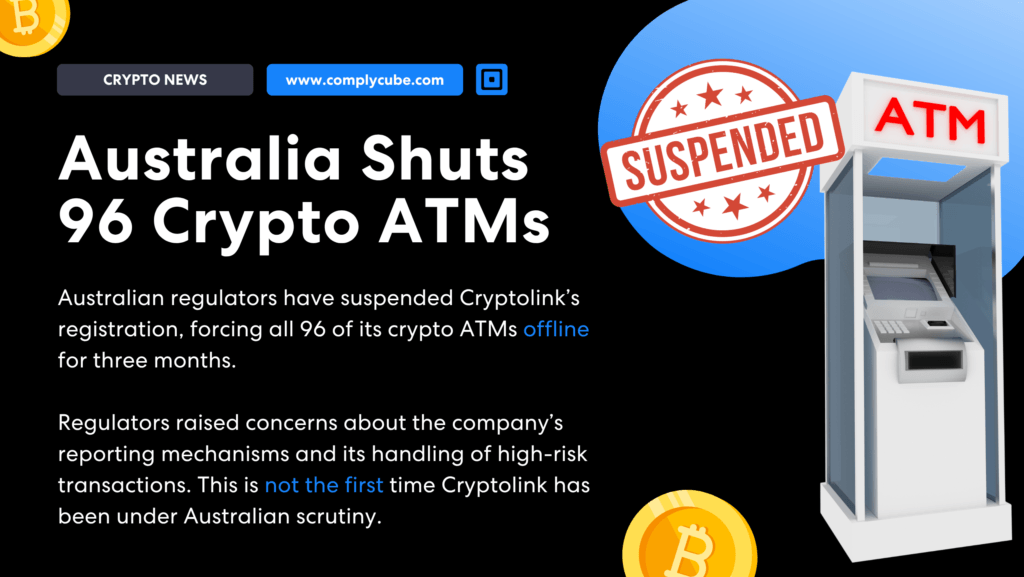
This month, AUSTRAC suspended Cryptolink’s VASP registration for three months, preventing it from operating its network of crypto ATMs. Although Cryptolink had complied with conditions under the earlier undertaking, AUSTRAC noted that the firm failed to provide required threshold transaction reports and did not adequately respond to a formal request for information.
### ***Compliance Takeaway:***
For compliance teams, this case shows that paying a penalty or completing an undertaking does not immediately end regulatory scrutiny, especially when weaknesses continue. In particular, crypto ATM operators must maintain accurate and timely transaction reporting and regulatory communications around high-risk, cash-to-crypto activity.
For more information, click [here](https://www.austrac.gov.au/news-and-media/media-release/austrac-orders-cryptolinks-crypto-atms-offline).
## OFAC Targets Iran-Linked Crypto Exchanges
United States, August 7, 2026 **🇺🇸**: The US Treasury steps up its crypto sanctions campaign targeting exchanges and financial networks used to move illicit funds for Iran and the Islamic Revolutionary Guard Corps (IRGC).
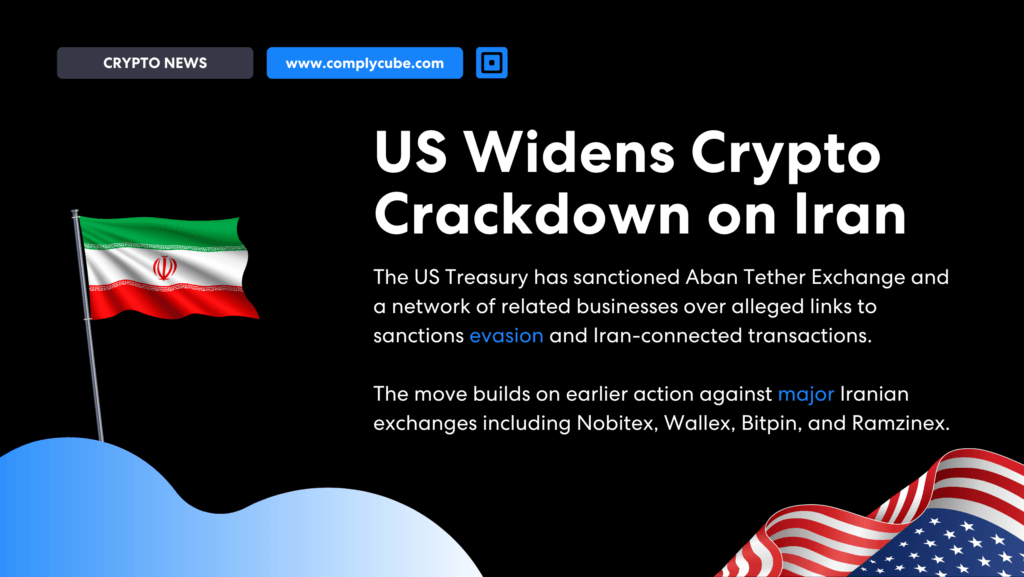
According to the Treasury, Iranian actors had used lightly regulated or unlicensed digital asset platforms, corporate structures, and an online gambling network to move large volumes of cryptocurrency. Consequently, they were able to evade sanctions and support regime-linked actors including the IRGC.
Subsequently, OFAC sanctioned Aban Tether Exchange and several related businesses based in the UAE, Georgia, and Poland. Earlier in June, OFAC targeted major Iranian exchanges, including Nobitex, Wallex, Bitpin and Ramzinex, over alleged sanctions evasion and IRGC-linked transactions.
Crucially, OFAC clarified in August that the risk does not end with US firms: non-US financial institutions and businesses transacting with designated Iranian crypto exchanges could themselves face secondary sanctions exposure.
### ***Compliance Takeaway:***
>
Businesses must treat exposure to Iranian crypto exchanges as a heightened sanctions risk, including where transactions are indirect or routed through offshore intermediaries. Most importantly, enhanced due diligence and robust screening are critical in identifying potential high-risk entities and associated wallet addresses.
For more information, click [here](https://home.treasury.gov/news/press-releases/sb0598).
## Time for Some Light-Hearted Creative Criticism?
So you’ve made it to the end of our newsletter. It’s time to enjoy a little satire, worthy reader, you’ve earned it.
### 🔥THE CRYPTO CUBED POEM: AUGUST🔥
This month in crypto, the pressure climbed,
Deals were questioned, and companies were fined.
ATMs went dark, exchanges were named,
Millions were seized and networks were blamed.
Across borders, the scrutiny grew,
Old transactions came back into view.
Follow the money, the people, the trail,
Because in crypto, the details prevail.
### Stay tuned for our September newsletter, and have a great month!

**Categories:** News
**Tags:** Crypto Regulations
---
### [CryptoCubed April Newsletter: Coinone $3.5M Fine and New Russia Crypto Bill](https://www.complycube.com/cryptocubed-april-newsletter-coinone-3-5m-fine-and-new-russia-crypto-bill/)
**Published:** April 30, 2026
**Author:** Dini Habib
**Excerpt:** This month, we see regulators’ efforts to stabilize the crypto sector, with updated rules to make crypto AML compliance easy to understand. Additionally, we explore dreadful fines and license revocations in three important cases.
**Content:**
👋 Welcome back! In this CryptoCubed April Edition, we explore interesting cases, such as the major Coinone $3.5M fine, the latest Russia Crypto Bill, the FCA’s raid on eight illegal crypto hubs, and the U.S. targeted take down of a massive pig butchering fraud operation.
From heavy AML penalties and crypto crackdowns to a significant push toward a formal crypto framework, the month shows how quickly the global digital asset landscape is tightening around compliance, oversight, and control. Read on below!
## Coinone $3.5M Fine in South Korea
South Korea, April 13, 2026 🇰🇷: Coinone, one of South Korea’s major cryptocurrency exchanges, has been fined 5.2 billion won ($3.5 million) for repeatedly breaking AML and KYC rules. The South Korean Financial Intelligence Unit (FIU) also enforced a partial 3-month business suspension.

Coinone had failed to verify 70,000 customer identities. Of those, 40,000 involved unverifiable or incomplete ID documents, and 30,000 involved customers who were allowed to trade despite incomplete verification. Moreover, the company facilitated 10,113 transactions with 16 unregistered foreign virtual asset platforms, thereby breaching the [South Korean Special Financial Information Act](https://elaw.klri.re.kr/eng_service/lawView.do?hseq=49601&lang=ENG).
Cha Myung-hoon, Coinone’s CEO, was also reprimanded. The penalty is a wider push by the country to align crypto exchanges with traditional AML standards, with Coinone’s peers, Upbit, Korbit, and Bithumb, fined in previous months. Coinone has filed a lawsuit seeking to overturn the business suspension and enforcement penalty. The lawsuit is still ongoing.
For more on this story, click [here](https://news.bitcoin.com/south-korea-fines-coinone-3-5m-suspends-new-user-services-for-3-months-over-aml-violations/).
## FCA Raids Peer-to-Peer Crypto Trading Hubs
United Kingdom, April 22, 2026 🇬🇧: The FCA’s Enforcement and Market Oversight division, together with the His Majesty’s Revenue and Customs (HMRC) and the South West Regional Organised Crime Unit (SW ROCU), cracks down on eight illegal peer-to-peer (P2P) crypto hubs across London.
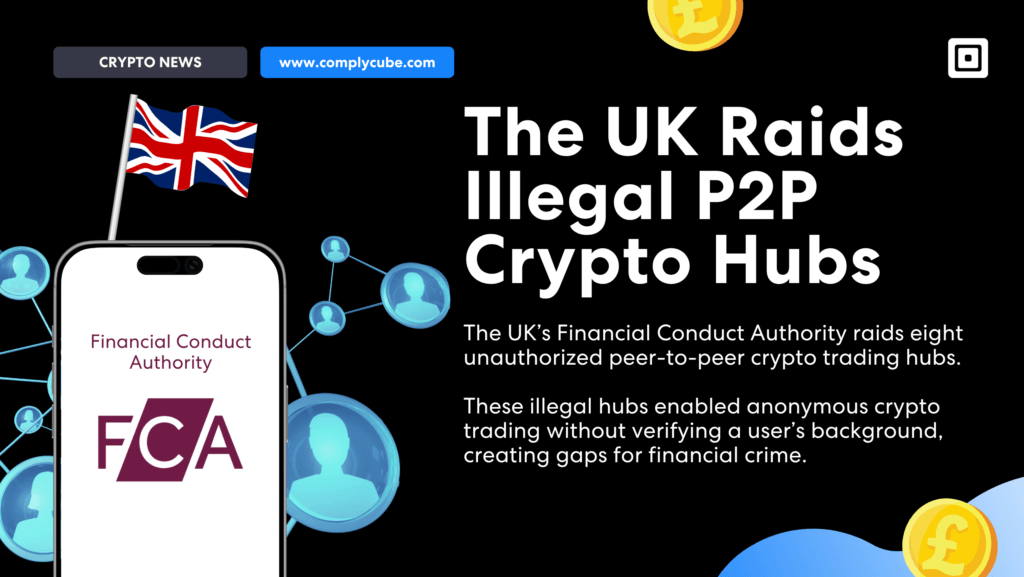
In the UK, there are no authorized P2P crypto companies currently operating. These eight unauthorized, illegal sites facilitated crypto trading, where users could buy and sell crypto directly with one another without undergoing [identity and background verification](https://www.complycube.com/en/use-cases/industry/crypto/). As such, individuals could move illicit funds with one another without being detected by authorities.
> Unregistered traders can enable criminals to move, disguise, and spend illegal money.
Officials have issued a cease and desist notice to each of them. This case highlights the UK’s move to introduce broader regulatory obligations for crypto firms in 2027. The FCA has urged all crypto companies to strengthen KYC to dodge high-risk P2P transactions.
For more information, click [here](https://www.fca.org.uk/news/press-releases/fca-leads-first-crackdown-illegal-crypto-trading).
## Chinese Crypto Investment Scam to Repay Victims $700 M
United States, April 23, 2026 🇺🇸: The U.S. Department of Justice (DOJ), led by U.S. Attorney for DC Jeanine Pirro, took down a massive “scam compound” in Burma, impersonating US banks and the New York City Police Department (NYPD) to steal money from American citizens.

Huang Xingshan and Jiang Wen Jie, the leaders of the scam operation, lured job seekers to run pig butchering fraud, defrauding US citizens of millions of dollars via fiat or crypto. Over $700M has been restrained in blockchain assets. These funds are now being queued for verified victims.
This case is a scary one, as it highlights the speed and anonymity of crypto transactions, acting as perfect channels for money laundering. For legitimate crypto firms, this could mean potentially handling laundered proceeds through the fraud pipeline. As such, crypto companies must enforce comprehensive transaction monitoring and enhanced KYC screening to [block pig butchering](https://www.complycube.com/en/americans-lost-5-6b-to-pig-butchering-crypto-scams-in-2023-what-about-the-uk/) inflows early.
For more on this, click [here](https://nypost.com/2026/04/23/us-news/doj-working-hard-to-reunite-american-victims-with-700m-stolen-in-sick-chinese-crypto-scheme/).
## Advances in Russia Crypto Bill
Russia, April 21, 2026 🇷🇺: The Russian State Duma has advanced a monumental crypto bill in first reading, forming the country’s first-ever, formalized digital asset frameworks. The bill shifts Russia’s crypto scene from a de facto ban to a structured, state-controlled market.
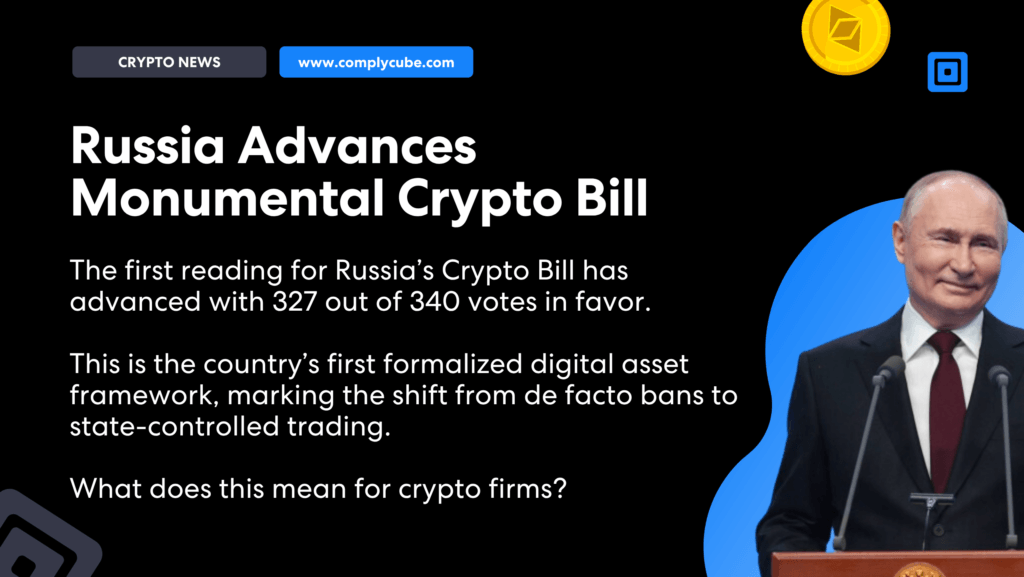
After years of ambiguity, crypto firms and Russian citizens now have access to clear guidelines on trading, licensing, and using cryptocurrency internationally. The crypto bill garnered huge support in parliament, with 327 votes in favor out of 340. While the bill has only passed through the first reading, the positive favor might mean the bill can be expected to roll out by July 2026.
For global crypto platforms, partnering with licensed local exchanges is crucial to avoid restrictions from Russian regulators. The move is expected to accelerate crypto diplomacy under heightened regulator oversight to combat illicit trading. Subsequent readings and presidential approval are ongoing.
Find more on this story [here](https://finance.yahoo.com/markets/crypto/articles/putin-signs-russias-first-crypto-183821235.html).
## Time for Some Light-Hearted Creative Criticism?
So you’ve made it to the end of our newsletter. It’s time to enjoy a little satire, worthy reader, you’ve earned it.
### 🔥THE CRYPTO CUBED POEM: APRIL🔥
Crypto never sleeps, it shifts with every tide,
From Seoul to London, rules now cut more wide.
Some firms are fined, some shadows pulled to light,
Some fraud is stopped before it grows too bright.
In Russia, rules are forming strong and new,
While global platforms rethink what they do.
The market changes fast, both harsh and bold,
Where trust and traceability now outweigh gold.
### Stay tuned for our May newsletter, and have a great month!

**Categories:** News
**Tags:** Crypto Regulations
---
### [Compliance Takeaways from The FCA’s £35.5M Dolfin Scheme Probe](https://www.complycube.com/the-fca-dolfin-scheme-probe/)
**Published:** August 26, 2026
**Author:** Dini Habib
**Excerpt:** The Financial Conduct Authority has banned three key figures from Dolfin Financial Ltd from working in the UK's financial services industry, following their involvement in a scheme involving fraudulent UK Tier 1 visa applications.
**Content:**
The UK’s Financial Conduct Authority (FCA) has cracked down on three former senior Dolfin Financial figures over a £35.5 million scheme to help clients avoid investor visa rules. Notably, the FCA found that the firm ran an illicit scheme that enabled clients to obtain UK Tier 1 investor visas without investing £2 million of their own money.
Dolfin’s Former Chief Executive, Denisz Nagy, was fined £324,800, while Former Finance Director, Sanjay Maraj, was fined £122,000. They have both also been banned from working in UK financial services. Enforcement action against the firm’s co-founder, Roman Joukovski, remains provisional.
## How the Dolfin Scheme Remained Hidden for Years
The [UK’s Tier 1 Investor Visa](https://www.gov.uk/tier-1-investor) route was introduced in 2008, offering a viable residency route for high-net-worth individuals who made a substantial financial investment of at least £2 million in the economy. By 2022, the route was closed to new applications due to security concerns, including corrupted elites.
The FCA investigation found that a majority of the customers under the Dolfin scheme only paid fees of roughly £400,000 between 2016 and 2019. At least 99 people had received investor visas under the scheme, while Dolfin-linked businesses and immigration agents earned at least £35.5 million in fees.
In essence, the scheme was able to bypass authorities due to several factors:
- **The Illusion of Compliance:** The arrangement was deliberately designed to create the impression that customers had met the $2 million investment requirement via false paper trails.
- **Concealed Networks:** The visibility of millions of transactions was obscured across multiple fragmented layers through third-party channels, including immigration agents.
- **Acting as an Authorized Firm:** Because Dolfin Financial (UK) Ltd operated as a regulated wealth management firm, it avoided heightened regulatory scrutiny.
> Reports indicated that Mr Nagy and Mr Joukovski played [leading roles](https://www.fca.org.uk/news/press-releases/fca-bans-trio-bypass-visa-rules) in creating and operating the scheme. At the same time, Mr Maraj was responsible for the financial aspects of the illicit scheme.
The FCA also found that Mr Joukovski deliberately hid his involvement and role within the scheme. However, investigations are still ongoing, as Mr Joukovski referred his Decision Notice to the Upper Tribunal, where his case will be presented.
## The Timeline of the Dolfin Scheme, from 2019 to 2026
Scrutiny only caught up when the FCA identified broader red flags regarding Dolfin’s financial crime and [Anti-Money Laundering (AML)](https://www.complycube.com/solutions/due-diligence-compliance/anti-money-laundering/) controls, leading to initial voluntary restrictions in late 2019. Here is the full timeline of the Dolfin Scheme:
- **2019:** The FCA imposed voluntary restrictions on Dolfin after identifying concerns, including around its Tier 1 investor-visa business and financial-crime controls. An independent review of the company was launched under section 166.
- **2021:** The review uncovered material deficiencies in Dolfin’s onboarding and financial-crime controls. The FCA then stopped the firm from carrying out regulated activities. Months after, Dolfin entered Special Administration and became insolvent.
- **2022:** The Home Office officially closed the UK Tier 1 Investor Visa route.
- **2026:** The FCA announced the individual enforcement outcomes.
## The Compliance Controls Dolfin Financial Ltd Needed in Place
Traditional Know Your Customer (KYC) processes pose an important first question: Who is this client? However, the Dolfin case underscores a crucial problem for compliance teams, that identity verification alone is not sufficient enough in managing financial crime risk.
This is particularly true in cases involving high-value relationships, such as the UK Tier 1 Investor Visa route. In a compliant framework, Dolfin would need to do more than verify identity. The firm should demonstrate a clear understanding of its clients, including the source of their funds, the purpose of the visa, and the nature of their relationship.
### Compliance Lesson 1: Enhanced Due Diligence Is More Than a Box to Check
The Dolfin case shows why high-value transactions require scrutiny beyond the mere presence of supporting documents. Firms must have sufficient controls in place to understand where millions of pounds are allegedly being invested and whether the activity made any sense.
This includes understanding the funds origins, whether the customer truly owns or controls the funds, whether any third parties are involved, and whether the transaction aligns with its stated purpose. This makes abnormal behavior easier to identify later. As such, for higher-risk relationships, [Enhanced Due Diligence (EDD)](https://www.complycube.com/en/enhanced-due-diligence-requirements-guide/), Source of Funds (SoF), and Source of Wealth (SoW) checks are especially critical.
### Compliance Lesson 2: Strong Governance is Part of Financial Crime Prevention
The most important lesson from the case relates to governance. Compliance systems are only as good as the people who operate and respect them. A strong compliance infrastructure cannot compensate for a culture whereby senior decision-makers can ignore critical controls without being questioned.
Strong governance should therefore enforce clear escalation processes. This includes documented decision-making, appropriate segregation of duties, and an audit trail capable of showing not simply what decision was made, but who made it and why.
### Compliance Lesson 3: Continuous Customer Risk Assessment as a Non-negotiable
A customer can have a legitimate passport, pass biometric verification, and successfully clear sanctions or [Politically Exposed Person (PEP)](https://www.complycube.com/en/what-is-a-politically-exposed-person/) screening, yet still carry significant risks. That is why KYC today increasingly needs to be an ongoing risk assessment rather than a one-off check.
Identity verification needs to operate alongside customer due diligence, Source of Funds checks, and [ongoing monitoring](https://www.complycube.com/solutions/global-screening/continuous-monitoring). Ultimately, effective compliance is not just about confirming the customer’s identity. It is about understanding where their money comes from, why they are transacting, and whether their behavior continues to make sense over time.
[](https://portal.complycube.com/signup)
Find out more AML news in ComplyCube’s [Trust Edition newsletter](https://www.linkedin.com/newsletters/the-trust-edition-7103022355722981376/). We explore the latest in developments across identity verification and AML globally.
**Categories:** News
**Tags:** Identity Verification
---
### [Shell Companies Linked to Up to £464M in Suspect Funds](https://www.complycube.com/shell-companies-linked-to-up-to-464m-in-suspect-funds/)
**Published:** August 25, 2026
**Author:** Rithu Jagannath
**Excerpt:** More than 3,000 UK shell companies may have moved up to £464 million through cash-heavy businesses posing as salons, mini-marts, and convenience stores, raising fresh concerns around KYB, AML controls, and company verification.
**Content:**
On 24 August, 2026, the Guardian reported on an analysis that found that over 3,000 shell companies registered in the UK as hairdressers, beauticians, mini-marts, and convenience stores may have moved up to £464M ($632M) . Based on Companies House records between 2016 and 2026, 3,097 dissolved UK shell companies showed similar patterns in their overall lifespan. These patterns raised fresh concerns about how businesses appearing to be legitimate can be used to obscure financial crime.
## How Were These Shell Companies Identified?
This analysis looked at businesses registered in specific industries such as the beauty and convenience-store sectors. Though the companies seemed to be separate on the public register, it appeared that many shared a lot of striking similarities. These companies were active for an average of 170 to 194 days. They were also found to be around the same post codes and addresses, with similar dates of incorporation, and dissolution. According to The Guardian’s analysis:
- 83% of suspected hairdressing companies were incorporated in the beginning of the year in Q1 or Q2.
- 92% of convenience-store companies also followed a similar pattern of incorporation.
- More than half the companies were dissolved in Q4.
- One area of Cardiff has 119 suspected companies over the two sectors.
- SmartSearch estimated that £310M to £464M may have passed through the Companies found.

The [August 25th reporting](https://www.theguardian.com/business/2026/aug/24/up-to-464m-moved-through-more-than-3000-uk-shell-companies-branded) also found that these suspected shell companies increased more than 340% compared with 2016 to 2018. These examples do not prove that every short-lived salon or convenience store is being used for criminal activity. It just demonstrates how these groups of seemingly ordinary companies can build a stronger risk signal when the same characteristics keep showing up together.
## Companies House Has Tightened UK Company Controls
These findings come in as the UK is strengthening their controls around company formation and corporate transparency. Under the Economic Crime and Corporate Transparency Act, [Companies House](https://www.complycube.com/en/companies-house-identity-verification/) has gained wider powers. They have much greater authority around challenging suspicious information, removing misleading records, and scrutinising company filings.
A central part of these reforms is Identity Verification. Since November of 2025, new directors and People with Significant Control (PSCs) have been required to verify their identities, while existing directors and PSCs are moving through a wider transition period.
These measures are meant to lower the misuse of the UK company register and make it much harder for people to create businesses using false or stolen identities. However, verifying that a director of PSC is a real person does not establish that the company itself is real. A business can be legally incorporated, have verified individuals attached, and still show elevated financial crime risk. These newest findings help reinforce why registration checks must be part of a larger [Know Your Business (KYB)](https://support.complycube.com/hc/en-gb/articles/9226618983453-Can-ComplyCube-be-used-for-Know-Your-Business-KYB) process instead of a standalone measure.
## Why Company Registration Alone is Not Enough
A Companies House record allows people to confirm that an entity actually exists. However, it does not highlight how a business works, who benefits from its work, or if its financial behavior is consistent with its stated purpose. For compliance teams, this shows why KYB checks must look at relationships between the company, [its directors, beneficial owners](https://www.complycube.com/en/companies-house-identity-verification/), registered address, commercial profile as well as ongoing behavior. Many indicators can provide strong risk signals when reviewed together:
- Many companies linked to the same address
- Oddly short company lifespans
- Regular changes in directors or ownership
- Commercial activity that does not align with the stated business model
- High concentrations of similar businesses within the same area
- Patterns of incorporation and dissolution
A shared address or short trading history might have a legitimate explanation. However, when several characteristics show up together, it justifies the need for [Enhanced Due Diligence (EDD](https://www.complycube.com/en/solutions/due-diligence-compliance/customer-due-diligence/)), further source of funds checks, or closer review. For potentially suspicious shell companies, the challenge becomes connecting corporate, identity, ownership and behavioral data together for a more coherent risk picture. The need for that broader view becomes more clear when the shell company findings are look at alongside other recent examples of high-street money laundering.
## Shell Companies Form Part of a Wider UK Money Laundering Risk
The concerns raised sit within a bigger focus on cash-intensive businesses and their use of ordinary commercial infrastructure to move criminal funds. The [UK’s 2025 National Risk Assessment](https://www.gov.uk/government/publications/national-risk-assessment-of-money-laundering-and-terrorist-financing-2025) identifies cash-based money laundering as an important financial crime threat. Cash-heavy sectors can be challenging because real revenue and criminal proceeds are harder to differentiate without strong scrutiny.
In a separate report, the Guardian also examined organised crime networks using Post Office branches to move criminal cash into the financial system. Even one Leicester network was reportedly linked to the laundering of over £53 million over two years.
Though these two stories talk about different methods, they point to the same challenge. Financial crime does not rely on obviously suspicious structures or complex offshore networks. It can be concealed with familiar businesses, payment channels, and corporate entities that look to be conventional when looked at individually.
## What Compliance Teams Can Learn from the Shell Company Findings
This £464 million estimate brings attention to the massive scale of this issue. The most useful lesson though was in understanding how these companies were identified. Risk often shows up with combinations of information instead of a single data point.
- It is important to treat company registration as a starting point.
- Look for patterns across multiple risk signals.
- Reassess risk as company information changes.
These findings demonstrate UK shell companies require effective [Anti-Money Laundering (AML)](https://www.complycube.com/en/solutions/due-diligence-compliance/anti-money-laundering/) controls. They need systems that can connect company data with the wider context in which a business operates. The goal is to understand if structure and behavior remain consistent with its stated purpose.
[](https://portal.complycube.com/signup)
Find out more AML news in ComplyCube’s [Trust Edition newsletter](https://www.linkedin.com/newsletters/the-trust-edition-7103022355722981376/). We explore the latest in developments across identity verification and AML globally.
**Categories:** News
**Tags:** Anti-Money Laundering
---
### [How UK Recruitment Firms Can Check Employee Right to Work](https://www.complycube.com/check-employee-right-to-work-for-recruitment/)
**Published:** August 25, 2026
**Author:** Rithu Jagannath
**Excerpt:** A practical guide for recruitment firms on how to check employee Right to Work, choose the correct verification route, manage agency responsibilities, retain evidence, and prepare for UK Right to Work changes in 2026 confidently.
**Content:**
**TL;DR:** Recruitment firms must **check employee right to work** alongside employers. It must show **who is responsible** and whether the right verification route was chosen. This guide shows examples of how to check right to work UK **requirements for hiring**. It also helps firms strengthen recruitment right to work UK processes before 1 October 2026.
## Why Right to Work is a Recruitment Priority in 2026
UK recruitment firms are being put under a sharper enforcement backdrop and a currently changing legal framework. Right to work checks impact every single employer. However, agencies face more issues when the organisation sourcing a job applicant is not always the organisation employing or engaging that person.
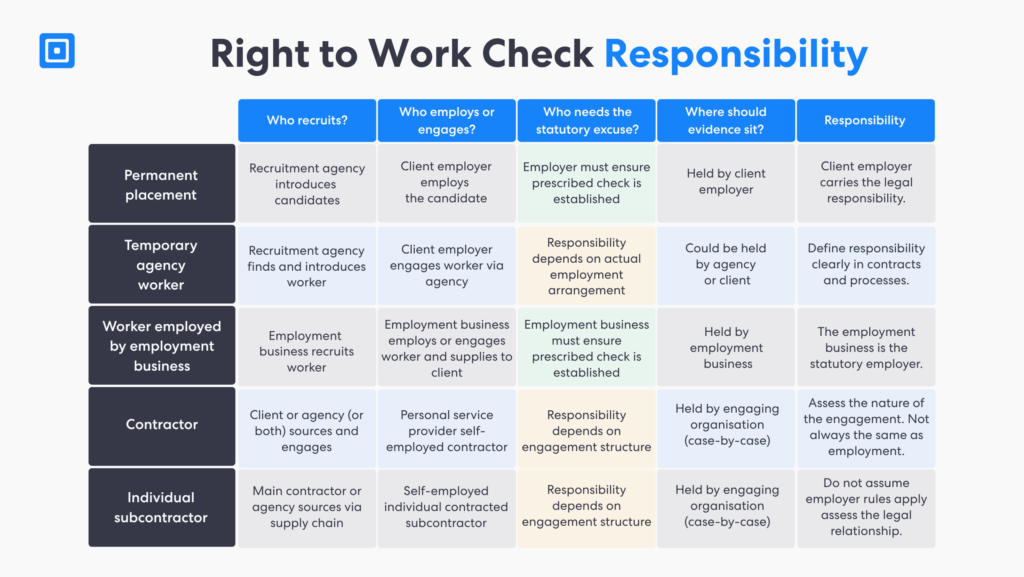
Right to work matters before any job offer turns into employment. A flawed process can leave an employer without a statutory excuse if an illegal worker is found later on. Moreover, unclear responsibility between recruiter and hirer can create huge gaps even when both organisations think that a check happened.
> A Right to Work check should not be treated as a one-off identity event.
[Milosh Caunhye](https://www.linkedin.com/in/milosh-caunhye/), Solutions Consultant at ComplyCube adds, “Right to work checks are mandatory for all employees. In reality, UK recruitment firms need to have a process that links who was verified, which route was applied, and what permission was confirmed.”
Right now, civil penalties can reach up to [£45,000 per illegal worker](https://www.gov.uk/penalties-for-employing-illegal-workers) for a first breach, going up to £60,000 per illegal worker for a repeat breach within three years. It can also result in serious jail-time. Employing someone without permission to work in the UK knowingly can also result in up to five years in prison, and an unlimited fine.
These right to work checks have been required by UK law since 1997. However, from 1 October 2026, the goal is to extend their scope into workers contract, individual subcontracting, and certain work online matching arrangements.
## How Do You Check Employee Right to Work?
Checking employee [right to work](https://www.complycube.com/en/what-changed-in-the-2026-right-to-work-legislation/) according to compliance requirements begins with using a verification route that is appropriate for the individual in front of you. Recruitment teams need to look at nationality, immigration act status (settled, temporary, asylum, etc…), available documents, and if the person is eligible for a [digital check](https://www.complycube.com/en/use-cases/process/certified-digital-right-to-work-checks/) before any real evidence is assessed. You can learn more here: [Employers Guide to Proof of Right to Work in UK with Certified IDSPs](https://www.complycube.com/en/proof-of-right-to-work-in-uk-with-idsp/)
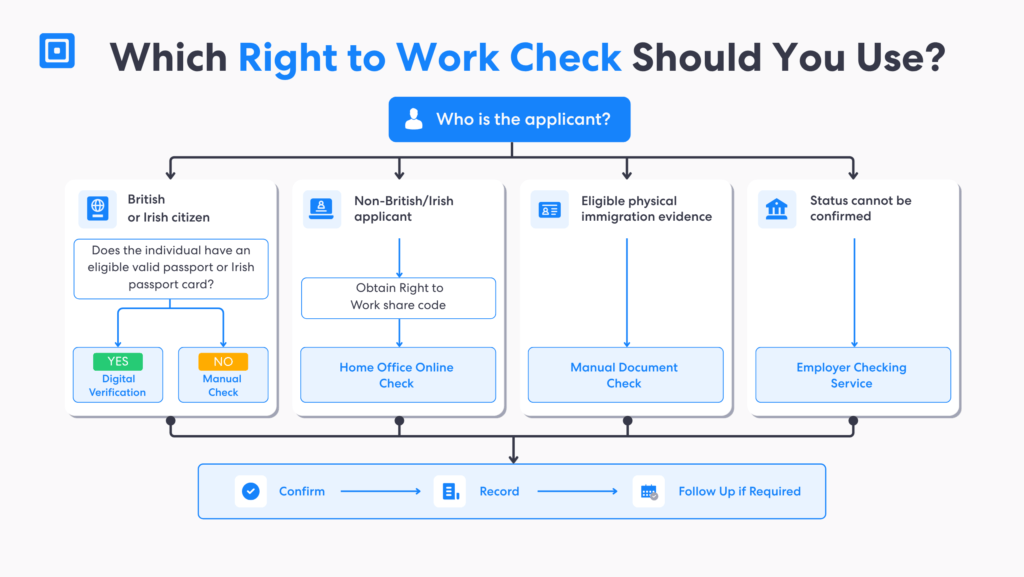
It is important to keep a secure record and arrange follow-up checks where right to work checks have a limited amount of time. According to gov.UK guidance, right to work checks can be done through online checks using the Home Office’s Employer Checking Service, manual checks, or through certified Identity Service Providers (IDSPs).
### Identify the Person and Correct Route
The necessary right to work check [depends on nationality](https://www.gov.uk/government/publications/common-travel-area-guidance/common-travel-area-guidance), immigration status, and available evidence. For example, British and Irish citizens have completely different routes from most people who typically rely on an e-Visa or other immigration permissions. That is why recruiters must apply checks consistently to every single potential employee instead of making assumptions. This prevents discrimination, and inconsistent recruitment decisions.
### Confirm Permission to Work in the UK
To have a compliant work check, it is important to confirm that the person has the right permission for the work that is being offered. For students, an employer may also need evidence of study and vacation times where working-hour restrictions apply.
### Retain the Evidence Securely
Retaining evidence is necessary to check employee right to work. Employers need to keep copies or digital records of pages and documents. They must also record the date that the check happened. Evidence must be kept over the course of their employment period and at least for two years after their contract ends.
## How Does Identity Document Validation Technology Work in the UK?
An important part of right to work checks is Identity Document Validation Technology (IDVT). It has historically been used by [certified identity providers](https://www.complycube.com/en/company/security-compliance-center/uk-diatf-certified-idsp/) for digital Right to Work identity checks in the UK. Current Home Office guidance increasingly uses the broader term Digital Verification Service (DVS). Right to work checks can be conducted through online checks, manual checks, or IDSPs.
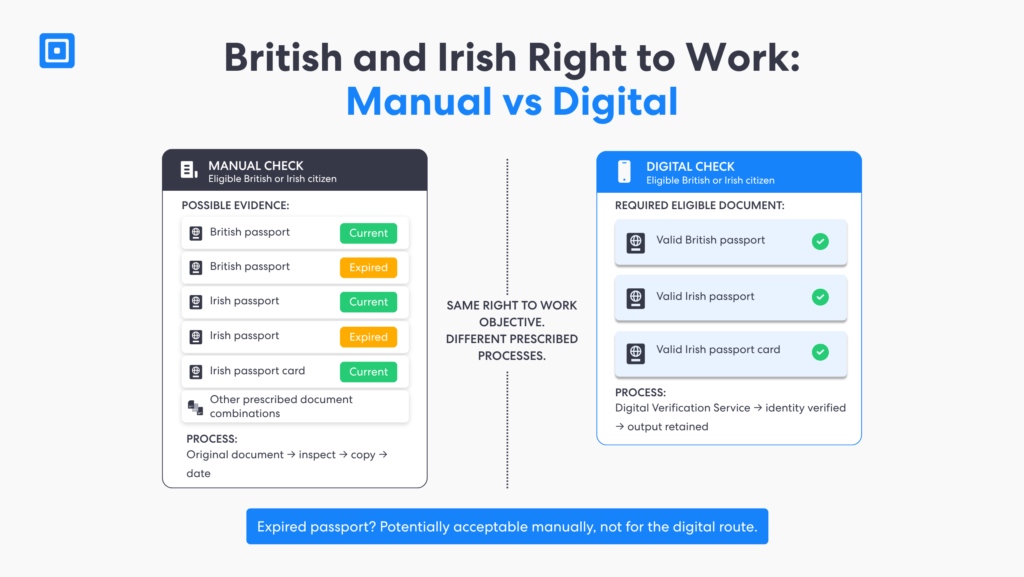
These digital identity checks are available for eligible British or Irish citizens using supporting documents showing important data such as a valid passport. For instance, a British citizen can use a valid British passport or an Irish citizen can use an Irish passport or Irish passport card. It is important to note that though expired documents cannot be used for a digital verification route, an expired British or Irish passport is still acceptable for a manual check.
Moreover, if they do not hold a passport, another acceptable form of documentation is a birth or adoption certificate. Similarly, applicants can provide a certificate of registration or naturalisation along with an official letter from a previous employer or government agency. This document needs to have the person’s name and National Insurance Number. Marriage certificates and divorce decrees do not independently prove right to work.
## Immigration Status to Check Employee Right to Work
The Home Office online service is the primary route for digital immigration status for most non-British and non-Irish applicants. This also applies to EU settlement scheme applicants and Commonwealth citizens. Now, an e-Visa is the most important digital record of a person’s identity, visa, or immigration permission. This also includes whether they have the right to work in the UK. This is typically accessed through a UKVI account.
### Share Codes
Most of the time, a worker can get a share code online and provide it with their date of birth. A right to work [share ](https://www.gov.uk/prove-right-to-work)[code](https://www.gov.uk/prove-right-to-work) contains nine characters, starting with the letter W, and remains valid for about 90 days. Then, the employer needs to use that online share code through the official employer service.
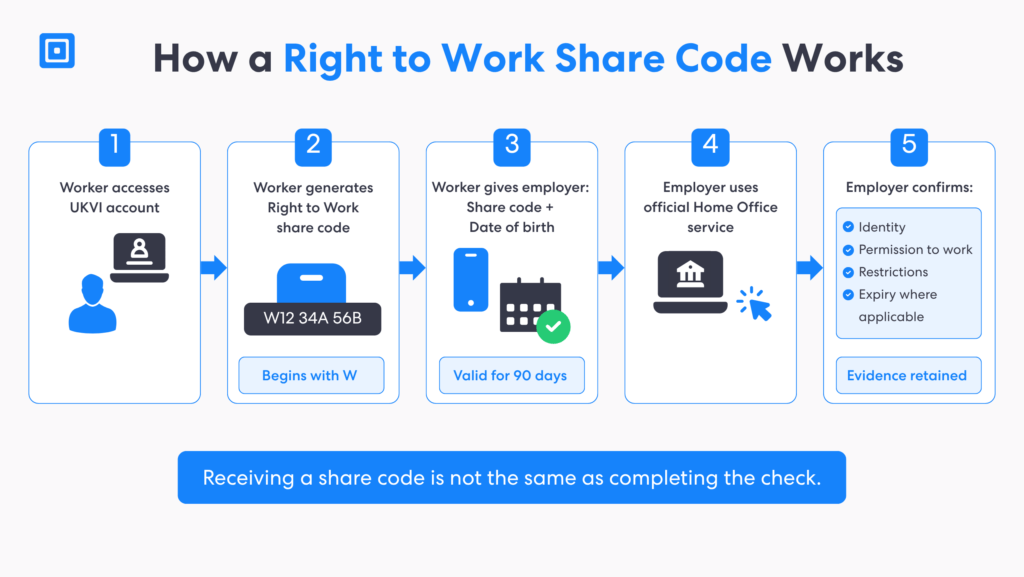
Just looking at the information from their application is not the same as completing the prescribed online check. The online right to work process lets the employer confirm the type of work allowed and how long the individual can work.
### Biometric Residence Permits
Previously, another way to check right to work is through a physical [biometric residence permit (BRP)](https://www.gov.uk/biometric-residence-permits). However, they are no longer accepted as a standalone piece of evidence for Right to Work. BRPs have been replaced by e-Visas for immigration-status purposes.
Someone with a BRP can still use its details to access digital services to obtain a share code. Additionally, the printed expiry date on a biometric residence permit must not be treated as the person’s current immigration permission.
### Biometric Residence Cards
Just like the BRP, a biometric residence card (BRC) is no longer acceptable as a singular way to check employee right to work. The relevant individuals need to prove their current immigration status through their UKVI account and Home Office service as well.
## When Should the Home Office Checking Service Be Used?
The [Employer Checking Service](https://daniellecohenimmigration.com/online-right-to-work-check-rtw-vs-employer-checking-service-check-ecs/) is an option for people whose immigration status document cannot be verified using the applicant’s original documents normally or through the online system. An example of this could be an applicant present that has an outstanding appeal, administrative review, qualifying pending application, or an Application Registration Card.
An [Application Registration Card](https://www.migranthelpuk.org/pages/faqs/category/arc) needs to show that the work is permitted, and it is the employer’s responsibility to use the Home Office Employer Checking Service to establish the necessary statutory excuse based on immigration documents, applicant dates, vignette stickers, etc… Through this process, the work checking service can issue a Positive Verification Notice where the person is permitted to undertake the proposed work.
## When Do You Check Employee Right to Work?
Sometimes, follow up checks are required. This is typically when an employee has a time-limited leave permission such as a [Youth Mobility Scheme](https://migrationobservatory.ox.ac.uk/resources/commentaries/what-is-the-youth-mobility-scheme-and-how-does-it-work/) or Graduate Scheme visa. After some time, the statutory excuse will expire.
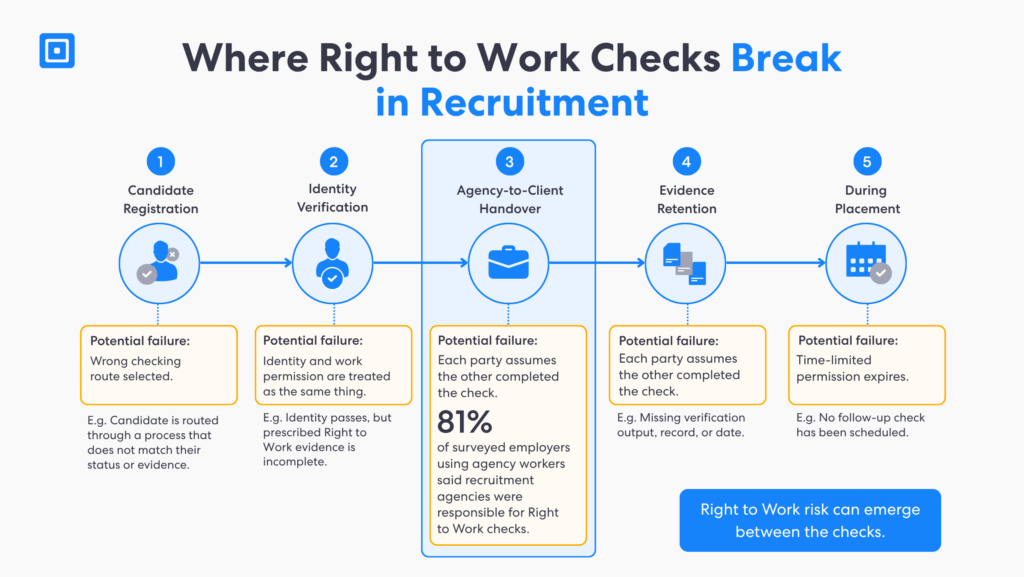
However, someone with indefinite leave to remain or another continuous right to work route will not need recurring checks. The prescribed process for right to work will correctly establish continuous permission.
### **Case Study: UK Illegal Working Enforcement Reaches Record Levels**
Excell Care Services Limited received £110,000 civil penalty for [illegal working](https://www.carehomeprofessional.com/care-sector-illegal-fines/) during the Home Office reporting period from October to December 2025. With temporary staffing models, right to work responsibility is much harder to assign. So, if the ownership is unclear, checks can be missed or poorly evidenced.
##### **Check Employee Right to Work Responsibilities**
The practical response is to define responsibility before job or contract placements. Recruitment firms also need to complete the correct right to work check, and keep evidence securely for audit purposes. There should also be scheduled follow-up checks before the existing statutory excuse expires based on time-limited leave.
##### **Outcomes**
- Excell Care Services Ltd. was liable for a six-figure illegal-working penalty.
- Companies House considers the firm as a temporary work agency.
- Recruitment firms need documented ownership of Right to Work checks.
## What Changes to Check Employee Right to Work from 1 October 2026?
From [1 October 2026](https://www.cipd.org/uk/views-and-insights/thought-leadership/insight/employment-law-changes-june-2026/), the revised framework is intended to extend checks beyond conventional contracts of employment to additional worker contracts, individual subcontractors, and specified online matching arrangements.
This matters for recruitment businesses managing flexible labour. Processes built exclusively around conventional employee onboarding may need to accommodate a broader group of people providing work or services.
### Key Takeaways
- **Complete a prescribed Right to Work check** before employment begins.
- **Match the checking route** to nationality, immigration status, and available evidence.
- **Keep evidence securely** throughout employment and for two years afterwards.
- **Schedule follow-up checks** where an individual’s permission is time limited.
- **Prepare recruitment** **workflows now for the wider arrangements covered from 1 October 2026.
## Using ComplyCube to Check Employee Right To Work
When processing right to work checks at scale, the best approach is to combine regulatory clarity with strong identity evidence and audit-ready workflows. ComplyCube’s certified digital identity capabilities, configurable onboarding, APIs, biometrics, and compliance controls can help with right to work processes. [Get in contact with our team](https://www.complycube.com/en/contact/contact-sales/) today to discuss how ComplyCube can support right to work verification that fits into your recruitment workflows.
[](https://portal.complycube.com/signup)
## Frequently Asked Questions
Do employers accept an expired British passport for a right to work check?
Yes, a current or expired British passport can help with a prescribed manual right to work check for employers. However, a digital check through a certified Digital Verification Service requires a valid, unexpired British passport.
How long is a right to work share code valid?
In order to work in the UK, applicants require a right to work share code. They are typically valid for 90 days. It consists of nine characters and begins with the letter W when generated to prove right to work for employers.
Can a biometric residence permit be used for a right to work check?
A physical Biometric Residence Permit, also known as a BRP, cannot be used as a standalone piece of evidence for right to work verification. The relevant individuals need to use their digital immigration status and Home Office online service where necessary.
What happens if an applicant cannot provide documents or a share code?
If an applicant cannot provide documents or a share code, the employer needs to use the Employer Checking Service. This is particularly relevant where the individual has a qualifying pending application, outstanding appeal, technical issue, or Application Registration Card.
How can ComplyCube support right to work checks for recruitment firms?
ComplyCube supports digital right to work workflows through certified identity verification, document checks, biometrics, and configurable onboarding journeys. Recruitment firms can integrate these checks through APIs, SDKs, hosted flows, or low-code tools.
**Categories:** Guides
**Tags:** Regulations
---
### [UBS Financial Services Hit With $125M Fine From US Regulators](https://www.complycube.com/ubs-financial-services-hit-with-125m-fine/)
**Published:** August 4, 2026
**Author:** Rithu Jagannath
**Excerpt:** The biggest lesson from the UBS AML Fine isn't just the $125 million penalty. Find out why several various US regulators took actions against UBS Financial Services and what every compliance team should learn from the case.
**Content:**
US regulators have imposed a combined record penalty of $125M against UBS Financial Services Inc. The enforcement action followed findings that UBS failed to address major Anti-Money Laundering (AML) flaws even with previous regulatory actions.
On August 3rd, 2026, there was a joint action led by the Financial Crimes Enforcement Network (FinCEN), the Securities and Exchange Commission (SEC), the Commodity Futures Trading Commission (CFTC) as well as the Financial Industry Regulatory Authority (FINRA). Authorities imposed the largest penalty on a broker-dealer for serious Bank Secrecy Act (BSA) violations.
This UBS AML fine was due to an extensive investigation of their activities from January 2019 to June 2023. This was well after UBS Financial Services had committed to remediate similar issues found during an earlier 2018 enforcement action.
## Why Did US Regulators Fine UBS Financial Services?
According to FINCEN, UBS willingly [admitted their violation](https://www.fincen.gov/news/news-releases/fincen-assesses-historic-125-million-penalty-against-ubs-financial-services-inc) of the BSA. They failed to build and upkeep a thorough AML risk prevention program. Moreover, they failed to file Suspicious Activity Reports (SARs) in an urgent and timely fashion. Several US regulators found significant compliance failures, such as:
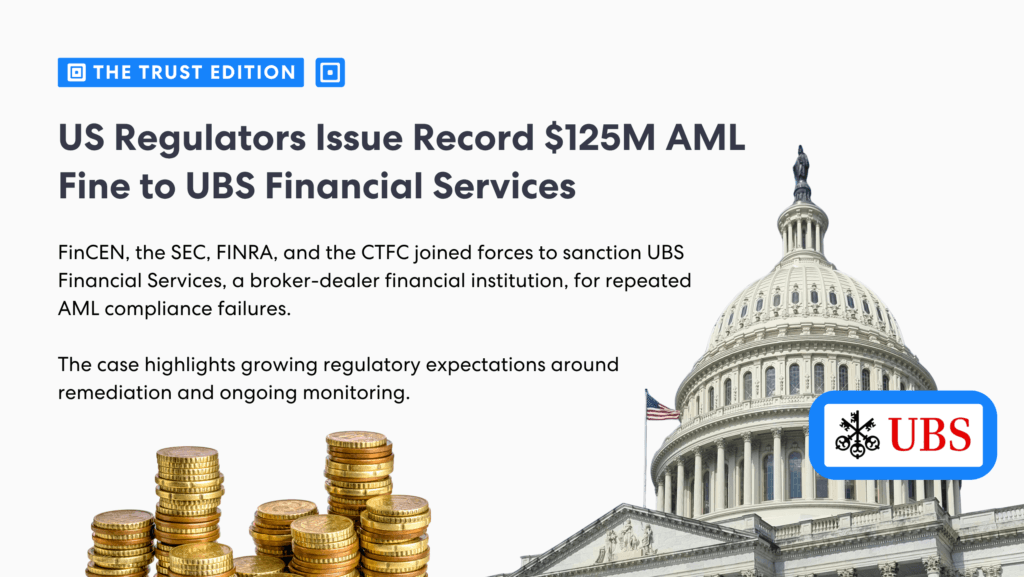
- Failed to monitor over 50,000 foreign currency wire transfers in total exceeding $10 billion.
- Lack of [Customer Due Diligence (CDD)](https://www.complycube.com/en/solutions/due-diligence-compliance/customer-due-diligence/) for high-risk clients, including customers with links to higher-risk countries such as Russia and Latin America, for example.
- Did not properly assess sources of wealth and keep track of adverse media relating to higher-risk clients.
- Late reporting of various suspicious transactions that should have been brought to the attention of law enforcement.
- Failure to remediate known AML control deficiencies found during the previous 2018 settlement.
As a result, FinCEN requested that UBS Financial Services should take on an independent review of its AML program. They needed to carry out a look-back to identify and report any suspicious activity that poor protocols failed to catch.
## The Biggest Compliance Failures of UBS Financial Services
The UBS AML fine’s bigger message here is around [remediation](https://amlincubator.com/blog/the-step-by-step-process-of-aml-regulatory-remediation) of poor AML controls and systems. FinCEN emphasized that UBS was a repeat offender. US regulators saw key weaknesses for years after the first instance, despite assurances UBS Financial Services would improve monitoring controls. This allowed high-risk activity to go undetected.
This enforcement demonstrates how there is a growing expectation with global and US regulators that financial institutions need to identify weaknesses in their systems. They also require firms to show how their remediation programs are properly implemented, validated, and continuously monitored.
## Compliance Takeaways from UBS Financial Services
There are many important compliance lessons to take away from this collective enforcement action against UBS Financial Services. All regulated firms must take into consideration the following takeaways:
- **Remediation must be showcased:** Regulatory commitments need measurable improvements instead of some sort of implementation plan alone.
- **Monitoring requires continuous optimization:** Legacy monitoring systems and poor data handling causes gaps in compliance systems.
- **CDD is an ongoing obligation:** Risk assessments need to grow and chance based on customer activity and external risk indicators.
- **Governance is important:** There needs to be thorough oversight of AML processes. Governance teams must escalate any raised concerns promptly.
- **Repeat deficiencies bring harsher enforcement:** US regulators increase penalties when financial institutions such as UBS Financial Services do not address any previous issues or weaknesses.
## What Happens Next?
UBS Financial Services needs to complete an independent review and conduct a retrospective review of historical transactions. The retrospective review will identify suspicious activity that the deficiencies may have missed. In turn, [FinCEN may waive up to $15M of the penalty](https://citywire.com/pro-buyer/news/ubs-fined-a-combined-125m-by-4-regulators-for-money-laundering-failures/a2495441) if UBS completes the necessary actions and implements recommendations. Repeated AML weaknesses attracts a lot of scrutiny, especially if previous remediation commitments have not been met.
[](https://portal.complycube.com/signup)
Find out more AML news in ComplyCube’s [Trust Edition newsletter](https://www.linkedin.com/newsletters/the-trust-edition-7103022355722981376/). We explore the latest in developments across identity verification and AML globally.
**Categories:** News
**Tags:** Anti-Money Laundering
---
### [Two Binance Employees Detained in the UAE Amid Financial Crime Probe](https://www.complycube.com/two-binance-employees-detained-in-the-uae/)
**Published:** August 21, 2026
**Author:** Dini Habib
**Excerpt:** Recently, two Binance employees were reportedly detained and questioned in the UAE following the country's broader probe into financial crime exposure. The crypto company has been facing ongoing scrutiny globally in recent years.
**Content:**
On 20 August 2026, The New York Times reported that two Binance employees were stopped and detained in the United Arab Emirates (UAE) in recent weeks. According to Binance, its employees were questioned as part of the UAE’s routine inquiries into a broader financial crime investigation.
## Why Were Two Binance Employees Detained?
Of the two employees, one was a mid-level staff member detained in Sharjah, while the other was an official from Binance’s Dubai-based subsidiary, who was questioned at a police station in July.
A Binance spokesperson noted that its employees were asked to provide information as part of “routine” checks involving the company’s third-party fund flows through a Binance client-money account.
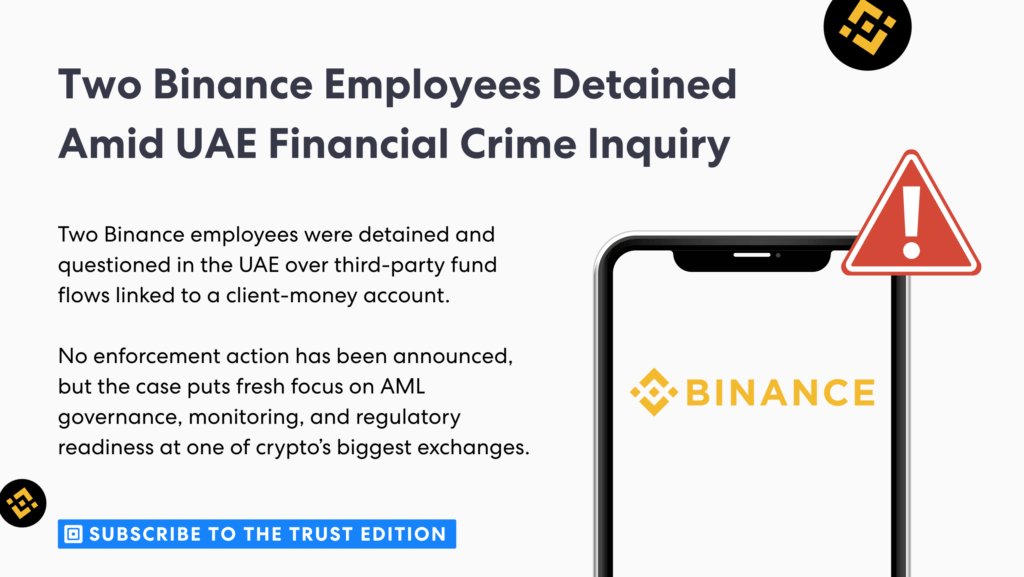
Here is what was disclosed so far:
- The two Binance employees were detained separately in the UAE in recent weeks.
- The UAE was reportedly investigating potential financial crime concerns on the crypto platform.
- Binance mentions that its employees were not targets of the inquiries and were released quickly.
- The specifics of the investigation remain unclear, as UAE regulators have not disclosed further details.
Currently, no further news has been shared about the case. As such, no enforcement actions have been reported from these detentions. You can [subscribe](https://www.linkedin.com/newsletters/the-trust-edition-7103022355722981376/) to ComplyCube’s Trust Edition newsletter here for ongoing crypto, financial crime, and AML updates.
## Binance Holds an Active Crypto License in Dubai
Interestingly, Binance holds an active license to operate its financial services in Dubai. In particular, Binance FZE is an authorized Virtual Asset Service Provider (VASP) under Dubai’s Virtual Assets Regulatory Authority (VARA) public register.
> Regulated businesses remain [accountable](https://www.linkedin.com/in/harryvaratharasan/) for continuously monitoring customer activity.
Notably, its full VASP license was issued in 2024, enabling the crypto firm to operate key operations, including lending and borrowing, investment, and broker- and dealer-related services. This news exposes a critical finding, that being licensed does not eliminate financial crime exposure.
Harry Varatharan, Chief Product Officer at ComplyCube, notes, “Regulated businesses, whether licensed or not, remain accountable for monitoring evolving customer risks on an [ongoing basis](https://www.complycube.com/solutions/global-screening/continuous-monitoring).” In a recent US court filing, Binance noted that [around 25% ](https://finance.yahoo.com/news/binance-claims-cut-sanctioned-exposure-101716322.html)of its employees worked in compliance, investigations, and risk functions. The message is clear, headcount alone is not an indicator of compliance effectiveness.
## Binance’s Historical AML Scrutiny
This is not the first time Binance has been caught across multiple jurisdictions. A quick search of the company will surface multiple fines and compliance disputes from regulators all over the world. These cases involve weak due diligence, sanctions exposure, and illegal transactions.
### February 2026: US Regulators Investigate Illegal Iran-Binance Transactions
The US Department of Justice (DOJ) opens an investigation into whether Binance was used as a platform for Iran to evade sanctions and move funds. Allegations indicate that [over $1 billion](https://www.complycube.com/en/crypto-news-paxfuls-aml-misconduct/) in transactions were traced to an Iranian-linked network. Binance denies knowingly facilitating sanctioned activity.
### August 2025: Australia Orders Binance to Appoint External AML Auditor
The Australian Transaction Reports and Analysis Centre (AUSTRAC), [demands](https://www.complycube.com/en/the-cryptocubed-newsletter-august-edition-yes/) Binance to appoint an external compliance auditor after finding major lapses in its AML processes. Investigations found weaknesses in governance, compliance resources, and senior management oversight.
### August 2025: Paxos $48.5 Million Settlement Linked to Binance Partnership
This case specifically highlights the importance of due diligence when forming business relationships. The New York Department of Financial Services (NYDFS) reaches a [$48.5 million](https://www.complycube.com/en/cryptocubed-newsletter-top-5-aml-crypto-fines/) settlement with Paxos over failures to adequately assess and monitor risks related to Binance.
### October 2024: Binance Executive Detained for 8 Months in Nigeria
Tigran Gambaryan, one of Binance’s financial crime compliance executive was detained in Nigeria after authorities accused him of potential involvement in money laundering of over [$35 million](https://www.bbc.co.uk/news/articles/c8dmp1jg448o), alongside Binance. Charges were dropped for Tigran, but the case against Binance in Nigeria is ongoing.
### November 2023: Binance Hit with Historic $4.3 billion Fine
In 2023, the crypto company was penalized with the world’s largest fine by US authorities. [Investigations](https://www.justice.gov/archives/opa/pr/binance-and-ceo-plead-guilty-federal-charges-4b-resolution) by the DOJ showed that Binance violated multiple sanctions laws, failed to report suspicious customer activity, and did not implement sufficient customer identity verification.
## What Compliance Teams Can Learn From the Binance UAE Case
Asking a business to strengthen AML controls can sound simple, but in reality, it can be complex, especially if you do not know where to start. This is particularly true in this case, where risk is fragmented across varying users and channels. The following questions can expose weaknesses in existing controls.
- **License is a baseline, not a shield:** Being authorized to operate in a country does not reduce the need to meet AML, sanctions, and financial crime compliance requirements. Businesses need to continuously review controls, train staff, and test current compliance infrastructure against the relevant jurisdiction laws.
- **Keep audit trails always clear:** Having transparent, timestamped audit trails is critical to building a [defensible AML framework](https://www.complycube.com/solutions/due-diligence-compliance/anti-money-laundering/). Compliance teams must maintain documentation of why alerts were closed, escalated, or approved so that decisions can be clearly explained during unexpected regulatory investigations.
- **Preparation for law-enforcement requests is critical:** Consider providing compliance staff with clear procedures during regulatory and police inquiries. Periodic training, defined escalation paths, and accessible records can support teams in responding quickly and consistently to information requests, avoiding situations such as the Nigeria case.
[](https://portal.complycube.com/signup)
Find out more AML news in ComplyCube’s [Trust Edition newsletter](https://www.linkedin.com/newsletters/the-trust-edition-7103022355722981376/). We explore the latest in developments across identity verification and AML globally.
**Categories:** News
**Tags:** Crypto Regulations
---
### [Anti Money Laundering Checks for Solicitors Practical Buyer Guide](https://www.complycube.com/anti-money-laundering-checks-for-uk-solicitors/)
**Published:** August 21, 2026
**Author:** Dini Habib
**Excerpt:** Anti money laundering checks for UK solicitors are critical to meeting compliance requirements. However, due to sector-specific risks, legal processes, and access to client information, solicitors require specific AML solutions.
**Content:**
**TL;DR:** Anti money laundering checks for solicitors are more than just a client onboarding task. The best **AML checks** for solicitors is one that supports **risk-based controls**, enhanced due diligence, transparent audit trails, and suspicious activity reporting.
## Why are Anti-Money Laundering (AML) Checks Critical for UK Law Firms?
Anti money laundering checks are a legal requirement in the United Kingdom. Solicitors and law firms alike face unique risks as they may manage client funds, facilitate property transactions, and be exposed to complex structures involving multiple jurisdictions. As such, these sector-specific vulnerabilities make them prime targets for money launderers and criminal activity.
The [Solicitors Regulation Authority (SRA)](https://www.sra.org.uk/sra/research-publications/aml-risk-assessment/) notes that entities offering a combination of legal services, such as solicitors, are at the greatest risk in the sector. Notably, conveyancing, trust or company services, and the misuse of client accounts are particularly vulnerable to financial crime.
> Over [£100 billion](https://www.nationalcrimeagency.gov.uk/who-we-are/publications/755-economic-crime-areas-of-research-interest-ari-report-july-2025/file) is laundered through the UK every year.
According to the National Crime Agency (NCA), over £100 billion is laundered through the UK every year. The impact of financial crime is damaging; it can hamper growth and security on a national level. As such, regulators have tightened anti money laundering regulations.
> HMRC issued over 739 fines for AML and Counter-Terrorism Financing (CTF) breaches from 2024-25.
In HM Treasury’s AML and CTF Supervision Report, penalties imposed by the SRA for AML violations amounted to [£1.5 million.](https://assets.publishing.service.gov.uk/media/693308125b5198836f304150/24-25_Annual_Report_.pdf) In contrast, the FCA levied more than £59.5 million in fines from 2024 to 2025. This marks greater expectations for UK law firms to strengthen and invest in comprehensive anti money laundering checks.
## Who Sets AML Regulations in the UK Legal Sector?
Understanding the regulatory bodies that oversee anti money laundering checks is critical to determining which requirements must be met. This is crucial to remain compliant, as fines have increased in both frequency and severity. Here are the primary regulators UK solicitors must know:
- **Money Laundering, Terrorist Financing and Transfer of Funds (Information on the Payer) Regulations 2017 (MLR 2017):** The main rulebook that sets out AML and CTF obligations for regulated firms. It sets out requirements for [Customer Due Diligence (CDD)](https://www.complycube.com/en/what-is-customer-due-diligence/), ongoing monitoring, and risk assessment.
- **Proceeds of Crime Act 2002 (POCA) and the National Crime Agency (NCA):** Creates offenses and reporting duties, such as submission of a Suspicious Activity Report (SAR) to the NCA. Operates alongside the MLR2017 and centers on cases where solicitors fail to report suspicious transactions.
- **HM Treasury and the Office of Financial Sanctions Implementation (OFSI):** Maintains and sets out UK financial sanctions policy. On the other hand, the OFSI arm implements enforcement actions against companies that violate sanctions policy.
- **The Solicitors Regulation Authority (SRA):** Designated AML supervisor built specifically for firms operating in the legal sector across England and Wales. It oversees registration, supervision, and enforcement of AML checks for solicitors.
- **Financial Conduct Authority (FCA):** AML and CTF supervisor of a broader range of firms in the UK. Unlike the SRA, the FCA is a financial regulator with greater authority to enforce registration, conduct risk-based supervision, and impose penalties on non-compliant firms.
In October 2025, the UK government [announced](https://www.sra.org.uk/news/news/sra-update-145-aml-supervision-change/) that the FCA will assume the powers of a single professional services supervisor for AML/CTF compliance. Consequently, it will take over supervision from the SRA, the Law Society of Scotland, the Law Society of Northern Ireland, and other professional bodies. As a result, solicitors and other legal services will face more demanding AML requirements.
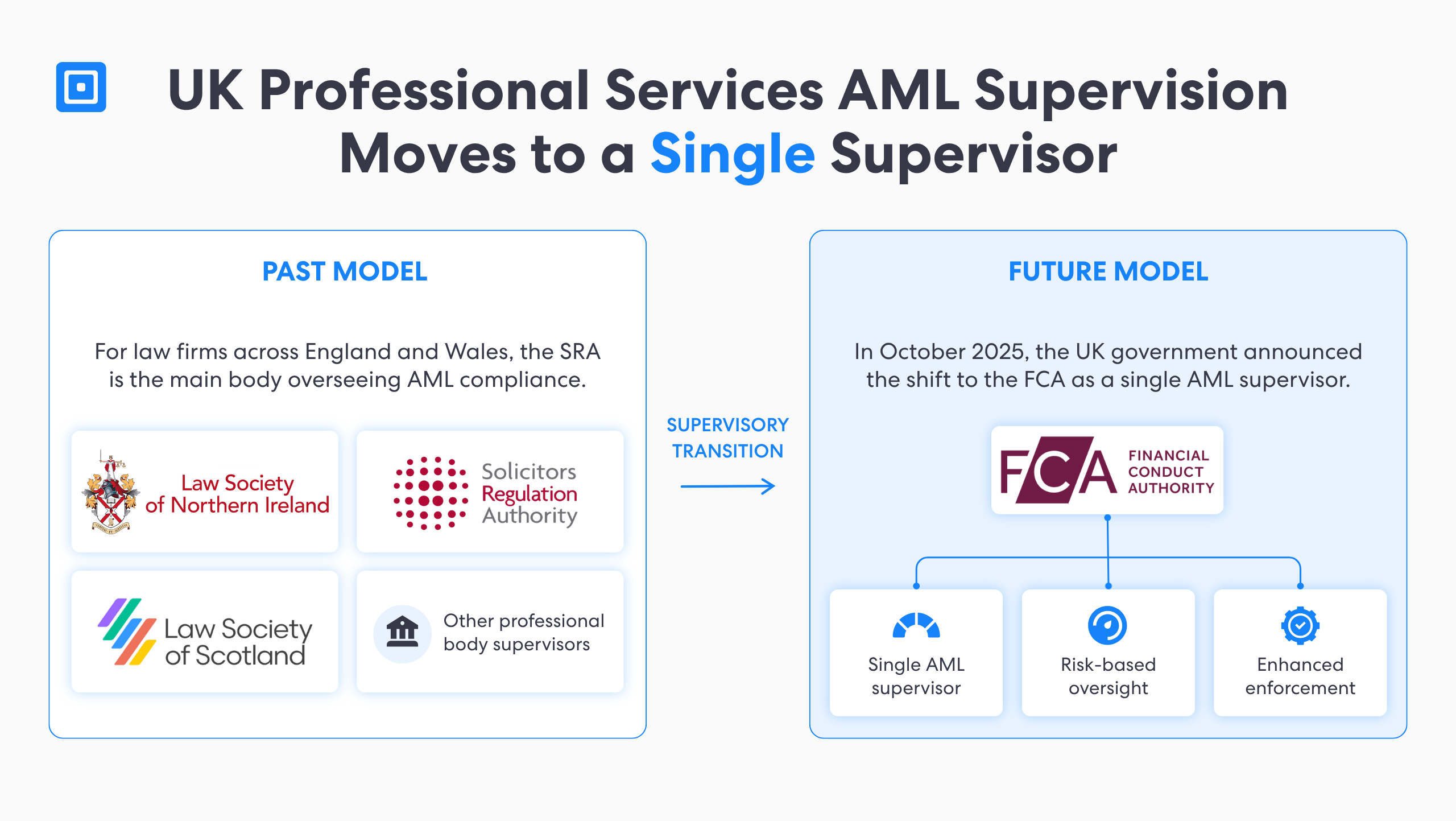
### Must all UK Solicitors Comply with AML Requirements?
Under the MLR 2017, any company or individual carrying out “relevant business,” such as conveyancing, managing client money, company formation, trust work, or tax advice, must comply with the UK’s AML obligations. Moreover, the SRA states that anti money laundering checks do not differentiate between large firms and sole solicitors.
### **Case Study: The Cost of Weak AML Oversight**
In June 2026, Belgian authorities started investigating Wise over alleged money laundering that involved using company accounts to transfer illegal funds. According to reports, around [€500 million](https://www.complycube.com/en/wise-money-laundering-control-lapses-belgium/) in suspicious transactions were uncovered.
##### **Control Failure Pattern**
However, this was not the first time Wise was under scrutiny. In 2025, US regulators fined Wise millions over AML deficiencies, including weaknesses in suspicious activity monitoring. This case reinforced the need for consistent, scalable AML oversight.
##### **Outcomes**
- Rapid growth can expose weaknesses in existing AML controls.
- Strong Enhanced Due Diligence, ongoing monitoring, and audit trails are essential.
- Repeated scrutiny across jurisdictions shows how quickly control gaps can become a wider regulatory issue.
## Non-negotiable Requirements for AML Checks for Solicitors
Anti money laundering checks for solicitors are more than identity checks. They must include [Ultimate Beneficial Owner (UBO) verification](https://www.complycube.com/en/what-is-ultimate-beneficial-ownership-ubo/), source of funds and source of wealth checks, [ongoing monitoring](https://www.complycube.com/en/what-is-an-ongoing-monitoring-process/), reporting of suspicious activity, and more. Here are the core obligatory AML checks for solicitors:
### Customer Due Diligence (CDD)
CDD involves verifying and assessing an individual’s identity, relationships, and associated money-laundering risks. For individuals, verification is done primarily through documents, address, and biometric verification. For corporates and trusts, CDD can entail corporate registry searches, and UBO verification is required for individuals who exercise over 25% control in a business.
### Source of Wealth (SOW) and Source of Funds (SOF) Verification
Source of wealth and Source of funds checks help solicitors understand a client’s financial background. SOF establishes the origin of transactions, while SOW assesses how a client achieved their total asset. Although crucial, many law firms [fall short](https://www.sra.org.uk/sra/research-publications/thematic-review-source-funds-wealth-compliance/) of this requirement. From 2024 to 2025, 11% of the files the SRA reviewed lacked SOF checks, and 8% had information that did not support the client’s explanation.
### Enhanced Due Diligence (EDD)
The MLR2017 calls for comprehensive EDD workflows for higher-risk customers. For instance, examples of high-risk factors include Politically Exposed Persons (PEPs), links to a high-risk jurisdiction, complex ownership structures, or unusual transactions. EDD processes require further information on a client’s background and may require senior management approval or frequent reviews.
### Sanctions, PEP, and Adverse Media Screening
Businesses in the legal profession are accountable for countering financial crime and terrorism financing. To build a defensible AML framework, it is mandated to screen clients against sanctions, PEP, and adverse media data sources. These checks, therefore, help solicitors identify high-risk clients who may pose money-laundering risks.
### Risk Assessment and Risk-Based Approach (RBA)
Under [Regulation 18](https://www.legislation.gov.uk/uksi/2017/692/regulation/18), regulated businesses must conduct and maintain an updated record of their risk assessments. As a result, solicitors are required to document a client’s risk profile, potential risks, and rationale for onboarding. In particular, [a risk-based approach](https://www.complycube.com/en/what-is-a-risk-based-approach/) helps firms allocate resources in proportion to the identified risk level, strengthening financial crime prevention.
### Suspicious Activity Reporting (SAR) and Ongoing Monitoring
Ongoing monitoring throughout a customer or business relationship ensures that a client’s account reflects the current risk they carry. This is crucial as new risks can exist after onboarding. Furthermore, a Money Laundering Reporting Officer (MLRO) has a duty to alert the NCA where they suspect suspicious activities or transactions.
## Evaluating Anti Money Laundering Checks for Solicitors
A practical framework for selecting anti money laundering checks for solicitors will assess how well it meets compliance and security requirements while maintaining high operational efficiency. There are six key areas to consider for UK solicitors considering AML checks:
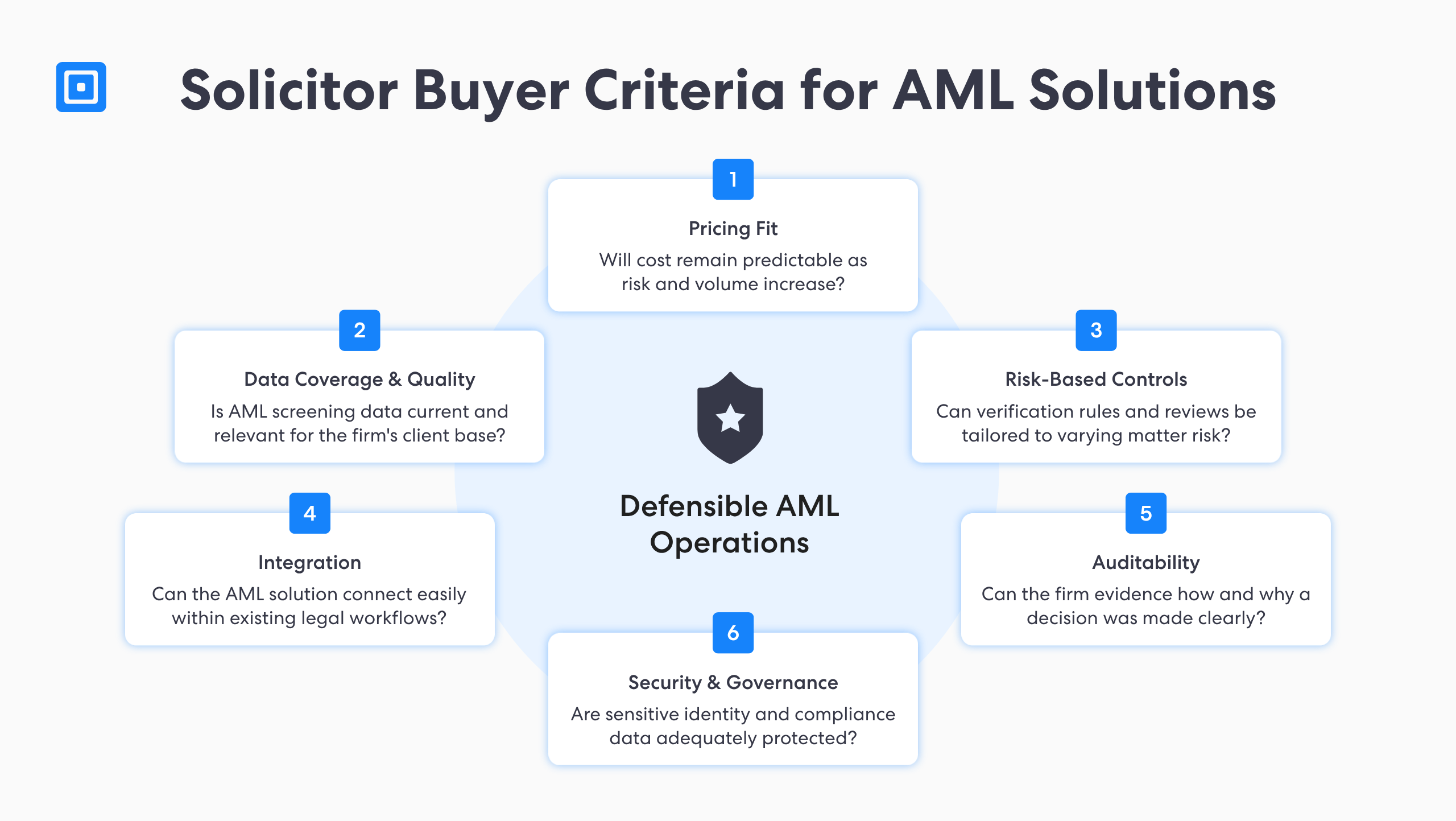
**1. Pricing:** Assess how the selected pricing tier can handle volume increases, EDD, and ongoing monitoring to understand the total cost of ownership. Also, ensure you confirm setup, maintenance, and integration fees upfront to avoid [hidden costs](https://www.complycube.com/en/aml-check-cost-hidden-fees-in-compliance/).
**2. Data breadth and quality:** Consider AML solutions that provide updated, reliable data sources for PEP, sanctions, adverse media, and Companies House screening. Assess whether the solution supports the checks relevant to your firm, including identity verification and, where appropriate, UBO verification for the jurisdictions and client types your firm serves.
**3. Risk-based controls and configurability:** A suitable AML platform should enable solicitors to apply varying levels of due diligence based on [client and matter risk](https://www.complycube.com/en/what-is-aml-risk/). As such, consider whether workflows, risk scoring, escalation rules, and reviews can be configured to reflect your firm’s policies.
**4. Integration:** Invest in an AML platform that integrates easily with your existing onboarding and case management processes. For example, relevant API, SDK, and CRM integration helps reduce duplicate data entry and make AML checks easier to incorporate into day-to-day legal workflows.
**5. Auditability and oversight:** Regulators expect firms to demonstrate how AML decisions are reached. Thus, AML checks for solicitors should offer and log records of checks, risk assessments, supporting evidence, approvals, alerts, and changes over time.
**6. Security:** Strong security controls help solicitors protect sensitive information and meet UK data protection requirements. Law firms should assess whether an AML solution supports UK GDPR compliance and holds relevant certifications, such as [ISO 27001](https://www.complycube.com/company/security-compliance-center/). Essential features may also include multi-factor authentication and role-based access controls.
## Essential vs. Differentiating AML Capabilities for Solicitors
Once the broader evaluation criteria have been considered, firms can look more closely at individual product capabilities. Features such as no-code workflows, complete global coverage, and dynamic workflow routing can save time, provide scalability, and enhance compliance operations. As such, UK solicitors are encouraged to assess and score them against the business’s priorities and needs.
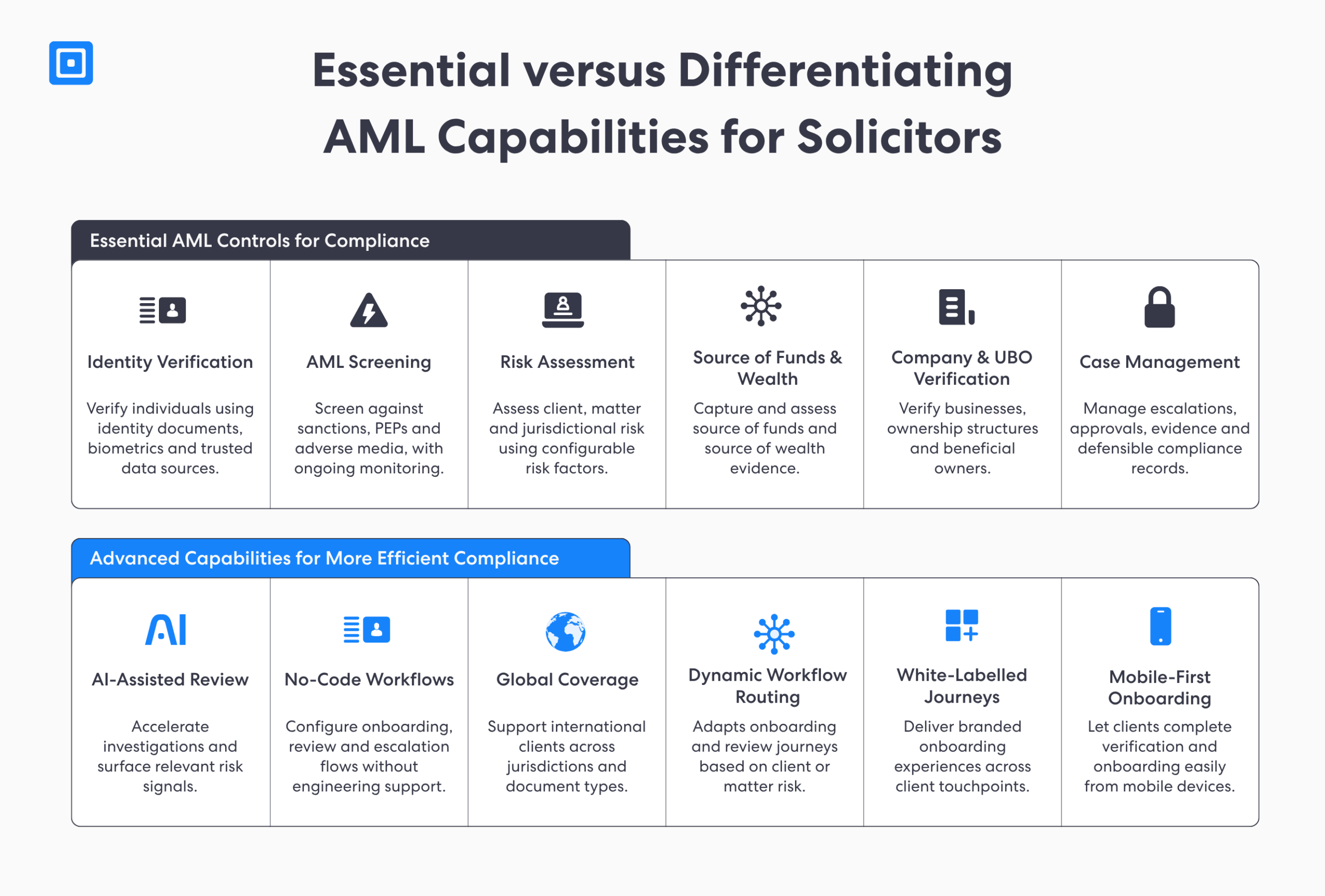
While investing in an all-in-one automated AML platform may seem complex at first, it can provide operational benefits for UK solicitors. A unified solution can help reduce false positives, data fragmentation across third-party vendors, and manual checks without weakening record-keeping or compliance oversight.
### Key Takeaways
- **UK solicitors** must carry out AML checks under the Money Laundering Regulations 2017.
- **In 2025, AML** supervision of law firms was transferred to the Financial Conduct Authority.
- **Under the FCA**, firms may now face greater scrutiny and more demanding AML requirements.
- **Risk-based** due diligence, risk assessment, and ongoing monitoring are crucial for compliance.
- **Solicitors should** evaluate data coverage, integration, and reporting capabilities for AML systems.
## Strengthen AML Compliance in the UK
Choosing the right anti money laundering checks for solicitors goes beyond basic identity verification. The legal duty to identify and combat financial crime falls on UK law firms. As such, it is important to invest in solutions with adequate measures for EDD, ongoing monitoring, and clear audit trails.
Additionally, selecting AML checks with strong data quality, integration, and automation can strengthen compliance without creating operational friction. [Learn more](https://portal.complycube.com/signup) about how you can implement ComplyCube’s law firm-focused AML platform to meet stringent compliance obligations today.
[](https://portal.complycube.com/signup)
## Frequently Asked Questions
What are the consequences of AML non-compliance for solicitors?
The consequences of AML non-compliance for solicitors can go beyond £10,000 fines. It includes regulatory sanctions on operations, disciplinary action for senior officers, and criminal prosecution for those that fail to report criminal activity.
Why must solicitors use a risk-based approach in AML compliance?
The Financial Action Task Force (FATF) and multiple UK regulatory supervisors mandate a risk-based approach for AML compliance as it enables firms to focus investigations where the risk of money laundering and terrorist financing is highest. As such, solicitors can identify and investigate financial crime more quickly.
What is the difference between source of funds and source of wealth for law firms?
Source of funds refers to the origin of a specific transaction. An example includes is a customer providing evidence of bank statements for a particular purchase. Source of wealth refers to how a client achieved their financial position. Examples include salary or inheritance declarations. Law firms collect source of funds and wealth evidence dependent on the risk present.
How often should UK law firms refresh due diligence on existing clients?
While there is no established refresh period for due diligence, law firms must conduct ongoing monitoring and update customer due diligence where customer information or risk changes. This enables firms to meet compliance on an ongoing basis.
Does ComplyCube provide AML checks for solicitors?
Yes, ComplyCube provides tailored AML tools built for solicitors and legal firms. Its AML suite includes both individual and business verification, ongoing screening against watchlist, PEP, and sanctions lists, as well as ongoing monitoring and case management to support compliance. ComplyCube meets AML policies in over 250 countries, supporting operations for global firms.
**Categories:** Guides
**Tags:** Anti-Money Laundering
---
### [A 2026 Buyer's Guide to AML Screening Software for the UAE](https://www.complycube.com/uae-aml-screening-software/)
**Published:** August 19, 2026
**Author:** Rithu Jagannath
**Excerpt:** Firms in the UAE must choose the right AML screening software in 2026. Learn about how sanctions, politically exposed persons, Arabic name matching, false positives, and ongoing monitoring work together under regulatory scrutiny.
**Content:**
**TL;DR:** Anti-Money Laundering (AML) screening software helps regulated firms within the **United Arab Emirates (UAE)** screen customers, businesses, and beneficial owners. Buyers comparing UAE AML screening software should **test lists, name matching**, monitoring, and integrations. This guide explains what strong AML KYC screening software in UAE should achieve in 2026.
## Why Some AML Screening Software Can Leave UAE Firms Exposed
Nowadays, a customer can easily pass onboarding within seconds. They can clear an automated check and still trigger an alert that compliance teams wish they had caught earlier. That is often the issue with modern AML screening software because speed is easy to show, but effective fraud detection is much harder to maintain.
For instance, having a weak transliteration match, a sanctions update that arrives far too late, or thousands of low-quality alerts can turn a complex AML compliance program into a massive blind spot. Having no kind of system is dangerous, but trusting a system that seems somewhat effective until a regulator proves otherwise is even worse.
That is why the Central Bank of the UAE (CBUAE)’s May 2026 thematic review was incredibly important. The regulator tested millions of UAE bank customer records against the UAE Local List and the United Nations Security Council (UNSC) sanctions data for proof . The CBUAE checked to see whether these confirmed matches had actually been detected, frozen, and reported.
For financial institutions, Designated Non-Financial Businesses and Professions (DNFBPs), Virtual Asset Service Providers (VASPs), and other regulated entities, the buyer question changes. The question moves from whether teams have an AML screening process in place to whether their AML tools work when data is difficult, risk changes, and the consequences are dire.
## What Is AML Screening Software in Compliance Operations?
The key functionalities of AML screening software look into people and organizations to determine if they are a financial crime risk. This includes sanctions, politically exposed persons (PEPs), and adverse media information. In reality, the software is not meant to find names. It should surface reliable context for a compliance team to decide whether a potential match matters.
Modern screening software supports customer screening at various stages. From the [onboarding stage](https://www.complycube.com/en/customer-onboarding-kyc-for-banks/) to continuous monitoring, the right software can link alerts with verified customer data. This helps compliance officers gather strong evidence for risk assessment, due diligence, and further investigation. It also reduces the time spent on chasing irrelevant alerts. An AML solution supports regulatory compliance because accountability for decisions and AML obligations stays within the regulated business’sscope of responsibility.
## Why UAE AML Compliance Raises the Bar for AML Screening Software
Currently, [Federal Decree-Law No. 10 of 2025](https://uaelegislation.gov.ae/en/legislations/3314) anchors the federal AML framework, along with Cabinet Resolution No. 134 of 2025. The Dubai Financial Services Authority (DFSA) and the [Financial Services Regulatory Authority (FSRA)](https://assets.adgm.com/download/assets/FCCP%2B-%2BNotice%2BNo.%2B87%2Bof%2B2026%2B-%2BUpdated%2BVersion%2Bof%2Bthe%2BAML%2BRulebook.pdf/7a9ba3de54f211f1ba211a3284270de3) updated these frameworks in 2026. Still, CBUAE guidance emphasizes the importance of effective controls, Customer Due Diligence, and a strong Risk-Based Approach (RBA). You can learn more here: [What is a Risk-Based Approach (RBA)?](https://www.complycube.com/en/what-is-a-risk-based-approach/)
These UAE AML insights and laws apply differently across activities. However, UAE regulators expect relevant reporting entities to maintain key system and control functionalities proportionate to their respective risk exposure. [Non-compliance](https://www.amlcc.com/what-are-the-consequences-for-failing-to-comply-with-aml-obligations/)with AML laws can result in serious supervisory and enforcement consequences. Therefore, effective AML compliance software is a business-control decision, not a feature comparison between vendors.
## How AML Screening Software Works Across the Customer Lifecycle
Customer verification and identity verification determine who someone is. After that, AML screening checks their identity against risk sources and flags any possible matches. Similarly, transaction monitoring analyzes financial activity to detect suspicious activity, unusual patterns, and behavior that may indicate increased risk. Finally, [API integration](https://docs.complycube.com/documentation/api-reference/integration) can lower any manual processes. It can also improve customer experience and lower compliance workload by automatically moving verified information between these controls.
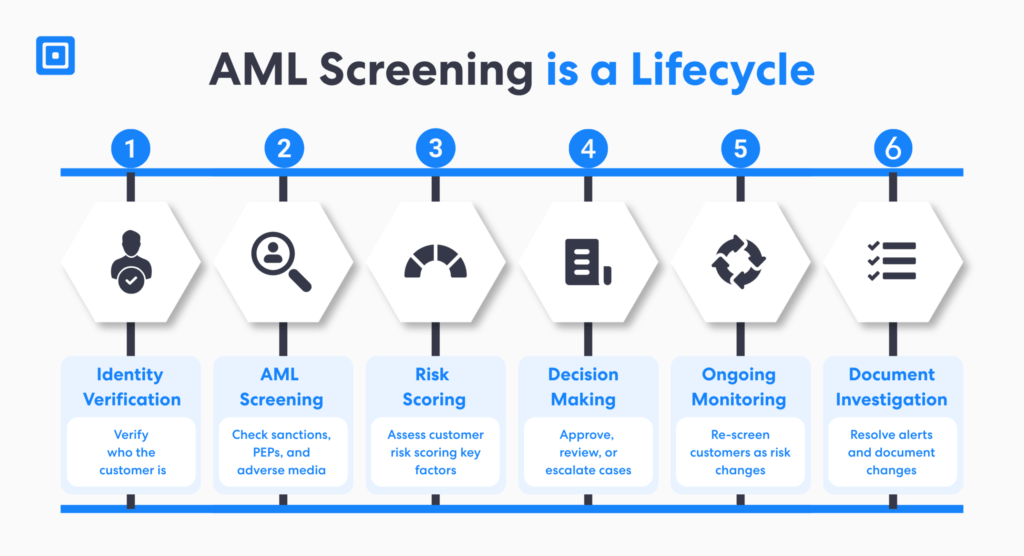
Good AML software links [Know Your Customer (KYC)](https://www.complycube.com/en/electronic-kyc-platform-red-flags/), automated screening, risk scoring, and monitoring instead of forcing compliance operations across multiple software solutions. Each check stage needs to inform the next, instead of creating another isolated queue.
## Who Must Meet UAE AML Regulatory Requirements?
AML software is mandatory for VASPS, banks, and DNFBPs in the UAE. The UAE adheres to [Financial Action Task Force (FATF)](https://www.fatf-gafi.org/en/countries/detail/%C3%89mirats%20arabes%20unis.html) standards for AML compliance. They must also comply where this legal framework applies.
Typically, DNFBPs include sectors with distinct exposures, such as real estate professionals and dealers in precious metals and stones. They are usually organizations or professions where transactions and ownership structures will elevate risk exposure.
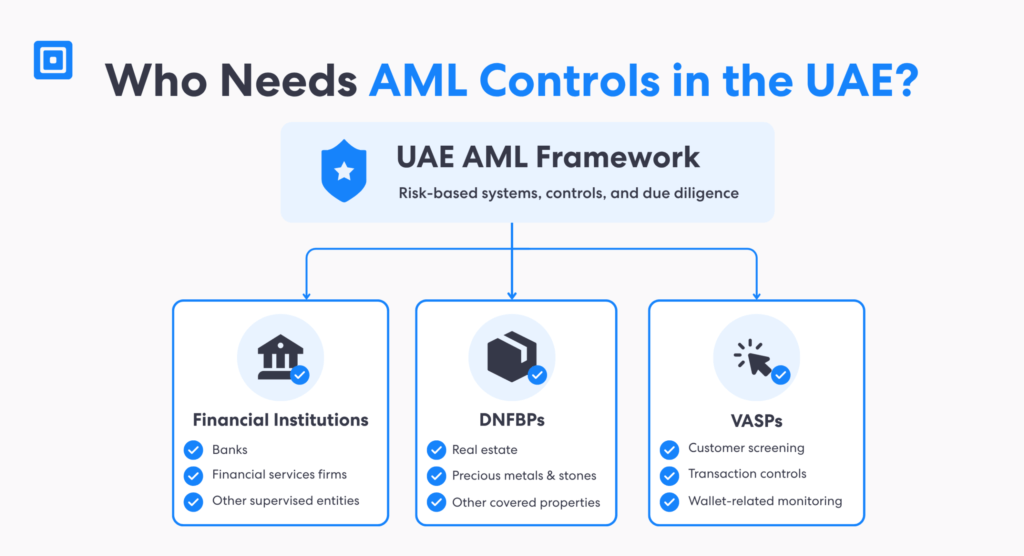
Therefore, AML controls are mandatory even though UAE law does not recommend one specific commercial AML software product for every firm. The requirement is to ensure compliance through effective systems, policies, and controls. They need to be suited to individual firms’ risks, customers, products, and supervisory frameworks.
### Banks and Financial Institutions
For UAE banks and other financial institutions, customer screening should continue over the course of the relationship, not stop after the initial onboarding and risk assessment. According to the [CBUAE guidance](https://www.centralbank.ae/en/news-and-publications/news-and-insights/press-release/cbuae-updates-aml-cft-cpf-guidance-for-licensed-financial-institutions/), they require ongoing due diligence, risk-based controls, and proactive detection of financial crime risks.
The best AML systems support financial transparency and economic stability. Systems like this can help institutions find suspicious relationships faster than normal, well before risk can grow. Buyers need to assess how integration, risk analytics, and governance work together, along with the raw speed of an AML screening API.
### Designated Non-Financial Businesses and Professions (DNFBPs)
[Non-Financial Businesses](https://rulebook.centralbank.ae/en/rulebook/1614-designated-non-financial-businesses-and-professions-dnfbps) face unique AML compliance challenges in the UAE. Customer volumes, transaction patterns, and compliance resources can change significantly from traditional banking. For example, real estate firms and dealers in precious metals may need to carefully examine beneficial owners, source information, and complex ownership structures.
For many businesses, AML services support standardized due diligence, identify high-risk customers, and surface risk factors without creating unmanageable manual processes. Therefore, before adding any additional AML software, firms must ask if a platform actually streamlines operations or adds another disconnected queue for reviewers.
### Virtual Assets Service Providers (VASPs)
Dubai’s [Virtual Assets Regulatory Authority (VARA)](https://www.clydeco.com/en/insights/2026/08/virtual-asset-insurance-in-the-uae-divergent-regul) requires VASPs to screen clients and transactions against applicable UNSC and federal sanctions frameworks. Moreover, they recommend that providers use regularly updated automated systems and that automated sanctions controls operate in real time. This is why real-time screening is incredibly important for this regulated segment of the UAE market.
For VASPs, customer screening is just one part. Adding on transaction monitoring and wallet-related controls may be needed to prevent financial crimes and manage more risk exposures. The strongest AML architecture links those signals with case management instead of treating each alert as a singular event.
### **Case Study: CBUAE’s May 2026 Thematic Review of AML Screening Software**
The [CBUAE examined](https://www.centralbank.ae/media/vzbe24pd/thematic-review-on-compliance-with-screening-against-uae-local-list-and-unsc-sanctions-list-in-the-banking-sector.pdf) whether UAE banks are effectively screening customers against the [UAE Local List and the UNSC Sanctions List](https://beta.uaeiec.gov.ae/en-us/United-Nations-Security-Council-Sanctions). They then froze and reported confirmed matches as needed. This exercise covered roughly 15 million records against the UAE Local List and 15.72 million against the UNSC list, creating a large-scale effectiveness test.
##### **Combine Name Screening with Identity Evidence**
The review used fuzzy name matching to meet regulatory demands. Then, they validated potential matches against any additional attributes such as birth details, nationality, passport information, and trade licenses. Banks with confirmed batch screening matches provided evidence showing detection, freezing, and reporting. That is why thorough metadata and decisions that can be properly traced matter.
##### **Outcomes**
- 15 UAE Local List matches with eight entity matches and seven individual matches.
- 5 UNSC entity results with three confirmed matches and two partial-name matches.
- Controls worked overall; however, two reporting delays were identified after freezing action.
## Global Watchlists Are Useless If They Update Too Late
An important factor is whether AML software provides timely access to relevant updates in UAE and global sanctions lists. Clear information about the sources covered and the update process is very helpful. Real-time updates matter where the regulatory framework requires rapid action. However, buyers must distinguish API response time from the speed of data ingestion and re-screening.
Ask providers how their data licensing works, which lists are direct or aggregated, and how quickly a new designation is available for production screening. The best answers explain the whole control chain instead of using “real-time” as an undefined marketing claim. A [faster API](https://www.complycube.com/en/real-time-id-verification-api-buyer-guide/) means little if the underlying list change reaches the AML platform hours later.
## PEP Match Is Not a Sanctions Match
PEP screening should provide context for a risk-based decision. A political exposure is not always equivalent to a sanctions prohibition. Compliance teams should test relatives, close associates, historical PEP information, and the supporting evidence available when a potential match appears.
Those match results must feed customer risk assessment and Enhanced Due Diligence (EDD) where necessary. This is especially important when other risk factors also increase overall exposure. Dynamic risk scoring also updates a customer risk profile whenever behavior, status, or new information changes the underlying assessment.
## More Adverse Media News Does Not Mean Better Screening
Similarly, adverse media screening reviews news and other credible sources for information that indicates corruption, fraud, money laundering, or other related financial crime risk. However, the value of adverse media depends on its relevance. For example, duplicate stories, weak sources, and namesakes can create false positives without giving useful investigative context for compliance teams.
UAE buyers must ask providers how they assess source quality, language, recency, entity resolution, and the relationship between a story and the screened subject. Effective adverse media screening aims to enable proactive detection without letting news volumes overwhelm human reviewers.
## Complexity in UBOs and Complex Ownership Structures
Business screening should extend beyond a legal entity name. Often, beneficial owners, directors, and controllers may introduce separate AML compliance concerns. Therefore, identifying ultimate beneficial owners can be complex and challenging, even more so when ownership spans multiple jurisdictions, holding companies, or other complex ownership structures.
As a result, an integrated AML solution can connect Know Your Business (KYB) data with beneficial-owner screening, risk profiling, and ongoing due diligence in one review path. That gives compliance officers a clearer view of ownership risk instead of having separate tools with disconnected customer data.
## Where Exact Matching Breaks Down in AML Screening Software
Name screening is extremely important in the UAE market. This is because Arabic-to-Latin transliteration can produce multiple valid spellings for the same individual. Aliases, reordered name components, common names, and incomplete records can further complicate both automated screening and analyst review.
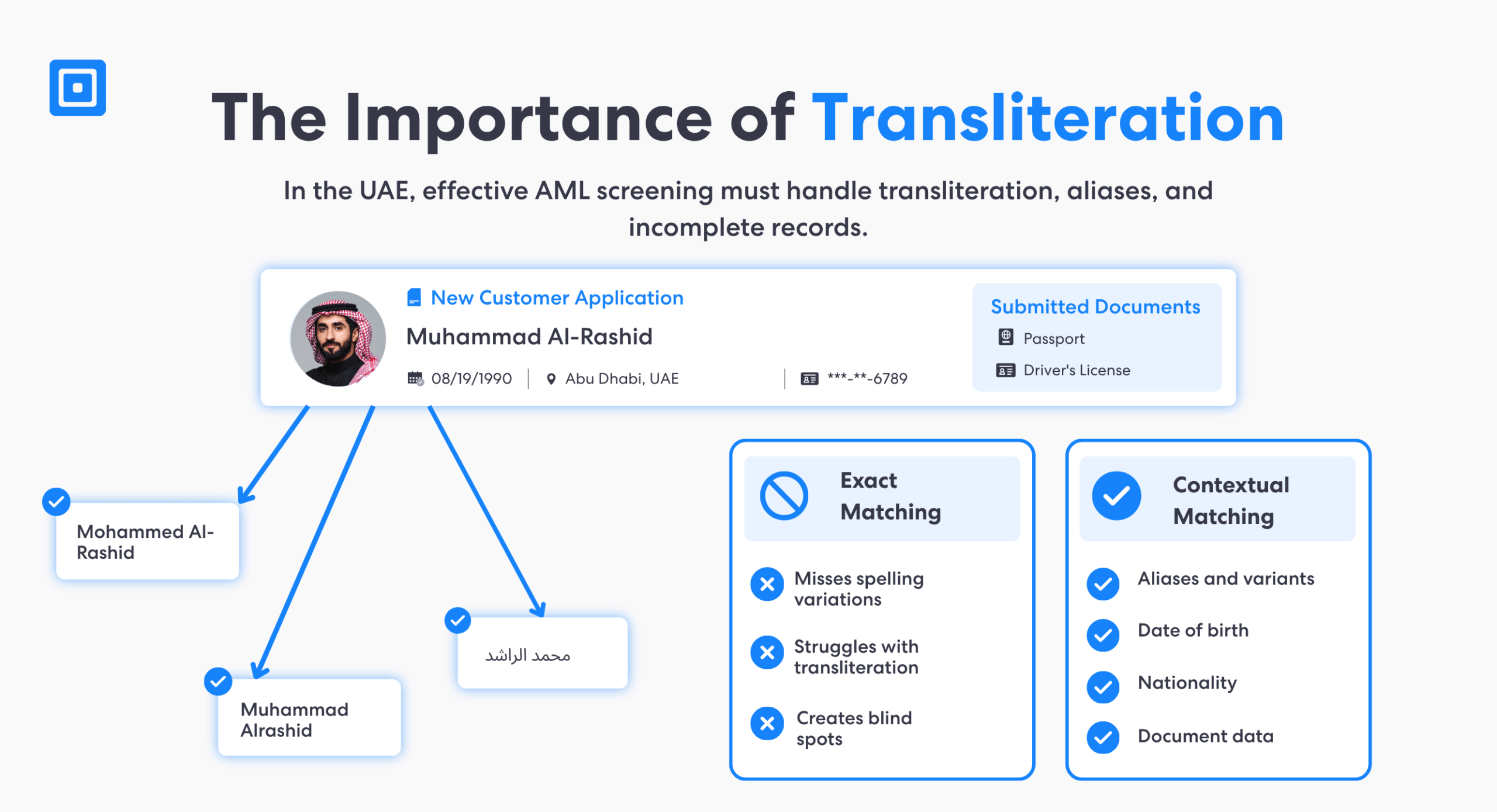
Fuzzy logic matching helps identify variations and typos. However, artificial intelligence or fuzzy algorithms alone do not guarantee an accurate result. Test realistic Arabic and Latin variants, along with dates of birth, national documents, and other useful metadata. So, if a provider cannot show how it handles the names your customers actually use, claims of”global coverage” deserve closer scrutiny.
## The False-Positive Trade-Off Buyers Discover Too Late
A major challenge in AML screening is false positives. Excessive alerts increase operational costs and can seriously distract analysts from genuinely material cases. However, an overly restrictive threshold creates the opposite danger by suppressing true risk. The most effective systems balance detection sensitivity with false positives.
Ask providers how thresholds can be calibrated. Learn how secondary identifiers can impact matches, and whether previous review decisions can influence repeated alerts. The goal is to lower false positives without weakening the institution’s ability to identify relevant financial crime exposure. Remember, having a quiet alert queue does not automatically mean that it is a good alert queue.
## The Case Management Alert Is Only the Beginning
Case management functionalities can help compliance teams greatly. They can track alerts, evidence, ownership, escalation, and investigations all the way through to resolution. Generally, alert generation must flag suspicious or potentially relevant events for human review. They also need to preserve enough context to support a defensible decision.
Automation stops being a screening feature and becomes part of the overall [compliance operations](https://www.complycube.com/en/aml-compliance-software-solutions/) process. Finding a name is useful, but proving why a case was cleared, escalated, or reported makes a control truly defensible. Similarly, strong case management helps prevent unresolved alerts from disappearing into inboxes, spreadsheets, or other manual processes.
> The best anti-money laundering solutions will not remove human judgment.
ComplyCube CEO and Founder, [Tarek Nechma](https://www.linkedin.com/in/tarek-nechma/), goes on to say, “The right AML screening software will give compliance teams better signals, clearer evidence, and more defensible decisions.” That is exactly the role that technology must play. Automated systems, risk analytics, and artificial intelligence can help prioritize information. However, humans remain responsible for material decisions.
The most credible AML-compliant software makes that judgment easier to explain. There is no hiding behind an opaque model. As a result, audit logs should provide tamper-resistant or otherwise protected records. They must outline what screening was, what evidence was found, and how the team arrived at a decision.
For verification, buyers must learn to test if historical screening events, reviewer actions, and later sanctions screening, politically exposed persons, or adverse media monitoring can be reconstructed reliably. Strong evidence can help show regulatory compliance, particularly to UAE regulators who scrutinize the effectiveness of systems and controls.
Being “audit-ready” means that teams must be able to reproduce evidence, demonstrate clear accountability, and have records aligned with applicable retention requirements. If a reviewer cannot do this later, the original screening result has limited evidential value.
### Key Takeaways
- **AML screening software** must detect relevant risk and support timely action.
- **Local requirements**, Arabic names, UBOs, and sector-specific exposure should shape testing.
- **It is crucial to blend onboarding** with monitoring, due diligence, and dynamic risk assessments.
- **Case management and audit** **logs** should make important decisions reproducible.
- **Use realistic customer data** to measure matching, false positives, integrations, and escalation.
## How ComplyCube Supports AML Screening Software for the UAE
Non-compliance with AML regulations can lead to severe penalties. That is why the best AML screening software providers must have accurate customer screening, proportionate risk assessment, reliable monitoring, and defensible decisions across your compliance operations.
ComplyCube supports UAE businesses in connecting identity, risk, and monitoring without relying on fragmented tools. Their proprietary AML screening software solution helps individuals and businesses with multilingual matching, entity resolution, continuous monitoring, and coverage across international, regional, and local lists.
For UAE firms, that integrated model can reduce fragmentation between customer verification, screening, risk assessment and ongoing due diligence. Learn how ComplyCube aligns with your regulatory requirements, customer population, workflows, and risk factors. [Talk to our team today.](https://www.complycube.com/en/contact/contact-sales/)
[](https://portal.complycube.com/signup)
## Frequently Asked Questions
Which sanctions lists matter most in the UAE?
In the UAE, financial institutions such as banks, and DNFBPs and VASPS, must prioritize UAE and UN sanctions requirements. Then, they must add other global sanctions lists where customers, transactions, counterparties, or internal policies make them relevant..
How often should customer screening happen for due diligence?
Customer screening should continue after initial onboarding. This can be done through periodic, event-driven, or configured re-screening on a daily basis, where appropriate, based on the firm’s needs and applicable regulatory requirements.
Can AML screening reduce false positives?
Yes, better metadata, fuzzy matching, secondary identifiers, calibrated thresholds, and analyst feedback can lower false positives in batch screening, where entire customer databases can be reviewed at once. This allows teams to preserve sensitivity and identify real financial crime risk.
Why does Arabic name screening matter?
Sometimes, Arabic names can show up in multiple valid Latin transliterations. Therefore, multilingual name screening, combined with aliases and secondary identifiers, is crucial in the UAE. Now, compliance teams distinguish real matches from their namesakes.
Why choose ComplyCube for UAE AML screening and a risk-based approach?
ComplyCube’s award-winning platform brings KYC, KYB, and AML screening with multilingual matching together. With strong entity resolution and ongoing monitoring, their AML screening platform helps UAE firms build more integrated, risk-based compliance workflows for customers.
**Categories:** Guides
**Tags:** Anti-Money Laundering
---
### [Crypto Enforcement in Focus as Dutch Prosecutors Sell €2.2M in Knaken Crypto](https://www.complycube.com/knaken-crypto-enforcement-sells-2-2m-in-assets/)
**Published:** August 17, 2026
**Author:** Rithu Jagannath
**Excerpt:** Dutch prosecutors sold €2.2M in seized Knaken crypto, putting crypto enforcement and MiCA safeguards under the spotlight as the bankruptcy raises questions over customer asset protection, ownership, recovery and orderly wind-down.
**Content:**
On 17 August 2026, Dutch prosecutors sold almost €2.2M ($2.5M) in seized crypto. They seized these assets from the previously bankrupt Dutch crypto platform Knaken. They converted the assets into cash for their bankruptcy estate. The latest development comes about one month after Knaken declared bankruptcy. It led to a renewed focus on crypto enforcement in the Netherlands.
The sale shifts attention away from the collapse of Knaken Crypto. It raises the question of how much value customers can recover when a crypto platform fails massively. This is especially relevant under the EU’s [Markets in Crypto-Assets Regulation (MiCA)](https://eur-lex.europa.eu/eli/reg/2023/1114/oj/eng), which places greater emphasis on safeguarding customer assets and ensuring crypto firms can wind down in an orderly way.
## From MiCA Deadline to Crypto Enforcement
The Netherlands’ MiCA transition period for previously registered crypto providers ended back in June 2025. In that time, Knaken did not get the right [authorization](https://www.afm.nl/en/sector/actueel/2024/december/sb-start-micar) and eventually stopped its regular crypto activities while trying to [wind down](https://www.esma.europa.eu/sites/default/files/2026-06/ESMA75-113276571-1710_Public_Statement_MiCA_transitional_period_ends.pdf).
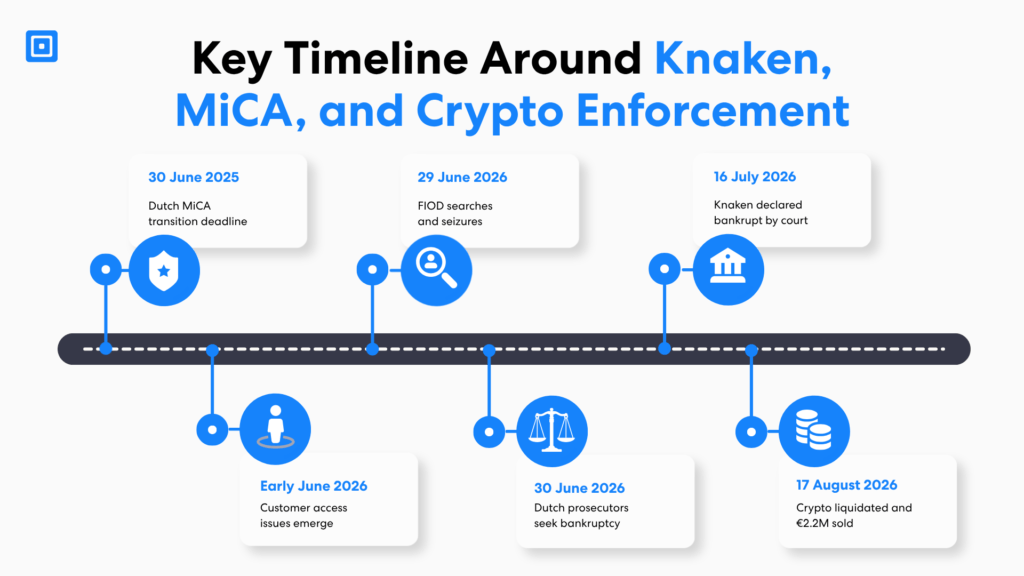
However, nearly a year later, the situation escalated as the Fiscal Information and Investigation Service (FIOD) seized their assets, after which the prosecutors petitioned for bankruptcy. In nearly two weeks, the Rotterdam District Court declared Knaken bankrupt. Now, the remaining seized crypto has been sold for €2.2 million. This crypto enforcement timeline shows that the point at which a firm leaves the market is just as important as the point at which it enters.
## Why the Knaken Crypto Sale Matters Under MiCA
MiCA regulates market entry and strengthens how authorized [crypto-asset service providers (CASPs)](https://www.afm.nl/en/sector/cryptopartijen/vereisten-en-vergunningen/casp-vergunning) protect customer assets. Its requirements include safeguarding clients’ ownership rights. It prevents providers from using customer crypto-assets for their own accounts and requires credible wind-down arrangements.
The sale in August makes these safeguards more real. Once insolvency begins, asset segregation, custody records, and legal ownership can determine if customer can recover their assets right away. Otherwise, it must compete with other creditors for what is left over in the crypto enforcement. Then, the key issue becomes whether customer assets are structured in the right way, where ownership and recovery are clear before the business failed.
## A Wider Test for Crypto Enforcement
For regulators, crypto enforcement cannot stop at deciding which firms are permitted to operate. This means failed authorizations, wind-downs, and insolvencies can create their own period of customer risk and require close supervision.
For CASPs, the lesson is that authorization is part of the compliance lifecycle. Firms need to have controls in place that are effective even when conditions are deteriorating. This includes having clear asset ownership, thorough safeguarding, and an exit process that allows customers to withdraw or transfer their holdings.
As [MiCA](https://eur-lex.europa.eu/legal-content/EN/HIS/?uri=uriserv%3AOJ.L_.2023.150.01.0040.01.ENG) becomes embedded across all of Europe, cases such as the Knaken enforcement is an important measure of its effectiveness. It will demonstrate whether its framework and regulations raise standards for active crypto firms. More importantly, it will show if those standards translate better outcomes for customers when a provider fails.
[](https://portal.complycube.com/signup)
Find out more AML news in ComplyCube’s [CryptoCubed newsletter](https://www.complycube.com/en/cryptocubed-july-dunamu-sanctions-and-u-s-crypto-scam/). We explore the latest in developments across identity verification and AML globally.
**Categories:** News
**Tags:** Crypto Regulations
---
### [10 Critical KYC Fraud Detection Signals You Cannot Miss](https://www.complycube.com/ai-powered-kyc-fraud-detection-signals/)
**Published:** August 17, 2026
**Author:** Rithu Jagannath
**Excerpt:** KYC fraud detection goes beyond identity checks to connect document, biometric, behavioral, and contextual signals. Learn 10 critical fraud detection signals or indicators and how layered KYC controls reduce risk while limiting unnecessary friction.
**Content:**
**TL;DR:** KYC fraud detection helps compliance teams **link identity, biometric, behavioral, and contextual signals** across the financial system. If the evidence, applicant, and surrounding risk signals **form a credible story,** that is completely different altogether. This guide covers overlooked fraud signals, why they matter, and how AI-powered KYC fraud detection can **close gaps**.
## KYC Fraud Detection As A Fast-Moving Public Fraud Problem
Fraud is a compliance issue that impacts millions of people. The [Office for National Statistics](https://www.ons.gov.uk/peoplepopulationandcommunity/crimeandjustice/articles/natureoffraudandcomputermisuseinenglandandwales/yearendingmarch2025) estimated that 4.2 million fraud incidents in England and Wales took place in 2025. This is 31% more than the previous year. Similarly, bank and credit account fraud accounted for almost 2.4 million incidents.
The picture of fraud and emerging threats is actually quite similar in the United States. For example, the Federal Bureau of Investigation (FBI) has a [Crime Complaint Center](https://www.ic3.gov/AnnualReport/Reports/2025_IC3Report.pdf) that received 1,008,597 complaints in 2025. This accounted for $20.87 billion in reported losses. The Federal Trade Commission (FTC) also separately received three million consumer fraud reports in 2025, with consumers reporting $15.9 billion in losses.
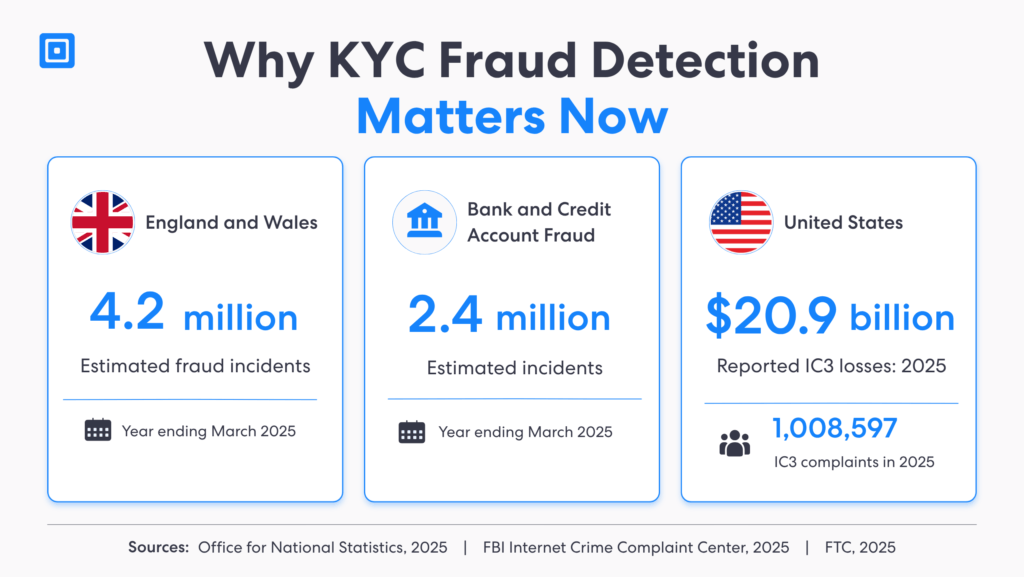
This pressure is twofold. Financial institutions and other regulated businesses must prevent fraud without hindering legitimate customers. They also must maintain regulatory compliance with [Anti-Money Laundering (AML)](https://www.complycube.com/en/solutions/due-diligence-compliance/anti-money-laundering/) requirements. As a result, acquiring modern KYC fraud detection systems are necessary for compliance teams as well as fraud, risk, product, and customer onboarding teams.
Fraudsters can now test identity combinations, documents, devices, and application patterns at scale. This makes a single successful document or biometric data check act as a weak endpoint for fraud decisioning. This is especially important as fraudulent activity and financial crime tactics evolve.
## Fraud is Much Easier to Scale
INTERPOL’s March 2026 [Global Financial Fraud Threat Assessment](https://www.interpol.int/News-and-Events/News/2026/INTERPOL-report-warns-of-increasingly-sophisticated-global-financial-fraud-threat) explains financial fraud as an ever-changing transnational threat. It thinks of artificial intelligence (AI) or advanced machine learning models, low-cost digital tools, and growing criminal collaboration as important factors in fraud expanding its scale and complexity. Secretary General of INTERPOL, [Valdecy Urquiza](https://www.interpol.int/en/Who-we-are/General-Secretariat/Secretary-General/Biography-of-Valdecy-Urquiza) stated,
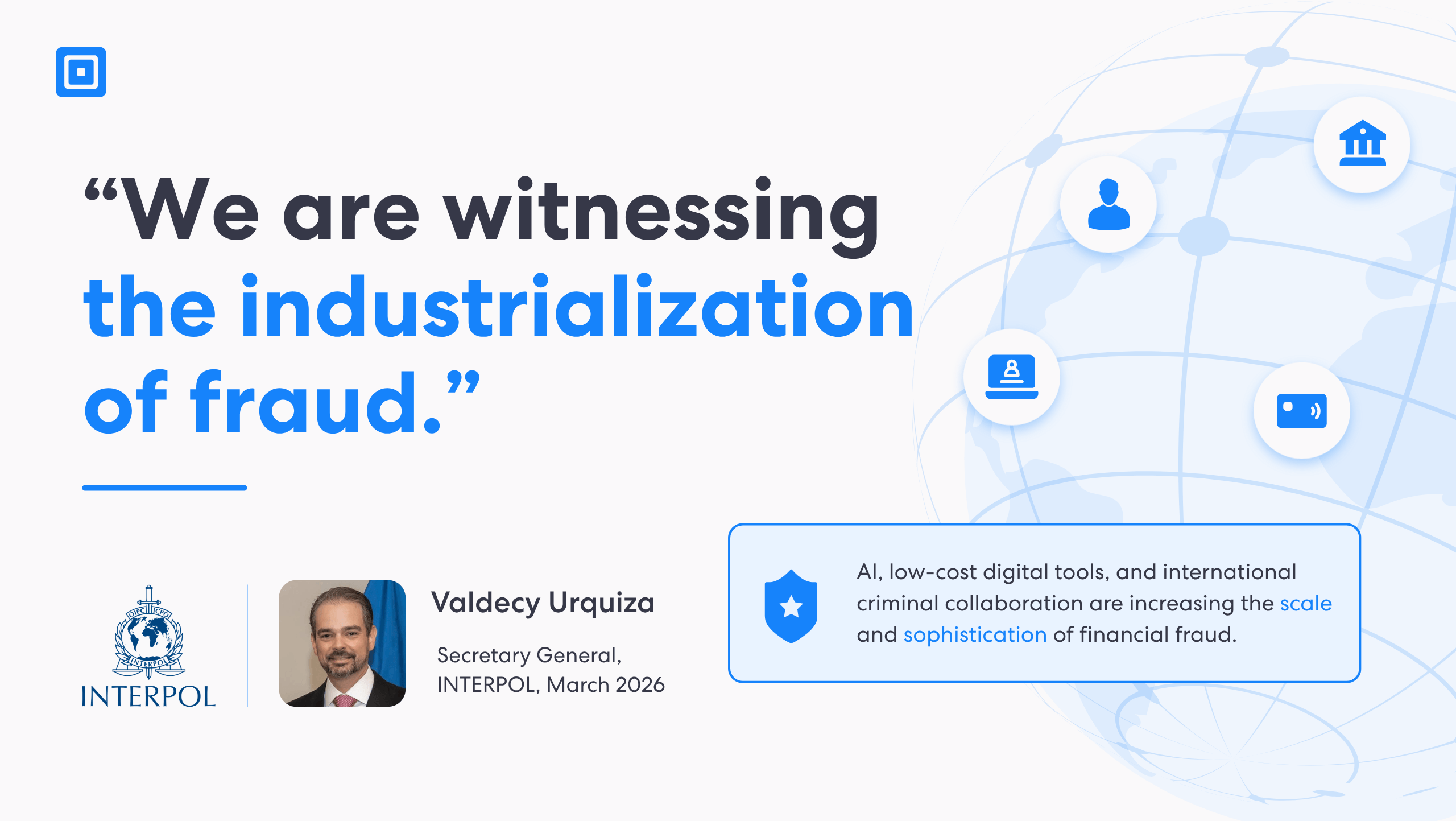
> We are witnessing the industrialization of fraud.
He also said that, “It is vital to remember that the cost of financial crime is not just money. It is people’s life savings, their dignity, and in the worst case, their life.” A verification process can impact how we review identity theft attempts, unusual transaction patterns, synthetic identity profiles, and coordinated attacks.
## What is KYC Fraud Detection?
Know Your Customer (KYC) compliance began back with [The Financial Action Task Force (FATF)](https://strongroom-intel.com/article/tracing-the-roots-a-historical-look-at-kyc-compliance) in 1989. It was established to combat money laundering and other financial crime activity. As a result, the KYC process includes the use of identity, document, biometric, and contextual controls to determine a customer’s identity. This is especially important with customers who may be using misleading information or false, stolen, or manipulated identities.This supports the wider KYC fraud detection system by determining if evidence can be validated and the applicant presenting it can be trusted.
National Institute of Standards and Technology (NIST)’s [2025 Digital Identity Guidelines](https://pages.nist.gov/800-63-4/) gives a helpful distinction between the two. Identity proofing considers identity resolution, evidence validation, attribute validation, and fraud mitigation as separate projected outcomes. A piece of evidence can be real without proving that the person presenting it is the rightful owner of that data.
Strong KYC fraud detection weaves those layers together to ensure regulatory compliance while reducing human error. Customer identity verification and fraud detection can help consider if other risk signals make the customer’s application suspicious even with a pass on the KYC verification result.
## 10 KYC Fraud Detection Signals To Look Out For
A KYC pass does not make an individual or organization immune from fraud risk related to terrorism financing or money laundering. For example, a document can be genuine but stolen from someone else. Sometimes, a face can match while other attributes remain inconsistent. Typically, an advanced fraud detection process blends government issued documents, databases, facial recognition, and biometric verification.
Different identity verification processes answer different important questions. Therefore, a successful answer to one, does not settle the other ones. The following 10 KYC fraud detection signals showcase where distinction matters the most:
### 1. Finding a genuine document in the wrong hands
The first and often most common blindspot is assuming that a [genuine identity document](https://www.complycube.com/en/solutions/due-diligence-compliance/know-your-customer/document-authenticity/) means that there is a real applicant on the other side. For instance, consider a real passport being used by someone else. Document authentication will prove that the document is authentic, but identity theft is still happening in that moment. NIST’s identity verification requirement emphasizes confirming that the applicant is the real owner of the validated evidence. That is why identity verification needs to progress after the passport itself passes.
### 2. Learn to recognize synthetic identities
There is another challenge that comes with [synthetic identity fraud](https://www.complycube.com/en/what-is-synthetic-identity-fraud/). Often, individual attributes can look believable while the combined customer identity is false or misleading. As a result, criminals and fraudsters will look to exploit compromised personal information in order to secure financial transactions. They will use this along with fabricated or made up data to create coherent applications of customers.
Synthetic identities are hard to manage because individual attributes may pass validation separately while the combined identity never existed as a real person. NIST states that having an Identity Assurance Level 2 is meant to protect customer transactions against these synthetic identities and attacks. It needs identity resolution to find out that the claimed identity is actually linked to a real and unique person within the relevant population.
### 3. Go beyond basic biometric verification with liveness and presentation attack detection
Facial recognition helps determine if an applicant actually resembles the image or photo on an identity document. However, facial similarity cannot be the only proof that a [biometric interaction](https://www.complycube.com/en/biometrics-identity-verification-system/) is genuine during onboarding. Other variables to consider include liveness detection and presentation attack detection.
They add another layer by reviewing if the verification system is dealing with a real person instead of a fake image, replay, or other spoofing attempting. Many fraudsters leverage AI-enabled to commit fraud. As a result, biometric controls need to determine who the person appears to be and if the interaction can, in fact, be trusted.
### 4. Looking beyond document authentication for KYC fraud detection
Sometimes, even if a customer grants valid evidence, they can interact with a service in a weird way. An example is using devices, networks, or sessions that they would not normally. This factor adds additional risk signals that identity documents are incapable of providing.
Real customers can change [devices](https://www.complycube.com/en/solutions/fraud-intelligence/device-intelligence/), travel, or use different networks that could potentially cause a technical anomaly. However, the most important point to consider is whether several differing signals together generates enough risk for a profile to have more investigation. This layer reduces missed fraud attempts and false positives, thereby making risk assessments proportionate to the evidence available.
### 5. Detect identities, devices, and attributes reused across applications
Sometimes, a single onboarding attempt may look real. However, patterns reveal more when applicants use the same device, phone number, document details, or other attributes that appear across many different unrelated customers. This is where machine learning, AI systems, and graph-based analysis can come into play. They help identify clusters and recurring relationships that would be hard to find with individual checks. These outputs should bolster defined fraud policies and investigations.
### 6. Watch for unusual onboarding velocity
A high application velocity can be indicative of automated or coordinated fraud especially when the same device, network, identity attributes, or contact information shows up over and over again within a short amount of time. However, in shared households or workplaces, applicants can also create overlapping signals that might be flagged as suspicious behavior. Instead of using strict velocity rules, KYC fraud detection should blend application frequency with various types of evidence before raising risk.
### 7. Test whether geographic signals are consistent
Cross-border activity is not normally suspicious. For example, a customer might have a passpor from one country, live in another, and finish onboarding while travelling elsewhere. This is where geography becomes useful especially when several signals conflict. Several pieces of information such as a declared address, document country, IP location, device history, and later transaction destinations can be assessed together. It helps determine whether the whole customer story is credible.
### 8. Corroborate identity claims with independent evidence
Customer-supplied information does not prove that the applicant owns or controls the identity being claimed. Important identity attributes should therefore be corroborated through reliable and independent evidence where appropriate. For individuals, that may include authoritative identity data and validated documents. The key question is whether independent sources support the same identity story rather than whether each individual data point merely exists.
### 9. Combining weak risk signals for strong KYC fraud detection
Fraud signals look weak when looked at alone. For instance, a new device may be real, a foreign IP, and recently issued phone number too. Yet, when those signals come together along with repeated verification attempts or reused identity attribute, it changes the risk picture. AI-powered analysis can find these combinations at large scale. This is why compliance and fraud teams are still responsible for how the resulting risk score impacts the customer.
### 10. KYC fraud detection must not end at customer onboarding
Fraud risk can emerge after a customer has successfully passed onboarding. Account takeover, behavioral changes, new adverse media or politically exposed persons (PEPs) information, unusual transactions, or changes in customer circumstances can all alter the original risk assessment. Continuous monitoring connects those later signals back to the customer information collected during onboarding. Transaction history, expected behavior, and updated KYC information can help teams recognise when the original customer risk assessment needs to be revisited.
## Where KYC Fraud Detection Fits Across the Customer Lifecycle
KYC fraud detection must change with the nature of the customer relationship. It must not be a one-time onboarding control because it increases in riks over time. Therefore, different stages of the process will answer different questions about identity assurance, expected behavior, and changing financial crime risk.
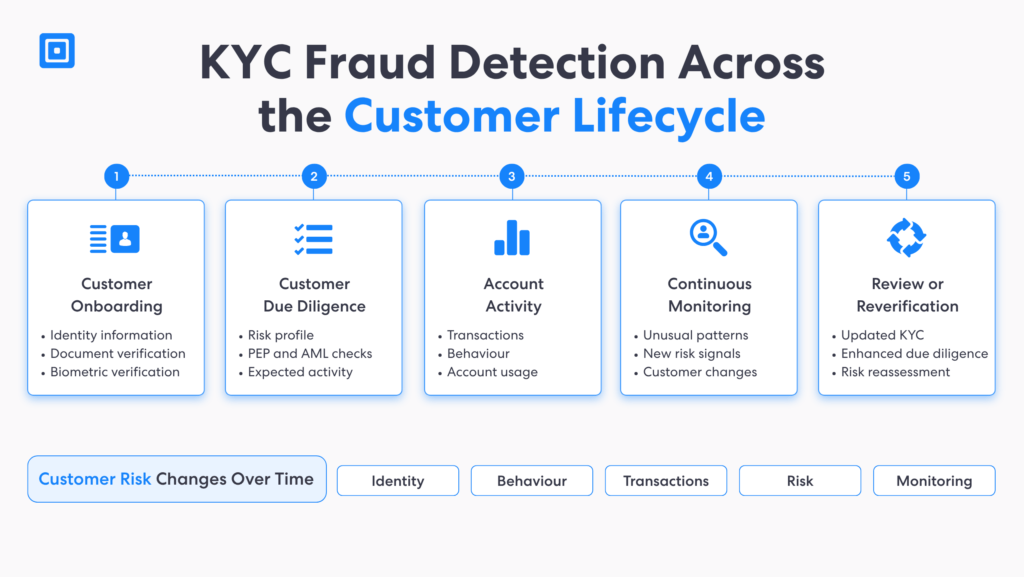
### Establish an Identity Baseline at Onboarding
At first, customer identification and verification sets the foundation. For example, this could happen at the start of customer onboarding or with the opening of a bank account. Here, identity information, documents, biometric data, and other evidence helps teams understand who a customer really is, and if the applicant can be reasonably linked to the identity that is presented.
### Use Customer Due Diligence to Understand the Customer’s Risk Context
The next layer is Customer Due Diligence (CDD). The CDD process often adds context around the purpose of a relationship, geography, and business activity. It also provides further details around ownership, expected transactions, PEP, and other relevant financial crime factors. This context is much needed later on when fraud signals are more meaningful. These unusual transactions or change in behavior could be the key to understanding what normal customer activity should look like. You can learn more here: [What is Customer Due Diligence (CDD)?](https://www.complycube.com/en/what-is-customer-due-diligence/)
### Apply Enhanced Due Diligence When Risk Increases
Similarly, [Enhanced Due Diligence (EDD)](https://www.complycube.com/en/enhanced-due-diligence-edd-insights-challenges/) adds more protection when customer or transactional risk needs it. This typically involves gathering more evidence and reviewing ownership structures and business licenses. It also considers source information as well as applies much more intensive monitoring. The goal is to create risk-proportionate friction. Higher-risk customer profiles often justify deeper review, but applying those same enhanced AML controls to every customer impacts operational costs, customer abandonment, and rates of false positives.
### Reassess Risk and Financial Crimes Through Continuous Monitoring
[Ongoing monitoring](https://www.complycube.com/en/ongoing-aml-monitoring-for-insurers/) helps identify when customer behavior, transactions, ownership, or other risk factors no longer align with the original profile’s financial behavior. Rather than treating onboarding as the final KYC decision, firms can use monitoring to determine when customer information needs updating, risk needs reassessing, or additional due diligence is required.
### **Case Study: Real Identities, Fraudulent Documents**
In June 2025, [eight people in Puerto Rico](https://www.justice.gov/usao-pr/pr/eight-individuals-indicted-and-arrested-mail-wire-and-bank-fraud-conspiracy-and) were charged with alleged fraud and an aggravated identity-theft conspiracy. The defendants seemingly stole identifying information from victims and created hundreds of fraudulent Puerto Rico driver’s licenses. They contained different combinations of victims’ names, dates of birth and licence numbers along with photographs of members of the alleged conspiracy.
##### **Link the Presenter to the Claimed Identity**
The alleged scheme did not depend entirely on invented identities. Prosecutors said real victim information was mixed with fake driving licenses containing photos of alleged conspirators. That demonstrates the distinction at the center of KYC fraud detection. Valid identity data does not prove that the person presenting it is the rightful owner.
##### **Outcomes**
- Eight people were indicted on charges including conspiracy and aggravated identity theft.
- Prosecutors alleged that hundreds of fraudulent licenses were created.
- This scheme combined real victim information with different photographs.
## Protecting The Customer Experience
More fraud checks are not indicative of creating better fraud prevention. Applying the same level of scrutiny to every applicant can result in more false positives, manual review, abandonment, and operational cost. Moreover, it reduces overall customer satisfaction.
Better risk segmentation and a proactive approach creates smarter friction. Low-risk customers can continue through automated checks, uncertain cases can receive step-up verification, and higher-risk cases can be routed for deeper investigation. The goal has the proportionate amount of friction based on the evidence presented.
## KYC Fraud Prevention Works Best as a Layered Framework
The best and most thorough frameworks blend many different verification processes such as identity resolution, biometric verification, and due diligence processes. For example, documents can provide one type of confidence while biometric evidence establishes another. Similarly, CDD adds context and continuous monitoring finds risks that show up later on.
Having a layered KYC fraud prevention model that prevents terrorist financing helps businesses and other financial institutions to verify identities and financial statements. It also helps recognize any form of identity fraud, money laundering, or other illicit transactions or crimes that appear at many different stages of the overall customer lifecycle.
### Key Takeaways
- **A real document** does not prove if the applicant actually owns the identity.
- **Synthetic identities** contain individually credible but collectively misleading data.
- **Weak fraud risk signals** become more important when assessed together instead of separately.
- **KYC fraud detection** must happen after the onboarding process with customer risk changes.
- **Better risk segmentation** can strengthen fraud prevention without adding too much friction.
## Strengthen KYC Fraud Detection With ComplyCube
In summary, ComplyCube helps businesses bring identity verification, document checks, biometric controls and AML screening into modular KYC processes. Learn to build a layered approach to KYC fraud detection that safeguards sensitive data to support customer onboarding.
Understand how fraud detection capabilities and regulatory requirements are met with ComplyCube while keeping friction proportionate to risk. Get in [touch with our team](https://www.complycube.com/en/contact/contact-sales/) to discuss how your organization can strengthen KYC fraud detection across the customer lifecycle in alignment with global AML regulations.
[](https://portal.complycube.com/signup)
## Frequently Asked Questions
Can a customer pass KYC and still commit fraud?
Yes. A genuine document, successful biometric match, or valid customer attribute does not guarantee that every element of the application is trustworthy. Strong KYC fraud detection assesses identity evidence alongside device, behavioral, contextual, and ongoing risk signals.
How AI-powered KYC improve fraud detection?
AI models can analyze large volumes of identity, biometric, behavioral, device, and application data to identify relationships and anomalies that fixed rules may miss while tracking transaction patterns. It works best when outputs remain explainable and operate within fraud policies and human oversight.
Why does KYC fraud detection need to continue after onboarding?
Customer risk can change after onboarding because of account takeover, behavioral changes, unusual transactions, or newly identified financial crime risks. Continuous monitoring helps firms reassess customers when later activity no longer matches the original risk profile.
How can financial institutions reduce KYC false positives?
Financial institutions can reduce false positives by combining multiple independent signals rather than treating individual anomalies as proof of fraud. Risk-based thresholds and step-up verification can focus deeper investigation on customers with stronger evidence of risk.
How can ComplyCube strengthen KYC fraud detection?
ComplyCube blends identity verification, various types of screening, and configurable workflows to help businesses determine fraud signals in onboarding and monitoring. This enables firms to apply strong controls that meet global regulatory frameworks where risk grows while keeping friction proportionate for real customers.
**Categories:** Guides
**Tags:** Fraud Prevention
---
### [Singapore Scam Investigation Uncovers $5.4M in Victim Losses](https://www.complycube.com/singapore-scam-investigation-270-suspects/)
**Published:** August 13, 2026
**Author:** Dini Habib
**Excerpt:** In the latest AML news, we cover Singapore's recent crackdown on a scam infrastructure that connected 270 suspects to over $5.4 million in losses. This network has engaged in offenses including money laundering and other crimes.
**Content:**
On 13 August 2026, The Straits Times published another sizeable scam investigation, following the Singapore Police Force’s (SPF) probe into 185 men and 85 women linked to over 660 scam cases and over S$5.4 million (USD$4.2 M) in victim losses.
## What went down in the Singapore Scam Investigation Case?
The SPF conducted a two-week investigation, which found 270 individuals tied to offenses such as money laundering, cheating, and operating payment services without a license. However, the case is not a standalone one. Similar police announcements occurred four consecutive times from 18 June to 12 August this year.
- **18 June to 1st July:** Over 230 scammers and money mules linked to 713 scam cases and S$9 million (USD$7 M) losses.
- **2 to 15 July:** 579 individuals connected to more than 1,469 illicit cases and around S$18 million (USD$14 M) in losses.
- **16 to 29 July:** 255 people investigated with ties to 660+ cases and around S$5.6 million (USD$4.3 M) in losses.
- **30 July to 12 August:** 270 scammers associated with 660 cases and S$5.4M million (USD$4.2 M) in losses.
When we add those numbers up, that is over 3502 scam cases and $30 million in reported victim losses in just eight consecutive weeks. This suggests an industrialized enforcement cycle, rather than occasional police crackdowns.
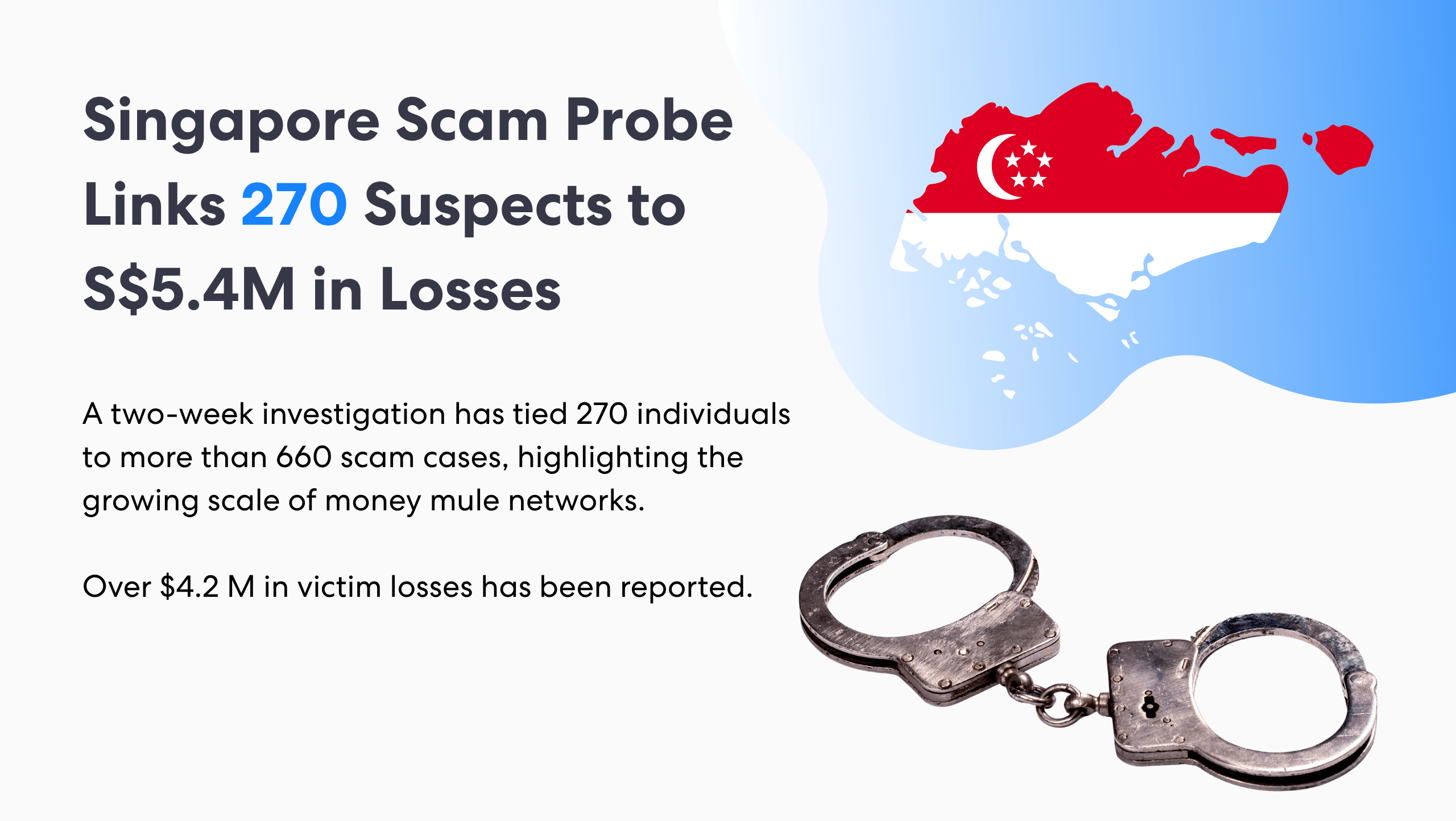
For compliance teams, the message is significant. Repeated enforcement at this scale can translate to greater scrutiny on firms to demonstrate that their fraud monitoring and [Anti-Money Laundering (AML)](https://www.complycube.com/en/solutions/due-diligence-compliance/anti-money-laundering/) systems are capable of identifying scam related activity before losses escalate. It can also signal more stringent regulations and sharing of data intelligence.
## The Increasing Pervasion of Money Mules
Money muling refers to the act of transferring criminal money on behalf of others. Bad actors use emotional tactics, including online friendships, fake job offers, and romance, to get victims to launder cash from their bank accounts, often lying about the intention of the transaction.
Are all of us susceptible to money mules? More often than we admit, anyone can be susceptible to becoming a money mule. This is especially true today, where we share our information freely on social media, job agencies, and dating applications. As such, criminals can exploit situational, financial, and behavioral vulnerabilities to target people.
According to the Financial Conduct Authority (FCA), in 2024, the UK recorded over [225,000 people as victims](https://www.intelligenciatraining.com/the-uks-money-mule-problem/) of money mules. In the Singapore scam investigation landscape, the scale is similarly concerning. Just two months ago, Singapore had placed 1,423 money mules, 1,439 SIM-card mules and 53 corporate mules under its Facility Restriction Framework.
Money muling, however, can act as just one enabling layer within a much broader network of scam infrastructure. So then, the question arises: How, and who, is accountable for dismantling this infrastructure before it hits victims?
## Who is Accountable for Stopping Scam Infrastructure?
The truth is, no single regulatory body or organization can stop scams on its own. Scam infrastructure can exist within banks, telecom companies, online platforms, and law enforcement. However, while responsibility is distributed, accountability to identify, prevent, and report scams is not absent.
Businesses are increasingly expected to demonstrate that they have effective controls to detect fraud, safeguard the financial ecosystem, and share intelligence data with other organizations. The importance of information sharing is particularly clear in FCA findings.
The FCA’s published data says 25 firms between 2022 and 2023 offboarded 194,084 money mules, but just [37%](https://www.fca.org.uk/publications/multi-firm-reviews/firms-use-national-fraud-database-money-mule-account-detection-tools) were reported to the National Fraud Database. Additionally, while the cases met the required reporting standards, businesses chose not to submit their details for almost one-third of them.
This is critical, as data sharing is crucial to disrupting the networks that move scam proceeds and acts as a strong barrier against financial crime. As such, establishing strong AML and Counter-Terrorism Financing (CTF) infrastructure is only one part of the solution.
## What Compliance Teams Must Act on Now?
Asking a business to strengthen AML controls can sound simple, but in reality, it can be complex, especially if you do not know where to start. This is particularly true in this case, where risk is fragmented across varying users and channels. The following questions can expose weaknesses in existing controls.
### 1. Can we identify behavioral changes, not just large transactions?
Too much emphasis on transactional thresholds can lead to a narrow view of risks. Rather, businesses should also monitor behavioral deviations. This can include unusual transaction patterns, such as large incoming payments or increased transfer frequency. This enables businesses to identify and assess meaningful deviations and whether they are linked to suspicious activity.
### 2. Can we detect infrastructure reuse?
Scam networks do not usually operate via a single platform, account, or channel. As such, businesses should look for recurring connections between suspicious [devices](https://www.complycube.com/en/solutions/fraud-intelligence/device-intelligence/), email addresses, and phone numbers. These connections help firms detect networks of related activity, thus reducing false positives and focusing investigations on high-risk activities.
### 3. Can fraud intelligence insight feed into risk scoring?
Fraud intelligence should not end at identification. Firms need strong integration feeds that link fraud insights to risk scoring and case management systems. For example, when account misuse is detected, automated workflows should determine if the individual will need re-verification, reported to authorities, or reviewed by senior management. This makes it hard for scam activity to hide within organizational silos.
### 4. What happens after offboarding a high-risk customer?
Account closure does not signal the end of the risk management lifecycle. A suspected fraudster can easily open another account, use a different provider, or move activity to another channel. Instead, companies need to properly document, report, and share this information with external intelligence networks.
[](https://portal.complycube.com/signup)
Find out more AML news in ComplyCube’s [Trust Edition newsletter](https://www.linkedin.com/newsletters/the-trust-edition-7103022355722981376/). We explore the latest in developments across identity verification and AML globally.
**Categories:** News
**Tags:** Identity Verification
---
### [What is Perpetual KYC (pKYC)? Implementation Guide for 2026](https://www.complycube.com/what-is-perpetual-kyc-implementation-guide/)
**Published:** August 14, 2026
**Author:** Dini Habib
**Excerpt:** Perpetual KYC is a non-negotiable customer due diligence model that supports proactive risk management. pKYC captures evolving customer risks automatically, allowing teams to review suspicious patterns and transactions rapidly.
**Content:**
**TL;DR:** Perpetual KYC, or pKYC, replaces periodic, time-based customer review with continuous customer risk monitoring. For compliance teams, **perpetual KYC due diligence** ensures a proactive approach to risk management. It supports quicker, more accurate, and more efficient **financial crime prevention**, reducing compliance gaps in traditional KYC processes.
## The Hidden Compliance Blind Spot
Traditional Know Your Customer (KYC) or legacy KYC processes are time-bound and calendar-based, usually requiring review every 1 to 5 years based on risk, company, or country policy. However, between those reviews, customer data can be untouched. As such, traditional KYC can miss crucial changes in customer risk profiles. This blind spot comes with measurable cost.
Take CCV Netherlands, for example. The firm was [fined $3 million](https://www.complycube.com/en/netherland-fines-ccv-2-65m-for-monitoring-gaps/) for failing to load over 4000 merchant profiles into its monitoring system for 23 months. According to authorities, CCV did not meet Anti-Money Laundering (AML) and KYC requirements for continuous compliance, not just a point-in-time fix.
Another example is UBS Monaco, which was fined [$6 million](https://www.complycube.com/en/ubs-monaco-fine-6-million-aml-failures/) for deficiencies in its ongoing monitoring framework. The company failed to capture and update evolving customer risk in response to changes in transaction behavior, Politically Exposed Person (PEP) exposure, and source of wealth information.
For many financial institutions, the consequences can extend beyond fines. This is particularly true in this era of quick payments, sophisticated fraud, and rapidly shifting sanctions landscapes. This guide explores pKYC systems, their benefits, challenges, and how to implement them successfully.
## What is Perpetual KYC (pKYC)?
Perpetual KYC updates customer information continuously and is driven by specific event triggers. These event triggers can include changes to sanctions lists, new beneficial ownership structures, or unusual transactions. Instead of waiting for a particular date, customers are automatically flagged for review when there is a change in their risk profile.
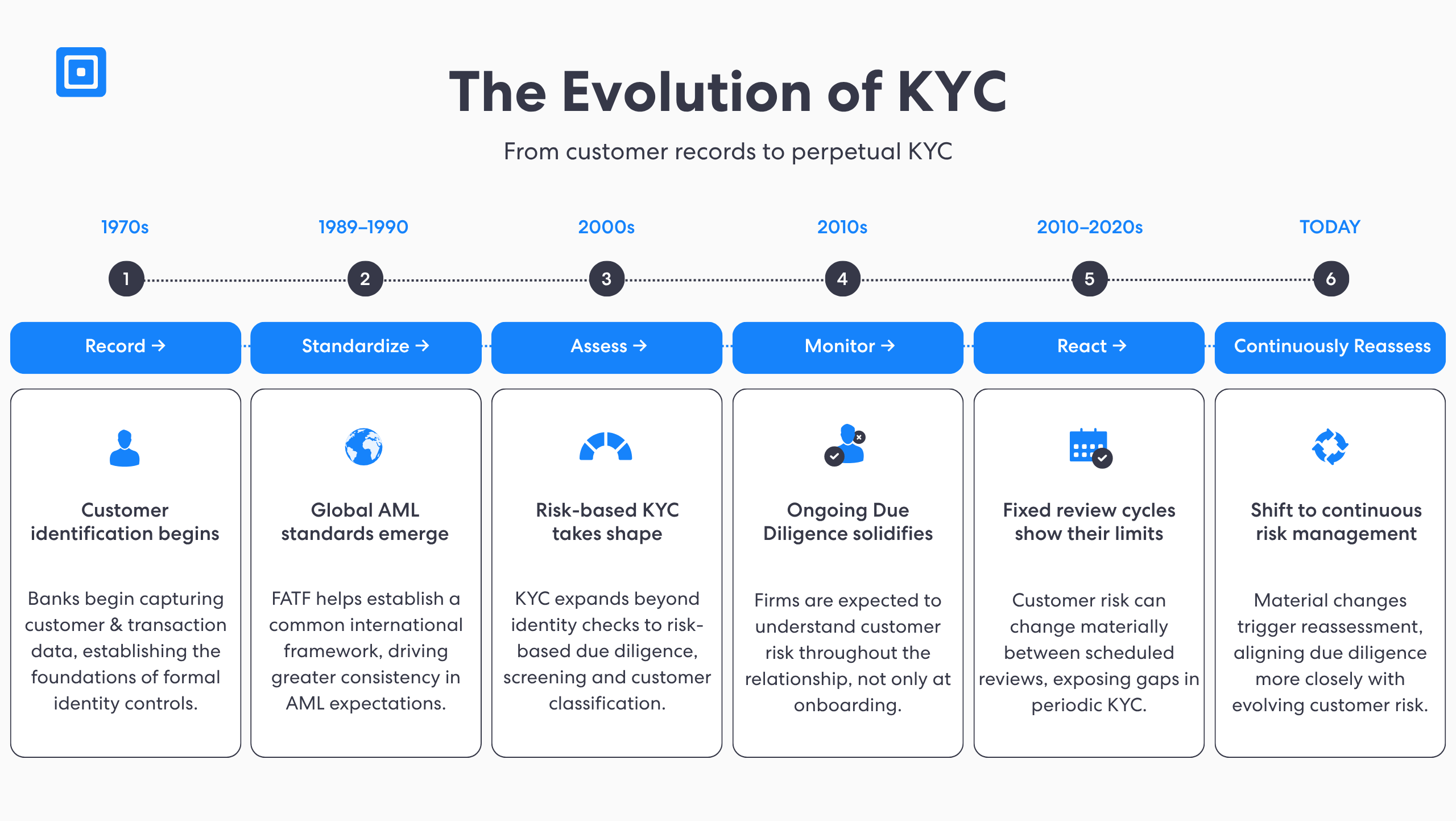
Thus, perpetual KYC closes the blind spot that exists in legacy systems. Since teams are notified of changes in real-time, they can detect and act on suspicious activity immediately. This makes pKYC important, particularly for regulated entities that face evolving regulations or heightened financial crime risk.
Perpetual KYC runs on Artificial Intelligence (AI) and machine learning models. These technologies connect data feeds from internal systems, company registries, and external data sources, such as PEP, sanctions, and adverse media databases. Additionally, it enhances regulatory compliance by improving detection of real, high-risk scenarios, dramatically reducing false positives and manual re-verification.
## The Shift from Periodic to Perpetual KYC
[Know Your Customer (KYC)](https://www.complycube.com/en/solutions/due-diligence-compliance/know-your-customer/) principles can be traced back to 1970, when it was introduced as a document collection exercise. Regulatory bodies implemented it for banks to track and record customers and transactions. In 1989, the Financial Action Task Force (FATF) solidified KYC compliance guidelines, with leading jurisdictions, such as the Bank of England, following suit.
This model held for nearly two decades. As transactions grew in volume and speed globally, it became clear that periodic KYC could not sustain large changes in customer risk. Large banks were grappling with thousands of customer files that had gone stale, and enforcement actions continued to multiply.
In the late 2010s, global financial institutions, together with regulators, pushed toward adopting ongoing customer due diligence. This marked the shift from fixed-interval KYC checks. Today, leading jurisdictions, including the [U.S. Bank Secrecy Act (BSA)](https://www.occ.gov/topics/supervision-and-examination/bsa/bsa-law-enforcement-tools-resources/index-bsa-law-enforcement-tools-and-resources.html), the [UK Financial Conduct Authority (FCA)](https://www.fca.org.uk/publications/good-and-poor-practice/operational-resilience-insights-observations-one-year), and the EU AML Regulation, explicitly mandate dynamic, real-time risk assessments.
In the same timeline, cloud infrastructure, API-driven data providers, and AI-based entity resolution support the technical feasibility of continuous monitoring. These changes drove the demand for pKYC solutions, shifting KYC regulatory requirements from a filing exercise to a risk management discipline.
## What pKYC Really Is and Isn’t
Perpetual KYC due diligence aligns with the risk-based approach to ongoing Customer Due Diligence (CDD). Using automation, customers are routed to further review, lightweight review, or full [Enhanced Due Diligence (EDD)](https://www.complycube.com/enhanced-due-diligence-requirements-guide/) flows based on predefined criteria set by companies themselves.
These criteria and triggers require human judgment to maintain well-governed data, explainable risk models, and documented trigger catalogs. So, we can say that the distinction between pKYC and legacy KYC is its event-driven logic.
### Perpetual KYC vs Traditional KYC
Traditional KYC is the one-off identity verification and risk assessment approach to customer due diligence. It relies on some form of periodic review and low ongoing monitoring effort, typically via manual processes. Perpetual KYC is an always-on process that goes beyond onboarding and reflects current risk changes, with low human intervention.
### Perpetual KYC vs Periodic KYC
Periodic KYC is a subset of traditional KYC and refers to the practice of reviewing customers at predefined intervals. Typically, these KYC refreshes occur every 1 to 5 years. In practice, a customer that onboards in 2023 will not face a review until the next scheduled cycle, which can be in 2026. Perpetual KYC detects changes and triggers a review at that point-in-time.
### Perpetual KYC vs Ongoing Monitoring
[Ongoing monitoring](https://www.complycube.com/what-is-an-ongoing-monitoring-process/) is a component of pKYC. It refers to the real-time screening of customers against sanctions, PEP, and adverse media lists. However, perpetual KYC goes further by monitoring all relevant sources for a variety of risk signals. This can include behavioral anomalies and changes in identity data that help firms promptly identify what warrants further review.
## What Triggers Perpetual KYC?
A perpetual KYC review is triggered when new information materially changes a customer’s identity, business relationship, or risk profile. It should not simply generate more compliance alerts. Instead, it needs to ensure that the level of due diligence applied to a customer continues to reflect their current risk, rather than the risk they carried when the relationship first began.
### Common pKYC risk indicators include:
- **Corporate or regulatory changes**: legal status shifts, new disclosure requirements, new [ultimate beneficial owners](https://www.complycube.com/what-is-ultimate-beneficial-ownership-ubo/) (UBOs)
- **Identity information changes:** name, address, expired documents, jurisdictions.
- **PEP, sanctions, and adverse media hits:** negative press on customer or related parties, new designations
- **Behavioral anomalies:** change in customer behavior such as unusually large volumes or multiple account openings
## Implementing Perpetual KYC Processes
Implementing pKYC does not involve just adding ongoing monitoring to an existing KYC process. In reality, many factors need to be considered during implementation. Businesses need to define which changes actually matter and what action must follow to meet compliance measures.
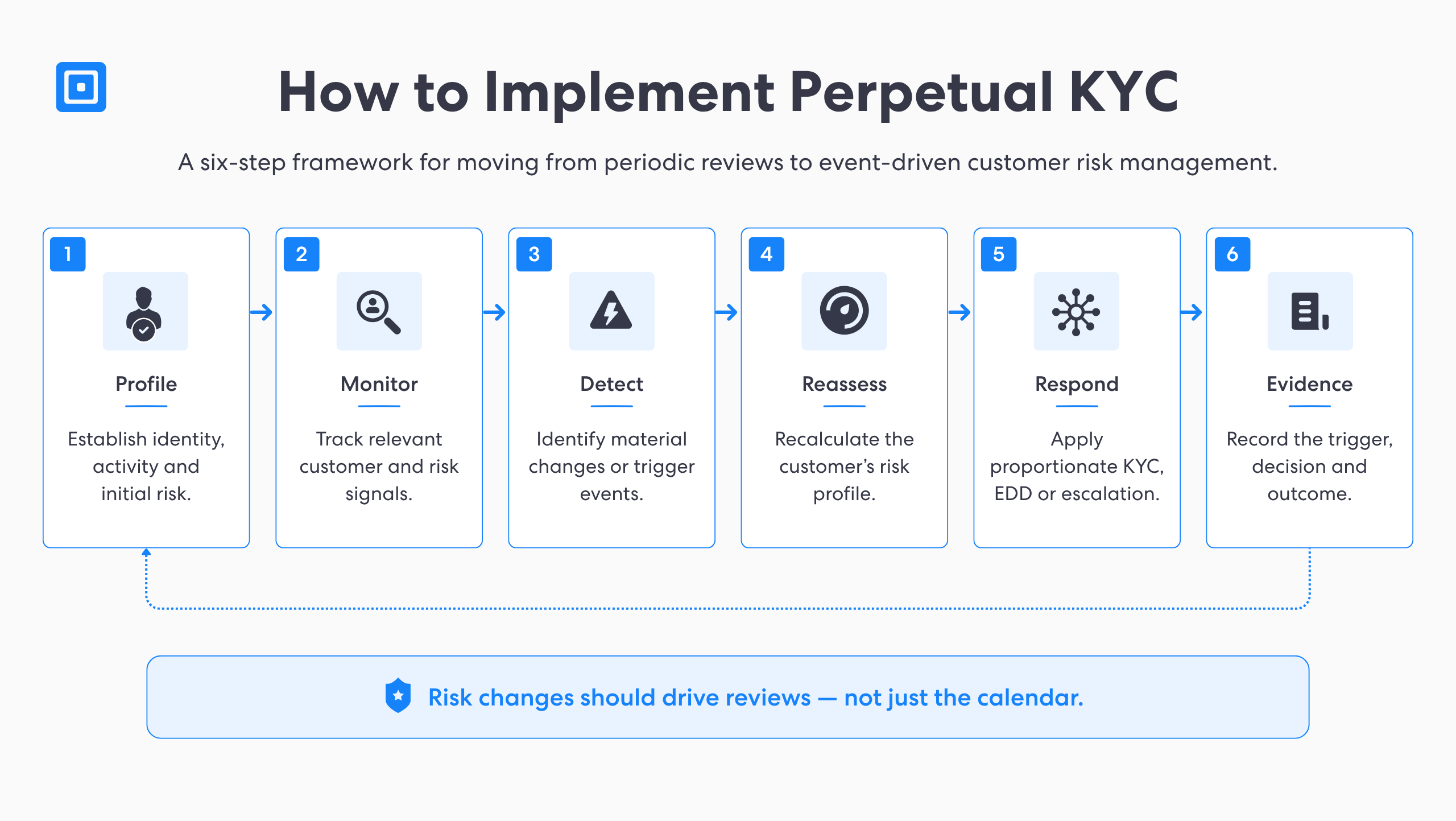
### In Summary, A Strong pKYC trigger framework includes:
- **What changed:** A material update to the customer’s risk profile is identified.
- **Why the change matters:** Does the update change the company’s exposure to financial crime risk or affect AML/KYC compliance?
- **Which customer-risk factors are affected:** Identify specific risk drivers, such as geographic, channel, and customer risks.
- **Whether the customer’s risk classification should change:** Determine if the customer’s risk rating should be reassessed, increased, or decreased.
- **What additional due diligence, if any, is required:** Depending on the new risk rating, determine the appropriate follow-up measures.
- **Who needs to review or approve the outcome:** Map out the appropriate level of compliance ownership for any changes or review.
- **How the decision is recorded:** All steps, from the trigger event to the necessary steps taken, must be fully documented to meet regulatory reporting obligations.
### **Case Study: Risky Customers After Successful Onboarding**
In 2026, Singapore and Malaysian authorities dismantled a cross-border money-laundering network. Operations detected multiple bank accounts opened under [different identity credentials](https://www.complycube.com/en/singapore-maribank-cracks-money-laundering-network/). 83 mobile phones and 45 bank security tokens were seized during a raid.
##### **Weakness of Point in Time KYC**
This case highlighted a critical compliance gap. In particular, it showed that an account holder can pass identity, biometric and AML checks at onboarding but later become involved in, or lose control of their account to a money-laundering network.
##### **Outcomes**
- Successful onboarding does not mean a customer remains low-risk forever.
- Ongoing behavioral and device signals can identify and alert firms when risk changes.
- pKYC supports continuous reassessment of customers, triggering verification where new risks emerge.
## Benefits and Challenges of Perpetual KYC Solutions
Perpetual KYC does not have to exist as a mere compliance obligation. Instead, it acts as a strategic lever for risk mitigation, operational efficiency, and customer retention. However, successful implementation requires overcoming some very common challenges.
### The Key Advantages of pKYC Include:
**1. Support KYC and improve AML compliance:** Perpetual KYC enhances ongoing due diligence, data security, and fraud prevention. It supports businesses in identifying, acting on, and reporting suspicious activity more rapidly, including account takeover and identity theft.
**2. Operational and cost impact:** Since pKYC is driven by automated systems and advanced analytics, it can significantly lower manual effort and cost. It uses smarter flows to reduce false positives and the time spent on low-risk customer KYC reviews.
**3. Customer experience and satisfaction:** pKYC cuts compliance noise by alerting companies to the risk changes that actually matter. It provides a remote, non-intrusive method of re-verification, boosting [customer satisfaction](https://www.complycube.com/critical-kyc-requirements-for-customer-loyalty/) and retention.
### The Key Challenges of pKYC Include:
**1. Legacy technology:** Adopting legacy systems with narrow automation or integration capability, including limited API feeds, can create fragmented processes. Additionally, relying on multiple third-party vendors can create data silos and inconsistent customer profiles.
**2. Data quality:** Incomplete or inconsistent records, especially during previous manual data collection processes, can create false triggers if not integrated robustly. Data gaps can also occur if a pKYC solution cannot support large customer bases.
**3. Privacy and governance:** Businesses operating across borders must ensure compliance with specific jurisdiction data protection laws. Since pKYC relates to continuous customer data monitoring, it can raise data privacy concerns and must thus involve legal review.
### Key Takeaways
- **Perpetual KYC** is an event-driven due diligence model that updates client risks in real-time.
- **Event-driven KYC** closes the gaps that traditional KYC leaves open between scheduled reviews.
- **pKYC uses AI** and machine learning to automate processes, lowering manual effort and cost.
- **Successful pKYC** implementation requires clear governance, event triggers, and documentation.
- **ComplyCube’s pKYC** solution lowers false positives while introducing long-term cost savings.
## Enhance Compliance with ComplyCube’s pKYC Solutions
When choosing KYC and AML providers, compliance teams are recommended to ask specific questions around perpetual KYC due diligence model validation, jurisdiction alignment, and how risk information flows between identity verification, monitoring, and case management.
Additionally, compliance and governance considerations, such as configurable risk rules aligned to internal risk appetite and local AML guidelines, as well as strong audit trails, are crucial for regulatory alignment. [ComplyCube’s KYC solutions](https://www.complycube.com/en/contact/contact-sales/) address the core dimensions:
- **Enhanced security:** Aligned with global industry standards for data protection and security, including [GDPR and NIST compliance](https://www.complycube.com/en/company/security-compliance-center/), as well as being ISO 27001 certified.
- **Coverage**: Provides end-to-end compliant and customizable KYC solutions, tailored to businesses of all sizes and over 250+ territories.
- **Integration depth**: Offers full SDK and API feeds to core CRM, sanctions lists, registries, and case management tools, enabling seamless integration with current infrastructure.
- **Intelligence**: AI- and machine learning-powered risk scoring, anomaly detection, and entity resolution with clear audit trails ready for regulators.
[](https://portal.complycube.com/signup)
## Frequently Asked Questions
Which companies require perpetual KYC?
Regulated institutions exposed to stringent KYC regulations and high financial crime risks typically require continuous KYC solutions. Examples include banks, fintechs, and crypto firms that regularly face fast-changing customer profiles or cross-jurisdiction exposure.
How does perpetual KYC support AML compliance?
Perpetual KYC enables compliance teams to identify and review genuine, high-risk scenarios faster and more accurately. As such, it strengthens fraud prevention and aligns with regulatory ongoing customer due diligence obligations.
Does perpetual KYC reduce compliance costs?
Yes, perpetual KYC uses automated systems to identify risk changes, update customer information, and route customers to the next re-verification step without human intervention. It reduces human error, manual steps, and false positives, introducing cost savings.
Is perpetual KYC and AML ongoing monitoring different?
Yes, typically AML ongoing monitoring involves continuous customer screening against PEP, sanctions, and adverse media databases. Perpetual KYC models capture risk signals that fall outside this scope, including behavioral and transactional anomalies.
Does ComplyCube offer pKYC solutions?
Yes. ComplyCube combines continuous AML screening with dynamic risk scoring, trigger‑based workflows and central case management. This lets firms move from fixed periodic reviews to event‑driven, always‑on KYC while keeping a full audit trail of checks and decisions.
**Categories:** Guides
**Tags:** Know Your Customer
---
### [Crypto Source of Funds Under Scrutiny after $100M WLFI Investment](https://www.complycube.com/wlfi-100m-crypto-source-of-funds/)
**Published:** August 10, 2026
**Author:** Rithu Jagannath
**Excerpt:** The $100M WLFI investment puts crypto source-of-funds checks under scrutiny, highlighting why blockchain analytics alone cannot reveal who controls funds, or the wider financial crime risk.
**Content:**
World Liberty Financial, the Trump family-linked crypto venture, is facing renewed scrutiny over a $100 million WLFI investment. This case puts crypto source of funds back into focus, bringing wider questions about source of funds checks necessary for high-value digital asset transactions.
In June 2025, [UAE-based crypto fund](https://www.reuters.com/business/finance/uae-fund-buys-100-million-trumps-world-liberty-tokens-2025-06-27/), Aqua 1, purchased $100 million worth of World Liberty Financial governance tokens. This deal positioned Aqua 1 as a major WLFI investor and came as World Liberty Financial was preparing to expand the role of its governance tokens.
Recent reports from August 2026 have linked Guren “Bobby” Zhou, the businessman behind Aqua 1 associated with the WLFI investment, to an active money-laundering investigation in the UK. Zhou has not been charged with a criminal offense. This story raises an enduring question for the wider crypto market. How much can firms really understand about the money behind a crypto transaction from blockchain activity alone?
## Why the $100M WLFI Deal is Back in the Spotlight
Zhou was reportedly arrested in Britain in 2021 and remains under investigation for suspected money laundering. He has not been charged with a criminal offence. The renewed attention is significant because of World Liberty Financial’s association with President Donald Trump and his family. President Trump’s 2026 financial disclosures also showed substantial crypto-related income linked to World Liberty Financial, while previous reporting has detailed the Trump family’s economic interest in the venture.

Political connections can place large foreign investments under significant public scrutiny. From a compliance perspective, crypto firms need to understand more than the transaction itself: they need to know the people and entities involved, who ultimately controls them, and where the capital originated.
## What BlockChain Data Can Tell You About Crypto Source of Funds
Public blockchains can reveal where digital assets moved, which addresses were involved, and if funds have interacted with known high-risk wallets or services. That level of transparency is incredibly important for crypto transaction monitoring. However, it cannot necessarily establish:
- Who owns or controls an investment vehicle
- How an investor gained the capital being deployed in a transaction
- Whether the transaction is consistent with their expected financial profile
- If corporate structures hide details around ultimate beneficial ownership
- If off-chain intelligence has changed the customer’s risk profile
This is how crypto source of funds checks become critical in breaking down money laundering suspicions. Knowing that $100 million moved from one wallet to another is not the same as learning how those funds showed up in the first place.
## Knowing the Wallet is Not The Same As Knowing the Customer
In the past, crypto compliance has placed huge value on wallet screening and transaction analysis. These controls are essential as they can help firms find sanctioned addresses, any exposure to illicit services, unusual transaction patterns, and other block-chain based risk signals. However, [wallet intelligence](https://www.jmlsg.org.uk/wp-content/uploads/2023/03/JMLSG-Part-II_Sector-22_March-2023.pdf) only answers part of the equation.
Thorough customer due diligence requires firms to understand the individual or organization behind the wallet. This incorporates Know Your Customer (KYC), Know Your Business (KYB), and beneficial ownership checks. Firms can also look at sanctions and PEP screening, adverse media, and enhanced due diligence where risk requires it.
Crypto firms need to understand who the customer is, who controls the entity, and where the money came from. Is the transaction consistent with their profile? Has anything changed since onboarding? As crypto firms handle increasingly large institutional and cross-border transactions, answering these questions together is becoming more important.
## Crypto Source of Funds vs. Source of Wealth
There are some key differences between determining the [source of funds versus the source of wealth](https://handbook.fca.org.uk/handbook/fcgannex) in crypto. Source of funds refers to the origin of the money being used for a particular transaction, where source of wealth takes on a much broader view. This looks to establish how an individual gained their wealth over time.
This distinction is important because blockchain analytics may establish the immediate transactional history of an asset without answering either question thoroughly. For example, a crypto asset may have moved through several wallets before reaching an investment platform. Though the trail can be valuable, it does not explain the underlying economic activity. As a result, crypto source of funds assessments need firms to connect on-chain activity with off-chain identity, business, and financial information.
## From Wallet Risk to Financial Crime Risk
The lesson from the World Liberty Financial story is that wallet analytics are not enough on their own. [Crypto compliance](https://www.complycube.com/en/crypto-aml-compliance-securing-the-sector/) in 2026 increasingly requires firms to link transactions with the economic actors behind them. It means bringing together identity verification, business verification, and more with source of funds. For compliance platforms such as ComplyCube, this reflects a broader shift towards treating KYC and AML as part of a continuous customer lifecycle rather than a single checkpoint at onboarding.
The objective is to assess if the wallet, customer, ownership structure, and the crypto source of funds all make sense together. As digital assets become more deeply integrated into institutional and cross-border finance, that distinction is likely to be more important. Blockchain transparency can show where assets move, but effective financial crime controls help firms understand who is moving them and where the money ultimately comes from.
[](https://portal.complycube.com/signup)
Find out more Crypto news in ComplyCube’s [CryptoCubed](https://www.complycube.com/en/cryptocubed-july-dunamu-sanctions-and-u-s-crypto-scam/) newsletter. We explore the latest in developments across identity verification and AML globally.
**Categories:** News
**Tags:** Crypto Regulations
---
### [What Changed in the 2026 Right to Work Legislation?](https://www.complycube.com/what-changed-in-the-2026-right-to-work-legislation/)
**Published:** August 7, 2026
**Author:** Rithu Jagannath
**Excerpt:** The right to work legislation changes on 1 October 2026 will reshape UK workforce compliance for various employers. Explore new rules, expanded duties, digital verification requirements and what organisations should do to prepare.
**Content:**
**TL;DR:** On 1 October 2026, the new **right to work legislation** comes into force. This is one of the **biggest changes in workforce** compliance in the UK in recent years. This article shows what changes with the 2026 right to work legislation, why the reforms matter, and how employers, contractors, and digital identity providers should prepare for **UK right to work changes**.
## The Biggest UK Right to Work Legislation Reform in Years
Most coverage of the reforms has focused on the importance of expanded right to work checks, tougher civil penalties, or the inclusion of more working arrangements. However, this is only part of the bigger picture. The biggest change is how organisations are expected to demonstrate compliance.
The reforms place greater emphasis on evidencing compliance through stronger record-keeping, greater accountability, and the use of trusted digital identity verification when carrying out checks. As a result, many employers are revisiting long-established hiring processes rather than making a few administrative tweaks.
Additionally, the consequences of getting this wrong have also grown. Home Office enforcement is focused on demonstrating whether organisations followed the correct verification process rather than simply whether documents were collected. Employers that knowingly employ someone without the right to work may also face criminal sanctions, temporary business closure notices, or the loss of their sponsor licence under certain circumstances. These risks apply to large organisations and basically any business of every size that is looking to recruit or engage workers in the UK.
## What is Right to Work Legislation in the UK?
Although the phrase “right to work” has different meanings in different countries, in the UK it refers to immigration compliance and an employer’s legal duty to verify that an individual has permission to work. The number one goal of the UK’s right to work legislation is to stop illegal working. This legislation requires employers to verify that every individual has the legal right to work before their employment period starts. You can learn more here: [Employer’s Guide to Proof of Right to Work in UK with Certified IDSPs](https://www.complycube.com/en/proof-of-right-to-work-in-uk-with-idsp/)
The basis of the current UK government framework stems from Asylum and Immigration Act 1996, the subsequent amendments in the Immigration, Asylum and Nationality Act 2006 as well as the Immigration Act 2014. Together, these Acts and the latest Home Office guidance form the foundation of the UK’s right to work regime.
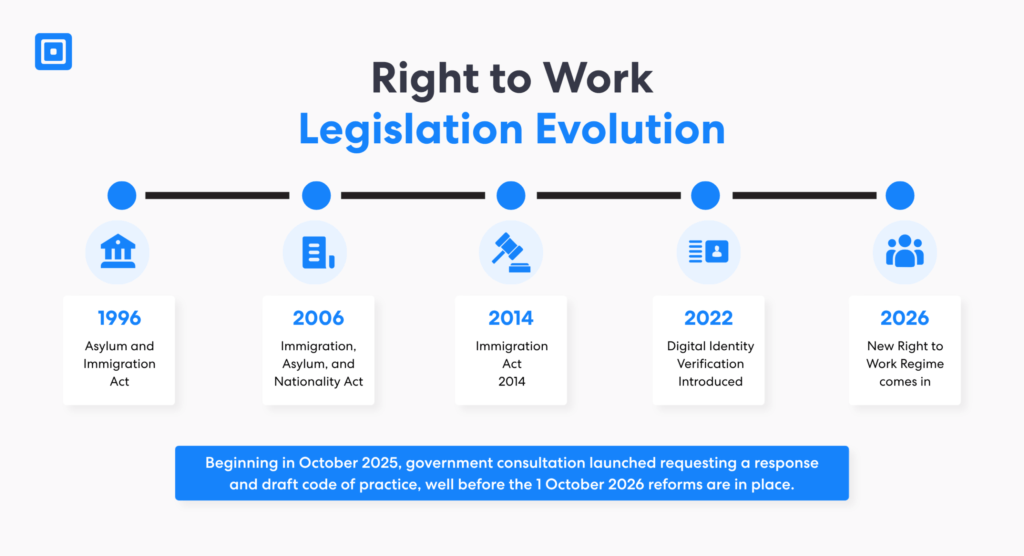
The legislation gives employers a thorough legal defence, also known as a statutory excuse. This protects employers from civil penalty liabilities if they carry out compliant right to work checks before employment begins They also must retain evidence for the necessary period. Without that statutory excuse, employers may become liable if an individual is later found to have been working illegally. Right now, there are three recognised ways to complete right to work checks:
- Employers can conduct online Home Office checks for eligible individuals such as non-British nationals.
- A digital identity verification route using an approved Identity Service Provider (IDSP).
- Manual checks using acceptable documents where digital or online routes are not available.
Although these routes already exist, the UK right to work changes taking effect will significantly expand the scope of the rules and who they apply to.
## Why Is The Government Updating Right to Work Legislation?
Many organisations no longer rely solely on traditional employment relationships. Moreover, with flexible hiring, agency work, outsourcing and digital labour platforms, the UK’s labour market is dramatically changing. Employers now engage workers through complex contractual arrangements, outsourced teams, and labour supply chains. This creates new challenges in identifying a person’s immigration status and maintaining consistent work compliance with right to work.
The Home Office [recently published figures](https://www.gov.uk/government/publications/returns-from-the-uk-and-illegal-working-activity-since-july-2024/illegal-working-and-enforcement-activity-to-the-end-of-december-2025-by-illegal-working-sector) showing more than 17,483 visits, and made more than 12,322 arrests between July 2024 and December 2025. This helps explain why the UK government is extending this regime now. The UK government believes existing legislation is not a reflection of how people actually deliver services today.
> These changes close gaps in the current framework.
[Alex Norris MP](https://www.ein.org.uk/news/government-announces-new-right-work-and-right-rent-rules-october-2026), The Minister for Border Security and Asylum went on to say that the 2026 right to work legislation updates, “…ensure that responsibility of illegal working sits appropriately across modern labour market structures.” The updated rules give enforcement agencies more visibility into a broader range of working arrangements.
The UK Home Office consulted employers and other stakeholders around how the scheme should extend into gig work and other working arrangements. This also supports wider government priorities around border security, reducing illegal working, tackling exploitation, and strengthening confidence in digital identity services.
## What Actually Changes in Right to Work Legislation on 1 October 2026?
Some of the new UK right to work changes in October 2026 focus on expanding the scope of those who need proof of a right to work. Other updates aim to strengthen compliance enforcement or further modernise digital verification journeys as part of the right to work process.
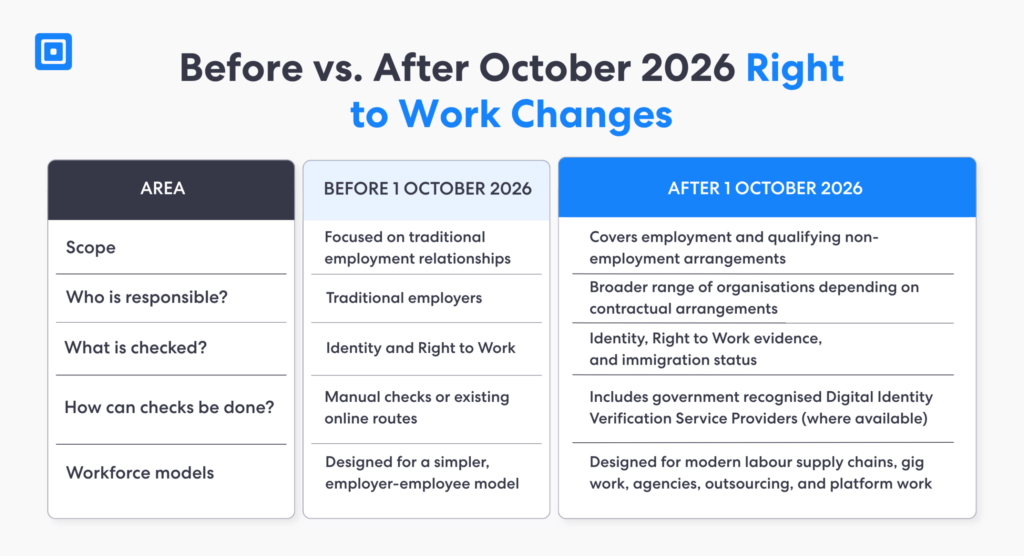
However, when looking at these UK right to work changes together, it seriously points towards a huge shift. The Home Office guidance is looking for organizations to move away from basic document checking to evidence-based workforce compliance.
## The Scope of the Right to Work Legislation Are Expanding
One of the most significant reforms is the expansion of who falls within the right to work regime. In the past, organisations often linked compliance with the recruitment of employees. However from October onwards, certain non-employment working arrangements are now subject to right to work legislation where there is a direct contractual relationship.
Contractors, subcontractors, and specialist service providers play a more crucial role in the delivery of business operations. The government’s intention is to ensure compliance keeps up with those changing workforce models instead of allowing responsibility to disappear through more layered contractual structures.
## Enforcement Is Becoming More Aggressive About Non-Compliance
With the new rules, if employers fail to conduct compliant right to work checks, they can face civil penalties of up to £60,000 per illegal worker. This is potentially alongside criminal sanctions where illegal working is carried out knowingly. Businesses may also risk losing sponsor licenses or facing temporary closure notices in serious cases.
Those penalties are intended to encourage organisations to treat workforce verification as an ongoing governance issue rather than a one-time onboarding task. But interestingly, stronger penalties are not the bigger story. The most important point is how the UK government expects organisations to prove that they have in fact, done the right thing.
## Why Digital Verification Suddenly Matters
As more recruitment takes place remotely, employers need reliable ways to verify identity before employment begins. Yet, at the same time, organisations are expected to complete [compliant right to work checks](https://www.complycube.com/en/use-cases/process/certified-digital-right-to-work-checks/) before employment starts, while maintaining evidence. Employers establish a statutory excuse by carrying out compliant checks before employment begins and retaining evidence that can be relied upon if challenged later.
Manual checks remain an important verification route where digital or online checks are not available. This is particularly important where digital or online routes are available. With hiring moving more online, the UK government has recognised that digital identity verification must also meet a consistent trusted standard. However, who decides if a digital identity check is trustworthy?
## Why Trusted Digital Verification Matters
To support secure digital identity verification, the UK government has established the [UK Digital Identity and Attributes Trust Framework (UK DIATF)](https://www.ukas.com/accreditation/about/developing-new-programmes/development-programmes/uk-digital-identity-and-attributes-trust-framework/). Providers assessed against this framework can offer compliant digital right to work checks for eligible individuals. For eligible British and Irish citizens, employers can use a Digital Verification Service Provider (DVSP) to complete digital UK right to work checks. This route is only available where the provider has been assessed against the UK government’s trust framework and is authorised to perform these checks.
However, this is an important distinction. Purchasing identity verification software alone is not enough. The whole digital verification process must line up with the standards that are set out by the UK government to support compliance. Keeping up with regulatory standards is a necessary part of an organisation’s full compliance strategy.
## Government Registration Is Now a Legal Requirement
Employers using digital verification should confirm that their provider is authorised to perform compliant right to work checks under the UK government’s framework. In order to perform UK digital right to work checks under the government framework according to updated guidance, a service provider must be recognised under the [UK DIATF](https://www.complycube.com/en/company/security-compliance-center/uk-diatf-certified-idsp/). Government recognition provides employers with greater assurance that a provider meets the required standards for identity proofing, fraud detection, governance, and record keeping.
The framework is intended to create [greater consistency](https://www.foxwilliams.com/2026/08/04/right-to-work-checks-are-changing-is-your-extended-workforce-ready/) across employers, labour supply chains, and digital identity providers. When employers use an authorised provider and follow the prescribed process for initial checks, the resulting evidence can help establish a statutory excuse.
When evaluating an identity verification provider, organisations should consider compliance capabilities alongside implementation, user experience, scalability, and ongoing support. However, the reforms introduce another important consideration. Now, they must also check whether their provider supports compliance with the latest Home Office guidance.
## Why Certified Identity Profiles Matter for Right to Work Legislation
Typically, government recognition confirms that an identity verification provider has met the required baseline needs. However, organisations need to consider how many certified identity profiles that provider can support. A certified identity profile is a structured combination of identity checks and evidence scores under UK government guidelines. This provides a specific level of identity assurance.
Different organisations or even different worker journeys need different profiles depending on the verification scenario. Most providers often support a small number of certified profiles which might be suitable for some and not others. An IDSP with a much wider range of profile coverage gives employers much greater flexibility to provide consistent digital onboarding. This covers different worker populations without switching verification methods for follow-up checks or repeat checks.
### **Case Study: Recent Home Office Enforcement Statistics**
Recent Home Office [enforcement data](https://www.bbc.co.uk/news/articles/ce3qzd9932do) illustrates the scale of ongoing compliance activity. From the period of 1 October to 31 December 2025, Home Office enforcement powers recorded 525 civil penalties and identified 620 illegal workers without either pre-settled status or settled status through the EU settlement scheme. As a result, they issued penalties with a combined value of £26.47 million.
##### **Stronger legislation backed by stronger enforcement and civil penalties**
Under the new UK right to work changes, employers need to complete compliant checks around working status before employment begins. Organisations are also required to retain records including physical documents for at least two years after employment ends. This helps build a valid statutory excuse through the prescribed work procedures for new and existing contracts.
##### **Outcomes**
- 525 civil penalties issued by the Home Office in one quarter.
- 620 illegal workers identified during enforcement activity.
- £26.47 million in gross civil penalties, illustrating the financial impact of non-compliance.
## Preparing for The New Rules Enforcement on 1 October 2026
As the rules apply, the reforms go beyond updating a policy or revising an onboarding checklist. Enforcement actions depend truly on whether the check was completed using the correct process, with the correct evidence, and recognised verification methods.
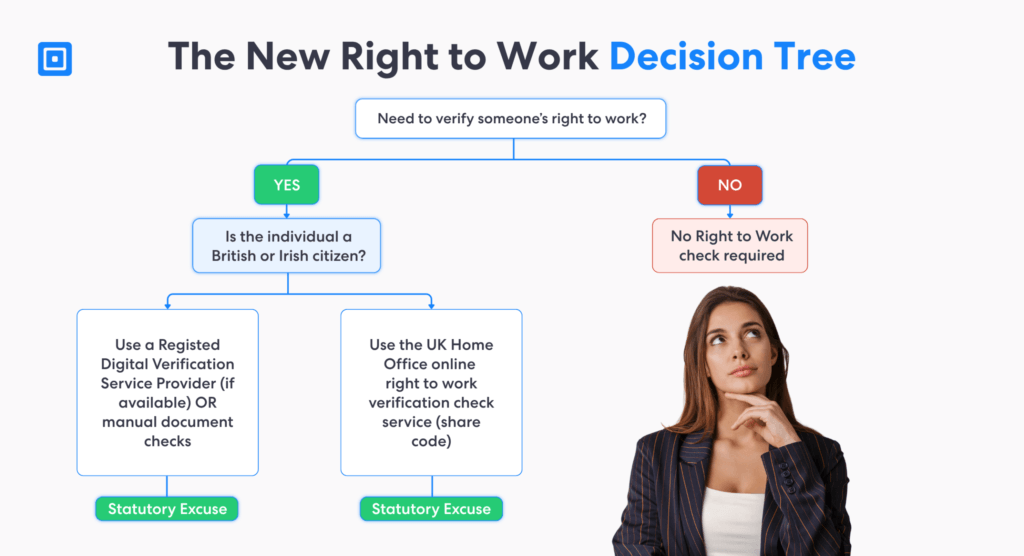
For many employers, the 2026 right to work legislation creates an opportunity. Companies and organisations have the chance to modernise their verification processes. This makes those work schemes better positioned to change and grow as regulations evolve rather than amending every time new guidance is published. There are five steps to take to prepare for the October 2026 right to work reforms:
### 1. Review your workforce, not just your employees.
Map every individual carrying or providing services to your organisations. According to employment law, this includes contractors, consultants, agency workers, and outsourced teams with worker’s contracts. This updated right to work legislation addresses a broader range of working arrangements. Understanding the workforce model is the right first step towards understanding your obligations.
### 2. Revisit your verification procedures.
Confirm when manual checks, Home Office online checks, and digital verification should be used. Each verification route has its own requirements. This includes share codes, expiry dates, etc. As a result, applying the wrong process can completely undermine your statutory excuse.
### 3. Strengthen your record-keeping.
It is important for an online matching service or employer checking service to carry out compliant right to work checks. Employers should retain verification records in accordance with Home Office guidance. This includes the evidence of how the check was completed and whether it took place within the grace period.
### 4. Evaluate your identity service provider.
If digital identity verification forms part of the onboarding process your online matching service provides, it is important to ensure that your provider is authorised for compliant digital right to work checks in the UK. This can support verification journeys as needed in the future that your organisation requires.
### 5. Prepare for future change.
These UK right to work changes are unlikely to be the final iteration of the country’s digital identity landscape. Building flexible verification processes today will make any future legislation changes or modifications much easier to accommodate for organisations everywhere.
### Choosing the Right Digital Verification Service Provider
It is important to choose the right IDSP for digital verification as it becomes more linked to compliance strategies. It requires more than comparing basic features or overall implementation times. Employers should assess if an IDSP supports any long-term goals or objectives for the organisation. They should also consider the overall direction of UK right to work changes. Ask some important questions to determine if a provider is right for you:
- Is the provider authorised to support digital Right to Work checks as recognised by the government?
- How many certified identity profiles do they support in their verifications?
- Can they provide evidence for supporting a statutory excuse?
- How quickly do they adapt to or implement changes according to Home Office guidance updates?
- Can they support future needs or requirements without huge disruption to services?
These types of assessment questions help move the conversation beyond technology and towards a more resilient compliance strategy. This is an increasingly important consideration as UK right to work legislation requirements continue to evolve over time.
### Key Takeaways
- **The 2026 reforms** expand Right to Work obligations beyond traditional employment.
- **Digital identity verification** is now a core part of modern workforce compliance.
- **Government-recognized IDSPs** play a crucial part in compliant digital checks.
- **Certified identity profiles** can directly affect how organisations onboard different worker types.
- **Preparing helps employers** build verification processes that remain resilient as regulation evolves.
## How ComplyCube Supports The New Right to Work Landscape
As workforce verification continues shifting towards trusted digital identity, choosing the right provider becomes a long-term compliance investment rather than a short-term implementation. ComplyCube is a government registered DVSP. They are authorised to support compliant digital right to work checks under the UK DIATF. Moreover, they support 23 certified identity profiles, one of the broadest certified profile portfolios available in today’s market.
So whether your organisation is reviewing existing onboarding processes or preparing for the upcoming UK right to work changes, our team can help you build a verification strategy that is ready for what’s next. Learn how ComplyCube can [help prepare](https://www.complycube.com/en/contact/contact-sales/) for right to work legislation changes in October 2026.
[](https://portal.complycube.com/signup)
## Frequently Asked Questions
Do the October 2026 right to work legislation changes apply only to employers?
No. October 2026 right to work legislation changes include certain qualifying non-employment working arrangements. Whether the legislation applies depends on the nature of the contractual relationship and if there is relevant Home Office guidance.
Can employers still carry out manual Right to Work checks?
Yes. Manual checks often remain a valid verification route where appropriate. Employers need to ensure they review and retain the correct physical documents in accordance with Home Office guidance. They may also require a manual check to be reviewed and recorded to establish a statutory excuse.
What is a Digital Verification Service Provider?
A Digital Verification Service Provider also known as DVSP is an organisation that is authorised to perform compliant digital identity verification for eligible Right to Work checks. This is updated terminology that replaces Identity Service Provider (IDSP) under the UK DIATF.
Why do certified identity profiles matter?
Certified identity profiles define how identity is verified and the level of confidence that can be achieved with acceptable proof. Maintaining a much wider or broader range of certified identity profiles can create room for more verification scenarios while keeping up with UK government standards.
Why does ComplyCube support 23 certified identity profiles?
ComplyCube has invested in supporting on the UK’s broadest portfolio of certified identity profiles because organisations rarely have the same verification requirements. These profiles help employers take reasonable steps to deliver more consistent, compliant, and scalable journeys.
**Categories:** Guides
**Tags:** Identity Verification
---
### [Best AML Software in 2025: What to Look for in a Compliant Solution](https://www.complycube.com/best-aml-software-in-2025-comparison-and-insights/)
**Published:** July 30, 2025
**Author:** Dini Habib
**Excerpt:** With the removal of travel bans post-COVID-19, financial crimes have increased, with criminals using smarter, deceptive tactics. Selecting the right AML software can safeguard your business from these high-risk criminal activities.
**Content:**
**TL;DR:** Choosing the **best AML software** in 2025 involves looking beyond basic checks to compare how each solution supports monitoring, screening, automation, and broader compliance needs. This **AML platform comparison** looks at the most important **features of AML tools**, including ongoing monitoring, sanctions and watchlist screening, and integrated KYC and IDV.
Bad actors and fraudsters increasingly use sophisticated, smarter tactics to commit money laundering. Last year in particular, nearly 421,000 fraud cases were recorded in the UK alone, marking a 13% increase from the previous year. Therefore, selecting a compliant Anti-Money Laundering (AML) solution is vital to protecting businesses, adhering to regulations, and safeguarding the integrity of financial systems. Ultimately, this guide will break down the critical features of AML tools to look for. It also offers a robust AML platform comparison, and highlights what firms need to consider when choosing the best AML software in 2025.
## How AML Software Has Evolved
Modern market-leading AML software solutions are widely automated. It is built to assist financial institutions in meeting strict AML regulations, detecting and preventing financial crimes, and managing risk efficiently. Today, AML technology is fundamentally different from traditional AML in many key aspects. As a result, it makes financial crime detection and prevention more efficient:

On the other hand, modern compliance platforms support businesses in monitoring transactions, conducting detailed risk assessments, and screening for activities connected to money laundering. Additionally, most AML software today leverages advanced analytics through AI and machine learning to analyze transactional data and assign customer risk scores. Businesses benefit from a faster, more reliable compliance process.
## The Importance of Advanced AML Software in 2025
- **Increasing Regulatory Scrutiny:** The increase in financial crimes has led to higher standards and laws from regulatory bodies. More specifically, financial institutions must meet escalating, stringent regulatory compliance requirements and global AML compliance standards.
- **Advanced Technology and the Rise of Criminals:** As technologybecomes smarter, criminals leverage more complex money laundering techniques to bypass AML software. Therefore, without the right Anti-Money Laundering software, detecting potential risks is tough.
- **Uptick in Real-Time Monitoring:** Compliance officers use [real-time monitoring capabilities](https://www.complycube.com/en/solutions/global-screening/continuous-monitoring/) to meet regulatory requirements and prevent money laundering. Unusual and suspicious transactions can be flagged early, facilitating a quick response to combat money laundering.
- **Integration of AI and Machine Learning:** Artificial Intelligence (AI) and Machine Learning (ML) are commonplace for operational efficiency and accurate risk assessments. For this reason, businesses that fail to leverage these technologies will fall behind in preventing financial crime effectively.
[](https://www.complycube.com/en/ai-driven-fraud-deepfakes-versus-ekyc-solutions/)
## Core Features of AML Tools in 2025
Ultimately, AML vendors are continuously adopting the latest technologies to enhance the accuracy and efficiency of detecting and mitigating money laundering risk. This is especially important at the earliest stage of onboarding a new customer. For example, the National Crime Agency has estimated that [over £100 billion](https://www.nationalcrimeagency.gov.uk/news/director-general-graeme-biggar-launches-national-strategic-assessment) is laundered annually in the UK, with up to £5 billion moving via cryptocurrency channels. Consequently, this has led to the integration of smarter AML intelligence tools to get ahead of these increasing threats.

So, against this backdrop of escalating financial crime, the demand for advanced AML solutions has never been greater. For example, in 2025, the key features commonly sought in AML tools include real-time monitoring, comprehensive sanctions and watchlist screening, integrated Identity Verification (IDV) and [Know Your Customer (KYC) processes](https://www.complycube.com/en/solutions/due-diligence-compliance/know-your-customer/), and automated compliance workflows. Discover more about the benefits of each feature below:
### Ongoing Monitoring Capabilities
Notably, the best AML software solutions include ongoing monitoring abilities. Typically, these systems monitor against AML watchlists, sanctions, and adverse media news sources. Financial institutions can identify and resolve suspicious activity immediately, adopting a proactive risk management approach.
**The Key Benefits Include:**
- Immediate detection of customers or entities added to sanctions list or watchlist worldwide.
- Receive automated alerts when there are changes in risk profiles to enable proactive fraud prevention.
- Higher detection accuracy of current and emerging risks through AI and ML usage.
### Comprehensive Sanctions and Watchlist Screening
Robust [sanctions](https://www.complycube.com/en/solutions/global-screening/sanctions-pep-screening/) and [watchlist screening](https://www.complycube.com/en/solutions/global-screening/watchlist-screening/) are vital features in advanced AML compliance software. Subsequently, they enable financial institutions to oversee and prevent sanctioned entities and terrorists from evading their AML controls. Businesses can check customers against global sanctions lists, perform Politically Exposed Persons (PEPs) and adverse media screening, ensuring efficiency in risk mitigation.
**The Key Benefits Include:**
- Screening Politically Exposed Persons (PEPs) and [adverse media checks](https://www.complycube.com/en/solutions/global-screening/adverse-media-checks/) will help gather customer data and build robust risk profiles.
- Continuous updates against reliable global sanctions and watchlist databases ensure AML compliance with evolving regulations.
- Mitigates risk and reduces false positives.
[](https://www.complycube.com/en/what-is-a-pep/)
### Integrated Identity Verification and KYC Capabilities
Many modern AML compliance platforms today integrate IDV and KYC with their AML screening solutions. Compliance professionals can identify suspicious patterns from the very beginning, using checks such as [document verification](https://www.complycube.com/en/solutions/identity-assurance/document-verification/), device intelligence to identify fraud signals, and biometric authentication.
**The Key Benefits Include:**
- Enhanced security and fraud prevention with Biometric & Liveness checks certified to PAD Level 2.
- Seamless onboarding processes with automated identity and document verification.
- Minimization of manual errors and data input repetition by digitizing customer data.
### Automated Compliance Workflows
Effective AML software vendors must offer financial institutions the ability to tailor and automate workflows in alignment with industry regulations and the company’s risk appetite. These AML systems utilize dynamic rules and automated alerts to reduce manual workload and streamline regulatory obligations.
**The Key Benefits Include:**
- Reduced ‘noise’ and increased focus on high-risk cases, resulting from minimized false positives.
- Automated alerts and case management for efficient resolution.
- Access to audit trails and regulatory reporting, ensuring swift responses to AML regulatory requests.
#### **Case Study: Barclays 2025 AML Issues Demonstrating the Importance of AML**
In July 2025, the UK Financial Conduct Authority fined Barclays £42 million for poor handling of financial crime risks across two cases. In one of them, the FCA said Barclays failed to adequately manage money laundering risks linked to services provided to Stunt & Co, including not gathering enough information at onboarding and not carrying out proper ongoing monitoring.
##### **Rapid Review Across the Crypto Ecosystem**
As a result, businesses need stronger AML controls built around continuous monitoring, better customer due diligence, and more consistent risk management. Firms need AML tools that support screening, ongoing monitoring, case handling, and clearer audit trails at scale. This aligns closely with what matters in any AML platform comparison and the core features of AML tools highlighted in this guide.
##### **Outcomes**
- Barclays was fined £42 million by the FCA in July 2025 for poor handling of financial crime risks.
- The FCA found failures in onboarding checks and monitoring linked to money laundering risk exposure.
- The best AML software should focus on monitoring, risk management, and scalable workflows.
## Choosing the Best AML Software: Criteria Checklist
Overall, choosing the right AML platform can be the difference between sustainable growth, profitability and compliance or fines, reputational damage, and at worst, insolvency. So, how can financial institutions and other companies choose the best AML software when there are so many to choose from?
> According to [Grand View Research](https://www.grandviewresearch.com/industry-analysis/anti-money-laundering-market), the international Anti-Money Laundering (AML) software market is expected to grow at a compound annual growth rate (CAGR) of 16.2% between 2024 and 2030.
Therefore, we outline the top five key factors for AML platform comparison that businesses must consider, along with essential questions to ask AML vendors to guide the decision-making process:

### Scalability of the Best AML Software Solutions
Financial institutions need the right AML software to expand and scale as they grow to boost long-term compliance efforts. Certain AML compliance vendors have limits on the number of watchlists or territories they cover, forcing firms to switch providers down the road.
**Key Questions:**
- Is the platform built on cloud-based infrastructure to ensure seamless scaling without performance issues?
- Can the Anti-Money Laundering software handle growing transaction volumes and user bases?
- Does the AML software support a wide range of countries and watchlists that may be of business interest in the future?
### Integration Capabilities
Ensuring strong integration capabilities from AML software helps financial institutions minimize disruptions and manual work. With the right integrations, businesses can build robust compliance and effective risk management processes.
**Key Questions:**
- Is it compatible with existing systems, including CRM and payment processing tools?
- Does it offer APIs for easy integration with other compliance and risk management solutions?
- Can the software support cross-channel data sharing and unified workflows across different departments?
### Accuracy and Transparency with the Best AML Software
Businesses in regulated industries, such as financial institutions and banks, are increasingly required to use explainable Artificial Intelligence (AI) models. Additionally, providing detailed auditing and regulatory reporting is key. It is crucial to select AML software that provides accurate, unbiased results.
**Key Questions:**
- Does the software use explainable AI models?
- Does it leave audit trails for all compliance activities and changes?
- Can compliance teams easily access recent logs and changes to review updates?
### The Best AML Software User Experience and Interface
A positive customer experience is vital for every business in order to build customer trust online. While mitigating financial crime risk is a priority, ensuring the compliance process remains straightforward for customers is equally important to minimize drop-offs and prevent loss of revenue. The right AML software enables firms to customize workflows and adjust customer due diligence processes according to customer type and location.
**Key Questions:**
- Is the interface intuitive for compliance teams and easy for customers to navigate?
- Can workflows and due diligence steps be tailored to organizational needs?
- Does the provider offer flexible ways to include clear business terms and conditions?
### Regulatory Coverage of the Best AML Software
While meeting regulatory expectations locally is critical, businesses transacting worldwide must also adhere to international standards. For example, the [Financial Action Task Force (FATF)](https://www.fatf-gafi.org/en/the-fatf/what-we-do.html), [FinCEN](https://www.fincen.gov/about/what-we-do), and [EU AMLD](https://finance.ec.europa.eu/financial-crime/anti-money-laundering-and-countering-financing-terrorism-eu-level_en) set global frameworks to prevent terrorist financing and other financial crimes.
**Key Questions:**
- Does the software comply with international standards such as FATF, FinCEN, and EU AMLD?
- Can it adapt to changing regulations across different jurisdictions?
- Does it provide regular updates to ensure ongoing compliance with new and evolving laws?
### Key Takeaways
- The best AML software in 2025 must go beyond basic checks and support continuous risk detection.
- Any strong AML platform comparison should assess monitoring, automation, and compliance scalability.
- The most important features of AML tools are ongoing monitoring, screening, case management, and auditability.
- Real-world cases show that weak AML controls can end up in major fines and reputational damage.
- Businesses should choose AML tools that improve both compliance and operational efficiency.
## Bolster Compliance with the Best AML Software
In short, strengthening compliance efforts with comprehensive and scalable AML software solutions is key for organizations to actively prevent financial crime and money laundering from the start. With features such as advanced real-time monitoring, adverse media screening tools, and thorough risk based approach, modern AML systems enable organizations to detect suspicious activity early on.
[Get in touch](https://www.complycube.com/en/contact/contact-sales/) with a member of the team to learn more today.
[](https://www.complycube.com/en/contact/contact-sales/)
## Frequently Asked Questions
What is the best AML software in 2025?
The best AML software in 2025 goes beyond basic checks and supports ongoing monitoring, sanctions and watchlist screening, adverse media screening, integrated KYC and IDV, compliance automation, and AI-enhanced risk detection. The right solution should help businesses strengthen AML compliance, improve operational efficiency, and scale with changing regulatory requirements.
What should an AML platform comparison include?
An AML platform comparison should assess ongoing monitoring, screening coverage, automation, scalability, integration capabilities, auditability, and user experience. Businesses should look beyond surface-level features and focus on how effectively a platform can support end-to-end AML compliance.
What are the top features of AML tools?
The most important features of AML tools include ongoing monitoring, sanctions screening, watchlist screening, adverse media screening, integrated identity verification and KYC, automated workflows, case management, and AI-powered risk assessment. These features help businesses detect suspicious activity earlier and manage compliance more effectively.
Why does ongoing monitoring matter in AML?
Ongoing monitoring matters because AML risk does not stop at onboarding. Businesses need to continuously screen customers and detect changes in risk over time, helping compliance teams respond faster to suspicious activity, financial crime threats, and evolving regulatory expectations.
How does ComplyCube support AML compliance?
ComplyCube supports AML compliance by combining ongoing monitoring, sanctions and watchlist screening, adverse media checks, integrated KYC and IDV, compliance automation, and scalable workflows in one platform. This helps businesses improve risk detection, streamline compliance operations, and make faster decisions.
**Categories:** Guides
**Tags:** Anti-Money Laundering
---
### [Swiss Bank Lombard Odier fined $3.6M in Uzbekistan Money Laundering Case](https://www.complycube.com/swiss-bank-lombard-odier-fined-in-uzbek-money-laundering-case/)
**Published:** July 28, 2026
**Author:** Dini Habib
**Excerpt:** Lombard Odier faces a CHF3 million fine after a Swiss court found failures in its controls against aggravated money laundering. This article explains the ruling, the Karimova backstory and practical lessons for compliance teams.
**Content:**
On 27 July 2026, Switzerland’s Federal Criminal Court fined the Swiss Private Bank, Lombard Odier, CHF 3 million (around $3.6M) for failing to prevent aggravated money laundering by a former employee.
The former employee, a Lombard relationship manager, was given a 24-month custodial sentence, fully suspended. Additionally, the Swiss court ordered the confiscation of more than CHF 400 million in assets connected with the illicit scheme.
## What did the Court Find Against the Geneva-Based Bank Lombard?
According to the court, the case can be traced back to a network called “the Office.” This network is connected to Gulnara Karimova, the daughter of Uzbekistan’s former president, Islam Karimov. Allegedly, the Office was moving funds from corruption involving foreign telecommunications companies seeking favorable treatment in the Uzbek market.
Lombard Odier’s former relationship manager managed the relevant accounts linked to the network. Swiss authorities found that he knew of indications that some assets might have originated from corruption in Uzbekistan’s telecommunications sector. Despite this, he conducted superficial checks, failing to adequately verify the money’s origin and economic purpose.
Under [Article 102](https://www.unodc.org/cld/en/legislation/che/swiss_criminal_code/book_1_-_part_1/article_102/article_102.html) of the Swiss Criminal Code, Lombard’s AML program was not sufficient to prevent the offense. In particular, its AML program failed to ensure that the source and economic purpose of the funds were investigated and documented.
Lombard has disputed the court’s decision, stating it never knowingly or wilfully participated in money laundering. Additionally, the bank emphasized that it had proactively submitted a suspicious-activity report in 2012 and had subsequently cooperated with the authorities.
As such, the ruling is not final. This case is critical because it concerned whether the bank had the right governance, escalation and investigative arrangements in place to sufficiently prevent employees from facilitating criminal proceeds.
## Employee Risk Hiding in Plain Sight
One of the less-discussed elements of the backstory is the former employee’s connection to the customers before joining the bank. Allegedly, the relationship manager already knew Karimova and some members of the Office before he joined Lombard.
This creates a blind spot. While a banker’s existing network can prove commercial value, it can create significant risk and conflicts, especially when tied to an influential network such as the Office. Compliance teams should therefore treat pre-existing relationships as a distinct risk factor.
### Relevant questions can include:
- Does the employee have a financial or reputational interest in maintaining the relationship?
- Is customer information being independently verified or largely supplied through the banker?
- Has the employee discouraged escalation or characterized high-risk alerts as normal for the client?
- Are compliance challenges documented and resolved independently of revenue ownership?
## The Full Impact of the Case is Understated
The Swiss court has ordered the seizure of over CHF 400 million ($487 M) connected to the laundering offense or under the Office’s control. The Lombard case forms part of the broader Karimova investigation, whereby Swiss authorities froze almost CHF 800 million across the relevant proceedings beginning in 2012.
> Regulatory penalties [fall short](https://uk.linkedin.com/in/harryvaratharasan) of the overall costs of non-compliance.
Switzerland and Uzbekistan agreed that the confiscated Karimova-related assets would be returned through a United Nations trust-fund structure. Harry Varatharasan, Chief Product Officer at ComplyCube, mentions, “Regulatory penalties fall short of the overall costs of non-compliance. Asset restraints, remediation, and reputational effects far outweigh the headline fines.”
## Compliance Takeaway and What to Expect Next
The next step in this case will be Lombard’s appeal. Compliance teams should expect closer scrutiny of whether controls are effective in practice. This is especially true as the [Swiss Financial Market Supervisory Authority (FINMA)](https://www.finma.ch/en/documentation/dossier/dossier-effektive-und-effiziente-finanzmarktaufsicht/was-sind-die-aufgaben-der-finma/) identifies private wealth management as a sector with elevated money laundering risks.
Despite submitting a suspicious-activity report, this case shows how regulators may reconstruct and challenge businesses on whether compliance controls could effectively challenge and prevent illicit funds. The lesson is that detection does not automatically prove that the AML framework is effective.
### 1. Review the Purpose of Transactions
Despite a customer having genuine source-of-wealth evidence, individual transactions may still appear suspicious. Thus, compliance teams should understand whether a transaction has a clear purpose, not whether a client can afford the transaction. For example, this can include alerts on transactions that are unusually large or inconsistent with the customer’s expected activity.
Learn how [transaction screening](https://www.complycube.com/en/transaction-screening-check/) can support identifying and detecting risk in real time.
### 2. Documented Escalation
Businesses should maintain clear audit trails and provide real judgment on how challenges are resolved. For instance, this can include what concern was identified, what questions were asked, and what evidence was used to resolve it. Reports do not need to be lengthy. Instead, it needs to show more than the fact that a customer or transaction was approved.
Learn how [case management tools](https://www.complycube.com/en/solutions/due-diligence-compliance/case-management/) can help teams maintain a consistent audit trail.
### 3. Treat Employee Relationships as a Risk Factor
In situations where an employee might know or have worked with a customer, that relationship should be disclosed. This is particularly true if the relationship holds high commercial value, as it can create unconscious bias or make it hard to challenge a customer’s explanation. An independent review of the relationship can help ensure the relationship does not replace due diligence.
Learn how [KYC questionnaires](https://www.complycube.com/en/what-are-smart-forms/) can help you identify and manage these relationship risks.
[](https://portal.complycube.com/signup)
Find out more AML news in ComplyCube’s [Trust Edition newsletter](https://www.linkedin.com/newsletters/the-trust-edition-7103022355722981376/). We explore the latest in developments across identity verification and AML globally.
**Categories:** News
**Tags:** Anti-Money Laundering
---
### [CryptoCubed July Newsletter: Dunamu Sanctions Review and the U.S. Crypto Scam](https://www.complycube.com/cryptocubed-july-dunamu-sanctions-and-u-s-crypto-scam/)
**Published:** July 28, 2026
**Author:** Dini Habib
**Excerpt:** The latest crypto developments in July are here. This month, we cover Dunamu's formal sanctions case, the global crypto scam in the U.S., Australia's latest VASP news, FATF's Travel Rule adoption review, and more. Check it out!
**Content:**
👋 Welcome to July’s CryptoCubed edition. This month, regulators are under pressure to respond faster and more effectively to growing crypto fraud and crime. We explore the formal Dunamu sanctions proceedings, the global crypto scam seizures in the U.S., the alleged $14.8M crypto pool fraud by Argent Management, and more.
The latest cases highlight why KYC, device intelligence, and cross-functional escalation are no longer optional. Unpack the key crypto developments below.
## More than $25M Detained in Global Crypto Scam
United States, July 21, 2026 🇺🇸: The U.S. Cyber Fraud Task Force seized over $25 million in cryptocurrency through five separate investigations into international fraud schemes. These investigations are still ongoing, and they include romance, investment, and recovery scams.
Reports by the U.S. Attorney’s Office for the District of Columbia suggest that the five cases were traced back to alleged money laundering networks operating mainly in Southeast Asia. Interestingly, not all those cases were reported by victims.
In one case, a private-sector partner reported to authorities on multiple suspicious transactions it saw. In another, Canadian authorities informed Secret Service agents about large suspicious virtual currency wallet addresses that were transferring illegal proceeds.
### *Compliance Takeaway:*
For crypto companies, successful KYC signals should not be translated to genuine transactions. Fraudsters can easily manipulate users to transfer funds. Instead, controls must assess behavior, payment, and counterparty signals. Additionally, [device intelligence](https://www.complycube.com/solutions/fraud-intelligence/device-intelligence) should be used, as it can expose VPN usage, IP risks, and account-access changes that cannot be identified with KYC alone.
For more information, click [here](https://www.justice.gov/usao-dc/pr/investigations-cryptocurrency-scams-result-seizure-more-25-million).
## Dunamu Enter Sanctions Review After $30M Hack
South Korea, July 19, 2026 🇰🇷: South Korea’s Financial Supervisory Service (FSS) enacts a formal sanction review against Dunamu, the operator of the leading crypto exchange, Upbit. The proceedings followed a ₩44.5 billion (USD $30M) wallet breach that happened in November 2025.
The FSS sent Dunamu an inspection report following its seven-month-long investigation into the company. Interestingly, South Korea’s current crypto laws do not specify clear penalties against crypto firms for security breaches.
Now, regulators will examine whether Dunamu’s wallet-security controls, incident response, and disclosure practices meet the required standards. This case could encourage South Korea to introduce clearer penalties and security requirements for crypto firms.
### *Compliance Takeaway:*
A wallet breach can turn into a wider AML and sanctions problem if stolen funds move through exchanges or high-risk criminal networks. As such, businesses operating in the crypto space are recommended to feed cybersecurity alerts into AML and sanctions monitoring, so stolen assets can be identified, escalated, and disclosed at a unified pace.
For more information, click [here](https://poundtoken.io/south-korea-opens-sanctions-case-against-upbit-owner-over-30m-hack/).
## US CFTC Alleges $14.8M in Crypto Pool Fraud
United States, July 7, 2026, 🇺🇸: The Commodity Futures Trading Commission (CFTC) sues Argent Capital Management and its founder, Trevor Vernon, for allegedly raising $14.8 million from more than 60 investors through an unregistered commodity pool.
Complaints from investors showed that over $8.6 million was lost through trading. Despite this, they received emails and statements from the company that showed profits that supposedly did not exist.
The CFTC also suspects that over $3 million that was returned to investors replicated Ponzi-type payments rather than genuine investment returns. Vernon claimed the funds were profitable despite having zero supporting records to prove his point.
### *Compliance takeaway*
Regulated businesses should verify that investment managers are registered and that independent records can support returns. This prevents firms such as Argent Capital from using personal accounts and false performance statements to conceal losses and access financial services.
For more information, click [here](https://www.complycube.com/en/cftc-fine-exposes-14m-crypto-pool-fraud/).
## Persistent Financial Crime Risk Despite Travel Rule Adoption
Global, July 16, 2026 🌍: The latest report from the Financial Action Task Force (FATF) shows a promising outcome: 83% of surveyed jurisdictions have enacted the Travel Rule, up from 73% last year. Additionally, 11 other jurisdictions have implementation underway.
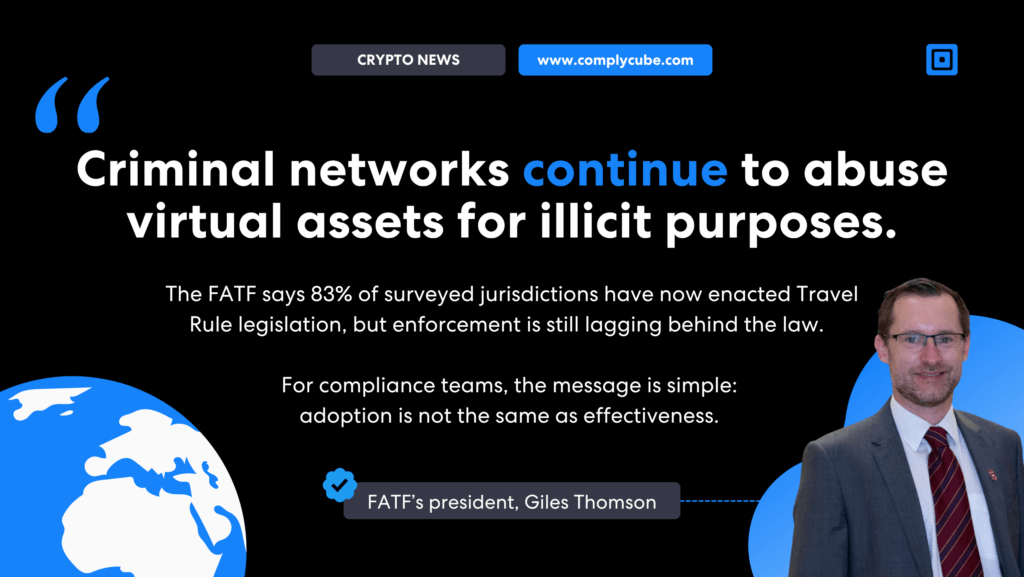
However, the FATF notes that legislation is still outpacing enforcement. Many jurisdictions struggle to effectively identify, supervise, and take action against Virtual Asset Providers (VASPs) that breach Travel Rules.
> *Criminal networks continue to abuse virtual assets for illicit purposes.*
The introduction of the Travel Rule means VASPs can capture, retain, and report information about specified originator and beneficiary information alongside virtual-asset transfers. FATF’s president, Giles Thomson, mentions, “This year’s targeted update makes clear that criminal networks continue to abuse virtual assets for illicit purposes.”
### *Compliance Takeaway:*
The FATF is shifting Travel Rule adoption from legislation to operational effectiveness. VASPs and financial institutions must prioritize demonstrable accuracy in customer data and how it is used to inform risk decisions. This means moving away from just applying and instead on how businesses can identify, review, and investigate suspicious activity related to sanctioned or high-risk activity.
For more information, click [here](https://www.fatf-gafi.org/en/news/targeted-updated-va-vasps-2026.html).
## Australia’s VASP Regime Reaches Final Registration Window
Australia, July 2026, 🇦🇺: By July 29th, virtual-asset services must enroll and register with the Australian Transaction Reports and Analysis Center (AUSTRAC). Failure to apply can lead to limitations in operations and service offerings.
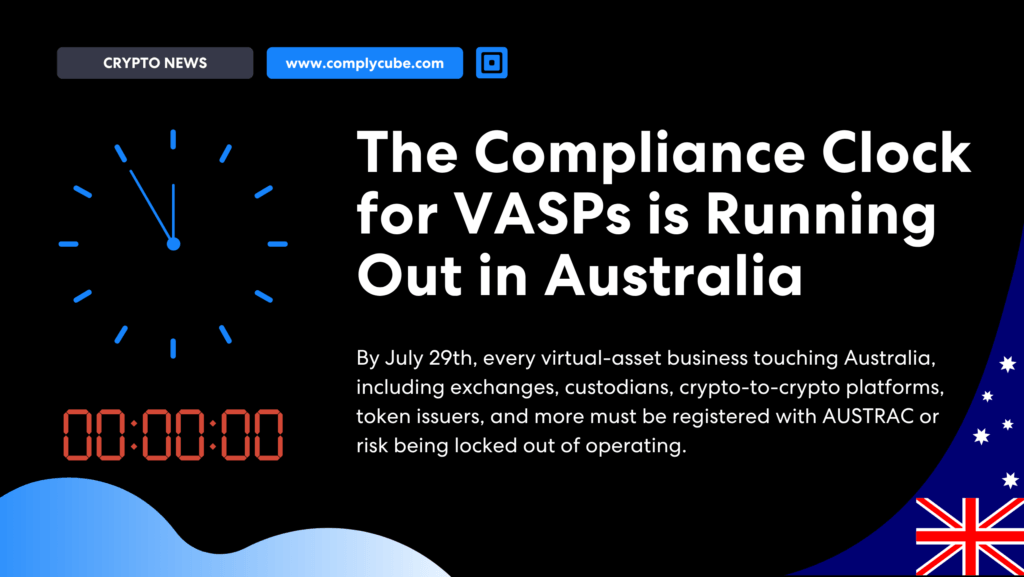
Australia’s reforms expand its previous regime beyond digital currency exchanges. The wider scope now includes crypto-to-crypto exchanges, virtual-asset transfers, custody and private-key management, and certain token-offering services.
As such, more crypto businesses now fall under Australia’s AML and CTF law; this means more rigorous requirements around identity verification, transaction monitoring, and suspicious activity reporting mechanisms. The intended outcome is to close further regulatory gaps that criminals exploit to move assets through crypto-to-crypto platforms, custodians, or transfer services with less scrutiny.
**Compliance takeaway**
For VASPs, it’s crucial to move away from treating AUSTRAC registration as a one-off. Instead, firms need to demonstrate a strong AML/CTF program, risk assessment, and suspicious-matter reporting controls. Applicants are encouraged to provide details such as ownership, key personnel, business activities, relevant overseas operations, and how they manage money laundering risks.
For more information, click [here](https://www.austrac.gov.au/virtual-asset-service-provider-register-goes-public).
## Time for Some Light-Hearted Creative Criticism?
So you’ve made it to the end of our newsletter. It’s time to enjoy a little satire, worthy reader, you’ve earned it.
### 🔥THE CRYPTO CUBED POEM: JULY🔥
Scams hide through illegal crypto flows,
Allowing stolen funds to move fast and low.
But strong controls can help us see,
The risks that KYC may miss.
Watch the patterns, trace the trail,
So fraud and crime are less likely to prevail.
With careful checks and eyes that stay keen,
We make the crypto world safer and clean.
### Stay tuned for our August newsletter, and have a great month!

**Categories:** News
**Tags:** Crypto Regulations
---
### [12 Critical Vendor Red Flags for Electronic KYC Platforms](https://www.complycube.com/electronic-kyc-platform-red-flags/)
**Published:** July 22, 2026
**Author:** Rithu Jagannath
**Excerpt:** An electronic Know Your Customer (KYC) vendor can enhance the customer onboarding journey. However, with so many platforms available today, how do compliance officers discern whether a platform can provide exactly what they need?
**Content:**
**TL;DR:** An electronic Know Your Customer (KYC) platform can **accelerate digital KYC**, strengthen eKYC compliance, and make customer onboarding a secure digital journey. However, buyers of an electronic KYC platform must demonstrate **fraud resistance** before choosing a provider.
## What is an Electronic KYC Platform?
An electronic KYC or eKYC process uses technology to verify customer identity, assess risk, and collect evidence of verification. It replaces or supplements current traditional KYC processes that rely on physical documents, branch visits, and manual data entry.
A complete procedure combines various methods of verification, such as document checks, biometric authentication, and checking against trusted databases. Additionally, by incorporating Anti-Money Laundering (AML) screening, Customer Due Diligence (CDD), and workflow orchestration, teams can build out a more thorough digital process.
## Choosing an Electronic KYC Platform Is a Risk Decision
In 2026, it is not a simple feat to buy an electronic KYC platform. Businesses must be able to find out the difference between real customers and stolen or artificially generated identities in less than a minute. This guide is for compliance leaders, risk officers, and product owners evaluating eKYC platforms for regulated industries. It talks though how to challenge vendor claims, run a realistic proof of concept, and identify weaknesses. Often a polished sales demonstration can conceal this information.
The real question here is if an eKYC system can conduct identity verification reliably across different markets, devices, profiles, and risk scenarios. They also must support and satisfy regulatory compliance requirements and customer expectations. Deepfakes and generative artificial intelligence (AI) are putting remote onboarding processes under a great deal of pressure.
## How the eKYC Process Works
The eKYC process has five connected stages. This includes data collection, document capture, evidence validation, biometric data verification, and a final risk decision. However, AML screening and Enhanced Due Diligence (EDD) may be required. You can learn more here: [Navigating the World of Enhanced Due Diligence.](https://www.complycube.com/en/enhanced-due-diligence-edd-insights-challenges/)
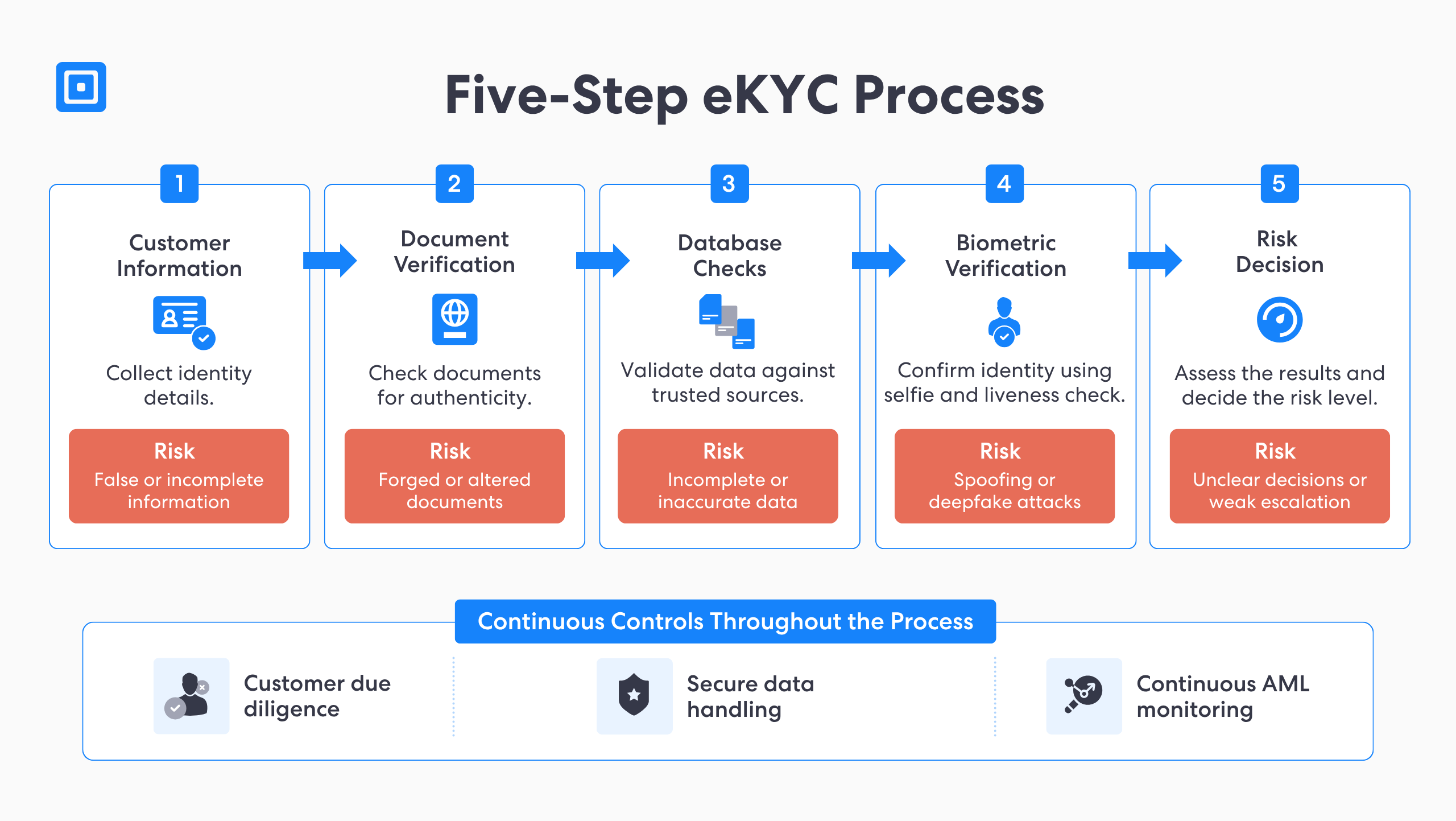
### Customer Information Collection
In the first step of the identity verification process, a digital KYC platform collects personal details such as name, date of birth, address, and government identification numbers. An electronic KYC platform must be able to validate whether the information is correct, consistent, and appropriate in accordance with the necessary regulatory requirements.
### Document Verification
Here, the goal is to capture a passport, national identity card, or driver’s license. Features such as Optical Character Recognition will be able to extract information from documents. Meanwhile, security checks can review the structure, data fields, and expiry dates to determine whether there were any signs of physical or digital manipulation.
### Biometric Verification
Biometrics helps teams compare a customer’s face with the image within their identity (ID) documents. Facial recognition technology, and other facial biometrics, can figure out if the applicant is a real, present person rather than a photograph, mask, replay, or manipulated feed.
### Digital Verification and Database Checks
After gathering all this information, an eKYC platform will attempt to validate the evidence against trusted databases or authoritative records. So, depending on the jurisdiction or risk level, this can include someone’s address, mobile phone number, government, or electronic identity data.
### Risk Decisioning and Audit Trails in Due Diligence
In the end, electronic KYC platforms must combine verification results, fraud-detection signals, and due diligence rules to approve, reject, or escalate customers for manual review. Compliance teams need to record these results to show how KYC compliance propels identity verification.
## The Buyer’s Electronic Know Your Customer Stress Test
To determine whether an electronic KYC platform is a good fit, teams should stress-test it against real-world conditions. The test should show how the platform handles damaged identity documents, weak internet connections, and manipulated content injected during onboarding.
> An electronic KYC platform should be judged by the auditable evidence that informs its risk decisions.
Account Executive at ComplyCube, [Billy Baird](https://www.linkedin.com/in/billy-baird-a6a943120/), goes on to say, “When evaluating eKYC platforms, it is not about the number of boxes it can check. The strongest eKYC solution should be able to explain how its checks work, what their limitations are, and how performance changes across different types of customers.”
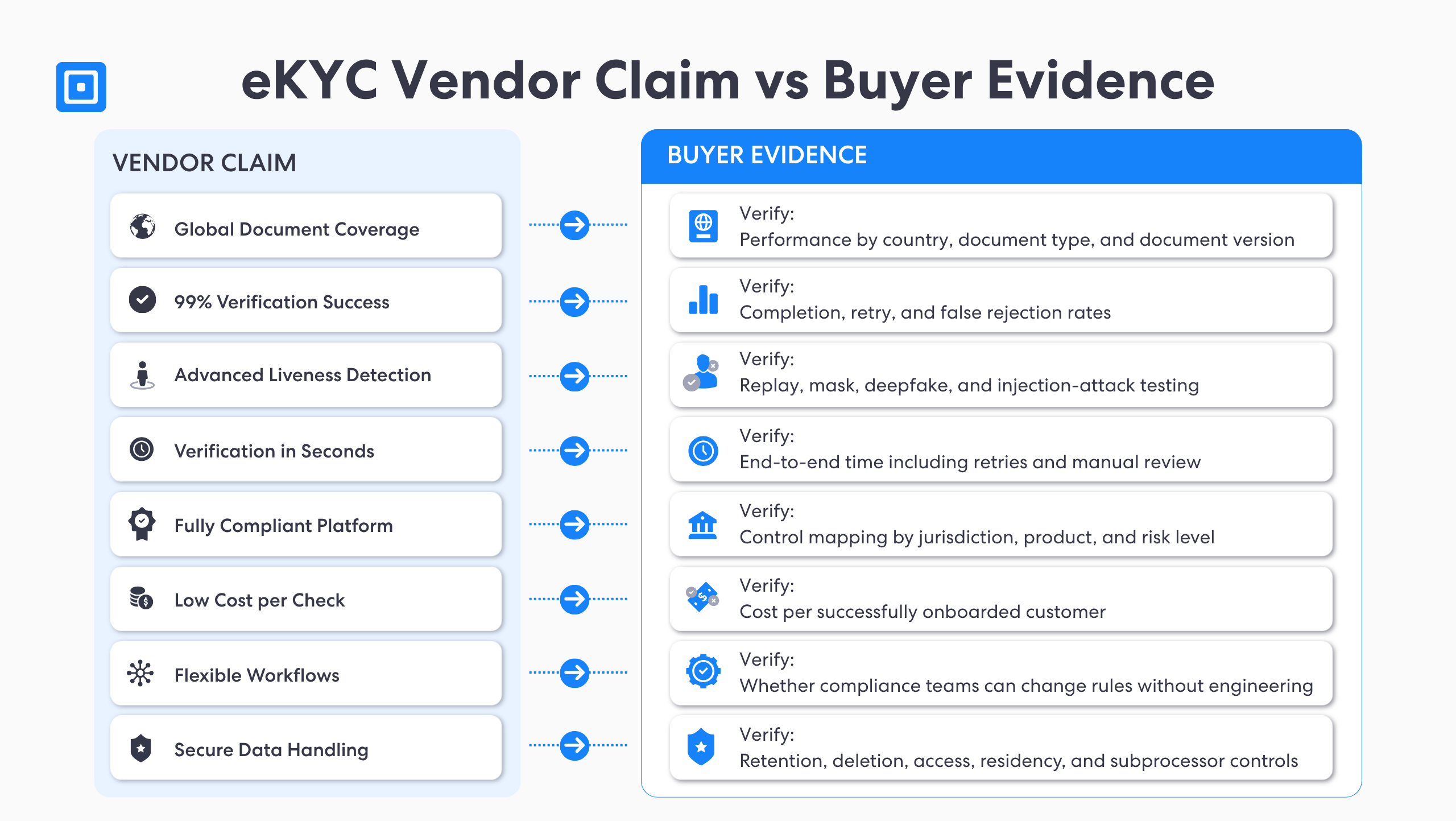
That is why buyers need segmented evidence with realistic testing. They also need a clear escalation process based on risk management appetite. Some of the most common vendor claims include document coverage inflation, and verification success metrics. Buyers need to evidence these claims.
### **Case Study: Rathbones Pauses High-Risk Client Onboarding**
In June 2026, UK financial institution [Rathbones](https://www.privatebankerinternational.com/news/rathbones-pauses-new-high-risk-client-onboarding/) announced that, following an engagement with the Financial Conduct Authority (FCA), it had identified areas requiring significant improvement in its compliance processes, oversight, and assurance arrangements.
##### **Rathbone’s Two-Year Compliance Remediation Program**
Rathbones launched a two-year program in response to address the [Skilled Person Review](https://register.fca.org.uk/s/firm) recommendations. They conducted a targeted assessment of selected clients, and paused onboarding of new customers ensuring they completed an EDD review for up to 12 months.
##### **Outcomes**
- New clients were paused up to 12 months, affecting $370M in gross inflows.
- Rathbones expected its remediation and related actions to reduce profit.
- Their share price fell by 17%.
## 12 Electronic KYC Platform Red Flags
Most electronic KYC platform providers can highlight their features attractively, but the real differences show up in how those features handle pressure. Teams also assess how transparently results are measured and how well the platform adapts to regulatory, operational, and fraud risks. The following red flags give massive warning signs that buyers must look for and investigate before making any commitment.
### 1. Global Coverage Number
Today, many vendors may claim to provide support for thousands of different identification documents across various jurisdictions and authorities. However, the term “supported” could mean anything from simple image capture to detailed and thorough verification. Teams should identify which document versions, languages, and security features their platform has been tested with.
Teams should request performance data for the specific markets they serve. A driver’s license from one country may perform very differently from a passport issued elsewhere, and aggregate acceptance rates can conceal weak regional results.
### 2. Unqualified Success Rates
Another major red flag is when providers advertise a 99% success rate. They should be able to disclose the common denominator, sample population size, and the treatment of manual review. Without this context, that statistic only says so much about real eKYC identity verification performance.
Teams should request false acceptance, false rejection, completion, retry, and abandonment rates. Where sample sizes allow, they should also break results down by document type, country, device, capture channel, and customer cohort.
### 3. Data Extraction is Presented as Fraud Detection
Where OCR can extract text, it does not establish if the document is authentic. Strong document verification processes must examine evidence integrity, templates, security characteristics, and portrait substitution. This also includes field manipulation and digital injection.
The European Banking Authority (EBA) has guidance on remote onboarding that requires financial firms to determine whether their solutions can verify the validity and authenticity of official documents. Remote onboarding must be able to reliably bind the evidence to the person that is being verified in the moment.
### 4. “Liveness” is Left Undefined
Though biometric data can improve data security, it also brings privacy, performance, and presentation attack risks. To prevent fraud, a buyer must find out if the provider tests printed images, screen replays, or masks. Today, teams must also be able to test deepfakes, virtual cameras, and injection attacks rather than relying on a generic liveness label for a customer profile.
False positives and rejections can happen in [biometric authentication](https://docs.complycube.com/documentation/product-guides/biometric-and-liveness-verification/face-authentication-check). Many variables, such as lighting, camera quality, age, accessibility, and demographic variation, can impact verification results. The electronic KYC platform should explain when human review becomes necessary.
### 5. Speed Excludes Failure Handling
A provider may say that eKYC verification takes seconds while excluding capture retries, timeouts, manual queues, and unresolved cases. What should be measured here is the complete onboarding process from the customer’s first action to the final usable decision.
The goal is to promote a consistent customer experience while responding differently to varying levels of risk. For instance, low-risk customers do not need much friction. Still, any uncertainty should trigger the right checks rather than automatic approval during account setup.
### 6. The Platform Tests Yesterday’s Threats
Identity theft or other financial crimes combine breached customer information, synthetic attributes, forged evidence, and compromised devices. Fraudsters are not relying just on physical documents. They can create convincing customer relationships and applications all over an online environment.
According to the NIST Digital Identity Guidelines, expanded fraud controls for identity proofing include measures that address injection attacks and forged media. It is the buyer’s responsibility to ask whether the provider tests for these attacks and how quickly they adapt their traditional KYC practices when new fraud techniques emerge.
### 7. “Compliant” is Treated as a Feature
There is no digital KYC platform that can make a business compliant with various compliance authorities and government regulations in a single setting. Minimum requirements change on a case-by-case basis between regions and industries.
The Financial Action Task Force (FATF) Guidance on [Digital Identity](https://www.fatf-gafi.org/en/publications/Financialinclusionandnpoissues/Digital-identity-guidance.html) states that regulated organizations need to understand if a digital identity system is reliable, independent, or appropriate for the relevant customer due diligence risk.
### 8. Onboarding and Monitoring Are Disconnected
Initial onboarding only establishes what a firm knows about a customer at the beginning of the business relationship. However, when sanctions exposure, political connections, and other risk factors change, compliance teams must update the customer’s profile accordingly.
Initial customer identification and ongoing due diligence are two separate functions. Buyers need eKYC systems to link their ‘customers’ information to ongoing monitoring, investigations, and case management, rather than treating KYC as a one-time check.
### 9. Sensitive Information Has No Clear Lifecycle
KYC requirements involve collecting a range of personal information, including documents, facial images, and biometric templates. If a breach were to happen, it could expose a lot of sensitive identity data that customers might not be able to replace as easily as a password or login.
The [UK Information Commissioner’s Office (ICO)](https://ico.org.uk/for-organisations/uk-gdpr-guidance-and-resources/lawful-basis/biometric-data-guidance-biometric-recognition/) biometric data used to identify a person is special category data under the UK [General Data Protection Regulation (GDPR)](https://gdpr-info.eu/). The ICO advises that organizations consider data minimization, storage limitation, and biometric template protection. This prevents any breach risks and determines if a Data Protection Impact Assessment is required.
Encryption, retention periods, and deletion processes play a critical role in eKYC compliance. Buyers should also assess breach response procedures and evidence portability. Automated verification can support consistent privacy controls, but it does not by itself prove that customer data is processed lawfully or securely.
### 10. Every Applicant Follows One Journey
Banks should not apply every verification method identically to every customer. A rigid onboarding process creates unnecessary friction for low-risk applicants while failing to apply sufficient controls to higher-risk cases.
A risk-based approach applies assurance levels and controls based on the customer’s money-laundering and terrorist-financing risk. Teams can adjust verification measures when simplified or enhanced due diligence is appropriate. An effective digital KYC process uses customer profiles, evidence quality, fraud signals, and regulatory requirements to determine which checks are necessary.
### 11. Configuration Requires Engineering
Teams should be able to easily respond to changes in KYC regulations, fraud practices, or internal processes. However, when every workflow needs a vendor development or internal engineering release, companies can struggle to keep their controls aligned with growing risks.
Digital identity requires continuous risk management, not a one-off implementation project. Buyers should confirm that authorized users can safely update thresholds, workflows, rules, and policies, with every change controlled, versioned, approved, tested, and recorded in the audit trail.
### 12. The Headline Price Hides the Real Cost
Finally, the cheapest solution could exclude a variety of features such as document retrieval, biometric checks, or implementation support. A headline unit price should be one input instead of evidence regarding the platform’s total commercial value.
The red flag here is based on total-cost-of-ownership analysis. The commercial evaluation should look at contract exit costs, access to verification evidence, and migration assistance. A low-cost eKYC solution can become expensive when other factors, such as rigid workflows or high volumes of manual review, come into play. Lastly, consider that the cheapest solution may exclude features such as document retries, biometric checks, or implementation support.
### Key Takeaways
- **All modern eKYC platforms** should be evaluated based on proven performance.
- **Buyers must test verification** controls against real customers and attack scenarios.
- **Strong compliance** needs adaptable workflows, audit trails, and ongoing monitoring.
- **The true cost of an eKYC** solution includes integration, support, and abandonment.
- **The best eKYC platform** balances regulatory compliance, fraud prevention, operational efficiency, and customer experience.
## Implement eKYC Verification Around Trust with ComplyCube
The best electronic KYC platform must help your business prevent fraud, meet KYC compliance, reduce operational costs, and create a smoother experience for legitimate customers. Explore how a risk-based verification process can support customers, markets, and compliance programs. [Get in touch with ComplyCube](https://www.complycube.com/en/contact/contact-sales/) to discuss your electronic KYC needs.
[](https://portal.complycube.com/signup)
## Frequently Asked Questions
How should a business compare electronic KYC platforms?
Businesses need to look at various factors before deciding upon which electronic KYC platform they should choose. They must look at document coverage, regulatory alignment, data security and integration effort.
Can eKYC be completed in under one minute?
Yes, some eKYC checks can be completed in under one minute when evidence quality is high and escalation is not needed. Actual completion time does depend on document capture, biometrics, device quality, and risk rules.
Does eKYC replace traditional KYC entirely?
eKYC can replace many time-consuming, branch-based traditional activities. However, business still require risk-based policies, CDD, escalation, record keeping, and ongoing monitoring. For some customers and regions, they need alternative options for verification.
What are the biggest risks when businesses implement eKYC?
The biggest risks for business in implementing eKYC are weak document authentication, biometric false results, deepfake or injection attacks and more. Effective governance and realistic KYC testing are just as important as automation.
How does ComplyCube support electronic KYC?
ComplyCube’s all-in-one platform brings identity verification, document analysis, biometric checks, and AML screening. With configurable workflows, and ongoing monitoring, businesses can create strong verification journeys required by eKYC compliance programs.
**Categories:** Guides
**Tags:** Know Your Customer
---
### [What is eKYC (electronic Know Your Customer)? Basics You Need To Know](https://www.complycube.com/what-is-ekyc-electronic-know-your-customer/)
**Published:** September 8, 2023
**Author:** Andreea Balasa
**Excerpt:** The increasing frequency of digital interactions calls for a reliable online identity verification process. This requirement has given rise to eKYC, a process that's quickly becoming the gold standard for digital identity assurance.
**Content:**
**TL;DR:** eKYC (electronic Know Your Customer) modernizes onboarding by replacing manual checks with secure, **automated identity verification**. It helps organizations roll out digital KYC faster, reduce fraud risk, and stay compliant while improving the **customer experience**.
## What does eKYC mean?
eKYC, or electronic Know Your Customer, is a digital KYC process that verifies a customer’s identity remotely using electronic checks and evidence, rather than relying on in-person or paper-based methods. At its core, eKYC addresses modern identity authentication challenges by streamlining how organizations verify identities.
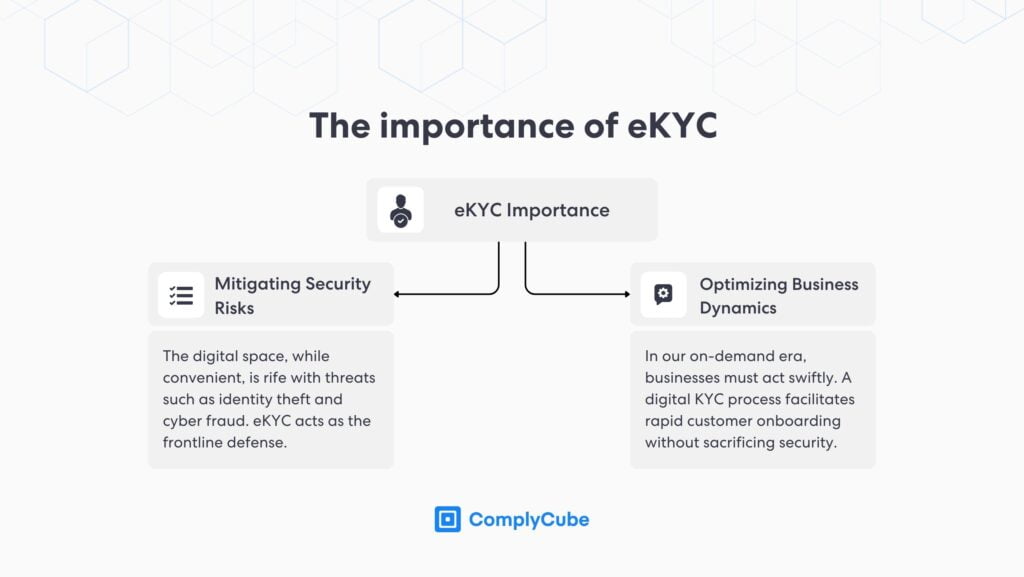The Importance of eKYC
Secure online transactions are central to trust in an increasingly digital economy. According to Zendesk, 70% of consumers will choose not to buy a product or service from a company with weak security measures. As a result, prioritizing secure, robust online identity verification is essential.
Additionally, electronic know your customer helps firms comply with digital KYC requirements and strengthen defenses against money laundering and other financial crimes. You can learn more here: [The Profound Challenge of AI-Driven Deepfakes Versus eKYC Solutions.](https://www.complycube.com/en/ai-driven-fraud-deepfakes-versus-ekyc-solutions/)
## Why is eKYC Important?
eKYC plays a critical role in today’s digital landscape by enabling more secure and efficient customer onboarding. With fraud on the rise and regulations growing more stringent across regions, businesses can no longer afford to rely on outdated, manual methods. The growth of the eKYC market reflects this shift.
> The electronic Know Your Customer market is projected to grow to around [$2.79 billion by 2030](https://www.absrbd.com/post/electronic-kyc-statistics).
In addition to enhanced onboarding, secure KYC is increasingly mandated by leading jurisdictions. Regulators, including the [U.S. Financial Industry Regulatory Authority](https://www.finra.org/rules-guidance/rulebooks/finra-rules/2090#the-rule), the [Monetary Authority of Singapore,](https://www.mas.gov.sg/regulation/anti-money-laundering) and the [Australian Transaction Reports and Analysis Center (AUSTRAC)](https://www.austrac.gov.au/industry-and-business/obligations-and-guidance/your-amlctf-program/customer-due-diligence/overview-customer-due-diligence), demand rigorous customer verification, strong data privacy, and transparent documentation. You can learn more here: [Navigating Changing eKYC Verification Rules.](https://www.complycube.com/en/navigating-changing-ekyc-verification-rules/)
As a result, eKYC enables businesses to:
- **Mitigate Security Risks:** The digital space, while convenient, is rife with threats such as identity theft and cyber fraud. eKYC acts as the frontline defense against these digital adversaries.
- **Support KYC Compliance:** Align with global identity verification and customer due diligence obligations to prevent fines and reputational damage.
- **Optimize Business Dynamics:** In our on-demand era, businesses must act swiftly. A digital KYC process facilitates rapid customer onboarding without sacrificing any security.
## eKYC vs. Traditional KYC Processes
eKYC shifts away from heavy reliance on manual document collection and review. Instead, it digitalizes identity verification through automated document checks, biometric verification, and Anti-Money Laundering (AML) screening. You can learn more here: [The Value of Automation.](https://www.complycube.com/en/compliance-automation-software/)
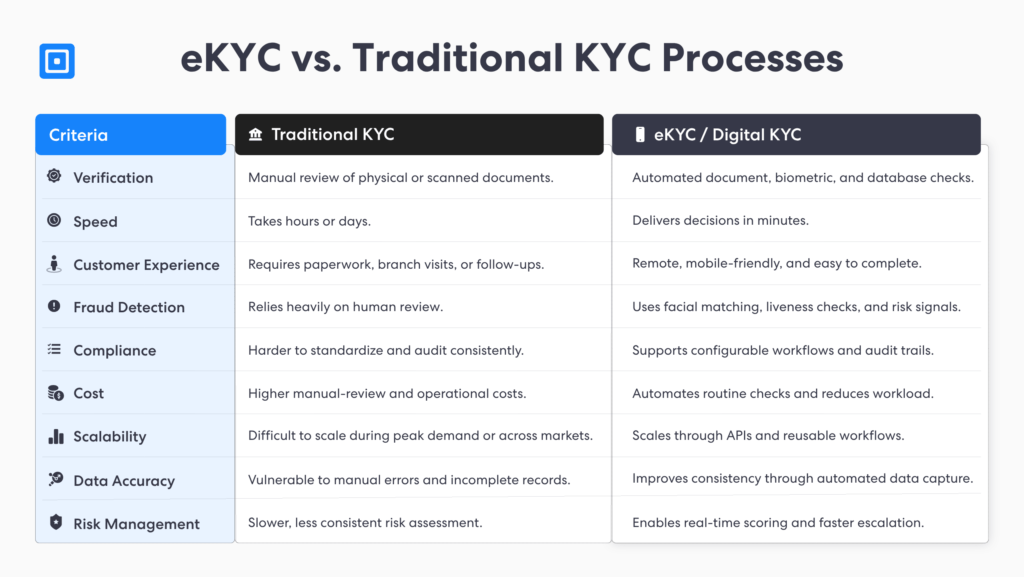
Traditional Know Your Customer methods have long required physical presence, paper documentation, and in-person checks. These processes can be time-consuming, resource-intensive, and highly prone to human error. As such, it can make it difficult for businesses to scale and meet growing customer demands.
On the other hand, digital KYC harnesses technology to streamline [customer identity verification](https://www.complycube.com/en/solutions/identity-assurance/document-verification/) through online platforms and documentation. It reduces human error and ensures a consistent approach through a paperless process. Moreover, it can service customers globally without the limitations of physical boundaries.
## Building a Reliable eKYC Process
For financial institutions and other regulated industries, understanding the electronic KYC process is vital. Businesses must grasp the effectiveness of digital identity verification and [prevent identity fraud.](https://www.complycube.com/en/use-cases/process/fraud-prevention/) As firms move toward digital onboarding, understanding eKYC verification and how it maintains compliance, protects customers, and builds a secure and scalable verification framework is key.

### 1. Customer Identification Program (CIP)
A CIP is vital for businesses when obtaining client information. You can learn more here: [What is CIP?](https://www.complycube.com/en/customer-identification-program-what-is-cip/) It is completed during the online registration process. For example, when a new account is created, a user enters their personal details through a secure online interface. Typically, it starts at the beginning of a customer’s journey, such as opening a new bank account.
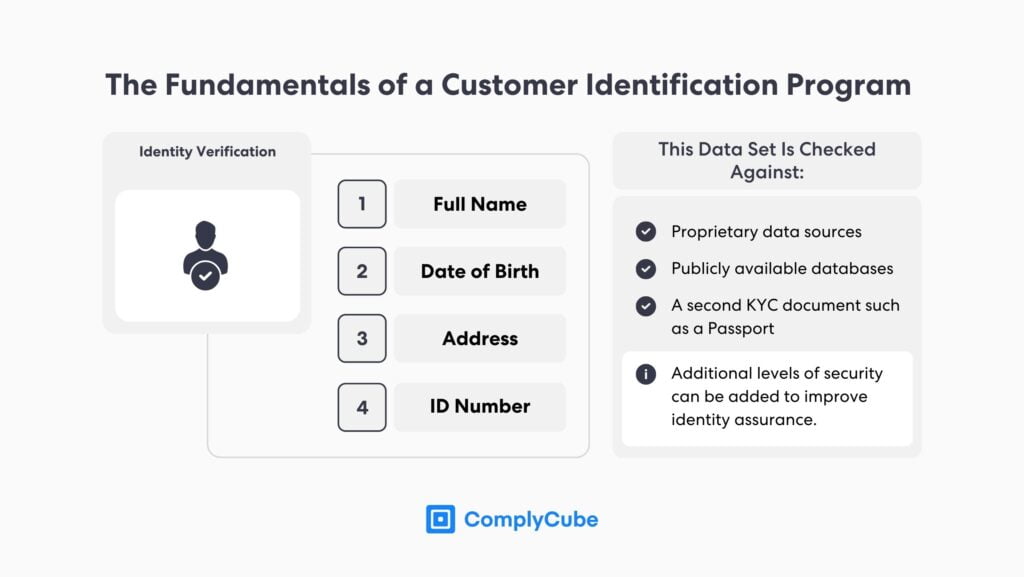
### 2. Automated Identity Verification (IDV)
IDV is required to verify a customer’s identity, proving they are who they claim to be. The authenticity and integrity of an individual’s collected identity data are verified through artificial intelligence tools. This includes tools such as identity document verification, biometric data checks, facial recognition, and more. You can learn more here: [The Essential Guide For Identity Verification.](https://www.complycube.com/en/the-essentials-guide-for-robust-identity-verification/)
### 3. Customer Due Diligence (CDD)
Once customer identities are confirmed, users undergo further checks. This is done via AML screening and cross-verification with third-party databases, known as multi-bureau checks, or database verification. For example, a user’s residency could be verified against information from a credit bureau’s database. You can learn more here: [What is Database Verification?](https://www.complycube.com/en/what-is-database-verification/)
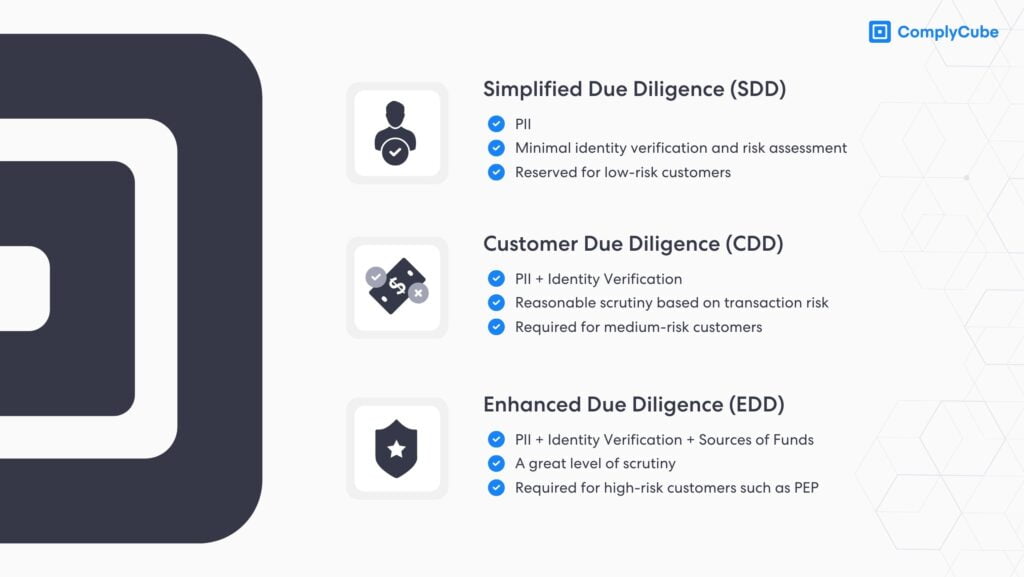
### 4. Feedback and Result Interpretation
The eKYC system analyzes and verifies the results electronically. It confirms true identities or highlights discrepancies that require further investigation. Based on the findings, a risk score is swiftly produced and assessed against a financial institution’s [Risk-Based Approach (RBA)](https://www.complycube.com/en/the-evolution-of-the-risk-based-approach-in-aml/). This automatically determines whether a user passes or fails verification. This process eliminates manual reviews, enabling faster, more accurate, and consistent onboarding decisions.
### 5. Secure Data Storage
Verified data is securely stored, ensuring future transactions are streamlined and protected against breaches. As data security remains a top priority for regulators worldwide, businesses must ensure their solutions provider is fully compliant with both local and international data regulations. This safeguards customer information and maintains regulatory adherence at every stage of the verification process.
### 6. Ongoing monitoring
eKYC verification not only streamlines initial identity assurance but also facilitates [continuous monitoring](https://www.complycube.com/en/what-is-an-ongoing-monitoring-process/), ensuring ongoing trust and compliance in digital interactions. In an era where fraud tactics are constantly evolving, ongoing monitoring is critical to effective electronic KYC. This ensures that a customer’s compliance status remains accurate and up to date long after their initial onboarding.
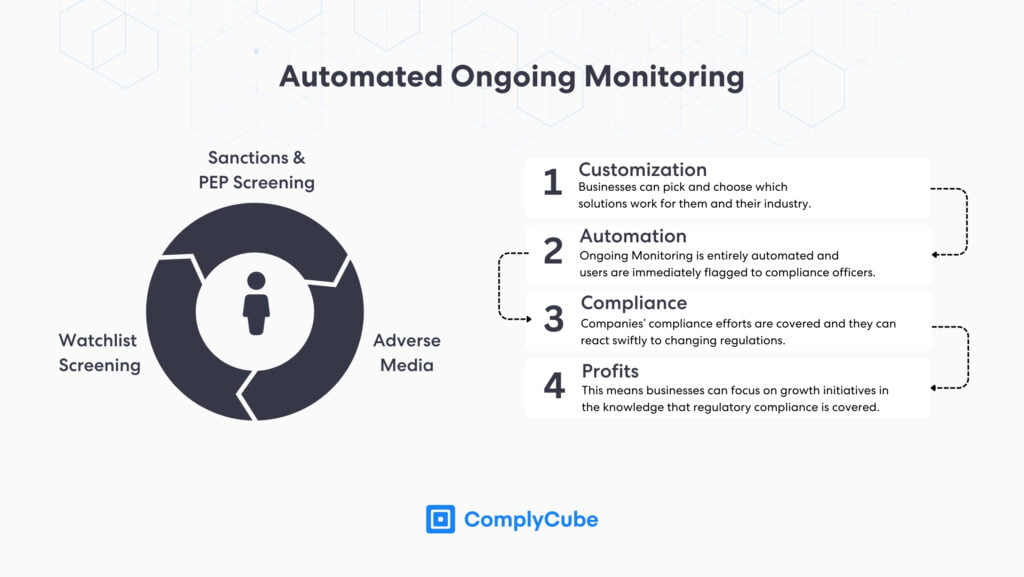
## Choosing the Right eKYC Provider
Partnering with the right eKYC solutions provider helps businesses meet their unique needs, scale, and maintain strong anti-money laundering practices. As requirements continue to evolve, selecting a provider that aligns with your electronic KYC standards can make the difference between smooth compliance and costly setbacks.
Here’s a guideline to ensure a selection that matches your required electronic identification standards:
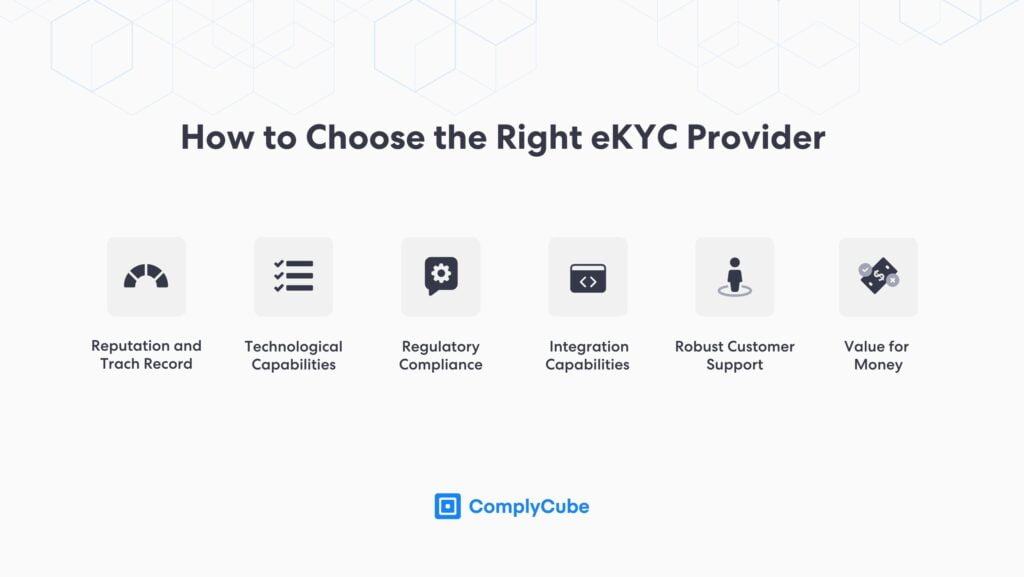
1. **Reputation and Track Record:** Research potential providers’ market reputation and past performance. Examining client feedback, reviews, and success stories can offer a clear picture.
2. **Technological Capabilities:** Ensure your chosen provider uses advanced tools, including AI, facial biometrics, automated video identification, and other cutting-edge verification methods.
3. **Regulatory Compliance:** The provider should be well-versed in global and local KYC policies and regulations, ensuring adherence to worldwide data privacy norms.
4. **Seamless Integration:** Your solution should seamlessly integrate with your current digital ecosystem, causing minimal disruption and maximizing efficiency.
5. **Robust Customer Support:** A provider’s value is also in their post-integration support. A dedicated, responsive team is indispensable for addressing concerns or optimizations.
6. **Value for Money:** An effective eKYC provider should offer top-notch services that align with your budgetary constraints without compromising quality.
With these criteria in mind, businesses can confidently navigate the eKYC solutions landscape. They can ensure they partner with a provider that truly complements their identity verification objectives. In effect, choosing the right electronic KYC partner is not just a compliance decision; it is a strategic one that directly impacts the security, scalability, and long-term success of your business. You can learn more here: [Selecting KYC Software for Your Industry and Growth Stage.](https://www.complycube.com/en/selecting-kyc-software-industry-and-growth/)
## eKYC Processes: Benefits and Challenges
While eKYC verification offers numerous benefits, it is crucial to acknowledge the accompanying challenges that businesses may face during implementation. Understanding both the advantages and limitations of electronic KYC is key to building a verification framework that is resilient and future-proof.
### What are the Benefits of eKYC?
1. **Efficiency and Speed:** Digital verification trumps traditional methods in speed, completing processes that once took days in mere minutes, even seconds.
2. **Cost-Effective:** Digitizing and automating the eKYC services while eliminating the need for manually checking physical documents significantly reduces operational costs.
3. **Global Reach:** Digital KYC allows businesses to conduct electronic identification and onboard customers from anywhere in the world, expanding market reach.
4. **Enhanced Security:** eKYC solutions employ cutting-edge technologies such as document liveness, biometric verification, and AI, ensuring compliance with data protection regulations.
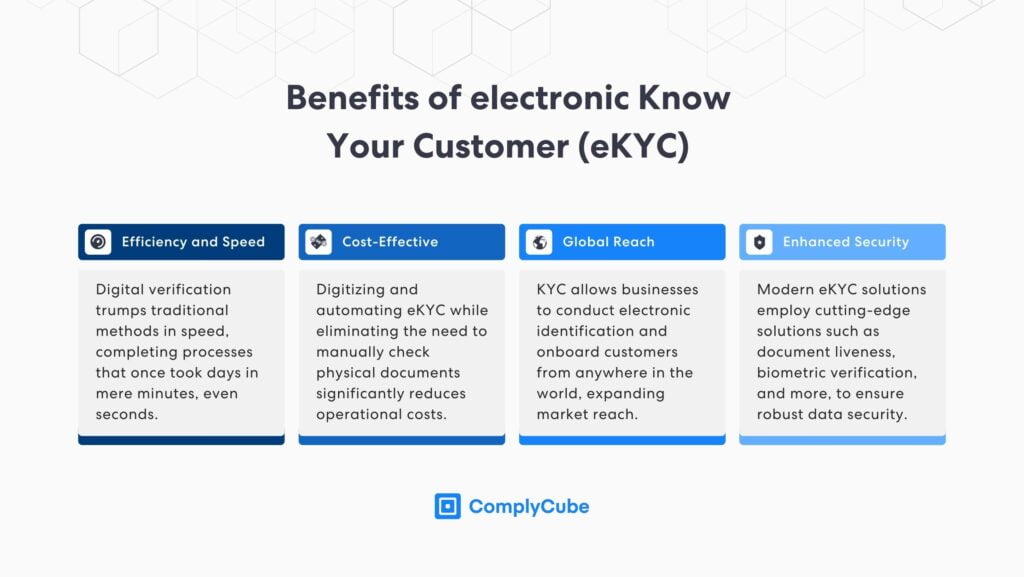
### What are the Challenges of eKYC?
1. **Regulatory Concerns:** It must constantly evolve to stay aligned with changing global and regional regulations.
2. **Data Privacy:** Handling sensitive information electronically raises concerns about data breaches and unauthorized access.
3. **Technological Barriers:** Not all customers may have the necessary technological access or literacy to navigate online identity verification processes smoothly.
4. **Integration Hiccups:** Merging electronic Know Your Customer solution providers with existing systems can sometimes lead to technical challenges.
5. **Dependency on Technology:** Relying heavily on tech means that system downtimes can disrupt the verification process.
6. **Potential for Misuse:** As with all digital tools, there’s always the risk of misuse by malicious entities.
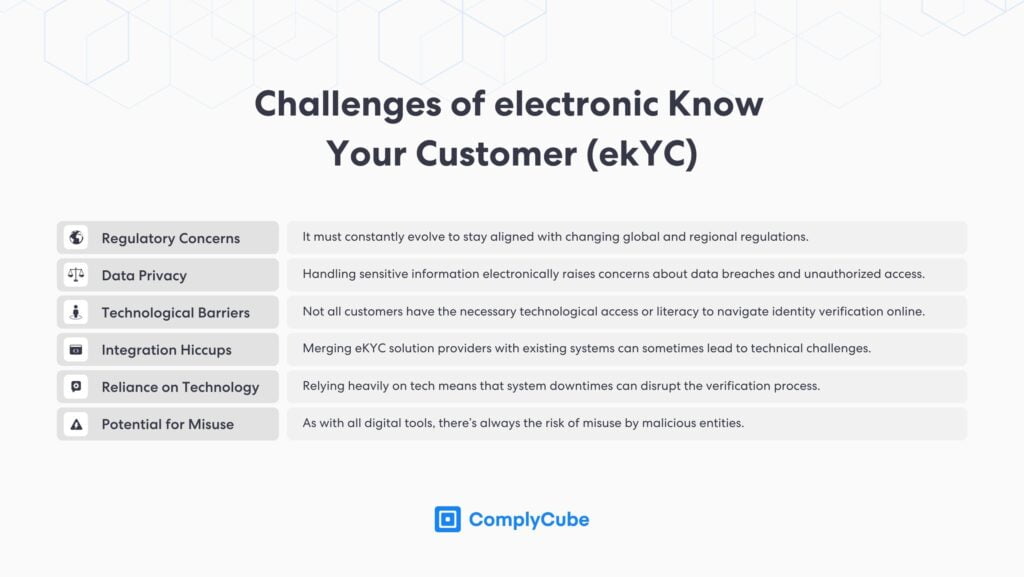
Recognizing both the advantages and challenges of electronic KYC allows businesses to make informed decisions. In practice, organizations should proactively navigate these potential pitfalls and adopt a culture of continuous optimization. As a result, teams can streamline onboarding, reduce fraud, and maintain compliance while building a robust verification framework that adapts to an ever-evolving regulatory and threat landscape.
## Sectors Thriving on eKYC
As the digital era evolves, electronic Know Your Customer has become a cornerstone for various sectors. The application of digital KYC is clear across various industries, each leveraging its capabilities to enhance operations. Common examples of sectors that capitalize on these solutions include banking, real estate, and telecommunications.
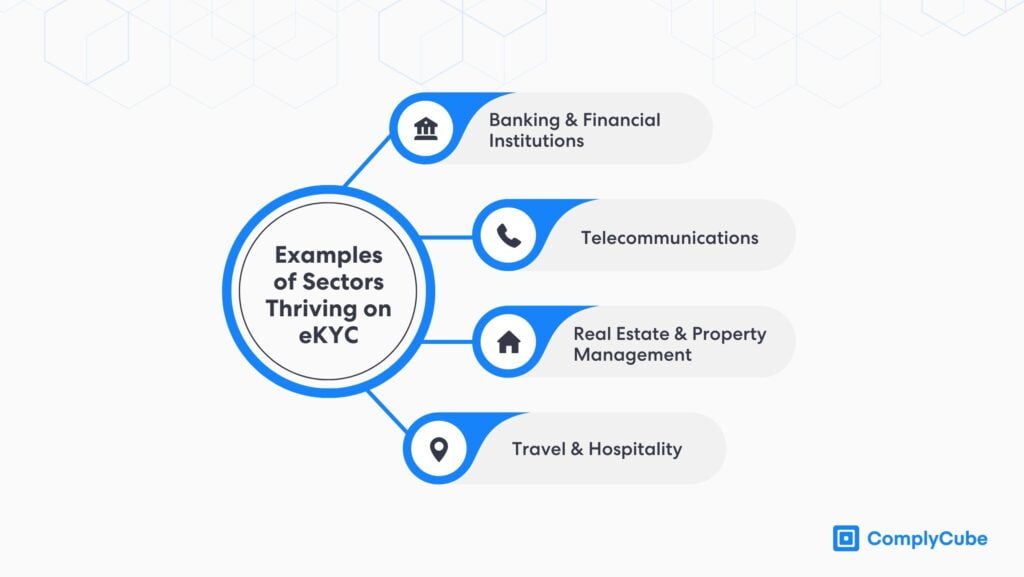
### Banking & Financial Institutions
For many [modern banking operations](https://www.complycube.com/en/use-cases/industry/financial-services/), digital KYC enables swift, secure customer onboarding for bank account opening. It is also crucial to meet ongoing due diligence obligations during the life of the customer relationship, preventing financial crimes and money laundering, and enhancing user trust in the financial sector.
### Telecommunications
As subscribers and services grow, [telecommunication providers](https://www.complycube.com/en/use-cases/industry/telcoms/) use electronic Know Your Customer practices to validate user identities, making legal procedures for registering new users and SIM activations smoother. With regulatory requirements around SIM registration tightening across regions, eKYC verification enables telecoms to meet compliance obligations efficiently, reduce fraudulent activations, and deliver a faster, more seamless onboarding experience for their customers.
### Real Estate & Property Management
eKYC verification assists in [verifying both buyers’ and sellers’](https://www.complycube.com/en/use-cases/industry/property/) identity documents, streamlining customer onboarding, property transactions, and rental agreements across the real estate sector. As property transactions remain a key target for money laundering and identity fraud, electronic KYC solutions play a critical role in helping real estate businesses meet their compliance obligations, protect against financial crime, and build a more secure and transparent transaction process for all parties involved.
### Travel & Hospitality
For online bookings and check-ins, eKYC verification provides an additional layer of identity assurance, enhancing customer trust and ensuring that reservations are made by genuine, verified individuals. As the travel and hospitality industry continues to shift toward fully digital experiences, electronic KYC solutions are becoming an increasingly essential tool for preventing fraudulent bookings and safeguarding both businesses and their customers.
### **Case Study: NHS App and Identity Proofing**
As NHS App usage scaled, services like test results and prescription ordering required stronger assurance that the person logging in was the right patient. The NHS needed a secure, self-serve way to confirm identity without forcing everyone through in-person checks.
##### **“Full access” identity checks in UK healthcare**
NHS login enables users to “prove who you are” using photo ID plus a facial video/self-capture, or via GP online-registration details where photo ID isn’t available. This supports a digital KYC-style identity step for accessing sensitive healthcare features inside the NHS App.
##### **Outcomes**
- Reduced reliance on in-person identity confirmation for access to personal health features.
- Supports secure access to sensitive services like prescriptions, appointments, and records.
- Offers digital service usage at large scale, with millions of sessions and unique logins.
## The Future of Electronic Know Your Customer
As the identity verification landscape evolves rapidly, businesses must stay ahead of emerging trends and technologies shaping the future of eKYC. From AI-powered fraud detection to increasingly stringent global regulations, the future presents both exciting opportunities and new challenges for organizations looking to strengthen their electronic KYC processes and build a more secure digital future.
The future of electronic Know Your Customer converges on technological fusion and enhanced security:
- **Technological Fusion:** The merging of groundbreaking technologies such as Blockchain and AI is set to amplify the efficiency and reliability of eKYC processes and online procedures.
- **Enhanced Security Protocols:** With the digital landscape continually shifting, there will be a heightened focus on continually adapting digital customer onboarding and reinforcing electronic KYC processes to counter emerging digital challenges.

### Key Takeaways
- **eKYC** (electronic Know Your Customer) verifies identity remotely using digital checks.
- **It enhances** onboarding by reducing manual steps while strengthening fraud and AML controls.
- **Digital KYC** outperforms traditional KYC on speed, scale, and consistency across markets.
- **A reliable** eKYC flow spans CIP, automated IDV, CDD/AML screening, and risk scoring.
- **Long-term value** comes from secure storage, ongoing monitoring, and smooth integration.
## About ComplyCube’s eKYC Solution
eKYC isn’t just another digital trend; it forms the blueprint for future digital interactions. As businesses navigate the digital age, eKYC stands out as an invaluable ally, offering the speed, security, and adaptability required to prevent terrorist financing. Learn more about how you can rapidly integrate eKYC solutions today. Speak to a [member of the team](https://www.complycube.com/en/contact/contact-sales/).

## Frequently Asked Questions
What does eKYC mean in the UK and Europe?
eKYC means electronic Know Your Customer. It is a digital KYC process that verifies identity electronically and remotely instead of paper or in-person verification. In the UK and Europe, eKYC is commonly used to support compliant and quicker onboarding under local KYC/AML rules.
Is eKYC compliant with UK Customer Due Diligence (CDD)?
Yes, eKYC can support CDD requirements in the UK by collecting customer details, verifying identity through automated IDV, and applying risk-based checks like screening and database comparisons. The key is using appropriate assurance levels, audit trails, and data protection controls.
What is the difference between eKYC and traditional KYC for UK and EU businesses?
Traditional KYC typically relies on physical documents and manual or in-person checks. eKYC (digital KYC) uses automated, remote verification to speed up onboarding, reduce human error, and deliver consistent outcomes across regions.
What are eKYC steps for fintechs and banks?
Most strong electronic Know Your Customer flows include customer data capture, automated identity verification (document + biometric checks), CDD/AML screening, risk scoring, and secure data storage. Additionally, ongoing monitoring is required to detect changes in risk over time.
How does ComplyCube support eKYC requirements?
ComplyCube supports organizations in aligning with eKYC (electronic Know Your Customer) compliance through automated identity verification, configurable onboarding checks, and ongoing monitoring to support CDD workflows. It’s designed to integrate into digital customer journeys while maintaining strong security and compliance alignment.
**Categories:** Guides
**Tags:** Know Your Customer
---
### [What is a Politically Exposed Person (PEP)?](https://www.complycube.com/what-is-a-politically-exposed-person/)
**Published:** January 25, 2021
**Author:** Andreea Balasa
**Excerpt:** To comply with financial crime regulations, it is critical for businesses to understand how to identify, screen, and review PEPs. Due to their unique influence and power, PEPs must undergo heightened scrutiny to mitigate AML risks.
**Content:**
**TL;DR:** Major jurisdictions across the US, UK, Singapore, and the UAE require businesses to identify and screen a Politically Exposed Person (PEP) for **Anti-Money Laundering (AML)** compliance. This guide explores different types of politically exposed persons and how to screen them effectively for **PEP KYC compliance.**
## What is a Politically Exposed Person?
A Politically Exposed Person (PEP) is an individual who holds a prominent public position or function, either domestically or internationally. Common examples include government officials, military officers, judges, and senior executives of state-owned enterprises. Regulators consider PEPs as high-risk due to their potential influence and access to sensitive information.
As a result, PEPs are more vulnerable to [corruption](https://en.wikipedia.org/wiki/Corruption), [bribery](https://en.wikipedia.org/wiki/Bribery), and money laundering. RCA of PEPs are also considered high risk due to their connections, which can present similar AML risks. Due to the potential indirect influence or involvement in corruption, they thus also require appropriate risk management and due diligence measures.
Identifying a politically exposed person is crucial for financial institutions to comply with PEP Know Your Customer (KYC) and AML regulations. It helps businesses mitigate the risk of money laundering, fraud, and other financial crimes while protecting customers.
## Types of Politically Exposed Persons
Today, there are several types of PEPs, including:
**1. Domestic PEPs:** These individuals hold prominent public positions within their own country. Common examples include government officials, high-ranking military officers, and judges. Their influence and access to national resources make them susceptible to corruption and bribery.
**2. Foreign PEPs:** These individuals hold prominent public positions in other countries. This category includes heads of state, government ministers, and senior government executives. Due to their international influence, they pose a significant risk for cross-border money laundering activities.
**3. International Organization PEPs:** These are individuals who hold high-ranking positions in global firms, such as the United Nations, the World Bank, and the International Monetary Fund. Their global reach and decision-making power make them targets for corruption and financial crimes.
**4. Immediate Family Members:** Spouses, children, parents, and siblings of PEPs, also referred to as Relatives and Close Associates (RCA), are also considered high-risk due to their close relationship. Their association with a PEP can expose them to similar risks of involvement in illicit activities, even if only indirectly.
## Levels of Politically Exposed Persons
Politically Exposed Persons (PEPs) are typically categorized into four different levels in AML processes. This categorization largely depends on the level of risk they pose relative to their position and influence. With clear classifications, businesses can determine the appropriate level of scrutiny for each customer.
First, Level 1 addresses Prominent figures representing an international body. Next, the second level examines individuals holding national-level positions. Then, Level 3 covers officials holding state-level positions. Finally, Level 4 comprises civil servants holding positions at the local level.
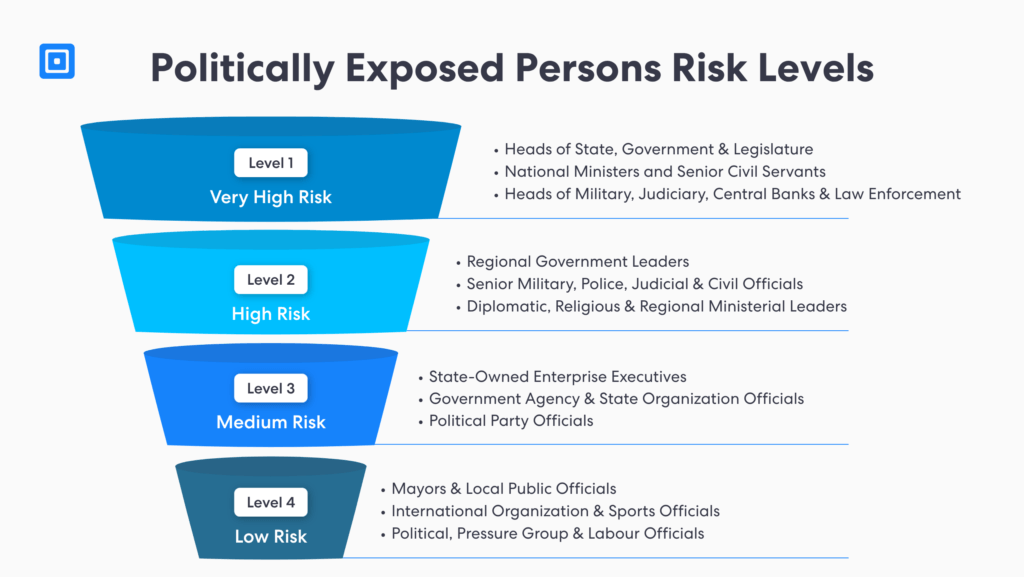
Authorities require financial institutions to screen for PEPs and implement adequate AML measures to reduce their risks and liabilities. Notably, a Risk-Based Approach (RBA) enables businesses to tailor AML controls to the identified risks. PEP KYC is crucial because they ensure compliance with AML and Counter-Terrorist Financing (CTF) regulations. You can learn more here: [Navigating KYC vs AML Compliance for Finance Firms.](https://www.complycube.com/en/kyc-vs-aml-compliance-for-finance/)
### **Case Study: Argentine President Highlights Importance of PEP Screening**
In 2025, the Argentinian President, Javier Milei, publicly expressed his favorable opinion on the [$LIBRA cryptocurrency](https://www.complycube.com/en/the-cryptocubed-newsletter-february-edition/). This caused the token’s value to surge rapidly before collapsing. Opposing lawmakers called for Milei’s impeachment, with fraud complaints fueling across the country.
##### **Significant Influence of PEP**
This case showed how powerful political figures are and the influence they have over financial markets. For businesses, individuals such as Milei can create heightened compliance risks, thereby reinforcing the importance of PEP identification and Enhanced Due Diligence (EDD).
##### **Outcomes**
- While the case was not an enforcement action against a company, it illustrates why firms must closely identify and monitor PEPs.
- Ongoing monitoring of emerging adverse media and reputational risks helps maintain an accurate risk assessment.
- Milei’s case highlights how rapidly evolving events can impact financial crime risk assessments, requiring timely and ongoing alerts.
## Why is it Important to Conduct a PEP Screening?
Local and international regulatory authorities have tightened regulations on financial institutions to protect both businesses and consumers from fraud and other crimes. In fact, fines imposed by bodies such as the [Financial Action Task Force (FATF)](https://www.fatf-gafi.org/en/the-fatf/what-we-do.html) and the [Financial Crimes Enforcement Network (FinCEN) ](https://www.fincen.gov/about-fincen)for AML non-compliance have reached millions of dollars.
To meet AML and KYC obligations, organizations must identify individuals who qualify as Politically Exposed Persons (PEPs) and assess their risk levels. PEP screening enables institutions to better understand the risk profiles of customers and beneficial owners, helping to detect and manage potential exposure to money laundering and terrorist financing.
For many financial institutions, the “once a PEP, always a PEP” approach (i.e., ongoing PEP status) is therefore adopted even after clients have left their governmental or civic positions.
> PEP (Politically Exposed Person) screening is crucial for businesses as it helps mitigate the risks associated with financial crimes.
[Harry Varatharasan](https://www.linkedin.com/in/harryvaratharasan/), Chief Product Officer at ComplyCube, states, “PEP (Politically Exposed Person) screening is crucial for businesses as it helps mitigate the risks associated with financial crimes, corruption, and money laundering. By identifying and monitoring high-risk individuals, companies protect their reputation, ensure compliance with regulatory standards, and maintain trust with stakeholders and customers.”
### **Case Study: PEP KYC Remediation at GlobalBank**
In 2025, GlobalBank failed to detect multiple politically exposed persons (PEPs) during onboarding and ongoing monitoring. Its legacy PEP KYC systems did not screen for indirect PEP links or apply enhanced due diligence effectively.
##### **Enhanced Risk Scoring and Monitoring Integration**
To demonstrate change, GlobalBank integrated automated PEP KYC workflows to identify every politically exposed person across jurisdictions. It adopted a risk-based approach, implemented enhanced due diligence, and enabled real-time alerts for politically exposed persons.
##### **Outcomes**
- 98% reduction in missed PEP matches within 6 months.
- 80% decrease in remediation backlog.
- Strengthened reputation and reduced financial crime exposure.
## How to Conduct Politically Exposed Person (PEP) Due Diligence
In practice, PEP due diligence depends on the level of risk each customer presents, which in turn determines the extent of AML controls required. While the specific due diligence steps and risk assessments may vary by jurisdiction, most frameworks recommend an RBA, combined with ongoing monitoring.
However, understanding the unique characteristics of each customer relationship is crucial in determining the appropriate level of due diligence. For example, the depth of due diligence should consider factors such as political influence, country of exposure, products and services used, and any links to high-risk jurisdictions or adverse media.
## Elements of PEP Due Diligence
PEP risk is not static. A person can become a PEP after onboarding, assume a more influential public role, or become associated with corruption allegations at a later stage. Thus, PEP due diligence should extend beyond onboarding and require continuous monitoring. Typically, the process should incorporate:
### **1. A Risk-Based Approach**
Instead of treating all PEP the same, a risk-based approach applies proportionate controls based on multiple risk factors. This is critical, especially as leading bodies, such as the FATF, warn against blanket de-risking based on a single factor, as highlighted in their June Plenary update. You can learn more here: [The Evolution of the Risk-Based Approach in AML.](https://www.complycube.com/en/the-evolution-of-the-risk-based-approach-in-aml/)
### **2. Verify the Customer and Identify Political Exposure**
When verifying a customer, a business should collect robust, relevant information to determine if someone is a politically exposed person or an RCA of a PEP. As political exposure can be indirect, businesses may need to screen beneficial owners or controlling persons. You can learn more here: [What is Ultimate Beneficial Ownership (UBO)?](https://www.complycube.com/en/what-is-ultimate-beneficial-ownership-ubo/)
### **3. Establish Source of Wealth and Source of Funds**
Businesses should perform Source of Wealth (SOW) and Source of Funds (SOF) verification for high-risk PEPs. Major AML jurisdictions across Australia, Hong Kong, the US, and the UK mandate SOW and SOF checks to assess financial crime risks for high-risk PEP.
### **4. Conduct Adverse Media and Sanctions Screening**
To fulfill PEP KYC requirements, businesses must conduct adverse media and sanctions screening. Ongoing screening and monitoring ensure that adverse media and sanctions findings are always up to date. Where required, these findings should trigger further investigation. You can learn more here: [Perform Adverse Media Checks for KYC.](https://www.complycube.com/en/importance-of-adverse-media-checks/)
### **5. Obtain Senior Management Approval**
Several rules, including the UK’s Money Laundering, Terrorist Financing and Transfer of Funds (Information on the Payer) Regulations 2017 (MLR2017), mandate senior management approval before establishing or continuing a business relationship with a PEP.
### **6. Perform Ongoing Monitoring and Risk Reviews**
Effective PEP KYC calls for continuous monitoring of a customer’s risk via automated, real-time screening against PEP, sanctions, watchlist, and adverse media databases. Businesses should implement event-driven triggers, such as changes in political positions or ownership structures, to keep risk assessments up to date.
## Data Sources for PEP Identification
Accurate PEP identification typically requires screening against multiple trusted data sources rather than a single database. As a result, businesses can enhance screening accuracy while lowering false positives. Some examples of these authoritative sources may include:
- **Government Lists**: Official lists of government officials, politicians, and other public figures provide a reliable source of information for identifying PEPs.
- **Publicly Available Information**: News articles, social media, and other publicly available sources offer valuable insights into individuals’ public roles and affiliations, helping to identify PEPs.
- **Commercial Databases**: Specialized databases compile information on PEPs, including their names, positions, and affiliations, for more thorough screening.
- **Sanctions Lists**: Lists of individuals and entities subject to economic sanctions often include PEPs. These lists help financial institutions identify high-risk individuals and entities that require EDD.
- **Adverse Media**: Monitor reports of negative news or adverse information about an individual or entity that may point to reputational risk or emerging corruption allegations.
By combining these trusted data sources, financial institutions can effectively identify PEPs and maintain compliance with evolving AML regulations.
### Key Takeaways
- **A Politically Exposed Person (PEP)** holds a prominent public position and presents heightened financial crime risks.
- **PEP KYC compliance** requires enhanced due diligence based on jurisdiction and risk level.
- **Screening must** cover direct PEPs, family members, and close associates.
- **Risk-based monitoring** and ongoing due diligence are essential for maintaining AML compliance.
- **Combining multiple,** trusted PEP data sources improves screening accuracy and lowers false positives.
## Strengthen Politically Exposed Person (PEP) Controls
Understanding the definition of a PEP and how to screen them is critical for compliance with AML laws and regulations. With increased scrutiny from regulatory authorities, financial institutions must implement adequate measures to reduce their risks and liabilities.
All-in-one AML vendors, such as ComplyCube, provide comprehensive AML screening solutions, including [PEP screening](https://www.complycube.com/solutions/global-screening/sanctions-pep-screening/), to help businesses mitigate risks and ensure compliance. Contact a member of the team to learn more about our services and how you can safeguard your business against financial crimes.
## Frequently Asked Questions
What is a Politically Exposed Person (PEP) in financial compliance?
A Politically Exposed Person (PEP) is someone in a high-ranking public role, such as a government official, judge, or military leader, who may be at higher risk for financial crime. Global regulations, including those in the UK, EU, US, and APAC regions, require firms to identify PEPs as part of KYC and AML compliance.
Why is PEP screening important under EU and UK AML laws?
Under the UK’s Money Laundering Regulations and the EU’s Fourth and Fifth AML Directives, identifying politically exposed persons is mandatory. PEP screening helps regulated entities apply enhanced due diligence and avoid penalties from authorities like the FCA or EU regulators.
How are Politically Exposed Persons classified across jurisdictions?
Most regulatory bodies classify PEPs into four levels, international, national, regional, and local officials. This tiered structure is used in the UK, US (FinCEN guidance), EU, and FATF recommendations to guide the depth of KYC checks required.
What are common PEP screening challenges in cross-border compliance?
Cross-border firms face challenges in identifying foreign PEPs, keeping lists updated across languages, and complying with country-specific definitions. For example, a PEP in one country may not meet the same threshold in another, requiring flexible and jurisdiction-aware PEP KYC workflows.
How does ComplyCube help meet global PEP KYC requirements?
ComplyCube provides automated, multi-jurisdictional PEP screening with real-time updates from global watchlists and adverse media sources. Its risk-based engine supports UK, EU, US, and APAC compliance, helping businesses detect politically exposed persons and maintain continuous AML readiness.
**Categories:** Guides
**Tags:** Know Your Customer
---
### [Top 5 Tranche 2 Compliance Software for 2026](https://www.complycube.com/top-5-tranche-2-compliance-software-for-2026/)
**Published:** July 3, 2026
**Author:** Rithu Jagannath
**Excerpt:** Compare the top Tranche 2 compliance software solutions for 2026 and learn how firms can move beyond ID checks to build AML/CTF workflows for risk, monitoring, reporting, audit-ready evidence, and ongoing client due diligence.
**Content:**
**TL;DR:** Tranche 2 **compliance software** helps Designated Non-Financial Businesses and Professionals (DNFBPs) meet regulatory obligations. These Tranche 2 **compliance rules** are due to Australia’s Anti-Money Laundering (AML)/Counter-Terrorism Financing (CTF) regime. This guide is for Tranche 2 firms **looking for a solution** going above and beyond to meet their needs.
## What Led to Tranche 2 AML/CTF Reforms?
As of 1 July 2026, Australia’s Tranche 2 extends to include more high-risk professions, aligning with global AML standards. These new reforms apply to lawyers, accountants, real estate agents, conveyancers and more.
Australian Transaction Reports and Analysis Centre (AUSTRAC) guidance states that [reforms are intended to close gaps](https://www.austrac.gov.au/amlctf-reform-webpage-home-everything-reform) that criminals have previously exploited. Unfortunately, compliance requirements’ blind spots have cost Australia up to approximately [$82.3 billion](https://www.aic.gov.au/publications/sr/sr55) AUD ($57 billion USD) a year.
AUSTRAC acts as both Australia’s financial intelligence agency and AML/CTF regulator collecting data from reporting entities. They aim to identify and disrupt financial crime. Their [Tranche 2 AML/CTF reforms](https://www.homeaffairs.gov.au/criminal-justice/Pages/overview-of-the-amlctf-amendment-act.aspx) mark a huge change for Australian firms. 90,000 entities are expected to be newly regulated. Regardless, AUSTRAC expects businesses providing these designated services to enroll and meet their new reporting and compliance obligations.
## What is Tranche 2 Compliance Software?
Tranche 2 compliance software is technology that helps newly regulated Australian businesses and firms meet their AML/CTF obligations. This software must support a variety of different AML solutions for different regulated institutions. At the very minimum, to prevent financial crime risks, strong Tranche 2 compliance software must have:
- Identity Verification (IDV) and Know Your Customer (KYC)
- Customer Due Diligence (CDD) and Enhanced Due Diligence (EDD)
- Global sanctions and Politically Exposed Persons (PEP) screening
- Identifying Ultimate Beneficial Ownership (UBO)
- Anti-Money Laundering (AML) screening
- Conducting ongoing monitoring
- Case and risk management
- Suspicious activity workflows
- Maintaining thorough records and evidence
As a result, the best Tranche 2 AML compliance software must focus on helping firms move toward a more live compliance system. Having just a manual compliance workflow is a system of the past.
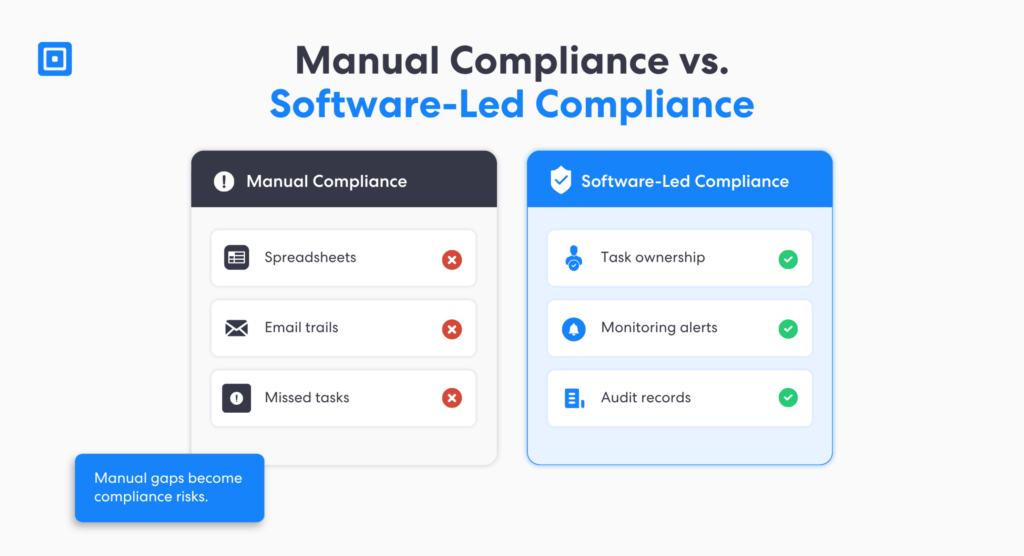
Compliance teams need help applying those AML/CTF policies when they bring on new customers, review business relationships, or assess high-risk clients. Most importantly, they need to report any suspicious matters when required.
Moreover, the strongest Tranche 2 compliance software solutions fit in well with practice management systems. Solutions must produce data that supports Suspicious Activity Reports (SARs) and threshold transaction reports. It is their job to make it easy for [Money Laundering Reporting Officers (MLROs)](https://www.complycube.com/en/use-cases/profession/money-laundering-officers/) and other compliance team members look for evidence to make decisions with ease. It makes internal compliance reviews seamless.
## Tranche 2 Compliance Software Capabilities
The right Tranche 2 AML Software needs to be indicative of a firm’s current risk profile. What may be considered risky for a real estate agency or law firm might not be the case for an accounting practice or tax advisory. Similarly, a conveyancer, trust, or company service provider may need to meet different compliance requirements. Their workflows are not meant to be identical. A strong platform should support:
### Customer Due Diligence (CDD)
CDD helps firms understand who the customer is. This solution also looks into what service is being provided by firms, what risks come up, and if Enhanced Due Diligence (EDD) is needed. The best AML software must support IDV, beneficial ownership checks, and various levels of AML screening based on risk.
### Risk Management and Assessments
A strong risk-based approach should consider the customer, the service being provided, and the ownership structure behind the relationship. It must also provide data on transaction type, delivery channels, and business relationships.
Good Tranche 2 software makes risk review consistent and easily explainable. Through compliance platforms, teams can see which risks were identified, the risk rating assigned, and whether enforcement actions have followed.
### Conduct Ongoing Monitoring for Customers
Manual compliance has a habit of breaking down. This is where ongoing monitoring is crucial. If a customer is high-risk after the onboarding process, firms must be informed. Whether it is due to sanctions changes, adverse media, or suspicious activity, if the risk changes, it should be known. Strong AML software supports re-screening, alerts, and review workflows. Also, for higher-risk clients, ongoing monitoring must happen more frequently and be better evidenced.
### Reporting Group Obligations and Record Keeping
Finally, regulated entities have core guidance around comprehensive records. Reporting obligations include the filing of suspicious matter reports, especially if illicit activities arise, or certain physical currency transactions up to a threshold of $10,000 AUD or more show up on threshold transaction reports. Strong software keeps records of financial transactions and data around any escalation or reporting decisions.
In the same vein, record-keeping is just as important. Maintaining records that show which clients were checked, what information was verified, and what risk was found is necessary. Moreover, teams must know who approved each case, and whether ongoing reviews were completed.
## AML/CTF Readiness to Tranche 2 Compliance Operations
However, many firms are treating Tranche 2 compliance as a one-time project. To them, it is as simple as obtaining a template, appointing an officer, and enrolling with AUSTRAC to meet the 1 July 2026 deadline. This results in missing a bigger operational risk.
Tranche 2 compliance obligations will become a part of day-to-day operations for these newly regulated firms. They will become part of customer onboarding and client servicing. Every single new matter, property transaction, and high-value transaction will now require a consistent process.
## Which Tranche 2 Compliance Software Is Right?
Often, the right question is not “which tool helps us get ready?” but rather “which tool helps us run a defensible AML/CTF program after 1 July 2026?” This is how Tranche 2 compliance software solutions can differentiate themselves. The best platforms help firms identify, verify, and assess customers throughout the full business relationship. By linking various AML prevention solutions into a single, controlled workflow, teams can build the strongest operating model to protect against risk.
## Identity Verification and Tranche 2 Compliance Software
Today, identity verification is necessary as firms need to verify clients before providing them with specific designated services. This involves potentially verifying individuals, directors, and beneficial owners. Other verifications include those of trustees, buyers, sellers, or representatives.
However, identity verification is the first layer. A client can easily pass a document verification check and still have money laundering or terrorism financing risks assigned to them. This is found through adverse media, sanctions exposure, and complex ownership.
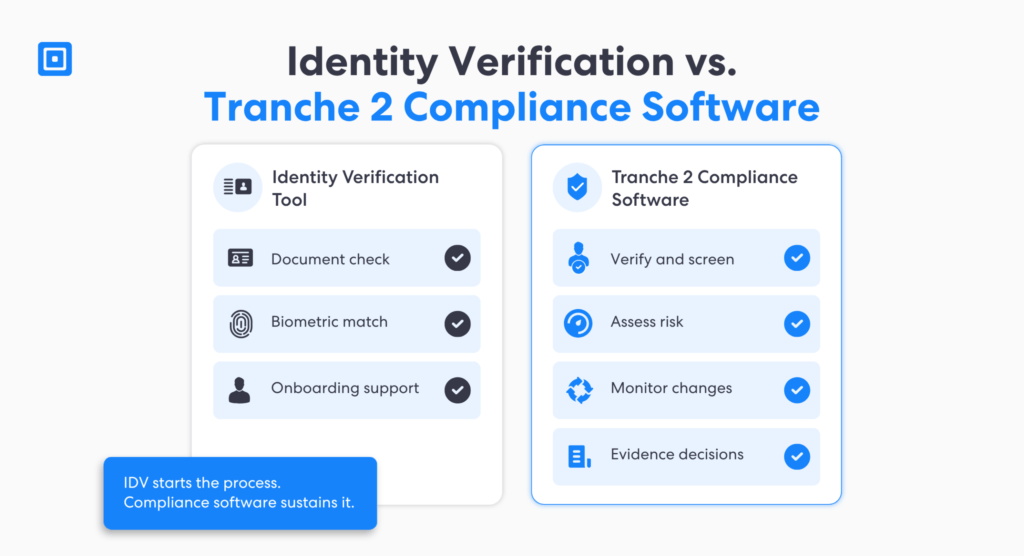
The best AML compliance software will link identity verification with other AML solutions and features such as case management, reporting support, and audit trails. A one-off identity check cannot replace a live and ongoing compliance program.
## The Tranche 2 Compliance Software Maturity Model
To compare Tranche 2 compliance software, teams need to know what level of compliance maturity they have. Though some compliance tools help prepare documents, others help to verify customers. The best platforms help firms operate compliance over time.
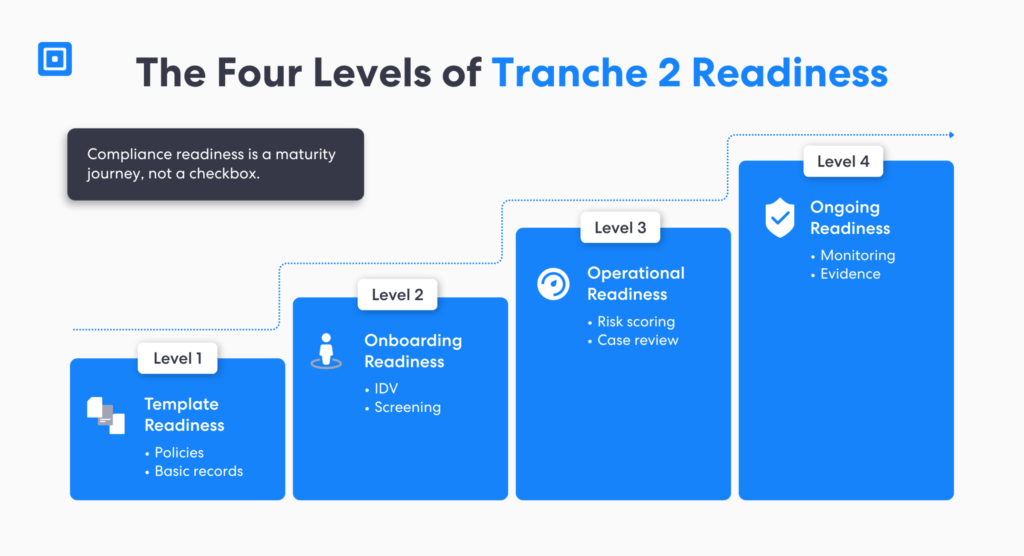
A good Tranche 2 maturity model can help buyers and potential customers understand the level of readiness each platform can support. This can prevent any further complications with AML/CTF obligations under the new reforms. You can learn more here: [How Australian Firms Can Build a Tranche 2 KYC Solution](https://www.complycube.com/how-australian-firms-can-build-a-tranche-2-kyc-solution/)
### Level 1: Template Readiness
Oftentimes, firms in this category have the paperwork foundation. That means that they may have some semblance of an AML/CTF policy or draft version of a compliance program. This could look like a risk assessment template, straightforward staff guidance, and somewhere to store records.
However, it does not mean that the firm can actually verify clients, screen them, or risk-rate them. Moreover, they cannot escalate concerns, monitor them, or prove at all that each step actually happened. This is where teams do not necessarily have the working process and are not operationally compliant.
### Level 2: Onboarding Readiness
Some firms need to check clients at the point they come in. The businesses can collect client information, verify ID documents, and check names against sanctions or PEP lists. This is a basic customer due diligence process that typically happens during any onboarding procedure.
Here the focus is still the start of the business/client relationship. It does not fully cover what happens if a client becomes higher risk later. For example, if ownership changes, suspicious matters arise, or if the firm needs to evidence a full decision trail, this could change their risk scoring. Though teams can onboard clients compliantly, they do not have a full ongoing compliance process.
### Level 3: Operational Readiness
Here, firms can run compliance as part of day-to-day operations. Their systems go beyond verifying clients by assigning risk scores, triggering EDD for higher-risk clients, and escalating a case to compliance officers where needed. Additionally, they are able to manage any client approvals, add notes or evidence, and demonstrate exactly why a decision was made.
Compliance processes are easily defensible at this stage. They can answer all of the important questions around why client approval happened, what risks we identified, who conducted the review, and most importantly, what evidence supports the decisions. There are risk-based compliance decisions being made, not just complete checks.
### Level 4: Ongoing Compliance Readiness
The final stage is seeing if firms can keep compliance live well after the onboarding process. Here, businesses can monitor risk changes, re-screen customers, and update existing records. They are also able to review existing clients, get alerts for any changes in sanctions/PEP/adverse media status, and evidence that ongoing reviews are and have happened.
This is the strongest level of Tranche 2 compliance maturity as AML/CTF compliance is not a one-time check. For example, a system can alert the compliance team, trigger reviews, update the risk rating, and store the new review outcome. Firms are monitoring and managing compliance over a period of time.
## Choosing from Tranche 2 Anti-Money Laundering Software
Newly regulated firms should choose Tranche 2 compliance software based on their risk profile, designated services, and compliance maturity level. From real estate agents to legal services and from tax agents to virtual asset service providers, the obligations vary according to [sector-specific guidance](https://www.minterellison.com/articles/austrac-key-guidance-released-on-2026-aml-ctf-reforms) from current reporting entities.
Firstly, start by mapping out what your designated service entails. For example, a law firm manages client funds or a real estate agent handles property transactions. Varying closeness to risk determines what tools or solutions would work best.
Then, map out the Tranche 2 compliance maturity level. Each level has a different level of need. A Level 1 may need policies, risk assessments, and staff training. On the other hand, Level 2 will need IDV and screening. If you end up moving towards Level 3 or 4, you need a much more intensive process including risk scoring, enhanced due diligence, and case management. Moreover, firms at that level will also need ongoing monitoring, reporting support, and audit-ready evidence.
It is also incredibly important to avoid any sort of disconnected compliance tools where possible. So, if ID documents sit in one system, and screening results or risk assessments sit in another, it becomes much harder to prove to regulators that the written AML/CTF program is actually working in practice.
The best Tranche 2 compliance software must make compliance easy to follow. By outlining who was checked, what information was verified, and what risk was identified, it builds a strong baseline of information for compliance officers and teams. Additionally, being able to track what decision was made, who approved it, and whether ongoing monitoring later changed the [risk profile](https://docs.complycube.com/documentation/api-reference/core-resources/risk-profile) can be hugely impactful to the overall process.
## Top 5 Tranche 2 Compliance Software Solutions for 2026
Choosing the right Tranche 2 compliance software is about choosing a platform that can help turn AML/CTF obligation into a working compliance process for newly regulated Australian firms. The providers listed below support many important parts of the compliance journey.
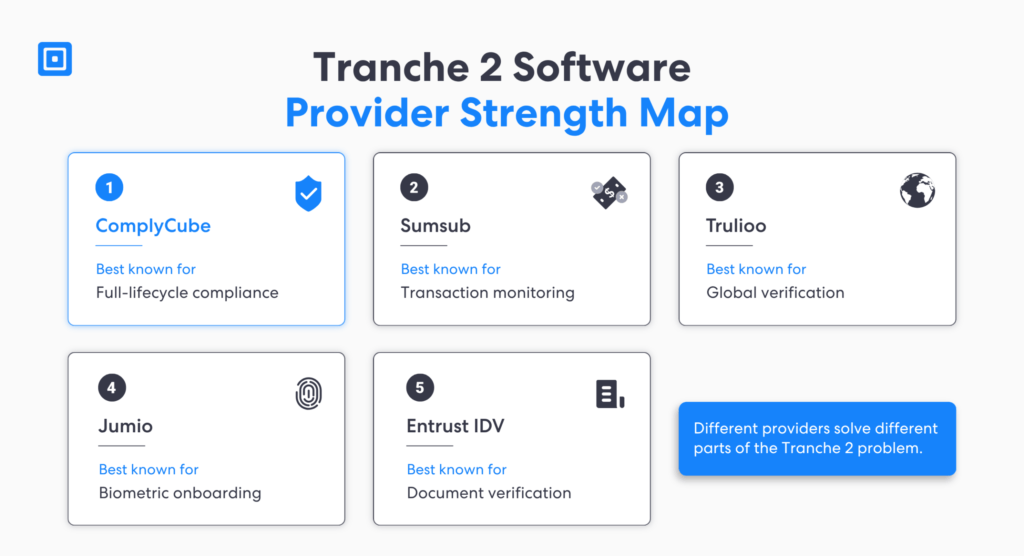
However, these Tranche 2 compliance software solutions are not made for the same level of compliance maturity. The comparison guide below assesses which one best fits your firm’s risk profile, designated services, and long-term Tranche 2 needs.
### 1. ComplyCube
ComplyCube is best known for full lifecycle AML/CTF compliance. This is the best option for newly regulated firms that wish to connect various solutions such as onboarding, customer screening, ongoing monitoring, and custom policy building all within one platform. Teams are able to tailor risk rules and workflows to their specific Tranche 2 obligations.
- **Best for:** Firms that wish to centralize Tranche 2 compliance instead of stitching together separate tools.
- **Where it stands out:** When teams need help verifying clients, assessing risk, and evidencing decisions over time.
- **Tranche 2 Maturity Fit:** Levels 1 to Level 4, helping those in template all the way through to ongoing compliance readiness.
- **Key consideration:** ComplyCube is best for firms that want broad and thorough compliance coverage. If a firm needs basic IDV, perhaps a narrower IDV provider may be better.
### 2. Sumsub
Sumsub is best known for their transaction monitoring and risk orchestration. This is relevant for firms that must monitor customer activity, link risk signals, and manage more complex fraud or compliance scenarios.
- **Best for:** Firms where transaction behavior is closely linked to the risk model.
- **Where it stands out:** When businesses need to connect verification with transaction monitoring. This is useful for firms handling high-volume activity, digital services, or complex customer behavior.
- **Tranche 2 Maturity Fit:** Level 3 to Level 4, helping those in operational compliance to ongoing compliance readiness.
- **Key consideration:** Newly regulated businesses should assess how Sumsub best ensures compliance and fits professional services workflows. Additionally, it is important to check AUSTRAC alignment in reporting expectations and local client-funds risks.
### 3. Trulioo
Trulioo is best known for global identity and business verification coverage through Know Your Business (KYB). It is a strong option for firms that work with international clients, foreign beneficial owners, or cross-border ownership structures.
- **Best for:** Firms that need help with verifying individuals or businesses across many jurisdictions and countries.
- **Where it stands out:** Trulioo’s main strength is overall reach. For Tranche 2 firms dealing with overseas clients, complex company structures, or foreign ownership, global verification depth can be valuable.
- **Tranche 2 Maturity Fit:** Level 2 to Level 3, helping those in onboarding to operational readiness.
- **Key consideration:** Though Trulioo is strongest as a global verification layer, firms may still need help with case management, ongoing monitoring, and AUSTRAC-aligned evidence workflows.
### 4. Jumio
Jumio is most well known for strong biometric identity verification and Electronic KYC (eKYC) onboarding. For most, this is a practical choice for firms who want to digitize client intake and reduce manual identity checks.
- **Best for:** Firms that need a strong digital onboarding experience.
- **Where it stands out:** Where the priority is verifying customers quickly and securely. It can help firms replace manual document collection with a more consistent digital intake process.
- **Tranche 2 Maturity Fit:** Level 2 to Level 3, helping those in onboarding move to operational readiness.
- **Key consideration:** It is true that Jumio can support onboarding well. However, Tranche 2 firms must assess if they need risk workflows, EDD, and ongoing monitoring as well.
### 5. Entrust (formerly Onfido)
Entrust IDV, formerly known as Onfido, is somewhere firms can turn to specifically for document verification and onboarding fraud detection. They provide a strong IDV layer for firms that need to verify real users and lower fraud at onboarding.
- **Best for:** Firms that require an IDV layer before building broader AML/CTF workflows.
- **Where it stands out:** Entrust is best as an onboarding verification tool. It helps firms that already have internal AML/CTF processes better verify identity documents, reduce fraud, and create a smooth client intake process.
- **Tranche 2 Maturity Fit:** Level 2, helping those in the onboarding readiness stage.
- **Key consideration:** Entrust will need to sit alongside additional tools. Firms may still need risk scoring, beneficial ownership checks, and ongoing monitoring.
### **Case Study: The Civil Penalties from The Federal Court of Australia**
The Federal Court of Australia imposed civil penalties of $50,000 AUD ($34,000 USD) against Castra Licensee Pty Ltd. and $45,000 AUD ($31,050 USD) against Princeton Securities (NSW) Pty Ltd. Both businesses failed to pay AUSTRAC infringement notices due to alleged AML/CTF act breaches.
### Failing to Conduct Annual Compliance Reporting
They failed to meet mandatory reporting obligations, specifically annual compliance reporting in 2023. This AUSTRAC case matters as Australia aligned more closely with global standards from the [Financial Action Task Force (FATF)](https://www.fatf-gafi.org/en/countries/detail/Australia.html). Newly regulated Tranche 2 firms need systems that support governance from day one.
### Outcomes
- Missed AML/CTF reporting obligations escalated into Federal Court penalties.
- Compliance failures are not limited to large banks or money laundering schemes.
- For Tranche 2 firms, compliance software must help keep track of reporting duties, maintain evidence, and keep ownership of AML/CTF obligations visible.
## Supporting Maturity with Tranche 2 Compliance Software
For Tranche 2 firms, the best test of a platform’s compliance arrangements is to see if they can support a defensible AML/CTF operating model well after the deadline. It does not boil down to how fast a document check is. It is all about how everything works together to prevent financial crime and fraud under the new regulations.
However, for Tranche 2 firms, this solution distinction is important. A provider known for identity verification may be excellent for onboarding. However, firms that need to manage ongoing [AML/CTF obligations](https://www.austrac.gov.au/sites/default/files/2025-07/AMLCTF_obligations_factsheet_for_tranche_2_REs.pdf) must look for risk workflows, monitoring, and case management. They also need to look to reporting controls and audit-ready evidence.
### Key Takeaways
- **Tranche 2 compliance software** must help firms operate an AML/CTF program.
- **Identity verification** is only one part of a wider AML/CTF compliance process.
- **Platforms must support** risk assessments, monitoring, reporting, and recordkeeping.
- **Many credible options** support different levels of Tranche 2 compliance maturity.
- **The strongest fit for firms** seeking ongoing compliance readiness and full lifecycle AML compliance software is ComplyCube.
## Update AML Programs for Tranche 2 with ComplyCube
Though 1 July 2026 has passed, Tranche 2 obligations are only just beginning. Newly regulated entities, whether they handle client funds, money transfer services, or digital assets and more, must build a strong AML/CTF program. They must make it defensible, repeatable, and scalable to protect your firm, client identities, and Australia’s financial system.
In summary, ComplyCube helps these businesses automate various compliance solutions such as IDV, CDD, AML, and KYB. Their award-winning software solution also supports beneficial ownership checks, ongoing monitoring, and risk management. If your firm needs audit-ready compliance workflows for Tranche 2, ComplyCube can help you move from manual compliance to a live program. [Get in touch with our team today](https://www.complycube.com/contact/contact-sales/).
[](https://portal.complycube.com/signup)
## Frequently Asked Questions
How should Australian firms choose Tranche 2 compliance software?
Australian firms must choose Tranche 2 compliance software based on factors such as customer risk profile, offered designated services, and client types. New reporting entities must also consider compliance maturity levels. Then, they can determine which solutions they need to be compliant with ongoing enhancements from AUSTRAC.
Why is IDV not enough for Tranche 2 compliance?
IDV helps confirm who a client is. However, Tranche 2 compliance needs firms to assess overall financial crime risk over the whole business relationship. This requires firms to have CDD processes, beneficial ownership checks, and sanctions or PEP screening. It also requires them to have EDD protocols in place, conduct ongoing monitoring, report suspicious matters, and keep records.
Which businesses are most affected by Australia’s Tranche 2 reforms?
Australia’s Tranche 2 AML/CTF reforms impact businesses providing newly regulated services that will impact the financial system. These include real estate professionals, legal professionals, and accountancy. Other industry associations are trust services, company services and dealers in precious metals and stones.
What is the difference between onboarding readiness and ongoing compliance readiness?
Onboarding readiness is when firm can identify clients, gather information, verify documents, and screen names. Ongoing compliance readiness refers to firms that can monitor risk changes, re-screen customers, and update records. Additionally, they are looking manage escalation, file suspicious matter reports, and evidence reviews over a period of time.
Is ComplyCube suitable for Tranche 2 compliance?
Yes. ComplyCube is suitable for Tranche 2 compliance because it supports identity verification, CDD, and KYC. They also provide additional software solutions including KYB, AML screening and ongoing monitoring. Moreover, with risk workflows, case review, and audit-ready evidence, ComplyCube is a strong option for Australian firms that need full-lifecycle AML/CTF compliance software rather than a standalone IDV tool.
**Categories:** Guides
**Tags:** Anti-Money Laundering
---
### [CryptoCubed June Newsletter: Binance MiCA Failures and FinCEN Stablecoin Rule](https://www.complycube.com/cryptocubed-june-binance-mica-fincen-stablecoin/)
**Published:** June 30, 2026
**Author:** Dini Habib
**Excerpt:** In June, we cover new global regulatory requirements for crypto firms. We cover the Binance MiCA license challenges, FinCEN's latest stablecoin rule, the infamous Southeast Asian fraud network, Hong Kong's warning on AI, and more!
**Content:**
👋 Welcome back! June’s crypto headlines cover the latest regulatory developments worldwide. We explore the recent Binance MiCA license challenges, the new FinCEN stablecoin rule, targeted U.S. attacks on Southeast Asian crime networks, Hong Kong’s AI cyber warning, and lastly, ASIC’s High Court win against Block Earner.
For compliance officers, this month focuses on more than enforcement actions. It focuses on building resilient Anti-Money Laundering (AML) and fraud controls that adapt to evolving regulations and crypto-related risks.
## Binance MiCA License Withdrawal Forces EU Exit
European Union, June 29, 2026, 🇪🇺: From July 1st onwards, Binance will suspend its crypto services in multiple EU markets after withdrawing its Markets in Crypto-Assets (MiCA) license registration in Greece.

Under MiCA regulations, cryptocurrency and Virtual Asset Service Providers (VASPs) have until 30th June to obtain authorization to operate in the EU. Regulators expect these businesses to evidence [strong AML](https://www.complycube.com/en/solutions/due-diligence-compliance/anti-money-laundering/) governance, risk control, and customer protection as part of the license review.
Binance is one of the largest crypto exchanges by volume, and as such, authorities demand better documentation and mature AML controls. In another case, the firm faced scrutiny in France over regulatory and operational concerns, which can make its path to entry into the EU regime much harder.
For businesses in the crypto space, planning for regulator-specific timing during MiCA registration is key. It ensures firms do not need to resubmit applications for different question sets. Binance has said it will now focus on obtaining authorization from another EU member state rather than completing the Greek process.
> Spain’s market watchdog will grant [no extensions](https://www.reuters.com/business/finance/spain-markets-watchdog-rules-out-extension-eu-crypto-licence-deadline-2026-06-26/) or waivers to crypto firms that fail to secure licenses under the EU’s MiCA regime.
However, EU regulators are enforcing tighter MiCA oversight, with larger scrutiny on firms that are “license shopping,” i.e., applying for a license in multiple member states to pursue the easiest approval route. Countries such as Spain have reinforced this message, with its chair, Carlos San Basilio, stating, “Spain’s market watchdog will grant no extensions or waivers to crypto firms that fail to secure licenses under the EU’s MiCA regime.” Will Binance win this battle to operate in the EU?
For more information, click [here](https://www.reuters.com/business/finance/binance-set-lose-eu-licence-bid-permission-offer-services-bloc-sources-say-2026-06-16/).
## FinCEN Stablecoin Rule Puts Issuers under Heightened Oversight
United States, June 18, 2026, 🇺🇸: The Financial Crimes Enforcement Network (FinCEN) and other U.S. federal regulators have proposed a new rule, requiring payment stablecoin issuers to enforce the Customer Identification Program (CIP) under the GENIUS Act.
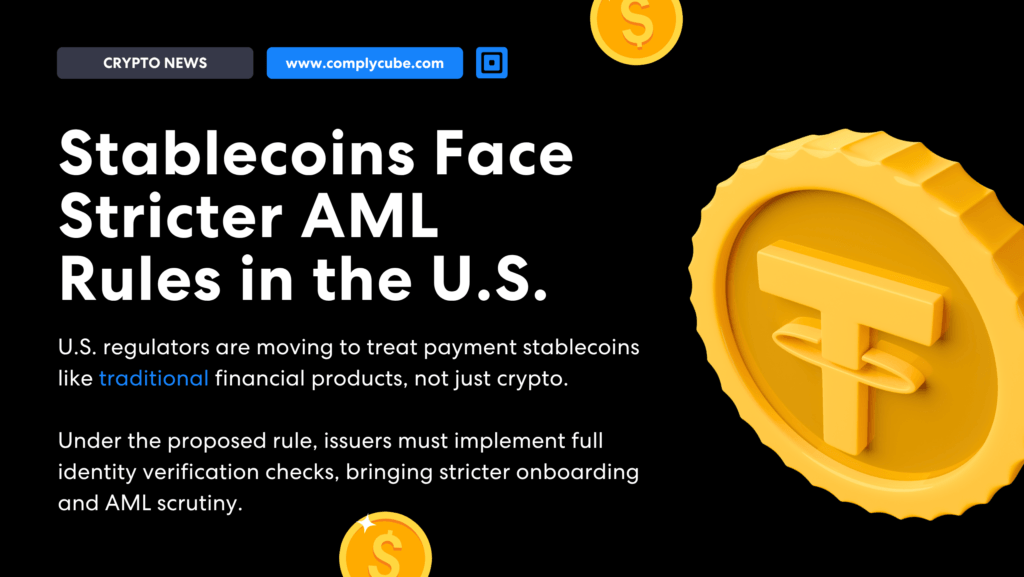
A stablecoin is a form of crypto designed to maintain a fixed value rather than experience drastic price swings, unlike Bitcoin. However, authorities increasingly consider them medium- to high-risk as they are commonly used in trading and cross-border payments.
Under this proposed rule, stablecoin issuers must identify customers before account opening or redemption. As such, regulators now bring these firms closer to heightened, bank-style onboarding. AML compliance for stablecoins is seen as a financial activity, rather than a crypto product.
For more information, click [here](https://www.fincen.gov/news/news-releases/fincen-agencies-propose-rule-implement-genius-act-customer-identification).
## Southeast Asian Transnational Criminal Organization Dismantled by U.S.
United States, June 23, 2026, 🇺🇸: U.S. authorities have sanctioned 9 individuals and 26 entities linked to the notorious Southeast Asian, Prince Group Transnational Criminal Organization, connected to large-scale fraud in the country.
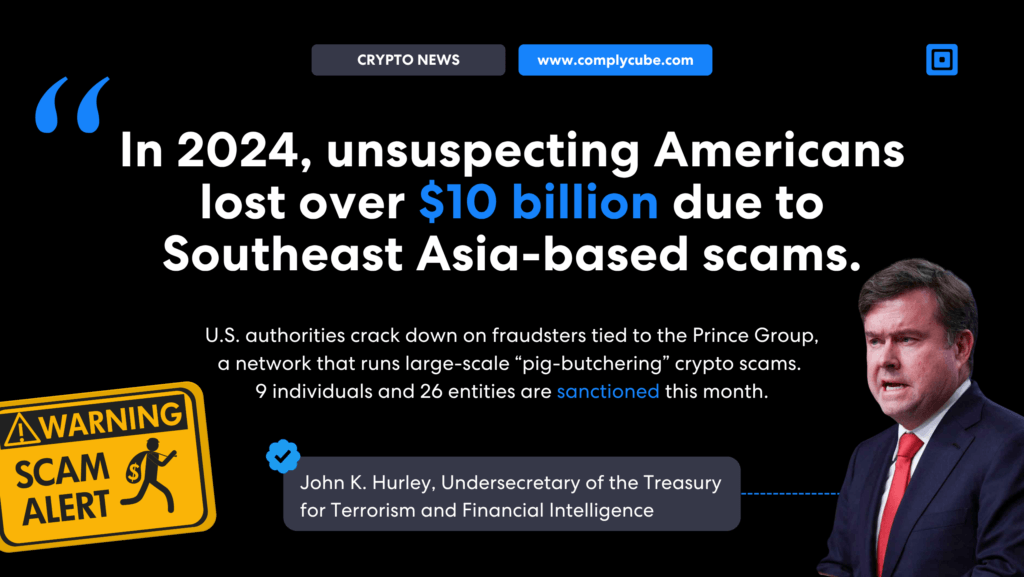
The Prince Group runs online pig-butchering scams that lure victims into investing in cryptocurrency. The organization is treated as a regional, cross-border threat, with countries such as the UK, South Korea, and Japan swiftly arresting and sanctioning associated individuals.
> Scam centers in Southeast Asia steal billions of dollars from American victims each year.
The case highlights just how strong modern criminal groups are in using corporate structures, financial intermediaries, and cross-border offshore entities to industrialize scam activity. This scam now forms a major global AML challenge.
Businesses across regulated markets, particularly crypto firms, play a strong role in strengthening compliance controls to identify and report these groups. Authorities are pushing towards enforcement actions on firms that fail to identify and report scam typologies.
For more information, click [here](https://home.treasury.gov/news/press-releases/sb0538).
## Hong Kong Expects Crypto Firms to Prepare for AI Cyberattacks
Hong Kong, June 2, 2026, 🇭🇰: Hong Kong’s Securities and Futures Commission (SFC) and Hong Kong Monetary Authority (HKMA) warn Licensed Corporations (LCs) and Virtual Asset Trading Platforms (VATPs) to harden their defenses ahead of AI-enabled cyberattacks.
> The proliferation of AI-enabled tools may lower the technical barrier for threat actors to execute malicious activities, such as phishing, social engineering, and deepfake impersonation.
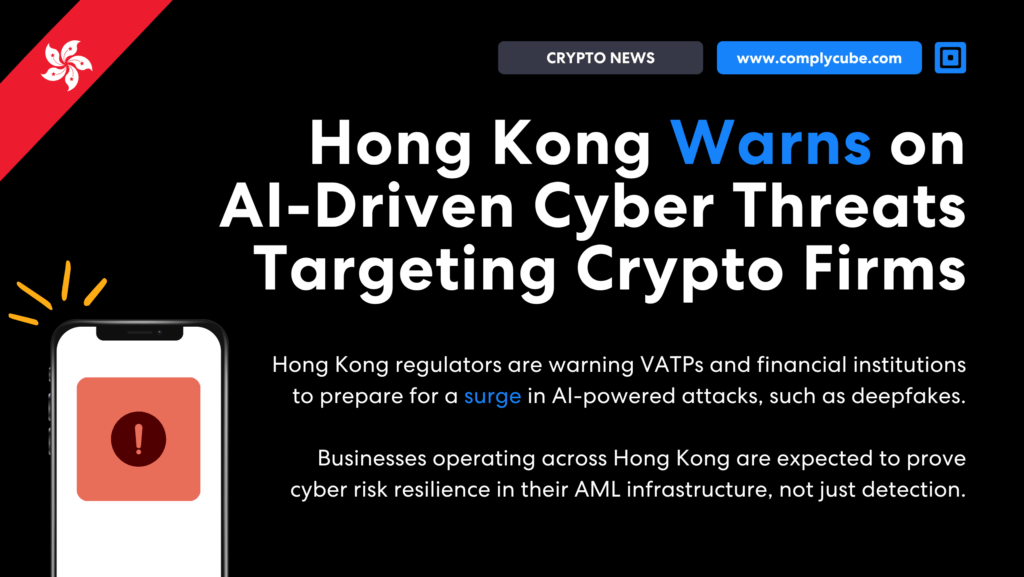
In 2025, Hong Kong saw a steep 27% rise in cyberattacks. Due to their speed, remote nature, and high transaction volumes, virtual asset platforms remain attractive targets for these AI-assisted attacks. The SFC now signals heavy supervision on how firms are resisting destructive attacks, not just detecting them. VASPs alike must treat AI-enabled cyber risk as a governance issue.
For more information, click [here](https://apps.sfc.hk/edistributionWeb/gateway/EN/circular/intermediaries/supervision/doc?refNo=26EC32).
## ASIC Wins High Court Battle Over Block Earner’s Crypto Product
Australia, June 17, 2026, 🇦🇺: The Australian Securities and Investments Commission (ASIC) got a High Court win after judges found Block Earner’s fixed-yield “Earner” product was a financial product, suggesting its initial civil penalty of A$350,000 (USD $240K) is back in consideration.
Block Earner is an Australian blockchain-powered fintech company. In 2024, ASIC imposed a civil penalty on Block Earner after deeming its fixed-yield “Earner” product as a financial product requiring an Australian Financial Services License. Following this, the Federal Court relieved Block Earner of the penalty, and ASIC appealed the decision.

Typically, regulators treat crypto yield products as a legal gray area because they are seen as software or digital tokens, rather than regulated securities. However, the recent callback by the High Court shows that regulators are moving away from product labels and instead, look at its behavior. In this case, authorities viewed the Earner product as resembling an investment, derivative, or managed-return activity, even if marketed as an innovative digital asset service.
For businesses in the blockchain and crypto sector, this case highlights a critical shift: regulators are moving beyond product design, focusing scrutiny on products and services based on their risk to investors, consumers, and the wider ecosystem. Investigations are still ongoing.
For more information, click [here](https://www.asic.gov.au/about-asic/news-centre/find-a-media-release/2026-releases/26-124mr-asic-successful-in-high-court-block-earner-appeal/).
## Time for Some Light-Hearted Creative Criticism?
So you’ve made it to the end of our newsletter. It’s time to enjoy a little satire, worthy reader, you’ve earned it.
### 🔥THE CRYPTO CUBED POEM: JUNE🔥
The market rushed where rules were thin,
But June drew lines and pulled them in.
Europe locked the doors on MiCA license games,
While stablecoin issuers face bank-like claims.
Hong Kong watched AI sharpen fraud,
And ASIC judged the yield product flawed.
Across the map, sophisticated scammers fell,
As compliance rose to ring the bell.
### Stay tuned for our July newsletter, and have a great month!

**Categories:** News
**Tags:** Crypto Regulations
---
### [KYV: Online Dating Identity Verification For Safe Romance](https://www.complycube.com/online-dating-identity-verification/)
**Published:** February 14, 2024
**Author:** Andreea Balasa
**Excerpt:** Know Your Valentine (KYV) is the process of mitigating the dangers within the online dating industry. This guide celebrates Valentine's Day, the importance of a secure platform, and discusses robust dating app identity verification.
**Content:**
**TL;DR:** **Know Your Valentine (KYV)** safeguards dating platforms with robust online dating identity verification to stop fraud, fake profiles, and **underage access**. ComplyCube’s AI-powered online identity verification service helps prevent online dating fraud and enables fast, secure onboarding through seamless **online identity verification** tools.
## What is Know Your Valentine in Online Dating Identity Verification?
Know Your Valentine (KYV) helps dating platforms mitigate the dangers present in the online dating industry. Platforms must start safeguarding users at the point of customer acquisition by applying thorough identity verification procedures.
As the internet matures, dating apps continue to take the world by storm. In fact, they fill the romantic void in the hearts of many folks. However, innovations in online identity verification have yet to keep pace with advancements in internet connectivity and related technologies. As a result, this has led to a surge in online dating fraud, multiplying the need for stronger online identity verification service.
It is necessary to protect minors from explicit and inappropriate content. This can be done by ensuring your online dating site has sufficient IDV measures such as age verification. This can also save thousands of individuals (or millions of dollars) from romance scams on dating apps.
## Statistics Around Online Dating Services
In 2025, dating apps are becoming the norm. According to dating statistics from eharmony, around [80 million people in the U.S.](https://www.eharmony.com/online-dating-statistics/#fn2-3175) are now using dating app websites. It is imperative to raise awareness of the necessity of user identity to prevent online dating fraud. This is pertinent now as it is common practice for users to have multiple dating and even social media accounts. This uptick in account volume makes conducting a romance scam easier, as there is far more opportunity for bad agents.
It is important to realize that integrating a thorough online identity verification service will deter online dating fraud from romance scammers and malicious individuals. It will stop them from exploiting minors and other individuals. As a provider of dating services or any social media platform, instilling trust in your platform will retain confidence in your brand and increase usage, driving revenue up.
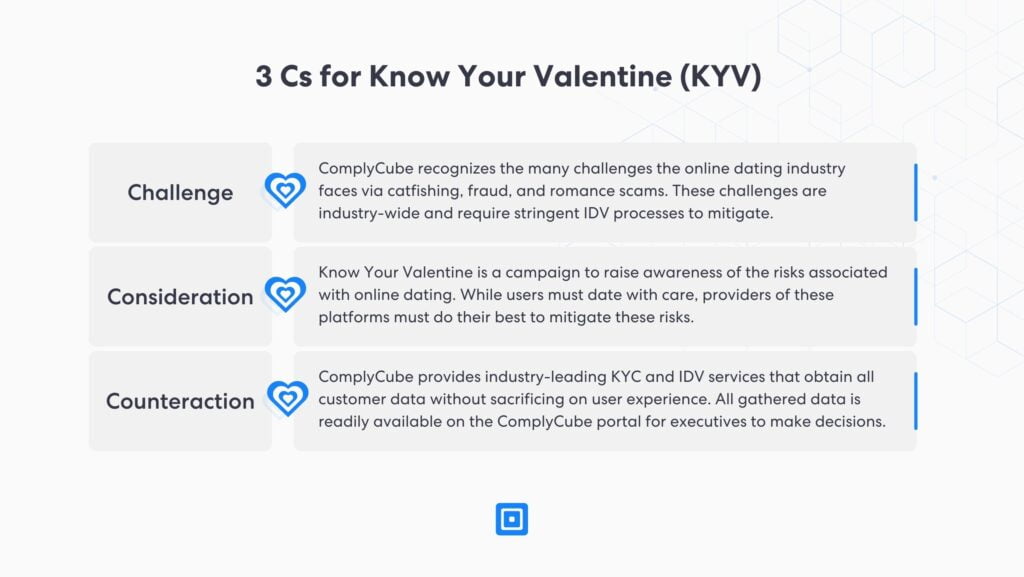
## Challenge with Online Dating Fraud
The online dating industry is a breeding ground for malicious activity and individuals intent on scamming users looking for love. [67% of users](https://zipdo.co/statistics/social-media-catfish/#:~:text=Approximately%2053%25%20of%20all%20catfishing,their%20catfisher%20impersonated%20someone%20else.) believe that more could be done to prevent online dating fraud, and improve the safety or operational security of dating platforms.
In 2022, [catfishing scams cost an average of $132.5 million a quarter](https://allaboutcookies.org/catfishing-scams-by-state#:~:text=Key%20findings,of%20catfish%20victims%20per%20capita.) in America, increasing over 10% from 2021. This notes the considerable increase in the prevalence of dating app scams which demands a change to be made.
Similarly, a 2023 Snapchat report showed that from a pool of 6000 Gen-Z users from Australia, France, Germany, India, the UK, and the US, [nearly 66% of them had experienced catfishing](https://edition.cnn.com/2024/01/29/tech/catfishing-explained-what-to-do-as-equals-intl-cmd/index.html). They were requested to send private information or indecent images to be later used against them.
In short, online dating fraud impacts both users and providers of the platform. More importantly, the industry should define itself by its safeguards, not by its perpetrators. Online identity verification service providers encourage dating sites to proactively look for ways to mitigate the risks that malicious individuals bring to their services.
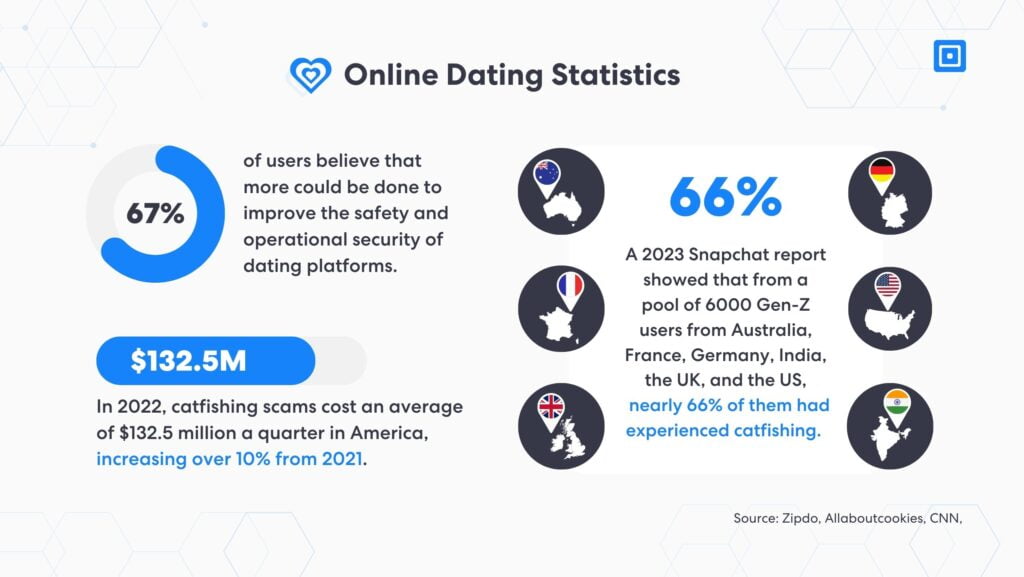
## Consideration for Online Dating Identity Verification
For this reason, Know Your Valentine (KYV) is the methodology online dating platforms should follow, KYV is a reminder of these dangers. Ultimately, online dating sites must look for ways to counter the lies romance scammers employ. Online identity verification service can stop scammers from conducting malicious activities, such as catfishing. As fake profiles rise, providers must protect user security, privacy, and data to build lasting trust across their services.
To enhance trust in their services, dating apps must establish robust mechanisms for generating age and identity assurances. This requires implementing comprehensive and up-to-date IDV and KYC processes that can scale with the exponential user base dating apps are fostering.
Additionally, the need for effective passive security measures is critical. In fact, this includes the ability to report any inappropriate content to preemptively prevent harm by identifying and reporting a potential romance scammer early on.
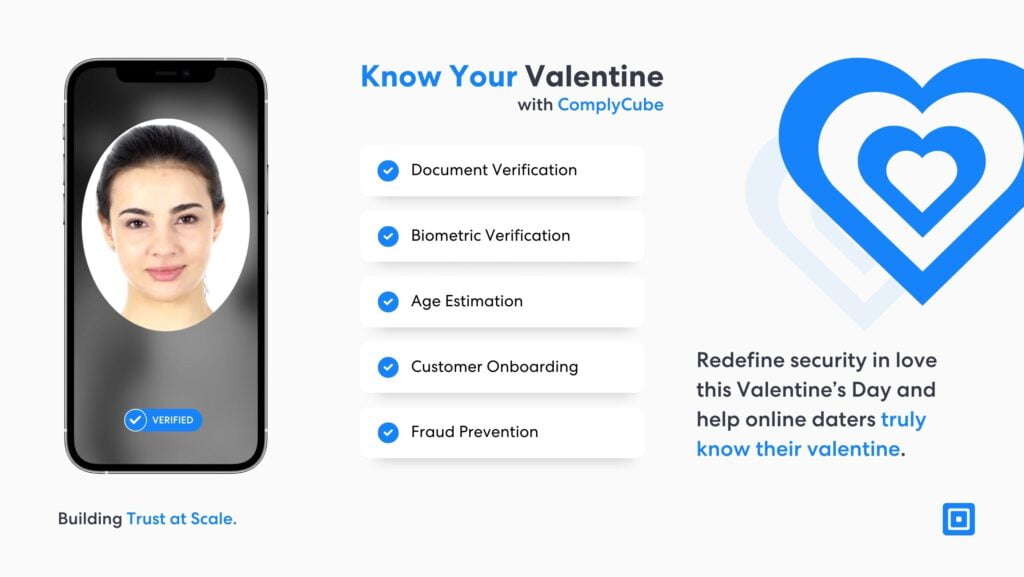
### Importance of Trust for Online Dating Sites
A dating platform that harbors instances of online dating fraud, catfish scams and other deceptive or fraudulent activities is one that tacitly endorses such crimes. Ultimately, these activities significantly undermine trust in your company’s ability to safeguard its users. This can lead to:
- Increased customer churn
- Deterioration of brand reputation
- Weaker growth prospects
- Potential fines for non-compliance
## Counteraction Against Online Dating Fraud
Online identity verification services provide a tailored offering for mitigating fraud, deception, and exploitation. Using AI-powered authentication engines, they provide autonomous customer acquisition workflows that extract data precisely and give complete customizability to their clients.
Dating site users are fickle, wanting a secure platform without lengthy onboarding times. These online identity verification services do the heavy lifting to provide secure and precise customer acquisition mechanisms. Using automated and customizable workflows, you can choose the level of friction that works for your business.
### Online Dating Identity Verification Workflow
A secure Online Identity Verification service follows a straight forward and seamless flow that balances safety and a great customer experience:
1. A User decides to sign up for your online dating service.
2. The user is redirected to an IDV and KYC onboarding workflow.
3. They walk through an easily comprehensible program.
4. IDV checks are run, and data is extracted instantly.
5. This data is sent back to the provider’s platform (for ComplyCube, this would be their portal), and the user returns back to your app/site.
6. The user is either instantly accepted and is granted access or required to submit more information.
7. If this occurs an onboarding team can create a case through the portal to be manually completed.
8. A case management team assigns tasks to be conducted via the portal.
9. The user is accepted if tasks are done adequately or rejected due to suspicious activity.
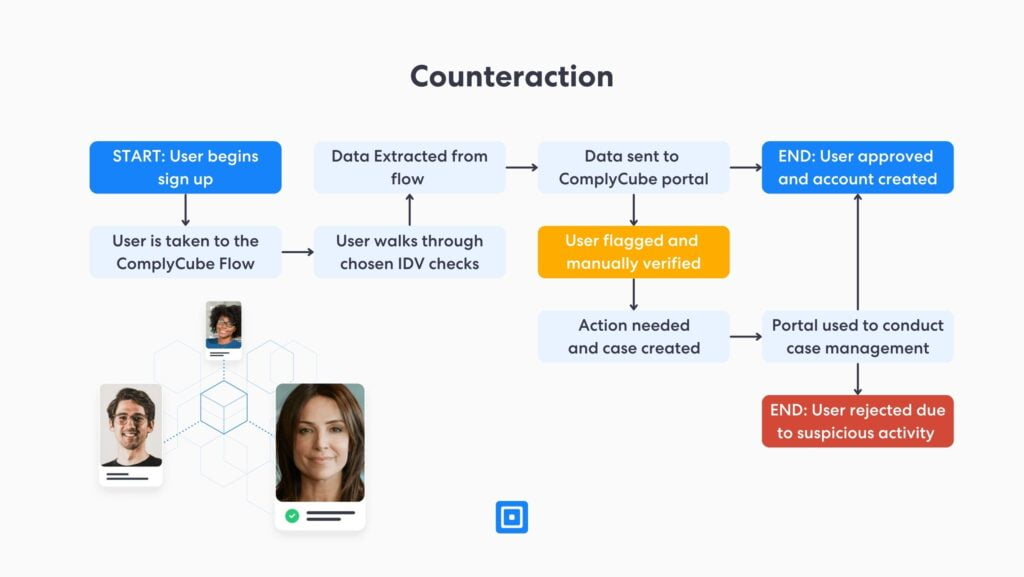
## Identity Verification Methodology
Artificial intelligence is paramount to the successful automation of these workflows. Machine learning technologies can perform the tasks that a human would accomplish in a fraction of the time and to a far higher degree of precision. This seamless process satisfies your customers and assures your business that it meets all compliance and security obligations.
### Document Verification in Online Dating Identity Verification
Often, [document verification](https://www.complycube.com/en/solutions/identity-assurance/document-verification/) authenticates a government-issued ID such as a passport. Then, it extracts the available data in seconds. This process ensures that the user has provided a genuine identification document and eradicates human error from the verification process.
Notably, registering on a dating or social media platform using a government-issued ID guarantees that individuals can establish only one account. This approach effectively addresses the problem of multiple signups, automatically denying registration if the ID is already in use. Additionally, it plays a significant role in thwarting attempts by fraudsters and bots. This compromises the integrity of genuine user accounts, enhancing overall platform security.
Therefore, this process alone acts as a strong first step towards improved regulation. However, many services still do not request such basic proof of information.
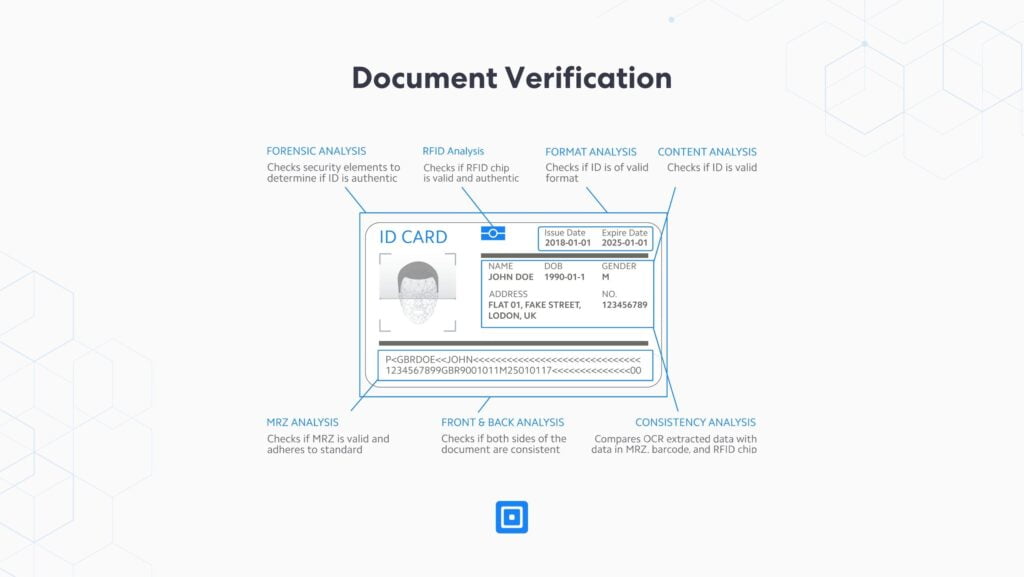
### Biometric Verification in Online Dating Identity Verification
Typically coded into the same workflow as a Document Verification, but available as a less stringent stand-alone option, biometrically authenticating a user does two things to mitigate identity theft:
1. Tests for liveness with machine learning technology and [Presentation Attack Detection (PAD)](https://www.complycube.com/en/solutions/due-diligence-compliance/know-your-customer/liveness-detection/). This ensures selfie integrity by checking for manipulation in the image, from pixel tampering to signs of distress (from the individual) in the supplied image.
2. Matches the supplied selfie to the stock image in the KYC document. Consequently, this provides the company with a high level of identity assurance when combined with document verification. Dating sites can choose their own ‘friction’ levels, setting their own similarity score thresholds between the document image and the selfie.
For more information on Biometric Verification, read: [The Advantages of Biometric Authentication.](https://www.complycube.com/en/the-advantages-of-biometric-authentication/)
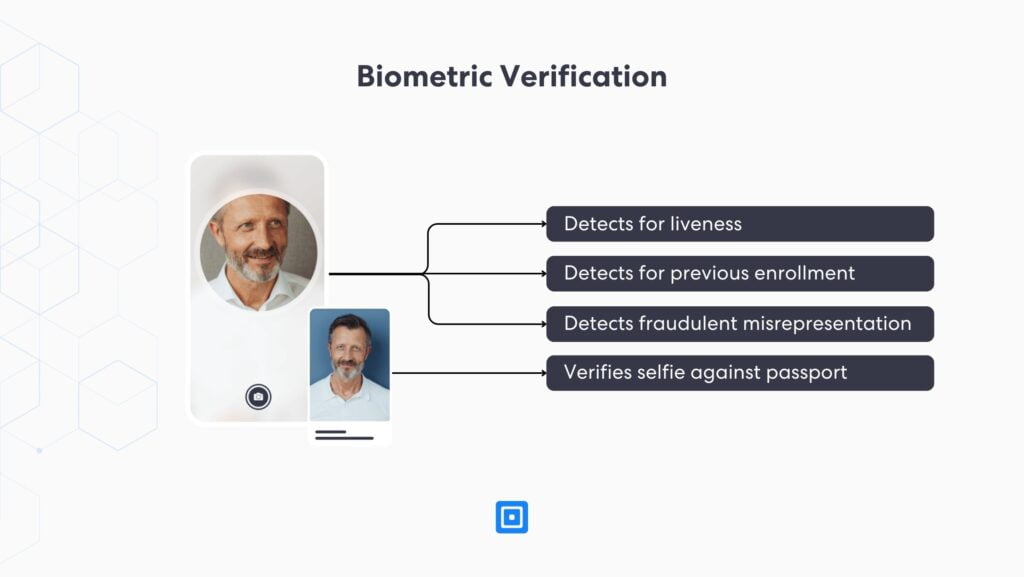
### Age Estimation in Online Dating Identity Verification
ComplyCube’s sophisticated AI-powered face recognition system delivers immediate age estimations for users using the same advanced liveness and anti-spoofing technology found in standard biometric checks. This approach ensures a one-step age verification process without compromising on precision.
[Age estimation](https://www.complycube.com/en/solutions/global-screening/facial-age-estimation/) is an ideal solution for businesses offering products or services with age restrictions, aiming to minimize onboarding barriers. This method is flexible and accessible, allowing customers to estimate their age quickly and conveniently with just a selfie, anytime and anywhere.
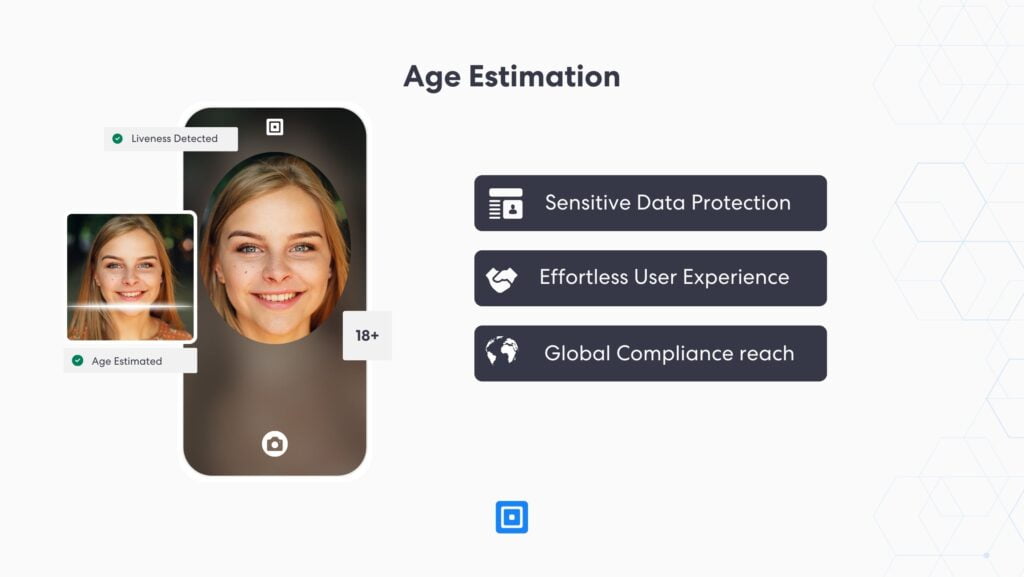
### **Case Study: Grindr Strengthening Online Dating Identity Verification in the UK**
Grindr lacked robust age verification measures, relying solely on self-declared user age. This exposed the platform to underage access, grooming risks, and potential violations of the UK’s Online Safety Act 2023. You can learn more here: [Online Safety Act 2023 vs. EU DSA: What You Need to Know](https://www.complycube.com/en/online-safety-act-2023-what-you-need-to-know/)
**Identity Verification for Dating Profiles**
To meet regulatory obligations, Grindr launched a mandatory **online identity verification service** for all UK users in July 2025. The updated onboarding flow allowed users to verify their age. For instance, they would either conduct biometric [age estimation](https://www.complycube.com/en/solutions/identity-assurance/facial-age-estimation/) through a video selfie.
**Outcome:**
- Grindr aimed to achieve full compliance with the Online Safety Act age verification mandate
- IDV prevented underage access through verified onboarding
- This reinforced Grindr’s public commitment to user protection and digital trust
## Is Your Business in Need of an Online Identity Verification System?
Identity verification procedures in the online dating industry will provide users with a safe and secure experience, mitigating the fraudulent risks that are now synonymous with the industry.
### Instant Document Verification
The online dating sector has standardized lengthy and drawn-out waiting times for Document Verification. IDV solutions can verify a government-issued ID in seconds, providing a streamlined user experience without compromising the integrity of the data extracts.
### Seamless Biometric Verification
Document Verification is further strengthened when followed by [Biometric Authentication](https://www.complycube.com/en/solutions/identity-assurance/biometric-verification/). For example, this provides assurances over the user’s genuine identity via microscopic pixel detection. It also corroborates the identity by matching the ID image to the supplied selfie. This leads to combining these processes into one seamless flow takes less than one minute to complete. Therefore, it significantly disrupting the industry standard of multiple-hour waits for profile verification.
### Frictionless Onboarding
ComplyCube’s onus is to provide flexible and customizable services. Clients can choose which solutions to incorporate into their onboarding workflow based on their personal corporate tolerance. As a result, they are quickly becoming the go-to as a one-stop shop in Know Your Customer and Identity Verification services.
This hyper-focus on flexibility means clients are provided with frictionless onboarding processes for their users, who begin their relationship with the platform as favorably as possible. This ultimately acts as a revenue driver as failed signups are deterred and client retention is maximized and brings an unparalleled reputation to your platform. Users feel comfortable knowing that measures are being taken with their security in mind and that they are not signing up for one of many fake dating sites.
### Prevent Minor Exploitation and Online Dating Fraud
Online identity verification processes are designed with the security of the user in mind. Thorough identity verification methods will foster a safe online dating experience on your platform and ensure you meet the rapidly evolving compliance regulations. This is most pertinent in regard to minor exploitation on dating apps.
Therefore, with underage use and abuse on dating platforms rising and regulations also evolving, platform providers must take action into their own hands. They must seek innovative solutions for online dating identity verification.
### Key Takeaways
- **Online dating identity verification** is now essential to protect platforms and users from fraud.
- **Implementing a KYV strategy** helps platforms prevent catfishing, impersonation, and underage access.
- **AI-powered biometric checks** and document verification streamline secure onboarding.
- **Real-world results** show significant reductions in online dating fraud and improved platform trust.
- **ComplyCube** enables dating apps to implement scalable, KYV-ready online identity verification services through flexible, enterprise-grade workflows.
## Leading IDV and KYC Solutions for Online Identity Verification
ComplyCube is a leading force in digital identity verification, providing multiple proprietary AML, KYC, and IDV solutions that make it a front-runner in the industry. ComplyCube plays host to a plethora of institutions’ compliance efforts and has shaped their operational efficiency and helped maximize profits.
However, it can be difficult to choose a KYC and IDV provider in the modern day as there are an increasing number of services that come to market. A few questions to keep in mind when deciding are:
- Does this service cover the breadth of countries we operate in?
- Are their technologies proprietary, and are they reliant on others?
- How customizable are their plans?
- How easy is it to integrate this technology into our existing stack?
In closing, ComplyCube prides itself on having all of this, and more, in abundance as they provide the best-in-class for customization, range of operations, in-house developed technologies, and ease of integration. For businesses seeking a reliable partner in Identity Verification, [get in touch with one of our AML, KYC, and IDV specialists today](https://www.complycube.com/en/contact/contact-sales/?utm_source=cc_website&utm_medium=blog_post&utm_campaign=kyv_online_dating), and see how we can reshape your customer acquisition processes.
## Frequently Asked Questions about Online Dating Identity Verification
What is KYV in online dating identity verification?
KYV, or Know Your Valentine, is a safety framework that applies online dating identity verification to protect users from romance scams, impersonation, and underage access. By adopting KYV, dating platforms create safer, more trustworthy environments while complying with regulations that require secure and verifiable onboarding.
How do dating apps stop online dating fraud?
Dating apps prevent online dating fraud by integrating a secure online identity verification service into their onboarding flows. These include verifying IDs, performing biometric checks, and detecting liveness to ensure users are who they claim to be. These tools block scammers, fake profiles, and bots, significantly reducing fraud-related incidents on the platform.
What is biometric verification in online dating identity verification?
Biometric verification in online dating identity verification uses facial recognition technology to confirm that a user is real and matches the photo on their ID. This process often includes liveness detection, which ensures the selfie or video provided isn’t a spoof or deepfake. It adds a strong layer of trust by verifying both identity and physical presence during sign-up.
How can dating apps verify age without ID?
Dating apps can verify age without an ID by using AI-powered facial analysis to estimate the user’s age from a selfie. This technology uses biometric data to provide an accurate age range in seconds, helping dating platforms prevent underage access while offering a fast, low-friction user experience.
Why use ComplyCube for your online identity verification service?
ComplyCube offers a complete online identity verification service designed for dating platforms that need secure, scalable, and compliant onboarding. With tools like real-time document checks, biometric verification, and AI-based age estimation, ComplyCube helps platforms implement KYV strategies, meet global regulations, and build user trust through safe sign-up experiences.
**Categories:** Guides
**Tags:** Identity Verification
---
### [The Importance of Automated KYC Verification](https://www.complycube.com/the-importance-of-automated-kyc-verification/)
**Published:** March 12, 2024
**Author:** Andreea Balasa
**Excerpt:** AI has already reshaped multiple processes. With this, KYC automation has bridged a gap between regulatory compliance and operational efficiency. It enhances onboarding and strengthens regulatory adherence, building trust at scale.
**Content:**
**TL;DR:** Automated **KYC verification** enables businesses to accelerate customer onboarding while improving compliance accuracy and reducing manual effort. This guide explores how KYC automation powers business infrastructures and enables **regulatory** **adherence** through streamlined identity verification, customer due diligence, and Anti-Money Laundering processes.
## What is Know Your Customer?
[KYC](https://www.complycube.com/en/solutions/due-diligence-compliance/know-your-customer/) is the general process that businesses use to understand who a client is. This involves multiple stages of identity verification, customer due diligence, and ongoing monitoring to ensure a client does not bring a risk to a business’s reputation.
### Identity Verification Processes
Identity verification (IDV) can be completed in different ways but typically follows a document and selfie upload pattern for a safe level of identity assurance. These images are then analyzed for similarities, as well as potential tampering. This process would previously have been done manually by a human and would have been very prone to errors in precision.
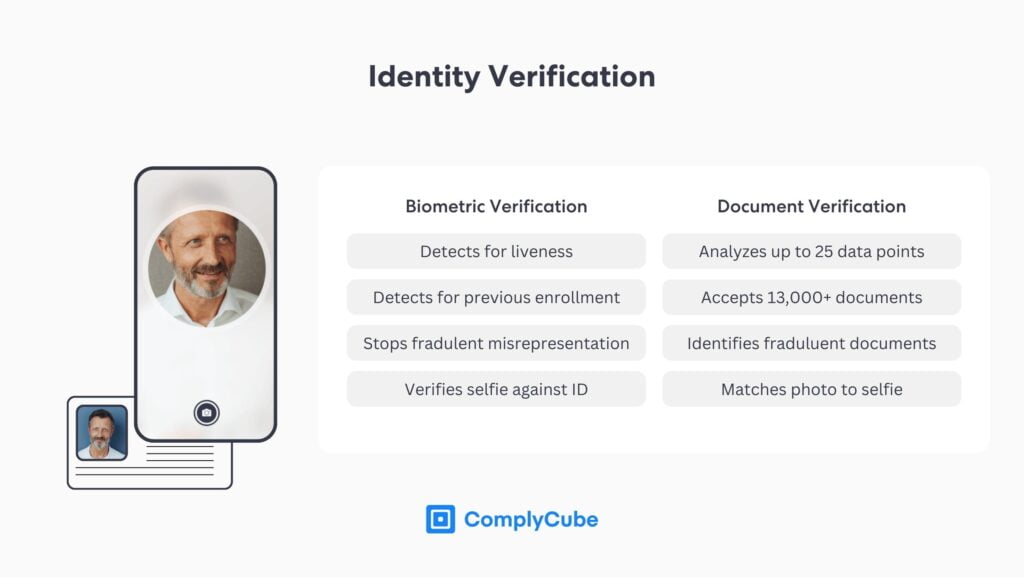
### Customer Due Diligence (CDD)
Once a company has established that the user’s identity is authentic, it can begin its customer due diligence. This process, also a painstaking one to complete manually, involves checking the user’s profile against a host of partnered databases, such as a telecom’s or credit bureau’s, to provide further clarity over the identity of a user. [Customer due diligence](https://www.complycube.com/en/solutions/due-diligence-compliance/customer-due-diligence/) also enables Anti-Money Laundering (AML) risk scoring for clients, giving businesses adequate information to make informed decisions on their users.

### Ongoing AML Monitoring
Ongoing monitoring is the continued due diligence and vetting of a user. On the other hand, ongoing AML monitoring describes similar processes to CDD but vets clients constantly in real-time. A manual team could not mimic this process due to the vast quantity of data that would need to be analyzed around the clock. This process relies on strong partnerships with various databases and the technology to enable live updates.
Ongoing due diligence is even more pertinent now that the EU Council has updated its crypto AML regulations. All crypto transactions over[ €1,000 throughout the European Union must be scrutinized through enhanced due diligence](https://www.europarl.europa.eu/news/en/press-room/20230414IPR80133/crypto-assets-green-light-to-new-rules-for-tracing-transfers-in-the-eu), making the continuous monitoring of customer data more critical than ever.
KYC strategies are typically employed to meet regulatory compliance but are also used in association with a company’s set risk-based approach. These processes are critical in an institution’s monitoring, prevention, and deferral of financial crimes, such as money laundering.
## Limitations of manual KYC
Manual KYC processes cannot scale with the volume modern companies handle. Manual handling of the above mentioned tasks is slow, arduous, and littered with human error. This leads to a poor customer experience and aggregates the natural limitations that have been overcome by automated KYC verification.
### Human Error
Mistakes can never be eliminated, especially when dealing with the intricate verification of identity documents and supporting images. [Machine learning](https://mitsloan.mit.edu/ideas-made-to-matter/machine-learning-explained) (ML) technologies can be trained to output precision far higher than a human eye could achieve. This enables businesses to employ their staff for far more effective purposes, such as initiatives relating to revenue growth and company expansion.
Human error in reporting, manual data entry, and regulatory checks significantly contribute to the number of false positives compliance teams are burdened with. This has a knock-on effect on net operational costs as tasks must be unnecessarily repeated, leading to reduced efficiency.
### Poor Customer Experience
Perhaps more significantly, manual KYC checks take time. While increasing internal efficiency and reducing operational costs should be a priority for all businesses, a lengthy client acquisition process could lead to customer frustration and severe damage to your business through failed signups.
Customer experience is vital, particularly when competition in your market is fierce, and a manual KYC process can take days at a time. KYC, and as a result, client acquisition that is not instant will constrain growth and act as your bottleneck to success.
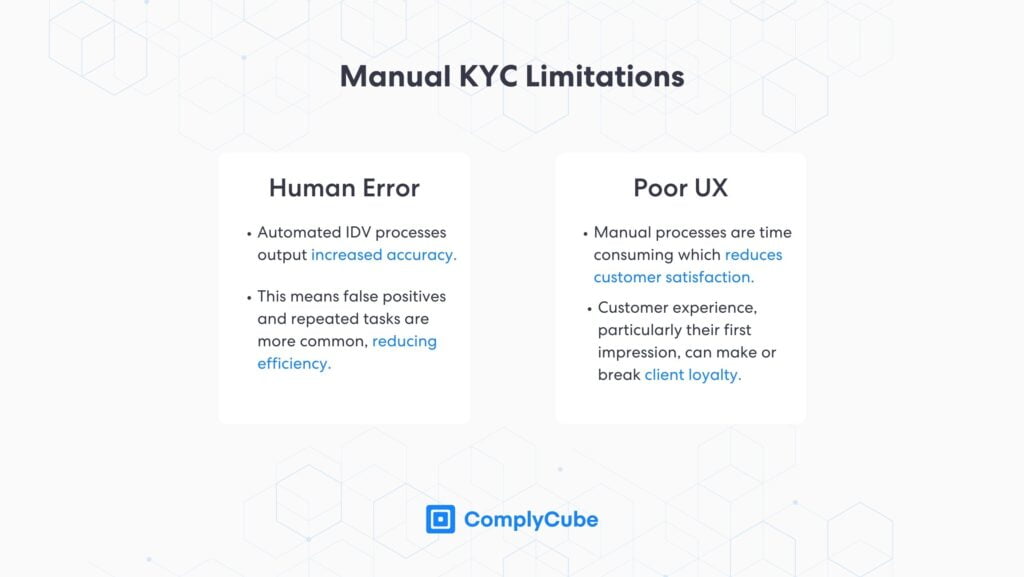
## What is Automated KYC Verification?
KYC solutions represent a transformative leap in handling, verifying, and monitoring customer data. The AI technologies employed enhance regulatory compliance and significantly improve customer onboarding experiences with seamless and customized identity verification workflows. These are compounded with integrated customer due diligence and ongoing monitoring solutions in one all-encompassing platform.
It’s well documented that Automated KYC verification solutions [significantly streamline businesses’s compliance efforts](https://legal.thomsonreuters.com/en/c/the-experts-guide-to-kyc-automation/form?gatedContent=%252Fcontent%252Fewp-marketing-websites%252Flegal%252Fgl%252Fen%252Fc%252Fthe-experts-guide-to-kyc-automation). This allows firms to operate without fear of implicit involvement in financial crimes, ensuring a secure environment for both the company and its users.
### Automated Identity Verification
eKYC solutions, fueled by powerful AI engines, verify identity documents and their specific security features at unparalleled speed and precision. This feat is beyond the capabilities of even the most trained human eye. These advanced systems use sophisticated matching algorithms to scrutinize up to 25 data points on ID documents such as passports and driver’s licenses and powerful facial recognition technology to check thousands of selfie pixels to ensure authenticity.
These processes, known as document and biometric verification, significantly reduce the time it takes for a customer to sign up and can be [completed in less than 60 seconds.](https://www.complycube.com/en/use-cases/process/customer-onboarding/) Companies providing KYC services typically host an array of alternative but similar services, which can be customized per a company’s requirements. For more information on the types of automated KYC solutions available, browse ComplyCube’s list [here](https://www.complycube.com/en/solutions/).
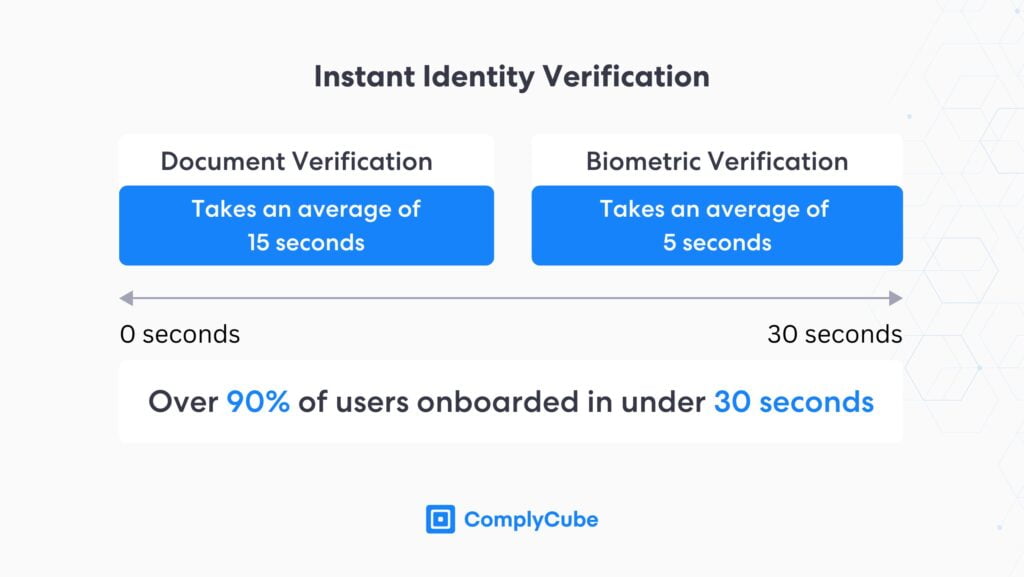
### Powerful Tools to Streamline Customer Due Diligence
The automation of KYC processes does not stop at client acquisition. Customer due diligence and ongoing monitoring are integrated into the same solution. This makes automated KYC verification services a comprehensive instrument for KYC and AML methodology.
Customer due diligence refers to the risk assessment and profiling of a client. This involves further IDV measures, vetting users against multi-bureau databases, and watchlist and adverse media screening. This process is highly time-consuming and costly for businesses due to the volume of data that must be processed. Automation solves the problem.
- More data analyzed
- Faster confirmation
- Precise risk score
When this process is automated, no stone is left unturned, and these data sets can be examined instantly. It mitigates customer dissatisfaction and ensures compliance standards are met. Clients are then accurately and swiftly attributed their risk score, and the user can be acquired according to the required regulatory framework in place.
### Automated AML Monitoring
[AML monitoring](https://www.complycube.com/en/solutions/due-diligence-compliance/anti-money-laundering/) would be a near-impossible task to optimize manually, requiring significant resources. This is because the correct application of ongoing monitoring requires checking an ever-growing volume of data sets.
For example, the client of a start-up neobank was portrayed negatively in an obscure Columbian newspaper for money laundering charges. Traditional vetting and due diligence methods would have a slim chance of picking this up, especially if the news article did not make it to national media.
An automated AML monitoring solution would detect such an occurrence. By continually scanning global news outlets for adverse media coverage, the detection of any negative media impressions is immediately reported on the user’s profile. This detects the appearance and supplies all relevant data to compliance officers to make informed and timely decisions.
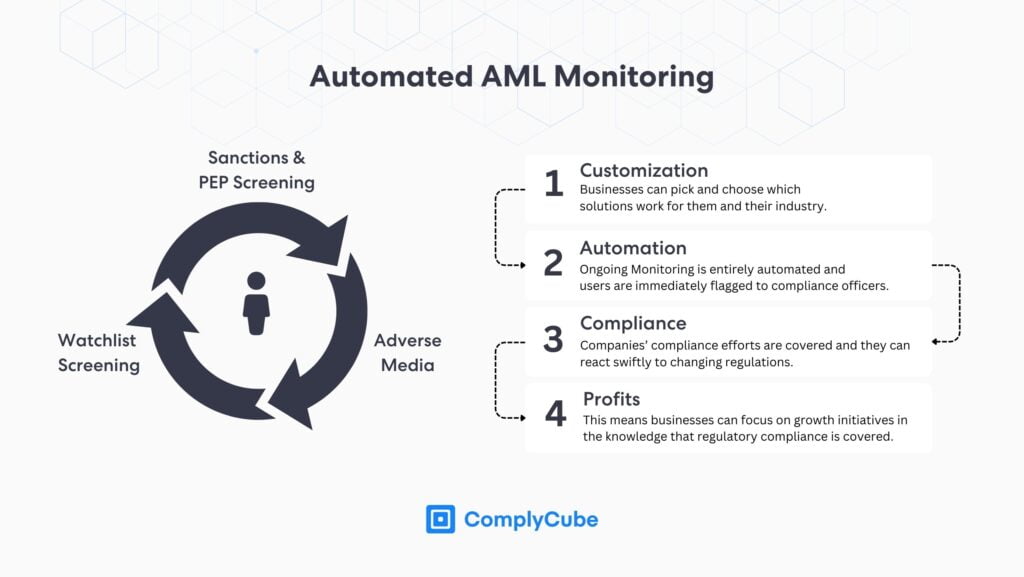
### **Case Study: Robinhood’s $30 M Fine Highlights Cost of Weak KYC Controls**
In 2025, Robinhood was penalized $29.75 million by the U.S. Financial Industry Regulatory Authority (FINRA) for identity verification and AML shortcomings. Robinhood had major AML gaps, particularly, missing suspicious activity monitoring, and customer verification processes.
##### **A History of Compliance Failures**
Regulators noted suspicious trading accounts and identity verification lapses. Just a month ago, Robinhood was fined $45 million by the U.S. Securities and Exchange Commission (SEC) for record keeping and customer data breaches, pointing to a wider AML infrastructure issue.
##### **Solutions & Outcomes**
- The settlement includes a [$26 million fine](https://www.complycube.com/en/the-cryptocubed-newsletter-march-edition/) and $3.75 million in restitution for affected customers.
- Revenue statements indicate strong user growth for the business, which suggests a lack of scalable KYC processes.
- This case demonstrates the importance of automated KYC and ongoing monitoring to identify suspicious activity earlier.
## Advantages of Automated KYC Verification
Verifying clients automatically brings a host of benefits to businesses no matter the level of identity assurance required.
### Time-Saving
Know Your Customer automation significantly reduces the time spent reviewing user documents and checking for authenticity. This means operational efficiency is substantially increased, and companies see reduced manual errors. The speed of these automated processes enhances the customer experience and allows companies to process and accept a far higher volume of clients.
### Cost Saving
Reducing the time spent on mundane tasks means that operational costs can be significantly minimized. Automated KYC procedures allow businesses to focus on what is important to them by reducing the number of false positives and repeated tasks. This means there can be a more streamlined company culture, and efficiency can be maximized.
Automated KYC also saves businesses from potential fines that come from non-compliance. Crypto KYC (and its non-compliance) is an excellent example of this. In 2023, [crypto and related FinTech groups were fined $5.8 billion for non-compliance](https://www.ft.com/content/f2a8c1e4-30f2-49c7-939b-73e0d1a22033) with AML regulations. Many of these fines could have been mitigated had a sufficient KYC and AML strategy been established.
### Accurate Conclusions
The precision of KYC solutions means that data accuracy is exceptionally high, improving the data analytics of compliance officers. eKYC processes, by their nature, endorse secure, malleable, and fluid information. As these AML systems are cloud-based and provided by leading SaaS companies, data is readily available and extractable for compliance officers to make instant and accurate decisions.
Furthermore, user data is upheld to the tightest and most enhanced security standards, including GDPR, CCPA, and the Data Protection Act. This is exemplified through ComplyCube’s auto-redact feature on ID images and selfie uploads of users under 18.
### Compliance Made Simple
Regulations, particularly in FinTech industries, rapidly change. Automation and Know Your Customer solutions make adhering to these regulations far simpler. For instance, [the FATF frequently updates which countries are on their black and grey lists ](https://www.fatf-gafi.org/en/countries/black-and-grey-lists.html)due to financial and geopolitical movements. Automated KYC solutions enable timely reactions to updates in these lists.
Crypto firms already working with a KYC partner would be able to react swiftly to this news, discussing which solutions are required from their existing provider. This enables reactionary measures to be made under pressure with ease.
### Easy Integrations
With integration simplicity at the heart of KYC automation, your existing tech stack doesn’t need to change to facilitate KYC services. Workflows are integrated into your website via a robust API (Application Programming Interface) or SDK (Software Development Kit). This means they can be customized and designed to your business’s brand.
Embedding KYC solutions into your current flow is vital. It contributes to an exceptional user experience, enhancing brand reputation and leaving new customers satisfied with a pleasant, user-friendly experience.
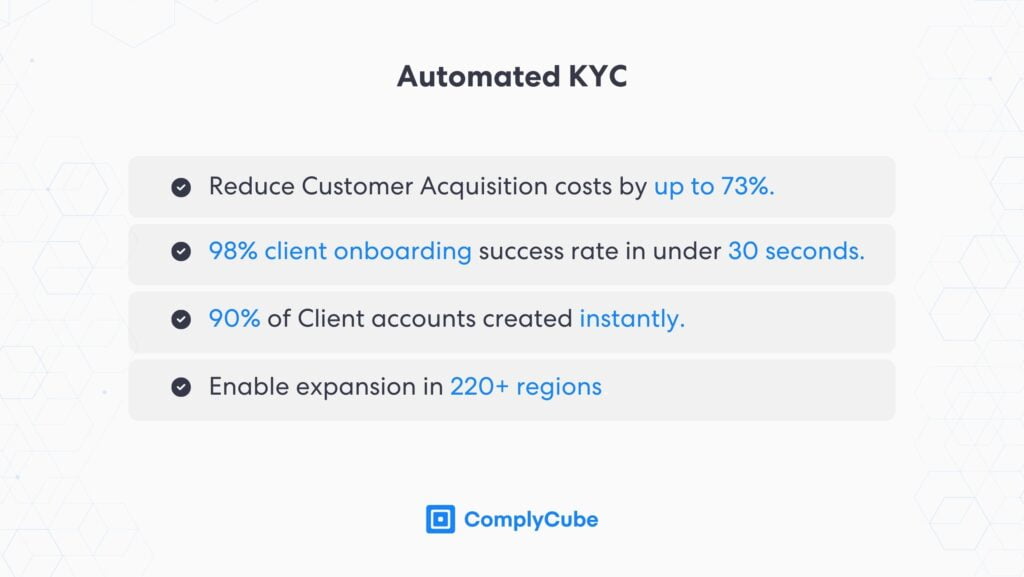
## Artificial Intelligence in Automated KYC Verification
The integration of cutting-edge AI and advanced algorithms into automated KYC verification processes is the power behind the shift in how businesses onboard customers and ensure compliance. These advanced technologies streamline data extraction, document verification, and all stages of the KYC process, enhancing the efficiency of Anti-Money Laundering regulatory compliance.
Machine learning engines, such as facial recognition technology, ensure errors are minimized and repeated tasks, or false positives, are mitigated. AI also enables around-the-clock monitoring of deep data sources to ensure that user’s risk profiles are accurate and updated in real-time.
Automated KYC processes would not be possible without the development of advanced AI technology. For this reason, companies at the forefront of AI development must do so ethically. As these systems are handling sensitive user data about race, gender, sex, and many other sensitive categories, ethical AI development is fundamental to ensure potential biases are omitted.
### Key Takeaways
- **Automated KYC** verification uses AI-powered identity verification to accelerate onboarding.
- **Manual verification** is prone to human error, and can raise false positives and operational costs.
- **Automated** **Customer Due Diligence** assesses risk across multiple trusted sources instantly.
- **Ongoing AML monitoring** identifies sanctions, adverse media, and risk changes in real-time.
- **A unified compliance** platform supports regulatory compliance and seamless onboarding journeys.
## Should I Integrate Automated KYC?
The systems powering modern automated KYC verification strategies are bringing huge ROIs to businesses that use them. This puts them ahead of their competition as operational efficiency, profit margins, and reputability are all optimized.
### Future of KYC
Businesses employing a manual KYC process will not have the operational scalability to grow alongside the market or their competition. Regulatory requirements to Know Your Client are expanding into more industries than ever before; only with KYC automation can a business scale meet the demands of its users.
Taking Neobanking as an industry example, 2024’s expected transaction volume is anticipated to be $6.37 trillion and climb to $10.44 trillion in 2028.
> In the Neobanking market, the number of users is expected to amount to [386.30m users by 2028.](https://www.statista.com/outlook/dmo/fintech/neobanking/worldwide)
The rising volumes depicted in these figures highlight the trajectory of FinTech sectors, like Neobanks, and underscore the imperative for KYC strategies to evolve in tandem. As the user base and transactions within these industries expand, there’s a pressing need for KYC processes to embrace automation and increase scalability to manage the demand for Financial Services effectively.
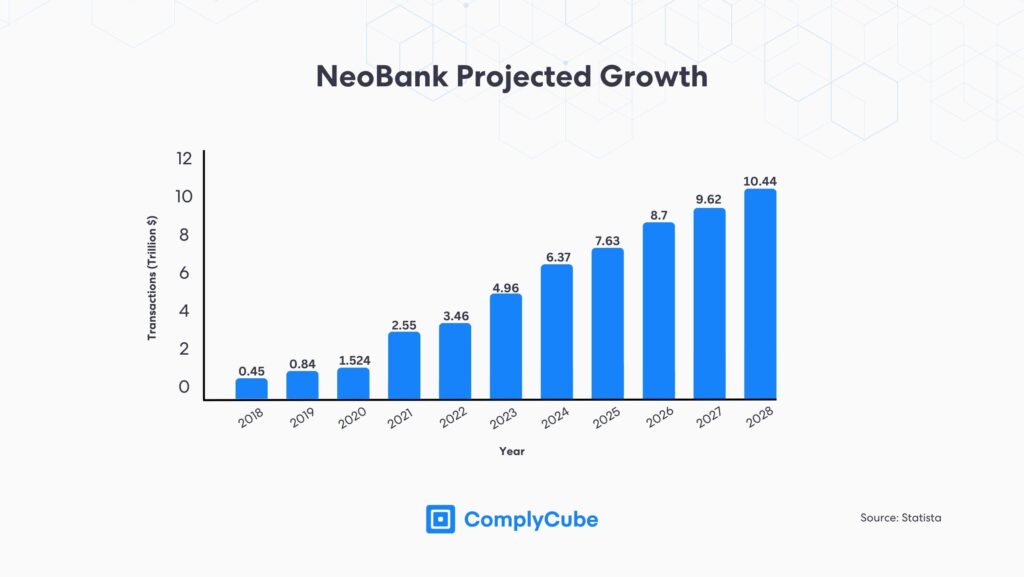
### Has Your Business Embraced Automated KYC Verification?
The rapid expansion of FinTech sectors, including Neobanks, necessitates the evolution of KYC strategies to match the growing volume of transactions and user base, highlighting the importance of automation for scalability and efficiency. Automated KYC verification, powered by advanced AI technologies, streamlines identity verification, customer due diligence, and ongoing monitoring, ensuring regulatory compliance while enhancing operational efficiency.
ComplyCube’s proprietary technologies provide a comprehensive suite of utilities to enable businesses to expand without limits. Hosting 220+ regions, 13,000+ documents, and typical onboarding processes completed successfully in less than 60 seconds, they are becoming a common choice for growing companies.
The future of KYC lies in embracing technological advancements to meet the increasing demands of the financial services industry, ensuring secure, efficient, and scalable customer verification processes. If you are looking for a new AML, KYC, and IDV partner, [start a conversation with one of our specialists today.](https://www.complycube.com/en/contact/contact-sales/)
## Frequently Asked Questions
Why is automated KYC verification important for regulated businesses?
Automated KYC verification supports quicker, more accurate, and secure customer verification. It replaces manual verification, lowering human errors and false positives. Additionally, it supports regulatory compliance through instant, ongoing monitoring and risk assessment.
How does KYC automation improve AML compliance?
KYC automation uses AI and machine learning algorithms to detect money laundering and other financial crimes more accurately and efficiently. It combines identity verification, PEP and sanctions screening, adverse monitoring, and risk scoring into a single platform for stronger compliance.
Can automated KYC reduce false positives during customer onboarding?
Yes. Automated KYC uses AI-powered verification to analyze multiple identity details, risk signals, and data sources simultaneously. As such, it improves decision accuracy and ensures compliance teams can focus on genuine high-risk scenarios.
What capabilities are crucial in an automated KYC solution?
Businesses should look for a multi-layered KYC automation platform for stronger compliance. It should include critical checks such as document and biometric verification, as well as ongoing AML monitoring. Additionally, audit trails, deep API integrations, and workflow automation support evolving regulatory requirements.
How does ComplyCube support automated KYC verification?
ComplyCube is an all-in-one, AI-driven compliance platform, built to support Customer Due Diligence and AML screening requirements. As a certified Identity Service Provider (IDSP), ComplyCube supports regulated businesses in meeting stringent AML and KYC obligations in over 250 global territories.
**Categories:** Guides
**Tags:** Know Your Customer
---
### [How AML Compliance Software Is A Trust Infrastructure](https://www.complycube.com/aml-compliance-software-solutions/)
**Published:** June 12, 2026
**Author:** Rithu Jagannath
**Excerpt:** AML compliance software is a trust infrastructure, helping firms move from one-time checks to monitor customer risk, support explainable decisions, and evidence trust across the lifecycle with stronger control and clarity.
**Content:**
**TL;DR:** Anti-Money Laundering (AML) processes turn **regulatory requirements** into repeatable workflows. **Financial crime** moving faster than ever and AML compliance software must keep up. The right AML compliance solution should identify when trust needs to be reassessed and clearly justify the decision it makes. This guide shows how AML compliance solutions help **firms decide who to trust**.
## What is AML Compliance Software?
According to The United Nations Office on Drugs and Crime (UNODC), 2-5% of global GDP is laundered annually through financial crimes such as counter terrorism financing, money laundering, and sanctions violations. Anti-Money Laundering (AML) compliance obligations protect customers, detect financial crimes, and help institutions avoid huge financial penalties. AML compliance solutions find, review, monitor and provide evidence for money laundering risk across the customer journey. In 2026, AML compliance programs need to be more comprehensive than just screening customers against lists.
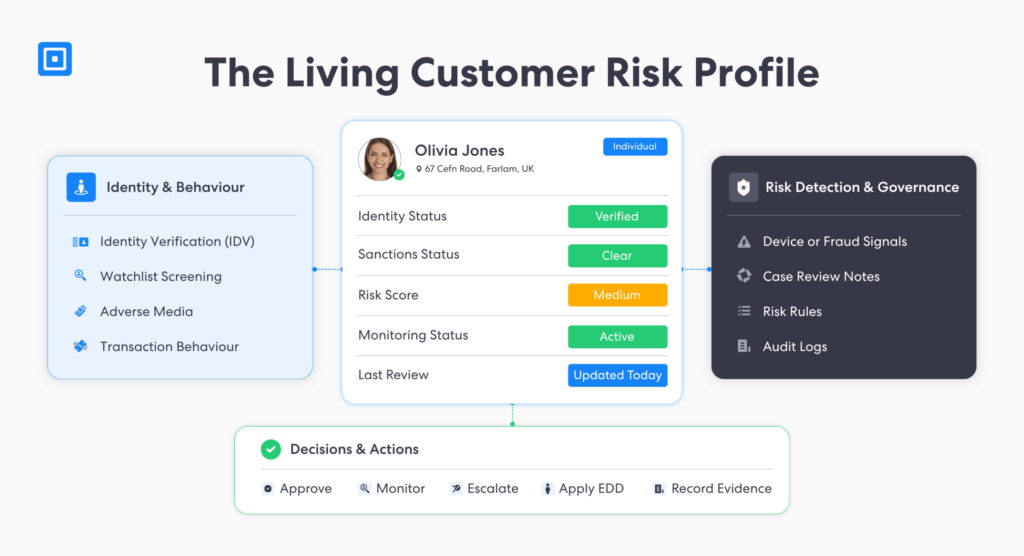
The original purpose of AML compliance software was risk management. While involving many moving parts, AML compliance solutions also gave firms a way to standardize compliance processes and reduce the reliance on manual review. But, as [financial crime moves faster](https://www.ukfinance.org.uk/news-and-insight/blog/financial-crime-in-2026-key-trends-shaping-uks-horizon) with evolving threats across various regulated ecosystems, compliance software needs to support a more strategic approach to help organizations meet requirements.
## Point-In-Time AML Software Is No Longer Enough
Traditional AML check services are still relevant, but the problem is that they are not sufficient on their own. They only seem to capture financial crime risks at one moment in time. However, customer risk does not stay still after that moment passes. Often, a customer can pass onboarding checks, then later become linked to emerging threats, new global sanctions exposure, and terrorist financing. In this case, the right AML solution helps compliance teams gain a deeper understanding of what has changed, why it matters, and what should happen next.
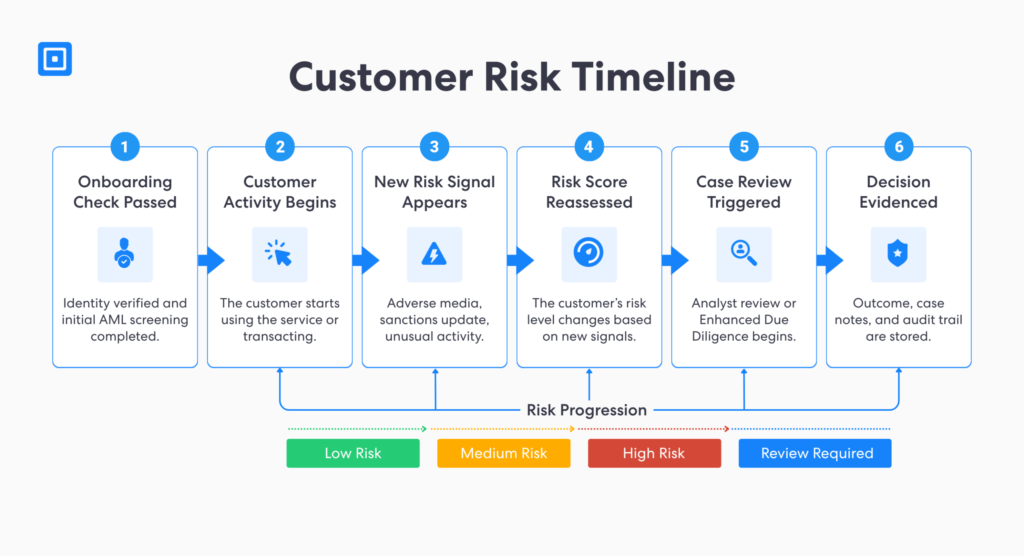
The original compliance model presents potential risks when it is difficult to [monitor evolving threats](https://www.complycube.com/en/solutions/global-screening/continuous-monitoring/) across existing systems that are fragmented. For example, watchlist screening may sit in one workflow, while customer risk scoring is in another. Without connecting this information across different flows and generated reports, firms lack a holistic view of how customer risk is changing over time.
According to [INTERPOL’s 2026 Global Financial Fraud Threat Assessment](https://www.interpol.int/en/News-and-Events/News/2026/INTERPOL-report-warns-of-increasingly-sophisticated-global-financial-fraud-threat), connected views of AML processes are much better for warnings of financial fraud. This type of view is central to navigating polycriminality, the involvement of an individual or crime group in a variety of different criminal activities instead of one type of offense.
This report also states that AI-enhanced fraud is 4.5 times more profitable than traditional methods. For instance, agentic AI systems are now more capable of planning and executing fraud campaigns. AML programs must help firms notice when customer trust begins to change. As AI makes fraud easier to scale, it needs to become easier to identify unusual activity, or links to suspicious networks before trust breaks down. You can learn more here: [Evaluating Anti-Money Laundering Software Beyond Monitoring](https://www.complycube.com/en/anti-money-laundering-software-evaluation/).
## AML Compliance Solutions as Trust Infrastructure
Compliance solutions need a much wider role when AML risks become dynamic. An AML compliance solution must become a part of a trust infrastructure. A trust infrastructure is a shared digital system, policy, or standard that allow various organizations, devices, and people to safely share data and verify identities. It helps guarantee integrity while allowing data, transactions, and other digital interactions to flow smoothly.
This shift is subtle, but incredibly important. A tool typically helps complete one task, whereas an infrastructure supports an operating model. A future-ready [AML compliance solution](https://www.complycube.com/en/solutions/due-diligence-compliance/anti-money-laundering/) helps firms answer a few practical risk questions throughout the customer journey such as:
- Is this customer who they claim to be?
- Have they been exposed to [sanctions, politically exposed person (PEP)](https://www.complycube.com/en/solutions/global-screening/sanctions-pep-screening/), or adverse media risk?
- How has their risk profile changed since onboarding?
- Does their behavior still match their expected activity?
- Does this case need human review?
- Can firms or financial institutions prove why a risk decision was made?
The above questions demonstrate a targeted approach for AML compliance solutions. Customer trust is built, monitored, challenged, and consistently evidenced over time to keep up with reporting obligations and compliance needs.
### **Case Study: Wise’s Compliance Failure Investigation**
On June 1st, 2026, authorities in Belgium announced that Wise, a British financial technology company focused on global money transfers, was [reportedly engaged in money laundering](https://www.complycube.com/en/wise-money-laundering-control-lapses-belgium/). According to reports, criminals used several company accounts to move illicit funds into fraud.
##### **Suspicious Activities, False Positives, and Customer Risk Assessments**
The sheer size of this case points to a much wider systematic issue. This risk exposure was due to a lack of oversight and consistency in verifying high-risk users, businesses, and transactions. Wise could have better managed risks with a proactive approach with a strong AML program.
##### **Outcomes**
- Wise supposedly moved $580M in suspicious transactions across 30 European countries.
- The Brussels prosecutor and Wise are working together to investigate further details.
- The fine shows the importance of comprehensive fraud detection software. It highlights how even established banks can enable high-risk users to bypass critical controls.
## AI and Machine Learning in Regulatory Compliance
Today, advanced AML solutions incorporate machine learning for real-time detection. It is easy to assume that the answer to meeting AML regulations is more automation. If external risk exposure such as sanctions risks or third-party dependencies move fast, becomes well-connected, and harder to detect, it would make sense that [artificial intelligence (AI)](https://www.complycube.com/en/generative-ai-fraud-and-identity-verification/) must take over more of the process. With the use of AI, AML solutions automate identity verification and watchlist screening.
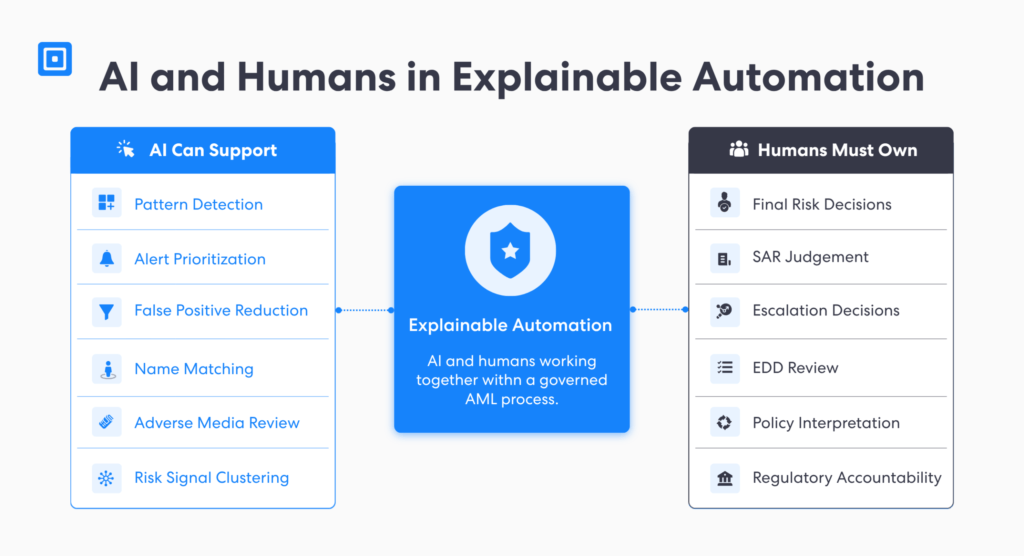
However, it is only partially true that using more automation for AML is the right solution. Of course, AI-driven solutions can help find risk factors, reduce false positives, and increase operational efficiency. Additionally, automated reporting assists in documenting suspicious activities for regulators. Yet, firms must not outsource accountability to a compliance model that they cannot properly explain.
### Insights on AI in AML Compliance Software
In practice, the future is not fully autonomous AML solutions. Decisions need to be explainable to regulatory bodies. So if an AML compliance software changes a risk score, suppresses a low-value alert, or prioritizes one investigation over another, teams must be able to clearly understand why. Evidence must show how data was used, which analyst reviewed the case, and what financial crime prevention decisions were made.
> The best anti-money laundering solutions will not remove human judgement.
CEO and Founder of ComplyCube, [Tarek Nechma](https://www.linkedin.com/in/tarek-nechma/) adds, “The right AML compliance solution will give compliance teams better signals, clearer evidence, and more defensible decisions”. Additionally, the Financial Conduct Authority (FCA) supports this more mature view of AI and innovation. This updated view uses synthetic data, artificially generated information that mimics the statistical patterns and characteristics of real-world data. Moreover, it does not contain real personal or historical records.
The [2026 synthetic data AML project](https://www.fca.org.uk/publications/research-notes/research-note-synthetic-data-anti-money-laundering-project-report) developed alongside the Alan Turing Institute and Plenitude Consulting, generates a synthetic data set that can support innovation in money laundering detection. Synthetic data helps test AML typologies, risk model performance, and alert quality without exposing real customer records. Real financial crime data is hard to share as it can contain sensitive customer data. Additionally, privacy, legal, or confidentiality obligations prevent firms from sharing data.
## Advanced Analytics and Testable AML Software
So, if the future is focused on being more explainable than fully autonomous, how can firms know if their AML compliance software is working? This is where testing comes in. Future-proof AML compliance solutions need to have an intuitive interface that is configurable. They also need to be tested against realistic examples of financial crime scenarios.
Firms need to be confident in their risk-based approach, screening logic, and [workflows](https://www.complycube.com/en/solutions/compliance-suite/kyc-workflow/). The right anti-money laundering solution will detect important patterns without relying on live incidents. Overall, advanced analytics improves risk scoring and customer assessments. Regulated firms can look into what an AML compliance solution can automate and ask how risk controls are tested, governed, and further improved.
## Features of The Right AML Compliance Solution
AML compliance software that acts as a trust infrastructure needs a completely different evaluation framework in the buying stage. AML compliance solutions must be assessed as a system. This system must link customer identity, risk signals, human decisions, and audit evidence.
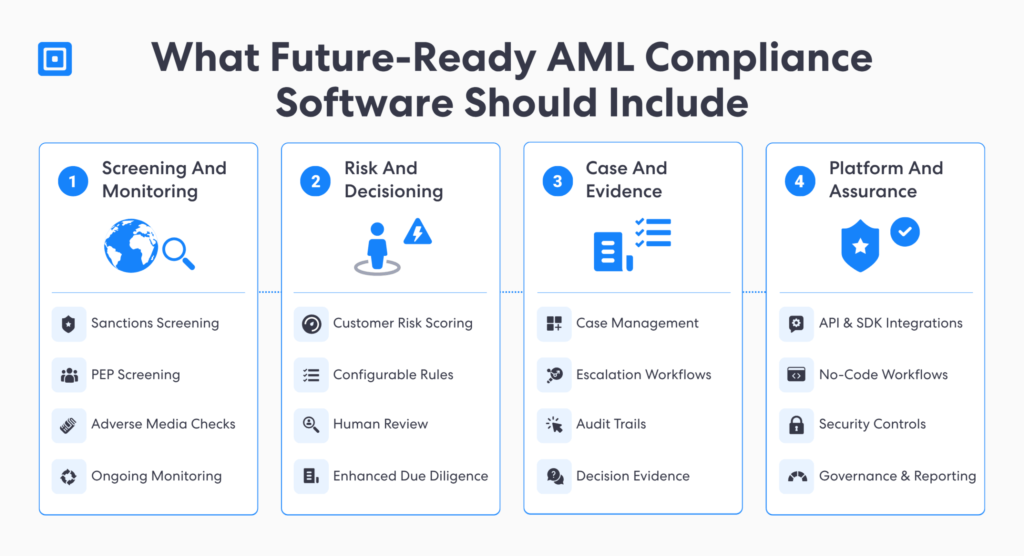
Seamless integration of AML risk signals from these key software features helps reduce false positives within the process. Regulated firms should look for AML compliance solutions that include the following aspects:
- Continuous sanctions screening, PEP, and [adverse media](https://www.complycube.com/en/solutions/global-screening/adverse-media-checks/) screening
- Customizable risk scoring capabilities, and configurable risk rules
- Case management and escalation workflows
- Audit trails and decision evidence
- [Real-time monitoring](https://www.complycube.com/en/solutions/global-screening/continuous-monitoring/) and alerting
- Identity, fraud, and AML signal orchestration
- Strong privacy, security, and governance controls
Finally, security and assurance are core buying criterion. AML compliance solutions handle some of a firm’s most sensitive data. If data is exposed, altered, or unavailable, it impacts customer trust, regulatory reporting and operational continuity. IBM [reported that the global average](https://www.ibm.com/reports/data-breach%20) cost of a breach stands at $4.44 million, while the United States average reached $10.22 million. Breaches can compromise regulated data and disrupt operations, but also weaken the confidence in a firm’s risk controls.
### Key Takeaways
- **AML compliance software** improves efficiency by moving toward a trust infrastructure.
- **An AML compliance solution** must support explainable and evidence-ready decisions.
- **AI can improve fraud detection**, but AI-enabled fraud will increase financial crime complexity.
- **Future-proof AML regulations compliance** has smooth integration of varying fraud checks.
- **A strong AML compliance solution** will help firms move faster with regulatory changes.
## Choosing the Right Solution for AML success
While AML compliance software began as a means to organize checks, alerts, and records, it is changing rapidly. It is becoming the trust infrastructure that regulated entities need to build trust across the full customer life cycle. Integrated systems enhance collaboration across departments in AML efforts.
Financial crime does not wait for scheduled review. It can show up through synthetic identities, fraud networks, or a cross border investigation. The future of compliance will be measured by better decisions, clearer evidence, and strong control. Explore ComplyCube’s AML compliance software services and learn from [our team](https://www.complycube.com/en/contact/%20) about how to prove trust with our platform.

## Frequently Asked Questions
How does AML compliance software work?
Anti-Money Laundering (AML) compliance software works by screening customers, scoring risk, monitoring, and helping teams review suspicious alerts. It links checks such as global sanctions, Politically Exposed Person (PEP), adverse media, case management, and audit reporting.
Why is AML compliance software becoming trust infrastructure?
AML compliance software is becoming trust infrastructure because risk is changing. Modern AML compliance solutions should verify who to trust, monitor that trust over time, and prove how compliance teams arrived as risk decisions based on the audit-trails and evidence presented.
Why are one-time AML checks no longer enough for case management?
One-time AML checks are not enough because customer risks change after onboarding. New sanctions exposure, additional adverse media, unusual activity, or new fraud signals can emerge later on, pushing firms to implement ongoing monitoring into the overall AML process.
What should the right AML compliance solutions include?
The right AML compliance solutions include many different checks such as sanctions screening, PEP screening, adverse media checks and more. It should also support configurable no-code workflows and secure, seamless integrations.
How does ComplyCube support business needs with AML compliance software?
ComplyCube combines screening, monitoring, and fraud checks as well as risk profiling, and case management in one platform. Its APIs, SDKs, hosted flows, and no-code workflows help compliance teams scale AML compliance with efficiency without adding unnecessary friction.
**Categories:** Guides
**Tags:** Anti-Money Laundering
---
### [Central Bank UAE Fines Foreign Bank $5.4M Over AML Failures](https://www.complycube.com/central-bank-uae-fines-foreign-bank-5-4m-over-aml-failures/)
**Published:** June 25, 2026
**Author:** Rithu Jagannath
**Excerpt:** CBUAE fined a foreign bank branch $5.4M over repeated AML, CTF and sanctions failures, signalling tougher UAE enforcement and rising accountability for senior compliance leaders and Money Laundering Reporting Officers in 2026.
**Content:**
The Central Bank UAE (CBUAE) imposed a $5.4 million (AED 20 million) AML fine on the UAE branch of a foreign bank. They were lacking in Anti-Money Laundering (AML), Counter-Terrorist Financing (CTF), and sanctions compliance failures. Though CBUAE did not name the institution, the message is clear. Foreign banks operating in the UAE are expected to show that they have financial crime controls that are effective. Documentation is simply no longer enough.
This AML fine enforcement action goes beyond the foreign bank. The CBUAE also fined the bank’s Head of Compliance and [Money Laundering Reporting Officer](https://www.complycube.com/en/use-cases/profession/money-laundering-officers/) (MLRO) $81,700 (AED 300,000). The MLRO failed to meet the responsibilities of their role. CBUAE’s decision demonstrates an importance in regulatory adherence, not only from an institutional standpoint, but also from an individual standpoint. Accountability is paramount, signaling that there is shared responsibility between institutions and their senior executives to oversee AML crime controls.
## Why Does The CBUAE Fine Matter?
The [CBUAE enforcement action](https://www.arabianbusiness.com/finance/banking/uae-central-bank-fines-foreign-bank-anti-money-laundering-failures) reflects the UAE’s broader efforts to strengthen its AML framework. This is an effort to reinforce confidence in its financial system and a reminder that effective compliance must be shown through evidence rather than policy.
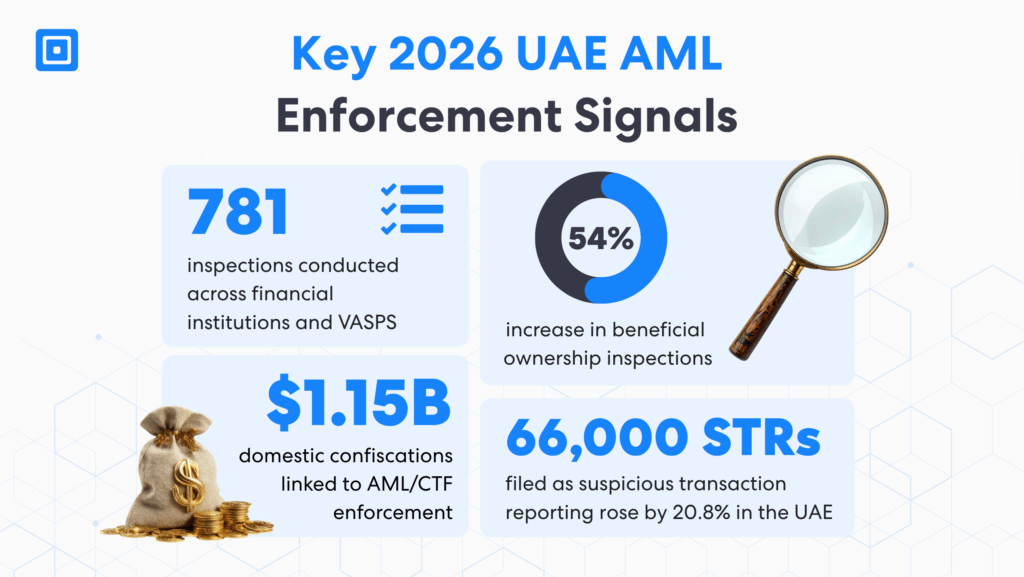
Assessing written policies, yearly reviews, and screening are only part of the picture. Firms are expected to show Customer Due Diligence (CDD), sanctions screening, and other AML controls as well as their escalation processes. Regulators need to understand that these systems are working correctly and on an ongoing basis.
The regulatory expectations are relevant for foreign bank branches. Global compliance programs or frameworks set the precendent for baseline controls. However, local regulators look to firms to show that those controls also operate well within the UAE’s regulatory framework. In that context, the CBUAE AML fine is less like an isolated enforcement action and more like another step in a larger more assertive approach to the UAE’s AML supervision.
## The Bigger Picture For Central Bank UAE and Other Institutions
In summary, the UAE has invested heavily in strengthening its financial crime framework in recent years. Regulators are placing greater emphasis on effective AML governance, sanctions compliance, and risk-based supervision. Against that backdrop, enforcement actions such as this one are likely to become increasingly important indicators of regulatory expectations.
Rather than focusing solely on whether firms have compliance policies in place, supervisors are examining whether those policies identify risk, support timely intervention, and create clear accountability across the organisation. For banks, the Central Bank UAE message is straightforward. AML compliance must be operational, evidence-based, and continuously monitored.
[](https://portal.complycube.com/signup)
Subscribe to ComplyCube’s [Trust Edition newsletter](https://www.linkedin.com/newsletters/the-trust-edition-7103022355722981376/), where we explore the top developments across identity verification and AML globally. Plus, we share valuable insights on compliance with the latest regulations.
**Categories:** News
**Tags:** Anti-Money Laundering
---
### [FIFA World Cup 2026 Scams Expose AML Fraud Risk](https://www.complycube.com/fifa-world-cup-2026-scams-expose-aml-fraud-risk/)
**Published:** June 9, 2026
**Author:** Rithu Jagannath
**Excerpt:** FIFA World Cup 2026 scams show how fake sites, stolen data, and fraudulent payments can create downstream AML risks for banks, FinTechs, marketplaces, payment providers, and teams managing high-volume event fraud risk globally.
**Content:**
Fans are scrambling to find tickets deals and packages online with the upcoming FIFA World Cup 2026. As a result, cybercriminals have a lucrative opportunity to spoof FIFA-related websites to steal personal and financial information globally. The Federal Bureau of Investigation (FBI) issued a warning about fake websites impersonating official 2026 FIFA World Cup platforms. What starts off as a fake ticketing page or scam will turn into a case of stolen identity, unauthorized payments, or suspicious criminal activity.
## How a Global Tournament Creates a Scam Opportunity
Major sporting events often create instant demand and urgency. This is what fraudsters rely on to build a system of fast-moving fraud. For example, criminals build fake websites that replicate official FIFA World Cup 2026 branding to steal sensitive information using realistic domain names and promoting offers that seem legitimate.
According to Fortinet, over [13,000 World Cup-themed websites](https://www.fortinet.com/blog/threat-research/cybercriminals-are-targeting-the-fifa-world-cup-2026) were registered between January and May. 8% were found to be malicious or suspicious. As a result, football fans looking for a last-minute deal may be convinced to enter in payment details, passport information or other [Personally Identifiable Information (PII)](https://www.complycube.com/en/solutions/due-diligence-compliance/know-your-customer/pii-sensitive-data-redaction/).
**Background:** For the first time in its history, the 2026 FIFA World Cup will be hosted across three countries. The matches will take place across the United States, Canada, and Mexico. The expanded format includes 48 teams increasing demand across ticketing, travel, and payments. Therefore, this leads to an increased risk of fraud.
Though at first, these types of scam seem straightforward, there are many layers. Maybe a customer will lose money or hand over sensitive information, but there is a chance it can go beyond the point of sale. Down the line, this fraudulent behavior could trickle down into financial institutions, fintechs, marketplaces, and payments providers. This valuable information is a gold mine for criminals looking to open new accounts, bypass [Know Your Customer (KYC)](https://www.complycube.com/en/solutions/due-diligence-compliance/know-your-customer/) checks, create fake identities, or support broader fraud campaigns.
Now, a simple consumer scam can become a larger compliance concern. Even though regulated firms may not interact with the fake websites themselves, they will see a correlation with new account openings with synthetic identities, account takeovers, or money mule activity popping up in their operations. You can learn more here: [What is Synthetic Identity Fraud?](https://www.complycube.com/en/what-is-synthetic-identity-fraud/)
## AML Risks Behind Fake Tickets and Stolen Data at FIFA World Cup 2026
The [FBI scam warning](https://www.ic3.gov/PSA/2026/PSA260527) about 2026 FIFA World Cup is unique because it is not tied to bank fines, regulatory settlements, or sanctions breaches. It is a public alert about websites pretending to be real pages, misleading fans, and collecting personal or financial information.
The Canadian authorities also issued warnings urging fans to watch out for World-Cup themed fraud. Yet for compliance teams, the real AML impact sits further down. It looks at what happens after the first victim is tricked and fraud money needs to be moved. Often, payments move through mule accounts, crypto wallets or newly opened account with synthetic identities. Therefore, these steps make money harder to trace.

These fraudulent activities create a practical challenge for compliance teams. For example, a basic onboarding check may say that a document is valid without looking into the device or biometric signals that shows impersonation. In another instance, a fraud team may see chargebacks, while an AML team sees broken up transaction alerts. The clear lesson is that AML and fraud controls must work together to build a clearer view of customer risk.
## Why Event-Driven Fraud Matters
Huge tournaments such as the 2026 FIFA World Cup are [create more fraud opportunities](https://www.euronews.com/next/2026/06/09/how-cyber-criminals-are-taking-advantage-of-the-fifa-world-cup). Higher user volumes, increasing cross-border payments, and customer disputes become easier to hide behind. Normal fraud patterns are squeezed into a shorter period of time. It becomes increasingly harder for firms to know the difference between real customer urgency versus suspicious activity.
**Key Facts:** The peak time for event-related fraud is before the event happens. This is the time when fans are booking tickets, travel, accommodation, and hospitality under a time crunch.
Big events such as FIFA World Cup 2026 require control environments that adapt to different contexts or risk levels. Low-risk customers should not face unnecessary friction, but accounts with unusual signals should trigger enhanced checks.
## The Compliance Lessons from FIFA World Cup 2026
The scams coming out of the 2026 FIFA World Cup are a classic example of how AML fraud can start outside of regulated firms and move into them. This demonstrates how early fraud detection is crucial for protecting customers and businesses. Firms that decide to treat [fraud prevention](https://www.complycube.com/en/online-fraud-prevention-with-idv-solutions/) and AML as separate controls are at real risk of missing the full fraud pattern. Combining various signals allow operations teams to find suspicious behavior before it is hard to trace.
[](https://www.complycube.com/en/contact/contact-sales/)
Subscribe to ComplyCube’s [Trust Edition newsletter](https://www.linkedin.com/newsletters/the-trust-edition-7103022355722981376/), where we explore the top developments across identity verification and AML globally. Plus, we share valuable insights on compliance with the latest regulations.
**Categories:** News
**Tags:** Anti-Money Laundering
---
### [How Australian Firms Can Build a Tranche 2 KYC Solution](https://www.complycube.com/how-australian-firms-can-build-a-tranche-2-kyc-solution/)
**Published:** June 19, 2026
**Author:** Rithu Jagannath
**Excerpt:** Build a Tranche 2 KYC solution in line with global AML/CTF standards before July 2026. Use a practical plan for scope checks, CDD, EDD, screening, risk assessment, reporting, monitoring, and audit-ready compliant workflows for Australian firms.
**Content:**
**TL;DR:** A **Tranche 2 Know Your Customer (KYC)** solution helps Australian businesses prepare for expanded Anti-Money Laundering and Counter-Terrorism Financing **(AML/CTF) obligations**. The right Tranche 2 KYC solution can reduce manual compliance work. Building the right solution with Tranche 2 KYC verification supports a **risk-based approach**.
## What is a Tranche 2 KYC Solution?
A Tranche 2 KYC solution is a system that helps Australian firms verify clients, review financial risk, and keep records that are needed for Anti-Money Laundering and Counter-Terrorism Financing (AML/CTF) compliance. Now, customer onboarding becomes a repeatable workflow that links customer due diligence, risk management, and ongoing monitoring.
Tranche 2 brings [newly regulated sections](https://www.austrac.gov.au/newly-regulated-businesses-get-ready-reforms) by extending regulations that previously applied to financial institutions and firms. AUSTRAC’s Tranche 2 factsheet states that AML/CTF obligations will be applicable from 1 July 2026 onwards to services typically provided by:
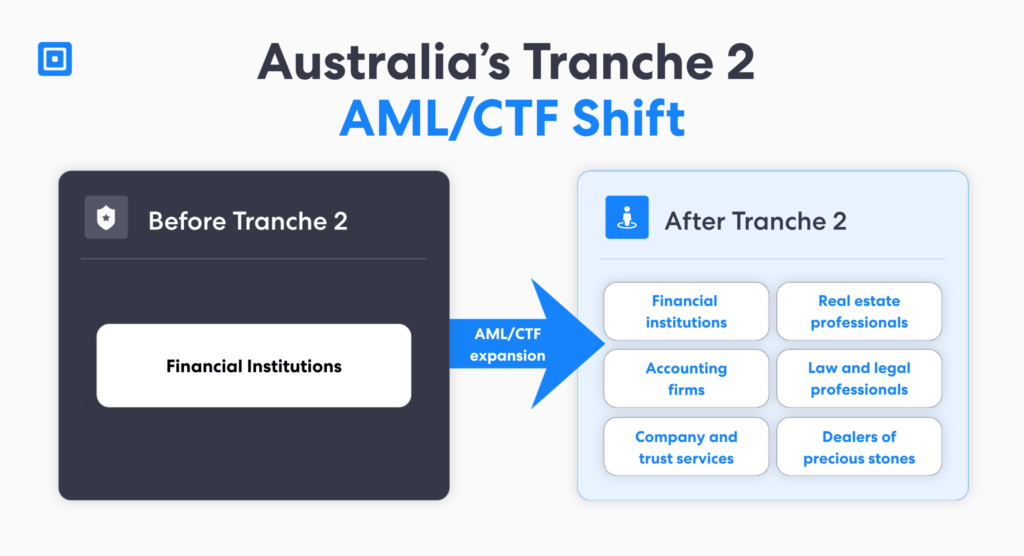
- Lawyers and legal professionals
- Conveyancers
- Real estate businesses
- Accountants
- Trust providers
- Company service providers
- Dealers in precious metals, stones, and products
The right Tranche 2 KYC solutions do not replace real legal advice or regulatory guidance from AUSTRAC. It provides current reporting entities with the operational structure to conduct due diligence processes where risk is higher and conduct ongoing review when risk changes over time.
## Why Tranche 2 Combats Financial Crime
Most firms think of the new Tranche 2 regulations as a hassle and wonder why Australia is making the change. Tranche 2 is an attempt to align Australia to global regulatory reforms and diligence processes. By widening the AML/CTF perimeter, professional services and high-value sectors have a more active role in protecting the financial system. You can learn more here: [The Ultimate Guide to Tranche 2 AML Software for Australian Businesses](https://www.complycube.com/en/australia-tranche-2-aml-software-guide-2026/)
The [Department of Home Affairs](https://www.homeaffairs.gov.au/about-us/our-portfolios/criminal-justice/anti-money-laundering-and-counter-terrorism-financing/anti-money-laundering-and-counter-terrorism-financing-amendment-act/overview-of-the-aml-ctf-amendment-act) states that the new AML/CTF obligations for Tranche 2 designated non-financial businesses and professions (DNFBPs) apply from 1 July 2026. This enrollment period began on 31 March 2026 giving newly regulated firms a window of preparation before compliance requirements apply. Additionally, many entities covered by this new regulation have been identified as high or very high risk for money laundering exploitation.
The reforms and ongoing enhancements are not just about meeting international standards of existing reporting entities. By closing regulatory gaps, illicit funds can no longer move through legitimate services. For Australian firms, KYC must become part of how the business understands its clients, its risk appetite, and its [reporting obligations](https://www.austrac.gov.au/sites/default/files/2025-07/AMLCTF_obligations_factsheet_for_tranche_2_REs.pdf).
## How a Tranche 2 KYC Solution Closes Regulatory Gaps
However, these days, criminals do not move money through the most obvious channels. Using property, legal structures or trusts are a common way to hide ownership. It makes criminal activity such as money laundering and terrorism financing risk look legitimate.
It is for this reason that [Australia remains ideal](https://www.austrac.gov.au/sites/default/files/2024-07/2024%20AUSTRAC%20Money%20Laundering%20NRA.pdf) for storing and integrating criminal proceeds. Their stable economy, independent legal system, developed financial services sector, and strong real estate market make them attractive to fraudsters and criminals.
There are practical risk applications for Australian firms. For example, a real estate transaction can move large sums through a legitimate channel and a company structure can make beneficial owners harder to identify. Similarly, a professional adviser can be misused by clients seeking to obscure the source or destination of their [illicit funds](https://www.complycube.com/en/what-is-counter-terrorist-financing/).
That risk context becomes practical for firms preparing for Tranche 2 AML/CTF. A real estate transaction can move large sums through a legitimate channel. A company structure can make beneficial owners harder to identify. A professional adviser can be misused by clients seeking to obscure the source or destination of funds.
Preparing for AML/CTF reforms with a Tranche 2 KYC solutions makes these risks easier to see. Firms can better understand who the client is, who controls the relationship, and whether the transaction or service fits the firm’s risk appetite.
## AML/CTF Programs Built Around Global Standards
A Tranche 2 KYC Solution should be built around [risk management](https://www.complycube.com/en/aml-compliance-checklist/). The purpose is to understand where money laundering, terrorism financing, and proliferation financing risk could enter the client journey. An AML/CTF compliance program must consider these risks in its [policies](https://www.complycube.com/en/solutions/compliance-suite/policy-assurance/), procedures, systems, and controls. Additionally, senior management must approve of the program and appoint an AML/CTF compliance officer.
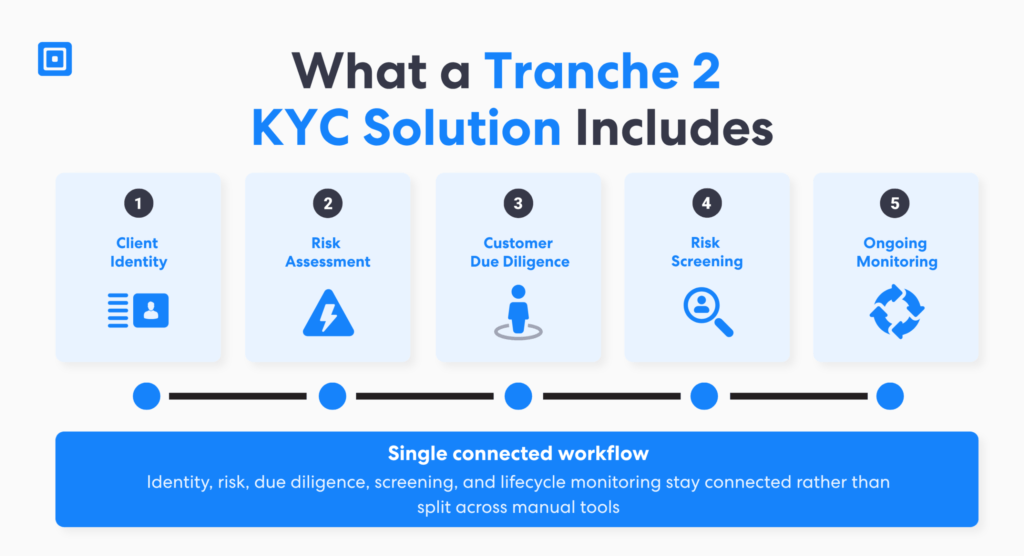
This changes how newly regulated firms and reporting groups think about onboarding. For example, a low-risk domestic client should not face the same level of friction as a high-risk customer using complex structures. A firm’s compliance system should be linked to risk. The same process should not be applied to every single client.
> Tranche 2 firms should not start by asking how many documents they need to collect.
[Harry Varatharasan](https://www.biometricupdate.com/202605/stop-treating-identity-as-a-compliance-step-its-infrastructure-now), Chief Product Officer at ComplyCube states that firms, “…should start by asking where financial crime exposures begins. Based on this, they can design controls that are appropriate, explainable, and repeatable.”
### Tranche 2 KYC Solution Compliance with Customer Due Diligence
According to AUSTRAC, conducting initial [Customer Due Diligence (CDD)](https://www.complycube.com/en/solutions/due-diligence-compliance/customer-due-diligence/) involves determining specific data about a customer or client on reasonable grounds before providing a designated service. This protects businesses from the very start of the customer relationship by identifying and mitigating risks such as money laundering, terrorism financing, and proliferation financing.
>
Aside from verifying client identity, it should also help identify beneficial owners and clarify who controls the relationship as a whole. Know Your Business (KYB) solutions can be helpful, particularly those firms looking to keep client onboarding central to their operations.
With identity risk becoming more complex, Identity Verification (IDV) is another core part of an AML/CTF control. As artificial intelligence and deepfakes are expected to make verification more contested, such a service will make a lasting impact on ensuring compliance under the new Tranche 2 regulations.
### Escalation Pathways with Enhanced Customer Due Diligence
After initial checks are in place, the next stage is escalation. This is where [Enhanced Due Diligence (EDD)](https://www.complycube.com/en/enhanced-due-diligence-edd-insights-challenges/) comes in, when standard checks are not enough. The purpose to to understand how higher-risk relationships expose the firm to money laundering, terrorism financing, or sanctions risk.
EDD is most relevant when a client’s profile is very complex. If beneficial ownership is unclear, politically exposed persons are involved, or the activity is inconsistent with the stated purposed of the relationship, that is where it is needed most. A practical EDD review should look at three areas:
- Who controls the client or transaction.
- Where funds or assets appear to come from.
- Whether screening results require escalation.
In practice, technology should support judgement, it is not a replacement. A Tranche 2 KYC solution can show risk signals, apply rules, and create a record of decisions. Compliance teams still need clear criteria for accepting, rejecting, or escalating a customer relationship.
Technology should support judgement, not replace it. A Tranche 2 KYC Solution can surface risk signals, apply rules, and create a record of decisions. Compliance teams still need clear criteria for accepting, rejecting, or escalating a customer relationship.
### Address Key Obligations By Conducting Ongoing Monitoring
Lastly, once a client is approved, it is important to keep checking in. [Ongoing monitoring](https://www.complycube.com/en/solutions/global-screening/continuous-monitoring/) turns KYC into a live compliance function. A client may be low risk at the top of onboarding, but become higher risk as ownership changes, screening alerts appear, or suspicious transactions emerge. You can learn more here: [What is an Ongoing Monitoring Process?](https://www.complycube.com/en/what-is-an-ongoing-monitoring-process/)
This type of view matters for most DNFBPs. For example, a real estate agent may onboard a buyer before their funding details change. Similarly, a law firm may start with one matter before a new beneficial owner appears. Ongoing monitoring helps firms notice three types of changes in data:
- Client identity or beneficial ownership.
- Sanctions, PEP, or adverse media exposure.
- Activity that may indicate suspicious transactions.
### **Case Study: Strike Force Myddleton in New South Wales**
In 2026, the New South Wales (NSW) Police reported that [Strike Force Myddleton](https://www.police.nsw.gov.au/news/news_article?sq_content_src=%2BdXJsPWh0dHBzJTNBJTJGJTJGZWJpenByZC5wb2xpY2UubnN3Lmdvdi5hdSUyRm1lZGlhJTJGMTI1NDU1Lmh0bWwmYWxsPTE%3D) uncovered a fraud and money laundering syndicate that began with “ghost car” loans. This expanded into large-scale personal, business, and home loan fraud. As a result, the New South Wales Crime Commission restrained $95M AUD ($61.8 M USD) in assets.
##### Professional Layers Enabling Fraud
Shortly after, investigators targeted other professional layers that helped the syndicate move fraudulent documents to mortgages, loans, and other large transactions. In April 2026, a Sydney solicitor became the first legal professional charged under Strike Force Myddleton. The police alleged that he helped facilitate mortgaged property purchases.
##### Outcomes
- NSW Police’s investigation reached a critical phase focused on professional facilitators.
- Police alleged that professional authority was used to support fraudulent activity.
- This demonstrates why Tranche 2 firms need stronger AML/CTF controls.
## Reporting, Records, and Escalation
When a risk signal shows up, newly regulated firms need a clear path from review to escalation. Moreover, they have a path that shows how an escalation moves toward a document decision. This is how a Tranche 2 KYC solution can become an accountability framework.
According to AUSTRAC, reporting entities must support reports relating to transactions of a certain monetary threshold and suspicious matters. These suspicious matter reports must be submitted 24 hours from when the suspicion arises. These compliance reports may involve any suspicion related to terrorism financing or certain transactions.
Maintaining accurate and complete records are necessary for AML/CTF compliance as part of Tranche 2 regulations. To be compliant, firms must retain any reporting or records for at least seven years.
## Key Dates for Tranche 2 AML/CTF Readiness
The last step in building a Tranche 2 KYC solution is turning the AML/CTF reform timeline into an implementation plan. Key dates must become operational milestones as firms need time to assess scope, build workflows, test controls, and train teams before obligations begin. With enrollment in effect from 31 March 2026, the AUSTRAC AML/CTF obligations apply from 1 July 2026. Firms should look to focus on three workstreams:
- Scope and reporting entity assessment.
- AML/CTF program and risk assessment.
- KYC verification, monitoring, and record keeping workflows.
It is important that Australian firms look to AUSTRAC for further guidance. They will provide core guidance and sector specific guidance updates. This is especially important for businesses balancing legal professional privilege, reporting obligations, and client confidentiality.
### Key Takeaways
- **A Tranche 2 KYC solution** links IDV, risk assessment, and record keeping.
- **Tranche 2 Know Your Customer** rules apply to firms providing designated services.
- **Tranche 2 KYC** helps firms verify client identity and understand beneficial ownership.
- **Ongoing customer due diligence** helps firms detect changes in risk after onboarding.
- **Global RegTech infrastructure** can help Australian firms build scalable AML/CTF compliance workflows.
## Build a Tranche 2 KYC Solution with ComplyCube
The new Tranche 2 regulations are a compliance deadline that marks a shift in Australia’s Anti-Money Laundering framework. It brings professional services and newly regulated sectors into a much more active role in protecting the financial system.
Strong Tranche 2 KYC solutions help firms move from uncertainty to control giving teams a practical way to conduct ongoing customer due diligence across the full client lifecycle. Talk to [ComplyCube](https://www.complycube.com/en/contact/contact-sales/) about how Tranche 2 KYC verification can help your newly regulated business.

## Frequently Asked Questions
Why do Australian firms need Tranche 2 KYC Solutions?
Tranche 2 regulations were put in place in order to support Australian firms in protecting the financial system from money laundering, counter terrorism financing and fraud as a whole. A Tranche 2 KYC solution helps verify clients, assess risk, monitor relationships and keep records.
Who Needs a Tranche 2 KYC Solution in Australia?
Australian firms that provide designated services covered by the expanded AML/CTF regime need Tranche 2 KYC verification . This applies to newly regulated sectors; real estate agents, lawyers, accountants, trust services, company services and dealers in precious metals, stones, and products.
What Should Tranche 2 KYC Verification Include?
Proper Tranche 2 KYC verification must include strong client identity checks, beneficial ownership review, and risk-based screening based on respective risk appetite. It should also support enhanced customer due diligence based on complexity and ongoing monitoring when client risk changes.
When Do Tranche 2 AML/CTF Obligations Start?
According to the Australian Home Affairs office, Tranche 2 regulated entities providing new designated services can enrol with AUSTRAC from 31 March 2026. New AML/CTF obligations apply from the 1 July 2026 deadline.
How Can ComplyCube Support Tranche 2 Readiness?
ComplyCube supports Tranche 2 readiness through IDV, KYC, AML screening, biometric liveness detection, workflow automation, case management, and ongoing monitoring. These solutions help firms build scalable workflows while keeping responsibility for legal interpretation with the firm and its advisers.
**Categories:** Guides
**Tags:** Know Your Customer
---
### [Ikano Bank Fined SEK 140 Million in Sweden for Major AML Failures](https://www.complycube.com/ikano-bank-fined-sek-140-million-in-sweden-for-major-aml-failures/)
**Published:** June 17, 2026
**Author:** Dini Habib
**Excerpt:** Ikano Bank, the IKEA founder's family-owned bank, was fined SEK 140M ($14.9M) by Sweden for systematic AML failures. This case reveals the four critical violations and includes critical compliance lessons to prevent costly fines.
**Content:**
On June 17, 2026, the Swedish company, Ikano Bank AB, was fined SEK 140 million (USD$15 M) by Sweden’s Financial Supervisory Authority, the Finansinspektionen, for failures to comply with the country’s Anti-Money Laundering (AML) and Counter-Terrorist Financing (CTF) Act (2017:630).
**Background:** Ikano Bank AB was first founded in 1995 by Ingvar Kamprad, the founder of IKEA. The bank provides financial services to a large portfolio of leading clients, including Volkswagen, Audi, Linex, and Shell.
## What Actually Went Wrong?
In a statement by the Finansinspektionen, there were four clear areas in its AML and CTF program that Ikano Bank failed to follow. Firstly, the company had incomplete risk assessments. It did not have a comprehensive assessment of the risk exposure level of its products. Without a clear product or service-specific risk assessment, this meant the bank could not identify the specific red flags that would be triggered in the event that a criminal was potentially moving illicit funds.
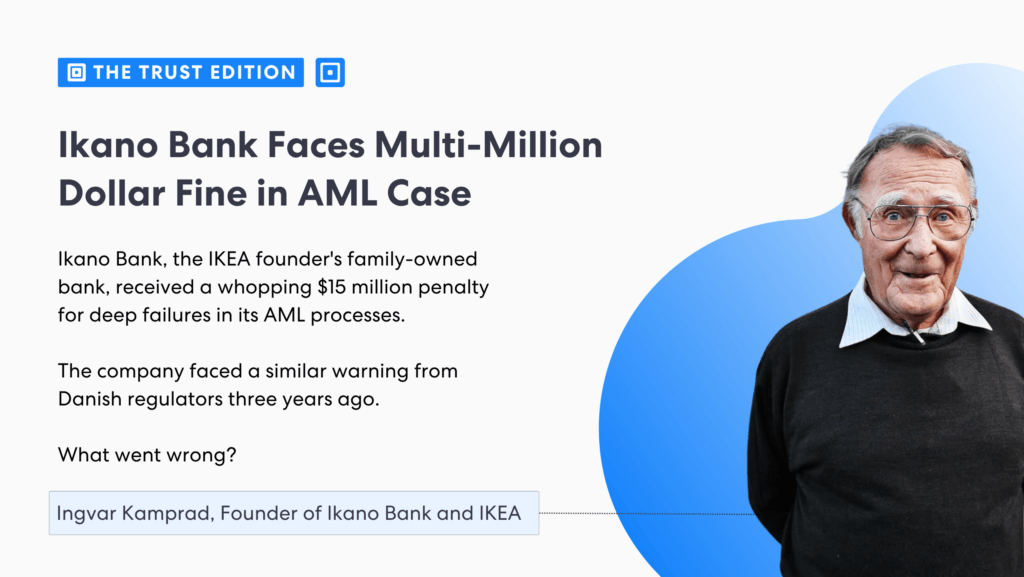
Secondly, the bank failed to consider risk factors that have a link to its actual corporate customers. This meant that the company had never realistically identified what classifies a customer as low, medium, or high risk. In practice, this could lead to a high-risk customer receiving the same due diligence measures as a low-risk one, despite being of a higher threat.
**Key Facts:** In 2023, Denmark inspected the Danish branch of Ikano Bank and noted it had insufficient beneficial owner documentation and inadequate customer knowledge procedures. Three years later, Sweden found the same issues, indicating a pattern of systemic AML weakness.
Thirdly, Ikano Bank had not examined or integrated updated ML and TF methods by regulators in the appropriate manner. As such, the company maintained outdated frameworks, instead of evolving them based on new information from Swedish authorities on the evolving tactics used by criminals to commit financial crime. Effectively, this implied that Ikano’s systems missed new red flags provided by regulators.
Lastly, the company did not gather adequate knowledge in order to implement Enhanced Due Diligence (EDD) measures. This suggested that the company had failed to gather crucial information, such as the purpose of the business relationship, source of funds, source of wealth, and beneficial ownership details. As a result, high-risk customers or entities could access financial services without proper verification.
## Finansinspektionen’s AML Enforcement Surge
The Swedish Financial Intelligence Unit (FIU) has issued large AML penalties in recent months. Just last month, [Norion Bank](https://www.complycube.com/en/norion-bank-fined-90-million-by-sfsa/) was penalized SEK 90 million (USD$9.75 M) for violations of AML and CTF rules. The regulator explicitly mentions its focus on sectors with elevated money laundering risks.
> How financial firms prevent money laundering is a [priority](https://www.fi.se/en/published/news/2025/how-fi-reviews-money-laundering-risks-in-the-financial-sector-in-2025/) issue for Sweden’s FIU.
For companies across regulated markets, this case highlights the importance of rigorous, product-specific AML frameworks. Businesses must map and have a deep understanding of how actual customers can misuse specific products for money laundering.

Subscribe to ComplyCube’s [Trust Edition newsletter](https://www.linkedin.com/newsletters/the-trust-edition-7103022355722981376/), where we explore the top developments across identity verification and AML globally. Plus, we share valuable insights on compliance with the latest regulations.
**Categories:** News
**Tags:** Anti-Money Laundering
---
### [The Identity Verification Onboarding Bottleneck](https://www.complycube.com/identity-verification-onboarding-bottleneck/)
**Published:** February 24, 2025
**Author:** Sofia Daley
**Excerpt:** Businesses need to strike the perfect balance between speed and security with a comprehensive identity verification service. Discover why digital identity verification plays a crucial role in fraud prevention and onboarding.
**Content:**
**TL;DR:** **Identity verification** can accelerate onboarding or become the bottleneck that causes user to abandon sign-up. A modern identity verification service helps startups replace **slow manual checks with automation**. Digital identity verification enables faster onboarding, stronger fraud prevention, and scalable KYC **without adding overhead**.
Businesses need to strike the perfect balance between speed and security when implementing a comprehensive identity verification service. Digital identity verification plays a crucial role in fraud prevention. It helps verify users’ identities and ensuring that bad actors are prevented from accessing services or completing transactions. With the rise of digital services, the onboarding process must be efficient yet thorough, meeting regulatory requirements while maintaining security.
Automated processes can streamline customer onboarding, allowing organizations to quickly verify a person’s identity with documents like government-issued ID, proof of address, and even biometric data such as a phone number or camera image. A verification service integrated with an organization’s website or web portal can enable quick and reliable business verification, which is crucial to protect both customers and businesses from fraud. These systems can address risks, such as adverse media or incorrect data records, that may arise during verification.
By leveraging technology, businesses can handle the demands of multiple markets and industries. It ensures compliance while serving more users and meeting customer expectations. With these integrations, businesses can ensure a smooth onboarding experience. It ensures users have easy access to their accounts and ensuring the transactions they complete are secure.
The ability to prove a customer’s identity online is essential to prevent fraud, comply with regulations, and protect against the risks associated with fake information. Identity verification services provide customers with the speed they need in today’s fast-paced world.
## KYC and the Slow Identity Verification Process
At its core, KYC is designed to ensure that financial institutions know exactly who their customers are. The process typically involves verifying government-issued IDs, proof of address, and, in some cases, additional documents. This includes documents such as bank statements or utility bills. While these safeguards are essential for regulatory compliance, they often lead to significant delays when done manually, which is where startups face a major issue.
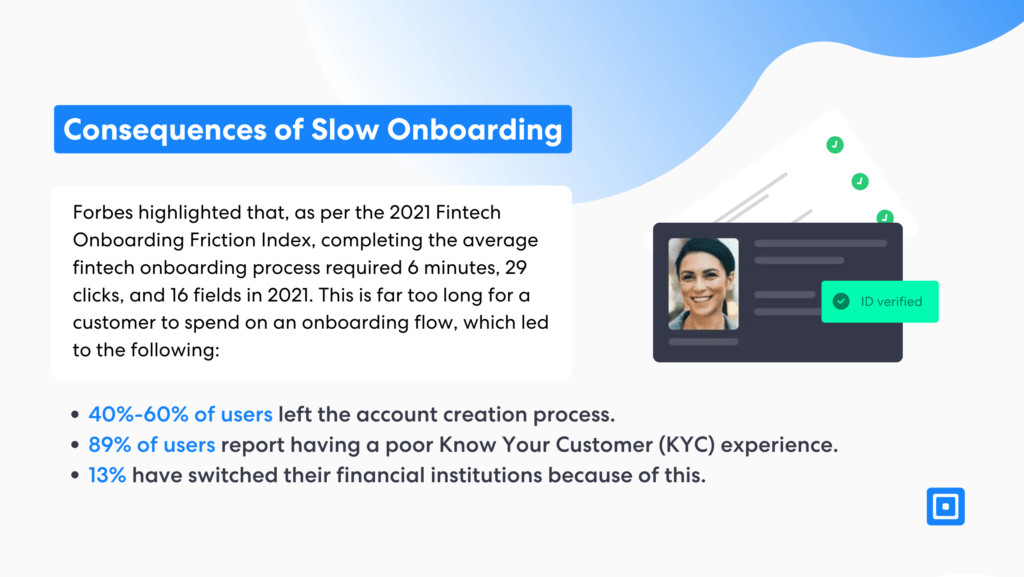
Many financial services companies still rely on outdated or inefficient manual processes, which makes the KYC verification stage a bottleneck. This delays customers’ access to services, creating friction in the onboarding process and frustrating users who expect faster, more seamless interactions.
For startups that aim to scale, these delays can be especially damaging:
- **Increased Drop-Off Rates**: Long verification times cause potential customers to abandon the onboarding process, which leads to lost business.
- **Manual Effort Strain**: Relying on manual checks for each customer means that a growing customer base demands more administrative time, resources, and costs, reducing the startup’s agility.
- **Compliance Risk**: With constantly evolving regulations, manual verification increases the risk of errors, compliance missteps, and regulatory penalties.
### Key Statistics About Identity Verification Services and Onboarding
Forbes highlighted that, as per the [2021 Fintech Onboarding Friction Inde](https://www.forbes.com/councils/forbestechcouncil/2023/04/26/perpetual-kyc-is-inevitable-but-not-how-you-think/)[x](http://forbes.com/councils/forbestechcouncil/2023/04/26/perpetual-kyc-is-inevitable-but-not-how-you-think/ "x"), completing the average fintech onboarding process required 6 minutes, 29 clicks, and 16 fields in 2021. This is far too long for a customer to spend on an onboarding flow, which led to the following:
- 40%-60% of users left the account creation process.
- 89% of users report having a poor Know Your Customer (KYC) experience.
- 13% have switched their financial institutions because of this.
Onboarding remains a significant area of friction and cost for companies. Yet, the task of understanding your customer doesn’t stop after the initial setup. Personal details such as addresses and financial information are subject to change over time.
Partnering with an expert KYC platform can reduce onboarding time to less than 30 seconds per customer, granting businesses the ability to onboard customers seamlessly and scale. For this reason, partnering with a KYC platform with advanced technology is critical for growth and efficiency.
## Evolving KYC Regulations: A Constant Challenge
KYC regulations are not static. They vary greatly across regions, and, in some cases, these rules are changing rapidly to meet the growing threats of digital fraud, money laundering, and terrorism financing. While these regulations are designed to enhance security, they can also contribute to significant delays if not addressed with the proper tools.
### **Country-Specific Compliance** & ****The Need for a Risk-Based Approach:****
Financial institutions must tailor their KYC practices to comply with local laws. This means that startups planning to scale internationally face a complex web of compliance challenges. For example, U.S. regulations might require multiple forms of ID, while European Union regulations might demand proof of source of funds for certain transactions. Staying on top of these country-specific regulations is a daunting task and could cause further delays if handled manually.
> By adopting a [risk-based approach](https://www.thomsonreuters.com/en-us/posts/investigation-fraud-and-risk/kyc-risk-based-approach/), competent authorities and financial institutions are able to ensure that measures to prevent or mitigate money laundering and financing threats are commensurate to the risks identified. ~ FATF
Some regulators are shifting to a more dynamic, risk-based approach to KYC, meaning that higher-risk customers, such as those from certain countries or industries, will require more intensive verification. However, identifying these customers and adjusting the verification process is time-consuming when done manually.
For startups with limited resources, this complexity becomes a scalability challenge. Automation tools that can differentiate risk levels and apply different levels of scrutiny are essential to ensure efficiency and compliance.
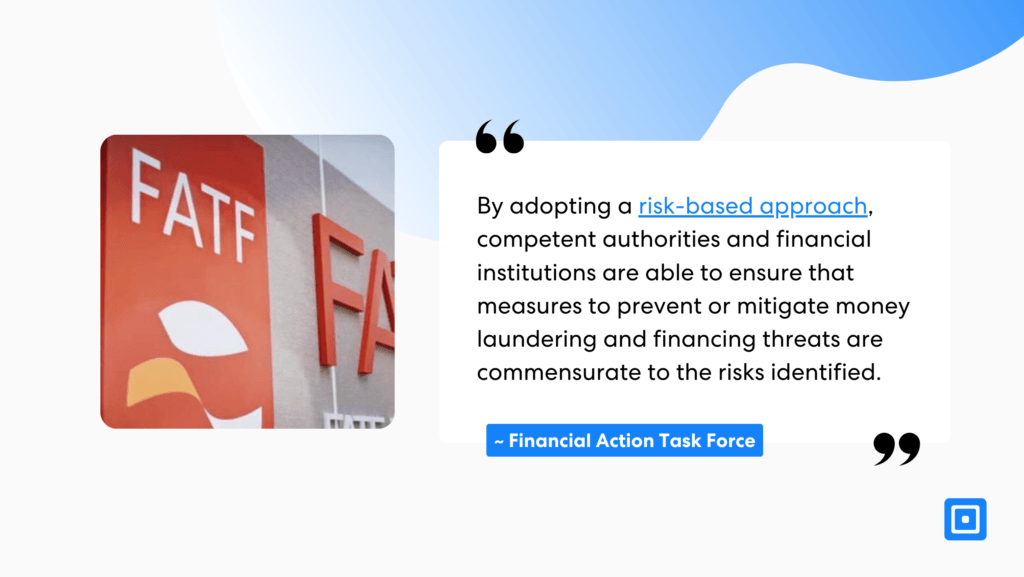
Staying ahead of regulatory changes and emerging risks manually is time-consuming and costly for businesses of all sizes. Along with identity checks, a highly time-consuming part of manual AML checks is screening each client separately against multiple lists, including PEP databases and sanctions lists.
For companies managing large client bases, this involves reviewing every individual’s profile, comparing it to both national and international databases, and frequently performing further investigations into negative media coverage or the origins of their wealth.
### **Case Study: Bithumb KYC and AML enforcement action**
In March 2026, South Korea’s Financial Intelligence Unit fined crypto exchange, Bithumb, around 36.8 billion won ($24.6M USD), with reports citing approximately 6.65 million KYC and transaction-control violations. This enforcement reportedly included failures in client verification, and failures to restrict activity when checks were incomplete.
##### **Automated Identity Verification Embedded Into The Mobile Journey**
A stronger digital identity verification workflow would prevent users from progressing when required checks are incomplete, unclear, or inconsistent. This means validating identity documents, blocking transactions where verification is unfinished, applying automated decisioning rules, and maintaining audit-ready records of each step.
##### **Outcomes**
- Shows how incomplete KYC can become a large-scale compliance failure.
- Connects poor onboarding controls with fines, restrictions, and reputational risk.
- Reinforces the need for identity verification workflows that are fast, complete, and auditable.
## The Digital Shift for a Faster, More Efficient Process
The rise of remote services has placed additional pressure on startups to streamline their KYC processes. Customers now expect to complete identity verification without leaving their homes, and a slow, in-person verification process just won’t cut it in today’s digital-first environment. This is where remote identity verification solutions can play a crucial role in eliminating bottlenecks.
[Document Verification through AI](https://www.complycube.com/en/solutions/identity-assurance/document-verification/): AI-powered tools can scan, validate, and cross-check government-issued IDs and documents within seconds. These tools use machine learning algorithms to detect fraudulent documents or suspicious activity, making them far more efficient and accurate than manual review. For startups, this enables them to serve more customers without hiring an army of compliance staff.
[Facial Recognition and AI Integration:](https://www.complycube.com/en/solutions/identity-assurance/biometric-verification/) Biometric identity verification is fast becoming the gold standard for digital KYC. Through facial recognition and liveness detection technology, users can verify their identity in real-time, reducing the need for physical document submission or face-to-face meetings. This shift not only accelerates the onboarding process but also minimizes human error and enhances security.
## How Digital Identity Solutions Can Drive Startup Growth
The move to digital identity verification is essential for startups looking to scale without hitting identity verification bottlenecks.
- **Instant Onboarding**: By incorporating AI-powered solutions like selfie-based verification or digital ID verification, customers can complete the entire KYC process in minutes instead of days. This seamless experience helps startups create a frictionless path to onboarding, encouraging more customers to join and reducing abandonment rates.
- **Improved Customer Satisfaction**: The quicker and more secure the verification process, the better the overall user experience. With instant identity validation, customers no longer have to wait for days to complete the KYC process or submit additional paperwork. This creates a positive first impression and builds customer trust immediately.
- **Cost Efficiency and Scalability**: For startups, the key to scaling is automation. As your customer base grows, manual verification becomes unsustainable. Automated KYC platforms can easily handle large volumes of verifications without compromising speed or accuracy. This allows startups to focus their resources on scaling other business areas while ensuring regulatory compliance and customer satisfaction.
### Key Takeaways
- **Slow identity verification** create avoidable drop-off during onboarding.
- **Manual KYC processes** become harder to scale as customer volumes grow.
- **Digital identity verification** can reduce friction while improving fraud detection.
- **Reserve human oversight** and manual review for edge cases outside of automation.
- **The best identity verification** service balances speed, compliance, UX, and fraud prevention
## Embracing the Future of KYC for Scalable Growth
For startups in the financial services sector, slow and manual identity verification processes are holding them back. KYC compliance is necessary, but outdated practices create a bottleneck that leads to frustrated customers, high drop-off rates, and hindered scalability.
The future of KYC is in automation, remote verification, and AI-powered solutions. By embracing these technologies, startups can streamline their verification processes, meet compliance regulations, and provide a seamless, secure, and fast onboarding experience. This allows them to scale effectively, remain competitive, and serve a growing customer base without sacrificing security.
Contact one of our [compliance experts](https://www.complycube.com/en/contact/contact-sales/) for more information on how to implement advanced IDV and KYC solutions to safeguard your organization.

## Frequently Asked Questions
Why does digital identity verification slow onboarding?
Identity verification slows onboarding when checks are manual, fragmented, or difficult for users to complete. Delays from poor document capture, repeated uploads, and manual review can increase abandonment and make customer acquisition harder to scale.
How can a digital identity verification service speed things up?
Digital identity verification speeds up onboarding by automating document checks, biometric verification, liveness detection, and risk-based decisioning. This helps genuine users move through onboarding faster while suspicious applications are flagged for closer review.
Is a faster identity verification service less secure?
A faster identity verification service is not less secure when it uses layered fraud controls. AI-powered document analysis, biometric matching, liveness detection, and risk signals can improve speed while helping businesses detect spoofing, deepfakes, and synthetic identities.
What should an identity verification service include?
An identity verification service should include document verification, biometric checks, liveness detection, fraud detection, configurable workflows, global coverage, and audit-ready reporting. This helps businesses reduce friction without weakening compliance or fraud prevention.
How does ComplyCube reduce onboarding digital identity verification bottlenecks?
ComplyCube reduces onboarding bottlenecks through automated identity verification, digital identity verification workflows, biometric checks, liveness detection, AML screening, and configurable risk rules.
**Categories:** Guides
**Tags:** Identity Verification
---
### [The Future of Insurance Regulatory Compliance Playbook](https://www.complycube.com/insurance-regulatory-compliance/)
**Published:** June 15, 2026
**Author:** Dini Habib
**Excerpt:** Modern AML and KYC insurance fraud solutions leverage AI and machine learning to enable insurers to verify and authenticate policyholders with speed and precision. These technologies facilitate the detection and prevention of fraud.
**Content:**
Digital interactions are the new standard for conducting business. With this, organizations are compelled to **protect their customers and themselves** from fraudulent online activity. But, verifying your customers’ identity in the digital world presents a unique set of challenges.
**Categories:** Insights
**Tags:** Know Your Customer
---
### [A Practical Approach to Fintech Compliance in 2025](https://www.complycube.com/fintech-compliance-aml-essential-strategies/)
**Published:** May 16, 2025
**Author:** Dini Habib
**Excerpt:** Fintech companies adopt advanced technological tools to disrupt the infrastructure of traditional financial institutions. With rapid innovation, fintech compliance has moved from a "check box" exercise to proactive risk management.
**Content:**
**TL;DR:** With rapid innovation in the digital financial services industry, fintech compliance has moved from just being a “check box” exercise to proactive **fintech risk management** practices. This guide covers the importance of compliance for fintech companies and best practices for **navigating evolving regulations**.
## The Birth of Fintech Companies
Fintech, also known as Financial Technology, is an emerging sector that aims to revolutionize financial services. Fintech companies pride themselves on adopting the most advanced technological tools to disrupt the infrastructure found in traditional banking sectors and financial institutions. Although the financial, technological, and fintech sectors are distinct in their purposes, they remain intricately connected.
> Fintech is expected to reach a market size of [$1.5 trillion in revenue by 2030](https://www.bcg.com/publications/2024/global-fintech-prudence-profits-and-growth), a growth of roughly five times from 2024.
Conventional financial systems typically rely on physical functions, emphasizing client-customer relationships. On the other hand, technological firms drive the development of digital tools and platforms to move traditional banking into a digital space. Fintech takes the center stage, leveraging state-of-the-art technology such as Artificial Intelligence (AI), blockchain, and real-time analytics to make financial services faster, cheaper, and more tailored than ever before.
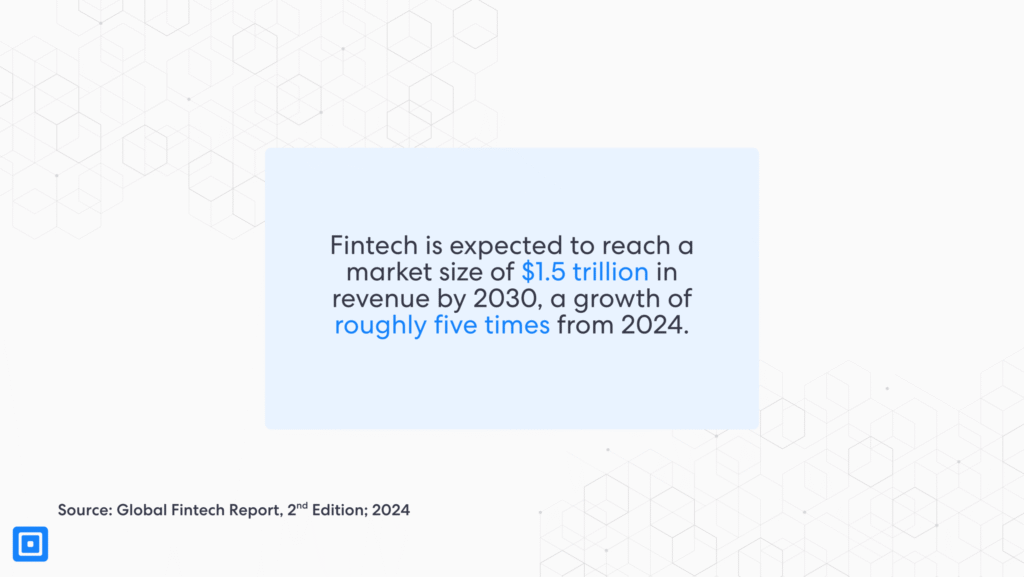
While this emerging sector picked up momentum relatively quickly, the immense growth opportunities for fintech companies were also met with complex challenges. This was particularly in building a flexible and agile compliance program that satisfied evolving regulatory standards while enabling scalability.
## Increasing Scrutiny of Fintech Firms
The distinction between fintech and traditional [financial industries ](https://www.complycube.com/en/use-cases/industry/financial-services/)will wear off as regulatory bodies extend oversight and compliance expectations across a wider financial ecosystem. This means that now, any companies involved in working with other financial institutions or providing financial transactions must align with new regulations and implement security measures to actively combat terrorist financing, money laundering, and unfair or deceptive acts.
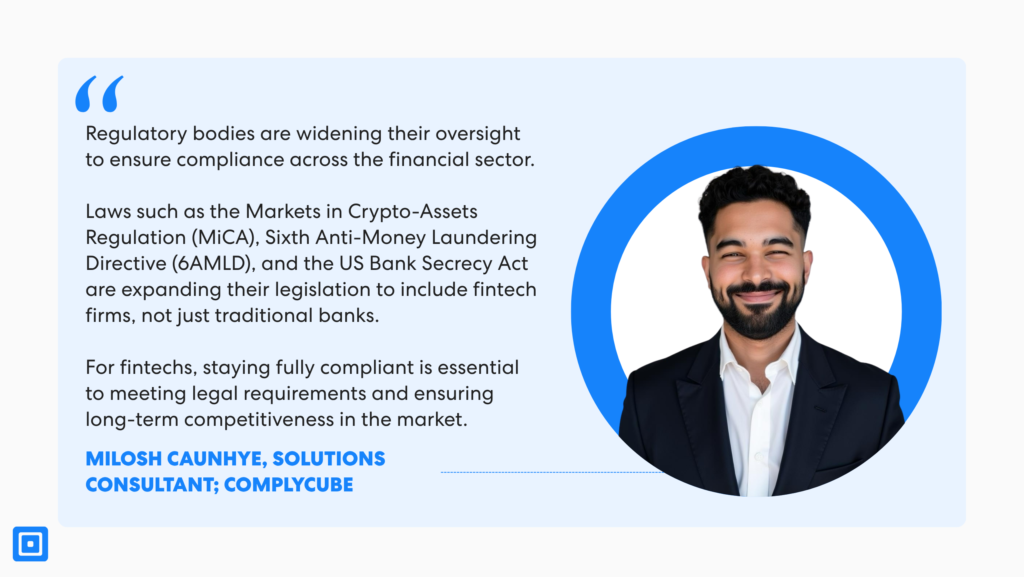
Fintech organizations that fail to adapt to these expanded regulations could face significant penalties, reputational damage, and loss of consumer trust in an increasingly competitive marketplace. The factors that drive this heightened scrutiny towards fintech businesses include:
### 1. Gaps in the regulatory environment
The acceleration of fintech growth has often outpaced regulatory frameworks. This has created compliance difficulties in data protection and consumer protection laws, forming a breeding ground for financial crimes like money laundering and fraud. As a result, regulatory authorities implement stringent compliance requirements for fintech firms to abide by to ensure compliance and financial stability.
### 2. The rise of threats and failures
As we know, financial service providers commonly have inadequate compliance processes, with the Financial Conduct Authority (FCA) [imposing over £176m](https://www.investmentweek.co.uk/news/4395753/fca-fines-increase-230-2024-amid-heightened-crackdown-financial-misconduct) in fines just last year. The fintech sector is not immune.
> In 2023, [86% of fintech respondents](https://thefinancialbrand.com/news/bank-culture/trends-2024-how-fintechs-are-balancing-growth-with-compliance-risk-172589?ref=escape.tech) said their organization paid over $50,000 in compliance fines last year, with more than 37% paying over $500,000.
Fintech compliance practices and poor risk management have increased over the years, prompting increased regulatory oversight of fintech companies and their partnerships with other financial institutions to safeguard the financial system.
### 3. Data processing and Artificial Intelligence (AI) concerns
Due to their extensive contact with sensitive financial data, fintech businesses now face stricter data protection laws. Legislation such as the [General Data Protection Regulation (GDPR)](https://gdpr-info.eu) and the [California Consumer Privacy Act (CCPA)](https://oag.ca.gov/privacy/ccpa) mandates higher privacy rights and customer protection. Companies must adopt compliance programs that include regulatory reporting and risk assessments to satisfy regulatory compliance.
### 4. Prioritising Growth Through Investment
Companies that fail to keep up with the complex regulatory environment can face devastating consequences from federal regulators. Reputation damage, financial losses, and even the shutdown of business activities are not unheard of. Fintech firms prioritizing compliance-first models, syncing with international regulations like the [Bank Secrecy Act](https://www.occ.treas.gov/topics/supervision-and-examination/bsa/index-bsa.html) and [Anti-Money Laundering (AML)](https://www.complycube.com/en/solutions/due-diligence-compliance/anti-money-laundering/) standards, are more likely to garner the interest of investors and customers.
### 5. Evolving global regulatory developments
AML and [Know Your Customer (KYC)](https://www.complycube.com/en/solutions/due-diligence-compliance/know-your-customer/) regulations are now being enforced on wider sectors globally. Regulatory bodies such as the [Financial Action Task Force (FATF)](https://www.fatf-gafi.org/en/the-fatf/what-we-do.html) are now given more decisive power to drive harmonized compliance standards to ensure fintech compliance and financial market stability. Companies that fail to adapt to the new regulatory landscape will fall behind with increased financial penalties and potential exclusion from key markets.
### **Case Study: Canada Penalizes Cryptomus Landmark $177 M**
In 2025, Cryptomus, the crypto focused FinTech landed itself a $177 million fine from Canadian regulators for violating critical AML and CTF controls. This penalty is one of the largest enforcement action by Canada’s watchdogs in recent years.
##### **Suspicious Transactions Traced to Darknet Markets**
According to Canada’s regulator, the firm violated the country’s AML Act in 2,593 instances. 1,068 of those instances were traced to suspicious criminal activity, such as darknet markets and child abuse trafficking, which the firm did not report.
##### **Outcomes**
- Cryptomus was penalized a [historic $177 million](https://www.complycube.com/en/the-cryptocubed-newsletter-october-edition/) for major violation of Canada’s Proceeds of Crime (Money Laundering) and Terrorist Financing Act.
- Despite operating in a sector with high financial risks, the company failed to implement strong AML screening and due diligence solutions.
- This case emphasizes the importance of real-time risk scoring and continuous monitoring to detect high-risk cases beyond intial onboarding.
## The Swift Uptick of Fintech Compliance
Although faced with increased scrutiny, fintech companies have been quick to integrate compliance technology, outpacing conventional financial institutions due to their digital-native operations. A majority of fintech companies view new regulations not just as a regulatory requirement but as a competitive advantage for boosting financial innovation and growth.
### The swift integration of fintech compliance is driven by:
- **Technological Intelligence:** Fintech companies are familiar with advanced AI, machine learning, and blockchain technology for real-time monitoring, automated [risk assessments](https://www.complycube.com/en/solutions/due-diligence-compliance/risk-scoring/), and robust compliance programs. This enables them to pick up regulatory technology more easily than the traditional financial services industry.
- **Proactive Culture:** The competitiveness in the fintech space means that most fintech companies need to be proactive in winning consumers’ trust. This has led to rapid alignment with risk management practices, consumer protection laws, and compliance requirements in their product roadmaps.
- **Competitive Advantage:** Implementing strong security enhancements and regulatory standards from the start enables fintech companies to address operational risks and differentiate themselves from big players in the financial markets.
- **Huge Risk of Non-Compliance:** Operating in a saturated market, [fintech companies need to be agile and swift](https://legal.thomsonreuters.com/en/insights/articles/understanding-the-risks-of-fintech) to respond to the complex regulatory landscape. Any wrong mistake, such as poor compliance expertise and unfair business practices, can negatively impact their financial innovation, setting them back.
- **Customer-First Principle:** Lastly, fintech firms view customers as the beating heart of their operations. As a result, ensuring financial stability for their users through anti-money laundering (AML) efforts and alignment with data protection laws is a priority.
## Top 5 Best Practices for Fintech Compliance 2025
As regulations evolve, keeping up with new standards in anti-money laundering and risk management frameworks is key. But how can businesses get ahead of regulatory compliance, especially as regulatory bodies continuously monitor and change legislation? This section will explore the best practices for fintech companies to adopt to ensure agility and flexibility in the face of changing regulatory requirements.
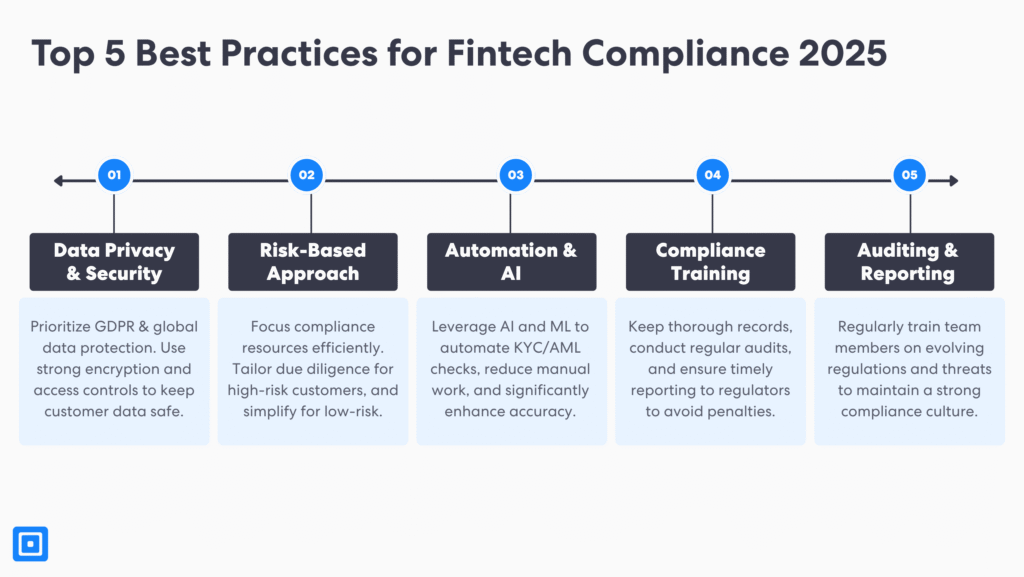
###
Step 1: Maintaining Priority of Data Privacy and Security Measures
Fintech companies must strictly adhere to fundamental data protection laws like the General Data Protection Regulation (GDPR). Initially, implementing strict security measures, such as access controls, will significantly reduce the likelihood of bad actors and illegitimate users gaining sensitive information.
### Step 2: Implementing a Risk-Based Approach (RBA)
In a compliance program, [RBA](https://www.complycube.com/en/what-is-a-risk-based-approach/) refers to allocating resources to higher-risk situations and clients. With RBA, fintech companies can streamline compliance activities by focusing on [enhanced due diligence](https://www.complycube.com/en/enhanced-due-diligence-edd-insights-and-challenges/) and ongoing monitoring for high-risk customers to prevent financial crimes and money laundering. In contrast, low customer risk profiles benefit from simplified compliance steps.
### Step 3: The Importance of Using Automation Capabilities
Advanced technology, including machine learning algorithms and proprietary AI, helps fintech companies rapidly satisfy compliance requirements. These tools can replace manual compliance tasks, such as filling in customer data and building reports, saving time and costs. Additionally, it can learn from historical patterns to make fraud prevention and AML more accurate.
### Step 4: Compliance Training as an Asset
Whether you create an in-house compliance team or choose to integrate a compliance vendor, compliance training cannot be ignored. Staying abreast of new regulatory requirements, financial regulations, and threats in the regulatory environment is key in the financial services industry.
### Step 5: Auditing, Documenting, and Reporting Diligently
Lastly, with robust auditing and documentation records, fintech companies can ensure they fulfill regulatory reporting obligations to satisfy compliance regulations and avoid penalties. Moreover, having an internal process to submit regular audits and risk assessments helps rectify gaps in your regulatory frameworks.
### Key Takeaways
- **Fintech compliance** is a core risk management infrastructure that requires proactive and risk-based KYC and AML controls.
- **Businesses in the fintech** sector face increasing regulatory scrutiny, including stronger oversight, penalties, and reputational consequences.
- **For scalable compliance**, fintech firms should prioritize a risk-based approach, which can drastically streamline onboarding and operations.
- **Automation via AI-driven** screening and identity verification supports financial services in meeting compliance obligations more accurately and rapidly.
- **Strong KYC and AML** programs are strategic advantages for fintech organizations as they boost customer loyalty, investor confidence, and regulator trust.
## Strengthening Fintech Compliance Solutions
From this guide, we learnt that meeting compliance regulations in the fintech industry is critical for safeguarding the financial system and avoiding fines for financial crimes, money laundering, or terrorist financing. Most importantly, meeting compliance standards pays dividends in building trust through consumer protection and resilience within modern payment systems in financial sectors. Fintech companies must take a proactive and agile approach to fulfill compliance requirements and satisfy regulatory authorities.
Get started with [advanced AML and KYC solutions](https://www.complycube.com/en/) today. [Learn more](https://www.complycube.com/en/contact/contact-sales/) from a member of the team.

## Frequently Asked Questions
Do fintech companies need to comply with AML laws?
Yes. While the exact AML obligations may vary by jurisdiction, fintech companies are legally mandated to comply with Anti-Money Laundering (AML) laws. These firms must have a strong compliance program to combat the risks of money laundering, terrorist financing, and other criminal activity. Non-compliance can lead to million-dollar fines and reputational damage.
What does fintech compliance include?
Fintech compliance can include Anti-Money Laundering (AML), Know Your Customer (KYC), and data privacy regulations. These regulations are mandated by global authorities, including the UK’s FCA, the U.S. FinCEN, and the EU’s AMLD. While exact requirements vary, the FATF recommends robust customer due diligence, suspicious activity reporting, and a risk-based model.
What are the biggest fintech compliance risks?
The biggest fintech compliance risks include money laundering and identity fraud risks, weak data protection, and AI governance challenges. The pace of technology and large transactions in the sector acts as an attractive space for fraudsters to exploit. As such, firms across fintech should implement strong, robust, and risk-based AML, KYC, and data integrity infrastructures.
How can FinTech organizations apply a risk-based compliance program?
Fintech companies can build a risk-based compliance program by analyzing and categorizing common risks in the sector, including customer, product, geography, and channel risks accordingly. This will enable them to allocate compliance resources, such as stronger due diligence to higher-risk users or scenarios, while streamlining processes for low-risk customers.
Why is automation important for fintech compliance?
Automation is important for fintech compliance because it reduces reliance on slow, error-prone manual reviews. It can support quicker, more accurate identity verification while ensuring that compliance processes remain scalable and flexible with growing business needs. Consequently, it enables real-time risk scoring and auditing, streamlining operations.
**Categories:** Guides
**Tags:** Anti-Money Laundering
---
### [The Ultimate Buyers Guide to Sanctions Screening Tools](https://www.complycube.com/the-buyers-guide-to-sanctions-screening-tools/)
**Published:** April 25, 2025
**Author:** Dini Habib
**Excerpt:** Businesses and individuals use software solutions such as sanctions screening tools to screen clients, customers, or transactions against official global watchlists and sanctions lists, aligning compliance with regulatory bodies and jurisdiction.
**Content:**
**TL;DR:** Businesses use sanctions screening tools to screen clients, customers, or transactions against **official global watchlists** and sanctions lists. These lists support businesses in identifying potential high-risk users or entities, supporting the **prevention of money laundering**. This guide explores a step-by-step buyer decision framework when choosing sanctions screening solutions.
## Why do Businesses Require Sanctions Screening Tools?
Sanctions lists are exhaustive databases that include the names of individuals, entities, and even countries restricted from certain activities due to their involvement in financial crime, illicit behavior, terrorism, and more. Sanction screening is critical to [Anti Money Laundering (AML)](https://www.complycube.com/en/solutions/due-diligence-compliance/anti-money-laundering/) and Counter-Terrorism Financing (CTF) measures, aligning compliance with regulatory bodies and jurisdiction.
A sanction screening tool enables firms to efficiently identify high-risk individuals or entities and easily make informed decisions about onboarding customers. These tools provide businesses with a simple and straightforward way to check if any of the parties that they are engaging with are listed in any sanctions list by automatically extracting data from various global sanctions lists and cross-referencing them within a centralized platform. This automation reduces manual workload, enhances accuracy, and ensures compliance with constantly changing regulatory requirements.
## How Do Sanctions Screening Tools Work?
Sanctions screening tools work to automate the process of checking and proactively preventing businesses from unintentionally interacting with sanctioned parties. These tools involve data collection, data standardization, and analyzing risk scores based on the information collated from a comprehensive database of sanction lists worldwide.
Customers with a high-risk match will undergo thorough analysis to confirm whether they are true or false positives. Once confirmed, appropriate actions are taken, such as blocking transactions or reporting to authorities. [Ongoing monitoring](https://www.complycube.com/en/solutions/global-screening/continuous-monitoring/) ensures ongoing compliance with evolving sanctions lists and regulatory requirements. You can learn more here: [Global Sanctions Check in 2025.](https://www.complycube.com/en/everything-you-need-to-know-about-global-sanctions-check-in-2025/)
## Essential Features to Look for in Sanctions Screening Tools
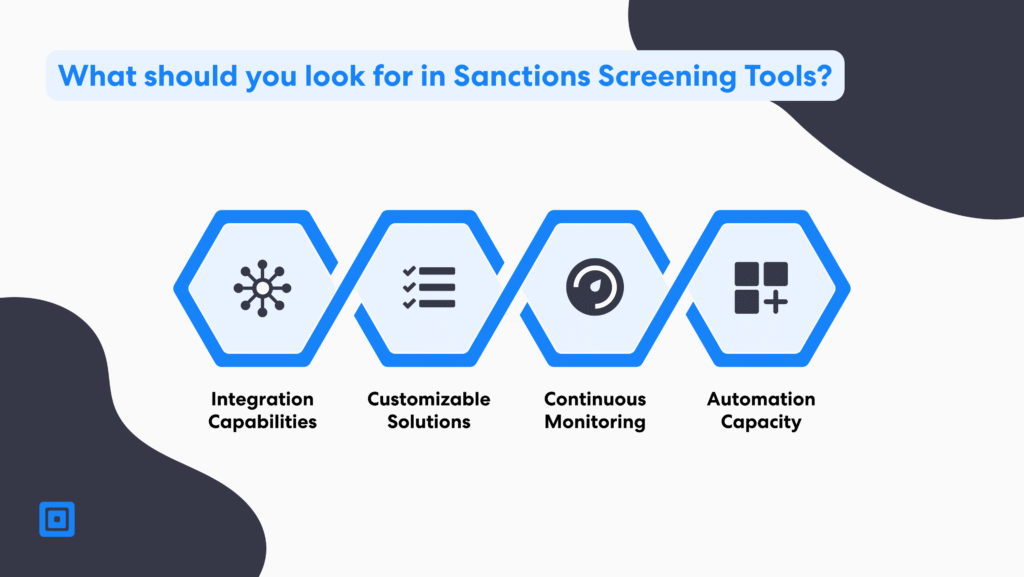
### Seamless Integration Capabilites
One of the most crucial components when searching for the best sanctions screening tool for your business is its integration capabilities. Advanced screening tools enable companies to seamlessly integrate it into their existing technology stack, providing a centralized platform for managing customer data and compliance processes. This ensures that all customer information can be accessed through a single dashboard, simplifying workflows and enhancing efficiency. [Screening tools with API and Web SDK integration](https://www.complycube.com/en/developers/) further enhance this by enabling real-time data exchange and easy embedding into applications, ensuring automated and up-to-date compliance checks.
### Key Questions for Buyers to Consider
1. How frequently are sanctions lists updated, and does the integration support real-time updates?
2. Does the integration process require significant technical expertise, or is it user-friendly for non-technical teams?
3. Will integrating this tool disrupt other compliance systems or workflows?
4. Does the vendor offer technical support during and after integration to troubleshoot issues?
5. Can the tool integrate with CRM systems like Salesforce, HubSpot, or others to streamline customer management processes?
6. Are safeguards in place to prevent data quality issues or mismatches during integration?
### Customizable Solutions for Unique Business Needs
Another vital factor to consider is the level of flexibility and customization in a sanction screening tool. In some instances, screening tools may offer limited customization options, forcing businesses to adapt their processes to fit the tool, which is time-consuming and inefficient. In contrast, advanced sanctions screening solutions provide robust customization options, allowing companies to tailor workflows, screening parameters, and [internal watchlists](https://www.complycube.com/en/solutions/global-screening/watchlist-screening/) to align perfectly with their compliance goals. Whether configuring workflows for specific onboarding processes or adjusting risk thresholds to reduce false positives, the right tool should adapt to your firm, not the other way around. Customizable features also enable businesses to scale operations effectively as regulations evolve, ensuring fraud prevention and operational efficiency.
### Key Questions for Buyers to Consider
1. Does the tool allow you to create custom workflows for your specific business processes?
2. Can you adjust screening parameters, such as fuzzy matching thresholds or match types (e.g., exact vs. close matches)?
3. Does the tool support internal list management, such as adding or editing custom watchlists?
4. Can you configure notifications (e.g., frequency, recipients) to align with your operational needs?
5. Does the software allow branded interfaces or reports to maintain consistency with your company’s identity?
6. Are there options for customizing user access levels based on organizational roles?
### Continuous Monitoring for Evolving Threats
As sanctions lists are updated frequently, ensuring that the screening tools you choose offer real-time monitoring is vital. Sanctions lists are prone to updates very often. Thus, it is important to enable continuous monitoring so your business is always notified of any changes and does not risk missing newly sanctioned entities or outdated compliance checks. Advanced tools leverage AI-driven technologies to track updates from thousands of global sanctions lists, [politically exposed persons (PEP) databases](https://www.complycube.com/en/solutions/global-screening/sanctions-pep-screening/), and adverse media sources. This ensures businesses can act on the most current data. This proactive approach to identifying risk is vital in strengthening the overall AML framework in a firm.
### Key Questions for Buyers to Consider
1. Does the tool provide real-time updates for sanctions lists, PEP databases, and adverse media?
2. Can the screening tool monitor transactions continuously without manual intervention?
3. Does the solution leverage AI or machine learning to enhance monitoring accuracy and reduce false positives?
4. Does the tool support dynamic risk scoring based on real-time data updates?
5. Are compliance-related metrics tracked in real-time to meet regulatory requirements?
### **Automation Capacity for Enhanced Efficiency**
Advanced sanction screening tools utilize state-of-the-art AI and ML algorithms to reduce manual processes and streamline the screening process. Automated tools enable companies to analyze vast databases in real-time, reducing the risk of human error and significantly boosting accuracy. Repetitive tasks, including batch screening, risk scoring, and alert generation, can be optimized, further allowing compliance teams to feel empowered to focus on making calculated decisions. Features such as [fuzzy logic](https://www.int-comp.org/insight/fuzzy-matching-getting-the-balance-right/) and natural language processing (NLP) further help reduce false positives, fortifying compliance. By integrating automated solutions into existing workflows, firms can enhance efficiency and accuracy while adhering to evolving regulatory requirements.
### Key Questions for Buyers to Consider
1. Does the tool support batch screening for bulk data uploads and processing?
2. Are repetitive tasks like risk scoring and alert generation fully automated?
3. Does the tool provide detailed audit trails for automated processes to ensure transparency during compliance reviews?
4. Does the vendor offer training or support to help teams maximize the the benefits and effectiveness of automation features?
### **Case Study: The UK Strengthens its Sanctions Approach**
In 2026, the UK launched its new sanctions package, aiming to further tackle Russian-linked, illicit crypto and financial networks. One of its largest focus was the Kremlin-backed A7 network, who processed $90 billion in transactions in 2025 via exploited financial channels.
##### **Clear Warning for Regulated Businesses**
In a statement by the Foreign Secretary, its noted that the country is adapting its approach to block the evolving strategies that Russia uses to evade sanctions. The move sends a signal to UK firms to expect higher oversight over AML screening frameworks.
##### **Outcomes**
- This case reinforces the [zero-tolerance approach](https://www.complycube.com/en/cryptocubed-may-newsletter-binance-iran-crypto-news-and-mica-crypto-rules-review/) to sanctions evasion by leading jurisdictions across the UK, US, Singapore, and more.
- Businesses are increasingly expected to adopt and evidence strong enhance due diligence steps and decisions, especially those linked to high-risk networks.
- Heightened supervision, particularly towards watchlist, sanctions, and PEP screening around companies in regulated markets are anticipated.
## Purchasing the Right Sanctions Screening Tool for your Firm
Selecting the right sanctions screening solution requires evaluating several factors to ensure it aligns with your business needs. In this section, we will discuss the most important aspects you must consider based on conversations with industry leaders and clients in the RegTech field.
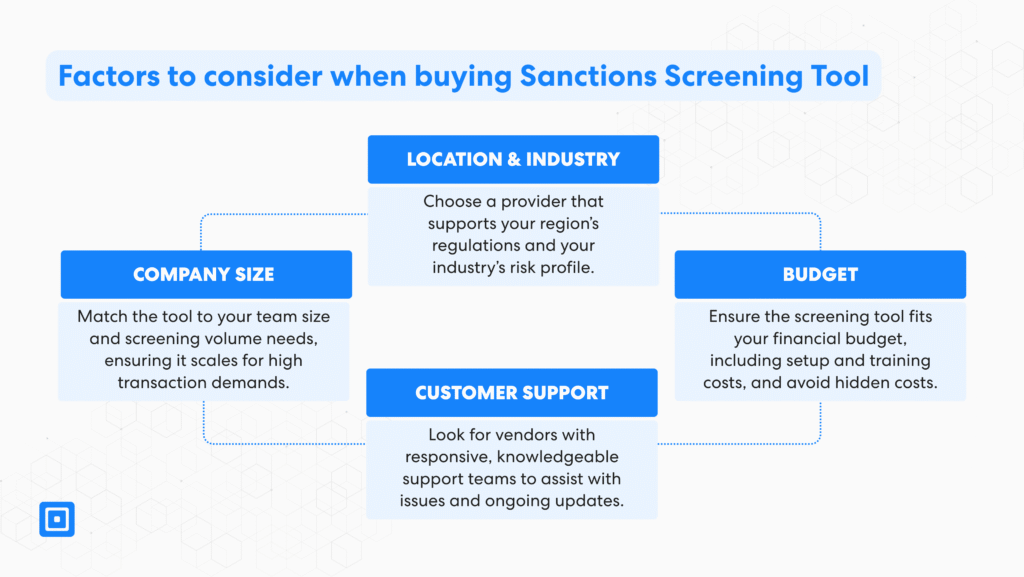
### Company Size
The size of the organization, such as the number of team members utilizing the tool, is a significant consideration when choosing the appropriate provider. Low-cost tools with minimal integrations may suffice for small organizations with limited resources. However, businesses with high-volume transactions require scalable solutions to manage bulk data rapidly and support multiple users. Additionally, it’s also important to consider how many customers or merchants your business needs to screen and onboard daily.
### Industry Requirements and Location
The regulations in an industry and a company’s geographic location will make an influence on the vendor chosen. For example, businesses sitting in the finance or banking sector are regulated by the [Financial Conduct Authority (FCA)](https://www.fca.org.uk). These firms might require more enhanced features, such as dynamic risk scoring and audit trails, given stricter compliance requirements. Additionally, businesses operating globally must ensure the screening solution they use covers a range of jurisdictions worldwide to support geographic coverage.
### Budget
One of the main concerns for businesses of any size is budgetary constraints. Generic screening software can be more cost-efficient; however, it might not include features such as automation, API integration, or AI-powered risk scoring, features that can deliver ROI in the long-term. Companies must do a thorough cost-benefit analysis to determine whether it’s worth investing in a more sophisticated solution that will yield grater returns over time.
### Customer Success and Support
Implementing sanction screening can be made easy with a dedicated customer support team. Dedicated account managers provide tailored support, while training programs compliance officers to navigate regulations with confidence. In addition, responsive technical support reduces downtime, enabling businesses to maximize the value of sanction screening and manage risks more effectively. Ongoing support also includes regular product updates, best practice recommendations, and proactive check-ins, all of which help businesses stay ahead of evolving regulatory expectations.
## Benefits of ComplyCube’s AML Screening Solutions
ComplyCube’s sanctions screening solution is designed to address the complex compliance requirements of government agencies and businesses worldwide. By leveraging advanced proprietary AI, ComplyCube’s platform provides a comprehensive approach to managing sanctions risk and mitigating risks across the customer lifecycle.
### Real-Time Screening and Ongoing Monitoring
ComplyCube’s screening capabilities include real-time screening and ongoing monitoring of sanctions lists, adverse media lists, politically exposed persons, and their close associates. This ensures that compliance teams take a proactive approach in identifying and reporting high-risk customers during screening. With ongoing screening integrated into compliance workflows, firms can effectively oversee transactions while meeting regulatory compliance standards.
### Accuracy with Artificial Intelligence and Machine Learning
ComplyCube’s screening solution uses advanced AI features like natural language processing and ML to enhance the effectiveness of the screening process. These technologies significantly reduces false positives by catching any spelling errors, variations in names, and relations to any politically exposed persons or sanctioned parties. Organizations can rest assure knowing they will make informed decisions during customer screening and adverse media screening while improving alert management for compliance teams.
### Seamless Integration for Business Requirements
ComplyCube’s screening tools are built to integrate easily with a firm’s existing technology system, allowing risk monitoring and IT teams to align the solution with specific business requirements. Whether for transaction screening or AML screening, this one solution supports a wide range of use cases to focus on risk management and regulatory compliance. Its flexibility ensures that businesses can adapt to evolving regulations without disrupting their operations.
### Customizable Screening Needs
The platform offers customizable solutions tailored to meet unique screening needs, including sanctions screening tools for global sanctions checks, adverse media lists analysis, and due diligence processes. Businesses can configure the ComplyCube software to match their diverse monitoring capabilities and workflows while addressing specific risks tied to money laundering or financial crimes.
### Transparent Auditable Logs for Compliance
Transparency is a key factor in ensuring compliance with regulatory requirements. ComplyCube provides auditable logs for every transaction and customer lifecycle activity, enabling compliance teams to track suspicious activity, screen payments effectively, maintain accountability, and reduce false positives in their risk management processes. Additionally, it helps teams streamline and oversee any bottlenecks that might occur in their compliance operations.
### Scalability for Global Operations
Designed for scalability, ComplyCube’s solutions empower organizations operating across multiple jurisdictions and over 220 territories by offering robust tools for sanctions risk assessment and ongoing monitoring. By leveraging diverse third party official data sources and other global sanctions lists, the platform supports financial institutions in meeting international policies while addressing client risk and preventing anti money laundering effectively.
### Key Takeaways
- **Sanctions screening tools** help firms identify high-risk, restricted individuals, entities, and jurisdictions before onboarding or forming a business relationship with them.
- **Leading sanctions screening** tools include real-time data coverage, automation technology, and configurable risk controls such as fuzzy matching.
- **Ongoing monitoring** is critical in AML processes because sanctions lists change frequently, which can trigger a customer from low to high-risk.
- **Advanced AI tools**, machine learning, and customizable match logic and risk thresholds are critical in supporting precise matching and lowering false positives.
- **The best sanctions** screening tools will ultimately depend on business sector, geography, budget, integration, and volume requirements.
## Strengthen Compliance with Enhanced Sanctions Screening Tools
Sanctions screening tools are essential for clients and merchants to effectively identify and mitigate the risks that arise from financial crimes and anti-money laundering. Advanced software with enhanced screening capabilities enables real-time transaction screening and due diligence, seamlessly integrating with compliance workflows and existing systems to boost regulatory adherence and operational efficiency.
As compliance laws evolve and fraud increases, minimizing false positives is crucial, as excessive alerts can overwhelm compliance teams and divert focus from genuine threats. ComplyCube equips customers with the data sources and solutions to get significantly better at detecting high-risk individuals. The platform boost up to 98% in customer onboarding rates in mere seconds while preventing over $259 million in money laundering attempts and 92% of fraud blocked in real-time. Get started by [talking to a member of the team](https://www.complycube.com/en/contact/contact-sales/).

## Frequently Asked Questions
What is the difference between sanctions and watchlist screening?
Sanctions screening forms a core part of an AML watchlist screening process. It checks an individual or entity against sanctions lists issued by official authorities, including OFAC, the UN, and EU bodies. Watchlist screening is broader and may include adverse media, PEP screening, and other risk databases. However, most compliance teams use the term interchangeably.
Are businesses required to do sanctions screening?
Yes. A majority of businesses across regulated jurisdictions must perform sanctions screening to meet Anti-Money Laundering (AML) and Counter-Terrorist Financing (CTF) obligations. This is especially true in firms exposed to financial or customer risk, such as banks, crypto providers, gambling firms, and more.
How do compliance teams reduce false positives during sanctions screening?
To reduce false positives during sanctions screening, AML compliance teams use advanced and configurable matching logic, automated risk scoring, real-time data sources, and risk-based workflows. This supports businesses in separating genuine matches from low-risk name similarities, such as those from phonetic variations or transliterations, effectively.
What should businesses look for in a sanctions screening tool?
Businesses should look for sanctions screening tools that offer real-time list updates, global coverage, ongoing monitoring, and PEP and watchlist screening for a stronger AML framework. Other capabilities that distinguish leading tools include wide API integrations, configurable workflows, and case management.
How does ComplyCube’s real-time sanctions monitoring ensure compliance?
ComplyCube’s real-time sanctions monitoring supports ongoing KYC and AML compliance by ensuring that sanctions, watchlist, PEP, and adverse media data sources are up-to-date. As such, compliance teams can receive instant alerts when a customer’s risk profile changes, allowing swift compliance decisions and lower risks.
**Categories:** Guides
**Tags:** Anti-Money Laundering
---
### [Why Identity Verification AI is Crucial](https://www.complycube.com/why-identity-verification-ai-is-crucial/)
**Published:** August 9, 2024
**Author:** Andreea Balasa
**Excerpt:** A robust identity verification AI system, including a biometric and document verification AI KYC solution, is now imperative in client onboarding software. Read on to learn more about ComplyCube's AI-powered AML solutions.
**Content:**
**TL;DR:** Identity verification AI systems are crucial in powering modern-day client onboarding software, helping firms combat **innovative fraud** methods. Additionally, tools such as biometric and document verification AI technology offer high identity assurance while **unifying compliance**. This guide explores the impact of AI KYC solutions on business cost and compliance.
## Tackling Regulatory Compliance
The benefits of switching to AI-powered Identity Verification (IDV) solutions go beyond enhanced regulatory compliance and the identification of malicious individuals or bad actors. Cases of identity theft via deepfakes have risen astronomically over the past year, leading many tech firms that deal with demanding levels of client acquisition to adopt AI-powered IDV methods. But what is a deepfake?
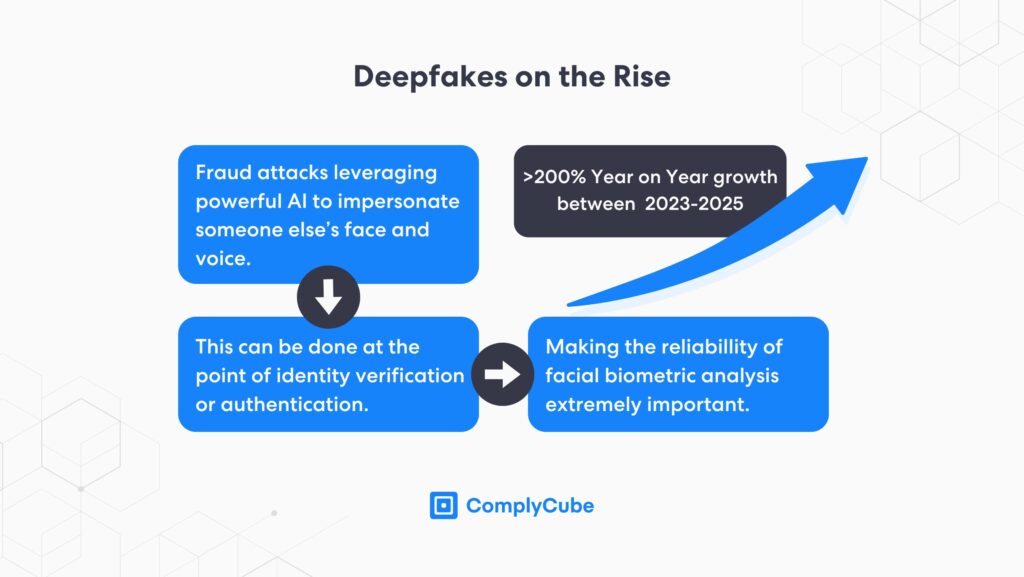
In a similar report published by Bitget, the exchange found that deepfakes will grow by 245% in 2024 alone and may account for [70% of all crypto crimes within the next two](https://www.bitget.com/news/detail/12560604062643)[ years.](https://www.bitget.com/news/detail/12560604062643)
> The number of deepfakes in the crypto sector increased by 217% in 2023.
These figures are likely to expand into more general Financial Crime (FinCrime). These troubling statistics have led many tech firms, both in and outside of the blockchain world, to fight fire with fire.
## Identity Verification AI Models
IDV is typically done in two stages. These include a method for verifying [document authenticity](https://www.complycube.com/en/solutions/due-diligence-compliance/know-your-customer/document-authenticity/) and a method for analyzing and matching facial biometrics to the document stock image.
### Document Verification AI Technology
[Document verification](https://www.complycube.com/solutions/identity-assurance/document-verification/) plays a pivotal role in the customer verification process and in securing personal identities for regulatory requirements. It involves a meticulous examination of IDs to confirm document authenticity and detect any signs of tampering or forgery.
Technological advancements have revolutionized this process, making it faster and more accurate. AI and Machine Learning (ML) technologies, combined with advanced computer vision algorithms and Optical Character Recognition (OCR), have significantly enhanced the efficiency of digital document authentication systems. The data extraction points can be seen below.

AI-powered ID verification uses this OCR technology to read and verify data from KYC documents in a matter of seconds. Using a comprehensive set of training data to mitigate bias, this powerful AI enables the processing of huge volumes of customer data in a very short space of time, creating a scalable yet accurate KYC onboarding methodology.
### AI-Powered Biometric Verification Process
[Biometric verification](https://www.complycube.com/en/solutions/identity-assurance/biometric-verification/) creates a heightened level of trust in identity with a robust solution against impersonation fraud and account takeover attacks. These attacks are increasingly common and costly for businesses. To learn more about the difference between biometric authentication and verification, read [2FA and Identity Authentication vs KYC Identity Verification](https://www.complycube.com/en/2fa-and-identity-authentication-vs-kyc-identity-verification/).
ComplyCube’s biometric verification uses a propriety facial analysis and recognition system for verification and authentication use cases. Facial biometric verification improves account security to a probability level of [less than 1 in 1,000,000](https://support.apple.com/en-gb/102381).
Machine learning (ML) is critical to the success of this solution. Verification systems use ML algorithms to learn from existing data, recognize and detect patterns, and make decisions autonomously with 0 human interference. The data sets examined in a selfie or biometric verification can be seen below.
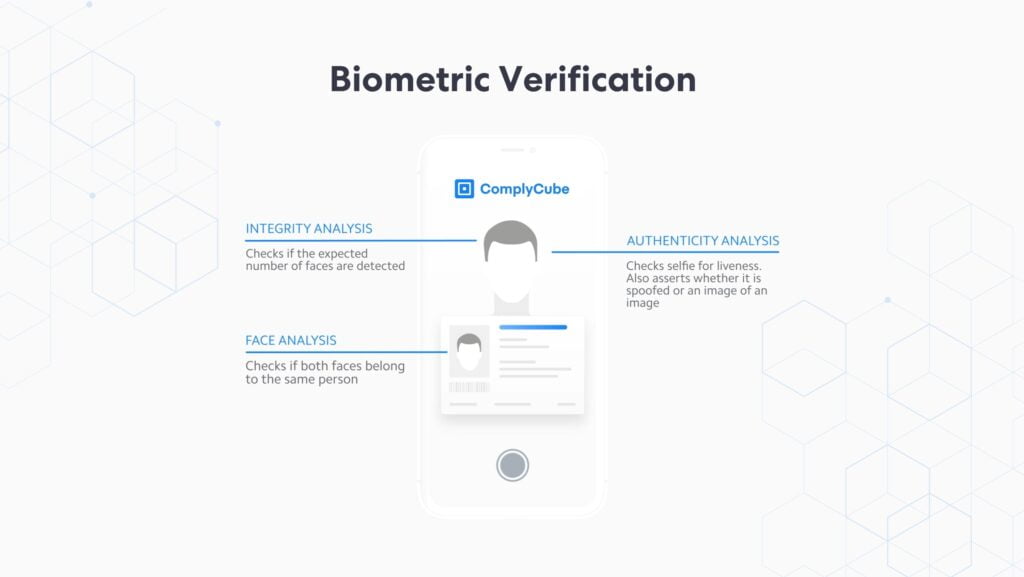
Autonomous biometric verification systems are now a critical component in a robust risk management strategy and are actively endorsed by major national and international regulatory bodies worldwide.
### **Case Study: Leading South Korean Crypto Firm Lands $3.5M Fine**
In 2026, Coinone, the South Korean cryptocurrency exchange, was fined $3.5 million by the country’s Financial Intelligence Unit (FIU) for violating Identity Verification (IDV) regulations. According to reports, Coinone failed to fully verify the accounts of over 70,000 customers.
##### **Increase Risks of Financial Crime**
The crypto exchange allowed customers to access its services despite incomplete identity verification. This meant that individuals could make transactions without a verifiable identity document. As such, there were significant risks of criminal activity via false or stolen accounts.
##### **Outcomes**
- Coinone was penalized [$3.5 million](https://www.complycube.com/en/cryptocubed-april-newsletter-coinone-3-5m-fine-and-new-russia-crypto-bill/) and was forced to suspend its operations for 3 months.
- The company faced significant reputational damage, with the firm’s CEO also being reprimanded.
- The case highlights the importance of automated IDV solutions, where systems can flag incomplete or suspicious users and activity from the start.
## Automated Customer Onboarding Software
Together, these AI systems create an automated verification workflow for a streamlined customer journey. Multiple factors explain why these methods are being adopted around the world to seamlessly onboard millions of new clients to platforms in fintech, crypto, telecoms, and many other global industries.
## Benefits of Identity Verification AI Systems
Automated identity verification systems bring numerous benefits. First and foremost, they provide a swift User Experience (UX) for new users. Secondly, the entire onboarding flow is autonomous and runs 24/7. A system that runs on its own with minimal human interference significantly reduces the time spent on individual onboarding administration, such as [Customer Due Diligence](https://www.complycube.com/en/solutions/due-diligence-compliance/customer-due-diligence/) (CDD), contributing to a strong first impression for partnered firms.
### Onboard New Clients in Under 30 Seconds
This greatly reduces the Client Acquisition Cost (CAC), which ultimately increases a business’s margins. This is a strong incentive for businesses to explore automated IDV solutions. Client onboarding time can be reduced to less than 30 seconds, granting businesses more time to spend productively.
The time that compliance teams would have historically spent on customer onboarding administration can be more productively spent on alternative initiatives, such as growth and research and development strategies.
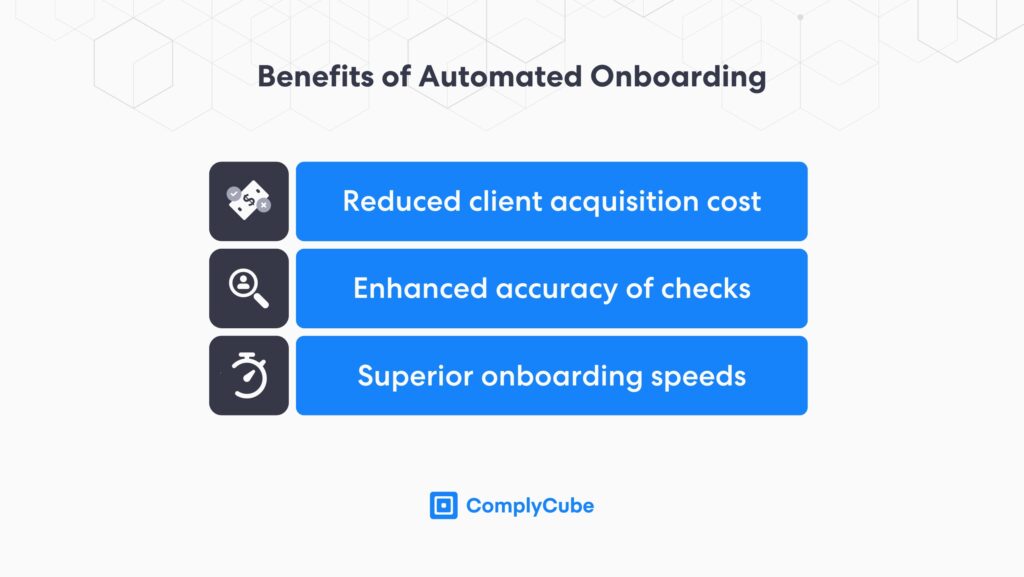
Another great incentive is the accuracy of these systems. Not only are these autonomous IDV systems incredibly scalable, but they also provide a higher level of identity assurance than manual or other digital systems can. Therefore, Identity Verification AI systems will satisfy regulators, ensure compliance with international standards, and mitigate the risk of corporate non-compliance fines.
Following swift signup and customer authentication, users are subjected to a host of AML checks conducted immediately in the background. AML checks, such as [PEP screening](https://www.complycube.com/solutions/global-screening/sanctions-pep-screening/) and [adverse media checks](https://www.complycube.com/solutions/global-screening/adverse-media-checks/), deliver the necessary information to KYC teams to determine what kind of due diligence is needed—CDD or Enhanced Due Diligence (EDD).
### Reduce Ongoing AML Monitoring Costs by 46%
An autonomous continuous monitoring system perpetually scrutinizes individuals to ensure client data is up-to-date and firms have a contemporary understanding of potential risk. Integrating with a continuous AML monitoring system can reduce the cost spent on ongoing administration by over 46%.
These KYC solutions are widely recognized by financial institutions as the leading remedy for detecting and mitigating associated client risks, resulting in streamlined onboarding, reduction in business costs, and enhanced compliance. You can learn more here: [Boost ROI with the Best KYC Cost Calculator.](https://www.complycube.com/en/best-kyc-cost-calculator-approach-for-roi/)
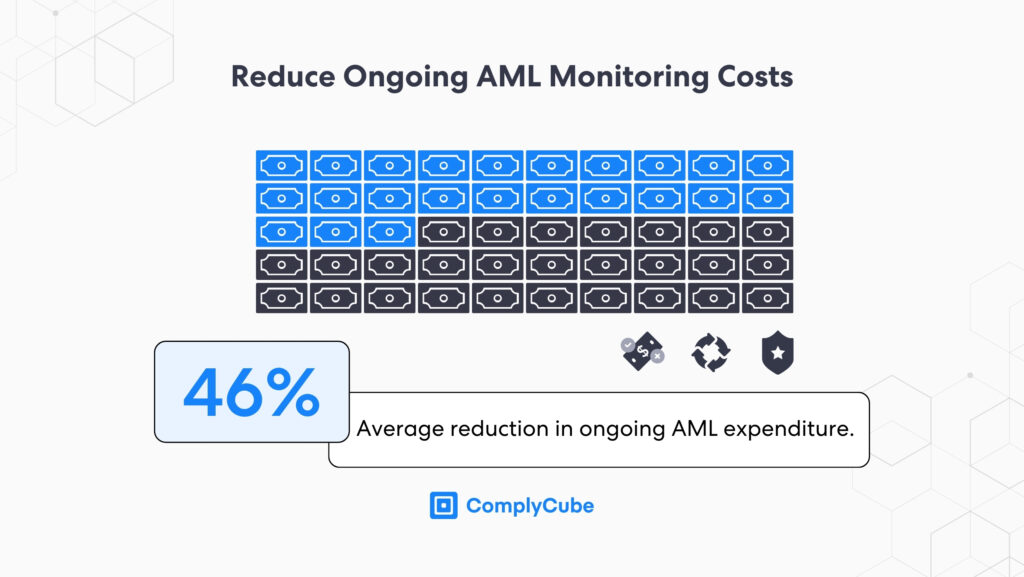
### Key Takeaways
- **Legacy identity verification** solutions are an onboarding bottleneck for digital firms, as they can delay account access, leading to high drop-offs.
- **Balancing quick onboarding** with high security standards and a strong compliance infrastructure is non-negotiable.
- **Manual KYC** can hinder a firm’s scalability as it can become slow, costly, and prone to human error as verification volume spikes.
- **Automated identity verification** streamlines onboarding and strengthens fraud prevention by verifying customers more quickly and accurately.
- **A risk-based onboarding** approach enhances compliance efficiency and customer satisfaction by routing users according to their risk profile.
## ComplyCube’s Identity Verification AI Solutions
ComplyCube’s industry-leading IDV solutions leverage the firm’s proprietary AI and ML technologies. Building every solution in-house, the AML and KYC provider can provide extremely cost-effective solutions that beat or match competitors’ KYC solutions on accuracy and scalability.
This business model has enabled their swift growth into multiple technology markets, such as crypto, fintech, banking, and telecoms, among many other key industries that face dynamic regulations. ComplyCube’s solutions can be integrated into existing systems via powerful APIs or SDKs or via a hosted and no-code solution, depending on your business needs.
### Challenged with Increasing AML and KYC Regulations?
If your business could use an Identity Verification AI solution to streamline onboarding and regulatory compliance, [contact an AML, KYC, or IDV specialist](https://www.complycube.com/en/contact/contact-sales/) and learn how ComplyCube’s suite of AI-powered solutions can help.
## Frequently Asked Questions
What is an identity verification onboarding bottleneck?
An identity verification bottleneck refers to a step in the Know Your Customer (KYC) process that can hinder a customer from completing onboarding. For example, manual reviews, complex instructions, or excessive data collection can lead to confusion, delays, and high drop-off rates.
What causes KYC to slow down customer onboarding?
Know Your Customer (KYC) processes slow down onboarding when users need to complete complex or lengthy steps. For instance, requesting multiple documents, repeating steps, or unclear guidelines can frustrate and lead to high drop-offs. This is especially harmful in remote onboarding, where customers expect seamless access.
How can businesses reduce identity verification friction?
To reduce identity verification friction, businesses should invest in automated checks, implement clear guidelines, adopt a risk-based workflow, and use Optical Character Recognition (OCR) technology to pre-fill data. This accelerates onboarding and enables low-risk users to access key services easily, while high-risk cases receive additional scrutiny.
What is the best approach to KYC onboarding?
The best approach to KYC onboarding is an automated, risk-based workflow that can balance speed, security, and accuracy. Leading authorities, including the FATF, Singapore’s MAS, and the U.S. FinCEN, recommend risk-based KYC methods so firms can apply the right level of due diligence efficiently while still meeting high standards of identity verification.
Why is ComplyCube’s automated IDV solutions important for startups?
ComplyCube’s automated Identity Verification (IDV) services include real-time liveness checks, document verification, and proof of address. Its solutions support startups in onboarding users compliantly and securely across 250+ territories without increasing manual workload. For fast-paced firms, this is crucial in boosting conversion while meeting global regulations.
**Categories:** Guides
**Tags:** Identity Verification
---
### [UK Retail Bank Cost of KYC: What Financial Institutions Need to Know](https://www.complycube.com/uk-retail-bank-cost-of-kyc-crucial-insights/)
**Published:** August 6, 2025
**Author:** Dini Habib
**Excerpt:** With the cost of KYC rising, compliance obligations have become a significant operational dilemma. For retail banks in the UK, strict expectations from global regulatory bodies has created a greater need to reassess KYC processes.
**Content:**
Know Your Customer (KYC) compliance in the UK is not optional; it is a growing necessity, especially for firms operating in regulated industries. However, with UK retail bank cost of KYC surging over the recent years, compliance obligations have become a significant operational dilemma. For retail banks, the strict expectations from global regulatory bodies have forced a higher need to reassess how strong KYC can be obtained and scaled efficiently.
From crafting automated onboarding workflows to producing clear risk assessments, UK banks must navigate stringent KYC obligations while managing compliance budgets. This guide will delve into the crucial factors driving KYC costs in UK retail banking and discover how modern digital solutions can ease the growing burden of compliance.
## Introduction to KYC Compliance in the UK
[KYC](https://www.complycube.com/en/solutions/due-diligence-compliance/know-your-customer/) is a process that allows financial institutions to verify consumers’ identity and assess an individual’s risk. Adopting a robust KYC framework is vital as it is the main defence against money laundering, terrorist financing, and broader financial crimes. For financial services, KYC is tightly interlinked with [Anti-Money Laundering (AML)](https://www.complycube.com/en/solutions/due-diligence-compliance/anti-money-laundering/) regulations.
## Compliance Cost and the Impact it has on UK Firms
A 2024 survey by PWC found that [65% of UK financial institutions](https://www.pwc.co.uk/financial-services/assets/pdf/emea-aml-survey-2024.html.pdf) reported increased spending on AML and Counter-Terrorist Financing (CTF) compliance over the past 24 months, with 15% stating their costs rose by more than 30%.
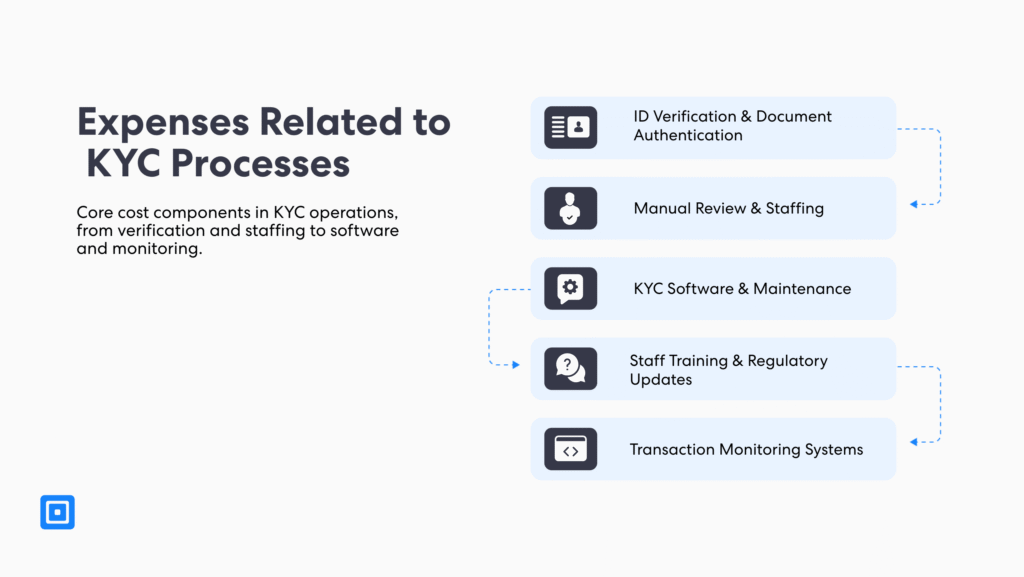
This increase can significantly rise for financial institutions that rely on manual KYC processes, as compliance budgets need to be allocated for manual intervention and outdated systems. The typical compliance operational cost in a firm includes identity verification technology, such as liveness checks and frequent staff training:
- Identity verification technology investment and document authentication services
- Labour-intensive manual review and compliance staffing
- Specialist KYC software accounts, licenses, and maintenance
- Ongoing staff training and updates to reflect current regulations
- Implementation of transaction monitoring and audit systems
Together, these factors contribute to the broader cost of AML compliance in the UK, putting pressure on operational budgets and underscoring the necessity for intelligent, scalable solutions. Learn more about AML compliance in the UK here:[ A Complete Guide to AML Compliance](https://www.complycube.com/en/a-complete-guide-to-aml-compliance-uk-for-financial-institutions/).
## Key Cost Drivers for UK Retail Bank Cost of KYC
For retail banks in the UK, a better understanding of what influences KYC cost can be instrumental. Maintaining legal alignment is paramount to avoiding penalties and preventing financial crime. Thus, an overview of the overall i mpact and ROI of KYC software is vital.
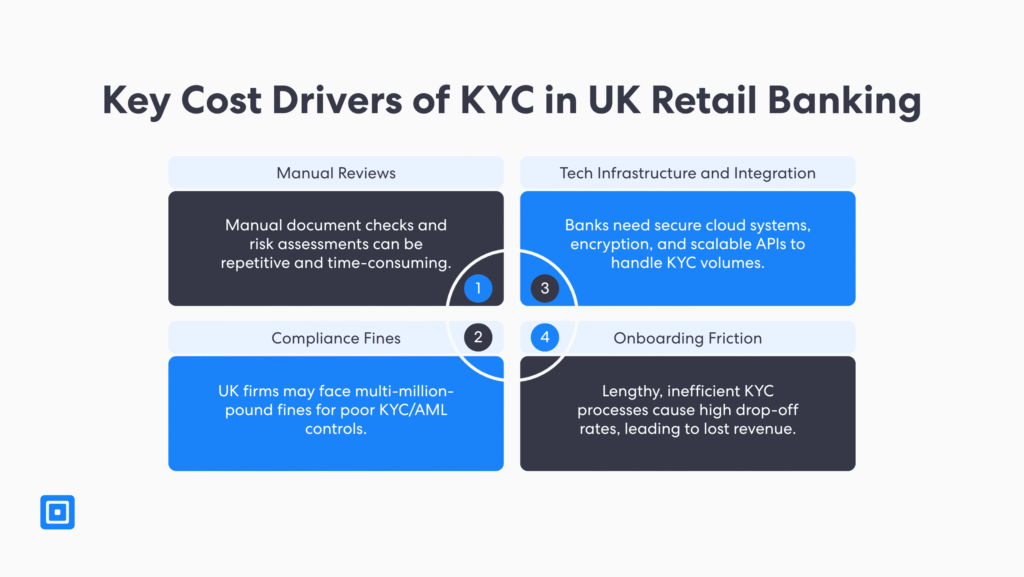
One way to reduce costs is to adopt KYC solutions to increase operational efficiencies. This can be delivered through enhanced automation capabilities such as data extraction. Check out some of the most influential cost drivers:
### Labour-Intensive Manual Reviews
[KYC costs](https://www.complycube.com/en/how-much-does-kyc-cost/) are heavily influenced by human capital. Teams tasked with verifying documents and performing risk assessments often encounter repetitive, time-intensive work, especially when dealing with incomplete or irregular documentation. In response to evolving customer behaviour, many banks have closed physical branches and shifted to digital onboarding and account opening.
At the same time, attracting and keeping skilled compliance professionals has become increasingly difficult. The Financial Conduct Authority (FCA) has [flagged high turnover](https://www.amlintelligence.com/2022/03/fca-issues-notice-to-firms-with-high-turnover-of-aml-staff) in AML personnel as a concern, warning that such workforce instability can weaken the overall integrity of UK firms’ compliance operations.
### Compliance Fines and Risk Buffers
UK financial services can face fines amounting to millions for not implementing robust KYC or AML regulations. For instance, the FCA recently issued leading bank Monzo, with [£21 million](https://www.fca.org.uk/news/press-releases/fca-fines-monzo-21m-failings-financial-crime-controls) for compliance failures. Regulators such as the FCA often impose fines on companies that are found with inadequate compliance, including customer due diligence and insufficient monitoring. These fines serve as a warning to firms to maintain strong KYC for financial crime prevention.
### Technology Infrastructure
To manage large volumes of identity verification and KYC checks, UK banks are required to invest in secure cloud infrastructure, strong data encryption, scalable API-based systems, and dependable backup solutions. Open banking, when implemented with customer consent, allows real-time access to bank data which streamlines processes for KYC, AML, and fraud detection. However, integrating these technologies with legacy platforms often proves both technically demanding and costly.
### Integration Requirements
Ongoing responsibilities such as [sanctions screening](https://www.complycube.com/en/solutions/global-screening/sanctions-pep-screening/), periodic reviews, and identifying Politically Exposed Persons (PEPs) require interconnected systems that are secure, auditable, and capable of real-time updates. As banks aim to reduce KYC friction, protect against identity theft, and prevent fraud, investing in scalable, intelligent infrastructure becomes critical to balancing risk and compliance with consumers’ user experience.
### Client Onboarding Friction and Abandonment
Poorly optimised KYC flows introduce friction that deters new customers. According to a 2024 survey by Encompass Corporation, [87% of corporate treasurers](https://www.encompasscorporation.com/press-releases/corporate-treasurers-abandon-banking-applications-onboarding/) in the UK and the US have abandoned banking applications due to lengthy and inefficient onboarding processes. Some of the most common reasons for drop-offs in customer onboarding processes include the lack of key identity credentials such as passports or digital IDs. Every consumer that abandons the onboarding process signifies a missed opportunity for revenue.
## Why Traditional KYC Approaches Are Unsustainable
Traditional KYC solutions that rely on physical branches and manual processing is a hinderence to long-term scalability. Additionally, it causes inaccurate verification due to human error and much longer processing times.
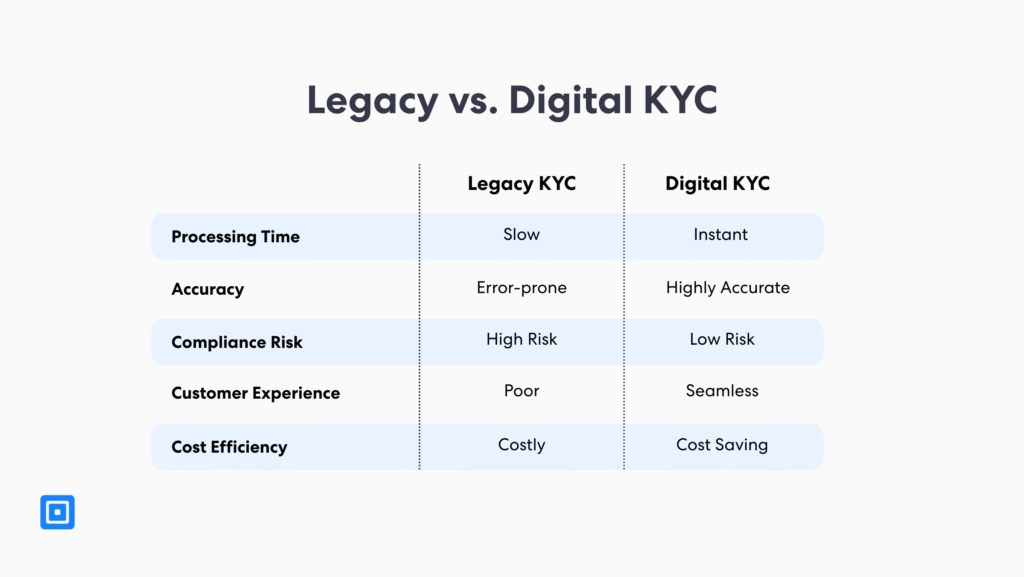
A KYC framework can be as basic as an ID check to something more complex, such as running due diligence checks for PEPs. Any gaps in control can translate to significant business risk. Perpetual KYC monitoring is vital for effective risk management and regulatory compliance. In a rapidly evolving online environment, timely detection of financial crimes will distinguish banks from their competition.
By clinging to conventional workflows and forgoing innovations such as machine learning–powered analytics or automation, institutions risk non-compliance, inflated costs, and an inability to meet modern regulatory requirements or customer expectations. A[ multi-case study](https://www.researchgate.net/publication/352687381_A_Multi_Case_Study_on_Legacy_System_Migration_in_the_Banking_Industry) on legacy system migration in the banking industry reveals that monolithic legacy architectures hinder the implementation of new banking models.
## Optimising KYC Through Advanced Analytics and AI
Digital transformation in compliance is enabling retail banks to reduce onboarding costs through automation, biometrics, and intelligent analytics. These technologies not only accelerate processes but also enhance accuracy, reduce operational burdens, and support robust regulatory alignment.
### Leveraging Cutting-Edge Digital Identity Verification
Advanced technologies, such as [Optical Character Recognition (OCR)](https://www.complycube.com/en/solutions/due-diligence-compliance/know-your-customer/optical-character-recognition/), facial biometrics, and liveness detection enable real-time document validation and identity assurance. These innovations streamline KYC workflows, flag potential fraud, and significantly reduce manual work, leading to fewer errors and reducing onboarding costs for retail banks.
### Device Intelligence and AML Screening
Device Intelligence adds an extra layer of security by detecting anomalies in user behaviour and device profiles. Adverse Media Screening enhances financial crime compliance by identifying high-risk individuals through global news sources and watchlists. These solutions are built for flexible integration. Banks can rapidly deploy systems that fit their infrastructure maturity, whether through SDKs, RESTful APIs, or no-code/low-code setups.
## The Regulatory Incentive to Modernise KYC
UK and EU regulators are pushing for risk-based KYC approaches. The FCA urges tailored due diligence, while the [Financial Action Task Force (FATF)](https://www.fatf-gafi.org) endorses digital tools such as identity verification and automation, provided data safeguards are in place.
Laws such as the Money Laundering Regulations and [6AMLD](https://www.complycube.com/en/a-quick-overview-of-the-6th-anti-money-laundering-directive-6amld/) align with the FATF’s principles but stop short of requiring digital adoption. UK regulators, including the FCA, expect firms to screen customers against up-to-date watchlists, PEPs, and adverse media sources.
## Final Thoughts: Future-Proofing KYC for the UK Retail Banking Sector
Retail banks are under pressure to cut costs while staying compliant. Addressing the UK retail bank cost of KYC means replacing legacy processes with smarter tools that automate identity verification, reduce errors, and streamline onboarding to build customer trust. With [ComplyCube](https://www.complycube.com/), financial institutions gain fast and scalable compliance through automated checks, global screenings, and real-time monitoring, meeting regulations without the overhead. [Future-proof your compliance](https://www.complycube.com/en/contact/contact-sales/) with ComplyCube today.

**Categories:** Guides
**Tags:** Know Your Customer
---
### [From Doorstep to Destination: The Evolution of Mobility as a Service](https://www.complycube.com/the-evolution-of-mobility-as-a-service-maas/)
**Published:** July 15, 2024
**Author:** Sofia Daley
**Excerpt:** The Mobility-as-a-Service sector has evolved rapidly, with delivery drivers upholding modern society. This sector's growth has led to a need for increased KYC, including driver screening and driver's license verification.
**Content:**
**TL;DR:** **Mobility as a Service (MaaS)** demands robust **driver screening** and **driver’s license check** to ensure safety amid rapid growth. ComplyCube’s automated verifications with DVLA and AAMVA combat fraud, enabling secure scaling and passenger trust.
Quick delivery and ride-hailing platforms like Uber deliver unmatched convenience that now defines modern life, bringing all kinds of goods and services straight to our doorsteps with just one tap. However, we often overlook what powers these comforts: a thriving Mobility as a Service (MaaS) sector demanding rigorous safety and security upgrades to fuel its explosive growth.
Of course, the mobility sector is no different. It has become drastically different since the COVID-19 pandemic. A time at which the delivery of food and goods became essential. Consumer behaviors continued to migrate towards a very digital path. It became a path of convenience, as today, we can hail a taxi or order our weekly shop with just a few taps. In light of this, businesses must put in place the necessary measures to safeguard these scaling operations. It includes important security measures such as driver screening and driver’s license verification.
## **Growth of the Mobility** as a Service Sector
As an illustration, McKinsey’s 2023 quarterly report on the future of mobility highlighted the sector as one of the most innovative. It showed some drastic growth on the horizon. The report looks forward to forecasts for 2035, outlining the industry’s current growth trend. It states,
“Mobility as a service is one of the hottest sectors. [Start-ups and traditional OEMs](https://www.mckinsey.com/~/media/mckinsey/industries/automotive%20and%20assembly/our%20insights/the%20future%20of%20mobility/the-future-of-mobility.pdf) constantly developing new technologies and transportation options.”
With this in mind, some of the key growing trends in mobility include:
**Micro-mobility solutions (e-scooters and e-bikes):** Micro-mobility solutions are certainly a great example of innovation within the sector, with businesses such as Bird and Lime leading the charge in electric scooter sharing. eBikes have also gained popularity, with VanMoof and Cowboy merging electric bikes with smart technology.
> The global market value of micro-mobility was valued at approximately $3.4 billion in 2022 and is projected to reach $6.1 billion by 2027, growing at a compound annual [growth rate (CAGR) of 12.5% from 2022 to 2027](https://www.marketsandmarkets.com/Market-Reports/micro-mobility-market-71389422.html).
**Ride-hailing and ride-sharing services:** Businesses like Uber and Lyft have led the growth of the ride-hailing service market, with people having become heavily reliant on these services in their daily lives. In just 2023, Uber generated [$37.2 billion in revenue](https://www.businessofapps.com/data/uber-statistics/#:~:text=Uber%20generated%20%2437.2%20billion%20revenue%20in%202023%2C%20a%2016%25%20increase,due%20to%20the%20coronavirus%20pandemic.), an impressive 16% year-on-year increase. The demand for time-saving, convenient transportation and the ever-rising cost of owning a vehicle encourage the growth of these services.
> The global ridesharing market is estimated at [USD 47.62 billion in 2024](https://www.mordorintelligence.com/industry-reports/ridesharing-market#:~:text=The%20Global%20Ridesharing%20Market%20size,effective%20and%20time%2Dsaving%20transportation.) and is expected to reach $89.99 billion by 2029.
**Car-sharing services:** Car-sharing services like Zipcar and Car2Go are also popular alternatives to owning a car, as they provide flexible vehicle access. IMARC Group expects the market to reach [US $23.3 ](https://www.imarcgroup.com/car-sharing-market)billion by 2032, exhibiting a growth rate (CAGR) of 12.3% from 2024 to 2032.
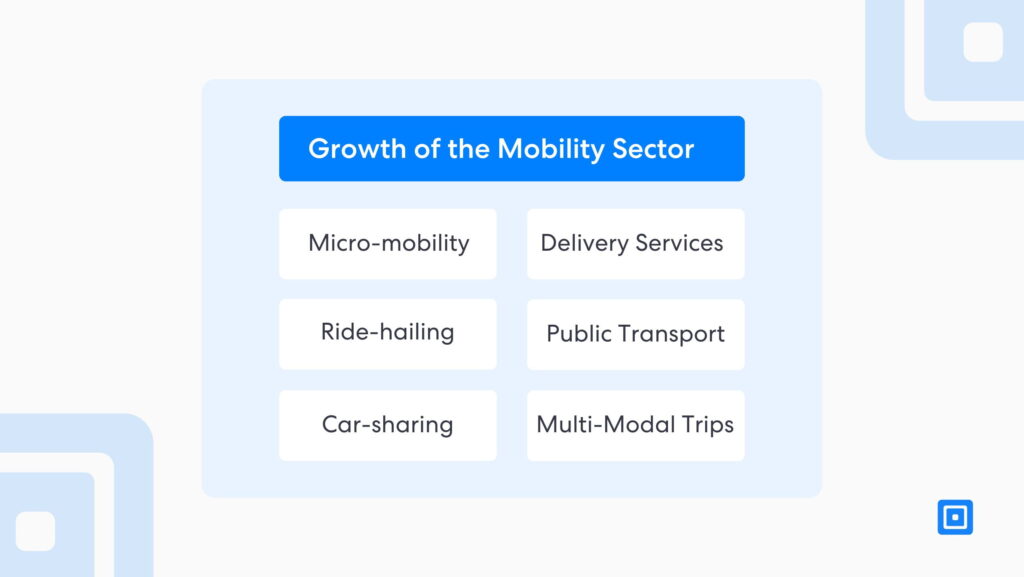
## **The Regulatory Landscape**
Consequently, as the MaaS industry continues to develop and evolve, so must the regulations in place. It upholds safety and security standards. [Driver verification](https://www.complycube.com/en/solutions/identity-assurance/enhanced-driver-verification/) is needed to ensure the safety of passengers and other road users and to comply with regulations. For example, in the UK, the mobility sector faces substantial regulations to help safeguard passengers, with Transport for London (TFL) requiring thorough background screenings for all taxi drivers within the city.
Similarly, regulations exist in the US. This includes the Federal Motor Carrier Safety Administration (FMCSA), which regulates the trucking industry and checks driver qualifications and background checks. On the other hand, the Transportation Network Company (TNC) mandates different regulations in each state to dictate specific rules for ride-sharing companies such as Uber or Lyft. This also includes background checks and vehicle inspections. Many more national and international regulatory standards exist for the mobility industry, which must be met to ensure high safety standards.
### **Uber Case Study**
For instance, in 2015, a BBC news article highlighted that Uber’s driver background checks were simply “not good enough”. The MaaS giant was accused of not doing their part to verify these drivers and ensure the safety of passengers. The piece echoes the words of George Gascon, district attorney in San Fransisco, stating,
> Uber’s [screening only covered the last seven years ](https://www.bbc.co.uk/news/technology-34002051)and omitted biometric checks that would uncover people who had falsified their identity to avoid being spotted by screening.
As a result, this piece revealed that many of Uber’s drivers did have criminal backgrounds, with several having criminal backgrounds of substantial offenses, which were not flagged in the driver verification process. Gascon also noted that Uber’s data relied upon was not comprehensive.
## **The Future Of Mobility as a Service is Verified**
For this reason, driver verification is an incredibly important next step in the future of [Mobility-as-a-Service](https://www.complycube.com/en/use-cases/industry/mobility-as-a-service-maas/). So, verification needs to be streamlined with accurate, efficient checks, such as:
- [Document Checks](https://www.complycube.com/en/solutions/identity-assurance/document-verification/): Verifying the validity of their driving license and any other essential government-issued documentation.
- [Biometric Identity Checks](https://www.complycube.com/en/solutions/identity-assurance/biometric-verification/): These checks ensure that the driver is who they claim to be. They use a biometric facial recognition engine to examine biometric data from a provided selfie and compare it with government-issued documentation.
- [DBS Checks](https://www.complycube.com/en/use-cases/process/government-certified-enhanced-dbs-checks/): Running a background check on whether drivers have committed criminal offenses.
- [Agency Checks](https://www.complycube.com/en/solutions/identity-assurance/enhanced-driver-verification/): The competency of drivers can be corroborated with intergartions to the DVLA (UK) and AAMVA (US) integration. This provides critical data points on drivers.
### Key Takeaways
- MaaS integrates ride-hailing, deliveries, and micro-mobility for urban growth.
- Driver screening prevents fraud and underage driving in MaaS onboarding.
- Driver’s license check via DVLA and AAMVA verifies validity and points.
- **Driver screening boosts safety and efficiency in MaaS ecosystems.**
- ComplyCube automates verification for MaaS compliance and trust.
## **Driver Verification and Mobility as a Service Solutions with ComplyCube**
In summary, ComplyCube gives market-leading driver verification checks. On the whole, it includes integration with the DVLA in the United Kingdom and AAMVA in the United States. In fact, it allows for extremely thorough identity verification, document validation, and background checks on drivers.
Altogether, their comprehensive driver’s license check and verification for the Mobility as a Service (MaaS) sector feature integrations with the Driver and Vehicle Licensing Agency (DVLA) in the UK and with the American Association of Motor Vehicle Administrators (AAMVA) in the US.
Get in touch with [one of their compliance experts](https://www.complycube.com/en/contact/contact-sales/) for more information on driver’s license checks.
## Frequently Asked Questions
What is Mobility as a Service (MaaS)?
Mobility as a Service (MaaS) integrates ride-hailing, public transport, car-sharing, and micro-mobility into a single seamless platform for urban commuters. As a result, it eliminates the need for personal vehicles by offering on-demand access via apps, optimizing routes and reducing congestion.
Why is driver screening essential for MaaS platforms?
Driver screening is critical for MaaS platforms to verify identities, criminal records, and qualifications before onboarding. It prevents fraud, underage driving, and safety risks in high-volume driver networks. Robust processes build passenger trust and ensure regulatory compliance across operations.
How does a risk-based approach work for AML in finance?
A risk-based approach assesses customers or entities according to their risk level. High-risk individuals must undergo stringent checks, including sanctions and politically exposed person screening. This approach enables financial institutions to focus their resources where risks are highest, while allowing low-risk users to onboard more swiftly.
How does a driver’s license check enhance MaaS safety?
A driver’s license check confirms validity, expiry dates, penalty points, and restrictions in real-time for MaaS drivers. It mitigate risks like unlicensed or disqualified individuals accessing platforms. This verification step enhances overall road safety and operational reliability.
How does ComplyCube support MaaS driver verification?
ComplyCube provides automated driver screening and driver’s license checks integrated with global authorities like DVLA and AAMVA. Its’ AI-driven platform ensures fast, scalable verification for MaaS providers worldwide. This reduces fraud risk while enabling compliant growth and user trust.
**Categories:** Guides
**Tags:** Know Your Customer
---
### [A Robust Guide to Proof of Address Checks (PoA)](https://www.complycube.com/proof-of-address-verification-poa-checks/)
**Published:** October 10, 2023
**Author:** Andreea Balasa
**Excerpt:** Proof of Address (POA) checks are a vital part of the Know Your Customer (KYC) process alongside Proof of Identity (PoI). They are typically used to authenticate the stated residence of an individual adding an extra layer of assurance.
**Content:**
**TL;DR:** Proof of address (POA) **helps businesses confirm** that a customer genuinely lives at the address they provide during onboarding. By **verifying proof of address documents**, companies can lower fraud, **strengthen compliance**, and build more reliable customer profiles. It makes it much easier to manage across high-volume onboarding flows.
Proof of Address (PoA) checks are a vital part of the [Know Your Customer (KYC)](https://www.complycube.com/en/solutions/due-diligence-compliance/know-your-customer/) process alongside Proof of Identity (PoI). They are typically used to authenticate the stated residence of an individual. This identity verification tool adds an extra layer of assurance when validating that a person is genuinely present. This is especially important during onboarding processes such as opening a bank account, getting a new insurance policy, or registering a new SIM card.
This guide will delve into the nuances of [proof of address checks](https://www.complycube.com/en/solutions/identity-assurance/address-verification/), their role in modern business operations, standard methods used for validation, challenges and benefits, and how to choose the right address verification tool.
## What is Proof of Address?
In essence, a proof of address is a document that confirms an individual’s current residential address at a particular location. The most common examples of acceptable documents include but are not limited to utility bills and bank statements.
Proof of address checks can apply to various sectors and safeguard businesses against fraudulent activities by adding an additional layer of verification and security. An [Identity Verification (IDV) software](https://www.complycube.com/en/) is generally employed to facilitate this type of check.
## Why is Proof of Address Essential for Businesses?
Proof of address checks establish an extra layer of trust and security in the interactions and transactions companies conduct with customers ([KYC](https://www.complycube.com/en/solutions/due-diligence-compliance/know-your-customer/)) and other businesses ([KYB](https://www.complycube.com/en/use-cases/process/know-your-business/)). This method ensures that the entities they engage with are legitimate and can be located physically. This mitigates risks related to fraud, money laundering, and other illicit activities. Some of the main benefits include:
- **Regulatory Compliance:** Institutions such as banks or governmental bodies often need proof of address for KYC compliance.
- **Geo-Specific Services:** Address verification ensures services cater to users within designated geographical limits, preventing misuse.
- **Fraud Prevention:** Address validation is an extra line of defense against deceitful actions and potential scams.
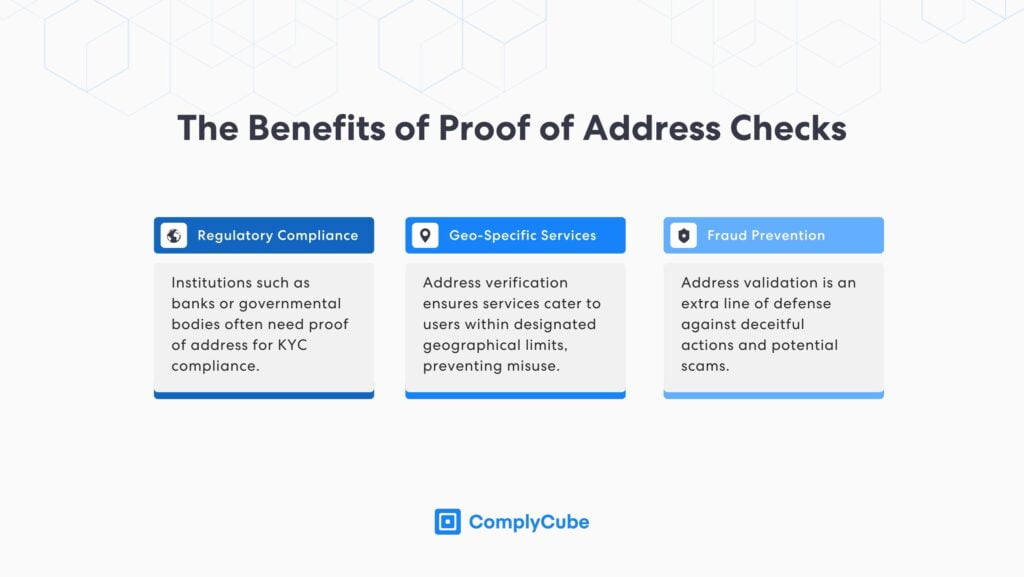
## What Counts as Proof of Address? Common Documents
A proof of address check validates that an individual’s stated residence is genuine and supported by reputable sources. Although several documents can confirm a correct address, some are more common:
- Utility bills (phone, gas, water, electricity, and other documents)
- Tax bill
- Valid driver’s license
- US social security card
- Bank or credit card statement
- Lease agreement or mortgage statement
- Employment letter
A widely acceptable proof of address document is the utility bill. Ranging from electricity and water to telephone and internet bills, these monthly statements are issued by service providers and reflect the recipient’s name and current address. Given their regular issuance and direct link to residential service, utility bills are seen as reliable indicators of a person’s residency. However, it’s important to note that most organizations require these bills to be recent, typically dated within the last two or three months, to ensure the address is current.
Another prominent proof of address document is a bank statement. These statements consist of monthly or quarterly summaries provided by financial institutions detailing an account holder’s transactions. Apart from its primary purpose of financial record-keeping, a bank account statement has the account holder’s name and address, making it suitable for address verification.
In certain situations, the same documents can’t be used for both PoA and PoI. Suppose an ID card, passport, driver’s license, or other acceptable document issued by government agencies is utilized for one part of the process. In that case, it can’t be employed for the other despite being an otherwise valid proof of address.
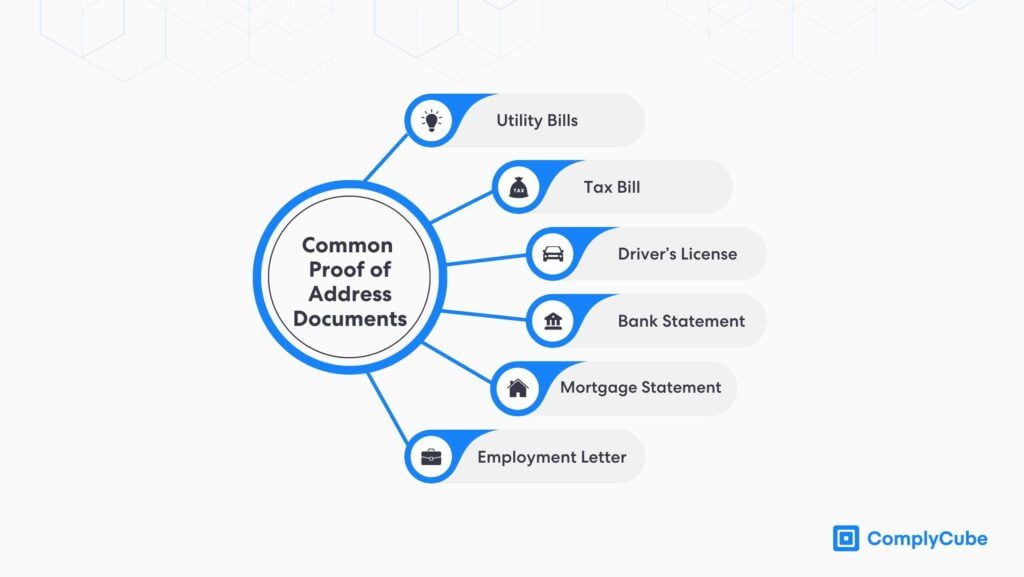
## What Constitutes a Valid Proof of Address?
Recognizing a legitimate proof of address goes beyond just an official-looking document. The main aspects you have to take into account are:
- **Issue Date:** An essential piece of data given that some proof of address documents will not be accepted unless issued recently.
- **Clear Details:** The document should display essential information like name, address, and date.
Businesses will generally opt for an IDV provider to simplify the validation process. A cutting-edge identity verification platform uses advanced Optical Character Recognition (OCR) technology and decision-making algorithms to extract key details from the proof of address documents, which are then cross-verified with the information provided by the client and geolocation data.
## Optical Character Recognition for Proof of Address Checks
With a foundation in [computer vision](https://en.wikipedia.org/wiki/Computer_vision), Optical Character Recognition (OCR) technology converts different types of documents, such as scanned paper documents, PDFs, or images captured by a digital camera, into editable and searchable data. The technology works by scanning and identifying text characters and symbols within an image and then converting them into machine-encoded text.
OCR facilitates the extraction of textual information from proof of address documents, thereby aiding in data processing, management, and analysis without manual data entry. It is a crucial tool in modern identification data management and automation practices.
Learn more about the topic here: [**What is Document Verification?**](https://www.complycube.com/en/what-is-document-verification/)
## Improved Accuracy with Geolocation Data
Cross-referencing the data added by the customer with geolocation data offers an increased level of assurance when it comes to proof of address checks. While not yet fully endorsed by regulators, it’s recognized in the FATF’s [guidance on digital identity](https://www.fatf-gafi.org/content/dam/fatf-gafi/guidance/Guidance-on-Digital-Identity.pdf) and its potential for AML/CFT. Businesses can pinpoint a user’s location using data points such as Wi-Fi positioning, IP data, GPS, and cell tower trilateration. However, user consent is crucial to GDPR compliance, as well as for other privacy laws. Leveraging geolocation can streamline resources and expedite proof of address verification.
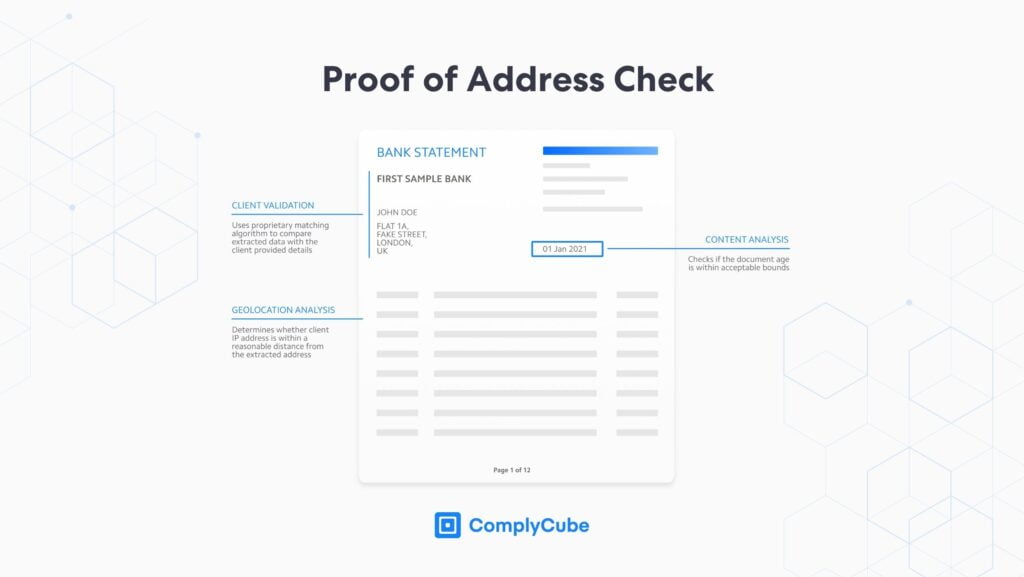
## **Industry-specific Applications of Proof of Address**
From ensuring compliance to combating fraud, proof of address is critical in safeguarding both businesses and consumers. [Different sectors](https://www.complycube.com/en/use-cases/) have unique ways of harnessing address verification to suit their distinct needs:
- **Crypto, Banking & Finance:** Utilized during bank account openings, loan applications, and other financial transactions to verify the account holder’s identity and to ensure compliance with anti-money laundering (AML) regulations.
- **Government Services:** Individuals must provide proof of residence to gain access to welfare benefits or local voting privileges.
- **Real Estate & Property Rentals:** Essential during property leasing or purchase to authenticate the identity of potential tenants or buyers and to prevent fraudulent transactions.
- **Telecommunications:** Whether setting up new service contracts or verifying existing ones, telecom companies regularly seek address proof.
- **E-commerce and Online Retailers:** Integrated into online payment gateways to confirm the authenticity of a buyer’s address, aiding in fraud prevention and ensuring the accurate delivery of products.
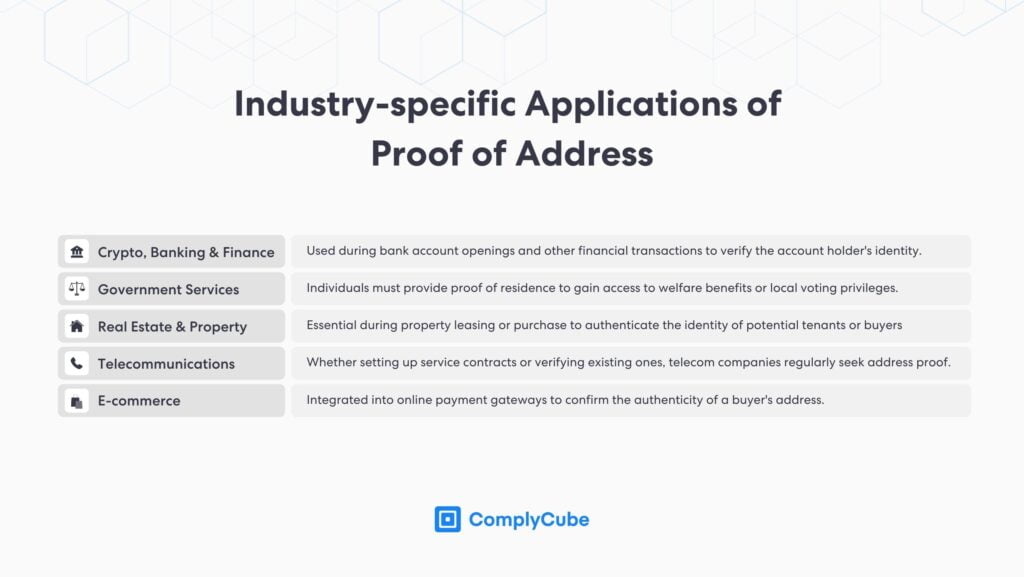
## **The Inherent Challenges** of **Address Verification**
Navigating the diverse landscapes of global regulatory requirements represents a prominent challenge in administering PoA checks effectively. Different nations, and even different states or provinces within the country, uphold varying rules concerning what documents they accept as valid proof. These regulations demand continuous attention and flexibility from organizations to ensure compliance.
Multinational businesses, in particular, find themselves entwined in a complex web of local and international laws that dictate the specifics of conducting, recording, and storing address verification details, frequently requiring them to tailor their processes to cater to each market.
Moreover, the proliferation of digital documentation and online transactions has generated distinct challenges related to fraud and data security. While technology provides innovative tools and streamlined processes for verifying addresses, it simultaneously introduces avenues for malicious actors to forge proof of address documents and manipulate systems.
Many businesses are turning to identity verification software for eKYC to tackle these challenges. Advanced IDV platforms streamline the verification process, ensuring accuracy and compliance. With the ability to rapidly assess various global proof of address documents, this tool significantly reduces fraud risks, optimizes operational efficiency, and fortifies user trust, marking it a core asset in modern identity verification.
Learn more about the topic here: [**What is eKYC (electronic Know Your Customer)?**](https://www.complycube.com/en/what-is-ekyc-electronic-know-your-customer/)

## Multi-bureau Checks Layer for Increased Accuracy
For businesses seeking an increased level of identity assurance, layering [multi-bureau checks](https://www.complycube.com/en/solutions/identity-assurance/multi-bureau-checks/) on top of PoA verification increases precision. Instead of solely relying on a single data source, top-tier identity verification providers harness vast networks. They draw from credit reference agencies, government bureaus, utility authorities, and a variety of commercial and proprietary databases. This broad-spectrum approach ensures that customer details, whether it’s a name, address, date of birth, or social security number, are corroborated swiftly against a myriad of trusted, authoritative sources.
With options such as the [“2+2 verification”](https://www.mishcon.com/news/the-uk-government-clarifies-electronic-verification-requirements-for-gambling-operators-and-other-regulated-businesses) feature, leading providers enable a verification process that demands data validation against at least two distinct sources, reinforcing the dependability of the checks. Enhanced by cutting-edge technologies such as intelligent matching engines, which employ fuzzy matching and source data deduplication, IDV platforms offer an elevated standard of identity assurance in the broader AML/KYC framework.
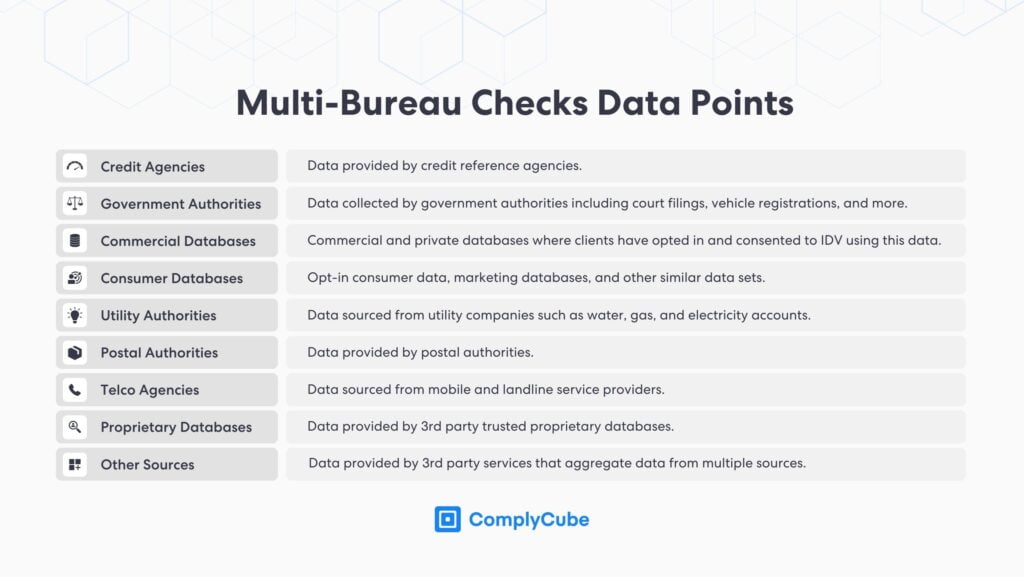
### **Case Study: Multi-Billion Dollar HealthCare Fraud Case**
The 2026 U.S. National Money Laundering Risk Assessment reported “Operation Gold Rush”, a multi-billion-dollar healthcare fraud and money laundering case involving 11 defendants. The scheme allegedly used nominee owners, fictitious corporate records, stolen personal data from more than one million Americans.
##### **The Need for Stronger Business Verification Controls**
Stronger proof of address and business verification controls could have helped expose the fraud earlier. Checks should verify nominee owners, business locations, leases, corporate records, and proof of address documents against trusted data sources. Moreover, checks should escalate mismatches between ownership, address history, and company controls.
##### **Outcomes**
- Over $10.6 billion in fraudulent Medicare claims were allegedly submitted.
- More than one million Americans’ identities were reportedly misused.
- POA checks must be layered with ownership, identity, and risk-based verification.
## Choosing the Right Proof of Address Validation Tool
The digital age offers an array of KYC tools tailored for swift and accurate proof of address checks. However, finding the best-suited solution for your business requires
### **AI-Driven Analysis**
Address verification tools with Artificial Intelligence (AI) capabilities can automatically scan, recognize, and validate proofs of address and prove residency.
### **Integration Capabilities**
A system that easily integrates with existing infrastructure saves both time and resources. IDV platforms offer various options spanning APIs, Web & Mobile SDKs, and hosted solutions.
### **Data Security and Compliance**
Prioritize tools that abide by global data protection regulations, ensuring user information remains secure. State-of-the-art verification providers use jurisdiction-based rules, thresholds, and workflows to provide flexible customization.
### **User Experience**
Seamless [onboarding](https://www.complycube.com/en/use-cases/process/customer-onboarding/) processes, intuitive user interfaces, and minimal friction points when providing proof of address are essential for user conversion and retention.
When evaluating potential tools, businesses should consider their specific needs, the volume of verifications, and the solution’s scalability. Seeking testimonials and reviews and running pilot tests can also help companies make an informed choice
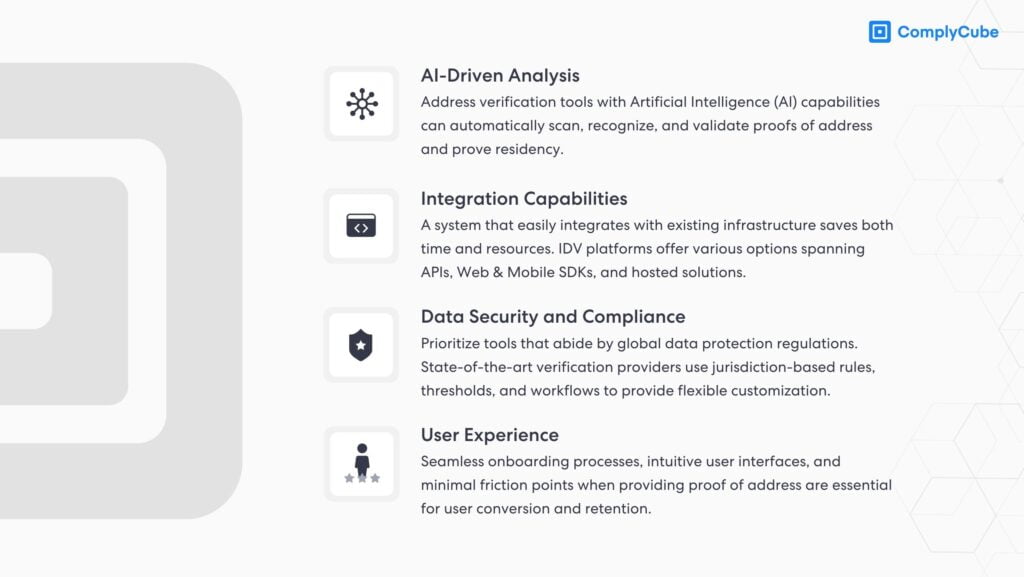
### Key Takeaways
- **Proof of address strengthens onboarding** by confirming whether a customer’s stated residence is genuine and supportable.
- **Proof of address documents help prevent identity fraud** by exposing forged, altered, expired, or inconsistent address records.
- **Automated POA checks improve scalability** by reducing manual document review and speeding up customer verification.
- **Proof of address supports compliance** because customer location can affect risk scoring, jurisdictional checks, and due diligence requirements.
- **Address verification should sit alongside identity verification** so businesses can confirm both who the customer is and where they are based.
## Conclusion
In our interconnected global landscape, the relevance of an efficient and accurate proof of address system stands stronger than ever. Beyond compliance, it’s about building trust, ensuring genuine interactions, and adapting to the ever-evolving digital realm. As businesses look forward, integrating robust address verification tools is not just a choice but a necessity.
Looking to the future, for businesses aiming to stay both protected and competitive, embedding robust proof of address verification tools is less of an option and more of a compelling necessity.
**Looking for a global compliance platform for Proof of Address Checks? [Get in touch](https://www.complycube.com/en/contact/) with us today!**
## Frequently Asked Questions
What is proof of address (POA)?
Proof of address is the process of confirming that a customer lives at the address they provide, usually by checking an official document that shows their name, residential address, and a recent issue date.
Why is proof of address important during onboarding?
Proof of address helps businesses verify customer residence, detect false or inconsistent address details, reduce identity fraud, and meet compliance requirements during onboarding.
What proof of address documents are usually accepted?
Common proof of address documents include utility bills, bank statements, credit card statements, tenancy agreements, tax documents, and official government letters, provided they are recent and show the customer’s name and address.
How do automated poa checks work?
Automated POA checks use document capture, OCR, authenticity checks, data extraction, and address matching to confirm whether a document is valid and whether the address matches the customer’s submitted details.
How does ComplyCube help with proof of address verification?
ComplyCube helps businesses automate proof of address verification by checking documents, extracting address data, detecting fraud signals, and supporting scalable onboarding. This makes address checks faster, safer, and easier to manage.
**Categories:** Guides
**Tags:** Identity Verification
---
### [How Document Fraud Detection Software Works](https://www.complycube.com/document-fraud-detection-software-guide/)
**Published:** June 4, 2026
**Author:** Dini Habib
**Excerpt:** Criminals are increasingly using AI technology to alter and manipulate documents to bypass critical KYC security. Modern automated document fraud detection software combats this challenge via advanced AI algorithm capabilities.
**Content:**
**TL;DR:** The rise of digital onboarding has seen fraudsters evolving to **advanced tactics** to evade security checks. As a result, modern automated document fraud detection software must go beyond basic checks to expose **coordinated fraud attempts**, such as synthetic identities. This guide explores how these systems work and the rise of synthetic document detection software.
## What is Document Fraud?
Document fraud is the act of tampering with or forging documents to bypass identity verification and mislead businesses or services. Common examples include forged or counterfeit documents, such as fake passports, driver’s licenses, and bank statements.
The impact of document fraud can be damaging for businesses. It includes the loss of consumer trust, reputational damage, and huge financial losses. Reports by the Federal Bureau of Investigation (FBI) estimate that Americans lose [at least $119 billion](https://www.nbcnews.com/tech/security/scam-cost-price-money-crypto-what-to-do-help-rcna262722) every year to scams. Moreover, the UK National Assessment Centre’s Fraud Assessment 2025 cites the increasingly [tech-enabled and global nature](https://www.gov.uk/government/publications/national-assessment-centre-fraud-assessment-2025) of fraud, with criminals using generative AI tools to scale attacks and evade detection.
> Criminals are using [advanced AI](https://www.cifas.org.uk/newsroom/fraudscape-2025-6monthupdate) to create fake identities, forge documents, and bypass verification systems with alarming accuracy.
Due to AI’s advanced technology, manual document verification is not enough to keep up with the volume and sophistication of document fraud. As a result, leading organizations are adopting AI-powered document fraud detection software to combat these challenges.
## The Evolution of Document Fraud Detection Software
Document fraud detection software refers to systems that scan documents to identify any form of alteration or manipulation intended to misrepresent identity. In the past, document fraud detection was limited to manual document review. Typically, analysts will look for typos, inconsistent fonts, or misaligned logos. However, analyzing millions of documents can lead to analyst fatigue and missed red flags caused by human error. You can learn more here: [Generative AI Fraud and Identity Verification.](https://www.complycube.com/en/generative-ai-fraud-and-identity-verification/)
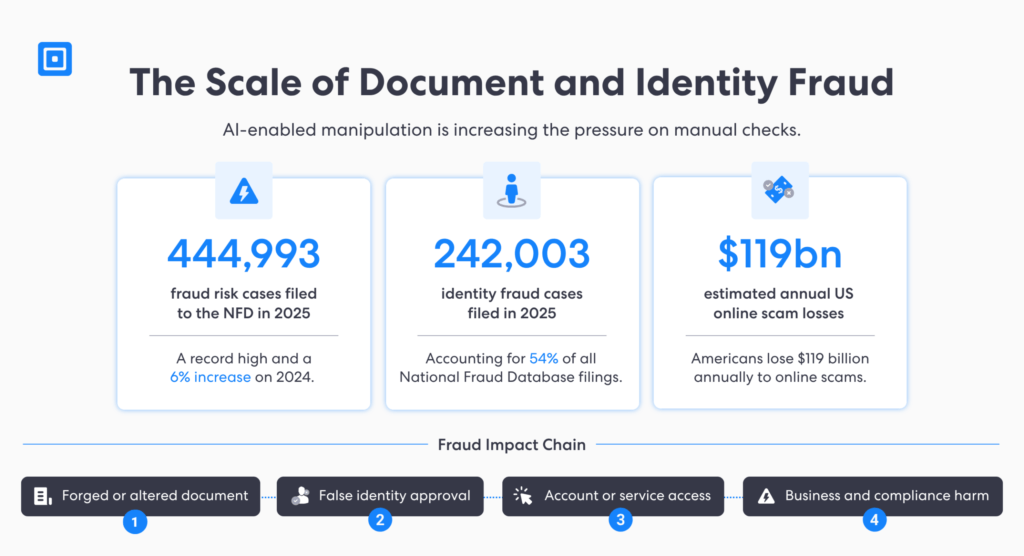
As companies moved onboarding online, it meant they required highly precise and scalable fraud detection capabilities. In the early 2020s, leading regulated organizations started adopting synthetic document detection software to meet the increasing volume and types of document fraud across borders.
> Document abuse comes in [many forms](https://www.gov.uk/government/publications/recognising-fraudulent-identity-documents/guidance-on-examining-identity-documents-accessible). Fraudsters can make fake documents from scratch, change a real one, or steal someone else’s.
Some of the common document fraud types include:
- **Tampering:** Changing a real document, such as photoshopping a new image, date of birth, or name to masquerade as someone else. Common examples include falsifying passports or driver’s license images to access digital services.
- **Forgery:** Creating a completely new document by altering important information, such as editing a bank statement or income records, to inflate financial and economic standing. This includes securing credit, mortgages, or loans.
- **Synthetic documents:** Designing a completely false identity by using a mix of real and fake elements. For example, combining a real National Insurance number with a false name to open a bank account.
- **Counterfeits:** Near-replica of genuine documents, imitating the exact layout and security features of a real document without authorization. Some examples include a false bank card or passport to bypass border control or to hold a deposit.
## Document Fraud Detection for KYC and AML Teams
Several regulatory frameworks support the move towards a risk-based approach to fraud prevention. This includes the [EU Anti-Money Laundering Directive (AMLD)](https://www.amla.europa.eu/policy/public-consultations/consultation-draft-rts-customer-due-diligence_en), Singapore’s [Monetary Authority of Singapore (MAS)](https://www.mha.gov.sg/what-we-do/managing-security-threats/policy-on-anti-money-laundering-and-countering-the-financing-of-terrorism/), and the [US Bank Secrecy Act (BSA)](https://www.fincen.gov/news/news-releases/fincen-proposes-rule-fundamentally-reform-financial-institution-programs). In practice, this means Know Your Customer (KYC) and AML teams require strong document verification software that not only detects altered documents but also suspicious patterns across the customer lifecycle.
Across various sectors, potential risks that may show up as fraud signals and require detection include:
- Financial fraud involves manipulating **financial documents** such as loan applications, bank statements, and transaction data.
- Insurance fraud includes submitting fake documents for **insurance claims**, duplicate receipts, or staged evidence.
- Mortgage fraud uses altered documents, such as **tax forms and employment letters**, to obtain loans or better mortgage terms.
- Receipt fraud involves manipulating or submitting **duplicate receipts** to claim additional expenses and reimbursements.
As fraud patterns vary across different legal jurisdictions and document types, advanced document analysis is crucial. It can adapt to a broad range of file types, with AI uncovering inconsistencies in seconds. Moreover, ongoing monitoring and auditability are important since these fraud signals can occur after onboarding.
### **Case Study: Norion Bank Fined $9.75 Million in AML Downfall**
The Swedish Financial Supervisory Authority (SFSA) penalizes Norion Bank, [SEK 90 million](https://www.complycube.com/en/norion-bank-fined-90-million-by-sfsa/) ($USD 9.75M) for several collapses in its AML framework. Investigations began in 2023, with Swedish authorities reviewing whether several companies were complying with its AML rules.
##### **Risk Control Failure Led to Potential Fraud Gap**
Notably, Norion Bank failed to comply with the country’s AML and CTF programmes. In particular, the bank did not apply adequate due diligence, including Politically Exposed Persons (PEPs) screening. This meant high-risk customers and transactions had insufficient oversight.
##### **Outcomes**
- The SFSA fined the bank SEK 90 million, one of the largest in Swedish banking history
- Norion Bank was tasked with an intensive remediation programme within 12 months
- The fine shows the importance of comprehensive fraud detection software. It highlights how even established banks can enable high-risk users to bypass critical controls.
## How Document Fraud Detection Software Analyzes Documents
Modern [document fraud detection software](https://www.complycube.com/en/solutions/identity-assurance/document-verification/) includes automation capabilities to produce consistent, real-time, explainable outcomes without slowing genuine customers in the onboarding process. The software or platform works by transforming a submitted document into structured evidence and then testing that data against document authenticity rules, machine learning models, and biometric information. Effective fraud detection solutions typically combine multiple core capabilities:
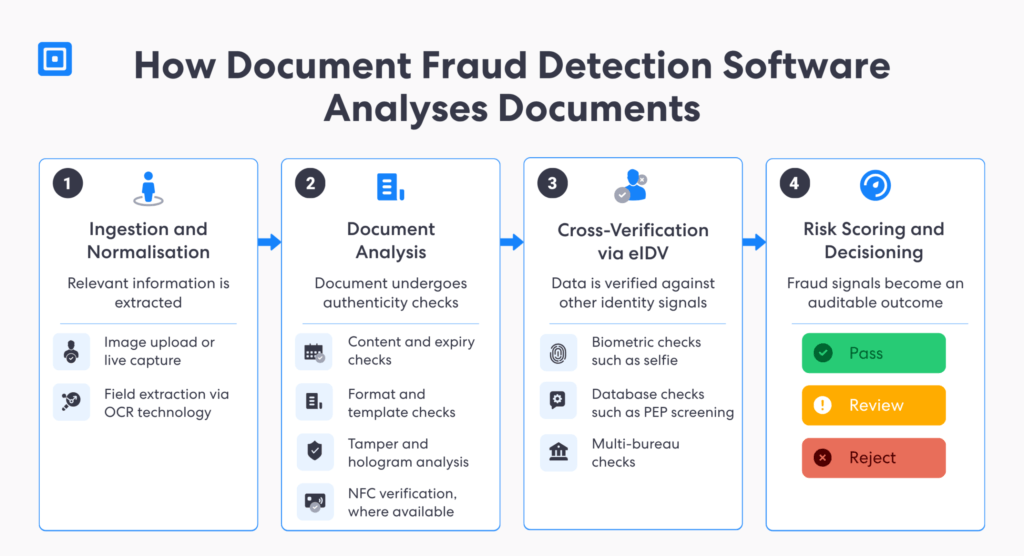
### 1. Ingestion & normalization
A customer captures or uploads a document image. In an automated solution, [Optical Character Recognition (OCR)](https://www.complycube.com/en/solutions/due-diligence-compliance/know-your-customer/optical-character-recognition/) technology is used for real-time data extraction, converting the visual content into machine-readable text to analyze names, addresses, dates, and more.
### 2. Document analysis
- **Content analysis:** Checks whether the content in the document submitted is accurate and valid during the time period. This includes checking if the name, nationality, or issuing and expiry dates are valid.
- **Consistency analysis**: Compares the information extracted against other submitted data during the identity verification process. For example, it checks for mismatches of date of birth, address, and other personal details.
- **Format analysis:** Scans if the document structure and layout is accurate for that particular document type and issuing authority. Some examples of this may include fonts, spacing, security placements, and more.
- **Forensic analysis:** Deep examination of signs of fabrication. This includes detecting if a document image is tampered with using image manipulation software, such as Photoshop, or has irregularities in holograms.
- **Near Field Communication (NFC) verification:** Reads and [cryptographically](https://www.complycube.com/en/solutions/identity-assurance/document-verification/nfc-verification/) validates the data stored on an embedded RFID chip. This is located in e-passports, e-ID cards, and some e-driver’s licences.
### 3. Cross-verification via eIDV (Electronic Identity Verification)
To further increase security and block fraudulent activities, the document is validated via other layered checks. This includes biometric verification, database, and multi-bureau checks. During this process, the extracted data is cross-verified against other identity data collected and various trusted databases, including, but not limited to, credit agencies, government authorities, and more. You can learn more here: [Unlock Trust with Electronic Identity Verification Tools](https://www.complycube.com/en/unlocking-digital-trust-with-electronic-identity-verification-tools/)
### 4. Risk scoring
After the document has been verified and validated, a risk score will be generated based on the intensity of fraud signals. Compliance teams will make an informed decision to pass, re-route, or reject onboarding for the particular individual.
## How Synthetic Document Detection Software Detects Fake Documents
Synthetic documents are typically generated or photoshopped using AI. They are meant to replicate authentic identity documents, bank statements, utility bills, and so on. As such, their usage is much harder to detect than basic forgery. Synthetic document detection software is hence used to detect these documents. Its intelligence comes from layered AI models, combining detection via a wider array of identity signals that include behavioral and biometric information.
Some of its capabilities include:
- **Machine learning models:** Train algorithms through learned data from genuine and fraudulent documents. Able to make predictions via visual, textual, and behavioral fraud patterns.
- **Natural language processing (NLP):** Pattern recognition forms the foundation of NLP. It checks tone, field consistency, and logic across documents.
- **Graph and behavioral analytics:** Detects coordinated, serial fraud attempts by connecting these signals across different onboarding applicants.
- **Anomaly detection:** Identify anomalies and flag them when they deviate widely from the expected document type patterns.
The Chief Product Officer at ComplyCube, Harry Varatharasan, notes, “Synthetic detection will become a distinct evaluation criterion for the best fraud detection software. It moves from verifying if a document looks real to understanding if the individual, device, and profile make sense when analyzed together.” Moreover, explainable AI is crucial as it provides a clear reasoning for why and how a document is flagged, satisfying stringent regulatory reporting requirements. You can learn more here: [Detect Synthetic Identity Fraud.](https://www.complycube.com/en/detecting-synthetic-identity-fraud-in-2025/)
## Evaluate the Best Fraud Detection Software
There are a few critical pillars to keep central when evaluating the best fraud detection software for a business. An effective platform not only boosts advanced technological requirements. Instead, it needs to meet evolving regulatory and risk requirements. Additionally, a few must-have features are critical in supporting scalability and changing needs. The checklist below provides valuable guidance for AML and KYC risk teams.
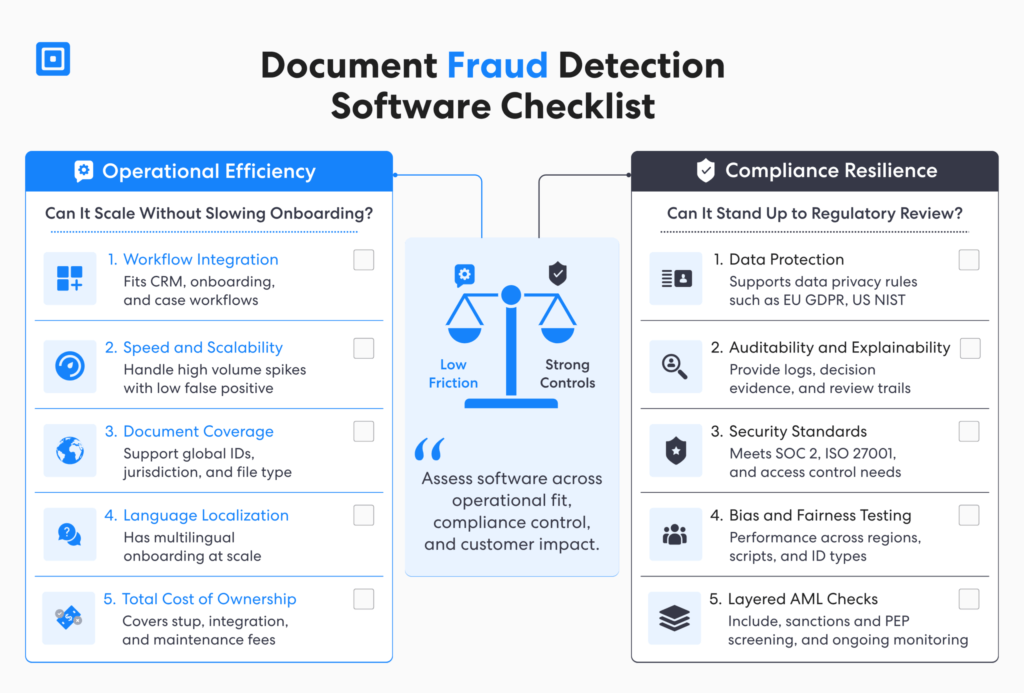
### Must-have features for operational efficiency:
- Integration and workflow: Can it be integrated within your current CRM and technology systems? Plus, can it be integrated into existing workflows easily?
- Speed and scalability: Does it support quick, accurate verification with low false positives and maintain a high level of precision when volume surges?
- Detection coverage: Does it support the document type and jurisdiction covered in your business, including PDFs and larger document files?
- Language localization: Can the software support multiple languages when your business scales operations internationally?
- Total cost of ownership (TCO): How do the setup, software, and integration fees fit into your compliance budget?
### Critical features supporting compliance:
- Data protection: Does the software align with jurisdiction privacy and security laws, such as GDPR and NIST?
- Auditability and explainability: Can your organization evidence AI explainability and meet regulator reporting needs, such as logs and decision-making?
- Security: Does the software meet high standards of security, including having key certifications, such as SOC 2 and ISO 27001?
- Bias and fairness: How does it test performance across geographies, languages, scripts, and identity documents to avoid uneven false positives?
- Layered checks: Does the platform support end-to-end AML compliance, which includes ongoing monitoring, sanctions screening, and biometric checks?
Beyond detecting document fraud efficiently, the software must take operational needs and customer experience into account. For example, stringent verification does not necessarily translate to the prevention of more fraud. Instead, it might increase false positives, which matter because they create friction for legitimate customers. The goal is not only to stop fraud, but also to avoid blocking good applicants.
### Key Takeaways
- **Modern document fraud detection** software uses AI to detect sophisticated attempts at forging, altering, using synthetic, or counterfeit documents.
- **Synthetic document detection** software is essential because AI-generated documents, deepfake IDs, and synthetic identities are increasingly used to bypass detection.
- **Layered AI algorithms**, including machine learning and natural language processing, support coordinated fraud attempts.
- **Automated document verification** software analyzes multiple fraud and data signals to produce a unified risk score in real-time.
- **Beyond accuracy and scalability**, effective document software includes ongoing monitoring and clear auditability to meet compliance.
## Fraud Detection Software for Global Document Types
In 2026, leading financial institutions and other regulated businesses adopt automated document fraud detection software to stay ahead of the growing threat of AI -enabled fraud. AI-powered software shifts compliance teams from manual checks, providing scalable and precise detection of suspicious activity. [Contact a member](https://www.complycube.com/en/contact/contact-sales/) of the ComplyCube team to learn more about how our document fraud detection software can sit within your business needs.

## Frequently Asked Questions
Is document verification and document fraud detection the same?
Document verification and document fraud detection are similar, but not the same. The goal of document verification is to confirm whether the submitted document and the applicant are legitimate. Document fraud detection goes a step further. It uses advanced image analysis to detect fraud risks in the signs of tampering, forgery, or alteration.
Can AI detect subtle, well-crafted forgeries better than humans?
Yes, in the majority of cases. Artificial intelligence can detect well-crafted forgeries often better than human analysis. This is because it analyzes pixel-level artefacts, metadata inconsistencies, or other hidden inconsistencies that might be missed by human review at scale. When combined, human effort and AI create a layered fraud workflow.
Does document verification satisfy KYC compliance?
Yes, document verification can partially meet KYC compliance. However, it needs to be combined with other layered checks to fully satisfy KYC requirements. For example, leading global regulators, including the FATF and FCA, increasingly demand ongoing monitoring, sanctions screening, and PEP checks for a stronger KYC programme.
How to choose the best document fraud detection software?
The best document fraud detection software will depend on your business needs. This includes the document types, sector-specific risks, volume, and workflow needs. Strong platforms use advanced AI algorithms to support low false positives, scalability, and fast onboarding. Additionally, all-in-one software combines layered AML checks to strengthen fraud prevention.
How can firms deploy ComplyCube’s automated document fraud detection software?
ComplyCube’s automated platform can be deployed quickly due to its deep integrations, including flexible APIs, SDKs, no-code workflows, and out-of-the-box integrations. The platform supports over 14,000 document types in 250+ territories, supporting quick implementation with low coding knowledge required.
**Categories:** Guides
**Tags:** Know Your Customer
---
### [Automated Document Verification Use Cases](https://www.complycube.com/automated-document-verification-use-cases/)
**Published:** June 27, 2024
**Author:** Andreea Balasa
**Excerpt:** Trust in digital identity verification fails to match the digital economy’s growth. This is bridged by enhanced regulations that endorse KYC compliance software such as automated document verification and NFC ID authentication.
**Content:**
**TL;DR:** **Automated document verification** strengthens document verification by helping firms confirm digital identity **faster and more securely**. This connects digital identity verification with KYC compliance software, NFC ID checks, and **scalable onboarding.**
## What is Automated Document Verification?
Automated document verification authenticates new users. It ensures that clients are who they say they are by validating their identity documents. Traditionally, this is a human job, but this is no longer feasible in the modern day:
- Training costs
- Human error
- Poor scalability
Moreover, advanced technologies, such as AI, increasingly streamline corporate processes. AI-powered document verification is far superior to its more traditional counterpart. Modern businesses face an ever-expanding client base, which demands a higher throughput of new users.
Likewise, such a development requires a process that can handle large quantities of data without compromising the quality of the verification. ComplyCube’s document authentication process is capable of handling an unlimited number of new users with extremely reliable results. You can learn more here: [What is Document Verification?](https://www.complycube.com/en/what-is-document-verification/)
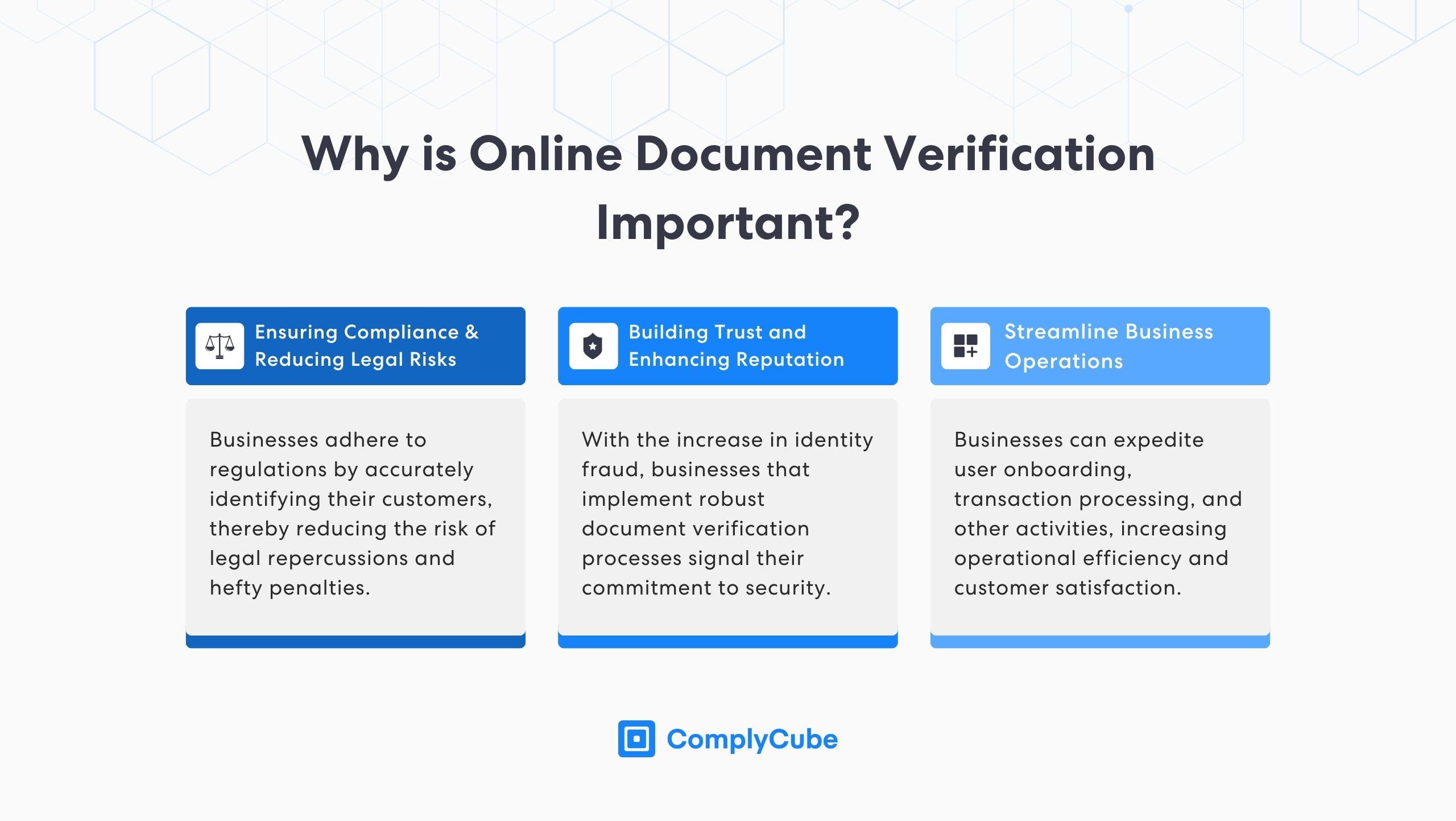
## NFC ID Verification
Near-field communication (NFC) is short-range wireless technology. For example, retail payments, ticket verification, and the Know Your Customer (KYC) process commonly use Near Field Communication (NFC). Most bank cards, modern passports, and NFC-enabled ID cards contain NFC chips that store trusted data for secure contactless verification.
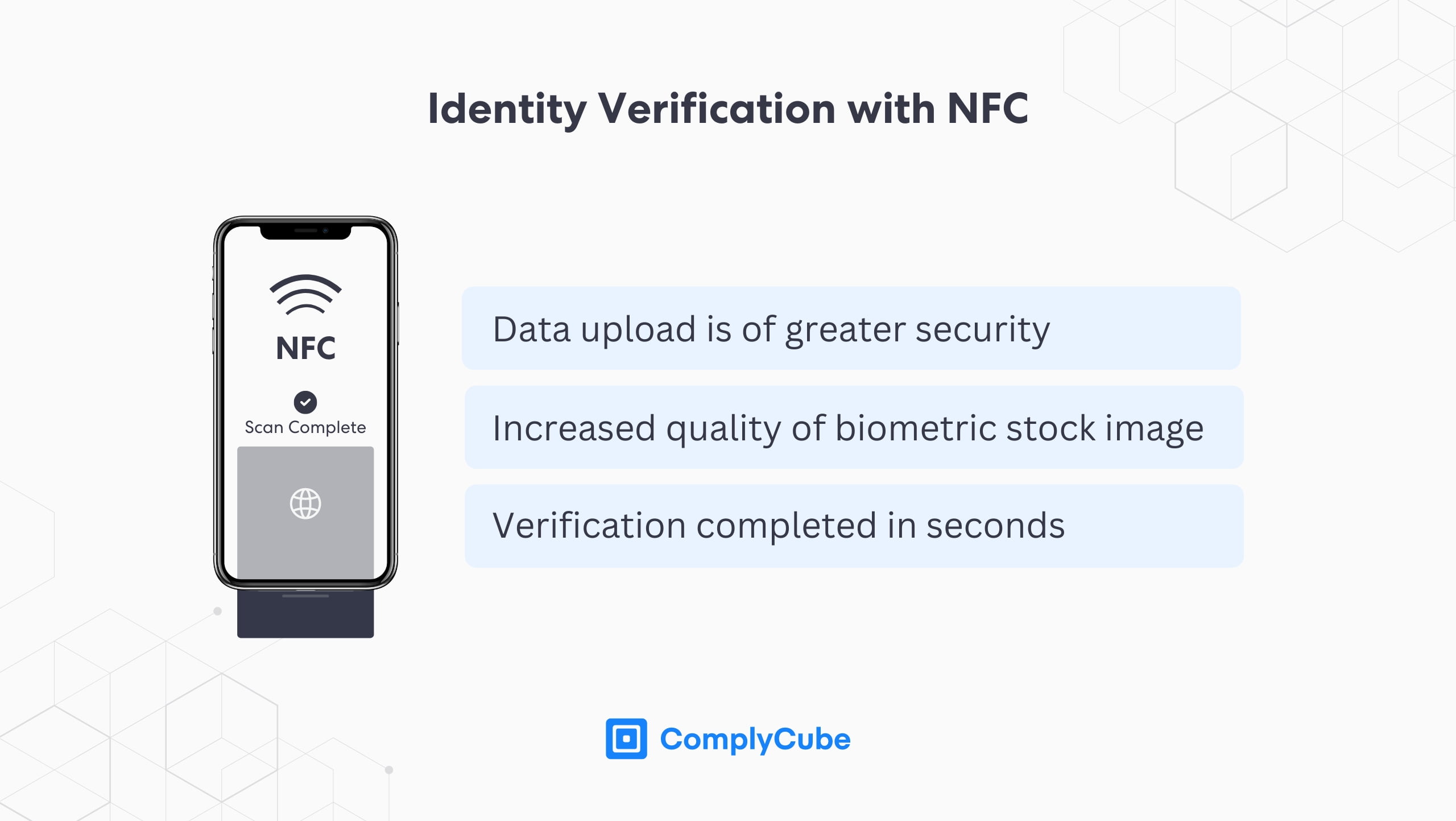
In document authentication, NFC ID verification produces an enhanced result because the data transfer is more precise. This, in turn, creates a stronger matching performance if a firm makes use of biometric verification due to the higher resolution image from the document.
### **Case Study: EU Digital Identity Wallet Rollout**
In 2026, the European Union are preparing to launch EU Digital Identity Wallets by the end of the year. The wallet framework lets citizens, residents, and businesses identify themselves securely. It stores digital documents, and share verified attributes across public and private services.
##### Major Cross-Border Identity Opportunity Revealed
In particular, the EU wallet programme shows how digital identity moves from isolated document checks to reusable, consent-based identity credentials. For regulated firms, this combines document verification, biometric assurance, NFC ID, and policy-based KYC orchestration in one compliant journey.
##### **Outcomes**
- EU Member States are expected to provide at least one wallet by the end of 2026.
- Wallets will support secure access to public and private digital services.
- The rollout strengthens the case for interoperable digital identity verification.
## Financial Services
Traditional financial (TradFi) services, such as banks, wealth management, accounting firms, and many others, must adhere to the tightest regulations. These services define the bridge between illicit finance and the security of the financial system and must, therefore, have some of the most robust safeguards in place.
The [Financial Action Task Force](https://www.fatf-gafi.org/en/home.html) (FATF) dictates much of the global financial regulation and enforces it via its 40 Recommendations. It acts as the focal point of many different regulators, combining national policies on an international stage.
As a result, the adoption of technology-backed compliance tools is an increasingly prevalent topic and is something that is being discussed across the globe [under many regulatory bodies](https://home.treasury.gov/news/press-releases/jy2346), including:
-
- The Department of the Treasury (DoT, US)
- The Securities and Futures Commission (SFC, Hong Kong)
- European Banking Authority (EBA, European Union)
These regulators endorse automated [document verification](https://www.complycube.com/en/solutions/identity-assurance/document-verification/). In the financial services industry, it can significantly streamline new client onboarding processes while actively increasing the reliability of the verification.
After all, the reliability of automated verification is driving this global trend by reducing human error and limiting opportunities for manipulation. Regulations first designed for financial services are now extending into other industries that rely on Know Your Customer (KYC) checks.
## Cryptocurrency
The crypto scene is one of the fastest-growing industries by value, volumes, and users. Scalable IDV and KYC solutions are fundamental to remaining competitive. Automated document verification is becoming the bread and butter of crypto onboarding processes.
- Completed in <15 seconds
- 13,000+ documents accepted
- Tamper proof
The blockchain sector experienced dynamic regulatory shifts in 2024, which are likely to continue into 2025 and beyond. Virtual Asset Service Providers (VASPs), such as crypto exchanges, are taking on financial responsibilities that increasingly mirror those of Traditional Finance (TradFi) institutions.
> The new rules will cover [most of the crypto sector](https://www.consilium.europa.eu/en/press/press-releases/2024/01/18/anti-money-laundering-council-and-parliament-strike-deal-on-stricter-rules/), forcing all crypto-asset service providers (CASPs) to conduct due diligence on their customers.
This increasing regulation demands flexible and precise KYC procedures. Advanced document verification, particularly NFC ID verification, is an affordable way of meeting these obligations while remaining competitive.
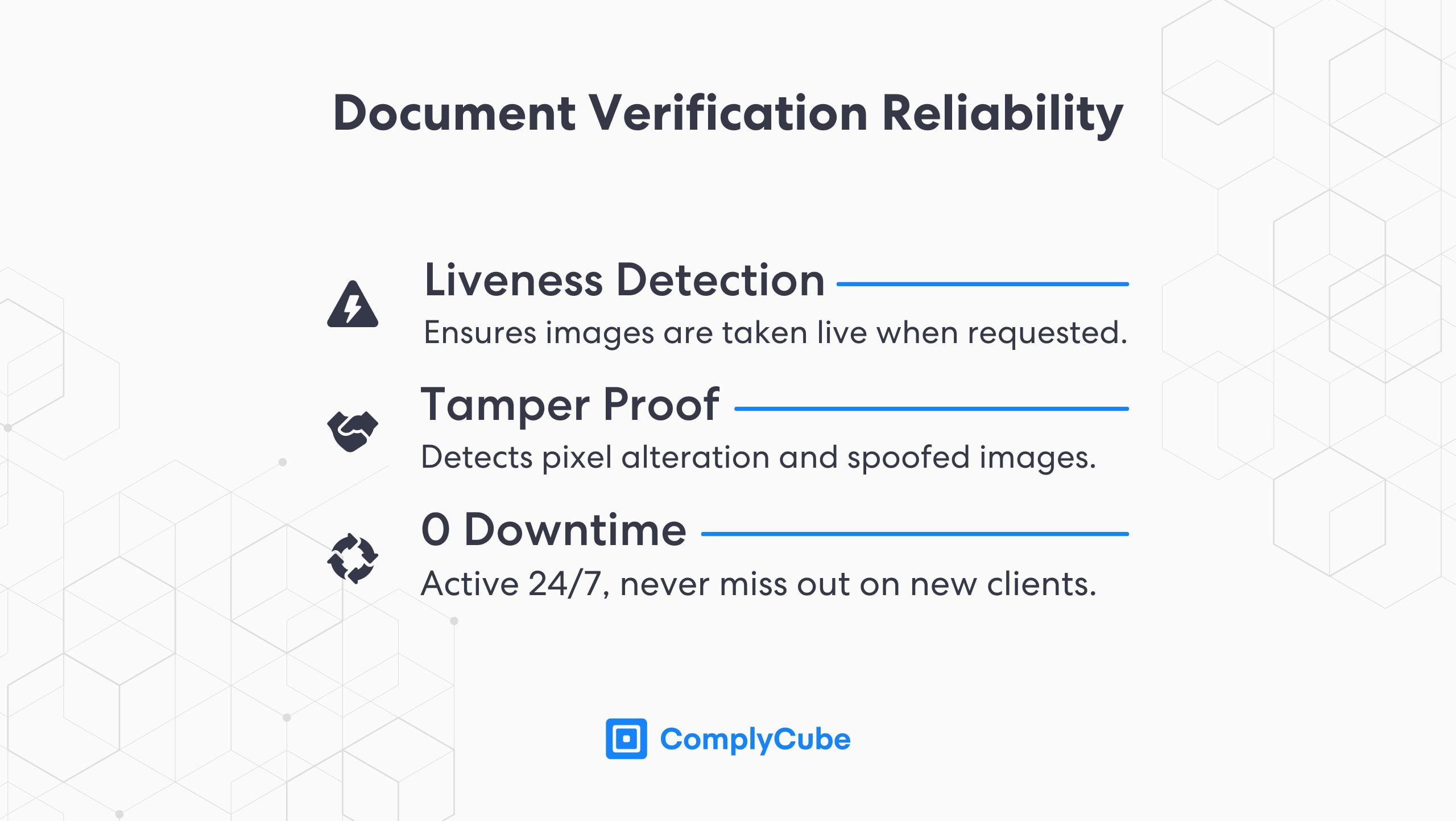
## Telecoms
The telecommunications sector which encompasses the internet, mobile, and communication services, is subject to stringent regulations. These regulations protect against fraud, misuse of services, and privacy. Some of the core regulators include:
- The Office of Communications (Ofcom, UK)
- The Federal Communications Commission (FCC, US)
- The European Telecommunications Standards Institute (ETS, EU)
Generally speaking, phone retail has moved entirely online. Consequently, many new firms are disrupting the industry by providing a 100% digital service. A core reason behind their success is the ability to verify new clients from anywhere, remotely.
Benefits of Automated Identity Verification:
- Reduced operational costs
- Increased sales exposure (24/7 accessibility)
Document verification, which would typically be followed by [biometric verification](https://www.complycube.com/en/solutions/identity-assurance/biometric-verification/), permits new client authentication anywhere in the world. Crucially, this process can be automated, meaning that new contract sales can be executed around the clock without the need for a sales team.
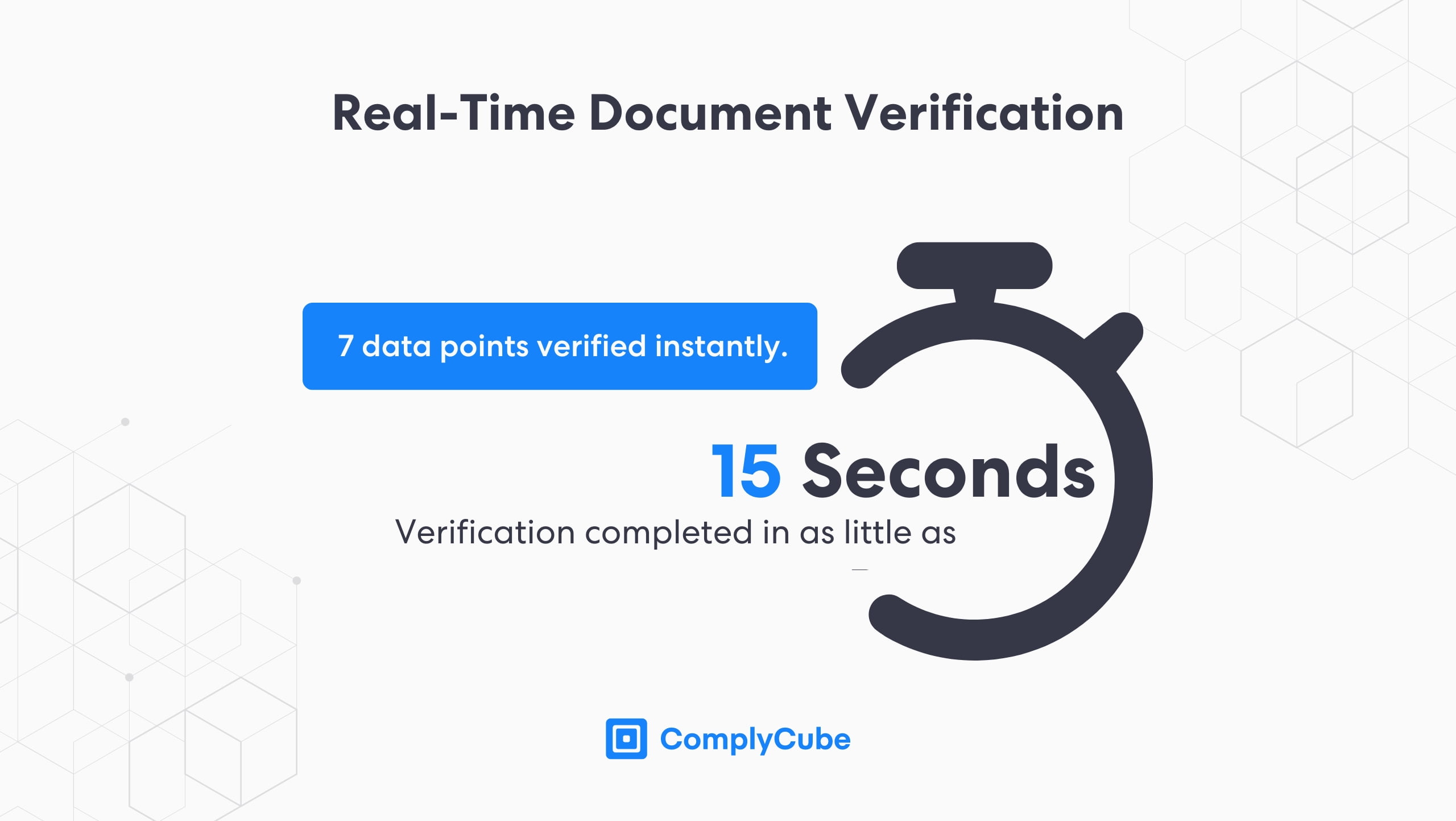
## Social Media
In 2023, [more than 38% of cases where money was lost to fraud began on social media](https://www.ftc.gov/news-events/data-visualizations/data-spotlight/2023/10/social-media-golden-goose-scammers). Such a statistic is driven by the anonymity that social media permits at scale. Anyone can create a new account, usually in seconds and with very limited personal information requested, and conduct malicious behavior.
Currently, this is a relatively unregulated market. KYC on most social media platforms is unheard of. Dating apps have been some of the first social sites to implement IDV measures. For example, they primarily use age verification procedures via document and sometimes selfie verification.
On the whole, over the next few years, communications regulators are likely to endorse tighter regulations around Identity Verification. This is in an effort to safeguard the industry against bad actors. Adopting KYC solutions, such as automated document verification, will place platforms ahead of the rest of the industry. For more information about Social Media IDV and KYC services, read [The Catfishing Crisis](https://www.complycube.com/en/the-catfishing-crisis-and-social-media-identity-verification/).
### Key Takeaways
- Automated document verification speeds up onboarding to reduce manual errors.
- NFC ID checks add stronger assurance by reading trusted chip data.
- Digital identity verification verifies ID documents and the person presenting it.
- KYC software blends document checks, biometrics, and screening together.
- Global document coverage helps firms onboard users across markets without weakening compliance.
## ComplyCube’s Automated Document Verification Solutions
To sum up, ComplyCube, a leader in digital Identity Verification and Know Your Customer solutions, provides IDV services to firms worldwide. Their proprietary suite of services is empowering trust in identity online.
If your firm needs to verify client credentials, [contact a ComplyCube specialist today](https://www.complycube.com/contact/contact-sales). With industry-leading flexibility of packages and customizability of solutions, the company can meet the demands of any firm looking for onboarding solutions.
## Frequently Asked Questions
What is automated document verification?
Automated document verification is the process of using technology to check whether an identity document is valid, authentic, and linked to the person presenting it. It replaces slow manual reviews with faster checks that can include Optical Character Recognition (OCR), fraud detection, biometric matching, and NFC ID authentication.
How does document verification support digital identity verification?
Document verification supports digital identity verification by confirming that a user’s identity document is genuine and belongs to them. When combined with biometric verification and liveness detection, it helps firms confirm both the document and the real person behind the account, reducing impersonation and onboarding fraud.
Why is NFC ID useful for identity checks?
NFC ID is useful because it reads trusted data directly from the chip inside eligible passports and ID cards. This can provide higher assurance than image-only checks, as chip data is harder to tamper with and can improve the quality of matching when biometric verification is used during onboarding.
Which industries use automated document verification?
Automated document verification is used across financial services, crypto, telecoms, payments, marketplaces, social platforms, and other regulated or fraud-exposed sectors. These industries use it to verify users remotely, reduce onboarding friction, meet Know Your Customer (KYC) requirements, and strengthen fraud prevention controls.
How does ComplyCube support automated document verification?
ComplyCube supports automated document verification through a unified compliance platform covering Identity Verification (IDV), biometric checks, NFC ID, AML screening, fraud detection, workflow automation, and case management. Its platform supports global document coverage, APIs, SDKs, hosted flows, and no-code orchestration for scalable onboarding.
**Categories:** Guides
**Tags:** Identity Verification
---
### [Implement Ongoing AML Monitoring for Insurers](https://www.complycube.com/ongoing-aml-monitoring-for-insurers/)
**Published:** February 26, 2026
**Author:** Dini Habib
**Excerpt:** Ongoing AML monitoring supports fraud detection and prevention. In insurance, the process involves performing real-time PEP, adverse media coverage, and sanctions screening checks to identify high-risk customers when they evolve.
**Content:**
**TL;DR:** To meet complete compliance requirements, insurance companies must go **beyond identity verification**. Ongoing AML monitoring for insurers enables firms to continuously identify, prevent, and escalate high-risk customers. This guide provides a deeper exploration of AML meaning in insurance and how to **implement ongoing monitoring in insurance** efficiently.
## What is Ongoing AML Monitoring for Insurers?
Ongoing Anti-Money Laundering (AML) monitoring is the continuous detection and prevention of suspicious activities that can potentially cause fraud, money laundering, and other financial crimes. In insurance, the process involves performing real-time Politically Exposed Persons (PEP) checks, adverse media coverage, and sanctions screening to identify high-risk customers as they evolve.
> $80-100 billion is laundered every year through insurance.
Typically, ongoing AML monitoring for insurers makes use of automated tools to fetch instant results, such as changes in a customer’s risk profile. Reports estimate criminals launder $80–100 billion through insurance, mostly via life insurance products. Ongoing AML compliance not only prevents fraud but also safeguards the financial system and integrity of the sector. As a result, strong safeguards protect investors, insurers, and policyholders from illicit activity.
## Ongoing Monitoring for Global Compliance
Several major regulators and jurisdictions mention the requirement of [ongoing AML monitoring](https://www.complycube.com/en/solutions/global-screening/continuous-monitoring/) for insurers to satisfy AML and Know Your Customer (KYC) laws. Although the terminology varies across regulatory bodies, each recognizes the concept as essential to combating terrorist financing and money laundering.
To achieve compliance, insurance companies align their operations with sector-specific regulatory requirements. Leading regulatory frameworks include the UK’s Financial Conduct Authority (FCA) Handbook, European Insurance and Occupational Pensions Authority (EIOPA), and the US National Association of Insurance Commissioners (NAIC) Model AML Regulation. Below are key examples that show how major jurisdictions implement these standards:
### United Kingdom’s FCA Handbook
In the [UK FCA Handbook](https://handbook.fca.org.uk/handbook), insurers must actively monitor relationships with policyholders and intermediaries. For example, insurance companies are required to provide evidence of consistent customer risk profiles and customer due diligence activities. Additionally, it involves strong case management, where high-risk scenarios must be logged and escalated.
### The EIOPA
The EIOPA provides insurance-specific AML supervisory expectations. In its guidelines, the EIOPA recommends [ongoing due diligence](https://eba.europa.eu/publications-and-media/press-releases/esas-publish-amlcft-guidelines) for policyholders and beneficial owners. In particular, strong risk assessment for high-risk products, such as premium or life insurance. It details steps for suspicious activity monitoring, which includes unusual premium patterns or rapid changes in beneficiaries.
### United States NAIC Model AML Regulation
The Financial Crimes Enforcement Network (FinCEN) oversees anti-money laundering compliance for insurance companies in the U.S. On the other hand, [the NAIC](https://content.naic.org/committees/d/antifraud-tf) Model offers a straightforward template that state insurance regulators use when enforcing AML laws. It emphasises a [risk-based AML program](https://content.naic.org/sites/default/files/committee_related_documents/committees_d_antifraud_meetingcc_faqsinsurance_103105.pdf), where due diligence is proportional to an individual or business’s risk status.
### Monetary of Singapore Notice 314
[MAS Notice 314](https://www.mas.gov.sg/regulation/guidelines/guidelines-to-mas-notice-314-notice-on-prevention-of-money-laundering-and-cft--life-insurers) requires life insurers to continuously monitor relationships and transactions to effectively detect suspicious activity. Insurers are recommended to perform transaction monitoring, maintain current customer due diligence information, and apply enhanced monitoring for higher risk statuses, such as complex structures and jurisdictions.
### AUSTRAC AML and Counter Terrorist Financing (CTF) Rules
Under the Australian Transaction Reports and Analysis Centre (AUSTRAC) AML and CTF Act, insurers must establish robust [ongoing customer due diligence](https://www.austrac.gov.au/business/how-comply-guidance-and-resources/guidance-resources/ongoing-customer-due-diligence). This includes monitoring transactions and relationships on an ongoing basis to identify suspicious patterns. Additionally, it calls for periodic audits of KYC information for high-risk individuals and filing suspicious matter reports (SMRs).
## Robust Ongoing AML Monitoring for Insurers
The insurance sector faces significant vulnerabilities that enable bad actors to funnel dirty money for criminal activity. One of the main reasons is due to legacy insurance systems, which heavily depend on manual reviews and investigations. Because of this, money launderers can easily seek short-term insurance options with quick one-off access to funds to avoid long-term investments. Ultimately, these weaknesses undermine effective fraud prevention.
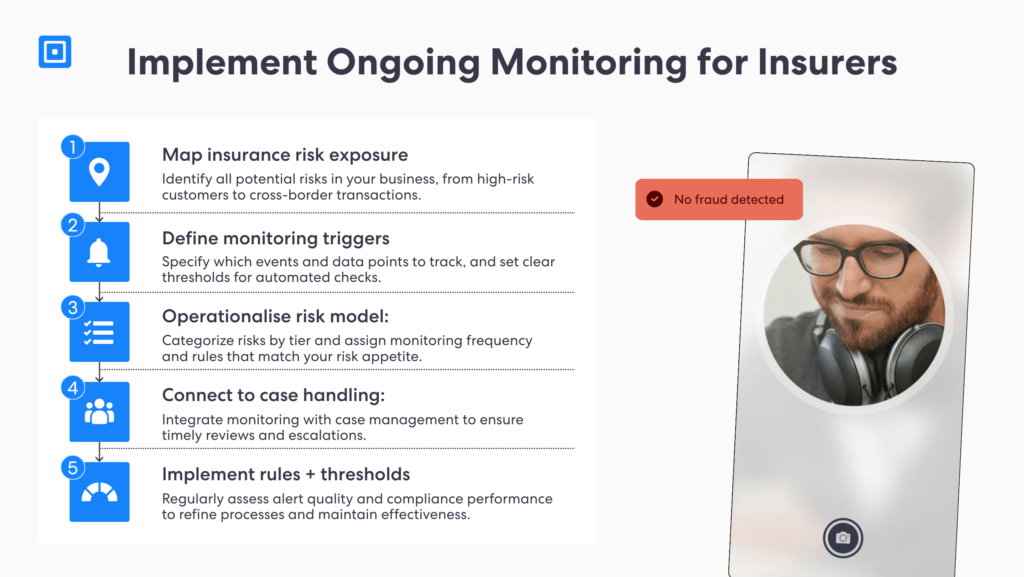
However, an ongoing monitoring approach supports insurance companies in proactively identifying suspicious customer behavior or ownership changes. Real-time monitoring blocks criminals who aim to use insurance products that involve large, one-time payments and cash-out features to launder money.
### Steps for an effective ongoing monitoring process:
**1) Map insurance risk exposure**: List down all the risk exposures involved in your specific business. This includes high-risk user segments, cross-border jurisdictions, risky products with large deposits or easy liquidity, and third-party exposure such as intermediaries or brokers.
**2) Define monitoring triggers:** Develop event logs for each typical activity, such as onboarding, premiums, claims, and policy cancellations. Next, define exactly what data is collected at that moment, which checks can run automatically, and what thresholds to apply for each risk tier.
**3) Build an operational risk model:** Set risk tiers, for example, low, medium, and high, and define the triggers and frequency of monitoring for each. Implement rules and thresholds proportionate to the organization’s risk appetite.
**4) Connect screening to case handling:** Link transaction monitoring with internal case management. For example, when a policyholder makes repeated refunds, make a decision, either to close, refresh customer due diligence, or escalate to senior management.
**5) Monitor metrics:** Analyse the effectiveness of ongoing monitoring by looking at key metrics. These include the number of false positives generated, the volume of alerts, and backlogs. AML compliance is subject to constant changes; thus, regular monitoring of compliance activities and metrics is critical.
## Risk-Based Ongoing Monitoring for Insurers
Criminals often exploit the insurance industry, necessitating strong defenses against money laundering. According to reports, 74% of insurers report facing stagnant or rising fraud cases. You can learn more here: [“What is Insurance Fraud?”](https://www.complycube.com/en/what-is-insurance-fraud/) A Risk-Based Approach (RBA) enables insurers and financial institutions alike to identify areas of highest money laundering risk in insurance companies.
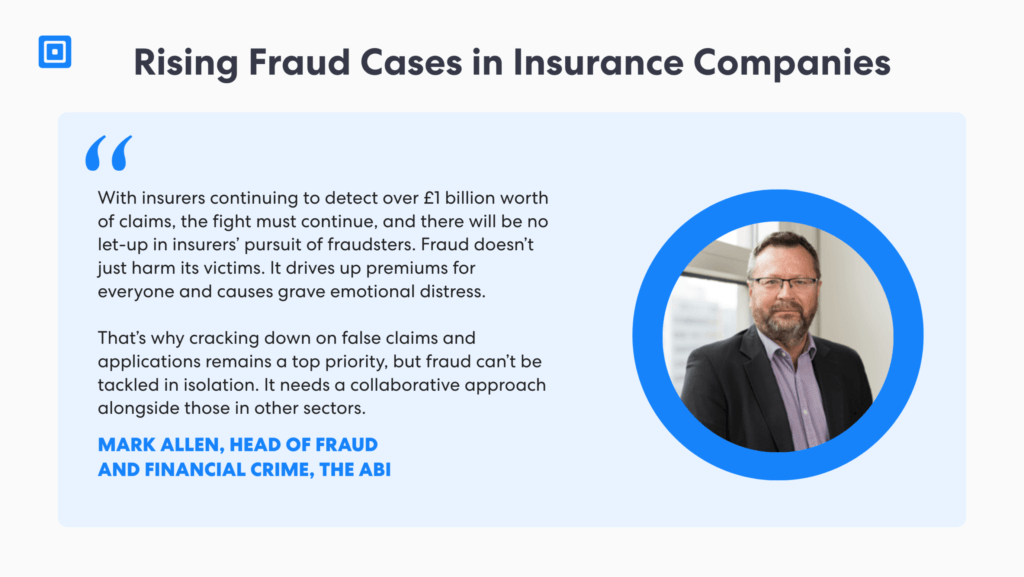
Under regulatory frameworks, such as the [US Bank Secrecy Act](https://bsaaml.ffiec.gov/manual/BSAAMLRiskAssessment/01), an RBA supports insurance companies in meeting AML compliance while enhancing customer onboarding. Insurers must scale their AML controls according to its products, customers, services, and geographies, shifting away from a one-size-fits-all approach.
> A risk-based compliance program enables companies to allocate compliance resources commensurate with their risk.
For example, upon detecting suspicious customer behavior, insurers must implement enhanced due diligence. This may include verifying a legitimate source of funds or requesting additional information until concerns are resolved as a minimum standard. You can learn more here: [“What is a Risk-Based Approach (RBA)?”](https://www.complycube.com/en/what-is-a-risk-based-approach/)
### **Case Study: Scale Operations with Fraud Prevention Solutions**
Fraudulent insurance claims continue to top over £1 billion annually. According to the Association of British Insurers, bad actors are using AI to further generate false documents, synthetic identities, and deepfakes to deceive insurers for their financial gain.
##### **Achieve Cross-Border Compliance at Scale**
Hayah, the leading digital insurer in the UAE required compliant and robust fraud prevention tools that can scale with the firm. The company partnered with ComplyCube’s AML software, leveraging comprehensive ongoing screening of its clients against trusted databases.
##### **Outcomes**
- Hayah was able to screen its policyholders against ComplyCube’s trusted databases of PEP, sanctions, and watchlists in over 250+ countries and territories.
- With ComplyCube’s AML fraud prevention suite, the organization automated key compliance obligations, such as enhanced due diligence, on one platform.
- ComplyCube empowered Hayah to meet cross-border, insurance-specific compliance, implementing a risk-based approach to KYC and AML.
## Common AML Pitfalls for Insurers
While comprehensive identity verification and anti-money laundering processes are critical, they can lead to customer friction during onboarding. For example, multiple steps and complex risk thresholds in the KYC process can lead to policyholder drop-offs and high false positives.
Instead, insurers must balance security, compliance, and seamless customer onboarding through transparent documentation, clear thresholds, and scalable processes. Additionally, training and awareness for staff are essential components of an effective AML program and build a culture of continuous improvement.
**1. Bank-style rules copied into insurance**: Insurance firms might apply monitoring logic from banks to policy data. This can lead to no alerts or irrelevant ones, as insurance events differ from bank payments. Instead, insurers must design rules around specific events, which include premium spikes, irregular top-ups, and failed payment attempts, et cetera.
**2. Monitoring only the policyholder**: Another pitfall is focusing on policyholders and excluding other partners, parties, or third-party entities. Risk can appear within the premium payer or ultimate beneficiary. Insurers must expand monitoring parameters to all relevant parties, such as controllers and beneficial owners, to receive alerts on risk changes.
**3. No clear thresholds by risk tier**: Next, treating all customers as the same can create rules that are either too light for high-risk scenarios or too aggressive for low-risk ones. As a result, potential threats are hidden, and genuine customers may feel alienated. Thus, firms must keep a clear document of each risk tier, low, medium and high and put them in actual insurance-based events practice.
**4. Weak documentation**: Lastly, monitoring can be futile without strong documentation. Authorities expect transparent audit trails to support regulatory decisions. Insurers should build documentation from day one. This includes maintaining real-time logs of available data used, rules triggered, escalations, and suspicious activity reports outcomes.
## Insurance-Specific AML Software
Technology modernization plays a crucial role in managing and mitigating money laundering risks in insurance companies. Thus, many insurers are leveraging Regulatory Technology (RegTech) providers to automate and streamline compliance obligations. The key factors to look out for when choosing AML software tailored for insurance include coverage, detection quality and customization, case management and auditability, and integration and operations:
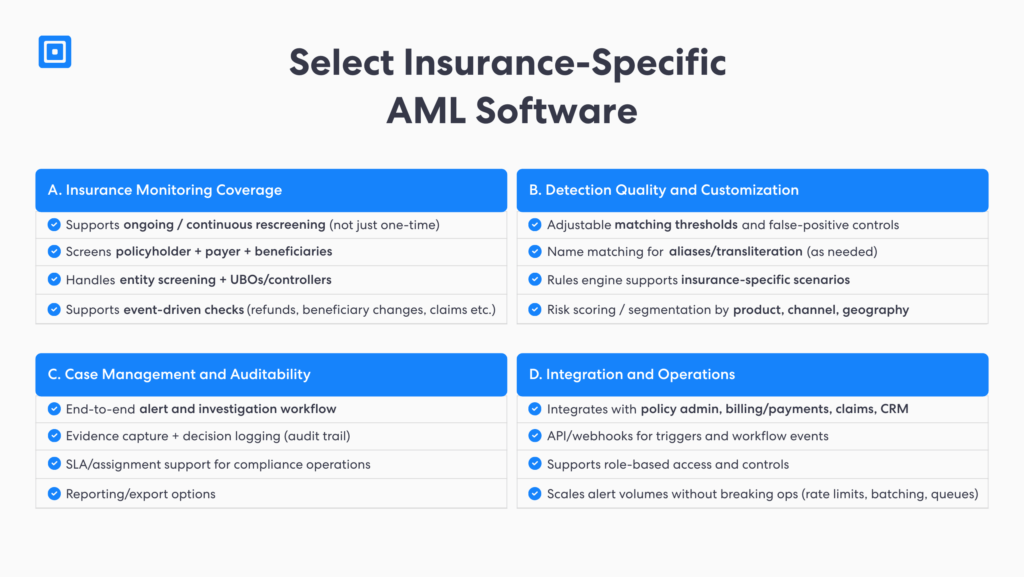
Particularly for ongoing monitoring, companies can integrate RegTech tools to track the presence of their clients in the news or on sanctions lists instantly. These providers use machine learning and AI-driven solutions to streamline the AML process, from automating data collection to advanced analytics. You can learn more here: [Stay Compliant with The Best Sanctions Screening Software.](https://www.complycube.com/en/best-sanctions-screening-software-for-2025/)
### Key Takeaways
- **Ongoing monitoring** in insurance is the real-time screening of customer interactions and relationships to detect suspicious behavior in customers’ accounts.
- **Effective AML measures** protect insurers from severe penalties, including fines and criminal prosecution, for non-compliance.
- **Understanding customer relationships** is crucial for identifying hidden risks in money laundering activities.
- **Suspicious activity reports** must be submitted to the appropriate authority to halt potential illicit funds and threats from further exacerbation.
- **Companies can integrate RegTech** tools to track the presence of their clients in the news or on sanctions lists.
## Meet AML Compliance Requirements for Insurance
In conclusion, ongoing AML monitoring for insurers is essential for [effective fraud prevention](https://www.complycube.com/en/use-cases/process/fraud-prevention/) and regulatory compliance with laws. Thus, financial institutions and insurance firms must implement robust real-time screening of business relationships and customer information to protect the integrity of financial systems. Insurers must adopt a risk-based approach to AML and are encouraged to utilize automated RegTech tools to meet stringent requirements across global jurisdictions. [Contact a member of the team](https://portal.complycube.com/signup) to learn more about how you can implement effective ongoing monitoring solutions today.
[](https://portal.complycube.com/signup)
## Frequently Asked Questions
What is AML meaning in insurance?
Anti-Money Laundering (AML) meaning in insurance refers to the regulations and frameworks firms must meet to prevent insurance services from being used for financial crime. It involves customer due diligence, ongoing monitoring to screen for politically exposed persons or sanctioned individuals, and reporting suspicious activities to the appropriate authorities.
Is ongoing monitoring in insurance required?
Yes. AML ongoing monitoring in insurance is required to combat money laundering and terrorism financing. AML regulations vary across jurisdictions. For example, the US FinCEN and UK FCA require insurers to implement regular reviews of written AML programs and report suspicious activity.
How often should ongoing monitoring run?
Businesses must conduct ongoing monitoring with a risk-based approach, instead of intervals. Screening must be proportional to the risk status of a product, customer, and geography. High-risk financial transactions will require granular monitoring, tighter thresholds, and faster alert escalation, while lower risk can be monitored with lighter controls.
What’s the difference between ongoing monitoring and periodic reviews?
Ongoing monitoring is the real-time screening of transactions and events to spot immediate suspicious patterns. On the other hand, periodic reviews are scheduled at intervals to ensure customer information and risk profiles are updated.
Does ComplyCube provide ongoing AML monitoring for insurers?
Yes. ComplyCube delivers automated ongoing monitoring solutions tailored for the insurance sector. Businesses can screen against trusted databases of sanctions lists, PEPs, and adverse media to meet regulatory compliance. Additionally, its no-code workflows deploy layered verification solutions to combat financial crime and money laundering effectively.
**Categories:** Guides
**Tags:** Anti-Money Laundering
---
### [AML Compliance for Accountants in the UK](https://www.complycube.com/aml-compliance-for-accountants-in-the-uk/)
**Published:** October 29, 2024
**Author:** Sofia Daley
**Excerpt:** The best AML software for accountants and finance professionals is one that offers AI-powered AML and KYC checks. Learn more about compliance for accountants, and the UK regulatory framework.
**Content:**
Accountancy firms, like all financial institutions, have a large responsibility on their shoulders regarding AML compliance for accountants. Money laundering is a serious crime that can tarnish an organization’s reputation quickly. International organizations such as the Financial Action Task Force (FATF), the International Monetary Fund (IMF), the International Criminal Police Organization (Interpol), and more ensure that global mandates are met and that under-supported AML schemes quickly come to light. The best AML software for accountants and finance professionals is one that offers AI-powered Know Your Customer (KYC) and Enhanced Due Diligence (EDD) checks alongside ongoing monitoring and individual risk assessments.
## Who Regulates AML Compliance for Accountants in the UK?
Currently, the UK has 25 AML supervisors, three of which are statutory supervisors. These include the Financial Conduct Authority (FCA), the Gambling Commission, and HM Revenue & Customs (HMRC). These watchdogs hold the legal power to enforce AML rules, conduct inspections, and impose penalties for non-compliance.
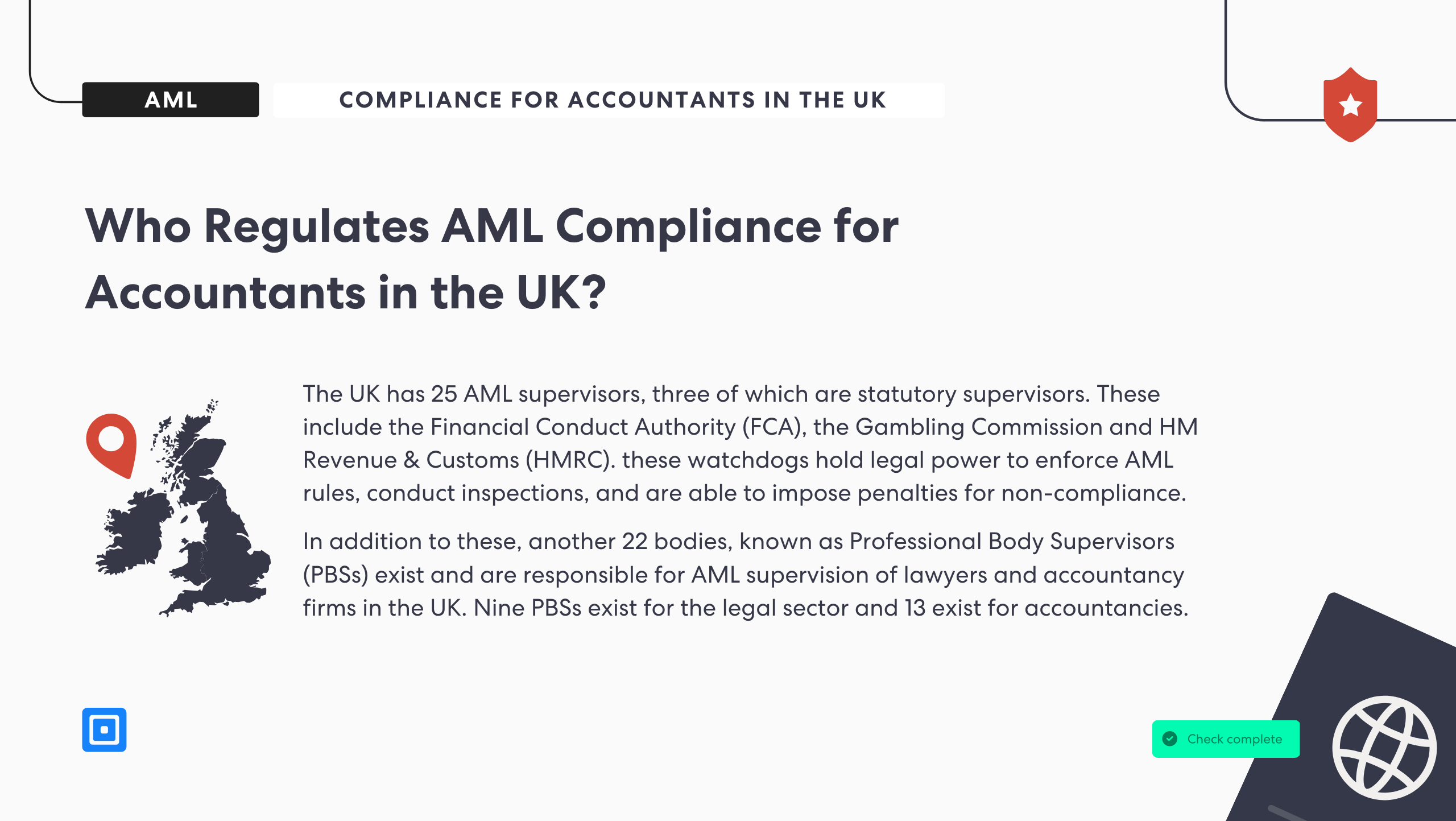
In addition to these, another 22 bodies, known as Professional Body Supervisors (PBSs) exist and are responsible for AML supervision of lawyers and accountancy firms in the UK. Nine PBSs exist for the legal sector, and 13 exist for accountancies.
- **PBS-Member Firms**: If an accountancy firm is a member of one of the 13 PBSs, it is subject to AML supervision by that specific professional body. The PBS oversees AML compliance within the firm, including customer due diligence, monitoring, and reporting of suspicious activities.
- **Non-PBS Firms**: If an accountancy firm or individual accountant is not a member of any PBS, they must register directly with HMRC for AML supervision. HMRC then takes on the role of the AML supervisor, ensuring that these firms comply with AML regulations and enforcing requirements through inspections, audits, and penalties when necessary.
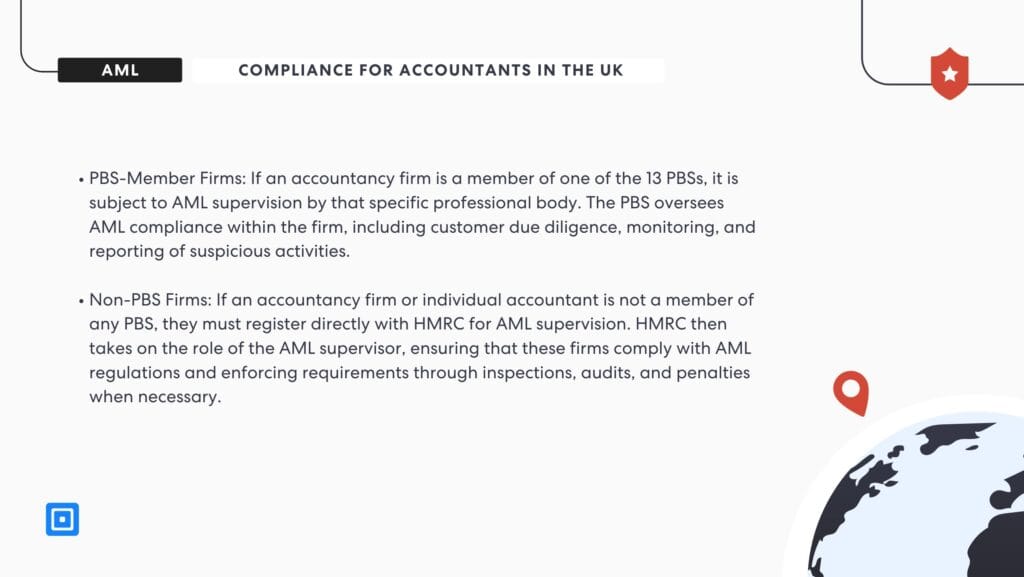
## AML Obligations in the Sector
Accountancy firms are legally required to comply with the Money Laundering, Terrorist Financing, and Transfer of Funds (Information on the Payer) Regulations 2017 (MLRs), which were amended in 2019. These regulations require identity verification, risk profiling, suspicious activity reporting, customer due diligence, ongoing monitoring, and more. However, different organizations must respond to these requirements with differing processes, as each firm’s specific needs to meet these regulatory demands must be supported.
**The Royal United Services Institute** (**RUSI**), the UK’s leading defense and security think tank, states, “The huge variety in size and risk profile of firms operating within both sectors presents significant challenges both to implementation of the [MLRs and to AML supervision](https://rusi.org/explore-our-research/publications/policy-briefs/anti-money-laundering-supervision-professions-uk-four-key-challenges-and-how-address-them#:~:text=The%20Structure%20of%20AML%20Supervision%20of%20the%20Professions%20in%20the,Professional%20Body%20Supervisors%20(PBSs).). While the size of the firm does not necessarily correlate with the risk of the services that it operates, the nature of the money laundering risks that a ‘magic circle’ law firm is exposed to will be very different from the risks that a small high street solicitor is exposed to. The same is true in the accountancy sector.”
The best AML software solution for accountants will be adaptable to the firm’s needs, as a one-size-fits-all package deal simply doesn’t work when avoiding non-compliance. A firm-wide risk assessment may be needed to pinpoint needed compliance measures that are unique to that organization.
For example, a large firm specializing in high-net-worth clients or international transactions may prioritize real-time screening against sanctions lists, while a small local practice could focus on efficient Customer Due Diligence (CDD) checks and straightforward identity verification processes. You can learn more here: [Adopting a Risk-Based Approach for Accountants.](https://www.complycube.com/en/adopting-a-risk-based-approach-aml-software-for-accountants/)
> Each firm’s [AML compliance](https://www.accountingweb.co.uk/tech/tech-pulse/anti-money-laundering-software-what-accountants-should-look-for) also needs to be unique.
David Winch, the AML & Onboarding Adviser at MLRO Support Ltd, states, “Each accountancy firm is unique – not least because the partners in it have a unique experience, knowledge, and interests,” said Winch. “In my opinion, each firm’s [AML compliance](https://www.accountingweb.co.uk/tech/tech-pulse/anti-money-laundering-software-what-accountants-should-look-for) also needs to be unique.” For more on UK AML regulation, read [“Achieving Compliance: UK AML Regulation.” ](https://www.complycube.com/en/achieving-compliance-uk-aml-regulation/)
## Client Onboarding with an AML Software Provider
Client onboarding should always leverage a sophisticated KYC process, as it can help firms quickly flag potential risks. By carrying out ID verification checks, adverse media checks, verifying beneficial owners, sanctions checks, and more, accountants ensure that their clients are not partaking in illicit activities that could tarnish their reputations. For more information on KYC and AML checks, read [“KYC vs AML: What is the Difference?”](https://www.complycube.com/en/kyc-vs-aml-what-is-the-difference/)
New clients must undergo AML processes monitored by a Money Laundering Reporting Officer (MLRO). This allows for quick and easy onboarding while minimizing risks by verifying their background and identities.
AML software that effectively screens new customers can empower businesses to scale quickly, as AI-powered KYC can be carried out in minutes. Clients can be onboarded quickly and efficiently without needing to worry about non-compliance. In addition, these platforms can also ensure that data privacy requirements (such as the UK GDPR) are met and respected.
Finding the right balance between holding on to client data, as required by regulatory compliance standards, and respecting data privacy laws can be difficult for firms to do independently. The right AML software provider will protect an organization from having to navigate through this issue.
## ComplyCube’s Accounting AML Software Solutions
ComplyCube is a leading KYC and AML platform with a deep understanding of the UK regulatory landscape and the needs of individual companies. UK accountants can find the right software procedures to run AML checks as needed within their solutions, with diligence requirements depending on client types.
Meet regulatory requirements with comprehensive tools to implement the most sophisticated AML procedures, drastically reducing the risks of non-compliance and financial crime. The right AML software solutions for one accountancy firm will differ from those of another, which is why ComplyCube’s solutions are highly customizable.
For more information on how to implement the best AML software for accountants with ComplyCube, get in touch with one of their [compliance experts.](https://www.complycube.com/en/contact/contact-sales/?_gl=1%2Afjzyjv%2A_up%2AMQ..%2A_ga%2ANjU5MDgwMzYxLjE3MzAyMTI0NDk.%2A_ga_1DN1ERTT4P%2AMTczMDIxMjQ0OC4xLjEuMTczMDIxMzgxOC4wLjAuMA..)

**Categories:** Guides
**Tags:** Anti-Money Laundering
---
### [Seamless Customer Onboarding with User Identity Verification](https://www.complycube.com/implement-effective-user-identity-verification/)
**Published:** May 13, 2025
**Author:** Dini Habib
**Excerpt:** The best way to protect your business against fraud is to prevent it from happening in the first place. Online identity verification emerges as a powerful tool for fraud prevention, anti-money laundering, and building customer trust.
**Content:**
**TL;DR:** From opening a bank account to signing up for a new service, user identity verification has become a cornerstone of **secure customer onboarding**. Moreover, it ensures only legitimate users can access services, keeping bad actors at bay. This guide covers modern tips for implementing strong identity verification solutions while **minimizing customer friction**.
## The Function of User Identity Verification
Your user identity is the totality of important characteristics, such as your name, date of birth, official government-issued IDs, and even your biometric data. These characteristics create your unique identity, which is used in [Identity Verification (IDV)](https://www.complycube.com/en/solutions/identity-assurance/) to confirm that you are who you claim to be. Digital identity verification enables businesses to verify someone’s identity and design a secure ecosystem for their users and clients. It empowers them to serve legitimate, successfully verified customers while preventing illicit transactions and identity fraud.
> At the beginning of 2024, [over £570 million](https://www.ukfinance.org.uk/news-and-insight/press-release/over-ps570-million-stolen-fraudsters-in-first-half-2024#:~:text=UK%20Finance%20today%20releases%20its,the%20first%20half%20of%202023.) was stolen from fraudulent activities as bad actors target innocent people.
The best way to protect your business against fraud is to prevent it from happening in the first place. Online identity verification emerges as a powerful tool for fraud prevention, anti-money laundering, and building customer trust.
## What Does Identity Verification Involve?
The identity verification process entails various steps. Today, businesses leverage the latest technology, such as biometric and vision authentication capabilities, to further [enhance customer onboarding](https://www.complycube.com/en/use-cases/process/customer-onboarding/) and fraud protection efforts.
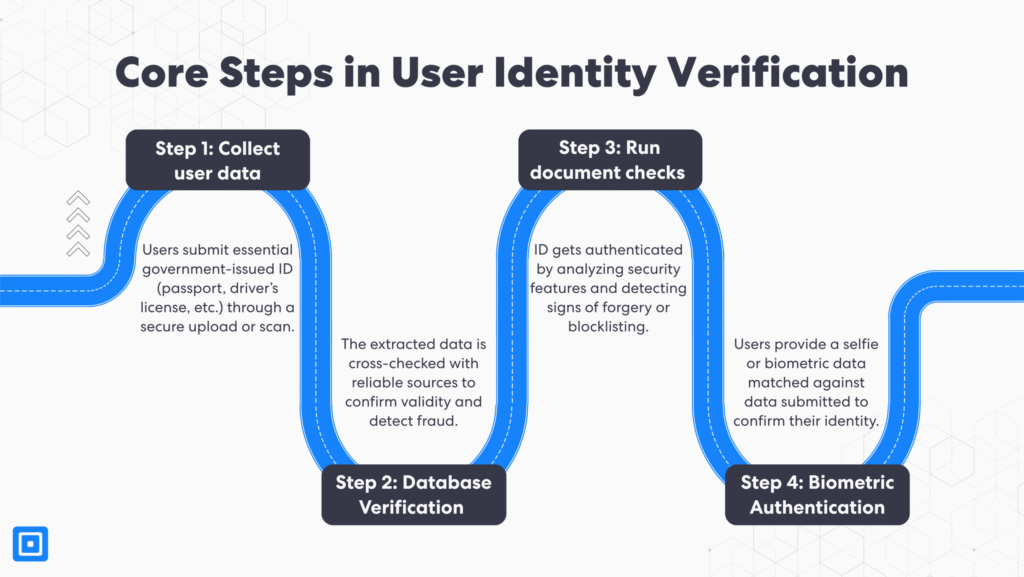
**Typically, the steps involved in identity verification are:**
- **Collection of User Data:** Organizations gather user data using various ID types, depending on the regulations and territory in which they operate. Common government ID types are passports, driver’s licenses, and unique identifiers such as Social Security numbers.
- **Database Verification:** The information provided will be cross-referenced against reputable sources, including credit bureaus, government data sources, utility authorities, and commercial databases.
- **Document Authentication Checks:** The [documents uploaded](https://www.complycube.com/en/solutions/due-diligence-compliance/know-your-customer/document-authenticity/) will be verified and classified as either legitimate or whether they have been compromised, forged, copied from the Internet, expired, or even blocklisted.
- **Biometric Verification:** This step involves facial recognition technology or biometric information to match the user’s unique physical characteristics against the ID submitted, ensuring the person is who they claim to be.
### **Case Study: Paxful Faces $4 M penalty by U.S. Regulators**
Paxful Holdings Inc., the crypto trading platform, was [fined $4 million](https://www.complycube.com/en/crypto-news-paxfuls-aml-misconduct/) in February 2026 by the U.S. Department of Justice (DOJ) for violating multiple identity verification and Anti-Money Laundering requirements under the Bank Secrecy Act (BSA).
##### **Investigations Exposed Links to Fraud, Prostitution, and Child Abuse**
Paxful knowingly enabled customers to transfer funds from criminal activities and markets itself as having no identity verification processes. In a particular case, the firm enabled its client, Backpage, the ad platform for illegal prostitution, to access services with no verification.
##### **Outcomes**
- The company was initially fined a massive $112.5 million, but the fine was reduced to $4 million due to its inability to pay.
- Paxful was in the midst of shutting down its platform in 2023 due to regulatory pressure and partner disputes.
- Despite shutting down in earlier years, this case highlights regulatory rigour, as the DOJ sought to resolve the enforcement actions.
## Evolution of Digital Identity Verification Methods
Identity verification methods have gone beyond simple checks. Organizations are adding extra layers of security to their identity verification processes to make it harder for data breaches. Here are some of the common methods on the rise:
### Answer Security Questions
Users provide personal answers to security questions, which are unique identifiers for the person’s identity. The questions include “What is the name of your first pet?” or “What is your mother’s maiden name?” especially during password recovery or as an extra authentication step.
### Sending Verification Codes
Sending a one-time verification code to the user’s phone via SMS or email helps confirm the user’s identity and prevents unauthorized access. This method ensures that only legitimate account owners can complete login or registration, reducing the risk of fraud. Popular platforms such as WhatsApp and Facebook require users to enter a code on their phone to create a new account or complete the login process.
### Multi-Factor (MFA) or Two-Factor Authentication (2FA):
Organizations, especially banks, often combine two or more security methods as an additional layer. This method is called two-factor or multi-factor authentication. A common example is requesting a password, plus a verification code sent to the authenticator app, or even biometric information.
### Advanced Biometric Authentication:
[Liveness detection](https://www.complycube.com/en/solutions/due-diligence-compliance/know-your-customer/liveness-detection/), including face depth analysis, micro-expression detection, and occlusion recognition, safeguards businesses from sophisticated deepfakes. Additionally, fingerprint scanning and voice recognition are used increasingly to verify a user.
## Establishing User Transparency and Trust
Managing identity verification and privacy can be complex. Safeguarding user privacy is the key to cultivating brand trust and compliance with regulators. Identity verification solutions and vendors need to be transparent about:
- **Data Collection:** For what reason is data gathered, and what specific information is collected?
- **Data Storage:** Where will the data be stored? How is the data being stored securely, and for what duration?
- **Data Protection:** What types of security measures or technologies are used to align with privacy laws?
- **User Consent:** Does the customer have the right to access or delete their data?
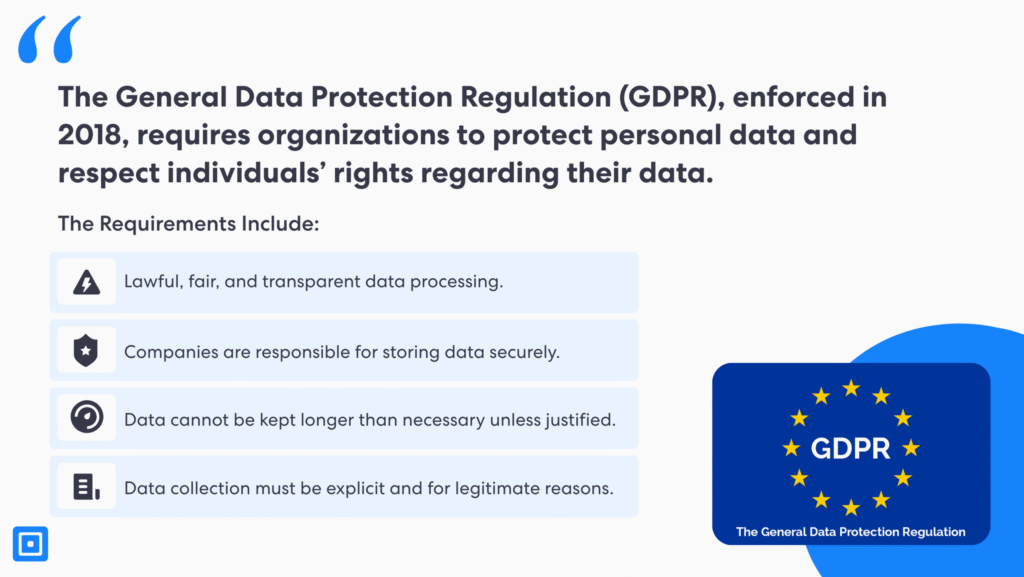
Complying with local and global regulations is critical. For example, [the GDPR](https://gdpr-info.eu) mandates explicit consent and strong data protection for EU and UK users.
## Prioritizing Seamless Customer Onboarding in Identity Verification Methods
Integrating a smooth user onboarding journey is beneficial in increasing conversion rates. Requesting too many documents or unnecessary steps can be frustrating and lead to a high user drop-off rate. In contrast, lax identity verification methods will invite more fraudsters.
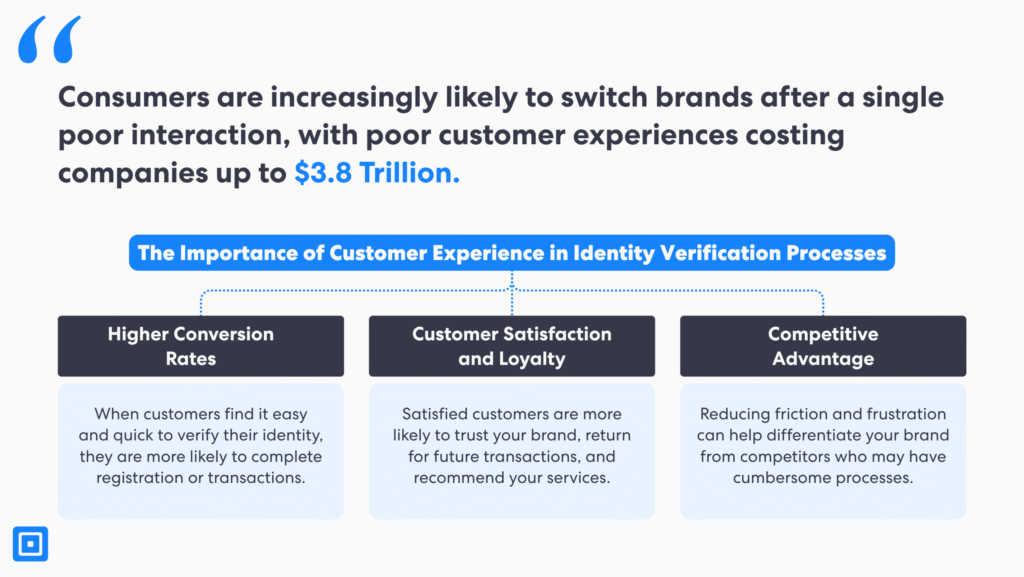
**Here are the best practices for building a strong onboarding process:**
- **Clear Step-by-step Instructions:** Use visual icons, accessible interfaces, and clear and concise text to walk users through the process.
- **Provide Feedback:** When necessary, provide feedback when a user fails verification. Additionally, providing more than one attempt for a user to verify their identity can be helpful, especially with real-time verification methods that can be affected by a poor wifi connection.
- **Guidelines and Privacy Statements:** Include guidelines, such as examples of a good document submission versus a poor one. For privacy statements, clearly explain how data is collected and processed.
- **Inclusion with Multiple ID Types:** Be mindful of what ID types your organization accepts. Allowing users to choose and submit various identification documents helps accommodate different user needs and minimizes friction.
- **Automated Tools and Integrations:** Businesses increasingly use Artificial Intelligence (AI) and other integration tools, such as an extraction feature, to handle routine checks and make ID verification significantly faster and more secure.
Implementing these best practices will ensure organizations maintain high security, prevent fraud, and mitigate social engineering attacks, while building a positive customer experience.
## Emerging Trends in Identity Verification Software
Modern IDV software leverages state-of-the-art technology, including AI, Machine Learning (ML), Blockchain, access control systems, and more. Businesses can deliver quicker services to their customers while addressing stringent regulatory compliance. The top trends you can find in ID verification processes are:
**Ongoing Monitoring:** Advanced identity verification software has [ongoing monitoring capabilities](https://www.complycube.com/en/what-is-an-ongoing-monitoring-process/) beyond the initial ID verification. This means a customer’s transactions and online activity are continuously tracked in real-time. Any suspicious activity that arises will be flagged immediately, enhancing the fraud prevention and anti-money laundering efforts.
**AI-Driven Checks:** AI and Machine Learning (ML) support identity verification processes by analyzing government-issued IDs, scanning for synthetic identities, and enhancing biometric authentication in seconds. Adopting AI technologies is a critical step in verifying someone’s identity and enhancing security quickly, delivering long-term cost savings. You can learn more here: [Why Identity Verification AI is Crucial](https://www.complycube.com/en/why-identity-verification-ai-is-crucial/).
**Decentralized Identity Solutions:** Users choose and control their own identity information, typically with blockchain technology. Sensitive data is managed by the users instead of being stored in central databases. This gives them more privacy, reducing the risk of data breaches.
**Digital Identity Wallets:** These refer to apps or services where users can store their electronic documents. They enable users to [easily share their identity](https://www.complycube.com/en/new-uk-digital-wallet-in-2025/) when it’s required, making the customer verification process quicker and safer.
**No-Code and Low-Code Identity Verification Solutions:** Identity verification solutions enable compliance teams to design tailored customer verification processes without programming knowledge. Companies can expect more straightforward and flexible set-up workflows, empowering them to make informed decisions while meeting regulatory requirements.
### Key Takeaways
- **User identity verification** confirms that a customer is who they are by verifying critical identity attributes.
- **Leading businesses** adopt layered IDV checks, such as liveness detection, multi-factor authentication, and OTP verification.
- **Customer trust is central** to IDV, with strong data privacy laws showcasing transparency, thus improving customer perception and loyalty.
- **Clear instructions**, feedback, and automation reduce customer friction and accelerate customer onboarding without more steps.
- **To strengthen fraud prevention**, firms should implement ongoing monitoring, no-code workflows, and AI for real-time detection.
## Seamless Customer Onboarding with User Identity Verification
By using advanced technologies and security features such as two-factor authentication and monitoring users’ behaviour, companies can proactively prevent fraud and build a secure system for customers. Adopting strong, user-friendly identity verification tools into your onboarding process not only protects accounts and sensitive data, but also builds trust, increases conversion rates, and ensures your business meets evolving compliance standards.
Unlock seamless customer onboarding by implementing a secure and efficient identity verification process that balances enhanced security with a smooth customer experience today. [Speak to a member of the team](https://www.complycube.com/en/contact/contact-sales/).

## Frequently Asked Questions
What is the difference between user identity verification and KYC?
User identity verification forms a component of Know Your Customer (KYC) processes. It verifies that a person is who they claim to be. However, KYC is a broader process aimed at combatting fraud and money laundering. It includes sanction checks, PEP screening, ongoing monitoring, and more.
What is the purpose of user identity verification?
The purpose of user identity verification is to ensure only valid, legitimate users pass onboarding and have access to services. As such, it supports businesses in identifying and combating fraud and identity theft.
How much does identity verification cost?
Identity verification pricing will depend on the type of check and volume required by a business. Typically, document verification can cost from $0.50 to $2, liveness checks from $0.10 to $0.8, and proof of address from $0.30 to $1. However, these are estimated price ranges and can drastically change based on pricing model and risk tolerance.
What is the difference between manual and automated identity verification?
In manual identity verification, an analyst or compliance officer is the one reviewing whether individuals are genuine. Since it relies on human effort, it can be prone to human error, especially during volume spikes. Automated identity verification uses AI-driven software to verify user legitimacy in real-time, making it faster and scalable.
What identity verification solutions does ComplyCube offer?
ComplyCube offers AI-driven identity verification solutions to support businesses in meeting global KYC and AML compliance. It provides document verification, with over 14,000 document types, PAD-Level 2 certified liveness detection checks, eID verification, and more. With no-code workflows, firms can deploy these checks easily.
**Categories:** Guides
**Tags:** Identity Verification
---
### [The Importance of Adverse Media Checks for an effective KYC](https://www.complycube.com/importance-of-adverse-media-checks/)
**Published:** February 28, 2021
**Author:** Andreea Balasa
**Excerpt:** Adverse or Negative Media includes any unfavourable information obtained from various trusted news sources and outlets. Adverse Media checks can expose hidden AML risks such as association risk
**Content:**
**TL;DR:** Adverse or Negative Media includes any **unfavorable information** obtained from various trusted **news sources and outlets**. Adverse Media checks can expose hidden AML risks such as association risk, Financial Crime (FinCrime) risk, or legal Risk. Explore how adverse media screening works in this guide.
## What is Adverse Media Screening?
Adverse Media Screening involves interrogating reputable data sources for negative news associated with an individual or company. These checks can uncover hidden links with FinCrime or similar activities that may pose a reputational risk to the business. Therefore, Adverse Media Screening must be an integral part of the Know Your Customer (KYC) process to enable companies to identify and protect their business from various Anti-Money Laundering (AML) risks.
At ComplyCube, we use the following buckets to categorize Adverse Media:
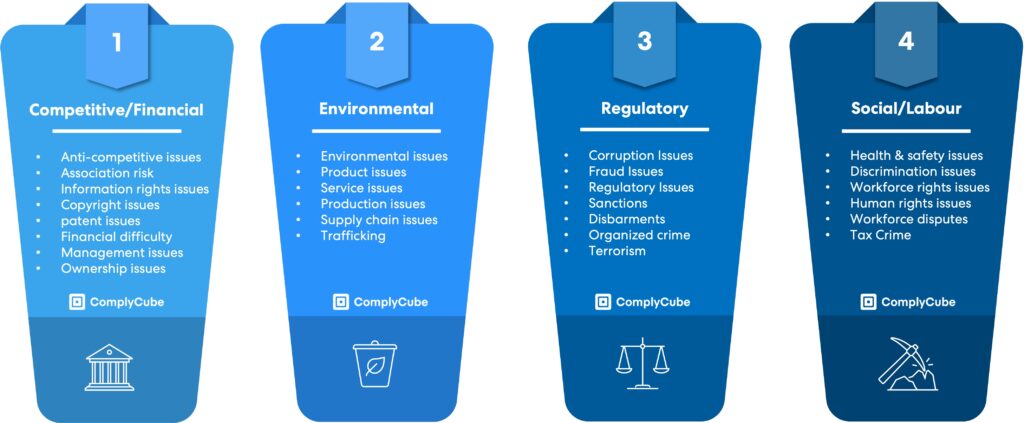Adverse Media Screening Buckets by [ComplyCube](https://www.complycube.com/)
## Where does Adverse Media come from?
- Traditional news outlets and Media.
- International Organisation’s databases.
- Blogs and web articles.
- Specialized websites that publish issues involving AML and FinCrime.
- Social media and internet forums.
- Press releases and notices published by regulators, law enforcement agencies, tax authorities, and other government agencies.
## What do regulators say about Adverse Media Checks?
It is no surprise that different jurisdictions and regulators enforce various Adverse Media AML regulations and guidance. However, they all highlight the need to build accurate risk profiles of clients.
[Financial Action Task Force (FATF)](http://www.fatf-gafi.org) recommends “verifiable Adverse Media searches” as part of customer risk assessments and underlines the need to “understand the client’s reputation”. It also requires firms to determine whether high-risk clients have been “previously investigated” for money laundering or terrorist financing or subject to regulatory enforcement in the past.
Similarly, the EU’s 4th Anti Money Laundering Directive (4MLD), also transposed into UK law, requires firms to perform enhanced customer due diligence (CDD) for high-risk customers, leveraging open-source or Adverse Media searches. 4MLD was strengthened by 5MLD on **10 January 2020** with the new directive encouraging automated Adverse Media Screening. **On 3 December 2020**, 6MLD came into effect, adding cybercrime and environmental crime to the list of money laundering predicate crimes and extending the AML criminal liability.
> Following Brexit, the UK has opted out of the 6MLD, on the basis that domestic legislation already [‘goes much further’](https://assets.publishing.service.gov.uk/government/uploads/system/uploads/attachment_data/file/684374/eighth-annual-report-to-parliament-eu-justice-home-affairs-matters.PDF). However, any regulated UK businesses operating in Europe must comply with the 6MLD.
The United States [Financial Crimes Enforcement Network](https://www.fincen.gov/) (FinCEN) requires financial institutions to conduct Adverse Media Screening as part of the CDD process. FinCEN also requires a risk-based AML approach that includes Adverse Media Screening throughout the relationship, in other words, ongoing Adverse Media Checks.
### **Case Study: Barclays Bank £42 M Fine for Inadequate Screening**
In 2025, the leading bank, Barclays Bank PLC, was [fined £42 million](https://www.linkedin.com/pulse/trust-edition-july-2025-complycube-n2lye/) (USD$56 M) by the UK’s Financial Conduct Authority (FCA) for gaps in its Anti-Money Laundering (AML) screening. Its outdated monitoring system enabled high-risk clients to transfer funds through the bank.
##### **Lack of Oversight on Red Flags**
In one of the cases, Barclays opened an account for Stunt & Co, a gold and trading business that had a relationship with Fowler Oldfield, a jewelry wholesaler linked to a money laundering operation. Despite warnings, the company failed to thoroughly verify its business relationships.
##### **Solutions & Outcomes**
- The company was fined a total of £42 M, including £39.3 million for the case relating to Stunt & Co.
- The FCA publicly censured the bank, requesting it to re-analyze the effectiveness of its AML processes.
- The regulator put Barclays on a remediation plan and ordered it to invest in upgraded monitoring systems to close its risk gaps.
## The Challenge of Adverse Media Screening
Manual Adverse Media Screening is time-consuming, highly ineffective, and does not scale. For instance:
- Institutions use internet searches and “googling” news articles to perform manual searches for negative news on high-risk clients.
- Compliance Officers must cross-reference the outcome of these searches with other data sources and approve them.
- This manual process is labor-intensive, costly, highly error-prone, and subject to increased human bias.
- Media coverage is changing at a staggering pace. Therefore, manual searches provide only a static risk snapshot.
- Media coverage may not be available in a familiar or accessible language and thus may be misunderstood.
- Limited access to some sources will lead to a few pieces of Adverse Media going unnoticed.
### Key Takeaways
- **Adverse media screening** forms a critical layer of Know Your Customer and Anti-Money Laundering compliance programmes.
- **Adverse media sources** can include press releases, social media forums, and public government databases.
- **The process includes** scanning reputable data sources for negative news linked to a business or customer.
- **Leading regulations**, such as FinCEN and FATF, mandate a risk-based AML approach, including adverse checks as CDD.
- **Automated negative media** screening can scan multiple, vast databases and send risk notifications in real-time.
## How our automated processes will help you?
In today’s media landscape, a process reliant on manual searches cannot contend with automated systems that digest enormous amounts of data in real-time, validate it, and then send notifications as soon as there is something of interest.
As such, systematic Adverse Media checks provide you with a more in-depth insight into your clients and allow you to tailor searches based on your risk approach and regulatory requirements. With state-of-the-art systems such as [ComplyCube](https://www.complycube.com), you will be able to screen customers across a vast array of databases and news sources whilst receiving only risk-relevant results. Our [leading platform](https://www.complycube.com/solutions/global-screening/adverse-media-checks/) will enable you to protect your company from reputational, and AML risks effortlessly and cost-effectively.
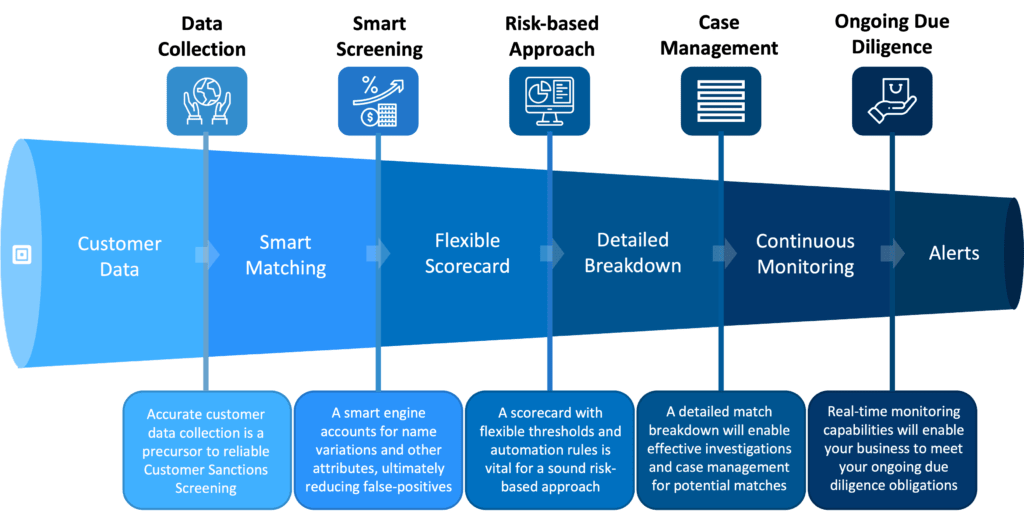Customer Screening at a Glance [ComplyCube](https://www.complycube.com)
Check out [www.complycube.com](https://www.complycube.com/) to learn more about our platform.
## Frequently Asked Questions
How long does an adverse media check take?
Automated adverse media screening can be performed in milliseconds due to the usage of AI, with verification outcome occurring in real-time. However, manual adverse media checks can take anywhere from 12 to 72 hours, as it largely depends on analyst expertise.
What is an adverse media red flag?
An adverse media red flag is any form of negative news linked to a person or entity that may suggest a connection to illicit activity, including fraud, money laundering, corruption, and sanctions. A red flag is raised to notify compliance teams of potential high-risk harm.
Do all companies need adverse media screening?
Not necessarily. Regulated business subject to AML requirements must run adverse media checks as part of the Customer Due Diligence (CDD) process. Adverse media screening acts as an early risk indicator. Although not strictly mandated, it is strongly recommended by global regulatory authorities, such as the FATF, the UK’s FCA, and the U.S. FinCEN.
How much does an adverse media check cost?
Adverse media screening costs anywhere from $1.05 to $15 per individual. The cost can differ across various pricing models, which include pay-per-check, subscription-based, or tiered plans. ComplyCube offers adverse media screening from as low as $0.85 per user, with the cost per check further reduced with high volume verification.
Does ComplyCube offer automated adverse media screening?
Yes, ComplyCube offers automated adverse media screening, covering over 50,000 trusted news sources. Businesses can deploy it quickly into their current systems and workflows with low/no-code and via strong API and SDK integration. All of their data sources are credible, global, and authoritative, empowering companies to reduce fraud risks in a matter of seconds.
**Categories:** Guides
**Tags:** Anti-Money Laundering, Know Your Customer
---
### [ComplyCube's G2 Summer 2026 Wins Tell a Bigger Story](https://www.complycube.com/complycubes-g2-summer-2026-wins-tell-a-bigger-story/)
**Published:** June 3, 2026
**Author:** Rithu Jagannath
**Excerpt:** ComplyCube’s recognition in the G2 Summer 2026 Reports reflects growing customer trust across identity verification, AML, and fraud prevention, showing how G2 Reviews translate into real momentum for regulated businesses.
**Content:**
London, June 2, 2026 – G2 customer reviews typically depict a story about businesses regarding industry trust. For ComplyCube, the G2 Summer 2026 report recognition shows how companies use their award-winning platform for compliance. By verifying identities and screening for risk or fraud, ComplyCube keeps onboarding moving with the utmost confidence. Though these stories rarely make headlines, they define if digital organizations can grow in security.
## What 280 G2 Summer 2026 Badges Signal to Customers
In the G2 Summer 2026 Reports, ComplyCube earned 280 badges. G2 recognized ComplyCube’s performance across Identity Verification (IDV), Anti-Money Laundering (AML), and Digital Onboarding. Arguably, the biggest mover was in the category of Fraud Detection which grew to 8 unique badges including, High-Performer, EMEA and Easiest Admin, Small Business. In an oversaturated AML software market, these G2 reviews are indicative of customer confidence across trust, usability, and operational performance.
That context matters because G2’s Summer 2026 cycle was highly competitive. G2 Summer 2026 release included 27,340 reports in its release after adding 323 reports in the latest quarter. It also stated that only 2% of software providers on G2 received a Leader badge. ComplyCube has maintained 11 leader badges this summer. The story begins here because customer recognition carries more weight in these core categories when the AML software market is harder to stand out in.
## The Risk Environment Has Changed
Growing customer trust is a necessary part of scaling with rising fraud risk. With approximately [445,000 cases](https://www.cifas.org.uk/newsroom/fraudscape2026) filed as fraud according to Cifas, this highlights a 6% increase from the previous year, marking the highest annual total on record. Additionally, identity fraud made up over half of all reports, making it the most common case.
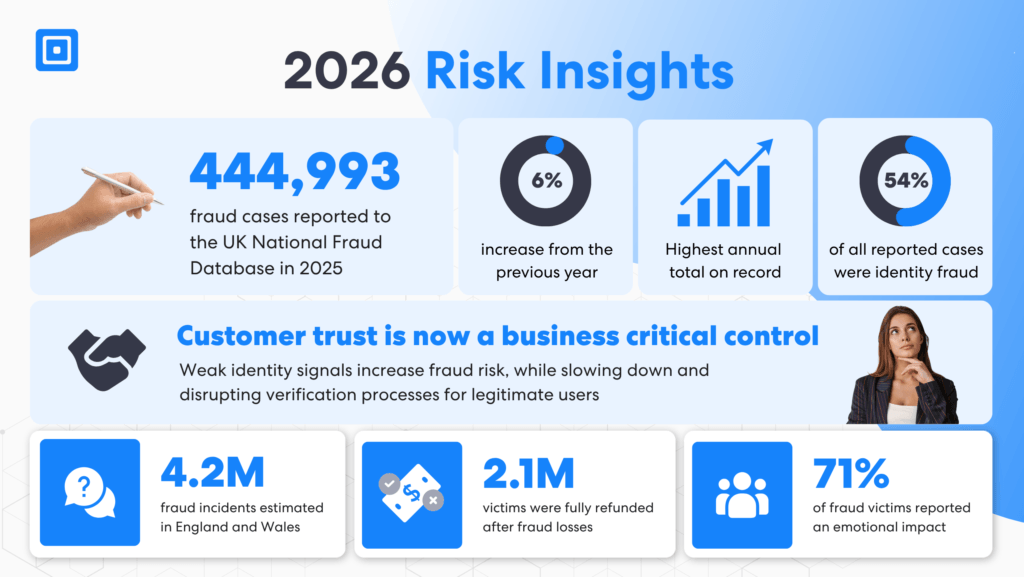2026 Risk Insights
Weak identity signals cause businesses to be exposed to fraud while slowing down verification. This type of pressure is what ComplyCube excels in. They bring IDV, [AML screening](https://www.complycube.com/en/solutions/due-diligence-compliance/anti-money-laundering/), and biometric checks into a configurable environment all while supporting fraud detection, address verification, and workflow automation.
## Why G2 Summer 2026 Reviews Carry Weight in RegTech
G2 reviews are important because compliance software is judged in live workflows and active accounts. Buyers must know whether a platform can be put in place fast, managed easily, and performs well under pressure. The G2 Summer 2026 reports prove that teams worldwide face broader regulatory change. For instance, almost 531 financial institutions across 40 countries contributed their insights for PwC’s [EMEA AML Survey 2026](https://www.pwc.be/en/news-publications/2026/emea-aml-survey-2026.html), showcasing how widespread that pressure has become.
Compliance teams tend to provide feedback on the areas they feel most strongly about. The G2 Summer 2026 recognition touches on setup, administration, and support. Additionally, it reflects on adoption, results, and estimated return on investment. Within the RegTech space, buyers look to whether customers trust the platforms they use.
## From Customer Proof to Fraud Readiness
However, customer proof is only powerful when it shows readiness for the next threat. In 2026, identity fraud is becoming more automated and harder to detect. Flashpoint analysts found almost [64,000 posts](https://www.techradar.com/pro/security/ai-generated-threats-are-hitting-businesses-harder-than-ever-do-you-know-what-to-look-out-for) in April 2026 that advertised or discussed AI-enabled Know Your Customer (KYC) bypass methods. These posts included deepfake-enabled verification workflows across different channels that focused on IDV bypass services.
As a result, this demonstrates the need for businesses to have layered controls in place. They need a solution that provides a proper picture of someone’s identity. For example, if compliance teams add device intelligence, deepfake detection or sanctions screening, they can potentially lower onboarding friction for users. This is why ComplyCube’s suite of products can improve fraud controls and improve overall AML risk management.
> These G2 badges reflect customer moments where trust, speed, and compliance come together.
[Harry Varatharasan](https://www.biometricupdate.com/202605/stop-treating-identity-as-a-compliance-step-its-infrastructure-now), Chief Product Officer at ComplyCube, also says, “Whether it is smooth integration, a clear decision, or an easy onboarding journey for the end user, this G2 Summer 2026 recognition shows what regulated businesses value most about compliance.”
## Built for Trust at Scale
Yet, regulated businesses need governance that keeps pace with changing regulations. Less than 30% of EU institutions conducted a thorough analysis of their AML practices as per PwC’s 2026 AML research reports. Additionally, only one-third of them are likely to be compliant by the upcoming July 2027 deadline of the [EU Anti-Money Laundering Regulation (AMLR)](https://eur-lex.europa.eu/eli/reg/2024/1624/oj/eng) where organizations must move to an overarching European rulebook.
ComplyCube is designed to support that level of change. It verifies in over 250+ countries and territories and supports thousands of identity document types. The real takeaway from the G2 Summer 2026 reports is that the future of compliance relies on platforms that make trust operational, measurable, and scalable.
## About ComplyCube
[ComplyCube](https://www.complycube.com/), three-time RegTech Partner of the Year, supports businesses and firms where trust and compliance cannot be an afterthought. ComplyCube’s platform pairs first-class compliance infrastructure with enterprise-level certifications including ISO 27001:2022, ISO 9001:2015, and SOC 2.
## About G2 Reviews & G2 Summer 2026 Report
[G2](https://www.g2.com/) helps evaluate technology through verified customer feedback and independent market reports. Their badges and category rankings are globally recognized allowing businesses to have a trusted view of which software products stand out for customer satisfaction, market presence, and real-world performance.

**Categories:** News
**Tags:** Announcements
---
### [How to Conduct UK Sanctions List Screening after OFSI Closure](https://www.complycube.com/uk-sanctions-list-screening-post-ofsi-closure/)
**Published:** May 22, 2026
**Author:** Rithu Jagannath
**Excerpt:** Learn how UK sanctions list screening changed after OFSI closure, and how firms can strengthen software-led workflows, ongoing monitoring, transaction screening, case management, and audit trails for stronger compliance outcomes.
**Content:**
**TL;DR:** At the very centre of **sanctions compliance** is UK sanctions list screening. For firms or financial institutions reviewing UK sanctions compliance software, this is the **only up-to-date** sanctions data source. UK **sanctions screening software** helps organizations stay ahead of severe reputational damage and financial penalties.
## What Is UK Sanctions List Screening?
Many organizations lean on global sanctions lists and the UK sanctions list screening to check on customers, businesses, and transactions. Sanctions listings are made under specific legal criteria, often tied to national security, foreign policy, international obligations, or similar concerns. Sanctions cover complicity in human rights violations, assisting in the development of weapons of mass destruction, or large-scale money laundering that breaches any applicable laws, for example. According to GOV.UK, the UK sanctions list is the one and only source for current UK sanctions designations.
As much as this process sounds simple, it is not just a name search. Firms must cross-reference any aliases, addresses, and document data. These pieces of information, known as secondary identifiers, support compliance teams in spotting real risk of sanctions evasion, reducing false positives. This is one of the many reasons that sanctions screening must sit under a wider compliance workflow rather than a separate manual check.
## UK Sanctions List Screening and Regulated Firms
The scale of UK sanctions risk deserves board-member-level attention. According to the Office of Financial Sanctions Implementation (OFSI) Annual Sanctions Review from 2024-2025, there were almost £37 billion in frozen assets across all sanctions regimes on all international lists. This is up from £24.4 billion in the previous year. Additionally, £28.7 billion in Russian assets were frozen under UK sanctions. This shows the significant amounts at stake for regulatory compliance teams.
Oftentimes, sanctions risk hides behind relationships. For example, a customer may pass at the onboarding stage, but a connected company, shareholder, director or [ultimate beneficial owner (UBO)](https://www.complycube.com/en/what-is-ultimate-beneficial-ownership-ubo/) may create exposure later on with new designations. This indicates how sanctions screening links to other compliance processes such as [Know Your Customer (KYC)](https://www.complycube.com/en/solutions/due-diligence-compliance/know-your-customer/), [Know Your Business (KYB)](https://www.complycube.com/en/use-cases/process/know-your-business/), and [Anti-Money Laundering (AML)](https://www.complycube.com/en/solutions/due-diligence-compliance/anti-money-laundering/).
More importantly, this impacts multiple key sectors such as fintechs, insurers, and accountants to name a few. Weak compliance controls can lead to a higher false positive rate. This results in more sanctions violations, operational inefficiencies, and reputational risks.
## OFSI Closure Changed Financial Sanctions Screening
On 28 January 2026, there was a huge change in how firms conducted their financial sanctions screening. The previous model involving the OFSI consolidated list no longer applied. According to the UK government, the consolidated list was officially closed and the [UK sanctions list](https://www.gov.uk/government/publications/the-uk-sanctions-list) became the only source for current UK sanctions designations. Every single policy, data feed, and vendor controls that firms had in place needed to be reviewed for any mentions of OFSI sanctions screening of individuals and entities.
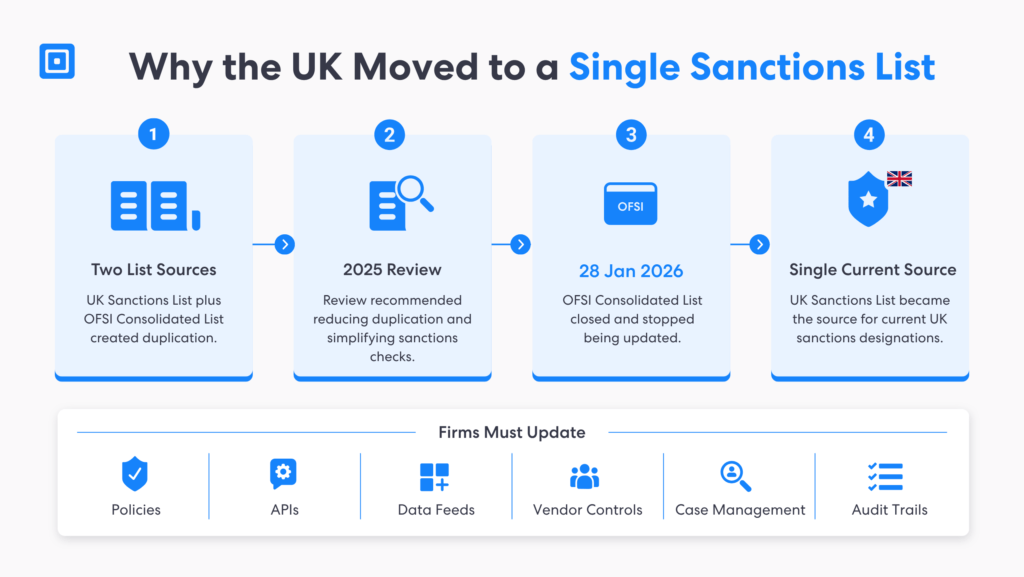
Still, many compliance teams missed this big announcement about the regulations. As a result, several platforms, playbooks, and sanctions screening software vendors did not change their verbiage along with it. With these types of rapid updates, firms may be under the impression that they are doing a good job screening correctly when, in truth, old feeds, outdated logic, or manual checks still sit in the background.
## Effective UK Sanctions List Screening Processes
It is important for firms to collect the right information on a client before the [sanctions screening](https://www.complycube.com/en/solutions/global-screening/sanctions-pep-screening/) begins. A strong process requires thorough data intake of details such as full names, aliases, dates of birth, and more. This helps improve the overall sanctions screening process, providing outcomes that are correct and lowering any remediation time.
However, the most important point is not to panic the moment a potential match on a sanctioned individual comes through. Compliance teams must pause, assess, and avoid rushing to a conclusion. It is necessary to compare a match alert against any secondary identifiers, ownership data, customer records, and risk history. Moreover, if the match case remains unclear after some preliminary investigation, the client should move down a much more defined risk escalation path.
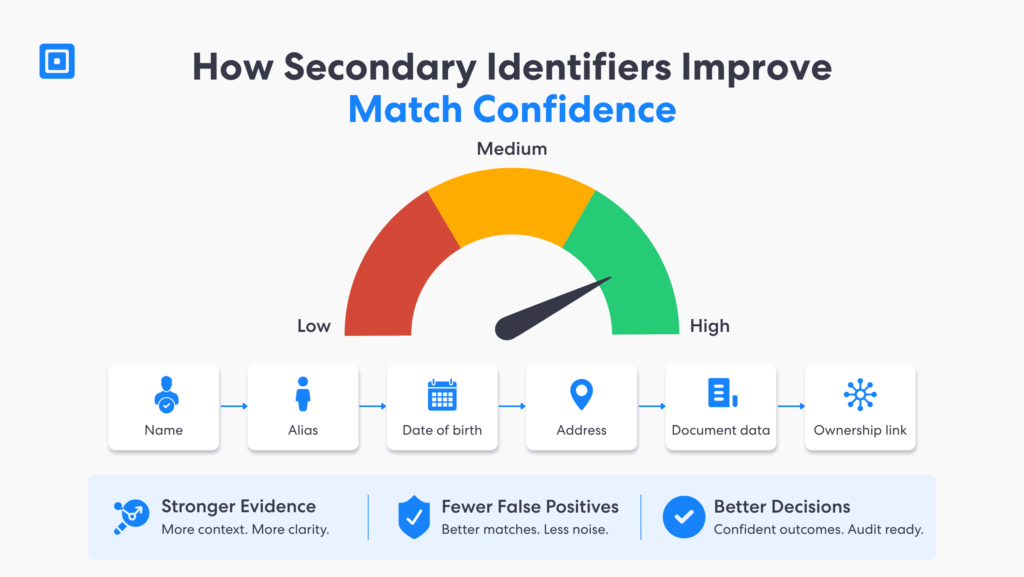
In order to have a strong process, firms must collect the right information before the search begins. Full names, aliases, and dates of birth help improve overall sanctions screening outcomes and lower remediation time.
> Sanctions screening works when firms can prove what they screened.
According to [Harry Varatharasan](https://www.biometricupdate.com/202605/stop-treating-identity-as-a-compliance-step-its-infrastructure-now), Chief Product Officer, “They also must be able to point to when they screened it, and why they made each decision. Each decision must create an audit trail.” Firms can ensure compliance with any risk policies and defend their decisions during audit periods, board reviews, or any sanctions enforcement.
## What Firms Should Do After a Sanctions Match
A sanctions breach is a serious issue and can happen to anyone. If any firm knows or suspects a breach, it is important to follow a structured risk escalation process with the necessary reporting obligations. According to [Financial Conduct Authority (FCA) guidance](https://handbook.fca.org.uk/handbook/fcg7) around sanctions, firms must report any suspected breaches to the OFSI. The closure of the consolidated list never removed the obligation to report. Any specific cases dealing with a designated person or frozen assets must be reported to the FCA as well.
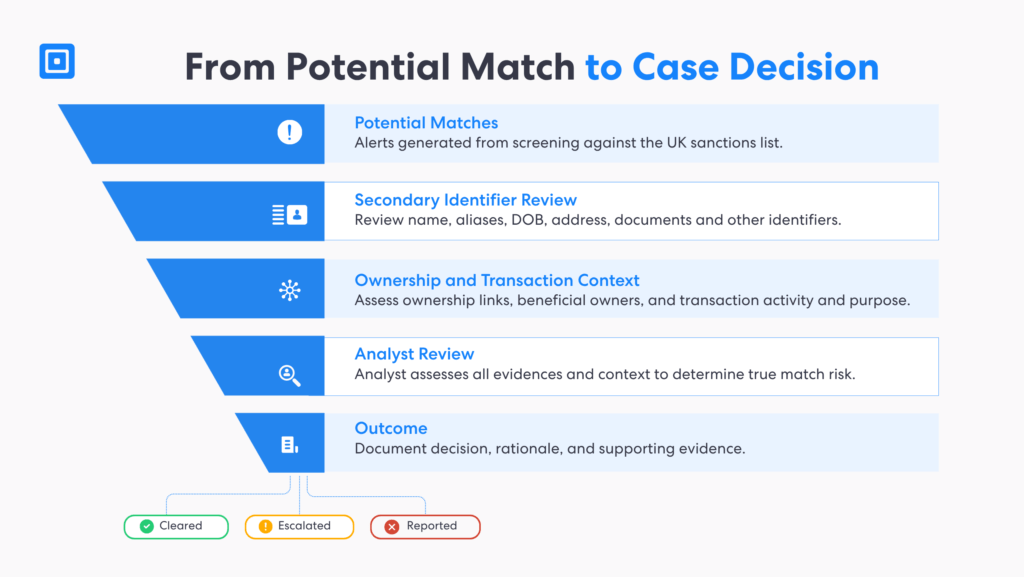
One thing all strong global sanctions compliance processes have in common is effective case management. They are responsible for capturing the alert’s source, match reason, time stamps, evidence, and outcomes. Real-time screening must also show whether the case triggered any [Enhanced Due Diligence](https://www.complycube.com/en/enhanced-due-diligence-requirements-guide/) (EDD) processes. This record within an effective sanctions screening software helps compliance teams improve match rules over time. You can learn more here: [What is Sanctions Screening?](https://www.complycube.com/en/what-is-sanctions-screening/)
## Ongoing Monitoring and Transaction Screening
Oftentimes, a customer may be fine today, but they may be designated tomorrow. That’s why an important aspect of an effective UK sanctions list screening protocol is ongoing monitoring. Monitoring helps firms catch risk past the onboarding stage as information changes. Similarly, another important feature to have in a sanctions screening software is transaction screening. It helps firms catch hold of any risk before value, goods, or services move. These types of events need diligent screening workflows that do not rely on a manual calendar date.
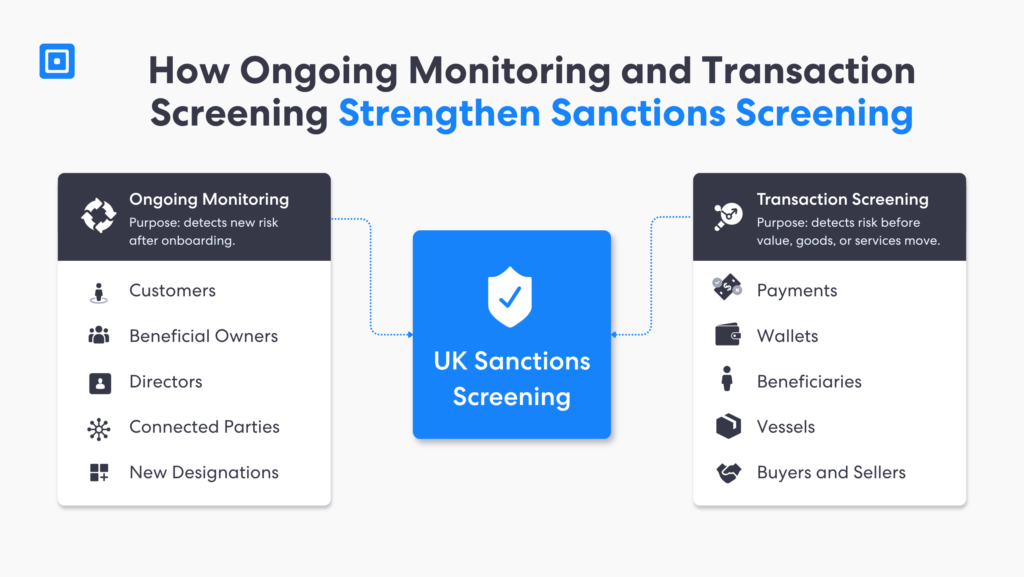
Generally, false positives create a great deal of pressure across both controls. Too many weak alerts slow onboarding time, delay payments, and make real risks harder to spot. Machine learning or artificial intelligence can help score alerts, rank cases, and learn from analyst decisions. Regardless, human review should remain central to the UK sanctions screening process.
### **Case Study: Deutsche Bank AG London Bank’s Sanctions Breach**
[In May 2026](https://www.linkedin.com/pulse/trust-edition-may-2026-complycube-c7lae), the Deutsche Bank AG London Branch (DBLB) received a penalty of £165,000 for breaching the Russia financial sanctions regime. Between June and July of 2022, DBLB processed two payments to an entity owned by a designated person according to the UK sanctions list.
##### **Major Sanctions Control Failures Revealed**
This [Deutsche Bank AG London Branch](https://www.gov.uk/government/publications/imposition-of-monetary-penalty-deutsche-bank-ag-london-branch-dblb) case marks the second OFSI monetary penalty case resolved through settlement. It also reinforces a very important lesson about risk appetite. Compliance teams must find restricted activity, escalate concerns, and keep thorough evidence explaining a clear decision pathway.
##### **Outcomes**
- The Deutsche Bank AG received a £165,000 penalty.
- Control evidence is just as important as sanctions detection.
- OFSI used this Deutsche Bank case to showcase compliance lessons for other firms.
## Building an Effective Screening Compliance Program
Finally, the key to building the best sanctions screening software is ensuring it links to the rest of the key features within a compliance stack. UK sanctions list screening must feed into onboarding, KYC, AML, and fraud prevention. When these compliance functions operate in silos within separate systems, teams can lose very important context.
A connected process also improves overall customer experience. Low-risk users can move through lower-friction flows, while higher-risk users receive proportional checks. Compliance teams can reduce unnecessary manual work without weakening oversight.
### Key Takeaways
- **UK sanctions list screening** is the only source for UK-sanctioned entities and persons.
- **The OFSI consolidated list** closure created a process review for UK firms.
- **Firms must get the full picture** of their sanctions screening match before arriving at a decision.
- **Ongoing monitoring and transaction screening** support firms in finding new risks.
- **Connected workflows** across various compliance products help improve audit trails, case management, and compliance decisions.
## Global Sanctions Compliance with ComplyCube
In summary, firms need a platform that helps them turn UK sanctions list screening information into an evidence-ready compliance workflow. ComplyCube provides a system that nestles sanctions screening with Identity Verification (IDV), ongoing monitoring, and case management all in one place.
ComplyCube also supports flexible deployment with APIs, SDKs, and hosted flows. Compliance teams can now adjust risk rules, escalation paths, and policy logic without long development cycles. Skip third-party risk management by exploring our global PEP and sanctions screening solution. Learn how to update your UK sanctions list screening post OFSI consolidated list closure. Talk to the [ComplyCube](https://www.complycube.com/contact/contact-sales/) team about how to meet the FCA’s regulatory expectations on sanctions screening.

## Frequently Asked Questions
What is UK sanctions list screening?
UK sanctions list screening checks customers, businesses, and transactions against the UK sanctions list. Firms use it to find designated individuals, sanctioned entities, and ownership links. Thorough screening prioritizes secondary identifiers, ownership data, adverse media, audit trails, and ongoing monitoring.
What replaced the OFSI Consolidated List?
The OFSI consolidated list was close in 28 January 2026 leaving the UK sanctions list as the current and only source of UK sanctions designations. As a result, firms are required to update any policies, data feeds, APIs, and sanctions screening to reflect the single-list model.
What should UK sanctions screening software include?
UK sanctions screening software must include current sanctions data, frequent updates, adverse media, and watchlist screening. It also needs to support any secondary identifiers, ownership screening, and audit trails. The best types of sanctions screening systems balance out automation with real human review.
Why do firms need both ongoing monitoring and transaction screening?
Ongoing monitoring and transaction screening is a necessary part of detecting sanctions exposure after onboarding. This way, teams can determine any sanctions risk before value, goods, or services move. Ongoing monitoring covers people and connected parties, whereas transaction screening focuses on payments and other transaction details.
How can ComplyCube help with UK sanctions list screening?
ComplyCube helps firms connect UK sanctions list screening with IDV, PEP screening, and ongoing monitoring amongst many other compliance solutions. Its APIs, SDKs, and hosted flows help compliance teams build strong risk-based controls into onboarding and operational workflows. Firms must move from isolated checks to connected sanctions compliance.
**Categories:** Guides
**Tags:** Anti-Money Laundering
---
### [Wise Money Laundering Control Lapses Under Belgium Scrutiny](https://www.complycube.com/wise-money-laundering-control-lapses-belgium/)
**Published:** June 2, 2026
**Author:** Dini Habib
**Excerpt:** The British FinTech company Wise is currently under investigation by Belgian prosecutors for several lapses in its AML programme. Reports indicate illicit criminal funds flowing through Wise accounts, amounting to half a billion.
**Content:**
On June 1, 2026, Belgian authorities announced that they are investigating Wise money laundering concerns. Allegedly, some of the company’s accounts were used by criminals to move illicit flows into fraud, corruption, and drug trafficking. The British FinTech company has responded to these allegations.
**Fun Fact:** Wise was launched back in 2011 by two Estonian entrepreneurs, Taavet Hinrikus and Kristo Käärman, living in London. The founders had interesting backgrounds, with Taavet being Skype’s first employee and Kristo working at Deloitte. The two bonded through their experiences of high international transfer costs, which led them to build Wise.
## Why Was Wise Under Scrutiny?
The investigations began last year, when Wise accounts surfaced in hundreds of law enforcement requests. According to the Bureau of Investigative Journalism, Belgian prosecutors are expected to see [over €500 million](https://www.theguardian.com/business/2026/jun/01/wise-investigated-belgium-money-laundering-control-concerns) (USD$580M) in suspicious transactions, spanning across 30 European countries.
Notably, the Brussels prosecutor’s office focuses its investigations on Wise’s European branch, specifically, the Belgian entity. Belgian watchdogs are still inspecting the case, with Wise fully cooperating with authorities, according to their press release.
> Enquiries are still incomplete, and no specific findings have been shared with us to date. As such, it would be [speculative](https://www.londonstockexchange.com/news-article/WISE/wise-europe/17616662) for us to comment on any allegations.
The scale of this case points to a wider systematic challenge, suggesting the lack of oversight and consistency in verifying high-risk users, businesses, and transactions. This could point to weak [Enhanced Due Diligence (EDD)](https://www.complycube.com/en/enhanced-due-diligence-requirements-guide/) and ongoing monitoring, which can enable bad actors to exploit easily.
## Wise Faces $4.2M Fine Last Year for AML Deficiencies
Unfortunately, this is not the first time the FinTech has been underwater for Anti-Money Laundering (AML) related scrutiny. Back in July 2025, Wise was [penalized $4.2 million](https://www.linkedin.com/pulse/trust-edition-july-2025-complycube-n2lye/) by multiple US state regulators for violating AML controls. Specifically, the firm struggled to meet key AML and Countering the Financing of Terrorism (CFT) controls. This includes inadequate due diligence and monitoring processes for suspicious activity.
> We face the reality of increasingly sophisticated bad actors attempting to exploit our platform, and we continually invest in tech-enabled systems and teams to stay ahead of ever-evolving threats.
[](https://www.linkedin.com/pulse/trust-edition-july-2025-complycube-n2lye/)
For [FinTech firms](https://www.complycube.com/use-cases/industry/fintech/), the pressure to meet heightened Know Your Customer (KYC) and AML regulations has peaked in recent years. Regulators are demanding tighter controls. This is partially due to the fast, low-friction transfers in the sector, which can act as a haven for fraudsters and criminals to lurk in.
**Fun Fact:** In 2025, FinTech and crypto firms racked up the highest amount of KYC and AML-related fines. Out of the top 10 penalties, around $1.1 billion, or 84% of fine were handed out to firms in this sector. Some of the familiar company names include OKX ($500M), KuCoin ($300M), and BitMEX ($100M).
The recent statement by Wise highlights the growing risks in the sector, with the team stating, “Like every financial institution, we face the reality of increasingly sophisticated bad actors attempting to exploit our platform, and we continually invest in tech-enabled systems and teams to stay ahead of ever-evolving threats”.

Subscribe to ComplyCube’s [Trust Edition newsletter](https://www.linkedin.com/newsletters/the-trust-edition-7103022355722981376/), where we explore the top developments across identity verification and AML globally. Plus, we share valuable insights on compliance with the latest regulations.
**Categories:** News
**Tags:** Anti-Money Laundering
---
### [Evaluating Anti-Money Laundering Software Beyond Monitoring](https://www.complycube.com/anti-money-laundering-software-evaluation/)
**Published:** May 11, 2026
**Author:** Dini Habib
**Excerpt:** The effectiveness of AML software solutions does not always depend on their monitoring or screening technology. Factors, such as alert precision and behavioral intelligence features, play an equally critical role in AML programs.
**Content:**
**TL;DR:** Many firms evaluate the effectiveness of their **Anti-Money Laundering software solutions** based on their monitoring technology alone. However, regulators are shifting their focus to demonstrable outcomes, rather than mere technology establishment. This guide explores the key aspects that indicate the **effectiveness** of AML software solutions beyond just technology.
## What is Anti-Money Laundering Software and How Does it Work?
Anti-Money Laundering (AML) software is a platform that supports businesses in detecting, reporting, and combating money laundering and terrorist financing risks. Additionally, it provides organizations with a straightforward way to comply with AML regulations.
For example, this software provides checks such as ongoing monitoring and sanctions screening aligned with leading mandates, including the U.S. Bank Secrecy Act, the EU’s Anti-Money Laundering Directive, and the Financial Action Task Force (FATF) Recommendations. In Anti-Money Laundering software, the typical workflow for a customer or business follows a structured process:
1. **Know Your Customer (KYC):** Identity verification and customer due diligence
2. **AML screening:** This stage may include sanctions and watchlist checks, Politically Exposed Person (PEP) screening, and adverse media checks to identify potential financial crime risks that arise.
3. **Ongoing Monitoring:** Continuous analysis of changes in a customer’s risk profile.
4. **Case Review:** Following up with next steps and supporting evidence when red flags are generated.
5. **Suspicious Activity Reporting (SAR):** Submitting full documentation of reports to meet regulations.
Modern AML platforms use automation to collect, analyze, and investigate risk-relevant data more efficiently. Furthermore, effective AML compliance software features advanced analytics, Artificial Intelligence (AI) and machine learning to detect sophisticated fraud. This includes identifying deepfakes, unusual device behavior such as VPN usage, and signs of document tampering.
## Why Anti-Money Laundering Software Evaluation Must Go Beyond Screening
Having screening and monitoring tools in place forms a partial part of an effective AML infrastructure. Regulators are now expecting businesses to go further to go further by proving that their teams design and test controls according to current threats.
> Rather than just having a compliance platform in place, businesses must demonstrate strong risk-based effectiveness.
For example, the U.S. Financial Crimes Economic Network (FinCEN) [2026 proposal](https://www.fincen.gov/news/news-releases/fincen-proposes-rule-fundamentally-reform-financial-institution-programs) reinforces effective, risk-based programs that go beyond reliance on technical compliance alone. Harry Varatharasan, Chief Technology Officer (CTO) at ComplyCube, states, “Rather than just having a compliance platform in place, businesses must demonstrate strong risk-based effectiveness. This means having controls that adapt, prioritize high-risk scenarios, and deliver real outcomes, not just alert volumes.”
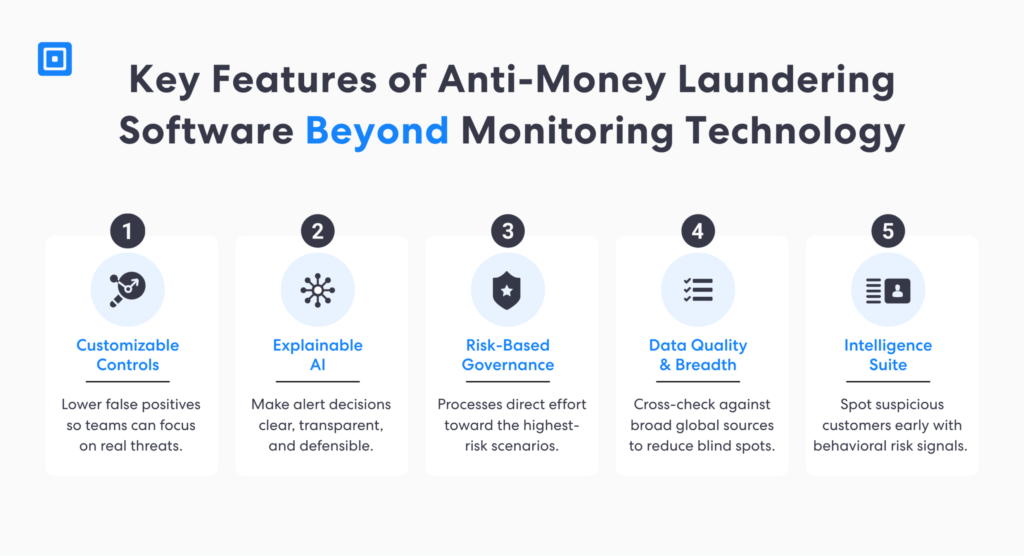
Furthermore, recent industry research suggests that Anti-Money Laundering solutions generate [85 to 95% of false positives](https://www.openlayer.com/blog/post/false-positive-rate-complete-guide-ml-teams) on average. As a result, compliance teams spend most of their time on threats that do not necessarily have high financial crime risks, while genuine threats evade detection. Screening and transaction monitoring are no longer sufficient differentiators in AML technology.
To design an effective compliance strategy, businesses must choose [Anti-Money Laundering software](https://www.complycube.com/en/solutions/due-diligence-compliance/anti-money-laundering/) solutions that prioritizes:
- **Customizable controls** for significantly lower false positive generation, so compliance teams can focus on genuine threats.
- **Explainable AI** that provides transparent decision logic to build a defensible reasoning for alert generation.
- **Risk-based governance** that dynamically focuses resources on high-risk customers and activities.
- **Data quality and breadth** to ensure comprehensive cross-reference from global sources to minimize blind spots in screening.
- **Intelligence suite** that detects suspicious user behavior before onboarding, creating a multi-layered defense against fraud at the point of entry.
## False Positive Reduction Is Becoming a Board-Level Metric
One of the major challenges in Anti-Money Laundering software is managing the volume of false positives, which can heavily fatigue compliance resources. Moreover, it can lead to less effectiveness in recognizing true risks as the week progresses, especially if there are low conversion rates into meaningful escalations. To tackle this challenge, modern AML evaluations focus heavily on:
- **Data extraction:** Make use of [Optical Character Recognition (OCR)](https://www.complycube.com/en/solutions/due-diligence-compliance/know-your-customer/optical-character-recognition/) for precise extraction and population of customer information during KYC. Additionally, integrating [smart KYC forms](https://www.complycube.com/en/solutions/compliance-suite/smart-forms/) into existing systems enables businesses to collect richer context, including source of wealth, and right to work proof, without overwhelming users. As a result, rules are less likely to fire on behavior that is fully explained by existing data.
- **Smart matching:** Numerous vendors market fuzzy name matching as a quick fix for sanctions screening. However, effective screening goes beyond that. Transliteration support, phonetic matching, multi-script handling, and name normalization are critical for dealing with real-world variations. This includes non-Latin scripts, titles, and honorifics. As such, compliance teams can tune screening controls precisely without missing true matches.
- **Alert precision:** Understanding the effectiveness of AML software solutions requires tracking alert quality at the rule level. To elaborate, this means analyzing how many alerts from a rule actually produce suspicious activity reports or investigations. Low-yield rules can then be tuned or retired to focus resources on strong alert to SAR conversion and genuine high-risk exposure.
The strongest AML platforms are those that help investigators focus on genuinely suspicious behavior instead of drowning compliance teams in low-value reviews. Focusing on software with automated data extraction, customizable screening logic for name matching, and alert precision is crucial.
## Explainability Is Now a Regulatory Requirement
AI without explainability can introduce as much regulatory risk as it removes operational burden. Regulatory expectations are increasingly moving towards explainable, or transparent AI in AML programs. For example, the [EU AI Act framework](https://www.europarl.europa.eu/topics/en/article/20230601STO93804/eu-ai-act-first-regulation-on-artificial-intelligence) is pushing firms towards transparent, auditable AI in AML, especially where systems influence customer risk assessments and monitoring outcomes.
Regulators increasingly expect firms to explain:
- Why alerts triggered
- How risk scores were calculated
- Why investigators closed cases
- How machine learning models are governed
This is critical to avoid regulatory penalties, especially with 89% of compliance and risk leaders encouraging the use of AI within their organization. As such, financial institutions must analyze for explainability and case management strength by asking:
- **Decision explainability:** Can the platform show, at alert level, which data points and rules or model features drove the risk score, in a way that investigators and regulators can understand?
- **Case management and audit trail:** Does the system capture a complete, time‑stamped trail of alert generation, risk score changes, investigative actions, comments, and final decisions?
- **Model governance support:** Does the vendor provide documentation, monitoring dashboards, and controls that support model validation, versioning, and performance tracking in line with your risk management framework?
- **Human‑in‑the‑loop controls:** Can investigators override model outcomes with clear justification, and does the platform learn from those decisions without becoming a “black box” you cannot explain?
[Strong case management](https://www.complycube.com/solutions/due-diligence-compliance/case-management/) tools should support compliance programs by generating clear, real-time, and regulatory-ready explanations for decisions and escalation workflows. These capabilities improve operational efficiency, enhance risk visibility across cases, and make it easier to produce comprehensive reporting for regulatory reporting and internal stakeholders.
## Evaluate Risk-Based Orchestration
Anti-Money Laundering software solutions that support a [Risk-Based Approach (RBA)](https://www.complycube.com/en/what-is-a-risk-based-approach/) is one of the clear signs of effectiveness. A risk-based workflow enables financial institutions to apply different controls to customers and entities based on the potential risk present. This moves AML compliance to a proactive, rather than a stationary process, where all users are forced through the same onboarding journey.
> This approach should be an [essential foundation](https://www.fatf-gafi.org/content/dam/fatf-gafi/recommendations/FATF%20Recommendations%202012.pdf.coredownload.inline.pdf?) for efficient allocation of resources across the anti-money laundering and countering the financing of terrorism (AML/CFT) regime.
A risk-based approach is critical to satisfying regulatory demands. Notably, the FATF expects controls to be proportional to the nature, scale, and complexity of a company’s activities. The key regulators enforcing the RBA include the Financial Conduct Authority (FCA) and FinCEN, to effectively manage money laundering risk. When evaluating a vendor’s risk‑based orchestration, financial institutions should check whether the platform can:
1. **Segment customers and activity by risk:** Automatically assign and update risk ratings based on factors like geography, product, behavior, and adverse media, and route each segment through appropriately tailored onboarding and monitoring paths.
2. **Apply dynamic controls and workflow:** Trigger different levels of KYC, enhanced due diligence (EDD), and monitoring rules based on current risk, rather than one‑size‑fits‑all rules, and adjust those pathways as risk changes over time.
3. **Evidence proportionality to regulators:** Provide clear audit trails and reporting that show why a particular control set was applied to a customer or transaction, and how this aligns with the firm’s documented risk assessment and risk appetite.
### **Case Study: Canada’s FINTRAC Revokes Company Licenses**
In March 2026, Canada’s regulator, the Financial Transactions and Reports Analysis Centre of Canada (FINTRAC), removed [23 crypto](https://www.complycube.com/en/crypto-news-jpmorgan-ponzi-scheme/) firms’ licenses. Without valid licensing, these firms are forced to cease and freeze all operations in the country.
##### **Major AML Violations Revealed**
Most of these crypto firms failed to meet the country’s AML program. This included filing necessary Suspicious Transaction Reports (STRs) on time, highlighting the regulator’s firm stance in meeting reporting requirements under AML rules.
##### **Outcomes**
- FINTRAC’s stern move meant that these affected firms had to stop serving Canadian customers and businesses, creating significant reputational and financial damage.
- This case sends a strong message to all firms, not just financial services, on the importance of case management, including timely reports to authorities.
- Reporting quality, governance, and responsiveness to regulator queries are equally gaining importance in AML programs.
## Integrating External Data and Global Databases for Continuous Monitoring
Client screening software verifies the identity of new clients at the onboarding stage and checks against sanctions lists, adverse media emerges or other watchlists. Anti-Money Laundering (AML) solutions must constantly update these external data sources to support [ongoing monitoring](https://www.complycube.com/en/what-is-an-ongoing-monitoring-process/) across the entire customer lifecycle.
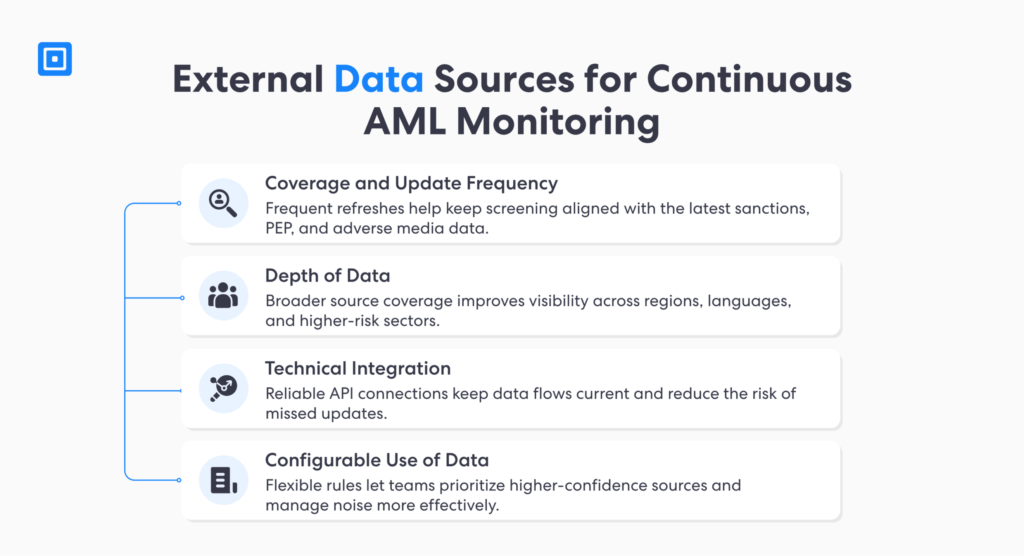
When assessing a provider’s use of external data, compliance officers should look for:
- **Coverage and update frequency:** Sanctions, PEP, and adverse media data from reputable providers, refreshed in near real time.
- **Depth of data:** Global coverage, local language sources, and sector‑specific lists that match the firm’s geographic and product footprint.
- **Technical integration:** API‑based connections rather than manual file uploads, with monitoring that shows when feeds fail or lag.
- **Configurable use of data:** The ability to treat different sources differently (e.g. primary sanctions vs. low‑quality adverse media) to avoid unnecessary false positives.
This is particularly important for regulated businesses operating globally in the crypto, fintech, and financial sectors to maintain compliance with Anti‑Money Laundering regulations and broader regulatory requirements. Additionally, strong API-based integrations improve risk management outcomes by reducing false positives and streamlining compliance processes.
By dynamically updating risk data and applying dynamic risk scoring throughout the customer lifecycle, AML compliance software improves risk management, supports robust diligence procedures, and helps identify emerging threats before they escalate into suspicious financial activities.
## Intelligence at the Point of Onboarding
Organizations are leveraging intelligence features that can run in the background without adding more steps in the onboarding journey. For instance, [device](https://www.complycube.com/solutions/fraud-intelligence/device-intelligence), email, and phone intelligence provides granular risk insights on behavioral signals before a customer even completes onboarding. Some examples of these behavioral signals include VPN usage, email domains, and IP addresses.
These intelligence features mean fewer suspicious users enter a firm’s ecosystem, which significantly decreases escalation workload. In addition, low-risk genuine users can onboard with minimal friction as these checks only happen in the background. Furthermore, one-time password (OTP) verification also provides a multi-layered defense with minimal effort required from an entity or individual.
A multi-layered, smart verification process, such as ComplyCube’s fraud intelligence suite, offers:
- **Device intelligence:** Alerts compliance teams to risky sessions via behavioral and network signals on a device. This may include IP mismatches, proxy use, and geolocation tampering that can indicate suspicious device setups.
- **Phone intelligence:** Checks whether a number is high-risk or linked to previous fraud by analyzing carrier risk, number hygiene and porting history. [Risky phone numbers](https://www.complycube.com/solutions/fraud-intelligence/phone-intelligence-verify-phone-number) can be blocked early while letting legitimate numbers onto the next KYC step.
- **Email intelligence:** Detects throwaway or auto-generated email addresses that can indicate synthetic identities. Firms can filter high-risk emails and [reduce suspicious users](https://www.complycube.com/solutions/fraud-intelligence/email-risk-score) entering the ecosystem via looking at domain validity, email reputation, and breach history.
### Key Takeaways
- **Modern Anti-Money Laundering** software automates the detection and reporting of money laundering and terrorist financing risks.
- **False positives** are increasingly used as indicators of effective AML solutions, with global standards demanding that noise is systematically reduced.
- **When implementing AML software solutions**, financial institutions should look for those that support ongoing monitoring, fraud prevention, and clear audit trails.
- **Device, mobile, and email** **intelligence** features strengthen fraud detection, stopping bad actors before onboarding.
- **Advanced analytics, AI, and machine learning** in data extraction, risk scoring, and case management combats evolving financial crime threats.
## Choosing The Right Anti-Money Laundering Software Solutions
In essence, choosing the best Anti-Money Laundering software solutions will highly depend on a company’s risk appetite, geography, and sector. However, companies must not overlook the key indicators presented above that can demonstrate the effectiveness of AML solutions. These indicators include alert precision to reduce false positives, strong explainable AI systems, risk-based governance, and a robust intelligence suite. To learn more about how you can get started with ComplyCube’s unified AML platform, [speak to us](https://www.complycube.com/contact/contact-sales/) today!
[](https://portal.complycube.com/signup)
## Frequently Asked Questions
What is Anti-Money Laundering software?
AML software supports financial institutions and other regulated organizations to detect, prevent, and report money laundering and other financial crimes. Modern AML platforms cover identity verification, sanctions and Politically Exposed Person (PEP) screening, ongoing monitoring, and regulatory reporting to identify suspicious patterns and meet regulatory compliance.
How do AML solutions reduce false positives?
Effective AML software make use of artificial intelligence and machine learning algorithms to support a risk-based approach, driving lower false positives. They include dynamic risk scoring and customizable thresholds, creating precise alert generation, so compliance teams can focus on genuine threats without weakening financial crime controls.
Why is a Risk-Based Approach (RBA) important for AML compliance?
Regulators and jurisdictions alike, such as the FATF, FCA, and the EU, mandate an RBA, where firms are expected to segment compliance efforts in proportion to risk tiers. With an RBA, businesses can detect suspicious activity more effectively, focusing due diligence and monitoring where the risk of money laundering and terrorist financing is highest.
What are the top AML software providers for regulatory compliance in 2026?
The top AML software vendors offer customizable controls, explainable AI systems, strong data quality and breadth for ongoing monitoring, seamless integration, and comprehensive behavioral risk signals for effective money laundering and fraud detection. Essentially, choosing an AML vendor depends on a company’s risk profile, scale, and regulatory environment.
Does ComplyCube’s AML software work alongside legacy monitoring tools?
ComplyCube’s AML solutions are designed to complement existing compliance and risk management systems. With robust API and SDK integrations, businesses can plug in KYC and monitoring features to meet their unique compliance obligations. As such, businesses at any stage and sector can easily layer AML checks while keeping their current compliance stack.
**Categories:** Guides
**Tags:** Anti-Money Laundering
---
### [ComplyCube Sets a New Standard in Peer to Peer Car Sharing With Turo](https://www.complycube.com/peer-to-peer-car-sharing-with-turo/)
**Published:** April 21, 2026
**Author:** Rithu Jagannath
**Excerpt:** Turo partners with ComplyCube to power secure, frictionless identity verification and fraud prevention across its global peer‑to‑peer car‑sharing marketplace. This partnership boosts conversion, and scalable growth for all parties.
**Content:**
LONDON, April 21, 2026 – [ComplyCube](https://www.complycube.com/) joins forces with [Turo](https://turo.com/), the world’s leading peer to peer car sharing marketplace. Together, they power next-gen [identity verification](https://www.complycube.com/en/customer/turo-strengthens-car-sharing-compliance/), crush fraud, and scale trusted mobility worldwide. This collaboration shows a shared commitment to building trust in mobility as a service platforms, where smooth user journeys and thorough compliance operate in parallel.
## Responding to Growth in Peer to Peer Car Sharing
The overall growth of peer to peer car sharing is extraordinary and closely linked to the rise of platform-based ecosystems. For example, PwC estimates that [digital platform models could generate $335 billion ](https://www.pwc.es/es/publicaciones/digital/evaluacion-economia-colaborativa-europa.pdf "https://www.pwc.es/es/publicaciones/digital/evaluacion-economia-colaborativa-europa.pdf")in global value. This makes mobility services such as Turo form a key part of that ecosystem. As adoption increases, expectations change. Similarly, Salesforce research shows that [88% of customers](https://www.salesforce.com/uk/news/stories/customer-engagement-research/ "https://www.salesforce.com/uk/news/stories/customer-engagement-research/") consider their experience just as important as the service itself. This places a great amount of pressure on platforms to deliver fast and intuitive onboarding without a lot of friction.
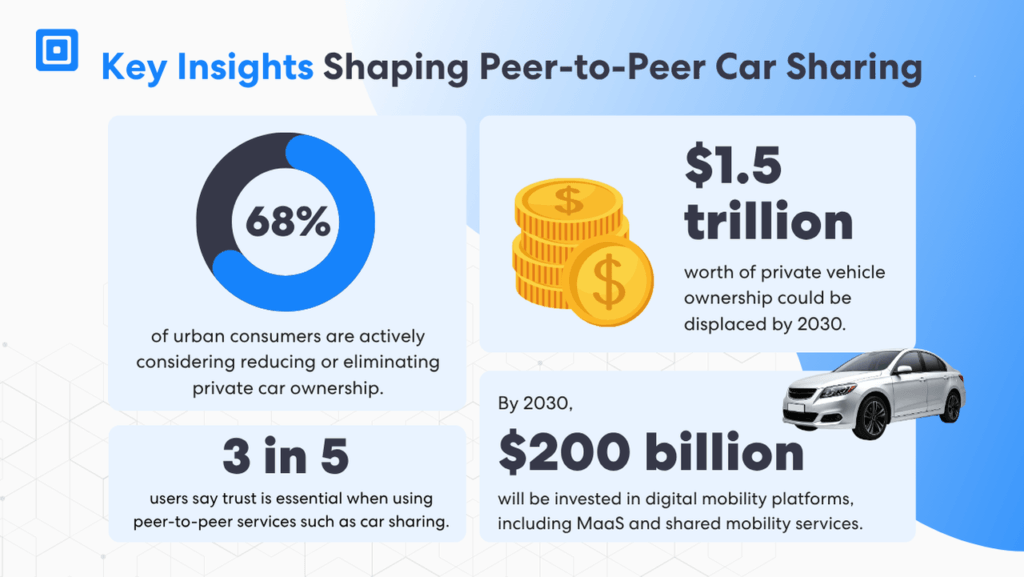
Specifically, the common denominator is trust, as it is the main driver of customer engagement. According to the Edelman Trust Barometer, 61% of customers say their [openness to use a digital platform](https://www.edelman.com/trust/2025/trust-barometer/special-report-brands) depends on how well it guards their personal data. As such, it further solidifies the role of secure IDV in user decision-making. According to the Chief Product Officer at ComplyCube, Harry Varatharasan,
> Platforms operating in peer to peer car sharing must embed trust into every stage of the user journey.
Harry goes on to add, “The ability to combine seamless onboarding with strong identity verification is essential for sustainable growth.” Turo found this balance as a key priority for their platform. Therefore, choosing solutions such as ComplyCube is crucial, as it can boost both operational efficiency while also enhancing the overall quality of the user experience.
## Delivering a Unified Framework for a Car Sharing Marketplace
ComplyCube offers the quickest omni-channel integration turnaround in the market. It equips Turo with the ability to put in place an end-to-end verification structure. These types of solutions only further support onboarding assurance throughout Turo’s entire car sharing marketplace. ComplyCube’s unified platform brings Identity Verification (IDV), [Know Your Customer (KYC)](https://www.complycube.com/en/solutions/due-diligence-compliance/know-your-customer/), and fraud intelligence within one single workflow. This supports consistent and more growth-oriented decision-making.
Key capabilities include:
- AI-powered document verification across 250+ countries and ID types
- PAD Level 2-certified biometric liveness detection for secure identity confirmation
- Driver licence verification, aligned with trusted UK data sources
- Device, mobile, and email intelligence to provide behavioural context
- No-code workflow orchestration, enabling adaptive onboarding journeys
However, unlike traditional systems that hinder transparency, ComplyCube gives verification outputs that support faster and more informed decisions. As a certified [UK Digital Identity and Attributes Trust Framework (DIATF)](https://www.ukas.com/accreditation/about/developing-new-programmes/development-programmes/uk-digital-identity-and-attributes-trust-framework/) Identity Service Provider (IDSP), the platform delivers a high level of assurance aligned with regulatory expectations. Rory Brimmer, Managing Director, UK at Turo, commented:
> As bookings on Turo surged to new heights, partnering with ComplyCube was a natural choice to evolve our driver’s license verification and risk management processes.
Additionally, Rory also states that, “This collaboration enables us to scale confidently while maintaining the highest standards of trust and safety.” He further highlights that the partnership strengthens their ability to deliver secure, seamless services to customers worldwide. It ensures that growth scales together with strong compliance.
## Driving Impact Across the Peer to Peer Car Sharing Marketplace
In truth, this partnership provided many meaningful operational improvements. It shows how thorough verification helps both performance and user experience within a peer-to-peer car sharing environment. Some major stats and key results from the [partnership](https://www.complycube.com/customer/turo-strengthens-car-sharing-compliance/) between Turo and ComplyCube include:
- 34% reduction in driver license verification costs, driven by automation and workflow optimisation
- 15% increase in checkout conversion rates, achieved without compromising security
- 36% reduction in customer support contact rates, supported by clearer risk signals and improved verification accuracy
It is important to realize that such outcomes are indicative of broader industry insights. [The Organization for Economic Co-operation and Development (OECD)](https://www.oecd.org/en/topics/anti-corruption-and-integrity.html) shows that strong data governance structures play an incredibly important role. It helps build digital trust, and influences user participation and long-term platform engagement.
## Scaling Trust in a Global Car Sharing Marketplace
Scaling makes trust harder to sustain. According to [PwC](https://www.pwc.com/us/en/library/trust-in-business-survey.html), 94% of business executives report trust-building challenges. As [Turo further expands](https://www.bloomberg.com/news/videos/2024-07-01/turo-ceo-s-plans-for-expansion-video) its operations globally, it was necessary for a more unified verification approach for this reason. However, with increasingly complex processes and growing expectations for instant access, Turo is under pressure to further improve both speed and reliability in a way that matches its already strong customer‑centric platform. This enabled:
- Faster onboarding for legitimate users
- Greater consistency in verification outcomes
- Improved operational clarity for internal teams
With this in mind, Turo was able to build a scalable infrastructure. This type of framework helped build a system that supports continued growth. It reinforced trust at every stage of the peer to peer car sharing journey. Turo was able to smooth its verification journey into a single system with ComplyCube.
## Strengthening the Future of Mobility as a Service Platforms
Subsequently, this partnership between ComplyCube and Turo is indicative of a broader shift towards an integrated compliance and verification solution. It underpins the next generation of mobility as a service platforms, much like Turo. For example, [research from McKinsey](https://www.mckinsey.com/~/media/McKinsey/Industries/Public%20and%20Social%20Sector/Our%20Insights/Customer%20Experience/Creating%20value%20through%20transforming%20customer%20journeys.pdf) demonstrates that organizations that focus on customer trust can outperform peers by up to 25% in customer satisfaction and overall retention. This highlights the commercial value of strong identity and data practices.
Moreover, this partnership also supports regulatory and policy perspectives. The OECD emphasizes trust in digital identity and data handling. It is a key enabler of participation in digital economies, particularly when it comes to platform-based services such as Turo. By embedding verification and governance into its platform, Turo was able to further [strengthen its leadership](https://turo.com/blog/uk/insights/car-sharing-for-net-zero/) in peer to peer car sharing. As a result, it delivered a service that balances accessibility with confidence.
## About ComplyCube
[ComplyCube](https://www.complycube.com "ComplyCube") is a leading RegTech platform providing Identity Verification (IDV), Know Your Customer (KYC), Anti-Money Laundering (AML), and fraud prevention through a unified, API-first infrastructure. With coverage over 250+ countries and certifications including ISO 27001:2022, and ISO 9001:2015, ComplyCube helps deliver secure, compliant, and scalable digital onboarding at a global level.
## About Turo
[Turo](https://turo.com/gb/) is the world’s largest peer to peer car sharing marketplace, connecting vehicle owners with drivers through a seamless digital platform. Founded in 2010, Turo operates across the United States, United Kingdom, and Canada, supporting millions of mobility as a service platform journeys with integrated booking, payments, insurance, and customer support.
**Categories:** News
**Tags:** Announcements
---
### [Norion Bank Fined SEK 90 Million by SFSA](https://www.complycube.com/norion-bank-fined-90-million-by-sfsa/)
**Published:** May 29, 2026
**Author:** Rithu Jagannath
**Excerpt:** Norion Bank’s SEK 90 million penalty shows how weak customer checks, risk reviews, and AML controls can expose banks to serious regulatory action and lasting reputational damage.
**Content:**
On 28 May 2026, Finansinspektionen, Swedish’s financial watchdog, issued Nordic institution, Norion Bank, SEK 90 million, approximately $9.75 million, in fines. This penalty was as a result of several breaches of Anti- Money Laundering (AML) rules. A formal remark and an adminstrative fine was issued by The Swedish Financial Supervisory Authority (SFSA) they closed their investigation into Norion’s AML controls.
**Fun Fact:** Norion Bank was formerly known as Collector Bank. Founded in 1999, it was initially a management business for non-performing loans. Later, it became a licensed bank. It operates across Nordic regions with locations in Sweden, Norway, and Finland.
## What Led to the Norion Bank SFSA Fine?
The investigation into Norion Bank by Finansinspektionen began in May 2023 while reviewing whether or not the bank had complied with Sweden’s AML and Counter-Terrorist Financing (CTF) rules. The period the review covered was from 30 April 2023 to 1 May 2023 with Norion bank and other market participants.
Many of Norion’s AML frameworks were investigated by the SFSA. Enforcement officers looked into baseline controls around general risk assessment and Customer Due Diligence (CDD) measures within their review. This dictates how banks identify, score, and raise customer risk further up.
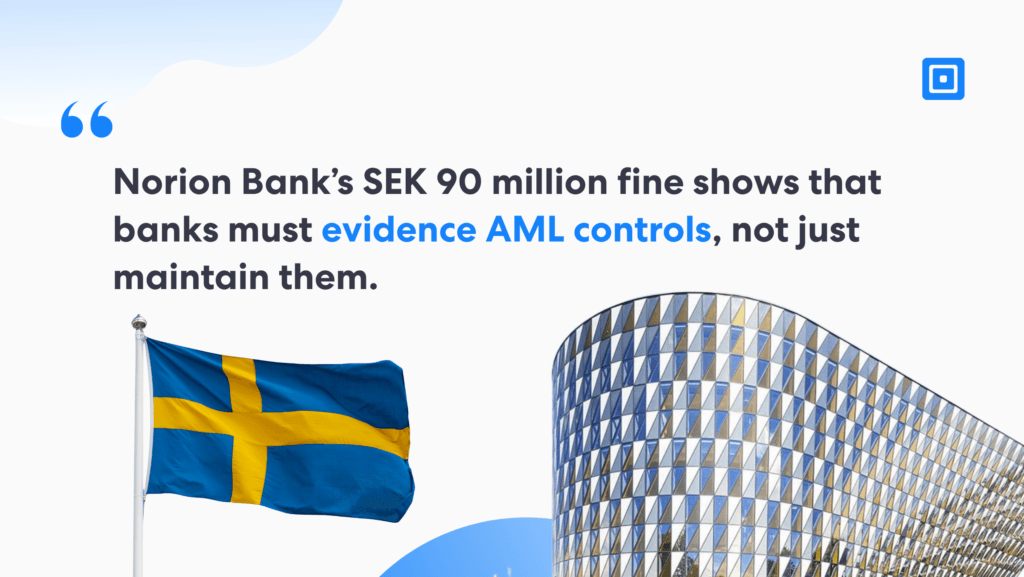
### The SFSA investigation of Norion Bank looked certain risk controls:
- Weakened Know Your Customer (KYC) standards
- Any process gaps during customer risk assessments
- Inadequate due diligence procedures and guidelines
- Failures connected to Politically Exposed Persons (PEPs)
- Weak controls for identifying risks linked to PEP family members
It is important to note that the financial authority did not frame this AML issue as a simple paperwork issue. The regulator was concerned around whether Norion Bank had enough risk controls in place for high-risk corporate clients. This is crucial because ownership structures, transaction activity, and business purposes require close inspection.
## Sweden’s AML Enforcement Push
Finansinspektionen took action against Norion Bank. Historically, the authority builds regulations and monitors many supervised firms. This is an effort to prevent criminals from misusing organizations for AML or CTF reasons. Additionally, they are responsible for whether firms keep up with procedures and protocols in order to prevent financial crime.
**Fun Fact:** Finansinspektionen was created in 1991 after Sweden merged its banking and insurance supervisory authorities into one regulator. Today, it oversees firms across banking, payments, insurance, securities, and other areas of the financial market.
However, there is a larger pattern with Swedish financial crime enforcement. Finansinspektionen has issued several AML-related sanctions against several financial institutions such as Klarna, Zimpler and Svea Bank for example.
Supervisors are paying attention to the nitty gritty details around how firms assess risk, apply customer due diligence, and present evidence for compliance decisions. EU law, Swedish legislation, and Finansinspektionen combined shape the AML framework of the country. Supervised firms must meet broad legal duties and regulatory expecations to protect the Swedish financial system from fraud and misuse.
Ultimately, the fine creates financial and reputational consequences for Norion Bank. Banks must keep AML programmes risk-based, current, and clearly evidenced in customer files. Policies alone are not enough when a bank cannot show how it made risk decisions.
[](https://www.complycube.com/en/contact/contact-sales/)
Subscribe to ComplyCube’s [Trust Edition newsletter](https://www.linkedin.com/newsletters/the-trust-edition-7103022355722981376/), where we explore the top developments across identity verification and AML globally. Plus, we share valuable insights on compliance with the latest regulations.
**Categories:** News
**Tags:** Anti-Money Laundering
---
### [What is Ultimate Beneficial Ownership (UBO)?](https://www.complycube.com/what-is-ultimate-beneficial-ownership-ubo/)
**Published:** August 7, 2024
**Author:** Andreea Balasa
**Excerpt:** Establishing an entity's Ultimate Beneficial Ownership (UBO) can be challenging, and needs Know Your Business (KYB) technologies to enable compliance. The common UBO meaning is the person(s) in control of another separate entity.
**Content:**
**TL;DR:** Establishing an entity’s **Ultimate Beneficial Ownership** can be challenging, and demands Know Your Business (KYB) technologies to meet compliance standards. An Ultimate Beneficial Owner refers to the individual or group of people who is in control of and responsible for actions taken by another entity. This guide explores what UBO is and how to identify **real ownership.**
## What is an Ultimate Beneficial Owner?
A UBO is the natural person or group of people who own and/or control another entity. Entities can range from another human being to a multi-billion dollar institution. While the beneficial owner might control a significant portion of responsibility, they might not be directly listed within a company’s official documents or an affiliate individual’s records.
The standard definition of Ultimate Beneficial Ownership is when 25% (or more) is controlled by one group or individual. Such a large stake grants the owner(s) unparalleled levels to exercise ultimate and effective control.
### What is a UBO of a Company?
The beneficial owner of a company is the person or group that ultimately benefits from the business’s activities. This means they have the power to make significant decisions regarding the company’s operations, finances, and strategic direction.
Identifying the UBO is crucial for institutions establishing new business relationships. They must ensure that the operators of a partner company are compliant and operate legally. Not doing so could lead to non-compliance with financial and [Anti-Money Laundering](https://www.complycube.com/en/solutions/due-diligence-compliance/anti-money-laundering/) (AML) regulations or other corporate fines.
### What is a Beneficial Owner of an Individual?
Beneficial ownership of an individual refers to someone who benefits from assets held by another person or entity. These cases often include individuals whose assets are held in trust funds or via custodial arrangements. In these cases, the UBO has the lawful right to obtain profits or other economic benefits from them, but the trustee holds legal ownership of the assets.
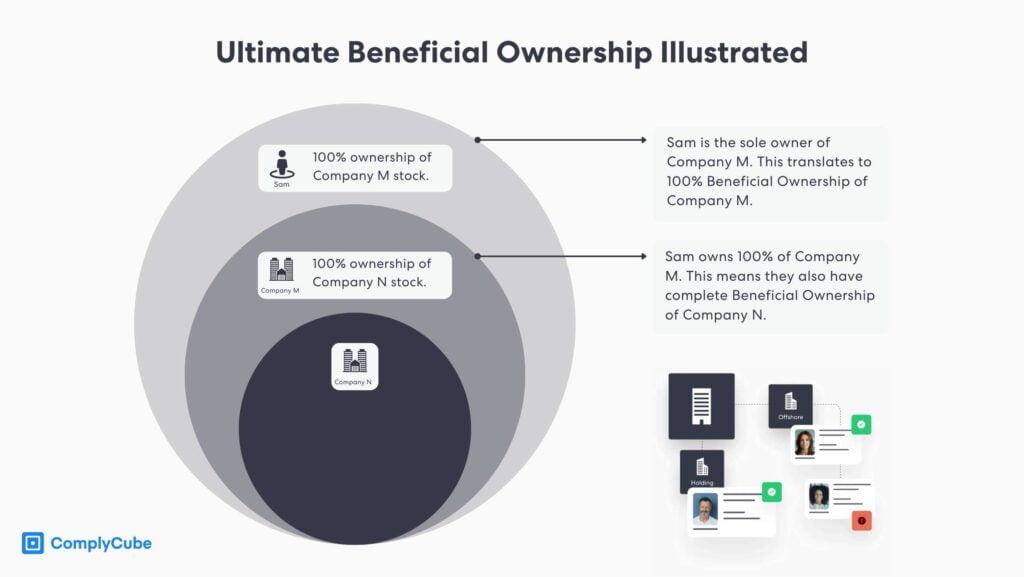
## What is Know Your Business?
[Know Your Business](https://www.complycube.com/en/use-cases/process/know-your-business/) is the process used by institutions to identify the backgrounds of companies they might work with. This includes ascertaining the ownership structure (Ultimate Beneficial Ownership), financial and legal health, and compliance with laws such as AML regulations.
KYB solutions use advanced technologies to facilitate this process in a matter of minutes, reducing the time spent on due diligence and the cost of onboarding new businesses as well as enabling compliance with dynamic and potentially convoluted regulations.
## The Corporate Transparency Act (CTA) in the US
The Corporate Transparency Act, [launched in 2021 but only taking effect on ](https://www.fincen.gov/news/news-releases/us-beneficial-ownership-information-registry-now-accepting-reports)[January 1, 2024](https://www.fincen.gov/news/news-releases/us-beneficial-ownership-information-registry-now-accepting-reports), requires firms to submit particular information regarding beneficial owners—known as Beneficial Ownership Information Reports (BOI Reports). This information must be sent to the Financial Crimes Enforcement Network (FinCEN) [as part of America’s AML Act of 2020 ](https://www.nortonrosefulbright.com/en/knowledge/publications/55b72cd0/the-corporate-transparency-act-is-here)and its renewed mission to increase corporate and structural transparency.
### The data a reporting company must submit:
- Full legal name and trade name
- Up-to-date address of the business’s place of trade/where the firm conducts business
- Jurisdiction of where the company is registered
- Inland Revenue Service (IRS) Tax Payer Identification Number (TIN)
### The data each company applicant and the beneficial owner must submit:
- Full legal name
- Date of birth
- Up-to-date residential address
- Personal identification number and ID document
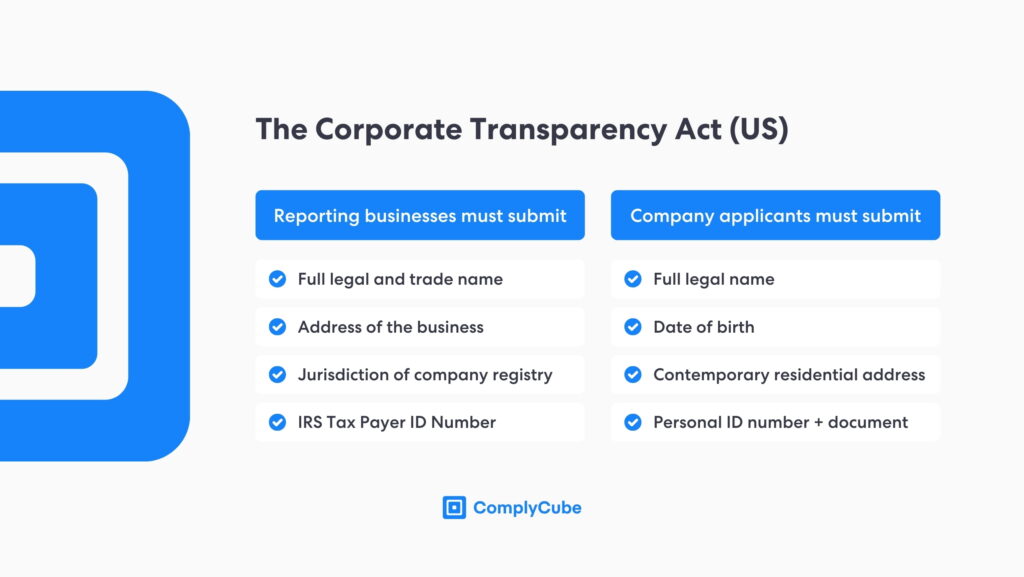
## Challenges of Finding Ultimate Beneficial Ownership
Firms face many challenges when establishing an entity’s, institution’s, or individual’s UBO. These include layered ownership structures, data opacity, and regulatory discrepancies.
### Complex Ownership Structures
One of the significant challenges in identifying ultimate beneficial ownership (UBO) of an individual is navigating complex ownership structures. Many individuals and some institutions structure the ownership of their assets or companies in layered arrangements, using holding companies, trusts, or offshore entities to obscure the true ownership of assets or equity.
These structures can create an irregular network of ownership that makes it difficult to trace back to the ultimate owner. The use of intermediaries or nominees further complicates this process, as the legal title might not reflect the true owner of the assets. Institutions must sometimes dive far deeper than the surface-level ownership to determine the real beneficiary.
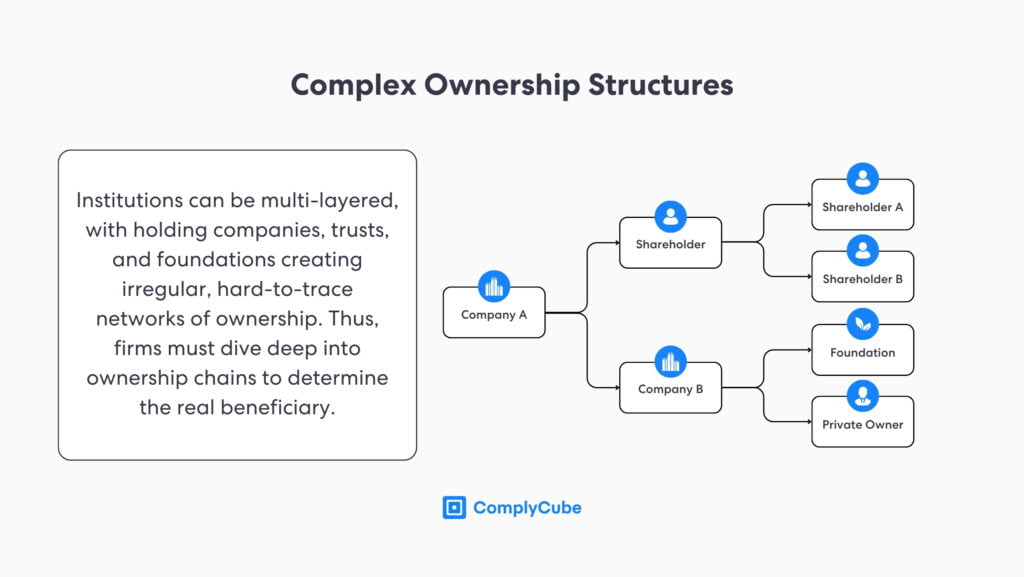
### Lack of Transparency
Many regions have stringent privacy laws that protect the identity of beneficial owners by law, making it extremely difficult to obtain the required information. Typically, the lack of beneficial ownership transparency occurs in tax havens or secrecy jurisdictions that offer a high level of confidentiality, which can shield the identities of individuals seeking to conceal their ownership.
These protective laws, while legally justified, often purposefully hinder efforts to reveal the true beneficiaries of financial and corporate structures. This poses a significant challenge for regulators wishing to prevent financial crime and financial institutions, among other businesses, looking for safe partnerships.
### Inconsistent Regulations
Jurisdictional inconsistency in regulation can prove another steep hurdle for firms. The lack of a global standard for identifying the Ultimate Beneficial Owners of legal entities allows different countries to define beneficial ownership differently. Fragmented regulations lead to disparate methods of UBO identification.
This divergence in regulation means businesses may have to employ different methods of identification in different regions where the firm operates, leading to high compliance costs to facilitate different UBO verification methods.
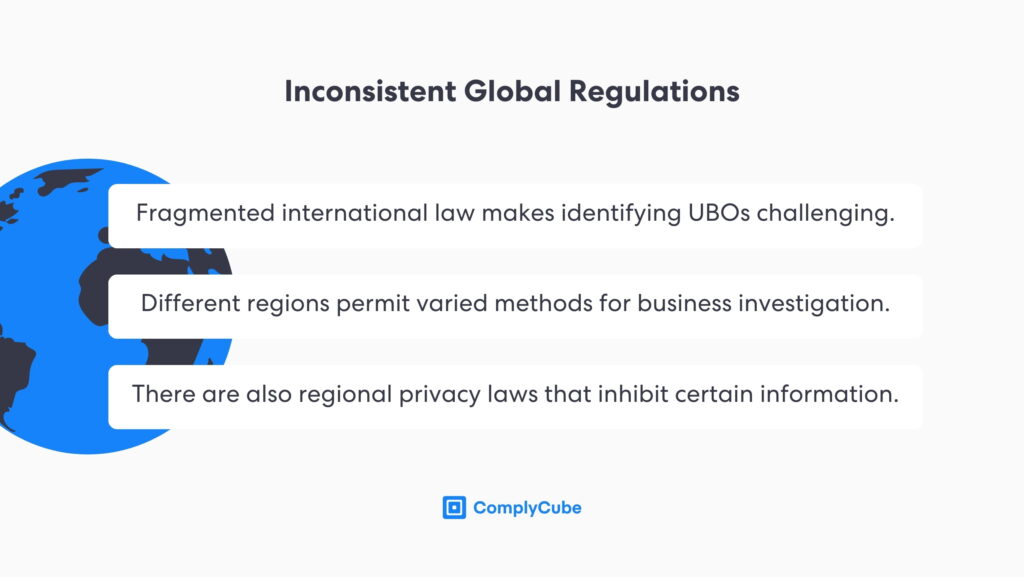
### Use of Trusts and Foundations
Trusts and foundations can separate legal and beneficial ownership, adding to the complexity of identifying UBOs. Trustees hold the legal rights to the assets in question, but the beneficiaries enjoy the rewards.
Identifying the UBO can be challenging for various reasons, including trustee discretion, confidentiality agreements, and dynamic asset entitlements. Foundations obscure fund ownership by separating the control and benefits of the underlying assets.
### Deliberate Concealment
Malicious individuals or firms knowingly contravening AML laws might choose to purposefully conceal an institution’s true nature and ownership. Shell companies, sophisticated financial instruments, or nominee shareholders are all viable methods for deliberately concealing the true ownership of large entities.
These evasive tactics are designed to obscure true ownership and the value of the ownership stake, making it difficult for authorities or other companies to identify the Ultimate Beneficial Ownership. Fraudulent activities, such as using false information to disguise the real owners, increase the complexity of the true identification of UBOs. Combatting these challenges, along with the others listed above, requires robust AML and KYC processes.
### Technology and Resources
Identifying UBOs is, therefore, a resource-intensive exercise that requires sophisticated technologies to efficiently and affordably complete. Smaller companies with limited resources may struggle to implement robust systems for tracking and verifying UBOs. Technological barriers, such as outdated or incompatible IT systems, can hinder the efficient sharing and processing of beneficial ownership data.
The FATF recommends that firms invest in modern technologies and related resources to overcome these challenges. This will enable businesses and regulatory bodies to streamline processes, improve data accuracy, and ensure compliance with transparency requirements.
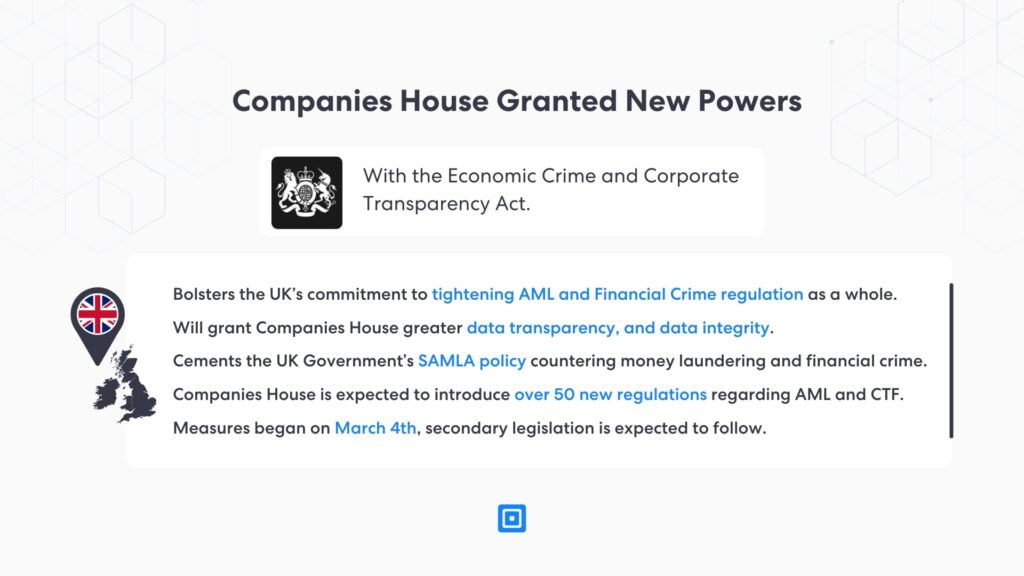
In its [updated Recommendation 24,](https://www.fatf-gafi.org/content/dam/fatf-gafi/guidance/Guidance-Beneficial-Ownership-Legal-Persons.pdf.coredownload.pdf) the Financial Action Task Force (FATF) provides guidelines on how firms should identify UBOs on a unified and global level. Furthermore, the UK released its [Economic Crimes and Corporate Transparency Act](https://www.legislation.gov.uk/ukpga/2023/56) in 2023/24, strengthening Companies House’s authority and setting a new global standard. The Act demonstrates the UK’s ambition to deliver the resources and create an environment to quell money laundering.
### **Case Study: Building Security and Agility While Maximizing Global Growth**
##### **The Complexity of Compliance in Global Jurisdictions**
Bots, the leading trailblazer in global blockchain innovation, aimed to expand its operations worldwide. However, the large volume verification and cross-border operations presented a key challenge: ensuring complete adherence to AML and identity verification regulatory requirements in different countries.
##### **The Need for Speed, Compliance, and Agile Operations**
High-volume cross-border compliance often forces companies to choose between speed and security. Bots, however, sought to achieve both. The firm partnered with ComplyCube to sustain its rapid expansion. With automated no/low-code workflows, Bots was able to streamline AML screening, address checks, and biometric verification on one platform without heavy IT resources.
##### **Solutions & Outcomes**
- Bots were able to onboard 98% of customers in under 30 seconds through automated AML and KYC checks.
- The company scaled its operations to over 34 countries confidently, utilizing ready-made, customizable workflow templates.
- ComplyCube was able to deliver layered verification tailored to sector- and country-specific risks, supporting both KYC and AML compliance.
## The Role of Know Your Business Solutions
KYB solutions play a crucial role in establishing and maintaining compliance with international regulations such as Ultimate Beneficial Ownership identification. Know Your Business is designed to help firms navigate the complexities of identifying and verifying the beneficial owners of their partners, clients, and other entities with which they engage.
By leveraging KYB technologies, such as ComplyCube, companies can significantly streamline their due diligence processes, reduce risks associated with financial crimes and money laundering, and ensure adherence to local and international Anti-Money Laundering regulations.
### Time to Adopt Compliance Technology
The integration of sophisticated technologies, such as Artificial Intelligence (AI) and Machine Learning (ML), is vital in providing a swift identification process. When this is coupled with a sleek User Interface (UI) and User Experience (UX), compliance processes are significantly streamlined in both time and cost spent on due diligence.
### Key Takeaways
- **A UBO can refer** to either the person or a group of people that ultimately owns, controls, or is responsible for an entity.
- **Verifying UBO is** central to AML and KYC, as it confirms who someone or something is doing business with.
- **Complex ownership structures** can obscure the true UBO, demanding more comprehensive tracing and verification methods.
- **Effective UBO checks** support businesses in detecting suspicious or hidden entities, thus reducing fraud risks.
- **Various jurisdictions** hold their own UBO verification requirements, including filing and disclosure obligations.
## ComplyCube’s KYB Solution
ComplyCube is a market-leading Know Your Customer (KYC) and KYB service provider. Their services are actively used around the world to navigate the complex legal and corporate structures used by firms to obfuscate identity and real ownership.
The global AML compliance firm sets new precedents in integration time. With a no-code, low-code, hosted solution, or full integration, partner firms have the option to start using ComplyCube’s hosted product in less than a day or integrate its AML solutions fully into their existing compliance tech stack.
Learn more about ComplyCube’s compliance offering by [getting in touch with a KYB and AML specialist today.](https://www.complycube.com/en/contact/contact-sales/)
## Frequently Asked Questions
What is Ultimate Beneficial Ownership (UBO)?
UBO refers to a person or group of individuals who ultimately owns or controls another entity. One can be a UBO despite not being formally named as an official owner. This makes identifying a UBO challenging, as they can conceal their true self, especially in complex management structures.
Why do businesses need to identify Ultimate Beneficial Owner?
Verifying a UBO is a core KYC and AML requirement. It enables businesses to identify the real individuals or groups of people that have a large influence over a company’s activity. UBO verification ensures transparency in business relationships and uncovers potential misuse of corporate structures that can be used to conceal financial crime.
How to perform Ultimate Beneficial Ownership verification?
The typical flow of UBO verification involves robust KYC, including collecting certificates of registration, ID, and shareholder documents. It also requires tracing the ownership structure by identifying intermediary firms, trusts, or holding firms. Additionally, it involves AML screening of the identified UBO, including watchlist, sanctions screening, and ongoing monitoring.
Are Ultimate Beneficial Ownership verification rules the same everywhere?
No, the rules for UBO verification and disclosure differ across jurisdictions. For example, in the UK, companies must perform KYC on anyone with significant control (PSC) of more than 25% of shares or voting rights in the entity. In the U.S., FinCEN’s beneficial ownership rules require firms to report individuals with at least 25% of the company or exercise substantial control over it.
How does verifying Ultimate Beneficial Owner prevent fraud?
UBO verification is central to KYC and AML regulations. It prevents fraud and other financial crime by establishing higher transparency in corporate structures. For example, it unveils hidden controllers, stops fraudsters from establishing fake businesses, and prevents the funneling of illicit flows through complex structures.
**Categories:** Guides
**Tags:** Know Your Business
---
### [CryptoCubed May Newsletter: Binance Iran Crypto News and MiCA Crypto Rules Review](https://www.complycube.com/cryptocubed-may-newsletter-binance-iran-crypto-news-and-mica-crypto-rules-review/)
**Published:** May 28, 2026
**Author:** Dini Habib
**Excerpt:** In May, we explore the biggest crypto regulatory developments in the UK, US, India, and the EU. We cover the latest review of the MiCA crypto rules, the recent Binance-Iran crypto allegations, and new sanctions targeting Russia.
**Content:**
👋 Welcome back! In this CryptoCubed May Edition, we explore several major regulatory developments impacting the crypto landscape globally. This includes the EU’s latest MiCA crypto rules review, the UK’s Money Laundering and Terrorist Financing (Amendment) Regulations 2026, and the Indian Government’s scrutiny of Virtual Digital Assets (VDA). Additionally, we also cover the recent Binance Iran crypto allegations and new sanctions targeting Russia. Read on below!
## India Flags Crypto as High-Risk Sector
India, May 26, 2026 🇮🇳: India’s government delivers a warning to the parliamentary finance panel, classifying VDA and the broader crypto ecosystem as “high-risk.” This is crucial, as the parliamentary finance panel reviews India’s VDA regulatory framework.
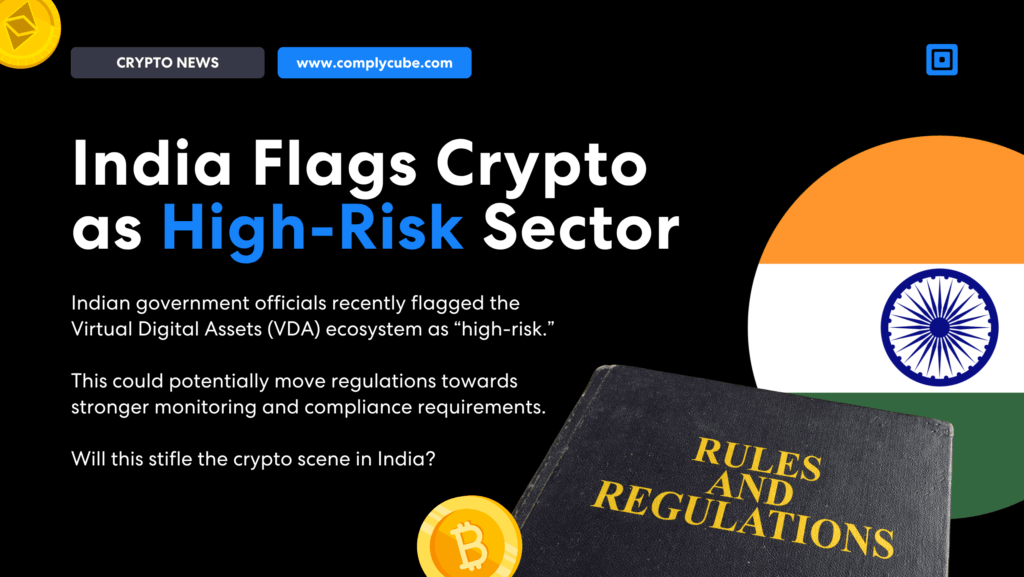
The warning sets a tone for the direction of where the policy may go next, which can include tighter surveillance and possibly more restrictive regulation rather than a friendlier framework. As such, it shifts the message from “we tax crypto” to “the crypto market can create significant financial and security challenges.”
For more information, click [here](https://m.economictimes.com/news/india/government-flags-cryptocurrency-as-high-risk-amid-illegal-activities-and-tax-compliance-issues/articleshow/131233344.cms).
## Binance Iran Crypto Allegations
United States, May 22, 2026, 🇺🇸: A recent article by the Wall Street Journal alleged that Binance, the world’s largest cryptocurrency exchange, enabled $850 million in transactions to move through an Iranian-linked network, despite multiple compliance red flags.
This case follows the company’s 2023 guilty plea, which saw Binance fined $4.3 billion for major Anti-Money Laundering (AML) and sanctions failures. In the article, it was stated that the transactions were linked to an Iranian-linked trading network associated with Babak Zanjani, an Iranian businessman who has publicly described himself as “anti-sanctions”.
The Wall Street Journal alleged that the compliance team at Binance flagged the activity as suspicious, and yet the account still stayed active for about 15 months. Binance has strongly rejected these claims, reiterating that it has “zero-tolerance for illicit activity.”
For more information, click [here](https://www.wsj.com/world/middle-east/iran-binance-crypto-military-e755b218).
## UK AML Amendments to Tighten Crypto Controls
United Kingdom, May 22, 2026, 🇬🇧: The UK introduces the Money Laundering and Terrorist Financing (Amendment) Regulations 2026, expecting to tighten AML controls for businesses, including crypto firms. The amendments introduce a set of changes, with most provisions to come into force in June-July 2026.
Some of the changes introduced include heightened [Enhanced Due Diligence (EDD)](https://www.complycube.com/en/enhanced-due-diligence-requirements-guide/) for certain crypto correspondent relationships, echoing banking-style risk controls. As such, this can also mean stronger senior-management approval, ongoing monitoring, and stronger risk assessment.
Other updates link to changes in crypto transfer threshold and Travel Rule-style information requirements. These updates are designed to strengthen supervision of cryptoasset businesses and align AML arrangements under the wider Financial Services and Markets Act (FSMA) crypto regime.
For more information, click [here](https://www.legislation.gov.uk/ukdsi/2026/9780348281743).
## EU Reviews MiCA Crypto Rules
European Union, May 20, 2026 🇪🇺: The EU Commission opens up a public consultation to gather feedback on the functioning of the Markets in Crypto-Assets Regulation (MiCA). The consultation aims to assess whether MiCA is still fit for purpose, given how quickly crypto markets have evolved since then.
The [MiCA](https://www.complycube.com/en/mica-regulation-and-the-future-of-rwas/) was first proposed in 2020 to inform rules and policies for the crypto industry. Since it came into force in 2023, the law has harmonized EU framework for crypto-assets, stablecoins, issuers, and crypto-asset service providers (CASPs).
After full establishment, the European Commission is collecting feedback from stakeholders and the public on the effectiveness of the MiCA law. For crypto firms, this review is crucial, as it can influence the next phase of EU crypto regulations. The review is open until 31 August 2026, giving exchanges, banks, and many others the chance to influence the next iteration of the EU crypto rulebook.
For more information, click [here](https://www.coindesk.com/policy/2026/05/20/eu-opens-mica-consultation-to-review-if-crypto-framework-is-still-fit-for-purpose).
## FCA Leads Sanctions on Russian Crypto Networks
United Kingdom, May 25, 2026 🇬🇧: The UK imposes its new sanctions package, targeting 18 entities and individuals connected to Russia-linked cryptocurrency platforms and financial networks. This moves the country from a broad sanctions pressure to a targeted crypto crackdown as illicit Russian flows escalate.
The new sanctions aim at dismantling the Kremlin-backed A7 network, which UK officials say actively exploits offshore and regional financial channels, including Kyrgyzstan’s financial systems, to route funds around Western restrictions. In 2025, this same network had processed over $90 billion.
> The UK is adapting and strengthening our approach to target the evolving tactics Russia is using to evade restrictions.
Yvette Cooper, Foreign Secretary, noted in a statement, “The UK is adapting and strengthening our approach to target the evolving tactics Russia is using to evade restrictions. We are going after the infrastructure that underpins its war economy at the same time as Ukraine is increasing the pressure on Russia on the battlefield.”
For compliance teams, regulators are now expecting strong demonstrations of stronger transaction monitoring and self-reporting mechanisms. Businesses must build strong risk signals and detect patterns that may suggest being used as a channel for sanctioned entities.
For more information, click [here](https://www.gov.uk/government/news/uk-cracks-down-on-backdoor-russian-sanctions-evasion-with-tough-new-measures).
## Time for Some Light-Hearted Creative Criticism?
So you’ve made it to the end of our newsletter. It’s time to enjoy a little satire, worthy reader, you’ve earned it.
### 🔥THE CRYPTO CUBED POEM: MAY🔥
India deems crypto as a high-risk space,
As billions slip through Binance’s case.
UK tightens AML, crypto now in line,
EU now reviews MiCA, checking if rules align.
FCA leads sanctions, Russia’s crypto undone,
Across nations, regulators converge as one.
From red flags raised to networks cut and barred,
The age of crypto compliance has begun.
### Stay tuned for our June newsletter, and have a great month!

**Categories:** News
**Tags:** Crypto Regulations
---
### [What Are Smart Forms?](https://www.complycube.com/what-are-smart-forms/)
**Published:** May 22, 2026
**Author:** Dini Habib
**Excerpt:** Smart forms are increasingly being adopted by regulated businesses to streamline customer onboarding while meeting KYC obligations. These features give firms the flexibility to collect relevant user information at the right depth, improving accuracy, compliance, and customer experience.
**Content:**
**TL;DR:** Customers often face lengthy, **irrelevant questionnaires** to start a new service. Adaptive smart forms for onboarding streamlines this via tailored questions to each user. Smart forms for KYC further adapt questions to user type and risk signals, supporting **due diligence requirements**. This guide explores smart forms and how they support risk-based onboarding journeys.
## What Are Smart Forms?
Smart forms, also known as dynamic questionnaires, are used to capture customer information during onboarding. Modern compliance teams use adaptive smart forms for Know Your Customer (KYC) and Know Your Business (KYB) processes. These tools help collect the right customer details to meet regulatory obligations while supporting a seamless onboarding experience.
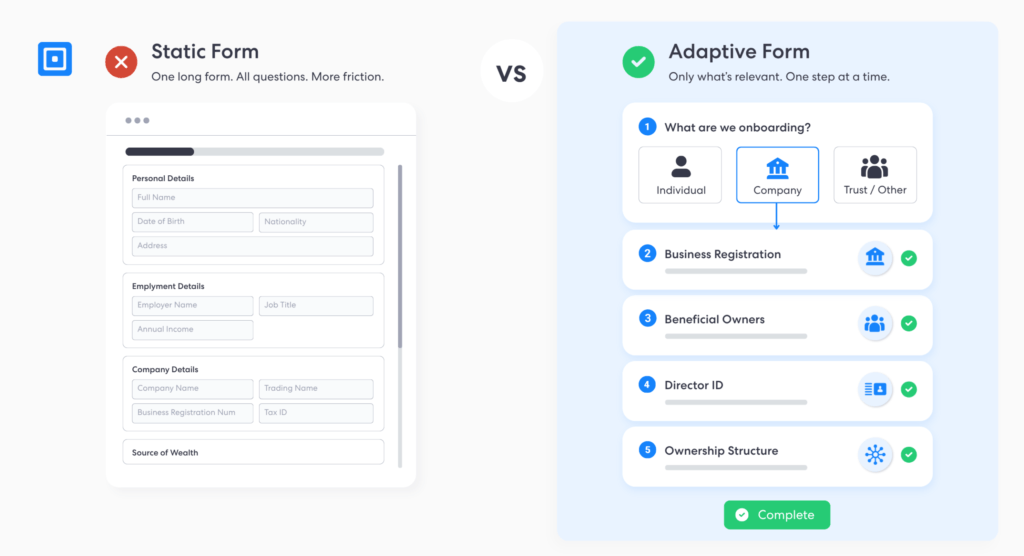
Adaptive smart forms for KYC use advanced conditional logic and data validation. These features expand, hide, or change form fields based on the responses a user provides in real-time. Additionally, regtech vendors, such as ComplyCube, enable businesses to layer identity verification checks after a user completes the form. This helps close the regulatory gaps by verifying that a person or business filling the form is legitimate.
## Smart Forms for KYC Compliance
High-growth, regulated businesses increasingly use smart forms to support KYC compliance. This is because they support clear data capture, enhanced customer experiences, and more proportionate compliance checks. As such, it shifts from static to dynamic forms, where users see questions based on identity, jurisdiction, and risk indicators.
This is critical, especially for Customer Due Diligence (CDD), where firms must collect and evidence the right information at the appropriate level of depth. According to the UK’s Financial Conduct Authority, [poor practices of CDD](https://www.fca.org.uk/publications/good-and-poor-practice/firms-customer-due-diligence-processes-and-controls-our-findings) include the lack of documentation around key information, such as the purpose and intended nature of the business relationship. On the other hand, strong practices tailor CDD to customers’ risk profiles, supporting the need for dynamic, risk-based smart forms.
### Customer Due Diligence Obligations
Smart forms help businesses meet global regulatory alignment. For instance, international regulatory standards such as the [Financial Action Task Force (FATF)](https://www.fatf-gafi.org/content/dam/fatf-gafi/recommendations/FATF%20Recommendations%202012.pdf.coredownload.inline.pdf) recommend collecting information to meet compliance. This includes confirming customer identity, beneficial ownership, the purpose of a business relationship, and ongoing monitoring.
Additionally, other leading regimes echo the same standards. For instance, the [EU’s Anti-Money Laundering Directive (AMLD)](https://finance.ec.europa.eu/financial-crime/anti-money-laundering-and-countering-financing-terrorism-eu-level_en) mandates risk-based CDD, while the [U.S. Bank Secrecy Act (BSA)](https://www.fincen.gov/resources/statutes-and-regulations/cdd-final-rule) emphasizes beneficial ownership verification and suspicious transaction reporting. Although the requirements can look different across various jurisdictions, the need for complete, accurate, and auditable information is clear.
For this reason, advanced KYC or KYB smart forms go beyond data collection. They act as strong compliance journeys, integrating identity verification, [Enhanced Due Diligence (EDD)](https://www.complycube.com/en/enhanced-due-diligence-requirements-guide/) triggers, and consent capture in one process.
### Supporting a Risk-Based Approach
Instead of applying the same level of questioning to every customer, companies can collect targeted, essential information. For example, if an applicant filling the form identifies as a company, the form automatically switches to a KYB flow. Instead, it requests documents related to business information and ownership structure.
Similarly, answering “yes” to a [Politically Exposed Person (PEP)](https://www.complycube.com/en/what-is-a-politically-exposed-person/) status or high-risk country of residence can trigger additional steps. This includes source of wealth questions or enhanced ID documents. On the flip side, the form routes low-risk users into a streamlined flow that collects the core KYC fields required by local regulators.
The key benefits of adaptive smart forms include:
- **Faster reviews:** Reduces back-and-forth emails between businesses and clients for extra information. It also reduces the potential risk of manual error during data collection.
- **Better data:** Makes use of standardized formats, real-time validation, and required fields to reduce errors or incomplete information before submission.
- **Risk-based KYC:** A low-risk customer sees fewer questions, while a high-risk customer can be routed to additional steps, such as enhanced document uploads or bank statement requests.
- **Stronger auditability:** Each answer, uploaded file, and consent is timestamped, maintaining a clear record for internal reviews and enhancing audit readiness.
- **Lower abandonment:** Improve data quality by simplifying data collection, leading to improved customer experiences and conversion rates.
- **Periodic reviews:** Beyond customer onboarding, smart forms can streamline KYC refreshes by collecting updated customer information where risk factors change or a certain time has passed.
- **Fraud prevention:** Smart forms can be layered into KYC and Anti-Money Laundering (AML) workflows, identifying any inconsistencies to confirm that an individual or business is legitimate.
## Conditional Logic and Dynamic Flows
Unlike static questionnaires, adaptive smart forms for KYC extend verification workflows with [fully customizable](https://docs.complycube.com/documentation/product-guides/compliance-studio/smart-forms) data capture steps. They are driven by if-then rules, event triggers, and integrations with internal systems. As such, compliance officers can build flexible KYC and AML workflows.
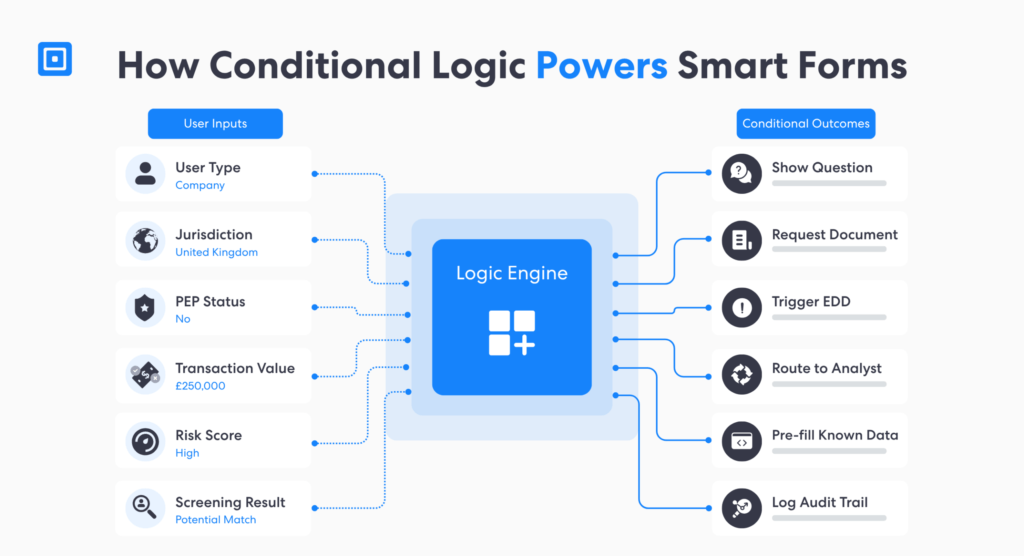
Providers, such as ComplyCube, offer [smart forms](https://www.complycube.com/en/solutions/compliance-suite/smart-forms/) that leverage enhanced conditional logic to determine the sections, questions, and text that will appear based on a user’s responses, customer profile, or risk scores. For instance, if a client fills a text field mentioning they require a loan amount above a certain threshold, the form can trigger additional questions and route the case for EDD.
Furthermore, with APIs or webhooks, all responses can be securely stored and linked to a workflow session, which can be accessed in real time. In practice, this means known information from identity verification steps can be pre-populated, irrelevant fields are hidden, and submission accuracy is significantly improved.
### Examples of KYC Questions Enhanced by Smart Logic
- **Individual versus company:** Individuals provide personal details and ID documents, while businesses provide company details such as ownership information and a primary contact.
- **Tax residence:** If a customer selects another tax jurisdiction, the KYC form reveals tax identification number fields and self-certification statements.
- **PEP status:** If a customer declares itself as a PEP, the form requests essential details, including role, source of wealth, and supporting document uploads.
- **High-value intent:** If expected transactions exceed a set threshold, the system routes the case to EDD review.
## Adaptive Smart Forms Use Cases
Smart forms can be used in various sectors to support employment history verification, source-of-wealth declarations, and more. According to reports, [more than half](https://thefinancialbrand.com/news/bank-onboarding/more-than-half-of-customers-abandon-account-opening-how-to-take-back-control-of-the-process-191691) of individuals who start a digital bank account application never end up finishing it, often due to unclear steps and excessive questions.
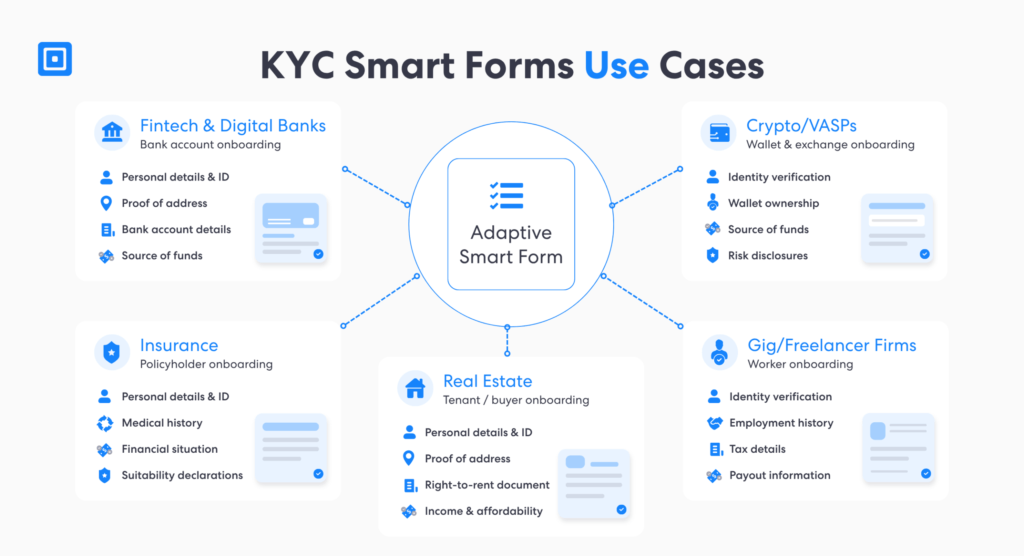
To combat this challenge, businesses can use an adaptive onboarding form template or a KYC form template to guide applicants through the right onboarding checklist. As such, it reduces manual data collection and minimizes compliance risks across different user journeys.
> Adaptive smart forms are no longer just a digital upgrade to paper forms. They are the strategic layer that turns fragmented onboarding tasks into a single, risk‑based workflow.
According to ComplyCube’s Chief Product Officer, Harry Varatharasan, “Adaptive smart forms are the strategic layer that turns fragmented onboarding tasks into a single, risk‑based workflow.” Whether a business needs to gather necessary information for new customers to open a bank account or collect right-to-work proof for new hires, smart forms can meet these specific needs. Adaptive smart forms are applicable across various industries, including finance, healthcare, and e-commerce, enhancing workflows by automating data capture and compliance processes:
### 1. Fintech or Digital Banking
[FinTechs](https://www.complycube.com/use-cases/industry/fintech/) and digital banks use smart forms to streamline account opening while meeting compliance requirements. Firms can capture financial information such as expected transaction volumes, business or personal declarations, and bank details securely. Moreover, high-risk applicants can trigger additional document uploads.
### 2. Cryptocurrency or Virtual Asset Service Providers (VASPs)
[Crypto‑asset platforms](https://www.complycube.com/en/use-cases/industry/crypto/) use smart forms to verify new clients and gather source of funds and source of wealth declarations for high-value activity. For instance, if a customer makes a large deposit or withdrawal, the form can trigger information about the origin of funds or wallet ownership. Additionally, firms can capture customer attestations, risk disclosures and consent confirmations for trading.
### 3. Insurance
Insurers deploy smart forms for [KYC](https://www.complycube.com/en/what-is-kyc-in-insurance/) to gather tax records, suitability information and policy-specific declarations. For example, life or medical insurance can request additional information about income, occupation, medical history, or investment risk appetite. As a result, insurers gather the exact information they require for underwriting and tax compliance.
### 4. Property and Real Estate
Companies in the [property or real estate](https://www.complycube.com/use-cases/industry/property/) sector make use of smart forms to gather tenancy history, right-to-rent, and right-to-work information. Furthermore, for high-value purchases or complex ownership structures, questions around beneficial ownership and transaction purpose can be triggered to onboard customers accurately.
### 5. Gig Economy and Freelancer Platforms
HR departments, gig platforms, and freelancer marketplaces use smart forms to collect employee details, right‑to‑work proofs, and tax‑related records. Where there are high‑value contracts, additional checks can be requested. Consequently, this helps verify and support employee engagement via a guided, digital onboarding experience.
### **Case Study: UBS Monaco Fined €6M for Weak Customer Due Diligence**
Monaco’s regulator, the AMSF, issued UBS Monaco a €6 million fine for compliance failures. Reports indicate that the bank failed to meet crucial CDD requirements. From 2018 to 2023, UBS Monaco repeatedly failed to perform Enhanced Due Diligence (EDD) for high-risk clients.
##### **Poor Risk-based KYC Controls**
UBS Monaco did not have the right procedures in place for collecting information proportionate to the risks present. For instance, the firm failed to verify beneficial ownership in complex corporate structures and did not conduct source of wealth assessments for high-risk clients.
##### **Outcomes**
- In addition to the fine, the AMSF will publish the enforcement decision for [five years](https://www.complycube.com/en/ubs-monaco-fine-6-million-aml-failures/), leading to reputational damage.
- Some notable cases include enabling $800,000 transaction from poorly verified businesses and incomplete PEP screening in 5 out of 25 cases.
- During investigations, the bank could not provide regulators with information about several clients, signalling deep systematic gaps in its audit function.
## Core Features of Smart Forms
Not all digital forms can deliver the same functionality that is required in today’s modern compliance and [onboarding](https://www.complycube.com/use-cases/process/customer-onboarding/) requirements. For instance, a wizard-style navigation is a user interface design that breaks down complex processes into step-by-step flows with progress indicators for enhanced customer experience. Additionally, real-time validation checks ensure formats such as emails or phone numbers are accurate before submission.
As a result, organizations can benefit from improved conversion rates resulting from shorter perceived forms. This reduces friction in the process, leading to more sign-ups, leads, or purchases. Moreover, since AML frameworks mandate KYC processes, banks, insurers, and accountants must ensure the forms can meet the CDD requirements in their respective jurisdictions. Some of the key capabilities that can support this include:
- **No-code setup:** Supports teams in creating, updating, and deploying forms without knowledge of coding required. As such, businesses can adapt and scale faster to regulatory changes.
- **Security:** Ensure to look for end-to-end encryption in transit and at rest. Additionally, role-based access controls, SSL encryption, and real-time audits further safeguard sensitive data.
- **Responsive and adaptive layouts:** Smart forms need to resize seamlessly across multiple devices, supporting fully responsive forms across mobile and web, regardless of screen size.
- **Integrations:** Look for breadth of integration capabilities, including API connectivity with CRM systems, case management tools, and sanctions and PEP screening.
- **Analytics:** Delivers dashboards with actionable insights on completion rates, drop-off points, time to complete, and optimization opportunities.
### Key Takeaways
- **Adaptive smart forms** are digital forms that change in real-time based on a user’s identity, previous answers, and risk profile, making KYC compliance and onboarding seamless.
- **Smart forms for KYC** use conditional logic to collect relevant client information, improving completion rates and data quality.
- **Regulated businesses** use smart forms to streamline the client onboarding process, reduce manual reviews, and minimize compliance risks.
- **Modern smart forms** connect identity verification, document uploads, consent forms, and e-signatures into one secure onboarding process.
- **Advanced smart forms** for onboarding include a no-code setup, customizable rules, deep integrations, and robust analytics.
## Meet Customer Due Diligence Requirements
Global, high-paced companies that use adaptive smart forms can gain strategic business advantages while building strong regulatory trust. Smart forms are crucial in reducing form fatigue, lowering abandonment rates, and improving data quality by simplifying data collection.
Moreover, organizations can embed compliance documents into the onboarding journey, helping them meet KYC requirements efficiently and consistently. As regulatory expectations continue to evolve, smart forms provide the agility, accuracy, and user-centric design needed to scale compliance operations without compromising customer experience. [Contact the ComplyCube team](https://www.complycube.com/contact/contact-sales/) to get started with smart forms today.
[](https://portal.complycube.com/signup)
## Frequently Asked Questions
What are smart forms?
Smart forms or dynamic questionnaires adapt to a customer’s responses, automatically filling known data and hiding irrelevant questions in real-time. Regulated businesses use these forms to gather client data to support KYC and AML compliance, including right-to-work or bank account information.
How does adaptive smart forms help with compliance?
Smart forms use advanced conditional logic and data validation to streamline compliance requirements across borders. These forms adapt to the customer type and risks present based on their responses. Since every interaction, such as question paths and acknowledgements are recorded in real-time, it supports clear audit trails for KYC and AML regulatory reporting.
Are smart forms only relevant for financial institutions?
No. Regulated companies in financial services use smart forms to stay compliant while maintaining a smooth transition during onboarding. However, insurers, real estate firms, and healthcare providers are increasingly using smart forms to detect and reduce compliance risks earlier in the onboarding process.
What to look for in KYC smart forms?
A KYC smart form should collect the relevant information for existing and new clients to verify identity, assess risk, and meet due diligence obligations effectively. Leading regulated organizations opt for smart forms with a no-code setup, advanced conditional logic, and deep integrations to reduce manual entry, validate responses, and build clear audit trails.
Can ComplyCube’s smart forms handle document uploads and e-signatures?
Yes. Modern smart forms can collect various types of documents, digital signatures, and certificates. ComplyCube’s smart forms are built to accept multiple file documents, including payslips, address proof, and tenancy information. It also captures e-signatures to support policy acknowledgements, risk warnings, and truthfulness declarations that meet regulatory standards.
**Categories:** Guides
**Tags:** Know Your Customer
---
### [The Ultimate Guide to Tranche 2 AML Software for Australian Businesses](https://www.complycube.com/australia-tranche-2-aml-software-guide-2026/)
**Published:** May 15, 2026
**Author:** Rithu Jagannath
**Excerpt:** A practical guide to Tranche 2 AML software, covering Australia’s AML/CTF reforms, risk-based Customer Due Diligence, ongoing monitoring, audit-ready evidence, and how firms can prepare.
**Content:**
**TL;DR: Tranche 2 AML changes** how regulated Australian firms identify clients, review risk, and prove compliance decisions. The best Tranche 2 AML software links **identity verification**, customer due diligence, and **regular monitoring**. These Tranche 2 AML/CTF reforms start from 1 July 2026 and must close any new regulatory gaps that arise.
## What is Tranche 2 AML Software?
Australia’s AML/CTF framework was introduced in stages, referred to as “tranches.” Tranche 1 focused primarily on financial institutions such as banks, remittance providers, and gambling services under the AML/CTF Act 2006. On the other hand, Tranche 2 refers to the expansion of these obligations to Designated Non-Financial Businesses and Professions (DNFBPs), including lawyers, accountants, real estate agents, and trust or company service providers.
Tranche 2 AML software helps firms meet Australia’s Anti-Money Laundering (AML) and Counter-Terrorism Financing (CTF) obligations all in one place. They typically support Identity Verification (IDV), Customer Due Diligence (CDD), and AML screening. It helps firms review risk, create compliance reports, and keep evidence for the future.
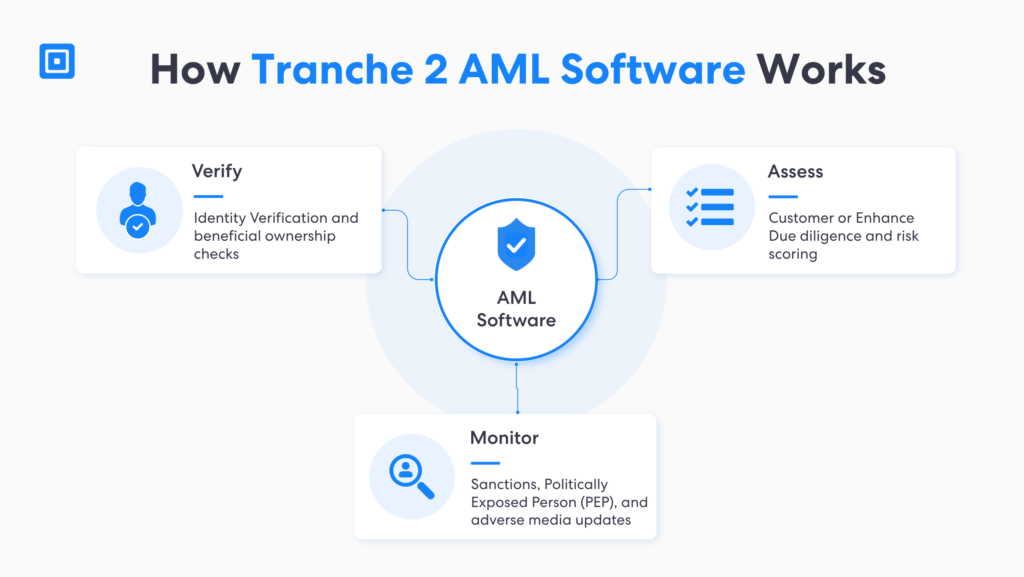
Under the upcoming Tranche 2 requirements, AML/CTF obligations will apply to certain designated services such as the legal profession, accountants, and real estate businesses. Additionally, it applies to company service providers, conveyancers, and dealers in precious metals where necessary. The Australian Transaction Reports and Analysis Centre (AUSTRAC), states that AML/CTF obligations will apply from 1 July 2026.
For many firms, this is a shift from relationship-based client intake to evidence-based AML compliance. For example, a lawyer may know a client, but it is in the firm’s best interest to verify customer identity and assess risks. Similarly, a real estate agent may know a high-value transaction, but the business must still manage any money laundering risks and suspicious transactions.
The best Tranche 2 AML software makes it incredibly easy to turn regulatory obligations into repeatable workflows. It supports compliance teams by identifying the ultimate beneficial owner and routing high-risk customers to review. They also ensure that ongoing monitoring takes place. Firms can now move through the compliance journey with much stronger evidence and less manual work.
## Why AML/CTF Reform Changes the Regulatory Landscape
However, the reason for Australia’s Tranche 2 AML/CTF reforms was to close big gaps in regulation with any non-financial sectors or DNFBPs. [AUSTRAC](https://www.austrac.gov.au/austrac-ceo-speech-regulating-game "AUSTRAC") explains that these reforms were meant to “…deter, detect, and disrupt any money laundering”. Additionally, it strengthens Australia’s alignment with international anti-money laundering standards.
According to Home Affairs, the [AML/CTF Amendment Act 2025](https://www.homeaffairs.gov.au/about-us/our-portfolios/criminal-justice/anti-money-laundering-and-counter-terrorism-financing "AML/CTF Amendment Act 2025") supports Australia’s ability to meet standards set by the Financial Action Task Force (FATF). Meeting these AML standards matter because the regulatory landscape is no longer focused simply on financial institutions alone. Designated non-financial businesses such as legal, accountancy, and real estate now require rigorous AML controls to stand up to AUSTRAC scrutiny.
> Tranche 2 is a shift in how firms are expected to identify, evidence, and manage financial crime risk.
Solutions Consultant, [Milosh Caunhye](https://www.linkedin.com/in/milosh-caunhye/), goes on to say, “Risks need to be managed across the full client relationship and lifecycle. Firms and other organizations require controls that work in practice, from first onboarding all the way through to continuous monitoring, escalation, and audit evidence.”
These AML regulatory changes go beyond rewriting policies. It also shows how businesses can find and deal with illicit criminal activities. Additionally, the reforms outline details around how organizations must respond to any suspicious criminal activities and ensure ongoing monitoring of any customer risk.
## Tranche 2 Sectors and AML Compliance Requirements
AUSTRAC reforms apply to sectors such as legal, conveyancing, and the [real estate sector](https://www.complycube.com/en/use-cases/industry/property/) to name a few. Also, it names [accounting services](https://www.complycube.com/en/use-cases/industry/accounting-compliance/ "accounting services"), trust services, and company services. These firms affected are often described as “gatekeepers” because they sit very close to various types of property, client funds, and legal arrangements.
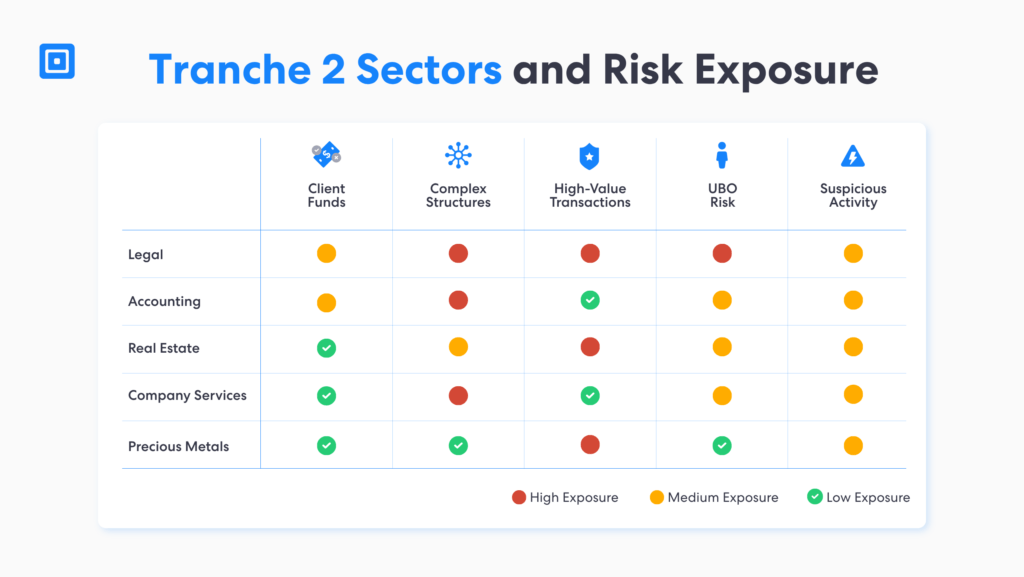
It is important to note that there is a clear difference between [Tranche 1 and Tranche 2 AML/CTF reforms](https://www.nortonrosefulbright.com/en-au/knowledge/publications/bae065f5/tranche-2). Previously, many AML tools were built just for banks, insurers, and current reporting entities. However, Tranche 2 reaches smaller non-financial sectors with fewer compliance resources. That is why the best Tranche 2 AML software must be easy to put in place, but strong enough to evidence compliance needs.
## Customer Due Diligence and AML Tools Firms Need
Key to Tranche 2 AML/CTF reform is the role of ongoing [Customer Due Diligence](https://www.complycube.com/en/solutions/due-diligence-compliance/customer-due-diligence/) (CDD) and Enhanced Due Diligence (EDD). Australia’s Home Affairs office says CDD helps reporting entities find, review, and fix any money laundering risks. It also covers any illicit financial activities such as terrorist financing and proliferation financing risk linked to any clients.
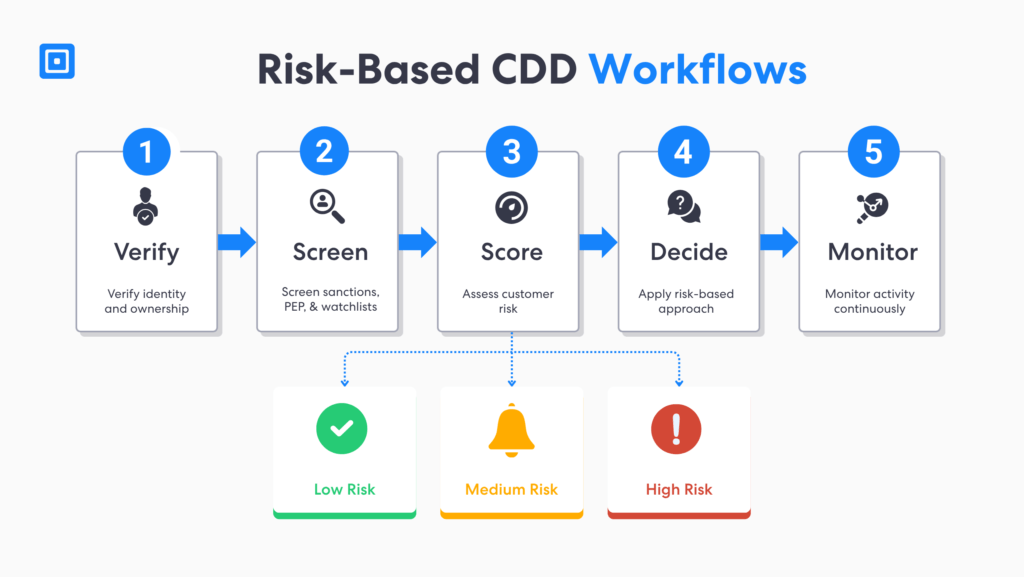
Therefore, a strong compliance program should help with customer onboarding processes such as identity checks, business verification, and ultimate beneficial owner identification. It must also screen for any sanctions, politically exposed persons, or adverse media. These types of checks support firms in their understanding of their existing diligence processes. This allows them to easily decide whether they need standard CDD or EDD. You can learn more here: [Navigating the World of Enhanced Due Diligence](https://www.complycube.com/en/enhanced-due-diligence-edd-insights-challenges/).
The strongest AML tools do not treat customers the same way. They apply risk profiling and customisable risk scoring to match the level of control they need to give to any kind of risk. For example, low-risk clients can move much faster, while high-risk clients receive enhanced KYC procedures or risk assessments. At the end of the day, it all boils down to each company’s respective risk appetite.
## Anti-Money Laundering and Counter Terrorism Financing Controls
Many companies try to look at building internally first. Initially, an internal build may appear to be cheaper. However, companies must manage many variables such as identity checks, case notes, and audit trails. The best Tranche 2 AML software should also be responsible for managing any watchlist changes, regulatory obligations, and reporting triggers. The issue is that Tranche 2 AML/CTF reforms and controls do not stay the same. Sanctions lists inevitably change, new adverse media emerges, and customer risk status shift.
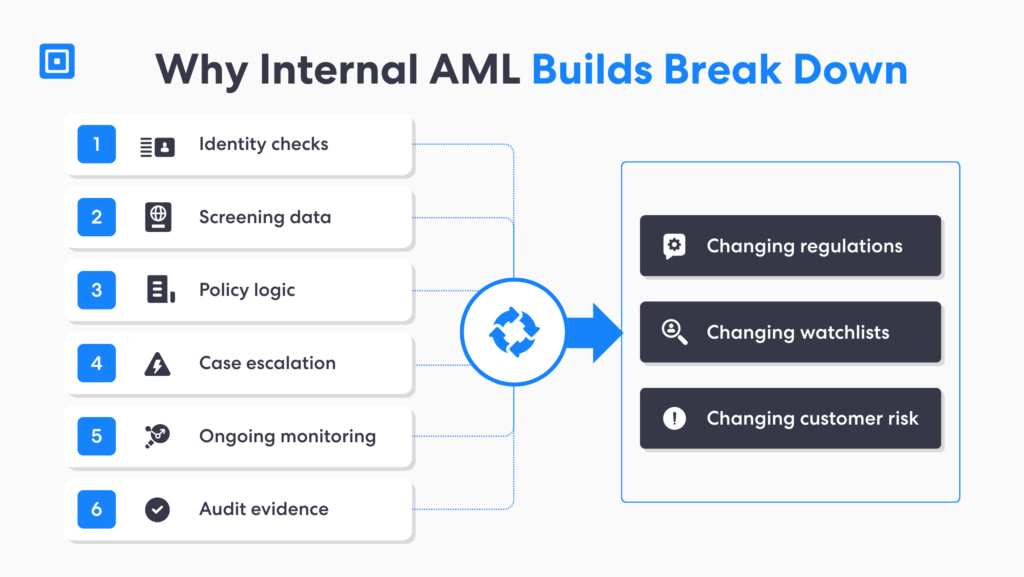
On the other hand, some firms do need internal procedures for legal professional privilege, client confidentiality, and suspicious transactions. This is where purpose-built AML software becomes important. Tranche 2 systems require [hosted workflows](https://www.complycube.com/en/solutions/compliance-suite/kyc-workflow/), APIs, and reusable workflow templates. Additionally, they need region-aware policies, ongoing monitoring, and integrated IDV, AML, as well as fraud orchestration.
### **Case Study: AUSTRAC Court Proceedings with Mounties**
In July 2025, AUSTRAC led Federal Court [civil penalty proceedings](https://www.hnlaw.com.au/unprecedented-wake-up-call-for-aml-ctf-in-pubs-clubs-austrac-sues-mounties/) against Mount Pritchard District and Community Club Ltd, also known as Mounties. The proceedings show systemic AML/CTF failures in its operations and non-compliance with Australia’s AML/CTF laws.
##### **Money Laundering and Terrorism Financing Risks**
The Mounties allowed [almost $140 million](https://www.abc.net.au/news/2025-08-07/nsw-pokies-mounties-high-risk-gamblers-court/105621124) to be bet by 10 gamblers considered high risk of money laundering or terrorism financing. Firms must build in customer assessments and escalation rules when certain clients or specific transactions appear to be high-risk.
##### **Outcomes**
- AML/CTF policies must be backed by active controls and accountable oversight.
- Tranche 2 firms should build in Customer Due Diligence before obligations begin.
- High-risk clients need ongoing monitoring, escalation, and evidence-based decisions.
## How Tranche 2 AML Software Supports Operational Readiness
Now, for newly regulated Australian firms, Tranche 2 [AML](https://www.complycube.com/en/solutions/due-diligence-compliance/anti-money-laundering/) software is the most valuable when it can turn regulations into actionable compliance controls. Yet, the big problem is that customer identity verification at onboarding needs the right amount of ongoing customer due diligence. Companies also need to keep evidence of each and every decision. They must monitor when risk levels change. This makes a case for where a connected workflow is better for compliance than a set of disconnected AML tools.
Any strong setup for anti-money laundering helps firms put in place enhanced KYC procedures. To keep up with changing AML/CTF regulations in Australia, companies must move from manual reviews to structured risk management. This takes combining AML tools with clear escalation rules. Another key aspect of the best Tranche 2 AML software solutions is adverse media monitoring, fraud signals, and [ongoing monitoring](https://www.complycube.com/en/solutions/global-screening/continuous-monitoring/).
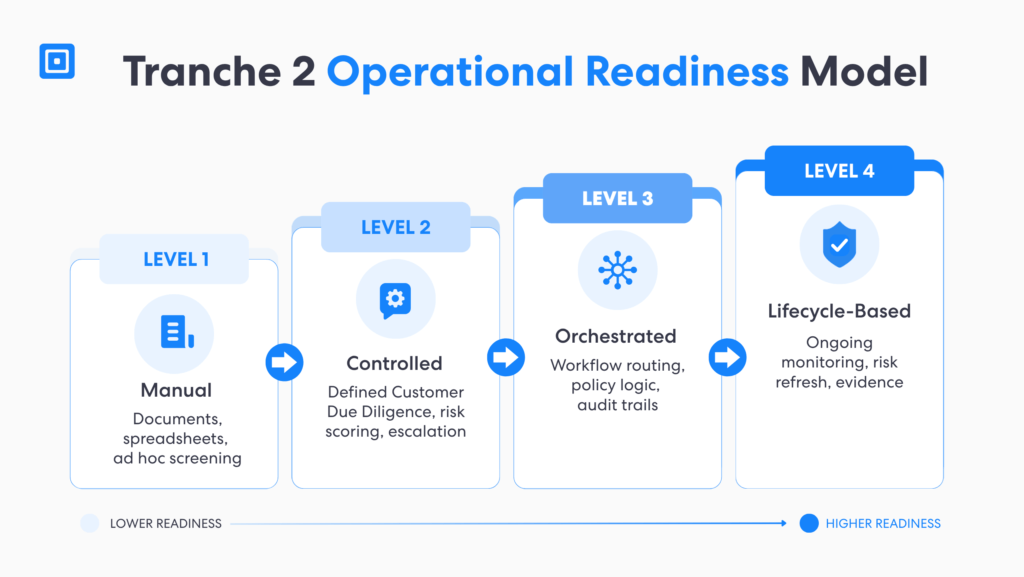
In order to bridge this gap, Tranche 2 AML companies must look at their overall compliance processes. Here is where no-code workflow orchestration, hosted workflows, and APIs can help businesses comply efficiently around their actual services. Teams can meet compliance obligations rather than forcing every customer through the exact same risk management journey.
For customers comparing the best Tranche 2 AML software, the smart decision is not whether a compliance platform can run checks, but rather if the platform itself can help with business evidence. For example, they can provide information on why a customer was accepted, escalated, monitored, or exited from a workflow. Being Tranche 2 ready means that companies need a practical way to link customer due diligence, enhanced due diligence, ongoing monitoring, and audit evidence without constructing a bank-grade system within.
### Key Takeaways
- **The best Tranche 2 AML software** connects onboarding, screening, and monitoring.
- **Internal builds are difficult** because regulations, watchlists, and customer risk change.
- **Customer due diligence** and enhance due diligence are core controls for high-risk clients
- **Operational readiness** depends on orchestration, lifecycle monitoring, and audit-ready evidence.
- **Tranche 2 AML software** supports firms moving toward more risk-based compliance.
## Get Ready for Tranche 2 AML/CTF Reforms with ComplyCube
1 July 2026 is the Tranche 2 AML deadline. However, it gives firms the opportunity to build a stronger, and more defensible compliance journey. If companies act now, they can close compliance gaps, meet AML obligations, and improve customer onboarding processes. [Talk to our compliance experts](https://www.complycube.com/en/contact/contact-sales/) to enhance your sector specific guidance and prepare your firm for Tranche 2 AML needs.
[](https://portal.complycube.com/signup)
## Frequently Asked Questions
What are Tranche 2 AML obligations?
Tranche 2 AML expands Australia’s Anti-Money Laundering and Counter-Terrorism Financing (AML/CTF) regime to Designated Non-Financial Businesses and Professions (DNFBPs) from 1 July 2026. It applies to designated services in legal, accounting, real estate, and company services where firms may be exposed to financial crime risk.
What is Tranche 2 AML software?
Tranche 2 AML software helps firms automate customer checks, assess risk, and monitor relationships. It supports Identity Verification, screening, and evidence capture for activities such as managing client funds, verifying ownership, or reviewing transactions above a certain monetary threshold.
What Tranche 2 AML risks should firms monitor?
Firms should monitor risks linked to unusual transaction patterns, opaque ownership, and cross-border movement of funds or assets. This can include shipping physical currency, working with complex legal structures, or dealing with customers whose source of funds is difficult to verify.
Why is customer due diligence important under Tranche 2?
Customer Due Diligence helps firms understand who they are dealing with and whether the relationship presents financial crime risk. It is especially important when firms need to verify customer identity, identify beneficial ownership, and apply enhanced review to higher-risk clients.
How does ComplyCube help with Tranche 2 AML regulations?
ComplyCube helps firms automate customer onboarding, screen for AML risks, and maintain ongoing monitoring. It supports configurable workflows for risk-based checks across real estate transactions, company service providers, and virtual assets service providers.
**Categories:** Guides
**Tags:** Anti-Money Laundering
---
### [19 Virtual Asset Providers Fined up to $163,000 by Dubai Regulators](https://www.complycube.com/19-firms-fined-by-dubai-regulators/)
**Published:** October 16, 2025
**Author:** Dini Habib
**Excerpt:** Nineteen Virtual Asset firms in Dubai have been charged with penalties amounting to $163,000. These firms were fined for operating without a Virtual Assets Regulatory Authority (VARA) license and breaching Dubai's marketing rules.
**Content:**
Dubai Regulator, the Virtual Assets Regulatory Authority (VARA), has fined nineteen firms between AED 100,000 and AED 600,000 (approximately USD $28,000 to $163,000). Upon investigations, the VARA found that these firms were operating without a valid VARA license and breached marketing regulations. These nineteen companies were immediately ordered to cease all virtual asset services in or from Dubai. The move reaffirmed Dubai’s aim to position itself as a secure financial haven for investors and global businesses.

In a release statement, VARA highlighted that these actions are part of its ongoing movement towards making the virtual asset market more transparent and resilient. In Dubai, all crypto and virtual asset providers must obtain a VARA license under the law. To obtain a license, businesses must undergo a two-step approval process to meet the stringent compliance standards within the emirate.
> Enforcement is critical to maintaining [trust and stability](https://www.vara.ae/en/regulations/regulatory-notices/vara-steps-up-enforcement-to-safeguard-dubai-s-virtual-asset-market-19-unlicensed-firms-penalised-and-public-warning-issued/) in Dubai’s Virtual Asset ecosystem.
Unlicensed activities and unauthorized marketing are deemed critical violations that can increase risks to the security of consumers and investors. VARA’s Regulatory Affairs and Enforcement Division mentions, “Enforcement is critical to maintaining trust and stability in Dubai’s Virtual Asset ecosystem. These actions reinforce VARA’s mandate: to ensure that only firms meeting the highest compliance and governance standards are permitted to operate.”
## Dubai Regulator VARA Strengthens Virtual Assets Oversight
[VARA](https://www.vara.ae/en/about-vara/) is a regulatory body under Law No. 4 in Dubai, which grants it the authority to regulate, supervise, and oversee virtual assets in the country. Under the law, VARA issues licenses for virtual asset providers to run operations within Dubai legally. Businesses providing virtual assets or related services must adhere to strict compliance requirements, including submitting regular audits and complying with [Anti-Money Laundering (AML)](https://www.complycube.com/en/solutions/due-diligence-compliance/anti-money-laundering/) and Counter-Terrorist Financing (CFT) frameworks.
> VARA will continue to take proactive measures to uphold transparency, safeguard investors, and preserve market integrity.
The VARA team has permission to suspend or revoke a license and enforce monetary penalties. Additionally, the regulatory body monitors trading activities and establishes regulations to safeguard consumers’ personal data in the virtual asset sector. Just last month, [Dubai-based crypto firm Fuze](https://www.complycube.com/en/the-cryptocubed-newsletter-august-edition-yes/) faced significant financial penalties due to weaknesses in its AML controls. The UAE has clearly set high expectations regarding regulating the crypto and virtual asset sector.
Besides Dubai’s VARA, the UAE includes key regulators that work together to harmonize and protect the country’s financial ecosystem. Some of the notable ones include the Securities and Commodities Authority (SCA), which oversees onshore UAE activities outside the Dubai and Abu Dhabi financial free zones, as well as the Financial Services Regulatory Authority (FSRA), which regulates virtual assets within the Abu Dhabi Global Market (ADGM) free zone.
For more on this story, click [here](https://www.vara.ae/en/regulations/regulatory-notices/vara-steps-up-enforcement-to-safeguard-dubai-s-virtual-asset-market-19-unlicensed-firms-penalised-and-public-warning-issued/).
**Categories:** News
**Tags:** Crypto Regulations
---
### [UBS Monaco Fine Reaches €6 Million for Repeated AML Failures](https://www.complycube.com/ubs-monaco-fine-6-million-aml-failures/)
**Published:** May 15, 2026
**Author:** Dini Habib
**Excerpt:** UBS Monaco, part of the UBS AG group headquartered in Switzerland, was fined by the country's regulator, the Monaco Autorité Monégasque de Sécurité Financière (AMSF), €6 million for violating Anti-Money Laundering requirements.
**Content:**
On May 7, 2026, Monaco’s Autorité Monégasque de Sécurité Financière (AMSF) issued the UBS Monaco fine, penalizing the bank €6 million (USD $7 million) for Anti-Money Laundering (AML) failures. UBS Monaco is a small division of UBS Group AG, the leading Swiss global financial services firm.
**Fun Fact:** The bank’s name, UBS, comes from its **historical merger** between the Union Bank of Switzerland and the Swiss Bank Corporation in 1998. Following its acquisition of Credit Suisse, UBS Group AG is one of Switzerland’s largest banks, dominating with **over 40%** of market share.
## What Led to the UBS Monaco Fine?
The AMSF is Monaco’s Financial Intelligence Unit that oversees AML and Counter-Terrorist Financing (CTF) compliance. During the investigation, the AMSF found that UBS Monaco breached the country’s AML obligations from [2018 to 2023](https://www.swissinfo.ch/eng/various/money-laundering-ubs-fined-€6-million-in-monaco/91380894). The violations included deficiencies in [Customer Due Diligence (CDD)](https://www.complycube.com/en/what-is-customer-due-diligence/) and ongoing monitoring processes mandated under Monaco’s regulatory framework.
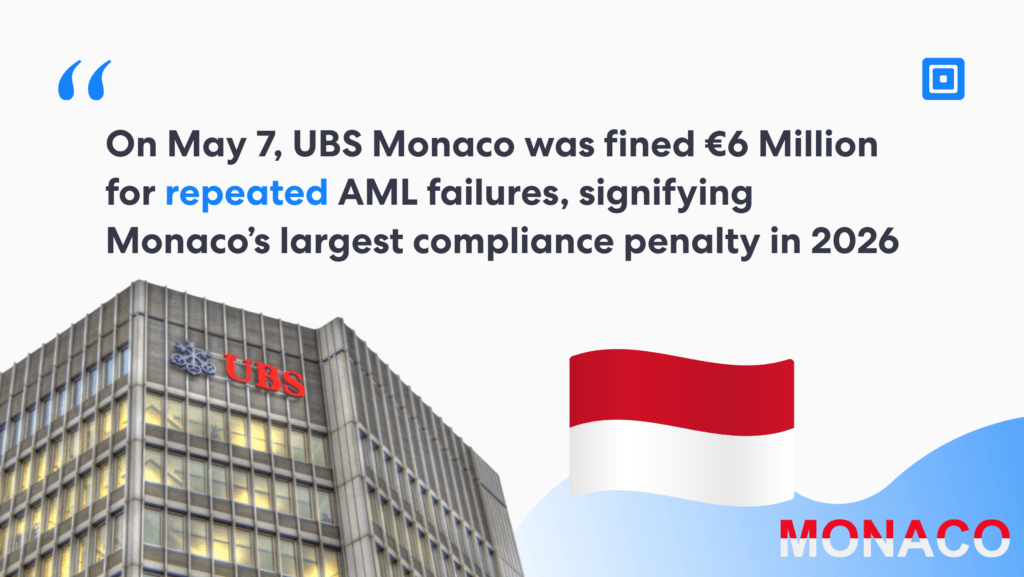
### UBS Monaco repeatedly breached compliance obligations, including:
- Weak source of wealth assessments for high-risk clients
- Failure to identify and verify beneficial ownership in complex corporate structures
- Incomplete [Politically Exposed Persons (PEPs)](https://www.complycube.com/en/what-is-a-politically-exposed-person/) screening in 5 out of 25 reviewed cases
- Insufficient scrutiny of large international transfers across high-risk jurisdictions
The bank also failed to document the nature and purpose of high-risk financial transactions. This is in particular to PEPs with close ties to government entities. This was shocking, as it is a gap that bad actors can exploit easily to move illicit money.
### Some notable gaps that led to the multi-million euro fine include:
- Enabling a PEP to make a €6m transaction without comprehensive enhanced due diligence
- Delayed suspicious transaction report by up to 253 days
- Over USD $800,000 were transferred from insufficiently verified real estate firms in Saudi Arabia and Lebanon
- Took on a new client based on old documents and mostly untranslated Russian language, implying a lack of due diligence
## Monaco’s Inclusion in the FATF Grey List
The AMSF’s call was a significant move in reinforcing its role in combatting money laundering and other financial crime. This is especially important, since Monaco was listed in the Financial Action’s Task Force (FATF) grey list in 2024 and the European Commision’s high-risk third country list in 2025.
**Fun Fact:** The grey list was first formalised by the FATF post-2007. The list puts a country under **increased monitoring** due to strategic deficiencies in AML and CTF controls. Some of the countries included in the grey list in recent years are Bolivia, Kuwait, and Venezuela.
Moreover, the AMSF noted that UBS Monaco was unable to provide them with the required details on the nature and purpose of multiple business relationships, pointing to systematic gaps in its internal audit function. Ultimately, the €6 million fine accompanied reputational consequences, as the AMSF will publish the enforcement decision for up to five years.
[](https://www.complycube.com/en/contact/contact-sales/)
Subscribe to ComplyCube’s [Trust Edition newsletter](https://www.linkedin.com/newsletters/the-trust-edition-7103022355722981376/), where we explore the top developments across identity verification and AML globally. Plus, we share valuable insights on compliance with the latest regulations.
**Categories:** News
**Tags:** Anti-Money Laundering
---
### [What is an Identity Verification API?](https://www.complycube.com/what-is-an-identity-verification-api/)
**Published:** May 2, 2025
**Author:** Sofia Daley
**Excerpt:** Identity verification solutions allow businesses to remain compliant and prevent identity fraud from their platform. Learn how critical solutions can prevent cases of identity fraud, keeping businesses compliant and secure.
**Content:**
**TL;DR:** Identity verification processes are essential for security, compliance, and **fraud prevention** across all sectors. An **ID verification API**, or a KYC verification API, enables firms to connect existing technology systems to compliance solutions. This article explores what an identity verification API is and how it works.
## Why is Identity Verification API Crucial?
Businesses increasingly rely on automated systems to handle processes that were once done manually. One such process that’s essential for security, compliance, and fraud prevention across all sectors is Identity Verification (IDV).
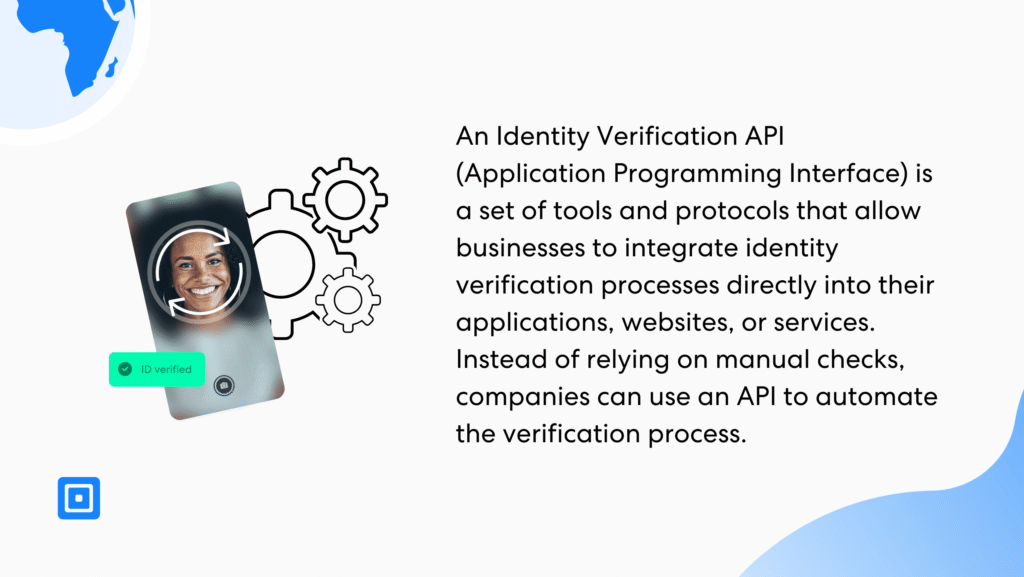
Businesses must accurately verify their clients’ identities during onboarding processes to ensure compliance with regulations and mitigate risks. Identity verification APIs enable firms to integrate Know Your Customer (KYC) and IDV solutions seamlessly into existing tech stacks.
ID Verification APIs allow businesses to make the verification process quicker, more reliable, and more secure. In this guide, we’ll explore not only what an Identity Verification API is and how it works, but also its benefits and how businesses can integrate it with their existing systems.
## Understanding Identity Verification APIs
An ID Verification API (Application Programming Interface) is a set of tools that allow businesses to connect identity verification solutions directly into their applications, websites, or services. Instead of relying on manual checks, companies can use an API to automate the verification process. Identity Verification API can handle document scanning and biometrics to Anti-Money Laundering (AML) checks and KYC compliance in seconds.
Identity Verification is critical to ensure that individuals or businesses are who they claim to be. It is essential in preventing financial crimes such as money laundering and terrorism financing. Additionally, it is critical for KYC and AML regulatory compliance. Leading global and national regulatory bodies, such as the [Financial Industry Regulatory Authority (FINRA)](https://www.finra.org/filing-reporting/entitlement/identity-verification) and the Financial Crimes Enforcement Network (FinCEN), oversee these processes to ensure that financial institutions adhere to strict guidelines. As such, non-compliance can lead to large fines and reputational damage.
## How Does an Identity Verification API Work?
An ID Verification API is designed to integrate with an existing system seamlessly. As the entire process happens quickly, it reduces the risk of human error while ensuring that businesses comply with regulatory standards. Here is a simple breakdown of how it works:
- **Data Collection:** The user provides personal information (e.g., government-issued ID, passport, selfie, etc.).
- **API Request:** The information is sent to the Identity Verification API, which processes the data.
- **Verification:** The API cross-checks the provided data against various databases (such as government databases or financial watchlists) to ensure authenticity.
- **Response:** The API returns the results, confirming if the identity is valid or if further action is required in the verification process. This step is crucial for customer due diligence, ensuring all necessary information is collected and verified.
## Key Features of ID Verification API
Speed and accuracy are key in the KYC process. Slow or complex verification processes can increase drop-off rates during onboarding. To combat this, top KYC platforms give real-time verification so you can verify documents, assess risk and complete the KYC process fast. This not only improves the user experience but also reduces operational delays.
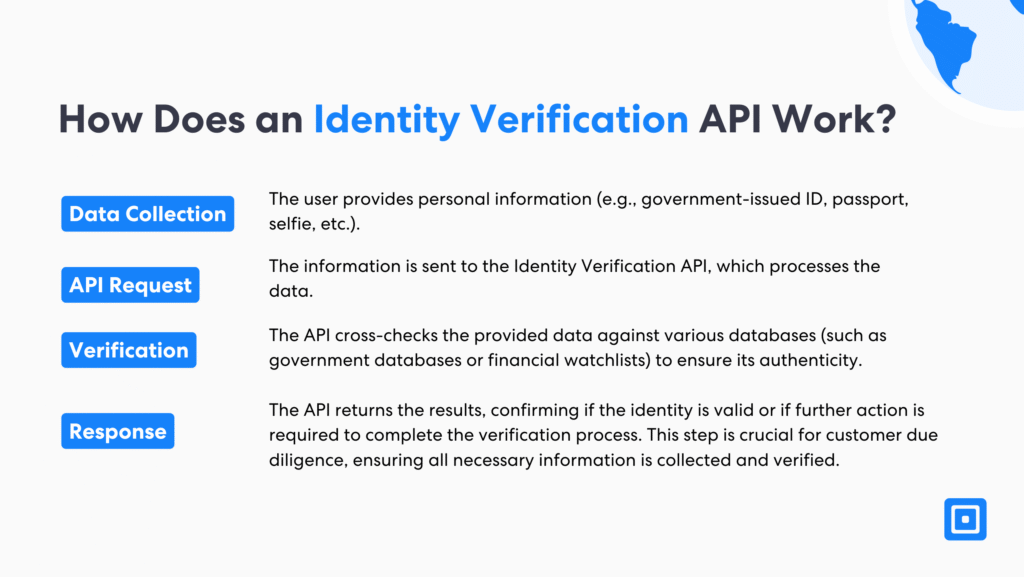
In order to avoid high drop-off rates, onboarding has to be clear, simple, and quick. To achieve this, leading providers make use of advanced AI-powered technology. These AI tools can provide secure and accurate onboarding in under a minute per customer. For instance, KYC providers, such as ComplyCube, utilise market-leading technology to support robust liveness detection and advanced biometrics.
## Understanding Know Your Customer (KYC) Requirements
KYC is a set of regulations and guidelines that require financial institutions to verify the identity of their customers and assess their risk profiles. The KYC process involves collecting customer identification information such as name, date of birth, and address, and verifying this information through various means, including KYC checks, document verification, and biometric verification.
A key component of KYC is the Customer Identification Program (CIP), which mandates that financial institutions collect and verify identity details from their customers. This program helps ensure that financial institutions know who their customers are, reducing the risk of fraud and other financial crimes. By implementing KYC processes, financial institutions can maintain the integrity of their customer relationships and comply with regulatory requirements. You can learn more here: [What is CIP?](https://www.complycube.com/en/customer-identification-program-what-is-cip/)
## Anti-Money Laundering
Anti-Money Laundering (AML) regulations are designed to prevent the laundering of illicit funds and the financing of terrorism. These regulations require financial institutions to implement comprehensive KYC processes, monitor customer transactions, and report any suspicious activity to the relevant authorities.
Several jurisdictions mandate AML processes. For example, the U.S Bank Secrecy Act (BSA), the [EU’s AML Directives](https://www.complycube.com/en/6th-anti-money-laundering-directive-6amld-guide/), and the UK’s Financial Conduct Authority (FCA) set out guidelines for AML rules that businesses must follow. By adhering to AML regulations, financial institutions can safeguard their operations and maintain the financial system’s integrity.
## Enhanced Due Diligence
Enhanced Due Diligence (EDD) is a more rigorous form of due diligence for high-risk customers or transactions. EDD involves collecting and verifying additional information, such as beneficial ownership details, business activities, and comprehensive risk profiles, to assess the customer’s risk thoroughly.
To ensure compliance with KYC regulations, financial institutions must conduct EDD on high-risk customers, including politically exposed persons (PEPs) and individuals from high-risk countries. EDD is essential for preventing money laundering, terrorism financing, and other financial crimes.
By implementing EDD, financial institutions can better manage risks and ensure compliance with regulatory requirements. You can learn more here: [When Enhanced Due Diligence Requirements are Needed.](https://www.complycube.com/en/enhanced-due-diligence-requirements-guide/)
## Benefits of Using an Identity Verification API
### 1. Improving operational efficiency with automation
Manual identity verification can be time-consuming and error-prone. Businesses can automate this entire process by using an Identity Verification API, improving efficiency and accuracy. The API can handle a large volume of requests in real-time, ensuring that your verification workflows are always up-to-date. Additionally, ongoing monitoring of customer accounts ensures continuous compliance and security. These solutions help businesses streamline their verification processes and improve overall efficiency.
### 2. Increase security by identifying fraud earlier
Identity theft and fraud are significant concerns for businesses, particularly in industries like banking, e-commerce, and healthcare. An Identity Verification API significantly reduces the risk of fraudulent activity. This is because it helps automate robust checks in real-time. Additionally, its usage in features such as biometric matching, document verification, and liveness detection makes it harder for malicious actors to fake their identities.
### 3. Meet compliance obligations at scale
Financial institutions, healthcare providers, and other regulated industries must follow strict KYC and AML regulations. However, with regulations evolving at such a quick pace, keeping up with compliance can be complex. An Identity Verification API helps businesses easily comply with these laws by automating checks and ensuring that only legitimate customers are onboarded.
### 4. Long-term cost savings
Building an in-house identity verification system can be expensive, requiring investment in software development, maintenance, and security. By using an external API, businesses can save on these costs while accessing cutting-edge technology provided by the API service. For more on the breakdown of AML and KYC costs, read [“AML Check Cost: Hidden Fees in Compliance.” ](https://www.complycube.com/en/aml-check-cost-hidden-fees-in-compliance/)
### 5. Enhanced onboarding and user experience
Customers demand convenience and speed, and an Identity Verification API helps businesses streamline the onboarding process. Users can verify their identities quickly through the system, improving customer experience and reducing the chances of abandonment during sign-up or checkout. You can learn more here: [KYC Checks For a Secure Onboarding Process.](https://www.complycube.com/en/kyc-checks-for-a-secure-and-scalable-onboarding-process/)
### **Case Study: Boost Operational Efficiency with Automated KYC Checks**
54% of identity checks are still manual. With manual verification, the likelihood of human error and data inaccuracies can increase significantly. As a result, customer drop-off rates and false negatives can occur. For regulated businesses, this can be fatal for compliance.
##### **Enhance Customer Experience**
Citibank, the leading financial services company, partnered with ComplyCube to automate its KYC compliance process. With broad API and SDK integration, Citi was able to significantly reduce manual verification, freeing up agents and boosting customer satisfaction.
##### **Outcomes**
- Citi was able to reduce its acquisition cost by up to 73% by simplifying and automating its identity verification processes for its customers.
- ComplyCube’s wide integration library and no-code workflows provide multi-layered security and compliance at an unprecedented rate.
- The company reduced KYC onboarding rates significantly, from days to minutes, boosting customer satisfaction and conversion.
## Fighting Fraudulent Activities
Fraudulent activities, such as identity theft and money laundering, pose significant risks to financial institutions and regulatory bodies. These activities can lead to substantial economic losses and damage a financial institution’s reputation. To combat these threats, financial institutions must implement robust Identity Verification processes, including KYC and AML programs, to ensure their customers are who they claim to be.
In addition to verifying identities, financial institutions must use ongoing monitoring and report suspicious activity to the relevant authorities. By adopting these measures, financial institutions can help prevent fraudulent activities and maintain the integrity of their customer relationships. KYC verification APIs are a convenient way to plug into cutting-edge technology to ensure financial safety and maintain cost efficiency through accurate verifications.
## Choosing the Right ID and KYC Verification API Provider
With many Identity and KYC Verification API providers, how do you choose the right one for your business? Here are some factors to consider:
- **Accuracy:** Look for a provider that offers reliable and accurate verification services. Providers should be highly certified and should leverage cutting-edge technology, such as PAD Level 2 Liveness Detection, to ensure a high rate of accuracy.
- **Compliance:** Ensure the API complies with your region’s compliance requirements and regulations, especially if you’re in a highly regulated industry. Looking for industry acknowledgements, such as ISO certifications, is a step in the right direction.
- **Integration:** Choose an API that is easy to integrate with your existing systems and has clear documentation and support. This can help prevent inflated costs required to set up the API.
- **Scalability:** As your business grows, ensure the API can handle increasing verification volumes and provide timely responses. As a result, businesses can avoid painful technology migrations as they grow.
### Key Takeaways
- **Application Programming Interface** (API) enables software applications to communicate with each other seamlessly.
- **Identity verification API** integration enables identity checks to seamlessly connect with current systems, websites, and CRMs.
- **KYC verification API** enables businesses to meet AML compliance rapidly by layering biometric, document, and NFC checks into current services.
- **Firms can achieve** faster, more secure, scalable, and cost-efficient identity and AML checks when utilizing API integration.
- **To choose the right ID** verification API provider, consider integration, accuracy, and compliance factors.
## Leveraging Identity Verification for Financial Security
Securing user identities is more important than ever, and choosing the right solution can make all the difference. An Identity and KYC Verification API provides an automated, accurate, and secure way to confirm the legitimacy of your customers. Not only does it help businesses meet regulatory requirements, but it also reduces the risks associated with fraud and identity theft. Regular review of the verification processes ensures that they remain effective and up-to-date with the latest security standards.
By implementing an Identity Verification API, businesses can improve customer experience, save on operational costs, and ensure compliance with industry regulations. Whether in finance, e-commerce, healthcare, or any other industry, adopting this technology is essential to building trust and security in the digital world.
Contact our expert compliance team for more information on ComplyCube’s [Identity Verification services and API.](https://www.complycube.com/en/)

## Frequently Asked Questions
What is an identity verification API?
Identity verification (application programming interface) API supports firms in integrating identity checks into their services easily. As a result, businesses can perform document verification, biometric checks, and age estimation on their website or app to meet KYC compliance.
How do you verify a person’s identity with API?
The process of identity checks with an API is simple. Firstly, a customer’s data, such as passport information, gets sent to the API endpoint. Next, this data gets processed and cross-checked against various trusted sources. Lastly, the results, such as passing or failing verification, will be returned for simple customer onboarding decision-making.
What is the purpose of ID verification API?
ID verification API removes the need for manual intervention and data collection. By supporting real-time identity verification, businesses can achieve secure, seamless, and rapid customer onboarding. Thus, achieving higher customer conversion rates while lowering long-term costs from manual verification.
How to choose KYC providers with API integration?
To choose KYC providers with API integration, consider the ease of integration and the variety of integrations, such as CRMs and SDKs. Additionally, factors such as global coverage, accuracy rates, and compliance certifications, including data and privacy compliance with GDPR.
How does ComplyCube’s KYC verification API satisfy compliance?
ComplyCube offers wide integration capabilities, with the fastest omnichannel integration turnaround in the market. Businesses of any size and stage can adopt its KYC and AML solutions easily with its no-code solutions, APIs, mobile and web SDKs, client libraries, and CRM integrations.
**Categories:** Guides
**Tags:** Identity Verification
---
### [ComplyCube Achieves UK-DIATF IDSP Certification](https://www.complycube.com/complycube-achieves-uk-diatf-certified-idsp/)
**Published:** July 1, 2024
**Author:** Sofia Daley
**Excerpt:** Regulations for Digital Identity Service Providers (IDSPs) continue to tighten, ensuring that only robust solutions capture the market. At ComplyCube, we're a DIATF-certified IDSP and compliant with eIDAS regulations.
**Content:**
The pursuit of digital trust consumes the ambitions of regulatory bodies across the globe, with frameworks like the UK government’s [Digital Identity Attributes and Trust Framework (DIATF)](https://www.gov.uk/government/publications/the-uk-digital-identity-and-attributes-trust-framework/the-uk-digital-identity-and-attributes-trust-framework) or the EU’s [Electronic Identification, Authentication, and Trust Services (eIDAS)](https://digital-strategy.ec.europa.eu/en/policies/eidas-regulation) focused on countering the threat of sophisticated fraud. Regulations for Digital Identity Service Providers (IDSPs) continue to tighten, ensuring that only robust solutions capture the market.
At ComplyCube, we’re proud to announce that we’re now a UK DIATF-certified IDSP and fully comply with eIDAS regulations for identity service providers with market-leading identity verification software.
## What Does the UK DIATF Do?
Published by the Department of Science, Innovation and Technology (DSIT), the UK DIATF looks to encourage trust in digital identity products and recognition of trusted digital identities across borders, introducing the concept of certified reusable IDs.
In doing so, the initiative sets out requirements for IDSPs to adhere to for the provision of secure solutions, ensuring that single-use and reusable digital identities enhance privacy and security beyond traditional, physical forms of identification such as passports.
However, building trust in digital identities within a modern society is certainly quite a task, with fraudulent activity continually evolving and new forms of technology, such as AI, enabling its growth. Hence, the fight against fraud can never be static and requires market leaders to remain innovative in their commitment to digital trust. UK Finance noted in their Annual Fraud Report that in just 2023, payment fraud amounted to [a shocking £1.2 billion in the UK](https://www.ukfinance.org.uk/news-and-insight/press-release/fraud-remains-major-problem-over-ps1-billion-stolen-criminals-in#:~:text=UK%20Finance%20today%20releases%20its,cent%20decrease%20compared%20to%202022.) – a figure that points to a need for heightened security within identity verification practices.
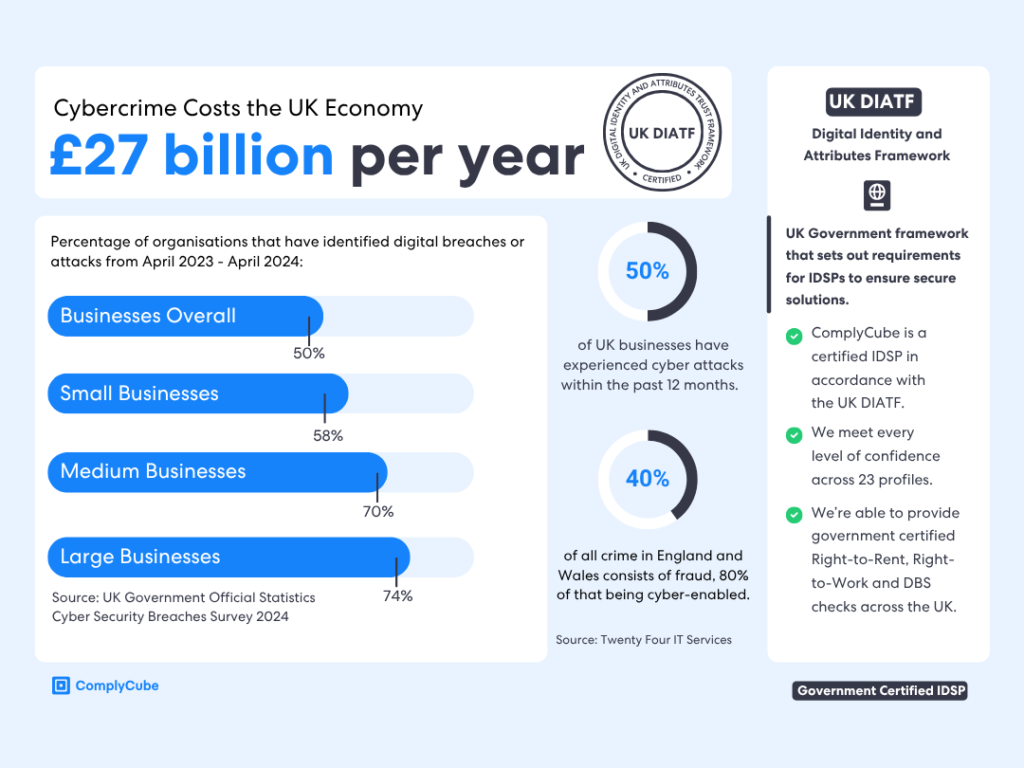
## New IDSP Standards for Secure Digital Identity Verification
The DIATF presents new standards for Digital Identity Service Providers, mitigating the risk of fraud by specifying standardized levels of confidence that IDSPs must meet across different use cases, referred to as profiles. The Home Office requires a Medium level of confidence as a minimum for IDSPs providing Right-to-Rent or Right-to-Work checks.
At ComplyCube, we’re proudly certified across every level of confidence under the UK government DIATF, meeting 23 profiles. As our products are independently government-certified, we can provide highly tailored solutions, including bespoke Right-to-Rent, Right-to-Work, and Disclosure and Barring Service (DBS) checks.
## Introducing Government-Certified Right-to-Rent, Right-to-Work, and DBS Screenings
Our [Right-to-Rent](https://www.complycube.com/en/use-cases/process/government-certified-right-to-rent-check-uk-diatf/), [Right-to-Work](https://www.complycube.com/en/use-cases/process/certified-digital-right-to-work-checks/), and [DBS Checks](https://www.complycube.com/en/use-cases/process/government-certified-enhanced-dbs-checks/) are powered by our market-leading technology and sector expertise. All of these screenings include our sophisticated [Document Check](https://www.complycube.com/en/solutions/identity-assurance/biometric-verification/), which analyses cryptographically protected features such as the Radio Frequency Identification (RFID) chip using NFC, as well as verifying the validity of passports through the use of Optical Character Recognition (OCR) and Machine Readable Zone (MRZ) analysis. In addition, our [Biometric Identity Check](https://www.complycube.com/en/solutions/identity-assurance/biometric-verification/) and UK Identity Fraud Check also form a part of these screenings.
We hold a PAD Level 2 certification in liveness detection and facial recognition, which analyses selfies captured by end users and compares them with their ID documents. Our UK Identity Fraud Check leverages the SIRA network, the largest cross-sector syndicated database of customer risk intelligence in the UK, and accessing Amber Hill and Disclosure of Death Registration Information (DDRI). Additional services can be added to your solution depending on your use case and required confidence levels, such as an extensive AML screening, Proof of Address, or Multi-Bureau check.
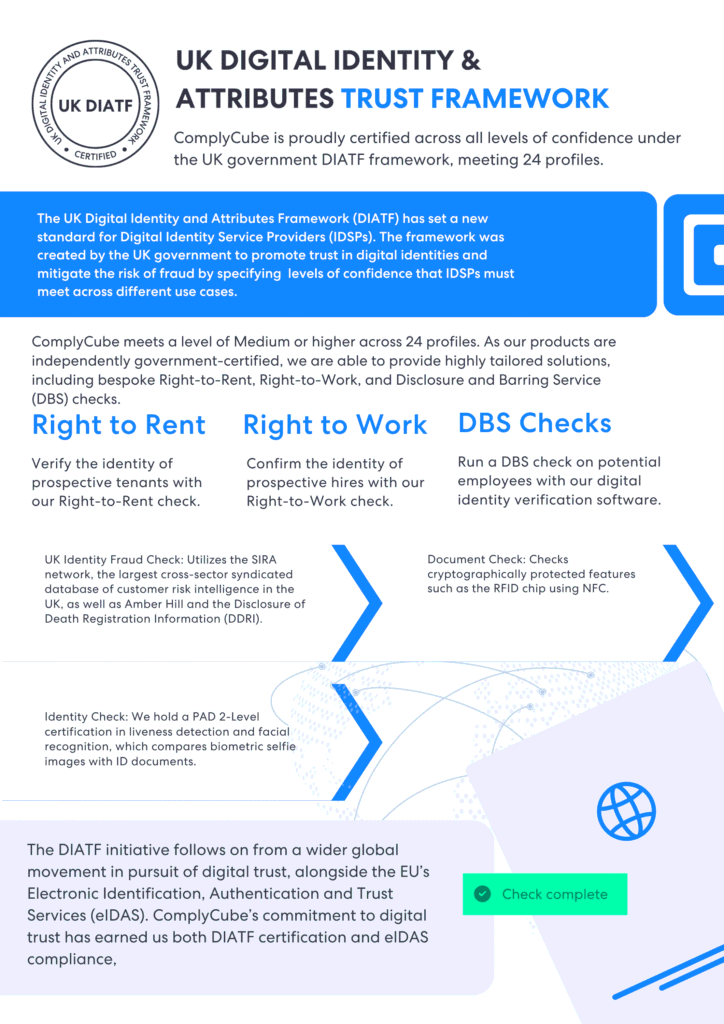
## Continuing the Fight Against Fraud with Identity Verification Software
Achieving UK DIATF certification is a significant accomplishment for our team, and it reflects the high standard of our platform. As fraud continues to evolve, so should the robustness of technology, processes, and compliance in place to protect user privacy, security, and trust in regulated organizations.
For information on UK DIATF or IDV, AML, and KYC solutions, speak to one of our [experts](https://www.complycube.com/en/contact/contact-sales/).
**Categories:** News
**Tags:** Announcements
---
### [ComplyCube Launches New Trust Center](https://www.complycube.com/complycube-launches-trust-center-for-security-and-compliance-transparency/)
**Published:** June 17, 2024
**Author:** Andreea Balasa
**Excerpt:** ComplyCube launches a comprehensive Trust Center. This new initiative highlights ComplyCube as having the most complete compliance posture in the market, setting new benchmarks for security and privacy in IDV, KYC, and AML platforms.
**Content:**
**LONDON, June 5, 2024** — [ComplyCube](https://www.complycube.com/en/), a prominent global provider of identity verification and compliance solutions, is excited to announce the launch of its Trust Center. This new initiative highlights ComplyCube as having the most complete compliance posture in the market, setting new benchmarks for security and privacy in IDV, KYC, and AML platforms. Featuring over fifty continuously monitored controls, the AI-powered SaaS ensures clients remain ahead of international regulations and standards.
## Enhancing Transparency and Trust
The [Trust Center](https://trust.complycube.com/) offers real-time updates on security measures, compliance statuses, and operational transparency. This functionality allows clients to meet regulatory requirements confidently and provides on-demand access to ComplyCube’s compliance posture. This platform is crafted to significantly improve transparency, foster trust, and streamline compliance processes for organizations worldwide.
## Key Features of the Trust Center
At the heart of the Trust Center are several key features designed to support organizations in maintaining and enhancing their compliance efforts:
- **Real-Time Compliance Dashboard**: Provides continuous updates on compliance metrics and security statuses.
- **Comprehensive Resource Hub**: Offers access to critical documents, certifications, and regulatory guidelines.
- **Incident Reporting and Tracking**: Ensures transparent reporting and monitoring of security incidents.
These features collectively provide a robust foundation for managing compliance and security in a dynamic regulatory landscape.
> The Trust Center represents a significant step in our goal to [build trust at scale](https://www.complycube.com/en/company/about-us/) and deliver advanced compliance solutions
Tarek Nechma, CEO of ComplyCube, commented, “The Trust Center represents a significant step in our goal to build trust at scale and deliver advanced compliance solutions. This platform will enable our clients to navigate complex regulatory landscapes more confidently.”
## Tackling Compliance Challenges
Noncompliance costs significantly more—about [2.71 times more](https://secureframe.com/blog/compliance-statistics) —than maintaining it. Research also shows that companies with robust compliance programs can [reduce incident costs by up to 30%](https://www.skillcast.com/blog/top-10-compliance-challenges-2024). Additionally, [84% of businesses face compliance challenges](https://www.skillcast.com/blog/top-10-compliance-challenges-2024) that can lead to substantial financial and reputational damage. The Trust Center by ComplyCube is designed to mitigate these risks by providing tools to help businesses maintain and enhance their compliance posture.
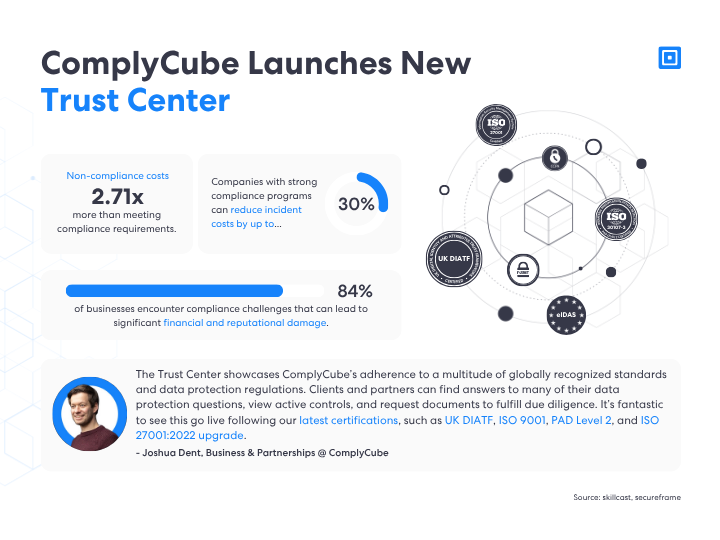
Mohamed Alsalehi, CTO of ComplyCube, emphasized, “Our systems are designed to comply with stringent laws and regulations. This proactive approach ensures our clients can effortlessly meet and exceed compliance requirements.”
## Commitment to Global Standards
Joshua Dent, Business & Partnerships Manager, added, “The Trust Center reflects ComplyCube’s commitment to globally recognized standards and data protection regulations. Clients and partners can find answers to many data protection questions, view active controls, and request documents for due diligence. It’s great to see this platform live following our recent certifications, such as UK DIATF, ISO 9001, PAD Level 2 ISO 30107-3, and ISO 27001:2022 upgrade.”
> It’s great to see this platform live following our [recent certifications](https://www.complycube.com/en/company/security-compliance-center/), such as UK DIATF, ISO 9001, PAD Level 2 ISO 30107-3, and ISO 27001:2022 upgrade.
ComplyCube continues to lead the industry with its innovative solutions, and the launch of the Trust Center underscores its mission to support businesses in achieving compliance excellence.
For more information, visit the [ComplyCube Trust Center](https://trust.complycube.com/).
## About ComplyCube
[ComplyCube](https://www.complycube.com/en/) is a leading provider of identity verification and compliance solutions, assisting organizations across various sectors in securing their operations and meeting regulatory requirements. Focusing on innovation and customer satisfaction, ComplyCube delivers reliable and efficient services that help businesses thrive in complex regulatory environments.
## About Vanta
[Vanta](https://www.vanta.com/) is a trust management platform that automates compliance and streamlines security reviews for SaaS businesses. It helps companies manage risk and demonstrate security in real-time, ensuring adherence to global standards and data protection regulations. With Vanta, businesses can efficiently handle compliance processes and affirm their commitment to security and trust.
**Categories:** News
**Tags:** Announcements
---
### [When Enhanced Due Diligence Requirements Are Needed](https://www.complycube.com/enhanced-due-diligence-requirements-guide/)
**Published:** April 16, 2026
**Author:** Dini Habib
**Excerpt:** Enhanced Due Diligence (EDD) requirements are mandated by regulations such as the U.S Patriot Act, the EU AML Directives, and more. EDD is triggered by specific high-risk indicators and, as such, requires effective implementation.
**Content:**
**TL;DR:** Enhanced due diligence requirements are triggered by specific **high-risk indicators**. For **regulated businesses**, understanding when and how to apply enhanced due diligence measures is crucial. This guide examines the critical controls required to move from **standard to enhanced** verification and the benefits of **automating enhanced due diligence**.
## Why is Enhanced Due Diligence Important?
Enhanced due diligence measures are important as they support businesses in having a comprehensive understanding of their customers and the risks they pose to the company. As a result, companies can better track and prevent money laundering and other financial crimes. Moreover, Enhanced Due Diligence (EDD) forms a core aspect of Anti-Money Laundering (AML) programs, making it a mandatory process that moves beyond simplified and standard due diligence processes.
In essence, enhanced due diligence deeply verifies a customer or client’s identity, background information, and source of funds. EDD is driven by the Financial Action Task Force (FATF) Recommendations to effectively combat money laundering and terrorist financing. Following the FATF’s enhanced due diligence requirements, jurisdictions worldwide, such as the European Union’s AML Directives and the U.S. Bank Secrecy Act, have followed suit. This will be covered in more depth below.
## Understanding Enhanced Due Diligence Requirements
Simplified Due Diligence (SDD) is a low-intensity AML check used for customers with low risk, allowing less verification and monitoring. Next, Standard Customer Due Diligence (CDD) forms the norm baseline and focuses on confirming a customer’s identity through basic checks. You can learn more here: [What is Customer Due Diligence (CDD)?](https://www.complycube.com/what-is-customer-due-diligence/)
On the other hand, EDD goes much deeper, shifting from “who is this customer” to “why this customer, why this product, etcetera.” Enhanced due diligence measures are implemented when there is a heightened risk of money laundering, terrorist financing, or corruption.
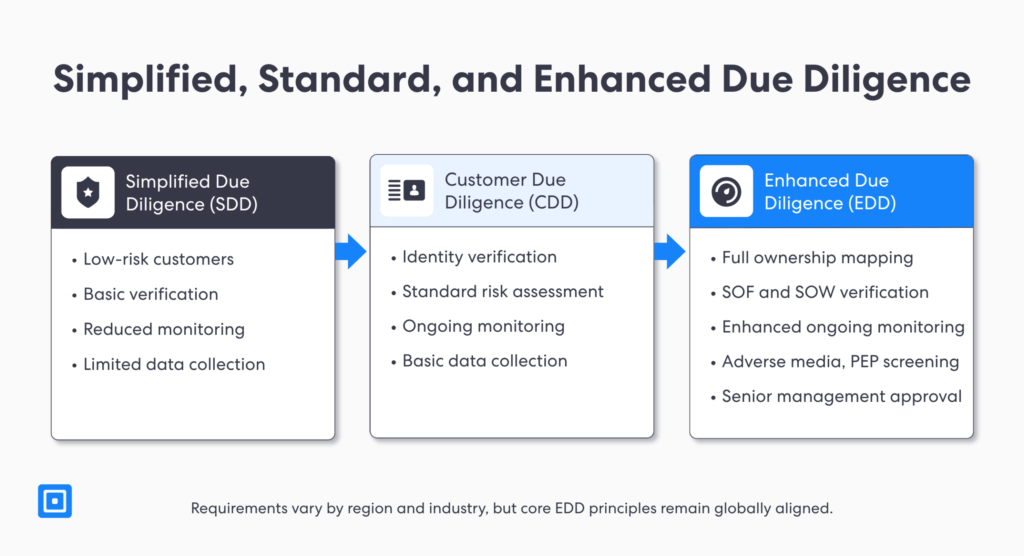
However, enhanced due diligence requirements come from a combination of standards and national AML laws, such as those stated previously. Moreover, these requirements are further shaped by sector-specific guidance from regulators, including the Financial Conduct Authority (FCA), the Monetary Authority of Singapore (MAS), and the Australian Transaction Reports and Analysis Centre (AUSTRAC), to address further gaps in AML programs.
At a glance, [standard customer due diligence](https://www.complycube.com/en/solutions/due-diligence-compliance/customer-due-diligence/) versus enhanced due diligence:
- **Standard or Basic CDD:** Identity verification, basic customer data collection, standard risk assessment, continuous monitoring.
- **EDD:** Full ownership mapping, source-of-wealth proofs, adverse media checks, senior sign-off, enhanced ongoing monitoring.
## Regulatory Drivers for Enhanced Due Diligence
Understanding enhanced due diligence requirements across major regulations is critical in building a defensible AML infrastructure. Moreover, it supports organizations in meeting regulatory compliance and, as such, preventing reputational damage or fines. For instance, notable fines in recent years show a common theme of businesses failing to implement adequate due diligence.
Notable examples include [Cannacord’s $80 million fine](https://www.linkedin.com/pulse/trust-edition-march-2026-complycube-ayjhe/) for weak due diligence on high-risk customers, Louis Vuitton €500,000 fine for CDD failures on undetected, large transaction patterns, and even [CaixaBank’s €30 million fine](https://www.linkedin.com/pulse/trust-edition-january-2026-complycube-h3o9e/) related to EDD lapses for a company it merged with. The examples below discuss the central regulations that shape enhanced due diligence requirements:
### The Financial Action Task Force
The FATF, based in Paris, is an intergovernmental body set up by the G7 nations to establish global standards for preventing money laundering and terrorism financing. In particular, in [Recommendations 9, 10, and 12](https://www.fatf-gafi.org/content/dam/fatf-gafi/recommendations/FATF%20Recommendations%202012.pdf.coredownload.inline.pdf), specific EDD requirements are mandated for high-risk business relationships, as well as for [Politically Exposed Persons (PEPs)](https://www.complycube.com/en/solutions/global-screening/sanctions-pep-screening/) and their close family or associates. Moreover, it demands additional verification for countries connected with the FATF grey or blacklist. Suspicious transaction reporting from EDD analysis is also listed as crucial to meeting AML compliance.
### The U.S. Patriot Act
The USA Patriot Act made an impact on strengthening U.S. AML regulations by amending the BSA to include strict requirements for US financial institutions regarding EDD. Notably, [Section 312](https://www.fincen.gov/fact-sheet-section-312-usa-patriot-act-final-regulation-and-notice-proposed-rulemaking) mandates EDD for accounts held by foreign banks, especially those in high-risk locations. Plus, non-U.S. individuals who maintain large private banking accounts require deep source of funds checks. Furthermore, the Act calls for [ongoing monitoring of EDD](https://www.complycube.com/en/solutions/global-screening/continuous-monitoring/), ownership verification, and senior management approval to identify and prevent suspicious activity proactively.
### The EU AML Directives
The [EU AML Directive](https://finance.ec.europa.eu/financial-crime/anti-money-laundering-and-countering-financing-terrorism-eu-level_en) progresses from 4AMLD to 6AMLD. The 4AMLD, introduced in 2017, became a catalyst for automating EDD due to raising obligations for high-risk scenarios. Next, the 5AMLD extended these requirements, including the risk-based approach to EDD to crypto providers. The 6AMLD introduced higher penalties and reinforced PEP screening and ongoing monitoring for high-risk jurisdictions and high-net-worth individuals. The UK’s Money Laundering Regulations (MLR2017) mirror these obligations with EDD for suspected false ID and complex transactions.
### Sectoral Guidance
Moving on, sector-specific guidance has shaped EDD standards. For example, the European Banking Authority (EBA) requires [financial institutions](https://www.eba.europa.eu/sites/default/files/document_library/Publications/Guidelines/2023/EBA-GL-2023-03/1061654/Guidelines%20ML%20TF%20Risk%20Factors_conslidated.pdf.pdf) to apply EDD for high-risk customers and transactions with high-risk countries. Another example is the UK Financial Conduct Authority (FCA), which introduces deeper identity and business purpose verification in EDD processes.
### **Case Study: Louis Vuitton €500K Fine for EDD Lapses**
In February 2026, Louis Vuitton was fined by Dutch authorities €500K for violating the Netherlands’ Money Laundering and Terrorist Financing Act. Regulators noted that the company failed to implement enhanced due diligence despite suspicious customer activity.
##### **Luxury Goods Laundering Scheme**
According to reports, Louis Vuitton did not implement strong Know Your Customer (KYC) processes. This includes inadequate due diligence measures. As a result, a customer was able to make over €2 million in transactions under different aliases without intervention.
##### **Outcomes**
- The Dutch unit of Louis Vuitton was penalized a [€500K fine](https://www.linkedin.com/pulse/trust-edition-february-2026-complycube-2ftee/) by prosecutors.
- The case saw a woman spending large amounts on luxury goods to hide illicit funds from money laundering.
- Dutch regulators introduced strict limitations on financial transactions of cash payments, with anything above €3,000 banned to curb money laundering.
## Enhanced Due Diligence Requirements Triggers
For effective EDD, firms need to codify risk triggers in their AML program. These triggers will determine when compliance teams escalate from CDD to EDD. Additionally, EDD can be triggered by external signals beyond the customer onboarding process. For example, new adverse media coverage or law enforcement investigation can indicate a significant risk.
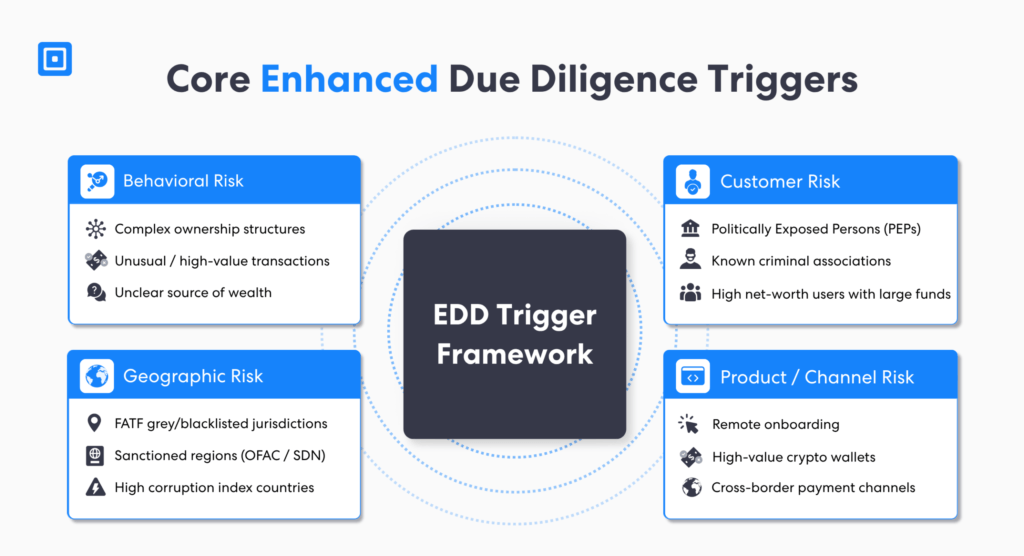
Core trigger categories to conduct enhanced due diligence:
- **Behavioral Risk:** Suspiciously complex corporate structures, large or unusual transactions without a clear rationale, an unexplained source of wealth, and more.
- **Customer Risk**: PEPs, their family and close associates, customers listed on Interpol, those with criminal activity, high net-worth users moving large sums, and more.
- **Geographic Risk**: Customers or entities residing in FATF grey or black-listed countries, sanctioned regions under the Office of Foreign Assets Control (OFAC) lists, and more.
- **Product Risk**: High-value crypto wallets, cross-border payment products, non-face to-face onboarding, and more.
Moreover, automating enhanced due diligence makes use of advanced Artificial Intelligence (AI) and Machine Learning (ML) to analyze vast datasets in real-time. EDD workflows can be triggered instantly for high-risk clients, customers, or transactions. As a result, the reliance on manual verification and human error is lowered, leading to quicker and more accurate enhanced due diligence measures.
## Regulatory Compliance and AML Requirements
Enhanced due diligence requirements can look different in each sector. Despite overlapping themes, getting a better understanding of sector-specific examples is crucial for setting appropriate risk thresholds. For instance, the risks present in crypto companies can differ widely from those of insurance firms, which calls for tailored risk controls to detect anomalies.
> For effective EDD, controls must be aligned with the specific company risks.
According to [Harry Varatharasan](https://www.linkedin.com/in/harryvaratharasan/), Chief Product Officer at ComplyCube, for EDD to be effective, controls and triggers must be calibrated to align with a company’s specific product, geography, and sector risks. Below, we detail common situations in varying sector that will require EDD under a risk-based approach.
### Fintech and Digital Banking
[Fintech and digital banking](https://www.complycube.com/en/use-cases/industry/fintech/) support remote onboarding and rapid account activation. While this increases customer conversion due to quicker onboarding, it can increase the risk of identity fraud. Additionally, shell companies and opaque ownership structures are particular red flags. Where sufficient confidence cannot be met, firms must escalate these cases and do full ownership mapping of both the client and their business partners to avoid blind spots.
### Crypto and Virtual Asset Providers (VASPs)
For crypto firms, high transactions across borders can be particularly risky, particularly where compliance with the Travel Rule is weak. Customers exposed to mixers or tumblers, dealing with privacy coins, or making transactions with unhosted wallets require thorough EDD. For instance, this means higher scrutiny on the source of funds, with the EU’s Markets in Crypto-Assets Regulation (MiCA) demanding ongoing transaction monitoring across customer activity. You can learn more here: [Crypto AML Compliance: Securing the Sector](https://www.complycube.com/crypto-aml-compliance-securing-the-sector/).
### Property and Real Estate
[Real estate](https://www.complycube.com/use-cases/industry/property/) can be vulnerable to money laundering risks, especially since opaque ownership structures, offshore entities, and unusual funding arrangements can easily hide the ultimate beneficial owner or source of funds. As a result, firms in this sector must adopt comprehensive EDD. Typically, this means higher scrutiny on the ultimate beneficial ownership, reasonable assurance of a customer’s real assets and wealth sources, and also deeper reviews of transaction rationale to bridge any potential risk gaps.
### Gaming and Gambling
In 2025, the UK Gambling Commission found that companies had [inadequate play-pattern monitoring](https://cms.law/en/gbr/legal-updates/gambling-operators-hit-by-flurry-of-gambling-commission-regulatory-action) as a common AML failure. The FATF includes casinos and gambling services within its AML framework, noting several risks that can be present in transactions. To meet AML compliance and avoid penalties, gaming and gambling firms must adopt EDD, whereby suspicious customer activity from transactions and play patterns must undergo a source of funds probe and ongoing monitoring.
## Core Components of an Effective EDD Process
Businesses must model a consistent EDD workflow scaled to the risk level. To expand, core global regulatory frameworks emphasize a risk-based application of EDD, followed by clear documentation and audit trails. As a result, companies can maintain strong governance and build regulatory trust.
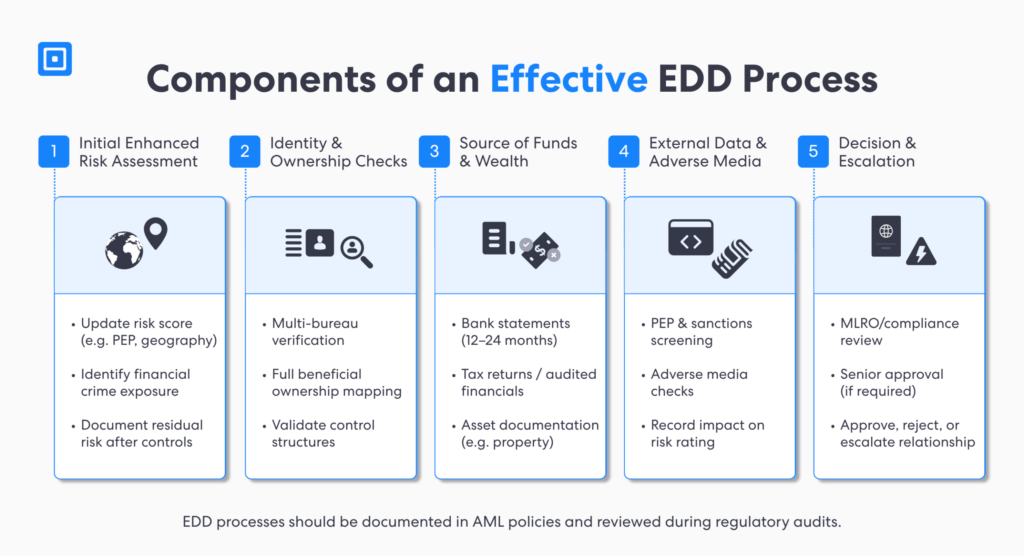
Furthermore, compliance teams record and evidence ongoing monitoring and senior management intervention for high-risk customers to meet reporting obligations. This includes the level of due diligence that each step requires and implements. Teams better understand how to build an effective EDD workflow when they know the core components involved:
### Initial Enhanced Risk Assessment
Collect customer background information through document verification, proof of address, and selfie checks to confirm identity authenticity. Next, refine the customer’s risk scoring based on the information collected, which includes PEP status or any unusual activity patterns. Ensure to document why the relationship presents risks, noting specific risk indicators. You can learn more here: [Document Authentication Services with ID Liveness.](https://www.complycube.com/complycube-strengthens-document-authentication-services-with-id-liveness-layer/)
### Identity and Beneficial Ownership Verification
EDD demands verification beyond standard checks. To elaborate, it requires understanding who really owns and controls an entity. Thus, implement advanced checks, such as [multi-bureau verification](https://www.complycube.com/solutions/identity-assurance/multi-bureau-checks/) and sanctions screening, to verify customers against multiple trusted databases. Confirm full ownership structure mapping and challenge inconsistencies in documents.
### Source-of-Funds (SOF) and Source-of-Wealth (SOW)
Gather proof of SOF to investigate how the money for a specific transaction was made. On the other hand, SOW checks enable organizations to analyze the total net worth of a customer. Together, these checks provide an understanding of whether transaction values align with the customer’s known occupation, income level, or declared assets. To evidence this, use a standardized template and record the evidence received and assessment outcome.
### External Data and Adverse Media
Use reputable, global databases for accurate PEP, [adverse media](https://www.complycube.com/en/solutions/global-screening/adverse-media-checks/), watchlists, and sanctions screening. Document how hits of negative news coverage and listing influence the customer’s risk ratings. Automating enhanced due diligence supports quicker cross-referencing of this data from multiple sources. For best practice, keep a record of every alert reviewed and how it affected the risk rating.
### Decision and Escalation
Each EDD case must lead to a documented decision. Regulators expect teams to record compliance reviews, obtain senior management approval where required, and clearly write imposed controls. Moreover, decisions to approve or to introduce step-up checks must be rationalised. A centralized case management system is recommended to maintain full, real-time audit trails.
## Operationalizing Enhanced Due Diligence Measures
For high-growth companies looking to scale EDD, strong process design and governance are crucial. According to reports, a slow and duplicative process can cause [high customer drop-offs](https://www.mckinsey.com/industries/financial-services/our-insights/winning-corporate-clients-with-great-onboarding). Thus, a well-governed framework supports a scalable EDD process and creates a single source of truth for high-risk client assessments.
- **Documented Policy Thresholds:** Define clear quantitative triggers, such as transaction volume thresholds. Additionally, you must record qualitative triggers, such as a criminal record.
- **Cross-functional Alignment:** Set clear compliance standards, share risk models, and introduce role-based controls to increase ownership over EDD decision-making.
- **Cross-functional Alignment:** Set clear compliance standards, share risk models, and introduce role-based controls to increase ownership over EDD decision-making.
- **Training:** Introduce real-world situations to train on when to recognize suspicious activity and escalation strategy. Create ongoing training and a thorough due diligence checklist.
- **Regulatory Changes:** Track updates to local and global regulations. For instance, monitor changes to FATF blacklists or customers’ risk profiles and promptly act on them.
In order to avoid complex onboarding, compliance teams must embed clear policy documentation, cross-functional team alignment, frequent compliance training, rigorous feedback loops, and ongoing monitoring for regulatory changes. Together, these create stronger compliance operations aligned with regulatory requirements.
### Key Takeaways
- **EDD goes beyond** **CDD**, requiring robust investigation of source of funds, source of wealth, PEP, and adverse media screening, ongoing monitoring, and thorough documentation.
- **A risk-based approach** supports businesses in creating triggers in their AML program to decide when to escalate CDD to EDD while maintaining seamless onboarding.
- **EDD triggers include specific** indicators, including politically exposed persons, unclear ownership structures, connections to high-risk countries, unusual transaction patterns, and more.
- **The FATF Recommendations** set standards on EDD measures and shape global regulations, including the EU’s AML Directives and the U.S Bank Secrecy Act.
- **Companies in banking**, cryptocurrency, gambling, and real estate must follow sector-specific EDD legislation due to varying levels of risk involved in the product.
## Automating Enhanced Due Diligence
EDD involves assessing risks in the efforts to combat money laundering and other financial crime. As technology evolves, regulations become more stringent to effectively safeguard the financial system. By automating enhanced due diligence, businesses can expect accurate customer verification, quicker onboarding, and secure processes. Contact ComplyCube to learn more about how you can leverage automation technology to meet compliance obligations [today](https://www.complycube.com/en/contact/contact-sales/).

## Frequently Asked Questions
When is enhanced due diligence needed?
Enhanced Due Diligence (EDD) is needed when high-risk indicators of money laundering or terrorist financing are present. For instance, unusual transaction patterns or complex corporate structures require businesses to undergo deeper scrutiny through EDD processes.
How does enhanced due diligence differ from customer due diligence?
Customer Due Diligence (CDD) forms the standard baseline for verifying identity and assessing customer risk. Enhanced Due Diligence (EDD) is a more thorough investigation performed on customers or entities with a higher risk exposure, which mandates a higher depth and frequency of customer verification.
Which companies need enhanced due diligence measures?
Customer Due Diligence (CDD) forms the standard baseline for verifying identity and assessing customer risk. Enhanced Due Diligence (EDD) is a more thorough investigation performed on customers or entities with a higher risk exposure, which mandates a higher depth and frequency of customer verification.
What are the common Enhanced Due Diligence (EDD) triggers?
Common triggers that need EDD measures include customer risk, such as politically exposed persons, and associated risks from their family and close associates. Other risks include behavioral ones, such as unusual transactions, geographic risk, such as individuals linked to high-risk countries, and product risk, such as high-value crypto wallets.
How does ComplyCube’s automated EDD work?
ComplyCube’s automated EDD solutions verify identity, score customer risk, and automatically escalate high-risk cases for enhanced checks. Businesses can mitigate risks effectively with configurable risk thresholds and no-code workflows according to your regulatory needs.
**Categories:** Guides
**Tags:** Identity Verification
---
### [ComplyCube Maintains IDV Leader Position in G2 Spring 2026 Report](https://www.complycube.com/g2-spring-2026-report/)
**Published:** April 15, 2026
**Author:** Rithu Jagannath
**Excerpt:** ComplyCube’s G2 Spring 2026 results highlight strong customer satisfaction, platform reliability, and onboarding performance, reinforcing its leadership across compliance and identity verification categories.
**Content:**
London, April 15, 2026 – ComplyCube earned 136 G2 badges in the G2 Spring 2026 report, with top-ranked placement in 1st place across multiple reports for Address Verification, Age Verification, and Biometric Authentication. The data also shows strength across more than 100 category placements, including AML, Digital Customer Onboarding, Fraud Detection, and Reference Check, plus expansion into enterprise, mid-market, SMB, EMEA, and Europe report groups.
## Regulatory Pressure and Market Demand on the Rise
Today, regulatory expectations are only increasing globally. In 2026, it is reported that 85% of compliance professional say that regulations have grown more complex within the past three years. It places a great deal of pressure on organizations and companies to increase their efforts in Anti-Money Laundering (AML) controls and onboarding processes. For example, the [Financial Action Task Force (FATF)](https://www.fatf-gafi.org/en/home.html) says that risk-based approaches (RBA) and ongoing monitoring are essential for AML frameworks. On the other hand, [UK Financial Conduct Authority (FCA)](https://www.fca.org.uk) believe that onboarding weaknesses are one of the biggest compliance risks.
This demand is clear across broader industry data and reporting. The [United Nations Office on Drugs and Crime](https://www.unodc.org) estimates that between 2 and 5 percent of global GDP, up to $2 trillion annually, is linked to money laundering. It is clear that as these financial crime risks grow, companies are investing in software that can deliver fast verification, strong fraud detection, and improved operational efficiency. The G2 Spring 2026 Report demonstrates that solutions perform the best under real regulatory conditions.
## G2 Validates Platform Performance and Customer Satisfaction
This G2 report provides transparent benchmark for evaluating software based on verified user experiences. Its’ Grid reports rank vendors by looking at customer satisfaction score and market presence indicators. As a result, it aggregates data across the most relevant categories to support compliance teams in their purchasing decisions. Particularly, it is helpful when it comes to compliance technology, where usability and reliability impact onboarding and compliance.
ComplyCube’s performance reflects strong alignment with these criteria. With consistent positive review and feedback from their customers across 108 categories, ComplyCube moved up in multiple categories to a higher rank. Most notably, they moved up to a higher position for [Age Verification](https://www.complycube.com/en/use-cases/process/age-verification/ "Age Verification"), [Biometric Authentication](https://www.complycube.com/en/solutions/identity-assurance/customer-authentication/), and Identity Verification. These metrics showcase how the platform can deliver measurable outcomes, particularly in regulated environments where performance is crucial.
## G2 Recognition Highlights Consistent Customer Value
[ComplyCube’s G2](https://www.g2.com/products/complycube/reviews) Leader badge awards shows how strong customer satisfaction is relative to their market presence. G2 are typically showcasing vendors that get high user ratings while continuing to grow their footprint. This makes this designation a strong marker of real world performance. It signals a consistent delivery over onboarding and verification workflows.
According to G2 data reporting, customer satisfaction is the number one driver in software selection. This is relevant particularly in fintech and compliance sectors. [ComplyCube’s](https://www.complycube.com) badges around Best Governance, Risk & Compliance Software Products as well as Best Support, Highest User Adoption as well as Users Most Likely to Recommend highlightingf their strong user confidence and adoption.
## Customer Outcomes and Industry Trends in G2 Spring 2026 Report
In the G2 Spring 2026 Report, ComplyCube shows up with strong performance across usability, implementation, and support with badges such as Best Results, Best Usability and Easiest Setup. According to a recent report by [SundaySky](https://sundaysky.com/blog/customer-onboarding-statistics/), poor product adoption during onboarding is cited as a leading churn driver by 23% of B2B companies. These results reflect the platform’s ability to lower onboarding friction while maintaining compliance accuracy. This is a key requirement for regulated organizations.
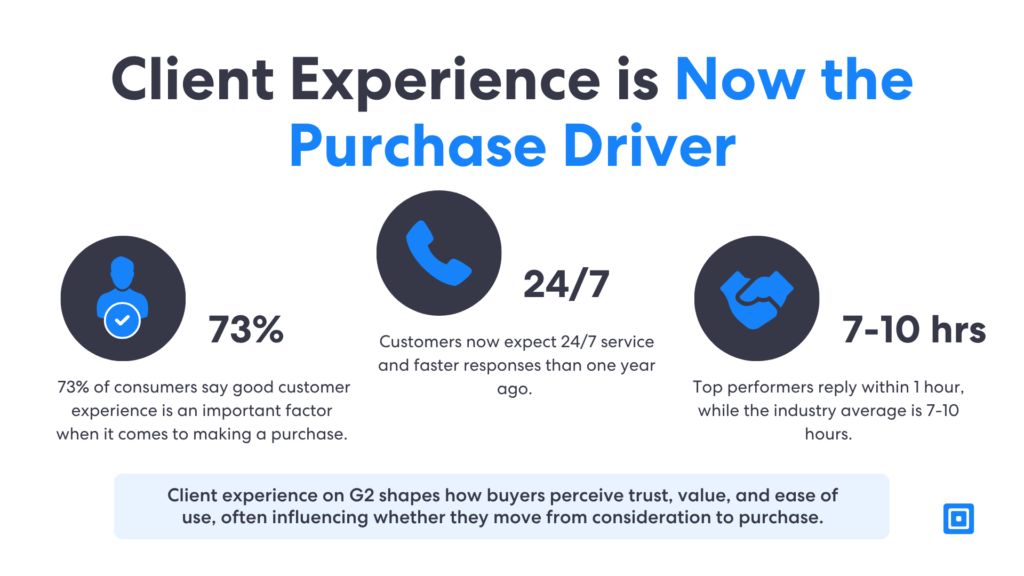
Industry research from [McKinsey](https://www.mckinsey.com/capabilities/tech-and-ai/our-insights/service-industries-can-fuel-growth-by-making-digital-customer-experiences-a-priority) shows that effective digital onboarding can help conversion rates by 20% while lowering operational complexity. By prioritizing efficiency and customer experience, platforms that can blend automation with usability are gaining traction. ComplyCube’s G2 Spring 2026 results prove that alignment with these industry trends.
> G2 recognition reflects real-world performance at scale.
Chief Technical Officer, [Mohamed Alsalehi](https://www.linkedin.com/in/malsalehi/) added that, “Delivering efficient, accurate and adaptable compliance workflows are central to ComplyCube’s platform development.” This is particularly important as regulations and expectations continue to change across global markets and various industries.
## Unified Compliance Platforms Define the Next Phase of Growth
The G2 Spring 2026 results show a much broader market shift in buyer expectations. Companies are now focusing more on unified compliance platforms that make things simple. Ones such as ComplyCube that integrate identity verification, AML screening, and fraud detection. Deloitte’s research on compliance modernization states that fragmented systems add to overall costs and slow down onboarding processes. As a result, integrated platforms help with more efficient decision-making and risk management.
Similarly, the [World Economic Forum](https://www3.weforum.org/docs/WEF_The_future_of_financial_infrastructure.pdf) found digital identity as a major component of future financial infrastructure. This further reinforces the importance of integrated compliance systems. Picking platforms that centralize workflows, reduce complexity and support regulations across various jurisdictions or regions.
ComplyCube has repeatedly shown how they are a leading provider of AML and identity verification solutions. They received 136 badges with multiple G2 Leader recognitions across Anti-Money Laundering, Biometric Authentication, and Identity Verification just to name a few. ComplyCube continually shows high performance and these results are grounded in verified user feedback, providing a clearer and credible measure of real world effectiveness.
## About ComplyCube
[ComplyCube](https://www.complycube.com/en/) is a leading RegTech platform for Identity Verification (IDV), Anti-Money Laundering (AML), and Know Your Customer (KYC). Their system helps businesses streamline onboarding, reduce fraud, and stay compliant across global markets in many industries.
## About G2 Software & G2 Spring 2026 Report
[G2](https://www.g2.com) is a trusted software marketplace that turns verified user feedback into clear, transparent rankings across technology categories. The G2 Spring 2026 Report helps buyers cut through noise. They identify the right products earning the strongest satisfaction, traction, and real-world credibility.

**Categories:** News
**Tags:** Announcements
---
### [How to Assess Business Risk Score More Accurately](https://www.complycube.com/how-to-assess-business-risk-score/)
**Published:** April 30, 2026
**Author:** Rithu Jagannath
**Excerpt:** Learn how to assess a business risk score with smarter business risk assessment and continuous business risk monitoring. Discover how to detect threats early, prioritise risk, and make better decisions in a fast-changing risk landscape with confidence and clarity.
**Content:**
**TL;DR:** A business risk score is **a quantifying number** assigned to a business risk assessment. However, companies today require more than static scoring. Business risk monitoring needs to be continuous, data-driven, and adaptive. It reduces exposure, **improves risk management,** and helps **companies gain an edge** over their competitors.
## What is a Business Risk Score?
Business risk scores help companies answer one simple but critical question. They look at how risky a business, customer, or partner is. In today’s environment, this question becomes harder to answer because risks are not all in one place. They come from financial pressures, regulatory changes, and operational gaps. Even the World Economic Forum’s Global Risk Reports show how these risks are becoming much more connected and happening more often.
At its core, risk scoring relies on two key ideas. Business risk assessments look at likelihood and impact. Teams assess how likely an event is to occur and how severe the consequences would be. They then combine these factors to produce a risk score. This simple structure helps teams compare very different risks in a consistent way.
In practice, business risk assessments are rarely this straightforward. Teams often assign weights to key risk factors based on their importance before calculating a combined score. This allows organisations to focus on what matters most to their business strategy and risk appetite. They may also use two types of scores: internal risk scores built by their own teams, and external risk scores provided by third parties.
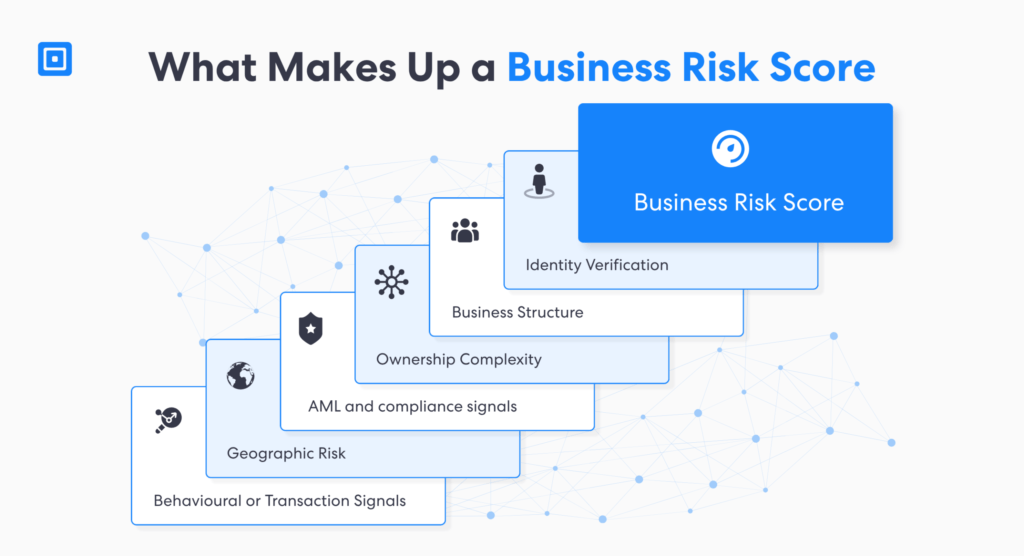
Therefore, the true value of a business risk score comes into play when it is treated as a real-time signal. Low-risk today may become high-risk tomorrow due to new business leaders, unusual behavior, or financial stress. This ensures regulatory compliance and business continuity. Risk scoring is essential because of its ability to spot risk and respond fast. This is what sets resilient organizations apart from vulnerable ones.
## Why Business Risk Score Matters
A business risk score needs to be actionable. It should be able to move organizations from understanding their risks to actively preparing for them. According to [PWC’s Global Risk survey](https://www.pwc.com/sk/en/current-press-releases/global-risk-survey.html), over 75% of organizations say they have experienced disruption from risks that were either underestimated or not foreseen. The structured assessment that [risk scoring](https://www.complycube.com/en/solutions/due-diligence-compliance/risk-scoring/) provides closes that gap by being prepared.
However, the range of risks that businesses encounter on a day-to-day basis continues to grow. Where certain strategic decisions can bring about long-term exposures, day-to-day carries their own individual vulnerabilities. Compliance expectations are only increasing, especially in regulated industries such as financial institutions.
As a result, conducting a thorough business risk analysis helps companies map these risks much earlier. It helps them understand how they could impact their organization’s objectives and support informed decisions. The Organization for Economic Co-Operation and Development (OECD) highlights that [complexity in regulations](https://www.oecd.org/en/publications/oecd-regulatory-policy-outlook-2025_56b60e39-en/full-report/regulating-for-people_6d2fc8d4.html) has become more significant in the past decade. This grows the burden on organizations to keep risk monitoring important. The risk assessment process can no longer be static or periodic.
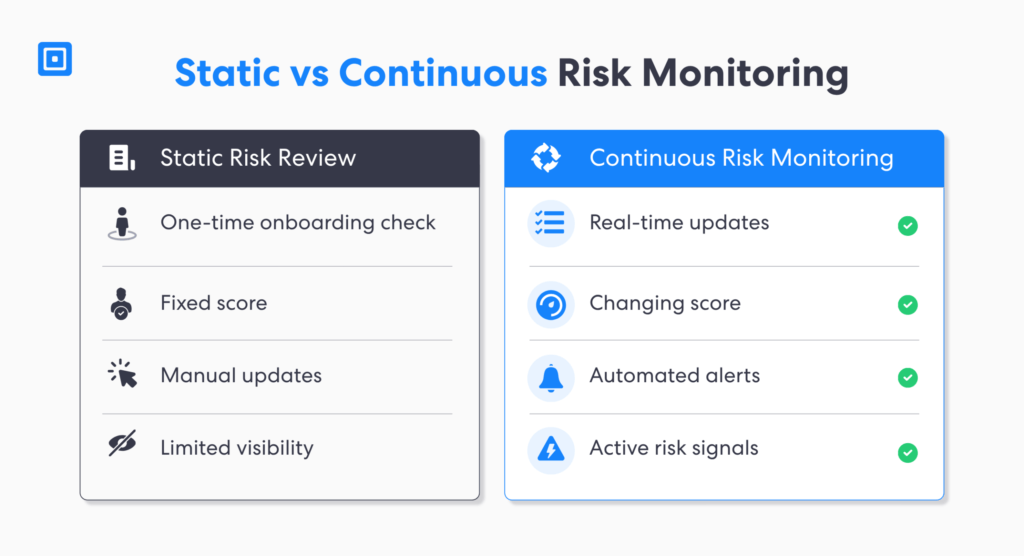
A strong business risk assessment helps organizations prioritize security risk mitigation. It allocates resources much more effectively and strengthens overall resilience. More importantly, it supports better decision-making at every team level. Businesses that invest in due diligence, specifically structured ongoing risk assessment, are in a much better position to change fast, lower risk exposure, and protect long-term performance.
## Key Risk Indicators and Early Detection
Understanding why a business risk score matters is one thing, but knowing when that risk profile is starting to change is much more valuable. This is why [key risk indicators (KRIs) ](https://legal.thomsonreuters.com/blog/key-risk-indicators-kris-an-overview/) act as early signals that show whether risk levels are increasing, decreasing, or changing in new ways. In a recent report by EY, 84% of executives said [better signals around risk](https://www.ey.com/en_gl/insights/consulting/how-can-reimagining-risk-prepare-you-for-an-unpredictable-world#:~:text=2025%20EY%20Global%20Risk%20Transformation,%25%2C%20and%20have%20remained%20elevated.) could impact a company’s operations and are necessary in achieving their strategic objectives.
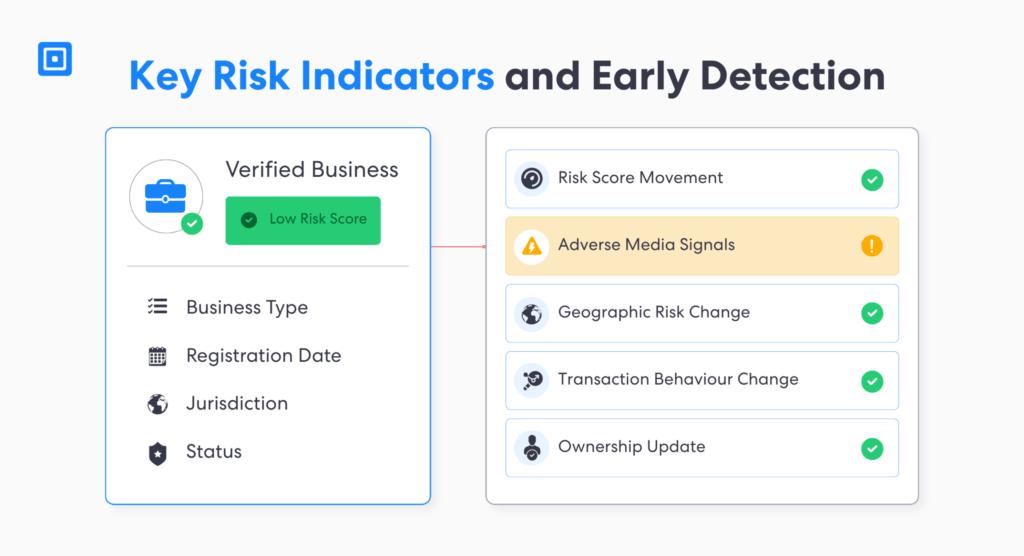
Risks build over time through small, often overlooked signals. They can be found in an organization’s operations across multiple departments. This can be found by documenting changes in behavior, unusual patterns in data, or subtle shifts in financial or operational performance. [The Association of Certified Fraud Examiners (ACFE)](https://www.acfe.com) found that organizations with continuous monitoring [detect fraud](https://www.acfe.com/fraud-magazine/all-issues/issue/article?s=top-internal-controls-that-reduce-fraud-losses-2024) up to 50% faster than relying on traditional methods, significantly reducing financial damage.
Teams create effective key risk indicators and a strong continuous business risk monitoring process by defining clear thresholds. They must link each indicator to specific risk factors and ensure that any change triggers the right response. For example, transaction anomalies, new adverse media, or changes in ownership structure should directly impact the risk score and prompt further review. This keeps risk teams aligned with company objectives and prevents risk monitoring from becoming disconnected.
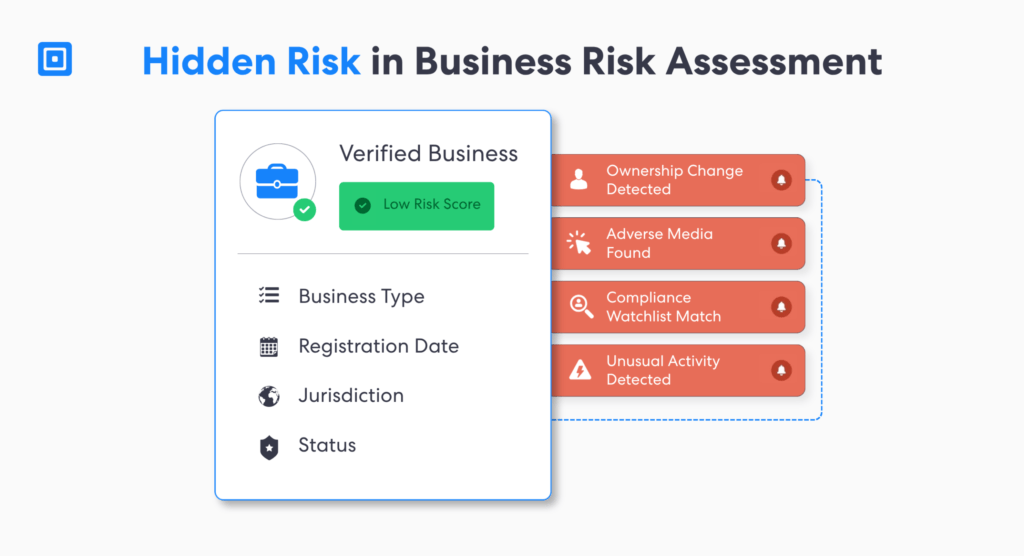
On the other hand, data analysis and automation support early detection. Today’s advanced business risk monitoring tools can deal with large amounts of data, find patterns, and place important signals in real time. According to McKinsey, organizations that prioritize [data-driven risk management](https://www.mckinsey.com/capabilities/risk-and-resilience/our-insights/the-future-of-risk-how-global-trends-are-reshaping-risk-management) are much better at anticipating disruptions and responding fast. Being able to detect early warnings through business risk scores and act on them gives companies a clear advantage in reducing risk exposure and maintaining control.
### **Case Study: ION Group Cyberattack and Identified Risks**
Financial software provider, ION Group, faced new scrutiny from the ongoing fallout from its previous cyberattack. Though risk signals existed, they were not prioritized or surfaced early enough. Weak visibility into vendor risk, system exposure, and evolving threat signals meant risks were not fully reflected in internal risk score models.
##### **Enhanced Risk Scoring and Monitoring Integration**
Impacted firms strengthened their approach to business risk scores. They built in more threat intelligence, vendor risk data, and system exposure metrics into their risk scoring. As a result, scores were subject to change as new risks emerged. This was combined with continuous processes for business risk monitoring that reflected real-world conditions.
##### **Solutions & Outcomes**
- Improved visibility into third-party and operational risk across critical systems
- Faster escalation of high-risk signals through dynamic risk scoring updates
- Stronger alignment between risk scoring, monitoring, and incident response
## Regulatory Compliance and Business Risk Analysis
Once organizations improve early detection through key risk indicators, the next challenge is putting things into action that meet regulatory expectations. Compliance is a core part of managing risk in a defensible way. In reality, failures in compliance can bring about serious consequences. A great example of that is the Financial Conduct Authority (FCA) issuing [billions in fines over the past decade](https://www.id-pal.com/blog/fca-aml-fines-2015-2025-a-decade-of-data-and-what-it-means-for-you/) for weaknesses in controls and practices. This shows how quickly small gaps can, in fact, turn into major exposure.
As a result, a strong risk management framework helps companies stay aligned with changing expectations. It connects risk scoring, risk monitoring, and responses into one clear system. This covers clear risk management policies, running regular risk audits, and keeping a consistent monitoring process across the whole organization. Regulators such as the Basel Committee have stressed the need for stronger risk data collation. Firms must track and report risk correctly across all business areas.
These risk management practices should be built on the basis of consistency and adaptability. If the risk changes, so must the controls around them. According to KPMG, organizations that [embed continuous risk monitoring](https://kpmg.com/xx/en/our-insights/risk-and-regulation/ai-is-helping-revolutionize-risk-management.html) into their operations are much better equipped for regulatory reviews and respond more effectively to emerging threats. This approach makes sure that risk responses are aligned with real-world conditions. This gives business leaders much greater confidence that risks are being managed with both internal and external expectations.
## Natural Disasters, External Threats, and Risk Exposure
However, many of the most disruptive risks come from outside the company’s control. The UN Office of Disaster Risk Reduction reports that the number of disasters globally has [increased sharply](https://www.undrr.org/news/un-report-dramatic-rise-climate-disaster-over-last-twenty-years) over the past two decades. Natural disasters, geopolitical tension, and economic shocks can impact operations with very little warning. This places much more pressure on businesses to prepare for sudden disruption to their operations.
According to the Federal Emergency Management Agency (FEMA), it estimated that [almost 40% of small businesses](https://www.insurancebusinessmag.com/us/news/risk-management/risktakers-why-a-business-might-never-reopen-postnatural-disaster-108301.aspx) never reopen after a major disruption. This highlights the importance of identifying potential business risks in advance. These events do not just impact physical buildings. They disrupt supply chains, stop operations, and cause long-term financial strain. Without having a structured approach to risk identification and mitigation, even well-run organizations can struggle to recover.
To manage this, organizations must build environmental and external links into their risk monitoring process. Effective risk management includes contingency planning, clear resource allocation, and effective processes that track early warning signals. Changes in weather patterns, supplier delays, or geopolitical developments can all act as early indicators of said disruption. If teams link these signals back to business risk scoring and monitoring systems, organizations can respond faster and lower the impact of such risks.
Compliance risks also need to take into consideration the future. Climate change, regulatory shifts in government regulations, and global economic instability influence risk probabilities. It can impact an organization’s ability to meet its strategic objectives. For example, the World Bank has showcased how [climate-related risks](https://documents1.worldbank.org/curated/en/705731624380363785/pdf/World-Bank-Group-Climate-Change-Action-Plan-2021-2025-Supporting-Green-Resilient-and-Inclusive-Development.pdf) alone are increasing operational uncertainty across industries. By integrating external risk factors into their management strategy, businesses that take a proactive approach are better prepared for what is to come.
## Resource Allocation and Effective Risk Monitoring
So, the next challenge is deciding where to act first. Considering that, resource allocation becomes incredibly critical. There is no business that has unlimited amounts of time, budget, or people. This is where business risk scoring proves its value. Ranking risks clearly allows teams to prioritize high-impact threats instead of spreading compliance team efforts too thin. This leads to potential consequences and risks that could impact big or small businesses negatively.
However, organizations should not prioritise risks at random. They need to align resource allocation with their risk appetite and strategic objectives, especially when multiple departments manage different types of risk. Without this alignment, teams can misallocate resources, under-manage critical risks, and spend too much time on lower-priority issues.
As a result, technology now plays a key role in making this process more impactful. Modern risk management software helps automate workflows, improve data analysis, and provide real-time insights into changing risk levels. Gartner notes that organizations adopting [integrated risk management](https://www.gartner.com/reviews/market/integrated-risk-management) platforms gain much better visibility across operations and make fast, more consistent decisions. By placing resources into high-risk areas and using data to guide decisions, organizations can lower overall risk exposure by prioritizing effectively. You can learn more here: [What is a Risk-Based Approach (RBA)?](https://www.complycube.com/en/what-is-a-risk-based-approach/)
## Mitigating Risks with a Business Risk Score
However, companies cannot eliminate all risk. That is virtually impossible. Trying to do so wastes time and resources. Instead, they should make clear, informed decisions about how to handle each risk. Many organizations fall short not because they lack data, but because they lack a structured way to turn that data into practical action.
> Risk management is not about eliminating uncertainty. It is about responding to it with clarity and intent.
Solutions Consultant at ComplyCube, [Milosh Caunhye](https://www.linkedin.com/in/milosh-caunhye/), goes on to say that, “A business risk score should never sit passively in a report or dashboard. It should act as a trigger point within the risk management process for most businesses and organizations. It should guide teams on what to do next, how quickly to act, and which risks require escalation.”
Organizations use four core risk responses: accept, reduce, transfer, or avoid. They choose the right response based on their risk appetite and the nature of the risk. For example, teams can accept and monitor low-impact risks, while high-impact risks require immediate action, such as tighter controls, process changes, or reduced exposure.
However, a business risk score should also trigger a defined response. A rising risk score should lead to enhanced due diligence, additionally monitoring specific risks, or escalation to senior risk teams. There is now a clear connection between assessment and action in the risk management plan. It ensures that risk mitigation strategies are both analytical and operational.
Additionally, risks often overlap between many different departments. Risk management teams must align their mitigation efforts and strategies. In a complex risk landscape, organizations that respond with clarity and speed reduce exposure and protect their business interests. You can learn more here: [Understanding User Risk from Identity Fraud](https://www.complycube.com/en/understanding-user-risk-from-identity-fraud/).
### Key Takeaways
- **Business risk scoring** must grow from static models to real-time monitoring.
- **Effective risk monitoring** supports early detection and proactive risk management.
- **Risk scores** should look at many risk factors, such as behavioral and external threats.
- **A strong risk framework** improves regulatory compliance and business continuity.
- **Advanced data analysis** and automation are critical for correct risk assessment and mitigation.
## Assess Business Risk Score with ComplyCube
In summary, accurate business risk scores are a fundamental need for most organizations. It is hard to navigate the complex risk landscape and potential threats that change every day. By adopting an ongoing risk monitoring approach, businesses can speed up decision-making, lower risk exposure, and gain a competitive edge.
Want to move beyond static compliance models? ComplyCube can help you implement a smarter, real-time risk intelligence solution tailored to your needs. [Contact us today](https://www.complycube.com/en/contact/).
[](https://portal.complycube.com/signup?_gl=1%2A2ope9e%2A_up%2AMQ..%2A_gs%2AMQ..&gclid=Cj0KCQjw2MbPBhCSARIsAP3jP9zDtXoFxaJyNCi7AUlcsnNe9XrRBK9gJDYh9CKNsdGZryQKogIYSPMaAjlnEALw_wcB&gbraid=0AAAAAoJigpp9L3SRUWiLPlTuLvG0RRAzO)
## Frequently Asked Questions
What is a business risk score and why is it important?
A business risk score is a numerical value assessing the likelihood and impact of potential risks impacting an organization. It helps businesses monitor risks, allocate resources effectively, and ensure regulatory compliance while supporting strategic decision making.
How does business risk monitoring improve risk management?
Business risk monitoring improves risk management by providing continuous insights into risk levels based on relevant risks such as data breaches. It is important to enable early detection of threats, and ensure that mitigation strategies remain effective over time.
What are the key components of a business risk assessment?
A business risk assessment includes risk identification, analysis of risk probabilities and impacts, evaluation of risk exposure, and implementation of mitigation strategies to manage identified risks effectively in a changing risk landscape.
How can organizations mitigate risks effectively?
Organizations can mitigate risks effectively by implementing a comprehensive risk management framework based on their risk tolerance. They can use data analysis, using risk monitoring tools, and updating their risk management strategy to address evolving threats.
How does ComplyCube support business risk scoring?
ComplyCube supports business risk scoring by providing the ongoing process of real-time monitoring, advanced data analysis, and configurable risk scoring frameworks that enable organisations to manage risk proactively and maintain regulatory compliance.
**Categories:** Guides
**Tags:** Anti-Money Laundering
---
### [What to Look for in a Customizable Compliance Solution](https://www.complycube.com/customizable-compliance-solution/)
**Published:** May 7, 2026
**Author:** Rithu Jagannath
**Excerpt:** Learn what to look for in a customizable compliance solution with smarter compliance workflows and continuous compliance monitoring. Discover how to reduce manual effort, improve audit readiness, and adapt to changing regulatory requirements with confidence.
**Content:**
**TL;DR:** A **customizable compliance solution** supports organizations by replacing old-school rigid systems with customizable workflows**.** By building intelligent **compliance workflow** solutions, businesses can **scale efficiently** across evolving regulatory environments.
## What is a Customizable Compliance Solution?
A customizable compliance solution is a newer approach to compliance management. It helps businesses design, update, and improve compliance frameworks. These compliance management solutions are built based on risks, regulatory requirements, and operational needs. Unlike traditional compliance efforts that rely on fixed rules, these processes fit in with dynamic compliance workflows that change in real-time. Most top compliance management tools have core key features such as Identity Verification (IDV), Know Your Customer (KYC), and Anti-Money Laundering (AML) checks.
Today’s move towards more customizable workflows reflects a broader change in managing compliance risk. According to PwC, over 70% of firms now expect compliance to support digital transformation initiatives. Manual compliance processes that are static tend to struggle to meet this demand. Customizable compliance solutions offer tailored workflows, automation capabilities, and centralized policy management. Now, compliance teams can lower manual effort and respond fast to changing risk, and compliance expectations.
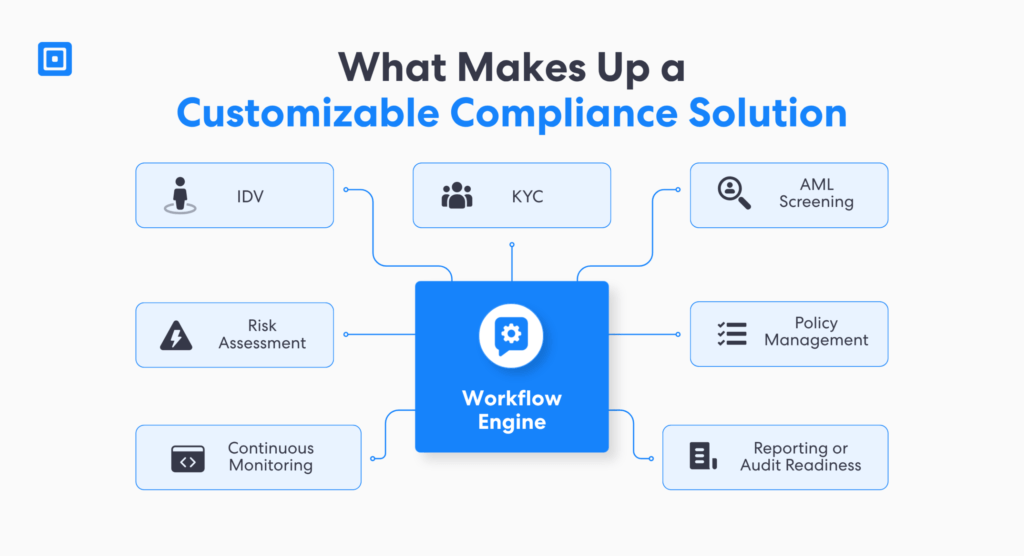
Automating repetitive tasks plays a huge role in this change. Compliance and risk management software can automate regular compliance tasks, review regulatory standards, and give real-time visibility into compliance statuses. Research from Deloitte shows that organizations that automate compliance processes report up to 30% faster audit preparation time. By standardizing compliance activities, these security frameworks help companies lower risk, improve operations, and maintain consistent compliance.
In reality, now compliance automation is a part of everyday life. It sits directly in operations rather than being a reactive function. Compliance professionals and teams can align automated [compliance workflows](https://www.complycube.com/en/solutions/compliance-suite/kyc-workflow/) with business processes. They can monitor risks as they show up, and demonstrate regulatory adherence with much greater confidence. This level of visibility and control into risk assessment processes is necessary as regulatory risks become more complex and enforcement actions grow globally.
## Adapting a Customizable Compliance Solution
Organizations have leaned on manual compliance management. They used rigid compliance processes to meet many frameworks for regulatory bodies. These systems were built for a different time, prioritizing stability over flexibility. As a result, reporting on compliance challenges relied on manual effort. Soon enough, routine compliance tasks were missed due to disconnected tools and slow operations that struggled to keep up.
This existing model of compliance solutions is under great pressure. Expectations are rising, and businesses are growing faster. In [PwC’s Global Compliance Survey in 2025](https://www.pwc.com/gx/en/issues/risk-regulation/pwc-global-compliance-study-2025.pdf "PwC's Global Compliance Survey in 2025"), they reported that 71% of organizations expect digital transformation initiatives over the next three years that will need compliance support.
Teams are being asked to support major operational changes such as AI implementation, cloud-based infrastructure, and new customer experiences. Also, 41% surveyed need compliance support for new business models, showing that compliance is no longer a back-office function. This shift is increasing the demand for customizable compliance workflows that can move fast with regulatory change.
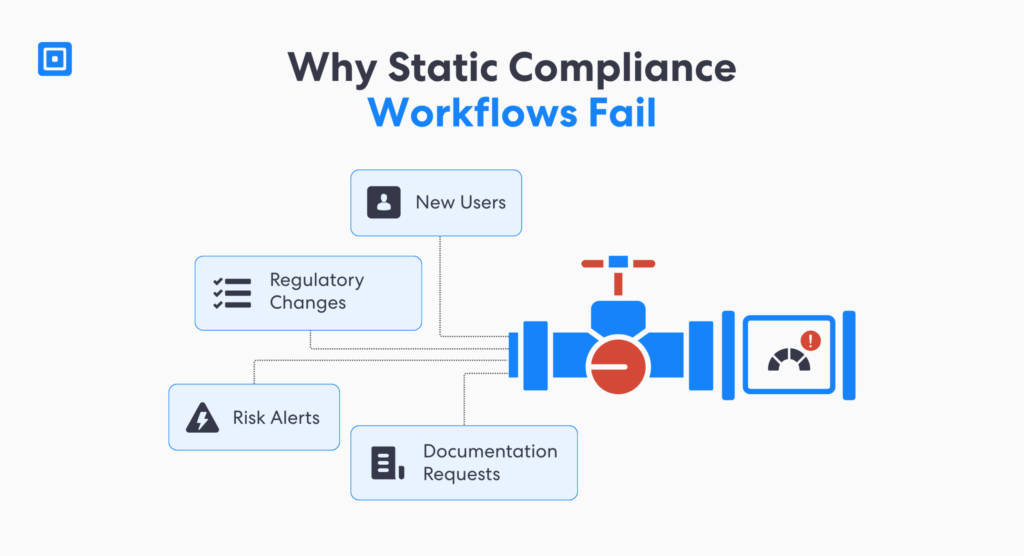
Manual compliance processes create delays, increase compliance risks, and limit visibility into compliance status. As organizations expand into new markets, they must adopt new technologies such as [KYC workflow builders](https://www.complycube.com/en/solutions/compliance-suite/kyc-workflow/) or drag-and-drop interfaces. Therefore, customizable compliance solutions bring flexibility into workflows. For example, instead of relying on fixed processes, compliance teams can change workflows based on many factors such as risk level, jurisdiction, or customer profile.
In reality, dynamic systems lower bottlenecks and make things more visible. Teams can track and monitor compliance status in real time. They can act on incoming issues the moment they arise. This shift from reactive to proactive compliance is key for organizations or third-party risk management that want to scale without growing risk.
## Managing Regulatory Compliance Pressures
Today, regulators are not focused on checking a box. They are expecting organizations to show clear risk awareness. Companies need to apply controls based on that risk. The Financial Action Task Force (FATF) continues to stress the importance of a risk-based approach to AML and Counter-Terrorist Financing (CTF). You can learn more here: [What is Counter-Terrorist Financing (CTF)?](https://www.complycube.com/en/what-is-counter-terrorist-financing/)
This shift can also be seen in regulatory enforcement trends. For example, in 2025, regulators issues major penalties that were tied to ineffective AML controls. The UK Financial Conduct Authority (FCA) [fined Barclays](https://www.fnlondon.com/articles/barclays-fined-42m-by-the-fca-for-financial-crime-risk-failures-162efd53) £42 million for failures in ongoing financial crime monitoring. Meanwhile, Germany’s BaFin imposed a record €45 million on [JPMorgan’s German unit](https://www.wsj.com/finance/regulation/german-regulator-hands-52-million-fine-to-jpmorgan-019bc1d2) for delays in suspicious activity reporting. These enforcement actions demonstrate the growing cost of relying on static compliance systems that cannot adapt quickly to changing risk signals and regulatory expectations.
> Compliance should adapt before risk escalates.
Chief Technical Officer, [Mohamed Alsalehi](https://www.linkedin.com/in/malsalehi/) states, “A customizable compliance solution helps teams update checks, escalation paths, and monitoring rules. All before small issues become larger compliance failures”. Now, companies can adapt without rebuilding full systems. Having flexibility for maintaining compliance in a fast-moving environment is necessary.
## Visibility in Continuous Compliance Monitoring
Continuous compliance monitoring refers to the process in a customizable compliance solution that involves reviewing systems. This looks at data and additional activities on an ongoing basis. Primarily, this ensures that controls and systems are working as intended. It takes into account issues very early on. According to the [National Institute of Standards and Technology (NIST)](https://nvlpubs.nist.gov/nistpubs/legacy/sp/nistspecialpublication800-137.pdf), continuous monitoring dramatically improves risk awareness. It also strengthens security posture across organizations.
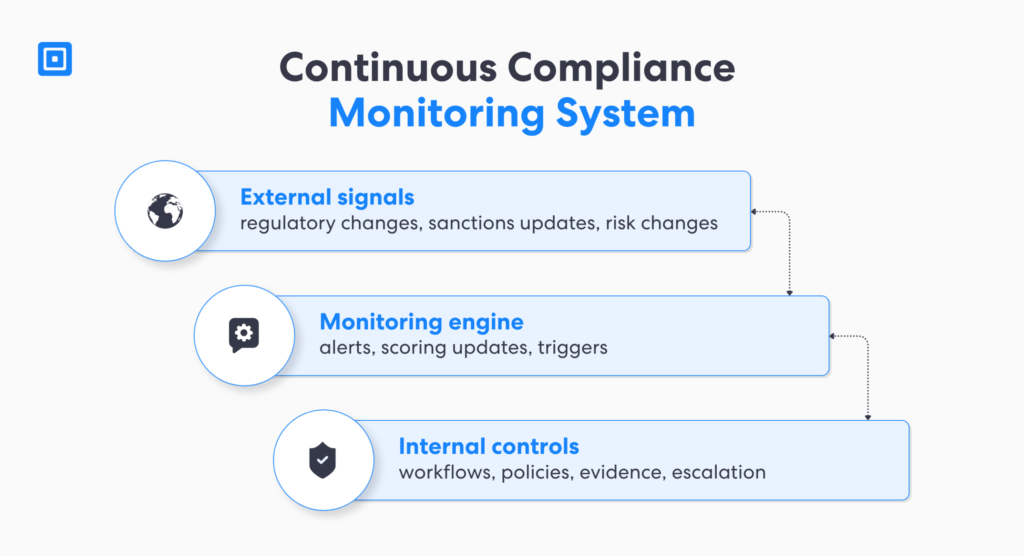
Additionally, [continuous compliance monitoring](https://www.complycube.com/en/solutions/global-screening/continuous-monitoring/) helps companies with audit readiness. Keeping up-to-date records and having automated tracking make it much easier to demonstrate compliance. This lowers the time and work needed during audits. As a result, it helps organizations build trust with regulators and stakeholders.
### **Case Study: The Cost of Failure in Compliance Programs**
As of March 2026, the U.S. Department of the Treasury’s Office of Foreign Assets Control (OFAC) announced its settlement with [TradeStation Securities, Inc](https://ofac.treasury.gov/recent-actions/20260317). The firm had allowed customers in sanctioned jurisdictions such as Iran, Syria, and Crimea to access its platform and execute 481 trades due to failures in controls.
##### **Adaptive Compliance Management Systems**
Following these compliance violations, TradeStation put a risk management platform in place. This helped further detect and escalate compliance issues in real time. Additionally, they built more thorough testing protocols and centralized compliance documentation to ensure audit readiness and regulatory tracking.
##### **Outcomes**
- $1,110,661 settlement demonstrating the financial impact of compliance failures
- Identification of 481 violations linked to workflow and monitoring gaps
- Regulatory emphasis on continuous monitoring, testing, and audit readiness
## Automated Data Collection and Audit Readiness
A key advantage of modern compliance systems is automated evidence collection. Even today, some companies gather documents manually. However, a compliance management software or customizable compliance solution grabs and updates evidence as workflows run. This way, records are always up-to-date and aligned with regulatory expectations.
In fact, Deloitte’s 2025 Global Risk Management Survey stated that [over 60% of organizations](https://www.deloitte.com/global/en/services/consulting/services/deloitte-forensic.html) say optimizing process automation is a huge priority. This strengthens compliance and risk management functions. Compliance teams to focus on higher-value tasks such as risk analysis and policy improvement. It lowers the risk of missing or outdated documentation.
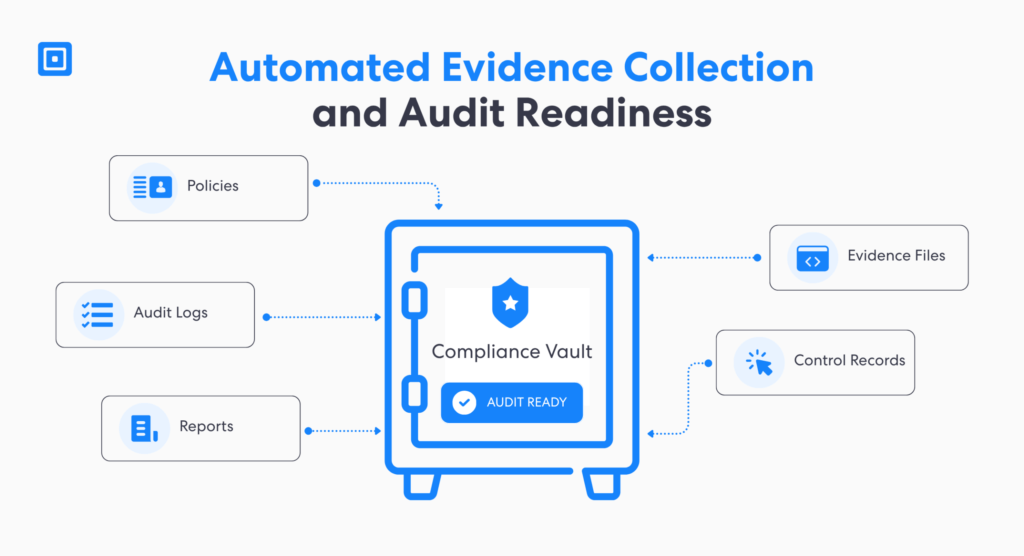
Furthermore, another feature that strengthens this process is centralized documentation. Compliance reporting dashboards store policies, logs, and reports all in one place. As a result, this creates a single source of truth that is easy to access and review. Auditors can retrieve the required information without delays. This helps audit timelines and improve transparency.
Moreover, automation can greatly improve accuracy. With less manual input, companies have less risk of human error in compliance documentation. Overall, that leads to more reliable reporting and stronger audit outcomes. Having accurate and easy-to-access evidence is crucial for building trust and avoiding penalties.
## AI and Customizable Compliance Solutions
Today, everyone talks about how artificial intelligence can help automate routine compliance tasks. However, these AI-powered solutions are also changing how companies manage their risk-based approach. When dealing with large amounts of data in real-time, AI helps compliance teams find patterns that would be hard to find by the human eye. This results in faster and more informed decision-making.
Particularly, machine learning and AI are valuable when it comes to risk assessment. It can review identity data and external signals to find potential risks early on. For instance, McKinsey reported that [agentic AI](https://www.mckinsey.com/capabilities/risk-and-resilience/our-insights/how-agentic-ai-can-change-the-way-banks-fight-financial-crime) in KYC and AML workflows can bring productivity gains of 200% to 2000%. It also improved response time and helps prevent issues before they become much worse.
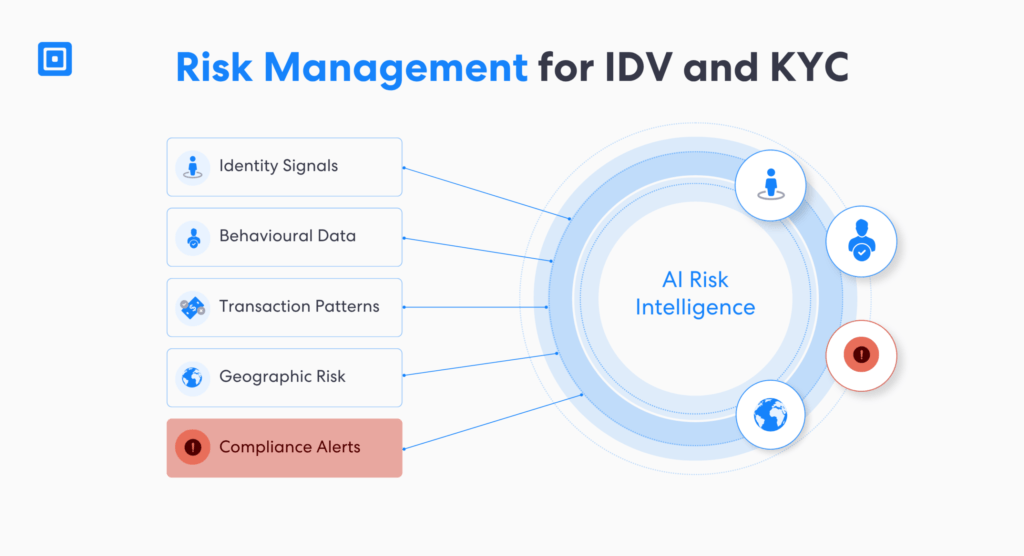
Instead of applying the same kind of compliance processes to every case, AI can adjust systems based on their respective risk level. It ensures that the appropriate resources and efforts are used when they are needed the most. For example, high-risk cases can get much deeper checks, while low-risk users can move fast.
## Compliance Management Software Solutions
Choosing the right compliance management software is one of the most important decisions companies face when it comes to their [AML processes](https://www.complycube.com/en/solutions/due-diligence-compliance/anti-money-laundering/). They need to keep in mind flexibility, cost, and long-term scalability. Of course, building an in-house system offers control. However, it needs much more time, technical resources, and ongoing maintenance. Similarly, buying a standalone tool may seem faster, but it can cause a breakdown. Disconnected systems lead to inconsistent workflows and much less visibility.
Next, configurable compliance platforms provide a much more balanced approach. So, having a unified system can be adapted to different use cases and regulatory environments. There is less of a need for multiple tools. Additionally, it allows compliance teams to customize workflows based on risk and operational needs.
Finally, another equally important feature is integration. Compliance software must connect with existing company systems. This includes customer onboarding, ongoing monitoring, and reporting tools. This integration improves data flow, reduces duplication, and supports more accurate decision-making. You can learn more here: [Integrating with a Liveness Detection SDK](https://www.complycube.com/en/integrating-with-a-liveness-detection-sdk/ "Integrating with a Liveness Detection SDK").
Therefore, the right solution should meet current needs and also support any future growth. Organizations that put in time and effort into flexible and growth-minded compliance systems are in a much better position to manage risk. These compliance systems can improve efficiency and stay ahead of regulatory change.
### Key Takeaways
- **Customizable compliance solutions** enable dynamic, risk-based compliance workflows.
- **Continuous compliance monitoring** ensures alignment with evolving regulations.
- **Automated workflows** reduce manual effort and improve operational efficiency.
- **Real-world enforcement actions** highlight the risks of static compliance systems.
- **AI-powered compliance software** enhances scalability and risk management.
## Find a Customizable Compliance Solution with ComplyCube
In summary, customizable compliance solutions are essential for organizations that need to keep pace with regulatory change. They help reduce manual effort and build more resilient, risk-based workflows. By replacing static processes with adaptable compliance infrastructure, businesses can improve operational efficiency. They can strengthen audit readiness and keep a stronger compliance posture over time.
For teams ready to level up their compliance operations and support broader goals such as SOC 2/ISO 27001, ComplyCube offers the technology and expertise to help. Reach out to [our team](https://www.complycube.com/en/contact/contact-sales/) to see how our customizable compliance solutions can support your growth and compliance requirements.
[](https://portal.complycube.com/signup?_gl=1%2A2ope9e%2A_up%2AMQ..%2A_gs%2AMQ..&gclid=Cj0KCQjw2MbPBhCSARIsAP3jP9zDtXoFxaJyNCi7AUlcsnNe9XrRBK9gJDYh9CKNsdGZryQKogIYSPMaAjlnEALw_wcB&gbraid=0AAAAAoJigpp9L3SRUWiLPlTuLvG0RRAzO)
## Frequently Asked Questions
What is a customizable compliance solution?
A customizable compliance solution is a platform that allows organizations to design and adapt automated compliance workflows based on risk, regulatory requirements, and operational needs, enabling more efficient and scalable compliance management.
Why is continuous compliance monitoring important?
Continuous compliance monitoring ensures organizations remain aligned with evolving regulations by tracking compliance status in real time and identifying compliance issues before they escalate into violations.
How do automated workflows improve compliance processes?
Automated workflows improve compliance processes by reducing manual effort. They streamline compliance tasks, improve accuracy, and ensure that compliance activities are completed efficiently without delays.
What are the benefits of compliance management software?
Compliance management software centralizes compliance activities, automates processes, and provides real-time visibility into compliance status, helping organizations reduce risks and improve operational efficiency.
How does ComplyCube support customizable compliance solutions?
ComplyCube offers a unified compliance platform with AI powered automation, customizable workflows, and continuous compliance monitoring, enabling organizations to streamline compliance processes and maintain regulatory compliance at scale.
**Categories:** Guides
**Tags:** Know Your Customer
---
### [AML Compliance Checklist: What Most Firms Still Get Wrong](https://www.complycube.com/aml-compliance-checklist/)
**Published:** April 24, 2026
**Author:** Rithu Jagannath
**Excerpt:** Explore this AML compliance checklist to understand risk assessment, due diligence, and monitoring. Learn how an AML checklist supports a scalable, risk-based compliance program for financial institutions aiming to improve regulatory alignment and operational efficiency.
**Content:**
**TL;DR:** An AML compliance checklist often provides **financial institutions** with structure to manage **financial crime risks**. As a result, an AML checklist blends risk assessment, customer due diligence (CDD), and ongoing monitoring into **an effective checklist**.
## What Is an AML Compliance Checklist?
In today’s world, an AML compliance checklist is absolutely necessary. It is a framework for financial institutions to prevent, detect, and report any financial crime. By bringing together key compliance processes such as verifying customer identity, and suspicious activity reports, AML compliance can fit within a single operational model.
Now, organizations can better meet regulatory requirements while ensuring compliance across all businesses. In reality, it acts as a guide for putting controls in place rather than a simple list of tasks to be completed. The AML checklist looks at critical actions in the AML and compliance processes that help ensure proper risk management. It also looks at alignment with different regulations across many jurisdictions.
More importantly, an AML checklist makes up the backbone of a wider AML compliance program that changes and grows alongside emerging risks. This checklist helps compliance and [money laundering reporting officers (MLROs)](https://www.complycube.com/en/use-cases/profession/money-laundering-officers/) get clarity on due diligence procedures, internal controls, and risk escalation protocols.
The MLROs are responsible for dealing with compliance issues, managing escalation processes and fulfilling any reporting obligations to Financial Intelligence Units (FIUs). According to practical guidance from the [Financial Action Task Force (FATF)](https://www.fatf-gafi.org/en/home.html), organizations need to constantly change their controls to reflect the changing financial crime risks in real time. A checklist should be a living system rather than a stand-alone and static document.
## Why an AML Compliance Checklist Matters for Financial Institutions
In 2023, there were more than [$7 billion in fines](https://www.skillcast.com/blog/biggest-aml-fines-annual-report) reported across various industries and companies due to a lack of strong Anti-Money Laundering controls and programs. As a result, AML compliance has now become one of the biggest priorities for financial institutions and relevant authorities globally. This statistic shows the financial and reputational risks of weak AML compliance processes.
Such enforcement actions or fines show that regulatory bodies have clear expectations of different organizations. It is clear that they must take proactive measure in order to detect and stop financial crime before it starts. The [Bank Secrecy Act](https://www.fincen.gov/resources/statutes-and-regulations/bank-secrecy-act) from the Financial Crimes Enforcement Network (FinCEN) is one of the foundational regulations in AML compliance. It plays an important role in preventing any financial crimes and it underscores the many significant risks of non-compliance across the board.
Therefore, supervisory authorities are much more interventionist today. The [Financial Conduct Authority (FCA)](https://www.fca.org.uk) sent warning letters to over 1,000 financial institutions in March 2024 for compliance deficiencies identified during AML audits, indicating a proactive regulatory approach to enforcement. However, this is not even the latest regulatory update. It marks the shift to earlier detection of compliance deficiencies and stricter rules around AML controls. As a result, financial institutions need their AML compliance checklists to support both regulations and operations incredibly well.
## From AML Checklist to AML Compliance Program
A lot of different organizations look at an AML checklist as a static requirement. However, regulators want more of a fully integrated AML compliance program. They want it to link policies, procedures, and monitoring into a continuous cycle that goes across customer onboarding all the way through to ongoing monitoring. As a result, compliance efforts remain consistent, measurable, and aligned with regulatory expectations.
> An AML compliance checklist only works when controls are clearly defined, consistently applied, and continuously tested against real-world risk.
Solutions Consultant, [Milosh Caunhye](https://www.linkedin.com/in/milosh-caunhye/), adds on, “At ComplyCube, that means treating the checklist as an operational framework rather than a static compliance document.” When firms take this approach, it becomes more of a practical tool for managing, monitoring, escalation, and reporting in a consistent way. By linking multiple factors, organizations can strengthen compliance outcomes and build a more tough AML compliance program.
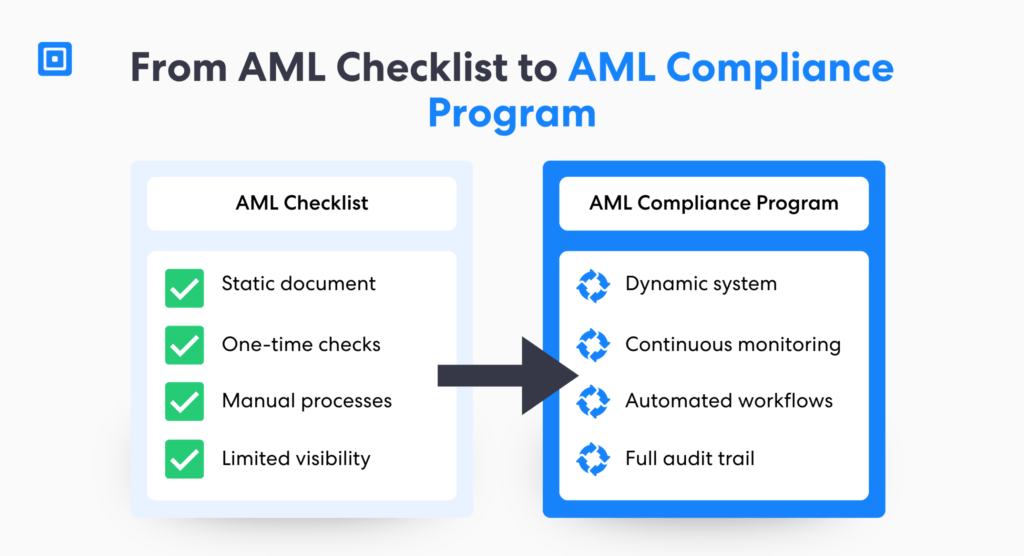
A thorough compliance framework focuses on five core pillars. It looks at the appointment of a compliance officer, development of AML policies, customer due diligence, independent testing, and regular ongoing AML training. These work together to form a system of AML controls that help continuous monitoring and overall risk management.
## The Role of Risk Assessment in an AML Compliance Checklist
Another huge part of an AML compliance checklist is risk assessment. It provides a strong base for a risk-based approach (RBA) to compliance. It helps financial institutions find any potential money laundering risks across customers, products, services, and geographic regions. This ensures that resources allocation is done appropriately and responsibilities are assigned based on the highest risk exposure.
The best way to perform a risk assessment is to assign risk ratings, figure out risk appetite, and conduct occasional reviews to monitor changing conditions. This ensures more effective decision-making across compliance programs. By regularly assessing risk profiles, companies and organizations can modify their AML compliance checklist and lower any vulnerabilities within their own AML process. You can learn more about RBA here: [What is a Risk-Based Approach (RBA)?](https://www.complycube.com/en/what-is-a-risk-based-approach/)
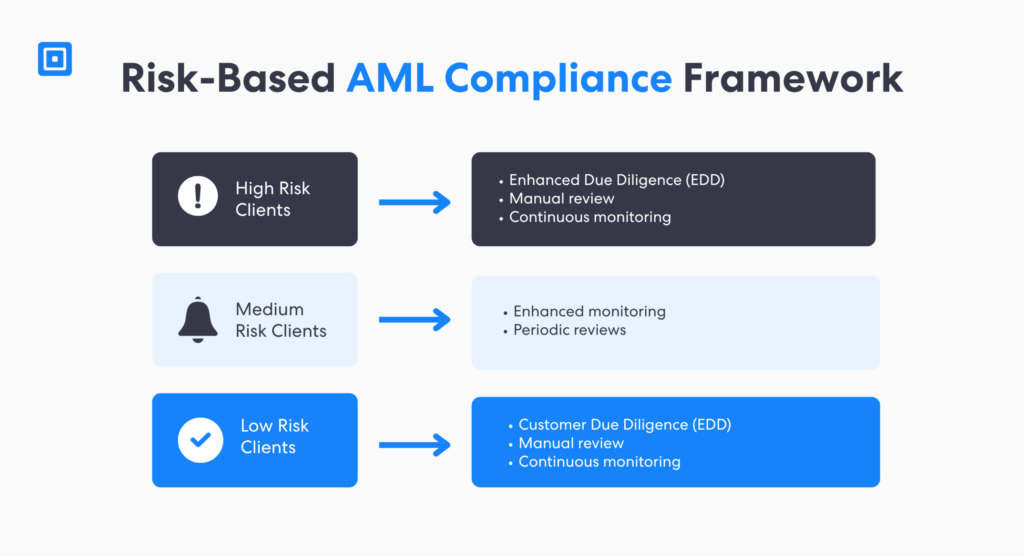
Overall, a strong risk-based approach is necessary for AML compliance programs for organizations. It helps companies find, learn about, and fix any potential money laundering and [terrorist financing risk](https://www.fatf-gafi.org/en/publications/Methodsandtrends/Terrorist-financing-risk-assessment-guidance.html). This covers all types of financial risks, particularly those in connection with customers, products, services, and regions. This is normally determined by FATF.
## Establishing a Risk-Based Framework in AML Policies
As aforementioned, rather than apply the same levels of scrutiny to every single customer or transaction, compliance teams must to look toward a risk-based approach. This version of targeted AML strategy helps financial institutions to move the necessary resources properly, prioritizing compliance on the areas with the biggest AML risks.
By focusing on [high-risk profiles ](https://www.complycube.com/en/solutions/due-diligence-compliance/risk-scoring/)or customers, products, and regions, financial institutions and organizations must better protect themselves against any potential threats. This clearly ensures that AML compliance frameworks are consistently growing and changing based on regulatory requirements, expectations, and financial crime risks.
### Key Components of a Risk-Based Framework
The first step in order to build a successful risk-based approach is around finding out which crucial components are necessary. By seeing what needs to work together, a strong risk-based AML framework can lower any exposure to money laundering or additional terrorist financing risks. The 4 components of a risk-based framework are:
- **Risk Assessment:** Conducting thorough risk assessments that find and assess any money laundering risks over all businesses and customer segments.
- **Customer Due Diligence:** Put in place proper due diligence protocols to determine customer identity, learn about beneficial ownership, and look through risk profiles.
- **Ongoing Monitoring:** Keeping continuous monitoring of customers and their activities helps update risk profiles to show changes in behavior or circumstances.
- **Training and Awareness:** Give regular AML training through awareness programs so employees learn the risks and consequences that come with diligence procedures.
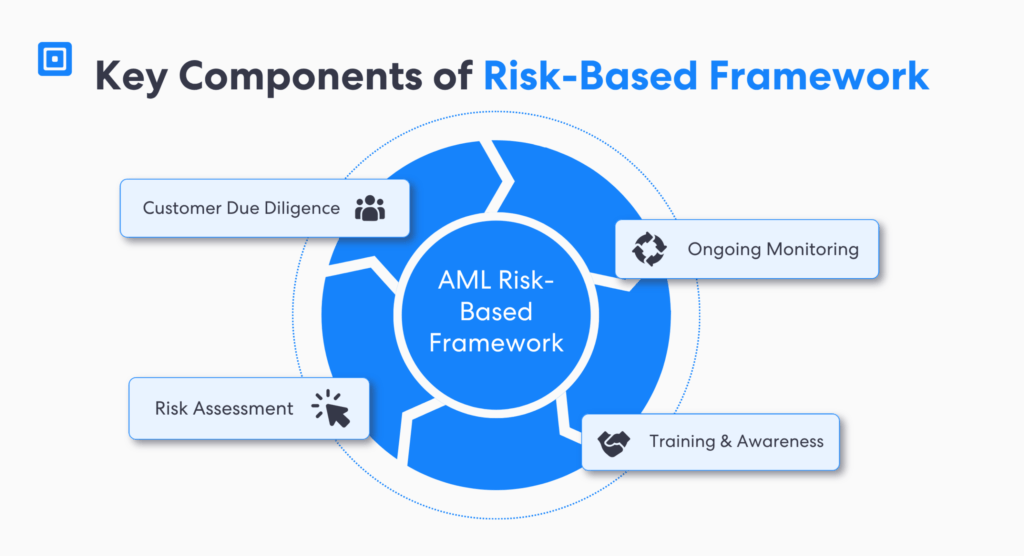
As a result, by putting all of these different components of AML Risk Assessments in one place, today’s financial institutions must stay well ahead by building a dynamic and responsive AML compliance program. One that changes based on new threats and rule changes with varying regulatory bodies, business lines, and jurisdictions.
## Customer Due Diligence in Anti-Money Laundering AML
Today, [customer due diligence (CDD)](https://www.complycube.com/en/solutions/due-diligence-compliance/customer-due-diligence/) is known to be a cornerstone of Anti-Money Laundering (AML) programs. By identifying customers, looking at beneficial ownership, and reviewing risk levels, CDD does screening well before starting or building upon a business relationship. This way, financial institutions can find any criminal activity at the very beginning at customer onboarding. You can learn more here: [What is Customer Due Diligence (CDD)?](https://www.complycube.com/en/what-is-customer-due-diligence/ "What is Customer Due Diligence (CDD)?")
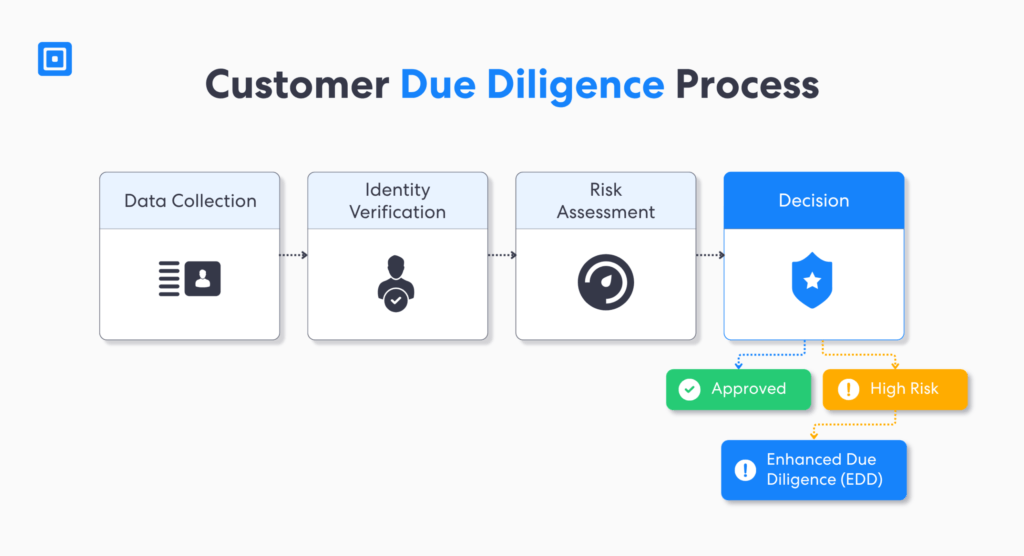
However, a thorough CDD process is very involved. It needs identification document or data collection, further identity document verification, and looking at transaction behavior. Such procedures support companies trying to build incredibly accurate risk profiles. It stops high-risk individuals from coming into a financial system. Strong CDD also shows compliance with regulatory bodies and indication of continuous monitoring over the customer lifecycle.
### Enhanced Due Diligence for High-Risk Clients
Similarly, [Enhanced Due Diligence (EDD)](https://www.complycube.com/en/enhanced-due-diligence-edd-insights-challenges/) comes into play when standard customer due diligence is not enough to manage risk properly. For example, this EDD process would apply to high-risk clients that are potentially politically exposed persons or customers that operate from high-risk regions. These types of people need much deeper investigations so that financial institutions can fully know their risk exposure.
EDD needs even more data, manual review and a much closer review of transaction patterns to find any odd behavior. This high level of scrutiny helps mitigate terrorist financing risks at a high degree. It ensures better compliance with regulatory authorities. Therefore, without any effective EDD, senior management will struggle to find any complex money laundering schemes that fall outside of regular AML controls.
### Ongoing Monitoring Processes
Ongoing monitoring ensures that customer risk profiles remain accurate throughout the lifecycle of the relationship. It involves continuously reviewing transaction activity, updating customer data, and identifying changes that may indicate financial crime risks. This process is essential for maintaining compliance with AML regulations.
Also known as continuous monitoring, it enables organizations to respond proactively to emerging risks, reducing the likelihood of regulatory penalties. By conducting periodic reviews and updating risk profiles, financial institutions must ensure that their compliance programs remain effective. This reinforces the importance of treating compliance as an ongoing process rather than a one-time requirement. You can learn more here: [What is an Ongoing Monitoring Process?](https://www.complycube.com/en/what-is-an-ongoing-monitoring-process/)
### Suspicious Activity Reporting and Regulatory Expectations
One critical output from AML compliance programs are [Suspicious Activity Reports](https://www.nationalcrimeagency.gov.uk/what-we-do/crime-threats/money-laundering-and-illicit-finance/suspicious-activity-reports) (SARs). They give valuable information to regulatory bodies and authorities. They help law enforcement agencies to better detect and investigate financial criminal activity. Thereby, making it a key component of the global compliance framework.
Therefore, it is incredibly important to have timely and confident SAR submissions. Financial institutions absolutely need to set up clear processes to make sure reports are in fact accurate and do not negatively impact investigations. A strong SAR program prioritizes quality, giving actionable insights rather than excessive reporting volumes.
### Record Keeping and Audit Trail Requirements
Most importantly, record keeping is a fundamental part of any AML compliance checklist. Strong and thorough record-keeping means keeping all customer identification, transactions, and investigation records for at the very least five years or as required by local laws and regulations. Maintaining accurate and accessible data, is crucial for AML compliance.
Maintaining detailed records of customer identity, transactions, and investigations supports audit trail creation and regulatory compliance. It enables organizations to demonstrate adherence to aml regulations and respond effectively to requests from authorities. Strong record keeping also supports continuous improvement by providing valuable insights into compliance performance.
### Independent Audit and Continuous Improvement
Finally, independent audit reviews and independent testing are essential. They thoroughly evaluate the effectiveness of AML compliance programs. These compliance processes provide an objective assessment of internal controls, identifying gaps and areas for improvement. They are critical for maintaining alignment with regulatory requirements of governing bodies.
For instance, audit findings should be used to refine policies, improve risk assessment frameworks, and enhance transaction monitoring systems. This ensures that compliance programs remain effective in a constantly evolving regulatory landscape. Therefore, continuous improvement is key to staying ahead of emerging financial crime risks.
### **Case Study: Airwallex and AUSTRAC in AML Review**
In April 2026, Airwallex came under scrutiny from [AUSTRAC](https://www.austrac.gov.au/new-and-media/news/austrac-orders-audit-airwallex-suspected-amlctf-compliance-failures), Australia’s financial intelligence agency, over potential gaps in its Anti-Money Laundering (AML) controls. Reported concerns centered on customer due diligence, transaction monitoring, and governance oversight.
##### **Strengthening Controls with a Risk-Based AML Checklist**
Consequently, the Airwallex response reinforces a risk-based AML compliance program rather than relying on static policies alone. That meant tighter customer due diligence, better transaction monitoring calibration, and clearer escalation highlights the value of stronger internal controls.
##### **Solutions & Outcomes**
- Increased regulatory focus on the operational effectiveness of AML checklists
- Reinforced the need for real-time monitoring, stronger governance, and audit readiness
- Shows why a risk-based AML framework is needed for lowering compliance failures
## AML Training and Ongoing Staff Training
AML training is a critical component of any compliance program, ensuring that employees understand their responsibilities and can identify financial crime risks. Training programs should cover key areas such as customer due diligence, transaction monitoring, and suspicious activity reporting. This ensures consistency across business operations.
According to the FCA, financial firms must make room for regular and role-specific training to maintain compliance as part of their operations. Ongoing training ensures that employees remain informed about regulatory changes and emerging threats. As a result, this strengthens the overall compliance culture and reduces operational risk.
### Key Takeaways
- **AML compliance** requires a risk-based approach aligned with real-world risks.
- **Customer due diligence** and enhanced due diligence are critical AML components.
- **Continuous monitoring** ensures accurate and up-to-date risk profiles.
- **Independent audits** and training support long-term compliance effectiveness.
- **Strong AML training** enables scalable and efficient AML compliance programs.
## Strengthen Your AML Compliance Checklist with ComplyCube
Building an AML compliance checklist requires more than policies and procedures. It demands a unified approach that integrates identity verification, transaction monitoring, and continuous monitoring into a single compliance program. Financial institutions must ensure that all components work together seamlessly to detect and prevent financial crime.
[Talk to our compliance experts](https://www.complycube.com/en/contact/contact-sales/) to enhance your AML compliance checklist and build a scalable, risk-based compliance program with ComplyCube’s unified platform.
Start A Conversation About Business Risk Score
## Frequently Asked Questions
What is an AML compliance checklist?
An AML compliance checklist is a structured set of controls used to detect, prevent, and report financial crime or fraud. Though these checklist covers due diligence, monitoring, reporting, and record keeping, organizations are moving away from a simple checklist into an integrated compliance program.
What are the key components of AML compliance?
There are many key components of AML compliance such as risk assessment, customer due diligence, sanctions screening, and suspicious activity reporting. Up-to-date AML compliance training, regularly scheduled audits, and thorough record keeping also support compliance operations.
How does a risk-based approach support AML compliance?
A risk-based approach (RBA) helps firms put in place even stronger controls where risk exposure is extremely high. It improves efficiency by lining up customer due diligence, enhanced due diligence, ongoing monitoring, and manual reviews with actual risk.
How often should AML compliance processes be reviewed?
AML compliance processes should be reviewed regularly. Policies and controls must be updated to reflect evolving regulatory requirements and emerging financial crime risks. This supports continuous improvement and ensures long-term compliance effectiveness.
How can ComplyCube improve AML compliance processes?
ComplyCube enables organizations to automate AML compliance processes, including customer due diligence, transaction monitoring, and ongoing monitoring. Its unified platform reduces false positives, improves efficiency, and supports real-time risk decisioning.
**Categories:** Guides
**Tags:** Anti-Money Laundering
---
### [Critical KYC Requirements For Customer Loyalty](https://www.complycube.com/critical-kyc-requirements-for-customer-loyalty/)
**Published:** December 9, 2024
**Author:** Sofia Daley
**Excerpt:** With online fraud at an all-time high, organisations must provide their customers with safety and security within their digital confines of their platforms. Read our latest guide on KYC for customer loyalty for key insights.
**Content:**
**TL;DR:** Online fraud is at an **all-time high** in 2026, necessitating stronger security measures for digital platforms. As KYC requirements and AML compliance standards evolve, businesses must keep Know Your Customer procedures strong while maintaining **seamless** user journeys. This guide explores how firms can meet compliance requirements without adding unnecessary friction.
## Mitigating Fraud to Protect Customers with KYC
Customers are currently losing more than ever to digital scams, with the CIFAS Fraudscape 2026 Report highlighting 444,000 cases in the UK in 2025. In the US, nationwide fraud losses surpassed the [$20 billion](https://www.aarp.org/money/scams-fraud/fbi-ftc-report-2025-losses/) mark, marking a sharp rise from the previous year.
> According to the Federal Bureau of Investigation (FBI), the U.S. has seen [over 1 million](https://www.ic3.gov/AnnualReport/Reports/2025_IC3Report.pdf) complaints of crime reported in 2025, with phishing, extortion, and investment fraud topping the charts.
Financial institutions have been especially targeted, with money laundering, terrorism financing and other financial crimes taking places within these platforms at an all-time high. KYC standards must be rigorous to quickly detect customer risk profiles and suspicious behaviour, with risk-based customer due diligence being at the forefront of a robust KYC process.
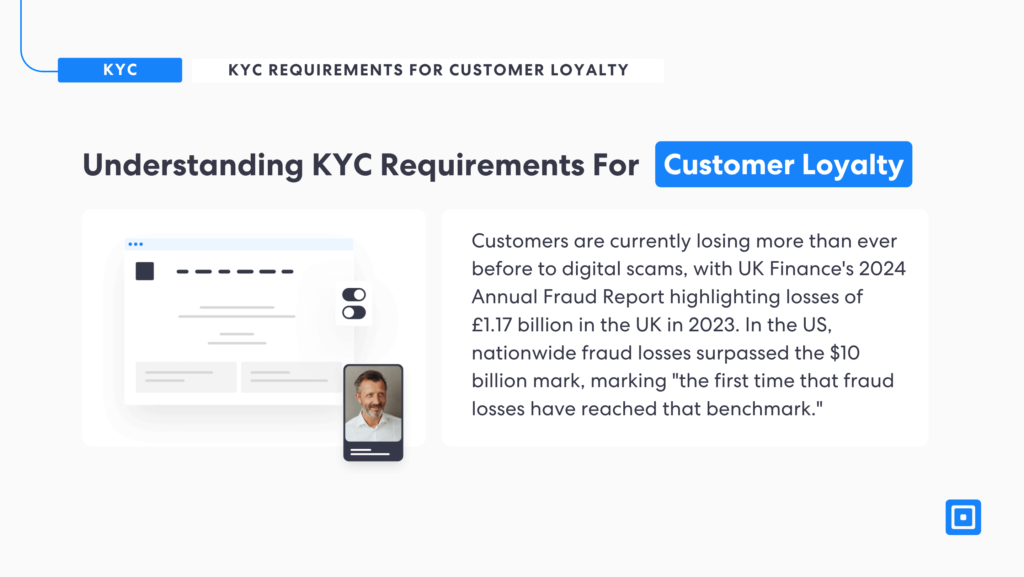
## Proactive Risk Management
Fraud risk management is a key reason why a customer might choose one financial institution over another. A recent study found that [69% of consumers ](https://www.securitymagazine.com/articles/100488-69-of-financial-services-consumers-prioritize-fraud-protection)now prioritise fraud protection when deciding between financial institutions, highlighting the importance of a secure customer identification program and ongoing monitoring for any risk factors.
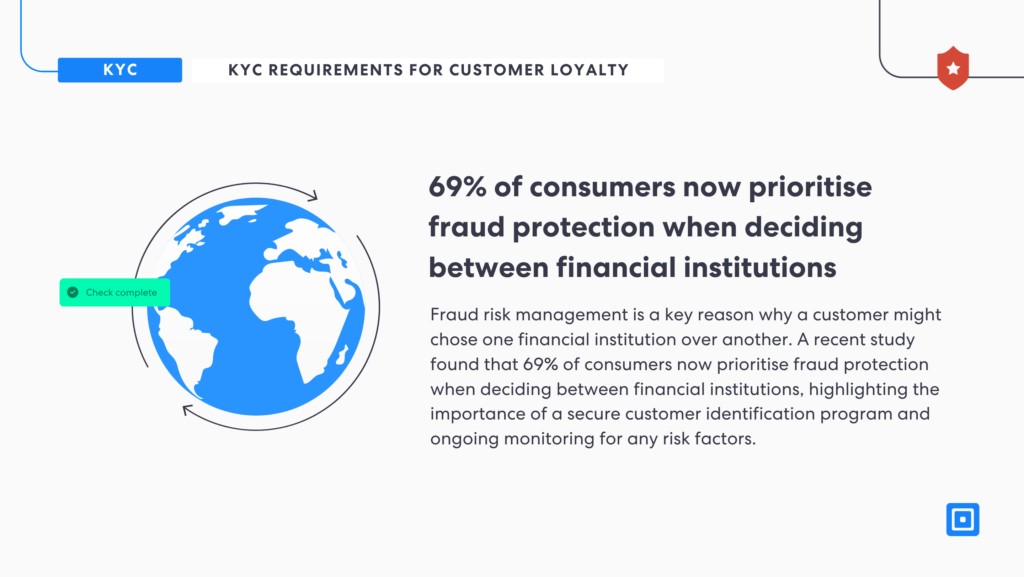
There are many kinds of scams that take place on financial platforms, including the creation of new accounts using a false or stolen identity, account takeovers, unauthorised credit or loan applications, and more. Some of the critical protections needed to instil loyalty and trust amongst customers might include:
- Safeguarding accounts with biometric authentication, making account takeovers much more difficult to carry out.
- Secure identity verification leveraging liveness detection technology to identify synthetic identities, stolen identities, or false identities. This allows for businesses to quickly stop fraudsters from applying for credit or loans, as well as stopping them from opening an account in someone else’s name.
- Ongoing monitoring with fraud alerts and notifications. Providing customers with real-time alerts when potentially fraudulent activities are detected on their accounts is crucial to building customer trust.
In addition, strict AML screening which might include sanctions and PEP screening, adverse media checks, watchlist screening and continuous monitoring ensures full AML compliance, fostering increased digital trust.
## Advanced Fraud Detection
Fraud detection has come a long way with new AI-powered technologies. Powering KYC processes with market-leading AI tools helps build a trustworthy global reputation. Some of the latest technologies include:
### Liveness Detection
Liveness detection can identify stolen or false identities, using AI to pull biometric data from a submitted video during customer onboarding to verify whether or not the individual is a real live person. Leveraging liveness detection ensures that businesses spot deepfake technologies during these onboarding processes, analyzing subtle micro-expressions and skin texture to ensure liveness. The customer’s identity is verified effectively, meeting KYC regulations when used with an advanced document verification check.
### Optical Character Recognition
Optical Character Recognition (OCR) helps extract data from images of KYC documents quickly and effectively, verifying a client’s identity. OCR technology extracts key data points (e.g., name, date of birth, address) from identity documents, ensuring no manual errors or inconsistencies occur.
This extracted information can then be cross-checked against databases, such as sanctions lists, politically exposed persons (PEP) lists, and watchlists, to identify high-risk individuals. OCR can identify anomalies within images of government-issued KYC documents, which might indicate fraudulent tampering.
### **Case Study: Leading Crypto Platforms Face $3 M Fine**
Coinone, South Korea’s leading cryptocurrency exchange, was fined $3 million for breaching KYC and AML compliance requirements. The South Korean Financial Intelligence Unit (FIU) found multiple lapses in the company’s compliance infrastructure.
##### **Failure in Customer Verification**
The FIU found that Coinone failed to verify more than 70,000 customer identities, including 40,000 cases with unverified or incomplete ID documents. It also allowed 30,000 customers to trade without completing proper Know Your Customer procedures.
##### **Solutions & Outcomes**
- Coinone was fined [$3 million](https://www.complycube.com/en/cryptocubed-april-newsletter-coinone-3-5m-fine-and-new-russia-crypto-bill/), with a 3-month partial business suspension.
- Its CEO, Cha Myung‑hoon, was formally reprimanded for the lack of oversight.
- The case highlights the regulatory push for non-financial services to align with strict KYC standards.
## KYC Requirements as a Competitive Advantage
In the past couple of years, sophisticated KYC compliance processes within financial institutions to prevent financial crimes such as money laundering has now become a clear competitive advantage. Customers look for platforms that can protect them at all times, especially since so many financial institutions have recently been victims of large-scale scams.
> [45% of all adverse contributions](https://fintech.global/2024/03/11/id-fraud-dominates-uk-financial-sector-with-a-45-surge/) in the finance sector in 2023 were linked to stolen identities and identity fraud.
The banking sector has emerged as a key target for identity theft and synthetic identity fraud. According to Synectics Solutions, which manages the UK’s largest syndicated risk intelligence database, [45% of all adverse contributions](https://fintech.global/2024/03/11/id-fraud-dominates-uk-financial-sector-with-a-45-surge/) in the finance sector in 2023 were linked to stolen identities and identity fraud. Fraudsters leverage falsified or stolen identities to drain funds from accounts, make unauthorized purchases, or secure loans fraudulently.
### Differentiating Through Compliance
Between 2023 and 2024, fraud reports surged across major financial institutions, with HSBC receiving 5,467 reports, Revolut 9,793, Lloyds 7,395, and Barclays 7,874. These figures highlight the pervasive and sophisticated nature of modern fraudulent practices, underscoring the urgent need for financial institutions to reassess their priorities in order to win over customer trust and loyalty. For more information on identity fraud within UK financial institutions, read [“Revolut Falls Victim to Identity Fraud.”](https://www.complycube.com/en/revolut-falls-victim-to-identity-fraud/)
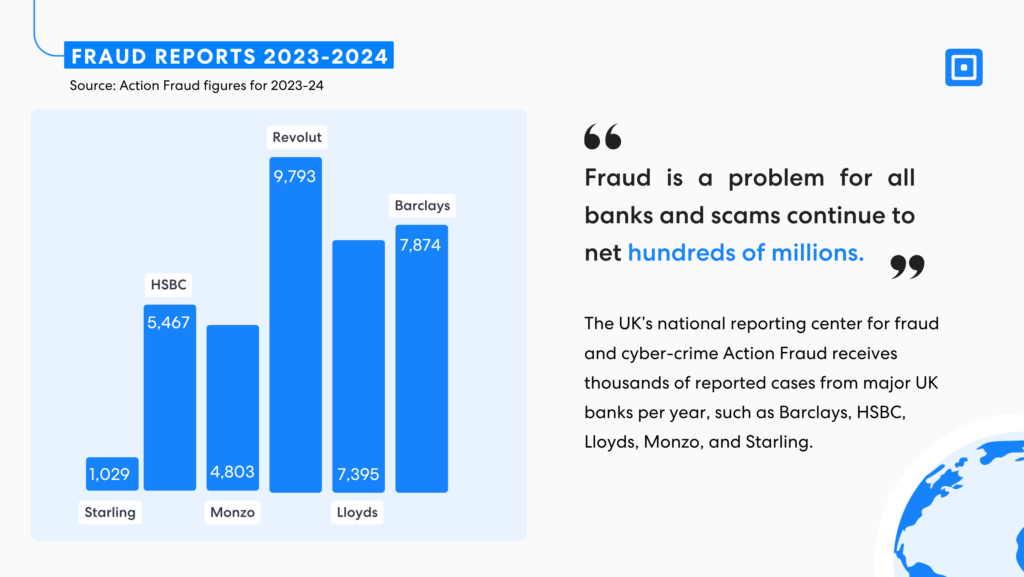
Stringent KYC processes will also enable businesses to operate in highly regulated markets, supporting global market expansion. This positions organisations as reliable international players, providing reassurance for investors and instilling confidence in customers and stakeholders.
Businesses that can differentiate themselves through reliable fraud defences will continue to hold a competitive advantage within their industry, as customers continue to prioritise security. An organisation that remains compliant with worldwide KYC and AML regulations, maintaining a strong reputation of security, is far more likely to win over a customer.
## What Does a Comprehensive KYC Process Look Like?
For a KYC process to be a robust defence against fraud and ensure compliance, several key steps must be implemented. Some of these include:
[Advanced Document Check](https://www.complycube.com/en/solutions/identity-assurance/document-verification/): A document check will verify a government-issued identity document, checking for signs of tampering and extracting key information with OCR technology.
[Biometric Verification with Liveness Detection](https://www.complycube.com/en/solutions/identity-assurance/biometric-verification/): Biometric verification will quickly identify presentation attacks such as those using deepfake technology. Biometric data samples are pulled from submitted images and videos to be examined, as well as analysing details such as skin texture and subtle involuntary movements.
[Multi-Bureau Checks:](https://www.complycube.com/en/solutions/due-diligence-compliance/know-your-customer/) With a Multi-Bureau Check, businesses can verify customer details, such as name, address, date of birth and social security numbers against trusted authoritative sources such as government and credit bureaus.
### Key Takeaways
- **KYC compliance** acts as a deterrent against sophisticated fraud and a driver of trust.
- **Proactive risk management** is increasingly prioritized to boost customer loyalty.
- **Liveness detection** and OCR technology supports earlier detection of identity fraud.
- **KYC requirements** support businesses in meeting global compliance obligations as they scale.
- **ComplyCube** supports end-to-end detection and ongoing monitoring of suspicious activities.
## Compliance with ComplyCube
ComplyCube offers state-of-the-art KYC solutions to help businesses safeguard their customers and their platform from fraud. Achieving compliance across complex regulatory structures enables businesses to scale quickly and seamlessly, which ComplyCube’s platform supports.

For more information on fortifying your business with a robust KYC process, get in touch with one of our [compliance experts](https://www.complycube.com/en/contact/contact-sales/).
## Frequently Asked Questions
What are KYC requirements?
KYC requirements are mandated across various jurisdictions to verify a customer’s identity and support AML compliance. Typically, requirements include identity verification, proof of address checks, document verification, and ongoing monitoring for suspicious activity.
Is KYC mandatory?
Yes. KYC is mandatory in most regulated businesses and is required under several laws, including the EU’s AML Directives (6 AMLD), the U.S. Bank Secrecy Act, the UK’s Money Laundering Regulations 2017 and more. The exact process depends on the country, sector, and level of risk present.
What documents are needed for KYC?
In a typical KYC process, accepted documents include a passport, driving license, and national ID cards. For businesses, further documents are required to prove beneficial ownership and evidence business relationships.
What happens if a business does not follow KYC requirements?
A business can face massive negative consequences from non-compliance with KYC requirements. This ranges from million-dollar regulatory fines, legal action, reputational damage, and potential exposure to fraud and money laundering risks.
What role does ComplyCube play in preventing fraud?
ComplyCube is an all-in-one platform providing AML and KYC solutions for businesses to detect fraud. Its automated platform provides comprehensive checks to meet global regulations, including ongoing monitoring, sanction and PEPs checks, CDD, and more to detect and prevent suspicious users from onboarding.
**Categories:** Guides
**Tags:** Know Your Customer
---
### [What is Sanctions Screening?](https://www.complycube.com/what-is-sanctions-screening/)
**Published:** February 17, 2021
**Author:** Andreea Balasa
**Excerpt:** What is Sanctions Screening, and why is it important? Sanctions screening tools and sanction screening software enable organizations to automate the global sanctions check. Implement sanctions checks for full AML compliance.
**Content:**
**TL;DR:** Sanctions check are critical to AML and CFT compliance. It helps firms identify **restricted** individuals, entities, and transactions and reduce financial crime risk. This guide explains how sanctions screening works and the role of **sanctions screening solutions** in effective compliance.
## Why is Sanctions Screening Important?
Sanctions screening is crucial for financial institutions to comply with regulations and prevent money laundering. With a sanctions check, companies can screen customers and entities against global sanctions lists before onboarding on their platform. An effective sanctions check automates this entire process, supporting real-time AML screening and lower false positives.
Advancements in technology, such as robotic process automation and AI, further streamline compliance operations, minimizing gaps caused by manual screening. As the sanctions landscape is ever-changing, understanding operational and regulatory implications is paramount.
## What are Sanctions?
Countries or regulatory bodies enforce sanctions to impose restrictions on certain activities or relations with specific regions, entities, or individuals. Typically, these sanctions are enforced to address threats to national security or international peace, human rights abuses, and illicit activity. Sanctions can take various forms, such as financial restrictions, trade embargoes, and travel bans.
Some of the most prominent governing and sanctioning bodies include:
- **United Nations** ([UN](https://www.un.org/securitycouncil/content/un-sc-consolidated-list)): The sanctions apply to all UN nation-states, encompassing a wide range of restrictions and measures.
- **Office of Foreign Assets Control** ([OFAC](https://ofac.treasury.gov/)): OFAC’s sanctions extend to all US citizens, individuals, and institutions conducting business within or connected to the United States and those engaged in transactions using US currency.
- **European Union External Action Service** ([EU EEAS](https://www.eeas.europa.eu/eeas/about-european-external-action-service_en#:~:text=The%20European%20External%20Action%20Service%20(EEAS)%20is%20the%20European%20Union%27s,of%20Europeans%20across%20the%20globe.)): The EU EEAS sanctions affect all EU citizens and legal entities established within any of the member states.
- **His Majesty’s Treasury** ([HMT](https://www.gov.uk/government/publications/financial-sanctions-consolidated-list-of-targets/consolidated-list-of-targets)): This body oversees the United Kingdom sanctions list, which is applicable to individuals and legal entities working or conducting activities within the territory and under UK law. The Office for Financial Sanctions Implementation (OFSI) enforces these sanctions.
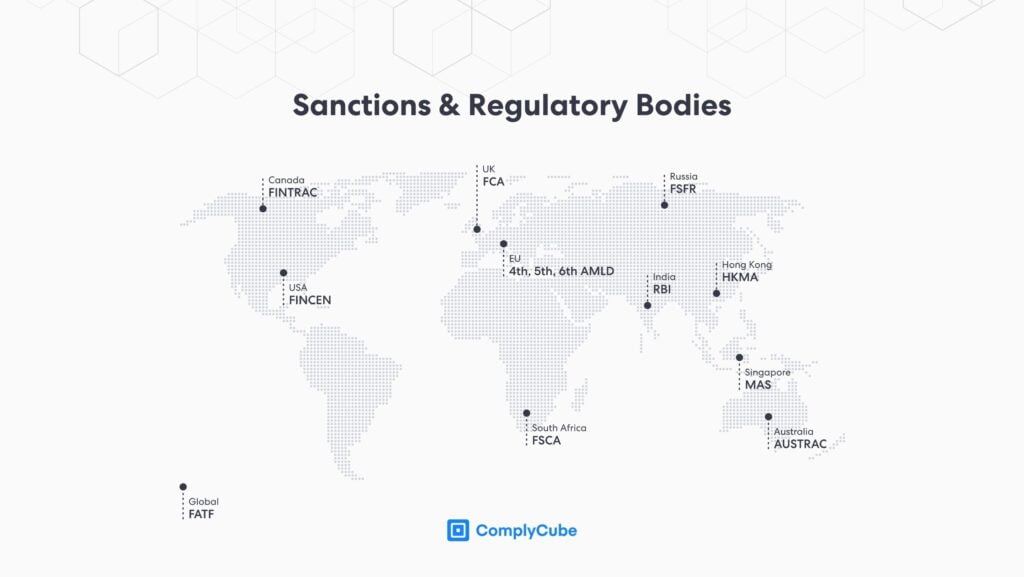
## What is a Sanctions List?
A sanctions list is a publicly available document issued by national or international authorities, such as those mentioned above. Authorities update sanctions lists regularly and include relevant details of individuals, entities, territories, or countries that are subject to economic or legal restrictions.
As such, individuals or parties identified on these sanctions lists may be denied access to financial systems, restricted from trade, or subject to other limitations as part of punitive or preventive measures.
## Types of Sanctions
Sanctions compliance is not merely a legal obligation. Economic sanctions and trade restrictions play a crucial role in maintaining a secure and trustworthy business environment. Moreover, they prevent the facilitation of illegal activities such as terrorism financing, money laundering, and other financial crimes.
Restrictions can be applied on different levels:
- **Explicit sanctions** name the subject directly, be it an individual, entity, or country.
- **Narrative or implicit sanctions** don’t specifically name an individual or an entity. Instead, the narrative implicitly covers them due to their connections to a named sanctioned body or sector.
From an economic perspective, sanctions can materialize into:
- **Comprehensive sanctions:** imposing restrictions on all transactions with a specific country. Some examples include Iran, Cuba, and Sudan.
- **Targeted sanctions:** limiting transactions with specific individuals, entities, or individuals listed on the [Specially Designated Nationals and Blocked Persons (SDN)](https://ofac.treasury.gov/faqs/topic/1631) list maintained by OFAC. Russia is a prime example.
- **Sectoral sanctions:** designed to hinder the future development of specific sectors within an economy by prohibiting a specific subset of financial transactions related to those sectors.
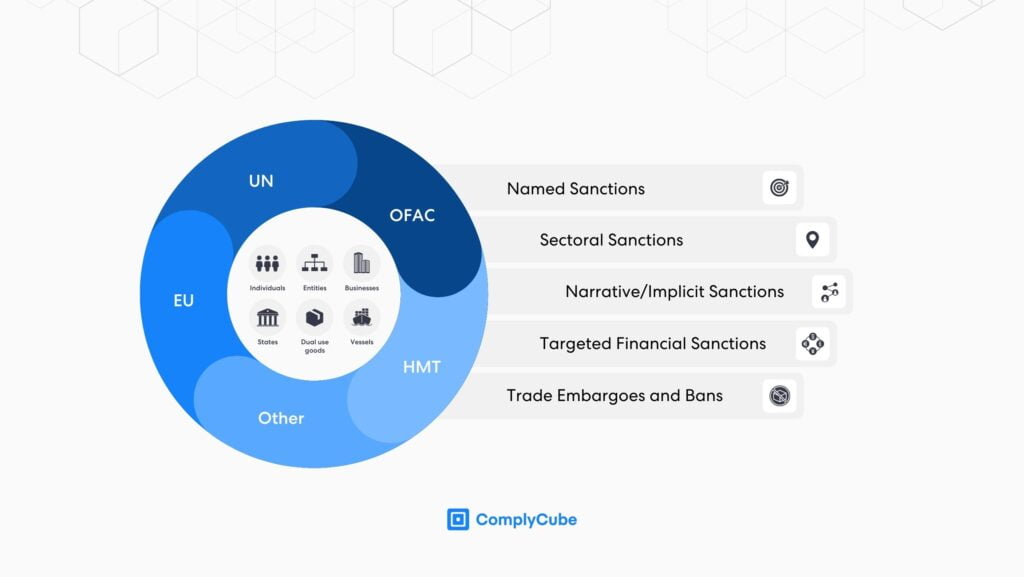
## Understanding Sanction Screening Solutions
Sanctions screening is a critical component of an effective AML/CTF program. It involves checking an organization’s existing and potential customers, partners, and transactions against global sanctions lists to identify financial risks and ensure compliance with international regulations.
The process typically involves six key steps utilizing advanced screening technology methods:
### Step 1: Collect
The first step involves collecting necessary data that will be checked against a sanctions list. This typically includes information about customers, potential business partners, and transactions. The data collected may include names, addresses, dates of birth, nationality, and other important details to ensure data accuracy.
### Step 2: Validate
Once the data is collected, data validation is crucial to corroborate the information and ensure its accuracy. This step often involves cross-checking the data against other sources, such as ID documents, company registers, or third-party data providers. The goal here is to ensure the integrity of the data before it is used in the sanctions screening process.
### Step 3: Screening Solution
After the data has been collected and corroborated, it’s time for the actual screening process. Using sanctions screening technology, the collected data is matched against global sanctions lists, which include individuals, organizations, or countries that are embargoed or sanctioned by regulatory bodies.
### Step 4: Investigate
If a potential match is identified during the sanctions screening process, it triggers an investigation process. The analysis aims to confirm or reject the potential matches upon enriching the client data and cross-checking the details. This step confirms whether the alerts were false positives or true matches.
### Step 5: Report
Reporting is the final and optional step in the sanctions screening process, which institutions activate only when they find a true match. The institution must adhere to reporting requirements and file the Suspicious Activity Report (SAR) to the relevant authority following the proper protocols, as failing to report a match can lead to severe penalties.
### Step 6: Monitor
An essential, often overlooked step in the process is continuous monitoring. Regulations and sanctions lists are dynamic. Thus, continuous monitoring must be done in real-time or periodically to ascertain compliance with ongoing due diligence obligations.
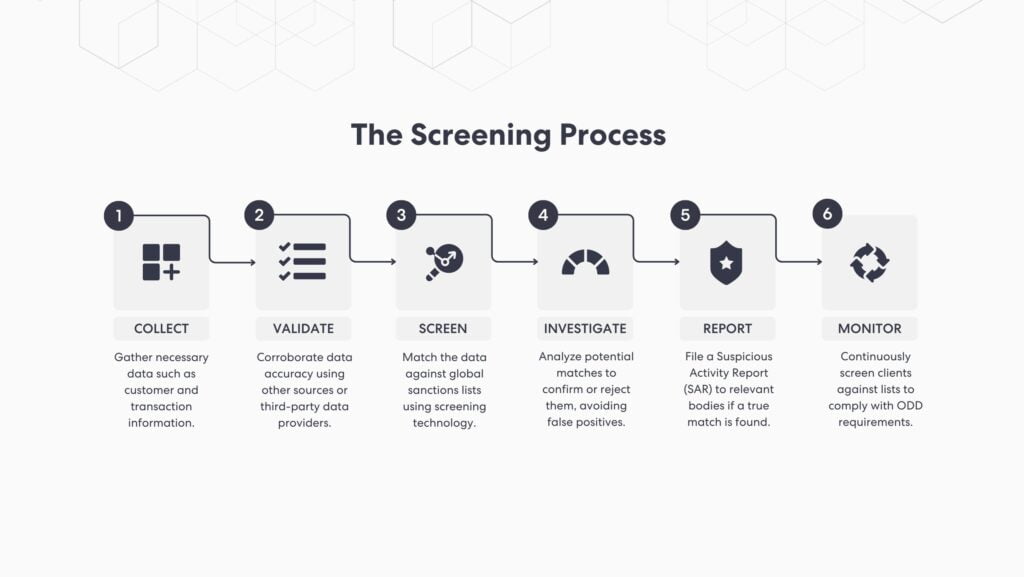
## When are Sanctions Checks Performed?
Organizations should perform sanctions screening at several key stages to maintain compliance, including [ongoing monitoring](https://www.complycube.com/en/what-is-an-ongoing-monitoring-process/). The initial screening has to take place when onboarding a new client or partner. Before engaging in business transactions, financial institutions must verify the identities of their clients or partners against relevant sanctions lists. This step ensures that sanctions rules do not bar the entity or person from engaging in certain activities.
However, performing sanctions check and risk assessments only at the start of a business relationship is insufficient. It should happen regularly throughout the customer relationship lifecycle. This is because sanctions statuses can change over time. A customer who was not a sanctioned party during onboarding or initial risk assessment might become one later.
### **Case Study: Company Sanctioned Over Russian Oligarch Ties**
Rusal, the major aluminium producer, was added to the U.S. OFAC list due to its association with Russian oligarch Oleg Deripaska. The abrupt addition had a huge effect on global aluminium markets.
##### **Importance of Ongoing Monitoring**
Firms in ongoing or future contracts with Rusal had to immediately halt all trading activities to comply with the new sanctions and avoid **potential fines**, highlighting the importance of ongoing monitoring.
##### **Outcome**
- Rusal was later delisted when its founder, Oleg, consented to forfeit control.
- The case showed how ownership and control changes can affect sanctions exposure.
- It reaffirmed the importance of **continuous monitoring** for compliance as sanctions evolve.
## Identifying Politically Exposed Persons (PEPs) and Their Role in a Sanctions Check
Politically exposed persons (PEPs) are high-risk individuals who hold a prominent public role or have a close association with such individuals. Due to their position and influence, PEPs pose a higher risk of involvement in bribery, corruption, money laundering, and other financial crimes.
Identifying and conducting enhanced due diligence on a politically exposed person is critical to an effective sanctions screening process. Organizations should have robust PEP screening controls in place to mitigate associated risks. These controls should include regularly checking customer data against PEPs lists and transactional screening to identify suspicious activities.
You can learn more here: [What is a Politically Exposed Person (PEP)?](https://www.complycube.com/en/what-is-a-pep/)
### **Case Study: Isabel dos Santos and PwC Controversy**
Isabel dos Santos is a Politically Exposed Person (PEP) as she was the daughter of Angola’s former president. She faced scrutiny when leaked documents suggested she **exploited** family connections and public funds to build her $2 billion fortune.
##### **PWC’s Conflict of Interest**
During investigations, PwC had been auditing Sonangol’s books, Angola’s state-owned oil company. The firm’s dual role as an advisor on a significant restructure for Sonangol presents a potential **conflict of interest**. PWC’s auditing and advisory work occurred while Isabel was chair of Sonangol.
##### **Outcome**
- Isabel was relieved from her role shortly after her father’s retirement.
- Sonangol’s new management terminated PwC’s contract and replaced it with KPMG.
- This case highlights the risks and potential **complications** firms can face when dealing with PEPs.
## The Impact of Adverse Media on Sanctions Screening
Adverse media, also known as negative news, refers to information from media sources indicating potential sanctions risks linked to certain customers or business partners. It is a crucial component of an effective sanctions screening program, offering early warning signs of non-compliance. For instance, news about a customer’s involvement in illegal activities, association with sanctioned parties, or political or business status changes can indicate probable threats.
Organizations should perform adverse media screening regularly and at various stages of the customer relationship lifecycle. Furthermore, businesses should leverage advanced technologies such as artificial intelligence and natural language processing to automate and enhance this process.
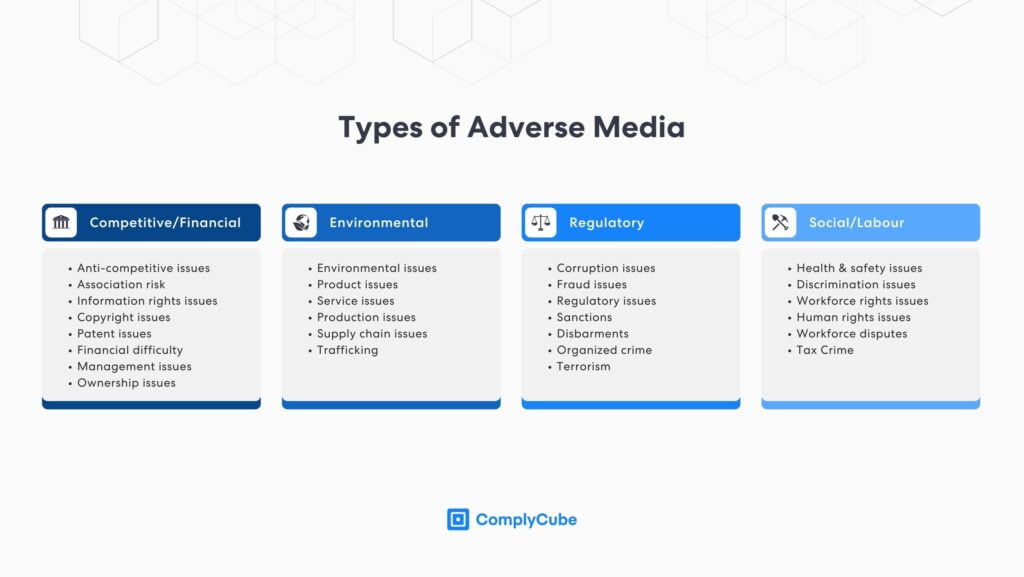
## Suspicious Activity Reports (SARs)
Suspicious Activity Reports (SARs) are crucial in sanctions check, providing financial institutions with a means to report potential illicit activities. When transactions raise suspicions of violations, institutions file SARs with competent authorities. These reports facilitate investigations by law enforcement agencies, enabling them to take necessary actions.
> According to Financial Crimes Enforcement Network (FinCEN), a total of [3.8 million](https://www.thomsonreuters.com/en-us/posts/corporates/sars-report-2024/) Suspicious Activity Reports (SARs) were filed.
SARs contribute to the collective fight against money laundering, helping protect the integrity of the financial system. Thus, with SARs, financial institutions avoid enforcement actions and assist regulatory organizations and law enforcement agencies in their mission by detecting and reporting suspicious activities.
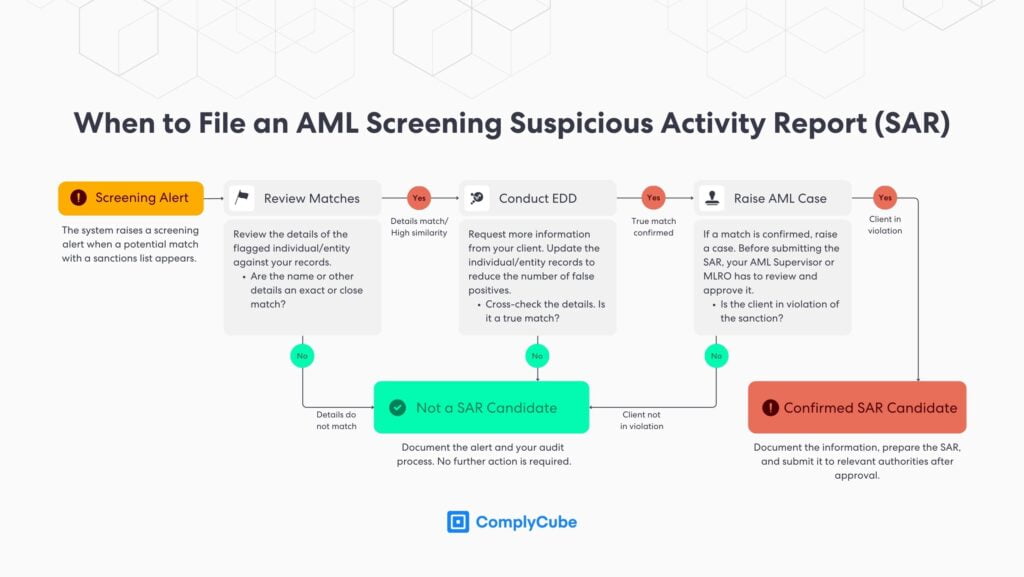
## Consequences of a Sanctions Breach
Failure to comply with AML regulations and sanctions check requirements can result in severe penalties, including punitive fines, criminal proceedings, and damaged reputation. For instance, breaches of financial sanctions in the [UK](https://www.gov.uk/government/publications/monetary-penalties-for-breaches-of-financial-sanctions) are punishable by up to 7 years in prison. Similarly, the US OFAC considers sanctions violations a threat to national security and foreign relations. Offenders can face up to several million-dollar fines and 30 years in jail.
The consequences of a sanctions breach can seriously damage an institution’s reputation, credibility, and performance. Becoming a sanctioned entity can be even more damaging, as it significantly hinders, if not halts, an institution’s ability to conduct global business and access international markets and capital. In some instances, these consequences led to a sanctioned institution’s complete inability to continue operations and, ultimately, its demise.
> Several firms were heavily fined for OFAC breaches, in some cases [exceeding $200 million](https://digitalisationworld.com/blog/57503/sanctions-against-trickbot-ransomware-group-payments-now-punishable). These include Interactive Brokers, Exodus Movement, and more.
In summary, sanctions breaches constitute serious offenses and thus have a severe impact. Therefore, institutions must efficiently screen customers against relevant sanctions lists. However, as authorities constantly update sanction lists, organizations must ensure that sanctions screening processes keep up with changes while avoiding inefficiencies and reducing false positives.
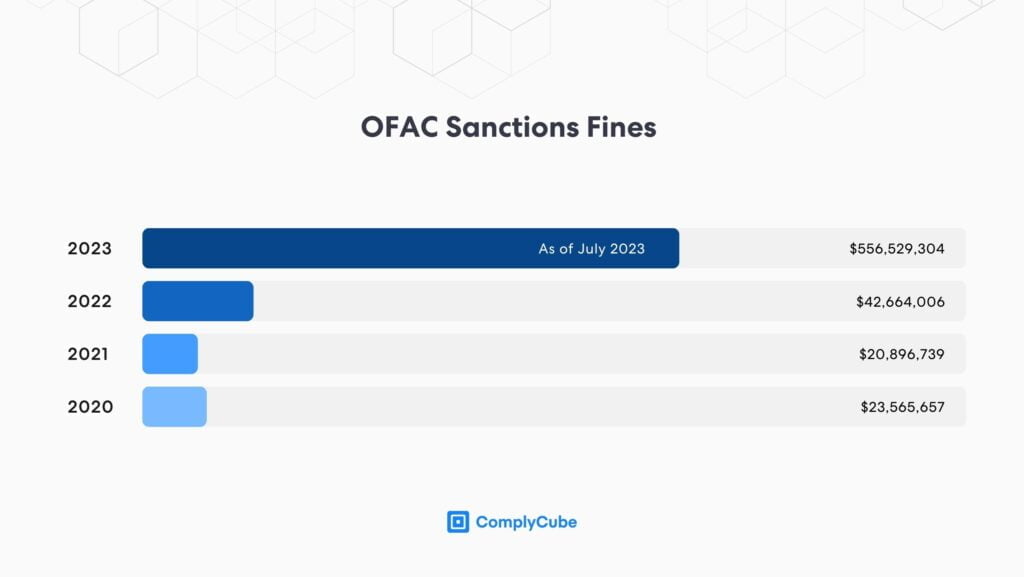
## What are the Challenges Facing Sanctions Screening Solutions?
Sanction Screening has never faced as many screening challenges as it does today due to several factors, including:
- Sanction lists are evolving rapidly in nature (e.g., narrative sanctions) and breadth (e.g., [US technology export controls](https://www.trade.gov/us-export-controls)).
- Increase in the complexity of restrictive and punitive sanction measures and screening regulations.
- Sanction Screening has to account for association risk, which may not be immediately apparent. For instance, the [Patriot Act](https://en.wikipedia.org/wiki/Patriot_Act) forbids US corporations from supplying ‘financial assistance’ to organizations accused of [terrorism](https://www.complycube.com/what-is-counter-terrorist-financing/).
- Multiple sanctioning bodies have different standards and agendas that do not align, leading to inconsistent economic sanctions.
In the EU itself, there are [over 40 different](https://finance.ec.europa.eu/eu-and-world/sanctions-restrictive-measures/overview-sanctions-and-related-resources_en) sanctions regimes in place, with some mandated under the United Nations.
## Choosing the Right AML/KYC Sanctions Screening Partner
Despite the inherent challenges of Customer Screening, the right AML/KYC partner can help you implement a robust and cost-effective solution, as outlined below.
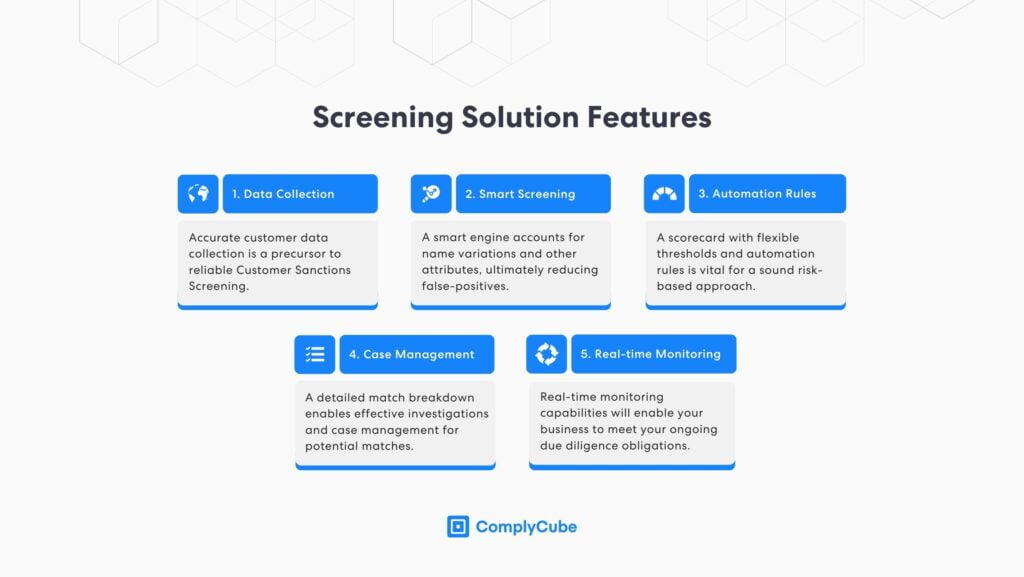
### **Single Customer View**
Sanctions screening is only as effective as the input data that organizations use to screen the entity or individual at hand. Therefore, firms should leverage a solution that will help streamline data collection processes and provide you with a single customer view that is aggregated, consistent, and holistic through data aggregation.
### **Comprehensive Data Coverage**
Screening activities should build on thoroughly studied and regularly revised global risk information that includes comprehensive data coverage of the current [PEP](https://www.complycube.com/what-is-a-pep/) and sanctions lists, unfavourable media, and compliance reports from around the world.
### **Smart Screening**
Numerous vendors market [fuzzy name matching](https://en.wikipedia.org/wiki/Approximate_string_matching) as a silver bullet for state-of-the-art sanctions screening. However, organizations should not solely rely on fuzzy name matching. It does indeed account for misspellings and minor variations.
However, it does not deal well with phonetic similarity, transliterations, linguistic variations, non-Latin scripts, patronymics, honorifics, titles, or out-of-order names, to name a few of the aspects that a reliable screening engine needs to take into account.
You can learn more here: [Stay Compliant with The Best Sanctions Screening Software](https://www.complycube.com/en/best-sanctions-screening-software-for-2025/)
### **Risk-based Approach**
Risk-based approach (RBA) is a comprehensive sanctions screening solution should manage several sanctions lists and allow custom thresholds and inclusion/exclusion rules to enable AML officers to adapt the screening capability to the organization’s risk perception and policies.
You can learn more here: [What is a Risk-Based Approach (RBA)?](https://www.complycube.com/en/what-is-a-risk-based-approach/)
### **Case Management**
AML case management, combined with monitoring and alerts, enable analysts to investigate suspicious activity and effectively mitigate financial crime risk. A robust Case Management solution provides a fully integrated experience with rich contextualized data, such as a detailed match breakdown. This helps investigators organize and manage investigations and easily discount false positives, all while creating a permanent audit trail for regulatory review.
### **Ongoing Due Diligence**
Companies may Many AML/KYC vendors check customers in bulk via running batches. However, that is a cumbersome and reactive process unsuitable for the modern age. Instead, mature KYC providers will offer ongoing monitoring to support the shift from a legacy tick-the-box approach to real-time, ongoing, and proactive customer due diligence.
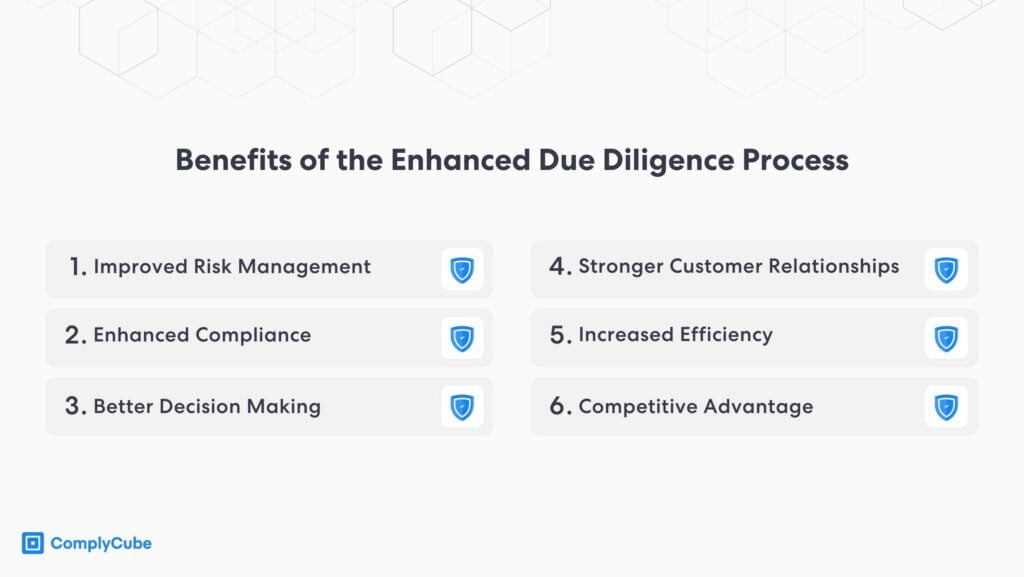
### Key Takeaways
- **Sanctions screening** ensures firms meet global AML and KYC regulation standards, helping prevent terrorist financing and other financial crimes.
- **Failure to perform** sanctions checks results in fines and reputational damage, which, if severe, can lead to termination of business operations.
- **Combining PEP, adverse media checks**, and sanctions screening gives companies a fuller overview of an individual or entity’s total risk exposure.
- **Ongoing monitoring** enables firms to continuously verify an individual against evolving sanctions list beyond the initial onboarding stage.
- **The sanctions screening process** includes collecting and validating data, then matching it against global sanctions lists to detect restricted parties.
## Sanctions Screening Software for Financial Institutions
At its core, sanctions screening has emerged as a non-negotiable requirement globally. This process is critical to ensure that entities like banks and other financial institutions do not engage in business transactions with individuals, organizations, or countries that are on global sanctions lists.
In particular, industry professionals cannot overstate the importance of sanctions screening within the financial industry, as it is a crucial measure to mitigate the risk of engaging with sanctioned entities and to prevent money laundering.
As OFAC’s enforcement penalties hit new records year after year, the cost of non-compliance has never been higher. As such, financial services companies should continually refine their sanctions screening processes and stay ahead of evolving global sanctions landscapes to effectively navigate this complex regulatory environment.
## Implementing a Strong Sanctions Screening Program
Sanctions screening is indispensable in maintaining a compliant and secure financial environment. Businesses can prevent transactions with sanctioned parties by vigilantly cross-checking customer data against sanctions lists provided by regulatory bodies such as the UN and the EU. This proactive stance strengthens AML efforts and contributes to the broader global initiative to prevent financial crime.
The world of sanctions and Anti-money Laundering compliance is continually evolving, and maintaining an up-to-date sanctions list at the heart of your screening processes is essential to navigating this complex landscape effectively. Choosing the right AML/KYC and sanctions screening partner, such as ComplyCube, can also provide significant benefits.
Explore our global PEP and Sanctions screening [solution](https://www.complycube.com/solutions/global-screening/sanctions-pep-screening/) to learn more about our platform!
## Frequently Asked Questions
What is sanctions screening?
Sanctions screening is the process of checking a customer or entity against official sanctions list published by authorities, including the OFAC, UN, and the EU. It enables an organization to identify sanctioned individuals or businesses in order to comply with regulations.
Why is sanctions screening important?
Sanctions screening is a vital component of Know Your Customer (KYC) and Anti-Money Laundering (AML) processes. It enables a company to comply with regulations by avoiding doing business with sanctioned individuals or entities.
Why do businesses use sanctions screening solutions?
Businesses use sanctions screening solutions to verify and avoid doing business with sanctioned regimes. Sanctions software or solutions offer companies a more automated, accurate, and quicker way to identify a sanctioned person or entity.
When must a business perform a sanctions check?
A sanction check must be performed during Know Your Customer (KYC) and Anti-Money Laundering (AML) program. It typically occurs during customer onboarding, when forming new business relationships, and throughout ongoing monitoring to ensure continuous adherence with regulations.
How does ComplyCube’s sanctions screening solution work?
ComplyCube enables real-time screening against global sanctions lists. The platform continuously updates its sanctions list and combines it with PEP screening and adverse media checks for multi-layered compliance. Additionally, it uses adaptive AI to detect both fuzzy and exact matches, reducing false positives significantly.
**Categories:** Guides
**Tags:** Know Your Customer
---
### [Best AML & KYC Providers for Startups in Fintech and Growing SaaS](https://www.complycube.com/kyc-providers-for-startups-saas-and-fintech/)
**Published:** June 10, 2025
**Author:** Dini Habib
**Excerpt:** Ensuring regulatory compliance and fostering loyalty is crucial for fast-growing SaaS and FinTech startups. Thus, selecting the right AML and KYC provider is paramount to maintain speed, growth, and cost-effectiveness in the long-run.
**Content:**
**TL;DR:** Today, startups do not want KYC providers for startups based on compliance alone. They look at infrastructure that allows for growth, confidence, and global expansion. Choosing fintech compliance tools that helps AML for fast-growing companies is the most strategic choice companies could make
## Why does KYC and AML Matter for Startups?
In 2020, companies could treat compliance as an afterthought. In 2026, that strategy is not possible anymore. Regulators are expecting early-stage companies to put in place more thorough identity verification (IDV) and anti-money laundering (AML) processes from the very beginning. In particular, FinTech startups are under scrutiny to put in place thorough compliance programs to boost money laundering and fraud prevention efforts.
In the UK alone, the Financial Conduct Authority (FCA) has issued over £176 million in fines within 2024. This marks the start of a new era towards more strict enforcement. As a result, choosing the right Know Your Customer (KYC) providers for startups is all about strategy. This directly impacts a company’s ability to grow globally, and build trust with investors and customers alike.
> [Over £100 billion is annually](https://www.twobirds.com/en/insights/2025/uk/money-laundering-in-the-age-of-fintech-emerging-risks-and-regulatory-responses) lost to money laundering, underscoring the urgency of robust anti-money laundering measures.
In short, [Know Your Customer (KYC)](https://www.complycube.com/en/solutions/due-diligence-compliance/know-your-customer/) and [Anti-Money Laundering (AML)](https://www.complycube.com/en/solutions/due-diligence-compliance/anti-money-laundering/) compliance are foundational to businesses looking to scale in today’s environment. Taking advantage of KYC and AML is essential for startups due to many factors such as:
### Regulatory Scrutiny for FinTech and SaaS Firms
First and foremost, startups must put in place thorough compliance and risk management controls from day one. These measures will help avoid enforcement actions and licensing setbacks. Particularly, startups must focus on compliance with local and global KYC, KYB, and AML standards to find their way through complex regulatory environments.
### Risks of Fines for Non-Compliance
Secondly, startups that do not meet AML or KYC compliance standards [risk severe financial penalties](https://www.complycube.com/en/a-practical-approach-to-fintech-compliance-in-2025/). In addition, they also risk public reputational damage, loss of customers, and investor trust. In short, non-compliance can throw off growth or trigger operational shutdowns entirely.
### Investor and Partner Due Diligence Expectations
Finally, venture capital firms, banking partners, and payment processors are expect more early-stage companies to show strong compliance maturity. In particular, they are look for real dedication to prevent money laundering and other financial crimes. Without this level of commitment, startups can often lose out on partners and funding.
## The 4 Essential Capabilities of Modern AML & KYC Providers for Startups
Unlike traditional financial institutions, SaaS and [FinTech startups](https://www.complycube.com/en/use-cases/industry/fintech/) must avoid manual processes such as running basic identity checks. Verifying a customer’s identity is a crucial part of the KYC process. It often involves official documents and digital technologies to ensure accuracy and security. Fast-growing startups need a smarter and flexible compliance infrastructure that can grow with product changes and high user volume.
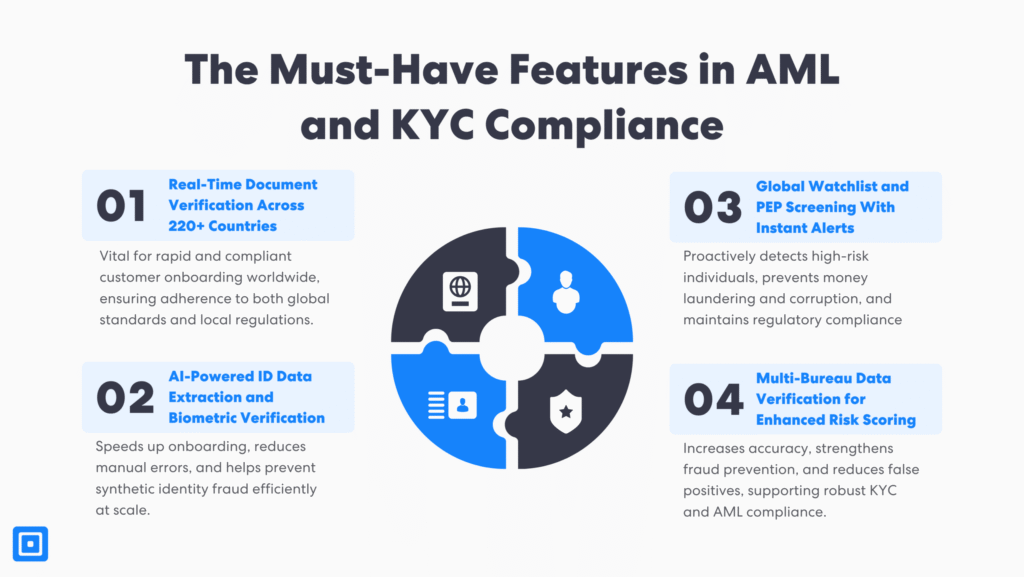
Most early-stage companies take advantage of modern AML and KYC processes from the beginning. This approach helps them to stick by complex compliance requirements and prevent operational drag. Additionally, automation in KYC and AML processes also helps smoothen operations and lower operational complexity. Some of the key features to look for include:
### Real-Time Document Verification Across 250+ Territories and Countries
Startups need rapid and global customer onboarding processes. When operating globally, ongoing compliance across many jurisdictions is vital. Hence, choosing KYC providers for startups that [offer real-time document verification](https://www.complycube.com/en/solutions/identity-assurance/document-verification/) of government-issued IDs from various countries is key. This is more true for FinTech and SaaS platforms working cross-border in the payment and financial sectors.
### **AI-Powered ID Data Extraction and Biometric Verification**
Today’s AML and KYC software now blends artificial intelligence and machine learning models. This model is trained on millions of identity documents to automatically extract [PII (Personally Identifiable Information)](https://ico.org.uk/for-organisations/uk-gdpr-guidance-and-resources/personal-information-what-is-it/what-is-personal-information-a-guide/) with deep precision. For startups, this can deliver faster customer onboarding rates and a reduction of synthetic identity fraud during biometric authentication.
### **Global Watchlist and PEP Screening With Instant Alerts**
In the current regulatory landscape, continuous monitoring and due diligence processes are non-negotiable for startups. AML and KYC software that integrates with real-time [global sanctions](https://www.complycube.com/en/solutions/global-screening/sanctions-pep-screening/) and watchlists to make sure that high-risk situations, such as [Politically Exposed Persons (PEPs)](https://www.complycube.com/en/what-is-a-pep/), do not go past controls. Instant notifications help mitigate risk and strengthen financial security via swift responses.
### **Multi-Bureau Data Verification for Enhanced Risk Scoring**
A digital identity verification process that covers customer data across multiple national ID registries, credit bureaus, and utility databases supports startups in fraud prevention more efficiently. For example, multi-bureau data matching strengthens regulatory compliance under KYC and [Customer Due Diligence (CDD)](https://www.complycube.com/en/solutions/due-diligence-compliance/customer-due-diligence/) requirements and lowers false positives that can alienate real users.

## Cost-Efficient AML for Fast-Growing Companies
As a result, SaaS and FinTech startups need to balance fast expansion demands with disciplined resource allocation in their existing systems. Adding an Anti-Money Laundering (AML) compliance process that gives enterprise-grade protection without draining capital is no longer a luxury; it’s a competitive advantage. The right KYC and AML solutions shield startups from regulatory blowback and help unlock leaner, cost-effective, and scalable multi-jurisdictional compliance operations:
- **Pay-as-you-go Pricing Versus Subscription Models:** Startups might find themselves in inflexible annual contracts that fail to align with changing user checks or evolving use cases. Modern RegTech providers offer specific, pay-as-you-go pricing, allowing startups to scale verification and screening activity together with customer acquisition, seasonal peaks, or product rollouts.
- **ROI of Automation and No-Code Workflows:** Using low-code or no-code compliance solutions helps startups to automate workflows without having coding knowledge. This lowers time-to-deployment from weeks to hours and cuts operational overhead.
- **Avoiding Hidden Costs:** Startups, particularly those in the financial services industry, might encounter unexpected, abrupt fees from certain AML and KYC vendors. To stop this, startups must have clear discussions and look at insights from leading review platforms before purchase.
## Key Factors to Consider when Selecting Top KYC Providers for Startups
When selecting compliance providers, a thorough understanding of evolving regulatory standards and KYC regulations, ensuring solutions can adapt to changing requirements and support ongoing compliance, is crucial. Here are the key factors for startups to consider:
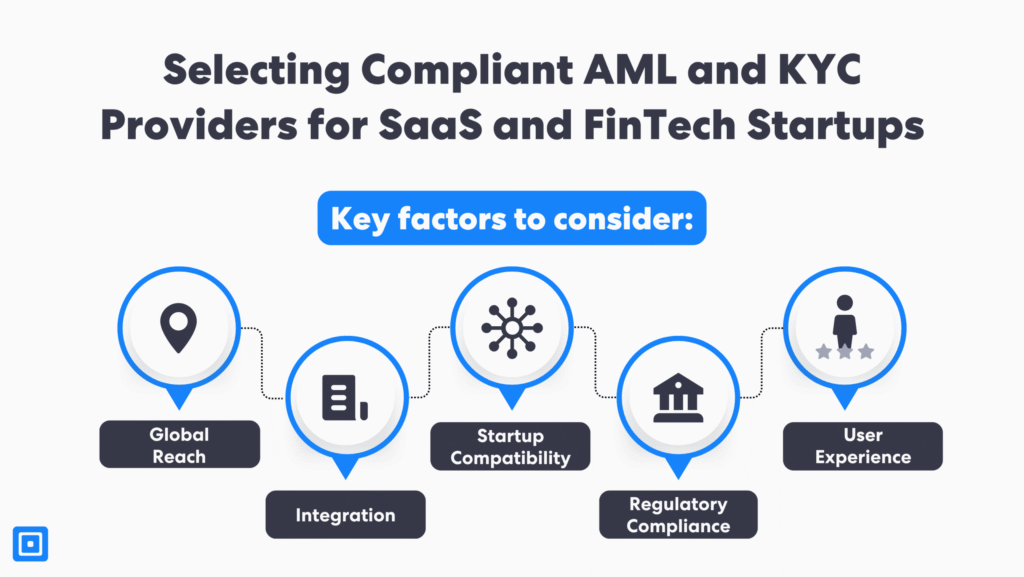
- **Global Reach:** Startups with international ambitions need the ability to perform digital identity verification and business verification across multiple countries. As a result, helps them maintain compliance with international regulations and regulatory authorities.
- **Technology Integration:** Advanced technologies such as machine learning, AI, and biometric authentication are leveraged for accurate and efficient identity verification, ongoing monitoring, and transaction monitoring, ensuring a robust verification system that adapts to emerging risks and regulatory changes.
- **Startup Compatibility:** Flexibility in integrating existing systems (APIs, SDKs), scalable solutions, and startup-friendly pricing models is key. Consequently, startups can implement effective compliance programs and KYC processes without hindering growth.
- **Regulatory Compliance:** Adherence to global regulatory requirements, including [GDPR](https://gdpr-info.eu/), AML, the [Bank Secrecy Act](https://www.occ.treas.gov/topics/supervision-and-examination/bsa/index-bsa.html), and KYC compliance, is fundamental. It ensures that startups meet the expectations of regulatory bodies and authorities while protecting data integrity and complying with data protection laws.
- **User Experience:** A seamless verification process and [customer onboarding journey](https://www.complycube.com/en/use-cases/process/customer-onboarding/) are prioritized to enhance user satisfaction and retention, while maintaining rigorous security measures and risk intelligence data to detect politically exposed persons and prevent financial crime such as money laundering.
By focusing on these criteria, startups can select Know Your Customer (KYC) processes and AML solutions that ensure compliance with regulatory reporting and standards. Therefore, firms can strengthen their defenses against financial crime, support fintech compliance, and build trust with customers and financial institutions.
### **Case Study: How ComplyCube Supports GRVT’s Next Million Crypto Users**
Fraud and deepfake attacks are more common in the crypto sector. For startups, this can have negative impacts on growth. For GRVT, a leading DEX firm, this meant it had to choose the right compliance solutions to combat this threat and support trusted onboarding.
##### **The Need for Speed, Compliance, and Agile Operations**
[GRVT](https://www.complycube.com/en/complycube-powers-grvt-crypto-onboarding-for-millions/) needed to partner with an AML and KYC vendor that matches its compliance-first culture. To meet its large onboarding demands while keeping accuracy and sticking to global regulations, GRVT took advantage of ComplyCube’s unified automated regtech platform.
##### **Outcomes**
- ComplyCube’s proprietary technology meant that GRVT did not rely on third-party data or vendors, enhancing cost-effectiveness.
- The platform’s automated and tailored workflows enabled rapid and agile onboarding without compromising security and user experience.
- Advanced AML and KYC checks included sophisticated EDD and real-time monitoring, achieving proactive fraud prevention.
## Comparison of Top KYC and AML Providers for Startups
The best KYC and AML providers deliver a thorough fraud prevention framework, effective risk management, and customizable workflows for smooth customer onboarding. Ultimately, the right KYC and AML Vendor for startups will rely on the type of checks, verification process, and compliance operations desired. This section highlights the top KYC solutions and AML providers, particularly for SaaS and FinTech startups, based on the evaluation factors above and popular SaaS review sites such as G2 and TrustRadius:
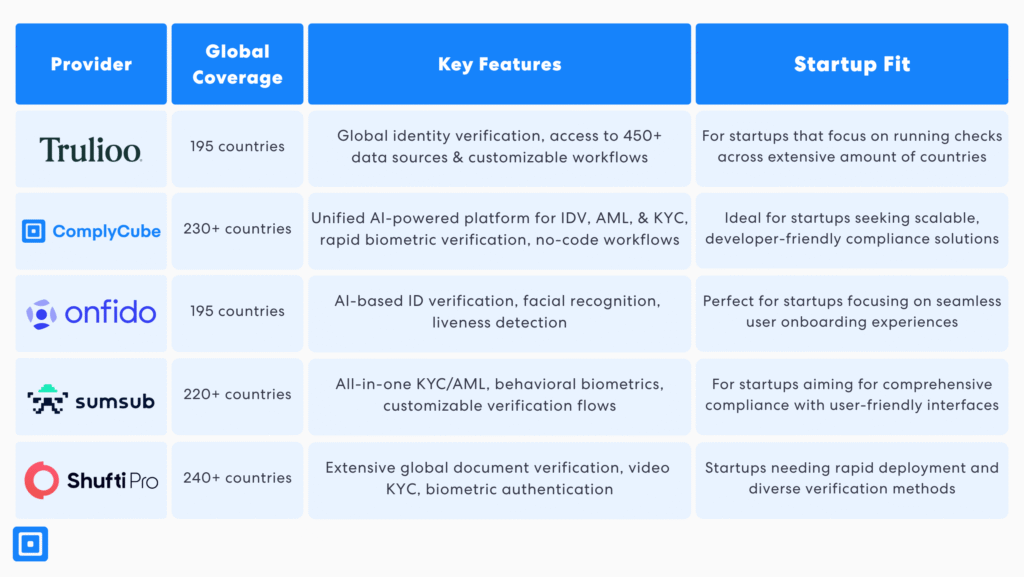
### Key Takeaways
- **Fintech startups** face high regulatory scrutiny due to sector-specific vulnerabilities, including large and rapid transaction volumes across borders.
- **Startups with strong** AML and KYC compliance benefit from strategic advantages, such as investor trust, customer loyalty, and regulatory satisfaction.
- **Real-time document checks**, biometric verification, watchlist, and PEP screening are must-have features for fast-paced startups to avoid fines.
- **Choosing KYC providers** for startups depends on business-specific needs, including geography, verification volume, and technology integration.
- **ComplyCube provides AI-driven** tools to help startups detect risk, automate workflows, and align with global regulatory standards at an accessible pricing plan.
## Safeguarding Startups with Advanced AML and KYC Solutions
In short, navigating KYC and AML requirements doesn’t have to slow down growth for SaaS and FinTech startups. By leveraging KYC providers for startups with strong identity verification and biometric authentication, firms can stay compliant while reducing fraud risks. Continuous monitoring also helps them quickly adapt to changing regulations and maintain customer trust.
Additionally, effective risk management, transaction monitoring, and business verification ensure compliance with regulatory reporting, boost trust with financial institutions, and protect against financial crime in the evolving financial services landscape. [Speak to a member](https://www.complycube.com/en/contact/contact-sales/) of the team today or sign up for [ComplyCube’s Startup Program](https://www.complycube.com/en/company/startup-program/).

## Frequently Asked Questions
Who are the best KYC providers for startups
The best KYC providers for startups are those that offer global coverage, startup-friendly pricing, and easy API integrations. Leading providers support quick ID verification, biometric checks, and robust AML screening. Startups must prioritize vendors with no-code workflows, strong customer support, and transparent pricing to enhance compliance.
How to choose the best KYC providers for startups?
Startups that need to choose KYC providers must map out their risk profile, target market, and regulatory obligations. They must perform comparison analysis on factors, such as country coverage, supported document types, depth of AML screening, and integration capabilities. These factors help startups avoid costly vendor migrations later.
How can startups stay compliant with AML regulations?
To stay compliant with AML rules, startups must satisfy jurisdiction-specific regulations. According to FATF, these include applying risk-based AML policies, ongoing monitoring, and performing KYC and KYB checks. Additionally, keeping real-time records and audit trails of compliance activities is crucial for compliance.
Why is KYC important for startups?
KYC is crucial for startups. It helps prevent fraud, money laundering, and other financial crimes. In addition, the best KYC providers for startups support building trust with customers, investors, and regulatory authorities. For startups, this is vital as it helps protect brand reputation and enhance customer acquisition.
What is ComplyCube’s startup program?
ComplyCube’s Startup Program offers early-stage companies access to cutting-edge, automated KYC and AML solutions on startup-friendly terms. Under the program, startups can benefit from discounted credit and expert guidance on building a strong, compliant onboarding journey.
**Categories:** Guides
**Tags:** Know Your Customer
---
### [CryptoCubed March Newsletter: JPMorgan Ponzi Scheme and SEC Rules](https://www.complycube.com/crypto-news-jpmorgan-ponzi-scheme/)
**Published:** March 25, 2026
**Author:** Dini Habib
**Excerpt:** This month, we see regulators’ efforts to stabilize the crypto sector, with updated rules to make crypto AML compliance easy to understand. Additionally, we explore dreadful fines and license revocations in three important cases.
**Content:**
👋 Welcome back to CryptoCubed! In this CryptoCubed March 2026 Newsletter: JPMorgan Ponzi Scheme and SEC Rules edition, we see regulators’ efforts to stabilize the crypto sector. We explore dreadful fines, license revocations, and new guidance to tame fraud risks and clarify rules.
This month, we cover JPMorgan’s lawsuit, Canada’s crypto purge, Japan’s increasing crypto scrutiny, Bithumb’s $25 million fine, and the US SEC’s new token taxonomy. Let’s unpack the impact of the hottest crypto news!
## JPMorgan’s Ponzi Scheme Faces Speculations
United States, March 10, 2026 🇺🇸: JPMorgan Chase is facing a proposed class action by the California District Court for enabling a $328 million crypto Ponzi scheme to flow through the company without adequate Anti-Money Laundering (AML) guardrails.
This case revolves around [Goliath Ventures](https://en.wikipedia.org/wiki/Goliath_Ventures), a cryptocurrency investment firm, now defunct after its CEO and founder were arrested for wire fraud and money laundering. Between 2023 and 2025, the firm made $328 million, involving 2000 investors who were lured into promises of high returns. Goliath funnelled new investor money to satisfy earlier participants, a key pattern in crypto Ponzi schemes.
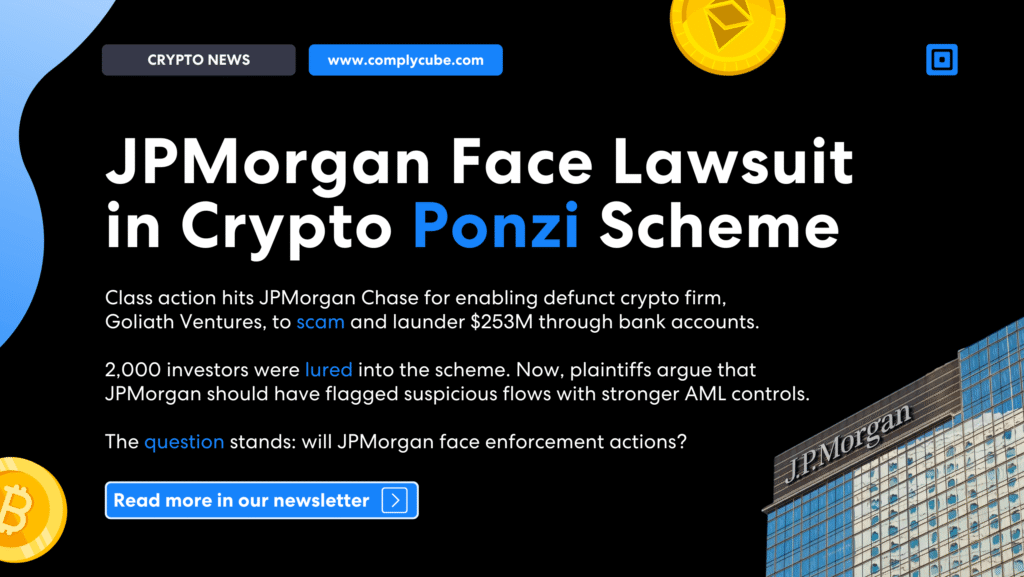
Reports indicate over $253 million flowing into JPMorgan accounts and $123 million then sent to crypto wallets at Coinbase. Plaintiffs argue that the bank overlooked Goliath’s suspicious transactions, including its rapid, high-volume flows to crypto exchanges and absence of genuine revenue.
Under FinCEN, these red flags should have been submitted in its Suspicious Activity Reports (SARs). Just last year, JPMorgan SE faced a [€45 million fine ](https://www.linkedin.com/pulse/trust-edition-november-2025-complycube-ndhae/)(USD $52 M) for breaching Germany’s Money Laundering Act. The question remains: could this lawsuit trigger additional regulatory fines?
For more on this story, click [here](https://www.bitget.com/news/detail/12560605272920).
## Canada Sternly Revokes 23 Crypto Firms’ Licenses
Canada, March 18, 2026 🇨🇦: The Financial Transactions and Reports Analysis Centre of Canada (FINTRAC) retracted 23 cryptocurrency-linked Money Services Businesses (MSBs) in the country. This action reflects the country’s stern stance on AML compliance in crypto firms.
> Our government will [continue to monitor](https://www.canada.ca/en/department-finance/news/2026/03/statement-by-the-minister-of-finance-on-canadas-progress-combatting-money-laundering.html) and pursue new measures to address risks posed by virtual currency businesses.
In its reports, FINTRAC noted that these firms significantly violated AML obligations, preventing effective mitigation of fraud and money laundering in the country. Out of the breaches mentioned, the majority were related to the failure to file necessary Suspicious Transaction Reports (STRs) or Large Virtual Currency Transaction Reports promptly.

Further violations include not meeting registration eligibility requirements and the inability to update records on time. 2 of the 23 firms were based outside Canada: Slovakia and the United Kingdom. Without registration, these firms must cease and freeze all operations. Canadian crypto firms are now facing the intensity, marking their shift towards automated, proactive KYC and reporting for compliance.
For more information, click [here](https://www.acams.org/en/news/breaking-news-fintrac-takes-down-cryptocurrency-platforms).
## Japan Triples Prison Time and Fines for Crypto Services
Japan, March 16, 2026 🇯🇵: Japan’s Financial Services Agency (FSA) launches a new proposal, indicating tougher enforcement action on unregistered crypto sales. This move aims to increase the protection of investors against fraudulent or unregistered crypto operators.
> In 2025, the crypto exchange market size reached [$3,657 million](https://www.imarcgroup.com/japan-cryptocurrency-exchange-market), with Japanese investors’ crypto assets surpassing a record [5 trillion yen](https://www.indexbox.io/blog/japans-crypto-holdings-hit-record-high-as-firms-position-for-growth/) (USD $33.16 B).
Against rising cryptoasset ownership, Japanese regulators have found a surge in complaints regarding fraudulent investments in the sector. The objective of the Financial Instruments and Exchange Act (FIEA) framework is to close these persistent gaps in illicit crypto trading.
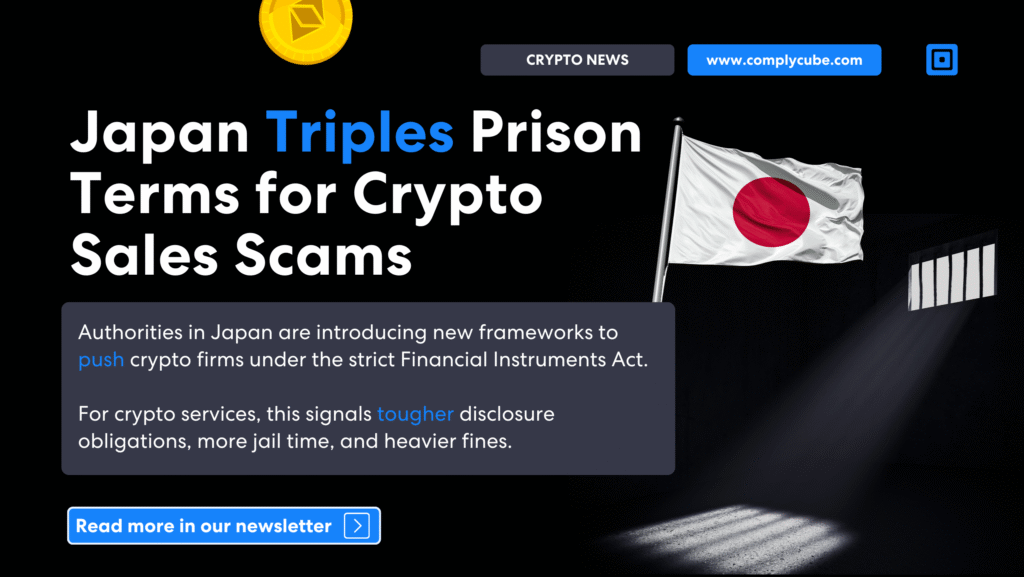
### Payment Services Act (Current) vs Financial Instruments and Exchange Act (Proposed):
- Penalties increased from 3 years to 10 years’ jail time for non-compliant crypto firms
- Monetary fines now shift from ¥3 million to a hefty ¥10 million (USD $67K)
- Crypto firms now face heightened disclosure obligations to users, such as the nature and functions of the cryptoasset, supply volume, technology, and inherent risks
- Disclosures must be provided at the point of selling a cryptoasset, and on an ongoing basis, including updating users on any changes promptly
- Investment seminars and similar advisory-style activities could be treated as regulated investment businesses
For more on this, click [here](https://cryptorank.io/news/feed/8db00-japan-fsa-toughen-crypto-penalties).
## Bithumb’s Long-Awaited $25 M Fine Matches Earlier Predictions
South Korea, March 16, 2026 🇰🇷: The past few months have been daunting for South Korean crypto firms, as the country’s Financial Intelligence Unit (FIU) slams multi-million dollar fines on leading crypto services, one by one. We’ve covered [Upbit’s $25 million penalty](https://www.complycube.com/en/the-cryptocubed-newsletter-november-edition-2025/) last November and [Korbit’s $1.9 million fine](https://www.complycube.com/en/crypto-news-the-bithumb-fine-and-oecds-carf/) this January. Now, Bithumb joins the list with a brutal $24.6 million for AML failures.
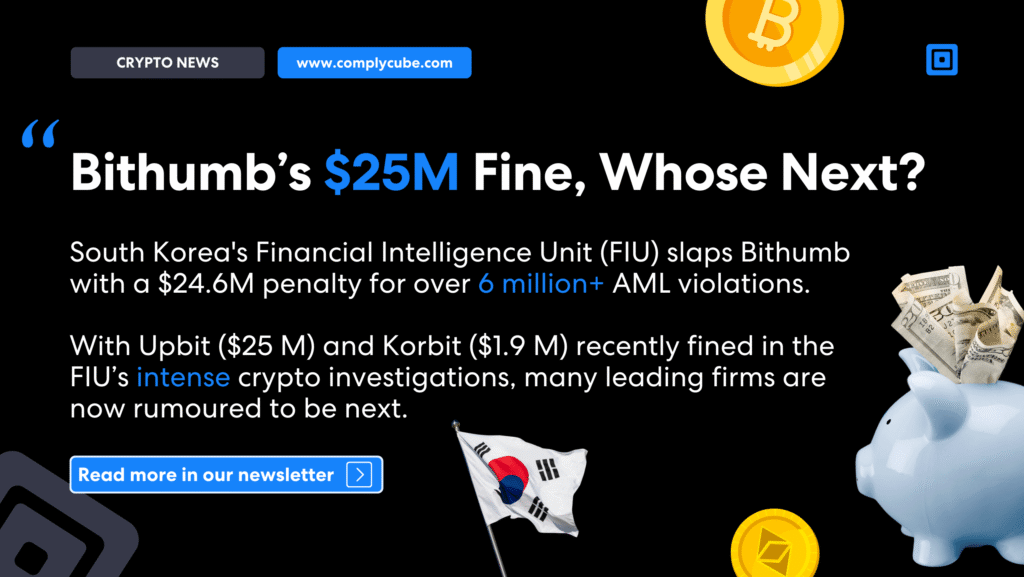
Investigations by the FIU found over 6 million AML violations. Out of them, the company failed to verify customer identities in 3.55 million cases and made 45,772 dealings with 18 unregistered foreign exchanges. These breaches left Bithumb’s customers and South Korean citizens exposed to terrifying fraud and money laundering risks.
The company now faces a six-month suspension, whereby new users are blocked from onboarding, deposits, and withdrawals. The fine matched many industry insiders’ predictions of a $25 million plus penalty, given the scale of the business. Now, many are waiting to see which company will be next.
Find more on this story [here](https://koreajoongangdaily.joins.com/news/2026-03-16/business/industry/Bithumb-fined-37-billion-won-faces-6month-biz-suspension-over-antimoney-laundering-lapses/2545981).
## Securities and Exchange Commission (SEC) Refines Crypto Law
United States, March 17, 2026 🇺🇸: The US SEC has launched its new guidance on how securities laws apply to crypto firms. Crypto is now segmented into five categories, with securities laws applicable to only digital securities, ending years of confusion around regulations.
> The United States is home to the largest crypto market globally, with [over $1 trillion](https://www.google.com/url?sa=t&source=web&rct=j&opi=89978449&url=https://finance.yahoo.com/news/us-crypto-usage-grew-50-225927750.html&ved=2ahUKEwiLqdbJy6uTAxXkxjgGHUFUFGMQFnoECBkQAQ&usg=AOvVaw2PgQrFaI7sBma8r62hmxNN) in transaction volume in only 7 months last year.
The new framework proposed by the SEC will now help crypto providers understand what is regulated and not. As a result, these firms can better improve their compliance framework and avoid risky lawsuits that undermine operations. Tokens are now split into five sections according to their functionality:
### Tokens are now split into five sections according to their functionality:
- **Digital Commodities**: These are freely tradeable assets deemed “digital gold,” and are not controlled by a central company. The value comes from market supply and demand.
- **Digital Securities**: These act as investments, as customers expect profits driven by a team’s ongoing efforts. Thus, it’s treated as shares which require full SEC registration and disclosure.
- **Stablecoins**: Refers to digital tokens linked to a currency, such as the US dollar. They are used more for payments and not to generate investment returns.
- **Collectibles**: Unique items, including art or gaming assets. These are exempt under the SEC unless they are being sold as investment shares, where users expect profitability from them.
- **Digital Tools**: Users buy tokens or assets to access software or digital services. There are no profit expectations present.
This distinction matters as under US securities laws, crypto firms face tougher AML implications. However, many are still challenging the vagueness and the practicality of the proposed changes. Will this move lead to significant innovation in the crypto scene, or will it lead to the proliferation of compliance uncertainty?
Find more on this story [here](https://www.theguardian.com/technology/2026/mar/18/sec-cryptocurrencies-securities-rules).
## Time for Some Light-Hearted Creative Criticism?
So you’ve made it to the end of our newsletter. It’s time to enjoy a little satire, worthy reader, you’ve earned it.
### 🔥THE CRYPTO CUBED POEM: MARCH🔥
JPMorgan faces stumbles, as Ponzi funds flow free,
Goliath’s promises lure investors, blind to AML debris.
Canada revoked plenty of licenses, with 23 firms grounded cold,
FINTRAC’s blade falls swiftly on suspicious activities untold.
Japan triples penalties for crypto shadows sly,
The FSA fortifies, no unregistered high.
Bithumb’s billions fined match whispers long foretold,
While the SEC carves five paths for crypto firms bold.
### Stay tuned for our April newsletter, and have a great month!

**Categories:** News
**Tags:** Crypto Regulations
---
### [Navigating KYC vs AML Compliance for Finance Firms](https://www.complycube.com/kyc-vs-aml-compliance-for-finance/)
**Published:** January 10, 2025
**Author:** Sofia Daley
**Excerpt:** KYC and AML are a set of best practices and processes to help businesses reduce their risk of fraud. Compliance is not optional for financial services, and the right infrastructure can ensure compliance and avoid costly fines.
**Content:**
**TL;DR:** KYC is a core component of AML compliance for finance, focused on verifying customer identity and preventing money laundering. AML in finance enables companies to meet regulatory obligations and reduce **risk exposure** across the customer lifecycle. This guide explores the key **AML compliance** finance sector requirements businesses need to know today.
## What are KYC Checks?
[Know Your Customer (KYC) checks](https://www.complycube.com/en/solutions/due-diligence-compliance/know-your-customer/) are critical components of an organization’s security processes, enhancing Anti-Money Laundering (AML) due diligence efforts. KYC verification strategies include identity verification, which drastically reduces the risk of fraudsters committing financial crimes with fake customer identification. Additionally, KYC verification also makes establishing relationships with new customers easier and ensures financial institutions are well-aligned with their customers from day one.
To begin, KYC compliance requires a strong Customer Identification Program (CIP) to verify identity and mitigate risks effectively. Consequently, a comprehensive CIP program protects financial institutions and is a form of critical customer due diligence and financial transparency, helping to fight money laundering and other financial crimes.
### Effective KYC implementation enables financial institutions to reduce:
- Terrorist financing by confirming identity through more than just document verification, limiting access to financial institutions and funding for illegal acts.
- Identity theft by verifying customer information and reporting suspicious transactions.
- Money laundering risks, by ensuring the financial system can identify threats to money laundering regulations but also monitoring activity closely enough to deter money laundering from occurring within the banking sector.
- Reputational harm from thefts and attacks, as account owners generally blame the bank or other financial institutions for the associated risk, which could impact the business relationship.
- Financial penalties are levied by government organisations for failure to comply with regulatory requirements, such as those imposed by the US Patriot Act or rules established by the Financial Industry Regulatory Authority.
- Legal action by customers and third parties or reports to the Financial Crimes Enforcement Network, often due to a lack of reasonable diligence that exposes customer data.
KYC aims to minimise the risk of bad actors from infiltrating the customer onboarding process. The sector most targeted by identity fraud is financial services. Synectics Solutions, the UK’s largest syndicated risk intelligence database, predicted in 2024 that ID fraud may account for [50% of all bank-reported](https://www.synectics-solutions.com/our-thinking/id-fraud-may-account-for-50-of-all-bank-reported-fraud-by-2025#:~:text=The%20typology%20accounts%20for%2045,facing%20Financial%20Services%20organisations%20today.) fraud by 2025.
Similarly, the U.S Department of the Treasury’s Financial Crimes Enforcement Network (FinCEN) issued a notice that highlighted a “concerning increase in U.S passport cards being used to impersonate and [defraud individuals](https://www.pymnts.com/news/security-and-risk/2024/spike-in-identity-fraud-forces-banks-to-embrace-innovation/) at financial institutions across the country.” Businesses within financial services often have access to financial assets, making them a very lucrative target for fraudsters. You can learn more here: [“Biometric Verification: Elevating Security in Banking.”](https://www.complycube.com/en/biometric-verification-elevating-security-in-banking/)
## The Risk-Based Approach to AML
When it comes to AML, customer risk management is complex but essential. A robust and effective AML approach is essential to reducing costs while meeting regulatory requirements. However, such methods can be time-consuming and can drain customer experience expectations.
## Risk Profiling
Risk profiling considers customer risk by scoring the customer based on several criteria. Moreover, the process focuses on a full assessment of each customer, transaction, and business relationship based on factors that have been identified by the organisation as potential risks.
Some of the most common components of a risk-based analysis include:
- **Geographical factors**: High-risk countries or jurisdictions with well-recognized AML/CFT concerns, such as terrorism-heavy locations or areas where previous crime has occurred.
- **Customer type**: PEPs, non-resident customers, complex business structures, or cash-intensive operations can also factor into risk assessment.
- **Transaction patterns**: Unusual, complex, or high-frequency transactions could signal risks, such as a sudden shift in account usage or high transaction values not commonly associated with the account.
- **Source of funds**: Known high-risk sources or unexplained income streams, often those that are on the perceived watchlist.
- **Industry or occupation**: Certain sectors (e.g., cryptocurrency, gaming, or import/export) may carry higher risks and must be considered.
- **Lighting and Depth Perception:** AI models can also use light reflection and shadows to detect liveness. Human faces reflect light differently than a flat photo or video would.
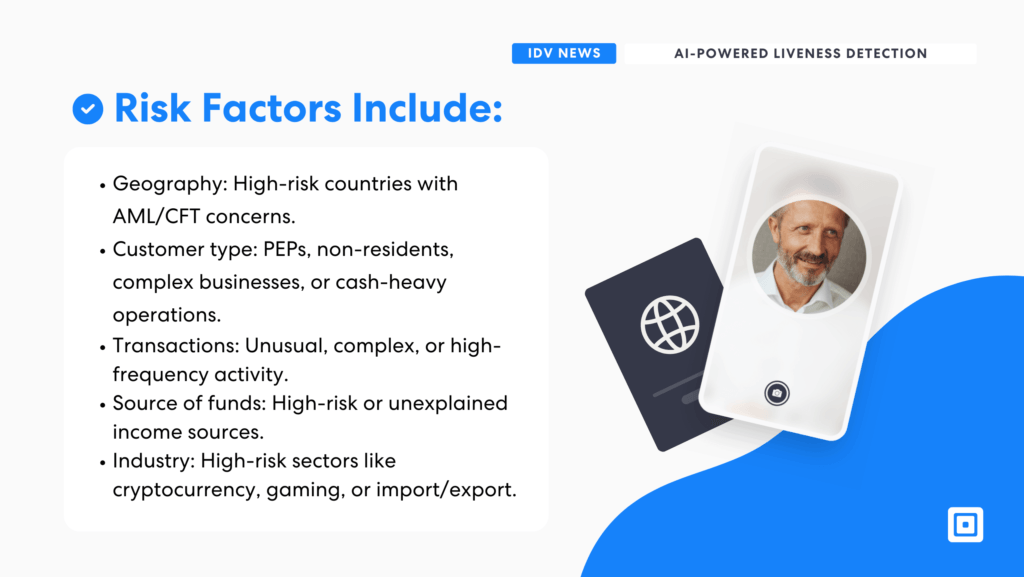
## The Consequences of Non-Compliance with AML Mandates
Businesses that fail to implement effective KYC strategies risk financial costs, including compliance-related fines. For instance, a single instance of fraud can cause reputational damage from adverse media mentions that may far exceed direct financial losses from compliance costs.
Some of the biggest fines handed out due to lack of AML compliance for finance include a £3B fine to TD Bank, a $35M fine to Nordea Bank, a $29M fine to Starling bank, and a $7.45M settlement for MGM Grand & The Cosmopolitan. Thus, implementing the right solutions early on avoids these catastrophic consequences.
Also notable is that KYC and AML is not a one-time process completed at onboarding. Continuous monitoring is necessary. It enables financial organisations to monitor a customer’s behaviour over the long term while also identifying new risks as they develop.
### **Case Study: Historic $80 Million Fine for AML Lapses**
In March 2026, Canaccord Genuity LLC was penalized a record $80 million fine by the U.S. FinCEN. According to reports, Canaccord has violated the Bank Secrecy Act (BSA) due to persistent AML failures. Shockingly, the breaches had occurred for over a decade.
##### **Operational AML Gaps**
FinCEN reported that Canaccord had a weak AML infrastructure. For instance, the firm onboarded high-risk customers without enough due diligence, failed to submit 160 suspicious activity reports, and did not review red flags due to unavailable resources.
##### **Outcomes**
- The Toronto-based investment management firm, Canaccord, was [fined $80 million](https://www.linkedin.com/pulse/trust-edition-march-2026-complycube-ayjhe/) for AML breaches.
- Despite prior warnings in 2025, the company’s remedial measures did not meet FinCEN’s expectations.
- Canaccord’s violations led to reputational damage and operational losses, highlighting the importance of AML compliance for finance.
## The Need for Strong AML Compliance for Finance
AML checks specifically target activities that could indicate a higher risk of money laundering. Data from the [United Nations Office on Drugs and Crime](https://www.unodc.org/unodc/en/money-laundering/overview.html) states that money laundering accounts for 2 to 5% of global GDP, equivalent to about US$800 billion to $2 trillion annually. Financial institutions and other regulated agencies must take steps to detect and prevent such activities, including terrorist financing. AML checks are a critical component of meeting AML compliance finance sector requirements.
> Money laundering accounts for [2 to 5% of global GDP](https://www.unodc.org/unodc/en/money-laundering/overview.html), equivalent to about US$800 billion to $2 trillion annually.
Utilisation of AML checks is needed to ensure prospective customers are not a risk to an organisation. This risk-based approach helps identify information that may indicate potential red flags. These warnings can expose bad actors attempting to launder money or finance terrorism. Conducting ongoing monitoring is also critical to identify risks quickly. AML checks must include the following when it comes to customer requirements:
### Customer Due Diligence (CDD)
This step verifies the prospective customer’s identity, financial behaviour, and risk profile. Standard CDD applies to all customers, while Enhanced Due Diligence (EDD) applies to high-risk customers. This includes transactions involving complex ownership structures, multi-jurisdictional customer relationships, customers from high-risk regions, and other interactions considered at higher risk. You can learn more here: [Navigating the World of Enhanced Due Diligence.](https://www.complycube.com/en/enhanced-due-diligence-edd-insights-and-challenges/)
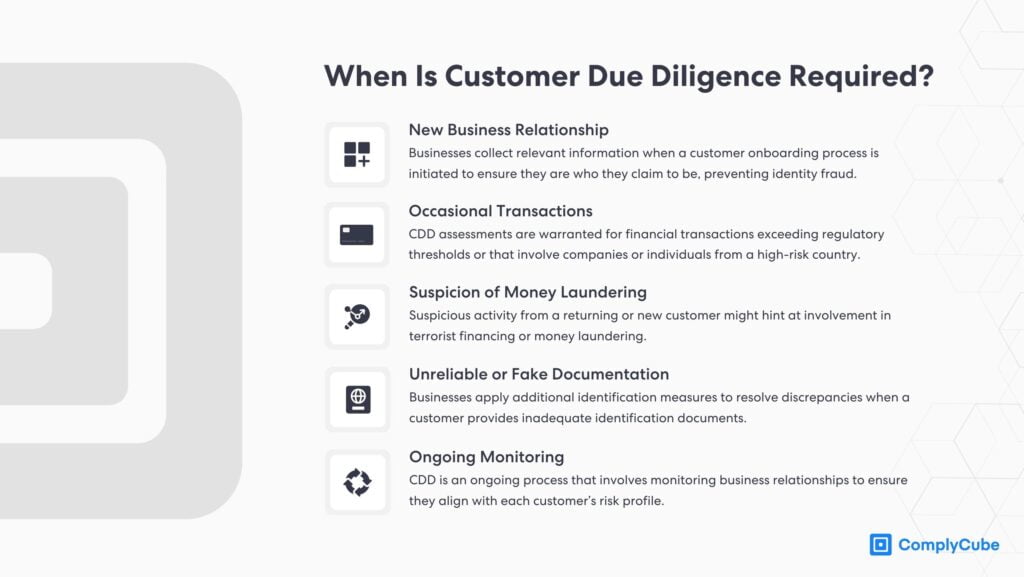
### **Risk-Based Screening**
AML checks ensure added due diligence on certain customers, transactions, or activities based on perceived risk. This may include customers or transactions in sanctioned countries. It also places heavier requirements on perceived higher-risk financial activities, including unusual, large, or complex transactions. Customer profile risks, such as occupations in high-risk industries, are also considered. All customers that possess a higher risk in any of these or other areas must work through a more elaborate AML process to ensure safety at all times.
## What Kinds of Financial Institutions Need KYC and AML?
Any type of financial transaction benefits from an effective customer identification program to establish the authenticity and accuracy of any information provided. However, some organisations must meet stricter KYC and AML compliance requirements because they involve higher risks, especially within the financial industry.
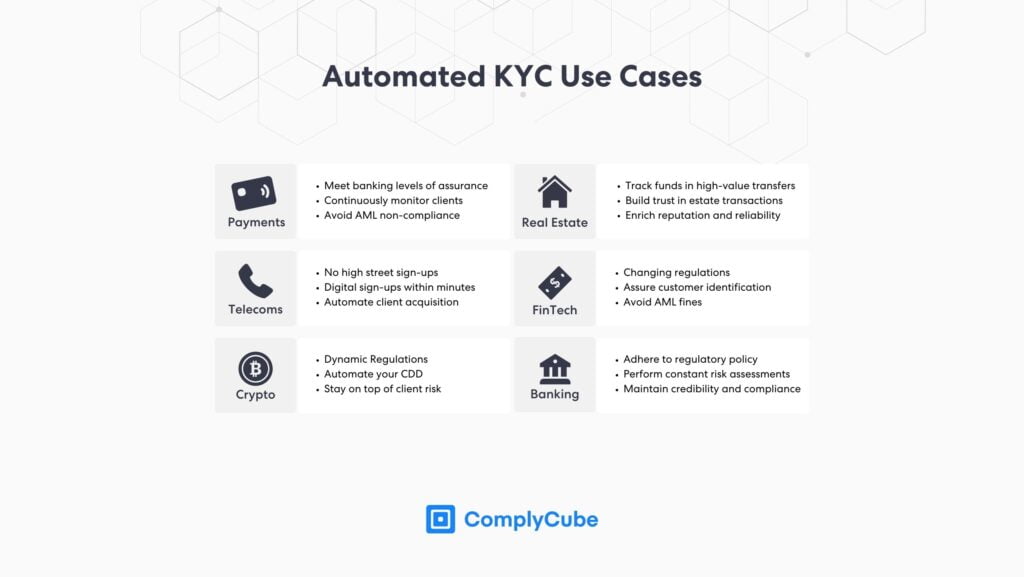
Meeting the requirements of global watchdogs working to monitor and minimise risks associated with wide-scale fraud is particularly important. Global watchdogs span through a wide range of industries, and some of the most important to know from a financial industry standpoint include organisations such as the Financial Action Task Force (FATF), a global watchdog of money laundering and terrorist financing. Sector specific watchdogs also exist, such as the Association of Chartered Certified Accountants (ACCA), which supervises the accounting industry. Let’s dive into different types of financial institutions and how they must meet the specific KYC and AML in finance requirements.
## Retail Banks
Banks are the transactional heart of the financial industry, and all must employ KYC and AML checks. These handle personal accounts for everyday financial activities like savings, loans, and payments. They screen account holders to ensure their identities match the documentation and assess risk. When out-of-place transactions occur in customer accounts, automated tools alert the bank to investigate, potentially minimising risk before transactions are complete.
Banks are often targeted by identity fraud and used for illicit practices such as money laundering. Therefore, these organisations must verify the identity and financial integrity of new and existing customers by continuously monitoring transactions, suspicious activities, or criminal behaviour.
## Investment Banks
These institutions perform market-based transactions on behalf of corporations or governments and must screen transactions to prevent market manipulation or insider trading. They must also work to pinpoint bad actors who may be laundering money through fake organisations. Monitoring global sanction lists can also facilitate ongoing oversight, anti-money laundering efforts, and better risk assessment.
## Corporate Banks
They work with businesses and large corporations, and require verification of the legitimacy of prospective clients and partners. Assessing financial activities and credit risk is key for corporate banks. Additionally, ongoing monitoring can provide insight into fraudulent activity happening within the business. KYC documents and regulatory methods aid in identifying information that could expose these banks to wide-scale fraud.
## Payment Service Providers (PSPs)
Companies like PayPal, Venmo, and Stripe facilitate digital payments and transfers. They must adhere to KYC and AML requirements to ensure secure payment processing and prevent misuse. They tend to operate on a global scale. The risks are higher, yet because consumers demand fast and effortless transactions, these organisations face some of the most challenging processes for achieving KYC and AML compliance. Key strategies they must maintain include:
- **Transaction Monitoring**: PSPs track payments in real-time to identify suspicious patterns. They must be able to put a stop to transactions that could be deemed fraudulent.
- **Sanctions Screening**: PSPs screen customer information against international sanctions lists to prevent unauthorised payments. However, ongoing monitoring for bad actors and an enhanced focus on key risks to changing global threats make these steps more challenging. For more on Sanctions Screening, read [“What is Sanctions Screening?”](https://www.complycube.com/en/what-is-a-sanctions-screening/)
## Insurance Providers
Insurance companies rely on KYC and AML checks to verify the legitimacy of customers’ funds and confirm the validity of claims. For example, insurance companies must spot numerous policy updates or changes against non-associated clients and beneficiaries. Some of the areas of focus here include:
- **Premium Payments**: Ensuring that premium payments are legitimate and traceable to the customer’s known source of income.
- **Claims Payouts**: Insurance firms must verify that payouts are going to the correct, verified individual and are not being processed for criminal purposes. Verification of policyholder identification and authentic claims is critical.
- **Risk Profiling**: [AML checks](https://www.complycube.com/en/solutions/due-diligence-compliance/anti-money-laundering/) help insurance companies assess financial risks associated with underwriting new policies. They can also be crucial in maintaining healthy accounts by ensuring a constant focus on changing customer behaviour and risk factors.
## Investment Firms & Brokers
Investment firms and brokerage houses are tasked with ensuring that clients are legitimate and their trades and investment behaviours do not violate market laws. As a result, investment firms and brokers must adhere to some of the strictest standards and be high targets for threats. Therefore, to minimise risk, they must focus on these key areas:
- **Client Identity Verification**: Before allowing clients to trade on their platforms, investment firms ensure that they are legitimate and compliant with regulatory standards. This includes verifying the source of invested money and account beneficiaries.
- **Trade Monitoring**: Investment brokers monitor trades for evidence of market manipulation or insider trading. Identifying potential fraud quickly may minimise risks.
- **Risk Analysis**: Investment firms assess customers for financial risks, particularly if their accounts are linked to criminal activity or sanctions violations. This process must be continuous as conditions change.
## Cryptocurrency Exchanges
Cryptocurrency exchanges like Binance, Coinbase, and others must conduct KYC and AML checks because cryptocurrency transactions are less transparent than traditional fiat currency transfers. You can learn more here: [Crypto AML Compliance: Securing the Sector](https://www.complycube.com/crypto-aml-compliance-securing-the-sector/). Key focuses include:
- **Sanctions List Screening**: [Screening customers](https://www.complycube.com/en/solutions/global-screening/sanctions-pep-screening/) against global and national sanctions lists to ensure compliance and then monitoring this over time to pinpoint suspicious restrictions.
- **Customer Screening**: Verifying the identity of cryptocurrency buyers and sellers to prevent financial crimes. As a target for criminal activity, cryptocurrency organisations must consistently monitor for any suspicious insights to support anti-money laundering initiatives.
### Key Takeaways
- **KYC is a core aspect of AML** in finance, with a large focus on customer identity verification and due diligence.
- **AML for finance refers to** the processes and controls designed to detect and prevent money laundering and terrorist financing.
- **Failure to meet AML** compliance finance sector requirements results in heavy fines, reputational damage, and enforcement actions.
- **Regulators expect financial** institutions to apply a risk-based approach, where higher-risk customers require EDD and higher scrutiny.
- **AML** **compliance finance sector** requirements go beyond identity verification, including enhanced due diligence and ongoing monitoring.
## Meet KYC and AML Compliance for Finance
KYC procedures that support streamlined verification of a customer’s identity can meet all due diligence requirements without slowing down digital processes. Mitigate compliance and fraud risks by implementing state-of-the-art KYC and AML checks. To safeguard your organization with advanced AML and KYC checks, reach out to ComplyCube’s [expert compliance team](https://www.complycube.com/en/contact/contact-sales/).

## Frequently Asked Questions
What is the difference between KYC and AML for finance firms?
Know Your Customer (KYC) is a subset of Anti-Money Laundering (AML) programs for financial institutions. Specifically, KYC focuses on verifying customer identity. On the other hand, AML in finance involves broader processes for preventing money laundering. The process includes transaction monitoring, ongoing monitoring, and risk management.
Why is AML compliance for finance important?
Anti-Money Laundering (AML) compliance supports financial institutions in protecting their customers and systems from suspicious or harmful activity such as fraud and financial crime. Additionally, they are required by regulators to effectively identify and tackle money laundering and terrorism financing.
How does a risk-based approach work for AML in finance?
A risk-based approach assesses customers or entities according to their risk level. High-risk individuals must undergo stringent checks, including sanctions and politically exposed person screening. This approach enables financial institutions to focus their resources where risks are highest, while allowing low-risk users to onboard more swiftly.
What are AML compliance finance sector requirements?
The key components of AML in finance include customer due diligence (CDD), sanctions and watchlist checks, PEP verification, adverse media screening, and suspicious activity reporting. It also involves ongoing monitoring to ensure any changes to a customer’s risk level are notified to prevent suspicious behavior.
Is KYC enough for AML in finance?
No. KYC forms a subset of AML compliance for finance. Full compliance goes beyond identity verification to include ongoing monitoring and suspicious activity reporting. As a result, this creates a stronger defense, preventing any gaps for fraudsters to exploit.
**Categories:** Guides
**Tags:** Anti-Money Laundering
---
### [The CryptoCubed Newsletter: November Edition](https://www.complycube.com/cryptocubed-newsletter-november-edition-2025/)
**Published:** November 27, 2025
**Author:** Dini Habib
**Excerpt:** The November edition of CryptoCubed includes Coinbase Europe's €21.46 million fine for AML breaches, X hit with a €5 million penalty for unauthorized crypto ads, and South Korea's increased enforcement penalties on crypto exchanges.
**Content:**
👋 Welcome back to CryptoCubed!
The November edition of The CryptoCubed Newsletter spotlights a significant regulatory shakeup in the crypto industry. The crypto news that made the headlines this month includes Coinbase Europe’s €21.46 million fine for Anti-Money Laundering (AML) breaches, X hit with a €5 million penalty for unauthorized crypto ads in Spain, and South Korea’s increased enforcement penalties on cryptocurrency exchanges.
Additionally, in the UK, we cover the case of Operation Destabilise and provide key updates on HMRC’s crypto taxation rules for 2026. Stay here to read more, and don’t forget to follow us on LinkedIn for more crypto updates!
## Ireland Fines Coinbase Europe €21.46 Million
Coinbase Europe Limited was fined €21.46 million (around US $25 million) for breaching AML and Counter-Terrorist Financing (CTF) regulations. This fine was imposed by the Central Bank of Ireland (CBI) following investigations that revealed significant lapses in the company’s transaction monitoring system. The case followed Coinbase Europe’s technical glitches caused by coding errors, which led to over 30 million transactions worth approximately €176 billion not being monitored.
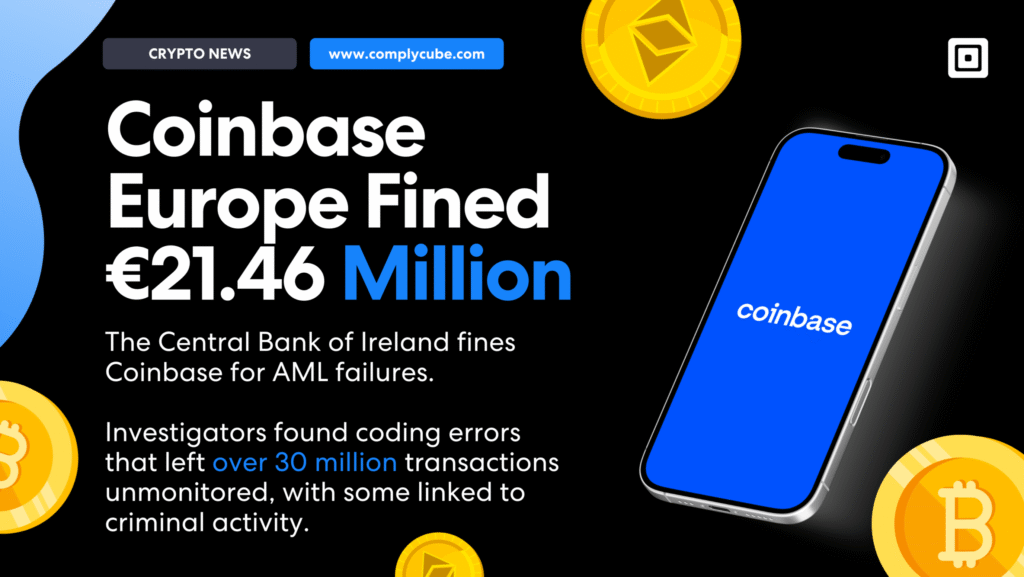
Coinbase took three years to file reviews of these failures, which included over 2,700 Suspicious Transaction Reports (STR) linked to financial crime, drug trafficking, and sexual exploitation. Due to Coinbase’s delayed response, the CBI initially imposed a penalty of over €30 million. This was reduced by 30% due to the company’s cooperation in an early settlement.
In reports by the CBI, the regulator highlights that Coinbase Europe failed to implement adequate internal policies, controls, and procedures to detect and prevent money laundering and terrorist financing. Coinbase is now working collaboratively to enhance its monitoring systems in accordance with MiCA requirements.
For more on this story, click [here](https://www.centralbank.ie/news/article/press-release-enforcement-action-against-coinbase-europe-limited-6-November-2025).
## Spanish Regulator Fines Elon Musk’s X for Unauthorized Crypto Ads
Spain’s securities market regulator, the Comisión Nacional del Mercado de Valores (CNMV), has fined X €5 million (around US $6 million) for unauthorized crypto ads on the platform. Formerly known as Twitter, X is a global communication platform app acquired and rebranded by Elon Musk in 2022.
According to CNMV, X breached crypto advertising regulations under Spanish laws. The company failed to verify the crypto trading platform, Quantum AI, and whether it was authorized to provide investment services or properly listed in regulatory warnings. The CNMV notes that the penalty aims to set a precedent on the increasing responsibility of digital platforms in vetting financial advertisers.

CNMV operates under the Securities Market Law 24/1988, with the purpose of protecting investors and consumers by ensuring market transparency. The regulator emphasizes the importance of [due diligence](https://www.complycube.com/en/what-is-customer-due-diligence/) to safeguard individuals from misleading or unauthorized cryptocurrency advertising. This is part of Spain’s broader goal to align with the EU’s Markets in Crypto-Assets (MiCA) regulation.
For more on this story, click [here](https://www.reuters.com/legal/government/spain-fines-musks-x-58-million-cryptoasset-advertising-case-2025-11-13/).
## South Korea’s Massive Crackdown on Leading Crypto Exchanges
South Korea has intensified its enforcement of AML penalties on cryptocurrency exchanges. Out of those affected, Dunamu, the operator of South Korea’s top crypto exchange, Upbit, faced the highest fine of 35.2 billion won (around US $25 million). Other firms, such as Bithumb, Coinone, Korbit, and GOPAX, have also been involved, with the country’s Financial Intelligence Unit (FIU) signaling similar penalties.

The FIU operates as South Korea’s specialized agency overseeing the implementation of critical Know Your Customer (KYC) and AML frameworks in crypto services. Despite several warnings and sanctions, the FIU found that these affected exchanges had not upgraded their AML systems. In particular, investigations revealed that Dunamu had up to 5.3 million violations. The firm was issued a three-month suspension on new customer onboarding.
Authoritative statements from the FIU indicate that ongoing delays and inadequate upgrades in AML systems by some exchanges have prompted regulators to shift from warnings to punitive measures. VASPs in South Korea are feeling the pressure, with weaker players facing the possibility of complete dissolution if they are unable to meet stringent regulatory demands.
For more on this story, click [here](https://www.coindesk.com/policy/2025/11/25/upbit-considering-appeal-of-usd25m-fine-by-south-korea-regulator).
## UK’s 2026 HMRC Crypto Reporting Tax Rules
From January 1st, 2026, all UK [cryptoasset](https://www.complycube.com/en/use-cases/industry/crypto/) providers are required to collect and report robust personal and transactional information about their customers and businesses to HM Revenue and Customs (HMRC). Previously, UK crypto taxation relied on voluntary disclosure by taxpayers themselves, with limited data sharing between crypto platforms and HMRC.
This move aims to improve transparency, accountability, and tax compliance within the crypto sector. Exchanges, brokers, and dealers must report complete customer information, including full name, address, date of birth, tax residency status, tax identification numbers, and crypto transactions. Under this new reporting requirement, HMRC aims to shift part of the compliance burden to crypto-asset services.
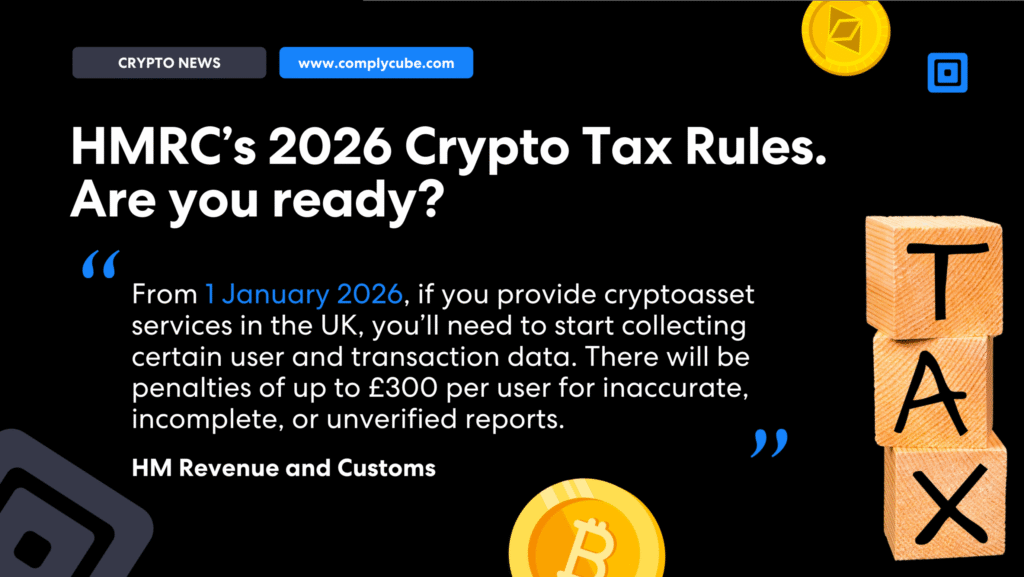
The shift is critical in enabling HMRC to close the gap of tax evasion that arises from the inaccurate declaration of crypto gains or income from customers. The first reports covering all 2026 transactions must be submitted by May 31, 2027. Crypto providers are encouraged to start collecting information earlier to better prepare for the new rules when they take effect.
For more on this story, click [here](https://www.gov.uk/guidance/collecting-cryptoasset-user-and-transaction-data).
## Russian Money Laundering Network Exposed
Over £25 million in cash and cryptocurrencies were seized in the UK from the downfall of a Russian money-laundering network. The investigation, known as Operation Destabilise, was led by the UK’s National Crime Agency (NCA), which found an extensive billion-dollar Russian criminal network operating across the UK and internationally.
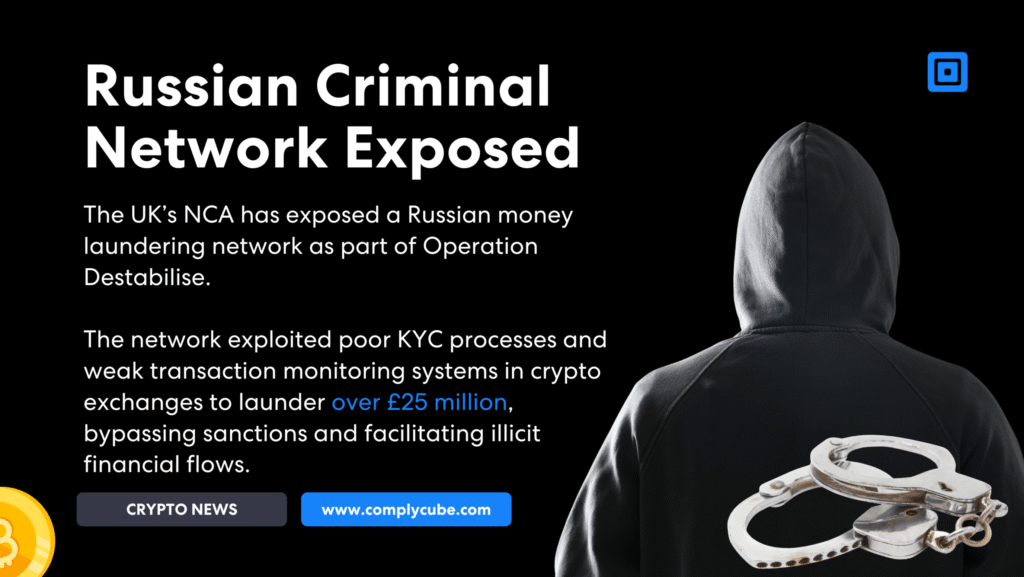
The network evaded sanctions and made use of cash-intensive businesses and cryptocurrency exchanges to launder money. The NCA has made a total of 128 arrests as a result of the operation. This case exposes the vulnerabilities and loopholes that persist in crypto firms.
> We are working tirelessly to [detect, disrupt, and prosecute](https://www.nationalcrimeagency.gov.uk/news/operation-destabilise-nca-exposes-billion-dollar-money-laundering-network-that-purchased-bank-to-fund-russian-war-effort) anyone engaging in activity for a hostile foreign state.
Security Minister Dan Jarvis mentioned, “We are working tirelessly to detect, disrupt, and prosecute anyone engaging in activity for a hostile foreign state. It will never be tolerated on our streets.” This case highlights the weak KYC policies and transaction monitoring systems that still occur within the crypto scene despite heightened regulations.
For more on this story, click [here](https://www.nationalcrimeagency.gov.uk/news/operation-destabilise-nca-exposes-billion-dollar-money-laundering-network-that-purchased-bank-to-fund-russian-war-effort).
## Time for Your Monthly CryptoCubed Poem
So you’ve made it to the end of our newsletter. It’s time to enjoy a little satire, worthy reader, you’ve earned it.
### 🔥 THE CRYPTO CUBED POEM: NOVEMBER 🔥
Coinbase Europe’s code had slipped,
Thirty million trades unzipped.
AML rules breached, fines immense,
Twenty one million euros’ expense.
X’s ads in Spain went stray,
Five million euros must now be paid.
South Korea cracks down with might,
Crypto rules now held more tight.
### Click [here](https://www.complycube.com/en/contact/contact-sales/) to learn more about how ComplyCube supports cryptocurrency firms in maintaining global AML and KYC compliance.
### Stay tuned for our next newsletter and have a great day ahead!
**Categories:** News
**Tags:** Crypto Regulations
---
### [Why is Driving License Verification Critical for Ride-Sharing Compliance](https://www.complycube.com/driving-license-verification-in-ride-sharing/)
**Published:** March 11, 2026
**Author:** Dini Habib
**Excerpt:** With the increasing use of digital services and higher access to driving, the ride-sharing industry has transformed mobility on the road. However, this growth is met with heightened regulations around driving license verification.
**Content:**
**TL;DR:** The rise of the increasingly popular **ride-sharing industry** has transformed how we commute today, with both drivers and passengers benefiting from **convenient travel options**. To ensure the safety of passengers, comprehensive driving license verification must be implemented. This guide explores the importance of driver document checks and **compliance in ride sharing**.
## What is Compliance in the Ride-Sharing Industry?
Regulatory bodies globally have enforced strict rules around driving license verification processes in the ride-sharing sector. In the United States alone, 85% of the population holds a driver’s license, while in England, numbers have hit a record-high with over 74% of residents with a full driving license. Due to the increasing number of drivers, several entities, for example, Transport for London (TfL), have heightened checks for private-hire drivers, including license eligibility and background screening.
However, regulations can vary in different jurisdictions based on levels of risk and data privacy laws. For instance, in the UK, the regulatory approach to ride-sharing services centers on passenger safety and driver legitimacy. In the US, the focus is on safety verification in conjunction with the Department of Motor Vehicles (DMV). Meanwhile, regulatory offices within the European Union prioritize data protection alongside safety requirements.
> In 2024, Uber faced a whopping €290 million fine by the Dutch Data Protection Authority for transferring European drivers’ personal data to the US without adequate data guardrails.
Variations across jurisdictions have driven the demand for advanced Know Your Customer (KYC) systems that offer centralized control and oversight while meeting local rules and regulations. Non-compliance can cause severe consequences, with fines amounting to 4% of global turnover.
## Implementing Effective KYC in Driving License Verification
Driving license verification is a crucial component of [KYC for mobility platforms](https://www.complycube.com/en/solutions/due-diligence-compliance/know-your-customer/). Unlike traditional financial institutions, companies such as Uber and Grab must review driver entitlements and status in addition to basic identity checks. This can present unique challenges in its operations and compliance processes.

In a typical KYC process, verification includes collecting and cross-checking vital customer information against trusted databases. This includes data such as name, date of birth, social security number, and state-issued ID card. [Biometric verification](https://www.complycube.com/en/solutions/identity-assurance/biometric-verification/) further confirms that the customer submitting the information physically matches the ID document provided.
The ride-sharing industry is expected to grow at an annual compounding rate of [10.97%](https://www.sphericalinsights.com/reports/united-kingdom-car-rental-market) from 2025 to 2035, making the shift for automated KYC for quicker driving license verification critical. These KYC systems leverage the use of artificial intelligence to boost customer onboarding accurately while maintaining alignment with stringent privacy regulations. The growth of the ride-sharing industry marks this shift:
- The global ride-sharing market in 2025 is $149.88 billion and predicted to increase to [$788.44 billion](https://www.precedenceresearch.com/ride-sharing-market) by 2035.
- The ride-sharing company, Lyft, noted [945.5 million](https://www.lyft.com/blog/posts/lyft-reports-record-q4-and-full-year-2025-results) rides via its app in 2025, with 51.3 million annual riders.
- The number of global gig workers is predicted to see an increase in 30 million people, with [58%](https://hellopebl.com/resources/blog/gig-economy-statistics/) of the industry’s revenue coming from ride-sharing or transportation services.
In the UK jurisdiction, mobility platforms use the [Driver and Vehicle Licensing Agency (DVLA)](https://www.gov.uk/get-vehicle-information-from-dvla) to confirm license status and driver entitlements. Meanwhile, in the US, state [Department of Motor Vehicles (DMV)](https://en.wikipedia.org/wiki/Department_of_motor_vehicles) are used for similar checks. AI-driven KYC vendors, such as ComplyCube, consolidate these jurisdiction-specific requirements into a unified driving license verification flow, reducing manual reviews and potential delays to access services.
## Driver Document Checks For Proof of Identity in Ride-Sharing
Document verification in standard KYC processes focuses primarily on identity verification compliance to prevent fraud and money laundering. On the other hand, KYC in the ride-sharing industry includes an emphasis on passenger protection.
> In the US alone, there are over [242 million](https://hedgescompany.com/blog/2024/01/number-of-licensed-drivers-us/) licensed drivers with valid licenses.
Drivers are requested to provide all required details, including primary and secondary identity documents, as well as documentation on their license validity and driving record or history to prove their legal ability to drive motor vehicles. Document verification in the ride-sharing industry ensures compliance, passenger safety, and fraud prevention by validating a driver’s legal qualification to operate a specific vehicle at that time:
- **Proof of Identity:** Extraction and authentication of information on documents, such as government-issued ID cards and passports.
- **Driver’s License Validity:** The driver’s license must be genuine and valid for the specific vehicle type used. This is done through cross-checking government databases, such as the DVLA.
- **Driver Entitlement:** The driver must be legally permitted to drive and clear of vehicle offenses. For example, meeting age thresholds by scanning date of birth, passing a criminal background check and holding a clean license. These data points provide key underwriting information for car clubs.
- **Driver’s Background**: Platforms must screen drivers against sanctions lists and politically exposed person databases for [Anti-Money Laundering (AML) compliance](https://www.complycube.com/en/solutions/due-diligence-compliance/anti-money-laundering/). This prevents onboarding drivers linked to potential crime.
- **Other Supporting Documents:** Recent utility bills and bank statements are used for proof of address. This links the driver to the specific location, supporting compliance and confidence in the KYC process.
Modern KYC for mobility services integrates [document checks](https://www.complycube.com/en/solutions/identity-assurance/document-verification/), biometric matching, and database cross-referencing to create comprehensive user profiles. These systems operate in real-time to support rapid onboarding while aligning with compliance and data security in global jurisdictions.
## Advanced Verification Systems
A driver’s license card incorporates numerous security elements that these sophisticated systems can analyze. Examples of these elements include holograms, microtext, and guilloche patterns that AI can detect with precision. Thus, the authentication process must account for the diversity of document types and security features across different government agency jurisdictions.
Fraud intelligence solutions are capable of strengthening document verification. It includes device intelligence checks to assess whether the same driver is moving consistently through the journey. With device intelligence, ride-sharing firms can gain insights into device history, usage patterns, and behavioral consistency, such as IP mismatches and geolocation tampering, to detect suspicious activity. Thus, only enabling legitimate drivers access to services.
## Ongoing Monitoring
Consider this scenario: A driver submits the required records on a ride-sharing app’s digital onboarding service. They are acceptable documents, and the application is approved, deeming the driver eligible to operate the rideshare vehicle when they are onboarded. But on a later date, their license is suspended or revoked. Without continuous monitoring, the rideshare service would have no way of knowing this.
Ongoing monitoring processes supports businesses in the mobility industry to stay compliant beyond initial onboarding. It includes periodically re-verifying if drivers are valid for driving with repeat DVLA checks and face authentication in between driving shifts.
In practice, face authentication between journeys will confirm that the driver using the account is the same approved driver, preventing account sharing and impersonation. Furthermore, interval DVLA checks confirm that licenses are still valid and no new disqualifications have been identified. As a result, ride-sharing companies are able to keep accurate driver profiles, safeguarding passenger safety.
## Operationalise Driving Licence Verification Without Friction
According to Harry Varatharasan, Chief Product Officer at ComplyCube, the best compliance in the ride-sharing industry is invisible when it works, and decisive when it fails. A risk‑based model allows ride‑sharing platforms to apply lighter, largely automated checks where risk is low, and stronger controls where risk is higher, or regulators expect more scrutiny.
> Risk-based orchestration must be tailored to every driver to cut delays and costs while maintaining confidence in driver validity.
In short, this model supports the balance between compliance and frictionless onboarding. A tiered approach, low-to-high-risk flow, aligns with licensing mandates across several key jurisdictions:
- **State TNC Laws (example: California AB5, Texas HB2305)**: Mandate background checks and license validity with essential [risk-based frequency](https://content.naic.org/insurance-topics/commercial-ride-sharing).
- **Singapore Land Transport Authority**: Enforces profile-based re-verification frequency, requiring annual checks for clean vocational licences and scrutiny for drivers with demerit points. This model starts with identity proofing before escalation to license-specific screening and then activation.
- **Transport for London (TfL) and UK taxi and private-hire licensing:** Ride-sharing companies requires consistent identity through a staged flow with DBS, license history, and right-to-work checks with high-risk cases escalated to fitness-to-drive review or criminality.
The importance of risk-based KYC for mobility firms cannot be overlooked. Harry adds, “Risk-based orchestration must be tailored to every driver to cut delays and costs while maintaining confidence in driver validity”. Where risk indicators are present, such as inconsistencies in the driver’s data, businesses can add layered checks to confirm accurate identification information:
### Low-Risk Path:
- **Triggers:** Lowest risk present. The driver clears document verification with all driver details appearing on the source databases.
- **Verification step:** Fully automated document, selfie check, or basic database verification, which can go straight through approval.
### Medium-Risk Path
- **Triggers:** Slight risk present. The driver may have data inconsistencies, be from a higher-risk territory, or has unusual onboarding patterns that do not flag immediately as fraud signals.
- **Verification step:** Targeted step-up checks, including additional proof of address verification or video liveness checks to determine the user is live and present.
### High-Risk Escalation
- **Triggers:** Strong fraud indicators exist. Information gathered shows a mismatch in data or suspected tampering. Driver alert for unusual device behavior, previous safety incidents, or revoked license.
- **Verification step:** Additional verification layer, including robust database checks, device intelligence, and in-depth manual review required with full decisions documented for regulators.
## Common Fraud Types in Ride-Sharing
Ride-sharing services face escalating identity theft and subsequent fraud as they scale. Research shows that fraud in the ride-sharing industry is both prevalent and evolving, highlighting the need for robust driving license verification processes. According to a recent study by Cifas, the rise in [insurance fraud by 25%](https://www.cifas.org.uk/newsroom/fraudscape-2025-6monthupdate) in H1 2025 was driven by identity theft in motor insurance.

One example, account sharing, where verified drivers allow unverified individuals to operate cars under their valid accounts, has created numerous issues to date. It violates terms of service and regulatory requirements, jeopardizes safety, and increases liability risks. Fraudulent activity like account sharing can also increase the risk of accidents and complicate insurance coverage claims for ride-sharing platforms.
### The most common fraud types include:
- **GPS spoofing**: Fraudsters fake locations to claim phantom trips, inflate fares, or exploit surge pricing without moving. This evades official geofencing controls that are meant to protect customers and ensure valid trip data. To combat this, firms must combine device intelligence checks to identify location anomaly or suspicious trip patterns.
- **Fake accounts**: Criminals create multiple driver or rider profiles using stolen information, including social security numbers and date of birth, to game promotions or evade bans. To prevent fake accounts, it is essential to apply strong driver document checks during onboarding to identify reused or tampered credentials.
- **Driver-passenger collusion**: Partners fake rides or cancellations to trigger refunds, splitting the profits. This type of fraud is done when a driver account slips through gaps in weak onboarding and periodic re-verification checks. Thus, periodic re-verification with face authentication and DVLA checks are critical.
- **Account takeovers**: Hackers seize legitimate accounts to misuse payment methods or book fraudulent trips. Without strong verification, attackers enter with stolen contact details, leading to issues like unauthorized accident claims. Ride-sharing firms must use strong authentication and periodic re-verification to detect false logins.
- **Promo abuse**: Users spin up fake profiles to repeatedly claim referral bonuses or discounts. Biometric deduplication enforces single account per user restrictions to combat this. It is thus critical to implement biometric or device checks to identiy repeated claims linked to the same account.
But the most common fraud patterns in ride-sharing are document-related, and identity theft is usually the underlying cause. In rare cases, individuals working at the issuing agency may be involved. People desperate for work alter legitimate documents to create convincing forgeries that conceal driver status issues. You can learn more here: [Understanding User Risks from Identity Fraud](https://www.complycube.com/understanding-user-risk-from-identity-fraud/).
## Ride-Sharing Compliance Implementation
Ride-sharing providers implement driving license verification as a core compliance process to confirm drivers hold valid credentials before they can participate in the service. This essential step protects customers by ensuring only individuals with proven driving ability operate vehicles, directly addressing risks like unqualified drivers or identity fraud during onboarding.
Platforms prioritizing automating identification, through document scans and biometric matching, achieve more accurate driving license verification while maintaining efficient onboarding flows. Strong governance frameworks help providers comply with jurisdictional regulations, balancing safety for users with seamless service delivery across ride fleets:
### 1. Assessment and Planning
First, conduct a comprehensive assessment of current capabilities, regulatory requirements, and operational needs. This will identify gaps and vulnerabilities and establish priorities for improvement. All relevant stakeholders must understand the implementation goals and timeline. This includes internal teams, technology partners, regulatory bodies, and driver representatives.
Budget and resource allocation also require careful consideration, given the investments required in technology, training, and ongoing operational support. Platforms should develop realistic budgets for initial and ongoing KYC costs, especially since these expenses are typically absorbed by the company in order to attract and maintain a qualified driver base.
### 2. Technology Selection and Integration
Compare KYC providers and verification technology solutions. While price is important, the focus should be on how each solution meets operational and compliance needs. Other key considerations include scalability, accuracy, and user experience. You can learn more here: [Perform a KYC Platform Comparison.](https://www.complycube.com/en/kyc-platform-comparison-feature-evaluation/)
Planning for integration with existing systems should address technical requirements, data flow design, and security considerations. Successful integrations require thorough testing to ensure system reliability and performance. Ensure that staff understand the new workflows and can support drivers effectively during the transition. Training programs should address the technical and operational aspects of the new system.
### 3. Implementation and Optimization
From an internal perspective, a phased rollout approach allows teams to identify and address issues before full deployment. This approach can begin with onboarding in limited geographic areas or specific segments before expanding to full operations.
The verification process should offer a positive user experience. Streamlined interfaces and clear instructions help applicants complete these steps quickly. Performance monitoring systems can track key metrics such as success rates, processing times, and fraud detection effectiveness. Feedback from users and regulatory bodies provides valuable insights, too.
### Key Takeaways
- **Driving license verification** is crucial for compliance in the ride-sharing industry, accurate insurance underwriting and safety, and will vary according to different states.
- **Risk-based** driver’s license verification supports efficiency in onboarding and balances security with user experience.
- **Ongoing monitoring** beyond initial driver verification is mandated to track changes in drivers’ risk profiles.
- **Biometric with liveness**, Background Checks, and biometric verification provide a robust multi-layered approach to safeguard passenger safety.
- **Unified, automated KYC** platforms can strengthen fraud prevention while cutting manual reviews and streamlining driver onboarding.
## Meet Compliance in Share-Riding Regulations
Modern regulatory technology solutions lead compliance in ride-sharing by automating driving license verification. A unified platform, such as [ComplyCube](https://www.complycube.com/en/), supports firms in performing document, biometric verification, and real-time database matching to confirm valid drivers throughout the lifecycle journey.
Advanced driving license verification tools anticipate evolving regulations and integrate AI and machine learning with ongoing monitoring to mitigate risks such as revoked or expired licenses. Boost efficiency and position your firm as a [safety-first leader](https://www.complycube.com/en/contact/contact-sales/) while scaling globally with ComplyCube today.
[](https://portal.complycube.com/signup)
## Frequently Asked Questions
What is compliance in driving?
Compliance in driving is achieved when ride-sharing companies meet regulations around driver verification, vehicle safety, and ongoing monitoring. It involves ensuring the issued driver’s card is valid and free of illicit records via identity and criminal background checks.
How often should ride-sharing platforms recheck the frequency for driver’s licenses?
Ride-sharing platforms must recheck licenses according to their risk level and jurisdiction. Reviews of drivers’ information should be done according to the risks, which is done on a case-by-case basis. Those who have had recent changes in information or a behaviour change will require re-verification. Automated verification removes manual checks, particularly with expiry alerts.
Is a Social Security Card or Social Security Number enough for driver onboarding?
It’s not enough to accept a government-issued number, such as a Social Security number, on a job application for a position as a ride-sharing driver. A driver’s license must be produced, checked, and entitlements verified. This supports applicant verification, but more importantly, it proves that they can legally drive.
What is driving license verification in ride-sharing?
Driving license verification confirms that a driver is legally allowed to drive by verifying key information. The process includes document verification (e.g. using passport, government-issued ID cards), biometric checks, and database matching against issuing authorities such as DVLA or DMV. Its purpose is to protect passengers and comply with KYC laws.
How does ComplyCube support compliance in ride sharing?
ComplyCube supports ride-sharing compliance by automating driving license verification and criminal background checks across multiple jurisdictions. The platform uses Optical Character Recognition to extract key data, including driver license numbers, expiration dates, date of birth, and social security numbers from documents for instant validity.
**Categories:** Guides
**Tags:** Identity Verification
---
### [Electronic Identity Verification vs Document Checks for Onboarding](https://www.complycube.com/electronic-identity-verification-vs-doc-check/)
**Published:** March 23, 2026
**Author:** Dini Habib
**Excerpt:** Electronic identity verification (eIDV) and document verification enable businesses to verify customers securely and accurately during AML onboarding. However, each approach presents different costs, operations, and effectiveness.
**Content:**
**TL;DR:** Electronic identity verification (eIDV) and Know Your Customer (KYC) document verification processes both help businesses **confirm a customer’s identity** during AML onboarding. While they share similar goals, they differ in **operational costs and effectiveness**. This guide compares eIDV’s database-based identity check approach against manual verification.
## What are Electronic Identity Verification Processes?
Electronic identity verification, also known as eIDV, is the process of digitally verifying a customer’s identity through complete database searches. eIDV forms a key part of the broader KYC process and supports organizations in complying with Anti-Money Laundering (AML) regulations.
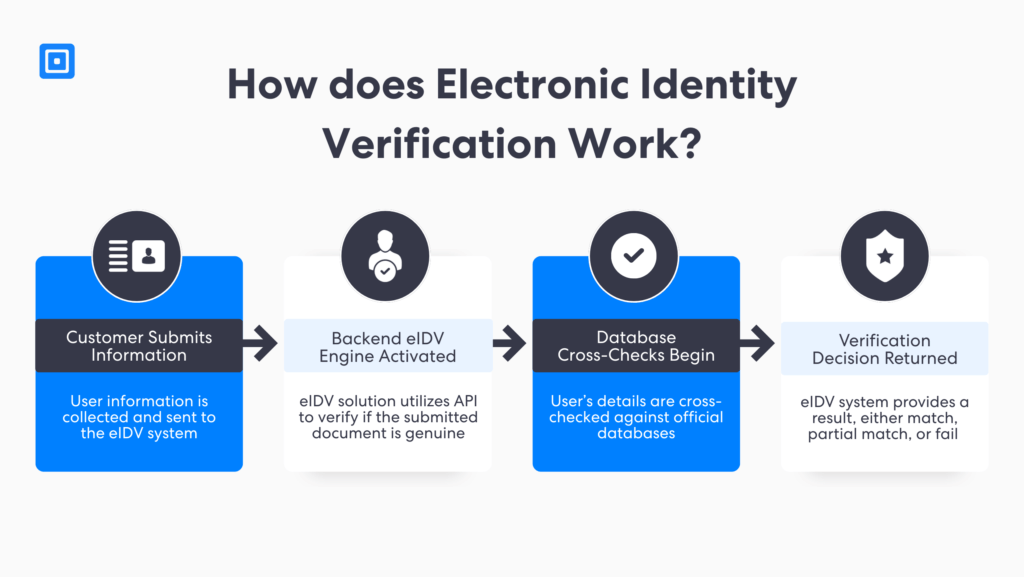
The eIDV process leverages digital analysis, allowing businesses to verify identities against authoritative databases remotely. Unlike legacy document checks, eIDV aims to shift away from physical document uploads or manual verification. Some benefits of eIDV include faster database checks and seamless customer onboarding.
### Speedy Database Checking
The eIDV process involves gathering a customer’s basic demographic information, including name, address, date of birth, and Social Security number. Next, this customer information will be verified against [trusted records](https://www.complycube.com/en/solutions/identity-assurance/multi-bureau-checks/), such as government databases, credit bureaus, and utility databases.
The system cross-references data against multiple databases simultaneously. While geographic coverage can vary across providers and sources, several vendors maintain relationships with numerous data providers to ensure maximum accuracy. Since eIDV leverages automation and Application Programming Interfaces (APIs), it accelerates customer verification and validation.
### Seamless Customer Onboarding
Unlike manual identity verification of customer data, eIDV uses automated verification to confirm a customer’s identity within seconds. For example, during address verification, a customer’s residential address can be cross-checked against multiple databases simultaneously.
Moreover, customers can receive immediate feedback about their verification status during the KYC onboarding process. Thus, customers can achieve more accurate, faster onboarding, enabling rapid access to online services. This significantly improves customer satisfaction and supports business growth, particularly for global financial institutions.
## Legacy Document Verification in KYC Procedures
The traditional document checking method requires customers to submit physical identification documents, such as passports, driver’s licenses, or government-issued IDs. Next, organizations will need to manually analyze these documents to extract user identity information and verify their authenticity.
The primary advantage of this method is its universal applicability and independence from database coverage limitations. Customers can verify their identities regardless of their geographic location. Document checking is essential for KYC onboarding and synthetic identity fraud prevention. A document check is typically combined with other methods or includes additional features:
- **Biometric Verification:** Combining document and biometric verification provides an additional layer of security that can help prevent identity theft more robustly. [Selfie checks](https://www.complycube.com/en/solutions/identity-assurance/biometric-verification/) and liveness detection prevent spoofing attempts using deepfakes.
- **Advanced Security Features:** Modern identity documents include security elements such as watermarks, holograms, microprinting, and embedded chips. Enhanced verification tools analyze these features to effectively detect forged or altered documents.
- **Optical Character Recognition (OCR):** Modern businesses leverage OCR technology to extract customer information from uploaded documents. While this simplifies data extraction, human oversight is needed to analyze information accurately. You can learn more here: [OCR Technology](https://www.complycube.com/en/solutions/due-diligence-compliance/know-your-customer/optical-character-recognition/).
## Electronic Identity Verification vs Traditional Document Verification
Both eIDV and document checks enable companies to deter identity fraud and terrorist financing. Also, they align with key regulations, including the European Union’s [Anti-Money Laundering Directive (AMLD)](https://eucrim.eu/news/new-anti-money-laundering-directive-amld-6/), the US Bank Secrecy Act (BSA), and the Financial Action Task Force (FATF).
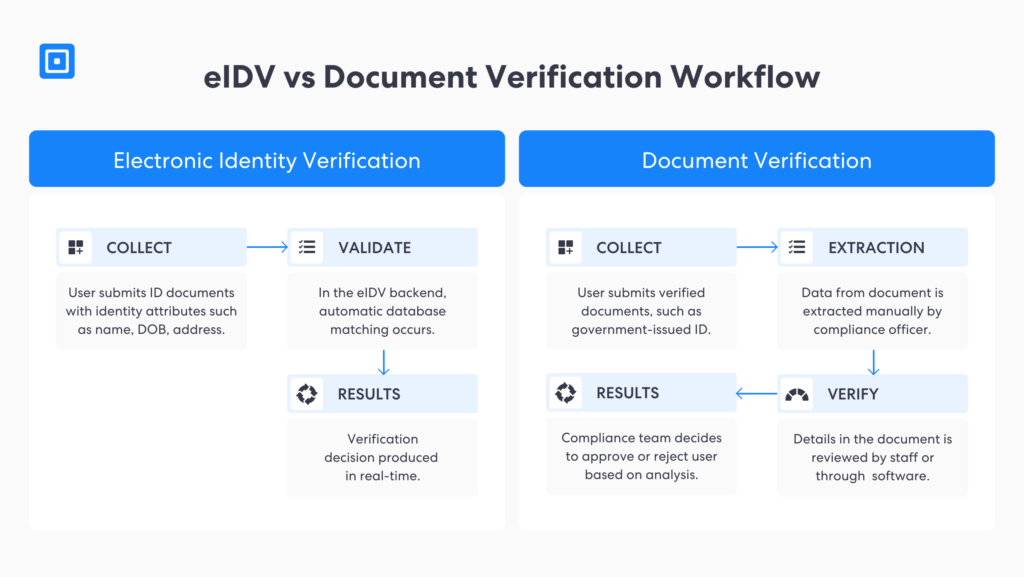
Processing time considerations are the primary challenge with document-checking methods. Customers must locate appropriate documents, capture clear images, and submit them. Regulated companies, such as financial institutions, tend to lean towards document checks as it provides clear audit trails and evidence of activities to meet reporting requirements.
On the other hand, eIDV is favored by fast-scaling companies that need speed and have high-volume verification requirements. Since manual processes can risk additional delays due to human verification, companies in the fintech and crypto industries typically utilize eIDV. eIDV is best suited for firms that prioritize quick AML onboarding over extensive staffing.
### Electronic Identity Verification
- **Streamlined customer onboarding:** Provides a straightforward customer onboarding process, removing the need for manual document uploads.
- **Integration:** Electronic identity verification typically offers simpler API integration than traditional verification systems and integrates seamlessly with mobile applications.
- **Younger demographic:** Younger customers often prefer electronic identity verification for its minimal effort requirements and convenience.
- **Accessibility considerations:** This method may be complex for customers with technical limitations, thus needs additional support.
- **Low friction:** Customers avoid fumbling with documents or dealing with image quality issues, reducing abandonment rates.
### Traditional Document Checking
- **Universal accessibility**: Works in different countries without reliance on database coverage or internet access, ideal for diverse or remote customers.
- **Strong audit trails**: Provide tangible, visual evidence of documents reviewed, simplifying compliance and audits to meet AML requirements.
- **No data privacy risks**: Avoids third-party database sharing, enhancing data security over sensitive information, such as GDPR.
- **Older demographic:** Less tech-savvy customers may prefer this approach as it does not require digital knowledge.
- **High fraud resistance**: Manual inspection detects forgeries and alterations that might be missed if eIDV does not have adequate sophisticated technology.
## Regulatory Compliance and AML Requirements
AML is the overarching legally required regulatory framework that both eIDV and traditional document checks must follow to prevent money laundering, terrorist financing, and other financial crimes. It supports KYC and AML regulations by onboarding legitimate customers once a business relationship is formed. A Customer Identification Program (CIP) must be implemented at the outset, in which companies collect and validate data to create customer profiles.
> A CIP helps organizations protect themselves from bad actors who use [stolen identities](https://legal.thomsonreuters.com/blog/what-is-digital-identity-theft-and-fraud/) and other disguises.
Next, businesses must conduct Enhanced Due Diligence, including screening against the Financial Crimes Enforcement Network (FinCEN) lists for high-risk customers. Compliance teams are recommended to adopt a risk-based approach under the FATF to build an effective Customer Due Diligence (CDD) process. Also, [ongoing monitoring](https://www.complycube.com/en/solutions/global-screening/continuous-monitoring/) is critical for identifying suspicious activities or changes in a user’s risk profile.
### **Case Study: Tampered Documents and Fake Accounts**
##### **How GenAI Erodes Digital Trust and Reputation**
Bad actors are becoming more technologically savvy, exploiting GenAI to create false documents. Such forgeries are a huge threat to the security of digital firms. TrustVerifi, the reputation platform, faced the challenge of fake accounts, undermining credibility and trust.
##### **Combatting Illicit Activity without Sacrificing Customer Experience**
TrustVerifi had to rely on KYC solutions that enable high trust and speed. The firm uses ComplyCube’s eIDV tools for reliable verification. ComplyCube offers high integration, automation, and a compliance-ready infrastructure to help global firms scale compliantly.
##### **Solutions & Outcomes**
- TrustVerifi increased its [client onboarding by 5x](https://www.complycube.com/en/customer/trustverifi-automated-onboarding-for-secure-trust-verification/), with rapid adoption in Brazil, the UK, and India.
- The leading startup reduced manual verification by less than 1%, significantly speeding up operations and enhancing security.
- As a result, TrustVerifi experienced higher customer satisfaction, user trust, and increased adoption of its Trust Score activation.
## Cost Analysis, Scalability, and Implementation Considerations
Digital and traditional verification approaches can have very different operational costs, depending on automation levels, integration, and pricing structures. Due to its automated processing capabilities and minimal infrastructure requirements, eIDV is highly scalable. Also, eIDV requires minimal staff training and human review, thereby significantly lowering costs. However, eIDV processes require broad API integrations and database connectivity.
On the flip side, document-checking systems must have greater oversight to handle increased verification volumes, storage, and manual review activities as a business scales. It also requires secure storage systems and robust staff training to ensure AML compliance. If not implemented well, document checks can be complex and lead to reputational damage caused by not meeting compliance requirements.
## Making the Choice
The choice between electronic and traditional identity verification can look different for each organization. Multiple factors play a role, such as customer demographics, risk tolerance, regulatory requirements, and business structure. A balance of thoroughness with user experience will deliver the best business outcomes.
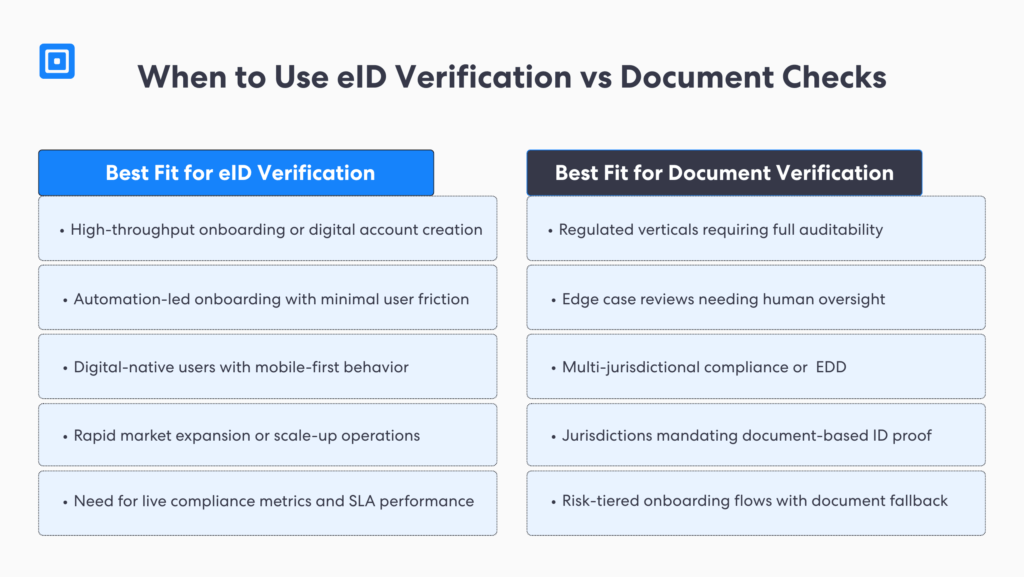
Customer journey mapping can make the decision easier. It reveals how verification choices impact overall onboarding experiences and business conversion rates. Organizations that stay up to date with emerging technology deliver the best customer experience while maintaining compliance.
### Do a Competitive Analysis
Competitive analysis provides insights into industry standards and customer expectations. Organizations operating in highly competitive markets may prioritize database-based identity checks to accelerate customer onboarding. Alternatively, regulated industries and financial institutions may favor document-based checks to emphasize reliability and audit trails.
### Perform a Risk Assessment
Conducting a risk assessment helps organizations select appropriate verification methods based on fraud exposure, regulatory requirements, and business model characteristics. Higher-risk businesses, particularly the financial sector, typically require multilayered compliance measures regardless of the user experience during KYC onboarding.
### Implement Performance Monitoring
Performance monitoring will highlight KYC and AML pass rates, customer satisfaction, fraud rates, and operational efficiency. Regular assessment can help organizations refine their approach and identify opportunities for improvement. Thus, over time, this leads to closing gaps, reducing false positives, and improving long-term ROI.
### Key Takeaways
- **Electronic Identification Verification** (eIDV) empowers businesses to verify users online, removing human intervention and customer friction.
- **eIDV and legacy document** checks differ in verification speed, level of human review, accuracy, and user experience.
- **Long-term cost savings** can be achieved with eIDV through faster onboarding and lower labor costs, thereby enhancing customer satisfaction and conversions.
- **Enhanced due diligence** and ongoing monitoring support the identity verification process, ensuring alignment with the FATF’s global recommendations.
- **To analyze the effectiveness** of IDV services, firms must perform ongoing competitive analysis, risk assessments, and performance monitoring.
## Ensure AML Compliance with Enhanced eIDV Solutions
Organizations must factor in coverage, integration, automation level, and costs to choose the right identity verification solution for the business. To maximize customer onboarding rates, investment in IDV solutions with high automation, flexibility, and scalability is crucial for long-term growth. ComplyCube supports empowers compliance teams to prevent fraud effectively with its enhanced eIDV and AML software. Get started with ComplyCube today, click [here](https://www.complycube.com/en/contact/contact-sales/).
## Frequently Asked Questions
What is electronic identity verification?
Electronic Identity Verification (eIDV) is the process of verifying a customer’s identity online. During this process, important identity attributes such as a customer’s full name, address, and date of birth are validated against trusted databases. eIDV enables companies to verify a customer’s legitimacy remotely, eliminating the need for physical document checks.
Are KYC and eKYC the same?
KYC and eKYC confirm that a customer is who they say they are and are crucial in preventing money laundering, identity fraud, and financial crimes. eKYC focuses specifically on verifying information using digital, automated technologies such as AI and machine learning rather than manual checks.
How does eIDV enable AML compliance?
eIDV is a key component of Know Your Customer (KYC) processes, supporting firms in Anti-Money Laundering (AML) compliance. It provides a secure and rapid way of identity verification through critical technology, including Optical Character Recognition (OCR). eIDV helps firms identify, detect, and prevent synthetic identities and tampered documents.
Why is electronic identity verification (eIDV) important?
eIDV is critical because it enables companies to prevent identity theft and comply with KYC/AML regulations. Since it enables remote identity verification, eIDV supports a quicker, more seamless, and compliant AML onboarding process. Furthermore, eIDV leverages automation and cutting-edge technology to enhance check accuracy.
How does ComplyCube’s eIDV process work?
ComplyCube’s eIDV process validates users via document checks, biometrics, or proof of address verification. Its platform leverages automation technology, including OCR and liveness detection, to ensure businesses meet stringent global regulations seamlessly. Additionally, with cutting-edge integrations, customers and businesses can onboard more securely, accurately, and quickly.
**Categories:** Guides
**Tags:** Identity Verification
---
### [CryptoCubed January Newsletter: The Bithumb Fine and OECD's CARF](https://www.complycube.com/crypto-news-the-bithumb-fine-and-oecds-carf/)
**Published:** January 28, 2026
**Author:** Dini Habib
**Excerpt:** In this edition, we explore massive AML breaches and fines making headlines, including Cetera, Saxo Bank, and South Korea's Bithumb. We also cover the OECD's latest January crypto framework, which aims to combat global tax evasion.
**Content:**
👋 Welcome back to CryptoCubed! In this **CryptoCubed January 2026 Newsletter: Bithumb Fine and OECD’s CARF** edition, we see regulators’ efforts to tear down the wild crypto scene. From Anti-Money Laundering (AML) to Customer Due Diligence (CDD) lapses, we explore the massive mistakes made by leading firms, such as Bithumb, Saxo Bank, and Cetera.
Additionally, we also cover massive regulatory shifts, including the UK’s enforcement of the latest OECD crypto framework, and a note from our Chief Product Officer (CPO), Harry V., on how crypto companies can stay ahead of these merciless enforcement penalties.
## Cetera Hit With $1.1M Fine After Monitoring Gaps Exposed
USA, January 16, 2026 🇺🇸 — Cetera has been fined $1.1 million by the Financial Industry Regulatory Authority (FINRA) for gaps in its AML systems. Based in the US, Cetera is a financial services provider with the largest number of registered investment advisers and broker-dealers.
FINRA found that Cetera’s three subsidiaries (Cetera Advisors, Cetera Wealth Services, and Cetera Investment Services) had lapses in complying with the US Bank Secrecy Act. In 2019, the firm failed to report suspicious transactions involving “low-price securities,” even though the situation warranted it. This enabled Cetera users to sell 800 million shares of penny stocks.
Despite remediation through daily reviews of reports, FINRA deemed the report inadequate as it did not include past audits, rendering it ineffective for monitoring suspicious activity. This oversight meant Cetera was unable to detect risky AML violations. In one example, three customers opened accounts, deposited 100M+ shares, and liquidated them, with proceeds totaling $375,000.
For more on this story, click [here](https://finance.yahoo.com/news/cetera-pays-1-1m-settle-191457981.html?).
## South Korea’s Crypto Hunt Leads to Upbit, Korbit, and Bithumb Fine
South Korea, January 21, 2026 🇰🇷 — Last year, South Korea’s Financial Intelligence Unit (FIU) launched a hunt for crypto firms that failed to comply with the country’s AML law. In its on-site AML inspections, the FIU uncovered thousands of AML violations at leading crypto exchanges in the country.
Last year, top crypto exchange Upbit was penalized up to $25 million. In January this year, Korbit, South Korea’s first cryptocurrency exchange, was hit with a $1.9 million fine. The FIU stated that Korbit committed over 22,000 violations. This includes over 12,800 cases in which staff accepted blurry ID documents or sign-ups without a residential address.

Furthermore, Korbit failed to perform full KYC checks on its customers and enabled transfers with overseas crypto providers that were not registered under South Korean law. A spokesperson for Korbit said, “We respectfully and humbly accept the Financial Intelligence Unit’s decision to impose a fine.”
Now, regulators are setting their sights on Bithumb, the second-largest crypto exchange in the country by trading volume. Predictions indicate a similar penalty amount of over $25 million, like Upbit, due to market share size and systematic customer due diligence failures.
For more information, click [here](https://www.coindesk.com/policy/2025/12/31/korbit-fined-usd1-9-million-for-anti-money-laundering-customer-verification-breaches).
## Saxo Bank’s AML Breaches Lead to Monumental $50M Fine
Denmark, January 23, 2026 🇩🇰 — Saxo Bank was fined $46,100,000 by the Danish Financial Supervisory Authority for systematic AML deficiencies found between 2021 and 2023. The company failed to implement sufficient CDD and ongoing monitoring in line with Danish Money Laundering Laws.
Namely, the firm had not gathered information on the purpose and nature of its customer relationships, including those with white-label partners who used the platform for their end clients. Despite no actual money laundering, Danish regulators emphasized structural control weakness in complex third-party models, which threatens risk assessment frameworks.
Earlier this month, the Securities and Futures Commission (SFC) penalized the Hong Kong unit of Saxo Bank HK$4 million (nearly US$514,000) for listing unauthorized virtual asset products on its platform. These sweeping fines signal regulators’ growing efforts to tighten oversight within the crypto sector.
For more on this, click [here](https://www.tradingview.com/news/financemagnates:fa48fc0e9094b:0-saxo-bank-fined-nearly-50-million-in-denmark-its-largest-penalty-in-recent-years/).
## OECD’s CARF Aims to Combat Tax Evasion in Crypto Companies
United Kingdom, January 1, 2026 🇬🇧 — Developed by the Organisation for Economic Co-operation and Development (OECD), the CARF is a new framework designed to increase global tax transparency. This month, new rules, including requirements to report and collect detailed information on customers of Crypto-Asset Service Providers (CASPs), take effect in the UK, with many jurisdictions following suit.
UK CASPs must declare information collected to HM Revenue and Customs (HMRC). In practice, any user information is exchanged with other tax jurisdictions that have also implemented the CARF. Over 67 jurisdictions, including Singapore, will commit to full CARF implementation by 27/28 with data collection beginning this year.

Unlike the Common Reporting Standard (CRS), the CARF commits to transaction granularity and standardized global due diligence. For CASPs, this means additional reporting requirements for individual crypto transactions, including type, volume, dates, and market value.
Find more on this story [here](https://www.gov.je/TaxesMoney/InternationalTaxAgreements/IGAs/pages/cryptoassetreporting.aspx).
## Top 5 AML Crypto Fines from 2025 — Lessons with Harry V., AML Specialist and ComplyCube’s CPO
Global, 2025 🌍 — Last year, total AML fines in the crypto sector skyrocketed above 1 billion, with multi-million dollar fines faced by OKX ($505M), KuCoin ($300M), Cryptomus ($127M), and BitMEX ($100M). AML Specialist Harry V., breaks down the biggest red flags in the top 5 AML crypto cases in 2025, including weak governance and gaps in ongoing monitoring:
[](https://www.complycube.com/the-cryptocubed-newsletter-top-5-aml-crypto-fines-in-2025/)
### Weak Governance
“Across the board, governance failed terribly. The lack of senior oversight left teams blind,” mentioned Harry. Strong governance is the foundation for robust AML and KYC frameworks. Businesses are encouraged to appoint senior executives, train staff regularly, and maintain clear documentation of internal procedures.
### Inadequate Ongoing Monitoring
Real-time monitoring is a non-negotiable for crypto firms. Harry states, “OKX and KuCoin were crushed by ongoing monitoring gaps.” Companies must deploy a dynamic Risk-Based Approach scoring into monitoring and run alert recalibration after Suspicious Activity Reporting (SAR) to remove blind spots.
### Late and Incomplete Reports
To provide a strong regulatory report, crypto firms must invest in robust case management with clear audit trails to track compliance activities. “BitMEX had ignored its SAR accountability,” Harry said. He adds, “SARs must be standardized to local jurisdictions, turning reactive filings into proactive shields.”
### Lax Due Diligence
“There is higher scrutiny on implementing due diligence on partnerships, not just end customers,” noted Harry. Full verification, including Enhanced Due Diligence for high-risk scenarios, must cover all business relationships. Utilize a risk scoring engine and real-time dashboards to prevent penalty flare-ups.
Learn more about the top 5 AML Crypto Fines [here](https://www.complycube.com/the-cryptocubed-newsletter-top-5-aml-crypto-fines-in-2025/).
## Time for Some Light-Hearted Creative Criticism?
So you’ve made it to the end of our newsletter. It’s time to enjoy a little satire, worthy reader, you’ve earned it.
### 🔥THE CRYPTO CUBED POEM: JANUARY🔥
Welcome back to CryptoCubed, our January newsletter lights the stage anew,
Where regulators rise, intent on cutting chaos all the way through.
From AML alarms to CDD found weak,
The cracks in crypto giants Bithumb, Saxo, and Cetera speak.
The UK now moves beneath the OECD’s command,
Enforcing clarity where grey once ruled the land.
And ComplyCube writes, as a guiding flame,
To help firms stand tall in this unforgiving game.
### Stay tuned for our Feb newsletter, and have a great month!

**Categories:** News
**Tags:** Crypto Regulations
---
### [CryptoCubed February Newsletter: Paxful's AML Misconduct and India's Fraud Ring](https://www.complycube.com/crypto-news-paxfuls-aml-misconduct/)
**Published:** February 26, 2026
**Author:** Dini Habib
**Excerpt:** In this edition, we explore massive AML breaches and fines making headlines, including Cetera, Saxo Bank, and South Korea's Bithumb. We also cover the OECD's latest January crypto framework, which aims to combat global tax evasion.
**Content:**
👋 Welcome back to CryptoCubed! In this February 2026 edition, we explore the hottest crypto headlines shaping the month. From the case of Paxful’s AML misconduct to the exposure of India’s Fraud Ring, the dark side of crypto is once again showing up.
Additionally, we also dive into the Dutch crackdown on Polymarket, the popular crypto sportsbook operator Maverick Games and its £200K fine, plus the most recent update from the team at Binance! You can’t afford to blink an eye this time.
## Paxful’s AML Misconduct Startles US Regulators
USA, January 16, 2026 🇺🇸: Paxful Holdings Inc., the virtual cryptocurrency trading platform, has been penalised $4 million by the U.S Department of Justice (DOJ). The fine, initially amounting to $112.5 million, was imposed on the firm for violating the US Bank Secrecy Act (BSA) and Travel Act.
According to court documents, Paxful’s founder and co-founder knew that its customers transferred funds from criminal activities such as fraud and prostitution. On one occasion, with its client Backpage, the online advertising platform for illegal prostitution, Paxful’s founders exclaimed how the “Backpage Effect” enabled the firm to earn $2.7 million in profits.
Shockingly, the firm marketed itself as a platform that did not need any customer verification, essentially encouraging the illicit use of crypto for schemes such as child abuse and fraud. Assistant Attorney at the DOJ, Tysen Duva, comments, “Paxful profited from moving money for criminals that it attracted by touting its lack of AML controls, all while knowing that these criminals were engaged in fraud, extortion, prostitution and commercial sex trafficking.”
For more on this story, click [here](https://www.justice.gov/opa/pr/virtual-asset-trading-platform-sentenced-violating-travel-act-and-other-federal-criminal).
## Dutch Watchdogs Issue Warning to Polymarket to Halt Activities
Netherlands, February 18, 2026 🇳🇱: New York-based crypto prediction platform, Polymarket, was given a stern warning by Dutch regulators to stop operations in the country. The failure to do so could see the firm being fined €420,000 per week, capped at €840,000.
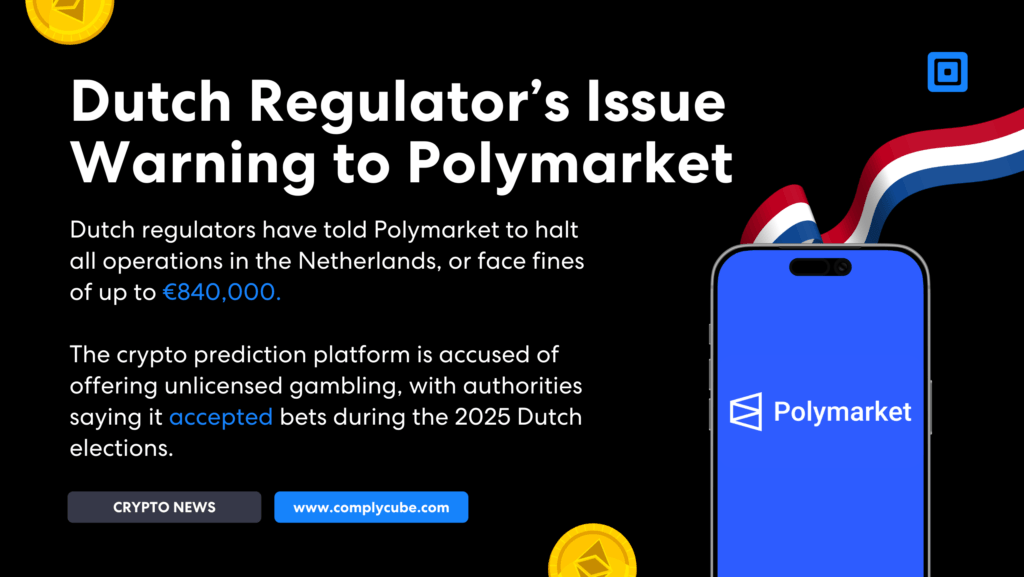
Polymarket is a firm that enables users to place trades or “bets” on the outcomes of real-world events, such as politics. Regulators across jurisdictions classify Polymarket as an unlicensed gambling firm. Its high-risk activities raise major AML red flags. Countries such as Belgium, France, Singapore, and the UK have placed similar blocks or full bans on the platform.
The Dutch regulator, Kansspelautoriteit (KSA), concluded that the firm offered unlicensed “games of chance” under the Dutch Betting and Gaming Act. The case began when the platform accepted bets on the 2025 Dutch elections, including prime minister and party winners.
For more information, click [here](https://www.financemagnates.com/forex/dutch-regulator-shuts-polymarket-over-unlicensed-betting-and-election-concerns/).
## India’s Fraud Ring Call Centres Targets US Citizens
India, February 4, 2026 🇮🇳: Indian regulators, the Directorate of Enforcement (ED), have raided six locations in Ahmedabad connected to a call centre fraud ring. According to the ED, operators of the call centre faked their identity as company officials to request payments.
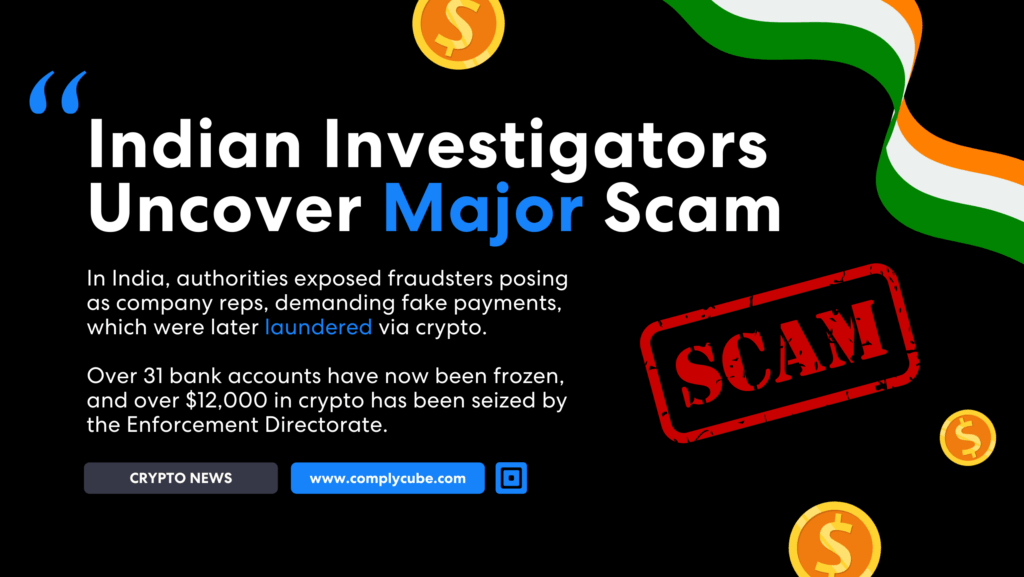
The operators exploited fear to steal money from US citizens, converting it to cryptocurrency to evade detection. The ED, India’s main agency for enforcing AML laws, have frozen over 31 bank accounts and seized $12,000 in crypto so far.
This case is a classic illegal financial plumbing method used by criminals. The operators took advantage of peer-to-peer (P2P) crypto rails, such as Paxful in the case above, to convert and move crypto quickly. Unfortunately, due to its large transaction volume and cross-border operations, many fraudsters use crypto platforms to conceal illegal cash flows.
For more on this, click [here](https://timesofindia.indiatimes.com/city/ahmedabad/con-call-centres-ed-raids-6-locations-in-ahmedabad-freezes-31-accounts/articleshow/128127115.cms).
## Crypto Sportsbook Operator Maverick Games Civil Penalty Chase
Isle of Man, February 6, 2026 🇮🇲: Regulators fined Shelgeyr Limited, operator of Maverick Games, £200,000 for AML breaches. The Isle of Man Gambling Supervision Commission (GSC) noted weak expertise around KYC and AML laws in the firm.
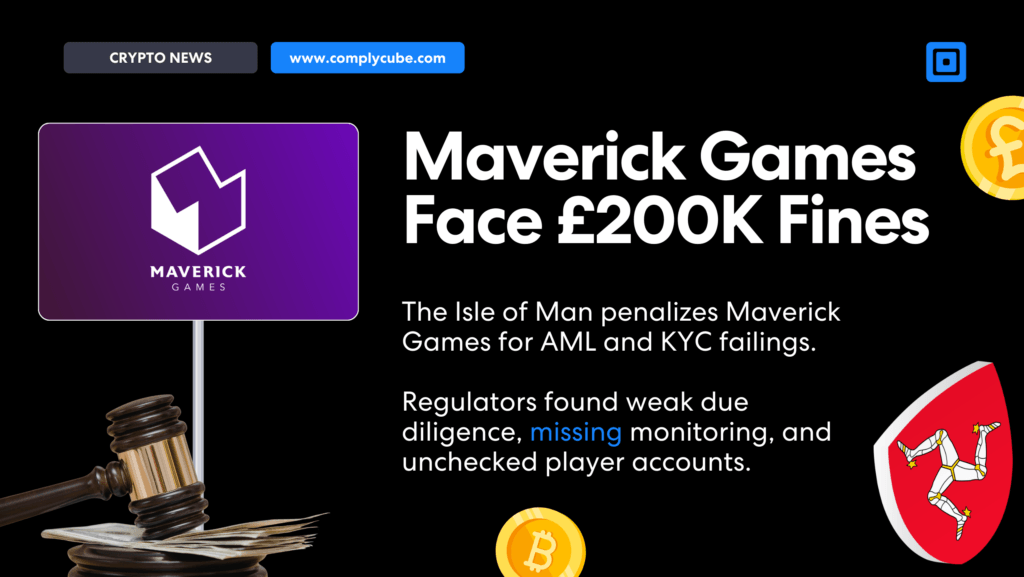
Particularly, Maverick Games did not implement and could not provide evidence that showed it had implemented sufficient enhanced due diligence, ongoing monitoring, and risk assessments. This included enabling active or reopened accounts without proper due diligence and not identifying customers’ source of wealth.
The GSC investigation concluded that Maverick Games had breached key aspects of the Gambling (AML/CFT) Code 2019. As a result, crypto firms are now under huge pressure to treat [due diligence](https://www.complycube.com/en/solutions/due-diligence-compliance/customer-due-diligence/) and ongoing monitoring with expert oversight as mandatory guardrails, instead of just a to-do checklist.
Find more on this story [here](https://www.isleofmangsc.com/gambling/gsc-gambling-news/06-february-2026-public-statement-regarding-shelgeyr-limited/).
## Binance Rejects Iran-Tied Sanctions Violations
United States, February 15, 2026 🇺🇸: Binance, the leading cryptocurrency exchange, has issued a statement this month, rejecting allegations that it facilitated Iran-linked transactions in its November 2023 AML case. US regulators fined the firm $4.3 billion for major AML rule violations at that time.

The statement came about after the top global media company, Fortune, [published an article](https://fortune.com/2026/02/13/binance-investigators-fired-iran-sanctions-potential-violations/) titled, “Exclusive: Binance fires top investigators who claim to have uncovered evidence of Iranian sanctions violations.” The Binance communications team has mentioned that the article is grossly inaccurate.
The question stands: who is right? Only US regulators can settle sanctions disputes, not media claims or corporate denials. Undeniably, this case has highlighted a hard lesson for all crypto firms: AML and sanctions compliance shape long-term reputation, with headlines from previous enforcements lingering for many years.
Find more on this story [here](https://cointelegraph.com/news/binance-denies-iran-sanctions-report-fortune).
## Time for Some Light-Hearted Creative Criticism?
So you’ve made it to the end of our newsletter. It’s time to enjoy a little satire, worthy reader, you’ve earned it.
### 🔥THE CRYPTO CUBED POEM: FEBRUARY🔥
Coins may shine, but truth must gleam,
Behind each transaction, there runs a scheme.
Paxful’s fall, a costly blow,
When rules are missed, the cracks will show.
Polymarket’s bets meet legal frowns,
Maverick’s lapses bring it further down.
In crypto’s race for trust and gold,
It’s law and ethics that must hold.
### Stay tuned for our March newsletter, and have a great month!

**Categories:** News
**Tags:** Crypto Regulations
---
### [Navigating Changing eKYC Verification Rules](https://www.complycube.com/navigating-changing-ekyc-verification-rules/)
**Published:** July 8, 2024
**Author:** Sofia Daley
**Excerpt:** Discover how eKYC solutions are vital for modern businesses facing tightening regulations and increasing fraud. Learn about global standards, market growth, and how ComplyCube's eKYC verification can ensure compliance.
**Content:**
**TL;DR:** eKYC verification is **changing customer onboarding** by digitizing identity checks and lowering fraud. **Navigating regulatory requirements** is difficult, as compliance standards for electronic KYC vary across regions. Organizations need ekyc solutions that balance **smooth verification** with regulatory compliance.
## What is eKYC Verification?
Electronic KYC verification shifts how businesses bring on and verify customers. eKYC solutions are being accepted worldwide as regulations become more strict with growing digital fraud. Overall, by switching paper-based identity checks for AI-powered systems, companies can verify users in seconds. Again, this lowers costs, lowers fraud risk, and improves the customer flow.
In addition, moving through the regulatory landscape around electronic KYC is still a big challenge. This is because compliance rules can vary across regions and industries. From global bodies such as the Financial Action Task Force (FATF) to national ones such as the Monetary Authority of Singapore (MAS), businesses must adhere to changing standards. Nevertheless, many companies struggle to achieve compliance. Therefore, choosing an eKYC solutions partner is important for businesses to scale safely, remain compliant, and build trust with their customers.
## The Need for Global eKYC Verification Processes
The global eKYC market was valued at [$518 million in 2022](https://www.vantagemarketresearch.com/industry-report/e-kyc-market-1754). By 2030, it will likely reach $2.46 billion with a compound annual growth rate of 21.40%. Obviously, the growing demand for eKYC solutions has increased with money laundering and fraudulent practices. For this reason, electronic KYC methods are a needed next-step to fight fraud now.
> About [5% of a business’s annual revenues](https://wifitalents.com/statistic/fraud-in-business/#) are lost to fraud each year.
According to the United Nations Office on Drugs and Crime (UNODC), between 2% and 5% of global GDP is laundered each year. This amounts to a [shocking €715 billion to €1.87 trillion worldwide](https://anti-money-laundering.eu/money-laundering-in-numbers/#:~:text=Global%20Estimates%3A,of%20the%20total%20global%20GDP.). As a result, businesses must hold customer identity data to reduce their risk of fraud. In essence, identity theft and false personas created online expose businesses to the risk of onboarding customers involved in illicit activities, threatening both the security and reputation of the organization.
> The FTC has received [5.7 million total fraud and identity theft reports in 2024](https://identitytheft.org/statistics/), 1.4 million of which were identity theft cases.
Ultimately, businesses must protect themselves from leading scams. An example of this, is preventing identity fraud with a thorough electronic KYC process. These practices should include a thorough Identity Check and a Document Check. It verifies that customers are who they claim to be, and in fact, that their documentation is valid.
## eKYC Verification Solutions and Increasing Regulatory Pressures
Presently, regulatory bodies across the globe are pushing for tighter Identity Verification (IDV) and Anti-money Laundering (AML) practices. Quoted in a DW news report, the EU Commission Executive Vice President Valdis Dombrovskis stated:
> The rules we have in place to prevent money laundering are [amongst the toughest in the world](https://www.dw.com/en/the-eu-declares-war-on-money-laundering/a-58583614#:~:text=%22The%20rules%20we%20have%20in,of%20this%20in%20recent%20years.), but they must also now be applied.
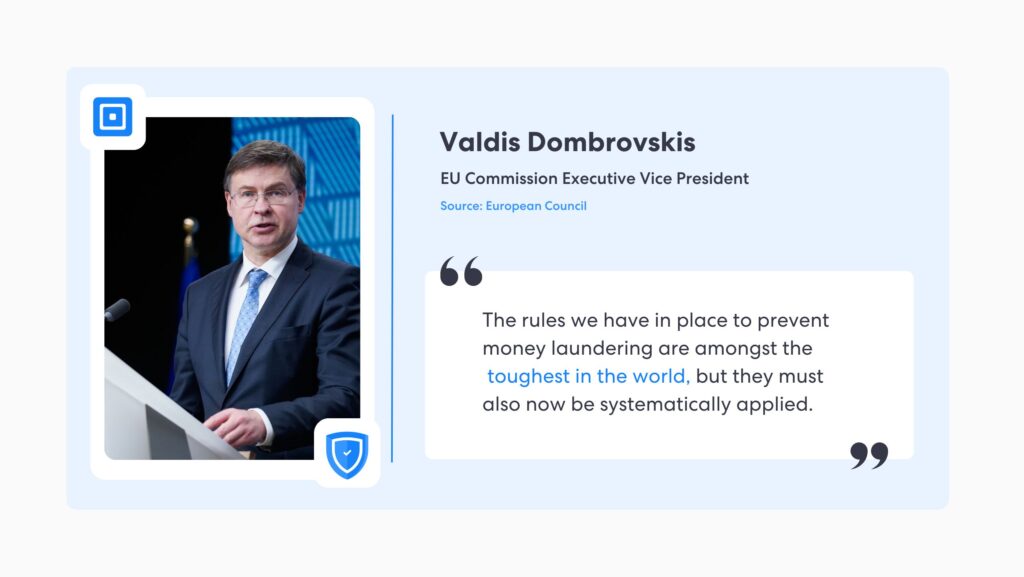
### United States
**[Section 326 of the USA Patriot Act](https://home.treasury.gov/system/files/246/staterule.pdf)** requires banks and other financial institutions put in place a Customer Identification Program (CIP). This process must collect specific information from customers, including their name, date of birth, address, and ID number.
In the United States, the **[Financial Industry Regulatory Authority (FINRA) Rule 2090](https://www.finra.org/rules-guidance/rulebooks/finra-rules/2090)** states that financial organisations must put in place detailed due diligence process. This practice is in place to identify and retain customer data or anyone acting on behalf of said customer. Ultimately, the rule states the following:
> Every member shall use reasonable diligence, in regard to the opening and maintenance of every account, to know (and retain) [the essential facts concerning every customer](https://www.finra.org/rules-guidance/rulebooks/finra-rules/2090) and concerning the authority of each person acting on behalf of such customer.
**[The Bank Secrecy Act](https://www.occ.treas.gov/topics/supervision-and-examination/bsa/index-bsa.html#:~:text=Under%20the%20Bank%20Secrecy%20Act%20(BSA)%2C%20financial%20institutions%20are,(daily%20aggregate%20amount)%2C%20and)** aims to put an end to money-laundering practices. This establishes the [Customer Due Diligence (CDD) enforcement as part of their efforts to improve financial transparency](https://www.moderntreasury.com/learn/customer-due-diligence).
Accordingly, the CDD has four main rules for financial institutions regarding KYC practices. Firstly, companies need to look at doing a thorough identity verification. Collecting customer data including name, email address, phone number, occupation, and tax identification and more is crucial. Then, it is shortly followed by business review. In particular, business reviews where financial institutions look at the business interests of their consumer, followed by a customer risk assessment and continuous monitoring.
### European Union
The **[Payments Services Directive (PSD2)](https://ec.europa.eu/commission/presscorner/detail/pl/MEMO_17_4961)** secures online payments as it requires that customers must go through a Secure Customer Authentication (SCA) within the EU. Therefore, businesses must now put in place this two-factor authentication process across all high-value payments, making it the new standard.
Similarly, the **[General Data Protection Regulation (GDPR)](https://gdpr-info.eu/)** needs organizations to carry out identity checks and keep sensitive information about their customers, though they must be fully transparent in their use of data.
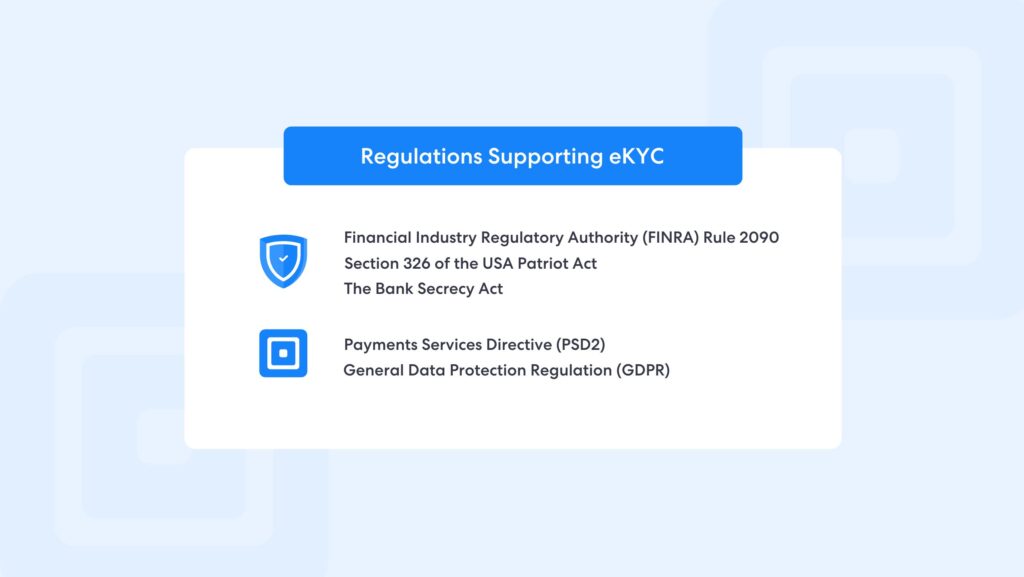
### Other Prominent Regulatory Bodies Worldwide
### **[Australian Transaction Reports and Analysis Centre (AUSTRAC)](https://www.austrac.gov.au/):**
The AUSTRAC is an Australian government financial intelligence agency. It identifies activities such as money laundering and terrorism financing. The organisation needs businesses to verify their customers and documentation, underlining the threat of fraud.
### **[Reserve Bank of India (RBI)](https://www.rbi.org.in/):**
The RBI has revised and standardised its KYC regulations. It needs financial institutions to put in place updated processes to identify customers correctly. To manage risks, the RBI suggests adopting measures such as tagging high-risk customers to prevent fraud, money-laundering and identity theft.
### **[Monetary Authority of Singapore (MAS)](https://www.mas.gov.sg/)**:
The MAS is the central bank and financial regulatory authority of Singapore. MAS needs financial institutions to implement eKYC solutions to stop money laundering and financing of terrorism. MAS’s regulatory framework says that customer identities must be verified through multiple channels. This includes independent verification of mobile phone numbers, addresses, salary details and more. For example, in the case of high-risk customers, enhanced due-diligence processes that include ongoing monitoring are necessary.
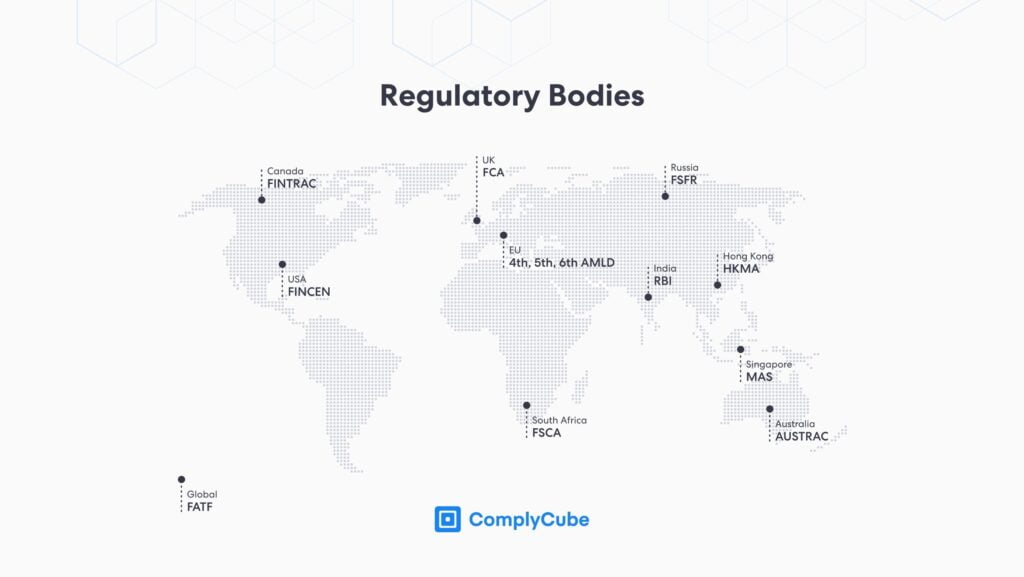
### **Case Study: HSBC Modernising Customer Onboarding with eKYC Verification**
HSBC faced pressure to smoothen its onboarding process across different markets. The bank needs to stick to stringent electronic KYC and AML regulations. Manual identity verification processes were creating bottlenecks. Soon, this led to delayed onboarding, higher operational costs, and an increased risk of fraud exposure.
##### **Implementing advanced eKYC solutions for automation**
As a result, HSBC put in place advanced eKYC solutions to automate identity verification across its digital banking platforms. By blending biometric authentication, real-time document scanning, and AI-powered fraud detection, the bank was able to meet electronic KYC compliance rules. They met this across key regions including the EU, UK, and Singapore.
##### **Outcomes**
- Reduced customer onboarding time by 60%, dropping from an average of 5 days to under 48 hours.
- Achieved a 40% reduction in identity fraud cases following the rollout of eKYC verification.
- Reported a 35% decrease in compliance-related costs within the first year of implementation.
## How Can Businesses Remain Compliant with eKYC Regulations?
Prior to today, traditional eKYC verification processes tried to verify identity documents manually. Obviously, this was highly-prone to human error. Automated systems provide enhanced data security and verify customer identities quickly and accurately, smoothly meeting regulatory needs and allowing businesses to scale safely.
So, a strong electronic KYC process must include biometric verification with liveness detection. This allows for processes to identify presentation attacks fast, along with a document verification process to verify the validity of a document.
### Biometric Verification
[Biometric authentication ](https://www.complycube.com/en/solutions/identity-assurance/biometric-verification/)is a key part of the eKYC verification process, in which biometric data are taken from images, videos, or even speech. It analyzes this information to verify a customer’s identity. In any event, liveness detection looks at micro-expressions, analyze skin textures, and spot signs of a spoofed image or deepfake attack.
### Document Verification
A [Document Check](https://www.complycube.com/en/solutions/identity-assurance/document-verification/) can verify whether a presented document might be compromised, forged, copied from the internet, expired, or blacklisted. Using [Optical Character Recognition](https://www.complycube.com/en/solutions/due-diligence-compliance/know-your-customer/optical-character-recognition/) (OCR) technology, document checks can take all available data from IDs, passports, and other key documents. For the most part, OCR extracts data, processes documents in real-time, and finds anomalies to ensure compliance with regulatory standards.
### Key Takeaways
- The global eKYC market is looking to reach $2.46 billion by 2030.
- Businesses lose around 5% of annual revenues to fraud each year.
- Businesses must move through complex and varying electronic KYC regulations across regions.
- Effective eKYC verification mixes biometric authentication with document verification.
- The right eKYC solution helps businesses grow safely and stay compliant.
## eKYC Verification with ComplyCube
In summary, ComplyCube is an award-winning eKYC solution provider. From [TrustRadius](https://solutions.trustradius.com/vendor-blog/best-of-awards/) in their ‘Best Of’ awards category, to their inclusion in the RegTech100 list, to achieve a Momentum leader status by G2 for multiple categories within their latest report, and more. Their state-of-the-art compliance platform gives market-leading eKYC solutions, including document and identity checks, that and protect global businesses.
Sooner or later, you will need a eKYC provider. Come to ComplyCube and check out the broad range of global eKYC solutions. Alternatively, get in touch with an[ electronic KYC/AML specialist](https://www.complycube.com/en/contact/contact-sales/) to talk about what a tailored eKYC solution could look like for you.

## Frequently Asked Questions
What is eKYC verification and how does it work?
eKYC verification is a digital identity verification process that replaces manual, paper-based checks with AI-powered solutions. It uses biometric authentication, liveness detection, and document verification with OCR technology to verify customer identities quickly and accurately.
What are the eKYC regulatory requirements in the United States?
In the US, businesses must comply with several regulations supporting eKYC verification, including FINRA Rule 2090, Section 326 of the USA Patriot Act, and the Bank Secrecy Act, which collectively mandate thorough customer identification and due diligence processes.
What electronic KYC regulations apply to businesses operating in Singapore?
The Monetary Authority of Singapore (MAS) requires financial institutions to implement eKYC solutions to prevent money laundering and terrorism financing, mandating identity verification across multiple channels and enhanced due diligence for high-risk customers.
How do eKYC solutions help businesses combat fraud in the EU?
In the EU, electronic KYC compliance is governed by regulations such as PSD2 and GDPR. Therefore, it requires businesses to implement secure customer authentication and thorough data protection practices to reduce fraud and safeguard customer information.
Why should global businesses choose ComplyCube as their eKYC solutions partner?
With electronic KYC regulations varying across regions, businesses need a trusted partner to stay compliant globally. So, ComplyCube’s eKYC verification platform helps businesses meet regional regulatory requirements, reduce fraud, and scale safely worldwide.
**Categories:** Guides
**Tags:** Know Your Customer
---
### [How Businesses Can Spot Red Flags in Crypto Money Laundering](https://www.complycube.com/crypto-money-laundering-red-flags/)
**Published:** August 17, 2021
**Author:** Andreea Balasa
**Excerpt:** Crypto and money laundering are growing synonymously, while the adoption of Anti Money Laundering crypto policies remains slow. This article discusses how FinTech and crypto businesses can prevent crypto money laundering.
**Content:**
**TL;DR:** **Crypto money laundering and scams** now pose a serious and growing threat to global financial compliance. Criminals are exploiting digital assets to **conceal illicit flows** using mixers, DeFi platforms, and anonymity tools. This guide helps businesses detect crypto scam patterns, identify red flags, and implement robust **AML controls** to stay ahead of criminal tactics.
## Why is Crypto Money Laundering a Growing Compliance Risk?
Cryptocurrency adoption has accelerated worldwide, with transaction volumes surpassing $20 trillion in recent years. Yet, regulatory frameworks only began to mature in 2019, when bodies such as the Financial Action Task Force (FATF) issued formal guidance on virtual assets. As digital currencies integrate into global finance, businesses face growing exposure to crypto-enabled crime, including crypto scams, money laundering, and terrorist financing.
Crypto money laundering poses increasingly sophisticated threats to both regulators and financial institutions. Criminals exploit digital assets such as Bitcoin and other privacy coins to conceal illicit proceeds. By leveraging tactics such as mixers, DeFi platforms, and cross-chain transfers, they obscure transaction origins and hinder due diligence.
> Reports indicate that 2024 could surpass the [$51 billion](https://www.chainalysis.com/blog/2025-crypto-crime-report-introduction/) threshold in illicit cryptocurrency inflows
Despite efforts by FATF, FinCEN, and the European Banking Authority, illicit crypto scam activity continues to rise. In 2024, the estimated value of unlawful transactions approached $51 billion. Cross-border flows and decentralised infrastructures compound the challenge of detecting these schemes.
Thus, businesses must now take proactive steps to strengthen AML controls, mitigate risk, and meet evolving compliance obligations. This guide outlines how money laundering works, how firms can identify red flags, and how to meet regulatory expectations with strong, proven compliance practices.
## Understanding Crypto Money Laundering
According to Reuters, money launderers accepted [$82 billion](https://www.reuters.com/legal/government/crypto-money-laundering-hit-82-billion-2025-researchers-say-2026-01-27/) in illicit funds in the form of cryptocurrencies in 2025. Cryptocurrency exchanges are continually used to funnel illicit funds, facilitate tax evasion, and abuse the financial system. As a result, combating money laundering is a critical priority for international legal frameworks.
To meet regulatory AML compliance, cryptocurrency platforms must adhere to Financial law enforcement agencies, such as FinCEN and the Internal Revenue Service ([IRS](https://www.irs.gov/)) in America. In order to do this, exchanges need a clear AML compliance strategy, including thorough Identity Verification (IDV), Customer Due Diligence (CDD), and ongoing monitoring, including transaction monitoring.
### The Crypto Money Laundering Process Explained
Cryptocurrency money laundering is a complex and evolving process that uses digital currencies to hide the origin of illegally gained money. Consequently, this practice poses a significant concern for law enforcement agencies and financial institutions, as it can facilitate a wide range of criminal activities, including terrorist financing and proliferation financing.
The money laundering process typically involves three key stages: structuring, layering, and integration. Structuring, also known as smurfing, involves breaking down large transactions into smaller ones to avoid detection by regulatory authorities. Next, layering is the process of moving funds through multiple accounts or jurisdictions to obscure their origin, making it difficult for investigators to trace the money. Finally, integration involves incorporating the illicit funds into the legitimate financial system, often through investments or purchases that appear lawful.
Digital currencies like Bitcoin and Ethereum have made it easier for criminals to launder money due to their high degree of anonymity and the ease of transactions across borders. However, law enforcement agencies and financial institutions are not sitting back. Instead, they are actively combating decentralized money laundering by implementing stringent AML regulations and leveraging advanced technologies, such as blockchain analysis, to track illicit transactions. These efforts are crucial in preventing the misuse of digital currencies and protecting the integrity of the financial system.
### CryptoCurrency Money Laundering Cases
These processes form the core of a strong Know Your Customer (KYC) strategy, which is vital for effective, ongoing AML processes. Financial intelligence units (FIUs) play a crucial role in these processes, supporting law enforcement agencies to prevent illicit fund flows. Part of the KYC process also involves verifying the legitimacy of customers’ financial accounts to prevent the storage of illicit funds.
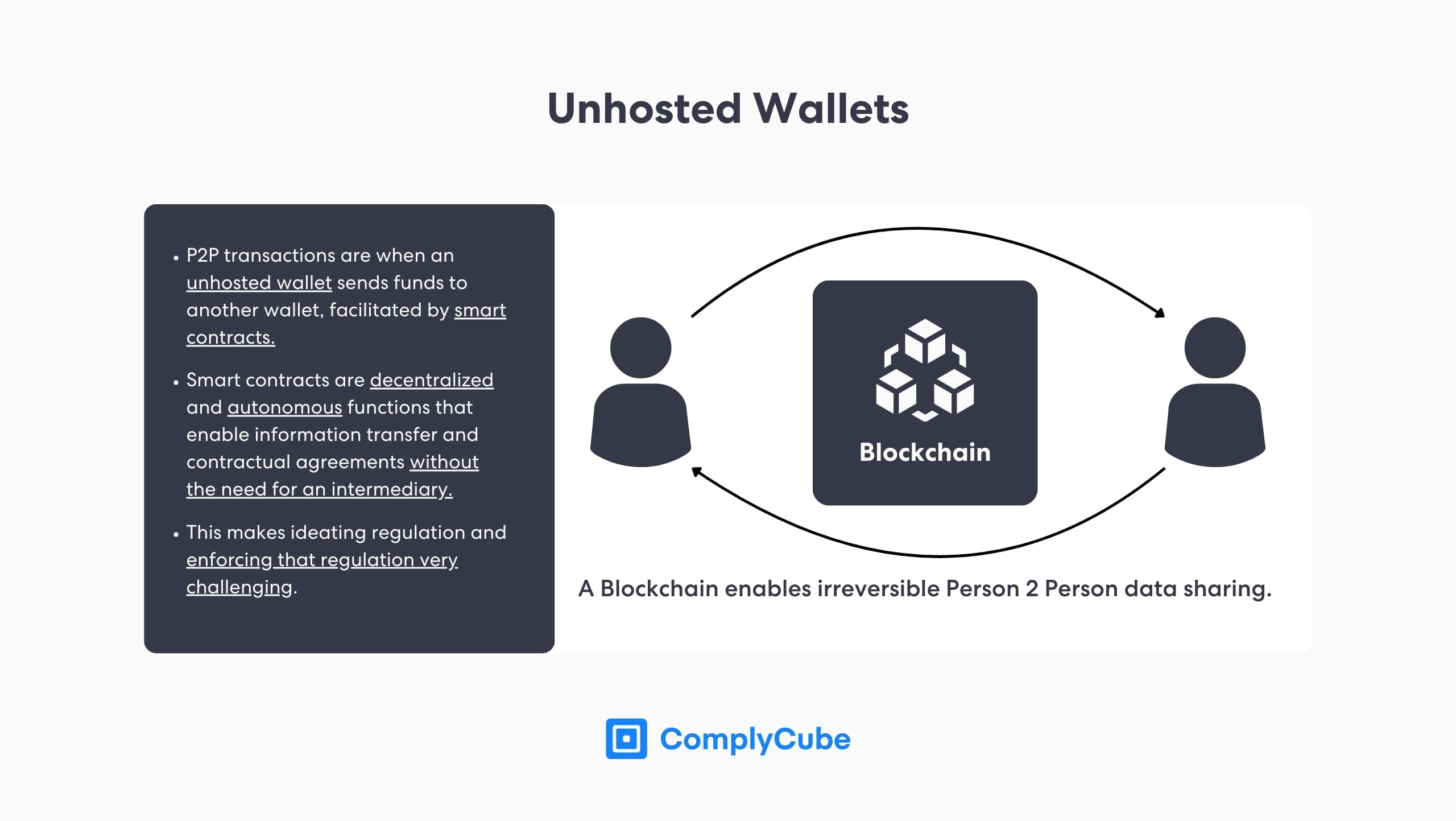
These developments create an urgency for tighter AML and KYC requirements that align with international standards, like the Bank Secrecy Act and FinCEN’s Travel Rule. You can read more here: [The Crypto Travel Rule: The Need for AML Compliance Software.](https://www.complycube.com/en/the-crypto-travel-rule-and-the-need-for-aml-compliance-software/) Furthermore, the FATF has pressured governments worldwide to enhance their scrutiny and monitoring of financial transactions to combat money laundering.
### **Case Study: Shocking AML Misconduct in Crypto Trading Platform**
At the beginning of 2026, a virtual cryptocurrency trading platform, Paxful Holdings Inc., was fined a massive $4 million by U.S regulators. Reports reveal that Paxful breached major AML legislation, including the US Bank Secrecy Act (BSA) and Travel Rule.
##### **Crypto Funds Linked to Illicit Activity**
Paxful had significant failures in its AML infrastructure, including inadequate customer verification. U.S. Attorney cited that the company’s lack of strong identity verification attracted criminals to move funds connected to fraud, sex trafficking, and child abuse materials.
##### **Outcomes**
- The cryptocurrency platform was penalized [$4 million](https://www.complycube.com/en/cryptocubed-february-2026-newsletter/) by the U.S. Department of Justice
- Additionally, a $3.5 million fine was imposed by FinCEN for willful violations of the BSA
- Its co-founder and chief technology officer now face potential prison time and an operation shutdown
### Bad Actors and Crypto Scams
Compared to traditional financial institutions, cryptocurrencies are decentralized and have low barriers to entry. Additionally, their anonymous nature makes them easy to transfer across international borders, posing significant challenges to safeguarding financial systems against illicit activities.
However, there is good news. Anti-Money Laundering (AML) regulations are becoming more efficient in tackling these risks. As of current, less than 1% of all crypto transactions are estimated to relate to illegal activity, compared to 35% in 2012. Consequently, a large part of that decrease is from businesses complying with AML regulations and learning how to spot money laundering crypto red flags.
## Where Crypto Money Laundering Thrives
Money laundering activity often concentrates in certain regions or countries where the regulatory environment is weakly enforced. As a result, these areas provide a safe haven for criminals to launder their illicit funds and serve as hubs for the transfer of illicit funds to other parts of the world.
Several factors contribute to the concentration of money laundering activities in these regions. For instance, the lack of effective AML regulations allows criminals to operate with no oversight. Moreover, corruption within government and law enforcement agencies exacerbates the problem. Additionally, the presence of organized crime groups in these regions contributes to money laundering at scale.
Non-compliant crypto exchanges also play a significant role in this concentration. For instance, these exchanges can act as conduits for illicit funds, allowing criminals to convert their illegally gained money into digital currencies and integrate it into the legitimate financial system. Consequently, these weak points in the global financial system allow money launderers to continue their operations with minimal risk of detection.
### **Case Study: DOJ’s Record $225M Seizure in Crypto Scam Bust**
In June 2025, the U.S. Department of Justice announced the seizure of over **$225 million in USDT** linked to an international crypto scam, the largest of its kind to date. The operation targeted more than 400 victims through a fraudulent investment scheme known as *“pig butchering.”*
##### **Luring Innocent Victims**
In this crypto scam model, perpetrators build **fake personal** relationships with victims and convince them to move funds to fraudulent crypto platforms. The laundered funds move through a complex network of wallets and exchange accounts, mainly involving OKX and Tether.
##### **Outcomes**
- U.S. law enforcement agencies, including the FBI, IRS, and Secret Service, executed the seizure using advanced blockchain analytics to identify the illicit flow of funds
- The case highlights the scale of modern crypto-enabled fraud and the need for proactive AML measures
- It reinforces the importance of transaction monitoring, wallet screening, and suspicious activity for crypto scam detection
## AML Policies and Regulations for Crypto Platforms
To determine if your business is affected, check whether your country has implemented FATF recommendations into national law. This often includes specific obligations under Virtual Asset Service Provider (VASP) regimes, such as registration, KYC enforcement, and ongoing reporting. Even if you’re based outside a FATF jurisdiction, local laws may still apply based on where your users or transactions originate. Ignoring these requirements can expose your business to regulatory action across borders.
### Sophisticated Crypto Money Laundering Techniques
Modern money laundering operations rely on multi-layered tactics to hide the origin of illicit funds. Criminals use shell companies, nested accounts, and trusts to create complex transactional structures. These financial instruments serve as intermediaries, allowing launderers to distance themselves from the source of the funds while appearing to operate as legitimate businesses.
In addition to these legal entities, money launderers use anonymization technologies such as encryption tools, privacy-focused wallets, and proxy servers to hide their identities. Moreover, the emergence of Decentralised Finance (DeFi) platforms enables illicit actors to bypass centralized controls. By using smart contracts and peer-to-peer exchanges without KYC requirements, criminals can move funds with minimal traceability.
Criminals also exploit tools and tactics that overwhelm legacy compliance systems. These include cross-chain transactions, anonymization services, and non-custodial DeFi platforms. Traditional AML frameworks built for traceable, account-based finance often fail to keep pace with the borderless nature of crypto scams. According to Harry Varatharasan, Chief Product Officer at ComplyCube, effective crypto compliance requires more than robust onboarding. It demands continuous, intelligent monitoring that can adapt to laundering methods across asset types, jurisdictions, and blockchain protocols.
> Effective crypto compliance requires more than robust onboarding
>
To further mask illicit flows, bad actors employ a combination of false invoicing, manipulated receipts, and rapid fund movement across multiple currencies and jurisdictions. Funds may be layered across mixers, converted into privacy coins, or routed through crypto ATMs with limited oversight. These techniques make traditional transaction monitoring insufficient without enhancements such as behavioral analytics, cross-chain intelligence, and continuous risk scoring.
Understanding these evolving methods is critical for compliance teams seeking to adapt their AML frameworks. Only by embracing dynamic, AI-driven tools and a risk-based approach can businesses stay ahead of laundering tactics that continue to evolve in both scale and sophistication.
## Crypto Money Laundering Red Flags to Watch For
Criminals are increasingly exploiting cryptocurrency platforms to launder illicit funds by bypassing traditional financial safeguards. The [FATF’s](http://www.fatf-gafi.org/publications/methodsandtrends/documents/virtual-assets-red-flag-indicators.html) 2024–2025 updates confirm that regulatory enforcement remains uneven, and that virtual asset platforms are regularly misused for layering, anonymity, and cross-border evasion.
The following indicators are commonly associated with crypto-enabled money laundering:
**1. Unusual transaction patterns**
Frequent transfers, large round-number values, and transactions just below reporting thresholds may indicate structuring or layering activity.
**2. Geographical exposure**
Transactions involving high-risk or non-compliant jurisdictions increase the likelihood of regulatory evasion. FATF grey-listed and blacklisted regions are key risk areas.
**3. Suspicious or inconsistent identity data**
Frequent updates to user details, use of unverifiable documents, or mismatches across KYC records suggest potential identity fraud or synthetic identity use.
**4. Anonymity-enhancing techniques**
Tools such as mixers, tumblers, privacy coins, and peer-to-peer platforms are used to obscure asset origins and ownership.
**5. Unverifiable source of funds**
Inability or refusal to explain the origin of crypto assets, especially across DeFi protocols or layered wallets, may indicate illicit activity.
**6. Wallet and platform behaviour anomalies**
Indicators include sudden switching between custodial and non-custodial wallets, use of obfuscated wallet addresses, and inconsistent wallet activity.
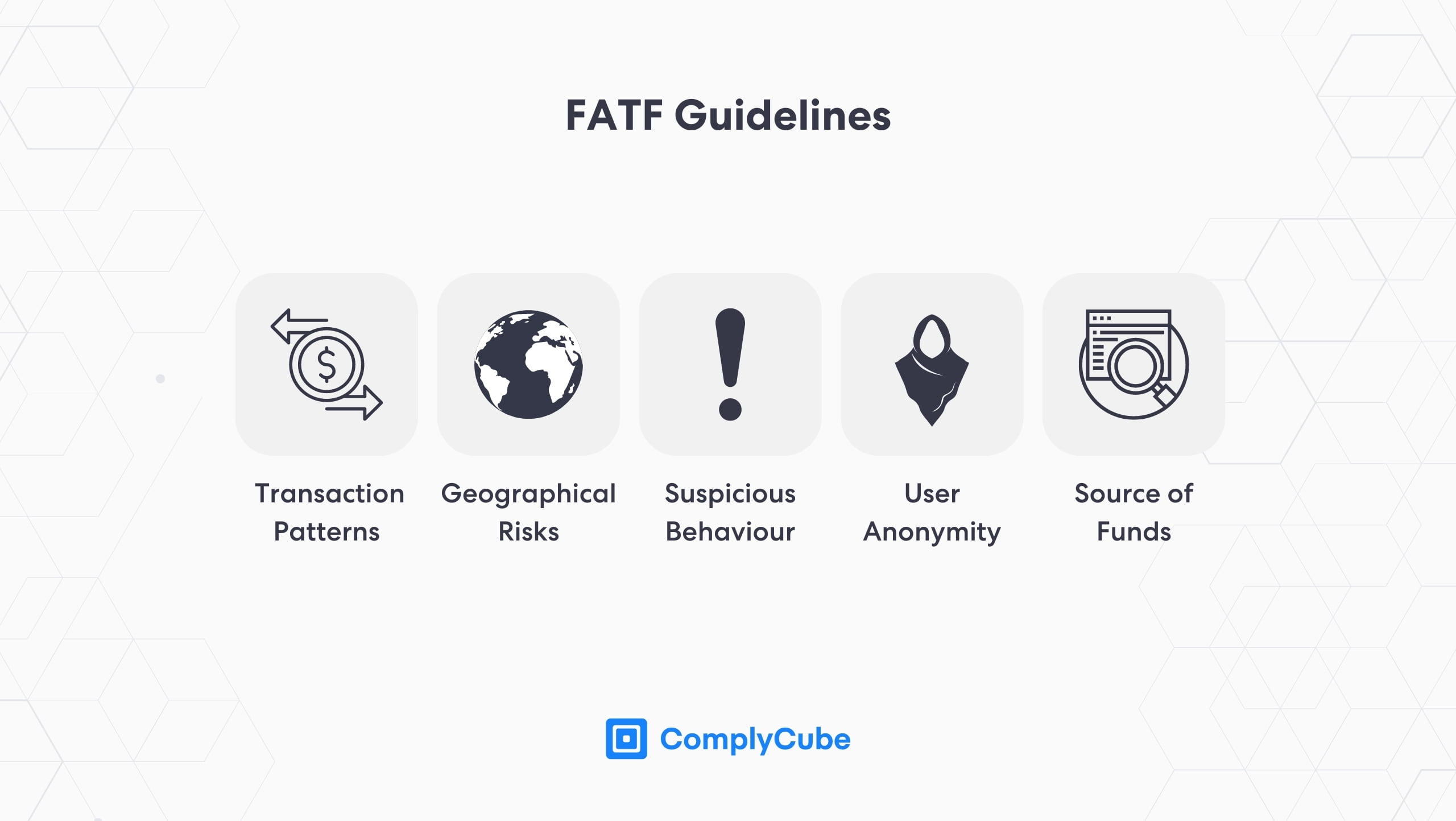
### Unusual Transaction Patterns
Irregular patterns relating to the size, frequency, or type of transactions may be red flags pointing to crypto scams or money laundering activity, including:
- Customers make several high-value transfers within a short amount of time, such as a 24-hr period.
- Structuring transaction amounts to fall below reporting thresholds.
- Depositing funds into accounts with previously identified stolen currency.
- Transferring crypto to service providers located in areas with low regulatory standards.
- Frequent large-value transfers from multiple accounts into a single account.
- Quick withdrawal of deposits without transaction history, especially large sums emptied from newly opened accounts.
- Converting deposits into multiple currencies with high incurred fees, and even exchanging at a loss.
- Converting substantial sums of fiat currency into crypto without a reasonable business premise.
### Geographical Risks
Criminals involved in money laundering exploit countries with weak regulations involving digital assets. So be on the lookout for:
- Funds are transferred to exchanges or service providers located in regions with inadequate or non-existent AML regulations.
- Customers sending or receiving funds from exchanges located in countries other than the one in which the customer lives in.
- Customers who establish business addresses in countries that do not have Suspicious Activity Reports up to FATF standards.
### Anonymity Used to Launder Money
Cryptocurrency uses advanced technology to ensure that users and exchanges are secure from data breaches. Illicit actors often exploit cross-chain bridges for money laundering purposes, transferring and converting illicit funds across various blockchains. However, this also makes it difficult for regulators to detect crypto scams or fraudulent activity. Still, red-flag indicators can lead investigators in the right direction:
- Customers who move funds from public blockchains to exchanges where the funds are immediately converted into privacy coins.
- Unlicensed customers who act as service providers.
- Users who regularly conduct high-value transactions on peer-to-peer (P2P) crypto exchanges, especially unlicensed ones.
- Frequent or high-volume transactions on platforms that offer crypto mixing services to disguise the origin of the funds.
- Customers who frequently conduct high-value transactions on platforms that fail to comply with international standards of KYC or CDD procedures.
- Multiple transactions involving crypto ATMs, often located in areas with known financial crime risks.
- Usage of proxies or other services intended to disguise IP addresses and domain names when registering for an exchange.
### Suspicious User Behaviour and Illicit Actors
Businesses should intercept customers with insufficient or forged identification documents at the KYC stage. In addition, there are different types of suspicious behavior that companies should note as money laundering activities and red flags:
- Transactions originating from untrustworthy IP addresses or domains that differ from the country the customer operates or resides in.
- Multiple crypto wallets that are controlled by the same IP address.
- Regular use of cryptocurrencies linked to fraudulent behaviour or Ponzi schemes.
- Constant changes in contact and identification information.
- Customers using multiple IP addresses to conduct transactions or access crypto platforms.
- Users who often transact with the same senders or receivers, resulting in significant gains or losses, could be flagged as illicit addresses.
- Senders who do not possess a working understanding of decentralized money (including but not limited to the elderly) yet still conduct regular or high-value transactions.
- Customers making substantial digital currency purchases beyond their established financial means.
### Source of Funds
Funding sources can identify many money-laundering operations. For example, any of the following should raise a red flag:
- Funds involving accounts linked to known illicit actors and illegitimate operations such as fraud, ransomware, extortion, darknet markets, or illegal gambling sites.
- Crypto wallets connected to several credit cards that withdraw sizeable sums of fiat currency.
- Funds sourced from initial coin offerings (ICOs) that may be fraudulent, third-party mixing services, or platforms that do not comply with AML standards.
- Substantial deposits that are converted directly into privacy coins or withdrawn into a different fiat currency.
### Key Takeaways
- **Crypto money laundering** exploits anonymity, cross-border transfers, and regulatory blind spots to hide illicit funds.
- **Common red flags** include structured transactions, high-risk geographies, use of mixers or privacy coins, and inconsistent customer behaviour.
- **Regulators such as FATF and FinCEN** require crypto platforms to implement robust AML measures, including KYC, CDD, and transaction monitoring.
- **Sophisticated crypto money laundering methods** like chain-hopping and DeFi misuse require dynamic, intelligent compliance systems.
- **ComplyCube provides AI-driven tools** to help businesses detect risk, automate workflows, and stay aligned with global regulatory standards.
## Implementing AML Controls in Crypto Businesses
Recognizing the red flags associated with crypto money laundering is only the first step. To effectively mitigate risk, digital currency platforms must implement a comprehensive, risk-based AML framework that aligns with international standards such as those set by the FATF.
An effective compliance program should include:
- **Customer Due Diligence (CDD):** Risk-based identity verification to assess customer profiles and assign appropriate risk levels.
- **Sanctions and PEP Screening:** Real-time screening against global sanctions lists and politically exposed persons databases.
- **Adverse Media Monitoring:** Continuous scanning for negative news involving customers or entities linked to financial crime.
- **S**uspicious Behaviour Detection:**** AI-driven systems to flag transactional anomalies and detect laundering patterns in real time.
- **Biometric Authentication:** Use of facial recognition and liveness detection to prevent impersonation and synthetic identity fraud.
- **Phonetic and Linguistic Screening:** Advanced name-matching technologies to account for transliterations, aliases, and regional variants in global KYC data.
ComplyCube’s SaaS platform [enables crypto businesses](https://www.complycube.com/use-cases/industry/crypto/) to automate these compliance measures through flexible APIs, low-code tools, and dynamic risk scoring. With the continued expansion of the crypto market, the threat landscape will only become more complex. Adopting a scalable, intelligent KYC and AML infrastructure is essential not just for regulatory alignment, but for long-term business viability.
[](https://www.complycube.com/en/contact/contact-sales/)
## Frequently Asked Questions
What is crypto money laundering?
Crypto money laundering is the process of using digital currencies like Bitcoin to conceal the origin of illicit funds. Criminals exploit blockchain anonymity to move funds through multiple accounts, exchanges, or privacy tools to integrate illegal proceeds into the legitimate financial system.
What are common red flags in crypto money laundering?
Red flags with crypto scams include frequent high-value transfers, structuring transactions to avoid reporting thresholds, use of mixing services, anonymity-enhancing tools, and transfers to or from high-risk jurisdictions. Businesses should also monitor accounts with no transaction history but sudden large deposits or withdrawals.
How can crypto businesses stay compliant with AML regulations?
Crypto platforms must implement Know Your Customer (KYC) processes, Customer Due Diligence (CDD), transaction monitoring, and sanctions screening. Compliance also includes aligning with FATF recommendations and local laws such as the Bank Secrecy Act or the EU’s AMLD.
Why is KYC important in preventing crypto scams?
KYC helps verify the identity of users and prevents stolen or synthetic identities from accessing the platform. It acts as a first line of defense against crypto scams and money laundering, reducing the risk of onboarding bad actors.
What role does ComplyCube play in preventing crypto money laundering and crypto scams?
ComplyCube provides AML and KYC tools including biometric checks, real-time monitoring, and AI-driven risk detection. Its platform supports crypto businesses in automating compliance workflows and identifying suspicious behaviour early.
**Categories:** Guides
**Tags:** Crypto Regulations
---
### [What Makes Transaction Screening Powerful for Detecting Financial Crime](https://www.complycube.com/transaction-screening-check/)
**Published:** April 8, 2026
**Author:** Rithu Jagannath
**Excerpt:** Transaction screening helps detect suspicious activity in real time by checking payments against sanctions, PEPs, and risk rules. Learn how it works, why false positives occur, and how to improve compliance and decision accuracy.
**Content:**
**TL;DR:** Transaction screening helps **regulated institutions find any odd activity** in real time. Each transaction screening check **reviews transaction attributes** against important lists, risk factors, and regulatory rules. As a result, a **transaction check can be manual or automated**. This guide will cover how transaction screening works and how companies can improve the process.
## Transaction Screening and Risky Transactions
Anti-Money Laundering (AML) or Counter-Terrorist Financing (CTF) strategies are supported by transaction screening. Often, it acts as the first line of defense for financial institutions against suspicious activity. In this process, systems review individual transactions in real time to find any potential risks. By looking into every transaction for any signs of fraud, financial institutions and regulated entities can stop threats of a critical nature well before they hurt the business or the wider financial system.
2% to 5% of global GDP is laundered each year, equal to roughly $800 billion to $2 trillion. That’s why robust transaction screening is a key factor for the best compliance and risk management systems. Actively looking for and stopping prohibited activity allows financial institutions to protect their reputation. Additionally, it helps prevent risk of any serious regulatory fines, and the operational issues linked to financial crimes or AML.
Day by day, as the financial landscape changes over time, an effective transaction screening process needs to learn to adapt to new threats. This process looks at every transaction to find potential risks. We will learn why this is a vital component for many entities and how to put these benefits in place for AML and Risk Management.
## How Does Effective Transaction Screening Work?
Obviously, transaction screening helps find crimes such as money laundering, terrorist financing, and sanctions regulations breaches. By looking at individual transactions before completion, it acts as a proactive measure rather than a reactive one. Financial institutions must put in place transaction screening checks as part of their AML compliance structures. Global bodies such as the [Financial Action Task Force (FATF)](https://www.fatf-gafi.org) set guidelines for screening processes, while local regulators uphold compliance rules.
The process starts with data capture. The screening process looks at key fields such as the sender name, recipient details, geographic location, and payment details. This is usually found in the transaction message. More often than not, these inputs are the basis of the transaction screening check process. Additionally, it can directly impact the accuracy and reliability of a specific transaction. Then, the system screens transaction details using exact or fuzzy matching to detect similarities across names and entities. When it finds a potential match, it creates transaction alerts for compliance analysts to review.
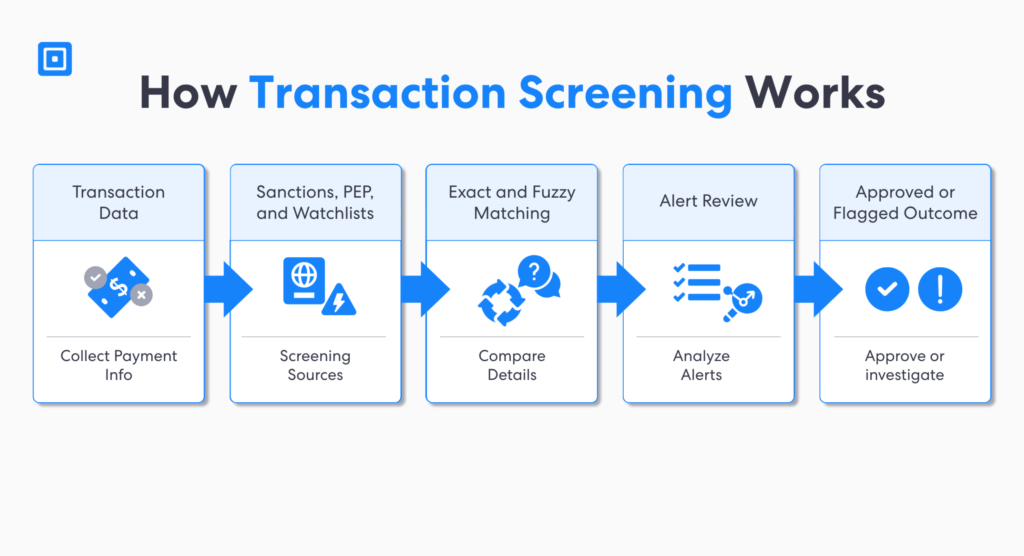
> Transaction screening has evolved into a real-time decision engine.
Chief Product Officer, Harry Varatharasan also says, “Firms that cannot balance speed and accuracy will find it hard to meet regulatory and customer expectations.” Unlike transaction monitoring, which looks at patterns across past transactions, transaction screening checks on each transaction as it happens. Instant payments need systems to make fast decisions without interrupting legitimate transactions.
## Transaction Screening vs Transaction Monitoring
However, it is a common misconception that transaction screening and transaction monitoring are the same thing. That couldn’t be more wrong. Though they are both closely related, they serve completely different purposes within AML compliance. Both transaction screening and transaction monitoring are needed for detecting financial crimes. However, they act at different parts of the transaction lifecycle.
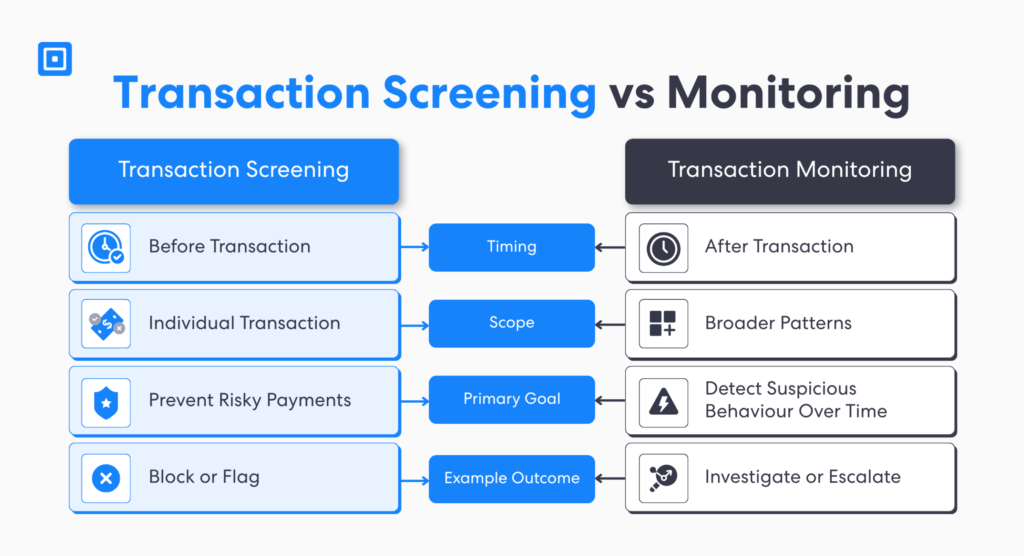
Transaction screening detects suspicious activity before transactions occur, while transaction monitoring identifies risks after processing. Screening assesses individual transactions from business or personal accounts in real-time at the point of transaction initiation. It tries to stop risky transactions making it a preventative control measure in AML. On the other hand, transaction monitoring takes a much broader view. It checks previous transactions over time to find any risky activity patterns. It finds complex schemes that a single transaction screening check might not show.
## Transaction Screening and Risk Assessments
Putting effective transaction screening checks in place deliver a wide range of benefits for financial institutions. Transaction screening helps reduce the risk of money laundering, terrorist financing, and other financial crimes. By using advanced transaction check solutions, institutions can also ensure compliance with changing sanctions and regulatory rules, even as new emerging risks add up.
Lowering false positives also allows compliance teams to pay attention to real threats instead of managing unnecessary alerts. This improves operational efficiency and improves overall risk management. Transaction screening solutions can help protect legitimate users. It ensures that customers feel less disruption while the institution maintains a strong defense against illicit activities.
Furthermore, thorough transaction screening checks enable financial institutions to quickly adapt to safeguard both their reputation and their customers. By focusing on high risk transactions and keeping up effective compliance processes, companies can stay ahead of any potential threats and help uphold the integrity of the financial system overall.
## Payment Screening in Financial Institutions
Another facet of a transaction screening check is payment screening. This focuses on overall payment flows. Banks, payment providers, investment firms, and other financial institutions rely so much on payment screening today. In the first half of 2025, euro area non-cash payments reached 77.7 billion transactions, up 7.7% year on year. It impacts those that handle large volumes of transactions and it is crucial for high-value transactions, cash deposits, and cross-border transactions.
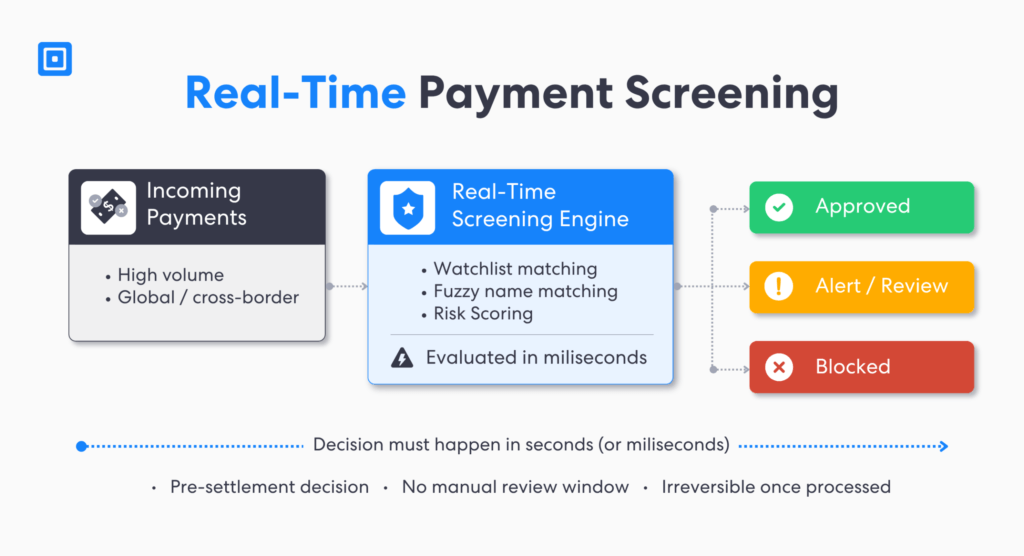
In the context of instant payments, this type of screening needs to happen in real-time. It adds more pressure on systems to provide much faster decisions without compromising on accuracy. As a result, slow screening times can hinder the overall customer journey and increase risk in operations. Additionally, payment screening supports financial sanctions compliance. It blocks transfers to sanctioned entities or high risk regions. This helps companies meet rules and achieve regulatory [compliance](https://www.complycube.com/en/complycube-unleashes-powerful-compliance-suite/).
## False Positives and Data Quality
Another factor in transaction screening is false positives. Often, transaction screening checks incorrectly flag legitimate transactions as risky. Name similarities, incomplete data, and the limits of traditional rule-based systems drive many of these alerts. This is one of the biggest operational hurdles for transaction screening.
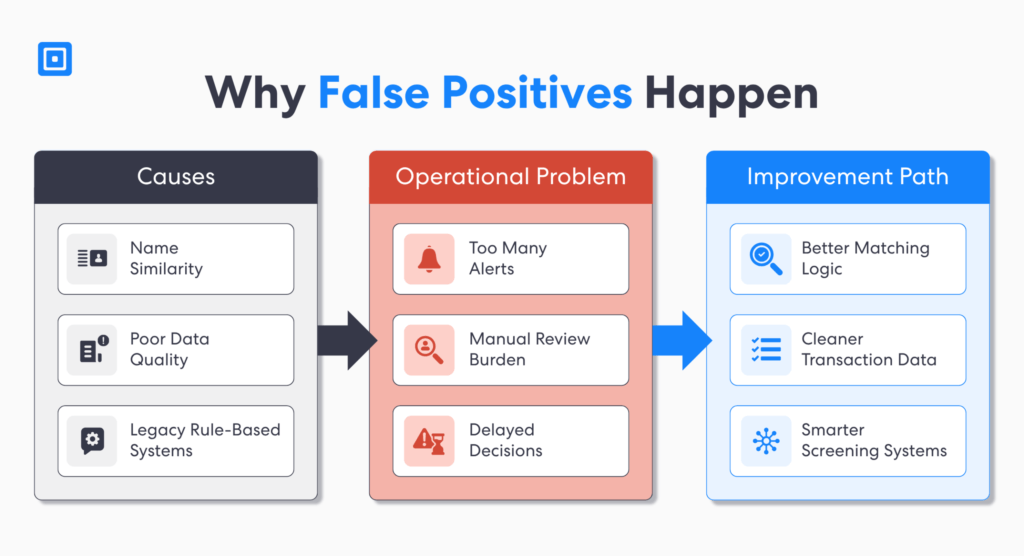
A major reason of this specific inefficiency is ancient outdated systems and legacy technology. They cannot keep up with the speed of modern transactions. It results in many delays and more false alerts. Similarly, sensitive systems generate larger volumes of alerts that require tons of manual review. That’s why lowering false positive is helpful in improving flows. This frees up compliance teams to look at real risks rather than reviewing legitimate transactions.
## Regulations, Financial Crimes, and AML Compliance
Global and local authorities have their own set of rules and regulations when it comes to transaction screening. For example, the Financial Action Task Force provides international standards and the FCA (UK) or FinCEN (US) uphold AML compliance at national levels. Companies must screen transactions against sanctions lists and identify suspicious transaction that may show fraud.
Today, regulators have high expectations of firms. For example, FATF’s 2025 said payment-message information should build a clearer picture of who is sending and receive money. This helps eliminate fraud and errors impacting customers. Any failure to comply to AML regulatory requirements (national or international) can lead to penalties and reputational damage. They must keep strong audit trails and show a strong risk-based approach. Decisions can be proven through a suspicious activity report and reviewed during investigations. You can learn more here: [What is a Risk-Based Approach?](https://www.complycube.com/en/what-is-a-risk-based-approach/)
### **Case Study: Bank of Scotland and Sanctions Screening Lessons**
The Office of Financial Sanctions Implementation (OFSI) fined Bank of Scotland £160,000 after finding breaches of UK Russia sanctions rules and regulations. The case shows how gaps in sanctions controls and payment handling can put companies to compliance risk.
##### **Reinforcing Effective Transaction Screening Processes**
The case shows how gaps in sanctions controls and payment handling can put companies at risk of noncompliance. That means improving screening accuracy, governance, and audit readiness across transaction flows.
##### **Solutions & Outcomes**
- Public enforcement action and monetary penalties from OFSI
- Clear reminder that sanctions controls must work in live payment environments
- Stronger industry focus on screening governance, escalation, and auditability after enforcement
## Best Practices for Implementing Transaction Screening
In order to have detailed transaction checks and screening, organizations must adopt a strong set of practices that build up their compliance and risk management efforts. As a result, regular risk assessments are necessary. They allow organizations to identify and prioritize emerging risks. It allows for them to adjust their screening process as needed. By using advanced technology, the screening process can be efficient, scalable, and responsive to changing regulatory requirements.
Another cornerstone of an effective transaction check is aiming to have high quality data. Complete and accurate transaction details improve the reliability of screening results. Additionally, it can help lower false positives. Also, financial institutions should ensure that screening processes are flexible. They need to adapt and change with new threats and regulations. It supports any ongoing compliance and risk management. Finally, integration is key. Transaction checks need to work smoothly with other compliance systems. They need to be stackable.
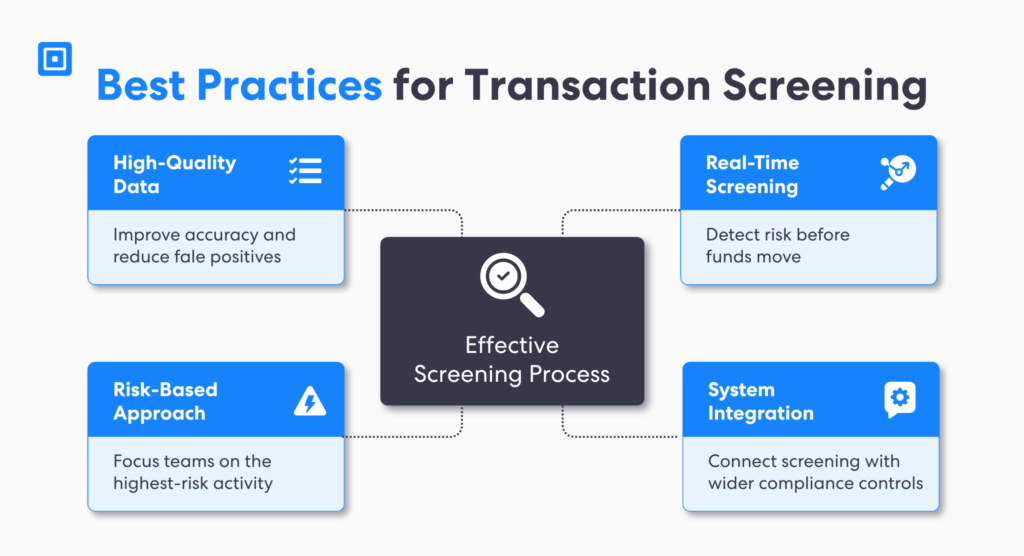
Compliance teams must train analysts to assess flagged transactions effectively. They conduct further investigation when necessary. They take the time to distinguish between suspicious high risk activity and legitimate ones. By following these best practices, financial institutions can build a thorough transaction screening process. One that meets the rules of regulatory bodies and protects against financial fraud.
### Key Takeaways
- Transaction checks are essential for preventing financial crimes.
- Transaction checks support both manual and automated workflows.
- False positives are still a key operational challenge.
- Data quality directly impacts screening accuracy.
- Modern solutions help real-time, scalable compliance.
## Transaction Screening with ComplyCube
In summary, transaction screening is a baseline control in AML compliance. It helps companies to find and stop risky activity before it happens. But as financial systems grow and instant payments become more common, there is a need for fast, correct screening now more than ever. By taking on modern screening solutions such as ComplyCube, financial institutions can improve risk management and build stronger customer trust. Talk to our team today about how you can update your transaction screening workflows and strengthen your compliance.
## Frequently Asked Questions
What is transaction screening?
Transaction screening checks transactions in real time against sanctions lists and risk indicators. It helps find any risky, suspicious or prohibited activity before funds are moved, making it a key preventative control measure in AML compliance and financial crime prevention.
What is a transaction check?
Similarly, a transaction check is the review of an individual transaction to find out whether or not it actually poses a real compliance risk. It can be done manually or through automation. In modern environments, it is a crucial part of a overall transaction screening process.
Why do false positives occur in transaction screening?
Often, false positives happen when real transactions are wrongly flagged due to name similarities or poor data quality. Traditional systems often lack precision, which leads to too many alerts. Improving matching logic and data quality helps lower these issues..
How does transaction screening differ from transaction monitoring?
Transaction screening is focused on real-time checks at the point of payment while transaction monitoring looks to past transactions for patterns. Both are needed for finding out criminal activity. Together, they give a full compliance structure or framework.
How does ComplyCube support transaction screening?
ComplyCube has real-time transaction screening software with advanced matching and automation systems. It helps lower false positives and supports ongoing monitoring. The platform helps companies to meet regulatory rules efficiently.
**Categories:** Guides
**Tags:** Anti-Money Laundering
---
### [What is Customer Due Diligence (CDD)?](https://www.complycube.com/what-is-customer-due-diligence/)
**Published:** February 3, 2021
**Author:** Andreea Balasa
**Excerpt:** Regulated businesses employ Customer Due Diligence (CDD) to mitigate risks in business relationships, prevent financial crime, and ensure compliance with regulatory requirements.
**Content:**
**TL;DR:** Customer Due Diligence is a key aspect of the **Know Your Customer (KYC)** process. It aims to mitigate risks in business relationships, prevent financial crime, and ensure regulatory compliance. This guide will explain **what is Customer Due Diligence (CDD)**, the common challenges involved, and how to achieve full KYC compliance through effective CDD checks.
## What is Customer Due Diligence?
Customer due diligence is the process by which companies, particularly financial institutions and other [regulated entities](https://www.gov.uk/guidance/money-laundering-regulations-who-needs-to-register), collect and analyze customer information to ensure compliance with legal and regulatory requirements. Customer due diligence involves conducting manual or automated checks to verify customer identities and understand the nature of their financial history in line with the potential risks a customer presents.
The US Federal [Financial Institutions Examination Council](https://www.ffiec.gov/) (FFIEC) recommends that a robust Anti-money Laundering (AML) compliance program adopt thorough CDD measures, especially for high-risk customers.
## The Three Levels of Customer Due Diligence
Companies commonly adopt three nuanced levels of customer due diligence, each aligned to the customer’s risk profile. This strategy aligns with the Risk-Based Approach (RBA), as recommended by the [Financial Action Task Force (FATF)](https://www.fatf-gafi.org/en/topics/fatf-recommendations.html).
By adopting these varying levels of due diligence, a financial institution can ensure an effective risk management strategy, enabling it to respond swiftly to diverse customer risk scenarios. You can learn more here: [What is a Risk-Based Approach (RBA)?](https://www.complycube.com/en/what-is-a-risk-based-approach/)

### Simplified Due Diligence (SDD)
Simplified due diligence applies when there is a low risk of involvement in financing terrorism or money laundering. SDD involves lighter [KYC](https://www.complycube.com/en/solutions/due-diligence-compliance/know-your-customer/) procedures with low identity assurance requirements. Nonetheless, businesses may run enhanced due diligence on low-risk customers to better assess customer relationships and improve trust.
### Basic Due Diligence (BDD)
BDD is also referred to as standard due diligence or basic customer due diligence. It is the most common level of CDD and involves customer identification and data verification. Businesses use a government-issued ID, trusted third-party databases, and private data sources to check customer details. BDD also requires businesses to confirm a customer’s activities, source of funds, business model, and ultimate beneficial ownership.

### Enhanced Due Diligence (EDD)
High-risk customers, such as Politically Exposed Persons (PEPs) or clients from high-risk countries, must undergo enhanced due diligence. EDD involves gathering additional identity information and establishing the sources of wealth or funds. Understanding the intended business relationship and the purpose of potential customer transactions is also essential.

Several jurisdictions have enacted laws mandating that financial institutions establish EDD measures. Examples include the European Union’s 6th Anti-Money Laundering Directive ([6AMLD](https://www.complycube.com/en/a-quick-overview-of-the-6th-anti-money-laundering-directive-6amld/)) and the Bank Secrecy Act ([BSA](https://www.complycube.com/en/fincen-issues-first-ever-list-of-aml-cft-priorities/)) in the United States. You can learn more here: [Navigating the World of Enhanced Due Diligence](https://www.complycube.com/en/enhanced-due-diligence-edd-insights-and-challenges/).
### Case Study: ESG Compliance
Historically, Environmental, Social, and Governance (ESG) factors weren’t considered compliance issues. However, [new mandates](https://www.sec.gov/news/press-release/2022-46) from bodies such as the Securities and Exchange Commission (SEC) highlight the changing nature of regulations, leading to the need for ongoing monitoring procedures.
For instance, in 2022, the SEC [fined](https://www.sec.gov/news/press-release/2022-209?utm_medium=email&utm_source=govdelivery) Goldman Sachs Asset Management $4 million for not adhering to its ESG guidelines. Therefore, when considering partnerships, it is vital to conduct a thorough risk assessment to avoid reputational risk and foster responsible business relationships.
## When is Customer Due Diligence Required?
The need for CDD checks emerge at different stages, whether at the beginning of a business relationship, during transactions of significant value, or in scenarios that require higher scrutiny due to emerging concerns. The following are instances when a CDD process is needed:
1. **New Business Relationship:** Businesses collect relevant information at onboarding to verify that customers are who they claim to be and to prevent identity fraud.
2. **Occasional Transactions:** CDD assessments are warranted for financial transactions exceeding regulatory thresholds or which involve companies or individuals from a high-risk country.
3. **Suspicion of Money Laundering:** Suspicious activity from a returning or new customer might hint at involvement in terrorist financing or money laundering.
4. **Unreliable or Fake Documentation**: Businesses apply additional identification measures to resolve discrepancies when a customer provides inadequate identification documents.
5. **Ongoing Monitoring:** CDD is an ongoing process that involves monitoring business relationships to ensure they align with customer risk profiles.

## The Customer Due Diligence Rule Requirements
The FATF recommends several requirements for a reliable customer due diligence process as part of Recommendation 10:
- Verifying a new customer’s identity or establishing a business relationship.
- Identify the ultimate beneficial owners and verify their identity.
- Evaluating suspicious transactions to minimize money laundering risks.
- Ongoing monitoring and reporting activities indicative of financial crime to assist law enforcement.
- Maintaining and updating information and customer profiles.
### **Case Study: Bithumb’s $25 Million Fine**
South Korean regulators penalized Bithumb, South Korea’s leading crypto company, in March 2026 for major CDD failures. Reports reveal that Bithumb failed to verify customer identities in 3.55 million cases and made 45,772 dealings with 18 unregistered foreign exchanges.
##### **When Volume Outpaces Compliance**
Bithumb did not enforce basic CDD and risk-based controls. As a result, high-value transactions, suspicious activity, and changes to its business relationships slipped through the firm’s compliance framework, creating major gaps in its AML infrastructure.
##### **Outcomes**
- Bithumb was fined a hefty [$25 million penalty](https://www.complycube.com/en/crypto-news-jpmorgan-ponzi-scheme/) for over 6 million AML violations.
- The crypto company was forced to suspend operations for six-months, blocking new users.
- This case opened users to potential money laundering and financial crime risk, drawing criticism and reputational damage to the firm.
## Customer Due Diligence Checklist
FATF guidelines recommend that financial institutions and other regulated entities tailor their CDD process to the risk profile posed by their business model and customer base. Companies can balance compliance obligations, operational resources, and budgetary requirements with the help of an Identity Verification (IDV) provider. Here is a reliable customer due diligence checklist:
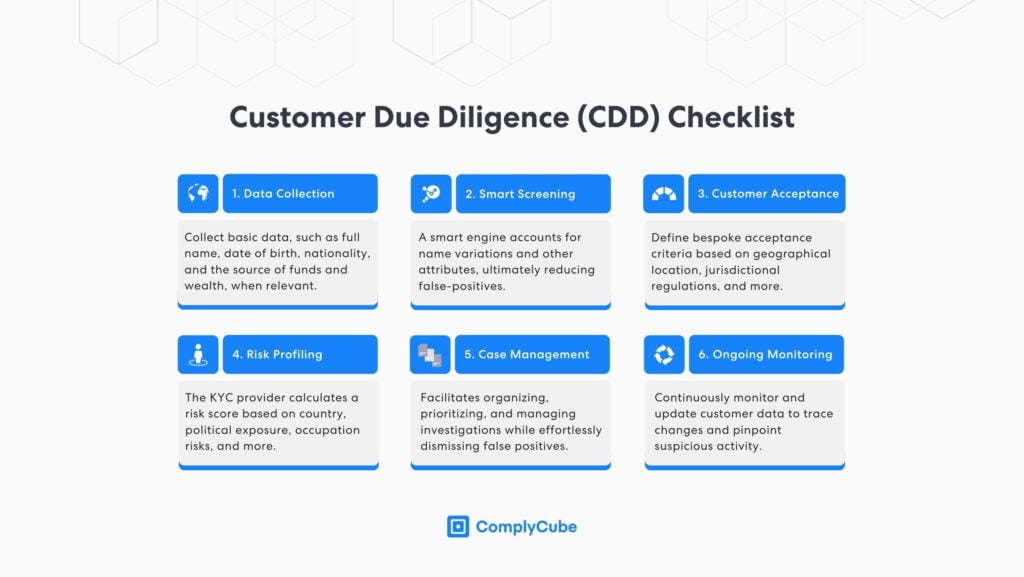
A reliable customer due diligence checklist has six key steps. Start by collecting customer information. Next, conduct smart screening. Then, define customer acceptance policies. Follow with risk profiling and case management. Finally, ensure ongoing monitoring. Here is a more detailed explanation of each step:
### 1. Collecting Customer Information
[Customer authentication](https://www.complycube.com/en/enhanced-due-diligence-edd-insights-and-challenges/), typically part of a financial institution’s Customer Identification Program (CIP), involves collecting customer data, such as full name, date of birth, contact details, nationality, and sources of funds or wealth when relevant. This information is required to verify a customer’s identity and ensure they aren’t suspected or sanctioned for illicit financial behavior such as terrorist financing or other financial crimes.
The business should have a process for customer information updates and maintenance and conduct ongoing monitoring to prevent financial crimes. It’s recommended to use an identity verification solution that simplifies data collection and provides a unified, clear view of each customer’s identity.
### 2. Smart Screening for High Accuracy
Many IDV platforms promote [fuzzy name matching](https://redis.com/blog/what-is-fuzzy-matching/) as a critical feature for CDD processes. However, this method mainly handles misspellings and minor variations, leaving other crucial aspects unaddressed.
It doesn’t effectively tackle issues like phonetic similarities, transliterations, linguistic variations, non-Latin scripts, patronymics, honorifics, titles, or out-of-order names. ComplyCube offers a comprehensive KYC solution that covers these aspects for more reliable and thorough verification.
### 3. Defining Customer Acceptance Policies
CDD checks may vary based on factors such as the customer’s risk profile, geographical location, jurisdictional regulations, etc. Therefore, businesses should define a bespoke, risk-based approach with clear customer acceptance criteria for their services and products. This step also contributes to risk profiling, defining thresholds, and alert monitoring.
### 4. Risk Profiling Based on Customer Data
Companies should determine a client’s risk level based on the information collected and the initial identification processes. Businesses can define custom thresholds for low-risk and higher-risk customers with the help of an AML/KYC solution that covers risk scoring.
The KYC provider calculates a risk score for new customers based on a suite of risk attributes such as country, political exposure, and occupation risks, among other vectors. These factors aid in determining the level of due diligence that should be applied: simplified, basic, or enhanced.
### 5. Case Management for Alert Monitoring
Incorporating [case management](https://www.complycube.com/en/solutions/due-diligence-compliance/case-management/) with monitoring and alerts empowers analysts to delve into suspicious activities and swiftly investigate financial crimes. A robust Case Management solution should offer a seamlessly integrated experience enriched with contextualized data like detailed match breakdowns.
This facilitates investigators in organizing, prioritizing, and managing investigations while effortlessly dismissing false positives. Additionally, it ensures the creation of a permanent audit trail for regulatory scrutiny.
### 6. Ongoing Monitoring for Risk Mitigation
Regardless of a client’s risk level, companies must continuously monitor and update customer data to detect changes and identify suspicious activity. Maintaining an audit trail for [ongoing monitoring](https://www.complycube.com/solutions/global-screening/continuous-monitoring/) and documenting findings following an alert is essential.
An effective monitoring system should be adaptable and bolstered by robust technology that seamlessly integrates with existing platforms, offering real-time alerts and a user-friendly interface for analysts to swiftly respond to and mitigate potential risks and issues.
## Customer Due Diligence for Financial Institutions
CDD is vital for banks and other financial institutions to ensure compliance, manage financial risks, prevent money laundering and terrorist financing, and establish transparent banking relationships. The KYC process aligns financial institutions’ activities with legal requirements, detects suspicious behavior, and averts potential legal and reputational issues.
Moreover, CDD checks cultivate a foundation of trust between banks and their customers that goes beyond mere compliance. A robust framework is critical for navigating complex regulatory environments in today’s digitally-driven global banking landscape. Through rigorous CDD practices, banks establish a compliant operational structure and bolster their reputation, reinforcing trust and business relationships among customers and regulators. This trust is a cornerstone of long-term success in the financial industry.
### Key Takeaways
- **Customer Due Diligence** enables companies to verify a customer or entity’s identity and evaluate any risk present.
- **The three main CDD** levels include: Simplified Due Diligence, Basic Due Diligence, and Enhanced Due Diligence.
- **CDD checks are** triggered by events beyond onboarding, such as high-value transactions or suspicious activity.
- **A risk-based approach,** where the amount of scrutiny is proportional to the level of risk, is central to CDD measures.
- **Strong CDD measures** involve robust risk profiling, clear audit trails, and ongoing monitoring controls.
## Comprehensive CDD Checks for KYC Compliance
Customer due diligence is essential for businesses looking to confirm the identity of returning and potential customers and comply with regulatory requirements. Financial institutions and other regulated bodies can effectively manage customer risk levels and avert possible financial crimes. With the help of a robust IDV/KYC partner, businesses can ensure that they stay up to date with evolving customer due diligence regulations, identify red flags, and foster a healthy compliance framework.
**Looking for a global compliance platform for IDV and KYC checks?** [**Get in touch**](https://www.complycube.com/en/contact/contact-sales/?utm_source=marketing&utm_medium=website_blog&utm_campaign=edd_process) **with us today!**
## Frequently Asked Questions
What is Customer Due Diligence (CDD)?
Customer Due Diligence (CDD) is a mandatory component in Know Your Customer (KYC) processes. CDD measures involve collecting essential customer information, including beneficial owners and business relationships. Companies require CDD to combat money laundering and terrorist financing risk.
Why are CDD checks important?
Customer due diligence checks enable a company to identify and assess money laundering and terrorist financing risk. These checks prevent suspicious customers from onboarding and support Anti-Money Laundering (AML) compliance. As a result, firms are able to protect their customers and prevent financial damage.
What are the three levels of customer due diligence?
The three levels of customer due diligence are: simplified, standard, and enhanced due diligence. These levels are risk-based measures used to build a more efficient risk management strategy. It includes higher scrutiny, such as sanctions screening checks for higher-risk users.
When is customer due diligence required?
Customer due diligence is legally required when a new business relationship is formed. Additionally, they are triggered by events that happen beyond the onboarding stage. These events include high-value transactions, suspicious activity, and ongoing monitoring.
What does an effective CDD checklist include?
An effective CDD checklist verifies customers’ identity and assesses risk levels accurately. It includes identity verification, beneficial ownership checks, robust risk assessment, sanctions and PEP screening for high-risk customers, transparent audit trails, and ongoing monitoring for compliance and regulatory trust.
**Categories:** Guides
**Tags:** Know Your Customer
---
### [Navigating the World of Enhanced Due Diligence](https://www.complycube.com/enhanced-due-diligence-edd-insights-challenges/)
**Published:** May 10, 2023
**Author:** Andreea Balasa
**Excerpt:** The internet has revolutionized the world, but has also opened new doors for fraudsters. To protect customers, assets, and reputation, businesses must use Enhanced Due Diligence. Read on!
**Content:**
**TL;DR:** Enhanced Due Diligence (EDD) helps firms assess high-risk customers, transactions, and relationships with greater scrutiny. The blog explains what enhanced due diligence involves, when it applies, and how a practical enhanced due diligence checklist supports a clear enhanced due diligence process. It also shows how enhanced due diligence EDDimproves risk management, consistency, and ongoing compliance.
The online world has revolutionized how we communicate, access information, and conduct business. Almost everything we do, from opening a new bank account to scheduling a doctor’s appointment, can be done online in just a few steps.
Nevertheless, this new reality brings about new challenges. Fraudsters are becoming increasingly sophisticated, and businesses must keep up to protect their customers, assets, and reputation while complying with increased regulatory scrutiny. Enhanced Due Diligence (EDD) is a key Anti-Money Laundering (AML) and Counter-Terrorist Financing (CTF) process. This article highlights EDD’s key aspects and challenges.
## What is Customer Due Diligence?
Customer Due Diligence (CDD) is a process undertaken by businesses, particularly financial institutions and [regulated entities](https://www.gov.uk/guidance/money-laundering-regulations-who-needs-to-register), to verify the identity of customers and assess risks before establishing a business relationship. CDD aims to prevent money laundering, terrorist financing, and other illegal activities.
A crucial element of CDD is the Know Your Customer (KYC) process, which involves verifying customer details such as name, address, date of birth, transaction history, biometrics, and identification documents. After [identity verification](https://www.complycube.com/en/the-essentials-guide-for-robust-identity-verification/), businesses must conduct Ongoing Due Diligence (ODD) by continuously monitoring the customer’s risk profile and reporting suspicious activities to the competent authorities.
## The Different Levels of CDD
There are three levels of CDD:
- **Simplified Due Diligence (SDD):** Applied to low-risk customers, SDD involves minimal identity verification and risk assessment. It is used when the risk of Financial Crime (FinCrime) is deemed low.
- **Basic Due Diligence (BDD):** Applied to most customers, BDD, also called CDD, involves obtaining and verifying customer information, including occupation, source of funds, and the purpose of the business relationship.
- **Enhanced Due Diligence (EDD):** Applied to high-risk customers, such as a Politically Exposed Person (PEP) or client from a jurisdiction with weak AML/CTF controls. EDD involves a deeper analysis of customer information and a thorough risk assessment.
To determine the appropriate level of CDD, businesses use a Risk-Based Approach (RBA) to assess customer risk factors such as location, the nature of transactions, and behavior. RBA enables institutions to allocate resources to higher-risk areas, enhancing the effectiveness of AML/CTF measures.
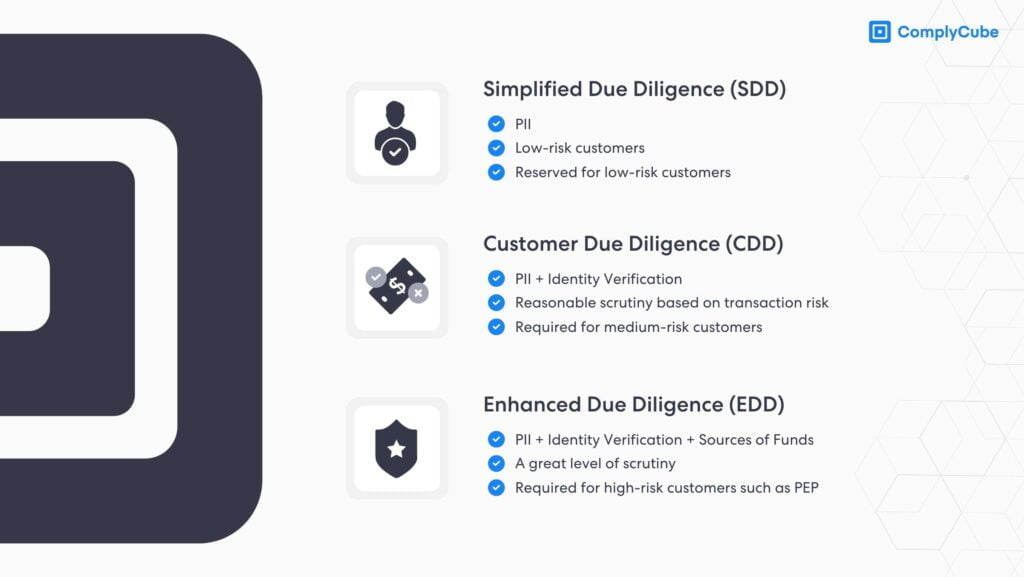
## What is Enhanced Due Diligence?
Enhanced Due Diligence (EDD) represents a comprehensive approach to customer due diligence employed by businesses to address heightened transaction risk associated with high-risk customers.
EDD processes involve thoroughly examining client backgrounds, financial assets, sources of funds, business certificates, and transaction patterns. By obtaining additional identifying information and delving deeper into risk factors, EDD enables improved risk management compared to standard KYC diligence measures.
That is why several jurisdictions have introduced regulations requiring institutions to implement comprehensive EDD controls. Key examples include the Bank Secrecy Act ([BSA](https://www.complycube.com/en/fincen-issues-first-ever-list-of-aml-cft-priorities/)) in the United States and the European Union’s 6th Anti-Money Laundering Directive ([6AMLD](https://www.complycube.com/en/a-quick-overview-of-the-6th-anti-money-laundering-directive-6amld/)).
## The Difference between AML Due Diligence and EDD
AML Due Diligence is a broad term encompassing various processes and measures financial institutions and businesses take to detect, prevent and report money laundering and other illicit activities. It includes implementing policies, procedures, and controls for identifying and assessing customer risk, as well as conducting CDD and transaction monitoring.
On the other hand, EDD is a specialized form of CDD used in situations with a higher risk of money laundering, terrorist financing, or other financial crimes. It requires a more thorough examination of a customer’s background, source of wealth, and transaction activity.
In summary, AML Due Diligence is a broad term that includes policies, procedures, and controls for assessing customer risk. EDD is a specialized and extensive process for customer vetting used in high-risk situations to gain a deeper understanding of a customer’s financial activities and identify potential risks.
### When is EDD Required? Defining High-risk Customers
EDD may be triggered for customers or ongoing transactions that are considered higher risk by a financial institution. Examples include:
- Customers from high-risk countries or jurisdictions with weak AML/CTF regulations or a greater risk of money laundering. These are also known as high-risk third countries**.**
- Politically Exposed Persons, their family members, or close associates.
- Customers with a history of criminal activity, involvement in suspicious transactions, or high-risk businesses such as cash-intensive businesses.
- High-net-worth individuals with complex business structures or financial arrangements.
- Transactions involving high-risk industries include arms trade, gambling, the financial sector, and cryptocurrency.
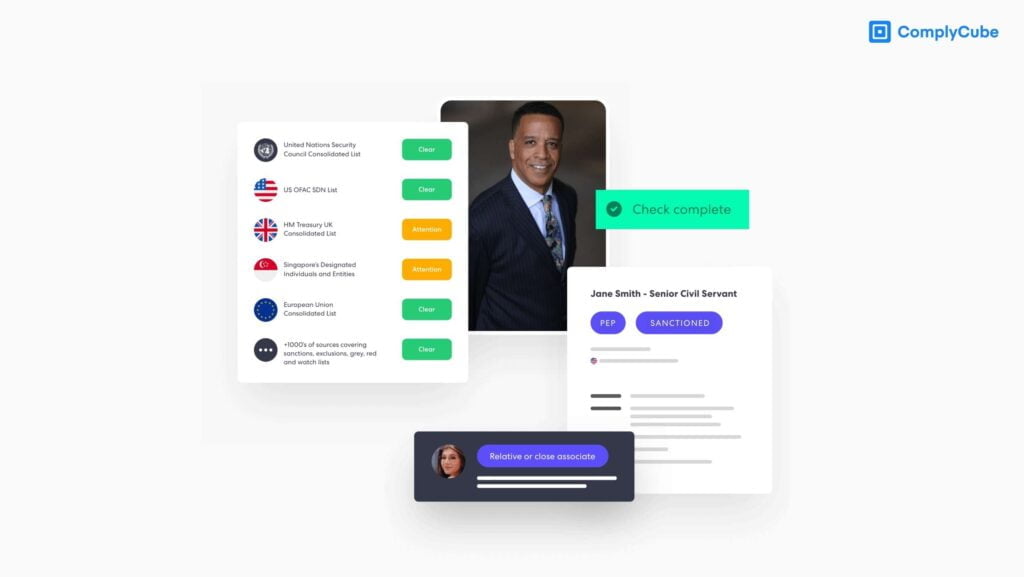
## The Key Components of Enhanced Due Diligence
Enhanced due diligence procedures rely on the organization’s risk appetite but typically include the following components:
- **Customer Identification Program (CIP)**: Verifying the customer’s identity by collecting necessary identification documents and corroborating the provided information.
- **Customer Risk Assessment:** Evaluating the risk level of the customer based on factors such as industry, location, transactional behavior, and affiliations.
- **Intelligence Reports:** Commissioning an intelligence report to obtain insights into an individual, beneficial owner, business, or industry to assess risks holistically.
- **Beneficial Ownership:** Identifying the ultimate beneficial owners of the customer’s business or account, including individuals [who own or control the legal entity.](https://www.occ.treas.gov/news-issuances/bulletins/2018/bulletin-2018-12.html)
- **Source of Wealth and Funds:** Investigating discrepancies in the customer’s source of wealth, the origin of funds, and net worth.
- **Ongoing Monitoring:** Continuously monitor high-risk customer accounts to detect suspicious activity, changes in risk profile, or compliance issues.
- **Politically Exposed Persons (PEPs):** Identifying whether the customer or a beneficial owner is a politically exposed person or has close ties with one. You can learn more about it here: [What is a Politically Exposed Person (PEP)?](https://www.complycube.com/en/what-is-a-pep/)
- **Sanctions Screening:** Checking the customer against national or international sanctions lists, which may prohibit or restrict business relationships. You can learn more about the topic here: [What is Sanctions Screening?](https://www.complycube.com/en/what-is-a-sanctions-screening/)
- **Adverse Media Screening**: Reviewing news articles and online sources to identify potential involvement in FinCrime or illicit activities.
- **Risk Mitigation:** Implementing appropriate risk mitigation measures, such as enhanced transaction monitoring, additional documentation requirements, or senior approvals.
- **Record-Keeping:** Maintaining detailed records of the EDD process, including customer information, risk assessments, and any related actions.
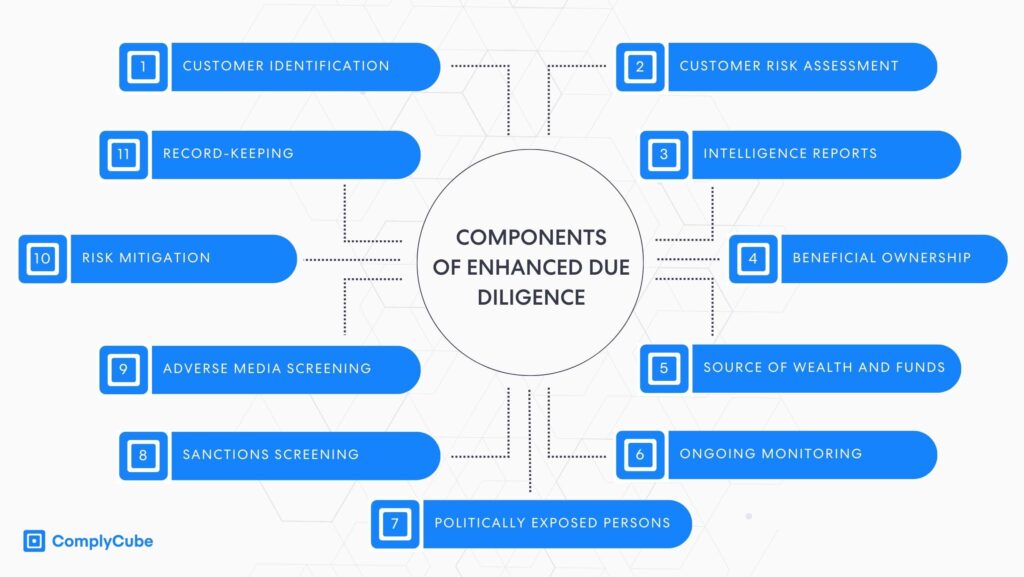
### Incorporating KYC in Enhanced Due Diligence Procedures
Incorporating KYC into EDD procedures strengthens risk management for institutions dealing with high-risk customers. The KYC process lays the groundwork for EDD by gathering essential customer information and assessing risks. When combined, these approaches create a robust customer risk management strategy.
KYC and EDD procedures involve customer identification, verification, risk assessment, and ongoing monitoring. However, EDD requires a more in-depth analysis, emphasizing beneficial ownership, extensive evaluation of the customer’s source of wealth and funds, and enhanced ongoing monitoring. This heightened level of examination enables banks and other financial institutions to gain a deeper understanding of high-risk customers and maintain regulatory compliance.
## Enhanced Due Diligence Checklist
The EDD process includes several steps that can vary depending on the organization’s policies and procedures. A typical due diligence checklist might involve:
1. Identifying high-risk customers and transactions that require EDD based on risk assessment criteria and thresholds.
2. Obtaining additional information and documents to verify the customer’s identity, funds, and wealth involved in the transaction to assess the risk posed by the business relationship.
3. Conducting a thorough analysis of the client’s financial activities, business-related documents, and transaction history.
4. Investigating red flags or suspicious activity, such as payments from unknown third parties and their intended nature, and escalating to the appropriate internal or external authorities.
5. Documenting findings and rich audit trails, from the client risk assessment stages and throughout the customer relationship, for future reference and compliance.
6. Implementing an effective ongoing monitoring strategy for high-risk customers and transactions to ensure risk profiles remain accurate and up-to-date.
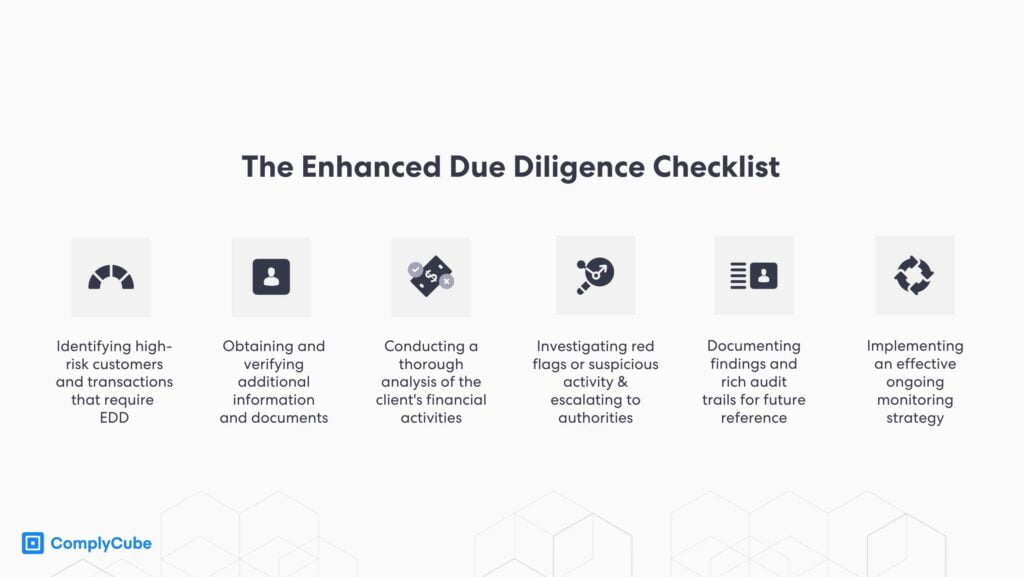
## Benefits of Enhanced Due Diligence
The Enhanced Due Diligence process enables organizations to manage high-risk customers and transactions, reduce the likelihood of financial losses, legal penalties, and reputational damage, and ensure regulatory compliance. Benefits of implementing EDD include:
- **Improved Risk Management**: EDD enables organizations to identify transactions from high-risk clients more effectively, which helps reduce financial and reputational risks.
- **Enhanced Compliance:** EDD ensures compliance with regulatory requirements, reducing the likelihood of legal penalties and regulatory sanctions.
- **Better Decision Making:** EDD provides in-depth insights into potential risk factors, enabling organizations to adopt a fledged risk-based approach.
- **Stronger Customer Relationships:** Implementing EDD demonstrates a commitment to compliance, which helps build stronger customer relationships and avoid actors that present increased exposure to money laundering risk.
- **Increased Efficiency**: EDD simplifies the onboarding and ongoing monitoring process, enabling organizations to address potential issues proactively.
- **Competitive Advantage**: By streamlining compliance, organizations can differentiate themselves from competitors and attract new business.

### **Case Study: Barclays and the Cost of Weak EDD**
In July 2025, the UK Financial Conduct Authority fined Barclays £39.3 million for failings in its treatment of a high-risk corporate client, Stunt & Co. The regulator said the bank did not apply adequate Customer Due Diligence (CDD), Enhanced Due Diligence (EDD), or ongoing monitoring, despite clear indicators of elevated money laundering risk.
##### **Escalating higher risk cases with suspicious activity**
The case highlights the need for stronger EDD controls, including better source of funds and source of wealth checks, clearer escalation procedures, and regular risk reviews. It also shows why firms need ongoing monitoring that can respond quickly when new intelligence or suspicious activity changes a customer’s risk profile.
##### **Outcomes**
- Barclays was fined **£39,314,700**, reduced from **£56,163,900** after a Stage 1 settlement discount.
- The FCA said Stunt & Co received **£46.8 million** linked to Fowler Oldfield, which it considered to be proceeds of crime handled through the account in part.
- The case reinforced a key EDD lesson: high-risk relationships need active reassessment and enhanced monitoring, not one-time onboarding checks.
## Challenges of Enhanced Due Diligence
As outlined earlier, enhanced due diligence measures are widely used in various industries to identify potential risks. However, implementing EDD poses challenges for businesses. In this section, we’ll discuss some of these challenges and how to address them.
### Regulatory Compliance
Regulatory compliance is one of the major challenges in EDD due to the complexity and diversity of the regulations that govern financial institutions. Important aspects to consider include:
- **Variation in Regulations**: Different jurisdictions have different rules regarding EDD. For example, what is considered adequate in one country may be deemed insufficient in another. This variance can make it challenging for institutions operating across borders to maintain consistent and compliant EDD procedures.
- **Regulation Changes**: Regulations are not static; they can change over time, often in response to emerging trends in FinCrime or major incidents. Institutions must stay up-to-date with these changes and quickly adapt their EDD procedures accordingly. This requires continuous monitoring of regulatory updates and changes, which can be quite challenging and resource-intensive.
- **Interpretation of Regulations**: Sometimes, the regulations may be open to interpretation, or they may lack clarity on specific points. This can lead to inconsistencies in how EDD is performed and can increase the risk of non-compliance.
Addressing regulatory compliance in EDD is critical for financial institutions, and it requires an integrated approach that combines staying abreast of regulatory changes, standardizing processes, leveraging [Regulatory Technology (RegTech)](https://en.wikipedia.org/wiki/Regulatory_technology), and investing in regular staff training.
### Efficiency and Effectiveness
Another key challenge in implementing EDD measures is balancing the requirement for efficiency with the need to conduct comprehensive risk assessments. Organizations must find ways to optimize processes, prevent money laundering, and maintain a great customer experience.
Organizations should invest in technology and automation tools, such as [ComplyCube](https://www.complycube.com/en/), which leverages Artificial Intelligence (AI), to improve the accuracy and consistency of customer risk profiles and thus improve the compliance posture.
### Ultimate Beneficial Ownership (UBO)
Ultimate Beneficial Ownership (UBO) poses a significant challenge for EDD due to the complexities and opacity of modern corporate structures. The prevalence of shell companies, offshore accounts, partnership agreements, and complex ownership arrangements makes determining the real owners behind legal entities labor-intensive and time-consuming.
Moreover, effective EDD requires a skilled workforce with extensive knowledge of regulatory requirements, industry-specific risks, and technological advancements. The training and development of such professionals can be expensive and time-consuming, especially for small businesses.
Virtual addresses can be also problematic for identifying UBOs and assessing financial crime risk. Institutions can conduct an on-site visit to provided address, use an electronic data verification service, and implement EDD controls that include an on-site visit to the physical address.
While regulators have made significant progress in strengthening AML/CTF measures, increased international cooperation, data-sharing initiatives, and the use of innovative technology solutions are needed to unmask hidden beneficial owners.

### Adverse Media Screening
Verifiable adverse media searches are an essential component of EDD procedures. Robust adverse media screening uncovers negative information from credible sources, enabling organizations to make informed decisions and improve risk management.
Performing searches manually is inefficient, time-consuming, and susceptible to human error and biases, potentially compromising the quality and reliability of the results. It is also not cost-effective or scalable for high-volume businesses.
Automated tools using artificial intelligence and machine learning can quickly and accurately analyze vast data volumes, streamlining EDD processes and reducing human error, in line with The Financial Action Task Force (FATF) recommendations. You can find more about it here: [The importance of Adverse Media checks for an effective KYC](https://www.complycube.com/en/importance-of-adverse-media-checks/).
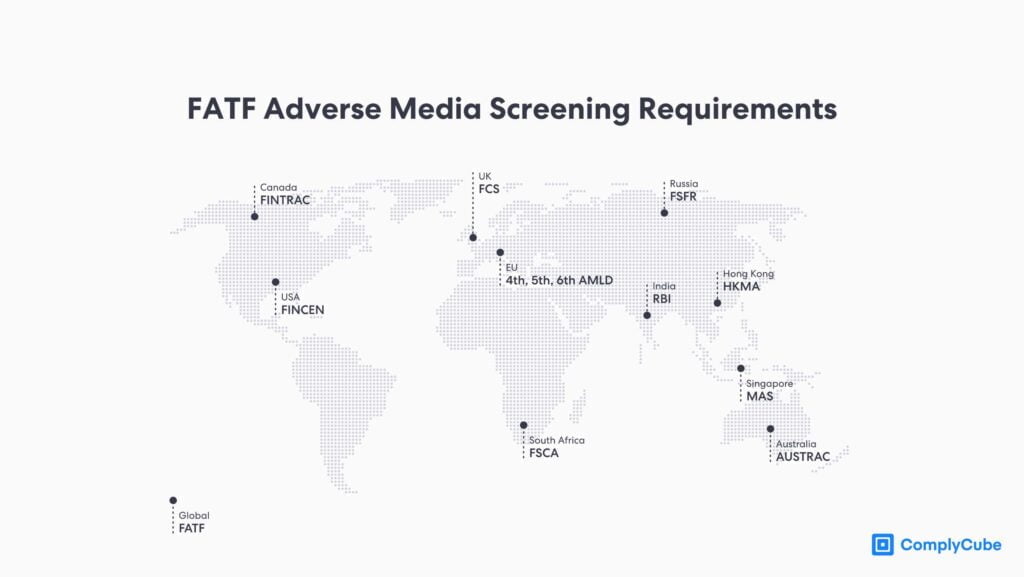
### Data Privacy and Protection
One challenge in the EDD process is ensuring the privacy and protection of customer data, as it involves collecting and storing sensitive personal and financial information. Businesses must implement robust data security standards to safeguard customer information and prevent unauthorized access or breaches.
Ensuring that data is accurate and up-to-date is another challenging aspect of EDD from a data privacy and protection standpoint. To address this, businesses must establish procedures for maintaining accurate and relevant customer data through the use of a [Single Customer View (SCV)](https://en.wikipedia.org/wiki/Single_customer_view) solution.
Adherence to data protection regulations, such as GDPR, is crucial for maintaining compliance and demonstrating a commitment to responsible data management. This approach helps build trust with stakeholders, ultimately fostering a secure environment for conducting business.
### Risk-based Approach
Implementing a risk-based approach within EDD is [advocated](https://www.fatf-gafi.org/en/publications/Fatfrecommendations/Guidance-rba-supervision.html) by FATF. However, as bad actors continuously devise new tactics to bypass existing AML/CTF controls, staying informed of the changing risk landscape and adjusting the risk-based approach is demanding.
Organizations should establish clear risk assessment criteria and thresholds, considering indicators such as customer type, activity, geographic location, and delivery channel risk factors. Thorough assessments allow organizations to understand transaction risks, focus efforts, and proactively implement new AML controls to stay ahead of bad actors.
A risk-based monitoring strategy is crucial for regularly reviewing and updating criteria to ensure relevance and effectiveness. You can learn about it here: [What is a Risk-Based Approach (RBA)?](https://www.complycube.com/en/what-is-a-risk-based-approach)
### Key Takeaways
- Enhanced Due Diligence (EDD) is a deeper level of scrutiny for high-risk customers and transactions.
- A strong enhanced due diligence checklist covers identity, source of funds, source of wealth, beneficial ownership, and transaction history.
- EDD should be triggered by higher-risk factors such as PEP status, weak-control jurisdictions, suspicious activity, or complex ownership structures.
- Ongoing monitoring is essential because customer risk can change after onboarding.
- Technology and automation help firms make EDD more consistent, scalable, and audit-ready.
## Conclusion
As the regulatory landscape evolves, EDD remains critical to an organization’s AML/CTF processes. To mitigate emerging money laundering risks, businesses should invest in technology and automation, adopt a risk-based monitoring strategy, and prioritize data privacy and protection.
The future of EDD lies in improved information sharing among key stakeholders, such as regulators, financial institutions, private banking institutions, and law enforcement agencies. This collaborative approach will lead to standardized EDD best practices and a safer global financial system.
**Looking for a global compliance platform for AML and KYC checks?** [**Get in touch**](https://www.complycube.com/en/contact/contact-sales/?utm_source=marketing&utm_medium=website_blog&utm_campaign=edd_process) **with us today!**
## Frequently Asked Questions
What is Enhanced Due Diligence (EDD)?
Enhanced Due Diligence (EDD) is a higher level of customer scrutiny used for relationships that present elevated AML or fraud risk. It goes beyond standard checks by reviewing source of funds, beneficial ownership, transaction patterns, and other risk indicators.
When should a business apply Enhanced Due Diligence?
A business should apply EDD when a customer, transaction, or jurisdiction presents a higher risk of money laundering or terrorist financing. Common triggers include PEP exposure, suspicious activity, weak AML controls, and complex business structures.
What belongs on an enhanced due diligence checklist?
An enhanced due diligence checklist should include high-risk customer identification, extra identity and funds verification, deeper financial analysis, red-flag investigation, full record-keeping, and ongoing monitoring. These steps help firms document decisions and maintain a stronger audit trail.
How is EDD different from standard customer due diligence?
Standard customer due diligence establishes identity and baseline risk, while EDD is reserved for higher-risk cases that need deeper investigation. EDD adds more detailed checks around source of wealth, beneficial ownership, and enhanced ongoing monitoring.
How does ComplyCube support Enhanced Due Diligence?
ComplyCube supports EDD by helping firms automate customer risk profiling, screening, monitoring, and audit-ready compliance workflows. Its platform combines AML checks, identity verification, ongoing monitoring, and configurable rules to make high-risk reviews more consistent and scalable.
**Categories:** Guides
**Tags:** Anti-Money Laundering
---
### [What is a Risk-Based Approach (RBA)?](https://www.complycube.com/what-is-a-risk-based-approach/)
**Published:** January 20, 2021
**Author:** Andreea Balasa
**Excerpt:** The risk-based approach (RBA) is central to the effective implementation of the Know Your Customer (KYC) and Anti-Money Laundering (AML) framework. This modern risk control technique departs from
**Content:**
**TL;DR:** A risk-based approach helps firms tailor AML compliance and KYC checks to the level of AML risk each customer presents. By using a money laundering risk assessment, businesses can apply proportionate anti-money laundering controls, focus resources where risk is highest, and strengthen overall AML effectiveness.
## What is a Risk-Based Approach?
A Risk-Based Approach (RBA) is central to the effective implementation of the Know Your Customer (KYC) and Anti-Money Laundering (AML) compliance framework. These days, this modern terrorist financing and money laundering risk assessment control is a vital technique that enables AML compliance globally. RBAs are a key regulation in the Financial Action Task Force’s (FATF’s) recommendations and enable firms to properly ascertain the associated AML risk of their users.
## Where Does the Risk-Based Approach Come From?
In the mid-1990s, KYC and AML risk assessment laws were still very much in development. What is now known as a Risk-Based Approach was then a Rule-Based Approach. This was ultimately a rigid regulation, as the nuances of independent businesses were not taken into consideration, meaning financial institutions had to abide by certain rules that simply weren’t effective.
The effect was that all consumers were subjected to the same KYC and AML controls, regardless of the industry they were participating in or their associated risk profile. This ultimately impacted industry and business growth, resulting in the development of the Risk-Based Approach.
## Post-2000: A Risk-Based Approach
The RBA was coined by the Financial Services Authority (FSA) in 2000. This is the body now referred to as the [Financial Conduct Authority](https://www.fca.org.uk) (FCA), the UK’s chief financial regulator. In 2012, under a revision of FATF Recommendations, the organization formally adopted an RBA as a key ruling. 
## The Components of a Risk-Based Approach
The RBA requires financial institutions to conduct AML risk assessments that are proportionate to the level of associated risk a company faces. Associated risk can change based on geographic locations, and the company operates in and onboard clients from. Risk also addresses the industry they operate in and the services they provide, and many others.
### Initial Risk Assessment
The initial AML risk assessment identifies a client’s associated risk factors to get a risk score. There are different compliance levels in each of these categories. For example, firms operating in higher-risk industries, such as Virtual Asset Service Providers (VASPs or crypto exchanges), must conduct the highest level of identification and AML risk screening.
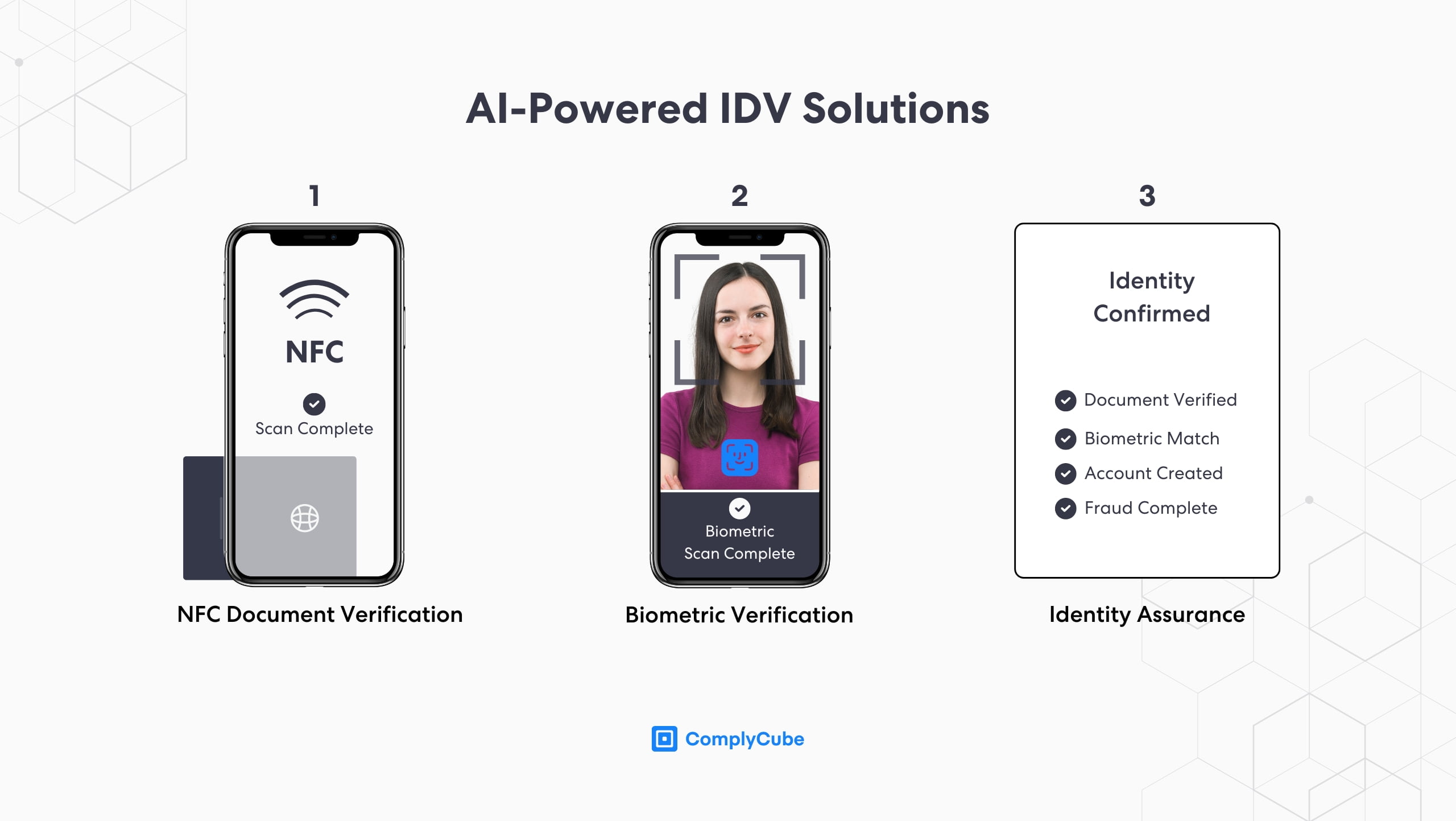
### Proportional Response
Once the identification and AML risk assessment has been conducted, businesses must allocate resources according to the level of risk posed. For instance, customer types can vary significantly if a consumer was found to have political connections through a Politically Exposed Person (PEP) screening. As a result, they would be subject to Enhanced Due Diligence (EDD) rather than basic Customer Due Diligence (CDD). This approach allows businesses to implement the rule in a way that best fits their operations.
### Ongoing Monitoring
Continuous monitoring is a key element of the RBA. It ensures that customers’ levels of risk do not change. Conducting an ongoing AML risk assessment means that a business is made aware if a client’s situation changes. If this were the case, further AML controls might be required. Controls such as transaction screening or monitoring to report on transaction data and suspicious activity.
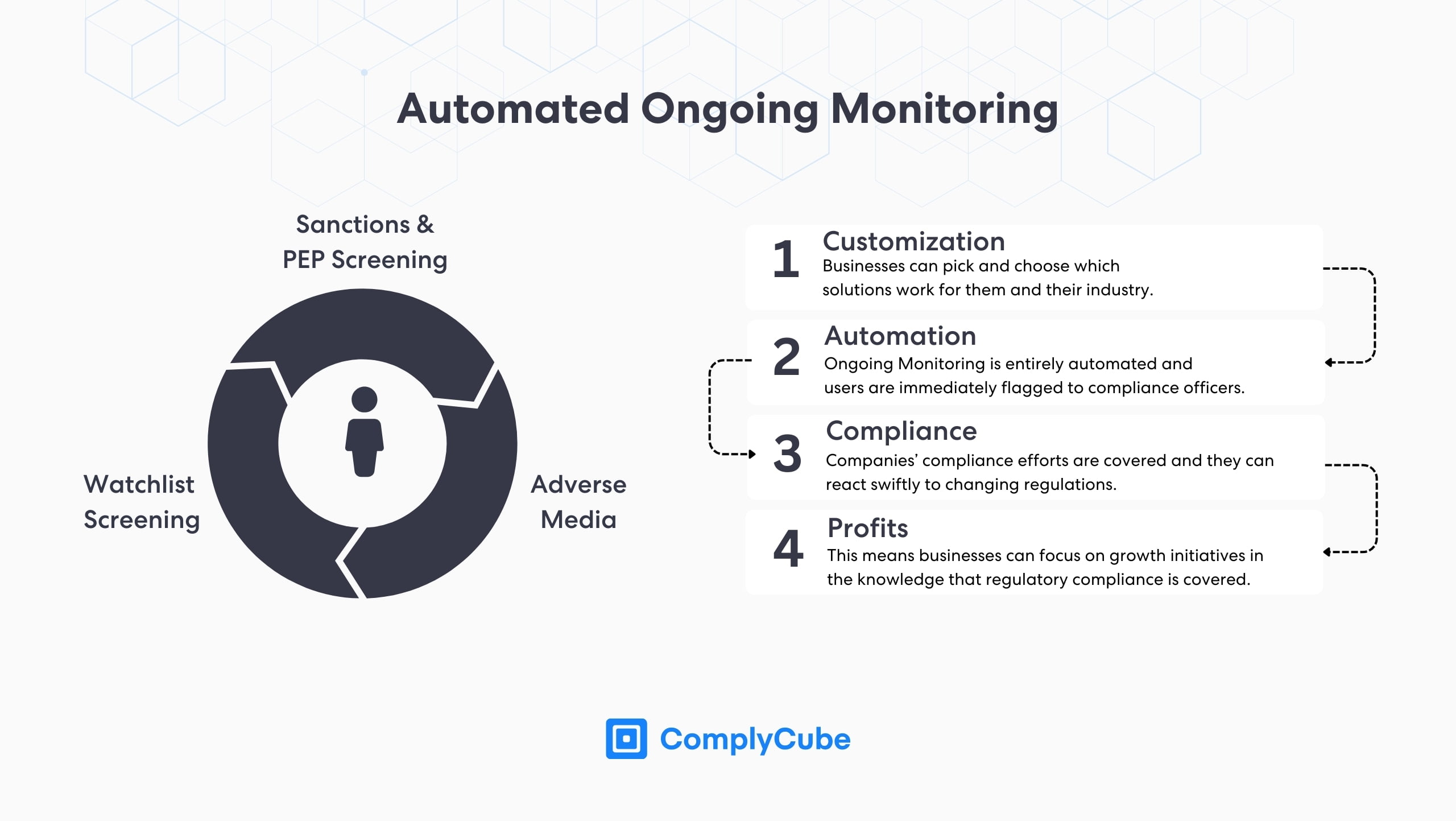
### Flexible Framework over time
Lastly, firms must be flexible in their approach to adhering to the Risk-Based Approach. This allows businesses to update their AML program. Therefore, this enhances their AML risk assessment as time goes on. This approach creates a dynamic regulatory environment where institutions can react to new regulations or new fraudulent methodologies.
### **Case Study: FCA Action Against Monzo Bank**
The FCA said Monzo’s financial crime controls did not keep pace with rapid growth, citing weaknesses in customer onboarding, customer risk assessment, and transaction monitoring. The regulator also said the bank onboarded high-risk customers despite restrictions, showing what can happen when a risk-based approach is not properly designed or maintained.
##### **Financial crime changes for remediation**
In response, Monzo completed a financial crime change programme to remediate and strengthen its wider controls, following a comprehensive independent review required by the FCA. The corrective direction reflects core risk-based approach principles: stronger onboarding, sharper customer risk assessment, and more effective monitoring for higher-risk relationships.
##### **Outcomes**
- The FCA fined Monzo **£21,091,300** for inadequate anti-financial crime systems and controls.
- Weak customer risk assessment and monitoring can create major regulatory and operational exposure.
- It reinforced why a risk-based AML framework must evolve as customer volumes, products, and risk profiles change.
## EU’s Anti-Money Laundering Directives
The European Union (EU) has adopted several directives incorporating FATF’s AML/KYC recommendations, including an RBA framework. The most recent directive, added in 2020, is the [6th Anti-Money Laundering Directive (6AMLD)](https://www.complycube.com/a-quick-overview-of-the-6th-anti-money-laundering-directive-6amld/). The Member States have transposed these directives into national legislation and now govern financial institutions operating in their jurisdiction as regulations.
The EU system of AML is decentralized – within each EU member state lies a Financial Intelligence Unit (FIU). The FIUs are small units responsible for collecting Suspicious Transaction Reports (STRs) and prosecuting suspected money laundering cases.
The EU’s framework emphasises the role played by mandated agencies to determine the extent of the risk of money laundering that transactions present. Depending on the degree of risk, experts implement unique forms of customer due diligence. They are expected to file an STR with their national FIU to decide that the transaction is suspicious. The role played by professionals is, therefore, paramount to the efficiency of the broader AML mechanism.
## The UK and FCA Risk-Based Approach Adoption
The UK adopted the RBA into its Anti-Money Laundering and Counter-Terrorist Financing (AML/CTF) with the introduction of its Money Laundering Regulations (MLRs) in 2007. The MLRs in 2017 further cemented an RBA framework into the UK’s core AML legislation.
Businesses were required to perform risk assessments, conduct CDD to proportionate to risk levels and apply EDD where necessary. In the aftermath of Brexit, the UK was forced to publish its own independent set of AML legislation, much of which reflected the policies of the FATF and EU Directives.
## The Success of the Risk-Based Approach
The adoption of a Risk-Based Approach by regulatory authorities has demonstrated its suitability as an AML risk assessment control. The key successes of the RBA are:
### Efficiency and Resource Allocation
The RBA helps financial institutions allocate their resources more effectively. Instead of applying a blanket level of scrutiny to all clients, banks and other financial institutions can focus their efforts on high-risk customers or transactions. This targeted approach has saved significant time and money for institutions by reducing unnecessary compliance efforts for low-risk cases
### Improved Compliance with Evolving Risks
The RBA provides the flexibility needed to adapt to evolving risks, including the rise of new technologies, cryptocurrencies, and complex international transactions. This adaptability has made it a cornerstone of modern AML strategies, as it allows institutions to stay compliant with regulations while managing changing business landscapes
### Scalability for Growing Businesses
One of the biggest advantages of the RBA is its scalability. As businesses grow or expand into new markets, they can adjust their AML controls to match the risks of the new environment. This allows firms to engage with higher-risk clients or operate in riskier regions without compromising compliance
### Reduced Regulatory Risk
By implementing the RBA, institutions demonstrate to regulators that they understand the specific risks they face and are taking appropriate action to mitigate them. This reduces the likelihood of penalties or fines for non-compliance and improves relationships with regulatory bodies
### Support for Business Innovation
The RBA has also supported the development of new, high-risk sectors—such as the cannabis and cryptocurrency industries—by allowing financial institutions to engage with them responsibly. This tailored approach helps institutions manage the unique risks associated with these sectors while still supporting their business growth.
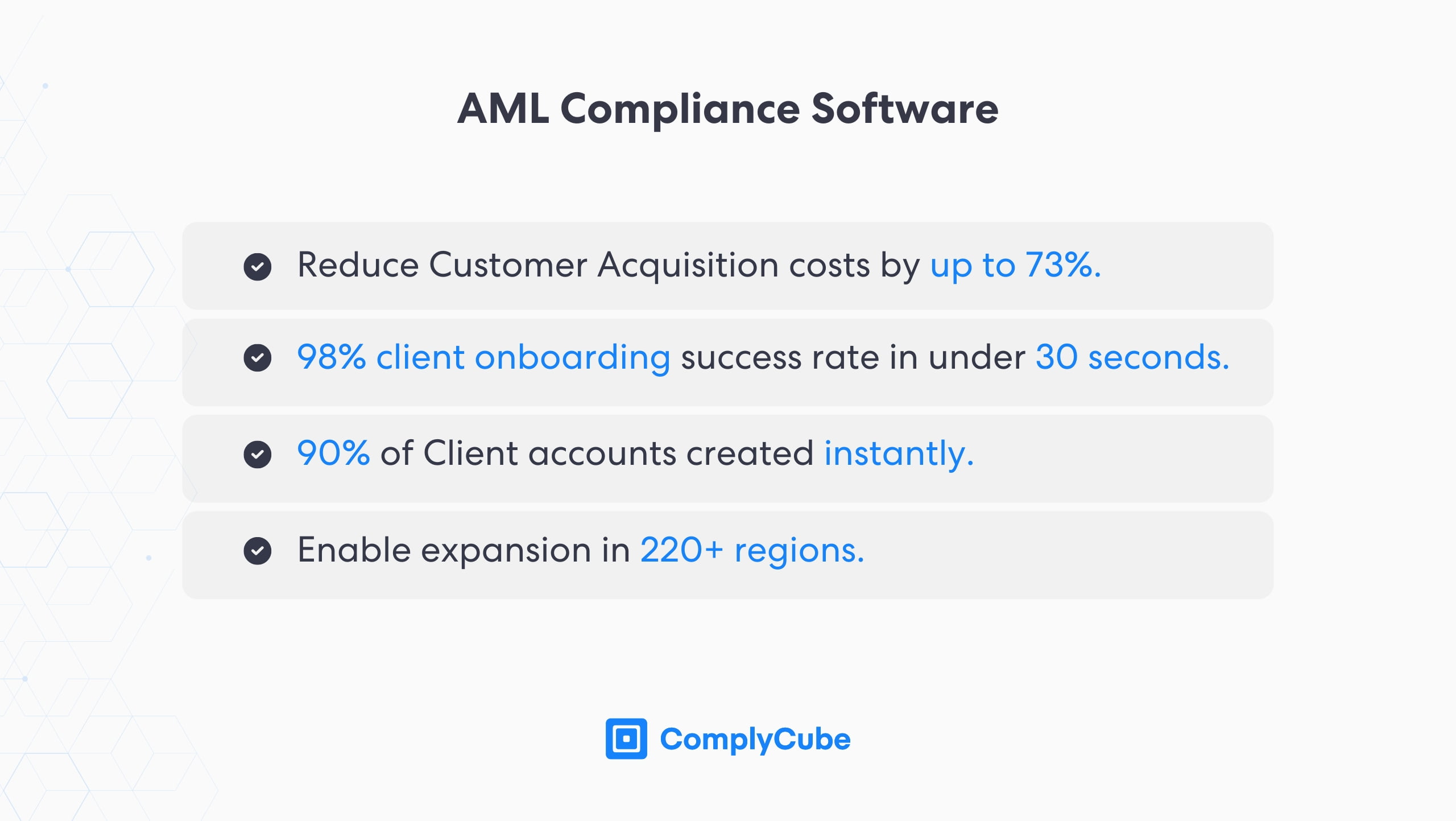
### Key Takeaways
- A risk-based approach replaces one-size-fits-all checks with controls matched to actual AML risk.
- Effective AML compliance starts with a clear money laundering risk assessment at onboarding.
- Higher-risk customers should receive enhanced due diligence, not the same treatment as low-risk users.
- Ongoing monitoring is essential because customer risk can change after onboarding.
- A flexible anti-money laundering framework helps firms stay compliant as threats, products, and regulations evolve.
## About ComplyCube’s AML Risk Assessment Solutions
ComplyCube offers an unparalleled solution for flexible and customizable AML risk assessment controls, enabling partnered firms to adhere to the RBA framework with ease. It offers comprehensive client identification through document and biometric verification, CDD and multi-bureau verification, AML screening, and ongoing monitoring.
These solutions offer a complete compliance package built for total coverage and flexibility under one roof. For institutions interested in learning more about these solutions, [contact](https://www.complycube.com/en/contact/contact-sales/)[a compliance specialist today](https://www.complycube.com/en/contact/contact-sales/).
## Frequently Asked Questions
What is a risk-based approach in AML?
A risk-based approach in AML means applying KYC, due diligence, and monitoring in proportion to the level of money laundering risk a customer or transaction presents. Instead of treating every case the same, firms focus more resources on higher-risk relationships and less on lower-risk ones.
Why is a money laundering risk assessment important?
A money laundering risk assessment helps firms identify which customers, geographies, industries, and activities create higher AML risk before harm occurs. That makes AML compliance more targeted, more efficient, and better aligned with regulatory expectations under a risk-based approach.
What are the main components of a risk-based AML framework?
There are three core elements: initial risk assessment, proportional response, and ongoing monitoring, all supported by a flexible framework that can evolve over time. Together, these controls help businesses adapt KYC and anti-money laundering measures to changing customer and transaction risk.
How does a risk-based approach improve AML compliance?
It improves AML compliance by helping firms allocate resources where risk is highest, reduce unnecessary friction for low-risk customers, and stay responsive to emerging threats. There are benefits such as scalability, better compliance with evolving risks, and reduced regulatory exposure.
How does ComplyCube support a risk-based approach?
ComplyCube supports a risk-based approach through document and biometric verification, CDD, multi-bureau verification, AML screening, and ongoing monitoring. This gives firms a flexible, end-to-end toolkit for managing AML risk and applying proportionate controls under one roof.
**Categories:** Guides
**Tags:** Anti-Money Laundering, Know Your Customer
---
### [Crucial Fintech AML Efforts to Safeguard your Business](https://www.complycube.com/fintech-aml-compliance-checklist/)
**Published:** May 20, 2025
**Author:** Dini Habib
**Excerpt:** While the fast-growing, competitive fintech sector offers many benefits, it can also open the door to increased money laundering risks and financial crime. This guide explores the latest fintech AML regulations and its main challenges.
**Content:**
**TL;DR:** Fintech AML is essential for protecting fast-growing firms from fraud, regulatory risk, and costly compliance gaps. As the biggest challenges in fintech become more complex, firms need smarter systems that keep pace with growth. Stronger fintech and compliance programmes help safeguard operations, build trust, and support long-term scale.
Fintech companies are widely known for adopting advanced technological capabilities, enabling them to develop services that operate at rapid growth, speed, and scale. While this is the main reason the sector is highly competitive and successful, it also opens the door to money laundering and financial crime risk. This guide delves into the importance of Anti-Money Laundering (AML) processes, the latest fintech AML regulations, and the biggest challenges in fintech and compliance.
## The Critical Role of Fintech AML Solutions
The fintech industry creates the perfect space for criminals to engage in terrorism financing, identity theft, and even drug trafficking. This is why there is an increasing requirement for businesses in the sector to leverage strong fintech AML processes:
- **Compliance Obligations:** Regulatory bodies increasingly enforce regulatory requirements on wider sectors, not just traditional banks. Legislation such as the [US Bank Secrecy Act](https://www.occ.treas.gov/topics/supervision-and-examination/bsa/bsa-aml-examinations/index-bsa-aml-examinations.html) and the [Sixth Anti-Money Laundering Directive (6AMLD)](https://eucrim.eu/news/new-anti-money-laundering-directive-amld-6/) requires fintech companies to implement effective AML and [KYC](https://www.complycube.com/en/solutions/due-diligence-compliance/know-your-customer/) compliance solutions.
- **Build a Safe Ecosystem:** Fintech companies that prioritize building a secure environment gain the trust of customers, business partners, and regulators. Integrating a compliance culture is key to preventing data breaches and financial losses. Plus, it strengthens the company’s reputation as a trustworthy player.
- **Remain Competitive:** The fintech industry is highly competitive, and businesses choose to remain agile and flexible to attract customers and investors. Aligning with stringent [AML compliance](https://www.complycube.com/en/solutions/due-diligence-compliance/anti-money-laundering/) enables firms to combat money laundering effectively and avoid reputational risk.
- **Long-Term ROI:** Adopting modern regtech solutions and AML software [supports fintech companies](https://www.complycube.com/en/use-cases/industry/fintech/) by removing manual tasks prone to human error. As a result, organizations can expect higher cost savings, enhanced customer relationships, and long-term competitiveness.
## Key Regulations for Fintech AML in 2025
Global AML compliance standards are often updated frequently to close the gaps that arise from technological and financial innovations. [The Financial Action Task Force (FATF)](https://www.fatf-gafi.org/en/the-fatf/what-we-do.html) is a global organization founded in 1989 by the G7 nations to develop policies to prevent money laundering and terrorist financing.
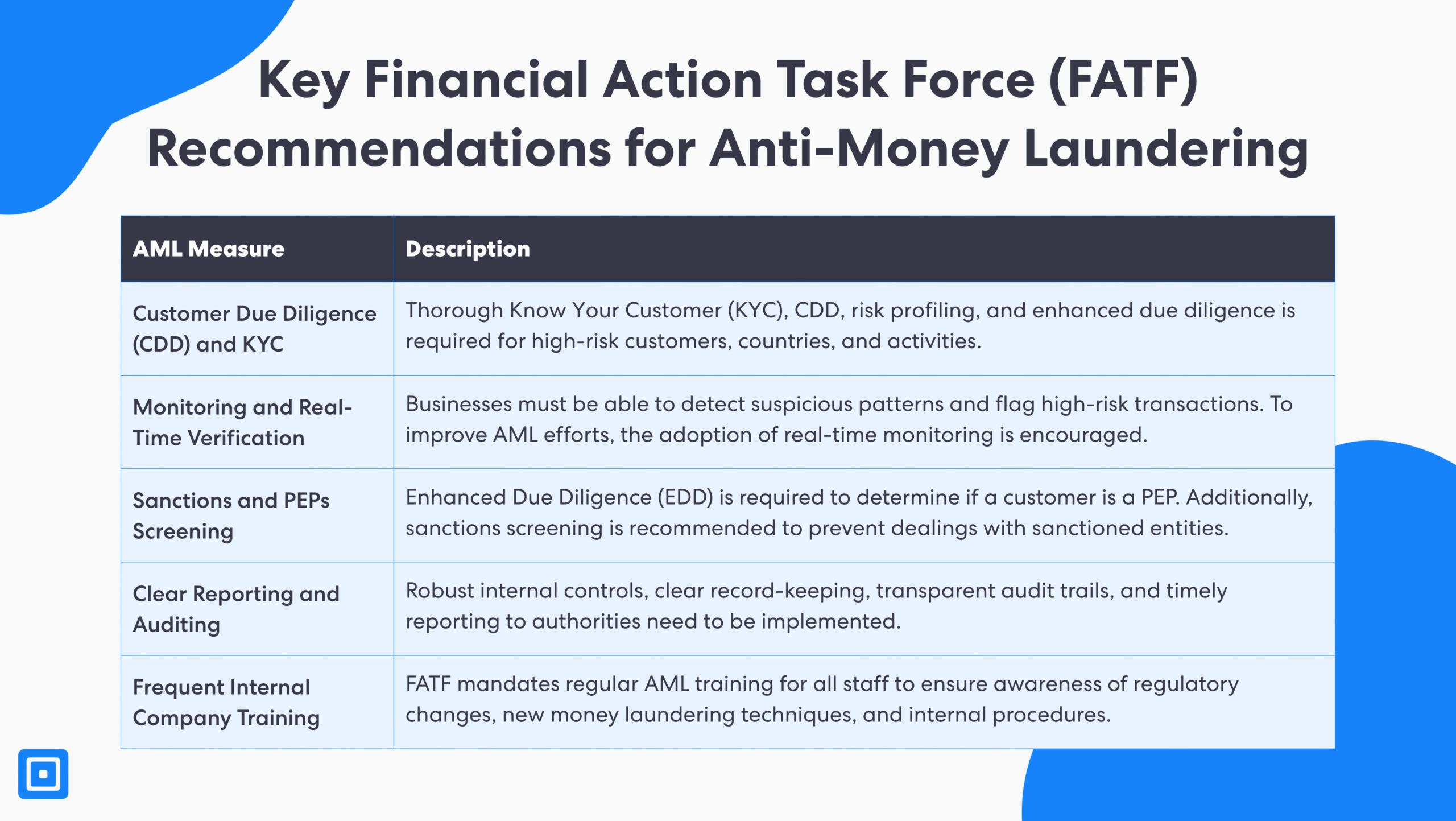
The FATF mandates that businesses within the financial sector or those providing financial transactions implement a strong risk-based approach, enhanced due diligence, and [ongoing AML monitoring](https://www.complycube.com/en/solutions/global-screening/continuous-monitoring/). The most critical compliance processes for fintech companies to comply with FATF recommendations include:
### Customer Due Diligence (CDD) and KYC
Fintech companies must perform thorough [Know Your Customer (KYC)](https://www.complycube.com/en/solutions/due-diligence-compliance/know-your-customer/) and [Customer Due Diligence (CDD)](https://www.complycube.com/en/solutions/due-diligence-compliance/customer-due-diligence/) checks. The process includes leveraging strong identity verification tools to verify customer identities, assess customer risk profiles, and perform ongoing monitoring. To achieve full regulatory compliance, businesses must execute enhanced due diligence for high-risk users and countries.
### Continuous Monitoring and Real-Time Verification
More responsibility is placed on businesses to identify suspicious behavior through ongoing monitoring and real-time transaction verification. Fintech companies must be able to detect suspicious patterns, flag high-risk transactions, and file [Suspicious Activity Reports (SARs)](https://www.nationalcrimeagency.gov.uk/what-we-do/crime-threats/money-laundering-and-illicit-finance/suspicious-activity-reports) promptly.
### Sanctions and PEP Screening
Advanced AML screening capabilities must be adopted to screen customers against global sanctions lists and [Politically Exposed Persons (PEPs)](https://www.complycube.com/en/what-is-a-pep/) databases. Proactive risk management is vital to prevent high-risk clients from accessing sensitive information and keep existing customers safe from potential criminal financial activities.
### Clear Reporting and Auditing Trails
Many jurisdictions now require fintechs to obtain specific licenses or register with local authorities as part of AML oversight. Clear data privacy laws, internal controls, robust reporting, and transparent auditing trails must be implemented to support compliance efforts.
### Company-Wide Training on AML Obligations
Frequent AML training for all staff is mandatory, ensuring awareness of regulatory changes, new money laundering techniques, and internal procedures. Strong corporate governance and a compliance-first culture are essential to meeting regulatory expectations and avoiding enforcement actions.
## The Common Challenges in Fintech AML and Compliance
Financial institutions and fintech firms face many challenges when implementing effective AML programs. If not navigated well, these challenges can lead to dire unintentional consequences, including facilitating illicit funds, tax evasion, suspicious transactions, and other financial crimes.
### Fintech AML challenges are unique and multifaceted:
- **Changing Regulatory Landscape:** Fintechs and financial institutions alike face evolving AML laws and strict regulatory compliance demands. A lot of time and resources are spent monitoring compliance processes and maintaining an effective AML program.
- **Rapid Cross-Border Activities:** With globalization, large financial transactions are happening rapidly across countries. Transaction monitoring and fraud detection are becoming tougher daily, with AML risks on the rise.
- **Digitalization of Identity Verification:** Identity verification and customer due diligence can now be done digitally. While this brings operational efficiency, money launderers can exploit multiple accounts or use stolen identities online, raising customer risk.
- **High Cost:** Most fintech companies operate a lean and agile framework for cost-effectiveness. Having robust [transaction monitoring and risk management tools](https://www.complycube.com/en/solutions/due-diligence-compliance/case-management/) can be harder to expense compared to larger financial institutions.
- **Sophisticated Criminal Tactics:** Relying on legacy and traditional rule-based systems is insufficient to meet Anti-Money Laundering (AML) regulations. Businesses must adopt modern, effective AML compliance tools to outpace criminals.
## What are Popular AML Compliance Failures in The Fintech Industry?
Although most fintech companies may agree that AML compliance is a competitive advantage, it can be detrimental if not properly implemented. Here are some examples:
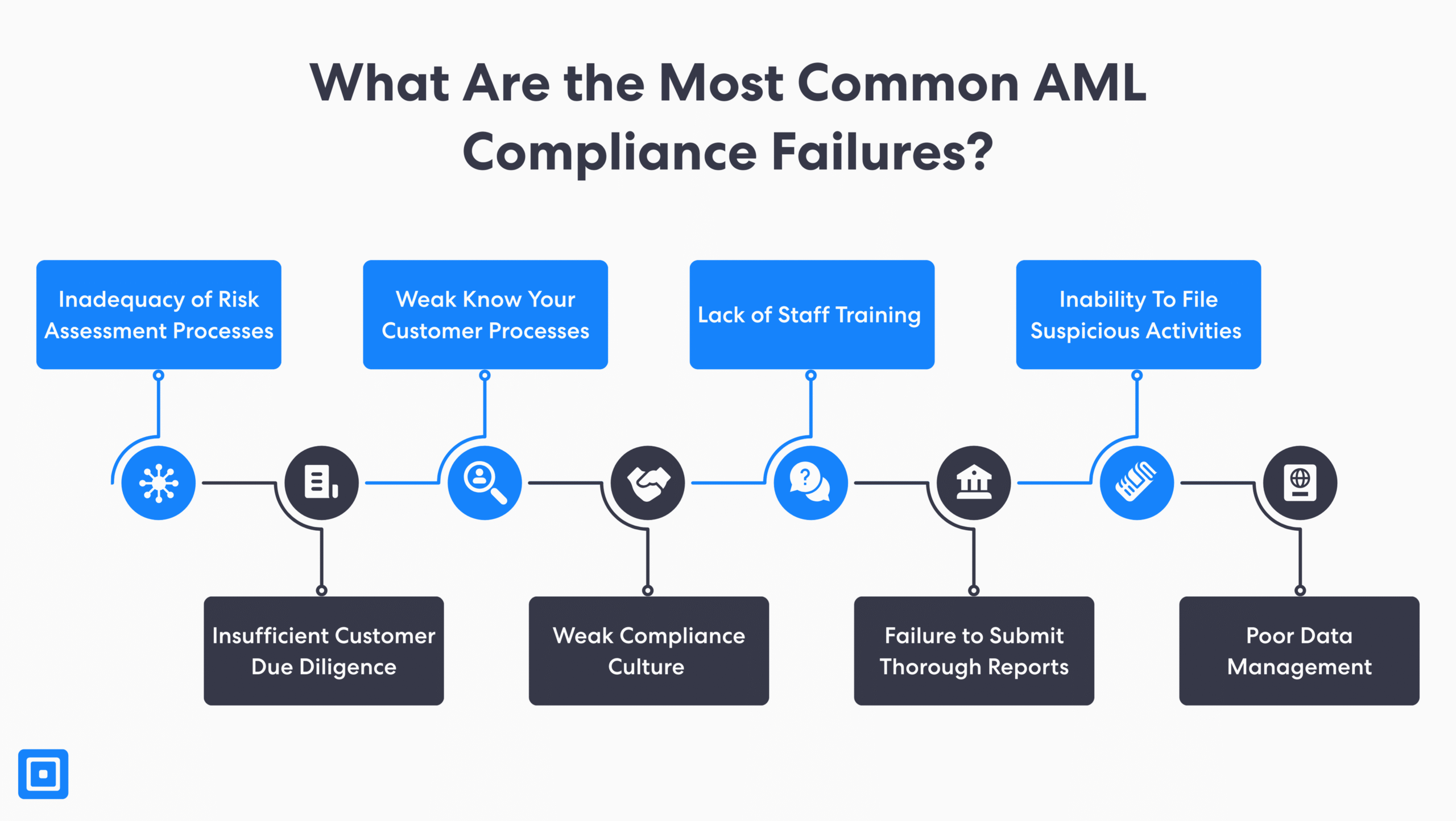
### Case Example 1: KuCoin’s 2 Year Forfeit from the US Market
KuCoin, the global cryptocurrency exchange firm, was fined almost [$300 million](https://www.reuters.com/technology/kucoin-pleads-guilty-agrees-pay-nearly-300-million-us-crypto-case-2025-01-27/) and had to exit the US market for two years. The heavyweight fintech company, launched in 2017, was fined for its poor AML controls and KYC regulations. This included failing to comply with the Bank Secrecy Act (BSA) and its requirements for registering as a money transmitting business.
### Case Example 2: Ratepay faced with nearly €25,000 in fines
Ratepay, a leading German fintech founded in 2009, was fined [€25,000 (approximately $28,260)](https://www.finextra.com/pressarticle/105466/eu-regulators-levied-over-36-million-in-aml-fines-over-the-past-year) by BaFin for anti-money laundering (AML) compliance breaches. The regulator cited Ratepay’s failure to submit adequate suspicious activity reports and transaction data. Additionally, the company had weak internal controls and suspicious transaction monitoring systems.
### Case Example 3: Coinbase Group hit with $4.5 million fines
Coinbase Group, under the CB Payments Limited (CBPL), faced massive losses of [£3.5 million (about $4.5 million)](https://international-adviser.com/coinbase-arm-fined-3-5m-by-fca-for-crypto-related-breaches/) in fines. The Financial Conduct Authority in the UK charged the company for its poor financial crime control framework. Moreover, Coinbase failed to implement strong anti-money laundering (AML) compliance, transaction monitoring, and fraud detection processes.
## Best Practices for Fintech AML Compliance with the U.S. FinCen
The [Financial Crimes Enforcement Network (FinCEN)](https://www.fincen.gov/about/what-we-do) is the U.S. regulatory body that delivers recommendations for AML compliance. While FinCEN’s guidance is centered on the U.S. financial system, it is widely referenced by financial institutions on a global scale:
- **Risk Appetite Management:** Firms are encouraged to adjust their AML controls to align with their risk appetite. A risk-based approach with more resources on higher-risk customers enables compliance while maintaining operational efficiency.
- **Data Sharing Initiatives:** FinCEN strongly recommends that financial institutions share information with one another about suspected illicit funds and suspicious activities. Businesses can expect a more coordinated and holistic response to money laundering and terrorism financing.
### Key Takeaways
- Fintech AML helps protect growth, revenue, and customer trust.
- The biggest challenges in fintech come from speed, scale, and cross-border risk.
- Strong fintech and compliance frameworks rely on risk-based, scalable controls.
- Weak AML controls can trigger fines, remediation costs, and regulatory scrutiny.
- Unified RegTech platforms help fintechs improve compliance without adding needless friction.
## Regulatory Outlook: What’s Next for Fintech AML?
[Fintech AML](https://www.complycube.com/en/use-cases/industry/fintech/) in 2025 seeks to strengthen how financial institutions combat money laundering, financial crime, and terrorist financing. Integrating a strong compliance culture first builds a proactive team that identifies and reduces AML risks. Moreover, teams that adopt AI and Machine Learning (ML) can expect rapid and accurate identity verification and KYC. By following the best practices and latest AML regulations, fintech companies can remain agile and strong in the face of evolving regulations and avoid hefty fines.
[](https://www.complycube.com/en/contact/contact-sales/)
Get started with strong AML and KYC processes with advanced risk management and ongoing monitoring capabilities. [Speak to a member of the team](https://www.complycube.com/en/contact/contact-sales/) today.
## Frequently Asked Questions
What is Fintech AML?
Fintech AML refers to the anti-money laundering controls used by fintech firms to prevent, detect, and report suspicious activity. It usually covers customer due diligence, sanctions and Politically Exposed Person (PEP) screening, transaction monitoring, and ongoing reviews.
What are the biggest challenges in fintech?
The biggest challenges in fintech include fast digital onboarding, cross-border risk, evolving regulations, and high transaction volumes. These pressures make it harder for firms to balance speed, user experience, and effective compliance controls.
Why is fintech and compliance so important?
Fintech and compliance are closely linked because weak controls can expose firms to fraud, enforcement action, and reputational harm. Strong compliance helps businesses meet regulatory duties while building trust with customers, partners, and regulators.
How can fintech companies improve AML compliance?
Fintech companies can improve AML compliance by using a risk-based approach across onboarding, screening, monitoring, and escalation. The most effective programmes combine clear policies, automation, and ongoing due diligence as the business grows.
How does ComplyCube support fintech AML compliance?
ComplyCube supports fintech AML compliance through one platform for Identity Verification (IDV), AML screening, biometrics, fraud checks, and ongoing monitoring. It also offers flexible integration options, global coverage, and enterprise-grade security credentials for scalable compliance operations.
**Categories:** Guides
**Tags:** Anti-Money Laundering
---
### [Top 10 AML Software for Banks to Watch in 2025](https://www.complycube.com/top-10-aml-software-for-banks-buyers-guide/)
**Published:** June 5, 2025
**Author:** Dini Habib
**Excerpt:** Choosing the right AML software for your business is crucial, especially with so many options available today. To select the best AML solution for banking, focusing on core features for effective compliance and risk management is key.
**Content:**
**TL;DR:** AML software for banks helps detect suspicious activity, automate monitoring, and support reporting. The **best AML compliance software** brings screening, transaction monitoring, and case management into one platform. When comparing **AML solutions for banking**, banks should prioritize efficiency, scalability, and a smooth customer experience.
Regulations for Anti-Money Laundering (AML) compliance in the financial sector constantly evolve to prevent advanced financial crime and money laundering techniques. Financial institutions and banks that fail to keep up with these evolving global regulatory standards can face harsh penalties, such as massive million-dollar fines, reputational damages, or even being forced to shut down.
This is why choosing the right AML compliance software is vital. This guide will compare the best AML solutions for banking, showcasing their key features, AML compliance capabilities, and suitability for various banking activities. Read more to discover the top 10 AML software for banks and regulated firms.
## The Importance of AML Software for Banks and Regulated Firms
Anti-Money Laundering (AML) software solutions are key in preserving the integrity of the global financial system. Selecting the right AML software provider supports banks and other financial institutions in adhering to strict regulatory compliance, preventing financial crime risks, and supporting fraud prevention efforts. As criminals execute more sophisticated money laundering schemes, organizations now face immense pressure from regulators to implement advanced transaction monitoring and risk management solutions.
## Evaluation Methodology: How We Selected the Top AML Software for Banks
The selection of the top [AML software](https://www.complycube.com/en/solutions/due-diligence-compliance/anti-money-laundering/) was based on a comprehensive analysis of product performance, regulatory alignment, user experience, and market recognition. It has also integrated objective, reliable software solutions from unbiased SaaS review platforms such as [G2](https://www.g2.com) and [TrustRadius](https://www.trustradius.com), and several findings from recent analyst reports.
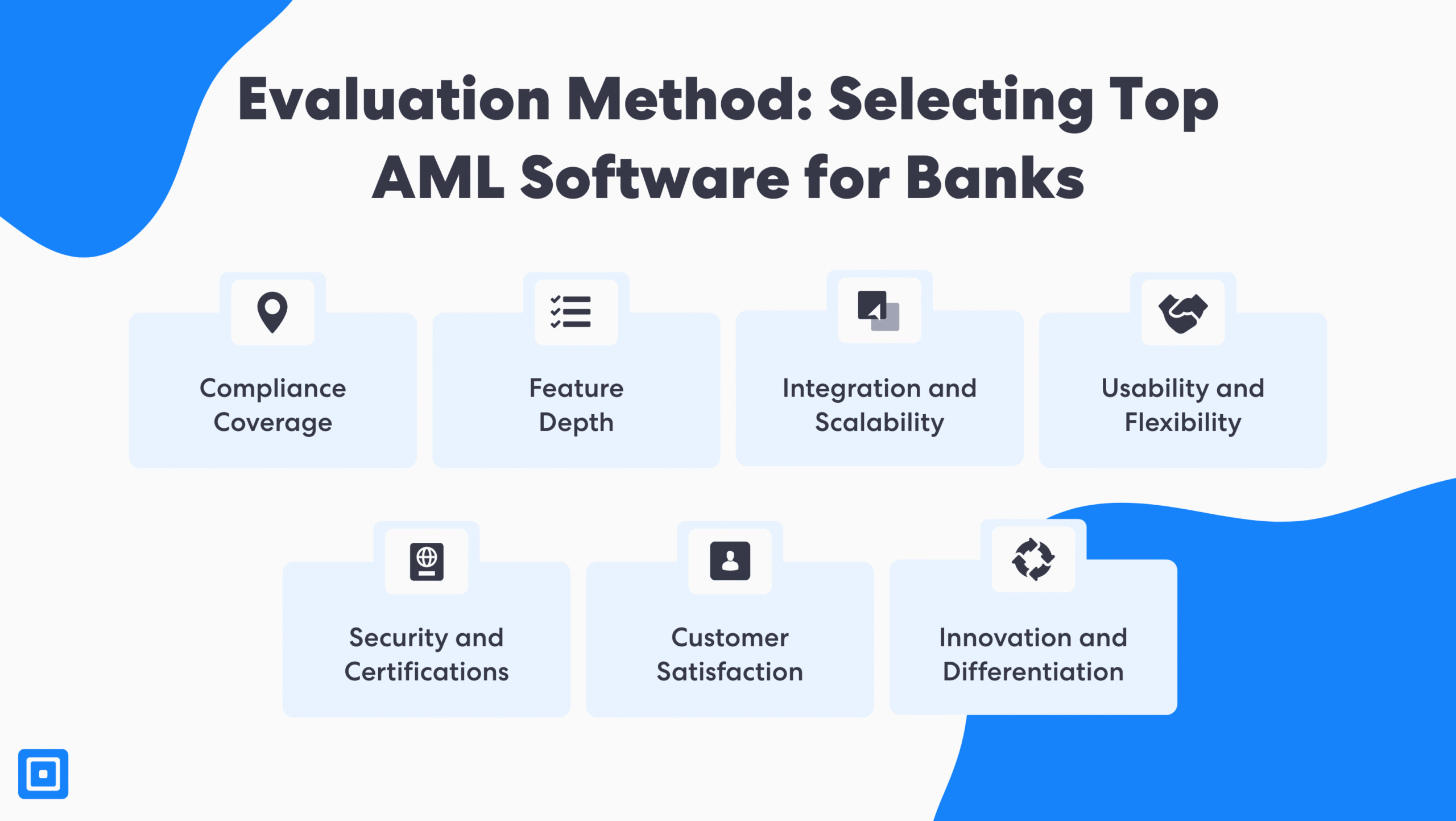
### Key Factors Considered:
- **Compliance Coverage:** The AML software’s competency to tackle international regulatory compliance standards. Popular ones include the [Financial Action Task Force (FATF)](https://www.fatf-gafi.org/en/the-fatf/what-we-do.html), [EU Anti-Money Laundering Directives (AMLD)](https://www.eba.europa.eu/regulation-and-policy/single-rulebook/interactive-single-rulebook/13192 "EU Anti-Money Laundering Directives (AMLD)"), and [Financial Conduct Authority (FCA)](https://www.fca.org.uk).
- **Feature Depth:** The key features in AML screening solutions include [real-time transaction monitoring](https://www.complycube.com/en/solutions/global-screening/continuous-monitoring/), [sanctions screening](https://www.complycube.com/en/solutions/global-screening/sanctions-pep-screening/), adverse media checks, risk management, and auditable reporting.
- **Integration and Scalability:** This factor incorporates whether the Anti-Money Laundering (AML) software has APIs, SDKs, and other integration capabilities to facilitate business expansion over time.
- **Usability and Flexibility:** This covers how simple the platform is to navigate, whether the AML processes are customizable, and if it includes no-code/low-code solutions to simplify compliance.
- **Security and Certifications:** Advanced security frameworks and certifications, such as alignment with [UK DIATF](https://www.complycube.com/en/comprehensive-guide-to-the-uk-diatf-framework/), SOC 2, and [GDPR](https://gdpr-info.eu) requirements for regulated industries.
- **Customer Satisfaction:** Objective customer reviews that determine if the AML software is meeting high usage and client satisfaction levels. Customer support responsiveness and ease of implementation are also considered.
- **Innovation and Differentiation:** The use of Artificial Intelligence (AI), ML, and explainable compliance features that enhance detection accuracy, risk prediction, and support regulatory reporting.
This multi-criteria evaluation method guarantees a holistic view of each AML software solution and how it can empower compliance professionals to maintain compliance across the banking sector. Read below to learn more about each platform and how it supports businesses meeting AML regulations.
### **Case Study: Varengold Bank AG**
In September 2025, the Federal Financial Supervisory Authority (BaFin) identified serious issues at Varengold Bank AG in the prevention of money laundering and terrorist financing. The bank failed to submit suspicious transaction reports (SARs), showing how weak controls and delayed escalation can turn AML issues into a broader governance problem.
##### **Remediation plans and ongoing progress reports**
BaFin ordered Varengold Bank AG to take suitable measures to remedy the shortcomings. The bank submitted a written remediation plan and was required to provide ongoing progress reports, reflecting the kind of structured response banks increasingly need from modern AML compliance software.
##### **Solutions & Outcomes**
- BaFin imposed an administrative fine of **EUR 3.3 million** on Varengold Bank AG for AML failings.
- BaFin also imposed a **EUR 500,000 coercive fine**, showing that remediation failures can create additional supervisory pressure.
- AML technology must support timely suspicious transaction reporting, ongoing monitoring, and documented remediation, not just basic screening.
## Top 10 AML Software for Banks and Regulated Firms
Now that the key considerations behind the selection have been outlined, this section explores each company that made it in the “Top 10 AML Software” list, highlighting niche product features. This list aims to empower organizations in the financial sector to understand which AML providers serve their needs best:
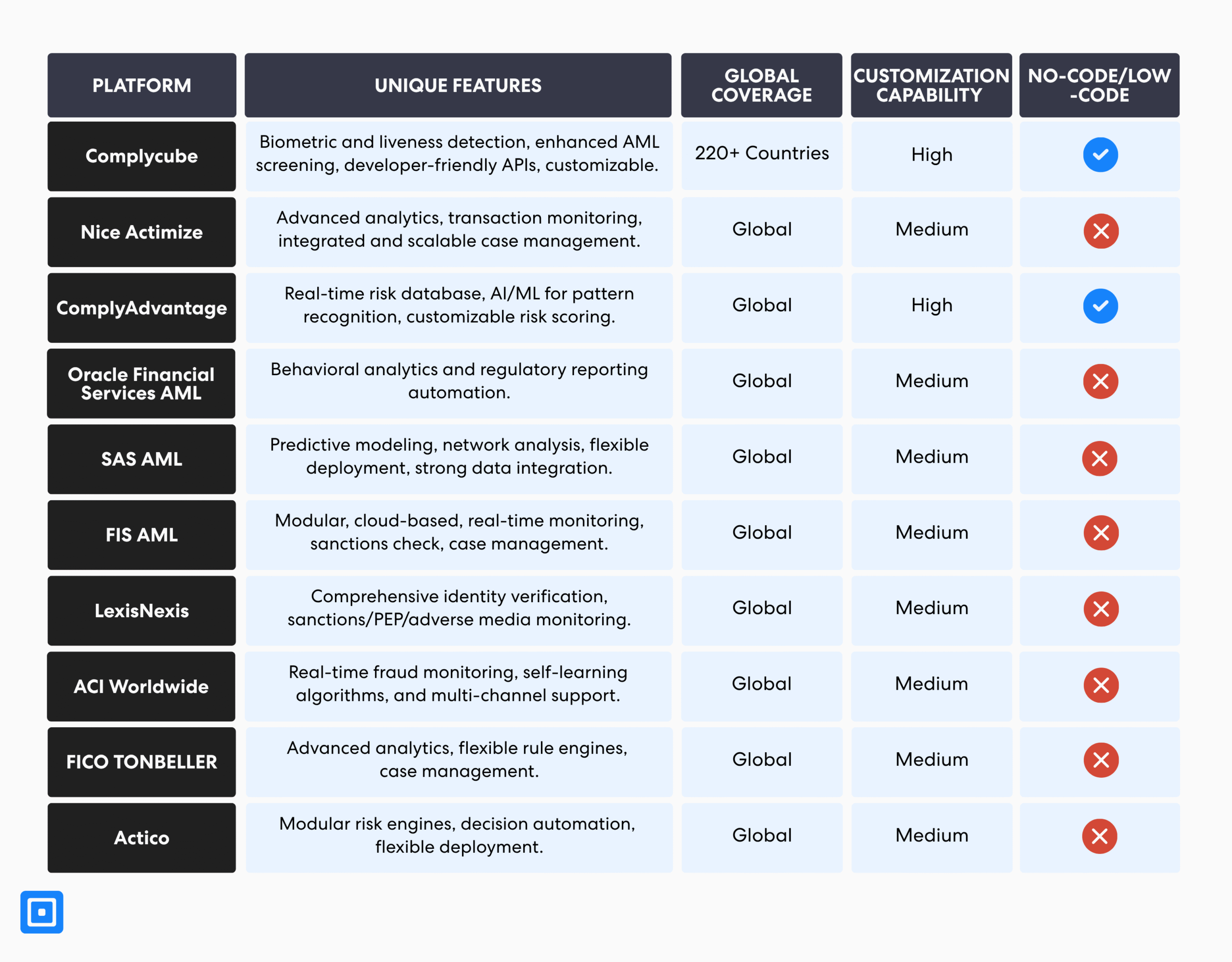
## 1. ComplyCube
[ComplyCube](https://www.complycube.com/en/) is a global provider of AML and KYC. The [FinCrimeTech50](https://fintech.global/fincrime50/) company is known for its unified, all-in-one compliance tools. ComplyCube’s platform is built for companies that need high performance, flexibility, and a global footprint in their AML operations. The platform features real-time AML transaction monitoring, [liveness detection](https://www.complycube.com/en/solutions/due-diligence-compliance/know-your-customer/liveness-detection/), and [adverse media screening](https://www.complycube.com/en/solutions/global-screening/adverse-media-checks/) tools, supporting over 220+ countries. On G2, a leading SaaS review platform, clients in the financial services industry have noted ComplyCube’s seamless integration and scalability capacity, and many have mentioned the outstanding customer success support.
> ComplyCube has [been instrumental](https://www.g2.com/products/complycube/reviews) in automating our due diligence and onboarding processes. Their API is well-structured, making integration seamless, and the platform scales well as we expand into new markets.
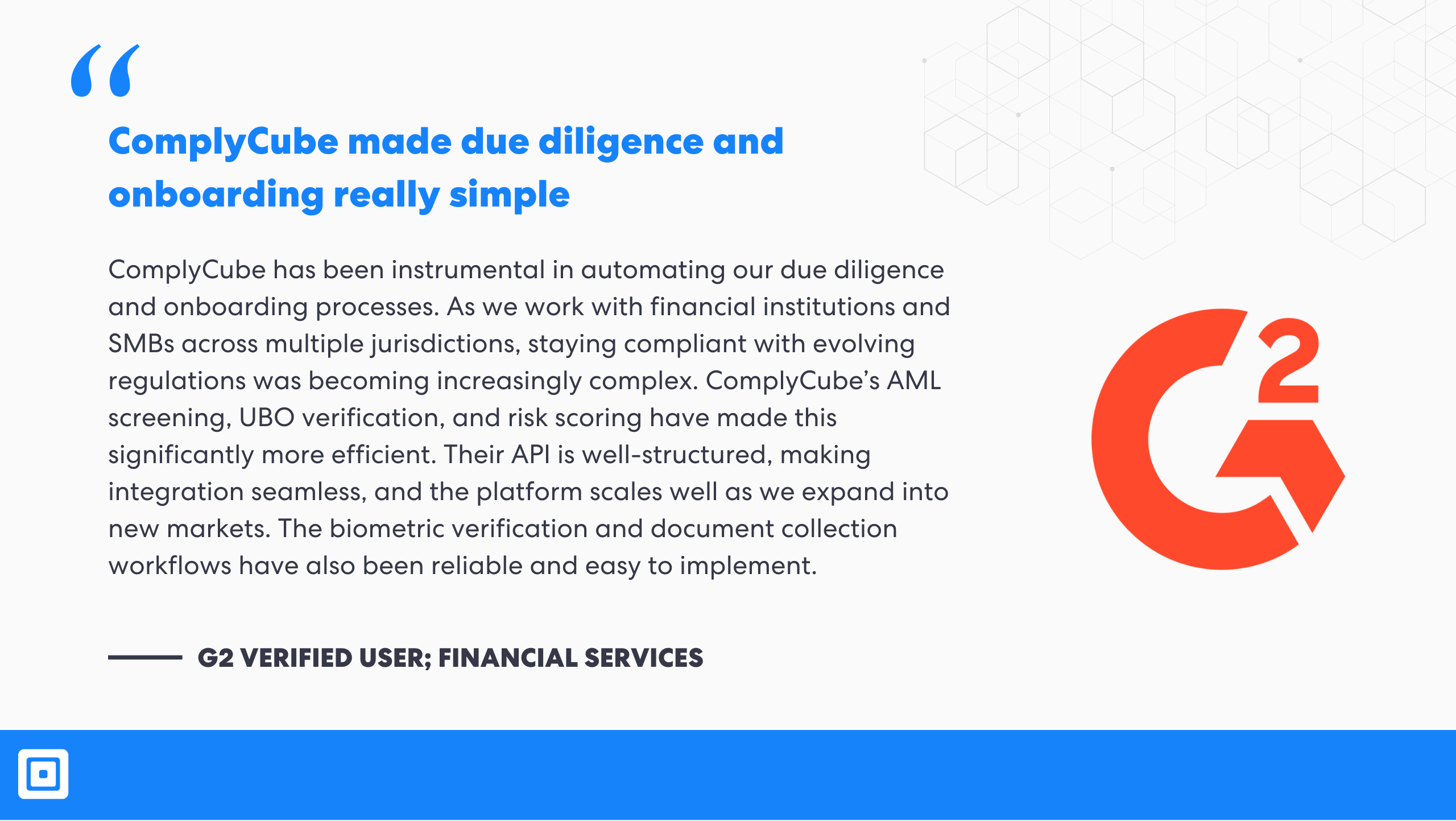
Built with developers in mind, ComplyCube is one of the top no-code AML providers in the market, offering unmatched customization and speed-to-deployment. Additionally, the platform is fully certified and compliant with GDPR, eIDAS, and the UK DIATF.
### Key Features:
- Real-time global watchlist screening
- Biometric liveness detection
- No-code workflow automation
The ComplyCube platform is best for banks seeking a developer-friendly, comprehensive Anti-Money Laundering solution with customizable workflows.
[Click here](https://www.complycube.com/en/complycube-is-a-leader-in-the-g2-spring-2025-report/) to learn more about ComplyCube and its Leadership Status in AML in the G2 Spring Report Awards.
## 2. Nice Actimize
Nice Actimize is a global provider of financial crime prevention and compliance solutions. The platform delivers a suite of AML tools, leveraging AI and machine learning to provide coverage across diverse financial markets. The company adopts a customer-first approach, ensuring that financial risk management capabilities are flexible to a business’s needs. Additionally, NICE Actimize has achieved awards, such as being a leader in The Forrester Wave™: Anti-Money Laundering Solutions in criteria such as data integration and [watchlist management](https://www.complycube.com/en/solutions/global-screening/watchlist-screening/).
### Key Features:
- Advanced analytics for transaction monitoring
- Real-time fraud detection
- Integrated case management
Nice Actimize suits large financial institutions requiring scalable AML tools, risk, and case management features.
## 3. ComplyAdvantage
ComplyAdvantage emphasizes using AI to deliver real-time risk data and monitoring to support financial institutions in identifying and preventing financial crime risks. The platform is known for its continuously updated database, gathering many data points daily, so compliance teams are empowered and informed about threats. The platform’s intuitive interface is also noted for its simple customer screening and rule customization.
### Key Features:
- Real-time risk database updates
- Machine learning for pattern recognition
- Customizable risk scoring
ComplyAdvantage is for banks that need dynamic risk assessment features and real-time data feeds to make proactive, informed decisions.
## 4. Oracle Financial Services AML
Oracle Financial Services provides a suite of AML and financial crime compliance solutions, including the recently announced Automated Scenario Calibration (ASC) Cloud Service. This service automates the manual process of scenario tuning, enabling banks to streamline compliance efforts and reduce costs. Oracle’s solutions are tailored to meet AML requirements, offering flexibility and security through Oracle Cloud Infrastructure.
### Key Features:
- Behavioral analytics
- Entity resolution
- Regulatory reporting automation
The Oracle Financial Services AML software is for financial institutions seeking robust integration and advanced analytics, and firms seeking comprehensive regulatory reporting features.
## 5. SAS AML
SAS Anti-Money Laundering prides itself on its advanced AI and machine learning-driven solutions, which enable a proactive approach to risk management, scoring, and alert generation. The platforms boast a wide array of integrations with various banking systems and regulatory frameworks, making compliance seamless and simple for clients.
### Key Features:
- Predictive modeling
- Network analysis
- Flexible deployment options
SAS Anti-Money Laundering is for firms in highly regulated industries looking for a platform with strong integration and scalability with existing systems.
## 6. FIS AML Software
FIS offers a range of modular, cloud-based platforms such as the AML Compliance Manager, designed to transform financial crime detection. It supports firms in making informed compliance decisions faster through automation, eliminating manually intensive tasks and contributing to operational efficiency. FIS AML provides a unified interface for case management and customer behavior monitoring.
### Key Features:
- Real-time transaction monitoring
- Sanctions check
- Case management workflows
FIS AML solutions are well-suited for organizations seeking analytics, AI-powered detection, and cloud-based automation to reduce manual work.
## 7. LexisNexis Risk Solutions
LexisNexis Risk Solutions provides end-to-end AML solutions that adapt to specific business needs and risk tolerances. Their tools help fortify compliance strategies against regulatory requirements, enabling institutions to meet expectations and thrive in a competitive global market. The RiskNarrative® orchestration platform offers extensive AML transaction monitoring rules, covering a range of scenarios to highlight anomalous behaviors and mitigate risks.
### Key Features:
- Comprehensive identity verification
- Sanctions and PEP screening
- Adverse media monitoring
LexisNexis Risk Solutions is suited for institutions in regulated industries that require high levels of customer due diligence and risk assessment.
[](https://www.complycube.com/en/the-evolution-of-the-risk-based-approach-in-aml/)
## 8. ACI Worldwide
ACI Worldwide offers real-time payment solutions with integrated fraud detection, utilizing self-learning algorithms that leverage information flows across its global footprint. Their AML screening solutions comply with PCI DSS v4.0, Know Your Customer (KYC), and sanction screening requirements, providing a holistic approach to financial crime prevention.
### Key Features:
- Real-time fraud monitoring
- Machine learning algorithms
- Multi-channel payment support
ACI Worldwide’s AML software platform is designed to support businesses operating at scale across global markets. It facilitates organizations such as payment companies, banks, and payment service providers with real-time transaction screening.
## 9. FICO TONBELLER
FICO TONBELLER’s Siron AML solution is a transaction monitoring platform that helps AML compliance officers keep up with new threats and compliance with evolving legislative requirements. The solution includes alert processing tools for false positives analysis, case management tools for scenario customization, and a rule editor for modifying the software.
### Key Features:
- Risk-based transaction monitoring
- Customer due diligence
- Regulatory reporting
FICO TONBELLER’s Siron AML is for banks and financial institutions seeking control over customizable risk management tools according to business needs.
## 10. Actico
Actico’s solutions are created for banks that need automated compliance processes and flexible rule management tailored to various risk appetites. The platform leverages automation tools so compliance officers can efficiently meet compliance and risk management expectations.
### Key Features:
- Rule-based decision engines
- Workflow automation
- Real-time monitoring
The Actico AML software is for organizations seeking regulatory technology with compliance automation technologies and flexible rule management.
### Key Takeaways
- AML software for banks should support screening, monitoring, and reporting.
- Strong AML compliance software helps reduce manual work and false positives.
- Integration and scalability are essential for growing banking teams.
- Usability matters because faster investigations improve compliance operations.
- The best AML solutions for banking combine control, efficiency, and flexibility.
## The Future of AML Technology for Regulated Industries
Future AML software for banks will leverage explainable AI and advanced machine learning to enhance the accuracy of detecting suspicious transactions and [payment fraud](https://www.complycube.com/en/use-cases/process/fraud-prevention/). As financial crime evolves, next-generation AML platforms will enable organizations to proactively spot and investigate unusual behavior.
By reducing false positives and streamlining compliance processes, companies can ensure robust fraud protection against emerging threats. For more information on how you can integrate advanced AML software for banks, contact one of our [compliance experts](https://www.complycube.com/en/contact/contact-sales/).

## Frequently Asked Questions
What is AML software for banks?
AML software for banks is technology that helps financial institutions detect suspicious activity, screen customers against sanctions and watchlists, monitor transactions, manage investigations, and produce audit-ready compliance records.
What features should banks look for in AML compliance software?
Banks should look for real-time transaction monitoring, sanctions screening, adverse media checks, risk scoring, case management, reporting tools, and flexible integrations such as APIs or SDKs. Strong usability, workflow configurability, and security certifications also matter.
Why are AML solutions for banking important in 2026?
AML solutions for banking are increasingly important because regulators expect stronger controls, while criminal typologies are becoming more sophisticated. Banks need technology that can support faster detection, lower manual effort, and better reporting across growing compliance workloads.
How does AML software help reduce false positives for banks?
Modern AML software helps reduce false positives by using better risk models, workflow automation, and AI-supported detection to identify which alerts need urgent review and which can be deprioritized. This improves investigator efficiency and supports more consistent decision-making.
Why should you choose ComplyCube’s AML software for banks?
ComplyCube provides a unified AML compliance software platform that combines Identity Verification (IDV), transaction monitoring, sanctions screening, and case management in one solution. Its flexible APIs and no-code workflows allow banks to deploy and scale quickly, while real-time risk detection and global coverage help teams strengthen compliance without increasing operational complexity.
**Categories:** Guides
**Tags:** Anti-Money Laundering
---
### [Document Check Challenges Guide for Compliance Teams](https://www.complycube.com/document-check-challenges-guide/)
**Published:** March 20, 2026
**Author:** Dini Habib
**Excerpt:** Document check challenges can be complex and are rarely caused by a single bad document upload. Instead, failures in the process can point to many factors. Without the right solutions, it can impact firm operations and KYC effort.
**Content:**
**TL;DR:** Despite modern identity verification solutions, **document check challenges** remain persistent in many compliance teams. This guide uncovers common document verification mistakes, explains why a **document verification fail** occurs, and shares proven prevention strategies.
## Why is Document Verification Challenging?
Document verification processes can be complex, as they are rarely caused by a single bad document upload by a customer. Instead, failures in the process can point to many factors, including stringent risk thresholds, multiple in-flight attempts, or ambiguous onboarding instructions.
Furthermore, additional challenges can stem from technological limitations, including data-capturing errors and poor integration. User behavior such as improper photo angles and inadequate lighting, can also occur. Thus, for compliance teams, the real task is to understand the root of why document verification fail cases happen, what steps to take next, and how to improve the process without compromising customer experience.
## Manual Versus Digital Document Review
Document verifications form a standard component of identity verification and Know Your Customer (KYC) compliance. Typically, during document checks, a customer submits a document, such as a passport or driver’s license, and this document is verified via two different routes.
The first route is manual document verification. In this route, a business will collect physical documents such as government-issued ID cards and cross-check the information against customer inputs (name, date of birth, social security number, residential address). An analyst will typically visually inspect security features on a physical level. This verifies that the person presenting the document matches the submitted information.
On the other hand, an [automated document verification](https://www.complycube.com/en/document-validation-automation-kyc-compliance/) process uses Artificial Intelligence (AI) tools, such as Optical Character Recognition (OCR), to instantly extract customer information. This key information is auto-matched against a customer’s onboarding input in seconds. Digital document verification incorporates validation scans of the document for its security features (holograms, watermarks, microprinting). Thus, it can handle high verification volume with minimal human intervention.
### The benefits of automated document verification:
- Online document checks support remote teams in scaling verifications without staff burnout or backlog.
- Manual checks are time-consuming. Digital verification significantly reduces processing from [minutes to seconds](https://www.gov.uk/government/publications/digital-id-scheme-explainer/digital-id-scheme-explainer).
- [Digital ID services](https://assets.publishing.service.gov.uk/media/69b2bd51c8010d37b34e008a/Making_public_services_work_for_you_with_your_digital_identity_2026.pdf) enhance security, reduce costly errors from human review, and boost operational efficiency.
- Manual processes can invite human error, such as misreading text. Automated processes, however, establish consistent reviews.
## Common Document Check Challenges
Document verification fail cases must be viewed as operational intelligence, not just onboarding friction. For example, a customer may be legitimate, but their document quality may prevent successful verification. [Effective document verification](https://www.complycube.com/en/solutions/identity-assurance/document-verification/) is thus two-fold; it confirms that a document is genuine and it verifies customer identities as a legitimate holder.
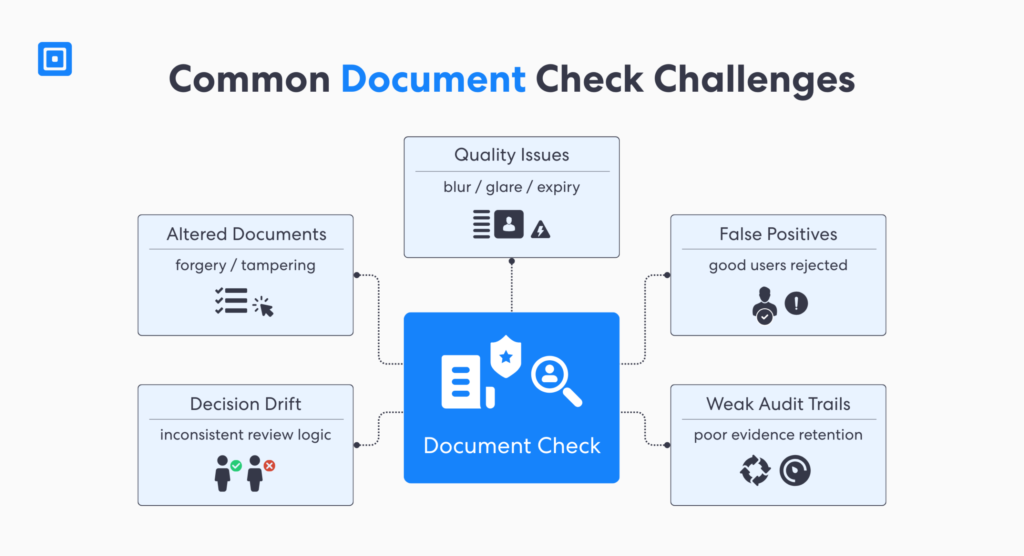
As a result, document review must be framed as part of a broader, end-to-end compliance infrastructure rather than an isolated fraud filter. In this section, we cover the biggest document check challenges from ComplyCube’s network experience, following authoritative, regulatory-backed solutions.
### 1. Distinguish Genuine from Altered Documents
Over the years, document forgery and tampering have advanced, with Cifas reports recording [over 440,000 identity fraud cases](https://www.cifas.org.uk/newsroom/fraudscape2026). Additionally, the rise of [“template farms,”](https://www.cifas.org.uk/newsroom/fraudscape2026) which produce and sell editable fakes fuel document fraud growth. These mimic genuine layouts, personal details, and images, making detection complex.
> Multi-layered document review moves beyond a single check to scale verified onboarding.
To combat this challenge, [the US NIST](https://pages.nist.gov/800-63-3/sp800-63b.html) encourages a multi-layered verification process. Organizations can stack biometric liveness, database checks, and [device intelligence](https://www.complycube.com/solutions/fraud-intelligence/device-intelligence) to build complete customer risk profiles, supporting faster compliance decisions. ComplyCube’s CPO, Harry Varatharasan, notes, “A multi-layered review process moves beyond a single check to enhance verified onboarding.”
### 2. Document Quality and Eligibility Issues
[Poor image quality](https://www.sciencedirect.com/science/article/pii/S2590123025010540) remains a core challenge for many organizations, eroding document integrity. For example, blur, glare, or cropped edges can lead to false positives and unnecessary resources wasted on escalations. Additionally, expired documents and damaged surfaces add to these failures.
Quality controls must be dedicated at the point of capture. For example, businesses can implement real-time image quality checks, capture prompts, field validation, and mandatory multi-side capture to create cleaner submissions and defensible audit trails:
##### Real-Time Image Quality Checks:
- **Blur detection**: If the sharpness score falls below 80% → Trigger “Hold steady, retake.”
- **Glare analysis**: For overexposures above 30% → Trigger “Angle away from lights.”
- **Framing complete**: All 4 corners of a document are visible → Trigger a green checkmark.
##### Guided Capture Prompts
- **Live previews:** Indicate proper framing with green and red zones.
- **Step-by-step**: Showcase clear steps and a progress bar, such as “Front → Back → Selfie”
- **Context-aware**: Add guidance on specific document types, for example, “Passports need MRZ visible.”
##### Pre-Submission Field Validation
- **Name/Date of Birth auto-fill**: Extract data from OCR, which a customer later confirms with a tick.
- **Expiration Validation**: If the ID expires, release a statement to get it replaced with other valid document.
- **Document Damaged**: Flag and prompt for a replacement with an alternative document type.
### 3. False Positives
Poor-performing, outdated systems can reject legitimate users and drive up manual reviews. At scale, false positives [drive up compliance resources](https://www.cyberhaven.com/blog/5-reasons-you-cant-afford-to-ignore-false-positives#:~:text=At%20first%20glance%2C%20a%20false,misinterpret%20normal%20behavior%20as%20risky.), distort risk metrics, and lead to onboarding friction. Overly strict thresholds, poor country routing, and weak exception handling can all lead to artificial fail rates.
> Risk assessment requires analysis of false positive data points and previously generated false positives.
To combat this challenge, it is first crucial to assess the previously generated false-positive [data points](https://financialcrimeacademy.org/minimizing-false-positives/). As a solution, organizations can fine-tune risk thresholds and route localized templates to eliminate generic model failures. In the US, for instance, every state issues driver’s licenses differently. By routing each state to its correct template library, false positives can be minimized.
### 4. Inconsistent Decision and Governance
Different compliance officers may reach conflicting outcomes on document cases. Additionally, fragmented ownership leads to unclear accountability during reporting. Inadequate training on changing regulations can also leave teams applying outdated regulatory standards.
Organizations are encouraged to create a clear control ownership model. This includes who owns, has access, and can modify change controls. Modern document verification software includes [role-based access controls (RBAC)](https://www.ibm.com/think/topics/rbac), which restrict access to different staff according to role type. Pairing this with periodic training and using pre-built policy templates enables consistent application across global regulatory frameworks, including the US Financial Crimes Enforcement Network (FinCEN), Singapore’s MAS, eIDAS, and the Financial Action Task Force (FATF).
### 5. Weak Audit Trails
Document verification does not end with successful onboarding. Regulatory authorities expect organizations to submit reports with comprehensive decisions. Just last year, Anti-Money Laundering (AML) fines [totalled over $6 billion](https://www.complycube.com/en/top-5-aml-fines-in-2025-you-need-to-know/), showcasing heightened enforcement towards compliance. Common pitfalls at this stage can point to data collection and integration gaps.
Modern document management leverages version control and AI algorithms to automatically deliver the latest version of compliance policies. API and SDK integration captures real-time decision logs for every case, which support real-time data integrity, timestamped evidence of customer risk profiles, and decision framework changes. Moreover, [centralized dashboards](https://www.complycube.com/en/solutions/due-diligence-compliance/case-management/) with audit-ready features can identify training gaps and red flags before regulatory examination.
## Document Verification Mistakes to Avoid
Document verification mistakes can happen during review and policy response. These operational mistakes might seem minor from the outset, but they can produce fragmentation. As a result, genuine documents are delayed, while fraudulent documents slip through the gaps.
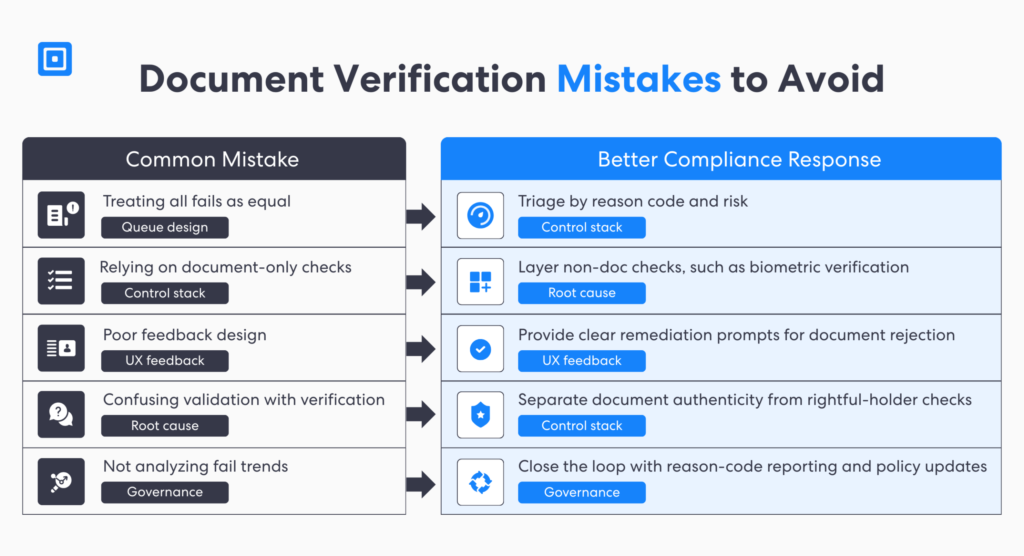
Consequently, these errors compound into higher manual review volumes, rapid customer drop-off, and regulatory exposure. However, with the right tools and framework, organizations can create a strong culture of compliance while maintaining a satisfied customer and client base. The common mistakes we see in many organizations include:
- **Treating all fails as equal:** For example, a blurred image should not follow the same customer messaging and reviewer path as a suspected document forgery. Instead, build reason-code discipline and route each issue at each stage according to the risk level present.
- **Reliance on document check:** Typically, a document-only decision can lead to high false positives or negatives due to a narrow risk profile. In contrast, combining [biometric](https://www.complycube.com/en/solutions/identity-assurance/biometric-verification/) and database verification offers robust customer profiles, catching fraud while onboarding real customers faster.
- **Poor feedback design:** Generic messages, such as “try again”, can lead to multiple submissions without better quality. Clear remediations tell the user whether the issue relates to an unaccepted document type or cropped edges, eliminating friction and boosting conversion.
- **Validation vs verification:** The [US NIST](https://pages.nist.gov/800-63-4/sp800-63a.html) separates evidence validation, where a document is analyzed for its genuineness from identity verification, where the applicant is checked to be the rightful owner of the same document. Without the other, remediation steps can be weakened.
- **Weak insights:** Failure reasons, including understanding where a user drops off in the onboarding stage, provide key insights into the root cause. When data are not analyzed, organizations cannot tell whether rising failure rates are due to fraud risks or weak user experience.
### **Case Study: Money Laundering Heist Traced to Poor Document Verification**
In 2023, Singapore authorities exposed the largest money laundering case in the country, with over S$3 billion in illicit assets transacted. In 2025, nine financial institutions were linked to the case, with [a total S$27.45 million](https://www.complycube.com/en/mas-fines-money-laundering-case/) fine due to weak document checks and due diligence.
##### **Shocking investigation uncovers years of non-compliance**
Leading firms, including UOB and Citibank, were found to have gaps in their identity verification processes. This includes the failure to verify source-of-wealth documents, outdated or incomplete documentation, and approving high-risk clients despite red flags.
##### **Outcomes**
- The total fines across these 9 firms amounted to S$27.45 million, with the highest fines for Credit Suisse (S$5.8M) and UOB (S$5.6M).
- Several senior executives faced harsh sanctions, including the CEO and COO of Blue Ocean Invest, who had to exit the financial services sector.
- The case highlights the impact of policies and compliance discipline, indicating that the right tools are not enough without strong governance.
## Respond Better to Document Check Challenges
Jurisdictions such as the EU, U.S., Singapore, UK, and UAE generally require risk-based customer due diligence and identity verification using reliable, independent sources. However, the exact documents, methods, and sector-specific obligations vary by jurisdiction and by regulated entity.
Non-compliance can risk multimillion fines, erode customer trust, and cause reputational damage. Effective document verification analyzes if the process is risk-based, consistent, and auditable, as per the [FATF’s Recommendation 10](https://www.fatf-gafi.org/content/dam/fatf-gafi/recommendations/FATF%20Recommendations%202012.pdf.coredownload.inline.pdf). This goes beyond fraud prevention, supporting regulatory defensibility.
For compliance teams, that usually means five step-by-step improvements:
**1. Adaptive workflows:** Use smarter, structured rules to bypass, escalate or request alternate evidence from live risk signals. Test and tweak them where necessary.
**2. Better capture guidance:** Real-time prompts to eliminate wrong user behavior, such as glare, cropping, and incomplete submissions, before review.
**3. Tiered routing:** Route each customer workflow by jurisdiction, document type, and risk profile, moving away from one uniform decision logic.
**4. Layered identity checks:** Combine document review with biometric verification, device intelligence, and [database checks](https://www.complycube.com/en/solutions/identity-assurance/multi-bureau-checks/) where appropriate.
**5. Reason-code reporting:** Track failure reasons at a granular level, with segmented, visual analytics to separate UX issues from fraud effectively.
### Key Takeaways
- **Common document check** challenges include poor document quality and eligibility, high fraud positives, and weak governance.
- **Document verification fails** are triggered by unclear onboarding instructions, technological limitations, and user behavior.
- **Multi-layered verification** removes document review as a standalone check, producing robust customer risk profiles and fraud detection.
- **Real-time image quality checks**, guided capture prompts, and pre-submission field validation improve customer experience and onboarding
- **Document verification software** with pre-built policy templates, such as ComplyCube, supports firms in meeting KYC obligations.
## Save Time with Compliant Document Verification
Document verification failures are not just onboarding errors. Compliance teams can leverage them as data points to built stronger KYC outcomes throughout the onboarding and monitoring process. Adopting a smarter response to document check challenges with a layered, [risk-based approach](https://www.complycube.com/en/what-is-a-risk-based-approach/) positions firms to better detect fraud and maintain compliance.
Additionally, embedding real-time document quality checks and clear prompts fosters enhanced customer experience, and in turn, long-term loyalty and revenue. Discover how [ComplyCube’s](https://www.complycube.com/en/contact/contact-sales/) automated document verification and fraud intelligence solutions can transform your compliance operations.
[](https://portal.complycube.com/signup)
## Frequently Asked Questions
What are the reasons for a document verification fail?
Document verification failures include poor image capture, such as blurry, glare, damaged, or cropped edges. Expired documents, unaccepted original document types, and software failures when extracting customer information also cause document check challenges. Other reasons point to compliance failures, such as suspicion of fraud or a high-risk customer profile.
What are the top document check challenges?
Common document check challenges include the inability to identify tampered documents, poor document quality, high false positives, and weak governance. These challenges, when not resolved, lead to fragmented decision-making in compliance, hampering KYC and fraud prevention efforts.
How does document verification support compliance?
Document verification supports KYC and AML processes by verifying that a user is a real person and a legitimate holder of a document. It involves validating security features on a document (watermarks, holograms, etc) to prevent fraudulent activity. Global regulations, such as the EU’s eIDAS, US FinCEN, and Singapore’s MAS, mandate document checks in customer due diligence.
What are common document verification mistakes?
The most common document verification mistakes that compliance teams make include over-reliance on manual reviews, dependence on document review as a standalone check, and poor feedback design. These mistakes negatively impact customer experience and can introduce compliance risks due to human error, leading to reputational harm and legal exposure.
Can ComplyCube’s document check stay ahead of regulatory changes?
Yes. ComplyCube’s bespoke document verification solutions accept over 14,000 document types in 250+ territories. The platform provides pre-built policy workflows aligned with international regulations (Canada’s FINTRAC, Singapore MAS, UAE CBUAE, UK DIATF, etc). Additionally, its no-code workflows support quick workflow deployment aligned with new rules in seconds.
**Categories:** Guides
**Tags:** Know Your Customer
---
### [How Crypto Fraud Detection Software Spots and Stops Risky Behavior](https://www.complycube.com/crypto-fraud-detection-software/)
**Published:** March 12, 2026
**Author:** Rithu Jagannath
**Excerpt:** Learn how crypto fraud detection software helps Web3 and crypto platforms stop scams, reduce false positives, and monitor risky activity with AI-powered controls, stronger compliance, and better protection for users and digital assets.
**Content:**
**TL;DR:** In today’s world, modern crypto fraud is getting out of hand and this is where **crypto fraud detection software** comes in. **AI fraud prevention for Web3** and crypto helps exchanges, wallets, and payment platforms spot risky behavior. It links identity checks, transactions, and behavioral signals to strengthen **cryptocurrency fraud prevention.**
## What Is Crypto Fraud Detection Software?
When you think of crypto fraud detection software, businesses need help spotting suspicious identities, devices, and accounts. By looking at crypto wallet activity and transactions, it lets companies to separate normal behavior from activity that could harm businesses such as scams, theft or money laundering.
Additionally, crypto fraud prevention software uses tools to check each and every session for signs of fraud. This helps protect both traditional payment processes and digital asset transactions. Software can also help remove fraudulent accounts, and support Anti-Money Laundering (AML) compliance protocols.
In crypto, it is important to cover more than just the blockchain activity alone. By looking at onboarding signals, customer behavior, risk scores, and linked payment activity, firms can see fraud faster than ever before. They can catch wind of funds that are off-ramped across on-chain and fiat transactions. Monitoring and flagging suspicious cryptocurrency transactions is incredibly crucial for building trust and protecting user assets from the vast amounts of emerging scams.
## Authorized Push Payment and Bank Account Fraud
However, even before a digital wallet is funded, the act of crypto fraud can start. This can happen through a bank transfer process called an [Authorized Push Payment](https://www.ukfinance.org.uk/policy-and-guidance/reports-and-publications/annual-fraud-report-2025) (APP). Nowadays, a victim (no matter individual or business) can get tricked into sending money from a bank account to a merchant. So, even though the bank transfer can look real, it is actually based on a lie.

APP fraud is pure manipulation. It matters because the payment will seem real to the sending bank, even when it is possibly linked to investment scams, social engineering, or mule activity. Once the funds move into crypto, recovery becomes harder even with regulations cracking down and making the situation better. That is why crypto businesses need clarity into [payment behavior](https://www.complycube.com/en/solutions/fraud-intelligence/) as well as activity on their own platforms to stay ahead.
## Why Crypto Fraud Detection Software Combats Emerging Threats and Fraud Typologies
Crypto fraud is changing fast as criminals adapt to new user journeys, products, and attack methods. The methods are varied and nuanced. From identity abuse to impersonation and mule networks to organized scam campaigns, crypto fraud prevention software platforms are [being put to the test](https://www.chainalysis.com/blog/crypto-scams-2026/).
These [crypto fraud scams](https://www.complycube.com/en/crypto-money-laundering-red-flags/) are harder to stop. To keep regulators on their toes, criminals keep changing their tactics. Obviously, rules still matter, but companies also need AI-powered intelligence. It helps them deal with large amounts of data, spot linked behavior, and keep up with new fraud strategies.
## False Positives, Risk Scoring, and Approval Rates
There are a few issues that come up in cryptocurrency fraud prevention. Firstly, it is cutting down on false positives. In crypto, high-value transfers, cross-border activity, and new devices can all look to be okay. However, this means strict controls may flag harmless behavior and create friction for real crypto users.

Secondly, a lack of good risk scoring in the fraud prevention process. According to the [Financial Action Task Force](https://www.fatf-gafi.org/en/publications/Fatfrecommendations/Guidance-rba-virtual-assets-2021.html)‘s updated documents around risk and virtual assets, better risk scoring helps fix this problem. By looking at identity, devices, transactions, and wallet data together, firms can build a clear profile for each user. This lowers manual reviews and defends approval rates without breaking down security.
## Account Takeover and Sensitive Information Risks
Another big risk is [account takeover](https://www.sentinelone.com/cybersecurity-101/threat-intelligence/the-ultimate-guide-to-preventing-account-takeover-attacks/). This is one of the ways users lose digital assets in the cryptocurrency space. Attackers use stolen blockchain data, use phishing, fake support messages, and other social engineering tactics. It allows them to access user accounts and move funds before the victim can even notice.
However, the risk gets worse when criminals and fraudsters collect private data which helps them go past normal security checks and [Decentralized Finance](https://www.esma.europa.eu/sites/default/files/2025-01/EBA-ESMA_DeFi_factsheet.pdf) (Defi) processes. That is why strong cryptocurrency fraud prevention controls should track any relevant login changes, unusual devices, and withdrawal behavior. This helps platforms protect their customers well before assets are moved out.
## Cryptocurrency Scams, Crypto Scams, and Investment Scams
All it takes with [cryptocurrency](https://www.complycube.com/en/use-cases/industry/crypto/) scams is persuasion. Technical attack vectors don’t have the same impact anymore. Criminals and fraudsters alike use fake community groups, spoofed support networks, and highly polished investment pitches to convince victims to send money to the wrong wallets or platforms.
These crypto scams often rely on trust and repeated contact. Users often make several transfers well before they know they have been deceived and can let law enforcement know. This is exactly why platforms need proactive AI fraud prevention for Web3 and crypto because they can spot any odd behavior liked to investment scams, pig butchering, and other similar fraud models. You can learn more here: [The Cost of Pig Butchering Crypto Scams in 2023](https://www.complycube.com/en/americans-lost-5-6b-to-pig-butchering-crypto-scams-in-2023-what-about-the-uk/)
## Digital Wallets, Addresses, and Ongoing Monitoring with Crypto Fraud Detection Software
Moreover, the fraud risk continues further after the onboarding process. With [digital wallets](https://www.complycube.com/en/new-uk-digital-wallet-in-2025/) and linked wallet addresses constantly being switched, ongoing review is a part of cryptocurrency fraud prevention. This is because a customer’s exposure can change fast. As soon as they start mixing up with risky counterparts or suspicious transaction flows, all bets are off.
This is why [ongoing monitoring](https://www.complycube.com/en/solutions/global-screening/continuous-monitoring/) matters. AI fraud prevention in Web3 and crypto depends on detecting suspicious activity as it happens. Relying on delayed reviews after funds have been moved is pointless. This is important for platforms that support both fiat and crypto activity. You can learn more here: [What is an Ongoing Monitoring Process?](https://www.complycube.com/en/what-is-an-ongoing-monitoring-process/)
### **Case Study: Bybit and the Need for a Real-Time Fraud Response**
In February 2025, Bybit lost around [$1.5 billion due to fraud](https://www.complycube.com/en/bybit-faces-1-5bn-hack-in-biggest-crypto-scam/). Criminals broke through a major crypto platform and quickly drained assets. They moved funds across wallets and exchanges so quickly that teams couldn’t intervene in time.
##### **Rapid Review Across the Crypto Ecosystem**
The response relied on fast tracing, monitoring, and fast review across the ecosystem. Fraud investigators used screening, alert-driven workflows, and real time analysis to detect suspicious movement, and act quick when stolen funds showed up at other digital asset and service providers.
##### **Outcomes**
- The theft was about **$1.5 billion**, one of the biggest crypto hacks on record.
- Greek authorities carried out their **first-ever cryptocurrency seizure** linked to the incident.
- An exchange apparently froze around **$150,000** in stolen assets in after the funds reached them.
## Biometric and Behavioral Biometric Signals with Crypto Fraud Detection Software
Another metric to help detect fraudulent activity is [biometric verification](https://www.complycube.com/en/solutions/identity-assurance/biometric-verification/). Biometric and behavioral signals can decide if a person using an account is real. More than that, they can also learn whether their actions are consistent with expected behavior of a normal user. These intuitive checks can bolster the whole onboarding and transaction review process. It adds much more context rather than looking at credentials or static profile data alone.
So, when this is blended with AI models, biometric signals support proactive cryptocurrency fraud detection. AI fraud prevention for Web3 and crypto help with unusual session patterns and repeated abuse attempts. Any suspicious changes in user behavior is accounted for. It could point to a bot, compromised account, or even worse, an organized fraud ring with criminals.
## Case Management and One Platform Response in Crypto Fraud Detection Software
Therefore, fraud detection only matters when it leads to tangible action and results. Strong compliance and fraud teams need thorough case management with real-time rules and clear paths for higher risk situations. This supports investigations of suspicious activity, keeps records, and helps them act before the risk grows out of control.

> Crypto fraud rarely appears as one clear signal. It usually builds across identity, payments, behaviour, and transaction activity.
This is why [sanctions and PEP screening](https://www.complycube.com/en/solutions/global-screening/sanctions-pep-screening/) as well as other wider compliance solutions such as [adverse media](https://www.complycube.com/en/solutions/global-screening/adverse-media-checks/) need to work with fraud controls. Chief Product Officer, Harry Varatharasan, goes on to say, “When these signals are looked at together, fraud and compliance teams can respond faster, lower false positives, and make better decisions before suspicious activity keeps going.
When every part of the crypto fraud detection is modular and stacked well, onboarding checks, screening results, and any user concerns can sit all in one platform such as ComplyCube. This allows crypto teams to move faster and review with the confidence.
## Protecting Digital Assets in the Web3 and Crypto Ecosystem
Protecting digital assets is important in a changing world. Now, crypto companies are facing rising levels of APP fraud, investment scams and other types of fraudulent activity. Criminals are finding more new ways to exploit users through their digital wallets, bank accounts and decentralized platforms. This places both customer trust and assets at risk.
Through artificial intelligence and machine learning, crypto companies can now learn to review large amounts of data in real time. Biometric or behavioral signals, and risk score helps spot odd activity early. Platforms like this can flag weird behavior before it turns into an even larger loss.

Ongoing monitoring is needed for this approach. Businesses can now check and block out of place transactions across digital wallets and accounts as they happen. As a result, teams have a good chance to stop any scams or fraud before funds are well beyond reach. On top of this, regulatory compliance also matters. In the long term, strong AI-powered fraud detection for Web3 and crypto can help companies stop scams and meet new regulatory requirements.
With advanced detection, crypto organizations can protect companies. They lower risk of payment fraud and help customers have trust in their own platforms. This hands-on approach allows for a fast response to threats across the entire digital asset ecosystem.
### Key Takeaways
- Many crypto losses start with traditional fraud before funds ever move on-chain.
- Better risk scoring lowers false positives, stops financial crime, and protect approval rates.
- Account takeover, investment scams, and APP fraud all need connected controls.
- Real time monitoring is essential because suspicious funds move fast.
- ComplyCube’s crypto fraud prevention software and regulatory compliance operations help business systems respond faster.
## Strengthen Crypto Fraud Prevention With ComplyCube
Crypto businesses and other financial institutions need more than single checks to stop fraud and protect users. ComplyCube helps firms bring identity verification, workflow automation, and case management all into one platform. This helps crypto platforms strengthen compliance, lowers manual work, and respond to high-risk profiles before it leads to loss.
Get in [touch with our team](https://www.complycube.com/en/contact/contact-sales/) to learn more about how we can help your cryptocurrency exchange with a crypto fraud detection software.
[](https://portal.complycube.com/signup)
## Frequently Asked Questions
How does crypto fraud detection software help prevent fraud?
Crypto fraud detection software helps prevent fraud by linking identity checks, sanctions screening, and investigation workflows. That joined-up approach gives companies better visibility across onboarding and ongoing activity. It helps teams detect suspicious behaviour before funds move too far.
What is authorized push payment fraud in crypto?
Authorized push payment (APP) fraud happens when a victim willingly sends money after being manipulated by scammers. The payment may appear legitimate even though it is based on deception. In crypto, that often becomes harder to recover once the funds reach an exchange or wallet.
Why are false positives such a big problem for crypto companies?
False positives create friction for genuine customers and slow down fraud and compliance teams. In crypto, unusual behaviour is not always suspicious, so rigid rules can block legitimate transactions. Better risk scoring helps businesses focus on real threats rather than harmless anomalies.
How do biometric and behavioural signals improve crypto fraud detection?
Biometric and behavioural signals add more context to onboarding and transaction reviews. They help identify whether a person appears genuine and whether behaviour matches expected patterns. This improves proactive detection and can reveal compromised accounts or repeated abuse attempts earlier.
Why should crypto companies choose ComplyCube for their crypto fraud detection software needs?
ComplyCube helps crypto companies bring identity verification, fraud prevention, sanctions screening, and case management into one platform. This gives teams a clearer view of customer risk across onboarding, transactions, and ongoing monitoring. It also helps businesses strengthen compliance in fast-moving Web3 and crypto environments.
**Categories:** Guides
**Tags:** Crypto Regulations
---
### [Modern KYC Requirements for Banks](https://www.complycube.com/modern-kyc-requirements-for-banks/)
**Published:** April 3, 2024
**Author:** Andreea Balasa
**Excerpt:** Criminals use increasingly innovative methods in fraudulent activity, leading to the tightening of KYC requirements for banks and the development of anti-fraud solutions. KYC and AML solutions for banks are integral to fighting financial crime.
**Content:**
Financial criminals continue to employ more and more innovative methods to facilitate fraudulent customer identity. Inherently, this leads to the tightening of KYC requirements for banks and the development of anti-fraud solutions. KYC and AML solutions for banks play an increasingly important role in combatting money laundering and terrorist financing.
This guide will evaluate the challenges banks face in the wake of increasingly complex KYC regulations, highlighting some of the key international terrorism financing policymakers.
## What is KYC?
Know Your Customer is a broad term for the true identification of clients. This process includes a number of practices that ensure users are not just who they say they are but do not pose a threat to a company. KYC identifies a user, performs due diligence, and continuously runs monitoring checks on them to ensure they remain someone a business would like to be associated with.
In the case of Know Your Business (KYB), very similar processes are conducted with the intention of discovering the beneficial ownership of an institution. However, this can be an arduous challenge as businesses with something to hide can do so conspicuously through various [shell companies](https://www.fatf-gafi.org/en/publications/Methodsandtrends/Best-practices-beneficial-ownership-legal-persons.html).
In the banking industry, Know Your Customer principles are indispensable for maintaining financial integrity and achieving regulatory compliance. Banks spearhead efforts to safeguard the financial industry and, therefore, represent the pinnacle of Financial Institution (FI) security. To learn more about Know Your Customer principles, read [Global KYC Verification Process in 3 Steps](https://www.complycube.com/en/global-kyc-verification-process-in-3-steps/).
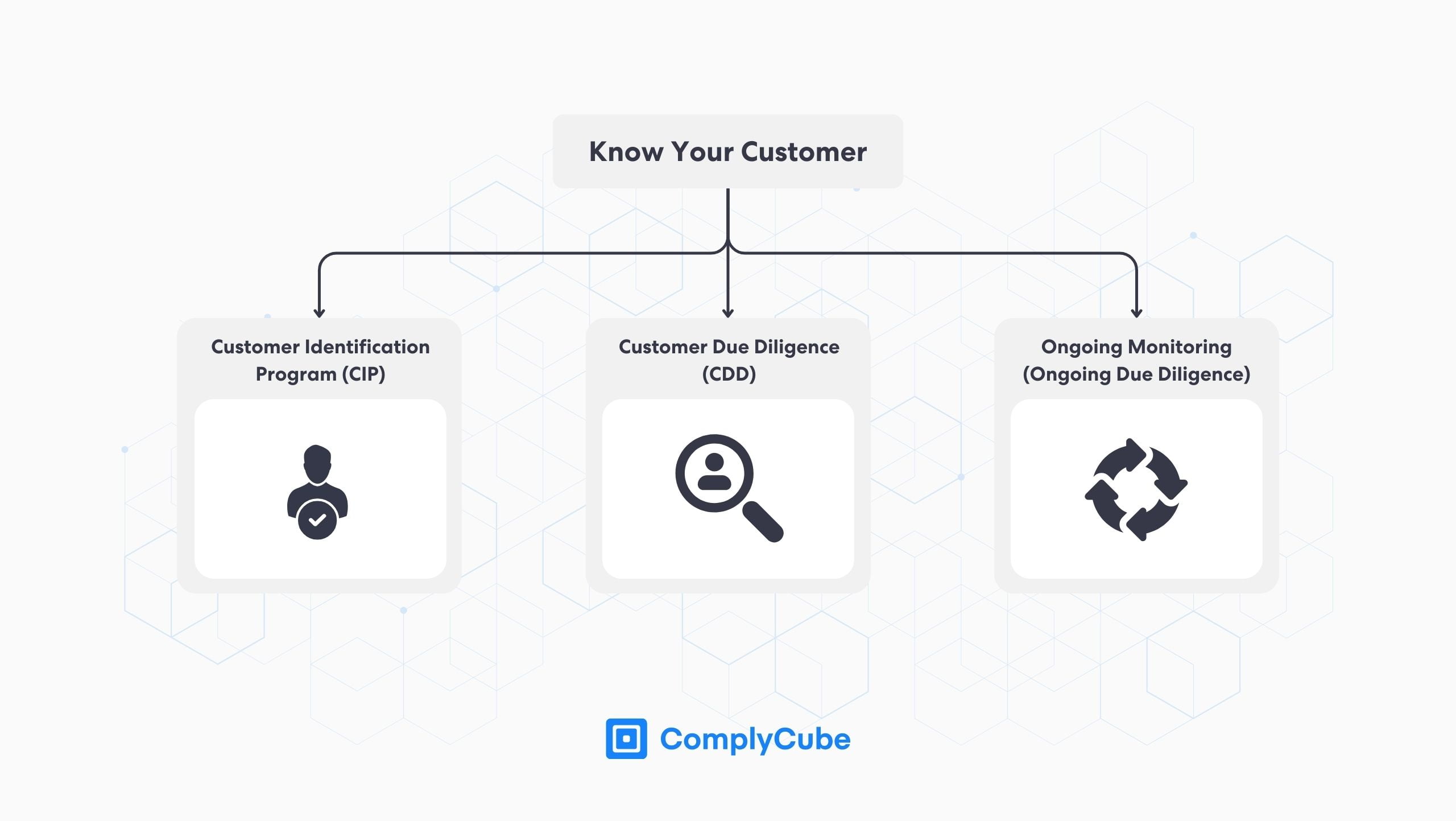
## Challenges to Banking KYC
The real challenge to Know Your Customer or Know Your Business verification in the banking industry is the increasing complexity of schemes designed to obfuscate real identity, real beneficial owners, and real motivations.
Global regulators are frequently updating their guidance on how banks should mitigate money laundering risk. Banks must adhere to the tightest financial regulations mandated by federal organizations. In America, these are the Financial Crimes Enforcement Network (FinCEN) and its Bank Secrecy Act (BSA) and Final Rule.
### American KYC and AML Regulators
The BSA authorizes the Department of the Treasury to impose particular policies on financial institutions over how they report suspicious transactions, data, and other factors to detect and prevent money laundering.
[FinCEN’s Final Rule regarding Customer Due Diligence](https://www.fincen.gov/resources/statutes-and-regulations/cdd-final-rule) (CDD) states that banks must:
- Identify and verify their customers
- Identify and verify beneficial owners of companies that open a new account
- Comprehend the nature of the customer relationship to establish an accurate risk profile
- Perform ongoing monitoring to prevent and report malicious activity and update user profiles
### KYC Requirements for Banks in the UK
In the UK, there are two key regulating forces: the Financial Conduct Authority (FCA) and the Prudential Regulation Authority (PRA). While both are instrumental to British financial policy decision-making, the FCA has a greater impact on AML regulation.
The Prudential Regulation Authority focuses more on the operational well-being of banks, including their solvency, liquidity, and ability to withstand financial turmoil. This means the PRA is responsible for ensuring that British banks have the capacity to [aid economic growth at an internationally competitive level.](https://www.bankofengland.co.uk/prudential-regulation)
The Financial Conduct Authority has a far larger responsibility regarding AML and KYC compliance. They are responsible for creating and implementing Counter-terrorist Financing (CTF) and Anti-money Laundering (AML) policies throughout the UK.
The regulator establishes clear laws regarding AML and KYC compliance, such as Customer Due Diligence (CDD) programs [influenced by the global standards set by the Financial Action Task Force (FATF)](https://www.fca.org.uk/firms/financial-crime/money-laundering-regulations). 2024 is already seeing a renewed attitude in the UK to take command of money laundering policy and reduce financial crime.
This is best shown in early 2024 by [Companies House](https://www.gov.uk/government/news/companies-house-begins-phased-roll-out-of-new-powers-to-tackle-fraud) who have started rolling out its improved infrastructure for detecting fraud and money laundering. For more information on this development, check ComplyCube’s [LinkedIn post](https://www.linkedin.com/feed/update/urn:li:activity:7171096677280272385).
### EU KYC Requirements for Banks
The European Union’s (EU) AML program is governed by two core institutions, the European Banking Authority (EBA) and the European Commission. Both of these policymakers are, again, influenced by the FATF.
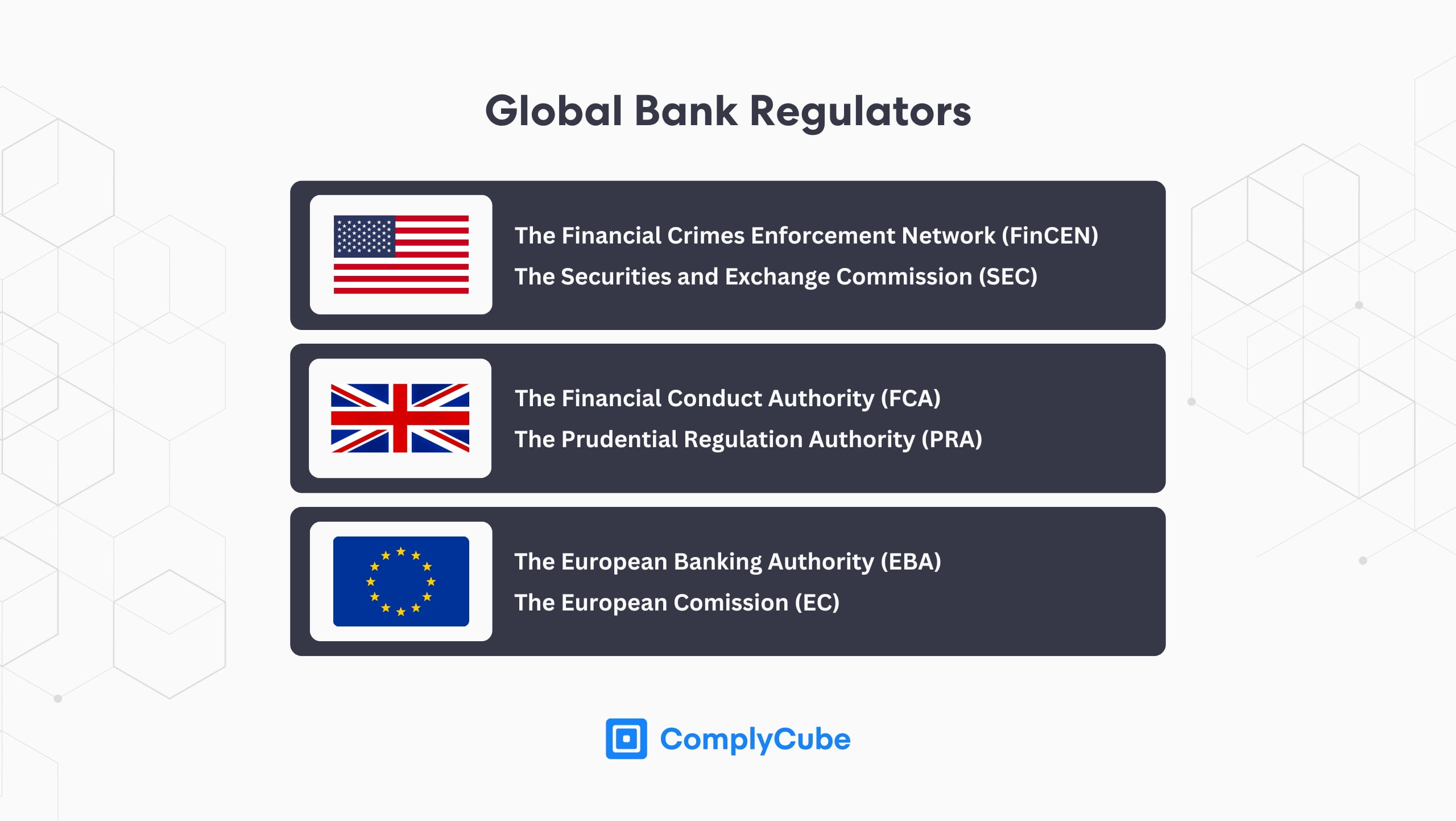
The EBA has an inter-jurisdictional responsibility across the European banking sector to ensure that its money laundering standards are being adhered to throughout the EU’s financial system. These include policies like Markets in Crypto-Assets Regulation (MiCAR), but specifically to banking, the EU Anti-Money Laundering Act from 2020, or the [AMLD (Anti-Money Laundering Directive).](https://www.eba.europa.eu/about-us/legal-and-policy-framework/eba-regulation-and-institutional-framework)
The European Commission amplifies the work done by the EBA. This body discerns potential gaps in AML compliance by conducting thorough risk assessments into policy implementation on a local and regional scale. This helps to promote the adoption of international anti-money laundering regulations.
### How do Banks Adhere to AML Regulation?
Employing a rigorous Know Your Customer process is how a financial institution meets KYC and AML policies. Every year, these international AML requirements get harder to meet. The bad actors behind financial crime continuously employ more innovative methods to bypass banking security measures.
A 2020 report from Deloitte discovered that banks see increasing regulatory expectations as the greatest challenge for AML compliance.
> The estimated amount of money laundered globally is [in the range of $800 billion to $2 Trillion](https://www2.deloitte.com/content/dam/Deloitte/in/Documents/finance/Forensic/in-forensic-AML-Survey-report-2020-noexp.pdf).
When compared against global GDP, this figure is anywhere between 2-5%. Deloitte cited this as an incredulous problem that governments, banks, and FIs must sort out with the aid of improved KYC technologies.
When considering the escalation of financial technology in the 21st century, it is not hard to fathom the scope of opportunity financial criminals possess. Cryptocurrencies are a prime example of the financial innovations that not only threaten the banking industry, but the security of the financial system with poor regulations. For more information on KYC crypto regulation, read [How KYC Crypto Regulations Safeguard the Industry](https://www.complycube.com/en/how-kyc-crypto-regulations-safeguard-the-industry/).
This calls for tightened security and precision of KYC services on a global scale. KYC verification employs 3 key steps to verify a client’s identity: a customer identification program, due diligence measures (enhanced due diligence if necessary), and ongoing monitoring.
## Identity Verification
The KYC process begins with verifying a customer’s identity and this can be done in several ways depending on the industry in question. In the banking sector, the tightest level of identity assurance is required thus, user KYC documents, such as their passport, are required.
A document verification is strengthened with a selfie taken live during the client acquisition process. Before KYC and customer onboarding services were adopted, this would all have been completed in-house by trained professionals.
### Document Verification
There are multiple data points that must be analyzed in a generally accepted KYC document, such as a government-issued ID or passport. To authenticate all data points manually and with precision is not scalable. This is how the identification process would have been completed before KYC solutions.
Now, [document verification](https://www.complycube.com/en/solutions/identity-assurance/document-verification/) takes less than 15 seconds and is completed with a far higher level of precision. KYC and AML solutions for banks scan up to 25 data points on ID documents instantly, leveraging powerful AI-powered analytical engines. For more information on ID verification, read ComplyCube’s guide: [What is Document Verification?](https://www.complycube.com/en/what-is-document-verification/)
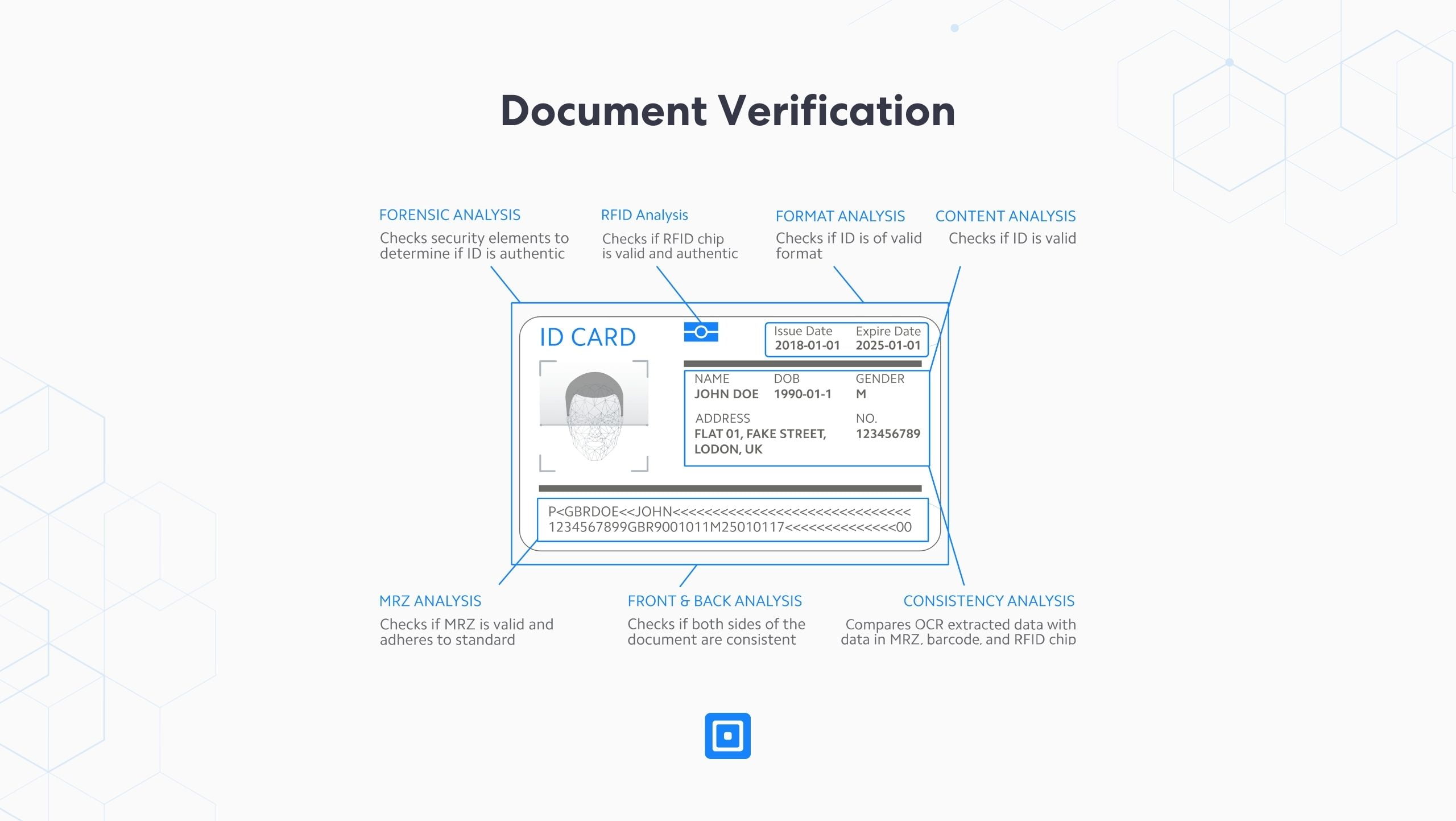
### Biometric Verification
Utilizing a similar AI engine, [biometric authentication](https://www.complycube.com/en/solutions/identity-assurance/biometric-verification/) matches an uploaded selfie for similarities with the image in the user ID. This process uses facial recognition and Presentation Attack Detection (PAD) technologies which are used to qualify that a selfie is authentic.
PAD technology builds 3D facial maps that are used to analyze potential pixel tampering, micro-expressions, skin texture, and many other fraudulent methods. Biometric verification, when provided via a KYC solution, can be completed in under 5 seconds.
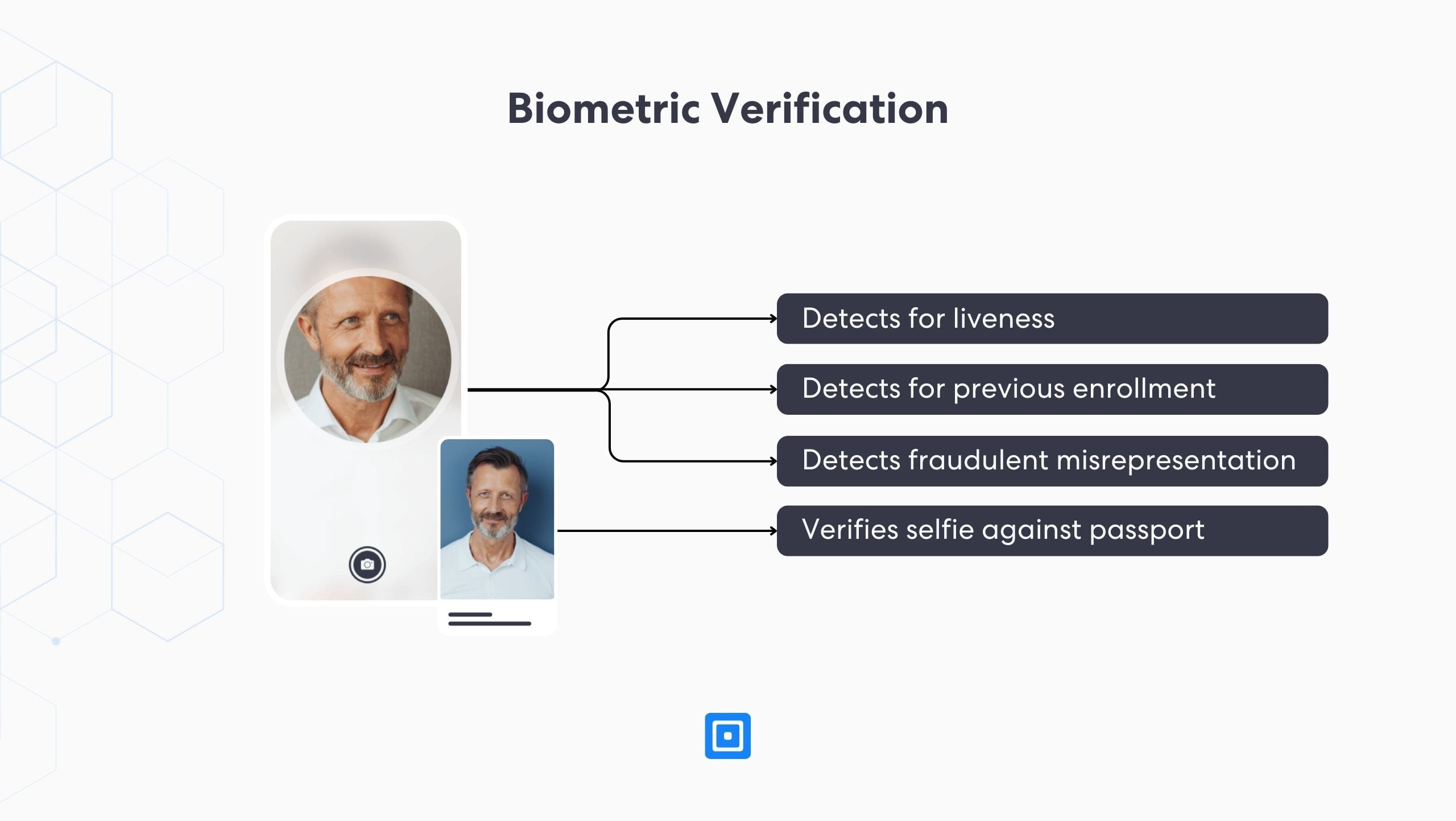
When these processes are automated, identity verification provides businesses with both a secure and extremely efficient client acquisition experience. An onboarding process can be finished accurately in under 30 seconds, ensuring client satisfaction is prioritized without compromising client data integrity or regional compliance requirements.
### Maximizing Customer Experience
Whether you are a bank, neobank, of other financial service, there are now a wealth of institutions that provide similar services. This makes effective client acquisition integral to reducing customer churn, maximizing acquisition rates, and the continued success and operation of modern-day banks.
However, reports suggest that banks have been slow to integrate such processes.
## Customer Due Diligence
[Customer Due Diligence](https://www.complycube.com/en/solutions/due-diligence-compliance/customer-due-diligence/) is a broad process that encompasses a plethora of different services designed to do two things:
1. Give institutions greater identity assurance over their users and
2. Ensure that users do not pose a threat to your business.
These threats could come in many forms but typically relate to individuals who might engage in suspicious activity. CDD is designed to leverage customer information to reduce fraud risk. The complexity of due diligence required varies from customer to customer. For more information on CDD and its various gradients, read [What is Customer Due Diligence (CDD)?](https://www.complycube.com/en/what-is-customer-due-diligence/)

### Sanctions and PEP Screening
[Sanctions and Politically Exposed Person (PEP) screening](https://www.complycube.com/en/solutions/global-screening/sanctions-pep-screening/) prevent bad actors, including internationally sanctioned institutions and legal entities, from bypassing your AML program. This process is significantly improved by partnering with a KYC solution provider.
Partnering with a KYC service significantly streamlines this process. Automating the system that ratifies users against sanctions and PEP lists creates a higher level of precision at a much swifter pace.
### What is a PEP?
A Politically Exposed Person is anyone in a natural position of authority. This does not have to be an office directly related to politics but could be of an aristocratic or corporate seniority nature too. These types of offices might have a connection to government or financial institutions that could be leveraged to a corrupt benefit.
For example, a PEP level 2 individual would include a senior leader of a national police force. An office like this would naturally come with various privileged exposure to government processes. This exposure could be exploited due to an individual’s own corruption or indirectly leveraged through blackmail or other malicious behavior.
For these reasons, PEP screening is fundamental to modern KYC processes. KYC services enable the immediacy of this information, allowing timely decisions over necessary due diligence and potential transaction monitoring that may need to occur.
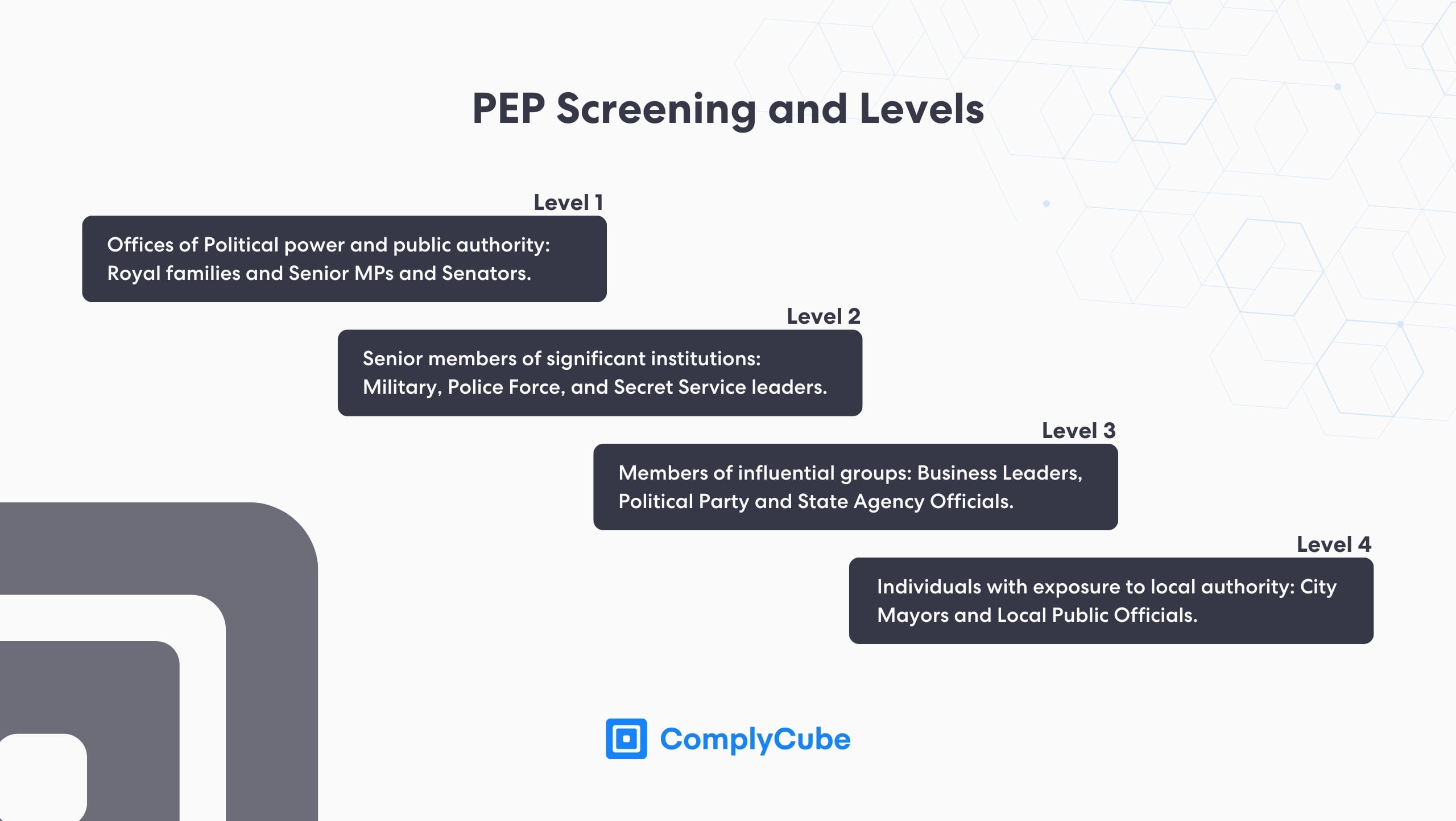
### Adverse Media Coverage
Automated processes have enabled the immediate detection of associated risks. [Adverse media checks](https://www.complycube.com/en/solutions/global-screening/adverse-media-checks/) identify customers who have appeared negatively in news outlets across the globe. A negative appearance could include anything from alleged money laundering activities in a foreign country to a local arrest made on a user.
This process is crucial in building a structured risk profile that enhances a bank’s ability to make informed and smart decisions for its users in real-time. It will automatically flag a user as a potential risk upon their appearance in media, empowering smart decisions.
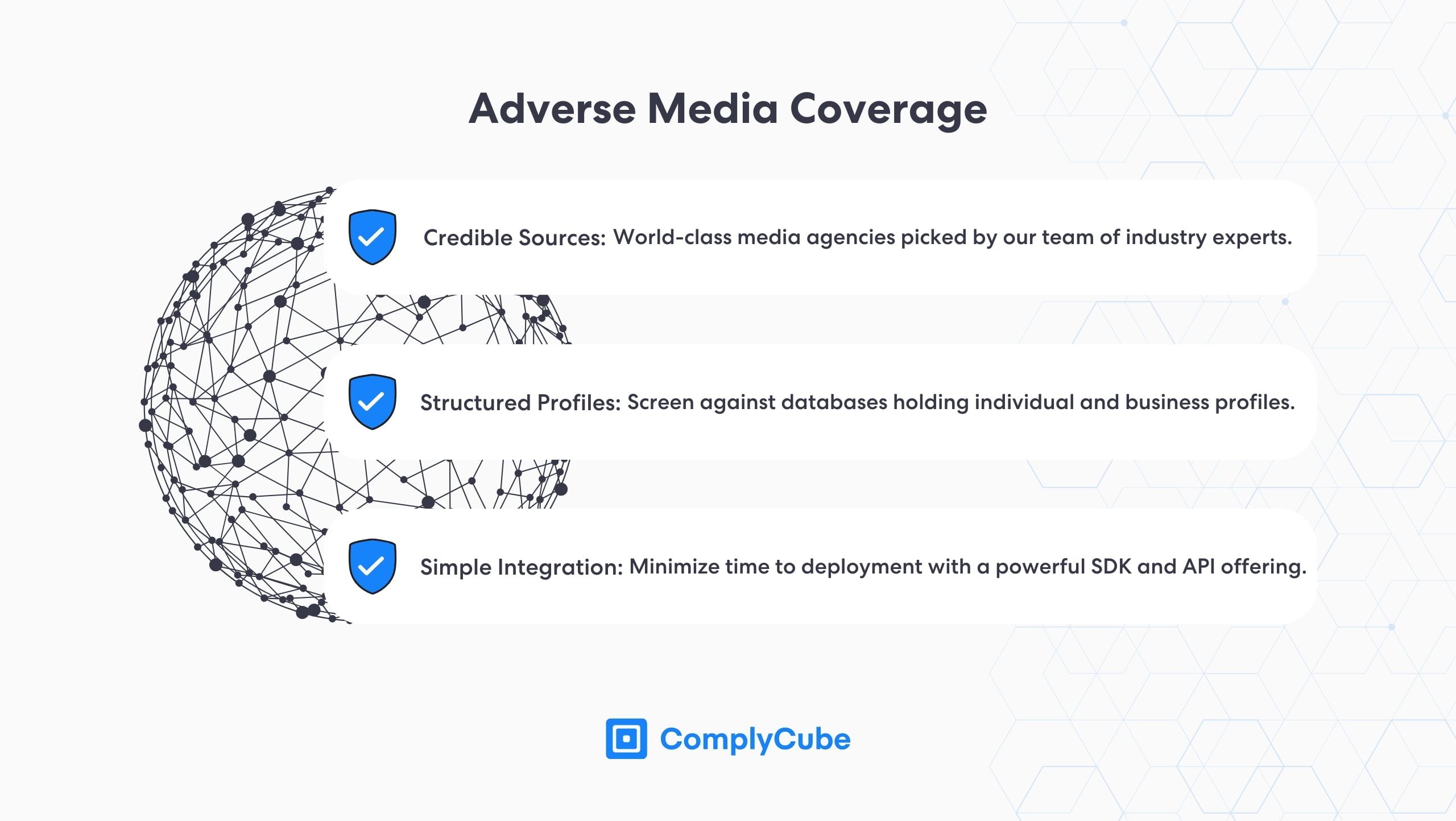
### Watchlist Screening
[Watchlist screening](https://www.complycube.com/en/solutions/global-screening/watchlist-screening/) allows banks to immediately accept or reject users upon an initial assessment. This capability drives efficiency by minimizing wasted time on unnecessary checks. If a client’s name matches with a name on a federal list they are flagged red and can be rejected.
The technology used to provide this system as an automated service is called fuzzy matching. ComplyCube uses this proprietary technology to optimize its AML software’s workflow. Fuzzy matching supports wider AML compliance by analyzing the etymology or derivations of names.
Fuzzy matching significantly streamlines the screening process and allows for risk thresholds to be set depending on a bank’s Risk-Based Approach (RBA), thereby further streamlining client verification. However, a bank’s RBA is often highly risk-averse, limiting the customizability to reduce thresholds.
## Ongoing Monitoring
The [continuous monitoring](https://www.complycube.com/en/solutions/global-screening/continuous-monitoring/) of users, including the practices discussed, is indispensable to modern-day banks. Once a client profile has been created and a risk assessment established, this service continually checks for updates in a user’s background or status.
Client profiles undergo perpetual vetting, with their risk scores updated in real-time if required. This task is becoming progressively less viable for banks as the volume of data required to analyze is so vast.
The birth of artificial intelligence and machine learning-powered systems has significantly improved businesses’ abilities to analyze data accurately, facilitating the shift towards automated AML solutions for banks.
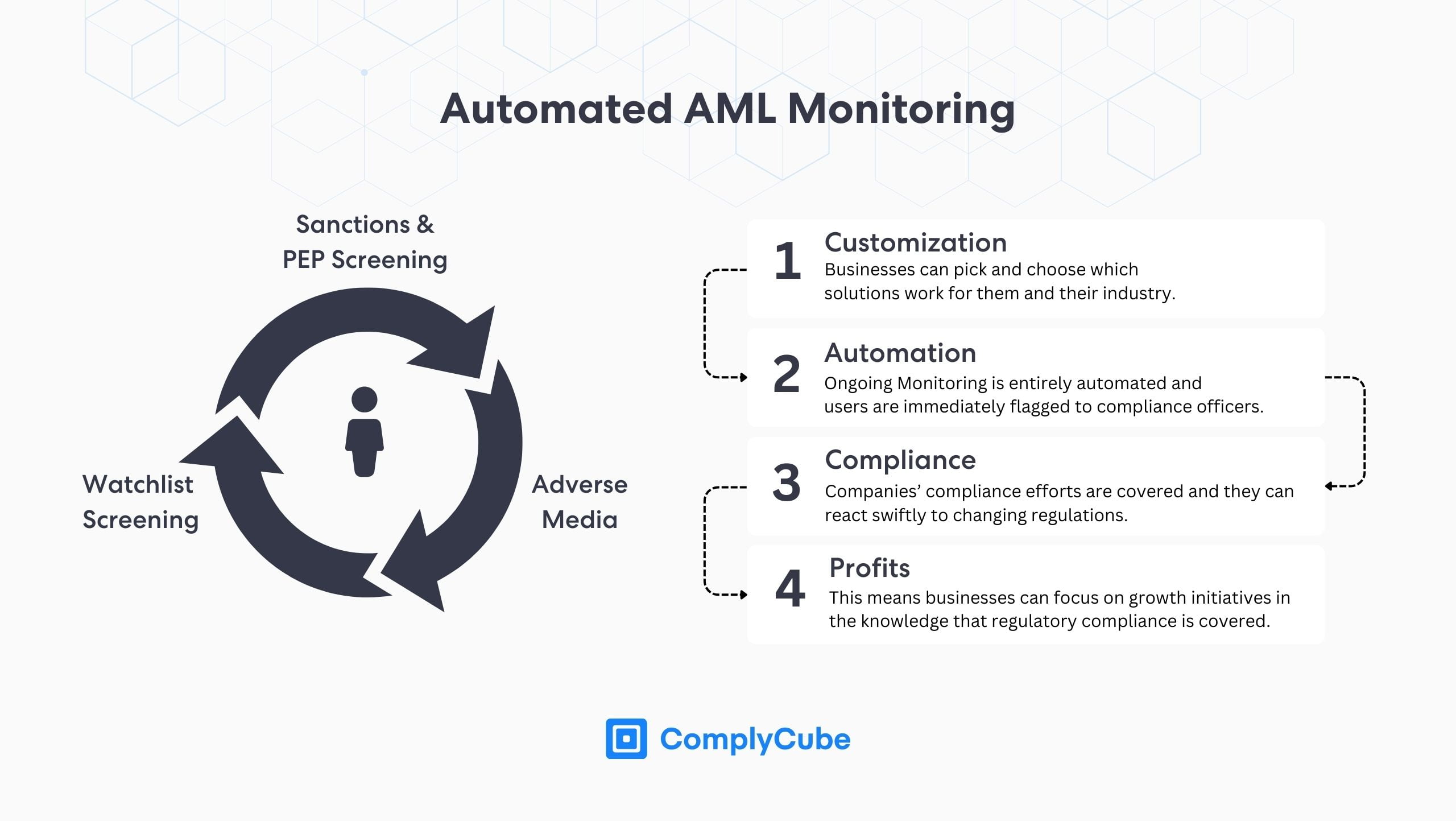
## KYC and AML Software
With the increasing complexity of fraudulent and financial criminal activity paving the path for increasingly intricate regulations over money laundering risks, KYC and AML solutions will become fundamental to the safe operation of banks.
Sustained regulatory developments from organizations such as the Financial Crimes Enforcement Network and the Financial Conduct Authority make meeting these dynamic regulations challenging.
This is a challenge solvable by KYC software, or eKYC. KYC solutions make identifying individuals who might launder money far less challenging for compliance professionals. Higher-risk customers can be prescribed particular due diligence measures to ensure compliance is achieved.
### Automation and eKYC
Developments in the accessibility of digital data and machine learning technologies have permitted this advancement in AML systems. When identity verification is automated, it can be completed in under 30 seconds.
Furthermore, the time required to complete customer verification is a fraction of that of traditional methods while significantly improving precision. Human error does not have to be accounted for when AI-powered analytical engines can scan and verify documents and facial biometrics in seconds.
The real advancement, however, is in the automation and customization of customer due diligence and continuous monitoring of banks’ clients. These are processes that have been revolutionized by automatic systems due to the sheer volume of data required to screen customers. For more information on this, head to ComplyCube’s [documentation page here](https://docs.complycube.com/documentation/product-guides/due-diligence-tools/customisable-thresholds#thresholds).
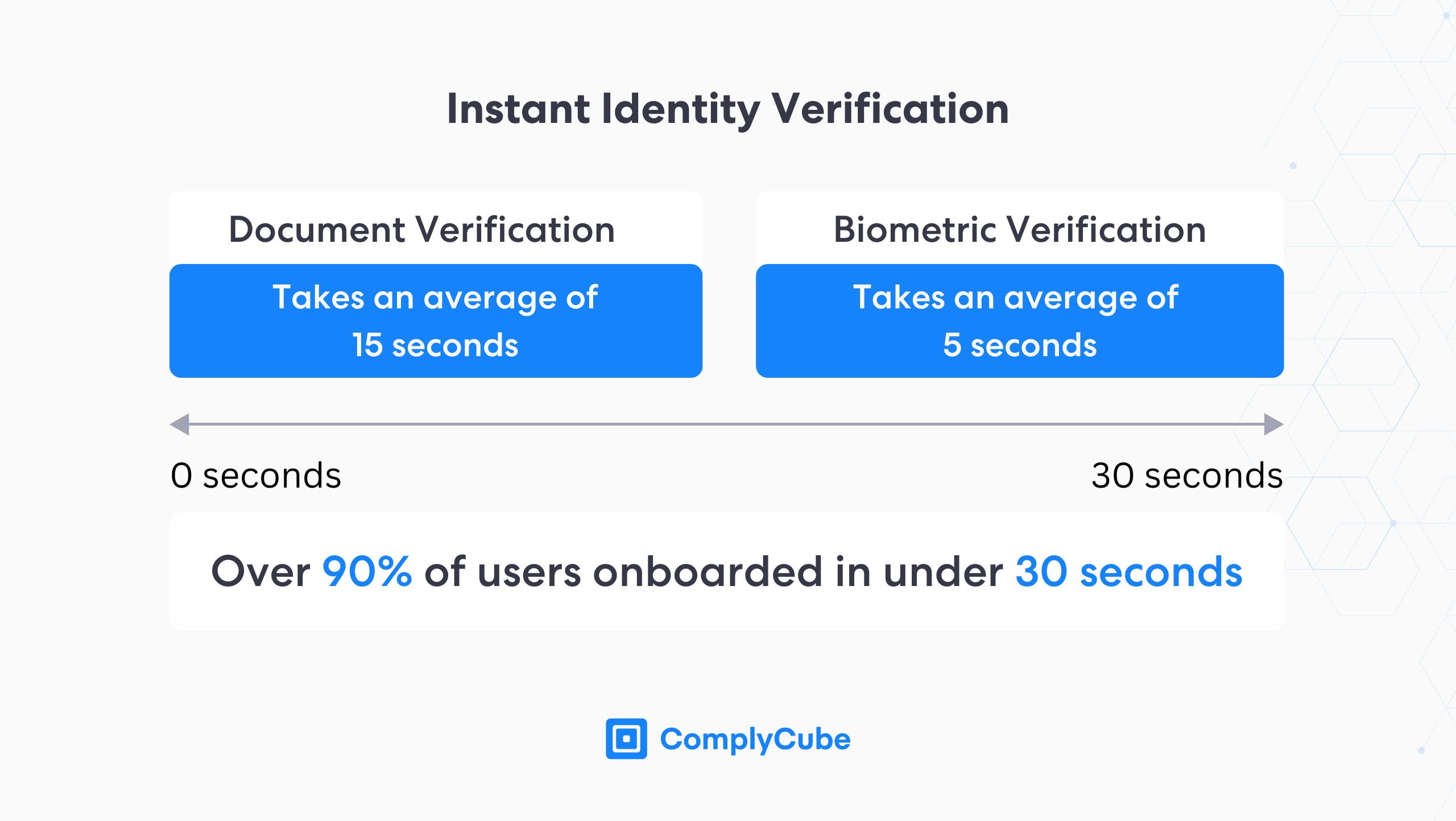
## About ComplyCube
ComplyCube partners with a host of clients across various industries, including banks, credit unions, crypto, fintech, telecoms, and more. Taking the lead in digital identity verification, due diligence, and AML compliance, ComplyCube offers a leading service with a global reach.
Their services are available in 220+ regions, enabling their core value—to build trust at scale—to be extended worldwide. ComplyCube’s services are wrapped in its all-encompassing platform, which is swiftly becoming a necessity for every compliance officer who uses it.
It’s time to leave the complexities of AML and KYC compliance behind. If you are looking for a new partner in AML, KYC, and IDV, [start a conversation here.](https://www.complycube.com/en/contact/contact-sales/)
**Categories:** Guides
**Tags:** Know Your Customer
---
### [ComplyCube Powers Secure RWA Tokenization for InvestaX](https://www.complycube.com/complycube-powers-secure-rwa-asset-tokenization-for-investax/)
**Published:** October 16, 2024
**Author:** Sofia Daley
**Excerpt:** ComplyCube, a prominent player in the global Anti-Money Laundering (AML) and Know Your Customer (KYC) space, has announced a partnership with InvestaX, a Singapore-based leader in Tokenization SaaS, enhancing their compliance and KYC processes.
**Content:**
London, October 16, 2024 — [ComplyCube](https://www.complycube.com), a prominent player in the global Anti-Money Laundering (AML) and Know Your Customer (KYC) space, has announced a partnership with [InvestaX](http://www.investax.io/), a Singapore-based leader in Tokenization SaaS. This collaboration aims to enhance InvestaX’s compliance and KYC processes, ensuring smooth and secure onboarding for professional investors while bolstering the platform’s scalability and commitment to regulatory standards.
## **Empowering Tokenization with Scalable Compliance**
InvestaX is at the forefront of digital asset innovation, enabling businesses and asset managers to tokenize, trade, and lend real-world asset (RWA) tokens internationally. Licensed by the Monetary Authority of Singapore (MAS) as both a Capital Markets Service and a Recognized Market Operator, InvestaX offers a secure gateway for institutional investors, family offices, and asset managers to access global markets. As InvestaX expands, the need for a robust and scalable compliance solution is critical.
To address these challenges, InvestaX has chosen to partner with ComplyCube due to its competitive pricing, global reach, user-friendly API, and real-time verification capabilities. Through this partnership, InvestaX will leverage ComplyCube’s advanced KYC services, including document and biometric verification, proof of address checks, and extensive AML screening. These features will enhance the platform’s compliance infrastructure while delivering an exceptional user experience.
## **Enhancing Efficiency with Real-Time Verification**
Nishtha Pandey, Chief Legal & Compliance Officer / Partner at InvestaX, expressed her enthusiasm: “We are thrilled to partner with ComplyCube to enhance our compliance and KYC processes at InvestaX. This collaboration ensures that we continue to meet the highest regulatory standards while providing our users with a seamless and secure onboarding experience. By integrating ComplyCube’s advanced verification technology, we strengthen our commitment to operational efficiency and global scalability, empowering us to better serve our growing base of professional investors.”
With ComplyCube’s real-time verification technology in place, InvestaX can now swiftly onboard users while maintaining the highest standards of security and regulatory compliance across multiple jurisdictions. The integration allows the platform to easily process complex regulatory checks, ensuring compliance with international regulatory frameworks.
Dr. Tarek Nechma, CEO of ComplyCube, highlighted the partnership’s significance: “The collaboration with InvestaX demonstrates the impact of innovative compliance solutions in the fast-evolving digital asset space. By incorporating our advanced KYC and AML tools, InvestaX can maintain its leadership position in tokenization while ensuring transparency and security. We’re excited to support InvestaX’s mission to transform global markets through digital asset tokenization.”
## **Elevating Secure RWA Asset Tokenization for Global Market Expansion**
ComplyCube’s comprehensive KYC services, including document and biometric verification, proof of address checks, and AML screening, are crucial for InvestaX’s global expansion. These tools enable InvestaX to scale its operations while adhering to stringent regulatory requirements. The partnership not only enhances InvestaX’s compliance framework but also solidifies its standing as a leader in tokenization and real-world asset trading.
Harry Varatharasan, Chief Product Officer at ComplyCube, added: “We’re proud to contribute to the success of InvestaX by integrating our real-time KYC and AML solutions. This partnership is about more than compliance—it’s about providing a seamless investor experience that prioritizes security, efficiency, and trust on a global level.”
## **About ComplyCube**
[ComplyCube](https://www.complycube.com) is a UK DIATF-certified global leader in Identity Verification (IDV), Anti-Money Laundering, and Know Your Customer compliance solutions. With flexible and robust SDKs and APIs, ComplyCube’s solutions are trusted by companies across the crypto industry and more to navigate complex compliance requirements. The ISO-certified company is committed to helping businesses enhance client acquisition and meet evolving regulatory demands.
## **About InvestaX**
[InvestaX](https://www.investax.io/) is a pioneering Tokenization SaaS platform licensed by the Monetary Authority of Singapore (MAS), providing companies and asset managers with the ability to tokenize, trade, and lend real-world asset tokens on a global scale. With a Capital Markets Services license and a Recognized Market Operator license, InvestaX is a trusted gateway to global markets, offering cutting-edge solutions for institutional investors, family offices, and asset managers.
**Categories:** News
**Tags:** Announcements
---
### [AML For Fintechs: Comply With Regulations](https://www.complycube.com/aml-for-fintechs-comply-with-regulations/)
**Published:** September 22, 2022
**Author:** Andreea Balasa
**Excerpt:** Any FinTech company knows compliance with anti-money laundering (AML) regulations is vital. To make the process easier, read this AML for FinTechs guide. We've got tips!
**Content:**
**TL;DR:** Fintech compliance with **Anti-Money Laundering (AML)** regulations is essential. However, keeping up with all the latest changes to those Fintech AML regulations can be complex, especially when businesses scale. This post will discuss how to comply with **AML for FinTechs** to prevent financial crime and safeguard customers.
## The Evolution of FinTech
The 21st century has seen the rise of many new technologies that have disrupted traditional industries. One of the most significant disruptions has been in the financial sector, where new FinTech companies have emerged to provide innovative solutions to customers.
FinTech stands for Financial Technology, which refers to using technology to provide financial services. This financial technology includes everything from mobile payments and peer-to-peer lending to investment platforms and digital currencies.
The total FinTech investment globally in [2025 is $53 billion](https://www.innovatefinance.com/capital/fintech-investment-landscape-2025/), with leading growth seen in the Unitied States, United Kingdom, India, and the United Arab Emirates.
One of the main reasons for FinTech’s success is that it has made financial services more accessible to consumers. In the past, the financial system excluded many people because they did not have a bank account or access to traditional banking services.
However, the rise of mobile banking and other FinTech solutions has enabled everyone to access financial services. This access is particularly important in developing countries, where FinTech can help to reduce poverty, promote economic growth, and improve financial inclusion.
With financial services moving online, trust is more important than ever. This move is why FinTech companies must keep their data secure and out of the hands of fraudsters. It is, therefore, crucial that they comply with AML regulations to ensure they keep their customers and business safe from these threats. So, let’s take a deeper look into this.
## FinTech and AML Risks
The Financial Action Task Force (FATF) is an intergovernmental organization combating money laundering and terrorist financing. In 2025, they published a [report](https://www.fatf-gafi.org/en/publications/Financialinclusionandnpoissues/guidance-financial-inclusion-aml-tf-measures.html) that covers the risks posed by businesses to the financial system.
The report found that there are three main types of risks:
- Money laundering (ML)
- Terrorist financing (TF)
- Financial crime and fraud
Money laundering is when fraudsters move money obtained through criminal activity, so it appears to come from a legitimate source. Criminals do this by using multiple bank accounts or shell companies to transfer the money around.
Terrorist financing is the action of providing financial support to terrorist organizations. It can include fundraising, money laundering, purchasing weapons, financing attacks, and more.
Financial crime and fraud refer to any illegal activity in the financial system. This unlawful activity includes [credit card fraud](https://www.cnbc.com/select/credit-card-fraud/), insider trading, and cybercrime.

All of these activities pose a risk to the financial system, and they can harm consumers.
For example, if a fraudster steals a person’s credit card details, they could suffer financial losses. And if money laundering finances a terrorist attack, it could lead to loss of life.
So, why don’t FinTech companies implement adequate measures to prevent this? Well, let’s take a look at the challenges.
## The Challenges Of AML For FinTechs
Complying with AML regulations can be challenging for FinTech companies; they often have to deal with large amounts of data and may not have the tools to track it effectively.
In addition, many FinTech businesses are startups and may not have the resources or expertise to comply with AML regulations. This conundrum is particularly pronounced for small companies operating on a tight budget.
Another challenge is that FinTechs typically have customers from all over the world who are subject to different legal jurisdictions. Hence, they may need to comply with multiple AML regulations, often with competing requirements, which can be challenging to implement.
Finally, it is essential to note that the FinTech industry is fast-paced and constantly evolving. Therefore, AML regulations and risks are continually changing, and FinTech companies must ensure they are up-to-date with the latest requirements.
Despite these challenges, there are several tips that FinTech companies can follow to ensure they comply with these regulations.
## Tips To Build the Right AML Compliance Program for a FinTech Business

Now that you know what the challenges of AML implementation are for [FinTechs](https://www.complycube.com/en/use-cases/industry/fintech/), it’s time to take a look at tips that simplify the process.
- **Tip 1**: Implement a [risk-based approach](https://www.complycube.com/en/what-is-a-risk-based-approach/) that focuses on the risks associated with your business. This approach should be based on understanding the types of customers you are dealing with, the business context, and the prevalent risks in the countries your firm operates in.
- **Tip 2**: Put in place an effective compliance program. This should include [customer due diligence](https://www.complycube.com/en/what-is-customer-due-diligence/), continuous monitoring, and reporting suspicious activity.
- **Tip 3**: Have a good understanding of the AML laws that apply to FinTech businesses, including keeping up-to-date with any changes to the regulations.
- **Tip 4**: Use technology to help with compliance, including data analytics to track customer behavior and [biometric authentication](https://www.complycube.com/en/solutions/identity-assurance/biometric-verification/) to verify customer identity. You can find a more comprehensive guide on this form of verification here: [The advantages of biometric authentication](https://www.complycube.com/en/the-advantages-of-biometric-authentication/).
- **Tip 5**: Have a robust internal controls system. This should include segregation of duties and independent testing of the compliance program.
- **Tip 6**: Train employees on the compliance program and ensure they understand the importance of following it.
- **Tip 7**: Cooperate with regulators, and be prepared to provide information when requested.
By following these tips, FinTechs can drastically reduce the stress of implementing and maintaining proper AML controls.
## The FATF Recommendations For FinTech Compliance

The FATF is an international organization that develops policies to combat money laundering and terrorist financing.
They have published a list of [40 recommendations](https://www.fatf-gafi.org/publications/fatfrecommendations/documents/the40recommendationspublishedoctober2004.html) for Financial Institutions, including FinTech companies, which set out the requirements for compliance with AML regulations.
These recommendations include the following:
- **Customer due diligence**: FinTechs must have mechanisms to identify and verify their customers. This includes identifying and verifying customers, which they can do using know your customer (KYC) checks. In addition, regulators expect them to obtain information on the ultimate beneficial owners of companies.
- **Continuous monitoring**: FinTech firms must have systems to conduct ongoing due diligence on customers and identify suspicious activity. This includes flagging changes in customer status and unusual transactions and investigating any of them that might be money laundering or [terrorist financing](https://www.complycube.com/en/what-is-counter-terrorist-financing/).
- **Reporting**: FinTech companies must have procedures to report any suspicious activity to the relevant authorities, such as the Financial Intelligence Unit (FIU). They should do this as a further effort to prevent criminal activity or money laundering.
- **Record keeping**: FinTech companies have to keep records of all their customers and transactions for international and domestic clients. They need to keep this information for at least five years and should make it available to the relevant authorities upon request.
- **Cooperation with law enforcement**: FinTech companies must cooperate with law enforcement agencies and provide them with any information they request.
These are merely some of the requirements that FinTechs need to meet to comply with AML regulations.
### **Case Study: Leading American FinTechs Face $40 M Fine**
In 2025, the leading financial services app Block Inc. was fined $40 million by the New York Department of Financial Services (NYDFS) for **breaching** the US Bank Secrecy Act. Reports stated that the firm’s significant growth had overwhelmed its current AML infrastructure, enabling **risky transactions** to go under the radar.
The NYDFS found **weak** monitoring controls, delayed suspicious activity reports, and inadequate customer screening. Thus, this meant thousands of potential high-risk customers were able to open accounts and access services **without** undergoing complete identity verification processes.
Block Inc. was required to implement a stronger AML program with an external independent compliance officer to monitor its progress. The message is clear: Without flexible, **scalable AML** oversight and investment, growing customer acquisition creates potential regulatory risk.
## Registration and Regulators For FinTech
Another vital compliance issue for FinTech companies is registration and regulation.
In many countries, FinTech companies must register with the financial regulator and obtain a license to operate. It can be lengthy and complicated and often requires the assistance of a law firm.
The registration requirements vary from country to country but typically provide information on the company’s owners, directors, and employees. The company must also provide evidence that it has adequate systems and controls to comply with AML regulations.
These systems include:
- Training for employees, so they understand the importance and process of AML.
- Written procedures for AML and Counter-Funding of Terrorism (CFT)
- Appointing a Money Laundering Reporting Officer (MLRO)
Once the registration process is complete, the FinTech company will be subject to ongoing supervision by the financial regulator, periodic reporting, and the submission of audited financial statements.
The level of supervision will vary from country to country and state to state in the US. But, it is typically more stringent for companies involved in activities considered to be high risks, such as money remittance or foreign exchange trading.
Compliance with AML regulations is a complex and essential issue for FinTech companies. They need to manage many compliance risks, and the regulatory requirements can be demanding.
However, compliance is crucial to ensure that the FinTech industry remains stable and trustworthy. By following the tips outlined in the previous section, FinTech companies can ensure they meet their compliance obligations.
## Global Compliance In FinTech

The global FinTech compliance landscape is constantly evolving. Entrepreneurs continually develop new technologies and business models, which impacts compliance requirements.
In recent years, there has been a growing focus on the need for FinTech companies to comply with AML regulations. This is due to criminals’ worldwide increased use of FinTech services to launder money.
Several countries have introduced new laws and regulations specifically for FinTech companies to combat this. These include registration requirements, KYC checks, and ongoing monitoring.
### United States
The United States was among the first to introduce specific FinTech AML regulations. In 2015, the US launched the BitLicense regime, which requires companies that offer digital currency services to get a license from the financial regulator.
The central regulating bodies are the [Financial Crimes Enforcement Network](https://www.fincen.gov/) (FinCEN) and the [Office of Foreign Assets Control](https://home.treasury.gov/policy-issues/office-of-foreign-assets-control-sanctions-programs-and-information) (OFAC). They work together to enforce the AML and CFT regulations set in place by their government.
### Europe
In 2020, the European Union introduced the [Sixth Anti-Money Laundering Directive](https://www.complycube.com/en/a-quick-overview-of-the-6th-anti-money-laundering-directive-6amld/) (6AMLD), which supersedes the [Fifth Anti-Money Laundering Directive](https://risk.lexisnexis.co.uk/insights-resources/infographic/5th-money-laundering-directive) (5AMLD). It includes some provisions that apply specifically to FinTech companies.
The 6AMLD further expanded the list of predicate crimes and also included cybercrime as an offense. This addition requires FinTechs to enhance their KYC and AML measures, while the 5AMLD requires them to register with the financial regulator and carry out KYC checks on their customers.
It also imposes stricter requirements for transaction monitoring and imposes new reporting obligations. Furthermore, the 6AMLD builds on the 5AMLD’s implemented regulations for cryptocurrencies to prevent money laundering further. Even though the European Union has this directive in place, most countries have regulatory bodies and laws for AML. You can learn more here: [A Quick Overview of the 6AMLD](https://www.complycube.com/en/6th-anti-money-laundering-directive-6amld-guide/).
Here is a short list of some of their regulators:
- UK: [The Financial Conduct Authority](https://www.fca.org.uk/) (FCA)
- Germany: [The Federal Financial Supervisory Authority](https://www.bafin.de/EN/Homepage/homepage_node.html) (BaFin)
- Spain: [Comisión Nacional del Mercado de Valores](https://www.cnmv.es/portal/home.aspx?lang=en) (CNMV)
- France: [French Prudential Supervision and Resolution Authority](https://acpr.banque-france.fr/en) (ACPR) and [Autorité des marchés financiers](https://www.amf-france.org/en) (AMF)
You can find more information on this here: <https://www.cliffordchance.com/content/dam/cliffordchance/briefings/2017/04/european-fintech-regulation.pdf>.
### Australia
In 2018, Australia introduced a new edition of the [Anti-Money Laundering and Counter-Terrorism Financing Act 2006](https://www.legislation.gov.au/Details/C2021C00243), which includes many provisions that apply to FinTech companies but don’t directly mention it.
The Act requires FinTech companies, among others, to obtain a license from the financial regulator and to comply with KYC and AML requirements. Their regulator is the [Australian Transaction Reports and Analysis Centre](https://www.austrac.gov.au/) (AUSTRAC).
The compliance landscape for FinTech companies is constantly changing. Therefore, companies must keep up-to-date with the latest developments and ensure they comply with all applicable laws and regulations.
### Key Takeaways
- **The FinTech industry’s** surge in growth, coupled with easy digital access, has given rise to heightened scrutiny and AML regulations globally.
- **FinTechs face challenges** in AML due to sector-specific characteristics, including rapid scaling, diverse customer bases, and large verification volumes.
- **The FATF’s 40** Recommendations for AML compliance include risk-based customer due diligence, ongoing monitoring, and suspicious activity reporting.
- **Regulations demand** FinTech registration, ownership disclosure, staff training, written CFT procedures, and MLRO appointment.
- **ComplyCube offers** customizable AML solutions with automated screening, robust PEP, sanctions, and watchlist checks for FinTechs.
## Conclusion
FinTech is an exciting example of how innovative technology can disrupt an industry, once monopolized by brick-and-mortar institutions, to improve consumers’ lives. Nonetheless, The FinTech industry is highly competitive, face-paced, constantly evolving, and increasingly globalized. As a result, compliance risks are growing, and the challenges of AML for FinTech companies are becoming more complex.
However, with the right approach and a bit of planning, it is possible to build an effective AML compliance program for your business.
At ComplyCube, we understand these challenges and have developed [solutions](https://www.complycube.com/en/solutions/) to help you get started. [Contact us](https://www.complycube.com/en/contact/)[ ](https://www.complycube.com/en/contact/)today to learn more about how we can help you build a FinTech compliance program that meets global standards.
## Frequently Asked Questions
Must FinTechs comply with AML?
Yes. FinTechs must comply with AML laws in the jurisdictions they operate. This includes regulations such as the EU AMLD6, the US Bank Secrecy Act, and the UK’s MLR 2017. Non-compliance risks million-dollar fines and reputational damage.
Why is the FinTech sector scrutinized by regulators?
The FinTech sector has received higher scrutiny from regulatory authorities over the years due to its fast-paced environment and ability for customers to make high-volume transactions. It’s digital onboarding and cross-border payments give rise to high money laundering risks.
What are the challenges FinTechs face for AML compliance?
Due to its global nature and agile operations, FinTechs struggle with implementing AML processes that are customizable and scalable to their business needs. Additionally, evolving regulations mean that FinTechs that do not integrate real-time screening face a higher potential of non-compliance.
What are the FATF’s AML recommendations for FinTechs?
The FATF recommends financial institutions and FinTechs to adopt risk-based AML processes, enhanced due diligence, and ongoing monitoring to detect and prevent fraud and money laundering effectively. Additionally, timely suspicious activity reporting and transparent audit trails are required to meet compliance.
How does ComplyCube deliver AML compliance for FinTech firms?
ComplyCube enables FinTechs to receive automated, instant KYC and AML results. It’s no-code workflows support fast-growing FinTechs to stay agile when deploying workflows, cutting verification time from minutes to seconds.
**Categories:** Guides
**Tags:** Anti-Money Laundering
---
### [Driver's License Verification Service in the UK](https://www.complycube.com/drivers-license-verification-service-in-the-uk/)
**Published:** December 31, 2024
**Author:** Sofia Daley
**Excerpt:** As the Mobility as a Service (MaaS) sector continues to grow, safety and compliance must take priority. MaaS operators must use a Driver's License Verification Service to verify drivers' licenses and provide safe services.
**Content:**
**TL;DR:** As the Mobility as a Service (MaaS) sector continues to evolve, safety and compliance must take priority. MaaS operators must use the right **Driver’s License Verification Service** to verify a driver’s license. Beyond compliance, Driver’s License Verification Service boost **passenger trust** and driver retention, enhancing revenue.
## Why has Driver’s License Verification Service Gained Popularity?
With several high-profile news outlets calling out industry giants (Deliveroo, Uber, etc) for illicit practices such as underage drivers over the past few years, it seems the MaaS industry is finally moving towards increased regulatory pressures and verified profiles. This gives rise to the usage of a compliant and secure Driver’s License Verification Service. Coupled with a facial biometric verification process, MaaS platforms can provide an unparalleled level of security to their customers when screening drivers. This not only protects passengers but also safeguards MaaS businesses from being vulnerable to costly penalties.
In the UK, several watchdogs have set mandates for UK drivers and residents, such as The Road Traffic Act (1988), which helps ensure that drivers have valid documentation. Increased regulatory pressures have entered the sector, with Transport for London (TFL) requiring thorough DBS for all taxi and private hire vehicle drivers within the city.
## The Rise of Mobility as a Service (MaaS)
McKinsey’s quarterly report on the future of mobility emphasizes the sector’s innovative potential and significant growth prospects. It provides insights into forecasts for 2035 and details the current growth trends within the industry. The report states, “Mobility is one of the hottest sectors, with start-ups and traditional OEMs constantly developing new technologies and transportation options.”
> Mobility is one of the hottest sectors, with [start-ups and traditional OEMs](https://www.mckinsey.com/~/media/mckinsey/industries/automotive%20and%20assembly/our%20insights/the%20future%20of%20mobility/the-future-of-mobility.pdf) constantly developing new technologies and transportation options.
Companies like Uber and Lyft have driven the expansion of the ride-hailing market, with many people relying on these services for their everyday transportation needs. In 2025 alone, Uber generated over [$50 billion in revenue](https://investor.uber.com/news-events/news/press-release-details/2026/Uber-Announces-Results-for-Fourth-Quarter-and-Full-Year-2025/default.aspx), with more than 40 million trips taken daily. The growing demand for convenient, time-saving transportation, coupled with the rising costs of vehicle ownership, fuels the continued growth of these services.
However, with the rise of these new services, MaaS operators must ensure they have the right processes to remain compliant with legislation regarding driver’s license verification. In the UK, there are several mandates that require compliance.
## UK Driver’s License Verification Service
Drivers within transport services are subject to DBS checks, as well as driver’s license checks for black cab drivers. The Department for Transport (DfT), a UK government agency, published the “Statutory Taxi and Private Hire Vehicle Standards” in 2020, providing national guidance for local authorities on improving safety and standards in the taxi and Private Vehicle Hire (PVH) industry. Each local council then takes these mandates and applies them as they see fit, ensuring driver’s license data verification takes place.
### Private Hire vs Taxi Licenses
In the UK, drivers may apply for either a Taxi License or a Private Hire License. The difference between these is that the latter forms part of London’s network of registered black cabs, while the former is the necessary license to work for private organizations such as Uber.
In both cases, drivers are required to undergo DBS checks to remain compliant with mandates such as the “Statutory Taxi and Private Vehicle Standards.” However, the responsibility for verifying identities often lies with the MaaS employer, as the Corporate Manslaughter Act of 2007 states that businesses that require employees to drive as part of their work (examples include MaaS platforms like Uber, Deliveroo or even Amazon), must monitor their employees’ entitlement to drive and verify driving licenses.
## UK Legislation and Driver’s License Verification Service
Similarly, the DVLA states in the UK that “All employers have a responsibility and duty of care to ensure that any [employee required to drive on behalf of the organization is correctly licensed](https://smartcompliance.descartes.com/resources/driving-licence-verification/#:~:text=All%20employers%20have%20a%20responsibility,also%20invalidate%20your%20company%20insurance.) and entitled to drive. Ignorance is no defense. Employees driving without a valid license may also invalidate your company insurance.” MaaS platforms must ensure their compliance with this mandate, which stems from two critical UK laws:
[The Corporate Manslaughter Act 2007: ](https://www.legislation.gov.uk/ukpga/2007/19/contents)Mandates that organizations that require employees to drive as part of their work must monitor their employees’ entitlement to drive and verify driving licenses.
[Section 87 (2) of the Road Traffic Act 1988:](https://www.legislation.gov.uk/ukpga/1988/52/section/87) This regulation makes it a crime for someone to allow another person to drive a vehicle of any type on a road if that other person does not hold a license that authorizes them to drive a motor vehicle of that class.
Unfortunately, these laws have been breached by MaaS platforms several times, with mobility giants such as Uber and Deliveroo often being named and shamed in mainstream media. A common crime amongst these delivery services is account renting, which often goes hand in hand with underage driving. Even if drivers undergo initial DBS checks, accounts are often shared with underaged drivers, pointing to a need for ongoing identity verification.
## The Need for Ongoing Verification
The BBC released [a news article](https://www.bbc.co.uk/news/uk-67371473), which highlighted the amount of underaged drivers working within Deliveroo. Whilst drivers must undergo checks when signing up to the MaaS operator, illegal account sharing with underage drivers often takes place once these checks have been carried out.
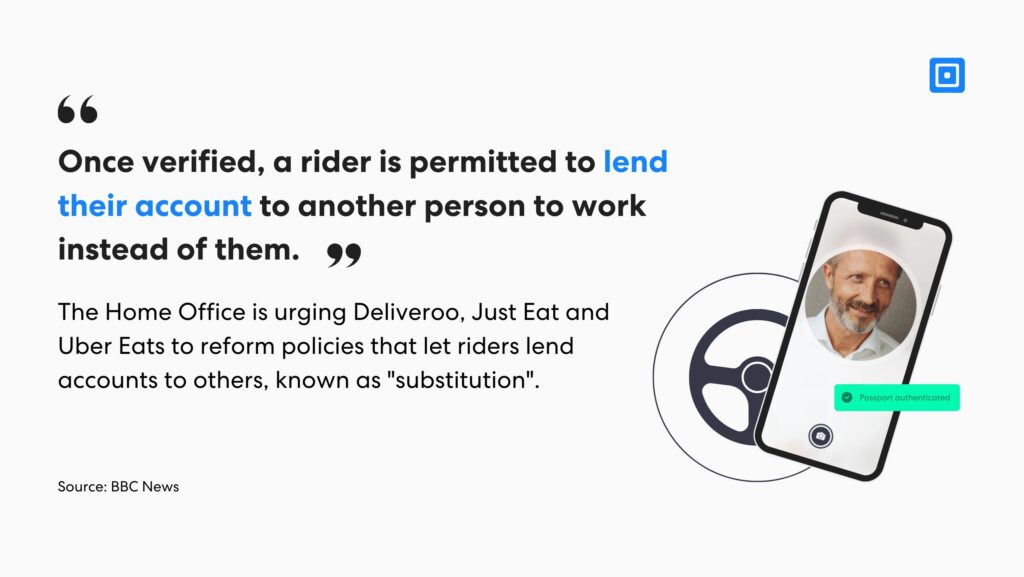
The article underlines that the Home Office are urging Deliveroo, Just Eat and Uber Eats to reform policies that let riders lend accounts to others, known as “substitution”. Ongoing identity verification could provide a legitimate solution.
> Once verified, a rider is permitted to [lend their account](https://www.bbc.co.uk/news/uk-67371473) to another person.
The article reads, “Riders who sign up to work for the big food delivery apps have to pass background checks. They must verify their age, that they have no convictions, and that they are allowed to work in the UK. But once verified, a rider is permitted to lend their account to another person to work instead of them.” The piece continues on to tell the story of a seventeen-year-old who died whilst delivering food, doing a job that he should not have been able to legally do.
> This is not a [victimless](https://www.bbc.co.uk/news/uk-67371473) activity.
Home Office Minister Robert Jenrick stated the following to the BBC: “This is not a victimless activity; we’ve seen a young person die when he was doing a job that he shouldn’t have been doing.” The safety within these services, in this case for drivers, is compromised without these platforms ensuring that they are investing in the right security infrastructure. However, this risk could be increased if these practices were occurring on platforms such as Uber. In this case, not only the driver is at risk, but passengers are as well.
A driver’s license verification process should be carried out continuously rather than just once once a driver has been onboarded. For optimal safety, a biometric facial verification process can be coupled with this.
### **Case Study: The Home Office Crackdown on Illegal Workers**
In 2025, the **UK’s Plan for Change** was set to crack down on illegal working, particularly focused on the high-risk gig economy roles, such as ride-sharing and food delivery. The Home Office worked collaboratively with three giants in the industry, **Uber, Just Eat, and Deliveroo**, to close loopholes in existing identity and right-to-work controls.
The plan called for stringent security measures in the ride-sharing sector, calling for increased facial verification checks and fraud detection tools to block **account sharing** and **document fraud**. Thus, the initiative plans to protect passengers, couriers, and the wider public.
The government further seeks to tighten the law, making it a **legal mandate** for all firms to perform robust verification on an employee’s legal right to work in the UK before granting access to services. The failure to carry out these checks can lead to hefty penalties, including **criminal liability** and reputational damage.
## Driver’s License Verification Service: DVLA Integration
The Driver and Vehicle Licensing Agency ([DVLA](https://www.gov.uk/government/organisations/driver-and-vehicle-licensing-agency)) is a UK government organization responsible for maintaining records of drivers and vehicles. It issues driving licenses, collects vehicle excise duties, and ensures that drivers and vehicles meet safety and environmental standards.
ComplyCube’s enhanced driver authentication solution, powered by DVLA integration, delivers swift and accurate driver screening, a critical need for industries like [Mobility-as-a-Service (MaaS)](https://www.complycube.com/en/use-cases/industry/mobility-as-a-service-maas/), vehicle rentals, fleet management, logistics, delivery services, and ride-hailing. In these sectors, ensuring driver suitability and competence is essential for both safety and compliance. The DVLA integration enables comprehensive background checks, verifying key credentials such as license validity and driving history, ensuring that only qualified and legitimate drivers are approved, thus fostering greater safety and trust within the industry.
### Key Takeaways
- **The advancement** of technology and growth within the gig economy have spurred expansion in the ride-sharing industry, followed by stricter regulations.
- **The UK’s Corporate** Manslaughter Act of 2007 mentions that businesses requiring employees to drive must monitor driving entitlement and validity.
- **Ride-sharing drivers** must undergo DBS checks and driver license verification to prove driving competence and a clear background history.
- **Ongoing driver’s** license verification service detects suspicious behaviours, including account takeovers, in real-time.
- **ComplyCube** integrates with the UK’s DVLA to provide MaaS firms with instant driving license status and records.
## ComplyCube’s Biometric Verification
ComplyCube’s own [biometric verification](https://www.complycube.com/en/solutions/identity-assurance/biometric-verification/) can also be used to ensure driver identities match ID documentation, with active liveness detection leveraged to detect attempts of presentation attacks, such as deepfakes.
From advanced document verification and biometric checks to Right to Work, DBS checks, and AML screening, ComplyCube offers a robust platform for secure driver credential verification. The integration of the DVLA API further strengthens its capabilities, cementing ComplyCube’s position as a trusted market leader for businesses focused on building secure and compliant digital ecosystems.

For more information on how to safeguard your MaaS platform, reach out to one of our Mobility [compliance experts](https://www.complycube.com/en/contact/contact-sales/).
## Frequently Asked Questions
What is mobility as a service?
Mobility as a Service (MaaS) operators integrate multiple transportation services into one application or platform for seamless passenger booking and payment. Some examples of these services are bike-sharing, public transit and ride-hailing, including firms like Uber and Deliveroo.
How does online driver’s license verification work?
Online driver verification includes document screening, whereby a driver scans their driver’s license using a camera and biometric selfies to match the license holder. Additionally, it includes database checks where the driver’s information is cross-referenced against trusted databases such as the UK’s DVLA or US DMV. These checks ensure a driver is licensed to operate a vehicle.
Is driver’s license verification required in the UK?
Yes. In the UK, ride-sharing and private hire companies must perform driver’s license verification alongside DBS checks to prevent unlicensed driving. Under the Road Traffic Act 1988 and Corporate Manslaughter Act 2007, operators must enforce license validity checks with ongoing monitoring for compliance.
What is compliant driver license verification?
Compliant driver license checks must meet state or country-specific legal standards to ensure road safety by preventing unlicensed driving. Typically, verification must confirm driver status, entitlements, and records to support compliance.
Does ComplyCube provide driver’s license verification service?
The ComplyCube platform integrates with the DVLA for instant driver license checks. Additionally, ComplyCube provides PAD Level 2-certified biometric liveness technology, DBS checks, and ongoing monitoring for MaaS operators to automate driver onboarding more securely while meeting local and global compliance requirements.
**Categories:** Guides
**Tags:** Identity Verification
---
### [The Best Automated Age Verification Solutions in 2026](https://www.complycube.com/best-automated-age-verification-solutions-2026/)
**Published:** March 5, 2026
**Author:** Rithu Jagannath
**Excerpt:** Automated age verification solutions are critical to meeting regulatory compliance. Modern age assurance solution supports firms in achieving quicker results, complying with data privacy laws, and adapting to changing regulations.
**Content:**
**TL;DR:** In 2026, **automated age verification** works best when it mixes low-friction checks with step-up controls that protect minors. The best **automated age verification solutions** blend selfie-based age estimation with audit trails and modular workflows. A modern **age assurance solution** also reduces data collection, adapts to changing requirements, and gives instant results.
## What Is Automated Age Verification?
Age verification solutions in 2026 are judged on practical outcomes and overall fit. They must stop underage access to age-restricted content and products while keeping conversion rates high. As enforcement rises, the market has moved away from basic age gates to automated systems.
These systems can check age, give audit-ready proof, and scale across many regions. They are expected to maintain compliance with consistent decision-making and clear audit trails. Also, they need to work across different user bases and regional rules without creating unnecessary friction.
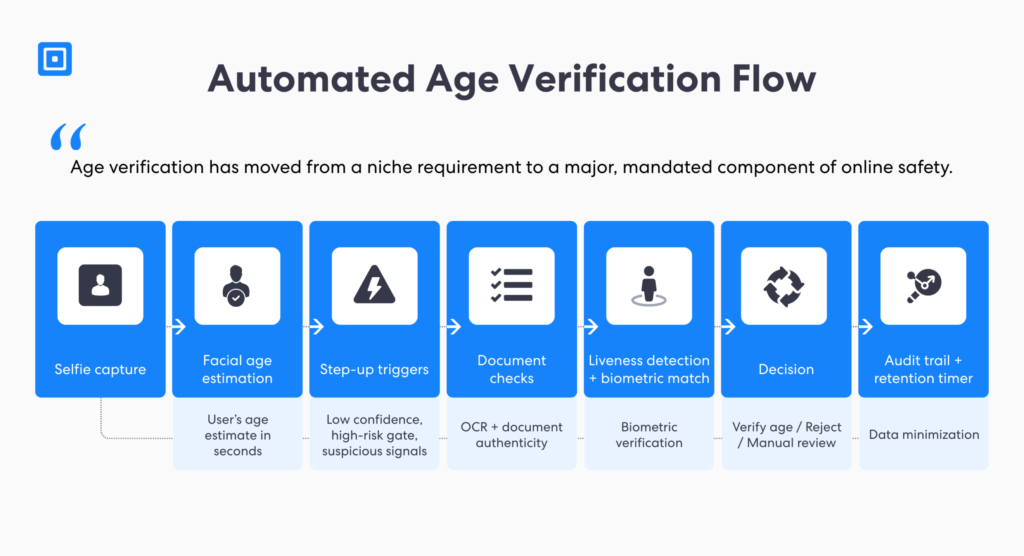
Automated age verification is technology-driven. This verification process confirms a user against age requirements without manual review. Automated checks leverage the use of cutting-edge artificial intelligence and machine learning algorithms. They mix facial age estimation, document checks, and database checks against authoritative sources. High-assurance flows add biometric verification and liveness checks. This verifies identity documents and ensures the person submitting the ID is present. It prevents users from using spoofed images or false documents.
In 2026, programmes are also judged on privacy, equality, and security. This includes data minimization to limit Personally Identifiable Information (PII) retention. The best [age assurance solution](https://www.complycube.com/en/solutions/identity-assurance/facial-age-estimation/) delivers instant results for legitimate users. In particular, the [Challenge 25 policy](https://wsta.co.uk/challenge-25/), whereby UK retailers are “challenged” to verify users appearing under the age of 25, is a prominent example of risk-based escalation that these systems implement.
## What “Best” Means for Automated Age Verification Solutions
Today, the best age verification solutions or age checks create measurable outcomes that safeguard young people. They can more accurately estimate age. They also show how many underage users are blocked and how many real users pass quickly.
Additionally, age verification software can track any user drop-off points and overall conversion rates by device type and region. Therefore, strong age verification platforms expose pass rates and escalation rates as key performance indicators (KPIs). This makes optimization proactive rather than reactive.
### Measurable Protection with Automated Age Verification
For this reason, a reliable age verification programme also provides [audit proof](https://www.ofcom.org.uk/siteassets/resources/documents/consultations/category-1-10-weeks/statement-age-assurance-and-childrens-access/part-3-guidance-on-highly-effective-age-assurance.pdf?v=395680). It logs the verification journey, decision policy, and any relevant timestamps for overall compliance needs. The idea here is that manual review should be relative to the risk to the user and business.
Age checks also support a privacy-first design by proving eligibility without collecting too much data from users. This balance is crucial for any services aiming to meet global compliance regulatory requirements, which include the EU’s GDPR.
### The Need for Globally Ready Automated Age Verification
Another example of what is considered “Best” in 2026 are product solutions that work across many regions. Keep in mind that age thresholds often [vary by country](https://digital-strategy.ec.europa.eu/en/news/commission-presents-guidelines-and-age-verification-app-prototype-safer-online-space-children?) and product category. This covers industries such as online gaming, adult content, purchasing alcohol, and more.
As a result, modular [workflow builders](https://www.complycube.com/en/solutions/compliance-suite/kyc-workflow/) allow policy teams to set appropriate age limits without completely rebuilding customer journeys. This speed of change is critical for global compliance when product teams ship very quickly. It also reduces general operational risk when legal requirements change.
## The Global Regulations Shaping 2026 Programmes
The challenge when it comes to scaling globally is turning overlapping rules into consistent build requirements. [Different systems](https://digital-strategy.ec.europa.eu/en/policies/eu-age-verification) prioritize effectiveness, child safety outcomes, and privacy-by-design using different implementation options.
Teams need one clear map from “what we must do” to “what we can prove.” It helps product, compliance, and engineering teams align on a shared control set without rewriting rules for every region. This makes it easier to demonstrate compliance consistently.
## Strong Age Assurance Methods in 2026
Age assurance works best in 2026 when the method matches the risk. Low-risk journeys should start with low-friction checks to keep conversion rates healthy. Then, teams can escalate only when confidence is low or the user is trying to access higher-risk content or products. This tiered approach to estimating age helps services stay compliant and prove effectiveness. You can learn more here: [Achieving Age Assurance: Online Age Verification Solution](https://www.complycube.com/en/achieving-age-assurance-online-age-verification-solution/)
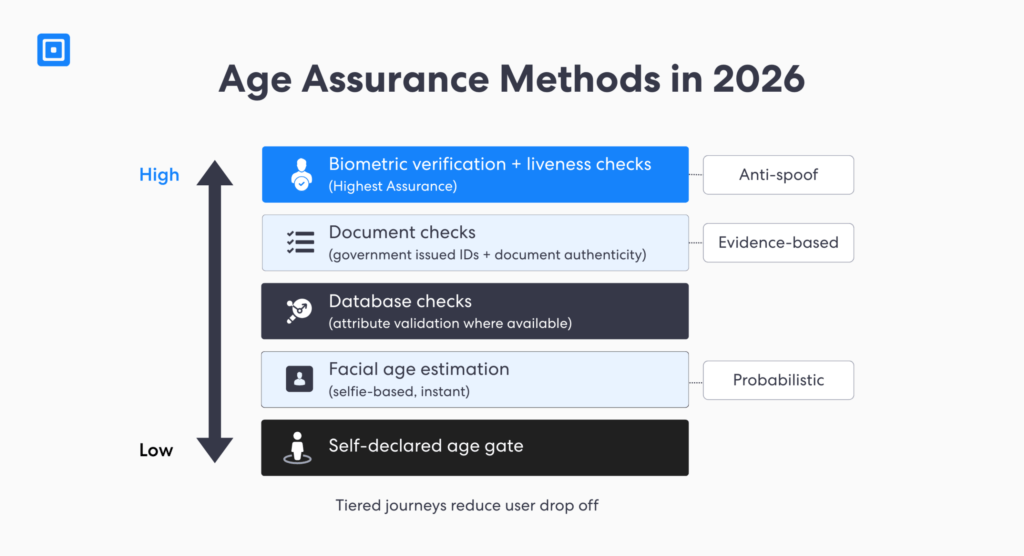
The ladder above shows the trade-off between friction and assurance. Self-declared age gates are the weakest. Then comes facial age estimation, which is fast but probabilistic. Database checks are put in place to add extra validation where available. [Document checks](https://www.complycube.com/en/solutions/identity-assurance/document-verification/) provide evidence-based assurance, and biometric verification with liveness detection offers the highest protection against spoofing and underage access. This progression aligns with the European Union (EU) push to strengthen protection for minors online.
## Use Cases for Automated Age Verification Processes
Automated age verification can look different across each sector. Thus, adapting age estimation process to each industry’s compliance needs and user expectations is crucial. For example, in regulated industries, robust audit trails and fraud prevention are also required. Another example includes tweaking workflows or adjusting age checks to fit specific service offerings.
> Customizable age verification software is critical for adapting to regulatory requirements.
Robust age verification processes support companies in meeting compliance and avoiding fines. According to ComplyCube’s Chief Product Officer, Harry Varatharasan, the importance of tailored age checks cannot be ignored. He states, “To support sector-specific compliance and business goals, adopting tailored age verification tools can enable quick integration and sustained regulatory alignment while preserving user trust.” Here are the most common sectors that require these solutions:
### Online gaming
Online gaming faces strict legal requirements in many markets. It often includes social interaction, monetisation, and user-generated content. That combination raises regulatory compliance expectations.
A famous case study involves the company Valve. [The Attorney General of the State of New York filed a lawsuit against Valve](https://ag.ny.gov/sites/default/files/court-filings/new-york-v-valve-corporation-complaint-2026.pdf), alleging that the company operates illegal gambling through paid loot boxes that give players a chance to win valuable virtual items. A tiered approach can reduce friction for most users, while still blocking underage access to restricted features.
The online gaming sector benefits from instant age verification results. These checks cut sign-up abandonment and speed up first-play access. They also enforce parental consent where required, with configurable workflows for varying age thresholds. This approach meets global regulations while keeping growth metrics stable.
### E-commerce and age-restricted products
[E-commerce platforms](https://www.complycube.com/use-cases/industry/ecommerce/) selling age-restricted products must verify age reliably. Common examples include purchasing alcohol and other regulated goods. Checkout is highly sensitive to friction. That is why automation and smooth onboarding matter. The goal is to verify age without harming conversion rates.
A typical stack uses facial age estimation for low-friction screening. It then uses document checks for higher assurance when needed. It may also use database checks depending on the region and data availability. [Liveness detection](https://www.complycube.com/solutions/due-diligence-compliance/know-your-customer/liveness-detection/) helps prevent fraud and spoofing. This supports compliance needs without excessive user drop-off.
### Adult content and legally restricted services
Adult content is one of the clearest use cases for high-assurance age verification. The [UK Office of Communications (Ofcom)](https://www.ofcom.org.uk/online-safety/protecting-children/age-checks-for-online-safety--what-you-need-to-know-as-a-user) guidance on highly effective age assurance is relevant for services that must restrict children’s access. That makes evidence-based methods central, not optional. It also increases the need for audit trails. These services must plan for enforcement scrutiny.
High-assurance stacks typically rely on age verification identity documents. They combine document authenticity checks with liveness detection. Risk-based re-authentication spots repeat abuse. Solutions must also prioritize data minimization and limited retention. This reduces privacy risk while ensuring compliance.
### Dating apps
Dating apps must balance safety and privacy. Users can be vulnerable, so anonymity and data security matter. Blanket ID collection can create safety risks if data is exposed. A tiered age assurance solution reduces that risk. It also supports a better user experience.
A common model uses age estimation as a first step. Then, it escalates to [biometric verification](https://www.complycube.com/en/solutions/identity-assurance/biometric-verification/) or document checks when risk is higher. It also uses configurable workflows for different regions. It can also support manual review for difficult edge cases. This supports regulatory compliance while onboarding low-risk users quickly. You can learn more here: [Online Dating Identity Verification Measures](https://www.complycube.com/en/online-dating-identity-verification/).
## Stopping Fraud Tactics with Age Verification Software
Automated age verification only stays reliable when it is built for adversarial behaviour. Attackers do not just try to guess a date of birth. They test controls using Virtual Private Network (VPN) circumvention, borrowed adult devices, deepfakes, and synthetic identity tactics. That is why fraud prevention needs to be treated as part of the verification process, not a separate add-on. The goal is to block underage access without forcing heavy checks on every user.
For example, device intelligence reduces repeat attempts and automated abuse, while behavioural analysis flags suspicious patterns across sessions. Liveness detection and biometric verification raise assurance when a selfie is presented, and document authenticity plus registry or database checks reduce acceptance of fraudulent documents.
### **Case Study: Reddit, Age Requirement Checks, and Enforcement**
In 2026, the UK ICO fined Reddit £14.47 million for children’s privacy failures after it relied on self-declared age, highlighting that weak age gates can be bypassed and create regulatory risk while raising tensions around anonymity and data minimization.
##### **Achieve Cross-Border Compliance at Scale**
To avoid the “self-declared age” gap, businesses must enforce risk-tiered automation: start with facial age estimation, with step-ups to document checks and biometric verification when required. This method minimises retained PII and focuses on where risks are highest.
##### **Outcomes**
- **Reddit was penalized a £14.47 million fine** by the ICO for children’s privacy failures.
- **Age verification was introduced in July 2025** after a period of reliance on self-declared age.
- **Failure window reported as May 2018 to July 2025**, showing multi-year enforcement exposure.
## Evaluate Automated Age Verification Platforms
### Accuracy, coverage, and fairness
Reliable age verification depends on measured performance, not assumptions. Teams should test pass rates, false reject rates, and escalation volumes. They should also evaluate different regions and device conditions. They should measure the impact on conversion rates. This makes procurement evidence-based.
Fairness testing is also essential for facial age estimation. AI-based age estimation can show higher error rates for darker skin tones or facial differences. Teams should request evaluation data and run their own pilots. They should also provide clear fallback options for users who fail. This protects both inclusion and trust.
### Audit trails and risk-based authentication
Age verification systems must provide audit trails and risk-based authentication. Audit trails should explain which method was used and why. They should show timestamps, policy versions, and outcomes. They should also support regulator-facing reporting. This reduces compliance uncertainty.
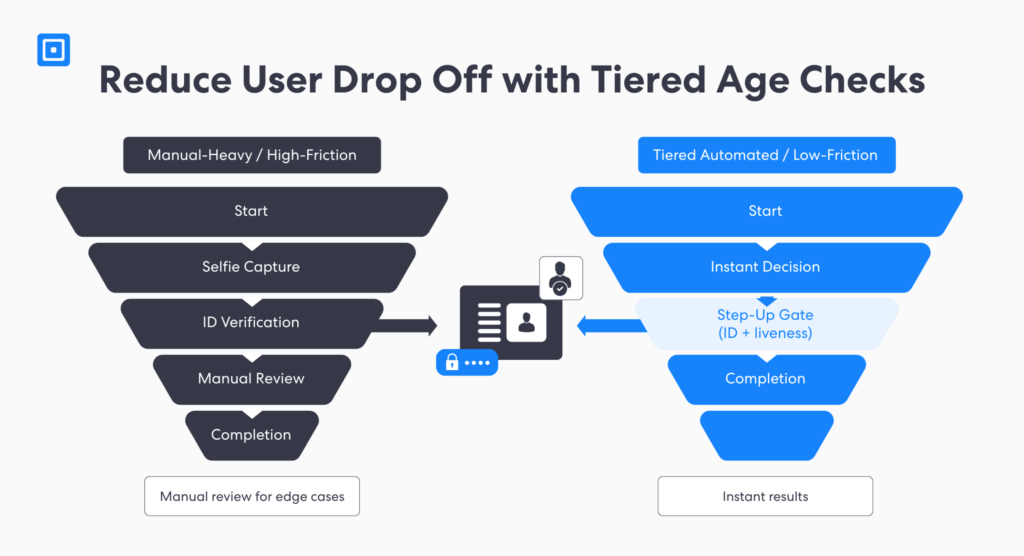
Risk-based authentication also supports long-term resilience. It allows step-up checks when risk changes, such as for higher-value transactions. It also helps manage fraud prevention without harming UX. Standards and guidance on reliable identity proofing can help frame assurance approaches. The Financial Action Task Force (FATF) digital identity guidance reinforces risk-based thinking for identity verification systems. You can learn more here: [What is a Risk-Based Approach (RBA)?](https://www.complycube.com/en/what-is-a-risk-based-approach/)
### Security and breach risk management
Many automated age verification systems involve sensitive user data. This increases the risks of data breaches and misuse. Teams should evaluate encryption, access control, and retention policies. They should also assess vendor incident response and auditability. This is part of ensuring compliance.
Fraud signals also matter in high-risk sectors. Identity fraud and misuse are well-documented concerns in government contexts, which are relevant for threat modelling. This context helps justify layered controls and monitoring.
### Key Takeaways
- **Automated age** **verification** performs best when it is tiered.
- **Document-based age** verification with biometric verification is the most defensible option.
- **Regulations are tightening**, with UK fines up to 10% and EU DSA penalties up to 6% worldwide.
- **Privacy-by-design** requires data minimization, limited retention, and careful handling of anonymity.
- **ComplyCube’s age** **estimation** uses APIs and SDKs, audit trails, and modular workflows for robust compliance with age verification requirements.
## ComplyCube’s Automated Age Verification
ComplyCube delivers scalable age assurance that protects minors, cuts user drop-off, and ensures global compliance. Choose the right age assurance methods for your sector and integrate age verification software through a single, unified KYC platform. [Speak with the ComplyCube team](https://portal.complycube.com/signup) about our comprehensive suite today.
[](https://portal.complycube.com/signup)
## Frequently Asked Questions
What is automated age verification in 2026?
Automated age verification uses AI and biometrics to confirm a user meets age requirements without manual review. The process typically starts with a low-friction selfie check and escalates to additional verification, such as document checks when risks are higher.
What are the leading automated age verification solutions in 2026?
The best solutions reduce underage access while keeping conversion rates high. Leading age verification providers are ones that support configurable workflows so policies, age thresholds, and evidence requirements can be applied consistently across markets.
Is age estimation and age verification different?
Age estimation provides a fast, probabilistic selfie-based result, while age verification uses higher-assurance evidence such as document checks and biometric verification, which is more suitable to meet stringent regional requirements.
How does automated age checks prevent fraud?
Automated age checks layer with other verification, including document and biometric checks with liveness detection. In turn, these checks can detect replayed selfies, deepfakes, and fraudulent documents, deterring fraud and identity theft effectively.
How can ComplyCube support privacy-first, global age assurance?
ComplyCube enables tiered age assurance through its no-code workflows, audit-ready logs, and vast API and SDK integrations. Organizations can roll out consistent age checks across jurisdictions while meeting data privacy regulations too.
**Categories:** Guides
**Tags:** Age Verification
---
### [Presentation Attack Detection: A Comprehensive Guide](https://www.complycube.com/presentation-attack-detection-pad-guide/)
**Published:** June 25, 2024
**Author:** Sofia Daley
**Excerpt:** Presentation Attack Detection (PAD) is a key component of a robust biometric verification process. PAD helps fortify identity verification by detecting Presentation Attacks (PAs) and fraudulent attempts to gain unauthorized access.
**Content:**
**TL;DR: Presentation attack detection (PAD)** helps stop presentation attacks that try to fool biometric verification with spoofs such as **printed photos, masks, replays, or screens**. As deepfake attacks and digital injection methods scale, PAD **strengthens liveness decisions** so remote onboarding and authentication are harder to bypass.
Presentation Attack Detection (PAD) is a key component of a robust biometric verification process. PAD helps fortify identity verification by detecting Presentation Attacks (PAs) and fraudulent attempts to gain unauthorized access. With advanced AI-powered deepfake attacks on the rise, PAD solutions have become critical for organisations to safeguard their stakeholders, and their reputation.
This guide explores different kinds of presentation attacks, and the need for implementing presentation attack detection solutions.
## What is Presentation Attack Detection?
PAD works by distinguishing between authentic biometric samples, such as a live person’s face or fingerprint, and presentation attack instruments like printed photos, fake fingerprints, latex masks, or digital images. Advanced PAD technologies, such as liveness detection, are adopted to enhance security in biometric authentication processes, which are widely used by financial institutions, law enforcement agencies, and many more organizations.
The case for implementing PAD continues to crystallize, as recent research finds that [90% of all document-based fraudulent practices are driven by presentation fraud](https://facia.ai/blog/digital-onboarding-fraud-prevention-document-spoofs/). The use of deepfakes, which increased by [704% in the US in the second half of 2023](https://www.forbes.com/sites/forbestechcouncil/2024/06/18/navigating-the-perils-of-deepfakes/) alone, points to a critical point in the discussion: presentation attacks are becoming increasingly sophisticated.
### Presentation Attack Detection and Biometric Verification
Even though facial recognition technology has massively improved worldwide security, it’s important to remember that biometric authentication isn’t infallible. Presentation attacks can subvert identity authentication processes by using deceptive techniques and discerning presentation attack instruments.
Implementing PAD allows organizations to distinguish real users from fraudsters using [biometric identity verification](https://www.complycube.com/en/solutions/identity-assurance/biometric-verification/). Biometric data is taken from provided images, documents, and videos and analyzed by advanced AI-powered technology that can then draw precise conclusions by examining microexpressions, skin texture, and more.
## Types of Presentation Attacks
Fraudsters use several methods to deceive facial recognition technology, including printed photo attacks, video replay attacks, and 3D masks.
### **Printed Photo Presentation Attack**

Print attacks are one of the simplest forms of presentation attacks. Without PAD technology present, attackers can easily bypass facial recognition authentication processes by presenting printed identity documents or images of another person.
These photos are often taken from social networks or even the dark web. Unauthorized users gain access by subverting these facial biometric systems, committing identity fraud due to the lack of face presentation attack detection.
Occasionally, printed photos are used as masks in these attacks. Fraudsters will create a mask from a printed photo by cutting out eye holes to blink and bypass liveness detection.
Governments and financial institutions are often the primary targets for presentation attacks using printed photos, as their biometric systems protect large volumes of high-value assets and information.
However, it’s important to remember that anyone can be a target of these attacks:
- As of 2023, 40% of businesses in the US were vulnerable to presentation attacks, with [only 60% of organizations](https://www.idrnd.ai/wp-content/uploads/2023/07/IDR_D_Document-Liveness-Whitepaper-.pdf#:~:text=URL%3A%20https%3A%2F%2Fwww.idrnd.ai%2Fwp) implementing the necessary PAD measures using biometric authentication processes.
### Replay Attempts and Deepfake Attacks
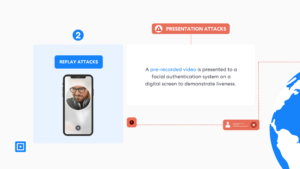
In replay attacks, the attacker plays a pre-recorded video or presents a digital image to the facial authentication system on a screen. This attack can mimic the natural movements and characteristics of a person’s face very well, as videos can capture blinking and subtle eye movements to appear like a live person.
Deepfakes, a sophisticated form of synthetic media used in presentation attacks, are also a form of replay attacks. They consist of artificial photos or videos created by advanced machine learning called “deep learning”. Deep learning differs from standard machine learning because it operates with a special class of algorithms called a neural network, which aims to replicate how our brain retains information. “Hidden layers” of nodes are utilized within the network, which perform mathematical transformations to convert input signals into output signals.
In the context of deepfakes, it converts authentic images into realistic fake images, offering scammers a great way of deceiving authentication systems. You can learn more here: [Deepfake Detection For The Modern Media Threat.](https://www.complycube.com/en/deepfake-detection-for-the-modern-media-threat/)
> Deepfakes have quickly gained popularity over the last few years, with the number of deepfake videos online [increasing by 550% from 2019 to 2023.](https://igp.sipa.columbia.edu/news/rise-deepfake-pornography#:~:text=Another%20study%20in%202023%20by,550%20percent%20increase%20from%202019.)
Identifying a presentation attack that utilizes deepfakes requires advanced PAD methods to spot subtle inconsistencies such as unusual blinking patterns or digital artifacts.
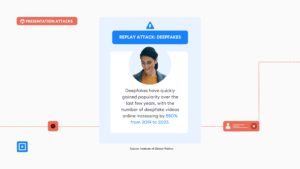
The Institute of Global Politics recently interviewed the journalist Emanuel Maiberg on the rise of deep fakes, and stated the following in the article:
> **“Recent advancements in generative AI have made everything even easier and more realistic, with Stable Diffusion technology and other text-to-image AI tools, you can take photos of someone and create a custom AI model of the person’s identity.”**
### 3D Mask Presentation Attack
Presentation attack methods also include 3D mask attacks, in which fraudsters present a 3D mask with their target’s physical characteristics to deceive biometric systems that use facial recognition technology. These masks are often made using a mold of their target’s face to replicate the facial biometric characteristics of the genuine user with high precision.
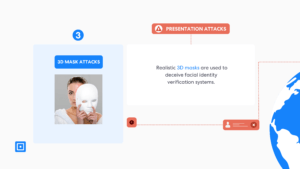
### **Case Study: Commonwealth Bank of Australia suspected AI-enabled mortgage fraud**
In February 2026, Commonwealth Bank of Australia (CBA) reported up to A$1 billion in potentially fraudulent home loans, with reporting suggesting some applications used AI-generated or manipulated documents. The case shows how AI-enabled fraud can weaken onboarding when controls are not built to resist spoofing and modern presentation attacks.
##### **Reusable, privacy-aware IDV solutions across borders**
CBA referred the matter to police and regulators and focused on strengthening financial crime controls to counter evolving AI-driven fraud. A PAD-led approach supports this response by improving biometric verification resilience and detecting presentation attack detection signals earlier across remote and intermediary-led journeys.
##### **Outcomes**
- Up to A$1 billion in potentially fraudulent home loans were flagged and reported to authorities.
- CBA reported investing A$900 million in the prior financial year to protect customers from fraud.
- 89% of Australians believed they could spot a deepfake, but only 42% could do so when tested.
## The Case for Presentation Attack Detection
Presentation attack detection is critical for fraud prevention and provides organizations with the necessary security to avoid financial losses and data leaks.
### Statistical Overview of Presentation Attack Detection
The need for presentation attack detection software is more than apparent when we look at the financial cost of online fraud and the wide reach of fraudulent practices:
- Recent research found that presentation attacks account for [90% of all document-based fraudulent attacks](https://www.idrnd.ai/wp-content/uploads/2023/07/IDR_D_Document-Liveness-Whitepaper-.pdf), underlining the need for a robust biometric PAD process.
- Deepfake attacks and other advanced forms of presentation attacks that can subvert facial identity verification systems saw a real increase. In just 2023, the use of deepfakes to deceive facial identity checks rose[ by 704% in the US](https://www.forbes.com/sites/forbestechcouncil/2024/06/18/navigating-the-perils-of-deepfakes/).
- The Federal Trade Commission stated that American consumers lost over [$10 billion in fraud](https://www.biometricupdate.com/202404/us-sees-identity-theft-fraud-problem-more-clearly-than-biometrics-role-in-addressing-it) in 2023, which includes various forms of identity theft facilitated by inadequate identity verification measures.
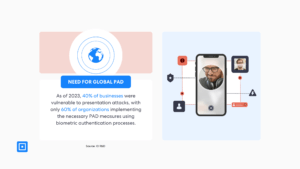
### Compliance and Best Presentation Attack Detection Practices
- The framework for evaluating presentation attacks is developed [within ISO/IEC 30107-3:2017](https://www.complycube.com/en/company/security-compliance-center/).
- Compliance with ISO 30107 helps ensure that biometric systems can accurately distinguish between genuine biometric traits and fake or altered ones.
- Official websites and linked source publications provide guidelines for best practices in presentation attack detection.
## Introducing a Biometric PAD System for Identity Verification
Using liveness detection to spot deepfakes, printed photos, or other PAD instruments is critical to a strong IDV and KYC solution for any business.
### Liveness Detection
A liveness detection solution ensures that your customer or user is physically present and alive during the authentication process, eliminating the possibility of deepfake, replayed video, or spoofed images gaining unauthorized access.
Advanced presentation attack detection software should include precise liveness detection to authenticate users. To prevent presentation attacks, these [liveness detection solutions](https://www.complycube.com/en/solutions/due-diligence-compliance/know-your-customer/liveness-detection/) should also be able to analyze subtle micro-expressions and facial textures to recognize pixel tampering or any kind of mask.
For example, liveness detection will monitor that a person transferring money is present during the transaction, ensuring they are not being impersonated.
### Example Industry Applications
- **Financial Services:** Protects against fraudulent transactions and account takeovers by ensuring that only real, verified users who are physically present can access sensitive information.
- **Healthcare:** Secures patient data and correctly identifies individuals accessing medical records.
- **Border Control:** Enhances border security by accurately verifying travelers’ identities and detecting fraudulent documents.
### Key Takeaways
- PAD reduces biometric spoofing risk by spotting non-genuine submissions.
- It should catch physical spoofs and injection-led deepfake attempts.
- Strong biometric verification pairs liveness with face matching.
- Layered checks improve resilience against repeated attack attempts.
- ComplyCube supports PAD-led checks within identity flows.
## Presentation Attack Detection with ComplyCube
We offer a market-leading PAD solution, which uses an AI-powered liveness detection check to examine precise facial features.
### ComplyCube’s Identity Verification Solutions for PAD
At ComplyCube, we utilize a PAD Level 2 ISO-certified biometric AI engine for presentation attack detection by verifying liveness through contrasting facial similarity data points between the submitted video and an image from a government-issued document. In addition, we use 3D face mapping to check if a user has enrolled before under different details.
[Contact our team](https://www.complycube.com/en/contact/contact-sales/) of KYC specialists to learn more about how presentation attack detection can fortify your authentication processes and safeguard your organisation.
## Frequently Asked Questions
What is presentation attack detection (PAD)?
Presentation attack detection is the capability in biometric systems that identifies spoof attempts, helping determine whether a presented face, fingerprint, or trait is genuine and live.
What are common presentation attacks against biometric verification?
Common presentation attacks include printed photo attempts, mask-based spoofs, and replayed video or screen-based submissions intended to trick liveness checks.
How do deepfake attacks relate to presentation attack detection?
Deepfake attacks can be used to generate or manipulate biometric media, and modern threat reporting shows rapid growth in face swap and injection-style vectors that PAD and liveness must be engineered to detect.
What is the difference between PAD and liveness detection?
Liveness detection is commonly treated as a subset of PAD focused on proving a real, present human, while PAD covers broader spoof detection methods across biometric modalities./p>
How does ComplyCube help prevent presentation attacks in biometric verification?
ComplyCube applies PAD within its identity flows to detect spoofing vectors and return liveness outcomes alongside face similarity against an ID image, supporting defensible onboarding decisions.
**Categories:** Guides
**Tags:** Identity Verification
---
### [Understanding KYC Requirements UK: A Quick Guide for 2025](https://www.complycube.com/understanding-kyc-requirements-uk-full-guide/)
**Published:** April 28, 2025
**Author:** Dini Habib
**Excerpt:** Know Your Customer (KYC) is a foundation of the United Kingdom's anti-money laundering regulations. It mandates organizations to identify and authenticate their clients and assess the risk of their relationships and transactions.
**Content:**
**TL;DR: KYC Requirements UK** set the baseline for how firms can identify customers**.** It **understands risk and keep compliant** during the onboarding under UK AML rules. Firms that treat **KYC requirements** as a one-time tick box face heightened regulatory and operational risk.
Know Your Customer (KYC) is a foundation of the United Kingdom’s anti-money laundering regulations. It mandates organizations to identify and authenticate their customers. Additionally, it assesses the risk of business relationships and financial transactions. Understanding KYC requirements UK is essential to meeting the law’s requirements. It also contributes to their role in protecting the overall economy from the threat of money laundering, financial terrorism, and identity fraud.
Advanced KYC processes enable the UK financial system to maintain its reputation. It builds consumer confidence, and makes the UK a reliable and secure location to conduct international business. This guide provides a comprehensive overview of the different legislation governing KYC regulations in the UK. It also shows best practices for maintaining strong KYC procedures, and details the impact of non-compliance.
## Regulatory Obligations Governing KYC Requirements UK
The main UK legislation overseeing KYC compliance is the [Money Laundering, Terrorist Financing and Transfer of Funds (Information on the Payer) Regulations (MLR)](https://www.legislation.gov.uk/uksi/2017/692/contents), enacted in 2017. This regulation incorporates the [European Union’s Fourth Money Laundering Directive (4MLD)](https://finance.ec.europa.eu/regulation-and-supervision/financial-services-legislation/implementing-and-delegated-acts/anti-money-laundering-and-terrorist-financing-directive-4_en) within UK legislation and aligns with updated world standards circulated by the [Financial Action Task Force (FATF)](https://home.treasury.gov/policy-issues/terrorism-and-illicit-finance/financial-action-task-force). The FATF is an international organization formed in 1989 to combat money laundering and the financing of terrorism.
The FATF recommendations are the standard against which Anti-Money Laundering (AML) and [KYC processes](https://www.complycube.com/en/solutions/due-diligence-compliance/know-your-customer/) are measured worldwide. The UK is a founding member. It revises its regulations every few years to maintain FATF requirements. In the UK, the responsibility to uphold AML and KYC compliance is divided among various domestic key regulatory and supervisory bodies:
- **Financial Conduct Authority (FCA)** — Established in 2013
- **Her Majesty’s Revenue & Customs (HMRC)** — Established in 2005
- **National Crime Agency (NCA)** — Established in 2013
- **Prudential Regulation Authority (PRA)** — Established in 2013
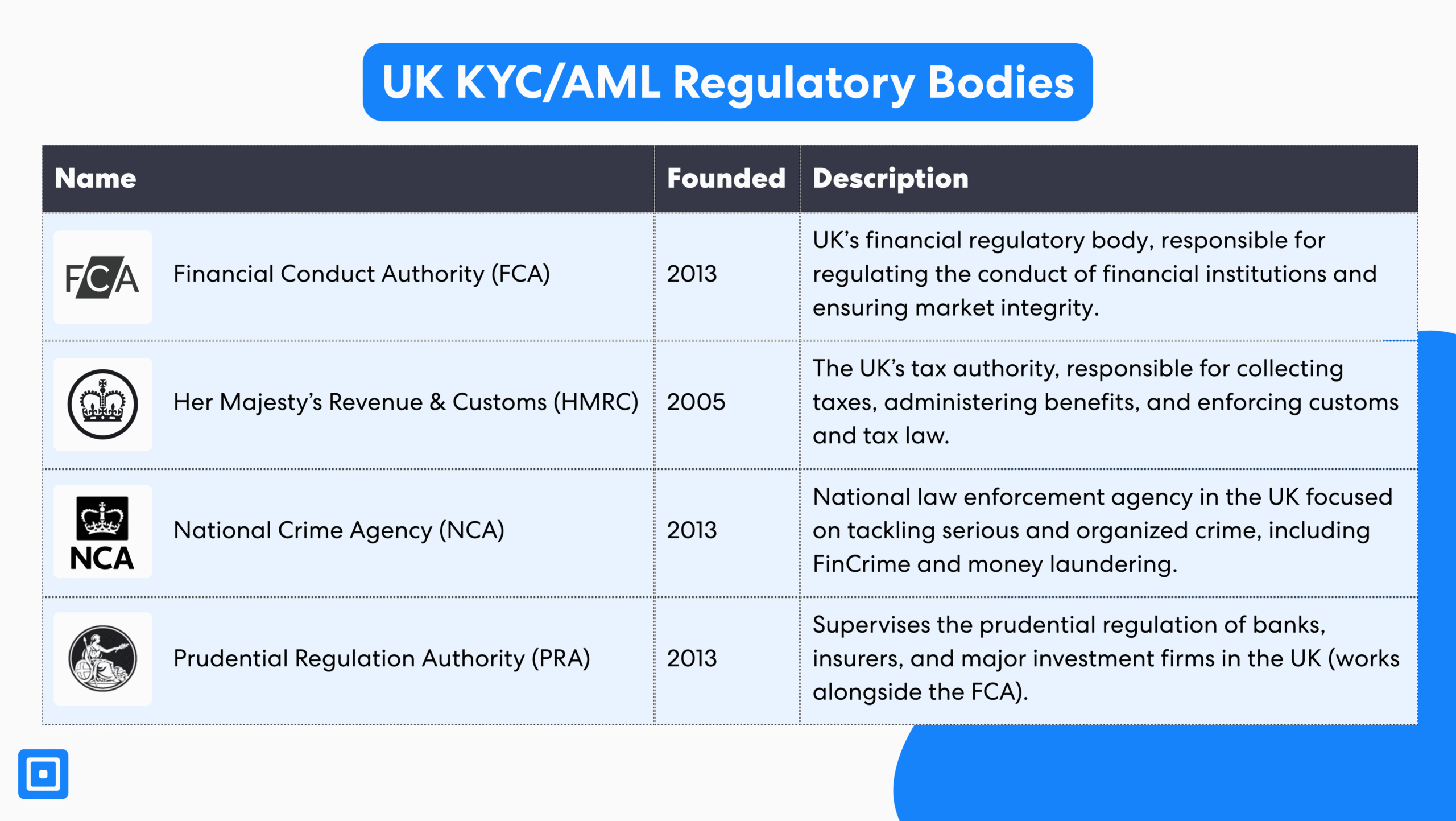
### The Role of the Financial Conduct Authority (FCA)
The [Financial Conduct Authority (FCA)](https://www.fca.org.uk) is a financial regulatory body in the United Kingdom. It is the principal regulator for financial services firms, including banks, investment firms, insurance companies, and cryptoasset businesses. It operates independently of the UK Government and enforces compliance with KYC and Anti-Money Laundering (AML) regulations. This includes investigating breaches, imposing fines, and implementing sanctions on businesses.
### Her Majesty’s Revenue & Customs (HMRC) Responsibilities
HMRC oversees non-financial businesses and professions. It looks at money service businesses, trust or company service providers, high-value dealers, and art market participants. [HMRC](https://www.gov.uk/government/organisations/hm-revenue-customs) is accountable for ensuring these sectors comply with KYC and AML rules, conducting inspections, and issuing penalties for non-compliance.
### The Purpose of National Crime Agency (NCA)
The National Crime Agency is a national law enforcement agency in the United Kingdom. It leads the UK’s response to serious and organized crime. This includes money laundering, cybercrime and terrorist financing that goes across regional and international borders. The [NCA](https://www.nationalcrimeagency.gov.uk/what-we-do) receives and analyzes suspicious activity reports (SARs) from regulated entities and coordinates national efforts to disrupt financial crime.
### Prudential Regulation Authority (PRA) and the Bank of England
The [Prudential Regulation Authority](https://www.bankofengland.co.uk/explainers/what-is-the-prudential-regulation-authority-pra) works closely with Financial Conduct Authority (FCA), both coordinating under a Memorandum of Understanding. Operating under the Bank of England. The PRA focuses on the prudential regulation of major financial institutions. This covers banks, building societies, credit union, insurers, and large investment firms, ensuring their stability and resilience.
The UK’s regulatory framework is dynamic. With frequent updates, the framework addresses emerging money laundering risks and remain in step with FATF compliance recommendations. Specific regulation bodies are also founded to supervise niche sectors, such as the Solicitors Regulation Authority (SRA) and the Legal Sector Affinity Group (LSAG) within the legal and accountancy professions. By aligning closely with FATF standards, the UK continues to lead globally in preventing financial crime and promoting corporate transparency and security.
### **Case Study: Monzo Bank FCA Penalty and KYC Requirements UK**
The FCA found that Monzo’s anti-financial crime controls did not keep pace with rapid scale. There were weaknesses across onboarding and monitoring linked to KYC Requirements UK. In practice, those gaps meant the bank applied restrictions inconsistently and onboarded customers without sufficient controls.
##### **Internal reviews and remediation programs**
Monzo went through an independent “Skilled Person” review focused on Customer Risk Assessment (CRA), Customer Due Diligence (CDD), Enhanced Due Diligence (EDD) and transaction monitoring to align to KYC Requirements. The firm also collected missing due diligence for existing customers and exit relationships outside its risk appetite.
##### **Outcomes**
- £21,091,300 FCA financial penalty (reduced from £30,130,475 after a 30% settlement discount).
- Monzo estimated this may have led to 34,262 high-risk customers being onboarded.
- A CIFAS screening test of 69,685 existing customers showed an 8.72% high-risk match rate, and Monzo identified 5,038 customers to exit as outside its risk appetite.
## Best Practices for Alignment with Stringent KYC Requirements UK
The UK Government’s [Good Practice Guide 45 (GPG 45)](https://www.gov.uk/government/publications/identity-proofing-and-verification-of-an-individual) is a foundational document for identity verification across both public and private sectors. GPG 45 provides a clear, outcomes-based compliance strategy framework for verifying the identity of customers, employees, and third parties. The GPG 45 is designed to help organizations determine the appropriate level of Know Your Customer (KYC) rules based on the service or transaction risk profile.
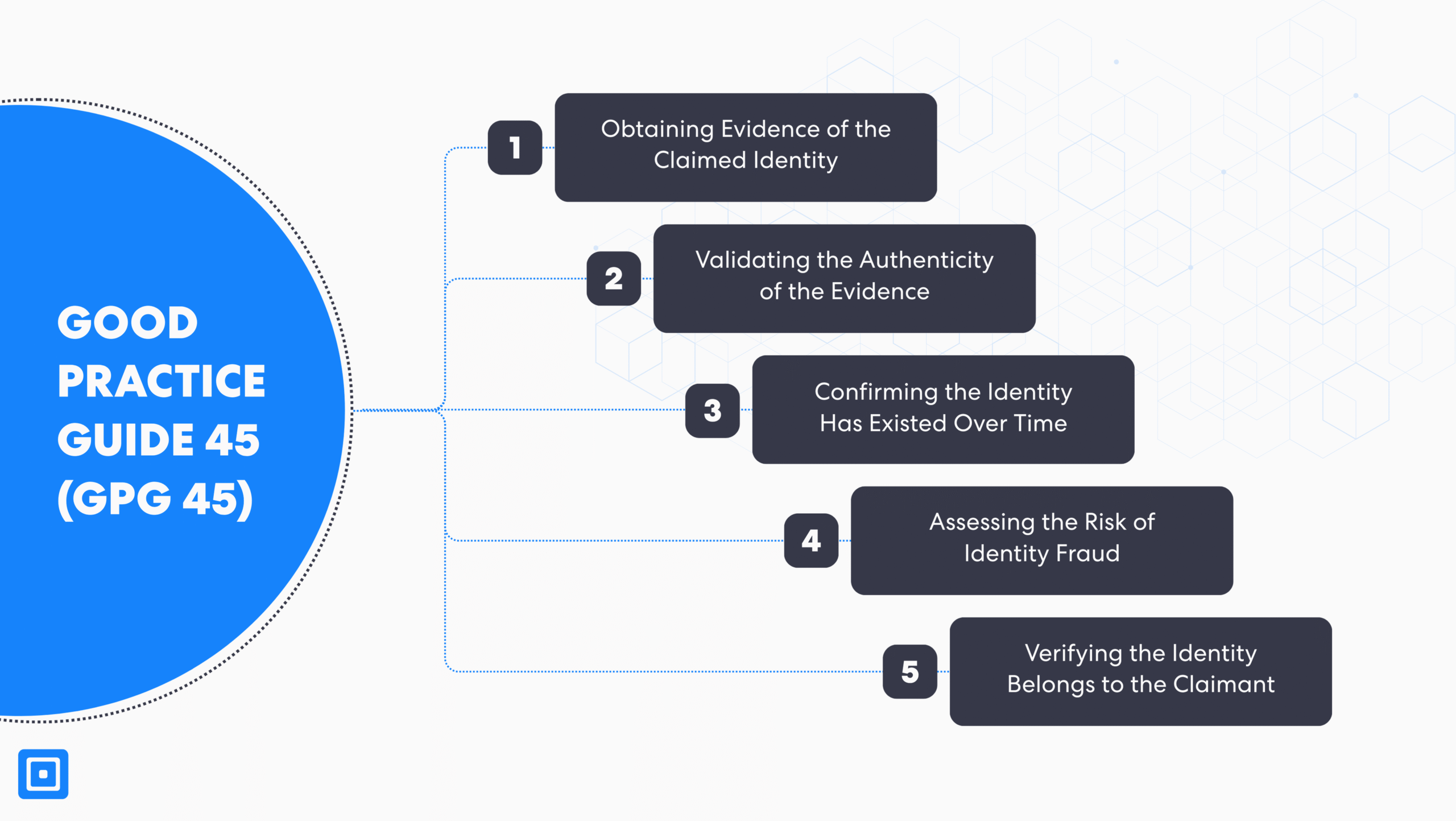
### 1. Obtain Evidence of the Claimed Identity
The first step is to gather evidence that supports the customer, merchant, or entity identified. This includes physical documents, such as a passport or driving licence, or digital records, such as information from a trusted database.
### 2. Check the Evidence is Genuine or Valid
Once collected, evidence [must be examined](https://www.complycube.com/en/solutions/identity-assurance/document-verification/) to confirm the documents authenticity and validity. This involves checking for signs of forgery, counterfeiting, or tampering on physical documents, or verifying digital records against authoritative sources.
### 3. Check the Claimed Identity Has Existed Over Time
This step involves confirming that the identity attributes have been active and consistent over a period of time. Historical data, such as credit history, utility bills, or employment records, can be used. They demonstrate that the claimed identity is not synthetic. This helps guard against identity theft, particularly through the use of fabricated or stolen identities.
### 4. Assess if the Claimed Identity is a High-Risk Customer
Cross-referencing the identity against known fraud databases, watchlists, and [sanctions lists](https://www.complycube.com/en/solutions/global-screening/sanctions-pep-screening/) is vital to accessing a customer’s risk profile. This stage aims to identify warning signs. Signs such as links to previously compromised identities, unusual patterns, or other red flags that might indicate a higher risk of identity theft or misuse.
### 5. Check that the Identity Belongs to the Person Who’s Claiming It
The final step is to verify that the individual presenting the identity is genuinely entitled to use it. This can involve biometric authentication and leveraging liveness detection technology. The purpose is to ensure that the person submitting the evidence is not an imposter but the rightful owner of the claimed identity.
Each step is scored, and the combination of scores determines the overall confidence level in the identity verification process. [Modern compliance platforms](https://www.complycube.com/en/choosing-the-right-automated-kyc-verification-service/) enable businesses in the financial sector to streamline and further fortify Know Your Customer (KYC) verification through comprehensive ongoing monitoring, enhanced due diligence, and robust KYC checks to ensure regulatory compliance.
## Key Components of a Comprehensive KYC Process
Compliance software and tools have drastically changed how financial institutions tackle Know Your Customer (KYC) requirements. The use of sophisticated technology enables banks, cryptocurrency, real estate, gaming, and other financial sector players to meet KYC obligations and run customer due diligence with increased speed, accuracy, and consistency. This empowers businesses such as financial institutions and others to effectively manage risky financial transactions, combat money laundering, and prevent terrorism financing proactively.
### Customer Identification Programme and Identity Verification
The cornerstone of a strong KYC process is a [Customer Identification Program (CIP)](https://www.complycube.com/en/customer-identification-program-what-is-cip/). CIP refers to gathering significant KYC documents to verify a customer’s identity. Automated screening systems streamline this process by leveraging [Artificial Intelligence (AI)](https://www.complycube.com/en/generative-ai-fraud-and-identity-verification/) and Machine Learning (ML) technologies to make conducting KYC checks and biometric verification rapid and secure within regulated markets.
### Customer Due Diligence and Enhanced Due Diligence
When a customer’s identity has been verified, compliance software can conduct comprehensive [Customer Due Diligence (CDD)](https://www.complycube.com/en/what-is-customer-due-diligence/) and, where necessary, [Enhanced Due Diligence (EDD)](https://www.complycube.com/en/enhanced-due-diligence-edd-insights-and-challenges/). Due diligence is a crucial step in KYC and Anti-Money Laundering (AML) regulations. It encompasses assessing the risk profile of each business relationship, identifying beneficial owners, and screening for [Politically Exposed Persons (PEPs)](https://www.complycube.com/en/what-is-a-pep/) or links to high risk third countries.
### Ongoing Monitoring and Risk Management
Know Your Customer (KYC) requirements do not end at the onboarding stage. Financial institutions must continue [conducting ongoing monitoring](https://www.complycube.com/en/what-is-an-ongoing-monitoring-process/) to remain aligned with AML regulations in real-time. The risk profile of individual and corporate clients can be subject to changes easily, making continuous monitoring compulsory to prevent money laundering and terrorism financing in the long-term. The timely escalation of Customer Due Diligence (CDD), where heightened risk indicators are witnessed, is crucial.
### Risk-Based Approach and Compliance Strategies
Adopting a [risk-based approach](https://www.complycube.com/en/what-is-a-risk-based-approach/) is essential in KYC processes. This approach entails utilizing risk management efficiently through prioritizing and tailoring resources in accordance with risk policies. For instance, financial transactions and business relationships occurring in regulated markets or high-risk third countries would require more stringent ongoing monitoring and due diligence to counteract financial crime and remain alignment with KYC regulations.
### The Benefits of an Automated Compliance Framework
By automating KYC checks, financial institutions will reduce operational costs, minimize human error, eliminate potential risks, and enhance customer experience by significantly lowering onboarding times. In summary, establishing a robust Customer Identification Program (CIP), enhanced Customer Due Diligence (CDD), and enabling ongoing monitoring enables UK businesses to meet KYC requirements efficiently and achieve regulatory compliance.
## Penalties for Non-Compliance with KYC Requirements UK
Failure to conduct robust KYC checks and meet KYC requirements has harsh implications for companies in the United Kingdom. This section will detail the severe penalties UK banks and other financial institutions face, reflecting the commitment to safeguarding the financial system from financial crime and illicit financial activities.
> Financial crime costs every one of us here today, consumers and firms alike. It violates the financial systems we rely on to live our everyday lives and uses them against us. ~ [Sarah Pritchard](https://www.fca.org.uk/news/speeches/targeted-and-outcomes-based-approach-tackling-financial-crime), FCA Executive Director of Markets and International.
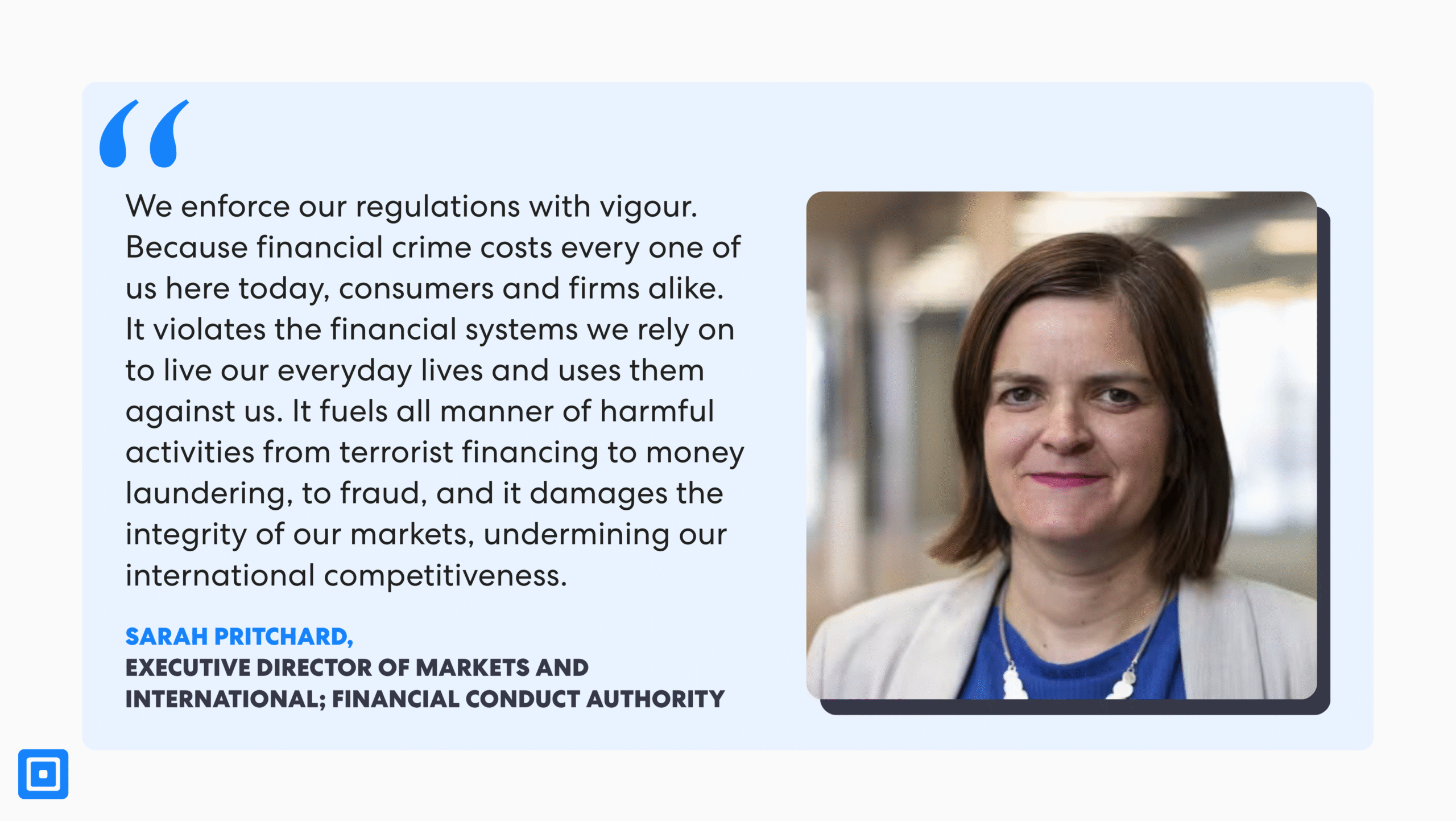
### Santander UK PLC — £107.7 million fined
In 2022, Santander UK Bank was fined after the FCA identified persistent weaknesses in its anti-money laundering controls for business banking clients. The bank’s weaknesses allowed suspicious funds of more than [£298 million](https://www.fca.org.uk/news/press-releases/fca-fines-santander-uk-repeated-anti-money-laundering-failures) to be permitted, creating a high-risk environment for terrorist financing and FinCrime to thrive.
### National Westminster Bank PLC (NatWest) — £264.7 million fined
NatWest was fined in 2021 for failing to monitor and report suspicious financial transactions involving a jewellery company that deposited [£264 million](https://www.theguardian.com/business/2021/dec/13/natwest-fined-264m-after-admitting-breaching-anti-money-laundering-rules) of cash. Although NatWest leveraged compliance software, it was unable to pick up red flags, demonstrating weak KYC documents collection and due diligence on high-risk merchants.
### William Hill Group — £19.2 million fined
Three gambling businesses owned by William Hill Group paid a total of £19.2 million in 2023 for their AML failures. The organizations were found allowing clients to make large deposits without adequate KYC checks during the COVID-19 lockdown.
> When we launched this investigation the failings we uncovered were so widespread and alarming serious consideration was given to licence suspension. ~ [Andrew Rhodes](https://www.gamblingcommission.gov.uk/news/article/william-hill-group-businesses-to-pay-record-gbp19-2m-for-failures), Gambling Commission Chief Executive and Commissioner.
The cases above highlight the consequences that UK businesses will face if they neglect KYC requirements, fail to verify customers’ identities, or overlook potential risks in business relationships with private and unlisted companies or high-risk clients.
### Key Takeaways
- KYC requirements UK must be risk-based, consistent, and evidenced.
- KYC starts with ID verification, then customer due diligence and enhanced due diligence if needed.
- Requirements must tighten for PEPs, complex ownership, and higher-risk activity.
- Ongoing monitoring with KYC is essential for customer risk reviews and evidence accuracy.
- ComplyCube helps teams meet KYC Requirements UK through IDV, screening and workflows.
## Meeting Stringent KYC Requirements UK with ComplyCube
Conducting detailed KYC checks is imminent in the fight against financial crime, money laundering, and terrorist financing. It ensures that financial institutions, electronic money institutions, insolvency practitioners, and even independent legal professionals uphold the integrity of the UK’s financial system.
Rigorous KYC verification on customers, beneficial owners, and merchants empower firms to accurately access the risk associated with each business relationship and fulfill their due diligence obligations. As UK regulations evolve, adopting scalable and tailored KYC processes remains as the key for compliance and safeguarding the UK from financial crime. [Get in touch](https://portal.complycube.com/signup) with a team member today.
[](https://portal.complycube.com/signup)
## Frequently Asked Questions
What do KYC requirements UK mean for regulated firms?
KYC requirements UK refer to the controls firms must apply to identify and verify customers. They understand the nature of the relationship, assess risk, and maintain ongoing oversight aligned to UK AML expectations.
What are KYC Requirements in practice during customer onboarding in the UK?
KYC requirements usually include identity verification, collecting core customer information, assessing risk, and applying Customer Due Diligence (CDD) to determine whether Enhance Due Diligence (EDD) is needed.
When do KYC Requirements UK require Enhanced Due Diligence (EDD)?
KYC Requirements UK typically call for EDD where the relationship presents higher risk, such as when a customer is a Politically Exposed Person (PEP), ownership is unusually complex, or risk indicators increase after onboarding.
Do KYC Requirements end after onboarding, or do UK rules expect ongoing monitoring?
KYC Requirements do not end at onboarding. KYC Requirements UK are generally met through ongoing monitoring, periodic refresh of due diligence, and updates to customer risk profiles when circumstances change.
How can ComplyCube support KYC Requirements UK compliance?
ComplyCube helps organisations meet KYC requirements UK by enabling configurable identity verification and risk-based due diligence workflows, supported by real-time screening for sanctions, PEPs, and adverse media.
**Categories:** Guides
**Tags:** Know Your Customer
---
### [Picking Top Digital Identity Verification Solutions](https://www.complycube.com/best-digital-identity-verification-solutions/)
**Published:** June 25, 2024
**Author:** Andreea Balasa
**Excerpt:** Digital Identity Verification (IDV) solutions, sometimes referred to as eIDV, are fast becoming a common KYC practice. Whether it is to identify a customer or adhere to tightening AML regulations, this KYC process is paramount.
**Content:**
**TL;DR:** Digital identity verification also known as eIDV **confirms real users** with automated document and biometric checks. IDV solutions support KYC identity verification by **applying IDV evidence, fraud signals, and audit-ready decisions** in one flow. For regulated teams, digital identity verification strengthens AML controls through **risk-based checks and monitoring**.
Digital Identity Verification solutions, sometimes referred to as eIDV or IDV solutions, are swiftly becoming a common KYC practice. This process is paramount, whether it is simply to identify a customer or adhere to ever-tightening AML regulations.
It can be challenging to determine what qualities businesses should look for in Identity Verification (IDV) solutions. This guide dives into how eIDV practices can significantly improve a business’s client onboarding process and enable a streamlined process for regulatory adherence and operational risk management.
## What is Digital Identity Verification?
Digital Identity Verification refers to the electronic identification and authentication of user details. Before the technology-driven and digitalized global economy, IDV would be completed manually by requesting certain KYC documents and verifying this information in person (think about passport security when you go on holiday).
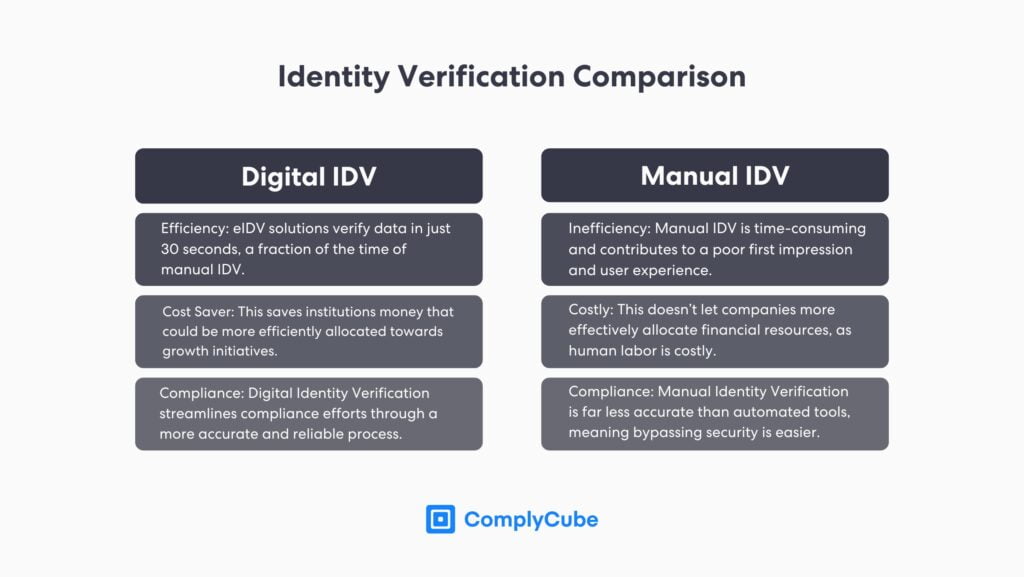
However, such a strategy is outdated for numerous reasons. Modern fraudulent technologies are extremely powerful. Falsified documents, deepfakes, and other AI-powered strategies can portray convincing online identities, leading to synthetic fraud, made-up identities, and other malicious eventualities.
### Is Digital Identity Verification the Future?
Businesses are now turning to powerful tools for client account opening to keep pace with bad actors’ movements. Such solutions help businesses prevent fraud and identity theft and ensure compliance with the relevant regulatory authorities.
> New account fraud makes up roughly [90% of all credit card fraud](https://www.fool.com/the-ascent/research/identity-theft-credit-card-fraud-statistics/).
This figure shows that current Identity Verification measures are lacking. As fraudulent activity continues to rise and the methods used to power it become more sophisticated, every modern business’s compliance team should prioritize transitioning to digital Identity Verification solutions.
## How do IDV Solutions Verify Users?
There are multiple national financial market regulators around the globe, each of which has its own set of rules. Most of these regulatory bodies are members of the Financial Action Task Force (FATF). [The Ministers of the FATF met in April 2024 in a biannual meeting and confirmed two core features:](https://www.fatf-gafi.org/en/the-fatf/ministerial-declarations.html)
1. Their continued recognition of the FATF as the lead global authoritative voice on AML and CTF regulation.
2. Their ongoing financial support of the global institution to ensure a comprehensive service can be conducted in 2025’s assessments.
This evidences the significance of the FATF’s recommendations, and that firms around the world should commit to the advice they provide. A consistent message from the international regulator is that technology should be adopted to aid in the prevention of fraud, along with the adoption of a rigorous Customer Identification Program (CIP).
There are multiple financial regulators in America, however, the Financial Crimes Enforcement Network (FinCEN) was instrumental in developing what is now known as the [Final CIP Rule between 2003 and 2004](https://www.fincen.gov/sites/default/files/guidance/finalciprule.pdf).

The Final CIP Rule mandates that banks must create an identifying program to gather a reasonable belief that a user is who they say they are. This program includes analyzing a person’s identity data, such as name, address, phone number, and birthdate.
This program was created with financial institutions in mind; however, it has more commonly been adopted by multiple other industries as the world becomes increasingly digitalized. For more information, read [What is a Customer Identification Program (CIP)?](https://www.complycube.com/en/customer-identification-program-what-is-cip/)
### What KYC documents are needed?
Businesses need enriched customer data, and this is procured from their KYC identity documents. A person’s identity is authenticated by verifying their passport or driver’s license (or any government-issued ID) and matching this document to their face via a selfie image.
To do this successfully, businesses need to be able to quickly and accurately process one of many potential documents. Modern digital account verification demands an extremely high volume of checks simultaneously; manual identity verification no longer suffices.
This is exemplified by Revolut’s client acquisition rates in 2022 alone. The global super financial app onboarded 9.8 million new customers, which equates to over 26,500 new customers every day.
> With annual revenue increasing by 45%, and [over 9.8 million new customers added](https://www.revolut.com/blog/post/annual-report-blog-2022-2023/), the rocketship continued its ascent.
Onboarding this many users without fail and without downtime requires an extremely competitive AML, KYC, and IDV solution. These solutions have helped catalyze the firm’s ability to enter new markets quickly. For more information on Know Your Customer automation, read [The Importance of Automated KYC Verification](https://www.complycube.com/en/the-importance-of-automated-kyc-verification/).
### What is Digital Identity Verification, or eIDV?
Digital Identity Verification uses advanced machine learning algorithms and artificial intelligence to extract client data at the point of their onboarding and authenticate it instantly. Verification engines are fed thousands of data entries, including global documents and individuals from around the world, to create an unbiased verification AI.
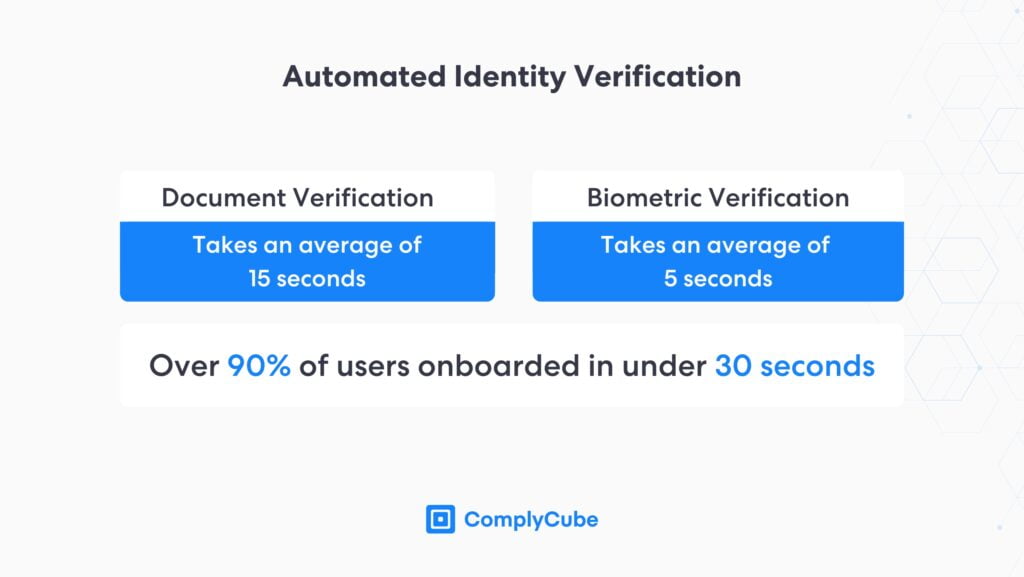
This AI powers the IDV workflow, which typically consists of document and biometric verification, providing a seamless user experience. The sophisticated technology that powers these processes can extract and verify user data in seconds, reducing client acquisition time to 30 seconds.
An IDV system can be strengthened with address verification or with multi-bureau checks to achieve greater [identity assurance](https://www.complycube.com/en/solutions/). These processes are fully customizable and programmable, meaning that eIDV solutions can be tailored to any unique business’s requirements.
## Why Adopt IDV Systems Now?
Key regulators worldwide are recommending switching to technology-powered, automated solutions. The FATF has encouraged this initiative for a number of years now, and the US Department of Justice’s 2024 report on illicit finance further corroborated this.
The FATF’s 5th round of Mutual Evaluations starts in 2025 and it is highly anticipated that these automated systems will play a vital role in many region’s performance. For this reason, many regulators suggest integrating with an AML and KYC partner as a subject of priority.
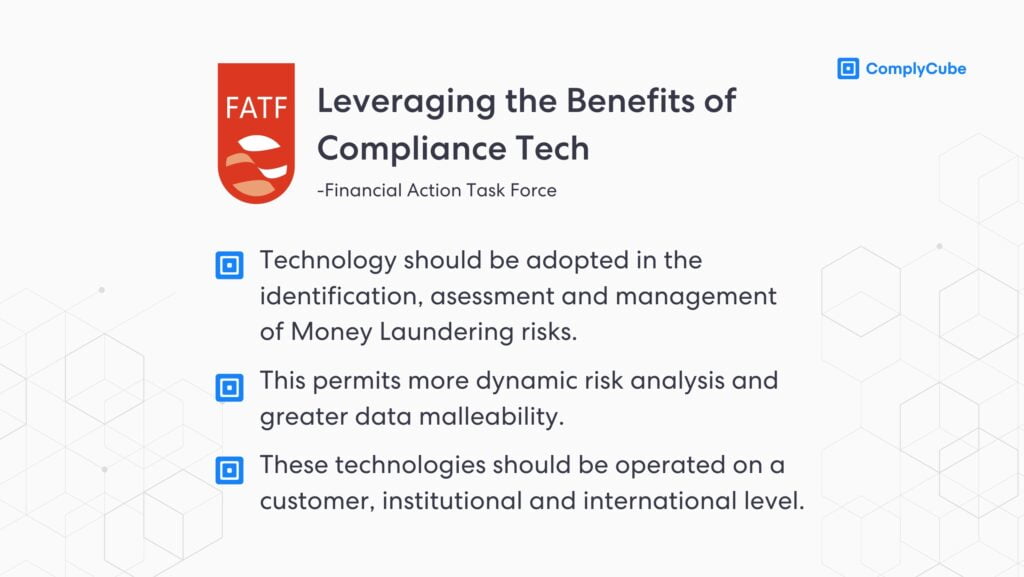
### **Case Study: European Digital Identity Wallet pilots feeding into 2026-2027 rollout**
Cross-border digital onboarding and high-assurance transactions have historically been slowed by fragmented national identity schemes, inconsistent assurance, and limited interoperability between public and private sector systems. This created a practical barrier for scalable digital identity verification.
##### **Reusable, privacy-aware IDV solutions across borders**
The EU-backed Large-Scale Pilot consortium POTENTIAL tested how interoperable wallet-based identity can work in real conditions. The programme brought organisations together to prove technical feasibility and inform governance and rollout readiness for the EU Digital Identity Wallet.
##### **Outcomes**
- 140+ partners participated from 19 Member States plus Ukraine.
- The pilot completed 1,300+ interoperability tests.
- The pilot delivered 1,000+ successful transactions, including 249 cross-border scenarios.
## eIDV Solutions for a Streamlined Customer Onboarding Process
eIDV solutions allow businesses to tackle fraudulent behavior and significantly improve their compliance with local and international AML and KYC regulations.
### Document Verification
[Document verification](https://www.complycube.com/en/solutions/identity-assurance/document-verification/) provides a high level of assurance that the document provided is authentic. Leveraging custom AI-powered verification engines, these systems can swiftly analyze multiple critical data points simultaneously, ensuring a comprehensive verification of the document.
Passports, driving licenses, or any government-issued ID are created with multiple purpose-built security features, including Near-Field Communication (NFC) technology. This short-range wireless technology enables data exchange between devices without a reliance on the internet and provides a more precise data transaction for ID cards and passports that contain RFID chips.
When scanned by an NFC-capable device, the chips’ encrypted data is read and validated. Advanced verification systems utilize NFC to confirm the authenticity of digital documents and ensure data consistency, enhancing security and streamlining identity confirmation. If your business is looking for a document authentication solution, read [What is Document Verification?](https://www.complycube.com/en/what-is-document-verification/)

### Biometric Verification
[Biometric verification](https://www.complycube.com/en/solutions/identity-assurance/biometric-verification/) is now a critical component of modern Customer Identification Programs, providing high assurance of a user’s identity. It involves matching a live selfie to an ID photo and utilizes similar advanced machine learning processes to confirm the authenticity of the selfie.
Presentation Attack Detection (PAD) is a technology that is employed to analyze facial features in 3D, assess skin textures, detect tampering, and recognize disguises, such as masks. This innovative technology ensures rapid and accurate misrepresentation detection, enhancing the efficiency and reliability of client onboarding processes.

### Address Verification
[Proof of Address](https://www.complycube.com/en/solutions/identity-assurance/address-verification/) (PoA) verification analyzes documents like utility bills and bank statements. It extracts and matches personal details with client data to validate the PoA. When completed digitally, the geolocation of the PoA document can be cross-checked against the user’s IP to bring about an additional layer of identity assurance.
Proof of Address is an increasingly important check to gain identity assurance. To learn more about IP validation, geolocation matching, and PoA verification in Britain, the British Virgin Islands, Singapore, and Hong Kong, read [The Pertinence of Proof of Address Verification](https://www.complycube.com/en/the-pertinence-of-proof-of-address-verification/).
### Multi-Bureau Verification
A [Multi-Bureau Check](https://www.complycube.com/en/solutions/identity-assurance/multi-bureau-checks/) enhances trust by providing a thorough financial and background verification and examining multiple data sources, such as credit bureaus, simultaneously. This approach deepens the vetting process, which is typically used to bolster identity assurance for significant corporate decisions, such as loan applications.
The graphic below details a list of ComplyCube data partners; however, their range of partners is not limited to these data sets alone. The more data partners a firm has, the stronger service the company can provide for enhancing identity assurance.
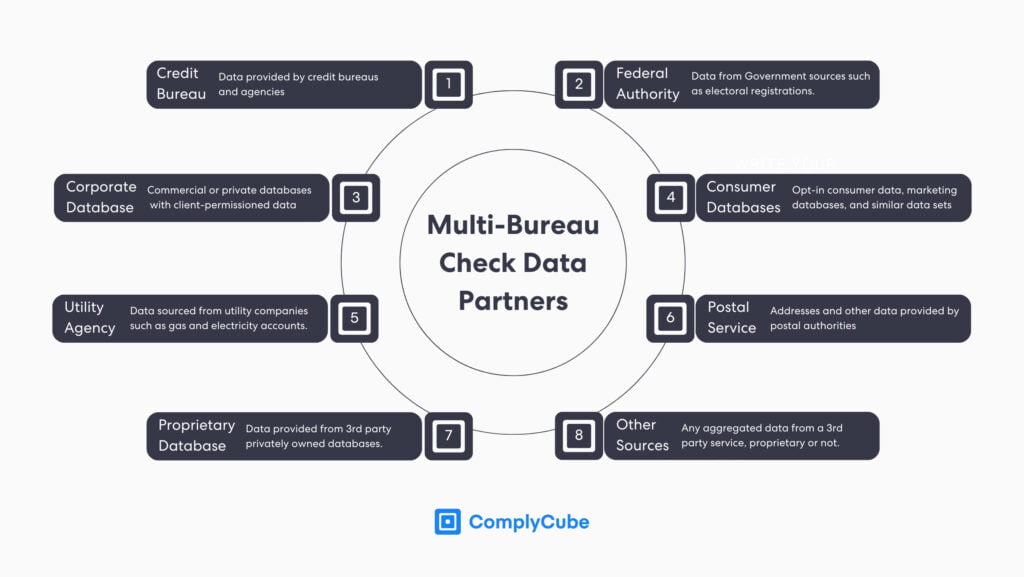
## Benefits of Digital Identity Verification
The benefit of adopting eIDV solutions is to reduce fraud risks while generating more value for businesses. The constant threat of fraudsters in both traditional and emerging markets has demanded a higher precision of risk analysis.
1. Digital Identity Verification opens doors to new data. When organizations verify client data electronically, such as with a utility bill, the document’s geolocation can be matched against a user’s IP address.
2. Transacting this data electronically reduces the risk of data compromization. ComplyCube adheres to the most rigorous data privacy laws, including [GDPR](https://gdpr-info.eu/), [ISO 27001](https://www.iso.org/standard/27001), and many others.
3. These technologies minimize human interference with the ID verification process. This leads to a significant reduction in human error and increases the rate at which new customers are accepted, revolutionizing client acquisition conversion rates.
4. A digital transition also enables a far more scalable service. Automation is at the core of eIDV, and solutions allow businesses to minimize spending on labor costs while onboarding faster.
5. Lastly, automated IDV solutions are proven to be more accurate, empowering a firm’s ability to prevent fraud. The automation of these tasks is carried forward in the [Customer Due Diligence](https://www.complycube.com/en/solutions/due-diligence-compliance/customer-due-diligence/) (CDD) process, providing a seamless and reliable KYC procedure from end to end.
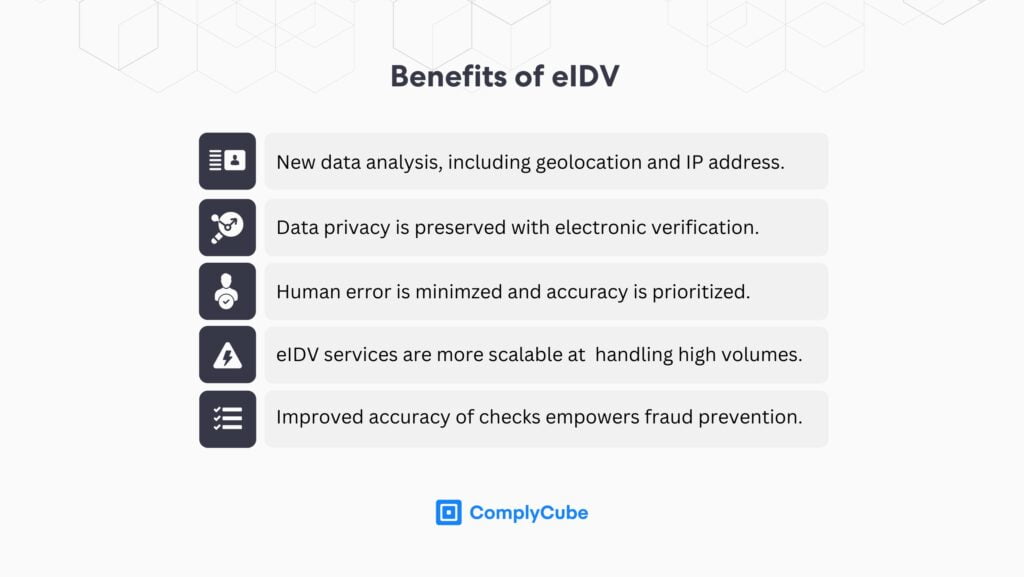
### Key Takeaways
- Digital identity verification works best when it balances fraud defence with low-friction onboarding.
- Strong IDV solutions combine document authenticity, biometric liveness, and tamper detection.
- Higher assurance comes from layered checks such as Proof of Address and data-source verification.
- The right IDV setup is integration-friendly, and produces audit-ready decision evidence.
- ComplyCube delivers scalable digital identity verification with configurable IDV, global coverage, and built-in screening.
## About ComplyCube’s Digital Identity Verification Solution
ComplyCube is an award-winning IDV solution provider, demonstrated by their nominations from [TrustRadius](https://solutions.trustradius.com/vendor-blog/best-of-awards/) in their ‘Best Of’ awards category. This recognition celebrates the development ComplyCube has forged into its IDV and KYC offerings.
Their IDV solutions offer a comprehensive approach to managing the multifaceted challenges of modern Identity Verification online. From advanced biometric checks to multi-bureau and document verification, ComplyCube equips businesses with the tools necessary to streamline customer acquisition, enhance their AML compliance, and effectively combat fraud.
For more information, visit their website [homepage](https://www.complycube.com) to browse their suite of IDV solutions. Alternatively, [get in touch with one of their agents](https://www.complycube.com/en/contact/contact-sales/) to find out how they can tailor an Identity Verification strategy to suit your business’s needs.
## Frequently Asked Questions
What is digital identity verification?
Digital identity verification also known as eIDV is the process of confirming a real person’s identity online by validating identity data and evidence, typically through document checks and biometric verification.
What are eIDV solutions and how do they work?
IDV solutions are platforms that automate identity checks by capturing user data, verifying government-issued documents, and confirming the user’s presence with biometric liveness and face matching.
What is included in KYC identity verification during onboarding?
KYC identity verification typically includes verifying identity documents, validating key identity attributes, and adding extra checks such as Proof of Address or database verification when risk levels require higher assurance.
How does IDV support AML controls and fraud prevention?
IDV supports AML by tying customer identity to higher-assurance evidence and enabling consistent, risk-based verification that helps detect impersonation, synthetic identities, and document fraud.
How does ComplyCube help teams implement digital identity verification and IDV solutions?
ComplyCube provides digital identity verification and IDV solutions that combine document verification, biometric liveness checks, and configurable workflows, helping teams strengthen KYC identity verification and AML processes.
**Categories:** Guides
**Tags:** Know Your Customer
---
### [What is Document Verification? An In-depth Look at ID Verification](https://www.complycube.com/what-is-document-verification/)
**Published:** August 25, 2023
**Author:** Andreea Balasa
**Excerpt:** Whether it's a bank assessing the validity of a customer's identity documents or a government institution ensuring the integrity of its processes, document verification promotes trust in systems globally.
**Content:**
**TL;DR:** Document checks are essential for **preventing fraud** and supporting KYC and AML compliance. AI, NFC, and biometrics capabilities strengthen identity document verification and help organizations meet rising regulatory expectations across markets. This guide explores **what is document verification** and how these checks are implemented effectively.
## What is Document Verification?
Document verification is the process through which a business confirms the authenticity and validity of a document. It involves analyzing specific attributes of a document to confirm that it has not been altered, tampered with, or forged. Verifying the legitimacy of these documents protects businesses from potential risks. Additionally, it ensures adherence to Anti-Money Laundering (AML) and Know Your Customer (KYC) compliance regulations.
> Document verification has become a mission-critical capability for regulated businesses.
Harry Varatharasan, AML Specialist from ComplyCube, shared that, “Document verification has become a mission-critical capability for regulated businesses. It is no longer just about meeting compliance requirements but about actively mitigating the risk of evolving fraud threats. As synthetic identities become more common, surface-level checks are no longer sufficient. At ComplyCube, we view document checks as a strategic enabler of trust, operational speed, and long-term competitive advantage.”
Technological advancements have led to significant improvements in digital document authentication systems. In particular, these solutions use advanced computer vision algorithms, Optical Character Recognition (OCR), Artificial Intelligence (AI), and Machine Learning (ML) to make the identity document verification process quicker, more accurate.
## Types of Document Verification
At its core, there are two types of document verification:
- **Physical Document Verification** involves the direct examination of hard-copy documents. Through manual verification processes, evaluators look for physical attributes such as watermarks, holograms, texture, print quality, and embossed seals. Therefore, this manual review method requires trained personnel to verify documents, as the security features on many official documents are intricate.
- **Digital or Online Verification** harnesses technologies such as OCR to read and verify content from physical documents. This method has gained popularity for its ability to efficiently process vast volumes of documents in less time. Moreover, it becomes even more effective with automation, Machine Learning, and Artificial Intelligence tools.
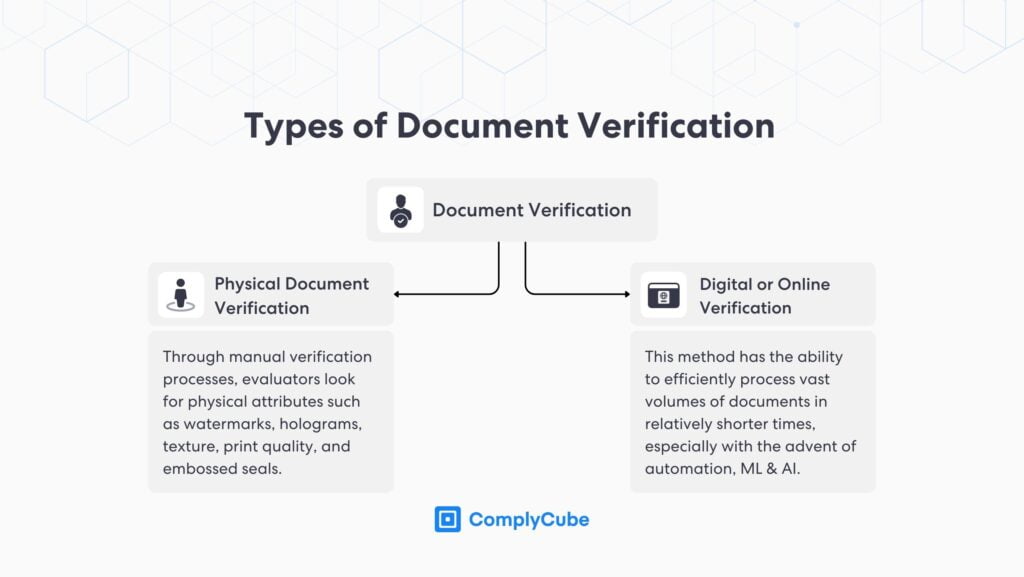
## Common Forms of Identity Document Verification
While [document verification](https://www.complycube.com/en/solutions/identity-assurance/document-verification/) can be broadly categorized into physical and digital, a more granular exploration reveals specific use cases:
1. **[ID Verification](https://www.complycube.com/en/solutions/identity-assurance/document-verification/):** This method ensures that an individual is genuinely who they claim to be when running customer identity verification. Using photo-based identity documents such as passports, driver’s licenses, it verifies an individual’s name, photo, and sometimes biometric data. Thus, ensuring a match between the information provided and the authoritative source.
2. **[Proof of Address Checks](https://www.complycube.com/en/solutions/identity-assurance/address-verification/):** This process analyzes an individual’s or entity’s Proof of Address (PoA) documents to extract relevant information. For example, utility bills and bank statements are matched against client data, ensuring the PoA document is valid. Next, an address verification service cross-references the extracted address against trusted sources.
Businesses verify documents for different purposes. However, various industries utilize ID verification as the main document check. In particular, businesses build trust in interactions and strengthen KYC and AML compliance, especially online.
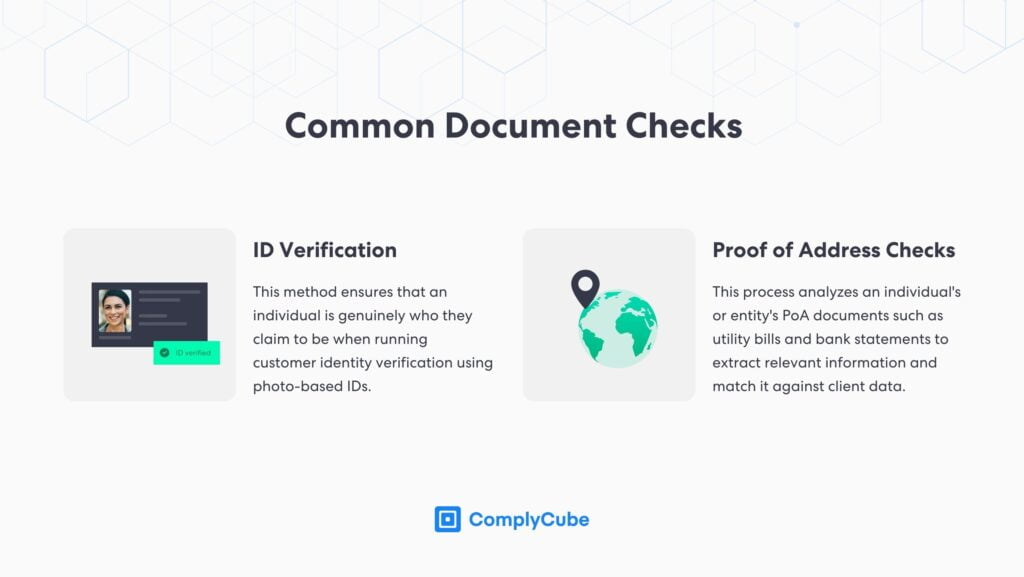
## The Mechanics Behind ID Document Verification
Identity verification can be established with varying levels of assurance based on the business and industry’s regulatory environment. Depending on the desired level of identity assurance, one or more means of ID document verification can be used. In the next section, we explain how these verification mechanisms work.
### Machine Learning and Computer Vision
[Computer vision](https://en.wikipedia.org/wiki/Computer_vision) enables machines to process and understand visual data from their surroundings, mirroring human capabilities. It creates algorithms and methods that allow computers to interpret images/videos, making decisions rooted in visual observations. Thus, replicating human insights.
In the context of document validation and verification, computer vision refers to the ability of a computer system to automatically process, analyze, and interpret visual information, specifically to authenticate or validate an individual’s identity. This can involve facial recognition, document verification, liveness detection, and OCR to extract data from ID cards and other documents.

### Near-Field Communication (NFC) Verification
[NFC](https://medium.datadriveninvestor.com/the-ultimate-revelation-of-nfc-in-digital-id-verification-process-d5c1ef68896c) is a short-range wireless technology. It allows devices to exchange data when brought into proximity, typically within a few centimeters. As a result, NFC facilitates quick and easy communication between devices without needing an internet connection.
Modern ID cards and e-passports incorporate embedded RFID chips that securely hold encrypted personal details. When these chips are accessed by an NFC-capable device (scanner or smartphone), the stored data can be read and validated.
State-of-the-art verification solutions leverage the NFC mechanism to verify the digital document’s authenticity. It inspects that the encoded data matches the information presented. Thus, safeguards against potential tampering and offering a streamlined means of confirming identity.
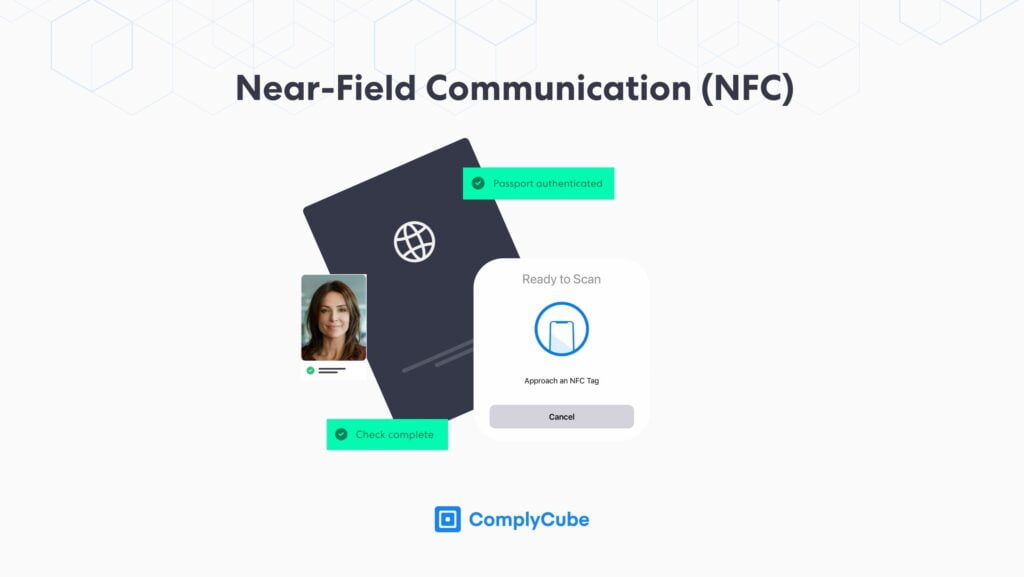
### eIDV (electronic Identity Verification)
[eIDV](https://www.complycube.com/en/solutions/identity-assurance/multi-bureau-checks/), referred to as database or KYC data checks, validates customer details by comparing them with reputable data sources. These details include an individual’s name, birth date, address, and even SSN to prevent identity theft. These sources can be translated into consumer reporting agencies, credit bureaus, utility records (such as phone or electricity bills), and official government databases.
In specific regions and applications, regulatory bodies mandate a “2+2 check” to verify the identity of customers. This requires that a minimum of two customer attributes align with two distinct data sources.

## Levels of Assurance (LoAs) in eIDAS
[Digital Identity in Europe](https://ec.europa.eu/digital-building-blocks/wikis/display/DIGITAL/eIDAS+Levels+of+Assurance), mainly represented by [electronic identification (eID)](https://www.complycube.com/en/solutions/identity-assurance/eid-verification-service/), is vital for online access and authentication. Moreover, trust in these digital transactions depends on the Level of Assurance (LoA), which measures identity accuracy and reliability.
The EU’s eIDAS framework defines three primary LoA tiers, benchmarked against the [ISO 29115](https://www.iso.org/standard/45138.html) standard:
- **Low**: Offers a moderate confidence level, typically relying on single-factor authentication.
- **Substantial**: Requires at least two authentication factors and verified identity information.
- **High**: Demands two authentication factors and robust safeguards against identity tampering.
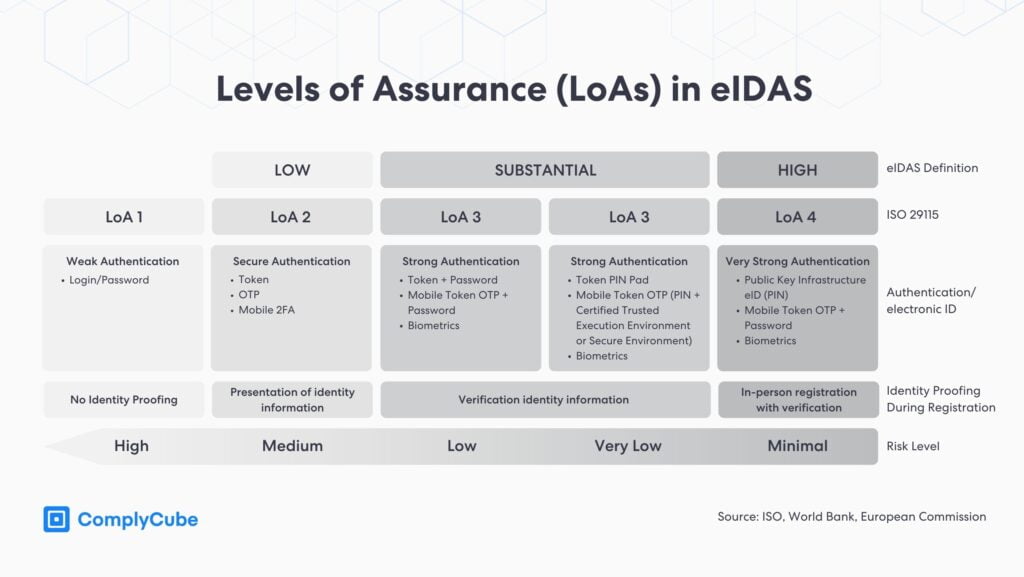
When accessing sensitive government platforms, claiming social security benefits, or filing taxes online, a High LoA is essential. For these scenarios, stringent checks and robust verification ensure only legitimate individuals can make critical updates or claims. For activities like purchasing a prepaid SIM card from a telecom company, a Low LoA might suffice, although some countries now require IDV for this service.
> eID schemes have seen a notable uptick, with countries like Sweden, Denmark, and Finland achieving over 90% usage from their citizens.
## When is Document Verification Required?
[Document verification](https://www.complycube.com/en/solutions/identity-assurance/document-verification/) is integral to various processes across industries, such as banking, financial services, healthcare, recruitment, and more, due to the stringent requirements of AML and KYC regulations. These rules are enforced to combat financial fraud, money laundering, and terrorist financing.
Intergovernmental and regulatory bodies safeguard the integrity of nations and counteract criminal activities such as fraud and terrorist financing. Financial institutions have to conform to rigorous regulations such as the [Bank Secrecy Act (BSA)](https://www.occ.treas.gov/topics/supervision-and-examination/bsa/index-bsa.html) and [US Patriot Act](https://www.fincen.gov/resources/statutes-regulations/usa-patriot-act)**,** while businesses across different sectors have to abide by guidelines recommended by the [Financial Action Task Force (FATF)](https://www.fatf-gafi.org/en/home.html) and the [EU Directives](https://eur-lex.europa.eu/EN/legal-content/summary/european-union-directives.html) (including financial services companies).

To adhere to the regulations and guidelines encompassed by the KYC framework, businesses must conduct document verifications at various points throughout the customer’s journey, such as:
- **[Customer Identification Program (CIP)](https://www.complycube.com/en/use-cases/process/customer-onboarding/):** The minimum requirements for a customer onboarding process, enabling businesses to reasonably ascertain the genuine identity of every customer. Under Section 326 of the US Patriot Act, the program includes proper identification of the individual or entity opening the account, recordkeeping, and corroboration with governmental lists.
- [**Ongoing Due Diligence (ODD)**](https://www.complycube.com/en/solutions/global-screening/continuous-monitoring/): Rather than a one-time check, it’s an active effort to ensure that customer profiles remain accurate, relevant, and compliant with evolving regulations. This proactive continuous monitoring approach helps companies identify and address potential risks, ensuring they maintain integrity and trust in their operations.

## How Does Online Document Verification Work?
Amidst evolving financial regulations, the foundation of trust between businesses such as financial institutions and their customers largely hinges on stringent identity verification measures. Central to ensuring this trust is the online ID document verification process, a structured approach to authenticating users in line with AML and KYC protocols.
### Identity Document Data Extraction
Businesses generally integrate document verification solutions on account opening to confirm data integrity and spot fraudulent documents. An effective AI-powered verification system [supports a broad range of country and ID combinations](https://docs.complycube.com/documentation/checks/document-check), such as a passport, driver’s license, identity card, residence permit, travel document, and other government-issued IDs from around the world. At times, more documents, such as bank statements or utility bills, are required when further investigation is needed.
Data extraction is completed using digital imaging or scanners. With the help of OCR, the image text is converted into machine-readable characters. The identity verification software will extract all the available data from fields such as the Visual Inspection Zone (VIZ), Machine Readable Zone (MRZ), and barcodes to verify identity documents.
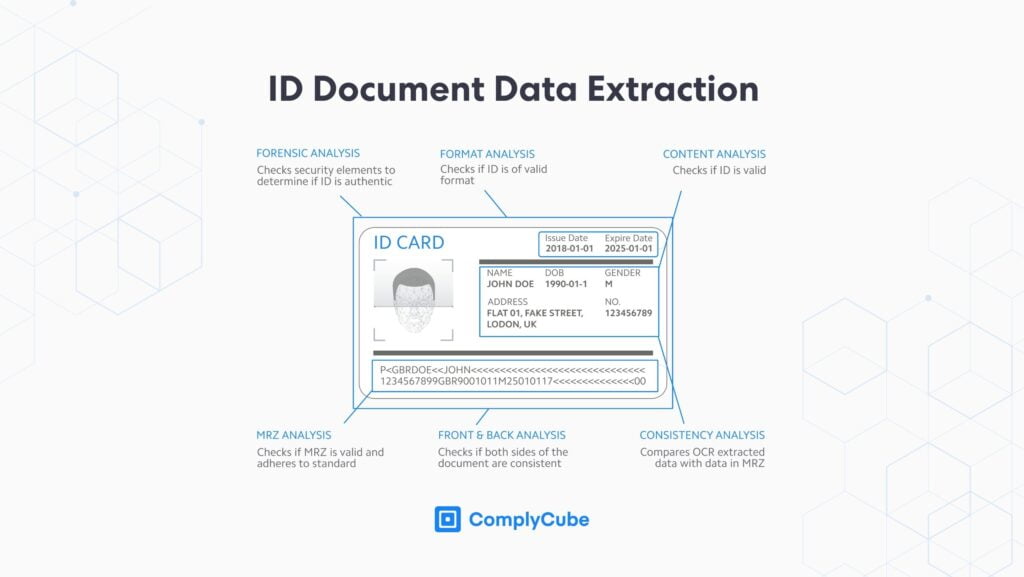
### Data Validation
State-of-the-art AI, machine learning, and advanced analytics allow businesses to perform various types of analysis on ID documents, including detailed checks on visual security elements, potential tampering or manipulation, document liveness, and blacklist checks.
### Biometric Verification
Some platforms go a step further in the IDV journey by requiring users to [submit a live photo or video](https://www.complycube.com/en/solutions/identity-assurance/biometric-verification/) at different stages, such as customer onboarding. Biometric algorithms compare the facial biometrics live data to the photo on the ID to ensure the person presenting the ID is the same person. Anti-spoofing detection safeguards businesses from sophisticated presentation attacks like 3D masks without introducing additional user friction.
You can learn more here: [The Advantages of Biometric Authentication](https://www.complycube.com/en/the-advantages-of-biometric-authentication/).

### Manual Checks (Optional)
Some companies integrate manual checks when verifying documents. IDV specialists might use manual document verification processes to review the security features of official papers that raise flags or don’t pass automated checks. The element of human intuition and judgment acts as a safety net. However, it is optional if an effective document authentication software is employed, as human error can become a challenge if the person verifying the identities of new customers does not have the necessary training and knowledge.
### Verification Results and Further Action
Provided that the government-issued ID document used, such as a driver’s license or passport, is verified successfully, the user can proceed with the account creation. If there are discrepancies or the verification fails, the user may be asked to retry or provide additional documentation, such as a utility bill or bank statement. In the case of an application that triggers an alert, the compliance team is notified so that they can run an enhanced due diligence (EDD) process to investigate further.
You can learn more here: [Navigating the World of Enhanced Due Diligence.](https://www.complycube.com/en/enhanced-due-diligence-edd-insights-and-challenges/)

### Data Storage and Protection
Platforms that store user data actively secure sensitive information through encryption and comply with local data and privacy regulations such as the GDPR, UK GDPR, and CCPA. In order to meet robust compliance measures, leading document authentication software [redact or mask sensitive fields](https://docs.complycube.com/documentation/checks/document-check/redaction) to adhere to global privacy laws. Sensitive fields, among others, include:
- **Korean RRN** (*Resident Registration Number*)
- **Singaporean NRIC** (*National Registration Identity Card Number*)
- **Dutch BSN** (*Burgerservicenummer or Dutch Citizen Service Number*)
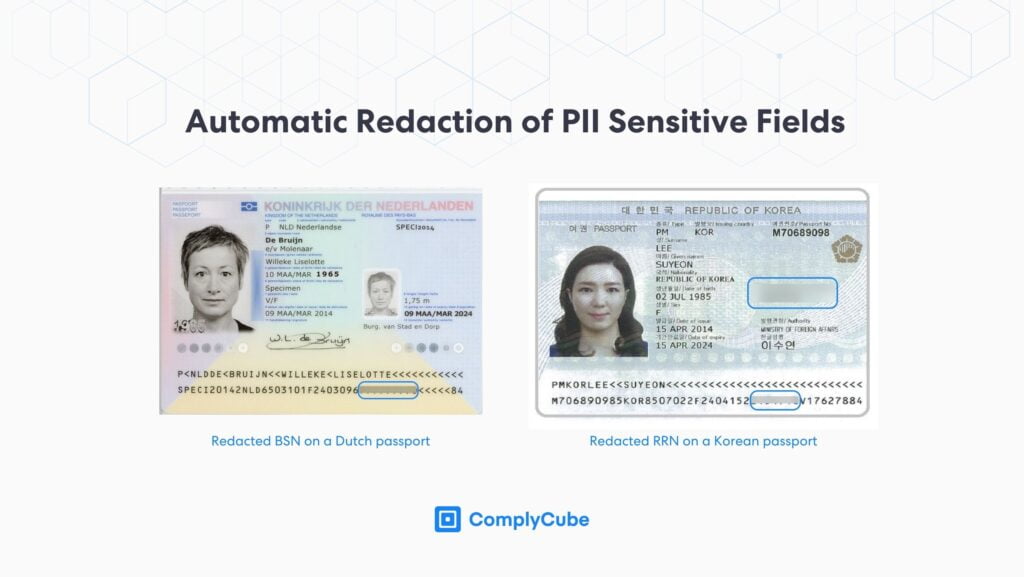
## Why is Online Document Verification Important?
As more businesses shift to the online environment, the risk of encountering forged or counterfeit documents surges. Thus, online document verification has become an essential tool to instill trust and prevent identity theft in this vast digital marketplace.
> In the first half of 2025, [over 217,000](https://www.cifas.org.uk/newsroom/fraudscape-2025-6monthupdate) identity fraud cases were reported to the UK’s National Fraud Database.
In essence, document verification is not just a procedural necessity but a strategic tool that brings about a hefty number of benefits, including:
- **Ensuring Compliance and Reducing Legal Risks:** Businesses adhere to regulations by accurately identifying their customers, thereby reducing the risk of legal repercussions and hefty penalties.
- **Building Trust and Enhancing Reputation:** With the increase in identity fraud, businesses that implement robust document verification processes signal their commitment to security.
- **Streamlining Business Operations:** Businesses can expedite user onboarding, transaction processing, and other activities, increasing operational efficiency and customer satisfaction.
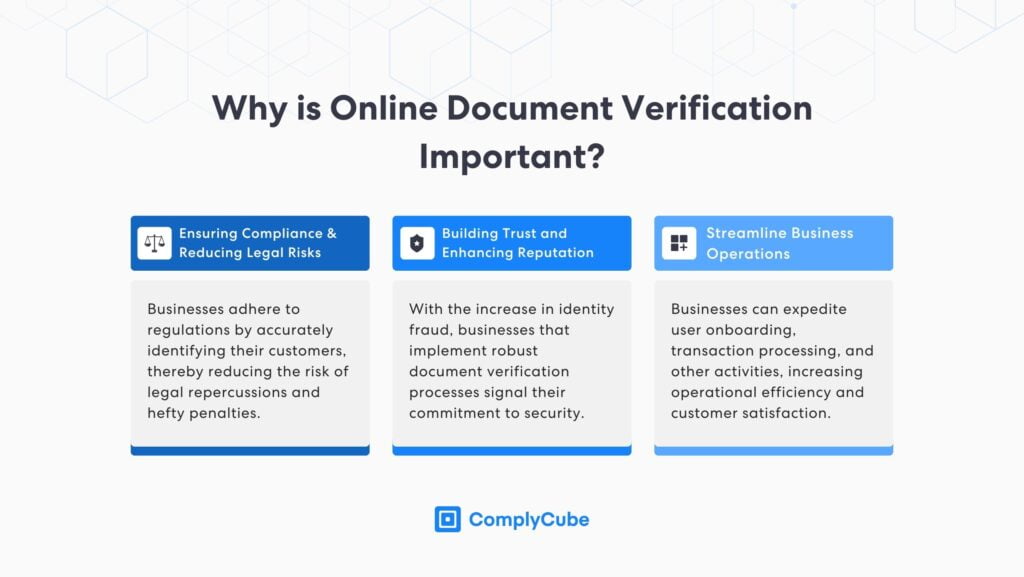
## Document Verification Challenges: Evolving Fraud Techniques
Navigating the intricacies of document verification presents a host of challenges for businesses. These challenges not only pertain to the technical aspects but also involve operational, regulatory, and cultural factors.
As verification technologies become more sophisticated, so do the methods employed by fraudsters. From high-quality forged documents to deepfake videos and images, malicious entities are continuously finding new ways to bypass standard verification checks. This constant game of cat and mouse requires verification systems to be agile and adaptive.
> In North America, there was a [significant rise in the occurrence of deepfakes from 2022 to Q1 2023](https://www.paymentscardsandmobile.com/us-fraud-statistics-fai-deepfake-multiply-at-alarming-rates/). Specifically, the US saw an increase from 0.2% to 2.6%, while in Canada, the rate leapt from 0.1% to 4.6%.
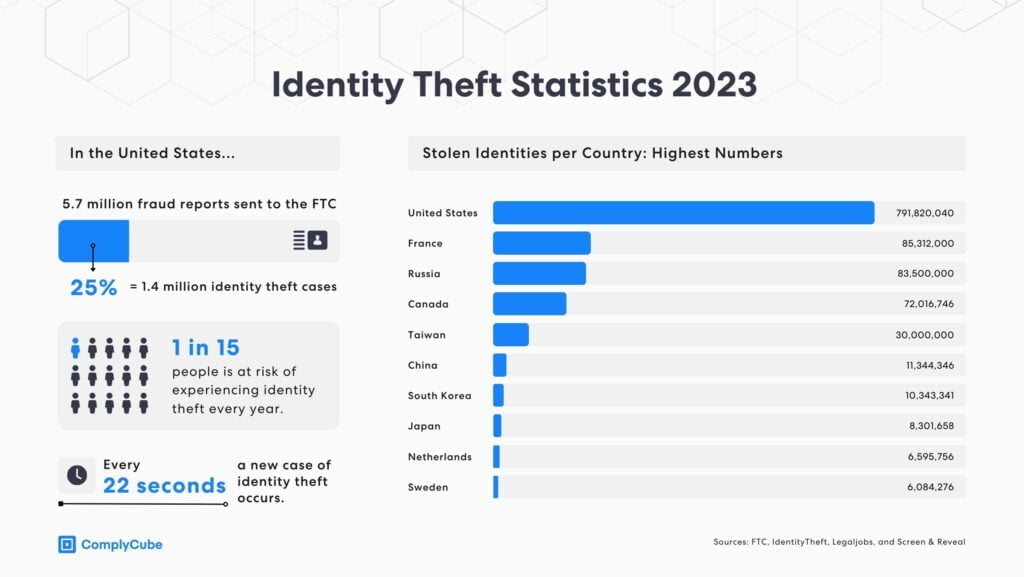
A significant instance of online ID fraud [occurred](https://www.washingtonpost.com/technology/2022/02/11/idme-facial-recognition-fraud-scams-irs/) in 2020 when an individual employed multiple accounts, counterfeit driver’s licenses, and wigs to deceive the digital identity verification platform used by US government agencies. According to reports, $900,000 was claimed on unemployment grounds before the scam was detected and halted. The intended target of this scheme was to secure $2.5 million unlawfully.
To prevent similar cases and mitigate fraud, IDV providers implement [document liveness detection](https://www.prnewswire.com/news-releases/complycube-unveils-enhanced-id-document-security-with-advanced-liveness-detection-301894608.html). The process typically refers to methods used to determine if a document (such as an ID card or passport) is genuine and not a reproduction or a stolen, expired, or digitally manipulated image.
Document liveness checks use machine learning and sophisticated algorithms to analyze different elements of the ID document, such as holograms, stamps, coat of arms, expiration/issuance date, 3D properties, and more based on the document type.
### **Case Study: TeraPay Asia Strengthens Its’ Defence Against Document Fraud**
**Battling Synthetic Identity Attacks in Onboarding**
In 2025, the US seized over $225 million in USDT linked to an international cryptocurrency scam. Scammers targeted over 400 victims through a false investment scheme known as *“pig butchering.”* The perpetrators build fake personal relationships with victims to convince them to transfer funds to fraudulent crypto platforms.
**Upgrading to AI-Enhanced Identity Verification with Regional Fit**
The laundered funds moved through a complex network of wallets and exchange accounts, primarily involving OKX and Tether. U.S. law enforcement agencies, including the FBI, IRS, and Secret Service, executed the seizure using advanced blockchain analytics to trace the transactions and identify the illicit flow of funds.
**Outcomes**
- 91% reduction in fraudulent onboarding attempts within two months
- 360% improvement in detecting synthetic and deepfake content
- 25% increase in onboarding completion rates, driven by smoother, lower-friction verification
## How to Choose the Right ID Document Verification Software?
Selecting a reliable identity document verification software is the best way to ensure compliance, security, and a seamless user experience. Here’s a brief cheat sheet for choosing the right solution:
1. **Determine the Company’s Needs** Define your company’s needs based on your business model and in line with your AML/KYC risk-based approach. Then choose an identity document verification provider that allows you to quickly customize the solution according to your company’s ever-changing AML framework.
2. **Check for Multi-Modal Verification** In the age of sophisticated fraud, having multi-modal verification such as OCR, NFC, biometric checks, and liveness detection is invaluable. These multi-layered checks provide a higher level of assurance, reducing the risk of accepting forged or manipulated documents for online businesses.
3. **Prioritize Rule-based Automation** An effective [IDV solution](https://www.complycube.com/en/) streamlines operations by enabling businesses to establish distinct rules, case management processes, and thresholds. This time-effective approach ensures the team can redirect their focus to value-add tasks, optimizing overall performance.
4. **Evaluate Integration Capabilities** A robust document verification software should offer a suite of Low/No-Code solutions, robust API, Mobile SDKs, Client Libraries, and seamless CRM integrations. Ease of integration can save time, reduce operational costs, and enhance user experience.
5. **Prioritize User Experience** While security and compliance are paramount, ensuring the verification process is user-friendly is equally necessary. Lengthy or complicated flows can lead to customer frustration. Opt for software that offers an intuitive interface, minimizing friction and maximizing user retention.
6. **Review Support & Compliance Updates** Regulations and industry standards evolve. It’s crucial to select a software provider that runs regular updates in line with regulatory changes and requirements. Additionally, having strong customer support ensures that any issues or queries get resolved promptly, ensuring smooth operations.
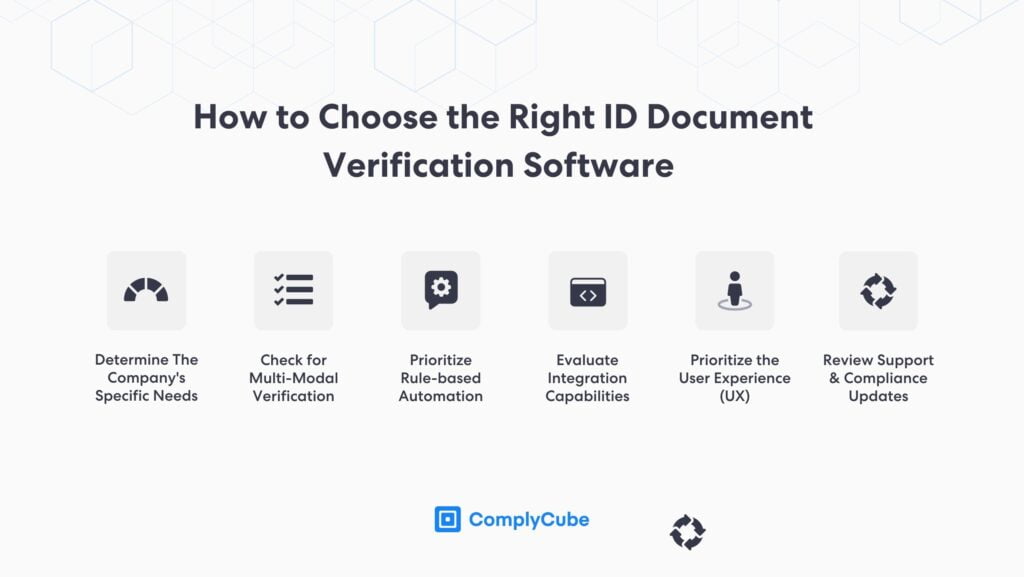
## The Future of Document Verification
As we look ahead, technological advancements and global shifts are transforming the landscape of document verification. Experts anticipate that AI and ML will play even more central roles in online document verification and beyond. Moreover, these technologies improve accuracy, minimize human error, reduce false positives, and strengthen fraud prevention efforts.
As the world becomes increasingly interconnected, it promotes a further surge in cross-border transactions and global operations. This could translate into a universal or standardized document verification system, fostering collaboration between nations and industries.
While the future of document verification looks bright, filled with technological innovations that promise heightened security and efficiency, the journey will require constant vigilance, adaptation, and collaboration across industries and governments.
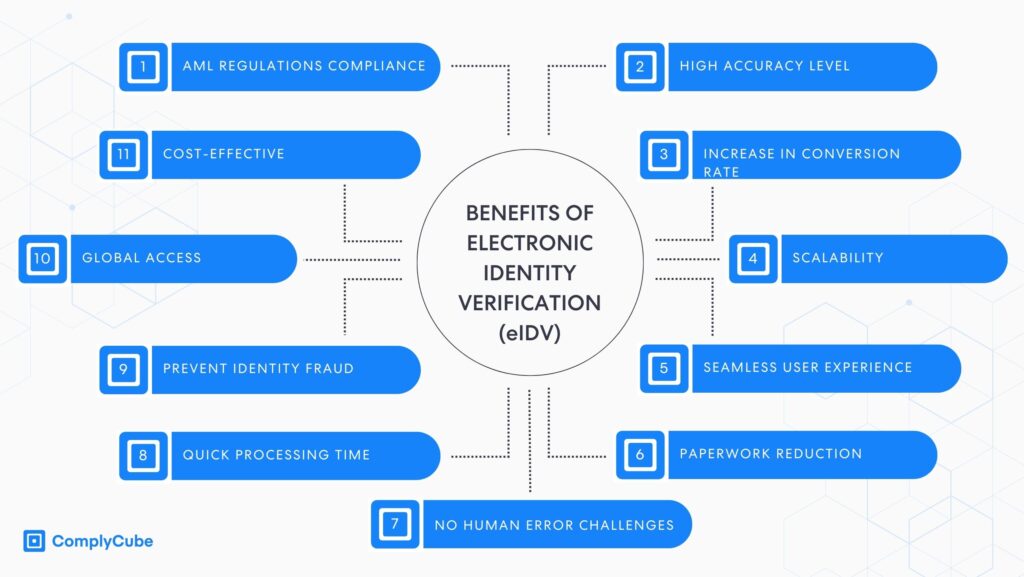
### Key Takeaways
- **Online document verification** ensures AML and KYC compliance across regulated sectors.
- **Multi-layered checks** using AI, biometrics, and NFC boost fraud detection rates.
- **Global compliance** requires solutions with broad document and regulatory coverage.
- **Real-time results** and automation reduce friction and improve onboarding speed.
- **ComplyCube’s IDV platform** is trusted by regulators and Tier-1 financial institutions.
## Conclusion
Ensuring the authenticity of documents in the modern business landscape is no small task, but it’s undeniably crucial. As deceptive practices grow increasingly intricate, the imperative for robust online document verification measures rises concurrently.
Thus, with cutting-edge technologies, consistent revision of verification strategies, and a steadfast commitment to global regulatory standards, enterprises can position themselves at the forefront of security and trust.
As such, it is evident that a flexible, comprehensive, and efficient way to conduct document verification will serve as a foundational pillar for offering a seamless customer experience, establishing trust, and maintaining seamless operations in an interconnected world.
Looking for a global compliance platform for document checks? [Get in touch](https://www.complycube.com/en?utm_source=blog&utm_medium=blog_post&utm_campaign=doc_verif_blog_post) with us today!
## Frequently Asked Questions
What is the best document verification method in the UK?
Firms regulated by the UK’s Financial Conduct Authority (FCA) need to meet stringent KYC and AML requirements under the UK Money Laundering Regulations. As such, regulators expect a multi-layered, risk-based approach. This includes layering biometric liveness, NFC checks, and using a certified Identity Service Provider (IDSP).
How does eIDAS regulation impact document verification?
The eIDAS regulation makes digital identity verification more secure, setting standards for Levels of Assurance (LoAs). For High or Substantial LoA, document verification must involve multi-factor authentication and verification of official ID documents. This shifts compliance to a standardised, risk-based approach.
Is document verification mandatory in the United States?
Yes, under the Bank Secrecy Act (BSA), financial institutions are required to implement a Customer Identification Program (CIP). This includes verifying the identity of individuals by checking official documents such as a passport, driver’s license, or state-issued ID. These documents must be authenticated to detect forgery, tampering, or manipulation.
Is document verification required in the United Arab Emirates (UAE)?
The UAE mandates strict AML compliance under the UAE Central Bank and Financial Intelligence Unit (FIU) frameworks. Businesses, especially those in finance, real estate, and virtual asset sectors, must validate government-issued ID documents, and, where applicable, verify residency visas and Emirates ID data.
Does ComplyCube support compliant document verification?
ComplyCube enables global businesses to verify documents and identities from over 250 territories using a comprehensive suite of tools, including NFC, OCR, AI-powered liveness detection, and multi-bureau registry lookups. The platform adheres to global data protection laws such as GDPR, CCPA, and eIDAS, while offering localized flows, language support, and regional KYC templates.
**Categories:** Guides
**Tags:** Identity Verification
---
### [The Power of AML Watchlist Screening Software](https://www.complycube.com/the-power-of-aml-watchlist-screening-software/)
**Published:** June 2, 2025
**Author:** Sofia Daley
**Excerpt:** With financial crime at all all-time high, AML Watchlist Screening Software has become a critical tool for financial institutions, fintech, and regulated enterprises. Learn more about how Watchlist Screening can help.
**Content:**
**TL;DR:** With financial crime at an all-time high, AML **watchlist screening software** has become a critical tool for financial institutions, fintech, and regulated enterprises. The tools are designed to proactively identify and mitigate **money laundering risks** against vast global watchlists. This guide explains watchlist checks and how to ensure AML compliance.
## What Is AML Watchlist Screening?
Anti-Money Laundering (AML) watchlist screening is the automated matching of customer data, names, addresses, and identification numbers against authoritative lists. Individuals and entities on this watchlist are considered high risk by authorities due to their potential connection with criminal activities. Key examples of this list include:
- **Sanctions Lists:** Government and international issuances.
- **Politically Exposed Persons (PEPs):** Individuals with public influence worthy of note.
- **Adverse Media:** Media sources that could be indicative of potential risk.
- **Law Enforcement and Enforcement Actions:** Agencies under investigation or the subject of enforcement.
Scanning customers against updated global lists enables firms to maintain compliance with regulatory requirements. Additionally, real-time, automated screening is performed for organizations to instantly detect high-risk individuals, supporting financial crime prevention.
## Major Features of AML Screening Solutions
Sophisticated AML watchlist screening software has advanced capabilities to enhance compliance processes. They include critical features that empower businesses to meet anti-money laundering obligations and make informed decisions quickly. For example, these key features include extensive databases, artificial intelligence, and customizable no-code workflows:
### 1. AI-Based Matching and Minimal False Positives
Fuzzy matching, phonetic verification, and other automated workflows run on sophisticated AI engines that accurately identify potential matches. Additional machine learning algorithms strengthen and sharpen screening tools. As a result, businesses minimise manual review workloads and reduce false positives.
### 2. Monitoring in Real-Time and Ongoing
Real-time monitoring capability allows rescans of customer data daily against updated watchlists. This allows any changes to a customer’s risk profile to be automatically identified, allowing timely compliance action. Ongoing monitoring helps businesses stay within their risk tolerance by detecting any changes in risk. These changes include a client appearing in adverse media or being added to a sanctions list.

### 3. Customizable Risk Scoring and Workflows
AML screening solutions allow organizations to make risk scoring and screening logic customizable by jurisdiction, customer type, and so on. Strong case management can route alerts to the correct teams so that investigations can be effective and contextual. Most regulators suggest following a risk-based approach to AML, which is why creating segmented risk profiles and customizable workflows is critical to meeting compliance requirements.
High-risk individuals can be identified based on a wide variety of data points obtained from watchlist screening. High-risk profiles often require enhanced due diligence to verify that the business or individual is not tied to any illegal activities. You can learn more here: [“What is a Risk-Based Approach (RBA)?”](https://www.complycube.com/en/what-is-a-risk-based-approach/)
### 4. Audit Trails and Reporting
Comprehensive audit capabilities are critical for demonstrating a strong screening process. Leading organizations automatically logs all screening activities and updates. As a result, businesses build a defensible, tamper-proof audit trail. Built-in reporting tools enable firms to track decision-making and outcomes across customer onboarding and beyond.
### 5. Database Coverage
Effective AML watchlist screening software offer access to global watchlists data, such as the UK HM Treasury, U.S. Department of the Treasury’s Office of Foreign Assets Control (OFAC), European Union Consolidated Financial Sanctions List, and more. Leading organizations integrate global sanctions list, enforcement databases, watchlists, and politically exposed persons registries for robust screening processes. With large breadth of data sources, companies gain an overall view of risk across their customer base.
## Best Practices for Successful AML Watchlist Screening
Effective and secure watch list screening processes ensure compliance. Compliance teams are better equipped to detect and prevent money launderers and financial crime from further damage. However, effective screening processes go beyond just technology.
Industry experts recommend a proactive, disciplined approach to compliance. According to Chief Product Officer and AML Specialist, [Harry Varatharasan](https://www.linkedin.com/in/harryvaratharasan?miniProfileUrn=urn%3Ali%3Afs_miniProfile%3AACoAAANt1FUBmXTN52rL_u9zjNgCfX4ZIMIqRLk), “Organizations can significantly enhance AML and sanctions programs through well-trained teams, risk-based screening, and key data points.” To achieve positive outcomes from AML watchlist screening software, implement the following best practices:
- **Periodically Update Watchlists:** Ensure watchlists are updated periodically to reflect the latest sanctions and regulatory information.
- **Emphasize Risk-Based Screening:** Focus on more risky customers and transactions to optimize compliance measures.
- **Compliance Staff Training:** Train personnel with the capability to interpret the output of screening and process alerts in a proper manner.
- **Leverage Sophisticated Analytics:** Employ data analytics to identify patterns and trends that can indicate future risk.
## Apply Industry-Specific AML Watchlist Screening Software
Different industries face varying risks of financial crime, requiring tailored screening solutions to meet specific needs. For example, regulated entities, such as those in crypto and banking typically face higher risk due to large volume and rapid transactions. Thus, tailored solutions and resources are needed to screen payments, customers, and sector regulations effectively:
### 1. Financial Institutions (Banks & Credit Unions)
Banks use AML software to screen new and existing customers against global watchlists (sanctions, politically exposed persons) during onboarding and transactions. The finance sector is the main target of AML related crimes, so this sector specifically must ensure a strong risk-based approach during identity verification and ongoing monitoring to be notified of changes in customer risks.
### 2. Fintech Companies (Payment Platforms & Digital Wallets)
Fintech platforms must screen customers during account creation and for large transactions, matching their data against sanctions and PEP lists. This is because fintechs operate in fast-moving environments, where rapid customer onboarding increases exposure to risk. Companies in this industry can integrate risk scoring to focus resources where risk is highest, thereby reducing false positives.
### 3. Casinos & Gambling Platforms
Casinos use AML screening to monitor large bets and withdrawals, screening players against sanctions lists. Due to the cash-intensive nature of this industry, comprehensive watchlist screening is mandated by several regulations. High-value bets, deposits, and withdrawals from players can be cross-checked against global sanctions, adverse media, and PEP databases to effectively deter fraud.
### 4. Real Estate
Real estate agents screen buyers and sellers against sanctions lists to prevent money laundering through property investments. High-value deals trigger enhanced due diligence for flagged individuals or entities. Screen real estate buyers, sellers, and ultimate beneficial owners (UBOs) against sanctions, enforcement, and PEP lists.
### 5. E-commerce
E-commerce platforms screen sellers and large transactions for potential money laundering risks, especially in cross-border sales. These platforms manage diverse participants and large volumes, making them susceptible to AML risks. Thus, comprehensively screen merchants, international transactions, and large volumes to identify suspicious activity.
### 6. Insurance Companies
Insurance providers screen policies during underwriting and claims processing to ensure clients avoid involvement in fraud or money laundering. Screening applicants and beneficiaries during underwriting and claims processing is essential for insurance-specific regulations. Additionally, automated screening can simplify compliance processes and lower operational costs. You can learn more here: “Ongoing AML monitoring for insurers.”
## Select Top-Rated Watchlist Screening Software
To select the best watchlist screening software for your business, an understanding of integration requirements, regulatory obligations, and customer segments is key. The most suitable software supports a smooth customer experience and boosts long-term operational efficiency:
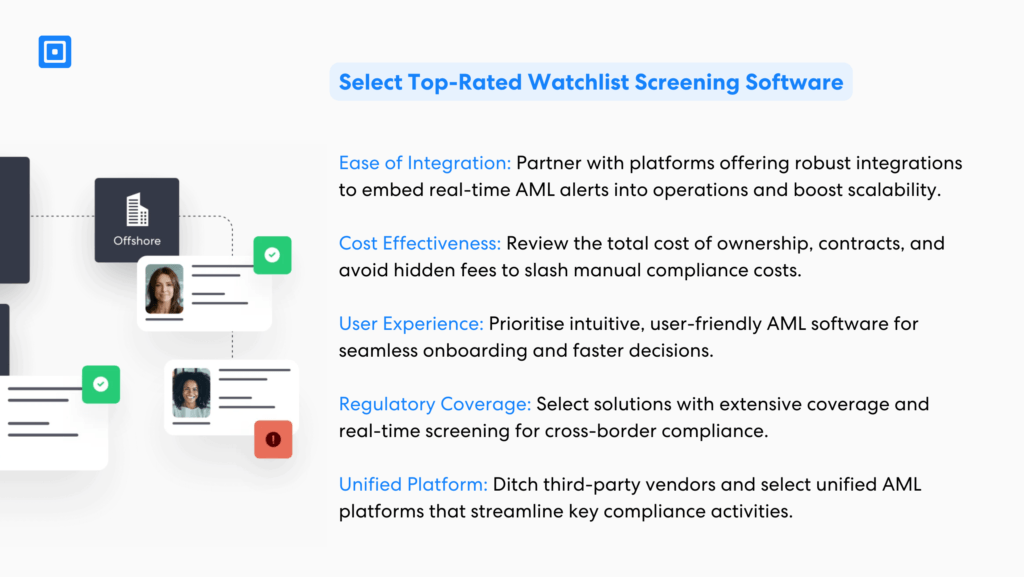
### 1. Ease of Integration
New solutions are smoothly incorporated into existing systems through APIs and SDKs. This scalability enables AML screening to grow in tandem with the organization, accommodating expanding volumes of transactions and rising regulatory pressures.
Partner with a compliance platform that integrates easily with your technology to embed real-time alerts directly into your operations. This strengthens risk detection across the customer lifecycle and maintains a holistic approach towards compliance management.
### 2. Cost Effectiveness
Cost-effective watchlist screening software offers highly customizable automated screening tools, so compliance teams can further reduce manual compliance costs. Additionally, review platforms and contracts to avoid complex pricing or hidden costs.Thus, it is crucial to evaluate the total cost of ownership (TCO), including setup fees, data resources, and refreshes according to business needs.
### 3. User Experience
The most important factor to grow a business is a satisfied customer base. Organizations should opt for software with a clear, intuitive design for seamless customer onboarding. A platform that provides customizable interfaces and access to real-time data enables faster decisions, enhancing customer satisfaction during onboarding.
### 4. Regulatory Coverage
Comprehensive international, regional, and local watchlists encompass over 250 countries and territories. This ensures that businesses can carry out needed risk assessment on each client through global sanctions screening to ensure regulatory compliance. A reliable provider updates global sanctions, PEP, enforcement, and adverse media lists regularly, reflecting the latest changes from authorities.
### 5. Unified Platform
Rather than using third-party screening vendors, modern watchlist screening solutions unify AML compliance obligations. They provide access to unified onboarding checks, ongoing monitoring, and reporting to ensure compliance. This centralised approach enables teams to manage decisions by date to maintain accurate audit trails. Ultimately, an all-in-one platform with artificial intelligence and automation helps fetch faster data sources, further unifying AML compliance.
### Key Takeaways
- **Modern watchlist screening** software enables businesses to cross-check customers and entities against sanctions, watchlists, PEP, and adverse media coverage.
- **Watchlist screening** is required for businesses to detect and prevent money laundering, fraud, and terrorism financing.
- **AI-powered automated** screening empowers quicker and accurate detection of risky individuals, reducing manual reviews and enhancing efficiency.
- **Regulated markets** such as fintech, crypto, and banks are subject to stringent AML screening requirements due to sector-specific vulnerabilities.
- **Regulatory coverage**, integration capability, pricing model, and user experience must be accounted for when choosing watchlist software for business needs.
## The Future of AML Screening Software
The future of AML Watchlist Screening Software rests on how fast and deep the adoption of new technologies such as machine learning, natural language processing, and blockchain analytics takes place. These technologies can potentially drive screening accuracy and efficiency even higher, and organizations will be able to stay ahead of evolving financial crime schemes.
Businesses that want to stay ahead of their competition in terms of both security and compliance should prioritise meeting AML standards globally, and using sophisticated AML watchlist screening software is a great place to start. For more information on how to integrate AML watchlist screening and fortify your business operations, get in touch with one of our [compliance experts.](https://portal.complycube.com/signup)
## Frequently Asked Questions
What is a screening software?
In compliance, a screening software equips firms to automatically check customers and entities against trusted databases, including sanctions and watchlists, to uncover high-risk parties. Screening software streamlines AML compliance and enables the prevention of fraud, money laundering, and terrorist financing.
What could be the most important objective of watchlist screening?
The main objective of watchlist screening is to enable companies to detect and prevent themselves from forming relationships and doing transactions with sanctioned or high-risk individuals and entities. Therefore, safeguarding the business from potential crime and fines, as well as protecting customers.
What is a watchlist in screening?
In screening, watchlists are a database that includes individuals, entities, or countries listed due to being sanctioned, having political exposure, or adverse media. These lists help prevent companies from engaging with risky individuals and entities, a key aspect of Anti-Money Laundering regulations.
What does it mean if someone is on a watchlist?
When an individual or entity is on a watchlist, it means they have been flagged as risky for either being sanctioned, politically exposed, or associated with financial crime. To stay compliant, businesses must use watchlist screening software to detect and prevent engaging with these individuals.
Which screening solution is best for your business?
The best screening solution for your business is the one that matches your sector, geography, and risk appetite. To choose the best solution, opt for real-time screening, broad coverage, seamless integration, and strong case management, such as ComplyCube, to support scalability.

**Categories:** Guides
**Tags:** Anti-Money Laundering
---
### [Security Token Offering (STO) Compliance](https://www.complycube.com/security-token-offering-sto-compliance/)
**Published:** July 12, 2024
**Author:** Dini Habib
**Excerpt:** Digital securities must adhere to RWA rules and regulations to meet Security Token Offering (STO) compliance. Real World Asset tokenization (RWA tokenization) digitizes ownership of traditional assets on a blockchain.
**Content:**
**TL;DR:** A **Security Token Offering** (STO) issues **digital securities** on-chain that represent regulated ownership or investment rights. Security token compliance also known as **STO compliance** require meeting local securities rules alongside good AML and KYC controls.
## What is a Security Token Offering?
A Secure Token Offering (STO) is the distribution of company assets on the blockchain. These assets are tokenized, meaning they exist on the blockchain and act as a digital version of ownership. The digital tokens distributed in this event are thought to be securities by law. Therefore, they must stick to STO compliance rules and policies brought in by leading securities regulators, such as:
- The Securities and Exchange Commission (SEC, America)
- The Securities and Futures Commission (SFC, Hong Kong)
- Financial Conduct Authority (FCA, United Kingdom)
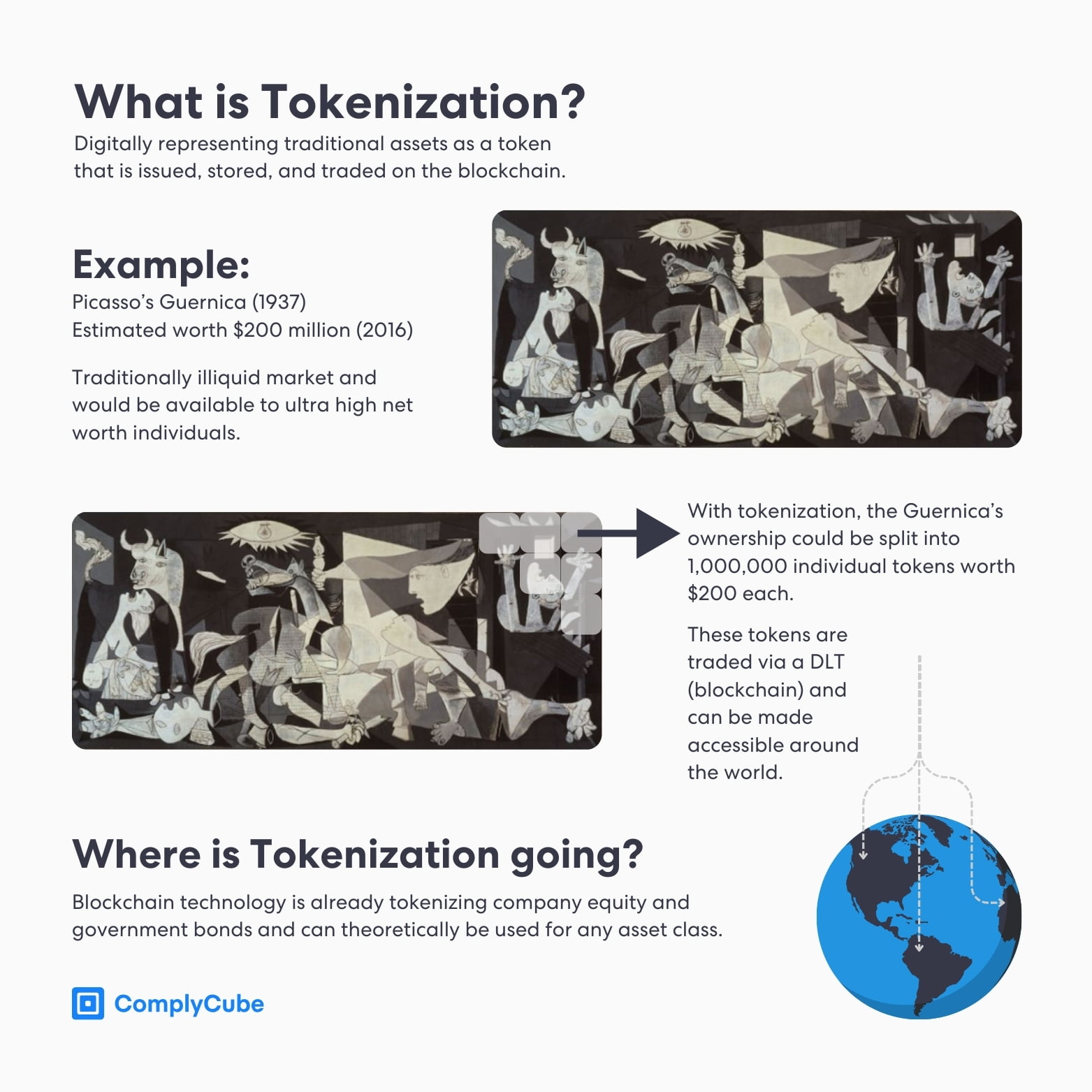
STOs are gaining traction fast as a way to do corporate fundraising. They are starting to be used instead of Initial Public Offerings (IPOs). An [STO must comply with the security legislation in the location where the digital security token is being transacted](https://www.coinbase.com/en-gb/learn/crypto-glossary/what-is-a-security-token-offering-sto#:~:text=Understanding%20Security%20Token%20Offerings%20%28STOs,and%20art%20to%20company%20equity.). Such STO compliance regulations often include disclosure, transparency, and user protection.
## What are Digital Securities?
Digital securities act as ownership rights on the blockchain, mirroring traditional instruments such as company equity in a digitally held format. Issuers can also tokenise a wide range of assets through a security token offering. From real estate to art, they can create on-chain tokens that reflect the underlying ownership interest. In short, trading security token offerings that represent a traditional financial asset, such as tokenized company stock, offers many perks for users and traders:
- Increased liquidity
- Reduced costs of trading
- Fractional ownership
- 24-hour trading
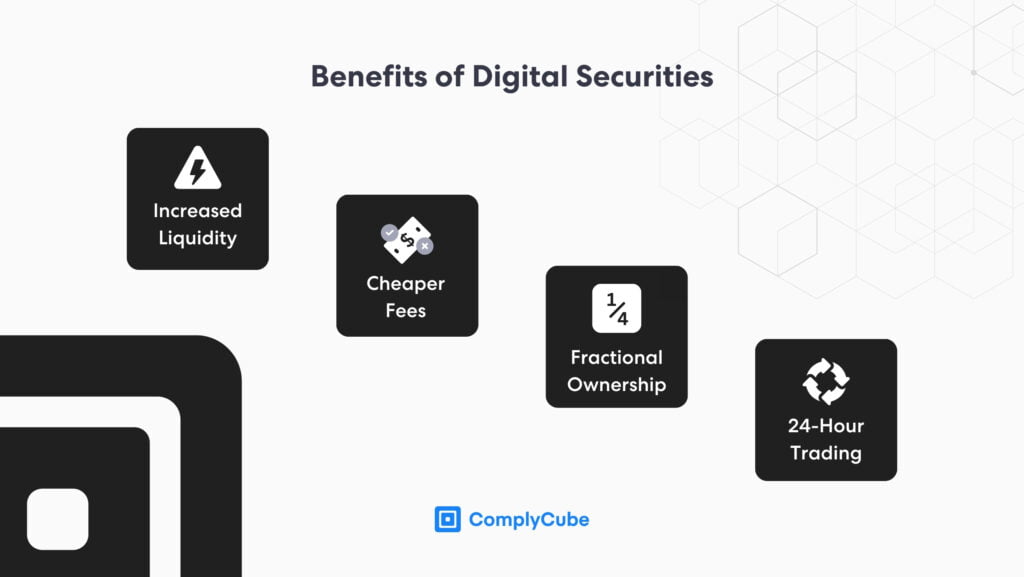
Digitizing securities can widen access to global capital markets by lowering minimum investment sizes and simplifying distribution. Securities rules still push many STOs to focus on institutional or qualified participants. This limits direct retail participation in most regions. Moreover, retail engagement in investing has [recovered strongly](https://www3.weforum.org/docs/WEF_Future_of_Capital_Markets_2022.pdf) since the 2007/2008 financial crisis, with more individuals taking an active role in managing their finances.
So, as digital securities mature, they can go beyond market access for existing investors and lower barriers to entry. Fractional ownership and faster settlement make this possible. This supports wider participation, providing protections and STO compliance controls. It remains in line to local regulatory rules.
Digital asset markets enable near 24/7 trading by using smart controls that automate verification and settlement without relying on a single go-between. This design keeps markets running more continuously than traditional exchanges, where fixed trading hours and slower post-trade processes limit activity.
Centralized exchanges (CEXs), such as Coinbase, offer around-the-clock access. Trades occur through the platform acting as the middle-man rather than an on-chain smart contract. As [24/7 tradition becomes familiar](https://www.nasdaq.com/articles/contemplating-24-7-trading-at-nyse) to market participants, traditional venues have looked at extended trading models. This may speed up the move toward more digitized and tokenized market structure over time.
## STO vs ICO
An STO also known as security token offerings are an initiative for raising capital or publicly distributing financial instruments on the blockchain, such as company equity. Initial Coin Offerings (ICOs) raise funds through the selling of utility tokens, which grant access to a business’s platform or services. The utility token acts as the engine behind a company’s project.
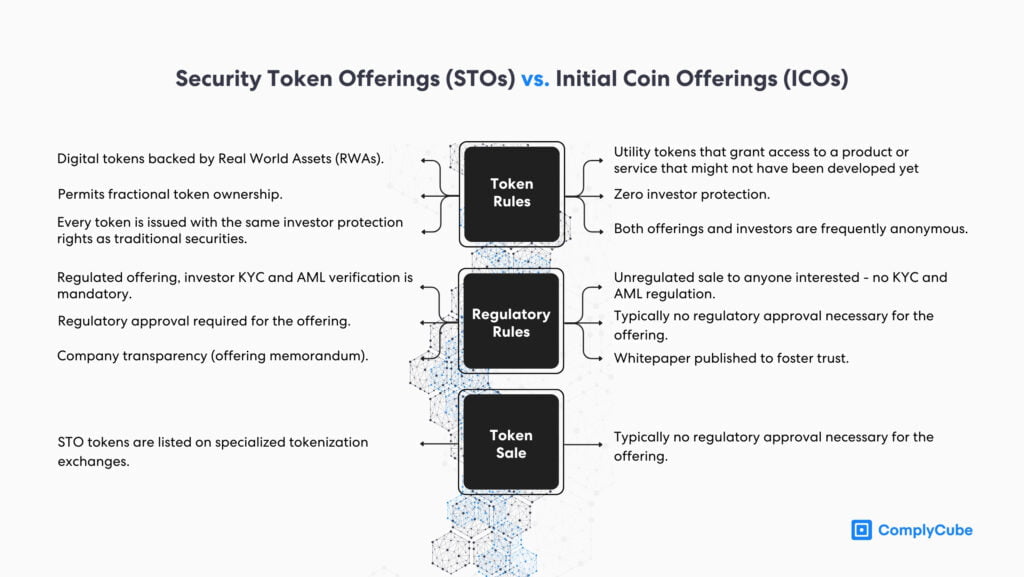
The Financial Action Task Force (FATF) moderates ICOs as any other Virtual Asset Service Provider (VASP). This means that all ICOs must stick to the same AML and KYC rules as [Recommendation 15.](https://www.fatf-gafi.org/content/dam/fatf-gafi/guidance/Updated-Guidance-VA-VASP.pdf) In the UK, the FCA has not set clear ICO rules, so it often reviews offerings on a case-by-case basis.
> [But we may ask you to explain why you think your activities are not in scope](https://www.fca.org.uk/publication/documents/cryptoasset-registration-flowchart.pdf).
The FCA flow chart explains how it treats crypto firms that do not arrange payment services, operate payment machines, or provide custody. The UK then aims to clarify crypto rules and related legislation, reducing ambiguity and supporting further growth across the UK sector.
## Security Token Offering Rules and Regulations
Tokenized Real World Assets and digital securities still fall under traditional securities laws. In the United States, the SEC regulates these markets by setting and enforcing investor-protection rules, and tokenized RWA exchanges must obtain the right licence from the same federal regulator.
STOs and digital securities must stick to the same traditional securities laws as regular securities. These include:
1. Registration: Issuers of digital securities must still register their equity tokens with the correct regulatory body, the SEC in America, for example.
2. Disclosure: All needed information about the securities and issuers must be provided for investor transparency.
3. Reporting: Company reporting obligations must be met, such as financial statements, investor relations updates and related business developments.
Issuers and intermediaries must then stick to a suite of AML and KYC regulations. This involves the thorough identification and vetting, known as Customer Due Diligence (CDD), of users who wish to trade or invest in securities. For more information about the CDD process, [What is Customer Due Diligence?](https://www.complycube.com/en/what-is-customer-due-diligence/)
Broker-dealers must meet the same core guidelines and secure the right licence before they can work. Then, they apply stricter controls across onboarding, transaction recordkeeping, communications, and conduct standards to protect investors and keep market integrity.
There is also a matter of verifying that the individual has the right to purchase of invest in the securities, known as accredited investor verification. Such an example would be private placements (non-public offerings, typically to persons or groups that provide a company with more than just financial funding).
### **Case Study: HKSAR Government’s Third Digital Green Bonds Offering**
The Hong Kong Special Administrative Region (HKSAR) Government wanted to scale a regulated security token offering issuance. They wanted to do this while keeping investor protections and market accessibility consistent with traditional bond structure. A big challenge was presenting tokenised settlement efficiencies without breaking down liquidity or excluding participants who rely on already built rails.
##### **Digitally native issuance with regulated settlement and standards**
As a result, the HKSAR Government priced its third digital green bond issuance on 10 November 2025, using the HKMA’s CMU for clearing and settlement and HSBC Orion as the digital assets platform. The structure retained traditional market access options while issuing in a digitally native format and integrating green bond disclosures with the digital assets platform.
##### **Outcomes**
- **HK$10 billion** record tokenised issuance size across **four currency tranches.**
- **Over HK$130 billion** in total subscriptions over four tranches, the most digital bond issuance to date.
- **T+1** settlement cycle, with HKD and RMB tranches offering settlement via tokenised central bank money (e-HKD and e-CNY).
## Blockchain-Specific Securities Regulations
Due to digital securities being listed, transferred, and stored via a Distributed Ledger Technology (DLT), the protocols that facilitate digital securities trading, such as INX, must receive smart contract audits for security.
Teams run code audits to identify and fix vulnerabilities before attackers can exploit them to drain treasuries, liquidity pools, or other on-chain funds. The tokenization platform then hardens day-to-day operations with secure controls, monitoring, and disciplined change management to keep issuance and trading resilient.
Exchanges run rigorous **Identity Verification (IDV)** to confirm each user’s identity and block impersonation, fraud, and other high-risk activity before onboarding. These are the same typical checks that most regulated Centralized Exchanges (CEXs) conduct when a new user signs up.
A typical AML and KYC flow would consist of the following steps:
- Document verification
- Biometric (selfie) verification
- Address verification (where applicable)
- Background CDD checks
- Continuous monitoring
After assessing the customer’s risk level, the platform screens and monitors their transactions as needed, quickly detecting, investigating, and resolving suspicious activity. For more information about crypto compliance, read [How KYC Crypto Regulations Safeguard the Industry](https://www.complycube.com/en/how-kyc-crypto-regulations-safeguard-the-industry/).
### Key Takeaways
- Security Token Offerings (STOs) are securities first, blockchain second.
- RWA tokenization does not reduce regulation, it expands the compliance map.
- STO compliance is built on two pillars: securities governance and financial crime controls.
- Digital securities can unlock market efficiency without sacrificing safeguards.
- Blockchain-specific risk becomes regulatory risk in tokenised markets.
## ComplyCube’s Security Token Offering (STO) Compliance Solutions
ComplyCube delivers a comprehensive suite of AML and KYC solutions used by organisations across multiple industries worldwide. In the blockchain and trading sectors, they have helped companies expand STO compliance to 250+ regions compliantly while onboarding new customers in under 30 seconds.
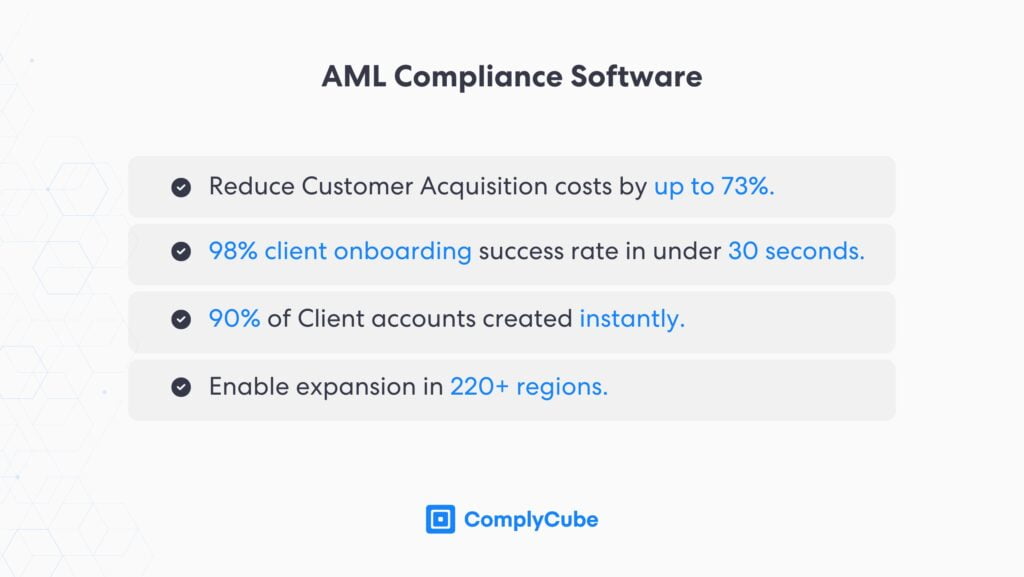
Such a capacity to sign new customers up quickly is fundamental in the digital assets space and has been a growth catalyst for many firms around the world. However, their AML solutions go beyond client acquisition strategies.
The industry leader supplies a range of AML services, such as:
- Adverse media checks
- Sanctions and PEP screening (Politically Exposed Person screening)
- Watchlist Screening
- Transaction screening and monitoring (available via a partner’s API solution)
ComplyCube delivers these AML controls 24/7, actively screening and monitoring to detect, flag, and stop malicious activity in real time.
### Reach Out to an STO Compliance Expert Today
If your STO, crypto, or fintech platform requires an optimized Identity Verification, Know Your Customer, or Anti-Money Laundering strategy, reach out to a ComplyCube specialist today to learn how they can help.
## Frequently Asked Questions
What is a Security Token Offering (STO) and why is it regulated?
A Security Token Offering (STO) is the spreading of tokenised company assets on the blockchain, where the tokens represent ownership and are considered securities by law. They are treated as securities, STOs must follow local securities legislation in the jurisdictions where the token is transacted, including disclosure, transparency, and investor protection requirements.
What are digital securities and what benefits do they offer for investors and traders?
Digital securities are virtual representations of ownership stored on the blockchain that replicate traditional securities such as company equity. The blog highlights benefits including increased liquidity, reduced trading costs, fractional ownership, and near 24/7 trading access, while still requiring protections and STO compliance controls aligned to local regulatory rules.
What is the difference between an STO and an ICO?
An STO raises capital by spreading tokenised financial instruments such as equity that are treated as securities. An Initial Coin Offering (ICO) sells utility tokens that provide access to a platform or service.
What does STO compliance require for AML and KYC?
STO compliance blends securities obligations (such as registration, disclosure, and reporting) with AML and KYC controls that verify and monitor participants. The standard flow includes document verification, biometric (selfie) verification, address verification where applicable, background Customer Due Diligence (CDD) checks, sanctions and Politically Exposed Person (PEP) screening, and continuous monitoring to identify and remediate suspicious behaviour.
How does ComplyCube support security token compliance for STOs and digital securities?
ComplyCube supports security token compliance and STO compliance through a unified suite of AML and KYC capabilities, including Identity Verification (IDV), CDD, sanctions and PEP screening, watchlist screening, adverse media checks, and ongoing monitoring support.
**Categories:** Guides
**Tags:** Crypto Regulations
---
### [AML Check Cost: Hidden Fees in Compliance](https://www.complycube.com/aml-check-cost-hidden-fees-in-compliance/)
**Published:** February 6, 2025
**Author:** Sofia Daley
**Excerpt:** Many businesses fail to recognize hidden costs within AML processes due to a lack of understanding of what drives AML pricing. This guide dives into how to identify hidden costs in AMLcheck pricing whilst ensuring compliance.
**Content:**
**TL;DR:** The true AML check cost is not just a per-search fee. Often, the cost of AML grows through hidden spend. This means more manual review time, review backlogs, and the breakdown of reporting workflows. Manual screening and slow onboarding can raise the AML check burden through opportunity costs and higher error risk.
## What is AML Check Cost?
Anti-Money Laundering (AML) check cost is the total price of running AML screening and monitoring. This looks at cost across onboarding and ongoing customer activity. It includes the most obvious, direct spend. For example, per-search pricing for sanctions and Politically Exposed Person (PEP) screening, data coverage, and vendor licensing. Moreover, it adds on the hidden costs that usually dominate total spend at scale.
Three layers push the cost of AML: technology, operations, and risk. First, technology covers the platform fees and integrations. Secondly, operations addresses analyst time for investigations, escalations, and audit evidence. This grows fast when false positives create alert backlogs. Finally, risk is the cost of control failure. Weak systems and governance trigger remediation programmes, independent oversight, and enforcement outcomes that can impact the original tooling budget.
Recent examples include the UK FCA’s £44.1 million fine against Nationwide for financial crime control failings. Another story to consider is the FCA’s £42 million fine against Barclays for poor handling of financial crime risks.
In 2025, firms also had a clearer view of how remediation becomes a long-running cost centre. TD expected to spend $500 million on AML remediation as well as governance and control investment in fiscal 2025. It shows how “AML check cost” can go far beyond per-check pricing when programmes require structural fixes and more oversight.
## The Real Drivers of AML Check Costs for Financial Institutions
Compliance with AML regulations is now a baseline expectation. Regulators require firms to prove they run effective controls, including reliable customer verification and transparent monitoring. Many organisations still don’t know what actually drives AML spending. Particularly, this is important when they lack visibility into an AML check cost breakdown or how costs accumulate.
Financial institutions should be clear on what they are paying for and why. When building AML programmes, they must reduce financial crime risk and meet regulatory rules. Manual checks can appear cost-effective at first because there is no subscription. However, costs often shift into staffing, repetitive steps, slow reviews, and rework caused by human error. Automated AML solutions can reduce this drag by standardising screening and monitoring. It helps improve decision consistency, and enabling compliance teams to scale without adding the necessary overhead.
The same cost discipline applies when choosing an AML platform. Some providers price core screening competitively while charging separately for features that teams rely on in practice. This includes solutions such as adverse media checks, ongoing monitoring, case management, workflow approvals, or expanded data coverage. This guide compares manual and automated approaches, looks at cost add-ons that are easy to miss, and sets out criteria for choosing the right AML platform for your needs.
## The Hidden Costs of Manual AML Checks and AML Compliance
The cost of [AML compliance](https://www.complycube.com/en/solutions/due-diligence-compliance/anti-money-laundering/) includes the investment in technology and the training required to reduce human error. By using technology, institutions can smooth their compliance processes. It can lower the associated risk of non-compliance and improving efficiency. However, AML check costs are still a big challenge. Now, companies may feel the need to use manual processes to achieve AML compliance. Especially, if their budget is tight and they’re looking for a cost-effective solution.
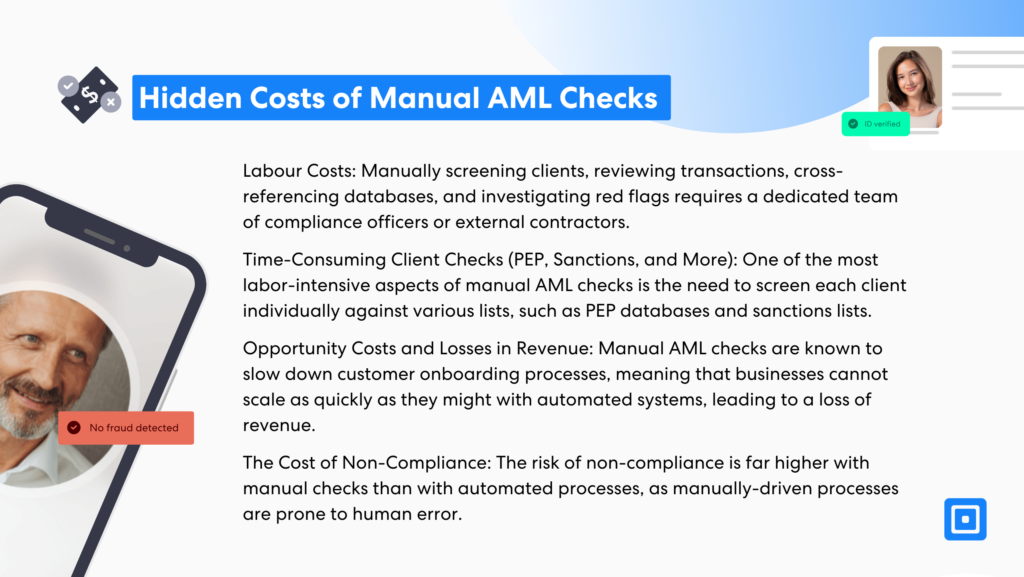
Yet, the hidden costs associated with manual checks can quickly spiral out of control. A long list of unexpected expenses can very quickly drain resources and put companies at serious risk of non-compliance. Some of the hidden costs associated with these kinds of checks include:
### Additional Hidden Costs for Manual AML Checks
1. **Labor Costs:** Manual AML checks hide an obvious cost: the labour needed to perform the checks. This means ongoing wages and benefits for staff performing these tasks, along with the added administrative costs of managing them. Over time, this can become a huge recurring expense that many businesses don’t think about when first considering manual AML processes.
2. **Time-Consuming Client Checks (PEP, Sanctions, and More):** One of the most difficult aspects of manual AML checks is the need to screen each client one-by-one against various lists, such as PEP databases and sanctions lists. For businesses with high volumes of clients, this means going through each person’s profile, cross-referencing them against national and international lists, and often conducting a deeper dive into adverse media reports or their sources of wealth.
3. **Opportunity Costs and Losses in Revenue:** Manual AML checks are known to slow down customer onboarding processes, meaning that businesses cannot scale as quickly as they might with automated systems, leading to a loss of revenue. Similarly, time spent on reviews on high-risk customers can take long periods. Consider, processes such as manual collection and analysis of additional information, such as the client’s transaction history, geographical links, and political affiliations.
4. **The Cost of Non-Compliance:** The risk of non-compliance is far higher with manual checks than with automated processes, as manually-driven processes are prone to human error. A team member may easily miss a flag or fail to see a suspicious pattern that an AI-powered process would never miss. These mistakes, however minor they may seem, can lead to huge penalties and legal fees due to non-compliance.
You can name many more hidden problems in manual AML processes. Consider broken down record-keeping or reporting, lack of real-time monitoring, and proactive risk management. All of these examples can lead to big fines. Thus, it proves the importance of investing in a trusted platform that can provide expert checks.
### **Case Study: Nationwide’s £44m FCA Fine and the Hidden Cost of AML Checks**
In December 2025, the UK Financial Conduct Authority (FCA) fined Nationwide Building Society £44 million for inadequate anti-financial crime systems and controls. This was over October 2016 to July 2021. This shows how AML check cost goes beyond screening fees. Such weak controls create operational drag, remediation work, and sustained governance overhead.
##### **Stepping up check controls**
Following the identified weaknesses, Nationwide started a large-scale financial crime change programme in July 2021, reflecting the path firms take when systems and controls are not working well. This means tightening customer risk assessment, improving due diligence refresh discipline, strengthening monitoring, and making evidence capture auditable.
##### **Outcomes**
- The FCA fined Nationwide £44 million for financial crime control failings.
- The FCA said the failings spanned October 2016 to July 2021.
- Nationwide launched a financial crime transformation programme in July 2021.
## Hidden AML Check Cost to Look Out for When Partnering With A Compliance Platform
The AML compliance process includes customer due diligence, risk scoring, and onboarding processes to assess high-risk customers and identify suspicious activities. These measures are essential for creating a secure financial environment, but they also drive up compliance costs, particularly when considering the cost of AML compliance across all stages of the AML compliance program.
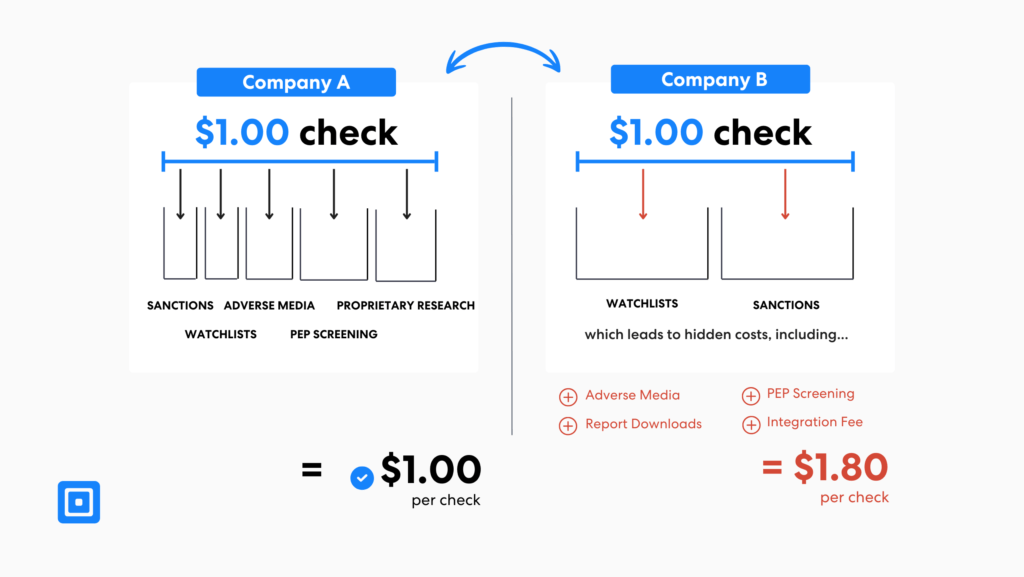
Whilst partnering with an automated platform is definitely necessary, it’s important to be aware of hidden fees within different pricing structures to ensure an optimal return on investment. Whilst checks may be priced similarly, for example at $1.00 per check, when businesses break down what is incorporated within that bracket they often find that necessary features are not included. Therefore, the cost of AML checks are far more expensive than anticipated.
> Set-up fees can amount to £20,000.
### Fees and Hidden Expenses to Consider
[Harry Varatharasan,](https://www.linkedin.com/in/harry-varatharasan/) Chief Product Officer at ComplyCube, states, “Many AML providers market their services as cost-effective solutions, but businesses are often caught off guard by hidden expenses that escalate quickly. From third-party fees to unexpected setup and support costs, these hidden charges can turn what initially seemed like an affordable option into a significant financial burden.”
Some examples of hidden fees to look out for are:
- **Set-up fees:** A set-up fee is a common hidden cost of AML partnering and KYC compliance platform, as providers charge for integrating their AML tools into existing systems. Set-up fees can amount to £20,000, a noteworthy expense for most businesses.
- **Support fees:** The cost of AML platforms vary and they may charge for ongoing support or system enhancements, which might come as an unexpected recurring expense. Finding a platform that provides the necessary support as part of your package is critical.
- **Lack of Proprietary Data:** Some providers access only public sanctions data, with propriety data increasing AML screening costs a drastic 5x.
- **Data Retention and Report Downloads:** Another hidden cost is not including data retention and the ability to download reports in a standard package. Some providers offer this only as an add-on, which can be an unexpected expense for the customer.
- **Lack of Volume-Based Pricing:** Providers that offer volume-based pricing are often far more economical for businesses that need to carry out a large number of checks.
- **Ongoing Monitoring:** Ensuring that Ongoing Monitoring is included within your package is critical, as trying to do this manually can be extremely expensive and time-consuming. is essential to conduct a new screening in accordance with your ongoing monitoring policy. This may require performing a new manual check on a daily basis.
As Harry notes, businesses must thoroughly understand the full cost structure before committing to an AML provider, as overlooking these expenses can lead to compliance challenges and unanticipated financial strain. Transparency regarding the pricing breakdown is critical to making the right decision.
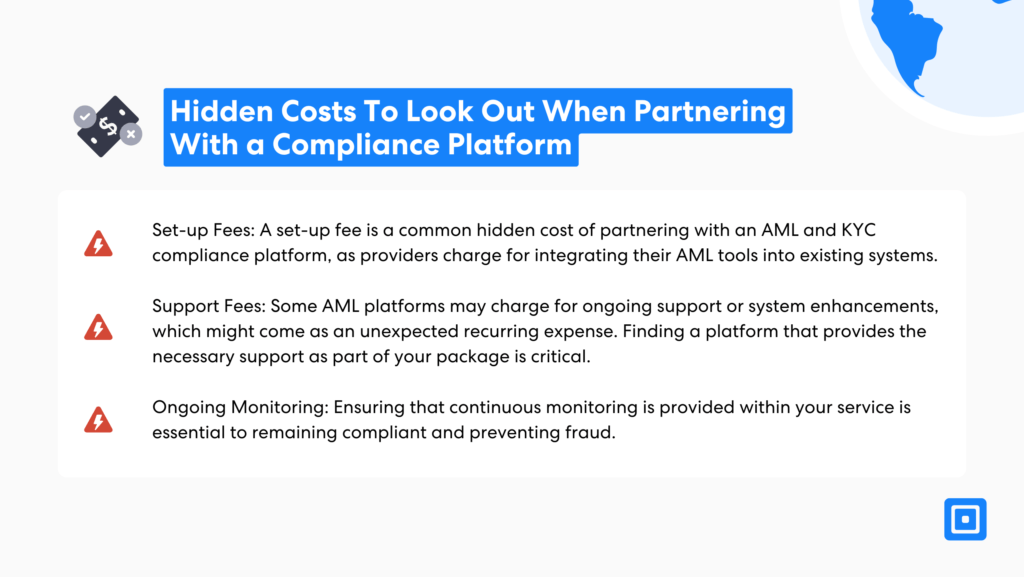
### Key Takeaways
- **AML check cost** goes beyond per-search fees.
- **False positives** inflate analyst time and queues.
- **Manual investigations** raise the cost of AML fast.
- **Disconnected tools** add duplication and audit rework.
- **Tuning, risk scoring, and EDD** reduce total AML check spend.
## Maximizing AML Check Cost With the Right Provider
Choosing the right AML and KYC provider is a big step for businesses to make sure they get a positive return on investment in their solutions. Providers that lack transparency around pricing, such as what might be classed as an “add-on” or an ongoing support fee, often lead to businesses avoiding adding important services to their package that they would otherwise have included with another provider. Or, if they do decide to add additional services, they are often paying an unnecessarily high price point.
For more information about ComplyCube’s AML platform and pricing, get in touch with one of our [compliance experts.](https://www.complycube.com/en/contact/contact-sales/)
[](https://www.complycube.com/en/contact/contact-sales/)
## Frequently Asked Questions
What is AML check cost and what does it include?
Anti-Money Laundering (AML) check cost includes vendor fees for screening and data coverage, plus analyst time for triage, investigation, escalation, and reporting. It also includes governance effort such as QA and audit evidence capture. The most overlooked part is the cost of rework when evidence is fragmented.
Why does the cost of AML increase even if per-check pricing stays low?
The cost of AML rises when alert volumes increase, false positives create queues, and manual reviews expand. Fragmented tooling adds duplication and slows decisions, which increases analyst time per case. This is why the cheapest scan price can still produce the most expensive programme.
What are typical cost ranges for an AML check?
Low-volume sanctions name screening is often $1.50–$2.00 per scan, while monthly name screening plans can run $50–$300+ depending on scan volume. EIV can range $1.50–$15 per check, and high-risk EDD manual checks can exceed $100 per check. Total cost is shaped by operational overhead, not just the scan price.
What hidden fees should firms look for in an AML check platform contract?
Common hidden fees include add-ons for ongoing monitoring, adverse media, case management, workflow approvals, retention, and report exports. Set-up fees can also be significant, sometimes around £20,000, depending on integration requirements. Total cost of ownership analysis reduces surprises.
How does ComplyCube help reduce AML check cost without weakening compliance?
ComplyCube reduces AML check cost by combining IDV, AML screening, and ongoing monitoring in one workflow, cutting false positives, duplicate reviews, and audit rework while supporting scalable, evidence-ready compliance.
**Categories:** Guides
**Tags:** Anti-Money Laundering
---
### [ComplyCube and Fidamy Partner to Accelerate Embedded Insurance Adoption](https://www.complycube.com/complycube-x-fidamy-embedded-insurance-adoption/)
**Published:** February 25, 2026
**Author:** Rithu Jagannath
**Excerpt:** Fidamy (NN Group-backed) partners with ComplyCube to strengthen AML and sanctions compliance across Europe’s embedded insurance journeys, helping brands scale responsibly while reducing compliance burden as adoption accelerates.
**Content:**
LONDON, FEBRUARY 25, 2026 – [Fidamy](https://www.fidamy.com/), the [NN Group](https://www.nn-group.com)‑backed embedded insurance platform, announced a strategic partnership with [ComplyCube](https://www.complycube.com), a leading global compliance automation leader. This collaboration enhances anti‑money laundering (AML) and sanctions compliance within embedded insurance adoption all across Europe. By combining Fidamy’s ability to embed protection products into customer experiences with ComplyCube’s automated compliance capabilities, it allows for responsible scaling within a complex regulatory environment.
## Regulatory Scrutiny Rises Alongside Market Growth
Embedded insurance is growing rapidly worldwide. According to global industry forecasts, the embedded insurance market is expected to grow from [USD 116.05 billion in 2025 to USD 138.08 billion in 2026](https://www.thebusinessresearchcompany.com/report/embedded-insurance-global-market-report). This reflects a worldwide adoption by digital commerce and platform ecosystems. Such a surge underscores the expanding opportunity for brands to offer contextual coverage such as travel and device protection.
[Fidamy’s platform](https://www.fidamy.com/platform/configuration) allows businesses to integrate insurance adoption products directly into digital and in‑store journeys. It improves convenience and customer loyalty. However, increasing regulatory expectations around financial crime compliance are shaping how embedded insurance must be delivered. In 2025, annual compliance costs tied to AML and sanctions screening across the [EMEA region were estimated at USD 85 billion](https://ibsintelligence.com/ibsi-news/emea-faces-85bn-annual-financial-crime-compliance-costs-study-shows/), with organisations reporting growing operational burden.
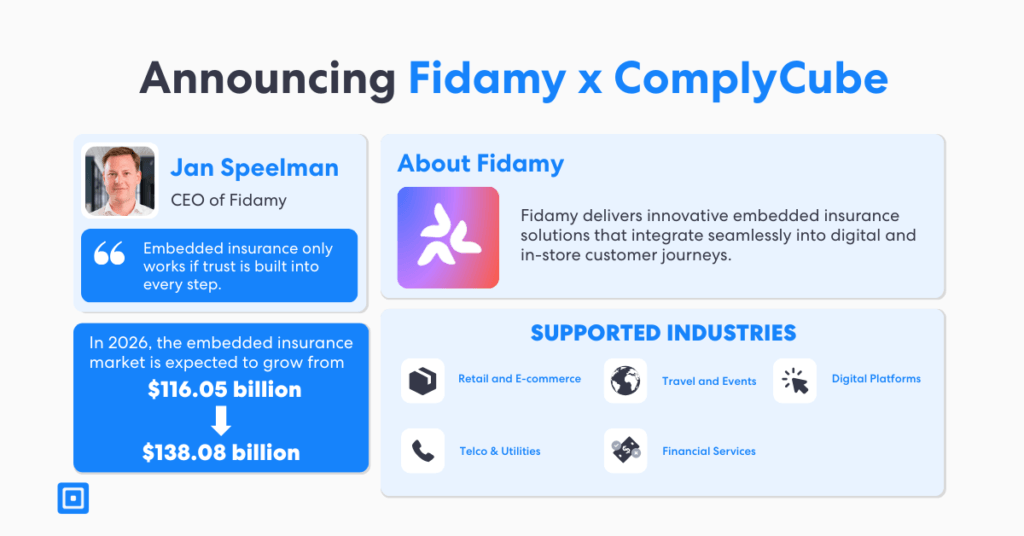
This regulatory pressure is mirrored by enforcement activity. Between March 2024 and March 2025, European authorities imposed more than [€36 million in AML‑related fines on payments and e‑money firms](https://fincrimecentral.com/aml-fines-europe-regulatory-pressure/), illustrating that weaknesses in compliance can have significant financial consequences. By integrating compliance automation early, partners can avoid costly lapses and align with evolving frameworks such as the [EU’s AML Regulation (AMLR)](https://www.citigroup.com/rcs/citigpa/storage/public/Sec_Services_Anti-Money_Laundering_Article.pdf).
## Customers Journey with Embedded Insurance
*“*Compliance must be woven into embedded insurance journeys,*”* said [Jan Speelman](https://www.linkedin.com/in/jspeelman/), CEO of Fidamy. He emphasizes that regulatory alignment must happen without compromising user experience. ComplyCube provides automated [sanction list screening, PEP monitoring](https://www.complycube.com/en/solutions/global-screening/sanctions-pep-screening/), and [adverse media checks](https://www.complycube.com/en/solutions/global-screening/adverse-media-checks/) that support audit‑ready reporting and consistent oversight. These capabilities help ensure that partners can meet regulatory requirements while offering embedded insurance at scale.
Embedded insurance adoption being directly incorporated into [onboarding](https://www.complycube.com/en/use-cases/process/customer-onboarding/) and customer management flows. Additionally, it helps partners reduce manual reviews. They can also improve decisioning consistency, and alleviate operational bottlenecks. This is especially important in Europe, where AML and sanctions expectations are broadening in scope and enforcement intensity.
## Reducing Burden and Supporting Scale
Meanwhile, automation is becoming a key differentiator for compliance professionals. As a matter of fact, [industry analyses](https://www.silenteight.com/blog/2025-trends-in-aml-and-financial-crime-compliance-as-we-enter-q4) highlighted that forward‑looking firms are adopting data‑centric AML and sanctions controls. It addresses increasingly sophisticated risk signals and supervisory expectations. These proactive approaches help maintain resilience amid evolving threats and cost pressures.
*“*Bringing embedded insurance together with robust AML and sanctions compliance gives partners confidence to grow responsibly,*”* said [Harry Varatharasan](https://www.linkedin.com/in/harryvaratharasan/), Chief Product Officer at ComplyCube, noting that automation reduces complexity while preserving regulatory alignment. In other words, by integrating compliance logic into the embedded insurance stack, partners can focus on building seamless customer experiences supported by trustworthy compliance infrastructure.
## A Compliance‑First Approach for Growth
Today, as embedded insurance adoption continues its rapid ascent, embedding regulatory compliance into business models is a strategic necessity. So, the growth trajectory of embedded insurance, combined with rising [AML](https://www.complycube.com/en/solutions/due-diligence-compliance/anti-money-laundering/) and [sanctions](https://www.complycube.com/en/what-is-a-sanctions-screening/) expectations, means automation, transparency, and auditability are key to long‑term success.
In short, Fidamy’s integration with ComplyCube reflects a broader market shift. They are prioritising embedding [compliance](https://www.complycube.com/en/best-aml-software-in-2025-comparison-and-insights/) as a foundational pillar of product delivery, not an add‑on. Together, they support partners in offering property and casualty covers that align with customer expectations and regulatory requirements. As a result, they can help build trust and drive sustainable adoption.
## About ComplyCube
[ComplyCube](https://www.complycube.com/en/) helps organisations automate sanctions screening, manage AML obligations, and meet evolving financial crime regulatory requirements. Its modular suite includes PEP and sanctions monitoring, adverse media detection, and no‑code compliance orchestration. It is accessible via API, SDK, and hosted flows. Recognised in the FinCrimeTech50, and awarded [RegTech Partner of the Year](https://www.complycube.com/en/complycube-wins-regtech-partner-of-the-year-2025/) at the British Bank Awards.
## About Fidamy
[Fidamy](https://www.fidamy.com/), backed by [NN Group](https://www.nn-group.com/) and headquartered in Amsterdam, provides embedded insurance adoption solutions focused on property and casualty lines such as travel, device and shipping protection. Its platform integrates seamlessly into digital and in‑store customer journeys, helping partners unlock new revenue opportunities and build customer loyalty through contextual, on‑demand protection.
**Categories:** News
**Tags:** Announcements
---
### [What Are Active and Passive Biometric Checks](https://www.complycube.com/what-are-active-and-passive-biometric-checks/)
**Published:** October 6, 2021
**Author:** Andreea Balasa
**Excerpt:** Over the last two decades, the global fight against financial crime and terrorist financing has led to an enhanced regulatory regime for Know Your Customer (KYC) and Customer
**Content:**
**TL;DR:** Biometric checks are essential for **secure identity verification**. This article explains how active biometrics require user interaction, how **passive biometrics** work in the background, and how combining both reduces fraud, ensures compliance, and improves user experience.
## What is the Importance of Biometric Checks?
Biometric checks are essential for digital identity verification. As more services move online, companies must confirm who their users are. This helps stop fraud and meet strict rules, such as Know Your Customer (KYC) and Customer Due Diligence (CDD).
The COVID-19 pandemic sped up the shift to remote services. In-person identity checks became harder or even impossible. As a result, fraudsters took advantage and started using stolen IDs, fake videos, and deepfakes to trick systems.
To fight this, companies are turning to better tools. Companies House expects that [6 to 7 million people](https://www.gov.uk/government/news/companies-house-confirms-identity-verification-rollout-from-18-november-2025) will need identity verification by the mid of November 2026. This shows how fast the demand for digital security is growing. Moreover, the Biometrics Institute stresses the need to use these tools in ways that protect privacy and earn user trust.
One of the most effective tools today is liveness detection. It helps confirm that a user is a real, live person. Businesses can choose between two main types of liveness checks: active and passive. These methods improve trust, reduce fraud, and help meet global compliance needs.
## Biometric Checks Explained: What They Are and How They Work
Biometric checks use unique physical or behavioural traits to confirm a person’s identity. These traits include face, fingerprint, or voice, which are hard to forge or replicate. As such, biometrics offer a reliable layer in identity proofing and access control.
Three core terms often appear in biometric verification:
- **Biometric verification** matches a person’s biometric data to a stored template to confirm who they are.
- **Biometric authentication** uses that match to grant access to a service, system, or device.
- **Liveness detection** confirms that the biometric input is coming from a real, live person, not a spoof such as a photo, video, or mask.
Biometric technologies are widely used in banking, telecom, healthcare, and government. For example, people unlock phones with facial recognition, access banking apps with fingerprints, or pass through airport gates using facial scans.
Broadly, biometric checks fall into two categories:
- **Active biometrics** ask users to do something such as blinking, smiling, or pressing a finger on a scanner, in a visible and intentional manner.
- **Passive biometrics** work silently in the background. They analyse facial cues or behaviour without asking the user to act, making them ideal for low-friction onboarding and authentication.
Both biometric types are effective, depending on the situation. Active biometrics are used in high-risk or high-assurance flows. Passive methods are better for seamless user experiences and can detect fraud in real time without causing delays. You can learn more here: [“Deepfake Detection for the Modern Media Threat”.](https://www.complycube.com/en/deepfake-detection-for-the-modern-media-threat/)
## What Are Liveness Checks?
Liveness checks verify that biometric inputs, such as a face or fingerprint, come from a real, physically present person. By analysing motion, depth, and texture, they block spoofing attempts using photos, videos, or deepfakes. Liveness detection prevents impersonation, supports compliance, and builds trust in digital onboarding and authentication.
There are two main types of liveness detection:
- **Active liveness checks** ask the user to complete a task and this may include blinking, smiling, turning their head, or following an on-screen prompt.
- **Passive liveness checks** do not require any action from the user. Instead, the system runs in the background and looks for subtle signs of life, such as depth, motion, and skin texture.
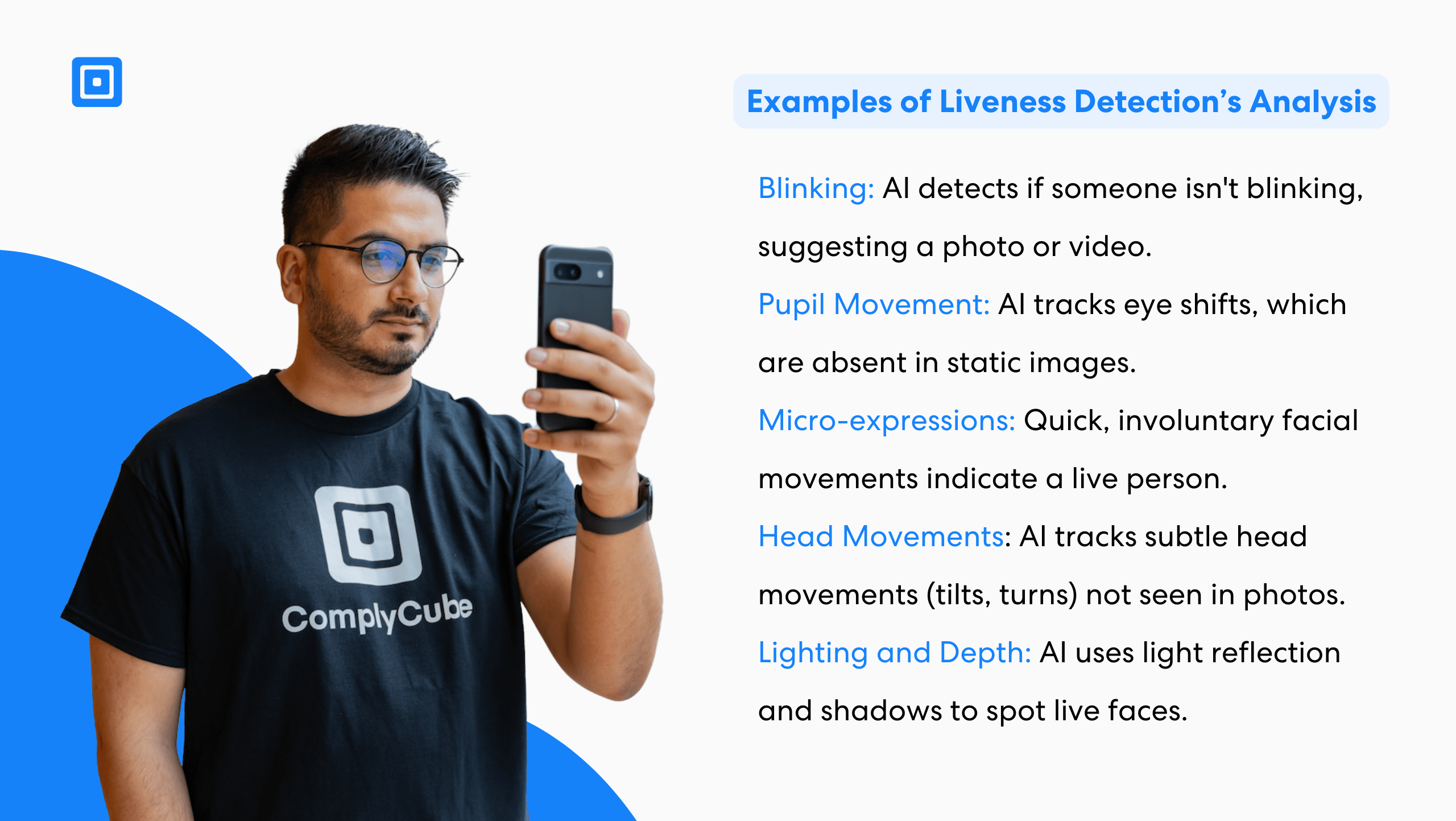
Without liveness detection, even accurate biometric matches can be fooled by fake or stolen data. These checks reduce that risk by confirming the input is live and not artificially produced. Many systems now use Artificial Intelligence (AI) and Machine Learning (ML) to assess facial movements, skin texture, and lighting. Some also consider behavioural cues, such as how the person holds their device.
> Liveness detection can quickly identify anomalies in skin texture, lighting, and more, effectively deterring fraudsters
[Harry Varatharasan](https://www.linkedin.com/in/harryvaratharasan/), Chief Product Officer at ComplyCube, explains, “Liveness detection is a critical part of fraud prevention checks, as facial recognition processes are often impacted by non-authentic inputs, such as deepfakes. Liveness detection can quickly identify differences in skin texture, lighting, and more, effectively deterring fraudsters.”
Both methods aim to stop impersonation and identity fraud. Active checks are often used in high-risk flows where strong assurance is required. Passive checks are ideal for user journeys that need to stay fast, smooth, and low-friction. You can learn more about how liveness detection enhances biometric security here: [“Liveness Detection Software for Digital Trust”](https://www.complycube.com/en/liveness-detection-software-for-digital-trust/).
## Active Biometrics: User-Guided Identity Checks
Active biometrics ask users to perform a specific action to prove they are real and present. This action confirms that the biometric input, such as a face or fingerprint, comes from a live person and not from a static image or recording. Systems often use these checks during onboarding, account recovery, secure logins, and high-value transactions.
Direct user interaction makes active methods more resistant to spoofing. They are especially valuable in high-risk situations where a high level of identity assurance is required. Examples of active biometric checks include:
- Blinking or smiling at the camera
- Turning the head left or right
- Following an animated dot on the screen with the eyes
- Placing a finger on a scanner
- Speaking a short phrase for voice recognition
These actions help systems detect signs of life and confirm that the user is who they claim to be. Active biometrics are often used alongside facial recognition or fingerprint matching. For instance, a banking app might ask the user to smile after scanning their face to ensure the image is not a static photo or pre-recorded video.
While these checks improve security, they can also introduce friction. Users must complete a task, which may cause drop-offs in low-risk scenarios. However, many users accept the added step, especially when it increases trust and protection.
Additionally, systems can be designed to use active liveness checks only when a risk signal appears, such as a login from a new device or location. This approach helps balance strong security with a smooth and user-friendly experience.
## Passive Biometrics: Frictionless and Secure
Passive biometrics confirm a user’s identity by observing physical and behavioural traits. These systems work in the background and do not ask the user to do anything. They use artificial intelligence to detect natural signs that show a real person is present.
Passive systems check things like facial depth, skin texture, motion, and how the person uses their device. This makes them useful for mobile onboarding, logins, and extra security during a session. Unlike active biometrics, passive checks do not require any action. Instead, they look for natural signals such as blinking, head movement, small facial changes, typing style, or how the device is held.
These signals are hard to fake. Deepfakes and printed images usually fail to copy the tiny, real-time details that passive systems monitor. These systems also spot problems in light, depth, or motion that would not appear with a real person.
### **Case Study: Challenger Bank Reduces Drop-Off with Passive Biometrics**
A leading European challenger bank was losing nearly **1 in 3 users** during video-based identity verification due to friction from active liveness checks. After switching to **ComplyCube’s passive liveness detection**, the bank achieved:
- **42% boost in conversion** rates
- **30-second reduction** in onboarding time
- **Fewer fraud attempts** while staying fully **EBA AML** compliant
This shift shows how passive biometrics can improve security and compliance without disrupting trusted users.
For businesses, passive biometrics offer strong security without slowing users down. They help reduce drop-off, improve satisfaction, and meet compliance needs. When combined with tools like device or location checks, they can detect risk early without interrupting trusted users.
## Active vs Passive Biometric Checks: A Head-to-Head Comparison
Both active and passive biometric checks help confirm that a user is present and genuine. While they serve the same purpose, their approach, user experience, and fraud resistance differ. Selecting the right liveness detection method depends on the level of assurance required, the business risk appetite, and how much user friction is acceptable. The image below illustrates the key differences between passive and active liveness detection.
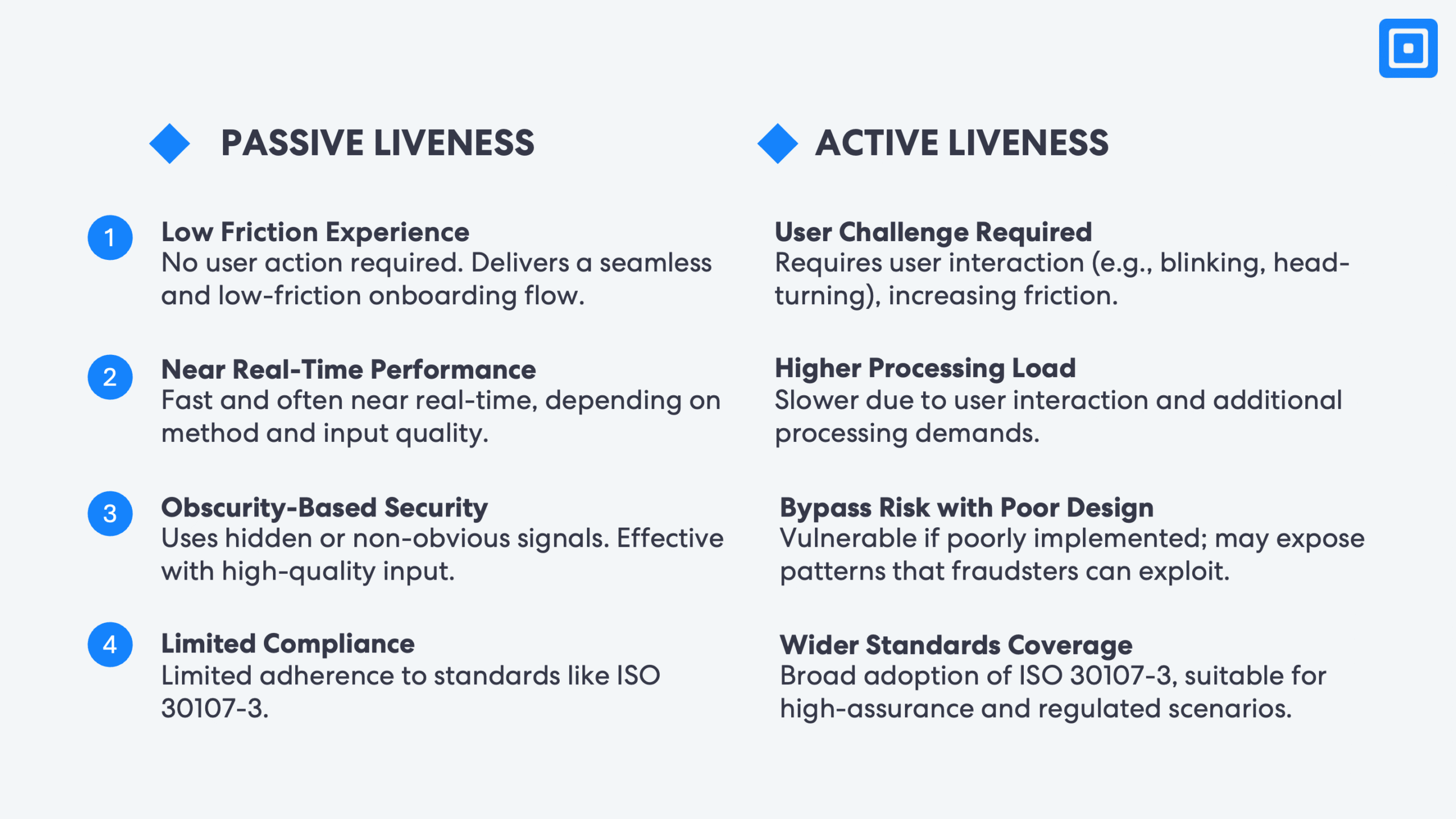
Some organisations deploy both methods depending on risk level. The application platform may use passive checks by default and switch to active biometrics when risk signals or anomalies are detected. This layered approach helps balance security, compliance, and user experience.
Both types of liveness checks help organisations detect and stop fraudulent activities by ensuring the integrity of biometric data. Neither method is universally superior. Instead, each offers protection against fraud depending on the organisation’s specific needs and risk thresholds.
Passive biometrics, in particular, can significantly enhance identity verification workflows by introducing advanced, frictionless safeguards. These solutions improve compliance, increase security, and ultimately strengthen user trust while streamlining the verification experience for both customers and businesses.
## Multi-Factor Security with Biometric Checks
Multi-Factor Authentication (MFA) protects systems by asking users to prove who they are in more than one way. Biometric checks make MFA stronger by adding a unique trait, like a face pattern or typing style, that is hard to fake or steal. There are three main types of authentication:
- **Knowledge:** What the user knows, like a password or PIN
- **Possession:** What the user has, like a phone or security token
- **Inherence:** Who the user is, like their face, fingerprint, or voice
Biometrics belong to the third group. They are always with the user and hard to copy. This makes them a strong layer in any MFA setup. Biometric MFA lowers the risk of account takeovers, helps meet compliance rules, and builds trust with users.
Both active and passive biometrics, when used together, improve flexibility. A platform might use passive checks for normal logins and switch to active checks if something unusual is detected. This helps stop fraud without slowing down trusted users.
## User Experience: Balancing Security and Simplicity
Biometric checks must provide strong security without making the user journey difficult. A smooth experience helps build trust, reduce drop-off, and improve conversion rates, especially during onboarding.
Active biometrics increase assurance but require the user to perform a task. While these steps are simple, they can add time and effort. In some cases, this may cause frustration or lead users to abandon the process. On the other hand, passive biometrics offer a lower-friction option. These checks work silently in the background. As such, passive methods are well-suited for mobile apps, returning user logins, and low-risk actions.
Organisations can use both types of checks in a way that adapts to context. For instance, passive checks can run by default to keep the experience seamless. Consequently, if the system detects a risk, such as a device change or suspicious behaviour, it can trigger an active check for added certainty.
This adaptive approach helps meet security goals without slowing down the user. It also supports regulatory expectations for risk-based authentication. You can learn more here: “[What is a Risk-Based Approach (RBA)?](https://www.complycube.com/en/what-is-a-risk-based-approach/)” When implemented correctly, biometric checks protect users and systems while keeping the journey fast and intuitive.
### **Key Takeaways**
- **Biometric verification** uses physical or behavioural traits to confirm a user’s identity
- **Liveness detection** ensures the biometric input comes from a real, live person
- **Active biometrics** prompt the user to complete a task, such as blinking or turning their head
- **Passive biometrics** run in the background, analysing natural traits without user input
- **Combining both** methods supports adaptive risk-based authentication and fraud prevention
## Making the Right Choice for Your Business
Both active and passive biometric checks help verify identity and prevent fraud. Each method has its strengths, depending on whether your goal is to reduce friction or meet strict security and compliance requirements.
**Active biometrics** offer greater control and a higher level of identity assurance. They are best suited for high-risk situations such as digital onboarding, remote Know Your Customer (KYC) checks, or financial transactions.
**Passive biometrics** operate in the background without interrupting the user. They are ideal for mobile logins, returning sessions, and real-time fraud detection. These checks deliver a smooth and low-friction user experience.
The choice between active and passive methods should align with your risk appetite. The best solution is the one that fits your customer expectations and regulatory environment. Many organisations combine both methods to build a flexible system that adapts to different levels of risk and context.
Select the approach that meets your verification needs while keeping the user journey secure and seamless. To learn more about implementing active or passive biometric checks in your business, [contact our expert compliance team today](https://www.complycube.com/contact/contact-sales/). These checks are increasingly mandated for secure, remote onboarding in legal, financial, and immigration sectors
[](https://www.complycube.com/contact/contact-sales/)
## Frequently Asked Questions
What is a biometric check?
Biometric checks are an identity verification method mandated by regulators for secure onboarding. These checks validate that a user is genuine by cross-referencing biological traits (such as an individual’s selfie scans) against their identity documents.
What are active and passive biometric checks?
Active biometrics require users to perform an action, such as blinking or turning their head. Passive checks work in the background, detecting liveness from motion, depth, and texture without user input. Active methods offer higher assurance, while passive methods improve convenience.
When should a business use passive biometrics instead of active?
Passive biometrics are ideal for low-friction flows such as mobile logins, app re-authentication, or fast-track onboarding. They allow verification without interrupting the user, making them effective for improving conversion rates while still detecting fraud in real time.
Are biometric checks compliant with KYC and AML regulations?
Yes. Biometric verification supports KYC and AML compliance by proving that a real person is present. ComplyCube’s solutions are designed to meet global regulatory standards, including GDPR, and are trusted by regulated industries to meet identity assurance requirements.
Can active and passive biometric checks be used together?
Yes. Many organisations use passive checks by default and escalate to active ones when risks are detected. This layered approach balances user experience with fraud prevention, adapting dynamically to context, device signals, and transaction risk levels.
**Categories:** Guides
**Tags:** Biometrics
---
### [Employers Guide to Proof of Right to Work in UK with Certified IDSPs](https://www.complycube.com/proof-of-right-to-work-in-uk-with-idsp/)
**Published:** February 19, 2026
**Author:** Dini Habib
**Excerpt:** To prevent hefty fines and reputational damage, UK employers are required to conduct compliant right to work checks. Under the Home Office guidance, these checks must fulfil specific needs, such as the type of document to collect.
**Content:**
**TL;DR:** UK firms must check employees right to work before enrolment to avoid penalties. As such, **right to work compliance** is crucial. Additionally, automating right to work checks enables firms to reduce hiring friction and keep audit-ready records. This guide explains **proof of right to work in UK** processes and how to stay compliant while enhancing employee satisfaction.
## What are Right-to-Work Checks?
In the UK, right-to-work (RTW) checks are a mandatory Home Office process. During this process, employers have the responsibility to verify that a job applicant is allowed to work in the UK legally before hiring. Without robust RTW, companies can face civil penalties of up to £60,000 per person.
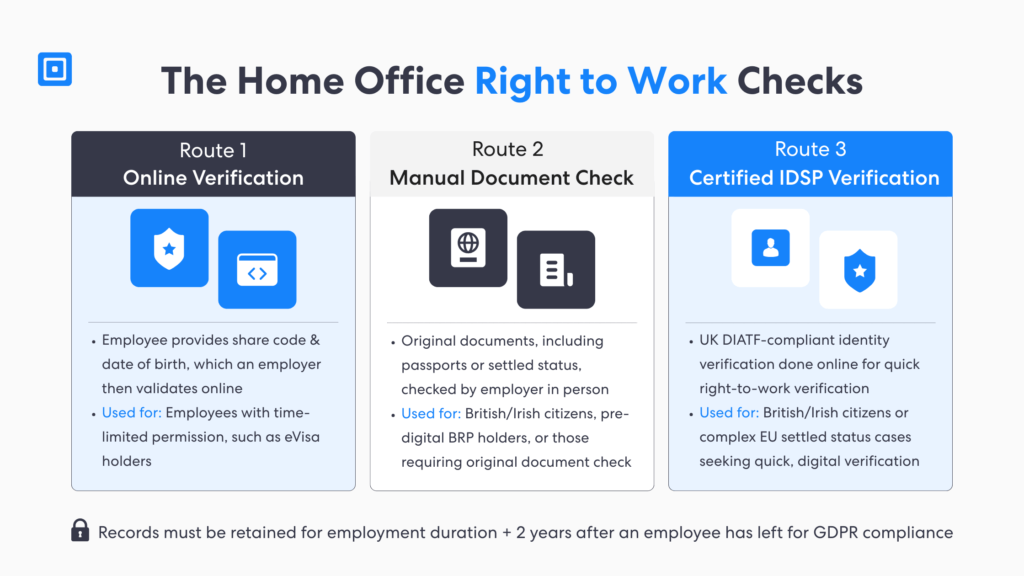
The Home Office department guides employers on how to conduct sufficient checks, which include three distinct routes:
### 1. Check RTW Online
Under this process, an employer can view and confirm an individual’s RTW record in real-time using the Home Office service. The information required from an individual’s online account is their date of birth and share code (generated by the user themself via the GOV.UK website). Typically, international talent and commonwealth citizens use this service. Irish or British citizens cannot generate a share code and must undergo route two or three instead.
### 2. Check RTW with Physical Documents
Use original documents from the Home Office’s [acceptable list](https://www.gov.uk/legal-right-work-uk), which includes a British passport or an Irish passport. If no passport is available, other documents, such as a birth or adoption certificate, and an official document letter showing the National Insurance number, are required. If an individual has just attained British citizenship, they must prove so via a Certificate of Registration or Naturalisation.
### 3. Check RTW via an Identity Service Provider (IDSP)
An IDSP is a certified [digital identity verification provider](https://www.complycube.com/en/use-cases/process/certified-digital-right-to-work-checks/) used by employers, landlords, and organizations to perform RTW, right to rent, and DBS checks. Firms that choose to perform RTW checks with an IDSP typically do so because it enables quicker, compliant onboarding at scale.
Employers must [keep all copies](https://www.gov.uk/check-job-applicant-right-to-work) of right to work documents throughout the employment contract, plus for two years after that. Under the UK’s [General Data Protection Regulation (GDPR)](https://gdpr-info.eu) law, this worker’s information must then be safely destroyed afterwards. Implementing complete right to work checks supports UK employers in obtaining a statutory excuse, which can legally help against penalties for hiring illegal workers.
## Automating Right to Work Checks with an IDSP
UK employers are increasingly adopting IDSPs, as they provide a high level of automation, removing the need for manual intervention. In 2022, the UK government launched the IDSP framework, enabling employers to partner with digital IDSPs to verify an employee’s right to work status accurately. An IDSP complies with the [UK’s Digital Identity and Attributes Trust Framework (UK DIATF)](https://www.complycube.com/en/company/security-compliance-center/uk-diatf-certified-idsp/).
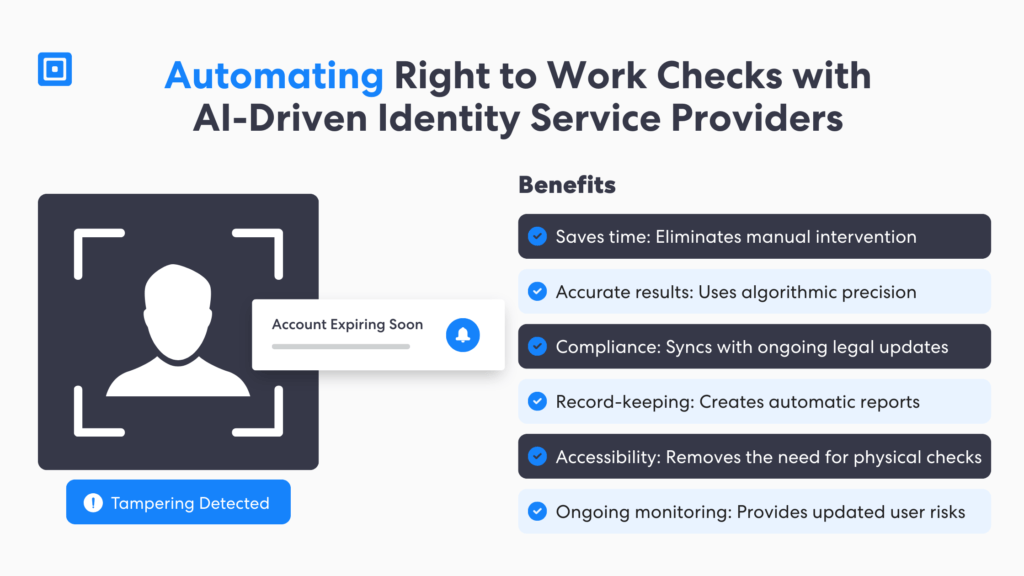
Automation uses Artificial Intelligence (AI) and Machine Learning (ML) to rapidly extract valid information and detect tampered identity documents. AI-driven IDSPs support right to work checks with instant compliance records and fraud detection alerts. The advantages of automation with a certified IDSP include:
- **Saves time** through instant digital verification, eliminating manual document management.
- **Reduces human errors** with algorithmic precision and automated confirmation of identity.
- **Ensures compliance** via integration with UK Home Office systems and real-time updates.
- **Creates audit-ready digital** records for easy documentation and inspections upon request.
- **Cuts costs** by minimizing dependencies on manual paperwork and potential penalties.
- **Improves accessibility** with remote, authorized checks from any device.
- **Goes beyond pre-screening** by enabling continuous monitoring and real-time risk updates.
Modern IDSPs, including ComplyCube, support UK businesses in complying with both pre-employment checks and continuous compliance with the UK Anti-Money Laundering (AML) regulations. Additionally, these digital systems simplify the hiring process, ensuring each worker has a valid right to work status instantly. You can learn more here: [Choosing a UK DIATF-Certified IDSP](https://www.complycube.com/en/choosing-a-uk-diatf-certified-idsp/).
## Compliant Proof of Right to Work in UK
According to the UK Government, the most common risk factor for UK employers is not understanding the requirements for compliance with right to work checks. It is noted that [80% of UK employers](https://www.gov.uk/government/publications/employer-awareness-of-right-to-work-checks/employer-awareness-of-and-self-reported-compliance-with-right-to-work-checks) answered at least one compliance question incorrectly during a survey.
This can pose a huge risk to a business, especially as it can cause bad actors to manipulate the verification system. For example, individuals can commit identity theft by using stolen details to create fraudulent certificates or visa status, evading the correct employment status.
[Compliant IDSPs](https://www.complycube.com/en/company/security-compliance-center/uk-diatf-certified-idsp/) mitigate these risks by providing by cross-referencing contact information and official documents against trusted databases in real-time. As a result, firms can flag discrepancies before onboarding, strengthening fraud prevention. In addition, certified IDSPs such as ComplyCube offer cutting-edge verification tools. This includes liveness checks and [Optical Character Recognition (OCR)](https://www.complycube.com/en/solutions/due-diligence-compliance/know-your-customer/optical-character-recognition/), to further enhance identity verification and protect businesses from fraud.
### **Case Study: Make Employees’ Right to Work Checks Faster and Compliant**
A leading UK staffing and recruiting firm needed to perform right to work checks for all new hires. However, the firm was struggling with inefficiencies due to reliance on multiple third-party vendors to run initial verification and onboarding.
##### **End-to-End Identity Verification Flow**
To streamline its complex processes, the firm partnered with ComplyCube, the IDSP-certified KYC provider under the UK DIATF. ComplyCube provided unified verification, including document verification, and ongoing compliance monitoring across the candidate lifecycle.
##### **Outcomes**
- The firm was able to layer multiple checks in one workflow, including selfie and proof of address checks to enhance security.
- With a unified, automated platform, the UK business was able to seamlessly integrate effective right to work checks into its CRM.
- As a result, the company was able to hire and onboard new hires at a faster rate, increasing the verification rate by 14%.
## Common Mistakes and How to Avoid Them
Not implementing the correct right to work verification process results in huge losses. Firstly, employing workers without valid rights or work visa can lead to fines and potential imprisonment. Secondly, genuine applicants who undergo complex right to work checks can feel alienated by the process. For example, filling in a form repeatedly or having no transparency on document submission can lead to a bad experience.
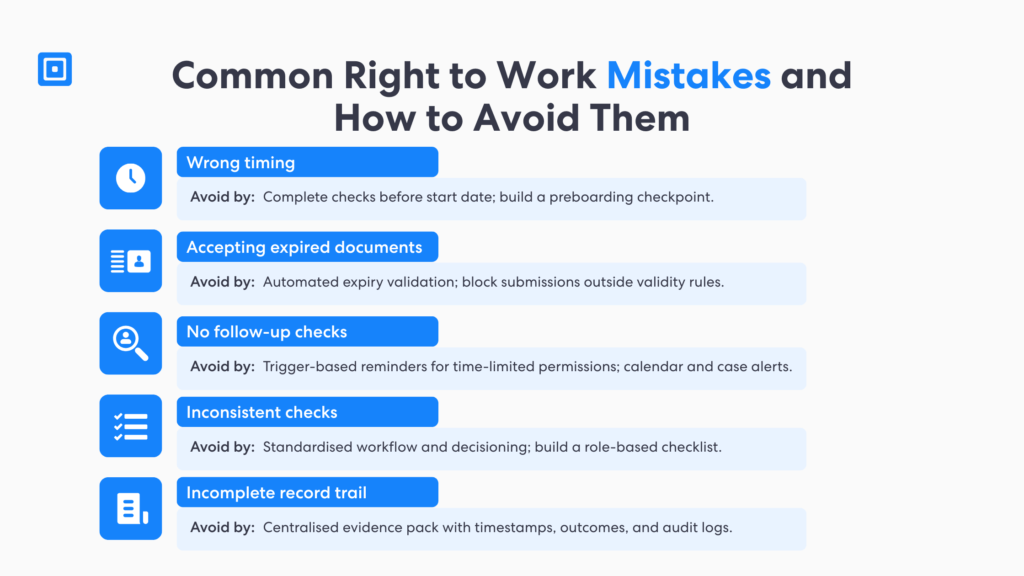
### According to the UK’s Digital Identity Sectoral Analysis 2025:
- **79% of users** report privacy and security as the main factors when using digital identification
- Next, **76% of applicants** chose service provider reputation and clarity on forms needed as important
- **75% of individuals** indicate reliability and conformity to government standards as vital
- **75% of respondents** mention faster transactions with digital identity services
Right to work checks form a crucial component of onboarding programs. Consequently, effective onboarding has a large role in employee satisfaction and retention. For example, reports indicate that workers who don’t receive a preboarding experience are more likely to leave [within six months](https://www.shrm.org/mena/executive-network/insights/onboarding-key-to-elevating-company-culture).
### The most common mistakes during right to work checks are:
**1. Conducting checks at the wrong time:** According to the Home Office, carrying out a right to work check after employment has begun will ultimately invalid statutory excuse. As a solution, employers are encouraged to always run a right to work check before employment begins, including starting an unpaid trial that is considered work.
**2. Accepting expired or incorrect documents:** Processing documents that are not valid, such as visa past an expiry date is not allowed. However, an expired British passport can still be accepted. To avoid this mistake, check the required documents for each applicant based on their country or citizenship (review List A and List B document types). The share code, versus the manual route, versus the IDSP route, caters to different workers and requires different documents for compliance.
**3. Inconsistent checks:** Enforcing different right to work checks per employee can create legal risks, such as discrimination claims. Thus, businesses must conduct checks using a standardised process to build defensibe proof during regulatory checks. Ensure to align names and date of birth with other checks, including proof of address.
**4. Not conducting follow-up checks:** For employed workers with time-limited permission to work, failing to perform checks before their RTW expires can lead to non-compliance. To mitigate this, set follow-up triggers where permission is time-limited and schedule the follow-up checks in advance to ensure they’re completed on time.
**5. Incomplete record trail:** Not keeping clear copies of documents may mean losing statutory excuse. On the other hand, not disposing of employee data two years after they have left is non-compliant. Businesses must retain dated copies of relevant documents and detail who conducted the check and when. For online or IDSP checks, retain output evidence as required.
### Key Takeaways
- **UK employers** can face heavy fines and imprisonment for failing to check employees right to work, while workers who cannot prove it may face deportation.
- **An online share code** is mandatory for most non-British or Irish citizens to verify their right to work in the UK and can be applied for online, valid for 90 days.
- **British/Irish citizens** must present original documents, such as a passport, either in person or live video link, or via a certified IDSP.
- **An automated IDSP** empowers employers to remain compliant with right to work checks, perform rapid, real-time screening, and strengthen fraud detection.
- **Right to work checks** play a crucial role in customer onboarding, influencing an applicant’s experience and retention rate.
## Right to Work Checks as a Growth Enabler
Embracing right to work checks through compliant IDSPs shifts compliance from a complex process into a growth enabler. By leveraging AI-driven IDSPs to prove right to work eligibility, whether via [document checks](https://www.complycube.com/en/solutions/identity-assurance/document-verification/) such as passports or share codes from a previous employer, UK businesses can protect their operations from fines. Access compliant, automated UK DIATF certified identity service providers today and hire talent at scale. [Contact a member](https://portal.complycube.com/signup) of the ComplyCube team to learn more.
[](https://portal.complycube.com/signup)
## Frequently Asked Questions
What is proof of right to work in UK?
Proof of right to work in UK confirms a person has legal permission to work by verifying their immigration status or employment eligibility. Usually, individuals submit a passport, a share code to prove visa status, or a document with a national insurance number before employment. UK employers must check employees right to work for compliance.
How do UK employers check employees right to work?
UK employers can check employees right to work through 3 different routes: checking documents online via a share code, physically accessing original documents, or remote verification through a certified identity service provider (IDSP). Documents collected must be kept throughout the applicant’s employment contract and for 2 years afterwards, before being disposed.
What are the benefits of automating right to work checks?
Automating right to work checks offers benefits such as quicker hiring, reduced human errors during document validation, and real-time confirmation of right to work or immigration status. In addition, it builds a defensible, audit-ready report, cuts costs, and ensures ongoing compliance beyond the job offer.
How do you partner with an IDSP for right to work checks?
To partner with a UK IDSP, businesses can view these providers on the UK’s GOV.UK website. Some factors to consider when choosing IDSP include UK DIATF alignment, integration capability, automation level, and compliance with AML rules.
What documents are needed for proof of right to work in uk?
Documents for proof of right to work in UK include a valid passport, biometric card, share code, or national insurance number for Irish or British citizens. Applicants from a specific country may need additional information, such as a job offer letter or work permission certificate. Examples include List A (unlimited employment) or List B (time-limited work).
**Categories:** Guides
**Tags:** Identity Verification
---
### [Why Insurance Fraud Prevention Fails After Onboarding](https://www.complycube.com/post-onboarding-insurance-fraud-prevention/)
**Published:** February 17, 2026
**Author:** Rithu Jagannath
**Excerpt:** Insurance fraud prevention often stops at onboarding, yet fraudsters cash out at claims. Learn how insurance fraud detection and a risk-based insurance fraud check across policy changes, claims and payouts reduce fraud and false positives.
**Content:**
**TL;DR:** In most cases, **insurance fraud prevention** stops at onboarding. Fraudsters wait and **cash in through fraudulent claims** later within the policy lifecycle. Typically, better insurance fraud detection comes from **verifying identity properties during policy changes**, the claims process, and payouts. A risk-based insurance fraud check helps **detect and prevent suspicious activities**.
## What is Insurance Fraud Prevention?
Insurers want to prevent fraud before ever having to pay out. Insurance fraud prevention typically occurs through thorough identity verification, fraud detection rules, and any deeper investigations. It is essential to prove user legitimacy at key stages during the process. This process protects policyholders, consumers, and the insurance industry from crimes such as theft, staged losses, and scams.
> Fraudsters rely on confusion, speed, and assumptions.
Solutions Consultant, Milosh Caunhye also says, “Insurance companies need to protect policyholders by replacing any assumptions with proof. By combining thorough identity verification, advanced analytics, and accountable escalation, every high-risk decision is defensible before an insurance claims payout.”
To effectively prevent or even detect insurance fraud, insurance companies need to stay aware of any emerging fraud schemes or red flags. Insurance companies need a comprehensive approach to solutions that blend people, processes, and data. Using advanced analytics and machine learning helps them spot risk earlier, while clear escalation paths to Special Investigative Units (SIUs) and law enforcement ensure the right response when required.
## Why Insurance Fraud Prevention Fails After Onboarding
Nowadays, onboarding receives more attention than ever. In today’s world, organizations have easy metrics to measure. Metrics such as conversion, time-to-bind, or a clean “pass/fail” flow. However, fraudsters do not need to beat the onboarding process. At any point, they can compromise a person’s real identity. At any point, they can compromise a person’s identity, take over an account, or manipulate insurance claims processes later down the line, especially when identity checks are a little lighter.
There is a perception that if an identity is proven once in the process, that trust is granted forever to the user. However, this gap becomes apparent during policy serving and any claims. This is truly where speed matters. Attackers exploit any discrepancies and move money quickly before patterns are even noticed. More importantly, insurance fraud detection must not compromise any customer experience. Best practices need to align both objectives to ensure effective fraud detection while maintaining satisfaction and trust.
## Four Touchpoints Where Insurance Fraud Occurs
When insurance fraud occurs, there are four touchpoints at which you could encounter it. This arc includes onboarding, policy changes, claims submissions, and eventually payout. Yet, if you only secure the first step, you are only capable of defending the “front door.” This leaves the entire vault wide open during the entire claims process.
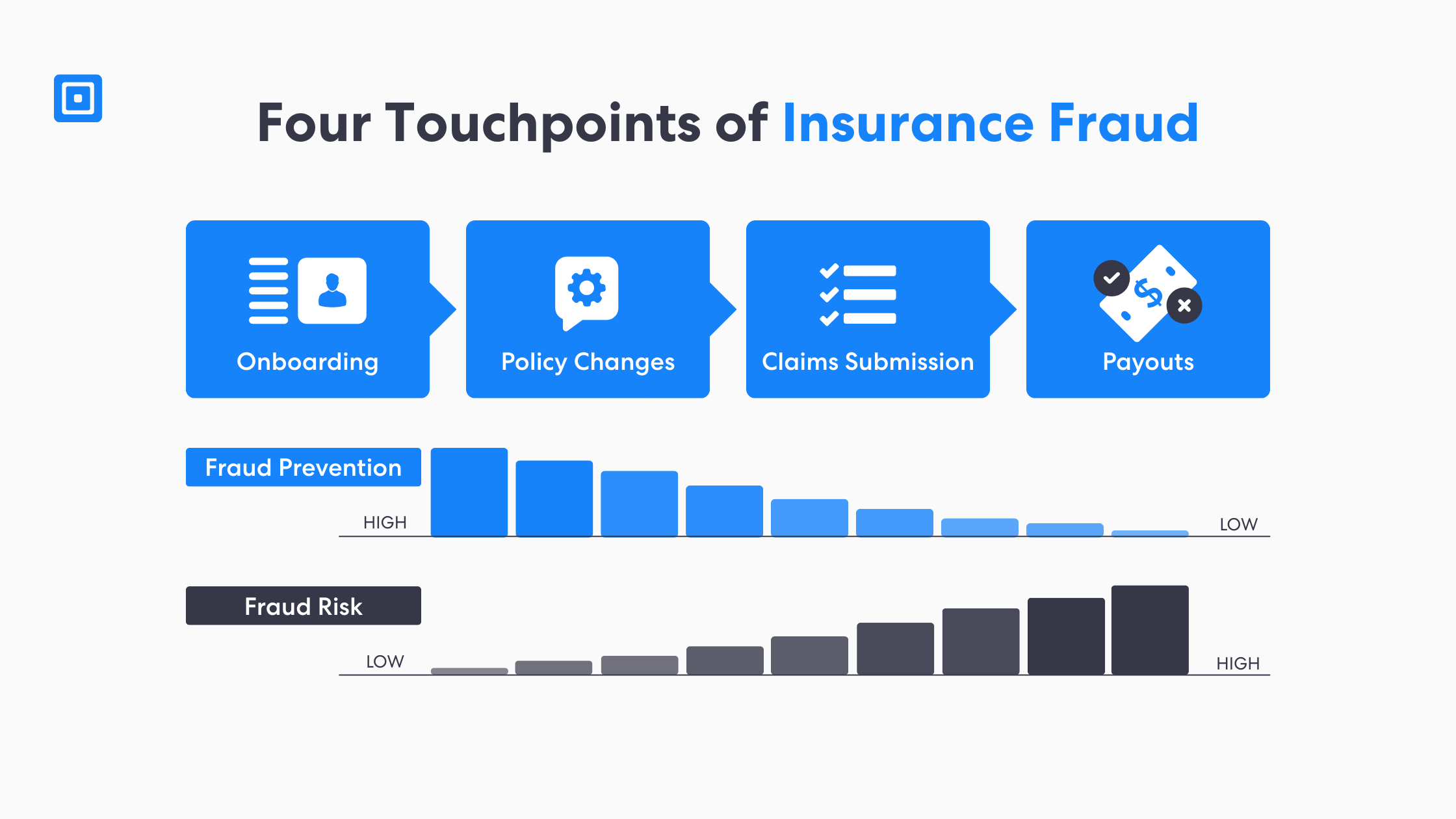
Companies and industry organizations only further reinforce this view. The [National Insurance Crime Bureau](https://www.nicb.org/) works with insurers and law enforcement to fight insurance crimes, and the [Coalition Against Insurance Fraud](https://insurancefraud.org/) shares research and awareness. A coordinated, data-driven organization that works with law enforcement, government agencies, and industry partners is essential for effective insurance fraud detection. It enables a united and resource-sharing approach to detect, deter, and prevent insurance-related crime.
### Touchpoint 1: Onboarding (Strong Controls, Limited Coverage)
The first touchpoint will be the [onboarding process](https://www.complycube.com/en/use-cases/process/customer-onboarding/). Businesses and organizations with strong onboarding controls can catch any obvious fraudsters. Controls identify at any mismatched identity data, low-quality documents, inconsistent details. These types of checks also create a baseline record for businesses that helps any [Special Investigations Unit (SIU)](https://insurancetrainingcenter.com/resource/special-investigative-unit-siu/) prove what happened later.
However, it still remains that in the onboarding process, teams cannot prevent post-issuance abuse or fraud risk. For example, a legitimate customer can still become a victim through theft of credentials or a scam. Fraudsters can use their accounts later to create fraudulent activity even if the consumer’s onboarding was fully legitimate.
### Touchpoint 2: Policy Changes (Quiet Setup for Claims Fraud)
Second, companies and businesses need to keep an eye on policy servicing. This is where fraudsters and attackers set the stage. Any bank changes, beneficiary updates, address edits, and channel swaps determine who gets paid. Yet teams often handle them as routine requests across multiple channels and teams.
For example, if a call-center script is much weaker than an online portal flow, fraudsters will route through to the easiest path. As a result, insurers spend effort on solutions or investigations after the fact. So, a risk-based insurance [fraud check](https://www.complycube.com/en/use-cases/process/fraud-prevention/) on high-impact changes can detect and prevent diversion before claims arrive.
### Touchpoint 3: More Claims Submission (Where Money Is Requested)
Next up in the insurance lifecycle, [claims submission](https://www.gallagherbassett.com/uk/news-and-insights/tackling-fraudulent-claims-across-the-insurance-industry/) is a very crucial moment. It is the point at which monetization occurs and suspicious activities turn into real claims. This process is typically built for speed and customer experience. So when respondents report injuries, fraudsters have the opportunity to exploit urgency and “plausible” narratives.
That is why modern insurance fraud detection must re-identify the person requesting money. It is their responsibility to identify patterns in the data collection. This covers new devices, any unusual timing, changes in payout, repeated discrepancies or any claim velocity. If done well, a good detection method prevents fraud while reducing any false positives. It only routes higher-risk claims for further review.
### Touchpoint 4: Payouts and Beneficiaries (Where Loss Becomes Final)
Finally, even when a claim is legitimate, the [payout](https://www.abi.org.uk/products-and-issues/topics-and-issues/fraud/) could be fraudulent. This occurs if the beneficiary or bank details were manipulated by a fraudster earlier. Remember, once the money is sent, recovery can be slow and expensive. Any disputes, case investigations and legal constraints across laws and jurisdictions can take a lot of time.
It is incredibly important that insurers need to treat any claims payout as its own control touch point. Implementing identity verification checks with step up in intensity before any funds move to a claimant will protect both policyholders and insurers. It reduces reliance on SIUs and law enforcement after the fraud loss has occurred.
## Why False Positives Are a Hidden Tax
Alternatively, false positives irritate customers. They reduce any chance at efficiency, slow legitimate claims, and waste investigative expertise or time. So, when every single insurance claim looks like potential fraud, SIUs spend too much time clearing clean cases from their queue instead of stopping [real organized crimes](https://www.complycube.com/en/what-is-insurance-fraud/).
It is important to use proportionality. Organizations must learn to apply advanced analytics and machine learning to rank risk when it comes to insurance fraud. This will allow teams to then step up verification only when it’s meaningful. As a result, it protects the overall customer experience while fighting fraudsters in real-time.
## Tax Evasion, Law Enforcement and Proof-by-Paper
There are some fraud schemes that overlap with tax evasion or accounting manipulation. Sometimes, people engineer documents that “prove” a certain type of narrative. As a result, fraud then becomes a paperwork exercise rather than a blatant lie. These case examples exploit gaps between systems, vendors, and teams.
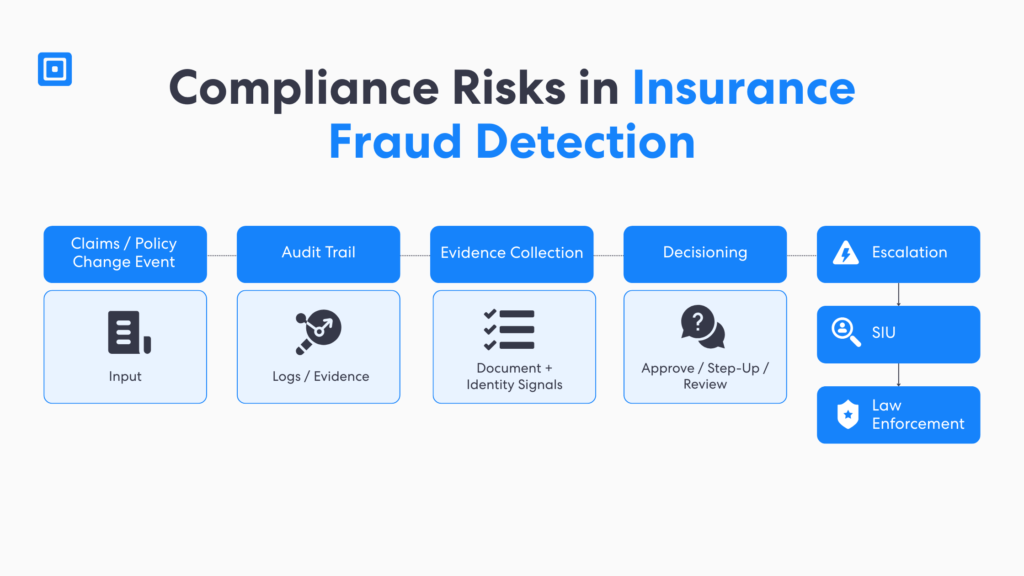
Companies need to look to risk-based guidance. This supports stronger controls at high-risk moments. For example, the [Financial Action Task Force (FATF)](https://www.fatf-gafi.org/en/publications/Fatfrecommendations/RBA-Life-Insurance-Sector.html) digital identity guidance reinforces any compliance measures proportionate to risk. This can help better determine which processes fits claims-stage verification and payout protection.
### **Case Study: Closing the Claims-Stage Identity Gap**
In auto insurance, a major onboarding-stage fraud pattern is premium misrepresentation. This is where applicants provide false information at quote/bind (e.g., unreported drivers, garaging location, mileage, vehicle use) to secure cheaper coverage, creating downstream claims risk.
##### **More checks and stepping up verification**
Insurers reduce this risk by strengthening onboarding verification before binding. They must validate identity and household/driver context, apply risk-based checks when quote data shifts across attempts, and use pre-bind controls such as inspections and evidence requirements.
##### **Outcomes**
- $35.1B in annual losses are attributed to auto premium fraud driven by onboarding.
- Unrecognized drivers are the largest contributors to auto premium fraud.
- Millions of claims are processed annually and cites that an estimated ~20% are fraudulent.
## The Insurance Fraud Prevention Playbook for Claims Teams
Claims teams need a [playbook](https://www.complycube.com/en/aml-guidelines-for-insurance-companies/) to detect and prevent insurance fraud. They need a process they can repeat across claims handlers, fraud operations teams and special investigative units. The goal is to standardize when a claims case becomes “potential fraud.” This clarifies what evidence is required and how the overall claims process changes without derailing legitimate customers who need help.
This is why the most practical approach is [tiered handling](https://thedecisionlab.com/big-problems/reducing-insurance-fraud). Low-risk claims flow fast, medium-risk claims get a small step-up verification and any high-risk claims route to SIU with an evidence pack with important clues and documents. This reduces investigative effort on any noise, focuses on expertise where it matters, and improves consistency across insurance carriers and channels.
## Insurance Fraud Prevention and the Role of Technology
Today, the [role of technology](https://fintechos.com/blogpost/ai-in-insurance-fraud-prevention/) is central to insurance fraud detection. This challenge presents especially at the claims stage where potentially billions of dollars are at risk. Insurers and government officials can use advanced analytics, machine learning, and data to spot any suspicious activities. It can speed up how quickly teams can identify patterns across large volumes of claims that humans and simple rules often miss.
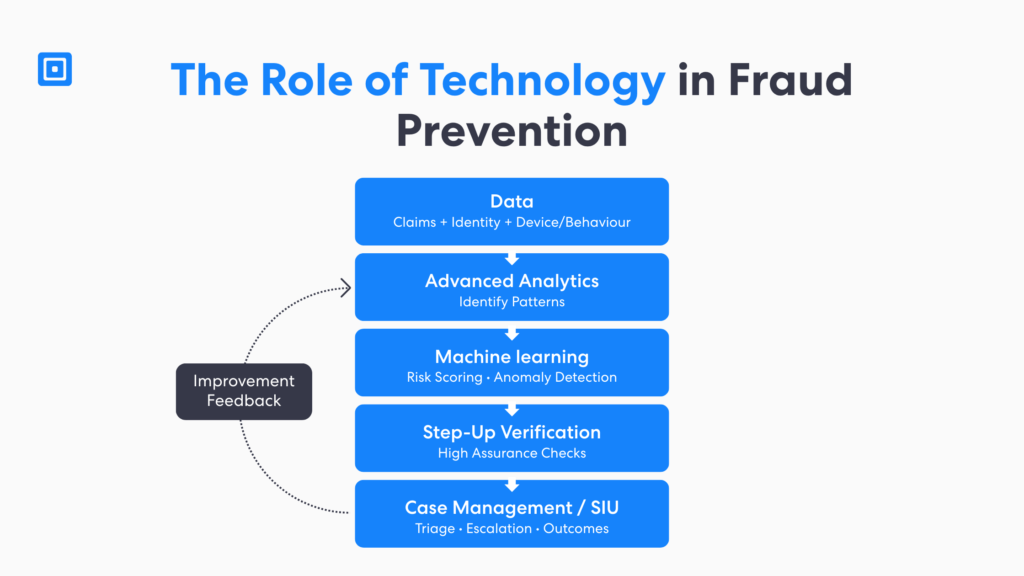
As the framework illustrates, the real value isn’t “more alerts,” but rather a structured path from signals to action. That prioritisation is what reduces false positives, protects customer experience, and gives SIUs time to focus investigations on high-risk cases separating genuine discrepancies from truly fraudulent claims before payouts occur.
Finally, technology strengthens collaboration by making decisions more consistent, auditable, and shareable across teams. Organizations can now support faster escalation when fraud spans multiple companies. Done well, this turns fraud prevention into an improvement loop: investigation outcomes feed back into the system, improving accuracy over time as fraudsters evolve. Learn more about this here: [Enhance Health Insurance Fraud Detection for KYC and AML Compliance](https://www.complycube.com/en/health-insurance-fraud-detection-compliance/)
## Turning Fraud Detection Into Decisions for Insurance Carriers
Insurance fraud detection is only important when it creates value and drives a decision in the insurance claims process. Fraud detection should do three things at the very least. It should be able to identify, score risk, and recommend the next best action. That could be approve, step-up verify, holding for review or escalating for further investigation by SIUs.
Similarly, feedback is just as important. When SIUs conducts investigations that confirm any fraudulent activity or clear legitimacy, these outcomes must come back to the model and rules. It reduces false positives over time. Moving from “more alerts” to measurable impact means fewer fraud claims are paid, less delays for genuine customers who need help, and a better ability to fight organized crimes.
### Key Takeaways
- **Insurance fraud prevention** fails when identity assurance stops after onboarding.
- **Claims fraud concentrates** at policy changes, claims submission, and payout moments.
- **A risk-based insurance fraud check** reduces false positives and protects customer experience.
- **Advanced analytics and machine learning** identify patterns, but only matter when tied to decisions.
- **The NICB, Coalition, and law enforcement** strengthens prevention across the industry.
## Insurance Fraud Prevention through Onboarding at ComplyCube
The most damaging fraud is rarely a fake customer; fraudsters exploit an account later in the insurance process. Prevent fraud by focusing controls where money moves: policy changes, claims, and payouts. ComplyCube helps insurers build continuous, risk-based identity verification beyond onboarding. [Explore ComplyCube](https://www.complycube.com/en/contact/) as a lifecycle identity layer for insurance fraud prevention.
## Frequently Asked Questions
Why does insurance fraud prevention fail after onboarding?
Insurance fraud prevention fails after onboarding because many insurers treat onboarding as the only high-risk step and then trust the account by default. Fraudsters shift to post-onboarding touchpoints where controls are typically lighter and money moves much faster.
How can insurers reduce claims fraud without slowing genuine customers?
Insurers can reduce claims fraud by using risk-based triggers in the claims process instead of applying friction to every customer. Step-up checks should activate only for suspicious or higher-risk signals such as payout detail changes, new devices, unusual timing, or repeated discrepancies.
What should an insurance fraud check include during the claims process?
An insurance fraud check should confirm the identity of the person, validate claim context, and evaluate risk signals across identity. It should also look at device/behaviour, and payout data. Advanced analytics and machine learning knowledge should be used to identify patterns and anomalies in claims data, then route potential fraud into review.
Which organizations help insurers detect and prevent insurance crimes?
Key organizations that help insurers fight insurance crimes include the National Insurance Crime Bureau (NICB) and the Coalition Against Insurance Fraud. The NICB supports insurance carriers by sharing intelligence and coordinating with law enforcement on organized claims fraud and theft-related schemes. The Coalition Against Insurance Fraud provides research, awareness, and coordination.
How does ComplyCube support insurance fraud detection after onboarding?
ComplyCube supports insurance fraud detection after onboarding by enabling continuous, risk-based identity verification across the insurance process, especially during policy changes, claims submission, and payouts. ComplyCube’s step-up verification helps insurers detect and prevent fraudulent claims when risk signals appear, while reducing false positives and maintaining customer experience.
[](https://www.complycube.com/en/contact/contact-sales/)
**Categories:** Guides
**Tags:** Fraud Prevention
---
### [KYC Onboarding Automation Tools For Trust and Conversion](https://www.complycube.com/kyc-onboarding-automation-tools-boost-conversion/)
**Published:** February 13, 2026
**Author:** Dini Habib
**Excerpt:** Digital KYC supports remote identity verification, enhancing customer satisfaction and reducing drop-offs. With the right onboarding automation solution, firms can further accelerate compliant and streamlined customer experiences.
**Content:**
**TL;DR:** Digital KYC onboarding presents a practical way to verify a customer’s identity remotely. With **onboarding automation tools**, businesses can design quicker and streamlined user journeys. This guide covers the mechanics behind automated identity verification methods and how to build customizable customer onboarding processes to enhance **trust** and **conversion rate**.
## How Does User Onboarding Impact Trust and Conversion?
Onboarding flows have a significant impact on customer experience and brand image. This is especially true in the modern era, where customer expectations are high. Trust breaks down when the onboarding process feels complex. For example, unclear instructions, repeated requests, and sudden friction lead to dissatisfaction. As a result, a customer will have a negative perception of the company, which creates a sense of distrust, leading to drop-offs. Here are some statistics firms must know:
- **38%** of new banking users abandon account creation if the process is long
- **89%** of customers who have a poor onboarding experience will turn to a competitor
- **63%** of customers consider the onboarding experience in purchasing decisions
- It costs **five times more** to source a new customer than to keep an existing one
Additionally, in regulated sectors, particularly financial institutions, customers are becoming more particular about how their data is collected and used. Thus, without a clear explanation, this can also result in distrust. For companies in competitive sectors or those serious about growth, streamlined onboarding tools act as a strategic advantage.
## The Role of Onboarding Automation Tools
Automation enables businesses to build tailored onboarding workflows with precision, balancing security and user experience. It utilizes sophisticated artificial intelligence and machine learning algorithms to standardise what “good” looks like and apply it consistently. Additionally, automation removes customer friction that can arise from human error during manual review. It streamlines the verification process by removing human judgment from the equation.
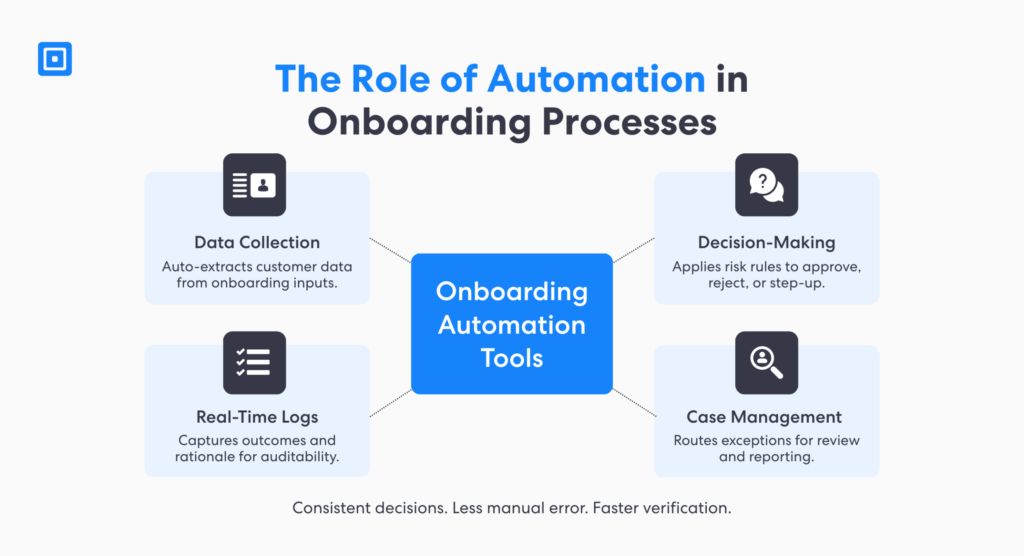
Furthermore, automated onboarding provides higher customization and scalability. For global businesses, these two benefits are crucial to long-term business growth. Thus, automated systems deliver lower customer drop-off, faster time-to-value, and consequently higher return on investment. Onboarding automation tools support 4 distinct steps:
1. **Data Collection:** Automatically extracts relevant customer data once a user completes onboarding, removing the need for manual data submission.
2. **Decision-Making:** Applies rules according to the risk profile of the user to decide whether to reject, approve, or route to a different step.
3. **Real-Time Logs:** Details verification outcomes so compliance teams can demonstrate decision rationale, building a defensible proof for regulators.
4. **Case Management:** Escalates suspicious scenarios that require senior oversight or submission to regulators for compliance requirements.
## Automation in KYC and Identity Fraud Prevention
Automated identity verification methods reduce bottlenecks for genuine customers while making fraud tougher for bad actors. This is where no or low-code workflows come in. In Know Your Customer (KYC) compliance, businesses can layer multiple identity verification checks according to risk. No-code workflows leverage API integrations for rapid deployment without waiting for long development cycles. You can learn more here: [Simplify AML With No-Code Compliance Workflow Software](https://www.complycube.com/en/aml-with-no-code-compliance-workflow-software/)
### Common methods used in automated identity verification include:
### 1. Document Verification and Optical Character Recognition (OCR):
Document verification is the process of screening submitted document types to validate genuine customers. Firstly, identification documents such as driver’s licenses, passports, and national ID cards are submitted on the user’s end. Next, the security features in these documents, including holograms and watermarks, are scanned for authenticity. Automated document verification makes use of cutting-edge OCR technology, which extracts and analyses customer information in real-time.
### 2. Biometric Verification and Liveness Detection:
Biometric authentication enables firms to ensure customers are genuine and present during online transactions. It includes facial recognition, such as selfie checks to determine if a user is the actual owner of an account. Automated verification involves [liveness detection technology](https://www.complycube.com/en/solutions/due-diligence-compliance/know-your-customer/liveness-detection/), which involves anti-spoofing detection to prevent advanced presentation attacks. Thus, companies can achieve maximum security and prevent fraud more effectively.
### 3. NFC Chip Screening:
[Near Field Communication (NFC) screening](https://www.complycube.com/en/solutions/identity-assurance/document-verification/nfc-verification/) is the process whereby a customer uses their NFC sensor on their phone to read the biometric data on their e-passport chip. It plays a crucial role in KYC and helps businesses identify cloned or tampered passports. With automation, NFC checks are triggered in real-time, producing instant outcomes. As a result, companies detect any potential for fraudulent or suspicious activities much quicker than manual verification.
### 4. Database Verification or Multi-Bureau Checks:
Database verification refers to cross-checking a customer’s information against trusted sources, including credit and identity bureaus. It gives firms a more comprehensive picture of risk assessment. Using automation, this process increases in accuracy and scalability. Unified reports can be generated in real-time, shifting from manual checks, so customers can onboard at a much quicker pace. You can learn more here: [Why Multi-Bureau Identity Verification is the Ultimate Fraud Defense](https://www.complycube.com/en/multi-bureau-identity-verification/)
### **Case Study: Accelerate Compliant Onboarding with Automation**
StartDock is the leading coworking space provider in the Netherlands. The firm had to comply with the country’s Anti-Money Laundering and Anti-Terrorist Financing Act (Wwft) when onboarding new customers and businesses.
##### **Enhanced KYC, KYB and AML Screening for Virtual Addresses**
StartDock required automated tools to enhance onboarding compliance. The firm leveraged ComplyCube’s real-time regulatory technology platform. The firm was able to run KYC checks on members and conduct enhanced due diligence on businesses requiring virtual addresses.
##### **Outcomes**
- StartDock was able to perform real-time biometric and document verification process, onboarding users instantly.
- The firm was able to implement advanced, customizable KYB and KYC checks according to the risk profile of customers and entities.
- As a result, the company was able to improve member and [business onboarding by 28%](https://www.complycube.com/en/startdock-complycube-advanced-kyc-platform/) through automation.
## Build a Digital KYC Onboarding Framework
An effective digital onboarding process must use a risk-based approach. This means low-risk users experience faster onboarding flows while high-risk users route to enhanced checks. A risk-based approach is foundational to reducing drop-offs while maintaining compliance, as recommended by the [Financial Action Task Force (FATF)](https://www.fatf-gafi.org/en/publications/Fatfrecommendations/Guidance-rba-supervision.html).
### A practical structure for a trust-first, risk-based flow includes:
- **Start with clarity**: Set expectations for what will happen (data capture, ID upload, selfie, screening) and why. Insert clear privacy terms and ensure data collected aligns with jurisdiction rules, for example, the EU’s GDPR and the US NIST.
- **Use progressive disclosure**: Only collect relevant customer information to verify identities according to a user’s risk tier at that moment. For instance, do not include additional checks if onboarding documents have not been verified.
- **Apply step-up logic**: Increase ID verification layers only when signals warrant it (document quality issues, mismatch risk, geolocation anomalies, sanctions screening flags). Ensure all outcomes and decisions are logged for transparency and clarity.
- **Treat manual review as a designed path**: Provide clear status messaging and timelines to ensure customers are not stuck at a dead end. In particular, including clear links to support teams or additional how-to videos is vital in onboarding checklists.
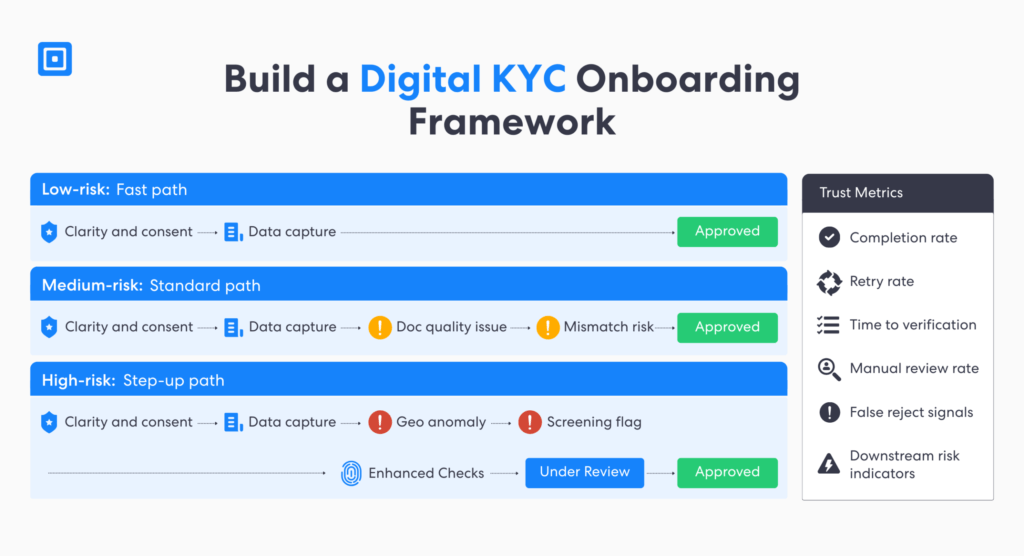
However, speed alone cannot be treated as a trust metric if onboarding automation tools generate high false positives, fraud rates, or escalation to senior oversight. According to Harry V., Chief Product Officer at ComplyCube, “Risk management teams must track the metrics that signal both user experience and control quality”.
### Important trust metrics to consider include:
- **Completion rate**: The percentage of users who finish onboarding.
- **Retry rate**: How often users must resubmit identity documents or data.
- **Time to verification**: median time from start to decision, split by auto-pass vs manual review.
- **Manual review rate**: The percentage of cases routed to human review, with top drivers.
- **False reject signals**: False positives, support tickets, and re-onboarding attempts.
- **Downstream risk indicators**: Early fraud markers, false negatives, or suspicious activity flags.
## Comparing Top KYC and AML Onboarding Automation Tools
In order for businesses to strengthen their efforts in combating identity theft and money laundering, combining layered checks into workflows is crucial. For example, this includes combining onboarding ID verification with watchlist screening, adverse media checks, and implementing [ongoing monitoring](https://www.complycube.com/en/solutions/global-screening/continuous-monitoring/) to satisfy Anti-Money Laundering (AML) compliance requirements.
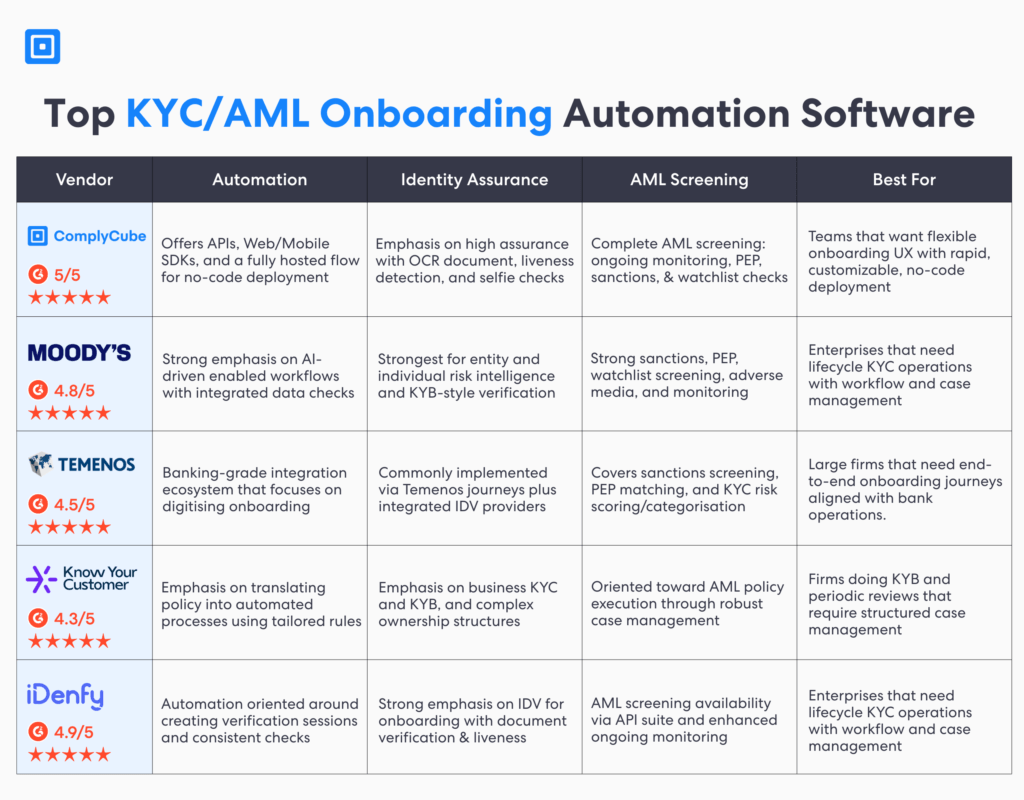
Onboarding software supports businesses in meeting regulatory compliance. It provides regulated firms with streamlined digital identity verification, ongoing monitoring, and case management. As a result, organizations can balance security with user-friendly interfaces that adapt to international and local regulations and risk appetite for enterprise teams.
### Key Takeaways
- **Customer onboarding** is crucial and has a significant impact on user trust, brand perception, and conversion.
- **Onboarding automation** tools streamlines verification processes, making it more secure, accurate, and quicker than manual reviews.
- **The effectiveness** of onboarding must be analysed with metrics such as false positives, conversion rates, drop-offs, and customer satisfaction scores.
- **Biometric verification**, document checks, NFC screening, and database verification, when done with automation, enable real-time outcomes and decisions.
- **Top KYC and AML** onboarding automation tools support cross-border compliance, enhanced security, and customer trust.
## Enhance Customer Experience and Reduce Operational Costs
The right identity verification solution unifies regulatory compliance requirements, satisfying KYC and AML compliance while enhancing customer conversions. While speed is vital, trust metrics, including customer satisfaction, time-to-value, and support tickets, provide an overview of operational efficiency. Automated ID verification software such as ComplyCube empowers companies to make trusted decisions, adhering to cross-border KYC and AML compliance. [Start your free trial](https://portal.complycube.com/signup) with ComplyCube today.

## Frequently Asked Questions
What are onboarding automation tools?
Onboarding automation tools enable businesses to verify customers more securely and quickly by removing manual reviews and checks. It includes automating identity checks, document verification, and risk scoring during AML and KYC processes. The benefits include enhanced operational efficiency and reduced cost.
How can firms implement automation in KYC?
To implement KYC automation, firms must integrate APIs, SDKs, and leverage AI-driven solutions. Next, businesses must set up rules and risk thresholds for identity verification and real-time AML screening. This enables low-risk customers to onboard more quickly, while applying enhanced due diligence to high-risk scenarios.
What is the digital KYC onboarding process?
Digital KYC processes enable identity verification remotely. It includes collecting customer information, verifying user identity, screening against sanctions and watchlists databases, and ongoing monitoring, all of which occur in the backend via secure web or mobile apps.
What are automated identity verification methods?
Automated identity verification methods include OCR technology for real-time data extraction, liveness detection for instant selfie checks, and AI-based database verification for quick cross-checking against trusted third-party data providers. Automated ID verification processes cut manual reviews and confirm a customer is legitimate within seconds.
Does ComplyCube provide KYC automation solutions?
Yes. ComplyCube offers a large integration capacity, providing regulated firms with end-to-end KYC automation solutions. The firm provides AI-powered identity verification, AML screening, selfie checks, and no-code workflows tailored for AML and KYC compliance globally.
**Categories:** Guides
**Tags:** Know Your Customer
---
### [FinCEN Issues First-Ever List of AML/CFT Priorities](https://www.complycube.com/fincen-issues-new-list-of-aml-cft-priorities/)
**Published:** July 8, 2021
**Author:** Andreea Balasa
**Excerpt:** The U.S. Department of the Treasury's Office of Financial Crimes Enforcement Network (FinCEN) has issued for the first time a list of priorities for Anti-Money Laundering and Countering
**Content:**
**TL;DR:** The US Department of the Treasury’s Office of Financial Crimes Enforcement Network (FinCEN) has issued for the first time a list of priorities for **Anti-Money Laundering** and Countering the Financing of Terrorism (AML/CFT Priorities). This guide explores the **top 8 priorities** all businesses must know to get ahead of AML compliance.
## What are the Recent AML/CFT Priorities by FinCEN?
FinCEN issued its latest guidelines on 30th June 2021 under the [Bank Secrecy Act (BSA) Section 5318(h)(4)(A)](https://www.occ.gov/news-issuances/bulletins/2021/bulletin-2021-29.html) in order to address several new and long-standing threats facing the US national security and financial system. These threats include attempts to exploit or circumvent the US financial system’s legal, regulatory, supervisory, or enforcement vulnerabilities.
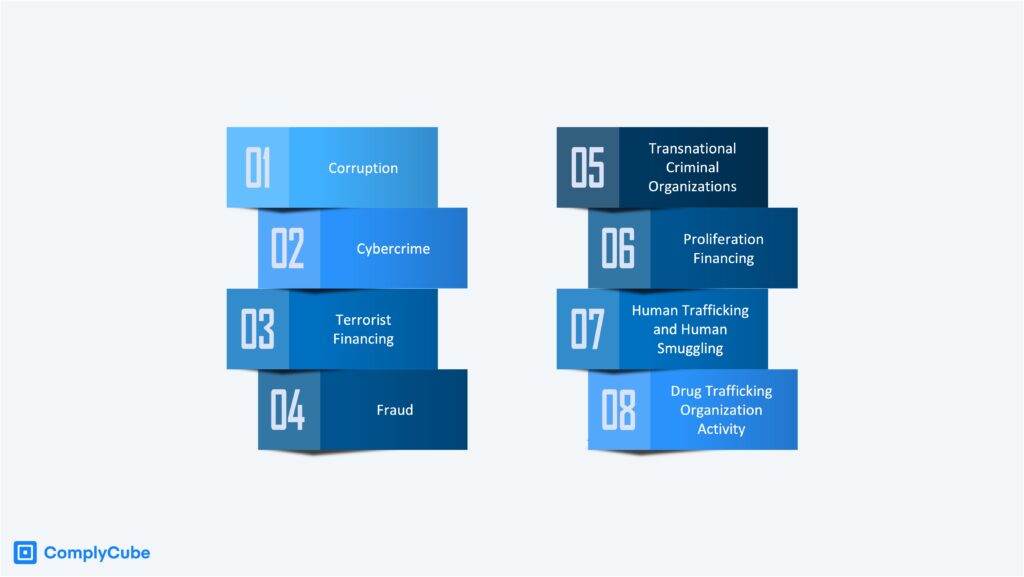
These guidelines aim to help the BSA-covered financial institutions (FIs) in their efforts to comply with the set AML/CFT policies. Although these Priorities may not apply to all organizations, institutions must comply with those related to their operations. The [8 Priorities](https://www.fincen.gov/system/files/shared/AML_CFT%20Priorities%20(June%2030%2C%202021).pdf) addressed in this list include:
## 1. Corruption
Bribery and misappropriation of public funds, among other forms of corruption, threaten the US national security and financial system. Typically, such actions degrade the rule of law, deprive innocent citizens of their fundamental human rights, and undermine democratic institutions.
In fact, according to the 2025 Corruption Perception Index (CPI), the USA’s [overall CPI score came in at 64](https://www.transparency.org/en/cpi/2025/index/usa), its lowest level ever on a scale where 100 is very clean, and 0 is highly corrupt.
FinCEN issued advisories on human rights abuses facilitated by corrupt foreign political figures and their financial promoters concerning South Sudan, Venezuela, and Nicaragua to combat corruption.
FinCEN requires all covered financial institutions to consult advisories regarding corrupt foreign entities and human rights abuse.
The guidelines also require these financial institutions to reconsider their particular AML/CFT policies. For instance, increasing the robustness of programs related to high-profile foreign political figures.
## 2. Cybercrime
FinCEN describes cybercrime as illegal activities involving computers, computer networks, or other digital devices.
The cybercrimes covered here include network attacks, phishing, and other cybercrimes targeting organizations’ [Software as a service (SaaS)](https://en.wikipedia.org/wiki/Software_as_a_service) and [Application Programming Interface (API)](https://en.wikipedia.org/wiki/API) software.
These crimes target the confidential information of specific institutions, threatening the national security and financial system. For this reason, FinCEN has issued advisories warning addressed institutions of the predominant cybercrime frauds. This includes illegal use of convertible virtual currencies (CVCs), ransomware attacks, and FinCrime, to mention a few.
FinCEN also urges institutions to be vigilant in sharing information on suspected cybercrime activities.
## 3. Terrorist Financing
Both domestic and foreign terrorism is a threat the US national security.
Terrorist groups require funding to recruit members, support training and other logistics and execute their operations, thus creating a chain of illegal terror funding activities. Preventing such funding is crucial in helping the US government in its fight against terrorism.
For this reason, FinCEN requires covered institutions to identify and file [Suspicious Activity Reports (SARs)](https://www.occ.treas.gov/topics/supervision-and-examination/bank-operations/financial-crime/suspicious-activity-reports/index-suspicious-activity-reports.html) on potential terror funding. Furthermore, this government bureau urges the involved institutions to comply with the set sanction programs regarding the AML/CFT risk-based policies.
## 4. Fraud
Organizations such as consumer banks, healthcare, and tax institutions generate the highest percentage of illicit funds through fraud. For instance, Pew Research Centre notes that in 2025, [73% of U.S. adults](https://www.pewresearch.org/internet/2025/07/31/online-scams-and-attacks-in-america-today/) have experienced an online scam or attack, common across all age groups.
The most common fraud activities include corruption, drug smuggling, human trafficking, and organized crime, to mention a few.
Fraudsters launder their proceeds through methods such as transfers through accounts of established offshore legal entities, money mules, or accounts controlled by cyber actors, etc.
Therefore, FinCEN has categorized fraud under its list of Priorities and advises the involved organizations. These advisories emphasize email account compromise and Business Email Compromise (BEC).
## 5. Transnational Criminal Organization Activity
Transnational Criminal Organizations (TCOs) are included in the Priorities list because they are involved with several criminal activities that threaten the US national security and financial systems.
In particular, common TCOs activities include human trafficking and smuggling, drug trafficking, wildlife trafficking, and weapons trafficking.
FinCEN urges the covered financial institutions to be vigilant in identifying and reporting such criminal activities. In addition, the Priorities guidelines require involved institutions to re-evaluate the robustness of the AML/CFT policies regarding these illegal activities.
Also, financial institutions must monitor suspicious activities, trace the transactions, and comprehensively clarify Suspicious Activity Reports (SARs) filings.
## 6. Proliferation Financing
Proliferation financing comprises activities that exploit the United States’ financial infrastructure in an attempt to exchange illicit funds. These funds might, in turn, be used for violent actions such as purchasing mass destruction weapons or developing Artificial Intelligence/ Machine Learning (AI/ML) tools for evasion of US or UN sanctions.
For this reason, FinCEN requires the covered institutions to review the sanction programs, especially those involved with trade and economy. Moreover, reviewing these programs is essential in identifying and reporting suspicious criminal activities.
Most importantly, financial institutions, especially those that facilitate international transactions, must perform [Customer Due Diligence (CDD)](https://www.govinfo.gov/content/pkg/FR-2016-05-11/pdf/2016-10567.pdf) and Know Your Customer (KYC) protocols to identify criminals who seek to engage in proliferation financing.
## 7. Human Trafficking and Human Smuggling
Financial proceeds from human traffickers and smugglers can intersect with the US formal financial system at any point during the execution of these illegal activities.
The human trafficking and smuggling networks use various mechanisms to move their illicit proceeds, such as the standard cash smuggling by individuals, to more sophisticated channels, such as professional money laundering networks.
These proceeds may be from income associated with logistics and gains from exploiting victims.
FinCEN has issued advisories to help covered organizations identify behavioral and financial red flags associated with human smuggling and trafficking activities.
## 8. Drug Trafficking Organization Activity
Drug trafficking continues to generate enormous proceeds for Drug Trafficking Organizations (DTOs). Trafficked drugs and the proceeds laundered through trafficking often trigger public health emergencies in the US.
These drugs are brought to the US from countries such as Mexico, China, and Columbia. Here, DTOs use professional money laundering networks to exchange their cash proceeds or pose as money brokers in several trade-based money laundering (TBML) schemes.
In line with this, FinCEN urges the concerned institutions to refer to the existing FinCEN advisory regarding the trafficking of synthetic opioids such as fentanyl and red flags to detect such illicit transactions.
### Key Takeaways
- **Recent AML/CFT priorities** include eight focus areas that will shape how businesses must comply with AML laws.
- **The focus areas** include long-standing threats to US security, which have been issued by the Financial Crimes Enforcement Network (FinCEN).
- **Major** **focus areas** include corruption, cybercrime, terrorist financing, proliferation financing, human trafficking, and fraud.
- **Companies** that fall under the Bank Secrecy Act (BSA), including accountancies and insurance firms, must align their efforts with the priorities.
## AML/CFT Priorities in Driving Compliance and Security
Lately, criminal activities such as corruption, fraud, drug trafficking, and terrorism, to mention a few, have become rampant in the US. Such illicit activities undermine the US financial system and national security.
And for this reason, FinCEN has issued guidelines known as The Priorities to reduce the threats these illegal activities pose to the US financial system.
All eyes are now on the covered financial institutions to see how well they comply with the set guidelines in the fight against money laundering and financing terrorism.
Need more information on FinCen’s AML/CFT priorities? [Speak with an expert.](https://www.complycube.com/contact/contact-sales/)
## Frequently Asked Questions
What are FinCEN’s 2021 AML/CFT priorities?
The FinCEN’s AML/CFT priorities fall under the US Anti-Money Laundering Act and list key focus areas that are the biggest threat to US security. The eight areas are: (1) corruption, (2) cybercrime, (3) domestic and international terrorist financing, (4) fraud, (5) transnational criminal organization activity, (6) drug trafficking, (7) human trafficking and smuggling, and (8) proliferation financing.
When does the 2021 AML/CFT priorities launch?
The 2021 AML/CFT priorities were issued on June 30, 2021, through official FinCEN publication. The focus areas took immediate effect, serving as guidelines for risk assessments and future KYC and AML regulations.
Which companies fall under FinCEN’s AML/CFT guidelines?
The companies that must comply with FinCEN are those that fall under the US Bank Secrecy Act (BSA). The broad range of firms includes financial institutions, Money Services Businesses (MSBs), crypto platforms, insurance companies, and more.
What is the significance of the US AML/CFT focus areas?
The focus areas act as a guide for firms to prioritise their efforts on the biggest threats to the US financial system. It leverages a risk-based approach to AML frameworks. Additionally, they shape oversight by FinCEN and are refreshed every four years under the US AMLA.
Are there any recent FinCEN guidelines in 2026?
As of 2026, there have been no updates to the original 2021 AML/CFT priorities. Instead, US regulators are focusing on heightened AML enforcement, increasing scrutiny and fines over failures.
**Categories:** News
**Tags:** Anti-Money Laundering
---
### [ComplyCube Enables Trust at Scale with KYC Workflow Tool](https://www.complycube.com/kyc-workflow-tool/)
**Published:** February 11, 2026
**Author:** Rithu Jagannath
**Excerpt:** ComplyCube launches a real-time no-code KYC workflow tool. A KYC workflow orchestration tool for faster policy updates, consistent onboarding, and audit-ready decisions, delivering end-to-end KYC workflow orchestration.
**Content:**
LONDON, FEBRUARY 11, 2026 – As synthetic identity fraud accelerates, generative AI has made deception easier to scale. Even today, The Federal Reserve repeatedly flagged synthetic identity fraud and financial institutions attribute over 40% of onboarding fraud to synthetic or identity‑related attacks. In response to this urgency, [ComplyCube](https://www.complycube.com/en/) launched a [no‑code KYC workflow tool](https://www.complycube.com/en/solutions/compliance-suite/kyc-workflow/), also known as a KYC workflow orchestration tool. It helps compliance teams create, deploy, and orchestrate KYC workflows without engineering bottlenecks.
That “why now” pressure is not limited to just banks. Fraud journeys increasingly start off-platform and regulators are steadily raising expectations for demonstrable, auditable controls across onboarding and account lifecycle decisioning.
## Why Compliance Workflows Must Change
Traditional onboarding systems are fragmented and inflexible, making it difficult for [compliance teams](https://www.complycube.com/en/use-cases/profession/compliance-managers/) to maintain consistency and speed at scale. Without unified KYC workflow tools, verifying customers often requires patching together different services and relying on engineering to adjust workflows slowing response times to regulatory changes and emerging fraud risks.
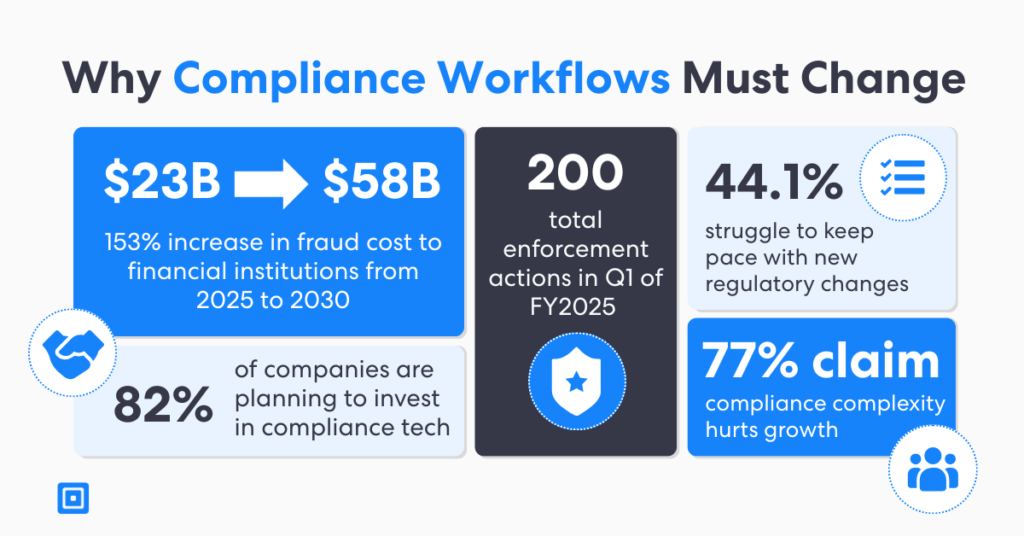
Critically, today’s scams originate outside of onboarding flows. According to Juniper Research reports that global fraud losses to financial institutions were forecast to rise from $23B in 2025 to $58.3B by 2030. That’s a rise of 153% in five years. That trend means that controls can’t remain static or siloed if any threats are multi-channel and fast-moving.
The most common challenges include:
- **Rising synthetic identity fraud**, which requires additional verification steps
- **Manual reviews and delays**, leading to customer drop-off and operational overhead
- **Disjointed logic across products and markets**, increasing compliance risk
Moreover, addressing these issues means giving teams greater control over their KYC workflow orchestration. Then, when teams can design and update onboarding logic themselves, they’re no longer dependent on engineering backlogs or lengthy release cycles. This autonomy accelerates time-to-market for new rules or risk strategies. As a result, it ensures that verification flows remain consistent, compliant, and responsive to emerging threats.
## Real-Time KYC Workflow Tool for Structured Identity Journeys
In a [report from KPMG](https://assets.kpmg.com/content/dam/kpmgsites/sg/pdf/2024/01/stepping-up-to-a-new-level.pdf.coredownload.inline.pdf), 34% of CCOs say that new regulatory requirements are the greatest compliance challenges over the next two years. ComplyCube’s drag-and-drop [KYC workflow tool](https://www.complycube.com/en/solutions/compliance-suite/kyc-workflow/) brings together identity checks, fraud signals, and decision logic into one orchestrated flow. This enables compliance teams to design and launch structured KYC processes tailored to risk tiers, user types, or jurisdiction-specific rules. It allows for quick updates when guidance or threat patterns for change.
Teams can:
- **Define escalation paths** using dynamic risk signals
- **Map identity, AML, and fraud checks** into a single journey
- **Update workflows instantly** in response to changing regulations
This reduces reliance on engineering. A KYC [workflow tool](https://www.complycube.com/en/aml-with-no-code-compliance-workflow-software/) can empower compliance leads to adapt onboarding journeys faster. It enables faster responses to regulatory change while improving operational efficiency. This maintains alignment with internal policies and legal requirements. This KYC workflow orchestration tool also aligns with broader direction of industry guidance by building layered controls, improving detection and strengthening operational readiness as synthetic identity fraud evolves.
## KYC Workflow Tool Consistency Without Engineering Bottlenecks
Across the world’s biggest compliance markets, KYC workflow orchestration is being pushed to public infrastructure. The EU is simultaneously hard-wiring a continent-wide digital identity regime (eIDAS 2.0) and rolling out a single AML rulebook. It is also bringing in a new central supervisor (AMLA) aimed at harmonising identity assurance and enforcement across borders. Accordingly, the UK moved in parallel, turning its digital identity trust framework into statutory rules from 1 December 2025, effectively setting a legal baseline for reusable digital ID in the private sector.
Soon after, it wasn’t long before the US followed suite, and FinCEN has widened the AML perimeter by bringing investment advisors into the core AML/CFT program and SAR reporting architecture. Without delay, Australia and Canada have advanced regulatory upgrades that expand and modernize AML obligations. This change is happening everywhere.
As a result, maintaining consistent [onboarding](https://www.complycube.com/en/use-cases/process/customer-onboarding/) experiences across platforms and regions is difficult when each flow relies on hardcoded logic. For example, ComplyCube’s no-code KYC workflow orchestration tool gives compliance professionals the ability to update customer journeys directly ensuring policy alignment without developer intervention.
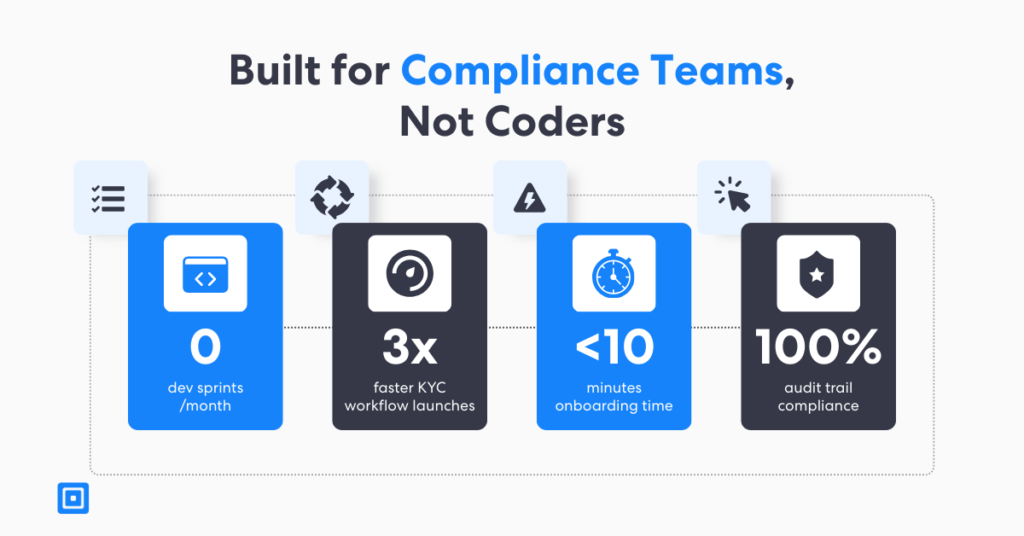
With this in mind about self-service approach, teams can:
- **Deploy region- and product-specific flows** that enforce global standards
- **Ensure uniform application of checks** for different risk profiles
- **Implement changes immediately**, controlling their own release governance
> Workflows are about giving compliance teams the controls they need to move faster.
Chief Product Officer at ComplyCube, [Harry Varatharasan](https://www.linkedin.com/in/harryvaratharasan/) goes on to say, “Our KYC workflow orchestration tool lets teams build and update workflows in real time. That agility helps teams stay compliant while delivering more efficient onboarding.”
## Full Audit Trails for Operational Oversight
Each KYC workflow orchestration is executed as a single session that captures [every verification step](https://www.complycube.com/en/use-cases/process/identity-verification/) and decision in real time. This organised structure supports clearer audits, simplifies investigations, and gives compliance teams better visibility into how identity checks are performing. Furthermore, this is important as fraud losses continue to rise and oversight expectations evolve.
These sessions include:
- **Timestamps and event logs** for each decision point
- **Escalation paths and reason codes** tied to outcomes
- **Structured records** for internal reviews and regulatory inquiries
By logging each journey from start to finish, ComplyCube helps teams identify friction points. Their KYC workflow tool monitors performance, and fine-tunes workflows to improve pass rates therefore reduce false positives.
## Flexible Deployment via API, SDK, or Hosted Flow
To support [multiple product lines and user interfaces,](https://www.complycube.com/en/developers/) ComplyCube’s KYC workflow orchestration tool can create workflows to be deployed across different environments. It ensures that any verification logic remains consistent across all onboarding channels. In either case, whether embedded in mobile apps or hosted externally, organisations can implement workflows through:
- **Hosted onboarding flows**, ready to launch and customise
- **SDKs**, to embed directly into web and mobile apps
- **APIs**, for deep integration with internal systems
In summary, this flexibility allows compliance teams to manage policies centrally. Customising onboarding for different products, user types and requirements ensures every customer journey aligns with internal standards and regulatory obligations.
## About ComplyCube
Trusted by over 300 global clients across fintech, telecoms, crypto, government, and financial services, [ComplyCube](https://www.complycube.com/en/) is an award-winning compliance platform. It empowers businesses to design, manage, and optimise onboarding through intuitive visual KYC workflow orchestration tools and developer-friendly APIs. Recognised in the [G2 AML Leaders Report](https://www.complycube.com/en/complycube-aml-leader-in-g2-fall-2025-report/?utm_medium=email&_hsenc=p2ANqtz--HhXL-vIkbQRLaC0okykNtv5SKiEX89J_TpLcFrQuo3GrT3mKV72G0HtatAT_ltTX0-VbUzmCaGcL-9ruFgJJ8fVAgiSCjCqB4zrGv4q1S2v13pS4&_hsmi=2&utm_content=2&utm_source=hs_email) and named to the FinCrimeTech50, ComplyCube’s modular suite spans document and biometric verification, sanctions and PEP screening, and dynamic risk logic.
**Categories:** News
**Tags:** Announcements
---
### [Document Validation Automation KYC for Lower Friction in 7 Steps](https://www.complycube.com/document-validation-automation-kyc-compliance/)
**Published:** February 10, 2026
**Author:** Dini Habib
**Excerpt:** In document verification, automation via artificial intelligence and machine learning speeds up secure data extraction and validation. As a result, decision-making in the onboarding journey is quicker, freeing up time and effort.
**Content:**
**TL;DR:** Document validation automation KYC offers a strong method for businesses to remove friction without hampering **identity assurance**. For regulated firms, automated KYC solutions boost operational efficiency while ensuring compliance. This guide outlines seven simple steps to achieve **frictionless document verification** with KYC automation.
## What is Document Validation Automation KYC?
Document validation automation in Know Your Customer (KYC) processes leverages enhanced features to speed up decision-making during document verification. These key features include customizable risk rules and Optical Character Recognition (OCR) technology to capture, validate, and determine whether a customer is approved or rejected.
> Companies lose up to $1 trillion annually due to [inefficiencies](https://sensetask.com/blog/document-processing-statistics-2025/) in document processing.
Automation in document checks relies on Artificial Intelligence (AI) and Machine Learning (ML) algorithms to turn messy document submissions into reliable verification with minimal human intervention. As a result, it eliminates human error in manual review.
Thus, financial institutions can perform customer onboarding and comply with KYC and Anti-Money Laundering (AML) regulatory requirements accurately, securely, and seamlessly. Recent reports have indicated that firms lose over $1 trillion due to document processing gaps. It’s not surprising that the global automation market is projected to [exceed $30 billion](https://sensetask.com/blog/document-processing-statistics-2025/) by 2025.
## Impact of KYC Automation Solutions
The companies that will win in the next decade are those that strategically tackle AML and KYC regulations. To achieve this, a fully digitized, end-to-end, orchestrated process is required, powered by intelligent automation tools. According to RegTech Analyst, “Human error is the largest vulnerability in manual AML processes, particularly when teams are dealing with repetitive tasks under time pressure.”
> Human error remains one of the [biggest vulnerabilities](https://regtechanalyst.com/why-automated-document-verification-is-critical-for-aml/) in manual AML processes.
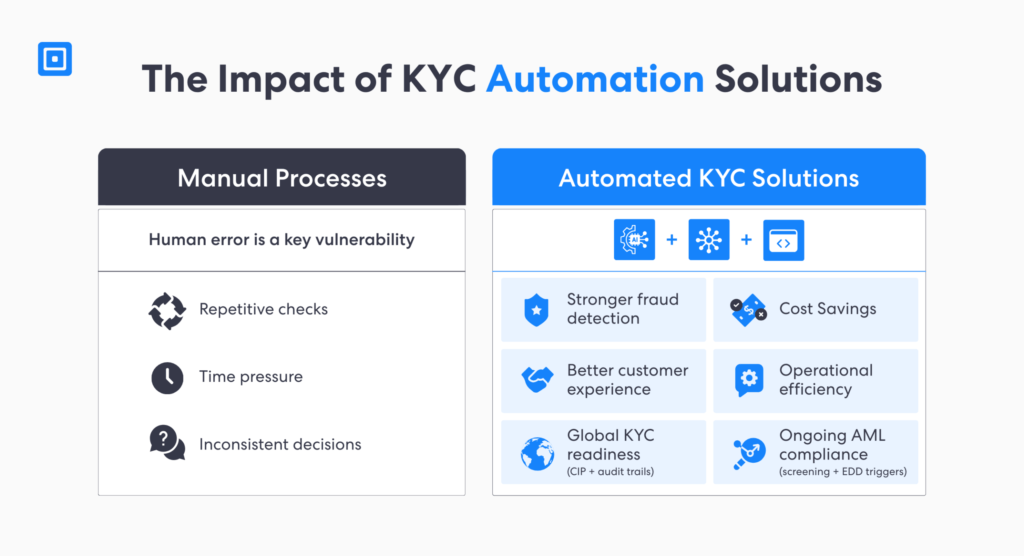
In RegTech, automation largely relies on a combination of artificial intelligence, ML, and integration technologies, such as Application Programming Interfaces (APIs), working together. These features work together to enrich processes such as biometric verification, sanctions screening, and ongoing monitoring, strengthening regulatory compliance. With automated processes, risk and compliance professionals can:
- **Strengthen fraud detection:** AI-driven tools can easily deter identity theft and flag potential risks, including false documents and deepfakes.
- **Enhance the customer experience:** Instant, secure verification safeguards customer transactions, boosting trust and satisfaction.
- **Satisfy global KYC requirements:** Build a seamless Customer Identification Program (CIP) with real-time, comprehensive audit trails to ensure regulatory compliance.
- **Significant cost savings:** Eliminate manual data entry and reliance on heavy staff from common processes such as document and facial recognition analysis.
- **Operational efficiency:** Streamline identity verification and risk management by focusing on high-risk cases.
- **Ongoing compliance with AML regulations:** Continuously screen against external databases, adverse media screening, and enhanced due diligence triggers.
Harry V, AML specialist at ComplyCube, adds, “The largest benefit of automated KYC and AML tools includes speed, enhanced customer experience, and cost savings.” The benefits of KYC automation tools for document checks are vast; however, if not implemented correctly, they can lead to compliance fragmentation.
## Step 1: Identify Friction Hotspots
KYC automation solutions are not the end-all, be-all for enhanced customer onboarding. To start automating processes, it is important to build a strong foundation for identity verification. If automation is layered before the KYC journey is considered, it can lead to wasted time and cost. Compliance teams are recommended to map the end-to-end workflow and clearly understand the common friction points.
For example, financial institutions must build standardized policies, including defining workflow steps, risk models, and approval thresholds that can be digitized directly into rules and decision engines. Additionally, gaining clarity into customers’ pain points when onboarding is crucial. Faster time-to-value is achieved by knowing how to automate the right things, not everything.
## Step 2: Map KYC Processes Around Risks
Next, firms must create clear exception paths for [document verification](https://www.complycube.com/en/solutions/identity-assurance/document-verification/) results. Instead of routing every case to senior management, build workflow automation routing with a risk-based approach. According to the Financial Action Task Force (FATF), a [risk-based approach](https://www.fatf-gafi.org/en/publications/Fatfrecommendations/Fatfguidanceontherisk-basedapproachtocombatingmoneylaunderingandterroristfinancing-highlevelprinciplesandprocedures.html) enables financial institutions to address money laundering risks more effectively. Practical examples include:
1. ****Low-risk document result**** **example**: Standard utility bill or passport scan: Address matches application form, format checks pass, no tampering detected: Immediate KYC completion
2. **Medium-risk document result** **example**: Minor OCR confidence issues (e.g., faded address): Request single re-upload with specific guidance rather than full re-documentation
3. **High-risk document result** **example**: Sanctions/PEP fuzzy match high risk score: Escalate to compliance with full candidate list, match scores, and source documents
## Step 3: Customer-Focused Document Verification Guides
Continuing from above, creating a seamless customer onboarding process begins at the first interaction. When users submit poor images or incomplete customer information, it signals friction. Regulated entities and other financial institutions must implement standardized guides and user prompts during the document checks.
For example, during the identity verification process, firms are recommended to include smart forms and clear instructions, with multi-language support. When verifying customer identities from high-risk jurisdictions, the smart forms can include additional questions to maintain compliance. On the other hand, low-risk users can onboard more quickly with fewer steps.
## Step 4: Layer Intelligent Document Processing Features
Moving on, document validation automation KYC works best with multiple signals rather than a single factor that passes or fails. Features such as [OCR customer data extraction](https://www.complycube.com/en/solutions/due-diligence-compliance/know-your-customer/optical-character-recognition/), NFC chip scanning, and security feature analysis enhance KYC compliance by combining multiple fraud risk signals to build a holistic customer risk scoring profile.
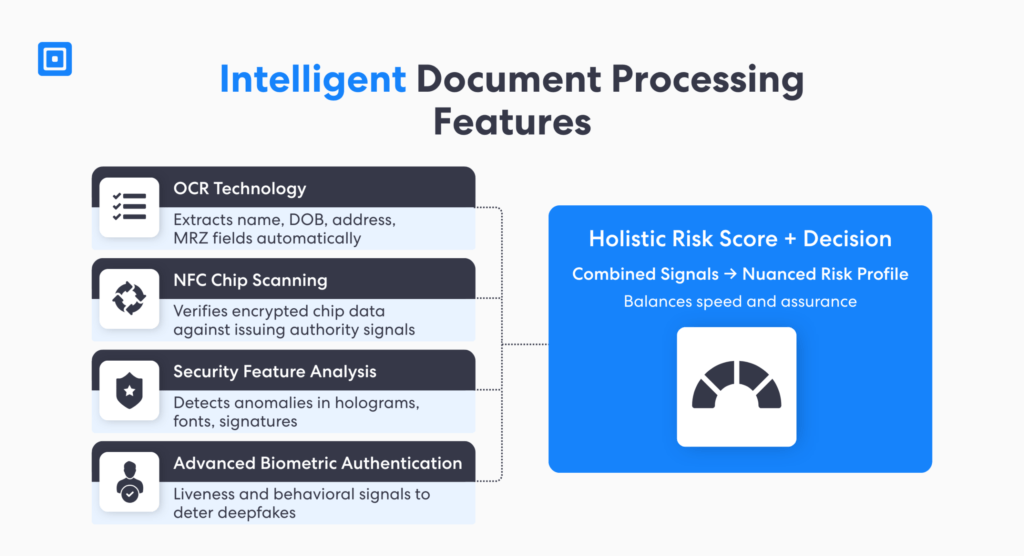
By combining these advanced technologies, financial institutions can develop nuanced risk profiles that balance speed, security, and ensure compliance. Moreover, it eliminates manual review and the potential for human error, enabling smarter detection of suspicious activity:
- **OCR Technology:** Automatically extracts customer information, including full name, date of birth, and address from visible document zones and MRZ during the document verification process.
- **NFC Chip Scanning:** Scans [encrypted chip data](https://www.complycube.com/en/solutions/identity-assurance/document-verification/nfc-verification/) from government-approved ID, such as a passport, to instantly verify customer identity against issuing authorities.
- **Security Feature Analysis:** Leverages machine learning to analyze key features on documents such as holograms, signatures, and fonts for potential suspicious activity.
- **Advanced Biometric Authentication:** Combines [behavioral data](https://www.complycube.com/en/solutions/due-diligence-compliance/know-your-customer/biometric-facial-recognition/) beyond document data using liveness detection technology. Detects deepfakes or potential risks of identity fraud.
## Step 5: Implement pKYC for Ongoing Monitoring
pKYC, also known as perpetual know your customer solutions, strengthens [Anti-Money Laundering (AML)](https://www.complycube.com/en/solutions/due-diligence-compliance/anti-money-laundering/) compliance. The process occurs throughout the customer lifecycle journey, beyond customer onboarding. During pKYC, businesses shift away from manual KYC processes, such as periodic re-verification, towards automated KYC verification with up-to-date customer information.
pKYC relies on real-time data feeds from trusted databases, including watchlist and adverse media coverage that flag high-risk individuals or entities. As a result, customer risk profiles are always refreshed without constant re-verification interruptions. For customers with soft triggers, such as expired IDs or address updates, pKYC offers a simple frictionless re-verification process.
### **Case Study: Boosting Customer Onboarding with Automation**
Lycamobile, the leading telecom operator faced complex and manual customer verification processes. This meant higher customer drop-out and pressure on their bottom line. The firm required enhanced biometric and document verification checks to speed up onboarding.
##### **Increased SIM Activation Rates**
To boost SIM registration, the firm partnered up with ComplyCube, the award-winning AML and KYC automation platform. ComplyCube offers secure end-to-end automation tools to verify customer biometric data and document submission at scale.
##### **Outcomes**
- Lycamobile was able to leverage ComplyCube’s solutions to speed up identity verification processes, accounting for 18% higher customer acquisition rates.
- The firm streamlined its customer verification process, making it straightforward for users to submit their documents, which led to 63% lesser cost-per-SIM activation.
- Additionally, operating in over 250 countries and territories, ComplyCube supports Lycamobile in building its global customer base while maintaining compliance.
## Step 6: Adopt Strong Central Case Management
To further align automated KYC checks to regulatory requirements, financial institutions must invest in a robust case management solution. Case management refers to the process of tracking, investigating, and resolving any compliance activities. “A centralized case management system is integral to compliance. Automation ensures risk assessment remains efficient and transparent for regulatory reporting,” adds Harry V.
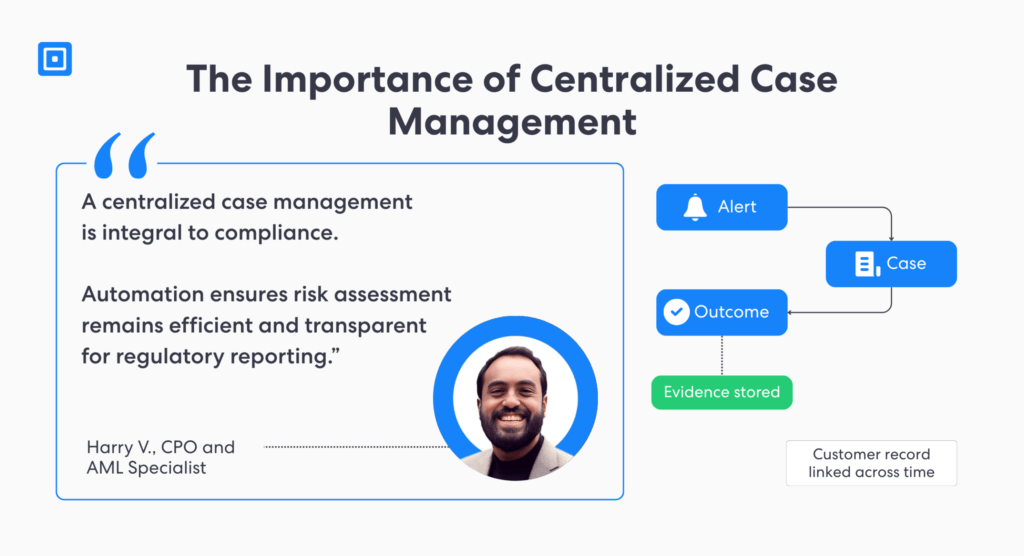
As customer data evolves, an automated case management tool will link them back to the same underlying customer or entity. As a result, businesses prevent fragmented views of risk. Furthermore, behavioral and transaction patterns form across time, and this data can be fed back into customer automation rules to further enhance detection precision.
## Step 7: Testing and Reiteration
In order to plug any gaps in the document verification KYC automation process, testing is key. To elaborate, testing and reiteration need to be an ongoing risk-driven discipline. For example, data analysis for crucial metrics such as false positives, false negatives, time for manual data entry, and customer satisfaction scores must be recorded and fed into test suites. Testing must be part of the implementation and change management plan:
- **Gain clarity on risk environment:** Map regulatory and operational risks to guide which scenarios need the most rigorous testing.
- **Define clear success criteria:** Establish benchmarks for match rates, negative thresholds, and fuzzy matching tolerance levels.
- **Parallel-run phases:** Perform automated KYC checks along current processes to compare outcomes and model reliability.
- **Strong change management:** Log new document type, geography, session version to maintain auditable evidence of results and system behavior.
### Key Takeaways
- **Document validation automation KYC** refers to the use of enhanced features, such as AI, to accelerate the verification of customer identity.
- **AI and machine learning** are tools used to drive automation in KYC and AML solutions, making compliance more secure and accurate.
- **To implement automation**, businesses must investigate what customer experience friction exists in their current document verification process.
- **Beyond identity verification**, firms can reap the biggest benefit when using automation for ongoing compliance, such as pKYC and auditing.
- **Effective automated document** verification layers OCR technology, NFC scanning, biometric verification, and security feature analysis.
## ComplyCube’s Automated KYC/AML Solutions
ComplyCube specializes in secure end-to-end automation for anti-money laundering and identity verification services. Our AI-driven verification reduces false positives, accelerates onboarding, and adapts to any market or regulatory framework. Unlike legacy providers, we deliver fully automated checks, rich case management, and all-inclusive pricing – no add-ons, no hidden costs. Speak to a member of the team to learn more today. To learn more, [speak to a member](https://www.complycube.com/en/contact/contact-sales/) of the team today.
## Frequently Asked Questions
What is an automated KYC process?
An automated Know Your Customer (KYC) process uses enhanced technologies such as AI, machine learning algorithms, and Optical Character Recognition (OCR) to accelerate identity verification. It moves away from manual reviews and human effort by relying on risk-based models. As a result, customer data can be verified more securely and quickly.
How does document validation automation KYC reduce onboarding friction?
Document verification within KYC automation makes use of cutting-edge features, such as OCR technology and NFC chip reading, to streamline customer onboarding. It eliminates human intervention and utilizes automatic risk-based approaches during document analysis. As a result, low-risk customers can onboard quickly, while high-risk users will escalate to more verification.
What should KYC automation logs include for audits?
In order to meet KYC regulations, automation logs for audits must provide a transparent and comprehensive record of the entire customer onboarding process. These logs provide a defensible demonstration of compliance activities, which include the checks run, customer data collected, match results, decision rules applied, timestamps and suspicious activity.
How can financial institutions implement automated KYC solutions effectively?
Key strategies to implement automated KYC solutions include integrating AI, OCR technology, and machine learning algorithms. These technologies support automated data collection, real-time risk assessments, and continuous monitoring for compliance
How does ComplyCube’s document verification KYC automation tools ensure compliance?
ComplyCube’s AI-driven and PAD Level 2-certified platform streamlines KYC and AML processes. It utilizes a cutting-edge OCR engine to extract over 13,000 types of documents across 250+ territories. ComplyCube’s solutions align with international regulatory standards, including the FATF, FinCEN, and FCA, to combat identity theft and money laundering efficiently.

**Categories:** Guides
**Tags:** Know Your Customer
---
### [Enhancing Security and Streamlining Onboarding with Digital Identity Solutions](https://www.complycube.com/digital-identity-solutions/)
**Published:** February 9, 2026
**Author:** Rithu Jagannath
**Excerpt:** Digital identity solutions help businesses prevent fraud without adding heavy friction. Learn how a digital identity check and digital identity validation work together to strengthen verification, protect data, and keep onboarding fast.
**Content:**
**TL;DR:** Digital identity solutions lower fraud while meeting customer expectations for fast online services. A digital identity check evaluates risk signals to verify identity in real time, while digital identity validation proves the identity data is trustworthy and consistent. Together, they support comprehensive digital identity verification that helps businesses prevent fraud.
## What are Digital Identity Solutions?
Digital identity solutions are tools, workflows, and controls that help an organization verify someone’s identity online. This way, genuine customers can access services safely. They combine documents, biometrics, and reviews against data sources to confirm that a person is who they claim to be.
As a result, these solutions make identity into a clear, measurable control to support consistent decisions and traceable outcomes. A strong digital identity verification process is vital in fraud prevention scenarios. Today’s traditional methods simply cannot keep pace with the scale and automation capability of evolving attacks.
## How Digital Identity Checks Work
In today’s world, fraud comes in the form of fake personas and reused stolen identity information. They do this by testing services using the same device, different phone numbers or a reused email address. They thrive off of finding gaps within the verification process in order to exploit them for gain. This threat of fraud only creates constant pressure for systems controls.
Customer expectations are rising at the same time. People want a quick onboarding process with mobile device capture. They also expect minimal friction from start to finish. Businesses must prevent fraud and deter fraudulent activity while helping a genuine person easily prove they are legitimate. Getting this balance wrong can increase drop-off or increase risk.
## Core Blocks of Digital Identity Verification
There are three types of evidence when it comes to digital identity verification. The evidence often covers what a person has, what a person is, and what a person controls. Documents are analyzed for authenticity and signs of tampering to prevent fraud. [Biometrics and liveness detection](https://www.complycube.com/en/solutions/identity-assurance/biometric-verification/) as well as multi-factor authentication come together as the core blocks. These elements provide fraud protection without forcing users and customers into manual identity verification. You can learn more here: [What to Look for in a Biometrics Identity Verification System](https://www.complycube.com/en/biometrics-identity-verification-system/)
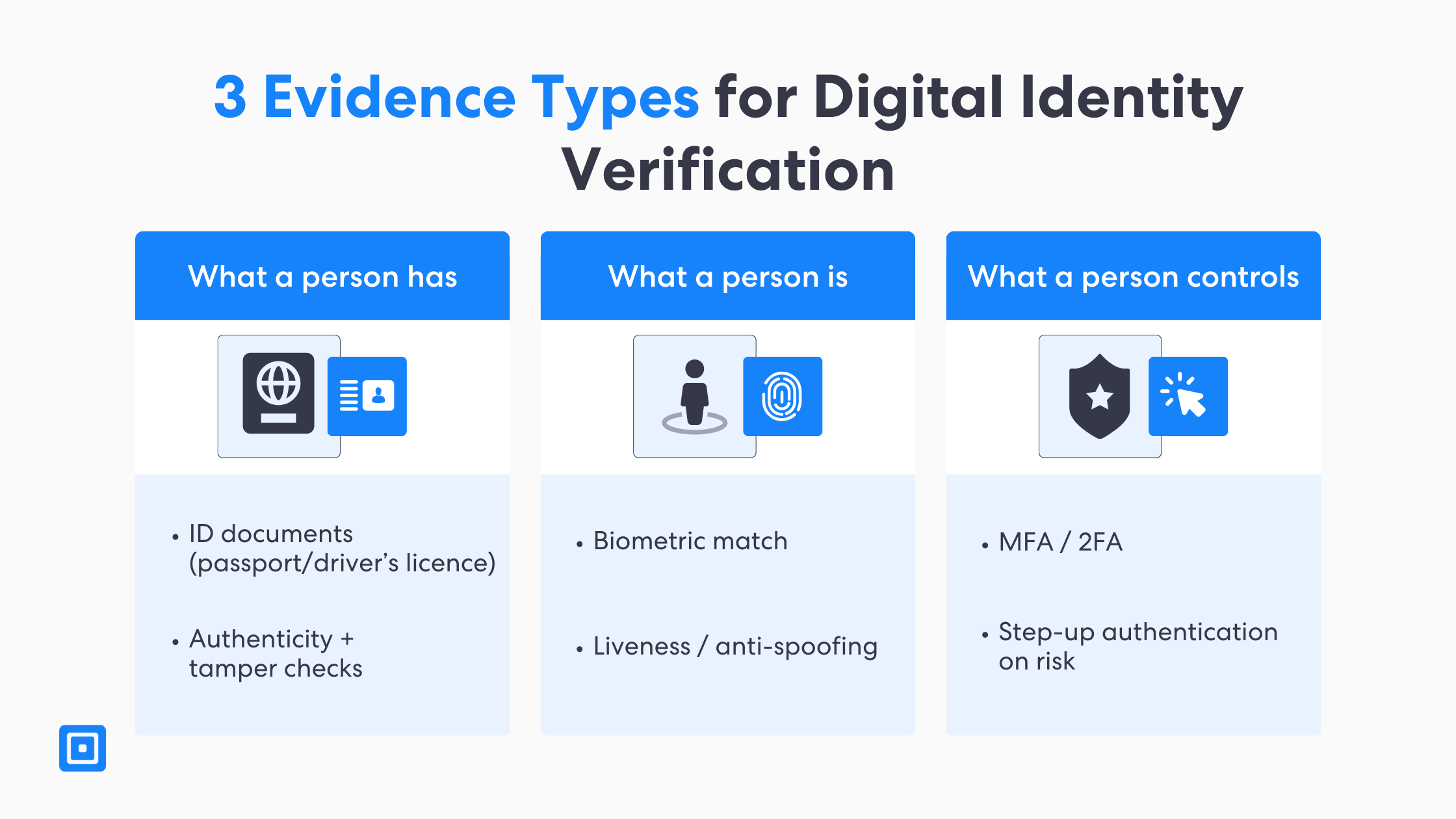
Authoritative standards and guidance increasingly frame this as risk-based. For example, [NIST’s Digital Identity Guidelines](https://pages.nist.gov/800-63-4/) cover identity proofing and authentication requirements that organizations can use to match assurance to risk. This approach helps teams apply stronger checks only when the context and fraud risk justify them.
### Evidence in digital identity solutions
Evidence is the starting point for most digital identity verification solutions. Most platforms start with ID documents, such as passports or driver’s licenses, and then focus on testing [document authenticity](https://www.complycube.com/en/solutions/identity-assurance/document-verification/). They look for evidence through signs of data tampering, and confirming that key fields match the correct formats. Additionally, some flows can incorporate facial recognition with liveness detection to confirm whether users are real in the moment.
Finally, digital identity solutions platforms enrich decisions with more important and contextual data. This other data includes [device intelligence](https://www.complycube.com/en/solutions/fraud-intelligence/device-intelligence/) signals, behavior, geography, and transactions. Bringing in automated processes makes it easier to spot patterns across many attempts. Identifying such a pattern happens much faster than through separate data points in manual verification. It also keeps controls audit-ready by providing logs, inputting rules, and reason codes. Decisions are now easier to review and will improve faster over time.
## Digital Identity Check vs. Digital Identity Validation
There are two types of digital identity solution; digital identity check and digital identity solution. A digital identity check reflects a real-time decision that answer the question, “Should a user get access?” It does this by combining relevant evidence, assessed risk signals and checking against policy rules. This brings a user to a few different outcomes; pass, fail or step up to enhanced due diligence. The decision based on the level of fraud risk that comes across in the onboarding session.
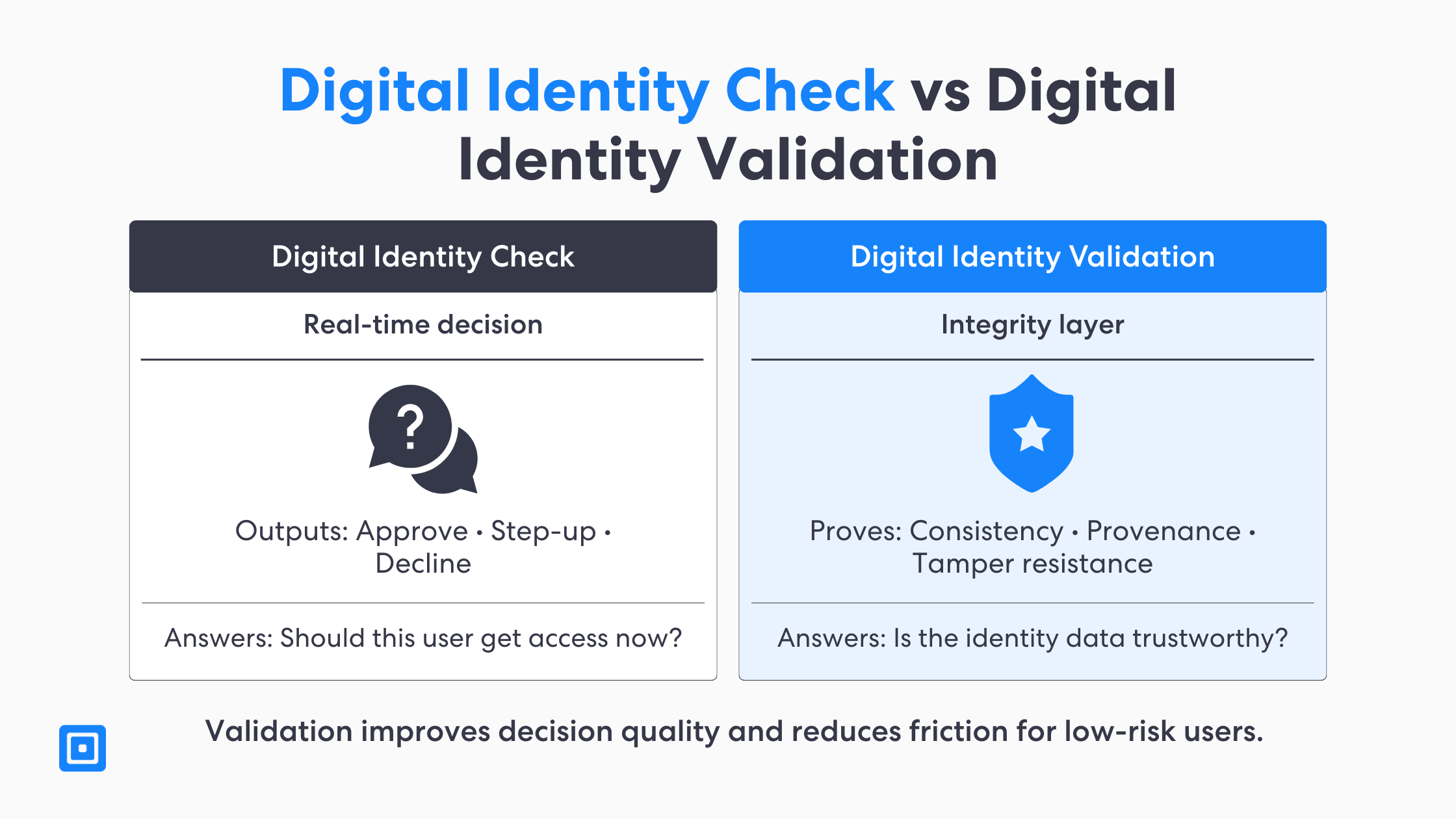
Digital identity validation is more specific than a basic check. It answers a clear question: “Is the identity data and evidence trustworthy?” It proves integrity, consistency, and provenance, so you are not just collecting identity details. Instead, you build confidence in the data over time and across sessions. This makes later decisions more reliable and easier to defend.
## The Identity Verification Process with Digital Identity Solutions
The full identity verification process comes with many steps. When teams say they “verify identity,” results can vary a lot. That is, unless the identity verification process is clearly designed. Good digital identity solutions systems define what complete verification means for each industry, service, channel, and risk tier. They also set clear rules for how to handle errors, retries, and exceptions. A step-by-step process helps teams stay consistent as check volume and the level of fraud risk change.
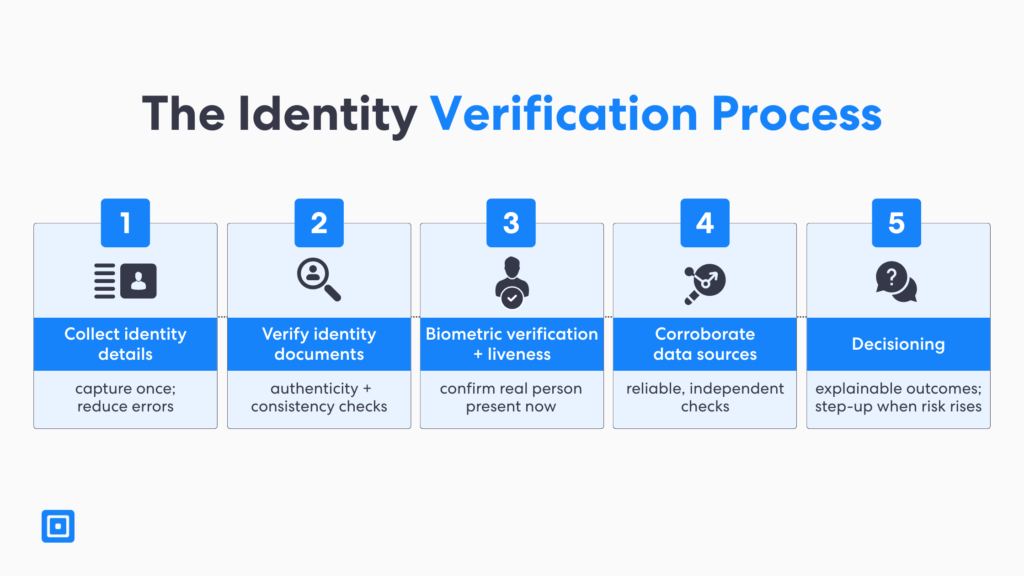
To make this practical, the sections below show how comprehensive [digital identity verification](https://www.complycube.com/en/best-digital-identity-verification-solutions/) can be delivered using automated processes. They also explain where manual identity verification may still be used as a fallback. In most cases, manual verification should be limited to edge cases and high-risk scenarios. The goal is to keep the customer experience smooth while maintaining strong fraud protection.
- **Step 1: Collect identity details**: Capture core identity data (name, DOB, address, contact details) and any required identifiers based on regulation and risk.
- **Step 2: Verify identity documents**: Check document authenticity and validity signals (security features, data consistency) to reduce identity theft and weak “knowledge” checks.
- **Step 3: Biometric verification and liveness detection**: Use facial recognition and liveness detection to confirm a real person, and protect biometric data with secure storage.
- **Step 4: Corroborate against reliable data sources**: Cross-check identity details with independent sources (e.g., registries, internal records, credit bureaus where permitted) to raise confidence.
- **Step 5: Decisioning for complete verification**: Produce explainable outcomes (pass, fail, step-up) with consistent rules aligned to fraud risk and audits.
## Fraud Risk with Digital Identity Verification
Throughout this blog, it is clear that [fraud risk](https://www.complycube.com/en/the-battle-against-aggravated-identity-fraud/) is tied to digital identity verification. To illustrate how fraud risk works under pressure, it is essential to consider examining a common attack pattern. Typically, fraudsters begin with a low-friction flow. They check whether the same device has been previously blocked, and then retry with new identity documents or synthetic identities. Another method they may try is rotating a [phone number](https://www.complycube.com/en/solutions/fraud-intelligence/phone-intelligence-verify-phone-number/) or the user’s email address to bypass basic risk controls. This type of risk flow can result in fast, repeated attempts that simple rules may miss.
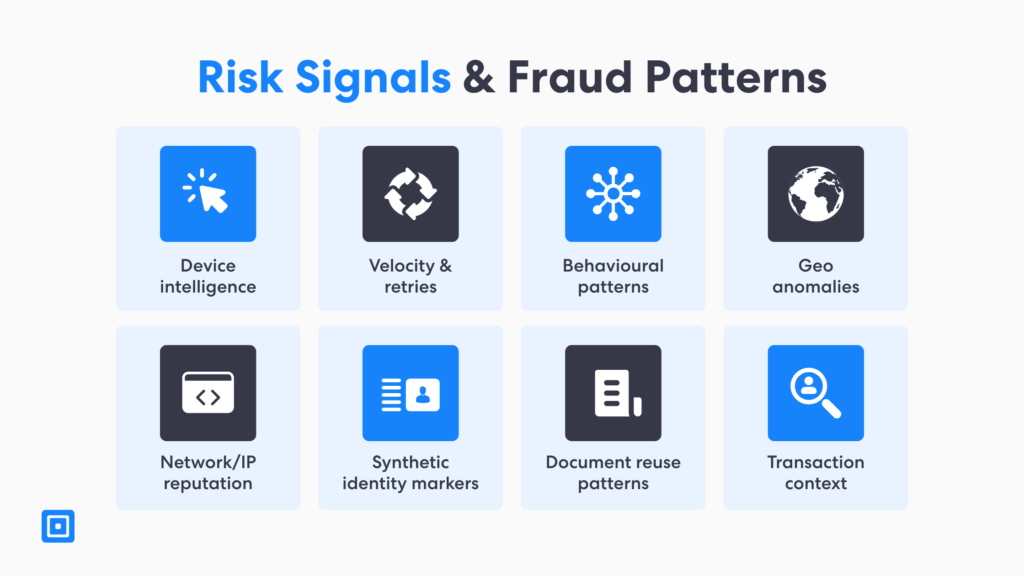
Due to this, ID verification solutions require [artificial intelligence](https://www.complycube.com/en/why-identity-verification-ai-is-crucial/) and [machine learning](https://www.complycube.com/en/how-ai-powers-biometric-identity-verification/) to spot suspicious patterns across fraud risk attempts. It is verification tools like these that can flag unusual velocity of identity checks, repeated session failures, or any inconsistent identity information across sessions. The end goal is to protect the business and prevent fraud, not to punish genuine customers. When identification protocols and processes are well-tuned, it reduces manual verification and supports a smoother overall customer experience.
## Traditional Methods and Manual Verification
Manual verification and traditional methods, such as knowledge-based security questions, were built for a different era of risk protection. Today, leaked data and large-scale automation make it easier for attackers and fraudsters to pass “what you know” checks. This is especially true when identity theft has already occurred and identity details are exposed. As a result, these verification approaches can increase fraud risk without improving overall security.
However, manual identity verification can still be helpful in rare edge cases. The issue is that it does not scale well. It often negative impacts the customer experience. [Automated processes](https://www.complycube.com/en/automated-kyc-verification-service-checklist/) provide consistent results, faster decisions, and stronger audit trails. It helps teams apply the same identity verification process across channels and services. Manual verification review is best reserved for tightly defined, high-risk exceptions.
## Frameworks for Digital Identity Solutions
Digital identity solutions require a strong framework. To operationalize digital identity validation, it is important to use a four-part model without adding unnecessary friction. This type of model keeps teams aligned across product, compliance, and security. It makes outcomes much easier to monitor and improve.
- **Validate**: Check document authenticity, tampering, and data consistency to reduce obvious fraud and manual verification.
- **Corroborate**: Confirm identity details using independent data sources (e.g., registries, internal records, credit bureaus where allowed).
- **Defend**: Use risk signals and behavioral analytics to spot synthetic identities, retries, and suspicious patterns with minimal friction.
- **Decide**: Apply explainable pass/step-up/decline rules and trigger MFA/2FA when risk is higher.
This four-part framework also cleanly maps out to different identity verification platforms. It separates evidence quality from final decision-making. Fine-tuning operational performance while keeping regulatory requirements in mind to keep fraud risk management intact.
## Secure Data Storage and Privacy
Digital identity solutions are only as trustworthy as the way they handle their data storage and privacy. The [Federal Trade Commission](https://www.ftc.gov/business-guidance/resources/start-security-guide-business) (FTC) guidance emphasizes the importance of protecting sensitive data. Exposure can lead to more fraud, identity theft, and damage to long-term brand trust. Strong controls around secure data storage can reduce the risk of insider misuse and accidental data leaks. It is essential for protecting both customers and organizations.
In practice, secure storage and data privacy processes include multiple factors. They cover encryption, privilege access, retention limits, and disciplined vendor management. It is crucial to design workflows that minimize the amount of biometric data that you actually keep. This limits the potential damage if data breaches do occur. Regular audits and access reviews help keep controls effective over time. Clear incident plans also support a fast response when issues arise.
## Authentication After Verification: MFA, 2FA, and Continuity
Authentication proves identity immediately after verification. It protects access from that moment onward. This is crucial, especially when the fraud risk shifts from the onboarding journey to account takeover. Multi-factor authentication and two-factor authentication can reduce that risk. This kind of layered approach helps prevent attackers even if they have stolen information or credentials.
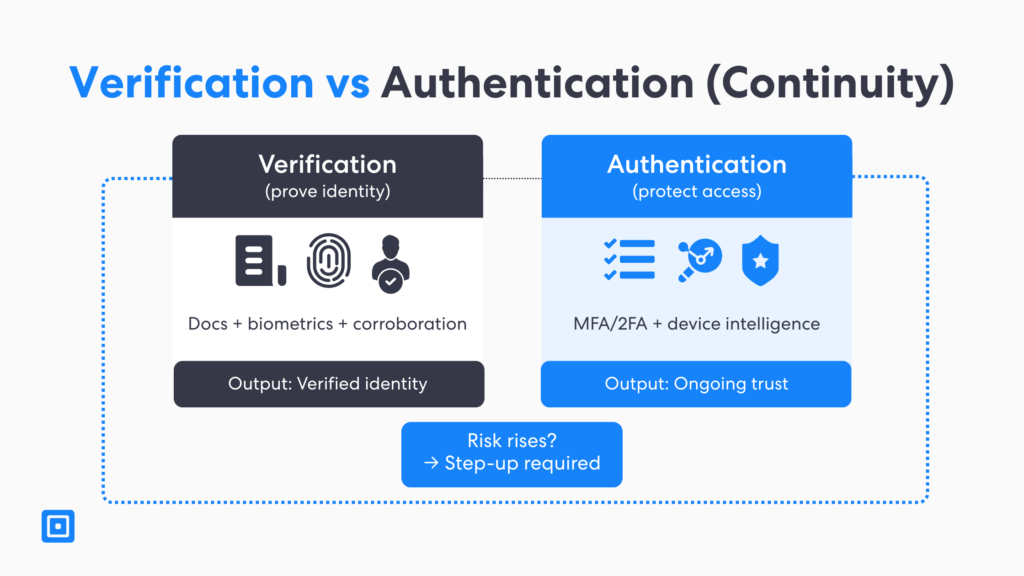
Imagine a verified user trying to access an account suddenly from a new mobile device. There are unusual login patterns present as well. This will prompt teams to step up verification pathways. This is a perfect example of how “same device” intelligence can help verify identities. Any additional factor authentication helps balance security and access with a much smoother customer experience.
## Financial Institutions and Regulated Sectors
It is incredibly common for financial institutions and other regulated sectors to face strict [Know Your Customer](https://www.complycube.com/en/solutions/due-diligence-compliance/know-your-customer/) (KYC) regulations. There is close scrutiny of the quality of the identity verification process. Clear rules on accepted evidence, the exceptions that apply, and how monitoring works are necessary for any risk-based program. Consistent outcomes across various channels and online services are also needed. This clarity helps to reduce errors and improve audit readiness.
The [Financial Action Task Force](https://www.fatf-gafi.org/content/dam/fatf-gafi/guidance/Guidance-on-Digital-Identity-Appendice%20A.pdf) (FATF) framework is widely referenced. It links identity verification and digital identity solutions to risk and governance. It supports an organized approach to choosing data sources, setting appropriate controls, and documenting decisions. Teams that align policy, controls, and monitoring lower overall fraud risk, all while maintaining a strong customer experience. It is also easier to adapt when threats and regulations change over time.
### **Case Study: Companies House Identity Verification Rollout (UK, Nov, 2025)**
The UK sought to reduce misuse of company registrations for illegal purposes by strengthening identity assurance for people who set up, run, own, or control companies. This included addressing risks tied to fraud and identity manipulation and improving trust in corporate records.
##### **Companies House Identity Verification Goes Live for Directors and PSCs**
Companies House confirmed that legal requirements for directors and people with significant control (PSCs) to verify their identities would begin on 18 November 2025, using routes including gov.uk One Login and alternative channels for those who need them.
##### **Outcomes**
- More than 1 million people verified early after the voluntary launch in April 2025, signalling strong uptake ahead of mandatory changes.
- By a later milestone, more than 1.5 million people had verified since April 2025, supporting a staged shift toward stronger transparency and less identity abuse.
- The gov.uk ID Checking App route averages under 2 minutes 30 seconds to complete, helping verification scale without heavy friction.
## Choosing Identity Verification Solutions
It is essential to look for a [comprehensive suite](https://www.complycube.com/en/solutions/) of identity verification products that support multiple evidence types and clear policy configurations. Ideally, choosing a tool that can be customized with building blocks based on your needs is a perfect fit. This is much better than forcing a one-size-fits-all workflow. It becomes significantly easier to pick controls that work for each service and separate risk tiers.
Other factors to consider when choosing digital identity solutions are secure data storage, audit trails, and explainability. Platforms that can show teams why a decision was made make it clear how to govern. It becomes easier to defend against regulatory requirements during audits or compliance reviews. That is why clear reporting reduces any additional manual verification work and speeds up investigations.
## What Comprehensive Digital Identity Verifications Should Include
As mentioned before, comprehensive digital identity verifications include a combination of document authenticity checks, liveness detection, [data source corroboration](https://www.complycube.com/en/solutions/identity-assurance/multi-bureau-checks/), and step-up authentication when risk arises. These additional layers verify identities with much stronger confidence. It also reduces the need for manual identity verification in routine cases. The result is a more consistent identity verification process.
Other products include monitoring of retries, fraud attempts, and performance by segment. This is a great demonstration of how companies can tune their automated processes to reduce any false rejects. This keeps fraud protection strong against [fake identities](https://www.mastercard.com/global/en/news-and-trends/Insights/2024/what-is-synthetic-identity-fraud-and-how-does-synthetic-identity-theft-work.html) and any evolving fraud patterns. Additional monitorinsyng helps you spot weak data verification sources or any broken user journeys early on.
## Implementation Checklist for a Verification Program
An implementation checklist for any verification program begins with defining outcomes. Organizations need to determine what a “complete verification” means. Then, teams can map controls to each stage, covering identity documents, biometric data, device intelligence, behavioral analytics, and any authentication. Verifying consistently across channels and digital platforms becomes easier. It also makes roles and responsibilities clearer than ever across multiple teams.
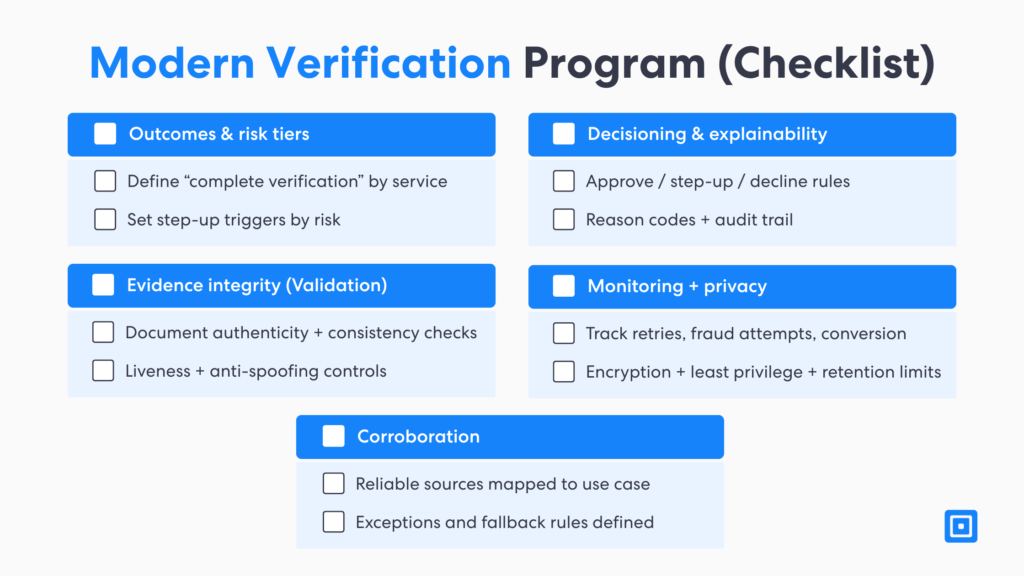
[Feedback loops](https://hoop.dev/blog/the-identity-feedback-loop/) are built to become more efficient and improve over time. It is essential after major incidents or shifts in attack patterns to keep track of any fraud risk, conversion rates, retries, exception reasons, and review controls. Companies can ensure that their identity verification processes are aligned with business growth and changing customer expectations. This helps reduce any false declines without seriously weakening fraud protection.
### Key Takeaways
- Digital identity solutions work best when digital identity validation is an integrity layer.
- A digital identity check should be clear, policy-led, and based on risk signals.
- Secure data storage and privacy by design reduce damage from data breaches.
- Strong programs scale automated processes and limit manual identity verification to rare cases.
- Comprehensive digital identity verification combines documents, biometrics and data sources.
## ComplyCube’s Digital Identity Solutions
If your goal is to verify identity, reduce identity theft, and improve customer experience across digital platforms, the strongest approach is validation-first: prove the integrity of identity data, corroborate it with reliable sources, defend against fraud patterns, and decide with clear policy logic. ComplyCube helps businesses implement digital identity solutions that support fast, secure verification journeys so you can protect access, meet regulatory requirements, and keep genuine customers moving. [Connect with our team today](https://www.complycube.com/en/contact/).
## Frequently Asked Questions
How do digital identity solutions reduce fraud without slowing down online onboarding?
Digital identity solutions combine identity documents, biometric verification, and trusted data sources to verify identity quickly while keeping controls strong. They use risk signals to apply step-up checks only when needed, so genuine customers are not forced through heavy friction.
What should a strong digital identity verification process include from end to end?
A strong identity verification process typically follows five steps: collect identity details, verify identity documents, run biometric verification with liveness detection, corroborate against reliable data sources, and apply explainable decisioning. Each stage should have clear rules and measurable outcomes, so “complete verification” is consistent across services and risk tiers.
What is the practical difference between a digital identity check and digital identity validation?
A digital identity check is the real-time decision point that determines whether a user should get access, based on evidence and fraud risk. Digital identity validation is the deeper integrity layer that proves identity data and evidence are trustworthy, consistent, and defensible across sessions.
How can businesses use risk signals and behavioral analytics to spot synthetic identities early?
Risk signals such as rapid retries, unusual navigation patterns, and inconsistent identity details can indicate synthetic identities or scripted attacks. Behavioral analytics and machine learning help detect these patterns across attempts faster than manual verification, especially at scale.
How can ComplyCube help teams implement validation-first digital identity solutions at scale?
ComplyCube helps businesses implement digital identity solutions with policy-led decisioning, strong identity document checks, biometric verification, and corroboration across trusted data sources. A validation-first approach improves confidence in identity data, reduces false declines, and limits manual verification to high-risk exceptions.
[](https://www.complycube.com/en/contact/contact-sales/)
**Categories:** Guides
**Tags:** Identity Verification
---
### [Choosing the Right Automated KYC Verification Service](https://www.complycube.com/automated-kyc-verification-service-checklist/)
**Published:** March 20, 2024
**Author:** Andreea Balasa
**Excerpt:** Increasingly complex regulations have muddied the regulatory water for some time. The high demand for an automated KYC verification service has led to a spike in the number of KYC vendors on the market. Choose the right one for you.
**Content:**
Increasingly complex KYC regulations have muddied the regulatory water for some time, leading to a need for change in the compliance industry. Onboarding processes are now highly automated, and generally outsourced, to enable companies to meet compliance requirements. The increased demand for an automated KYC verification service has led to a spike in the number of KYC vendors available on the market.
Choosing the right automated KYC verification partner is a tall order. This guide will explain what a KYC verification process involves and how automated identity verification procedures streamline client acquisition processes. It will also discuss what to look for when choosing a compliance service, diving into the nuances of the technology driving the industry.
## An Overview of KYC Compliance
[Know Your Customer](https://www.complycube.com/en/solutions/due-diligence-compliance/know-your-customer/) (KYC) processes envelop the strategies used in fraud prevention and the monitoring of illicit activities like money laundering and [terrorist financing](https://www.unodc.org/unodc/en/terrorism/expertise/combating-terrorist-financing.html#:~:text=Terrorist%20financing%20encompasses%20the%20means,drugs%20or%20people%2C%20or%20kidnapping.). The stronger the KYC verification process, the better an institution knows exactly who its customers are and the less risk the company is exposed to.
Regulatory compliance varies across industries. In banking, the requirements for KYC and Anti-Money Laundering (AML) are much stricter compared to those in the hospitality or private hire driver sectors. This difference is due to greater accessibility and opportunity to commit financial crimes.
KYC vendors offer customizable, industry-specific solutions. These services can be adjusted for varying levels of identity assurance, balancing risk and tolerance as required. They aim to reduce financial system abuse and enhance company profit through identity assurance and improved operational efficiency.
While knowing your customer can differ between industries, the key 3 steps to the process remain the same. Learn more about KYC Verification here: [Global KYC Verification Process in 3 Steps](https://www.complycube.com/en/global-kyc-verification-process-in-3-steps/).
1. Customer Identification Program: Obtaining customer information to create a profile including but not limited to name, address, date of birth, and a government-issued ID.
2. [Customer Due Diligence](https://www.complycube.com/en/what-is-customer-due-diligence/): Comparing this information against proprietary or public data sources to validate that the information provided is correct.
3. Continuous Monitoring: Verifying this information on an ongoing basis as part of a real-time risk assessment.
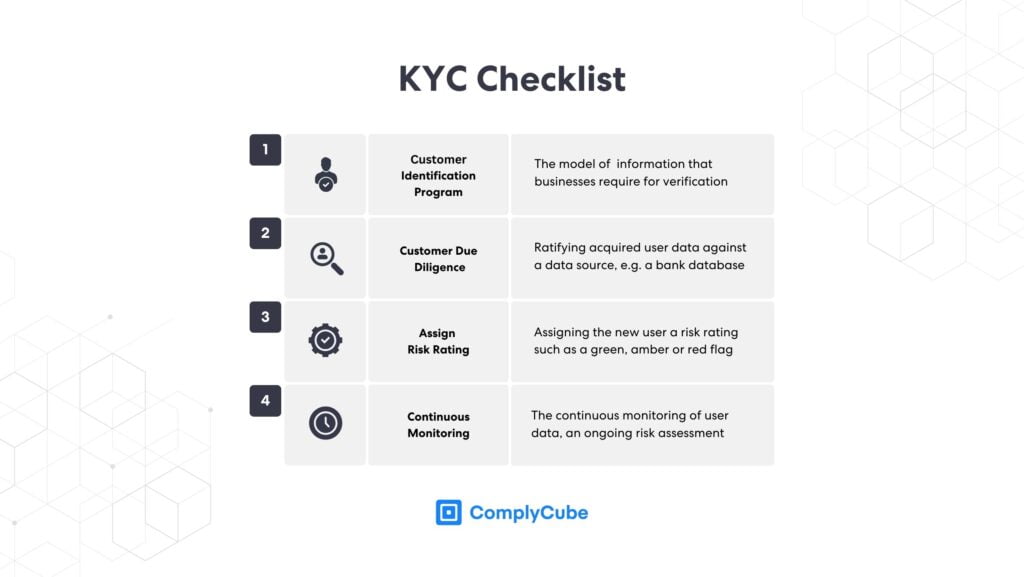
### Are Regulatory Requirements Exclusive to Financial Institutions?
Regardless of its sector, every company needs to ensure compliance with the related regulatory body is met. Organizations might not share the same compliance structure based on regulations and their risk appetite. This can be due to:
- Discrepancies in company risk tolerance
- Differences in company size (employees and customers)
- Specific risks pertaining to particular products or services
Therefore, every company has its own unique risk tolerance and will require a specific set of KYC services tailored to its business. 3rd Party KYC vendors are becoming increasingly popular as they remove the hassle from nuanced regulation while actively improving customer acquisition rates. ComplyCube, one of the leading KYC/AML providers on the market, improves its clients’ profitability by optimizing operational efficiency and reducing customer churn.
Efficient KYC platforms enable businesses to toggle their ‘friction levels’ during customer acquisition processes. A good example of this is the use of a flexible [document verification solution](https://www.complycube.com/en/solutions/identity-assurance/document-verification/), where businesses can set the number of document uploads a user can ‘fail’ before being ‘passed.’
This information is immediately available to KYC analysts and forms part of the user’s risk profile. The ability to toggle between friction levels reiterates the importance of fluidity in compliance. Know Your Customer verification services are the Swiss Army middlemen between regulations and operations.
## Customer Identification Program (CIP)
A Customer Identification Program is the process companies follow to prove who it is they are dealing with. The typical data required from a new customer when they open a new account is as follows:
- Full Name
- Address
- Date of Birth
- Government-issued ID

However, this model of information is subject to change depending on the level of identity assurance that is mandated by industry regulators. A financial institution, for example, would need a higher level of identity assurance to verify customer authenticity.
This information is then checked via various KYC procedures and underpins the importance of flexibility in eKYC solutions. Comparing banks and delivery services again, a bank will require far more than a biometric check to meet its obligations of verifying customer identity.
The likelihood of a banking service being leveraged to abuse the financial system is far higher than a takeaway service. As such, banks represent the pinnacle of Know Your Customer verification and it is almost guaranteed that at some point in the money laundering process, a bank will have been at risk of being abused.
## What is Identity Verification?
Most companies onboarding new customers must have a procedure to validate that they are who they say they are and this process is called Identity Verification (IDV). In the context of eKYC services, this is done digitally and in a variety of methods. Learn more about eKYC here: [What is eKYC (electronic Know Your Customer)?](https://www.complycube.com/en/what-is-ekyc-electronic-know-your-customer/)
Depending on the level of identity assurance required by an industry, IDV can be done in different ways, including but not limited to:
- Document Verification: Users upload a clear image of their passport, driver’s license, or other document that details personal information.
- Biometric Verification: The user is verified by uploading a live selfie which is compared to the image on the supplied document, such as a passport.
- Multi-Bureau Check: Client information is ratified against trusted third parties to provide assurance that they are who they say they are.
Automated KYC procedures combine IDV with thorough customer due diligence (CDD). This onboards clients in one seamless process, both confirming the acquired data and reducing the process to a matter of seconds.
### Proof of Address Verification
[Proof of Address (PoA)](https://www.complycube.com/en/solutions/identity-assurance/address-verification/) checks are one part of the IDV process. They provide another level of assurance to prove that the customer is who they say they are and they are providing correct information. For a Proof of Address check, this includes:
- Client Validation
- Content Analysis
- Geolocation Analysis

PoA verification, such as analyzing a utility bill, provides the service provider with basic information about a user. ComplyCube’s extraction technology takes this data and matches it against the provided information from the user upon their sign-up. For some services and industries with less of an obligation to curb money laundering, this is a satisfactory check. Learn more about PoA here: [A Robust Guide to Proof of Address Checks (PoA)](https://www.complycube.com/en/proof-of-address-documents-poa-checks-for-address-verification/)
### Document Checks
Proof of Address checks do not provide a high enough level of assurance for banks, FinTechs, and other financial institutions. In the finance industry, document verification is a key IDV solution. The process involves stringent analysis of identity documents such as government-issued IDs, passports, and more.
Passports contain personally identifiable information (PII) such as the [Machine-Readable Zone (MRZ)](https://en.wikipedia.org/wiki/Machine-readable_passport) number and embedded advanced security protocols including a Radio-Frequency Identification chip (RFID). With the help of modern technology, for instance, Optical Character Recognition ([OCR](https://aws.amazon.com/what-is/ocr/#:~:text=Optical%20Character%20Recognition%20(OCR)%20is,words%20in%20the%20image%20file.)) and Near Field Communication ([NFC](https://www.techtarget.com/searchmobilecomputing/definition/Near-Field-Communication)), a 3rd party KYC verification service can help businesses verify and onboard their customers with peace of mind.
Leading IDV/KYC solution providers such as ComplyCube use proprietary technology to instantly verify up to 25 data points, check for inconsistencies throughout the document, and match the data to information provided via an alternative verification method. For the highest level of clarity for data extraction, businesses can opt for NFC verification. Learn more about document verification here: [What is Document Verification? An In-depth Look at ID Verification.](https://www.complycube.com/en/what-is-document-verification/)

### Biometric Verification
Biometric authentication is a key identity verification solution required when institutions need a deeper understanding and confirmation of their clients’ identity. This type of check verifies an uploaded selfie, taken during customer onboarding, against the user’s document image.
An efficient KYC verification service uses [AI-powered biometric checks](https://www.complycube.com/en/solutions/identity-assurance/biometric-verification/) to ensure that the individual on the other side of the process is unequivocally who they say they are and to curtail identity theft. Some of the key features to look for when choosing a facial recognition solution include:
1. Liveness Detection: Using advanced Presentation Attack Detection (PAD) technology to analyze microexpressions, skin texture, pixel manipulation, and more, to establish the genuine presence of the customer.
2. Face enrollment: Immediately checks for previous enrollment of the same face and flags as an investigative requirement if it has been used before.
3. Spoof Detection: Detects deepfakes and misrepresentations in the uploaded selfie through an AI-powered algorithm. This could come via a printed photo, 3D life-like masks, video replays, and network spoofing.
4. Redaction Capabilities: Blurrs out images or other Personal Identifiable Information (PII) based on different jurisdictional requirements.
5. Face Authentication: Matches a client’s facial features with their previously registered face, enabling strong, passwordless authentication, routine re-verifications, account unlocks, and more.

### Multi-Bureau Verification
[Multi-bureau checks](https://www.complycube.com/en/solutions/identity-assurance/multi-bureau-checks/) are used as a further measure to corroborate that a customer is who they claim to be. Data partners, such as credit unions, have a global reach and can instantly corroborate customer details. Institutions can specify whether a customer’s data must be verified against a single data partner or a minimum of 2 independent sources, known as ‘2+2 verification’.
Leading KYC/AML solutions consider a client as verified when a bureau has matched at least their **name** and **one more attribute**. This can be as follows:
1. Name and Date of Birth match
2. Name and Address Match
3. Name and ID number match
## How an Automated KYC Verification Service can Revolutionise Customer Acquisition and Business Operation
Once businesses are happy that they know who their customer is, they can begin their customer due diligence process. This can range from basic customer due diligence to enhanced due diligence.
State-of-the-art KYC providers offer automated services that perform the checks seamlessly and in no time. It is important to note that the due diligence process can also be completely customizable. AI-powered automated KYC solutions are designed with the clients’ operational preferences and flexibility in mind.
### How does this Maximise Profit?
Automating every step in the KYC process eradicates human error from customer verification. This reduces the number of false positives creeping into customer reports.
A false positive is an error in reporting – a false alarm. It is an alert into something about the user profile that indicates that an investigation is required from an MLRO, a compliance or KYC analyst. An alert may also be triggered as a cautionary measure when there’s a potential similarity with the data of a customer who’s already enrolled or a PEP match. Automation and digitalization reduce the time spent on manual tasks and allow employees to focus on more important cases.
### Improved Customer Onboarding
Digital KYC processes also enhance the customer onboarding process when transitioning from potential customers to real customers. Swifter and more efficient customer experiences equate to happier customers, but more importantly, they prevent customer churn which leads to a loss in revenue.
### Improved Data Capabilities
Automating KYC with advanced technology provides a customer data storage system, that is both malleable and secure. This allows KYC analysts to perform tasks with a far greater scope of efficiency as client data can be seamlessly extracted and integrated as per the business’s operation.
### Regulatory & Anti Money Laundering Compliance
Last but not least, automated KYC processes facilitate the adoption of new and updated policies. Thus, automating a KYC verification process will become increasingly integral as the modern-day risk mitigation strategy for battling money laundering and other financial crimes. With the help of a combined CIP, CDD, and Ongoing Monitoring workflow, KYC specialists can prioritize the more pertinent issues and improve operational efficiency.

## KYC Verification Service Industry Use Cases
As regulatory demands become stricter in the global economy, the scope of KYC solutions is expanding beyond traditional financial sectors. In an era where businesses are seeking ways to refine their processes, embracing automated KYC verification is becoming an increasingly obvious choice. Regardless of their [use case](https://www.complycube.com/en/use-cases/), companies can significantly enhance efficiency across various levels by integrating an automated Know Your Customer system into their operations.
### Payments
Businesses can meet banking standards of identity assurance with an automated and customizable workflow of Know Your Customer checks. KYC vendors allow companies to react to changing client circumstances, such as political exposure and adverse media relations, while reducing these operational expenses by around 50%.
### Real Estate
Real Estate is a frequently abused industry due to the high-value nature of the transactions. Some of the largest challenges facing this sector are the lengthy, manual, and time consuming KYC processes on large corporate entities. An automated and efficient KYC/KYB procedure will build trust and efficiency in transactions that separate businesses from competitors and benefit from an enriched reputation.
### Telecoms
The days of high-street sign-ups are gone, with the entire process of telecom client acquisition moving more and more to an online environment. With digital KYC solutions, telecom providers can reduce the cost of SIM activation by over 63%, verifying users in under 15 seconds.
### FinTech
Alleviating the threat of suspicious transactions, meeting the increasingly complex KYC & AML compliance standards, and simultaneously providing a seamless customer experience can be difficult. KYC providers significantly streamline due diligence processes, reducing customer acquisition costs by up to 73% with onboarding times cut down from days to minutes.
### Crypto
With regulations evolving nearly as fast as the technology underpinning it, cryptocurrency protocols and projects require an automated workflow for KYC checks. An effective KYC verification service can onboard up to 98% of customers with precision in under 30 seconds. As cryptocurrency exchanges become a more common vehicle for money laundering, creating accurate client profiles will help crypto companies avoid fines.
### Banking
Maintaining a bank’s reputation is the utmost priority regarding compliance and Identity Verification. eKYC solutions can reduce customer acquisition costs by over 73%. These automated processes not only improve the customer experience but also free up time for employees to focus on other activities, such as monitoring financial transactions.

## Choosing your Automated KYC Verification Service
For a high level of flexibility, effective KYC vendors provide a fully customizable suite of integrations that are designed to enhance business operations. When looking for a provider, ensuring they have the necessary infrastructure is critical:
1. Check that they comply with all relevant KYC and AML regulations.
2. Make sure the customer journey is seamless and won’t foster failed signups.
3. Check the breadth of documents they work with and from which authorities.
4. Ensure your provider can scale at your rate of growth.
5. Investigate who leads the business and what their background is.
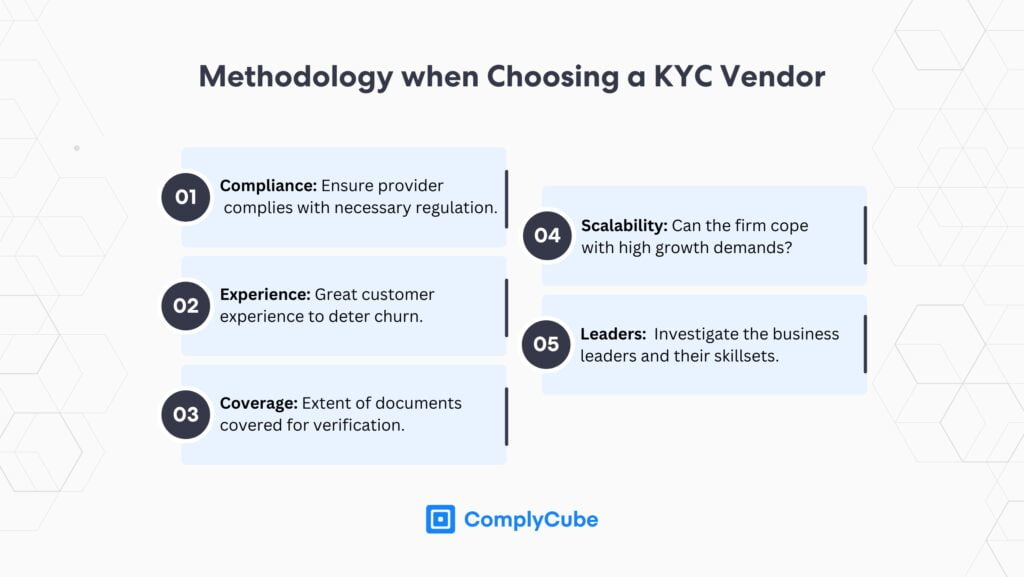
ComplyCube removes the headache of policy compliance by bridging the gap between regulation and operation. If you’re looking to improve client acquisition and regulatory know-how, [get in touch with our team of IDV, KYC & AML specialists](https://www.complycube.com/en/contact/contact-sales/).
**Categories:** Guides
**Tags:** Know Your Customer
---
### [ComplyCube Expands Global Reach with eID and SSN Real Time Identity Verification](https://www.complycube.com/real-time-identity-verification/)
**Published:** February 4, 2026
**Author:** Rithu Jagannath
**Excerpt:** ComplyCube launches real-time SSN and eID verification, enabling instant, government-backed identity checks across the US, EU, and India, streamlining global onboarding and boosting compliance confidence.
**Content:**
LONDON, FEBRUARY 04, 2026 – [Identity verification](https://www.complycube.com/en/) is at a breaking point. Legacy document-based checks are slow, fragmented, and increasingly vulnerable to synthetic identities, deepfakes, and cross-border fraud. Today, ComplyCube addresses that gap with the launch of a real time identity verification solution. With a real time [eID check](https://www.complycube.com/en/solutions/identity-assurance/eid-verification-service/) and [SSN check](https://www.complycube.com/en/solutions/identity-assurance/ssn-verification-service/), ComplyCube brings two of the world’s most authoritative identity systems directly into a single compliance platform.
## Why Real Time Identity Verification Needs to Change
Across regulated industries, identity verification is under more pressure. Onboarding delays are frustrating users. With fragmented compliance tools straining operations, and evolving deception tactics, fraud is getting harder to detect. Compliance teams are being forced to balance speed, accuracy, and risk mitigation without the tools they need to do all three well.
- Synthetic identity fraud had $3.3 billion in U.S. lender exposure in H1 2025.
- Manual document checks cuts conversion rates by 15–20% per extra day.
- 60% of business onboarding requires manual multi-tool compliance reviews.
ComplyCube’s new SSN and eID services are purpose-built to address these challenges by enabling verification at the source. Through government-backed identity systems, the platform moves beyond static document uploads and toward real time, regulation-ready identity assurance. This shift reduces fraud exposure. It also improves onboarding speed and user experience across global markets.
## SSN Validation: Real Time Identity Verification for the U.S.
ComplyCube’s [SSN verification service](https://www.complycube.com/en/solutions/identity-assurance/ssn-verification-service/) enables real time validation of U.S. Social Security Numbers as part of onboarding and Customer Due Diligence (CDD) processes. This capability directly supports compliance with the [USA PATRIOT Act](https://www.fincen.gov/resources/statutes-and-regulations/usa-patriot-act) and FinCEN’s [Customer Identification Program (CIP) rules](https://www.fincen.gov/system/files/federal_register_notice/Customer_Identification_Programs.pdf). Rather than relying on delayed reviews, organizations can now instantly confirm whether an SSN is:
- Correctly structured and issued
- Currently active and valid
- Flagged as deceased or potentially synthetic
These instant verifications reduce both operational risk and compliance friction. All outputs are CIP, KYC, and AML compliant, making it easier for firms to satisfy reporting obligations without disrupting onboarding flows. When this [SSN validation](https://www.complycube.com/en/ssn-validation-check/) is embedded into digital onboarding journeys, it allows organizations to implement more secure, scalable workflows. Specifically, businesses are able to:
- Detect and block synthetic or recycled identities early
- Reduce reliance on manual escalation teams
- Accelerate onboarding while maintaining regulatory integrity
In a regulated environment, speed, accuracy, and trust are equally essential to the process. ComplyCube’s SSN Verification gives compliance teams a critical tool to verify identities with confidence. Now, real time checks deliver both security and speed. By embedding these checks into workflows, businesses gain the agility to meet compliance demands without slowing growth.
## eID Verification: One-Step Trust Across Global Identity Networks
Additionally, ComplyCube’s [eID verification service](https://www.complycube.com/en/solutions/identity-assurance/eid-verification-service/) allows businesses to connect directly to government-backed electronic identity schemes in major global markets. The service simplifies identity verification across Europe and APAC without requiring document uploads or biometric scans. It supports key eID schemes including:
- BankID (Sweden)
- itsme (Belgium)
- MitID (Denmark)
- iDIN (Netherlands)
- Aadhar (India)
This solution aligns with the eIDAS regulation, which establishes a common legal framework for secure digital identification across all 27 EU member states and defines clear Levels of Assurance (LoA) for electronic identity schemes. As [eIDAS adoption](https://www.complycube.com/en/a-digital-europe-introducing-the-eudi-wallet/) accelerates across Europe, organizations are under increasing pressure to support trusted digital identity methods that work seamlessly across borders while meeting local regulatory requirements. As a result, businesses benefit from:
- Seamless identity verification with higher conversion rates
- Compliance with both domestic and cross-border regulations
- Reduced fraud exposure through verified, government-issued credentials
Instead of layering multiple regional tools or managing separate identity providers for each market, ComplyCube offers a single point of integration for electronic identity verification. This unified approach delivers fast, trusted identity decisions at scale, allowing teams to expand internationally while maintaining consistency, compliance, and operational control.
## One Platform, Authoritative Identity at Scale
With the launch of SSN and eID verification, ComplyCube strengthens its position as a unified identity assurance platform built for global compliance. No more stitching together localized providers or forcing users through document-heavy flows. Instead, businesses can now streamline onboarding with scalable, trusted verification at the source.
- Apply consistent identity logic across jurisdictions
- Meet U.S. mandates (e.g., SSN + FinCEN) and E.U. standards (e.g., eIDAS 2.0)
- Streamline onboarding while maintaining security, trust, and audit readiness
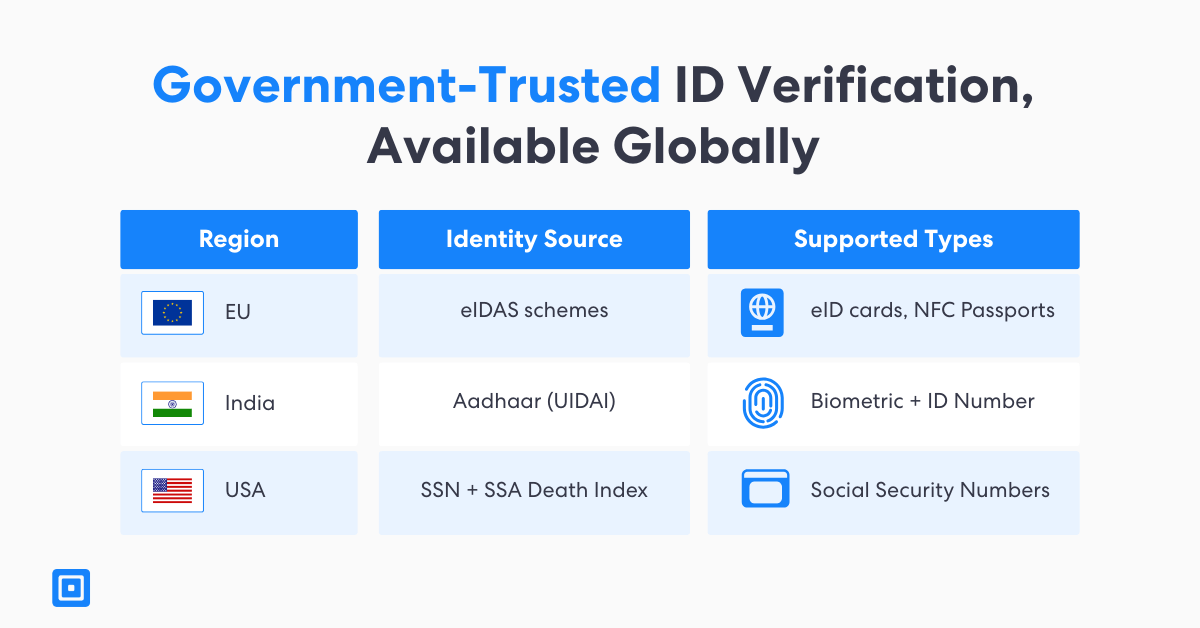
> “Bringing these national-level identity systems under one roof aligns with our mission to simplify global compliance,” said Dr. [Tarek Nechma](https://www.linkedin.com/in/tarek-nechma/), CEO of ComplyCube.
Expanding on this, Dr. Tarek Nechma added, “SSN and eID verification are foundational identity systems. By integrating them directly into our platform, we’re helping organizations meet local regulatory obligations while delivering faster, more trustworthy onboarding experiences for their customers.”
## About ComplyCube
[ComplyCube](https://www.complycube.com), the FinCrimeTech50 winner, is a global identity verification and compliance platform enabling businesses to verify users, prevent fraud, and meet regulatory obligations with confidence. Its modular solutions span identity assurance, biometric verification, fraud intelligence, and no-code workflow orchestration, delivered via APIs, SDKs, and hosted flows.
**Categories:** News
**Tags:** Announcements
---
### [Social Security Number Validator: Critical for AML & KYC Workflows](https://www.complycube.com/social-security-number-validator/)
**Published:** February 5, 2026
**Author:** Rithu Jagannath
**Excerpt:** Social Security Number validation plays a critical role in U.S. AML and KYC workflows. This guide explores how SSN validators support identity verification, fraud prevention, and regulatory compliance across modern financial institutions.
**Content:**
**TL;DR:** **Social security number validator** tools are essential in verifying customer identity. Leveraging KYC social security validation can **help organizations** meet regulatory requirements faster. AML social security validation enables risk-based due diligence, helping organizations **flag risky profiles** early in the customer life cycle.
## What are Social Security Number Validators?
Social Security Number (SSN) validators are tools or systems that verify current SSNs. They check if numbers are valid, formatted correctly, and historically consistent with official insurance data. Validator tools also review details such as the structure of the SSN, its issuance location and timeframe. They run information against taxpayer identification numbers or lists of known invalid numbers or those associated with deceased individuals.
Particularly, SSN validation is a foundational process for financial institutions, government agencies, and other regulated entities. They confirm identities in order to prevent the misuse of social security benefits and prevent financial crime. The SSN functions as a unique identifier for U.S. citizens, permanent residents, and certain non-resident aliens. Proper validation helps ensure that each number truly belongs to the individual claiming it.
Therefore, using [SSN validators](https://www.complycube.com/en/solutions/identity-assurance/ssn-verification-service/) supports compliance with KYC regulation standards and helps protect against identity theft. It prevents fraud and unauthorized access to sensitive data. By confirming that an SSN is authentic and accurately linked to the right person, institutions can strengthen fraud prevention. It can help protect customer information and guarantee that benefits or transactions are granted only to eligible individuals.
## How Customer Identification Programs Depend on SSN Verification
Modern customer identification programs are designed to verify a customer’s identity as part of the [Know Your Customer (KYC)](https://www.complycube.com/en/solutions/due-diligence-compliance/know-your-customer/) process. Organizations must ensure that the user identity is real. Organizations must ensure that the user identity is real, correct, not linked to synthetic identities, identity theft, or fraudulent transactions.
Social security number validators focus on [matching identity documents](https://www.complycube.com/en/solutions/identity-assurance/document-verification/) to SSNs. They do this with driver’s licenses and other forms of government-issued identification to ensure that the SSN belongs to the correct individual. This helps companies and organizations establish user or customer authenticity and comply with legal requirements.
As a result, CIPs must include procedures for responding to situations where a bank cannot verify a customer’s identity. They must also include record-keeping and retention requirements for customer identification information. Additionally, financial institutions are required to conduct continuous monitoring of customers as part of their compliance efforts. You can learn more here: [Customer Identification Program: What Is CIP?](https://www.complycube.com/en/customer-identification-program-what-is-cip/)
## Methods of SSN Verification
Regulated entities and other financial institutions have access to several methods for [SSN verification](https://www.complycube.com/en/real-time-identity-verification/). Each offers signals that contribute to a broader identity verification framework. For instance, when used in combination, these techniques form a layered verification process that goes beyond confirming SSN validity. It helps institutions determine whether a security number is genuinely tied to the customer’s identity.
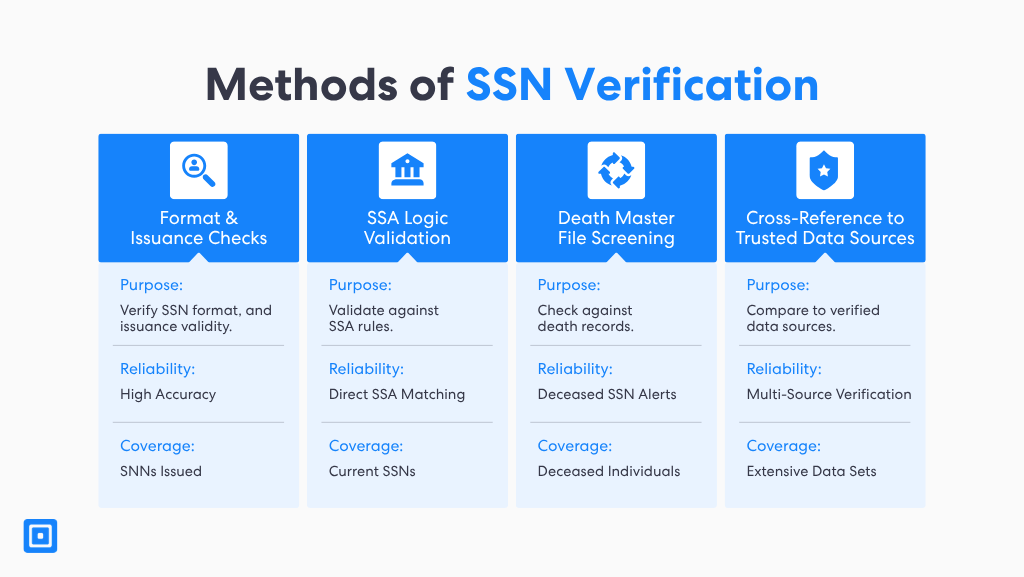
Moreover, this approach supports compliance with the [USA Patriot Act](https://www.fincen.gov/resources/statutes-and-regulations/usa-patriot-act), the [Bank Secrecy Act](https://www.occ.treas.gov/topics/supervision-and-examination/bsa/index-bsa.html), and additional guidance from the [Financial Crimes Enforcement Network (FinCEN)](https://www.fincen.gov). It also enables stronger risk assessment, fraud prevention, enhances security, and provides more accurate customer verification outcomes across regulated industries.
### Format and Issuance Checks
Firstly, SSN validation examines structural and historical correctness. The format can confirm whether an SSN follows the correct nine-digit pattern. It ensures that numbers fall within known issuance ranges based on geography and issuance date. Assessing these formatting details can flag obviously invalid SSNs before requiring even deeper levels of verification.
### SSA Logic Validation
Then, the next step is using logic validation to test against official rules set by the Social Security Administration (SSA). This includes confirming whether the number was ever issued, whether it has been marked as restricted, and whether it aligns with the customer’s personal details, such as the name and date of birth. In automated workflows, logic checks result in higher data accuracy and improved outcomes during compliance reviews.
### Death Master File Screening
Similarly, to guard against identity theft involving deceased individuals, many institutions screen SSNs against the SSA Death Master File (DMF). This database contains information on individuals reported as deceased and is a key control for detecting invalid or fraudulently used SSNs. Screening against the DMF ensures that the SSN provided is not associated with a deceased person. Incorporating this step into customer identification programs enhances trust and reduces compliance risks associated with onboarding fake or inactive profiles.
### Cross-Reference to Trusted Data Sources
Finally, cross-referencing SSNs against trusted data sources such as credit bureaus, utility records, and proprietary databases provides an additional layer of validation. These systems verify whether an SSN is correctly linked to consistent name, address, and date-of-birth records across institutions. Modern platforms may use AI-driven fraud detection and automated verification to assess behavioral patterns and flag inconsistencies in SSN usage.
By combining these four methods, financial institutions can meet the stringent requirements of [AML regulations](https://www.complycube.com/en/solutions/due-diligence-compliance/anti-money-laundering/). It can help prevent fraud, improve onboarding integrity, and prevent crime and suspicious patterns at the point of customer interaction. This layered approach helps ensure regulatory compliance with business transactions, improves data accuracy, and delivers a more secure and frictionless experience for customers navigating KYC processes in an increasingly digital world.
## SSN Data Accuracy and Customer Information Verification
When SSN records are clean and current, risk models tend to perform better. This allows investigations to focus on the highest-risk cases. Poor data accuracy only increases the risk of onboarding fake profiles. Missing key red flags in risk assessment workflows is absolutely necessary. Accurate SSN data ensures alignment with official records from the [Social Security Administration](https://www.ssa.gov) and helps avoid additional compliance risks.
In addition to confirming identity, high-quality SSN data helps institutions avoid onboarding fake profiles. Through verification, organizations can now better prevent identity fraud, false claims, and synthetic identities. With growing threats, verifying customer information with a social security number validator supports early detection. It also prevents escalation into full-scale financial crime investigations.
## How Social Security Number Validators Aid AML Compliance
Effective AML compliance begins with rigorous [identity verification](https://www.complycube.com/en/use-cases/process/identity-verification/). Financial institutions, fintech platforms, and other regulated entities must ensure that every customer or business partner is accurately identified before granting access to products or services. SSN validation plays a vital role in this process. In AML programs, social security number validators help detect synthetic identities, inconsistencies across records, and unusual profile changes. These markers may often indicate money laundering risk.
However, by validating against trusted government sources, such as the [Internal Revenue Service (IRS)](https://www.irs.gov) and the Social Security Administration (SSA), institutions can strengthen their regulatory compliance stance. This can also reduce exposure to fraudulent activity. These SSN checks flag suspicious activity early in the onboarding process. These are key requirements under the Bank Secrecy Act (BSA) and other similar AML regulations.
Therefore, AML-focused SSN validation ensures that firms operating across multiple jurisdictions can satisfy both domestic and international legal obligations efficiently. The Financial Crimes Enforcement Network (FinCEN) and other supervisory authorities demonstrate a proactive commitment to risk management, transparency, and data integrity. Ultimately, integrating SSN validation into a broader AML framework enhances due diligence, supports customer trust, and reinforces compliance readiness in an increasingly complex regulatory landscape.
### **Case Study: U.S Bank Uses Social Security Number Validator to Enhance Due Diligence**
U.S. Bank faced a rising number of synthetic identities entering its digital onboarding process. Without real-time [SSN verification](https://www.complycube.com/en/ssn-validation-check/), the bank suffered from manual errors, delayed escalations, and inconsistent outcomes across regional teams.
##### **Implementing Social Security Number Validators**
As a result, the bank used a social security number validator with its KYC processes and biometric verification system. SSNs were checked instantly for validity, duplication, and linkage to high-risk profiles or other regulated entities. Then, this triggered additional verification where needed.
##### **Outcomes**
- 38% reduction in fraud attempts using synthetic or invalid SSNs
- 22% improvement in customer verification time for digital applications
- Significant increase in regulatory reporting accuracy and wage reporting integrity
## Fraud Prevention Through Additional Verification Layers
[Fraud prevention](https://www.complycube.com/en/use-cases/process/fraud-prevention/) doesn’t stop at validating a single data point. Forward-thinking institutions now employ layered verification checks that combine multiple signals to build a complete picture of a customer’s identity. These elements work together to confirm that the individual’s Social Security Number (SSN) is valid, current, and legitimately associated with the person submitting it. Cross-referencing this data through background checks and trusted databases strengthens the accuracy and reliability of identity verification.
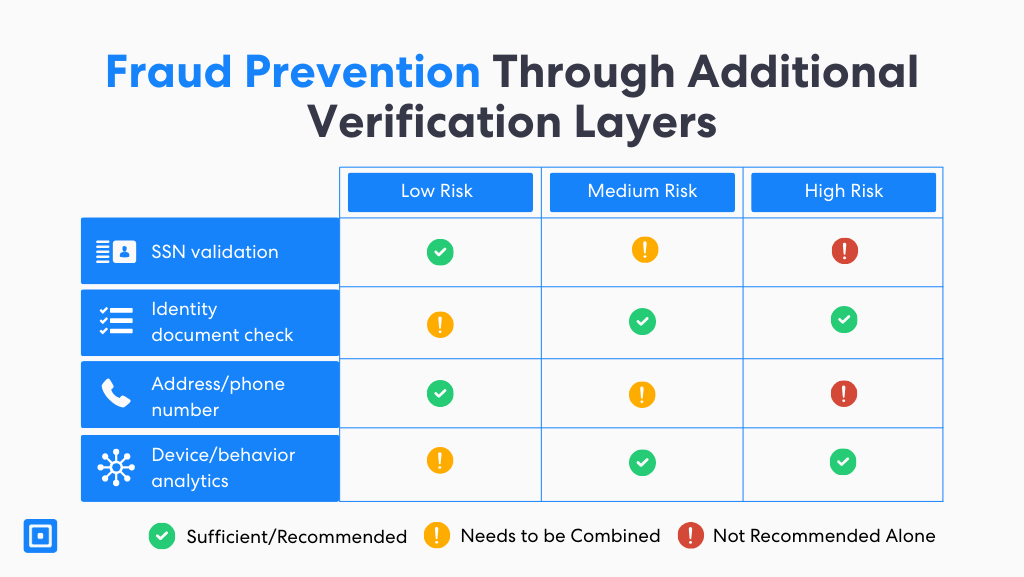
When an SSN or associated data point triggers a potential risk indicator, enhanced due diligence (EDD) workflows are activated. It examines the broader customer profile in greater detail. This multi-layered approach helps institutions uphold Know Your Customer (KYC) and Anti-Money Laundering (AML) requirements.
In general, multi-layered approaches actively protect against [terrorist financing](https://www.complycube.com/en/what-is-counter-terrorist-financing/) and reduce exposure to criminal activities across linked fraud networks. By integrating these verification safeguards, organizations can detect anomalies earlier, prevent systemic risks, and maintain trust and compliance in an increasingly complex regulatory landscape.
## Ensuring Compliance with Changing AML Regulations
Ensuring compliance means using tools such as a social security number validator to keep up with changing AML regulations. To remain audit-ready, firms must show proactive control over their verification stack. Having an up-to-date verification stack only enables faster updates to rules as regulations evolve.
Consequently, changing AML regulations apply to other regulated industries beyond banking. It covers fields such as real estate, crypto, and lending. AML regulations typically come into play where there is frequent onboarding of new customers. This is important as most of the time, there isn’t adequate identity verification, which opens the door to money laundering and other financial crimes.
## Digital Transformation of Identity Verification Standards
The rapid shift to online services has amplified the need for identity verification. Firms must ensure that this process is both thorough and frictionless. As customers expect seamless digital experiences, regulated institutions must balance convenience with security. They must ensure that compliance standards are never compromised.
In fact, technologies such as automated identity verification, [AI-driven risk scoring](https://www.complycube.com/en/solutions/due-diligence-compliance/risk-scoring/), and digital document analysis are now central to this effort. It enables organizations to detect anomalies and validate identities efficiently at scale.
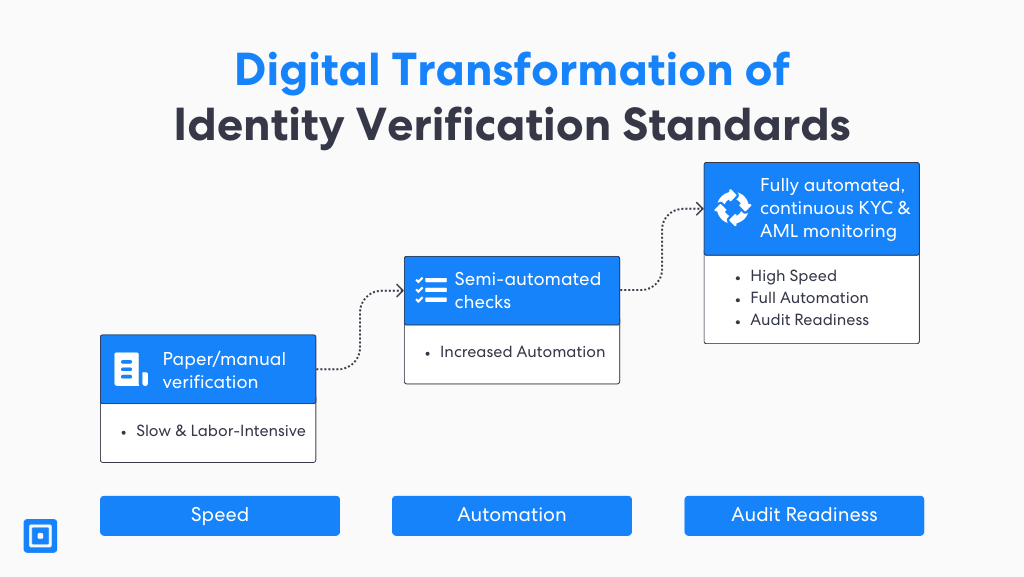
Within this evolving ecosystem, a Social Security Number (SSN) validator plays a critical role. SSN validation enables real-time identity checks, verifies data against trusted sources, and supports omni-channel onboarding flows with minimal user friction.
When integrated into broader compliance frameworks, SSN validation enhances data accuracy, improves risk modeling, and streamlines regulatory reporting. Ultimately, it helps institutions manage digital transformation responsibly. It is important to maintain compliance integrity while delivering seamless experiences that today’s users demand.
## Blockchain Technology and Future-Proof Identity Validation
Emerging technologies such as blockchain are introducing possibilities for creating secure, verifiable, and privacy-preserving digital identities. Institutions can issue credentials that are tamper-resistant and cryptographically authenticated, reducing reliance on centralized databases. When combined with artificial intelligence, these innovations pave the way for decentralized identity verification.
Furthermore, future-proofing identity verification allows organizations to perform real-time risk assessments without unnecessarily exposing sensitive personal identifiers. This approach aligns closely with global data privacy principles, improving both security and transparency across verification ecosystems. Despite these advancements, foundational identifiers such as the Social Security Number (SSN) remain critical for linking customers to existing financial and governmental systems.
So, until decentralized identity infrastructure achieves full interoperability, thorough [SSN validation](https://natlawreview.com/press-releases/complycube-expands-global-reach-eid-and-ssn-verification) continues to serve as a cornerstone of compliance and trust. Integrating SSN checks with electronic verification methods ensures data accuracy, supports regulatory reporting, and helps institutions. It manages the transition between traditional and emerging identity frameworks safely and effectively.
### Key Takeaways
- **Social security number validators** enhance trust and reduce fraud during onboarding.
- **KYC social security validation** is a regulatory expectation in the U.S.
- **AML social security validation** detects suspicious identity patterns.
- **Third-party SSN validation** avoids reliance on direct government APIs.
- **ComplyCube integrates SSN checks through social security number validators** into a layered identity workflow.
## ComplyCube’s Social Security Number Validator
To summarize, ComplyCube provides compliance trusted by regulated entities globally. It supports ID verification, customer analysis, and data validation using SSN verification programs. Stacking this on top of existing processes allows teams to meet KYC and AML compliance obligations. Ultimately, whether it be a bank, lender, or crypto firm, ComplyCube enables teams to prevent financial crime and reduce false positives, all in a single no-code workflow.
## Frequently Asked Questions
What is a social security number validator and why is it important?
A social security number validator is a tool that confirms whether a person’s SSN is valid, correctly formatted, and associated with their identity. It’s critical for verifying current or former employees, business directors, new users, etc.
How does SSN verification help with identity theft prevention?
By confirming that SSNs are not stolen, reused, or synthetic, SSN verification helps detect early signs of identity theft. It also supports accurate risk scoring and can trigger escalations in KYC processes, helping organizations stay compliant with data privacy laws on handling sensitive data.
Is SSN validation enough for AML compliance?
Validation is not enough on its own. AML compliance requires many data checkpoints, including document and biometric checks. However, SSN validation is a foundational step in building customer identification programs that satisfy U.S. legal and data privacy requirements.
What are common challenges in verifying social security numbers?
Today, the most common challenges in verifying social security numbers are outdated internal systems, manual errors, lack of access to official records, and inconsistent integration with other tools. Third-party electronic verification systems solve these gaps with real-time automation. They do this while maintaining compliance with relevant data privacy laws.
How does ComplyCube ensure AML and KYC compliance using SSN checks?
ComplyCube incorporates social security number validator technology within a no-code platform that ensures data accuracy, biometric authentication, and regulatory compliance. We help financial institutions scale securely while upholding AML standards and protecting customer data privacy.
[](https://www.complycube.com/en/contact/contact-sales/)
**Categories:** Guides
**Tags:** Know Your Customer
---
### [Enhance Health Insurance Fraud Detection for KYC and AML Compliance](https://www.complycube.com/health-insurance-fraud-detection-compliance/)
**Published:** February 5, 2026
**Author:** Dini Habib
**Excerpt:** Health insurance fraud is rife. It involves the illegal exploitation of the healthcare system by submitting fake or exaggerated claims. To combat this challenge, AI-powered health insurance fraud detection solutions are critical.
**Content:**
**TL;DR:** Fraud is a threat to the healthcare industry, jeopardizing patient safety and compliance with regulations. To combat this challenge, **health insurance fraud detection tools** are critical. Explore how advanced AI fraud detection in health claims and healthcare fraud prevention software can eliminate **fraud, waste, and abuse (FWA)** effectively in this guide.
## What is Healthcare Insurance Fraud?
Health insurance fraud is the illegal exploitation of the healthcare system by submitting false or inflated medical claims. For example, it includes falsifying records, over-billing, and dishonest health insurance claims using stolen identities for financial gain. The impact of insurance fraud is startling, with common examples including bribery and identity theft. Common fraud committed by policyholder includes:
- Submitting claims for medication that were not received.
- Falsifying customer information when buying a policy.
- Exaggerating or incorrectly diagnosing health issues.
- Bribing medical providers to provide a fake claim.
- Incorrect reporting of health issues or diagnosis.
- Committing identity theft through stolen ID to access medical services.
To mitigate the financial toll, insurance providers pass these losses on to policyholders through higher premiums. Consequently, trust is eroded for legitimate claims and patients who require medical care. According to the National Health Care Anti-Fraud Association (NHCAA), key statistics indicate that financial losses from health care fraud exceed billions of dollars each year.
To address this challenge, insurers must use effective tools for health insurance fraud detection. These tools help identify patterns of suspicious claims earlier in the process, safeguarding the financial integrity of patients, healthcare providers, and insurers. Additionally, cutting-edge solutions, such as AI fraud detection in health claims, enable rapid, accuratedetection of fake claims.
## Understanding Health Insurance Fraud Detection Solutions
Medical insurance fraud identification systems use Know Your Customer (KYC) and Anti-Money Laundering (AML) frameworks to block the use of stolen credentials and tampered documents before false claims are filed. By integrating artificial intelligence AI) and machine learning methods, these solutions flag high-risk suspicious patterns via real-time processing.
> It takes a [concerted team effort](https://www.nicb.org/prevent-fraud-theft) to fight back against insurance criminals
A robust KYC and AML program supports health insurance fraud detection more effectively while complying with global regulations, such as the EU’s 6th AML Directive (AMLD6). Additionally, modern healthcare fraud prevention software further supports compliance with data privacy laws, including the [Health Insurance Portability and Accountability Act of 1996 (HIPAA)](https://www.hhs.gov/hipaa/for-professionals/privacy/laws-regulations/index.html).
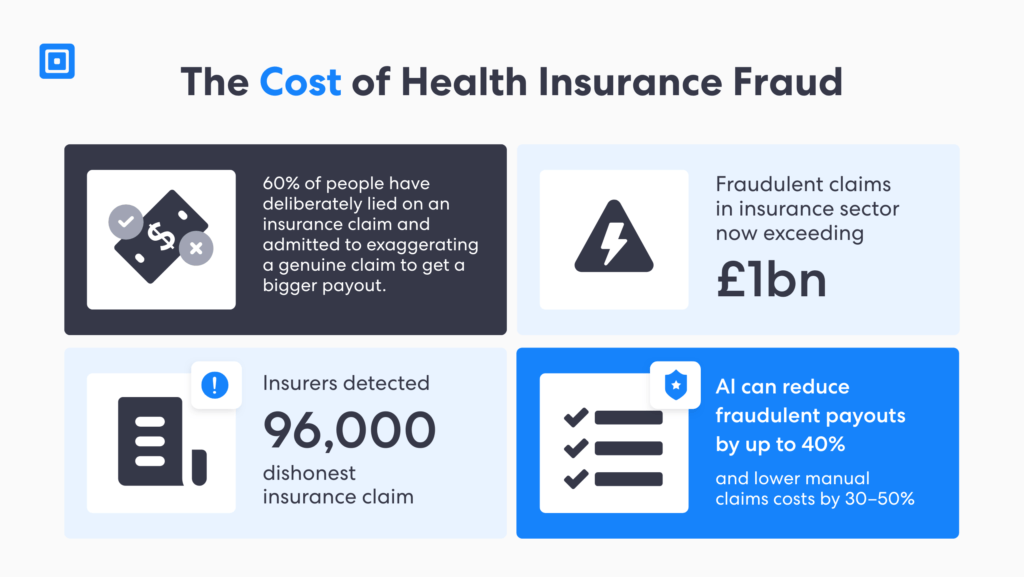
According to the National Insurance Crime Bureau (NICB), “It takes a concerted team effort to fight back against insurance criminals”. To that end, combining the resources and expertise of insurers and law enforcement agencies, fraud can be detected, deterred, and stopped.
## AI Fraud Prevention with AML and KYC in Health Claims
Insurers invest at least [£200 million each year](https://www.abi.org.uk/products-and-issues/topics-and-issues/fraud/) to prevent fraud. It is no news that fraud in the insurance industry is a serious crime. To combat it, modern regulatory technology software employs sophisticated fraud-identification models powered by AI and ML.
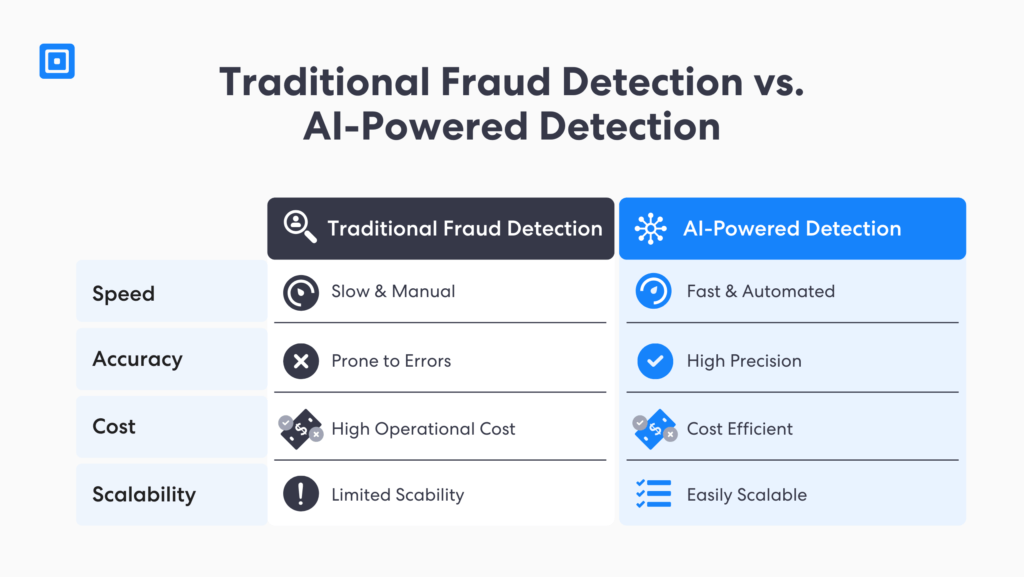
This software can analyze large amounts of data to detect anomalies and patterns missed by human oversight. According to reports, the AI market in Regtech is forecast to reach [$3.3 billion](https://www.industryarc.com/Report/17918/artificial-intelligence-market-in-regtech.html) by 2026, growing at a CAGR of 36.1% from 2021 to 2026. Thus, by applying AI fraud detection in health claims, insurers can:
1. **Identify Fraudulent Behaviors Faster:** AI-powered KYC software utilizes advanced data analytics and anomaly detection to sift through thousands of documents and biometrics in real-time. This enables insurers to block stolen credentials that enable claims fraud before medical records are tainted.
2. **Improve Fraud Detection Accuracy:** Unlike traditional fraud prevention in KYC insurance processes, AI-powered solutions deliver improved accuracy at an unprecedented rate. This enables reduced false positives and reliance on human effort, achieving significant cost savings in the long run.
3. **Enhance Predictive Analytics:** [AML screening](https://www.complycube.com/en/solutions/due-diligence-compliance/anti-money-laundering/) can improve risk scoring by analyzing new data, such as biometric data, against sanctions lists, watchlists, and adverse media coverage. High-risk entities flagged with risk triggers can undergo further investigations through automated Enhanced Due Diligence (EDD).
4. **Automate Manual Processes:** Insurers can streamline policyholder onboarding with real-time detection, enabling a shift away from manual identity verification. Companies in the insurance sector can maintain HIPAA audit-ready compliance, combating fraud schemes before patient records are compromised.
AI-driven [fraud intelligence solutions](https://www.complycube.com/en/solutions/fraud-intelligence/) enhance the efficiency of compliance teams by significantly speeding up verification without error, reducing fraud waste and abuse in insurance companies. It is an innovative solution that makes healthcare identity theft precise. You can learn more here: [Generative AI Fraud and Identity Verification](https://www.complycube.com/en/generative-ai-fraud-and-identity-verification/).
### **Case Study: Solidifying Leader Status in the Insurance Space**
Hayah is a UAE-based leading firm in insurance services, including health and life insurance solutions globally. The firm required software that could streamline its compliance obligations in the UAE and align with fraud prevention and AML laws while scaling the business.
##### **AI-Powered Automation Solution**
The company partnered with ComplyCube to scale its operations globally while maintaining secure policyholder onboarding. ComplyCube provides complete due diligence tools, screening clients against worldwide data in over 250 territories, providing strong regulatory adherence.
##### **Outcomes**
- Hayah was able to achieve quicker and precise onboarding of its policyholders, significantly lowering false positives and enhancing conversion.
- The firm was able to build a frictionless KYC policyholder process and meet both local and global KYC/AML regulations at the same time.
- ComplyCube’s AI-driven regulatory technology equipped Hayah’s compliance team with the confidence to verify customers securely, building trust at scale.
## Insurance Fraud Prevention Features to Prioritize
To complement AI-powered fraud prevention tools, a unified KYC and AML software is critical. Insurers can adopt a proactive approach in monitoring and reporting fraud across their operations. In addition, a complete KYC and AML platform helps insurance firms reduce compliance complexity and protect the bottom line more effectively. Here are key features of these platforms:
- **Real-Time Monitoring and Alerts:** Perform document and biometric verification and receive [instant alerts](https://www.complycube.com/en/solutions/global-screening/continuous-monitoring/) on high-risk entities tied to fraudulent activities. Insurers can expect to stop threats before they escalate to payouts.
- **Risk Profiling:** Develop dynamic risk scoring utilizing data from behavioral biometrics, device intelligence, and sanctions matches to assess fraud likelihood from suspicious patterns, including prior device abuse and hidden IP addresses.
- **Multi-Bureau Checks:** Seamlessly cross-reference customers to global fraud registries, trusted government agency databases, and watchlists to uncover schemes exploiting medical claims for improper payment payouts.
- **Robust Document Checks:** Leverage document verification that employs Natural Language Processing (NLP) to validate IDs and records for synthetic identities, tampering, and flagging deepfakes.
With these advanced capabilities, firms in the insurance industry can develop a unified, intelligence-driven defence. Insurers can expect greater policyholder trust, stronger compliance, and increased operational resilience. Co, businesses can scale and sustain long-term growth while reducing fraud, waste, and abuse. You can learn more here: [AML Guidelines for Insurance Companies.](https://www.complycube.com/en/aml-guidelines-for-insurance-companies/)
## The Importance of Detecting Fraud in Healthcare
Mastering fraud deterrence related to health care insurance provides multiple benefits. With trusted AML and KYC solutions, insurers can demonstrate high trust in patient care. Early detection helps identify suspicious patterns before they escalate into large-scale losses.
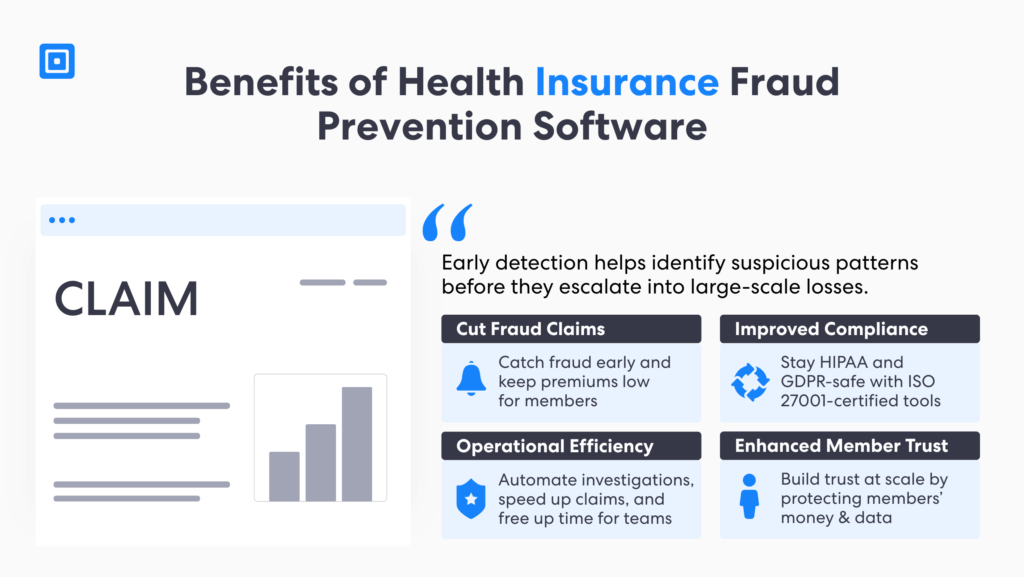
Moreover, effective health insurance fraud detection promotes transparency across health care networks. By combining AI-driven analytics with robust KYC and AML frameworks, insurers and healthcare providers can identify emerging schemes, streamline investigations, and safeguard the integrity of patient data. Ultimately, proactive fraud detection strengthens the sustainability of the healthcare system by ensuring fairness, accountability, and operational efficiency.
### 1. Reduced Fraud Claims
By identifying and preventing fraudulent claims at an earlier point of entry, insurers can save significant amounts of money and human resources. This not only improves the bottom line but also helps keep premiums affordable for members, safeguarding both the insurance and health care sectors.
### 2. Improved Compliance
Health care insurers are mandated to meet stringent regulations, including HIPAA and privacy laws. Fraud deterrence software supports these requirements through independent certifications. For example, ISO 27001 and EU GDPR certification enable compliance while protecting patients’ identities and personally identifiable information (PII).
### 3. Operational Efficiency
AI health insurance fraud detection software automates many of the processes involved in identifying and investigating fraudulent claims. This not only accelerates claims processing but also frees up resources for other important tasks while still adhering to regulations.
### 4. Enhanced Member Trust
Members rely on insurance firms to protect them from fraud. By investing in advanced fraud prevention measures, insurers demonstrate their commitment to safeguarding both their financial integrity and their members’ well-being. This helps build customer satisfaction and loyalty over the long-run.
### Key Takeaways
- **Insurance fraud related** to health care can include exaggerated claims, using fake IDs, and bribery to achieve financial gain.
- **Unified AML and KYC software** are essential in proactively identifying and mitigating fraud, reducing compliance complexity across operations.
- **Tools such as real-time** **monitoring** and dynamic risk profiling support insurers in early identification of high-risk individuals before fake claims escalate.
- **AI-driven health insurance fraud** detection solutions solidify identity assurance and prevent sophisticated fraud such as deepfakes and tampered ID.
- **Developing a proactive fraud prevention** framework is critical to build customer trust, safeguard the health care sector, and enhance regulatory confidence.
## Implement Health Insurance Fraud Detection Solutions Seamlessly
By integrating AI, KYC, and AML platform solutions, firms can supercharge health insurance fraud detection systems, supporting the prevention of claims fraud at an earlier stage. Insurers can reduce fraud, waste, and abuse, streamline operations, and enhance member trust, ultimately leading to a more secure and efficient healthcare system. Protect claims data and medical records before they are tainted by stolen IDs and credentials today. To learn more, [speak to a member](https://www.complycube.com/en/contact/contact-sales/) of the team today.
## Frequently Asked Questions
How can insurance companies identify fraud?
Firms in the insurance sector can identify and escalate fraudulent cases through features such as real-time monitoring, risk profiling, and document verification. Additionally, multi-bureau checks, sanctions, and watchlist screening against global registries enable flagging of suspicious activities early on.
What is the most common type of health/medical insurance fraud?
The most common type of health or medical insurance fraud includes claiming for services that are not rendered, inflating medical diagnoses, and upcoding for improper payouts. These activities drive up premiums to legitimate policyholders, delaying genuine care and eroding trust in the health care sector.
How does AI-driven AML and KYC software fight insurance fraud in health care?
Artificial intelligence enables insurers to detect identity theft, deepfakes, and tampered documents quickly and reliably. This enables any suspicious activities to be detected and investigated early on before actual payouts, reducing unnecessary procedures such as human oversight. Additionally, AI streamlines regulatory compliance, shifting from reactive to proactive threat prevention.
What are the benefits of utilizing health insurance fraud detection software?
Fraud prevention software enables insurers to reduce financial losses, streamline compliance requirements, and boost authentic claims processing. It supports frictionless onboarding of genuine policyholders, enhancing customer conversion and operational resilience.
Does ComplyCube offer AML/KYC solutions to the insurance industry?
Yes. ComplyCube provides award-winning KYC and AML tools customized to the insurance industry. Its ongoing monitoring, case management, and complete document verification solution supports companies in insurance to speed up policyholder onboarding while reducing false positives significantly.

**Categories:** Guides
**Tags:** Anti-Money Laundering
---
### [Integrating with a Liveness Detection SDK](https://www.complycube.com/integrating-with-a-liveness-detection-sdk/)
**Published:** July 24, 2024
**Author:** Andreea Balasa
**Excerpt:** A liveness detection SDK is a critical feature of modern client acquisition and IDV solutions. SDKs with Presentation Attack Detection are crucial for security. Learn more about liveness detection SDKs in this guide.
**Content:**
**TL;DR:** Liveness detection is a critical feature in identity verification. **Spoofing attacks** utilize increasingly sophisticated technologies to **bypass verification engines**. Thus, an equally sophisticated liveness detection SDK with **Presentation Attack Detection (PAD)** is critical. This guide explores what liveness detection is and the benefits of facial matching SDK.
## How Does Liveness Detection Work?
Liveness detection technology uses motion analysis and sophisticated algorithms to confirm that a user is physically present during biometric authentication or verification. These verification steps, known as liveness checks, confirm real human interaction. For instance, systems actively detect micro-movements, such as involuntary eye blinks and facial muscle twitches, to verify a live person.
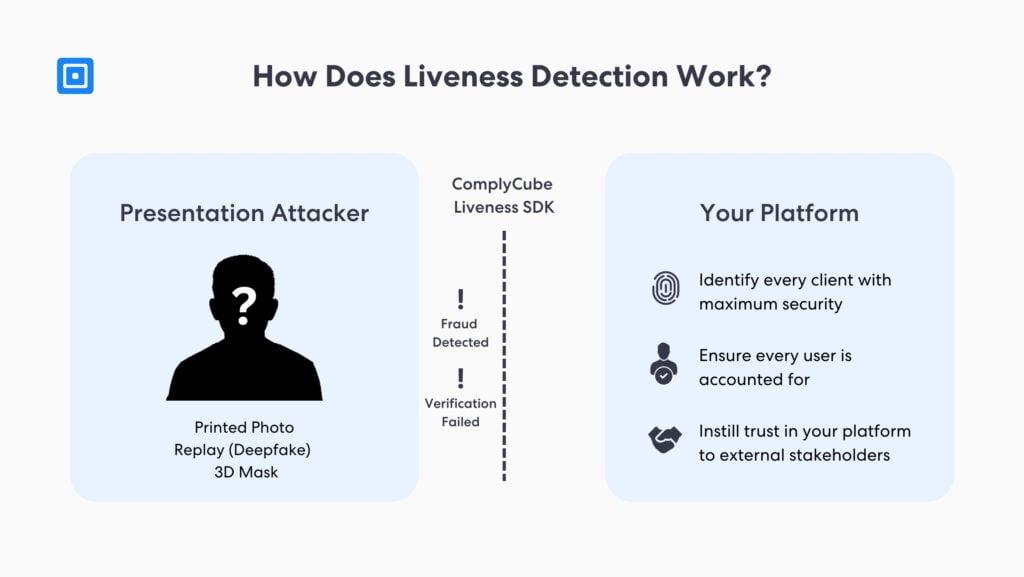
Liveness detection actively lowers privacy risk by capturing only genuine biometric data. Without a liveness detection feature, firms make it far too easy for individuals with malicious intent to bypass security systems using fake representation methods, such as a tampered biometric sample (a selfie).
## Types of Liveness Detection Systems
Liveness detection techniques divide into two main types, active versus passive liveness detection. The former uses live responses to on-screen prompts, including blinking and smiling. On the other hand, passive liveness authentication occurs in the background, using advanced algorithms to detect natural signs of life without requiring user interaction.
Each liveness method has different use cases. For example, active provides strong identity assurance, usually used for high-risk individuals or jurisdictions. However, companies actively use passive liveness detection if they prefer a frictionless, quicker IDV process for low-risk users.
## What is Presentation Attack Detection (PAD)?
[PAD](https://docs.complycube.com/documentation/checks/identity-check) is a crucial fraud prevention technology that plays a key role in biometric verification. Presentation Attack Detection technology helps identify and block fraudulent attempts to gain unauthorized access to a platform, product, or service.
To achieve this, advanced PAD technologies combine both passive liveness detection and active liveness detection to ensure a real person is completing the biometric verification process. Moreover, global regulatory authorities, such as the [Financial Action Task Force (FATF)](https://www.fatf-gafi.org/content/dam/fatf-gafi/guidance/Opportunities-Challenges-of-New-Technologies-for-AML-CFT.pdf.coredownload.pdf), encourage the use of liveness technology. This shift underscores the growing need to protect businesses and consumers from surges in fraudulent and spoofing attacks.
## Types of Presentation Attacks
As technology evolves, it has enabled new techniques of presentation attacks. However, some of these are only detectable through the most advanced identity verification solutions, embedded with liveness checks. Additionally, Artificial intelligence (AI) plays a crucial role in this process, continuously learning from large datasets to search emerging attack patterns and improve spoof detection mechanisms over time.
Modern solutions actively catch spoof artifacts. These spoof artifacts include artificial skin tones, inconsistent facial hair, and texture analysis of a user’s face, used to commit fraudulent attempts. For example, a common challenge-response method asks the user to blink or smile to confirm they are a live person and not a static image or mask.
### **Printed Photo Presentation Attacks**
These are among the simplest forms of spoofs. Without PAD technology, attackers can easily bypass facial recognition authentication processes by presenting printed identity documents or images of another person. This is why featuring a live upload during the biometric liveness detection process is critical to enhancing security.
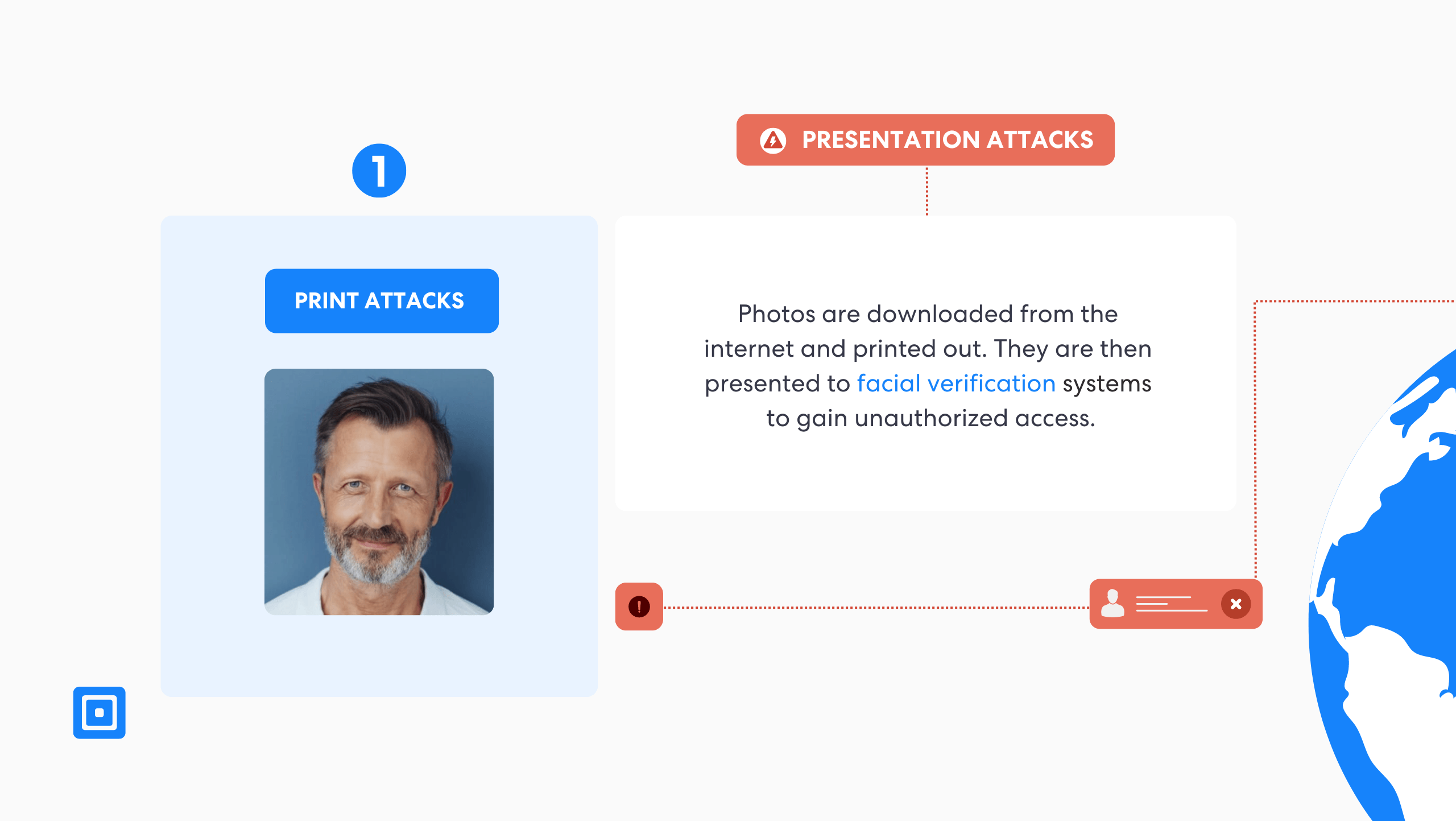
### **Replay Attempts and Deepfake Attacks**
Deepfake or replay attacks occur when the attacker plays a pre-recorded video or presents a digital image to the facial authentication system. Deepfakes are an advanced form of synthetic media used in presentation attacks. It is created by machine learning techniques, making it difficult to detect without advanced PAD methods.
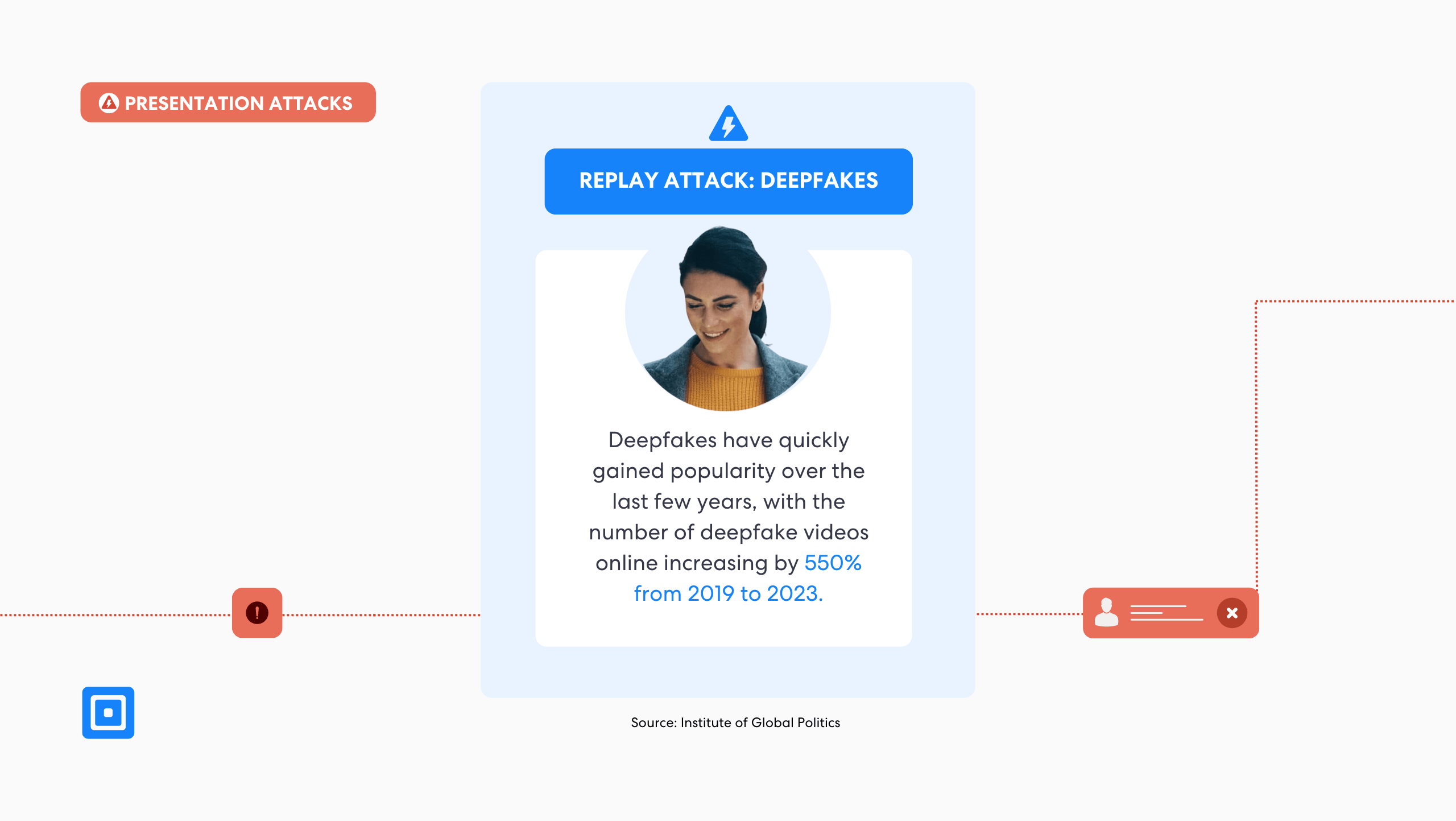
### **3D Mask Presentation Attacks**
These occur when fraudsters use a 3D mask with their target’s physical characteristics to deceive biometric systems. These masks are often made using a mold of their target’s face to replicate the facial biometric characteristics of the genuine user with high precision. Learn more about PAD by reading [Presentation Attack Detection: A Comprehensive Guide](https://www.complycube.com/en/presentation-attack-detection-a-comprehensive-guide/).
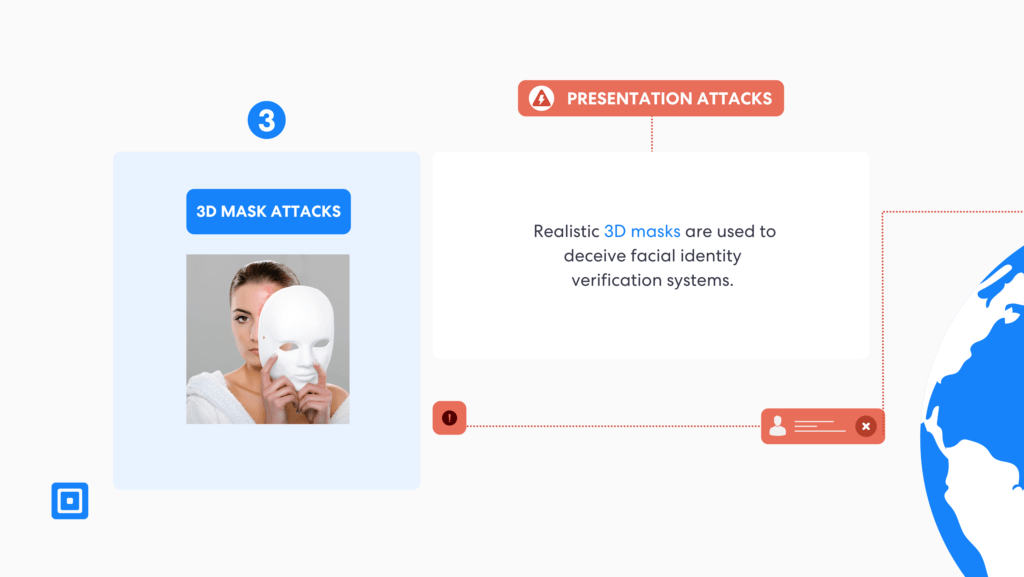
## Integrating with a Liveness Detection SDK
Software Developer Kits are building tools for developers, providing a specific utility to a particular system. SDKs are built to be easily integrated into existing software, making them flexible tools for developers. Most IDV SDKs will come with liveness detection algorithms already built in; if you are looking for a provider, make sure you know what the SDK you’re integrating with is capable of.
Additionally, many liveness detection SDKs process biometric data locally to enhance data privacy and security. Requiring multiple biometric inputs, such as facial recognition and fingerprint recognition, is one of the most secure ways to use biometric authentication, and some SDKs support these multiple modalities.
> [88% of all deepfake cases detected in 2023 were in the crypto sector](https://eftsure.com/statistics/deepfake-statistics/#:~:text=88%25%20of%20all%20deepfake%20cases,deepfake%20cases%20detected%20in%202023.).
This is an alarming figure, especially when considering many crypto exchanges do not feature a liveness detection solution during their KYC onboarding flow. However, crypto aside, the volume of deepfake and spoofed identities is increasing month on month. Tough KYC integrations are a must for protection from malicious individuals.
## Liveness Detection: Web and Mobile SDKs
Customizing a web or mobile SDK is key for firms that want to provide a seamless on-brand user experience. Developers can tailor each step of the verification process such as the introduction screen, document capture settings, and much more.
Developers can use this function to ensure that the liveness check integrates smoothly with the rest of the IDV flow, facilitating a seamless and user-friendly experience that guarantees a high-quality verification. Properly branded SDKs not only reinforce brand recognition but also build trust and confidence among users, a vital practice for robust modern customer acquisition strategies.
## Common Use Cases and Industries
Liveness technology is central to secure IDV and biometrics systems. It enables firms to determine whether they are onboarding a genuine user or an attacker attempting to deceive the system. Namely, regulated industries, such as financial institutions utilize it for secure online banking and remote onboarding. In addition, government agencies also utilize it to increase secure access to e-passport and digital services.
For digital-first companies, including e-commerce and crypto platforms, liveness biometric authentication to defend against other presentation attacks while maintaining a frictionless user journey. This solution validates the authorized user’s face in real-time, which strengthens anti-spoofing methods while enhancing customer satisfaction, security, and trust.
## ComplyCube Web SDK
ComplyCube’s web SDK is a user-experience-optimized (UX-optimized) interface that creates an easy-to-follow verification process. Integration involves two steps:
- Generating an SDK token to permit the sending of data securely to the ComplyCube platform via the SDK.
- Following this, the SDK is mounted into your platform’s code for seamless integration.
## ComplyCube Mobile SDK
The mobile SDK provides the most frictionless customer onboarding and authentication experience for users. With a smart, customizable UX in your platform’s app. Mobile SDKs grant several perks, such as:
- Intuitive UX
- PAD (level 2) liveness
- RFID authentication
- Automatic document and biometric capture
- Personalization and branding
- International reach
## ComplyCube’s IDV and Liveness Detection Solutions
ComplyCube’s industry-leading Identity Verification solutions with advanced liveness detection are PAD level 2 certified, making them amongst the most resistant to fraudulent attacks worldwide. Many firms around the world that have integrated their IDV and liveness detection SDK have experienced significantly reduced rates of fraud and reduced time and cost of onboarding new users.
A key nuance provided by the KYC provider is the customizability of their solutions. Once your platform has integrated with its technology, they are the market leader in providing tailored packages that accentuate your business’s development and scale at your demand.
### Key Takeaways
- **Liveness Detection SDK** enables the real-time detection of presentation attacks, enabling only genuine customers to pass verification.
- **Integrating facial matching SDKs** with simple APIs supports checks with complex user instructions required.
- **Active liveness detection** involves real user interaction, such as blinking, while passive liveness detection uses advanced technologies to analyze micro-expressions.
- **Presentation Attack Detection (PAD)** is the broader s ystem that identifies blocked and spoofed attempts using combined liveness and passive liveness checks.
- **ComplyCube’s liveness detection** SDK empowers businesses to scale biometric onboarding volume while maintaining high accuracy, security, and speed.
### Start a Conversation Today
ComplyCube empowers hundreds of organizations worldwide by catalyzing business growth through secure, seamless client-acquisition solutions. As a result, your team can focus on the initiatives that are most important to your business. If you’re looking for a robust anti-spoofing solution, get in touch with a ComplyCube specialist today.
## Frequently Asked Questions
What are examples of spoofing attacks in facial biometrics?
Spoofing attacks regarding facial biometrics refer to the act of using fake representations to bypass recognition controls. For example, it includes 3D masks (custom-printed faces), deepfake videos (generated by AI), print (high-resolution imitation photos), and replay attacks (pre-recorded videos that mimic real human motion).
What does liveness detection mean?
Liveness detection is a term used to check whether someone is a real living person and not a spoof. Modern liveness checks analyze biometric data, including real-time eye blinks and skin texture, to differentiate a real person from false or static images/videos.
What is face presentation attack detection (PAD)?
A face PAD is a broad system that can identify real-time attempts to spoof facial biometrics. A PAD-certified company uses advanced technologies to effectively detect synthetic faces, motion inconsistencies, and printouts.
How does AI prevent deepfakes?
AI-powered models enable the quick and precise detection of advanced deepfakes and synthetic media. Equipped with AI, deepfake detection is critical for biometric authentication and for securing systems against identity fraud. As criminals are constantly looking for ways to fool facial recognition technology, deepfake detection is vital to global security and safety.
Does ComplyCube provide liveness checks?
Yes, ComplyCube provides robust liveness checks within its unified AML and KYC platform. Its SDKs feature both passive and active ways to prevent sophisticated spoofing attacks. Additionally, the firm is PAD level 2-certified, providing end-to-end compliance to the highest global standards for IDV.
**Categories:** Guides
**Tags:** Identity Verification
---
### [Effective Use of Money Laundering Software for AML-Sensitive Firms](https://www.complycube.com/using-anti-money-laundering-software/)
**Published:** January 30, 2026
**Author:** Rithu Jagannath
**Excerpt:** Learn how money laundering software helps firms prevent financial crime with automated KYC, risk assessments, and real-time monitoring. Discover key benefits, including compliance, reduced risk, and scalability for AML-sensitive businesses.
**Content:**
**TL;DR: Money laundering software**, commonly referred as **Anti-Money Laundering software**, helps firms **stop financial crime**. By **verifying identities**, **Anti-Money Laundering solutions** strengthen compliance processes, **reduce operational risk**, and **stop illicit funds** from entering businesses.
## What is Money Laundering Software?
Money laundering software is technology designed to help businesses with compliance. It enables organizations to automate Know Your Customer (KYC) processes, manage risk assessments, and generate audit-ready reports. Modern Anti-Money Laundering (AML) software includes advanced capabilities, such as automated checks and real-time verification. AML checks and customer screening enhance detection and management of illicit financial activity.
At its core, AML compliance software replaces manual verification processes with intelligence-driven, automated workflows that operate continuously. As a result, customer onboarding and ongoing compliance remain accurate, efficient, and auditable. By automating repetitive verification tasks, firms can save time and internal resources while reducing human error.
## Why is Money Laundering a Critical Business Risk?
Financial crime has become more sophisticated than ever. Now, criminals are exploiting digital platforms and cross-border transactions to launder illicit funds. Combating money laundering is essential to stop criminal activity, including drug trafficking and other illicit activities. Firms without thorough [AML software](https://www.complycube.com/en/solutions/due-diligence-compliance/risk-scoring/) or Anti-Money Laundering efforts risk facilitating financial crime inadvertently.
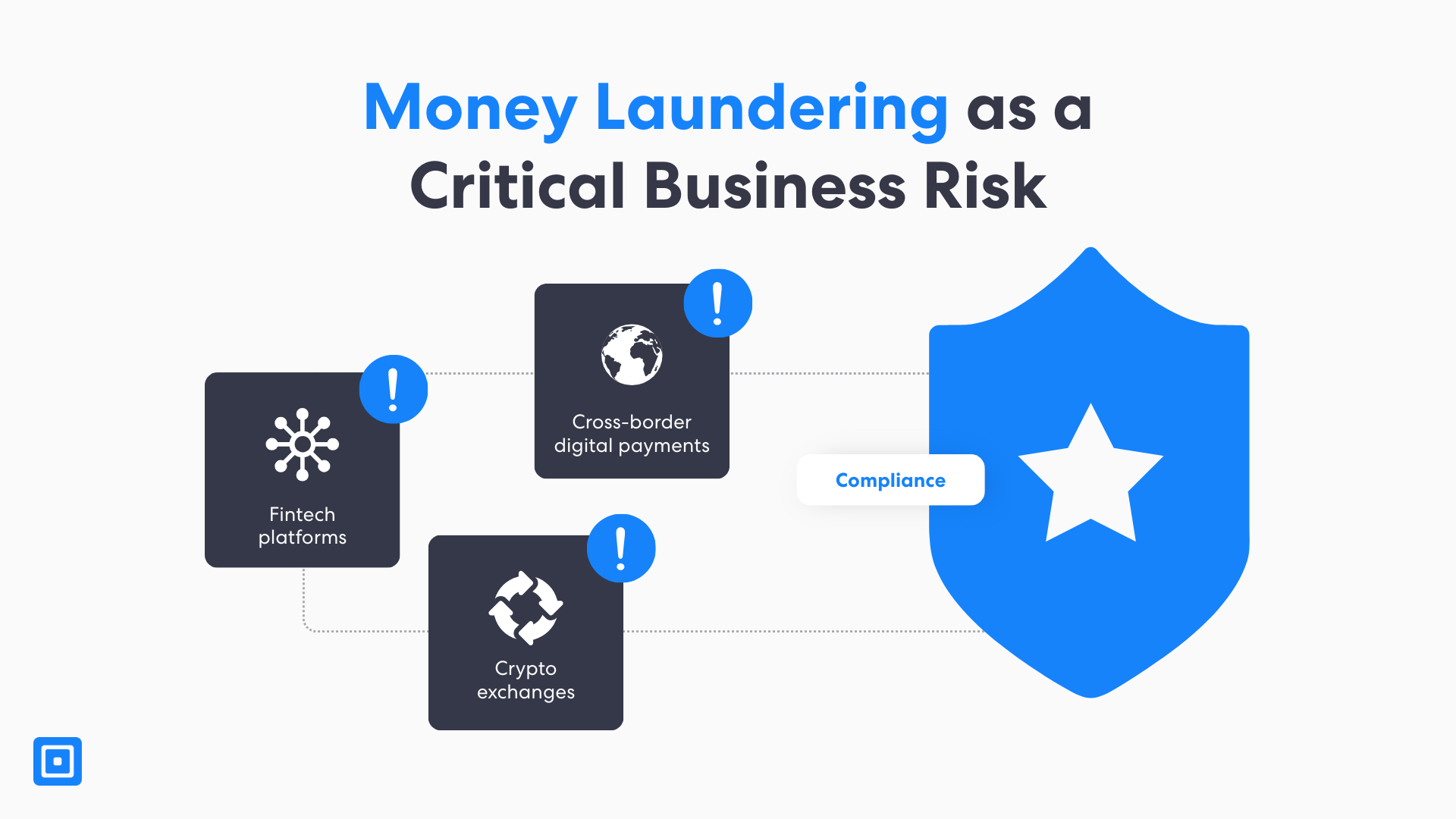
Regulators expect organisations to have proactive software controls. Therefore, they need to mitigate money laundering activities and risks. Failing to comply can lead to regulatory penalties, reputational damage, and operational restrictions. Accord to a study by the United Nations Office on Drugs and Crime (UNODC), financial institutions face risks from money laundering, [which can cost up to 5% of global GDP annually](https://www.unodc.org/unodc/en/money-laundering/overview.html).
Nevertheless, investing in identity verification and AML software helps firms address these risks. Setting aside budget for such processes also demonstrates compliance with regulatory obligations. This means that AML teams play a role in analyzing alerts and managing investigations to effectively manage risk and critical errors when it comes to financial crime.
## 2026 Risk Management Processes for AML Software
From late 2025 and early 2026, global Anti-Money Laundering (AML) enforcement intensified. Regulators such as the [Financial Conduct Authority](https://handbook.fca.org.uk/handbook/cob5/cob5s2?timeline=true&date=01-03-2006) (FCA) and [Financial Crimes Enforcement Network](https://www.datazoo.com/fincen-kyc-rule-changes-2025) (FinCEN), emphasised the importance of KYC, ongoing monitoring and screening processes. Now, authorities scrutinize whether firms have appropriate solutions aligned with risk-based expectations.
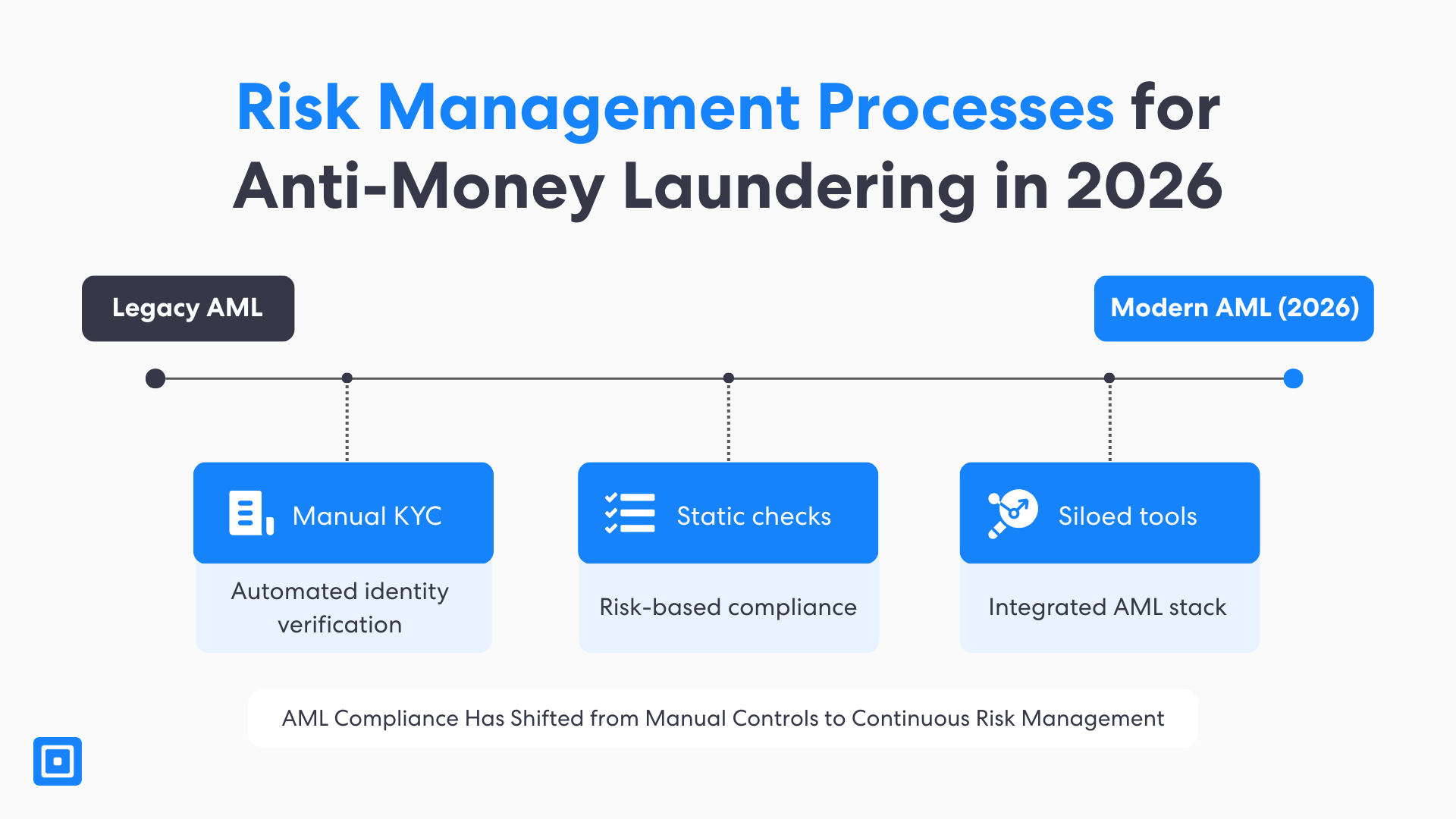
As regulatory changes accelerate, firms must adapt quickly and maintain processes. This is necessary for ongoing compliance and maintenance of their organization’s reputation. Therefore, AML regulators now expect an AML compliance solution program to be proportional, explainable and audit-ready as part of the process.
In essence, having the most robust AML software is considered a core compliance control. Firms need to maintain accurate records and verifiable compliance procedures. Regulators such as FinCEN and the FCA require robust, audit-ready monitoring systems for AML compliance.
### **Case Study: Coinbase Europe, Money Laundering Software & AML Enforcement Action**
In November 2025, the [Central Bank of Ireland](https://www.centralbank.ie/news/article/press-release-enforcement-action-against-coinbase-europe-limited-6-November-2025) fined Coinbase Europe €21.46 million for AML and counter-terrorist financing breaches. The firm’s let over 30 million transactions go unmonitored, thus creating major compliance gaps and delayed reporting of suspicious activity.
##### **System Overhaul and Retrospective Compliance Review**
Eventually, Coinbase Europe corrected the monitoring system errors and completed a retrospective review of unmonitored transactions. The firm also strengthened internal compliance controls and validation processes to prevent future regulatory lapses.
##### **Outcome**
- €21.46 million fine imposed after cooperation with the regulator.
- 30 million+ transactions, valued at €176 billion, were identified as unmonitored during the compliance gap.
- 2,708 late Suspicious Transaction Reports (STRs) were filed following retrospective monitoring.
## Who Needs Anti-Money Laundering Programs?
Any organization subject to financial crime risk benefits from AML solutions. This includes banks, fintechs, payment providers, crypto platforms, neobanks, marketplaces, and regulated professional service firms. Other financial institutions, such as credit unions and cryptocurrency exchanges, also require thorough AML solutions.
Even smaller organizations with digital or cross-border operations must implement KYC solutions to meet compliance requirements. AML software must remain flexible and scalable to accommodate diverse business models while maintaining regulatory compliance across jurisdictions. It should seamlessly integrate with existing systems, and strong vendor support is essential for ongoing compliance and system effectiveness.
## **Key Benefits of Money Laundering Software**
Effective money laundering software is necessary to prevent financial crime and maintain a strong compliance posture. Beyond meeting regulatory requirements, it enhances transparency, accuracy, and operational efficiency. Implementing this type of software allows compliance teams to automate critical processes such as;
- Customer due diligence
- Sanctions screening
- Risk-based asseessments
This automation reduces human error and helps organizations respond faster to suspicious activity or evolving regulatory demands. AML software helps organisations stay ahead of emerging threats. With powerful AI capabilities and real-time monitoring, businesses can detect suspicious activities early and reduce risks.
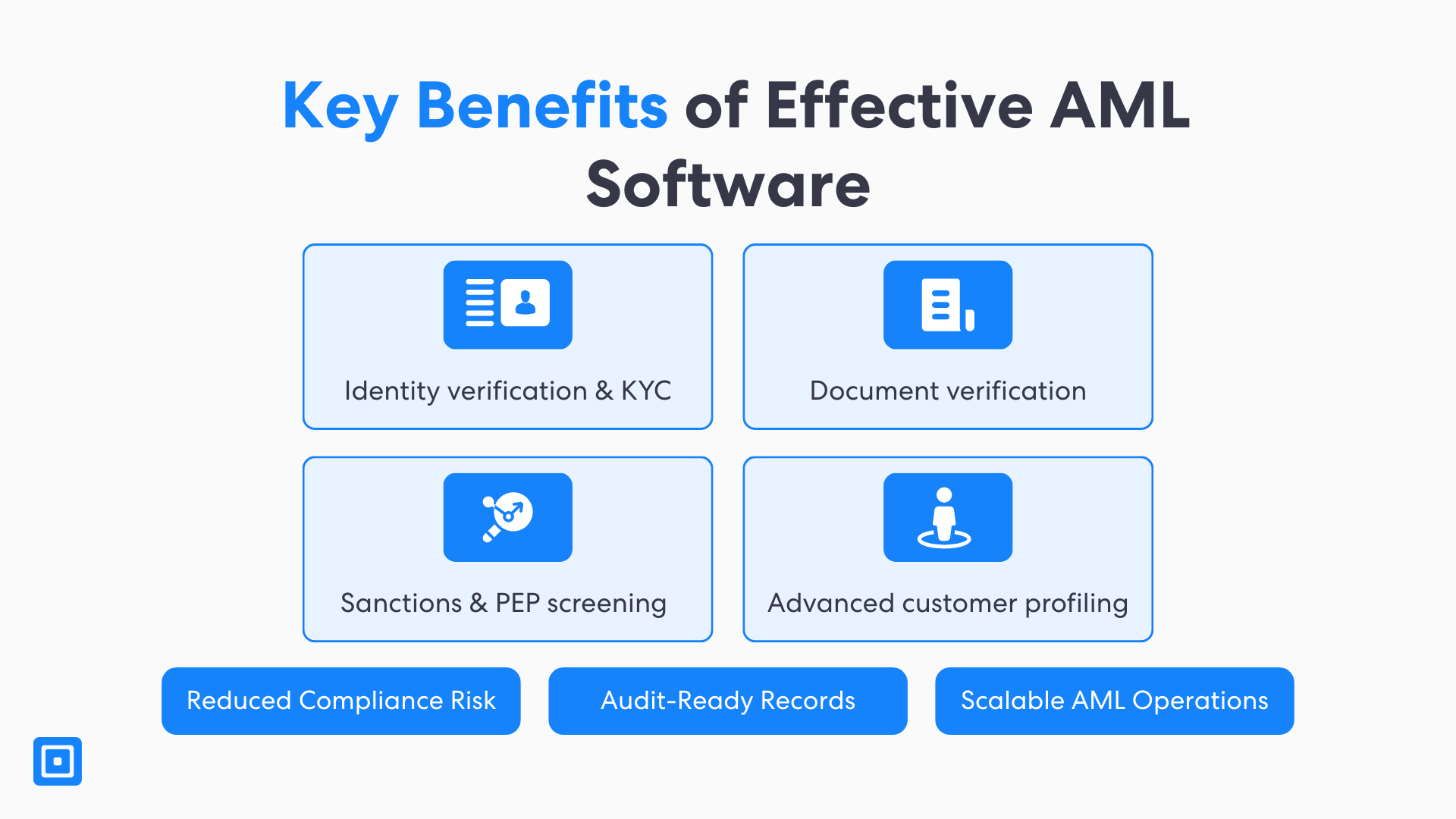
The benefits of implementing advanced money laundering solutions extend beyond compliance. These tools not only streamline workflows but also ensure scalability, enabling firms to grow while maintaining regulatory standards. By integrating seamlessly with existing systems, software with AML capabilities offer improved accuracy, reduced human error, and enhanced operational efficiency, making it a vital tool for AML-sensitive organisations worldwide.
### **1. **Customer Due Diligence (CDD), Enhanced Due Diligence (EDD) & KYC Verification****
[CDD and EDD](https://www.complycube.com/en/solutions/due-diligence-compliance/customer-due-diligence/) is the foundation of any risk management software and compliance tools. This is especially true when it comes to Anti-Money Laundering and economic crime. That is why ComplyCube’s KYC and identity verification tools allow firms to verify new customers quickly and accurately, reducing onboarding friction while ensuring regulatory compliance.
These solutions use a combination of government ID verification, document checks, and biometric validation to confirm that the person or entity is who they claim to be. By automating these processes, firms can maintain audit-ready records, demonstrate compliance to regulators, and significantly reduce human error.
- Faster onboarding while meeting compliance requirements
- Consistent identity verification for all customers
- Reduced risk of onboarding fraudulent or high-risk clients
### ****2. Sanctions, PEP & Adverse Media Screening****
Screening customers against [global sanctions lists, politically exposed persons (PEPs)](https://www.complycube.com/en/solutions/global-screening/sanctions-pep-screening/), and [adverse media databases](https://www.complycube.com/en/solutions/global-screening/adverse-media-checks/) is essential for risk-based AML compliance. ComplyCube’s screening solutions automatically check customers and entities against continuously updated global watchlists, ensuring that high-risk individuals or organizations are flagged immediately.
Automation of solutions allow firms to maintain consistent compliance without manually cross-referencing multiple databases. This continuous verification reduces regulatory risk and ensures that only verified, low-risk customers are approved for services.
- Reduced regulatory and reputational risks
- Continuous and automated monitoring of sanctions, PEPs, and adverse media
- Instant alerts for potential high-risk individuals or entities
### ****3. Document Verification & Advanced Identity Checks****
Beyond basic KYC, firms and organisations need to ensure that supporting documents are authentic and valid. ComplyCube’s [document verification](https://www.complycube.com/en/solutions/identity-assurance/document-verification/) solutions analyze government-issued IDs, passports, utility bills, and other relevant documents. Organizations can now confirm authenticity and detect potential tampering or forgery.
This feature capability is particularly important for firms onboarding high-risk clients or operating in regions with elevated fraud risk. With ComplyCube’s features, teams can mark certain countries as high/medium/low risk as well. Automated document verification simplifies workflows, shows audit-ready evidence, and improves overall compliance effectiveness.
- High confidence in customer identity and documentation
- Reduced onboarding times with automated verification
- Enhanced fraud prevention and compliance reporting
## Risk-Based AML Programs Explained
Risk-based software focus compliance efforts where risk exposure is at its highest. Essential features of such softwares include helping assign risk scores to customers. This can vary based on jurisdiction, identity attributes, and sanctions status. It is essential to align risk assessments from AML software with the organization’s specific risk tolerances.
Low-risk customers require minimal intervention, while high-risk profiles receive enhanced verification. This ensures proportional allocation of compliance resources. A risk-based approach allows firms to scale efficiently while maintaining regulatory effectiveness. The adoption of AML tools and software should be included in a broader AML compliance framework and executed as part of a [risk-based approach](https://www.complycube.com/en/what-is-a-risk-based-approach/) tailored to the specific requirements of a financial institution.
## Entity Resolution and Payment Screening
Entity resolution and payment screening are essential pillars of any thorough anti money laundering (AML) compliance program. For financial institutions, accurately identifying and verifying all parties involved in financial transactions is critical to preventing money laundering and meeting AML regulations. The real-time, high volume nature of payments means processors must use advanced analytics and machine learning to detect risk accurately and reduce false positives.
Such anti money laundering solutions need to match and consolidate customer, vendor, and counterparty records, eliminating duplicates and ensuring that each transaction is linked to the correct entity. This process not only enhances data quality but also strengthens risk management processes by providing a clear, unified view of customer relationships.
Meanwhile, payment screening involves the real-time analysis of transactions to detect suspicious activity. It keeps track of attempts to circumvent sanctions or engage in financing crime. AML compliance software with integrated screening allows organizations can monitor transactions as they occur, flagging potential risks for further investigation.
[The use of machine learning](https://www.complycube.com/en/deepfake-detection-software-preventing-fraudulent-content/) helps reduce false positives, allowing compliance teams to focus on genuine threats and improve operational efficiency. Seamlessly combining these two processes within an AML solution empowers financial institutions to more effectively combat money laundering, maintain compliance, and optimize their overall AML process.
## Using AI and Machine Learning in Money Laundering Software
AI-enabled AML solutions analyse identity and risk data to identify potential high-risk customers. AI capabilities automate verification processes. It leverages artificial intelligence to optimize efficacy in detecting suspicious activity. This reduces errors and improves compliance efficiency. Modern AML tools use AI and machine learning to identify complex patterns that rule-based systems might miss.
> “Effective AML software transforms compliance from a reactive obligation into a proactive risk management function.
“Effective AML software transforms compliance from a reactive to a proactive risk management function. When AML systems are built around real customer profiles, firms gain both regulatory confidence and operational efficiency.” says Harry Varatharasan, Chief Product Officer of ComplyCube. AI driven solutions identify patterns that rule-based systems might miss. Automation streamlines repetitive verification tasks, and ensures consistent application of compliance policies.
## Suspicious Activity Reporting and Reducing False Positives
[Suspicious Activity Reporting (SAR)](https://www.complycube.com/en/achieving-compliance-uk-aml-regulation/) is a cornerstone of effective AML compliance. It requires financial institutions to promptly identify and report transactions that may indicate financial crime from criminals or politically exposed persons. Modern AML software streamlines the SAR process by automatically flagging unusual transaction patterns or suspicious behavior.
SAR enables compliance teams to investigate and document findings efficiently. By leveraging AI, these solutions can analyze vast amounts of data. The best AML software does a good job of recognizing emerging threats, and reducing the risk of human error in the compliance reporting process. Compliance with regulations such as the Bank Secrecy Act hinges on timely and accurate reporting.
AML software facilitates the generation and submission of SARs. It also ensures that institutions maintain comprehensive audit trails and meet evolving regulatory standards. Effective SAR processes help financial institutions protect their reputation. SARs uphold the integrity of the financial services industry. By integrating advanced tools into their AML compliance operations, organizations can maintain compliance and strengthen their efforts.
## Money Laundering Software Implementation Pitfalls
Often, firms underestimate the importance of building AML solutions properly. Poor integration can lead to gaps. Choosing the right anti money laundering solution has significant consequences. False positives or negatives can cause problems for both the financial institution and the individuals involved.
Lack of staff training and unclear process ownership can reduce system effectiveness and compliance reliability over time. Addressing these pitfalls proactively is critical for sustainable and effective AML programmes. Additionally, the solution should be regularly updated and maintained to ensure it operates at peak performance. You can learn more here: [5 Critical Errors to Dodge in AML Software Implementation](https://www.complycube.com/en/aml-software-implementation-mistakes/).
### Key Takeaways
- **Money laundering software** is essential for verifying identities and screening.
- **Risk-based AML programs** focus compliance resources on high-risk profiles.
- **Automation and AI** improve verification accuracy and efficiency.
- **Continuous proactive AML compliance** is expected by regulators.
- **Scalable AML solutions** support growth while maintaining regulatory standards.
## ComplyCube’s Money Laundering Software
In summary, preventing economic crime requires more than policies. It requires intelligent, scalable technology that verifies identities, screens and supports ongoing compliance. Organisations that implement modern AML software are better equipped to reduce regulatory risk. If your organisation or AML team wants to enhance its framework with a seamless integration, ComplyCube’s team can help. Reach out and get in touch to discuss how anti money laundering solutions can support your organisations overall compliance strategy and growth.
## Frequently Asked Questions
What is money laundering software and how does it work?
Money laundering software (also known as Anti-Money Laundering or AML software) automates compliance processes. It verifies customer identities, screening for sanctions and politically exposed persons (PEPs), and monitoring transactions for suspicious activity. This software helps businesses comply with AML regulations and reduces the risk of financial crime by detecting illicit transactions in real time.
How does money laundering software help businesses meet regulatory requirements?
Money laundering software ensures compliance with global AML regulations by automating identity verification, transaction monitoring, and suspicious activity reporting (SAR). It supports regulatory bodies such as FinCEN (US), FCA (UK), and the European Union’s AML directives, helping businesses maintain accurate, auditable compliance records.
What are the key benefits of using money laundering software for financial institutions?
Key benefits of AML programs or money laundering software include automated compliance with KYC, AML, and sanctions screening, improved risk management through real-time alerts for suspicious transactions and audit-ready reports that simplify regulatory reporting and reduce penalties.
How can money laundering software help fintechs and cryptocurrency platforms?
Money laundering software enables fintechs and crypto platforms to onboard customers quickly while ensuring they meet KYC and AML requirements. It automates verification, transaction monitoring, and risk assessments, ensuring compliance without disrupting the customer experience.
How does ComplyCube’s money laundering software help firms prevent financial fraud?
ComplyCube’s money laundering software helps firms prevent financial fraud by automating identity verification, KYC checks, and sanctions screening within a single compliance workflow. Organizations can detect high-risk customers earlier, reduce false positives, and maintain consistent AML compliance across jurisdictions.
[](https://www.complycube.com/en/contact/contact-sales/)
**Categories:** Guides
**Tags:** Anti-Money Laundering
---
### [SFC Crypto Legislation Target KYC in Hong Kong Regulation](https://www.complycube.com/sfc-crypto-kyc-legislation-hong-kong/)
**Published:** August 29, 2024
**Author:** Andreea Balasa
**Excerpt:** Hong Kong's crypto regulations emphasize client safety and highlight KYC processes as key market vulnerabilities. These SFC updates focus on improving these areas and aim to help facilitate crypto license applications.
**Content:**
New Hong Kong crypto regulations have highlighted client safety and Know Your Customer (KYC) processes as key vulnerabilities in the region’s crypto sector. These updated SFC crypto regulations aim to help deliver more licenses to crypto exchanges by the end of 2024. However, the region’s crypto KYC and general regulatory framework have often been cited as complex to navigate.
Platforms that are unable to negotiate these regulations and fix compliance deficiencies may find their provisional crypto licenses voided. This guide digests what is expected of crypto exchanges in Hong Kong in order to qualify for an SFC license.
## SFC Crypto Landscape
Under the Securities and Futures Commission (SFC), Hong Kong has implemented a robust regulatory framework for the region’s crypto assets industry. These regulations, which were majorly upgraded in June 2023, focus on user safety through enhanced custody arrangements and tightened KYC programs.
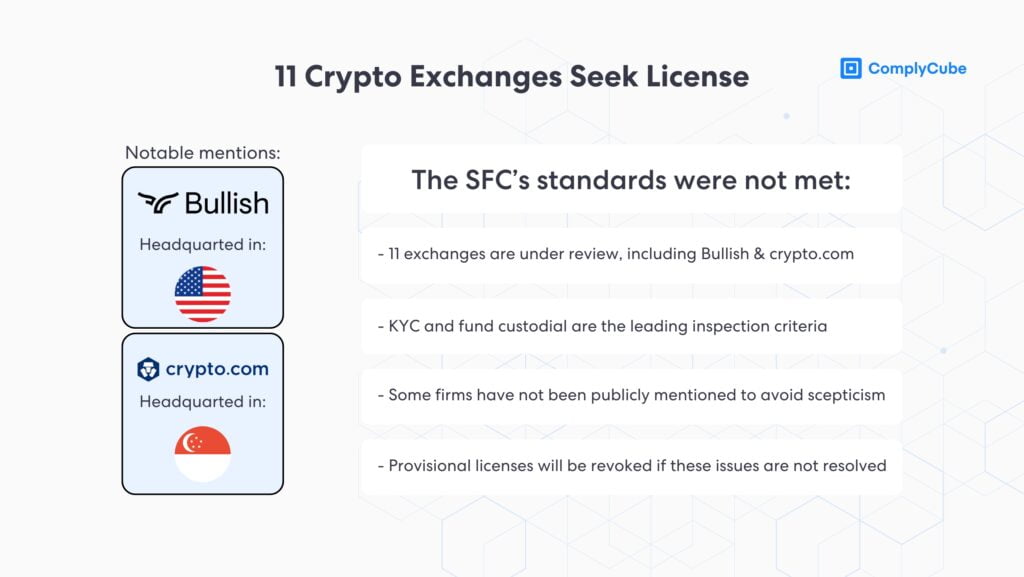
Only two exchanges, HashKey and OSL, have obtained a full license from the SFC, evidencing the challenges that firms face in meeting the region’s crypto regulations. Currently, [11 exchanges are under review](http://www.financemagnates.com/cryptocurrency/hong-kongs-crypto-licensing-faces-hurdles-as-11-exchanges-under-review/) for a full Virtual Asset Trading Platform (VATP) license.
These crypto firms are not allowed to onboard new clients until they are fully compliant with the region’s legislation and have obtained this license. The SFC CEO, Julia Leung, expects to issue licenses to all firms that are 100% compliant by the end of the year.
## Hong Kong Crypto Regulations: The Licensing Regime
Following the Hong Kong Monetary Authority (HKMA) and SFC’s updated legislation in 2023, there have been renewed initiatives focusing primarily on two agendas:
- How crypto exchanges onboard new clients via their KYC process.
- How Virtual Asset Trading Platforms safeguard client funds via their custodial services.
## Safeguarding Client Assets
Recent VATP inspections revealed significant concerns and vulnerabilities in the reliance on a limited number of executives for asset custody, which poses substantial risks to the security and integrity of client funds.
Exchanges operating within the region must implement robust measures to protect these assets and address any vulnerabilities that could expose them to cybercrime or other forms of financial misconduct.
The SFC has made clear that VATPs will have their licenses revoked or denied if substantial security systems and processes are not put in place before the end of 2024. Hong Kong regulators’ demands demonstrate their approach to leaving no regulatory stone unturned to stabilize the region’s industry.
## Crypto KYC in the Virtual Assets Industry
Adopting a sufficient KYC strategy has proved challenging for many exchanges operating in Hong Kong, leading some firms to withdraw from obtaining a license for the region at all. Further clarification of crypto KYC regulations evidences how important a robust Anti-Money Laundering and Know-Your-Customer strategy is in the industry.
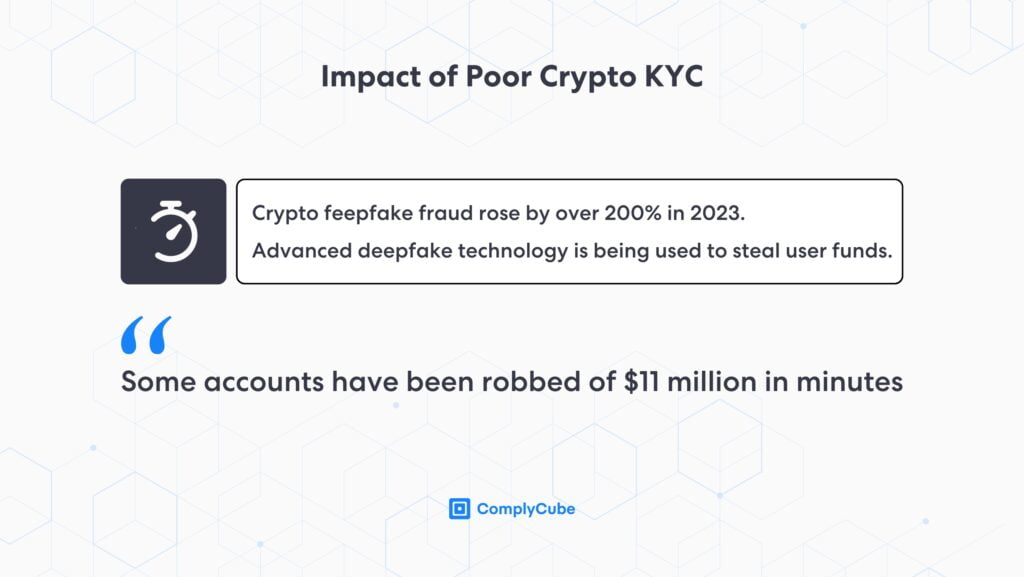
Both HashKey and OSL demonstrate very strong customer onboarding and compliance strategies, contributing to their success in obtaining operation licenses. [HashKey’s onboarding process](https://support.hashkey.com/hc/en-gb/articles/20694981089817-How-to-perform-individual-KYC-verification) involves robust KYC processes, including Identity Verification (IDV), financial information, various Virtual Asset (VA) knowledge tests, and bank account verification.
Users are also monitored around the clock to ensure their personal or domestic circumstances have not changed or been compromised. An all-in-one compliance solution, such as ComplyCube, easily overcomes all of these challenges.
For more information on Hong Kong crypto regulations, including a comprehensive overview of the related legislation, including the Counter-Terrorist Financing Ordinance (AMLO) and other key regulatory bodies, read [Hong Kong Crypto Regulation in 2024](https://www.complycube.com/en/hong-kong-crypto-regulation-in-2024/).
## ComplyCube’s Crypto KYC Solution
Complying with the Hong Kong government and its crypto regulations is challenging without the right compliance partner. However, while challenging to comply with, regulators have created these rules and regulations for good reason.
Multiple significant regulatory bodies worldwide, including the Financial Action Task Force (FATF), Financial Crimes Enforcement Network (FinCEN), and the Basel Committee on Banking Supervision (BCBS), endorse automated technology to achieve compliance and safeguard the financial and digital assets markets.

These compliance technologies are advocated due to their resilience against innovative fraudulent methods. The crypto market has experienced the highest rate of fraudulent attacks, particularly deepfakes. For more information on this, read [Why Identity Verification AI is crucial](https://www.complycube.com/en/why-identity-verification-ai-is-crucial/).
ComplyCube already supplies a range of solutions to Virtual Asset Service Providers (VASPs) around the globe, the types of AML and KYC solutions that help achieve compliance with the SFC. All VASPs or financial institutions with VA dealing services require:
- Robust Identity Verification, including document and biometric verification.
- Customer Due Diligence (CDD), including a host of AML checks.
- Ongoing monitoring to ensure client circumstances remain constant.
- Transaction screening and monitoring.
- VASP analysis.
## Comply With Hong Kong Crypto Regulations
The compliance leader’s [crypto KYC solution](https://www.complycube.com/en/use-cases/industry/crypto/trust-node-level-1-crypto-kyc/) is rated 10/10 on TrustRadius, with one VASP in particular noting its enhanced security and analytics features which simplified and enabled its international expansion.
> [Enhanced security for trader onboarding](https://www.trustradius.com/reviews/complycube-2024-05-09-04-16-28), advanced analytics, and great support.
Such a remark reflects their triumph at providing a market-leading service that is a far broader service than just a vehicle for achieving compliance. If your VASP, fintech, or related firm requires precision onboarding and compliance solutions, [get in touch with a ComplyCube specialist to learn more](https://www.complycube.com/en/contact/contact-sales/).
**Categories:** Guides
**Tags:** Crypto Regulations
---
### [Simplify AML With No-Code Compliance Workflow Software](https://www.complycube.com/aml-with-no-code-compliance-workflow-software/)
**Published:** January 7, 2026
**Author:** Dini Habib
**Excerpt:** Low-code or no-code compliance workflow software utilizes visual drag-and-drop interfaces, eliminating the need for custom coding. Compliance teams can adopt stronger governance, agility, and scale rapidly with no-code software.
**Content:**
**TL;DR:** As regulations evolve, businesses must implement robust compliance programs without slowing operational growth. As such, banking **AML compliance workflow software** is becoming essential, enabling firms to stay compliant while maintaining agility. This guide explores how **no-code** **workflows** help reshape and modernize compliance for today’s teams.
## What is Low/No-Code Compliance Workflow Software?
Unlike legacy systems, low or no-code compliance workflow software works by using visual drag-and-drop interfaces instead of custom coding. Compliance professionals can efficiently adapt regulations by layering the relevant checks without requiring advanced coding knowledge. As such, compliance teams remain more agile in responding to changing regulatory requirements.
> Staying current with regulatory changes is a near-constant responsibility for compliance professionals.
According to Thomson Reuters, senior management is faced with the responsibility of paying closer attention to every aspect of compliance. This is because regulatory authorities are demanding more data, reporting, and transparency as quickly as possible, or even in real time. With no-code automated workflows, regulatory demands can be iterated rapidly without dependency on IT teams.
## The Operational Challenge Facing Modern Compliance Teams
Legacy Anti-Money Laundering (AML) and Know Your Customer (KYC) software are constrained by manual processes, which restricts operational flow between product, engineering, and risk management teams. Additionally, manual tasks in code-driven compliance models include embedding compliance logic directly into application code, thus making changing regulations costly and complex to implement.
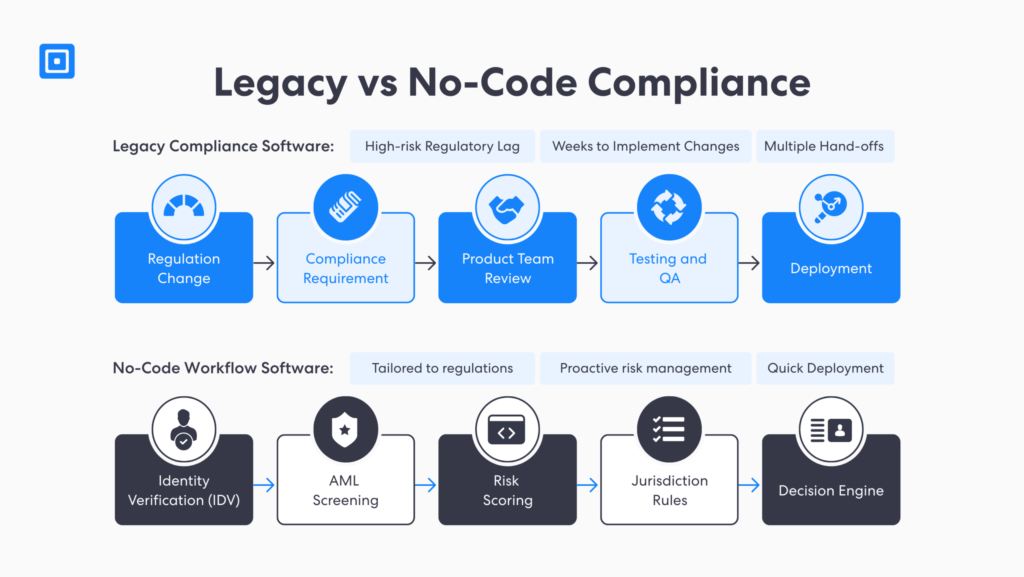
This challenge becomes more complicated as business operations grow across different jurisdictions. Each country operates on varying regulatory reporting, customer due diligence procedures, and audit protocols. Updating one workflow can take several weeks of developing, testing, and deployment. Therefore, businesses are forced to operate reactively rather than proactively in risk assessment. No-code compliance workflow software addresses this challenge by separating compliance logic from application code.
## Applying No-Code Workflows Across KYC and AML Compliance Programs
Effective KYC and AML compliance programs are essential for combating money laundering, terrorist financing, and other financial crimes. Regulations such as the US Bank Secrecy Act (BSA) and the [EU’s 6th Anti-Money Laundering Directive (6EUAMLD)](https://eucrim.eu/news/new-anti-money-laundering-directive-amld-6/) require firms to maintain high standards in AML and KYC procedures throughout the customer lifecycle. Entities must apply [strong customer due diligence](https://eucrim.eu/news/new-anti-money-laundering-directive-amld-6/) measures, including identifying and verifying customers and beneficial owners, and conduct ongoing monitoring of the business relationship.
> No-code orchestration is most effective when applied across the entire KYC lifecycle.
As such, no-code workflows are most effective when applied from the initial onboarding stage through to customer retention. For example, low-risk customers can go through standard customer due diligence with minimal friction through document verification. According to Harry V, Chief Product Officer at ComplyCube, “No-code orchestration is most effective when applied across the entire KYC lifecycle, rather than isolated onboarding steps”.
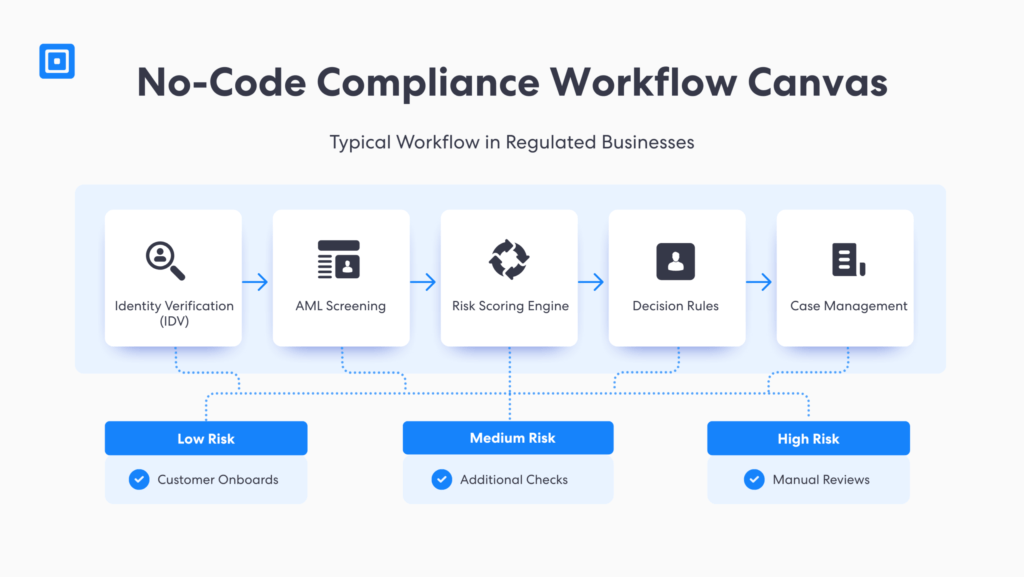
For high-risk users, workflows must trigger enhanced verification, including [Politically Exposed Person (PEP) screening](https://www.complycube.com/en/solutions/global-screening/sanctions-pep-screening/), adverse media checks, and watchlist screening, to identify suspicious activity early. These paths and triggers are built directly within a compliance workflow software rather than embedded in application logic. Financial institutions can remain flexible while consistently ensuring compliance throughout the organization.
## What No-Code Compliance Workflow Automation Enables
No-code compliance workflows empower non-technical compliance professionals to visually design, automate, and execute effective [KYC](https://www.complycube.com/en/solutions/due-diligence-compliance/know-your-customer/) and AML programs without writing a single line of code. With automation, compliance teams can maintain greater control over internal processes, such as auditing and data management, with simple, repeatable steps. Implementing [compliance workflow automation](https://www.complycube.com/en/compliance-automation-software/) enables businesses to tap into a large number of benefits
- **Reduces manual work**: Automation replaces repetitive compliance efforts, including manual data entry and reporting. Less time will be spent by labor on compliance tasks, forcing efforts to be placed on higher-risk scenarios.
- **Eliminates human errors:** Compliance workflow automation ensures consistency across an organization, encompassing policies, approvals, and access controls. This improves accuracy by eliminating the potential risk of human error.
- **Adapt to evolving compliance regulations:** As regulations or company policies change, compliance and engineering teams must stay agile. Automation streamlines updates to workflows, eliminating lengthy testing and deployment cycles.
- **Lowers costs:** Since workflow automation increases the speed of execution without requiring large IT resources, costs are dramatically reduced. Additionally, with increased accuracy, firms can avoid costly penalties from non-compliance.
While modern compliance workflow software utilize automation, managing them with guardrails is crucial to avoid costly mistakes. Due to the ease of implementation, automation may pose several challenges, including duplicate workflows from multiple team members and a loss of visibility over individual changes. For successful implementation, senior team member oversight and internal controls remain critical. You can learn more here: [5 Critical Errors to Dodge in AML Software Implementation](https://www.complycube.com/en/aml-software-implementation-mistakes/)
### **Case Study: Building Security and Agility While Maximizing Global Growth**
##### **The Complexity of Compliance in Global Jurisdictions**
Bots, the leading trailblazer in global blockchain innovation, aimed to expand its operations worldwide. However, the large volume verification and cross-border operations presented a key challenge: ensuring complete adherence to AML and identity verification regulatory requirements in different countries.
##### **The Need for Speed, Compliance, and Agile Operations**
High-volume cross-border compliance often forces companies to choose between speed and security. Bots, however, sought to achieve both. The firm partnered with ComplyCube to sustain its rapid expansion. With automated no/low-code workflows, Bots was able to streamline AML screening, address checks, and biometric verification on one platform without heavy IT resources.
##### **Solutions & Outcomes**
- Bots were able to onboard [98% of customers in under 30 seconds](https://www.complycube.com/en/customer/bots/) through automated AML and KYC checks.
- The company scaled its operations to over 34 countries confidently, utilizing ready-made, customizable workflow templates.
- ComplyCube was able to deliver layered verification tailored to sector- and country-specific risks, supporting both KYC and AML compliance.
## Governance, Access Controls, and Risk Management in No-Code Models
The most common misconception is that no-code workflows reduce governance. This misconception arises from the perception that no-code software leads to a loss of transparency on who made changes, when, and why. In reality, modern no-code platforms enhance oversight for each team member by implementing role-based permissions and maintaining real-time internal auditing logs.
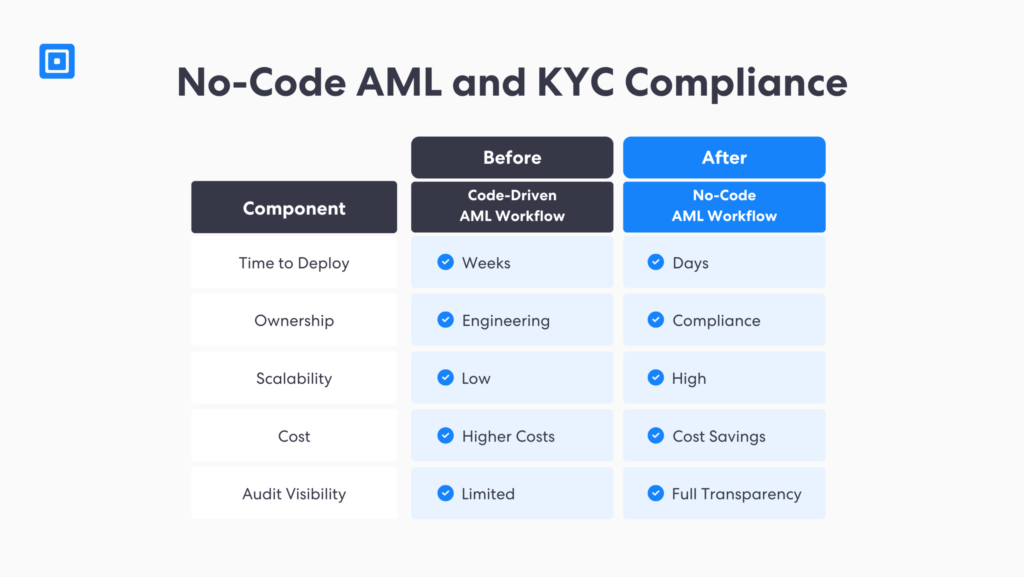
Role-based access control ensures that only authorized staff can modify workflows. Additionally, audit logs provide a record of changes and actions made to workflow versions, thereby enhancing transparency. These features streamline document management, data collection, and audit preparation. Thus, compliance teams can own policy execution and meet regulatory compliance requirements without compromising security or control.
## Why No-Code Is Becoming Crucial for Tech-Led Compliance Operations
The move towards no-code software highlights the shift towards how regulated technology teams operate. Speed and cross-functional agility are becoming crucial in a compliance journey, moving away from merely optional choices. The evolution from code-dependent compliance to no-code, policy-driven workflows enables organizations to:
- **Accelerate compliance:** No-code workflows enable faster data gathering, development, and deployment of workflows in accordance with evolving KYC and AML operations.
- **Reduce operational bottlenecks:** Dependence on technical coding knowledge is eliminated, placing higher ownership on risk assessment teams over the compliance funnel.
- **Enhance compliance status visibility:** Centralized dashboards, audits, and reporting are recorded in real-time, increasing transparency over compliance status.
- **Enable consistency:** Automated no-code frameworks support firms in achieving uniform enforcement of policies across products and systems.
For technology-led businesses, this model turns compliance from a bottleneck into an enabler of trust and growth. As regulatory scrutiny increases, workflows arise as a way for organizations to adapt to cross-border, changing regulatory requirements without introducing operational risk.
### Key Takeaways
- **Automating compliance workflows** reduces costs and improves accuracy by eliminating manual errors and tasks.
- **No-code compliance workflow** models enhance agility throughout the KYC process, facilitating alignment with evolving regulations.
- **Role-based access and audit logs** are key components of modern workflows, strengthening security and transparency in compliance frameworks.
- **Effective AML compliance programs** can be achieved without heavy IT knowledge using drag-and-drop, no-code workflow interfaces.
- **Common compliance issues** in no-code software can include weakened governance, loss of transparency, and security vulnerabilities.
## Implement Compliance Workflow Automation Effectively
No-code orchestration in compliance processes offers multiple advantages. With reduced costs and increased accuracy, no-code workflows are becoming the standard operating model for many businesses, streamlining key business processes while meeting the requirements of external auditors. Additionally, compliance automation in no or low-code software enables faster responses to evolving regulatory standards and stronger governance across KYC and AML procedures. Businesses can maintain compliance while strengthening their financial system’s defenses.
Discover how ComplyCube’s low or no-code onboarding solutions can transform your compliance operations. [Speak to a member](https://www.complycube.com/en/contact/contact-sales/) of the team today.
## Frequently Asked Questions
What is compliance workflow software?
Compliance workflow software encompasses key functions, including regulatory monitoring, risk assessment, and audit reporting mechanisms. It enables organizations to build customizable workflows by introducing different checks according to the level of risk. Organizations can meet regulatory requirements with modern workflow software.
How does a no-code compliance workflow differ from traditional systems?
Low- or no-code workflows enable compliance professionals to configure logic and rules visually using a drag-and-drop user interface, rather than relying on application logic. Thus, time and cost can be saved significantly.
Is no-code suitable for banking AML compliance workflow requirements?
Yes. Businesses in regulated markets, such as accounting, banking, and cryptocurrency, utilize no-code solutions to support strong governance controls, audit trails, and role-based access.
What is compliance automation in AML and KYC workflows?
Workflow automation utilizes Artificial Intelligence (AI) and machine learning to automate repetitive manual tasks. This streamlines the customer lifecycle journey, from initial KYC onboarding to ongoing monitoring.
How does ComplyCube’s no or low-code platform work?
ComplyCube’s workflow builder supports organizations in building tailored, drag-and-drop workflows aligned with sector-specific regulations and risk appetite, without requiring a single line of code. Its regulator-ready templates include those of the FATF, FinCEN, and eIDAS 2.0.

**Categories:** Guides
**Tags:** Anti-Money Laundering
---
### [ComplyCube Unleashes Powerful Compliance Suite](https://www.complycube.com/complycube-unleashes-powerful-compliance-suite/)
**Published:** January 27, 2026
**Author:** Rithu Jagannath
**Excerpt:** ComplyCube has launched a unified compliance suite featuring a powerful KYC workflow builder. The platform enables secure onboarding and real-time verification across regulated industries.
**Content:**
LONDON, JANUARY 27, 2026 – [ComplyCube](https://www.complycube.com/en/), the British Bank Awards’ [RegTech Partner of the Year 2025](https://www.complycube.com/en/complycube-wins-regtech-partner-of-the-year-at-the-british-bank-awards-2025/), and global leader in Identity Verification (IDV), Know Your Customer (KYC) and Anti-money Laundering (AML) compliance automation, today announced the launch of its enhanced Compliance Suite with KYC workflow builder, Fraud Intelligence Solutions and Digital ID Tools for secure onboarding.
ComplyCube’s sweeping upgrade and expansion of its existing suite of services. It introduces new, groundbreaking solutions for implementing global policy compliance. The new upgrade brings about greater deep fake detection, regulatory reporting, secure onboarding without documents, and unparalleled ROI.
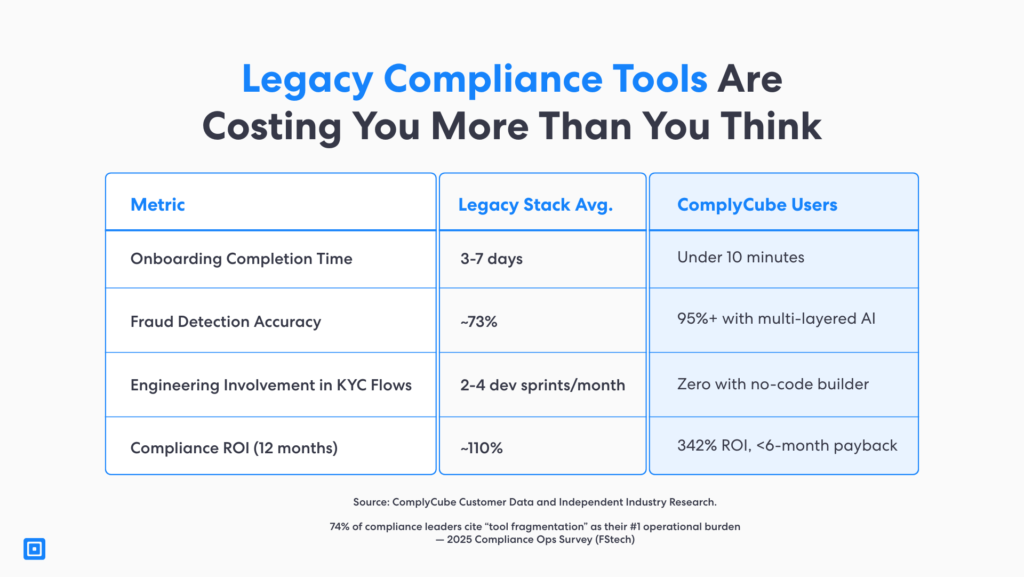
This release marks a strategic evolution of ComplyCube’s unified compliance stack. This enables businesses to build smarter onboarding journeys, stop fraud in real time, and scale their regulatory operations with greater precision and control. New capabilities include its no-code workflow builder, a multi-layered fraud intelligence suite, and expanded digital identity verification for secure onboarding.
## ComplyCube’s Compliance Suite Presents No-Code Workflow Orchestration
At the center of ComplyCube’s complete compliance suite is the launch of its [no-code KYC workflow builder](https://www.complycube.com/en/solutions/compliance-suite/kyc-workflow/). This workflow builder is a drag-and-drop orchestration engine that gives compliance teams full control. Workflow orchestrating gives teams full control over how identity, AML, and fraud checks are deployed. Without writing a single line of code, compliance teams can now build customer journeys that can be analyzed and adjusted in real time. They can make changes based on customer behavior insights, fraud and AML risk, or regional compliance needs.
> ComplyCube’s KYC workflow builder is designed to put control back in the hands of compliance professionals” – [Mohamed Alsalehi](https://www.linkedin.com/in/malsalehi/), Founder & CTO of ComplyCube
Putting no-code workflows into the hands of teams is central to ComplyCube’s vision for a more agile, automated compliance suite. “ComplyCube’s KYC workflow builder is designed to put control back in the hands of compliance professionals. It eliminates bottlenecks and lets teams adapt instantly to risk without needing extensive engineering support. We’ve made it possible for any compliance team to act with the speed, scale, and intelligence previously reserved for top-tier engineering organizations,” said [Mohamed Alsalehi](https://www.linkedin.com/in/malsalehi/), Founder & CTO of ComplyCube.
## Advanced Fraud Intelligence Compliance Suite Built for Today’s Threats
Next, ComplyCube is also introducing a significant expansion of its fraud detection capabilities with a new [Fraud Intelligence](https://www.complycube.com/en/solutions/fraud-intelligence/) Suite. In addition to existing document and biometric controls, the platform now leverages behavioral and contextual intelligence to catch sophisticated fraud attempts earlier in the onboarding journey.
New solutions include:
- [Device Intelligence](https://www.complycube.com/en/solutions/fraud-intelligence/device-intelligence/), looks at fingerprint, IP address, geolocation, and session integrity
- [Phone Intelligence](https://www.complycube.com/en/solutions/fraud-intelligence/phone-intelligence-verify-phone-number/), to verify numbers and carriers, origin, usage patterns, and fraud risk
- [Email Intelligence](https://www.complycube.com/en/solutions/fraud-intelligence/email-risk-score/), analyzing email age, domain type, and known fraud signals
These capabilities work together in real time. It allows room for enriching the risk profile of each user. It also enables smarter decisions on whether to approve, escalate, or reject users before sign-up.
## Expanding Compliance Suite’s Global Reach with eID and SSN Verification
In addition, ComplyCube launches its eID Hub and SSN Check as part of its compliance suite. This significantly enhances its [digital identity verification](https://www.complycube.com/en/what-is-digital-identity-verification-and-eid-for-fintechs/) capabilities in three critical national identity ecosystems. The identity ecosystems cover the EU, India, and the US. The new [eID Hub](https://www.complycube.com/en/solutions/identity-assurance/eid-verification-service/) provides businesses with direct access to national electronic ID systems across key European markets and Aadhaar in India. This allows for fast, secure, and government-trusted identity verification. As a result, it also aligns with the EU’s eIDAS2.0 and other national frameworks.
On the other hand, the [SSN Check](https://www.complycube.com/en/solutions/identity-assurance/ssn-verification-service/) module enables real-time validation of Social Security Numbers in the United States. SSN validation helps regulated entities onboard users quickly while screening for fraud via deceased or synthetic identities. At this instant, these additions reinforce ComplyCube’s leadership in global IDV. Ultimately, it delivers compliance-ready solutions that are secure, scalable, and tailored to local requirements.
## Enabling Compliance Suite Automation with Zapier Integration
Notably, as part of this compliance suite release, ComplyCube is launching a [native Zapier integration](https://zapier.com/mcp/complycube). Zapier allows organisations to seamlessly connect their compliance workflows to thousands of third-party applications from CRMs and support tools to marketing platforms and internal dashboards.
With this integration, non-technical teams can automate compliance triggers, route data to internal systems, and initiate secure onboarding flows based on external events. For instance, whether teams pushing verified customer data into a CRM or syncing screening results to a case management system, ComplyCube’s Zapier connector unlocks a new layer of interoperability and operational efficiency.
## About ComplyCube
[ComplyCube](https://www.complycube.com/en) is a complete, UK Government-approved compliance suite for global Identity Verification (IDV), Know Your Customer (KYC), and Anti-Money Laundering (AML) compliance. Its AI-powered solutions empower regulated organizations to comply with AML/CFT regulations in one place via no-code, low-code, and API-first modules. Designed for scale and flexibility, ComplyCube serves 300+ global clients across financial services, insurance, fintech, crypto, telecoms, accountancy, and more.
**Categories:** News
**Tags:** Announcements
---
### [What is Watchlist Screening? Best Practices for FinTech Compliance](https://www.complycube.com/what-is-watchlist-screening-for-fintechs-guide/)
**Published:** January 26, 2026
**Author:** Dini Habib
**Excerpt:** Watchlist screening solutions enable FinTech companies to combat money laundering and other crimes effectively. However, due to its sector-specific environment, watchlist screening for FinTechs may differ from that for other firms.
**Content:**
**TL;DR:** Watchlist screening solutions are vital for Anti-Money Laundering (AML) compliance. These tools help firms combat financial crime by flagging high-risk parties. However, **watchlist screening best practices** may differ across industries, particularly fintech firms. This guide explores what is watchlist screening and how **fintech firms** can best use it for AML compliance.
## What is Watchlist Screening Software for FinTechs?
Watchlist screening is a key method used by compliance teams to check customers, business partners, and entities against official law enforcement databases. With specialized watchlist software, this process is simplified by checking users against multiple trusted data sources to identify potential risks. Furthermore, watchlist screening is part of the broader Anti-Money Laundering process, enabling organizations to counter terrorism financing and prevent financial crimes.
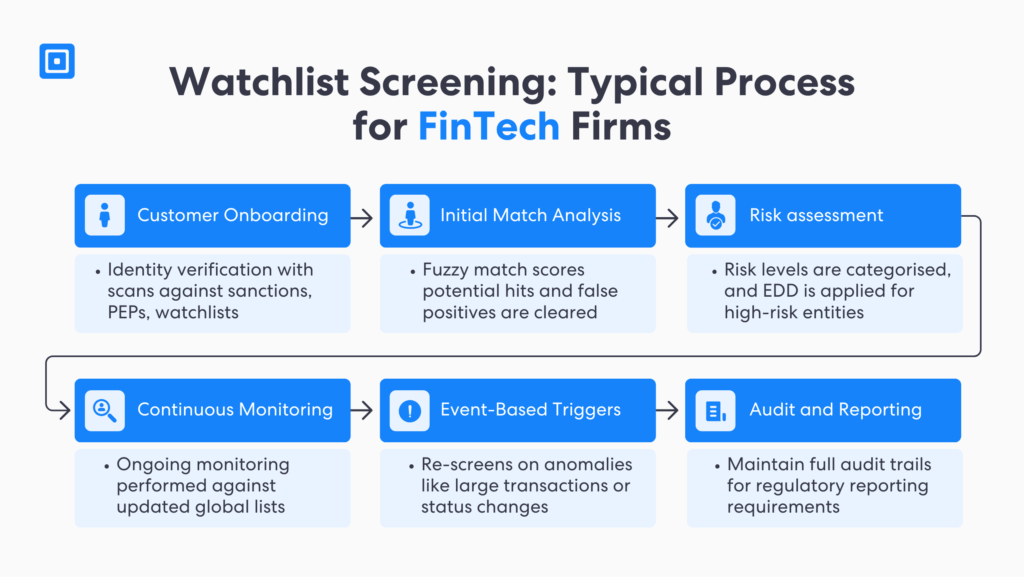
There are several list types that a watchlist screening platform checks against, including government sanctions lists (such as EU, UN, and Office of Foreign Assets Control, also known as OFAC), Politically Exposed Persons (PEPs) databases, criminal watchlists (such as Interpol), and adverse media databases. Watchlist screening solutions are crucial for global fintechs to meet Customer Due Diligence (CDD) requirements. You can learn more here: [What is Customer Due Diligence (CDD)?](https://www.complycube.com/en/what-is-customer-due-diligence/)
> Firms [must prioritize](https://www.jmlsg.org.uk/wp-content/uploads/2025/12/JMLSG-Guidance-Part-II_June-2023_updated-Dec-2025.pdf) entities involved in higher-risk activities, particularly Politically Exposed Persons (PEPs) and customers from countries subject to high-risk designations or non-FATF jurisdictions.
Failure to implement robust AML screening can lead to serious legal trouble and significant penalties, resulting in massive reputational damage. The [Financial Action Task Force (FATF)](https://www.fatf-gafi.org/en/publications/Fatfrecommendations/Fatf-recommendations.html), the intergovernmental body that tackles terrorism financing, financial crime, and money laundering, recommends that companies:
- Require financial institutions and organizations to use a Risk-Based Approach (RBA) for global watchlist checks, including Enhanced Due Diligence (EDD) for higher risks.
- Enhanced measures are required for high-risk individuals, including politically exposed persons, who require additional checks.
- A clear system must be implemented to prevent and block funds or other assets from sanctioned, suspicious individuals.
- Ongoing monitoring is crucial to assess risk and ensure that screening systems remain up to date with evolving adverse media coverage, PEP, and sanctions lists.
## Why FinTechs Must Prioritize Robust Watchlist Screening Processes
[FinTechs](https://www.complycube.com/en/use-cases/industry/fintech/), in particular, are subject to heightened scrutiny by regulatory bodies. This is because the FinTech sector involves multiple vulnerabilities for bad actors to exploit. The rapid onboarding, global reach, large transactions, and high volume of new customers create a perfect environment for sanctions evasion. Therefore, firms operating in the FinTech sector must implement comprehensive screening to strengthen compliance and build regulatory trust.
For many firms, implementing effective global watchlist screening processes can be tricky. If the customer onboarding process involves too many steps to ensure compliance, this creates a customer experience trade-off. To maintain operational efficiency and user trust, automated screening tools are essential. The right watchlist screening solutions enable FinTechs to identify suspicious activities in real time while minimizing false positives.
### **Case Study: Starling Bank’s Shocking AML Watchlist Screening Failures**
##### **Starling Bank’s Whopping £28.96 million fine by the UK**
In 2024, the UK’s Financial Conduct Authority (FCA) fined Starling Bank [over £28M](https://www.fca.org.uk/news/press-releases/fca-fines-starling-bank-failings-financial-crime-systems-and-controls). The penalty followed the FCA’s finding that Starling Bank had breached multiple AML laws. Specifically, this includes failure to screen against the OFAC and the full UK sanctions lists.
##### **Key Gaps in Starling Bank’s AML Compliance Program**
Investigations found that the company was using an outdated sanctions system that resulted in screening only a small portion of the full sanctions lists. Critical alerts were being missed despite heightened geopolitical sanctions activity during that period.
##### **Solutions & Outcomes**
- Starling Bank’s deficiencies led to the opening of over 54,000 accounts for 49,000 high-risk customers, causing reputational damage and eroding customer trust.
- The FCA cited the importance of strong governance, noting that senior management oversight and staff training are crucial for effective risk assessment.
- ComplyCube was able to deliver layered verification tailored to sector- and country-specific risks, supporting both KYC and AML compliance.
## Key Features of Watchlist Screening Solutions for FinTechs
After learning about what is watchlist screening and its importance for FinTechs, it is critical to understand the key features to look out for. Under FATF recommendations, Targeted Financial Sanctions, whereby identification and freezing of funds from sanctioned or high-risk individuals must be implemented without delay.
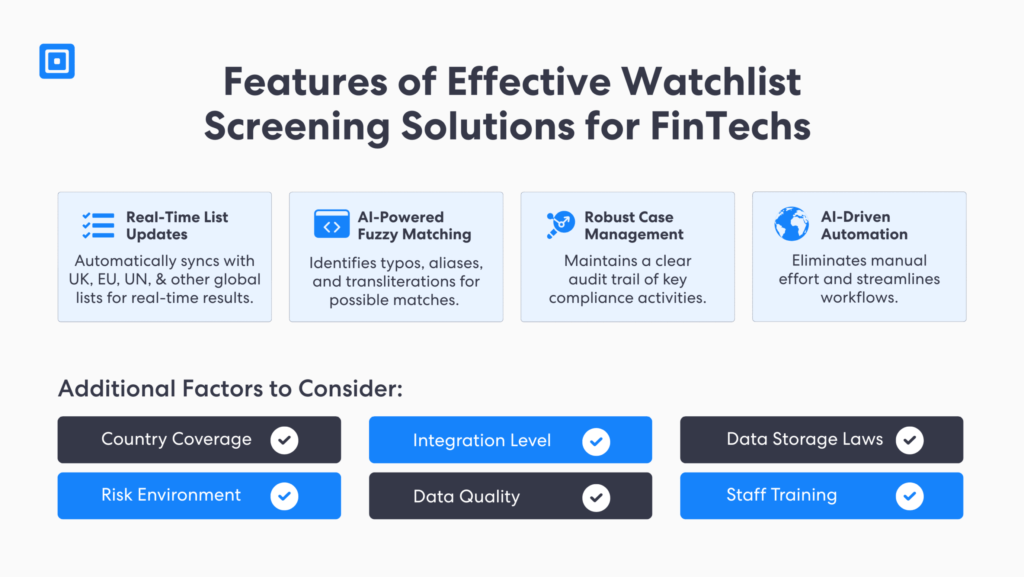
To ensure regulatory compliance, FinTechs must prioritize global watchlist tools with [real-time screening](https://www.complycube.com/en/solutions/global-screening/watchlist-screening/), fuzzy matching, and effective case management. Together, these features help businesses effectively identify high-risk, sanctioned individuals and block them from crucial services. Additionally, compliance with independent data security certifications, such as ISO 27001 and GDPR, is essential to protecting customer data.
### Real-time data sync with official lists
To ensure screening accuracy, it is essential to integrate real-time, up-to-date watchlists. Since data points on official databases are updated daily, businesses must therefore ensure to use current watchlist data. To do this, FinTechs should look for watchlist checks vendors with powerful API and SDKs that can pull real-time changes in watchlist databases, adverse media sources, and PEP lists.
### Advanced fuzzy matching algorithms for low false positives
Fuzzy matching leverages AI and machine learning to capture similar or partial matches in name variations, transliterations, and aliases. By doing so, fuzzy matching helps financial institutions identify minor name variations or misspellings used by sanctioned entities to evade detection. However, a common challenge in FinTech firms is the high rate of false positives. To overcome this challenge, FinTech firms must choose tools that offer customizable fuzzy-matching thresholds to lower false positives.
### Case management, logs, and audit readiness
To meet stringent audit reporting requirements, financial institutions need [comprehensive case management](https://www.complycube.com/en/solutions/due-diligence-compliance/case-management/). Case management supports global watchlist screening efforts by ensuring a thorough audit trail of key compliance activities. Compliance and risk assessment teams can conduct investigations and monitor key trends such as false negatives when screening customers. The benefit is two-fold: adhere to strict reporting rules by government agencies and optimize operational efficiency.
### Automatic screening for cost optimization
For fast-paced, high-growth FinTechs, investing in AI-driven automated screening tools is important. It streamlines compliance workflows by eliminating manual screening. For Fintechs, this means reduced human error and cost. These systems can learn from past patterns to produce accurate screening results, reducing false positives. Additionally, an all-in-one regtech software unifies ongoing monitoring and EDD into a single solution, ensuring robust compliance coverage.
## Watchlist Screening Best Practices for FinTech Regulatory Compliance
For FinTechs, customer trust and credibility are vital. This is especially true given the industry’s competitive nature. According to Juniper Research, the adoption of digital wallets in the fintech and payments markets is expected to increase by [15.3% by 2029](https://www.juniperresearch.com/press/over-two-thirds-of-the-global-population-to-own-a-digital-wallet-by-2029/), representing a 52.6% growth from 2024. A strong global watchlist screening framework can enhance regulatory, investor, and customer trust.
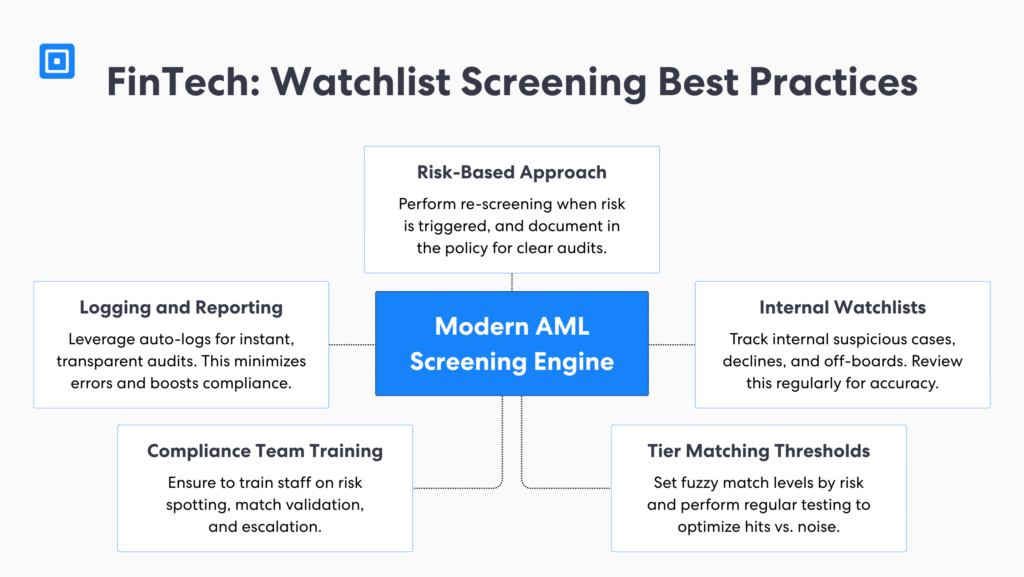
The [Wolfsberg Group](https://wolfsberg-group.org/about), an association of 12 global world banks including Citibank, Barclays, HSBC, and Santander, sets out the Financial Crime Principles to underpin the best practices for financial companies to mitigate ML and TF risks.In particular, under its Principles, screening programs must remain dynamic, risk-based, and operational across the customer lifecycle:
### 1. Dynamic Screening with an RBA
Screening checks must occur at initial onboarding and repeat consistently where risk occurs. Additionally, FinTechs must document these scenarios in policy to provide transparent, defensible audit trails. You can learn more here: [What is a Risk-Based Approach (RBA)?](https://www.complycube.com/en/what-is-a-risk-based-approach/)
### 2. Build and Monitor Internal Watchlists
In addition to external databases, every FinTech must maintain its own internal watchlists. This list must document suspicious activity, entities declined, and off-boarded customers. Also, to remain accurate and avoid bias, it must be reviewed periodically.
### 3. Tier Matching Thresholds
Every FinTech must implement tier-matching logic based on entity type, geography, and product risk level. For instance, platforms operating across high-risk jurisdictions must apply tighter thresholds. Back-testing and sampling against known matches can balance sensitivity and efficiency.
### 4. Training Compliance Teams
For strong governance, FinTech companies must maintain reliable training programs on contextual risk analysis and escalation criteria. For example, differences between “true” and “false” matches are vital during data quality issues, such as misspellings.
### 5. Logging and Reporting
Full traceability supports effective risk assessment decisions. To support this, risk management teams must be trained to keep internal audits up to date. Leveraging robust case management systems with automatic logging reduces human error and supports real-time audit changes.
### Key Takeaways
- **Watchlist screening** checks customers and entities against multiple data sources, which include sanctions, PEPs, and adverse media lists.
- **The FATF outlines** key recommendations for FinTechs, including a risk-based approach and enhanced due diligence to support effective AML programs.
- **Robust case management** supports FinTech firms in meeting regulatory reporting needs and provides a defensible audit trail of key screening activities.
- **The Wolfsberg Group** outlines dynamic, tiered matching thresholds, with higher-risk scenarios requiring tighter thresholds and enhanced fuzzy matching.
- **Real-time, automated** watchlist tools enable FinTech firms to streamline AML compliance, enhancing verification accuracy and speed.
## Comprehensive Anti-Money Laundering Watchlist Screening Solutions
Investment in robust watchlist screening solutions is vital for helping FinTech operations ensure compliance with AML regulations. By partnering with an [all-in-one AML](https://www.complycube.com/en/solutions/due-diligence-compliance/anti-money-laundering/) provider that offers enhanced PEP and sanctions screening, continuous monitoring, and case management, businesses can reduce complexity and streamline compliance workflows. Moreover, ComplyCube offers over 2,000 trusted global lists across 230 countries to help firms implement strong Anti-Money Laundering and fraud prevention practices. To learn more, [speak to a member](https://www.complycube.com/en/contact/contact-sales/) of the team today.
## Frequently Asked Questions
What is the purpose of the watchlist?
A watchlist is a database of high-risk individuals or entities that have been shortlisted for their involvement in sanctions, money laundering, or other illicit activities. Watchlists play a crucial role in Anti-Money Laundering programs by helping organizations identify and avoid dealing with these parties.
What is watchlist screening due diligence?
Watchlist due diligence refers to the process of verifying user information against these lists (wanted list, sanctions database, PEP list) during the KYC and AML process. Under the FATF, watchlist screening enables businesses to assess risk by cross-checking against official lists, including the UN list, Interpol, and the UK Sanctions Lists.
What are watchlist screening challenges for fintechs?
Due to the global, high-transaction nature of FinTech businesses, regulatory scrutiny is common. FinTech companies struggle to balance sensitivity to name variations and fuzzy matching errors that affect operations. This results in a poor alert system and a high rate of false positives. To counter this challenge, fintech firms must leverage automated, customizable screening solutions and set matching thresholds in proportion to the risk a customer/entity poses.
Best practices for effective watchlist screening?
According to global bodies such as the FATF and the Wolfsberg Group, adopting a risk-based approach to AML screening is crucial. Furthermore, robust case management and staff training are encouraged to provide strong governance and audit preparedness. AI-driven tools can remove reliance on manual review, saving time and cost for scaling businesses.
How to select the best watchlist screening provider?
To select the best watchlist screening provider, consider your business’s coverage and risk environment. Choosing providers with broad coverage, real-time updates, robust integrations, and advanced AI and machine learning helps with scalability and cost effectiveness. Additionally, customizable matching threshold and fuzzy matching support a risk-based approach under FATF.
[](https://www.complycube.com/en/contact/contact-sales/)
**Categories:** Guides
**Tags:** Anti-Money Laundering
---
### [Boost ROI with the Best KYC Cost Calculator Approach](https://www.complycube.com/best-kyc-cost-calculator-approach-for-roi/)
**Published:** December 29, 2025
**Author:** Dini Habib
**Excerpt:** Smart budgeting for identity verification begins by leveraging a KYC cost calculator to strike a balance between efficiency and customer experience. Cost benchmarking strategies can help forecast verification spend with confidence.
**Content:**
**TL;DR:** Budgeting for Identity Verification (IDV) effectively using a KYC cost calculator is crucial for ensuring operational efficiency while delivering a **seamless customer experience**. This guide breaks down the main cost drivers, strategic compliance cost planning steps, benchmarks, and practical tools to forecast and manage digital identity verification spend with **confidence**.
## What Does Compliance Costs Refer To?
Compliance costs encompass the total amount of money spent by businesses to meet current regulations and standards established by the relevant regulatory authority. In Know Your Customer (KYC) compliance, costs refer to the expenses required to satisfy identity verification and data privacy laws. The cost of KYC includes direct costs, including compliance software expenses and IDV checks, as well as indirect costs, including staff training and monitoring software updates.
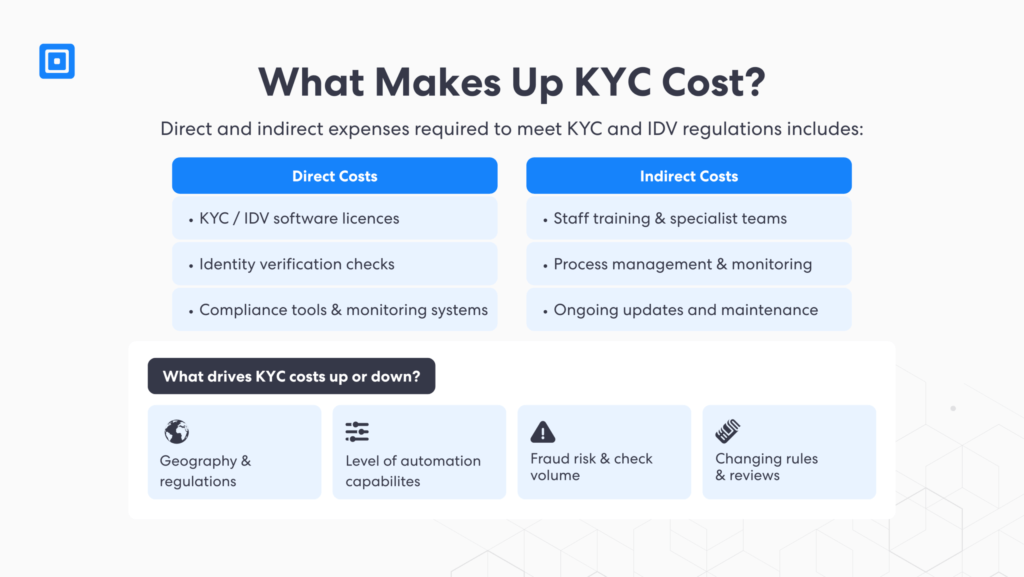
Strong IDV processes support secure onboarding, protection against fraud, and compliance with global standards. For financial institutions and international service providers, forecasting these costs is rarely straightforward. For example, the technology used and the verification volume required significantly impact the cost of compliance. Furthermore, fluctuating verification volumes, evolving fraud risks, and regulatory updates introduce an additional layer of complexity.
## The Complexity of Compliance Cost Planning for Identity Verification
Identity verification costs are complex due to variable factors. However, the importance of IDV solutions cannot be overstated. In 2024, UK Finance reports [£722.0m](https://www.ukfinance.org.uk/system/files/2025-05/UK%20Finance%20Annual%20Fraud%20report%202025.pdf) in unauthorized fraud, with over 109,000 cases involving ID theft. Yet, many organizations underestimate the true cost of implementing robust systems.
> The total gross losses from unauthorized fraud, including counterfeit card fraud, remote purchase fraud, and ID theft, totalled over [£722.0m](https://www.ukfinance.org.uk/system/files/2025-05/UK%20Finance%20Annual%20Fraud%20report%202025.pdf).
Additionally, businesses often account for initial IDV solution fees but overlook hidden costs, including compliance with multiple jurisdictions, infrastructure, and staffing. Furthermore, regulatory adherence to enhanced due diligence and ongoing monitoring to meet [Anti-Money Laundering (AML)](https://www.complycube.com/en/solutions/due-diligence-compliance/anti-money-laundering/) standards can lead to higher compliance costs if not factored effectively. Failing to account for these costs can lead to unplanned, reactive spending during audits. Proactive planning, by contrast, enables scalability and cost-efficient growth from the outset.
## Core KYC Operational Costs of Compliance and Key Drivers
According to research by PwC, financial institutions face annual regulatory compliance costs that exceed [£33.9 billion](https://www.thecityuk.com/news/annual-cost-of-regulatory-compliance-to-uk-financial-services-sector-exceeds-339bn/), accounting for over 13% of operational expenses. The rising cost of KYC compliance places a significant strain on a company’s operational budget. Additionally, compliance teams are feeling the pressure from evolving regulations, with [85%](https://www.pwc.com/gx/en/issues/risk-regulation/global-compliance-survey.html) reporting that compliance processes and requirements have become more complex over the last three years.

Understanding the key factors that drive the true cost of compliance in KYC, such as verification volume, check types, and pricing models, is crucial for strategic planning. It also enables businesses to achieve cost savings while avoiding non-compliance, which can lead to reputational damage and legal fees.
### Verification Volume
The number of identity verification checks performed by a business directly influences compliance costs. However, many vendors offer lower costs per check to high-volume firms, thereby boosting long-term cost savings. Alternatively, some providers provide fixed costs based on a monthly pricing model, allowing a predictable budget and cost effectiveness.
### Verification Types
Standard verification of documents, facial recognition, or biometric authentication processes typically have separate pricing tiers. Layers, such as [liveness detection](https://www.complycube.com/en/solutions/due-diligence-compliance/know-your-customer/liveness-detection/), multi-factor authentication, or risk assessment, further increase complexity and spend. Businesses, particularly those in regulated sectors, must determine the level of assurance and risk appetite appropriate for their use case.
### Jurisdictional Complexity
Companies operating in multiple regions must comply with local and international regulatory requirements. Different jurisdictions have specific legal requirements, including data privacy laws and accepted verification methods. Organizations incur increased associated costs when utilizing significant resources, such as higher expenses in staffing, training, and software licensing, to maintain compliance.
### Manual Review vs. Automation
Manual tasks in KYC drive up costs due to labor-intensive administrative tasks, human error, and longer document retrieval time. With automated workflows, organizations can achieve faster data extraction and validation, as well as make real-time decisions. Automation streamlines compliance processes, enabling firms to reduce operational overhead and costs effectively.
### Vendor Pricing Models
Vendors may offer pay-as-you-go, subscriptions, or tiered pricing. Some providers bundle multiple services, such as [customer onboarding](https://www.complycube.com/en/use-cases/process/customer-onboarding/) and biometric technology, while others price them separately. Choosing the right pricing model is crucial for striking a balance between scalability and expenditure. By planning for these drivers, businesses can effectively control costs and maintain operational agility. You can learn more here: [Understanding the Essentials of KYC Pricing Models](https://www.complycube.com/en/kyc-pricing-models/).
### **Case Study: Crypto Markets in South Korea Transition to Increasingly Regulated Environments**
##### **South Korea Intensifies Oversight and Fines on Cryptocurrency Exchanges**
Regulators in South Korea have penalized leading crypto platforms as they aim to enforce heightened scrutiny on the sector. Out of the firms involved, Dunamu (also known as Upbit) faced approximately US [$25 million in fines](https://www.complycube.com/en/the-cryptocubed-newsletter-november-edition-2026/). Bithumb, Coinone, Korbit, and GOPAX faced similar penalties, including market suspensions and monetary fines.
##### **When Warnings Are not Sufficient for Robust AML and KYC**
The country’s Financial Intelligence Unit (FIU) indicated that it issued multiple warnings to crypto firms regarding increased oversight in their sector. However, warnings were not enough, as some of these firms continued operations without establishing adequate KYC programs aligned with the risk faced in the crypto space. As such, the FIU escalated from warnings to fines.
##### **Outcomes & Learnings**
- The compliance failures in these firms resulted in significant financial losses, hindering their operations.
- The case underscores the importance of comprehensive, proactive KYC solutions to ensure compliance and prevent fraud and money laundering.
- Firms are required to be more vigilant about sector-specific risks and evolving regulations as part of their compliance costs planning.
>
## Managing Compliance Costs Across Business Types and Maturity Stages
The scope, complexity, and cost of implementing KYC solutions vary depending on a company’s size, risk exposure, and industry regulations. For global and regulated businesses, such as those in payments and cryptocurrency, solutions such as [ongoing monitoring](https://www.complycube.com/en/solutions/global-screening/continuous-monitoring/), Enhanced Due Diligence (EDD), and sanctions screening are essential to meet compliance requirements.
Aligning compliance strategies with an organization’s maturity and projected growth stage is crucial for achieving cost-effective compliance and long-term scalability. For example, businesses in the early stages will have a different compliance approach compared to a company in the high-growth stage. You can learn more here: [Selecting KYC Software for Your Industry and Growth Stage](https://www.complycube.com/en/selecting-kyc-software-industry-and-growth/).
### Early-Stage Startups and FinTechs
Startups often operate in Minimum Viable Product (MVP) mode, striking a balance between the need for digital IDV and the realities of constrained funding. Firms at this stage utilize features such as Artificial Intelligence (AI) to streamline operations while keeping compliance costs manageable. Additionally, an integrated approach to compliance is ideal at this stage, ensuring that verification and system upgrades can be embedded without significant time or expense.
### Scaling Platforms and Mid-Size Enterprises
At this stage, companies are primarily focused on rapid expansion of business operations. Therefore, investing in features such as machine learning, [Optical Character Recognition (OCR)](https://www.complycube.com/en/solutions/due-diligence-compliance/know-your-customer/optical-character-recognition/), and liveness detection is crucial. Together, these solutions enable a secure, accurate, and scalable compliance infrastructure. Furthermore, automated and customizable workflows streamlines compliance efforts, meeting industry regulations while keeping compliance costs low.
### Global and Regulated Businesses Operating in Multiple Jurisdictions
For mature and regulated platforms, scrutiny and heightened oversight from regulators are common. As such, robust KYC and AML solutions must be implemented. Regulations such as the [US Bank Secrecy Act (BSA)](https://www.occ.treas.gov/topics/supervision-and-examination/bsa/index-bsa.html) and the [UK’s Proceeds of Crime Act 2002 (POCA)](https://www.legislation.gov.uk/ukpga/2002/29/contents) mandate strong frameworks, including ongoing monitoring, Suspicious Activity Reports (SARs), as well as strong data protection.
> Failing to disclose suspicions of criminal property or money laundering can result in [unlimited fines](https://www.ukciu.gov.uk/(xwxqxm55yk5tzxbr0dznv2en)/Information/info.aspx?InfoSection=Legislation).
Additionally, businesses must establish transparent audit trails and secure storage for sensitive data to demonstrate resilience against money laundering, data breaches, and fraud. Compliance failures can lead to significant market restrictions and reputational damage. The POCA states, “A conviction for failing to disclose suspicion of criminal property or money laundering can incur a custodial sentence of up to five years and an unlimited fine.”
## Key Steps to Mastering Compliance Management and Digital Identity Verification Spend
Compliance management in KYC requires strategic planning around both direct and indirect costs. Understanding how compliance expenses correlate with customer acquisition, risk appetite, and future growth is key to ensuring compliance aligns with the budget.
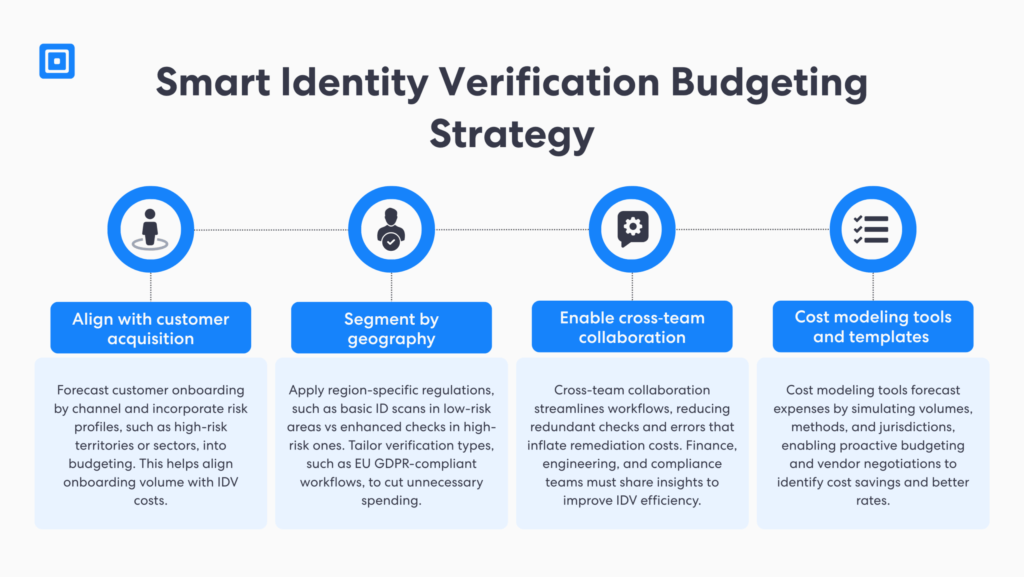
The complexity of regulatory standards is unpredictable and can arise naturally as businesses expand or operate in high-risk areas. Thus, keeping KYC compliance programs flexible, scalable, and automation-ready is crucial to make cost and infrastructure changes manageable.
### Align With Customer Acquisition Forecasts
IDV costs are inherently tied to the volume of onboarding. Thus, it is vital to work closely with marketing and sales teams to project potential users across key channels. IDV budgeting must also factor in risk profiles, such as high-risk territories or sectors.
### Segment by Geography and Verification Type
Compliance requirements and costs vary by region. For example, EU-based companies are required to have GDPR-compliant workflows, while in Belgium, data privacy laws mandate the [redaction of PII](https://www.complycube.com/en/solutions/due-diligence-compliance/know-your-customer/pii-sensitive-data-redaction/) during IDV. Segment budgets to match verification tiers (basic vs. enhanced) to cut spending on low-risk areas.
### Enable Cross-Team Collaboration
Finance, compliance, and engineering teams must work in a unified manner to meet compliance standards while driving ROI. For example, prompt communication ensures finance and engineering teams stay ahead of rapid regulatory updates while minimizing implementation cost. Additionally, within IDV software, team members can manage and transfer caseloads to maintain operational efficiency across teams.
### Use Cost Modeling Tools and Templates
Forecasting platforms and internal planning spreadsheets can be enhanced with a KYC cost calculator approach, estimating per-verification costs, failure rates, and review loads across different tiers. Incorporating tools that simulate the cost impact of varying onboarding scenarios helps organizations remain financially agile.
### Key Takeaways
- **Compliance cost** refers to the Total Cost of Ownership (TCO) of meeting regulations, including efforts in preventing fraud and money laundering.
- **KYC cost drivers** include direct and indirect expenses, including verification volume, types, pricing models, and the level of automation.
- **Compliance cost planning** involves understanding sector-specific risks, current and future business stage, as well as company size.
- **AI-based platforms**, ongoing monitoring, and automated workflows streamline KYC, lowering compliance costs.
- **Compliance monitoring** with real-time tools detects risks early, avoiding costly reverifications and legal penalties.
## Leverage a KYC Cost Calculator for Smarter Compliance Cost Planning
Budgeting for identity verification is a crucial part of building resilient and compliant operations. As businesses expand into new markets and face more complex regulatory changes, understanding and forecasting compliance costs is essential. Investing in key features such as automation, customizable workflows, and an AI-powered platform reduces human error and unlocks savings.
With the right cost and compliance strategy in place, businesses can achieve faster onboarding, reduce fraud efficiently, and enjoy stronger customer trust. [Discover ComplyCube’s AML and KYC](https://www.complycube.com/en/contact/contact-sales/) software to learn how you can ensure compliance with industry regulations while achieving significant cost savings.
## Frequently Asked Questions
How do you calculate compliance cost?
Compliance costs are calculated by combining direct expenses (such as KYC and AML features, staffing salaries) and indirect expenses (including hidden costs, re-verification, and false positives) required to meet regulations.
What is compliance planning?
Compliance planning refers to the process of proactively identifying, monitoring, and adhering to applicable regulations, both locally and internationally. It is crucial in the effort to prevent fraud, financial penalties, and reputational damage. Compliance planning also includes defining roles, budget, and governance for compliance management.
How to turn compliance cost into a competitive advantage?
Compliance costs can become a competitive advantage when businesses utilize them to invest in automation and technology, enabling quicker and more accurate onboarding. As processes become more secure, it will also build trust with regulators, investors, and customers, creating brand loyalty and satisfaction.
Why do regulated industries face increased compliance costs?
Regulated industries such as financial institutions, cryptocurrency, and fintech face high compliance costs. Due to the large amount of cash flow and rapid transactions in these sectors, authorities demand advanced AML and KYC tools to deter fraudsters. Typically, firms in these sectors face stringent regulations, increased oversight, and higher penalties.
How does ComplyCube support compliance while offering cost savings?
ComplyCube is a UK DIATF-certified provider offering volume-based pricing and tailored pricing models for each unique business case. Companies in all types of industries can onboard 98% of customers in under 30 seconds, while also enabling cost reductions of 63%.

**Categories:** Guides
**Tags:** Know Your Customer
---
### [What Is Digital Identity Verification and How eID Transforms It for Fintechs](https://www.complycube.com/what-is-digital-identity-verification-fintech/)
**Published:** January 9, 2026
**Author:** Dini Habib
**Excerpt:** Electronic identification (eID) aims to transform the digital identity verification space. It provides a government-backed and rapid method for validating and onboarding customers. eID is crucial for fast-growing global fintechs.
**Content:**
**TL;DR:** eID verification, also known as **electronic identification**, is reshaping digital ID verification in the fintech space. In today’s complex fintech landscape, firms must meet strict digital verification and AML programs. This guide explores what is **digital identity verification for fintechs** and how to implement it for faster onboarding and **regulatory trust**.
## What is Digital Identity Verification in the Context of eID?
eID in regulatory compliance is a digital credential provided by an authoritative body, such as a government or national registry. It provides a secure and portable method for verifying a person’s identity in digital transactions. Electronic identification moves away from traditional methods such as physical document verification of passports and driver’s licenses. Instead, eID is cryptographically signed, enabling real-time identity verification against government-certified registries.
> eID reduces administrative burden, in terms of time, expenses, and effort, a necessity for many in an increasingly globalised world.
eIDs have been growing in adoption, mainly due to its built-in authenticity and security measures. Regulated organizations, such as those providing financial services, utilize eID to comply with regulatory requirements and enhance operational efficiency. Unlike manual verification, it enables rapid account creation and access to online services.
## Digital Verification Methods
Online identity verification matters because it offers a reliable foundation for trust in online transactions. According to CIFAS, over 118,000 fraud cases were reported to the National Fraud Database. As such, comprehensive identity verification processes serve as a cornerstone against identity theft and fraud.
Digital identity verification works through a combination of advanced technologies and data sources to verify identities in real-time. It utilizes artificial intelligence and machine learning to enhance the security and accuracy of [document verification](https://www.complycube.com/en/solutions/identity-assurance/document-verification/), biometric verification, and proof of address checks. Digital ID verification is the process that includes key components:
- **Document Verification:** Scans documents, such as driver’s licenses, passports, and national IDs. The collected data is then scanned for forgery and verified against authoritative databases for authenticity.
- **Biometric Verification:** Confirms that a user is present during transactions. Biometric data is used to verify that a person submitting their information is genuine. [Liveness detection](https://www.complycube.com/en/solutions/due-diligence-compliance/know-your-customer/liveness-detection/) and selfie verification enhance the process in real-time.
- **Digital Fingerprinting:** Organizations can monitor attempts to use synthetic identities or stolen credentials by scanning browser fingerprint. Suspicious activities on mobile devices can be flagged to prevent identity theft.
- **Device Intelligence:** Utilizes [network signals and IP addresses](https://www.complycube.com/en/solutions/fraud-intelligence/device-intelligence/) during online activities, such as digital banking, to flag suspicious transaction patterns. A user’s login behavior, either on a new or the same device, can be analyzed.
- **Email and Phone Checks:** Analyzes number and email indicators, including carrier types and email domains, to flag misuse. Additional security measures, such as two-factor authentication, further validate genuine users.
Identity Verification (IDV) forms a crucial aspect of Customer Identification Programs (CIP), mandated by international regulations. Unlike manual identity verification, digital ID verification supports a quicker onboarding process. While digital IDV is beneficial, eID provides a fast-track, government-backed method for fintechs. You can learn more here: [Customer Identification Program: What Is CIP?](https://www.complycube.com/en/customer-identification-program-what-is-cip/)
## Regulatory Alignment and Assurance Levels with eID
Online identity verification via eIDs supports compliance with regulatory requirements. In the EU, the eIDAS 2.0 regulations use [national eID schemes](https://www.complycube.com/en/solutions/identity-assurance/eid-verification-service/), including MitID and BankID, to detect fraud and prevent fraudulent transactions. Additionally, the UK’s Digital Identity and Attributes Trust Framework (DIATF) and Sixth Anti-Money Laundering Directive (AMLD6) establish standards for Know Your Customer (KYC) and Anti-Money Laundering (AML) programs. Secure eID-based identity verification puts these standards into operation.
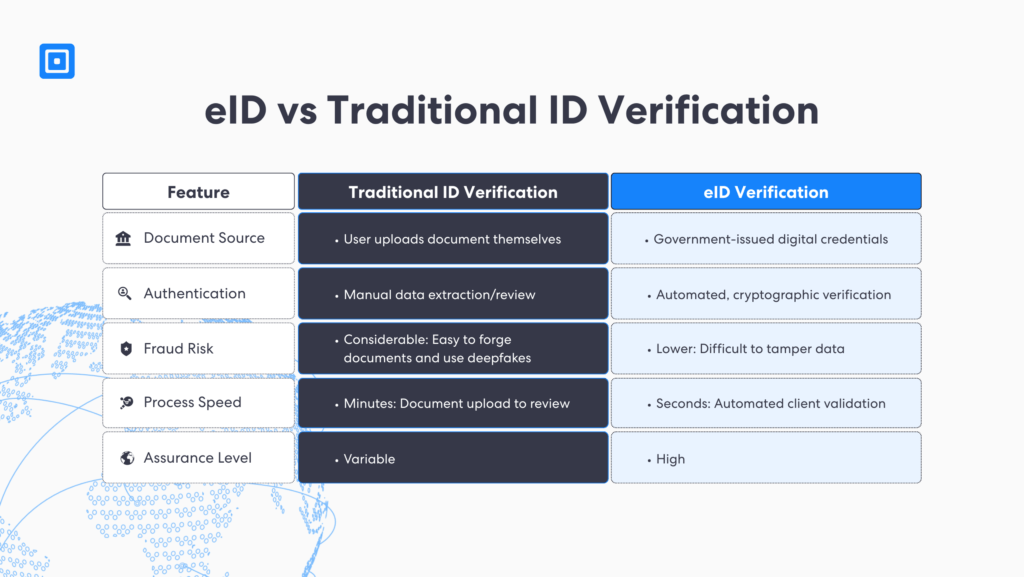
These frameworks categorize levels of assurance (LoA) as low, substantial, and high, defining the strength of identity verification methods required to prove a user’s identity. For example, for fintechs operating in the EU, high LoA is needed for high-risk transactions, including large payments or account creation. Fintechs that integrate eID into their workflows demonstrate compliance and can scale across jurisdictions more efficiently, boosting global growth.
## Speed, Efficiency, and Customer Trust
The benefits of digital identity verification cannot be overlooked. However, eID can replace traditional identity verification checks, validating an individual’s identity in a single step within a workflow. A standard workflow for financial institutions performing IDV includes a selfie check, digital document verification, and [proof of address](https://www.complycube.com/en/solutions/identity-assurance/address-verification/). From a customer’s point of view, they would need to search for and upload the right identity documents. This might seem invasive, introduce friction, and impact customer experience.
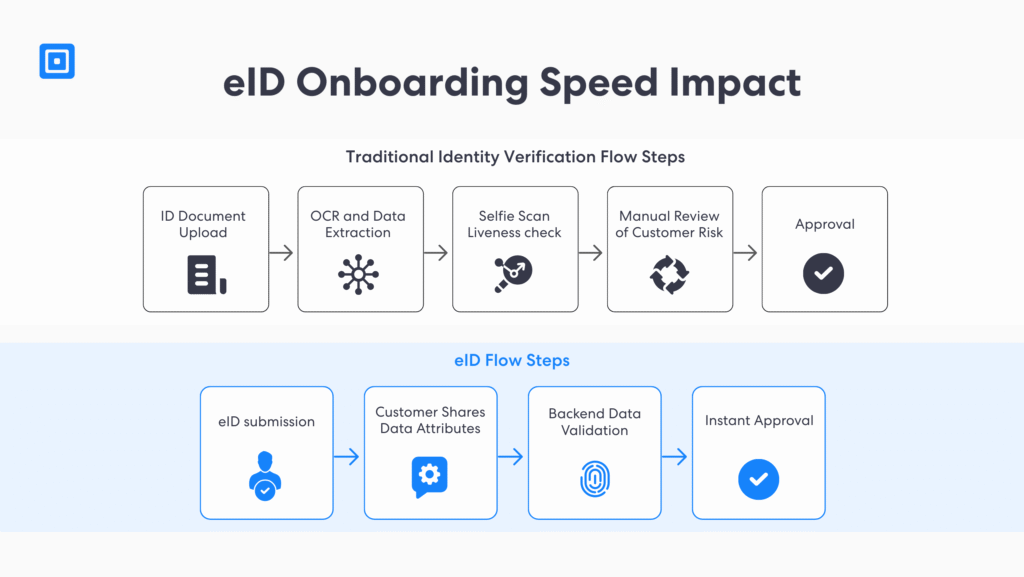
eID schemes bypass a lengthy and time-consuming process to gather personal details. Customers can provide their identity data consensually, and t trusted sources on the backend in seconds. For fast-paced fintechs, eID proves to be a strong method for rapidly analyzing customer identities, thereby enhancing time-to-revenue. Customer loyalty increases as users can open a bank account or access services with enhanced security measures and speed.
## Strengthening Fraud Prevention with eID
Electronic identification plays a broader role in [Anti-Money Laundering (AML)](https://www.complycube.com/en/solutions/due-diligence-compliance/anti-money-laundering/) and risk management frameworks. eIDs are significantly harder to forge or tamper with as they contain electronically signed attributes, preventing identity theft, fraud, and money laundering. In addition, businesses can layered with other checks under international standards, such as the Financial Action Task Force recommendations.
> The FATF calls upon all countries to implement [effective measures](https://www.fatf-gafi.org/en/publications/Fatfrecommendations/Fatf-recommendations.html) to bring their national systems for combating money laundering and terrorist financing.
According to the [FATF](https://www.fatf-gafi.org/content/dam/fatf-gafi/recommendations/FATF%20Recommendations%202012.pdf.coredownload.inline.pdf?nocache=true), digital businesses must adopt adequate Customer Due Diligence (CDD), which includes online identity verification with document and biometric verification. Additionally, continuous monitoring, Politically Exposed Persons (PEPs), and watchlist screening produce a stronger customer risk profile, mitigating ML and terrorist financing (TF) risks more effectively.
Fintechs and digital financial services have unique vulnerabilities in the sector, making eID service critical. Fintechs rely on remote customer relationships and quick transactions, which bad actors can easily leverage to commit illicit activity. According to UK Finance, at the beginning of 2025, losses from online unauthorised transactions reached £372 million.
> Unauthorised transactions across payment cards, remote banking, and cheques [amounted to £372 million](https://www.ukfinance.org.uk/news-and-insight/press-release/over-ps600-million-stolen-fraudsters-in-first-half-2025) in the first half of 2025.
eID solutions address these challenges by providing enhanced security, accuracy, and a government-backed method for onboarding users. Fintechs can achieve reduced false positives, lower costs, and stronger fraud prevention. Additionally, EU customers are much more likely to validate their Personally Identifiable Information (PII), such as date of birth and full name, with eID due to its ease of use and familiarity. For fintechs, this means faster onboarding while meeting compliance regulations
### Key Takeaways
- **Manual identity verification** introduces bottlenecks, including human error, dependence on coding knowledge, and a slower onboarding process.
- **Digital identity verification**, which includes facial recognition features and document checks, can be completed remotely, thereby reducing friction and enhancing the customer experience.
- **Electronic identification** offers a government-backed method. It verifies identities in a single step, enabling fintechs to boost conversions and meet compliance more efficiently.
- **Leading fintechs** utilize eID services from a single provider to eliminate cross-border compliance complexity, reduce costs, and enhance interoperability.
- **All-in-one RegTech** vendors offer tailored and layered verification, including sanctions screening and ongoing monitoring, to meet global AML requirements.
## Selecting the Right eID Provider for eIDAS 2.0 Compliance
For compliance with eIDAS 2.0, a partner that provides various LoA and can support the European Digital Wallet (EUDI) is key. A typical eID verification process consists of three steps: a customer chooses an eID scheme, shares the required data attributes, and trusted sources validate this on the backend. You can learn more here:[ A Digital Europe: Introducing the EUDI Wallet](https://www.complycube.com/en/a-digital-europe-introducing-the-eudi-wallet/).
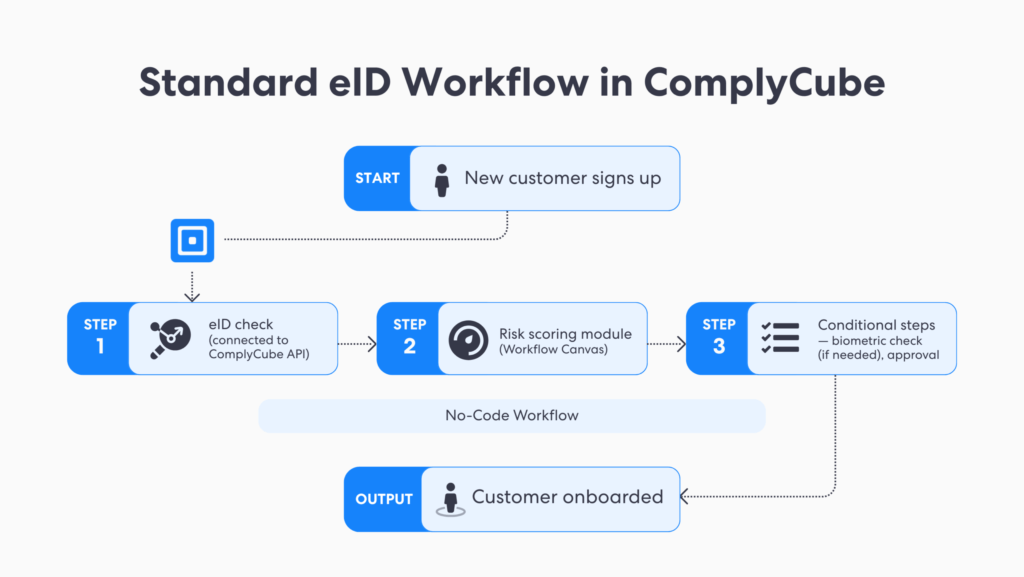
Verifying digital identities through a compliance partner that offers multiple eID schemes supports fintechs in scaling and building trust globally. Additionally, with an all-in-one software, companies benefit from robust user behavior analytics to identify fraud more effectively. The factors influencing eID solutions include:
- **Security and Data:** Select a provider that demonstrates strong alignment with global privacy and data protection laws, including the US NIST, EU GDPR, and ISO 27001 certifications.
- **Multi-Scheme Support:** Instead of relying on third-party vendors, choose an eID provider that supports scalability across multiple national eID schemes to reduce complexity and cost.
- **All-in-One Platform:** For fintechs that require robust KYC and AML programs, choosing a unified platform that offers eID, sanctions screening, and ongoing monitoring streamlines compliance.
- **No-Code Workflows:** No/low-code workflows benefit fintechs that require additional checks, such as adverse media screening, without relying on manual processes or IT resources.
- **Multilingual Aid:** Global firms must choose eID from a provider that offers multilingual support features to cater to a diverse customer base, enhancing the customer experience.
- **International Compliance:** To meet cross-border compliance, pick a vendor that aligns with global AML requirements, such as the EU AML Directive, and those with configurable LoA.
## Implement Multi-Scheme eID Services
Countries such as Norway, India, the Netherlands, and Finland have an adoption rate of eID exceeding 90%. With ComplyCube’s no/low-code tailored workflows, fintechs can scale their business with multiple eID schemes. Get ahead and [speak to a member of the team](https://www.complycube.com/en/contact/contact-sales/) to learn more about ComplyCube’s eID service today.

## Frequently Asked Questions
What is electronic identification (eID)?
eID is a secure way for businesses to validate a person’s identity online. It contains digital data attributes that are government-backed. Companies benefit from eID because it reduces customer friction and streamlines cross-border compliance.
Why are fintechs choosing electronic identification over digital ID verification?
Fintechs utilize eID verification because it provides a simpler and secure method for customer onboarding. Unlike digital ID verification, which requires document submission or selfie verification, eID checks occur in a single step. eID schemes are also recognized by global frameworks such as eIDAS, enabling fintechs to meet stringent KYC requirements.
How does eID support Know Your Customer and Anti-Money Laundering requirements?
Electronic identification (eID) supports KYC and AML as it offers a secure and accurate way to validate that a customer is who they claim to be. It provides a remote method to verify that a user is legitimate, thereby reducing the risk of identity fraud and money laundering.
How to choose the right eID solution for your business?
The right eID service allows an organization to scale simply and securely. To select the right eID partner, companies should assess their alignment with global privacy data laws and KYC/AML requirements, including the EU GDPR and FATF recommendations. Additionally, a provider that supports multiple eID scheme integration and multilingual support boosts global growth seamlessly.
How can fintechs leverage ComplyCube’s no-code workflows for eID?
ComplyCube offers no-code workflows for businesses to perform identity checks without coding knowledge. With its drag-and-drop interface, fintechs can build workflows tailored to various use cases and layer additional checks for robust compliance, including sanctions and PEP screening, on a single platform. It supports all eID scheme types, including India’s Aadhaar, Norway and Sweden BankID, and Denmark’s MitID.
**Categories:** Guides
**Tags:** Identity Verification
---
### [The Value of Compliance Automation Software](https://www.complycube.com/compliance-automation-software/)
**Published:** January 22, 2026
**Author:** Rithu Jagannath
**Excerpt:** Learn how compliance automation software helps reduce manual effort, streamline audits, and boost ROI. Discover the tools, processes, and real-world outcomes that make automated regulatory compliance a growth advantage.
**Content:**
**TL;DR: Compliance automation software** is a strategic asset. By adopting **compliance automation tools**, companies reduce manual efforts, accelerate onboarding, and ensure consistent, risk-aligned decisions. The ROI of **automated regulatory compliance** is around better agility, lower fraud, and faster growth driven by smart **compliance automation** systems.
## What is Compliance Automation Software?
For many organisations, regulatory compliance and compliance related tasks have long been treated as a necessary cost of doing business. However, that mindset is changing fast. For example, compliance frameworks are helping financial services, fintechs, and digital-first businesses scale securely and cost-effectively. With AI-powered tools, companies are transforming their governance, risk, and compliance (GRC) operations. They are turning compliance from a back-office function into a driver of strategic initiatives and faster market entry.
As global expectations grow, firms are recognising the power of automating key compliance requirement processes. Such processes as Know Your Customer (KYC), Anti-Money Laundering (AML), and broader risk-based compliance workflows. Manual compliance management has become too slow, costly, and inconsistent to keep up with changing regulations.
Conversely, automated tools streamline monitoring, risk assessments, and audit preparation. Generally speaking, compliance tools now focus on delivering real, measurable ROI while reducing regulatory exposure. This supports long-term compliance readiness keeping up with industry regulations.
## Automated Compliance Software is No Longer Optional
At the present time, in the UK and EU, compliance teams are under pressure to keep up with fast-changing regulations across multiple compliance frameworks. These include the Fifth Anti-Money Laundering Directive (5AMLD), General Data Protection Regulation (GDPR), and eIDAS. Given these points, manual compliance processes with repetitive tasks often fall short of keeping in line with changes. This is especially prevalent as businesses face a growing number of overlapping rules and reporting obligations.
> Automated compliance software is no longer optional.
“Automated compliance software is no longer optional. We’ve reached a point where the pace, scale, and complexity of regulatory change can’t be managed manually. What used to be a periodic review cycle is now a continuous obligation. Automation gives compliance teams the visibility, control, and consistency they need to meet these expectations without slowing down growth or draining internal resources.” says Solutions Consultant, [Milosh Caunhye](https://www.linkedin.com/in/milosh-caunhye/).
[Automated compliance](https://www.techtarget.com/searchitoperations/definition/compliance-automation) tools help organisations manage these challenges more efficiently. They reduce manual intervention or effort, improve regulatory adherence, and support multiple frameworks at once. By automating decision-making, monitoring, and reporting, teams can adapt more easily to regional differences and shifting requirements. These tools also help prove compliance by clearly tracking and demonstrating compliance status to regulators, stakeholders, and customers.
## How Automated Compliance Tools Improve Audit Readiness
Automated compliance tools are vital for organisations that want to scale without adding headcount. They support high-volume onboarding, [reduce human error](https://cnwr.com/blog/5-ways-automation-reduces-human-error-in-it-infrastructure), and make compliance monitoring more efficient. These tools also enable smarter, risk-based decision-making by automating workflows and applying consistent policy rules.
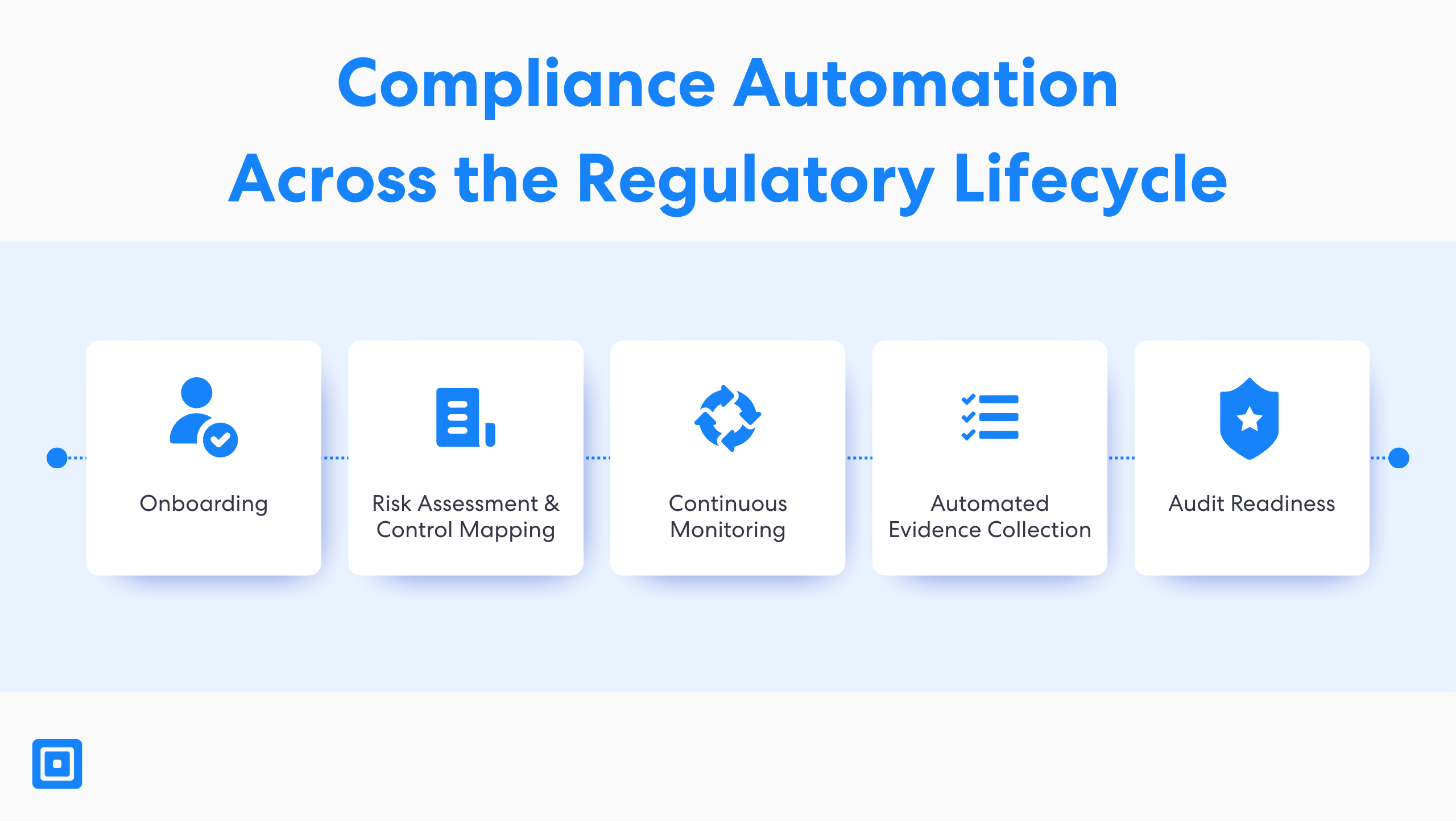compliance automation across the regulatory lifecycle
Therefore, automation takes care of repetitive and routine compliance tasks, freeing teams to focus on more strategic work such as investigating risks or data breaches. Unlike manual processes, which are time-consuming and prone to error, automation streamlines workflows for better accuracy and speed. Many compliance automation tools also include built-in policy templates and rule libraries, helping teams save time when creating documentation.
## Compliance Automation Platforms for Global Growth
Digital-first organisations often face fragmented compliance activities across jurisdictions. Without unified systems, tracking compliance status becomes difficult and incomplete. A thorough compliance automation platform consolidates these activities. It offers central dashboards, control visibility, and automated evidence collection for clean audit trails across multiple compliance frameworks.
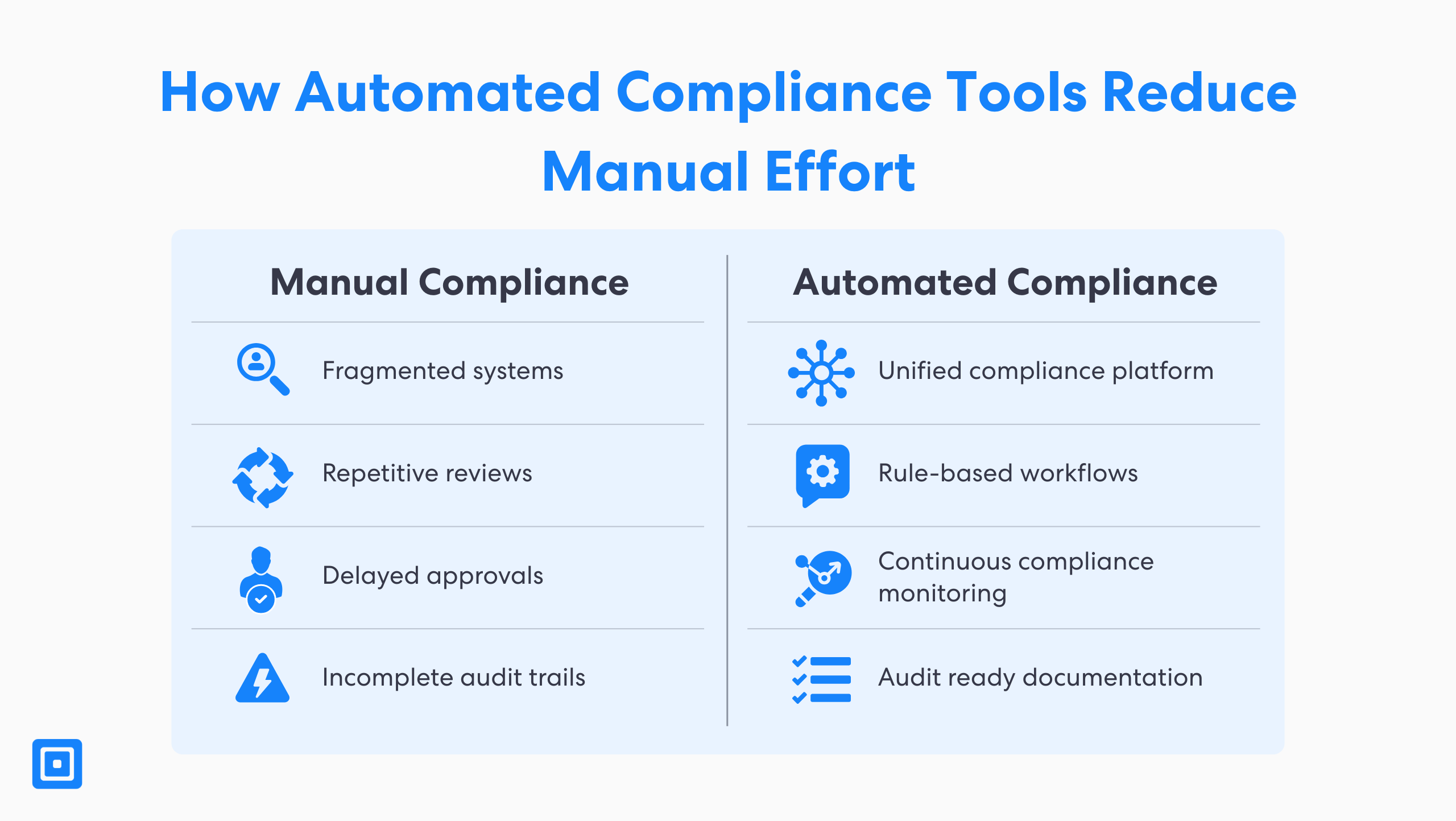
Modern compliance platforms integrate with cloud services to support real-time data collection and monitoring. Tools such as ComplyCube offer built-in automation that gives teams instant visibility into compliance tasks and status. Features such as [continuous controls monitoring](https://ijsrcseit.com/paper/CSEIT2173307.pdf) replace manual checks with standardised, automated oversight. This ensures nothing gets missed.
## Enhancing the Audit Ready Documentation Process
When preparing for audits, firms must ensure transparency, consistency, and timely delivery of [evidence](https://www.trustcloud.ai/security-questionnaires/automating-evidence-collection-for-regulatory-compliance-tools-best-practices/). Automated compliance software makes this easier by tagging evidence, flagging high-risk cases, and mapping controls to the right frameworks. This reduces the need for manual review and allows teams to focus on more strategic work.
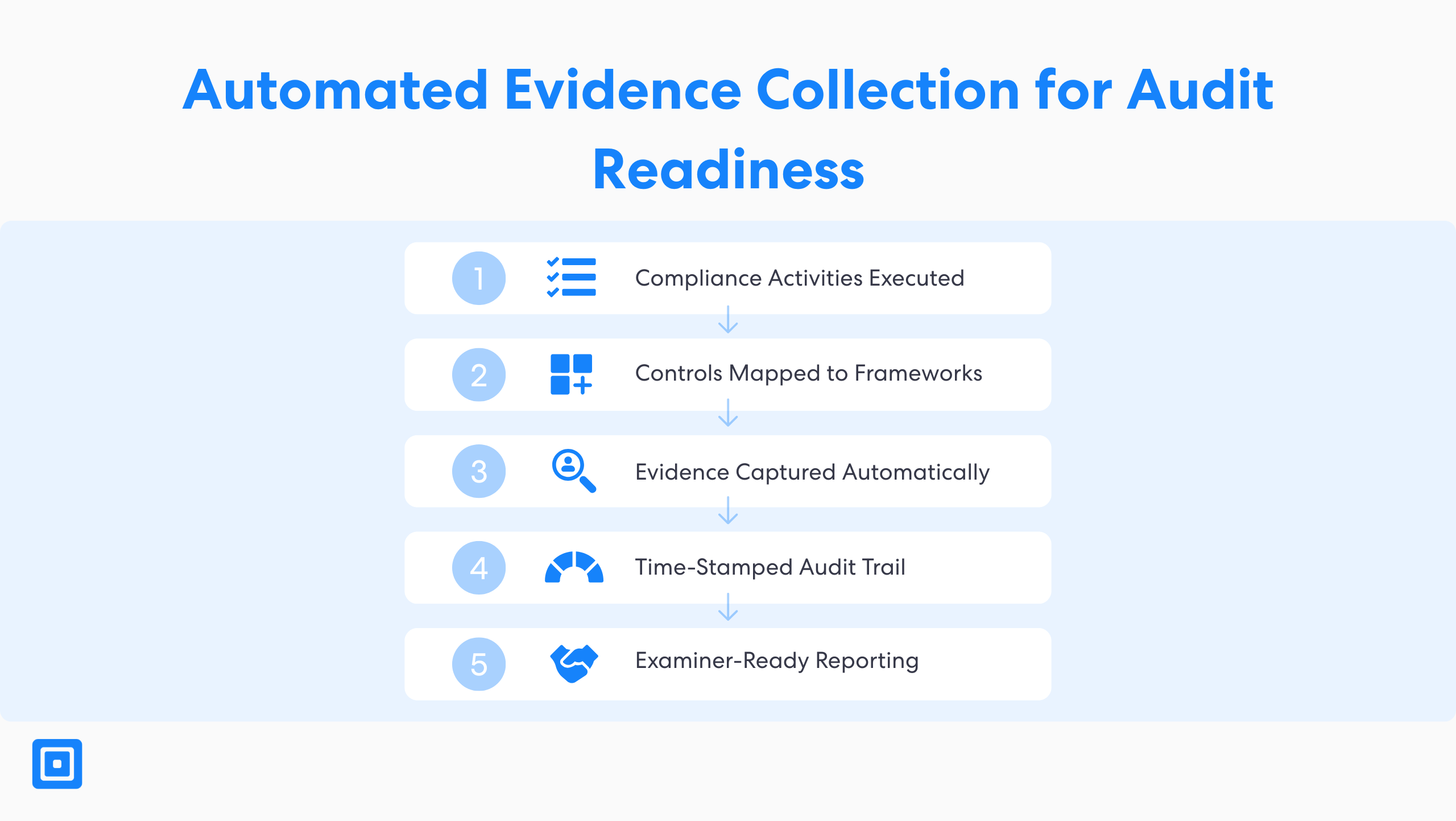
Most compliance automation tools offer features for audit preparation, such as evidence collection and control mapping, but some may lack advanced capabilities to handle complex compliance scenarios or seamless integration with other systems. With built-in control mapping and the ability to map controls across systems, teams can swiftly respond to audit findings and demonstrate defensible security controls.
## Streamlining Operations with Compliance Automation Software
Modern compliance automation tools are designed with role-based access controls, ensuring that only authorized personnel can access, edit, or manage sensitive compliance data and documentation. This granular approach to access management is essential for safeguarding compliance efforts, as it minimizes the risk of data breaches and unauthorized changes to critical compliance records.
For the most part, by assigning specific roles and permissions, organizations can streamline compliance operations. It allows compliance teams to focus on their designated tasks while reducing manual effort and the potential for human error. Additionally, role-based access not only enhances audit readiness by maintaining clear records of who accessed or modified compliance documentation.
Furthermore, role-based access also helps mitigate risks associated with accidental or intentional data exposure. Ultimately, this feature empowers organizations to manage compliance more efficiently and securely, supporting a culture of accountability and collaboration across compliance teams.
## Navigating Multiple Regulatory Environments in the Audit Process
With the regulatory landscape is constantly evolving, with organizations often needing to comply with multiple frameworks such as [SOC 2, ISO 27001, HIPAA, and GDPR](https://www.complycube.com/en/company/security-compliance-center/). Of course then, the right compliance automation software will be built for adaptability, enabling businesses to seamlessly navigate various regulatory frameworks without increasing manual effort. These compliance automation tools allow organizations to map controls across different standards, automate evidence collection, and maintain continuous compliance regardless of jurisdiction.
In other words, by supporting multiple frameworks, automation software simplifies compliance processes. It reduces the complexity of managing diverse regulatory requirements, and strengthens overall compliance posture. This adaptability ensures that organizations can demonstrate compliance with confidence, efficiently manage evidence collection, and stay audit-ready across all relevant frameworks, including SOC 2, ISO 27001 and other industry standards.
## Turning Compliance Automation Data into Strategic Advantage
Today, compliance automation tools do more than just streamline compliance processes. They transform compliance data into actionable insights that drive strategic decision-making. With advanced reporting capabilities, compliance teams gain real-time visibility into compliance status, enabling them to proactively address gaps and optimize compliance management.
[Automated reporting features](https://www.diligent.com/resources/blog/automated-compliance-monitoring) make it easy to generate audit ready documentation, demonstrate compliance to regulators and stakeholders, and maintain ongoing compliance management across the organization. By leveraging these insights, organizations can continuously improve their compliance programs, respond swiftly to new regulatory requirements, and turn compliance management into a source of competitive advantage.
## ROI of Compliance Automation Software
Consequently, ROI from automation software isn’t just about reducing labour costs. Automation reduces time to onboard, flags fraud faster, and supports continuous compliance via perpetual checks. When calculating ROI, it’s important to consider the cost of compliance automation tools.
In that case, the cost of compliance automation tools varies widely based on features, organizational size, and the number of users. Additionally, successful compliance automation implementation requires clear ownership of the project within the organization. As regulatory environments evolve, firms using automation can pivot quickly without reengineering manual flows, minimising disruption and maximising responsiveness.
## A New Growth Lever: Automating Compliance to Drive Revenue
N companies that automate compliance don’t just manage compliance, they monetise efficiency. Rapid onboarding boosts customer conversion, while adaptive flows lower churn in high-friction industries. Organisations using advanced compliance automation report reduced SLA violations, improved client trust, and a proactive stance in mitigating risks.
Generally speaking, automation also enhances security practices. It helps protect sensitive data, ensuring regulatory requirements are met and confidential information is safeguarded.
### **Case study: Healthcare Compliance Automation For Audit Preparation**
**Outdated, manual compliance in regional healthcare system**
A regional healthcare system serving over 2 million patients and operating more than 15 facilities struggled with outdated, manual compliance procedures in the face of growing regulatory demands.
**Overcoming fragmented systems across cloud and on-premises environments**
Under those circumstances, the system implemented a compliance automation solution to integrate with existing systems and break down silos. The technology combined automated compliance checks, policy mapping, role‑based access control, real‑time monitoring, and automated reporting pipelines.
**Continuous compliance operations with proactive alerting**
- Reduced audit preparation time by approximately 70 %, cutting weeks from manual workflows
- Achieved 100 % compliance coverage with continuous monitoring across facilities
- Freed 20 + hours per month of staff time previously spent on documentation
## Real-Time Regulatory Tracking with Compliance Automation
Staying compliant in a dynamic regulatory environment requires constant vigilance. Compliance automation tools equipped with real-time regulatory tracking empower organizations to monitor updates to regulatory frameworks and compliance requirements as they happen. As a result, this capability enables compliance teams to quickly adapt their compliance programs, maintain continuous compliance, and ensure audit readiness even as regulations evolve.
Therefore, by proactively tracking regulatory changes, organizations can reduce the risk of compliance violations. They can strengthen their compliance posture, and demonstrate a commitment to regulatory requirements. Real-time regulatory tracking is a critical feature for organizations seeking to stay ahead of compliance challenges and maintain robust compliance programs across multiple regulatory frameworks.
## No-Code Compliance Automation Software & Audit Preparation
Audit readiness depends on accurate data, clean processes, and defensible logic. No-code flows let compliance teams configure audit preparation processes directly, cutting time-to-resolution and ensuring security and compliance. ComplyCube’s no-code orchestration allows teams to escalate reviews, document exceptions, and enable workflows without developer input.
This level of flexibility makes it easier to adjust to changing audit requirements or internal policy updates. Teams can quickly adapt controls, update decision paths, and maintain audit-ready documentation without needing to engage engineering. This empowers compliance teams to work faster and stay in control, even as regulations evolve. You can learn more about no-code workflows here: [Simplify AML with No-Code Compliance Workflow Software](https://www.complycube.com/en/simplify-aml-with-no-code-compliance-workflow-software/)
## Ease of Adoption of Compliance Automation Software
The effectiveness of compliance automation hinges on how quickly and easily organizations can implement and start using the software. The right compliance automation tools are designed for rapid adoption, featuring intuitive interfaces and straightforward workflows that minimize the learning curve. This ease of adoption allows organizations to accelerate their time to value, quickly streamlining compliance processes and improving compliance posture without the need for extensive training or technical expertise.
Automated compliance management becomes accessible to teams of all sizes, enabling them to reduce manual effort, enhance compliance management, and lower the risk of non-compliance from day one. By choosing compliance automation software that prioritizes user experience, organizations can unlock the full benefits of automation and maintain a strong, proactive approach to regulatory compliance.
### Key Takeaways
- **Compliance automation software** turns regulatory tasks into business enablers.
- **Automated compliance tools** reduce manual review and support consistent decisioning.
- **Automated evidence collection** streamlines audits across multiple frameworks.
- **Continuous compliance monitoring** improves audit readiness and risk management.
- **A central compliance automation platform** enables secure, scalable compliance workflows.
## Compliance Automation Software at ComplyCube
Today, ComplyCube is purpose-built to streamline and scale your compliance automation efforts. Whether you’re managing KYC, AML, or internal compliance controls, ComplyCube’s platform centralises and automates the entire process. It reduces manual effort, improving consistency, and enabling faster, audit-ready outcomes.
That is to say, with no-code workflow orchestration, real-time sanctions screening, and automated evidence collection, ComplyCube empowers compliance teams to manage complex requirements across multiple frameworks. The solution supports control mapping, dynamic decisioning, and continuous compliance monitoring. It gives teams full oversight and defensible audit trails without engineering dependencies.
In summary, if you’re looking to reduce compliance costs, accelerate onboarding, and ensure perpetual audit readiness, ComplyCube offers the tools to automate with confidence. [Talk to our compliance experts](https://www.complycube.com/en/contact/) to enhance your customer due diligence workflows.
## Frequently Asked Questions
What is compliance automation software?
Today, compliance automation software streamlines regulatory operations by using AI, analytics, and rule-based workflows to replace manual effort in tasks such as onboarding, monitoring, and audit documentation. It helps organisations maintain continuous compliance, reduce risk exposure, and scale regulatory processes efficiently.
How do compliance automation tools assist with regulatory adherence?
Compliance automation tools improve regulatory adherence by standardising compliance activities across teams and jurisdictions. They reduce human error, apply risk-based logic in real time, and enforce policies consistently, especially across complex and changing frameworks such as the FCA Handbook, GDPR, or eIDAS.
What does automated evidence collection involve?
Automated evidence collection refers to the real-time capture and organisation of compliance evidence, such as ID document checks, decision logs, control status, and user actions, throughout the compliance process. This ensures complete, time-stamped audit trails and improves both internal reviews and third-party audits.
How can businesses manage compliance across multiple frameworks?
Firms can manage compliance across multiple frameworks by implementing a centralised platform with built-in control mapping, flexible workflows, and configurable compliance rules. As a result, this enables teams to scale their compliance programs globally while maintaining consistency, audit readiness, and local regulatory alignment.
How does ComplyCube help automate compliance?
ComplyCube supports automating compliance through its unified platform offering real-time screening, biometric verification, no-code policy orchestration, and automated evidence collection. With support for IDV, AML, KYB, and continuous monitoring, it helps businesses stay ahead of audits while reducing costs and manual effort.
**Categories:** Guides
**Tags:** Anti-Money Laundering
---
### [Why Fintechs Need Deepfake Detection Tools to Stop Synthetic Fraud](https://www.complycube.com/deepfake-detection-tools/)
**Published:** January 15, 2026
**Author:** Rithu Jagannath
**Excerpt:** Discover how deepfake detection tools help FinTechs stop synthetic identity fraud, meet compliance, and overcome the limitations of current deepfake detection tools in 2026 and beyond.
**Content:**
**TL;DR: Deepfake detection tools** are essential for FinTechs to effectively stop synthetic identity fraud by identifying manipulated media in **digital onboarding flows**. Without a doubt, deepfake detection tools **2026 and beyond** are evolving but what are the limitations of current deepfake detection tools?
## What Are Deepfake Detection Tools and How Do They Work?
Deepfake detection software and tools are designed to identify and analyze manipulated or synthetic media. Examples include videos, images, and audio generated using artificial intelligence (AI). These are used to impersonate legitimate users. It causes significant financial and reputational damage. Such systems use a combination of AI tools, computer vision, and pattern recognition to distinguish authentic content from fake.
Yet, many deepfake detectors produce scores that indicate the likelihood that a piece of media has been manipulated by bad actors. Some tools use a binary classification system to decipher image integrity, providing clear outcomes for decision-making. This allows risk engines to make nuanced decision such as granting access, requiring step‑up verification, or flagging for manual review.
Under the hood, modern systems compare input against extensive datasets of known real and synthetic samples. As deepfake creators use increasingly sophisticated generative models, detection models must continually evolve. They must spot subtle inconsistencies that humans cannot see. Advanced detection models with faster analysis look at biological signals, such as subtle changes in blood flow, to distinguish real from synthetic media.
Frame level classification is also used to analyze individual video frames for signs of manipulation. Deepfake detection tools leverage machine learning, computer vision, and biometric analysis to identify AI generated deception. For example, some solutions use computer vision to detect micro-variations in skin color caused by blood flow, which are largely absent in synthetic media.
## Identity Risk in Digital Finance
FinTechs operate in a digital world where customers rarely appear in person. This convenience, however, has created [new opportunities for fraud](https://www.sciencedirect.com/science/article/pii/S1057521924004216), particularly through synthetic identities constructed from stolen and fabricated data. Deepfake technology allows bad actors to create convincing yet fraudulent images, videos, and voice recordings that mimic real individuals.
Besides, these forms of manipulation can bypass traditional identity verification systems. It can cause significant financial loss and compliance risk for FinTechs. Deepfakes are increasingly used in phishing attacks and Business Email Compromise (BEC) scams, where attackers impersonate executives to authorize fraudulent transactions.
In this environment, deepfake detection tools are no longer optional. These systems analyze digital media for manipulation and help ensure that the person on the other end of a transaction or onboarding flow is real, authentic, and authorized. FinTechs must protect organizations from identity fraud and reputational harm, especially as 46% of businesses have been targeted by deepfake-fueled identity fraud.
## Why Deepfake Detection Tools Matter for FinTechs
FinTech platforms process millions of remote identity checks each year for account openings, lending, payments, and compliance. In this context, fraud attempts often involve synthetic identity fraud, where attackers blend stolen personal information with AI‑generated media. Deepfake content and digital manipulation are becoming increasingly sophisticated, making it harder for traditional systems to detect fraud.
Now, [deepfake](https://www.ibtimes.co.uk/celebrity-deepfake-scams-explode-ai-passes-8m-files-fans-are-losing-everything-1770783) video is a major point of vulnerability especially during remote onboarding. Fraudsters can submit a manipulated video that appears to match the claimed identity and fool basic selfie verification systems. Without robust detection, these attacks lead to unauthorized access, financial loss, and regulatory scrutiny.
Deepfake detection tools work in tandem with biometric analysis (e.g., liveness detection, facial recognition) and document authentication. This layered approach helps separate legitimate applicants from fraudulent ones and strengthens trust in digital onboarding flows. Real-time deepfake detection can flag synthetic voices and videos in digital content, helping to prevent financial harm from deepfake-enabled cybercrime.
## How Deepfake Detectors Fit Into FinTech Verification
The seamless integration of deepfake detection software into [Know Your Customer (KYC)](https://www.complycube.com/en/solutions/due-diligence-compliance/know-your-customer/) and [Anti-Money Laundering (AML)](https://www.complycube.com/en/solutions/due-diligence-compliance/anti-money-laundering/) workflows through API access and deployment. When a user uploads a video during onboarding, the system initiates a detection pipeline that focuses on detecting deepfakes in real time, assessing facial movements, texture anomalies, blink patterns, and frame transitions to identify signs of deepfake content.
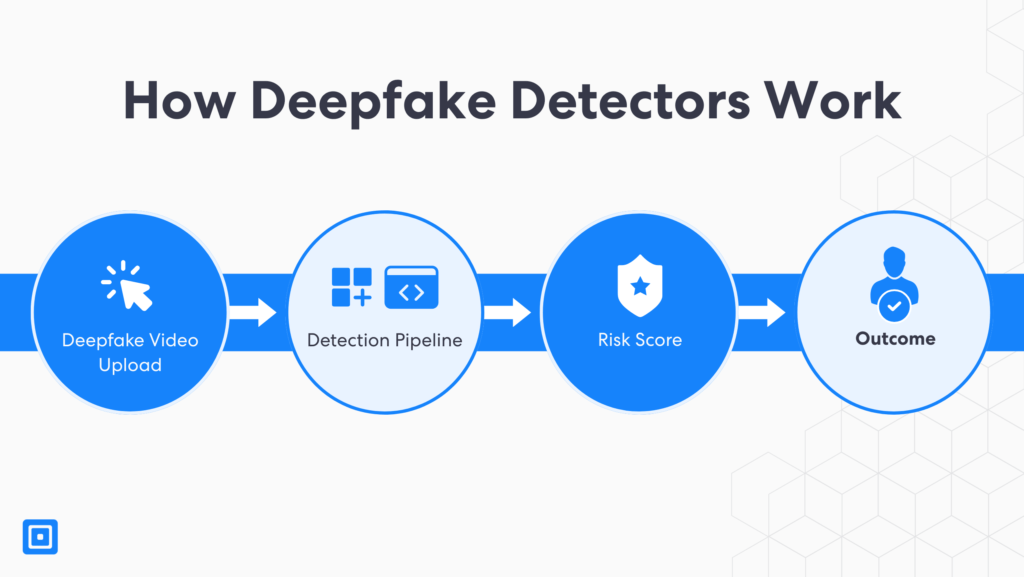
Then, the system generates a risk score for digital content, which reflects the chance that media has been artificially manipulated. This score feeds into existing decision engines, triggering automated outcomes, such as approval, rejection, or step-up verification. Beyond visual cues, these key features of tools also evaluate metadata and behavioral signals such as device fingerprinting or user interaction patterns. This layered scrutiny strengthens the integrity of digital onboarding and helps fintech stay ahead of synthetic identity threats.
In high-volume environments, real-time deepfake detection is essential. Unlike legacy systems such as government agencies that may struggle with live video or HD content, modern solutions for fintechs are designed for performance and scalability, ensuring fast, accurate results across web and mobile channels. Key capabilities include media integrity checks, low-latency analysis, and full integration with enterprise risk and compliance infrastructure.
## Detection Accuracy of Deepfake Creators
Detection accuracy is a core metric for evaluating deepfake detection solutions. It hinges on three key indicators: True Positive Rate (TPR), False Acceptance Rate (FAR), and Processing Latency. TPR measures the proportion of actual deepfakes that the system correctly identifies. FAR, on the other hand, represents the rate at which a biometric system mistakenly grants access to an unauthorized person. Lastly, processing latency refers to the time it takes for the system to analyze the media and return a result.
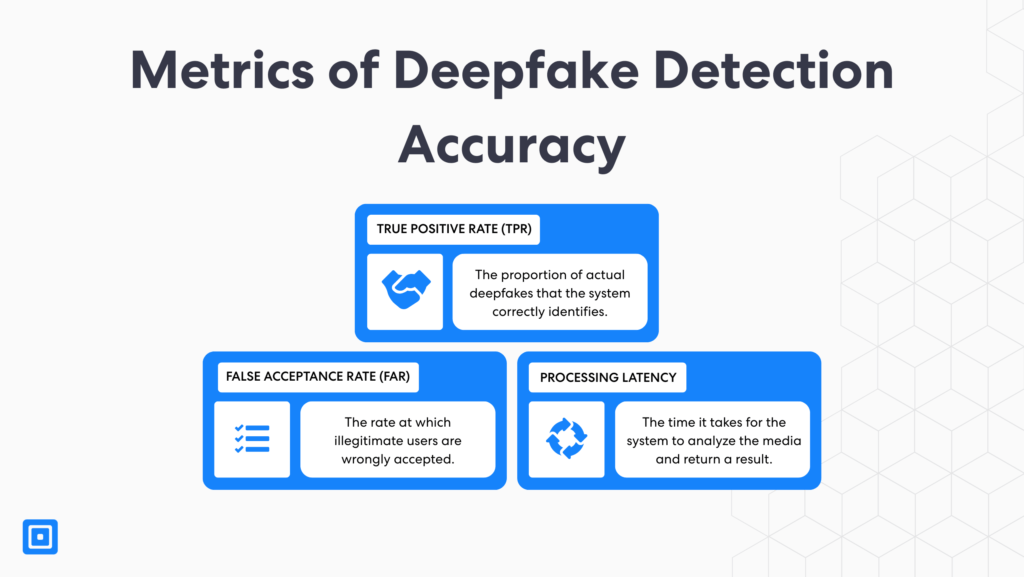
To stay ahead, FinTechs should test detection tools across varied conditions, including different lighting, backgrounds, devices, and demographic groups to ensure fair and reliable performance. Video resolution and compression levels significantly impact real-time detection accuracy. Nevertheless, teams should evaluate tools across a range of video qualities and compression settings to confirm their robustness in real-world scenarios.
Therefore, detection performance often varies across different skin tones and demographic groups. [Demographic and cultural biases](https://www.sciencedirect.com/science/article/pii/S1566253524005384) in training data can influence the effectiveness of deepfake detection tools, leading to lower accuracy for certain users and reducing overall reliability. FinTechs should prioritize solutions that demonstrate strong performance across diverse real-world conditions.
## Commercial Deepfake Detection Tools
Often, commercial tools offer enterprise‑grade solutions with scalability, high detection accuracy, and integration options. They often outperform open‑source models in terms of support, reliability, and ongoing updates. Open source tools provide greater transparency and customization at the cost of lower detection capabilities and higher maintenance requirements.
Deepfake detectors built for financial services handle high volumes, report confidence scores, and integrate seamlessly with risk engines and case management systems. Open source detection algorithms, when combined with hybrid approaches and commercial support, strike a balance between transparency and professional reliability. As a result, these tools provide thorough, scalable solutions for organizations managing complex identity verification workflows.
It’s important to set realistic expectations. Even top commercial tools may see real‑world accuracy drop relative to controlled test environments. Detection accuracy depends on the quality and diversity of training data, as limited or non-representative datasets create vulnerabilities. Organizations should establish continuous improvement processes with regular audits and updates to ensure detection remain effective. Effective deployment relies on combining detection tools with broader risk signals and operational controls.
## Current Limitations of Deepfake Detection Tools
However, despite recent advancements, [current limi](https://www.helpnetsecurity.com/2024/11/22/ben-colman-reality-defender-deepfakes-detection/)[tations in detecting deepfakes](https://www.helpnetsecurity.com/2024/11/22/ben-colman-reality-defender-deepfakes-detection/) stay significant. Detection models struggle with low-quality or highly compressed media, which can obscure visual cues essential for accurate analysis. They may fail to identify high-quality deepfakes generated using advanced methods. Additionally, some systems lag behind the latest developments in generative AI. Even when genuine, certain tools can misclassify content resulting in false positives that can disrupt onboarding workflows.
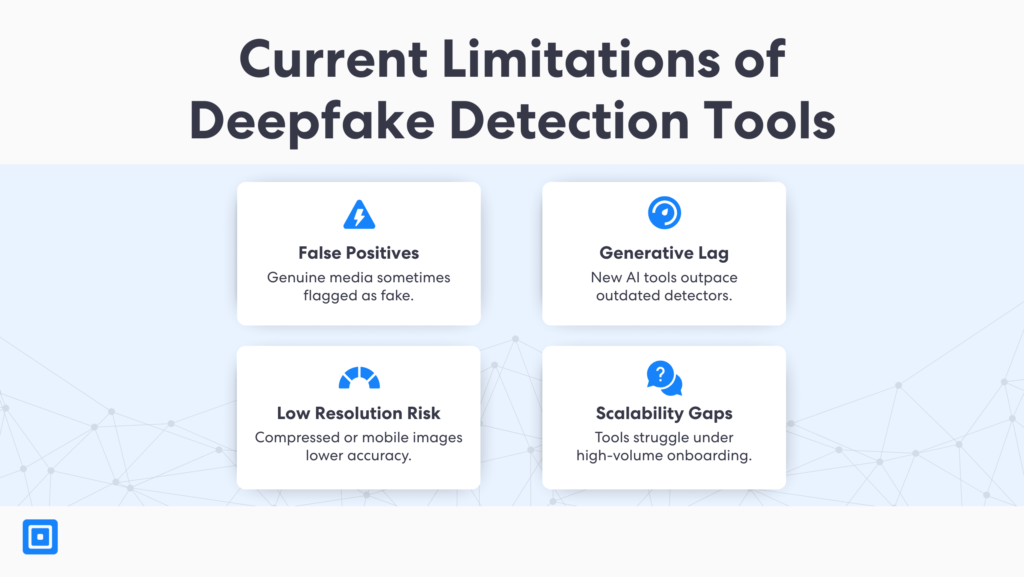
In addition, many deepfake detection tools also struggle with real-time analysis. Particularly, this occurs during live video calls, where they cannot pause to examine inconsistencies. FinTechs therefore need fallback options, such as manual review or tiered verification, when confidence scores fall into ambiguous ranges. Audit trails and explainable scoring are also important for compliance and regulatory reporting.
## The Role of AI Deepfake Detection Tools
AI tools power both deepfake creation and detection. The deepfake detection landscape is rapidly evolving. With new tools and techniques constantly emerging, it is essential for organizations and government agencies to stay ahead of new threats. As adversarial generative AI creates more realistic fraud attempts, fintechs must rely on improved machine learning systems that adapt quickly. Learn more about AI-generated deepfake detection here: [Deepfake Detection For The Modern Media Threat](https://www.complycube.com/en/deepfake-detection-for-the-modern-media-threat/).
> Staying ahead of generative AI threats means deploying systems that don’t just detect deepfakes today, but learn from every new attempt tomorrow
According to [Harry Varatharasan](https://www.linkedin.com/in/harryvaratharasan/), Chief Product Officer of ComplyCube, “Staying ahead of generative AI threats means deploying systems that don’t just detect deepfakes today, but learn from every new attempt tomorrow. ComplyCube’s approach focuses on continuous model retraining and intelligence-sharing to keep defenses adaptive and responsive.”
Leading detection platforms incorporate continuous retraining, adversarial learning, and federated updates from cross‑industry threat intelligence. Automated alerts and real time monitoring are essential for detecting and responding to threats as they emerge. These capabilities help maintain detection relevance and improve defenses against evolving manipulation techniques. Threat actors are increasingly using generative AI deepfakes to manipulate public perception and enhance their attacks.
## Detecting Deepfakes in Live Flows
[Real‑time deepfake detection](https://www.sciencedirect.com/science/article/pii/S2215016125004765) is now a business necessity for digital onboarding. Advanced AI tools monitor facial movements, expression dynamics, and temporal cues to distinguish genuine users from manipulated submissions. Not to mention, multimodal detection, which analyzes audio, visual, and metadata streams, further improves accuracy in live flows.
As a matter of fact, integrating deepfake analysis into workflows with live video calls or instantaneous selfie checks is crucial. It supports seamless operations without degrading user experience. Behavioral analysis complements automated detection by helping security teams interpret ambiguous results and identify suspicious activities. When combined with document verification and device intelligence, deepfake detection enhances onboarding security holistically.
### **Case study: Hong Kong Neobank Expansion and Deepfake Videos**
In mid-2025, a [Hong Kong–based digital bank](https://bankingplus.news/news/deepfake-bank-scam) experienced a coordinated fraud campaign during a regional expansion push. Fraudsters used AI-generated deepfake videos to submit false identity verification media. Undoubtedly, they mimicked facial movements and speech.
**Multi-layered fraud prevention with deepfake detection tools**
As a result, the bank integrated a multi-layered fraud prevention system, anchored by a specialized deepfake detection engine. The team implemented behavioral analytics to flag irregular user-device interactions to block reused access points linked to prior fraud.
**Integrating deepfake detection into digital onboarding flows**
- Over 50 fraudulent account applications blocked in the first month after deployment
- 90% of flagged cases verified as attempted synthetic identity fraud
- Automated decisioning time improved by 35%, reducing onboarding delays
## Compliance and Regulatory Implications
Regulatory expectations under frameworks such as the [Financial Action Task Force (FATF)](https://www.fatf-gafi.org/en/publications/Fatfgeneral/Fatf-position-fintech-regtech.html) recommendations and EU directives such as [AMLD6](https://www.europarl.europa.eu/legislative-train/theme-an-economy-that-works-for-people/file-6th-directive-on-amlcft-(amld6)) require fintechs to implement robust identity verification and risk assessment systems. As synthetic identity fraud evolves, meeting these standards increasingly depends on the ability to detect and reject manipulated biometric and media inputs.
However, deepfake detection tools 2026 and beyond, play a critical role in fulfilling these obligations. To enhance the reliability of KYC processes and strengthening internal controls, firms must verify the authenticity of user-submitted content. Well‑validated systems also improve audit readiness, offering clear evidence of compliance to regulators.
## Business Impact of Deepfake Detection Tools
[Investing in deepfake technology](https://www.fidelity.com.au/insights/investment-articles/investing-in-the-deepfake-era-know-what-youre-up-against/) delivers strong ROI by reducing fraud losses, minimizing manual reviews, and increasing operational efficiency. Above all, when integrated directly into onboarding flows, these deepfake detection tools also lower customer drop-off rates and improve overall conversion.
Yet, beyond immediate cost savings, comprehensive detection systems reinforce long-term trust. It enhances brand reputation, especially in markets with heightened digital fraud risk. By protecting the authenticity of user-submitted media, they help safeguard digital ecosystems and uphold media credibility in the face of increasingly realistic manipulated content.
### Key Takeaways
- **Deepfake detection tools** are critical to defend against synthetic identity fraud.
- **Detection accuracy** directly impacts risk and user experience.
- **Commercial tools** provide scalable, enterprise-ready solutions for FinTechs.
- **Understanding the limitations** of current deepfake detection tools shape layered defenses.
- **Deepfake detection tools** continue to evolve in 2026, requiring adaptive, multi-signal strategies.
## Why FinTechs Should Partner with ComplyCube
In conclusion, ComplyCube delivers trusted, scalable fraud prevention with deepfake detection at its core. Its API-first platform supports advanced biometric checks, regulatory compliance, and seamless onboarding. Whether launching in a new market or tightening controls, ComplyCube enables FinTechs to operate with confidence. [Speak to a ComplyCube team member ](https://www.complycube.com/en/contact/)to explore tailored solutions for deepfake detection and synthetic fraud risk mitigation.
## Frequently Asked Questions
What are deepfake detection tools used for FinTech?
Deepfake detection tools 2026 and beyond identify manipulated media in user-submitted documents, selfies, and videos. It helps prevent fraud during onboarding and KYC processes. Deepfake detection tools are also used to identify synthetic media and support digital forensics in verifying the authenticity of user-submitted content. This is crucial for combating misinformation and safeguarding public trust.
How accurate are commercial deepfake detection tools today?
Leading tools achieve over 90% accuracy in lab environments and support real-time analysis. Key features of top deepfake detection tools include multi-layered detection, forensic reporting with confidence scores and heatmaps, and support for audio deepfake detection to identify AI generated voices and voice cloning.
What are the limitations of current deepfake detection tools?
Current deepfake detection tools may struggle with poor video quality or new generative techniques. Background noise and compression algorithms used by social media platforms can further degrade detection accuracy. However, false positives are possible, making multi-layered risk checks essential. Many deepfake detection tools also struggle with real-time analysis, especially during live video calls, where they cannot pause to examine inconsistencies.
Is deepfake detection mandatory for regulatory compliance?
While real-time deepfake detection is not explicitly mandated by most regulatory frameworks, it plays a critical role in meeting broader compliance expectations. Regulatory bodies such as the Financial Action Task Force (FATF) and the EU under eIDAS emphasize the need for thorough identity verification, media authenticity, and risk-based controls.
How can ComplyCube support deepfake detection in FinTech?
ComplyCube integrates detection into its identity verification suite, combining it with liveness checks, document validation, and PEP/sanctions screening to offer end-to-end fraud defense. The platform supports forensic analysis and voice cloning detection as part of its comprehensive fraud defense suite, helping to examine and verify the authenticity of digital media and audio.
**Categories:** Guides
**Tags:** Biometrics
---
### [ComplyCube Partners with Scorechain to Fortify IDV and Blockchain Analytics](https://www.complycube.com/complycube-scorechain-partnership-to-boost-idv/)
**Published:** April 1, 2025
**Author:** Dini Habib
**Excerpt:** ComplyCube, the RegTech100 company that specializes in Identity Verification and Anti-Money Laundering solutions, has partnered with Scorechain, a pioneer in blockchain analytics and AML tools for Virtual Asset Service Providers (VASPs).
**Content:**
ComplyCube, the award-winning RegTech100 company specializing in Identity Verification (IDV) and Anti-Money Laundering (AML) solutions, has partnered with Scorechain, a pioneer in blockchain analytics and AML tools for Virtual Asset Service Providers (VASPs). By partnering with ComplyCube, Scorechain will fortify their operations within the financial space, establishing robust AML crypto practices as a necessary standard within today’s rapidly evolving regulatory landscape.
## Complying with Evolving Crypto Regulations
Regions worldwide are implementing necessary frameworks, such as the [Markets in Crypto-Assets (MiCA)](https://www.esma.europa.eu/esmas-activities/digital-finance-and-innovation/markets-crypto-assets-regulation-mica) regulation in Europe, to ensure transparency within the sector and establish a unified standard. The Markets in Crypto-Assets (MiCA) regulation, set to take effect on December 30, 2024, introduces a unified framework for cryptocurrency regulation across the European Union, establishing a global standard for both investor protection and innovation. Under MiCA, crypto businesses will face stricter regulation. Additonally, the [Digital Operational Resilience Act (DORA)](https://www.esma.europa.eu/esmas-activities/digital-finance-and-innovation/digital-operational-resilience-act-dora#:~:text=The%20Digital%20Operational%20Resilience%20Act,as%20of%2017%20January%202025.) became law in January, 2025, similarly pushing for robust protocols and enforcing stringent regulation.
## The Challenges of Fraud and Financial Crimes
Regulatory changes aren’t the only challenge; cases of identity fraud and other financial crimes have skyrocketed over the past few years. In 2024 alone, crypto scam revenue had [hit a significant $9.9 billion](https://blockchaintechnology-news.com/news/ai-driven-crypto-scams-set-to-surge-in-2025-as-fraud-tactics-evolve/), proving that the need for controls regarding [Anti-money Laundering (AML)](https://www.complycube.com/en/solutions/due-diligence-compliance/anti-money-laundering/) and KYC practices had become undeniable.
## Enhancing Trust and Compliance with Advanced IDV and AML Solutions
Scorechain’s vision, focused on enhancing trust and compliance globally, aligns perfectly with ComplyCube’s mission – to build trust at scale. Scorechain will now offer their clients a comprehensive framework through ComplyCube’s state-of-the-art platform. This approach enables businesses to accurately verify user profiles while strictly screening and monitoring blockchain transactions, providing a robust suite of solutions to combat fraud and money laundering.
This collaboration streamlines the compliance process to address the needs of the digital asset ecosystem. Businesses can leverage ComplyCube’s advanced IDV, KYC, and AML solution to efficiently and accurately verify and screen customer identities, ensuring full compliance with KYC and AML regulations.
## Fortifying Compliance within the Crypto Space
Following verification, Scorechain’s blockchain analytics solutions offer detailed monitoring of blockchain transactions, including wallet screening and risk scoring, allowing for the detection of suspicious activity and ongoing regulatory compliance. This multi-layered approach enables users to securely onboard customers through ComplyCube’s streamlined process while also benefiting from Scorechain’s detailed analytics for transaction-level insights, resulting in a comprehensive and efficient AML compliance solution for regulated Crypto firms.
Benjamin Zemmour, Head of Sales at Scorechain, emphasized the impact of the collaboration, “The partnership between Scorechain and ComplyCube represents a significant step forward in enhancing the compliance landscape for financial institutions and cryptocurrency businesses. By combining Scorechain’s robust Blockchain Analytics with ComplyCube’s advanced Identity Verification and AML solutions, we’re offering a comprehensive toolkit to address the growing complexities of regulatory compliance.”
Mohamed Alsalehi, CTO at ComplyCube, discussed the shared vision, remarking that “Collaborating with Scorechain reinforces the value of aligning specialized expertise to tackle the nuanced compliance requirements in the cryptocurrency market. Our unified approach delivers robust tools that seamlessly address identity verification and blockchain monitoring.”
This initiative empowers businesses to lead the way to a trust-driven economy. ComplyCube and Scorechain offer practical, scalable solutions that enable organizations to stay ahead of compliance demands without sacrificing growth or agility.
## About ComplyCube
[ComplyCube](https://www.complycube.com/en/) is an award-winning global leader in SaaS solutions for Identity Verification (IDV), Anti-Money Laundering (AML), and Know Your Customer (KYC) compliance. The AI-driven platform empowers businesses in banking, financial services, cryptocurrency, wealthtech, lending, fintech, and more to reduce risk, enhance onboarding, and confidently meet regulatory requirements. Certified under the UK DIATF, ComplyCube boasts one of the industry’s strongest compliance postures, enabling its clients to meet the highest regulatory standards.
## About Scorechain
Headquartered in Luxembourg, [Scorechain](https://www.scorechain.com/) is a leading innovator in blockchain analytics and AML solutions, empowering the cryptocurrency industry with cutting-edge compliance tools. Since 2015, Scorechain has supported businesses in navigating the complexities of digital assets through real-time transaction monitoring, wallet screening, and customizable alerts. Trusted by over 350 companies in 45+ countries, Scorechain continues to set the standard for blockchain compliance.
**Categories:** News
**Tags:** Announcements
---
### [ComplyCube is a Leader in the G2 Spring 2025 Report](https://www.complycube.com/complycube-leader-in-the-g2-spring-2025-report/)
**Published:** March 27, 2025
**Author:** Dini Habib
**Excerpt:** ComplyCube has achieved a Leader status in the G2 Spring 2025 Report in key categories like Digital Customer Onboarding and Anti-Money Laundering while also maintaining its Momentum Leader Position in Identity Verification
**Content:**
**London, October 2, 2024** — [ComplyCube](https://www.complycube.com/), the RegTech100 award-winning platform transforming compliance automation, has achieved a Leader status in the G2 Spring 2025 Report in key categories, including Digital Customer Onboarding and Anti-Money Laundering while also maintaining its Momentum Leader Position in Identity Verification.
## **ComplyCube Earns Leader Recognition in G2 Spring 2025 Report**
In the [recent Spring Report by G2](https://www.g2.com/products/complycube/reviews), ComplyCube was listed in over 70 reports and earned over 100 badges, marking its success in new categories like Biometric Authentication and E-commerce Fraud Prevention. Additionally, the company has secured its place as a G2 Leader in three core categories: Digital Customer Onboarding, Biometric Authentication, and Anti-Money Laundering. ComplyCube has also earned multiple Momentum Leader Badges, including Identity Verification, Reference Check, and Age Verification, awarded to companies demonstrating significant growth in those areas.
ComplyCube remains as one of the youngest companies [certified under the UK Digital Identity and Attributes Trust Framework (DIATF)](https://www.complycube.com/company/security-compliance-center/), where it has achieved the highest confidence level with the broadest profiles, delivering exceptional identity assurance and protection against fraud. This has further solidified the company as one of the most secure disruptors in the RegTech market, outweighing its competitors in **speed, accuracy, and scalability**.
## **Powering the Future of Compliance**
ComplyCube’s founder, Mo Alsalehi, mentions, “Being recognized as a Leader in the G2 Spring 2025 in multiple categories solidifies our dedication to building the most scalable, accessible, and ethical all-in-one compliance solution. We’re grateful to our clients, partners, and network for their trust and feedback. Each review provides us with the opportunity to continually refine our approach, ensuring we meet our client’s evolving needs amidst ever-changing compliance trends while maintaining our position at the forefront of RegTech innovation.”
ComplyCube’s platform is listed as a top contender under “[The most effective AML Compliance Software](https://www.g2.com/categories/anti-money-laundering)” based on recent reviews on G2. The company has also secured multiple badges for Best Support, Easiest to Use, Easiest to Setup and Best Relationship across a broad range of categories such as E-commerce, Address Verification, and Biometric Authentication.
Sadé Olotin, ComplyCube’s Customer Success Manager adds “Being recognized on G2 showcases our dedication to providing a seamless and intuitive experience for our clients. We pride ourselves on empowering every partner with highly customizable solutions that make compliance effortless for their unique needs.”
## **What is the G2 Grid Leader Report?**
G2 is a peer-to-peer leading platform that provides unbiased user reviews, peer insights, and software comparisons to help businesses make informed decisions about software and services. With a rigorous methodology, G2 posts authentic, transparent, and sincere reviews only, which help businesses and users make decisions with certainty on high-rated positive software. The G2 reports are published quarterly, typically aligned with the season, to reflect changes in the market and user reviews.
## **Check out ComplyCube’s most recent reviews**
“We’re very happy with the quality of the services ComplyCube provides. Their platform is very easy to use and offer a wide range of checks and features. We were able to integrate their API and SDKs into our workflow in a very short amount of time and their support team was always on hand whenever we needed assistance or clarifications.” – Lead Process Architect in the Financial Services Industry.
> We’ve been using ComplyCube for 3 years now, and it has really helped us with AML and KYC needs. The [support team is always ready to help](https://www.g2.com/products/complycube/reviews), and we can see that the platform keeps evolving with new features being added on a regular basis.
“ComplyCube allowed us to rationalise the number of AML/KYC vendors we were using, enabling us to reduce complexity, cost, and onboarding time along the way. Previously, we had a vendor for Sanctions and PEP screening and another for document and liveness checks. It’s been great to bring all of this under one roof, making it more manageable for us while offering a better user experience for our customers. Since then, we have intergrated more of ComplyCube checks into our platform to tackle more frauds attempts.” – Verified User in the Financial Services Industry
## **Tailor Your Compliance Strategy with ComplyCube**
ComplyCube continues to win industry accolades, with the G2 Spring 2025 Report being the latest in a string of awards. Last year, it was named a RegTech 100 company, which honors the top innovators in combatting fraud. It also won the RegTech Partner of the Year award at the British Bank Awards and earned recognition from TrustRadius in key categories, including Anti-Money Laundering and Identity Verification.
ComplyCube stands out as a dedicated and trusted leader in the RegTech space, leveraging state-of-the-art proprietary AI and in-house data to make compliance seamless and scalable according to your company’s unique needs.
Learn more about how ComplyCube can be integrated into your compliance tech stack today. Get in touch with a [member of a team here.](https://www.complycube.com/en/contact/contact-sales/)
[](https://www.complycube.com/en/contact/contact-sales/)
**Categories:** News
**Tags:** Announcements
---
### [ComplyCube Wins Capterra Badges Across 5 Categories](https://www.complycube.com/complycube-wins-capterra-badges-five-category/)
**Published:** August 2, 2023
**Author:** Andreea Balasa
**Excerpt:** ComplyCube earns the Best Value and Best Ease of Use badges across multiple categories, including AML, Address Verification, Background Check, Compliance, and CIAM.
**Content:**
**London, August 2, 2023** – ComplyCube, the leading identity verification SaaS platform, has reached another milestone by securing two accolades from Capterra. With a perfect overall rating, ComplyCube solidifies its position as a top-tier platform in Anti-Money Laundering (AML) and Know Your Customer (KYC) compliance.
Capterra, a Gartner company and leading business software review platform, has just revealed the winners of its 2023 badges. These accolades are awarded based on user feedback and ratings, providing an authentic measure of customer satisfaction and the quality of products and services rendered.
This recognition comes shortly after the [recent win](https://www.complycube.com/en/top-rated-aml-kyc-awards-trustradius/) of three Top-Rated TrustRadius awards endorsing ComplyCube’s expertise in Identity Verification, Anti-Money Laundering, and Mobile Identity.
## Dual Recognition: ComplyCube Wins Capterra Badges
ComplyCube earned both the **Best Value** and **Best Ease of Use** badges across multiple categories, including AML, Address Verification, Background Check, Compliance, and Customer Identity and Access Management (CIAM). These accolades reflect the organization’s ongoing commitment to providing cost-effective, user-friendly solutions in the complex field of AML and KYC.
Mohamed Alsalehi, CTO of ComplyCube, lauds his team’s tireless efforts, stating, “They strive to develop a platform that doesn’t just deliver efficiency and effectiveness to end-users, but also simplifies the integration process.”

ComplyCube’s ISO-certified platform boasts the fastest omnichannel integration turnaround in the market with Low/No-Code solutions, API, Mobile SDKs, Client Libraries, and CRM Integrations.
> We believe that [the essence of a great product lies in its usability](https://www.complycube.com/en/use-cases/profession/developers/), and that’s been our focus since day one.
Recognizing the critical role that developers play in bringing technology solutions to life, ComplyCube has placed special emphasis on nurturing a developer-friendly environment. Alsalehi further elaborates, “The team is deeply committed to making compliance processes accessible and straightforward. They focus on converting complex tasks into intuitive operations, easing the developers’ burden and fostering innovation.”
## Pioneering Customer-Centric Compliance
Upon securing the awards, Dr. Tarek Nechma, CEO of ComplyCube, emphasized a similar account, suggesting that this is another robust validation of the team’s hard work to ensure the AI platform is not only the most accurate, reliable, and comprehensive in the industry but also highly user-friendly.
> They fuel our resolve to continue building a future where [trust in the internet is the norm](https://www.complycube.com/en/company/about-us/).
Dr. Nechma also noted that the team’s sights remain firmly set on sparking a paradigm shift that reverberates across the entire industry. As ComplyCube continues to innovate and provide solutions that address the evolving needs of global businesses in this dynamic landscape, it looks forward to more opportunities to serve and empower its customers.
## Commitment to Client Success
Demonstrating an unyielding commitment to client success, ComplyCube has always prioritized understanding and catering to its customers’ unique requirements, delivering unparalleled customer experiences from initial engagement to ongoing support.
This news comes in light of the recent reviews that praised the global AI platform. Sarah C. stated, “Their solution is easy to use and integrate, has global coverage, offers many customization options, and is immediately accessible. From discovering their solution till we integrated, it took less than a day! Additionally, they offer an excellent Startup program we were fortunate enough to enroll in.”
> From discovering their solution till we integrated, [it took less than a day!](https://www.capterra.com/p/264688/ComplyCube/reviews/4684027/)
Similarly, Chris L. commended ComplyCube expressing that “ComplyCube enabled us to streamline our AML/KYC process, resulting in reduced complexity, cost, and onboarding time. We used to rely on separate vendors for Sanctions and PEP screening and document and liveness checks, but consolidating all of these into one platform has made it more manageable for us and improved the user experience for our customers.”
> ComplyCube enabled us to streamline our AML/KYC process, resulting in [reduced complexity, cost, and onboarding time](https://www.capterra.com/p/264688/ComplyCube/reviews/4657004/).
## Fuelling Global Growth
ComplyCube is an AI-powered platform equipped to address the dynamic compliance challenges organizations face, regardless of their size. It boasts versatility, catering to various businesses [across multiple sectors](https://www.complycube.com/en/use-cases/), including but not limited to financial services, healthcare, telecoms, and e-commerce. Its wide-ranging applicability stretches globally, presenting a significant advantage for companies worldwide to leverage its extensive capabilities.
The IDV leader also runs a highly advantageous Startup program. It provides considerable credit allowances ([up to $50,000](https://www.biometricupdate.com/202207/complycube-expands-startup-program-with-up-to-50k-each-for-kyc-and-aml-support)) for eligible startups to enhance customer onboarding and KYC operations while ensuring comprehensive compliance. The one-stop shop AML platform has also recently released ARC. This [multi-layered partnership](https://www.businesswire.com/news/home/20230705519531/en/Accelerate-Revenue-with-ARC-ComplyCube%E2%80%99s-New-Global-Partnership-Program) program enables members to leverage their networks for revenue generation and engage globally, promoting a more competitive landscape in the AML/KYC sector.
With its focus on customer success, cutting-edge technology, and supportive initiatives, ComplyCube helps businesses concentrate on their core objectives while ensuring seamless compliance, promoting sustainable growth, and enhancing user experience.
To learn more about ComplyCube’s award-winning solutions and how they benefit organizations, [contact the team here](https://www.complycube.com/en/contact/contact-sales/?utm_source=marketing&utm_medium=blog&utm_campaign=trustradius_win_2023).
## About ComplyCube
[**ComplyCube**](https://www.complycube.com/) is an award-winning identity verification platform for AML and KYC compliance automation. The one-stop shop IDV provider combines cutting-edge Artificial Intelligence, trusted data sources, and expert human reviewers to enable businesses to effortlessly achieve global AML/CTF compliance, convert more customers, prevent fraud, and cut costs.
## About Capterra
[**Capterra**](https://www.capterra.com/) is a leading online resource for software solutions comparison. Its user-centric platform collects and provides comprehensive reviews, insights, and expert analyses across various software products. It empowers businesses to make data-driven decisions, ensuring their chosen software aligns seamlessly with their specific needs and goals.
**Categories:** News
**Tags:** Announcements
---
### [The Essential Guide for Robust Identity Verification](https://www.complycube.com/crucial-guide-for-robust-identity-verification/)
**Published:** October 31, 2022
**Author:** Andreea Balasa
**Excerpt:** Fraudsters believe they can grab anyone's ID and create a new account. That's why you should keep your business safe from fraud by using robust identity verification software. Read on!
**Content:**
Advancements in fraudulent methodologies have created an urgent demand for robust Identity Verification software (IDV solutions). Fraudulent content created by Artificial Intelligence (AI), known as deepfaked content, bypasses traditional verification platforms too often. Businesses are now turning to KYC Identity Verification online to counter these emerging threats.
This guide covers all the essentials you need to know about identity verification solutions and how businesses should verify client identity online.
## **What Is Identity Verification (IDV)?**
In simple terms, IDV is the process of the identity of new customers. The verification process may use various methods, including requesting government-issued identification or utilizing Know Your Customer (KYC) identity verification software.
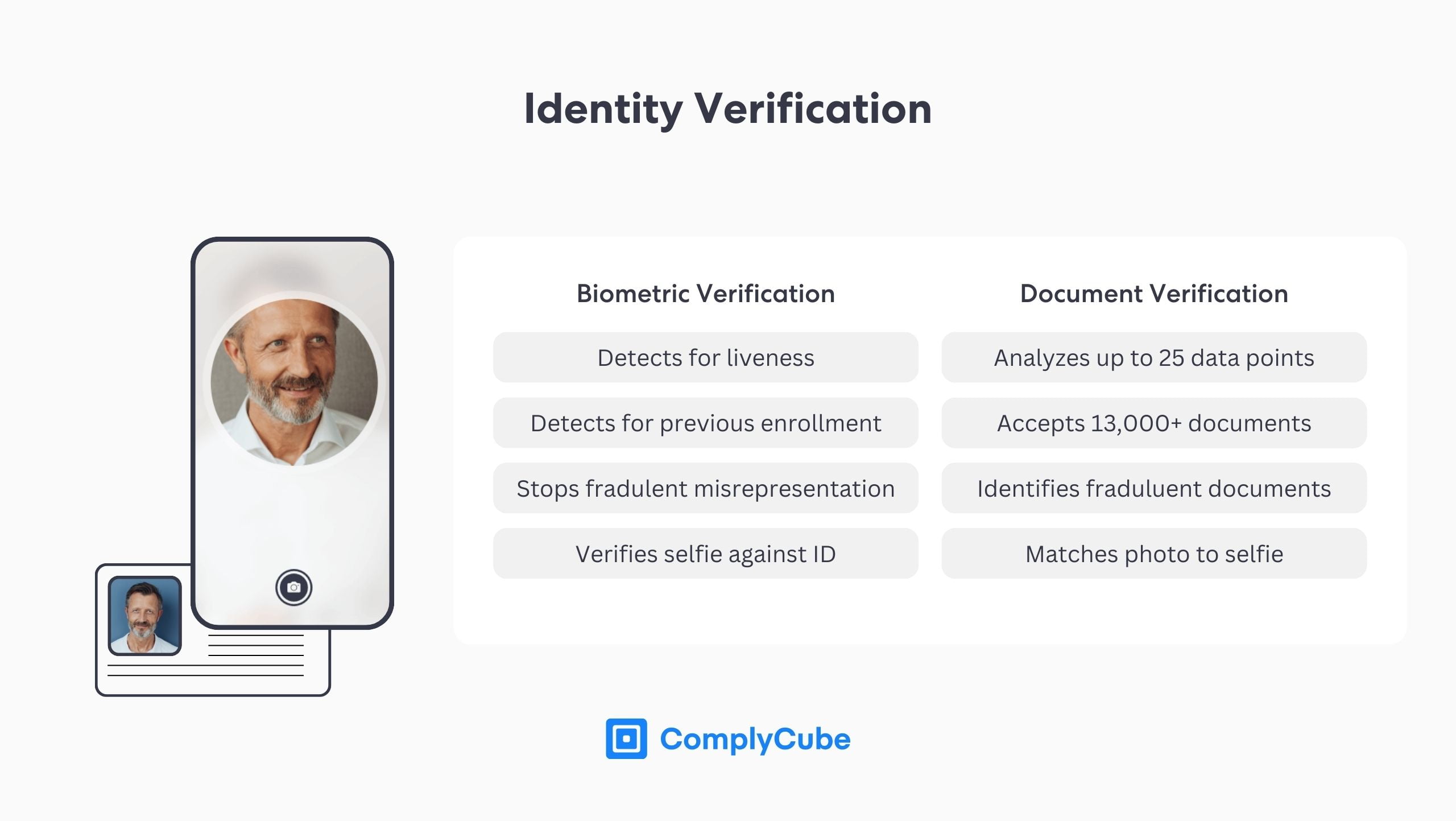
IDV is paramount to achieving regulatory compliance. In the digital age, identity theft and fraud are on the rise, especially with the increase of online companies prompted by Covid-19 restrictions. In fact, up to [70%](https://firstsiteguide.com/online-business-stats/) of businesses are investing more in their online presence.
A robust Identity Verification process is the best fraud detection tool, helping financial institutions and other organizations protect themselves, their customers, and their assets.
### **What Is Digital Identity Verification?**
Digital identity verification utilizes software to confirm someone’s identity online. It is nearly always completed during the customer onboarding process and can include checking government databases, social media profiles, and other publicly available information.
### **KYC Vs. AML Identity Verification**
KYC is the process of confirming the identity and intentions of clients in a financial context. On the other hand, AML, or Anti-Money Laundering, refers to preventing illicit funds from entering the financial system. You can read more about the topic here: [KYC vs AML – What Is the Difference?](https://www.complycube.com/en/kyc-vs-aml/)
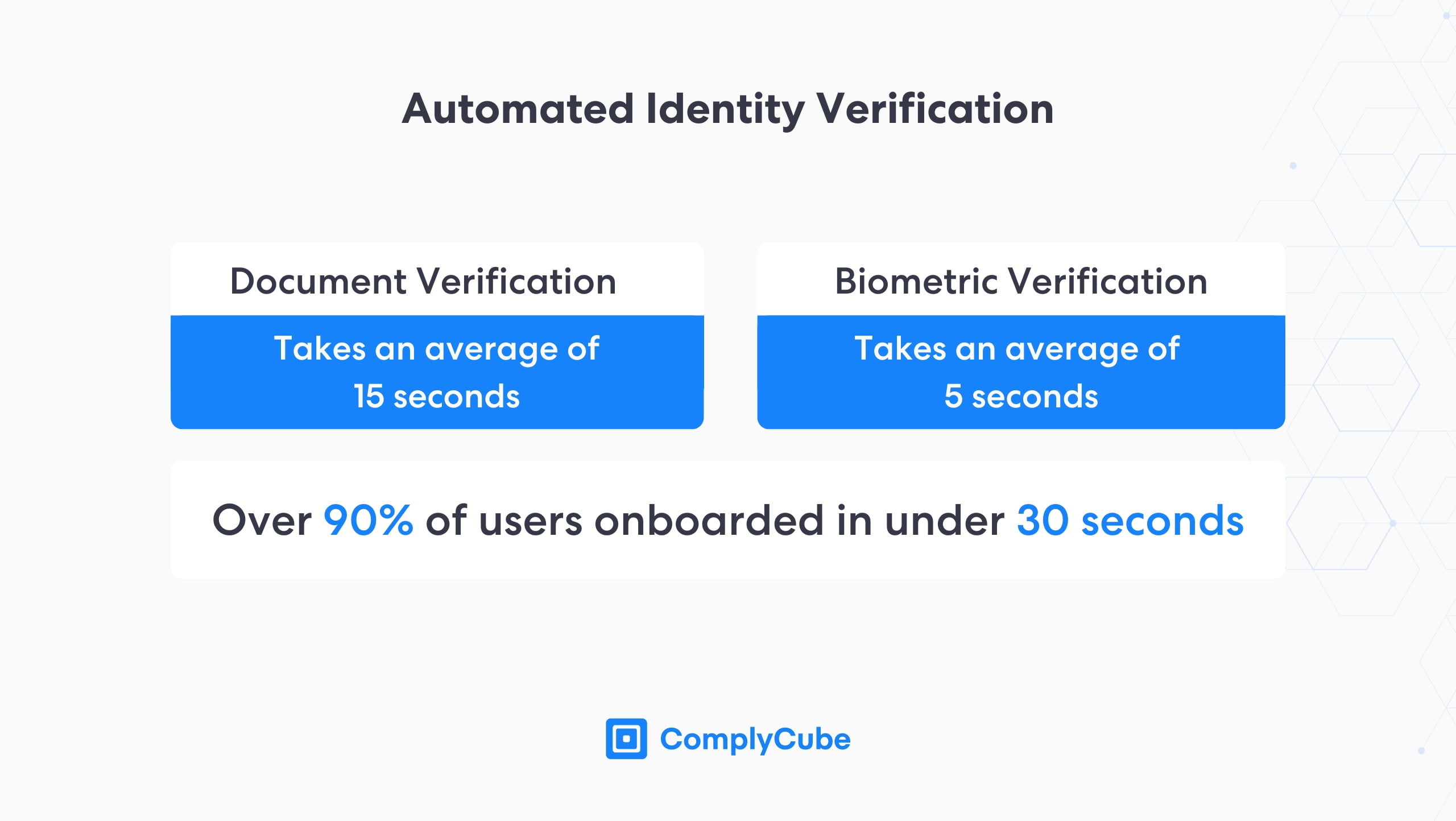
Therefore, KYC and AML identity verification processes are essential for businesses handling financial transactions.
## **The Types Of Identity Verification**
There are various methods for confirming someone’s identity. These include:
### **Identity Document Verification**
Document verification is the process of authenticating an identity document, such as a driving license or a passport, to prove it is genuine, valid, unexpired, and has not been tampered with.
The verification process involves checking documents for several features, including holograms, watermarks, stamps, encodings, fonts, and other security features. It may also entail checking whether the document has been reported lost, stolen, or never been issued. For example, Belgium’s CheckDoc service, maintained by its federal police, offers a web interface and APIs (Application Programming Interfaces) to verify the status of national IDs, passports, and residence permits.

Verification can be conducted manually by expert human reviewers or through [identity verification software](https://www.complycube.com/en/solutions/identity-assurance/document-verification/). Today, it’s not uncommon for businesses to prompt online users to snap their ID documents and take a selfie or short video to prove liveness when opening an account. Customers expect this process to be [fast and frictionless](https://thepaypers.com/expert-opinion/the-ekyc-tightrope-the-balancing-act-between-customer-experience-and-fraud-deterrence), but this can be challenging for large institutions to deliver at scale without the right identity verification software in place.
Some of the most promising technologies that complement document verification include Near-Field Communication (NFC) verification and biometric checks, which fend off fraud by verifying that the individual seeking to use your service is genuinely behind the attempt.
### **Biometric Verification**
Biometric verification utilizes advanced algorithms to analyze unique physical attributes (i.e., biometrics), such as fingerprints or facial traits, to confirm a person’s identity. Many enterprises use this method in conjunction with document verification to establish that the person presenting the identity document is indeed the same as the document holder.

Biometric verification can also be used for authentication purposes if the collected biometrics are stored and indexed appropriately (e.g., 3D face maps). Biometric authentication has many advantages, such as improved security and convenience. You can find more information about it here: [The Advantages Of Biometric Authentication](https://www.complycube.com/en/the-advantages-of-biometric-authentication/).
### **Liveness Detection**
Liveness detection is a process used to ensure that the person undergoing identity verification is present and not using a fake or manipulated photo or video. It uses advanced biometrics and image analysis, typically underpinned by Machine Learning (ML) models, to establish whether the person attempting to verify themselves is physically present and is not an inanimate object such as a 3D mask or a photo of a photo.
There are two types of liveness detection, active and passive biometric checks, which you can learn more about here: [What are Active and Passive biometric checks?](https://www.complycube.com/en/what-are-active-and-passive-biometric-checks/)
### **Knowledge-Based Authentication (KBA)**
KBA involves asking personal, knowledge-based questions to which only the genuine individual would know the answer. It can include past addresses, credit card numbers, or other personally identifiable information.
### **eIDV (electronic Identity Verification)**
eIDV, also known as database or KYC data checks, involves corroborating personal customer information, such as name, date of birth, address, and SSN, against authoritative data sources. The sources may include consumer reporting agencies, credit bureaus, utility data (e.g., phone, electricity), and government databases. You can learn more about the various source types used in eIDV checks here: [Multi-Bureau Check](https://docs.complycube.com/documentation/checks/multi-bureau-check).
In certain jurisdictions and use cases, regulators go further by stipulating a “2+2 check”, which ensures at least 2 customer attributes have matched on 2 independent data sets.
### **eID (electronic identification)**
An eID is a digital solution for proof of identity, typically issued by banks or government entities. It is used for authentication, login, or signing electronic documents with a [digital signature](https://en.wikipedia.org/wiki/Digital_signature). One example of eID is an **electronic identification card** (**eIC**), a physical card that can be used for online or offline identification or authentication purposes. Another form of eID is the Swedish BankID, which returns the verified name and national ID number of an end-user.
And with the prevalence of mobile phones and their relatively low cost compared to a card-based system, the eID ecosystem has seen [Mobile ID](https://id4d.worldbank.org/guide/mobile-id) gain more traction due to its convenience and security.
While these are just a few examples, there are countless ways to verify someone’s identity. Businesses can combine these methods to ensure a robust identity verification process in line with their [risk-based approach](https://www.complycube.com/en/what-is-a-risk-based-approach/).
But what are the typical components of an identity verification process? Let’s find out.
## **The Identity Verification Process**
There are multiple steps to the verification process, namely:
- **Identification:** The first step in identity verification is to gather personal identification data points, such as an address, a government-issued ID, and a selfie.
- **Verification:** Then, you should verify the collected data using suitable identity verification software, trained KYC agents, or a combination of the two.
- **Authentication:** Your business can authenticate the identity through additional methods, such as biometric authentication or KBA.
- **Continuous Monitoring:** Even after you complete the initial authentication, the verification process doesn’t end. It’s essential to continuously monitor changes or red flags in a person’s identity or status throughout your relationship with the customer.
By following these steps and utilizing multiple verification methods, businesses can protect themselves and their customers from fraud and identity theft.
## **Why Do You Need Identity Verification?**
So, now that you know what identity verification is, the different types, and the process, let’s discuss why you need it for your business.
### **Prevent Fraud**
Identity verification software is there to [prevent fraud](https://www.complycube.com/en/the-battle-against-aggravated-identity-fraud/). By verifying the identity of your users, you can ensure that the person is who they say they are and that they’re not using someone else’s information. Generative AI can be used to create convincing copies of KYC documents, which can easily bypass outdated AML and KYC controls.
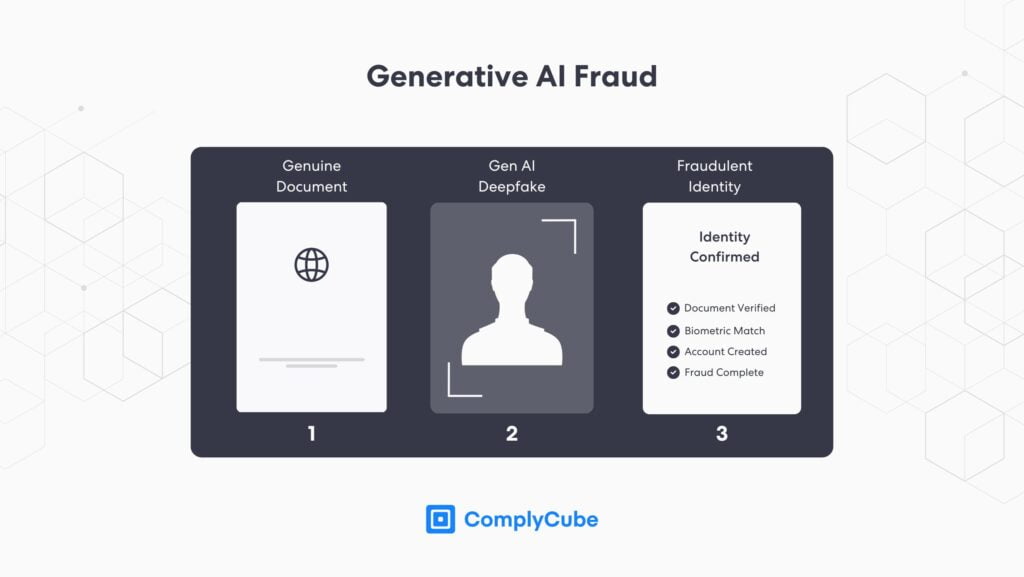
Fraud prevention is even more vital when dealing with sensitive information, such as financial data or sensitive information.
### **Comply With AML Regulations**
It’s also crucial to comply with regulations. In many industries, some laws and regulations require businesses to verify the identity of their users.
These regulations are enforced by many different bodies, depending on your location. Here are a few major AML regulatory bodies around the world:
- Global – [FATF](https://www.fatf-gafi.org/)
- UK – [FCA](https://www.fca.org.uk/)
- Netherlands – [FIU](https://www.fiu-nederland.nl/en/fiu-the-netherlands)
- US – [FinCEN](https://www.fincen.gov/)
- Canada – [FINTRAC](https://www.fintrac-canafe.gc.ca/intro-eng)
- China – [CBIRC](https://www.cbirc.gov.cn/en/view/pages/index/index.html)
- Hong Kong – [HKMA](https://www.hkma.gov.hk/eng/)
- Japan – [FSA](https://www.fsa.go.jp/en/)
- Singapore – [MAS](https://www.mas.gov.sg/)
- Australia – [AUSTRAC](https://www.austrac.gov.au/)
- South Africa – [FICA](https://www.fic.gov.za/)
- UAE – [NAMLCFTC](https://www.namlcftc.gov.ae/en/)
This is not an exhaustive list of bodies that mandate identity verification to fight money laundering and protect consumers from fraudsters. Often a country may have more than one regulator covering different aspects of fraud or specializing in a particular industry. Nevertheless, each has the mandate to prevent fraud and ensure that businesses within their jurisdiction adhere to the laws set out by the government.
### **Protect Your Data**
Verifying your user’s identity can ensure that only authorized individuals can access your data. Therefore, it’s crucial for businesses dealing with sensitive customer data, such as personal or financial information.
### **Improve Customer Experience**
In today’s online world, customer experience is everything. Customers are more likely to continue using your service when they are satisfied and safe. They are also more inclined to spread the word about your fantastic solutions.
That’s why robust identity verification is essential to keeping your customers happy. By verifying your users, you can ensure they are who they say they are and that they aren’t using someone else’s information. This can help to reduce customer frustration and increase customer satisfaction.

### **Battle Financial Fraud**
In addition to preventing fraud in general, identity verification software can also help battle financial fraud.
By confirming the identity of a user, businesses can ensure that they are not dealing with fraudulent credit cards or bank information. It can save the company from costly chargebacks and losses due to fraudulent transactions.
### **Improve Trust**
Overall, identity verification software improves trust between a business and its customers. By having these verification precautions in place and protecting the company’s data, you can show their customers that you take security seriously and safeguard their personal information. This can lead to improved customer relationships and trust in the business.
## **The Top Businesses That Need KYC Identity Verification**
Now it’s time to discuss which firms and industries need KYC identity verification the most.
### **Banks**
Banks are perhaps the most apparent business that needs to perform KYC identity verification. Customers must first provide proof of their identity to open an account, deposit or withdraw money, or apply for a loan. This helps to prevent money laundering and other financial crimes.
### Cryptocurrency Exchanges and **Fintechs**
Crypto firms (known as Virtual Asset Service Providers, or VASPs) and Fintech companies, such as online lenders and payment apps, must also implement identity verificaation software. Over recent years, they have been the target of increased financial fraud, money laundering, and finance proliferation. These businesses often deal with sensitive financial information and need to confirm the identity of their customers to protect against fraud and [comply with regulations](https://www.complycube.com/en/aml-for-fintechs-comply-with-regulations/).
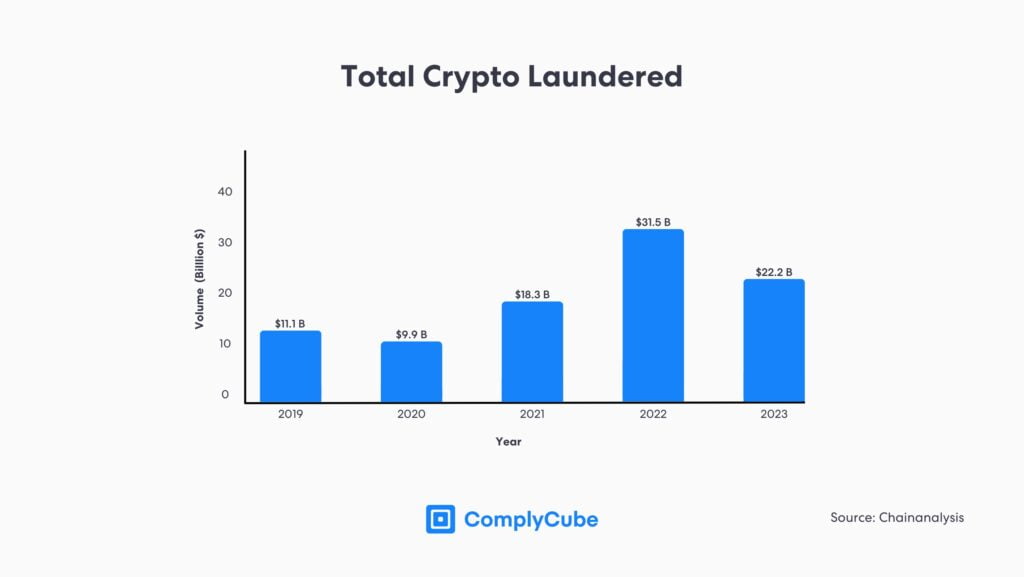
### **Telecoms**
The use of mobile devices has increased exponentially over the past few years, with [mobile users crossing the 7 billion mark in 2021.](https://www.statista.com/statistics/218984/number-of-global-mobile-users-since-2010/) Telecom airtime providers, be it Mobile Network Operators (MNOs) or Mobile Virtual Network Operators (MVNOs), typically retain personal data and conduct a credit check before granting a customer a ‘post-pay’ or ‘monthly contract’. On the other hand, pre-paid or ‘pay as you go’ SIM card holders’ identities are not actively checked. However, as of early 2021, [157 countries](https://privacyinternational.org/long-read/3018/timeline-sim-card-registration-laws) have mandatory SIM registration laws stipulating that customer identities must be reliably established before SIM activation.
With the onset of the COVID-19 pandemic and increasing digitalization, many Telcos are now compelled to leverage online identity verification software to save costs, reduce onboarding time, and improve the customer experience while complying with mandatory registration rules.
### **Video Games**
The video gaming industry has been [booming over the past decade](https://www.investopedia.com/articles/investing/053115/how-video-game-industry-changing.asp), but even more so after COVID-19. With a large proportion of video games now facilitating transactions, such as purchasing new skins, mods, and in-game items, companies operating in such industries are becoming more vulnerable to identity fraud and money laundering.
Operators facilitating such transactions and content should now use identity verification software and KYC services to verify their users’ identity, age, location, and source of funds. These new practices have come into play to protect vulnerable children and keep terrorist financing and money laundering at bay.
### **Metaverse**
With the advent of [Web 3.0](https://www.forbes.com/sites/forbestechcouncil/2020/01/06/what-is-web-3-0/), several companies, including Meta and Disney, are building[ experiences in the Metaverse](https://www.stevenvanbelleghem.com/blog/10-brands-that-have-built-awesome-experiences-in-the-metaverse/). Yet, amid hype and promise, there’s a lot to be done to make the Metaverse a safe place. However, without verified and trusted identities, anonymous bots and nefarious actors can wreak havoc in Metaverse.
Therefore, identity verification software will be vital in enabling numerous use cases for virtual worlds, including new collaborative experiences, by combining the benefits of in-person and remote communication. Identity verification will also be crucial in age verification checks and protecting the vulnerable, as avatars may change regularly, and illegal attempts are made to access restricted content, such as novel gambling experiences.
The ecosystem of the Metaverse will also undoubtedly facilitate transactions of goods and services using [NFTs (Non-Fungible Tokens)](https://www.theverge.com/22310188/nft-explainer-what-is-blockchain-crypto-art-faq) or other forms of digital currency, making it vital to establish the real identities of the transacting parties.
### **Online Retailers**
The e-commerce industry has been booming over the past few years. In 2020, the [United Nations](https://news.un.org/en/story/2021/05/1091182) documented that the percentage of retail sales that happen online increased from 16% to 19%.
This dramatic increase has left the door open for scammers and fraudsters. The issue is that customers expect online retailers to have fast checkouts, and this makes identity verification difficult.
That’s why it’s essential for e-commerce stores to use verification that is easy-to-use, and quick to authenticate. In doing so, they can prevent credit card and identity fraud.
### **Government Agencies**
Government agencies are also required to perform KYC identity verification. For example, citizens must first provide proof of their identity to obtain a passport, driver’s license, or other government-issued ID.
## **Choosing The Right Identity Verification Software**
Choosing the right identity verification software for your business can be difficult. Here are some factors to consider when choosing the right software:
- Does the software meet regulatory requirements for your industry?
- Is it user-friendly for both customers and employees?
- Can it integrate with your current systems and processes?
- How secure is the software, and what measures does it have to protect customer data?
- Does the software have a good reputation and strong credibility?
Choosing a reputable and secure identity verification software that meets your business needs and industry regulations is crucial.
Don’t skimp on security — investing in proper identity verification can save your business from costly fraud and improve customer trust.
## **About ComplyCube’s**
Identity verification is a critical step in protecting your business and customers. Verifying your customers’ identities ensures that only authorized individuals can access your products or services. There are many types of identity verification, but all of them serve a common purpose—to protect your business and customers.
If you’re looking for a reliable and affordable way to verify your customers’ identities, [ComplyCube](https://www.complycube.com/) is the partner you need. Our identity verification platform is easy to use and can be customized to meet the unique needs of your business. [Sign up](https://portal.complycube.com/signup) today and see how our innovative IDV and KYC solutions can help you keep your business safe and secure.
**Categories:** Guides
**Tags:** Identity Verification
---
### [New Updates to Companies House Identity Verification Requirements](https://www.complycube.com/companies-house-identity-verification/)
**Published:** April 17, 2026
**Author:** Rithu Jagannath
**Excerpt:** From intake to personal code, this blog breaks down companies house identity verification, how to meet companies house identity verification standard, and companies house director verification so ACSPs can reduce rework and stay compliant.
**Content:**
**TL;DR:** As of November 2025, **companies house identity verification** is mandatory. To understand **how to meet** companies house identity verification standard, businesses must follow a step-based process supported by controls. For **companies house director verification**, the journey ends with a **personal code used to link roles** and support confirmation statement filings.
## What is Companies House Identity Verification?
Companies House is the UK registrar that keeps the public register of companies’ corporate members and runs online filing services for confirmation statements. As of November 2025, stronger identity verification protocols became a legal requirement for all UK company directors and People with Significant Control (PSCs) for existing and new companies.
People must either successfully verify via GOV.UK one login or through an Authorised Corporate Service Provider (ACSP). They must do this using documents, to ensure a safer register of existing individual members to tackle anti-money laundering or identity fraud. An ACSP acts as a business entity that can verify people on a client’s behalf. That means there needs to be some additional company time and resources that go beyond just checking an ID.
## Companies House Identity Verification Journey
ACSPs should retain evidence from every identity check to uphold UK standards and maintain a clear audit trail. This includes successful, failed, and referred outcomes for corporate directors or PSCs, as well as failed verification attempts. Complete records show which evidence the ACSP used, which checks the team performed, and which outcome they reached. They also help the ACSP explain how each decision was made and produce a clear record quickly if Companies House requests one.
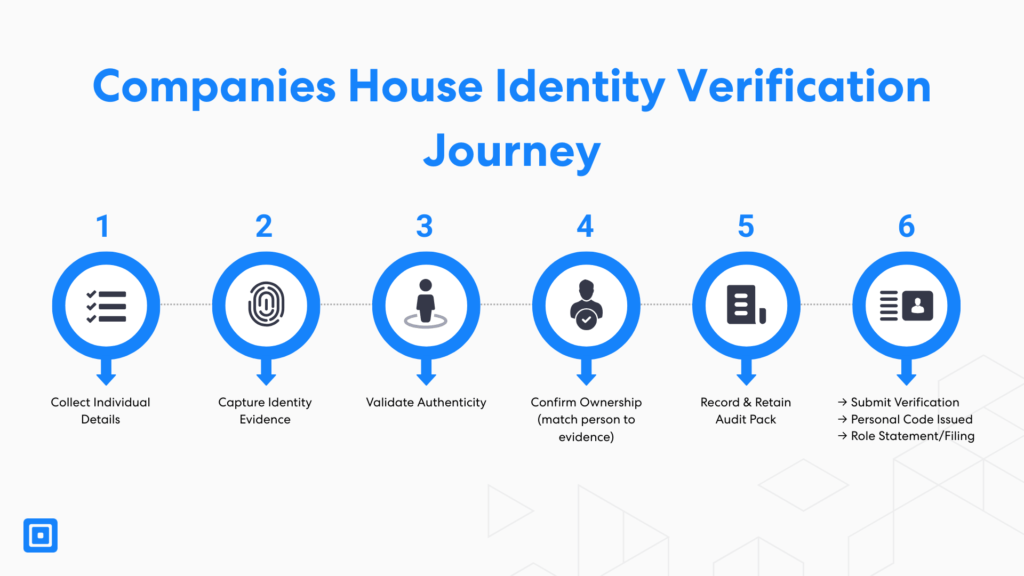
ACSP teams should follow a simple, repeatable journey to maintain compliance and reduce the risk of financial penalties. They should collect the individual’s details, capture identity evidence, validate its authenticity, confirm it belongs to the person, and then record and retain a complete audit pack. Once the verification is complete, the personal code can be issued and the relevant roles can be linked for filing. Building this protocol takes time, training, controls, and consistent outputs, but it gives ACSPs a defensible process they can apply at scale.
## Why Companies House Identity Verification Tightened
This [introduction of identity verification](https://companieshouse.blog.gov.uk/2025/11/06/how-companies-house-is-helping-businesses-prepare-for-identity-verification/) in November 2025, is part of Companies House’s wider push to reduce any abuse of the register linked to anti-money laundering and economic crime. To prevent the use of companies for illegal purposes, existing directors need to verify their Identity. It helps ensure compliance with legal requirements and reduce further risks.
> Identity checks are tightening because the UK is closing gaps.
Joshua Vowles-Dent, GTM Lead, says that “Identity checks are tightening because the UK is closing gaps that have been exploited for years – shell companies, false director details, and synthetic identities that make it easier to move value and hide accountability. For ACSPs, the shift is clear: identity verification can’t be treated as a one-off ‘tick box’. It needs to be consistent, evidence-led, and repeatable, with records that stand up to scrutiny.”
The identity verification process must follow a consistent standard, not a best-effort approach. Companies House makes clear that business entities such as ACSPs must meet the identity verification standard when verifying existing PSCs or directors for clients. If organisations skip these steps or apply them inconsistently, they risk non-compliance, regulatory scrutiny, and financial penalties.
## Scope of Verification of Companies House Service
Companies House identity verification currently applies to directors, persons with significant control (PSCs), and members of limited liability partnerships who must verify their identity. Directors and PSCs cannot legally act in these roles without a verified identity. If they fail to meet the identity verification requirements, they may face enforcement action, prosecution, and financial penalties through the courts.
It is also common to see mixed status in one file for a company’s confirmation statement. The same company may have new and existing directors plus existing PSCs at the same time. So intake must capture roles clearly. Clients also ask about the company secretary, so define who must verify their identity versus who only files.
## The Companies House Identity Verification Process
In November 2025, the companies house register has two routes for the new identity verification process. As mentioned, [people verify directly](https://www.gov.uk/using-your-gov-uk-one-login/proving-your-identity) through gov.uk one login, post office or they use an [authorized corporate service provider](https://changestoukcompanylaw.campaign.gov.uk/authorised-corporate-service-providers/) (ACSP). This is direct verification of identity of existing directors and PSCs.
The ACSP route is the assisted route which is helpful for existing and new companies alike. Unlike gov.uk one login, this is where a business will handle and run the checks, keep records, as well as support any edge cases around identity for companies house. Both of these routes introduce identity verification for the same end state as part of anti-money laundering procedures, preventing the use of companies for illegal purposes and any other form of identity fraud.
## Common Pitfalls for Authorised Corporate Service Providers (ACSP)
ACSP teams often run into the same four pitfalls when delivering Companies House director verification. They confuse AML CDD with Companies House identity verification, accept incomplete intake data, especially address history, keep weak records, and fail to explain the personal code clearly to clients.
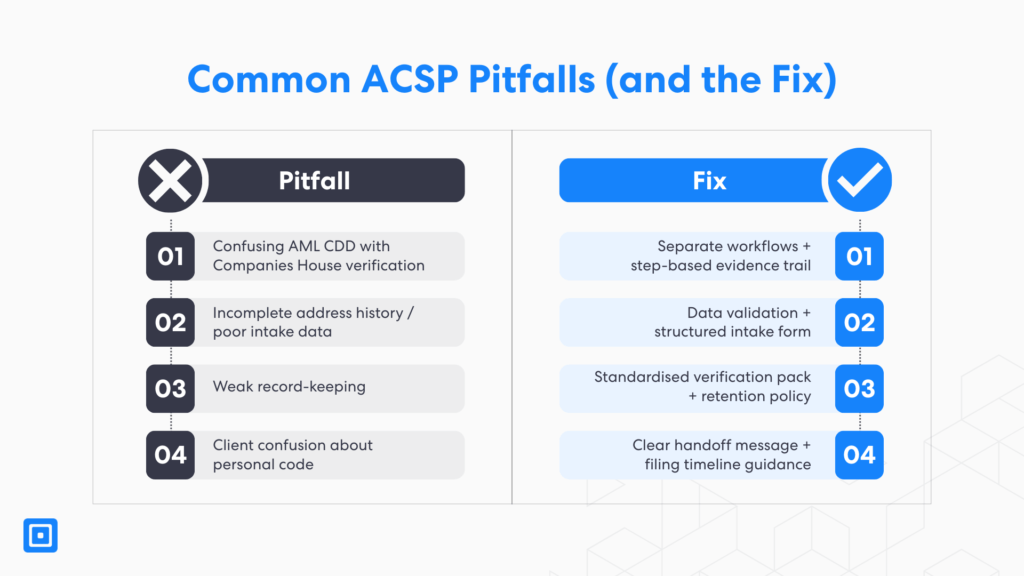
These compliance gaps can leave company directors stuck at the point they need to link their verified identity to their Companies House roles for filings. It is clear because Companies House sets a very clear expectation. ACSPs must follow the identity verification standard and keep step-based evidence for every check.
The simplest fix is a tighter operating model: split AML and Companies House into separate workflows, validate intake data up front, standardise an “audit pack” for every case, and send a short handoff explaining how to access and use the Companies House director verification personal code (via “Manage account”) before key filing dates.
## The Guide to Identity for Companies House Verification Standards
Companies House introduces [identity verification as mandatory](https://companieshouse.blog.gov.uk/2025/09/15/why-identity-verification-is-good-for-business/) and it is crucial for ACSPs to complete every step. That means your ACSP must be standards-first. Tools can help, but the duty stays with you. This is also where anti-money laundering governance helps. Anti-money laundering culture already values evidence and audit trails. Still, Companies House director verification is its own process and identity verification requirements. It is not just another AML check.
### Step 1: Entering details and identity data quality
ACSPs must collect the right evidence to verify a person’s identity. This is where identity documents and photo ID choices matter. Acceptable forms of identification can include government-issued documents, machine-readable passports, biometric residence permits, UK biometric residence permits, UK biometric residence cards, Irish passport cards, and UK frontier worker permits. GOV.UK One Login lists the types of photo ID people can use to verify their identity. ACSPs should record the document reference number, expiry date, and country of issue as part of the evidence, so each verification has a clear and defensible audit trail.
### Step 2: Identity documents and photo ID
It is important to get evidence to verify their company identity. This is where identity documents and photo ID choices matter. ACSPs can accept several forms of identification, including government-issued documents, machine-readable passports, biometric residence permits, UK biometric residence permits, UK biometric residence cards, Irish passport cards, and UK frontier worker permits. GOV.UK One Login lists the photo ID types people can use to verify their identity.
### Steps 3: Security questions
Some users need to prove their identity by answering security questions online. Typically, this only applies to direct routes for companies house director verification. This is where the person can complete the process digitally without visiting a Post Office. These questions help confirm that the person has access to information that should be linked to their identity.
### Step 4: Identity checks
Core identity checks ensure that the evidence provided is real, valid and untampered. That must then be checked to see if it belongs to the person that is going through the process. In the “online then Post Office” route, users must enter information from their photo ID on GOV.uk, then go to a Post Office to have their photo ID scanned. This confirms that the document presented matches what was submitted online.
### Steps 5: Records and retention
Companies House requires teams to keep records of the evidence and information used during the identity verification process. These records help show how the verification decision was reached and provided an audit trail if the decision is reviewed later. Information must be kept for 7 years from the date identity verification is completed. It is essential to capture the right information at the point of verification, rather than after the fact. Clear records make the process easier to defend, especially when checks are being completed at mass.
### Step 6: Verification Decision
The final step is the decision of the companies house director verification. Here, teams must decide whether the person’s identity can be verified based on checks, evidence, and information recorded. This decision should be clear, consistent, and easy to justify. It is important to build a verification pack as part of the new companies house director verification process. This includes details around the identity verification such as what was done as well as the outcomes and reasons for the decision.
## Companies House Identity Verification Pack for Audit-Readiness
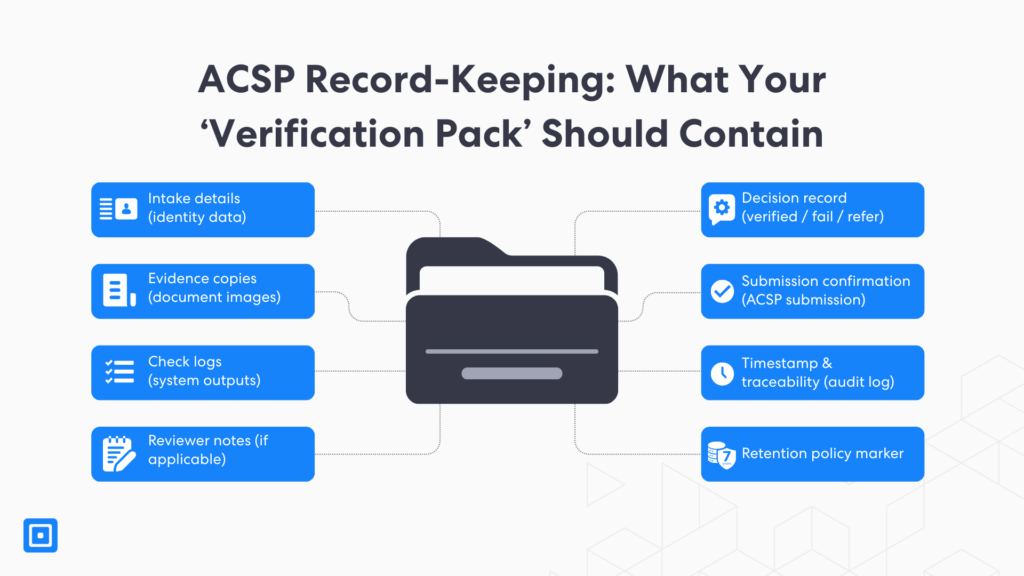
A strong ACSP verification pack turns Companies House director verification from a one-off task into a defensible process teams can repeat at scale. Companies House requires ACSPs to keep records of each identity verification step and retain them for 7 years. Build each pack so it answers one question quickly. We need to answer, what did we check, which evidence did we rely on, and why did we verify the person’s identity, reject it, or refer it for further review?
In practice, a complete pack should include: intake details (the identity data provided at onboarding), evidence copies (document images or capture outputs), and check logs (system outputs showing authenticity/ownership results). It should also capture the decision record (verified / fail / refer), any reviewer notes (if applicable), the ACSP submission confirmation, and an audit-ready timestamp trail that links actions to the operator and time, plus a clear retention marker so your team knows when the record can be disposed of.
## Companies House Personal Code via gov.uk one login
After a person verifies their identity, a person gets a Companies House personal code. Companies House explains it is an [11-character code](https://www.gov.uk/guidance/companies-house-personal-codes-for-identity-verification), personal to the individual. Clients often call it a house personal code. Users can view and manage their personal code and verification details through their Companies House account via Manage account once their identity is verified and connected to the account.
Companies House will update the register to show the due dates for each role you hold after verification. If you are involved in more than one company, you may need to provide your personal code to Companies House more than once. Companies House also says you must sign in with the same email address you used when you verified.
## Handling Sensitive Identifiers for Companies House Identity Verification
Some clients will ask if they need to provide a National Insurance number, especially when different verification routes request different details. ACSPs should treat any government identifier as high-sensitivity data and only collect it when the selected verification journey genuinely requires it. GOV.UK One Login can use evidence and verification signals beyond photo ID, including HMRC tax record checks. The security questions route also uses credit-record style questions, so users may see different prompts depending on what data is available for them.
From an ACSP controls perspective, the goal is minimisation plus strong safeguards: collect the minimum attributes needed to complete the ID verification process, store them with tight access controls, and retain them only as long as required for audit. [FATF’s digital identity guidance](https://www.fatf-gafi.org/content/dam/fatf-gafi/guidance/Guidance-on-Digital-Identity.pdf) explicitly frames digital ID as a way to support elements of customer due diligence using a risk-based approach, which aligns well with treating identifiers such as a national insurance number as optional-by-design, not default-by-habit.
### **Case study: Overseas founder becomes company director near a filing date**
Northbridge Services Ltd (Leeds) added an overseas founder as a new director and updated an existing director’s details. The founder tried gov.uk one login but struggled to verify their identity. After switching to an ACSP route, they learned that a shared mailbox caused confusion over the same email address used at verification. This blocked access to a personal code for companies house director verification via Manage account.
**ACSP verification plus code-access recovery playbook**
An ACSP ran the six-step process and captured evidence in a clean audit pack. This was treated as a full companies house director verification process. Then, they moved the new director to a unique email and documented ownership. Additionally, the team aligned next steps to role linkage and filing timing. A verified identity results in a personal code that allows you to role link.
**Outcomes**
- The new director’s verified identity linked cleanly to the role.
- They removed shared inbox risk and kept access stable.
- The company filed on time with no identity rework for the existing companies corporate members.
## Corporate directors, corporate PSCs, corporate members, and limited partnerships in scope at later date
After November 2025, Companies House has signalled that some roles will move into scope at a later date, so ACSPs should expect follow-on change. This includes corporate directors, officers of corporate PSCs, and limited partnerships. They require tighter role mapping. Some clients will also describe LLP structures using terms such as corporate members or “companies corporate members” where a company is the member, which is exactly where poor data modelling and unclear ownership chains create friction.
As outlined by Companies House’ “changes to UK company law” programme, staged implementation is part of the plan, so the best teams treat later-date scope as a planned product iteration, not an unexpected compliance fire drill. You can learn more about workflows here: [Build a Strong KYC Due Diligence Checklist UK](https://www.complycube.com/en/build-a-strong-kyc-due-diligence-checklist-uk/)
### Key Takeaways
- **Companies house identity verification** works best as an end-to-end workflow, not a one-off check.
- **Companies house director verification** should be planned around a confirmation statement deadline.
- **Strong record-keeping** (audit pack + retention) makes an ACSP process defensible at scale.
- **Clear client communications** (timelines and code usage) prevent most delays and rework.
- **Meeting companies house identity verification standard** means mapping every step to saved evidence and a clear decision record.
## Preparing for Scale with ComplyCube
As of November 2025, with the 12-month transition period, volume will rise. More people will verify closer to company’s confirmation statement deadlines. The authorised corporate service provider process is an advantage. With good intake, strong checks, and fast record retrieval, companies can avoid financial penalties and further risks.
So if you want to future-proof your identity verification solution, design now for later date roles. That includes corporate PSC officers and limited partnerships. If you want a practical review of your workflow against the six-step standard, speak to our team at [ComplyCube](complycube.com). We can help you standardise checks and produce audit-friendly outputs that match your policy.

## Frequently Asked Questions
Do I need GOV.uk One login for companies house identity verification?
Not always. GOV.UK One Login is the direct route for people verifying their own identity online. ACSPs can also verify clients through their own workflow, as long as they meet Companies House identity verification standards for evidence capture, identity checks, decisioning, and record keeping.
Can directors verify their identity at the Post Office?
Yes. Directors, PSCs, and some corporate officers who cannot complete the GOV.UK One Login route may use the Post Office route. They enter details from their photo ID online, then visit a participating Post Office to have the document scanned and checked in person.
Why do people lose access to their Companies House personal code?
People usually lose access because they sign in with the wrong account, use a different email address, or cannot find the code in their Companies House account. Since the personal code is needed to link verification to a company role, this can delay filings and confirmations.
How long must ACSPs keep identity verification records?
ACSPs must keep identity verification records for 7 years from the date the verification is completed. These records should show what evidence was used, which checks were completed, what decision was made, and why the person’s identity was accepted or rejected.
How does ComplyCube support Companies House identity verification?
ComplyCube helps ACSPs standardise Companies House identity verification with an audit-ready workflow. Teams can capture identity evidence, run checks, make consistent decisions, and retain verification records. This helps firms verify directors, PSCs, and relevant officers efficiently while keeping the process defensible at scale.
**Categories:** Guides
**Tags:** Identity Verification
---
### [ComplyCube Boosts IXO World’s Web of Trust with Crypto KYC/AML](https://www.complycube.com/complycube-boosts-ixo-worlds-web-of-trust-with-crypto-kyc-aml/)
**Published:** October 15, 2024
**Author:** Andreea Balasa
**Excerpt:** ComplyCube has partnered with IXO World to integrate crypto KYC/AML solutions into IXO World’s Spatial Web Platform and streamline Identity Verification and compliance processes for its global user base in the digital asset space.
**Content:**
London, October 8, 2024 — [ComplyCube](https://www.complycube.com/en/), a leading provider of cutting-edge Identity Verification (IDV) and compliance technology, has partnered with [IXO World](https://www.ixo.world/), the pioneer of the Internet of Impacts. This collaboration will integrate advanced crypto KYC/AML solutions into IXO World’s Spatial Web Platform, helping to streamline Identity Verification and compliance processes for its global user base. The partnership comes as regulatory demands in the digital asset space become increasingly stringent.
## Choosing the Right Partner for Crypto KYC/AML Compliance
IXO World’s Spatial Web Platform is a groundbreaking solution that facilitates coordinating, funding, and verifying real-world impact initiatives. Working with renowned organizations such as [UNICEF](https://www.unicef.org), IXO World has made a meaningful impact in sectors such as clean energy, healthcare, education, and youth skills development. The platform provides decentralized infrastructure and services, enabling sustainable economic networks to flourish across both physical and virtual domains.
By utilizing ComplyCube’s technology, IXO World has developed the iID Oracle, a service that enables platform users to meet their KYC and AML requirements seamlessly. This component is a vital part of IXO’s decentralized Web of Trust, ensuring secure, scalable, and compliant IDV processes as global regulations evolve.
## Building Global Trust and Growth Through Technology
Founded over ten years ago, IXO World sought a KYC provider that could not only support its rapid expansion but also integrate seamlessly into its Web of Trust, a foundational aspect of its self-sovereign identity framework. After evaluating several options, IXO World chose ComplyCube for its user-friendly interface, flexible pricing model, and robust verification capabilities. ComplyCube’s automated IDV solutions — including document verification, video selfie checks, and enhanced screening — empower IXO World to meet stringent compliance requirements without compromising user experience.
> ComplyCube allows us to integrate [key Identity Verification services](https://www.complycube.com/en/solutions/) into our Spatial Web of Trust, which is critical as we scale our efforts.
Dr. Shaun Conway, Founder and CEO of IXO, commented on the partnership: “The ComplyCube team has been fantastic to work with. They understand both our immediate needs and long-term vision of creating a compliant and trusted Internet of Impacts. Their platform allows us to integrate key Identity Verification services into our Spatial Web of Trust, which is critical as we scale our efforts.”
As IXO World continues to grow and regulatory demands tighten, integrating ComplyCube’s automated verification processes ensures ongoing compliance while delivering a smooth user experience.
> This collaboration reflects our mission to [build trust at scale](https://www.complycube.com/en/company/about-us/), empowering organizations to create safer, more transparent digital ecosystems that benefit society.
Dr. Tarek Nechma, CEO of ComplyCube, emphasized the partnership’s broader impact: “By working with IXO World, we are not just delivering compliance solutions – we are empowering a platform that can drive real, positive change on a global scale. This collaboration reflects our mission to build trust at scale, empowering organizations to create safer, more transparent digital ecosystems that benefit society. Together with IXO World, we are proving that advanced technologies can drive progress while ensuring the highest standards of security and compliance.”
### **Ensuring Future-Ready Compliance**
ComplyCube’s technology strengthens IXO World’s compliance and onboarding procedures and aligns with its broader objective of establishing a trusted, self-sovereign identity ecosystem. By automating KYC and AML checks, IXO World can uphold the integrity of its projects and maintain trust while navigating the intricate regulatory environment of digital assets.
As global regulators increasingly advocate for AI-powered solutions to combat financial crime, ComplyCube remains well-positioned to advance its mission of building trust at scale in a rapidly evolving digital economy.
Mohamed Alsalehi, CTO of ComplyCube, emphasized: “Emerging technologies are reshaping the global landscape, but they also present challenges in terms of fraud and financial crime. Platforms like IXO must have strong tools in place to prevent illegal activities. ComplyCube’s identity verification and AML solutions enable IXO World to achieve this, adding an essential layer of trust in the digital ecosystem.”
With regulatory frameworks such as the [EU’s Markets in Crypto-Assets (MiCA) regulations](https://www.complycube.com/en/mica-regulation-and-the-future-of-rwas/), which are set to take effect soon, the importance of robust KYC and AML measures becomes increasingly critical. MiCA will soon enforce stricter compliance requirements on digital asset platforms like IXO World. By integrating ComplyCube’s advanced compliance technology, IXO World ensures it remains ahead of these regulatory changes, offering users a secure and compliant platform to meet evolving legal standards.
## About ComplyCube
[ComplyCube](https://www.complycube.com/en/) is a RegTech100 global leader in Identity Verification (IDV), Anti-money Laundering (AML), and Know Your Customer (KYC) compliance solutions. Offering flexible SDKs and APIs, ComplyCube’s solutions are trusted by businesses across various industries to navigate complex compliance landscapes. The UK DIATF and ISO-certified company is committed to helping businesses enhance client acquisition and meet evolving regulatory challenges.
## About IXO World
The [IXO Spatial Web Platform](https://www.ixo.world/) provides the world’s most intelligent operating systems for coordinating, financing, verifying, governing, and gathering data in real-world Impact domains. Over the past decade, IXO World has been the pioneer of the Internet of Impacts and is now being used to scale impacts in domains such as clean energy, youth skills development, education, and healthcare.
**Categories:** News
**Tags:** Announcements
---
### [The Profound Challenge of AI-Driven Deepfakes Versus eKYC Solutions](https://www.complycube.com/ai-driven-fraud-deepfakes-versus-ekyc-solutions/)
**Published:** July 16, 2024
**Author:** Sofia Daley
**Excerpt:** AI-driven deepfakes have become one of the largest security threats worldwide. Learn why the investment in AI-powered eKYC solutions are essential to safeguard organizations from deepfakes.
**Content:**
Electronic Know Your Customer (eKYC) has become a fundamental part of the fight against deep fakes. Deepfake photo and videos has become one of the largest security threats worldwide, bypassing facial recognition software and leading to large-scale data breaches. Customer identity verification processes must leverage advanced eKYC solutions and AI technologies to fight against this threat. This can be achieved through implementing strong biometric authentication methods and verification of identity documents within every verification process.
Insight Partners, a leading Private Equity firm, stated in their 2024 tech predictions piece that *“*the risks created by AI will [only be combated with AI](https://www.insightpartners.com/ideas/investor-predictions-founder-advice-2024/).” This is certainly true regarding digital fraud and the need for defensive eKYC solutions.
Deepfakes are a form of media created by Artificial Intelligence, and they’re being used for deception worldwide. They’ve become a leading tool for digital impersonation, as they’re generated by expert machine-learning algorithms and facial mapping software, which can implement data into digital content without permission. The execution of these deepfakes is usually excellent, making them highly realistic and believable despite being completely fabricated. They tend to consist of either videos, images, or voice recordings.
## The Threat Posed By Deepfakes
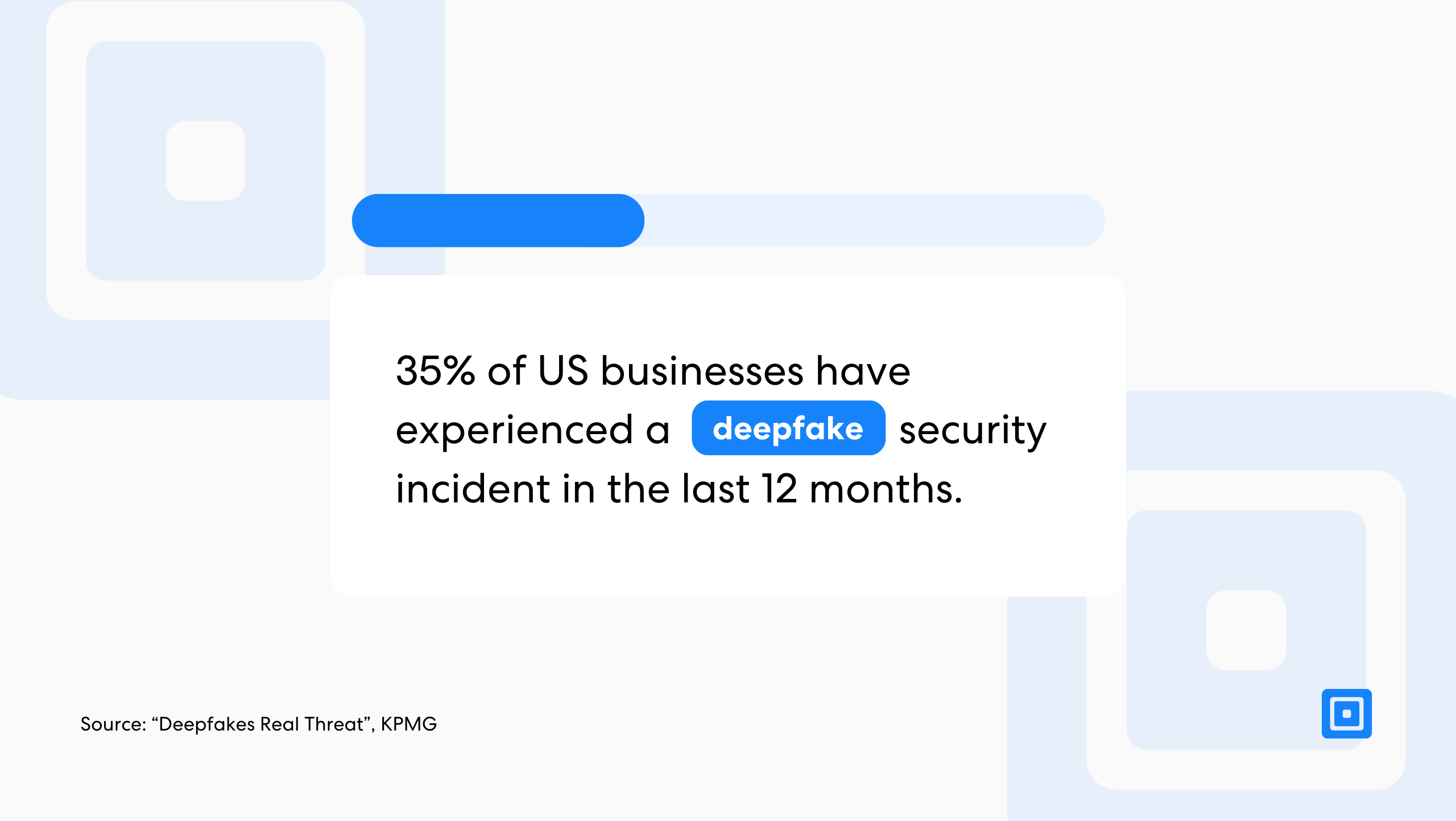
[35% of US businesses](https://www.darkreading.com/cyberattacks-data-breaches/deepfakes-rank-as-the-second-most-common-cybersecurity-incident-for-us-businesses#) have experienced a deepfake security incident in the last 12 months, with this form of crime ranking as the country’s second most common cybersecurity incident. Despite the apparent danger, businesses are slow to act against the threat of deepfakes.
KPMG’s recent report, “Deepfakes: Real Threat”, highlights that 71% of businesses have not taken steps to safeguard their organization from this form of fraud. [46% of businesses have not even thought of steps](https://kpmg.com/kpmg-us/content/dam/kpmg/pdf/2023/deepfakes-real-threat.pdf) or a plan of action to protect themselves from deepfakes.
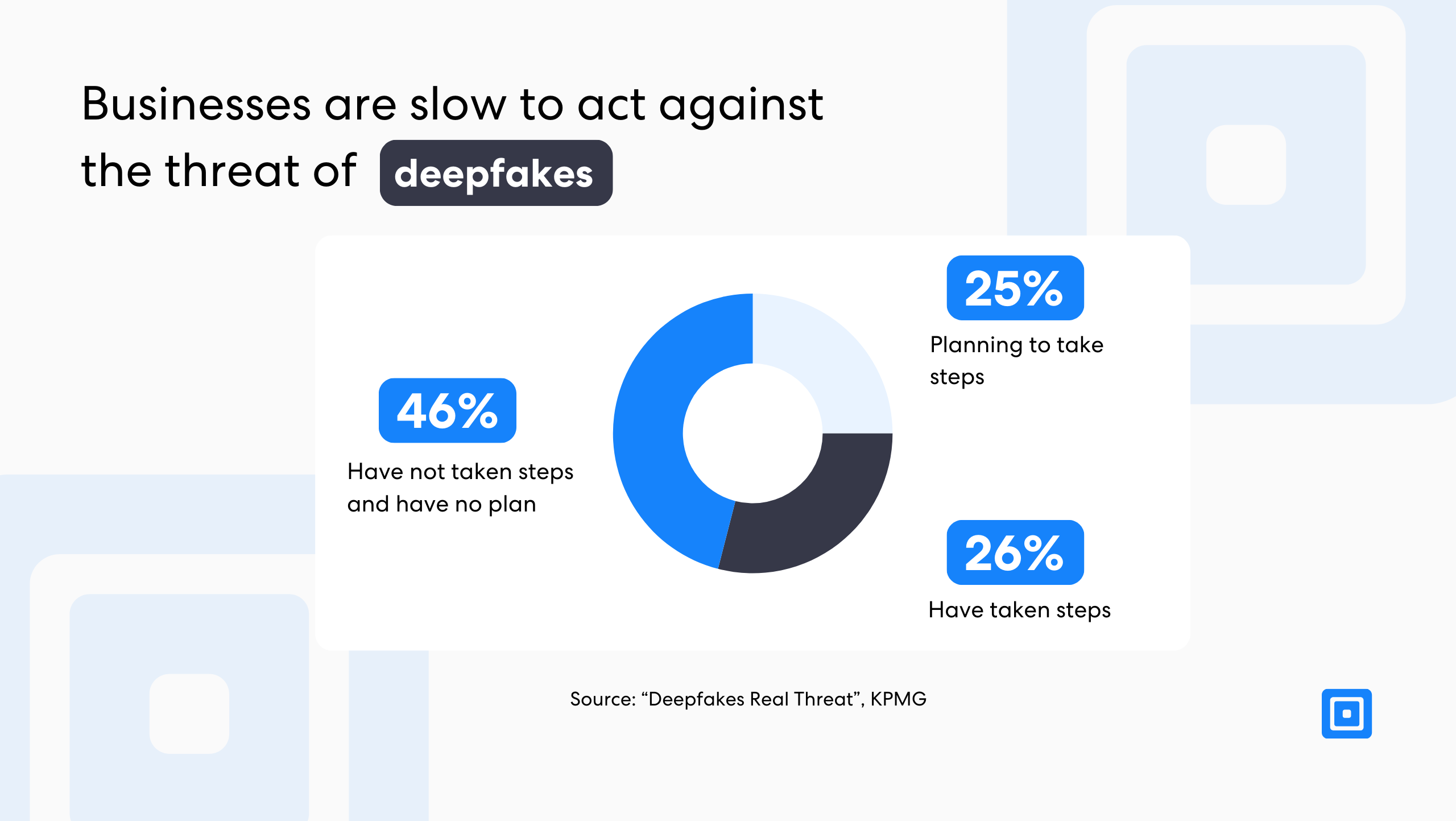
Deloitte’s Center for Financial Services predicts that gen AI could enable fraud losses to reach a massive height of over US$40 billion just in the United States alone by 2027:
> Generative AI could enable fraud losses to reach US$40 billion in the United States by 2027, with a significant [compound annual growth rate of 32%](https://www2.deloitte.com/us/en/insights/industry/financial-services/financial-services-industry-predictions/2024/deepfake-banking-fraud-risk-on-the-rise.html) from 2023.
The rising threat of AI-powered fraud requires an AI-powered defense, starting with robust eKYC processes. These technologies are able to detect bad actors and presentation attacks quickly, with liveness detection analysing subtle facial expressions, skin texture and more, identifying even the most sophisticated deepfakes.
## AI-Powered eKYC
Traditional KYC processes have been used historically by businesses to achieve AML and KYC compliance, yet this often left the organizations vulnerable to hefty penalties due to these manual processes being prone to error. Traditional KYC processes have been used historically by businesses to achieve AML and KYC compliance, yet this often left the organizations vulnerable to hefty penalties due to these manual processes being prone to error. The Financial Conduct Authority (FCA) has imposed £11.3 million in fines recently:
> The UK FCA imposed fines amassing [£11.3 million as of March 2025](https://www.fca.org.uk/news/news-stories/2025-fines), with the largest single fine of £9.2 million issued to The London Metal Exchange for KYC and AML compliance breaches.
Artificial intelligence in the digital age can now power electronic Know Your Customer (eKYC) solutions that can ensure accuracy and efficiency with advanced technologies. Biometric identity verification with liveness and voice recognition capabilities should be carried out when onboarding a new customer, as these expert technologies are able to look for signs of life and therefore differentiate a deepfake from a video of a living being.
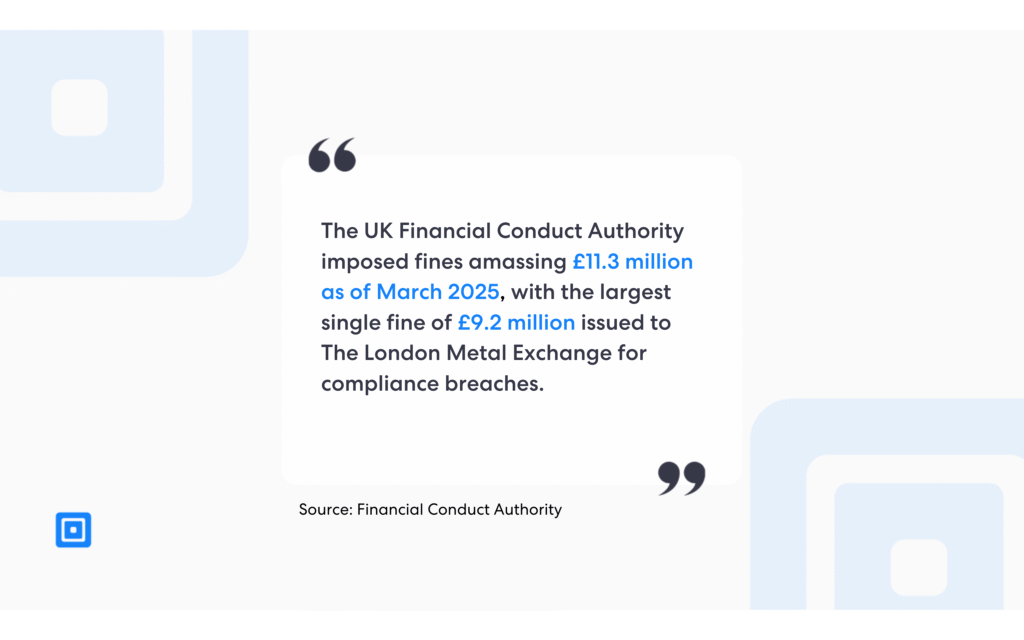
## Features of eKYC Enhanced by AI
AI powers many leading features of eKYC solutions, with some examples including:
- **[Biometric Verification](https://www.complycube.com/en/solutions/identity-assurance/biometric-verification/) with Liveness Detection**: utilizes advanced AI to verify users’ genuine presence. This refers to our custom-built liveness detection feature powered by our Presentation Attack Detection (PAD) technology. This function builds 3D facial maps and analyzes the minutia of skin texture, pixelation, and micro-expressions, ensuring that a user was physically present when the photo was taken.
- **[Document Verification](https://www.complycube.com/en/solutions/identity-assurance/document-verification/) with Optical Character Recognition (OCR):** AI-powered OCR quickly and accurately extracts relevant information.
- **[Real-time Monitoring ](https://www.complycube.com/en/solutions/global-screening/continuous-monitoring/)and Alerts:** AI-driven systems excel at real-time data analysis. This enables organizations to monitor customer transactions in real-time, and any suspicious behavior is caught quickly.
- **[Enhanced Risk Assessment](https://www.complycube.com/en/solutions/due-diligence-compliance/risk-scoring/):** AI can analyze large datasets to identify potential risks and can continuously learn from data to improve accuracy.
- **[Adverse Media Screening](https://www.complycube.com/en/solutions/global-screening/adverse-media-checks/):** AI allows for comprehensive screening for negative news associated with individuals or companies, identifying clients with reputational risks.
## Benefits of AI-Powered eKYC
eKYC solutions that leverage AI are needed to end the threat posed by deepfakes. There have been many cases of deepfakes bypassing face authentication processes, proving the need for eKYC to evolve and implement advanced AI technologies.
At the beginning of 2025, a finance professional was in a video meeting with someone who looked and sounded just like their CFO. The team member then made a transaction of [over 200 million Hong Kong dollars](https://www.ibm.com/think/insights/are-successful-deepfake-scams-more-common-than-we-realize) (approximately USD 25 million), as instructed. He later discovered that the person he spoke to was not his actual CFO but a sophisticated deepfake impersonation.
Identifying deepfakes is not as easy as everyone thinks. In fact, [a majority of people](https://www.zdnet.com/article/most-people-worry-about-deepfakes-and-overestimate-their-ability-to-spot-them/) often overestimate their ability to spot them. As a result, many companies became aware of the need to invest in advanced AI technologies to detect and prevent deepfakes from being used within authentication processes.
- **Bespoke Solutions:** Automatic workflows that can be highly tailored to fit different compliance requirements. Utilizing machine learning technologies, eKYC solutions can streamline data extraction while providing a smooth user onboarding experience.
- **Streamlined Onboarding:** Implementing a robust eKYC process allows you to verify customers quickly and efficiently, enabling organizations to scale safely.
- **Enhanced Security:** eKYC is far more effective at protecting organizations from identity fraud and financial crime. The use of advanced biometric verification, as well as AI-driven fraud detection, allows organizations to minimize fraud risk.
- **Improved Customer Experience:** The streamlined onboarding process also results in a more positive user experience, reducing friction and increasing customer satisfaction.
- **Global Reach:** eKYC solutions enable businesses to operate globally, quickly verifying many customers and supporting multiple languages and various international regulations.
## eKYC Solutions with ComplyCube
ComplyCube is a RegTech100 all-in-one platform for automating Identity Verification (IDV), [Anti-Money Laundering (AML)](https://www.complycube.com/en/solutions/due-diligence-compliance/anti-money-laundering/), and Know-Your-Customer (KYC) compliance. It has global customers in legal, telecoms, financial services, healthcare, e-commerce, cryptocurrency, travel, and more.
Our full suite of AI-powered KYC/AML solutions enhanced with automatic workflows are highly tailored to fit our customers’ compliance requirements. Utilizing machine learning technologies developed and owned by our team, our solutions streamline data extraction while providing a smooth onboarding experience for the user.

For more information on our eKYC solutions, contact our [expert compliance team](https://www.complycube.com/en/contact/contact-sales/).
**Categories:** Guides
**Tags:** Identity Verification
---
### [How Much Does KYC Cost?](https://www.complycube.com/how-much-does-kyc-cost/)
**Published:** May 20, 2025
**Author:** Sofia Daley
**Excerpt:** How much does KYC cost businesses across the world, and how can you tell if the cost is justified? KYC compliance is a non negotiable to avoid both financial crime and hefty penalties. Learn more about cost efficiency in KYC.
**Content:**
**TL;DR:** How much does KYC cost businesses across the world, and how can you tell if the cost is justified? KYC compliance is a **non-negotiable** to avoid both financial crime and hefty penalties. However, costs can escalate quickly if these checks are carried out manually. This guide will show you how to manage your **KYC costs effectively** while maintaining accuracy and compliance.
## What is KYC?
Know Your Customer (KYC) encompasses a range of checks and processes that verify customer identity and perform the necessary customer due diligence. It enables financial institutions to detect and prevent onboarding clients who may pose a risk to the organisation, such as those involved in money laundering and tax evasion. KYC compliance requirements include collecting customer data via identity documents during the customer onboarding process.
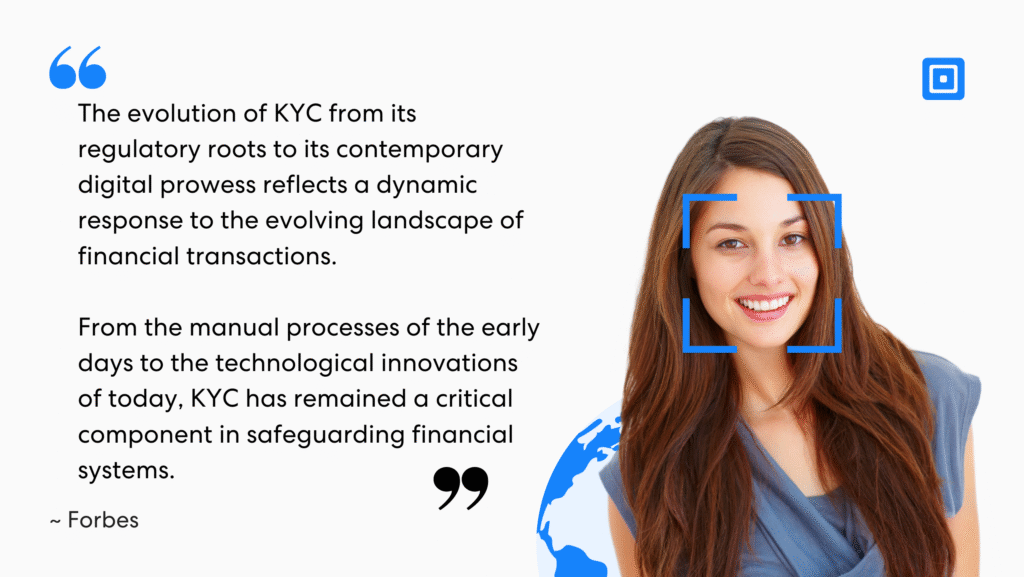
Several regulators, both nationally and internationally, have established regulatory standards for KYC verification processes. Document verification and continuous monitoring are a must, as well as increased due diligence depending on the risk assessment. An effective KYC system supports the broader scope of global Anti-Money Laundering (AML) requirements.
> KYC has remained a [critical component](https://www.forbes.com/councils/forbesbusinesscouncil/2024/02/26/the-history-of-kyc-from-paper-to-digital-identities/) in safeguarding financial systems.
KYC regulations have undergone significant evolution over the past few years. Forbes states, “the evolution of KYC from its regulatory roots to its contemporary digital prowess reflects a dynamic response to the evolving landscape of financial transactions. From the manual processes of the early days to the technological innovations of today, KYC compliance has remained a critical component in safeguarding financial systems.”
## Why Manual KYC Checks Are Expensive
The cost of KYC can increase significantly with manual KYC reviews. These costs accumulate due to labor-intensive processes, as skilled compliance staff must manually review documents, assess risk, and enter data into systems. On top of this, there are also operational costs related to secure data storage, software tools, and ongoing staff training. Additionally, manual checks carry the risk of human error, which can result in costly fines, reputational harm, and a poor customer experience.
1. **Labor Costs**: Skilled compliance staff are expensive, and manual reviews take time.
2. **Document Handling**: Verifying IDs and other documents manually is slow, error-prone, and less effective at spotting fraud.
3. **Data Entry**: Manual input increases errors and requires more oversight.
4. **Compliance Risk**: Regulatory updates, audit needs, and potential fines demand thorough (and costly) processes.
5. **Poor Scalability**: Manual checks don’t scale well with growth, causing bottlenecks.
6. **Customer Friction**: Slow onboarding and rework can drive customers away.
7. **Infrastructure Needs**: Secure systems for storing and accessing data add to costs.
On the other hand, KYC tasks that leverage automation technologies, including Optical Character Recognition (OCR) and Artificial Intelligence (AI), reduce expenses. KYC automation streamlines identity verification by seamlessly verifying customer information in real-time. Financial institutions can focus on high-risk scenarios by simplifying new account creation and eliminating manual data collection.
## How Much Does KYC Cost? The Costs of KYC Essentials
Understanding the cost of Know Your Customer (KYC) compliance begins with understanding the key checks involved in the process. A laborious KYC process can incur associated costs, especially when outsourced or conducted at scale. Here’s a breakdown of the core KYC verification and their typical price ranges:
### Document Check
Document verification includes document authentication, data extraction, cross-referencing and image verification. These processes ensure that the right security features, such as watermarks, holograms, and other markers, are authentic and that information can be cross-referenced with other data sources. Document checks can include passport verification, diver’s license verification, and many other forms of documentation, including social security cards, tax documents or employment records.
With volume-based pricing, document verification typically ranges from $0.80 to $1.35 per check at lower volumes. For instance, competitors such as Sumsub charge $1.35 onwards per verification. However, higher-volume organizations benefit from more cost-efficient rates and better ROI. For example, high-volume companies leveraging ComplyCube’s [proprietary AI document checks](https://www.complycube.com/en/solutions/identity-assurance/document-verification/) enjoy greater cost savings.
### Biometric Check
The user submits a selfie or live video as part of the identity verification process. The facial recognition software compares the live image to the image on the submitted document (e.g., passport or driver’s license). The software looks for specific facial features, such as the distance between eyes, nose shape, and overall facial structure, ensuring that the person in the document matches the one in the selfie.
Companies such as ComplyCube enable organizations to conduct liveness and facial similarity checks from $0.20 at lower volumes, reducing even further for higher-volume use cases. Find more information on all of ComplyCube’s [biometric checks here](https://www.complycube.com/en/solutions/identity-assurance/biometric-verification/ "https://www.complycube.com/en/solutions/identity-assurance/biometric-verification/").
### **Case Study: Paxos $48.5 Million Penalty for Poor KYC and AML Programs**
##### **New York Department of Financial Services (NYDFS) Findings**
NYFDS penalized Paxos a whopping $48.5 million in August 2025. This fine marked one of the [largest fines in 2025](https://www.complycube.com/en/the-cryptocubed-newsletter-top-5-aml-crypto-fines-in-2025/) for compliance failures. Paxos Trust is a leading blockchain provider based in New York. NYFDS investigations exposed systematic gaps in the firm.
##### **The Cost of Non-Compliance**
Reports showed that Paxos did not conduct adequate customer due diligence and ongoing monitoring during its partnership with Binance. This failure enabled over $1.6 billion in illegal funds to flow. The cost of non-compliance is steep, costing million-dollar fines.
**Outcome**
- The NYFDS fined Paxos Trust $26.5 million, with $22.5 million allocated for remediation and monitoring of compliance gaps.
- Partnerships and business relationships now demand rigorous measures, including Know Your Business (KYC) checks.
- This case exposed Paxos Trust to reputational damage, as the news served as a stern warning on the cost of non-compliance.
## Pricing Factors To Consider in KYC Verification Process
When evaluating the cost of KYC, financial institutions must consider the direct and indirect costs. Increased cost can arise from verification volume, level of automation, and geographic scope. The balance between complex KYC processes and maintaining positive customer relationships continues as an ongoing challenge for businesses. Organizations can address this by adopting a risk-based approach and utilizing scalable automation tools that expedite customer onboarding, comply with KYC regulations, and minimize costs.
### Verification Depth
- Standard KYC: Typically, this check includes document and biometric verification.
- Enhanced Due Diligence (EDD): Includes increased Customer Due Diligence (CDD) than a standard KYC check, with added checks such as adverse media and Politically Exposed Person (PEP) screening.
- Ongoing Monitoring: Real-time alerts and monitoring for changes in customer risk profiles, new adverse media, etc. Additionally, transaction monitoring systems can incur a high cost.
### Volume-Based Pricing
- Bulk discounts: Lower per-check cost for higher monthly or annual volumes.
- Tiered pricing: Pricing levels that change once certain volume thresholds are hit.
- Commitment levels: Discounts for committing to a minimum monthly or annual volume.
### Geographic Scope
- Domestic vs. international checks: International verifications often cost more due to data access costs and regulatory complexity.
- High-risk jurisdictions: Enhanced checks in sanctioned or high-risk countries may incur premium fees.
### Automated KYC
- High automation: Utilizes AI and machine learning to replace manual, repetitive KYC reviews which reduces time, effort, and manual labor.
- Low automation: Dependence on employee review and IT increases the risk of human error and a slower onboarding process.
## Hidden Costs to Watch Out For To Reduce KYC Costs
- Set-up fees: This is a common cost that you might find with some AML and KYC platforms, which can amount to £20,000 in some cases.
- Support fees: Some platforms charge for ongoing support, which can quickly become very expensive for businesses. Ensuring that support is included within your package is critical.
- Data retention and report downloads: Another hidden cost to be weary of is the ability to download data and reports without paying an additional fee.
Harry Varatharasan, Chief Product Officer at ComplyCube, states, “A lot of providers may seem to have cost-effective pricing models, yet their standard packages do not include essential features, such as report downloads, data security, or support fees”.
> Ask potential providers the tough questions before it’s too late.
“This then leaves customers vulnerable to constantly paying extra fees to obtain the service that was actually required. Ask potential providers the tough questions before it’s too late,” he adds. You can learn more here [AML Check Cost: Hidden Fees in Compliance](https://www.complycube.com/en/aml-check-cost-hidden-fees-in-compliance/).
## What Does Non Compliance Look Like?
For many financial institutions, especially corporate and institutional banks, the cost of incorporating cutting-edge KYC technology may seem steep. While compliance costs that include services such as identity verification with liveness detection and customer due diligence to ongoing maintenance, these are nothing in comparison to the regulatory fines, reputational harm, and lost business that result from non-compliance.
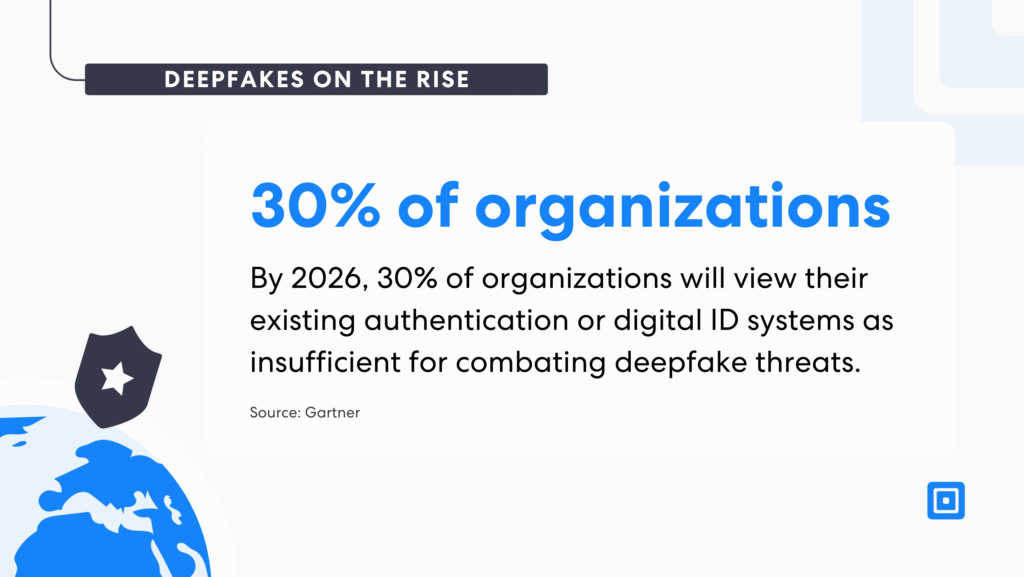
Furthermore, research by Gartner shows that by 2026, [30% of organizations](https://www.gartner.com/en/newsroom/press-releases/2024-02-01-gartner-predicts-30-percent-of-enterprises-will-consider-identity-verification-and-authentication-solutions-unreliable-in-isolation-due-to-deepfakes-by-2026) will view their existing authentication or digital ID systems as insufficient for combating deepfake threats. This highlights the importance of maintaining robust KYC processes and conducting regular training sessions to detect fraudulent identities. You can learn more here: [Are KYC Onboarding Processes Worth It?](https://www.complycube.com/en/are-kyc-onboarding-processes-worth-it/)
## The Real Cost of Neglecting KYC Compliance
Failing to invest properly in KYC compliance is not just risky, it’s expensive. Regulatory bodies around the world are issuing record-breaking fines for lapses in KYC processes, especially those involving financial crime, money laundering, terrorist financing, or failure to identify beneficial owners. A single violation can result in:
- **Fines running into the millions**: Major banks and other financial institutions have been penalized upwards of $100 million for inadequate customer identification programs, poor ongoing monitoring, and weak risk assessment.
- **Increased compliance scrutiny**: Once flagged, institutions often face more frequent audits, KYC reviews, and must implement expensive remediation plans under tight deadlines.
- **Business disruption**: Weak KYC systems can lead to the suspension of licenses, loss of business relationships, and denied access to international markets, particularly when operating in high-risk jurisdictions.
- **Reputational damage**: Non-compliance erodes customer trust and harms your brand, often causing long-term revenue losses beyond immediate penalties.
### Key Takeaways
- **International regulations** mandate KYC compliance, as it is crucial in preventing money laundering, identity fraud, and financial crimes.
- **Identity verification** forms a key component of KYC, which includes gathering and verifying the identity documents of users for authenticity.
- **KYC processes** can be significantly streamlined through automation, leveraging features such as artificial intelligence and machine learning.
- **The cost of KYC** is influenced by verification depth, check volume, geography scope, and the level of automation involved in the KYC processes.
- **KYC costs increase** significantly due to hidden expenses, which include setup and support fees, data retention, and report downloads.
## Strengthen Operations with KYC Automation
Comprehensive KYC streamlines customer onboarding process, increasing customer trust, and ensuring compliance with national and international regulations. With strong automation technology, organizations can rapidly verify customer identity accurately and securely, reducing onboarding cost significantly. For more information on how to integrate cutting-edge KYC solutions, get in touch with one of our [compliance experts.](https://www.complycube.com/en/contact/contact-sales/)

## Frequently Asked Questions
Is KYC expensive?
The cost of KYC can exceed $48 million a year on average. However, the reason KYC can be expensive is because it is largely driven by complex regulations, fines for non-compliance, and manual processes. Modern organizations utilize an all-in-one, automated compliance platform to streamline regulatory requirements and reduce labor bottlenecks.
Is KYC mandatory?
Yes, Know Your Customer (KYC) programs are legally required by many B2B and B2C firms. Under laws such as the US Bank Secrecy Act, the EU’s Anti-Money Laundering Directive (AMLD) and, the UK’s Proceeds of Crime Act require businesses to verify customer identity and to perform ongoing monitoring to prevent illicit activities and safeguard the economy’s financial system.
How much does banks spend on KYC programs?
Banks spend an average of $40-60 million annually with global operations. This cost can increase up to $500 million for enterprises with large verification volumes. However, legacy KYC systems rely on manual processes, significantly responsible for this high cost figure.
What is required for KYC compliance?
For KYC compliance, businesses need to gather and verify if a customer is who they say they are. This is done through the Customer Identification Program (CIP) where a customer’s data, including passport, date of birth, and proof of address is collected to verification. It also extends throughout a customer’s lifecycle journey, requiring continuous monitoring and risk management.
How does ComplyCube’s KYC cost differ from competitors?
ComplyCube offers a unified AI-driven platform for businesses of all sizes to achieve global KYC and AML requirements. We offer tailored cost pricing, offering lower cost per-check for high-volume companies. ComplyCube do not charge set-up fees and provides price transparency for our checks.
**Categories:** Guides
**Tags:** Anti-Money Laundering
---
### [5 Critical Errors to Dodge in AML Software Implementation](https://www.complycube.com/aml-software-implementation-mistakes/)
**Published:** November 18, 2025
**Author:** Dini Habib
**Excerpt:** Implementing AML software without fully grasping the nuances of specific compliance obligations can expose firms to serious regulatory scrutiny, costly financial penalties, operational inefficiencies, and long-term reputational harm.
**Content:**
**TL;DR:** Implementing **Anti-Money Laundering (AML) software** without a clear strategy can be costly and expose firms to serious compliance risk. This guide outlines practical steps, such as **closing audit trail gaps** and reducing manual review errors, to ensure **successful AML software implementation** that delivers lasting value.
## What are Common AML Software Implementation Failures?
Anti-money laundering compliance failures can result in millions in fines and irreparable reputational damage. Despite adopting AML software, many companies face challenges at the implementation stage, inviting regulatory scrutiny and financial penalties. The most common failures in AML software implementation include inadequate planning, human error, insufficient risk management, and poor training.
Businesses can reduce compliance issues and prevent costly mistakes by learning the most common pitfalls in AML software implementation. This is particularly critical for firms in highly regulated industries, such as insurance, accounting, and financial services, as compliance standards tend to be more stringent.
## Mistake 1: Inadequate Planning for AML Software Implementation Requirements
Rushing into implementing compliance software without a thorough understanding of specific regulatory obligations and business requirements can expose an organization to significant risks. Institutions operating across multiple jurisdictions (global, federal, state, local, etc.) are at a much greater security risk simply because they are responsible for complex regulatory obligations that vary between regions.
> The biggest AML software implementation mistakes are rarely technical issues; they are often shortcuts taken during implementation – Joshua Vowles-Dent, AML Compliance Lead
Organizations often overlook how an AML compliance program could align with their existing business processes and services. Many underestimate the resources, cross-functional alignment, and planning required to successfully embed evolving AML regulations across the business. Additionally, the collection of technical requirements and improvement of data quality often receive insufficient support and attention during implementation planning.
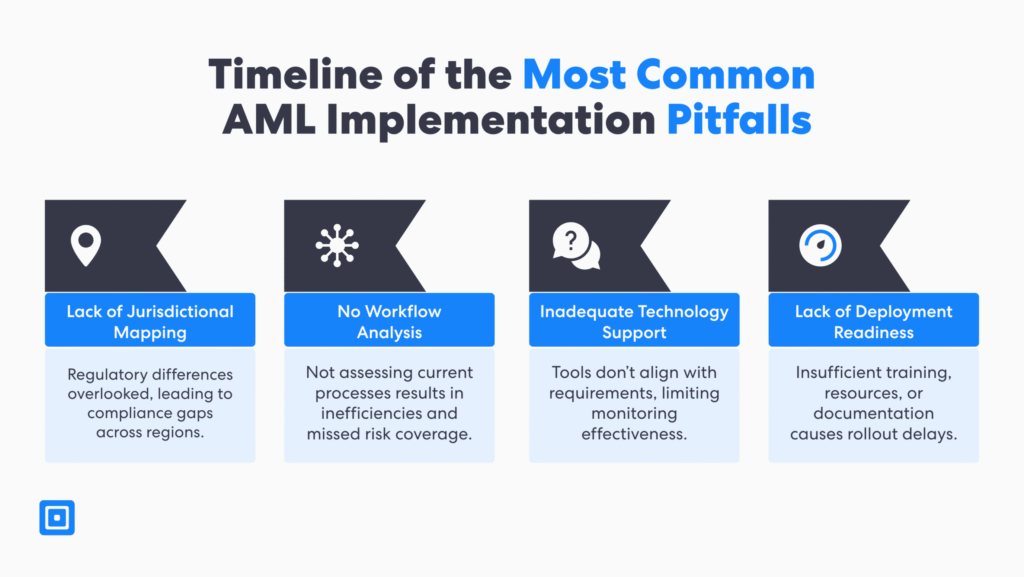
To successfully execute [AML software](https://www.complycube.com/en/solutions/due-diligence-compliance/anti-money-laundering/) implementation, companies must thoroughly understand their current customer onboarding workflows and reporting processes. Without this strong foundation, a new system may not integrate properly with existing operations and services. Additionally, resource allocation planning helps determine a more realistic timeline expectation for implementation.
### How to Avoid it:
- Conduct a detailed assessment of regulatory requirements specific to the organization’s industry, whether that is insurance, accounting, legal, or banking, to ensure full compliance.
- Dedicate sufficient lead time and resources for thorough testing, staff training (onsite or offsite), and phased deployment. Collaboration between IT, operations, finance, and legal departments is crucial to address requirements.
- Assess technology infrastructure, data quality, and integration capabilities to provide a seamless customer experience while maintaining compliance.
## Mistake 2: Underestimating Risk Assessment and Management
Businesses often underestimate the need for robust compliance [risk assessment](https://www.complycube.com/en/solutions/due-diligence-compliance/risk-scoring/) and risk management. It is common for companies to identify needs based on oversimplified risk categories, which can fail to capture the nuanced risk profiles that effective AML monitoring requires. A risk assessment process should be implemented across the customer base and reviewed at least periodically; however, to achieve continuous compliance, organizations require [ongoing monitoring ](https://www.complycube.com/en/solutions/global-screening/continuous-monitoring/)to identify changes to sanctions, PEPs, and [adverse media](https://www.complycube.com/en/solutions/global-screening/adverse-media-checks/) in real time.
Inadequate risk assessment can have severe consequences. It can lead to poorly calibrated monitoring systems, inappropriate regulation measures, and other various regulation violations that could be prevented. Different risks must be identified and considered. For example, complex financial products, cross-border services, and digital payment solutions present unique vulnerabilities and risks for fraud that require adherence to specific regulations.
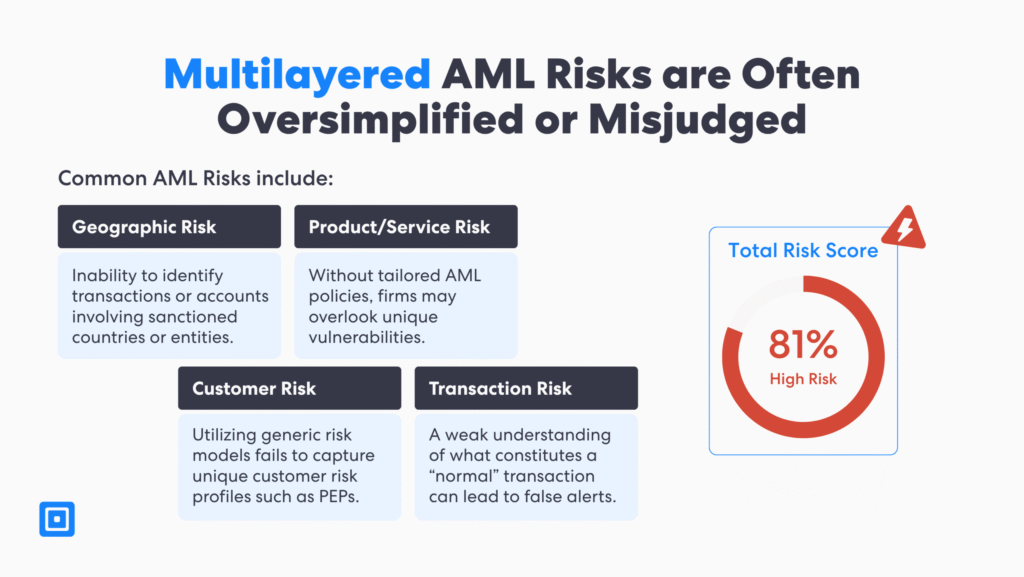
Geographic risk assessment requires a detailed understanding of jurisdictional differences in AML regulations. Failing to assess geographic risks leads to inadequate controls in high-risk regions and potential regulatory violations. Customer risk profiling, which requires sophisticated analysis of customer types, transaction patterns, and business relationships, is another area where companies and organizations frequently fall short.
### How to Avoid it:
- Global corporations must evaluate country-specific risks, sanctions regimes, and regulatory expectations to make informed decisions. To start, follow the international standards set by the [Financial Action Task Force (FATF)](https://www.fatf-gafi.org/en/publications/Fatfrecommendations/Fatf-recommendations.html).
- Regular risk assessments must be established to ensure AML programs remain effective against evolving business models, new products, and changing regulatory requirements.
- Vendors, partners, and service providers could introduce AML risks. Therefore, evaluating extended business relationships and implementing ongoing monitoring is critical.
## Mistake 3: Failure to Manage Audit Trail Gaps Effectively
Audit trail gaps are one of the most critical compliance challenges during technology implementation. Regulators expect complete transparency and accurate records of all AML-related activities, decisions, and system changes. As a result, companies must provide comprehensive operating procedure documents, including who made the changes, when modifications occurred, and the business justification for the adjustments.
> According to the Financial Crimes Enforcement Network (FinCEN), failing to file Suspicious Activity Reports (SARs) in a timely manner is a [serious offense](https://www.fincen.gov/news/news-releases/fincen-assesses-record-13-billion-penalty-against-td-bank).
It is not uncommon for an organization to switch to new AML software because of technical limitations or cost. However, a transparent audit trail must still be maintained to show accountability. Typically, regulatory authorities review audit trails during periodic compliance examinations or when a submitted SAR requires further investigation. Recently, FinCEN [fined TD Bank $1.3 billion](https://www.complycube.com/en/td-bank-fails-anti-money-laundering-compliance/) due to failures in AML, including inadequate audit trails that hid suspicious transactions.
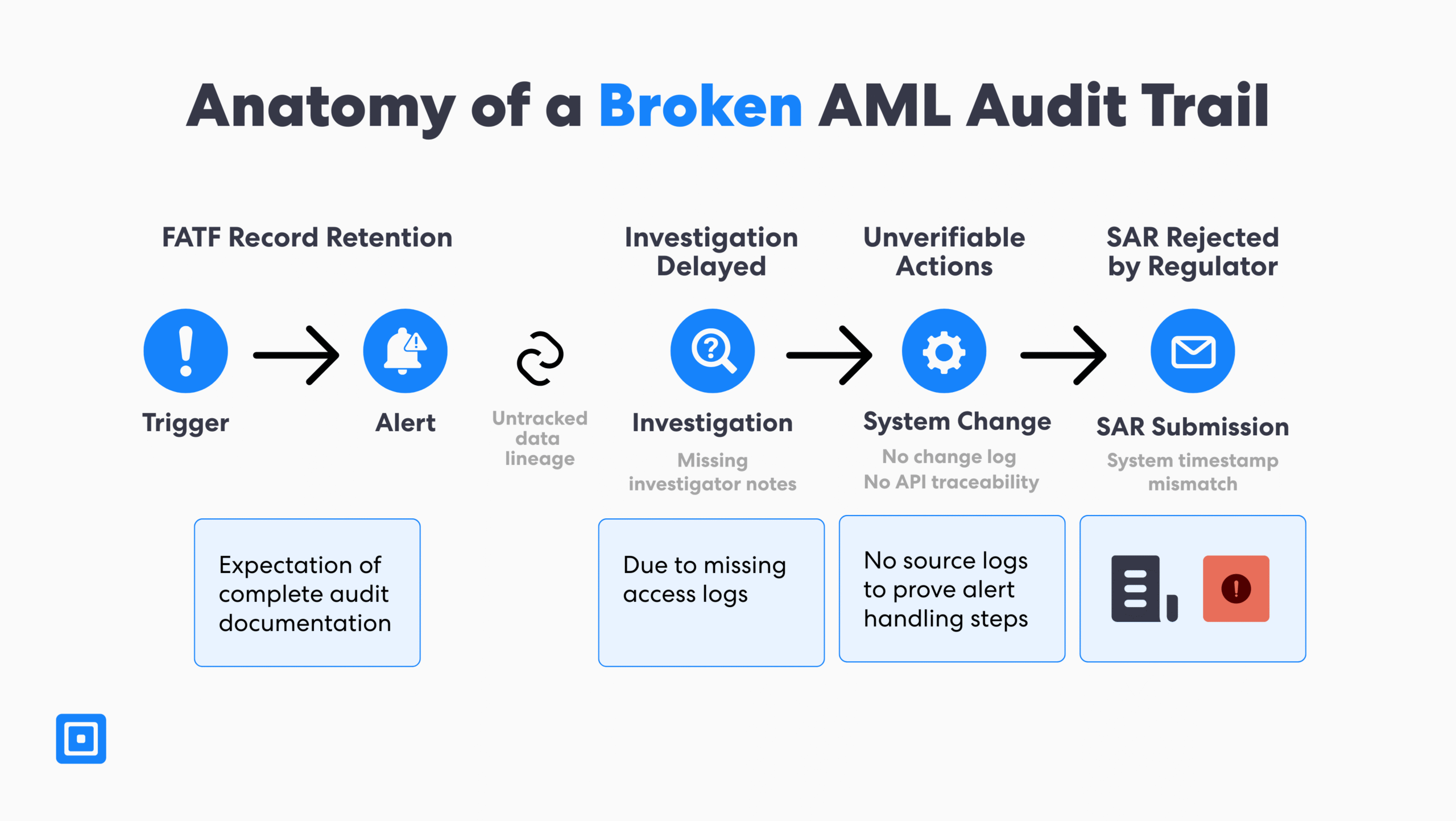
Weak user activity logging exposes companies to regulatory violations, increasing security risks, and compliance violations. Poor documentation of data lineage hinders the ability to demonstrate adherence to policy and regulatory requirements. Audit trail gaps hinder investigation processes when suspicious behaviors or transactions that may be related to money laundering activities are identified.
### How to Avoid it:
- Ensure [audit trails](https://www.complycube.com/en/solutions/due-diligence-compliance/case-management/) capture all changes in AML settings, rules, and parameters. Comprehensive records are needed to track who accessed what and when.
- System integration documents how AML software connects with other business systems and external data sources. Organizations must maintain records of data exchanges, API calls, and system synchronization activities.
- Different jurisdictions operate under varying requirements for record retention. Organizations must comply with the most stringent applicable regulations.
## Mistake 4: Inadequate Anti-Money Laundering Training
Employee training (on-site or off-site) and change management are critical success factors for successful software implementation. Many regulators are increasingly using high employee turnover in risk management teams as an indicator of weak AML oversight. Yet, many companies overlook this important concern.
Compliance officers and investigators require different levels of compliance training tailored to their functions within the company or organization. AML compliance requirements change frequently, and employees must understand and implement these updates to maintain effective compliance programs. Employees often resist changes to familiar workflows, creating critical implementation challenges and compliance concerns.
### How to Avoid it:
- Adopt role-based training programs to address specific responsibilities and system interactions for different user groups. Performance monitoring and feedback mechanisms enable organizations to effectively address training gapss
- Change management processes help organizations transition from legacy systems to new AML technology, minimizing confusion and compliance errors.
- Employee staffing issues can hinder compliance. Cross-training and backup procedures must be implemented to ensure continued operations when key personnel are unavailable.
### **Case Study: Binance Australia’s High Employee Turnover Results in AUSTRAC Scrutiny**
**AUSTRAC’s Shocking Demand**
The Australian Transaction Reports and Analysis Centre (AUSTRAC) requested [Binance Australia](https://www.complycube.com/en/the-cryptocubed-newsletter-august-edition/) to appoint an independent reviewer to investigate its AML processes after identifying weak AML/CFT controls. A major issue was the firm’s **high staff turnover** and lack of senior oversight.
**Binance’s Internal Staff Crisis**
From AUSTRAC’s view, high staff turnover creates an unstable team that **lacks the knowledge** of internal compliance processes and regulations. The lack of staff and senior oversight can cause a company to struggle with identifying and reporting suspicious activity promptly.
**Outcome**
- Binance Australia was given 28 days to nominate external reviewers for AUSTRAC’s consideration and has expressed its commitment to resolving the case.
- This case highlights a broader lesson in compliance. Lack of team member training and high turnover can weaken the effectiveness of a company’s AML framework.
- Mr Thomas, AUSTRAC’s CEO, released a statement calling for increased vigilance towards transactions that indicate suspicious behaviour, noting that these risks are often higher for global exchanges.
## Mistake 5: Insufficient Human Errors Prevention
While AI-powered platforms reduce compliance risks, human judgment remains essential for complex investigations and decision-making. However, human errors represent a persistent challenge in AML programs that organizations often fail to address. Addressing human errors requires systematic approaches and robust quality control measures that protect the company and employees.
Inadequate escalation procedures within a company can lead to decision-making errors due to confusion, lack of ownership, and fractured communication. Furthermore, excessive workloads and unrealistic expectations can create a culture of high stress or pressure, which can inevitably lead to shortcuts and unintentional errors.
### How to Avoid it:
- Utilize AI-powered platform review tools that effectively empower teams to assess data, risks, and analyze complex transactions.
- Provide new or junior team members with clear and concise criteria, tools, and procedures so they can avoid making decisions well beyond their expertise.
- Ensure reasonable workload distribution by monitoring investigation volumes, completion times, and metrics. This will prevent fatigue and rushed decision-making, which contribute to manual review errors.
### Key Takeaways for a Successful AML Software Implementation
- **AML Software implementation** requires businesses to adopt a more strategic, unified approach. Cutting corners and rushing processes increases compliance and reputational risk.
- **Risk assessment and management** must include a detailed evaluation of sector-specific risks and extended business relationships.
- **Adopting advanced tools** with systematic, auditable trails and access control will support firms in meeting AML reporting requirements set by regulatory bodies.
- **Ongoing employee training** on regulations, such as the UK’s GDPR, EU AMLD, and the US’s BSA, is crucial to building a proactive culture in the face of evolving risk.
- **AI-driven AML software,** such as ComplyCube, offers no-code workflows and meets global reporting requirements, thereby enhancing the accuracy and transparency of AML processes.
## Final Thoughts on AML Software Implementation
The cost of mitigating compliance risk is often a price worth paying in the long run compared to the critical consequences of failed implementation and non-conformity to compliance regulations. Comprehensive planning, thorough fraud risk assessment, and clear audit trail management are essential for a successful AML software implementation. Additionally, considering factors such as providing regular team member training and reducing the likelihood of manual errors occurring helps build a more resilient AML framework.
To address changing risks, an AML provider with comprehensive [Know Your Customer (KYC)](https://www.complycube.com/en/solutions/due-diligence-compliance/know-your-customer/) and AML solutions can help. Modern AML systems provide automated data extraction, risk control, and ongoing monitoring capabilities. Organizations are better positioned to detect suspicious activities earlier, which can significantly reduce their compliance burden. [Speak to a member](https://www.complycube.com/en/contact/contact-sales/) of the team to learn more about ComplyCube’s solutions today.

## Frequently Asked Questions
What is the biggest threat to anti-money laundering compliance?
The biggest threat to AML compliance includes weak planning and governance. Inadequate risk assessments, poor audit trails, and the lack of employee training create significant AML gaps. Effective AML programs require a holistic approach, including leveraging advanced risk management, AI, and ongoing training as top priorities.
How to choose the best anti-money laundering platform to avoid compliance and reputational risk?
To choose the best AML platform, firms must assess their specific business needs. Factors such as the geography, company size, customer profile, and overall risk appetite are key considerations when choosing an AML platform. The right AML platform aligns well with a firm’s compliance obligations and long-term growth strategy.
What are high-risk customers, countries, and industries in anti-money laundering?
High-risk customers, countries, and industries in AML pose a higher risk for financial crime. High-risk countries such as North Korea and Venezuela, and sectors such as cryptocurrency and fintech, are commonly flagged by regulatory bodies. High-risk customers include politically exposed persons, sanctioned users, and those with high adverse media coverage.
What does risk assessment mean in anti-money laundering?
In AML, risk assessment helps evaluate a business’s exposure to money laundering and fraud by analyzing risk factors such as political exposure, sanctions lists, adverse media status, and industry. The process involves systematically categorizing these risks, enabling an organization to better align its AML controls with regulatory requirements.
How to prevent human error in anti-money laundering?
To prevent human error, firms should adopt automated and tailored AML software. For example, ComplyCube’s platform leverages AI and machine learning, enabling businesses to achieve full automation while maintaining transparency, auditability, and accuracy. Combined with strong governance and security frameworks, automation enhances compliance while minimizing errors.
**Categories:** Guides
**Tags:** Anti-Money Laundering
---
### [The CryptoCubed Newsletter: 2025’s Top 5 AML Crypto Fines](https://www.complycube.com/cryptocubed-newsletter-top-5-aml-crypto-fines/)
**Published:** December 23, 2025
**Author:** Dini Habib
**Excerpt:** In 2025, we witnessed regulators increasing AML fines for crypto firms. In this December edition, we cover the largest crypto fine cases involving OKX, KuCoin, Cryptomus, BitMEX, and Paxos. Avoid AML penalties effectively today.
**Content:**
👋 Welcome back to CryptoCubed! Instead of our usual monthly crypto news round-up, this month, we are highlighting the top 5 AML crypto fines in 2025. This year, Anti-Money Laundering (AML) charges in the cryptocurrency sector [surpassed $1 billion globally](https://sqmagazine.co.uk/crypto-aml-fines-and-penalties-statistics/), with the average penalty for each crypto firm rising to $3.8 million in the first half of 2025.
In the US, regulators have taken a firm stance in penalizing crypto firms for compliance failures, with leading names such as OKX and KuCoin facing significant repercussions. We also see global hotspots such as Canada’s Cryptomus in the headlines this year. Can you guess the top 5 largest crypto compliance fines of 2025? Check them out below.
## 1. OKX Historic AML Fine
**OKX, $505 million fine (February 24, 2025)** — Leading cryptocurrency exchange OKX was fined over $505 million by the [US Department of Justice (DOJ).](https://www.justice.gov/) This marks the most significant penalty in crypto history, with the firm being penalized for severe AML failures. The Seychelles-based platform processed $5 billion in unmonitored transactions linked to high-risk jurisdictions.
OKX violated the US Bank Secrecy Act (BSA), potentially facilitating illicit transactions and illegal activities on the platform. Additionally, the DOJ found that OKX enabled users to bypass Know Your Customer (KYC) checks, with employees assisting customers in falsifying their IDs and using VPNs to evade IP bans.
**Outcome and Lesson Learnt:**
- OKX agreed to criminally forfeit [$420.3 million](https://www.justice.gov/usao-sdny/pr/okx-pleads-guilty-violating-us-anti-money-laundering-laws-and-agrees-pay-penalties) and pay a criminal fine of approximately $84.4 million.
- US cryptoasset firms must adhere to the FinCEN’s Travel Rule for VASPs, including having a strong Suspicious Activity Report (SAR) submission process.
- Businesses in regulated industries are mandated to implement robust [sanctions](https://www.complycube.com/en/solutions/global-screening/sanctions-pep-screening/) and watchlist screening, followed by geofencing, to block high-risk users effectively.
For more on this story, click [here](https://www.complycube.com/en/top-5-aml-fines-in-2025-you-need-to-know/).
## 2. KuCoin Connection to Illicit Funds
**KuCoin, $300 million fine** **(January 27, 2025)** — Peken Global Ltd., operating as KuCoin, pleaded guilty to violating the BSA. Founded in 2017, KuCoin is one of the largest global crypto exchanges, with over billions in trading. KuCoin was charged for running an unlicensed exchange operation, bypassing critical AML and KYC controls, and failing to submit SARs.
The US DOJ and Securities and Exchange Commission (SEC) exposed the firm for enabling customer trading without adequate identity verification, enabling users to transact money anonymously. KuCoin processed over $4 billion in suspicious transactions, potentially enabling illicit flows to fraud and sanctions evasion.
**Outcome and Lesson Learnt:**
- KuCoin agreed to forfeit [$184.5 million](https://www.justice.gov/usao-sdny/pr/kucoin-pleads-guilty-unlicensed-money-transmission-charge-and-agrees-pay-penalties) and pay a criminal fine of approximately $112.9 million. Its co-founders, Gan and Tang, had to forfeit approximately $2.7 million in funds received.
- Cryptoasset firms in the US must adhere to stringent [Customer Identification Programs (CIPs)](https://www.complycube.com/en/customer-identification-program-what-is-cip/), collecting robust customer data, including full name, date of birth, and address.
- Under FinCEN, companies operating in the US must register as a money transmitting business and file required SARs promptly.
For more on this story, click [here](https://www.justice.gov/usao-sdny/pr/kucoin-pleads-guilty-unlicensed-money-transmission-charge-and-agrees-pay-penalties).
## 3. BitMEX Evasion of Key AML Laws
**BitMEX, $100 million fine** **(January 15, 2025)** — BitMEX, operating under HDR Global Trading Limited, entered a guilty plea in July 2024 and was sentenced to a $100 million fine this year for breaching AML and KYC laws. Under registration with the Commodity Futures Trading Commission (CFTC), BitMEX is required to implement robust AML and KYC programs, but chose to evade them.

BitMEX enabled its customers to trade on the platform with merely an email address, which was insufficient in preventing money laundering and other financial crimes under US law. Additionally, the firm lied to a bank about the purpose and nature of a subsidiary to continue generating millions of revenue from its US operations.
**Outcome and Lesson Learnt:**
- BitMEX was fined [$100 million](https://www.justice.gov/usao-sdny/pr/global-cryptocurrency-exchange-bitmex-fined-100-million-violating-bank-secrecy-act) and placed on two years of probation. Its three founders and executives, Hayes, Delo, and Reed, paid $10 million in civil monetary penalties to the CFTC.
- Founders must prioritize governance over growth by appointing dedicated risk management teams and conduct annual audits to evade repercussions.
- Under the BSA, email-only registration is deemed inadequate. Businesses must implement complete KYC processes and [ongoing monitoring](https://www.complycube.com/en/solutions/global-screening/continuous-monitoring/) to detect high-risk users.
For more on this story, click [here](https://www.complycube.com/en/the-cryptocubed-newsletter-january-edition/).
## 4. Cryptomus Record-Breaking Canada Fine
**Cryptomus, $127 million fine (October 22, 2025)** — Cryptomus, known formerly as Certa Payments LTD, was fined C$176.96 million by the Financial Transactions and Reports Analysis Centre of Canada (FINTRAC). Cryptomus, the cryptocurrency payment platform, was found breaching the Proceeds of Crime (Money Laundering) and Terrorist Financing Act.
The firm breached Canada’s AML laws, including failing to submit 1,068 suspicious transaction reports that were potentially linked to child abuse material, fraud, and sanctions evasion. Additionally, Cryptomus failed to report large virtual currency transfers of over $10,000 and ignored high-risk transactions linked to Iran.
**Outcome and Lesson Learnt:**
- FINTRAC imposed a record [C$176.96 million](https://fintrac-canafe.canada.ca/new-neuf/nr/2025-10-22-eng) administrative penalty, marking the largest in crypto fine in Canadian history.
- Under Canadian law, cryptoasset firms are required to have adequate senior compliance oversight on all AML and KYC programs.
- Proactive risk assessments and timely sanctions reporting are crucial in preventing lapses by bad actors.
For more on this story, click [here](https://www.complycube.com/en/the-cryptocubed-newsletter-october-edition/).
## 5. Paxos Partnership with Binance Exposed
**Paxos, $48.5 million fine (August 6, 2025)** — Paxos Trust Company received a $48.5 million penalty for systematic AML deficiencies. Founded in 2015, Paxos is a regulated blockchain infrastructure provider in the crypto sector, offering stablecoins such as PAX. The firm was fined after the New York Department of Financial Services (NYDFS) found critical gaps in its compliance programs.
The NYDFS launched investigations in 2023 after uncovering severe AML and KYC failures related to Paxos’ partnership with Binance, who were charged $4.3 billion in 2024 for violating AML laws. Paxos was found to have weak [due diligence](https://www.complycube.com/en/solutions/due-diligence-compliance/customer-due-diligence/) controls, allowing $1.6 billion in illicit funds to flow. Additionally, it had weak transaction monitoring processes.
**Outcome and Lesson Learnt:**
- Paxos was charged a [$26.5 million](https://www.dfs.ny.gov/reports_and_publications/press_releases/pr20250806) penalty by the New York State and was mandated to pay $22 million to remediate its compliance program.
- Cryptoasset firms are required to conduct ongoing due diligence on all businesses and partnerships, including exchanges.
- Automated transaction monitoring is crucial for detecting and escalating high-risk transactions to senior executives promptly.
For more on this story, click [here](https://www.complycube.com/en/the-cryptocubed-newsletter-august-edition-yes/).
## Top 5 AML Crypto Fines: Your Monthly CryptoCubed Poem
So you’ve made it to the end of our newsletter. It’s time to enjoy a little satire, worthy reader, you’ve earned it.
### 🔥 THE CRYPTO CUBED POEM: DECEMBER 🔥
In 2025, the sleigh bells ring,
While regulators take their full swing.
Crypto firms try to audit with care,
As they try to ensure compliance everywhere.
Wallets hum a jingle bright,
As fines fall softly through the night.
This year’s gift, a costly sign,
Peace on Christmas, but not crypto trading online.
### Click [here](https://www.complycube.com/en/contact/contact-sales/) to learn more about how ComplyCube supports cryptocurrency firms in maintaining global AML and KYC compliance.
### Stay tuned for our next newsletter and have a happy holiday season!

**Categories:** News
**Tags:** Crypto Regulations
---
### [How UK Crypto Trading Platforms Can Build Stronger KYC](https://www.complycube.com/uk-crypto-trading-platforms-kyc/)
**Published:** December 24, 2025
**Author:** Dini Habib
**Excerpt:** Regulatory scrutiny on firms offering crypto services has grown sharply in the UK. Unlike legacy banks, meeting crypto KYC requirements demands tailored strategies, deeper checks, and ongoing adjustments to stay compliant.
**Content:**
**TL;DR:** Since FCA registration has been mandatory for UK crypto trading platforms, firms must meet stringent **KYC for crypto** legal requirements. This guide examines the primary regulations, regulatory bodies, and strategies for partnering with a reliable KYC provider UK to achieve **full KYC compliance in 2026.**
## What is Know Your Customer (KYC) in Relation to UK Crypto Trading Platforms?
KYC is the process used to determine the real identity of customers. For cryptocurrency exchanges, KYC is critical in the effort to combat money laundering and terrorist financing. Implementing strong identity verification solutions and KYC builds a security-first market reputation, enabling firms to build trust with customers.
Accepting a completed form and a copy of a utility bill is not enough. Firms offering crypto assets are now required to comply with new regulations that demand greater security and oversight. Notably, for UK crypto organizations, regulations are shaped by the Financial Action Task Force (FATF) standards, shaping Anti-Money Laundering (AML) regulations.
## Cryptocurrency KYC and How it Supports Anti-Money Laundering Initiatives
KYC processes serve as a defense against financial crime in the UK and are also part of broader AML compliance. For UK-based cryptoasset firms, registration with the Financial Conduct Authority (FCA) is required under the [Money Laundering, Terrorist Financing and Transfer of Funds (Information on the Payer) Regulations (MLRs)](https://www.legislation.gov.uk/uksi/2017/692/contents).
> Companies operating in the cryptocurrency market must adhere to the MLR to prevent illicit activities, including fraud and financial crime.
The MLR sets AML and KYC standards required for compliance. Businesses must conduct due diligence, ongoing monitoring, and submit Suspicious Activity Reports (SARs) to the [National Crime Agency (NCA)](https://www.nationalcrimeagency.gov.uk/what-we-do) promptly. Any firm classified as a cryptoasset exchange provider, which can include hybrid decentralized exchanges, is subject to AML and KYC measures in the UK.
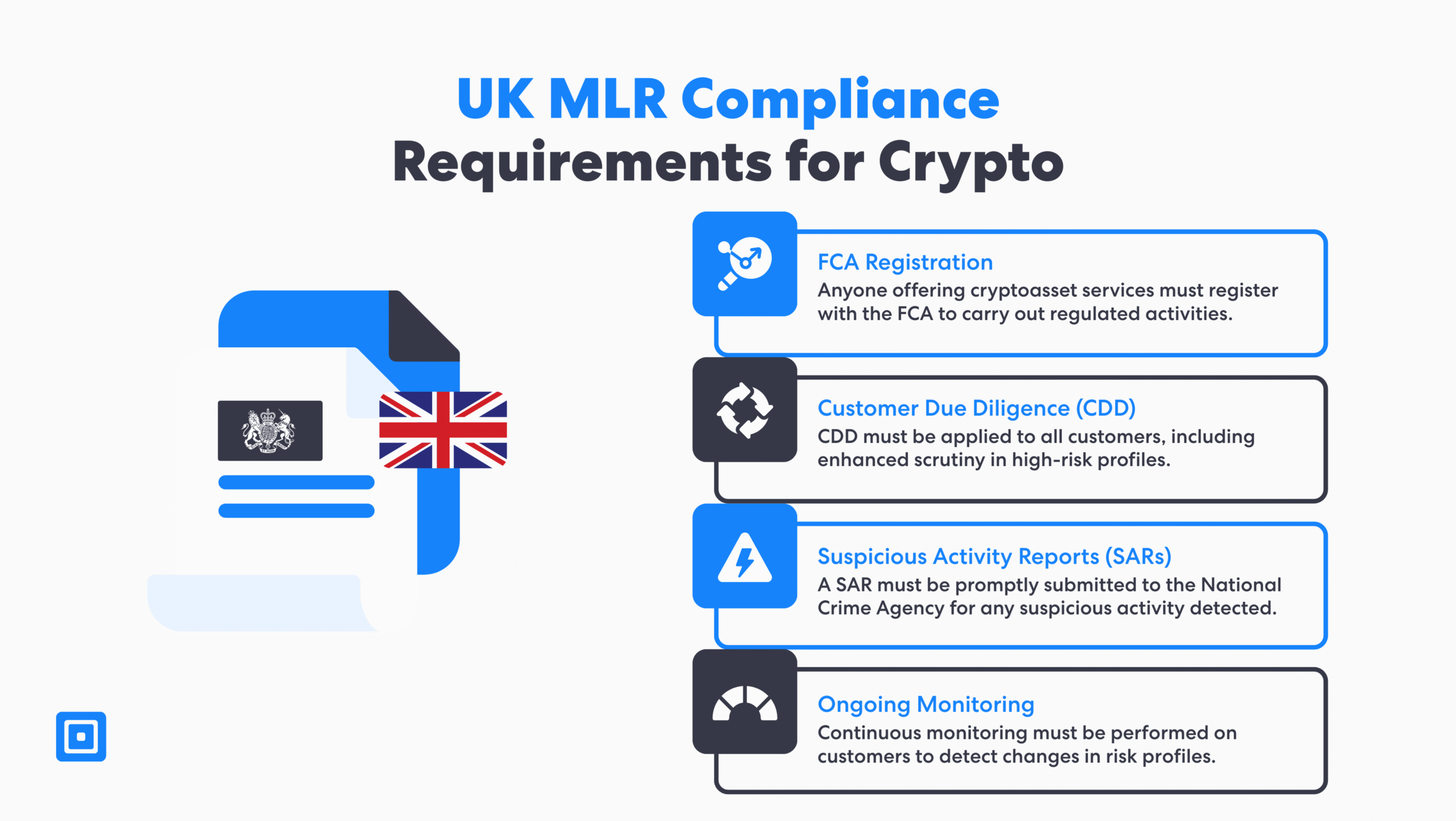
Walid M’Sallem, Full-stack Engineer and Compliance Policies Specialist at ComplyCube, notes, “Companies operating in the cryptocurrency market must adhere to the MLR to prevent illicit activities, including fraud and terrorist financing. Failure to meet regulations will result in heavy restrictions on their operations, face reputational damage, and, in more severe circumstances, criminal investigations”.
## Understanding KYC Requirements for UK Crypto Trading Platforms
KYC obligations vary depending on the industry and level of customer risk. UK crypto trading platforms and crypto exchanges must align their processes with the UK’s risk-based regulatory framework through Customer Due Diligence (CDD), [Enhanced Due Diligence (EDD)](https://www.complycube.com/en/enhanced-due-diligence-edd-insights-and-challenges/), and ongoing monitoring efforts.
> Businesses must demonstrate established policies, controls, and procedures to effectively manage the risks of money laundering and terrorist financing.
According to the FCA, crypto firms must take proactive steps to identify and assess the risks of money laundering to which their businesses are subject. This means that while CDD is standard, a company must take additional steps, such as EDD, to ensure high-risk scenarios do not pose a threat.
### Customer Due Diligence (CDD)
CDD includes verification methods involving digital identity verification, including Proof of Address (PoA) checks, document scans, and liveness checks. For instance, standard customer information, such as name, date of birth, and government-issued identification, including passports and driver’s licenses, is collected.

A common example in the crypto sector is a custodial wallet, which is a type of wallet where a third party takes custody of private keys on behalf of users. Because the third party has control over the assets, it is also subject to KYC compliance when buying crypto. CDD includes the verification of:
- The customer’s identity
- The purpose and intended nature of the business relationship
- Risk screening and assessment
### Enhanced Due Diligence (EDD)
EDD is needed when a customer or entity is associated with a higher risk. As a result, firms must apply EDD to their identity verification process when dealing with any high-risk customers or jurisdictions. MLR mandated measures include senior management approval and multi-bureau checks. Examples of high-risk scenarios can include:
- Politically Exposed Persons (PEPs). You can learn more here: [What is a Politically Exposed Person (PEP)](https://www.complycube.com/en/what-is-a-pep/)?
- Sanctioned individuals or entities
- Financial transactions in high-risk countries
### Real-Time Monitoring
[Ongoing monitoring](https://www.complycube.com/en/solutions/global-screening/continuous-monitoring/) efforts enable businesses to identify and stop suspicious activity promptly, allowing the relevant authorities to become involved earlier. The process includes checking against trusted global sanctions lists, watchlists, adverse media, and PEP databases. As risk profiles can be updated rapidly in real-time, continuous monitoring enables companies to stay ahead of high-risk scenarios.
## Challenges Facing UK Crypto Trading Platforms
Traditional institutions, such as banks, credit unions, or financial intermediaries, have had years to adapt their Identity Verification (IDV) solutions to the changing AML frameworks. On the other hand, UK crypto trading platforms face several challenges as they often operate under leaner models. With the increasing popularity of crypto, virtual asset trading companies face pressure to implement secure KYC frameworks quickly that can handle high transaction volumes.
Additionally, regulators are increasing scrutiny and oversight over crypto platforms. Since crypto transactions occur at a rapid speed and provide the potential for anonymity, illicit activities are more likely to take place, compromising financial safety. For example, the UK’s His Majesty’s Revenue and Customs (HMRC) will fine organizations [up to £300 per customer](https://dig.watch/updates/uk-to-require-crypto-traders-to-report-details-from-2026) for KYC reporting failures in 2026.
### Defective Document Verification Processes
Many platforms rely on manual identity checks or on using legacy IDV providers. Manual processes in KYC lengthen onboarding time and introduce human error, which further impacts customer experience. Thus, platforms must look for providers fully certified to PAD Level 2, ISO 27001, ISO 9001, and the UK Government’s DIATF to ensure credibility and external validation from approved auditors.
### Managing User Drop-Off During Onboarding
User drop-offs can impact customer relationships and trust, leading to revenue losses. To better manage drop-offs, platforms must leverage increased automation, adopt light-touch eIDV methods for instant verification, and analyze onboarding workflows using user behaviour analytics to identify and resolve bottlenecks early. You can learn more about this in our guide, “[The Identity Verification Onboarding Bottleneck.](https://www.complycube.com/en/the-identity-verification-onboarding-bottleneck/)“
### Shortage of Global Crypto KYC Coverage
Many UK crypto trading platforms serve users in multiple jurisdictions. Some KYC providers offer less effective coverage of identity documents or sanctions lists. Similarly, the lack of multi-language support further hinders effective KYC implementation. As such, firms must partner with global KYC vendors that have multilingual verification capabilities, comprehensive document coverage, and ongoing access to global sanctions lists.
### Poor Integration with UK Crypto Trading Platforms
Many exchanges struggle to integrate IDV with customer relationship management (CRM) systems, anti-fraud tools, or compliance systems. The lack of integration coverage creates data silos, undermining overall risk assessment and management systems. Thus, platforms are encouraged to adopt API-first KYC solutions that offer seamless integration with existing tech stacks, enabling real-time data sharing.
### **Case Study: ComplyCube Powers GRVT’s Crypto Onboarding for Millions**
##### **The Rise of Deepfakes and Fraud in the Crypto Space**
GRVT is a leading hybrid derivatives exchange in the crypto space, managing over **$3.3 billion** in monthly volume. As a global firm, GRVT maintains robust KYC and AML frameworks. However, firms in the crypto sector are [increasingly facing](https://www.complycube.com/en/complycube-powers-grvt-crypto-onboarding-for-millions/) deepfakes and fraud attacks.
##### **The Power of Scalable and Automated KYC**
GRVT needed to increase its KYC verification volume; however, it needed to ensure that its customers and clients are legitimate and protected from bad actors. GRVT’s CEO, Hong Yea, noted that the business required KYC solutions that are customizable, secure, and automated.
##### **Solutions & Outcomes**
- GRVT turned to ComplyCube’s platform, which was able to elevate its unique pain point of scaling while eliminating fraud risk.
- ComplyCube enabled GRVT to onboard customers in real-time with **zero downtime and unmatched data accuracy levels.**
- GRVT was able to achieve full **KYC compliance**, aligned with the FATF, while **reducing the cost** and time for customer acquisition.
## Selecting Trusted KYC Solutions for UK Crypto Trading Platforms
Establishing a scalable Know Your Customer (KYC) process requires a combination of technology, policy, services, and human expertise. One cannot work efficiently by compromising the other. It is critical to leverage automation capabilities. Automation helps eliminate human error and accelerates the decision-making process. Through automation, data can be extracted from customers using an identity document in real-time and matched against trusted databases, reducing fraud attempts efficiently.
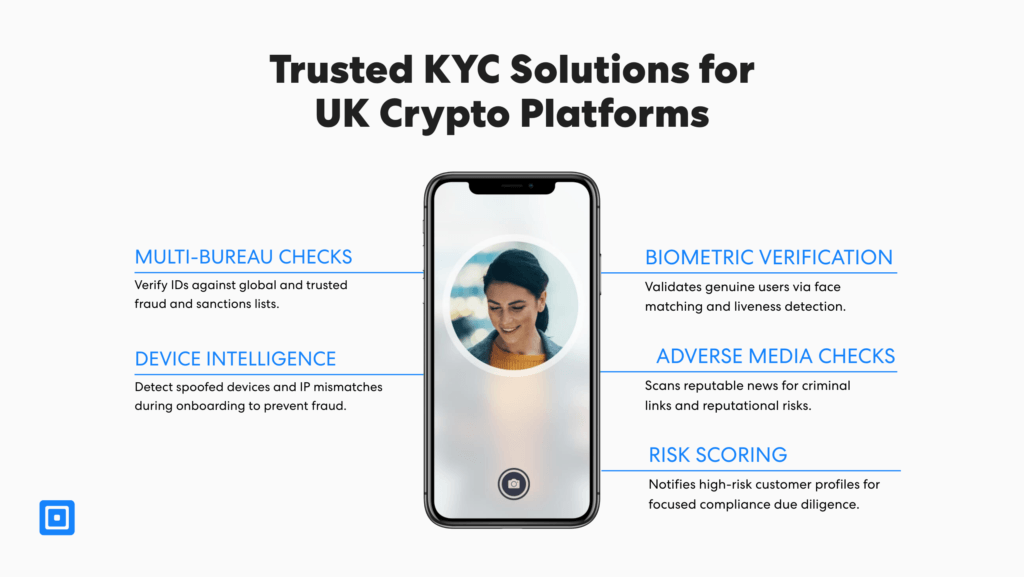
Furthermore, selecting the right KYC provider for scalable compliance is crucial. With all-in-one KYC and AML vendors, businesses enhance fraud detection, streamline sign-ups, and meet FCA requirements on a unified platform. To ensure AML and KYC regulatory compliance, the most important compliance features to look for include:
- **Multi-Bureau checks**: Use of global databases for the verification of identity documents and match user details against known fraud or authoritative sources.
- **Device intelligence**: Ability to detect device spoofing, emulators, or mismatched IP and device environments.
- **Adverse media checks**: Scan [trustworthy news sources](https://www.complycube.com/en/solutions/global-screening/adverse-media-checks/) for signs of criminal association or reputation damage and risk.
- **Biometric verification**: Face matching and liveness detection confirm that users are genuine customers and verify their identity.
- **Risk scoring**: Customizable automated scoring can flag risky profiles based on changing thresholds.
## Emerging KYC Trends for UK Crypto Trading Platforms
Several developments are reshaping KYC processes for crypto. These evolving standards in KYC are driven by the sector’s vulnerabilities to bad actors and fraudsters. To stay ahead of fraud risks, crypto exchanges are adopting advanced compliance solutions.
This includes AI, machine learning, and behavioral analytics in KYC workflows to facilitate faster risk identification, enhanced accuracy, and adaptability to emerging threats. From changes in the Travel Rule to implementing ongoing monitoring and adopting a risk-based approach, crypto firms are finding strategic methods to effectively mitigate fraudulent activity.
### Expansion of Travel Rule Obligations
Financial institutions are responsible for implementing the [Financial Action Task Force (FATF) Travel Rule](https://www.fatf-gafi.org/content/dam/fatf-gafi/recommendations/Best-Practices-Travel-Rule-Supervision.pdf). This travel rule is a global AML standard that requires platforms or Virtual Asset Service Providers (VASPs) to share information about senders and receivers for crypto transactions exceeding a certain threshold.
### Perpetual KYC for Risk-Based Management
Firms are moving away from static KYC procedures in favour of dynamic, real-time assessments for quicker identification of anomalies and threats. This refers to [perpetual KYC (pKYC)](https://www.complycube.com/en/solutions/global-screening/continuous-monitoring/), which enables businesses to utilize automation to manage risk and maintain accurate customer information efficiently. Any changes in identity or risk changes are automatically flagged, building a proactive KYC program.
### The Use of Digital Identity and Cryptocurrency Wallets
To reduce onboarding friction while adhering to regulations, crypto platforms are exploring partnerships with digital identity networks that enable users to undergo verification once and reuse their credentials across multiple services. Decentralized IDV utilizes digital wallets to provide customers with greater control over their information through data portability.
### Monitoring of Crypto Wallet Transactions and Financial Crime Risk Indicators
Staying KYC and AML compliant means taking proactive steps to ensure that all transactions are legitimate and comply with relevant regulations. Transaction monitoring solutions enable companies to track customer behavior. These risk indicators must be incorporated into broader [fraud prevention](https://www.complycube.com/en/use-cases/process/fraud-prevention/) and AML monitoring systems for integrated risk management. Dormant accounts and crypto wallets that suddenly become active or experience an increase in transaction volume require thorough oversight.
### Key Takeaways
- **Crypto scrutiny** is rising as regulators deem the sector high-risk due to its security vulnerabilities, including large transaction volumes.
- **UK Crypto firms** must adopt crypto-specific FCA frameworks to meet and comply with AML and KYC regulations effectively.
- **A risk-based** focus, following FATF guidelines, enables firms to target high-risk areas efficiently while reducing friction for low-risk users.
- **Robust integration, automation,** and multilingual verification capabilities enhance user experience, boosting conversions.
- **Perpetual KYC** enables continuous, reusable verifications across platforms, reducing redundant checks and accelerating onboarding.
## Final Thoughts on UK Crypto Trading Platforms
For crypto firms, staying compliant is about building trust, reducing fraud, and enabling long-term scalability while providing a seamless customer experience. Strong crypto KYC solutions enable businesses to unify regulatory requirements, including Travel Rule obligations and ongoing monitoring, while enhancing customer conversion rates.
A robust KYC process supports long-term scalability while ensuring a seamless and frictionless customer experience, which is crucial for maintaining a competitive edge in a rapidly growing and fast-paced market. Partnering with a trusted, FCA-aligned KYC service provider ensures that crypto firms are equipped to navigate the evolving regulatory landscape confidently and sustainably. Speak to a member of the team today.
## Frequently Asked Questions
Who is the regulatory body for KYC in the UK?
The regulatory body for KYC in the UK is the Financial Conduct Authority (FCA). The FCA is the central regulatory authority responsible for overseeing KYC and AML programs for crypto firms in the UK. It establishes supervision for crypto asset exchanges aligned with the Money Laundering Regulations 2017 (MLRs).
Is KYC mandatory for all crypto businesses with customers in the UK?
KYC is mandatory for FCA-registered crypto firms operating and transacting within the UK to prevent money laundering and financial crime from anonymous transactions. In the EU, regulations such as the MiCA require firms to implement robust identity verification, ongoing monitoring, and strong consumer protection rules.
What are the risks of not doing KYC in the UK for crypto firms?
Crypto firms in the UK can be fined by the Financial Conduct Authority (FCA), facing hefty financial penalties, restrictions, and criminal prosecution for breaches of regulations such as Anti-Money Laundering (AML) rules. Not implementing KYC also exposes a company to security threats, fraud, and scams on its platform.
How can UK crypto trading platforms reduce user drop-off during KYC onboarding?
Platforms can reduce abandonment by utilizing automated, low-friction IDV solutions that expedite onboarding. Utilizing biometric checks, such as liveness detection, ensures both security and ease of use. Multi-language support also enhances accessibility, enabling users to complete verification without confusion.
How does ComplyCube support KYC verification for crypto services?
Aligned with the FCA and FATF’s standards, ComplyCube supports complete KYC verification for crypto services. It offers ISO-certified biometric and liveness detection, enhanced document security, and regulator-aligned workflows. Additionally, its real-time sanctions and PEP monitoring give crypto firms confidence to scale without high costs and complexity.

**Categories:** Guides
**Tags:** Know Your Customer
---
### [Fraud Checks: Big Tech to Be Held Accountable](https://www.complycube.com/fraud-checks-big-tech-to-be-held-accountable/)
**Published:** September 16, 2024
**Author:** Sofia Daley
**Excerpt:** The new Labour government plans to hold big tech accountable for online fraud, as they must compensate victims. AI-powered identity verification now allows for implementing a sophisticated document and biometric check.
**Content:**
Victims of online fraud are scattered across the UK, yet it seems that going forward, they may finally be served justice—but at whose expense? The Labour government plans to enforce a new way forward, in which big tech companies will be held accountable and must compensate online fraud victims for their losses through their platform. These firms will need to buckle up for this change, as a lack of adequate fraud checks will now cost them a pretty penny. The solution? AI-powered identity verification with a sophisticated document and biometric check.
Unsurprisingly, banks such as Lloyds Banking Group have been quick to back the government’s initiative. Until now, the cost of reimbursing victims of fraud has fallen almost exclusively with them. Yet, from October 2024, the burden will be lifted off their shoulders and placed on those belonging to the nation’s tech giants.
## Billions Lost to Online Fraud
Online fraud currently costs the UK billions annually, yet tech firms seem to escape accountability due to “[weak laws](https://channeleye.co.uk/labour-partys-tech-changes-leave-big-tech-more-responsible-for-online-fraud/).” The importance of adequate regulation cannot be understated despite the increased complexity faced by firms in achieving compliance. With the cost of online fraud only increasing, it’s time for identity verification infrastructure to tackle this challenge head-on before blame is assigned. An oversight body will be set up in order to hold these firms accountable and assess whether or not their contributions to fraud victims are considered sufficient.
> According to UK Finance figures, 232,429 authorised push payment scam cases were reported in Britain last year, [resulting in losses of £459.7 million](https://www.decisionmarketing.co.uk/news/labour-to-force-tech-giants-to-cough-up-for-online-scams). However, this figure will likely be much higher as most scams go unreported.
A spokesperson from Lloyds Banking Group spoke to The Sunday Times on the matter, stating that “almost [80% of scams ](https://www.decisionmarketing.co.uk/news/labour-to-force-tech-giants-to-cough-up-for-online-scams#:~:text=A%20Lloyds%20Banking%20Group%20spokesperson,ready%20to%20play%20our%20part.)start online, and we have long called for social media and tech companies to do more to protect their users and help refund innocent victims.”
A key point to consider here is whether or not tech firms are really doing all they can to ensure IDV and eKYC measures are up to scratch. Jessica Cath, Head of Financial Crime at Thistle Initiatives, a compliance consultancy for financial services, believes otherwise. She suggests that perhaps increased interoperability between these firms is needed in order to detect online fraudsters through increased information sharing.
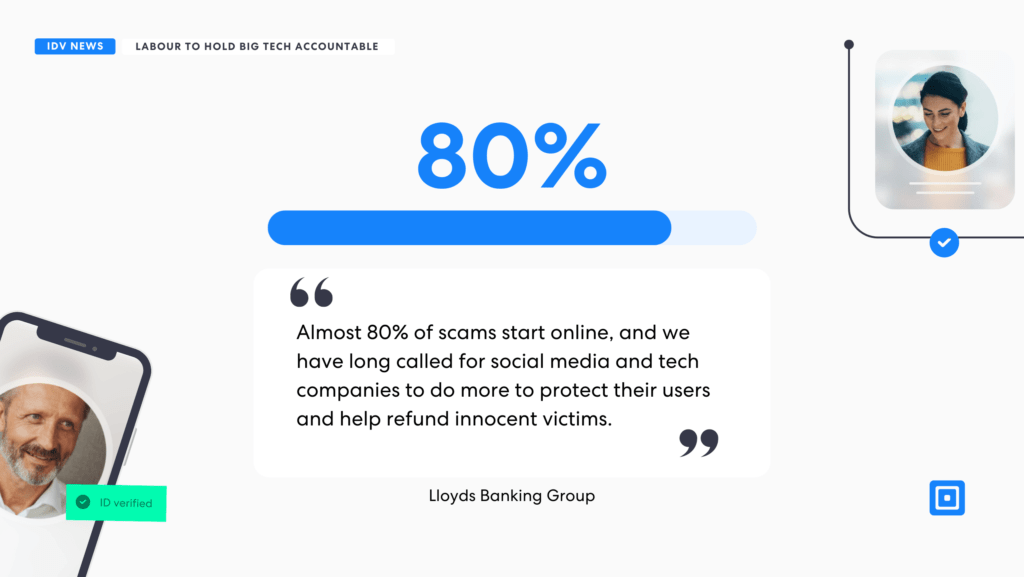
Cath explains, “If tech firms were liable for [reimbursing victims ](https://thefintechtimes.com/labour-plans-to-make-tech-firms-reimburse-app-fraud-victims/)(at least in part), this would encourage collaboration and data sharing across sectors to bring fraud rates down. Multi-industry responsibility and collaboration would make APP fraud prevention much more effective – for example, if social media and telecom companies were encouraged to share suspicious behavior related to a phone number or social media profile, they [could be linked to bank accounts](https://thefintechtimes.com/labour-plans-to-make-tech-firms-reimburse-app-fraud-victims/). This would make the identification and elimination of fraud networks far easier.”
> If tech firms were liable for [reimbursing victims ](https://thefintechtimes.com/labour-plans-to-make-tech-firms-reimburse-app-fraud-victims/)(at least in part), this would encourage collaboration and data sharing across sectors to bring fraud rates down.
However, taking full responsibility away from financial services is certainly not the answer, as the industry has a clear role to play in ensuring its fraud detection and monitoring systems are robust. The burden must be shared across the entire ecosystem—from tech giants to financial institutions—so that no single sector is left to shoulder the costs alone. However, this shift in responsibility comes with its own challenges.
Will tech companies and banks find common ground, or will this lead to new tensions as they juggle costs, accountability, and customer trust? Ultimately, the success of this initiative will depend not just on policy changes but on the willingness of these industries to work together for the greater good of consumer protection.
## What does robust IDV and eKYC infrastructure look like for tech firms?
Several forms of fraud checks need to be implemented to safeguard customers, including AI-powered identity and document checks that can effectively spot presentation attacks. Deepfakes are only becoming increasingly deceptive, and presentation attack detection technology must include [liveness detection](https://www.complycube.com/en/solutions/due-diligence-compliance/know-your-customer/liveness-detection/) in order to accurately spot and deter these criminals.
[Document verification](https://www.complycube.com/en/solutions/identity-assurance/document-verification/): Ensures that the identity being presented is genuine and valid. This process involves authenticating official documents such as passports to confirm that they are legitimate, unexpired, and have not been altered. Key security features are analyzed using Optical Character Recognition (OCR) technology to ensure both speed and accuracy. Technologies such as Near-Field Communication (NFC) verification have also become integral to document verification, adding another layer of protection.
[Biometric Verification](https://www.complycube.com/en/solutions/identity-assurance/biometric-verification/): Biometric verification goes a step further by analyzing a person’s unique facial features to confirm their identity. This technology is often paired with document verification to ensure that the individual presenting the ID is its rightful owner. [Biometric authentication](https://www.complycube.com/en/solutions/due-diligence-compliance/know-your-customer/face-authentication/) offers improved security and convenience by storing and indexing these physical traits, such as 3D face maps, for future use. The use of liveness detection within the biometric verification process is key, as it leverages advanced biometrics and machine learning to distinguish between real individuals and fraudulent attempts involving 3D masks or photographs. Active and passive biometric checks further enhance the system’s ability to detect fraud, ensuring that identity verification remains robust.
## Fraud Checks via Identity Proofing Services
Robust Identity Verification (IDV) and Know Your Customer (KYC) infrastructure are more crucial than ever to effectively meet the challenges posed by increasing online fraud. For tech firms now facing the burden of reimbursing fraud victims, implementing advanced document verification, biometric checks, and liveness detection is not just a recommendation but a necessity.
With the introduction of regulatory oversight, the spotlight is on whether tech firms will rise to the challenge of deploying and maintaining these advanced IDV measures. Their success—or failure—will have far-reaching implications for the future of consumer trust and financial security in the UK.
[ComplyCube](https://www.complycube.com/en/) is renowned for its state-of-the-art identity verification (IDV) checks. It offers advanced security measures alongside a seamless user experience. The platform streamlines onboarding processes to under 30 seconds while maintaining precise IDV, AML, and KYC compliance.

Reach out to ComplyCube’s [expert compliance team](https://www.complycube.com/en/contact/contact-sales/) to explore how a robust IDV infrastructure can be implemented to protect your organization against online fraud.
**Categories:** Guides
**Tags:** Identity Verification
---
### [What is Synthetic Identity Fraud?](https://www.complycube.com/what-is-synthetic-identity-fraud/)
**Published:** October 7, 2024
**Author:** Sofia Daley
**Excerpt:** Businesses face the growing threat of synthetic identity fraud. Sophisticated biometric verification with ai deepfake detection and an advanced document check is needed to safeguard businesses against evolving fraudulent practices.
**Content:**
A question every business should be asking themselves in 2024 is, what is synthetic identity fraud? Synthetic identity fraud involves combining real information pertaining to a person’s identity with fake information, creating a new deceptive fictional identity. It’s extremely difficult to detect a synthetic identity, as bad actors often “nurture” them over time in order to gradually build up a desired credit profile. This form of identity fraud is becoming increasingly widespread, with financial institutions, fintech apps, and trading platforms often being targeted. The rise of synthetic identity fraud is also supported by an increasing amount of personally identifiable information being readily available on the dark web. Businesses must be aware of the risks that these deceptive identities entail and safeguard their organizations with comprehensive IDV and KYC solutions.
## The Anatomy of a Synthetic Identity
A synthetic identity is created by combining real and fake personally identifiable information, such as a Social Security number, name, and address. Synthetic identities can be used to open bank accounts, apply for loans, and make fraudulent purchases. There are several forms of synthetic identity fraud, including identity compilation and identity manipulation, both of which are often used to create a fake credit history, making it easier to commit fraud.
Research published towards the end of 2023 highlighted the growth of synthetic identity fraud caused directly by the development of AI. Biometric Update reported that “fraud involving AI-generated identities has risen 17 percent over the past two years, while more than [two-thirds (76 percent)](https://www.biometricupdate.com/202311/ai-speeds-synthetic-identity-fraud-enabling-human-like-interactions) of financial professionals believe that their companies have approved customers using synthetic identities.” As fraud evolves due to the availibility of AI-powered tools, businesses must similarly leverage these tools to stay one step ahead.
Synthetic identity fraud is often a long-term game. Unlike traditional identity theft, synthetic fraudsters often cultivate identities over time, gradually building up a credit profile that appears legitimate. This carefully planned approach allows bad actors to avoid immediate detection. Eventually, the synthetic identity appears to be credible, and fraudsters can take out larger loans or credit lines before disappearing. Hence, it has become a preferred method for fraudsters, especially with the help of AI-generated identities.
## What is Synthetic Identity Fraud and The Impact of Identity Theft
A Transunion report at the end of 2023 looked into the growth and trends of digital fraud, highlighting that “data breaches in the U.S. increased 15% year [over year in 2023](https://statescoop.com/synthetic-identity-fraud-data-breaches-transunion-report-2024/), with 54% of consumers across 18 countries and regions reportedly targeted in online, email, phone call or text messaging fraud attempts from September to December of last year.” Increased data breaches, as well as the availability of sensitive data online, has led to the rise in synthetic identities. KPMG highighted the severity of the issue in 2022, pointing out in a recent piece that synthetic fraud is a $6 billion dollar problem, and “the fastest-growing [financial crime](https://kpmg.com/us/en/articles/2022/synthetic-identity-fraud.html) in the United States.”
> The fastest-growing [financial crime](https://kpmg.com/us/en/articles/2022/synthetic-identity-fraud.html) in the United States.
Synthetic identity theft can have a significant impact on individuals, including damage to their credit history and financial losses. Victims may experience a split or fragmented credit file, making it difficult to obtain credit or loans. Synthetic identity theft can also have a significant impact on businesses, including financial losses and damage to their reputation. The impact of synthetic identity theft can be far-reaching, affecting various sectors, including financial services, healthcare, and government entities.
> It’s estimated that [95% of synthetic identities](https://legal.thomsonreuters.com/en/insights/articles/trends-in-synthetic-identity-fraud) are not detected during the onboarding process.
With nearly two-thirds of financial professionals believing that their company has approved customers who are using synthetic identities, most businesses without comprehensive verification processes are running a very serious risk. Thomson Reuters argues that “at financial institutions, it’s estimated that [95% of synthetic identities](https://legal.thomsonreuters.com/en/insights/articles/trends-in-synthetic-identity-fraud) are not detected during the onboarding process. At many e-commerce and retail sites, losses due to synthetic identity theft are either never detected or simply written off as an unrecoverable cost of doing business.”
## Protecting Against Synthetic Identity Fraud
The issue with synthetic identity fraud is that detecting it during an application/onboarding process is extremely difficult. KPMG states, “despite its growing rate, synthetic identity fraud remains nearly [impossible to flag](https://kpmg.com/us/en/articles/2022/synthetic-identity-fraud.html) during the application process. The ability to create an unlimited number of identities, coupled with how challenging they are to detect, makes synthetic identity fraud a popular choice among cybercriminals.”
> Despite its growing rate, synthetic identity fraud remains nearly [impossible to flag](http://kpmg.com/us/en/articles/2022/synthetic-identity-fraud.html).
To protect against synthetic identity fraud, businesses should invest in advanced identity verification and due diligence tools to detect and prevent synthetic identity fraud. By employing advanced identity verification techniques that include biometric checks, document authentication, and cross-referencing data across multiple sources, companies can detect inconsistencies that signal synthetic identities. Additionally, integrating machine learning to continuously enhance detection capabilities helps stay ahead of new fraudulent practices.
## What’s Needed? **IDV Checks with ComplyCube**
Detecting synthetic identities requires robust, multi-layered verification methods, and ComplyCube’s biometric and document verification solutions are able to effectively safeguard businesses and invididuals against this threat.
Their liveness detection technology guaratnees that the person presenting the identity is alive and present, mitigating the risk of AI-generated or spoofed identities. The integration of facial recognition and document validation ensures that the identity details are authentic and not fabricated. By combining biometric, document, and behavioral analysis, synthetic identities can be flagged early, preventing fraudsters from nurturing fake credit histories or gaining unauthorized access. Some of the features of their solutions include:
[**Robust facial recognition and similarity**](https://www.complycube.com/en/solutions/identity-assurance/biometric-verification/)**:** ComplyCube’s advanced ISO 30107-3 and PAD Level 2-certified biometric liveness detection technology ensures that the person presenting an identity document truly matches the submitted details. Their Identity Verification (IDV) system combines biometric and behavioral analysis to provide a highly secure and reliable identity verification process, offering a robust level of assurance in detecting fraudulent or synthetic identities.
[**Advanced document verification**](https://www.complycube.com/en/solutions/identity-assurance/document-verification/)**:** ComplyCube utilizes a blend of AI technology and expert review to meticulously verify ID documents, ensuring they haven’t been altered, forged, copied online, expired, or blacklisted. This rigorous process supports various types of documents, including passports, driver’s licenses, national ID cards, residence permits, visa stamps, and travel documents, providing a comprehensive layer of protection against identity fraud.
[**Expert liveness detection**](https://www.complycube.com/en/solutions/due-diligence-compliance/know-your-customer/liveness-detection/)**:** Their AI-powered PAD-Level 2 liveness detection software accurately confirms genuine customer presence and flags imposters. By incorporating advanced anti-spoofing technology, ComplyCube effectively safeguards businesses from even the most sophisticated fraud attempts.
[**Seamless biometric enrolment**](https://www.complycube.com/en/solutions/identity-assurance/customer-authentication/)**:** A top-tier guided face capture technology that ensures seamless authentication for accessing Finance, Telecommunications, Travel, Enterprise Services, and more.
## Protect Your Business Today
Synthetic identity fraud is a growing concern, with losses in the multi-billions. It’s essential to understand the anatomy of a synthetic identity and the impact of synthetic identity theft. Protecting against synthetic identity fraud requires advanced identity verification and due diligence tools and a robust identity verification process.

By understanding the role of technology in synthetic identity fraud and implementing business protection strategies, individuals and businesses can minimize the risk of synthetic identity fraud.
Contact one of ComplyCube’s [compliance experts](https://www.complycube.com/en/contact/contact-sales/) and put measures in place to protect your organisation today.
**Categories:** Guides
**Tags:** Identity Verification
---
### [FATF Crypto Guidance: Securing the Sector](https://www.complycube.com/fatf-crypto-guidance-securing-the-sector/)
**Published:** October 24, 2024
**Author:** Sofia Daley
**Excerpt:** The FATF leads global crypto regulations, which have evolved drastically since 2018 as the threat perceived from the industry has significantly increased. Digital assets have become a significant avenue for money laundering.
**Content:**
FATF crypto guidance leads global and UK crypto regulation policies, which have evolved drastically since 2018 as the threat perceived by the industry has increased. Due to their anonymity, digital assets have become a significant avenue for money laundering. In 2022, laundering volumes reached $31.5 billion, dropping to $22.2 billion in 2023, showing some progress. Yet, these figures are still alarmingly high.
During the same period, the concentration of laundering through the top five off-ramping services (platforms converting crypto to fiat currency) increased from 68.7% to 71.7%. This highlights the urgent need for stricter KYC and AML procedures at major crypto institutions to mitigate financial crime.
> In 2022, laundering volumes reached [$31.5 billion](https://www.chainalysis.com/blog/2024-crypto-money-laundering/).
In 2024, money laundering in crypto encompasses [all crime](https://www.chainalysis.com/blog/2024-crypto-money-laundering/), meaning that crypto-related money laundering is not limited to activities that are directly tied to the crypto ecosystem, such as hacks or fraud within crypto exchanges. Instead, it now includes proceeds from any type of criminal activity, both traditional (e.g., narcotics trafficking) and digital. This guide will dive into how the FATF defines Virtual Assets (VAs), the financial crime threat they pose to worldwide economies, and how FATF regulation evolved through its early stages.
## How does the FATF define VAs?
The FATF defines a virtual asset as “a [digital representation of value](https://www.fatf-gafi.org/en/topics/virtual-assets.html#:~:text=Virtual%20Assets-,Virtual%20Assets,many%20potential%20benefits%20and%20dangers.) that can be digitally traded or transferred and can be used for payment or investment purposes. Virtual assets do not include digital representations of fiat currencies, securities, or other financial assets that are already covered elsewhere in the FATF Recommendations.”
The definition of virtual assets underscores their function as digitally tradable or transferable forms of value that can be used for payment or investment purposes**,** distinguishing them from more traditional assets.
## Overview of FATF’s Early Crypto Guidance
The FATF began providing official guidance for the crypto sector in 2019. The organization issued its initial recommendations on adopting a risk-based approach to virtual assets and Virtual Asset Service Providers (VASPs), while also updating its standards to introduce mandatory measures for regulating and overseeing virtual asset activities. For an initial overview of how crypto regulations and guidance protect the industry, read [“How KYC Crypto Regulations Safeguard the Industry.”](https://www.complycube.com/en/how-kyc-crypto-regulations-safeguard-the-industry/)
**2018:** In October of 2018, the FATF first acknowledged the risk presented by the crypto sector. Cryptocurrencies were mainly considered to be unregulated virtual assets (VAs) at the time, with most parts of the world not having implemented formal regulation to address these digital assets.
The FATF clarified in October that VAs and VASPs should also follow its Recommendations, which until then had mainly targetted the traditional financial sector. Similarly, the added clear definitions for VAs and VASPs. The FATF also added VAs and VASPs to Recommendation 15 (R15), extending its guidance to make sure these organisations followed Anti-Money Laundering (AML) and Counter Financing of Terrorism (CFT) directives.
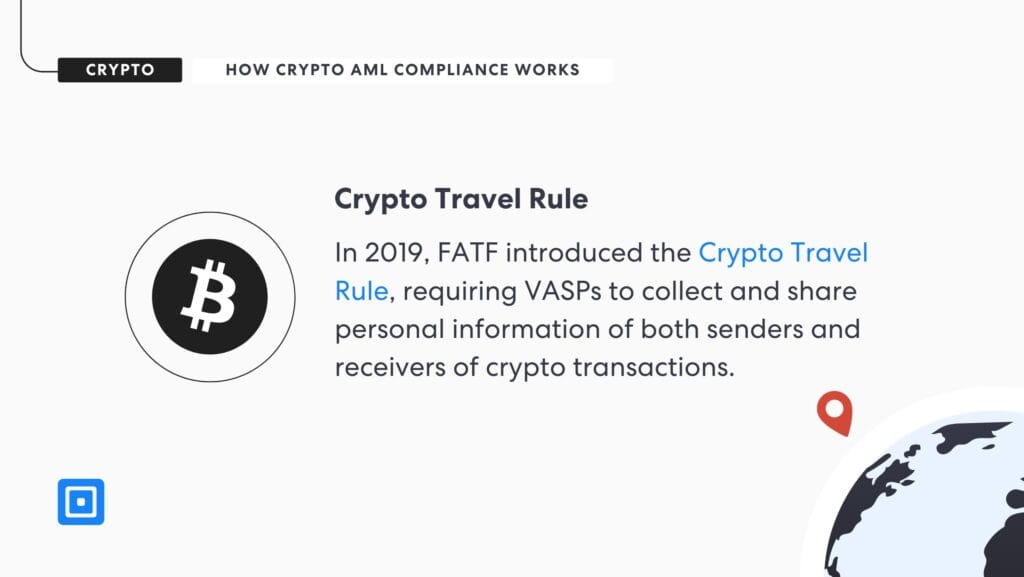
**2019:** On the 21st of June (2019), the FATF identified virtual assets (VAs) as a significant issue and a potential threat to the integrity of the financial system. The FATF also released a statement on virtual assets and providers, which included the following: “The threat of criminal and terrorist misuse of virtual assets is serious and urgent, and the FATF expects all countries to take prompt action to implement the FATF Recommendations in the context of virtual asset activities and service providers.”
> The threat of [criminal and terrorist misuse](https://www.fatf-gafi.org/en/publications/Fatfrecommendations/Public-statement-virtual-assets.html) of virtual assets is serious.
The FATF then released its first “[Guidance for a Risk-Based Approach to VAs and VASPs](https://www.fatf-gafi.org/en/publications/Fatfrecommendations/Guidance-rba-virtual-assets-2021.html "Guidance for a Risk-Based Approach to VAs and VASPs").” This addressed how VAs and VASPs fall within FATF views and recommendations. It also adopted an interpretative note to R15, which clarified how different mandates for VAs and VASPs should be applied. R16 extended Travel Rule requirements to VASPS. For more on the Travel Rule, read [“The Crypto Travel Rule: The Need for AML Compliance Software.”](https://www.complycube.com/en/the-crypto-travel-rule-and-the-need-for-aml-compliance-software/)
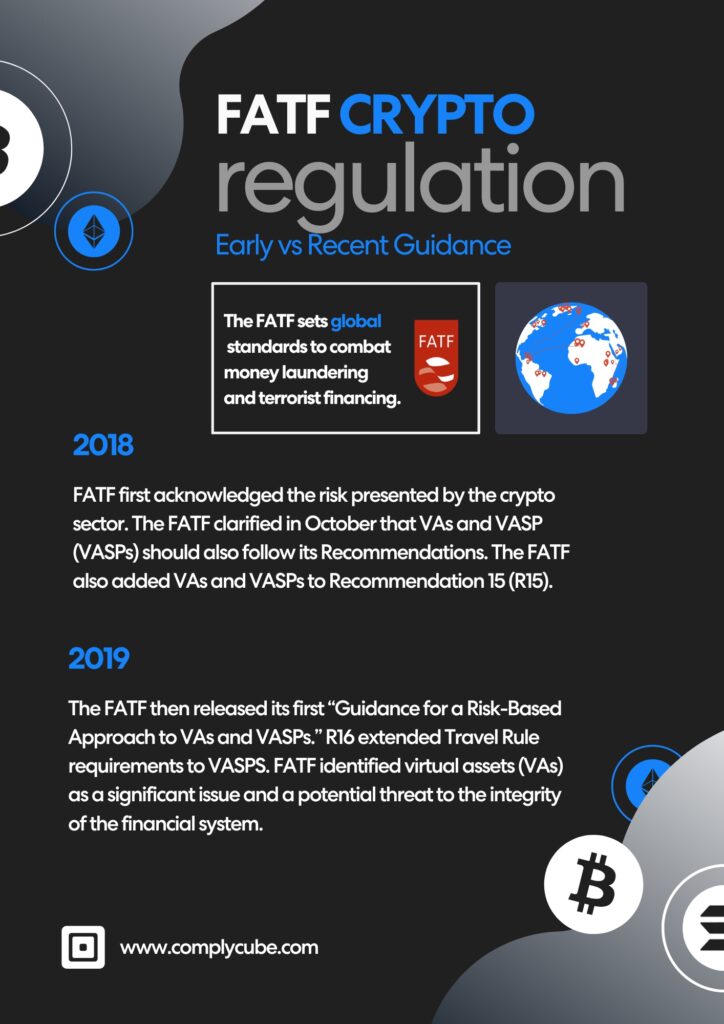
## 2023-2024: FATF’s Global Evaluation of Virtual Asset Regulation
In February 2023, the Financial Action Task Force (FATF) Plenary identified a considerable shortfall in implementing its updated Recommendation 15, particularly regarding Virtual Assets (VAs) and Virtual Asset Service Providers (VASPs). Although the October 2018 revision sought to incorporate measures like the Travel Rule for VAs and VASPs, many countries had yet to adopt these enhanced standards.
To tackle this issue, the Plenary set forth a roadmap focused on strengthening the implementation of FATF Standards related to VAs and VASPs. This plan involved conducting a thorough evaluation of implementation levels across the global network.
After 12 months of watching and evaluating global levels of compliance with the Travel Rule, the FATF published their report, highlighting the status of jurisdictions with significant virtual asset service provider (VASP) activity regarding their implementation of FATF Recommendation 15 (which includes the Travel Rule).
The published report unveiled 3 key findings:
- Progress was found in the implementation of the Travel Rule: [Almost 89%](https://notabene.id/post/key-takeaways-from-fatfs-2024-targeted-update-of-travel-rule-implementation-for-virtual-assets-and-service-providers---july-2024) of the jurisdictions with important VASP activity are enacting or have enacted Travel Rule legislation.
- More than[ 90% of jurisdictions with significant VASP activity](https://notabene.id/post/key-takeaways-from-fatfs-2024-targeted-update-of-travel-rule-implementation-for-virtual-assets-and-service-providers---july-2024) have implemented essential measures to regulate and oversee virtual assets and virtual asset service providers.
- Only three jurisdictions with significant VASP activity—China, Egypt, and Saudi Arabia—have explicitly banned virtual assets and virtual asset service providers.
The release of this report granted global insights into the landscape of crypto regulations, with the findings pointing to a key understanding of the importance of crypto compliance measures.
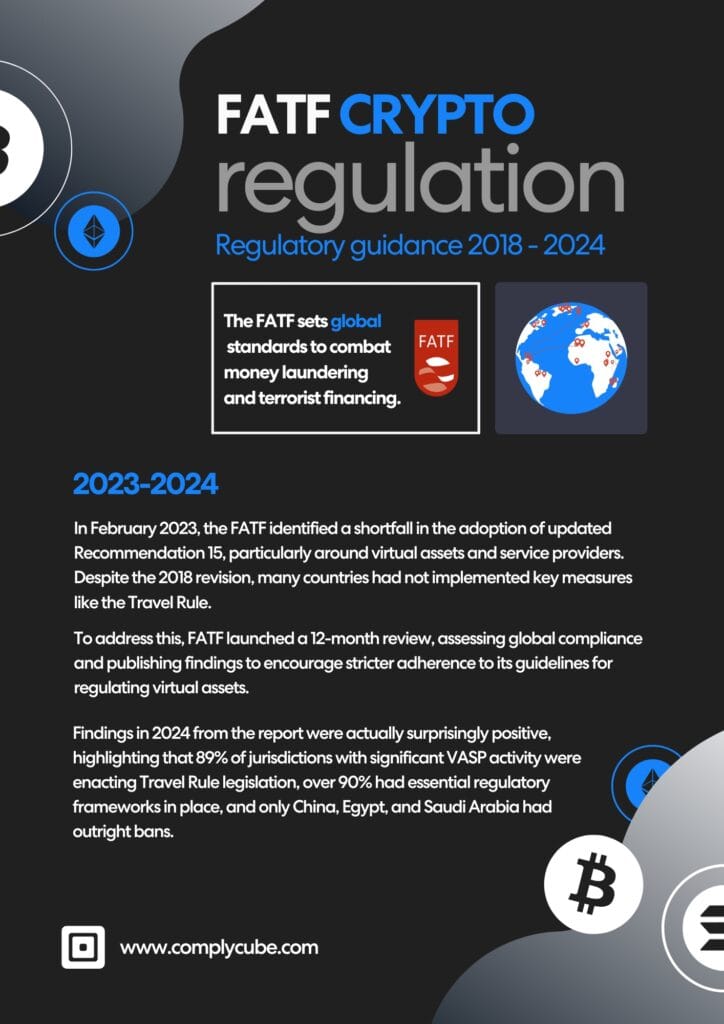
## How UK Crypto Firms Can Align with FATF Crypto Guidance
The FCA ensures that UK legislation follows FATF global guidelines, ensuring that the country follows international mandates. [The Money Laundering, Terrorist Financing, and Transfer of Funds (Information on the Payer) Regulations 2017 (MLRs)](https://www.legislation.gov.uk/uksi/2017/692/contents), which was amended in 2019, require crypto firms to follow these steps:
- **Register with the FCA:** All UK crypto businesses need to receive authorization from the FCA for AML/CFT compliance.
- **Apply the Travel Rule:** Businesses need to collect and share information on transaction origins and beneficiaries.
- **Implement KYC and AML controls:** Organizations need to ensure that there is ongoing due diligence on customers and on transactions. Ensuring that KYC measures are stringent helps reduce the chance of fraudulent practices.
> Higher-risk customers therefore need [ongoing monitoring](https://www.fca.org.uk/firms/financial-crime/cryptoassets-aml-ctf-regime).
The FCA, like the FATF, believes in a risk-based approach, stating, “Our [supervisory approach](https://www.fca.org.uk/firms/financial-crime/cryptoassets-aml-ctf-regime) to cryptoasset businesses is in line with our approach to other businesses under the MLRs. It is risk based so that businesses which pose the greatest money laundering and terrorist financing risk receive an increased level of supervisory focus. Higher-risk customers therefore need ongoing monitoring.”
## Ensuring Compliance in Crypto
Crypto platforms now bear a significant responsibility to protect the integrity of the financial system. With the continued expansion of the crypto ecosystem, capital inflows are projected to rise even further in 2024 and 2025.
It’s crucial that customer onboarding processes are optimized to smoothly convert potential users into active participants while simultaneously adhering to robust consumer protection standards. Maintaining this balance will be essential to foster both trust and security in the rapidly growing sector. For more on why stringent KYC measures are needed in crypto, read “[The Dangers a No KYC Crypto Exchange Can Bring.](https://www.complycube.com/en/the-dangers-a-no-kyc-crypto-exchange-can-bring/)“

If your client acquisition process is proving a challenge to scale or if you are seeking solutions in AML, KYC, and IDV, [get in touch with one of ComplyCube’s specialists today](https://www.complycube.com/en/contact/contact-sales/).
**Categories:** Guides
**Tags:** Crypto Regulations
---
### [Why Multi-Bureau Identity Verification is the Ultimate Fraud Defense](https://www.complycube.com/multi-bureau-identity-verification/)
**Published:** December 18, 2025
**Author:** Rithu Jagannath
**Excerpt:** Multi-bureau identity verification helps onboarding by validating customer data across trusted sources. Using 1+1 and 2+2 checks, it ensures regulated businesses reduce fraud, meet KYC requirements, and onboard customers with confidence.
**Content:**
**TL;DR:** Multi-bureau identity verification cross-checks **customer data** against multiple authoritative sources to confirm authenticity. Using 1+1 verification, 2+2 check, match logic, it cross **verifies multiple combinations of data** attributes through an identity database for information such as name, date of birth, address, and **national identity numbers**.
## What is Multi-Bureau Identity Verification?
Multi-bureau identity verification is an automated identity-checking method. It validates customer information by comparing it against multiple independent and trusted data sources. Businesses use sources such as telecom records, credit bureaus, government registries, and utility providers to build a more complete and reliable picture of who a person is.
This identity verification approach allows organizations to verify key data points, and assess identity risk with far greater precision. By distributing checks across different bureaus, businesses can reduce the chance of fraud slipping through gaps in any system. This ensures that customers with limited documentation can still be verified.
## Why Multi-Bureau Identity Verification Matters
It is clear that multi-bureau identity verification checks are central to the customer onboarding process. Most verify customer information across two or more data sources, such as government records, utility bills, and credit bureaus. Businesses can easily ensure they meet detailed due diligence and compliance requirements through an additional third-party as part of a comprehensive multi-bureau process.
> Fraudsters have evolved, and so must our defenses.
Milosh Caunhye, Solutions Consultant from ComplyCube states that, “Fraudsters have evolved, and so must our defenses. By combining telecom data, credit bureaus, and alternative data, multi-bureau verification disrupts the very signals bad actors depend on. It allows businesses to identify manipulation early especially in the face of deepfakes and AI-generated social engineering.”
Financial services and regulated platforms worldwide face growing pressure to verify customers quickly and accurately over time. The UK government must be ready to use trusted [digital identity services](https://www.gov.uk/guidance/digital-identity), provided they meet individual regulatory requirements. Multi-bureau identity verification, such as 1+1 verification and 2+2 checks, offers:
- Improved match algorithm accuracy, reducing false positives and the friction they cause.
- A broader range of defined data coverage options, helping onboard users who may lack traditional documents
- Flexible compliance, supporting evolving regulations in jurisdictions such as the UK, the US, and the EU.
## Understanding 1+1 Verification and 2+2 Checks
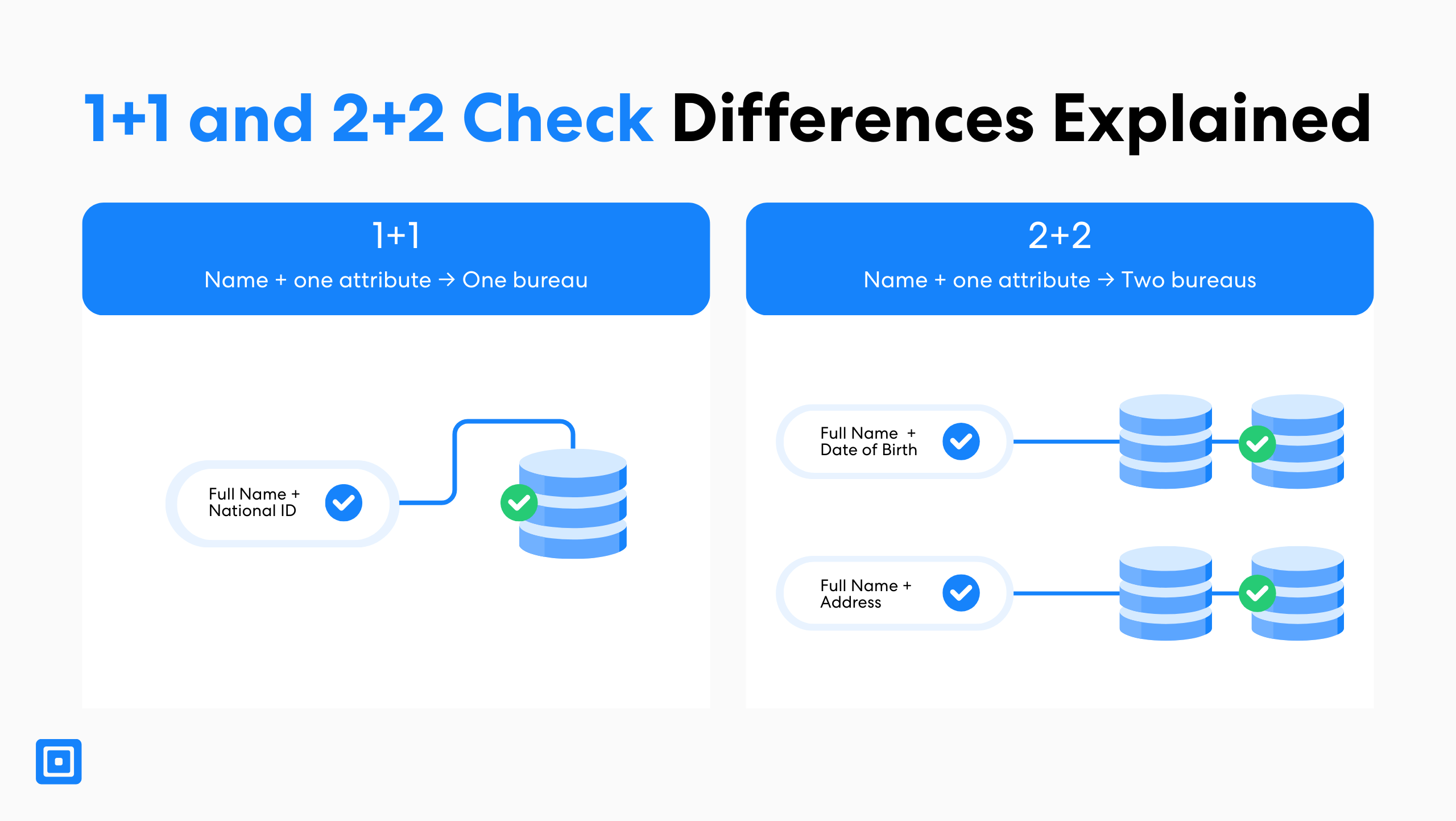
Verifying customer identity through various identity databases operates under two regulatory framework options. This includes 1+1 verification and 2+2 checks. These match frameworks define how many attribute pairs (name plus one additional attribute) must be verified, and across how many independent data sources, to meet regulatory and compliance requirements.
### What is a 1+1 Verification?
1+1 verification involves matching a customer’s name plus one additional attribute, such as date of birth, address, or an ID number, within a single authoritative data source. While less intensive than 2+2 logic, this approach is often acceptable for lower-risk scenarios or jurisdictions with more flexible requirements. It enables businesses to verify customers who may lack extensive financial histories by using alternative or locally available data.
### What is a 2+2 Check?
A 2+2 check requires matching a customer’s name plus one additional attribute across two separate and reliable data sources. This could include name and date of birth, or name and address, verified independently by two bureaus. Frequently, this 2+2 check is considered the gold standard for electronic identity verification in many regulated environments. For example, a FinTech in the UK might verify a customer’s full name and address across both a credit bureau and an electoral roll database.
The [Joint Money Laundering Steering Group](https://www.jmlsg.org.uk/) (JMLSG) supports financial industry sectors in complying with anti-money laundering (AML) and counter-terrorist financing (CTF) legislation. It recommends the 2+2 check as a preferred method to verify electronic ID (eID) in high-risk customer onboarding scenarios, requiring due diligence.
## How Match Logic Works in Multi-Bureau Identity Verification
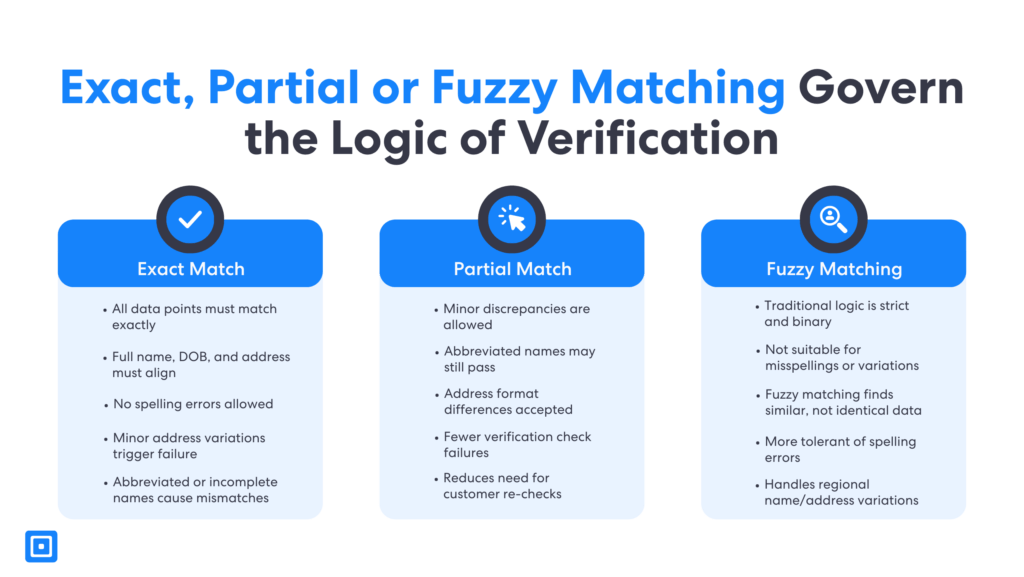
Match logic is the set of rules that govern how individual customer information must align across different identity databases. Often, match logic determines whether a user is “verified”; otherwise, further action is required to complete the process. In practice, this typically boils down to either an exact match or a partial match between sources.
### Exact Match Logic
With exact match logic, the identity verification rules are clear. In order to be verified, every piece of data referenced must align perfectly with a real birth date, full name, and address within a relevant identity database. Even a small discrepancy, such as a street name typo or forgetting a middle name, can still trigger an instant failure during a check.
### Partial Match Logic
In a partial match, some minor discrepancies in results are allowed, for example, an abbreviated name or address formatting differences between sources. This can ensure reduced fail rates and the need for re-checking or requiring a customer to update their information, such as their address or email, to complete the process.
### Fuzzy Matching: When Ordinary Match Logic Doesn’t Fit the Bill
Traditional algorithm logic is binary and straightforward, but this is not always the best approach, as a range of options may need to be considered. Names can be misspelt, and some areas can be known by multiple names. These logic algorithms identify similar, but not identical, text or data properties. Compared to other logic system algorithms, fuzzy matching is more tolerant of simple misspellings or regional variations.
Businesses can adjust their risk tolerance ranges to customise their processes according to use case requirements, geographic regions, and customer segments. For example, there are times when a payment platform operates in both Europe and Africa. It might have added stricter match logic for European users due to recently published local AML laws, while accepting partial matches in Nigeria, where address formats vary widely.
## What Are Customer Identity Databases?
Identity databases are structured, trustworthy sources of customer data used for complete electronic verification. These sources vary by country and regulatory framework but must generally correspond to detailed standards for independence, accuracy, and data freshness. Common examples or types of identity databases include:
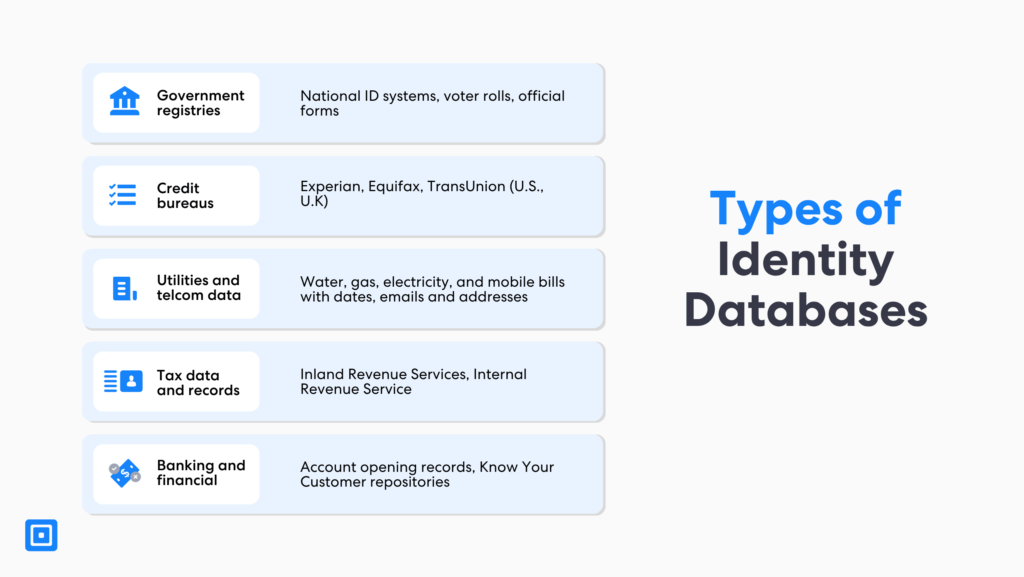
Note that, to meet regulatory expectations, at least one identity database used in the verification should come from a regulated authority. This ensures that underlying data meets standards for accuracy, integrity, and freshness. Combining information from both public records and private entities such as telecom providers or utility companies only strengthens the verification process, offering a more complete and trustworthy view of an individual’s identity.
## Use Cases in Different Sectors and Geographic Regions
Multi-bureau verification is incredibly vital across various types of sectors and different regions. Businesses that face stringent due diligence requirements must be prepared to implement detailed processes that correspond to their respective industry and any regional regulations. Some use cases include:
### FinTech and Digital Banks
[Fintech](https://www.complycube.com/en/essential-compliance-strategies-for-fintech-aml-efforts/) and the banking industry, in general, are expected to uphold stringent customer identity verification measures and update information. Digital banks operating in high-growth regions such as India and Brazil often rely on 2+2 verification to verify identities, prevent fraud risk, and meet local regulatory requirements. Integrating multi-bureau identity databases into your customer application results in a fast, document-free onboarding process.
### Crypto and Blockchain
Crypto exchanges are vulnerable to exploitation and abuse and are, therefore, also becoming increasingly subject to regulation. In the EU, the US, and the UAE, these businesses must address both national KYC laws and FATF recommendations. Multi-bureau checks enable complete frictionless onboarding while supporting different forms of risk-based controls and identity monitoring. You can learn more about the topic here: [What is a Risk-Based Approach (RBA)?](https://www.complycube.com/en/what-is-a-risk-based-approach/)
### Telecommunications and Marketplaces
It’s not just the financial sector that needs diligence and stringent individual identity verification due to the rise of fraud at this time. Telecom operators in Africa often face a higher volume of SIM card fraud compared to other developed countries. Using mobile operator data and government ID registries for a 1+1 logic has proven effective in countries where the availability of identification documents varies.
### **Case Study: Multi-Bureau Identity Verification at Paytm Payments Bank**
Paytm Payments Bank operates at significant scale in a mobile-first market, where customers expect fast digital onboarding. At the same time, it must comply with Reserve Bank of India (RBI) KYC and customer due diligence requirements, which place strong expectations on identity verification.
### Introducing Multi-Bureau Identity Verification
To meet these demands, digital banks in India commonly use a layered identity verification approach, combining primary identity evidence (such as government-issued identifiers) with additional independent data sources to validate key identity attributes (e.g., name, date of birth, and contact details).
### Outcomes
- Faster onboarding by reducing reliance on manual checks and rework
- Stronger identification of inconsistent or high-risk identity profiles
- Better alignment with RBI KYC expectations and audit requirements
## Benefits of Multi-Bureau Identity Verification
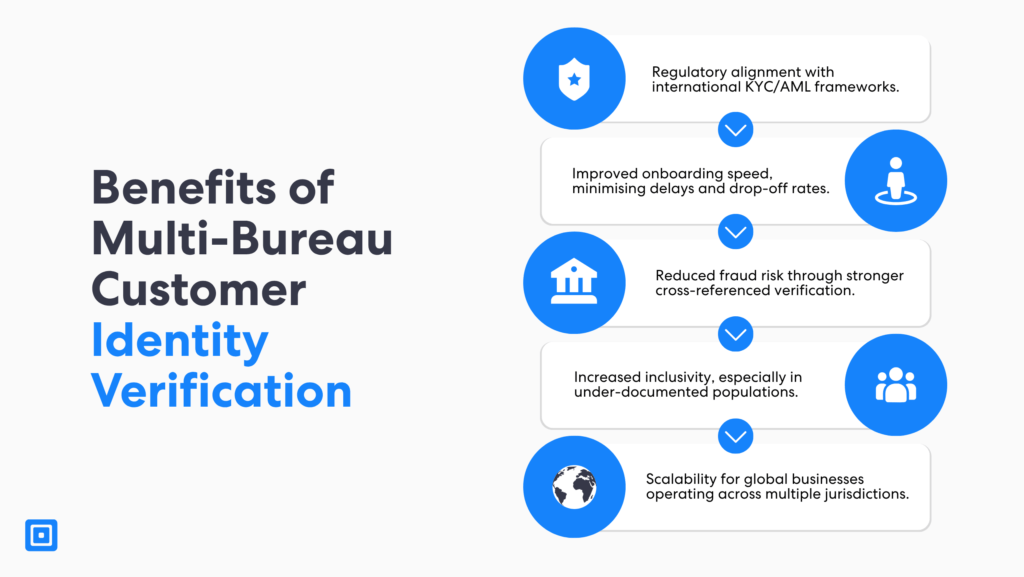
At first glance, multi-bureau identity verification might seem a bit excessive. This is true especially if you’re concerned about the [cost of KYC](https://www.complycube.com/en/how-much-does-kyc-cost/) measures and APIs. However, these multi-bureau checks, in addition to thorough document verification, offer numerous operational and compliance advantages. They provide a deeper level of assurance that single-source checks simply cannot achieve, helping secure and scalable.
It also accelerates customer onboarding by reducing delays and drop-off rates, while lowering fraud risk through more reliable cross-referencing across independent data sources. Beyond fraud prevention, multi-bureau verification expands access for customers with limited documentation and offers scalability for businesses operating across multiple jurisdictions. Together, these advantages make multi-bureau verification a foundational tool for modern, compliant, and inclusive onboarding.
## Five Compliance Considerations for Multi-Bureau Identity Verification
Multi-bureau is the safer, more accurate choice to address KYC compliance, and it’s an effective means to prevent fraud. But adopting this approach comes with key compliance considerations that global businesses must evaluate to ensure it supports their broader strategy. Done well, multi-bureau enhances onboarding; done poorly, it can add friction and complexity.
The most important considerations are workflow alignment, auditability, privacy, source integrity, and risk-based match logic. Multi-bureau checks should integrate cleanly into existing CDD processes, maintain a defensible audit trail of sources and attributes, protect customer data under laws like GDPR and CCPA, rely only on reputable independent datasets, and calibrate match thresholds according to the risk profile of each onboarding journey.
### Key Takeaways
- **Multi-bureau verification** increases verification pass rates by 9% reducing onboarding friction.
- **Drawing from multiple identity databases** improve accuracy and compliance alignment.
- **Using both 1+1 verification and 2+2 checks** allowed the firm to balance low- and high-risk cases.
- **Reduced manual intervention** sped up onboarding and gave stronger audit trails for regulators.
- **ComplyCube’s multi-bureau verification** solution delivers the same advantages at scale, helping global businesses achieve compliance while offering customers a seamless onboarding journey.
## The Future of Multi-Bureau Identity Verification
Multi-bureau plays a critical role in modern digital identity verification. By using 1+1 verification and 2+2 logic to check customer identity information such as name, address, email, etc, across multiple pages of trusted identity databases. Businesses are then able to achieve higher complete rates, speed up onboarding, and stay KYC compliant. As regulatory expectations evolve, scalable identity verification strategies, such as multi-bureau checks, remain essential to building trust with customers and [ComplyCube](https://www.complycube.com/en/) has the solution you need.
[](https://portal.complycube.com/signup)
## Frequently Asked Questions
What is multi-bureau identity verification?
Multi-bureau identity verification checks a person’s name, date of birth, and address across many sources. Typical sources are electoral rolls and credit files in the UK/IE, population registers and eID in the EU, and credit bureaus plus USPS/NCOA in the US. Canada uses provincial and credit data, AU/NZ uses credit, postal, and (NZ) electoral data.
What is the difference between 1+1 verification and 2+2 checks?
The difference between 1+1 verification and 2+2 checks is the strength of the evidence. Where a 1+1 verification check confirms one attribute in two independent sources and suits lower-risk cases, a 2+2 check confirms two attributes in two sources and fits higher assurance needs.
Why do FinTech, crypto, and telecom companies use multi-bureau checks?
FinTech, crypto, and telecom companies use multi-bureau checks to lift pass rates and block fraud across regions. In the UK/EU, multi-bureau checks support AML and eIDAS while keeping sign-up fast. Over in the US/CA, multi-bureau checks help meet CIP/FINTRAC with fewer manual steps.
How does match logic work in identity verification?
Match logic in identity verification sets how close two records must be to count as a match. Exact matching is strict and suits high risk. Normalised and fuzzy matching handle local name styles, address formats, and date orders.
What are examples of identity databases used in multi-bureau verification?
Databases used for verification depend on the country and what is legal to use. The UK/IE often use electoral rolls, credit files, and PAF/UPRN, the EU uses population or municipal registers and postal files. The US/CA use credit bureaus, USPS/NCOA, utilities, and provincial records, AU/NZ use credit, postal, and (NZ) electoral data. In APAC/MENA/LATAM, databases used for verification can include national ID, tax or municipal files, and telecom KYC, where allowed.
**Categories:** Guides
**Tags:** Identity Verification
---
### [A Complete Guide to AML Compliance UK](https://www.complycube.com/aml-compliance-uk-guide-financial-institutions/)
**Published:** May 22, 2025
**Author:** Dini Habib
**Excerpt:** In the UK, various regulatory bodies enforce new requirements to reduce the potential for money laundering risks. As a result, UK businesses must adapt their approach to Anti-Money Laundering (AML) regulations to achieve full compliance.
**Content:**
Regulatory bodies worldwide continuously update Anti-Money Laundering (AML) regulations as organised crime and terrorist financing become more sophisticated. In the UK, various legislation authorities enforce new requirements that align with international standards to reduce the potential for money laundering risks within the country. As a result, UK businesses must adapt and rethink their approach to anti-money laundering regulations. This guide outlines the essentials of AML compliance UK and offers actionable steps for crafting an effective anti money laundering policy template UK.
## Legislation vs Regulations vs Regulators for AML Compliance UK
While the terms may sound interchangeable, legislation, regulators, and regulations are separate concepts. Knowing the difference is vital so businesses know where to find the right resources and guidance on [anti-money laundering](https://www.complycube.com/en/solutions/due-diligence-compliance/anti-money-laundering/) compliance.
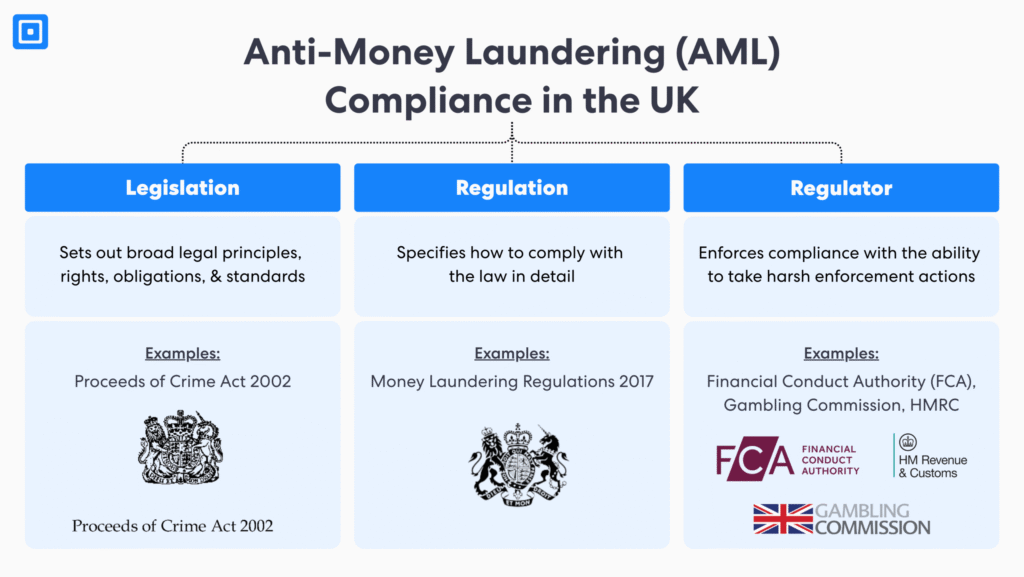
### Legislation
- **Definition:** Defined as the laws passed by Parliament (in this context, the UK Parliament)
- **Purpose:** Outlines the legal principles, rights, and obligations of businesses and individuals
- **Key Examples in the UK:** Proceeds of Crime Act 2002 (POCA), Sanctions and Anti-Money Laundering Act 2018 (SAMLA 2018), Terrorism Act 2000
### Regulation
- **Definition:** Defined as the specific rules made under the authority of legislation.
- **Purpose:** Explains how the rules stated in legislation must be followed in practice for compliance.
- **Key Examples in the UK:** Money Laundering Regulations 2017 (MLR 2017)
### Regulators
- **Definition:** Defined as the specific authority figure or entity responsible for enforcing compliance with legislation and regulations based on a specific sector.
- **Purpose:** Monitors, oversees, and penalises non-compliance
- **Key Examples in the UK:** Financial Conduct Authority (FCA), [HM Revenue & Customs (HMRC)](https://www.gov.uk/government/organisations/hm-revenue-customs), [Gambling Commission](https://www.gamblingcommission.gov.uk).
To summarise, legislation sets out the legal framework, regulations provide the detailed requirements for compliance, and regulators ensure that businesses follow these rules.
## What is The Anti-Money Laundering Act UK?
Despite many repetitive searches about the AML Act in the UK, this specific, standalone law does not exist. Instead, the UK’s anti-money laundering framework is built upon several pieces of legislation that coordinate and work together:
### Proceeds of Crime Act 2002 (POCA 2002)
The [POCA](https://www.legislation.gov.uk/ukpga/2002/29/contents) criminalizes money laundering offences that occurred on or after 24 February 2003. It strictly defines the scope of money laundering crimes and outlines the legal framework for confiscating assets and criminal proceeds. Under the POCA, individuals and businesses, not just financial institutions, must report [Suspicious Activity Reports (SARs)](https://www.nationalcrimeagency.gov.uk/what-we-do/crime-threats/money-laundering-and-illicit-finance/suspicious-activity-reports), with a failure to do so leading to almost 14 years of jail time and fines.
### Sanctions and AML Act 2018 (SAMLA 2018)
The [SAMLA](https://www.legislation.gov.uk/ukpga/2018/13/contents) grants the UK government more power post-Brexit to implement and execute sanctions independently. It keeps pace with the international standards from the [Financial Action Task Force (FATF)](https://www.fatf-gafi.org). The SAMLA aims to support the wider UK AML effort by restricting relationships and transactions with high-risk countries and customers, such as [Politically Exposed Persons (PEPs)](https://www.complycube.com/en/what-is-a-pep/), through sanctions.
### Terrorism Act 2000 (as amended)
The [Terrorism Act 2000](https://www.legislation.gov.uk/ukpga/2000/11/contents) explicitly prevents and criminalizes terrorist financing. The main difference between the Terrorism Act 2000 and the POCA is its focus on the usage, facilitation, and concealment of monetary funds for the purpose of terrorism acts. This legislation plays a critical role in the UK’s financial system and overall AML and Counter Terrorist Financing (CTF) measures.
## The Role of the Financial Conduct Authority (FCA) and National Economic Crime Centre (NECC)
Two prominent bodies, the [Financial Conduct Authority (FCA)](https://www.fca.org.uk) and the [National Economic Crime Centre (NECC)](https://www.nationalcrimeagency.gov.uk/what-we-do/national-economic-crime-centre), work together to solidify the UK’s defences against economic crime, potential money laundering, and organised crime.
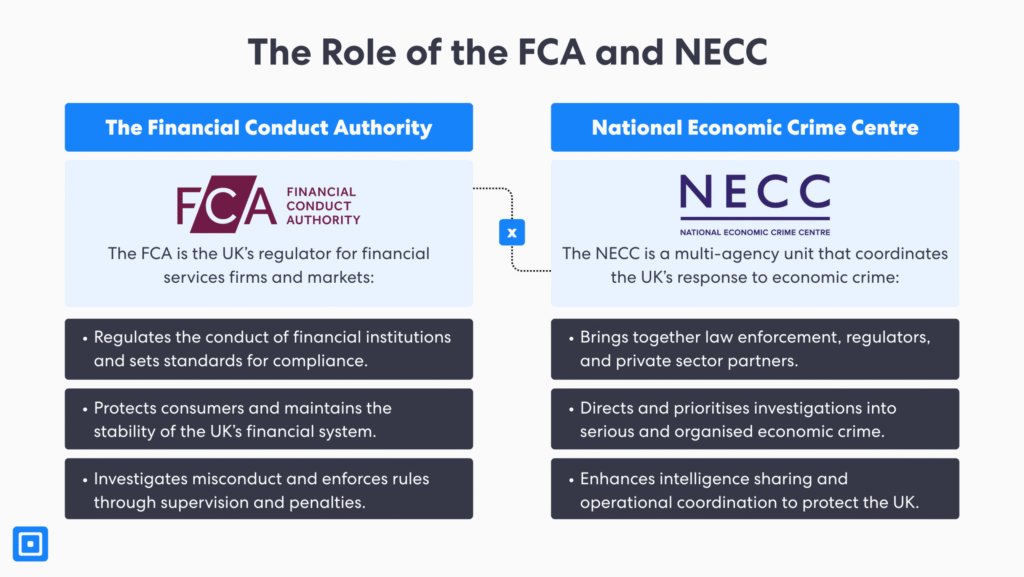
While the FCA and NECC have distinct purposes, the outcome remains to stabilize and protect the UK’s financial system.
- **Financial Conduct Authority (FCA):** The FCA is the financial services industry regulator in the United Kingdom. Its purpose is to maintain the UK’s financial system by protecting consumers and establishing market integrity. The FCA operates independently of the UK government and has the authority to punish any acts of financial crime, including money laundering.
- **National Economic Crime Centre (NECC):** The NECC is a multi-agency UK law enforcement unit housed within the [National Crime Agency (NCA)](https://www.nationalcrimeagency.gov.uk/who-we-are). It plays a critical role in collaborating and enhancing the efforts of various agencies, government departments, and regulatory bodies in the UK. The NECC provides operational coordination in responding to economic crime, which includes money laundering.
## Creating an Effective Anti-Money Laundering Policy Template UK Edition
To build a foolproof AML process, UK businesses should follow the steps listed by the Financial Action Task Force (FATF). The FATF outlines the international standards for compliance with anti-money laundering regulations.
For more specific local AML regulations in the UK, businesses can adopt the measures stated in the Money Laundering, Terrorist Financing and Transfer of Funds (Information on the Payer) Regulations 2017 (MLR 2017).
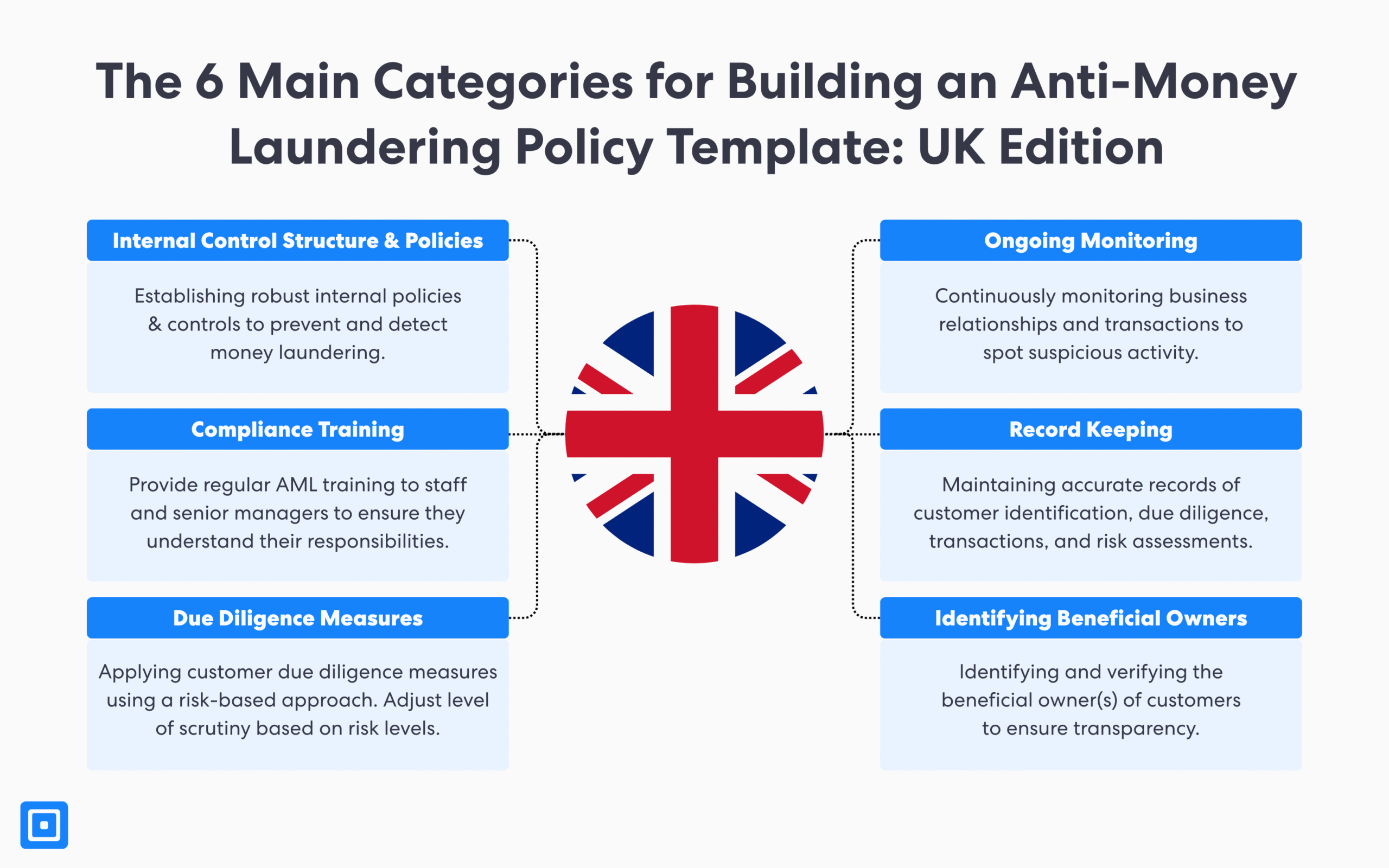
The [MLR 2017](https://www.legislation.gov.uk/uksi/2017/692/contents) regulation incorporates FATF recommendations into UK law. It sets out the specific requirements that businesses in the financial sector or regulated industries must follow to achieve full AML compliance:
### Implement Internal Control Structure and Policies
Businesses in the UK, under the MLR 2017, must maintain a documented, internal report covering its policies, which is in proportion with their size, nature, and risk profile. Internal control structures must be clearly defined, defining each individual’s roles and responsibilities in the risk management team. If necessary, firms need to employ an independent audit function in order to manage the effectiveness of its anti-money laundering framework over time.
### Regular Staff Training
Next, team members must be continuously trained on money laundering or terrorist financing risk. The training must cover how to identify and report suspicious business relationships and activities, and who to contact if a red flag or high-risk situation is detected. To be prepared, senior management must keep documentation of the training provided, including the dates and content covered.
### Integrating a Risk-Based Approach
UK businesses are encouraged to fully adopt a [risk-based approach](https://www.complycube.com/en/what-is-a-risk-based-approach/) as part of their efforts to combat money laundering or terrorist financing. A risk-based approach enables businesses to conduct the necessary due diligence measures based on the level of risk detected:
- **Customer Due Diligence Measures (CDD)**: CDD is the standard due diligence applied to verify the identity of customers and beneficial owners before starting a business relationship or conducting occasional transactions. Whenever there is a change in ownership and control structure, [CDD](https://www.complycube.com/en/what-is-customer-due-diligence/) must be updated.
- **Enhanced Due Diligence Measures (EDD):** [EDD](https://www.complycube.com/en/enhanced-due-diligence-edd-insights-and-challenges/) is applied to higher-risk situations, such as dealing with Politically Exposed Persons (PEPs), their family members, customers from high-risk third countries, or complex and large transactions. Firms must obtain additional information and increase monitoring efforts.
- **Simplified Due Diligence Measures (SDD):** SDD is the basic due diligence applied to new and existing customers where the risk of money laundering or terrorist financing is low. SDD might be applied to certain regulated sectors, financial institutions, or customers from low-risk countries.
### Ongoing Monitoring
[Ongoing monitoring](https://www.complycube.com/en/what-is-an-ongoing-monitoring-process/) is a requirement for regulated businesses in the UK’s financial system. It refers to continuously checking customer transactions and their intended nature throughout the business relationship to identify potential suspicious activities that may indicate money laundering. Companies must tighten monitoring efforts under certain circumstances, including a change in ownership and control structure or when higher risk emerges.
### Record Keeping
Record keeping involves gathering robust, documented record trails of customer due diligence, enhanced due diligence measures, ongoing monitoring, and risk assessments. Financial institutions are required to keep a clear auditing compliance trail for UK law enforcement. This supports the UK’s response in the relevant supervisory authorities completing investigations and confiscating criminal assets in illicit finance or money laundering cases.
### Beneficial Ownership
A [beneficial owner](https://www.complycube.com/en/what-is-ultimate-beneficial-ownership-ubo/) has ownership or control over an entity, such as a company, a trust, or a partner organization. Businesses in regulated sectors must accurately identify and update the company ownership with which they are in a business relationship. Identifying beneficial owners is a critical step in customer due diligence measures and supports the National Crime Agency’s efforts in detecting money laundering, illicit finance, and disrupting organised crime networks.
## Compliance with Anti-Money Laundering Regulations in the UK
Under the MLR 2017, all financial institutions and businesses in the regulated sector are legally obligated to implement due diligence measures, conduct thorough risk assessments to identify high-risk customers and activities, and submit robust suspicious activity reports. Additionally, effective ongoing monitoring helps financial institutions, tax advisers, and legal professionals identify and report illicit finance, eliminating the hostile environment required for fraud to flourish.
[](https://www.complycube.com/en/contact/contact-sales/)
As the UK decided to strengthen its anti-money laundering regulations framework, continuous monitoring and proactive reporting are now crucial to protecting the UK’s financial system integrity. [Speak to a member of the team today.](https://www.complycube.com/en/contact/contact-sales/)
**Categories:** Guides
**Tags:** Anti-Money Laundering
---
### [Where Identity Document Verification Fits in the End-to-End KYC Process](https://www.complycube.com/identity-document-verification-in-kyc-process/)
**Published:** December 3, 2025
**Author:** Dini Habib
**Excerpt:** Digital document verification is a crucial component of KYC compliance. However, many businesses face the dilemma of complying with stringent KYC compliance while ensuring their document verification processes remains seamless.
**Content:**
**TL;DR:** Identity document verification is vital to modern **Know Your Customer (KYC)** processes. Along with **proof of address checks**, it supports organizations in seamlessly verifying a user’s identity, forming a key part of **Customer Due Diligence (CDD)** requirements. This guide explores the importance of digital document verification and its role within the KYC process.
## What does a Know Your Customer Process Involve?
The KYC process comprises multiple interconnected stages, designed to verify that individuals are who they claim to be before any business relationship is established. As such, businesses can verify the legitimacy of clients and assess potential risk, safeguarding the firm from financial crimes and regulatory breaches. However, many modern businesses face the dilemma of complying with stringent KYC compliance while ensuring their processes remain seamless for onboarding clients.
Implementing effective KYC controls requires a strategic understanding and balance between efficiency and compliance. It involves three main stages: the Customer Identification Program (CIP), CDD, and ongoing monitoring. By following these steps, financial institutions can strengthen Anti-Money Laundering (AML) and Counter-Terrorism Financing (CFT) compliance.
## Customer Identification Program (CIP)
Implementing [adequate document verification](https://www.complycube.com/en/solutions/identity-assurance/document-verification/) can be cumbersome and challenging for many businesses. As such, this forces a trade-off between meeting compliance and satisfying customers. In a typical KYC process, customers must have their ID, proof of address, bank statements, and, in the U.S., even their Social Security Number (SSN) verified. However, without a clear workflow, bottlenecks can appear in onboarding, with industry reports indicating a [40-60% drop-off rate](https://www.complycube.com/en/the-identity-verification-onboarding-bottleneck/) in the document submission process.
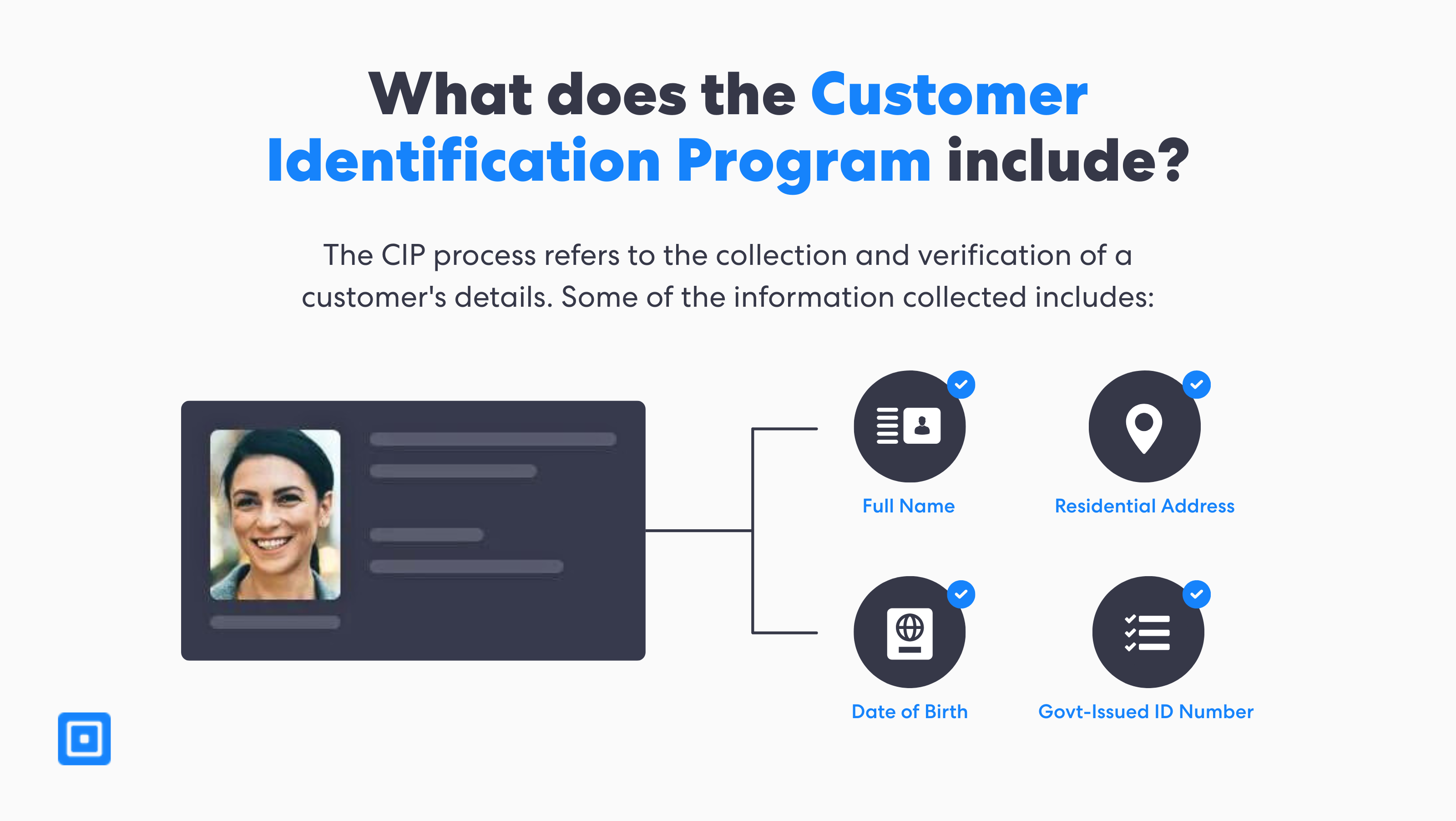
The CIP forms the first phase, where businesses collect, verify, and assess basic customer information. The most commonly gathered information includes a customer’s full name, residential address, date of birth, and government-issued identification number. Subsequently, these identity documents will be verified against official government databases. Based on this verification, the assessor will assign a risk level and produce a comprehensive risk assessment. You can learn more here: [Customer Identification Program: What Is CIP?](https://www.complycube.com/en/customer-identification-program-what-is-cip/)
## Customer Due Diligence Measures
KYC and CDD are mandatory for financial institutions and other entities for safeguarding trust. The [Financial Action Task Force (FATF)](https://www.fatf-gafi.org/) recommends that financial institutions undertake ongoing CDD measures to prevent fraudulent activity and financial crime. Effective KYC systems support AML checks while protecting the financial system from bad actors.
There are three levels of customer due diligence: standard, simplified, and enhanced. The level of customer due diligence applied is derived from a customer’s risk score, which is calculated during onboarding and throughout the ongoing due diligence process.
### Standard Customer Due Diligence Requirements
CDD requirements can vary depending on the business type and parties involved. For regulated industries, such as financial institutions, customers who need to open a bank account will need to undergo a more rigorous KYC procedure. This includes submitting official identity documents, such as driver’s licenses, and proof of financial standing, such as tax or mortgage statements.
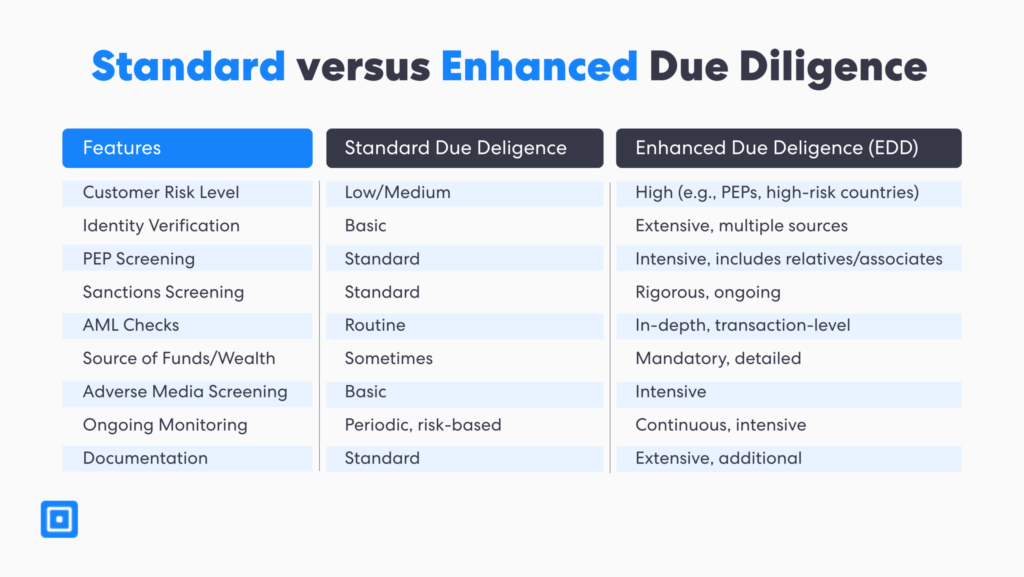
CDD supports firms in identifying and preventing suspicious activities within financial transactions at an early stage. Moreover, international KYC standards require financial institutions to use a Risk-Based Approach (RBA) to CDD. In some cases, high-risk factors in the customer’s risk profile show that CDD is insufficient, and a firm requires Enhanced Due Diligence (EDD). You can learn more here: [What is a Risk-Based Approach (RBA)?](https://www.complycube.com/en/what-is-a-risk-based-approach/)
### Enhanced Due Diligence Requirements
EDD requires more comprehensive identity document verification and background checks. For instance, an organization can determine if a customer requires EDD by examining their geographic location, business activities, and any suspicious transactions. This stage mitigates potential threats, including organized crime, money laundering, and terrorist financing. Ultimately, EDD offers multi-layered protection:
- Uncovers associated beneficial owners, business relationships, and sources of funds.
- Identify Politically Exposed Persons (PEPs) and adverse media coverage.
- Cross-verify the customer against the sanctions list and watchlist.
### Ongoing Monitoring and Regulatory Compliance
Conducting ongoing monitoring is necessary to identify any suspicious patterns or emerging risk factors in customer behaviour. In cases involving high-risk individuals or suspicious activity, there is a greater need for conducting transaction screening and [continuous risk monitoring](https://www.complycube.com/en/solutions/global-screening/continuous-monitoring/). The integration of public and private data sources, often with third-party services, enables a comprehensive understanding of customer activities.
Screening against PEP and sanctions lists is especially crucial, as these lists are updated frequently. Therefore, for businesses to comply with anti-money laundering regulations, they must prioritise [PEP and sanctions screening](https://www.complycube.com/en/solutions/global-screening/sanctions-pep-screening/) as an ongoing requirement. Businesses, particularly financial institutions, must thoroughly document these procedures to demonstrate compliance with regulatory requirements and support audit activities related to customer identities.
## Acceptable Forms of Proof of Address in KYC
Proof of address verification establishes the customers’ connection to a specific geographic jurisdiction. Thus, it supports various regulatory requirements, including jurisdictional risk profile evaluations, sanctions screening, and tax reporting obligations. [Proof of address](https://www.complycube.com/en/solutions/identity-assurance/address-verification/), plus an ID and proof of income, will suffice for standard customer due diligence. Specifically, acceptable forms of proof of address include utility bills, bank statements, government correspondence, and lease agreements.
To qualify as proof of address, these documents must be recent, preferably dated within the previous three months. This ensures accuracy and relevance for ongoing compliance purposes. Address verification processes face unique challenges related to document formatting, language variations, and regional differences. Modern verification systems use machine learning algorithms that process official records in multiple languages and recognize various formats.
## The Role of Identity Document Verification Technology
As seen above, Identity Verification (IDV) plays a foundational role in KYC. Official documents such as passports, driver’s licenses, and national identity cards are used because they contain standardized information formats. However, the layout, structure, and watermarks vary in different countries. Advanced identity document verification systems utilize innovative features to automatically validate various data from documents worldwide more efficiently.
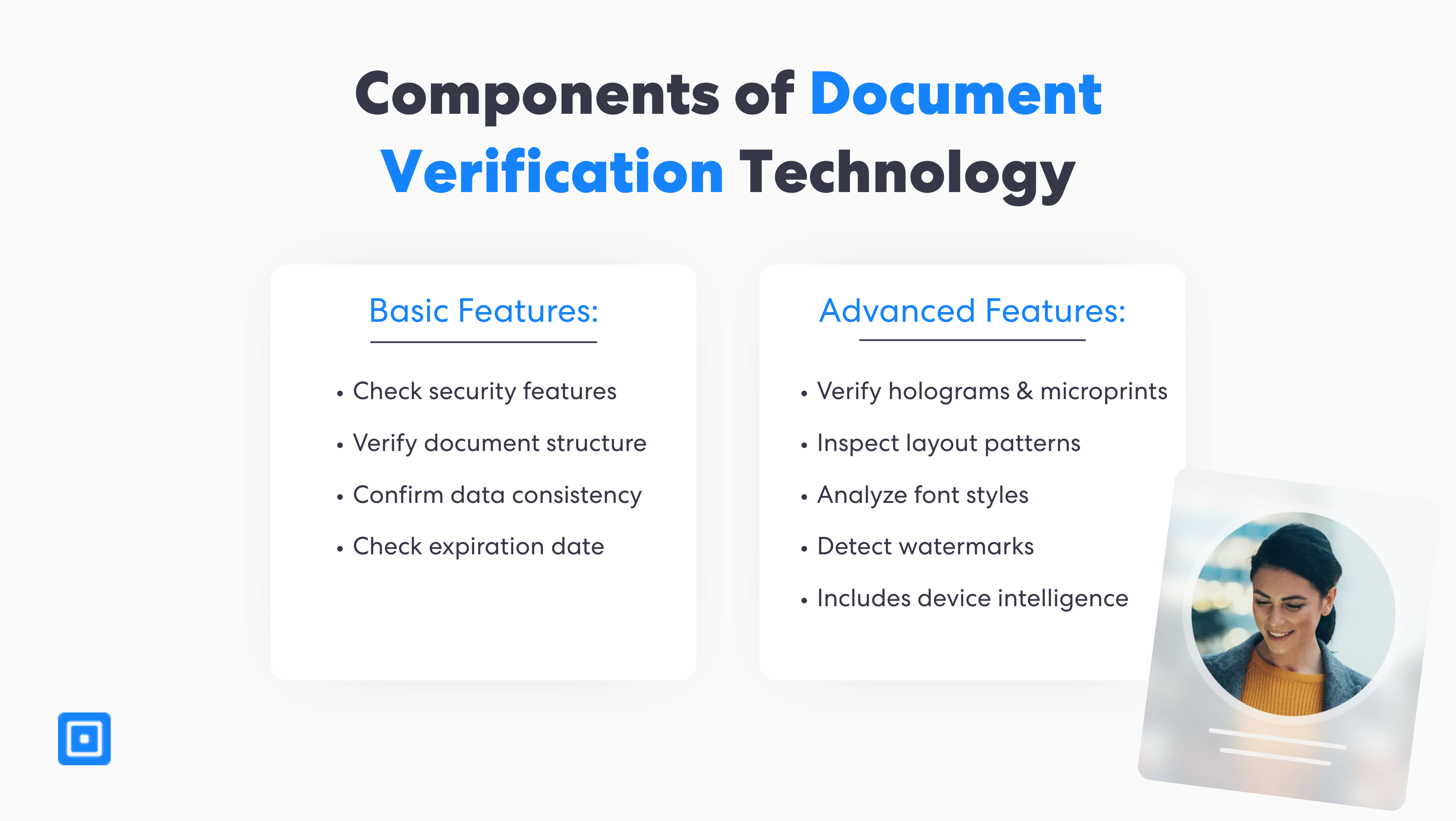
The basic features of digital document verification technology include analyzing security features in a document, confirming data consistency, and ensuring the document remains current up to its expiration date. Advanced features utilize sophisticated technology to verify a document’s authenticity more thoroughly. It includes analyzing font styles, inspecting layout patterns, and detecting watermarks and holograms. Basic and advanced features work together to create a stronger identity verification process.
### Optical Character Recognition (OCR)
[OCR technology](https://www.complycube.com/en/solutions/due-diligence-compliance/know-your-customer/optical-character-recognition/) provides businesses with a more resource-efficient way to manage identity documents. Handwritten or printed documents can be converted into machine-readable data in real-time. It minimizes human error and reduces manual labor, boosting operational efficiency for organizations that screen thousands of documents a day.
### Device Intelligence
As document forgeries become more sophisticated, identity verification has had to adapt with new security features. Device intelligence technology collects metadata from a device used during the KYC process. Generally, a user’s IP address, device type, and even browser can be detected. This adds another layer of security against suspicious activity, helping to uncover a customer’s identity.
### Document Authentication
Document authentication determines whether or not the information provided is genuine and valid. This involves analyzing security features, document structure, and data consistency to identify anomalies or alterations. Elements such as font characteristics, layout patterns, watermarks, and security elements can be assessed for authenticity.
## Integration of Identity Document Verification with Anti-Money Laundering Checks and Screening
According to the United Nations Office on Drugs and Crime, money laundering refers to the processing of criminal proceeds to disguise their illicit origin. The estimated annual amount of money laundered globally is between 2 and 5% of the global GDP, or between $800 billion and $2 trillion USD. A comprehensive anti-money laundering program can help reduce money laundering activities.
> In just one year, the amount of money laundered is estimated to be [**between $800 billion and $2 trillion US dollars.**](https://www.unodc.org/unodc/en/money-laundering/overview.html)
Identity document verification plays a foundational role in this effort. It ensures the identity credentials of customers are accurate, providing genuine data to fuel comprehensive AML checks and prevent financial crime. Businesses can identify potential risks related to money laundering, sanctions violations, and further reduce false positives in AML systems.
### Global Sanctions and PEP Screening
Global sanctions and PEP screening occur in real-time during onboarding and throughout the relationship lifecycle to identify newly designated high-risk individuals or entities that may impact existing customer relationships. According to the Financial Conduct Authority (FCA), low-quality CDD and KYC increases the risk of firms breaching sanctions, tying back in the importance of identity document verification in effectively managing sanctions risk.
Harry V, Chief Technology Officer (CTO) at ComplyCube, stresses, “Combining thorough initial due diligence with periodic re-screening or ongoing monitoring ensures firms maintain compliant, up-to-date customer risk profiles, preventing sanctions breaches and reputational harm.”
> It is crucial to integrate KYC and CDD processes as ongoing, dynamic processes. – Harry V, CTO, ComplyCube.
PEP screening represents a critical component of any AML check. PEP databases contain information about individuals who hold political positions or maintain close associations with politically significant figures. Because of the potential for corruption, such individuals require enhanced due diligence. On the other hand, sanctions screening uses verified customer information to search global sanctions lists. Organizations such as the [Office of Foreign Assets Control (OFAC)](https://ofac.treasury.gov/), the United Nations, and the European Union maintain these lists. You can learn more here: [What is Sanctions Screening?](https://www.complycube.com/en/what-is-a-sanctions-screening/)
### **Case Study: CB Payments Limited (CBPL) Fined £3 Million for Gaps in Verification**
**The FCA’s Discovery of CBPL’s KYC and AML Gaps**
The FCA fined CBPL over £3 million after finding significant lapses in its KYC and AML frameworks, including failures in its digital document verification process. CBPL did not implement sufficient due diligence and lacked adequate controls over its risk management.
**CBPL’s Penalty and Continued Failures**
CBPL’s weakness in its KYC process severely compromised the effectiveness of its document verification, enabling over 13,000 high-risk users to make transactions. The FCA also found that 31% of these users deposited nearly $24.9 million. You can learn more about the CPBL case here: [The CryptoCubed Newsletter: July Edition.](https://www.complycube.com/en/the-cryptocubed-newsletter-july-edition/)
**Outcome and Learning**
- The case served as a key warning to other crypto firms, damaging the reputation of CBPL.
- Identity and document checks must enforce high-risk rules and risk classifications across all flows to eliminate gaps.
- High-risk indicators must feed directly into strong due diligence without exceptions or delays to prevent potential fraud immediately.
### Adverse Media Screening
[Adverse media screening](https://www.complycube.com/en/solutions/global-screening/adverse-media-checks/) identifies negative news coverage or regulatory actions that might indicate increased compliance risks. It analyzes customer names and associated information against vast databases of news articles, regulatory announcements, and court records to identify potential reputational concerns. Identity document verification confirms that an individual being screened gets identified correctly, which allows any institution to link negative coverage to the right user.
### Key Takeaways
- **Identity document verification** plays a crucial role in supporting KYC compliance by validating government-issued IDs, such as passports or driver’s licenses.
- **AML screening** relies on accurate document verification technology to assess risk and support ongoing monitoring capabilities.
- **Digital document verification,** when combined with proof of address and liveness checks, forms a multi-layered verification of a user’s identity.
- **Document authentication** supports KYC by examining different fonts, metadata, and watermarks to confirm the authenticity of identity documents.
- **Optical character recognition** enables firms to automatically and accurately extract data from documents, minimizing human error.
## Boost Fraud Prevention and AML Efforts
To comply with KYC and AML regulations, organizations cannot overlook digital document verification. Forward-looking firms are moving away from legacy systems by adopting advanced, AI-powered document verification technology. With features such as OCR and document authentication, the costs from manual data entry and human error are minimized. Additionally, companies must integrate identity document verification with AML checks, such as PEP screening, to build a robust KYC framework.
When paired with continuous monitoring, it empowers faster decision-making, strengthening the KYC process for total regulatory compliance. ComplyCube is a [UKDIATF-certified](https://www.complycube.com/en/company/security-compliance-center/) leader in KYC and AML. The platform offers comprehensive compliance solutions, including case management, risk scoring, and document verification capabilities. [Speak to a member of the team](https://www.complycube.com/en/contact/contact-sales/) to learn more about how you can prevent fraud and achieve 63% in cost reductions.

## Frequently Asked Questions
What is sufficient for proof of address?
For proof of address checks, common acceptable forms of documents include utility bills (such as gas or broadband) and bank statements. These documents must be dated within the last three months and have an accurate name and residential address.
Does a Social Security card count as a form of ID?
A Social Security card is used by U.S residents and acts as an additional identification document for identity document verification. Organizations perform a Social Security Number (SSN) check to verify the legitimacy of a user. SSN checks are combined with other government IDs, such as a passport or driver’s license, during identity verification.
Can a fake identity card be detected easily?
A fake identity card can be detected when analyzed with advanced verification technology. Modern digital document verification incorporates AI and OCR technology to extract and detect tampered data rapidly.
Why is document verification important in the Know Your Customer process?
Identity document verification is an important step in the KYC process as it enables businesses to assess potential risk and comply with KYC and AML laws. Additionally, digital document verification supports the ongoing monitoring process, creating a robust system that safeguards against fraud and other financial crimes.
What documents does ComplyCube accept for identity document verification?
ComplyCube accepts over 13,000 documents from 220+ territories. Typically, official documents such as a valid passport, government-issued national card, or a driver’s license are required during identity verification. For regulated industries such as banks, customers may need to verify identity through selfie or video verification.
**Categories:** Guides
**Tags:** Identity Verification
---
### [How to Lower Identity Verification Cost Without Sacrificing Compliance](https://www.complycube.com/strategies-to-cut-identity-verification-cost/)
**Published:** December 4, 2025
**Author:** Dini Habib
**Excerpt:** Understanding the makeup of identity check pricing is crucial for realising cost efficiencies. It enables businesses to maintain a lower compliance budget without compromising security, accuracy, and scalability of KYC and AML.
**Content:**
**TL;DR:** Companies in **high-risk, regulated industries** such as fintech and crypto are increasingly concerned about **ID verification cost**. This makes understanding the makeup of identity check pricing crucial for realising cost efficiencies. This guide shares practical strategies for keeping **identity verification cost** low while maintaining a secure, scalable customer onboarding process.
## What are The Risks of Non-Compliance in Identity Verification?
Skipping steps in the Identity Verification (IDV) process exposes a firm to the risk of fraud, fines, and reputational damage. Non-compliant identity verification processes raise short-term fraud risks. However, in the long-term, it can lead to regulatory investigations, operational restrictions, criminal prosecutions, and reimbursements for defrauded customers.
In addition to ensuring compliance with IDV requirements, companies also face the pressure from escalating Know Your Customer (KYC) costs. Industry reports projected that KYC and Anti-Money Laundering (AML) spending will surge to $3 billion, a 12.3% increase in 2025. To address this rising cost, it is crucial to look beyond simply cutting compliance spend aggressively. Instead, organizations should look for more innovative and efficient pricing strategies.
## Understanding Total Identity Verification Cost
Businesses need to consider both direct and indirect cost factors to fully understand the overall price of identity verification solutions. Indirect costs, which include the amount of money lost due to customer drop-offs can result in significant monetary losses. Similarly, reputational damage and manual task can hinder business growth.

Therefore, looking beyond an identity verification solution’s initial pricing plan is crucial. Furthermore, additional verification steps can increase the direct and indirect identity verification cost if not properly monitored. The most common indirect or hidden costs stem from:
- **Customer Friction:** Customers may abandon the onboarding flow if it involves slow or complex steps. As such, resulting in drop-offs and a loss of potential revenue.
- **False Positives:** Poor data accuracy results in high false positives, incorrectly flagging legitimate customers as high-risk, which leads to lost potential customers.
- **Add-on services:** Human-in-the-loop video verification, bespoke customization, and manual reviews can lead to a price increase if initially incorporated into proposals.
- **Reputational Damage:** If an organization experiences poor customer service or fraudulent incidents, it can erode trust among clients and investors, ultimately leading to financial losses.
- **Manual Reviews:** Manual tasks increase operational overhead, as firms must train and manage review staff, which is a slower and more expensive process.
According to the [Financial Action Task Force (FATF)](https://www.fatf-gafi.org/en/publications/Fatfrecommendations/Fatf-recommendations.html), assessing compliance risks must be done on an ongoing basis. This means businesses must conduct [continuous monitoring](https://www.complycube.com/en/solutions/global-screening/continuous-monitoring/), re-verification, and auditing as an ongoing investment. Thus, reporting and ongoing compliance systems must be factored into budget management as they support meeting full compliance obligations.
## KYC Budget Optimization Strategies That Don’t Compromise Quality
Progressive companies are finding innovative ways to enhance their verification workflows and reduce compliance expenses without compromising [fraud detection](https://www.complycube.com/en/use-cases/process/fraud-prevention/) standards. To achieve cost savings, firms are partnering with IDV providers that can offer customization, automation, and scalability. Plug-and-play solutions are particularly growing in popularity as they enable selecting specific checks without investing in a full platform.
> The market size for identity verification software is expected to reach [USD 26.94 billion](https://www.researchandmarkets.com/reports/5026147/identity-id-verification-market-share) by 2030.
According to [Research and Markets](https://www.researchandmarkets.com/reports/5026147/identity-id-verification-market-share), the market for identity verification is expected to expand rapidly, fueled by the growing complexity of regulations and the increasing need for faster customer onboarding. The compound annual growth rate (CAGR) for IDV solutions is forecasted at 12.64% from 2025 to 2030. Here are some of the most effective KYC budgeting strategies for 2026 and beyond:

### Focus on Automation to Replace Costly Manual Processes
Automation is one of the most efficient ways to streamline the complexity of identity verification, saving both time and cost. AI-based solutions automate identity verification, replacing slow, error-prone manual reviews. It includes advanced analysis, verifies documents, and cross-checks databases in real-time.
Additionally, [Optical Character Recognition (OCR)](https://www.complycube.com/en/solutions/due-diligence-compliance/know-your-customer/optical-character-recognition/) is used to automatically extract and validate government-issued IDs and other identity documents. This ensures accuracy and efficiency during[ document verification](https://www.complycube.com/en/solutions/identity-assurance/document-verification/). OCR creates a uniform and rapid verification process, reducing identity verification cost while enhancing fraud detection accuracy.
### Reduce Redundancies with Decentralized Identity Frameworks
Redundant [ID checks](https://www.forbes.com/councils/forbestechcouncil/2023/04/26/perpetual-kyc-is-inevitable-but-not-how-you-think/), such as those triggered at renewals or logins, lead to frustration, higher drop-off rates, and additional costs. Repeat verifications reduce the overall efficiency of identity verification systems. Persistent identity records offer a practical way to verify returning users without requiring full re-verification.
For example, tokenized identity attributes or decentralized ID frameworks allow companies to authenticate users securely while complying with data protection laws. This reduces fraud risk, lowers processing costs, and improves the customer experience, particularly in time-sensitive sectors such as lending or real estate, where speed and accuracy are critical for conversion.
### Minimize False Positives, Added Friction and Drop-offs with Tailored Workflows
A false positive could occur when a legitimate customer is incorrectly identified as high-risk. However, while robust IDV is crucial, adding more onboarding steps to reduce false positives can backfire. This results in high drop-off rates and a potential loss of revenue.
To combat this, organizations must adopt customizable workflows tailored to each use case. For example, customers who have a higher risk score can go through a more comprehensive screening, while low-risk users can onboard through the standard [KYC process](https://www.complycube.com/en/solutions/due-diligence-compliance/know-your-customer/). Additionally, IDV platforms with embedded analytics, A/B testing, and real-time feedback loops can help identify friction points in the journey.
### **Case Study: Monzo’s Identity Verification Lapses Cost £21 Million**
**Rapid Growth in Monzo’s Customer Acquisition Leads to IDV Deficiencies**
The Financial Conduct Authority (FCA) fined Monzo over £21 million for failures in identity verification. Monzo is a leader in the fintech space, having grown from 600,000 customers in 2018 to 13 million customers by 2025. It was clear that the rapid uptick in customers outpaced Monzo’s ability to maintain compliance.
**When Company Growth Outpaces Compliance**
In an effort to manage the surge in customers, Monzo compromised key compliance measures. Notably, Monzo did not collect sufficient proof of address, allowing customers with unverified or falsified addresses to open accounts and conduct transactions. The company also failed to implement ongoing monitoring and comprehensive due diligence measures.
**Outcome and Learning**
- Monzo faced significant financial penalties and reputational damage, resulting in a major setback to its operations.
- The case underscores the importance of investing in flexible and scalable identity verification solutions.
- Firms are encouraged to plan for future compliance needs in relation to business expansion to prevent costly penalties.
## What Leading Companies Are Doing to Manage Identity Verification Costs
Selecting the right identity verification solution is a critical decision for companies that need to achieve robust compliance and cost efficiency. With the growing complexity of regulations, increasing sophistication of fraudulent activity, and the importance of user access, it’s essential to choose an online identity verification solution that delivers comprehensive security without inflating monthly identity verification costs.

There are several strategies employed to determine the best identity verification solution, which extends beyond comparing prices. This includes considering how a solution can meet current and future business needs, factoring in the total cost of ownership, testing in realistic environments, and ensuring strong privacy.
### Factoring Total Costs When Assessing Providers
While per-verification pricing is a starting point, businesses must account for additional costs such as ongoing monitoring, [sanctions monitoring](https://www.complycube.com/en/solutions/global-screening/sanctions-pep-screening/), and compliance add-ons that may be required to meet industry regulations. Prioritizing vendors that include key information, such as transparent pricing structures, enables businesses to better control monthly budgets.
### Use a Sandbox Environment or Free Trial for Testing
Before purchase, organizations should explore signing up for a free trial or sandbox environment. Businesses can safely test onboarding flows, refine risk models in a safe environment, and experiment with integrations before going live. This allows firms to have a better idea of how a solution works and helps expose any gaps in the software before making decisions.
### Investing in All-in-One Identity Verification Solutions
Relying on separate vendors for ID verification, [biometric authentication](https://www.complycube.com/en/solutions/identity-assurance/biometric-verification/), and watchlist screening can become complex and introduce bottlenecks for effective KYC implementation. Fragmented technology for identity verification causes duplicated ID checks, inconsistent data, and high admin costs. In comparison, trusting a single provider for these solutions simplifies processes, saves time, and reduces costs.
### Focusing on Integrations for Scalability
Expanding operations and services can lead to the need for additional types of checks and an increase in monthly volumes. This can introduce unnecessary time and cost, especially if switching to another solution is required. To avoid this, companies must look for IDV solutions that can scale and adapt with their business operations. For example, SaaS-based platforms such as ComplyCube offer SDKs and APIs that enable seamless integration with existing systems.
### Assessing Privacy and Security Certifications
It is crucial to evaluate how key data, including sensitive user data and credentials, is extracted, processed, and stored. Identity verification solutions that align with [global security and privacy requirements](https://www.complycube.com/en/company/security-compliance-center/), such as GDPR, CCPA, and ISO 27001, are critical. Additionally, during testing, businesses must assess whether a solution performs consistently across web and mobile devices.
### Consider Advanced Fraud Prevention Features
When evaluating providers, businesses should look beyond basic ID checks and consider advanced features that enhance fraud detection and regulatory compliance. Capabilities such as [liveness detection](https://www.complycube.com/en/solutions/due-diligence-compliance/know-your-customer/liveness-detection/), device fingerprinting, social security number validation, and Personally Identifiable Information (PII) redaction are now essential for true global compliance and deterring bad actors. These features not only strengthen the verification flow but also provide valuable risk management controls of suspicious activity or audits.
> Without secure identity verification controls, businesses risk exposing sensitive customer data to malicious actors. – Milosh Caunhye
Ultimately, the best identity verification providers offer scalable solutions that adapt to your business’s growth and evolving compliance landscape. Milosh Caunhye, AML/KYC Consultant from ComplyCube adds, “Without secure identity verification controls, businesses risk exposing sensitive customer data to malicious actors who can use these credentials to commit fraud and facilitate money laundering. By prioritizing security, comprehensive monitoring, and transparent pricing, businesses can ensure they remain compliant, effectively manage risk, and control their compliance budget as they scale.”
### Key Takeaways
- **Total identity verification cost** encompasses hidden expenses, including customer drop-offs, false positives, and ongoing monitoring.
- **Artificial Intelligence** and Optical Character Recognition streamlines IDV through accurate and automated data extraction and validation.
- **All-in-One RegTech** providers can provide a more secure customer onboarding process through multi-layered AML and KYC verification.
- **Accessing free trials** and sandbox environments enables businesses to determine if a platform can meet their specific business needs.
- **Cutting corners** in identity verification to save costs can lead to significant regulatory fines, reputational damage, and an increased risk of fraud.
## How ComplyCube Enables Cost-Effective Compliance at Scale
[ComplyCube](https://www.complycube.com/en/company/about-us/) is an award-winning RegTech partner that offers an accessible and scalable way for businesses to run IDV, KYC, and AML screening on a single platform. The platform supports seamless integration and alignment with international regulatory standards, including the Financial Action Task Force (FATF), the Financial Crimes Network (FinCEN), and eIDAS 2.0.
Partners and clients that utilize ComplyCube’s platform often require specific solutions to help them streamline their compliance operations while keeping identity verification costs to a minimum. Leading FinTechs, including 11:FS and Moneysmart, partner with ComplyCube for its end-to-end compliance automation capabilities, tiered pricing models, and more:
- **Cost-effective automation tools:** The software includes instant identity checks, biometric matching, and document validation, saving costs by eliminating the need for manual review, while also improving verification accuracy and speed.
- **Low-code, rapid deployment options:** ComplyCube offers no-code and low-code workflows, enabling companies to establish compliant verification workflows with minimal effort, ideal for early-stage companies and lean teams.
- **Flexible, volume-based pricing model:** Organizations benefit from a flexible payment structure, allowing them to align KYC spending with business growth and avoid unnecessary overhead.
- **Global scalability through a single API:** The platform supports IDV across 220+ countries and territories, helping businesses consolidate regional tools and streamline global operations.
- **Performance analytics for continuous improvement:** Businesses can track metrics, such as document failure reasons, and customer drop-off stages to optimize verification efficiency.
## Optimize Identity Verification Cost Strategy with Confidence
Lowering identity verification costs doesn’t necessarily mean lowering compliance standards. Successful companies recognize that they can achieve both cost control and regulatory excellence through more intelligent workflows, modern technology, and strategic vendor relationships. Explore smarter, automated KYC compliance by unlocking a free trial with ComplyCube or [speak with a member](https://www.complycube.com/en/contact/contact-sales/) of the team to safeguard your business today.

## Frequently Asked Questions
What are the hidden costs in identity verification?
Hidden identity verification costs can increase the total cost of regulatory compliance. When IDV is not implemented correctly, it results in added costs for manual reviews, re-verification, platform oversight, and lost revenue from customer drop-offs. These factors reduce overall business profitability and revenue growth.
How much does identity verification cost?
The average digital ID verification cost can range from $0.30-$1.00 per check. However, cost varies significantly according to the volume, features, and geographic coverage required. Cost can also depend on pricing structures, including pay-per-transaction, monthly, or annual subscription.
What are the cheapest identity verification solutions?
The cheapest identity verification solution depends on the type of verification and whether your provider is using third-party solutions. Document-based identity verification or electronic ID (eID) checks are typically the cheapest options available. eID’s instant verification method uses legally-certified digital identities, which streamlines processes and minimizes customer drop-offs, boosting ROI. On the other hand, multi-bureau verification, which cross-checks user data against several credit bureaus, can provide broader coverage but typically comes at a higher cost and larger variability per country.
How to reduce the price of identity verification?
To reduce the price of identity verification, organizations must adopt smarter, automated solutions. Automation streamlines verification workflows and offers high customization, enabling firms to avoid costs associated with manual reviews, redundant checks, and complex onboarding processes.
How does identity verification vary in different countries?
Identity verification requirements vary in different countries due to jurisdiction regulations, data and privacy laws, and document types. In the EU, customers can verify their identities through their European Digital Identity Wallets (EUDI Wallets) under eIDAS. In the UK or US, identity verification relies more on biometric checks and document verification.
**Categories:** Guides
**Tags:** Identity Verification
---
### [Understanding AML European Crypto Regulation](https://www.complycube.com/understanding-aml-european-crypto-regulation/)
**Published:** March 12, 2025
**Author:** Sofia Daley
**Excerpt:** With Europe leading the charge in regulating the crypto space globally, one of the most significant developments has been the introduction of Anti-Money Laundering (AML) regulations tailored specifically to cryptocurrencies.
**Content:**
As the cryptocurrency landscape continues to expand, so too does the scrutiny placed on it by governments and financial regulators. With Europe leading the charge in regulating the crypto space, one of the most significant developments has been the introduction of Anti-Money Laundering (AML) regulations tailored specifically to cryptocurrencies. These regulations aim to curb illicit activities like money laundering and terrorist financing, while providing a safe framework for legitimate crypto operations. This blog explores the evolution of AML European crypto regulation and how it has shaped the digital currency landscape.

## Crypto: A Financial Fraudster’s Dream
While crypto offered a decentralised, borderless alternative to conventional money, it also presented challenges for regulators concerned about illicit activities like money laundering and terrorist financing. The possibility for anonymity within the sector means that the user’s real-world identity is kept hidden. The ability to quickly move money internationally, without the need for intermediaries means that transactions are not flagged by local authorities. In addition, crypto transactions cannot be undone, as once it is confirmed on the blockchain, it is irreversible.
## The European Regulators
Traditional financial institutions, such as retail banks, commercial banks, brokerage firms, and more, have always been subject to strict regulation. In Europe, the European Central Bank (ECB) has overseen the stability of the Eurozone’s banking system. The ECB is part of the Single Supervisory Mechanism (SSM), responsible for overseeing large banks across the Eurozone. The European Banking Authority (EBA) is responsible for creating a single rulebook for the banking sector in the EU, aiming to outline clear and consistent regulation and supervision across EU member states. The European Securities and Markets Authority (ESMA) similarly works to fortify European protections for investors, stabilising the credibility of financial markets in the EU.
> “Once upon a time, cryptoland was a sort of digital Wild West where it was entirely up to each individual to separate the good from the bad and the ugly. But those days are numbered. The EU already introduced [anti-money laundering regulations](https://think.ing.com/articles/regulation-and-the-coming-of-age-of-europes-crypto-markets/) a few years ago.”
However, regulators such as these only began to regulate the crypto space in about 2018. This is drastically different to the rest of the financial services sector, which has now been regulated heavily for several decades in the EU and globally. To learn more about the FATF’s early regulation, read [“FATF Crypto Guidance: Securing the Sector.”](https://www.complycube.com/en/fatf-crypto-guidance-securing-the-sector/#:~:text=FATF%20crypto%20guidance%20leads%20global,significant%20avenue%20for%20money%20laundering.)
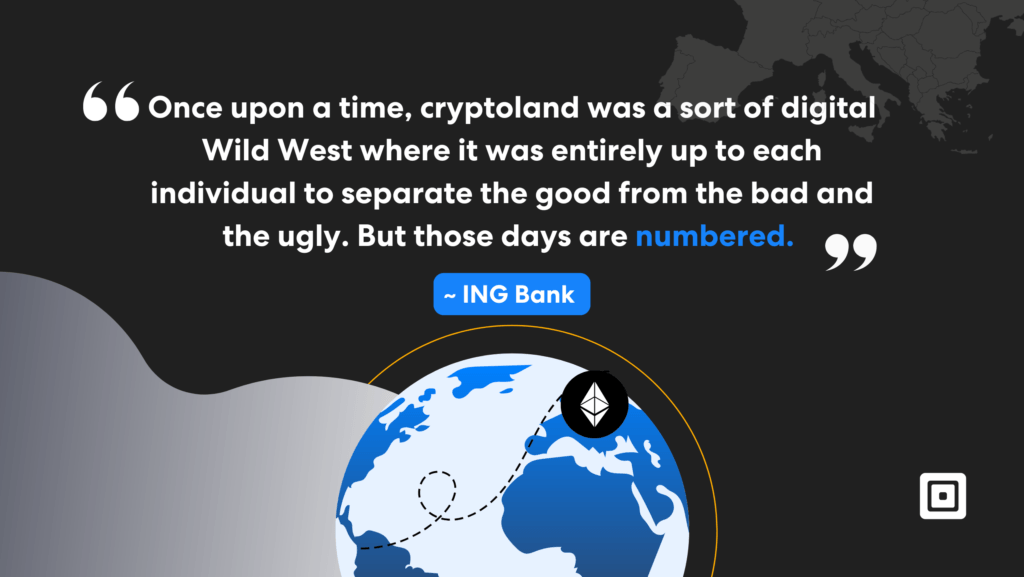
## The Early Days: Lack of Regulation
In the early years of cryptocurrency, Europe, much like the rest of the world, was relatively relaxed about regulating the industry. Cryptocurrencies like Bitcoin were seen as a niche innovation with little interaction with traditional financial systems.
It wasn’t until 2018 that the FATF started to regard the crypto industry as one with financial services, at which point regulatory clarity was finally more of a possibility. At this point, the crypto regulatory landscape quickly started to shift, as national and international regulators started to focus on the digital asset space.
Initially, many crypto exchanges operated in a regulatory grey area, without being subject to the same AML requirements as traditional financial institutions. This lack of regulation made the crypto space attractive to criminals, who exploited the anonymity and global nature of cryptocurrencies to move illicit funds across borders.
## The EU’s Initial Steps: The Fifth Anti-Money Laundering Directive (5AMLD)
A critical step towards a regulated crypto sector across Europe was the establishment of the Fifth Anti-Money Laundering Directive (5AMLD). This was initially agreed upon and passed in 2018, not long after it became an FATF concern, yet it was not implemented until January of 2020. The new directive grouped cryptocurrency service providers under the EU’s AML and CTF regulations.
**Key Provisions of 5AMLD Included:**
- **Defining Virtual Asset Service Providers (VASPs)**: The regulatory framework brought into play a definition of cryptocurrency service providers for the first time. This encompassed crypto exchanges, wallet providers, and custodial services. From January 2020, they were required to comply with AML regulations, similar to traditional financial institutions.
- **Know Your Customer (KYC) Requirements**: One of the most critical components of 5AMLD was the enforcement of KYC measures. Crypto service providers were required to identify and verify their customers before allowing transactions. This move made it harder for criminals to use cryptocurrency services anonymously.
- **Transparency and Reporting**: The directive also required crypto businesses to share detailed information about transactions and ensure their activities were transparent and traceable, which helped authorities track potential illicit activities.
This marked a pivotal moment in crypto regulation in Europe, signifying that the EU recognized the risks posed by unregulated digital currencies. With 5AMLD, Europe had effectively placed cryptocurrency services on the same regulatory footing as traditional banks and financial services.
## Expanding the Scope: The Sixth Anti-Money Laundering Directive (6AMLD)
While 5AMLD was an essential step in regulating cryptocurrencies, Europe’s regulators were aware that more stringent measures were needed. This led to the implementation of the **Sixth Anti-Money Laundering Directive** (6AMLD) in July 2021, which further tightened the regulatory framework around cryptocurrency transactions.
**Key provisions of 6AMLD included:**
- **Expanded Definitions**: 6AMLD expanded the definition of money laundering and terrorist financing to include a broader range of activities that could be linked to cryptocurrencies. It made it easier for regulators to track and penalize illegal activities.
- **Greater Penalties**: The directive increased the penalties for non-compliance, aiming to make cryptocurrency providers more accountable for preventing money laundering activities.
- **Stronger Due Diligence**: It also introduced stronger due diligence requirements for VASPs, including enhanced customer checks when suspicious activities or transactions were detected.
These measures made it harder for crypto companies to ignore their responsibilities to prevent financial crime and ensured that regulators had the tools they needed to tackle illegal activities in the crypto space.
## The Arrival of the Markets in Crypto-Assets (MiCA) Regulation
As cryptocurrencies grew in popularity, Europe moved toward developing a more comprehensive, cross-cutting regulatory framework. This came in the form of the [Markets in Crypto-Assets Regulation (MiCA)](https://www.complycube.com/en/mica-regulation-and-the-future-of-rwas/), a landmark piece of legislation that the EU proposed in September 2020 and which is expected to be finalised and implemented in the coming years.
MiCA aims to regulate the broader crypto asset market and fill gaps in existing regulations, providing a unified approach to cryptocurrency regulation across the EU. While MiCA is primarily focused on market integrity, investor protection, and financial stability, it will have significant AML implications as well.
**Key elements of MiCA include:**
- **Token Classification**: MiCA introduces a classification system for crypto assets, which will determine the regulatory framework that applies to each type of digital asset. This includes **utility tokens**, **stable coins**, and **security tokens**.
- **AML Compliance for All Actors**: Similar to previous regulations, MiCA strengthens AML compliance, extending obligations to all parties involved in the crypto ecosystem, including issuers, exchanges, wallet providers, and custodians.
- **Regulation of Stablecoins**: The rise of stablecoins has raised concerns about their potential to bypass traditional financial systems. MiCA addresses these concerns by imposing stricter rules on stablecoin issuers to ensure their stability and adherence to AML protocols.
- **Cross-Border Supervision**: MiCA introduces a more consistent and transparent regulatory approach across EU member states, promoting collaboration between national authorities and creating a more seamless environment for businesses.
MiCA is likely to bring greater clarity and consistency to the EU’s crypto market, particularly around AML obligations. Once implemented, it will create a much more standardized approach to crypto regulation and provide clear expectations for crypto companies operating across borders within the EU.
## Clamp Down on Privacy Coins
Privacy coins work like any cryptocurrency, used in a public blockchain network, but have privacy-enhancing features. This makes them more appealing to fraudsters
- **Increased Focus on Privacy Coins**: Privacy coins like Monero and Zcash, which provide enhanced anonymity, present a challenge for regulators. As these coins become more widely used, the EU may introduce further restrictions to ensure they don’t facilitate illicit activities.
- **Cross-Border Cooperation**: Since cryptocurrency is inherently global, the EU’s regulatory approach will likely require continued cooperation with other international bodies like the Financial Action Task Force (FATF) and G7 to ensure consistency and prevent regulatory arbitrage.
- **Enhanced Enforcement**: As crypto adoption grows, regulators are expected to invest more resources into enforcement mechanisms, using technology to track transactions and identify suspicious activity in real time.
- **Evolving KYC and Transaction Monitoring**: The rise of decentralized finance (DeFi) and non-custodial services presents a challenge to traditional KYC and AML protocols. Future regulations may need to evolve to account for these new technologies.
The evolution of [AML regulations for cryptocurrencies](https://www.complycube.com/en/crypto-aml-compliance-securing-the-sector/) in Europe has been both rapid and transformative. From the initial unregulated days to the robust frameworks now being implemented, European regulators have made significant strides in creating a regulatory environment that fosters innovation while minimizing risks of financial crime. This follows in line with the global trend, as international regulators, such as the SEC and CFTC, are focused on protecting consumers and retail investors through enforcement actions against fraud and money laundering. However, many consumer complaints persist, highlighting the risks in cryptocurrency transactions.
## Navigating the Future of European Crypto Regulation
With MiCA and other regulatory updates on the horizon, Europe’s crypto regulations will continue to evolve in response to new challenges and opportunities. For businesses operating in this space, staying informed and compliant with evolving AML regulations will be crucial to ensuring continued success and legitimacy in this fast-moving industry. Learn more about AML compliance for crypto on the ComplyCube [Crypto Compliance Trust Node. ](https://www.complycube.com/en/use-cases/industry/crypto/)
For more information on how to fortify your crypto business with advanced AML infrastructure, get in touch with one of our [compliance experts](https://www.complycube.com/en/contact/contact-sales/).

**Categories:** Guides
**Tags:** Crypto Regulations
---
### [Is Your KYC Provider "The One"?](https://www.complycube.com/is-your-kyc-provider-the-one/)
**Published:** February 13, 2025
**Author:** Sofia Daley
**Excerpt:** It’s natural to question whether you’re happy in any relationship, even with your KYC provider. In this guide, we’ll dive into how to spot red flags within your platform, and how you can find the provider that's right for you.
**Content:**
It’s natural to question whether you’re happy in any relationship, even with your KYC provider. Evaluating whether you receive the support and functionality needed to sustain full compliance and seamless operations is necessary for every business, especially within financial services. In this guide, we’ll help you spot the red flags, navigate the tricky process of breaking up with the wrong KYC platform, and how to find the one that’s just right for you.
## Spotting Red Flags within Your KYC Service
Red flags within KYC services are not always easy to identify. Knowing what to be aware of, both when looking for a new provider or when reassessing your current platform, is key to both remaining compliant and ensuring you’re maximising value.
### Lack of Transparency
Some KYC providers do not fully disclose their fees and pricing to businesses, so businesses often pay for packages that do not include the necessary features. Unexpected fees can arise for support, data retention, or report generation. This could indicate a lack of transparency or a focus on maximizing revenue at your expense. The set-up fee is a common hidden cost when partnering with an AML and KYC compliance platform. Providers often charge for integrating their AML tools into your existing systems, with costs potentially reaching up to £20,000, a significant outlay for many businesses. Another often-overlooked expense is data retention and the ability to download reports. These features may not be included in the standard package and could be offered only as paid add-ons, resulting in unexpected costs for the customer. For more information on KYC and AML pricing and common hidden fees, read [“AML Check Cost: Hidden Fees in Compliance.”](https://www.complycube.com/en/aml-check-cost-hidden-fees-in-compliance/)
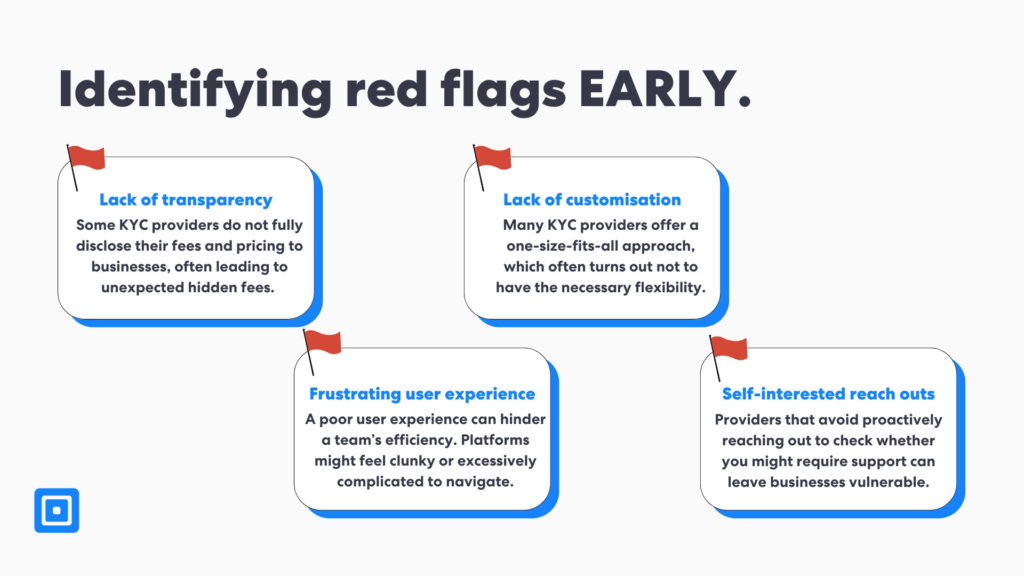
### Poor User Experience
A poor user experience can hinder a team’s efficiency, often when a KYC platform feels clunky or excessively complicated to navigate. Ensuring you’re able to use user-friendly technology that your team feels comfortable using is necessary for seamless operations. When the interface is unintuitive, employees may struggle to access or input the necessary data, increasing the likelihood of errors. This wastes time and can lead to compliance risks if information is incorrectly processed or overlooked. An effective KYC platform should provide an intuitive, easy-to-navigate dashboard, clear instructions, and responsive design across devices. Customizable features that allow you to adjust the interface to fit your needs are also a plus.
### Lack of Customization
Many KYC providers offer a one-size-fits-all approach, which often turns out not to have the necessary flexibility for specific requirements. If your provider offers rigid solutions that cannot be tweaked and refined for your specific use cases and compliance requirements, this might be a red flag that your business should not ignore. Additionally, if the platform doesn’t allow you to adjust things like screening thresholds, reporting formats, or user access controls, it could lead to inefficiencies or missed risks. Your compliance needs will change as your business evolves, and a rigid, cookie-cutter solution may struggle to keep up. Without customization options, your operations could become more cumbersome, and you might find yourself using a system that doesn’t align with your processes, potentially causing bottlenecks and increasing the likelihood of errors.
### Self-Interested Reach Outs
Providers who ghost you in times of need or avoid proactively reaching out to check whether you might require support can leave businesses vulnerable to non compliance fines due to a lack of seamless operations. Often, providers will reach out only when beneficial to them, asking whether you’d like to renew your package or even with an upsell attempt. Assessing whether your provider is proactively managing your account and even monitoring the health of your compliance process is absolutely critical.
## Breaking Up with a Bad KYC Provider
It can be time-consuming to part ways with your current provider and search for a new one that can provide you with increased value. Reviewing your contract with your KYC provider will be a necessary first step, as you’ll need to look for terms related to termination, notice periods, and any penalties for an early exit to ensure that your business is not faced with any unexpected costs.
### Securing Compliance Data
Once you have read the fine print and understand these terms, ensuring that all of your compliance data is up-to-date and securely stored is critical. This includes your client records, risk assessments, reports, and any other necessary documentation related to compliance. Check that client records are complete and accurate, and verify whether or not your provider has updated and maintained your data in line with regulatory requirements and national laws.
After validating these points, confirming how you can export this data is necessary. Saving copies of all important compliance documents and records in a secure, accessible format is essential. This ensures that you’ll have full access to the data necessary to remain compliant, even if there is a delay or problem during the transition period.
### Looking For a New Provider
Next, it’s time to choose a new provider. After deciding to leave your current plan, start doing some research on what platforms might be able to meet your needs and deliver more value. Focus on finding a platform that offers flexibility and ongoing customer support. It’s important to assess your essential needs at this point, such as risk assessments, system integration, or scalability, and communicate these with possible new providers. Read reviews and ask for recommendations to get a good sense of the provider’s reliability, if possible. In addition, requesting demos to test the platform firsthand and confirm it meets your technical and usability requirements can be very helpful.
## Finding “The One”
When choosing a new KYC provider, prioritize factors like up-to-date compliance features, seamless integration with your existing systems, scalability for future growth, and a user-friendly interface. Ensure robust data security, transparency in pricing (with no hidden fees), and responsive customer support. Check the provider’s reputation through reviews and industry feedback, and look for flexibility in contract terms to avoid long-term commitments. By considering these elements, you can partner a KYC provider that aligns with your business needs, supports compliance, and scales with your operations.
Scalability should be top of mind—your KYC solution should grow with your business, offering flexibility for future expansions, whether you’re entering new markets or adding more complex compliance requirements. A user-friendly interface is essential; a platform that’s intuitive and easy for your team to navigate will help reduce errors and training time.
Robust data security is non-negotiable. Look for providers with strong encryption protocols and secure storage for sensitive client information, ensuring you’re protected from data breaches. Transparency in pricing, without hidden fees, is also crucial; ensure the provider is clear about any additional costs for features like data storage, report generation, or customer support.
Responsive and knowledgeable customer support is another factor to consider. Your provider should be readily available to address issues or provide guidance when necessary. To assess a provider’s reliability, review client testimonials, industry feedback, and ask for case studies that demonstrate their ability to handle challenges similar to yours.
If you’re looking for a [new KYC provider](https://www.complycube.com/en/contact/contact-sales/), have a chat with our expert compliance team to see if our platform can address your needs.

**Categories:** Guides
**Tags:** Know Your Customer
---
### [AML Guidelines for Insurance Companies](https://www.complycube.com/aml-guidelines-for-insurance-companies/)
**Published:** May 6, 2025
**Author:** Sofia Daley
**Excerpt:** While traditionally viewed as less exposed than banks, insurance companies, particularly those offering life insurance, annuities, and investment-linked products, have increasingly found themselves under scrutiny from regulators.
**Content:**
While traditionally viewed as less exposed than banks, insurance companies, particularly those offering life insurance, annuities, and investment-linked products, have increasingly found themselves under scrutiny from regulators. Identifying and monitoring suspicious activities is a critical component of AML efforts in this sector. Insurance companies are classified as financial institutions under the Bank Secrecy Act and must implement specific compliance measures, including filing suspicious activity reports, to satisfy regulations set forth by authorities like FinCEN. For any insurance firm, a well-structured Anti-Money Laundering (AML) compliance program is no longer just a regulatory obligation; it is a strategic imperative to safeguard the integrity of their operations and maintain trust with policyholders, regulators, and investors. This guide will break down key AML guidelines for insurance companies to prevent fraud and ensure compliance.
## Introduction to Anti Money Laundering
Anti-money Laundering (AML) refers to the comprehensive set of laws, regulations, and procedures designed to prevent and detect the laundering of illicit funds. In the insurance sector, AML is crucial to prevent the exploitation of insurance products and transactions for money laundering purposes. Insurance companies must implement robust AML measures to identify and report suspicious transactions, verify customer identities, and monitor transactions to prevent the flow of illicit funds.
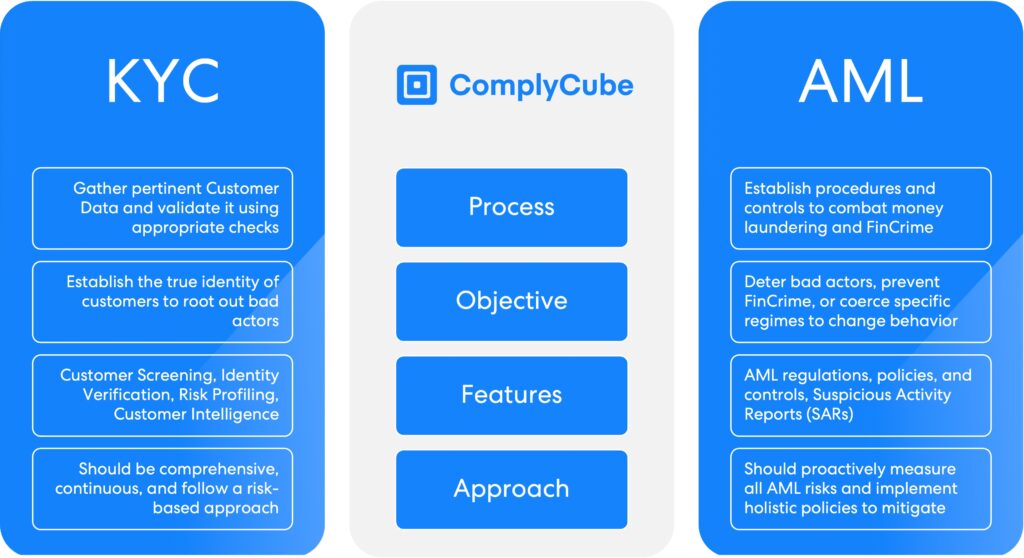
The Financial Action Task Force (FATF) provides essential guidance on AML regulations, and insurance companies must adhere to these regulations to avoid severe penalties and reputational damage. By embedding AML practices into their operations, insurance firms can safeguard their integrity and contribute to the global fight against financial crime.
## AML Risks Faced By Insurance Firms
Insurance products can present unique vulnerabilities when it comes to financial crime due to various risk factors such as the complexity of products and the involvement of multiple parties. For example, policies with investment components can be used to obscure the origin of illicit funds, while early withdrawals and beneficiary changes may serve as red flags for laundering or fraudulent activity.
Criminals often exploit insurance products to transfer large sums of illicit funds, particularly through single premium policies and top-ups. The use of third parties, such as brokers or agents, further complicates oversight and weakens direct visibility into the customer relationship.
Money launderers often favor insurance products because they offer perceived stability, large transaction values, and, in some cases, reduced scrutiny compared to traditional banking. As a result, insurance firms are expected to demonstrate the same level of AML diligence as other financial institutions, as they face av very real risk of fraud.
## Navigating Regulatory Expectations
Insurance companies operate under a complex patchwork of international and domestic AML regulations. At a global level, the Financial Action Task Force (FATF) provides a comprehensive set of recommendations that shape national legislation. In Europe, the EU’s Anti-Money Laundering Directives (AMLD) impose stringent obligations, including Enhanced Due Diligence (EDD) for high-risk customers and beneficial ownership transparency. In the United States, the Bank Secrecy Act and the USA PATRIOT Act outline detailed AML program requirements for insurers. Similarly, most European nations have similar regulatory bodies governing AML practices, such as the Financial Conduct Authority (FCA) in the UK, or Germany’s BaFin. These regulatory bodies apply sector-specific guidance and actively enforce compliance. Non-compliance with these AML regulations can result in serious consequences, including hefty fines and other penalties.
To remain compliant across jurisdictions, insurance companies must align their AML programs with both global standards and national expectations. This is a task that demands flexibility, precision, and often the support of advanced technology.
## The Building Blocks of Anti Money Laundering Compliance in Insurance
At the core of any effective AML framework lies the risk-based approach. Rather than applying uniform procedures across all customers and products, insurers must tailor their compliance controls to match the level of risk presented. This requires ongoing risk assessments that consider factors such as product type, customer profile, delivery channels, and geographic exposure. Identifying and reporting suspicious activities is crucial in this context to ensure compliance and prevent financial crimes.
> Higher-risk customers may require [additional verification procedures.](http://financialcrimeacademy.org/the-risk-based-approach-to-kyc/ "additional verification procedures.")
“The Know Your Customer risk-based approach enables a better customer onboarding compliance program by adjusting verification levels based on risk factors. Low-risk customers are accepted more quickly, whereas higher-risk customers may require additional verification procedures,” shares [Financial Crime Academy](https://financialcrimeacademy.org/the-risk-based-approach-to-kyc/). For more information on the risk-based approach, read [“The Evolution on the Risk Based Approach in AML.”](https://www.complycube.com/en/the-evolution-of-the-risk-based-approach-in-aml/)
Customer Due Diligence (CDD) is a foundational pillar of AML. Before issuing a policy, insurance companies must verify the identity of the customer and, where applicable, the beneficial owner. For standard-risk individuals, basic checks may suffice, but for Politically Exposed Persons (PEPs), clients from high-risk countries, or those with unusual transaction behavior, Enhanced Due Diligence (EDD) is necessary. This includes obtaining additional documentation, understanding the source of funds, and conducting more frequent reviews. For more on CDD, read [“What is Customer Due Diligence?”](https://www.complycube.com/en/what-is-customer-due-diligence/)
However, identity verification must not stop at the onboarding stage. Ongoing monitoring is critical to detect unusual activity over the life of a policy. For example, unusually large premium payments, sudden changes to a policy’s beneficiaries, or frequent early surrenders could indicate an attempt to launder funds. To detect such patterns, insurance companies are increasingly turning to AI-powered monitoring tools capable of analyzing large volumes of data and identifying subtle anomalies that might be missed in a manual review.
> “We’ve seen a worrying rise in [insurance fraud ](https://www.insurancefraudbureau.org/media-centre/ifb-news/2024/public-warned-of-rise-in-identity-theft)made possible by identity theft. Stolen personal information can be used for every financial crime imaginable, and victims of impersonation who are often elderly or vulnerable, face devastating consequences.“
Ursula Jallow, Director at the[ Insurance Fraud Bureau](http://insurancefraudbureau.org/media-centre/ifb-news/2024/public-warned-of-rise-in-identity-theft) states, “We’ve seen a worrying rise in insurance fraud made possible by identity theft. Stolen personal information can be used for every financial crime imaginable, and victims of impersonation who are often elderly or vulnerable, face devastating consequences.“ This underlines why businesses must implement advanced biometric technology to prevent cases of identity fraud and safeguard their operations.
## Insurance Products and Money Laundering
Insurance products, particularly those with a cash value such as life insurance and annuities, can be vulnerable to money laundering. Money launderers may exploit these products to launder illicit funds by overpaying premiums, surrendering policies prematurely, or making fictitious claims.
Insurance companies must be vigilant about these risks and implement stringent measures to prevent them, including rigorous transaction monitoring and thorough verification of customer identities. The [insurance industry is also susceptible to premium fraud](https://www.complycube.com/what-is-insurance-fraud/), where policyholders exaggerate or fabricate claims to receive payouts. To combat these threats, insurance companies must implement robust controls to ensure that their products are not used for money laundering purposes and to maintain compliance with AML regulations.
## AML Red Flags To Identify
Identifying red flags for money laundering is crucial for insurance companies to prevent financial crime. Common red flags include suspicious transactions such as large cash payments or payments from unrelated third parties.
Other indicators include frequent changes in beneficiaries or covered assets, unusual payment methods, and policies with high cash values. Insurance companies must be vigilant in recognizing these red flags and report any suspicious activity to regulatory authorities.
The insurance industry is also at risk from shell companies and other illicit entities that may use insurance products to launder money. By diligently monitoring transactions and verifying customer identities, insurance companies can prevent the exploitation of their products for money laundering purposes and ensure compliance with AML regulations.
## Implementing Cutting-Edge Technology
Outdated systems remain a challenge for many insurance firms, making it difficult to integrate real-time transaction monitoring or advanced analytics. However, modern RegTech solutions are increasingly accessible and scalable.
These platforms support automated onboarding, biometric identity verification, liveness detection, transaction screening, and real-time risk scoring. By adopting such tools, insurers can modernize their compliance posture while improving the customer experience, particularly important in a digital-first world where long onboarding processes can result in lost business.

Furthermore, many regulatory frameworks now encourage the use of technological solutions to meet compliance obligations more efficiently. Integrating these tools into existing operations allows insurance companies to shift from a reactive compliance model to a proactive, intelligence-led one.
## **Follow the Latest AML Guidelines for Insurance Companies Today**
AML compliance is no longer a back-office function or a one-time effort at onboarding. For insurance companies, it is an ongoing, strategic process that touches every part of the organization—from underwriting to claims to customer service. In an environment where regulatory expectations are rising and criminals are constantly evolving, insurance companies that take a proactive, technology-driven approach to AML will be best positioned to mitigate risk, maintain trust, and grow responsibly.
For more information on how to fortify your business with cutting-edge KYC and AML, get in touch with our [expert compliance team](https://portal.complycube.com/signup).

**Categories:** Guides
**Tags:** Anti-Money Laundering
---
### [What is Counter-Terrorist Financing (CTF)?](https://www.complycube.com/what-is-counter-terrorist-financing/)
**Published:** March 8, 2021
**Author:** Andreea Balasa
**Excerpt:** What is Counter-Terrorist Financing (CTF)?
Terrorists and terrorist groups often rely on funding to support themselves and to carry out acts of terrorism. Though terrorists are not very
**Content:**
**TL;DR:**Counter-Terrorist Financing (CTF) refers to the regulations, controls, and technologies used to prevent the fundingof terrorism. Terrorist groups exploit cash economies and front companies to obscure fund flows. This guide explains how businesses can mitigate CTF risks using advanced screening, identity verification, and real-time compliance automation.
## What is Counter Terrorist Financing?
Counter-Terrorist Financing (CTF) is a cornerstone of global security and compliance. Terrorist organizations depend on a steady flow of money to operate. Stopping terrorist financing is one of the most effective ways to disrupt extremist organizations. While individual attacks may be cheap to carry out, the wider networks behind them need constant funding.
This money helps recruit additional members, spread propaganda at scale, maintain safe houses and logistical networks. Additionally, financing helps with the acquiring of weapons and equipment, as well as fund international travel and other operational expenses. Without this steady flow of financial support, extremist groups often struggle to coordinate, resource, and execute their plans, which significantly reduces their capacity to prepare for and carry out attacks.
## Why Counter-Terrorist Financing Matters
Terrorist financing is harder to detect than other forms of financial crime. Financiers draw funds from both legal and illegal sources. They often divert donations, charities, and personal savings alongside proceeds from drug trafficking, extortion, or corruption. This blending of legitimate and illicit funds makes transactions appear routine even when they are not.
This money helps recruit additional members, spread propaganda at scale, maintain safe houses and logistical networks. Additionally, financing helps with the acquiring of weapons and equipment, as well as fund international travel and other operational expenses. Without this steady flow of financial support, extremist groups often struggle to coordinate, resource, and execute their plans, which significantly reduces their capacity to prepare for and carry out attacks.
Past cases show the dangers of overlooking these networks. For example, the [9/11 Commission Report](https://www.9-11commission.gov/staff_statements/911_TerrFin_Ch1.pdf) revealed that al-Qaeda raised and moved millions. They did this through front companies, charities, and informal transfer systems. Many of these transfers were small and routine, yet together they supported one of the most devastating attacks in history.
To reduce these risks, governments and regulators have developed strict [CTF frameworks](https://www.fatf-gafi.org/en/publications/Methodsandtrends/Terrorist-financing-risk-assessment-guidance.html). These require financial institutions to verify customer identities, monitor transactions, file Suspicious Activity Reports (SARs), and screen clients against sanctions and watchlists. Such measures are not only regulatory obligations but also vital safeguards
## How do terrorists evade CTF measures?
In order to evade counter terrorist financing measures, financiers use a mix of both traditional and modern techniques to obscure money flows. Even still, cash remains the most common method, particularly in regions with weak oversight. This is because cash transactions leave zero trail. They allow funds to move very quickly without alerting regulators for further inspection.
New digital channels have made detection even harder. Online payment services, prepaid cards, and cryptocurrencies enable cross-border transfers that are fast and often anonymous. Terrorist groups find cryptocurrencies especially attractive, as they can layer funds through multiple wallets and exchanges before moving them to a final destination.
Informal value transfer systems also remain popular. These networks operate on personal trust rather than formal contracts. Since settlements happen outside regulated banking systems, transactions leave no official record, making them almost invisible to authorities. Global watchdogs highlight the scale of the challenge. The United Nations has stressed that it is difficult to measure the success of counter-terrorist financing against terrorist financing because much of the activity is hidden.
> Countries around the world must use the intelligence [in this report](https://www.fatf-gafi.org/en/publications/Methodsandtrends/comprehensive-update-terrorist-financing-risks-2025.html) to build a stronger picture of the threats they face
According to the Financial Action Task Force (FATF) Comprehensive Update on Terrorist Financing Risks (July 2025), terrorist groups are adapting quickly to exploit financial loopholes. President Elisa de Anda Madrazo warned: “This continued abuse of the financial system poses a serious threat to global security and undermines international peace. Countries around the world must use the intelligence in this report to build a stronger picture of the threats they face and harness the tools available through the FATF Global Network to strengthen international cooperation and intelligence sharing.”
## How do terrorist organizations secure funding?
Terrorist organisations and their sympathizers rely on multiple funding streams, combining both legal and illegal sources. Some notable schemes include:
- **Drug trafficking** is one of the most lucrative sources of revenue. Groups such as the Revolutionary Armed Forces of Colombia (FARC) financed their operations for decades through cocaine production and distribution. Proceeds were laundered across international networks before reaching militant leaders.
- **Front companies** provide another channel. These businesses appear legitimate but are often used to move or disguise illicit funds. Historical accounts suggest Osama bin Laden operated a honey business to transfer money and goods across the Middle East while avoiding scrutiny.
- **Charities and non-profit organisations** have also been exploited. However, while most operate with genuine humanitarian objectives, some have been misused to divert donations into extremist causes. This misuse undermines trust in the sector and complicates regulatory oversight.
- **Corruption and bribery** are key enablers of terrorist financing, particularly in fragile or unstable states. Officials who accept payments or ignore suspicious activities allow terrorist funds to flow unchecked. This not only strengthens terrorist groups but also weakens governance and the broader fight against extremism.
- **Cybercrime** has emerged as a growing source of revenue. Extremist groups are increasingly using phishing schemes, ransomware, and fraudulent online fundraising to generate income. These methods allow funds to move quickly across borders with limited traceability.
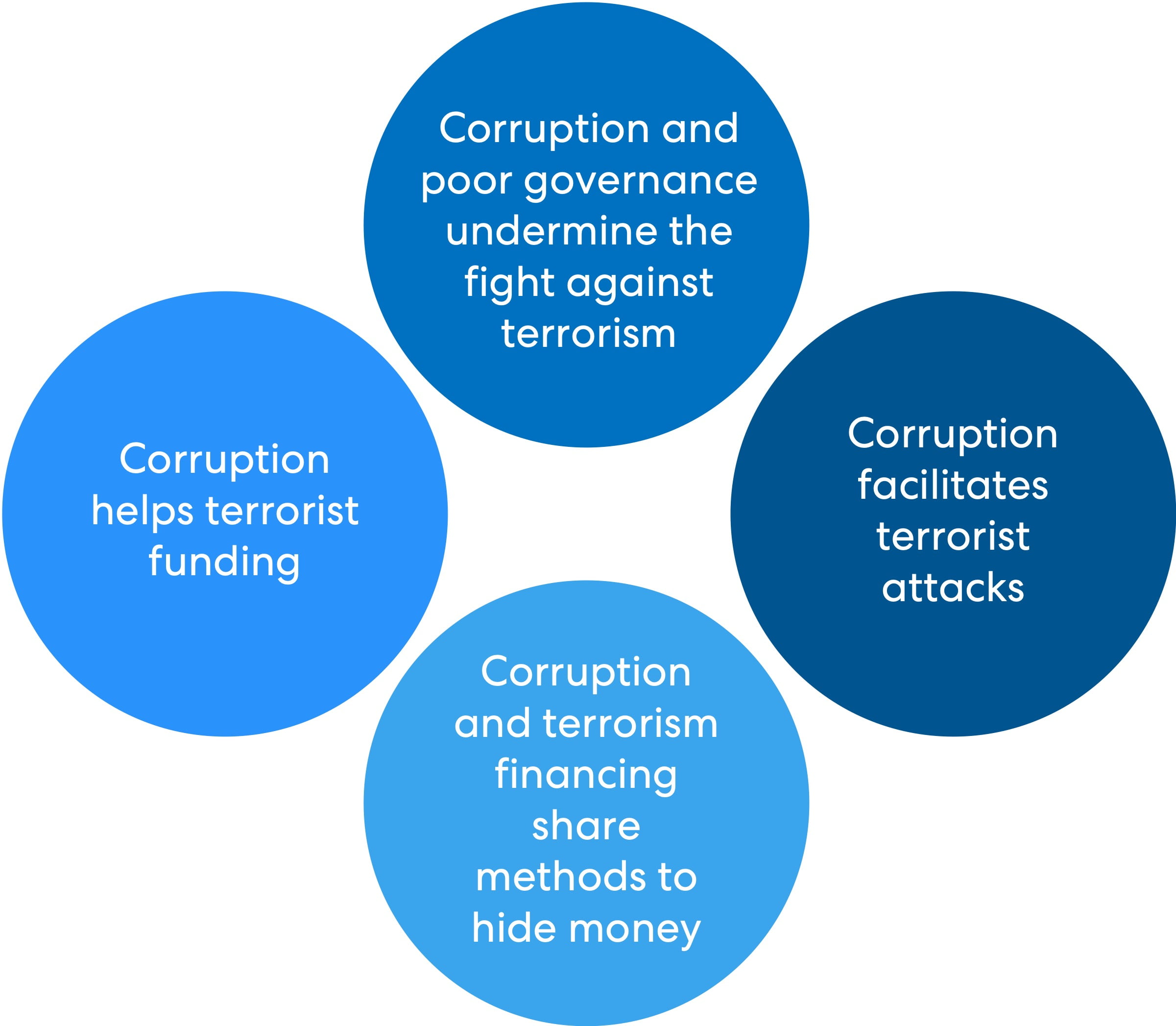 The Corruption-Terrorism Nexus
According to [Europol’s EU Terrorism Situation and Trend Report (TE-SAT 2024)](https://www.europarl.europa.eu/meetdocs/2024_2029/plmrep/COMMITTEES/LIBE/DV/2025/01-16/EuropolTE-SAT2024_EN.pdf), extremist groups are diversifying their funding methods by combining criminal activities with legitimate-looking financial flows.
The variety of funding sources highlights why Counter-Terrorist Financing (CTF) is so challenging. In particular, from narcotics and cybercrime to corruption and charities, terrorist groups exploit every possible channel. For regulators, financial institutions, and law enforcement, this means vigilance must extend far beyond traditional money-laundering models.
### **Case Study: How ETA Used Extortion for Terrorist Financing**
HM Treasury said it had grounds to suspect that Gurpreet Singh Rehal helped organisations linked to terrorism in India. He did this by promoting and encouraging activity, recruiting, providing financial services, and assisting networks connected to Babbar Khalsa (Babbar Khalsa International), including support involving weapons.
##### **Domestic Counter-Terrorism sanctions to cut off access to funds**
On 4 December, 2025, HM Treasury imposed an asset freeze and director disqualification on Gurpreet Singh Rehal. They imposed an asset freeze on Babbar Akali Lehar, under the Counter-Terrorism (Sanctions) (EU Exit) Regulations 2019 and the “Counter-Terrorism (Domestic)” regime
##### **Outcomes**
- The UK disqualified Rehal as a director, stopping him from acting as a company director or taking part in company management in the UK.
- HM Treasury framed the action as the first use of the Domestic Counter-Terrorism regime to disrupt funding linked to Babbar Khalsa.
- The government warned that breaches can trigger criminal penalties (up to 7 years imprisonment) and/or significant civil penalties.
## How the world is fighting Terrorist Financing?
Counter-Terrorist Financing (CTF) rests on international conventions, regional frameworks, and national laws. Together, they close loopholes, harmonise standards, and give regulators the tools to disrupt illicit financial flows.
### International standards
The [UN International Convention for the Suppression of the Financing of Terrorism (1999)](https://treaties.un.org/pages/ViewDetails.aspx?src=TREATY&mtdsg_no=XVIII-11&chapter=18) requires states to criminalise terrorist financing and cooperate in investigations and prosecutions. The [FATF 40 Recommendations](https://www.fatf-gafi.org/en/publications/Fatfrecommendations.html) set the global benchmark for Counter-Terrorist Financing and Anti-Money Laundering measures. In February 2025, FATF strengthened obligations on digital onboarding and virtual assets. Its [Comprehensive Update on Terrorist Financing Risks (July 2025)](https://www.fatf-gafi.org/en/publications/Methodsandtrends/comprehensive-update-terrorist-financing-risks-2025.html) reported that many jurisdictions still face significant enforcement gaps.
### Regional cooperation
The African Union has established a continental legal base. In addition, the [OAU/AU Convention](https://au.int/en/treaties/oau-convention-governing-specific-aspects-refugee-problems-africa) require member states to criminalise terrorist financing and strengthen judicial and border cooperation. The [African Model Law on Counter Terrorism (2011)](https://www.peaceau.org/uploads/african-model-law-on-counter-terrorsim-final-version-as-endorsed-by-the-17th-session-english.pdf) offers a template for asset freezing, information sharing, and investigation. Capacity building is supported through the AU’s [ACSRT](https://www.caert.org.dz/).
In 2024, the European Union introduced a new regulation and directive that harmonize AML and CTF obligations and created the [Anti-Money Laundering Authority (AMLA)](https://www.consilium.europa.eu/en/policies/aml-cft/), which will begin operations in 2025. For situational awareness and emerging typologies, see Europol’s [EU Terrorism Situation and Trend Report (TE-SAT)](https://www.europol.europa.eu/publications-events/main-reports/tesat-report).
### National frameworks
- **United States:** The [USA PATRIOT Act (2001)](https://www.congress.gov/bill/107th-congress/house-bill/3162) and the [Bank Secrecy Act](https://www.fincen.gov/resources/statutes-and-regulations/bank-secrecy-act) require enhanced due diligence, suspicious activity reporting, and asset freezing where appropriate.
- **United Kingdom:** The [Proceeds of Crime Act 2002](https://www.legislation.gov.uk/ukpga/2002/29/contents) enables seizure and recovery of terrorist-linked assets. UK competent authorities updates The [Money Laundering, Terrorist Financing and Transfer of Funds Regulations 2017](https://www.lawsociety.org.uk/topics/anti-money-laundering/quick-guide-to-the-mlrs) periodically to reflect FATF standards and technological change, including guidance on digital identity.
- **United Arab Emirates:** The core framework is [Federal Decree-Law No. 20 of 2018 on AML and CFT](https://uaelegislation.gov.ae/en/legislations/1016/download). Following FATF grey-listing in 2022, the UAE strengthened supervision of high-risk sectors and increased penalties for non-compliance.
- **Singapore:** CTF obligations are set out in the [Terrorism (Suppression of Financing) Act](https://sso.agc.gov.sg/Act/TSFA2002) and the [Corruption, Drug Trafficking and Other Serious Crimes (Confiscation of Benefits) Act](https://sso.agc.gov.sg/Act/CDSA1992). The Monetary Authority of Singapore issues binding AML and CFT notices for banks and payment firms, including oversight of virtual asset providers. See [MAS Notices](https://www.mas.gov.sg/regulation/notices).
- **Australia:** [AUSTRAC](https://www.austrac.gov.au/) enforces the [Anti-Money Laundering and Counter-Terrorism Financing Act 2006](https://www.legislation.gov.au/Series/C2006A00169), which underpins CTF supervision, risk assessments, and intelligence sharing with regional partners.
These frameworks show growing convergence in CTF enforcement. FATF sets the baseline. Regional organisations such as the African Union and the European Union strengthen cooperation. National regulators adapt rules to local risks. Compliance teams must align with global standards and pay close attention to jurisdiction-specific obligations, especially for digital identity, sanctions screening, and virtual assets.
## What’s the Difference Between CTF and CFT?
The terms Counter-Terrorist Financing (CTF) and Combating the Financing of Terrorism (CFT) both describe the global effort to identify, disrupt, and prevent the flow of funds that support terrorism. The difference lies mainly in how and where the acronyms are used. CTF is the preferred term in the world of financial services, compliance, and regulation. Banks, fintechs, and payment providers use it when discussing obligations such as Customer Due Diligence (CDD), Know Your Customer (KYC) checks, sanctions screening, and the filing of Suspicious Activity Reports (SARs). For example, the UK’s *Money Laundering, Terrorist Financing and Transfer of Funds Regulations (2017, amended 2025)* refer specifically to CTF when outlining business responsibilities. d
CFT is more common in treaties, conventions, and intergovernmental discussions. The United Nations’ *International Convention for the Suppression of the Financing of Terrorism (1999)* consistently uses the term CFT, as does the Financial Action Task Force (FATF) in its recommendations and risk assessments. Within the European Union, references often appear in the combined form “AML/CFT,” such as in the *EU AML/CTF Package (2024)*, which harmonises rules for banks, fintechs, and virtual asset providers.
Although the two acronyms come from different traditions, they mean the same thing in practice. Whether a regulation refers to CTF or CFT, the obligations remain identical: to stop terrorist groups from raiansing and moving funds. For compliance teams, the distinction is largely semantic, but recognising both terms ensures clarity when engaging with regulators and international partners.
### Key Takeaways
- **Terrorist financing** relies on informal networks, front companies, and illegal trade.
- FATF and other global framworks drive enforcement against terrorism funding.
- Corruption, crypto, and decentralized channels are common tactics.
- **Adequate tools need to be implemented for identity checks and transaction screening.**
- **ComplyCube’s AI-powered compliance tools** help businesses detect CTF risks and stay aligned with evolving regulations.
## How Terrorist Financing is Prevented in Practice
Preventing terrorist financing relies on a layered approach that blends regulation, technology, and intelligence sharing. The first step is [Customer Due Diligence (CDD](https://www.complycube.com/what-is-customer-due-diligence/)) and [Know Your Customer (KYC)](https://www.complycube.com/step-by-step-know-your-customer-process/) checks. These confirm the identity of clients, assess risk, and ensure that businesses are not onboarding individuals or entities connected to terrorism. Where higher risks are identified, firms must apply [Enhanced Due Diligence (EDD)](https://www.complycube.com/enhanced-due-diligence-edd-insights-and-challenges/), including deeper background checks and closer scrutiny of activity.
Ongoing risk-based monitoring is equally important. Rather than focusing only on individual transactions, this approach continuously reviews customer behaviour, account activity, and exposure to high-risk jurisdictions. It ensures that risk assessments remain dynamic and proportionate, adjusting to changes in customer profiles and global threat patterns. When suspicious activity is detected, firms must file Suspicious Activity Reports (SARs) with their national financial intelligence units.
Sanctions and watchlist screening is another example of a safeguard. Customers must be checked against customers and transactions against global databases of designated terrorists, organizations and politically exposed persons. Failure to comply with sanctions requirements can result in significant penalties and reputational damage.
To manage obligations at scale, modern compliance teams rely on technology. ComplyCube supports these requirements by combining [identity verification](https://www.complycube.com/en/solutions/identity-assurance/biometric-verification/), [sanctions and PEP screening](https://www.complycube.com/solutions/global-screening/sanctions-pep-screening/), and [adverse media checks](https://www.complycube.com/solutions/global-screening/adverse-media-checks/) with [continuous monitoring](https://www.complycube.com/solutions/global-screening/continuous-monitoring/). Its AI-powered engine reduces false positives, flags high-risk cases, and ensures compliance teams meet regulatory requirements across multiple jurisdictions. Biometric verification and liveness detection add further protection against impersonation and identity fraud.
> With [ComplyCube](https://www.complycube.com/), institutions can reduce manual workload, minimise false positives, and focus resources on genuine risks.
By combining regulatory obligations with advanced automation, financial institutions can build a multi-layered defence while strengthening global counter-terrorist financing efforts by reducing the ability of terrorist groups to raise, move, and use funds.
[](https://www.complycube.com/en/contact/contact-sales/)
## Frequently Asked Questions
What is the difference between Anti-Money Laundering (AML) and Counter-Terrorist Financing (CFT)?
Anti-Money Laundering (AML) refers to measures designed to stop criminals from disguising the origins of illicit funds. Counter-Terrorist Financing (CTF) focuses specifically on preventing money from being raised, moved, or used to support terrorism, even if the funds come from legal sources.
What are common methods of terrorist financing?
Terrorist groups use a mix of legal and illegal methods. These include drug trafficking, front companies, charities, corruption, and cybercrime. Increasingly, digital assets and informal value transfer systems such as hawala are also being exploited.
Who regulated counter terrorist financing globally?
The Financial Action Task Force (FATF) sets the global standard for Anti-Money Laundering and counter-terrorist financing measures. At a regional and national level, regulators such as AUSTRAC in Australia, the Monetary Authority of Singapore (MAS), the UK’s Financial Conduct Authority (FCA), and the U.S. Financial Crimes Enforcement Network (FinCEN) implement and enforce these rules for counter-terrorist financing.
Why is sanctions screening important in counter-terrorist financing?
Sanctions screening ensures that individuals, organisations, and jurisdictions linked to terrorism cannot access financial services. Breaching sanctions can lead to heavy fines, reputational damage, and even criminal liability for financial institutions.
What is the difference between CTF and CFT?
There is no substantive difference. CTF is more commonly used in compliance and regulatory settings, while CFT appears more often in treaties and international law. Both terms describe the same goal of stopping terrorist groups from accessing and moving funds.
**Categories:** Guides
**Tags:** Counter-Terrorist Financing
---
### [ComplyCube Wins 2025 RegTech Partner of the Year](https://www.complycube.com/complycube-wins-regtech-partner-of-the-year-2025/)
**Published:** June 30, 2025
**Author:** Dini Habib
**Excerpt:** ComplyCube, the award-winning KYC and AML leader, has won the “RegTech Partner of the Year” award for the second time at the British Bank Awards 2025. The award underscores ComplyCube’s commitment to excellence in the RegTech field.
**Content:**
London, June 30, 2025 – [ComplyCube](https://www.complycube.com/en/ "https://www.complycube.com/en/"), the global KYC and AML leader, has secured the “RegTech Partner of the Year” award for the second year running at the [British Bank Awards 2025](https://smartmoneypeople.com/british-bank-awards/winners), hosted by Smart Money People. This accolade underscores ComplyCube’s unwavering commitment to excellence in delivering cutting-edge compliance solutions and reinforces its position as a RegTech powerhouse in the banking sector.
## Leader in Fraud Prevention and Anti-Money Laundering (AML)
The [RegTech Partner of the Year](https://smartmoneypeople.com/british-bank-awards/winners#partner-specific-awards) category honours exceptional regulatory technology solutions for the UK banking sector. ComplyCube secured the top prize amid fierce competition, bolstered by strong endorsements from its extensive client base, including major financial institutions that rely on the platform for fraud detection and compliant customer onboarding.
In 2024, [3.31 million fraud cases](https://www.nationalcrimeagency.gov.uk/what-we-do/crime-threats/fraud-and-economic-crime) were reported in the UK, contributing to an estimated £722 million in losses to consumers and businesses. This alarming figure underscores the urgent need for advanced RegTech solutions to protect businesses and consumers from increasingly sophisticated threats.
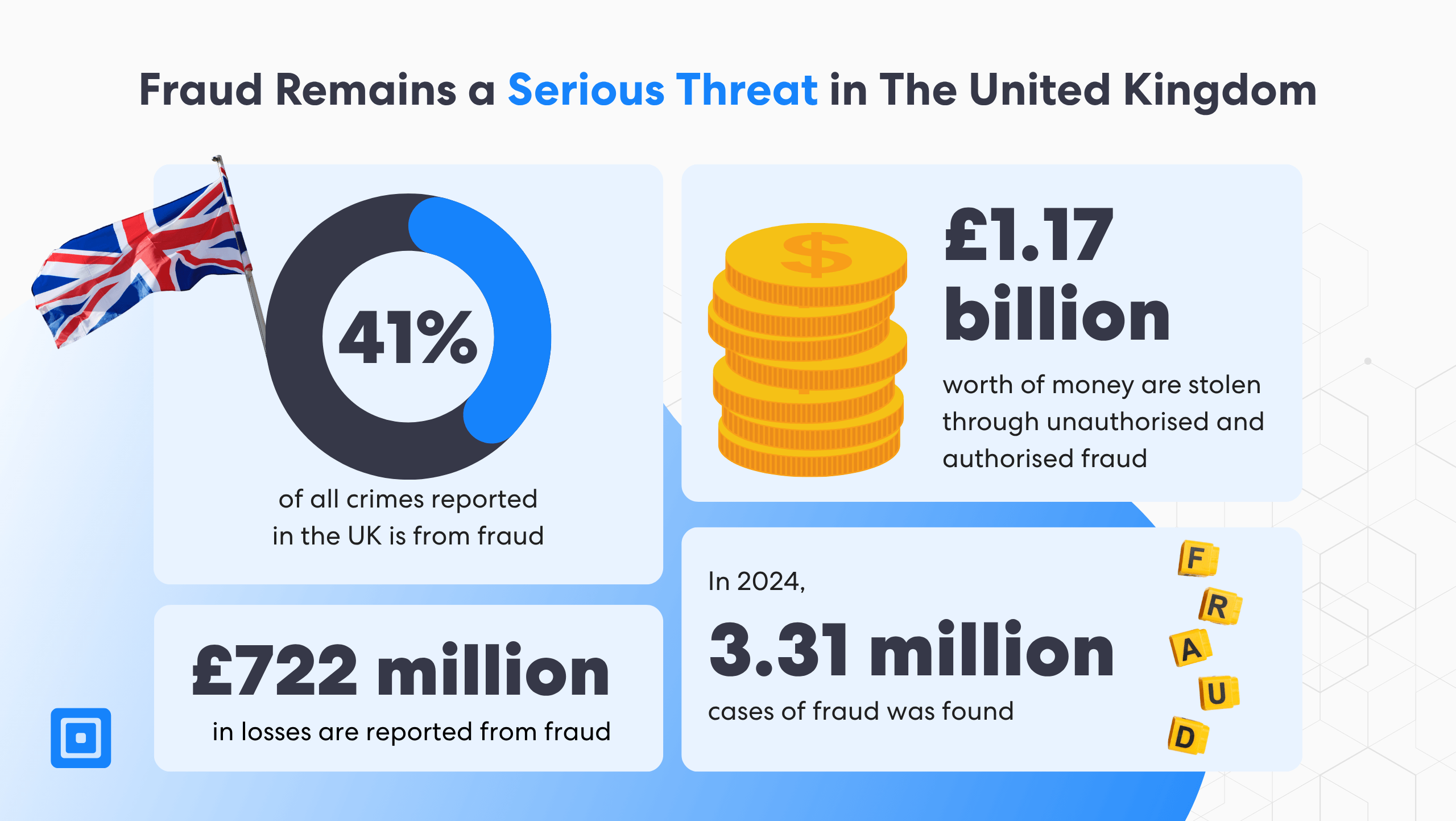
According to the National Crime Agency (NCA), nearly 41% of all UK crimes involve fraud. This growing challenge has made fraud prevention a top priority for financial institutions. ComplyCube is recognized a trusted partner in this fight, helping banks leverage cutting-edge verification technology to ensure both security and a seamless user experience.
> ComplyCube continues to demonstrate excellence in regulatory technology, offering cutting-edge solutions – Jacqueline Dewey, CEO, [Smart Money People](https://smartmoneypeople.com)
Jacqueline Dewey, CEO of Smart Money People highlights the significance of ComplyCube’s solutions, “Congratulations to ComplyCube for winning RegTech partner of the year for the second consecutive year. ComplyCube continues to demonstrate excellence in regulatory technology, offering cutting-edge solutions that not only help organisations stay compliant but also improve the safety and integrity of their customer interactions. A huge well done to the entire ComplyCube team on this fantastic achievement.”
## Pioneering RegTech Partner Solutions
ComplyCube stands out for its developer-friendly and highly secure solutions that address evolving regulatory requirements such as [Know Your Customer (KYC)](https://www.complycube.com/en/solutions/due-diligence-compliance/know-your-customer/), Identity Verification (IDV), and [Anti-Money Laundering (AML)](https://www.complycube.com/en/solutions/due-diligence-compliance/anti-money-laundering/) across global jurisdictions.
At the heart of ComplyCube’s platform is an advanced AI engine capable of [detecting sophisticated fraud patterns](https://www.complycube.com/en/use-cases/process/fraud-prevention/) in real-time. This includes powerful machine learning models that continuously evolve to recognize new types of fraudulent practices, such as identity theft and synthetic fraud. By leveraging AI-powered fraud detection, businesses can detect and prevent fraud in real-time, saving significant fraud reimbursement costs and minimizing operational and financial risks to businesses.
> Our mission at ComplyCube is to continuously raise the bar in RegTech
According to [UK Finance](https://www.ukfinance.org.uk/policy-and-guidance/reports-and-publications/annual-fraud-report-2025), criminals stole over £1 billion in 2024 alone, underscoring the urgent need for advanced RegTech solutions to protect businesses and individuals. “Winning the RegTech Partner of the Year award is a major achievement for the team,” says Dr. Tarek Nechma, CEO of ComplyCube. “It is not just a recognition of our hard work but also reflects our commitment to staying ahead of evolving threats. As fraudsters become more adept at exploiting technological gaps, our mission at ComplyCube is to continuously raise the bar in RegTech, ensuring our solutions remain resilient in the face of emerging challenges.”
## Building the Blueprint of a Safer Ecosystem
This recognition adds to a growing list of industry accolades, including ComplyCube’s leadership position [2025 G2 Spring Report](https://www.complycube.com/en/complycube-is-a-leader-in-the-g2-spring-2025-report/) for Anti-Money Laundering, Digital Onboarding, and Biometric Authentication. The award follows recent listings in the [*RegTech100*](https://www.complycube.com/en/complycube-regtech100-2024-list/), *FinTech Breakthrough Awards*, and *FinCrime50*, further cementing ComplyCube’s reputation as a leading innovator in compliance technology.
“The ComplyCube team is incredibly proud of this milestone, with the RegTech Partner of the Year award underpinning our strong commitment to providing sophisticated, reliable compliance solutions across the UK’s financial sector. We aim to continue testing the limits of RegTech, empowering banks with the tools to fulfil regulatory demands in the UK and abroad, confidently.” adds Mohamed Alsalehi, CTO of ComplyCube.
> We aim to continue testing the limits of RegTech, empowering banks with the tools to fulfil regulatory demands in the UK and abroad
As a trusted RegTech provider, ComplyCube empowers banks and financial institutions to strengthen compliance, streamline onboarding, and combat financial crime at scale. Its advanced platform delivers best-in-class tools for AML screening, identity verification, and real-time fraud prevention, built for the demands of modern compliance teams. Discover how [ComplyCube equips financial institutions](https://www.complycube.com/en/use-cases/industry/financial-services/) with tools to stay ahead of evolving compliance challenges.
## About ComplyCube
[ComplyCube](https://www.complycube.com/en/) is a global leader in AML and KYC compliance solutions. It is also a government-approved Identity Service Provider (IDSP) under the UK’s Digital Identity and Attributes Trust Framework ([DIATF](https://www.gov.uk/government/collections/uk-digital-identity-and-attributes-trust-framework)). With flexible and robust SDKs and APIs, ComplyCube’s solutions are trusted by companies across the finance industry and more to navigate complex compliance requirements. With smart and configurable verification methods, ComplyCube enables businesses to swiftly identify fraudsters, reduce false positives, and provide the right level of identity assurance tailored to each client’s needs.
## About Smart Money People
[Smart Money People](https://smartmoneypeople.com/british-bank-awards) is the leading financial services review site in the UK. With over 2.3 million reviews, the company aims to deliver key insights and transparent reviews across the financial industry to empower consumers to make informed decisions about various financial products, such as SaaS platforms, credit cards, insurance, and more. The firm organizes the British Bank Awards annually, aiming to honor excellence and recognize outstanding innovation in the industry.
**Categories:** News
**Tags:** Announcements
---
### [KYC vs AML – What is the difference?](https://www.complycube.com/kyc-vs-aml/)
**Published:** February 10, 2021
**Author:** Andreea Balasa
**Excerpt:** The rapid growth of the online economy and the meteoric rise of the FinTech industry has led to an unprecedented demand for Anti-Money Laundering (AML) and Know Your
**Content:**
**TL;DR:** KYC vs AML is a foundational concept in modern compliance. **Know Your Customer (KYC)** focuses on **verifying customer identity**, while Anti-Money Laundering (AML) targets the prevention of financial crime. Understanding AML vs KYC helps organisations **design risk-based controls** that go beyond onboarding.
The rapid growth of the online economy and the FinTech industry has led to an unprecedented demand for Anti-Money Laundering (AML) and Know-Your-Customer (KYC) tools. What do we mean by AML and KYC? Can we use these two terms interchangeably? To understand the difference between KYC vs AML, we’ll start by looking at what each process implies.
## What is Know Your Customer (KYC)?
KYC is the process financial institutions follow to collect relevant data from their customers to establish their identity and risk profile. For instance, investors must be verified before participating in a funding round, and likewise, individuals must be verified before opening a bank account. Anti-money laundering (AML) regulations require KYC for regulated firms to ensure that they do not conduct business with malicious individuals and contribute towards terrorist financing.
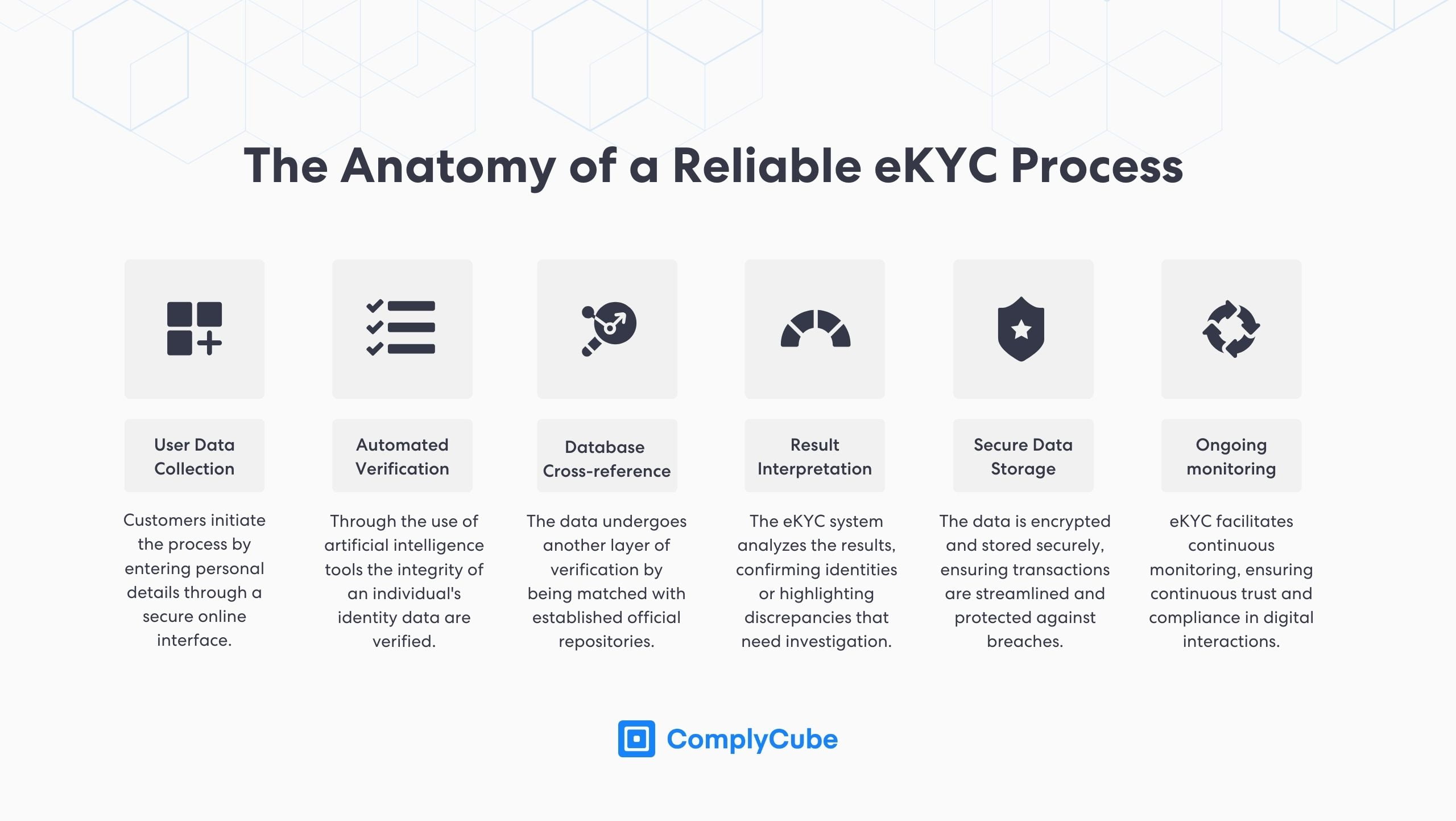
## What is Anti-Money Laundering (AML)?
AML refers to measures, policies, and controls regulated institutions and governments employ to prevent, discourage, and combat Financial Crime (FinCrime), especially money laundering and terrorism financing. AML also encompasses [Sanctions](https://www.complycube.com/what-is-a-sanctions-screening/), which governments or international bodies use to[ coerce specific regimes to change their behavior](https://assets.publishing.service.gov.uk/government/uploads/system/uploads/attachment_data/file/961516/General_Guidance_-_UK_Financial_Sanctions.pdf). Moreover, a regulated institution’s AML policy forms part of its broader AML compliance program, which is developed to comply with its local AML regulatory requirements.

## What is a Customer Identification Program (CIP)?
Businesses undertake a Customer Identification Program (CIP) to learn more about a customer’s identity when onboarding new consumers. It is the first step in stopping financial crimes. CIPs help businesses identify customers so they can conduct further regulatory checks on them, such as AML screening. Learn more by reading [“What is CIP?](https://www.complycube.com/en/customer-identification-program-what-is-cip/)“
## What is Customer Due Diligence (CDD)?
AML and KYC regulations state that once a firm has identified a client, it must conduct Customer Due Diligence to ascertain the level of associated risk posed. CDD involves further identity checks and background and AML screening, amongst other tasks.
Enhanced Due Diligence (EDD) is occasionally needed for higher-risk individuals, such as Politically Exposed Persons (PEPs). To help prevent money laundering, these processes are conducted around the clock in what is known as ongoing monitoring. Learn more by reading [What is Customer Due Diligence?](https://www.complycube.com/en/what-is-customer-due-diligence/)

### **Case Study: Monzo AML Failures (UK FCA)**
Monzo experienced rapid customer growth, onboarding millions of users within a short period. The Financial Conduct Authority (FCA) found that controls were inconsistently applied and insufficient for the scale of operations. This led to weaknesses in AML monitoring, with suspicious activity, including potential mule account usage.
##### **Regulatory-Driven AML Remediation Programme**
Following FCA intervention, Monzo implemented a comprehensive remediation programme. This included improving transaction monitoring systems, enhancing risk assessment processes, and increasing oversight across customer accounts. The focus shifted towards integrating **AML and KYC** into a more cohesive, risk-based compliance model.
##### **Outcome**
- £5.4 million FCA fine highlighting AML control deficiencies
- Strengthened transaction monitoring and risk detection capabilities
- Improved alignment between KYC onboarding and ongoing AML compliance processes
## How do KYC and AML differ?
Though institutions may blur the lines between KYC and AML, they are two distinct compliance frameworks. They have different scopes, processes, and objectives, as depicted in the comparison graphic below. AML is much broader in scope and typically encompasses many components, such as:
- KYC procedures.
- AML standards and guidelines.
- [Risk-based AML policies](https://www.complycube.com/what-is-a-risk-based-approach/).
- AML staff handbooks.
- Ongoing risk assessment and continuous monitoring.
- AML compliance training program for staff.
- Internal controls and internal audits.
- Escalation matrices and procedures.
With that said, an effective AML policy requires a reliable KYC process, as without establishing customers’ true identity and their source of funds, FinCrime cannot be prevented or detected. On the other hand, AML laws and policies inform [the risk-based approach](https://www.complycube.com/what-is-a-risk-based-approach/) that needs to be followed for KYC procedures.

### Key Takeaways
- **KYC vs AML** serves different purposes, identity verification versus financial crime detection.
- **Strong KYC alone** is insufficient without ongoing AML monitoring and risk analysis.
- **AML and KYC integration** enables a complete, lifecycle-based compliance strategy.
- **Regulatory expectations** increasingly require continuous monitoring, not just onboarding checks.
- **Platforms such as ComplyCube** unify KYC and AML workflows, improving efficiency and risk visibility.
## KYC vs AML Compliance Solutions
Achieving compliance with AML/CFT regulations requires significant administrative effort and large amounts of data analysis. Hence, many firms opt for automating AML processes with various innovative tools to reduce human error and avoid potential compliance penalties. Automation not only offers improved speed, accuracy, and efficiency to AML; it also helps firms quickly respond to new regulations and continue to deliver the highest standards of compliance.
For instance, AML solutions can quickly analyze customer data, look for specific risk flags, and raise real-time alerts to [Money Laundering Reporting Officers (*MLROs*)](https://www.handbook.fca.org.uk/handbook/ML/7/1.html?date=2005-04-02). They also help with the automation of KYC procedures through [**electronic Identity Verification (eIDV)**](https://www.investopedia.com/terms/e/eidv-electronic-identity-verification.asp)**,** which typically involves the following two steps:
1. Acquisition of an identity document, e.g., passport, national identity card, or driver’s license. The ID document is then analyzed across multiple vectors such as authenticity, consistency, expiry, and so forth.
2. Establishing that the document holder is indeed present during the transaction. This is achieved by taking a selfie or video along with a passive or active liveness check.
At [ComplyCube](https://www.complycube.com/), we have built a powerful AML/KYC Compliance stack on top of smart workflows and APIs. Our unique platform enables firms to quickly implement a risk-based AML/KYC framework bespoke to their needs. Businesses can also leverage our state-of-the-art Mobile and Web SDKs to create user-friendly KYC processes that effortlessly verify customers’ identities.
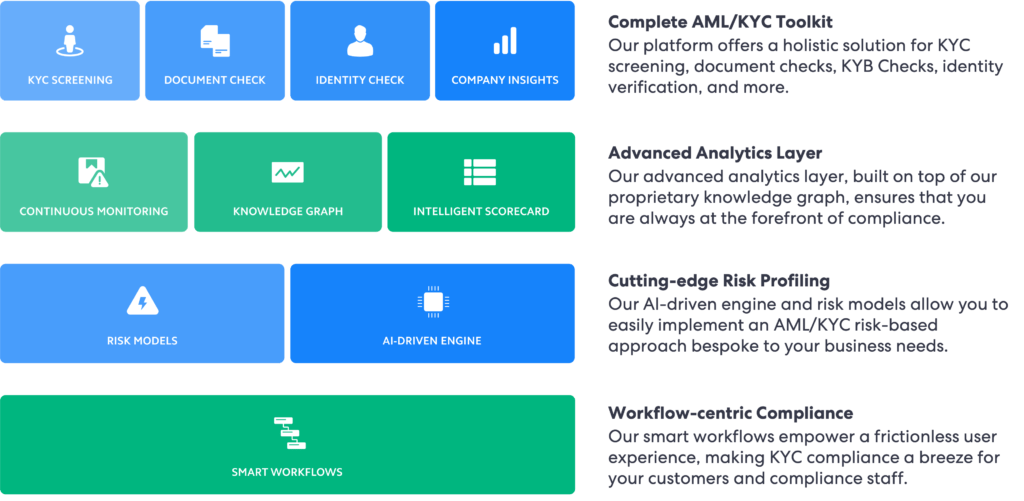ComplyCubes KYC and AML Compliance Stack
For more information on how to safeguard your organization, get in touch with our expert compliance [team](https://www.complycube.com/en/contact/contact-sales/).
## Frequently Asked Questions
What is the difference between KYC and AML?
KYC vs AML differs in scope and timing. Know Your Customer (KYC) verifies identity during onboarding, while Anti-Money Laundering (AML) focuses on monitoring transactions and detecting financial crime over time. KYC establishes trust at entry, whereas AML ensures ongoing risk management throughout the customer lifecycle.
Is KYC part of AML compliance?
Yes, KYC is a core part of AML compliance. It provides the verified identity data needed for sanctions screening, risk assessment, and monitoring. In practice, AML vs KYC is a layered approach, where KYC forms the foundation and AML builds on it to manage financial crime risks.
Why do businesses need both AML and KYC?
Businesses need both AML and KYC to meet regulatory requirements and reduce exposure to fraud and money laundering. KYC confirms customer identity, while AML tracks behaviour and flags suspicious activity. Using both ensures a complete compliance framework rather than a one-time verification process.
How do AML and KYC work together?
AML and KYC work together through a risk-based lifecycle. KYC collects and verifies identity data, which AML systems use for screening, monitoring, and ongoing due diligence. This integration helps organisations maintain accurate risk profiles and respond to threats in real time.
How does ComplyCube support AML and KYC compliance?
ComplyCube provides a unified platform combining KYC, AML, and Identity Verification (IDV) into a single workflow. Businesses can perform onboarding checks, real-time sanctions and PEP screening, and continuous monitoring globally. With no-code automation and advanced fraud detection, organisations can streamline compliance while maintaining strong risk controls.
**Categories:** Guides
**Tags:** Anti-Money Laundering
---
### [What is KYC in Insurance?](https://www.complycube.com/what-is-kyc-in-insurance/)
**Published:** May 6, 2025
**Author:** Sofia Daley
**Excerpt:** Maintaining the integrity of operations and minimizing risk is crucial within the insurance sector. Insurance companies must protect themselves and their clients from fraud and money laundering through KYC and AML measures.
**Content:**
Maintaining the integrity of operations and minimizing risk is crucial within the insurance sector. One of the most effective ways for insurance companies to protect themselves and their clients from insurance fraud, money laundering, and other illicit activities is through Know Your Customer (KYC) and Anti-Money Laundering (AML) measures. KYC in insurance is vital for customer identification, ongoing monitoring for suspicious activity, and ensuring accurate account information is maintained. These regulatory frameworks are essential in ensuring the legitimacy of clients, reducing financial risks, safeguarding the industry’s reputation as well as maintaining compliance with national and international regulations.
## Introduction to KYC
The Know Your Customer (KYC) process verifies the identity of customers and assesses their risk profile to prevent money laundering, terrorism financing, and other financial crimes. Businesses can flag potential clients that may pose a risk to the organisation, whether that is because they have been featured in adverse media, or whether they are committing identity fraud. However, beyond the risk of fraud, insurance companies must, as dictated by law, comply with KYC and AML regulations, hence partnering with a trusted KYC provider is critical.
> Insurance companies are required by law to comply with regulations related to KYC, Anti-Money Laundering (AML), and Countering the Financing of Terrorism (CFT).
Deloitte underlines the importance of KYC and AML for insurance businesses, stating, “Insurance companies are required by law to comply with regulations related to KYC, Anti-Money Laundering (AML), and Countering the Financing of Terrorism (CFT). These regulations aim to prevent financial crimes such as money laundering, fraud, and terrorist financing. By implementing advanced KYC controls, insurance companies can ensure that they are complying with these regulations.”
Furthermore, by thoroughly vetting customers, insurers can identify high-risk individuals and prevent fraudulent claims, which can lead to higher insurance premiums for honest customers. This process helps in safeguarding the financial integrity of the insurance sector and ensures that insurers are not inadvertently facilitating financial crimes.
## What is KYC in Insurance?
KYC in insurance begins with gathering and confirming key information about clients to ensure that the insurer is dealing with legitimate individuals or businesses. Ensuring that clients are properly identified and their backgrounds are thoroughly reviewed reduces the risk of identity fraud, which has undergone a stark increase with the rise of AI tools and deepfakes.
Confirming the account holder’s address through various forms of identification is crucial. Documents must clearly display the account holder’s address, and certain types of proof, such as utility bills and online bank statements, have specific acceptance criteria. A biometric identity check should also be carried out, as this can accurately verify biometric data and provide a liveness score, ensuring that prospective clients match the identities presented on their documents.
Depending on the requirements of the firm, additional checks can be added, such as AML screening including adverse media checks and PEP screening. These checks help determine whether a potential client is involved in financial crime, has been featured in negative news coverage, or is a politically exposed person (PEP) who may present a higher risk of corruption or bribery. Integrating these screenings into the KYC process allows insurers to make informed decisions about onboarding clients and managing risk appropriately.
After onboarding the client, ongoing due diligence is essential. KYC is not a one-time task but a continuous process. Client information should be periodically reviewed and updated, especially when there are changes in policy ownership, claims behavior, or regulatory guidelines. Real-time monitoring systems can flag unusual transactions or behavior patterns that deviate from a client’s risk profile, prompting further investigation.
## KYC Requirements for Insurance Companies
Insurance companies must conduct Customer Due Diligence (CDD) to verify a customer’s identity and evaluate their risk profile for any suspicious account activity. For customers deemed to be at higher risk, Enhanced Due Diligence (EDD) is employed to provide a more in-depth analysis of their background and financial activities. …This might include gathering additional documentation, conducting detailed source-of-funds checks, and performing more frequent monitoring of transactions. EDD is particularly important for clients with complex ownership structures, links to high-risk jurisdictions, or those flagged in sanctions or PEP screenings. For more on Enhanced Due Diligence, read [“Navigating the World of Enhanced Due Diligence.”](https://www.complycube.com/en/enhanced-due-diligence-edd-insights-and-challenges/)
## Technologies Behind KYC
The technologies behind KYC have evolved significantly, incorporating advanced tools like Optical Character Recognition (OCR), digital transformation, and artificial intelligence (AI) to enhance the accuracy and efficiency of the process. These technologies enable insurance companies to automate KYC processes, using machine learning algorithms to identify potential fraud and reduce the risk of false claims.
The use of PAD Level 2 Liveness Detection technology drastically reduces cases of identity fraud, helping businesses identify clients who may be involved in financial crime. This technology ensures that the individual presenting their identification is physically present and not using photos, videos, or deepfake technology to impersonate someone else. By verifying that a person is live and interacting in real time with the authentication system, insurers can more effectively block fraudulent attempts before they even begin. For more on Liveness Detection, read [“Deepfakes vs. Biometric Liveness Detection.”](https://www.complycube.com/en/deepfakes-vs-biometric-liveness-detection/)
Furthermore, AI-driven risk scoring allows insurers to evaluate the likelihood of a customer engaging in suspicious activities based on their historical behavior and other data points. These risk models are continually updated as the system learns from new data, ensuring that the insurer stays ahead of emerging threats. By automating these processes, insurers can quickly identify high-risk customers, flag suspicious activities in real-time, and adjust their risk models based on patterns and trends.
## The Role of AML in Insurance
Anti-Money Laundering (AML) refers to a set of procedures, laws, and regulations that insurance companies follow to prevent money laundering and other financial crimes. While KYC focuses on verifying the identity of clients, AML goes further by monitoring clients’ transactions and behaviors to detect suspicious or illicit activity.
AML systems are particularly important in the insurance industry because they help to identify and prevent the use of insurance products for illegal activities, such as money laundering, fraud, or financing terrorism. Just as KYC is vital for onboarding new clients, AML plays an ongoing role in ensuring that clients continue to meet compliance standards throughout the life of their policies.
## How KYC and AML Benefit Insurance Organizations
Insurance organizations face a multitude of risks, and the financial and reputational consequences of fraud or money laundering can be severe. By implementing robust KYC and AML frameworks, insurers can safeguard themselves from a variety of potential risks. Let’s dive into all of the benefits obtained by implementing advanced AML and KYC.
## 1. Preventing Fraud
Fraudulent claims are a significant concern for insurance companies, leading to financial losses, higher premiums for customers, and reputational damage. KYC processes help to identify potential fraudsters by verifying the identity of clients before coverage is provided. If a fraudulent applicant is attempting to obtain coverage using false or misleading information, KYC procedures can detect inconsistencies or discrepancies in their documentation. Insurance fraudsters engage in various activities such as false reporting of theft for vehicles, misrepresentation of health conditions for health insurance claims, and other fraudulent schemes to deceive insurance companies.
AML protocols help insurance companies to monitor clients for any signs of money laundering or suspicious activities that may indicate fraudulent behavior. By detecting irregular transactions or behavior patterns, insurers can intervene before fraud occurs, minimizing financial losses. Fraud investigations can lead to criminal convictions, emphasizing the serious legal consequences of submitting false or misleading insurance claims.
## 2. Enhancing Compliance
Insurance companies are required by law to comply with various regulations related to fraud prevention and financial crimes. Both KYC and AML are critical components of regulatory compliance, particularly in jurisdictions with strict anti-money laundering and anti-fraud laws. The regulatory landscape mandates that financial institutions adhere to stringent customer requirements, ensuring compliance with KYC obligations. Failure to implement these measures can result in hefty fines, legal penalties, and reputational damage.
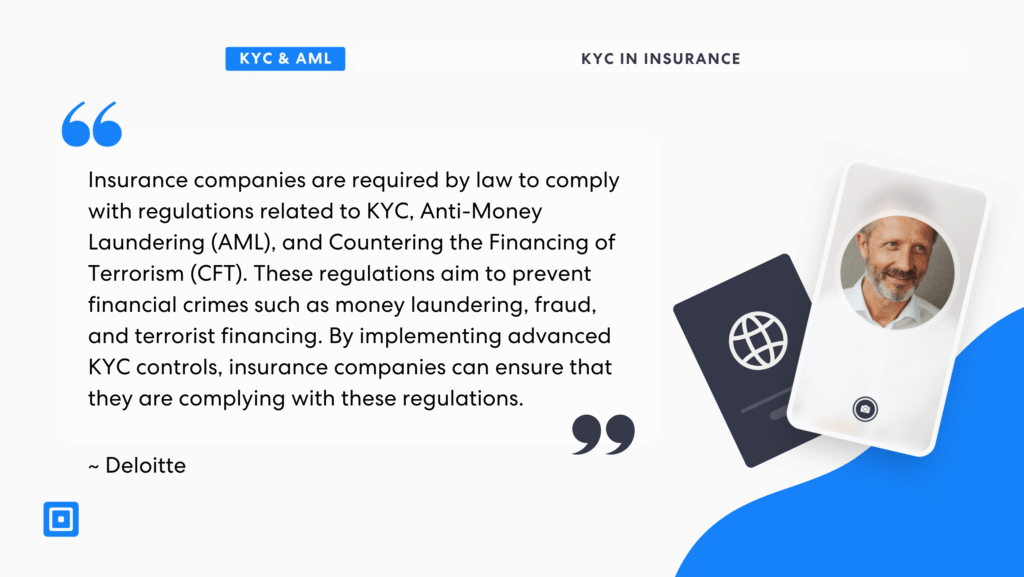
KYC ensures that insurance companies know who their clients are and that their business activities are legitimate. AML, on the other hand, helps to detect ongoing illegal activity and ensures that insurance companies are not unknowingly facilitating money laundering or other illicit financial activities. Diligence processes are crucial in managing risks associated with underwriting insurance policies, as they involve enhanced scrutiny of high-risk customers through more frequent KYC checks.
## 3. Reducing Risk
Risk management is a core aspect of the insurance industry. KYC and AML provide insurers with the tools to assess and mitigate risk. By verifying the identity and background of clients, insurers can better assess the risk they pose and determine whether they are likely to engage in fraudulent or illegal behavior.
For example, individuals with a history of fraudulent claims or businesses with unstable financial histories may be considered high-risk clients. Through KYC, insurers can identify these risks early on and either deny coverage or take additional precautions to minimize potential exposure. Identifying high-risk customers through thorough KYC checks allows insurers to implement enhanced due diligence processes, conducting more frequent evaluations to better manage underwriting risks.
AML systems help insurers monitor clients over time, ensuring that any suspicious activity, such as sudden changes in financial behavior or large, unexplained claims, is flagged and investigated. Continuous monitoring reduces the risk of unknowingly providing coverage to individuals or businesses involved in money laundering, terrorism financing, or other illegal activities.
## 4. Improving Customer Trust
In today’s highly regulated environment, customers expect insurance companies to take the necessary steps to protect their data and ensure their safety. KYC and AML procedures demonstrate that [insurers are taking appropriate measures to protect against fraud](https://www.complycube.com/en/what-is-insurance-fraud/) and financial crime, which can help build trust with clients.
When clients know that their insurance company has a rigorous KYC and AML process in place, they are more likely to feel confident in the security and legitimacy of the coverage they are purchasing. Understanding the customer relationship is crucial in developing risk profiles to comply with regulatory standards and detect suspicious activities. Additionally, customer-based risk management plays a significant role in tailoring premiums and investment recommendations based on the customer’s profile. This trust can lead to stronger customer relationships, better customer retention rates, and improved brand reputation.
## 5. Detecting and Preventing Money Laundering
Money laundering is a major global issue, and insurance companies can unknowingly become channels for illicit financial activities. The insurance industry, with its large transactions and long-term policies, is particularly vulnerable to being exploited for money laundering purposes. Regulatory compliance in relation to financial transactions is crucial for promoting transparency and preventing financial crimes.
AML processes are essential for detecting and preventing money laundering within the insurance sector. By monitoring transactions and identifying unusual behavior, insurance companies can flag suspicious activity, report it to the relevant authorities, and avoid being complicit in criminal activities. For example, large or frequent payments from unknown or high-risk sources may indicate money laundering, prompting the insurer to investigate further. National and local governments recognize insurance fraud as a serious crime, resulting in measures aimed at punishment and prevention.
## 6. Facilitating Business Expansion and Partnerships
Insurance organizations that have robust KYC and AML processes in place are more attractive partners for other financial institutions, regulatory bodies, and international markets. When expanding into new regions or forming partnerships with other financial organizations, demonstrating strong KYC and AML compliance can enhance an insurer’s reputation and credibility. Identifying beneficial owners in business partnerships is crucial to ensure compliance and mitigate risks associated with corporate structures. Additionally, verifying the identities of existing customers is essential in fraud prevention efforts.
In some jurisdictions, compliance with KYC and AML regulations is a prerequisite for conducting business. By ensuring that these processes are properly implemented, insurers can expand into new markets and collaborate with other businesses more seamlessly.
## Challenges of Implementing KYC
Implementing KYC can be a complex and resource-intensive task for insurance companies. Ensuring compliance with regulations requires significant resources and operational efficiency. The risk-based approach to KYC necessitates that insurance companies identify and assess risk factors associated with customers, which can be both time-consuming and costly.
The use of different AML risk classes and KYC procedures adds to the complexity, requiring insurers to navigate a myriad of regulatory requirements. Balancing the need for stringent KYC processes with the need to provide a seamless customer experience is another challenge, especially in the digital age where customer expectations are high.
Regulatory bodies like the Federal Register provide guidance on KYC regulations, but insurance companies must stay vigilant and up-to-date with changing regulations and guidelines to ensure compliance. This vigilance is essential to prevent financial crimes, including identity theft and terrorism financing, and to maintain the integrity and trustworthiness of the insurance industry.
## Fortify Your KYC and AML Infrastructure
KYC and AML are not just regulatory requirements, they are vital tools for protecting insurance organizations from fraud, money laundering, and reputational harm. By implementing thorough KYC and AML processes, insurance companies can verify the legitimacy of their clients, assess risk, prevent financial crimes, and ensure regulatory compliance. These practices not only safeguard the financial integrity of insurance organizations but also build trust with clients, improve customer retention, and position insurers for long-term success in an increasingly complex and regulated environment.
For more information on how to fortify your business with cutting-edge KYC and AML, get in touch with our [expert compliance team](https://portal.complycube.com/signup).

**Categories:** Guides
**Tags:** Know Your Customer
---
### [Build a Strong KYC Due Diligence Checklist UK](https://www.complycube.com/build-a-strong-kyc-due-diligence-checklist-uk/)
**Published:** May 7, 2025
**Author:** Dini Habib
**Excerpt:** Today's highly regulated business landscape makes compliance with Know Your Customer (KYC) and due diligence critical. UK businesses require robust KYC due diligence measures to safeguard against financial crime and reputational damage.
**Content:**
**TL;DR:** The KYC Due Diligence Checklist UK is **essential for** Anti-Money Laundering (AML) regulation compliance. By using a KYC Due Diligence Checklist, businesses can **improve customer experience** and reduce fraud. Effective KYC Due Diligence e**nsures safe business relationships**, reduced drop-offs, and **full compliance**.
## What is KYC and Customer Due Diligence (CDD)?
[Know Your Customer (KYC)](https://www.complycube.com/en/what-is-kyc-verification-an-in-depth-guide/) is the process of confirming customer identity and it is safe to do business with them. According to the [Money Laundering, Terrorist Financing and Transfer of Funds (Information on the Payer) Regulations 2017](https://www.legislation.gov.uk/uksi/2017/692/contents), customer due diligence (CDD) is mandated and necessary.
KYC Due Diligence needs firms to identify beneficial owners. Also, they need to learn the purpose of the relationship, as well as review for terrorist financing risk. In practice, customer due diligence requires checking reliable documents and data. By determining how risky a potential customer or transaction is for regulatory compliance, teams can avoid any potential money laundering.
More and more, organizations deliver risk management through configurable digital workflows that turn written compliance policies into consistent customer journeys. The due diligence process begins from the first sign-up all the way through to continuous monitoring.
## The Three Categories of Strong KYC Due Diligence Checklist UK
The KYC Due Diligence Checklist looks at three different categories according to different risk levels. The Financial Action Task Force (FATF) states that a [risk-based approach](https://www.fatf-gafi.org/en/publications/Fatfrecommendations/Risk-based-approach-banking-sector.html) (RBA) as central. It helps firms focus effort on higher-risk customers while keeping low-risk journeys fast and efficient.
Building and choosing various workflows based on customer’s activities is necessary to stop money laundering. In these workflows, they look at customer’s identity, account files, customer transactions, geography, and delivery channel. As a result, it allows firms can specialize rather than relying on a one-size-fits-all process.
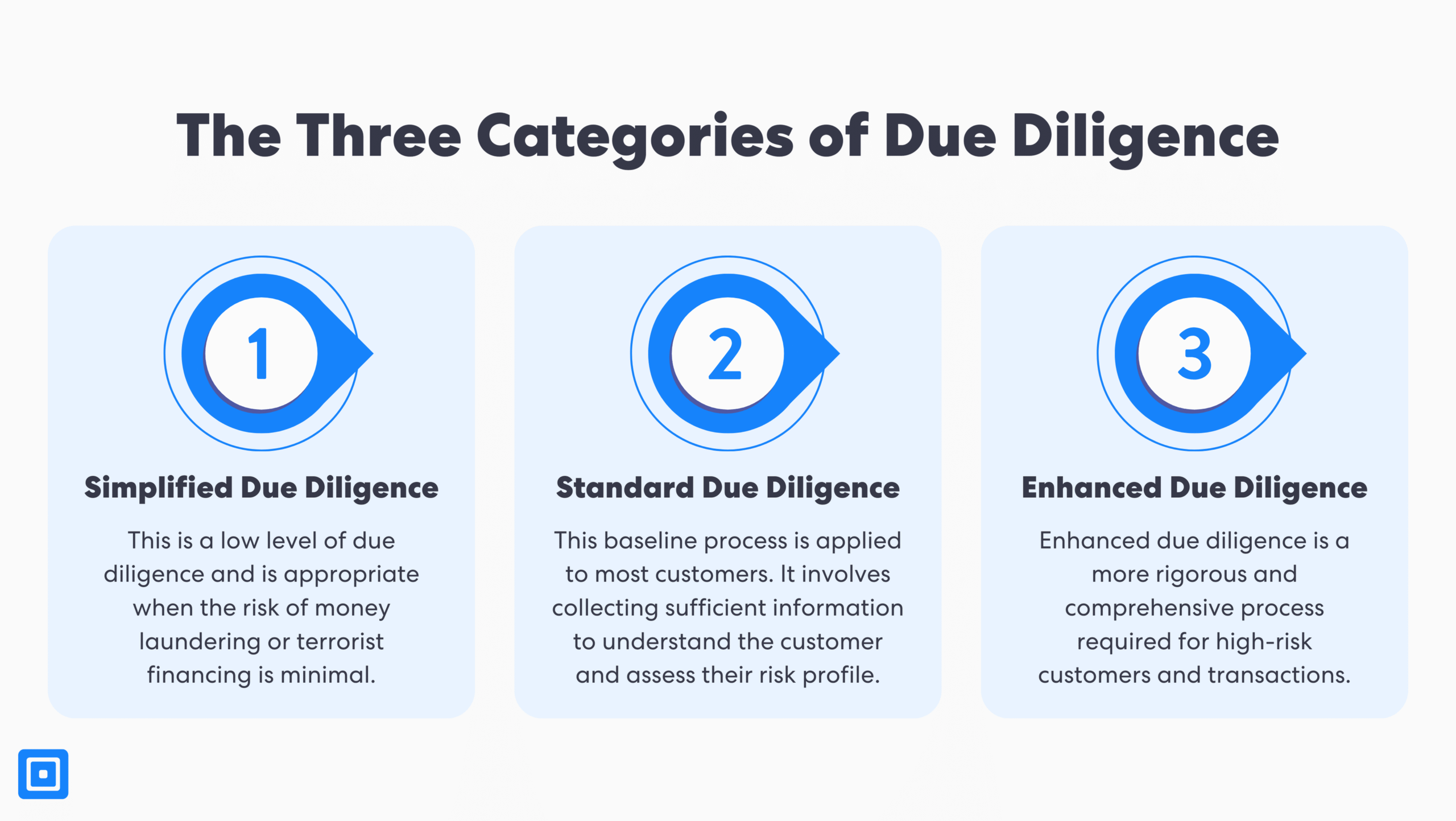
### ****Simplified Due Diligence (SDD)****
SDD applies to low-risk customers or one-off transactions. The diligence check customers experience is far less intensive than others, but it is not optional. A well-designed SDD compliance workflow might include light-touch checks for risk management. This includes multi-bureau verification, sanctions screening, PEP screening, and basic document or biometric checks.
### ****Standard Due Diligence (CDD)****
On the other hand, CDD measures apply to potential customers and standard business activities or situations. A good majority of transactions fall under this type of risk mitigation. Here, a standard workflow would combine full identity verification, address verification, AML screening, and continuous monitoring rules. In essence, they would build workflows that match the organization’s risk needs and threshold.
### ****Enhanced Due Diligence (SDD)****
Finally, EDD is only reserved for higher-risk scenarios. This type of due diligence occurs when dealing with Politically Exposed Persons (PEPs), complex ownership structures, and different jurisdictions. It involves collecting more KYC documents, source of funds verification to prevent money laundering, and conducting ongoing monitoring of business transactions. You can learn more about the intricacies here: [Navigating the World of Enhanced Due Diligence](https://www.complycube.com/en/enhanced-due-diligence-edd-insights-and-challenges/).
## Customer Due Diligence Measures for KYC Due Diligence Checklist UK
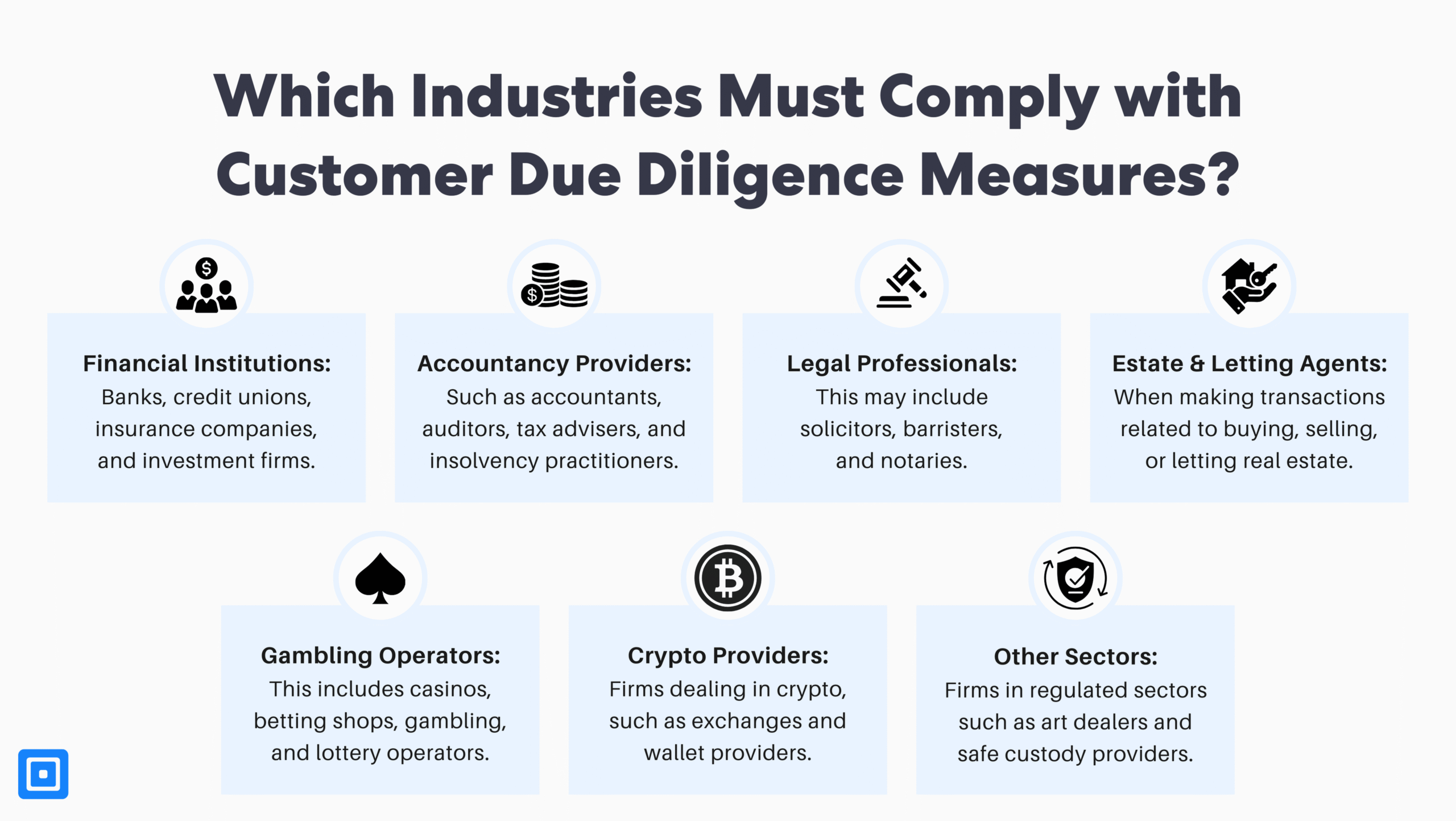
UK KYC Due Diligence Checklist measures apply to a broad set of regulated businesses within the financial sector. This includes banks, accountancy providers, legal professionals, estate agents, crypto providers and so much more.
For all of these sectors, compliance [workflows](https://www.complycube.com/solutions/identity-assurance/kyc-workflow/) are essential to avoid money laundering risks. Each industry will have different customer types, onboarding channels, and products. Therefore, every sector has specific legal obligations requiring different policy-driven workflows that apply SDD, CDD, and EDD proportionately based on risk.
## When is KYC Due Diligence Checklist UK Required?
Financial institutions and other regulated businesses must apply [customer due diligence](https://www.complycube.com/en/solutions/due-diligence-compliance/customer-due-diligence/) (CDD) measures at specific trigger points. To stay compliant and prevent financial crime, money laundering, and terrorist financing, firms must use a KYC due diligence checklist during these scenarios::
- **When establishing a new business relationship:** Verify the customer’s identity and risk profile before providing services, using a KYC workflow aligned to their segment and risk level.
- ****For large or unusual one-off financial transactions:**** Run CDD (or EDD) when a transaction exceeds set thresholds, even if there is no existing relationship, with workflow rules automatically flagging these cases.
- In the case, ****suspicious activity is detected for potential customers:**** Apply EDD and escalate through case management workflows whenever there are signs of financial crime or unexplained behaviour.
- ****When existing customer data is unreliable or outdated:**** Re-verify identity and refresh CDD if there are doubts about the accuracy or completeness of previous information.
- ****When ownership or business circumstances change:**** Reassess risk and update verification when there are material changes in beneficial ownership, activities, or risk profile.
By designing no-code workflows for these example scenarios with such triggers, firms can protect their financial system, support AML efforts, and reduce reliance on ad hoc manual decisions.
## The Five Key Components of a KYC Due Diligence Checklist UK
Now, before choosing individual checks, organizations should map their CDD process policy. They need clear workflows that can be tailored to varying customer risk profiles and jurisdictions. Embedding these flows as configurable, automated steps keeps scrutiny, approvals, and audit trails. This needs to be aligned with compliance policies. Strong due diligence in the UK usually includes five core components:
### 1. Customer Identification and Verification
The initial step in the KYC Due Diligence process is [verifying customer identities](https://www.complycube.com/en/solutions/identity-assurance/uk-identity-verification-and-fraud-prevention/). Firms and other financial institutions rely on official documents such as passports, driving licences, bank statements, or utility bills. They also increasingly use biometrics to confirm the genuine identity of the owner. Customer due diligence requirements specify acceptable documents, verification methods, and when additional checks or manual review are required.
In workflow terms, firms define separate flows for individual customers and legal entities. They embed these steps into reusable onboarding templates. This act makes sure every new potential customer is asked for the right information at the right time.
### 2. Beneficial Ownership Identification
If the customer is a company, partnership, or acting on behalf of someone else, then identifying the [Ultimate Beneficial Owner (UBO)](https://www.complycube.com/en/what-is-ultimate-beneficial-ownership-ubo/) is mandatory. [According to gov.UK](https://assets.publishing.service.gov.uk/media/5a80b627e5274a2e87dbb636/UK_EITI_Beneficial_Ownership_Guide_August_2016.pdf), the UBO is the natural person who ultimately owns or controls the entity. This applies even where ownership chains span across multiple jurisdictions or nominee arrangements.
A good checklist can set out what information must be collected, which sources should be consulted, and when a structure is considered incredibly complex. From this, workflows can flag higher-risk cases for Enhanced Due Diligence redirection. This routes them into specialist review queues with additional checks and approvals.
### 3. Understanding the Purpose and Intended Nature of the Business Relationship
Another important part of customer due diligence is understanding why they want to form a business relationship or carry out a transaction. Firms can learn this information by asking about source of funds, expected transaction volumes, main counterparties, and how the product will be used.
By building conditional questionnaires into the onboarding journey and feeding responses into a risk-scoring engine, teams can select an appropriate due diligence workflow and monitoring intensity. Any context can also help investigators later when they review alerts and assess whether a transaction genuinely looks suspicious.
### 4. Adopting a Risk-Based Approach (RBA)
Often, RBA helps firms decide how much due diligence to apply to each customer and transaction. Risk factors can consider geography, sector, transaction size and frequency, delivery channel, customer type, and adverse media history. Higher-risk customers will usually require EDD, while genuinely low-risk customers may qualify for SDD.
To manage this at scale, firms codify risk criteria into policy and use automation rules to translate risk scores into specific workflow templates. This allows programs to be proportionate and consistent, while still allowing compliance teams to adjust thresholds centrally as regulation or risk appetite evolves.
### 5. Ongoing Monitoring and Record Keeping
Due diligence does not end at onboarding. It is critical to monitor transactions and behavior throughout the entire customer journey. This ensures activities remain consistent with the stated purpose and risk profile. This is essential in detecting suspicious patterns early. They also need detailed records of checks, decisions, and evidence used.
Therefore, a checklist must include rules for ongoing monitoring, re-screening schedules for sanctions and PEP lists, and triggers for refreshing historical information. Embedding these policy rules into workflows and case management provides a clear, reportable audit trail while keeping manual effort under control.
### **Case Study: Danske Bank Missed Links to Terrorist Financing via Shell Companies**
Between 2007 and 2015, [Danske Bank’s Estonian branch](https://www.bbc.co.uk/news/business-47292732) processed more than €200 billion in suspicious transactions through shell companies with opaque ownership. Weak onboarding, failure to verify UBOs properly, and inadequate transaction monitoring meant links to criminal and terrorist networks went undetected, leading to severe regulatory and reputational fallout.
##### **Strengthening Controls with a Risk-Based AML Checklist**
Following further investigation, Danske Bank shut down non-domestic operations at the branch, overhauled its full AML framework, and embedded stricter CDD and EDD into automated workflows. This included mandatory UBO verification, improved source-of-funds checks, risk-based financial transaction monitoring, and tighter screening against [sanctions/PEP](https://www.complycube.com/en/solutions/global-screening/sanctions-pep-screening/) and [adverse media](https://www.complycube.com/en/solutions/global-screening/adverse-media-checks/) lists.
##### **Solutions & Outcomes**
- Rebuilt onboarding journeys for legal entities with stricter KYC and UBO checks
- Introduced ongoing audits, stronger governance, and enhanced board oversight
- Sharply increased focus on risk-based monitoring and regulatory expectations
## Tailoring Journeys to Risk and Customer Experience
Designing a customer due diligence process from a compliance perspective is no longer enough. Firms must blend policy, automation, and customer experience into a single onboarding and monitoring strategy. It needs to be both regulator-ready and user-friendly. Low-risk users must move quickly through lighter-touch SDD workflows, while higher-risk profiles go through longer, detailed journeys.
Analytics on completion rates and drop-off points help teams continually refine these workflow journeys. Light-touch SDD flows that combine [multi-bureau checks](https://www.complycube.com/en/solutions/identity-assurance/multi-bureau-checks/), [AML screening](https://www.complycube.com/en/solutions/due-diligence-compliance/anti-money-laundering/), and document and biometric verification into a single guided experience can dramatically reduce friction for customers. Additionally, it can lower abandonment without weakening AML defences.
The top tips and solutions above can help businesses implement and improve their Customer Due Diligence (CDD) measures. However, one crucial aspect that is always forgotten about in compliance strategies is staff training and compliance. Comprehensive training on AML and KYC will empower compliance teams to stay informed on the latest legislation updates and regulation technology. Ultimately, risk management teams are the first line of defence in identifying suspicious activity. They conduct thorough diligence checks, and maintaining strong compliance.
## Common Challenges With Basic Customer Due Diligence
Despite their best efforts, many organizations struggle to turn CDD policy into practical steps to prevent money laundering. Common pain points include poor data capture, difficulty adapting to changing risk profiles, uneven application of SDD, CDD, and EDD, and fragmented tech stacks. As a result, it is hard to obtain a reliable view of the customer profile.
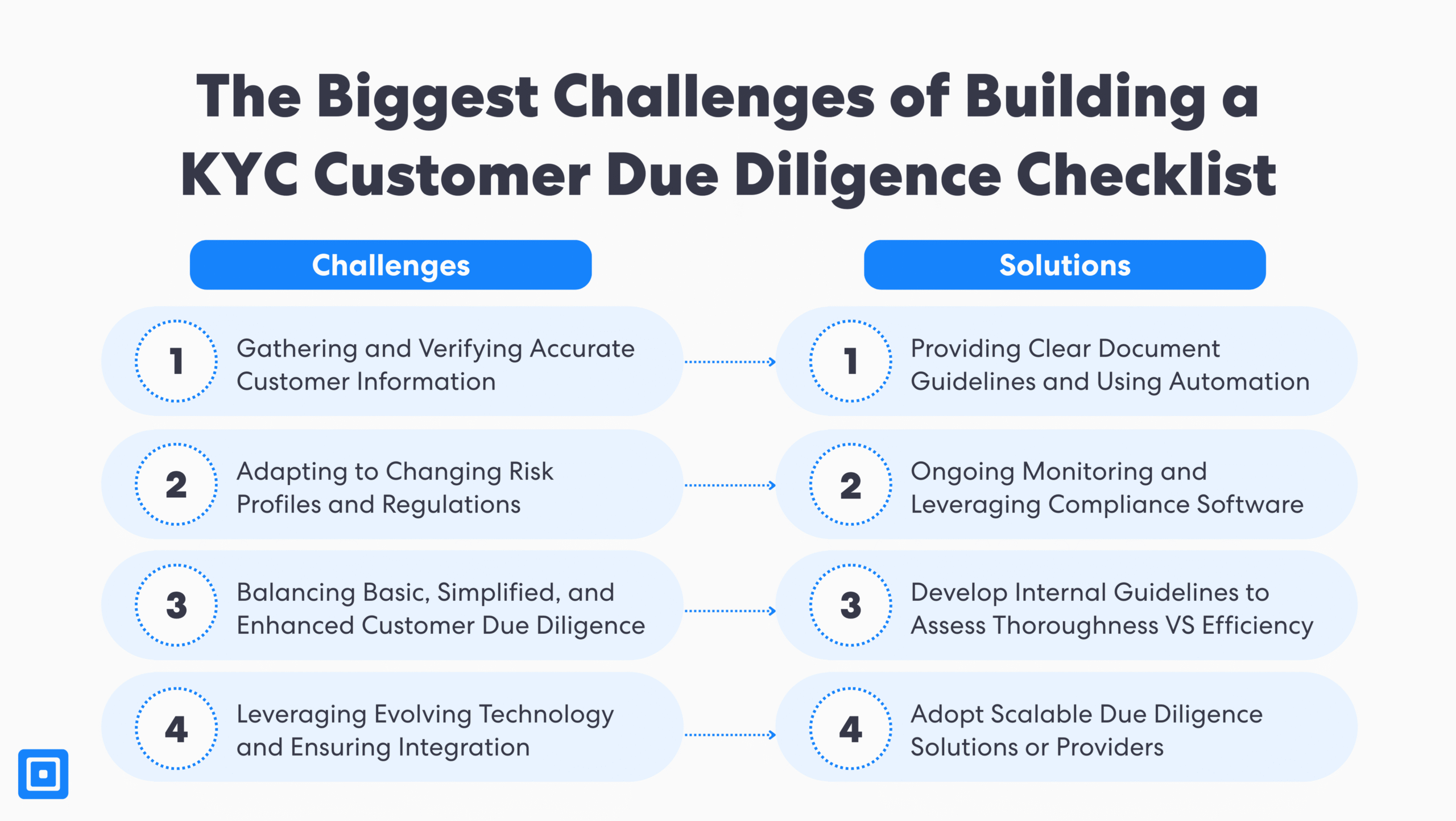
### Challenge 1: Gathering and Verifying Accurate Customer Information
Collecting reliable documents to verify identity, address, and business activities is essential. However, unclear requirements (residential address versus commercial address, home phone number versus business, etc..) and clunky capture flows often lead to incomplete information as well as high drop-off rates. By standardizing document requirements, giving clear in-flow guidance, and using intuitive capture interfaces, teams can reduce rework, speeds onboarding, and improves data quality.
### Challenge 2: Adapting to Changing Risk Profiles and Regulatory Requirements
Often, customer risk profiles evolve as they enter new markets, change ownership, or appear in adverse media, while regulations and high-risk lists also simultaneously shift. Effective ongoing monitoring and policy-based workflows recalculate [risk scores](https://www.complycube.com/en/solutions/due-diligence-compliance/risk-scoring/), trigger refreshed CDD or EDD when thresholds are crossed, and roll out new policy changes across all journeys without constant manual reconfiguration.
### Challenge 3: Balancing Basic, Simplified, and Enhanced Customer Due Diligence
Without a shared playbook, some teams over-apply EDD and create unnecessary friction, while others under-apply controls and expose the firm to regulatory or financial risk. Codifying thresholds and decision rules into clear guidelines and configurable workflow templates ensures SDD, CDD, and EDD are applied consistently, while still allowing central adjustments as risk assessment goals and appetite evolves.
### Challenge 4: Leveraging Evolving Technology and Ensuring Integration
### Key Takeaways
- A well structured KYC Due Diligence Checklist UK is essential to meet both UK and global standards.
- Use a risk-based approach to decide between Simplified, Standard, or Enhanced Due Diligence.
- Automate verification, screening, and workflows while preserving risk assessment policy controls.
- Tailor onboarding journeys to customer risk
- Strong AML training enables scalable and efficient AML compliance programs.
## Bolster Compliance with Robust KYC Due Diligence Checklist UK
Crafting a strong KYC and CDD process is critical for aligning with regulatory requirements. It provides cost savings, as well as safeguards customer and business relationships from criminals. By verifying customer identities, assessing risk accurately, and mapping policies into practical workflows, firms can tailor Simplified, Standard, and Enhanced Due Diligence to each customer segment. They can prove that KYC due diligence checklist measures are applied consistently in practice.
A dynamic, workflow-driven approach prevents financial crime, supports secure onboarding, and creates positive customer experiences while reducing remediation costs and enabling scalable compliance. To strengthen your KYC/AML process, [get in touch with our team at ComplyCube](https://www.complycube.com/en/contact/contact-sales/) to design automated workflows with deep [document](https://www.complycube.com/en/solutions/identity-assurance/document-verification/) and [biometric](https://www.complycube.com/en/solutions/identity-assurance/biometric-verification/) coverage and flexible policy controls tailored to your risk appetite.
[](https://www.complycube.com/en/contact/contact-sales/)
## Frequently Asked Questions
What is included in a KYC Due Diligence Checklist UK?
A UK-specific KYC Checklist includes identity verification using acceptable UK documents, beneficial ownership checks for UK-registered entities. It includes risk assessment of business relationships and customer risk profiles under UK AML regulations, and ongoing monitoring in line with guidance from HMRC, FATF and the FCA to prevent money laundering and other financial crime.
Which UK businesses are legally required to conduct customer due diligence?
Under the UK Money Laundering Regulations 2017, all regulated businesses including banks, estate agents, accountants, law firms, and cryptoasset providers operating in the UK must apply Customer Due Diligence measures when onboarding clients or processing qualifying transactions.
When must enhanced due diligence (EDD) be carried out in the UK?
UK firms must apply EDD when dealing with Politically Exposed Persons (PEPs), individuals in high-risk third countries, or any customer activities flagged as suspicious. This also includes situations where source of funds or ownership structures cannot be easily verified using UK or international registries.
How can UK-based companies automate KYC Due Diligence while complying with UK regulations?
UK-regulated firms can automate KYC by using platforms that support biometric identity verification, UK-specific document recognition, multi-bureau AML screening, and integration with UK regulatory requirements such as those enforced by the FCA, HMRC, and the NCA.
Why do UK compliance teams trust ComplyCube?
ComplyCube offers a UK-ready compliance solution with support for FCA-regulated workflows, local document coverage, multi-bureau AML screening, biometric verification, and no-code onboarding templates. Trusted by UK financial institutions and professional services firms, ComplyCube helps ensure full compliance with UK KYC and AML standards.
**Categories:** Guides
**Tags:** Know Your Customer
---
### [How SSN Validation Works: A Practical Guide](https://www.complycube.com/ssn-validation-check/)
**Published:** November 28, 2025
**Author:** Rithu Jagannath
**Excerpt:** Discover how SSN validation checks identify invalid, deceased, or mismatched Social Security numbers early in the process, minimising fraud risks, reducing manual review, and enhancing compliance across U.S. customer onboarding journeys.
**Content:**
**TL;DR:** SSN validation confirms a **Social Security Number (SSN)** and matches the person’s name and date of birth in **trusted records.** An SSN validation check (or SSN check) gives quick, reliable signals to **stop recycled or deceased numbers** and support KYC/AML decisions.
## What is SSN Validation?
The SSN validation method checks that the nine-digit number follows the correct structure and fits within the Social Security Administration (SSA) issuance ranges, ensuring it could have been legitimately assigned. With consent where required, it also verifies that the SSN and name align with authoritative Social Security records to strengthen overall assurance.
As a result, this early signal is essential for AML workflows. An SSN check blocks clearly invalid, fabricated, or misused identities before they reach credit decisioning, onboarding approval, or payout stages. It routes only uncertain cases to step-up verification, such as document or biometric checks, without slowing legitimate customers.
## Introduction to Social Security Numbers & SSN Validation
Social security numbers have been a cornerstone of the United States’ social safety net. Brought in through President Franklin D. Roosevelt’s Social Security Act, its original purpose was for wage reporting purposes over their lifetime to calculate social security retirement benefits.

Today, the SSA assigns a Social Security number to every citizen and eligible resident from birth. It acts as a primary personal identifier. A social security identification method is important for private companies and employers alike for earnings reporting, Customer Identification Program (CIP) checks, KYC checks, credit assessments, audits, and more. By leveraging SSN check tools, organizations can be compliant by safeguarding sensitive information for registered users. It also ensures that regulatory reporting ties back to the correct individuals in the SSA’s system while handling large volume requests.
> Social security number validation is a small step with a large impact.
Joshua Vowles-Dent from ComplyCube explains that, “Social security number validation is a small step with a large impact. When you verify social security numbers with SSN checks up front and link results to document checks, you lower fraud and protect the reporting of earnings information. It also creates an audit trail that examiners can follow with zero friction.”
This unique nine-digit sequence evolved from a simple wage-tracking number to the national identifier of the United States in the span of almost a century. That’s why SSN validation checks are still a necessary part of maintaining the American civic system.
## The Role of Social Security Cards in SSN Validation
The social security card is a document that displays an individual’s social security number. Public and private companies must check both the name and the number on the card. This is to determine legitimacy against social security’s records and be compliant with SSA rules. It is vital for preventing fraud and fulfilling wage reporting purposes.
The [SSA sets clear guidelines ](https://blog.ssa.gov/social-security-updates-recently-announced-identity-proofing-requirements/)and explains how enrolled private companies and organizations can efficiently process large-volume social security number verification requests. Companies use databases that track, note, and verify current and former employees and validate whether each individual has properly enrolled in the Social Security system. These SSN checks keep workforce information accurate and help organizations meet regulatory standards.
## How SSN Validation Can Verify Social Security
At the very minimum, social security validation checks that the SSN number is nine digits. Regulations stipulate that they must not have all zeros, and match the current country issuance rules. For example, a valid social security number might be 123-45-6789, while an invalid example would be 000-00-0000 or a number with fewer than nine digits.

For this reason, effective SSN validation confirms whether the number could have been issued by the [Social Security Administration](https://www.ssa.gov), using established issuance patterns. It compares the applicant’s name, birth date, and location against authoritative records to identify inconsistencies or potential fraud signals. This process also flags SSNs linked to deceased identities, strengthening overall checks.
Today, verification and screening platforms validate whether U.S. citizens have accurate social security numbers issued. They can also, at scale, detect common errors, such as transposed digits or a maiden name mismatch for registered users. When information does not line up, reviewers will receive a clear reason to re-collect the following information and correct records before filings or payouts proceed.
## How SSN Validation and Social Security Supports AML and KYC
AML and KYC start with accurate identification. An SSN validation check can assess structure and issuance, then cross-references the number and name against authoritative sources. It prevents obviously invalid or recycled SSNs from reaching onboarding, credit decisioning, or payouts. Then, SSN check programs apply a risk-based approach to approve low-risk customers, or step up to [Document Verification](https://www.complycube.com/en/solutions/identity-assurance/document-verification/) and [Biometric Verification & Liveness](https://www.complycube.com/en/solutions/identity-assurance/biometric-verification/).

Social Security-based controls strengthen CIP, Customer Due Diligence (CDD), and Enhanced Due Diligence (EDD) by reducing false starts and ensuring cleaner inputs. They help analysts focus their time on genuine risk with registered users instead of avoidable mismatches or bad data. These controls also improve sanctions and adverse media screening by ensuring the identity you review, whether a customer or employee, is real and accurate.
### Evidence, Audit, and AML/KYC Policy Alignment
AML examiners expect defensible processes, not guesswork, when it comes to SSN. SSN validation methods generate clear, time-stamped outcomes that link to the customer file and are mapped to internal policies. Teams should then record the purpose, value, consent, inputs used, and the match result, which supports monitoring, QA sampling, and model governance.
When exceptions arise, the SSN check audit trail verifies what was reviewed and why the case required escalation. It documents the full decision path, showing how outcomes align with AML and KYC procedures. Then, this transparency streamlines periodic reviews and remediation. It also makes responding to regulator requests much faster and more predictable.
### Running KYC and AML Operations at Scale for SSN Validation Checks
To scale KYC operations, identity verification controls need to be simple, fast and effective. Collect the SSN inline, run instant automated verification, and present a plain outcome that routes to the next step. This reduces rework, helping teams handle large volume requests during peak onboarding. It also shortens the time to social security approval across banks, credit unions, fintech lenders, payroll providers, utilities, and marketplaces.
Companies can use input masks to block impossible SSN patterns, such as all zeros or entries with fewer than nine digits. They can also prompt applicants to confirm details from their Social Security card if the first pass fails. These small UX touches improve precision, reduce abandonment, and keep AML and KYC operations consistent at scale.
### **Case Study: Intercepting Mortality-Linked SSN Fraud**
**A Fraudster Reuses a Deceased Individual’s SSN**
In March 2025, a U.S. credit issuer identified several applications tied to the [SSN of a woman who had died](https://www.ssa.gov/dataexchange/request_dmf.html?) in 2014. The fraudster built a convincing synthetic identity using a prepaid mobile number, fabricated pay stubs, and a rented mailbox as the residential address. Because the SSN appeared structurally valid and the supporting documents looked consistent, the profile passed basic PII checks and began to move toward credit underwriting, creating a [real risk of loss](https://www.ftc.gov/news-events/news/press-releases/2025/03/new-ftc-data-show-big-jump-reported-losses-fraud-125-billion-2024) without early intervention.
**How ComplyCube’s SSN Layer Helps**
ComplyCube’s SSN verification service validates every SSN against mortality data and SSA issuance rules, instantly flagging deceased or impossible numbers. With consent where required, the platform performs an authoritative SSN+name match to confirm whether the identity aligns with official records. When inconsistencies are detected, the case can automatically trigger additional due diligence, such as [Document Verification](https://www.complycube.com/en/solutions/identity-assurance/document-verification/) and [Biometric Verification & Liveness](https://www.complycube.com/en/solutions/identity-assurance/biometric-verification/), while legitimate users continue onboarding without friction.
**Outcomes**
- Verify social security numbers and stop deceased SSNs at the identity gate
- Underwriting losses avoided through early interdiction
- Audit-ready logs supporting AML, CIP, and FATF expectations
- Manual review workload reduced by filtering out clear fraud cases
## SSN Validation Use Cases Across Key Industries
SSN validation plays a central role in identity assurance, fraud prevention, and regulatory compliance across the U.S. landscape. While its original purpose was administrative, the SSN is now a critical signal that helps organizations verify individuals across databases with higher accuracy. Below are a few examples of key industries where SSN checks deliver the greatest impact:
### **Financial Services & Fintech**
Financial institutions use SSN validation to meet CIP and AML requirements, ensuring that customers are who they claim to be. Verified SSNs improve screening, reduce false positives, and support more reliable risk scoring. They also enable lenders and fintech apps to connect applicants to credit files, strengthening onboarding decisions and preventing synthetic identity fraud.
### **Crypto Exchanges & Digital Asset Platforms**
Crypto platforms rely on SSN checks to streamline account opening in fully remote onboarding environments. Validated SSNs help exchanges reduce false positives in AML screening and comply with Travel Rule expectations. They also help detect synthetic profiles, prevent account takeovers, and ensure legitimate users are linked to fiat funding sources.
### **Healthcare & Insurance Providers**
[Healthcare organizations use SSN](https://ors.od.nih.gov/pes/dis/VisitingScientists/Documents/ssn_overview.pdf) validation to improve patient matching and reduce duplicate or conflicting records. SSN checks help identify invalid, mismatched, or deceased identities, protecting against medical identity fraud. Insurers also depend on SSN validation to ensure accurate enrollment, claims processing, and benefits verification.
### **Gig-Economy Marketplaces & Staffing Platforms**
Gig-economy platforms use SSN validation to authenticate employees and prevent the creation of fake or duplicate profiles. SSN checks help build trust and safety for customers relying on hired employees, contractors, and delivery partners. Staffing providers also benefit by verifying employment eligibility and accurate payroll and tax reporting from day one.
### Key Takeaways
- **SSN validation checks** confirm with the Social Security Administration preventing **identity theft**.
- **Employers check** social security numbers **for wage reporting purposes, Internal Revenue Service (IRS)** and **aid programs**.
- **Instant automated verification** helps handle **large volumes of requests** consistently.
- Early SSN checks **reduce manual reviews** and enable **step-ups to documents and biometric.**
- **Strong security**, clear retention, and audit logs **ensure compliance and trust**.
## Where Social Security Fits in the KYC/AML User Journey
Place SSN validation checks immediately after basic information intake and then route results. Valid numbers move forward to decisioning, while exceptions trigger a focused step to validate names, date of birth, or address. If risk remains, step up to document verification or biometric verification and liveness for higher assurance.
This pattern keeps good users moving while stopping identities that would otherwise break down during verification. It also enables organizations and employers to follow a risk-based approach that aligns with regulatory expectations. By standardizing decisions, it ensures consistent outcomes across products and lines of business.
In summary, the SSN validation check is a precise compliance control that protects identities, improves wage reporting accuracy, and strengthens AML programs. When you verify social security numbers early, integrate results into clear workflows, and maintain secure, auditable records, your organization complies with rules and delivers a smoother experience for customers and employees alike. Speak to a [member of our team](https://www.complycube.com/en/contact/contact-sales/) to learn more about how you can integrate SSN validation checks into your compliance workflow today.
## Frequently Asked Questions
What is a SSN validation check, and why is it crucial for AML programs?
An SSN validation check confirms that a social security number is correctly formatted, appears to have been assigned by SSA, and is still valid for the stated purpose. When combined with name, birth date, and address checks, it helps prevent identity theft and supports AML requirements by catching impossible or never-assigned numbers before accounts are opened or payouts occur.
How do employers use SSN validation for wage reporting?
Employers and payroll teams use the SSA’s free online service to verify names and Social Security numbers for wage reporting purposes. Registered users at enrolled private companies can submit single lookups or large volume requests to validate new hires and current or former employees, reduce errors, and keep accurate records for IRS filings and social security benefits.
What information should be collected to improve SSN matches?
Programs typically collect the social security number, full employee names, date of birth, and current address. Matching these details against Social Security’s records improves validity, reduces false checks caused by typos, and keeps company data clean. If a match is rejected, request a quick correction and confirm details from the social security card.
How does SSN validation support privacy and security expectations?
Access should be limited to approved users, with encryption in transit and at rest, role-based permissions, and redaction in downstream systems. Clear retention schedules and audit logs help organizations comply with rules, maintain correct records, and show that sensitive data is handled securely and responsibly.
How does ComplyCube’s SSN check help businesses in practice?
ComplyCube verifies Social Security numbers in seconds, checking format, issuance, and mortality status with instant automated verification. The service scales to handle large volume requests, helps employers and financial institutions verify Social Security details for new hires and applicants, and connects results to document checks and biometric verification and liveness when higher assurance is required.
**Categories:** Guides
**Tags:** Identity Verification
---
### [Online Fraud Prevention with IDV Solutions](https://www.complycube.com/online-fraud-prevention-with-idv-solutions/)
**Published:** September 6, 2024
**Author:** Andreea Balasa
**Excerpt:** Digital Identity Verification, or IDV solutions, are being adopted faster than ever, acting as online fraud prevention and deepfake detection tools for firms. Read on to learn how AI Identity Verification could benefit your firm.
**Content:**
**TL;DR:** Digital Identity Verification (IDV) solutions are increasingly adopted for **online fraud prevention** , combining deepfake detection technologies for sophisticated threats. However, current IDV adoption lags behind the use of AI tools to commit fraud. This guide explores the rise of **modern fraud** and how IDV solutions counter it.
## The Rising Threat of Online Fraud
Digital fraud has changed. Identity fraud can now be conducted with AI technologies, such as deepfakes, to create lifelike and sometimes indistinguishable synthetic identities. These fraudulent methodologies can bypass many existing fraud prevention systems, delivering a resurgence in demand for new IDV technology.

### Fraudulent Identity Documents
Fraudulent identity documents continue to threaten the digital economy. These fake documents, such as passports and driver’s licenses, are created with sophisticated techniques, bypassing existing online fraud prevention and security onboarding systems due to their meticulous detail.
- Counterfeit documents are reproductions of ID cards or other [Know Your Customer](https://www.complycube.com/en/solutions/due-diligence-compliance/know-your-customer) (KYC) documents. They are made using high-precision printing techniques and official materials, and their resemblance to genuine documents is uncanny.
- Forged documents are authentic documents that have likely been stolen and tampered with. The tampering could be regarding the stock image, date of birth, or other details that the fraudster needs to change to commit malicious acts.
### Deepfakes Threaten the Modern World
Deepfakes represent one of the most captivating yet alarming advancements in digital fraud. They utilize AI to generate ultra-realistic fake images, videos, sound, and other media, which can be used for multiple malicious activities. The most common detriment to businesses is the use of deepfakes in the Identity Verification process.
- Misrepresentation in the media.
- Identity theft to bypass IDV.
- Blackmail and forced coercion.
- Sophisticated phishing scams.
Deepfake technology has become so advanced in such a short space of time that even relatively sophisticated IDV solutions can be fooled by them. This begs the need for businesses to search for the most intuitive and reliable KYC onboarding provider. You can learn more here: [Deepfake Detection Software](https://www.complycube.com/en/deepfake-detection-software-preventing-fraudulent-content/).
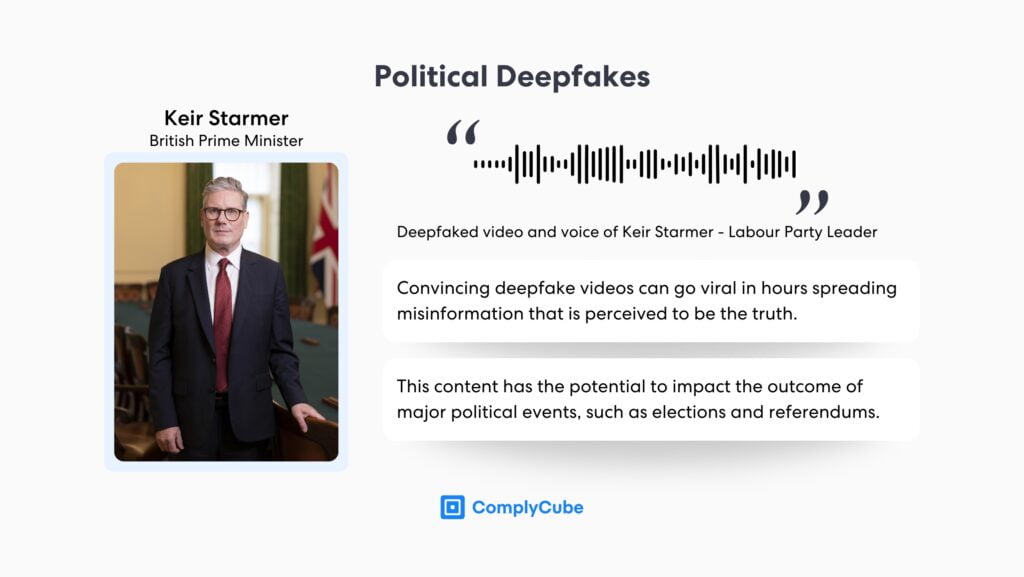
### Increased Reports on Account Takeovers and SIM Swap Fraud
The attack and exploitation of communication avenues, such as mobile and email addresses, have become a prevalent form of digital fraud. As of the beginning of 2025, the FBI reported more than [$262 million](https://www.securityweek.com/account-takeover-fraud-caused-262-million-in-losses-in-2025-fbi/) in losses from ATO. With ATO, criminals hijack a customer’s account to access sensitive information and can use a mix of methods, including phishing, SIM swapping, and credential stuffing.
- Unauthorized access to financial and social media accounts
- Stealing personal information and monies
- Identity theft for fraudulent transactions
- Service disruptions and loss of customer trust
Furthermore, fraudsters are exploiting the use of VPNs and fake numbers from free online services to circumvent basic geo-checks. This enables them to bypass KYC services during onboarding, which can be critical, especially if sanctioned person gain access to financial systems or services.
## The Need for AI-Powered IDV Solutions
The Federal Trade Commission (FTC) reported significant increases in general fraud, with financial losses to consumers amounting to over [$12.5 billion in 2024](https://www.ftc.gov/news-events/news/press-releases/2025/03/new-ftc-data-show-big-jump-reported-losses-fraud-125-billion-2024) alone. This represents a 25% increase from the previous year. Digital fraud, however, is growing even quicker, and this is emphasized by the proliferation of deepfake attacks. For example, in 2024, a [deepfake AI gang](https://cointelegraph.com/magazine/okx-11m-deepfake-ai-zipmex-sec-microvisionchain-grants-asia-express/) reportedly drained a crypto Centralized Exchange (CEX) account of all of its funds in just 25 minutes.
The exchange in question was OKX, a leading CEX with a global reach that fell victim to fraudsters using deepfakes to bypass identity authentication software to gain total access to the account. This corroborates a recent ComplyCube guide discussing how the crypto industry, in particular, is currently battling a deepfake crisis. You can learn more about the technology behind online fraud prevention here: [Why Identity Verification AI is Crucial](https://www.complycube.com/en/why-identity-verification-ai-is-crucial/).
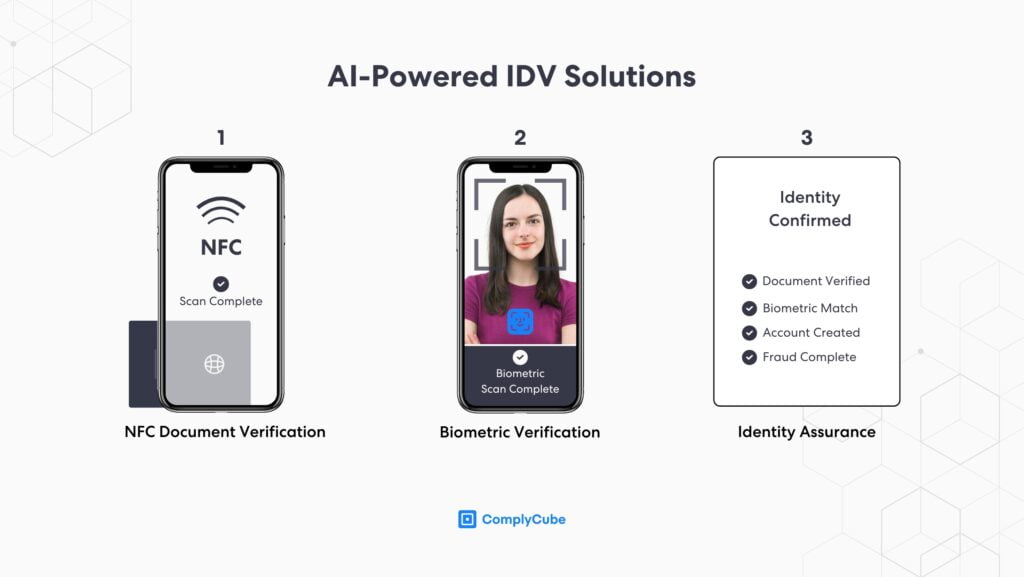
## Online Fraud Prevention and IDV Solutions
A robust KYC and onboarding process is the most effective method to prevent online fraud. With automated KYC, firms can scan a user’s identity document and match it against a selfie image taken live during the onboarding process.
These processes are known as document verification and biometric verification, respectively. Together, they form the foundation of modern KYC and, when developed properly, act as the best defense against online fraud and deepfakes.
## Intelligent Fraud Solutions Pre-KYC
A company might opt for fraud intelligence solutions to verify customer identity cost-effectively and straightforwardly. This includes solutions such as email, phone, and OTP verification, which enable businesses to assess the likelihood of fraud from customer risk profiles. This frictionless layer scans for high-risk customers by analyzing IP addresses, carrier signals, and prior suspicious activity.
As customers are not required to submit selfies or documents, this method provides a non-invasive and seamless way to validate customer identity remotely without complex steps. Companies can save resources, build trust, and maintain a positive customer relationship by flagging anomalies such as VPN usage to block fraud effectively.
### Email Intelligence and Prior Abuse
It is very common to find free online services that offer false or disposable email addresses. Email intelligence solutions help combat this challenge by enabling a company to onboard genuine email addresses. Factors such as domain age, disposable addresses, and deliverability prevent fake or suspicious email addresses, including those associated with a data breach, from accessing a service.
### Robust Risk Insights with Phone Intelligence
Mobile checks provide a simple way to gather data on fraud likelihood before KYC. Firms can verify if a mobile number is genuine by checking if it has the correct format and uses a valid carrier in the specified country. Additionally, enhanced phone intelligence tools provide deeper analysis, such as recent abuse and activity, to generate a risk level score, making decision-making much quicker.
### OTP Verification for Layered Defence
One-Time Password (OTP) is a feature which allows organizations to verify a user’s mobile number or email address. It adds a strong barricade in blocking credential-stuffing, brute force, and phishing attacks. OTP service supports strong customer authentication required in several regulations, including the Payment Services Directive 2 (PSD2) in the European Economic Area (EEA).
### Device Intelligence for Behavioral Insights
During KYC onboarding, device intelligence helps businesses gather a customer or entity’s device and network as they upload documents, take selfies, or submit information. This check occurs in the background, so it does not require any additional steps from the customer. By ensuring that the device and network have not been hacked or manipulated, it offers confidence that any data collected belongs to the client.
## Identity Verification Workflow
[Document verification](https://www.complycube.com/en/solutions/identity-assurance/document-verification/) is designed to extract the user’s sensitive data while also verifying the document’s authenticity. Scanning for tampering or other counterfeit factors this process takes 15 seconds to complete, contributing to a frictionless customer experience with inbuilt protection against AI fraud.
This sensitive information immediately populates a user’s new account, including date of birth, and country of origin, amongst many others. The immediacy and availability of this data make ComplyCube’s IDV solution among the very best on the market.
Typically, for maximum identity assurance, this process is followed by a [biometric verification](https://www.complycube.com/en/solutions/identity-assurance/biometric-verification/) which can take as little as 5 seconds to complete. Leveraging bespoke AI, this process analyzes facial biometrics with powerful liveness detection software built in. These selfie images are then compared to the stock image on the KYC document to ensure the person presenting the ID matches the selfie.

Furthermore, face recognition software can be used for biometric authentication, to safeguard users’ accounts from deepfake or other presentation attacks, and to mitigate against repeat sign-ups. Facial recognition software is a fundamental technology in ensuring that the same person cannot open more than one account.
These solutions are used widely across the fintech world to safeguard the account opening process. The benefit of operating under a SaaS model is that they are entirely cloud-based solutions that can be distributed easily across many different digital channels via an Software Developer Kits (SDK) or Application Programming Interface (API).
### Powerful Identity Verification SDKs and APIs
ComplyCube’s Identity Verification solutions can be integrated in multiple ways and are a leading factor behind the company’s success. Its mobile and web SDKs and APIs offer organizations a seamless way to integrate different IDV solutions into a single workflow. Compliance teams have the flexibility to tailor a workflow to meet specific business and regulatory requirements.

Whether a startup or an enterprise, firms can implement a robust and automated IDV process within their current technology stack immediately. This unified approach reduces the dependencies on third-party providers, lowering cost and time-to-implementation. For more information about integration methods, read the company’s [document page](https://docs.complycube.com/documentation).
### Key Takeaways
- **Digital identity verification** is a critical defense against modern online fraud.
- **Deepfakes**, tampered ID documents, and account takeover methods are used to bypass KYC controls.
- **Enhanced IDV** utilizes document checks, biometric verification, and device intelligence to verify users quickly.
- **Fraud intelligence** tools include email, phone, and OTP verification to provide early fraud screening.
- **Cloud-based IDV platforms** delivered via SDKs and APIs enable firms to embed multi-layered checks.
## About ComplyCube’s Online Fraud Prevention Solution
The leading firm for IDV solutions has experienced a rapid accession in the compliance world. Operating with firms worldwide, ComplyCube works in the telecoms, crypto and fintech, digital banking, and finance industries, amongst countless others.
Named as an Anti-Money Laundering (AML) and Digital Customer Onboarding Leader in the Fall 2025 G2 awards, it is easy to see why firms are choosing to work with the London-based compliance firm. For more information on ComplyCube’s online fraud prevention solutions, including AML, KYC, and IDV solutions, [get in touch with one of our specialists today](https://www.complycube.com/en/contact/contact-sales/).
## Frequently Asked Questions
How does digital identity verification stop AI-powered deepfake fraud?
Digital identity verification employs various checks, including AI-powered biometric, document, and device verification, to confirm the identities of customers and businesses. It helps prevent fraud by blocking unidentified, high-risk users and deepfakes from bypassing critical KYC controls.
How does email, phone, and device intelligence reduce fraud risk?
Email, phone, and device intelligence analyzes critical behavioral and network signals, such as recently abused or hacked devices. The legitimacy of contact information can be verified early, enabling fraud detection at the point of entry.
Why should fintechs and crypto exchanges upgrade from legacy ID checks to modern IDV?
Modern IDV solutions utilize advanced AI and machine learning technologies to facilitate the accurate and rapid detection of suspicious activity. It helps prevent sophisticated fraud such as deepfakes and account takeovers.
How can businesses integrate SDKs and APIs to build a multi-layer fraud prevention strategy?
By integrating SDKs and APIs, firms can embed real-time identity verification solutions seamlessly into a single workflow. Ongoing monitoring, device intelligence, and document verification can be combined to provide a more robust risk analysis, preventing fraud at scale.
What role does ComplyCube play in preventing fraud and money laundering?
ComplyCube offers award-winning compliance solutions that enable businesses to prevent fraud and adhere to the highest global regulatory standards, such as the FATF. The platform delivers AML and KYC solutions, which include advanced features such as sophisticated liveness detection and Optical Character Recognition, making fraud detection and prevention more accurate, secure, and scalable as onboarding volume increases.
**Categories:** Guides
**Tags:** Identity Verification
---
### [A Digital Europe: Introducing the EUDI Wallet](https://www.complycube.com/a-digital-europe-introducing-the-eudi-wallet/)
**Published:** December 20, 2024
**Author:** Sofia Daley
**Excerpt:** Electronic Identification (eID) schemes have become a key part of Europe’s digital transformation, creating an interoperable ecosystem for identity verification. With eIDAS 2.0, the EUDI wallet will now reshape digital Europe.
**Content:**
**TL;DR:** Europe’s digital identity framework, eIDAS, has evolved with **eIDAS 2.0**, mandating **higher interoperability, security, and privacy** protections across EU member states. With it comes new eID check requirements and the **EUDI Wallet** , which is projected to fully deploy by the end of 2026. Get ahead of these changes in our latest guide.
## How is Europe Building Secure Digital Identification with eIDAS 2.0 and the EUDI Wallet?
Electronic Identification (eID) schemes have become critical to Europe’s digital transformation. It establishes a robust and interoperable ecosystem for individuals and businesses to verify identities online. At the heart of these schemes is Europe’s digital identity framework, eIDAS. eIDAS Regulation sets the standards for trust services and identity verification across Europe. It mandates the mutual recognition of eID schemes among member states, ensuring interoperability for cross-border digital services.
The EU formally introduced eIDAS 2.0 in 2023, with its implementation in progress over the course of 2024 and beyond. eIDAS 2.0 revamped regulations crafted for a modern, digital Europe. These new mandates established the “European Digital Identity Framework,” which will introduce the EU Digital Identity Wallet (EUDI). EUDI marks greater trust in digital identities, whereby European citizens, residents, or businesses can use eID check across member states without additional registration.
## The Deployment and Adoption of the EUDI Wallet
The EUDI Wallet further strengthens the European Digital Identity Framework under eIDAS 2.0. It facilitates secure and interoperable eID verification across the EU, contributing to a secure and digital Europe. The notion of a EUDI Wallet was first proposed in 2021 by the European Commission, with the aim of creating a single digital ecosystem that could span across Europe.
> EU Digital Identity Wallets are the European Union’s response to the challenges of [digital identification](https://ec.europa.eu/digital-building-blocks/sites/spaces/EUDIGITALIDENTITYWALLET/pages/791609471/What+is+the+Wallet).
The European Commission proposed to reshape the original eIDAS legislation (No 910/2014) in order to introduce this new concept of an accessible and interoperable European Digital Identity. In addition to enhancing seamless cross-border use, the introduction of a secure digital wallet would offer users increased privacy and control, granting them the power to decide what data to share and with whom.
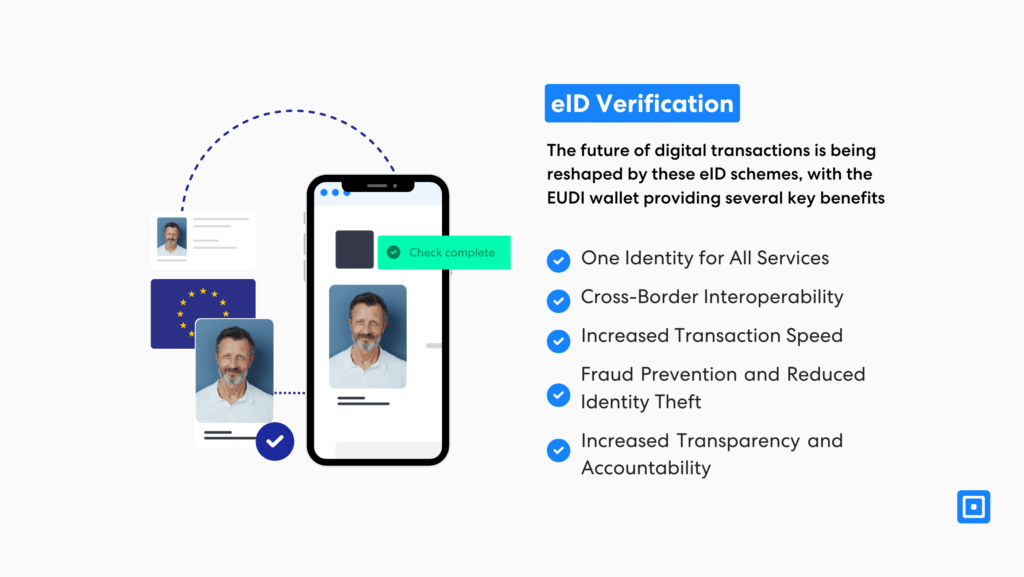
>
## Shaping The Future of Identification in the EU: What a Digital Identity Future Looks Like
Practical use cases will include opening a bank account, filing tax returns, renting a car using a digital license, dealing with public services that request birth certificates or medical certificates, applying for university, reporting a change of address, and much more. A digital future offers increased practicality, as outlined by the 2030 Digital Decade policy which currently sets out Europe’s digital transformation goal.
These targets outline that by 2030, all key public services in the European Union should be available online, thereby increasing accessibility to services such as health records across all member states. The future of digital transactions is being reshaped by these eID schemes, with the EUDI wallet providing several key benefits:
- **Increased Transparency and Accountability:** Each transaction tied to an eID check is logged securely, creating an audit trail that prevents fraudulent activity. Digital Identity Service Providers (IDSPs) can be certified under the DIATF framework, with a medium level of confidence required by HMRC.
- **One Identity for All Services:** Users will no longer need multiple credentials for different platforms. A single digital wallet will be far more practical, supporting increased interoperability across various public and private services.
- **Cross-Border Interoperability:** EU citizens will be able to use their eID across EU member states without the need for registration. This will allow for a more seamless user experience, as a Spaniard can open a bank account in Germany using the same eID credentials.
- **Increased Transaction Speed:** Manual document submissions or in-person verification can now be eliminated, with instant verification for services such as government applications or e-commerce transactions.
- **Fraud Prevention and Reduced Identity Theft:** Fraudulent transactions can be effectively prevented by using identity verification within payment processes. The fact that eIDs are government-certified minimizes the risks of fake IDs and tampering, both online and offline.
## Broader Impact: The Possibility For Economic Growth
Beyond streamlining identity verification practices, the eID scheme also lays the foundation for a fast digital economy in which transactions can be carried out quickly and securely, even across borders. This allows businesses to expand their operations across Europe member states as well as cater to a larger customer base.
> Businesses, particularly SMEs, can [expand their operations](https://nordicfintechmagazine.com/eudi-wallet-scaling-up-opportunities-for-eu-smes/) more effectively, entering new markets and handling increased workloads without the burden of fragmented or inconsistent processes.
In addition, building public trust in online systems can lead to more people carrying out purchases online, leading to economic growth. eIDs also reduce bureaucratic barriers, allowing for sectors such as FinTech, e-commerce, and healthcare to innovate and evolve at a higher speed.
## **eID Schemes Across Europe**
eID schemes have been put in place across Europe in countries like Sweden, Denmark, Norway, Belgium, and the Netherlands. While these nations have fully operational systems, other European countries are still continuing to establish their schemes.
### Denmark
Denmark’s national eID, MitID, has transformed how citizens interact with digital services. Adopted by over 90% of the population, it facilitates more than 75 million monthly transactions, highlighting its pivotal role in everyday life. Estimated at €117 million, the eID market underscores its economic and societal significance.
Introduced in 2022, MitID replaced NemID as the country’s third-generation eID, offering enhanced security and functionality. Its applications range from secure authentication to Qualified Electronic Signatures, enabling seamless access to public and private digital services.
> Today, more than [96.95 percent of the population](https://en.digst.dk/systems/mitid/#:~:text=MitID%20%28the%20Danish%20National%20eID,to%20document%20ones%20identity%20electronically.) uses their national eID in situations where it is essential to document one’s identity electronically. It allows for residents to access their public services 24 hours a day.
5.6 million Danes use MitID to verify their identities daily. The Danish Agency for Digital Government, which operates under the Danish Ministry of Finance, states that “eID is the key to digital Denmark,” cementing MitID’s position as a cornerstone of the nation’s digital-first approach.
### Norway
BankID is a cornerstone of Norway’s digital infrastructure, used by approximately 97% of the population for secure verification, authentication, and Qualified Electronic Signatures (QES). It establishes a trustworthy digital foundation across key services such as banking, government, healthcare, e-commerce, and real estate.
From logging into online banking and filing taxes to signing digital contracts and renewing driver’s licenses, BankID ensures seamless and secure access. In healthcare, it enables authentication for patient portals and e-prescriptions, while in e-commerce, it facilitates secure payments.
The transition to the BankID app represents a leap forward in user experience. With features like facial recognition, fingerprint scanning, and PIN authentication, the app reduces login times from 30 to just 10 seconds. Additionally, the new BankID Biometric option introduces a streamlined, lower-assurance solution tailored to specific use cases, enhancing accessibility and convenience.
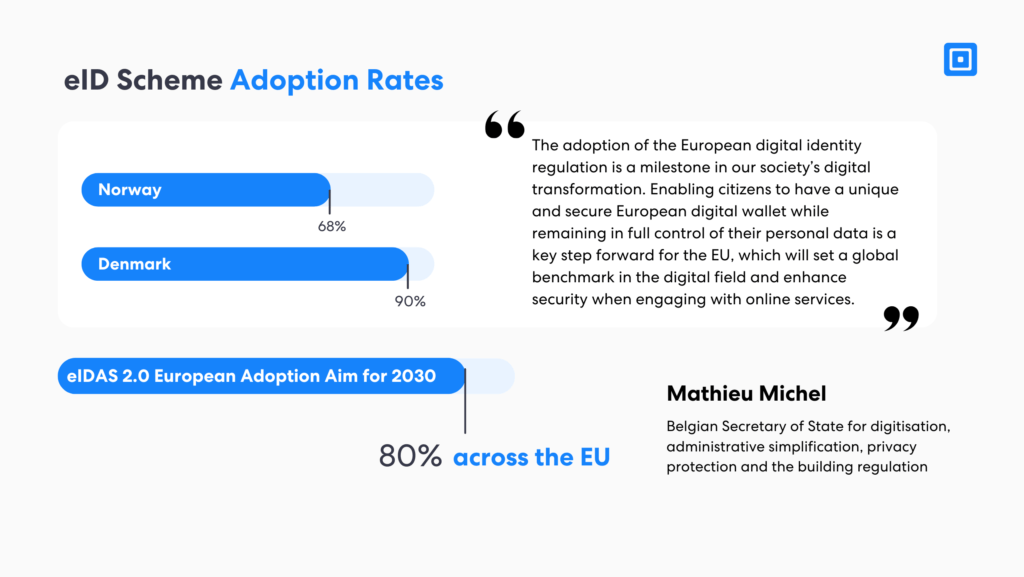
### Belgium
The eID scheme in Belgium, ItsME, was co-created by banks and telecom providers. It enables seamless identity verification. Seven million users rely on this scheme, with an estimated 80% of the Belgian adult population relying on it. Up to 1 million identity verifications are carried out each day.
ItsME has drastically up-levelled onboarding processes across Belgium, helping businesses identify clients quickly, minimise acquisition costs, prevent fraud, and achieve regulatory compliance. The ItsME platform plans to expand its operations and usage across various markets, with over 17 European countries leveraging it.
### Netherlands
iDIN, a joint initiative of Dutch banks, is transforming digital identity in the Netherlands by combining security, usability, and privacy. Built on the banks’ expertise in online banking and the widely trusted iDEAL payment service, iDIN offers a seamless way for users to verify their identity, log in to services, and sign documents electronically.
> iDIN increases usability without compromising [security and privacy](https://www.idin.nl/cms/files/Digitaal-aan-boord-en-KYC-rapport-2020-iDIN-kort.pdf "https://www.idin.nl/cms/files/Digitaal-aan-boord-en-KYC-rapport-2020-iDIN-kort.pdf"). Moreover, iDIN secures and protects personal data.
Since its launch, more than 200 organizations across industries have integrated iDIN into their customer journeys, with over 8 million transactions logged for identification and authentication. With high user trust and adoption, iDIN is quickly being utilized as the preffered method of identity verification, reducing multiple passwords and logins.
## The Role of the EUDI Wallet in Cross-Border eID Verification
As of November 2024, several EU Member States have notified their eID schemes under the eIDAS Regulation, indicating their readiness for cross-border recognition. In March of 2024, the European Identity Council outlined revised legislation and expectations for digital identities in Europe. Critical changes included:
1. Member states will provide citizens and businesses with digital wallets that can be linked to their national digital identities with proof of other personal attributes. This way, citizens can prove their identity easily by providing documents from their digital wallets through their mobile phones.
2. By 2026, all member states must make a digital identity wallet available to its citizens and accept European Digital Identity Wallets (EDIWs) from other member states according to their revised legislation.
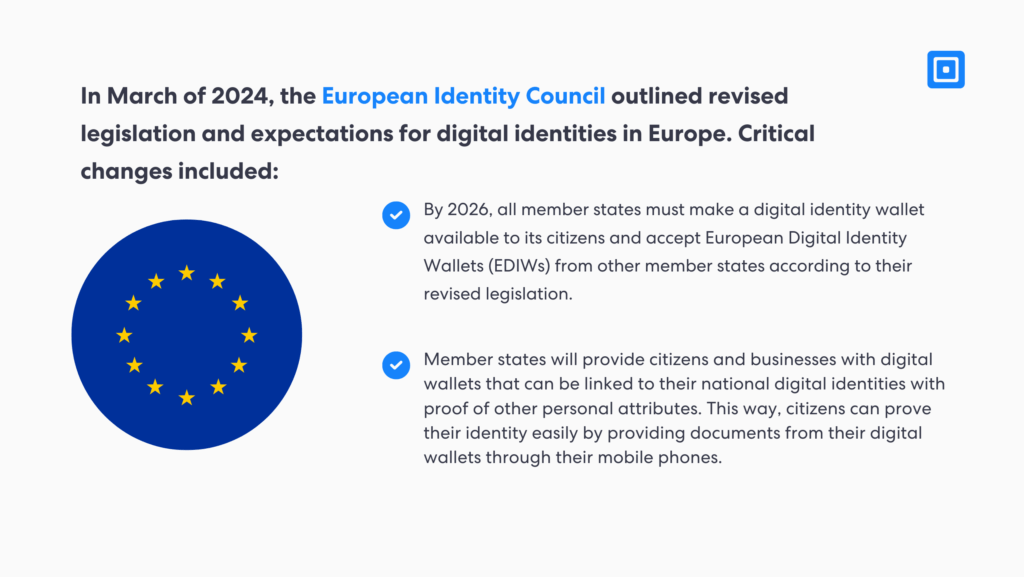
By 2030, The European Identity Council also aims for a 100% adoption rate of eID schemes across the EU. The next five years will be critical for governments, European regulators, and digital ID providers as they fine-tune the EUDI Wallet, and adoption increases across Europe.
### Key Takeaways
- **eIDAS 2.0 ensures secure**, interoperable digital identity across EU member states with enhanced privacy and data protection.
- **The EUDI Wallet** is a straightforward way to enable citizens to store, manage, and share personal IDs across borders.
- **Full EUDI Wallet deployment** is expected by the end of 2026, enabling seamless access to public and private services.
- **Countries such as Denmark and Norway** have shown successful national eID implementation and adoption, which are used and trusted by a large population.
- **Firms that leverage** multi-scheme eID checks can gain a competitive advantage through faster onboarding rates, higher customer conversion rates, and lower costs**.**
## eID Verification with ComplyCube
ComplyCube empowers businesses to harness eID check across Europe through a single integration, streamlining identity verification while ensuring compliance. By processing unique data points like ID numbers, names, and addresses from national eID schemes, ComplyCube integrates these with services such as Proof of Address (POA), AML Screening, and Ongoing AML Monitoring, delivering secure and efficient onboarding solutions.
With eID adoption surging, including Denmark’s MitID with 5.6 million Danes adopting it and Norway’s BankID supporting millions, ComplyCube’s scalable platform is built to handle high volumes across markets. Businesses can reduce onboarding times, enhance customer satisfaction, and meet stringent regulatory standards effortlessly.
As Europe moves toward the eIDAS 2.0, ComplyCube’s eID check is ideally positioned, offering a reliable, secure, and accurate way for firms to verify identities without the hassle of manual document and selfie uploads. For more information on ComplyCube’s services, reach out to their [expert compliance team](https://www.complycube.com/en/contact/contact-sales/).

## Frequently Asked Questions
What is the difference between eIDAS and eIDAS 2.0?
The eIDAS regulation focuses primarily on establishing a secure and legal framework for electronic identification, signatures, and trust services. The revised eIDAS 2.0 regulation requires higher interoperability, privacy, and security for EU member states. It introduces the EUDI Wallet as a way for users to gain greater control over their digital identities.
What are the benefits of eID checks for businesses?
eID checks enable businesses to verify and onboard customers digitally without the need for physical document submission or selfie uploads. These checks reduce fraud risk, lower identity verification costs, and streamline the customer onboarding process while meeting KYC and AML compliance requirements.
What are the requirements for eIDAS 2.0?
eIDAS 2.0 mandates greater security and data control through enhanced encryption methods and alignment with data and privacy laws, including the GDPR. Under eIDAS 2.0, European citizens and businesses have more consent and control over the data attributes they choose to share via their eID scheme.
Does eIDAS 2.0 apply to the UK?
eIDAS 2.0 does not apply to the UK as it is not a member state of the European Union. However, the UK government is actively moving toward more digitized and portable identity verification solutions. UK businesses that operate with customers or partners in the EU should comply with eIDAS 2.0 standards to ensure seamless cross-border digital identity verification and maintain regulatory alignment.
Which companies use ComplyCube’s eID check?
ComplyCube’s eID verification is utilized by a wide range of companies in regulated industries, including finance, fintech, crypto, and telecoms. These firms adopt ComplyCube’s eID check as it serves as a one-point access to multiple eID schemes. Businesses can align with stringent global KYC and AML regulations and data privacy laws through a unified eID provider.
**Categories:** Guides
**Tags:** Identity Verification
---
### [What is an Online Age Verification System?](https://www.complycube.com/what-is-an-online-age-verification-system/)
**Published:** February 29, 2024
**Author:** Andreea Balasa
**Excerpt:** Businesses distributing age-restricted products must implement an age verification system that provides the necessary level of age assurance is crucial. The right age verification software enables compliance with regulations.
**Content:**
For businesses distributing age-restricted products, implementing an age verification system that provides the necessary level of age assurance is crucial. Innovative age verification service solutions are transforming the landscape of Identity Verification (IDV). Through the use of advanced age verification software, businesses can ensure compliance with regulations while providing a seamless customer experience.
The necessity to implement such a process does not reside solely with distributors of age-restricted goods, however. From online services providing 18+ materials to social media platforms delivering age-restricted products and content, to supermarket-bought alcohol, age check systems must be put in place to protect children as well as businesses.
This guide digests the value of age verification solutions, including what they involve, whether your business should implement one, and why they are evolving into a modern-day requirement for most companies.
## What is Age Verification?
[Age verification](https://www.complycube.com/en/use-cases/process/age-verification/) is a process that ensures users comply with the minimum age requirements by law, or an institution’s specific age verification rules, to begin a relationship with a company. This procedure can take different forms depending on jurisdictional requirements and the company’s risk appetite, including but not limited to:
- Facial biometrics
- Document Verification
- Near Field Communication (NFC) Checks
A business will tailor the types of checks they are running based on the company’s Risk Based Approach (RBA), adjusting requirements and thresholds to verify whether a person is old enough to use a particular service or product. However, in certain situations, companies want to know the age of their users so they can adjust their product offerings based on their clients’ needs.
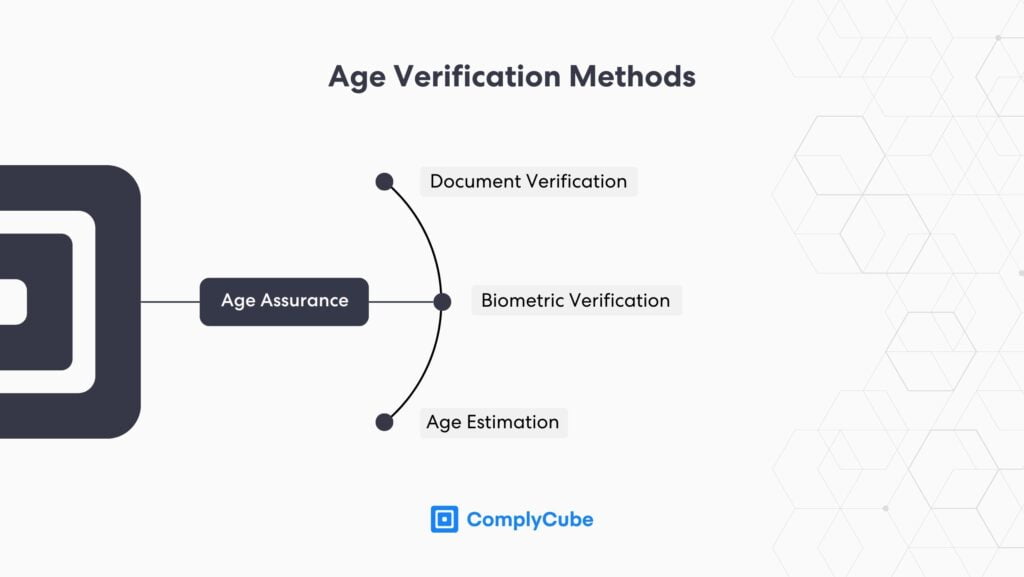
## Online Age Verification Regulatory Changes
In response to these growing global concerns, countries are introducing advanced regulatory frameworks to encourage stronger age verification procedures, protect children online, and prevent money laundering activities. Key legislative efforts include:
- [The UK’s Online Safety Bill](https://www.gov.uk/guidance/a-guide-to-the-online-safety-bill)
- [The European Union’s Digital Services Act](https://digital-strategy.ec.europa.eu/en/policies/digital-services-act-package)
- [California’s Age-Appropriate Design Code Act](https://leginfo.legislature.ca.gov/faces/billTextClient.xhtml?bill_id=202120220AB2273)
These laws are designed to endorse stricter guidelines and obligations for digital platforms, thereby introducing a safer online environment for younger users based on varying age requirements.
## Age Verification Across Industries
The legislation surrounding age verification has shifted in recent years. From dating to banking, a reliable age verification process will ensure businesses meet compliance requirements while balancing a great user experience. The internet enabled worldwide connectivity and the discovery of previously unfathomable information. However, it also enabled the circulation and availability of content and services such as alcohol vendors, adult websites, and more, that should be restricted based on age. A reliable age verification solution will mitigate this and protect both minors and the reputation of a business.
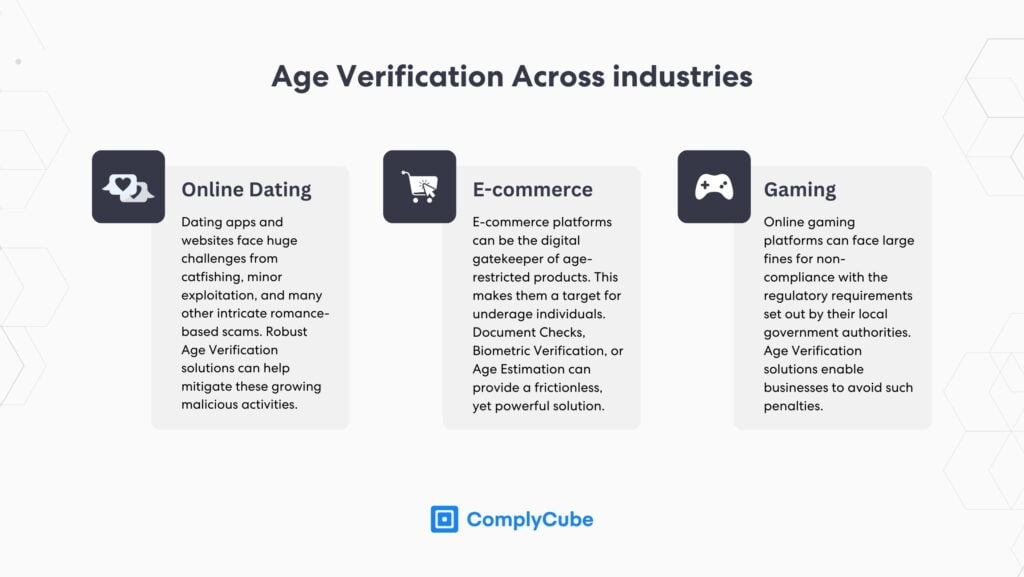
There is no single solution to help companies verify age, with various specific regulations and standards that can be spotted across industries:
### Online Dating
Dating apps and websites face huge challenges from catfishing, minor exploitation, and many other intricate romance-based scams. Robust Age Verification solutions can help mitigate these growing malicious activities and make the online dating industry a safer environment.
Learn more about it here: [**KYV: Online Dating Identity Verification For Safe Romance**](https://www.complycube.com/en/kyv-online-dating-identity-verification-for-safe-romance/)
### E-commerce
[E-commerce platforms](https://www.complycube.com/en/use-cases/industry/ecommerce/) can be the digital gatekeeper of age-restricted products, such as alcohol, tobacco, and more. This makes them an obvious target for underage individuals to attempt to purchase from them. Instant Document Checks, Biometric Verification, or even Age Estimation can provide a frictionless, yet powerful agent in deterring youngsters from purchasing age-inappropriate products.
### Gaming
Online gaming platforms can have vastly different jurisdictional regulatory requirements. However, there is generally a consensus that individuals must be at least 18 years old, or 21 in the US, to partake in some. Institutions can face large fines for non-compliance with the regulatory requirements set out by their local government authorities. Age Verification solutions enable businesses to avoid such penalties.
While companies might share the same or similar pain points regarding age verification, this does not mean they will share the same methodologies to solve them. Businesses with the same regulatory requirements can also demand varying levels of age assurance, depending on their own corporate tolerances to risk. This means that verifying a user’s age means different things to different companies, and depending on these company-specific tolerances, age verification processes can vary.
## Pain Points Solved by an Age Verification System
A study from over 2000 families found that over [50% of children play online games rated 18+](https://www.childcare.co.uk/blog/video-games#:~:text=We%20recently%20surveyed%20more%20than,olds%20watch%20an%2018%2B%20movie.). Additionally, data from 2022 indicates that [68% of 7-18 year olds own their own console](https://www.uswitch.com/broadband/studies/online-gaming-statistics/), underlining the widespread issue of underage participation in 18+ rated online gaming.
> A study from over 2000 families found that over [50% of children play online games rated 18+](https://www.childcare.co.uk/blog/video-games#:~:text=We%20recently%20surveyed%20more%20than,olds%20watch%20an%2018%2B%20movie.).
While this is a hard challenge to regulate, there are solutions available. Age verification services provide state-of-the-art technologies that streamline customer acquisition without jeopardizing the integrity of the data extraction. This allows for swift and uncomplicated customer onboarding processes.
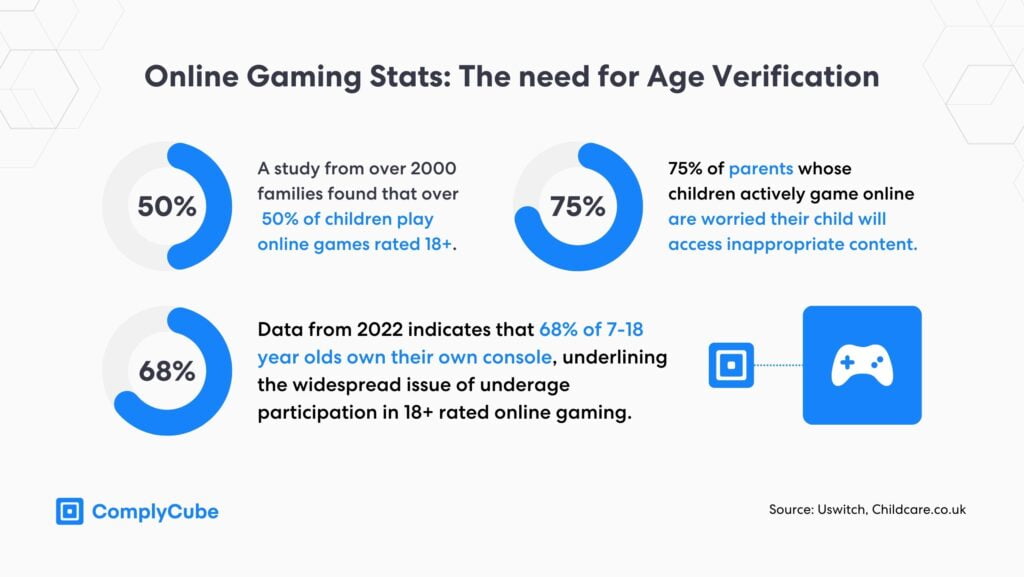
Authenticating KYC documents that verify user age can be a large pain point that companies struggle to solve independently. This is especially true when high levels of age assurance are required, and institutions must verify that document against other measures, such as a selfie check.
KYC and age verification solutions do the heavy lifting for businesses wherever they are in their growth trajectory, and these solutions can scale with a business whether they require 1,000 checks a year or 100,000. These services include, but are not limited to:
### Document Verification
Document verification is a cornerstone in any KYC strategy, providing essential insights into a user’s identity. Document check solutions use state-of-the-art AI to authenticate documents running [ID analysis on up to 25 data points](https://www.complycube.com/en/solutions/identity-assurance/document-verification/). This new technology means customer onboarding can be completed in a total of minutes instead of hours:
This solution mitigates false positives by proving more efficient and precise by reducing human error and improving a company’s scalability as customer onboarding can occur in minutes instead of hours, or longer.
- Enriched precision: AI-powered Document Verification significantly reduces false positives by achieving a level of precision. Via instant analysis of various data points, it facilitates the more reliable detection of authenticity.
- Increased volume: Document Verification services conduct checks at a far greater speed than manual processes could. This substantially reduces the net time of customer acquisition and contributes to reduced customer churn.
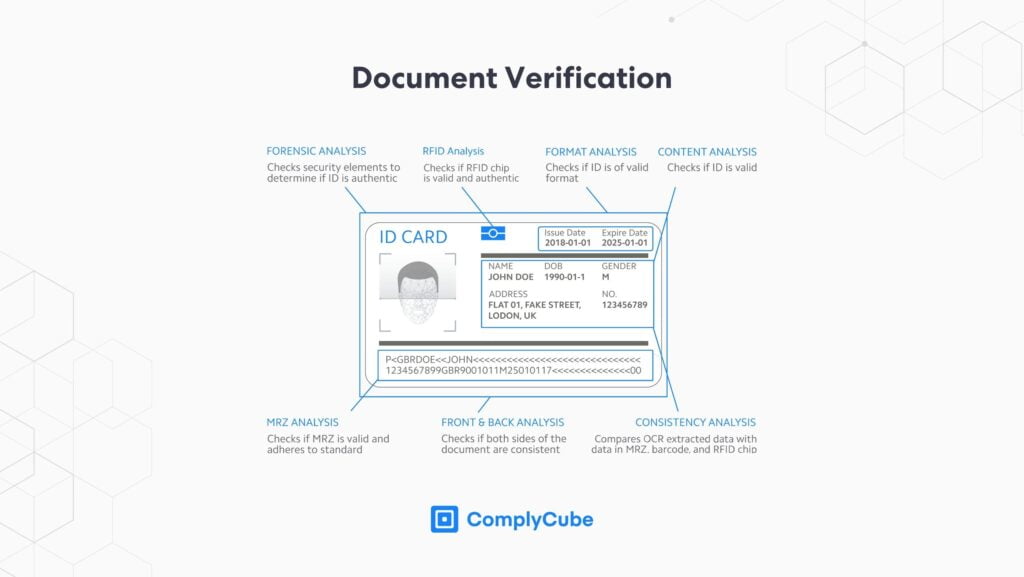
### Biometric Verification
Companies looking for a lower level of age assurance can employ an age estimation solution based on [biometric verification](https://www.complycube.com/en/solutions/identity-assurance/biometric-verification/) to estimate the age of their potential customers. However, in other cases, selfie checks can be used as a secondary method alongside document authenticity checks to enable businesses to verify the live presence of a person. Best-in-class face recognition engines that power these methods utilize 3D face maps with [Presentation Attack Detection (PAD)](https://www.complycube.com/en/solutions/due-diligence-compliance/know-your-customer/liveness-detection/) to determine if the user is genuine.
This check determines the legitimacy of a user’s presence by examining micro-expressions and skin texture. It identifies potential pixel alterations, and distinguishes between masks and disguises, along with multiple other exclusive techniques to test for image or video tampering.

### Age Estimation
Using advanced AI-powered face recognition technology, age estimation solutions instantly give an approximation of a user’s age. This service leverages the same liveness and spoof detection technology in a Biometric check. This provides a one-step, [smooth age verification experience](https://www.complycube.com/en/solutions/global-screening/facial-age-estimation/) for age-restricted content.
Age estimation is a great option for businesses providing age-gated goods or services that require limited onboarding friction and regulatory compliance. It can be performed anywhere and anytime, meaning customers are always just a selfie away from action.
If you are looking for a partner in age verification or [services pertaining to any one of KYC, AML, and IDV, contact one of our specialists today](https://www.complycube.com/en/contact/contact-sales/).

## What to look for in an Age Verification System
Age Verification is often a subsector of a broader Know Your Customer strategy. This makes it very possible for both services to be provided by the same company. For this reason, many of the key metrics to look for in Age Verification are similar to that of a KYC provider. However, 3 core features to watch out for are:
### Customizable Workflows
As previously discussed, age verification and the wider [Know Your Customer](https://www.complycube.com/en/solutions/due-diligence-compliance/know-your-customer/) (KYC) process, is an issue that demands precision and flexibility. The solution chosen by a dating app may be too brittle for a bank, and this is due to the industry-specific demands that are placed on age verification systems.
Age verification and KYC solutions are optimized for customizability and flexibility. This flexibility in their services means their solutions are optimized for any company in any industry and has been a key driver in their early growth.
### Automated and Intuitive Acquisition Processes
This portal enables the toggling of friction levels in [customer acquisition processes](https://www.complycube.com/en/use-cases/process/customer-onboarding/), enabling clients to determine their own thresholds that power their business decisions. For example, businesses can choose to automatically flag users aged 21 or younger.
This is a core element of age verification Service principles. Friction toggling is crucial for Identity Verification and KYC processes to be conducted autonomously and at scale, facilitating smooth client acquisition while mitigating the number of false positives.
### The Breadth of Document and Compliance Coverage
Automation and customizability are fundamental principles an age verification provider should deliver. However, ensuring the solutions chosen are operable to your required standards in your country, region or a global level is vital.
A primary concern could be the range of accepted documents your provider works with. ComplyCube’s list of document and compliance coverage spans 220+ territories with over 13,000 document types, ensuring that they have a broad range of business regions and potential needs covered. This underlines the company’s commitment to the business mission – building trust at scale. You can learn more here: [The Best Automated Age Verification Solutions in 2026.](https://www.complycube.com/en/best-automated-age-verification-solutions-2026/)
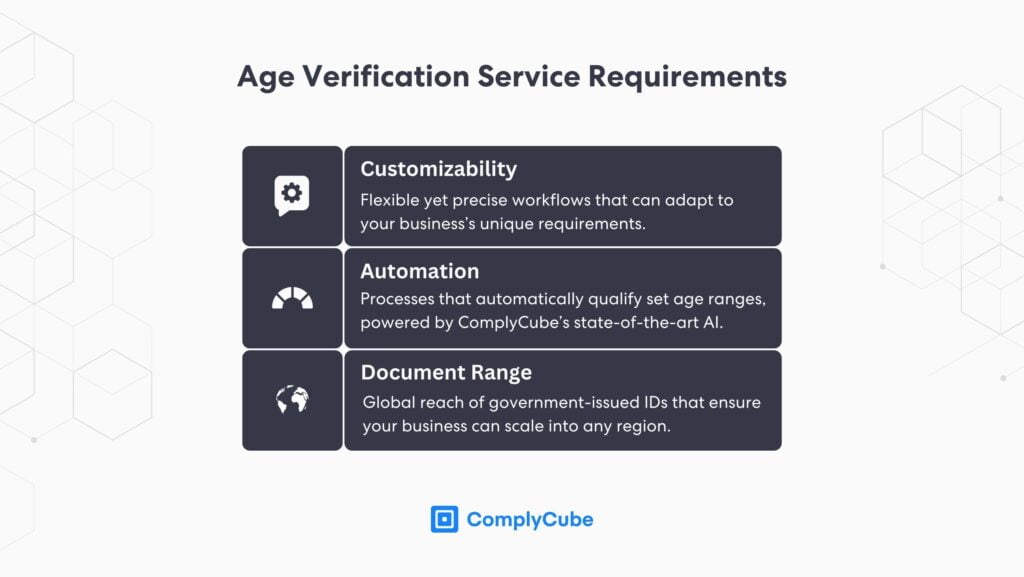
## Does Your Business Require an Age Verification System?
ComplyCube is at the forefront of identity and age verification, providing industry-leading solutions that protect both individuals and the reputation of businesses. With proprietary AI-powered document verification, biometric verification, and age estimation solutions that can be customized preferentially, ComplyCube is swiftly becoming the go-to in identity verification solutions.
If you are looking to add an age verification process or any IDV, KYC, or AML solution to strengthen your company’s operations, [get in touch with one of our specialists here](https://www.complycube.com/en/contact/contact-sales/).
**Categories:** Guides
**Tags:** Identity Verification
---
### [What is an Ongoing Monitoring Process?](https://www.complycube.com/what-is-an-ongoing-monitoring-process/)
**Published:** March 27, 2024
**Author:** Andreea Balasa
**Excerpt:** An ongoing monitoring process is vital in ensuring compliance is met with regulatory bodies. This guide discusses what comprises an AML monitoring strategy and how continuous monitoring strengthens Anti-Money Laundering efforts.
**Content:**
**TL;DR:** An **ongoing monitoring process**, also known as continuous monitoring, is **needed for any AML monitoring** strategy. Ongoing monitoring ensures businesses **keep real-time oversight** of customer risk profiles throughly automated. These tools find **changes in behaviour,** sanctions status, or exposure.
## What is Ongoing Monitoring?
Ongoing monitoring or AML monitoring is the last stage in the Know Your Customer process. Following successful CIP and CDD procedures, continuous monitoring ensures that the data businesses have on their clients’ potential risk exposure is up-to-date. This is necessary as customer circumstances can change fast at any given moment. This includes quick changes in financial health, legal issues, political or personal altercations, and much more.
Institutions that review their clients on an ongoing basis have a far stronger idea of the risks their clients might expose their business to. This allows them to make a more decisive repair act if required. As a result, ongoing AML monitoring is foundational to a business’s AML compliance strategy, specifically in the financial industry.
Global updates in AML and KYC regulation suggest that continuous monitoring will become more integral to safeguarding the financial industry. The finance industry has embraced digitalization in many ways. It has opened up new methods for money launderers to game the financial system.
The cryptocurrency market has enabled such a vehicle to bypass existing AML legislation which has forced global regulators to tighten their policies. The EU has agreed to introduce tougher due diligence measures on Crypto Asset Service Providers (CASPS), where [ongoing monitoring of users’ profiles and transactions will become common practice](https://www.coindesk.com/policy/2024/01/18/eu-provisionally-agrees-tough-crypto-due-diligence-measures-to-combat-money-laundering/).
## What are Ongoing Monitoring Processes?
There are multiple ongoing monitoring processes and strategies that a business can use. However, manually reviewing user KYC documents to do these checks would take up a vast amount of time. This time could be far more efficiently used elsewhere.
This has led to a rise in KYC verification services that bear the burden of customer compliance to allow businesses to focus on growth, efficiency, and revenue drivers. Continuous monitoring is basically the continued due diligence of users.
KYC providers offer clients fully automated workflows powered by state-of-the-art AI technologies. These customizable and automated services envelop wider customer due diligence and continuous monitoring processes. This includes services such as sanctions and politically exposed person screening, adverse media coverage, international watchlist screening as well as many others.
### Sanctions and PEP Screening
As mentioned earlier, individuals that hold a position of authority, such as a political office, are a much greater risk to the financial system. This potential risk and wrongdoing could be due to their own corruption or blackmail. Regardless of this threat’s origins, it still needs stringent forewarning to institutions engaged in a relationship with them.
[PEP Screening](https://www.complycube.com/en/solutions/global-screening/sanctions-pep-screening/) is a great risk assessment tool in the KYC and ongoing monitoring process; however, it naturally does not apply to every client. A much broader portion of clients will not have exposure to political or aristocratic influences, and therefore, PEP screening is just one of many continuous monitoring tools.
ComplyCube’s PEP Screening databases classify users across four levels of political exposure to determine their risk profile. Clients with lower PEP levels face higher risk. For instance, leading U.S. Senators wield far greater influence over national infrastructure than local civil servants. Thereby, giving them greater exposure and potential capacity for financial corruption.

### Watchlist Screening
Combining automation with a broad range of international and local watchlists provides an all-encompassing solution to background checking. Once a company has the required information about a new user, it can generate an incredibly accurate understanding of whether that individual poses a potential risk.
[Watchlist Screening](https://www.complycube.com/en/solutions/global-screening/watchlist-screening/) is typically updated around the clock, with new profiles and data integrated every day, providing a comprehensive service. This ensures businesses that employ these services are in a dominant position when it comes to compliance and AML monitoring requirements.
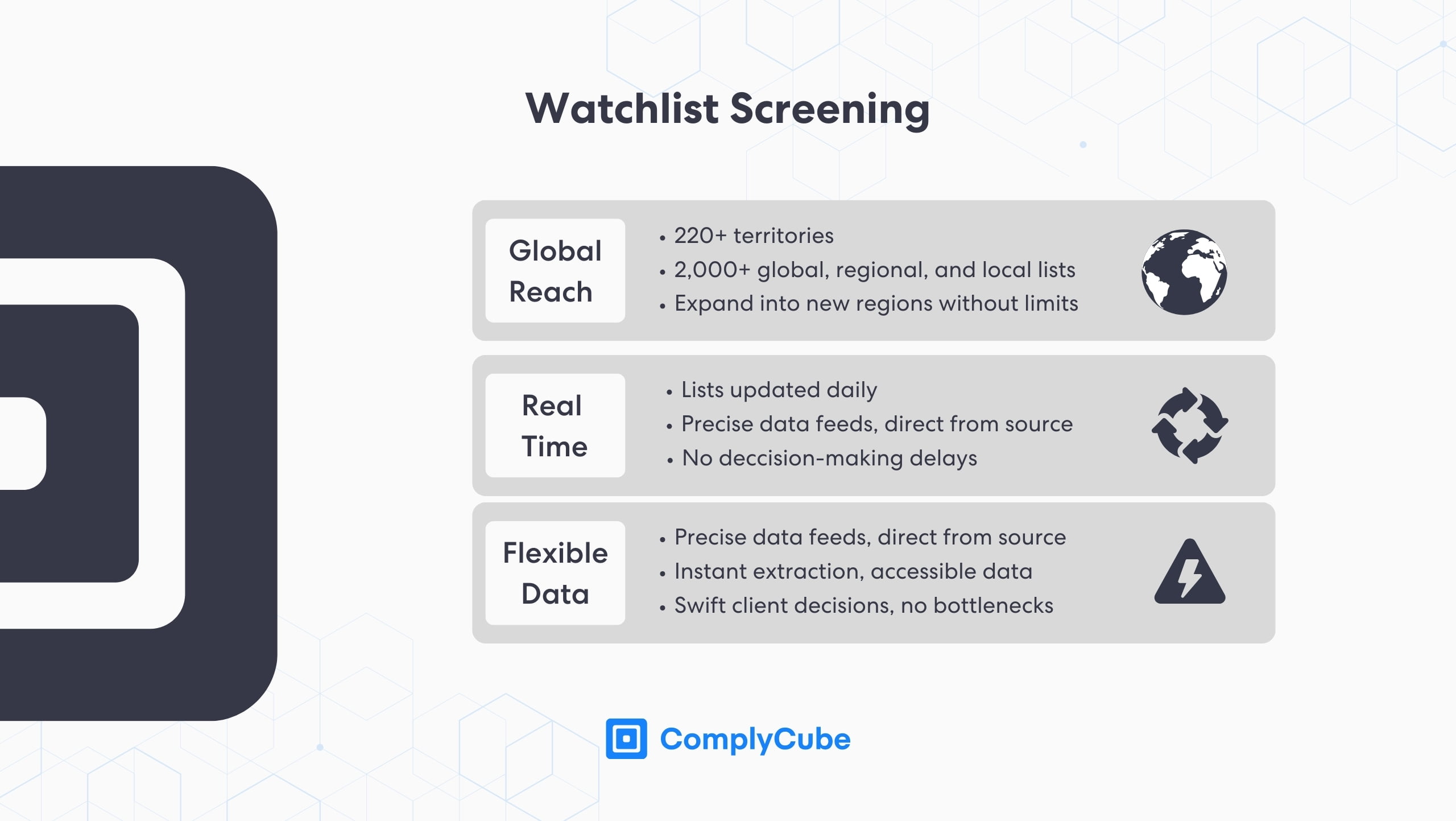
### Adverse Media
With this in mind, integrating media databases into risk profiling is a cornerstone of contemporary screening efforts. Leading ongoing monitoring processes rely on partnerships with thousands of media outlets to compile a comprehensive Adverse Media solution. As a result, this infrastructure empowers companies to conduct real-time screening of clients for negative press coverage in a wide array of malicious activities.
However, conducting [Adverse Media checks](https://www.complycube.com/en/solutions/global-screening/adverse-media-checks/) manually would require an overwhelming amount of time and resources. The process would be completed sufficiently with an automated and AI-powered solution. This gives way to the surge in machine learning technologies that continue to shift the regulatory compliance industry.

### **Case Study: Block, Inc. and Missed Opportunities in Ongoing Monitoring**
**Problem**
In 2025, Block, Inc. (owner of Cash App) was fined by US regulators for critical lapses in its Anti-Money Laundering (AML) compliance programme. The firm’s rapid international expansion outpaced its internal controls, particularly in relation to transaction monitoring and continuous due diligence. Investigations found that Block failed to implement effective ongoing monitoring, resulting in large volumes of unchecked activity that may have facilitated money laundering and other financial crimes.
**Solution**
Had Block deployed ComplyCube’s unified compliance platform, it would have implemented an intelligent ongoing monitoring system from the outset. This system would continuously screen customers in real time against global sanctions lists, Politically Exposed Person (PEP) databases, and thousands of adverse media sources. Using ComplyCube’s dynamic risk scoring and behavioural alerting features, Block’s compliance team would have been equipped to proactively identify and remediate threats before they escalated into regulatory breaches.
**Outcome**
With ComplyCube’s platform in place, Block’s ongoing monitoring process could have achieved:
- **Faster detection** of suspicious transactions and changes in customer risk
- **Substantial reduction in false positives**, enabling efficient use of compliance resources
- **Automated risk alerts** for real-time decision-making and escalation
- **Comprehensive audit trails** supporting defensible compliance actions
- **Potential avoidance or reduction of penalties** through demonstrable proactive controls
## KYC and AML: What is the Difference?
For the most part, while these processes are linked, there are integral nuances that separate them. However, both strategies help fortify a business’s efforts in countering terrorism financing, monitoring suspicious activity, and adhering to regulatory requirements. Both rely on ongoing monitoring.
### Know Your Customer (KYC)
Know Your Customer is the overarching process that underpins ongoing monitoring, Anti-Money Laundering (AML), and many other Identity Verification (IDV) processes that equip businesses with the tools to identify their customers.
KYC is an extensive and dynamic process that institutions must carry out when establishing a new customer or business relationship. KYC consists of 3 essential procedures:
1. Customer Identification Program (CIP)
2. Customer Due Diligence (CDD)
3. Ongoing monitoring

This means that KYC is not just a ‘one and done’ function. It is a process that requires fine-tuning and repeating over a user’s relationship with a business. For more detailed information on KYC Verification, read [Global KYC Verification Process in 3 steps](https://www.complycube.com/en/global-kyc-verification-process-in-3-steps/).
However, not all institutions must follow the same KYC procedure, and processes can differ vastly from one company to the next. This is because the regulatory requirements companies must meet from one sector to another are also vastly different. For example:
- A bank must comprehensively identify potential risks its clients might bring. Risk assessments in the banking industry are the most laborious because banks have direct access to the financial system. This makes them the most likely target for money laundering and other financial crimes and thus have the tightest AML regulations.
- An E-commerce site selling stationary would not have the same arduous regulatory requirements as the potential risks associated with the company’s operation are far less severe. For this reason, the company’s KYC strategy would likely be limited to a more basic procedure as the same level of identity assurance and customer information is not required.
This is known as a Risk-Based Approach (RBA). Financial Crimes Enforcement Network (FinCEN) recognizes that [every industry, and every institution, has its own unique set of operational risks](https://www.fincen.gov/news/news-releases/federal-bank-regulatory-agencies-and-fincen-improve-transparency-risk-focused). For this reason, there is no one-size-fits-all methodology for Know Your Customer verification.
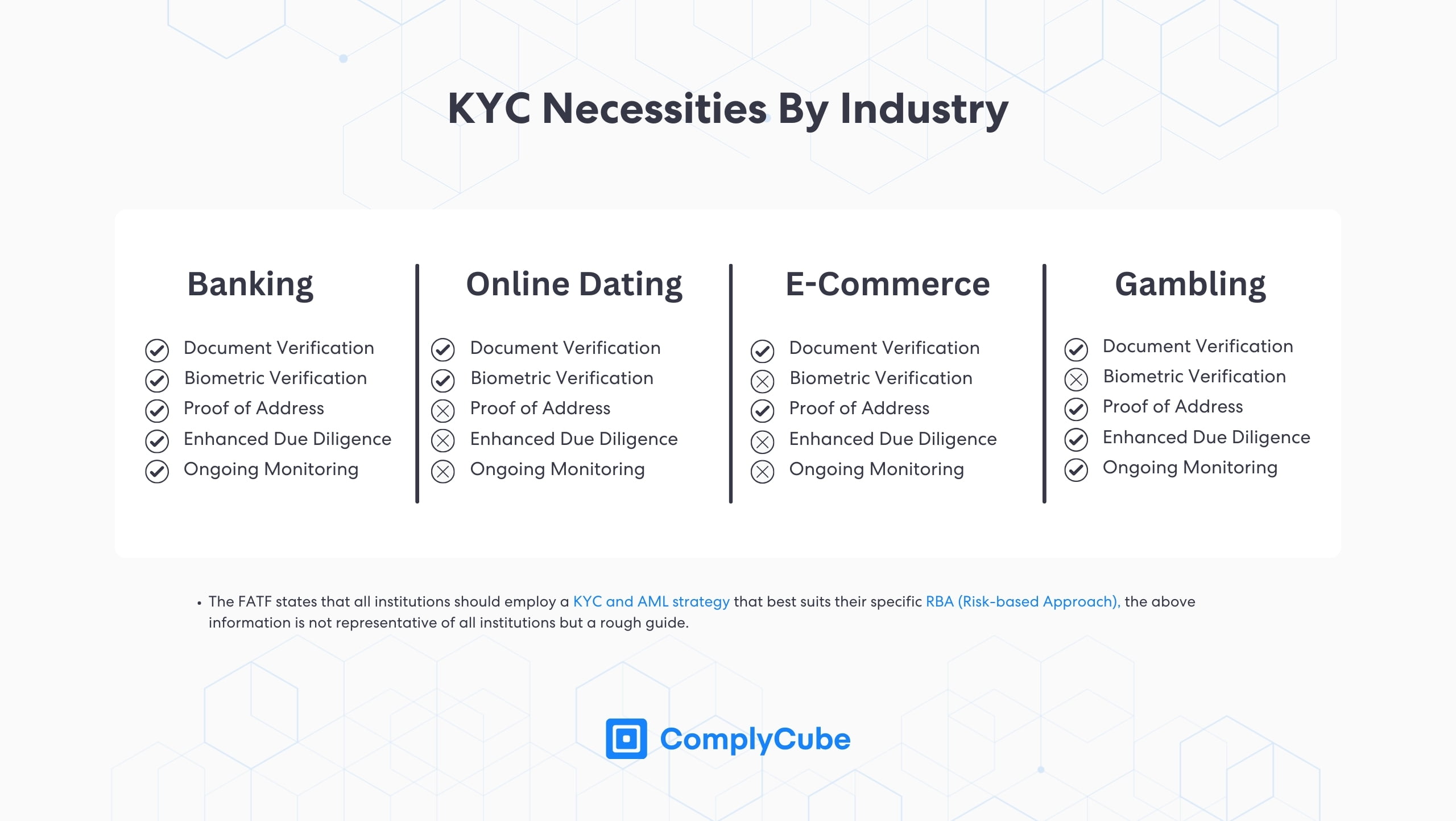
### Anti-Money Laundering (AML)
On the other hand, Anti-Money Laundering is a term that encompasses the policies in place to monitor, deter, and ultimately prevent any activity relating to money laundering. This involves ongoing AML monitoring as well as multiple other strategies.
Continuous AML monitoring is fundamental in preventing financial crime, as an individual’s circumstances are always subject to change. These changes could include:
- A new job or position that brings certain authorities or exposure to financial ecosystems.
- Blackmail of any kind which makes someone do things they would never usually do.
- A sudden loss of financial status renders an individual desperate for money.
To avoid non-compliance and reputational damage in their field, businesses must perform continuous AML monitoring as a perpetual risk management tool in their Anti-Money Laundering strategy. For more information on automated AML monitoring and KYC processes, read [The Importance of Automated KYC Verification](https://www.complycube.com/en/the-importance-of-automated-kyc-verification/).
## How do KYC Solutions Improve Ongoing Monitoring?
KYC solutions, or eKYC services, are becoming an industry standard for continuous monitoring and related AML pain points. Typically, these providers automate an entire workflow that is adapted and customized to a client’s bespoke requirements.
Automation, flexibility, and customization make ongoing monitoring and other KYC processes highly streamlined. ComplyCube provides these solutions from the comfort of an all-in-one, user-friendly platform for compliance officers to work with.
The company’s KYC and AML portal is one of its largest value propositions and serves as the hub for its suite of IDV and due diligence procedures. All customer data is readily available and sorted into risk profiles, the thresholds of which are also customizable to increase operational efficiency based on specific corporate RBAs. This makes the job of adhering to tough regulations, such as the [FATF AML/CTF Standards](https://www.fatf-gafi.org/en/publications/Fatfrecommendations/Fatf-recommendations.html), far easier to accomplish.

### Key Takeaways
- **Ongoing** **AML monitoring** is an essential, non-negotiable part of KYC and AML strategies.
- **Automated tools** significantly **improve detection** of suspicious activity and changes in risk.
- **Risk-based approaches** ensure appropriate monitoring intensity per sector and customer type
- **Watchlist, sanctions, PEP, and adverse media screenings** form the core of continuous due diligence.
- **ComplyCube’s unified platform** simplifies continuous compliance across geographies and sectors.
## How to Choose a KYC Provider for Ongoing Monitoring
In summary, automated ongoing monitoring processes helps businesses improve operational efficiency, reduce false positives, and cut costs. With the help of state-of-the-art artificial intelligence, eKYC providers bridge the gap between regulation and operation.
If your business needs to conduct ongoing monitoring process as a part of its KYC strategy, then it might be time to start investigating KYC services. ComplyCube provides a suite of automated AML, KYC, and IDV solutions wrapped up in one user-friendly platform.
The AI-powered platform is an industry leader based on the breadth of scope of operations, a good metric for grading KYC solution providers. ComplyCube is licensed in over 220 regions and facilitates over 13,000 documents, enabling it to scale with any company’s growth demands.
So, whether you are looking for a partner to perform ongoing monitoring or want to find out more about Know Your Customer solutions, ComplyCube is a good place to start. [Get in touch with one of their AML, KYC, and IDV specialists today.](https://www.complycube.com/en/contact/contact-sales/)
## Frequently Asked Questions About Ongoing Monitoring
What are the core components of an effective continuous monitoring strategy?
An effective ongoing monitoring process includes ongoing sanctions screening, watchlist checks, PEP tracking, and adverse media detection. As a result, these tools work together to surface new risk signals and ensure that customer profiles remain current. Leading AML platforms use automation and AI to run these processes in real time.
Why is continuous monitoring critical in effective AML programs?
Continuous monitoring is vital because customer risk is dynamic. Individuals can gain political exposure, face legal proceedings, or be subject to blackmail or coercion. Without continuous AML monitoring, firms may overlook these developments, exposing themselves to compliance breaches, fines, and reputational harm.
Which sectors are legally required to implement ongoing monitoring controls?
Ongoing monitoring is mandated for all entities regulated under AML/CTF frameworks. This includes banks, fintechs, crypto platforms, insurers, remittance providers, and other financial institutions, as well as regulated professions such as lawyers, accountants, and real estate agents.
How does a risk-based approach influence AML monitoring requirements?
A risk-based approach tailors monitoring intensity based on customer profile, geography, transaction behaviour, and industry sector. Higher-risk customers undergo more frequent reviews, while lower-risk ones may be monitored less frequently, striking a balance between compliance and operational efficiency.
How does ComplyCube support end-to-end ongoing monitoring and AML compliance?
ComplyCube offers a unified compliance platform that automates ongoing monitoring processes using AI-powered tools for real-time sanctions, PEP, and adverse media screening. Its configurable workflows, dynamic risk scoring, and audit-ready reports help businesses stay compliant while reducing false positives and manual effort.
**Categories:** Guides
**Tags:** Know Your Customer
---
### [What to Look for in a Biometrics Identity Verification System](https://www.complycube.com/biometrics-identity-verification-system/)
**Published:** November 6, 2025
**Author:** Rithu Jagannath
**Excerpt:** This guide explores how biometric identity verification uses facial recognition, AI, and liveness detection to prevent fraud, comply with global regulations, and deliver fast, secure, and scalable digital onboarding experiences.
**Content:**
**TL;DR:** A biometrics identity verification system helps **verify users**, but the best biometric identity verification solutions **catch spoofing attempts** and **manipulation in real time**. With biometrics-based identity verification, businesses can **reduce fraud**, protect their businesses and **stay compliant**.
## What is a Biometrics Identity Verification System?
A biometrics identity verification system is a digital tool that verifies a person’s identity. They verify a person’s identity by analyzing their physical features, such as facial geometry or voice patterns. This ensures that the biometric verification process works and that each identity is tied to something a person inherently is, rather than something they know or have.
Biometrics identity verification systems use distinct physiological and behavioral characteristics to authenticate individuals securely and accurately. This can include fingerprints, facial features, iris patterns, voice and more. These identifiers are extremely difficult to replicate, making biometrics one of the most reliable methods for digital verification.
## How Do Biometrics Identity Verification Systems Work?
The best biometric identity verification process is necessary for confirming that the person submitting identity documents is the actual owner. Unlike traditional methods such as passwords or PINs, biometrics-based identity verification uses traits that are unique to each person. These verification metrics make it extremely difficult to forge or replicate. This approach enables the system to verify and identify individuals based on their unique traits.
Typically, a [biometrics identity verification](https://www.complycube.com/en/solutions/identity-assurance/biometric-verification/) system captures a live image of the user’s face through a webcam or smartphone camera. It then, compares it to the facial image on an official document such as a passport or driver’s license. This comparison helps determine if the two images belong to the same person’s identity. This makes biometric systems a cornerstone of secure digital identity verification.
## Types of Biometrics Identity Verification Systems
Biometric authentication leverages a variety of technologies. Foregoing traditional methods to authenticate users, they make use of advanced biometrics-based identity verification. These biometric systems are based on their unique biological and behavioral characteristics.
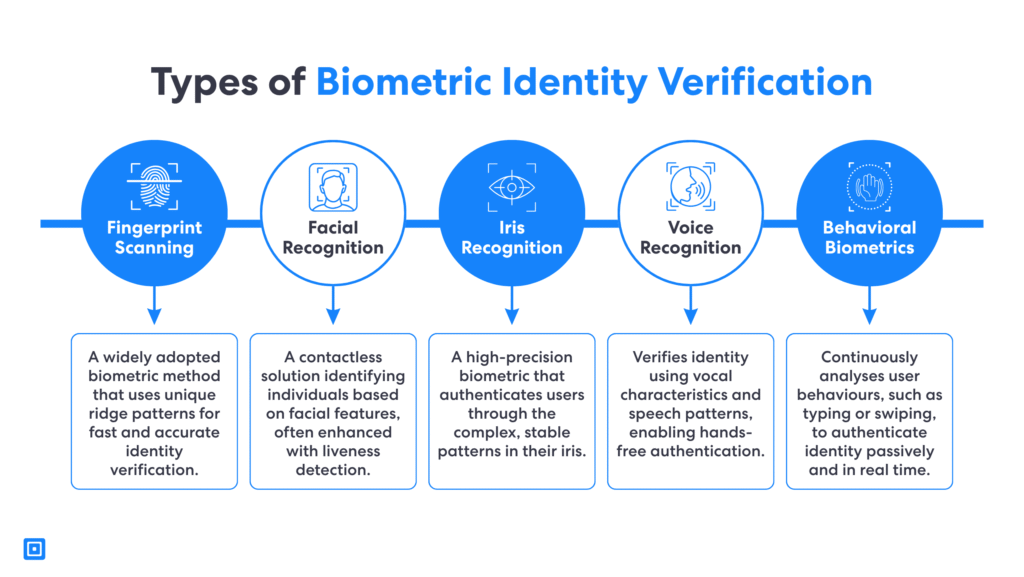
### Fingerprint Recognition
One type of biometrics-based identity verification is [fingerprint recognition](https://www.ncsc.gov.uk/collection/biometrics/fingerprint) or fingerprint scanning. This type analyzes the distinct patterns and ridges found on an individual’s fingertips to verify identities. A fingerprint scanner approach is most commonly used. This approach is used in mobile devices, access control systems, and prevent unauthorized access to secure facilities.
### Facial Recognition
Another example of biometrics-based identity verification is [facial recognition](https://www.kaspersky.com/resource-center/definitions/what-is-facial-recognition). Widely adopted in consumer electronics, it ranks among the top biometric identity verification methods. By utilizing sophisticated algorithms to map and compare facial features. This technology streamlines the authentication process and also incorporates liveness detection. This helps to guard against increasingly sophisticated identity fraud and spoofing attacks.
### Iris Recognition
[Iris recognition](https://ucr.fbi.gov/fingerprints_biometrics/biometric-center-of-excellence/files/iris-recognition.pdf) is also one of the best biometric identity verification methods. Renowned for its precision, iris recognition requires a scan of the intricate patterns in the colored part of the eye. This biometrics-based identity verification offers an secure solution for environments requiring the highest level of protection.
### Voice Recognition
Then, [voice recognition](https://www.techtarget.com/searchcustomerexperience/definition/voice-recognition-speaker-recognition) adds another layer of security by analyzing the unique patterns in a person’s speech, such as pitch, tone, and cadence. This type of biometrics-based identity verification makes it ideal for hands-free authentication and remote verification scenarios.
### Behavioral Biometrics
Finally, behavioral biometrics focus on identifying users through their [behavioral characteristics](https://www.ibm.com/think/topics/behavioral-biometrics). Unlike fingerprint recognition, facial recognition, or voice recognition, it takes into account things such as typing speed, mouse movements, or gait recognition. This provides continuous authentication and further reducing the risk of impersonation.
While every one of these biometric verification methods enhances security, they rely on unique patterns that are extremely difficult to replicate. For example, this helps organizations with problems such as authenticating users for online banking, or preventing identity fraud with mobile banking and financial transactions. Biometrics-based identity verification ensures that only authorized personnel gain access to sensitive information, and are most effective when layered alongside one another.
## Facial Recognition Technology in a Biometrics Identity Verification System
Facial recognition technology is the core mechanism behind most of the best biometric identity verification systems. This technology scans a user’s live facial image and compares it to their submitted identity document. By using sophisticated algorithms to assess hundreds of facial data points, including eye position, jawline structure, and skin texture, these measurements are converted into a unique facial map.
A facial recognition map uses a specific system to calculate a match score. This biometrics-based identity verification system matches the live map to a stored template or stored data for verification. This mapping of the biometric selfie to the image on the identity document is known as a Face Match, and ensures that the photo on the ID and the selfie belong to the same person.
What sets the best biometric identity verification systems apart is their ability to account for variations. Users may take selfies in different lighting, at various angles, or with slight changes in appearance such as facial hair or aging. Effective systems are trained on diverse datasets and use AI models that adapt to these conditions, ensuring accurate verification across different ethnicities, ages, and environments.
### **Liveness Detection**
Liveness detection ensures that the person presenting their face is physically present and not attempting to trick the system using a static image or digital manipulation. Moreover, it plays a critical role in defending against impersonation tactics for processes such as patient identification or mobile banking.
Nevertheless, liveness detection is a critical step within the broader biometric verification process. Liveness detection works alongside other stages such as capturing, analyzing, and validating biometric data to ensure security, accuracy, and user convenience. In addition, without liveness detection, even the best biometric identity verification and face match systems are vulnerable to attackers using realistic decoys to gain access to accounts or services.
### **Passive vs Active Liveness Detection**
There are two main categories of liveness detection in biometrics identity verification systems: active and passive. Active methods prompt users to perform an action. Passive detection, by contrast, operates silently in the background and evaluates indicators to determine if the face is real.
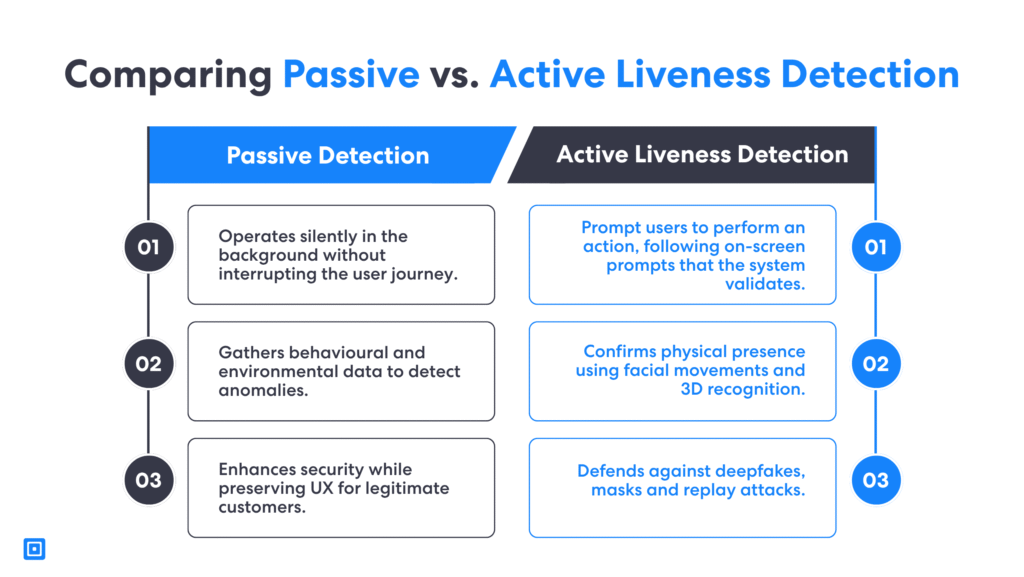
Active liveness detection methods are effective in high-security scenarios where maximum assurance is needed. First, they require the user to follow on-screen prompts, such as looking left or smiling. This then validates in the system as proof of life. While this approach offers a strong defence against spoofing, it introduces user friction and can disrupt the customer journey, especially on mobile or in low-bandwidth environments.
On the other hand, passive liveness detection works automatically during the face capture process. Using subtle clues such as depth perception, skin sheen, and light reflection, they can detect whether the face in front of the camera belongs to a real person. This is particularly useful for customer onboarding in industries such as banking or telecommunications. Passive liveness detection methods provides a smooth user experience while delivering strong fraud prevention.
## **Accuracy Benchmarks for Biometrics Identity Verification System**
There are two metrics that come into play when trying to identify the best biometric identity verification solutions on the market. Regulators look at False Acceptance Rate (FAR) and False Rejection Rate (FRR). This ensures that systems do not wrongly approve imposters or legitimate users are not turned away.
These two factors in biometrics-based identity verification make it more difficult for unauthorized users to get access. Also, leading biometric-based identity verification provides both security and usability. For example, they often aim for 99.9% face match accuracy, providing high assurance in identity verification.
### Addressing False Rejections and Bias
Biometrics-based identity verification platforms that do not mitigate against bias or address image quality may falsely reject users as part of the verification flow. In addition, some legitimate users might get denied access causing frustration and damaging trust. Biased training data, poor image qualities, or strict thresholds within biometrics-based identity verification systems can cause these errors. In order to mitigate this, biometric systems must be tested on diverse datasets.
The best biometric identity verification systems try to ensure that all processes work fairly for all users. Therefore, it is essential to conduct regular bias audits, demographic evaluations and provide regular re-training. It is also the responsibility of the developers to tune confidence thresholds and fallback processes.
## Spoofing and Deepfake Threats with Biometrics Identity Verification Systems
In today’s world, biometric spoofing is becoming a significant security threat for even the best biometric identity verification systems. Fraudsters attempt to bypass identity checks using printed photos, high-resolution screens, or hyper-realistic silicone masks to gain unauthorized access. Deepfake technology can fabricate a moving, speaking face that mimics another person, posing an even greater challenge to verification systems.
To counter these threats and protect sensitive information, biometric-based identity systems incorporate multiple anti-spoofing layers. By including texture analysis, movement tracking, and 3D depth sensing, systems can detect anomalies typical of deepfakes and synthetic presentations.
These biometric system measures are essential for bolstering security against sophisticated attacks. By confirming the identity and liveliness of the subject, it makes it exceedingly difficult for attackers to deceive the system using fake media.
### **Case Study: GRVT Scaling Biometric Onboarding for Millions in Crypto**
**Problem**
In 2025, GRVT, a hybrid derivatives exchange, faced the challenge of onboarding a large volume of users (over 2.5 million pre‑launch) and meeting rigorous KYC/AML standards. Deepfake attacks and identity spoofing in crypto had jumped in recent years, posing a threat to platform security and brand credibility. Without a scalable biometric identity verification system, GRVT risked delays, regulatory knock‑backs and user‑experience bottlenecks.
**Solution**
[GRVT partnered with ComplyCube](https://www.complycube.com/en/customer/onboarding-grvts-next-million-crypto-users/ "https://www.complycube.com/en/customer/onboarding-grvts-next-million-crypto-users/") to deploy a biometric identity verification system that enabled face‑matching, document verification and liveness detection in under 25 seconds. The platform layered in global identity coverage (220+ jurisdictions), real‑time screening, and anti‑spoofing checks to confidently verify users. Integration with GRVT’s onboarding flow ensured zero downtime, high scalability, and regulatory alignment across jurisdictions.
**Outcome**
- GRVT achieved **user onboarding in under 1 minute**, significantly accelerating volume growth.
- ComplyCube’s biometrics-based identity verification system enabled GRVT to demonstrate **compliance with global crypto KYC and AML standards**, reinforcing trust with regulators and institutional users.
- GRVT secured a **cost‑effective global verification model**, processing large scale user identity checks while maintaining high assurance and low latency.
## **Artificial Intelligence in Biometrics Identity Verification System**
Artificial Intelligence (AI) drives the accuracy and adaptability of face matching technology. The best biometric identity verification systems rely on AI to recognise subtle facial patterns and adjust to diverse real-world conditions. As technology advances, the goal is to continuously improve biometric verification.
> Advancements in AI have transformed biometric identity verification from a static, one-time check into a dynamic, real-time defence system.
Chief Product Officer of ComplyCube, Harry Varatharasan remarks that “Advancements in AI have transformed biometric identity verification from a static, one-time check into a dynamic, real-time defence system. Today’s intelligent systems can detect spoofing attempts, synthetic media, and deepfakes with remarkable accuracy, while adapting continuously to evolving fraud tactics.”
In fact, these systems evolve through continuous learning, improving their ability to distinguish genuine users from fraudulent attempts. Importantly, AI-based models can also be optimised to detect demographic biases, ensuring fair and inclusive verification across different ethnicities and age groups.
## How to Identify & Implement the Best Biometrics Identity Verification System
Successfully implementing the best biometric identity verification system requires a strategic approach. This approach needs to balance security, usability, and compliance. Security level, user experience, regulatory compliance, system integration, data protection and ongoing maintenance need to be considered as key criteria in selecting the right verification process.
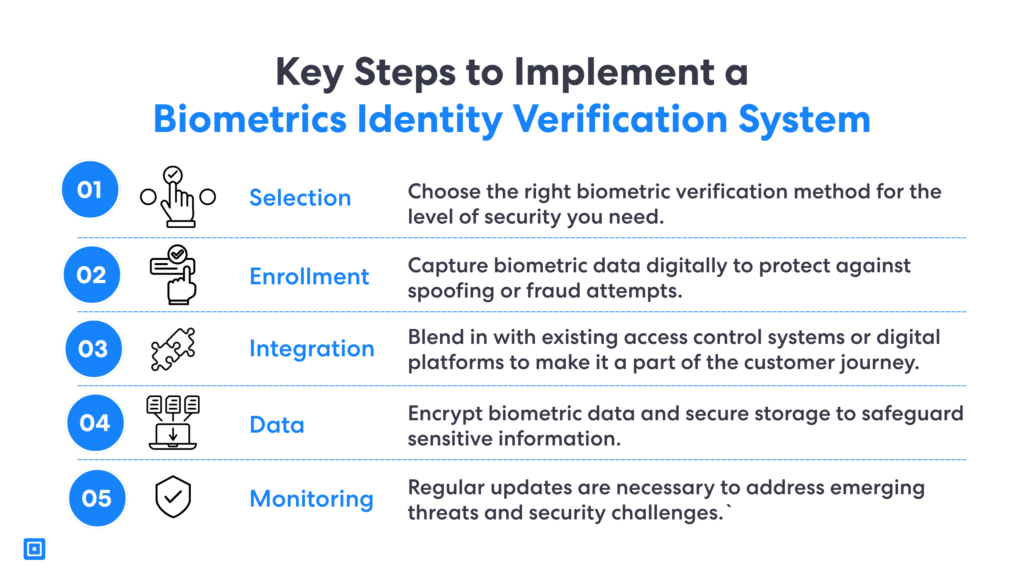 \#image\_title
The first step is to select the appropriate biometric verification method, whether it be fingerprint recognition, facial recognition, iris scans, or behavioral biometrics. Determining the appropriate biometric verification depends on specific needs as well as level of security required. Other factors include user convenience and any relevant regulatory requirements.
Once the optimal biometric technology is chosen, the enrollment process begins. Here, users’ biometric data is captured and converted into a digital template, ensuring high-quality data collection and protection against spoofing attempts. Secure storage and encryption of biometric data are crucial to safeguard sensitive information and maintain user trust.
Finally, integration with existing access control systems or digital platforms is the next critical phase. Seamless integration ensures that biometrics-based identity verification becomes a natural part of the user journey, whether for secure access to physical locations or digital services. Continuous monitoring and regular updates are vital to address emerging threats and adapt to evolving security challenges, helping to prevent data breaches and unauthorized access.
In the implementation, companies should prioritize providing high quality service and customer satisfaction. It is crucial to have a user-friendly experience. By clearly communicating about data usage, and providing responsive support, organisations can build user confidence in the biometric verification system.
## **Biometrics Identity Verification System for Digital Onboarding**
Global regulatory bodies have increasingly recognised biometrics as a reliable means of meeting identity verification requirements. Standards set by the Financial Action Task Force (FATF), European Banking Authority (EBA), and other regional regulators include liveness detection and biometric verification as recommended controls for onboarding and customer due diligence. You can learn more here: [The Identity Verification Onboarding Bottleneck](https://www.complycube.com/en/the-identity-verification-onboarding-bottleneck/)
These systems play a vital role in supporting compliance with Anti-Money Laundering (AML) and Know Your Customer (KYC) regulations. They provide a high level of assurance that helps financial institutions and digital service providers validate customer identities quickly and securely.
In addition, multi-factor authentication and multi-factor authentication systems are often recommended by regulators to further strengthen identity verification, as they integrate biometric modalities such as voice recognition and other advanced techniques. As fraud tactics evolve, regulators continue to promote the adoption of best biometric identity verification tools for identity assurance.
## **Enhancing Security for Biometrics Identity Verification System**
Processing biometric data involves heightened responsibilities under data protection laws. Regulations such as the General Data Protection Regulation (GDPR) and California Consumer Privacy Act (CCPA) classify biometric identifiers as sensitive personal data, requiring organisations to implement rigorous safeguards. Nevertheless, biometric information, such as fingerprints or facial images, is subject to strict privacy regulations to protect individuals’ identities and prevent identity theft.
Therefore, explicit user consent is essential before collecting or using biometric data. Transparency is key as users must understand how their data or identity documents will be used, stored, and deleted. Organizations must adopt privacy-by-design principles, including secure data storage, access controls, and policies for user data deletion. These practices build trust and ensure compliance with evolving legal frameworks.
### Key Takeaways about Biometrics Identity Verification System
- **The best biometric identity verification strengthens identity assurance** with facial images and ID documents.
- **Liveness detection is critical for fraud prevention**, blocking deepfakes, photo attacks, and digital injection attempts.
- **Accuracy and fairness depend on smart AI**, achieving 99.9% match rates while reducing false rejections.
- **Regulatory compliance requires privacy-by-design** in alignment with laws such as GDPR and CCPA.
- **Platforms such as ComplyCube deliver real-time biometric onboarding**, combining face match, spoof detection, and global coverage to reduce fraud and improve customer experience at scale.
## **Building Trust with Biometrics Identity Verification System**
To sum up, biometrics-based identity verification has emerged as a cornerstone of digital identity assurance. By combining face match accuracy with real-time liveness detection, organisations can onboard users quickly, securely, and in full compliance with global regulations. Ultimately, the best biometric identity verification can offer superior fraud protection, faster onboarding, and a smoother user experience than traditional verification methods.
[**ComplyCube**](https://www.complycube.com) enables these capabilities through a unified, API-first platform offering advanced face match, passive and active liveness detection, and global document compatibility. Backed by ISO, GDPR, and eIDAS certifications, ComplyCube supports businesses in building trusted, secure customer relationships at scale.
## Frequently Asked Questions
What is a biometrics identity verification system?
Biometric identity verification uses a variety of recognition technology to confirm that a person’s physical traits, typically their face, match a government issued ID document. By combining AI-driven face matching with liveness detection, the authentication process ensures the use is physically present and not using a spoofed image or video. This enhances security and maintains secure access and less security breaches for many institutions.
How accurate is biometric face match verification?
Modern biometric verification systems such as those used by regulated Regtech providers, deliver facial recognition match accuracy rates exceeding 99.9%. Advanced algorithms maintain high performance across various conditions, facial angles, and device types to keep false acceptance and false rejections extremely low. Once the biometrics obtained go through the authentication process, accuracy is further enhanced when paired with real-time document verification.
What is liveness detection in biometrics?
Liveness detection is a enhanced security feature that prevents identity theft. It determines through various methods such as iris recognition, facial recognition, voice recognition, fingerprint scanner or more, that the person undergoing biometric verification is physically alive and present during the process. It blocks any attempts to fool biometric authentication using photos, deepfakes impersonating a person’s biometrics, or replayed videos. Techniques to verify include passive liveness (analysing natural facial movements), and active liveness (prompting the user to perform a task). Both of these user-friendly biometric verification methods help guard against sophisticated fraud attempts.
Is biometric verification GDPR compliant?
Yes, the best biometric identity verification should be fully GDPR compliant when biometric data is securely stored as encrypted digital templates. On consumer electronics, this means gaining explicit user consent, enforcing strict access controls, enabling data deletion or correction, and ensuring all processing is transparent and purpose-limited.
How does ComplyCube use biometric verification to enhance KYC?
ComplyCube integraties advanced biometric technologies into its Identity Verification (IDV) platform to streamline and secure the KYC process. The user-friendly platform combines various features such as passive/active liveness detection, AI-powered facial matching, spoofing, and deepfake detection for their biometric identity verification process. This allows businesses to verify identities through facial recognition, iris recognition, or voice recognition accurately within seconds. This reduces onboarding friction and meeting global compliance standards whether it be for bank accounts, patient identification, or border control. When used alongside document verification, registry checks, and real-time screening, biometric verification works. It helps organisations and clients achieve faster onboarding rates and higher fraud detection accuracy, across more than 220 countries and territories.
**Categories:** Guides
**Tags:** Identity Verification
---
### [Understanding the Essentials of KYC Pricing Models](https://www.complycube.com/kyc-pricing-models/)
**Published:** July 2, 2025
**Author:** Dini Habib
**Excerpt:** Ensuring KYC compliance isn’t just about checking boxes. For organizations across banking, crypto, fintech, and other regulated sectors, it’s a foundational part of preventing fraud, meeting regulations, and preserving customer trust.
**Content:**
Ensuring Know Your Customer (KYC) compliance is not just about checking boxes; it is foundational for preventing fraud, meeting regulatory obligations, and preserving customer trust. All of this, however, can come at a significant cost if not implemented correctly. Choosing the right KYC pricing models is essential. Options such as KYC per check, tiered plans, and IDV subscription pricing can all impact operational efficiency and budget.
In this guide, we break down what drives the cost of KYC, the various types of pricing models commonly offered, and how ComplyCube structures its flexible options so buyers can make more informed decisions when purchasing KYC SaaS solutions that assure KYC compliance.
## The Impact of Regulatory Pressure on KYC
Compliance teams are under increasing pressure to keep up with evolving regulations while also optimizing operational efficiency. Knowing how much Identity Verification (IDV) should cost and what factors drive IDV pricing can help teams avoid overspending, forecast smarter, and invest in systems that scale with their business requirements.
> In 2024, financial institutions, e-commerce platforms, and other organizations [allocated $38.8 billion to KYC systems](https://www.juniperresearch.com/research/fintech-payments/identity/kyc-kyb-research-report/), and the market is projected to grow by 71% from 2024 to 2029.
Investment in KYC technology is critical for keeping pace with regulations and for companies to remain competitive. Both investors and consumers prefer businesses that can demonstrate trustworthiness through seamless and secure onboarding processes.
## The Significance of KYC and AML Compliance
Understanding KYC pricing models is essential when making an investment decision. However, financial institutions must also consider the potential value and benefits that come from effective compliance. According to the United Nations, [2 to 5% of global GDP](https://www.unodc.org/unodc/en/money-laundering/overview.html) is laundered annually, accounting for about $800 billion to $2 trillion.
While pricing remains an important factor, the quality of [KYC technology](https://www.complycube.com/en/solutions/due-diligence-compliance/know-your-customer/) must always be the top priority due to its implications on business reputation and long-term growth. Poor KYC and AML infrastructure can lead to risks in money laundering and other financial crimes. With leading compliance software, these risks can be detected and escalated earlier to prevent further losses.
[](https://www.complycube.com/en/is-your-kyc-provider-the-one/)
## KYC Pricing is not a One-Size-Fits-All
The cost of verifying a customer’s identity can look very different depending on who and where a business chooses to operate. A lean [FinTech](https://www.complycube.com/en/use-cases/industry/fintech/) onboarding 500 customers a month in one region faces vastly different requirements compared to a multinational bank verifying millions of users across multiple jurisdictions.
### Business Operating in Regulated or High-Risk Industries
Companies dealing with high-risk industries, such as [cryptocurrency](https://www.complycube.com/en/use-cases/industry/crypto/), gambling, or cross-border remittances, need more stringent checks. These often include [Enhanced Due Diligence (EDD)](https://www.complycube.com/en/enhanced-due-diligence-edd-insights-and-challenges/), biometric liveness detection, and continuous monitoring. Each adds cost, but each is also essential to avoid non-compliance.
### Abiding by Various Regulations International
Jurisdictional complexity and local regulations also determine the complete set of requirements. For example, regulations set by the [Financial Conduct Authority (FCA)](https://www.fca.org.uk), the [Monetary Authority of Singapore (MAS)](https://www.mas.gov.sg), and the [U.S. FinCEN](https://www.fincen.gov) often overlap but often come with their own nuances. Businesses operating across borders may need to meet varying ID verification standards, watchlist coverage, and data retention rules.
### Manual versus Automated Tools
Finally, how KYC is delivered, either through manual review, partially automated, or fully orchestrated through APIs, impacts price and performance. The more integrated and automated the process, the more scalable and cost-efficient compliance becomes over time.
## Key Components of an Effective KYC Verification Process
Before evaluating pricing models, it is critical to understand the foundational elements of an effective KYC process. These components ensure that financial institutions meet global regulatory expectations while managing exposure to illicit activity, including money laundering, terrorist financing, and fraud.

### Customer Identification Program (CIP)
Implementing a [CIP](https://www.complycube.com/en/customer-identification-program-what-is-cip/) is the first step in ensuring that institutions verify the identity of individuals engaging in financial transactions. By confirming key identity documents such as name, date of birth, address, and government-issued identification, CIP plays a crucial role in deterring the misuse of financial services. Compliance with CIP is mandatory in jurisdictions across the globe, including under regulations from the Financial Crimes Enforcement Network (FinCEN), the [Financial Action Task Force (FATF)](https://www.fatf-gafi.org), and the [UK’s Joint Money Laundering Steering Group (JMLSG)](https://www.jmlsg.org.uk) guidance.
### Customer Due Diligence (CDD)
CDD is the process of assessing the level of risk associated with a new client and then implementing the relevant checks according to that assigned risk rating. The [due diligence checks](https://www.complycube.com/en/what-is-customer-due-diligence/) required will follow one of three processes:
- **Simplified Due Diligence (SDD)**: For low-risk clients with minimal volume or low-value transaction activity.
- **Standard CDD**: The default process for the majority of customers. It includes a robust assessment of an individual’s identity and behavior to mitigate potential suspicious activities.
- **Enhanced Due Diligence (EDD)**: EDD is typically imposed for customers that are high-risk, including Politically Exposed Persons (PEPs). Further information needs to be collected, such as the source of funds, transaction patterns, geographies, and payment methods.
### Ongoing Monitoring for Long-Term Compliance
KYC is not a one-time event. To maintain compliance, organizations must continually update and monitor changes in a customer’s risk profile. Ongoing monitoring can help firms promptly detect suspicious activities, including unusual transaction volumes, changes in geography, inclusion in sanctions or PEP lists, and even negative media coverage. Additionally, sophisticated KYC technology provides real-time alerts and dynamic risk evaluation of a customer’s risk profile over time.
### Electronic KYC (eKYC)
Digitalization has shifted the KYC landscape from manual physical screening to rapid customer onboarding that takes place online. [Electronic KYC (eKYC)](https://www.complycube.com/en/what-is-ekyc-electronic-know-your-customer/) uses automated tools, such as biometric authentication, [Optical Character Recognition (OCR)](https://www.complycube.com/en/solutions/due-diligence-compliance/know-your-customer/optical-character-recognition/) for document parsing, and device intelligence to verify identities faster and more accurately. eKYC lowers manual review overheads and is especially useful for onboarding at scale or across multiple markets.
## Comparing KYC Pricing Models
Although in-depth due diligence measures are essential for compliance, costs can escalate quickly if processes remain manual. Modern KYC software offers an automated way for organizations to implement a [risk-based approach](https://www.complycube.com/en/what-is-a-risk-based-approach/), detect suspicious activity, and meet KYC standards efficiently. Selecting the appropriate KYC pricing model according to a business’s growth rate, risk appetite, and budget can help streamline costs.
Leading platforms such as ComplyCube offer [flexible pricing models](https://www.complycube.com/en/pricing/) to meet operational and compliance demands at every stage. These models help organizations avoid overpaying for unused services and ensure they only pay for what they need.
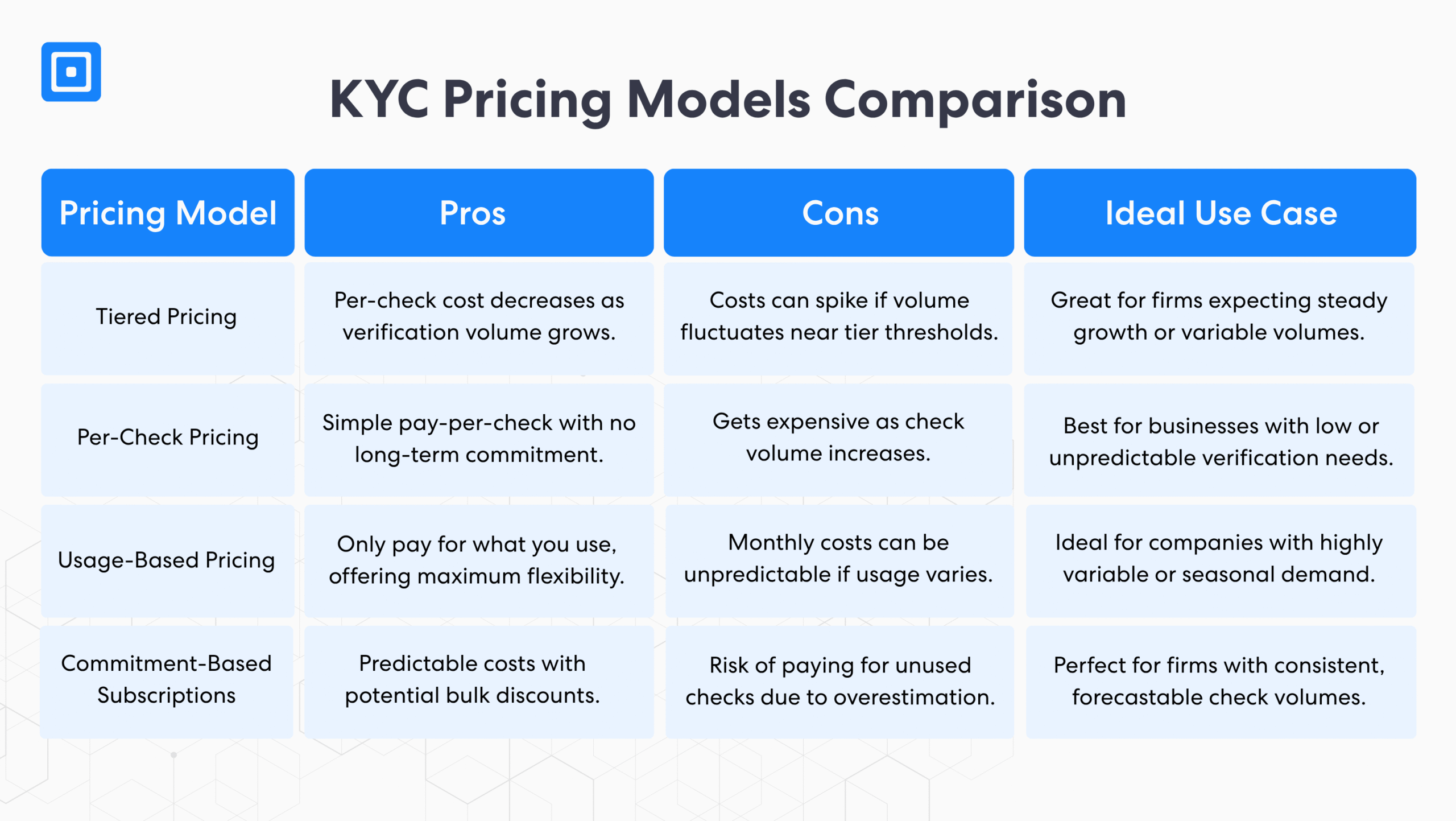
### Tiered Pricing
Tiered pricing follows a volume-based model where organizations are charged based on specific brackets, such as 0–1,000 verifications, 1,000–10,000, etcetera. Each tier typically includes core or recurring services, such as ID document validation, sanctions screening, and biometric and liveness checks. The price-per-check typically decreases as usage scales, resulting in more cost-efficient onboarding per customer. This model benefits companies with growing verification volumes or forecastable growth patterns.
### Per-Check Pricing
Per-check pricing works on a fixed fee for each verification, enabling businesses to access identity verification tools at lower volumes. Entrepreneurs, startups, or firms with irregular onboarding patterns are often attracted to per-check pricing as they may not have certainty over future volumes and cash flow. While this model is flexible, it can lead to higher costs if not actively monitored, particularly as transaction volumes grow or additional services are integrated.
### Usage-Based Pricing
Customers are charged according to their actual consumption of products and services. This means that no matter how many checks are conducted, each service will have a fixed price without discounts as the volume or range of services utilized increases. This is useful for firms with low check volumes and is often offered on a pay-as-you-go basis, whereby the client is charged in arrears based on their actual usage. However, since costs are always a variable in this scenario, it can lead to budget planning challenges.
### Commitment-Based Subscriptions
These models use verification credits, which are included in the subscription and can be used over a defined period, such as monthly or annually. These plans often bundle multiple services into a robust compliance allowance, including Know Your Business (KYB) checks, liveness detection, and watchlist screening. Customers can benefit from reduced rates on products or services based on their level of commitment over a given period. This model offers predictability with a committed balance, making it attractive to growing, profitable businesses with cyclical demand.
## How to Choose a Suitable KYC Pricing Model for Your Business
Selecting a KYC solution involves more than just compliance. Companies must also consider if the system fits operational goals, scales efficiently, and contributes to a better customer experience. The right pricing model should support these outcomes while staying within budgetary constraints. Below are the core considerations institutions should weigh when evaluating any KYC provider or pricing structure:
- **Accuracy:** Data quality and system adaptability are key to ensuring accurate results. False positives, mismatches, or incomplete verifications can cause compliance gaps, slow down onboarding, and increase business costs. Providers should offer advanced OCR, highly accurate [biometric verification](https://www.complycube.com/en/solutions/identity-assurance/biometric-verification/), and consistent data validation across jurisdictions.
- **Scalability and Adaptability:** KYC compliance systems and rules are constantly evolving. Solutions must be able to adapt and grow over time as threats and regulations change.
- **Cost Predictability:** Whether using per-check, usage-based, or tiered models, pricing must reflect the business’s actual needs. Unexpected cost spikes often stem from unmonitored volume, misaligned contract structures, or hidden fees. Businesses must seek transparent, predictable pricing aligned with transaction volume and operational complexity.
- **Reporting and Audit Readiness:** Effective KYC platforms should include robust reporting tools that meet audit and regulatory requirements. These capabilities support internal compliance functions and provide clear documentation in the event of supervisory reviews or enforcement action.
- **Customer Experience:** Frictionless onboarding has become a competitive differentiator. A KYC system should strike the right balance between thorough verification and speed. Smart workflows, such as dynamic risk scoring and passive biometric checks, can fast-track low-risk users while flagging anomalies for further review.
## ComplyCube’s Approach to KYC Pricing
ComplyCube offers versatile pricing options that cater to businesses of all sizes. With flexible identity verification pricing and a comprehensive suite of modular KYC services, firms can select the right plan and scale according to their growth stage, compliance needs, and technical requirements. What sets ComplyCube’s KYC plan apart is its ability to adapt to different business needs:

### **Basic Plan**
Ideal for startups and early-stage businesses, the [basic plan](https://www.complycube.com/en/pricing/) provides essential KYC tools through a monthly commitment model. Clients are allocated a monthly balance of verification credits that can be applied across various services, including ID document verification, passive biometric and liveness selfies, global AML and watchlist screening, and database checks.
### **Growth Plan**
The growth plan is designed for scaling businesses requiring comprehensive compliance and includes advanced KYC and AML features. Packages in this tier are tailored to meet specific customer needs, with a greater commitment to unlocking more cost-effective verification rates. In addition to all features included in the basic plan, the growth plan provides:
- Risk profiling and scoring for optimized decision-making
- Know Your Business (KYB) with detailed company insights
- Advanced document verification using Near Field Communication (NFC) technology
- Active liveness detection via video
- Age estimation capabilities with a single selfie
- International authoritative database checks (eIDV)
- Proof of address verification with OCR
For businesses requiring more extensive compliance solutions, this plan comes with everything a growing business needs for peace of mind. For a complete list of features, visit [ComplyCube’s pricing page](https://www.complycube.com/en/pricing/).
### **Enterprise Plan**
This plan combines ComplyCube’s full suite of compliance solutions, which are purpose-built for global businesses. Businesses in the enterprise plan can expect premium features, with custom pricing structures and enterprise-grade solutions for comprehensive risk management and scalability. In addition to all features included in the basic and growth plan, the enterprise plan provides:
- Custom screening lists tailored to business risk appetite
- 2+2 multi-bureau checks for enhanced identity assurance
- Advanced case management for streamlined investigations
- Full customized data retention policies
- White labeling for brand integration
- Dedicated infrastructure for security and performance
This plan is trusted by Tier 1 and Tier 2 global enterprises worldwide, including Citibank, Lyca Mobile, and AXA. Businesses can expect 100% service uptime from ComplyCube’s cutting-edge waterfall mechanism and an average ROI of 6.2x. Check out the [full list of features](https://www.complycube.com/en/pricing/) in this plan.
## Achieve Unmatched Compliance Without Compromising on Cost
Meeting KYC obligations is more than just a regulatory necessity; it is a strategic advantage. Whether aligning with Financial Crimes Enforcement Network (FinCEN) mandates, FATF Guidelines, or satisfying local regulators, organizations must balance robust AML controls with operational efficiency and seamless user experiences.
ComplyCube’s unified platform includes everything from biometric verification to global watchlist screening, all underpinned by industry-leading certifications such as ISO 27001:2022, ISO 30107, and UK DIATF. [Talk to our compliance experts](https://www.complycube.com/en/contact/contact-sales/) to learn more about how ComplyCube can enable you to achieve smarter, more cost-effective compliance strategies.
[](https://www.complycube.com/en/contact/contact-sales/)
**Categories:** Guides
**Tags:** Know Your Customer
---
### [SRA Launches Critical AML and Sanctions Data Collection Exercise](https://www.complycube.com/sra-data-collection-exercise/)
**Published:** July 10, 2025
**Author:** Dini Habib
**Excerpt:** The Solicitors Regulation Authority (SRA) has announced that it will conduct its latest data collection exercise from July 7 to August 15, 2025. The exercise aims to monitor the implementation of AML by law firms in the UK.
**Content:**
In a recent announcement, the Solicitors Regulation Authority (SRA) has mentioned it will conduct its latest data collection exercise from July 7 to August 15, 2025. The data collection exercise aims to monitor compliance and enhance the SRA’s understanding of AML risk.
## Adopting a Risk-Based Framework to Supervision
Established in January 2007, the SRA develops regulations and policies across the legal sector in England and Wales to protect consumers and safeguard the regulated legal environment. The SRA recently announced its latest Anti-Money Laundering (AML) and sanctions data collection exercise, enforcing stringent requirements for law firms operating in the UK.
> We’re investing in the capability to act faster and smarter, strengthening our use of data to spot problems earlier and taking appropriate action where needed — [Paul Philip, Chief Executive of the SRA](https://www.sra.org.uk/sra/how-we-work/management/)
The [SRA](https://www.sra.org.uk/sra/) works hand-in-hand with the [Office for Professional Body AML Supervision (OPBAS)](https://www.fca.org.uk/about/how-we-operate/who-work-with/opbas) to ensure a more collaborative and targeted approach to supervision in the legal sector. The OPBAS works under the Financial Conduct Authority (FCA) to minimize money laundering and terrorist financing in the UK.
## How the SRA’s Data Collection Exercise Impacts UK Law Firms
Under this initiative, legal firms across England and Wales must submit accurate, up-to-date information regarding their [AML](https://www.complycube.com/en/solutions/due-diligence-compliance/anti-money-laundering/) and sanctions activities. According to the latest published announcement, all regulated firms must provide the SRA with information in regards to:
- Any work conducted within the scope of Money Laundering, Terrorist Financing and Transfer of Funds (Information on the Payer) Regulations 2017 (MLR 2017). These activities include buying and selling property or business entities, and the management of clients’ money.
- The interactions they have with the sanctions regime, including information about any individual or entity under it.
- Provide complete Suspicious Activity Reports (SARs) that have been or will be submitted to the National Crime Agency (NCA) in the last 12 months.
The [initial questionnaire](https://www.sra.org.uk/sra/news/firm-anti-money-laundering-sanctions-data-requirements/) includes questions regarding implementing AML controls, policies, and procedures. It also includes questions about AML training, the frequency of submitting SARs, and [Enhanced Due Diligence (EDD)](https://www.complycube.com/en/enhanced-due-diligence-edd-insights-and-challenges/) measures.
## Compliance with MLR 2017
The MLR 2017 is a slew of regulations imposed to support the UK’s overall AML and Counter-Terrorism Financing (CFT) efforts. Under the MLR 2017, regulated companies must meet specific standards in Know Your Customer (KYC) and AML.
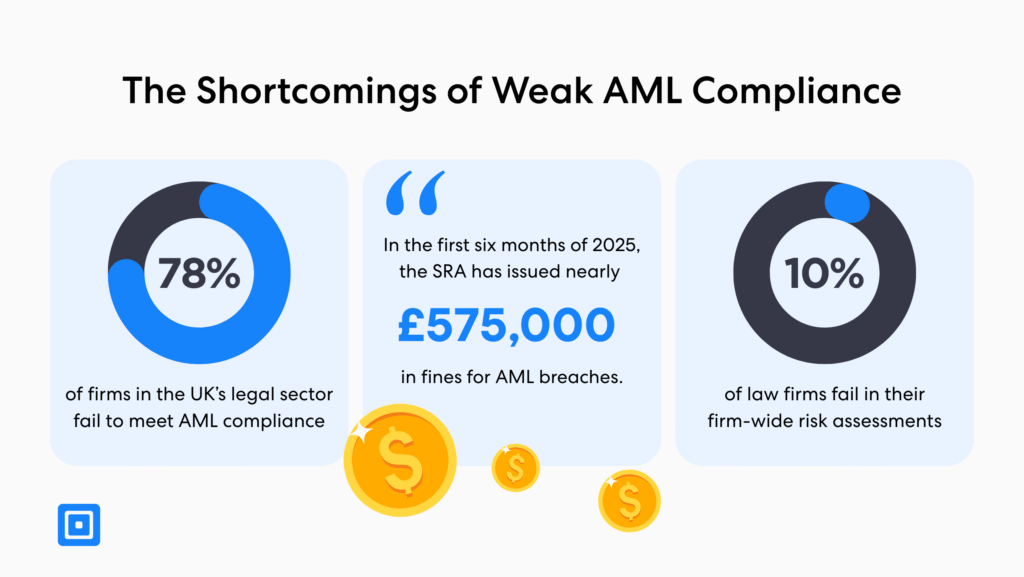
Law firms that fail to meet the compliance obligations in the MLR 2017 are subject to enforcement actions by [HM Revenue & Customs (HMRC)](https://www.gov.uk/government/organisations/hm-revenue-customs).
> In 2024 alone, the SRA had issued 74 enforcement actions for inadequate AML controls, nearly double the amount in the previous year.
Companies operating in the legal sector must follow compliance obligations stated in the MLR 2017 regulations. Some of the latest updates mandate regulated law firms to adopt a risk-based approach and ongoing monitoring technology:
- **Risk-Based Approach (RBA):** Organizations must analyze and manage each customer’s profile risk, customize resources, and tailor more stringent KYC and AML controls where higher risk is identified. This includes running advanced screening checks on Politically Exposed Persons (PEPs), while enabling lower-risk clients to onboard efficiently.
- **Customer Due Diligence (CDD):** UK businesses must verify the identity of individuals accurately, including beneficial owners. CDD enables firms to tackle fraud at the initial onboarding stage through advanced checks such as document verification and liveness verification.
- **Reporting Mechanisms and Internal Policies:** Companies must have transparent, documented AML policies and provide frequent AML training to team members. Additionally, SARs must be submitted to the NCA in a timely manner.
- **Ongoing Monitoring:** Business relationships and transactions must be monitored and kept up to date on an ongoing basis. This supports law firms in providing accurate, auditable records of CDD and risk assessments.
According to the SRA 2024 AML Report, merely[ 22% of companies](https://www.sra.org.uk/sra/news/press/2024-press-releases/aml-action-improvements/) were reported to be compliant, underscoring significant gaps in the UK’s legal sector. As 2025 unfolds, firms in the legal sector must implement stronger KYC and AML infrastructure or risk dire consequences. For more information about how you can build a stronger compliance framework, [speak to a member of the team](https://www.complycube.com/en/contact/contact-sales/).
**Categories:** News
**Tags:** Anti-Money Laundering
---
### [MAS Fines 9 Firms $27.45 Million in Money Laundering Case](https://www.complycube.com/mas-fines-money-laundering-case/)
**Published:** July 15, 2025
**Author:** Dini Habib
**Excerpt:** The Monetary Authority of Singapore (MAS) has issued nine financial institutions nearly USD 21.4 million for their weak AML controls. Some of the firms fined were leading banks such as UOB, Credit Suisse, Trident Trust, and more.
**Content:**
A recent news report reveals that the Monetary Authority of Singapore (MAS) has enforced harsh AML penalty fines related to Singapore’s greatest money laundering case, totaling up to SGD 27.45 million (nearly USD 21.4 million) to nine financial institutions. The firms caught in this Anti-Money Laundering (AML) scandal include leading financial firms, such as UOB, Citibank, and more.
## The MAS and Its Mission to Combat Money Laundering
Established in 1971, [the MAS](https://www.mas.gov.sg/who-we-are/what-we-do) is Singapore’s central bank and integrated financial regulator. As the primary financial regulatory body for the country, the MAS is in charge of maintaining the integrity of Singapore’s financial system. As a regulator, the MAS is highly involved in several functions, including:
- Responsibility of issuing policies on monetary, currency, and foreign reserves.
- Maintaining supervision over financial institutions such as banks, insurers, and cryptocurrency companies.
- Supporting the stability of the financial system by minimizing the risk associated with money laundering and other financial crimes.
- Enforcing authority and penalties on firms that violate AML laws.
Just last month, the MAS sent a shocking warning to eliminate money laundering in the country, introducing its strict [no-exception policy ](https://www.complycube.com/en/the-cryptocubed-newsletter-june-edition/)for crypto companies that wish to operate there. Any crypto firms without a valid Digital Token Service Provider (DTSP) license can now face up to SGD $200K in fines and up to three years of jail time.

With this firm stance, the MAS is making waves again with its strong message to the world: money laundering will not be tolerated in Singapore.
## Details on The AML Penalties
According to [The Straits Times](https://www.straitstimes.com/singapore/3b-money-laundering-case-9-financial-institutions-handed-27-45m-in-mas-penalties-over-breaches), Singapore’s daily newspaper, the fines were announced on July 4, 2025. Credit Suisse received the largest fine among the nine companies involved in this case, amounting to SGD $5.8 million. Other major penalties involved the Singapore branches of leading banks such as UOB, UBS, UOB Kay Hian, and Citibank.
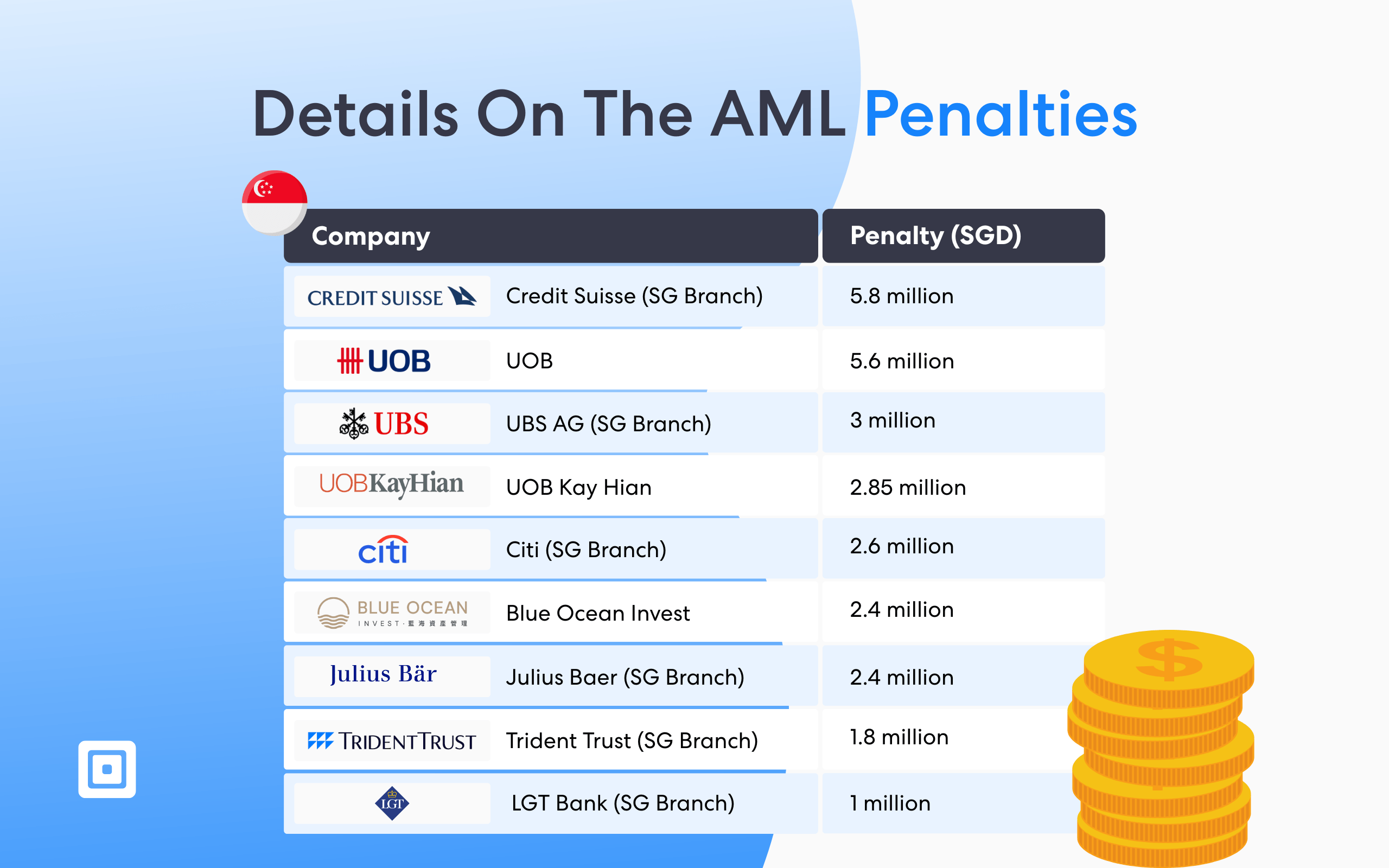
These organizations had significant [AML](https://www.complycube.com/en/solutions/due-diligence-compliance/anti-money-laundering/) and Counter Terrorist Financing (CFT) failures. Some of the collapses reported include:
- Inadequate risk management which includes not adequately accessing high-risk clients
- Negligence in establishing the source of wealth for high-risk customers
- Ignoring suspicious transactions that were originally flagged by their own internal systems
- Weak [customer due diligence](https://www.complycube.com/en/solutions/due-diligence-compliance/customer-due-diligence/) process including the lack of oversight from senior managers
Shockingly, the MAS reported that some of these firms had ineffective compliance governance, especially at the executive level. The failures highlighted pose a massive risk to Singapore’s financial ecosystem.
## The Increasing Responsibility on Senior Executives
In addition to the penalties imposed on the financial institutions, a few senior executives working in those firms were also charged. 18 individuals were condemned for lacking ownership and oversight over AML controls. Senior leaders from Blue Ocean Invest, including the CEO and COO, and directors from Trident Trust and UOB faced harsh sanctions and were required to exit the financial services industry. This case highlights the growing responsibility of senior management in maintaining robust AML frameworks and policies.
## Follow-up to The 2023 Money Laundering Case
These recent enforcement actions follow up on the major money laundering case uncovered two years prior. In August 2023, [ten foreign nationals](https://www.police.gov.sg/media-room/news/20240610_tenth_person_sentenced_for_forgery_and_money_laundering_offences) were arrested, jailed, and barred from entering Singapore for money laundering.
The case saw the seizure of over SGD 3 billion in illicit assets, marking one of the largest money laundering bust in Singapore’s history. The 2025 enforcement actions targeted at the nine financial institutions seeks to hold these firms culpable for their contribution to the case.
## Safeguarding the Financial Ecosystem
As regulators worldwide tighten their policies around AML and Know Your Customer (KYC) requirements, firms in regulated industries face higher obligations to maintain effective AML practices. This landmark case emphasizes the importance of both individual and collective efforts to combat fraud and money laundering. [Contact a member](https://www.complycube.com/en/contact/contact-sales/) of the team to learn more about how to build a foolproof AML infrastructure.
[](https://www.complycube.com/en/contact/contact-sales/)
**Categories:** News
**Tags:** Anti-Money Laundering
---
### [The CryptoCubed Newsletter: October Edition](https://www.complycube.com/the-cryptocubed-newsletter-october-edition/)
**Published:** October 30, 2025
**Author:** Dini Habib
**Excerpt:** In this edition of CryptoCubed, we look at the top crypto cases worldwide. This includes Canada's record-breaking $177 million fine against Cryptomus, Dubai's ongoing enforcement sweep on virtual asset firms, and Trump's pardon.
**Content:**
👋 Welcome back to CryptoCubed!
Many crypto cases are taking over news headlines like a storm this month. In this edition of CryptoCubed, we look at the hottest crypto cases across the globe, including Canada’s historic record-breaking $177 million fine against Cryptomus and Dubai’s ongoing enforcement sweep on virtual asset firms.
Meanwhile, crypto has intertwined with politics in the US, as Donald Trump pardons Binance founder, Changpeng Zhao. Across the UK and Australia, regulators reinforce consumer protection, warning all firms to comply strictly with laws to ensure market integrity and transparency. Let’s dive in!
## Cryptomus Faces Historic $177 Million Fine for AML Violations
Xeltox Enterprises Ltd, operating under the name Cryptomus, has amassed fines worth $C177 million (about $USD 126 million) for heavy violations of Anti-Money Laundering (AML) and Counter-Terrorist Financing (CTF) laws. Cryptomus now holds the record for one of the largest fines levied on a crypto firm by Canada’s regulator, Financial Transactions and Reports Analysis Center of Canada (FINTRAC).
> The penalty was [appropriate](https://fintrac-canafe.canada.ca/pen/amps/pen-2025-10-22-eng) based on the nature of the violations, the volume of the instances, and to ensure compliance within a high-risk sector.
FINTRAC’s examination revealed that the firm accounted for 2,593 instances across six violations under the Proceeds of Crime (Money Laundering) and Terrorist Financing Act. Out of them, 1,068 of transactions that involved darknet markets and virtual currency wallets tied to criminals such as sexual child abuse trafficking were not reported to FINTRAC, despite large grounds to suspect suspicious transactions.
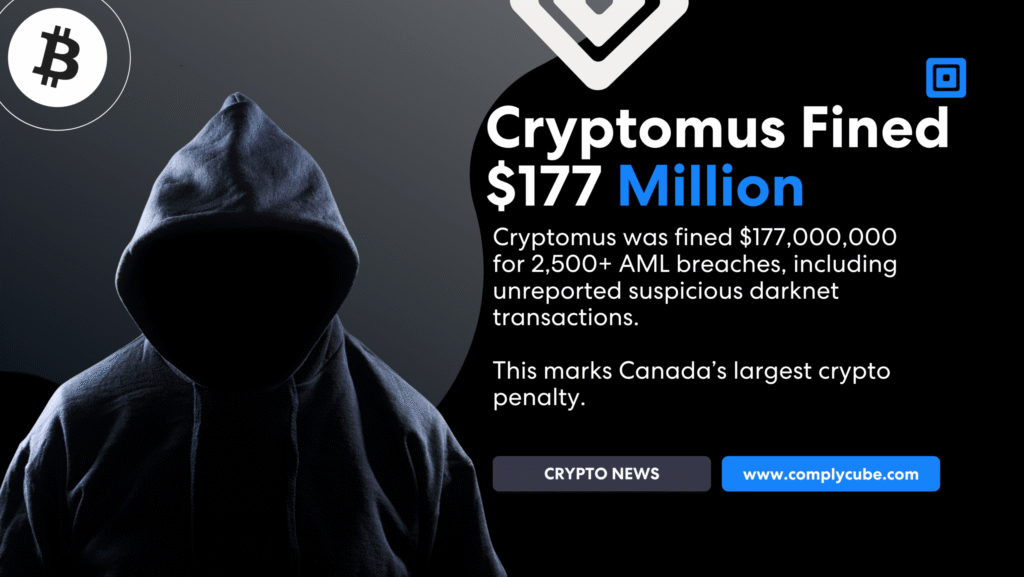
Amongst its violations, Cryptomus failed to evaluate and document money laundering risks, neglected to report transactions exceeding $10,000, and did not maintain updated [AML policies](https://www.complycube.com/en/solutions/due-diligence-compliance/anti-money-laundering/) approved by a senior compliance officer. Additionally, the firm had not followed mandated rules regarding transactions linked to Iran. The case underscores the present vulnerabilities and gaps that can still occur in the cryptocurrency world, calling on regulators for heightened oversight.
For more on this story, click [here](https://fintrac-canafe.canada.ca/pen/amps/pen-2025-10-22-eng).
## Donald Trump Pardons Binance Founder Changpeng Zhao
Trump formally pardoned former Binance CEO Changpeng Zhao this month, absolving him of any criminal record and legal restrictions, such as business activities or traveling, resulting from the conviction. Back in 2023, Zhao had pleaded guilty to AML violations that enabled criminals to move money via his company, Binance. He served four months in prison, ending in September of 2024, and resigned as CEO at that time.
> Deeply grateful for today’s pardon and to [President Trump](https://x.com/cz_binance/status/1981404850832494666) for upholding America’s commitment to fairness, innovation, and justice. – Changpeng Zhao, Binance Founder
Also known as one of the richest men in [cryptocurrency](https://www.complycube.com/en/use-cases/industry/crypto/), Zhao founded Binance in 2017. Binance’s growth was quick, and it did not take long for the crypto exchange to claim the title of the world’s largest cryptocurrency exchange by trading volume. However, due to its rapid expansion, the firm had faced multiple AML and CTF penalties from regulators worldwide. This includes the $4.3 billion fine handed out by the U.S. Department of Justice (DOJ) in 2024 and the $2.25 million penalty by India’s Financial Intelligence Unit (FIU).
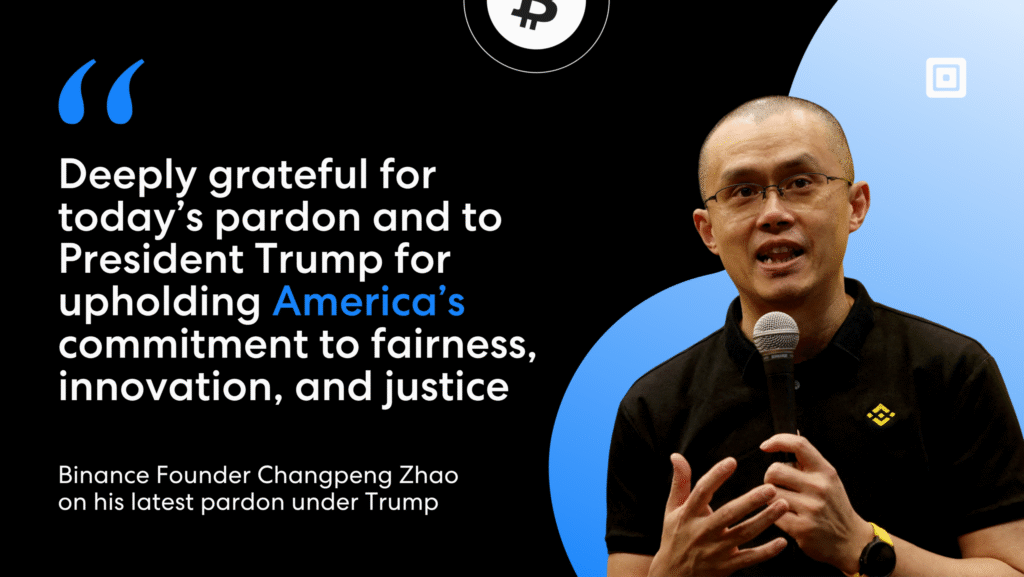
The pardon came about after large lobbying efforts by Zhao and Binance, including legal experts tied to the Trump Administration. This case highlights Trump’s move to support the country’s growing cryptocurrency sector. It also underscores the intricacies of politics, power, and crypto. The pardon has lifted Zhao from certain criminal convictions, enabling Binance to have a stronger footing in the U.S.
For more on this story, click [here](https://www.nbcnews.com/tech/crypto/binance-pardon-trump-changpeng-zhao-crypto-rcna239371).
## 19 Virtual Asset Firms in Dubai Charged up to $163,000
Dubai’s watchdog, the Virtual Assets Regulatory Authority (VARA), has fined 19 cryptocurrency firms with penalties up to AED 600,000 (approximately $USD163,000) for operating without a valid license and marketing breaches. The firms involved in this web of penalty include UAEC Digital Fintech FZCO, Morpheus Software Technology FZE (FUZE), Hatom Labs, and Triple A Technologies.
> VARA will continue to take proactive measures to uphold transparency, safeguard investors, and preserve market integrity.
In 2024, VARA, the regulatory authority overseeing virtual asset firms operating in Dubai, set marketing regulations mandating firms to seek approval before promoting crypto-related advertisements. This is part of Dubai’s larger move to safeguard its citizens, businesses, and investors, as well as promote a fair and safer financial ecosystem. Any marketing materials used to promote guaranteed returns on crypto without clear disclaimers of potential risk involved are deemed significant violations.
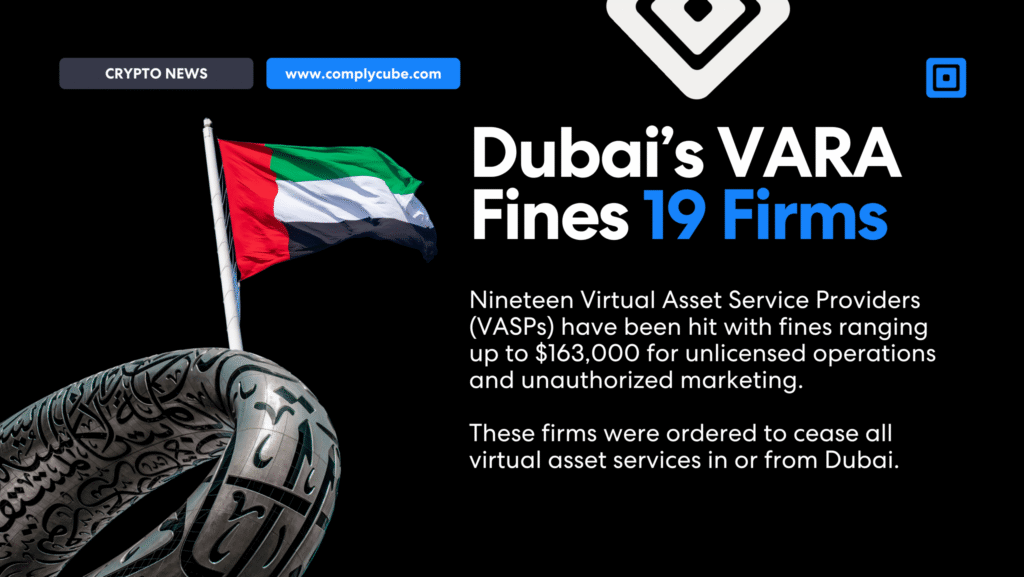
Additionally, under Dubai’s AML law, all crypto and virtual asset providers must obtain a VARA license to operate within the country. The 19 companies were immediately required to cease operations while investigations to remediate the issues are ongoing. The VARA stance towards crypto space highlights its balanced approach between encouraging innovation and maintaining stringent guardrailes in the industry.
For more on this story, click [here](https://www.complycube.com/en/19-firms-fined-by-dubai-regulators/).
## UK Crypto Advisor fined £100,281 for Insider Dealing
Neil Sedgwick Dwane, an experienced financial professional in the UK, was fined £100,281 by the Financial Conduct Authority (FCA) for abusing his power while working as an advisor for ITM Power PLC. In 2022, Dwane assessed insider information about an announcement made by ITM to the market. With this knowledge on his side, Dwane sold shares worth £124,287.
> Trading on inside information while in a position of trust rigs the system and undermines the integrity of the market.
ITM’s share price fell by 37% after the market announcement, and Dwane leveraged this by purchasing shares worth £140,700 after the price fell, ultimately profiting £26,575 in his pocket. Based on FCA investigations, he did not gain ITM’s prior approval before dealing with these shares. The FCA remains steadfast in its ruling, mentioning that the abuse of sensitive financial information must apply to anyone fairly, not just directors and executives.
Insider dealing creates gaps for criminals to exploit and launder money through crypto assets. The FCA describes this case as dishonest, unfair, and of huge risk to the country’s efforts of preventing money laundering and other financial crimes. This case underscores the intersection of AML compliance and market abuse control as regulators work their way in preventing any vulnerable loopholes within the financial hub.
For more on this story, click [here](https://www.fca.org.uk/news/press-releases/fca-bans-and-fines-advisor-insider-dealing).
## Crypto ATM Operators in Australia Tied to Scams
Australian-based ATM cryptocurrency, Cryptolink, was fined $A56,340 (approximately $USD 37,000) for weaknesses in its AML program. Australian Transaction Reports and Analysis Center (AUSTRAC) found that the company had not reported large transactions required under the country’s AML law. Cryptolinks ATM enables individuals to buy and sell crypto such as Bitcoin and Ethereum quickly without face-to-face interaction.
> Australians lose [millions of dollars each year](https://www.abc.net.au/news/2025-06-03/austrac-cracks-down-on-cryptocurrency-atm-scam-fraud-links/105351504) to scams linked to cryptocurrency ATMs, with older people being common targets.
Due to their rapid transaction speeds and 24-hour access, ATM operators are seen as attractive hotspots for fraudsters and scammers to exploit. Operators that fail to implement the required due diligence and compliance frameworks to prevent these illegal activities can be penalized heavily. According to the Australian Federal Police (AFP), Australians lose millions of dollars to scams involving crypto ATMs yearly.
AUSTRAC has ramped up its oversight over crypto ATM operators, as the country has the third-highest number of crypto ATMs globally, just behind Canada and the US. To ensure the impact of scams remains low, ATM operators have been subject to heightened regulations, with Australian crypto ATM operators facing a $5,000 limit on cash deposits and withdrawals at each time.
For more on this story, click [here](https://www.abc.net.au/news/2025-10-30/austrac-fines-crypto-atm-operator-cryptolink-in-scams-crackdown/105941804).
## Time for Your Monthly CryptoCubed Poem
So you’ve made it to the end of our newsletter. It’s time to enjoy a little satire, worthy reader, you’ve earned it.
### 🔥THE CRYPTO CUBED POEM: OCTOBER🔥
Coins spin fast through storm and flame,
Regulators step in quickly to tame.
From Canada’s gaze to Dubai’s might,
New rules rise to guide the fight.
Zhao walks free, his chapter turned,
While lessons from the markets burned.
Fraud and fear still haunt the chain,
Yet hope and progress shall remain.
### Click [here](https://www.complycube.com/en/contact/contact-sales/) to learn more about how ComplyCube supports cryptocurrency firms in maintaining global AML and KYC compliance.
### Stay tuned for our next newsletter and have a great day ahead!

**Categories:** News
**Tags:** Crypto Regulations
---
### [How to Use a KYC AML Pricing Benchmark Effectively](https://www.complycube.com/kyc-aml-pricing-benchmark/)
**Published:** October 30, 2025
**Author:** Dini Habib
**Excerpt:** Defining a pricing benchmark for KYC and AML is an important step in managing compliance expenses effectively. Understanding the factors that drive the costs of KYC and AML helps organizations make more informed pricing decisions.
**Content:**
**TL;DR:** As regulators increase the requirements needed to meet **KYC and AML compliance**, firms must benchmark their compliance spending to stay aligned. With **startup AML pricing plans** constantly evolving and a variable fintech KYC cost base, a KYC AML pricing benchmark can help develop strategies to optimize spend while **reducing compliance friction**.
## Why is Understanding KYC and AML Pricing Important?
Defining a pricing benchmark for Know Your Customer (KYC) and Anti-Money Laundering (AML) is essential to managing compliance expenses effectively. Understanding the factors that drive the costs of KYC and AML helps organizations to make informed decisions. This results in operational efficiency while ensuring regulatory adherence remains flexible to emerging regulatory changes.
However, pricing remains a major challenge for many firms. Across multiple sectors, fees remain opaque and highly variable. Particularly for early and growth-stage teams, visibility into realistic ranges is limited, making long-term planning difficult. This guide covers key pricing drivers, industry-wide benchmarks, strategic optimizations, and future trends that can help institutions reduce costs and scale smarter.
## KYC Compliance and AML Pricing for Regulated Entities
KYC and AML requirements combat financial crimes such as terrorist financing, tax evasion, and money laundering. Regulatory bodies such as the Financial Crimes Enforcement Network (FinCEN) in the United States, the [Financial Action Task Force (FATF)](https://www.fatf-gafi.org/), and equivalent authorities in the UK, EU, and APAC regions have ramped up expectations for [Customer Due Diligence (CDD)](https://www.complycube.com/en/solutions/due-diligence-compliance/customer-due-diligence/) and Identity Verification (IDV).
For most businesses, especially for startups, KYC requirements are often a strain on budgets, yet non-negotiable for customer due diligence. For growth-stage firms and banks, the complexity of regulatory expectations increases as the organizations scale. Now, multilingual onboarding, ongoing PEP and sanctions monitoring, and digital audit trails have become crucial.
Delayed investment in a thorough compliance infrastructure often backfires, leading to rising operational costs, loss of relationships with prospective customers, and regulatory fines. A KYC AML pricing benchmark can help mitigate these risks. It provides a strategic approach to reducing the Total Cost of Ownership (TCO) across KYC systems and onboarding functions, reducing onboarding times, and optimizing financial risk management.
## What Influences KYC and AML Pricing Structures?
Compliance expenses vary dramatically across organizations. From nimble crypto startups to multinational retail banks, a KYC AML pricing benchmark should not be the same from one sector to another. Factors such as the level of risk involved and the degree of automation can influence the mixture of checks that need to be conducted and the total cost base, with manual interventions driving up expenses.
> Relying on manual processes leads to increased costs and a loss of potential business opportunities.
According to [Fintech Global](https://fintechmagazine.com/regtech-compliance/autorek-payments-research), manually driven processes can drastically undermine profitability. Large enterprises spend up to $500m yearly on CDD. With manual processes, organizations face potential human error, reduced efficiency, and a loss of business customers. Additionally, the scale of operations, regulatory environment, and the need for ongoing support for robust compliance can further influence overall expenditure.
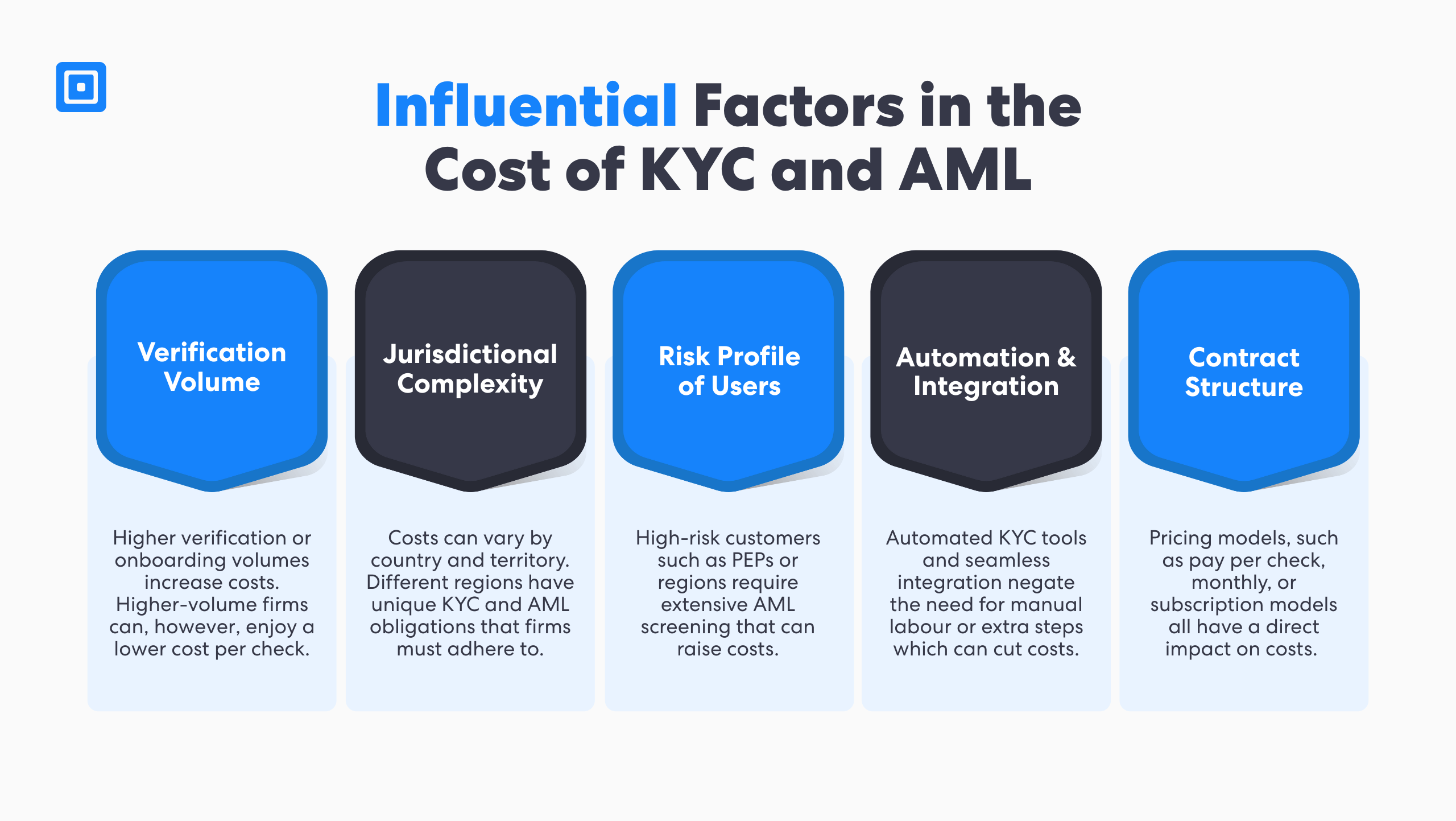
It’s easy to overlook hidden expenses that can add up behind the scenes. Risk management teams could spend hours on manual reviews while potential customers drop out because the onboarding process is too complex. The main factors impacting KYC AML pricing benchmark include:
### Verification Volume
The number of verifications performed directly impacts pricing tiers. Large enterprises typically opt for high-volume pricing packages, enabling them to onboard more customers. This leads to improved cost-efficiency in the long run, with many providers, including ComplyCube, offering a discounted average fee per verification for high-volume corporations.
Operating in multiple countries introduces regulatory fragmentation. Differences in regulations across regions can force firms to maintain separate regional processes, creating duplication of effort and inefficiencies. To achieve profitability, corporations need strong organizational alignment and to establish streamlined processes around global policies.
### Risk Profile of User Base
Businesses serving high-risk sectors may need to conduct additional checks on their clients as part of Enhanced Due Diligence (EDD). This is especially true for companies in regulated markets with unique vulnerabilities, such as the [banking](https://www.complycube.com/en/use-cases/industry/financial-services/), insurance, and cryptocurrency sectors.
### Automation and Integration of Manual Processes
Automation with real-time ID verification and document parsing, reduce customer onboarding time and operational expenses. To make an informed decision, firms need to evaluate the ROI of a KYC solution by understanding the average fee of onboarding a single user through a manual process, then quantifying the investment needed to implement additional automation.
### Contract Structure
Typical [pricing models](https://www.complycube.com/en/pricing/) include volume-based pricing and tiered subscriptions. Some RegTech platforms offer discounted rates or credits as the number of checks performed or the committed account balance increases. In addition, startups can levy reduced pricing through various pricing subsidies.
If hidden expenses are overlooked, they can result in spending much more in the long run and seriously affect operations. Furthermore, firms must consider the opportunity cost of their chosen pricing model, as an inflexible contract can limit scalability and divert resources from research and development.
## KYC and AML Expenditure by Sector
To make informed budgeting decisions, a KYC AML pricing benchmark could be developed per industry or use case. The product’s complexity, its geographic reach, and credibility impact its effectiveness and pricing. These variables influence the effectiveness of compliance efforts and the overall spend required to meet regulatory requirements.
Recognizing the unique characteristics of a sector is essential to understanding the main cost drivers. Firms in Crypto, FinTech, and Financial Services face intense scrutiny because the nature of their industry and its high transaction volumes can make them attractive targets for money laundering and fraud.
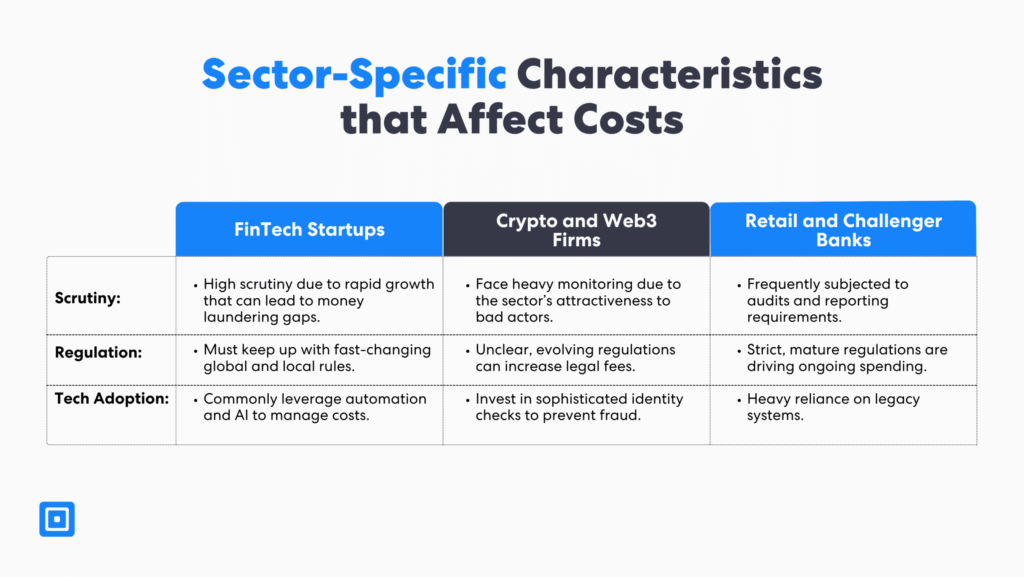
For crypto firms, regulations such as the EU’s MiCA regulation has increased scrutiny on this sector, while for financial institutions, regulations are much more mature. In terms of technology adoption, fintechs prefer AI and automation to boost operational efficiency, crypto firms invest in advanced fraud prevention solutions, while many traditional banks rely on legacy technology with manual oversight since decision-making and change management are slower.
### The Compliance Cost for FinTech Startups
FinTech startups often prioritize fast onboarding without sacrificing regulatory demands. These companies favor plug-and-play identity verification solutions. With low-commitment pricing and entry-level plans, companies can avoid large costs in the early stages. Startups typically use basic identity verification, sanctions screening, and [age verification services](https://www.complycube.com/en/solutions/identity-assurance/facial-age-estimation/). Given limited in-house resources, many organizations rely on modular, scalable API-driven platforms.
Early-stage fintechs, in particular, benefit from simplified dashboards and automation-ready tools. These can reduce operational overheads, speed up deployment, and reduce false positives. This means a KYC AML pricing benchmark for a start-up may prioritize budget control and speed over product complexity. You can learn more here: [How Much Does KYC Cost?](https://www.complycube.com/en/how-much-does-kyc-cost/)
### KYC and AML Spending for Crypto and Web3 Firms
Due to their higher risk profiles, cryptocurrency exchanges, wallet providers, NFT marketplaces, and DeFi platforms are subject to intense regulatory oversight. These entities must comply with global AML requirements, including the FATF and the EU’s MiCA framework, which require comprehensive internal controls, beneficial ownership disclosure, and real-time transaction monitoring.
Adverse media screening, continuous monitoring, sanctions screening, [Politically Exposed Persons (PEP)](https://www.complycube.com/en/what-is-a-pep/) checks, and dynamic risk scoring are typically required. To minimize platform risk and build regulatory trust, these firms must provide regulators with audit-ready data and implement innovative fraud detection screening systems to prevent false positives.
### Retail and Challenger Banks KYC and AML Pricing
Retail and challenger banks face unique challenges. With thousands of monthly verifications, these institutions must balance compliance rigor and operational efficiency to manage expenses. Customer trust is vital in this sector and building secure and straightforward onboarding is crucial. For firms in regulated sectors, high-volume IDV, integration with core banking systems, and maintaining audit-ready documentation are critical.
Retail banks often adopt a hybrid model to manage these pressures, utilizing an in-house compliance infrastructure with trusted vendor solutions to enhance efficiency. As operations expand, improving operation models becomes essential for reducing manual workloads, enhancing auditability, and ensuring regulatory alignment. Investment in [Optical Character Recognition (OCR)](https://www.complycube.com/en/solutions/due-diligence-compliance/know-your-customer/optical-character-recognition/), AI-driven analytics, and linear workflows support accuracy and faster onboarding.
### **Case Study: The impact of speed and automation on onboarding costs**
Bots is an innovative cross-asset trading platform that offers AI-based trading. The platform has expanded quickly, garnering over 100,000 users who make daily transactions. Despite its quick growth, Bots faced **operational bottlenecks**, largely due to its onboarding process, which relies on manual verifications and reviews.
To address these challenges, Bots partnered with ComplyCube. The key driver in selecting ComplyCube was the platform’s ability to **automate complex onboarding** workflows and reduce operational effort. After analyzing various providers, Bots also discovered its need for extensive AML solutions, multi-bureau (2+2), and case management.
ComplyCube enabled Bots to satisfy its compliance challenges, lowering its total cost. Bots shows how firms can implement a KYC AML pricing benchmark effectively. Its team **strategically analyzed** the company’s characteristics, sector-specific obligations, and future regulatory needs. They determined the **ROI** of adopting an automated platform by comparing the cost of a manual check with the expense of automation.
## Cost Optimization Strategies in KYC and AML Processes
To make AML and KYC processes more profitable, there are several strategies that any corporation can adopt and implement. As organizations scale, achieving sustainable efficiency is crucial, requiring a mix of approaches, including developing a risk-based model and regular monitoring systems. The aim is to create an environment that can adapt and thrive as the company grows.
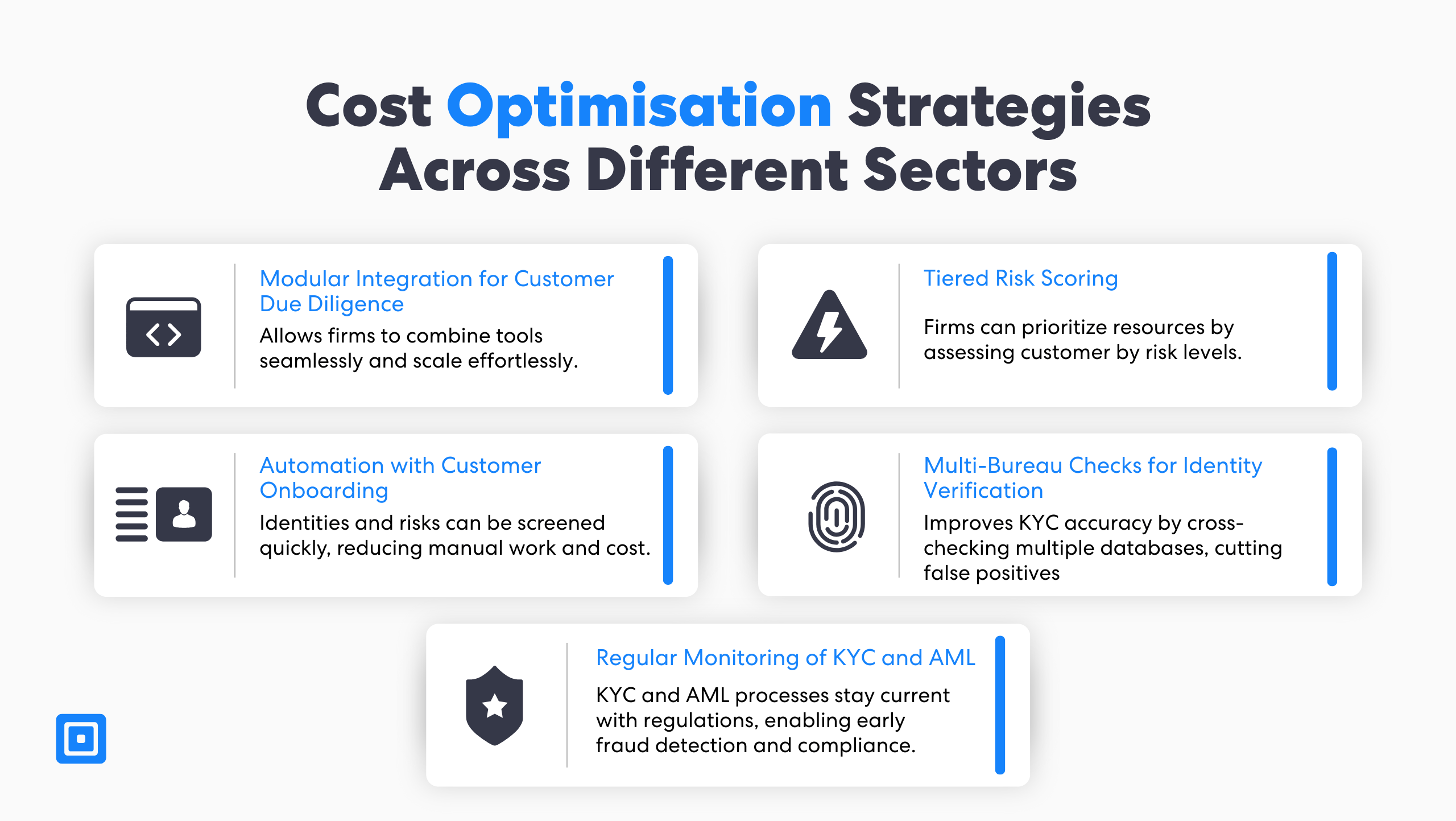
The evolution of technology supports this goal, helping risk management teams adapt faster to changing customer data, risk levels, and regulatory updates. Organizations can build long-term trust with regulatory bodies, clients, and investors alike by demonstrating its ability to ongoing alignment with governance standards and laws.
### Modular Integration for Targeted Compliance
Instead of going all in on full-suite pricing packages, choose only the required services through modular solutions. Companies can plug in specific features that are mandatory for compliance and avoid paying for items that do not provide ROI in the long-run. This strategy offers firms an informed way to align their compliance budgets with key metrics and risk exposure, allocating resources where it drives the highest operational impact.
### Investing in Automation during Document and Biometric Checks
Customers are highly sensitive to the customer onboarding process, with [74% mentioning](https://userpilot.com/blog/customer-onboarding-statistics-saas/) they will switch to another solution if it’s complicated. Thus, investing in automation for customer onboarding can increase client retention and build brand loyalty as it forms a more straightforward process. Features such as OCR technology and liveness detection enhance the accuracy and quality of document and biometric verification without requiring manual intervention.
### Implementing a Tiered Risk Scoring or Risk-Based Approach
When creating onboarding workflows, it is important to build them according to a customer’s risk level. This ensures low-risk customers can onboard quickly without requiring complex steps. Organizations can create a more tailored workflow, requiring comprehensive checks for high-risk users. A risk-based approach strikes a balance between overall profitability and regulatory adherence. You can learn more here: [Navigating Enhanced Due Diligence](https://www.complycube.com/en/enhanced-due-diligence-edd-insights-and-challenges/).
### Multi-Bureau Checks for Identity Verification
Multi-bureau checks enable businesses to cross-reference customer information against multiple global databases or credit bureaus in a single workflow. This eliminates duplication, enhances the reliability of identity assurance, and supports a thorough AML process. To further enhance security, businesses can implement a 2+2 multi-bureau check, whereby customer identity attributes are validated using two independent data sources.
### Regular Monitoring of KYC Processes
Re-screening clients post-onboarding improves risk coverage and reduces frequent full KYC system reviews, lowering the total cost of compliance. [ComplyCube](https://www.complycube.com/en/) supports these initiatives through scalable solutions for existing systems, including [multi-bureau checks](https://www.complycube.com/en/solutions/identity-assurance/multi-bureau-checks/), [continuous monitoring](https://www.complycube.com/en/solutions/global-screening/continuous-monitoring/), and device intelligence. Financial institutions can reduce friction, improve audit readiness, and enhance the overall customer journey while remaining lean and responsive.
## Future RegTech Trends that can Impact Pricing
Recent developments show a worldwide push to harmonize regulations and boost automation in regulatory management tasks. Organizations such as the FATF, along with the upcoming [EU AML Authority (AMLA)](https://www.amla.europa.eu/index_en), are playing pivotal roles in establishing standards around data privacy and raising the baseline requirements for document verification across regions.
Imagine new accounts for digital ID systems that work smoothly and seamlessly, much like the EUDI wallet, making everyday processes quicker. At the same time, institutions are utilizing machine learning to [detect fraud](https://www.complycube.com/en/use-cases/process/fraud-prevention/) and non-compliance. This shift helps reduce tedious manual processes and cuts down labor costs, making the customer onboarding process feel more connected and user-friendly.
The role transparency plays is also increasing. Regulators and users demand more transparent and understandable processes, such as step-by-step policy adherence and transparent audit trails. All these trends point to a future where flexible, tech-savvy RegTech systems are essential for managing pricing and risk efficiently.
### Key Takeaways about KYC AML Pricing Benchmark
- **A KYC AML pricing benchmark** helps firms assess potential risks while optimizing compliance expenditure.
- **Tailoring benchmarks** to niche business cases is crucial in crafting a balanced compliance budget strategy.
- **Automation and dynamic risk scoring** can increase efficiency and cut expenses through greater accuracy and lower false positives.
- **Explainable AI** and transparent audit trails reflect the current trend towards accountable and evidence-driven compliance.
- **ComplyCube is an all-in-one platform** for KYC and AML compliance, providing better budget control while meeting global regulations.
## Tailoring a KYC AML Pricing Benchmark Cost to a Company’s Growth Stage
The cost of KYC and AML requirements is universal. However, companies’ approaches depend on their size, sector, and risk appetite. Whether operating as a FinTech or expanding into new markets, understanding how KYC/AML regulatory compliance relates to the growth stage is essential. Leveraging features such as dynamic risk scoring, transparent audit trails, and document parsing can significantly cut spending while enhancing processes.
With the right tools and strategies, businesses can reduce verification fees, stay aligned with evolving regulations, and avoid reputational harm. Explore ComplyCube’s global [KYC](https://www.complycube.com/en/solutions/due-diligence-compliance/know-your-customer/) and[ AML](https://www.complycube.com/en/solutions/due-diligence-compliance/anti-money-laundering/) compliance tools to reduce verification expenditure and improve operational efficiency.
## Frequently Asked Questions
How much do AML checks cost?
AML screening cost varies. There are two types of screening: Standard and Extensive, which screen against different data sources and offer two different pricing options. An all-in-one platform offers companies access to more checks at a lower total cost, such as customer due diligence, ongoing monitoring, and multi-bureau checks.
What are the hidden fees in KYC and AML?
Hidden fees in KYC and AML come from setup fees, integration costs, and ongoing customer support. To prevent hidden fees, companies need to request full vendor transparency earlier. Request upfront costs and confirm the contract at the beginning stages to avoid unexpected financial strain.
What impacts the cost of KYC and AML?
The factors influencing KYC and AML cost include geography coverage, transaction volumes, and check mix required. Industry-specific risks and regulatory environments influence spending. Firms must assess the gaps in their current compliance stack to identify which checks and security layers are necessary. To align with future compliance expenses, businesses must consider business growth, such as country expansion.
What is the long-term ROI of automated AML and KYC solutions?
Automated AML and KYC solutions reduce manual efforts, prevent costly non-compliance penalties, and improve customer onboarding efficiency. Businesses that invest in scalable automated AML and KYC solutions can achieve compounding savings over time through better fraud detection, reduced false positives, and global regulatory adherence.
How does ComplyCube enable businesses to reduce the price of KYC and AML checks?
ComplyCube offers flexible, modular pricing plans. Its tiered and volume-based pricing models offer companies discounted per-check cost as verification volumes increase. Firms achieve more cost savings as they grow and onboard more customers. ComplyCube does not charge setup fees, delivering full pricing transparency. Its no/low code, automated platform lowers reliance on manual effort, providing cost reductions of 63%.
**Categories:** Guides
**Tags:** Know Your Customer
---
### [The CryptoCubed Newsletter: September Edition](https://www.complycube.com/the-cryptocubed-newsletter-september-edition/)
**Published:** September 30, 2025
**Author:** Dini Habib
**Excerpt:** In this month’s edition, we cover Australia’s $16.5 million warning to unlicensed crypto firms, KuCoin’s legal battle with Canada’s FINTRAC, the married duo who scammed over 145 crypto investors, Poland’s new crypto bill, and more!
**Content:**
👋 Welcome back to CryptoCubed!
The crypto industry is facing mounting pressure as governments all over the globe seek to introduce stricter regulations. In response, many crypto firms are relocating to countries with less regulatory oversight. This raises the question: could this be the downfall of crypto innovation in developed markets? In this month’s edition, we cover Australia’s $16.5 million warning to unlicensed crypto firms, KuCoin’s legal battle with Canada’s FINTRAC, the married couple who scammed over 145 crypto investors, the uproar sparked by Poland’s new crypto bill, and more! Stay tuned.

## AUD $16.5 Million Fines for Non-Compliant Crypto Firms in Australia
On September 24th, Australia introduced a new draft legislation, mandating all digital asset and tokenized platforms to hold an Australian Financial Services Licence (AFSL). Under the AFSL, crypto firms are placed under heightened monitoring in relation to consumer protection policies, transaction processes, and internal cyber securities policies.
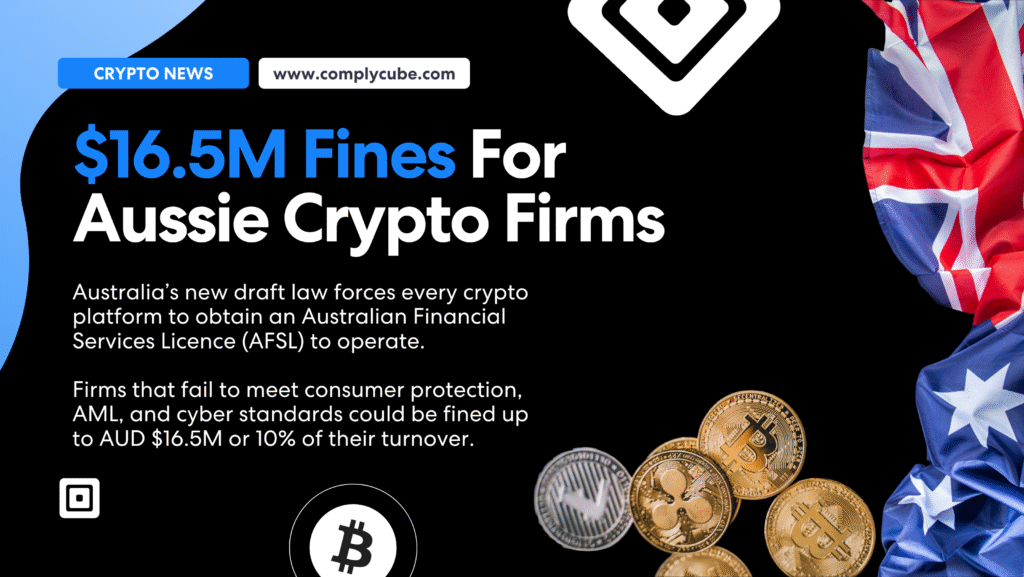
The license places crypto companies under Australia’s current financial services framework, aimed at harmonizing compliance for legacy cryptocurrency organizations with those of other financial institutions. The legislation establishes digital asset and tokenized custody platform, two new financial products under Australia’s Corporations Act.
Any firm covering trading, exchange, and safekeeping of digital assets will need to align with Australia’s Anti-Money Laundering (AML) and Counter-Terrorism Financing Act (CFT). This includes implementing effective Know Your Customer (KYC) framework, transaction monitoring, and submitting timely Suspicious Activity Reports (SARs). Any organization found non-compliant will face heavy penalties, including fines that can reach up to USD 10.9 million, or 10% of a company’s turnover.
For more on this story, click [here](https://cointelegraph.com/news/australia-tighten-oversight-crypto-exchanges-draft-law).
## Peken Global Limited Challenges FINTRAC’s $19.5 million Penalty
Peken Global, also known more commonly by the name KuCoin, has been fined CAD $19.5 million ($14 million) by The Financial Transactions and Reports Analysis Centre of Canada (FINTRAC) for breaching Canada’s Proceeds of Crime (Money Laundering) and Terrorist Financing Act. According to FINTRAC, KuCoin had breached three AML and CFT rules, ranging from minor to severe violations.
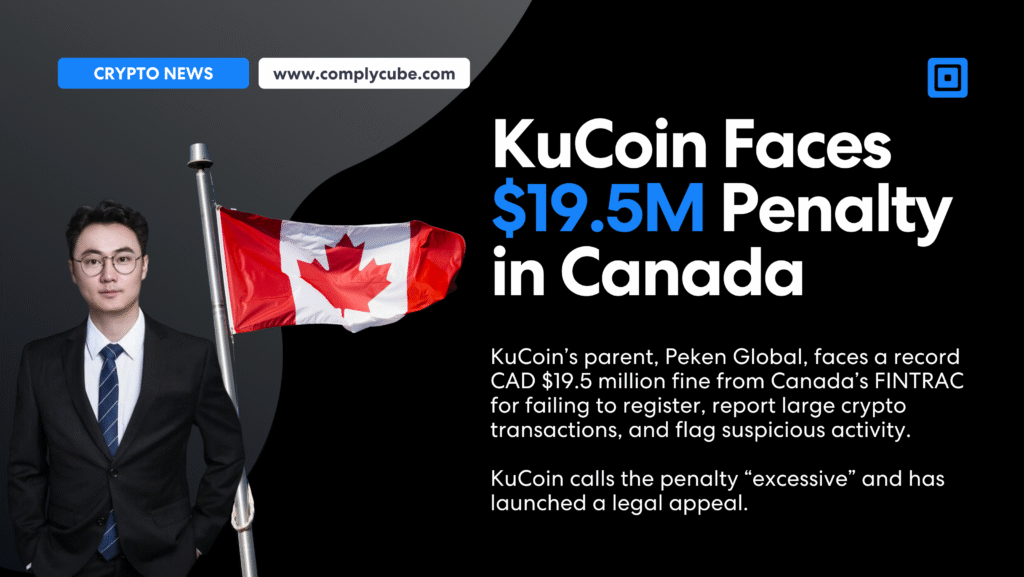
FINTRAC’s latest news release has mentioned that the firm failed to register as a foreign money services business, neglected reporting digital transactions amounting to or over CAD $10,000, and ignored suspicious transactions that had reasonable links to money laundering and other financial crimes. These breaches undermined Canada’s efforts to tackle illegal crimes and safeguard the financial services market.
> Canada’s Anti-Money Laundering and Anti-Terrorist Financing Regime is in place to protect the safety of Canadians and the security of Canada’s economy.
KuCoin’s CEO, BC Wong, published a post on X, mentioning that the firm has submitted an appeal to the Federal Court of Canada, as it believed the penalty is “excessive”. In a statement with the Director and Chief Executive Officer of FINTRAC, Sarah Paquet mentions, “FINTRAC works with businesses to help them understand and comply with their obligations under the Act. We are also firm in ensuring that businesses continue to do their part, and we will take appropriate actions when they are needed.” The appeal is currently being looked into as KuCoin holds its position in maintaining its responsibilities under Canadian laws.
For more on this story, click [here](https://fintrac-canafe.canada.ca/new-neuf/nr/2025-09-25-eng).
## Fraudulent Crypto Scheme by Tennessee Couple Unveiled
Tennessee couple Michael and Amanda Griffis have been fined $6.8 million for scamming over 145 people under a counterfeit platform aimed to replicate the Apex Trading Platform. Starting from 2021 to 2023 the duo operated a fraudulent commodity pool called “Blessings of God Thru Crypto.” At least 145 investors were scammed through promises of huge returns.
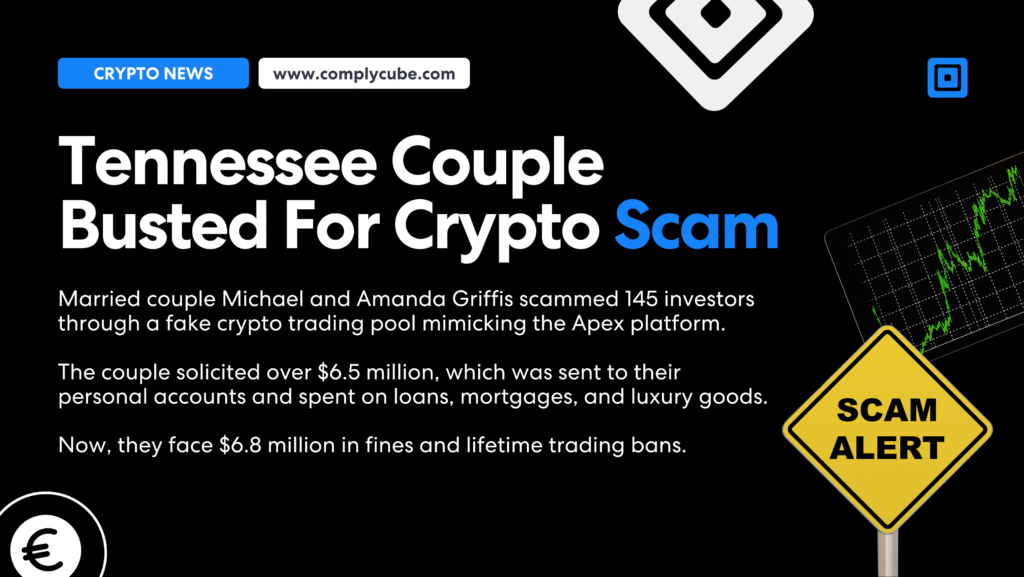header 7
The U.S. Commodity Futures Trading Commission (CFTC) first discovered “Blessings of God Thru Crypto” after investigations traced Ponzi-like payments made to a few investors. According to the CFTC, the couple ran a real estate company and were able to use their connections in the company to target investors. At least $6.5 million was received and deposited into the couple’s personal bank accounts, where they made payments for mortgages, loans, and luxury items.
> If an investment opportunity seems too good to be true, it almost certainly is, for you and anyone you bring along.
The married couple are required to pay up to $5.5 million in restitution to defrauded victims and over $1.3 million civil monetary penalty, totaling over $6.8 million in fines. Additionally, they were banned from the trading market permanently. Charles Marvine, Acting Chief of the Division of Enforcement’s Retail Fraud and General Enforcement Task Force states, “This case is a stark warning to be cautious about whom you trust with your money, if an investment opportunity seems too good to be true, it almost certainly is, for you and anyone you bring along.”
For more on this story, click [here](https://cryptonews.com/news/tennesee-couple-ordered-to-pay-almost-7-million-in/).
## Poland Faces Backlash as Crypto-Asset Market Act Receives Approval
Poland’s Parliament sends Bill 1424 to the Senate on September 26, mandating heightened oversight and regulation for crypto firms. The Bill aims at aligning Poland’s regulation more closely with the European Union’s MiCA Act. Under the Bill, all Crypto Asset Service Providers (CASPs) must submit a document detailing their company structure, internal and external compliance controls, and AML processess before earning a license to operate in Poland.
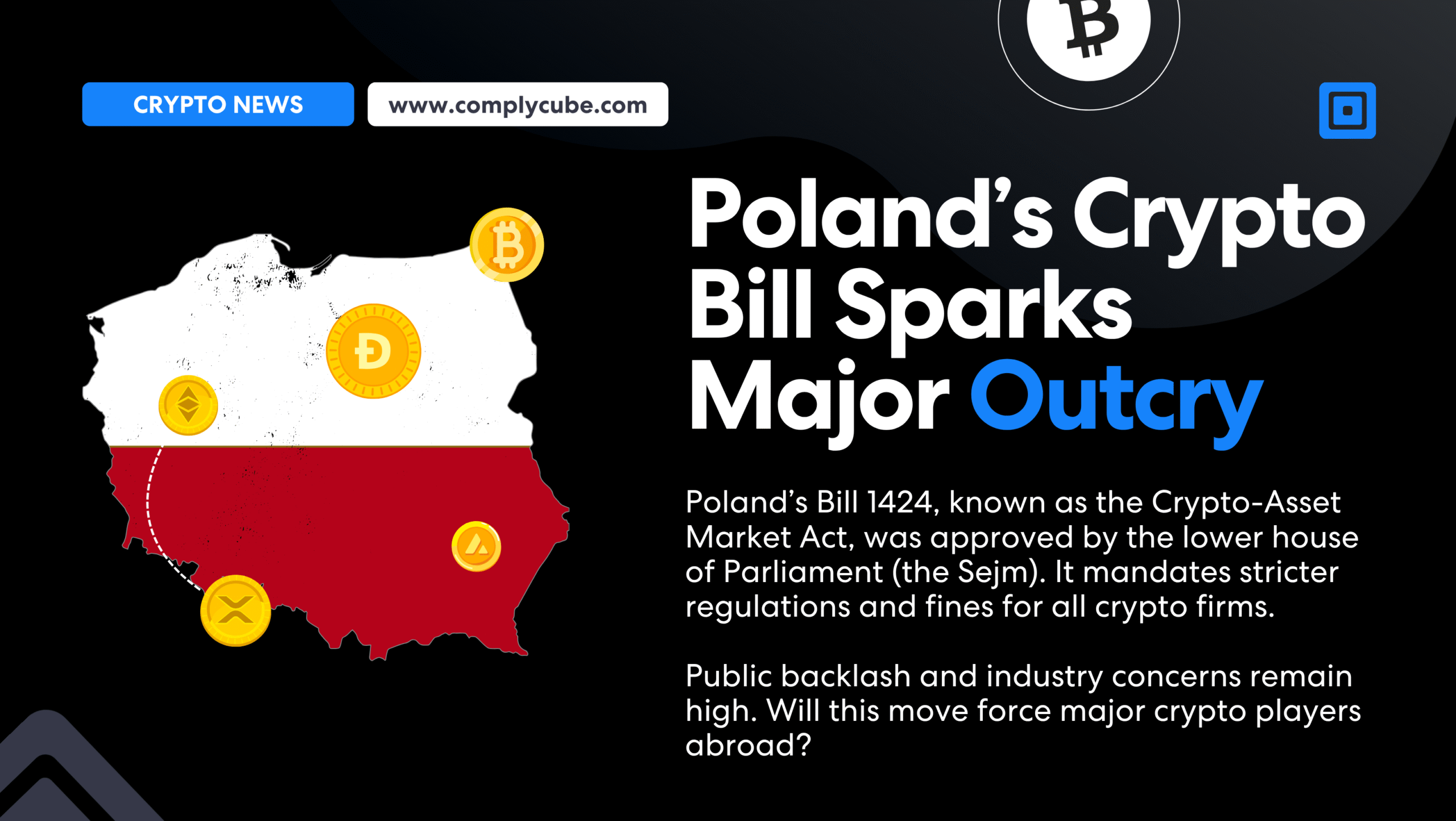
The Parliament has received massive backlash from the public, with many citizens mentioning that this could lead to broader economic impact on the country. Industry experts have warned that this overly restrictive regulation will force major Polish crypto players to relocate and cause large tax revenue losses to the country. According to the Polish Financial Supervision Authority (KNF), non-compliance will lead to up to 10 million Polish zloty fines (approximately USD 2.75 million) and two year’s jail time for those without license.
> Polish companies are already preparing a plan B: moving their operations abroad and operating in Poland on a passporting basis
Piotr Bień, co-founder of Polish Blockchain and Crypto Chamber of Commerce (IGBiNT) mentions, “The Ministry of Finance’s draft is 104 pages long, for comparison, Germany’s is 78 pages long, and some countries’ are just a few pages long. The most controversial issues include high license feeds, blocking of exchange websites by officials, and imprisonment for operating without a license. Polish companies are already preparing a plan B: moving their operations abroad and operating in Poland on a passporting basis.”
For more on this story, click [here](https://cointelegraph.com/news/poland-parliament-passes-crypto-bill-criticism).
## OKX To Pay €2.25 Million in Fines to the Netherlands’ Bank
Aux Cayes Fintech Co. Ltd, operating as OKX, is facing a €2.25 million fine (approximately USD $2.64M) from the De Nederlandsche Bank (DNB). The fine was issued because the DNB found that OKX offered crypto services across the Netherlands from 2023 to 2024 without registration, violating local AML laws. In the Netherlands, all crypto firms must register with the DNB under the country’s Anti-Money Laundering and Anti-Terrorist Financing Act (WWFT) framework.
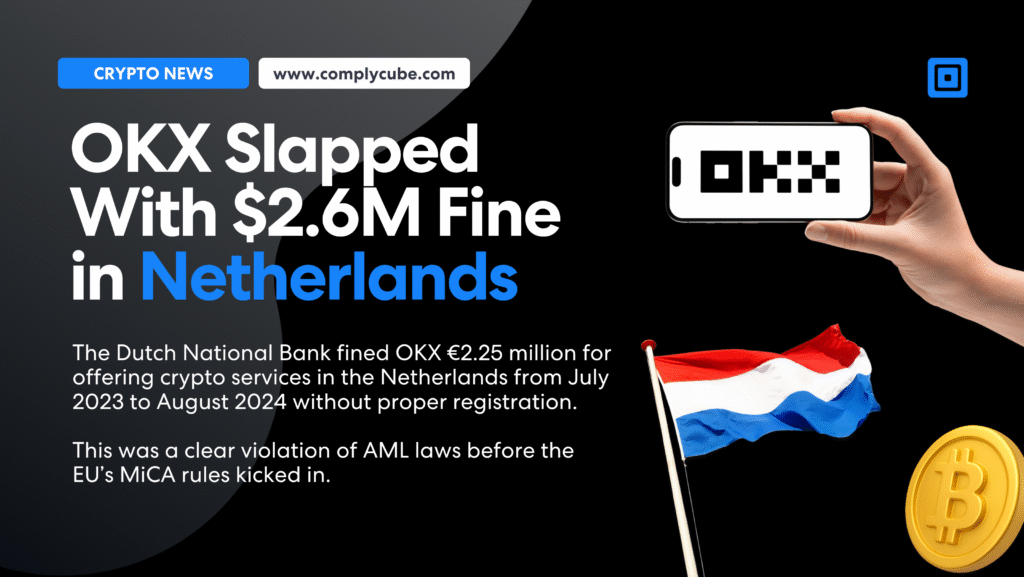
Prior to the EU’s Markets in Crypto Assets (MiCA) framework, crypto firms needed to register individually with local regulators such as DNB to operate in the Netherlands. With MiCA in force, any firm with a valid MiCA license can operate across Europe without separate licenses. OKX has released a statement mentioning that it is working closely with DNB and maintains that the Netherlands is a key area for the business.
For more on this story, click [here](https://www.dnb.nl/en/general-news/enforcement-measures-2025/fine-for-aux-cayes-fintech-co-ltd-for-offering-crypto-services-in-the-netherlands-without-the-legally-required-registration-from-july-2023-to-august-2024/).
## Time for Your Monthly CryptoCubed Poem
So you’ve made it to the end of our newsletter. It’s time to enjoy a little satire, worthy reader, you’ve earned it.
### 🔥THE CRYPTO CUBED POEM: SEPTEMBER🔥
Regulations are tightening, sharp and clear,
Crypto firms now face increased fear.
Australia’s warning makes waves wide,
While KuCoin battles Canadian courts in stride.
Poland’s bill sparks loud dissent,
Voices rise where change is sent.
Developed markets raise the stake,
But will innovation bend or make a break?
### Click [here](https://www.complycube.com/en/contact/contact-sales/) to learn more about how ComplyCube supports cryptocurrency firms in maintaining global AML and KYC compliance.
### Stay tuned for our next newsletter and have a great day ahead!

**Categories:** News
**Tags:** Crypto Regulations
---
### [Canada Bank Fined $601,139.80 for Five Major AML Breaches](https://www.complycube.com/canada-bank-fined-for-five-major-aml-breaches/)
**Published:** October 23, 2025
**Author:** Dini Habib
**Excerpt:** FNBC has been fined $601,139.80 for five AML violations. FINTRAC discovered that the firm did not meet AML standards, including submitting suspicious activity reports, updating client information, and performing due diligence.
**Content:**
The Financial Transactions and Reports Analysis Center of Canada (FINTRAC) penalized First Nations Bank of Canada (FNBC) $601,139.80 for five different Anti-Money Laundering (AML) violations. The breaches were discovered during a compliance examination by FINTRAC. FNBC, is a Canada bank fined based in Saskatoon, specializes in providing financial services to the Indigenous community.
According to the Criminal Intelligence Service Canada (CISC), approximately $45 billion to $113 billion is laundered in Canada per year. The country operates under its Anti-Money Laundering and Anti-Terrorist Financing (AML/AFT) regime. Under this regime, 13 federal partners, including FINTRAC, the Canadian Security Intelligence Service (CSIS), and the Office of the Superintendent of Financial Institutions (OSFI), work together to combat domestic and transnational crime.
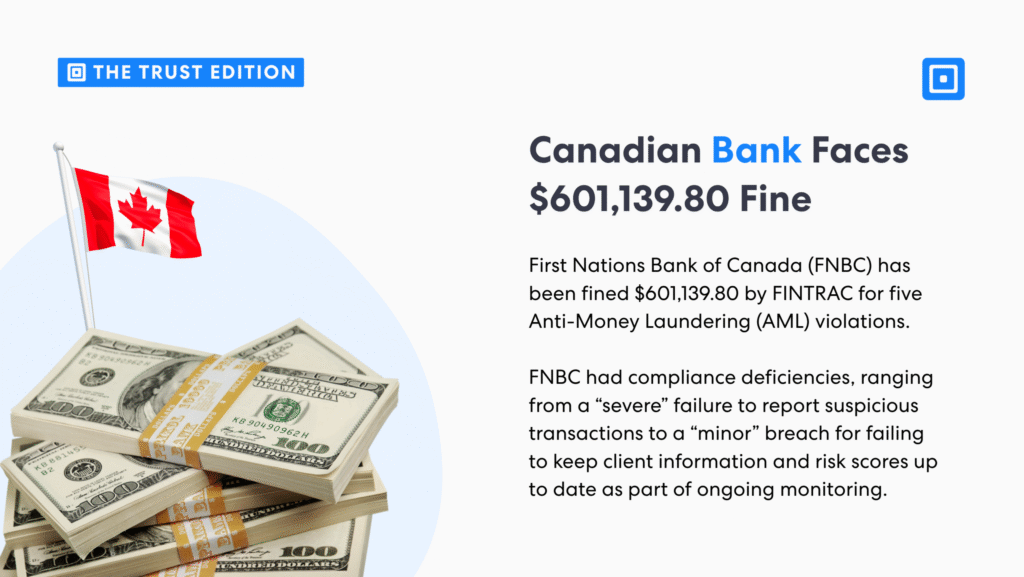
## Details of the Canada Bank Fined Case and FINTRAC’s Findings
Under the regime, the [Proceeds of Crime (Money Laundering) and Terrorist Financing Act (PCMLTFA)](https://laws-lois.justice.gc.ca/eng/acts/p-24.501/page-1.html) acts as Canada’s primary AML law, under which FINTRAC exerts oversight. According to FINTRAC, FNBC violated five rules under the PCMLTFA, which resulted in enforcement action. Of these violations, one is classified as a “very serious” breach, three are “serious” failures, and the last is a “minor” weakness.
> Canada’s AML/ATF Regime operates on [three interdependent pillars](https://www.canada.ca/content/dam/fin/programs-programmes/fsp-psf/rs-sr/rs-sr-eng.pdf): policy and coordination, prevention and detection, and, lastly, investigation, prosecution, and disruption.
The “very serious” breach involved FNBC’s inadequate identification and reporting of suspicious transactions. Among the files examined by FINTRAC, 31% involved transactions for which no suspicious transaction report was submitted despite reasonable grounds to suspect suspicious activity. This violation exposed critical gaps in FNBC’s [AML](https://www.complycube.com/en/solutions/due-diligence-compliance/anti-money-laundering/) controls, potentially enabling suspicious transactions to be sent and received via their services.
Specifically, FNBC did not implement further investigations on scenarios where customer transactions were inconsistent with their financial status, where transactions were structured to avoid reporting threshold alerts, and where there was evidence of dishonesty from clients.
> FINTRAC works with businesses to help them [understand and comply](https://www.canada.ca/en/department-finance/programs/financial-sector-policy/canadas-anti-money-laundering-and-anti-terrorist-financing-regime-strategy-2023-2026.html) with their obligations.
In terms of the violations deemed “serious,” FINTRAC found several gaps. First, FNBC did not keep its compliance policies up-to-date with evolving laws. Furthermore, these policies were not approved by a senior officer as required under the PCMLTFA. Second, the bank did not have robust customer-based risk assessments. Third, FNBC did not implement ongoing monitoring for high-risk clients. In its final violation, FINTRAC found 5 cases where FNBC failed to assess customer risk scores or keep their information updated.
FNBC’s penalty highlights a broader trend of Canadian regulators ramping up enforcement actions for AML failures. Most notably, this week, Canada’s Finance Minister François-Philippe Champagne announced an ambitious plan to introduce a national anti-fraud strategy alongside a new financial crime agency to further strengthen the country’s capacity to crack complex financial crimes.
For more on this story, click [here](https://fintrac-canafe.canada.ca/pen/amps/pen-2025-10-16-eng).
**Categories:** News
**Tags:** Anti-Money Laundering
---
### [ComplyCube wins 2025 Tech Cares Award for Third Consecutive Year](https://www.complycube.com/complycube-wins-2025-tech-cares-award/)
**Published:** August 27, 2025
**Author:** Rithu Jagannath
**Excerpt:** In recognition of the IDV leader’s consistent efforts and innovative approach in the tech sector, ComplyCube has been presented with the Tech Cares Award by TrustRadius for Corporate Social Responsibility.
**Content:**
London, August 26, 2025 – For the third year running, [ComplyCube](https://www.complycube.com) has won the 2025 Tech Cares Award by [TrustRadius](https://solutions.trustradius.com), recognizing the company’s dedication to socially responsible innovation in Identity Verification (IDV) and Anti-Money Laundering (AML).
Aside from being a technology provider, ComplyCube stands out for weaving purpose into product. Through inclusive hiring, ethical AI development, and community-driven initiatives, the company reflects what it means to lead with intent in the compliance space.
## Recognition from Trust Radius’ Tech Cares Award
The [Tech Cares Award](https://solutions.trustradius.com/vendor-blog/trustradius-an-hg-insights-company-announces-purpose-driven-businesses-as-2025-tech-cares-award-winners/) spotlights organizations that combine commercial success with meaningful social impact. The vendors recognized reflect the growing role of purpose in the tech industry. TrustRadius, an HG Insights company, celebrates organizations bringing compassions to their teams and communities.
> Congratulations to the ComplyCube team for earning a Tech Cares award. ComplyCube’s commitment to inclusion, mentorship, and ethical innovation demonstrates how technology can drive both business impact and societal progress. – [Allyson Havener](https://www.linkedin.com/in/allyson-havener/), CMO, Trust Radius
At ComplyCube, this includes integrating Environmental, Social and Governance (ESG) principles into its company operations. Through Diversity, Equity, and Inclusion (DEI), internal mentorship, and a commitment to creating a product that places fairness and and transparency at its core, ComplyCube raises the bar.
## Tackling Bias with Transparency
At the core of ComplyCube’s offering is a holistic, AI-driven AML/KYC solution that surpasses competitors in terms of transparency, accuracy, and scalability. In 2024 alone, the company enabled over 4.5 million unbanked individuals to access financial services, fostering inclusion. The main example of said innovation is ComplyCube’s ongoing work on bias mitigation within AI models. According to a recent study in 2024 with [Science Direct](https://www.sciencedirect.com/science/article/pii/S0167739X24000694),
> [Artificial intelligence](https://www.sciencedirect.com/topics/computer-science/artificial-intelligence "Learn more about Artificial intelligence from ScienceDirect's AI-generated Topic Pages") (AI) can potentially transform our world, but it can also perpetuate societal inequities if not properly designed.
Unlike ‘black box’ AI models, ComplyCube gives clear, actionable insights into verification results. This equips compliance professionals with the confidence to implement advanced risk-based strategies aligned with international standards. By establishing independent testing to ensure consistent performance across multiple demographics, ComplyCube’s efforts pave the way to expanding financial inclusion. It reinforces trust across the digital economy.
>
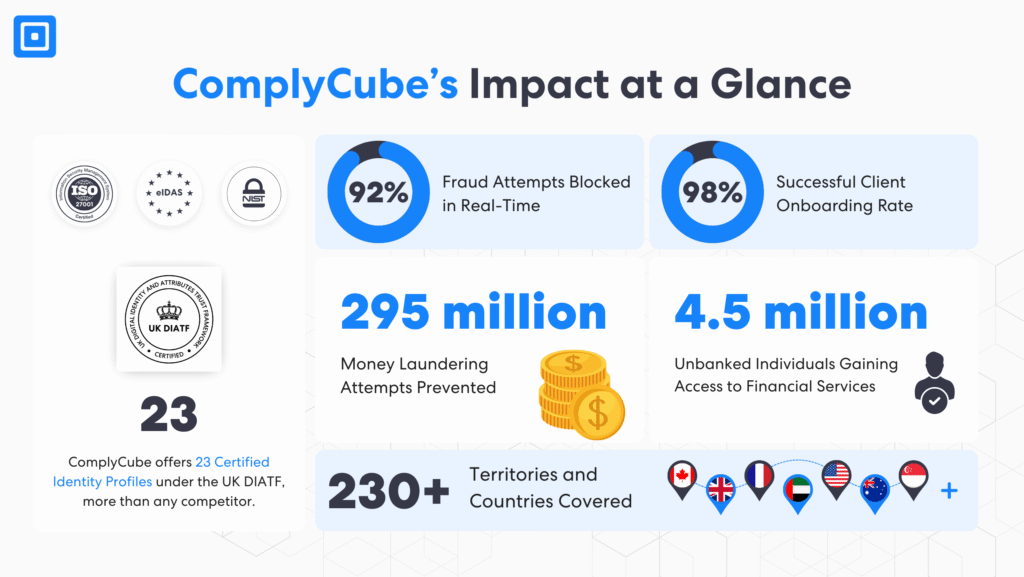
>
>
## People-First Culture in Practice
According to [TalentLMS](https://www.talentlms.com/research/toxic-culture-tech-industry-survey), 45% of employees within the software industry are planning to quit their job due to a toxic work environment. It is the responsibility of senior management to eliminate this and connect more deeply with their team. At ComplyCube, leadership aims to cultivate a workplace culture rooted in wellbeing, openness, and shared growth. By encouraging employees to participate in learning programs, cross-team collaboration and continuous development, ComplyCube carries a human-first mindset carries through into every product interaction and customer journey.
More recently, in the [G2 Spring 2025 Report](https://www.complycube.com/en/complycube-is-a-leader-in-the-g2-spring-2025-report/), ComplyCube strengthened its leadership position by being named a G2 Leader across Digital Customer Onboarding, Biometric Authentication, and Anti-Money Laundering, highlighting the breadth and depth of its technology. In addition, the company also secured multiple badges for Best Support, Easiest to Use, Easiest to Set Up, and Best Relationship across several categories. This covers E-commerce, Address Verification, and Biometric Authentication, underscoring its commitment to delivering exceptional client experiences and strong partnerships.
## Ethics and Responsible Business
However, what sets ComplyCube apart is how high standards can intersect with ethics. From document verification to AI model training, the platform is designed to support fairness, privacy, and accountability. These principles deeply embedded in its company philosophy.
> We’ve built ComplyCube on the belief that secure and inclusive identity verification should be universal. – Dr. Tarek Nechma, CEO, [ComplyCube](https://www.complycube.com)
[Dr. Tarek Nechma](https://www.linkedin.com/in/tarek-nechma/) says, “We’ve built ComplyCube on the belief that secure and inclusive identity verification should be universal. This recognition reinforces our belief that compliance technology has the power to serve a higher purpose. Beyond technological innovation, we’re committed to making compliance accessible. ComplyCube’s flexible pricing and self-service model have democratised access to high-quality compliance solutions, enabling startups and enterprises to scale securely. The results have been transformative.”
ComplyCube stands as the youngest company certified under the UK Digital Identity and Attributes Trust Framework ([UK DIATF](https://www.gov.uk/government/collections/uk-digital-identity-and-attributes-trust-framework)) where it achieved the highest confidence level with the broadest profiles. ComplyCube also holds a comprehensive suite of certifications, including ISO 30107-3, ISO 27001:2022, and ISO 9001:2015. These achievements demonstrate our commitment to setting new industry standards for IDV, fraud prevention, regulatory compliance, and responsible business practices. The work goes beyond compliance into ethical innovation and sustainability.
## About ComplyCube
[ComplyCube](https://www.complycube.com/) is an automation-first SaaS platform that leverages AI and machine learning to deliver industry-leading Identity Verification (IDV), Know Your Customer (KYC), Know Your Business (KYB), and Anti-Money Laundering (AML) solutions. Its unified compliance suite includes biometric authentication, fraud detection, sanctions and Politically Exposed Person (PEP) screening, and document verification.
Trusted by global leaders such as HSBC, AXA, and Citi Bank and recognized in the FinCrimeTech50 list and British Bank Awards, the company continues to provide secure and scalable compliance infrastructure.
## About TrustRadius and Tech Cares
[TrustRadius](https://solutions.trustradius.com/) is a leading B2B technology review platform that delivers rigorous, verified software insights to help buyers make confident decisions. The Tech Cares Award recognizes companies that integrate customer-centric and socially responsible practices into their core operations, aligning business outcomes with broader societal impact.
**Categories:** News
**Tags:** Announcements
---
### [Revolut Falls Victim to Identity Fraud](https://www.complycube.com/revolut-falls-victim-to-identity-fraud/)
**Published:** October 17, 2024
**Author:** Sofia Daley
**Excerpt:** In a recent case of digital fraud, a businessman had £165,000 stolen from his Revolut account after criminals bypassed the company’s identity verification process. This incident raises critical concerns about fraud in banking.
**Content:**
In a recent case of identity fraud, a businessman had £165,000 stolen from his Revolut account after criminals bypassed the company’s identity verification process. Fraudsters were able to break into his account by exploiting vulnerabilities within Revolut’s facial recognition software. This incident raises critical concerns about the effectiveness of biometric verification systems within the financial sector and highlights the increasing sophistication of digital fraud tactics.
The banking sector has become a prime target for identity theft and synthetic identity fraud. Research by Synectics Solutions, which operates the UK’s largest syndicated risk intelligence database, revealed that 45% of all adverse contributions in the finance sector in 2023 were linked to stolen identities and identity fraud. Using a falsified or stolen identity, fraudsters can drain funds from accounts, make fraudulent purchases, or take out loans.
> Nearly [£1.2 billion](https://www.ukfinance.org.uk/news-and-insight/press-release/fraud-remains-major-problem-over-ps1-billion-stolen-criminals-in "https://www.ukfinance.org.uk/news-and-insight/press-release/fraud-remains-major-problem-over-ps1-billion-stolen-criminals-in") was stolen from customers in 2023, and the criminals who commit these crimes destroy lives and damage our society.
UK Finance’s 2024 report recently highlighted that almost £1.2 billion was stolen from customers in 2023. ID theft increased, with losses up 53 per cent to [£79.1 million](https://www.ukfinance.org.uk/news-and-insight/press-release/fraud-remains-major-problem-over-ps1-billion-stolen-criminals-in "https://www.ukfinance.org.uk/news-and-insight/press-release/fraud-remains-major-problem-over-ps1-billion-stolen-criminals-in"). When criminals fail to socially engineer victims into making authorized payments, they use stolen personal information and card details to either take over existing accounts or apply for new credit cards. Ben Donaldson, Managing Director of Economic Crime at UK Finance, stated**,** “Nearly [£1.2 billion](https://www.ukfinance.org.uk/news-and-insight/press-release/fraud-remains-major-problem-over-ps1-billion-stolen-criminals-in "https://www.ukfinance.org.uk/news-and-insight/press-release/fraud-remains-major-problem-over-ps1-billion-stolen-criminals-in") was stolen from customers in 2023, and the criminals who commit these crimes destroy lives and damage our society. The money stolen funds serious organised crime and victims often suffer emotional damage as fraud is a pernicious and manipulative crime.”
This form of identity fraud can and should be prevented by the financial services industry, with a strong case for implementing the most sophisticated fraud detection solutions in the market. Facial recognition software must leverage active liveness detection, coupled with an AI-powered document check, to avoid these costly cases of identity fraud.
## What Happened?
Jack, a British businessman, has recently become a fraud victim, losing [£165,000](https://www.bbc.co.uk/news/articles/cj6epzxdd77o) due to identity fraud carried out on Revolut’s banking platform. In February of this year, Jack received a phone call from a scammer while he was in a co-working space. The caller pretended that they were from Revolut, alerting Jack that his account might have been compromised.
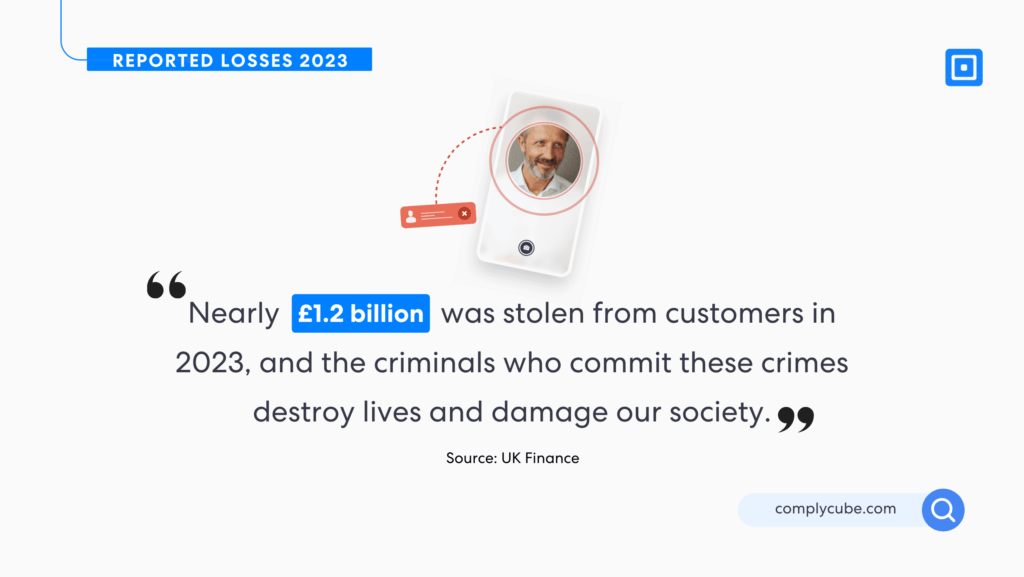
The caller then requested that Jack hand over sensitive data, which the scammers used to unlock the Revolut account on their device. This gave them an overview of his previous transactions, including the purchase at Etsy, an e-commerce platform. Jack was still on the phone with the fraudsters, and he received a text message that claimed to be from Revolut. The message requested that he confirm how much he had spent on the Etsy purchase by typing in a six-digit number, which he read out loud to the fraudsters. They then set up their own account, which they also called Etsy, using the six-digit number to authorize a new payment to their fake account instead.
Two additional texts arrived, prompting authorization of small payments to two more fraudulent accounts named “Revolut Fees” and “Revolut Fees Care.” Jack unknowingly approved these transactions as well, effectively setting up three new payees. This triggered a major breach, and it wasn’t long before thousands of pounds were being drained from the account.
## Banking Giants Struggling with Identity Fraud
Revolut is certainly not the only banking giant to have identity fraud intercepting its platform, with the UK’s national reporting center for fraud and cyber-crime Action Fraud receiving thousands of reported cases from other major UK banks, such as Barclays, HSBC, Lloyds, Monzo, and Starling.
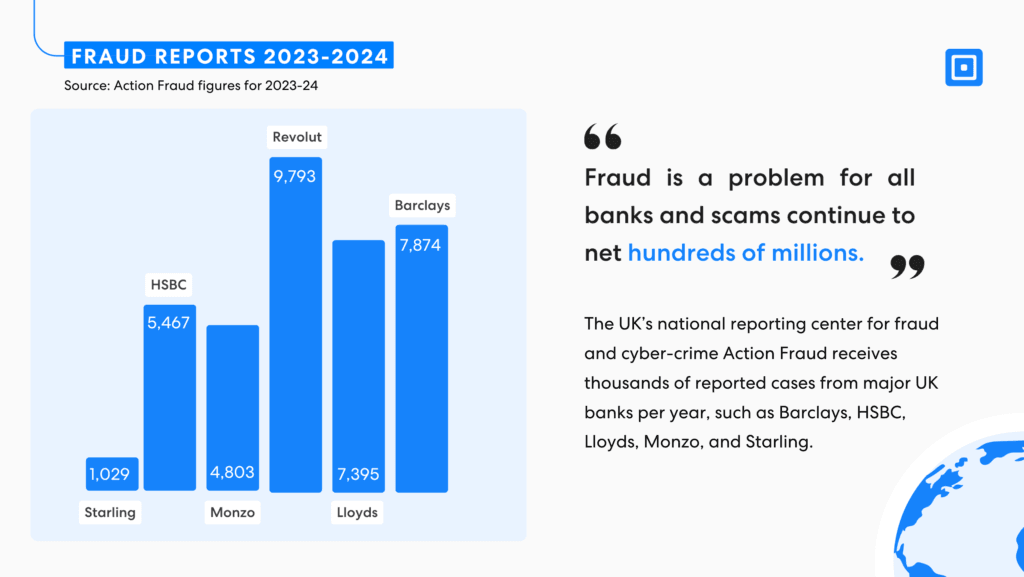
Data shows that from 2023 to 2024, HSBC had 5,467 fraud reports, while Revolut had 9,793, Lloyds had 7,395, and Barclays had 7,874. The fact that most major banks have been affected proves the startling sophistication of modern-day fraudulent practices, underlining the need for re-prioritisation amongst financial institutions. Investing in adequate infrastructure for fraud detection will end up helping organizations swerve serious fraudulent attacks, which could save them an insurmountable amount in the long run.
## Identity Fraud Reimbursements on the Horizon
A critical concern for banks in the UK is the FCA’s new reimbursement rule, which requires banks to reimburse fraud victims up to £85,000. This could prove very costly in future fraud cases, re-enforcing the need for banks to ensure their KYC, IDV, and AML infrastructure provides a strong defence against fraudsters.
Revolut currently holds a provisional banking license in the UK and is on its way to becoming a fully-fledged bank. This means that in future incidents, Revolut will be subject to these reimbursement standards. Until then, it continues to act as an electronic money institution, which is not subject to these rules.
Most people are unaware of the amount of fraud, especially APP fraud, currently ongoing within platforms such as Revolut. Figures from the PSR last year showed that for every million pounds paid into Revolut accounts, £756 were from [APP fraud](https://www.bbc.co.uk/news/articles/cj6epzxdd77o#:~:text=A%20man%20who%20had%20%C2%A3,refused%20to%20refund%20this%20money. "https://www.bbc.co.uk/news/articles/cj6epzxdd77o#:~:text=A%20man%20who%20had%20%C2%A3,refused%20to%20refund%20this%20money.").
> [62% of Revolut fraud victims](https://www.revolut.com/en-US/news/revolut_releases_its_first_ever_financial_crime_and_consumer_security_report/ "https://www.revolut.com/en-US/news/revolut_releases_its_first_ever_financial_crime_and_consumer_security_report/") in 2023 were defrauded by unauthorised fraud.
Fraudulent attacks on banks can be divided into authorized fraud and unauthorized fraud. Identity theft and account break-ins falls under the latter category, as fraudsters are able to hack into accounts by assuming the identity of a customer. Considering that, according to Revolut’s report, most victims experienced unauthorized fraud, biometric identity verification that leverages active liveness detection must be deeply embedded within daily actions on the platform. This is especially true when it comes to new login attempts.
## **Implementing Robust KYC with ComplyCube**
ComplyCube’s liveness detection technology prevents fraudulent attempts by validating identity biometrics and government-issued documentation to prevent fraud. Banks such as Revolut would largely benefit from their advanced AI-powered fraud detection tools, cutting costs and onboarding time due to the speed of checks. Key solutions that they would benefit from include:
- [**Biometric Verification with Active Liveness Detection**](https://www.complycube.com/en/solutions/identity-assurance/biometric-verification/ "https://www.complycube.com/en/solutions/identity-assurance/biometric-verification/")**:** ComplyCube’s state-of-the-art biometric liveness detection, certified to ISO 30107-3 and PAD Level 2 standards, verifies that the individual presenting the identity document matches the submitted details. Their Identity Verification (IDV) system leverages both biometric and behavioral analysis to provide strong security against fraudulent or synthetic identities.
- [**Comprehensive Document Verification**](https://www.complycube.com/en/solutions/identity-assurance/document-verification/ "https://www.complycube.com/en/solutions/identity-assurance/document-verification/")**:** Using AI-driven technology paired with expert reviews, ComplyCube thoroughly verifies identity documents. This ensures that documents are authentic, unaltered, and valid. Covering a wide range of document types—passports, driver’s licenses, national IDs, residence permits, visa stamps, and travel documents—ComplyCube offers extensive protection against identity fraud.

For more information on how to protect your business from fraud, contact ComplyCube’s [compliance experts](https://www.complycube.com/en/contact/contact-sales/ "https://www.complycube.com/en/contact/contact-sales/").
**Categories:** Guides
**Tags:** Identity Verification
---
### [The CryptoCubed Newsletter: March Edition](https://www.complycube.com/the-cryptocubed-newsletter-march-edition/)
**Published:** March 20, 2025
**Author:** Sofia Daley
**Excerpt:** This month's newsletter covers major developments in the crypto world, from AML Bitcoin’s CEO facing 30 years for money laundering to Robinhood settling a $29.75M fine for compliance failures. Buckle up, it's time for CryptoCubed.
**Content:**
👋 Welcome back to CryptoCubed!
This month’s newsletter covers major developments in the crypto world, from AML Bitcoin’s CEO facing 30 years for money laundering to Robinhood settling a $29.75M fine for compliance failures. We also dive into the growing influence of regulatory clarity on crypto market growth, the SEC’s reconsideration of crypto custody rules, and the push for national bank charters by US crypto firms. Plus, don’t miss our latest blog on European crypto AML regulations. Buckle up, it’s time for CryptoCubed.

## AML Crypto CEO Faces 30 Years Behind Bars For AML Infractions
It’s really not a good look when the man behind ‘anti-money laundering’ is convicted for money laundering.
Rowland Marcus Andrade, the founder and CEO of AML Bitcoin, has been convicted of wire fraud and money laundering in a case involving millions of dollars. Andrade raised funds from investors by falsely claiming that AML Bitcoin was close to being approved for use by the Panama Canal Authority, despite no such agreement existing.
> Mr. Andrade’s outrageous lies lured and [scammed individuals](https://news.bitcoin.com/crypto-ceo-falls-aml-bitcoins-founder-faces-30-years-for-fraud-and-laundering/) into investing their hard-earned money into a new cryptocurrency with fabricated features.

He misled investors about the cryptocurrency’s development, business deals, and expected release. The trial revealed that Andrade diverted over $2 million for personal expenses, including luxury vehicles and properties. He also laundered the funds through various bank accounts. Andrade faces up to 30 years in prison and asset forfeiture when sentenced in July 2025. Authorities emphasized that his deceptive actions exploited investors’ trust for personal gain.
For more on this story, click [here](https://news.bitcoin.com/crypto-ceo-falls-aml-bitcoins-founder-faces-30-years-for-fraud-and-laundering/).
## Robinhood Hit With Hefty Fine of $29.75M
Robinhood has agreed to pay $29.75 million to settle investigations by the Financial Industry Regulatory Authority (FINRA) over compliance failures, including violations of anti-money laundering (AML) regulations, poor trade supervision, and misleading communications. The settlement includes a $26 million fine and $3.75 million in restitution for affected customers.
FINRA found that Robinhood failed to address suspicious trading, compromised accounts, and identity verification lapses, particularly during the trading frenzy in early 2021 involving GameStop and AMC. Despite these regulatory challenges, Robinhood reported a record Q4 2024, with $1 billion in revenue, including a 200% year-over-year increase from crypto trading.
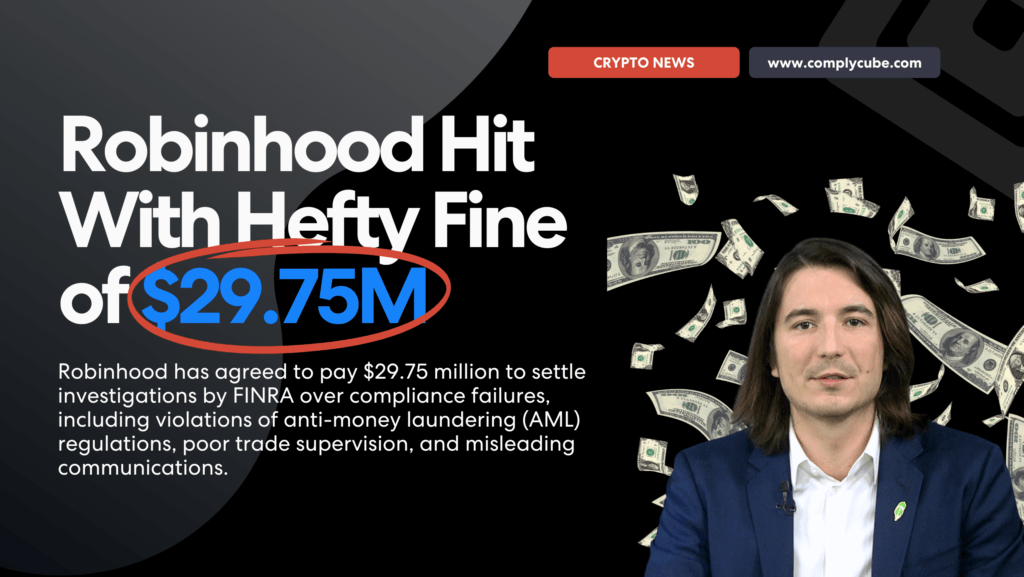
As regulators continue to tighten scrutiny on financial firms, especially those dealing with cryptocurrencies and retail trading, Robinhood may face even more challenges. Its history of compliance failures, combined with the increasing complexity of digital asset trading and its growing user base, makes it likely that Robinhood will need to implement stronger safeguards to avoid future fines or legal action. If they fail to address these concerns, they may face even harsher penalties and damage to their reputation in the long term.
For more information, click [here](https://cryptohead.io/news/robinhood-hit-with-29-75m-fine-over-trading-and-aml-violations/).
## Crypto Market Regulatory Pressures Fuelling Growth
A recent survey by Coinbase and EY-Parthenon reveals that regulatory clarity is the top factor driving growth in the crypto market. Of the 352 institutional investors surveyed, 86% either have exposure to digital assets or plan to invest in 2025.
Additionally, 59% intend to allocate more than 5% of their assets to crypto this year. The survey also highlights growing interest in altcoins, with 73% of investors holding tokens beyond Bitcoin and Ethereum, and 60% preferring exposure to crypto through registered vehicles like exchange-traded products.
As the regulatory environment improves, particularly with President Trump’s focus on making the U.S. the “crypto capital of the world,” institutional investment in crypto is expected to continue increasing.
For more on this, click [here](https://www.coindesk.com/markets/2025/03/18/crypto-regulatory-clarity-top-catalyst-for-industry-growth-coinbase-and-eyp-survey).
## The SEC Reconsiders Crypto Custody Requirements
The U.S. Securities and Exchange Commission (SEC) is reconsidering a proposal to tighten custody requirements for cryptocurrencies, a move that reflects policy changes under the new Trump administration.
Initially proposed in February 2023 during the Biden administration, the regulation would have required registered investment advisors to store cryptocurrencies with qualified custodians and introduced stricter asset protection measures.

However, concerns from financial and crypto sectors about the feasibility of these requirements led SEC interim Chairman Mark Uyeda to direct the SEC staff to explore alternatives. This reconsideration aims to balance investor protection with financial innovation. The proposed changes have sparked debate, especially among financial institutions, with some expressing fears that stricter regulations could harm their ability to operate within the crypto space.
Under the Trump administration, the SEC has shown a more flexible approach to crypto regulation, including halting certain enforcement actions and forming a task force to examine the legal status of digital assets. The outcome of these discussions will likely shape the future of crypto regulation in the U.S.
Find more on this story [here](https://en.cryptonomist.ch/2025/03/18/the-sec-reassesses-the-rules-on-the-custody-of-cryptocurrencies/).
## US Crypto Firms Push for National Bank Status
Crypto firms are reportedly seeking national bank charters under the Trump administration in an effort to gain regulatory legitimacy and expand their markets. With new banking regulators in place, there has been a surge in interest, although approvals for such charters have historically been slow and limited.
Obtaining national bank status would allow crypto firms to lower borrowing costs, access deposits, and enhance credibility, offering new business opportunities. Legal experts note that while there is growing enthusiasm among crypto firms, the process remains challenging, as only a few charters were granted in recent years.
The historically low approval rate for bank charters, with only a handful granted each year, suggests that regulators remain cautious about allowing crypto firms to operate on the same level as established banks.
This caution may be due to concerns over the stability of digital assets, potential risks to the broader financial system, and the rapid evolution of the crypto industry. Ultimately, while gaining national bank status could open new doors for crypto firms, they will likely face continued regulatory scrutiny and must prove that they can operate safely within the broader financial ecosystem.
For more on this story, click [here](https://www.thestreet.com/crypto/policy/crypto-firms-are-reportedly-pushing-for-national-bank-status).
## Our Latest Crypto Blog: Understanding European Crypto AML Regulations
Our latest crypto guide explains how crypto AML regulation has evolved over the past few years, giving critical insights into how your crypto business can remain compliant. Here’s a quick sneak peek of the beginning:
> As the cryptocurrency landscape continues to expand, so too does the scrutiny placed on it by governments and financial regulators. With Europe leading the charge in regulating the crypto space, one of the most significant developments has been the introduction of Anti-Money Laundering (AML) regulations tailored specifically to cryptocurrencies. These regulations aim to curb illicit activities like money laundering and terrorist financing, while providing a safe framework for legitimate crypto operations. This blog explores the evolution of AML European crypto regulation and how it has shaped the digital currency landscape.

Read the full piece [here](https://www.complycube.com/en/understanding-aml-european-crypto-regulation/).
## Time for Some Light-Hearted Creative Criticism?
So you’ve made it to the end of our newsletter. It’s time to enjoy a little satire, worthy reader, you’ve earned it.
### 🔥THE CRYPTO CUBED POEM: MARCH🔥
Our March Crypto newsletter brings an interesting turn of events,
As the CEO of AML Bitcoin was caught with no defence.
The King of AML himself can’t help but launder money,
We’re trying to be serious, but it’s pretty freaking funny.
The FATF is probably thinking what’s the bloody point,
If every single CEO is bound to disappoint?
Will there ever be a day where crypto sees no crime?
Until then, CryptoCubed will be here to dish out rhyme.
### Stay tuned for our March newsletter, and have a great month!

**Categories:** News
**Tags:** Crypto Regulations
---
### [Biometric Verification: Elevating Security in Banking](https://www.complycube.com/biometric-verification-in-banking-security/)
**Published:** October 14, 2024
**Author:** Sofia Daley
**Excerpt:** Facial biometric verification offers banks an essential tool for staying competitive in a rapidly evolving market where regulatory frameworks are re-determining industry leaders. Biometrics in banking have become a must in the UK.
**Content:**
Identity fraud is on its way to becoming the leading form of bank-reported fraud, with projections forecasting it will represent 50% of all cases by 2025. The need for facial biometric verification that leverages AI-powered technology has taken the UK by storm, as nearly 2 million people were victims of banking-related identity fraud in 2023. Biometrics in banking also offer an essential tool for staying competitive in a rapidly evolving market where regulatory frameworks are re-determining industry leaders.
## Global Banking Takes a Hit
The banking sector has been one of the most targeted by fraud. Synectics Solutions, the UK’s largest syndicated risk intelligence database, conducted research that found 45% of all adverse contributions within the finance sector was related to ID fraud in 2023.
The same trend seems to be taking place in the US, with the U.S. Department of the Treasury’s Financial Crimes Enforcement Network (FinCEN) issuing a notice that highlighted a “concerning increase in U.S passport cards being used to impersonate and [defraud individuals](https://www.pymnts.com/news/security-and-risk/2024/spike-in-identity-fraud-forces-banks-to-embrace-innovation/) at financial institutions across the country.” Yet, many banks have not taken the necessary measures to end these illicit practices, such as investing in defensive technology.
### Banking and Fintechs Vulnerable
Organizations within the financial services sector are often the targets of large-scale fraud attempts. Banks and fintechs often have access to financial assets, making them lucrative targets. With a falsified or stolen identity, fraudsters drain funds from existing accounts, make fraudulent purchases, or even take out loans. A common example of this is a fraudster applying for a credit card with a stolen or synthetic identity only to then max out the card’s limit and disappear.
A very recent case that exemplifies the extent of possible losses due to lack of robust biometric verification can be found in the BBC’s piece on a scam carried out through Revolut. The article highlights a case in which £165,000 was stolen from a Revolut business account by fraudsters, as the victim states that bad actors were able to bypass the identity verification process and gain access to his account. The article reads, “Criminals managed to [bypass facial-recognition](https://www.bbc.co.uk/news/articles/cj6epzxdd77o) software to gain access to his account on their device. If an account is set up on a new device, Revolut asks for a selfie, which Jack says he did not provide.”
> Criminals managed to [bypass facial-recognition](https://www.bbc.co.uk/news/articles/cj6epzxdd77o) software to gain access to his account on their device.
Sophisticated biometric verification checks, that include liveness detection, coupled with an advanced document check, are crucial for organizations like Revolut to protect their customers. All businesses handling financial accounts and/or sensitive data must secure processes in place to effectively deter criminals. Otherwise, firms risk real reputational damage from cases such as this one, with potential customers possibly opting for a competitor when opening future accounts.
## The Case for Biometric Verification in the UK
In 2023, nearly [two million people](https://www.infosecurity-magazine.com/news/brits-victims-financial-id-fraud/) in Britain had their identities stolen and used by bad actors to create new financial accounts. As these crimes have continued to hit banking giants, customers have become weary. [73% of respondents](https://www.fico.com/en/newsroom/fico-uk-research-finds-fraud-protection-bank-s-secret-advantage) in a survey carried out by FICO ranked fraud protection as one of the top 3 priorities when deciding which financial institution to open an account with.
Regulatory compliance continues to become increasingly complex within the banking space as national and international watchdogs buckle down on enforcing rigorous mandates. In the UK, the Financial Conduct Authority (FCA) outlines clear mandates for the financial service sector: “Firms must identify their customers and, where applicable, their beneficial owners and [verify their identities](https://www.handbook.fca.org.uk/handbook/FCG/3/?view=chapter#:~:text=Customer%20due%20diligence%20(CDD)%20checks&text=Firms%20must%20identify%20their%20customers,and%20then%20verify%20their%20identities.).” Their handbook outlines examples of good practice, including but not limited to:
- A firm that uses electronic verification checks or PEP databases.
- Catering for customers who lack common forms of ID.
- A firm that understands and documents the ownership and control structures of customers and their beneficial owners.
Recent updates in the sector include the world’s first scam reimbursement rule, which went live on October 7th in the UK. The FCA now requires banks, building societies, payment institutions, and e-money institutions to reimburse victims for their losses to digital fraud, paying up to [£85,000 per case](https://www.finextra.com/newsarticle/44675/psr-to-cut-app-reimbursement-limit-to-85000). This increases the pressure on financial services to prioritize investing in technologies that can leverage facial biometrics, protecting online banking and fortifying customer onboarding.
### Deepfake Technology
Bad actors are often able to subvert a facial recognition system by using deepfake technology. Several reports have already pointed towards the risk of AI fraud, with Deloitte recently publishing a piece headlined “Generative AI is expected to magnify the risk of deepfakes and other fraud in banking.” The piece argues that generative AI isn’t just providing fraudsters with highly sophisticated tools; rather, it’s also reducing both the price and effort of carrying out these attacks.
> Potential for fraud-related losses to hit [$40 ](https://www2.deloitte.com/us/en/insights/industry/financial-services/financial-services-industry-predictions/2024/deepfake-banking-fraud-risk-on-the-rise.html)[billion](https://www2.deloitte.com/us/en/insights/industry/financial-services/financial-services-industry-predictions/2024/deepfake-banking-fraud-risk-on-the-rise.html "billion") in the US by 2027.
Deloitte’s 2024 Financial Services Industry Predictions positioned generative AI as the biggest threat to banks and fintechs, with the potential for fraud-related losses to hit $40bn in the US by 2027, having increased up from $12.3bn in 2023. Worryingly, a recent US Treasury report recently found that “existing risk management frameworks may not be adequate to cover [emerging AI technologies](https://home.treasury.gov/system/files/136/Managing-Artificial-Intelligence-Specific-Cybersecurity-Risks-In-The-Financial-Services-Sector.pdf).
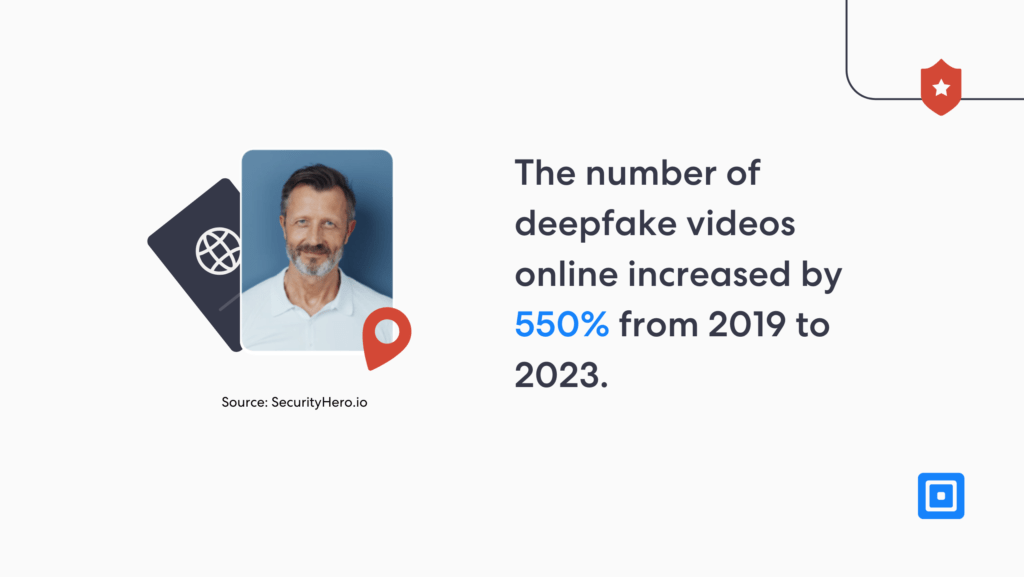
Deepfakes are certainly at the heart of these projections. In 2023, the number of deepfakes across all industries multiplied by 10 – a statistic that is quite hard to ignore. Increased security against deepfakes must start with accurately verifying an identity document and carrying out a biometric facial scan before a user can gain access to a new bank account.
## Biometric Verification with ComplyCube
ComplyCube’s [liveness detection technology](https://www.complycube.com/en/solutions/due-diligence-compliance/know-your-customer/liveness-detection/) ensures that the individual presenting an identity is genuinely present, reducing the risk of AI-generated or spoofed identities. By integrating facial recognition with document verification, their solution authenticates identity details to prevent fabrication. Through a combination of biometric, document, and behavioral analysis, synthetic identities are detected early, preventing fraudsters from building fake credit histories or gaining unauthorized access. Their solutions include:
- [**Advanced Facial Recognition**](https://www.complycube.com/en/solutions/identity-assurance/biometric-verification/): ComplyCube’s cutting-edge biometric liveness detection, certified to ISO 30107-3 and PAD Level 2 standards, ensures that the individual presenting an identity document matches the submitted details. Their Identity Verification (IDV) system leverages biometric and behavioral analysis, providing robust security against fraudulent or synthetic identities.
- [**Comprehensive Document Verification**](https://www.complycube.com/en/solutions/identity-assurance/document-verification/): ComplyCube combines AI-driven technology with expert reviews to thoroughly verify identity documents. This process ensures documents are not altered, forged, expired, or blacklisted, covering a range of document types like passports, driver’s licenses, national IDs, residence permits, visa stamps, and travel documents—offering extensive protection against identity fraud.
For more information on safeguarding your business from fraud, reach out to one of ComplyCube’s [compliance experts](https://www.complycube.com/en/contact/contact-sales/).
Preventing Identity Fraud with ComplyCube
**Categories:** Guides
**Tags:** Biometrics
---
### [The Catfishing Crisis and Social Media Identity Verification](https://www.complycube.com/the-catfishing-crisis-and-social-media-identity-verification/)
**Published:** June 21, 2024
**Author:** Sofia Daley
**Excerpt:** Catfishing and social media scams are on the rise, resulting in hefty costs to global economies. Social media identity verification and fake profile detection are crucial to safeguarding users online and combating digital threats.
**Content:**
Catfishing and social media scams have taken the digital age by storm, entrapping millions worldwide. Anyone can create a fake profile or commit identity theft by pretending to be a celebrity, political figure, or even one of your friends. This pressing lack of regulation has made social media and identity theft almost inseparable, creating a digital landscape for catfishing practices to thrive due to a lack of fake profile detection. There’s only one answer to the problem: implementing social media identity verification.
> In 2023, a shocking 22%, nearly 1 in 4 people, **were victims of being catfished by a false digital identity in the UK**.
>
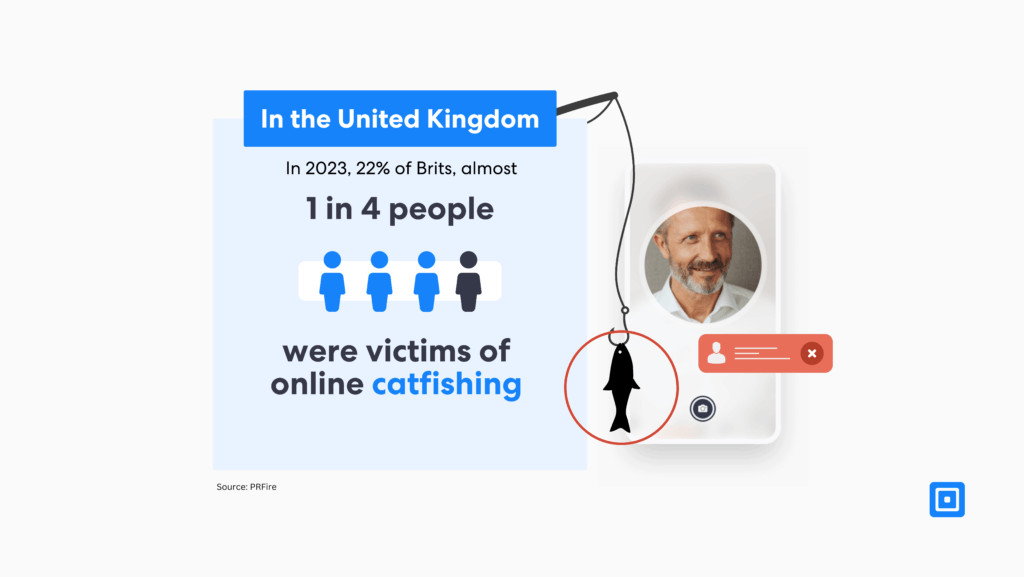
But catfishing has become a global epidemic, with equally alarming statistics emerging from the US and other regions. The danger posed by fake profiles is indisputable, raising the critical question: how will online dating and social media platforms fight back?
## Love at First Swipe
Romance fraud and catfishing practices go hand in hand; where you find one, you’ll likely find the other. Scammers aim to forge strong emotional attachments with their victims, driving them to make decisions based on emotion rather than rationale. They carefully craft the “perfect profile” to entice their victim, helping them fabricate the deceptive emotional connection. Techniques such as “love bombing,” which consists of showing victims exaggerated displays of affection, are also common practices used to lure in vulnerable people online and build trust, which is critical. Once emotional dependency reaches an all-time high, the scammer can coerce their victim, usually resulting in substantial financial losses.
Liz Ziegler, Fraud Prevention Director at Lloyds Bank, states,
> “Targeting those looking for love is a cruel, but sadly common way [for fraudsters to cash in](https://www.lloydsbankinggroup.com/media/press-releases/2024/lloyds-bank-2024/romance-scams-rose-by-a-fifth-in-2023.html). Scammers can be incredibly convincing and leave their victims both emotionally and financially drained.”
### Social Media Scams and Fake Profile Detection
Social media platforms have tackled the problem of fake profiles for years. In the fourth quarter of 2023, Facebook removed nearly [700 million fake social media accounts](https://www.statista.com/statistics/1013474/facebook-fake-account-removal-quarter/) after removing 827 million in the previous quarter. But no matter how many suspicious users are removed, more undoubtedly reappear.
[UK-based research](https://www.lloydsbankinggroup.com/media/press-releases/2024/lloyds-bank-2024/romance-scams-rose-by-a-fifth-in-2023.html#:~:text=Men%20more%20likely%20to%20fall%20victim&text=When%20looking%20at%20the%20age,almost%2049%25%20compared%20to%202022.) suggests that the age group most commonly targeted in these attacks is between 55 and 64, with more men falling victim to these scams than women worldwide. However, when women are the victims of romance fraud, the scam typically [results in much higher losses](https://www.lloydsbankinggroup.com/media/press-releases/2024/lloyds-bank-2024/romance-scams-rose-by-a-fifth-in-2023.html#:~:text=Men%20more%20likely%20to%20fall%20victim&text=When%20looking%20at%20the%20age,almost%2049%25%20compared%20to%202022.). Women lost £9,083 on average in 2023, compared to only £5,145 lost by men. Interestingly, the group recorded to have lost the highest amount were those aged 65 to 74, losing over £13,000 each on average.
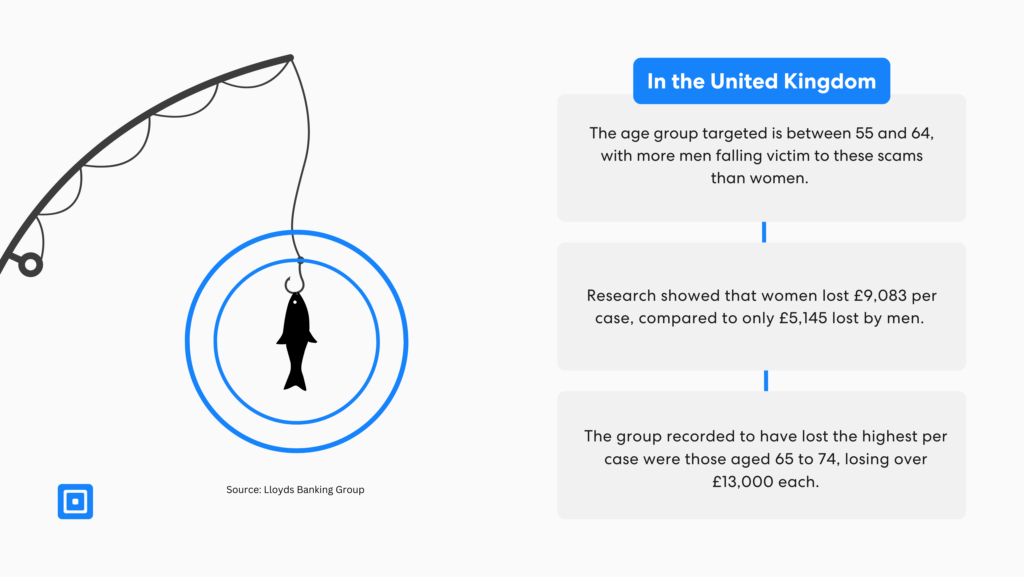
Despite most victims of romance fraud being over 18, many are also underaged. Snapchat was found to be a prime example of a high-risk setting for catfishing aimed at minors.
### Social Media Platform Snapchat Finds “Sextortion” on Its Platform
Snapchat, a widely used social media platform amongst Gen Z users, decided to undertake a large study to clarify the number of fake users and catfishing on its platform.
They found shocking evidence of young teens being subjected to sexual extortion online, which has now been labeled as “sextortion.” Predators connect with minors and establish friendships, often leading to minors sharing personal information and even explicit content. The fraudster then threatens their victim with sharing the explicit content online unless, of course, they pay. They looked at [6,000 young users on their platform and found that 69% of them admitted to having experienced this kind of online](https://www.weprotect.org/blog/two-thirds-of-gen-z-targeted-for-online-sextortion-new-snap-research/) abuse.
One particular case, featured on the BBC in 2023, received messages that stated:
> “I’m going send these to all your followers and ruin your life if you don’t send me £3,000. But I’ll delete them all if you [send me the money](https://www.bbc.co.uk/news/uk-northern-ireland-66736462).”
With the current digital landscape, it’s almost impossible to get minors to stop using social media platforms, but they can be protected from these social media scams with increased social media identity verification and fake profile detection processes.
### The Cost of Catfishing for Global Economies
Online dating and social media scams are extremely lucrative for fraudsters, as victims will often send money repeatedly if they trust their scammer and believe they have cause for making unreasonable requests. For this reason, scammers often use urgency as a tactic when communicating with victims.
> In the United States, catfishing practices related to romance scams account for the **biggest financial losses of all internet crimes.**
CNN reported that nearly [20,000 Americans lost a shocking $740 million](https://edition.cnn.com/2024/01/29/tech/catfishing-explained-what-to-do-as-equals-intl-cmd/index.html) each to these forms of romance fraud in just 2022. The FTC stated that the total cost for the whole year amounted to an [eye-watering $1.3 billion lost](https://us.norton.com/blog/online-scams/romance-scams), with 70,000 Americans being catfished.
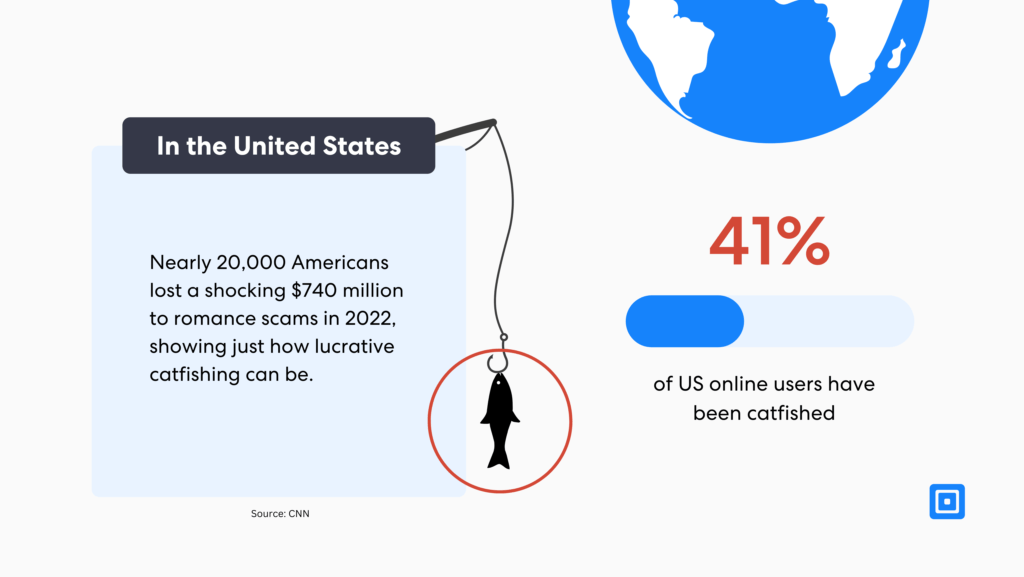
In the United Kingdom, the National Fraud Intelligence Bureau received over 8,000 reports of romance scams in 2022, [totaling £92 million](https://www.cnn.com/2024/01/29/tech/catfishing-explained-what-to-do-as-equals-intl-cmd/index.html#:~:text=In%20the%20UK%2C%20the%20country's,(US%20%2414%2C574)%20per%20victim.), with an average loss of £11,500 per victim.
However, catfishing practices are certainly not limited to these nations, as they occur worldwide. The BBC noted in early 2023 that catfishing has become a major concern in West Africa:
> “Nigeria and Ghana have become [synonymous with catfishing:](https://www.bbc.co.uk/news/av/world-africa-64643519) pretending to be someone you’re not online as part of a romantic or financial scam.”
The reality of the situation is that you risk encountering catfishing scammers wherever there is internet access and social networks, and something needs to change.
## Regulations Supporting Social Media Identity Verification Practices
Protecting users on social media has proved difficult due to a lack of awareness of fraud. Users are unable to spot the signs of criminal activity online. For this reason, many national and international regulatory bodies have put regulations in place to prevent catfishing cases, although a lot more work is needed to end these practices. Some of these regulations include:
### International Regulations
- **General Data Protection Regulation (GDPR)** **in the European Union:** The GDPR outlines standards for data privacy that all platforms should follow and mandates identity verification processes to authenticate customer identities, preventing criminal abuse such as catfishing.
- **Digital Services Act (DSA)** **in the European Union:** The DSA mandates Know Your Customer (KYC) processes for all business users’ digital identity and helps flag and remove fake accounts. The DSA reduces money laundering risks and financial crime overall.
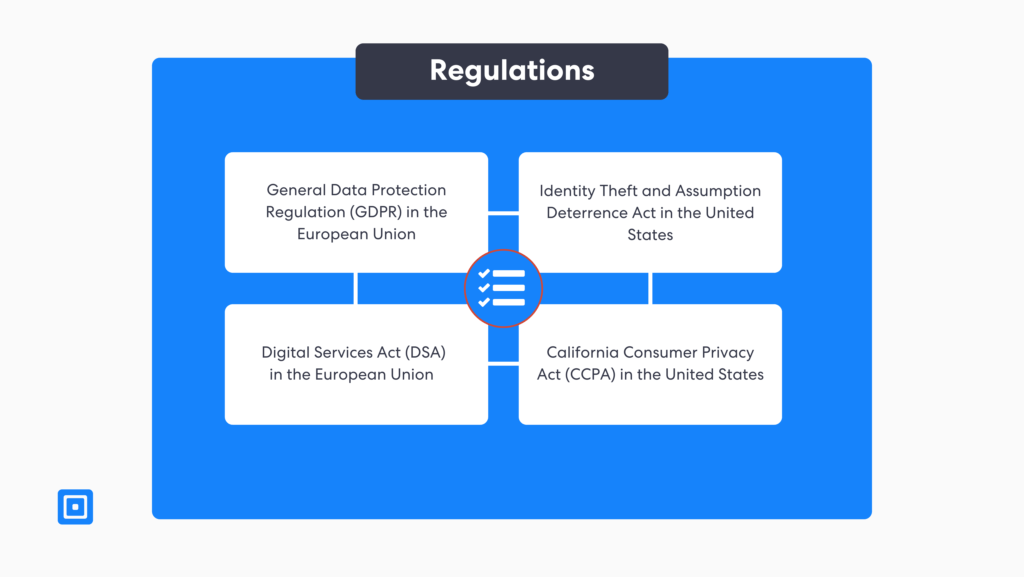
### National Regulations
- **Identity Theft and Assumption Deterrence Act in the United States:** This regulation, created by the US government, makes any form of identity theft a federal crime and allows victims of these criminal activities to report it.
- **California Consumer Privacy Act (CCPA) in the United States:** The CCPA requires financial institutions and other businesses to be transparent on data collection to reduce misuse of information, which often leads to catfishing practices.
Regulations also help prevent serious forms of online fraud, such as terrorism financing and other illicit financial activities. These activities sometimes utilize fake profiles or steal identities to solicit donations and receive funds through untraceable means, such as cryptocurrencies.
## What’s Next for Dating and Social Media Platforms?
Online dating and social media platforms need to start enhancing security for their users by implementing IDV and KYC processes. Urging users to protect their identity online should also be standard practice amongst these platforms.
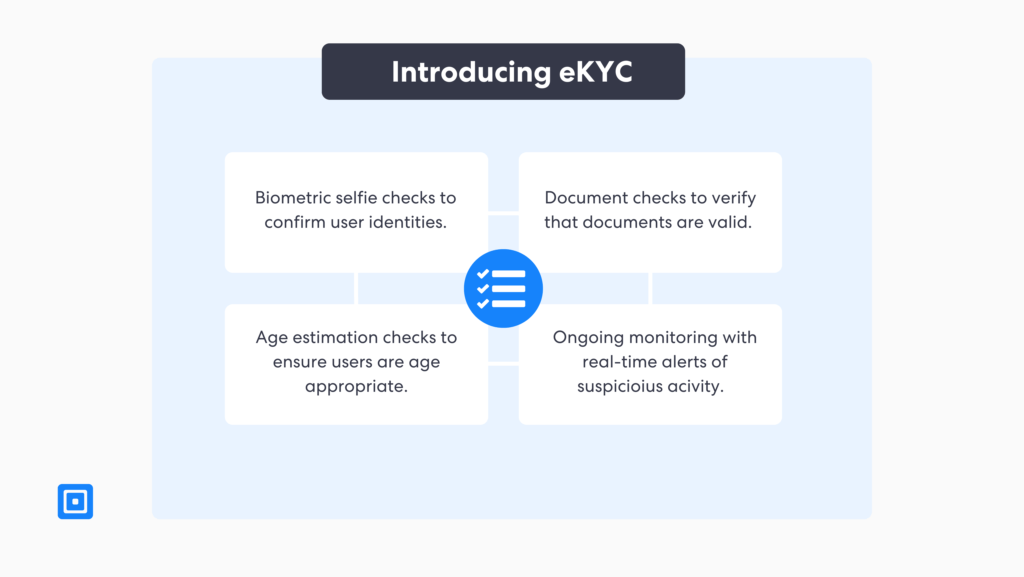
### Implement Social Media KYC with ComplyCube
At ComplyCube, we offer a range of IDV and KYC solutions. Choose a bespoke verification process for social media users to prevent identity theft and fake accounts on your platform.
Incorporating KYC requirements, such as a [biometric identity check](https://www.complycube.com/en/solutions/identity-assurance/biometric-verification/), would be a strategic move for social media platforms. It would help prevent online dating and social media scams with fake profile detection to stop catfishing practices, as the biometric check can compare a scanned selfie with the existing government-certified document image. Liveness detection is also used in our identity check to ensure the user is present and detects any presentation attacks. A document check can also be incorporated to ensure that documents provided by users are valid, increasing accountability and, therefore, safeguarding the platform.
Get in touch with our team to secure your platform and protect your users from catfishing practices.
**Categories:** Guides
**Tags:** Social Networks
---
### [ComplyCube Named as an AML Business Leader in the G2 Fall 2025 Report](https://www.complycube.com/complycube-aml-leader-in-g2-fall-2025-report/)
**Published:** September 22, 2025
**Author:** Dini Habib
**Excerpt:** ComplyCube has reinforced its Leader status in G2's 2025 Fall Grid Report. The company has achieved recognition for its ease of implementation and ROI in categories including AML, customer onboarding, and biometric authentication.
**Content:**
London, September 9, 2025 – [ComplyCube](https://www.complycube.com/en/), the RegTech provider with the largest number of identity profiles certified under the UK’s Digital Identity and Attributes Trust Framework (DIATF), continues to set industry standards for Anti-Money Laundering (AML) and Know Your Customer (KYC) excellence. The company has once again distinguished itself as a Leader in several key categories, including Biometric Authentication and Digital Customer Onboarding. Retaining its AML industry Leader status and overall 5-star rating in the G2 Fall 2025 Report, ComplyCube stands out as a trusted partner for Fraud Prevention and Customer Onboarding.
## Industry Challenges Driving RegTech Adoption
In the latest G2 Fall 2025 Report, [ComplyCube](https://www.g2.com/sellers/complycube) was featured in 82 reports and accumulated 107 badges, positioning itself as a Regional Leader in the Small-Business EMEA Grid Report and High Performer in the Enterprise Grid Report for AML. These achievements underscore the company’s strong performance across both small and enterprise-level AML solutions.
As the leading review site for business-to-business software, [G2](https://www.g2.com) enables customers to submit unbiased feedback about their experiences with SaaS solutions. G2 categorizes these reviews to support organizations in making more confident and well-informed buying decisions.
Regulators worldwide have issued [over $6 billion in AML fines](https://www.complycube.com/en/top-5-aml-fines-of-2025-when-compliance-cracks-open/). With heightened regulatory scrutiny and the prevalence of fraud, more businesses are now turning to smarter AML and [KYC](https://www.complycube.com/en/solutions/due-diligence-compliance/know-your-customer/) software for better compliance and security. According to [compliance executives,](https://www.pwc.co.uk/financial-services/assets/pdf/emea-aml-survey-2024.html.pdf) data protection and privacy (51%), corporate governance (40%), and compliance risks such as AML and fraud (38%) are their top priorities. These findings highlight the need for AML solutions that offer speed and accuracy to realize long-term cost savings.
## ComplyCube Secures Best Usability for Anti-Money Laundering Compliance
ComplyCube enables organizations to efficiently navigate the growing complexity of compliance, making AML, IDV, and KYC compliance straightforward. Voted [Regtech Partner of the Year](https://www.complycube.com/en/complycube-wins-regtech-partner-of-the-year-at-the-british-bank-awards-2025/) and listed in the prominent FinCrimeTech50 list, the AI-driven platform offers scalable, automated, and customizable [AML screening](https://www.complycube.com/en/solutions/due-diligence-compliance/anti-money-laundering/) workflows in real time for businesses worldwide. ComplyCube streamlines compliance burden by offering an all-in-one solution for organizations to stay aligned with evolving cross-border regulations.
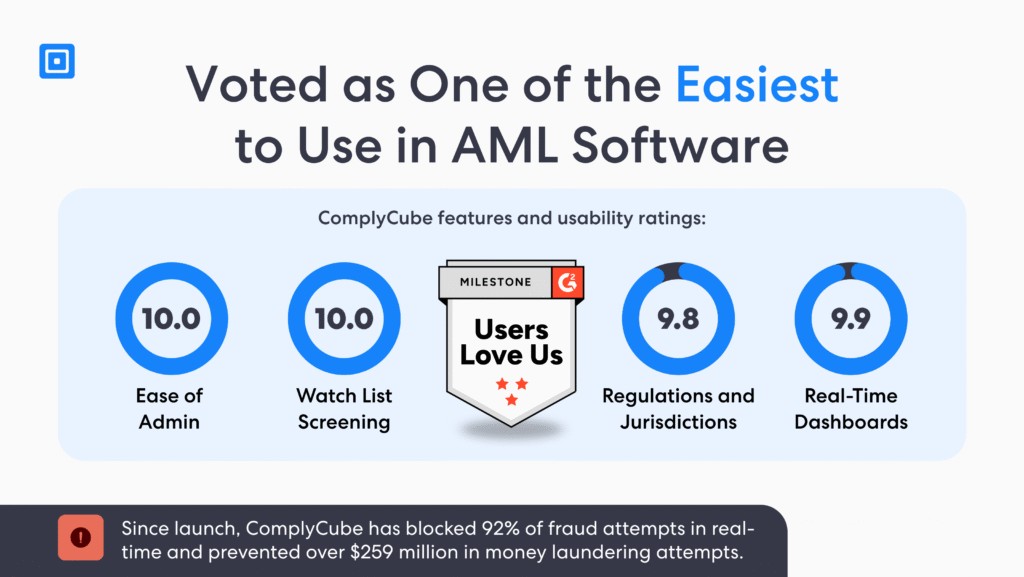
Operating in over 230 territories and adhering to international laws such as the [FCA’s](https://www.fca.org.uk) risk-based approach, [FinCEN’s](https://www.fincen.gov) customer due diligence rules, and [EU AMLD](https://finance.ec.europa.eu/financial-crime/anti-money-laundering-and-countering-financing-terrorism-eu-level_en) obligations, the platform equips firms with pioneering AML features such as real-time no-code automation rules to minimize false positives, ongoing monitoring against 3,000+ watchlist and sanctions databases, Politically Exposed Persons (PEPs) screening, and adverse media checks against 5,000+ media outlets. The platform supports a 98% onboarding rate in under 30 seconds while maintaining 100% service uptime.
## Recognition for Best ROI and Customer Support in the G2 Fall 2025 Report
According to [Grant Thornton’s](https://www.grantthornton.co.uk/globalassets/1.-member-firms/united-kingdom/pdf/publication/2024/regtech-survey-report-2024.pdf) 2024 RegTech and Regulatory Change Report, 54% of businesses cite cost, ease of use, and operational effectiveness as their top three considerations when selecting regtech vendors. It’s clear that organizations are moving towards AML and KYC solutions that can streamline operational efficiency while delivering high ROI.
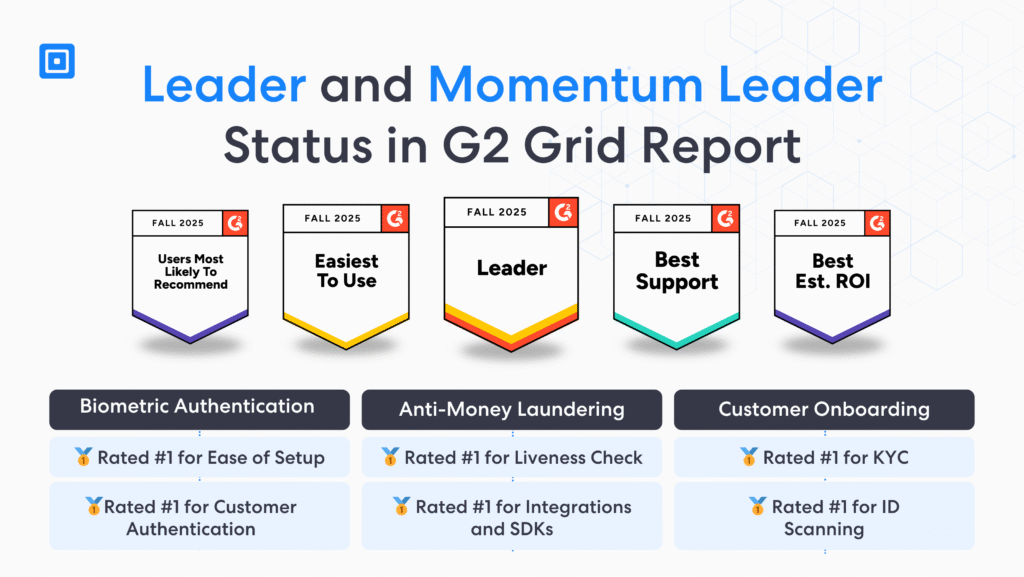
In the G2 Fall 2025 Report, ComplyCube ranked highly for user ease indexes, securing badges for best support, best estimated ROI, and easiest to implement across [fraud prevention](https://www.complycube.com/en/use-cases/process/fraud-prevention/), identity verification, and address verification. Whether a startup or enterprise, businesses of all sizes benefit from the company’s low point of entry. Leading organizations across the [fintech](https://www.complycube.com/en/use-cases/industry/fintech/), crypto, and accounting industries can leverage the platform with no coding expertise required.
To make implementation manageable, ComplyCube offers free setup, a 14-day free trial, and robust documentation guides for seamless integration to a company’s current systems. The company holds several internationally recognized certifications for information security, quality, effectiveness, and privacy, including ISO 27001, ISO 9001, the UK’s DIATF, and ISO 30107. Businesses can have peace of mind knowing that their customer data is encrypted to the highest international standards.
## Building Customer Relationships that Last
According to the [PWC Global Compliance Survey 2025](https://www.pwc.com/gx/en/issues/risk-regulation/global-compliance-survey.html), 85% of respondents remarked that compliance requirements have become more complex in the last three years, with compliance and risk management teams across industries experiencing the impact of expanding regulatory requirements.
> Vendors and organizations alike must cultivate a culture of curiosity and continuous innovation.
“Compliance executives are feeling the pressure of keeping up with regulators worldwide” remarked [Dr Tarek Nechma](https://www.linkedin.com/in/tarek-nechma/), CEO of ComplyCube. “Vendors and organizations alike must cultivate a culture of curiousity and continuous innovation. At ComplyCube, we are always stress-testing and developing technology that can make compliance less complex, while also getting ahead of sophisticated deepfakes and fraud.”
ComplyCube aims to navigate these challenges by making AML compliance and technology implementation easier for businesses. In the G2 Fall 2025 Report, ComplyCube has achieved above-average adoption and implementation scores across categories such as reference checks, fraud prevention, and [biometric authentication](https://www.complycube.com/en/solutions/identity-assurance/biometric-verification/).
> We continue to expand ComplyCube’s functionality with cutting-edge regulatory solutions.
“The ComplyCube team is very proud of this recognition from G2. We maintain a feedback loop to ensure our clients know that we are there to support them should they have any issues. Our operating principles, such as trust and stewardship, extend to our relationships with our clients and partners. We continue to expand ComplyCube’s functionality with cutting-edge regulatory solutions as compliance challenges evolve,” adds [Mohamed Alsalehi](https://www.linkedin.com/in/malsalehi/), Chief Technology Officer of ComplyCube.
## About ComplyCube
ComplyCube is a UK DIATF-certified, award-winning solution and AML industry leader. Trusted by leading financial institutions, the platform utilizes state-of-the-art features, including liveness detection and device intelligence, to support businesses in accurately identifying customers and combating money laundering. Backed by over 3000+ trusted databases and partners globally, ComplyCube delivers one of the industry’s widest coverage levels for AML screening and multi-bureau checks.
## About G2 Software
G2 is known for being the largest and most trusted software marketplace in the world, enabling businesses to discover and purchase software solutions based on unbiased customer feedback. The G2 2025 Fall Reports are part of G2’s commitment to providing customers with market analysis and research into software capabilities. Organizations are empowered to make confident and streamlined technology decisions based on transparent reviews covering pricing and unique selling points.

**Categories:** News
**Tags:** Announcements
---
### [How Deepfake Detection Can Empower Businesses](https://www.complycube.com/deepfake-detection-software-preventing-fraudulent-content/)
**Published:** September 3, 2024
**Author:** Sofia Daley
**Excerpt:** Deepfake detection software, such as Identity Verification or IDV solutions, ensures that everyday life can continue safely and securely. Document verification and biometric verification are pivotal in identifying deepfake fraud.
**Content:**
**TL;DR:** Deepfakes have evolved from AI novelties into **serious threat**s to global stability, **enabling fraud** and misinformation at scale. Their impact on **elections, public trust, and business security** is growing rapidly, demanding **urgent attention**. This guide explores how **deepfake detection software** and **Identity Verification** or **IDV solutions** such as biometric verification and document verification can help **mitigate risks** and **protect digital integrity**.
## What is a Deepfake?
Deepfakes get their name from an Artificial Intelligence (AI) technique known as deep learning. Specifically, deep learning algorithms can teach themselves to solve extremely complex problems. By analyzing vast datasets, they can then generate hyper-realistic content, seamlessly swapping faces into images, videos, audio and more.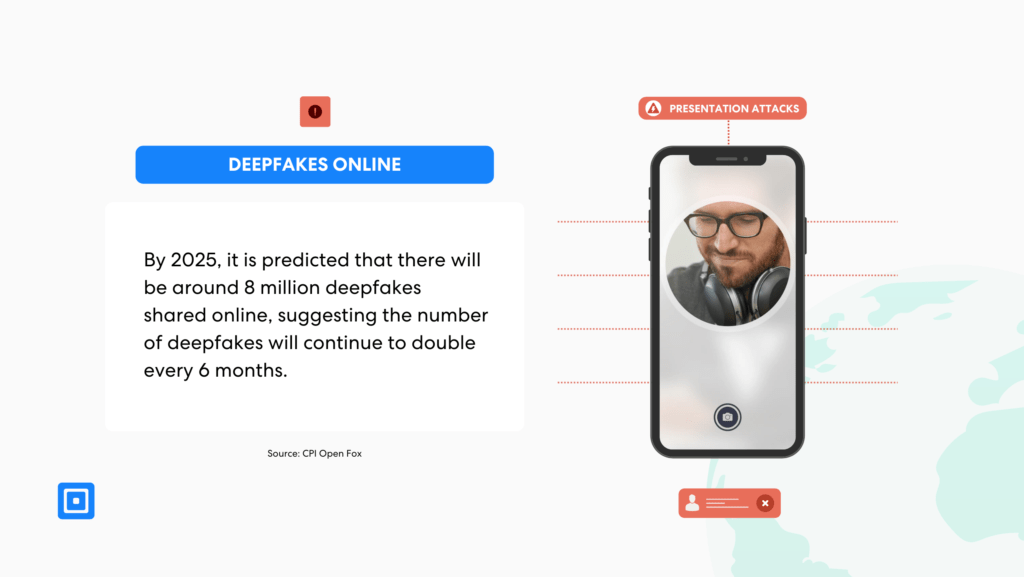
The world is quickly heading into a deepfake crisis. At the same time, concerns continue to grow over how this AI technology will affect organizations. In fact, it is already reshaping the global socio-economic and political landscape. Most recently, however, fears about election integrity have intensified and attracted significant scrutiny.
## What is Deepfake Detection?
Deepfake detection software identifies images, sounds, or videos that have been artificially created to look hyper-realistic. Today, companies integrate IDV solutions such as document verification and biometric verification processes to detect patterns that would not exist in ‘real content’.
AI-powered identity verification are quickly becoming the only way to reliably counter deepfake technology and mitigate this type of identity fraud. Comparably to a human, these technologies can identify spoofed content far more effectively, being able to process far more data over a given period of time, far more accurately, and far more cost-effectively.

In September 2023, 3 key law enforcement agencies, the National Security Agency (NSA), Federal Bureau of Investigation (FBI), and the Cybersecurity and Infrastructure Security Agency (CISA), released a paper declaring that deepfake threats had increased exponentially and automated preventative technologies such as deepfake detection software were essential.
> Threats from synthetic media, such as [deepfakes, have exponentially increased](https://www.cisa.gov/news-events/alerts/2023/09/12/nsa-fbi-and-cisa-release-cybersecurity-information-sheet-deepfake-threats).
As deepfake threats grow across sectors, the need for identity verification, becomes more urgent. IDV solutions that combine document verification, biometric checks, and liveness detection now represent a critical defense against AI-driven fraud.
### Document Verification
[Document verification](https://www.complycube.com/en/solutions/identity-assurance/document-verification/) is one of the two key steps in Anti-Money Laundering (AML), Know Your Customer (KYC), and IDV processes. It uses an AI-powered verification engine to read KYC documents, such as a driver’s license, in under 15 seconds. In fact, many deepfake fraud attempts are first detected through anomalies found during document verification, make it a critical component of any deepfake detection software technology.
Simultaneously verifying document authenticity and extracting the available data, document verification provides a strong level of identity assurance. It also acts as a preliminary deepfake detection software, being able to identify artificially created images of ID cards. For more information on Gen AI, document verification, and deepfake detection methods, read [Generative AI Fraud and Identity Verification](https://www.complycube.com/en/generative-ai-fraud-and-identity-verification/).
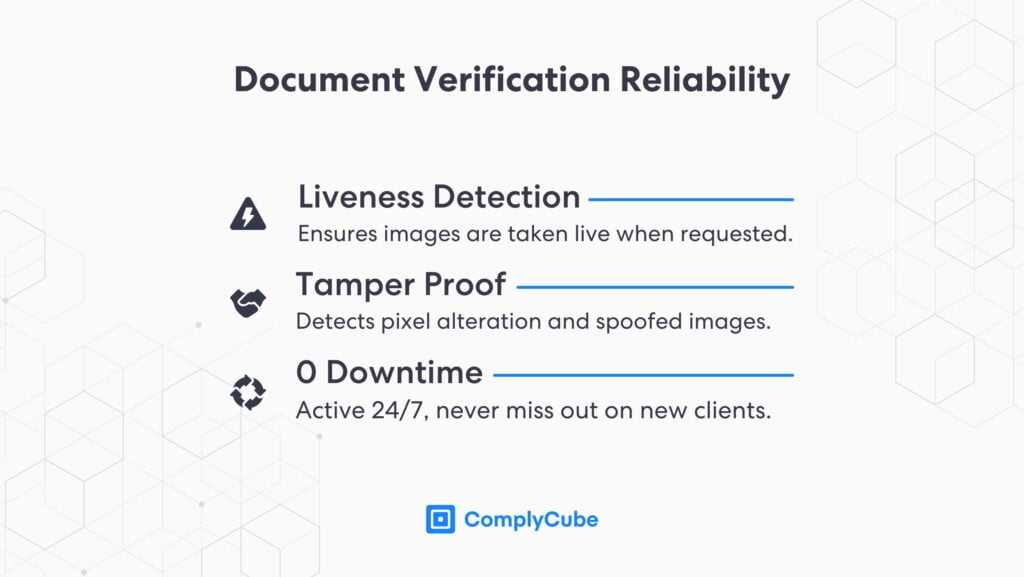
### Biometric Verification
[Biometric verification](https://www.complycube.com/en/solutions/identity-assurance/biometric-verification/) uses powerful biometric identification and facial recognition technologies to scan, verify, and authenticate user biometrics. Analyzing biometric information, such as facial features, micro-expressions, skin tones, and texture (sometimes using alternative data such as iris scans), this process acts as a liveness detection tool and prevents presentation attacks, such as deepfakes.
Biometric authentication remains one of the most reliable ways to verify identity. While biometric data is extremely difficult to forge, even with AI, detecting deepfakes is still far from simple.
Automated IDV solutions play a critical role in modern identity verification, client onboarding, and authentication. They enable organisations to handle large volumes of checks accurately and at scale. For more information, read [The Advantages of Biometric Verification](https://www.complycube.com/en/the-advantages-of-biometric-authentication/).

## Deepfakes and Election Integrity
Malicious actors often use deepfakes to undermine elections. They can spread false information and manipulate public opinion. The Alan Turing Institute found that nearly nine out of ten people worry about deepfakes influencing election outcomes.
>
This concern reflects real risks. Bad actors have already released high-profile deepakfes of political figures. This includes fabricated audio and video clips with the aim of confusing voters.
Ahead of the 2024 UK General Election, unknown actors created deepfakes mimicking the voices of Prime Minister Rishi Sunak, Labour leader Keir Starmer, and London Mayor Sadiq Khan. They distributed these clips across social media, reaching hundred of thousands of potential voters and fueling public misconceptions.
These manipulations included fake corruption scandals and misleading claims about political positions and intentions. As a result, such content can cause serious harm, particularly when voters struggle to tell real from fake.
### Deepfake Detection and Response
Deepfake detection is becoming increasingly difficult, even for tech giants like Meta, Google, and Microsoft, all of which have pledged to combat deceptive AI in elections. The challenge stems from the growing sophistication of generative AI tools, which now produce nearly indistinguishable from reality. Companies must integrate IDV solutions and real-time detection APIs to stop threats before they go live.
For instance, Meta’s President of Global Affairs, Nick Clegg, has noted the challenges in identifying AI-generated content, [emphasizing that malicious actors can strip away invisible markers that usually indicate manipulation](https://www.mishcon.com/news/the-impact-of-deepfakes-on-the-uk-general-election).
The threat of deepfakes is global. It even appears to follow international events. In America, deepfakes mimicking [President Joe Biden’s voice were used in a robocall to share false information about the election.](https://www.theguardian.com/technology/article/2024/aug/22/fake-biden-robocalls-fine-lingo-telecom) This incident highlights the potential of deepfakes to suppress voter turnout.

This challenge goes beyond detection. Once a deepfake spreads, it often causes harm before fact-checkers can debunk it. Platforms must act before fraudulent content goes live. Socials networks such as X (formerly Twitter), Facebook, and Instagram should adopt deepfake detection software with pre-upload scanning capabilities and real-time liveness detection via SDKs and APIs. For more information, read [Integrating with a Liveness Detection SDK](https://www.complycube.com/en/integrating-with-a-liveness-detection-sdk/).
## Deepfake Detection in Identity Verification
Beyond social media, deepfakes have become a major fraud vector across industries. Today, they represent a key fraud risk across financial serviceshey’ve become a major fraud vector across financial sectors, from banking and trading apps to crypto platforms and payment services. Criminals use deepfakes daily to bypass IDV, drain funds and open accounts with credit providers.
> Generative AI poses the biggest threat to the \[financial\] industry, [potentially enabling fraud losses to reach $40bn in the US by 2027](https://www2.deloitte.com/us/en/insights/industry/financial-services/financial-services-industry-predictions.html/#generative-ai-is-expected-to), up from $12.3bn in 2023.
This prediction suggests that deepfake fraud could rise by over 200% within four years, emerging as leading driver of global financial crime. To prevent this surge, organisations must invest in advanced deepfake detection software capable of identifying synthetic content before it leads to financial loss.
## The Erosion of Trust with Fraudulent Technology
Beyond elections, the proliferation of deepfakes poses a broader threat to public and private trust in information and identity verification. As deepfake technology becomes more prevalent, people are becoming increasingly skeptical of the media they consume. [This skepticism in media could lead to a phenomenon known as the *liar’s dividend,* ](https://gvu.gatech.edu/research/projects/liars-dividend-impact-deepfakes-and-fake-news-politician-support-and-trust-media)where the possibility of fake content gives individuals plausible deniability, undermining accountability and truth. IDV solutions could help organisations verify truth from falsehood, restoring digital trust in an age of AI deception.
A common example of this phenomenon is damaging media coverage of a public figure, political leader, or business leader. Skepticism in authentic media allows these individuals to play on this public sentiment, using it to their advantage to claim that it is not genuine. It is easy to see how this effect might snowball.
### **Case Study: Arup CEO Deepfake Scam and $25 Million Fraud**
In early 2025, cybercriminals used generative AI to impersonate senior Arup executives, including the CEO, during a fake video call with a finance employee in the company’s Hong Kong office. Believing the request was legitimate, the employee transferred US $25 million to accounts controlled by the fraudsters.
The deepfake video closely mirrored Arup’s internal communication style and featured multiple synthetic “executives”. Notably, the attackers had studied the firm’s hierarchy and workflows, combining deepfake technology with targeted social engineering. As a result, the employee found no reason to question the interaction. By the time identity verification checks uncovered the fraud, the funds were unrecoverable.
This case underscores how easily deepfakes can bypass traditional verification methods. Therefore, organisations must adopt real-time biometric IDV solutions with real-time biometric verification and deepfake detection software to counter such threats. Ultimately, the Arup incident serves as a clear warning that even global, well-resourced firms remain vulnerable to deepfake-enabled fraud.
## Building Trust at Scale with Deepfake Detection Software
While the dangers of deepfakes are well understood, regulatory responses remain fragmented. In the US, nationwide legislation is still lacking, however, at least 20 states have enacted laws targeting election-related deepfakes. A cohesive federal strategy, though, has yet to materialise. Meanwhile, the [Department of ](https://home.treasury.gov/news/press-releases/jy2346)the Treasury has endorsed automated technologies such as biometric verification and document verification as some of the most effective tools for preventing and combating emerging fraud techniques.
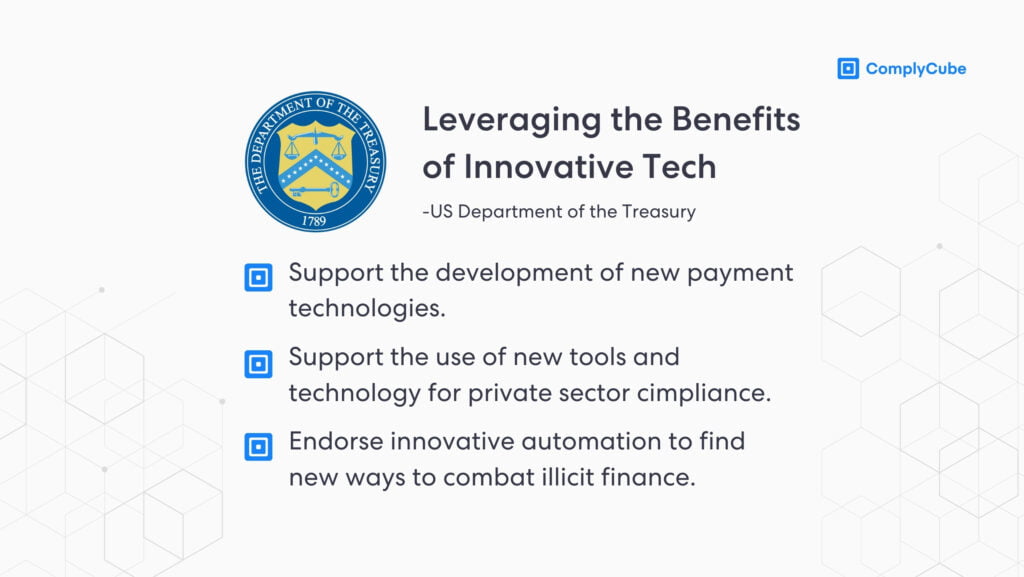
The UK has also seen limited progress. While laws prohibit the creation and distribution of harmful personal deepfakes, broader regulations targeting their use in electoral manipulation have yet to be enacted.
For now, it remains the responsibility of each business to implement IDV solutions that include deepfake detection software as a frontline tool to counter deepfake-enabled fraud. Additionally, organisations must account for deepfake threats within their Risk-Based Approach (RBA) when shaping an Anti-Money Laundering (AML) strategy.
### Key Takeaways
- **Deepfakes are fueling a surge in identity fraud**, bypassing standard IDV solutions.
- **Election integrity is increasingly at risk**, as synthetic media is used to spread disinformation, manipulate public perception.
- **Biometric verification plays a crucial role in combating deepfakes**, using facial recognition, liveness detection, and micro-expression analysis.
- **AI-powered document verification is essential for detecting forged or synthetic IDs**, enabling businesses to verify document authenticity.
- **ComplyCube provides a unified platform** that integrates identity verification, document verification and deepfake detection software for complete fraud protection.
## About ComplyCube
To counter AI-driven fraud, deepfake detection software and IDV solutions have become essential. These tools use generative AI to analyze the same data patterns used to create deepfakes, helping to detect synthetic content and prevent fraud. ComplyCube’s document and biometric verification solutions play a key role in this process, enabling organisations worldwide to authenticate users and block deepfake attempts.
The leading provider of IDV solutions was built to combat the growing threats of innovative fraudulent methodologies in the 21st century. By leveraging advanced AI and machine learning algorithms, ComplyCube’s platform offers comprehensive IDV and biometric verification services, ensuring robust protection against identity fraud and deepfake content.
Boasting a flexible and customizable solution, their services can be tailored according to a firm’s RBA to help businesses enhance their security protocols, maintain compliance with regulatory standards, and build trust with their customers in an increasingly digital world. For more information, [reach out to a compliance specialist today](https://www.complycube.com/en/contact/contact-sales/).
## Frequently Asked Questions
What is a deepfake and how does it work?
A deepfake is a form of synthetic media, such as video, image or audio, created using deep learning algorithms. These AI systems train on large datasets to replicate subtle human traits, including facial expressions and speech patterns. As a result, deepfakes can convincingly mimic real people’s voices, faces, and behaviors. Threat actors frequently use them to spread misinformation, impersonate individuals or commit identity fraud.
How can you tell if a video, audio or image is a deepfake?
Deepfakes can be identified using AI-powered detection tools that analyse for inconsistencies. However, deepfake detection software look for anomalies in facial symmetry, blinking patterns, lighting, or background distortions. In addition, advanced systems may also scan metadata and detect manipulation artifacts invisible to the human eye. While manual detection is unreliable, automated solutions can flag synthetic content with high levels of accuracy.
What is biometric verification and how does it stop deepfakes?
Biometric verification is a type of identity verification that authenticates a person’s identity by analysing unique biological traits. This verification takes into account, most commonly, facial features during a live interaction. It uses liveness detection to ensure the presence of a real human. This prevents spoofing attempts using static images, videos, or AI-generated faces. Since synthetic media struggles to pass these real-time checks, biometric verification remains one of the most effective tools for blocking deepfakes.
How do deepfakes affect elections and democracy?
Deepfakes are increasingly used to spread false political narratives, impersonate candidates, and confuse voters. For example, they can impersonate political candidates, spread false narratives, and erode voter trust. Consequently, this undermines electoral legitimacy and damages the foundations of democratic institutions.Election interference through deepfakes is now a recognised security concern in multiple countries.
What makes ComplyCube effective as a deepfake detection software?
ComplyCube combines AI-powered document verification, biometric authentication, and real-time identity verification to detect deepfake-based fraud. Its liveness detection technology flags synthetic media and stops fraudulent identities before onboarding. Moreover, ComplyCube analyses both documents and facial data for signs of manipulation, ensuring that deepfake threats are neutralised without compromising user experience or compliance. Trusted by global enterprises, ComplyCube ensures deepfake threats are mitigated without compromising user experience or compliance.
**Categories:** Guides
**Tags:** Identity Verification
---
### [UK Business Identity Theft: Balancing the Blame](https://www.complycube.com/uk-business-identity-theft-balancing-the-blame/)
**Published:** August 14, 2024
**Author:** Sofia Daley
**Excerpt:** Several news pieces have identified business identity theft within the UK's Companies House, now referred to as company cloning scams. Robust identity verification must be implemented to protect UK businesses.
**Content:**
The UK is often considered an optimal place to start a business. London is a global financial hub, the country’s workforce is highly skilled, and the legal system is stable and transparent, protecting intellectual property rights and enforcing contracts. Perhaps most importantly, starting a business in the UK is easy and straightforward. There are numerous online resources and government initiatives to support new businesses, as well as a relatively straightforward taxation framework in which HRMC offers support and guidance. But… is it too easy to set up a business? Some might argue so, as several news pieces and reports point to Companies House, the executive agency of the British Government that maintains the register of British companies, having become home to a form of business identity theft. A lack of comprehensive identity verification seems to be the culprit.
Fraudsters register fake companies, steal the identity of other businesses by “cloning” them, and then ask for loans. This might seem like a new form of fraud, with a BBC News article reporting on what is now being referred to as company cloning scams just earlier this year. But if we dig a little deeper, we find fraud reports from 2022, 2020, and 2019, with no real action having been taken.
However, can we really only blame the UK government? Not all businesses are set up directly through Companies House, which begs the question – who are the key enablers of these fraudulent practices? While the UK is a great place for budding entrepreneurs, it seems like it’s also a great place for fraudsters. Before we name the primary cause of these scams, let’s examine how they have unfolded over the past few years.
## A Familiar Scam? It Seems So…
BBC News reported a case early this year that certainly isn’t the first of its kind, a cloning scam in which some of the UK’s leading restaurants have been cloned as part of an emerging business identity theft fraud spike.
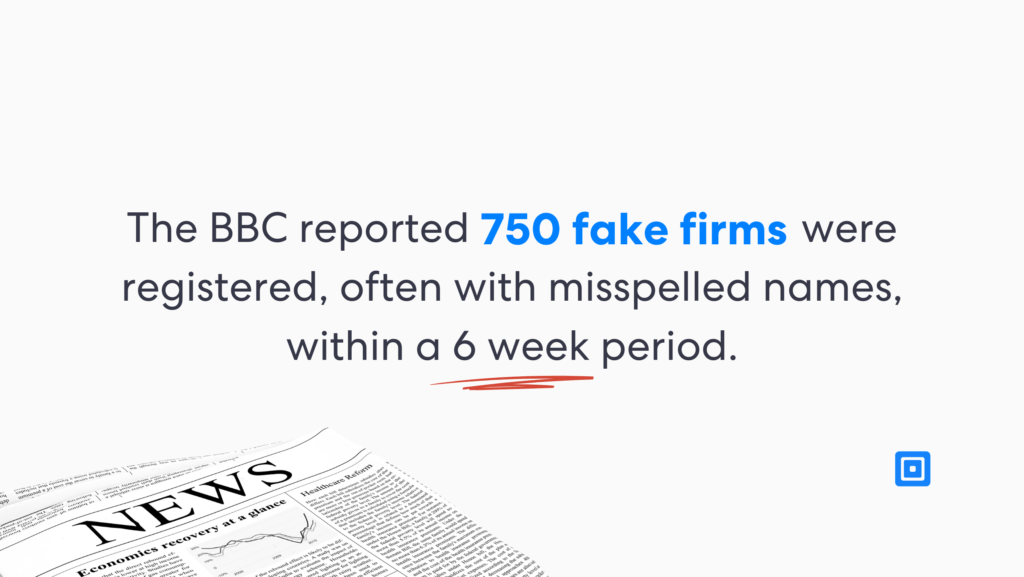
Over 750 fake firms were reported to have been registered,[ often with misspelled names](https://www.bbc.co.uk/news/uk-68156910), within just a six-week period. Companies House then began an investigation, though perhaps this should have been carried out in 2022 after some very similar news articles hit leading publications. The Guardian’s articles “Fakers, fast sign-ups and fraud: the crisis at the UK’s Companies House” and “Companies House is dysfunctional and facilitating fraud, MPs told” had reported these very same crimes back then. The latter piece stated as a subheading that less verification is needed “for someone to set up a fraudulent shell firm than to borrow a library book.”
> It’s easier for someone to set up a fraudulent shell firm[ than to borrow a library book](https://www.theguardian.com/business/2022/nov/08/companies-house-is-dysfunctional-and-facilitating-mps-told).
Graham Barrow, a money-laundering expert who leads The Dark Money Files podcast, outlined the problem to the Guardian in 2022, highlighting that burner companies are created for short-term fraudulent activity, and these companies then suddenly disappear. He went on to state in the piece, “You have to provide verification of your identity to borrow a library book; you don’t have to do that to create a company which could cause [tens of thousands of pounds’](https://www.theguardian.com/business/2022/nov/08/companies-house-is-dysfunctional-and-facilitating-mps-told) worth of damage to our economy.”
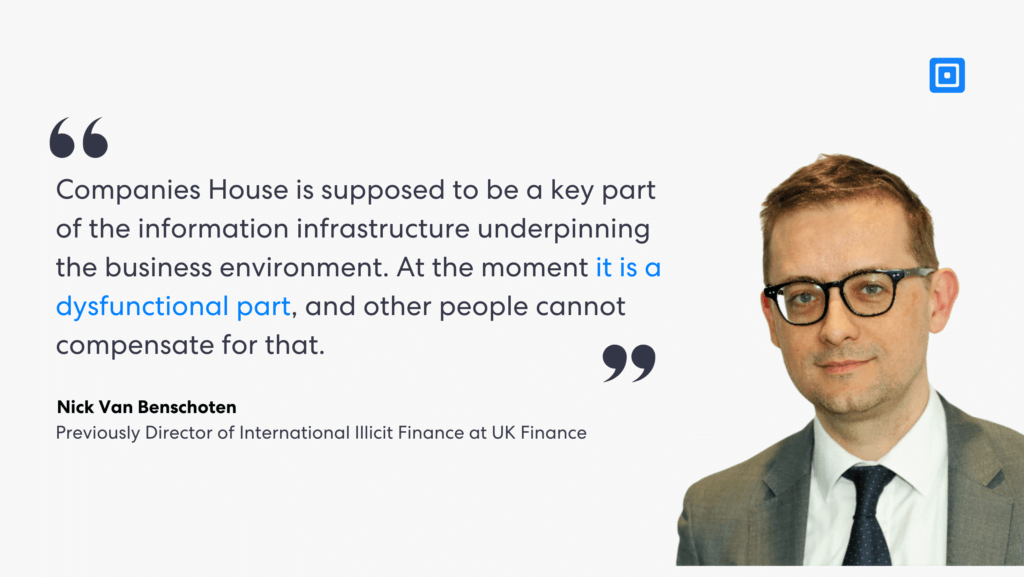
Banks were quick to support Benschoten’s concern, with fraud directors at HSBC and NatWest publically echoing his worry over the lack of checks conducted through Companies House.
Interestingly enough, a director from Companies House responded to some of these claims in the Guardian’s article, arguing that within three or four years, they planned to turn things around. He stated, “We want to be a [preventer of fraud](https://www.theguardian.com/business/2022/nov/08/companies-house-is-dysfunctional-and-facilitating-mps-told).” Considering that this piece came out in 2022, and the BBC has followed up with similar concerns being voiced in a 2024 article, we’re faced with a pressing question: why has Companies House not implemented identity verification processes in the past two years? Are there any changes on the horizon?
## Meet The Latest Victims
Some of the UK’s most up-market restaurants have now been targeted by company cloning scams. The latest victims included the restaurants belonging to Heston Blumenthal and Yotam Ottolenghi, two British celebrity chefs, as well as the Ritz.
Fraudsters were able to set up these fake companies within 24 hours, after which the next item on their agenda was stealing overdraft money from bank accounts set up in the name of the fake company they cloned and ordering expensive capital from suppliers and bank loans. Goods were then delivered, and invoices were [left unpaid.](https://www.bbc.co.uk/news/uk-68156910)
## FCA 2021 Warning Ignored?
In January 2021, the FCA issued a warning over “clone firm investment scams,” which increased by 29% in April 2020 compared to March. The COVID lockdown led to increased investment scams as the economic climate meant more investors were looking to deploy capital to improve their financial situation. Fraudsters capitalized on this by cloning successful businesses and receiving investments through business identity theft, scamming investors into substantial losses.
> Three-quarters [(75%) of investors ](https://www.fca.org.uk/news/press-releases/fca-scamsmart-warning-clone-firm-investment-scams#:~:text=Three%20quarters%20(75%25)%20of,companies%20authorised%20by%20the%20FCA.)said they felt confident they could spot a scam. However, 77% admitted they did not know or were unsure what a ‘clone investment firm’ was.
The FCA’s press release on clone firm investment scams states that “Three quarters (75%) of investors said they felt confident they could spot a scam. However, 77% admitted they did not know or were unsure what a ‘clone investment firm’ was.” The amount of information failure on these kinds of scams is astonishing, considering that they’ve now been carried out for several years. With all UK businesses at risk, something must be done to change the status quo and protect both businesses and investors. Yet, it seems that even the media’s name-and-shame approach has failed to stimulate enough progress over the past few years.
## So…Who’s To Blame?
There’s a common saying about blame that says, “Success has a thousand fathers, but failure is an orphan.” Should the UK government take sole accountability for a crime that many may have enabled? In reality, this chaos certainly has several enablers, who perhaps have left this failure an orphan due to a lack of individual accountability.
Not all businesses register through Companies House, as entrepreneurs often rely on company formation agencies. While company formation agencies might not have been named in these high-profile name-and-shame pieces carried out by the BBC and the Guardian, are they lurking in the shadows of these crimes?
Interestingly enough, a piece did attempt to point toward company formation agencies back in 2019. It quoted the chief executive of the Stanley Davis Group, Andrew Davis. Stanley Davis Group is a company formation agency that has been up and running since 1970. The piece echoed Davis’ views on company formation and accountability for fraud, stating, “We have [neither a legal nor moral responsibility ](https://www.hamhigh.co.uk/news/21352141.crime-reports-disappear-black-hole-criminals-abused-company-formation-firms/)for the activities of the companies that we form.” Shockingly, he went on to say, “When we identify, for example, a fake passport, we report this to the NCA, to Action Fraud, to police, and to the Passport Office. These reports are never acknowledged.”
This certainly throws a spanner in the works for us as readers, as it becomes a matter of “he said, she said” pretty quickly. Was the NCA, police, passport office, and Action Fraud negligent in 2019? If so, is this still the case? Do we have sufficient license to even believe this quote? Perhaps it is too difficult to blame anyone for the rise of these practices, as evidence points to a cycle of mutual enablement. So, we might have to base our judgment on who is leading the reformation of this broken system rather than who caused these problems in the first place.
## Challenging the Status Quo
Although the tightening of company formation processes seems to have stagnated over the past few years, it seems some movement is on the horizon. An article by solicitor Samantha Bowley outlines that the Economic Crime and Corporate Transparency Act 2023 (ECCTA) amended the Companies Act of 2006 last year. However, these changes have yet to be implemented as secondary legislation is needed. Bowler goes on to say that “The identity verification requirements are intended to improve the [reliability of the information](https://taylorwalton.co.uk/insights/new-identity-verification-rules-for-uk-registered-companies/) on the register at Companies House, as well as to make it challenging for individuals to create a fictitious identity, or fraudulently use another person’s identity, to set up or run a company. Companies House has indicated an intention for these measures to come into force from early 2025.”
While this is certainly well-received news, there are a few words that a hard to look past in this quote… “indicated an intention.” Companies House having indicated an intention for this to be up and running next year is certainly not a promise, and until measures are actively in place, the battle against company cloning has not yet started.
Bowley highlights the new verification routes that will form the new process at Companies House, “There will be two routes to identity verification, with individuals having the option to verify their identity directly through Companies House or indirectly through an authorized corporate service provider (ACSP), such as an accountant, legal adviser, or company formation agent. Companies House is currently in the process of developing an effective identity verification system, which will be active when the [identity verification requirements come into effect.](https://taylorwalton.co.uk/insights/new-identity-verification-rules-for-uk-registered-companies/)“
It seems as though a solution could be on the horizon, and hopefully, we can trust these forecasts. While not a lot of good has come out of this situation, what can we learn from it?
## Combating Business Identity Theft with KYB and Identity Verification
The importance of KYB checks cannot be underestimated. While the UK government may not have wanted to deter entrepreneurs from starting their own ventures by imposing more bureaucracy and checks, the losses to these scams are certainly not insubstantial for the UK economy. Furthermore, an environment has been created in which all entrepreneurs are at risk, which is surely a deterrent in itself to creating an entrepreneurial economy. KYB and identity verification checks must be put in place when needed, as the returns they offer on money and time invested are insurmountable, and this should never be overlooked.
Hopefully, these changes will kick in in early 2025. If all the organizations involved don’t prioritize this, we will surely find ourselves reading another BBC News piece, quoting yet another broken business ruined by another scam. Either way, you’ll hear it from us.
For more information on [KYB checks](https://www.complycube.com/en/use-cases/process/know-your-business/), reach out to our expert compliance team or read our latest piece on [UBOs](https://www.complycube.com/en/what-is-ultimate-beneficial-ownership-ubo/).

**Categories:** Guides, News
**Tags:** Identity Verification
---
### [What is Insurance Fraud?](https://www.complycube.com/what-is-insurance-fraud/)
**Published:** May 2, 2025
**Author:** Sofia Daley
**Excerpt:** Insurance fraud is a serious issue that costs the insurance industry billions of dollars each year. It occurs when individuals or businesses intentionally deceive insurance companies. Learn more about how KYC can fortify insurance.
**Content:**
What is insurance fraud? Insurance fraud is a serious issue that costs the insurance industry billions of dollars each year. It occurs when individuals or businesses intentionally deceive insurance companies to receive benefits or compensation they are not entitled to. Insurance fraud not only results in financial losses for insurers but also leads to higher premiums for honest policyholders. To combat this growing problem, insurance companies must implement rigorous processes to prevent fraud, particularly during the client onboarding phase and while monitoring clients throughout the duration of their coverage.
Two critical processes that help insurers prevent fraud are Know Your Customer (KYC) and Anti-Money Laundering (AML). These regulatory measures ensure that insurance companies can verify the identity of their clients, assess risk, and monitor for suspicious activity. When applied during client onboarding and continuous monitoring, KYC and AML are essential tools in the fight against insurance fraud.

## What is Insurance Fraud?
Insurance fraud involves various activities in which a policyholder or applicant misrepresents or withholds information to gain unauthorized financial benefits. It refers to any intentional act committed to deceive or mislead an insurance company during the application or claims process.
> The increasing sophistication of false documents poses a significant challenge for the [insurance sector. ](https://www.cifas.org.uk/newsroom/no_claims_fraud_soars)
The Association of British Insurers detected[ £1bn in fraudulent claims](https://www.abi.org.uk/news/news-articles/2024/9/no-let-up-in-crack-down-on-insurance-cheats-as-industry-detects-1-billion-worth-of-fraudulent-claims/) in a 2024 report, with Cifas arguing that the continuing sophistication of false documents seems to be strengthening fraudulent attempts. [Stephen Dalton, Director of Intelligence for Cifas](https://www.cifas.org.uk/newsroom/no_claims_fraud_soars), stated: ‘The increasing sophistication of false documents poses a significant challenge for the insurance sector. The ease by which fake websites can be created, and the growth of generative AI and deepfake technology manipulation means that some of these documents are highly convincing and may be capable of bypassing verification checks.’ Some common types of insurance fraud include:
- False Claims: This occurs when individuals or businesses submit fabricated or exaggerated claims, such as claiming non-existent damages or inflating the value of property loss.
- Premium Fraud: Fraudulent policyholders might provide inaccurate details, such as misreporting their health status, profession, or driving history, in order to secure lower premiums.
- Exaggerated Losses: Policyholders may exaggerate the extent of damage or loss to receive a larger payout than what is legitimately due. Individuals may also falsely claim their car has been stolen or misrepresent the primary driver to obtain lower insurance rates.
- Corporate Fraud: In the corporate sector, businesses may misrepresent their financial status, asset values, or losses to submit fraudulent claims for large-scale events like business interruptions.
Insurance fraud is a serious crime that can have severe consequences for both individuals and companies. Businesses within the insurance sector are implementing increasingly sophisticated [customer identification programs and customer due diligence](https://www.complycube.com/solutions/due-diligence-compliance/customer-due-diligence/) measures to prevent fraud and protect honest customers. By verifying identities and ensuring the individual is who they claim to be, insurance businesses can accurately assess the risk level of customers and determine the legitimacy of their claims. This process not only helps prevent fraudulent activities but also ensures that the appropriate coverage is provided to genuine customers.
## Types of Fraud
Insurance fraud can be classified into different types, including hard fraud and soft fraud. Hard fraud occurs when someone deliberately plans or invents a loss, such as a collision or fire, to make a false insurance claim. Soft fraud, on the other hand, involves exaggerating or misrepresenting information to obtain a higher claim payout. Both types of fraud are illegal and can lead to serious consequences for those who commit them. Other forms of insurance fraud include ghost broking, where fraudsters sell fake or illegally obtained insurance policies, and crash for cash scams, in which individuals stage accidents to make false insurance claims.
> Rigorous customer vetting and continuous monitoring ensure a more transparent risk assessment process, deterring fraudulent activities from the outset and fostering a safer, more reliable insurance environment.
[Harry Varatharasan](https://www.linkedin.com/in/harry-varatharasan/), Chief of Product at ComplyCube, states, “By enhancing Know Your Customer (KYC) and Anti-Money Laundering (AML) measures, insurance companies can significantly reduce both soft and hard fraud. Rigorous customer vetting and continuous monitoring ensure a more transparent risk assessment process, deterring fraudulent activities from the outset and fostering a safer, more reliable insurance environment.”
## How Can Increased Verification Help?
Increased [verification plays a pivotal role in preventing various cases](https://www.complycube.com/automated-document-verification-use-cases/) of insurance fraud, including ghost broking and crash for cash scams. Ghost broking, where fraudsters sell fake or illegally obtained insurance policies, can be mitigated through robust identity verification processes, such as KYC checks and biometric authentication, ensuring that individuals purchasing policies are who they claim to be.
These measures help prevent fraudsters from using stolen or fabricated identities to obtain policies. Similarly, in crash for cash scams, where fraudsters stage accidents to make false claims, enhanced verification helps by confirming the legitimacy of the individuals involved in the accident through biometric checks and cross-referencing with vehicle and accident databases.
Additionally, AI and machine learning tools can detect suspicious patterns, such as repeated claims or discrepancies in accident details, further safeguarding against fraudulent activities. By implementing these advanced verification methods, insurance companies can more effectively identify and prevent fraud, ensuring that only legitimate claims are processed while protecting both insurers and honest customers.
## The Role of KYC and AML in Insurance
Client onboarding is the first and most important step in ensuring compliance and preventing fraud. When a new client applies for insurance, it is crucial for the insurer to verify the identity of the individual or business and assess the risk level associated with providing coverage. KYC and AML processes are central to this task. KYC regulations ensure compliance for banks and other financial institutions, helping to mitigate fraud risks and prevent illegal activities such as money laundering and terrorism financing. For more information on KYC and AML checks to strengthen onboarding, read [KYC Checks For a Secure Onboarding Process.](https://www.complycube.com/en/kyc-checks-for-a-secure-and-scalable-onboarding-process/)
## Know Your Customer (KYC)
KYC refers to the process of verifying the identity of a client before providing insurance coverage. This process helps insurance companies make sure that they are not unknowingly engaging with fraudulent or high-risk clients. Here’s how KYC is used during client onboarding:
- [Identity Verification](https://www.complycube.com/en/solutions/identity-assurance/biometric-verification/): The first step in KYC is confirming that the client is who they claim to be. Insurers collect information such as government-issued identification, proof of address, and company registration documents (for businesses) to prove their identity. This step prevents identity theft, making it harder for fraudsters to use fake identities to obtain coverage.
- [Assessing Risk Profiles:](https://www.complycube.com/en/solutions/due-diligence-compliance/risk-scoring/#:~:text=We%20create%20an%20overall%20risk,profile%2C%20updating%20its%20risk%20score.) Once a client’s identity is verified, the insurer must evaluate their risk level. For individuals, this may involve reviewing factors such as their health history or driving record. For businesses, it might include checking financial stability, industry risk factors, and claims history. This process helps insurers identify high-risk clients who might be more likely to commit fraud. Financial institutions adhere to regulatory frameworks to ensure compliance with KYC processes, enhancing the overall security and reliability of the system.
- Understanding the Client’s Intent: KYC processes also gather information about the client’s purpose for purchasing insurance. By understanding their needs, insurers can better assess whether the client is at a higher risk for fraudulent behavior. For example, a client purchasing an unusually high amount of coverage for assets that appear to be undervalued might raise red flags.
- [Enhanced Due Diligence for High-Risk Clients](https://www.complycube.com/en/enhanced-due-diligence-edd-insights-and-challenges/): In some cases, insurance companies may need to conduct enhanced due diligence (EDD) for clients who present a higher risk. This includes clients with complex financial backgrounds or those in high-risk industries. Enhanced scrutiny ensures that these clients are not using insurance policies for illicit purposes.
## Anti-Money Laundering (AML)
AML refers to the processes used to detect and prevent money laundering, the process of concealing the origins of illegally obtained money. Insurance companies must implement AML measures to prevent fraud and ensure that they do not inadvertently facilitate criminal activity. Here’s how AML is applied during the client onboarding process:
- Client Screening: Insurance companies screen new clients to check whether they are listed on global sanctions lists or have a criminal history. This process helps ensure that clients involved in illegal activities are not able to gain access to insurance products. By checking against databases of known criminals or organizations involved in fraudulent activity, insurers reduce the likelihood of engaging with fraudsters.
- Source of Funds Verification: When dealing with high-value policies or corporate clients, insurers need to verify the source of funds. For example, if a business applies for large coverage, the insurer may need to ensure that the company’s financial resources are legitimate and not derived from illegal activities.
- Monitoring Politically Exposed Persons (PEPs): Politically exposed persons, who may have access to significant wealth or influence, require additional scrutiny during onboarding. This is because PEPs may be involved in higher-risk activities, including fraud, corruption, or money laundering. AML protocols ensure that these individuals are thoroughly vetted.
- Recording and Reporting Suspicious Behavior: If any part of the onboarding process raises concerns about the legitimacy of a client or their intent, insurers are required to report this suspicious activity to the relevant authorities. This process helps prevent fraud before it even occurs.
## Monitoring Clients to Prevent Ongoing Fraud
Client monitoring is an essential part of fraud prevention. Fraudulent activities lead to significant monetary losses for insurance companies, resulting in higher premiums for honest customers, thereby increasing overall insurance costs for the general public. Even after a client has been onboarded and coverage has been issued, it is vital for insurance companies to continuously monitor their clients’ behavior and transactions to detect any signs of fraudulent activity. Data is essential for conducting KYC checks and ensuring compliance with financial regulations. KYC and AML systems support this ongoing surveillance by flagging anomalies and suspicious transactions.
## Know Your Customer (KYC) – Continuous Monitoring
Once a client is onboarded, insurers need to ensure they remain compliant with regulations and detect any signs of fraudulent activity throughout the life of the policy. KYC provides the foundation for continuous monitoring by:
- Updating Client Information: KYC is not a one-time process. Insurers should periodically update their clients’ personal and financial information to ensure it remains accurate. This is especially important for high-risk clients whose circumstances may change, potentially increasing the risk of fraud.
- Tracking Claims History: By maintaining detailed records of a client’s claims, insurers can identify patterns that suggest fraud. For example, frequent or exaggerated claims might indicate that a client is attempting to abuse the system. Due to the high volume of claims, insurance companies cannot review all claims, so they focus on those flagged as suspicious for further evaluation. KYC processes help track these behaviors, ensuring timely intervention when needed.
- Risk-Based Monitoring: Clients who were flagged as high-risk during the onboarding process require more intense monitoring. These clients may undergo additional scrutiny whenever they file claims, request policy changes, or engage in financial transactions.
The consequences of lacking effective KYC (Know Your Customer) processes for insurance companies can be severe, leading to increased vulnerability to fraud, which in turn raises insurance premiums for honest customers, results in financial losses for both individuals and businesses, and damages the reputation of the insurance industry.
## Fortify Your KYC with ComplyCube
Insurance fraud is a significant threat to the financial stability of the insurance industry, but with the right measures in place, it is possible to mitigate this risk. KYC and AML checks, particularly during client onboarding and continuous monitoring, are essential tools for preventing fraud. These processes allow insurers to verify the identity of their clients, assess their risk profiles, and detect suspicious behavior throughout the duration of the client’s relationship with the company. By applying these measures rigorously, insurance companies can protect themselves, their clients, and the broader financial system from the damaging effects of fraud.
For more information on how to fortify your business with cutting-edge KYC and AML, get in touch with our [expert compliance team](https://portal.complycube.com/signup).

**Categories:** Guides
**Tags:** Identity Verification
---
### [Adopting a Risk-Based Approach: AML Software for Accountants](https://www.complycube.com/adopting-a-risk-based-approach-aml-software-for-accountants/)
**Published:** November 12, 2024
**Author:** Sofia Daley
**Excerpt:** In today’s increasingly regulated world, accountants face more than balance sheets and tax returns. Every client brings inherent risks that, if left unchecked, can harm a firm’s reputation, or even lead to legal repercussions.
**Content:**
UK accountants face more than just balance sheets and tax returns in today’s increasingly regulated world. Every client brings inherent risks that, if left unchecked, can harm a firm’s reputation, expose it to financial penalties, or even lead to legal repercussions. Knowing exactly who your clients are isn’t just advisable—it’s imperative. The best AML software for accountants will verify all necessary client information, including the legal structure of a client’s organization, the identities of all Ultimate Beneficial Owners (UBOs), and much more. KYC for accountants ensures that firms maintain robust compliance processes and seamlessly align with the mandates set by governing bodies like the Association of Chartered Certified Accountants (ACCA).
## AML Obligations for Accountancy Firms
In the UK, several key legislative mandates, such as The Money Laundering, Terrorist Financing and Transfer of Funds Regulations 2017, outline AML standards that must be met by all financial institutions. The Association of Chartered Certified Accountants (ACCA) underlines these requirements for accountancy firms and supervises its members, ensuring compliance with AML laws and regulations.
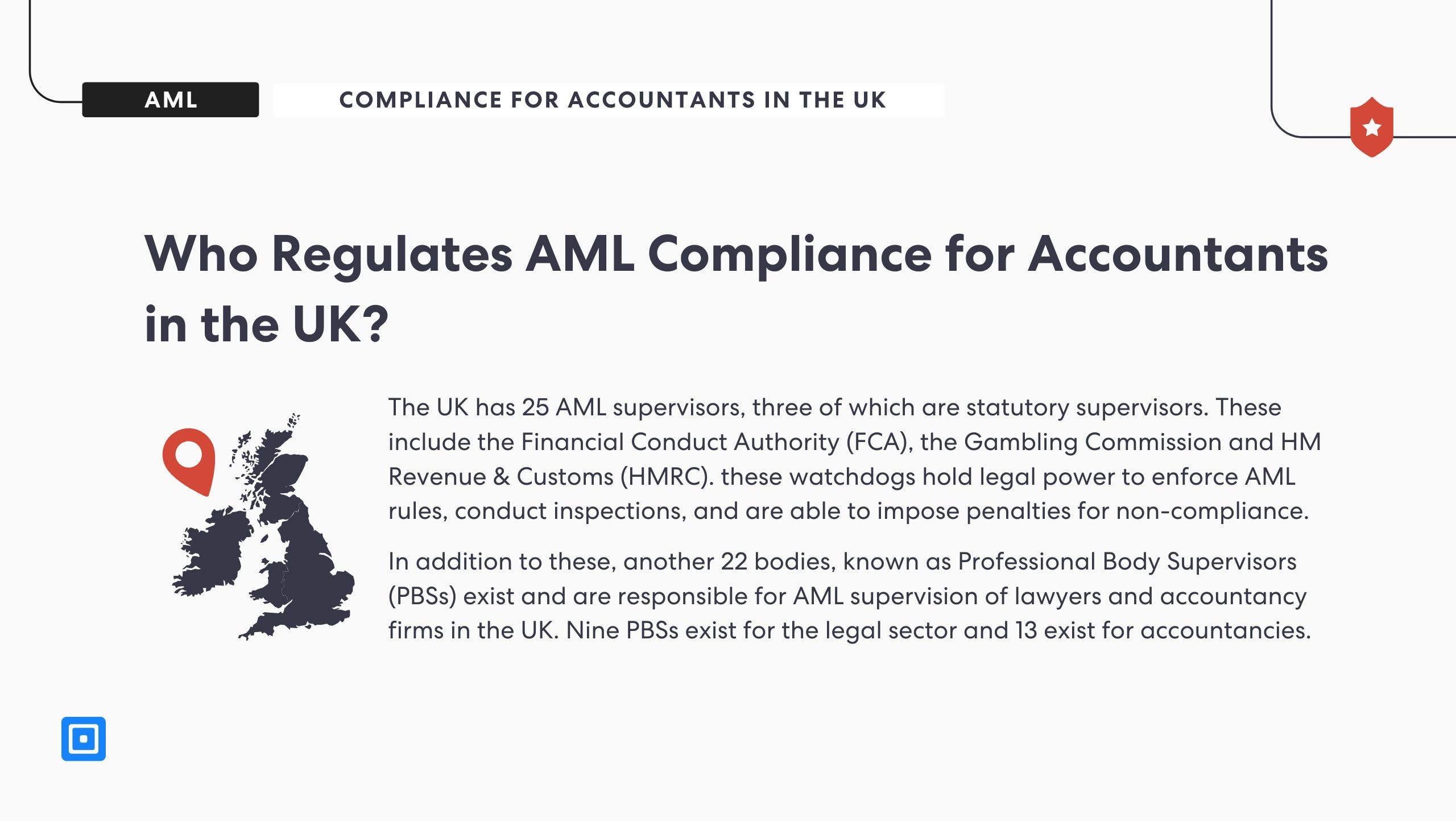
## (2017) The Money Laundering, Terrorist Financing, and Transfer of Funds Regulations
The 2017 Money Laundering, Terrorist Financing, and Transfer of Funds Regulations marked a turning point in compliance for accountants across the UK. This legislation imposed a stricter framework of [Client Due Diligence (CDD)](https://www.complycube.com/en/solutions/due-diligence-compliance/customer-due-diligence/) practices, mandating a more thorough understanding of each client’s business activities, financial history, and ownership structure.
> Understanding the nature of a client’s business enables accountants to identify behaviors that appear to be unusual and may amount to [suspicious activity](https://www.accaglobal.com/content/dam/ACCA_Global/Technical/fact/tf-ACCA-client-due-diligence-0124.pdf) when considered in context with what’s known about the client’s background.
In order to fully understand the nature of a client’s business operations and interests, accountants must use the right KYC processes to identify the following:
- The legal structure of the client’s organization. As part of the verification process, the certificate of incorporation, a breakdown of share ownership, or a partnership agreement should be accessed.
- The date that the business started trading.
- The identities of all of the Ultimate Beneficial Owners (UBOs), directors, and any other identities with significant control of the organization must be verified through a document check alongside a proof of address check, as mandated by the Association of Chartered Certified Accountants (ACCA). However, a biometric liveness check can further solidify this process for accountancies, helping to detect more sophisticated cases of identity fraud that might bypass a standard document check.
- ACCA also requires adverse media monitoring to ensure reputational and compliance risks are mitigated.
## Adverse Media Checks
[Adverse media checks](https://www.complycube.com/en/solutions/global-screening/adverse-media-checks/) involve searching news and public sources for negative information related to an individual or entity, such as involvement in fraud, financial crime, or other risky activities. These checks help accountancy firms identify potential reputational or compliance risks associated with clients or partners.
> If there are any [adverse media associated](https://www.accaglobal.com/content/dam/ACCA_Global/Technical/fact/tf-ACCA-client-due-diligence-0124.pdf) with the client, the best practice is to search the client’s registered name, trading name (if different), and the names of the client’s ultimate beneficial owners/directors.
However, attempting to search for adverse media without a sophisticated solution that can carry this out in an automated and precise manner can be risky. It’s best to work with AML software that can run this process automatically, providing continuous real-time monitoring and notifications on changes in a client’s risk status.
ACCA underlines that additional information on high-risk clients might need to be recorded, such as (but not limited to) identified sources of income, previous yearly turnover, future revenue projections, and an organization’s operational structure.
## Risk Assessments for a UK-Friendly Approach
The UK supports a Risk-Based Approach (RBA) when considering the best AML compliance practices. A risk assessment can determine what processes must be carried out to meet AML regulations. The risk-based approach to AML and KYC compliance was first introduced by the Financial Services Authority (FSA) in 2000, an organization that is now known as the Financial Conduct Authority (FCA), the UK’s primary financial watchdog.
Similarly, in 2012, the FATF also officially adopted the RBA as a central regulatory principle. High-risk clients require additional due diligence to ensure AML compliance processes are sufficient according to regulatory requirements. Client onboarding must differentiate between low-risk and high-risk clients according to UK (FCA) and international (FATF) guidance. For more on RBAs, read “[What is a Risk-Based Approach (RBA)?](https://www.complycube.com/en/what-is-a-risk-based-approach/)“
## What Does an Enhanced Due Diligence Process Look Like?
Enhanced Due Diligence (EDD) is a thorough vetting process that accounting firms might apply to high-risk clients to ensure compliance with Anti-Money Laundering (AML) regulations. It involves gathering additional information to assess and mitigate potential risks associated with the business relationship.
ACCA states, “Firms must ensure that they[ conduct EDD](https://www.accaglobal.com/content/dam/ACCA_Global/Technical/fact/tf-ACCA-client-due-diligence-0124.pdf) on all clients based in, trading with, or transacting to a high-risk third country as defined by the Financial Action Task Force (FATF) and named in the HM Treasury Advisory Notice: High-Risk Third Countries.”
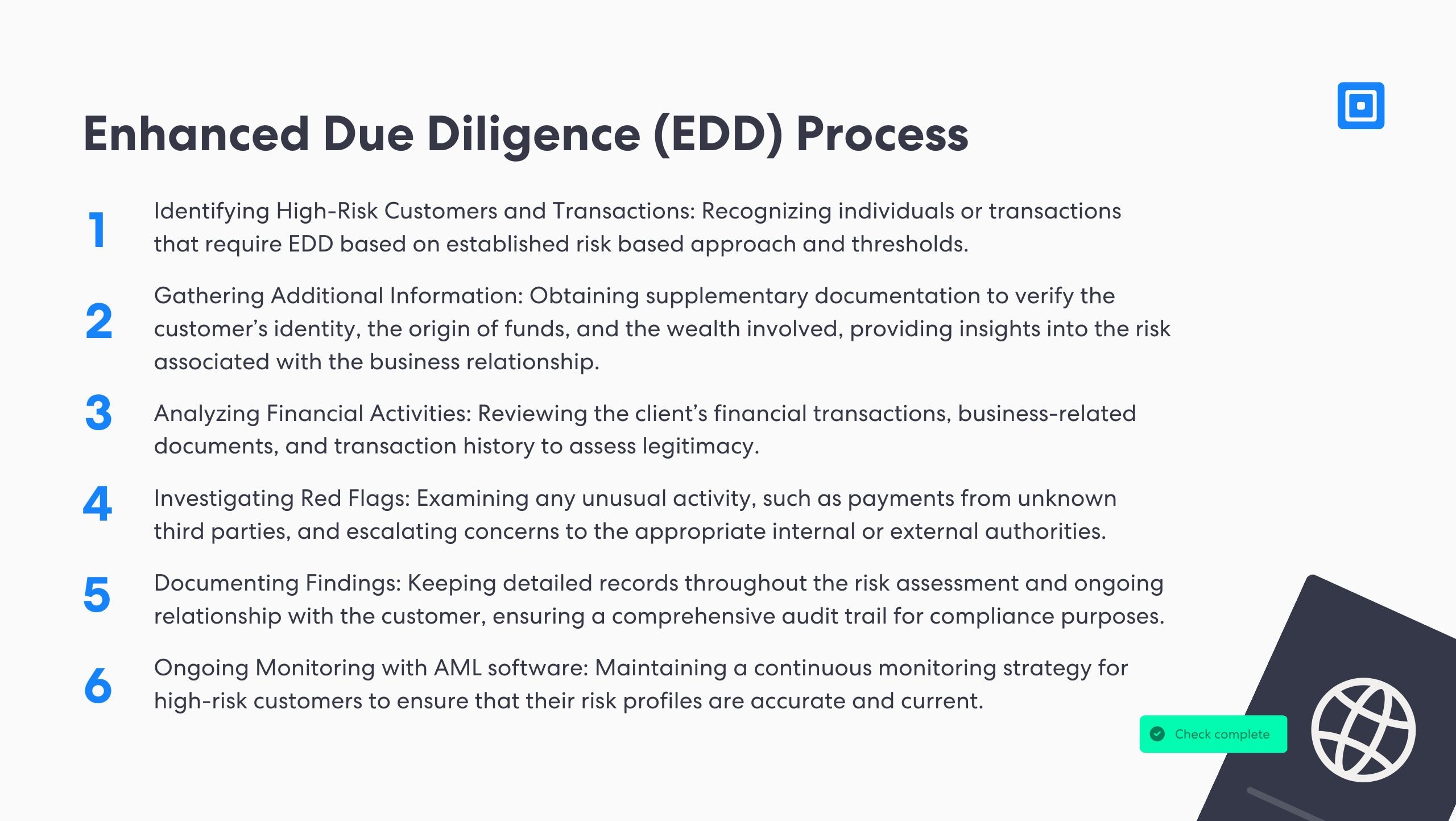
The Enhanced Due Diligence (EDD) process ensures business verification through the following methods:
1. **Identifying High-Risk Customers and Transactions:** Recognizing individuals or transactions that require EDD based on established risk-based approaches and thresholds.
2. **Gathering Additional Information**: Obtaining supplementary documentation to verify the customer’s identity, the origin of funds, and the wealth involved, providing insights into the risk associated with the business relationship.
3. **Analyzing Financial Activities**: Reviewing the client’s financial transactions, business-related documents, and transaction history to assess legitimacy.
4. **Investigating Red Flags**: Examining any unusual activity, such as payments from unknown third parties, and escalating concerns to the appropriate internal or external authorities.
5. **Documenting Findings**: Keeping detailed records throughout the risk assessment and ongoing relationship with the customer, ensuring a comprehensive audit trail for compliance purposes.
6. **Ongoing Monitoring with AML software**: Maintaining a continuous monitoring strategy for high-risk customers to ensure that their risk profiles are accurate and current.
For more information on Enhanced Due Diligence (EDD), read “[Navigating the World of Enhanced Due Diligence.](https://www.complycube.com/en/enhanced-due-diligence-edd-insights-and-challenges/)“
## Finding the Best AML Software For Your Compliance Needs
Each accountancy firm will face its own unique challenges in achieving compliance, which is why a one-fits-all approach isn’t always best. David Winch, a forensic accountant and Director of MLRO Support, states that “Each accountancy firm is unique – not least because its partners have unique experience, knowledge, and interests. In my opinion, each firm’s AML compliance must also be unique.”
Finding a platform with solutions that can be tailored is necessary, as different accountants may differ in needs. Some examples might include:
1. **Client Base Diversity**: Firms serving high-risk clients in sectors like real estate or foreign investments may need more robust adverse media screening and ongoing monitoring solutions than firms primarily working with low-risk clients or individuals.
2. **Firm Size and Resources**: Smaller firms may require more cost-effective, streamlined AML tools that don’t overburden limited resources, while larger firms with broader client bases may benefit from advanced analytics and customizable features that provide deeper insights into client risk.
3. **Regulatory Jurisdiction**: Firms operating internationally need AML software that complies with multiple regulatory frameworks, whereas firms focused solely on UK clients may prioritize local compliance features aligned with ACCA and UK AML mandates.
4. **Level of Automation Needed**: Firms with a higher volume of clients might require automated KYC processes to manage onboarding efficiently, while smaller firms may prefer manual verification to maintain personalized client service.
Customizable AML solutions allow firms to address these varied needs, ensuring compliance that aligns with their unique client profiles, resource availability, and regulatory environments. Finding a platform that offers such adaptability is critical.
## ComplyCube’s AML Software for Accountants
ComplyCube offers state-of-the-art Anti-Money Laundering (AML), Know-Your-Customer (KYC), and Identity Verification (IDV) [solutions for accountants](https://www.complycube.com/en/use-cases/industry/accounting-compliance/), easily keeping UK businesses compliant. UK accountants can implement tailored AML software solutions that adapt to the specific diligence requirements for different client types.
The platform offers flexible, customizable checks, such as document verification, biometric authentication, and liveness detection, allowing firms to adapt their approach based on client risk levels and transaction types. By automating these processes, ComplyCube reduces the operational burden on accountants, helping them maintain high compliance standards while focusing on their core advisory and auditing services.
Additionally, ComplyCube’s real-time adverse media and sanctions screening enhances firms’ ability to detect and manage potential risks associated with high-risk clients or entities. The platform’s continuous monitoring feature ensures that risk profiles remain current, alerting firms to any changes in client status, which is crucial for ongoing compliance in an evolving regulatory environment.
For more information on ComplyCube’s services, get in touch with one of their [compliance experts](https://www.complycube.com/en/contact/contact-sales/).

**Categories:** Guides
**Tags:** Anti-Money Laundering
---
### [How to Perform a KYC Platform Comparison in 2025](https://www.complycube.com/kyc-platform-comparison-feature-evaluation/)
**Published:** August 12, 2025
**Author:** Dini Habib
**Excerpt:** Comparing leading KYC platforms can help firms effectively evaluate and decide the right provider. However, knowing how to compare KYC providers effectively may look different for each company, depending on their unique case.
**Content:**
**TL;DR:** This article offers a practical framework for **KYC platform comparison**, covering compliance needs, technical fit, IDV and AML features, cost considerations, and future scalability. It delves into the essential features stakeholders must consider when selecting a KYC solution to meet **current and future needs**. Readers walk away with a **bulletproof** evaluation checklist to conduct a tailored KYC platform comparison, plus leading industry insights from KYC experts.
## What Should be Considered When Building a KYC Platform Comparison?
The criteria for comparing KYC providers effectively may look different to each company. Designing a tailored, well-defined KYC evaluation framework can help businesses make better-informed purchasing decisions and help firms evaluate then select the right RegTech provider for their business case. For an evaluation framework to be practical, it must align with a company’s technical capacity, customer satisfaction goals, and regulatory obligations. Without a strategic framework, comparisons can stray away easily, leading to volatile decisions.
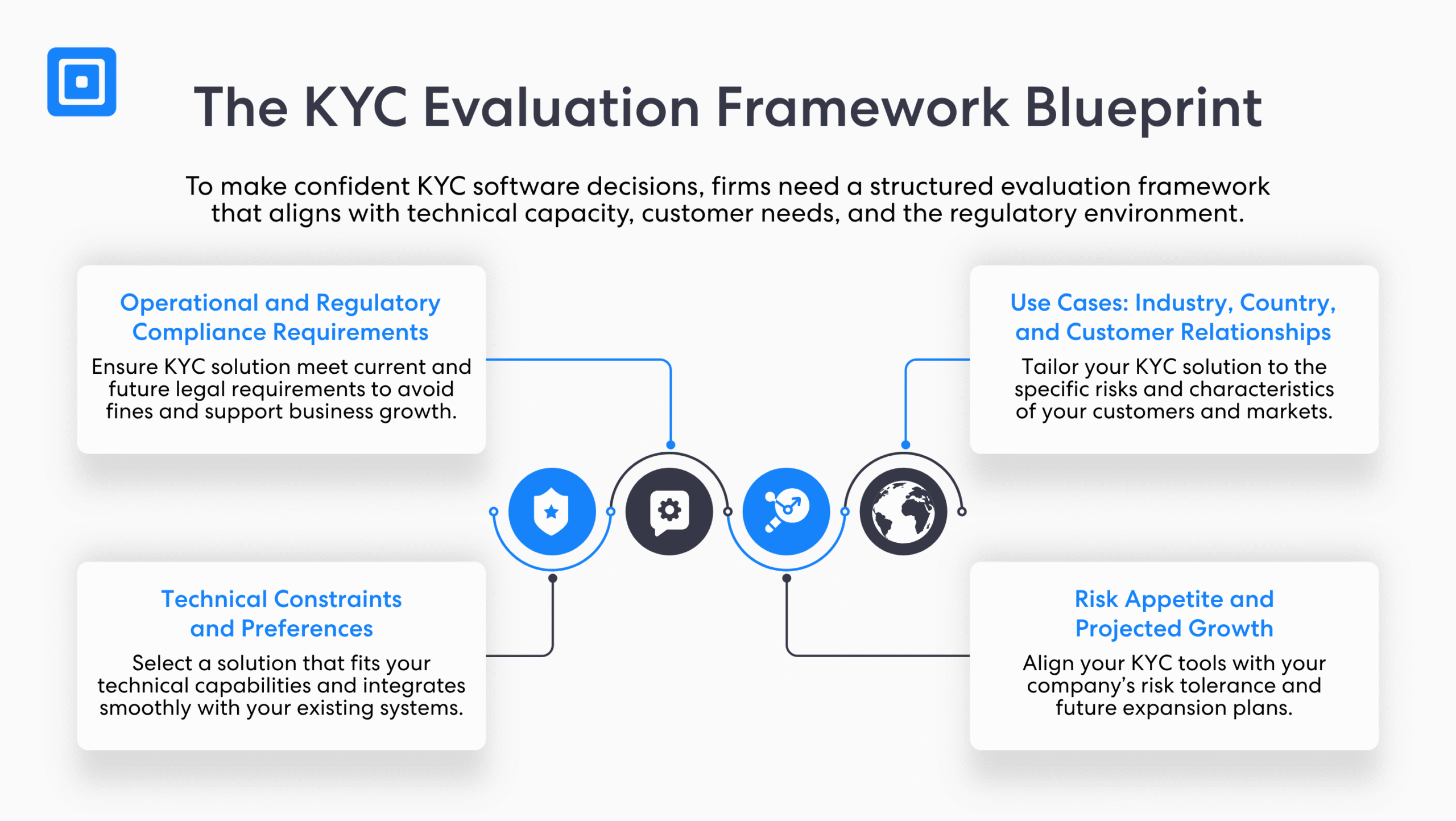
Selecting KYC vendors is vital as enforcement actions from regulatory authorities worldwide have increased tremendously in recent years. Notable fintechs and financial institutions such as [NatWest](https://www.fca.org.uk/news/press-releases/natwest-fined-264.8million-anti-money-laundering-failures), [Barclays](https://www.complycube.com/en/barclays-under-aml-scrutiny/), and [Santander](https://www.complycube.com/en/understanding-kyc-requirements-uk-a-quick-guide-for-2025/) are not excused. In 2024, the Financial Conduct Authority issued over £176 million in fines for weak KYC procedures. This underlines the importance of creating a [reliable KYC software](https://www.complycube.com/en/solutions/due-diligence-compliance/know-your-customer/) evaluation framework.
### Operational and Regulatory Compliance Requirements
Companies must list the particular KYC technology and operational support required to meet compliance requirements. While some businesses only need KYC coverage, others might require additional [Anti-Money Laundering (AML)](https://www.complycube.com/en/solutions/due-diligence-compliance/anti-money-laundering/), biometric verification, or real-time sanctions screening. Additionally, it is necessary to understand future business expansion goals. Firms that plan to expand operations globally must comply with international KYC regulation standards.
### Use Cases: Industry, Country, and Customer Relationships
Another factor to consider is the type of customer and client a business is dealing with. For instance, if an organization deals with high-risk individuals such as [Politically Exposed Persons (PEPs)](https://www.complycube.com/en/solutions/global-screening/sanctions-pep-screening/) or sanctioned entities, a platform that includes Enhanced Due Diligence (EDD) and ongoing monitoring is required. Furthermore, selecting a KYC solution with robust document verification and language localization support is key if operating in different countries. To learn more about how you can effectively navigate the largest challenges from EDD, [click here](https://www.complycube.com/en/enhanced-due-diligence-edd-insights-and-challenges/).
### Technical Constraints and Other Preferences
Every KYC service provider has its integration capability depth. For businesses that lack a dedicated technical team, prioritizing seamless integration with low/no-code solutions can be a game-changer. It enables new features to merge seamlessly into existing systems without coding or developer knowledge. Moreover, organizations that operate across multiple platforms, including web and mobile, must consider KYC software providers with API and SDKs to boost interoperability.
### Risk Appetite and Projected Growth
Understanding future business goals can help ensure alignment with customer experience and compliance processes. Industry-leading KYC solutions offer scalable tools that grow and evolve with changing business conditions. Industries prone to change, such as startups and scale-ups, may need to adopt KYC and AML tools that provide high customization during the customer onboarding and verification processes.
## Platform Feature Prioritization
After creating an evaluation framework, it can be beneficial to segment KYC features into three categories for greater clarity: must-have, nice-to-have, and future-state features. This structure enables firms to ensure regulatory compliance while considering future goals.
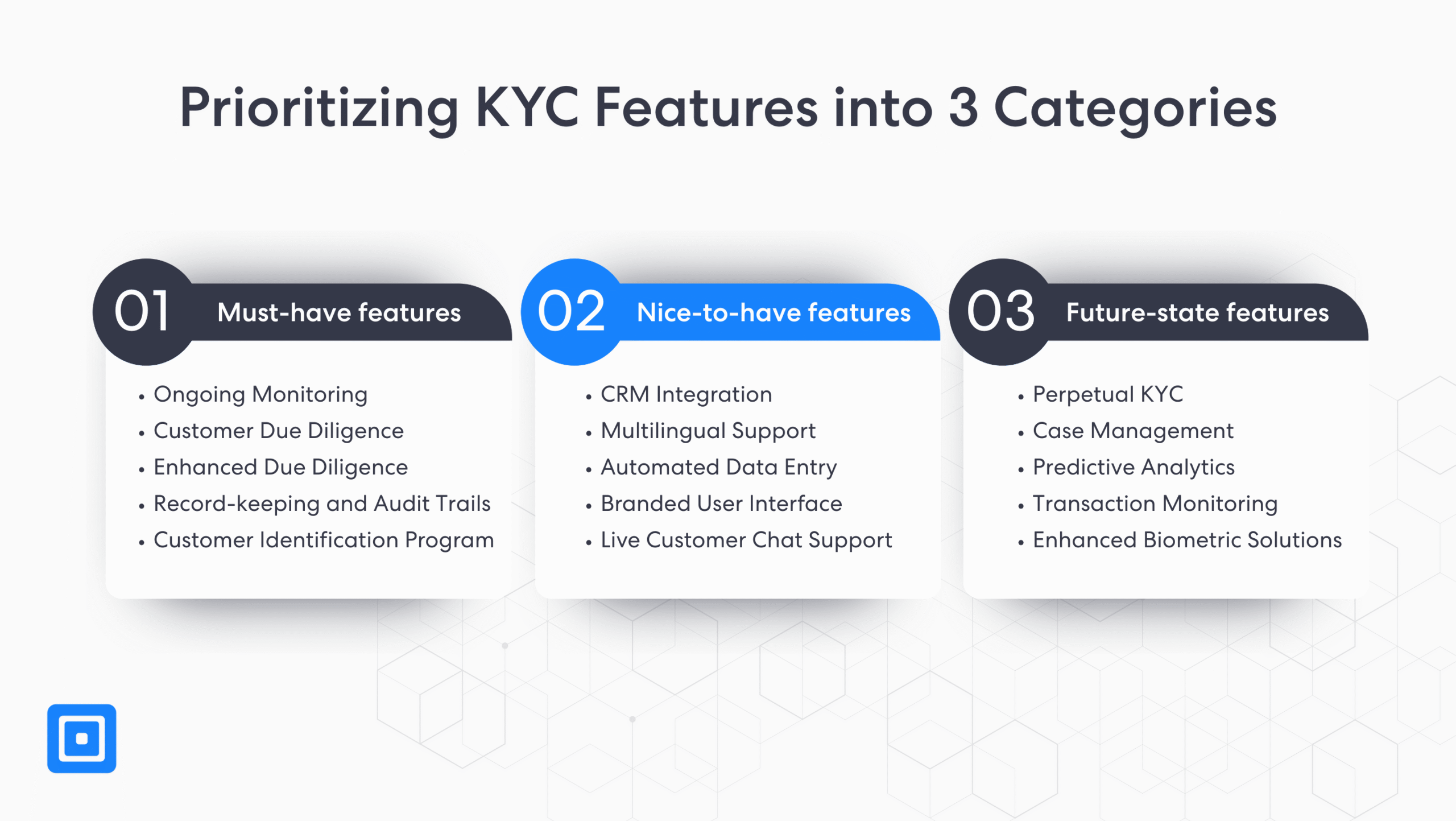
The must-have features are those necessary for compliance and business continuity, such as verifying customer identities. Nice-to-have features are the tools that contribute to growth but are not critical. Tools that add to a seamless onboarding experience, such as a branded user interface, are included here. Features in the future-state segment are those that may become more important as the business expands, such as robust case management and transaction monitoring.
## Identity Verification Capabilities
A central element of effective KYC software is powerful identity verification solutions. Identity verification is the process of authenticating an individual by gathering various customer data. Modern KYC solutions incorporate digital identity verification solutions, facilitating companies in customer onboarding remotely. The integral components in identity verification include:
- **Identity Document Coverage:** Accepts multiple types of identity documents for verification from different countries, reducing friction in the onboarding process.
- **OCR and AI-powered Identity Verification:** AI and [Optical Character Recognition (OCR)](https://www.complycube.com/en/solutions/due-diligence-compliance/know-your-customer/optical-character-recognition/) significantly reduce human error and manual labour, resulting in precision and speed during onboarding.
- **Biometric Authentication:** Liveness verification guarantees that a document holder is alive and helps mitigate identity theft and deepfakes.
- **NFC-Enabled Documents:** Enables document screening at immediate speed, helping financial institutions and businesses with Enhanced Due Diligence (EDD) and fraud prevention efforts.
### **Case Study: UK Fintech Platform Slashes ID Fraud by 84% with ComplyCube’s Liveness Detection**
A rapidly growing fintech platform expanding into new markets faces a sharp rise in fraud attempts during onboarding, particularly “presentation attacks,” where fraudsters display stolen or fake ID documents. This compromised both compliance and customer trust prior to speaking to ComplyCube.
### **Challenge**
- **High fraud exposure:** Screen-based spoofing made up 1 in 20 onboarding attempts.
- **User trust erosion:** Users experienced delays due to additional manual checks.
- **Regulatory pressure:** Stronger anti-fraud measures needed to meet full KYC/AML compliance.
### **Solution**
The fintech leveraged ComplyCube’s **Document Liveness Detection** feature into its identity verification workflow, enhancing its existing Document Checking Service. The added Presentation Attack Detection (PAD) layer identifies spoofing attempts, including 3D masks and screen replay fraud, enabling businesses to block bad actors while maintaining seamless customer experience.
### **Results within 3 months**
- **84% reduction** in screen-based fraud attempts.
- **30% faster onboarding** for legitimate customers, cutting KYC from minutes to seconds.
- **Straight-Through Processing (STP) rate** of **98%** with **100% uptime**.
- **92% customer satisfaction score**, up from 84%.
## Anti-Money Laundering Capabilities
Beyond identity checks, the best KYC software providers ensure compliance with evolving AML regulations. AML compliance mandates businesses to support ongoing fraud prevention solutions with sophisticated risk management and EDD:
- **PEPs, Sanctions Screening, Adverse Media Checks:** Secure compliance by screening customers against [global watchlist](https://www.complycube.com/en/solutions/global-screening/watchlist-screening/) and sanctions list to ensure prompt detection of high-risk profiles.
- **Configurable Risk-Based Rules Engine:** Firms can use dynamic workflows tailored to risk levels. For example, high-risk individuals undergo EDD while low-risk customers get onboarded faster.
- **Ongoing Monitoring:** Continuously screens and alerts businesses of any new risk from a change in a customer’s risk profile, making fraud prevention a proactive process.
- **Regulatory Reporting:** Audit trails and compliance activities are logged and easily accessible. This helps satisfy regulatory authorities’ reporting requirements.
## The Value of Security Certifications
When selecting KYC solution, trust and security are non-negotiables. KYC vendors that can demonstrate proven and reliable compliance will empower businesses with confidence and peace of mind. The three core areas to look for include industry or jurisdiction certifications, security features, and regulatory standards. Certifications highlights that a vendor meets rigorous and recognized benchmarks, security features provide robust protection, and regulatory standards maintain legal compliance:
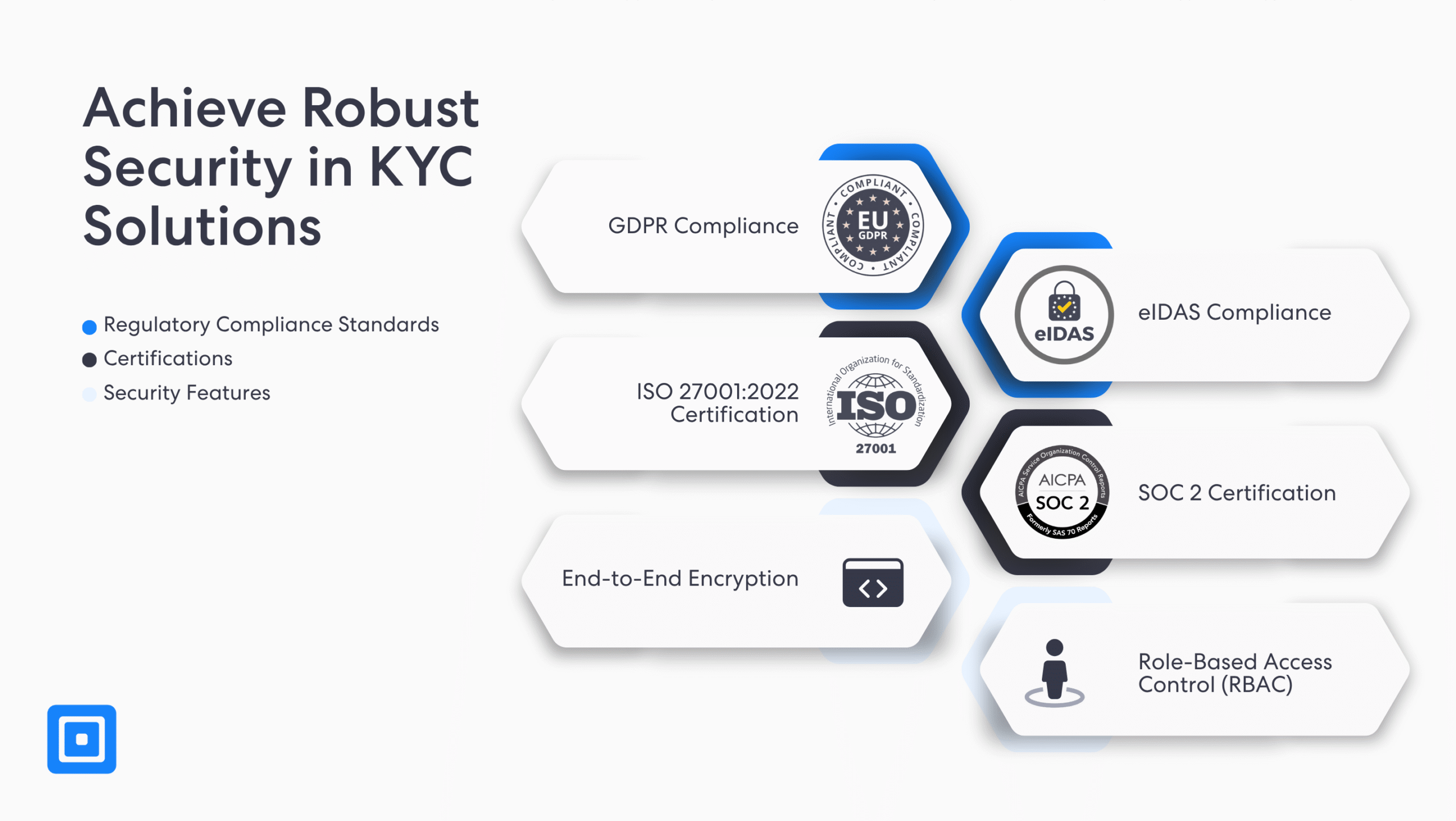
### Compliance with GDPR and eIDAS
[GDPR](https://gdpr-info.eu) and [eIDAS-certified](https://digital-strategy.ec.europa.eu/en/policies/eidas-regulation) KYC and AML solutions safeguard sensitive personal information with secure data storage capabilities. Organizations partnering with these vendors also gain trust from customers who feel assured that their financial transactions and information are protected.
### ISO 27001:2022, SOC 2, and ISO 9001:2015 Certifications
Certifications such as the ISO 27001:2022, SOC 2, and ISO 9001:2015 demonstrate high data security and quality standards. The best KYC compliance solutions leverage these certifications to provide clients with top-tier defense against data breaches.
### End-to-end Encryption and RBAC
End-to-end encryption and [Role-Based Access Control (RBAC)](https://www.complycube.com/en/solutions/due-diligence-compliance/case-management/) supply organizations with high security protection and control over data management. Firms can choose to give access to specific team members, mitigating the threats of data violations.
## Choosing the Right KYC Provider by Cost
While establishing robust verification systems is essential, the cost of KYC verification can be overpriced for many. To prevent overspending and painful migrations down the road, companies must take proactive steps to assess pricing before committing:
- **Breakdown Cost of KYC Checks**: It is vital to request clear, upfront pricing of KYC procedures. Some vendors may charge an extra cost once verification volume increases. Firms must ensure to clarify questions regarding extra features, such as case management or [multi-bureau checks](https://www.complycube.com/en/solutions/identity-assurance/multi-bureau-checks/).
- **Hidden Cost**: While uncommon, another possible challenge is hidden fees. Decision makers must have full visibility of contractual obligations to avoid additional charges arising from customer support, platform training, or data exports.
- **Contractual Flexibility**: In the worst-case scenario, companies might outgrow certain compliance providers due to changing business needs, forcing them to look for other options. Remember to check contracts for minimum commitments, renewal clauses, and exit fees to ensure seamless migration.
### Key Takeaways
- **Implement** **a** **structured evaluation framework** to choose the right KYC platform
- **Must-have, nice-to-have, and future-state features** clarify vendor capabilities and priorities
- **Scalable solutions** support regulatory compliance and business growth over time
- **Signal trust and security** with certifications such as ISO 27001:2022 and GDPR compliance
- **Clear pricing and contract terms** help prevent costly migrations and hidden fees
## Creating a Fit-for-Purpose KYC Platform Comparison
Designing an evaluation checklist when determining compliance solutions may look different for each company. While checking off features might sound reasonable, considering other factors like security certifications, cost, and user experience is imperative. Considering future-state features, such as diverse customer identity verification methods and ongoing KYC risk assessment, can be monumental in supporting business growth.
Safeguard your business with ComplyCube’s award-winning KYC and AML platform. Streamline customer onboarding with robust verification processes catered to your unique needs. [Speak to a member of the team](https://www.complycube.com/en/contact/contact-sales/) today.
[](https://www.complycube.com/en/contact/contact-sales/)
## Frequently Asked Questions
What should I look for when comparing KYC platforms?
Focus on compliance capabilities, technical integration options, identity verification tools, AML features, pricing transparency, and future scalability.
What technical features should a KYC solution offer?
Key features include API and SDK support, low-code or no-code integration, biometric verification, OCR, and support for NFC-enabled documents.
How can I manage KYC verification costs effectively?
Request clear pricing breakdowns, check for hidden fees, and review contract terms to ensure flexibility and avoid overspending.
What role do certifications play in choosing a KYC provider?
Certifications such as ISO 27001:2022, SOC 2, and GDPR compliance demonstrate strong data security, privacy protection, and regulatory alignment.
How can businesses prioritize features when evaluating KYC solutions?
Segment features into must-have, nice-to-have, and future-state categories to align immediate compliance needs with long-term strategic goals.
**Categories:** Guides
**Tags:** Know Your Customer
---
### [Digital Identity Verification For Security In Social Networks](https://www.complycube.com/digital-identity-verification-for-security-in-social-networks/)
**Published:** June 13, 2024
**Author:** Sofia Daley
**Excerpt:** With over 5 billion users on social networks worldwide, security in social networks has become critical. Social media and identity theft often go hand in hand, pointing to the need for a balance of anonymity and identity online
**Content:**
With over 5 billion users on social networks worldwide, the internet is every fraudster’s best friend. Fake names, profiles, and email addresses are scattered across social networks, chatrooms, and websites, luring in the trust of millions of people. The challenge of maintaining digital identity verification becomes more crucial as cases of social media and identity theft continue to increase. Know Your Customer (KYC) procedures prove to be a needed first step for balancing anonymity and identity online, ensuring that users can withhold their privacy for security in social networks.
Some of the most prominent types of fraud include investment and romance scams, both of which can happen across all different kinds of social networks and often go hand-in-hand with a lack of stringent identity verification processes. There’s really no way of knowing who we’re speaking to on these platforms, yet this fails to alarm us as it should. Social networks are not often perceived as being dangerous or heavily-associated with fraud, and perhaps it’s because we aren’t fully aware of the extent of these practices online.
The need for enhanced protection by implementing Identity Verification ([IDV](https://www.complycube.com/en/solutions/due-diligence-compliance/customer-due-diligence/)), Know Your Customer ([KYC](https://www.complycube.com/en/solutions/due-diligence-compliance/know-your-customer/)) and Anti-money Laundering ([AML](https://www.complycube.com/en/solutions/due-diligence-compliance/anti-money-laundering/)) amongst these platforms is certainly an urgent one, and will help to stop these networks from becoming breeding grounds for sophisticated fraud.
## Security in Social Networks: Uncovering Global Scams
Social media platforms, chat rooms, communities and networks have completely reshaped how we communicate and connect with other people, as well as creating a new professional working environment online through platforms like LinkedIn. The countless ways in which these networks have benefitted our lives are undeniable, yet they’ve also become a lucrative landscape for fraud. The Federal Trade Commission noted that the[ US faced $770 million in losses](https://www.ftc.gov/news-events/data-visualizations/data-spotlight/2022/01/social-media-gold-mine-scammers-2021) at the hands of social media fraud in just 2021. In addition, over 25% of fraud cases in the United States involving monetary losses in 2021 had began on a social networking platform, highlighting how lucrative these networks can be for scammers.
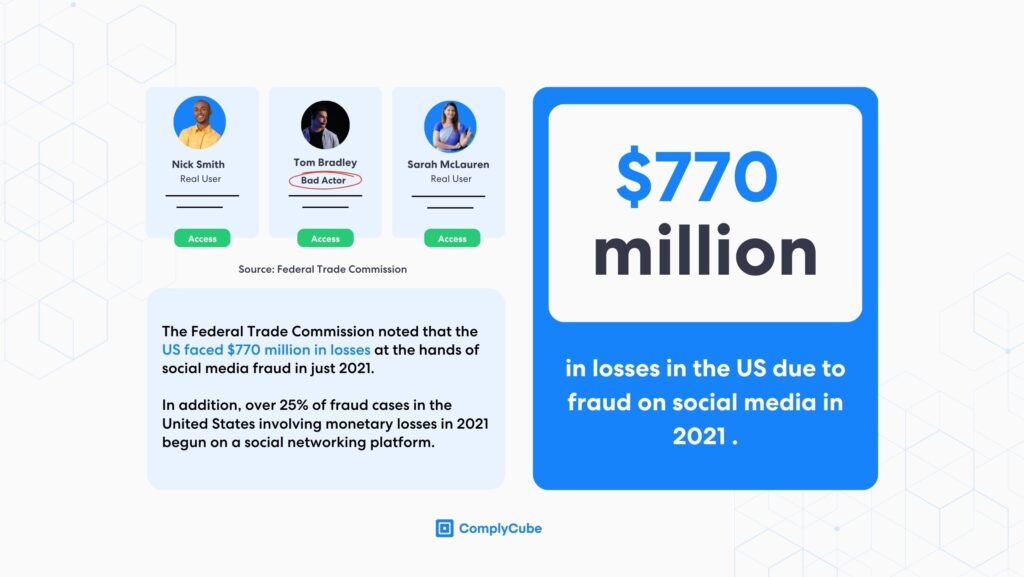
Some of the most prominent forms of fraud include investment, romance, and online shopping scams, with most of these scams being heavily reliant on remaining anonymous. Romance fraud has been quickly escalating across the globe, with mainstream media picking up individual cases, such as the famous 2022 “Tinder Swindler” documentary on Netflix.
> The reality is that cases of [romance fraud have increased by 30% in 2023](https://www.lloydsbankinggroup.com/media/press-releases/2023/lloyds-bank-2023/criminals-turn-to-romance-scams-as-reports-soar-by-30-per-cent.html), with victims loosing £8,000 on average – an uncomfortable reality that needs to be addressed.
These scams often begin with a seemingly innocent friend request, which quickly escalate to requests for money under various pretences. [Verifying the identities of users](https://www.complycube.com/en/) will form a key part of ensuring that these forms of fraud are halted, safeguarding the integrity of these networks from fraudsters.
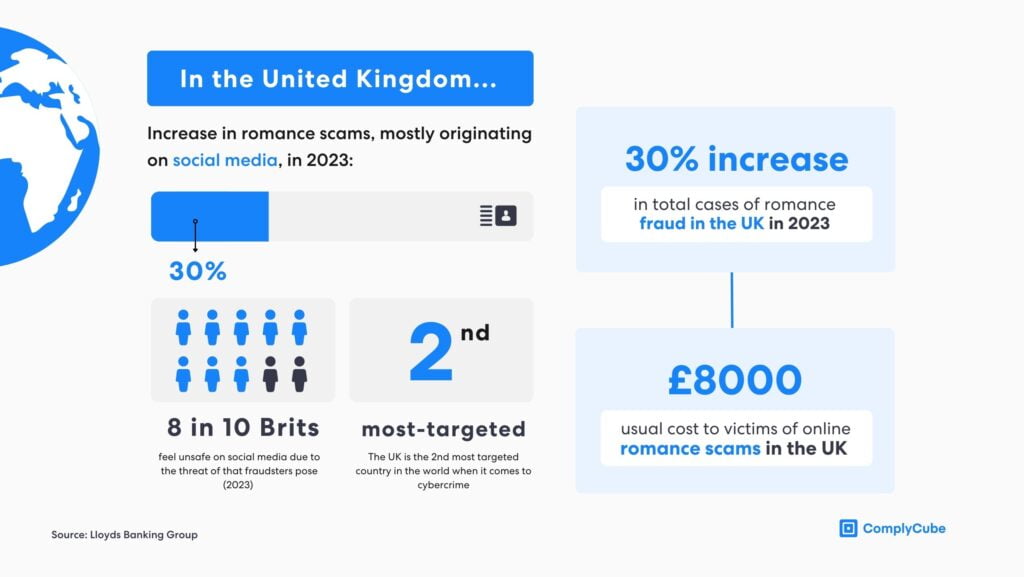
## The Danger of Misinformation
Another consequence of these prevalent forms of fraud is the spread of misinformation, which can often have devastating worldwide effects. With users being able to create a fake profile under any identity that they like, they’re then able to speak on behalf of anyone, claiming unsubstantiated authority with the expertise of the fake identity.
A great example of this is the 2011 Twitter case in which multiple users created fake Twitter accounts which pretended to be the former Alaskan governor, Sarah Palin. They tweeted misinformation and confused the general public. Identity theft in this form is certainly not uncommon, with a similar occurrence taking place during the 2016 U.S. presidential election, in which fake accounts similarly spread false information in an attempt to influence the voting public.
Applications used for texting and chatrooms have also been infiltrated with users spreading fake news several times over the past few years. Such was the case for WhatsApp in 2018, as the app experienced several users forwarding misinformation in India, which actually led to violent attacks within the country founded on anti-Muslim sentiment.
> Sadly some people also use WhatsApp to spread harmful misinformation. We believe this is a challenge that [requires action from technology companies, civil society and governments.](https://www.theguardian.com/technology/2018/nov/12/whatsapp-struggling-control-fake-news-india-bbc-study-hindu-nationalism-cheap-mobile-data)
A WhatsApp spokesperson commented at the time, “Sadly some people also use WhatsApp to spread harmful misinformation. We believe this is a challenge that [requires action from technology companies, civil society and governments.](https://www.theguardian.com/technology/2018/nov/12/whatsapp-struggling-control-fake-news-india-bbc-study-hindu-nationalism-cheap-mobile-data) That’s why we’ve stepped up broad education with ads on the radio and online to encourage people not to share rumours, and have created limits on how forwarded messages can be sent.”
There is only so much these networks can do, as responsibility also lies in the hands of national and international regulatory bodies to ensure that there are regulations in place that can ensure users are verified, helping to prevent the anonymity that fraudsters cling to. Some regulatory bodies are helping to combat these forms of fraud with regulations already in place:
- [**European Union’s Digital Services Act (DSA):**](https://www.eu-digital-services-act.com/#:~:text=Under%20the%20Digital%20Services%20Act,right%20to%20freedom%20of%20expression.) The DSA mandates KYC procedures, ensuring that platforms collect and verify the identities of their business users. The body also requires that platforms give reports on how they moderate content.
- [**UK Online Safety Bill:** ](https://www.bbc.co.uk/news/technology-67221691)The bill became law in late 2023 and aims to keep users, especially children, from accessing content that might be unsafe online.
- [**Australian Online Safety Act:** ](https://www.legislation.gov.au/C2021A00076/latest/text)This regulation mandates that social media networks should ensure that users are safe while using the platform, and should include digital identity verification practices. Platforms are therefore required to verify users and remove harmful content quickly.
> Like a car, alcohol or a gun, [we need to treat social media in a way that respects the power its users can wield](https://www.forbes.com/sites/willburns/2018/02/22/is-it-time-to-require-identity-verification-for-everyone-using-social-media/), good or, more importantly, bad.
Will Burns, Forbes Contributor, stated, “Facebook, Twitter, Instagram and YouTube, through no fault of their own, have become weapons of another state against this one. We can no longer just sit back and allow this to happen, nor can we expect the FBI or Justice Department to catch every fake person or every fake post. Like a car, alcohol or a gun, [we need to treat social media in a way that respects the power its users can wield](https://www.forbes.com/sites/willburns/2018/02/22/is-it-time-to-require-identity-verification-for-everyone-using-social-media/), good or, more importantly, bad. Some form of identity verification in social media would guarantee that every account is linked to a registered user.”
## Digital Identity Verification as a First Step For Security in Social Networks
Fraudsters often rely on identity theft or creating a fake profile, allowing them to spread misinformation or gain trust from other users in order to then carry out a scam. By eliminating anonymity, social networks can begin to really combat this problem and enhance user safety online.
Verifying government-issued IDs through a [document check](https://www.complycube.com/en/solutions/identity-assurance/document-verification/), as well as incorporating a biometric check that analyzes facial data points, would be a substantial help to safeguarding users online. In addition, digital identity verification will help social networks ban repeat offenders from creating new profiles, putting a stop to recurring scams.
Protect your platform with ComplyCube. We offer market-leading IDV, KYC and AML bespoke solutions. Head over to our [website and get in-touch. ](https://www.complycube.com/en/pricing/)
**Categories:** Guides
**Tags:** Identity Verification
---
### [A Complete Guide to ID Verification Pricing and Pricing Models](https://www.complycube.com/id-verification-pricing/)
**Published:** July 10, 2025
**Author:** Dini Habib
**Excerpt:** Balancing privacy rights with fraud mitigation is becoming increasingly complex. A robust Identity Verification framework can help firms uphold data protection and privacy standards while meeting stringent compliance regulations.
**Content:**
**TL;DR:** ID verification pricing should be **assessed by value**, not just by the cost of a single check. This guide explains how **identity check cost** varies by verification method, customer risk, volume, and compliance needs. A **flexible KYC pricing model** helps businesses choose the right checks without overpaying or weakening fraud prevention.
Balancing privacy rights with fraud mitigation in a digital world is far more complex than ever. Businesses must fully verify who their clients are before providing account access, while also managing costs through Know Your Customer (KYC) processes. Thus, many organizations are now turning to flexible KYC pricing models to balance security with budget considerations, making factors such as ID verification pricing and identity check cost crucial.
Achieving both robust security and cost efficiency can be complicated. The complexity stems, at first, from the ease of fraudulent activities online. Artificial intelligence can create highly authentic-looking passports, driver’s licenses, and other seemingly genuine documents that can pass some of the most rigorous evaluations. This guide will delve into the rising costs of identity verification (IDV), compare different IDV pricing methods, and explore how AI-driven solutions such as ComplyCube can deliver value to businesses.
## Additional Costs and Speed Comparison
To determine who the prospective customer is, corporations must apply tools and software that provide accurate, real-time verification. This approach ensures that firms can confidently avoid fraud and meet compliance requirements.
> The risks are higher than ever. According to the United Nations, [2 to 5% of global GDP](https://www.unodc.org/unodc/en/money-laundering/overview.html) is laundered annually, accounting for between $800 billion and $2 trillion.
However, ID verification pricing can be confusing and expensive. While ID checks are vital, understanding the cost of the IDV process is essential to meeting financial objectives. Finding the balance between reliable IDV and financial affordability requires considering multiple pricing strategies.
## Research on the Increasing Costs of IDV Platform Pricing
According to Juniper Research, the average cost of digital identity verification solutions in [2025 is approximately $0.20 per check](https://www.juniperresearch.com/resources/infographics/cost-per-digital-identity-verification-checks-to-drop-15-globally). However, a shift is happening across the industry, aiming to alleviate some of the cost burdens. The same research indicates that the cost per check will drop to $0.17 by 2029 as companies strive to make technology and verification processes more efficient.
## The Different Types of ID Verification Pricing Methods
Another factor to consider when choosing IDV software is the associated costs. Services have various pricing strategies. For instance, some vendors charge a flat-rate licensing fee, while others apply user-based pricing. Another pricing method involves pay-as-you-go, whereby organizations solely pay for each verification completed.
In the pre-verification method, firms may incur fees if they go beyond the transaction volume purchased. For this method to be beneficial, companies must maintain precise and controllable verification volumes that satisfy the subscription requirements. Companies growing rapidly, particularly startups and scaleups, need to consider long-term contracts that do not limit checks.
## The Real Value Behind Identity Verification Services
IDV involves scanning a document and confirming it matches an individual’s personal information. Modern IDV software includes advanced features and tools to make customer onboarding more accurate and efficient. The most popular IDV features that businesses seek include [document verification](https://www.complycube.com/en/solutions/identity-assurance/document-verification/), age estimation checks, and biometric authentication.
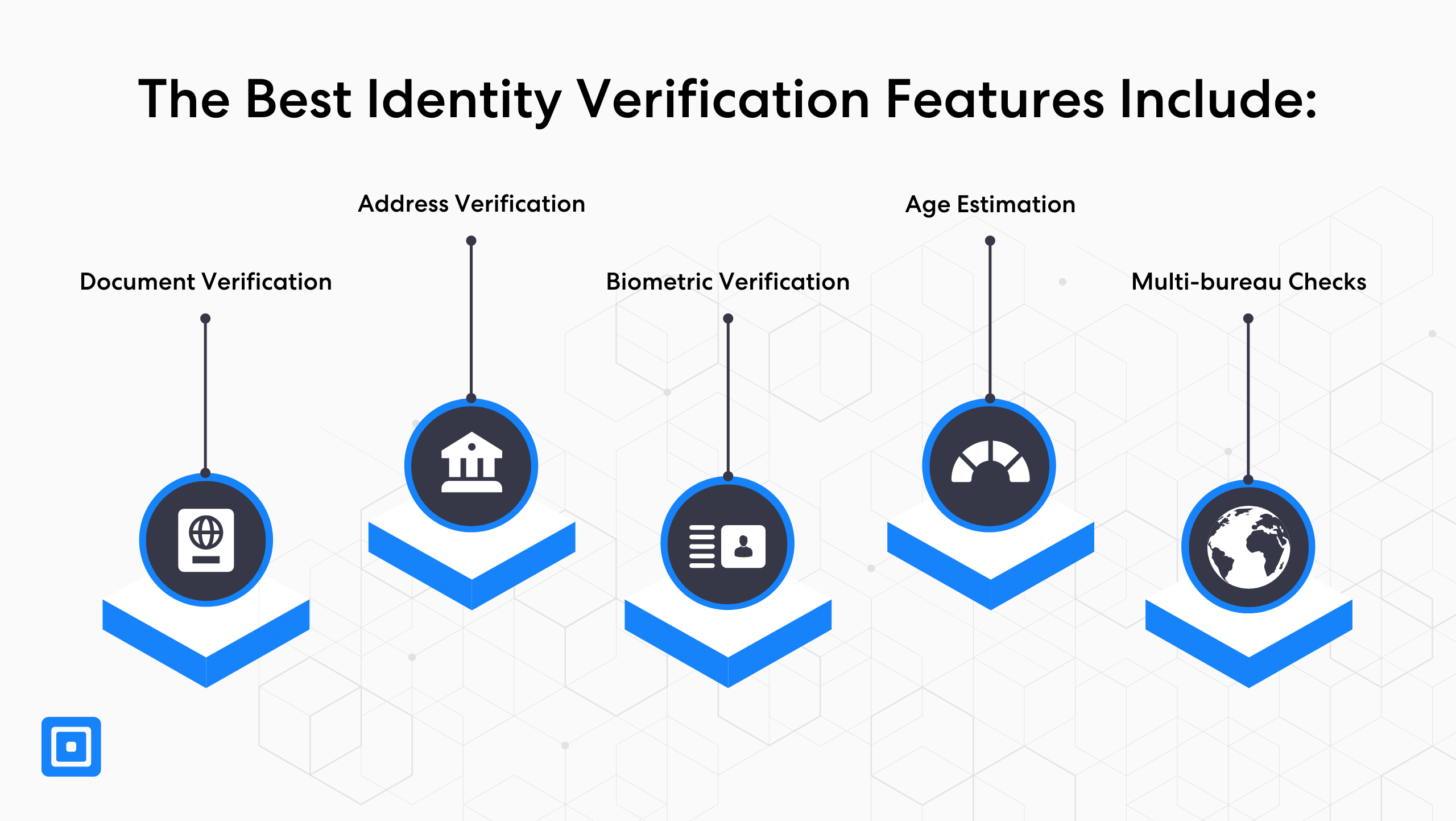
Selecting an IDV platform solely from factors such as its features and pricing might sound reasonable at first. However, this approach can lead to painful migrations later, especially if it does not align with current and future operational goals. Thus, organizations need to consistently evaluate the IDV software’s broader impact. Some important questions to raise include where budget is being allocated and how these expenditures enhance the verification process.
## Per Verification and Per Transaction Methods
Per-transaction or per-verification services are typically limited and focus mainly on document verification, offering basic identity assurance coverage. To align with compliance objectives, selecting a solution with extensive verification, including biometric authentication and [sanctions screening](https://www.complycube.com/en/solutions/global-screening/sanctions-pep-screening/), is key. These advanced features and factors, such as geographic variations and liveness technology, can directly influence ID verification cost and effectiveness.
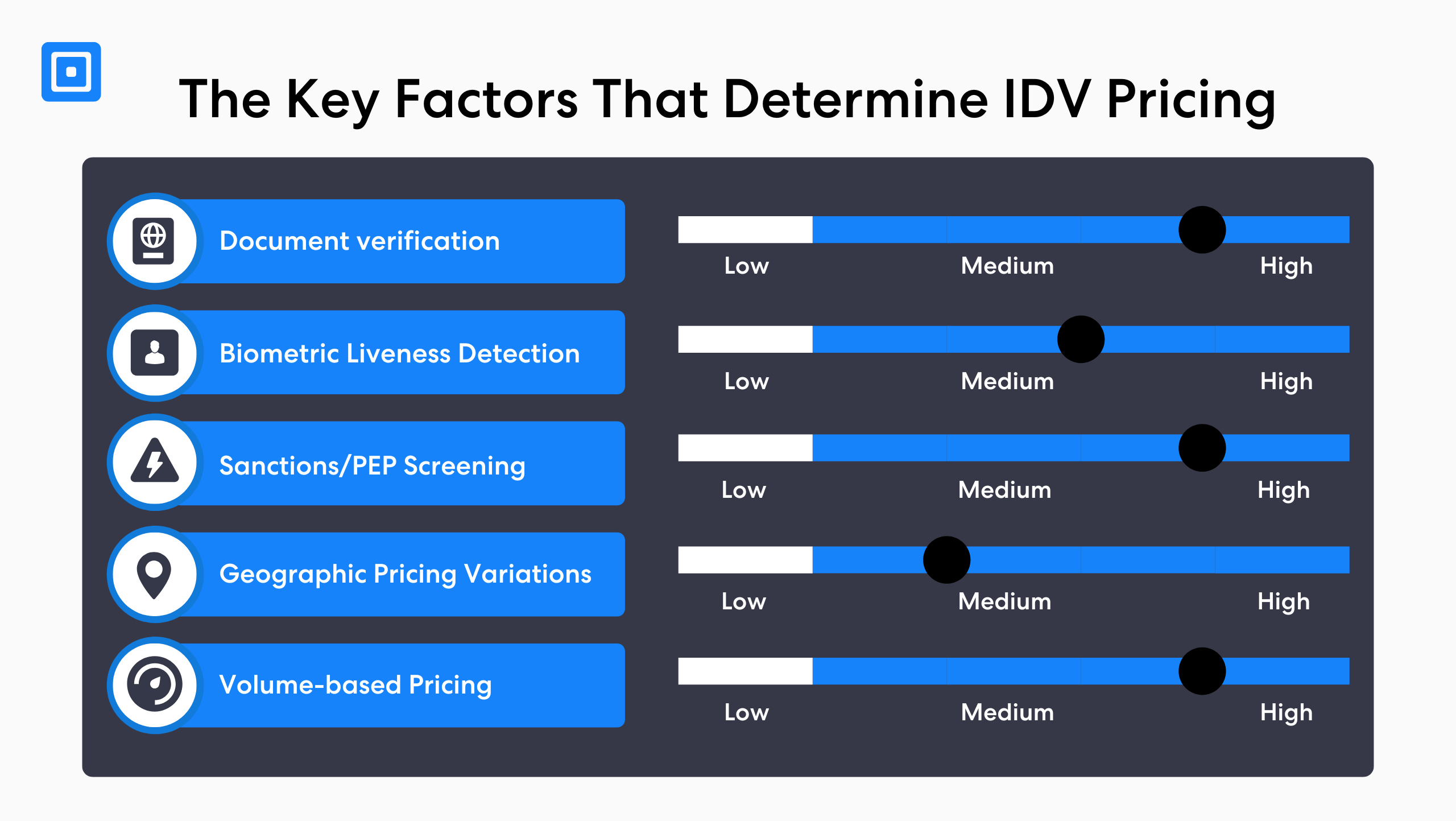
While solutions that are inexpensive may be appealing, it can be challenging as they may come with severe limitations. Although it may provide benefits for some of your needs, it might not address all of them. Instead, it is worth investing in a more robust IDV software that can effectively mitigate high risks.
## How ComplyCube Goes Further in the Identity Verification Process
ComplyCube offers more than just the standard customer screening solution. The company leverages artificial intelligence and machine learning to provide a suite of IDV intelligence solutions. Additionally, by utilizing advanced technologies such as liveness detection and optical character recognition (OCR), ComplyCube empowers companies to achieve a high standard of identity assurance:
- **Document Verification:** Instantly authenticate over 13,000 documents, including passports and driver’s licenses, to prevent illegitimate accounts from accessing a business service.
- **Address Verification:** Verify an individual’s location by screening [Proof of Address (POA)](https://www.complycube.com/en/solutions/identity-assurance/address-verification/) documents to reduce synthetic fraud.
- **Biometric Verification:** Leverage facial recognition and liveness detection technology to reduce the risk of identity theft and sophisticated deepfakes.
- **Age Estimation:** Accurately verify an individual’s age through a selfie to comply with age-related restrictions.
- **Multi-bureau Checks:** Cross-reference identity details against trusted government databases worldwide to improve risk assessment mechanisms.
While identity verification is critical, companies must consider robust [Know Your Customer](https://www.complycube.com/en/solutions/due-diligence-compliance/know-your-customer/) (KYC), Anti-Money Laundering (AML), Customer Due Diligence (CDD), and risk scoring mechanisms to achieve higher compliance coverage. Consider the following examples:
- **Sanctions and Politically Exposed Persons (PEPs) screening**: Screens individuals against global sanctions list to identify and prevent high-risk people from committing fraud.
- **Adverse Media Checks:** Scans organizations and individuals against high-quality news articles to avoid potentially associating with harmful entities.
- **Ongoing Monitoring:** Enables corporations to track changes in a [customer’s risk profile in real-time](https://www.complycube.com/en/solutions/global-screening/continuous-monitoring/), creating a proactive approach to fraud prevention.
- **Risk Scoring:** Quantifies risk according to a multiple number of data points, ensuring companies can quickly identify high-risk individuals and allocate compliance resources more efficiently.
## A Look into ComplyCube’s Pricing Models
ComplyCube stands out as a leader in the RegTech space due to its developer-friendly and highly customizable solutions. Organizations can choose a pricing model that reflects their operational goals, industry, and risk appetite. Consider the [three pricing plans available:](https://www.complycube.com/en/pricing/)
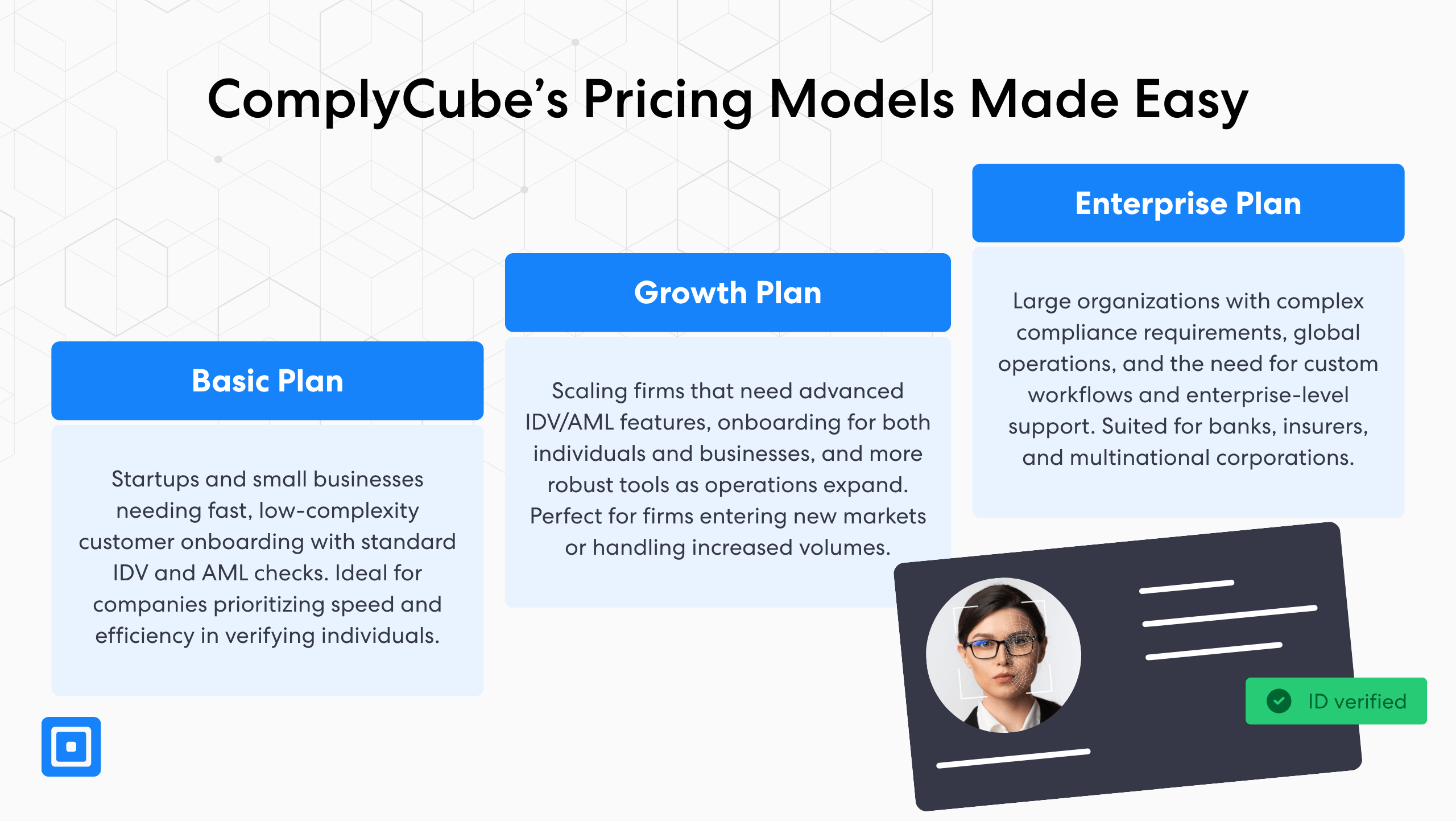
### **Basic Model**
ComplyCube’s basic plan enables companies to reach rapid customer onboarding using standard KYC features. Organizations are given a monthly verification balance to meet their needs. The basic plan helps decrease risk and provides an efficient way to secure operations effectively. Clients can complete onboarding request in under 60 seconds, reducing drop-offs and time-to-verification. The basic plan is the ideal entry-level solution for low complexity onboarding flows in early-stage businesses. In this plan, users get:
- Identity verification for individuals
- Liveness and facial similarity check via photo selfie
- Global AML screening with continuous monitoring of individuals and businesses
### **Growth**
The next pricing model is the growth package. The growth plan is ideal for companies that are scaling and need more advanced KYC and AML components. Managing different features can lead to a rampant increase in cost. The growth package enables businesses to scale without the costly need for multiple integrated tools from different vendors. This plan offers more robust features, such as sophisticated Know Your Business (KYB) workflows. It includes everything from the basic plan, as well as:
- Age estimation checks
- Onboarding of businesses
- RFID and NFC-based document verification
- Dedicated account manager and adoption manager
- Risk scoring and insights to improve decision-making
### **Enterprise**
The enterprise model gives firms access to high-end, advanced technology in a simple-to-use, competitively priced package. With enterprise, users get market-leading compliance tools to manage varying types of verification methods across 230+ countries. Here is where the reality of what most of today’s banks and larger companies must do comes into play. It includes everything from the basic and growth plan, as well as:
- Advanced case management
- Global 2 + 2 multi-bureau checks
- Custom pricing structures to fit needs
- White-label solutions for seamless branding
- Custom multi-organization partitioning, access controls, and enterprise support
ComplyCube is a government-approved Identity Service Provider (IDSP) approved by the [UK’s Digital Identity and Attributes Trust Framework (DIATF)](https://www.complycube.com/en/company/security-compliance-center/uk-diatf-certified-idsp/). The company offers a 14-day free trial, including up to 50 free verifications for businesses who want to activate an account. With a customer-driven approach at its core, ComplyCube is trusted by SMEs and larger enterprises worldwide, including Citibank, AXA, and Accenture. The features listed above are not exhaustive. For a full overview of ComplyCube’s solution, [click here.](https://www.complycube.com/en/pricing/#all_features)
### **Case Study: U.S. “Ghost Student” Financial Aid Fraud**
In January 2026, ABC News reported that “ghost student” scams were using stolen or fake identities to enrol in online college courses and claim federal loans and grants. Federal investigators had more than 200 open cases, with over $350 million in investigated fraud and some schemes suspected of exceeding $1 billion.
##### **Identity Verification Stops Fake Applicants**
Therefore, stronger identity verification could help stop fake applicants before funds are released. Instead of choosing tools based only on the lowest identity check cost, schools and financial aid providers need flexible KYC pricing that supports document checks, biometric verification, address checks, duplicate detection, and risk-based escalation.
##### **Outcomes**
- More than $350 million in “ghost student” fraud had been investigated.
- Some schemes were suspected of exceeding $1 billion in illicit gains.
- ID verification pricing should be weighed against fraud losses.
## Modern AI-Based Solutions
Identity verification solutions today deliver speed and accuracy to achieve effective fraud prevention. Most of these solutions leverage generative AI, combined with machine learning technology, to enable data extraction and real-time analysis of identity documents and data. Modern IDV vendors are a smarter investment for businesses expecting efficient and secure transactions with high customization needs.
[](https://www.complycube.com/en/how-ai-powers-biometric-identity-verification/)
### Key Takeaways
- **ID verification pricing should be assessed by value, not just cost** because cheaper checks can expose businesses to higher fraud and compliance risk.
- **Identity check cost varies by verification method**, including document verification, biometric checks, AML screening, proof of address, and ongoing monitoring.
- **Flexible KYC pricing helps businesses control costs** by allowing them to choose checks based on customer risk, industry, geography, and onboarding volume.
- **Low-friction onboarding still requires strong controls** because fast verification should not come at the expense of fraud prevention or regulatory compliance.
- **The right pricing model supports scalability** by helping companies manage verification spend while adapting to changing customer volumes and risk levels.
## Unlock Free Trial with ComplyCube’s Advanced IDV
In summary, identity verification solutions now offer flexible pricing, enabling clients to manage costs by selecting pay-per-verification. Additionally, leading IDV providers in the market typically offer free trial options in a sandbox environment, so firms can compare speed, data extraction, and customize workflows before committing.
Investing in a flexible, AI-powered IDV solution empowers corporations to verify customers securely, speed up onboarding, and maintain compliance at the same time. [Sign up for a free trial](https://portal.complycube.com/signup) to experience ComplyCube’s advanced identity verification firsthand.
[](https://www.complycube.com/en/contact/contact-sales/)
## Frequently Asked Questions
What is ID verification pricing?
ID verification pricing refers to the cost of verifying a customer’s identity using checks such as document verification, biometric verification, database checks, AML screening, and ongoing monitoring.
What affects identity check cost?
Identity check cost can depend on the type of verification used, the number of checks required, customer volume, geographic coverage, compliance requirements, and whether enhanced due diligence is needed.
What is flexible KYC pricing?
Flexible KYC pricing means businesses can choose and pay for the identity verification, AML, biometric, and monitoring checks they need based on customer risk, onboarding volume, and compliance requirements.
Should businesses choose the cheapest ID verification provider?
Not always. The cheapest provider may reduce upfront costs, but weak verification can lead to higher fraud losses, compliance issues, manual review costs, and poor customer trust.
How does ComplyCube help with ID verification pricing?
ComplyCube offers modular identity verification, AML screening, biometric checks, and ongoing monitoring. This helps businesses manage ID verification pricing while building secure, scalable onboarding flows.
**Categories:** Guides
**Tags:** Identity Verification
---
### [Barclays Under AML Check Scrutiny](https://www.complycube.com/barclays-under-aml-check-scrutiny/)
**Published:** February 14, 2025
**Author:** Sofia Daley
**Excerpt:** Barclays has revealed that the Financial Conduct Authority (FCA), the biggest financial regulatory body in the UK, has been investigating their AML processes due to possible misconduct. Read our guide and find out what happened.
**Content:**
Barclays has revealed that the Financial Conduct Authority (FCA), the biggest financial regulatory body in the UK, has been investigating their AML check due to possible misconduct. Whilst Barclays maintains a strong regulatory posture within many global jurisdictions, its UK division has long been subject to FCA scrutiny. This is an unsurprising start to the 2025 UK regulatory landscape, as many have been predicting a tighter fist from the FCA amidst their implementation of “new rules” to strengthen the resilience of the UK’s financial sector.
With several [prominent UK banks, including Starling and Metro](https://www.reuters.com/business/finance/starling-bank-fined-29-million-pounds-financial-crime-failings-2024-10-02/), having been called out for AML and IDV mishaps in 2024, including Starling and Metro, the UK financial sector must brace itself for a regulatory reshuffle in 2025, with AML making its debut as a sector priority. Ensuring best-in-class KYC solutions and a strong AML platform is critical.
> On Thursday, the bank said the [Financial Conduct Authority (FCA)](https://www.telegraph.co.uk/business/2025/02/13/barclays-under-investigation-over-money-laundering-controls/?ICID=continue_without_subscribing_reg_first "https://www.telegraph.co.uk/business/2025/02/13/barclays-under-investigation-over-money-laundering-controls/?ICID=continue_without_subscribing_reg_first") was examining whether financial controls at its UK division had been too lax and if the lender had broken anti-money laundering laws.
This isn’t Barclays’ first rodeo with being publicly scrutinised by the regulator. The Guardian noted back in 2021 that the banking giant’s UK branch has been embroiled in one scandal after another over the past decade, starting with its conviction for channeling secret fees to Qatari investors in return for emergency funding during the peak of the 2008 financial crisis. The FCA ultimately ended up fining Barclays a whopping £40m last year over this 2008 incident, one that was apparently too big to forget, even over 15 years down the line. Barclays was labelled as having been “reckless” by the FCA for not disclosing enough information on the Qatari deal.
## FCA’s Scrutiny Highlights the Importance of Robust AML Check Processes
The current investigation follows a previous two year enforcement investigation into Barclay’s compliance with UK-money laundering regulations that ended just last year. This previous investigation scrutinised Barclay’s transactions monitoring in certain parts of the UK bank.
> The FCA’s investigation focuses primarily on the [historical oversight](https://www.telegraph.co.uk/business/2025/02/13/barclays-under-investigation-over-money-laundering-controls/?ICID=continue_without_subscribing_reg_first "https://www.telegraph.co.uk/business/2025/02/13/barclays-under-investigation-over-money-laundering-controls/?ICID=continue_without_subscribing_reg_first") and management of certain customers with heightened risk.
Despite reporting a 24% rise in both pre-tax and attributable profits for the full year and announcing plans for a £1 billion share buyback, Barclay’s shares fell nearly 6% on Thursday morning. It’s likely that these regulatory issues may have had a strong part to play in the drop in share price, which clearly indicates concerns that surpass the bank’s balance sheet.
As 2025 unfolds, UK financial services must proactively monitor AML infrastructure, or risk the FCA’s newfound regulatory whip slashing share prices. If you’re looking to tighten your regulatory compliance, get in touch with our [expert compliance team. ](https://www.complycube.com/en/contact/contact-sales/ "https://www.complycube.com/en/contact/contact-sales/")
**Categories:** News
**Tags:** Anti-Money Laundering
---
### [The CryptoCubed Newsletter: Former SEC Official Prediction, Dogecoin Soars & BitCoin Heist](https://www.complycube.com/the-cryptocubed-newsletter-november-edition/)
**Published:** December 2, 2024
**Author:** Sofia Daley
**Excerpt:** The crypto world never fails to surprise, and this month’s developments are no exception. From political shake-ups to market surges, we’ve seen the intersection of power, policy, and profit reshape the digital currency landscape.
**Content:**
## 🗓️ Welcome to the November Edition!

The crypto world never fails to surprise, and this month’s developments are no exception. From political shake-ups to market surges, we’ve seen the intersection of power, policy, and profit reshape the digital currency landscape yet again.
## ⚠️ Former SEC Official Predicts Crypto Crime Will Explode
Following the US election, John Reed Stark, the former U.S. Securities and Exchange Commission (SEC) Chair, predicts an unprecedented surge in crimes relating to crypto. Regulatory and enforcement entities, such as the SEC, will now face increased difficulty in preventing crime within the sector.
Stark, a prominent critic of the cryptocurrency industry, acknowledged that the agency’s reliance on enforcement actions to regulate the sector has come to an end. According to U.Today, he anticipates the agency will discontinue all non-fraud-related crypto cases, including the ongoing lawsuits against Binance and Coinbase.
> The crypto capital of the planet.
During his campaign, Trump pledged to make the U.S. the “crypto capital of the planet” and proposed supportive regulations for the industry. He outlined his plan to ease existing restrictions on cryptocurrencies.
Find more information [here](https://u.today/former-sec-official-predicts-crypto-crime-will-explode).
## 📈 Dogecoin Soars Post Trump’s Musk Announcement
Dogecoin, the meme-based cryptocurrency frequently linked to Elon Musk, surged in value following President-elect Donald Trump’s approval of the tech billionaire’s proposal for a new executive department with a similar name.
Musk is known for promoting Dogecoin, often tweeting things such as “Dogecoin is the people’s crypto.” These tweets have often resulted in dramatic fluctuations in Dogecoin’s price, reflecting his significant impact on the cryptocurrency market’s dynamics.
> Dogecoin is the people’s [crypto](https://eu.usatoday.com/story/money/2024/11/13/doge-price-dogecoin-cyrpto-value-after-donald-trump-elon-musk-news/76257832007/ "https://eu.usatoday.com/story/money/2024/11/13/doge-price-dogecoin-cyrpto-value-after-donald-trump-elon-musk-news/76257832007/").
Trump announced that Musk would lead the newly established Department of Government Efficiency, or ‘DOGE’—a humorous nod that seems far from accidental. This isn’t Musk’s only recent victory, with the Tesla and SpaceX CEO’s net worth increasing by $50 billion due to a surge in stock prices after Trump’s recent victory.
In a conversation posted to X earlier this year, Musk confirmed that he still owned a large amount of Dogecoin, pointing to the insurmountable earnings he might be making from the boost following Trump’s announcement.
> Your money is being [wasted](https://www.reuters.com/world/us/trump-says-elon-musk-vivek-ramaswamy-will-lead-department-government-efficiency-2024-11-13/ "https://www.reuters.com/world/us/trump-says-elon-musk-vivek-ramaswamy-will-lead-department-government-efficiency-2024-11-13/").
At Trump’s rally in Madison Square Garden, Musk declared in very populist sentiment: “Your money is being wasted, and the Department of Government Efficiency is going to fix that. We’re going to get the government off your back and out of your pocketbook.”

Because nothing says ‘government efficiency’ quite like putting a billionaire crypto enthusiast in charge while his favorite cryptocurrency soars—efficiency for his portfolio, at least. 🤷🏻♀️
Find more information on the rise of Dogecoin [here](https://eu.usatoday.com/story/money/2024/11/13/doge-price-dogecoin-cyrpto-value-after-donald-trump-elon-musk-news/76257832007/ "https://eu.usatoday.com/story/money/2024/11/13/doge-price-dogecoin-cyrpto-value-after-donald-trump-elon-musk-news/76257832007/").
## 💰 Bitcoin Heist Worth Billions Identified
A hacker has now been sentenced to 5 years imprisonment in the United States for laundering stolen funds from one of the largest cryptocurrency thefts to have taken place. 120,000 bitcoins were stolen through Bitfinex, which at the time of the theft (2016) was worth around $70m but rose in value to more than $4.5 billion by the time of arrest.
According to prosecutors, Ilya Lichtenstein orchestrated one of the largest thefts in history from a virtual currency exchange, before he and his wife, Heather Rhiannon Morgan, executed a complex plan to launder the stolen funds.

Deputy Attorney General Lisa Monaco described the $3.6 billion in assets recovered in the case as the largest financial seizure in the Department of Justice’s history. “It’s important to send a message that you can’t commit these crimes with impunity, that there are consequences to them,” district judge Colleen Kollar-Kotelly said.
> It’s important to send a message that you can’t [commit these crimes ](https://www.breakingnews.ie/world/us-hacker-who-stole-around-one-billion-dollars-in-bitcoin-jailed-for-five-years-1695965.html)with impunity.
According to documents demonstrated in the trial, it became clear that Lichtenstein was able to hack into Bitfinex through the use of advanced hacking tools. The need for a stronger defence against fraud within all kinds of crypto platforms continues to be underlined.
For more, read the [BBC’s description](https://www.bbc.co.uk/news/articles/c2dl70wed1lo "https://www.bbc.co.uk/news/articles/c2dl70wed1lo") of the case.
## 🇳🇬 Nigeria Cracks Down on Crypto Fraud with Tougher Penalties
Nigeria has decided to take a firmer stance on crypto fraud with newly drafted legislation. Offenders can now face a fine of 20 million Naira ($12,000) or even a 10-year prison sentence.
Nigeria is one of the world’s largest crypto markets but has long struggled with having a reputation for being infested with scams and fraudulent practices, which have hindered its ability to grow. The country aims to reconstruct its reputation globally as a financial hub.
Nigeria has been the [most crypto-obsessed country](https://cryptonews.com/news/report-nigeria-introduces-stricter-penalties-for-crypto-fraud/ "https://cryptonews.com/news/report-nigeria-introduces-stricter-penalties-for-crypto-fraud/") based on Google search volumes for terms like “cryptocurrency” or “buy crypto.” However, regulators in Nigeria have shown less enthusiasm for the rapid pace of crypto adoption.
Nigeria’s recent dispute with Binance has further tarnished the country’s sector reputation, with ongoing legal battles deterring investors and partners, according to BICCoN (the organization that represents the Nigerian blockchain industry) president Lucky Uwakwe.
One example of said hostility is the case of Tigran Gamaryan. Gamaryan, a US citizen and Binance executive was detained in February and held in Kuje Prison in Nigeria for months, having only been released in the past couple of weeks. Gamaryan was detained on a business trip to the country alongside his colleague, Nadeem Anjarwalla.
For more on this story, read the [BBC’s recent piece](https://www.bbc.co.uk/news/articles/c8dmp1jg448o "https://www.bbc.co.uk/news/articles/c8dmp1jg448o").
## 🇪🇸 Crypto Transactions Are Taking Off in Spain’s Real Estate Market
Real estate technology firm Enlace reports a significant increase in real estate transactions utilizing cryptocurrency as a payment method in 2024. This usage grew by [15% this year](https://news.bitcoin.com/crypto-transactions-surge-in-spains-real-estate-market/ "https://news.bitcoin.com/crypto-transactions-surge-in-spains-real-estate-market/"), largely due to the advantages crypto payments offer over traditional methods, such as faster fund transfers and cost savings compared to international wire transfers.

The trend is particularly prevalent in major urban centres like Barcelona, Madrid, and Valencia, which together represent [60% of crypto-based transactions](https://news.bitcoin.com/crypto-transactions-surge-in-spains-real-estate-market/ "https://news.bitcoin.com/crypto-transactions-surge-in-spains-real-estate-market/") in the sector. Enlace estimates that approximately 6% of all real estate deals in 2024 involved cryptocurrency payments.
Read more on this [here](https://news.bitcoin.com/crypto-transactions-surge-in-spains-real-estate-market/).
## 👀 SNEAK PEAK 👀 Our Upcoming Piece: Americans Lost $5.6B to Pig Butchering Crypto Scams in 2023 – What About the UK?
Americans lost $5.6B to Crypto scams, often referred to as “pig butchering,” in 2023, yet this doesn’t seem to have been the wake-up call we might have expected it to be. More than 50,000 investment scams were reported in America in the first half of 2023, costing consumers $2.5B.
These investment scams mostly revolved around investing in cryptocurrencies with the promise of obtaining a large return. The median loss for investment scam victims in the first half of 2024 was $9,000 – a $1,000 increase from last year. With the U.S. facing mounting losses, it begs the question: has the UK managed to steer clear of this financial turmoil, or is it on the verge of a similar costly reckoning?
In 2023, cryptocurrency scams in the United States surged to unprecedented levels, leaving Americans with a staggering $5.6 billion in losses, according to a report by the FBI. This form of fraud is often referred to as “pig butchering scams”, due to the notion of fraudsters “fattening up” their victims by building trust through friendly conversations on social media or dating platforms. This grooming phase often involves scammers skilfully creating credible profiles and building up their victim’s confidence, enticing them to want to start investing.
Read the full piece next week at [www.complycube.com](https://www.complycube.com/ "https://www.complycube.com").
## Time for Some Light-Hearted Creative Criticism?
So you’ve made it to the end of our newsletter. It’s time to enjoy a little satire, worthy reader, as if we don’t laugh, we may cry.
**🔥 THE CRYPTO POEM: NOVEMBER EDITION 🔥**
Trump’s latest move to cut the fat,
Put Musk in charge—imagine that.
The Department of DOGE, efficiency’s call,
A bold new face for bureaucratic brawl.
“Your money’s wasted!” Musk declared,
As Dogecoin’s value sharply flared.
A billionaire’s words, a market’s cheer,
But whose efficiency are we buying here?
Crypto and politics now intertwine,
The lines between them hard to define.
When profits rise with policy’s stroke,
The biggest “efficiencies” might be a joke.
### Stay tuned for our December newsletter and have a great month!

**Categories:** News
**Tags:** Crypto Regulations
---
### [Online Safety Act 2023 vs. EU DSA: What You Need to Know](https://www.complycube.com/online-safety-act-2023-what-you-need-to-know/)
**Published:** September 15, 2025
**Author:** Rithu Jagannath
**Excerpt:** Discover how the UK Online Safety Act 2023 and the EU Digital Services Act differ on age verification, compliance, and platform accountability to protect children online.
**Content:**
**TL;DR:** The UK’s Online Safety Act 2023 and EU’s Digital Services Act now pose a **serious challenge** to businesses with a lack of **multilayered** age verification checks. While digital service act and online safety act compliance aims to **protect children** from harmful and illicit content, they both have **key differences** that are crucial for businesses to maintain compliance.
## How the Online Safety Act and the Digital Safety Act Protects Users
As digital markets evolve rapidly, the need to protect users from harmful content and illegal online activity continues to grow. The Online Safety Act 2023 and the Digital Services Act set out landmark rules to create a safer environment across platforms, social media, and digital services that host user-generated content.
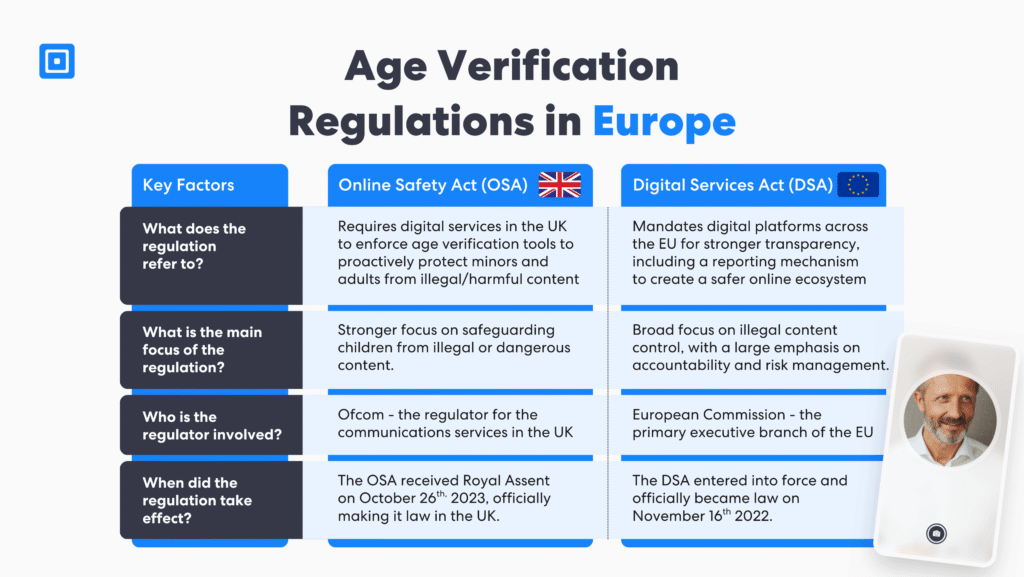
The [OSA](https://www.legislation.gov.uk/ukpga/2023/50) places an emphasis on safeguarding fundamental rights for children. By requiring online platforms to proactively tackle harmful activities and implementing age verification tools, online safety act compliance prioritizes removing illegal content and giving users more control over the content they encounter. Online safety act compliance also introduces criminal charges to address online abuse and dangerous stunts.
In contrast, the DSA impacts all online platforms operating within the European Union, including Very Large Online Platforms (VLOPs) and large online search engines. The DSA sets out rules for these digital platforms, requiring them to publish annual reports with online safety compliance related information. They must disclose how their algorithms operate and provide explanations for content removal decisions.
## Scope and Jurisdiction of the Online Safety Act 2023 and Digital Services Act
The Online Safety Act and the Digital Services Act approach regulation differently with [online safety and age verification](https://www.complycube.com/en/achieving-age-assurance-online-age-verification-solution/). In terms of sectoral scope, they both apply to online instant messaging services, social media companies, and online forums that enable user-generated content, regardless of the provider’s geographic location. The key factor lies in the service’s target market being users in the United Kingdom or the European Union.
Companies operating digital services may be subject to both regulatory frameworks, even if they are based outside these regions. Covered services include a significant number of search services, social media platforms, video-sharing services, file-sharing tools, online messaging and forums, dating services, search engines, and cloud hosting providers.
The OSA enforces a UK-focused, rules-based compliance model, while the DSA adopts a layered, risk-based approach tailored to each platform’s scale and function. Despite these differences, both frameworks apply to digital services that host user content in—or target—the UK or EU. As a result, companies must comply regardless of where their headquarters are located.
## Age Verification Obligations For Online Platforms with the Online Safety Act 2023 and Digital Services Act
The Online Safety Act 2023 requires platforms to implement “highly effective” [age verification mechanisms](https://www.complycube.com/en/solutions/identity-assurance/facial-age-estimation/), particularly for pornography and content that could harm minors. This obligation extends to legal content when it presents identifiable risks to children. The OSA mandates that platforms establish and enforce clear age restrictions to prevent underage access.
Approved verification methods include government-issued ID checks, biometric authentication, AI-powered facial age estimation, and systems resistant to circumvention tactics such as VPN use. For example, if a user tries to hide their location using a VPN, ComplyCube can detect and flag the session as part of a [biometric authentication check](https://www.complycube.com/en/solutions/identity-assurance/biometric-verification/), preventing the user from continuing until they have verified their age.
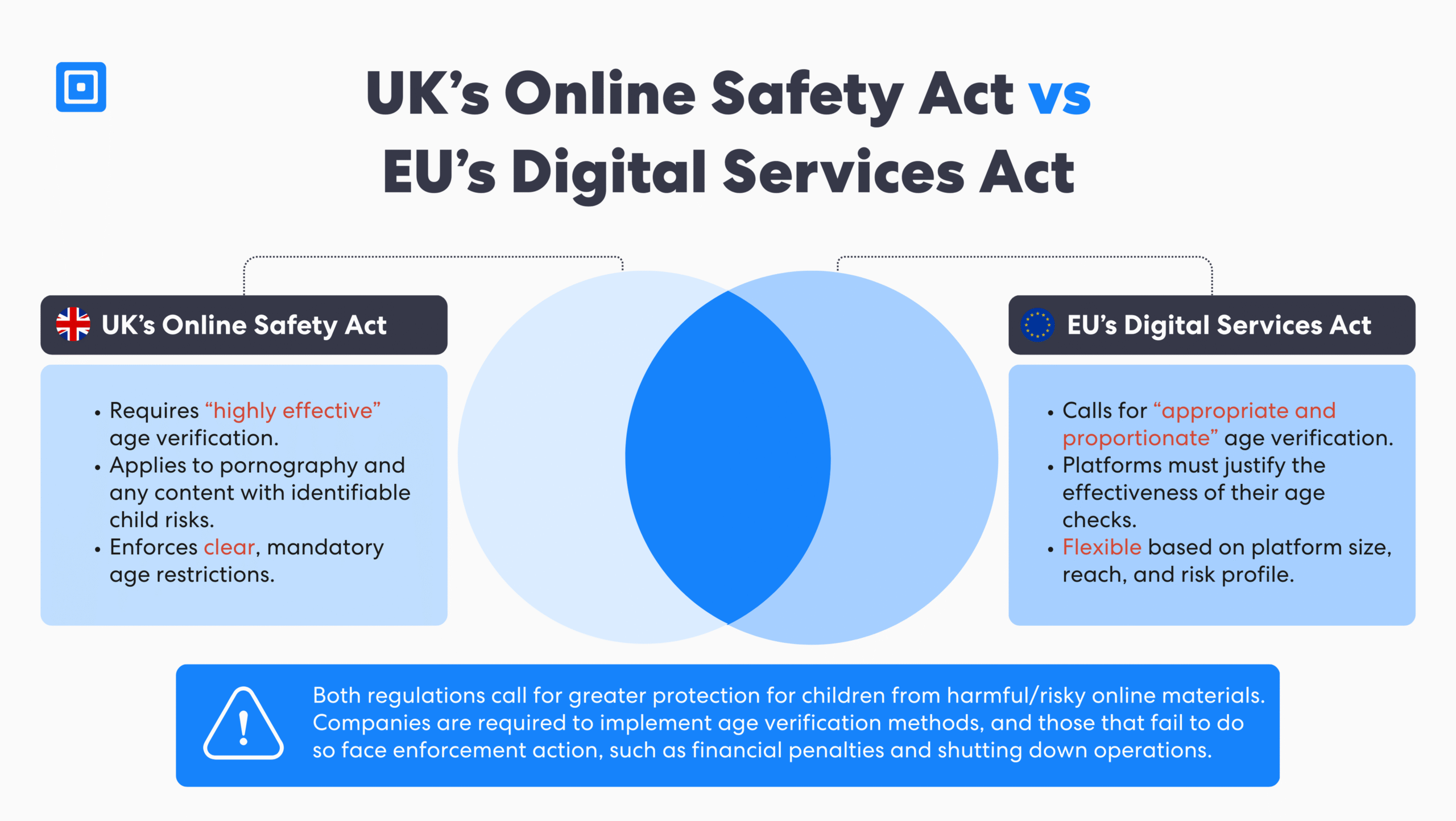
In contrast, the Digital Services Act (DSA) calls for “[appropriate and proportionate](https://digital-strategy.ec.europa.eu/en/library/commission-publishes-guidelines-protection-minors)” measures. It offers more flexibility depending on the platform’s size, reach, and risk profile. Although less prescriptive than the OSA, the DSA still obliges platforms to demonstrate the effectiveness of their age verification processes. This is prevalent especially where minors may be exposed to harmful content.
Regulatory enforcement under the DSA needs a clear justification of how protective measures are applied in practice. Despite their differences, both acts share a common objective. They safeguard children online through enforceable age limits and clear accountability standards. Learn more here about identity fraud in the UK: [The Price of Identity Fraud in the UK](https://www.complycube.com/en/the-price-of-identity-fraud-in-the-uk/).
## Transparency and Reporting Duties for the Online Safety Act 2023 and Digital Services Act
Both the Online Safety Act 2023 and the Digital Services Act require platforms to publish annual transparency reports. The first set was due by July 2025. These reports must cover takedown requests, moderation metrics, and broader risk mitigation efforts.
While the DSA focuses on reducing systemic risks through flexible, risk-based obligations, the OSA enforces stricter operational compliance aligned with [Ofcom-approved](https://www.ofcom.org.uk/online-safety) standards. Together, the laws aim to enhance accountability and ensure child safety across digital platforms through regular, verifiable disclosures.
## Illegal Content and Platform Liability for the Online Safety Act 2023 and Digital Services Act
The OSA requires platforms to proactively address illegal and harmful content, with specific illegal content duties to prevent illegal harms. Regulations include fines up to 10% of global turnover, blocking orders for persistent breaches, prioritizes child safety by reducing content around self-harm and child sexual abuse material (CSAM), and encouraging or assisting serious self-harm.
It highlights what is now classified as illegal content and a criminal offence. Enforcement actions are triggered when there is a material risk of significant harm to UK users. The DSA regulations include fines up to [6% of global turnover](https://ec.europa.eu/commission/presscorner/detail/en/qanda_20_2348). It needs management by national authorities with European Commission (EC) oversight, and focus on very large online platforms (VLOPs) as well as algorithmic accountability.
### **Case Study: TikTok Under DSA Enforcement (2024)**
##### **Overview**
In February 2024, the European Commission opened an investigation into TikTok for suspected violations of the Digital Services Act (DSA). The inquiry targeted key areas, including child protection, advertising transparency, T hiand risk management around potentially addictive platform design.
Particular focus was paid to the effectiveness of TikTok’s age verification systems and whether it could protect minors from dangerous content. The platform’s structure and its contribution to addictive user behavior were also investigated.
##### **Actions and Response**
The European Commission’s investigation into TikTok focused on three critical areas. It looks at child safety mechanisms, transparency in advertising practices, and the platform’s data access policies. Central to the inquiry was the algorithmic design of TikTok’s systems and their potential role in promoting harmful behaviors.
##### **Resolution**
By August 2024, the European Union Commission published a press release about TikTok agreeing to [**remove the “TikTok Lite” rewards feature**](https://www.eureporter.co/politics/european-commission/2024/08/07/tiktok-commits-to-permanently-withdraw-tiktok-lite-rewards-programme-from-the-eu-to-comply-with-the-digital-services-act/). This feature had come under scrutiny for its addictive design, which affected children’s user experience. This case underscores how DSA enforcement is not purely reactive. Regulators are now shaping platform design and safeguarding fundamental rights, especially in critical areas such as youth engagement and algorithmic risk.
## Advertising and Content Profiling Controls for Children Online
The Digital Services Act (DSA) explicitly prohibits behavioural targeting of minors. This includes profiling-based advertising and the use of dark pattern user interfaces within content recommendation systems. These new rules aim to reduce manipulative practices that disproportionately affect children on the internet.
While the Online Safety Act 2023 does not directly govern ad targeting, it imposes new obligations to prevent children from encountering harmful commercial content, particularly on search engines. Together, these frameworks signal a tightening regulatory stance on digital platforms’ responsibility toward young users.
## More Control with Technical and Ethical Implementation Standards
To comply with both the Online Safety Act 2023 and the Digital Services Act, platforms are required to minimise data collection in line with GDPR. They must avoid storing sensitive age-related information, and maintain transparency around their age verification processes. Additionally, they must also implement safeguards against re-identification risks and use secure integration methods such as [SDKs](https://docs.complycube.com/documentation/) or no-code modules.
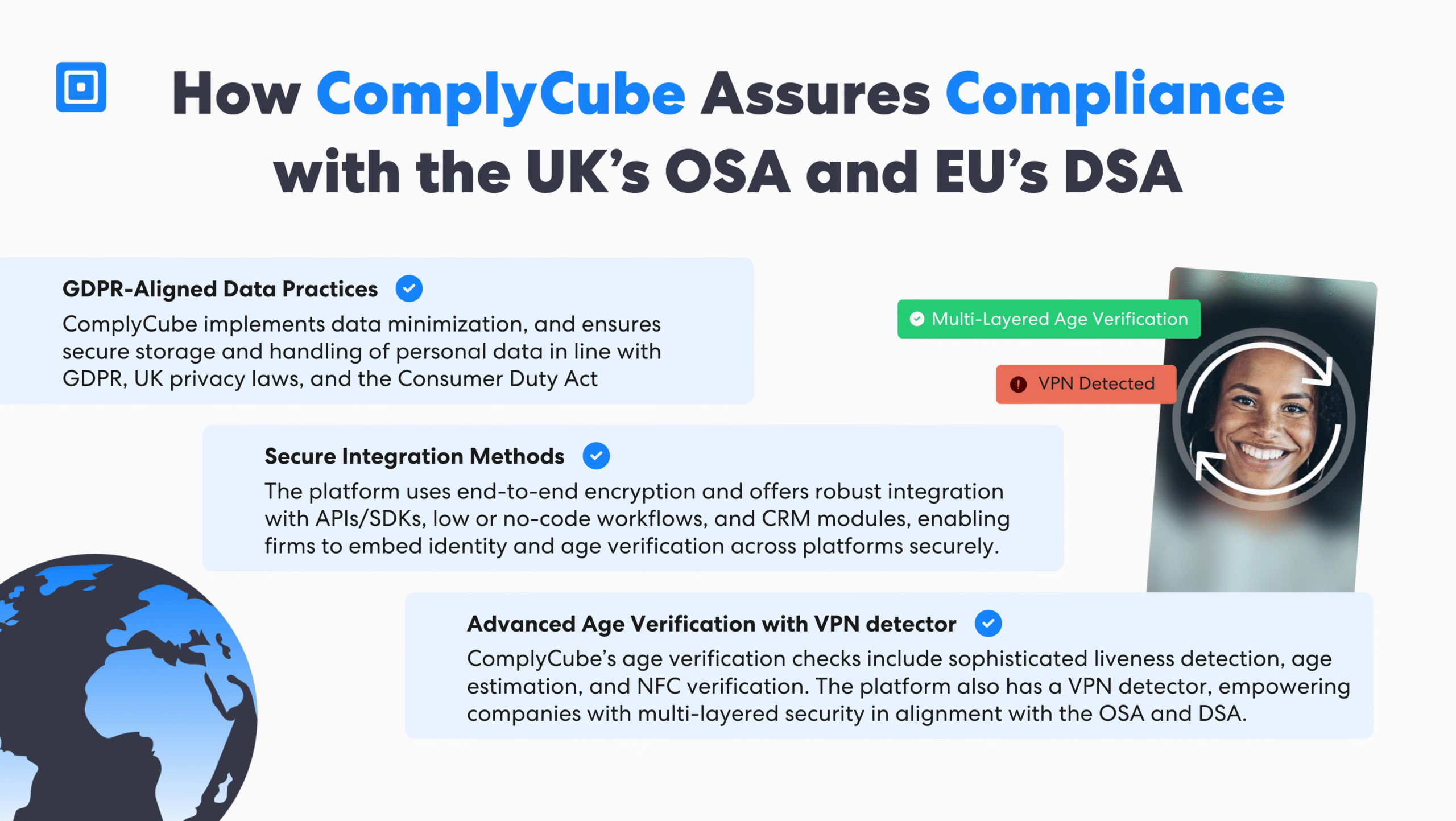
ComplyCube’s platform supports these requirements through on-device verification, biometric liveness detection, and [NFC chip reading](https://www.complycube.com/en/solutions/identity-assurance/document-verification/nfc-verification/), and cross-device recognition, delivering both prescriptive compliance and adaptable implementation at scale.
## Governance, Risk Mitigation, and Senior Accountability
Under both the Online Safety Act 2023 and the Digital Services Act, platforms are obligated to perform regular risk assessments and actively mitigate any material risks to users, particularly children. These assessments must address exposure to content such as pornography, self-harm, or eating disorders, as well as systemic abuse risks arising from user-generated content.
Additionally, platforms must evaluate the impact of their advertising and recommendation systems on minors. The OSA requires the appointment of compliance officers and the maintenance of audit-ready records, while the DSA mandates robust content governance policies and internal audits for Very Large Online Platforms (VLOPs).
## How OSA and DSA Impact SMEs and Niche Platforms
There is a common misconception that smaller platforms are exempt from regulatory obligations. In fact, the Online Safety Act 2023 applies based on the nature of content risk and accessibility, not the size of the platform. While the Digital Services Act provides procedural relief for small and medium-sized enterprises (SMEs) with fewer than 50 employees or under €10 million in annual turnover, it does not waive core responsibilities. All platforms, regardless of scale, are required to implement proportionate safety measures if their services are likely to be accessed by children.
## Integration with Other New Data Protection Rules
Age verification requirements intersect with several key regulatory frameworks. Under the [General Data Protection Regulation (GDPR)](https://www.complycube.com/en/company/security-compliance-center/), platforms must ensure data minimisation, establish a lawful basis for processing, and apply privacy-by-design principles. The eIDAS regulation sets digital identity assurance standards, particularly relevant for EU-based verifications.
Additionally, the [Digital Markets Act](https://digital-markets-act.ec.europa.eu/index_en) places design scrutiny on gatekeeper platforms, including age-related considerations. Secondary legislation under the OSA and DSA provides the detailed thresholds and classifications necessary to operationalise these obligations for different service providers.
### **Ofcom Investigates 34 Pornography Websites for Failing Age Verification**
##### **Investigation of Primary Priority Content**
On 31 July 2025, Ofcom launched formal investigations into four digital service providers operating a combined 34 pornographic websites. These platforms were suspected of breaching OSA requirements by failing to implement the new rules. Ofcom’s scrutiny focused on whether the platforms had adopted age assurance systems that met the legally required “highly effective” standard.
##### **Potential Penalties for Non-Compliance**
The outcome of these probes could set critical precedents for how similar platforms are regulated moving forward. These sanctions can reach up to £18 million or 10% of a platform’s qualifying worldwide revenue, whichever is higher. In extreme cases, Ofcom can also direct internet service providers to block access to offending platforms within the UK.
##### **Outcomes & Impacts**
While final rulings from the ongoing investigations are still pending, early data suggest the OSA’s enforcement is already having a measurable impact. Major adult content platforms have experienced substantial traffic declines with one report indicating a 47% drop in UK visits following the new rule’s implementation. This sharp decline signals that age verification systems are actively being adopted, either voluntarily or under regulatory pressure.
## Adopting a Unified Compliance Strategy
To comply with both the OSA and DSA, firms should adopt a holistic compliance strategy. Businesses must invest in dynamic risk management solutions that can trigger automated workflows according to user geolocation or document types.
Streamlining the testing and iteration cycles becomes more efficient when partnering with an [age verification vendor](https://www.complycube.com/en/solutions/identity-assurance/facial-age-estimation/) with SDKs and APIs for seamless integration. Additionally, monitoring evolving codes of practice can further equip organizations to be on top of changing regulations. You can learn more here: [What are Identity Verification Solutions?](https://www.complycube.com/en/what-are-identity-verification-solutions/)
### Key Takeaways
- **The Online Safety Act** compliance mandates stringent age checks and safety protocols to safeguard children.
- **The EU Digital Services Act** applies a proportionate, risk-based approach tailored by platform.
- **Both the UK’s OSA and the EU’s DSA** places greater ownership on firms to regulate content.
- **Smaller services, including startups**, are not exempt from scrutiny under the OSA and DSA.
- **Platforms must adopt ethical age assurance** that acknowledge fundamental rights, privacy-preserving design, and unified compliance tools.
## Strengthen Online Safety Act 2023 Compliance with ComplyCube
The convergence of the Online Safety Act 2023 and Digital Service Act reflects a shift in digital responsibility. Platforms need to move beyond reactive moderation and adopt safety-by-design principles, especially for children. Those companies providing open, user-first safety practices will earn trust and regulatory goodwill in a changing compliance landscape.
Explore seamless and bespoke [multi-layered age assurance solutions](https://www.complycube.com/en/contact/contact-sales/) on the ComplyCube platform. Onboard customers in seconds and avoid facing hefty enforcement action from the Online Safety Act and Digital Services Act. Speak with a member of the [ComplyCube](https://www.complycube.com/en/) team today.
## Frequently Asked Questions
Do the OSA and DSA apply to platforms with mostly adult audiences?
While a platform may target adults, it must still comply if minors can access it, particularly in cases like social media, where content is shared across various age groups. Platforms are required to take proportionate steps, such as implementing content filters and parental controls, to prevent minors from being exposed to harmful or adult content.
What counts as primary priority content under the Online Safety Act (OSA)?
Primary priority content includes pornography, as well as material that promotes eating disorders, self-harm, or suicide. This applies even if the content is legal, as it is deemed harmful to children.
How does OSA or DSA impact age verification on social media platforms?
Under the OSA, age verification is mandatory if children are likely to access the platform. The EU DSA also requires age assurance when content poses risks, meaning most mainstream social media platforms must adopt age verification measures.
Can companies or executives face criminal penalties under these acts?
The OSA allows for senior managers to face criminal liability if platforms fail to comply with safety and age verification duties. The DSA also permits penalties, including criminal consequences, depending on how individual EU member states implement the regulation.
How do the OSA and DSA protect fundamental rights while enforcing compliance?
Both acts include safeguards to balance regulation with user rights. They require platforms to respect freedom of expression and privacy while applying proportionate age verification, content moderation, and reporting obligations.
**Categories:** News
**Tags:** Age Verification
---
### [The Proven Features That Distinguish Top Rated KYC Providers](https://www.complycube.com/top-rated-kyc-provider-platform-to-choose/)
**Published:** June 12, 2025
**Author:** Dini Habib
**Excerpt:** Top-rated KYC providers balances technological innovation while adhering to strict regulatory obligations. The right KYC provider can significantly influence a company's reputation, operational efficiency, and bottom line.
**Content:**
**TL;DR:** Conducting a KYC platform comparison and choosing a top rated KYC provider helps organizations balance compliance with efficiency and growth. Market leaders stand out with ID verification leader features, passive liveness detection, and risk-based workflows. As a result, they all need to be backed by trusted certifications such as ISO 27001 and UK DIATF.
Selecting a top rated KYC provider involves balancing the technological innovation of KYC features with how well it helps organizations meet regulatory compliance. Therefore, the right provider can significantly impact a company’s efficiency and growth. This guide will cover the latest ID verification leader features, leading market differentiators, and practical steps for compliance teams to evaluate KYC platform capabilities confidently.
## What is a KYC Provider?
A [Know Your Customer (KYC)](https://www.complycube.com/en/solutions/due-diligence-compliance/know-your-customer/) software provider is a third-party service or technological company that supports businesses and financial institutions in ensuring customers are who they claim to be. According to [Juniper Research](https://www.juniperresearch.com/press/substantial-15percent-growth-in-global-digital-id-verification-checks/), the number of digital identity verification checks reached 75 billion in 2024 and is projected to increase to 86 billion in 2025.
Consequently, this surge highlights how KYC processes have become a key requirement for many businesses operating across multiple industries. From healthcare to crypto, firms that leverage KYC software can easily verify and authenticate their customers’ identities. So, running KYC checks is essential in the fight against money laundering, identity fraud, and other financial crimes.
### Main Reasons to Utilize a KYC Vendor:
- Reduce the risk of financial crime, identity theft, and money laundering.
- Optimize operational efficiency and gain a high return on investment.
- Fulfill regulatory compliance to avoid financial penalties.
- Achieve a frictionless customer onboarding journey.
- Build customer relationships based on trust.
## Identifying Top Rated KYC Providers
Distinguishing a top-rated KYC provider from other vendors in the market would require analyzing many different factors and data points. For instance, these factors include scalability, how well it satisfies national and international KYC regulations, and whether it supports diverse user journeys. Here are some of the non-negotiable components that can be found in the best top rated KYC software providers:
### Unified Compliance Solutions with Modular Flexibility
Firstly, leading vendors offer modular compliance coverage by integrating Identity Verification (IDV), Anti-Money Laundering (AML), and Know Your Business (KYB) solutions into a single platform. Organizations can run [document verification](https://www.complycube.com/en/solutions/identity-assurance/document-verification/) checks (IDV), assess customers’ risk profiles (AML), and perform business verification (KYB) all in one place. So, firms can expect a higher return on investment with a provider supporting various checks and verification types.
[](https://www.complycube.com/en/top-customer-identity-verification-software/)
### Multi-Jurisdiction Compliance Coverage
Second, globalization has encouraged many firms to expand their operations across different regions. Thus, choosing a leading KYC software with high global coverage is key. Supporting diverse languages and document types is now a must-have for top rated KYC providers. In fact, organizations can scale into new regions without impinging on global regulations.
### Real-Time Screening Technologies
Thirdly, real-time checks against [global watchlists](https://www.complycube.com/en/solutions/global-screening/watchlist-screening/), sanctions databases, Politically Exposed Persons (PEPs), and [adverse media sources](https://www.complycube.com/en/solutions/global-screening/adverse-media-checks/) are no longer optional. High-performing KYC technology can automate customer screening, allowing firms to monitor changes to customer data and risk without requiring any form of manual intervention. Click here to learn more about “[What is a Politically Exposed Person (PEP)](https://www.complycube.com/en/what-is-a-politically-exposed-person/)“.
### Regulatory and Security Certifications
Lastly, having trusted industry and regulatory-specific recognition and certification gives a KYC software higher credibility and trust. Certifications, including ISO 27001 and GDPR compliance, indicate high security and privacy, and ensure compliance. Additionally, country-specific certificates such as the UK Digital Identity and Attributes Trust Framework (DIATF) further reinforce operational maturity.
## Specific Features That Differentiate Market Leaders in KYC and AML
What makes a Know Your Customer (KYC) solution superior is its accuracy and intelligence, not the number of tools or services it offers. In reality, providing money laundering and [fraud prevention](https://www.complycube.com/en/use-cases/process/fraud-prevention/) solutions is nothing if it does not help make KYC compliance more accurate, compliant, and faster:
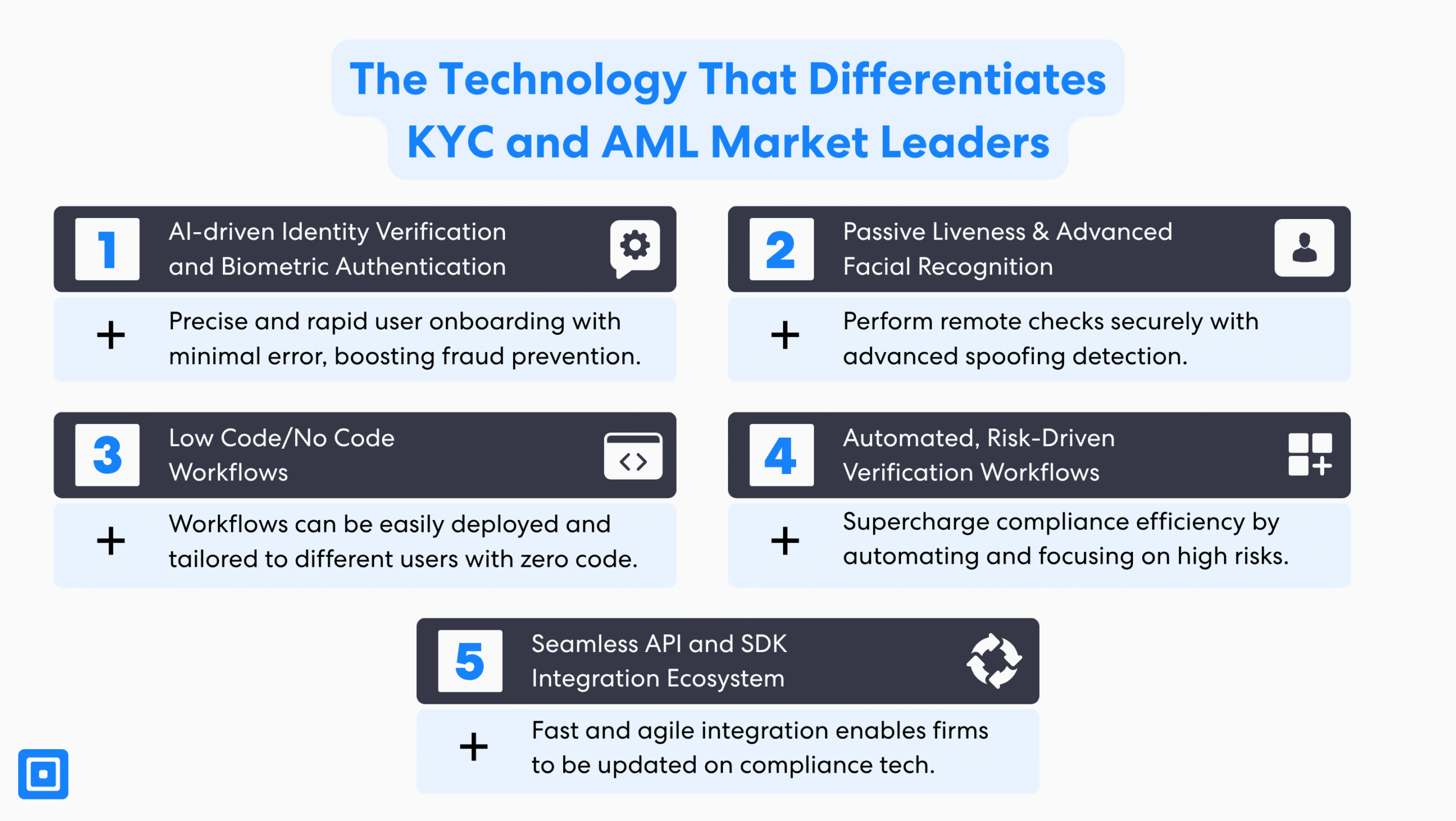
### 1. AI-powered Identity Verification and Biometric Authentication
Prominent KYC technology integrates artificial intelligence and machine learning capabilities in order to extract and verify various identification documents globally with millisecond accuracy. For example, this includes identity documents such as passports, driving licenses, utility bills, and more. An example would be leveraging liveness detection or [Optical Character Recognition (OCR)](https://www.complycube.com/en/solutions/due-diligence-compliance/know-your-customer/optical-character-recognition/) to process and verify German language identity documents without increasing manual work.
### 2. Advanced Facial Recognition Technology
Another notable KYC technology involves passive liveness verification methods. Unlike traditional active methods that require customers to turn their heads, it uses [Presentation Attack Detection (PAD) technology](https://www.complycube.com/en/solutions/due-diligence-compliance/know-your-customer/liveness-detection/). PAD integrates 3D facial mapping and micro-expression detection to assess aliveness. Businesses can easily perform remote identification checks and maintain a seamless user experience.
### 3. No-Code or Low-Code Verification Flows
On the other hand, the best top rated KYC providers offer drag-and-drop rule builders. They enable compliance and risk management teams to deploy risk logic without developer input or coding language. For instance, a crypto company can configure different customer onboarding workflows for two distinct types of customers without a line of code.
### 4. Automated and Tailored Risk-Based Workflows
Also, KYC software that empowers a risk-based verification approach through AI and workflow automation is undefeatable. These KYC solutions trigger enhanced customer due diligence checks only when needed, based on real-time fraud detection signals. The top rated KYC providers allow low-risk customer accounts to bypass quickly while focusing manual reviews on higher-risk cases. Specifically, this ensures efficient, accurate compliance and transaction monitoring with minimal effort.
### 5. API and SDK Integration Capabilities
At the same time, APIs and mobile SDKs boost the integration process by connecting and automating workflows within existing systems. Organizations can use their current KYC process and stack additional new features once it’s deployed. APIs and SDKs make achieving a verification system that stays ahead of evolving money laundering regulations simple.
## Market Recognition and Influencing Buyer Trust
However, another way that top rated KYC providers gain leadership status in the KYC and AML solutions space is through industry accolades and review sites. These awards and review forums enable compliance teams to gather more information about a provider’s verification process capability, customer support, and regulatory effectiveness.
- **RegTech Insight Awards:** RegTech100 and [FinCrimeTech50](https://fintech.global/fincrime50/) list recognize innovative RegTech KYC solution providers that aim to prevent financial crime and money laundering.
- **British Bank Awards:** The [RegTech Partner of the Year Award](https://www.complycube.com/en/regtech-partner-of-the-year-win-at-2024-british-bank-awards/) celebrates outstanding KYC software that supports financial institutions in fraud prevention efforts, as voted for by product users.
- **G2:** [Peer review platform](https://www.g2.com) where product users rate and review SaaS products. All reviews are verified extensively to give customers an unbiased understanding of a product.
- **TrustRadius:** This site includes [in-depth user reviews](https://www.trustradius.com) and ratings for specific KYC and compliance company. Reviews include the pros and cons of a product, providing detailed insights.
- **Capterra:** A [user rating site](https://www.capterra.com), featuring detailed explanations of a product through customer reviews. The site offers detailed software features and pricing comparisons.
### **Case Study: Canaccord Genuity LLC Faces $80M FinCEN Penalty**
In 2026, FinCEN imposed an $80 million civil money penalty on Canaccord Genuity LLC for willful Bank Secrecy Act (BSA) violations. Ultimately, the firm was found to have weaknesses across its Anti-Money Laundering (AML) program. That included Customer Due Diligence (CDD), monitoring, trade surveillance, and suspicious activity reporting.
##### **Missed SARs and Monitoring Failures**
As a result, FinCEN found that Canaccord’s controls failed to detect and report suspicious activity across high-risk trading relationships. The order cited thousands of suspicious transactions and at least 160 Suspicious Activity Reports (SARs) that were not filed, reinforcing the need for risk-based monitoring and audit-ready compliance workflows.
##### **Solutions & Outcomes**
- Earlier identification of high-risk securities activity before patterns became systemic.
- Stronger linkage between customer risk profiles, trading behavior, and investigation queues.
- Reduced reporting gaps through clearer ownership of Suspicious Activity Report (SAR) reviews.
## Important Security Certifications in Know Your Customer (KYC) Software
It is important to realize that attaining security certifications assures organizations of a vendor’s credibility and commitment to secure KYC, AML, and identity verification solutions. This covers biometric verification, digital identity verification, and data management processes. As a result, security certifications ensure compliance through strong document management and reporting tools.
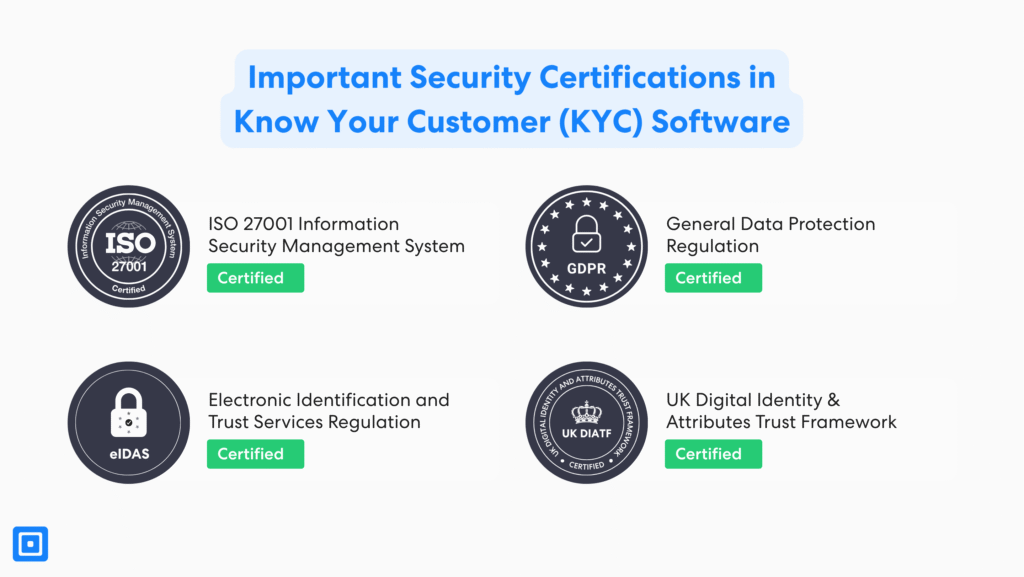
- **ISO/IEC 27001:2022 (Information Security Management):** [These certifications](https://www.iso.org/standard/27001) demonstrates that a KYC provider complies with implementing and maintaining an Information Security Management System (ISMS). To clarify, it proves that KYC software manages ID verification and KYC data under globally recognised security regulations.
- **UK Digital Identity and Attributes Trust Framework (DIATF):** Similarly, the UK DIATF is a certification with rigorous requirements. KYC software that is UK DIATF-certified meets high standards in compliance processes, demonstrating quality management and security in digital identity verification solutions. Learn more about the UK DIATF framework by [clicking here.](https://www.complycube.com/en/comprehensive-guide-to-the-uk-diatf-framework/)
- **Electronic Identification and Trust Services Regulation (eIDAS):** [eIDAS](https://digital-strategy.ec.europa.eu/en/policies/eidas-regulation) is an EU regulation that highlights standards in electronic identity verification and trust services. For instance, vendors with eIDAS certification need to meet stringent KYC compliance requirements. In particular, this enables them to deliver electronic signatures and biometric verification solutions across EU member states.
### Key Takeaways
- Top rated KYC providers drive compliance, fraud prevention, and efficiency.
- Unified IDV, AML, and KYB solutions deliver scalable compliance at lower cost.
- AI-powered verification and risk-based workflows set leaders apart.
- Global coverage and certifications like ISO 27001 build trust and credibility.
- ComplyCube combines all these strengths into a trusted, award-winning KYC platform.
## Strengthen KYC Compliance with Leading Software Providers
In short, prominent KYC software leaders introduce smarter and innovative identity verification and KYC solutions to make regulatory compliance significantly faster and more accurate. From AI-powered identity verification and passive liveness detection to no-code solutions. Therefore, financial institutions can expect accelerating growth and cost-effective compliance processes. Today, businesses can select a true compliance partner by prioritizing regulatory credibility, scalable automation, feature accuracy, and constant innovation.
ComplyCube is an award-winning AML and KYC platform trusted by institutions such as Lyca Mobile, MoneySmart, and high-growth FinTechs. To learn more, [contact a team member.](https://www.complycube.com/en/contact/contact-sales/)

## Frequently Asked Questions
What is a KYC provider and why is it essential for compliance?
A KYC provider is a third-party platform that verifies customer identities to meet regulatory requirements. It helps businesses prevent fraud, ensure Anti-Money Laundering (AML) compliance, and build trusted customer relationships.
How do top rated KYC providers help organizations reduce financial crime risks?
Leading KYC providers use AI-powered identity verification, biometric checks, and real-time screening against sanctions, PEP, and adverse media lists. These capabilities detect fraud early and minimise risks such as money laundering and identity theft.
Which features set top rated KYC providers apart from other vendors?
Top rated KYC platforms offer advanced capabilities such as passive liveness detection, no-code workflow builders, risk-based verification, and API integrations. These features improve accuracy, compliance efficiency, and customer experience.
Why are global coverage and security certifications critical in KYC software?
Global document support ensures firms can expand across regions without breaching regulations. Certifications such as ISO 27001, eIDAS, and UK DIATF prove a provider’s commitment to data security and compliance, increasing trust and credibility.
How can businesses evaluate and select the best KYC provider for their needs?
Organizations should assess KYC vendors on scalability, regulatory compliance, security credentials, and market recognition. Prioritising unified IDV, AML, and KYB capabilities ensures cost-effective compliance and sustainable growth.
**Categories:** Guides
**Tags:** Know Your Customer
---
### [The CryptoCubed Newsletter: August Edition](https://www.complycube.com/the-cryptocubed-newsletter-august-edition-yes/)
**Published:** September 4, 2025
**Author:** Dini Habib
**Excerpt:** Sit tight as we welcome you back to the latest edition of CryptoCubed. From Ripple Lab's high-stakes lawsuit to President Trump's executive orders, the crypto scene is buzzing with drama. Read on to learn more latest crypto news.
**Content:**
👋 Welcome back to CryptoCubed!
Hey! I’m sure you’ve missed us (or maybe it’s just us), so sit tight as we welcome you back to the latest edition of CryptoCubed. August has seen a wild ride in the crypto sector. From Ripple Lab’s high-stakes lawsuit to President Trump’s executive orders for crypto debanking, the crypto scene is buzzing with drama, one that you don’t want to miss!

## Ripple Labs Crypto Fine Saga Comes to an End
In December 2020, American blockchain and digital payments company, Ripple Labs found itself in a messy situation when the firm was handed a lawsuit by the U.S. Securities and Exchange Commission (SEC). According to the SEC, Ripple Labs sold its cryptocurrency XRP as an unregistered security to institutional investors, raising over $1.3 billion. The debate revolved around whether XRP should be classified as a security under U.S law or simply as a digital asset such as Bitcoin or Ethereum.
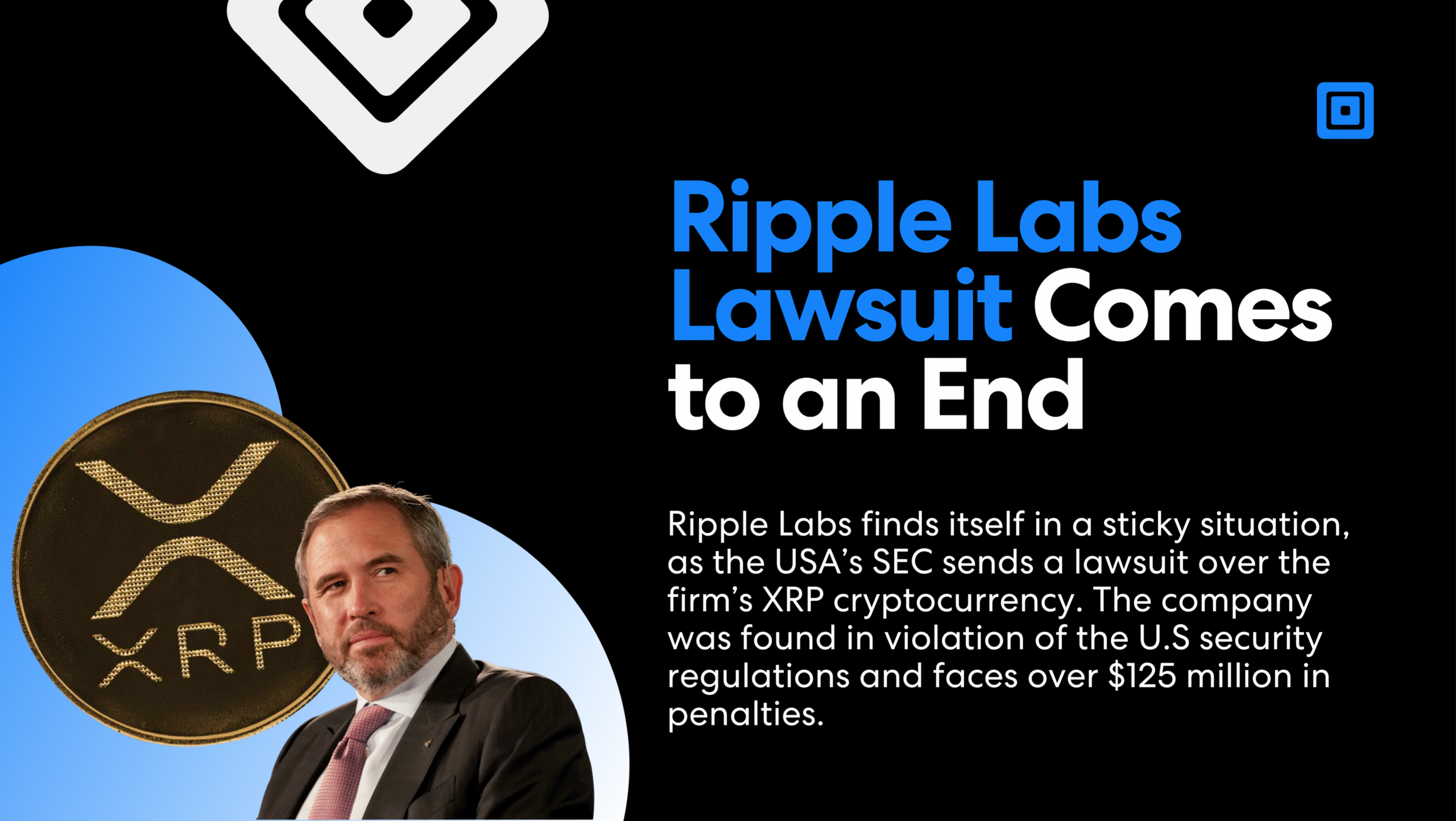
Securities regulation in the U.S crypto sector involves the laws and rules that govern the issuance and trading of financial assets, including cryptocurrency. This law is designed to protect investors and requires crypto firms to disclose key facts if what they’re selling is considered a security. In 2023, a federal judge came to the verdict that XRP sales to retail buyers were not considered securities transactions; however, direct sales to investors were. The settlement ended with Ripple agreeing to pay a civil penalty of $125 million. Both parties dropped the settlement in August 2025, solidifying the fine.
While the case ended with a positive outcome for Ripple Labs, this could have been mitigated from the beginning if the firm was in compliance with U.S securities laws from the outset. Although the primary issue was securities regulation, specifically around institutional sales of XRP, the case highlights the increasing scrutiny on crypto firms to adhere not only to securities laws but also to broader compliance frameworks, including [Anti-Money Laundering (AML)](https://www.complycube.com/en/solutions/due-diligence-compliance/anti-money-laundering/) and Know Your Customer (KYC) obligations.
For more on this story, click [here](https://www.reuters.com/legal/government/sec-ends-lawsuit-against-ripple-company-pay-125-million-fine-2025-08-08/).
## Donald Trump Threatens Enforcement Actions for Crypto Debanking
U.S. President Trump has officially signed an order titled “Guaranteeing Fair Banking for All Americans.” The executive order aims to demolish the practice of debanking, which refers to financial institutions refusing services to certain parties or individuals due to political, religious beliefs, and business activities, including crypto firms. A primary focus of the order is to protect crypto firms against perceived discrimination, further reinstating his advocacy for cryptocurrency.
The order calls for banks to make objective, risk-based decisions when assessing clients and businesses, making the balance between ensuring fair access and existing AML/KYC regulations much more delicate. Financial institutions might face operational challenges, as they aim to maintain strict AML compliance, especially with crypto firms, while also proving compliance with the new constraints on debanking. Regulators are given 180 days to review their debanking practices, ensuring that they reinstate any parties that have been removed unfairly.
For more on this story, click [here](https://edition.cnn.com/2025/08/07/business/debanking-executive-order-trump).
## New York-based Blockchain Firm Paxos Faces $48.5 Million Fine for AML Failures
The New York Department of Financial Services (NYDFS) has fined Paxos a heft $48.5 million after it was found that the firm did not uphold its AML framework in its partnership with Binance on the BUSD stable coin. Investigations showed that Paxos failed to maintain ongoing due diligence on Binance, including regular reporting and reviews of Binance’s AML/KYC and sanctions policies.
Paxos AML structure lacked crucial controls to effectively prevent suspicious and illegal activities. This meant that fraudsters were able to access its services through deceitful accounts or fake IDs. Further search revealed over $1.6 billion in suspicious transactions going through Binance. Part of the $48.5 million fine includes a $22 million focused on improving its compliance systems. This case highlights the importance of AML/KYC, not just on customers, but also on a company’s partnerships, in order to prevent money laundering and terrorist financing.
For more on this story, click [here](https://www.reuters.com/sustainability/boards-policy-regulation/paxos-trust-485-million-new-york-settlement-over-binance-related-lapses-2025-08-07/).
## AUSTRAC Instructs Binance Australia to Appoint External Audit
The Australian Transaction Reports and Analysis Centre (AUSTRAC) has ordered Binance Australia to establish an independent external auditor, following concerns about Binance’s AML and Counter-Terrorism Financing (CTF) controls. Founded in 2017, Binance is the biggest crypto exchange by trading volume. This move marks AUSTRAC’s key focus on the crypto sector as a high-risk environment, requiring these firms to implement stronger customer due diligence and enhanced identity checks to align with local regulations.
In his statement, Mr Thomas mentions that while global organizations have cross-border AML/CFT policies in place, this might not be adequate in meeting local and regional laws.
> AUSTRAC is committed to working with industry to ensure strong safeguards are in place to make it harder for criminals to move and conceal illicit funds using digital currencies — AUSTRAC CEO, Brendan Thomas
AUSTRAC had also noted that Binance had high employee turnover, as well as a lack of senior management oversight, bringing about concerns on the effectiveness of its AML programs. Binance Australia has 28 days to nominate external auditors to review its AML/KYC framework for AUSTRAC’s consideration.
For more on this story, click [here](https://www.austrac.gov.au/news-and-media/media-release/austrac-orders-audit-global-crypto-exchange).
## VARA Penalizes Fuze as it Aims to Press the Brakes on Dubai’s Rapidly Expanding Virtual Assets Sector
Dubai’s Virtual Assets Regulatory Authority (VARA) recently fined Fuze, also know as Morpheus Software Technology FZE for its significant AML gaps. Formal investigations began in April this year, with VARA finding massive defencies in Fuze’s AML program, including its internal system controls and governance. Fuze was also exposed for breaching its license by conducting unlicensed virtual assets activities.
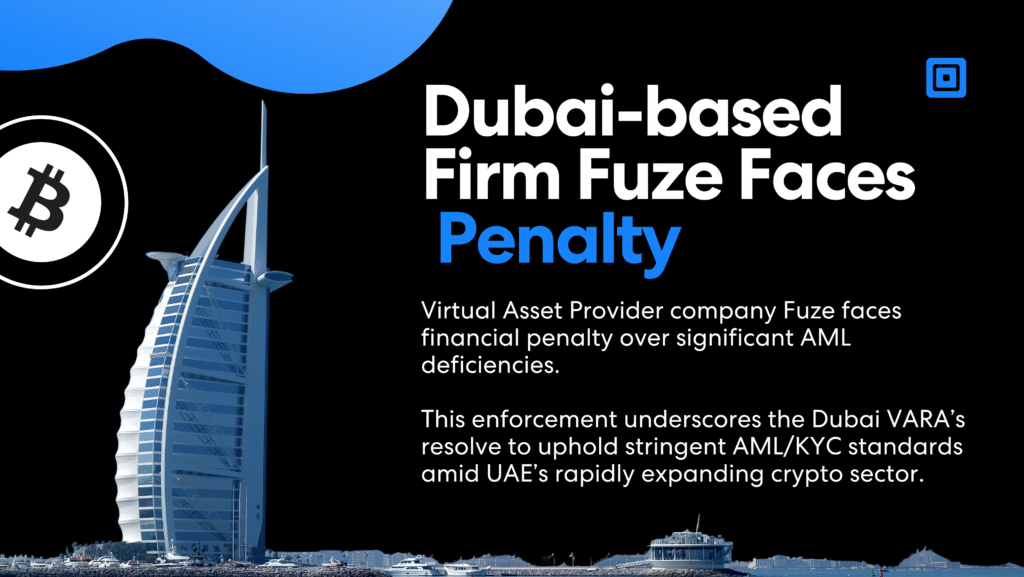
The total financial penalty amount was not disclosed; however, Fuze accepted the penalties and followed up with a remediation plan to fix its AML gaps. The company took proactive steps such as appointing an independent “Skilled Person” to oversee and maintain progress on the remediation plan. Additionally, Fuze has also appointed a Chief Compliance Officer, Head of Risk, and Head of Legal to further support its aim to strengthen and maintain compliance with regulations in the UAE.
This enforcement underscores VARA’s resolve to uphold stringent AML/KYC standards amid Dubai’s rapidly expanding crypto sector, signaling to all market participants the critical importance of compliance in safeguarding the UAE’s financial system.
For more on this story, click [here](https://fintechnews.ae/27417/fintechdubai/vara-fines-fuze/).
## Time for Your Monthly CryptoCubed Poem
So you’ve made it to the end of our newsletter. It’s time to enjoy a little satire, worthy reader, you’ve earned it.
### 🔥THE CRYPTO CUBED POEM: AUGUST🔥
Ripple paid its price, the storm finally calmed,
Yet the echoes remind that compliance disarmed.
Paxos was fined for its lapses with care,
As billions slipped through where controls weren’t there.
Binance in Australia faced auditors’ gaze,
Their weak oversight fueling AUSTRAC’s daze.
Dubai struck at Fuze, exposing gaps wide,
While Trump shields crypto from debanking’s tide.
### Stay tuned for our newsletter at the end of this month, and have a great day ahead!

**Categories:** News
**Tags:** Crypto Regulations
---
### [How to Comply with Failure to Prevent Fraud](https://www.complycube.com/how-to-comply-with-failure-to-prevent-fraud/)
**Published:** September 2, 2025
**Author:** Rithu Jagannath
**Excerpt:** The UK’s Failure to Prevent Fraud offence holds large firms liable for fraud by employees or agents unless “reasonable procedures” are in place. Finance and fintech face early scrutiny, with the SFO leading enforcement.
**Content:**
**TL;DR:** The UK’s **Failure to Prevent Fraud** is a corporate liability law targeting large businesses where employees or associates commit fraud and the company fails to prevent it. To comply with the failure to prevent fraud offence, firms must follow the Failure to Prevent Fraud Guidance and prove reasonable procedures were in place.
## The Growing Risk of Corporate Fraud in the UK
The introduction of the UK’s Failure to Prevent Fraud offence marks a pivotal moment for financial services compliance. The fraud triangle, developed by Donald Cressey, posits a model for three conditions that lead to fraud. The three conditions being pressure, opportunity and rationalisation. This framework helps explain why the new UK legislation coming into force targets large organisations with direct liability for fraudulent business perpetrated by employees, agents, or subsidiaries.
It forms part of wider reforms under the Economic Crime and Corporate Transparency Act 2023, significantly broadening the scope of liability for existing procedures. For financial services firms, this represents a shift in how internal controls, training, and third-party oversight are assessed. For risk and compliance leaders, the law demands a strategic overhaul of how fraud risk is managed. Heavy measures are no longer optional, they are legal expectations for company directors.
To remain compliant, firms must build demonstrable frameworks that reduce the risk of prosecution for crimes. Examples of fraud acts include tax evasion offences, associated persons making false statements, false accounting, fraudulent trading, bribery acts, false representation fraud, obtaining services dishonestly, and cheating the public to name a few. This guide outlines a practical checklist for preparation, clarifies common myths, and shows how companies can put in place fraud prevention procedures.
## What is the Failure to Prevent Fraud Offence?
The [Failure to Prevent Fraud](https://www.gov.uk/government/news/new-failure-to-prevent-fraud-guidance-published) offence introduces regulations for organisations specific to when an “associated person” commits fraud for the business’s benefit, particularly when it falls under a specified offence in the ECCT 2023. Even if the senior leadership is unaware of any wrong-doing, the offence applies and they are held criminally liable for any fraudulent conduct. As a result if firms are found liable, they can face unlimited fines and reputational harm unless they can prove “reasonable procedures” were put in place.
> Large organisations can now face criminal prosecution for fraud committed by employees or agents, regardless of whether senior management was aware.
Fraud Prevention Consultant, Milosh Caunhye says, “Large organisations can now face criminal prosecution for fraud committed by employees or agents, regardless of whether senior management was aware. Without reasonable fraud prevention procedures in place by 1 September 2025, firms risk facing unlimited fines and irreversible reputational damage. The defence requires organisations to demonstrate adequate fraud controls tailored to their risk environment.
It must go beyond a policy document, there must be clear evidence of implementation. Failure to meet this bar exposes firms to criminal prosecution. By implementing tools to support this evidentiary standard, companies can avoid underlying fraud offenses through real-time controls and audit capabilities.
## How Failure to Prevent Fraud Impacts Financial Services and Corporate Liability
Recent data has shown a disproportionate amount of offenses across banking, lending, and insurance. This marks a significant shift in who takes accountability and how [fraud prevention](https://www.complycube.com/en/use-cases/process/fraud-prevention/) has now become a board-level concern for large organisations. Senior managers and leadership teams must build out effective fraud frameworks that are implemented and regularly reviewed. For those in the financial sector, legal exposure, reputational risk and sector-specific obligations are major impacts under the new offence.
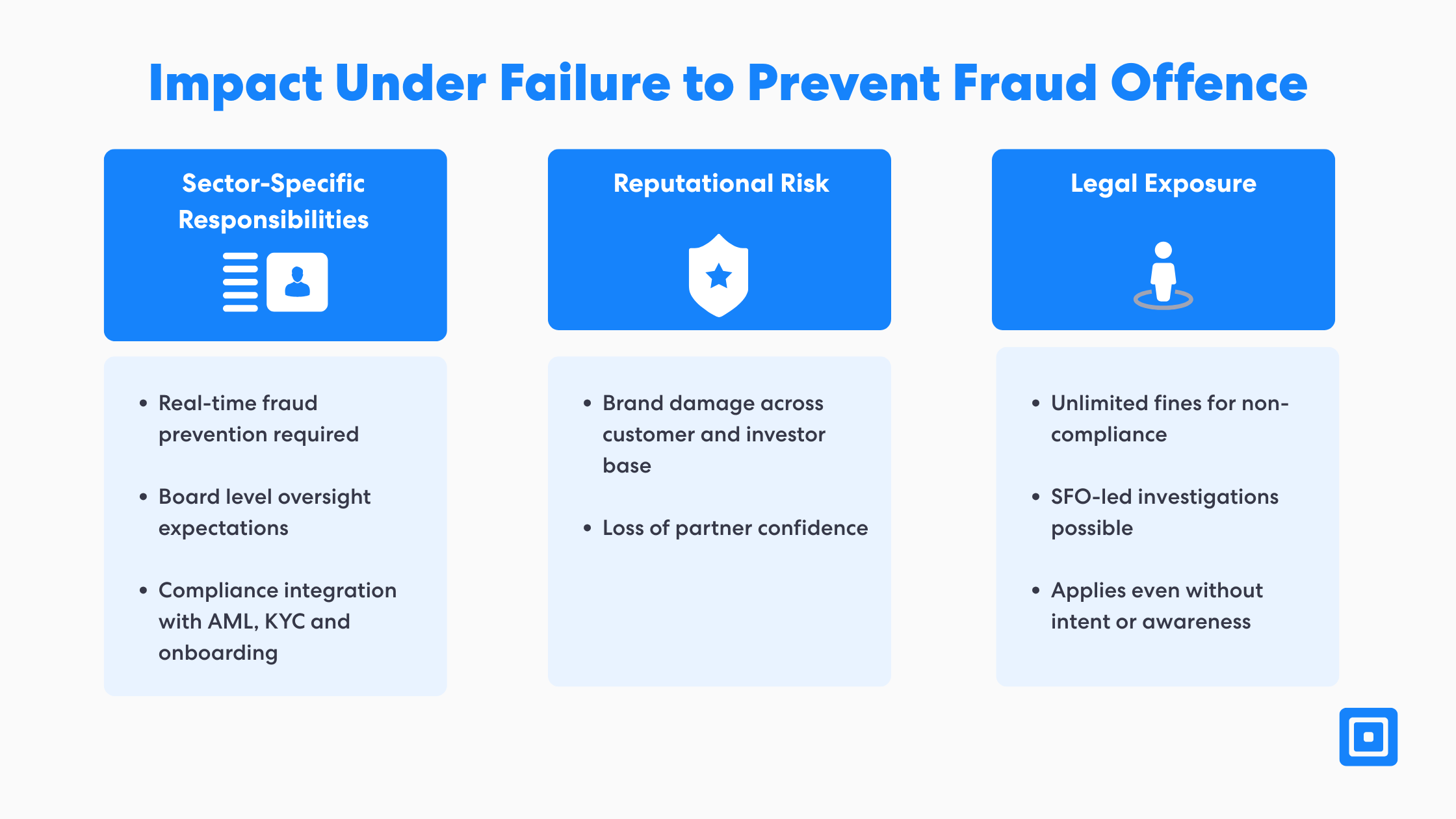
The [Serious Fraud Office](https://www.gov.uk/government/organisations/serious-fraud-office) (SFO) has been designated as the lead enforcement body under the new legislation. Failing to adequately implement such procedures put financial institutions at risk of civil litigation, reputational damage, and direct investigations. The pressure to create thorough risk assessment protocols is only increasing due to heightened regulatory scrutiny. This broadening of liability moves the focus from reactive incident responses to proactive risk governance thereby raising the bar for what regulators expect from firms under scrutiny.
## Who Does the Failure to Prevent Fraud Offence Apply To?
The failure to prevent fraud offence applies to companies referred to as large organisations. They are defined by meeting two or more of the following thresholds:
- £36 million in turnover
- £18 million in assets
- 250 employees.
The parameters of this offence are assessed and put in place based on the financial year preceding the offence. Typically, organisations such as banks, insurers, investment firms, and most fintechs fall within the scope of this offence. Even smaller firms could be indirectly affected through third-party relationships or by future legislation.
Importantly, the law could extend beyond fraud to include related offences such as tax evasion or crimes impacting public revenue. This broad applicability makes it critical for firms to evaluate both direct and indirect exposure. Assessing anti-fraud procedures that prevent bribery, criminal finances or mitigate any particular risks that a person commits, keeps firms ahead of the curve. Early class-action can support firms with status, operational risk and help determine the level of procedural rigour required under the law.
## Who are “Associated Persons” under Failure to Prevent Fraud?
The failure to prevent fraud offence adopts an expansive view of who qualifies as an “associated person.” This includes employees, contractors, subsidiaries, agents, and third-party service providers. Senior managers also fall within scope, reflecting a broader view of corporate responsibility. Under this definition, fraud committed by anyone acting on behalf of the organisation may result in criminal liability.
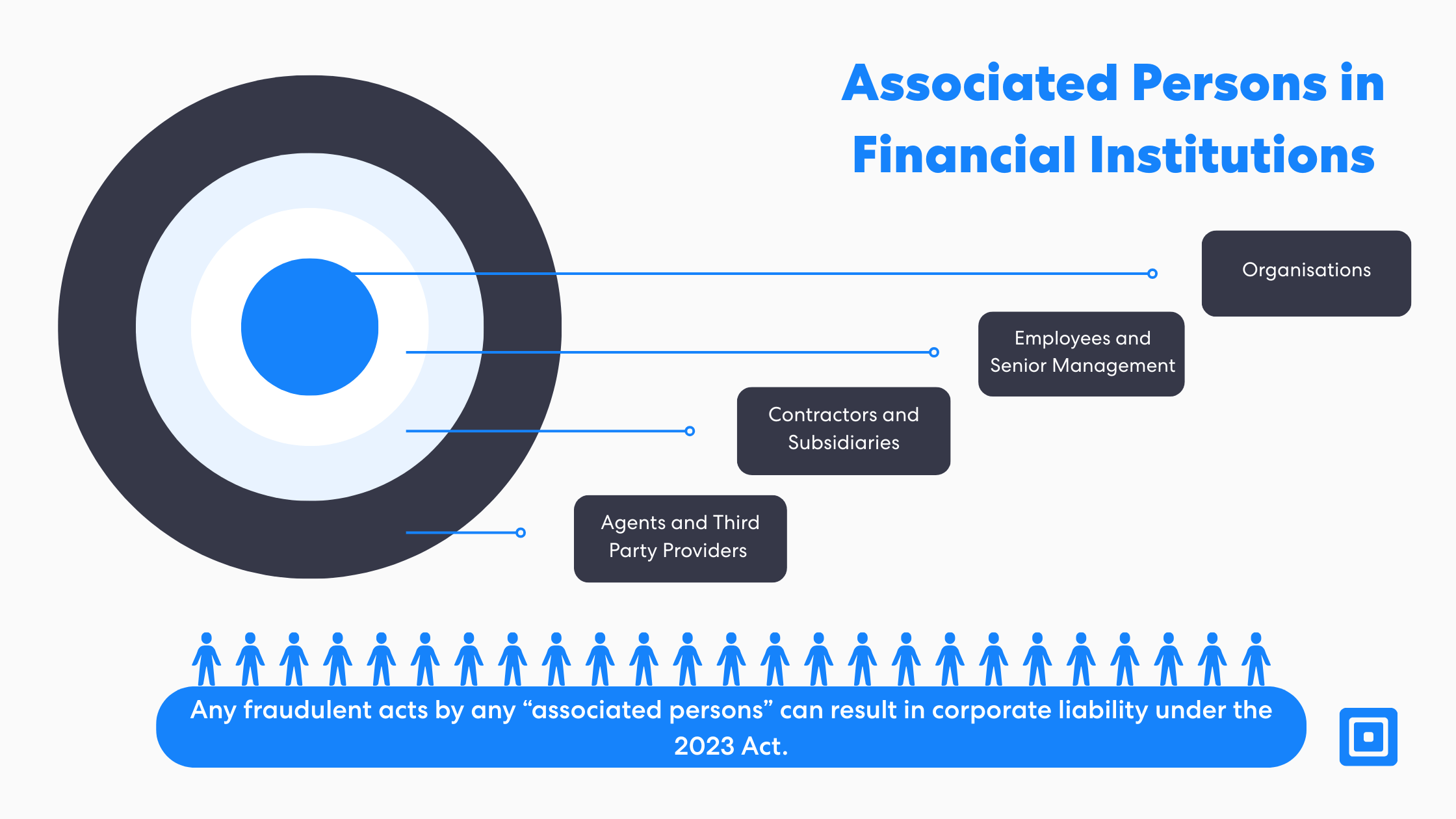
Firms must design fraud prevention frameworks that cover all contributors at risk of underlying fraud offences, not just staff that are fraud offence intending. The inclusion of non-employees and leadership elevates the importance of cross-functional risk mapping. Organisations must maintain oversight of anyone acting in their interest, especially in high-risk roles. This calls for comprehensive onboarding checks and ongoing monitoring.
## Scope and Expectations of Failure to Prevent Fraud
There is often uncertainty around the scope of reasonable fraud prevention measures and the intent of the new failure to prevent fraud offence. In some cases, it is assumed that the rules apply only to internal fraud or that current policies already provide sufficient coverage. However, the offence targets any fraud by an associated person that benefits the organization. Whether it be internal or external, large businesses need to be wary of whether their Anti-Money Laundering (AML) controls fulfil the requirements.
In truth, AML frameworks address different risks and lack the targeted specificity required under this offence. Written policies alone will not satisfy regulators of these large organisations. Implementation and monitoring of effective controls are essential to promoting an anti-fraud culture. The new law also demands fraud-specific measures that can withstand scrutiny from the Serious Fraud Office (SFO).
## The Difference between AML Compliance and Failure to Prevent Fraud Procedures
AML compliance is fundamentally reactive, focused on detecting suspicious activity after it occurs. In contrast, the new offence demands preventive measures to stop such a fraud act before it happens. This mirrors UK corporate offence legislations such as the UK Bribery Act 2010, where companies are penalised for failing to prevent wrongdoing by associated persons. Prioritizing corporate criminal attribution demonstrate in a shift from detection to prevention. Firms must not confuse AML risk assessments with the fraud prevention requirements introduced here.
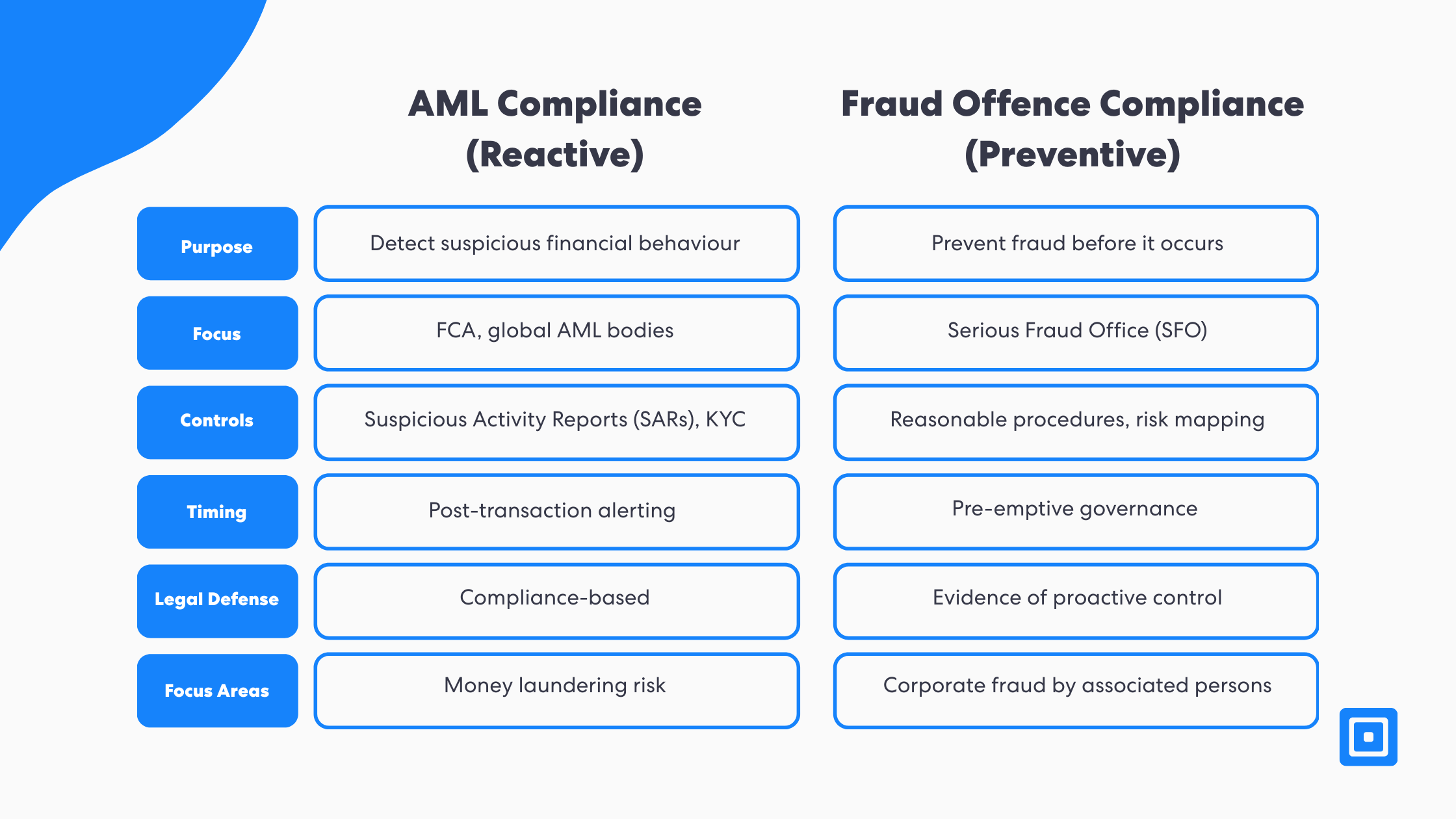
To establish a valid defence under the new offence, companies must prove they had reasonable fraud prevention procedures in place. These controls must be tailored to the business’s specific risk profile and operations. It is not enough to have generic policies, procedures must be documented, implemented, and periodically updated. Clear communication and operational visibility are also essential. This marks a shift from passive compliance to evidence-based readiness. Regulatory bodies will expect firms to demonstrate that their controls were functional at the time of the offence.
## Assessing and Managing Internal Fraud Risks
Effective prevention begins with a detailed risk assessment process. Firms must identify areas of the business most vulnerable to fraud and assess how associated persons interact with these functions. Key steps include mapping high-risk business units, identifying threat vectors, and quantifying potential impacts. Prioritisation based on exposure to theft acts helps allocate controls efficiently.
Financial firms should also account for changes in fraud risk over time, driven by internal changes or external threats. This requires ongoing analysis and a willingness to adjust controls accordingly. By using tools that enable this flexibility, as strong foundation can be built through adaptive workflows and risk scoring tools. Risk mapping is essential to meet legal obligations under the new offence.
### Reviewing Gaps in Existing Processes
Reviewing and strengthening existing compliance processes is necessary in avoiding duplication and ensuring legal alignment. Many firms assume that their AML tools or existing fraud policies are sufficient. However, controls must be audited against the regulations of the failure to prevent fraud offence. The review goes across onboarding, escalation, and third-party management.
Key starting points include reassessing risk-based onboarding flows, stress-testing escalation logic, and mapping out procedures. Firms should document findings and integrate updates into a formal fraud prevention framework. This type of process review signals a proactive stance on compliance to regulators.
### Core Fraud Prevention Procedures Every Firm Needs
Based on regulatory guidance and industry best practices, there are key procedures every firm should adopt. These include mandatory staff training on fraud indicators, such as false representation and financial misconduct. Firms must also implement whistleblower hotlines, real-time transaction monitoring, and enhanced vetting for high-risk roles. Continuous vendor screening further helps mitigate third-party risk.
These procedures must be embedded across departments, not siloed within compliance functions. A comprehensive prevention plan should also evolve with changes in regulatory expectations or internal risk appetite. Establishing a culture of fraud awareness is equally critical for long-term effectiveness.
### The Role of Due Diligence in Preventing Fraud
Under the new offence, due diligence becomes an ongoing obligation. Companies should continuously verify the legitimacy and risk profile of customers, vendors, and associated persons. Effective due diligence enables early fraud detection and strengthens a firm’s legal defence against other criminal activity such as money laundering. By identifying synthetic identities, fraudulent trading, and other financial misconduct over time, businesses can ensure thorough due diligence.
Firms should conduct Know Your Customer (KYC) and Know Your Business (KYB) checks across its entire customer, partner and employee base. KYC and KYB checks should be supported by refreshed Politcally Exposed Person (PEP) checks, sanctions and adverse media screenings. Behavioural monitoring flags suspicious activity that signal underlying fraud. ComplyCube supports these efforts through automated controls and integration-ready solutions. You can learn more here: [What is a Politically Exposed Person (PEP)](https://www.complycube.com/en/what-is-a-pep/)?
### **Case Study: HSBC’s £64M Fine Highlights Risks of Inadequate Fraud Controls**
In December 2021, the **UK Financial Conduct Authority fined HSBC £63.9 million** for longstanding weaknesses in its anti-money laundering systems. Between 2010 and 2018, HSBC failed to maintain **effective transaction monitoring controls**, exposing the bank to serious financial crime risks.
The FCA found that HSBC:
- Did not update or test key fraud detection systems for eight years
- Missed alerts involving high-risk customers and suspicious activity
- Lacked proper oversight of AML controls and internal risk escalation
While the penalty predates the UK’s new Failure to Prevent Fraud offence, it illustrates the **operational gaps** that now carry potential **criminal liability** under updated legislation. If internal or third-party fraud had occurred, HSBC could have faced prosecution in addition to financial penalties.
This case serves as a clear warning. Outdated systems and passive controls are no longer defensible. Under the new law, firms must demonstrate that **reasonable procedures to prevent fraud** are in place, operationalised, and supported by audit-ready evidence.
## Auditing and Evidencing Fraud Readiness
Documentation is central to demonstrating a valid defence under the new offence. Firms must keep records of training attendance, internal audits, vendor risk assessments, and case handling. These artefacts help prove that reasonable procedures were not only designed but also followed. Regulators will look for evidence that procedures were implemented at the time of the alleged offence.
ComplyCube’s reporting and audit modules allow firms to export logs, compliance reports, and process trails easily. This enables fast, transparent responses during enforcement actions or audits. Firms that build documentation into their daily workflows will be better equipped to defend against allegations. Evidencing readiness is as critical as implementing controls.
## Preparing Your Board and Risk Committee
Leadership accountability is embedded in the new offence, placing boards and senior risk committees at the heart of compliance. MLROs and Heads of Fraud must ensure that decision-makers understand fraud exposure across the business. Regular reviews of KPIs, audit results, and incident reports should become standard governance practice. It is equally important to allocate resources for continuous improvements in fraud controls.
A well-defined fraud prevention plan, backed by real data, supports a strong corporate culture and legal defence. Boards should treat this offence not just as a compliance issue, but as an enterprise risk. Firms that fail to engage leadership early risk being unprepared for enforcement. ComplyCube enables actionable visibility into fraud controls across business units, supporting strategic oversight.
## How ComplyCube Enables End-to-End Fraud Prevention
ComplyCube offers a unified compliance platform tailored to the demands of the new fraud offence. It enables real-time identity verification, sanctions screening, and behavioural fraud checks, all of which support the “reasonable procedures” defence. The unified platform uses custom rules through its workflow, allowing firms to implement and adjust controls to their specific risk profile without writing any code. This not only ensures flexibility, but prioritizes a quick deployment of fraud prevention measures.
Fraud detection measures can be implemented across the customer journey, providing full visibility and control. The modules cover document, biometric, and database verification, which can be coupled with connections into fraud networks, device intelligence, and fraud risk scores, enabling holistic fraud detection and insights. These purpose-built tools support proactive prevention and audit readiness. Integrated solutions such as ComplyCube will be essential as enforcement ramps up.
### Key Takeaways
- The **UK Failure to Prevent Fraud law** introduces strict and expanded corporate liability for fraud.
- **Associated persons** include employees, contractors, agents, vendors, and subsidiaries.
- **AML systems alone are insufficient** to meet the new fraud prevention requirements.
- Organisations must have **fraud-specific frameworks** that are tested, evidenced, and updated regularly.
- **ComplyCube** enables fraud prevention to be embedded across business processes.
## Overall Timeline of Roll-Out and Implementation
The new failure to prevent fraud offence took effect on September 1st, 2025 and initially focused on high-risk sectors such as finance and fintech. Firms with larger customer bases or public-facing operations faced higher scrutiny. The Serious Fraud Office (SFO) began leading investigations and prosecutions under this expanded framework. Regulators are expected to ask for documented proof of compliance readiness. Companies that prioritize early compliance can build a great reputation and reduce regulatory pressure.
Talk to [ComplyCube](https://www.complycube.com/en/contact/contact-sales/)‘s compliance experts to enhance your customer due diligence workflows.
[](https://www.complycube.com/en/contact/contact-sales/)
## Frequently Asked Questions
What is the UK Failure to Prevent Fraud law?
The UK Failure to Prevent Fraud law, introduced under the Economic Crime and Corporate Transparency Act 2023, makes companies liable if an employee, contractor, agent, or subsidiary commits fraud for the organisation’s benefit. Leadership can be prosecuted even if they were unaware. The only defence is showing that “reasonable procedures” were in place. The Serious Fraud Office is the lead enforcement body. The law came into effect on September 1, 2025.
Which UK companies are affected by the Failure to Prevent Fraud law?
The law applies to large UK organisations that meet at least two of these thresholds in the previous financial year: turnover of £36 million or more, assets of £18 million or more, or 250 employees or more. Smaller companies are not directly in scope but can still face indirect exposure as suppliers or agents to larger firms. UK entities may also be liable for fraud committed by overseas subsidiaries if it benefits the business.
What are reasonable procedures to prevent fraud under UK law?
Reasonable procedures under the UK Failure to Prevent Fraud law include mandatory staff training on fraud indicators, whistleblowing hotlines, real-time transaction monitoring, enhanced vetting for high-risk roles, and continuous vendor screening. Strong due diligence is also required, such as KYC and KYB checks, sanctions screening, and adverse media monitoring. Firms must keep evidence such as training records, audit logs, and risk assessments to prove these controls were active at the time of any alleged offence.
How is the UK Failure to Prevent Fraud law different from AML compliance?
AML compliance is mostly reactive, focused on detecting suspicious activity after it happens. The UK Failure to Prevent Fraud law requires proactive fraud-specific measures that reduce risks before they occur. Written policies alone are not sufficient. Regulators expect firms to demonstrate that tailored fraud prevention procedures are in place, regularly reviewed, and documented. AML and fraud prevention frameworks work together but cover different risks, and both are required for full compliance.
What are the penalties for failing to prevent fraud in the UK
Companies that fail to comply with the UK Failure to Prevent Fraud law face unlimited fines and significant reputational damage. Senior managers and boards are accountable for ensuring effective fraud frameworks. Key steps include risk assessments, continuous monitoring, whistleblowing processes, and audit-ready documentation. Early compliance helps reduce regulatory scrutiny. Platforms such as ComplyCube provide tools for identity verification, sanctions screening, and audit reporting to evidence readiness
**Categories:** Guides
**Tags:** Fraud Prevention
---
### [The Top 5 AML Fines in 2025 Business Need to Know](https://www.complycube.com/top-5-aml-fines-in-2025-you-need-to-know/)
**Published:** July 30, 2025
**Author:** Dini Habib
**Excerpt:** Regulators worldwide have issued over $6 billion in AML fines this year. Yet, these fines are projected to grow as regulations worldwide undergo rapid changes to close out the significant money laundering and fraud gaps.
**Content:**
**TL;DR:** Regulatory bodies all around the world are swiftly joining forces to crack down on companies that have weak oversight and implementation of robust AML and KYC processes. From inadequate customer due diligence to failures in internal risk assessments, this guide covers the top 5 AML fines in the first half of the year and explore the main challenges these firms face.
## What do the Top 5 AML Fines Relate to?
Half of the year has already passed, yet a concerning trend still appears: Companies are still getting big penalties due to weak Anti-Money Laundering (AML) controls. Regulators worldwide have issued over $6 billion in AML fines. It doesn’t stop there. Senior executives have also been penalized due to their lack of oversight on AML compliance. Buckle up as we cover the five record-breaking AML fines of 2025 and explains how businesses can avoid them, fairly easily.
## OKX Crypto Exchange and Its $500 Million Guilty Plea
February 24, 2025 — Cryptocurrency Exchange OKX was fined over $500 million by the [US Department of Justice (DOJ) ](https://www.justice.gov)due to severe AML violations. Founded in 2017 by Star Xu, a blockchain technology enthusiast, the Seychelles-based platform operated one of the largest crypto exchanges globally.

Authorities in the U.S found that the firm had aided over $5 billion in suspicious transactions due to inadequate Know Your Customer (KYC) and AML frameworks. Despite officially banning U.S. users, authorities uncovered internal documents showing that OKX staff instructed American customers to falsify identification documents and circumvent restrictions. Ultimately, OKX pleaded guilty and was charged $84 million in civil fines and a forfeiture of $420 million in illegal proceeds.
The DOJ also found that OKX had weak transaction monitoring, failed to implement [sanctions screening](https://www.complycube.com/en/solutions/global-screening/sanctions-pep-screening/), and did not register with the U.S Treasury as a money service business. This underpins the challenge for rapidly scaling businesses when balancing market growth with stringent regulatory obligations.
## UAE Exchange House Hit with $54.5 Million for Risk Mismanagement
May 22, 2025 — [The Central Bank of the UAE (CBUAE)](https://www.centralbank.ae/en/about/about-cbuae/) fined a UAE-based exchange house almost $55 million, the largest fine of its kind in the UAE, due to significant AML weaknesses. The firm was unnamed due to privacy policies.
Reports by the CBUAE found that the firm had failed to implement robust internal risk triggering, due diligence measures, and transaction monitoring. This was not the first time the firm had found itself in compliance trouble with authorities. According to leading news articles in the UAE, the firm had been given multiple chances to remediate its compliance protocols, which were blatantly ignored. Additionally, its branch manager was fined AED 500,000 (US$130K) and prohibited from holding any future position in a licensed financial institution.
This case highlights the growing resilience of authorities in breaking down AML and [KYC](https://www.complycube.com/en/solutions/due-diligence-compliance/know-your-customer/) gaps in high-risk regions. The trend resumes: all organizations, not just regulated financial services, are under scrutiny.
## $40 Million Fine for American Payment Company Block Inc.
April 10, 2025 — American digital payments company Block Inc. was fined US$40 million by the [New York Department of Financial Services (NYSDFS)](https://www.dfs.ny.gov/About_Us) for non-compliance with the U.S Bank Secrecy Act (BSA) and AML programme. The firm, formally known as Square Inc., was founded in 2009 by Jack Dorsey, the co-founder of Twitter Inc., to provide a simple and affordable way for small businesses to accept credit card payments.

Block Inc. had over 8300 Cash App accounts tied to a Russian criminal network. The NYSDFS investigated the case and found that the firm had major gaps in its [customer due diligence](https://www.complycube.com/en/solutions/due-diligence-compliance/customer-due-diligence/) and risk monitoring systems. This enabled fraudsters to launder money and commit financial crime without being detected.
The company must now undergo remediation through leveraging and an independent monitor in order to implement corrective actions. The case with Block Inc. further highlights the previous challenges encountered by OKX to ensure compliance does not lag behind the company’s scale.
## FINRA imposes $29.75 Million Fine on Robinhood
March 7, 2025 — Robinhood, a California-based financial services company, was charged $29.75 million by the [Financial Industry Regulatory Authority (FINRA)](https://www.finra.org) for its weak AML oversight. Founded back in 2013 by the Bulgarian-American entrepreneur Vladimir Tenev, the company provides a digital way for consumers to trade stocks, funds, and cryptocurrency.

FINRA found many gaps in the businesses’ AML programmes, dating back to 2014. A few of the major issues included the failure to act effectively on triggered red alerts and customer misconduct. Part of the fine included a $3.75 million fee to affected customers. Moreover, Robinhood lacked supervision over social media influencers who had created misleading advertisements about their products.
The restitution paid to customers highlights how regulatory authorities are increasingly prioritizing the protection of customers’ and investors’ financial well-being.
## Credit Suisse Penalized with US$4.5 Million for Poor AML Controls
July 4, 2025 — The [Monetary Authority of Singapore (MAS)](https://www.mas.gov.sg) has fined Credit Suisse S$5.8 million (~US$4.5 million) as part of its crackdown on the Singaporean AML scandal in 2013. Credit Suisse was one of nine firms fined by the MAS for weak AML and CFT protocols.

The MAS imposed the highest fine on Credit Suisse, which was found to have an inconsistent AML implementation. Some of its failures included weak risk management, inadequate source-of-wealth checks, and transaction monitoring lapses. The other eight firms included big names such as UOB, Citibank, UBS, and more. For the full story of how MAS cracked down on one of the biggest AML scandals in Singapore, [click here](https://www.complycube.com/en/mas-fines-9-firms-27-45-million-in-money-laundering-case/).
### Key Takeaways
- Money Laundering and Counter-Terrorist Financing penalties now **extend responsibility** to senior executives, expanding compliance obligations across leadership teams.
- **Common penalties** for gaps found in AML processes include monetary fines, reimbursement to affected customers, sanctions, and forfeiture from participation in the financial ecosystem.
- The **biggest challenge** for AML implementation in 2025 remains balancing rapid company growth with maintaining comprehensive compliance
- Some of the **major issues** that can lead to penalties include a lack of due diligence, insufficient or inaccurate risk assessments, and ignoring risk triggers.
## The Importance of Comprehensive AML Infrastructure
There is so much to learn from the top five AML fines in 2025. From the list above, its clear that regulatory authorities are extending the ownership of AML implementation and oversight to companies other than financial institutions and also penalizing the senior executives in risk management and compliance teams.
Compliance leaders must invest in an all-in-one AML software or system that is agile to company growth and changing regulations. [Speak to a team member](https://www.complycube.com/en/contact/contact-sales/) to learn more about prioritizing cost effectiveness and scalability through an AI-driven KYC and AML platform in 2025.

## Frequently Asked Questions
Why did OKX receive such a large amount of fines compared to the rest?
The DOJ found that the company had incomplete AML and KYC processes and helped users create fake documentation. Additionally, the firm operated an unlicensed platform, enabling over $5 billion in suspicious transactions made.
What is the common thread in these AML failures?
Despite prior warning and red flag alerts, these firms failed to take the necessary action to prevent further damage. Recurring themes included poor due diligence and insufficient transaction monitoring.
Can regulators fine crypto and fintech platforms the same way as banks?
As seen from the cases above, regulators are extending enforcement actions to companies other than financial institutions. Moreover, authorities in high-risk regions are holding the same global AML/CFT standards to local businesses.
What role does ComplyCube play in preventing money laundering?
ComplyCube provides AML and KYC tools including liveness detection, ongoing monitoring, and AI-driven risk detection. Its platform supports fast scaling businesses of all types in automating compliance workflows and identifying suspicious behaviour proactively.
**Categories:** News
**Tags:** Anti-Money Laundering
---
### [The CryptoCubed Newsletter: July Edition](https://www.complycube.com/the-cryptocubed-newsletter-july-edition/)
**Published:** August 1, 2025
**Author:** Dini Habib
**Excerpt:** July has seen huge strides in the crypto world as regulators have clamped down on the sector. From Algeria's complete crypto ban to the USA's strategic plan to be the crypto capital of the world, read on to explore key changes.
**Content:**
👋 Welcome back to CryptoCubed!
This month brings significant developments in the crypto and AML landscape, marked by Algeria’s sweeping and strict crypto ban. Meanwhile, the UK is introducing fines for crypto holders who fail to disclose their assets, reflecting growing global regulatory efforts. Additionally, the UK’s CB Payments Limited faced hefty fines over AML breaches, and a high-profile crypto fraud duo received lengthy prison sentences. These events underscore the continuing turbulence and tightening of compliance in the crypto world. Are you ready? Read on below.

## Algeria Imposes Shocking “Complete” Crypto Ban
Just last week, on the 24th of July, Algeria, the tenth-most populous country in Africa, imposed Law No. 25-10. The Law is noted as one of the strictest and most robust legislations globally, involving a total ban on cryptocurrency. Under the Law, anyone issuing, mining, promoting, or possessing digital assets will be penalized heavily. Crypto exchanges and digital wallets are fully prohibited from operating. Additionally, any influencer found advertising cryptocurrency will be criminalized as well.
The penalty is severe, with any violation found to be punishable by jail time going up to a year and fines ranging from $1,540 to $7,700. The legislation provides regulatory authorities with extensive enforcement power, including broad oversight of central banking activities.

The Algerian government marks this move as a vital progressive measure to end money laundering and terrorist financing effectively. Despite many other countries, such as South Korea and the US, leading the charge towards crypto assets, Algeria argues that this move is crucial for the country to protect its financial systems. Many have mentioned that the Law could boost the country as one of the safest financial hubs in Africa. In contrast, others have noted that it will completely isolate the country from global developments in digital finance.
For more on this story, click [here](https://news.bitcoin.com/algeria-enacts-sweeping-ban-on-crypto-use-exchange-and-mining/).
## Crypto Holders in the UK to Face Fines for Non-Discloures
From January 1st, 2026, all UK-based crypto holders need to submit key personal information, including name, address, date of birth, and national insurance, to crypto service providers. These new rules are introduced to crack down on the growing tax evasion in the UK’s crypto world. Any failure to submit accurate information will result in a £300 penalty.
In addition, crypto service providers are mandated to run essential Know Your Customer (KYC) checks to facilitate the new rules. Aside from gathering user information, they must also collect data on an individual’s transaction activities and submit details on the types and amounts of cryptoassets involved.
The Director General for Customer Strategy and Tax Design at HMRC, Jonathan Athow, says, “These new reporting requirements will give us the information to help people get their tax affairs right. I urge all cryptoasset users to check the details you must give your provider. Taking action now will help you avoid penalties in the future.”
HMRC obliges taxpayers to submit full information on any profits or income made from crypto through new dedicated reporting sections. These new rules usher in a new commitment to safeguarding the UK’s crypto sector, with officials estimating an additional £315 million in tax revenue by 2030.
For more on this story, click [here](https://www.ellisatkins.co.uk/news/hmrc-to-fine-crypto-investors-300-for-non-disclosure).
## CBPL fined over £3 Million for Facilitating High-Risk Transactions
CB Payments Limited (CBPL), a private limited company founded in 2015 under the Coinbase Group, was fined by the Financial Conduct Authority (FCA) a whopping £3,503,546 for gaps in its Anti-Money Laundering (AML) processes. After investigations, the FCA found that CBPL did not uphold its voluntary agreement reached in 2020, which stated strictly that the company could not onboard any more high-risk customers before their AML gaps had been remediated.
Even though the company received repeated warnings over the course of two years, it enabled over 13,000 high-risk customers to conduct payment and transaction services. Out of the 13,416 high-risk users, 31% made deposits worth nearly $24.9 million, enabling over $226 million in crypto transactions to be made through Coinbase entities.
CBPL was found to have extensive weaknesses in its customer due diligence processes, including failure to oversee major AML controls. This case highlights the importance of rigorously identifying and addressing the gaps in AML that can contribute to financial crime. The FCA’s steadfast enforcement action serves as a strong warning to other crypto platforms on the importance of abiding by compliance regulations.
For more on this story, click [here](https://www.fca.org.uk/news/press-releases/fca-first-enforcement-action-against-firm-enabling-cryptoasset-trading).
## 12 Years in Prison for Crypto Fraud Duo
Between 2017 and 2019, Raymondip Bedi and Patrick Mavanga committed crypto fraud amounting to £1.5 million. The two cold-called around 65 victims, deceiving them into making fake crypto investments. The fraudulent money was channelled through companies such as Astaria Group LLP and CCX Capital.
According to reports by the FCA, the pair was found intent on exploiting regulatory loopholes arising from weak KYC and AML systems. Bedi received five years and four months, while Mavanga received six years and six months. The latter pleaded guilty to possessing a false ID and deleting important evidence.
Currently, regulatory authorities are still working on recovering the stolen funds. The crypto fraud duo case underscores the FCA’s ongoing dedication to protecting investors and tackling financial crime in the crypto sector. Investors are reminded to always conduct due diligence before investing, and for crypto service providers to implement strong compliance protocols.
For more on this story, click [here](https://cointelegraph.com/news/uk-sentences-2-men-prison-over-2m-cold-calling-crypto-scam).
## America Positions Itself as Crypto Capital of the World Under Trump
The White House released a landmark 166-page report from the President’s Working Group on Digital Asset Markets on July 30th. The report sets forth the U.S. strategy for innovation and regulation in the cryptocurrency sector. One of its key points covers the use of advanced technologies such as AI and blockchain analytics to strengthen real-time monitoring in AML and Counter-Terror Financing (CFT) frameworks.
The report outlines comprehensive standards to position the US as a global leader in digital finance, including regulatory frameworks and addressing common financial risks. One such recommendation is that Congress pass increased clarity and comprehensive legislation that provides tailored rules for different asset types based on economic function.
Overall, the report signals a paradigm shift toward comprehensive, cohesive U.S. crypto policy embracing innovation while safeguarding consumers and financial stability, fulfilling President Trump’s goal to make America the “crypto capital of the world.”
For more on this story, click [here](https://www.idnfinancials.com/news/55986/trump-signs-genius-act-claims-america-as-crypto-capital-of-the-world).
## Time for The Poem You Have Been Waiting for
So you’ve made it to the end of our newsletter. It’s time to enjoy a little satire, worthy reader, you’ve earned it.
### 🔥THE CRYPTO CUBED POEM: JUNE🔥
Across the world, the crypto tide,
Brings law and order, far and wide.
From Algeria’s resolute, iron hand,
A total ban to guard the land.
Two fraudsters caught in prison’s grip,
Their schemes exposed, no more to slip.
Through rules, reports, and justice met,
The crypto age seeks to reset.
### Stay tuned for our August newsletter, and have a great month!
[](https://www.complycube.com/en/contact/contact-sales/)
**Categories:** News
**Tags:** Crypto Regulations
---
### [The CryptoCubed Newsletter: June Edition](https://www.complycube.com/the-cryptocubed-newsletter-june-edition/)
**Published:** July 2, 2025
**Author:** Dini Habib
**Excerpt:** June has been a busy month in the world of crypto, with anonymous crypto soon to be banned by the EU, AML fines being handed out left right and centre, new crypto AML laws in the works, and much more. Buckle up, it's time for Crypto.
**Content:**
👋 Welcome back to CryptoCubed!
June was anything but quiet for the crypto world. From Singapore’s $200K ultimatum for unlicensed international crypto to My Big Coin Pay Inc. facing $26 million worth of fines for fraud, the message is clearer than ever: the era of crypto’s Wild West is ending, or is it really? Buckle up for the June Edition of CryptoCubed. Sit tight as we break down the biggest enforcement actions and what they mean for the future of crypto.

## Crypto Firms in Singapore Threatened by Jail Time and $200K Fines
Singapore, known for its robust security, has taken it a step further by enforcing new regulations within the crypto industry. Effective June 30th this year, all companies that provide digital token services to overseas clients must obtain a Digital Token Service Provider (DTSP) license under the new licensing framework introduced by the Monetary Authority of Singapore (MAS).
The DTSP license introduces strict compliance standards, including enhanced Anti-Money Laundering (AML) and Counter-Terrorism Financing (CFT) measures. The license also calls for frequent routine-based risk assessments and operational controls. Any crypto business found without the DTSP license will face extreme charges, including massive fines of up to SGD 250,000 (about USD 200,000) and up to three years in prison.
The MAS has maintained this strict regulation, providing zero grace periods or exceptions for any company caught without a valid DTSP license. This bold move came about as the MAS aimed to close the potential gaps that could be exploited by international crypto firms operating from Singapore without adequate local oversight. Crypto companies in Singapore are now faced with two challenging options: to get DTSP-certified and face increasing compliance costs and resources, or to permanently relocate to jurisdictions with more flexible regulations.
For more on this story, click [here](https://www.financemagnates.com/cryptocurrency/singapores-new-rules-threaten-crypto-founders-with-jail-and-200k-fines/).
## Coinme Pays $300K Fine for Violating California Crypto Laws
California has imposed its first enforcement action under the new Digital Financial Assets Law on Coinme, a Seattle-based crypto ATM operator. Founded in 2014, Coinme is the largest certified crytocurrency cash exchange in the U.S, enabling users to buy crypto with cash seamlessly.
The $300,000 penalty was imposed after regulators found that Coinme had weak AML controls, facilitating customers in making daily transactions over the current limit of $1K per user. Additionally, the firm failed to include the required disclosures on receipts at its kiosk, located throughout California’s grocery and convenience stores. Part of the settlement involved the company paying $51,700 in reimbursement to an elderly resident who was scammed, highlighting the law’s emphasis on consumer protection.
In 2024, the US Federal Bureau of Investigation (FBI) filed nearly 11,000 complaints and over $246 million in losses from such scams. Officials in California aim to send a strong warning to other digital asset operators that strict compliance is here to stay. The law gained traction in 2023 in response to the rise in crypto ATM scams, where fraudsters trick victims into buying crypto at kiosks and directing those funds to criminals.
For more on this story, click [here](https://cointelegraph.com/news/coinme-pays-300k-fine-violating-california-crypto-atm-laws).
## $65K in Fines and Suspension for Crypto Broker Involved in Secret Digital Assets
Canadian broker Christopher Meehan, was struck with $65,000 worth of fines and suspended for four months after managing over $1.2 million in crypto assets for clients without regulatory oversight. This case emphasizes the increasing scrutiny over crypto trading, which is now being closely monitored for both firms and professionals in the industry.
The crackdown came about when the British Columbia Securities Commission (BCSC) flagged an unregistered company that Meehan had set up for his off-book operations. From 2019 to 2022, Meehan was caught accepting and depositing huge sums of crypto assets into his wallet and trading them on behalf of eight clients and 22 investors.

Meehan committed over 6,000 trades across over 75 types of cryptocurrencies. The penalty showcases the growing compliance requirements worldwide, as Canadian authorities now classify crypto trading on behalf of others as securities, mandating full registration license and compliance. Officials now encourage investors to fully verify broker license and steer clear of any form of off-book arrangements.
For more on this story, click [here](https://msig.at/en/crypto-broker-hit-with-65000-in-fines-and-suspension-after-secretly-managing-millions-in-digital-assets/).
## My Big Coin Inc. Faces Nearly $26 million in Fines for Fraud
From 2014 to 2017, My Big Coin Pay Inc. (MBC) and its executives were involved in an ongoing fraudulent virtual currency scheme. MBC was established so that anyone with an email account can send or receive My Big Coins crypto assets. The Massachusetts federal court imposed over $26 million in penalties and restitution, including $19.32 million in civil penalties and $6.44 million in reimbursement to victims.
Those involved included Mark Gillespie, John Roche, and Randall Crater, who misled 28 investors by making inaccurate claims about My Big Coin’s value and trade status, coaxing them to invest under deception. The Commodity Futures Trading Commission (CFTC), in charge of protecting consumers from fraud has also permanently banned them from participating in any CFTC-regulated markets.
In 2024, the FBI Internet Crime Complaint Center’s 2024 Internet Crime Report had filed over $5.8 billion in losses from cryptocurrency investment fraud. The US has ramped up its efforts to address the challenges induced by cryptocurrency dealings, warning other digital assets promoters of the severe legal and monetary implications of participating in money laundering, fraud, and deception.
For more on this story, click [here](https://cointelegraph.com/news/my-big-coin-to-pay-26m-fines-to-ctfc).
## Former FTX EU Subsidiary Faces €200,000 in Penalties Over Compliance Failures
The Cyprus Securities and Exchange Commission (CySEC) has fined the former FTX EU subsidiary, now renamed Trek Labs Europe, €200,000 for compliance failures. The failures occurred between March and November 2022 and were uncovered during a compliance assessment. Some of the failures included weak KYC procedures and not providing transparent and clear information to customers.
Despite changes in ownership and branding, the settlement addresses the period when FTX EU operated under its previous management. CySEC’s action underlines the ongoing regulatory scrutiny faced by crypto firms in Europe, with leading companies such as Binance and Coinbase facing similar charges. The enforcement of larger penalties also showcases the country’s larger push to safeguard the security and confidence of its financial sector to attract more investors and financial companies.
For more on this story, click [here](https://financefeeds.com/cyprus-regulator-fines-former-ftx-eu-unit-e200000-over-compliance-failures/).

## Time for The Poem You Have Been Waiting for
So you’ve made it to the end of our newsletter. It’s time to enjoy a little satire, worthy reader, you’ve earned it.
### 🔥THE CRYPTO CUBED POEM: JUNE🔥
Is Crypto’s Wild West fading fast?
As regulators’ grip is built to last,
From Singapore’s fines to U.S. law,
Enforcers are on the act without a flaw.
Big names caught in compliance nets,
The cost of rule-breaking, mounting debts.
As June unfolds, the message is clear:
A safer crypto world is drawing near.
### Stay tuned for our July newsletter, and have a great month!
[](https://www.complycube.com/en/)
**Categories:** News
**Tags:** Crypto Regulations
---
### [Selecting KYC Software for Your Industry and Growth Stage](https://www.complycube.com/selecting-kyc-software-industry-and-growth/)
**Published:** July 17, 2025
**Author:** Dini Habib
**Excerpt:** The industry and growth stage are the two vital factors organizations must consider when selecting KYC software. These factors shape the required country coverage, scalability, and integration capability needed to meet compliance.
**Content:**
Modern Know Your Customer (KYC) solutions play a vital role in helping organizations prevent money laundering, terrorist financing, and fraud. Selecting KYC software correctly can significantly improve a company’s customer relationships, regulatory compliance, and bottom line. This guide delves into the importance of KYC verification, highlights industry-specific KYC tools, and evaluates the best features for growth-stage compliance platforms.
## What Shapes the Right KYC Choice: Industry and Growth Stage
Organizations should consider the regulatory requirements for their specific industry and their growth stage when selecting the best [Know Your Customer (KYC)](https://www.complycube.com/en/solutions/due-diligence-compliance/know-your-customer/) software solutions. These factors directly shape key platform selection criteria such as the required country coverage, feature breadth and depth, scalability, and integration capability.
> The demand for KYC solutions has never been greater. According to statistics from Statista and CNBC, the eKYC market is expected to reach around [$2.79 billion by 2030](https://www.absrbd.com/post/electronic-kyc-statistics), up from $1.57 billion in 2021.
This projection directly highlights the rapid growth of KYC adoption due to the intensifying need for secure identity verification solutions and stricter compliance requirements. In addition to regulatory alignment and scalability, several factors are going to become key considerations when evaluating KYC partners, depending on industry and growth stage, including:
- **Industry-Dependent Fraud Risk:** Industries, such as financial institutions, that are more susceptible to money laundering and other financial crimes often have increased compliance obligations.
- **Differing Customer Expectations:** Companies in highly competitive industries, such as FinTech startups, must prioritize seamless Identity Verification (IDV) processes to rapidly onboard and retain customers.
- **Check Volume and Scalability:** The larger and more transaction-based the organization is, the higher the number of KYC checks will need to be conducted. This requires dependable KYC compliance tools that have high levels of up-time, reliable infrastructure, and a strong track record of delivering at scale.
- **Budget Limitations:** Small to medium-sized businesses with cost constraints may opt for simpler KYC processes than large enterprises. These established organizations typically opt for a more complex solution-set from KYC software providers, such as active liveness, 2+2 Multi-Bureau checks, or custom AML screening lists to prioritize full compliance while achieving operational efficiency gains and improved customer experience.
## The Key Features in a KYC Platform To Opt For
Selecting the right KYC software is a strategic decision that requires looking beyond a simple list of features. Ultimately, it must meet stringent regulatory standards whilst balancing speed and accuracy. This section focuses on the core capabilites that help firms streamline identity verification, due diligence processes, and meet changing regulations:
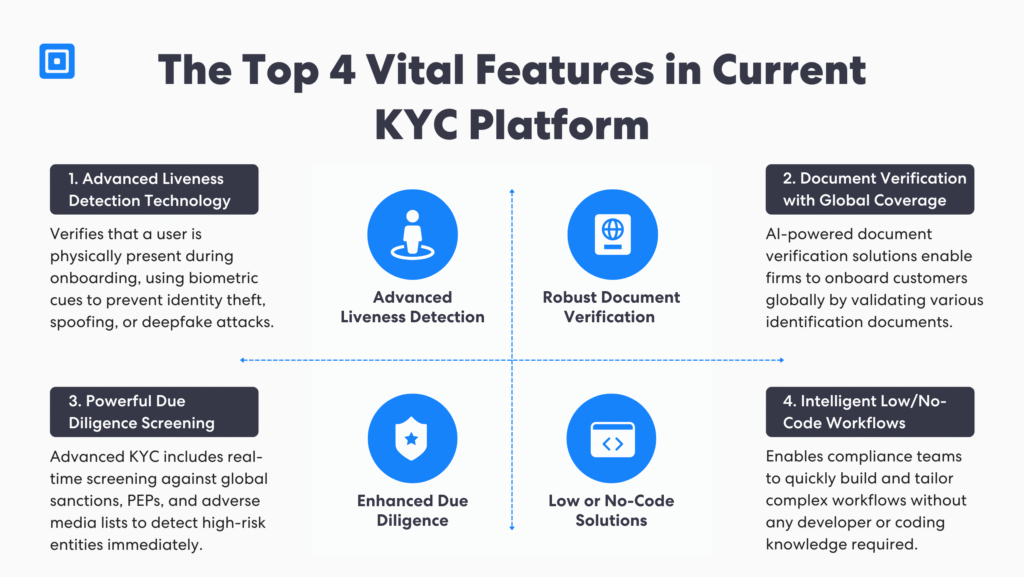
### Liveness Detection Technology
[Biometric technologies](https://www.complycube.com/en/solutions/identity-assurance/biometric-verification/) refer to features that support businesses in verifying whether a user is physically present, mitigating identity theft. For instance, liveness detection uses thousands of subtle data points to ensure a customer is genuine. [Liveness detection technology](https://www.complycube.com/en/solutions/due-diligence-compliance/know-your-customer/liveness-detection/) defends against sophisticated spoofing and deepfake attacks while maintaining seamless client onboarding.
### Document Verification with Global Coverage
Opting for KYC software with broad global coverage is crucial when operating cross-border. Organizations can perform customer onboarding by verifying [different identification documents](https://www.complycube.com/en/solutions/identity-assurance/document-verification/) accepted worldwide. AI-powered identity verification solutions offer rapid data extraction and biometric verification to onboard legitimate users accurately, reducing drop-off rates.
### Sanctions, Politically Exposed Persons (PEPs), and Adverse Media Screening
KYC software must also support [Anti-Money Laundering (AML)](https://www.complycube.com/en/solutions/due-diligence-compliance/anti-money-laundering/) efforts with extensive screening features. Real-time verification and ongoing monitoring help businesses screen high-risk customers to authoritative sources for sanctions and watchlists. High-risk transactions and entities that pose financial crime risks can be detected immediately, building a proactive approach to AML compliance.
[](https://www.complycube.com/en/what-is-a-pep/)
### Intelligent Low/No-Code Automation Workflows
The best KYC software includes low-code or no-code solutions. Compliance processes can get extremely complex easily. Thus, having the ability to design tailored and automated systems without having coding knowledge or hiring a developer is crucial. With intelligent compliance solutions, firms can build risk management, [continuous monitoring](https://www.complycube.com/en/solutions/global-screening/continuous-monitoring/), and due diligence workflows tailored to different risk levels without a line of code.
## Selecting KYC Software According to Growth Stage
Organizations in various growth stages have different priorities, which shape the type of KYC and AML software to choose from. For instance, early-stage companies are typically smaller and have limited resources, forcing them to prioritize low-cost solutions and rapid identification checks. As businesses grow, they require platforms with broader coverage and stronger data security to ward off criminals and meet higher compliance obligations.
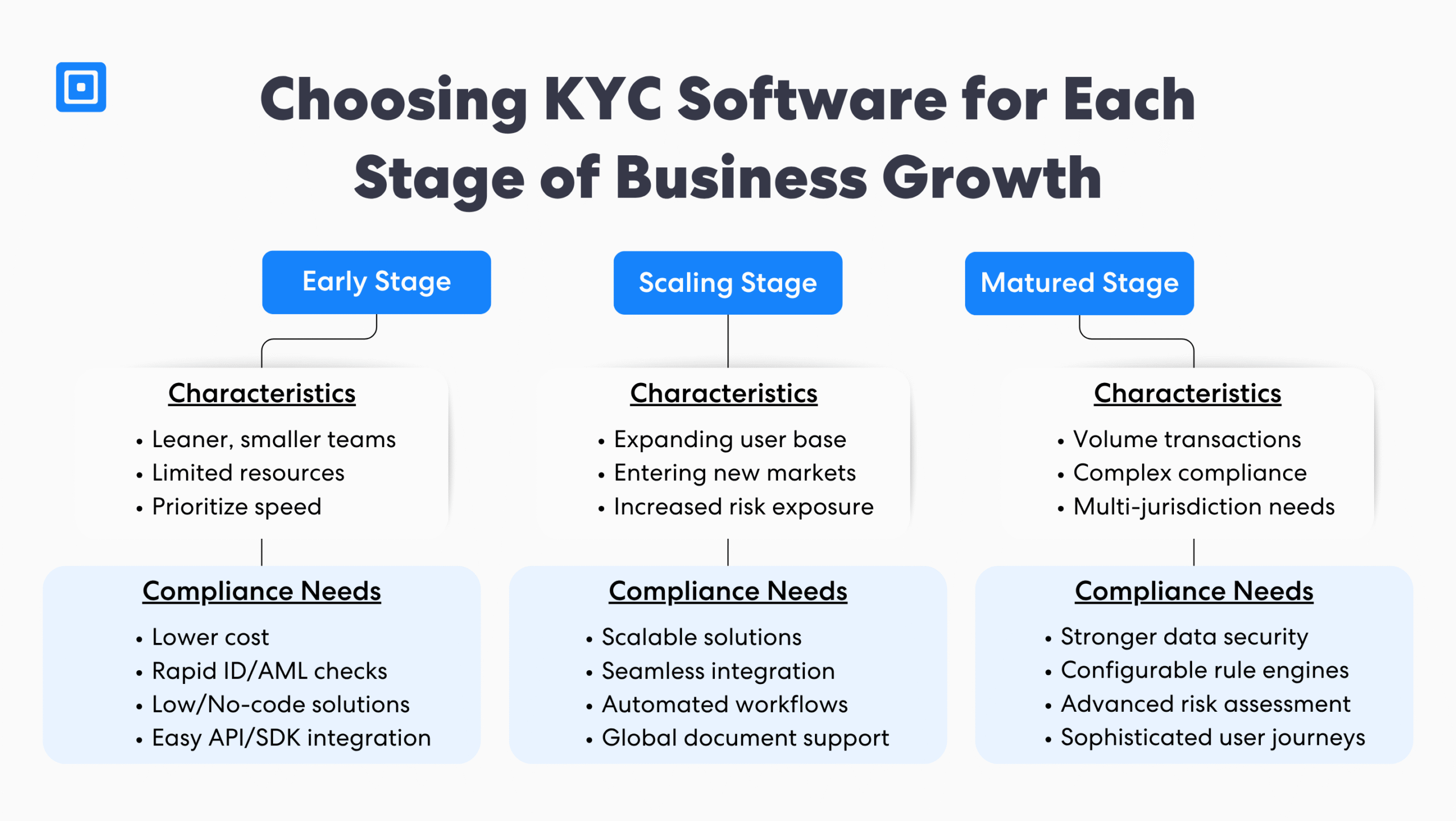
Aligning KYC solutions with current and future needs is critical to avoid painful and costly migrations. Ultimately, businesses must strike the right balance of cost-efficiency and global compliance to mitigate risk and maintain financial security:
- **Early Stage:** Startups and early-stage firms benefit from developer-first compliance platforms that require less technical setup. Opting for easy API integration and SDKs is vital in this stage as it delivers faster deployment rates without draining engineering resources. Organizations at this stage usually aim for rapid ID verification and basic AML checks to quickly identify fraudulent activity at a lower cost.
- **Scaling Stage:** Businesses expect rapid expansion at this stage as their user base and transaction volumes increase rapidly. To meet regulatory requirements, KYC processes must include higher geographic coverage and seamless integration capabilities. Companies at this stage must prioritize KYC platforms supporting a wide array of identity documents, language support, and scalable, automated workflows.
- **Matured Stage:** Organizations at this stage are typically larger, established enterprises with a greater appetite for credible solutions that can handle high volumes without compromising user experience and security. Features such as advanced risk assessment tools, role-based data management and access controls, and configurable rule engines are widely valued. These features help organizations meet stringent KYC requirements across multiple jurisdictions and seamlessly maintain the security of customer data.
## Industry-Specific Compliance Pain Points and What to Consider
Selecting providers that can address industry-specific pain points is critical to making an informed purchasing decision. This helps ensure that the solutions chosen are tailored to the industry’s unique challenges and operational nuances.
### Telecom Companies
[Telecom and mobile operators](https://www.complycube.com/en/use-cases/industry/telcoms/) commonly experience challenges in identity verification under tight activation windows and in maintaining full audit logs. Companies in this sector must focus on selecting KYC vendors with dynamic verification processes, risk reporting capability, and multilingual support.
### Financial Technology Firms (FinTech)
The most significant pain point for FinTechs is keeping up with evolving global regulations. Frameworks across different regions, such as [eIDAS](https://ico.org.uk/for-organisations/guide-to-eidas/what-is-the-eidas-regulation/) or FATF-aligned compliance standards, can be particularly challenging. FinTech companies need KYC software with broad global coverage and automated Customer Due Diligence (CDD) tools to minimize potential risks and ensure compliance. Furthermore, ensuring a provider has security certifications such as ISO 27001 and is GDPR compliant is crucial.
[](https://www.complycube.com/en/top-kyc-providers-for-startups-in-saas-and-fintech/)
### Accounting Organizations
[Accounting firms](https://www.complycube.com/en/use-cases/industry/accounting-compliance/) are prone to data breaches due to access to sensitive audit trails and financial records. The challenges faced by firms in this sector include the increasing complexity of compliance reporting requirements and the slow adoption of modern technology. As a result, accountancy organizations that fail to prioritize KYC technology risk falling behind in both security and regulatory standards. Businesses in this sector must adopt KYC solutions featuring automated workflows, transparent data management, and robust case management to ensure compliance and resilience against evolving threats.
### Crypto and Virtual Asset Providers (VASPs)
Due to their fast-moving nature, regulatory authorities are closely scrutinizing crypto platforms. [Crypto and VASP](https://www.complycube.com/en/use-cases/industry/crypto/) firms often face severe penalties due to weak AML and risk reporting processes. Thus, leveraging perpetual monitoring, also known as perpetual KYC solutions, enables them to assess updated customer information and risk profiles in real time. AI and machine learning are used to support enhanced identity verification models, detect AI-generated fraud, and protect businesses and their customers from scams.
## Aligning Strong KYC Solutions to Long-Term Strategy
KYC technology can benefit all regulated businesses dealing with significant financial transactions and user data, not just financial institutions. KYC software enables organizations to adhere to global regulations and verify client identities, preventing fraud and other illicit activities. Firms can make an informed KYC purchasing decision by combining industry-specific context and organizational operational maturity. [Learn more](https://www.complycube.com/en/contact/contact-sales/) about ComplyCube’s unified KYC platform.
[](https://www.complycube.com/en/contact/contact-sales/)
**Categories:** Guides
**Tags:** Know Your Customer
---
### [Gender Inequality in the Digital Identity Space](https://www.complycube.com/gender-inequality-in-the-digital-identity-space/)
**Published:** March 4, 2025
**Author:** Sofia Daley
**Excerpt:** Our digital identities have become as crucial as our physical ones, and inequality exists within the digital identity space as much as it does in any part of human life. Learn more about challenges faced within the IDV space.
**Content:**
Our digital identities have become as crucial as our physical ones, and inequality exists within the digital identity space as much as it does in any part of human life. Gender discrimination can be seen in the lack of identification that women possess compared to men on a global scale, as well as within AI biases due to unequal data input. Women, particularly women of colour, are being left behind in the digital identity revolution, with Identity Verification (IDV) technologies having far higher error-rates for women than men. This isn’t just a tech issue—it’s a human rights crisis with far-reaching consequences.
## The Global Physical and Digital Identity Gap
Imagine being unable to open a bank account, vote, or access healthcare simply because you lack a piece of plastic or a digital code. For a staggering [1 in 4 women](https://www.womeninidentity.org/campaigns/international-womens-day-2025-accelerateaction-for-women-in-identity) worldwide, this is reality. They lack a valid ID, effectively rendering them invisible to many systems and services we take for granted. Without the necessary documentation, these women face many disadvantages, including issues accessing healthcare, education, employment and legal protections.
> 1 in 4 women [worldwide](https://www.womeninidentity.org/campaigns/international-womens-day-2025-accelerateaction-for-women-in-identity) lack a digital ID.
“Without an ID, women are often trapped in a cycle of poverty and dependency,” says Dr. Amina Sayed, a researcher at the World Bank. “It’s not just about a card—it’s about freedom, opportunity, and dignity.”
But here’s where it gets even more alarming: the World Bank Group found that in low-income countries, [44% of women](https://documents1.worldbank.org/curated/ar/606011569301719515/pdf/Achieving-Universal-Access-to-ID-Gender-based-Legal-Barriers-Against-Women-and-Good-Practice-Reforms.pdf) don’t have an ID, compared to 28% of men. That’s nearly half of all women in these nations, cut off from full participation in society and the economy.
> In low-income countries, [44% of women](https://documents1.worldbank.org/curated/ar/606011569301719515/pdf/Achieving-Universal-Access-to-ID-Gender-based-Legal-Barriers-Against-Women-and-Good-Practice-Reforms.pdf) don’t have an ID, compared to 28% of men.
In 37 countries, married women face more obstacles than married men when applying for passports. In several nations, women also face extra legal challenges that limit their access to digital financial services. For example, married women may be required to present a marriage certificate, adopt their husband’s name, or seek approval from a male family member to obtain identification.
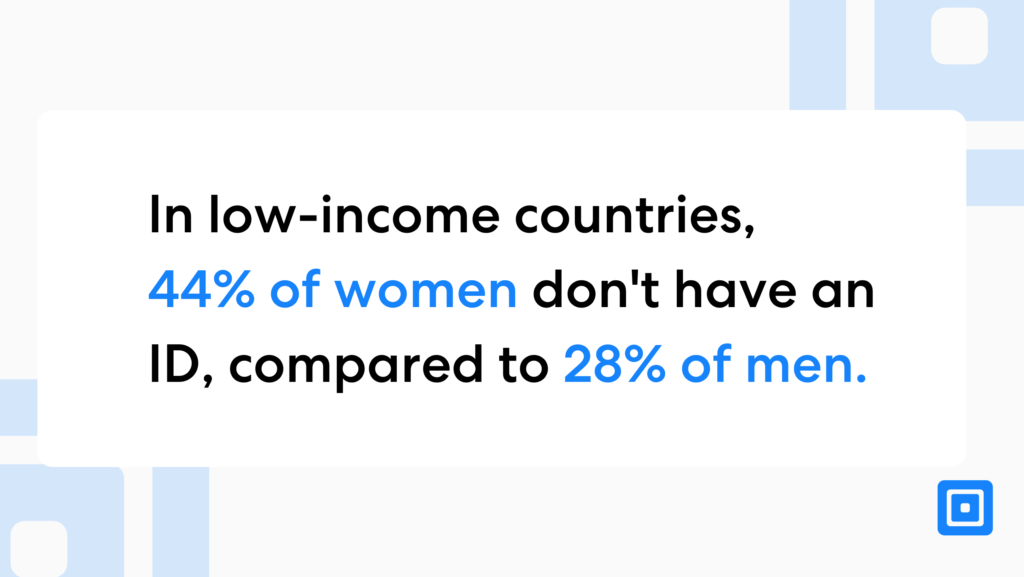
The World Bank’s 2024 Women, Business and the Law report highlights that in 14 countries, women face restrictions that prevent them from traveling outside the home freely. Additionally, women may encounter resistance or lack of support from family members, which can hinder their access to digital identification.
## When AI Plays Favourites: The Bias in the Machine
Artificial Intelligence is often thought as an equalizer, as it can eliminate human biases within decision making processes. However, what is occurring is that the data inputs into AI facial recognition systems is unequal, leading to higher error rates for women and people of colour.
> These systems misidentify light-skinned men only [0.8% of the time](https://www.aclu-mn.org/en/news/biased-technology-automated-discrimination-facial-recognition), the error rate skyrockets to [34.7% for ](https://www.aclu-mn.org/en/news/biased-technology-automated-discrimination-facial-recognition)darker-skinned women.
While these systems misidentify light-skinned men only 0.8% of the time, the error rate skyrockets to 34.7% for darker-skinned women. That’s not a small gap—it’s a very clear reflection of the inequality present within global societies.
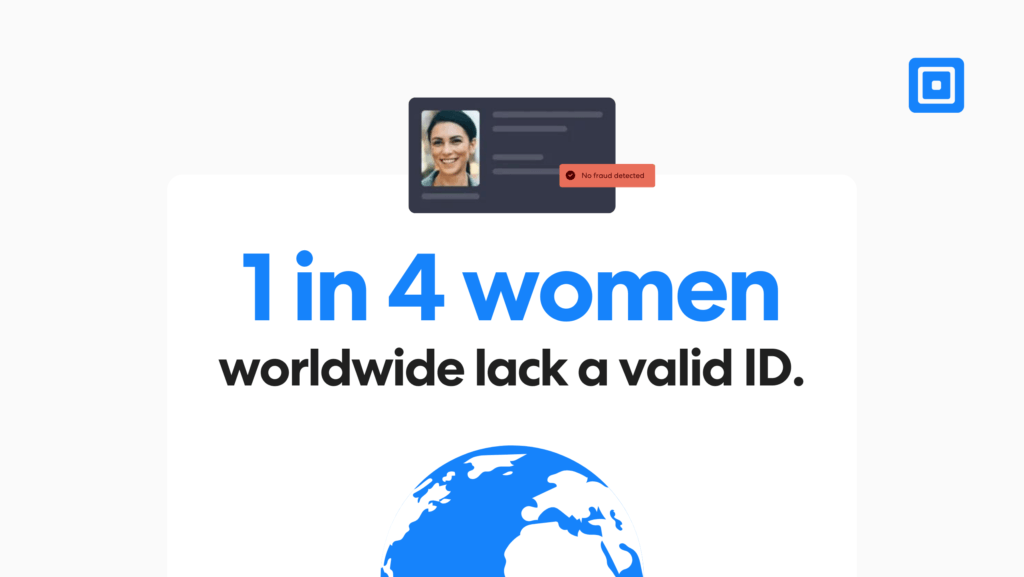
“It’s like these systems were [designed with blinders on](https://news.mit.edu/2018/study-finds-gender-skin-type-bias-artificial-intelligence-systems-0212),” notes AI ethicist Dr. Joy Buolamwini. “They simply don’t ‘see’ a large portion of the world’s population accurately.” The facial recognition bias proves that women are at a disadvantage even in western societies, where facial biometrics still possess a higher error rate for women than for men.
## Women of Colour Highly Disadvantaged
For women of colour, these issues create a perfect storm of exclusion. They’re more likely to lack traditional IDs and more likely to be misidentified by AI systems when they do interact with digital ID platforms. A [2019 test](https://www.aclu-mn.org/en/news/biased-technology-automated-discrimination-facial-recognition) by the Federal US Government concluded the technology works best on middle-age white men. The accuracy rates weren’t impressive for people of colour, women, children, and elderly individuals.
> We’re seeing 21st-century technology amplify [20th-century biases.](https://www.aclu-mn.org/en/news/biased-technology-automated-discrimination-facial-recognition)
“We’re seeing 21st-century technology amplify 20th-century biases,” warns civil rights attorney Maya Johnson. “It’s digital redlining, pure and simple.” Inequality within facial verification technology occurs is as these systems are trained on datasets with more male faces, particularly white male faces, leading to better accuracy for these groups. This happens because many early datasets were created by predominantly male researchers or sourced from data with limited diversity. As a result, women, especially women of colour, are underrepresented, causing the system to perform poorly for them and leading to misidentification or false negatives.
## Bridging the Gap: A Call to Action
So, what can be done? Experts agree that a multi-pronged approach is needed:
- **Social Initiatives**: Programs to help women obtain traditional IDs, especially in rural and low-income areas.
- **Legal Reform**: Challenging discriminatory laws that make it harder for women to obtain IDs.
- **AI Overhaul**: Diversifying AI development teams and training data to create more inclusive systems.
- **Accountability**: Implementing strict oversight and testing of AI systems for bias.
“This is a [solvable problem,”](https://pmc.ncbi.nlm.nih.gov/articles/PMC7973804/) insists tech entrepreneur Aisha Kahn. “But it requires acknowledging the issue and committing resources to fix it. We can’t afford to leave half the world’s population behind in the digital age.”
As our future becomes increasingly digital, it’s important that every platform offering facial recognition technology does their part to ensure the use of ethical, unbiased AI. At ComplyCube, ethical AI considerations have been central to our development process. We’ve implemented AI/ML systems with built-in bias-sensitive drift detection to ensure the models maintain fairness across diverse demographic groups. Our independent validation processes ensure near-uniform performance across all groups, and we continue to refine our systems to reduce bias and enhance accuracy.
For more information on partnering with an ethical AI focused IDV partner, get in touch with one of our [compliance experts. ](https://www.complycube.com/en/contact/contact-sales/)

**Categories:** Guides
**Tags:** Identity Verification
---
### [Stay Compliant with The Best Sanctions Screening Software](https://www.complycube.com/best-sanctions-screening-software-for-2025/)
**Published:** April 18, 2025
**Author:** Dini Habib
**Excerpt:** Sanctions screening software is an essential component of a robust compliance framework. It enables businesses to systematically identify and block transactions involving sanctioned individuals, entities, or jurisdictions.
**Content:**
Sanctions screening software is a tool or service built to support organizations in identifying parties listed on official sanctions list. It plays a vital role in ensuring that businesses are not caught up in transactions with sanctioned entities, thus ensuring compliance with regulatory requirements. Sanctions Screening Software plays a key role in Anti-Money Laundering (AML) and is paramount for preventing financial crimes and the risks of legal penalties.
## The Importance of Modern Sanction Screening Software
Leveraging screening software is essential for businesses to meet compliance requirements and mitigate sanctions risk efficiently. Compliance software significantly streamlines operations by reducing manual workloads, enhancing real-time detection of potential risks, and minimizing false positives. By automating the screening process, companies can avoid hefty fines, legal action, and even restrictions on business operations.
## How Sanctions Screening Software Detects Risks
Modern [sanction screening](https://www.complycube.com/en/solutions/global-screening/sanctions-pep-screening/) systems are typically integrated into a company’s existing tech stack, allowing them to automatically screen customers, partners, and users against global sanctions lists through automated screening. This integration ensures that all transactions are monitored continuously, providing international organizations with an additional layer of security against potential risks.
## The Mechanics Behind Sanction Screening Software
Sanctions screening is a wider part of the [Anti-Money Laundering (AML)](https://www.complycube.com/en/solutions/due-diligence-compliance/anti-money-laundering/) and Counter-Terrorist Financing (CTF) process. Comprehensive screening involves an initial risk assessment, ongoing monitoring, and advanced due diligence to address sanctions breaches, financial sanctions implementation, and sanctions violations enforced by regulatory bodies, such as the European Union, OFAC, and other sanctioning bodies. Let’s look at a detailed example of how it operates.
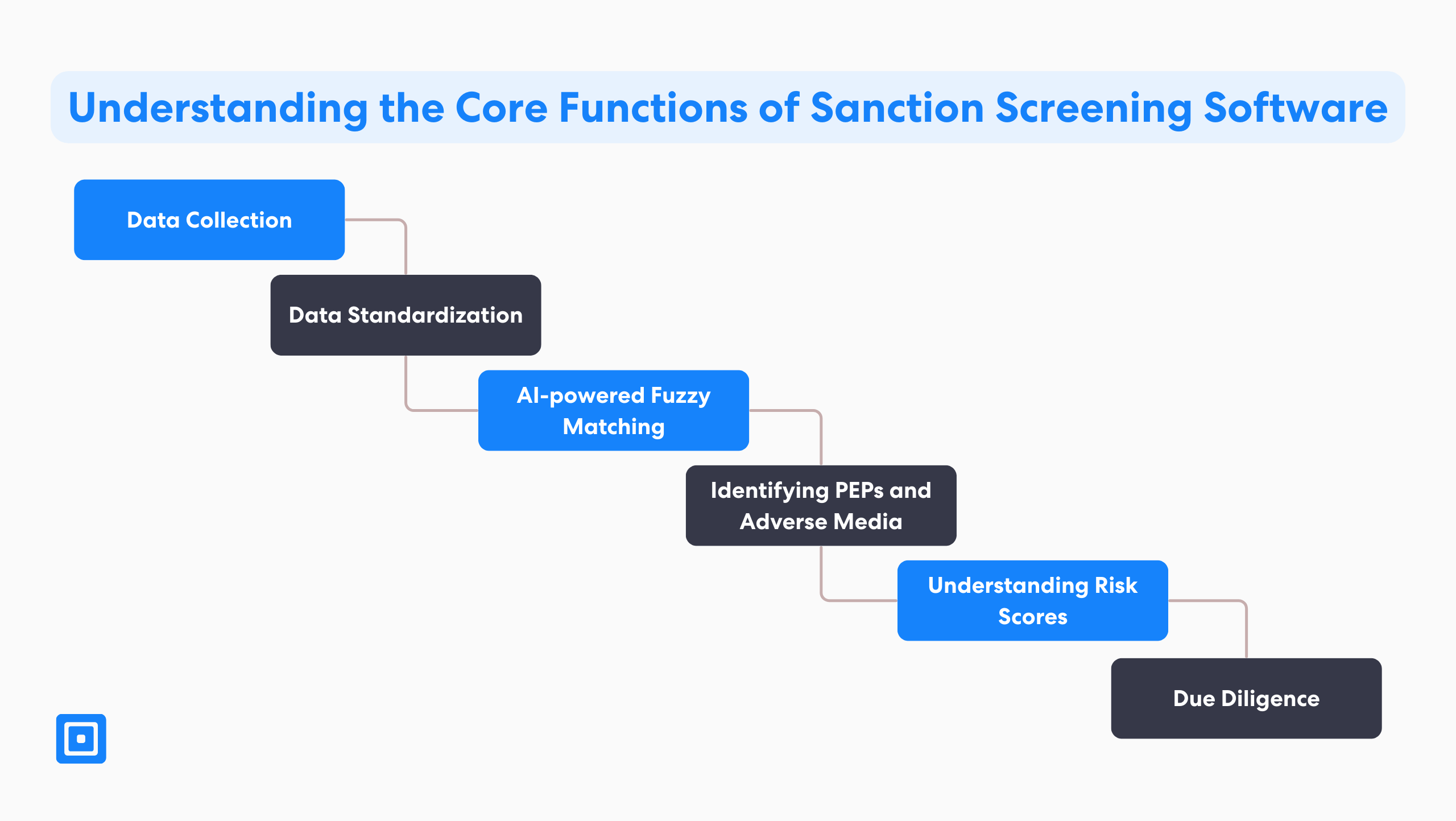
### Data Collection
The first stage is collecting essential information to verify a user’s identity and assess potential risks. This involves the initial screening of documents such as a government-issued ID, passport, bank statements, or utility bills. The documents collected will provide essential customer data and details, including one’s full name, address, date of birth, nationality, and more. In certain cases, additional data can be gathered through facial recognition or biometric verification.
### Data Standardization
The customer data then undergoes data standardization, which ensures consistency and accuracy across all records. The process involves converting all information to a uniform format, such as converting names or addresses to upper case and removing special characters to facilitate accurate comparisons against official government sanctions lists. This minimizes any discrepancies that can arise due to spelling and abbreviation variations.
### AI-powered Fuzzy Matching
Advanced screening software leverages Artificial Intelligence (AI) and Machine Learning (ML) techniques, such as fuzzy matching, to enhance the accuracy of identity verification. Fuzzy matching enables the system to recognize and account for data variations, including misspellings or transliterations. This ensures that potential matches are not flagged or missed unintentionally due to minor discrepancies.
### Identifying PEPs and Adverse Media
A key aspect of sanction screening is identifying [politically exposed persons (PEPs)](https://www.complycube.com/en/what-is-a-pep/) and assessing an individual’s media presence to detect potential risks. The software cross-references global PEP databases, news articles, or other publicly available sources to determine if such individuals have been involved in illegal activities. This real-time screening allows firms to make informed decisions before proceeding with customer transactions and onboarding.
### Understanding Risk Scores
The entity being screened will be given a risk score based on the comprehensive data consolidated, such as the closeness of the name match or data credibility. A higher risk score indicates a greater likelihood of non-compliance or financial crime exposure. Compliance officers can set alerts to determine the validity of the data proposed and choose to report the party or pass them through the onboarding stage.
### Due Diligence
[Due diligence](https://www.complycube.com/en/solutions/due-diligence-compliance/customer-due-diligence/) refers to monitoring a customer’s transactions or behavior. Since sanctions lists and risk factors are prone to frequent changes, it is essential to implement ongoing monitoring should any risks arise over time. Utilizing screening software enables businesses to stay up-to-date with any emerging or evolving changes to the sanctions list and watchlist.
## The Key Components of Sanctions Screening Software
Sanctions screening solutions can include a multitude of features that strengthen compliance efforts. Here, we’ve compiled the most common terms used and what they mean.
- **Sanctions Screening:** Cross-references entities against government-issued and international sanctions lists.
- **Adverse Media Screening:** Flags if an individual or company has been mentioned negatively in media reports, indicating potential risks.
- **Politically Exposed Persons (PEPs):** Identifies if an individual who holds prominent public positions or is closely related to such individuals. They are considered higher risk due to their potential influence and access to resources.
- **Watchlist Screening:** A broader term that includes checking a party against various databases, including Sanctions Lists, Politically Exposed Persons (PEPs), and Adverse Media Lists.
## Sanctions Screening Software versus Manual Screening
Historically, companies relied on manual screening methods, which are time-consuming and prone to human error. Modern compliance software, such as ComplyCube’s all-in-one platform, offers a more efficient alternative for international organizations to manage risk and maintain compliance.
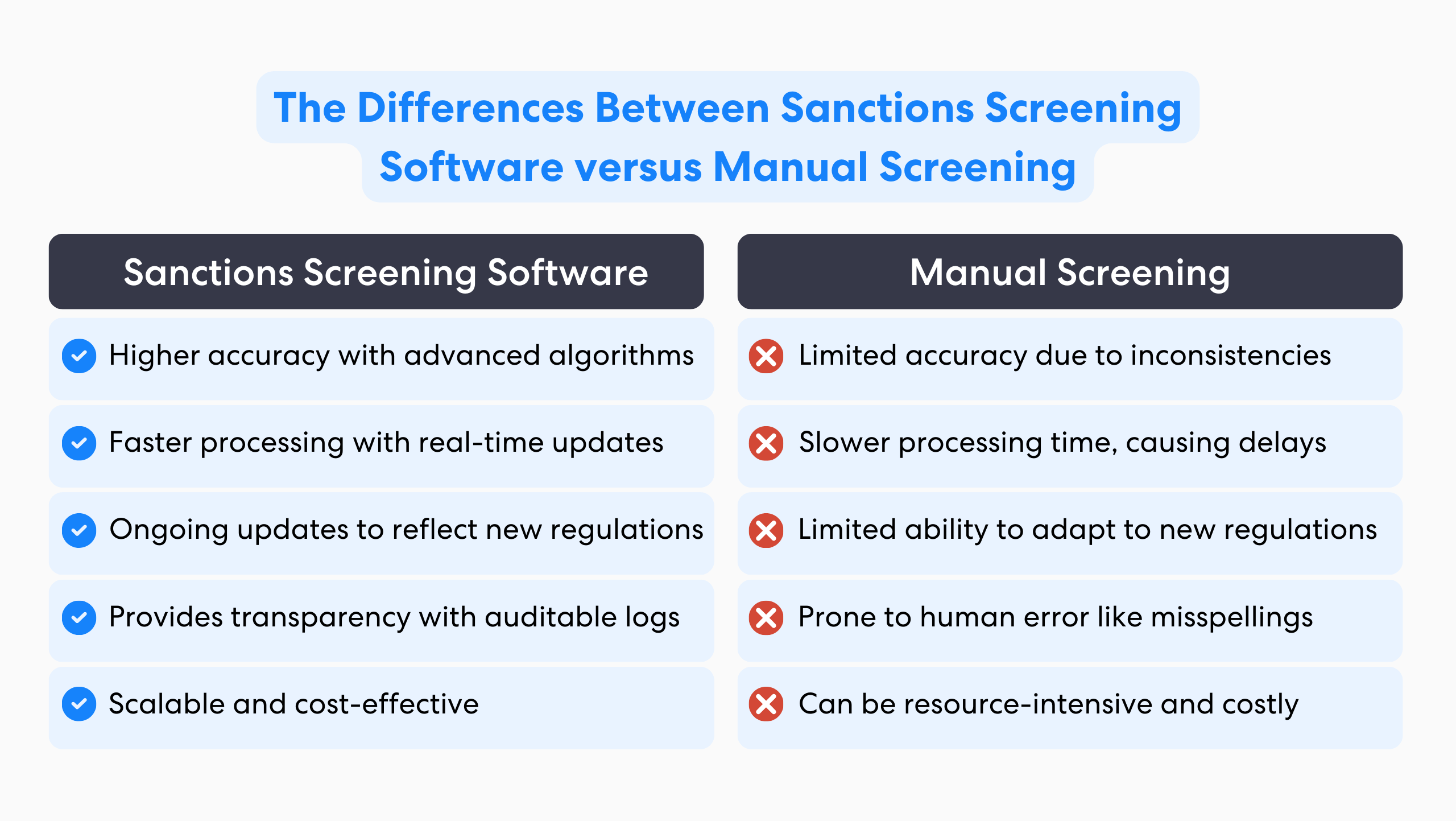
### Reducing False Positives
One of the most significant challenges in sanctions screening is managing false positives, which refer to instances where legitimate entities are incorrectly flagged. In this context, ComplyCube uses sophisticated proprietary AI and algorithms to screen users across a myriad of touchpoints, enabling accuracy and consistency in verification.
### Advanced Machine Learning and Natural Language Processing
Compliance software leverages advanced technology and extensive databases involving artificial intelligence and machine learning to help businesses better match names, handle linguistic variations, and analyze complex data sets more effectively. The results include faster transaction processing times, reduced delays, and enhanced customer experience.
### Global Coverage
Screening software enables businesses to comply with regulations across a multitude of different jurisdictions. Given the constantly evolving nature of global sanctions and regulatory requirements, these tools provide access to updated comprehensive databases that reflect the most recent changes to sanctions lists worldwide.
### Enhanced Due Diligence and Risk Management
Businesses are empowered to make informed decisions through a systematic and auditable trail of activities, making compliance accessible, transparent, and efficient. Additionally, real-time updates and notifications of a customer’s changed status can be accessed, allowing businesses to proactively mitigate risks before they escalate.
### Tailored Solutions
Another significant advantage of screening software is its flexibility. It allows organizations to customize their compliance workflow to fit their unique needs. Many platforms provide low-code or no-code options, APIs, and CRM integrations, allowing firms to adjust screening parameters according to their risk appetite and regulatory requirements.
## The Hefty Costs of Ignoring Sanctions
Any organization that fails to implement secure sanctions screening and anti-money laundering measures can face severe regulatory penalties, monetary damages, and reputational risk. Businesses across industries, including financial institutions, tech, hospitality, or retail, can be penalized for engaging with sanctioned parties. The damages can range from million-dollar fines to having their operations completely halted. Some of the most significant cases involve major financial institutions facing substantial consequences due to inadequate sanctions screening.
### The Sanctions Slip-ups at Starling Bank — 2024
In 2024, the leading finance firm Starling Bank was fined [a massive £28.96 million](https://www.fca.org.uk/news/press-releases/fca-fines-starling-bank-failings-financial-crime-systems-and-controls) by the UK’s Financial Conduct Authority (FCA) for its shortcomings in its anti-money laundering and financial crime sanctions screening process. The bank had used an outdated system, screening only a fraction of the full sanctions list since 2017. This led to over 54,000 bank accounts being opened for 49,000 high-risk customers who were able to make financial transactions between September 2021 and November 2023.
### Barclays Under Anti Money Laundering Scrutiny — 2025
Barclays, the banking giant, previously faced a £72 million fine in 2015 for failing to manage financial crime risks related to ultra-high-net-worth politically exposed persons (PEPs). The company is now facing a second financial crime investigation in just under three years for its weak implementation of robust identity verification and screening of customers. Get [the complete information here.](https://www.complycube.com/en/barclays-under-aml-scrutiny/)
### TD Bank’s Record-Breaking Fine — 2024
Just last year, TD Bank [was fined nearly C$9.2 million](https://www.reuters.com/business/finance/canadas-anti-money-laundering-agency-imposes-67-mln-fine-td-bank-2024-05-02/) by Canada’s anti-money laundering agency. This is a first look at a case of this scale in Canada. The Financial Transactions and Reports Analysis Centre of Canada (FINTRAC) found that the bank had failed to submit suspicious transaction reports for high-risk clients and did not document money laundering and terrorist financing risks, highlighting the importance of regulatory compliance.
In today’s ever-changing sanctions landscape, financial institutions must stay ahead of evolving sanctions screening requirements to protect the financial system and prevent financial crimes such as money laundering and terrorist financing. With stricter enforcement from regulatory bodies like the European Union, OFAC, and other sanctioning bodies, businesses need reliable sanctions screening solutions to manage risk and avoid significant penalties.
## Safeguarding Businesses with Enhanced Sanction Software
Beyond the financial institution industry examples above, navigating global sanctions programs is essential for ensuring compliance with international regulations. Effective sanctions screening solutions are vital to help detect sanctioned entities, high-risk individuals, and politically exposed persons, mitigating financial crime risks and prohibiting illicit activities. As regulatory bodies stricten compliance requirements, organizations must adopt enhanced due diligence and alert management to prevent sanctions breaches and reduce false positives.
Automated compliance platforms, such as modern sanction screening software, enable firms to quickly onboard clients and make secure financial transactions while managing risks associated with high-risk individuals and sanctioned entities. Solutions like ComplyCube support financial institutions in screening sanctions, performing initial risk assessments, and ensuring compliance with financial sanctions, trade restrictions, and international regulations.

**Categories:** Guides
**Tags:** Anti-Money Laundering
---
### [Bybit Faces $1.5bn Loss in Digital Crypto Scam](https://www.complycube.com/bybit-faces-1-5bn-hack-in-biggest-crypto-scam/)
**Published:** March 3, 2025
**Author:** Sofia Daley
**Excerpt:** In what is being described as the largest digital crypto scam ever, the cryptocurrency exchange Bybit has fallen victim to a massive hack, losing an estimated $1.5bn in Ethereum. Learn more about the impact of the digital heist.
**Content:**
In what is being described as the largest digital crypto scam ever, the cryptocurrency exchange Bybit has fallen victim to a massive hack, losing an estimated $1.5bn in Ethereum. The Dubai-based platform reported that a North-Korean attacker gained control of an Ethereum wallet and transferred the funds to an unknown address, causing alarm amongst the crypto sector as a whole.
Despite the scale of the breach, Bybit assured its customers that their individual holdings remained secure. Co-founder and CEO Ben Zhou emphasized that the company had the financial strength to cover the loss, even if the stolen funds were not recovered. The company holds $20bn in customer assets, providing a buffer against the loss.
The attack occurred during a routine transfer of Ethereum from an offline “cold” wallet to a “warm” wallet used for daily trading. While all other wallets were unaffected, the hack led to a surge in withdrawal requests, causing delays for some users. Ethereum’s price dipped[ nearly 4% following](https://www.bbc.co.uk/news/articles/ckgdy5e3neko) the news but has since regained much of its value.
In response, Bybit has sought assistance from cybersecurity experts and crypto analytics specialists to recover the stolen funds. The exchange has also promised a reward of up to $140m for the recovery of the full amount. This breach marks a significant setback for the cryptocurrency industry, just as it had started to gain momentum amid favorable political conditions in the U.S.
> North Korea is the most sophisticated and well-resourced launderer of cryptoassets in existence, continually adapting its techniques to evade identification and[ seizure of stolen assets.](https://www.yahoo.com/news/north-korea-plunders-world-crypto-144944458.html?guccounter=1&guce_referrer=aHR0cHM6Ly93d3cuZ29vZ2xlLmNvbS8&guce_referrer_sig=AQAAACqsz03286Qv_l_FSrRTK-wRVy8LywLz6N6Niu6v-bsc-M3Ed4tlRYHg7IzSBIvDoNshegOM59K3gZWN9GwtPd_lBqcUfLT2P5trr2jvYnAEaEHR2mxChKb2xx4lsY4KtdKpXaEB5TrTzO7AVQMiswP-hqe6nyMslsXNteWG8H1Q)
As the investigation continues, speculation about the perpetrators has pointed to groups like North Korea’s Lazarus Group, which is known for its involvement in similar large-scale heists. Bybit’s commitment to strengthening its security infrastructure is crucial in restoring trust within the crypto space.
## The Need for Increased Security for Large Transactions
When dealing with transactions of significant value, like the $1.5bn hack in Bybit’s case, robust identity verification should be a standard practice. Large transactions should be treated with extra scrutiny for any financial institution, whether traditional banks or cryptocurrency exchanges. With such large sums involved, additional layers of verification should ensure that only authorized individuals can approve or execute these transfers. This is a safeguard against fraud and essential to mitigating the risk of internal or external breaches.
Many traditional financial institutions already use enhanced identity verification for high-value transactions, so expecting the same from cryptocurrency exchanges wouldn’t be unreasonable. Financial services often use methods like identity verification for wire transfers over a certain threshold or additional scrutiny for international transfers, and this could be implemented more widely in the crypto space.
The hack occurred when an attacker exploited security controls during a routine transfer from a cold wallet to a warm wallet. This suggests a vulnerability in the access management process. By implementing more stringent identity verification measures for accessing high-value wallets, Bybit could have ensured that only authorized personnel could initiate such transfers.
As the cryptocurrency industry matures, customers and regulators alike are increasingly expecting these measures. In fact, regulatory bodies may require stricter identity verification protocols in the future to combat money laundering, fraud, and other illicit activities in the space.
## The Extent of Crypto Scams: Wallet Hacks Are Not a New Occurrence
Unfortunately, crypto wallet hacks are not new, pointing to a strong need for increased identity verification protocols. Implementing stronger identity verification systems, increasing transparency in security protocols, and staying ahead of emerging threats will be critical for reducing the risk of future attacks.
> In 2024, funds stolen increased by approximately [21.07% year-over-year (YoY) to $2.2 billion](https://www.chainalysis.com/blog/crypto-hacking-stolen-funds-2025/#:~:text=The%20Chainalysis%202025%20Crypto%20Crime%20Report&text=In%202024%2C%20funds%20stolen%20increased,about%20halfway%20through%20the%20year.), and the number of individual hacking incidents increased from 282 in 2023 to 303 in 2024.
The Chainalysis 2025 Crypto Crime Report underlines the increase in crypto scams. “Crypto hacking remains a persistent threat, with four years in the past decade individually seeing more than a billion dollars worth of crypto stolen (2018, 2021, 2022, and 2023). 2024 marks the fifth year to reach this troubling milestone, highlighting how, as crypto adoption and prices rise, so too does the amount that can be stolen. In 2024, funds stolen increased by approximately[ 21.07% year-over-year (YoY)](https://www.chainalysis.com/blog/crypto-hacking-stolen-funds-2025/#:~:text=The%20Chainalysis%202025%20Crypto%20Crime%20Report&text=In%202024%2C%20funds%20stolen%20increased,about%20halfway%20through%20the%20year. "https://www.chainalysis.com/blog/crypto-hacking-stolen-funds-2025/#:~:text=The%20Chainalysis%202025%20Crypto%20Crime%20Report&text=In%202024%2C%20funds%20stolen%20increased,about%20halfway%20through%20the%20year.") to $2.2 billion, and the number of individual hacking incidents increased from 282 in 2023 to 303 in 2024.”
With the amount of stolen funds rising by over 21% in 2024, it’s clear that we cannot afford to take these threats lightly. Identity verification is no longer just a regulatory checkbox—it’s a vital tool to safeguard assets and protect the integrity of the entire industry.
Moving forward, both crypto exchanges and users need to be more proactive in securing their digital assets. Bybit’s commitment to improving security may help restore trust, but it’s up to the entire crypto ecosystem to learn from this breach and take necessary steps to ensure that this “largest theft” remains a thing of the past.
## Fortifying Crypto Wallets in 2024
As scammers become increasingly sophisticated, wallets must fortify their defenses. The key is to identify potential threats when onboarding new customers and continuously monitor them to identify any risks that may arise. Crypto wallets must prioritize KYC and IDV to protect both businesses and customers.
### Critical checks include:
**[Identity Verification:](https://www.complycube.com/en/solutions/identity-assurance/biometric-verification/)** Identity verification should be included within all crypto wallets and high-value transactions. Ensuring that customers are who they claim to be by analyzing biometric data points ensures security at all times. IDV checks can be ran during customer onboarding, during wallet login processes as well as throughout high value transfers.
**[KYC Fortified Onboarding: ](https://www.complycube.com/en/kyc-checks-for-a-secure-and-scalable-onboarding-process/)**A full KYC check, including document verification, identity verification, multi-bureau checks and more to ensure that new customers are trustworthy. This reduces the chances for bad actors to use the platform.
[**AML Infrastructure:** ](https://www.complycube.com/en/crypto-aml-compliance-securing-the-sector/)Preventing financial crimes, such as money laundering and terrorist financing, is also critical to ensure that your crypto wallet is free from fraud. This protects not just individual customers, but your organisation as a whole.
If you’re looking to fortify your Crypto business from fraud, implementing these checks are a necessary first step to ensuring compliance and security. For more information, reach out to our expert compliance team [today](https://www.complycube.com/en/contact/contact-sales/).
[](https://www.complycube.com/en/contact/contact-sales/)
**Categories:** News
**Tags:** Crypto Regulations
---
### [The CryptoCubed Newsletter: April Edition](https://www.complycube.com/the-cryptocubed-newsletter-april-edition/)
**Published:** April 23, 2025
**Author:** Sofia Daley
**Excerpt:** In this issue, we highlight Binance India's latest policy update, marking a significant step toward enhanced KYC procedures as part of the exchange's efforts to meet stricter AML standards. This, and more, in this month's edition.
**Content:**
👋 Welcome back to CryptoCubed!
In this issue, we highlight Binance India’s latest policy update, marking a significant step toward enhanced KYC procedures as part of the exchange’s efforts to meet stricter AML standards. Meanwhile, across the globe, regulatory scrutiny intensifies with notable updates from South Korea, Australia, and the U.S., where companies like Upbit and Block Inc. face serious compliance challenges. Buckle up, it’s time for CryptoCubed.

## Binance India Levels Up in KYC Compliance
On April 18th, Binance announced a significant policy update requiring all users in India, both new and existing, to complete a full re-verification of their Know Your Customer (KYC) details. This move aligns with the exchange’s broader efforts to comply with India’s anti-money laundering (AML) regulations and strengthen platform-wide security protocols.
The company emphasized that this policy is grounded in legal and regulatory requirements set by Indian authorities. Users will be asked to provide updated identification information as part of the re-verification process.
To address privacy concerns, Binance reassured users that only essential data would be collected and that it would be protected under strict security standards. The exchange reiterated its commitment to combating financial crime and fostering a secure, responsible digital asset environment.
This development comes amid a tightening regulatory landscape in India, where all registered crypto platforms—whether domestic or international—are expected to follow similar compliance measures. Binance highlighted its official status in India:
> Binance is registered with the Financial Intelligence Unit-India and adheres to Indian AML legislation. This includes obtaining your PAN details as part of our KYC process, which is a requirement under the Indian AML laws.
India’s Permanent Account Number (PAN), a unique 10-character alphanumeric code issued by India’s Income Tax Department, is mandatory for individuals and entities conducting financial transactions in the country. Binance clarified that this requirement is not exclusive to its platform but applies universally to all exchanges operating under Indian AML regulations.
For more on this story, click [here](https://news.bitcoin.com/binance-india-goes-full-compliance-mode-with-re-verification-mandate/).
## Upbit Faces Suspension Over KYC/AML Violation in South Korea
South Korea’s Financial Intelligence Unit (FIU) has issued a suspension notice to Upbit. The government has accused the crypto giant of violating KYC and AML regulations. This may result in fines totaling 35.8 billion Korean won (nearly $25 million).
In addition, the exchange’s license renewal has actually been on hold since late 2024, with South Korean authorities stating that they need more time to thoroughly investigate a number of suspected violations before concluding whether or not they should be granted the license.
Shockingly, the exchange accounts for 70% of South Korea’s digital asset trading volume, showing the business’s significance and dominance within their crypto market. This further underlines the need for adequate KYC controls, as Upbit sets its national standard.
For more information, click [here](https://crypto.news/south-koreas-regulator-issues-suspension-warning-to-upbit-over-700000-kyc-violations/).
## AUSTRAC Taskforce Flags Weak Anti-Money Laundering Controls Among Australian Crypto ATM Operators
A task force established by the Australian Transaction Reports and Analysis Centre (AUSTRAC) has raised concerns that some cryptocurrency ATM providers may not be implementing proper Anti-money Laundering and counter-terrorism financing (AML/CTF) safeguards.
In December of 2024, Brendan Thomas launched the Australian Transaction Reports and Analysis Centre (AUSTRAC), an internal task force in Australia to ensure regulatory enforcement and transaction intelligence. The task force has been focusing on AML and terrorist financing risks presented by crypto ATMs, also called “crypto kiosks”.
> The taskforce has been busy engaging with businesses to understand the risks in their sector and assess their compliance with the law. It has identified worrying trends and indicators of suspicious activity, including transactions that may be linked to scams or fraud. ~ Brendan Thomas
Australia now leads the Asia-Pacific region in the number of crypto ATMs. What began as a niche service has seen explosive growth—from just 23 machines in 2019 to over 1,600 in operation today. These kiosks, primarily installed by digital currency exchanges, are heavily used for depositing cash to purchase Bitcoin.
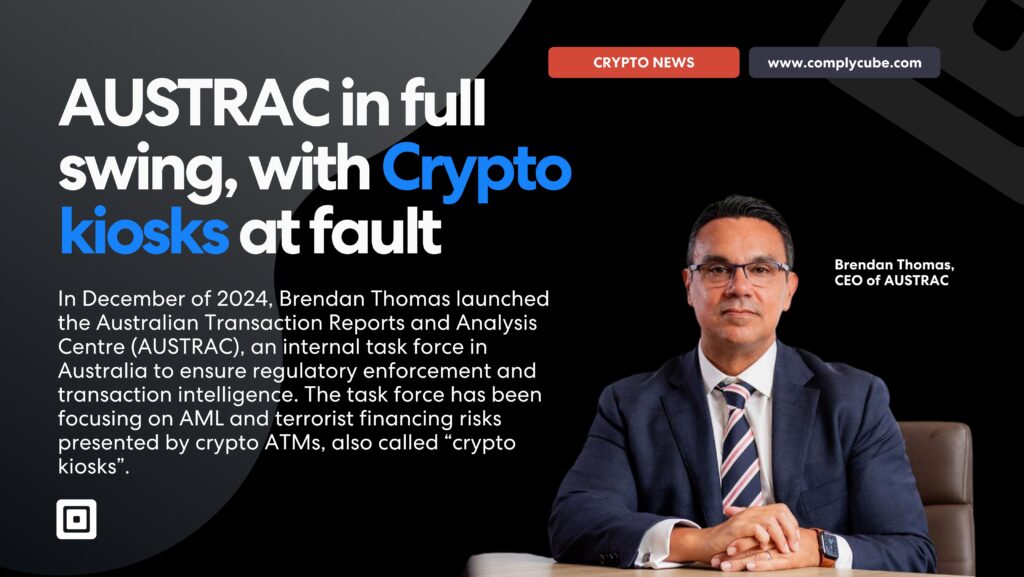
With such rapid expansion, AUSTRAC is placing greater scrutiny on how these machines are managed and whether they could be exploited for criminal purposes.
For more on this, click [here](https://fxnewsgroup.com/forex-news/cryptocurrency/austrac-finds-aml-ctf-deficiencies-at-crypto-atm-providers/).
## **Trump Expands Presidential Pardon Power to Include Corporations, Pardoning BitMEX**
In an unprecedented move, President Trump has extended the power of presidential pardons to include corporations, a decision that has sparked significant controversy. Traditionally, presidential pardons have been used to grant clemency to individuals convicted of federal crimes, but this expansion could have far-reaching implications for corporate accountability in the United States.
Corporations, legal entities designed to maximize shareholder profit, can theoretically commit crimes and face legal repercussions, as outlined in a 1999 memorandum from the Justice Department. This memorandum emphasized that prosecuting corporations for crimes, especially those with the potential for public harm, such as financial fraud, has significant public benefits, including deterrence on a large scale.
However, these principles are now being called into question after President Trump pardoned BitMEX, a cryptocurrency company that has faced serious charges related to financial misconduct. The company, which operates as a cryptocurrency exchange offering derivatives tied to assets like Bitcoin, has been at the center of a legal storm for its failure to comply with anti-money laundering (AML) regulations.
In August 2020, BitMEX admitted to violating the Bank Secrecy Act by operating without a proper AML program. The company was found to have allowed customers to trade anonymously before implementing any robust verification processes. This failure to prevent illicit activity led to a $100 million criminal fine, in addition to $130 million in civil penalties imposed by the Commodities Futures Trading Commission (CFTC).
Trump issued full pardons to four individuals and BitMEX, effectively wiping out both the criminal penalties and the legal consequences related to the company’s actions. With the pardon, BitMEX is immune from any future federal prosecutions for crimes covered by the pardon, even if new violations are uncovered.
By pardoning BitMEX, Trump has effectively set a new precedent that corporations engaged in serious financial crimes, particularly in the cryptocurrency space, may be exempt from accountability under his administration. This sends a troubling message to the financial world: major companies involved in illicit activities may be able to avoid legal consequences if they are politically connected.
Find more on this story [here](https://thehill.com/opinion/criminal-justice/5224229-trump-makes-history-by-pardoning-a-corporation/).
## Cash App’s AML Shortcomings Lead to a $40 Million Fine
Block Inc., the parent company of Cash App, has agreed to pay a $40 million penalty following a regulatory investigation into significant lapses in its anti-money laundering (AML) compliance program.
On Thursday, April 10, the New York Department of Financial Services (NYDFS) announced a penalty, stating that it followed the discovery of “significant failures” in Block’s Bank Secrecy Act/anti-money laundering (BSA/AML) compliance program.
In addition to the financial penalty, the company must appoint an independent monitor to conduct a thorough assessment of its compliance with NYDFS regulations. The department noted that Block Inc. cooperated fully with the investigation and has “already committed significant financial and other resources” to address the issues identified.
The business stated, “This is an enduring effort. We are committed to continued investment in safety and full compliance with both the letter and the spirit of the law as our program continually evolves.”
For more on this story, click [here](https://www.pymnts.com/aml/2025/block-fined-40-million-for-cash-apps-anti-money-laundering-failures/).
## Over 30% of Wealthy Koreans Prefer Crypto as a Long-Term Wealth Strategy
New data highlights a growing trend in South Korea, where over 30% of wealthy investors are increasingly turning to cryptocurrency for long-term value growth, surpassing traditional assets like gold and real estate.
According to a recent report by Hana Bank, South Korea’s major financial institution, younger investors in particular are showing a marked preference for digital assets. The bank’s think tank suggests this shift could be more than just a short-lived trend, signaling a potential change in investment patterns, particularly as conventional financial systems fail to meet the expectations of the younger generation.

The report suggests that if digital assets gain official status as a financial investment product and are recognized for settlement purposes, it could pave the way for a new financial order. While the report stops short of predicting crypto as the future of finance, it emphasizes the increasing likelihood of a paradigm shift in the financial landscape.
The data paints a revealing picture. Over 70% of South Korea’s affluent investors, those with more than 10 million won (approximately $7,000), have now invested in cryptocurrency, an amount that is more than twice as high as the average investment in other asset classes.
For more on this story, click [here](https://crypto.news/over-30-of-wealthy-koreans-prefer-crypto-as-a-long-term-wealth-strategy/).
## ComplyCube’s Crypto Guides: Staying Ahead of the Sector
Stay up-to-date with everything Crypto on the ComplyCube website, with relevant guides that can help your business stay crypto compliant. Here’s an excerpt from our recent piece, [“Understanding UK Crypto Regulation in 2025.”](https://www.complycube.com/en/uk-crypto-regulation-in-2025/)
### Understanding UK Crypto Regulation in 2025
*As the US spearheads the global crypto surge, the future of UK crypto regulation remains uncertain. Tulip Siddiq, the U.K. Treasury Minister and a prominent advocate for cryptocurrency regulation, has resigned, leaving the nation with questions over the future of crypto in Britain. Meanwhile, the FCA reports that 12% of UK adults now own cryptocurrency, a clear indication that Britain is eager to avoid being sidelined as America embraces its new financial frontier.*
*The [FCA’s crypto roadmap](https://www.fca.org.uk/publication/documents/crypto-roadmap.pdf) was first released in 2023, marking the regulator’s approach to stabilizing the sector’s growth. The roadmap outlines some clear focuses for the FCA, including consumer protection, market integrity, and Anti-money Laundering (AML) measures.*
*However, critics argue that the U.K. risks falling behind global competitors if it does not accelerate the implementation of these regulations. As one recent opinion piece in The Fintech Times pointed out, the pace of regulatory development is critical as nations like the U.S. and the European Union push ahead with their own crypto frameworks.*
Read the full piece [here](https://www.complycube.com/en/uk-crypto-regulation-in-2025/).
## Time for Some Light-Hearted Creative Criticism?
So you’ve made it to the end of our newsletter. It’s time to enjoy a little satire, worthy reader, you’ve earned it.
### 🔥THE CRYPTOCUBED POEM: APRIL🔥
This month, a controversial presidential pardon was agreed,
As Trump loves BitMEX’s imaginary AML and KYC.
South Korea goes crazy for crypto as a long-term strategy,
As their Crypto giant Upbit faces millions for acting nastily.
When it comes to crypto, one thing is for sure,
No one seems to give a damn about the law.
Block Inc.’s founder thought he could sidestep every rule,
Another million-dollar fine, and another cryptocubed fool.
### Stay tuned for our May newsletter, and have a great month!

**Categories:** News
**Tags:** Crypto Regulations
---
### [Best KYC Software For 2025](https://www.complycube.com/best-kyc-software-for-2025/)
**Published:** March 28, 2025
**Author:** Sofia Daley
**Excerpt:** Choosing the best KYC software is critical to keep your business compliant and free from fraud, but this isn't always an easy decision to make. This guide will dive into how KYC protects businesses from compliance fines.
**Content:**
Choosing the best KYC software is critical to keep your business compliant and free from fraud, but this isn’t always an easy decision to make. This guide will dive into how KYC protects businesses from compliance fines and helps smooth out onboarding processes, while explaining what you should look for in a KYC provider.
KYC software is important for regulatory compliance as it assists companies in maintaining their customers’ information up to date and preventing them from being used in illegal activities like money laundering. Sophisticated KYC systems excel at identity verification, document management, real-time monitoring, and integration with current software. The future of KYC software is centered on greater automaton, artificial intelligence-driven tools for accuracy enhancement in verification processes, and decentralized technologies for greater security and anonymity.
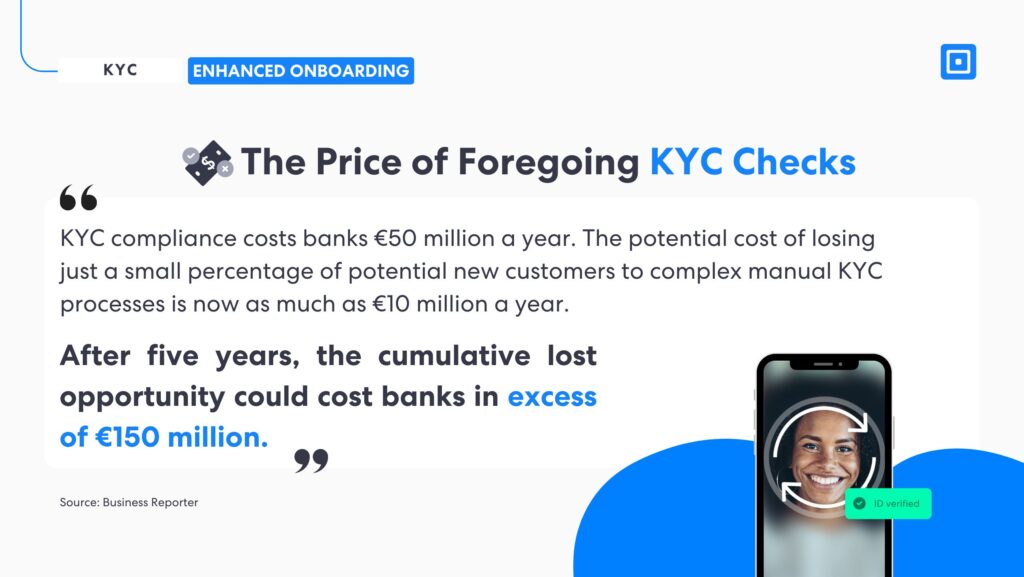
## What is KYC Software?
KYC software assists companies, especially financial institutions, in keeping their customer information current and correct as per regulatory requirements. It streamlines the customer onboarding process, such that all the necessary checks are performed effectively. The KYC process includes customer identity verification and risk assessments, through processes such as digital ID verification, face recognition, and biometric authentication.
> After five years, the cumulative lost opportunity could cost banks in excess of [€150 million](https://www.business-reporter.co.uk/finance/why-kyc-automation-matters-and-how-it-helps-fintech-companies-prevent-fraud)
Partnering with a KYC platform may seem like an unnecessary expense, however the price of foregoing these checks is often far higher. Business reporter pointed out that, “KYC compliance costs banks €50 million a year. The potential cost of losing just a small percentage of new customers to complex manual KYC processes is now as much as €10 million a year. After five years, the cumulative lost opportunity could cost banks in excess of €150 million.” This doesn’t even take into account the regulatory fines that are often handed out to businesses, with TD Bank facing a fine in the billions in 2024. For more on the TD Bank fine, read [“TD Bank Fails Anti Money Laundering Compliance.”](https://www.complycube.com/en/td-bank-fails-anti-money-laundering-compliance/)
## How Best KYC Software Empowers Financial Services
The best KYC software enables financial institutions to streamline compliance processes by automating customer onboarding, enhancing due diligence, and ensuring regulatory compliance with stringent KYC regulations. Through advanced identity verification solutions, such as biometric verification and digital identity verification, these systems help perform KYC checks and verify customer identities effectively, reducing the risk of identity theft and financial crimes like money laundering and terrorism financing.
KYC processes, including customer due diligence and ongoing monitoring, help businesses manage customer accounts while adhering to Anti-Money Laundering (AML) solutions and compliance requirements. KYC providers integrate with existing systems, offering a robust verification system to ensure accurate customer data management and risk assessment. In addition to verifying individuals, KYC software can handle business verification, ensuring that business entities meet KYC compliance standards.
The integration process of these systems allows for automated KYC document management and verification, reducing manual intervention and improving the customer experience. Through appropriate due diligence measures, financial services can maintain a customer identification program (CIP) and monitor politically exposed persons (PEPs) for regulatory compliance. With these KYC solutions, financial institutions can onboard legitimate customers, reduce risks, and improve customer relationships while staying compliant with the Financial Crimes Enforcement Network (FinCEN) and other regulatory bodies.
## Characteristics of the Best KYC Software
The best KYC software utilizes various tools to facilitate companies to comply and minimize risks. Some of the main characteristics are:
- **System Integration:** Smooth integration with existing banking or financial systems offers efficiency and better compliance monitoring.
- **Identity Verification with Document and Biometric Checks:** These facilities enable businesses to authenticate the identities of their clients and store KYC documents in a secure and structured manner.
- **Anti-Money Laundering (AML) Tools:** The tools are necessary in order to ensure that companies can track suspect activities and comply with the law.
- **Ongoing Monitoring:** The tool provides additional protection as it detects fraud in real-time.
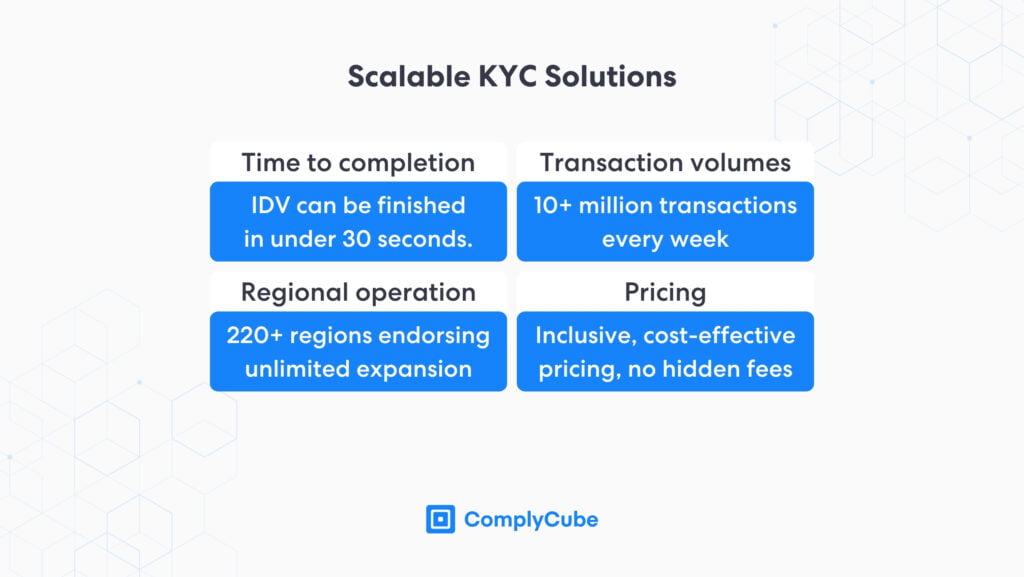
## The Benefits of KYC Automation
KYC process automation leads to an improved onboarding process that increases customer experience. Over 70% of KYC-related onboarding processes will be automated by 2025, driven by technologies like biometric authentication and eID verification. Automated processes, in addition to enabling organizations to stay compliant, reduce the risk of fines, improve security, as well as detect latent fraud.
When choosing a KYC solution, choose vendors who show a good understanding of regulatory requirements. Consider features like identity verification, customer onboarding, document management, and surveillance on a permanent basis. Coverage globally is a must for businesses across the globe, and the application of emerging technologies like AI and machine learning also becomes a requirement. Security must also be a priority. Top KYC vendors must provide secure protection of customer data, yet also seamless, effective onboarding procedures. Looking out for recognized industry awards, such as the RegTech 100, or government certifications, such as the UK DIATF, can help you identify trustworthy providers. Learn more about the [UK DIATF framework here.](https://www.complycube.com/en/comprehensive-guide-to-the-uk-diatf-framework/)
## The Role of AI in KYC
AI also plays an important part in KYC since it achieves speed and precision in verification. AI systems monitor enormous amounts of data in an attempt to look for suspicious transactions and money laundering. AI and machine learning through the year 2025 will reduce false alerts for transactional monitoring by a substantial percentage, thus making it easier to do risk management and compliance. In addition, AI fortifies the biometric verification process, with AI analyzing facial features and powering liveness detection. AI-powered OCR similarly strengthens the document verification process, extracting information with OCR.
## Future Trends in KYC Technology
KYC solutions find extensive application in regulatory compliance, anti-fraud security, and frictionless onboarding. These solutions in 2025 offer high-end capability in the form of AI-based verification, biometric identity verification, and frictionless system integration. With these kinds of advanced technologies, businesses can attain security, ease compliance, and provide an improved customer experience. As fraud continues to evolve, so must identity verification and KYC.
As new forms of fraud evolve, new sectors will need to rely on KYC technologies to protect their customers and their platform. Social media platforms will need increased user verification, as new regulations, such as the recent [“UK’s Online Safety Act” (OSA)](https://www.inetco.org/news/uk-online-safety-act-2025-and-beyond/), spearheaded by Ofcom, come into play.
## Protect Your Business From Fraud with Best KYC Software
As technologies continue to improve, AI and blockchain-based KYC will bring increasing efficiency, transparency, and compliance to enable companies to remain competitive in regards to regulatory shifts and customer demands. For more information on how to fortify your business with advanced KYC infrastructure, get in touch with one of our [compliance experts](https://www.complycube.com/en/contact/contact-sales/ "https://www.complycube.com/en/contact/contact-sales/").

**Categories:** Guides
**Tags:** Know Your Customer
---
### [A Guide to KYC API Pricing in 2025](https://www.complycube.com/a-guide-to-kyc-api-pricing/)
**Published:** May 29, 2025
**Author:** Sofia Daley
**Excerpt:** Understanding KYC API Pricing is critical to choosing the right provider in 2025. Learning what factors push up pricing can help you secure the best deal for your organisation. This guide breaks down everything you need to know.
**Content:**
**TL;DR:** KYC API pricing can be a key concern when evaluating identity verification vendors. As regulatory scrutiny heightens, businesses need to balance **cost management** with compliance precision. This guide explores the **pricing models**, cost variables, and investment decisions affecting the KYC API market.
## Understanding KYC API Pricing Models
Selecting an affordable KYC API is no longer just about finding the lowest price; it is about finding scalability with compliance without compromising on verification quality. KYC API pricing structures vary considerably between vendors based on the differences in architecture, product maturity, and market focus. Model choice can have a substantial impact on compliance cost and the scalability of the business.
### 1. Per-Call Pricing
It entails charging a fixed amount per verification request, such as document verification, biometric verification, or AML screening. It is easy and uncomplicated but can be expensive for high-volume operations.
### 2. Tiered Pricing
Vendors offer levels of pricing based on usage levels. As the number of verifications increases, the per-call cost decreases. The model promotes volume but creates price cliffs when volume fluctuates wildly.
### 3. Volume-Based Subscriptions
Customers pre-pay for a bundle of verifications on a monthly or annual basis. It provides cost predictability and bulk discounts. Unused verifications may not roll over, so there can be waste in case of wrong estimates.
### 4. Flat-Rate or Custom Bundles
Some providers offer flat monthly rates or custom packages combining multiple services such as IDV, biometric liveness, and AML filtering. That model best suits mature compliance companies that want the flexibility and ease of use.
## Which Is Best For Your Business?
The ideal API Pricing model depends on business size, speed of onboarding, and compliance risk exposure. Startups may like the ease of pay-as-you-go, while banks or large fintech players are benefited by subscription predictability. For more on KYC pricing, read [“How Much Does KYC Cost?”](https://www.complycube.com/en/how-much-does-kyc-cost/)
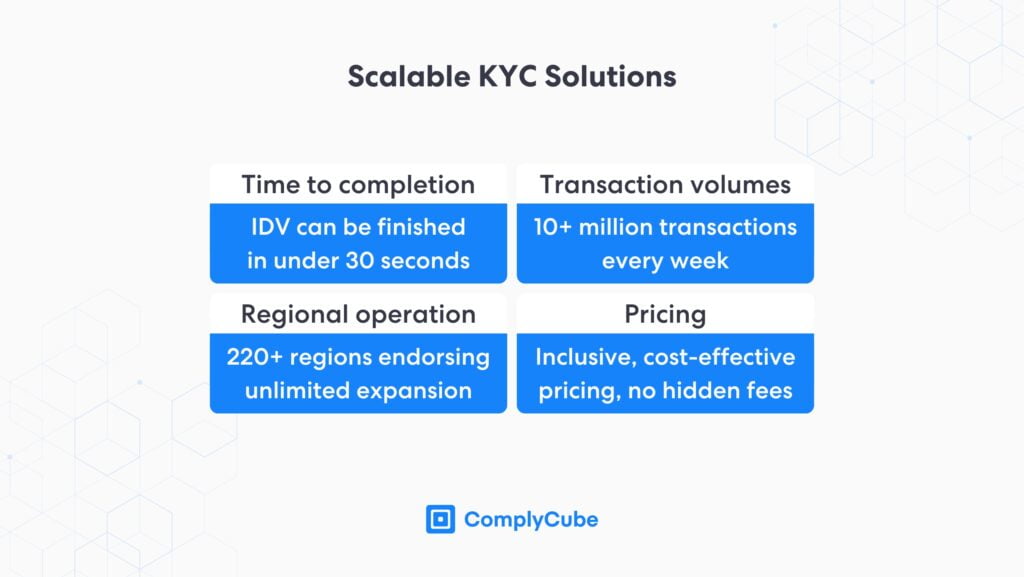
## Key Cost Drivers Behind KYC API Pricing
While the pricing models provide the structure, the real cost of KYC APIs is determined by a chain of underlying technical and operational drivers. Understanding these drivers enables organisations to budget correctly and avoid hidden costs.
### 1. Geographic and Document Coverage
Global operations require KYC solutions that can verify ID documents in several hundred countries. The wider the coverage, the more investment in document templates, OCR models, and mapping compliance rules, all of which affect costs.
### 2. Verification Layer Complexity
More advanced solutions past simple ID verification, such as adding biometric liveness, AML screening, and fraud detection, have a higher cost of operations and infrastructure. Multilayered checks enhance reliability while affecting pricing.
### 3. Accuracy and False Positive Handling
Solution vendors that invest in low false-positive rates, manual fallback processes, and continuous model training return better-quality results. This raises the cost of operations but reduces long-term risk to clients.
### 4. Usage Patterns and Infrastructure Load
Extended onboarding periods might cause spikes in volume. APIs must handle high concurrency, geographic load balancing, and failover processes, all with enterprise-class price plans.
## Total Cost of Ownership (TCO) Implications
In determining KYC API cost, with one eye on per-call pricing only telling half the story, actual budgeting must take into consideration the Total Cost of Ownership (TCO), such as integration, scalability, and ongoing operational overheads.
### 1. Integration and Setup Costs
Initial configuration charges vary based on the architecture of the vendor. REST APIs with robust SDKs and sandbox environments reduce time-to-market and developer frustration. But there are vendors who purchase setup support, test materials, or specialist technical support at additional costs.
### 2. Maintenance and Compliance Updates
Continuous maintenance, from bug fixes, new doc templates, and compliance upgrades, can be bundled, but perhaps not. Sneaky costs can arise if consumers are charged for every update or minor tweak.

### 3. Automation and No-Code Workflows
No-code orchestration platforms reduce the reliance on engineering teams. These platforms enable business users to build and edit compliance flows cost-effectively, decreasing operational costs in the long term.
### 4. Support, SLA, and Monitoring
Premium SLAs, 24/7 support, and real-time monitoring dashboards are possible add-ons. They are essential for high-risk sectors but need to be factored into the overall pricing strategy.
## Pricing Benchmarks and What to Expect
KYC API pricing is fuelled by evolving regulatory needs, advanced fraud, and the evolution of AI-powered verification. While actual prices vary on the vendor and the setup, industry benchmarks serve as a place to start comparing.
### 1. Typical Price Ranges
- ID Document Verification: $0.10 to $1.50 per check, depending on the type of document and region.
- Biometric Liveness & Face Match: $0.25 to $2.00 per session.
- AML and Watchlist Screening: $0.05 to $0.80 per search.
Bundling (combining IDV, biometric, and AML checks) can offer efficiency, especially whenboarding thousands of customers monthly.
### 2. Regional Price Variations
Pricing is based on regional risk exposure and document diversity. For example:
- US and Canada: Reasonable prices due to coverage by digital ID and relatively homogenous document structure.
- EU and UK: Higher compliance mandates (e.g., GDPR, DIATF) may increase verification costs.
- APAC and LATAM: Prices are highly volatile due to document heterogeneity and region-level verification infrastructure.
### 3. Impact of Regulation and Risk
Categories more vulnerable to money laundering, such as crypto or fintech, generally require more screening, which increases average cost. Additionally, changes to regulation can influence vendor cost. For example, the [Financial Action Task Force (FATF)](https://www.fatf-gafi.org/content/dam/fatf-gafi/guidance/Guidance-on-Digital-Identity-report.pdf) guidance on digital identity expects firms to assess the level of assurance offered by a platform, rather than selecting low-cost technology that merely confirms an identity document exist.
As such, organizations will need stronger biometric evidence, reliable data sources, and clear audit trails, which can dramatically impact KYC cost. For more on regulatory requirements, read [“Understanding KYC Requirements UK.”](https://www.complycube.com/en/understanding-kyc-requirements-uk-a-quick-guide-for-2025/)
### **Case Study: Reduce Verification Costs with a Scalable KYC Solution**
With the rise of AI, tampered documents, including false driving licenses has seen a steep increase. For Turo, the leading car-sharing company in the UK, this meant security, scalability and trust are more important than ever for customer and driver safety.
##### **The Need for Scalable, Customizable KYC**
Turo’s partnership with ComplyCube presented the quickest way for Turo to achieve secure end-to-end identity verification without unnecessary friction in its operations or driver journeys. ComplyCube’s automated KYC platform enhanced onboarding while lowering costs.
##### **Outcomes**
- Turo significantly reduced verification [costs by 34%](https://www.complycube.com/en/customer/turo-strengthens-car-sharing-compliance/) through automation, enabling a higher focus on more important growth initiatives.
- The company was able to enhance its rider and driver **conversion by 15%**, boosting frictionless user journeys and trust.
- Turo reduced its false positive and customer support **contact rate by 36%**, enhancing onboarding for legitimate users.
## Measuring ROI Beyond Price
### 1. Fraud Mitigation and Onboarding Precision
High-precision KYC APIs abolish abandonment, false positives, and manual verification during onboarding. These improvements accelerate revenue growth, enhance customer satisfaction, and protect against reputational harm from fraudulent accounts.

### 2. Regulatory Risk Mitigation
Automation of compliance reduces the risk of regulatory breaches and fines. Real-time screening for PEP and sanctions, logging of audits, and liveness detection all contribute to robust compliance that finds favor with regulators.
### 3. Operational Efficiency
Automated orchestration and passive liveness detection solutions lower user friction. It results in higher completion rates and lower support intervention, improving scalability and customer satisfaction.
### 4. Strategic Growth Enablement
Flexible KYC APIs for emerging markets, languages, and ID types make it possible for organisations to grow without re-negotiating compliance processes. ROI in such a case is through faster market entry and localisation.
### Key Takeaways
- **Common KYC API** pricing models include per-call, tiered, volume-based subscription, and flat-rate pricing.
- **Factors influencing KYC** API cost are geographic coverage, verification complexity, false positive accuracy, and usage patterns.
- **Calculating the total cost** of ownership provides a holistic understanding of the total KYC costs, including setup fees.
- **Free trials and modular pricing** support testing before committing, which is ideal for balancing compliance speed and budget.
- **Businesses** with high volume can expect lower costs per verification through automated KYC platforms such as ComplyCube.
## How ComplyCube Optimizes KYC API Pricing
[ComplyCube’s KYC API](https://www.complycube.com/en/pricing/) is priced on the principles of transparency, adaptability, and performance. It enables customers to scale without unexpected expenses or compliance compromises.
For more information on how to fortify our business with global Know Your Customer solutions, get in touch with one of our [compliance experts.](https://www.complycube.com/en/contact/contact-sales/)

## Frequently Asked Questions
What are the main KYC API pricing models?
Main KYC API pricing models include pay-per-check, where a fee is paid for each complete KYC verification, volume-based subscription that scales discounts by verification volume, and tiered pricing, where pricing is based on usage level.
How much does KYC API pricing cost per verification?
Typical KYC API cost for document verification ranges from $0.10 to $1.50 per check, biometric liveness and face match from $0.25 to $2.00 per session, and AML and watchlist screening from $0.05 to $0.80 per search. However, these costs can vary due to country coverage and volume required.
What is the total cost of ownership of KYC solutions?
The total cost of ownership of KYC services includes integration, scalability, and ongoing operational costs. Initial configuration charges, such as setup cost, technical specialist, and integration support that are hidden, can cause frustration and overspend. Additionally, maintenance and monitoring fees can quickly raise fees.
What affects the cost of KYC API pricing?
The cost of KYC API pricing is influenced by usage patterns, verification complexity, and false positive accuracy. Moreover, geography coverage, where a business requires verification in multiple territories, can scale the KYC API cost.
How much does ComplyCube’s API pricing cost?
ComplyCube provides flexible, scalable KYC API pricing models that reduce costs for high-volume teams. Its automated document verification ranges from $0.75 to $1.05 per check, and the liveness check from $0.20 to $0.35 per check. ComplyCube provides zero setup fees and transparent pricing for high-growth firms.
**Categories:** Guides
**Tags:** Know Your Customer
---
### [Global Watchlist Screening for Enhanced AML](https://www.complycube.com/global-watchlist-screening-for-enhanced-aml/)
**Published:** May 22, 2025
**Author:** Sofia Daley
**Excerpt:** Global watchlist screening is one of the most effective ways of doing so. It plays a critical role in AML framework strengthening and adherence to international regulations. Learn more about how watchlist screening can help.
**Content:**
Anti-money laundering (AML) efforts are more crucial than ever for businesses of all sectors and sizes. Financial institutions, governments, and businesses must proactively defend themselves from financial crimes such as money laundering, terrorist financing, and sanctions violations. Global watchlist screening is one of the most effective ways of doing so. It plays a critical role in AML framework strengthening and adherence to international regulations. This guide will break down how global watchlist screening can help your businesses strengthen AML efforts.
## What Is Global Watchlist Screening?
Global watchlist screening refers to the cross-checking of an organisation’s customers, transactions, or other parties against multiple authoritative global, regional, and local watchlists. These lists typically include individuals or entities suspected of involvement in illegal activities, such as sanctions lists, politically exposed persons (PEP) lists, or high-risk individuals and businesses. This allows organisations to detect and prevent risky business relationships from damaging their reputation or financials in the first place.
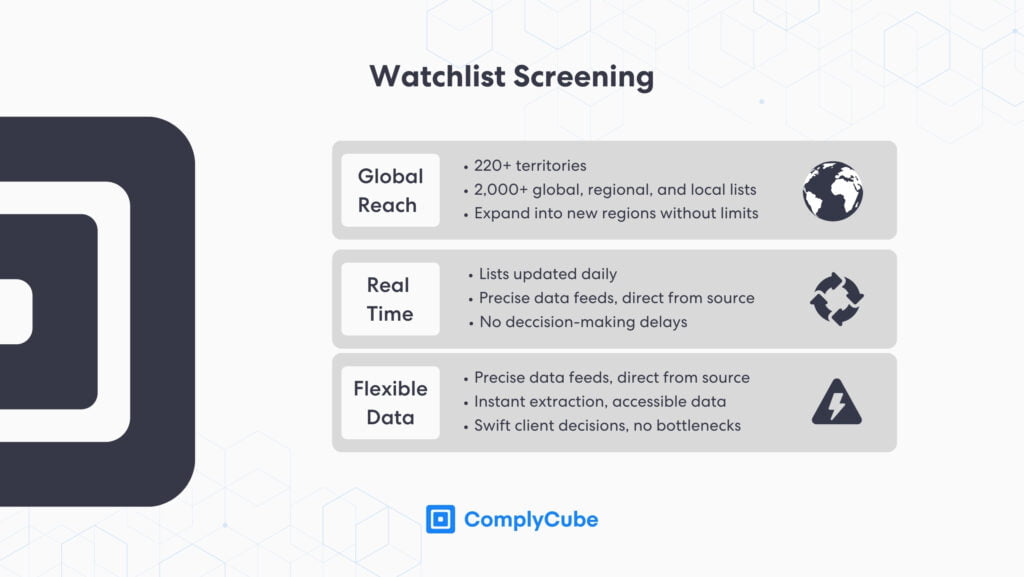
## Why Is Global Watchlist Screening a Must for AML?
The global nature of financial transactions compels financial institutions to take the initiative in screening customers and business relationships that go beyond geographical boundaries. AML regulations and compliance expectations are becoming more rigorous, and fines and penalties for lack of compliance are becoming more severe. Watchlist screening averts:
- Money Laundering: The washing of “dirty” money from criminal activities, often through complex international transactions.
- Terrorist Financing: Supporting or enabling terrorism through the provision of funds or resources.
- Sanctions Violations: Engaging in business with or trading with individuals or entities listed on international sanctions lists, which can result in severe legal and financial repercussions.
By conducting full global watchlist screening, organizations can not only meet regulatory expectations but also be assured that they are secure from engaging in business with high-risk individuals or entities.
## Key Features of Effective Global Watchlist Screening
### 1. Comprehensive List Coverage
One of the main components of successful watchlist screening is access to a broad and diverse range of watchlists. Global watchlist screening solutions typically offer access to thousands of official lists from around the world, including:
- Sanctions lists: Issued by regulatory bodies such as the United Nations, the U.S. Department of the Treasury, and the European Union.
- PEP lists: A large database of politically exposed persons who may represent higher risk due to their position or influence.
- Adverse media and high-risk individuals: Lists of individuals or entities that have been implicated by negative news reports, investigations, or legal actions.
With multiple sources being used, companies make sure that they are leaving no stone unturned and protecting themselves from every direction.
### 2. Advanced Matching Algorithms
Traditional watchlist screening methods are weak in matching names precisely, especially in multilingual and multicultural settings. Advanced watchlist screening solutions use AI-driven algorithms to match names phonetically, account for variant spellings, and apply fuzzy logic to identify potential matches. This works to significantly reduce the occurrence of false positives so that companies don’t waste time screening irrelevant or low-risk subjects.
### 3. Real-Time Screening and Monitoring
Time is money in AML compliance. Banks must screen customers in speed without losing out on accuracy. Advanced global screening platforms offer real-time or near real-time screening, which ensures customers are screened the instant they enter the system. Continuous monitoring is also required to stay updated on any changes to the watchlists. A client who is not flagged initially may be added to a sanctions list at any time, so continuous monitoring helps mitigate the risk of exposure after onboarding.
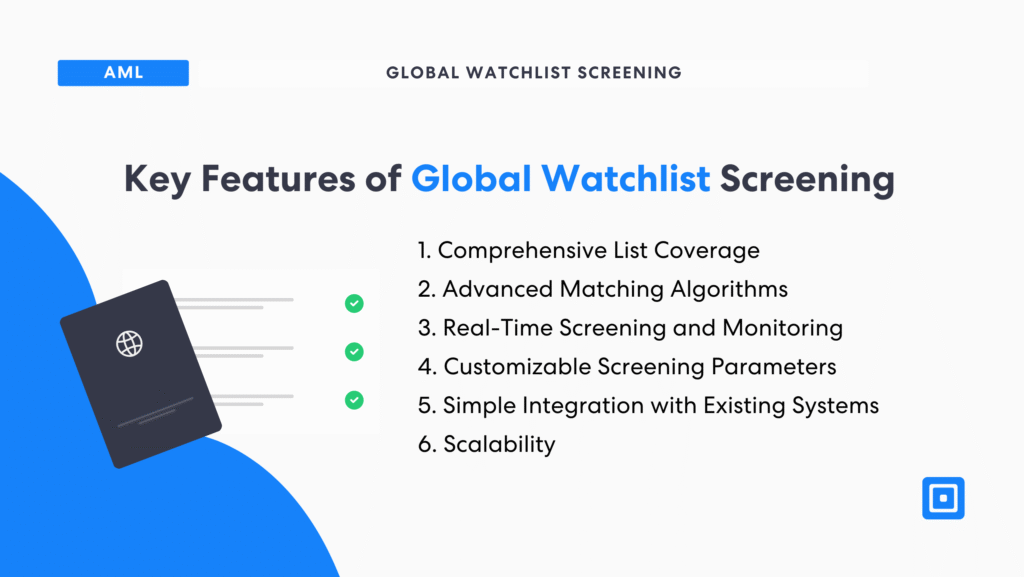
### 4. Customizable Screening Parameters
No two businesses have the same risk profile. Effective global watchlist screening allows for the setting of parameters to suit an organization’s individual needs. This may be in terms of adjusting the sensitivity of name-matching algorithms or giving precedence to specific high-risk jurisdictions or sectors. By tailoring the screening, businesses can more directly align their compliance activity with their risk management policy.
### 5. Simple Integration with Existing Systems
AML compliance software must be simple to integrate with an organization’s existing systems and processes. Global watchlist screening can be integrated with customer onboarding systems, transaction monitoring systems, and customer relationship management (CRM) software. Using APIs or no-code/low-code solutions, this type of integration allows businesses to maintain a streamlined workflow while being compliant without adding complexity. For more on integrating AML and KYC solutions with your existing tech stack, read [“What is an Identity Verification API?”](https://www.complycube.com/en/what-is-an-identity-verification-api/)
### 6. Scalability
As businesses grow and venture into new markets, their compliance efforts increase in volume and complexity. Global watchlist screening solutions must be scalable to handle an increasing number of customers, transactions, and regulations. Scalable systems ensure that businesses can meet compliance irrespective of their size or the complexity of their operations.
## Real-World Impact: Strengthening AML Compliance
Global watchlist screening can significantly strengthen an organization’s AML program by:
- Mitigating Risk: It aids in the identification of high-risk individuals at an early phase, allowing companies to avoid relationships with criminal entities.
- Compliance with Regulatory Requirements: Companies can meet regulatory demands, escaping fines, sanctions, and legal battles.
- Safeguarding Reputation: By preventing business relationships with high-risk individuals or entities, organizations shield their reputation and maintain the trust of clients and stakeholders.
- Enhancing Efficiency: Real-time screening and automation reduce the need for human intervention, improving operational efficiency and precision.
> Global watchlist screening is a cornerstone of AML compliance.
[Harry Varatharasan](https://www.linkedin.com/in/harryvaratharasan/), Chief Product Officer at ComplyCube, states, “Global watchlist screening is a cornerstone of AML compliance, helping businesses safeguard against financial crime by proactively identifying high-risk individuals and entities, ensuring integrity, and protecting both reputation and regulatory standing.”
## Fortified AML Across Every Frontier with ComplyCube
Global watchlist screening is a key component of a strengthened AML compliance program. It equips financial institutions and businesses with the means to detect and prevent high-risk relationships, meet regulatory expectations, and safeguard their reputation. By harnessing the power of sophisticated matching algorithms, real-time monitoring, and flexible screening capabilities, businesses can strengthen their AML initiatives and traverse the landscape of global financial regulation with assurance.
In an increasingly interconnected world, leveraging advanced watchlist screening that is complete, automated, and scalable is not just a best practice, it is an imperative part of doing business in a compliant, secure, and responsible manner.
For more information on how to fortify your business with global watchlist screening, get in touch with one of our [compliance experts.](https://www.complycube.com/en/contact/contact-sales/)

**Categories:** Guides
**Tags:** Anti-Money Laundering
---
### [AML Checks for Accountants UK: A Guide](https://www.complycube.com/aml-checks-for-accountants-uk-a-guide/)
**Published:** May 22, 2025
**Author:** Sofia Daley
**Excerpt:** Anti-Money Laundering (AML) screening is a significant aspect of the UK financial landscape, particularly for accountants with immediate access to customers' financial information. Learn more about AML for accountants in the UK.
**Content:**
**TL;DR:** **AML checks for accountants UK** are essential for compliance and preventing financial crime. Strong AML checks for accountants include due diligence, ongoing monitoring, and suspicious activity reporting. Effective **AML checks** reduce risk, protect firms, and **support regulatory compliance**.
Anti-Money Laundering (AML) screening is a significant aspect of the UK financial landscape. Particularly, this is relevant for accountants with immediate access to customers’ financial information. Screening against money laundering, fraud, and terrorist financing is a fundamental aspect in protecting businesses against exploitation for criminal purposes.
Therefore, with stringent regulations surrounding every move, accountants must exercise caution and adhere to such regulations to guarantee the healthiness of the financial system. In this guide, we’ll explore the importance of AML checks for accountants UK, the key regulations to be aware of, and the steps accountants should take to ensure compliance.
## What Are AML Checks?
In the first place, AML screening detects and discourages money laundering activities. Money laundering is making illegally obtained proceeds appear legal. It typically consists of three stages: placement (depositing illegal money), layering (concealing the illegal source of money), and integration (making the illegal money appear legal).
Additionally, for accountants, this means they must do due diligence on their clients, their clients’ transactions, and even, in some cases, their clients’ customers, to ensure that the funds flowing through the financial system are not from crime.
> Each firm’s [AML compliance](https://www.accountingweb.co.uk/tech/tech-pulse/anti-money-laundering-software-what-accountants-should-look-for) also needs to be unique.
David Winch, the AML & Onboarding Adviser at MLRO Support Ltd, argues, “Each accountancy firm is unique – not least because the partners in it have a unique experience, knowledge, and interests,” said Winch. “In my opinion, each firm’s [AML compliance](https://www.accountingweb.co.uk/tech/tech-pulse/anti-money-laundering-software-what-accountants-should-look-for) also needs to be unique.” For more on UK AML regulation, read [“Achieving Compliance: UK AML Regulation.”](https://www.complycube.com/en/achieving-compliance-uk-aml-regulation/)
## Why Are AML Checks Important for Accountants?
Indeed, as they are gatekeepers to the financial system, accountants have an excellent opportunity to report suspicious transactions. Non-compliance with AML regulations can be extremely costly for accountants and their firms, such as hefty fines, loss of reputation, or even prosecution. In doing so, accountants are not only helping preserve the integrity of the financial system but also keeping themselves from being a passive facilitator of illicit activity.
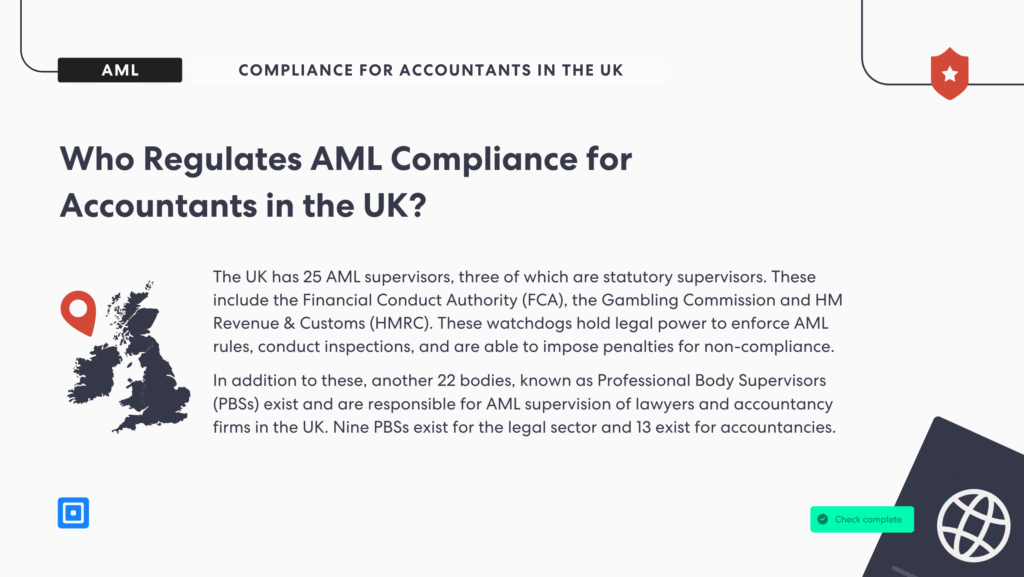
## UK Accountants’ Key AML Legislation
In fact, the UK boasts a robust anti-money laundering regime, based on a risk-based approach, and it is crucial that accountants know which specific legislation applies to their practice. Some of the key acts are:
### 1. The Proceeds of Crime Act 2002 (POCA)
Firstly, the POCA forms the basis of UK anti-money laundering. It criminalizes money laundering and establishes the obligations of UK businesses, including accountants, to report suspicious transactions.
### 2. The Money Laundering, Terrorist Financing and Transfer of Funds Regulations 2017
These regulations, more commonly referred to as the “MLR 2017,” set the detailed requirements of the regulated business entities, i.e., accounting firms. They prescribe requirements such as Customer Due Diligence (CDD), record-keeping, and reporting of suspicious transactions.
### 3. The Terrorism Act 2000
This legislation renders financing terrorism a crime, and accountants need to be sensitive to the possibility of clients’ terrorism finance involvement.
### 4. The Criminal Finances Act 2017
This legislation established new corporate crime offences for the inability to prevent the facilitation of tax evasion, an additional burden on accountants and their firms. This law made important amendments to the Proceeds of Crime Act 2002, Terrorism Act 2000 and the Anti-terrorism Crime and Security Act 2001.
The Criminal Finances Act 2017 introduces consequences that are far more severe for businesses who facilitate this criminal activity. The UK government states that, “CFA 2017 introduces [corporate criminal offences](https://www.gov.uk/hmrc-internal-manuals/economic-crime-supervision-handbook/ecsh24000#:~:text=ECSH20000-,ECSH24000%20%2D%20Criminal%20Finances%20Act%202017,from%20criminally%20facilitating%20tax%20evasion.) of failing to prevent tax evasion which may apply to businesses who facilitate this criminal activity. This means that businesses can be criminally liable where they fail to prevent those who act for, or on behalf of, the business from criminally facilitating tax evasion.”
## AML Obligations for Accountants
It is important to realize that accountants are required to comply with several key requirements in the UK’s anti-money laundering legislation. These include:
### 1. Customer Due Diligence (CDD)
Before entering into a business relationship or for certain transactions, accountants will be required to conduct CDD on their customers. This involves identifying the customer, verifying their identity, and identifying their business. For high-risk customers, there is the possibility of needing enhanced due diligence (EDD).
### 2. Ongoing Monitoring
AML rules necessitate accountants to always keep a check on their clients’ transactions to verify that they are aligned with what is known regarding the client and business. Suspicious or unusual transactions need to be identified and reported.

### 3. Record-Keeping
Accountants must retain their AML screening for a minimum of five years. This must include all their records on CDD, transactions, and the reports to the authorities.
### 4. Suspicious Activity Reporting (SAR)
If there is any suspicion that an accountant’s client is involved in money laundering or terrorist financing, the accountant is required to file a SAR to the National Crime Agency (NCA). Criminal liability will be attracted if this is not done.
### 5. Training and Awareness
Accountants must ensure their staff are regularly trained in AML procedures and comprehend what their responsibilities are to report and identify suspicious transactions. This is an essential part of building a compliance culture within the firm.
### 6. Independent Audits
Finally, firms need to conduct independent audits of their AML procedures to guarantee efficacy and adherence to the rules. This guarantees that loopholes within the process are addressed as soon as possible
### **Case Study: Weak AML Checks Led to Enforcement for Two Connected Firms**
In ICAEW’s 2024/25 AML supervision report, two connected firms were found to have serious control gaps. Reviewers identified no documented AML risk assessments, no evidence of ongoing risk review for existing clients, no Customer Due Diligence (CDD) for some new clients, outdated AML training for staff and partners, and an ineffective review.
##### **Control Gaps from Onboarding to Ongoing Monitoring**
That means combining identity verification, sanctions and Politically Exposed Person (PEP) screening, documented CDD, periodic risk reviews, staff training, and a clear audit trail for compliance oversight. This aligns with current UK guidance, which confirms certified digital identity services can support CDD under the Money Laundering Regulations.
##### **Solutions & Outcomes**
- Firms went through a follow-up review at their own expense, and ICAEW later said they had made progress in improving and applying their CDD and AML procedures.
- The matter was referred to the Conduct Department, and the Conduct Committee made consent orders of **£31,700** and **£10,400** against the two connected firms.
- The case shows how weak risk assessments, missing CDD, poor staff training, and ineffective compliance review can escalate into formal enforcement for UK accountancy firms.
## The Role of Technology in AML Checks
Today, the modern era of technology has transformed the implementation of AML checks. As a result, most accountancy firms use technology to help in customer identification, risk management, transaction monitoring, and reporting. AML software supports many parts of the process to be automated, thus being more accurate and efficient.
For example, digital verification software for identification may automate the CDD process by instant verification of clients’ details from government records and biometric data. Transaction monitoring systems may also flag an activity based on predetermined parameters, enabling accountants to recognize red flags with simplicity.
## Challenges in AML Compliance for Accountants
Even though the regulatory landscape is clear, AML compliance can be challenging for accountants. Some of the key challenges are:
### 1. Resource Shortages
Small accounting firms may not have the resources to implement effective AML procedures, and thus they fail to comply. Training and automation tools become more essential for small firms in such a scenario.
### 2. Complicated Clients and Transactions
For accountants handling foreign clients or high-risk industries, it is not always easy to make an objective judgment of the validity of transactions. This is particularly the case when handling advanced financial products or cross-jurisdictional transactions.
### 3. Staying Ahead of Evolving Regulations
AML regulations keep evolving, and accountants must be up-to-date with any modifications to stay compliant. It is a matter of ongoing learning and the adoption of new technologies to stay in accordance with regulations.
Anti-money laundering screening is a significant responsibility for accountants in the United Kingdom. It is high-risk, and non-compliance could lead to severe consequences. So, being aware of the key regulations and proactive implementation of robust AML controls, accountants are able to safeguard the integrity of the financial system as well as maintain their own business safe from the risks of money laundering.
### Key Takeaways
- **AML checks for accountants UK** are a legal requirement and a key part of staying compliant helping firms reduce exposure to money laundering and other financial crime risks.
- Checks must follow a clear compliance framework including customer due diligence, record-keeping, and reporting suspicious activity when needed.
- **AML checks do not stop at onboarding.** Accountants also need ongoing monitoring to spot changing client risks over time.
- A risk-based approach is essential for effective **AML checks for accountants**. Firms should tailor their controls to the clients, services, and risks they deal with.
- **Technology can make AML checks faster, more accurate, and easier to manage.** Digital tools help accountants improve efficiency while strengthening compliance.
## Leverage Robust AML Checks for Accountants UK
In summary, adopting the right KYC and AML infrastructure can enhance your customer due diligence process and overall AML compliance. Financial crime is at an all time high, and money laundering regulations continue to tighten for accountants, meaning that those without advanced AML and KYC solutions will face consequences in the long run. So, if you’re looking to fortify your operations with advanced AML infrastructure, get in touch with one of our compliance [experts today.](https://www.complycube.com/en/contact/contact-sales/)

## Frequently Asked Questions
What are AML checks for accountants in the UK and why do they matter?
AML checks for accountants UK are compliance checks designed to detect money laundering, fraud, and terrorist financing. They matter because accountants handle sensitive financial information and play a key role in stopping illicit funds from moving through the financial system.
Why do accountants need AML checks in the UK?
AML checks for accountants help firms meet legal obligations, identify suspicious activity, and reduce exposure to regulatory penalties. Strong AML checks also protect an accountancy firm’s reputation and support the integrity of the wider UK financial system.
What AML legislation must UK accountants comply with?
UK accountants must understand key AML laws including the Proceeds of Crime Act 2002, the Money Laundering Regulations 2017, the Terrorism Act 2000, and the Criminal Finances Act 2017. Together, these laws shape how AML checks for accountants UK should be carried out in practice.
What customer due diligence and monitoring checks must accountants carry out?
AML checks for accountants typically include customer due diligence, identity verification, ongoing monitoring, record-keeping, and suspicious activity reporting. For higher-risk clients, firms may also need enhanced due diligence to assess risk more closely and stay compliant.
How can ComplyCube help accountants in the UK improve AML checks?
ComplyCube helps streamline AML checks for accountants UK through automated identity verification, customer due diligence, risk screening, and ongoing monitoring.This makes AML checks for accountants faster, more accurate, and easier to manage at scale.
**Categories:** Guides
**Tags:** Anti-Money Laundering
---
### [The CryptoCubed Newsletter: May Edition](https://www.complycube.com/the-cryptocubed-newsletter-may-edition/)
**Published:** May 20, 2025
**Author:** Sofia Daley
**Excerpt:** This has been a busy month in the world of crypto, with anonymous crypto soon to be banned by the EU, AML fines being handed out left right and centre, new crypto AML laws in the works, and much more. Buckle up, it's time for Crypto.
**Content:**
👋 Welcome back to CryptoCubed!
This has been a busy month in the world of crypto, with anonymous crypto soon to be banned by the EU, AML fines being handed out left right and centre, new crypto AML laws in the works, and much more. As always, you’ll find your monthly dose of crypto poetry at the end. 😉 Welcome back to Crypto Cubed.

## EU Bans Anonymous Crypto
The EU will ban anonymous crypto accounts and privacy coins, including Monero and Zcash, on or before July 1, 2027, under its new Anti-Money Laundering regulations. The rules will require crypto service providers to eliminate privacy-friendly cryptocurrencies and enhance customer due diligence for over €1,000 worth of transactions.
This action by regulators, intended to enhance financial transparency and combat illegal activity, has been met with controversy. Some say it is needed for security reasons, while others fear it destroys privacy and decentralization in cryptocurrency. Enforcement will be overseen by the European Anti-Money Laundering Authority, with direct supervision of specific crypto players beginning in 2026.
> Under the new regulatory framework, Centralised Autonomous Secure Platforms (CASP) operating in at least six member states will be under[ direct AML supervision.](https://www.amlpforum.com/documents/coin-telegraph-eu-to-ban-anonymous-crypto-accounts-and-privacy-coins-by-2027-strengthening-aml-regulations-and-expanding-oversight-of-crypto-service-providers/)
CoinTelegraph states, “Under the new regulatory framework, Centralised Autonomous Secure Platforms (CASP) operating in at least six member states will be under direct AML supervision. In the initial stage, the European Anti-Money Laundering Authority plans to select 40 entities, with at least one entity per member state, according to the European Union’s Anti-Money Laundering Handbook.”
For more on this story, click [here](https://www.amlpforum.com/documents/coin-telegraph-eu-to-ban-anonymous-crypto-accounts-and-privacy-coins-by-2027-strengthening-aml-regulations-and-expanding-oversight-of-crypto-service-providers/).
## Germany Seizes $38M in Crypto Tied to Bybit Hack, Shuts Down Illegal Exchange
The authorities in Germany have seized $38 million in cryptocurrency from the eXch. The platform, which is alleged to have laundered funds from the $1.4 billion Bybit hack, was utilized. The Federal Criminal Police Office (BKA) and the Frankfurt Public Prosecutor’s Office led investigation efforts. The authorities also knocked down eXch and confiscated over eight terabytes worth of data from its German server infrastructure.
eXch, which had operated since 2014, was a crypto exchange site that lacked anti-money laundering (AML) systems. Officials alleged that the site facilitated the exchange of criminal proceeds, such as some of the $1.5 billion stolen from Bybit in February 2025. The site had already transferred $1.9 billion of crypto purchases, some of which had been believed to be of criminal origin.
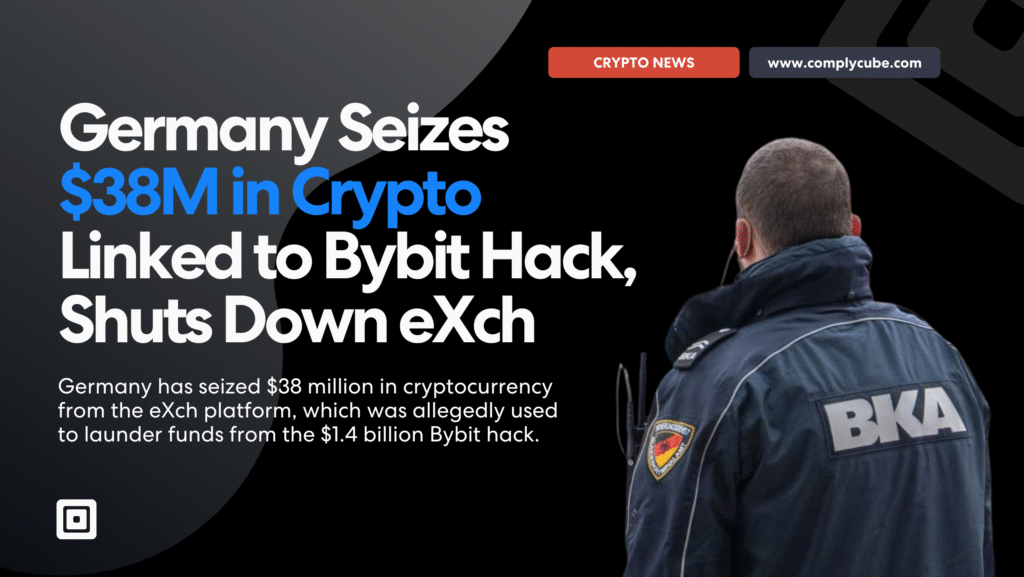
For more on this, click [here](https://fxnewsgroup.com/forex-news/cryptocurrency/austrac-finds-aml-ctf-deficiencies-at-crypto-atm-providers/).
## ****Thailand to Strengthen AML Laws for Cryptocurrencies to Combat Financial Crimes****
Thailand is set to amend its Anti-Money Laundering (AML) laws to address the growing concerns over cryptocurrency-related illicit activities. The Anti-Money Laundering Office (AMLO) plans to include cryptocurrency transactions in the AML Act, requiring crypto exchanges to report detailed transaction information, including sender and receiver identities, to aid in tracing potential illegal activities.
The amendments aim to bolster Thailand’s compliance with international standards, such as those set by the Financial Action Task Force (FATF), which recommends that crypto exchanges implement Know Your Customer (KYC) policies and report suspicious transactions.
While there is no current evidence of widespread money laundering involving cryptocurrencies in Thailand, AMLO officials emphasize the importance of proactive measures to prevent such activities. The proposed changes are part of a broader effort to combat cybercrime and strengthen the country’s financial regulatory framework.
The inclusion of cryptocurrency transactions in the AML Act is expected to enhance transparency and accountability in the digital asset sector, aligning Thailand with global efforts to curb financial crimes associated with cryptocurrencies.
Find more on this story [here](https://coinfomania.com/thailand-to-amend-aml-laws-for-cryptocurrencies/).
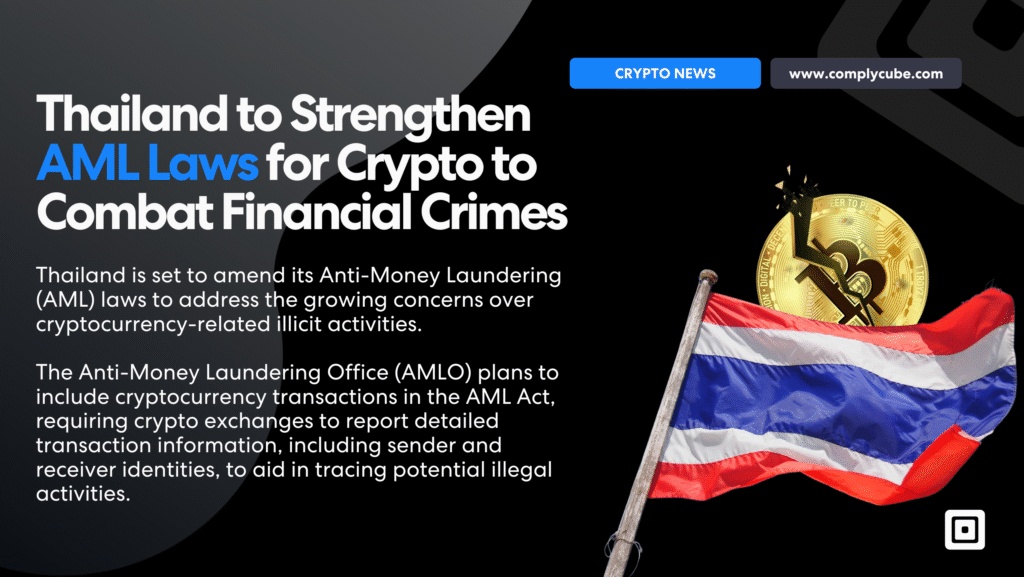
## Abu Dhabi Imposes $12M Fine on Crypto Firm Hayvn for AML Violations
Abu Dhabi’s Financial Services Regulatory Authority (FSRA) has imposed a total fine of $12.45 million on Hayvn Group and its former CEO, Christopher Flinos, for serious breaches of anti-money laundering (AML) regulations. The violations involved operating an unlicensed special purpose vehicle, AC Holding, to process client transactions without adequate AML controls between October 2018 and May 2024.
The FSRA’s investigation revealed that Hayvn and its affiliates failed to establish proper systems to manage operations and risks, and provided over 200 falsified documents to banking partners to maintain accounts for illicit activities. Flinos, who served as CEO of Hayvn ADGM and CEO and sole director of Hayvn Cayman and AC Holding, was found to have provided false information during the investigation.
As a result, the FSRA has canceled Hayvn ADGM’s operating license and permanently banned Flinos from holding any financial services position in Abu Dhabi. The fines are distributed as follows: $3.6 million against Hayvn Cayman, $3 million against Hayvn ADGM, $1.5 million against AC Holding, and $750,000 against Flinos.
This enforcement action underscores the FSRA’s commitment to upholding regulatory standards and ensuring the integrity of the financial system in Abu Dhabi Global Market.

For more on this story, click [here](https://decrypt.co/314844/crypto-firm-hayvn-12-million-abu-dhabi-aml).
## Bank of Italy Warns Crypto Could Threaten Global Financial Stability, Echoing EU Concerns
The Bank of Italy has joined European financial authorities in expressing concerns over the U.S.’s growing embrace of cryptocurrency, particularly following the recent presidential election. The central bank highlighted the potential risks to global financial stability, especially regarding the rise of U.S. dollar-pegged stablecoins like Tether and USDC.
The Bank of Italy’s report indicates that the post-election crypto boom in the U.S. led to a temporary surge in global crypto market values. However, the central bank warns that if crypto markets, especially volatile assets like Bitcoin, become more integrated with traditional finance, it could expose global markets and intermediaries to significant vulnerabilities.
The report also raises concerns about the growing systemic relevance of U.S. dollar-pegged stablecoins. If these stablecoins attain systemic significance, it could generate exceptional demand for U.S. government bonds, potentially leading to forced sales of reserves in the event of issuer failures. Additionally, the introduction of euro-denominated stablecoins by U.S. firms could undermine local payment systems and weaken Europe’s monetary sovereignty.
In response to these concerns, the Bank of Italy is aligning with the European Central Bank’s push for a digital euro to protect monetary sovereignty and reduce reliance on foreign stablecoins. The central bank is also preparing guidelines to apply European Union rules on crypto assets, focusing on preserving the regular functioning of the payment system and safeguarding consumer protection.

This development underscores the growing apprehension among European regulators about the potential implications of the U.S.’s pro-crypto stance on global financial stability and the need for coordinated international regulatory efforts
For more on this story, click [here](https://www.ccn.com/news/crypto/bank-of-italy-echoes-eu-fears-crypto-global-threat/).
## Time for Some Light-Hearted Creative Criticism?
So you’ve made it to the end of our newsletter. It’s time to enjoy a little satire, worthy reader, you’ve earned it.
### 🔥THE CRYPTO CUBED POEM: MAY🔥
It’s looking like anonymous crypto in the EU will be banned,
Why they are waiting until 2027… I don’t quite understand,
The Bank of Italy strongly agrees with the EU’s crypto fears,
But hey, why the rush? They’ll deal with it in a couple years.
If you’re an AML-lacking CEO, this rhyme is just for you,
I think you’re in a pretty bad position if your enemy is the EU.
Yes, ok, they might take a couple years and several lengthly negotiations.
But you can bet your bottom dollar they’ll hand your ass back to you with a side of eggs and bacon.
### Stay tuned for our June newsletter, and have a great month!

**Categories:** News
**Tags:** Crypto Regulations
---
### [Regulatory Frameworks for AML in Accounting ](https://www.complycube.com/aml-in-accounting/)
**Published:** May 8, 2025
**Author:** Sofia Daley
**Excerpt:** Advanced AML in accounting fortifies accountancy firms with risk-based approach to onboarding new clients, minimising fraud risks and ensuring full AML compliance. This guide breaks down how AML checks ensure full KYC compliance.
**Content:**
Compliance risks are a very real threat for all accountancy firms, as a lack of stringent AML protocols can put them at risk large fines due to non-compliance. Advanced AML in accounting fortifies accountancy firms with risk-based approach to onboarding new clients, minimising fraud risks and ensuring full AML compliance.
To mitigate these risks, advanced AML checks are essential. They offer accountancy firms a structured, risk-based approach to onboarding new clients and maintaining ongoing due diligence. By using intelligent screening tools, and real-time monitoring, firms can better assess the risk level of each client, detect red flags early, and ensure that suspicious transactions are reported appropriately. This proactive stance not only enhances regulatory compliance but also safeguards the integrity of the firm’s operations.
## UK Anti Money Laundering Compliance Standards
Accountancy firms in the UK must comply with stringent regulations regulations, such as the Money Laundering, Terrorist Financing, and Transfer of Funds (Information on the Payer) Regulations 2017 (MLRs), which were amended in 2019. This applies to all accountants who provide services such as bookkeeping, payroll, accounting, tax compliance, as well as company formation. These regulations require identity verification, risk profiling, suspicious activity reporting, customer due diligence, ongoing monitoring, and more. If firms fail to comply, it can result in penalties, damage to their reputation, and possible criminal prosecution.

David Winch, the AML & Onboarding Adviser at MLRO Support Ltd, states, “Each accountancy firm is unique – not least because the partners in it have a unique experience, knowledge, and interests,” said Winch. “In my opinion, each firm’s [AML compliance](https://www.accountingweb.co.uk/tech/tech-pulse/anti-money-laundering-software-what-accountants-should-look-for) also needs to be unique.” For more on UK AML regulation, read [“Achieving Compliance: UK AML Regulation.”](https://www.complycube.com/en/achieving-compliance-uk-aml-regulation/)
## Regulatory Bodies and Financial Accounting Standards
Several regulatory bodies monitor and supervise accounting firms in terms of AML compliance, monitoring customer relationships, financial information, and industry practices overall. Some of main regulators for AML compliance in accounting firms in the UK include:
### Financial Conduct Authority (FCA)
The FCA established OPBAS in 2018, a body which supervises 25 professional body supervisors (PBSs) across both law and accountancy firms. It’s key objectives consist of ensuring a high standard of supervision and to share information between PBSs, statutory supervisors and law enforcement agencies.
> The FCA is committed to playing a leading role in reducing and [preventing financial crime](https://www.fca.org.uk/news/news-stories/opbas-finds-improvements-needed-amongst-anti-money-laundering-supervisors). Through OPBAS, we have intervened to tackle failings where we have found them.
OPBAS assesses PBSs against the Money Laundering Regulations 2017, identifying areas for improvement and intervening when necessary. For instance, in 2024, OPBAS directed two PBSs to take corrective action due to identified shortcomings.
> We are still not seeing the consistent, [effective improvement](https://www.fca.org.uk/news/news-stories/opbas-finds-improvements-needed-amongst-anti-money-laundering-supervisors) we need.
Andrea Bowe, Director at the FCA, states, “The FCA is committed to playing a leading role in reducing and preventing financial crime. Through OPBAS, we have intervened to tackle failings where we have found them. However, we are still not seeing the consistent, effective improvement we need.”
Despite progress, OPBAS has identified several areas where PBSs need to enhance their effectiveness:
- **Enforcement Actions**: The number and value of fines issued to non-compliant firms have declined, indicating a need for more assertive enforcement.
- **Information Sharing**: Proactive sharing of intelligence with regulators and law enforcement remains inconsistent, hindering coordinated efforts to combat financial crime.
- **Risk-Based Supervision**: Some PBSs have been slow to implement and update risk profiles, affecting the prioritisation of supervisory activities.
In response, OPBAS continues to utilise its regulatory tools to hold PBSs accountable and drive improvements in supervision.
## HM Revenue & Customs (HMRC)
HM Revenue & Customs (HMRC) supervises the anti-money laundering (AML) compliance of accountancy firms in the UK that are not already overseen by professional body supervisors, such as ICAEW or ACCA. Any accountancy service provider (ASP) offering services like tax advice, bookkeeping, or auditing, and not under a professional body’s AML supervision, must register directly with HMRC. This registration is not a one-time event—it involves an annual supervision fee and a requirement to keep HMRC informed of any significant changes to the business. Failure to register or renew properly can result in a firm being prohibited from legally offering AML-regulated services.
If HMRC identifies weaknesses or non-compliance during a review, it has the power to take enforcement action. This can include issuing written warnings, imposing civil penalties, or removing a firm from the AML register altogether.

## Professional Bodies such as the ICAEW and the AAT
The Institute of Chartered aCcountants in England and Wales (ICAEW) and the Association of Accounting Technicians (AAT) ensure that their supervised firms comply with legal obligations through a structured framework of oversight, guidance, and enforcement. These bodies conduct periodic supervisory reviews, which may involve desk-based assessments or on-site visits, to check that member firms are meeting these expectations. During these reviews, they assess whether firms are adequately identifying and managing money laundering risks, keeping proper records, training staff effectively, and reporting suspicious activities when required.
## AML in Accounting Best Practices
AML in accounting has become a critical component of ensuring the integrity of financial reporting and protecting the global financial system from money laundering, terrorist financing, and organized crime. Accounting firms are now expected to integrate anti-money laundering (AML) protocols that align with industry-specific regulations and compliance standards to combat financial crime and meet the expectations of regulators such as the Securities and Exchange Commission (SEC) and the Financial Action Task Force (FATF).
These efforts include identifying beneficial owners, reporting suspicious transactions, and maintaining accurate records in accordance with the Bank Secrecy Act and other regulations which together aim to improve corporate responsibility, prevent corporate fraud, and ensure enhanced financial disclosure. Adequate AML and KYC checks, including Adverse Media Checks, Identity Verification with Liveness Detection, PEP Screening, Document Checks, and more, should be implemented by all accountancy firms.
> Accounting firms need to protect themselves from the risk of both fraud and non compliance.
Harry Varatharasan, Chief Product Officer at ComplyCube, states, “Accounting firms need to protect themselves from the risk of both fraud and non compliance. By implementing robust AML procedures and advanced verification systems, firms not only safeguard their operations but also build trust with clients and regulators, ensuring long-term success in an increasingly regulated financial landscape.”
Accounting compliance refers not only to adhering to generally accepted accounting principles (GAAP) such as the revenue recognition principle, economic entity assumption, and concern principle, but also to implementing strong internal controls, independent audit committees, and internal audit procedures to ensure the accuracy of financial statements, balance sheets, and annual reports. These measures are crucial for both public companies and private companies, especially as compliance risks and data breaches grow in an increasingly unregulated market.
For more information on how you can safeguard your business with ComplyCube’s AML checks, get in touch with one of our [compliance experts.](https://www.complycube.com/en/contact/contact-sales/)

**Categories:** Guides
**Tags:** Anti-Money Laundering
---
### [Top Customer Identity Verification Software](https://www.complycube.com/top-customer-identity-verification-software/)
**Published:** May 12, 2025
**Author:** Dini Habib
**Excerpt:** Firms typically adopt Identity Verification (IDV) when a person or client opens an account or aims to use a service. Adopting strong IDV processes helps companies combat fraudulent activity, protecting their assets and customers' data.
**Content:**
Leveraging advanced customer identity verification software is not just best practice, but also a business imperative. As digital interactions become the norm, the potential risks from fraud, identity theft, and non-compliance have skyrocketed. Companies without identity verification processes are vulnerable to these criminal activities, which can result in massive financial losses and loss of reputation.
Adopting strong identity verification processes helps businesses identify and combat fraudulent activity, protecting their assets and customers’ data. This guide will explore identity verification, its main elements, and the considerations for selecting the best customer identity verification software.
## What is customer identity verification?
[Identity verification](https://www.complycube.com/en/what-are-identity-verification-solutions/) is when companies confirm whether an entity or person is actually who they claim to be. Businesses adopt identity verification typically when a person or client opens an account or aims to use a service. The process involves collecting various forms of identification document types to gather essential information such as [name, address, and date of birth](https://www.complycube.com/en/solutions/identity-assurance/document-verification/ "name, address, and date of birth"). The documents may include passports, driving licenses, and residence permits, which are then verified through biometric authentication or against reputable databases. But why does it matter if a user or entity is legitimate?
## Why Does Customer Identity Verification Even Matter?
The digital world is [plagued with sophisticated fraud attempts](https://www.jackhenry.com/fintalk/2025-fraud-trends-protecting-against-emerging-threats), from account takeover and synthetic identity fraud to payment fraud and deepfakes. The list goes on. Beyond fighting fraud, verifying legitimate users enables firms to build trust with users, who expect their personal information to be handled securely. It also fulfills a moral duty: businesses are responsible for ensuring their platforms are safe, secure, and free from abuse.
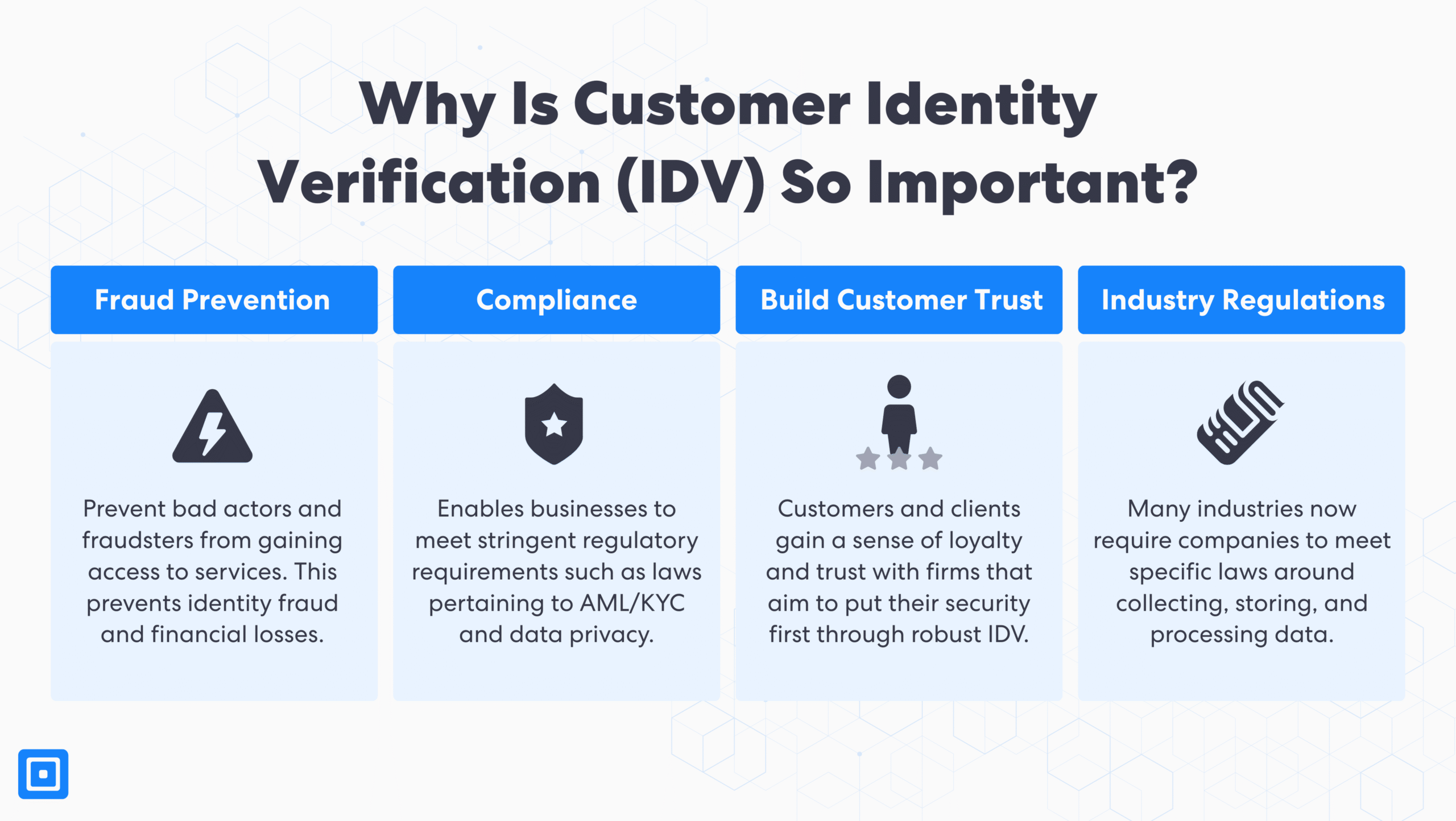
### 1. Potential Fraud Prevention and Other Illicit Activities
Organizations can deny access to unauthorized users across different countries and territories, preventing identity fraud and financial losses. Advanced identity verification tools support businesses in avoiding sophisticated scams and crimes, building a secure digital ecosystem for users to make transactions and take actions safely.
### 2. Meet Stringent Regulatory Requirements
Regulations worldwide state specific guidelines for complying with Know Your Customer (KYC), Anti-Money Laundering (AML), and data protection laws. These regulations mandate that organizations, especially in regulated industries, collect, verify, and securely store identity documents and customer information.
> The EU’s GDPR, along with similar global regulations, has resulted in penalties [exceeding $5 billion](https://www.dlapiper.com/en-gb/insights/publications/2025/01/dla-piper-gdpr-fines-and-data-breach-survey-january-2025), driving companies to boost data protection.
Non-compliance costs greatly exceed the expenses of implementing strong identity verification solutions, with some companies even being forced to close down.
### 3. Building Trust Through Enhanced Security and Customer Onboarding
Customers and clients are at the forefront of every business. To build long-term customer relationships and brand loyalty, providing users with a platform or service that is secure and transparent is key. Identity verification builds customer confidence and trust knowing that their data and activities are free from bad actors.
### 4. Industry Specific Compliance
Identity verification is no longer limited only to the finance industry. In finance, it’s about safeguarding accounts and transactions. In e-commerce, it prevents fraudulent orders and chargebacks. In health care, it protects patient data and identity documents and addresses regulatory compliance with privacy law. From financial institutions to healthcare, travel, and gaming, every industry that has a digital service must prioritize identity and business verification.
## Must-Have Features to Look For in Customer Identity Verification Software
Robust identity verification solutions have become a necessity in all industries. They provide [safer onboarding](https://www.complycube.com/en/use-cases/process/customer-onboarding/), regulatory compliance, and defense against elaborate identity fraud and cyber attacks. Modern identity verification software can provide a significant advantage through its use of advanced technology. Here are some of the must-have features to look out for when choosing the right vendor:

### AI-Driven Biometric and Document Verification
Look for identity verification tools incorporating [Artificial Intelligence (AI)](https://www.complycube.com/en/why-identity-verification-ai-is-crucial/) and Machine Learning (ML). AI and ML technologies allow companies to run document verification, adverse media screening, and biometric checks like facial recognition and liveness detection in real-time. With such functionalities, businesses can fight identity fraud by confirming document authenticity and distinguishing genuine users from fraudulent attempts.
### Automated Verification Options
Another must-have feature of identity verification software is its automation capabilities, enabling firms to securely and quickly verify users in real-time. Companies can set the right resources for more complex cases such as dealing with [Politically Exposed Persons (PEPs)](https://www.complycube.com/en/what-is-a-pep/) while enhancing accuracy and operational efficiency according to their business goals and risk tolerance.
### Global Document Coverage and Cross-Border Compliance
Choosing software providers that support multiple languages and cross-border compliance is imperative. Additionally, choose an identity verification solution that can verify various identity document types from diverse countries and regions. This tailored approach ensures businesses can facilitate the smooth onboarding of more users internationally.
### Support for Multiple Verification Methods
The best software offers multi-layered security to support document verification, biometrics, and knowledge-based authentication. This enhances [fraud detection ](https://www.complycube.com/en/use-cases/process/fraud-prevention/)and ensures that the verification process satisfies regulatory conditions.
### Ease of Integration with Existing Systems
The best verification solutions feature easy integration with existing workflows and systems via web SDKs and APIs. As a result, disruption is minimized and operational efficiency is maintained throughout the entire process.
Prioritizing these features helps businesses save money, prevent fraud, and offer a reliable, user-friendly experience on online platforms. Comprehensive compliance solutions with ongoing monitoring and real-time fraud prevention are also beneficial.
## Security and Frictionless Onboarding Process
Designing a smooth document verification and customer onboarding approach is crucial in enhancing customer satisfaction and boosting conversion rates. Businesses should aim to make onboarding easy from the beginning. This includes providing clear guidelines, leveraging a user-friendly interface, and offering privacy statements. To achieve a balance, leading organizations adopt a [risk-based approach](https://www.complycube.com/en/what-is-a-risk-based-approach/), tailoring identity verification steps according to the level of risk associated with each customer or transaction.
### Essential Factors to Maximize Customer Satisfaction and Reduce Drop-off Rates **Include:**
- **Optimize UI:** Design a user friendly interface for easy navigation.
- **Offer Choices:** Support document verification, facial recognition, and age estimation for inclusivity.
- **Speed Matters:** Use optical character recognition and machine learning to verify identities quickly.
- **Seamless Integration Process:** Connect with existing workflows to reduce manual work and friction.
- **Ongoing Monitoring:** Enable real-time monitoring to support anti-money laundering efforts and protect genuine users.
- **Adopt Risk-based Approach:** Only request critical information during onboarding and add further checks if a customer or transaction is high-risk.
## Practical Checklist: Choosing the Right Customer Identity Verification Software
Selecting the appropriate identity verification solution depends on several key factors. Ultimately, the right provider to choose will be one that can meet your unique business needs. Here is a practical step-by-step checklist you can download when navigating the myriad of ID Verification Vendors available today:
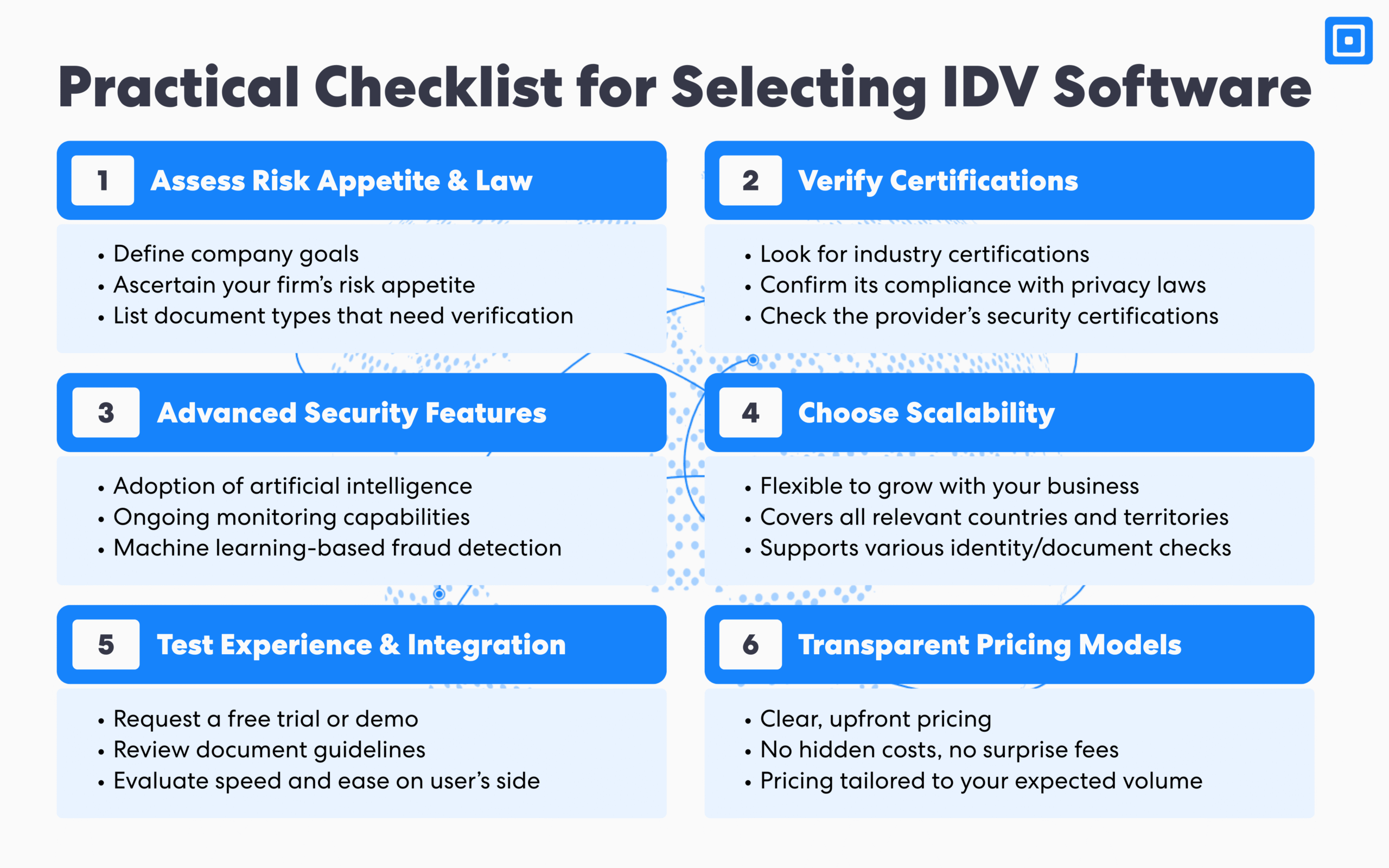
### 1. Assess Your Risk Appetite and Requirements
Firstly, document your businesses’ risk appetite and exactly what it needs. This includes the goals of your company such as onboarding more users, the amount of checks required, or implementing ongoing due diligence. Determine the document types needed to be verified based on the countries and territories you operate in. This can include driving licenses, residence permits, utility bills, and more. Having this understanding enables you to make a more informed decision.
### 2. Verify Certifications and Compliance
Next, check the provider’s certifications and compliance. You can request or look for security certifications which can be found easily on their website. Confirm if they comply with privacy laws like GDPR or CCPA, especially when it comes to handling customer data. For example, [ComplyCube is a UK DIATF-certified ](https://www.complycube.com/en/comprehensive-guide-to-the-uk-diatf-framework/)Identity Service Provider, meaning it meets strict requirements for data protection, fraud prevention, and secure digital identity verification.
### 3. Look for advanced security features
Opt for solutions with facial recognition, [liveness detection](https://www.complycube.com/en/solutions/due-diligence-compliance/know-your-customer/liveness-detection/), machine learning-based fraud detection, and ongoing monitoring for adverse media. These security measures help block fraud attempts and protect sensitive information efficiently. Compliance teams can remove bottlenecks and allocate their resources and focus more effectively to complex cases.
### 4. Prioritize Scalability and Support for Your Target Markets
It is crucial to ensure your chosen identity verification software can support a wide range of identity checks and document checks across the countries and territories where you operate. Having this flexibility from the beginning assures that your business has the ability verify various identity documents as your business grows.
### 5. Test User Experience and Integration
Don’t hesitate to test the user experience and integration. Try a free trial or demo to make sure the verification process is fast and easy for your users. Additionally looking at a provider’s document guidelines can enable you to check if they offer APIs, SDKs, or plugins for your tech stack.
### 6. Consider Transparent Pricing Models
Lastly, always keep an eye out for providers that have hidden costs. Look for software vendors that offer clear, upfront pricing models tailored to your expected volume of ID verification requests. Transparent pricing helps businesses plan costs efficiently while meeting regulatory requirements. This ensures you won’t encounter unexpected charges for additional identity checks or document checks.
## Get Started with Secure Identity Verification Solutions
Robust identity verification solutions enable you to verify users in an efficient and fast manner using advanced document verification processes. With support for diverse identity documents and different types of documents, businesses can onboard users smoothly, irrespective off where they are located globally. With built-in security features such as liveness detection and sophisticated fraud detection, companies are assured that it’s identity verification process is efficient and secure, safeguarding business and users from malicious attempts.
[Learn more](https://www.complycube.com/en/contact/contact-sales/) about ComplyCube’s advanced Identity Verification solutions.
[](https://www.complycube.com/en/contact/contact-sales/)
##
**Categories:** Guides
**Tags:** Identity Verification
---
### [Mastering the Know Your Customer Process](https://www.complycube.com/step-by-step-know-your-customer-process/)
**Published:** May 5, 2025
**Author:** Dini Habib
**Excerpt:** A strong Know Your Customer Process is vital, especially in the digital age where money laundering and financial crimes are rife. But what exactly is KYC, and how can firms remain ahead of regulations while meeting customer needs?
**Content:**
Preventing financial crime now demands the same speed and efficiency used to commit it. This is why a strong Know Your Customer Process (KYC) is crucial for every legitimate business, especially financial institutions where money laundering and other financial crimes are common.
But what exactly is KYC, and how can companies remain one step ahead of regulations while successfully satisfying evolving customer needs? This guide will break down the essential steps of KYC. It will explore the challenges of implementing KYC processes and discuss future compliance trends. By understanding these concepts, firms can design a KYC compliance strategy that is both effective and future-proof for long-term success.
## The History of Know Your Customer (KYC) Processes
KYC obligations did not always exist. In fact, the [KYC process](https://www.complycube.com/en/solutions/due-diligence-compliance/know-your-customer/) has changed significantly over time through different legislation and jurisdictions. Its origins, however, are closely tied to efforts aimed at fighting money laundering, identity theft, and illegal financial activities.
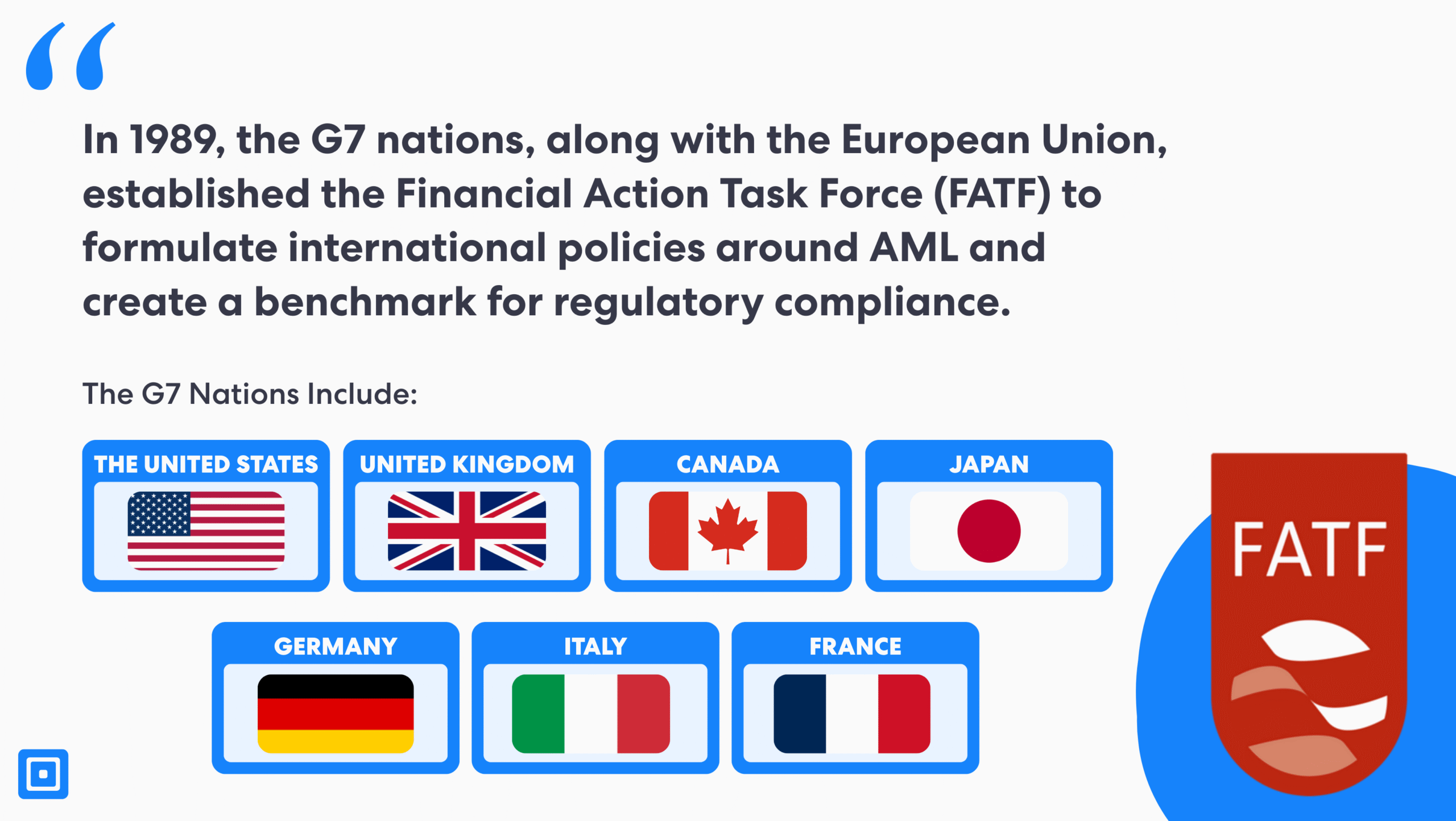
### The Early Drivers of KYC, Establishing Global Security
Financial crime worsened in the 1970s and 1980s, causing significant negative implications for many countries. Because of this, stronger KYC requirements were mutually recognized worldwide. The idea of KYC was formalized in the 1970s when the United States’ passed the [Bank Secrecy Act (BSA)](https://www.fincen.gov/resources/statutes-and-regulations/bank-secrecy-act) in 1970. This law required financial institutions and banks to detect and report suspicious activities. The main goal was to fight money laundering and terrorist financing.
### The Emergence of International Collaboration and Standards
In the 1980s, the rise of globalization made it easier for rapid financial transactions across borders. This contributed to loopholes in the financial systems that enabled criminals to commit financial crimes in different countries.
To stabilize the economy, countries worldwide decided to take a more united and collaborative approach to ensure compliance. For instance, in 1989, the G7 nations, including Canada, the United Kingdom, the United States, and the EU, established the [Financial Action Task Force (FATF)](https://thefinancialcrimenews.com/the-early-history-of-the-fatf-and-what-we-can-learn-from-the-founders-and-what-this-means-for-the-fight-against-financial-crime-including-money-laundering/) to formulate international policies around AML and create a benchmark for regulatory compliance in financial sectors and beyond.
### National and Regional Adoption
The FATF’s standards for customer identification, risk assessment, due diligence, and ongoing monitoring set the standard [in over 200 jurisdictions](https://www.fatf-gafi.org/en/countries.html). These global norms were internalized and implemented by states and regions worldwide until today.
- **European Union:** The current [Sixth Anti-Money Laundering Directive (6AMLD)](https://www.complycube.com/en/a-quick-overview-of-the-6th-anti-money-laundering-directive-6amld/) requires financial institutions and a wide range of non-financial businesses to implement robust Customer Due Diligence (CDD), verification of beneficial ownership, and maintain ongoing monitoring. These Know Your Customer (KYC) measures align and reinforce FATF standards.
- **Latin America and Africa:** Most countries on these continents have updated their legislation to evolve with FATF requirements. This came as a recognition of the value of secure and transparent financial systems. While aligning with global standards, these regions also tailor their approaches to reflect unique local policy needs for regulatory compliance.
- **Asia:** Countries including Singapore, Japan, China, and India possess stringent KYC requirements, generally governed by financial regulators or central banks. This approach are closely benchmarked against FATF recommendations. Some jurisdictions also adapt and enhance their KYC solutions to address local risks and evolving financial crime trends.
The widespread adoption of FATF standards demonstrates a unified global effort to adopt comprehensive KYC processes to proactively combat and assess associated risks of money laundering and terrorist financing act.
## Demystifying the KYC Verification Process
The KYC process involves three core stages: the [Customer Identification Program (CIP)](https://www.complycube.com/en/customer-identification-program-what-is-cip/), Customer Due Diligence (CDD), and the Ongoing Monitoring stage. These stages have evolved over time in response to increasing money laundering risks and international regulatory standards. They also help businesses efficiently onboard corporate customers and merchants.
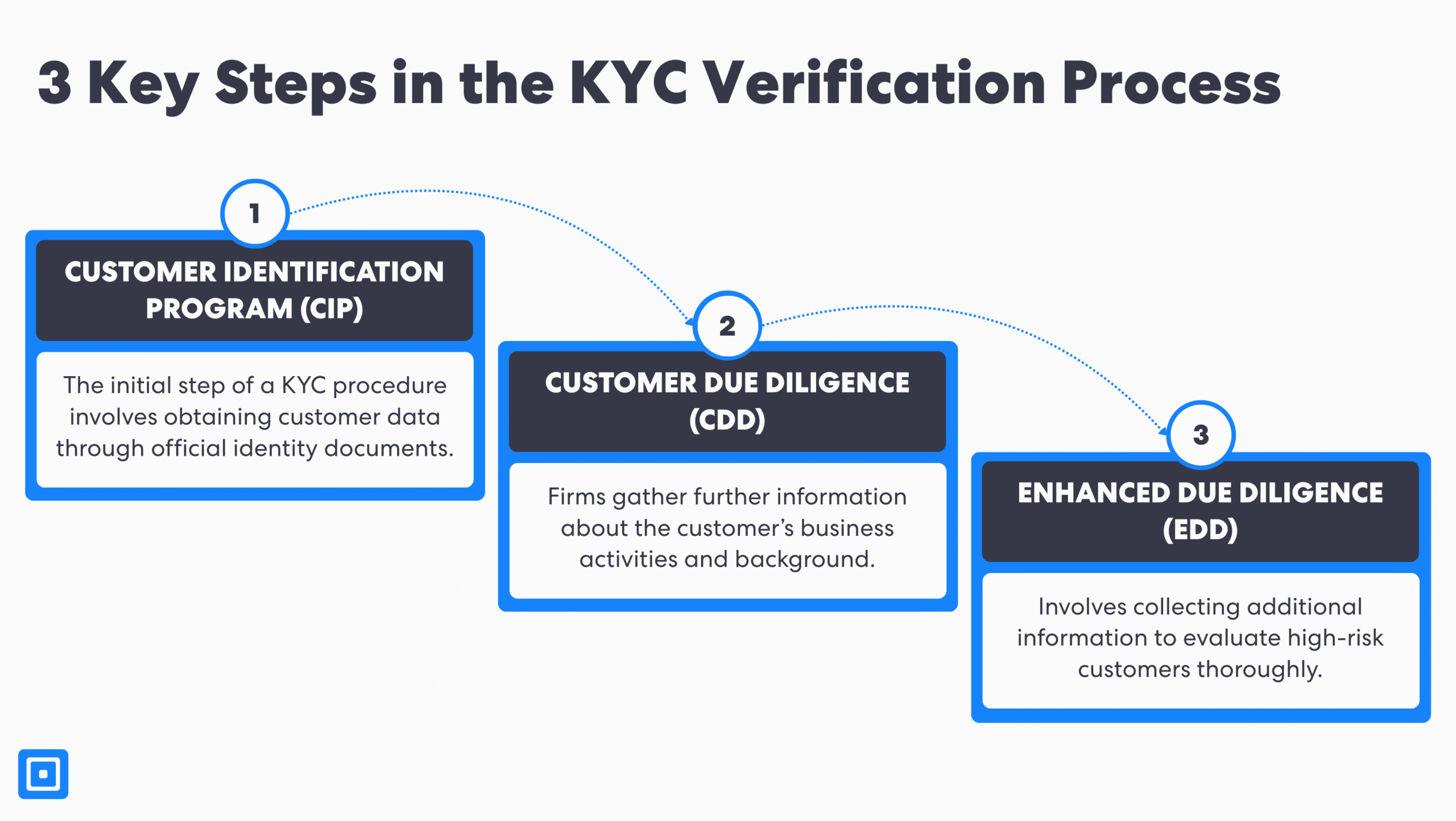
### 1. Customer Identification Program (CIP)
The initial step of a KYC procedure involves obtaining customer data through official identity documents such as passports or driver’s licenses. Important personal details, such as full name, date of birth, and home address, are gathered to help assess potential risk factors. This information enables compliance professionals to build a customer’s risk profile and identify associated risks in future transactions.
Verification methods to authenticate a customer’s identity include manual document checks or compliance software with advanced KYC and [Anti-Money Laundering](https://www.complycube.com/en/solutions/due-diligence-compliance/anti-money-laundering/) features. These features might include document verification, biometric checks like facial recognition, and other digital authentication methods. Using digital tools speeds up onboarding, improves customer experience, and strengthens the ability to detect suspicious activities early.
### 2. Customer Due Diligence (CDD)
The next stage is [Customer Due Diligence (CDD)](https://www.complycube.com/en/what-is-customer-due-diligence/), which forms a key part of the KYC onboarding process for financial institutions. Here, businesses gather more information about the customer’s business activities, financial background, and, where relevant, the intended use of their bank account.
This stage is crucial for Anti-Money Laundering (AML) compliance, enabling compliance professionals to effectively assess money laundering risks and assign an appropriate customer risk profile. The CDD process includes verifying the source of the customer’s funds, reviewing identity documents, and evaluating the nature of the customer’s transactions. For existing customers, ongoing monitoring ensures any behavior changes or suspicious activities are promptly reported to the relevant report analysis centre.
### 3. Enhanced Due Diligence (EDD)
Finally, there is the [Enhanced Due Diligence (EDD)](https://www.complycube.com/en/enhanced-due-diligence-edd-insights-and-challenges/) stage. EDD goes beyond standard [Identity Verification (IDV) ](https://www.complycube.com/en/what-are-identity-verification-solutions/)and the initial KYC onboarding process. It requires gathering additional detailed information to assess risk and thoroughly evaluate high-risk customers.
This involves ongoing risk assessment through investigating business activities, extensive background checks, and transaction patterns. For example, financial institutions might ask for extra KYC documents and apply closer checks for high-risk customers, such as [Politically Exposed Persons (PEPs)](https://www.complycube.com/en/what-is-a-pep/) or individuals on sanctions lists. These extra steps help prevent unauthorized people from accessing financial services or committing crimes like money laundering.
## The Major Challenges of KYC Implementation
KYC verification prevents bad actors from committing crimes by verifying their identity and limiting their access at the beginning of the [customer onboarding stage](https://www.complycube.com/en/kyc-checks-for-a-secure-and-scalable-onboarding-process/). However, while a robust KYC process is vital, a slow or confusing client onboarding process can harm the customer journey and cause frustration. For example, long delays and verification failures may cause a client to abandon onboarding entirely. Therefore, businesses must balance security with smooth onboarding to keep valid users while minimizing drop-offs.
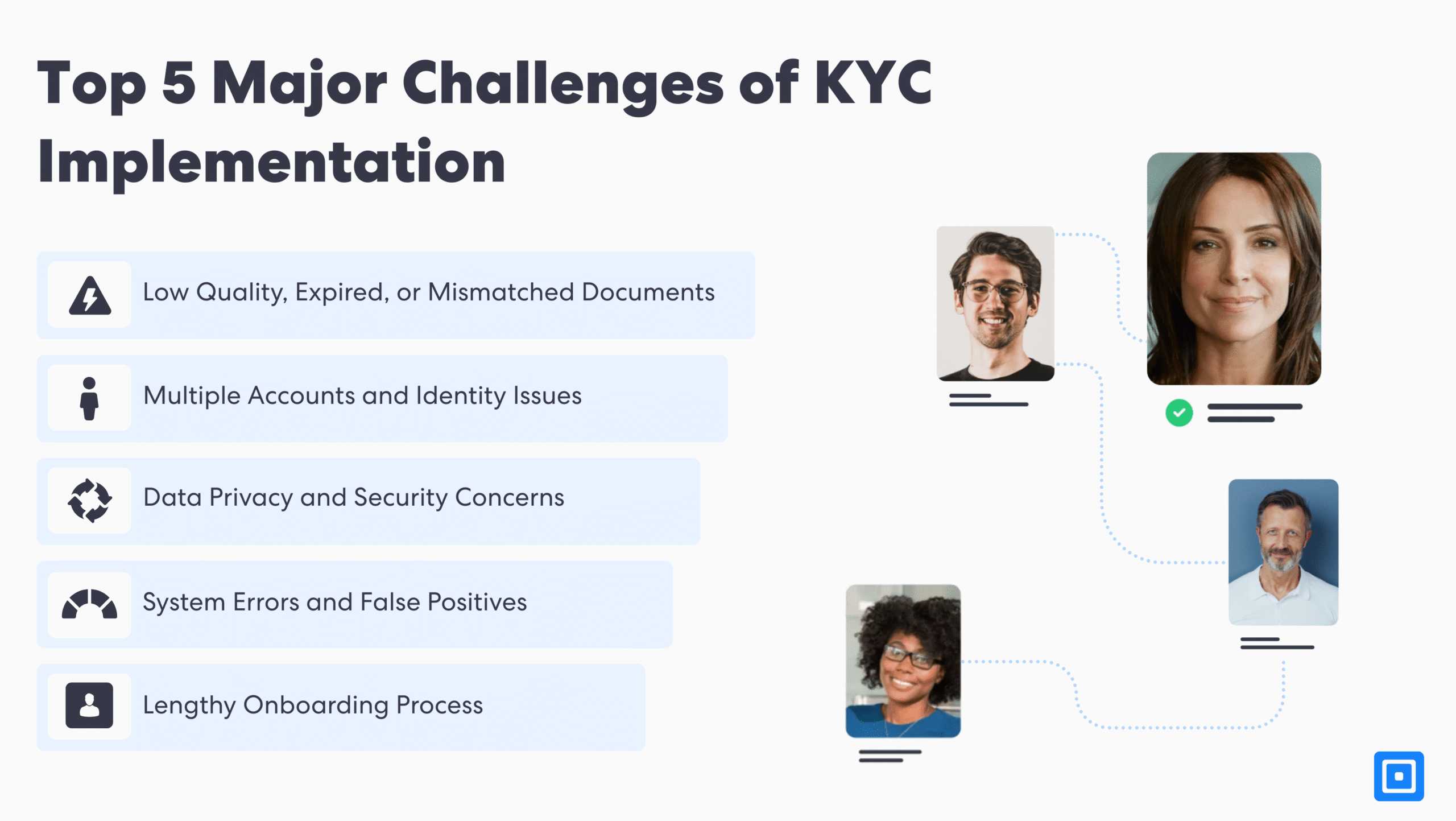
### 1. Low Quality, Expired, or Mismatched Documents
- **Challenge:** One common challenge is customers failing to submit the correct identification documents during the onboarding process. For instance, they may upload expired IDs or unclear photos. Some other instances include submitting the wrong document type, all of which trigger verification failures.
- **Solution:** To address these challenges, businesses need to notify users ahead of time and clearly and understandably about the document submission requirements. Offering step-by-step instructions with examples of valid documents can significantly reduce mistakes. Furthermore, real-time feedback involving lighting tips or blur warnings helps users correct issues immediately.
### 2. Multiple Accounts and Identity Issues
- **Challenge:** Another common challenge is customers creating multiple accounts or deleting and recreating new accounts during verification. This can cause system alerts to flag or outright customer rejection. Sometimes, customers might forget their login details and attempt to restart the onboarding process.
- **Solution:** Guiding users to customer support instead of allowing repeated failed attempts can be beneficial. Additionally, backend systems that detect duplicate identities early and provide users with clear updates on verification status are crucial. Businesses can avoid friction by allowing users to update personal information safely without redoing the Know Your Customer (KYC) onboarding process.
### 3. Lengthy Onboarding Process
- **Challenge:** Overly complicated forms with multiple verification steps and unclear instructions often frustrate clients and cause many to abandon the process. Excessive friction during customer onboarding lowers conversion rates and can push actual customers away.
- **Solution:** Instead of a one-size-fits-all method, companies should use a risk-based KYC process to match checks to customers’ risk levels. For example, low-risk users can undergo simplified verification, while high-risk customers undergo deeper checks. Automated KYC and AI can accelerate document verification, reducing human intervention and delays.
### 4. System Errors and False Positives
- **Challenge:** False positives occur when genuine customers are classified as suspicious or fraudulent due to system errors, outdated databases, or overly restrictive algorithms. It causes client frustration and inconvenience, and can damage a business’s reputation.
- **Solution:** To prevent this, firms must leverage explainable AI models that are transparent, understandable, and free from hidden biases. Additionally, companies should vet and update these models regularly to detect new risks and minimize incorrect decisions.
### Challenge 5: Data Privacy and Security Concerns
- **Challenge:** Customers often hesitate to give sensitive personal information due to data security and privacy concerns. Uncertainty about how personal data is used and processed will risk the loss of trust in the KYC onboarding process.
- **Solution:** Firms must explicitly state data protection policies and compliance with data protection laws. Additionally, using secure encryption for data storage builds stronger client and customer confidence. Highlighting compliance and security badges highlights alignment with regulations and fosters trust.
## Future Trends in KYC: Staying Ahead of the Curve
As technology and regulatory standards evolve, Know Your Customer (KYC) solutions are advancing to streamline the customer onboarding process and enhance the overall customer experience.
These improvements help financial institutions increase ROI by maintaining compliance with strict KYC requirements while delivering a smoother, more efficient onboarding process.
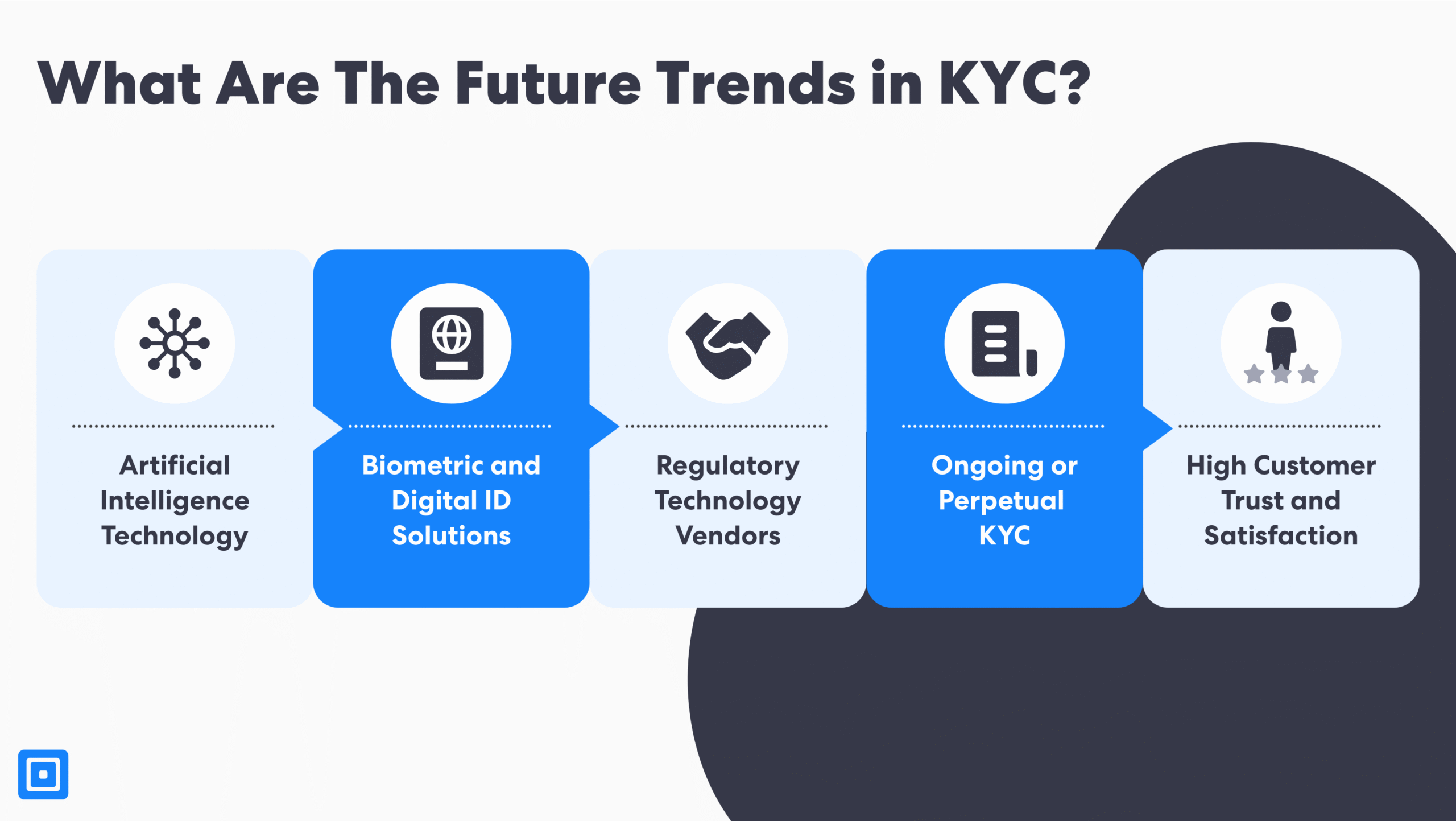
### The Use of Artificial Intelligence Technology
[Artificial Intelligence (AI)](https://www.complycube.com/en/why-identity-verification-ai-is-crucial/) has been reshaping KYC by streamlining identity verification, risk assessment, and transaction monitoring through automation. AI is able to scan bulk data, identify patterns and flag anomalies at a rapid pace while significantly increasing accuracy. This helps reduce false positives compared to manual KYC processes which are prone to human error and inconsistencies.
### Biometric and Digital ID Solutions
Biometric authentication, including facial recognition, is increasingly used to verify a customer’s identity with high accuracy. Features such as [liveness detection](https://www.complycube.com/en/solutions/identity-assurance/biometric-verification/) ensures that the person undergoing verification is physically present, effectively distinguishing real users from deepfakes. This significantly reduces the risk of fraud during customer onboarding and high-risk transactions.
### All-in-one Regulatory Technology (RegTech) Vendors
RegTech providers support businesses in getting ahead of regulations by making compliance checks and policy adherence easier. For instance, ComplyCube uses advanced AI to deliver real-time risk analysis, automate transaction monitoring, and centralize compliance management. These solutions are also scale with business growth, enabling firms to manage compliance obligations while reducing cost.
### Ongoing or Perpetual KYC
Manual compliance procedures in the past relied on periodic reviews on a quarterly or bi-annual basis. With ongoing KYC, also known perpetual KYC, organizations can leverage real-time data feeds and continous monitoring. As a result, risk profiles can be updated within seconds, creating a proactive approach to dynamic regulatory compliance.
### Maintaining Customer Trust and Satisfaction
Building customer trust and satisfying customer expections is vital for business reputation and growth. This is why companies are now prioritize a smooth and transparent customer onboarding experience to create a positive first impression, boost retention and foster loyalty. To achieve this, businesses leverage A/B testing to refine user interfaces and workflows, while closely monitoring drop-off rates and customer feedback to identify and address pain points in the onboarding journey.
By continuously refining the process based on real user data and Customer Satisfaction Scores (CSAT), businesses can enhance satisfaction and ensure that customers feel supported from the very beginning while maintaining significant ROI.
## Build Trust at Scale with Robust Know Your Customer Process
Establishing a comprehensive KYC onboarding process is crucial for financial institutions to ensure compliance with money laundering regulations and protect financial transactions. By leveraging automated KYC for identity verification, businesses can continuously monitor customer transactions while streamlining onboarding, enhancing customer experience, and maintaining strict KYC compliance. [Get involved today.](https://www.complycube.com/en/contact/contact-sales/)
[](https://www.complycube.com/en/contact/contact-sales/)
**Categories:** Guides
**Tags:** Know Your Customer
---
### [What is KYC Verification? An In-Depth Guide](https://www.complycube.com/what-is-kyc-verification-an-in-depth-guide/)
**Published:** May 1, 2025
**Author:** Dini Habib
**Excerpt:** Hackers and criminals' methods and avenues to conduct financial crimes have significantly increased over the years. This necessitates the implementation of Know Your Customer (KYC), as an essential compliance and security measure.
**Content:**
**TL;DR:** **What is KYC verification?** It is the process businesses use to **verify customer identities**, assess financial crime risks, **and comply with regulatory obligations. KYC verification** plays a crucial role in Anti-Money Laundering (AML) efforts by **preventing fraud, terrorism financing** and other **illicit activities.**
## What is KYC Verification?
KYC verification, short for Know Your Customer verification, is the process through which businesses verify the identity of their customers. It involves collecting and validating identity documents, conducting background checks and continuously monitoring customer activity. Originally developed to prevent money laundering and fraud, KYC has become a core requirement across many high-risk sectors. Businesses can build trust, meet legal obligations and protect the integrity of the financial ecosystem.
## The Legislation Frameworks Governing KYC
[Implementing KYC](https://www.complycube.com/en/solutions/due-diligence-compliance/know-your-customer/) combats financial crime and terrorist financing. It is also a legal requirement across many jurisdictions. For instance, the EU’s anti-money laundering directives (AMLD), the US Patriot Act, and the guidelines of the Financial Conduct Authority (FCA) and the Financial Action Task Force (FATF) mandate that businesses enforce comprehensive and auditable KYC processes. These laws drive organizations to collect, verify, and continuously monitor customer information to identify and mitigate potential risks.
## The Evolution of KYC Regulations
As an essential component of broader anti-money laundering efforts, KYC has been reinforced by decades of legislation. Since the 1970s, governments have introduced laws to combat money laundering and fraudulent activities within their borders.
> In 2023 alone, [global regulators issued $5.8 billion in fines](https://insights.searchbug.com/comprehensive-guide-anti-money-laundering-aml-compliance-violators-checklist-tools-34b6cd344e86) for AML and KYC non-compliance. This underscores the critical importance of robust KYC processes for organizations everywhere.
Here are some of the most popular AML regulations in different countries that protect financial institutions and customers worldwide.
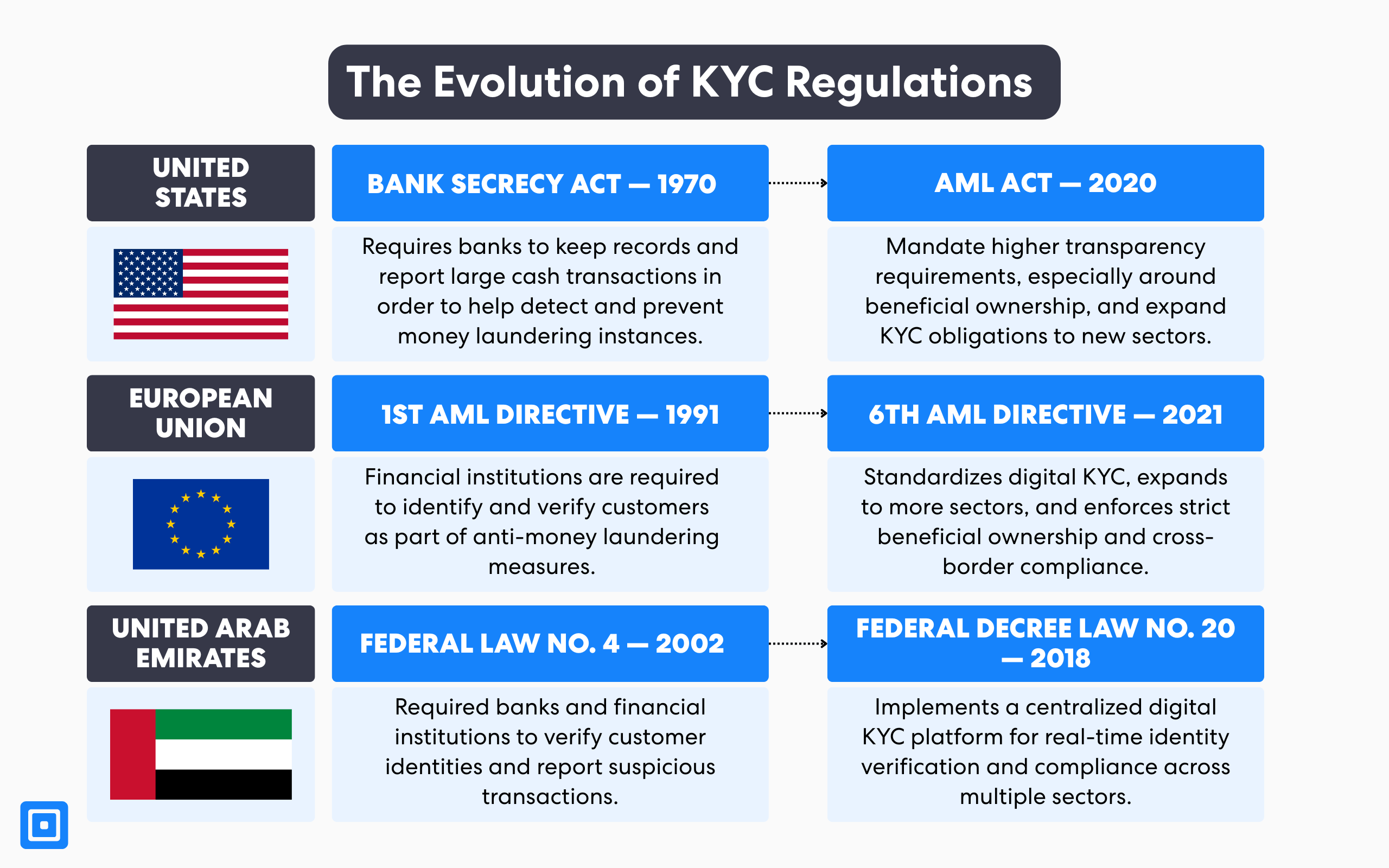
## United States and The Bank Secrecy Act
In 1970 in the United States, the first regulation began with the [Bank Secrecy Act (BSA)](https://www.occ.treas.gov/topics/supervision-and-examination/bsa/index-bsa.html), which focused on recordkeeping and the reporting of large currency transactions. As technology progressed, it prompted further development of KYC regulations. This led to the [US Patriot Act (2001)](https://www.fincen.gov/resources/statutes-regulations/usa-patriot-act), which expanded KYC requirements, and the adoption of the Anti-Money Laundering Act (AMLA) in 2020, which now encompasses a broader analysis of innovative technologies and their impacts on Anti-money Laundering (AML) legislation. Additionally, organizations such as the [Financial Industry Regulatory Authority (FINRA) ](https://www.lseg.com/en/data-analytics/financial-data/pricing-and-market-data/fixed-income-pricing-data/financial-industry-regulatory-authority)were established to supervise broker-dealers and ensure compliance with KYC requirements.
## European Union and the First Anti-Money Laundering Directive
The [first anti-money laundering directive (1AMLD)](https://finance.ec.europa.eu/financial-crime/anti-money-laundering-and-countering-financing-terrorism-eu-level_en#:~:text=The%20first%20anti%2Dmoney%20laundering,the%20purpose%20of%20money%20laundering.) was established in the EU in 1991. Since then, it has evolved to the [sixth directive (6AMLD)](https://www.complycube.com/en/a-quick-overview-of-the-6th-anti-money-laundering-directive-6amld/) in 2020, aiming to close additional money laundering loopholes through stronger identity verification solutions. Key changes include enhanced cooperation among EU member states, a requirement for all to criminalize specific serious offenses, and increased penalties for individuals and entities involved in money laundering. This includes mandatory minimum prison sentences of four years.
## United Arab Emirates and Federal Law No. 4 of 2002
Similarly, the UAE established clear obligations for financial institutions and other regulated entities to identify and prevent suspicious transactions. By mandating robust customer due diligence, ongoing monitoring, and KYC procedures. Its first fight against money laundering began with the enactment of [Federal Law No. 4 of 2002](https://www.cftc.gov/sites/default/files/idc/groups/public/@otherif/documents/ifdocs/dmea5-4.pdf). The framework was further strengthened by subsequent amendments, such as [Federal Law No. 9 of 2014.](https://u.ae/en/information-and-services/business/regulations/combatting-money-laundering) It was ultimately replaced by [Federal Decree Law No. 20 of 2018](https://www.centralbank.ae/media/05mli3jt/federal-decree-law-no-20-of-2018.pdf), which expanded the KYC requirements’ scope to include combating terrorist financing and financing illegal organizations.
[](https://www.complycube.com/en/understanding-kyc-requirements-uk-a-quick-guide-for-2025/)
## Breaking Down the KYC Verification Process Step-by-Step
The KYC process unfolds in three main stages: Customer Identification Program (CIP), Customer Due Diligence (CDD), and lastly, the Ongoing Monitoring stage.
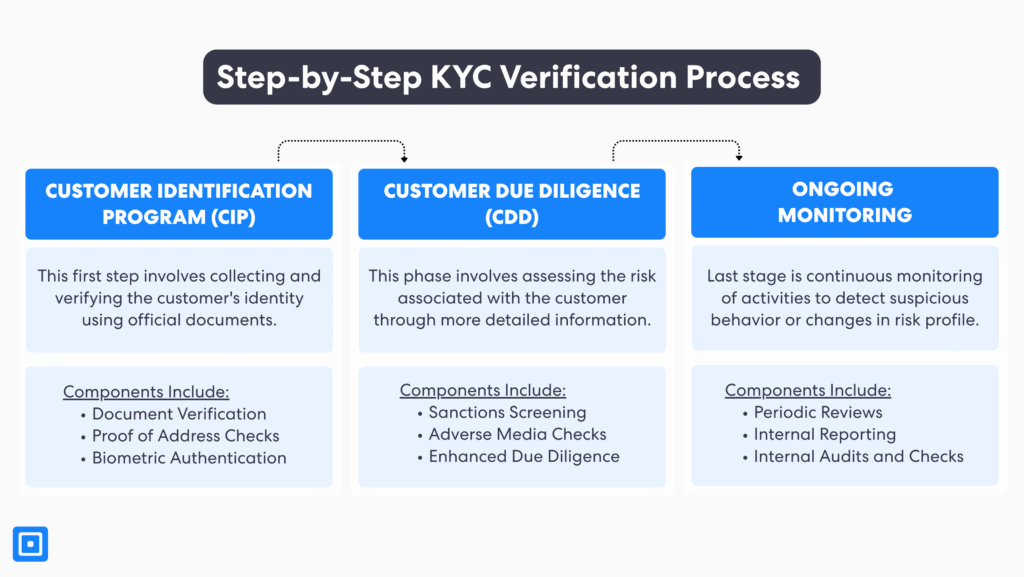
This section will provide a detailed overview of the specific stages and components typically found in the Know Your Customer verification process from a client’s perspective. The three key stages in a KYC process includes:
**1. The Customer Identification Program (CIP):** This first step involves collecting and verifying the customer’s identity using official documents. The components in this stage may include:
- **Document Check:** Organizations such as financial institutions will gather official government-issued identity documents from customers. These customer identification documents may include a driver’s license, passport, or birth certificate, which help to prove the customer’s identity.
- **Biometric Authentication (optional):** Many modern systems employ [facial recognition technology](https://www.complycube.com/en/solutions/identity-assurance/biometric-verification/) to match a user’s selfie with their ID photo, preventing identity fraud. This verification can be performed live or through an uploaded image.
- **Proof of Address Check**: A [Proof of Address (POA)](https://www.complycube.com/en/the-pertinence-of-proof-of-address-verification/) check verifies a customer’s residential address. This step ensures that the client’s address matches their provided customer records. In POA checks, documents such as bank statements or utility bills are commonly used.
**2. Customer Due Diligence (CDD):** This phase involves assessing the risk associated with the customer through more detailed information. The components in this stage include:
- **Sanctions Screening:** To ensure customers are not prohibited from conducting financial transactions, they are screened against international [sanctions lists](https://www.complycube.com/en/what-is-a-sanctions-screening/) and watchlists. This step helps businesses avoid facilitating illegal activities and ensures regulatory compliance.
- **Adverse Media Checks**: [Reviewing news sources and public records](https://www.complycube.com/en/solutions/global-screening/adverse-media-checks/) to identify any negative information or red flags associated with a customer. This process helps uncover potential involvement in financial crime, fraud, or other illicit activities.
- **Enhanced Due Diligence**: [EDD](https://www.complycube.com/en/enhanced-due-diligence-edd-insights-and-challenges/) is especially essential for companies dealing with higher-risk customers, including Politically Exposed Persons (PEPs) or those involved in complex business relationships. EDD builds on CDD, demanding further KYC documents, conducting deeper background checks, and continuously monitoring the customer’s financial transactions.
**3. Ongoing Monitoring:** The last stage is [continuously monitoring](https://www.complycube.com/en/what-is-an-ongoing-monitoring-process/) activities to detect suspicious behavior or changes in risk profile. The components in this stage may include:
- **Periodic Reviews**: Establish regular updates for reviewing and reassessing customer information and risk profiles to detect any changes or new risks that may emerge over time.
- **Internal Reporting**: Set up an internal reporting mechanism on a company-wide level. Escalate suspicious activities or compliance issues within the organization for timely investigation.
- **Internal Auditing**: Conduct independent reviews of AML/KYC controls to ensure compliance and improve risk management strategy where necessary.
## The Role of Technology in Modern KYC Procedures
Technology has transformed KYC solutions for banks and other financial institutions such that it is now feasible to achieve more effective and scalable compliance with KYC regulations and AML laws. Previously, traditional Know Your Customer (KYC) practices entailed strenuous amounts of paperwork and manual checks, which were slow and prone to inaccuracies. Today, electronic KYC (eKYC), Artificial Intelligence (AI), Machine Learning (ML), and blockchain are the focus of modern KYC compliance programs.
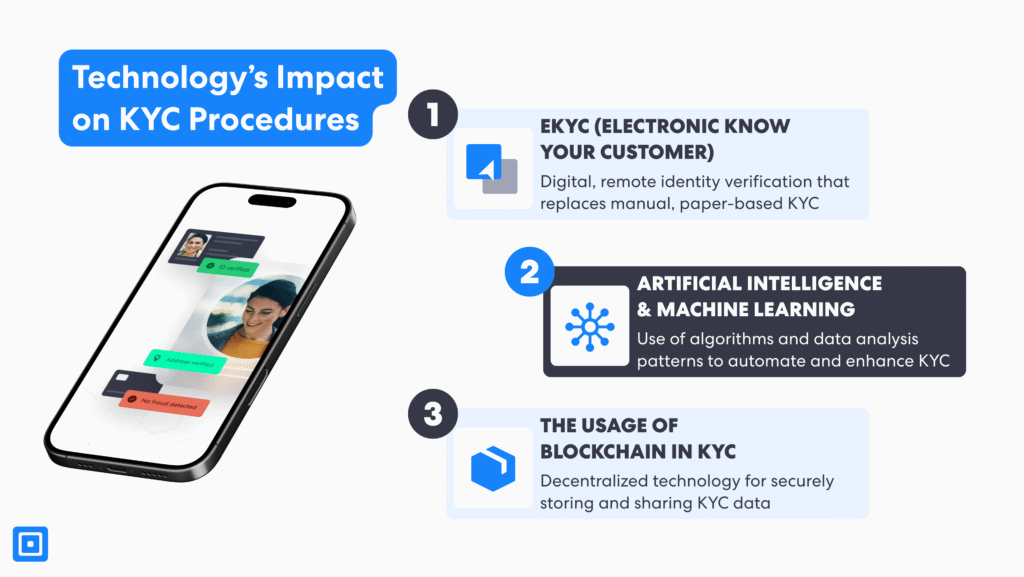
### Electronic KYC (eKYC) and How It Prevents Money Laundering
[Ekyc](https://www.complycube.com/en/what-is-ekyc-electronic-know-your-customer/) is the use of digital channels, including online channels, mobile apps, and biometric authentication, to name a few, to remotely and accurately validate a client. This digital process enables financial institutions to accurately validate people within a shorter time, reducing the cost of KYC compliance operations and onboarding time, while maintaining a positive consumer experience. eKYC supports financial systems in capturing, analyzing, and monitoring client information. In geographies with higher risk customers, the use of eKYC has led to enhanced risk assessments and regulatory compliance with real-time authentication.
### Streamlining Customer Identity Verification with AI and ML
[Artificial intelligence and machine learning](https://www.complycube.com/en/ai-driven-fraud-deepfakes-versus-ekyc-solutions/) have revolutionized KYC processes by automating data review, document validation, and risk assessment. AI and ML can analyze large amounts of data, detect counterfeit documents, and detect patterns of transactional behaviour that may signal money laundering or terrorism financing. AI-driven systems improve the accuracy of identity authentication, reduce the rate of false positives, and facilitate ongoing monitoring to ensure AML compliance. This enables compliance teams to deal with complex cases, improving the firm’s FinCrime prevention capability.
### Upholding the Integrity of Financial Systems through Blockchain
[Blockchain technology](https://www.sciencedirect.com/science/article/pii/S2666188823000035) offers a transparent, impenetrable, and secure platform to store and exchange client identity data. By utilizing [blockchain](https://www.complycube.com/en/use-cases/industry/crypto/trust-node-level-2-on-chain-kyc/), banks can create impenetrable and decentralized digital identities, reducing the requirement to provide KYC documents repeatedly. It also makes the regulatory mandate less burdensome to meet without compromising data privacy. The transparency offered by using blockchain also supports enhanced audit trails and inter-institutional cooperation, maintaining the integrity of the world’s financial system.
### **Case Study: Binance Sanctioned in the Philippines**
**Problem:**
In early 2025, the Philippine Securities and Exchange Commission (SEC) launched an investigation into **Binance**, revealing that the crypto exchange had onboarded users without conducting proper KYC verification. Several high-risk accounts—including politically exposed persons (PEPs)—were found to have bypassed Customer Due Diligence (CDD) checks. The failure to monitor transactional behaviors raised regulatory red flags, particularly in light of the region’s updated AML guidelines under the Anti-Financial Crime Reform Act of 2024.
**Solution:**
Following the probe, Binance was fined PHP 50 million (~$900,000 USD). To rectify the lapses, Binance adopted a multi-layered compliance stack including AI-powered IDV tools, automated PEP and sanctions screening, and a new eKYC onboarding process aligned with FATF standards.
**Outcome:**
- Reduced onboarding time by 42% via eKYC automation.
- Achieved 100% PEP and sanctions list screening coverage.
- Strengthened AML audit readiness and restored regulator confidence.
- Rolled out compliant onboarding workflows across Southeast Asia.
## Test Your KYC Knowledge
Now that you’ve explored the essentials of KYC verification, it’s a good time to reinforce your understanding. Take a brief quiz below to test your grasp of the key KYC concepts, answers are provided at the end of the article.let’s take a quick break and put your knowledge to the test. Take the brief quiz below to assess your understanding of the key concepts for KYC. You’ll find the answers at the end of this article.
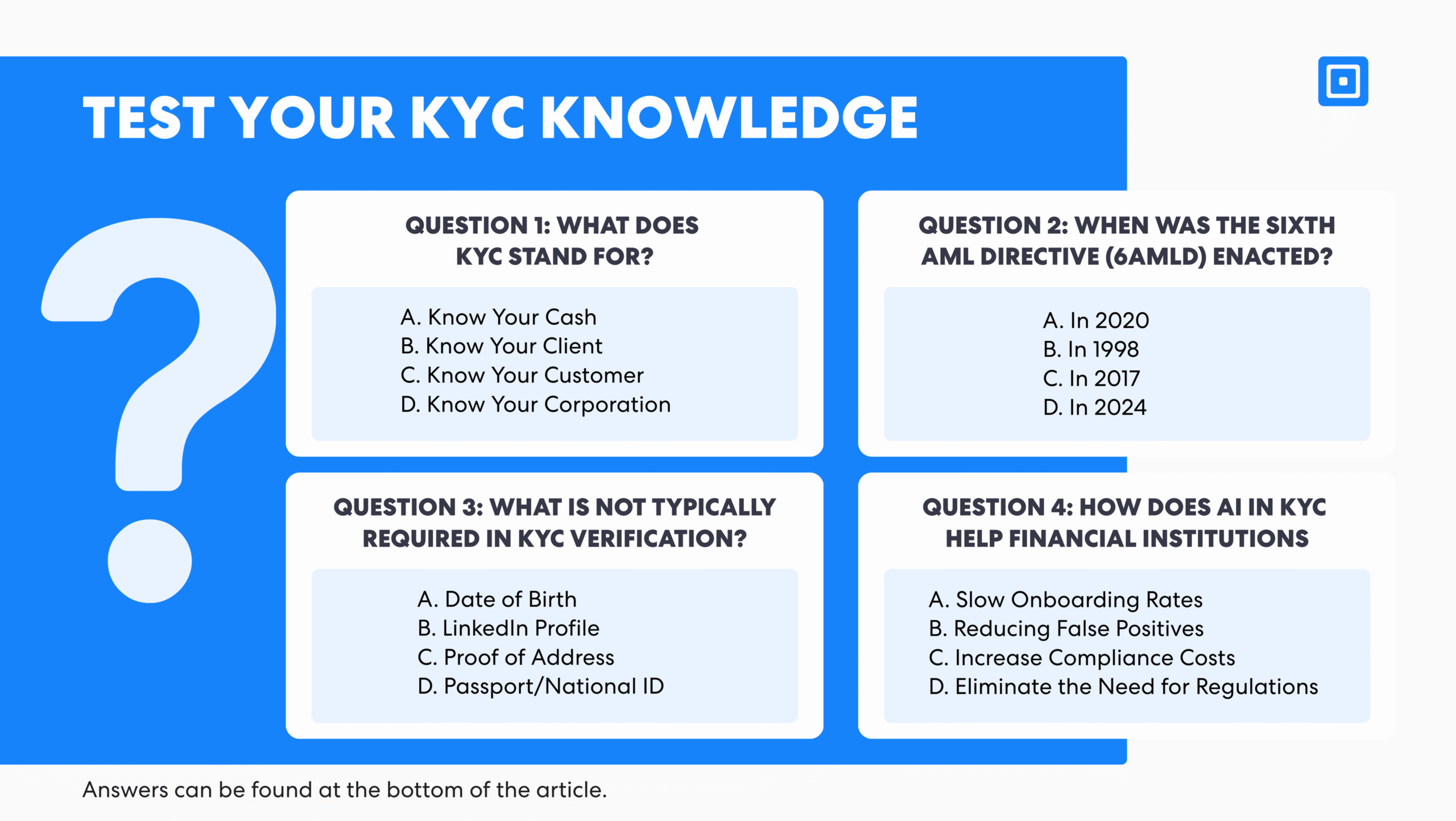
## Is KYC and AML Compliance Only Subject to Financial Institutions?
As a result of financial crime risks beyond the banking sector, a growing number of high-risk industries are now legally obligated to uphold KYC verification requirements. Below are some of the industries where legal and regulatory evolution has encouraged the integration of KYC processes:
- Art Dealers
- Insurance Company
- Gambling/Casino Industry
- Virtual Asset Providers (VASPs)
- Real Estate
- Credit Provider
- Online Gaming
- Accounting Firms
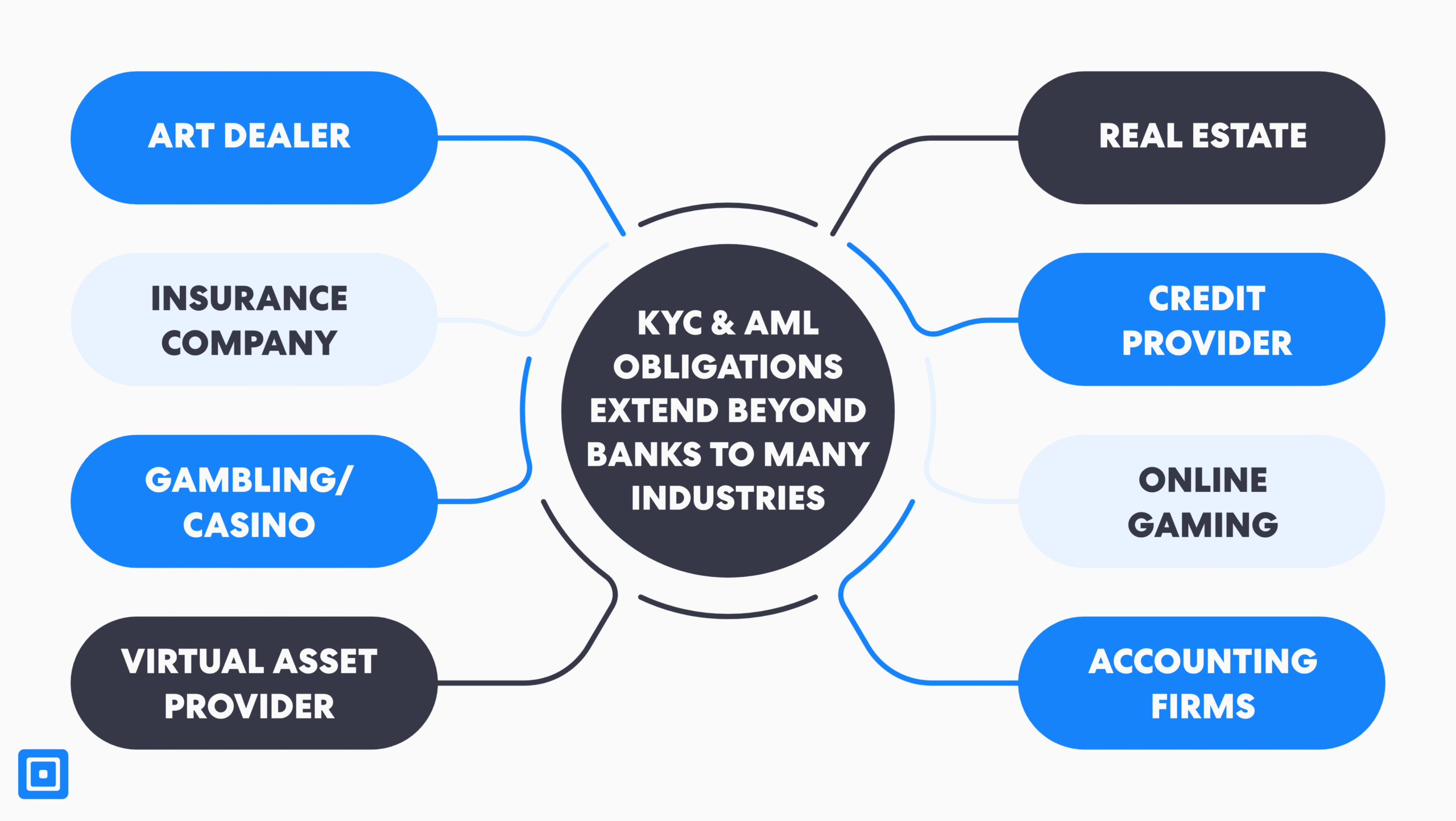
### Real Estate
Firms in the [real estate sector](https://www.complycube.com/en/use-cases/industry/property/) have now embraced KYC due to its vulnerability to money laundering through property transactions and complex ownership structures. In the European Union, the 4th Anti-Money Laundering Directive (4AMLD) directly subjected real estate agents to AML and KYC in 2018, making them responsible for identifying clients and ultimate beneficial ownership before a transaction.
### Online Gaming and Gambling
The gaming industry has witnessed increased demand for KYC to prevent fraud, underage play, and money laundering. AML Directives in the EU mandate online gaming sites to identify and authenticate a player’s identity, age, and geolocation and conduct transactional monitoring to detect unusual patterns. In the US, regulators impose stringent KYC requirements on gambling firms, compelling operators to implement robust customer authentication and verification measures.
### Bitcoin and Digital Assets
Legislation targeting Virtual Asset Service Providers (VASPs), such as the 5AMLD, has subjected exchanges and wallet providers to KYC and AML compliance. Meanwhile, US regulators require cryptocurrency companies to register as money services businesses and comply with KYC and AML requirements. Such legal requirements ensure that digital assets are not used for illegal financial flows.
### High-value dealers and other companies
Art traders, precious metal traders, and luxury goods traders are also subject to KYC requirements since valuable goods can be targeted for money laundering. For example, regulators now require precious metal and art traders to conduct due diligence on buyers when transactions exceed specified thresholds. Similarly, professional service firms such as law firms and accounting practices are legally obligated in many jurisdictions to identify beneficial owners and clients involved in high-risk transactions.
### Key Takeaways
- **Regulators mandate KYC verification** to combat financial crime and prevent terrorism financing.
- **The three phases of KYC verification** are Customer Identification Program (CIP), Customer Due Diligence (CDD), and ongoing monitoring.
- **Major global laws enforcing KYC** include the BSA (US), AMLD (EU) and Federal Law No. 4 (UAE)**.**
- **AI, machine learning, eKYC, and blockchain now** drive scalable, real-time KYC compliance.
- **ComplyCube simplifies KYC** with global coverage and continuous monitoring capabilities.
## Empower Your Know Your Customer (KYC) Solutions with ComplyCube
KYC verification is no longer just a checkbox. It has become a vital process for protecting the integrity and trust of businesses worldwide. With strong [Identity Verification (IDV)](https://www.complycube.com/en/what-are-identity-verification-solutions/) and [Anti-Money Laundering (AML)](https://www.complycube.com/en/solutions/due-diligence-compliance/anti-money-laundering/) frameworks, firms can take a proactive risk-based approach to maintain alignment with evolving regulations.
ComplyCube is the award-winning, all-in-one compliance platform made and designed for businesses looking to streamline AML/KYC approach. Leveraging advanced, no-code technologies, ComplyCube makes client verification and onboarding rapid, accurate, and ready to scale with your organization. [Get started for free today.](https://portal.complycube.com/signup)
*The correct answers are: C – Know Your Customer, A – 2020 for the sixth AML Directive (6AMLD), B – LinkedIn Profile as not typically required in KYC verification, and B – Reducing false positives as the benefit of AI in KYC.*
## Frequently Asked Questions
What does KYC verification involve?
KYC verification includes a structured process to confirm a customer’s identity and assess their risk level. It starts with collecting government-issued ID documents and proof of address, then moves into checks such as sanctions screening and adverse media monitoring. In higher-risk cases, Enhanced Due Diligence (EDD) is used. Finally, customer behavior is monitored continuously to detect suspicious activities and maintain compliance with AML regulations.
Is KYC required for all industries?
Not all, but many industries are now legally obligated to implement KYC verification due to increasing risks of money laundering and financial crime. These include banking, insurance, cryptocurrency, gambling, real estate, luxury goods trading, and accounting. Regulatory bodies like the EU and FATF have extended KYC mandates to cover these sectors, particularly when transactions involve large sums or complex ownership structures.
What is the difference between Customer Due Diligence (CDD) and Enhanced Due Diligence (EDD)?
CDD is the standard level of identity and risk checks applied to most customers. It includes document verification and sanctions list screening. EDD, on the other hand, applies to high-risk clients such as Politically Exposed Persons (PEPs) or individuals from high-risk jurisdictions. EDD involves deeper background checks, source of funds verification, and frequent monitoring to manage elevated risks.
How does eKYC improve onboarding and compliance?
Electronic Know Your Customer (eKYC) allows businesses to verify customers remotely using digital tools such as biometric verification, AI-driven document checks, and secure online platforms. eKYC shortens onboarding times, reduces manual errors, lowers compliance costs, and enhances customer satisfaction—all while maintaining regulatory alignment and improving fraud detection accuracy.
How does ComplyCube support KYC verification?
ComplyCube simplifies KYC verification through its all-in-one compliance platform. It offers no-code onboarding workflows, real-time IDV, global document coverage, and automated screening tools. With capabilities such as biometric liveness detection, continuous monitoring, and advanced fraud prevention, ComplyCube helps businesses meet KYC requirements efficiently while scaling operations with ease.
**Categories:** Guides
**Tags:** Know Your Customer
---
### [Top 5 Customer Identity Verification Challenges](https://www.complycube.com/top-5-customer-identity-verification-challenges/)
**Published:** January 14, 2025
**Author:** Sofia Daley
**Excerpt:** While customer identification tools have become more widely available and increasingly sophisticated in recent years, presentation attacks, also known as spoofs, continue to evolve. Uncover the top IDV challenges faced globally.
**Content:**
Customer identity verification is heavily reliant on the accuracy of the tools and software used throughout the onboarding process. While customer identification tools have become more widely available and increasingly sophisticated in recent years, presentation attacks continue to evolve globally. These attacks occur when a fraudster uses the biometric data or physical characteristics of another person to gain access to an account or system fraudulently. With digital identity verification strategies that employ biometric verification and liveness detection, businesses can defend their operations from these attacks. This guide will examine how presentation attacks occur and what makes customer identity verification so critical and yet challenging for modern businesses.
## Challenge #1: Synthetic Identity Fraud and the Importance of Customer Identity Verification
Synthetic identity fraud occurs when fraudsters combine real and fake information to create a new, untraceable identity. They often utilize one or a few components of real data, such as a Social Security number, and supplement that with a new name, address, or other verification details. In doing so, the fraudster creates a brand new identity.
> **The fastest-growing** [**financial crime**](https://kpmg.com/us/en/articles/2022/synthetic-identity-fraud.html) **in the United States.**
Identity verification is crucial for businesses as it allows them to establish trust and legitimacy when they provide services to individuals. Verifying an individual’s identity ensures that businesses can safely engage in transactions and comply with regulations, thereby minimizing the risk of fraud.
Synthetic identity fraud is a concern for businesses when trying to verify customers, with [KPMG](https://kpmg.com/us/en/articles/2022/synthetic-identity-fraud.html) recently labeling it the $6 billion dollar problem. They state, “As the fastest-growing financial crime in the United States, synthetic identity fraud bears a staggering $6 billion cost to banks. To perpetuate the crime, malicious actors leverage a combination of real and fake information to fabricate a synthetic identity, also known as a ‘Frankenstein ID.’”
[Harry Varatharasan](https://www.linkedin.com/in/harry-varatharasan/), Chief Product Officer at ComplyCube, states, “Synthetic identity fraud is increasingly deceptive, often bypassing traditional checks and undermining trust from the start. Leveraging biometric and AI-driven identity verification is essential to ensure secure, accurate, and compliant customer onboarding in this evolving threat landscape.”
### Introduction to Identity Verification
Identity verification is the process of proving that an individual’s identity is real and authentic. This crucial step involves verifying a person’s identity to ensure they are who they claim to be, thereby preventing identity fraud and ensuring compliance with anti-money laundering regulations. The identity verification process typically uses data such as name, date of birth, and address to prove an identity is real.
In recent years, biometric verification has become a common method of identity verification. This advanced technique uses unique physical characteristics, such as facial recognition, fingerprint recognition, and voice recognition, to verify someone’s identity. By leveraging these biometric data points, organizations can ensure a higher level of security and accuracy in the identity verification process. This not only helps in fraud prevention but also ensures compliance with stringent money laundering regulations.
### Understanding Biometric Verification
Biometric verification is a means of identifying a person by evaluating one or more distinguishing biological traits, such as fingerprints, facial patterns, and voice. Unlike traditional methods, biometric data is unique to each individual and cannot be easily replicated or stolen, making it a secure and convenient way to verify identities.
This method is widely used across various industries, including finance, healthcare, and government, to control access to sensitive information and prevent fraud. Facial recognition technology, in particular, has gained popularity as a common form of biometric verification. It uses artificial intelligence to scan and analyze facial features, ensuring that the person attempting to access a service is indeed a real user. This technology not only enhances security but also streamlines the verification process, providing a seamless experience for genuine customers.
### Biometric Authentication Methods
Biometric authentication methods include facial recognition, fingerprint recognition, and voice recognition. Each of these methods offers a secure and efficient way to verify identities:
- **Facial Recognition**: This technology uses AI to scan and analyze facial features, determining if a real user is present. It is widely used in various applications, from unlocking smartphones to airport security.
- **Fingerprint Recognition**: One of the most common forms of biometric authentication, fingerprint recognition, uses unique patterns in an individual’s fingerprints to verify their identity. It is commonly used in devices like smartphones and access control systems.
- **Voice Recognition**: This method uses unique markers in a person’s voice sample to check against a stored voice print. It is often used in customer service applications and digital assistants to verify a user’s identity.
These biometric authentication methods provide a higher level of security compared to traditional password-based systems, making them ideal for protecting sensitive information and preventing fraud.
### **The Problem**
Synthetic identities use information that is sufficient to surpass traditional and simplistic customer identity verification tools. These identities make it very difficult for financial institutions to detect risks and circumvent fraudulent activity, such as fake loan applications or money laundering schemes. Therefore, it is crucial to verify expired documents in the same way as non-expired ones to ensure consistent and thorough identity verification across all organizations.
### **The Solution**
Advanced identification verification tools powered by artificial intelligence, including biometric identification verification leveraging liveness detection, can detect synthetic identities. Sophisticated Know Your Customer (KYC) strategies employ biometric checks, which ensure your customers are present and genuine during a transaction. It is crucial to use the name that appears on official documents, such as passports, to reconcile discrepancies and maintain accuracy and compliance. These easy-to-use biometric verification processes allow for fast customer onboarding while using AI technology to detect spoofing. Biometric systems are also able to pull biometric data and analyze facial features, using data samples such as subtle microexpressions and skin texture to ensure liveness. For more on synthetic identity fraud, read [“Detecting Synthetic Identity Fraud in 2025”.](https://www.complycube.com/en/detecting-synthetic-identity-fraud-in-2025/)
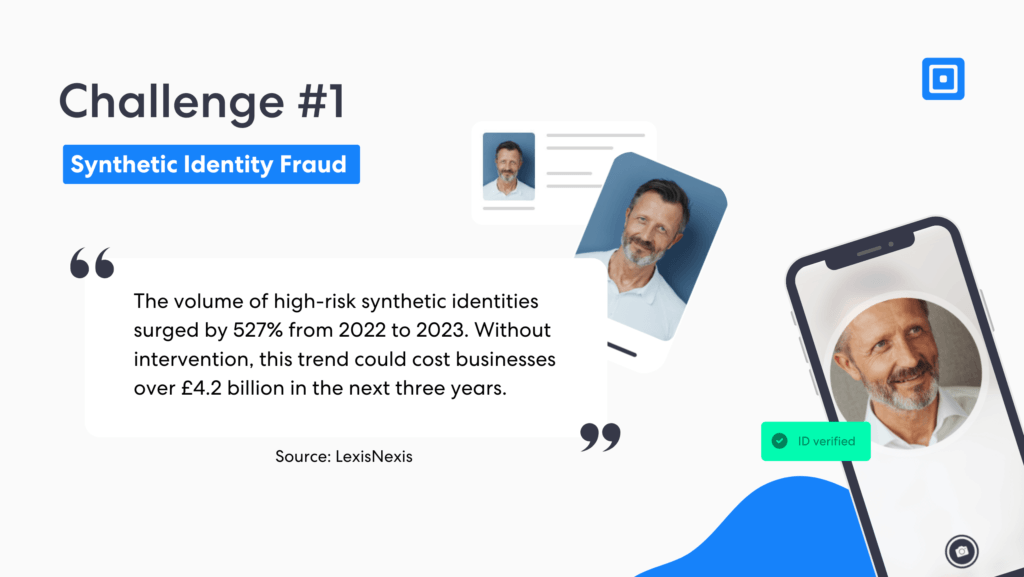
## **Challenge #2: Cross-Border Identity Verification**
Digital identity verification has become increasingly critical as more companies expand their services and products worldwide. While the digital economy benefits businesses, verifying customers’ identities across borders can be challenging, as each jurisdiction has varying compliance requirements and documentation standards. One of the challenges is verifying expired documents, as different jurisdictions have different rules regarding their validity and acceptance.
### **The Problem**
Different formats, degrees of available data, and strategies for identifying global customers make it challenging for companies to verify the authenticity of their clients and customers. Language differences, varied verification standards, and simply knowledge of differences limit organizations’ success. Fintech Global touches on this in their discussion on cross-border identification [challenges](https://fintech.global/2024/12/12/mastering-the-challenges-of-cross-border-identity-verification-in-a-digital-age/#:~:text=Cross%2Dborder%20identity%20verification%20poses,with%20each%20country's%20legal%20framework.%29), “Businesses must navigate these complexities by tailoring their verification processes to align with each country’s legal framework.”
### **The Solution**
Implementing a unified, automated identity verification solution ensures cross-border compliance. ComplyCube’s customer screening services provide global coverage, leveraging smart technology that is adaptable to varied compliance requirements. Market-leading platforms can navigate the challenges of multi-jurisdictional variations in real-time. Furthermore, by implementing AML monitoring with [watchlist screening](https://www.complycube.com/en/solutions/global-screening/continuous-monitoring/), organizations gain fortified protections from international threats.
Customers are required to provide information that can be verified against existing records or through their biometrics. However, data—such as basic bank account details—varies greatly across regions, and regulatory compliance requirements can differ significantly. Hence, partnering with a platform that can stay ahead of these complexities and ensure compliance in all regions is essential.
## **Challenge #3: Error-Prone Verification Processes Unable To Detect Sophisticated Attacks**
Many organizations use error-prone manual methods for data and identification. The lack of liveness detection technology and AI-powered biometric verification puts these organizations at risk of severe financial penalties from regulators.
In high-risk scenarios, advanced verification methods such as AML watchlist screening and facial verification technology are crucial to prevent identity fraud and ensure user onboarding and re-verification processes are secure.
### **The Problem**
The use of spoofing techniques continues to increase, with fraudsters gaining access to sensitive information on the black market or using AI to generate deepfakes. Without advanced Identity Verification technology, including a biometric verification process, it is practically impossible for organizations to identify spoofing attempts, which have now become unbelievably sophisticated. Biometric verification allows individuals to be uniquely identified through the evaluation of distinct biological traits, making it a crucial tool in combating these advanced spoofing techniques.
### **The Solution**
The use of AI and machine learning technology can drastically improve detection rates and accuracy. To combat spoofing, onboarding processes must implement advanced liveness detection and biometric screening. Any organization offering digital services must move beyond traditional, outdated methods such as manual verification to mitigate the risk of a user’s identity being fraudulent.
A dedicated compliance team plays a crucial role in ensuring that these verification processes are effective by utilizing sophisticated monitoring tools and real-time alerts to promptly address potential risks.
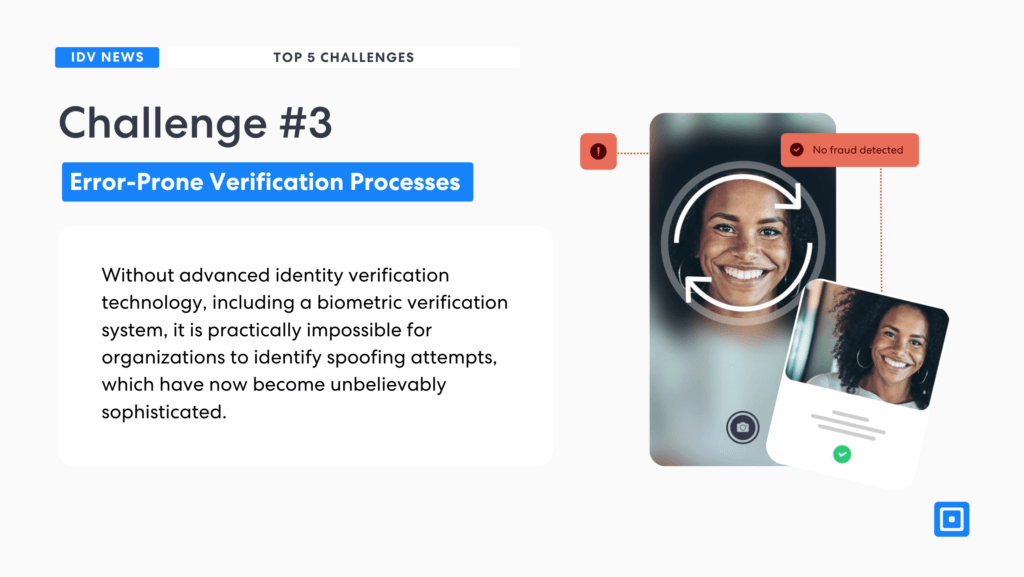
## **Challenge #4: Ensuring a Positive Customer Experience During Verification**
Identity verification can be intrusive, cumbersome, and frustrating for customers. Ensuring the accurate verification of an individual’s identity is crucial, but customers often do not want to be hampered by numerous steps and processes that are difficult to follow due to clunky processes.
> **An experience-driven secure journey can even become a** [**competitive advantage.**](http://mckinsey.com/capabilities/risk-and-resilience/our-insights/building-security-into-the-customer-experience)
“Customers expect an easy digital experience, including fast authentication and login, as well as seamless web and mobile interactivity. Companies that are able to offer all this while maintaining strong security standards will gain customer loyalty. An experience-driven secure journey can even become a competitive advantage,” notes a study from [McKinsey](https://www.mckinsey.com/capabilities/risk-and-resilience/our-insights/building-security-into-the-customer-experience).
### **The Problem:**
Finding a balance between rigorous security and a frictionless user journey is critical for maintaining customer trust and loyalty. Yet, customers become more frustrated as more digital identity verifications are employed. Customer experience is a critical component of any online interaction. In a digital environment, secure verification methods are essential to protect sensitive information while ensuring convenience. Customers know the risks of data breaches and expect sensitive information to remain protected. Yet, this extra layer of protection, in common forms, can slow down interactions. Extensive delays and slow processes are simply not acceptable in the eyes of the consumer.
### **The Solution**
Advanced solutions, such as biometric verification, do not need to impede customer satisfaction as they are simple and quick processes. Leveraging a platform like [ComplyCube](https://www.complycube.com/en/solutions/due-diligence-compliance/customer-due-diligence/) ensures a simple verification process – which takes about 30 seconds to complete. Tying physical identity to digital accounts during the sign-up process, using a photo ID along with a selfie or video for verification, is crucial for ensuring security and compliance. Prioritising a seamless onboarding process for the end user allows financial institutions to retain customers without sacrificing compliance.
ComplyCube offers several methods to prevent fraud, meet regulatory requirements, and improve the KYC process without limiting customer interaction. Passive verification, for example, quickly and easily determines unique characteristics, allowing customers to move through the process easily with minimal effort.
## **Challenge #5: Balancing Data Privacy With Comprehensive Verification**
Privacy remains a critical component of any transaction. Just as organisations must verify a person’s identity, consumers want to be sure the company or person they are interacting with is not misusing their personal data. Strict data protection and privacy laws, such as GDPR and CCPA, deter a companies’ ability to carry out checks on sensitive customer data.
### **The Problem**
Financial institutions are under pressure to balance transparency with data minimisation. They must ensure that they collect only necessary information without exposing sensitive data. Efficient verification processes are crucial for onboarding more customers, as they allow businesses to expand their customer base while maintaining security. The rise of strict data protection laws, such as the General Data Protection Regulation (GDPR) in Europe and the California Consumer Privacy Act (CCPA) in the U.S., hinder businesses in their ability to fully investigate and assess risk.
### **The Solution:**
Partnering with the right KYC (Know Your Customer) platform is key to navigating the delicate balance between data privacy and risk mitigation. The ideal KYC solution must help businesses meet their compliance obligations without compromising on privacy. This means leveraging identity verification processes that prioritise data minimisation and ensure that only essential information is collected during the verification process, in line with global data privacy standards such as GDPR and CCPA.
It is crucial to confirm that a real person is engaging in the verification process to mitigate risks associated with identity fraud.
For example, KYC platforms that offer [OCR (Optical Character Recognition)](https://www.complycube.com/en/solutions/due-diligence-compliance/know-your-customer/optical-character-recognition/) technology can help accurately capture and verify information from government-issued IDs, while liveness detection and face matching features prevent the use of fake IDs and identity fraud. These technologies allow institutions to confidently verify that the person applying for a loan or opening an account is the same person on the credit report, without exposing sensitive data.
## Benefits of Secure Verification
Secure verification provides numerous benefits, including the prevention of identity fraud and the protection of sensitive information. By implementing robust verification processes, businesses can build trust with their customers and ensure compliance with anti-money laundering regulations.
Biometric verification, in particular, offers a higher level of assurance than traditional methods. Since biometric data is unique to each individual, it is much more difficult to replicate or steal. This significantly reduces the risk of identity fraud and data breaches. Additionally, secure verification helps to prevent the creation and use of synthetic identities, further safeguarding businesses and their customers.
## The Role of Technology in Verification
Technology plays a crucial role in the verification process, facilitating identity verification and preventing fraud. For example, optical character recognition (OCR) is used to extract data from identity documents, ensuring accurate and efficient verification. Biometric information, such as facial recognition and fingerprint data, is used to verify a person’s identity, providing a higher level of security.
The use of technology in verification also enhances the customer experience by providing a seamless and convenient way to verify identities. Advanced tools and methods help to prevent fraud and ensure compliance with industry standards, making technology an essential component of the verification process. By leveraging these technological advancements, businesses can offer a secure and efficient verification process that meets the needs of both the organization and its customers.
## **Employing Effective Customer Identity Verification**
As identity theft and deepfakes become more common and complex, companies must find a way to stay ahead of the threats. Partnering with the right platform, like ComplyCube, minimises the challenges organisations face while empowering businesses to verify customer identities quickly and effortlessly. Biometric verification, live identity verification methods, and robust AI and machine learning-backed strategies ensure effortless protection.
Partnering with organizations like the Post Office for in-person verification can further enhance the reliability of identity verification solutions by leveraging their extensive branch network.
Protect your business with a trusted partner. Contact a[ compliance expert](https://www.complycube.com/en/contact/contact-sales/) at ComplyCube today to explore how their biometric verification solutions can safeguard your business.
**Categories:** Guides
**Tags:** Identity Verification
---
### [What Does Name Screening in AML Actually Mean?](https://www.complycube.com/what-does-name-screening-in-aml-actually-mean/)
**Published:** April 22, 2025
**Author:** Dini Habib
**Excerpt:** Name screening in anti-money laundering is an important approach to prevent fincrime and ensuring alignment with global regulations. It involves screening the names of individuals, companies, and countries against official databases.
**Content:**
Many clients and members of our ComplyCube network often ask, “What is name screening in AML?” or “What does name screening even mean?” Others, however, are curious about the ethical challenges associated with name screening, how advanced technology can help overcome these challenges, and the best practices for effective name screening. This guide will explain the name screening process in AML, why it’s essential, and how to incorporate it into your overall risk management and Know Your Customer (KYC) practices.
## What Is Name Screening?
Name screening is a subset of the Anti-money Laundering (AML) process. It involves screening the names of individuals, companies, and even countries against various official government databases, such as [watchlists](https://www.complycube.com/en/solutions/global-screening/watchlist-screening/), sanctions lists, and [lists of Politically Exposed Persons (PEPs)](https://www.complycube.com/en/solutions/global-screening/sanctions-pep-screening/). The goal is to identify potential risks related to financial crime, fraud, war crimes, corruption, or terrorism violations. Hence, businesses contribute to a safer financial ecosystem and avoid hefty fines. If you’re interested in understanding why someone might be placed on a sanctions list or want to determine whether a company you’re working with is sanctioned, check out our recent article below.
[](https://www.complycube.com/en/everything-you-need-to-know-about-global-sanctions-check-in-2025/)
## How Are Sanctions Lists and Watchlist Created?
Governments, international organizations and regulatory bodies are responsible for creating and maintaining updated sanctions lists and watchlists. These lists aim to identify and monitor various entities that pose potential risks to national security and financial systems, contributing to effective AML compliance.
To understand how sanctions and watchlists work, let’s look at a well-known example: Vladimir Putin. Governments create sanctions lists to restrict people or organizations involved in activities they want to stop, like violating international laws or threatening security. In [Putin’s case](https://www.state.gov/division-for-counter-threat-finance-and-sanctions/ukraine-and-russia-sanctions), the U.S. and other countries imposed sanctions because of his role in the conflict in Ukraine. These sanctions block his assets and prevent U.S. companies and individuals from transacting with him. Putin is also considered a Politically Exposed Person (PEP), which means he holds a powerful public position. While family members or close associates of PEPs may be checked more carefully because of potential risks, they are not automatically added to [sanctions lists](https://www.complycube.com/en/what-is-a-sanctions-screening/) just for being connected.
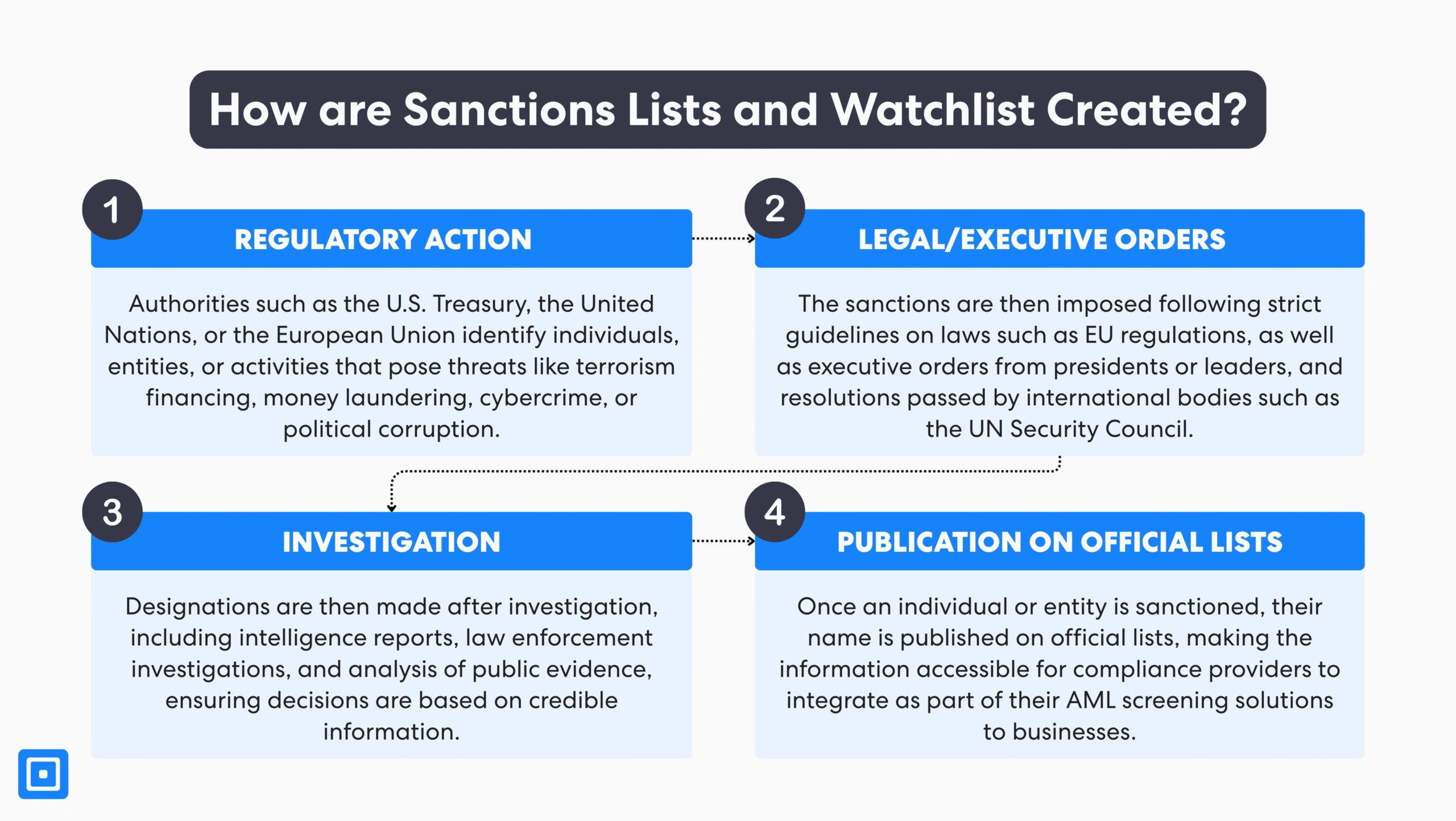
## Real-time Updates on Sanctions Lists and Watchlist
Regulatory bodies, such as the [U.S. Treasury’s Office of Foreign Assets Control ](https://ofac.treasury.gov)(OFAC), the UN, and the EU, constantly review intelligence, legal developments, and international law to add or remove individuals, entities, or countries from sanctions lists. These updates reflect new threats related to financial crime, money laundering, terrorist financing, and Politically Exposed Persons (PEPs).
Financial institutions rely on advanced screening software and automated screening systems that integrate these updates instantly through secure data feeds and APIs. This seamless process ensures compliance teams always use the latest information when conducting sanctions, customer, and payment screening. By maintaining a thorough and ongoing process of updating, institutions can quickly identify potential risks, minimize false positives, and adapt their AML screening process to mitigate risks in the global financial system.
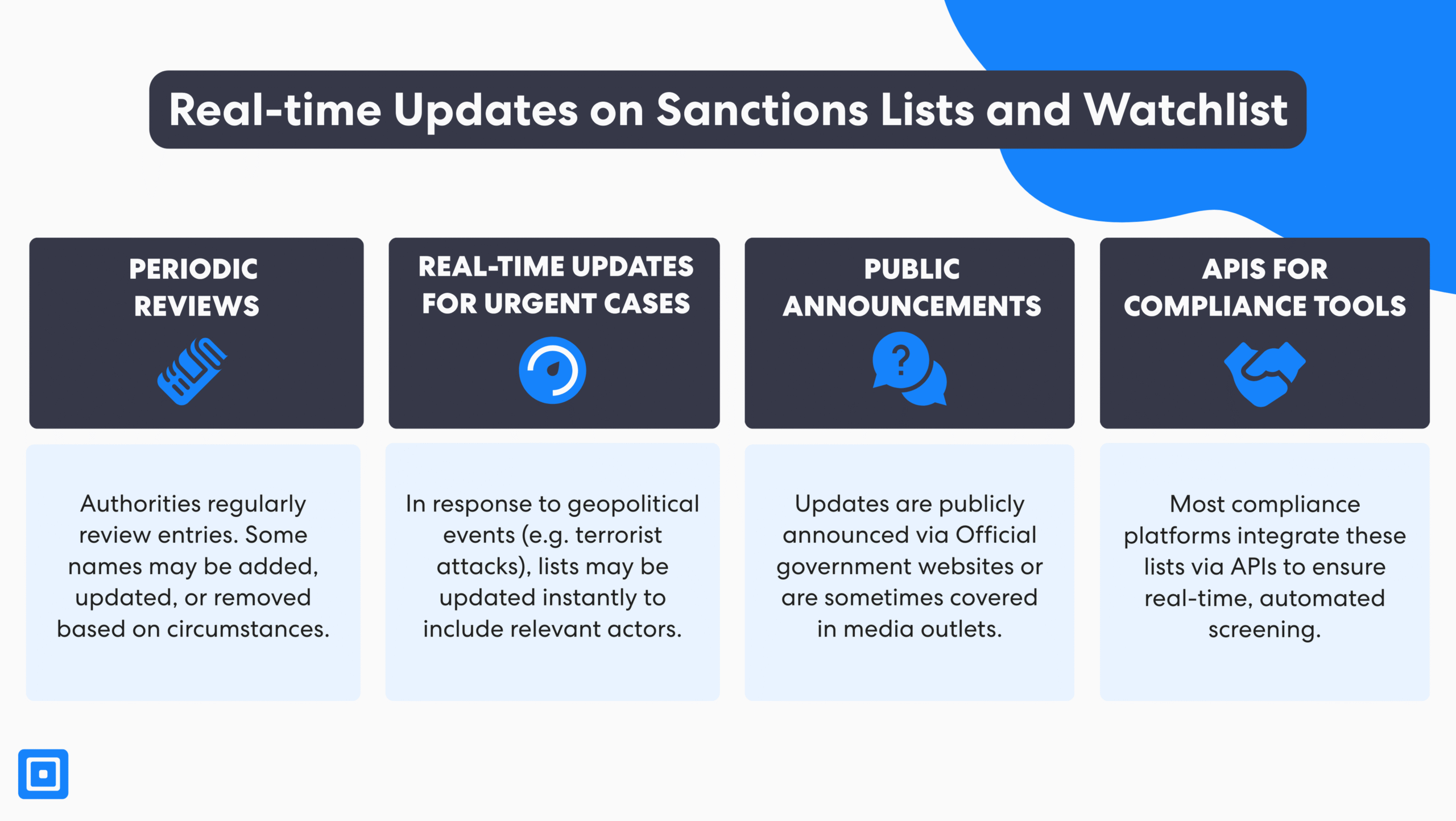
## Manual Versus Automated Name Screening in AML
Many businesses may stick to manual name screening to save on costs. While this might be a good idea in the short run, it often requires significant resources, such as exporting the sanctions list and updating it daily. Manual AML screening can lead to delays in identifying potential criminal activity. In contrast, [automated name-screening tools](https://docs.complycube.com/documentation/product-guides/due-diligence-tools/customisable-thresholds#thresholds) enable firms to handle large data volumes quickly, accurately, and transparently.
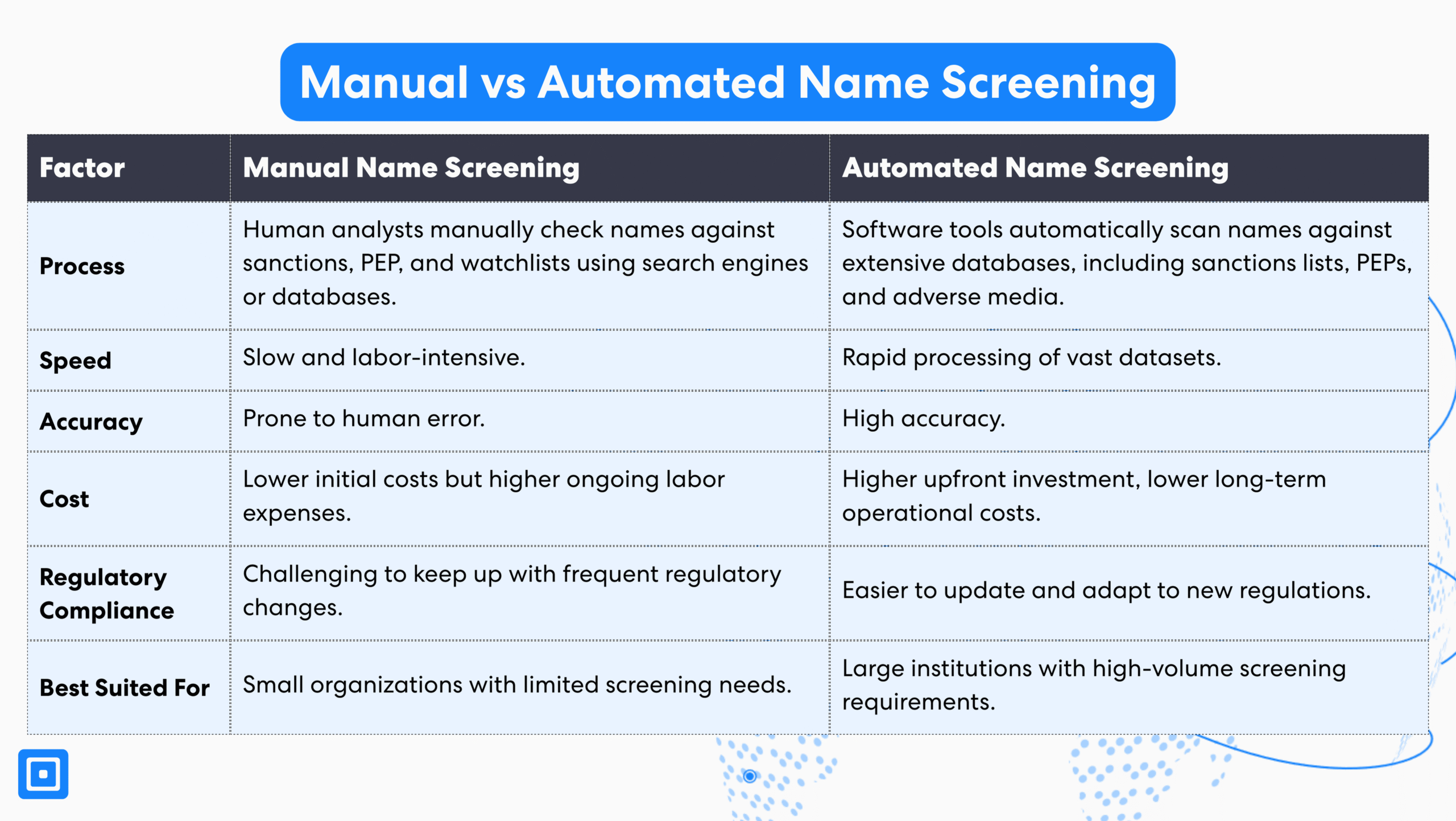
## Common Challenges for Name Screening in AML
A large number of challenges may arise from utilizing weak name-screening tools in AML processes. Take Starling Bank, for example, which was hit with [a massive £28.96 million](https://www.fca.org.uk/news/press-releases/fca-fines-starling-bank-failings-financial-crime-systems-and-controls) by the UK’s Financial Conduct Authority (FCA) due to its shortcomings in the anti-money laundering and financial crime sanctions screening process. The bank relied on outdated systems, screening only a fraction of the full sanctions list since 2017. As a result, over 54,000 bank accounts were opened for 49,000 high-risk customers, enabling them to conduct financial transactions between September 2021 and November 2023. As you can expect, this action has a trickling effect and may unintentionally pose financial harm to unsuspecting fraud victims. In this section, let’s explore the most common challenges of name screening for AML.
### Managing Large and Diverse Data Sets
When onboarding tens of thousands of merchants and customers daily, keeping track of these large data sets can be overwhelming, especially when using a manual name-screening process. Additionally, without advanced customization, compliance officers can focus on the wrong individuals instead of those who are high-risk.
### Solution: Risk Categorization to Tailor Compliance Responses
Businesses can improve compliance processes by categorizing risk and tailoring responses accordingly. For example, risk management features such as adjusting risk thresholds based on specific risk appetite means organizations can apply stricter checks to clients from high-risk countries or industries while using simpler checks for low-risk clients. Furthermore, tools such as [fuzzy logic](https://financialcrimeacademy.org/fuzzy-matching-in-financial-compliance/) and applying exclusion rules (such as omitting clients who are deceased or inactive) help focus resources where they matter most. These strategies improve the accuracy of identifying high-risk matches while reducing the likelihood of false positives.
### Evolving Sanctions and Regulatory Requirements.
Sanctions lists and watchlists undergo hundreds of changes every year, often being updated more than once a day. Manually handling all screening processes involves exhausting significant resources to organize information and prioritize tasks to make these complex data sets more manageable. Even with diligent attention to detail, this approach leaves a large gap for human error.
### Solution: Robust Customer Due Diligence (CDD) and Continuous Monitoring
Advanced all-in-one compliance platforms such as ComplyCube offer businesses robust [customer due diligence](https://www.complycube.com/en/what-is-customer-due-diligence/) during the onboarding process and continuous monitoring. The aim is to understand who the customer is and to identify any potential risks before entering into a business relationship. Furthermore, compliance teams can choose to stay up-to-date with new risk notifications delivered right to their inboxes. For example, a firm can be notified immediately of urgent risk, enabling it to take prompt action and make compliance proactive rather than reactive.
### Dealing with Language and Cultural Name Variations
There are many instances where customers might get incorrectly flagged as high-risk, or conversely, high-risk clients may not be flagged at all by compliance software. Names can be spelt or structured differently across cultures, and many compliance systems designed around Western naming conventions may struggle to identify individuals from diverse backgrounds accurately. This issue is quite common, so [choosing the right AML/KYC Vendor](https://www.complycube.com/en/is-your-kyc-provider-the-one/) that excels in handling global name variations and delivers high accuracy in fraud prevention is essential.
### Solution: Integrating Advanced AI and NLP
The solution lies in integrating advanced Artificial Intelligence (AI) and Natural Language Processing (NLP) technologies into compliance processes. Tools such as fuzzy name-matching techniques and sophisticated machine-learning models can recognize and account for different spellings, transliterations, and cultural naming patterns. For example, a single name might appear in multiple forms depending on the language or region. AI-powered platforms can learn to connect these variations to the same individual. These technologies are continuously improved by user feedback and real-world data, making them more effective over time.
## The Ethics of Name Screening and How it Impacts Real People
The implementation of name screening can have profound and sometimes unintended consequences on people’s lives. While strict AML processes aim to build a safer financial ecosystem, innocent individuals may sometimes get flagged for no reason at all. When someone is mistakenly identified as high-risk, a situation known as a false positive, it can result in real consequences like having their accounts blocked or suffering damage to their reputation.
> In the end, ethical name screening should prioritize transparency, accountability, and a genuine effort to reduce harm while still meeting regulatory requirements.
[Joshua Vowles-Dent](https://www.linkedin.com/in/joshua-vowles-dent?miniProfileUrn=urn%3Ali%3Afs_miniProfile%3AACoAAAxYa9IBYHsB-R_hIkXomiD895zWr3WlqDw&lipi=urn%3Ali%3Apage%3Ad_flagship3_search_srp_all%3BygBl%2FQIXTlWmzz6fp7WVsw%3D%3D), Business, Strategy & Partnerships Manager at ComplyCube, points out, “We often hear stories of legitimate customers who can’t open a bank account or set up a profile on a platform because their name is similar to someone on a sanctions list. This can cause major distress to the client and impact on their day-to-day activities. In the end, ethical name screening should prioritize transparency, accountability, and a genuine effort to reduce harm while still meeting regulatory requirements.”
## Name Screening in Emerging Markets and Non-Western Contexts
Name screening in emerging markets and non-Western contexts can be quite a challenge due to several factors. Many regions have non-Latin alphabets and complex naming conventions, which can create confusion when trying to match names accurately. For example, names might include patronymics, multiple family names, or vary in order, making it hard to pinpoint the correct individual. Transliteration adds another layer of complexity, as names can be spelled in various ways when converted from one script to another. Take “Mohammed,” for instance; the same person could be listed as “Muhammad” or “Mohamad” depending on the record. This inconsistency definitely increases the risk of false positives or negatives during screenings.
Cultural nuances also play a huge role. For example, in certain Asian countries, surnames come before given names, while in others, middle names might be used more prominently. Plus, in areas with limited digital infrastructure, data can often be incomplete or inconsistent, which adds more difficulty.
[Harry Varatharasan](https://www.linkedin.com/in/harry-varatharasan?miniProfileUrn=urn%3Ali%3Afs_miniProfile%3AACoAAANt1FUBmXTN52rL_u9zjNgCfX4ZIMIqRLk&lipi=urn%3Ali%3Apage%3Ad_flagship3_search_srp_all%3BygBl%2FQIXTlWmzz6fp7WVsw%3D%3D), Chief Product Officer at ComplyCube, speaks to this point, “The responsibility of using ethical and explainable AI lies in the hands of compliance providers. They must ensure that AI systems are designed and implemented with a strong focus on ethical considerations and transparency. This includes regularly auditing algorithms for bias, providing clear explanations of AI decision-making processes, and adhering to regulatory standards.”
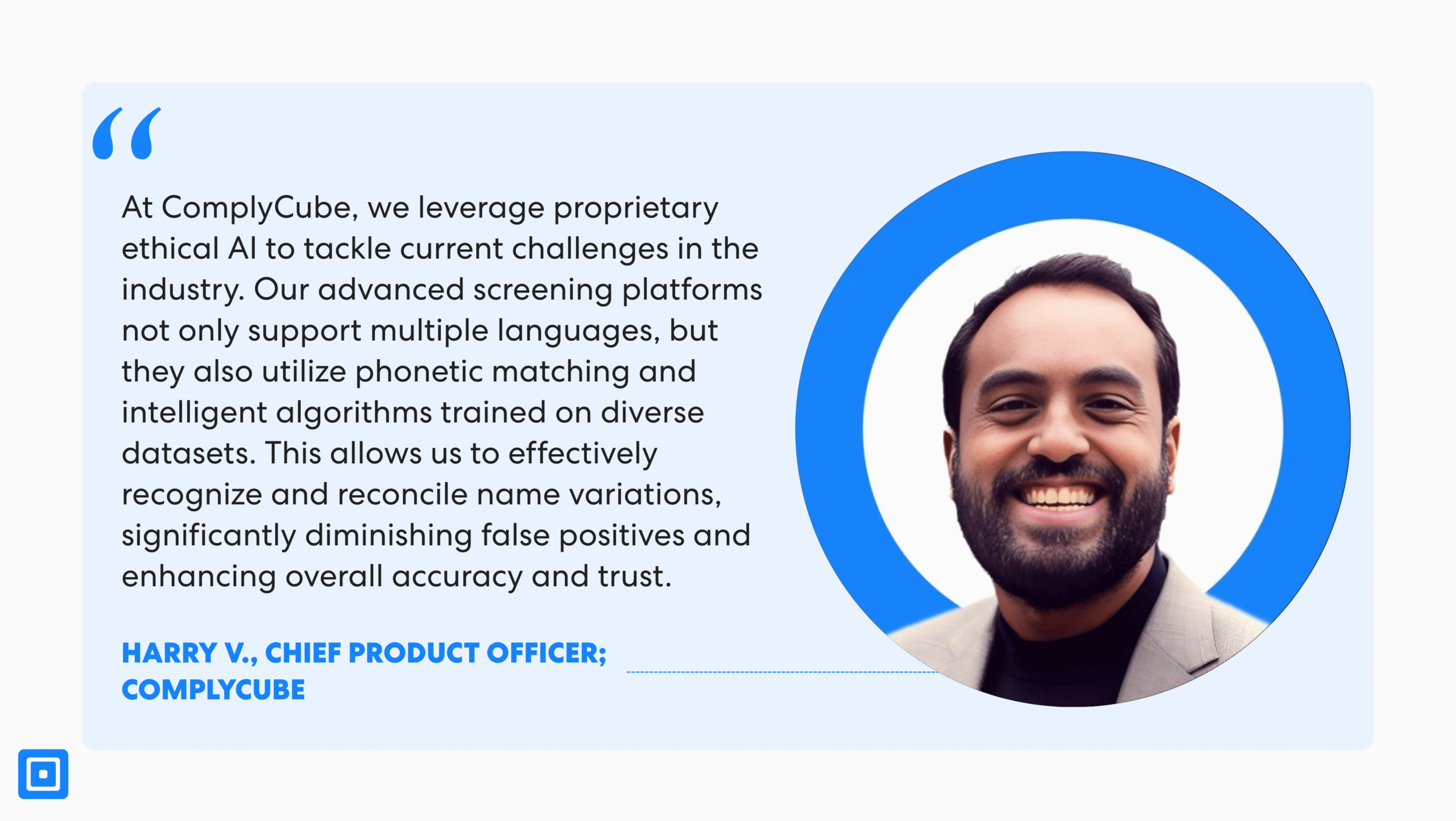
## Best Practices for AML Screening
Effective AML screening requires a combination of state-of-the-art technology, processes, and expertise. Some best practices for name screening in anti money laundering includes implementing a proactive risk approach, conducting thorough ongoing monitoring, and equipping risk management teams with regular training.
### Implement a Risk-based Approach
Above all, embracing a [proactive risk-based approach](https://www.complycube.com/en/what-is-a-risk-based-approach/) is essential. This entails aligning the name screening process to a customer’s risk profile, with greater focus on high-risk customers, Politically Exposed Persons (PEPs), and sanction-listed individuals. By allocating resources where financial fraud and suspicious activity risk is greater, compliance professionals can minimize risks more effectively and tackle them early.
### Leveraging Automated AML Screening Tools
Automated screening software is also a feature of modern AML compliance. Manual screening can be susceptible to human error and is not feasible for large data sets of financial transactions. However, automated systems and advanced screening software enable institutions to conduct real-time name screening, sanctions screening, and adverse media searches. These solutions help in minimizing false positives and enhancing the detection of threats such as terrorist financing and illegal activities related to worldwide law offenses.
### Conduct Ongoing Monitoring
AML name screening is an ongoing process. [Continuously monitoring](https://www.complycube.com/en/what-is-an-ongoing-monitoring-process/) customer activity allows financial institutions to detect changes in a customer’s identity or behavior that require further scrutiny. From onboarding new clients to screening existing customers, it is essential that screening systems are kept current so that organizations can keep up with new ways of financial crime and changes in sanctions legislation.
### Complying With Strict Regulations
AML compliance protects a firm’s procedure against all relevant regulatory mandates, for example, the Bank Secrecy Act and global AML mandates. Sanction screening is a procedure that properly includes conducting sanctions screening against available lists from bodies such as OFAC, the EU, and the UN. Institutions must be on their guard in maintaining compliance, accuracy, and up-to-dateness of their AML screening procedures to avoid exposure to the law and reputation impairment.
### Regular Check-ins and Training With Employees
Finally, no thorough screening procedure is finished without investing in those who do the screening. Compliance officers must be periodically trained to keep abreast with the latest AML directives, the usage of screening software, and the institution’s own risk appetite. Team member training with skills and expertise for identifying risks and screening meticulously helps build a culture of accountability. It improves the overall efficiency of AML name screening procedures in the entire financial sector.
By following these best practices, financial institutions can ensure that their AML screening process effectively identifies and mitigates money laundering risks, thereby protecting their business operations and maintaining regulatory compliance.
## The Critical Role of Name Screening in Ensuring AML Compliance
Name screening in AML is a fundamental component of effective compliance that helps financial institutions detect and prevent financial crimes such as money laundering, terrorist financing, and financial fraud. Utilizing advanced screening tools, including AI and machine learning, enhances the accuracy of the process by reducing false positives and managing the complexities of global financial transactions. Ongoing monitoring and a risk-based approach enable compliance teams to continuously assess customer risk profiles, adapt to regulatory changes, and mitigate potential risks associated with high-risk individuals or entities.
By conducting thorough screening during onboarding and maintaining vigilant continuous monitoring, firms can uphold AML compliance, protect the integrity of the financial system, and contribute to the fight against illegal activities. An effective sanctions screening process ensures regulatory adherence and fosters trust and fairness within the financial sector, making it a vital part of a comprehensive AML strategy. [Speak to a member of the team](https://www.complycube.com/en/contact/contact-sales/) to get started today.

**Categories:** Guides
**Tags:** Anti-Money Laundering
---
### [All You Need to Know About Global Sanctions Check In 2025](https://www.complycube.com/global-sanctions-check-2025-essential-updates/)
**Published:** April 1, 2025
**Author:** Dini Habib
**Excerpt:** Sanctions Screening is vital in the global effort to fight money laundering and terrorist financing. It is the process of methodically checking that individuals and businesses comply with regulations worldwide. This process involves
**Content:**
Sanctions Screening is critical in global efforts to fight money laundering and terrorist financing. It refers to the process of methodically checking that people, companies, and transactions are in line with government and international organisations’ regulations. This crucial process consists of global sanctions check, which involves carefully cross-checking data against sanctioned party lists, helping to uphold the integrity of global commerce and compliance frameworks.
In this blog, we’re responding to some of your most frequently asked questions about Sanctions Screening. We’ll examine the most common reasons why an entity can face sanctions and discuss how you can identify whether a person or company you are doing business with is sanctioned.
## What is a Global Sanctions Check?
Frequently used interchangeably with Sanctions Screening, Global Sanctions Check is a preventative action that one takes in order to ascertain whether an individual or entity appears on sanction lists. In other words, it’s the act of proactively screening and identifying whether someone or an entity is on a sanctions list through carrying out [diligent due diligence](https://www.complycube.com/use-cases/process/ongoing-due-diligence/) into their history and whether they’re prohibited from doing certain things due to their involvement in illegal activities such as fraud, money-laundering, terrorism, drug trade, among others.
> As of 2024, there [are over 70,000 unique sanctioned persons](https://www.lseg.com/en/insights/risk-intelligence/global-sanctions-trends-gsi-report "are over 70,000 unique sanctioned persons") globally, marking a massive 370% increase from 2017.
The complexity and breadth of sanctions regimes have grown in recent years, making it vital for organizations to remain alert and informed about the latest sanctions updates.
## Why Do Companies Face Sanctions?
When determining whether a company has been sanctioned, it’s important to consider the many factors that can lead to this outcome. Sanctions can stem not just from a company’s own behaviors but also from its connections to specific territories or sectors that fall under wider economic sanctions. Here are the common reasons a company may face sanctions:

### 1. Anti-Money Laundering (AML) Violations
- Companies can be sanctioned if they lack strong [Know Your Customer](https://www.complycube.com/global-kyc-verification-process-in-3-steps/) (KYC) and Customer Due Diligence (CDD) practices. Other factors include failing to adequately monitor or report suspicious activities and lacking solid measures to detect and prevent money laundering. Being involved in illegal schemes can also lead to serious repercussions.
### 2. Financial Crimes
- Involvement in various financial crimes like fraud, bribery, and insider trading can lead to sanctions. Actions such as money laundering, tax evasion, or financing terrorism can seriously harm a company’s standing. Additionally, cybercrimes targeting financial systems and personal information can also attract attention and potential sanctions.
### 3. Human Rights Violations
- Companies may face sanctions for significant violations of human rights, including acts like genocide, torture, or unjust arrests. Other infractions can include overlooking economic, social, and cultural rights, human trafficking, or labor exploitation. Environmental damages that go against local regulations can also bring about sanctions.
### 4. Terrorism-Related Activities
- Providing aid to terrorist groups or engaging in transactions related to planning or carrying out terrorist attacks can result in tough sanctions. Some businesses even go so far as to mask their legitimate operations to support funding for terrorism.
### 5. Violating Trade Embargoes or Export Controls
- Companies that engage in trade with sanctioned parties export restricted products without the right permissions, or bypass embargoes using intermediaries or false documents can also face significant consequences.
## How to Identify Sanctioned Businesses
### Checking Global Sanctions List
The first step in determining a business’s status is to look at the official sanctions lists put together by reliable organizations. Some key resources to consider include:
- [United Nations Security Council (UNSC) Sanctions List](https://main.un.org/securitycouncil/en/content/un-sc-consolidated-list)
- [European Union (EU) Consolidated Sanctions List](https://www.sanctionsmap.eu/#/main) – Managed by the European External Action Service (EEAS)
- [U.S. Sanctions](https://sanctionssearch.ofac.treas.gov) – Managed by the Office of Foreign Assets Control (OFAC)
- [UK Sanctions List](https://www.gov.uk/government/publications/the-uk-sanctions-list) – Managed by the Office of Financial Sanctions Implementation (OFSI)
- [Sectoral Sanctions Identifications List](https://www.opensanctions.org/programs/US-SSI/) – Part of the consolidated sanctions lists enforced by OFAC
### Leveraging Compliance Software
When it comes to compliance, having the right software can make all the difference. There are plenty of situations where a party might be sanctioned in a particular country, and without the right tools, it can be tough to keep track of everything.
Take ComplyCube, for instance. [The all-in-one AI-driven platform](https://www.complycube.com/en/solutions/) collaborates with various government and regulatory bodies to ensure that data is consolidated quickly and easily, right at your fingertips. Many businesses have reported onboarding clients over 98% faster, with checks taking less than 30 seconds. With an extensive database of over 3,000 global data points and its unique precision algorithm and technology, ComplyCube can help you confidently and accurately ascertain that the clients you’re working with are not at risk.
### Benefits of Leveraging ComplyCube for Sanctions Screening
Leveraging compliance software like ComplyCube’s allows businesses to streamline their compliance operations rapidly while staying compliant with changing regulations worldwide.
- ComplyCube’s advanced machine learning and proprietary AI algorithm instantly checks businesses against [multiple official sanctions lists](https://www.complycube.com/en/solutions/global-screening/sanctions-pep-screening/) (e.g., OFAC, EU, UN, UK, etc.) in real-time.
- Alerts you if a business gets sanctioned after your initial check, reducing compliance risks.
- Goes beyond sanctions and checks for Politically Exposed Persons (PEPs), adverse media, and watchlists.
- Automating the verification process reduces manual work, making it easier to comply with regulations like AML (Anti-Money Laundering) and KYC (Know Your Customer).
- Provides detailed logs for compliance audits, ensuring regulatory transparency.
## **How Do You Know if Someone Is Subject to Sanctions**
While sanctions often target specific geography and large corporations, individuals can also be affected. The most common reasons for an individual to get sanctioned can include:
- Narcotics trafficking
- Terrorism
- Human rights violations
- Weapons proliferation
- Political disruption
- Human trafficking and people smuggling
- Financial crime
- Transnational organized crime
- Corruption

Checking if a person is sanctioned follows the same process as checking if a company or territory is sanctioned. However, when it comes to companies, you’ll need to search for the company name along with its identifiers, such as registration numbers, business addresses, or legal entity identifiers. It’s also crucial to consider subsidiaries or related companies, as sanctions may also apply to them. This is where third-party screening tools like ComplyCube can make the process easier.
In addition, ongoing due diligence is essential to ensure compliance. This means consistently monitoring, reporting, and identifying new risks, including sanctions, fraudulent behavior, and illegal activities.
## **How Do You Know If a Country Is on the Sanctions List?**
While sanctions are commonly placed on specific organisations and individuals, they can also be imposed to restrict certain countries from engaging in transactions with one another. The scope of the sanction can vary to affect an entire nation or specific entities in that country.

## Some of the Most Common Cases Include
### The Case of US Embargo and Targeted Sanctions Against Cuba
[Under the 1958 U.S. embargo, Cuba has been classified as sanctioned](https://abolitionnotes.org/end-us-sanctions-embargo-on-cuba) by the US government. This means individuals are generally prohibited from making transactions or delivering items in Cuba unless otherwise provided with a comprehensive license. There are also trade and financial trading restrictions. The EU and UN do not have broad sanctions on Cuba, and in fact, the UN has been trying to oppose the US embargo with little to no change.
### The Case of Iran Sanctions for Human Rights Violation
Due to involvement in human rights violations, as well as the [violation of the 2015 Iran Nuclear Deal, Iran has been imposed sanctions by multiple jurisdictions](https://www.consilium.europa.eu/en/policies/sanctions-against-iran/), including the UN, US, UK, and the EU. The US has placed restrictions on oil, financial transactions, and banking in Iran, including narrower sanctions targeted at specific officials. The EU and UK have imposed Iran’s involvement in nuclear programs, imposing broad financial restrictions and sanctions.
### The Case of North Korea and Its Growing List of Sanctions for Nuclear Defiance
North Korea has been found to involve itself in nuclear testing repeatedly, and illicit activities such as crypto crime [have found themselves being sanctioned by many jurisdictions too](https://www.cfr.org/backgrounder/north-korea-sanctions-un-nuclear-weapons "have found themselves being sanctioned by many jurisdictions too"). The UN has placed an arms embargo, including banning weapons sales and imposing importing and exporting restrictions on items like oil, travel, and coal. The U.S. Sanctions prohibit virtually all trade and financial transactions and place secondary sanctions on any company or country that is in North Korea. The EU and UK Sanctions align with UN restrictions but also ban financial services and business with investments.
## Consequences of Overlooking Sanctions for Financial Institutions
Sanctions compliance is vital for financial institutions and businesses operating in the financial sector and beyond. Businesses, including those in e-commerce, retail, and telecom, must conduct thorough sanctions checks to avoid financial crime, money laundering, and terrorist financing. Without a proper sanctions screening process, companies may risk engaging with sanctioned entities, individuals, and [politically exposed persons (PEPs)](https://www.complycube.com/en/what-is-a-pep/ "politically exposed persons (PEPs)"), which can lead to heavy fines, reputational damage, and restrictions on international trade.
Foreign financial institutions subject to financial sanctions must align their screening processes with key regulatory authorities, including the United Nations, the European Union, and government agencies. Compliance with the sanctions list requires access to accurate sanctions data to detect potential matches and prevent violations. The key international organizations maintain major sanctions lists, including the Foreign Sanctions Evaders List, the Sectoral Sanctions Identifications List, and the Specially Designated Nationals (SDN) List.
## Fortify Your Sanctions Screening With ComplyCube
Failure to comply with sanctions can lead to blocked transactions and even the loss of correspondent accounts. Companies must integrate advanced screening tools into their existing systems to mitigate these risks. Transaction and PEP screening are crucial in identifying high-risk entities while minimizing false positives. Businesses should leverage fuzzy logic to refine their screening process and enhance due diligence efforts.
Furthermore, the consequences of ignoring sanctions compliance can go beyond financial penalties and might even lead to unintentional assistance of mass destruction, arms embargo, and forbidden trade within restricted territories. The international community collaborates to prevent threats, and businesses must comply with screening requirements to protect trade, entities, and businesses from legal and financial repercussions. Due diligence in the compliance process is a regulatory mandate and a safeguard against global threats. Speak to [the team.](https://www.complycube.com/en/contact/contact-sales/)
[](https://www.complycube.com/en/contact/contact-sales/)
**Categories:** Guides
**Tags:** Anti-Money Laundering
---
### [What are Identity Verification Solutions?](https://www.complycube.com/what-are-identity-verification-solutions/)
**Published:** April 1, 2025
**Author:** Sofia Daley
**Excerpt:** Identity verification solutions allow businesses to remain compliant and prevent identity fraud from their platform. Learn how critical solutions can prevent cases of identity fraud, keeping businesses compliant and secure.
**Content:**
Businesses across every sector are under an increase in pressure to comply with KYC and AML regulatory requirements. These regulations are crucial for protecting businesses from fraud, money laundering, and financial crimes. It’s important for businesses to partner with trusted providers who can ensure compliance on a national and international scale, meaning that companies must be savvy when deciding which provider to choose. Identity verification solutions allow businesses to remain compliant and prevent identity fraud from their platform.
In 2024, the Federal Trade Commission reported 1,135,291 cases of identity theft in the United States, marking an increase of approximately 98,000 cases compared to 2023. However, this rise in sophisticated identity fraud isn’t confined to the US; it’s a growing issue worldwide. A March 2024 study by Synectics revealed that 45% of fraud reported by banks in the UK involved identity theft. In financial terms, identity fraud costs the UK an estimated £1.8 billion annually, while the US faces a staggering $47 billion in losses in 2024.
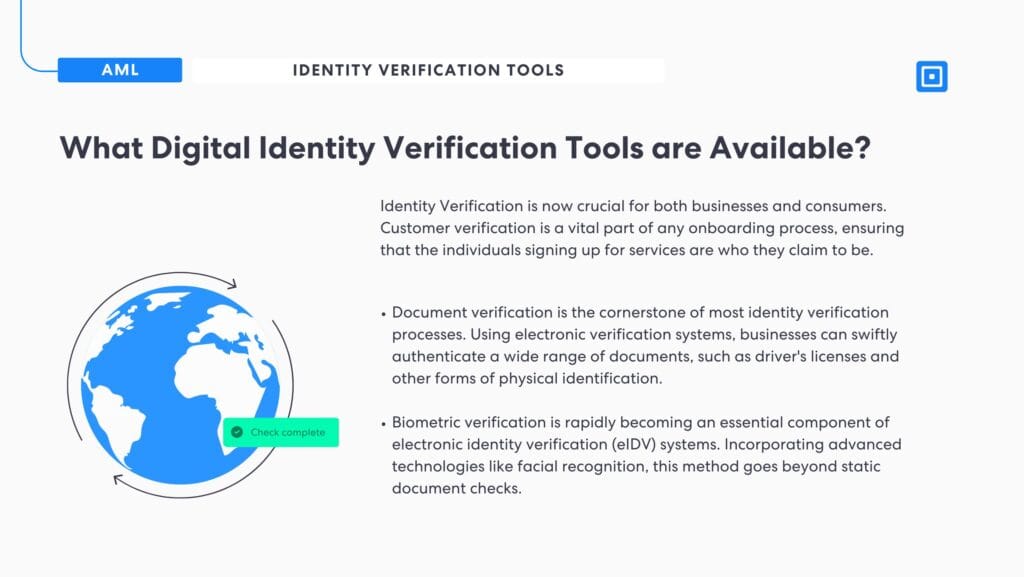
## The Key Features of Identity Verification Solutions
At the heart of every KYC platform is the ability to accurately verify the identity of customers. In addition to traditional document verification, biometric solutions, such as facial recognition, are now needed to fortify operations. Key features that are required for full compliance include:
**Biometric Facial Verification:** Standard identity document checks are no longer enough to ensure fraud prevention and achieve full compliance. An in-depth biometric verification check should be included within your KYC platform. Identity verification solutions can analyse biometric data to verify an identity using AI powered technology.
**Liveness Detection Technology:** To accurately spot deepfakes, biometric verification must leverage Liveness Detection technology. Liveness Detection is able to quickly identify sophisticated presentation attacks, such as deepfakes or video replays. For more information on presentation attack detection, read [“Presentation Attack Detection: A Comprehensive Guide.”](https://www.complycube.com/en/presentation-attack-detection-a-comprehensive-guide/)
Liveness detection spots deepfakes by analyzing subtle, difficult to replicate human behaviors and characteristics:
- **Subtle Micro-Expressions**: Real people exhibit unique motion patterns, like blinking, eye movement, and micro-gestures, which deepfakes often fail to replicate accurately.
- **Lighting & Texture**: Real faces reflect light naturally, with skin textures and wrinkles that deepfakes often get wrong, making them detectable.
- **Depth Perception**: Liveness systems can detect the 3D structure of a face, which deepfakes struggle to simulate, especially with head movement.
- **Audio-Visual Sync**: Liveness detection checks if lip movements match speech, identifying mismatches in deepfakes.
- **Behavioral Biometrics**: Humans respond to challenges like blinking or head turns in ways deepfakes can’t, exposing inconsistencies.
- **AI & Machine Learning**: Liveness detection uses advanced algorithms to spot patterns that deepfakes can’t replicate accurately in real-time.
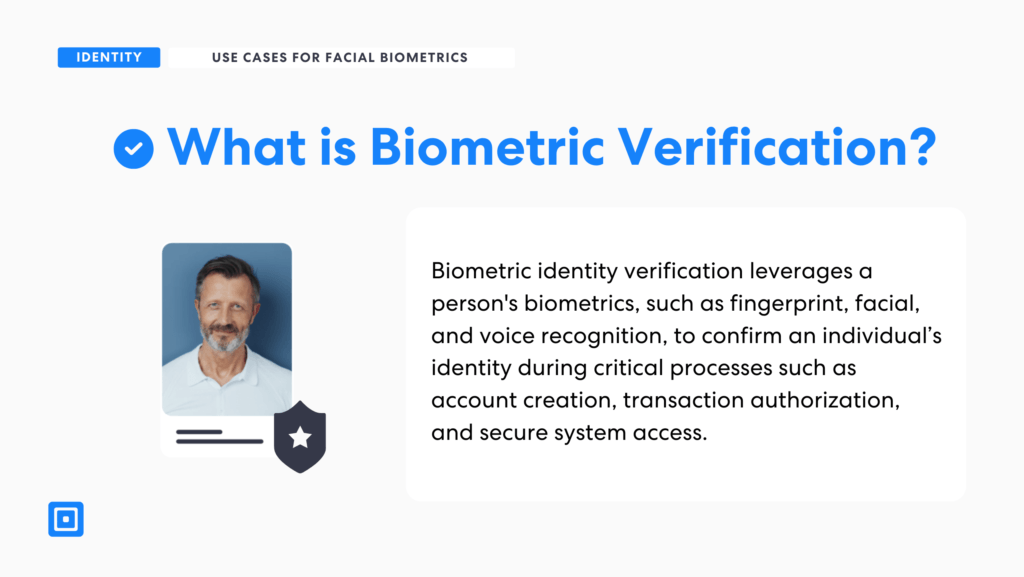
If several providers offer these necessary features, a key way to identify which providers have the latest and most accurate technology is checking whether they hold key certifications for their solutions. Some examples include:
**ISO-Certified Presentation Attack Detection (PAD) Technology (ISO/IEC 30107-3):** This certification marks that the IDV technology can analyze and detect the presence of various types of fraud attempts, such as printed photos, video replay attacks, and more. By building 3D facial maps, it assesses critical aspects like skin texture, micro-expressions, and movement to detect fraudulent attempts and ensure the person is live during the verification. KYC providers that hold this certification are likely to be leveraging cutting-edge technology with liveness detection.
**UK Government DIATF-Certified:** The DIATF certification, which applies to UK-based providers, specifies standardized confidence levels that IDSPs must meet across different use cases, referred to as profiles. These profiles ensure that the Identity Verification processes align with varying levels of risk and security. To learn more about UK DIATF, read [“Choosing a UK DIATF Certified IDSP.”](https://www.complycube.com/en/choosing-a-uk-diatf-certified-idsp/)
Finding a provider that holds necessary certifications and is working inline with government expectations for the sector is a great sign that the provider is trustworthy. Transparency around certifications should be upheld by all KYC and AML providers. In addition, looking for trusted sector awards, such as the RegTech 100, can help highlight which providers lead within the market.
## Ensuring Both KYC and AML Compliance with Identity Verification Solutions
KYC platforms also play a pivotal role in ensuring that your business complies with Anti-Money Laundering (AML) regulations. Effective AML compliance goes beyond verifying the identity of customers; it also includes screening customers against global watchlists, Politically Exposed Persons (PEP) lists, and sanction lists.
A good KYC provider will offer real-time AML screening to ensure that your business is not inadvertently engaging with high-risk individuals or entities. This capability is essential to minimize the risk of being involved in illicit activities and to maintain a strong reputation. Ongoing monitoring should also be included, with real-time notifications alerting businesses to any risks that may arise.
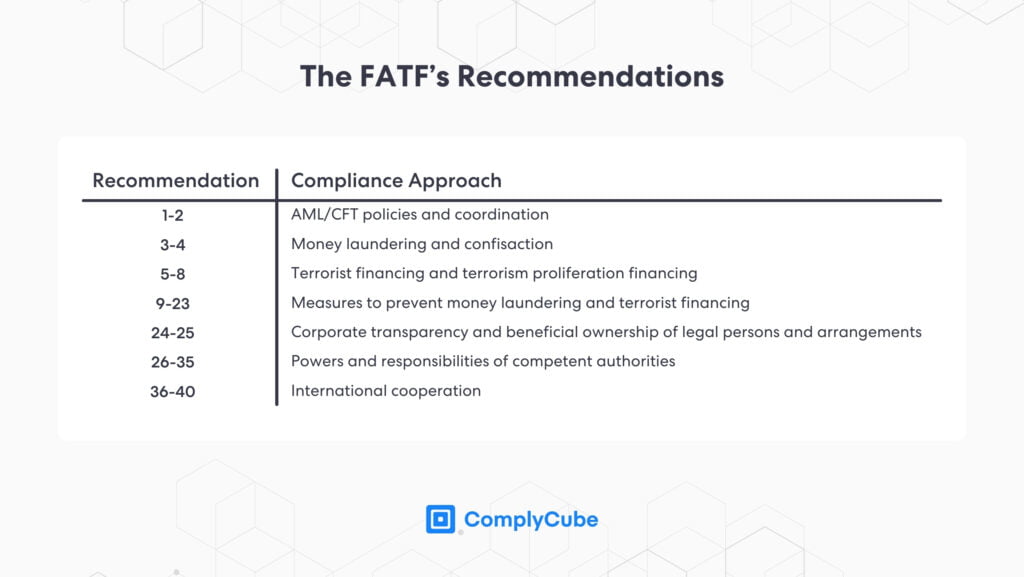
Other factors that make a KYC platform a top provider are onboarding times, global coverage, customisation and support. Let’s get into what that looks like and what you should look for in your KYC platform.
## Fast Yet Secure Onboarding
Speed and accuracy are key in the KYC process. Customers want fast onboarding and a slow verification process will have higher drop off rates. Top KYC platforms give real-time verification so you can verify documents, assess risk and complete the KYC process fast. This not only improves the user experience but reduces operational delays and keeps you ahead of the game.

Onboarding should be short and sweet to avoid high drop off rates. Providers that use cutting edge AI-powered tech can provide secure onboarding with robust KYC in under a minute per customer. Leading KYC providers, such as ComplyCube, can onboard customers in less than a minute with market-leading technology that leverages liveness detection and advanced biometrics.
## Transparent Pricing
Ensuring that you’re gaining real value from your provider is important, something that is closely tied to transparent pricing. Many AML and KYC providers charge unexpected support fees, or fees required for data retention or report downloads. Fair providers will offer transparent volume-based pricing, with ongoing monitoring included.
> From third-party fees to unexpected setup and support costs, these hidden charges can turn what initially seemed like an affordable option into a significant financial burden.
Harry Varatharasan, Chief Product Officer at ComplyCube, states, “Many KYC and AML platforms market their solutions as being highly cost-effective, yet their clients are then caught off guard by hidden expenses that can escalate quickly. From third-party fees to unexpected setup and support costs, these hidden charges can turn what initially seemed like an affordable option into a significant financial burden.” For more on pricing, read [“AML Check Cost: Hidden Fees in Compliance.”](https://www.complycube.com/en/aml-check-cost-hidden-fees-in-compliance/)
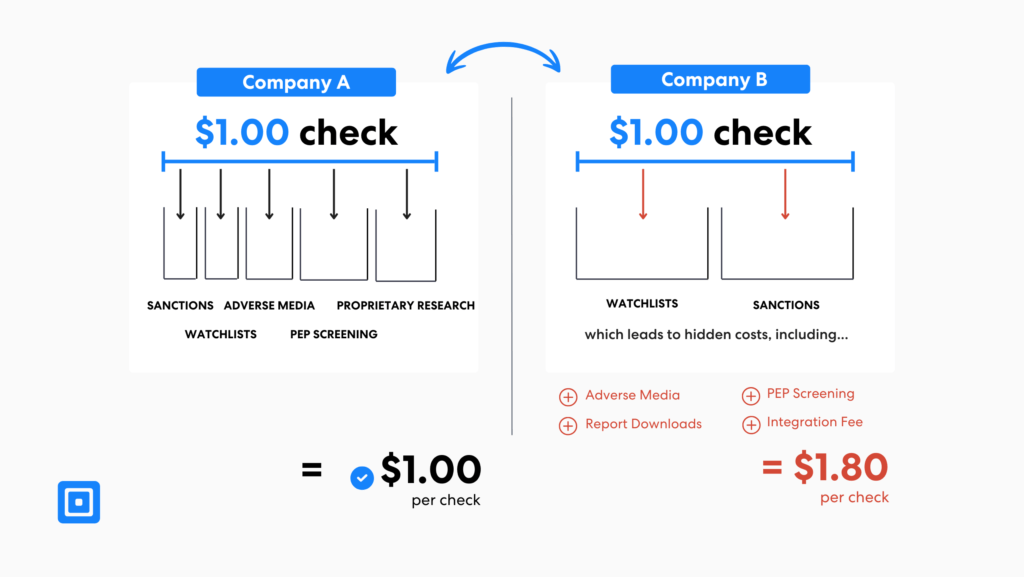
## Scalability and Customisation within Identity Verification Solutions
As you grow so will your compliance needs. Whether you’re growing your customer base or expanding into new markets the KYC platform you choose should be able to adapt to your changing needs. Scalability is key to your KYC processes staying effective as you get more customers. Customisation is another one. Your KYC platform should be able to offer custom solutions for your industry whether you’re in fintech, e-commerce or cryptocurrency.
Furthermore, the level of verification should be tailored to the potential risk and nature of the business. High-risk sectors, such as finance, may require stringent identity checks due to privacy laws and the sensitivity of the data involved. On the other hand, less-risky businesses, such as subscription-based services or social media platforms, may opt for lighter verification processes that still ensure the integrity of the user base.
## Implementing Identity Verification Solutions with ComplyCube
ComplyCube’s platform is built with transparency from the ground up. They provide rich, granular, and clear breakdowns of verification outcomes, enabling compliance professionals to implement risk-based approaches aligned with international standards such as FATF recommendations, the UK’s ICO guidance, and the EU’s AI Act. ComplyCube is also known for providing transparent pricing, a fair platform provides its users with real value. For more information, get in touch with their expert [compliance team.](https://www.complycube.com/en/contact/contact-sales/)
**Categories:** Guides
**Tags:** Identity Verification
---
### [Fortifying Transactions with Identity Verification Software](https://www.complycube.com/robust-kyc-with-identity-verification-software/)
**Published:** March 27, 2025
**Author:** Sofia Daley
**Excerpt:** Fortifying financial transactions with facial recognition is crucial in today’s digital landscape, where businesses must implement robust identity verification software to protect a customer's identity and prevent identity fraud.
**Content:**
Fortifying financial transactions with Identity Verification software is crucial in today’s digital landscape. Businesses must implement robust software to protect customers’ identities and prevent identity fraud within high value transactions. Identity verification solutions can minimize cases of account takeovers and fraudulent transactions and should be implemented by financial services to protect businesses and customers alike.
To fight identity fraud, businesses must be aware of the risks of financial crime on their platforms and ensure state-of-the-art technology to protect their customers online with a fortified identity verification process. Financial services are particularly affected by the fraud risk, as fraudsters try to access accounts with deceptive false identities. For this reason, it’s important that banks, fintechs, and other financial services implement identity verification solutions not just during onboarding checks but within platform activities.
## Identity Verification Solutions
Identity verification solutions are designed to quickly and accurately verify customers’ identities, reducing the risk of fraud and improving customer onboarding. These solutions use advanced technologies such as artificial intelligence, machine learning, and biometric analysis to verify the authenticity of identity documents and detect potential fraud.
By leveraging these technologies, businesses can ensure regulatory compliance, prevent financial crime, and protect their customers’ sensitive information. Implementing robust identity verification solutions is essential for maintaining the integrity of financial transactions and safeguarding customer identities in an increasingly digital world.
## The Threat of Identity Fraud
Identity fraud is a growing concern for businesses and individuals alike. According to recent statistics, the risk of fraud increases by five times when there is a discrepancy between the applicant’s address and the most probable consumer address. Additionally, the risk of fraud doubles when an applicant’s email address is associated with three or more new devices within a five-month window.
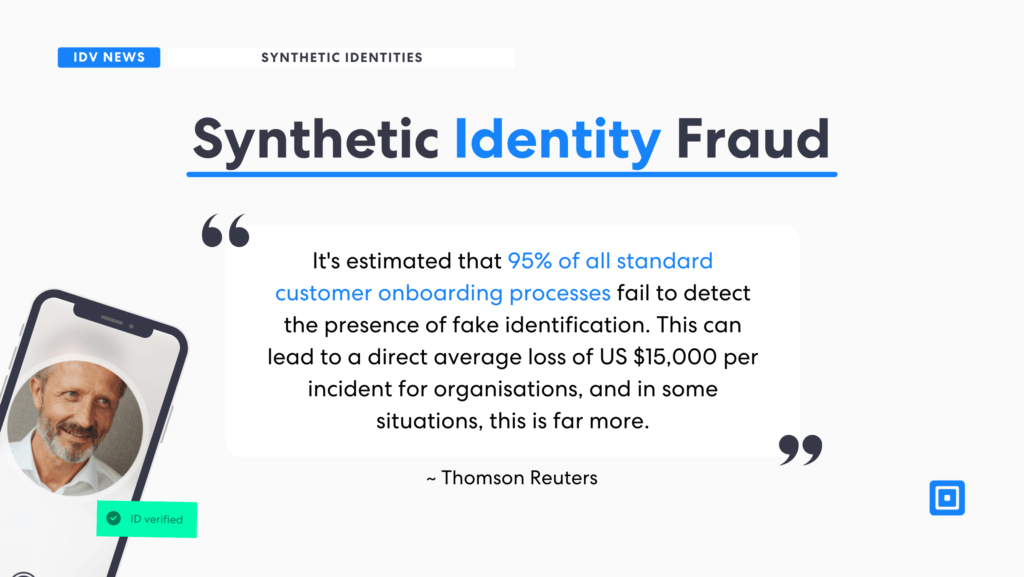
If left unchecked, identity fraud can have severe consequences, including financial loss, damage to reputation, and legal penalties. Businesses must implement effective identity verification solutions to fight identity fraud and protect their customers’ identities. By doing so, they can mitigate the risk of fraud and ensure a secure online environment for their customers.
## Benefits of Identity Verification
### Enhanced Security and Customer Experience
Identity verification solutions offer numerous benefits for businesses, including enhanced security and improved customer experience. By verifying customers’ identities, businesses can reduce the risk of fraud and financial crime, ensuring a safer and more secure online environment. Additionally, identity verification solutions can streamline the onboarding process, reducing friction and improving the overall customer experience. With the ability to detect fraud and mitigate risk, businesses can build trust with their customers and establish a strong reputation in the market. By leveraging global data sources and advanced technologies, identity verification solutions can help businesses stay ahead of fraudsters and protect their customers’ identities online. For more on customer protection and onboarding with KYC, read [“KYC Checks for Secure Onboarding.” ](https://www.complycube.com/en/kyc-checks-for-a-secure-and-scalable-onboarding-process/)
## Case Study: Revolut
Identity verification solutions using advanced technologies, such as facial recognition, help detect fraud and mitigate risk, ensuring fraud prevention measures are in place to safeguard transactions. By integrating machine learning with global data sources, businesses can enhance the verification process during customer onboarding, allowing them to verify real customers quickly and securely.
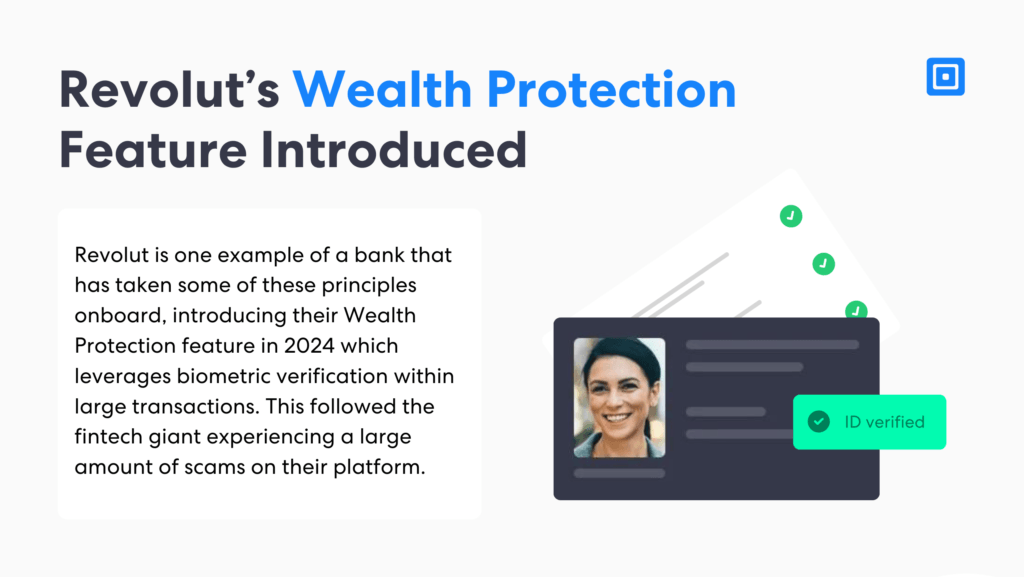
Revolut is one example of a bank that has taken some of these principles on board, introducing its Wealth Protection feature in 2024, which leverages biometric verification within large transactions. This followed the fintech giant’s experience of a large number of scams on its platform. Action Fraud found Revolut to have the highest identity fraud figures out of all banking giants from 2023-2024, a clear indicator of needed measures. Their data highlighted that from 2023 to 2024, HSBC had 5,467 fraud reports, while Revolut had 9,793, Lloyds had 7,395, and Barclays had 7,874. Learn more about their fraud cases in “[Revolut Falls Victim to Identity Fraud](https://www.complycube.com/en/revolut-falls-victim-to-identity-fraud/).”
However, the launch of their Wealth Protection feature will help fortify customer transactions and protect the platform from identity fraud, as biometric data samples can be pulled and quickly analyzed. These solutions not only address regulatory compliance and fraud risk concerns but also provide businesses with the ability to stay ahead of bad actors who attempt to bypass traditional fraud detection systems. Additionally, facial recognition can be used to authenticate documents, such as a driver’s license, helping to secure identity online while reducing complexity in the onboarding process.
Leveraging a solution with liveness detection is critical to spotting sophisticated presentation attacks such as deepfakes. As organizations continue to respond to evolving fraud threats, implementing reliable identity verification systems that integrate with existing systems is essential to protect both clients and revenue.
## Avoiding Financial Crime with Identity Verification Software
For a complete verification process, businesses must adapt to the rising challenges of fraud to protect their customers and their reputation and meet national and international IDV and KYC regulations. Verifying a customer’s identity is a critical component in combating fraud challenges and ensuring the integrity of financial transactions.
> Cifas reports that Identity Fraud costs the UK an estimated [£1.8 billion per year](https://www.cifas.org.uk/newsroom/cifas-rusi-growing-id-fraud-threat).
Cifas reports that Identity Fraud costs the UK an estimated [£1.8 billion per year](https://www.cifas.org.uk/newsroom/cifas-rusi-growing-id-fraud-threat), a startling figure that points to the sophistication of fraudulent practices. Their report from December 2024 points to “concerns about the ability of AI and deepfake technologies to enable organized criminals to evade financial sector controls.” Identity fraud is a pervasive threat, facilitating not just fraud for financial gain but many other types of serious criminal activity. Kathryn Westmore, Senior Research Fellow at RUSI, argued: “Identity fraud is a pervasive threat, facilitating not just fraud for financial gain but many other types of serious criminal activity, driven by new technologies and enhanced digitalization, the sheer scale of the issue is ever-increasing and demands that the UK prioritizes its response.”
1,135,291 cases of identity theft were reported in 2024 in the USA. According to the Federal Trade Commission (FTC), “1,135,291 cases of identity theft were reported in 2024, exceeding the number of cases reported in [2023 by 98,388](https://www.fool.com/money/research/identity-theft-credit-card-fraud-statistics/#:~:text=1%2C135%2C291%20cases%20of%20identity%20theft%20were%20reported%20to%20the%20FTC,identity%20fraud%20that%20go%20uncounted.). The identity theft statistics collected by the FTC are based on reports from consumers, so it’s likely that there are many cases of identity fraud that go uncounted.” Financial services must take some accountability for these crimes taking place within their platforms and prioritize stringent verification methods to combat these challenges accurately. Functionality and user experience must be carefully balanced.
## Securing the Customer Onboarding Process
When onboarding new customers, businesses within financial services must ensure that they leverage advanced identity verification solutions to verify a customer’s identity, fight identity fraud, and mitigate risk. However, ensuring a positive customer experience is still important. Forbes noted in 2023 that “KYC takes too long. Banks take an average of [24 days](https://www.forbes.com/sites/jumio/2020/06/01/how-to-get-aml--kyc-compliance-right/?sh=736de0413db5) to onboard customers; modern apps are better. Still, according to the [2021 Fintech Onboarding Friction Index](https://f.hubspotusercontent30.net/hubfs/5242234/Whitepapers%20and%20eBooks/Incognia_App%20friction%20report_V6.pdf), the average fintech onboarding process takes six minutes, 29 clicks, and 16 fields to complete.”
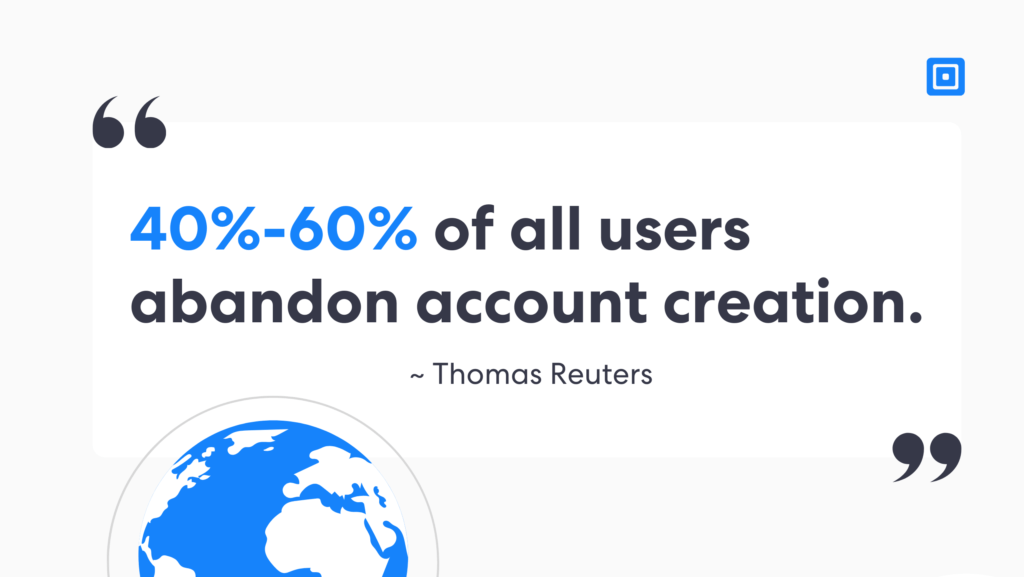
The following statistics are no surprise: 40%-60% of all users abandon account creation, [89%](https://www.thomsonreuters.com/en/press-releases/2016/may/thomson-reuters-2016-know-your-customer-surveys.html) of user have not had a good KYC experience, [13% ](https://www.thomsonreuters.com/en/press-releases/2016/may/thomson-reuters-2016-know-your-customer-surveys.html)changed their financial institution as a result.
> [40%-60% ](https://www.thomsonreuters.com/en/press-releases/2016/may/thomson-reuters-2016-know-your-customer-surveys)of all users abandon account creation.
For this reason, businesses must partner with KYC platforms that can offer both efficiency and advanced security solutions. A platform that can onboard customers in under a minute whilst verifying their biometric features is the way forward.
## Partnering with the Right KYC Platform
When partnering with a KYC platform, ensuring that your provider can deliver a balance of efficiency and security is critical to your business operations. ComplyCube leverages the most advanced IDV technologies while onboarding customers in less than a minute. For more information on how you can fortify your KYC processes, contact a member of their [expert compliance team](https://www.complycube.com/en/contact/contact-sales/).

**Categories:** Guides
**Tags:** Know Your Customer
---
### [StartDock Adopts ComplyCube’s Advanced KYC Platform Suite](https://www.complycube.com/startdock-complycube-advanced-kyc-platform/)
**Published:** February 25, 2025
**Author:** Dini Habib
**Excerpt:** ComplyCube, a leading KYC, AML, and IDV provider, has partnered with StartDock, one of the fastest-growing co-working space providers in the Netherlands. This partnership strengthens the security of StartDock’s community.
**Content:**
London, February 25, 2025 — ComplyCube, a leading provider of Identity Verification (IDV), Know Your Customer (KYC), and Anti-Money Laundering checks (AML compliance solutions), has partnered with StartDock, one of the fastest-growing co-working space providers in Amsterdam and Rotterdam. This partnership strengthens security and trust for StartDock’s expanding community, ensuring seamless and compliant identity verification for its members through ComplyCube’s advanced KYC platform.
## Staying Compliant in a Shifting Regulatory Landscape
As co-working spaces evolve into dynamic hubs for businesses, they are also met with increasingly stringent regulations. Firms such as StartDock face heightened pressure to ensure their operations align with strict regulations like [The Money Laundering and Terrorist Financing (Prevention) Act](https://www.dnb.nl/en/sector-information/open-book-supervision/laws-and-eu-regulations/anti-money-laundering-and-anti-terrorist-financing-act/), also known by its Dutch acronym WWFT.
As the Netherlands strengthens its efforts to combat money laundering and terrorist financing, companies of all sizes must comply with the WWFT, which requires comprehensive customer identification protocols and continuous monitoring of business relationships. By leveraging ComplyCube’s sophisticated AI-powered compliance platform, StartDock can meet these regulations seamlessly, implementing rigorous customer due diligence while maintaining its focus on growth and expansion.
## Strengthen Trust for SMEs with Robust KYC Platform
The startup and scaleup community in the Netherlands is thriving, which comes at a great time for StartDock and ComplyCube to join forces. Through this partnership, businesses operating within StartDock’s six co-working spaces across Amsterdam and Rotterdam can access enhanced compliance tools, including IDV, KYC, and AML automation. These solutions help companies stay compliant with regulations while delivering an effortless and seamless customer onboarding experience.
## Adapting to Evolving Compliance Regulations such as the eIDAS 2.0
Beyond local regulations such as the WWFT, businesses must also keep pace with the changing European regulatory requirements. Last year, [the eIDAS 2.0 regulation](https://www.european-digital-identity-regulation.com) came into full force, mandating stronger authentication measures, interoperability, and alignment with EU-wide trust frameworks. This meant any firms handling sensitive customer data, financial transactions, or secure access management had to take additional steps to meet these stricter standards. ComplyCube’s platform enables StartDock and its members to stay fully compliant with these demands, maintaining a fool-proof environment that boosts business growth.
## Instilling Confidence for Future Businesses
In the Netherlands, the co-working sector was valued at $243 million in 2023 and is now projected to exceed a whopping [$785 million by 2030](https://www.nextmsc.com/news/netherlands-co-working-space-market). However, this growth comes amid heightened security concerns, with nearly 3% of co-working employees citing security as a major issue. The partnership between ComplyCube and StartDock ensures that its facilities set the standard for co-working when it comes to AML and IDV.
> In the Netherlands, the co-working sector was valued at $243 million in 2023 and is now projected to exceed a whopping [$785 million by 2030](https://www.nextmsc.com/news/netherlands-co-working-space-market).
Johan Assink, Co-Founder of Stardock, highlights the vital importance of the partnership: “Adapting to evolving regulations is essential for any business, and as a co-working space, we must ensure our operations remain fully compliant. Partnering with ComplyCube allows us to seamlessly integrate state-of-the-art compliance automation, strengthening our ability to meet stringent AML and KYC requirements. By maintaining a robust compliance framework, we create an environment where SMEs and small businesses can operate with confidence. Compliance and trust are at the heart of our spaces, enabling our members to focus on innovation and growth without regulatory concerns.”
> Partnering with ComplyCube allows us to seamlessly integrate state-of-the-art compliance automation, strengthening our ability to meet stringent AML and KYC requirements.
Joshua Dent, Business Strategy and Partnerships Manager at ComplyCube, adds, “Our partnership with StartDock is built on a shared commitment to maintaining a seamless and compliant business environment. Together, we ensure that firms of all sizes can navigate evolving IDV and AML requirements while keeping their operations frictionless. As fraud and regulatory challenges become more complex, this collaboration enables StartDock and its members to uphold the highest standards, fostering a trusted space where businesses can operate with confidence.”
## About ComplyCube
[ComplyCube](https://www.complycube.com) is a cutting-edge SaaS platform that offers comprehensive online Identity Verification (IDV), Anti-Money Laundering (AML), and Know Your Customer (KYC) solutions. With the ability to verify customer identities in seconds, ComplyCube empowers businesses to onboard more customers quickly and securely while meeting regulatory compliance requirements. The AI-powered platform processes over 10 million transactions weekly across 220 countries and territories, providing unparalleled global coverage for businesses of all sizes.
## About StartDock
[StartDock](https://startdock.nl/en/) was founded in 2016 by five visionary entrepreneurs and has since rapidly evolved into one of the Netherlands’s most dynamic co-working spaces. What began as a single location has now expanded to six vibrant hubs across Amsterdam and Rotterdam, including the newly opened Keizersgracht 452, a historic canal house dating back to 1685. Recognized as one of the fastest-growing startups in the Netherlands, StartDock is committed to fostering a diverse and thriving co-working community space for startups, scale-ups, SMEs, freelancers, and remote employees.
**Categories:** News
**Tags:** Announcements
---
### [The CryptoCubed Newsletter: February Edition](https://www.complycube.com/the-cryptocubed-newsletter-february-edition/)
**Published:** February 20, 2025
**Author:** Sofia Daley
**Excerpt:** This month, we’ve got everything, from rogue presidents to ground-breaking fines. Buckle up for this month's dose of Crypto as regulations take center stage and the sector continues to grapple with ever-evolving challenges.
**Content:**
Welcome to the February edition of CryptoCubed! This month, we’ve got a bit of everything, from rogue presidents to ground-breaking fines. Buckle up for this month’s dose of Crypto chaos as compliance and regulation take center stage and the sector continues to grapple with evolving challenges.

## Argentina’s President Faces Impeachment Calls Over Possible Crypto “Rug Pull”
Argentine President Javier Milei faces impeachment calls and legal action for promoting cryptocurrency on social media. On Friday, he shared a post about the $LIBRA coin, claiming it would help fund small businesses. The coin’s price surged before Milei deleted the post, causing the cryptocurrency’s value to plummet and resulting in significant losses for investors. Some accuse Milei of a “rug pull,” a fraudulent tactic in crypto promotions.

Legal complaints of fraud have been filed, and opposition members are pushing for impeachment. Milei’s office stated the post was removed to prevent speculation and promised an investigation. Critics, including former President Cristina Fernández de Kirchner, have condemned him, calling the situation a “crypto scam.”
For more on this story, click [here](https://www.bbc.co.uk/news/articles/cp9x9j89evxo).
## Australia’s AUSTRAC Cracks Down on 13 Crypto and Remittance Firms for Compliance Failures
Australia’s financial crime regulator, AUSTRAC, has targeted 13 remittance and digital currency exchange providers over compliance issues and is investigating 50 more. This follows a year-long campaign to address non-reporting and under-reporting. AUSTRAC has issued alerts to operators who may not adhere to regulations, particularly around reporting suspicious activities. The agency recently canceled, suspended or refused registration renewals for 9 providers who failed to meet obligations under anti-money laundering laws. Two others are under scrutiny, with potential for further action.
Officials at several companies, including Auaisa Trading Pty Ltd and Amco Travelling and Exchange Pty, face serious charges and legal disputes. Some providers have ceased operations or missed registration deadlines, while others, like Currencyfair, have received conditional registration. Zipmex Australia and FTX Express were delisted due to insolvency. Additionally, AUSTRAC has focused on crypto ATM providers violating regulations.
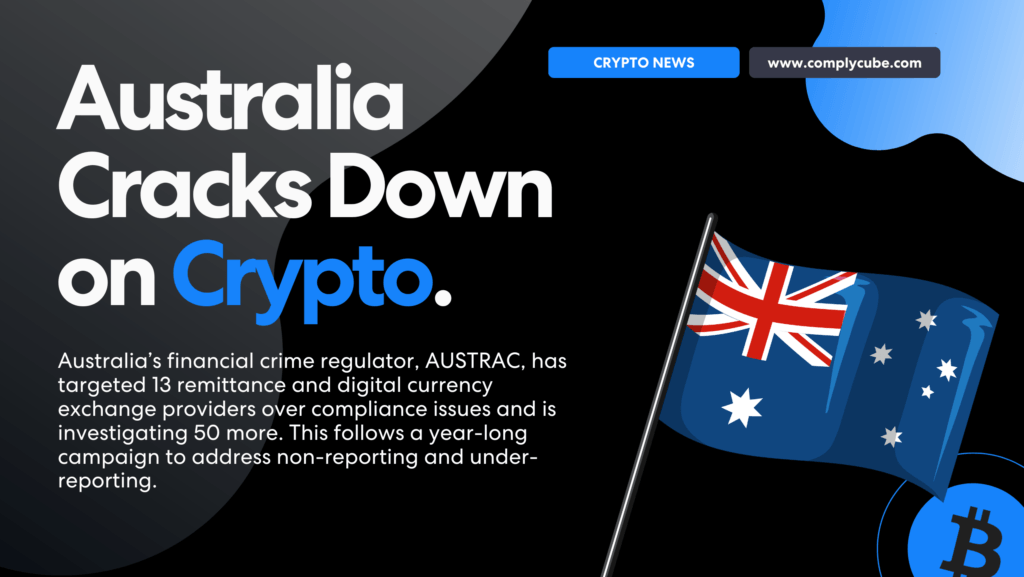
ASIC, Australia’s securities regulator, has taken down over 5,500 fraudulent investment websites and 615 crypto scam sites since July 2023. Investment scams were found to have resulted in losses of $1.3 billion in 2023. These scams often use fake news and deepfake videos to promote fake trading platforms.
For more information, click [here](https://cryptonews.com/news/australia-targets-13-crypto-remittance-firms-compliance/).
## Chinese Crypto Crackdown – $136 Million Linked to Money Laundering Scheme
Chinese police have found a large fraud operation involving cryptocurrency use to facilitate cross-border fund transfers. China National Radio published a report on February 12th outlining that the network was able to launder over $136 million. Authorities in Yanbian, Jilin, launched an investigation, which led to the arrest of seven key suspects in August 2024.
The operation, which spanned multiple provinces, was led by Zhang Liang, who initially profited from currency exchange and expanded into unauthorized fund transfers. More than 20 people were arrested, highlighting the growing use of crypto in underground banking. Despite China’s crypto ban, digital currencies are increasingly exploited for illicit transactions, posing challenges for law enforcement.
For more on this story, click [here](https://cryptonews.com/news/chinas-crypto-crackdown-136m-laundering-bust/).
## ESMA Proposes Competence Guidelines for Crypto Staff Under MiCA
The European Securities and Markets Authority (ESMA) has proposed guidelines to assess the knowledge and competence of staff at crypto asset service providers, which is in line with the EU’s Markets in Crypto-Assets Regulation (MiCA).

Released on February 17, the guidelines aim to establish consistent standards for staff providing crypto advice and information, with a focus on investor protection and market trust. Staff would need to understand crypto risks, market functioning, and blockchain technology and meet minimum qualifications, including relevant experience and ongoing professional development. ESMA is seeking feedback on the guidelines through April 22, with final rules expected by Q3 2025.
Find more on this story [here](https://cointelegraph.com/news/european-regulator-proposes-mica-guidelines-crypto-staff-competence).
## Bitcoin Falls Below $95K as Chances of U.S. Strategic Reserve Decline
Bitcoin’s price fell below $95,000 on Tuesday, continuing a downtrend that started four weeks ago after reaching a record high of $109,200.
The drop followed a decline in the odds of a U.S. Strategic Bitcoin Reserve (SBR). A Polymarket poll showed that Donald Trump’s likelihood of creating an SBR in his first 100 days was just 12%, down from 40% in January. Similarly, the chance of the Texas Strategic Bitcoin Reserve Act being signed this year dropped to 38% from over 60%.

Other states, including Wisconsin, Arizona, and Florida, have introduced similar bills, while the Trump administration is exploring the creation of an SBR. One option is using Bitcoin seized by the government. The U.S. government currently holds 198,109 BTC, valued at $18 billion.
A U.S. SBR could encourage other countries to follow suit. Bitcoin’s price chart shows a bullish pattern, with a megaphone formation suggesting a potential rebound in the coming weeks.
For more on this story, click [here](https://crypto.news/bitcoin-dips-below-95k-as-odds-of-u-s-strategic-reserve-drop/).
## Upbit Faces Billions in Fines for 700,000 Rule Breaches Amid South Korea’s Crypto Crackdown
South Korea’s largest crypto exchange, Upbit, is under investigation by the Financial Services Commission (FSC) for over 700,000 KYC violations, which could result in billions of Won in fines and a potential suspension of new user registrations.
As the market leader, holding over 80% of local crypto trading, Upbit’s case may influence other exchanges. Under South Korea’s Special Financial Transactions Act, the fines could reach up to $68,600 per violation. Speculation also suggests temporary operational suspensions or additional compliance measures for Upbit.
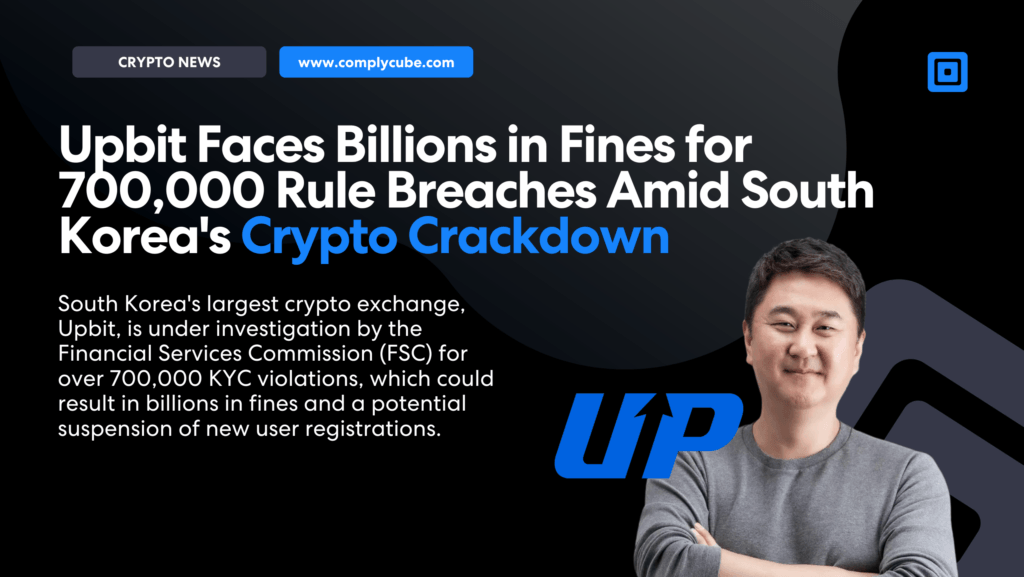
This investigation comes as South Korea tightens regulations following the introduction of the Virtual Asset User Protection Act in July 2024. Upbit’s parent company, Dunamu, is working with authorities, but regulatory pressure on smaller exchanges is rising.
Upbit’s past regulatory challenges include compensating users for losses during a December 2023 crisis, and the FSC continues to monitor the exchange closely.
For more on this story, click [here](https://cryptonews.com/news/upbit-faces-billions-in-fines-for-700000-rule-violations-amid-south-koreas-crypto-crackdown/).
## The Latest Crypto Guide: Understanding UK Crypto in 2025
Our recent crypto guide dives into understanding UK Crypto Regulation in 2025, guiding you through everything you need to know about how regulation might evolve in the coming months. Here’s a sneak peek:
“As the US spearheads the global crypto surge, the future of UK crypto regulation remains uncertain. Tulip Siddiq, the U.K. Treasury Minister and a prominent advocate for cryptocurrency regulation, has resigned, leaving the nation with questions over the future of crypto in Britain. Meanwhile, the FCA reports that 12% of UK adults now own cryptocurrency, a clear indication that Britain is eager to avoid being sidelined as America embraces its new financial frontier. With the U.S. gearing up for Trump’s crypto era, let’s dive into how Britain might follow and what we can expect from 2025 crypto regulation in the UK.”
Read the full piece [here](https://www.complycube.com/en/uk-crypto-regulation-in-2025/).
## Time for Some Light-Hearted Creative Criticism?
So you’ve made it to the end of our newsletter. It’s time to enjoy a little satire, worthy reader, you’ve earned it.
### 🔥THE CRYPTO CUBED POEM: FEBRUARY🔥
Another month, another newsletter, another crypto crook.
Another fraudulent president who doesn’t play by the book.
Another story, another scam, another massive fine,
Another month of regulators drawing new lines.
Another twist, another surprise,
Another CEO telling lies.
But they’ll get caught, you’ll see,
With a fine bigger than their nation’s GDP.
### Stay tuned for our March newsletter, and have a great month!

**Categories:** News
**Tags:** Crypto Regulations
---
### [The UAE and Belgium look to the UK to boost AML/CFT controls](https://www.complycube.com/belgium-and-uae-aml-enhance-controls-with-uk/)
**Published:** June 24, 2021
**Author:** Andreea Balasa
**Excerpt:** AML/CTF international cooperation is growing with Belgium, the United Kingdom (UK), and the United Arab Emirates (UAE) taking a collaborative approach to combat financial crime, enhance money-laundering controls
**Content:**
AML/CTF international cooperation is growing with Belgium, the United Kingdom (UK), and the United Arab Emirates (UAE) taking a collaborative approach to improving Belgium & UAE AML, CFT, & KYC controls to combat financial crime, enhance money-laundering controls, and improve information sharing.
## UAE AML: Growing International Cooperation to Strengthen CTF Controls
On June 21, the UK and the UAE announced that they had completed a [two-week-long conference](https://gulfnews.com/business/banking/uae-uk-host-anti-money-laundering-training-sessions-1.1619337665262) focused on improving the UAE’s money-laundering controls. The UAE’s Executive Office of Anti-Money Laundering and Counter-Terrorism Financing (the AML Executive Office), established earlier this year, is collaborating with Her Majesty’s Revenue and Customs (HMRC) and the Serious and Organised Crime Network (SOCnet) to address AML/CFT challenges and promote best practices.
UAE’s AML Executive Office was established to oversee the implementation of its National AML/CTF Strategy. The latter aims to tackle the concerns [raised by FATF last year](https://www.middleeastmonitor.com/20200430-uae-failing-to-stem-money-laundering-and-terrorist-financing-says-watchdog/), as it placed the country under a year-long observation period. The AML Executive Office carries out its mandate in conjunction with the UAE’s existing [National Committee for Combating Money Laundering and the Financing of Terrorism and Illegal Organisations (NAMLCFTC)](https://www.namlcftc.gov.ae/en/) and the Ministry of Foreign Affairs.
UAE isn’t the only country holding the UK up as an example.
According to the [Brussel Times](https://www.brusselstimes.com/news/business/174403/felbin-assuralia-ctif-fsma-nbb-belgium-launches-anti-money-laundering-initiative/), Febelfin, the Belgian nonprofit financial sector federation, has launched a consultation platform on 18 June 2021 to fight money laundering and financial crime.
[Febelfin](https://www.feb.be/en/who-we-are/sectoral-federations/belgian-financial-sector-federation---febelfin/) hopes that this new platform will foster greater collaboration between the financial industry and government authorities. As such, the nonprofit organization aims to follow UK’s footsteps in facilitating information sharing between financial institutions, law enforcement, and regulators. According to Febelfin, this collaboration has enabled UK law enforcement to seize over **£56 million** and identify 5,000 suspicious accounts.
Need more information on AML/CFT compliance in UAE or Belgium? [Speak with an expert.](https://www.complycube.com/contact/)
**Categories:** News
**Tags:** Anti-Money Laundering
---
### [Outcomes of the June 2021 FATF Plenary](https://www.complycube.com/outcomes-fatf-plenary-20-25-june-2021/)
**Published:** July 7, 2021
**Author:** Andreea Balasa
**Excerpt:** The Financial Action Task Force (FATF) is the inter-governmental body tasked with global Anti-Money Laundering (AML) and Counter-Terrorist Financing (CFT). The body puts together recommendations, also known
**Content:**
The Financial Action Task Force (FATF) is the inter-governmental body tasked with global Anti-Money Laundering (AML) and Counter-Terrorist Financing (CFT). The body puts together recommendations, also known as FATF Standards, to coordinate a uniform response to fighting organized crime.
The Plenary is [FATF’s](https://www.fatf-gafi.org/about/whoweare/) decision-making function, and it meets three times a year. The most recent of these meetings was in June 2021. It was led by German President, Dr. Marcus Pleyer with over 205 members attending globally.
The meeting was held virtually and attended by money laundering watchdogs, the [UN](https://www.un.org/en/), the [IMF](https://www.imf.org/en/Home), and the [World Bank](https://www.worldbank.org/en/home).
This article discusses the strategic initiatives to come out of this meeting.
## Digital Transformation & AML/CFT
One of the main topics for discussion at the plenary was how advancements in technology offer an opportunity to improve AML and CFT effectiveness.
The digital transformation has made it easier and faster to create systems that help in the fight against money laundering and terrorist financing. Technology helps financial institutions such as banks to identify and assess risks in a way that is both accurate and fast.
FATF identified how using data pooling and collaborative analytics tools helps these institutions change the way they analyze large amounts of data. This means they can analyze high numbers of transactions and identify suspicious behavior. Furthermore, new technology also helps achieve financial inclusion by bringing more people into the regulated financial system.
[This report](http://www.fatf-gafi.org/publications/digitaltransformation/documents/opportunities-challenges-new-technologies-for-aml-cft.html?hf=10&b=0&s=desc(fatf_releasedate)) discusses available technologies, policies needed to use them effectively, and the obstacles standing in the way of success.
## The Risks Associated With Virtual Assets
June 2021 saw an end to the second 12-month review of the implementation of FATF’s [revised Standards on virtual assets](http://www.fatf-gafi.org/media/fatf/documents/recommendations/Second-12-Month-Review-Revised-FATF-Standards-Virtual-Assets-VASPS.pdf) and Virtual Asset Service Providers (“VASPs”).
**Progress Made**
FATF found that many jurisdictions have made good progress since 2019 – with 58 of the 128 reporting jurisdictions have now implemented the revised Standards. 52 are now regulating the operations of VASPs, and 6 are prohibiting the operation of cryptocurrency providers altogether.
**A Failure To Implement The “Travel Rule”**
Most jurisdictions are still yet to implement the “Travel Rule,” amongst other FATF requirements, and, as such, there is much more work needed. The Travel Rule is the common name for [FATF Recommendation #16](http://www.fatf-gafi.org/media/fatf/documents/recommendations/pdfs/FATF%20Recommendations%202012.pdf) on combating money laundering. It requires parties in a digital transaction to exchange identity information. In the future, there will be an emphasis on actions that help mitigate the risk of ransomware-related virtual asset use.
The revised guidance is expected in October 2021.
## Money Laundering and Environmental Crime
Research into this area by FATF, alongside the Illegal Wildlife Trade, has identified that criminals are using trade-based fraud and shell companies to launder money obtained from environmental crime. Illegal goods are mixed with legal ones to make them harder to detect.
[FATF’s report](https://www.fatf-gafi.org/publications/methodsandtrends/documents/money-laundering-from-environmental-crime.html) requires AML authorities to work with environmental crime specialists to tackle this issue.
## Ethnically or Racially Motivated Terrorism Financing
FATF is exploring how to tackle Extreme Right-Wing terrorism (“ERW”) while bringing more awareness to a complex problem.
This issue has become more prevalent in recent years, having increased in frequency. Attacks of this nature can involve organizations and transnational movements. Those involved are more and more sophisticated in how they move money. Interestingly, most of ERW funding comes from legitimate and legal sources like donations.
The FATF report finalized at the plenary highlights the [challenges in tackling ERW financing](https://www.fatf-gafi.org/publications/methodsandtrends/documents/ethnically-racially-motivated-terrorism-financing.html), such as varying views on how it should be treated and a lack of designated resources.
Countries are encouraged to dedicate more time and funds to develop their understanding of the issue.
## **Operational Challenges of Asset Recovery**
Asset recovery is one of the most effective tools to fight against money laundering and terrorist financing. Not only does it seize the proceeds of crime, but it also compensates victims, builds trust in society, and keeps the money out of the financial system.
FATF identified that most countries are ineffective when it comes to their ability to recover assets successfully. It has offered guidance to government authorities looking at overcoming key obstacles to follow up at the next meeting.
## Proliferation Financing Risks
FATF has put in place new mandatory requirements. Countries and financial institutions must identify, assess, understand, and mitigate proliferation financing risk.
FATF also updated its **Interpretive Note to Recommendation 15**. The update provides guidance on how VASPs should be treated in relation to regulations and also how financial institutions should deal with VASPs. The update also clarifies that VAPs are also obliged to carry out proliferation risk assessments in the same way financial institutions currently do.
## Transparency Around Beneficial Ownership
Establishing who is behind companies is integral to stopping criminals from hiding behind a web of complex structures designed to confuse.
The need for more transparency around beneficial ownership is something FATF has been advocating for the last two decades. Despite that, countries are not doing enough to make sure beneficial ownership information is available.
[G7 Ministers](https://www.g7uk.org/) have acknowledged the problems this causes and have agreed to work on improving the availability of this information. FATF is also considering [amending Recommendation 24](https://www.fatf-gafi.org/publications/fatfrecommendations/documents/white-paper-r24.html) to make it stronger and with stricter controls. This is due to be discussed again in October.
## Country-specific Initiatives
**South Africa**
FATF has been working alongside [the Eastern and Southern African Anti-Money Laundering Group](https://www.esaamlg.org/) to combat money laundering and terrorist financing in South Africa. While there is a solid legal framework in place, South Africa needs to do more in proactively pursuing money laundering and terrorist financing in line with its risk profile.
**Japan**
FATF has also worked with the [Asia/Pacific Group on Money Laundering](http://www.apgml.org/) assessment of Japan’s measures to combat money laundering and terrorist financing. It found that Japan’s measures are working and it was demonstrating good results. However, there needs to be more work in some areas, including investigating and prosecuting money laundering and terrorism financing offenses.
**Ghana**
As a result of significant progress made in addressing AML/CFT deficiencies, Ghana is no longer subject to FATF’s increased monitoring.
**Haiti, Malta, the Philippines, and South Sudan**
These 4 countries were all added to [the list of jurisdictions](https://www.fatf-gafi.org/publications/high-risk-and-other-monitored-jurisdictions/documents/increased-monitoring-june-2021.html) subject to increased monitoring.
FATF is working with a number of jurisdictions where their counterterrorism, counter-money laundering, and proliferation financing regimes are not efficient. These jurisdictions under increased monitoring have committed to resolving the issues identified within a set timescale.
## Strengthening the Global Network
The FATF’s efforts are only effective if the safeguards are implemented worldwide. Therefore, the plenary underlined the role of [FATF-styled Regional Bodies](https://www.fatf-gafi.org/publications/fatfgeneral/documents/high-levelprinciplesfortherelationshipbetweenthefatfandthefatf-styleregionalbodies.html) (FSRBs) in combating money laundering. These independently operating units ensure that member countries effectively implement FATF-set standards. To this end, FATF is has agreed to provide additional support and resources for FSRBs.
## Interested In Learning More About AML/CFT Compliance?
We have a wide range of tools available to help you with Anti-Money Laundering and Know Your Client (KYC) compliance.
Get [in touch](https://www.complycube.com/contact) and let’s see how we can help you to build trust in your business and create the best experience possible for your customers.
**Categories:** News
**Tags:** Anti-Money Laundering
---
### [A Quick Overview of the 6th Anti-Money Laundering Directive (6AMLD)](https://www.complycube.com/6th-anti-money-laundering-directive-6amld-guide/)
**Published:** July 14, 2021
**Author:** Andreea Balasa
**Excerpt:** AMLD6 is the European Union's latest weapon for fighting financial crime. It brings additional AML regulatory requirements on obligated firms, such as banks. What are these changes? And
**Content:**
6AMLD is the European Union’s latest weapon for fighting financial crime. It brings additional AML regulatory requirements on obligated firms, such as banks. What are these changes? And what actions need to be taken by concerned firms?
On 3 December 2020, the 6th iteration of the European Union’s Anti-Money Laundering Directive ([6AMLD](https://ec.europa.eu/finance/docs/law/210720-proposal-amld6_en.pdf)) came into force. Regulated entities operating in the EU must be compliant by 3 June 2021. Obligated entities include banks, investment houses, gaming organizations, and financial services.
Building on the 5th version of the directive, 6AMLD expanded the scope of the obligations and penalties on companies handling financial transactions at volume in several ways:
## Expanded Cooperation and ****Harmonization****
Requirements have been harmonized across all countries in the EU bloc, requiring cross-border cooperation and eventual prosecution of offenders within a single, elected EU state.
An expanded list of 22 predicate offenses (crimes that create wealth which money laundering conceals) has been agreed upon and now includes cybercrime for the first time.
The addition of cybercrime to the predicate offense list means that companies operating in the FinTech environment must enhance their Know Your Customer (KYC) and Anti-Money Laundering (AML) measures due to the increased risk of non-compliance. Even e-commerce platforms are at risk when criminals target their customers at scale withouy sufficiently-protective measures being in place.
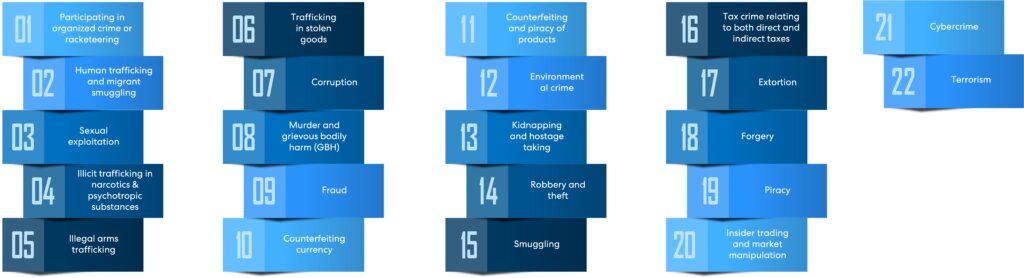6AMLD Harmonized 22 predicate offenses
Now, when predicate crimes are committed in one EU nation, and the criminal proceeds are laundered in another, there are requirements for collaboration, even when a predicate offense is not typically prosecuted within a particular member country. 6AMLD also sets out the factors that must be considered when authorities decide where and how to prosecute individuals, including country of origin, nationality, and the country where the crime was committed.
## Increased Liability and Scope
Under 6AMLD, those who passively assist money laundering, or let such offenses go unreported, can be held personally liable.
Previously, only companies would primarily be held accountable. Now, individual decision-makers within an organization can also be prosecuted for crimes including “aiding and abetting”, “inciting”, or “attempting” money laundering.
Furthermore, all “legal persons”, including sole traders and partnerships, will be criminally liable for permitting illicit activities on their platforms or within their businesses.
This broader definition of wrongdoing and the expansion of who can be held liable exposes companies without suitable AML/KYC measures to significant risk. Incorporating up-to-date security measures will ensure that staff is not tempted to engage in these illicit activities.
## Enhanced Penalties
Previously, the minimum sentence for money laundering was one year in prison. Under 6AMLD, this has been significantly increased. A four-year prison sentence is now the minimum sentence. Judicial powers to levy individual fines and restrict access to public finance have also been added.
The EU parliament sees these enhanced sentences and judicial powers as a stronger deterrent to money launderers and their enablers and a statement of more significant commitment to preventing such activities.
## Measures that can be taken for 6AMLD compliance
The extension of liability, increase in penalties, and widening of the definition of money laundering offenses create a significant risk for financial institutions and businesses.
Recent years have seen an increase in automated “[micro laundering](https://www.theguardian.com/technology/2018/may/17/cyberlaundering-funds-terror-internet-fake-transactions-cashless-society)“, where criminals use digital payment platforms, e-commerce sites, online games, and gig economy transactions to hide large amounts of money in thousands of small transactions. With this trend in mind, AML measures are vital for ALL firms handling digital payments.
If you can prove the identity of the individuals using your platform or service using KYC measures such as biometrics, CAPTCHA, and Multi-Factor Authentication (MFA), you are already mitigating risk. Other AML measures can be implemented, and compliance is assured when you incorporate a suite of compliance APIs into your cybersecurity and KYC measures.
## Summary
AMLD6 is the 6th iteration of the European Union’s Anti-Money Laundering Directive. It builds on its predecessor, AMLD5, by bringing additional AML regulatory requirements on obligated firms, including new predicate offenses monitoring. It also emphasizes individual accountability while introducing enhanced punitive measures and mechanisms for cross-border cooperation between member states.
As such, obligated firms must establish a good understanding of the new regulatory landscape, ensuring their staff and management are trained accordingly. Firms should also examine their AML technology capability to ensure it meets the increased regulatory scope.
Obligated firms may need to:
- Update their [AML/KYC](https://www.complycube.com/kyc-vs-aml/) compliance program, standards, and policies to reflect the enhanced regulatory environment and increased legal risk, taking into account the latest updates from [FinCen](https://www.complycube.com/fincen-issues-first-ever-list-of-aml-cft-priorities/) and [FATF](https://www.complycube.com/outcomes-fatf-plenary-20-25-june-2021/).
- Establish training plans for employees to cover the implications of the enhanced AML requirements, including identifying suspicious activities associated with the expanded predicate offense list.
- Reevaluate existing risk scoring methodologies and Key Risk Indicators (KRIs) across their internal procedures and processes.
- Review all [customer screening](https://www.complycube.com/what-is-a-sanctions-screening/) processes and readjust thresholds to reflect the increased AML risk.
- Establish [adverse media screening processes](https://www.complycube.com/importance-of-adverse-media-checks/) to identify relevant news and align them with the new KRIs.
[Please reach out](https://www.complycube.com/contact/contact-sales/) to learn more about how CompyCube can assist you in complying with the EU 6th Anti-Money Laundering Directive.
**Categories:** Guides
**Tags:** Anti-Money Laundering
---
### [The Battle Against Aggravated Identity Fraud](https://www.complycube.com/the-battle-against-aggravated-identity-fraud/)
**Published:** July 20, 2022
**Author:** Andreea Balasa
**Excerpt:** What if you woke up one morning and there were two of you? That sounds impossible, right? Not when aggravated identity fraud is a real possibility. Identity fraud
**Content:**
What if you woke up one morning and there were two of you? That sounds impossible, right? Not when aggravated identity fraud is a real possibility. Identity fraud is a scary thing. It can happen to anyone, and it’s something that you don’t want to deal with.
But what can you do to protect yourself from identity fraud? This blog post will tell you about identity fraud, how it affects you, and how to protect yourself. So, read on to feel more secure about your identity.
## **What Is Identity Fraud And How Does It Work?**

Identity fraud is a type of theft in which someone uses another person’s information, such as their date of birth, name, Social Security number, or financial information, without permission to commit fraud or other crimes.
It’s one of the fastest-growing criminal enterprises to hit the finance industry in recent years. In 2021,[ 42 million Americans](https://javelinstrategy.com/2022-Identity-fraud-scams-report) fell victim to identity fraud, which amounted to around $52 billion of loss.
There are many ways that identity thieves obtain your personal information. They may find it in the trash, buy it from someone who has stolen it or even trick you into giving it to them. Once they have your personal information, they can use it to open new accounts in your name, make changes to your existing accounts, or even get a job or a loan using your identity.
Identity fraud can devastate victims, leaving them with damaged credit, financial problems, and even legal troubles. This is why you must understand what it is, how it affects you, and how to avoid it.
## **The Different Types Of Identity Fraud**
There are many different identity fraud types, but some of the most common include:
- **Credit card fraud:** When an individual uses your credit card to make unauthorized charges.
- **Bank fraud:** When someone uses your bank account information to withdraw money or make unauthorized transactions.
- **Tax fraud:** When someone uses your personal information to file a tax return in your name and receive a refund.
- **Medical fraud:** When someone uses your insurance information to receive medical treatment or prescriptions.
- **Employment fraud:** When someone uses your personal information to get a job or apply for benefits.
No matter the type of aggravated identity fraud, they all [harm their victims](https://consumer.georgia.gov/consumer-topics/identity-theft-emotional-impact). So, let’s take a look at how this may affect you.
## **How Does Identity Fraud Affect You?**

Identity fraud can have several negative consequences for victims. These can include:
- **Damaged credit:** This is one of the most common effects of identity fraud. When an identity fraudster uses your personal information to open new accounts or make unauthorized charges, it may damage your credit score and make it difficult to get approved for loans or lines of credit in the future.
- **Financial problems:** Identity fraud can also lead to financial difficulties if an identity thief leaves with fraudulent charges on your accounts or empties them altogether.
- **Legal troubles:** If you are a victim of employment fraud, you may be in legal trouble if the person who used your information is arrested or fired from their job. You may also be held responsible for any taxes the identity thief does not pay.
These are only a few issues that may arise from having your identity stolen. So, now that you understand the importance of avoiding identity fraud at all costs, it’s time to look at how you can protect yourself against it.
## **How To Protect Yourself From Aggravated Identity Fraud**

There are a few simple steps you can take to help protect yourself from identity fraud, such as:
- Shred personal documents that contain your sensitive information before you throw them away.
- Safeguard your Social Security number and only give it out when absolutely necessary.
- Only have the credit cards and identification that you need with you.
- Check your credit report regularly for any suspicious activity.
- Never share personal information over the phone or online unless you are sure you are dealing with a reputable company.
Using these precautions can help protect you from becoming a victim of aggravated identity fraud. In addition, a more straightforward way of ensuring you are always secure is by only providing your sensitive information to businesses that use identity verification software.
## **How Electronic Identity Verification Software Prevents Identity Fraud**
Electronic identity verification (eIDV) software helps prevent identity fraud by verifying the identity of individuals attempting to access online accounts or services. This verification process typically involves matching the individual’s personal information, such as their name, date of birth, Social Security number, or driver’s license number, with data stored in a government database.
However, a more modern approach to eIDV uses biometric checks, liveness, and document authenticity. Businesses often do these checks using third-party software. If the information does not match, the individual will not be able to access the account or service.
Companies use this software to prevent identity thieves from using stolen personal information to access customer accounts. If someone stole your identity, then the software will prevent them from using the stolen data. Government agencies also use it to prevent fraudsters from filing false tax returns or receiving other benefits.
Aggravated identity fraud is a severe problem that can have a devastating impact on victims. However, by taking precautions and only interacting with companies that use [electronic identity verification software](https://www.complycube.com/en/solutions/identity-assurance/document-verification/), you can steer clear of becoming a victim of this crime.
## **What To Do If You Become A Victim Of Aggravated Identity Fraud**

If you think that you may have been a victim of identity fraud, there are a few steps that you should take right away, such as:
- Contact the credit reporting agencies and place a fraud alert on your credit report.
- Close any accounts that the thief tampered with or opened fraudulently.
- File a police report.
- Contact the relevant consumer protection authority or financial crime prevention agency in your country. Here are a few common ones:
- United States: Contact the Federal Trade Commission to [file a complaint](https://www.identitytheft.gov/#/).
- United Kingdom: Get in touch with [Cifas](https://www.cifas.org.uk/individuals) to report your case.
- Australia: Reach out to the [ReportCyber](https://www.cyber.gov.au/acsc/report) department of the government.
By taking these steps, you can help minimize the damage caused by identity fraud and protect yourself from further harm.
## **Don’t Lose Yourself**
In a world where data is king, protecting your identity is more important than ever. Therefore, ensure that the companies you communicate with are secure and can be trusted.
If your company needs protection from identity theft, [sign up](https://portal.complycube.com/signup) today for ComplyCube’s eIDV software. We allow you to rest easy knowing that your business and customer information is safe and sound. With our help, you can be sure that the only person with access to your data is you. Read more about identity verification, know your customer (KYC), and anti-money laundering (AML) on the rest of [our blog](https://www.complycube.com/en/resources/blog/).
**Categories:** News
**Tags:** Identity Verification
---
### [The Advantages Of Biometric Authentication](https://www.complycube.com/the-advantages-of-biometric-authentication/)
**Published:** August 21, 2022
**Author:** Andreea Balasa
**Excerpt:** Impersonation fraud and account takeover attacks (ATOs) are on the rise and costing businesses billions of dollars each year. So, how do you protect your business against such attacks?
**Content:**
Impersonation fraud and account takeover attacks (ATOs) are on the rise and costing businesses billions of dollars each year. So, how do you protect your business against such attacks after the biometric verification stage? Modern biometric authentication solutions are increasingly seen as viable solutions. But what is biometric authentication?
Biometric identification is a process that uses unique physical characteristics to identify individuals. This type of authentication is far more secure than traditional methods like passwords and ID cards.
In this blog post, we’ll discuss the advantages of using biometric systems in your business. Keep reading to learn more.
## **What Is An Account Takeover Attack?**
Account takeover is a form of online identity theft in which a cybercriminal gains unauthorized access to an account belonging to someone else. Criminals then exploit victims’ accounts to either hold funds or access products, services, or other valuable items such as sellable private information.

## **What Is Biometric Authentication?**
Biometrics is the science of measuring and calculating human characteristics from physical data. Biometrics identification and access control is a type of computer security based on biometrics.
Essentially, this is a method of authenticating oneself using one’s body rather than memorizing a series of digits or phrases. Thanks to biometric solutions, governments, businesses, and other services may now safely provide access to systems with more secure authentication than ever before.
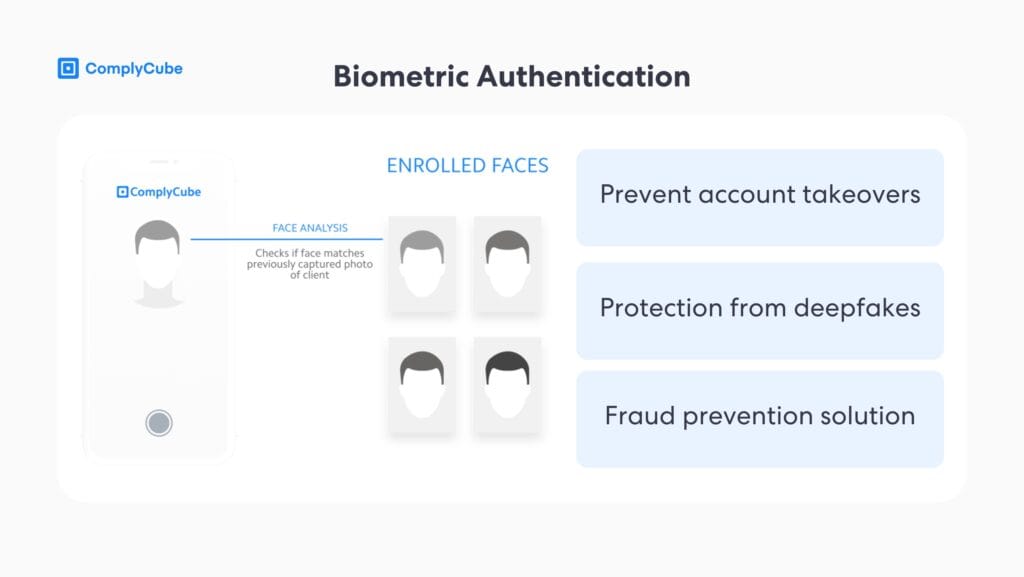
### **How Does Biometric Authentication Work?**
A biometric system needs specialized input devices such as fingerprint or iris scanners. However, it also works with conventional devices such as webcams or CCTVs linked with an on-premise or a cloud computer system running specialized biometric software.
These devices take measurements of your unique physical characteristics and compare them to a database of approved individuals. If there’s a match, you’re allowed access. If not, the device denies access. This process is far more secure than passwords, which can be guessed or stolen.
Biometric facial verification utilizes behavioral biometrics, where biometric data such as microexpressions and other mannerisms are scanned and verified. This is critical in a unimodal biometric authentication system, where only one set of data (i.e. a customer’s face) is scanned.
Sometimes, firms may choose to employ a multimodal biometric authentication system, where multiple biometric authentication methods are employed in the same verification process. Such a feature could consist of an automated fingerprint identification system coupled with a facial verification flow. However, typically firms opt for a biometric selfie verification as the preferred and most secure option.
### **Types Of Biometric Authentication**
There are different types of biometric authentication in use today. Here are some of the [most popular](https://www.marylandfingerprint.com/single-post/biometric-authentication-overview).
### **Fingerprints**
Fingerprint recognition and verification used to be the most common form of biometric authentication, and it one of the most accurate forms/ Fingerprint scanners are extremely reliable and it’s extremely challenging to replicate someone else’s fingerprint.
### **Iris Recognition**
Iris scanners are becoming more common, as they’re very accurate and difficult to fool. They work by taking a picture of the person’s iris (the colored part around the pupil) and comparing it to a database.
### **Facial Recognition**
Facial recognition systems are another form of biometric authentication that’s the industry standard for many firms. They use algorithms to compare a person’s face to a database of images that were captured during the original biometric verification and client identification process.

### **Voice Recognition**
Voice recognition is a form of biometric authentication that’s becoming more common. It works by analyzing the person’s voice to identify them.
### **Hand Geometry**
This is a newer form of biometric authentication that uses the person’s hand geometry to identify them. It’s less common than other forms, but it’s starting to be used more in some applications.
In addition, there are two main types of biometric authentication systems:
- **Centralized**: A centralized biometric authentication system stores the biometric data of individuals in a central location. When individuals attempt to authenticate, the device compares their biometric data to the data in the central database.
- **Decentralized**: A decentralized biometric authentication system stores the biometric data of individuals on their own devices. When individuals attempt to verify themselves, their device compares their biometric data to its own database.
## **Advantages Of Biometric Authentication For Businesses**
Biometric authentication has many [advantages](https://www.goodeintelligence.com/wp-content/uploads/2018/09/Goode-Intelligence-White-Paper-The-Business-Case-for-Biometric-Authentication.pdf) over traditional methods like passwords and IDs. Here are some of the most important benefits:
### **Improved Security**
Biometric authentication is much more secure than older methods like passwords and IDs. This is because it’s tough to replicate someone else’s biometric data.
For example, it isn’t easy to forge someone else’s facial features. And even if someone could manage to get ahold of these things, they would need access to the person’s biometric data.
So, if a business securely stores its customers’ biometric data, it will be nearly impossible for anyone to access it.
### **Convenience**
Biometric authentication is also much more convenient than traditional methods because you don’t need to remember a password or carry an ID card. Instead, all you need is your body.
For example, if you use fingerprint authentication to unlock your work computer, you don’t need to remember a password or PIN. Instead, you can use your finger.
This is much more convenient for businesses because customers can easily access their accounts. According to [Statista](https://www.statista.com/statistics/1303227/global-biometric-authentication-growth-by-industry/), in 2021 alone, there was a global increase of 1100% for biometric authentication used by financial services.
It’s also more suitable for employees because they can verify their identity without carrying around key cards, keys, or entering a pin every few minutes when they move to a different room or their device locks.
Besides, customers and employees who can access their accounts more quickly are more likely to do so. It leads to a better job and customer experience overall.
### **Accuracy**
Biometric authentication is also more accurate than traditional methods because there’s no chance of forgetting your password or losing your keys.
For example, if you use facial recognition to unlock your phone, you’re guaranteed to be the only one who can do so. This is because your facial features are unique to you.
Furthermore, facial recognition technology has an accuracy rate of 90% to [99.97%](http://csis.org/blogs/technology-policy-blog/how-accurate-are-facial-recognition-systems-%E2%80%93-and-why-does-it-matter), depending on the clarity of the image.
It’s crucial for businesses because only authorized individuals can access customer accounts. It also ensures that employees can only access the business areas they’re supposed to.
### **Cost-Effective**
You don’t need to invest in security infrastructures like cameras. All you need is software that can verify biometric data.
It’s vital for businesses because they can save money on security costs. Not to mention their time, which is money for most business people.
### **Fewer Cross-Cutting Concerns**
Depending on your service provider, you can often hand over those pesky cross-cutting concerns, and forget about them altogether. These can be anything from authorization to maintenance to data validation.
When you choose the right partner, you can alleviate these troubles and leave it to the professionals. They will oftentimes manage these aspects of your business, giving you more time to focus on scaling your business or day-to-day management.

## **How Can You Apply It To Your Business?**
Now that we’ve seen the advantages of biometric authentication, let’s see how you can use it in your business. Here are some of the more popular ways:
- **Employee Access Control**: Verify the identity of your employees. Ensuring that only authorized individuals access your business premises.
- **Customer Authentication**: Verify the identity of your customers. It gives your customers complete control over who can access their accounts.
- **Time And Attendance**: Track the time and attendance of your employees, which helps ensure that your employees are working their required hours. In addition, you can export this information instead of having someone input it manually. [Research](https://www.itprotoday.com/identity-management-and-access-control/how-biometrics-technology-changing-businesses-security) shows that 17% of North American & European businesses use this method.
- **Prevent Fake Signups**: Combat fraudsters using fake or stolen IDs by comparing new customer facial biometrics with blacklisted and previously registered individuals. ComplyCube battles this complex type of fraud using [Fake Authentication](https://www.prnewswire.com/news-releases/complycube-introduces-face-authentication-to-combat-fake-signups-and-synthetic-identities-301571133.html).
- **Meet KYC Regulatory Requirements**: Comply with [AML/KYC](https://www.complycube.com/en/kyc-vs-aml/) laws which require regulated businesses to uniquely and reliably identify their customers.
As you can see, there are many advantages to using biometric authentication in business. If you’re not using it already, now is the time to start. Your business will thank you for it.
However, it’s essential to see how it will benefit the people bringing in the money—your customers. So, let’s take a look at that next.
## **How Biometric Verification Benefits Your Customers**
Not only does biometric verification benefit your business and reduce the cost base, but it also achieves a great User Experience (UX) and convenience factor for your customers.
The most significant advantage customers gain from a biometric authentication business is security. It protects them from cyber-attacks, identity theft, and getting locked out of their own accounts.
Look at it like this; there aren’t cards, patterns, pins, or keys involved in the process. So, customers aren’t able to lose their access without losing their biometric identifiers. Furthermore, they can access their accounts wherever they are, as long as they have their trusted device nearby. An example of such a device is your mobile phone, and leaving the house without it nowadays is like leaving a part of yourself behind.
Biometric verification is also fast. Traditional methods like keycards can take time to swipe or insert. With biometric authentication, you simply unlock doors without fumbling around for your keys.
## **Potential Security Risks Associated With Biometric Authentication**
While biometric authentication offers several advantages, there are also some potential security risks to be aware of. Here are three potential security risks associated with biometric authentication:
1. **False Positive**s: In some cases, biometric authentication systems may allow access to someone who shouldn’t have it. It is known as a false positive and may occur due to multiple factors, such as poor quality sensors or incorrect data.
2. **False Negatives**: Another potential security risk is known as a false negative. It occurs when a device denies an authorized person access because the biometric authentication system doesn’t recognize their biometrics. The main factors contributing to this are dirt or oil on the sensor.
3. **Spoofing**: Spoofing is one of the most common security risks associated with biometric authentication. It’s when someone uses a fake fingerprint to try and gain access to a system. Spoofing can be challenging to detect and used to access sensitive information.
Biometric authentication is a convenient and secure way to protect your belongings. However, there are some potential security risks to be aware of. Although, you can easily avoid these risks by setting up 2-step verification, keeping equipment clean, and choosing your biometric authentication provider carefully.
## **2-Step Verification And Biometric Authentication**
Another excellent way to ensure your device is protected is through [2-step verification](https://www.microsoft.com/en-gb/security/business/security-101/what-is-two-factor-authentication-2fa) alongside your biometric authentication.
2-step verification is an additional security method that requires you to enter a code and your biometrics to gain access to your information. It makes it much more difficult for someone to gain access to your accounts, devices, or anything else you want to secure, even if they have your fingerprint. Even [Google](https://support.google.com/answer/2451907?hl=en) uses 2-step authentication to ensure its users are protected. Typically this is an email or SMS verification workflow, but it could be a secondary biometric verification step.
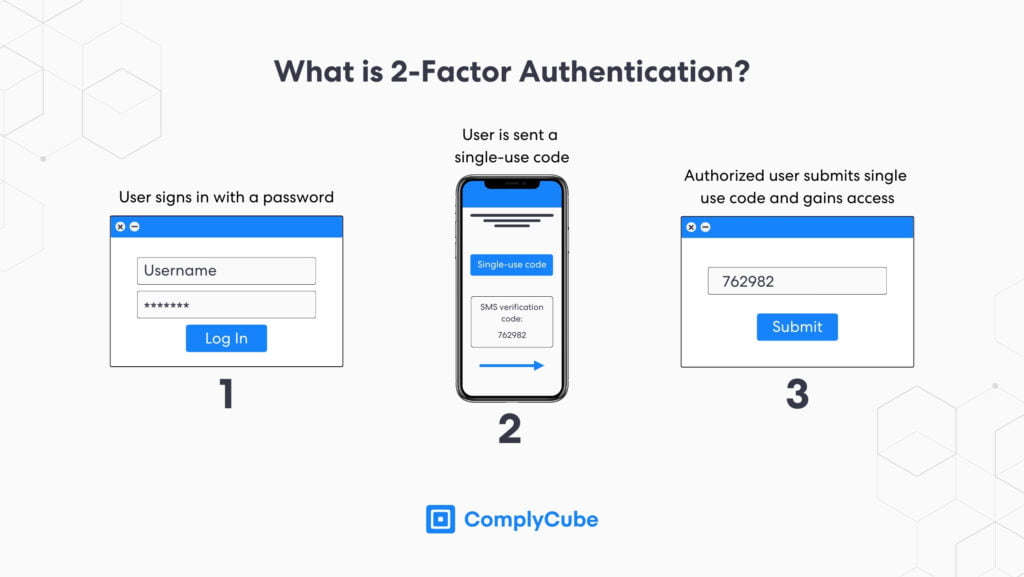
## **Choosing The Right Biometric Verification Service**
Knowing biometric authentication’s advantages and potential risks, you must choose the exemplary service. Here are five things to look for when choosing a [biometric authentication service](https://www.complycube.com/en/solutions/identity-assurance/biometric-verification/):
1. **Accuracy**: The first thing you should look for in a biometric authentication service is accuracy. You want to make sure that the system can correctly identify authorized users. Look for services that have a high success rate and low error rate.
2. **Ease Of Use**: You don’t want to choose a service that’s difficult to use. Look for software that offers an easy-to-use interface, integrates well, and has a simple setup process.
3. **Security**: You want to ensure that your data is safe and secure. Look for solutions that offer encryption and other security features. It needs to protect you from fraudsters, spoofing, and tampering.
4. **Reach**: You want to ensure the service is available where you need it. Look for a service that offers global coverage and is compatible with your devices.
5. **Customizability**: The last thing to look for is customizability. You want to be able to customize the service to meet your needs. Look for a service that offers a variety of options and allows you to tailor the service to your specific requirements.
If your potential [biometric authentication provider](https://www.complycube.com/en/solutions/) ticks all of these boxes, there’s no need to fear. You can rest assured knowing that your data is safe and secure.
## **Don’t Lose Yourself: what is biometric authentication?**
Simply put, it verifies a person’s identity using physical or behavioral characteristics. In other words, it’s an incredibly secure way to ensure that you are who you say you are, no matter where you are or what device you are using.
And for businesses, that means increased security and peace of mind. But biometric authentication isn’t just about security. It also offers enormous benefits for your customers. You can improve customer loyalty and satisfaction by providing a more convenient and secure way to access your products and services.
Ready to get started? [Reach out](https://www.complycube.com/en/contact/) to ComplyCube today and never be concerned about your data again. You can also find more information about protecting your data on the rest of [our blog](https://www.complycube.com/en/resources/blog/).
**Categories:** Guides
**Tags:** Biometrics
---
### [Reverse Money Laundering Explained](https://www.complycube.com/reverse-money-laundering-explained/)
**Published:** February 1, 2023
**Author:** Andreea Balasa
**Excerpt:** Money laundering is a serious crime that can result in harsh penalties. But what if there was a way to reverse the process and use clean money for a dirty business? Read on to learn more!
**Content:**
Money laundering is a serious crime that can result in harsh penalties. But what if there was a way to reverse the process and use clean money for a dirty business? This is known as reverse money laundering, a technique that criminals are using more and more to hide their illegal activities.
So how does it work, and what can your business do to protect your community from it? Read on to find out.
## **What Is Reverse Money Laundering?**
Reverse money laundering, which is a part of financial crime, is the act of using legally obtained funds to finance illegal activities, such as terrorism, bribery, or tax evasion. For this reason, it is often also referred to as terrorist financing.
At its core, reverse money laundering involves moving funds from legitimate sources to criminal groups or individuals. They do this through various means, including the use of shell companies or individual salary earners that belong to terrorist groups.
To better understand this concept, it’s vital to understand what money laundering is. So, let’s discuss that next.
## **Reverse Money Laundering Vs. Money Laundering**

While traditional and reverse money laundering both involve financial crime, some key differences exist between these practices.
### Traditional Money Laundering
Traditional money laundering is the process of moving funds from illegal activities to legitimate ones to disguise their source. This involves depositing or transferring money into a bank account, using complex financial transactions, or participating in underground banking networks.
It is a major criminal enterprise. A 2022 study estimated that the money laundered in one year could be between [2-5% of the global GDP](https://www.renolon.com/money-laundering-statistics/). That’s $800 billion to $2 trillion in the current US dollar.
### Reverse Money Laundering
In contrast, reverse money laundering does not involve disguising the origin of funds. Instead, it focuses on illegally funding criminal groups or individuals through legal means. So, the aim is to conceal what they are using the funds for.
The most common method of doing this is sending many people belonging to a criminal group into the regular job market. Once they join this market, they send some of their salaries back to the group for illegal use.
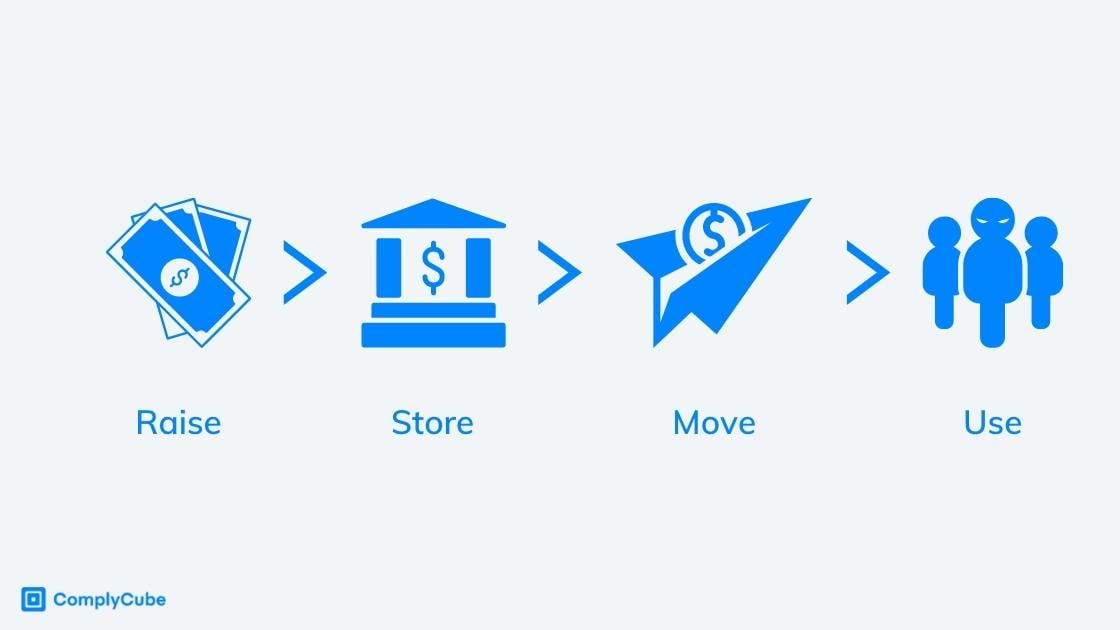
There are [four main stages](https://www.unodc.org/unodc/en/money-laundering/overview.html) to this process. These are:
- Raise
- Store
- Move
- Use
A study done by the National Risk Assessment has shown that there are low-level salary earners that belong to these criminal organizations, sending them funds each month. They send these raised funds to organizations across the globe, where they use them for low-sophisticated attacks.
For this reason, combating reverse money laundering is extremely difficult. Why? Because the [prohibition, identification, and monitoring](https://www.complycube.com/en/use-cases/profession/fraud-analysts/) of reverse money laundering have become much more complex.
Another critical difference between reverse money laundering and traditional money laundering is that reverse money laundering often involves a much larger volume of funds than what is typically associated with money laundering. This creates additional challenges for law enforcement agencies trying to track illicit activities.
Despite these challenges, reverse money laundering is a growing concern in today’s financial landscape, as it provides significant funding for terrorist groups and other criminal organizations. So, it’s vital for government and law enforcement agencies to understand reverse money laundering to prevent it.
## **Reverse Money Laundering And Terrorist Financing**

As mentioned, reverse money laundering is often known as terrorist financing.
While criminal organizations of all sorts typically use reverse money laundering to conceal where their money comes from, individuals or groups often employ it to finance acts of terrorism.
For example, terrorists may use reverse money laundering to fund the purchase of weapons or other supplies for an attack. In some cases, reverse money laundering may also involve providing funds for training sessions or educational opportunities for potential terrorists.

To avoid detection and prevent reverse money laundering from being linked to terrorist activities, individuals or groups may use several techniques, such as converting money into different currencies or moving funds between multiple bank accounts.
However, through [effective monitoring](https://www.complycube.com/en/solutions/global-screening/continuous-monitoring/) and tracking of reverse money laundering activities, law enforcement agents can help to disrupt terrorist financing networks and prevent criminal or terrorist groups from carrying out their harmful actions.
This is why “anti-money laundering” (AML) and “know your customer” (KYC) are integral parts of businesses that work with finances. So, let’s dive deeper into this analogy.
## **AML And Terrorist Financing**

Another key aspect of reverse money laundering is that it often involves what is known as AML practices.
AML refers to a set of regulations and laws designed to prevent financial crimes, such as reverse money laundering, by requiring that banks, financial institutions, and other regulated organizations closely monitor their clients and transactions for suspicious activities.
For example, suppose a regulator identifies an organization with close ties to a terrorist group. In response to this, the government may implement AML regulations requiring financial institutions to thoroughly review this organization’s transactions, including reverse money laundering funds transfers.
While reverse money laundering can be challenging to detect and prevent, by [implementing effective AML measures](https://www.complycube.com/en/solutions/due-diligence-compliance/anti-money-laundering/), governments can help disrupt terrorist financing networks and reduce the risk of reverse money laundering-related criminal activities.
### **How KYC Helps Combat Reverse Money Laundering**
Furthermore, they can identify these organizations much faster by enforcing KYC regulations. How does this work? Here’s an overview.
KYC is a process that financial institutions use to verify the identities of their clients and ensure that they are not financing any illicit activities. These activities can include reverse money laundering transactions such as moving funds through multiple accounts or converting currency.
To meet these KYC requirements, many banks and other financial institutions will collect information about their clients, such as their names, addresses, and other identifying documents. In addition, they may monitor reverse money laundering transactions for suspicious activity or review transaction histories to look for unusual patterns.
By implementing [robust KYC processes](https://www.complycube.com/en/solutions/due-diligence-compliance/know-your-customer/), businesses can help to prevent reverse money laundering activities from taking place while also helping to identify individuals or groups involved in terrorist financing.
Overall, reverse money laundering is a complex crime that requires specialized knowledge about financial regulations and practices to combat it effectively. However, with the right tools and resources, law enforcement agencies can help to disrupt reverse money laundering activities and prevent funding for terrorist groups or other criminal organizations.
## **How To Prevent Reverse Money Laundering**
Now that you understand what reverse money laundering is, how it differs from traditional money laundering, and how it ties into AML and KYC. It’s time to dive deeper into ways to prevent it.
### **Increase Awareness And Education**
One of the best ways to prevent reverse money laundering is by raising awareness about this type of financial crime among law enforcement agencies, businesses, and the general public. They can achieve this through targeted educational efforts that provide information on how terrorist financing works and what actions they should take to detect and prevent it.
### **Rigorous Monitoring Of Financial Transactions**

In addition to increasing awareness, reverse money laundering prevention efforts should also include rigorous monitoring of financial transactions. This monitoring is to identify other activities that link to criminal or terrorist organizations.
It can involve employing sophisticated data analytics tools and working closely with financial institutions to identify suspicious activity and take appropriate action.
### **Strong Regulatory Framework**
A robust regulatory framework is also necessary to help prevent reverse money laundering and disrupt terrorist financing activities. This may involve implementing strict business reporting requirements and imposing steep penalties and sanctions for those who violate money laundering laws or commit financial crimes.
### **Increased Cooperation Between Law Enforcement And Other Agencies**
To successfully prevent reverse money laundering and combat terrorist financing, law enforcement agencies must work closely with other organizations such as financial institutions, regulatory bodies, and the private sector. By cooperating and sharing information and resources in a coordinated manner, they can help protect communities from the harmful effects of reverse money laundering and terrorist financing.
### **Implementing AML And KYC Practices**

When financial institutes and other businesses ensure they follow proper AML and KYC regulations, they can aid in the identification, prohibition, and monitoring of these crimes. The best way to do this is to hire experts in this field, such as [ComplyCube](https://www.complycube.com/en/), to run these operations.
It is one of the best ways to prevent reverse money laundering and disrupt terrorist financing activities. By implementing robust AML and KYC processes, businesses can detect suspicious activity and prevent reverse money laundering before it happens.
With [the right tools](https://www.complycube.com/en/solutions/global-screening/watchlist-screening/) and guidance, they can also work with law enforcement and other agencies to identify and disrupt reverse money laundering networks, helping keep their communities safe.
## **Who Are The Regulators For Terrorist Financing?**
There is no single regulator responsible for overseeing terrorist financing activities. Instead, various regulatory bodies and organizations are involved in implementing anti-money laundering policies. In addition, they ensure that financial institutions and other entities abide by relevant laws and regulations. These may include government agencies such as the [Treasury Department](https://home.treasury.gov/policy-issues/terrorism-and-illicit-finance/money-laundering) or the [FBI](https://www.fbi.gov/news/testimony/combating-money-laundering-and-other-forms-of-illicit-finance) and organizations like [FINRA](https://www.finra.org/rules-guidance/key-topics/aml), the [IMF](https://www.imf.org/external/np/leg/amlcft/eng/aml1.htm), the [IRS](https://www.irs.gov/government-entities/indian-tribal-governments/title-31-anti-money-laundering), and the [SEC](https://www.sec.gov/about/offices/ocie/amlsourcetool).
### **Other Global Regulators**
Another set of essential regulators includes:
- Global: Global: [The Terrorism Prevention Branch](https://www.unodc.org/unodc/en/terrorism/index.html) (TPB) of the [United Nations Office on Drugs and Crime](https://www.unodc.org/unodc/index.html) (UNODC)
- USA: [Financial Crimes Enforcement Network](https://www.fincen.gov/) (FinCEN) and [Office of Foreign Assets Control](https://home.treasury.gov/policy-issues/office-of-foreign-assets-control-sanctions-programs-and-information) (OFAC)
- UK: [The Financial Conduct Authority](https://www.fca.org.uk/) (FCA)
- Germany: [The Federal Financial Supervisory Authority](https://www.bafin.de/EN/Homepage/homepage_node.html) (BaFin)
- France: [Autorité des marchés financiers](https://www.amf-france.org/en) (AMF) and [French Prudential Supervision and Resolution Authority](https://acpr.banque-france.fr/en) (ACPR)
- Spain: [Comisión Nacional del Mercado de Valores](https://www.cnmv.es/portal/home.aspx?lang=en) (CNMV)
- Australia: [Australian Transaction Reports and Analysis Centre](https://www.austrac.gov.au/) (AUSTRAC)
Businesses must work closely with these organizations and regulatory bodies to combat reverse money laundering and terrorist financing effectively. By collaborating on information sharing and data analysis, they can better identify suspicious activities, prevent financial crimes from occurring, and disrupt terrorist financing networks.
Ultimately, it’s up to every business owner to help protect the safety and security of communities worldwide.
## **Conclusion**
So, [what is reverse money laundering](https://aml-cft.net/library/reverse-money-laundering/)? In a nutshell, it’s the disguising of legal proceeds used for criminal activities. It can be challenging to detect, so it’s crucial for businesses to have systems in place that can identify red flags and prevent this type of activity.
At ComplyCube, we help companies do just that with our [AML and KYC solutions](https://www.complycube.com/en/solutions/). Please check out our website today if you’re interested in learning more about how we can help your business stay compliant.
Alternatively, you can find more exciting posts on [our blog](https://www.complycube.com/en/resources/blog/).
**Categories:** Guides
**Tags:** Anti-Money Laundering
---
### [The Crypto Travel Rule: The Need for AML Compliance Software](https://www.complycube.com/the-crypto-travel-rule-and-the-need-for-aml-compliance-software/)
**Published:** March 26, 2024
**Author:** Andreea Balasa
**Excerpt:** The crypto travel rule endorses VASPs to use AML compliance software to share user data when transactions exceed a specific value to achieve crypto compliance. This initiative is designed to mitigate crypto money laundering.
**Content:**
The crypto travel rule is a global initiative to mitigate crypto money laundering activities. It suggests that Virtual Asset Service Providers (VASPs), such as centralized exchanges, must share specific user data if a transaction exceeds a certain value threshold. This guide exhibits how AML compliance software is fundamental to successfully implementing this crypto compliance regulation.
## **The Impact of Money Laundering in the Crypto Industry**
Money launderers are constantly finding new vehicles to wash their money. When bitcoin was established, and later the plethora of altcoins, bad actors pounced on this new technology. The pseudonymous nature of cryptocurrencies makes them an attractive tool for money laundering activities. Criminals can exploit these features to conceal the origins of illicit funds and transfer them across the world without leaving a trace.
This gives virtual assets unrivaled opportunities for money laundering due to their ease of use, global reach, and anonymity in transactions. Criminals can convert illicit funds into crypto assets and transfer them to crypto wallets across the globe, making it challenging for authorities to track the source and destination of the funds.
Furthermore, the cryptocurrency industry is still an emerging market, one where regulators are still comprehending the scale, size, and gravity that regulations need to be. This has left a regulatory void for financial crime to exploit.
### Cryptocurrency Money Laundering Figures
Since 2015, there has been a concerted [effort to reduce illicit cryptocurrency funds traveling toward Centralized Exchanges](https://committees.parliament.uk/writtenevidence/111450/pdf/) (CEXs). This is because they are inherently less anonymous than decentralized applications (dApps).
Regulatory bodies worldwide have recognized the need to implement stringent Anti-Money Laundering (AML) measures. The Travel Rule is crucial in this effort, requiring VASPs to collect and share customer information during transactions, enabling greater transparency and accountability within the cryptocurrency industry.
Having said this, VASPs still oversaw a [volume of $22.2 billion laundered](https://www.chainalysis.com/blog/2024-crypto-money-laundering/#:~:text=2023%20crypto%20money%20laundering%3A%20Key,volume%2C%20both%20legitimate%20and%20illicit.) via their platforms, with centralized exchanges remaining the most popular destination for fraudulent funds. This signifies that the crypto travel rule is not being implemented successfully on a local level.

## **The Importance of Crypto Compliance**
Ensuring compliance is essential for the long-term sustainability and growth of businesses operating in the crypto space. By implementing robust crypto compliance processes, companies can establish trust with regulators, their customers, and other financial institutions.
Firms running compliance programs demonstrate a commitment to security, transparency, and ethical business practices, which are increasingly important in an industry plagued by concerns of illicit activities.
Cryptocurrency exchanges (and all crypto platforms) must take measures to mitigate terrorism financing, money laundering, and other financial crimes. Facilitating money laundering through a VASP, sometimes known as a Crypto Asset Service Provider (CASP), can result in detrimental fines and damage to the business.
### Regulatory Fines
Regulatory regimes and Financial Action Task Force (FATF) style regional bodies proved in 2023 that they can and will impose significant fines on VASPs that do not comply with crypto laws. Last year, one cryptocurrency exchange was fined[ $4 billion for paying no heed to its platform’s ongoing money laundering activities](https://www.justice.gov/opa/pr/binance-and-ceo-plead-guilty-federal-charges-4b-resolution).
> If you serve US customers, you must [obey US law](https://www.justice.gov/opa/speech/deputy-attorney-general-lisa-o-monaco-delivers-remarks-announcing-binance-and-ceo-guilty).
This comes from Deputy Attorney General Lisa O. Monaco, signifying America’s increasingly uncompromising stance against money laundering on crypto asset service providers.
### Reputational Damage
Non-compliance with policy can have devastating effects on the customer base. While crypto traders generally follow the hottest trends, fear of crypto exchanges collapsing or insolvency will cause users to churn.
Poor KYC/AML compliance strategies causing even minor reputational damage will increase regulatory probing. This will significantly reduce operational efficiency and increase expenditure on internal audits.
### Expansion into New Markets
Any large-scale cryptocurrency controversy can have a significant and lasting knock-on effect on the CASP’s client base. Whether it is issues over solvency, transparency, or money laundering, ensuring the platform is optimized to prevent risk is paramount.
This is especially important when crypto institutions are expanding abroad into new markets. Cryptocurrency exchanges face stifling competition, and being the first mover in a new market can enormously impact the number of clients.
This means that firms must have the means, and thus the infrastructure, to expand into new territories with different regulatory requirements. Failing to meet crypto compliance requirements in new territories could lead to a denied license, increased regulatory probing, or sudden operation restriction.
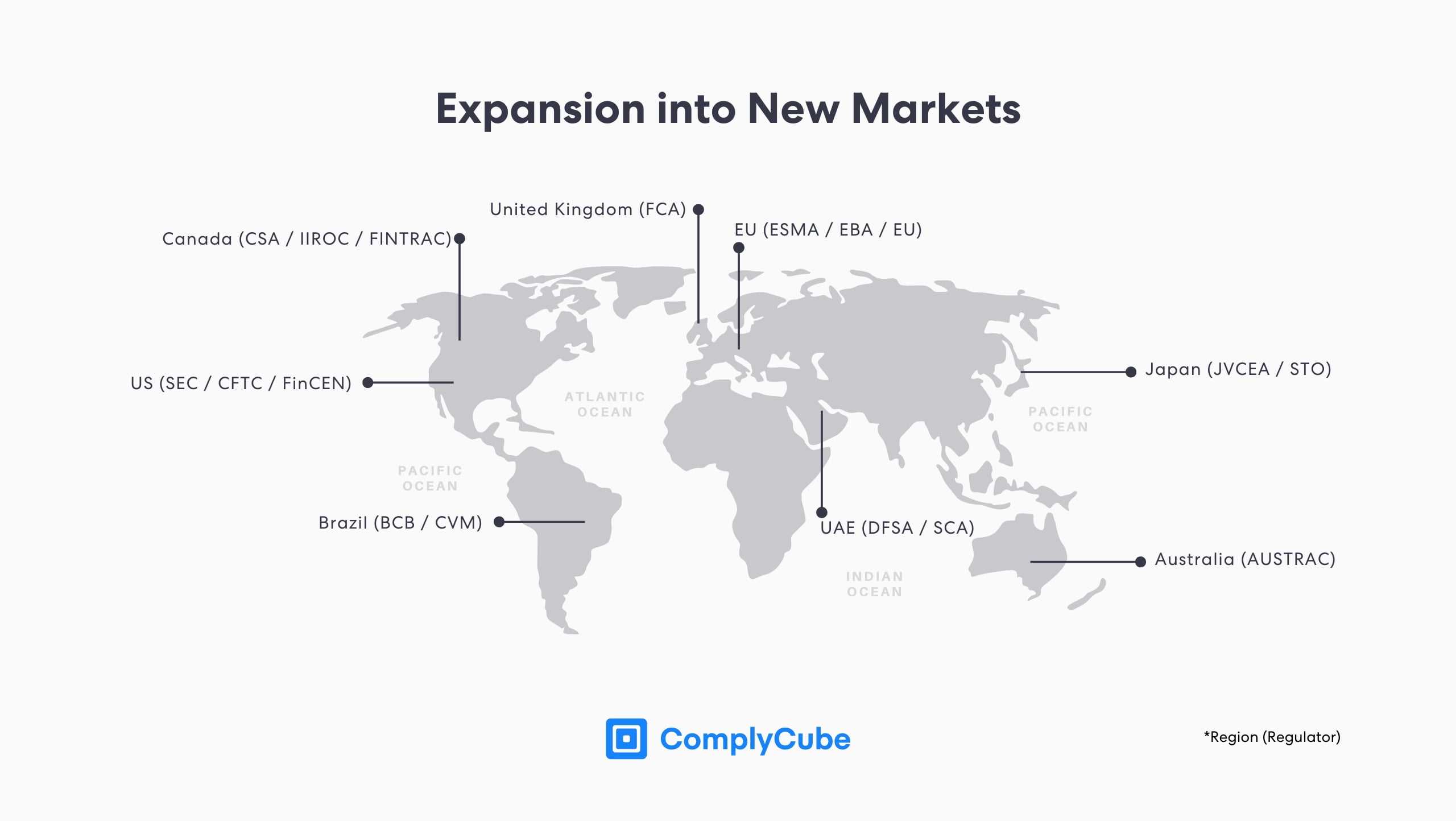
## **What is the Crypto Travel Rule?**
The Travel Rule, initially drafted by [FinCEN](https://www.fincen.gov/) (Financial Crimes Enforcement Network) and the Bank Secrecy Act, required financial services to pass on user information to the next financial institution during financial transactions. However, in 2019, [the FATF recommended extending the Travel Rule to CASPs](https://www.fatf-gafi.org/en/publications/Fatfrecommendations/targeted-update-virtual-assets-vasps-2023.html), recognizing the need to regulate the rapidly evolving crypto industry. This became known as recommendation 16.
Under the Travel Rule, crypto transactions that exceed a certain threshold (typically $1,000) must be investigated by a host of KYC (Know Your Customer) and due diligence procedures. Data about the individual conducting the transaction is shared between VASPs before the transaction can be accepted.
Crypto companies must also sanction screen the counterparty VASPs, extracting all necessary additional information to ensure both institutions are compliant with global and local regulations.
This regulatory requirement enhances transparency and prevents illicit activities such as money laundering and terrorist financing. The Travel Rule represents a significant shift in the regulatory landscape of the crypto industry.
It requires VASPs to collect and share customer information, including the originator’s and beneficiary’s names, wallet addresses, and additional identifying details. This information enables authorities to trace the flow of funds and investigate any suspicious activities. For more information on how KYC safeguards the cryptocurrency industry, read [How KYC Crypto Regulations Safeguard the Industry.](https://www.complycube.com/en/how-kyc-crypto-regulations-safeguard-the-industry/)
## Global Regulators: The Crypto Travel Rule
The travel rule compliance requirements can differ based on regional and jurisdictional boundaries. However, the FATF suggests that the crypto travel rule should apply to all transactions exceeding $1,000.
Different regions employ the Travel Rule at different rates; this is known as the ‘sunrise issue’ and is one of the key challenges this policy faces in the VASP industry.
A report by the FATF in 2023 determined that after 4 years of adopting the travel rule for cryptocurrencies, ‘implementation is pretty poor.’
> Over one third [(52 of 151) have not conducted a risk assessment.](https://www.fatf-gafi.org/content/dam/fatf-gafi/guidance/June2023-Targeted-Update-VA-VASP.pdf.coredownload.inline.pdf)
This suggests that local policymakers must regulate the industry with a firmer hand. The travel rule only works as intended if all jurisdictions adhere to it and properly implement it. This allows for seamless due diligence on users and the passing of that information to the next VASP.

### Financial Institutions and Crypto Compliance: Behind Schedule
The general finding of the Financial Action Task Force was that the cryptocurrency industry was behind most other sectors regarding regulation. Their immediate guidance to companies providing services for digital assets was to introduce the travel rule thoroughly as soon as possible.
They also commented on the requirement for greater interoperability in AML services, enabling robust endorsement of the travel rule. Data malleability is something that KYC and AML services must provide as a part of their product offering.
### The Financial Action Task Force: Next Steps
In H1 of 2024, the FATF is expected to publish the findings of their member jurisdictions’ employment of the travel rule. The global regulator is also presently assisting ‘low-capacity jurisdictions’ in enabling the widespread implementation of this policy.
## Which Crypto Services Does the Travel Rule Apply to?
Currently, the only real platforms that have seen the successful implementation of the crypto travel rule are Centralized Exchanges. These platforms host wallets for users to buy and sell crypto without paying blockchain gas fees.
This is an easier way of buying and selling crypto and attracts more users to the industry than dApps. While these hosted wallets on exchanges are generally cheaper and easier to navigate, they come at the cost of reduced security. Cryptocurrency that users purchase is not strictly theirs until they withdraw it to an unhosted wallet.
> Not Your Keys, [Not Your Coins](https://www.ledger.com/academy/not-your-keys-not-your-coins-why-it-matters).
This saying refers to the fact that centralized exchanges have custody of users’ private keys. Private keys are the digital pass to a wallet, meaning anyone with access to these keys can access its funds. Despite the AML concerns, this is what makes unhosted wallets the favored way of holding cryptocurrency securely.
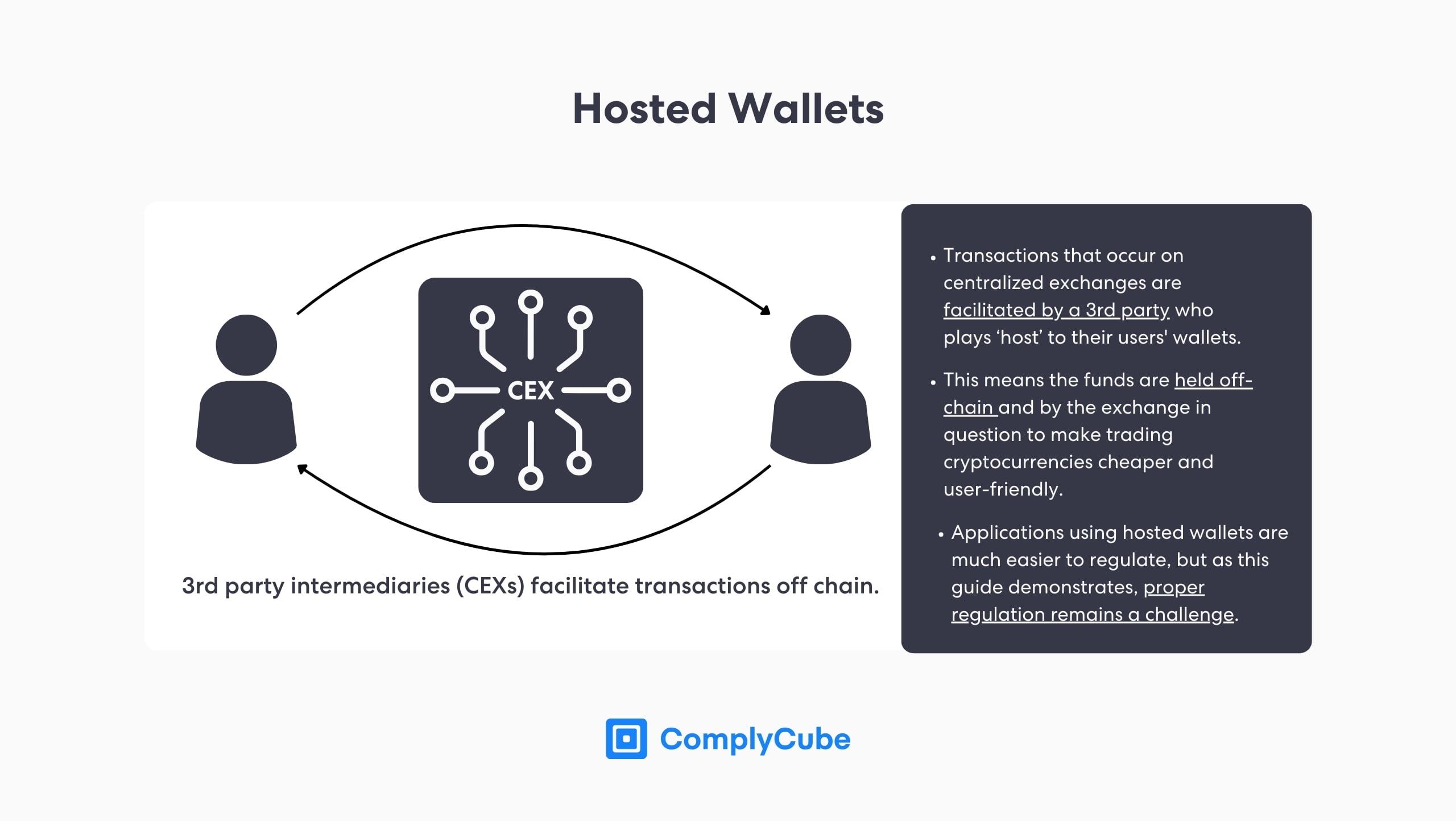
## Challenges to the Crypto Travel Rule Implementation
A leading crypto money laundering policy issue is the regulation of unhosted or non-custodial wallets. These wallets, including [Trust Wallet](https://trustwallet.com/) and [MetaMask](https://metamask.io/), are held privately by individuals, facilitating a secure method of holding cryptocurrencies on-chain.
This decentralized way of storing cryptocurrency requires no intermediary, such as crypto exchanges, to hold or trade tokens. These wallets communicate with dApps, such as Decentralized Exchanges (DEXs), staking and lending protocols, and many others.

It is commonly asserted that dApps are much more complicated to enforce regulations upon, particularly the travel rule solution, because of their anonymity. Unhosted wallets require no national identity number or any beneficiary information to create. A wallet or user is only identifiable through its non-custodial wallet address, which is a series of numbers and letters.
The FATF’s report clarified that unhosted wallets, which can leverage P2P (Person-to-Person) transactions, are tricky to regulate worldwide.
Businesses that fail to comply with the crypto travel rule and other regulations could face severe penalties, regulatory sanctions, and reputational damage. Non-compliance can lead to the loss of operational licenses, hindering their ability to operate within the legal framework and access traditional financial services.
Therefore, embracing [crypto compliance](https://www.complycube.com/en/use-cases/industry/crypto/) is crucial for businesses seeking to thrive in the rapidly evolving crypto landscape.
One of the primary challenges for VASPs when meeting the crypto travel rule requirements is the need to establish secure and efficient data-sharing mechanisms. VASPs must ensure the confidentiality and integrity of customer information while complying with regulations.
Additionally, businesses must invest in robust AML compliance software to facilitate the screening and verification of customers and counterparties. AML systems help automate the due diligence process, ensuring that businesses can identify and mitigate the risk of engaging with individuals or entities involved in illicit activities.
## **The Role of AML Compliance Software**
[AML software](https://www.complycube.com/en/solutions/due-diligence-compliance/anti-money-laundering/) is pivotal in preventing illicit actors from accessing financial platforms. This enables institutions to adhere to general crypto compliance and the Travel Rule. These software solutions provide advanced risk assessment capabilities, customer screening, transaction monitoring, and regulatory reporting functionalities.
By leveraging KYC client acquisition software, businesses can streamline their AML compliance processes, reduce manual labor and mistakes, and enhance their ability to identify suspicious transactions or customers.

According to the European Union Council and Parliament, centralized exchanges now have the same obligation as banks to combat money laundering. This means that CEXs must leverage a wealth of AML, KYC, and IDV (Identity Verification) solutions that provide the flexibility to meet the growing AML requirements globally.
In the same development, the European Securities and Markets Authority (ESMA) will now have the power to [restrict or ban crypto exchanges](https://www.cnbc.com/2023/04/20/eu-lawmakers-approve-worlds-first-comprehensive-crypto-regulation.html) if they are not making sufficient efforts to protect their users.
### About ComplyCube
ComplyCube is swiftly becoming a go-to in the identity verification and Know Your Customer industry by providing a suite of client authentication and due diligence solutions that enable adherence to the strictest AML policies.
If your VASP is looking to strengthen its crypto travel rule compliance, or your platform faces challenges around AML, KYC, and IDV, start a conversation with us today and [find out how ComplyCube’s services are shaping the security of the crypto and financial industry](https://www.complycube.com/en/contact/contact-sales/).
**Categories:** Guides
**Tags:** Crypto Regulations
---
### [FATF Recommendations in 5th Mutual Evaluations](https://www.complycube.com/fatf-recommendations-the-mutual-evaluations/)
**Published:** April 3, 2024
**Author:** Andreea Balasa
**Excerpt:** The FATF’s 5th Round of Mutual Evaluations begins in 2025, putting pressure on financial institutions to update their AML/CFT systems. The FATF mutual evaluation framework analyzes the adoption of the FATF recommendations.
**Content:**
The FATF’s 5th Round of Mutual Evaluations is expected to begin in 2025 and will put significant pressure on financial institutions to upgrade their existing AML/CFT systems. The FATF mutual evaluation framework is designed to analyze how well the FATF recommendations have been implemented.
This short guide covers what the Mutual Evaluation reports are, how they are changing, and what business and financial enterprises need to consider when choosing the right AML and CFT solutions.
## **What is the FATF?**
The Financial Action Task Force (FATF) is an intergovernmental organization that sets the global standards for Anti-Money Laundering (AML) and Counter-Terrorist Financing (CTF) policies. In doing so, they promote the correct implementation of regulatory and operational measures to combat financial crime.
These standards are outlined in the [FATF 40 Recommendations](https://www.fatf-gafi.org/content/dam/fatf-gafi/recommendations/FATF%20Standards%20-%2040%20Recommendations%20rc.pdf), in which over 200 countries and jurisdictions are committed to implementing these standards. This means that the FATF has a profound effect on the way financial organizations operate locally, nationally, and globally and has brought about major changes in laws from governments.
## **What are the FATF Recommendations?**
As the FATF sets the precedent for its members, it is left up to the member jurisdictions themselves to decide on how to implement the 40 recommendations. This means that the global regulator’s guides are left somewhat open to interpretation, and the efficacy of the FATF recommendations is not always guaranteed.
It is, therefore, the responsibility of national FATF-style regional bodies to successfully implement AML policy throughout local jurisdictions. While the FATF has a very strong authority over global AML regulations, they have no direct power when it comes to government agency enforcement or penalization of money laundering or financing of terrorism.
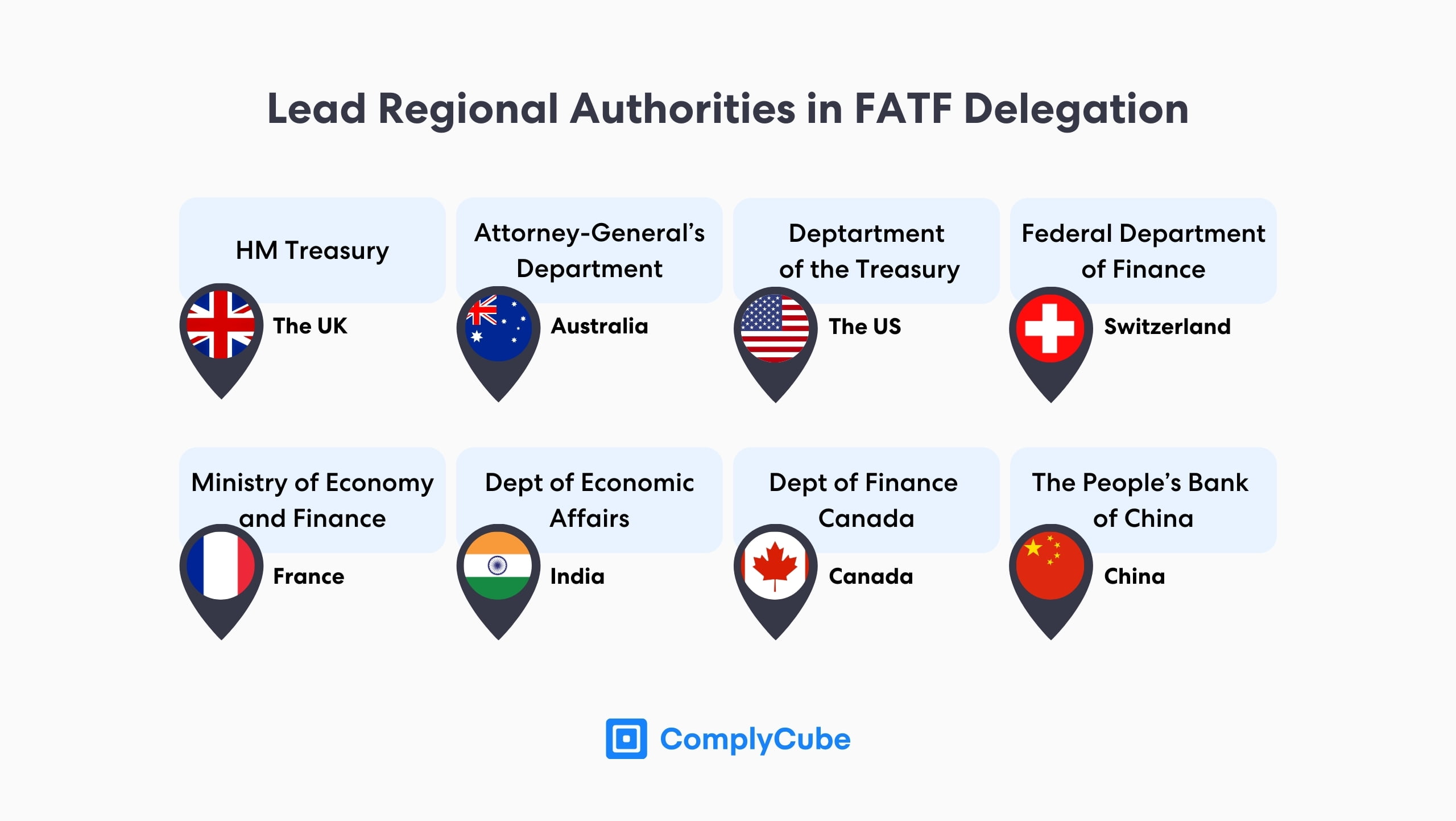
## What are the Mutual Evaluations?
A mutual evaluation is the methodology of assessing the compliance of each member’s AML framework as influenced by the FATF standards. These are particularly insightful for both the FATF and its members as they:
1. Provide a starting point whereby areas of improvement (and non-compliance with their recommendations) are identified, and
2. Inform the agency itself of areas they can improve in regarding recommendation quality, depth, and expectations.
Each country can then strengthen its framework accordingly, boosting the effectiveness of global AML, CFT, and other financial crime prevention strategies. The evaluations, therefore, can be seen as an ongoing initiative to align national policies combating money laundering with the FATF.
The Mutual Evaluation process historically can take [up to 18 months](https://www.fatf-gafi.org/en/topics/mutual-evaluations.html) and consists of multiple stages:
- Compliance experts are trained in the recommendations and methodology for assessing compliance with the FATF.
- Financial professionals (central bank officials) from the assessed country are given training so they are familiar with the processes and expectations of the FATF.
- Assessors are selected depending on the specific requirements for the assessment, such as language and legal barriers that can be particular to a jurisdiction.
- The analyzed country provides the assessors with details about its financial regulations and laws and how they compare to the FATF’s guidelines. This takes around 4 months.
- The assessors undertake a preliminary scoping exercise ahead of an on-site visit. This is done to ensure their focuses are correctly placed during the analysis.
- Assessors attend the country’s policymaking financial system venues and the private institutions that are subject to those policies. [There are 11 key areas that the assessors will be analyzing](https://www.fatf-gafi.org/en/publications/mutualevaluations/documents/effectiveness.html) for effectiveness and 40 for technical compliance.
- Following the on-site visit, the assessors will draft their report, finalizing the mutual evaluation report with findings from both the effectiveness and technical compliance with the FATF.
- The assessors present the draft to the FATF Plenary at a tri-annual meeting. A consensus is gathered here from members to ensure the ratings are justified and fair.
- A final quality review is undertaken by all countries in the organization to mitigate technical inadequacies before publishing.
- All countries are then liable to a follow-up assessment. This can range from regular reports to public warnings issued against a country for repeated and insufficient remedial actions.
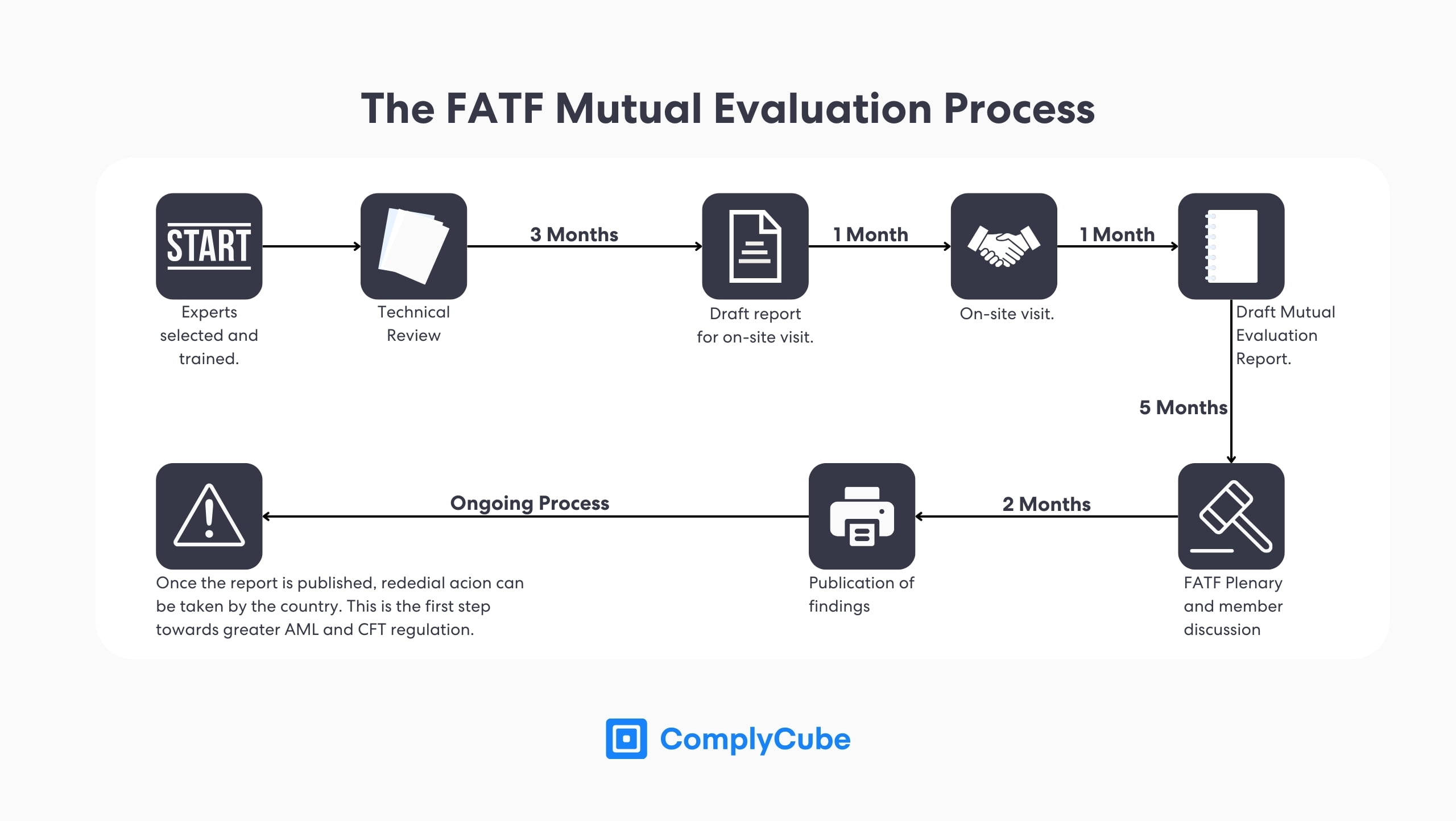
## Technical Compliance vs Effectiveness
Technical compliance assesses whether a FATF member has the right laws and regulations in place for an AML/CFT framework. This includes 40 ratings that determine to what extent the country’s laws and regulations are inclusive of the FATF requirements.
### The Technical Compliance Ratings Include
1. **Compliant** – No shortcomings.
2. **Largely compliant** – Minor shortcomings.
3. **Partially compliant** – Moderate shortcomings.
4. **Non-compliant** – Major shortcomings.
5. **Not applicable** – There are requirements that do not apply due to lacking national infrastructure.
### The Effectiveness Ratings
Effectiveness, on the other hand, measures whether these AML/CFT systems are working and whether the FATF member is achieving the specific outcomes recommended by the FATF themselves. 11 ratings are used to reflect the extent to which a country’s regulatory systems are effective:
1. **High level of effectiveness.**
2. **Substantial level of effectiveness.**
3. **Moderate level of effectiveness.**
4. **Low level of effectiveness.**
For more information on this, read the [FATF’s report from 2022](https://www.fatf-gafi.org/content/dam/fatf-gafi/reports/Report-on-the-State-of-Effectiveness-Compliance-with-FATF-Standards.pdf.coredownload.pdf).
## 5th Round of Mutual Evaluations
The 5th round of mutual evaluations will usher in a wave of new changes since the 4th round of mutual evaluations in 2013. Unlike the previous rounds, which usually lasted 10 years on average and had a follow-up assessment after 5 years, the next round of evaluations will be significantly shorter over a 6-year cycle.
After a FATF member’s mutual evaluation, countries will only have three years to take action on the gaps identified by the Financial Action Task Force. The consequences of not addressing these deficiencies can lead to the FATF publicly escalating them, which can have significantly negative economic implications for countries.
Public escalation can lead to a reduction of foreign business and a damaging economic and regulatory reputation that is hard to shake without a significant investment of time and resources. For this reason, it is vital to effectively implement the FATF recommendations.
The purpose of this shorter review cycle is to put greater scrutiny on FATF members and is a strategic decision to ensure governments stay on top of implementing AML laws, regulations, and policies in line with the 40 recommendations. This remains on trend with regulatory movements across the globe, where there seems to have been a concerted agreement to improve AML compliance.
The 5th round of mutual evaluations will start once all members have been assessed against the current methodology, meaning they will likely come into force in 2025. This new round will also be placing a greater emphasis on effectiveness to make sure that countries are implementing regulation to the best of their ability.
Financial services, therefore, must be prepared for the increased pressure they are going to face from regulators to ensure that the AML/CFT systems they are using are in line with FATF’s new results-orientated FATF mutual evaluations.
This begs the question, what should financial services look for in an AML/CFT verification system?
## **What to look for in an AML/CFT verification system?**
As the FATF is pushing for the next round of evaluations to be results-orientated, financial services will not be able to get away with just purchasing a new AML system. What the international organization really cares about, and thus what is important to its member regulators, is how these systems are being used to implement the FATF recommendations.
Effective AML/CFT systems are responsive. Providers of AML, KYC, and CFT solutions should have real-time data feeds of global watchlists, sanctions, and PEP requirements. It is true that financial services in FATF member countries will already be aware of and have access to these lists.
However, how they are gathering this data, and leveraging and integrating it into their AML systems to screen customers will be crucial. These data sources are continuously updated due to unforeseeable geopolitical events which lead to swift spikes of sanctioned entities and individuals.
Furthermore, the digitalization of the global economy and innovations in fraudulent activities have made manual retrieval of these data fields an inefficient process. Organizations must adopt a system that takes care of this intensive task for them, where they can access lists that are continuously updated and monitored. They can take advantage of services such as continuous monitoring helping to increase operational efficiency.
Data accessibility is equally important. Compliance teams must be able to carry out their investigations quickly, from the initial alert to a final remedial act. It is very easy for compliance teams to get overwhelmed with an overload of data. This necessitates a system that enables KYC and AML analysts to intuitively act on certain alerts.
Investigative portals are being more commonly used to facilitate these actions. These platforms hold all the necessary data for all stages of an analyst’s investigations into a customer so they can make informed and timely decisions.
Lastly, although false positives will always be an inherent part of AML screening, there has been a growing trend of utilizing artificial intelligence and machine learning in automation settings to reduce false positives. This helps investigators cut through the noise and only focus their time and resources on the individuals who pose the biggest threat to their organizations. This would help to actualize the results that the FATF desires.
## About ComplyCube
ComplyCube is a leading provider of AML, KYC, and IDV solutions. The company’s motivation is to build trust at scale and was founded upon key compliance gaps in the international financial system. Boasting identity verification workflows that can be completed in under 30 seconds, they operate in 220+ regions, accept 13,000+ documents, and have partnered with a range of proprietary and institutional AML data lists.
This has made the KYC provider a reliable solution to combat money laundering, striking a balance between operational efficiency and regulatory adherence. ComplyCube has been the choice of partner for a range of companies, including financial institutions, virtual asset service providers, telecoms, and many more.
The ability to continuously adjust, iterate, and shape compliance strategies is fundamental to modern-day compliance teams. This will be particularly pertinent when 5th round of mutual evaluations comes into full effect.
If your business is challenged by anything discussed throughout this article, it might be time to partner with a KYC service. [Start a conversation today](https://www.complycube.com/en/contact/contact-sales/).
**Categories:** Guides
**Tags:** Anti-Money Laundering
---
### [Customer Identification Program: What Is CIP?](https://www.complycube.com/customer-identification-program-what-is-cip/)
**Published:** April 5, 2024
**Author:** Andreea Balasa
**Excerpt:** Businesses obtain customer information and ratify it through a KYC process, which begins with a Customer Identification Program (CIP). FinCEN's Final Rule sets out the CIP requirements, answering many queries about 'what is CIP?'
**Content:**
**TL;DR:** A **customer identification program (CIP)** is the first step of KYC. If you are asking what is CIP, it is a **flexible, risk-based onboarding** procedure. It is designed to deter fraudsters, financial criminals, and terrorist. CIP requirements focus on capturing identifying information and validating them **against documents and trusted sources.**
## What is a Customer Identification Program?
When regulated businesses establish new user relationships, they must verify each customer’s identity. This requirement matters most in financial services, but it also applies across other industries. Beyond 2026, more firms will strengthen identity checks as onboarding moves further online, helping them reduce fraud risk while maintaining a smooth customer experience.
A Customer Identification Program is a procedure that most companies must follow when onboarding new clients. It deters bad actors, financial criminals, and known or suspected terrorists. It proves that customers are who they say they are and is a crucial first step in the KYC process. Done well, a CIP also gives compliance teams a reliable foundation for due diligence and ongoing monitoring later in the customer lifecycle.
The Financial Crimes Enforcement Network’s [(FinCEN’s) Final Rule](https://www.fincen.gov/resources/statutes-and-regulations/bank-secrecy-act) mandates that a company’s CIP must be ‘appropriate to its business size.’ This means every company must analyze customer details until there is a ‘reasonable belief’ that the customer is indeed who they say they are. This regulation provides companies with a degree of autonomy and flexibility when deciding and enacting their program.
## CIP vs KYC: What’s the difference?
There is a critical difference between a Customer Identification Program and a Know Your Customer strategy. CIP is the identity-focused onboarding step. It’s where an institution gathers and verifies key details to form a “reasonable belief” it knows who it’s dealing with. On the other hand, KYC is broader. It builds on that verified identity to assess risk and keep evaluating the relationship over time:
- Customer Identification Program (CIP): FinCEN and the USA Patriot Act requires a financial institution to form a reasonable belief that it knows the identity of its customers.
- Customer Due Diligence (CDD): The due diligence process fosters a risk profile for each customer that compliance and KYC officers can use to make informed user decisions.
- Ongoing Monitoring: Institutions perform due diligence on an ongoing basis. This gives them real-time information to stay fully informed about their users.
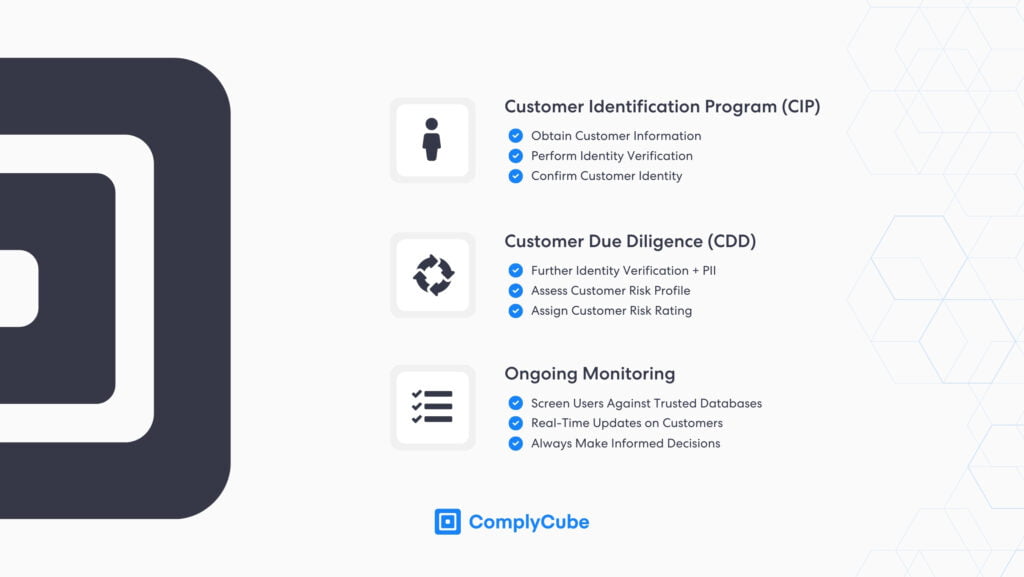
### What Information Must a CIP Extract?
There are 4 essential requirements that must be obtained when an institution begins a CIP. They are:
1. Full Name
2. Date of Birth
3. Address
4. ID Number
Then, the data is verified against the documents supplied by the potential customer and third-party trusted databases. Then, businesses can paint a clear picture of who the user is to decide whether that individual can gain access or continue to use the service. Companies can add further layers of identity verification to increase security as dictated by the company’s Risk Base Approach (RBA) or regulatory bodies. When requesting information from an old or new account, an institution must provide adequate notice for the data or documents to be provided.

## CIP Requirements for Financial Institutions
Although the Final Rule gives each company discretion, most firms follow a common framework. First, they collect customer information to establish a baseline for identity verification. This initial step gives the company verified data to compare against the user’s ID documents when they upload them.
Verifying important user documents such as a passport, driver’s license, or any other government-issued ID is essential for any Customer Identification Program. This helps any companies corroborate the information provided initially by users: Name, Date of Birth, Address, and ID number (such as a taxpayer identification number or social security number in the US).
Companies then verify this information against a trusted third-party database, such as a credit bureau, postal service, or financial institution. Depending on their risk tolerance, they may also request proof of address, typically through a utility bill or bank statement, to add another layer of identity assurance.
Once a business is content with the level of identity assurance, it runs an AML screening. This verifies that the user is not involved in illegal activities and helps the government fight against financial crime. Leading KYC/AML solutions provide multiple AML screening services including, but not limited to, [Sanctions & PEP Screening](https://www.complycube.com/en/solutions/global-screening/sanctions-pep-screening/), [Adverse Media Checks](https://www.complycube.com/en/solutions/global-screening/adverse-media-checks/), and [Watchlist Screening](https://www.complycube.com/en/solutions/global-screening/watchlist-screening/).
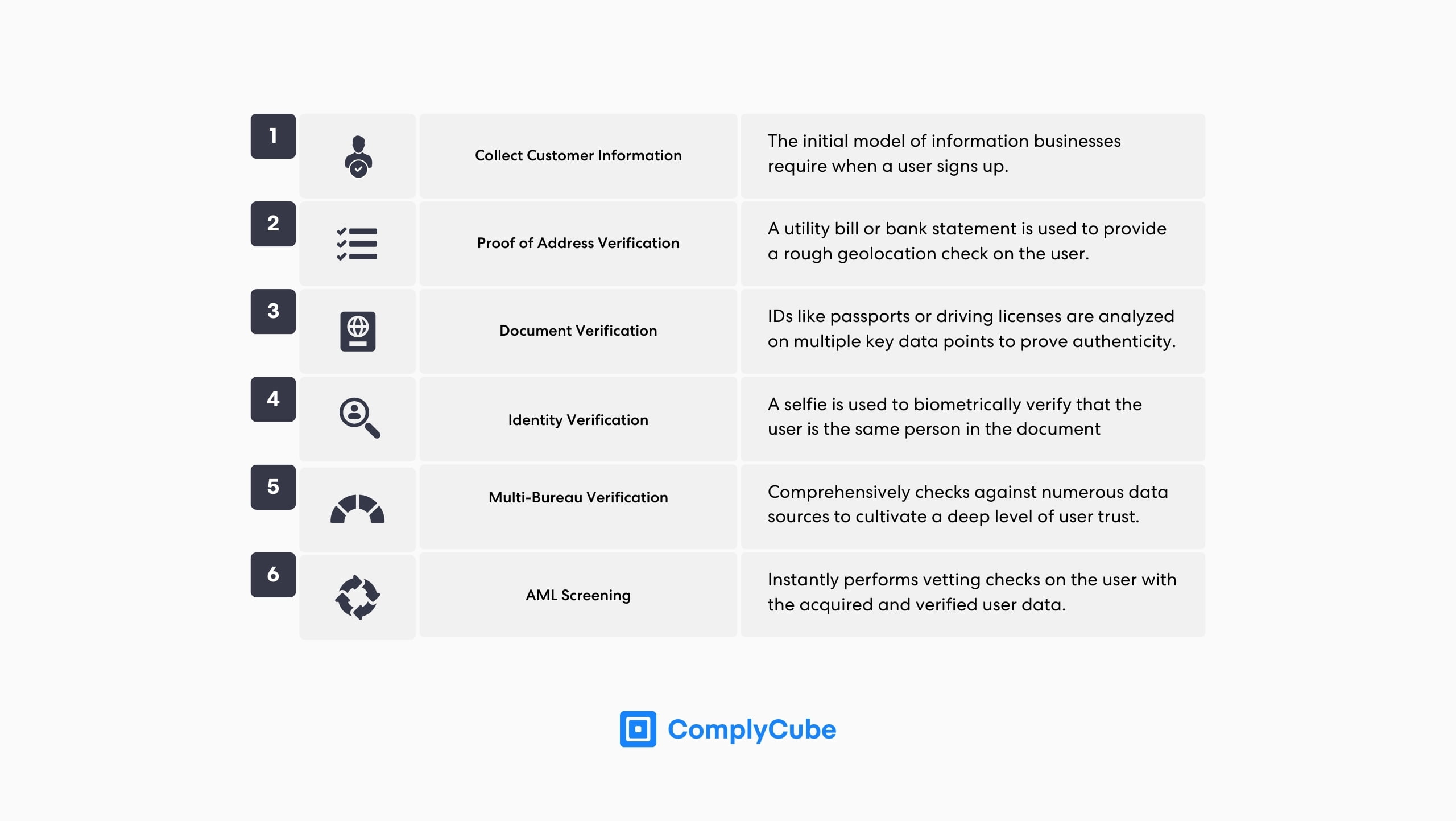
## Identity Verification (IDV) Procedures
Once user information has been acquired, their true identity must be verified. This can be done in several ways, depending on industry-specific regulations as well as a company’s corporate risk-based approach. KYC services provide a host of solutions that are indispensable in extracting reliable customer data and innovating customer onboarding processes. The solutions can be customized and tailored to fit the needs and operations of a business.
### Proof of Address (PoA) Check
Identity verification checks for [Proof of Address](https://www.complycube.com/en/solutions/identity-assurance/address-verification/) leverage state-of-the-art optical character recognition (OCR) and decision-making engines to extract relevant information from Proof of Address documents in seconds. These documents include any bank statements, utility bills, driving licenses, and tax documents that are checked for the following 2 criteria:
1. Data on the PoA document is matched against the details provided by the client upon registration.
2. The geolocation of the provided document is tested for proximity to the IP address of the upload.

PoA verification takes less than 15 seconds to complete on average, making it a seamless yet reliable method to strengthen customer authenticity. Discover more about PoA Verification here: [A Robust Guide to Proof of Address Checks (PoA)](https://www.complycube.com/en/proof-of-address-documents-poa-checks-for-address-verification/).
### Document Verification
In some circumstances, [Document verification](https://www.complycube.com/en/solutions/identity-assurance/document-verification/) can pertain to the remit of PoA. However, where high levels of identity assurance are required, such as financial services, any other identifying documents, including a passport, are required. Using bespoke AI-powered analytics technologies, these checks can analyze multiple integral data points instantly, including:
1. Forensic Analysis
2. RFID Analysis
3. Format Analysis
4. Content Analysis
5. MRZ Analysis
6. Front & Back Analysis
7. Consistency Analysis

These checks auto-redact any sensitive information, such as images on minors’ passports, MRZ codes, and more, ensuring both the service provider and the business adhere to all jurisdictional data privacy laws. For more information on the nuances of a document verification process, read: [What is Document Verification? An In-Depth Look at ID Verification](https://www.complycube.com/en/what-is-document-verification/).
### Biometric Verification
[Biometric verification](https://www.complycube.com/en/solutions/identity-assurance/biometric-verification/) is the final piece of the identity assurance puzzle and is swiftly becoming a modern CIP requirement. Once completed, financial institutions should have sufficient confidence that the user is who they say they are, and an account can be opened. This process matches a person’s live selfie against the image in their ID document. Leveraging machine learning technologies, biometric verification detects the liveness of a selfie via certain innovative and advanced technologies, including Presentation Attack Detection (PAD).
PAD technology is unique because it constructs 3D facial maps, conducts detailed analyses of skin texture and micro-expressions, identifies pixel tampering, and recognizes various disguises, including masks. This ground-breaking technology instantly detects any fraudulent attempts with precision at a speed that would be impossible for a human to mimic.
This accuracy at such a vast scale mitigates the number of false positives that come back from checks as well as increase the volume at which companies can onboard new clients. To learn more about Presentation Attack Detection here: [ComplyCube Bolsters ID Verification with Liveness Layer](https://www.complycube.com/en/complycube-strengthens-document-authentication-services-with-id-liveness-layer/).

### Multi-Bureau Check
A [Multi-Bureau Check](https://www.complycube.com/en/solutions/identity-assurance/multi-bureau-checks/) offers a comprehensive layer of financial and informational background verification, cultivating deeper trust between the user and the service. It synchronously examines various bureaus and databases, thereby performing a multifaceted vetting of a user’s background. This identification method usually amplifies an existing level of identity assurance. For example, if a user were to apply for a loan after having opened an account with a bank. Typical partner databases can be viewed below.

## Which Institutions are Bound by the CIP Rule?
FinCEN created the CIP requirements and Final Rule for financial institutions, but businesses across many sectors now use them as a benchmark for Know Your Customer (KYC) processes. For any institution that needs to verify customer identities, the CIP rule provides a useful reference point. As the global economy becomes more digital and interconnected, businesses need trusted identity checks to support secure growth.
This is why firms beyond financial services can apply FinCEN’s Final Rule as a practical identity assurance framework. Businesses should scale their CIP process according to their size, regulatory obligations, industry risk, and internal risk appetite. Some online sectors may not legally need a formal KYC process or Customer Identification Program, but many still adopt one to reduce fraud, strengthen trust, and protect their platforms.
### **Case Study: Apple Distribution International’s Russia Sanctions**
In March 2026, the Office of Financial Sanctions (OFSI) imposed a £390,000 penalty on Apple Distribution International Limited (ADI), and Ireland-based subsidiary of Apple Inc. This penalty was related to Russia sanctions exposure.
##### **Cross-Border Sanctions Risk Exposed**
Firms that use UK banks or process payments through UK-lined systems must conduct sanctions screening, ownership checks, and do third-party due diligence. This way teams have risk protocols strong enough to detect restricted activity.
##### **Outcomes**
- ADI received a £390,000 penalty from OFSI.
- ADI conducted payments connected to Russia sanctions exposure.
- OFSI reinforced that non-UK firms can fall within UK sanctions enforcement.
## How a Thorough CIP Helps Prevent Money Laundering
A Customer Identification Program is instrumental in helping financial institutions curb money laundering activities. Federal law requires these programs to collect a customer’s identifying information, including full name, identification number, date of birth, and address. This foundational step is critical in preventing money laundering and other financial crimes.
There is every possibility that a user’s situation, and therefore associated risk, will evolve throughout their relationship with a business. For example, a customer might open a bank account with no initial political connections but, over time, could develop associations with influential political figures.Financial institutions can form a sufficient belief in their customers’ identities and act accordingly by adhering to the stringent measures discussed in this guide, coupled with a detailed broader KYC strategy.
A report on money laundering in the British property industry found an increasing need for technology-assisted Identity Verification and that more traditional methods were quickly becoming outdated.
> These methods \[manual KYC and AML checks\] alone are [no longer enough.](https://thenegotiator.co.uk/features/dont-take-chances-on-aml-checks-the-risks-are-real/)
This represents a shifting landscape across a wide array of industries, where AI and machine-powered IDV solutions will become common practice across multiple industries. Money laundering in the real estate industry is nothing new, but reports show the [increasing aptitude of the UK, particularly London, for real estate money laundering activities](https://www.transparency.org.uk/uk-money-laundering-stats-russia-suspicious-wealth). This is, however, an escalating issue across multiple industries over the globe.
A thorough investigation of a client’s identifying details is essential, as it allows businesses to comply with regulatory policies and fortifies the financial system against the perils of illicit activities. This ensures that each account opened is based on a foundation of trust and verified identity.
## CIP for Customers vs Businesses
The Customer Identification Program rule sets a strong standard for verifying customers, and institutions can apply the same framework when forming new business relationships. This process, known as Know Your Business (KYB), helps firms verify business entities, identify their owners, and assess risk before entering a new partnership agreement.
Companies must collect an equivalent data set, including the business name, registration address, incorporation date, and government-issued business licence or employer identification number. They must also identify the Ultimate Beneficial Owners (UBOs), which adds the key layer of ownership transparency to the business verification process.

Business ownership checks can become challenging when company layers, owners, and proprietors sit behind complex or deliberately opaque structures. In many cases, bad actors hide ownership because they want to avoid scrutiny from government and regulatory bodies. This makes thorough due diligence essential, helping businesses identify the real owners, operators, backgrounds, and motivations behind a company.
### Key Takeaways
- **A customer identification program (CIP)** verify customers before onboarding.
- **Know Your Customer (KYC)** compliance is a core part of CIPs.
- **Strong CIP checks** help lower fraud and overall Anti-Money Laundering (AML) risk.
- **Risk-based workflows** improve compliance accuracy.
- **ComplyCube automates CIPs** with Identity Verification (IDV), biometrics, and AML screening.
## Choosing a CIP and KYC Verification Service
Refining a Customer Identification Program (CIP) as part of a wider KYC (Know Your Customer) strategy is vital for businesses aiming to comply with Anti Money Laundering regulations and prevent fraud. This requires meticulous attention to detail and a deep understanding of regulatory requirements and customer profiles.
ComplyCube’s solutions include an all-in-one, user-friendly portal that is swiftly becoming an essential tool for compliance officers. This platform features advanced automation toggles and fast-fail thresholds, which streamline the client acquisition process and refine internal operations with efficiency-enhancing tools.
Automated KYC solutions alleviate businesses from the stress of monitoring shifting regulatory landscapes while providing seamless user experiences. A strong CIP and KYC service will do this without forsaking the integrity and security of the extracted data. ComplyCube’s AI-powered KYC services could help relieve your business’s trepidations over regulatory compliance. If this is a subject of concern, [get in touch below](https://www.complycube.com/en/contact/contact-sales/).

## Frequently Asked Questions
What is customer identification program (CIP)?
A customer identification program (CIP) is a group of procedures that verify customer identity well before an account is opened or a regulated service begins. This helps companies confirm that customers are real by collecting and checking identifying details.
What does CIP require?
CIP requires businesses to collect key customer information. They need to be able to verify that information through reliable documents or data sources. Additionally, they can keep records of the checks performed. CIP needs risk-based procedures that help form reasonable beliefs around customer identities.y
What is the difference between CIP and KYC?
CIP is not the same as Know Your Customer (KYC). CIP looks at identity verification during onboarding. On the other hand, KYC includes Customer Due Diligence (CDD), Anti-Money Laundering (AML) screening, risk assessment, and ongoing monitoring.
Who needs a CIP?
A CIP is needed for many financial institutions such as banks, credit unions, lenders, and other regulated firms. CIP-style checks are needed to reduce fraud and meet compliance expectations. It covers several other additional sectors such as fintechs, payment firms, crypto platforms, and marketplaces.
How can ComplyCube help with CIP?
ComplyCube helps businesses automate Customer Identification Program checks through Identity Verification (IDV), document checks, database checks, and Anti-Money Laundering (AML) screening. Its APIs, SDKs, hosted flows, and no-code workflows support faster onboarding while keeping CIP processes consistent, scalable, and audit-ready.
**Categories:** Guides
**Tags:** Know Your Customer
---
### [Differentiating Between KYC Vendors](https://www.complycube.com/differentiating-between-kyc-vendors/)
**Published:** April 10, 2024
**Author:** Andreea Balasa
**Excerpt:** Multiple KYC software vendors have come to market over recent years. KYC vendors are becoming increasingly vital for modern business compliance. This KYC checklist identifies which KYC services are best optimized for your business.
**Content:**
There are a plethora of KYC vendors that have emerged over recent years, providing seemingly comparable services. KYC software vendors are becoming increasingly vital for the safe operation of businesses from many industries. This guide provides a KYC checklist for financial institutions and other services to help identify which KYC services are best optimized for your business.
## What is KYC Software?
Know Your Customer (KYC) software, sometimes known as eKYC, is a technology service that enables regulatory compliance and fraud prevention initiatives. A wealth of tools are used to help businesses mitigate money laundering and other financial crimes, such as terrorist financing. Identity Verification (IDV) and KYC solutions are becoming common practices for achieving Anti-Money Laundering (AML) compliance.
## Finding the Right Identity Verification Service
KYC and AML solutions provide a streamlined path for client acquisition and relevant compliance. This starts with scalable digital IDV solutions (eIDV), including document and biometric verification, which can be completed with extreme precision in under 60 seconds.
These solutions use state-of-the-art artificial intelligence to analyze multiple data points on KYC documents and leverage biometric authentication engines to match the document to the user in one workflow.
These KYC tools offer businesses a superior mechanism for client identification and further due diligence measures. Leveraging modern technologies means human error cannot creep into the verification process, and payment fraud can be minimized. This ensures a far higher level of precision at a far greater speed is brought to KYC processes.

## Customer Due Diligence: Reimagined
These KYC processes are not just an innovation in the IDV (identity verification) systems. They are typically provided as part of a more comprehensive platform integration and with a complete suite of related solutions. Customer due diligence (CDD) and ongoing monitoring greatly benefit from advanced AI, enabling the automation and vast customizability of KYC and customer onboarding processes.
These platforms provide full KYC functionality from start to finish. Manual due diligence strategies historically [spend too much time and money on CDD and continuous monitoring.](https://financialcrimeacademy.org/cdd-customer-due-diligence-and-automation/) In the modern day, these resources need to be allocated toward growth and expansion plans to remain competitive.
CDD services provide a comprehensive list of solutions that enable customers to be thoroughly vetted in real time. This makes Know Your Customer vendors fundamental to modern business strategy, particularly for financial institutions. For more details on KYC vendors and verification processes, read KYC Verification in 3 steps.
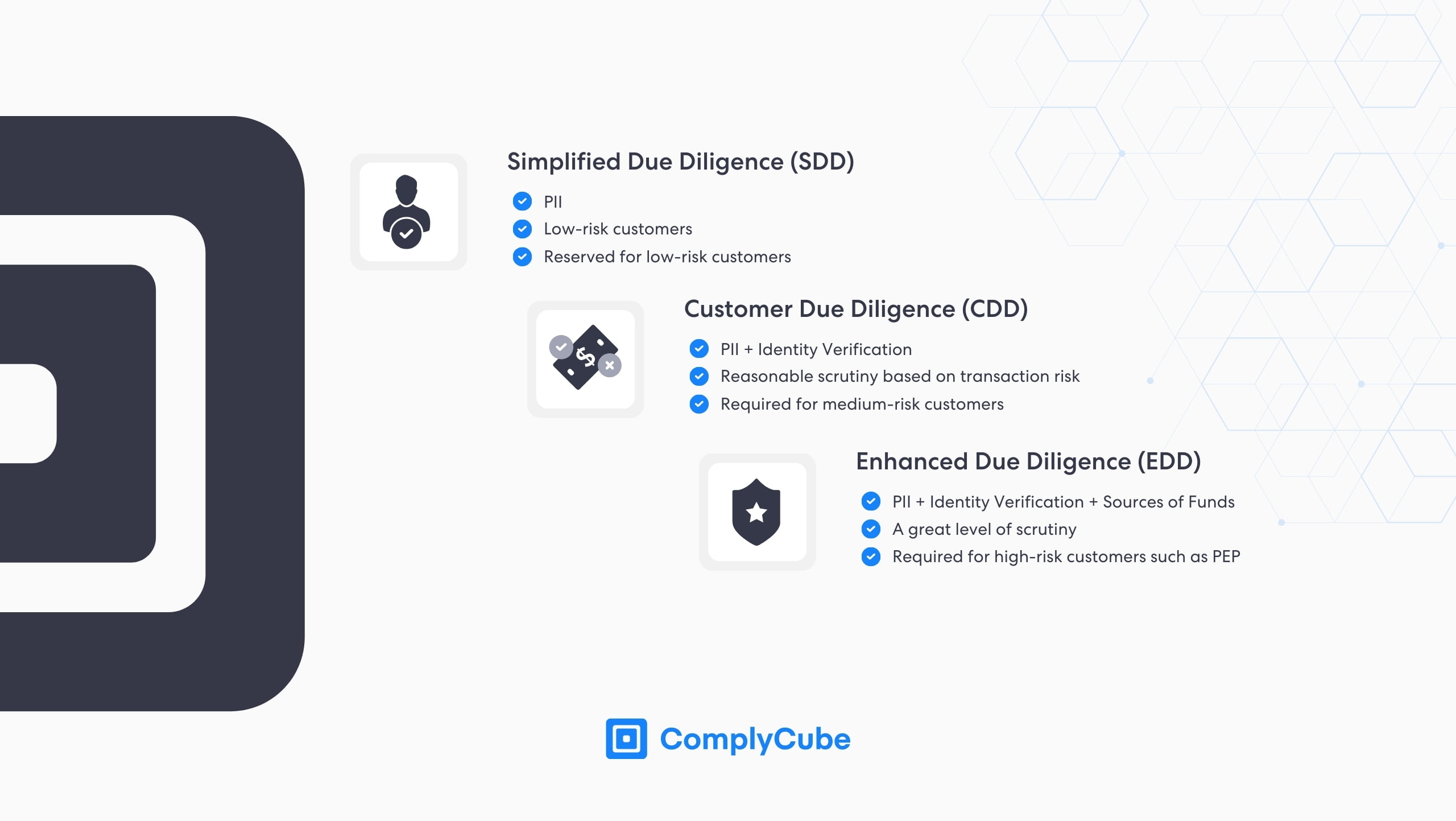
## Continuous Monitoring for Enhanced Risk Scoring
KYC vendors perform ongoing monitoring of user accounts to ensure that user accounts are updated in real time. However, this is extremely difficult without an automated infrastructure that will alert enterprises to changes in one of their client’s welfare or situation.
These changes could come in any shape or form, such as an appearance in the press in an obscure foreign newspaper, developments of a political or aristocratic nature, and many others. If this occurs, the platform will instantly form an alert on its risk profile, giving compliance officers the required information to make informed and correct user decisions.
Continuous monitoring services enable real-time data feeds to KYC analysts, enabling swift decisions on clients. Due to the speed at which risk profiles are updated and acted upon, a business’s risk of money laundering is dramatically reduced.
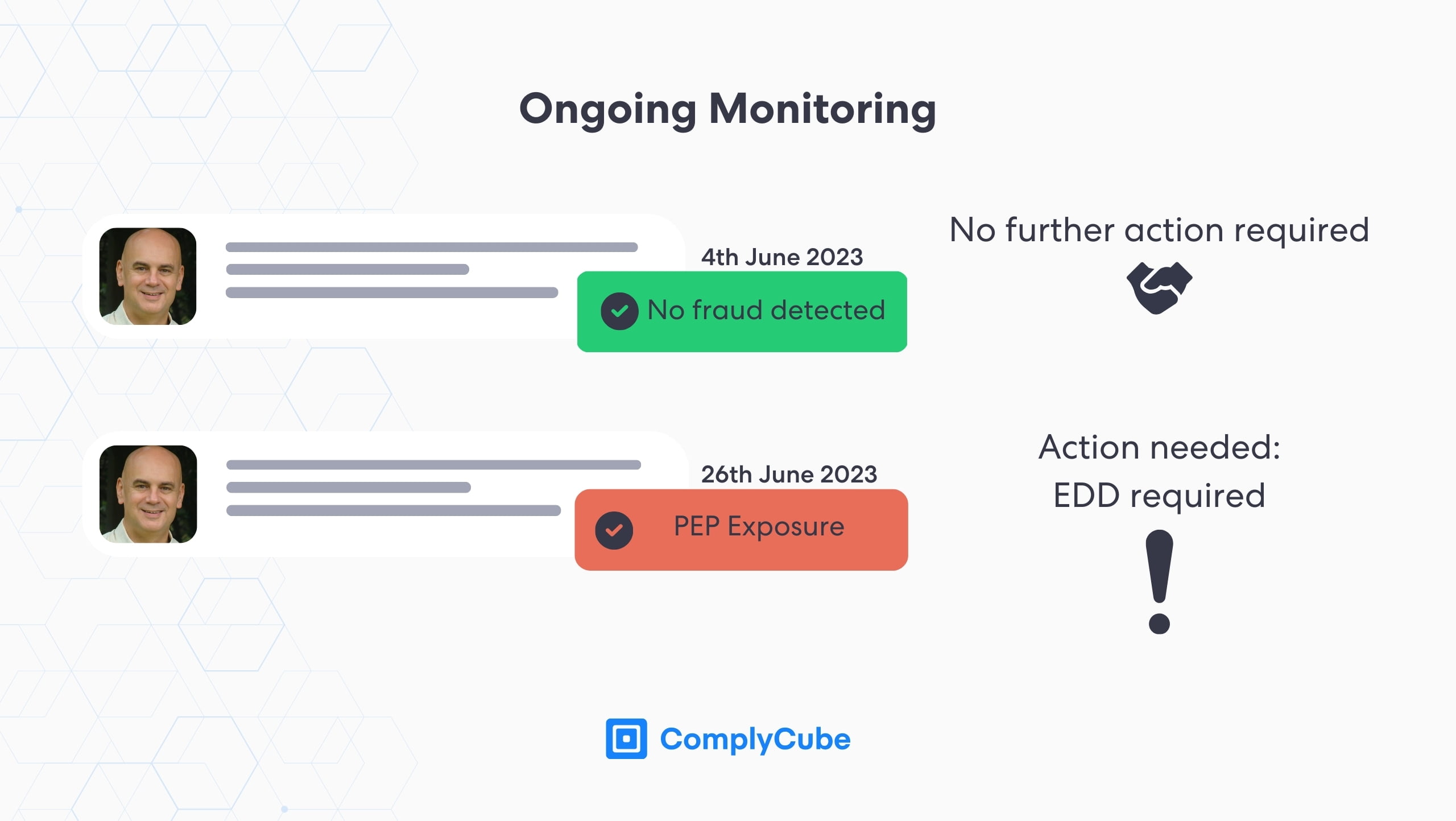
## KYC Checklist: What to Look for in KYC Vendors
Numerous KYC and AML software services have come to market in recent years. However, not all can supply the scalability that modern-day FinTechs, crypto firms, financial institutions, and other industries demand.
When determining the KYC provider that a business should integrate with, the below KYC checklist should be consulted.
## 1 – Their Identity Verification Solutions
KYC compliance requirements center around the identification of a new customer. IDV solutions, such as document and biometric verification, are becoming the go-to in KYC software. Ensuring a provider has a leading range of these services is paramount before integrating.
### **Document Verification**
This is the first step in customer identification and typically analyzes ID documents, including driver’s licenses and passports, to scan for fake or fraudulent documents.
Modern AI-powered document verification is far superior to manual verification. It can analyze up to 25 data points from 7 categories and achieve heightened precision on a time scale that would be impossible for a human to replicate. For more information on document authentication, read [What is Document Verification? An In-depth Look at ID Verification.](https://www.complycube.com/en/what-is-document-verification/)
### **Biometric Authentication**
[Biometric verification](https://www.complycube.com/en/solutions/identity-assurance/biometric-verification/) ensures that the identity of the individual presenting the document is the same person shown in it. This advanced security measure uses unique physical and behavioral traits to verify an individual’s identity.
This creates a higher confidence level in the authentication process; the technology that powers this is known as Presentation Attack Detection (PAD). For more information on biometric authentication, read [The Advantages Of Biometric Authentication.](https://www.complycube.com/en/the-advantages-of-biometric-authentication/)
- Liveness detection
- Printed photo detection
- Mask (and 3D mask) detection
- Video attack detection
- Network spoof detection
## 2 – Breadth of CDD and AML Services
[Customer due diligence](https://www.complycube.com/en/solutions/due-diligence-compliance/customer-due-diligence/) is pivotal in a business’s compliance with anti-money laundering regulations and in preventing financial crimes. A KYC vendor should provide a comprehensive range of tools to ensure a business can sufficiently perform KYC checks. These should include:
### Multi-bureau Checks
Firms can leverage a host of partnered databases to achieve a higher level of identity assurance. For example, they could verify user credentials against a proprietary database like a bank’s.
### Sanctions and PEP Screening
Quickly identifies individuals associated with positions of authority (such as an MP or Senator) or clients who appear on federal and regional lists, such as UN and EU lists.
### Adverse Media Monitoring
KYC vendors must be partnered with thousands of global and local news sources. This ensures that businesses can identify potential bad actors immediately and act accordingly. This process would be nearly impossible without partnering with a KYC service.
### Watchlist Screening
Engulfing a broad range of global data points, watchlist screening allows expansion into new territories without fear of breaking local compliance regulations. These services utilize AI to match client names in any language, using advanced fuzzy matching to find accurate matches without compromising low false positives.
These checks contribute to a client’s risk score, which enables compliance officers to swiftly identify the level of risk a user might expose a business to. This gives institutions all the information required to make informed decisions and, crucially, which users might require further and specialized due diligence. For more information on CDD processes, read [What is Customer Due Diligence (CDD)?](https://www.complycube.com/en/what-is-customer-due-diligence/)
### **Ongoing Monitoring**
Customer due diligence, however, is an ongoing process. Client situations change, and these potential movements must be monitored, particularly in the financial services industry. Continuous monitoring of a user profile ensures the business can take immediate remedial action.
For example, if a cryptocurrency exchange’s client appeared as a PEP level 1, the firm in question might decide to begin monitoring that user’s account for suspicious financial transactions. Ongoing monitoring is an essential part of a sound risk management strategy.

## 3 – How Scalable are These Solutions?
These IDV and CDD solutions must be precise, but precision can not come at the price of forsaken scalability. Scalability does not just refer to the volume of checks that can be done simultaneously; it is also defined by the service’s price structure, the breadth of regions it can operate in, and the efficacy of its technology.
Robust customer identification solutions ensure KYC compliance. However, these must operate in a seamless client onboarding process. Document and biometric verification can be completed in seconds, helping create effortless customer acquisition processes while endorsing precision at scale.

Client identity verification is then strengthened with a range of [AML solutions](https://www.complycube.com/en/solutions/due-diligence-compliance/anti-money-laundering/), which KYC vendors should conduct in the background immediately and continuously. The best KYC software will be able to supply these services in multiple regions, allowing expansion into new territories with ease.
Check a KYC provider’s pricing and the discrepancies between packages. Some providers do not build their own proprietary technologies to meet their customers’ demands, meaning the price of specific solutions can vary.
ComplyCube has built its entire suite of solutions in-house, partnering only where necessary, such as with database providers and screening institutions. This means many of its solutions are available at relatively lower prices but remain an extremely scalable, precise, and multi-regional solution.
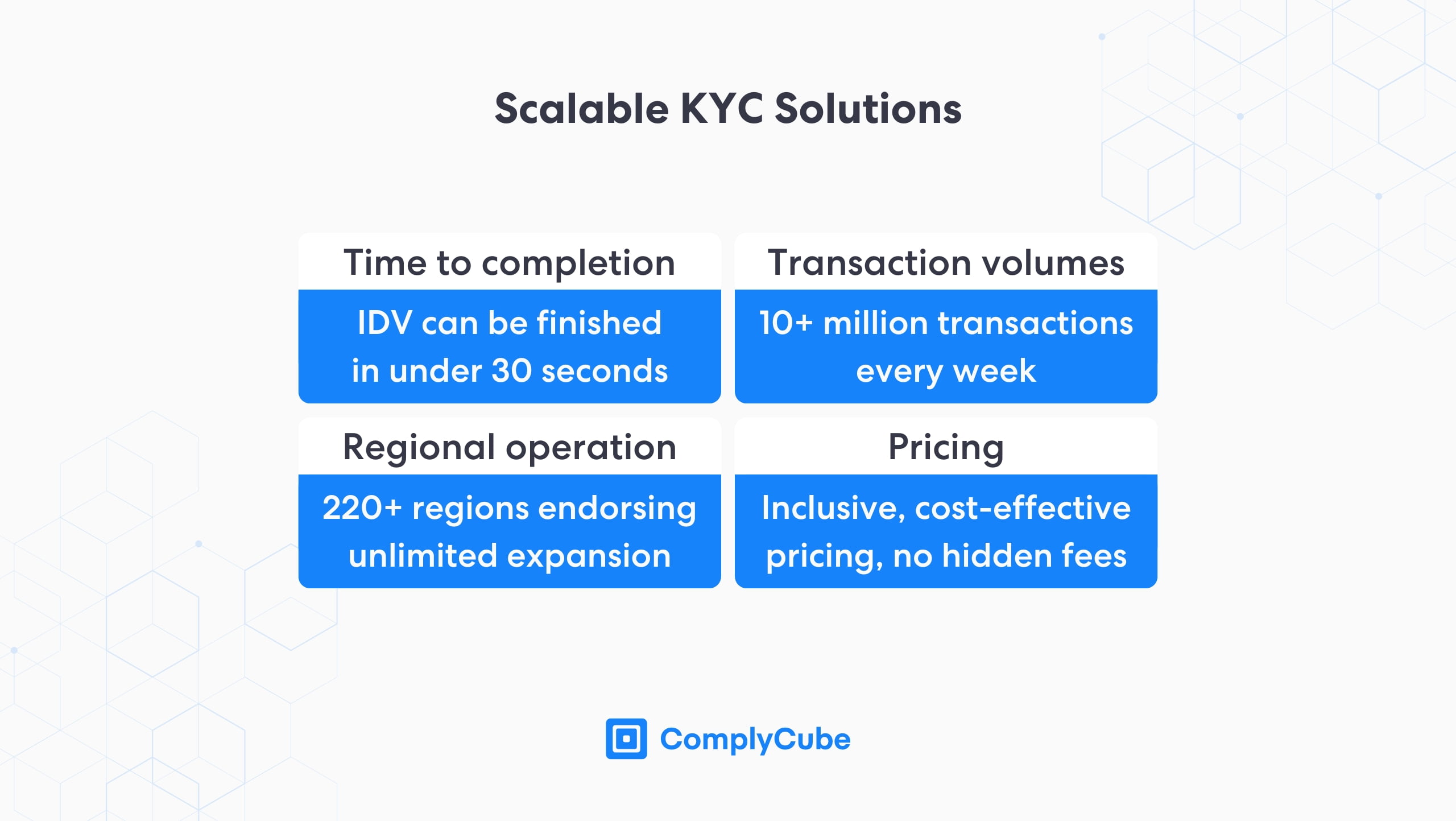
## 4 – Is the KYC Software Malleable and User-Friendly?
Integrating with a KYC provider is one thing, but it is paramount to ensure that the system can be tweaked and upgraded in response to changing developments. Malleable KYC systems also ensure that customer data management does not become a burden. This means that anti-money laundering initiatives can be conducted efficiently as part of an AML solution.
These include case management, customizable ‘fast-fail’ thresholds, KYC data accessibility, and much more. They allow common industry pain points, such as excessive false positives, to be solved from the comfort of an all-encompassing platform.
Furthermore, KYC services should be developed with customer satisfaction in mind. Solutions encompassing ID verification and biometric authentication must be seamless and precise, exposing the user to a swift workflow with minimal hiccups.
## KYC Software for Cryptocurrency Exchanges
Centralized Exchanges (CEXs) in the crypto industry are intermediaries that hold a wealth of crypto tokens and provide significant liquidity sources for users to trade. These trading platforms are targets for malicious activities that break global and local Anti Money Laundering (AML) regulations.
This has called for a more international and holistic approach to cryptocurrency regulation, which is slowly materializing in 2024. The most notable example is the FATF’s crypto travel rule. For more information on this, read [The Crypto Travel Rule](https://www.complycube.com/en/the-crypto-travel-rule-and-the-need-for-aml-compliance-software/).
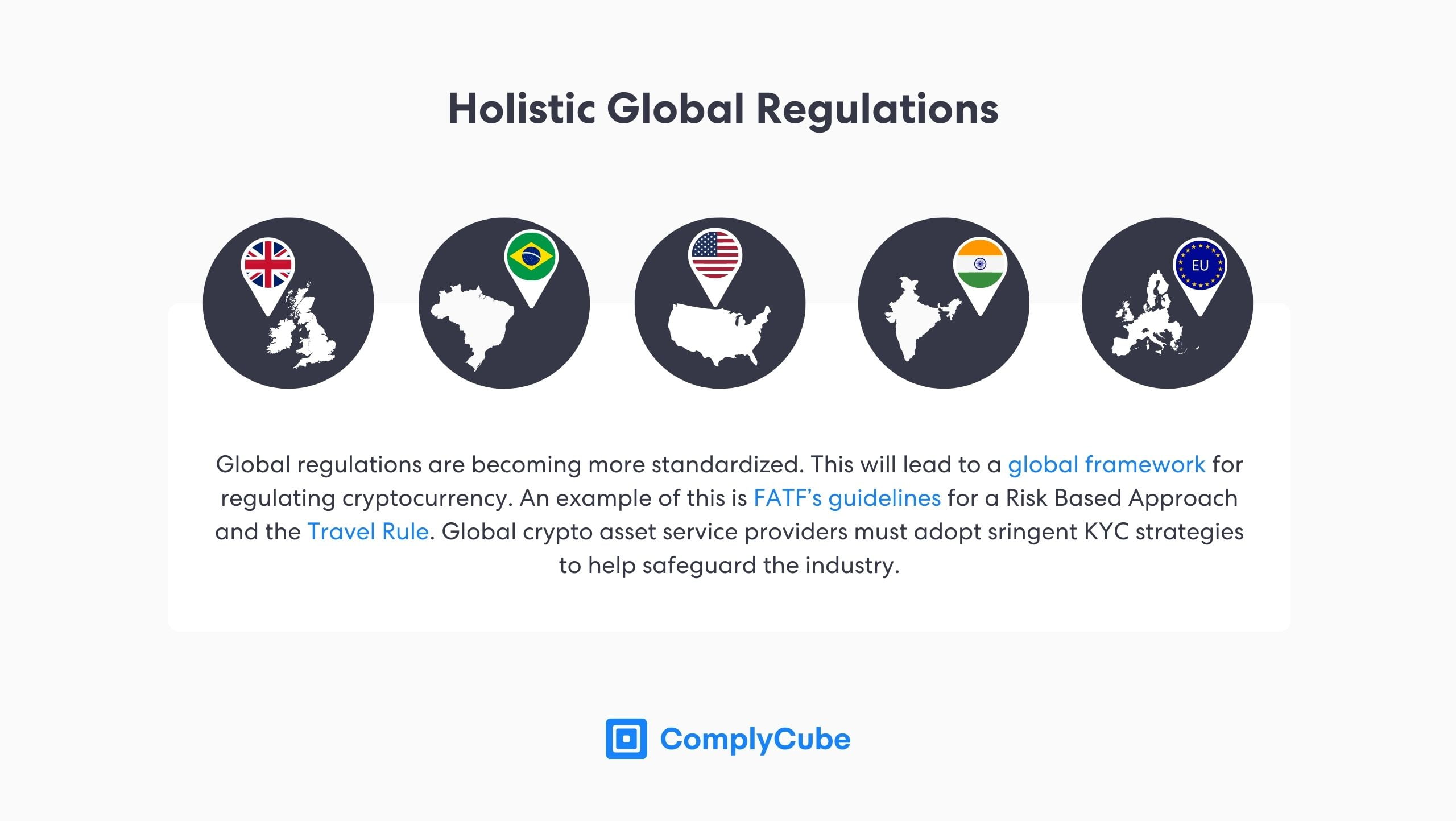
### Crypto KYC Regulations in the US
A CNBC reporter claimed that while 2023 was a year of legislative progress for the United States, 2024 will unlikely see continued progression in a presidential election year, [particularly when the federal government is so divided.](https://www.cnbc.com/2023/12/31/state-of-crypto-regulation-in-2023-eu-laws-approved-but-us-is-top-cop.html)
While this is not necessarily a negative thing for cryptocurrency services in America, it means businesses must ensure their crypto KYC and compliance strategies are:
1. Watertight, and
2. Flexible.
KYC regulations and compliance today are likely to be different tomorrow, begging the need for dynamic KYC solutions. Having said this, solutions for Identity Verification and customer and transaction screening capabilities will always be required.
It is imperative for KYC solutions to provide the means for a crypto business or platform to identify which clients require transaction monitoring. As global cryptocurrency regulations evolve and adapt to the industry, flexible AML strategies are paramount to ensure firms don’t break compliance regulations.
## KYC Vendors for Financial Institutions and Banks
Banking KYC systems must adhere to the tightest of standards. Banks represent the pinnacle of financial security as they facilitate the world’s transactions and wealth. This makes fraud detection and prevention an utmost priority for the financial sector.
As banks embrace digital transformation, employing digital KYC software to verify user identification and customer risk is crucial to ensure market share is not lost. KYC vendors enable banking services to vastly increase their range of accessibility.
This could be part of an overseas expansion plan, an elderly accessibility initiative, a campaign targeting young professionals or teenagers, and many more. However, the rate at which banks adopt eKYC solutions remains slow.
Financial institutions still rely on manual KYC processes for many KYC activities, and 2% of businesses and financial institutions have automated over 90% of their KYC process.
> About 28% of firms still carry out [41-60% of tasks manually](https://fintech.global/2023/05/19/bridging-the-gap-in-kyc-compliance-the-rising-tide-of-automation/).
This shows that there is still a large gap in the financial services industry for automated KYC software to disrupt the status quo. Integrating with a provider early could put you at a severe competitive advantage.
## KYC Compliance for FinTech
The disruption of traditional financial services underpins the FinTech sector. However, it faces unique challenges and opportunities regarding regulatory compliance, identity theft, and fraud prevention.
As FinTech firms bridge the gap between technology and financial services, the importance of robust Know Your Customer solutions cannot be overstated. These solutions are pivotal in ensuring FinTech platforms operate within particular jurisdictional and legal boundaries while offering secure and trustworthy services to their users.
> Growing at a compound annual rate of [over 25% over the next four years](https://www.marketdataforecast.com/market-reports/fintech-market).
The FinTech market is expected to grow to a valuation of $346 billion by 2027, according to a 2023 report, emphasizing the growing need for the adoption of KYC vendors to facilitate mass Financial Technology compliance.
When rapid expansion and capitalizing on empty market space can differentiate success and failure, scalable and international solutions are vital. FinTech KYC vendors are likely to be increasingly important as this industry matures.
## About ComplyCube
ComplyCube ties up a suite of industry-leading proprietary KYC solutions in one user-friendly platform. These include IDV, AML, and CDD services. Once integrated, this platform significantly streamlines a compliance officer’s workload, enabling KYC process customization, case management, delegation, and much more.
Working with a range of clients in FinTech, cryptocurrency, banking, telecoms, payments, and more, ComplyCube is one of the leading KYC vendors on the market.
If your business, FinTech startup, or multinational is looking for a new partner in one or multiple of these services, get in touch with today to [find out how your KYC processes can be upgraded](https://www.complycube.com/en/contact/contact-sales/).
**Categories:** Guides
**Tags:** Know Your Customer
---
### [The Dangers a No KYC Crypto Exchange Can Bring](https://www.complycube.com/the-dangers-a-no-kyc-crypto-exchange-can-bring/)
**Published:** April 30, 2024
**Author:** Andreea Balasa
**Excerpt:** Operating and using a no KYC crypto exchange brings substantial risks to both its users and operators. As AML crypto regulations become more holistic worldwide, crypto KYC procedures will become increasingly prominent.
**Content:**
**TL;DR:** Operating a **no KYC crypto exchange** exposes both users and operators to significant risks. With AML crypto rules tightening worldwide, KYC crypto requirements are **becoming essential** across the industry. **Many platforms** without crypto KYC **remain non-compliant**, putting exchanges and their founders at serious regulatory and **reputational risk.**
## What is a No KYC Crypto Exchange?
Operating a crypto exchange without a KYC program makes the exchange extremely accessible to both regular users who want to use the platform innocently and bad actors who want to use it maliciously. Crypto exchanges without a KYC strategy can quickly attract a vast and extremely broad user base.
### What do Crypto KYC Procedures Help No KYC Crypto Exchanges Achieve?
KYC in the cryptocurrency industry establishes who users are upon signup and continuously monitors their profiles. This ensures they do not pose a threat to the exchange’s compliance with national and international regulatory bodies.
So, if KYC processes are designed to safeguard the industry from both a user and Virtual Asset Service Provider (VASP) perspective, why would exchanges not implement one? This is a nuanced question. The cryptocurrency industry is one that was established on anonymity and privacy, with the ability to transact anonymously being the primary use case.
Therefore, certain crypto exchanges do not require a KYC process for users to trade on their platform. This allows users to trade under the industry’s core principle of anonymity. The issue this brings about, however, is that the lack of a KYC process increases the capacity for users to mask the origins of funds. This attracts bad actors, such as money launderers, to their exchange.
This makes no KYC exchanges a prime target for malicious financial activity. For more information on what a crypto KYC process involves and its purpose, read [How KYC Crypto Regulations Safeguard the Industry](https://www.complycube.com/en/how-kyc-crypto-regulations-safeguard-the-industry/).
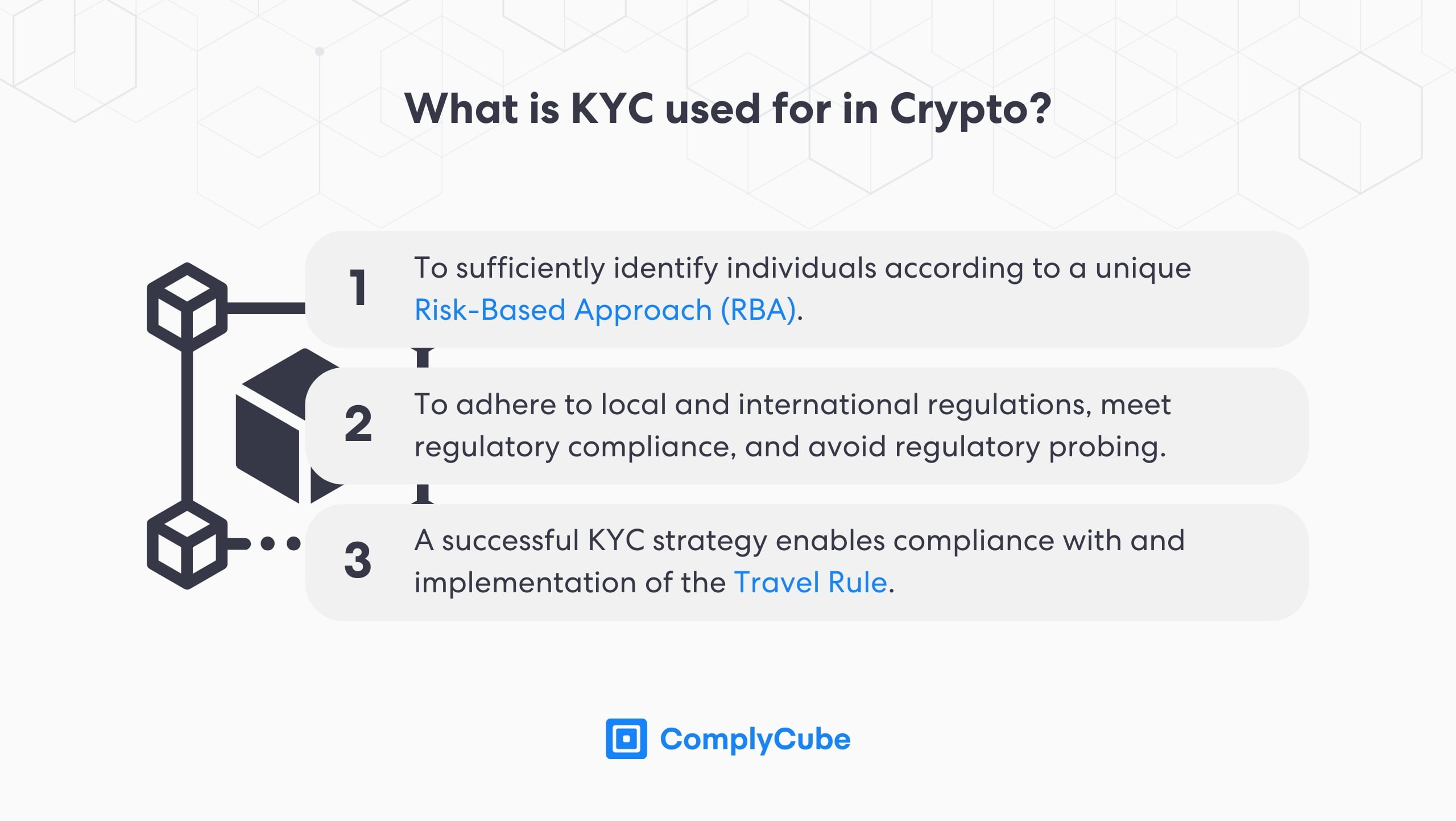
## Dangers for No KYC Crypto Exchange
Anti-Money Laundering regulatory bodies, including the Financial Crimes Enforcement Network ([FinCEN](https://www.fincen.gov/news/news-releases/fincen-proposes-new-regulation-enhance-transparency-convertible-virtual-currency)) in America, the Financial Action Task Force ([FATF](https://www.fatf-gafi.org/en/topics/virtual-assets.html)) globally, and related policies such as the Bank Secrecy Act (BSA) are instrumental in regulating financial institutions.
In early 2024, the [FATF posted a status update](https://www.fatf-gafi.org/content/dam/fatf-gafi/publications/VACG-Table-Jurisdictions-2024.pdf.coredownload.pdf) on how well various regions had implemented Recommendation 16 – the Crypto Travel Rule. This came ahead of its expected Mutual Evaluation report scheduled for 2025. These kinds of reports play a pivotal role in generating transparency throughout the industry.
The 5th Round of Mutual Evaluations should deliver a comprehensive study of how all FATF member regions have implemented multiple policies. For the cryptocurrency industry, this could be a regulatory watershed moment.
## Dangers of a No KYC Crypto Exchange for Users
Crypto exchanges that do not make use of a KYC program are typically unregulated. While this does not make them an immediately dangerous place to trade, it is certainly more threatening than using other regulated exchanges with a rigorous KYC and AML program.
These exchanges, while more accessible and anonymous, can play host to a range of negative trends.
1. Users are more vulnerable to scams and Ponzi schemes endorsed by the exchange. As the platform is unregulated and the operators potentially not doxxed (known publicly), the likelihood of money being directly or indirectly stolen is much higher.
2. This also increases the likelihood of the exchange blocking user funds. Centralized Exchanges (CEXs) are in full control of the funds you deposit. While your funds are on the platform, you are not technically the owner of them.
3. Users will likely trade with lower liquidity, causing price volatility and market manipulation. Unregulated exchanges do not need to provide the same liquidity that regulated exchanges do. Therefore, big funds, known as whales, can cause huge volatility and manipulate the price of tokens.
4. These exchanges will not be transparent about their solvency, in essence, the value of the funds they possess (what they do with user deposits). In particularly volatile periods, many users will want to withdraw funds sporadically and immediately.
5. Finally, regarding issues of disputes, regulated platforms provide seamless and around-the-clock customer service. Smaller, unregulated exchanges will not supply this, and fund disputes are likely to be lost by the user.
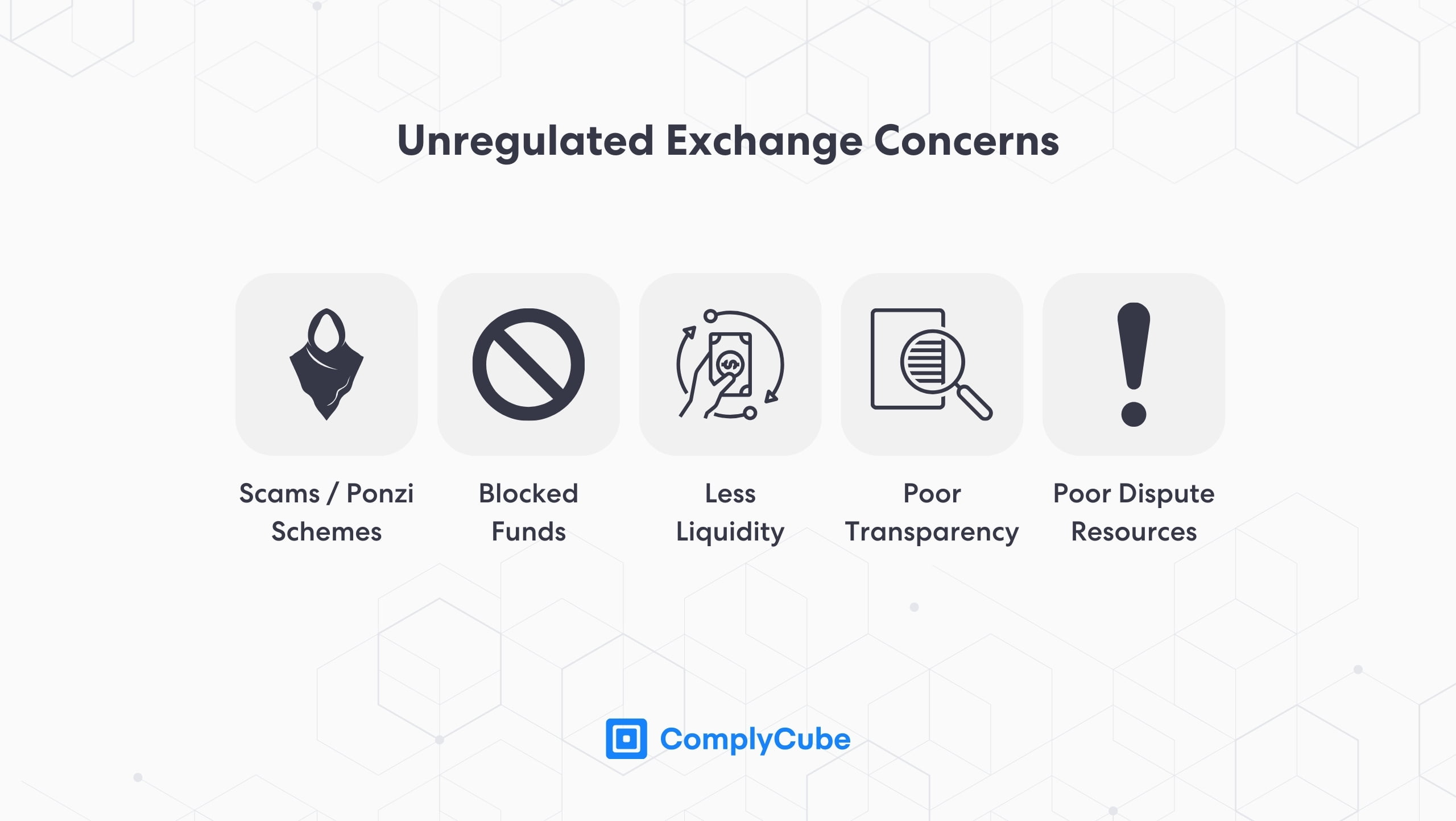
Smaller, unregulated crypto exchanges are known for accessibility and anonymity but come at the price of user security. Regulated exchanges, such as BitGet, have a responsibility to protect their users, as evidenced by their solvency and [Proof of Reserve](https://www.bitget.com/en-GB/proof-of-reserves) documentation.
Cryptocurrency exchanges must be solvent to ensure everyone can withdraw their funds when they want to. Insolvency and the misuse of user funds were the leading factors behind the fall of the FTX crypto exchange, which was illegally swapping user funds with its sibling institution, Alameda Research.
As global crypto regulations become more holistic and the Travel Rule’s ‘sunrise issue’ begins to subside, Know Your Customer processes will become more paramount to the success of the industry, and the the prevalence of non-KYC crypto exchanges will likely decrease.
## Crypto Anti-Money Laundering Regulators for No KYC Crypto Exchanges
VASPs and crypto firms are more commonly perceived as and, therefore, regulated in a similar way to traditional financial services. In January 2024, the EU confirmed that cryptocurrency exchanges should be held just as accountable as banks in safeguarding the financial system.
This involves a crypto exchange identifying customers with a rigorous Identity Verification process (IDV), which is the beginning of a KYC cycle. Not complying with global regulations as set out by the FATF, as well as local and federal regulations, can result in significant non-compliant fines.
Most recently, these have been charges of AML crypto breaches; the FATF’s Recommendation 16 is designed to improve the global interoperability of data between VASPs to aid in Anti-Money Laundering measures. For more information on this, read [The Crypto Travel Rule](https://www.complycube.com/en/the-crypto-travel-rule-and-the-need-for-aml-compliance-software/).
### Hong Kong Cryptocurrency Regulators
Hong Kong is rapidly becoming a hotspot for cryptocurrency adoption. In June 2023, the [Securities and Futures Commission](https://www.sfc.hk/en/) (SFC) in Hong Kong introduced a new regulatory framework for all VASPs operating a crypto trading platform. This new set of regulatory standards firmly aligns with the FATF’s Recommendation 16, and thus, the region can be seen to be compliant with the Travel Rule as of June 2023.
The SFC’s new framework, the ‘[Guideline on Anti-Money Laundering and Counter Financing of Terrorism (For Licensed Corporations and SFC-licensed Virtual Asset Service Providers)](https://www.sfc.hk/-/media/EN/assets/components/codes/files-current/web/guidelines/guideline-on-anti-money-laundering-and-counter-financing-of-terrorism-for-licensed-corporations/AML-Guideline-for-LCs-and-SFC-licensed-VASPs_Eng_1-Jun-2023.pdf?rev=d250206851484229ab949a4698761cb7),’ will likely catalyze the region’s progress into a crypto heavyweight and, thus, restore its status as a financial hub.
### Singapore Crypto Policies
The [Monetary Authority of Singapore](https://www.mas.gov.sg/) (MAS) published a framework for the implementation of the Travel Rule in 2019. This framework, [named PSN02](https://www.mas.gov.sg/-/media/MAS/Regulations-and-Financial-Stability/Regulatory-and-Supervisory-Framework/Anti_Money-Laundering_Countering-the-Financing-of-Terrorism/Guidelines--to--Notice-PSN02-on-Prevention-of-ML-and-Countering-the-Financing-of-Terrorism.pdf), came into effect in late January 2020 and incorporated the cryptocurrency industry into its legislation.
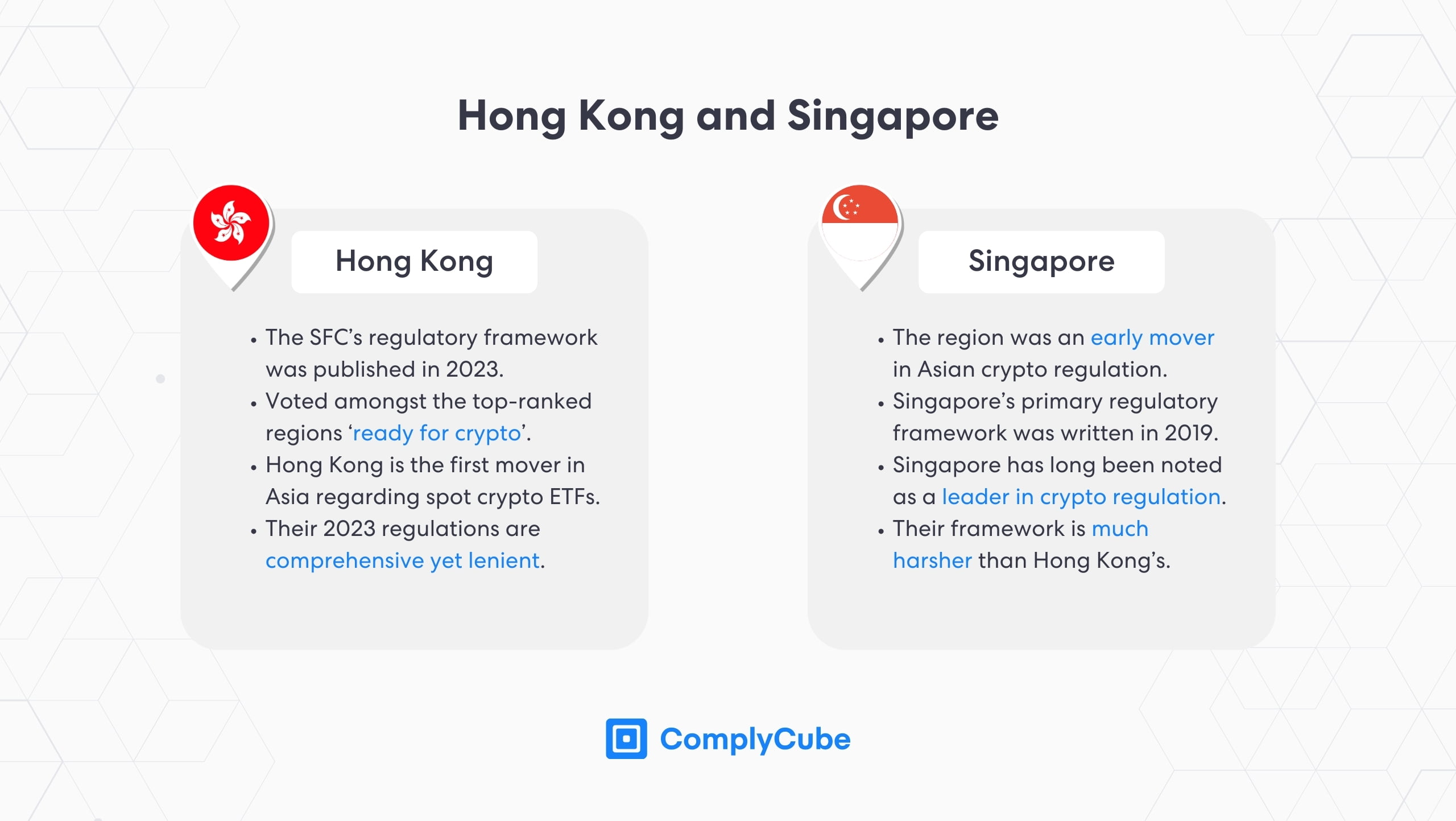
While Singapore was one of the early global movers to regulate the cryptocurrency industry, it has not launched a new framework for some time, such as the SFC’s Guidelines. This could count against the region in the short term as rival regions look to capitalize on the fast-expanding industry and become more ‘[crypto-ready](https://forexsuggest.com/worldwide-crypto-readiness-report-2023/)‘.
### **Case Study: KuCoin’s $300M Settlement Over AML and KYC Failures**
In January 2025, [**KuCoin**](https://www.reuters.com/technology/kucoin-pleads-guilty-agrees-pay-nearly-300-million-us-crypto-case-2025-01-27/), one of the world’s largest crypto exchanges, pleaded guilty in the United States to operating an unlicensed money-transmitting business and failing to maintain adequate AML and KYC programs. Regulators highlighted how KuCoin’s weak compliance controls allowed criminals to launder funds through the platform, echoing the same vulnerabilities seen in no KYC crypto exchanges.
The exchange agreed to pay nearly [**$300 million**](https://www.justice.gov/usao-sdny/pr/kucoin-pleads-guilty-unlicensed-money-transmission-charge-and-agrees-pay-penalties) in fines and forfeitures and entered into a deferred prosecution agreement. This outcome demonstrates the risks operators face when AML and KYC obligations are treated as secondary to growth and user acquisition. Even for global players, regulators are making it clear that failure to enforce robust “crypto KYC” is not sustainable.
For exchanges still operating without strong KYC controls, **KuCoin’s case serves as a cautionary tale**: inadequate compliance can trigger severe penalties, reputational collapse, and potential loss of market access.
## The Importance of AML and KYC for No KYC Crypto Exchanges
It’s well noted that the cryptocurrency market is exposed to some of the highest money laundering risks. Their anonymity at scale, as well as being superfluous of financial intermediaries, makes them a prime target for malicious financial transactions.
Integrating KYC crypto measures is essential for cryptocurrency exchanges to mitigate financial crime. A common misconception regarding Know Your Customer is that the process simply hinges solely on Identity Verification (IDV).
Robust KYC processes go much further than just identifying a user. Modern AML crypto and KYC programs provide an all-in-one service for adhering to evolving international guidelines. They are pivotal in determining which accounts’ crypto transactions need monitoring and offering transaction monitoring as a service.
### VASP Compliance for No KYC Crypto Exchanges
Platforms like [SDK.finance](https://sdk.finance/crypto-to-fiat-sofware/) offer a game-changer for developers building compliant crypto spending apps. SDK.finance provides a ready-made backend infrastructure specifically designed for payment applications, such as crypto. This software not only saves developers valuable time and resources but also streamlines the integration of KYC/AML providers.
To fulfill KYC requirements, a VASP should:
1. Establish a Customer Identification Program.
2. Request data from and perform the necessary Customer Due Diligence (CDD) on users.
3. Assign a suitable risk rating to the new user.
4. Continuously monitor their profiles to ensure customer risk levels remain tolerable.
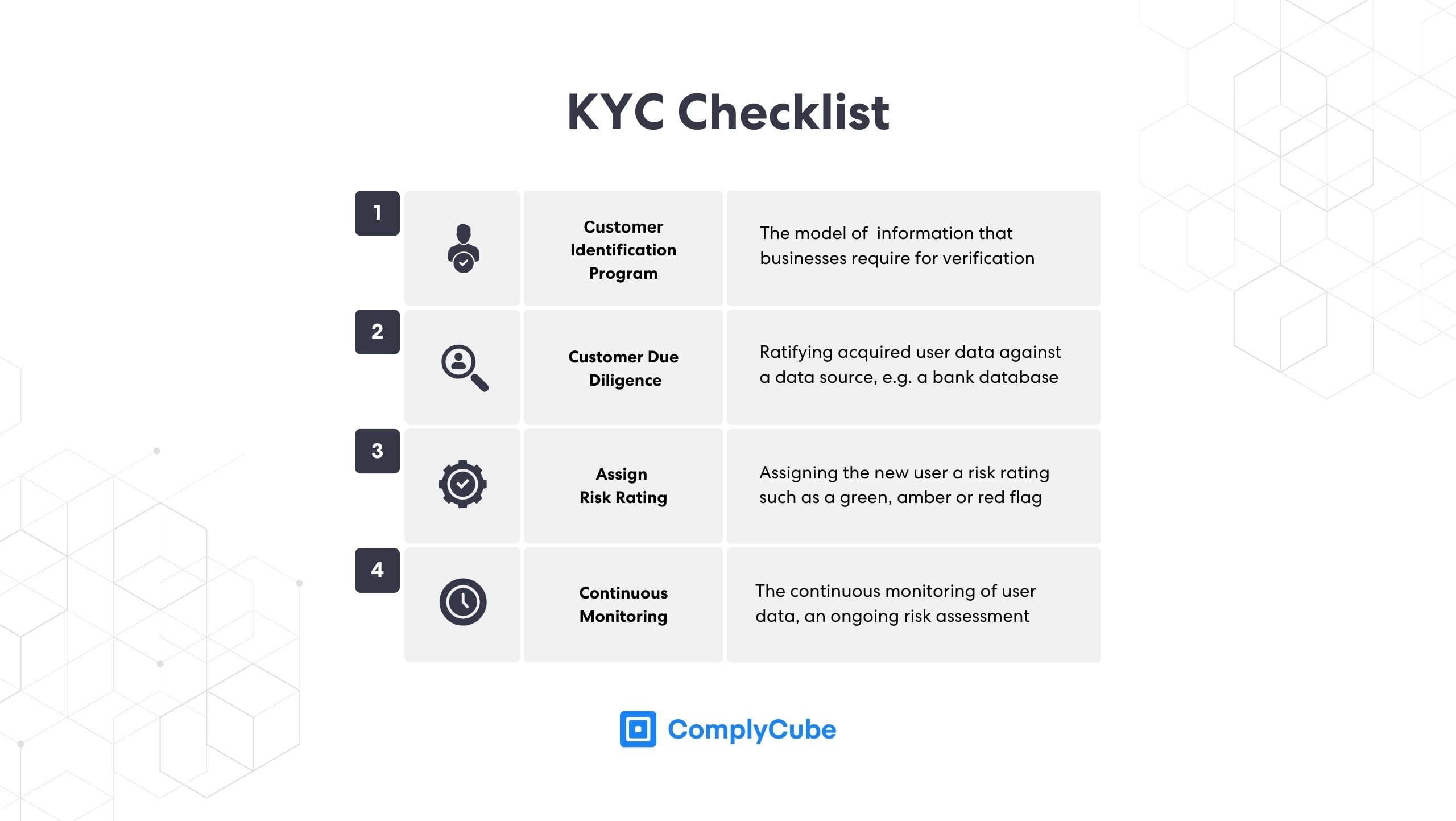
### What Does the Future Look Like for Crypto Assets and No KYC Crypto Exchanges?
As the crypto industry expands and regulatory systems tighten, integrating stringent KYC and AML protocols becomes critical for both centralized platforms as well as decentralized applications (dApps). These include Decentralized Exchanges (DEXs), unhosted and private wallets, and many others.
Ensuring compliance with these measures is essential to meeting federal regulations, managing legal challenges, and upholding the legal expectations set for most cryptocurrency exchanges. KYC in crypto is, therefore, integral to the continued development and adoption of blockchain technology and its various use cases.
### Key Takeaways About No KYC Crypto Exchange
- **No KYC crypto exchanges** are prime targets for fraud, scams, and money laundering.
- **These exchanges are non-compliant** with global AML and KYC regulations.
- **The future of no KYC crypto** exchanges is becoming increasingly limited with tight regulations.
- **Users face risks** such as frozen funds, market manipulation, low liquidity, and lack of dispute protection.
- **ComplyCube** helps no KYC crypto exchanges transition by providing AML, KYC, and IDV solutions to ensure compliance, protect users, and stay competitive.
## No KYC Crypto Exchange vs Regulated VASPs
Exchanges employing KYC processes ensure compliance with KYC regulations, reducing risks of financial crimes and terrorist financing. They align with global standards, enhancing user trust and regulatory approval.
In contrast, non-KYC exchanges face significant risks, including scams and regulatory penalties, which can undermine their operation and customer confidence. The future outlook for non-KYC crypto exchanges appears challenging as regulatory frameworks tighten worldwide, pushing for enhanced KYC compliance.
Cryptocurrency exchanges will need to adopt stringent AML and KYC measures to ensure their continued operation. ComplyCube stands at the critical conjunction between secure operations and regulatory adherence.
The AML, KYC, and IDV services provide industry-leading solutions that help exchanges meet the dynamic KYC regulations and safeguard their operations. This ensures that VASPs can remain competitive in a hotly competitive field. If your crypto platform, VASP, or related enterprise requires a compliance solution, [get in touch with a regulatory expert today](https://www.complycube.com/en/contact/contact-sales/).
## Frequently Asked Questions About No KYC Crypto Exchanges
What is a no KYC crypto exchange?
A no KYC crypto exchange is a platform that lets users trade crypto without identity verification. While this offers anonymity, it exposes both users and operators to fraud, scams, and regulatory penalties.
Is it safe to use a no KYC crypto exchange?
No KYC crypto exchanges are generally high-risk compared to regulated platforms. Users may face frozen funds, scams, low liquidity, price manipulation, and weak dispute resolution.
Why do some crypto exchanges not require KYC?
Some exchanges avoid KYC to appeal to users seeking anonymity, a founding principle of the crypto industry. However, this lack of oversight attracts bad actors and undermines compliance with global AML rules.
What are the main risks of trading on a no KYC crypto exchange?
The risks include exposure to Ponzi schemes, market manipulation, insolvency, and blocked access to funds. Without regulation, users have little protection if disputes arise.
How can ComplyCube support no KYC crypto exchanges?
ComplyCube helps no KYC crypto exchanges transition to compliance by offering AML, KYC, and IDV solutions. These tools protect users, meet regulatory standards, and help platforms stay competitive in a tightening market.
**Categories:** Guides
**Tags:** Crypto Regulations
---
### [Achieving Age Assurance: Online Age Verification Solution](https://www.complycube.com/achieving-age-assurance-online-age-verification-solution/)
**Published:** May 10, 2024
**Author:** Andreea Balasa
**Excerpt:** Companies must use an online age verification solution to achieve age assurance. Read on to learn about the challenges businesses face in age authentication, regulations, and what to look for in an age verification system.
**Content:**
Age assurance is a concept designed to ensure that only verified users of a minimum age can access age-restricted products. Due to this development, companies must use an online age verification solution to achieve age assurance. This guide assimilates the challenges in attaining age authentication for businesses and what to look for in an age verification system.
## What is Age Assurance?
[Age verification](https://www.complycube.com/en/use-cases/process/age-verification/) is a method used to achieve age assurance. It plays a vital role in creating a safe environment for online users and a business’s compliance with legal obligations and regulations, including COPPA in the US, the EU’s GDPR, and the Digital Economy Act of 2017.
Age assurance is the term that describes the adequate verification of a user’s age when they sign up for tangible or digital services. For this reason, its importance extends far beyond legal and regulatory compliance and addresses the ethical concerns of minors’ use of the internet and online services.
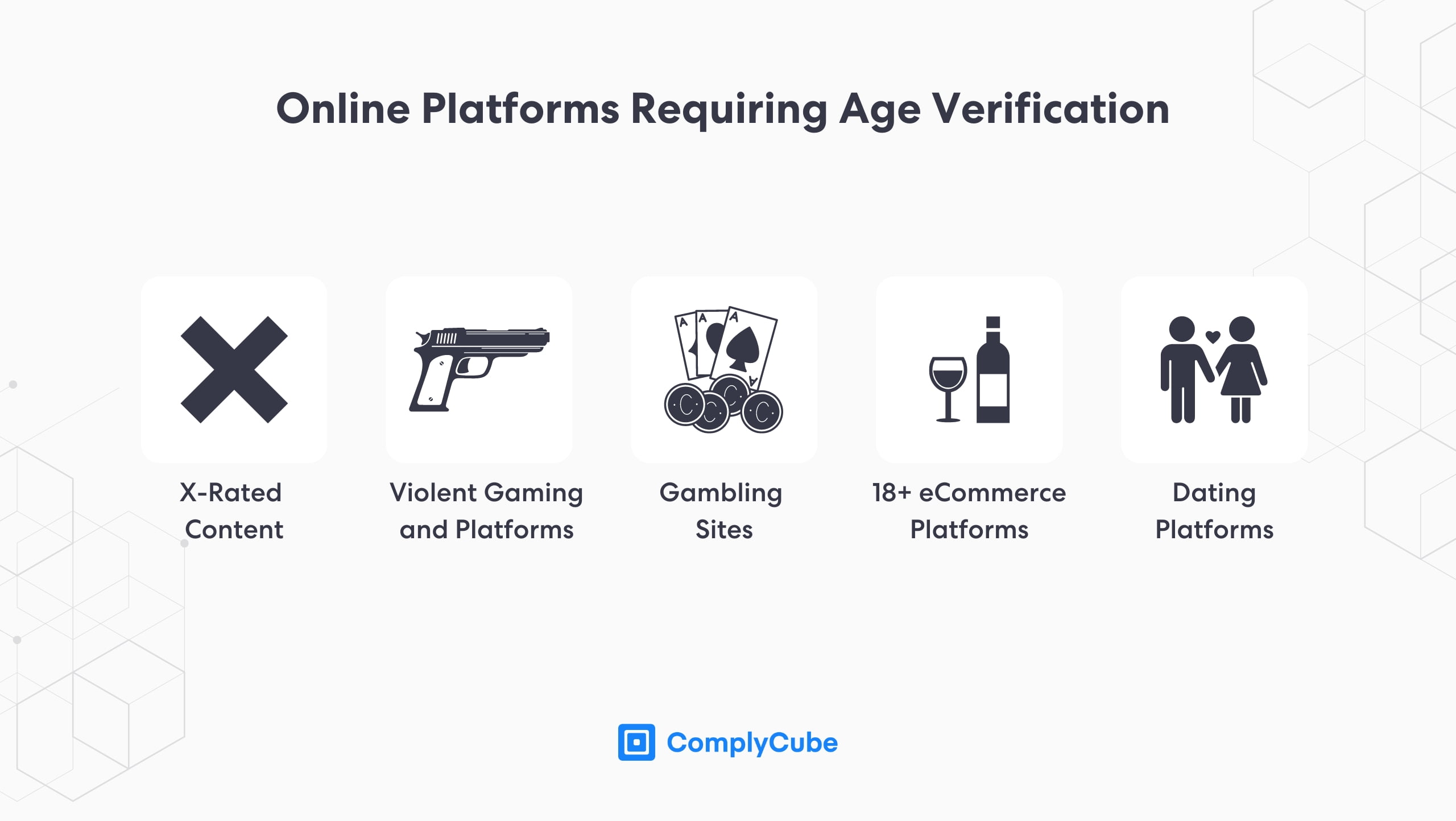
## Age Verification and Children’s Data Regulators
Misalignment with local and international children’s data privacy laws can result in significant fines and penalization. For more information, read ComplyCube’s [LinkedIn post](https://www.linkedin.com/feed/update/urn:li:activity:7161398075410857984) referencing the significance of age verification technologies.
### Using an Age Verification Solution for the COPPA Regulation
The Children’s Online Privacy Protection Rule (COPPA) became effective in 2000 and was amended in 2013. It is designed to protect children and [give parents control over what information is collected about the](https://www.ftc.gov/business-guidance/resources/complying-coppa-frequently-asked-questions)m, particularly those under the age of 13.
A critical aspect of complying with COPPA regulations involves determining the age of online users to clarify what can be done with their data. An excellent example of a successful age assurance strategy would be when an online platform successfully verifies a user’s age and either allows or prohibits access based on the result.
### Achieving Age Assurance to Comply with GDPR
The General Data Protection Regulation (GDPR) unifies data protection across EU member states, ensuring that all businesses trading in the EU bloc properly collect and use minors’ data. Therefore, age verification systems must adhere to the strictest levels of data privacy and storage.
Popular social platform TikTok was fined “€345 million after finding their handling of children’s data not to be compliant with GDPR.” The social media app was also found to have failed to prohibit users under the minimum age threshold of 13 from gaining access to the platform.
GDPR policies require age verification methods to attain a reasonable belief that the user is who they say they are and that they are of a certain age. The GDPR mandate is that [users must be 16 to consent for data to be collected and used](https://gdpr-info.eu/art-8-gdpr/).
### The UK Online Safety Bill (2023)
This act was designed to provide a new framework to aid policies that regulate the use of the Internet. This bill grants [new powers to the Office for Communications (OFCOM)](https://www.legislation.gov.uk/ukpga/2023/50/enacted), and digital platforms will be required to remove harmful content proactively and ensure higher safety standards, especially for content accessible by minors.
This measure is vital for reducing online risks and protecting vulnerable users in a digital age that increasingly blurs public and private boundaries. This is particularly important for minors who are far more susceptible to the dangers posed by an online social life
### The UK Digital Economy Act (2017)
The [UK’s Digital Economy Act 2017](https://www.legislation.gov.uk/ukpga/2017/30/part/3/enacted) aimed to increase digital security surrounding accessibility to 18+ content, particularly explicit content. This ambitious proposal would have been the world’s first attempt to introduce an age verification solution for viewing this type of content.
This policy, however, faced significant complexities at a national implementation level. The Act now attempts to balance a sense of freedom of expression, privacy, and security with the necessity to protect minors.
If such a development were to occur for national age restrictions, the requirement for an online age verification system would be absolute. While this is not likely in the immediate future, there is every possibility that it will become a reality in the near future.
**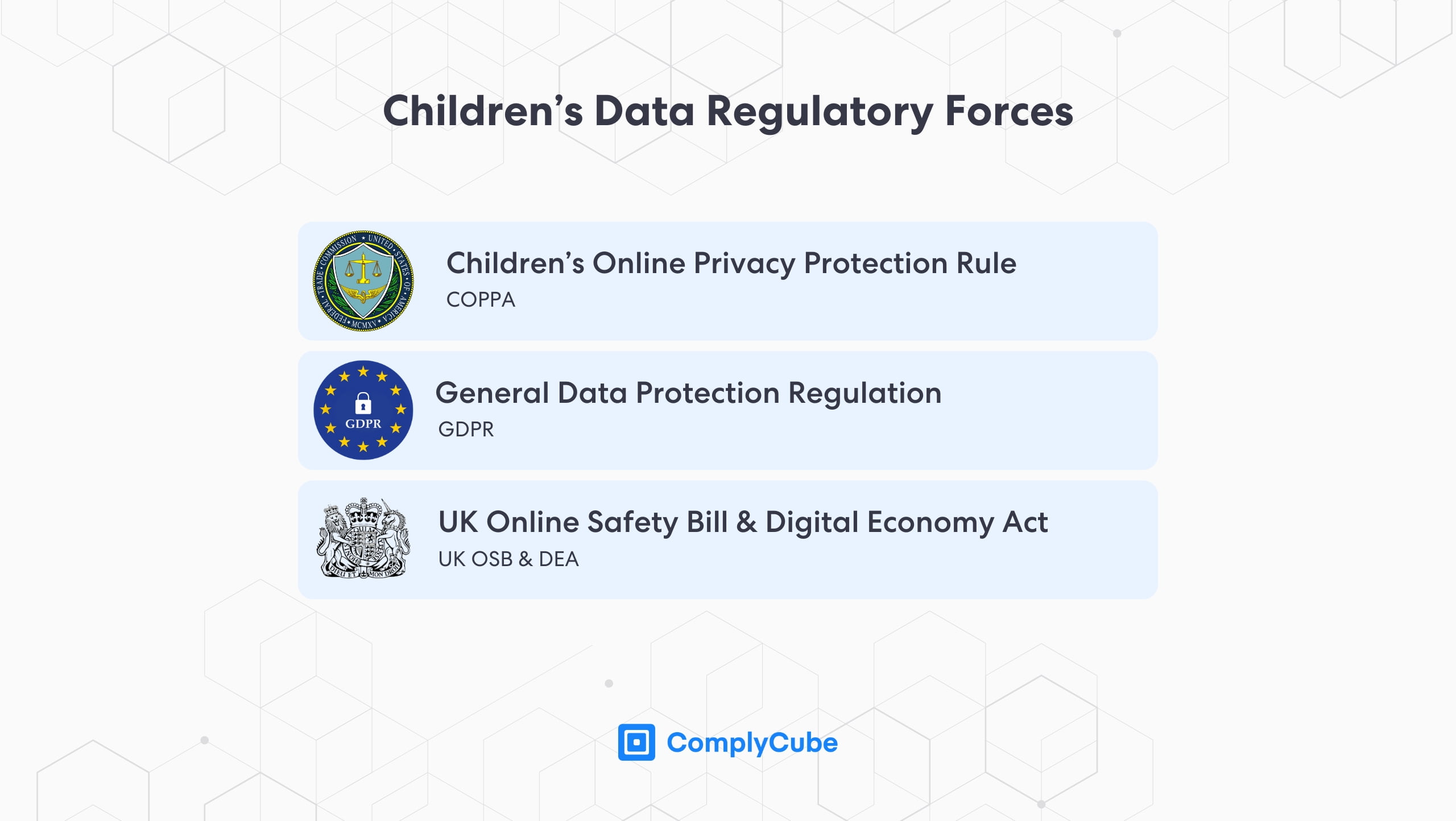**
## Age Verification Challenges
Verifying digital profiles is becoming increasingly complex. Much of the globe’s economy and social life is happening online, leading to a significant rise in the number of digital profiles. More pertinently, every individual worldwide now uses multiple different digital accounts frequently.
- Social Media: A global report from 2023 found that the average individual has over 8 social media accounts.
- Gambling: The average gambler in the UK had [3.2 accounts per person in 2020, up from 2.7 in 2018](https://cometoplay.co.uk/interesting-facts/uk-gambling-statistics/).
These figures show a growing trend of individuals opening multiple accounts to interact with the same industry, be it age-restricted services or not. Furthermore, the same individuals must be verified multiple times on different platforms, giving rise to a greater risk of synthetic fraud.
> On a global perspective, [the average individual boasts 8.4 social media accounts](https://www.forbes.com/advisor/business/social-media-statistics/).
These figures prove challenging for the entire Identity Verification (IDV) process, from age verification to document and identity authentication. Traditional age verification methods (manually checking IDs) can be easy to circumvent. Artificial Intelligence (AI) and advanced editing tools have created convincing deepfakes and altered KYC documents, making it increasingly challenging to verify a user’s age manually with certainty.
These fraudulent risks compromise the integrity of a platform’s security and demand the need for age assurance methods. Not integrating with a modern age verification solution exposes businesses to fraudulent attacks, enabling underage product or service misuse and being liable to legal issues or misconduct fines.
### Data Privacy Challenges
Age verification inherently requires the collection of sensitive customer data. In a digital environment, users might not be willing to submit this information due to fears of online safety in their data processing. There is a natural risk of unauthorized access and misuse of client data.
For this reason, age verification methods must be employed with data privacy in mind, leading to the adoption of age verification solutions to meet these complex requirements. Such solutions make compliance with international data standards, such as GDPR, far more straightforward and become a significantly cost-effective investment.
### Verification Accuracy and Throughput
The increasing volume of digital profiles requires a far more sophisticated methodology for achieving age assurance. This is due to the sheer volume of profiles that must be vetted and confirmed, which has a corresponding effect on the accuracy of the checks.
Traditional and manual age verification methods cannot cope with the increasing trend in digital profiles, particularly when this data suggests an exponentially increasing number of digital profiles and interactions.
Manual verification requires a trained human to be present to carry out a specific authentication process for a new user. This incurs a number of challenges that are no longer viable in modern-day business practices:
- Inaccuracy of checks and human error.
- Limited working hours of humans.
- Limitations in transaction/verification throughput.
- Labor and training costs.
These pain points are becoming increasingly costly for businesses and solvable with age verification systems. Online age verification services are proving to be a considerable driver in efficiency, easily complying with regulators and significantly streamlining operational costs.
## Online Age Verification Solutions
Regarding [Know Your Customer](https://www.complycube.com/en/solutions/due-diligence-compliance/know-your-customer/) (KYC) and IDV solutions, age assurance is an umbrella term for various age verification methods. Regulatory requirements can vary depending on the level of harmful content a platform might facilitate.
The dynamic landscape of online content means that age verification systems must be versatile. They must recognize that different age groups will access different products and content. This means that the legal requirements for age verification services will demand different verification methods.
### Document Verification
[Document verification](https://www.complycube.com/en/solutions/identity-assurance/document-verification/) enables businesses to comply with legal age restrictions and regulations. Modern automated IDV and KYC solutions use cutting-edge technologies and AI to instantly analyze and authenticate KYC documents, such as a driver’s license.
Automated analysis like this can detect forgeries, falsifications, and any other fraudulent attempt far quicker and more precisely than a human by immediately analyzing multiple data points in one flow. This strengthens the age assurance framework by preventing underage access to age-restricted products.
****
### Biometric Verification
[Biometric verification](https://www.complycube.com/en/solutions/identity-assurance/biometric-verification/) also leverages sophisticated AI algorithms and a liveness detection feature to determine if the selfie a user has supplied is genuine and not forged. It also matches for similarities between the stock photo in the user’s document, analyzing facial features as well as a host of other structures.
The combination provides companies with a powerful mechanism for verifying a user’s identity and, thus, their age. Document and biometric verification can both be completed in under 30 seconds, making it a scalable and precise method for achieving age assurance.
****
### Age Estimation
Leveraging the same technology as biometric verification, [age estimation](https://www.complycube.com/en/solutions/global-screening/facial-age-estimation/) provides businesses with a sleek and extremely versatile age verification solution. Users of a wide age range can be accurately authenticated in an average of 5 seconds.
Even with the aid of an AI-powered solution, estimating user age does not provide the same level of age assurance as authenticating users with document and biometric verification. However, it allows businesses with fewer regulatory requirements to implement a robust yet frictionless age-gating process. For more information on digital age verification, read [What is an Online Age Verification System?](https://www.complycube.com/en/what-is-an-online-age-verification-system/)
**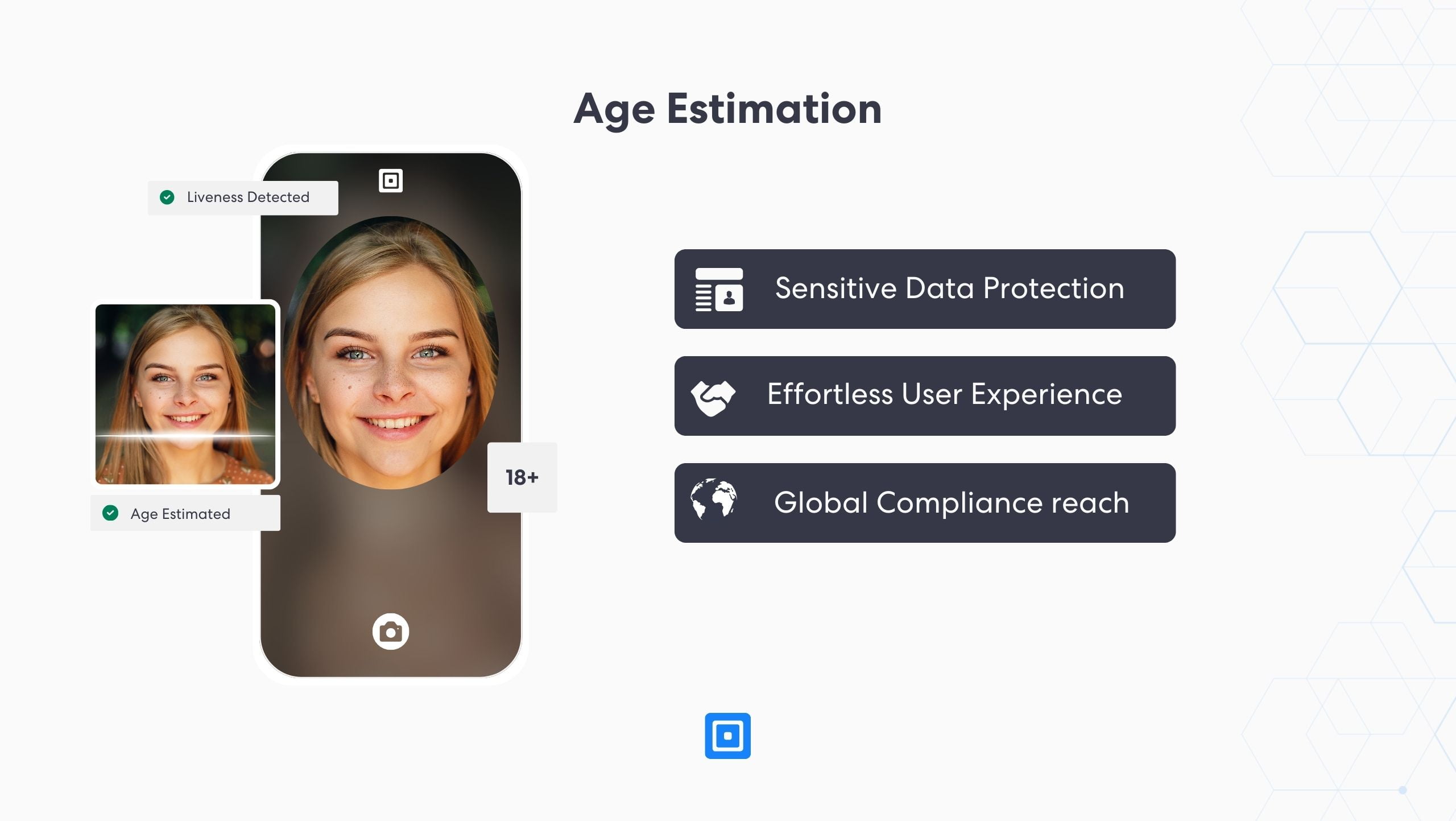**
## Time to Partner with an Age Verification Solution?
Robust age assurance solutions are increasingly important to online safety. They ensure that only users of the appropriate age can access age-restricted content. The accessibility of the Internet and online material has significantly dampened the efficacy of parental consent.
The complexities associated with online age verification, from ensuring compliance with international regulations to addressing data privacy concerns and achieving verification accuracy, underscore the necessity for advanced and reliable age verification systems.
Integrating a sophisticated age verification solution not only protects minors from accessing inappropriate content but also safeguards brand reputation by mitigating legal risks and enhancing corporate operational efficiency. This is a growing trend that cannot be overstated as global societies and economies increasingly convene online.
### About ComplyCube’s Age Verification Solutions
ComplyCube is Age Check Certification Scheme (ACCS) certified for for Age Check Systems and Data Protection and Privacy Certification. Such an accolade would not be possible without an industry-leading product.
The AML, KYC, and IDV leader empowers firms of all sizes to accurately verify their users’ age with customizable automation routes and powerful liveness detection technology. If your business is looking for a partner for IDV solutions, contact [ComplyCube](https://www.complycube.com/en/contact/contact-sales/) today to find a solution.
**Categories:** Guides
**Tags:** Age Verification
---
### [Hong Kong Crypto Regulation in 2024](https://www.complycube.com/hong-kong-crypto-regulation-in-2024/)
**Published:** May 16, 2024
**Author:** Andreea Balasa
**Excerpt:** Hong Kong has been subject to scrutiny in recent years. However, advances in Hong Kong crypto regulation and the Crypto Travel Rule have positioned the region as a winner for many years to come in the cryptocurrency industry.
**Content:**
Hong Kong’s status as a financial hub has been questioned in recent years due to its apparent failure to capitalize on economic trends. Hong Kong crypto regulation aims to counter this. With recent advances in the Crypto Travel Rule and legislative infrastructure, Hong Kong is positioning itself at the top for Web3 and crypto innovation.
This Hong Kong cryptocurrency guide sets out the fundamental legislative policies implemented in recent years. These regulations, coupled with a Western inability to capitalize on this fast-paced industry, could potentially see the key players move East. Perhaps more specifically, move to Hong Kong.
## Who Regulates Cryptocurrencies in Hong Kong?
The cryptocurrency industry is vast and swift, with hundreds of billions of dollars flowing in and out of it each year. Acting swiftly can put entire regions ahead in the industry. What is particularly pertinent to Hong Kong (HK) is the government’s quick-witted and comprehensive approach to regulation.
One reason this could be so significant for Hong Kong is that other nations appear to have taken quite a contrary approach. As this guide will explain, HK’s government is already providing Web3 and crypto firms with the tools to build responsibly.
### Securities and Futures Commission (SFC)
The SFC regulates the securities and futures markets in Hong Kong. As no specific council is designed to regulate the cryptocurrency market, the Securities and Futures Commission plays a pivotal role in the industry’s legislation.
Cryptocurrencies are traded like securities. However, despite the US’s attempts to label them as such, they are not registered securities in any country. For this reason, multiple organizations in Hong Kong share the responsibility of crypto market regulation.
The SFC plays the most hands-on role regarding how users are allowed to interact with the crypto industry, such as the procedures new users must undergo at the point of client acquisition. Therefore, the agency is instrumental in KYC and AML crypto compliance.
### Hong Kong Monetary Authority (HKMA)
The HKMA, the Central Bank of Hong Kong, ensures that financial institutions are and continue to operate efficiently and transparently. They were traditionally responsible for ensuring that banks and other payment systems were financially stable and solvent.
For Virtual Asset Service Providers (VASPs), the Hong Kong Monetary Authority ensures that crypto institutions, such as Centralized Exchanges (CEXs), [act properly with user funds](https://www.coindesk.com/policy/2024/02/20/hong-kongs-central-bank-issues-guidance-for-firms-offering-crypto-custodial-services/). Some of the HKMA’s key legislation that impacts the crypto industry relates to where and how user deposits are held.
This topic has garnered an increasing level of scrutiny following the collapse of Sam Bankman-Fried’s FTX exchange in 2022. The exchange was found to be misusing client funds via a sibling company known as Alameda Research. For more information on unregulated crypto exchanges, read [The Dangers of a No KYC Crypto Exchange](https://www.complycube.com/en/the-dangers-a-no-kyc-crypto-exchange-can-bring/).
### Legislative Council of Hong Kong
The Legislative Council of Hong Kong plays a fundamental role in regulating cryptocurrencies and Virtual Asset Service Providers. It is the core body for approving and passing legislation related to financial markets.
This regulatory body ensures that the established regulatory framework is up to date with the cryptocurrency industry’s dynamic standards. One core crypto policy established by the Legislative Council of Hong Kong was the Anti-Money Laundering and Counter-Terrorist Financing Ordinance (AMLO).
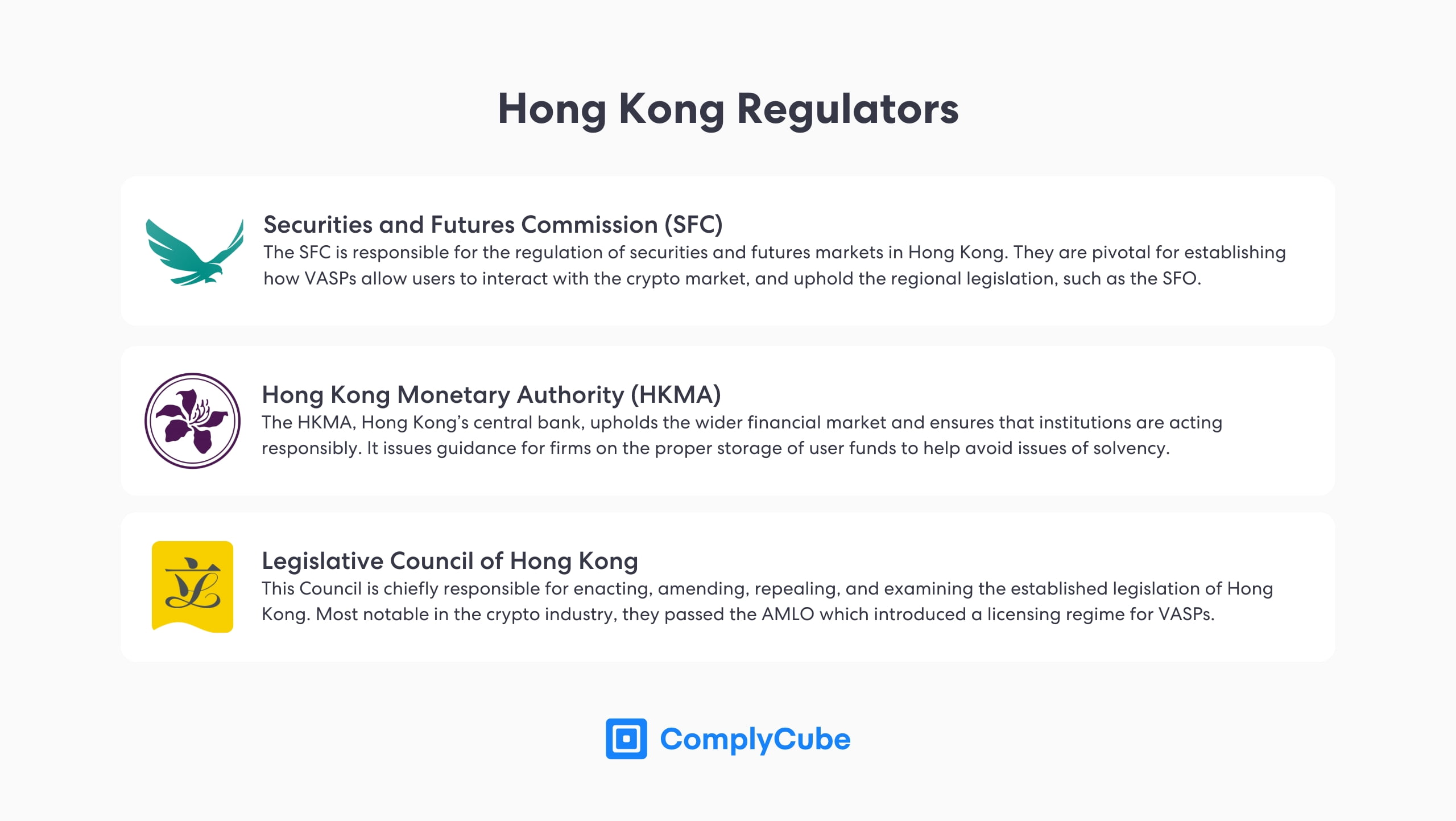
## What Does Hong Kong Crypto Regulation Look Like?
Hong Kong’s updated framework, the AMLO, is the core legislative piece that all VASPs must adhere to. Firms must also comply with international [Anti-Money Laundering](https://www.complycube.com/en/solutions/due-diligence-compliance/anti-money-laundering/) (AML) and Counter-Terrorism Financing (CTF) regulations.
Crypto companies must obtain a license from the SFC and be compliant with the AMLO to ensure their safe and continued operations. Hong Kong’s set of crypto asset standards is poised to catalyze the region into an industry leader, fostering innovation by attracting new start-ups and individual talent.
> Hong Kong aims to position itself as a leading global hub for [digital asset innovation and investment](https://www.forbes.com/sites/digital-assets/2024/02/18/year-of-dragon-accelerates-hong-kongs-crypto-regulatory-development/).
This new framework aligns with the [Financial Action Task Force](https://www.fatf-gafi.org/en/home.html) (FATF) and its [Recommendation 16](https://www.fatf-gafi.org/content/dam/fatf-gafi/recommendations/FATF%20Recommendations%202012.pdf.coredownload.inline.pdf)—the crypto travel rule. According to the international agency, when crypto assets are transferred between Virtual Asset Service Providers (VASPs), the two VASPs must provide additional information about the user and the nature of the funds.
Recommendation 16 implementation bolsters the need for a [Customer Due Diligence](https://www.complycube.com/en/solutions/due-diligence-compliance/customer-due-diligence/) (CDD) and travel rule compliance solution. For more general information on the travel rule, read [The Crypto Travel Rule: The Need for AML Compliance Software.](https://www.complycube.com/en/the-crypto-travel-rule-and-the-need-for-aml-compliance-software/)
### The AMLO
The Anti-Money Laundering and Counter-Terrorist Financing Ordinance (AMLO) complements the SFO and SFC’s work. However, it focuses directly on AML and CTF policies across the region’s industries. It mandates comprehensive CDD, ongoing monitoring, and specific requirements for banking services, including virtual asset transfers.
Therefore, the AMLO directly relates to money laundering, counterterrorism financing, and crypto travel rule requirements. Recommendation 16 is quickly becoming one of the leading metrics in gauging a region’s crypto compliance standards.
This framework helps [mitigate risks associated with money laundering and terrorist financing](https://www.cr.gov.hk/en/amlcft/overview.htm), making Hong Kong a safer and more attractive hub for crypto-related activities and investments. The AMLO protects investors and enhances the legitimacy and stability of Hong Kong’s financial market.
### The Provision of Custodial Services for Digital Assets in 2024
In February 2024, the HKMA released its [guidance for digital asset custodians](https://www.hkma.gov.hk/media/eng/doc/key-information/guidelines-and-circular/2024/20240220e4.pdf) to ensure they have the correct information to manage digital assets properly. These include a range of procedures:
1. Proper governance and risk management to ensure VASPs only operate once an adequate risk assessment has occurred.
2. Segregation of client digital assets to the firm’s funds to protect users from insolvency.
3. The safeguarding of client digital assets against theft, fraud, or other misappropriation.
4. Firms may not outsource custody functions to custodians outside the SFC’s jurisdiction.
5. Transparent disclosure of the custodial arrangements of user digital assets.
6. Thorough recordkeeping and reconciliation of client digital assets, including both off-chain and on-chain data.
7. Proper AML/CTF policies, including contemporary [Know Your Customer](https://www.complycube.com/en/solutions/due-diligence-compliance/know-your-customer/) (KYC) strategies such as Identity Verification (IDV), CDD, and [continuous monitoring](https://www.complycube.com/en/solutions/global-screening/continuous-monitoring/).
Compliance with many of these points overlaps adherence to the crypto travel rule and, therefore, will require a KYC and AML solution for the storage, accessibility, interpretation, and reliability of client data. While this particular policy relates to how a VASP operates, all crypto firms must rely on a comprehensive KYC solution to combat money laundering and maintain compliance.

### Virtual Asset Service Providers and SFC Licensing
The Securities and Futures Commission is the primary regulator that establishes the rules for investor protection and enables a financial institution’s risk management. The SFC must license every firm dealing with the transfer of virtual assets to provide their services to Hong Kong citizens.
By obtaining a license with the SFC, VASPs demonstrate their commitment to operational integrity and adherence to AML policies. This is vital in building a cryptocurrency ecosystem based on trust and stability.
### The Securities and Futures Ordinance (SFO)
The SFO provides the regulatory requirements that dictate the principles the SFC enforces. It is the rulebook that outlines the expected standards from market participants and permits the SFC to act accordingly if they are broken.
Therefore, the SFO is instrumental in creating a fair, regulated, and hospitable environment for Hong Kong’s financial markets, including the crypto industry and VASPs. The most extensive crypto policy established by the Securities and Futures Ordinance is that every VASP—or Virtual Asset Trading Platform (VATP) — must be licensed with the SFC.
### Hong Kong’s Spring 2023 Legislative Updates
Between May and June 2023, the SFC distributed a “[circular on implementation of new licensing for virtual asset trading platforms](https://apps.sfc.hk/edistributionWeb/gateway/EN/circular/doc?refNo=23EC28).” This included updated regulatory requirements on:
- The Guidelines for Virtual Asset Trading Platform Operators
- The Guidelines on Anti-Money Laundering and Counter-Financing of Terrorism (AMLO)
- The Prevention of Money Laundering and Terrorist Financing Guidelines issued by the SFC
These were released to prevent money laundering and terrorist financing for licensed corporations participating in crypto asset services, forming the foundation of Hong Kong’s updated cryptocurrency legislation.
### Stablecoin SandBox
On March 12, 2024, the Hong Kong Monetary Authority launched a [regulatory sandbox for the development and issuance of stablecoins](https://www.globalcompliancenews.com/2024/04/03/https-insightplus-bakermckenzie-com-bm-financial-institutions_1-hong-kong-new-sandbox-regime-for-stablecoins-released-by-hong-kong-monetary-authority_03222024/#:~:text=On%2012%20March%202024%2C%20the,regulatory%20regime%20for%20stablecoin%20issuers.) following a discussion paper that started in 2022.
The sandbox is designed to encourage the safe development of stablecoins in a controlled environment, where regulatory decisions can be iterated as required. Companies interested in [taking part in the initiative](https://www.hkma.gov.hk/eng/key-functions/international-financial-centre/stablecoin-issuers/) must:
- Show a genuine interest in issuing a fiat-referenced stablecoin in Hong Kong
- Demonstrate a suitable plan of action for the project’s development
- Provide a roadmap of how the project aims to participate in the sandbox
- Demonstrate how the firm will adhere to the proposed regulatory requirements and principles
The proof here is in the pudding, as ZA Bank, the first mover in the Hong Kong NeoBank industry, is actively pursuing a stablecoin strategy. The bank’s Chief Executive has frequently expressed his admiration for stablecoins, labeling them as a multi-faceted application of blockchain technology, with use cases including “wholesale or retail markets, tokenization, settlement for exchange trading, or to tackle overseas remittance pain points.”
> We are keen to explore how to put them \[stablecoins\] into [real-world use](https://www.bloomberg.com/news/articles/2024-04-04/za-bank-looks-to-offer-hong-kong-accounts-for-stablecoin-issuers) with the potential issuers.
These developments show a genuine drive in Hong Kong to develop a crypto economy full of diverse utilities. This sandbox puts the region ahead of much of the rest of the world regarding stablecoin legislation, with most major economies lagging behind.
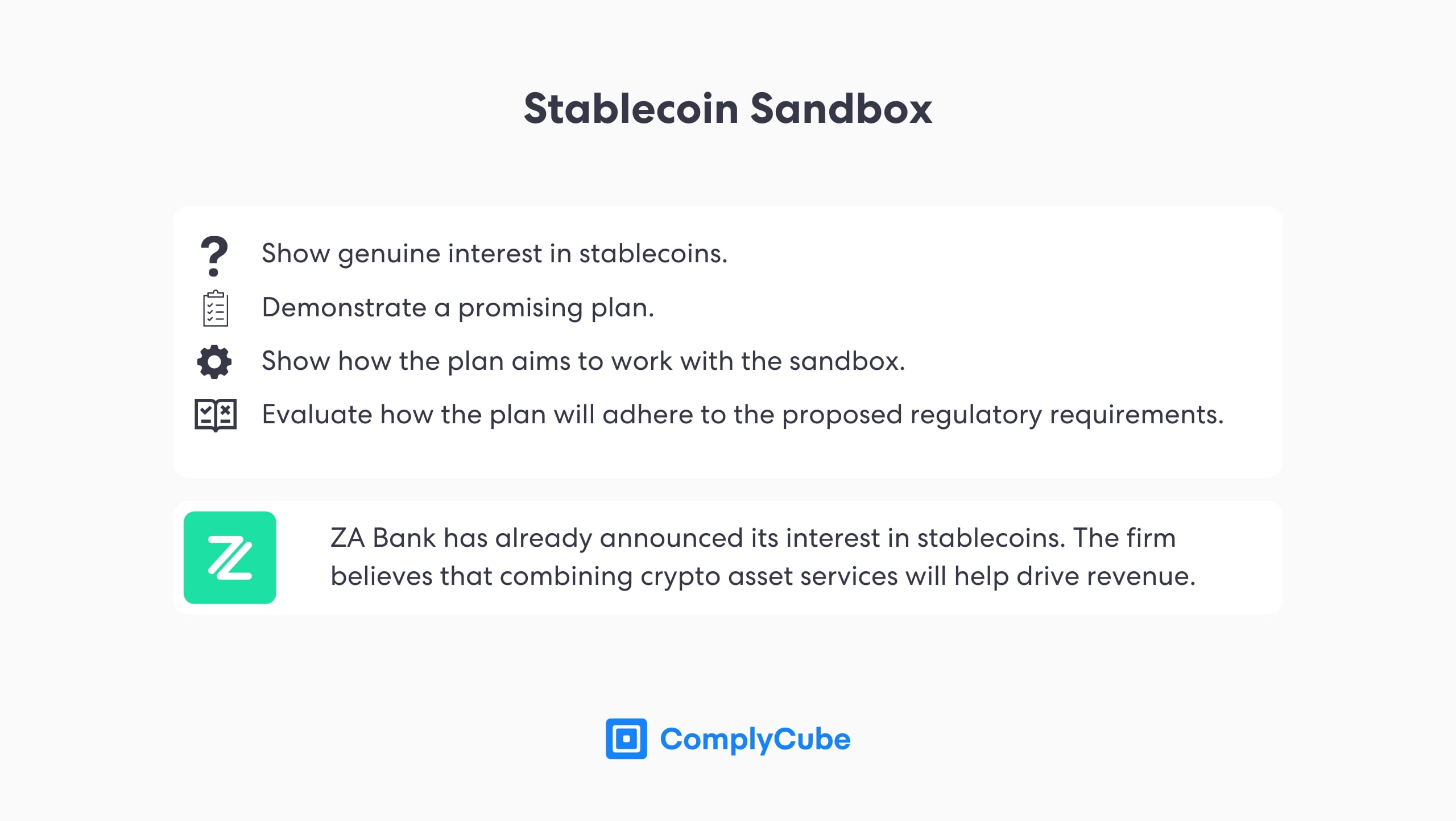
## List of SFC Licensed VASPs
Quite interestingly, the Securities and Futures Commission has only legally licensed 2 crypto exchanges (at the time of writing, May 2024) for operation in Hong Kong. This is despite many well-known CEXs being headquartered in the very same region. The two licensed exchanges are:
- [HashKey Exchange](https://www.hashkey.com/en-US/)
- [OSL Exchange](https://osl.com/en/)
However, 23 VATP applications remain open and are awaiting a response. The SFC’s licensing list is a great example of the transparency the Hong Kong government instills throughout the industry.
> The purpose of this list is to [enable any member of the public to ascertain whether a virtual asset trading platform has made untrue or misrepresentations](https://www.sfc.hk/en/Welcome-to-the-Fintech-Contact-Point/Virtual-assets/Virtual-asset-trading-platforms-operators/Lists-of-virtual-asset-trading-platforms) regarding its licence application status with the SFC.
There has been speculation about how effective the new Hong Kong crypto regulations will be at attracting overseas exchanges and investors. King Leung, head of FinTech at Invest Hong Kong, has stated that the government wants to develop a “[more complete ecosystem](https://www.ft.com/content/41651975-4eca-4d6f-8ca2-d17aaf175a2f)” by attracting other market contributors, such as market makers and developers, to Hong Kong. These new regulations are designed to do just that.
## The Financial Action Task Force and Crypto Travel Rule
The term travel rule was coined by the Financial Crimes Enforcement Network (FinCEN) and the Bank Secrecy Act (BSA) in [1996/7](https://www.fincen.gov/sites/default/files/advisory/advissu7.pdf) and later adopted by the FATF. Financial Institutions and now Virtual Asset Service Providers that operate in FATF member countries must adhere to Recommendation 16.
The crypto travel rule states that any crypto transactions exceeding a certain threshold, typically 1,000 (USD, EUR, or GBP), must be accompanied by certain customer information. This measure has been implemented to address the growing concern about crypto anonymity and its inherent links with money laundering.
Every country, however, is implementing the crypto travel rule at different rates and with varied levels of success. This problem is known as the ‘sunrise issue’. As the travel rule requires two VASPs to communicate client data with each other, it can only be successful if both services are fully compliant and have implemented robust KYC processes.
### Hong Kong Crypto Travel Rule Specifications
The crypto travel rule became obligatory on June 1, 2023. All virtual asset transfers that exceed 8,000 HKD (1,000 USD) must be subjected to the terms of the rule. This means certain information must be obtained and shared with the participating VASPs:
- The name of the business or individual making the transaction (the originator).
- The account details of the originator (the VASP or financial institution should store these.)
- The originator’s address and customer identification details, including beneficiary information.
- The name of the business or individual receiving the transaction (the recipient).
- The recipient’s account details.
Crypto transactions that do not exceed 8,000 HKD do not require the same level of accompanying data. However, basic information is still required, including the name and account number. The SFC states that all travel rule checks must be completed before the transaction is submitted due to blockchain finality.
When crypto assets are transferred via the blockchain (on-chain), they are final and cannot be reversed. Therefore, VASPs must be certain in their due diligence that the transaction is not threatening or connected to bad actors, further signifying the cruciality of KYC and CDD processes.
### Crypto Travel Rule Implementation in Hong Kong
The Securities and Futures Commission gave a 6-month window following the new crypto legislation. In an attempt to give firms a grace period, VASPs were allowed to process transactions before they received the accompanying information as long as they submitted the customer’s data as soon as possible. This was likely to allow time for firms to find and integrate with a travel rule solution.
This meant that the crypto travel rule could be gradually integrated into the region’s industry without upsetting the operation of crypto firms. The FATF released a status update of Recommendation 15 (governmental collaboration with FATF AML and CTF guidelines for VASPs) in March 2024, finding Hong Kong [Partially Compliant](https://www.fatf-gafi.org/content/dam/fatf-gafi/publications/VACG-Table-Jurisdictions-2024.pdf.coredownload.pdf) with the travel rule. The data from this report, however, pertains to 2023, before Hong Kong’s travel rule grace period had concluded.

The 5th Round of Mutual Evaluations, which is due in 2025, will include a more comprehensive update of all 40 FATF Recommendations. The cryptocurrency industry has witnessed far greater media attention in 2024, likely extending into 2025. The Mutual Evaluations will contribute significantly to many regulatory discussions, including the sunrise issue. Read the [FATF Recommendations in 5th Mutual Evaluations](https://www.complycube.com/en/fatf-recommendations-the-mutual-evaluations/) for more information.
### Where does this place Hong Kong Globally?
HK has swiftly developed an extremely expansive set of cryptocurrency legislation, which has put the region in one of the key driving seats on the crypto grid. Since 2023, Hong Kong has made impressive strides to provide regulatory clarity to entice the industry to its jurisdiction.
The first country to implement the crypto travel rule was the US in 2019, following the FATF’s introduction of the rule to the crypto industry in the same year. FinCEN also issued guidance that clarified the rule’s application to virtual assets, which is also used as a global standard.
This was the start of a global recognition of the importance Virtual Asset Service Providers can have over the financial system. In February 2024, the EU officially recognized VASPs’ significance as financial system safeguards, labeling them as ‘obliged entities’.
> CASPs will need to apply customer due diligence measures when carrying out [transactions amounting to €1000 or more.](https://www.consilium.europa.eu/en/press/press-releases/2024/01/18/anti-money-laundering-council-and-parliament-strike-deal-on-stricter-rules/)
Furthermore, Singapore — a region Hong Kong is frequently compared to — implemented the crypto travel rule in 2020. Singapore beat much of Asia in the race to regulate crypto, fostering its early lead in the crypto industry.
Now that Hong Kong is officially enforcing the travel rule coupled with perhaps the most contemporary structure of cryptocurrency legislation, the region is likely to harness a heightened share of the global market. The only caveat to this is that the suite of regulations Hong Kong has introduced is so comprehensive that it is reportedly very expensive to comply with. The same goes for license applications.
### At a Glance
Hong Kong’s regulatory regime looks set for success. Its comprehensive cryptocurrency legislation instills transparency and trust in an industry that, more frequently than not, lacks it. A regulatory sandbox for stablecoin development also shows great initiative and commitment — as well as putting their money where their mouth is — to developing a healthy crypto ecosystem beyond just hosting the headquarters of numerous CEXs.
While the stablecoin market is certainly dominated by the likes of [Tether](https://tether.to/en/) and [Circle](https://www.circle.com/en/) (USDT and USDC, respectively), that by no means rules out the rise and adoption of other more efficient protocols. This places Hong Kong in good stead to develop its own stablecoin infrastructure with the potential for deployment on a global scale. There is, however, the aforementioned caveat.
While comprehensive, the region’s regulations are possibly too strict, intricate, and expensive to adhere to. This could pose problems in attracting the vast majority to its jurisdiction. When compared to Singapore, the new and developing regulatory landscape in Hong Kong might not be seen as favorably as it wants to be. Only time will tell.
## About ComplyCube
The development of Hong Kong’s crypto legislation over the past year underscores the region’s determination to establish itself as a crypto hub for years to come. Compliance with these regulations, in particular the travel rule, is fundamental for VASPs that wish to operate in the region without incurring fines.
These regulations have successfully aligned Hong Kong’s compliance program with that of the FATF and international best practices. However, the VASP has discretion over how a firm achieves compliance with these protocols.
### Crypto KYC and AML Solutions
This is why KYC and AML tools are becoming increasingly important to the success and regulation of the crypto industry. Advanced Identity Verification methods, such as [document verification](https://www.complycube.com/en/solutions/identity-assurance/document-verification/) and [biometric authentication](https://www.complycube.com/en/solutions/identity-assurance/biometric-verification/), are used at the client acquisition stage to ensure that firms form a reasonable belief that users are who they say they are.
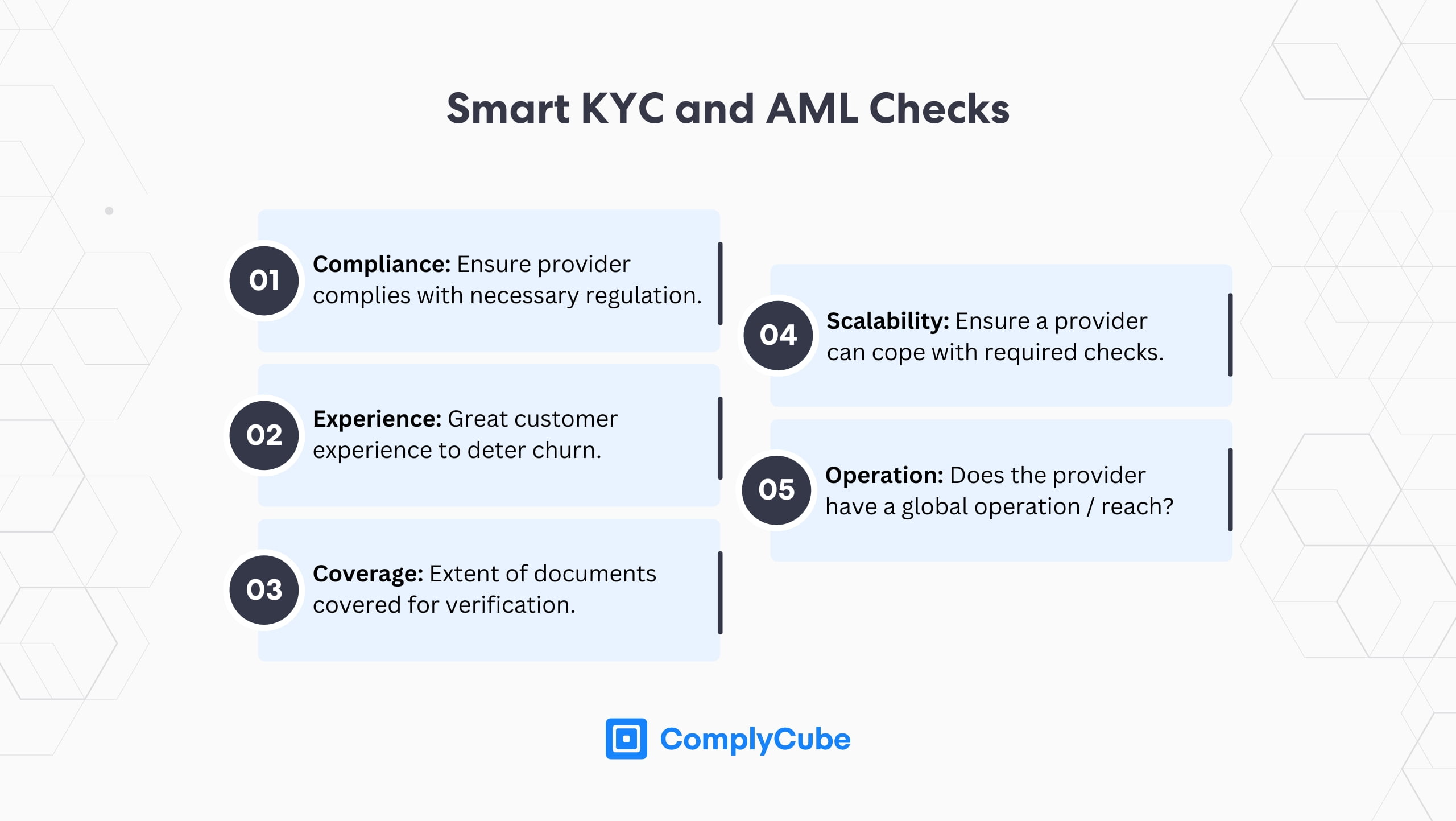
Once a Virtual Asset Service Provider has established who the user is, they will subject them to a host of background vetting processes in the Customer Due Diligence phase. All of this information must be collected, stored, and checked to ensure exchanges and other crypto providers comply with the travel rule.
Where ComplyCube excels is automating this entire process into one seamless workflow. Users can be verified in under 30 seconds with CDD performed in the background. This produces a risk score for compliance executives in minutes. Clients also have full control over friction thresholds, allowing for tightened or loosened ‘fast-fails’ depending on the region’s regulatory leniency.
These solutions give ComplyCube a market-leading compliance platform that is swiftly becoming a growth enabler for crypto firms. Businesses looking for a crypto KYC solution also use the ComplyCube platform to monitor transactions on and off-chain for an all-encompassing global solution.
If you’re interested in learning more about ComplyCube’s crypto KYC solutions, [contact a specialist today](https://www.complycube.com/en/contact/contact-sales/).
**Categories:** Guides
**Tags:** Crypto Regulations
---
### [Are KYC Onboarding Processes Worth It?](https://www.complycube.com/are-kyc-onboarding-processes-worth-it/)
**Published:** May 20, 2024
**Author:** Andreea Balasa
**Excerpt:** Customer onboarding software marks the start of a user's journey with a new business and could define the new business relationship. This guide discusses the importance of KYC onboarding and AML software in corporate compliance.
**Content:**
Customer onboarding software represents the beginning of a user’s journey and could define the nature of a new business relationship. However, facilitating smooth client acquisition while meeting KYC onboarding regulations is a steep operational barrier in 2024. This guide discusses businesses’ regulatory challenges and why AML software is now a leading force in corporate compliance.
## What is AML and KYC?
[Anti-Money Laundering](https://www.complycube.com/en/solutions/due-diligence-compliance/anti-money-laundering/) (AML) and [Know Your Customer](https://www.complycube.com/en/solutions/due-diligence-compliance/know-your-customer/) (KYC) are fundamental practices in identifying potential risks and preventing the escalation of fraud, financial crimes, and other illegal activities. When integrated effectively, KYC and AML software will improve operational efficiency and reduce the risk of non-compliance.
## Anti-Money Laundering Regulations
AML refers to the set of policies businesses must adhere to to meet money laundering regulations. These are typically jurisdictional regulations that promote the Financial Action Task Force’s (FATF) recommendations.
The [FATF’s Recommendations](https://www.fatf-gafi.org/content/dam/fatf-gafi/recommendations/FATF%20Recommendations%202012.pdf.coredownload.inline.pdf), as updated in November 2023, denote financial institutions’ responsibilities to detect and prevent money laundering and terrorist financing. These AML regulations are recommended globally, but it is up to jurisdictional bodies to implement them locally. Such national regulators include:
- The [Financial Conduct Authority](https://www.fca.org.uk/) (FCA) in the UK
- The [Financial Crimes Enforcement Network](https://www.fincen.gov/) (FinCEN) in the US
- The [Monetary Authority of Singapore](https://www.mas.gov.sg/) (MAS) in Singapore
- The [Securities and Futures Commission](https://www.sfc.hk/en/) (SFC) in Hong Kong
- The [Anti-Money Laundering Authority](https://finance.ec.europa.eu/financial-crime/amla_en#:~:text=doing%20and%20why-,The%20Anti%2DMoney%20Laundering%20and%20Countering%20the%20Financing%20of%20Terrorism,consistent%20application%20of%20EU%20rules.) (AMLA) in the European Union (International Bloc Regulator)
All member states of the FATF must adequately comply with the FATF Recommendations. National regulators must, therefore, style their policies on these recommendations. For more information on FATF developments in 2024, read the [FATF Recommendations in 5th Mutual Evaluations](https://www.complycube.com/en/fatf-recommendations-the-mutual-evaluations/).
The 21st Century has seen the financial industry expand into technologies that underpin greater inclusivity. This digitalization has increased the pertinence of the FATF’s Recommendations, which have become increasingly integral to the successful operation of companies beyond traditional finance.
Many of the FATF’s policies involve heavily scrutinizing customer data, but it is challenging to accomplish this without sacrificing user experience. KYC onboarding solutions enable compliance with these demands without compromising with poor customer experience.
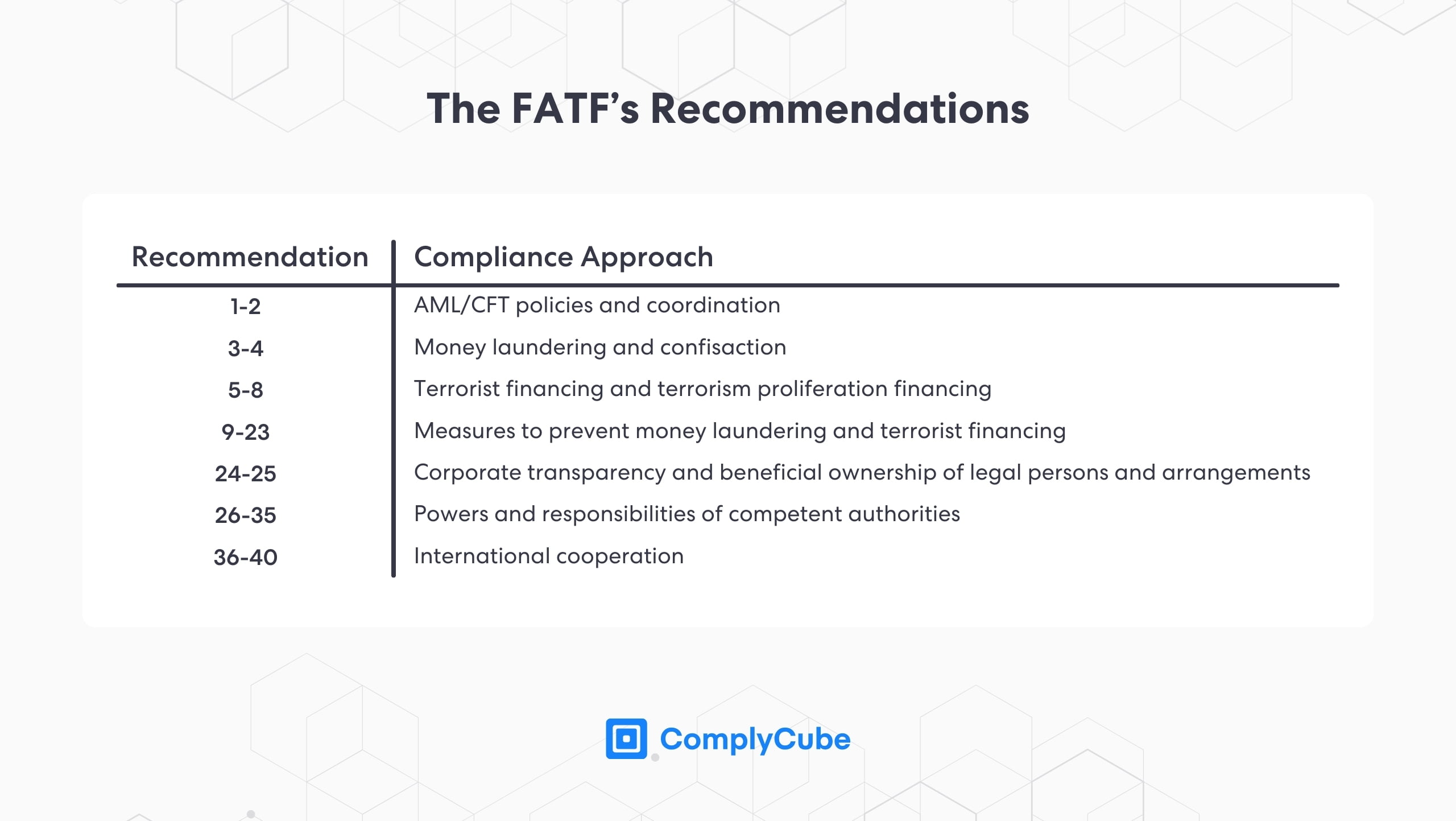
## Know Your Customer Compliance
KYC is an all-encompassing term for the processes involved in attaining and monitoring customer information. This includes the necessary information to make AML decisions on low-risk to high-risk clients. Complying with national regulations and international KYC standards is becoming a global business imperative, regardless of a company’s sector.
Much of the information required to approve new customers is obtained during the customer onboarding process. Automated KYC solutions that incorporate AML software have emerged to foster a seamless onboarding process that drives customer satisfaction. These solutions perform the necessary [Customer Due Diligence](https://www.complycube.com/en/solutions/due-diligence-compliance/customer-due-diligence/) (CDD) checks in the background, contributing to a sleek user experience.
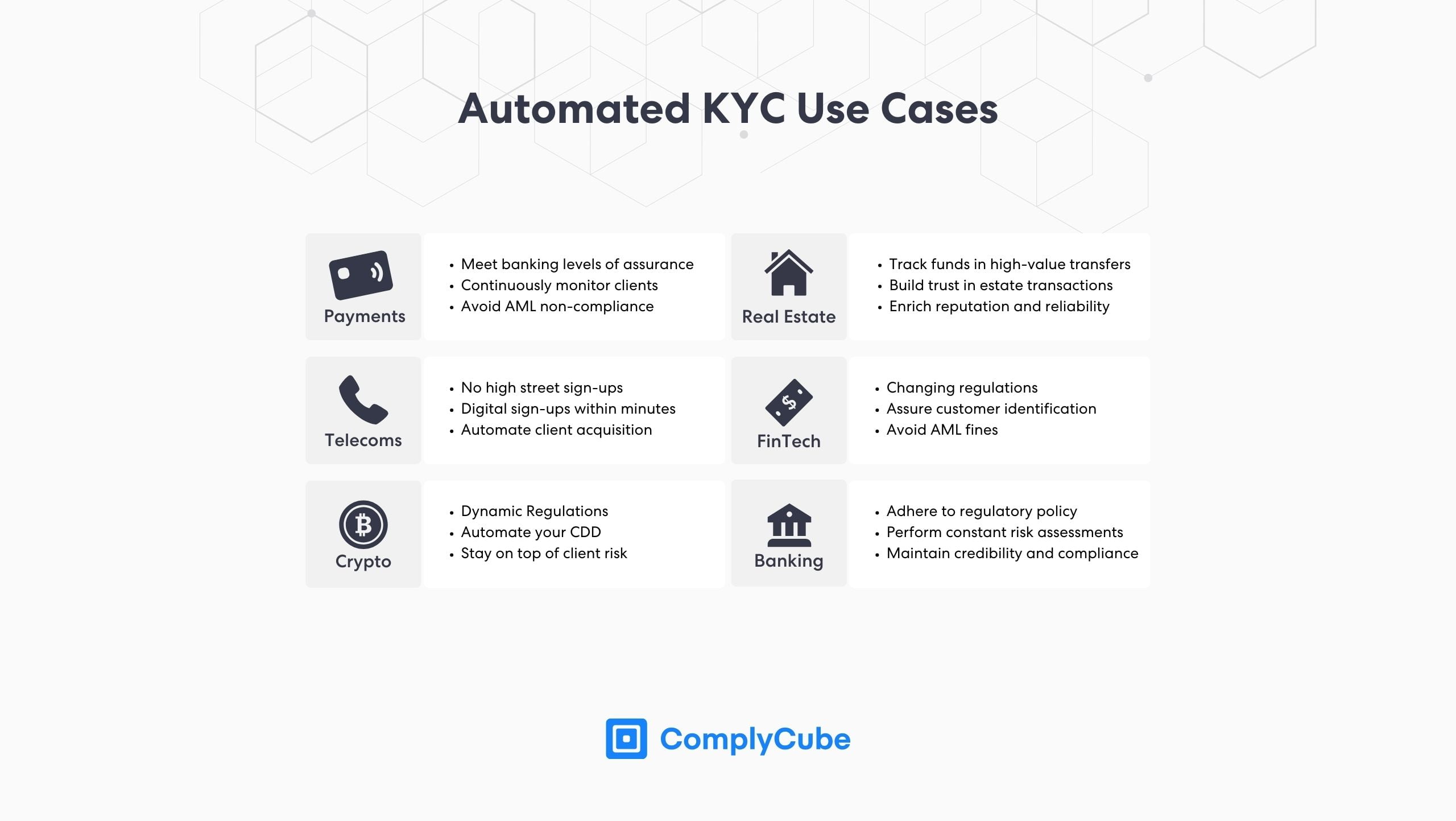
### KYC Onboarding
A KYC onboarding process refers to the workflow that a new user completes when signing up for a new service. Every company has a unique Risk-Based Approach (RBA) that demands specific qualities from their risk assessment. This makes KYC requirements per industry very flexible, demanding versatile onboarding software.
A Know Your Customer strategy goes much further than simply the initial user experience and client acquisition stage. Following the IDV and KYC onboarding checks, the user is subject to a host of CDD practices, including [Politically Exposed Person (PEP) screening](https://www.complycube.com/en/solutions/global-screening/sanctions-pep-screening/), [watchlist screening](https://www.complycube.com/en/solutions/global-screening/watchlist-screening/), and [adverse media checks](https://www.complycube.com/en/solutions/global-screening/adverse-media-checks/), which are conducted in real-time to strengthen their validity. This process is known as [ongoing monitoring.](https://www.complycube.com/en/solutions/global-screening/continuous-monitoring/)

This KYC process allows a company to regularly monitor a customer’s risk level to make informed decisions around the clock and understand which users might need to be monitored for suspicious activity. To learn more about ongoing or continuous monitoring, read [What is an Ongoing Monitoring Process?](https://www.complycube.com/en/what-is-an-ongoing-monitoring-process/)
## KYC Onboarding Process: The Details
Customer onboarding processes are the initial point of contact between a user and a business. A KYC onboarding process provides a streamlined route for businesses to onboard new customers while simultaneously extracting and analyzing user data.
## Customer Acquisition Tools
KYC solutions have become increasingly automated. To accomplish this, KYC services leverage machine learning technologies to carry out tasks that would have previously been completed by a human. Over the next 3 years, [91% of firms](https://www.forbes.com/sites/forbestechcouncil/2023/06/22/kyc-is-not-enough-how-to-prepare-for-the-future-of-verification/) in finance, aviation, telecommunications, and many other industries are expected to increase their spending on Identity Verification (IDV) systems. By 2027, the IDV market is expected to double in size from its 2024 valuation.
### Document Verification
Utilizing advanced Artificial Intelligence (AI) mechanisms, KYC documents, such as a passport or a driver’s license, can be analyzed in seconds. [Document verification](https://www.complycube.com/en/solutions/identity-assurance/document-verification/) analyzes this data at a far greater speed than a human could while providing a greater level of precision.
Authenticating identification documents involves 7 categories of analysis, and while human operators have been trained to identify fraudulent documents, human error cannot be completely eradicated. For more information on document verification, read [What is Document Verification?](https://www.complycube.com/en/what-is-document-verification/)

### Biometric Verification
[Biometric verification](https://www.complycube.com/en/solutions/identity-assurance/biometric-verification/) strengthens a new user’s legitimacy by examining a selfie upon signup. Utilizing a facial recognition engine and a technology known as [Presentation Attack Detection](https://docs.complycube.com/documentation/checks/identity-check) (PAD), these systems create a powerful verification machine.
PAD is the technology that detects the liveness of an image, assessing whether it is real, fake, or tampered with. The technology can authenticate a limitless number of selfies every day, ensuring that scalability does not forsake reliability and that the process will not hinder a business’s customer onboarding strategies. For more details, read [The Advantages of Biometric Verification](https://www.complycube.com/en/the-advantages-of-biometric-authentication/).

These technologies are capable of handling a huge amount of transactions every day without reliability suffering as a consequence of laborious throughput. Verifying users via automated processes dramatically reduces the rate of failed customer acquisition. Both processes are fundamental in modern client acquisition and significantly contribute toward the two core concepts of KYC onboarding processes:
1. Efficiency, and
2. Accuracy.
## Efficient Customer Onboarding Process
KYC onboarding processes are much more than an AML compliance tool. A wealth of competition in the space has meant that KYC vendors must also supply their customers with client acquisition workflows that are sleek and frictionless.
User experience must be at the heart of the process development, meaning customer onboarding must be easy for users to complete. [87% of users](https://www.complycube.com/en/use-cases/process/customer-onboarding/) believe that businesses don’t do enough to deliver a seamless customer onboarding experience. Integrating with a KYC onboarding process is the catalyst that satisfies the other 13%.
### Frictionless User Experience
A robust KYC onboarding process should encourage users to sign up during the process, not deter them. As mentioned above, a client acquisition system defines a user’s first impression; businesses must make it count.
Document and biometric verification can be completed jointly in under 30 seconds, and the visual workflow on the customer side can personalized to your firm’s brand image. This impresses clients with a sleek and stylized process that will mitigate failed signups.
### Scalable KYC Processes
Advanced KYC onboarding tools are designed to be able to handle the ever-increasing volume of customer transactions and throughput. Scalability is a crucial element driving businesses’ success, particularly in industries with demanding growth, such as crypto, neobank, and gaming platforms.
Without integrating with a KYC onboarding process, high-growth enterprises will struggle to cope with the volume of customers they need to onboard to remain competitive. Traditional KYC and onboarding methods are too inefficient and do not maximize resource allocation.
The popular dating app [Tinder takes a few hours to verify identity documents](https://www.help.tinder.com/hc/en-us/articles/360040592771-How-does-age-verification-work#:~:text=You%20will%20be%20under%20review,age%2C%20please%20visit%20this%20article.). While this is not currently impeding their growth, it does give rise to new market opportunities from competition that can provide a more seamless KYC and induction strategy.
### Broad Range of Functionality
Compliance with local jurisdictions is crucial to every business. Learning about the nuances of international, national, and local regulations can be extremely time-consuming, but Know Your Customer solutions do the heavy informational and compliance lifting.
ComplyCube offers its customers an exhaustive solution spanning 220+ regions and accepting over 13,000 KYC documents. Traditional client acquisition methods are rendered obsolete in comparison to the efficiency and comprehensiveness of the modern KYC onboarding process. Such strategies make meeting global regulatory standards effortless while also simplifying the customer onboarding journey.
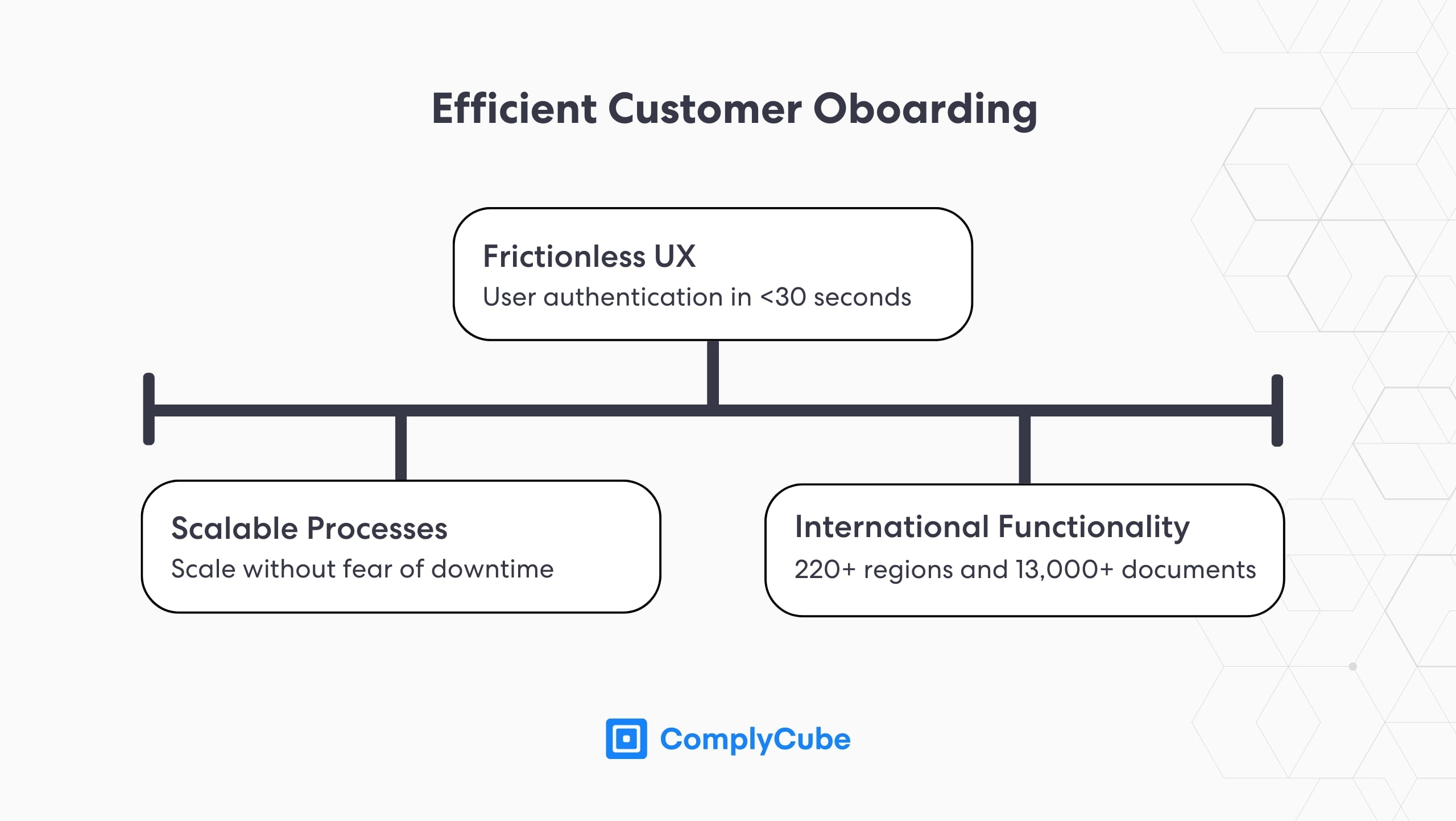
## Accurate Tools to Ensure Compliance
KYC onboarding solutions provide tools to streamline more than operational efficiency. They facilitate an infrastructure that dramatically increases the precision of the collected data upon client acquisition, making ensuring compliance with industry-specific AML regulations far smoother.
### Verification Precision
KYC onboarding processes provide a superior level of precision at scale to traditional IDV methods. A 2018 report by the National Institute of Standards and Technology found that the development of AI has significantly advanced the capabilities of Identity Verification.
> The rapid advance of machine-learning tools has [effectively revolutionized the industry](https://www.nist.gov/news-events/news/2018/11/nist-evaluation-shows-advance-face-recognition-softwares-capabilities).
This trend continues into 2024, which is swiftly becoming a watershed year for AI technologies. Document and biometric verification are powered by state-of-the-art machine learning technologies, which enable the extraction and authentication of client data to a degree unattainable by a human.
AI-powered precision empowers businesses in customer experience and regulatory compliance. The accuracy of the checks helps prevent the creation of fraudulent accounts without compromising a sleek user process.
### The KYC Cost of Hesitation
A KYC onboarding process is proving to be a far more reliable strategy than traditional methods. Data from every industry that has integrated these advanced methods exemplify this. However, the real adoption and uptake of KYC onboarding into client acquisition remain slow.
Some industries, like banking, have been slow to adapt to the digital transformation, meaning those same industries witness languid onboarding processes. Industries’ reluctance to embrace digital transformation has enabled more agile competition, in this context, neobanks, to exploit this and flourish.
> Firms should re-engineer their Anti-Money Laundering (AML) systems and controls to [refocus on Know Your Customer (KYC) processes](https://www.thomsonreuters.com/en-us/posts/investigation-fraud-and-risk/kyc-modeling/).
Hesitations over integrating with a KYC partner represent a potentially substantial cost. Traditional industries that do not leverage KYC onboarding strategies forfeit the added benefits of streamlined operations, enhanced customer experience, and improved reliability and precision of data extracts.
More agile competitors who embrace these innovations are then allowed the space to capitalize on market share. This is the KYC opportunity cost that will become increasingly significant in the digitalized era.
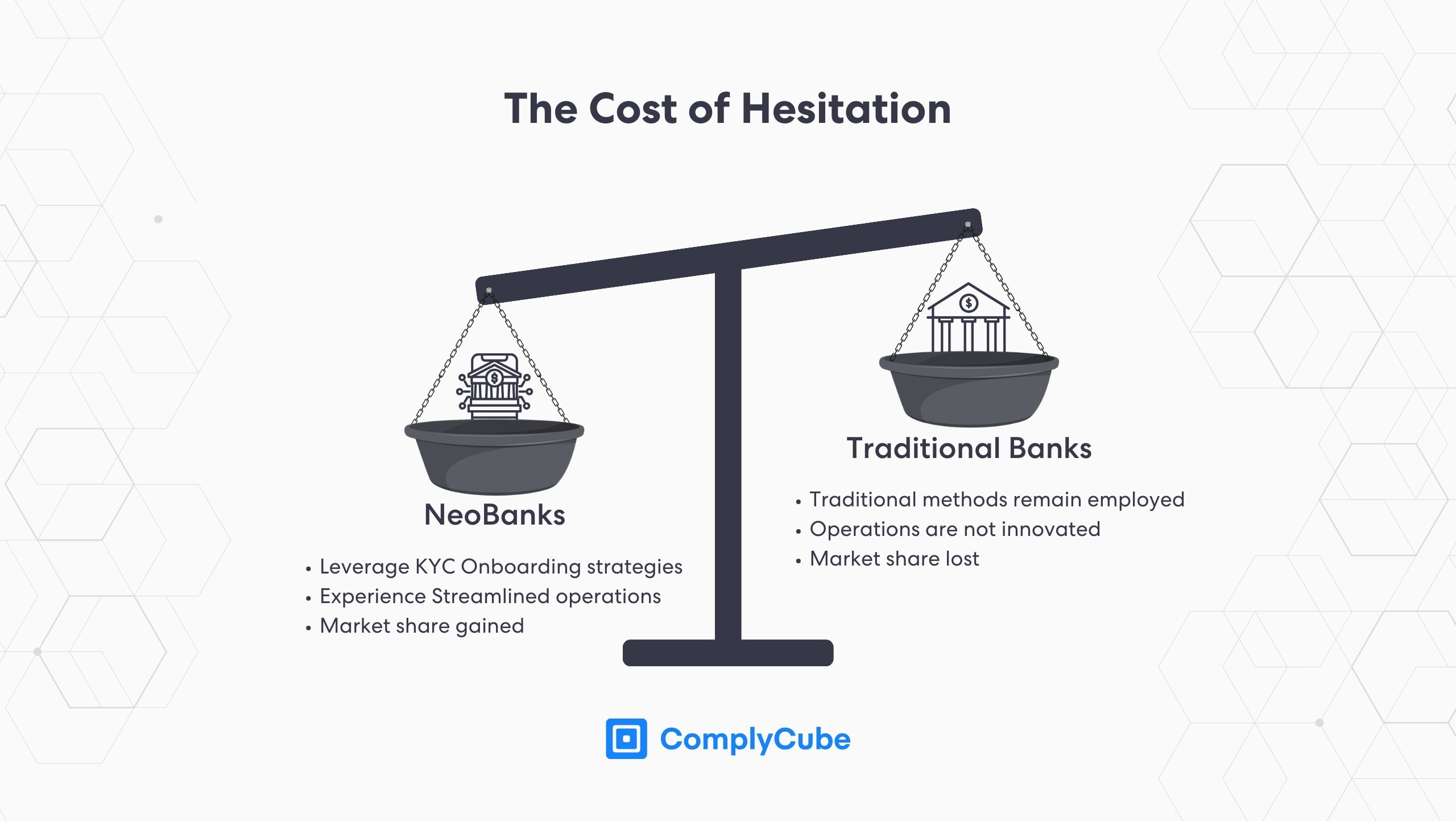
## Should Your Business Embrace KYC Onboarding?
In an increasingly competitive market, customer trust can dictate business success. KYC onboarding processes are proving to be extremely influential in fostering trust from the beginning of a client and business relationship and mitigating financial crime. Failing to adapt to increasing digitalization could result in regulated entities, such as banks, committing more resources than ever to their AML obligations.
Reluctance to adopt such technologies hinders operational efficiency and compromises customers’ safety and trust in institutions. In contrast, entities that embrace these innovative solutions secure a significant advantage, setting new standards for customer experience and adherence to regulatory requirements.
Institutions that choose to employ KYC onboarding technologies will take significant strides ahead of their competition, enabling greater growth, expansion, and operational efficiency. If your business faces challenges in complying with AML requirements, ComplyCube’s KYC offering can help. Contact one of their agents and [find a solution today](https://www.complycube.com/en/contact/contact-sales/).
**Categories:** Guides
**Tags:** Know Your Customer
---
### [How Effective is Singapore Crypto Regulations?](https://www.complycube.com/how-successful-is-singapore-crypto-regulation/)
**Published:** May 24, 2024
**Author:** Andreea Balasa
**Excerpt:** Asia has multiple hot spots vying for leadership in the crypto market. This cryptocurrency Singapore guide looks at the success of Singapore crypto regulation and where the region is placed globally as a crypto hub.
**Content:**
Asia has multiple hot spots vying for leadership in the crypto market. Singapore crypto regulation has catalyzed the region’s web3 and blockchain industry, propelling the country forward as an industry leader. This cryptocurrency Singapore guide digests the region’s regulatory framework and evaluates its position as a crypto hub in 2024.
Competitive regions in Asia, including Hong Kong and larger countries such as South Korea, now facilitate the infrastructure needed for crypto adoption. Their respective governments have implemented legislation that safeguards the industry and its users by deterring the irresponsible or illicit use of cryptocurrencies. So, where does Singapore rank?
## Singapore Crypto Regulation Overview
In Singapore, individual cryptocurrencies are classified based on their characteristics. They can be regulated as securities, e-money, or Digital Payment Tokens (DPTs). However, if a cryptocurrency is used strictly for utility purposes, it remains unregulated.
The Monetary Authority of Singapore (MAS) does not back any cryptocurrencies for retail use but is actively pursuing an institutional stablecoin program. Such programs involve Central Bank Digital Currencies (CBDCs) via initiatives such as [Project Ubin, Project Dunbar, Project Orchid, and Project Guardian.](https://www.globallegalinsights.com/practice-areas/blockchain-laws-and-regulations/singapore/)
- Project Ubin focuses on blockchain settlements for payment security transactions and is designed to streamline cross-border payments.
- Project Ubin+ is a collaborative effort between Singapore and international organizations using wholesale CBDCs (digital currencies designed for institutional use only) for cross-border foreign exchange settlements.
- Project Dunbar explores how financial institutions could use CBDCs to facilitate direct transfers via a shared platform, bypassing traditional and inefficient intermediaries.
- Project Orchid looks at establishing an infrastructure for a retail CBDC system. This retail-centric approach is viewed as a less significant development as issues of financial inclusion and transparency for users are not deemed urgent.
- Project Guardian is a [tokenization initiative](https://www.mas.gov.sg/schemes-and-initiatives/project-guardian) that researches the efficacy and utility of tokenizing Real-World Assets (RWAs) such as bonds, bank liabilities, and asset-backed securities. Tokenization could reduce users’ barriers to finance and increase liquidity in financial markets.
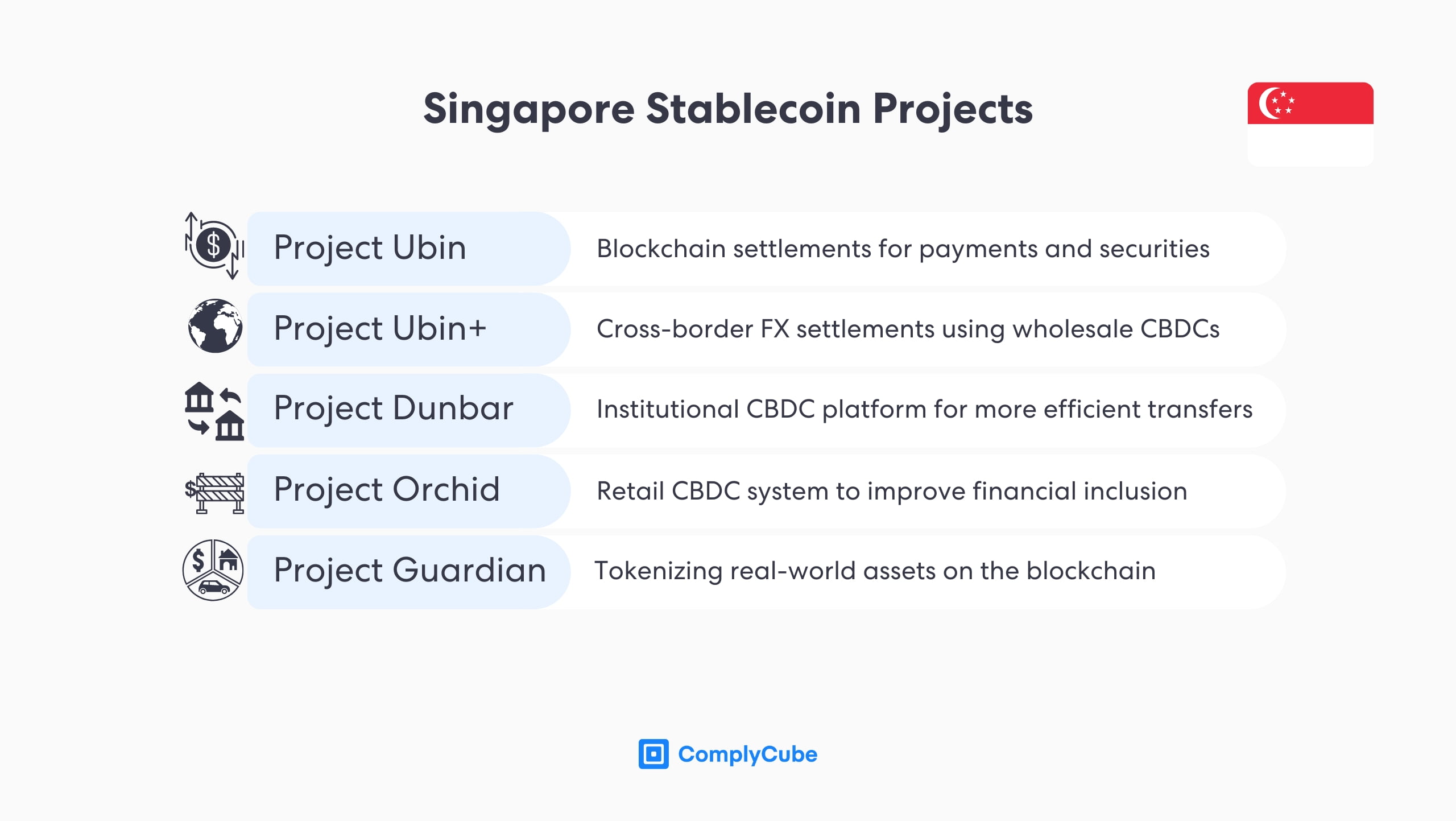
Deutsche Bank has recently joined Project Guardian to explore the applications of tokenization in traditional financial markets. Bridging RWAs on-chain is a quickly developing trend between the crypto industry, Decentralized Finance (DeFi), and Traditional Finance (TradFi).
> The collaborative initiative is dedicated to testing the [feasibility of asset tokenization applications in regulated financial markets.](https://www.db.com/news/detail/20240514-deutsche-bank-joins-project-guardian-to-explore-asset-tokenization-applications?language_id=1)
Singapore was an early mover in cryptocurrency regulation, establishing comprehensive legislative coverage in 2019 through its Payment Services Act (PSA). Arriving at the crypto regulation game ahead of many other global regions gave the province an advantage for its industry development. Some of these projects represent industry-leading innovation and adoption of blockchain technology.
## Who Regulates Crypto in Singapore?
The [Monetary Authority of Singapore](https://www.mas.gov.sg/) is the leading voice of authority in Singaporean financial markets and is the chief regulator in the cryptocurrency industry. The federal organization has released various regulatory frameworks, many of which are frequently praised for their innovation.
The MAS frequently updates the regulatory landscape to ensure the region stays aligned with the developments of the broader crypto industry. One example of this resides in the 2023 consultation papers issued by Singapore’s central bank, which reevaluated and reformed DPT service providers’ use and custody of client funds under a statutory trust.
The government in Singapore does not have some of the inefficiencies of other financial hubs. While democratic, the leading party has a vast majority in parliament, allowing policies and laws to be passed swiftly. Singapore has a much more efficient mechanism for creating and implementing complex regulations and laws than the UK, US, or Hong Kong.
### The Payment Services Act
The PSA, passed in 2019, is Singapore’s leading framework for the crypto market. It is designed to provide regulatory certainty in what is sometimes a loosely defined industry. All payment service providers must obtain a license with the PSA.
The PSA divides cryptocurrencies into two categories. Some Virtual Assets (VAs) may be outside the PSA’s jurisdiction and regulated under Singapore’s Securities and Futures Act (SFA). This would be the case if a VA displayed characteristics similar enough to assets in Singaporean capital or securities markets. It is the SFA’s prerogative to define the security-like VA class. The two categories under the PSA are:
- E-money is electronically stored monetary value that keeps its value against any chosen fiat currency, such as a Singapore Dollar, euro, or Pound. In the context of cryptocurrencies, these can be compared to stablecoins.
- Digital Payment Tokens are any digital model of value that can be identified and expressed as a unit. They are not pegged to or remain in constant value against a fiat currency. In the crypto industry, these can be viewed as utility and payment tokens.
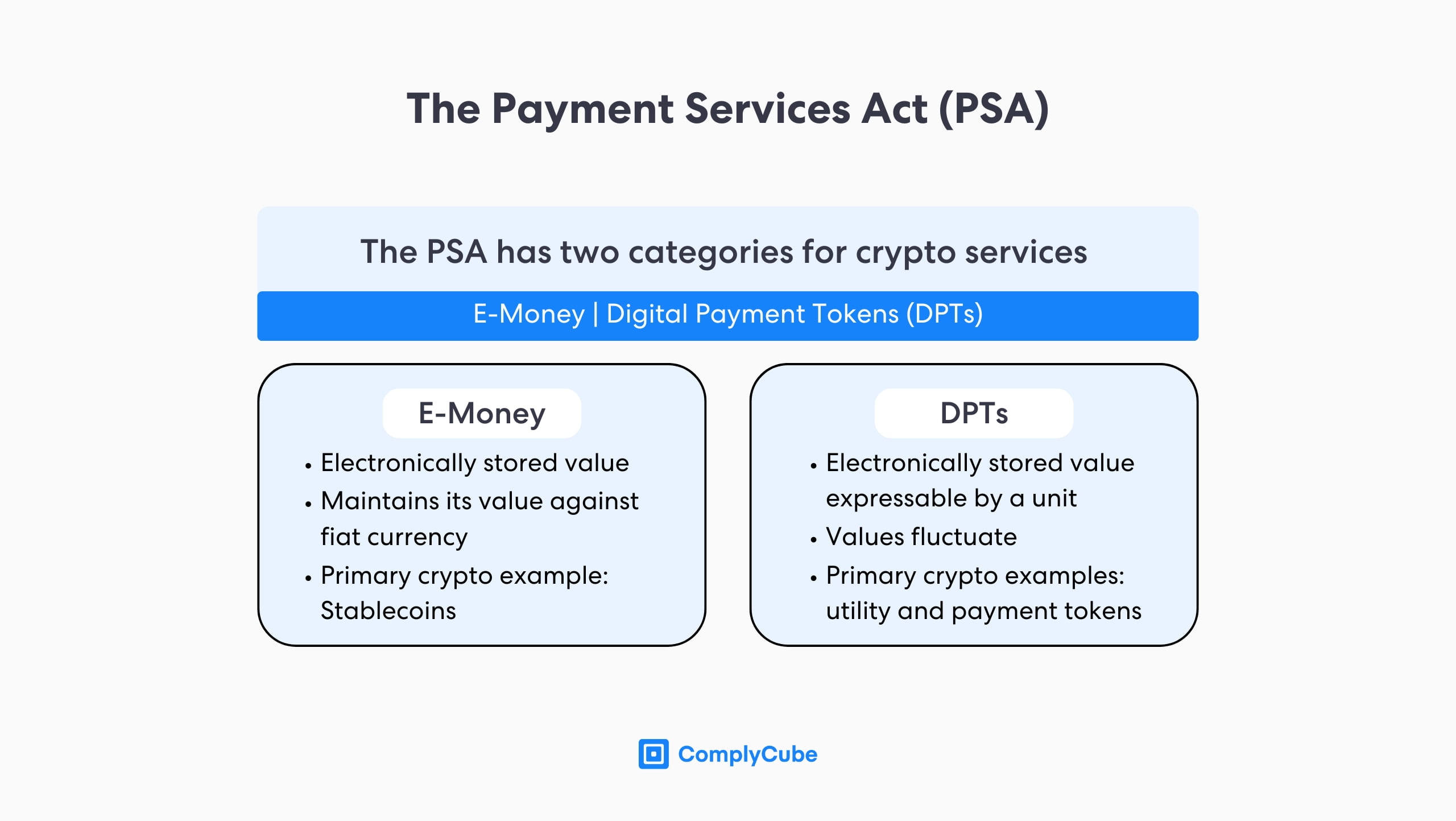
The PSA requires all businesses categorized as payment service providers, including Virtual Asset Service Providers (VASPs) and Digital Payment Token service providers, to obtain a license. 2 out of the 3 PSA licenses relate to cryptocurrencies.
## PSA Licensing Requirements
The 2 licenses are the Standard Payment Institution (SPI) license and the Major Payment Institution (MPI) license. If a VASP’s monthly transaction value exceeds S$3 million (3 million Singaporean Dollars) for any single payment service, the firm must gain a major payment license.
Additionally, an MPI license is also required if a firm’s monthly transactions surpass S$6 million for 2 or more payment services. MPI licenses are also needed for e-money providers if the value per annum of all e-money issued by the license holder exceeds S$5 million per day on average. Any values under these thresholds require only an SPI license.
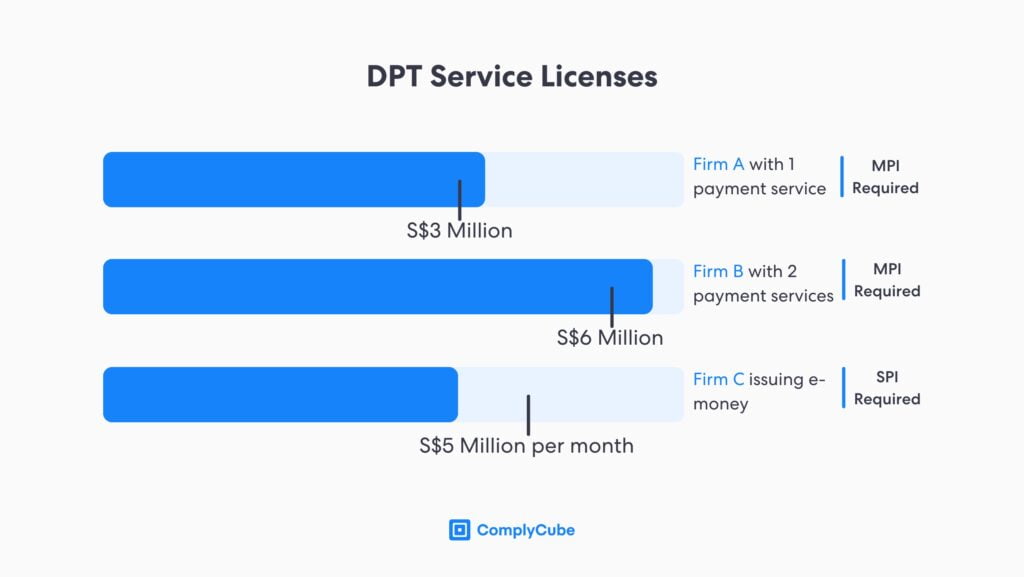
### Getting a Singapore Crypto Regulation License
A third type of financial license is available in Singapore—the Money-Changing license—but this does not relate to VASP or DPT services. To obtain an SPI or MPI license, [the following applies](https://www.mas.gov.sg/regulation/payments/licensing-for-payment-service-providers):
Standard Payment Institution License application:
- Be a Singapore-incorporated company or Singapore branch of a foreign firm
- Have a permanent place or office for your business where company records can be held safely
- The office must have a minimum of 1 individual present to help with potential consumer issues
- Own a minimum base capital of S$100,000, with a sufficient excess buffer for profit and loss
- A minimum of 1 executive director with Singaporean citizenship or permanent residency
For a Major Payment Institution License application, the same criteria apply with the exception of the value of base capital required. Firms wishing to gain an MPI license require S$250,000.
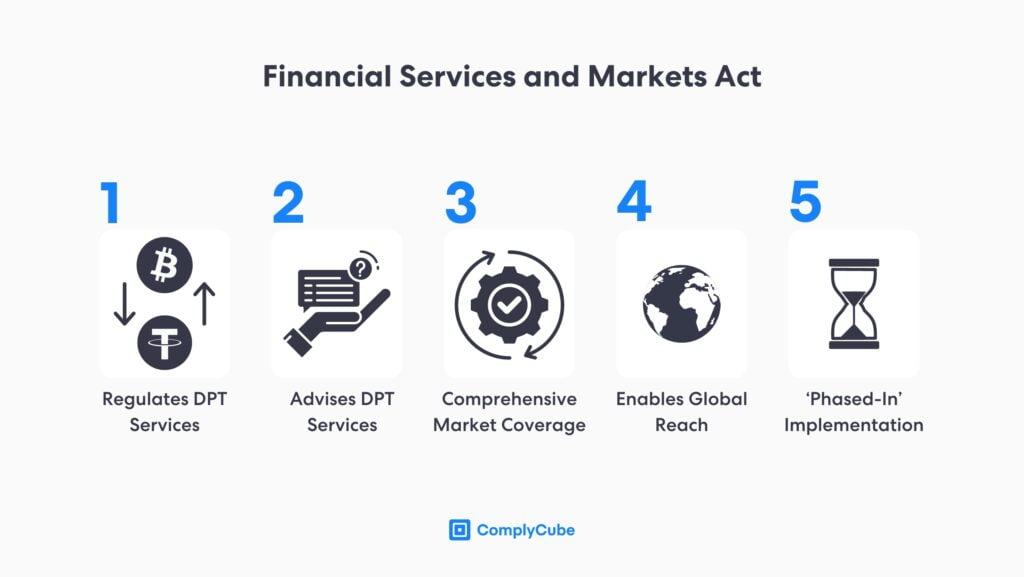
### Payment Services Act Notices
Notice PSN01 pertains to Anti-Money Laundering (AML) and Countering the Financing of Terrorism (CFT) policies for payment service license holders. Under this notice, the payment service provider must perform certain prescribed Customer Due Diligence (CDD) measures if it facilitates a transaction over S$5,000 for a customer who has not established a relationship with the institution.
Notice [PSN02](https://cointelegraph.com/learn/an-overview-of-the-cryptocurrency-regulations-in-singapore-and-thailand) specifically relates to Digital Payment Token Services and references advanced measures to prevent money laundering and the financing of terrorism. These notices were posted in 2019, amended in 2021, and restructured again in April 2024, where the definitions of DPT service providers were expanded.
Following the update, various cryptocurrency-related activities, including the provision of wallet services for DPTs, [custodial services](https://www.coindesk.com/policy/2024/04/02/singapore-enacts-licencing-requirements-for-crypto-custody-services-and-others/#:~:text=The%20amendments%20include%20%E2%80%9Csegregating%20customers,months%20from%20April%204%2C%202024.), and the facilitation of DPT exchanges without requiring the service provider to hold the funds or tokens, were now included in the regulatory framework. This measure helps impose user protection throughout the industry.
These measures ensured that the cryptocurrency industry would be encompassed by the PSA and that all aspects of the market were regulated and supervised sufficiently to encourage a secure and integral industry.
## Financial Services and Markets Act (2022)
The [Financial Services and Markets Act](https://sso.agc.gov.sg/Acts-Supp/18-2022/Published/20220511?DocDate=20220511) (FSM Act) regulates financial institutions in Singapore that provide a Digital Payment Token Service both in and outside of the country. This ensures that all VASPs operate consistently, regardless of where their target market resides. It is fundamental in engaging Singaporean crypto businesses with the regional regulatory framework for AML and CFT policies.
### FSM Act Core Functions:
1. Facilitates digital token exchanges: Firms providing a digital token exchange (crypto exchange or VASP) must comply with regulatory requirements to mitigate financial abuses and acts of money laundering. This also extends to firms that market or promote activities relating to buying, selling, or holding digital assets.
2. Provides financial advice on digital tokens: Businesses providing investor or financial advice relating to DPTs also fall into the jurisdiction of the FSM Act, with a view to ensuring advice is only given by trained, professional, and regulated individuals.
3. Comprehensive scope: The act is designed to encompass the entirety of the digital asset market, including exchanges, custody services, and more, to create a framework that attracts crypto firms catering to a diverse range of utilities.
4. Global compliance reach: Ensuring the FSM Act regulates firms operating outside of Singapore affirms the region’s position as a leading international crypto hub.
5. Periodically implemented: Phasing the framework in slowly ensures that VASPs can integrate into (or adapt their existing processes for) the regulations. By the end of 2024, the framework is anticipated to be fully integrated.
Adhering to money laundering regulations is crucial to being compliant with the Financial Services and Markets Act. Many, if not all, DPT services leverage some kind of KYC and AML solution provider to enable adequate compliance. If your firm requires one, learn more about crypto KYC solutions by reading [How KYC Crypto Regulations Safeguard the Industry](https://www.complycube.com/en/how-kyc-crypto-regulations-safeguard-the-industry/).
## Singapore AML Requirements
According to the updated PSN02 Notice from the MAS, Digital Payment Token services are required to put in place stringent mechanisms to detect and prevent the flow of illicit funds into Singapore’s financial system through digital assets. To do this, VASPs and DPT services must employ:
- A Risk-Based Approach (RBA) and thorough risk assessment and mitigation strategies,
- Rigorous Customer Due Diligence (CDD) procedures, including Enhanced Due Diligence (EDD) and Simplified Due Diligence (SDD),
- Third-party technologies to ensure adequate protection against illicit finance,
- Corresponding accounts and deposit/withdrawal information with thorough record-keeping,
- Transaction Monitoring and the infrastructure for a suspicious transaction reporting office,
- Internal compliance and audit training policies.
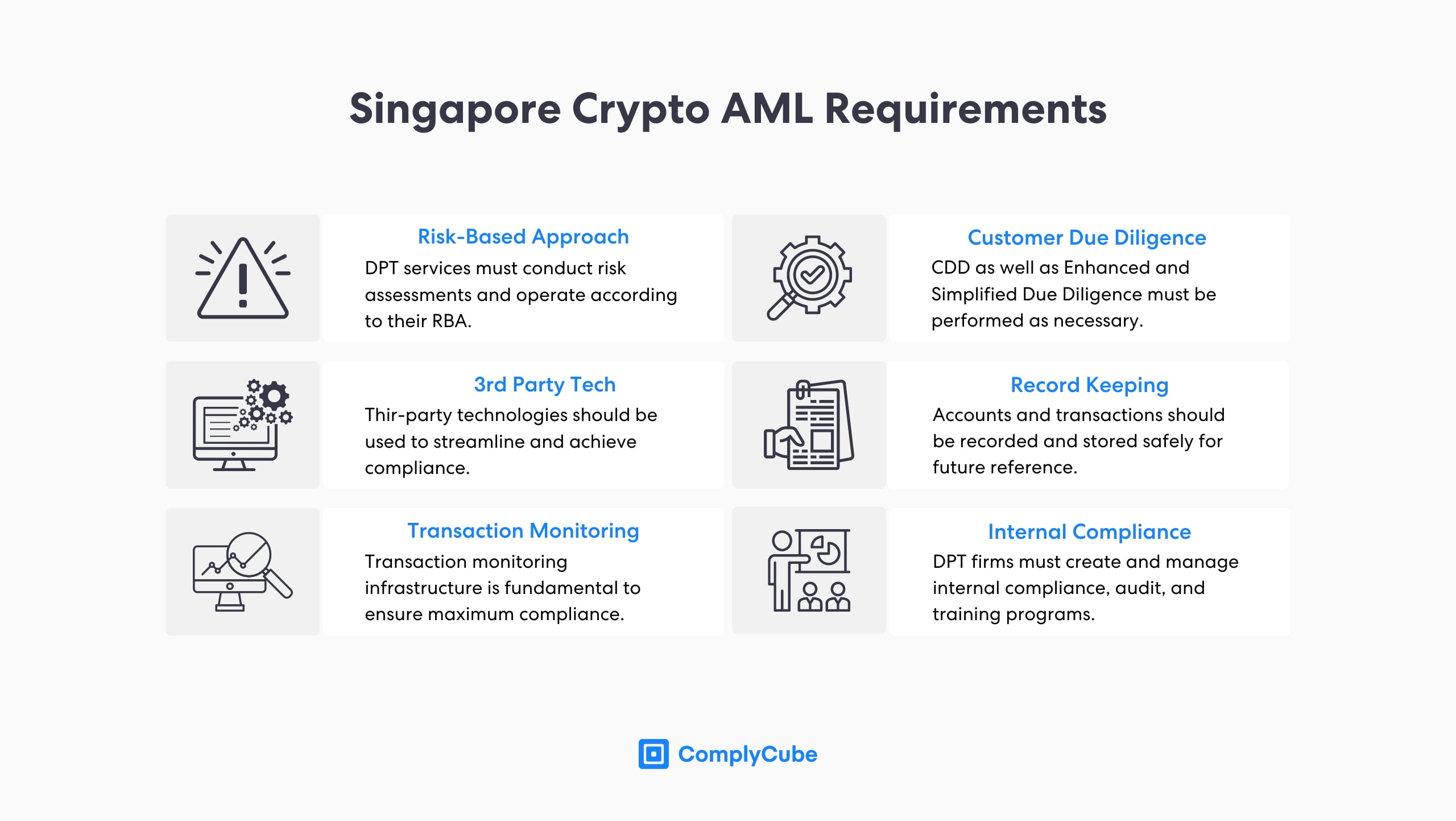
These requirements are easily followed when a firm uses a third-party KYC and AML solution. Crypto exchanges worldwide and most medium—to large-scale enterprises use a KYC onboarding solution to remain competitive.
Without compliance technology, firms and DPT services would find it impossible to comply with demanding legislation while onboarding the volume of customers necessary to remain competitive. The most popular crypto exchange by users and trading volumes, Binance, signed 30% more customers in 2023 than in 2022, displaying exceptional year-on-year growth.
> Over [40 million new users](https://cryptonews.com/news/binance-reports-30-surge-in-users-facilitates-18-more-trades-in-2023-emphasizes-compliance-strengthening.htm).
Onboarding this volume of clients would be impossible without a highly scalable, accurate, and automated KYC solution. Leveraging AML solutions to streamline client acquisition is one of the many reasons crypto exchanges have achieved such notoriety over the past years.
ComplyCube’s compliance platform provides DPT services with an all-in-one solution for client acquisition and real-time Anti-Money Laundering monitoring. This collection of products ensures that VASPs have a comprehensive compliance program.
## Singapore Crypto Regulation: The Crypto Trave Rule
The crypto travel rule is a pivotal regulation in Singapore, deriving from the Financial Action Task Force’s (FATF) [Recommendation 16](https://www.fatf-gafi.org/content/dam/fatf-gafi/guidance/Targeted-Update-Implementation-FATF%20Standards-Virtual%20Assets-VASPs.pdf.coredownload.inline.pdf). It requires the collecting and sharing of client data when transactions exceed a certain threshold. While the threshold is open to the discretion of local regulators, it is S$1,500 in Singapore. For more information about how to comply, read [The Crypto Travel Rule.](https://www.complycube.com/en/the-crypto-travel-rule-and-the-need-for-aml-compliance-software/)
### Singapore Travel Rule Requirements
Before a transaction can be submitted, DPT providers must collect and share the personal data of each user involved in the transaction on behalf of the originator or the beneficiaries of the transaction. This includes the names and account numbers of both users/parties involved in the transaction as well as the transaction ID (transaction hash if it is on the blockchain).
**For transactions below S$1,500,** only the following information is required:
- Name of the originator
- The originator’s account number
- Name of the beneficiary (or the individual receiving the funds)
- The beneficiary’s account number
**For transactions exceeding S$1,500**, further data is required on top of the above-mentioned information:
- The originator’s address
- A government-issued identification number, such as a passport number
- Date of birth, along with any other pertinent personal information
Enforcing this rule is much more difficult when an unhosted wallet is involved in the transaction. Unhosted wallets do not require any sort of KYC or client acquisition process to sign up, making compliance with the travel rule more challenging as there is no customer information to transfer.
While the crypto travel rule is increasingly being adopted globally, there remain several challenges to its full adoption. Unhosted wallets are identified through only a series of numbers and letters. The MAS offers advice on best practices when unhosted wallets are receiving or sending transactions.
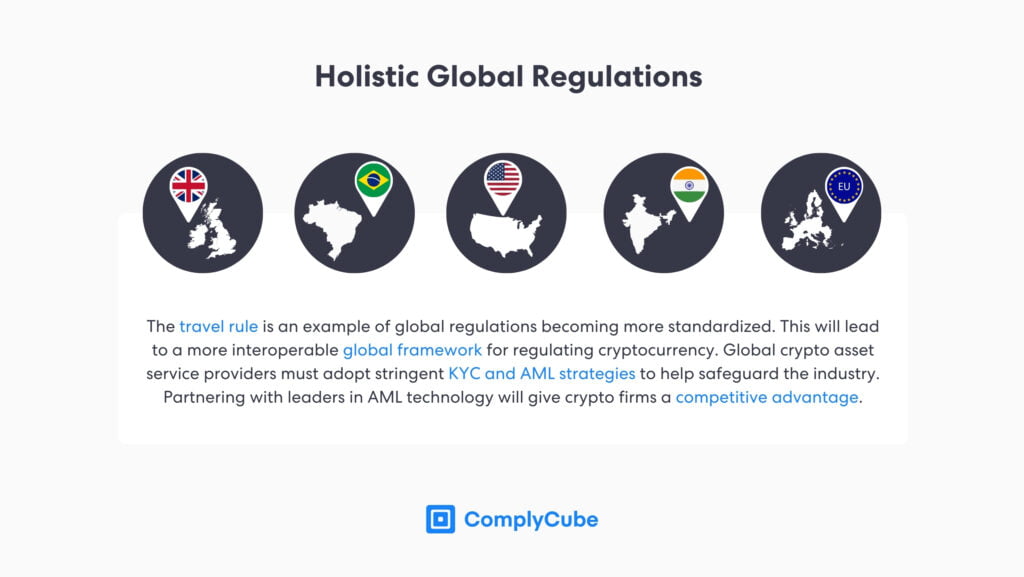
## Asian Crypto Cooperation at a Glance
Various Asian regions, particularly Hong Kong and Singapore, have been perceived as rivals for some time. While both vying for the top spot in Asian finance, Singapore has certainly been the relative winner in recent decades.
However, recent reports in 2024 suggest that there might be future cooperation between these provinces in the crypto industry. Hong Kong’s advances with crypto ETFs, particularly in Ethereum and Bitcoin financial products, set the stage for an altcoin Exchange Traded Fund.
[A strategic partnership](https://www.ft.com/content/81470acd-17d7-4232-990b-8d1a50a480f7) between Harvest Global (Hong Kong ETF administrator) and Metacomp (Singapore-based digital assets group) could extend these ETFs to the Singaporean market, marking a significant and revitalized financial relationship between the two provinces.
Furthermore, Hong Kong and Singapore crypto regulations are both comprehensive enough to attract talent to a bustling crypto industry but nuanced enough to attract different firms/institutions for different reasons. For more information on Hong Kong crypto regulations, read [Hong Kong Crypto Regulation in 2024](https://www.complycube.com/en/hong-kong-crypto-regulation-in-2024/).
## Should you Integrate with a KYC and AML Solution?
Partnering with a compliance provider will significantly streamline your operations. Client acquisition, solutions, customer case management, and real-time AML monitoring are just some of the beneficial solutions that DPT services in Singapore and VASPs worldwide are already using to remain competitive.
Furthermore, the MAS heavily endorses the use of 3rd-party compliance technologies to optimize internal processes and assure compliance with the region’s crypto regulatory framework. ComplyCube offers a suite of KYC and AML compliance services used by cryptocurrency firms to grow around the world.
Wherever your DPT, VASP, or crypto firm is based, ComplyCube’s global reach catalyzes local compliance, national growth, and international expansion efforts. If you’re interested, start a conversation today and [request a demo from their team of experts](https://www.complycube.com/en/contact/contact-sales/).
**Categories:** Guides
**Tags:** Crypto Regulations
---
### [UAE and Dubai Crypto Regulations in 2024](https://www.complycube.com/uae-and-dubai-crypto-regulations-in-2024/)
**Published:** June 6, 2024
**Author:** Andreea Balasa
**Excerpt:** The UAE crypto industry thrives due to the effectiveness of the Dubai cryptocurrency regulations. This guide investigates the UAE and Dubai crypto regulations and how crypto compliance differs between the Emirates.
**Content:**
The United Arab Emirates (UAE) crypto regulatory framework is divided by the Emirates. Dubai crypto regulations were created to foster innovation and encourage a bustling crypto industry. This guide investigates Dubai cryptocurrency regulations and how crypto compliance, Anti-Money Laundering (AML) requirements, and local policy differ from the rest of the country.
## The Crypto Regulatory Framework in the UAE
The United Arab Emirates has 7 regions, which were unified between 1971 and 1972 to bring about greater political and economic cooperation between the states. This allowed the Emirates to diversify its economies and specialize in each Emirate. Different regions now play independent but pivotal roles in strengthening the UAE’s economy.
Dubai’s innovation-focused regulatory policies regarding crypto assets are central to its rise as a financial and crypto hub. While all Emirates act under federal law, each state still has a great deal of autonomy. Dubai’s rise as a financial focal point is no coincidence. The region was given greater freedom to endorse regulations and policies attractive to global financial markets, notably the crypto industry.
The UAE’s leading federal financial industry regulatory authority is the Securities and Commodities Authority (SCA). The SCA enacted a policy prohibiting any person from engaging in Virtual Asset (VA) activities in Onshore Dubai without obtaining a license from the national regulator or a separate local authority.
In March 2022, however, Dubai’s Financial Free Zone took significant strides forward with its own set of regulations. Shortly after, the rest of Dubai (outside of the Free Zone) was subjected to the authority of the Virtual Assets Regulatory Authority (VARA), which enabled the significant growth and development of the Emirate’s crypto industry.
### Dubai and Abu Dhabi Economic Strategies
All of the Emirates are fundamental to the country’s economy. However, Abu Dhabi and Dubai have the most significant international recognition. The former is generally recognized as a stable financial hub with rigorous regulatory policies to ensure a safe financial system and prevent money laundering. The Abu Dhabi financial sector is strengthened by oil industry revenues and sovereign wealth funds, including the Abu Dhabi Investment Authority (ADIA).
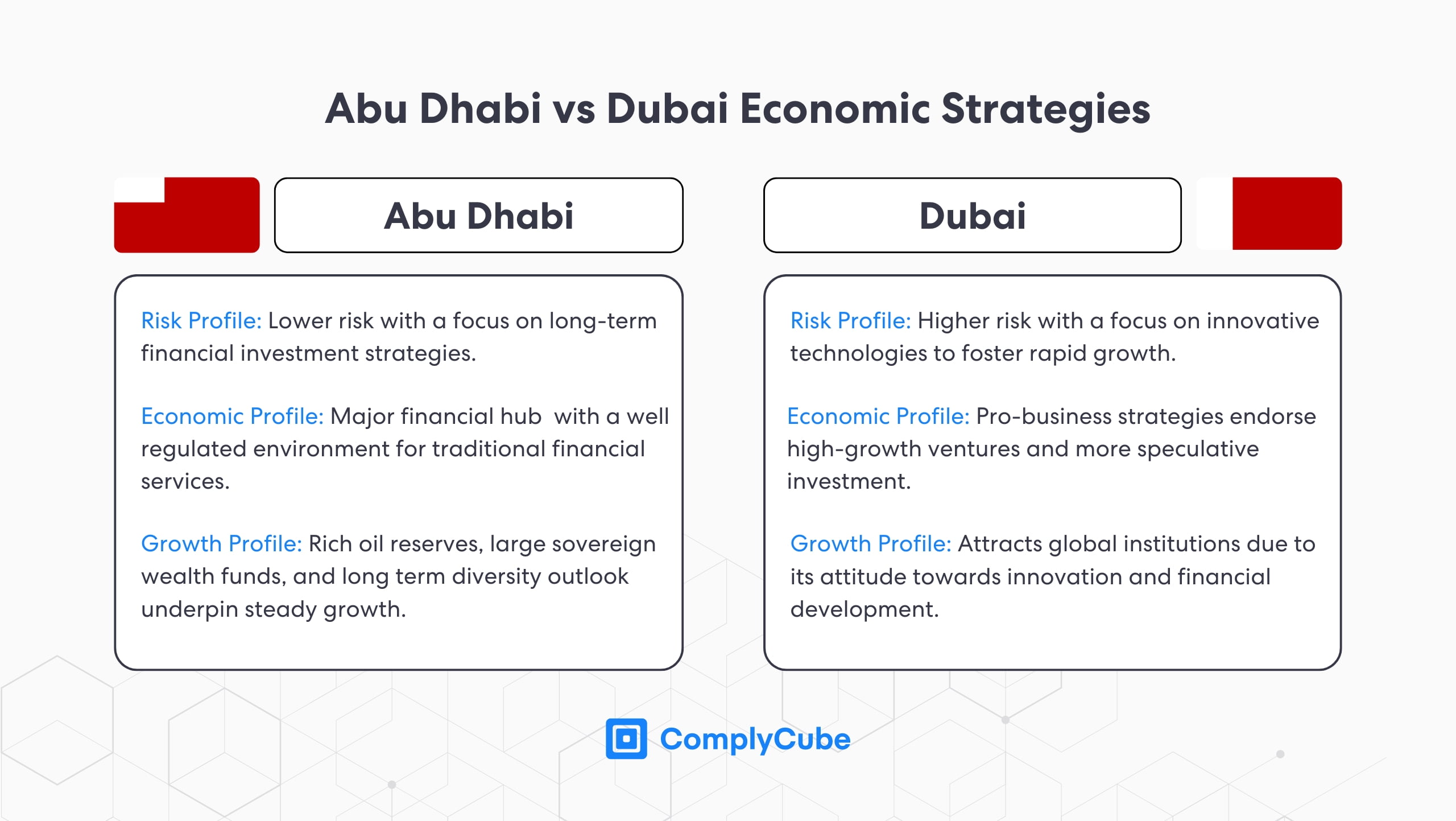
Conversely, Dubai is better characterized by a higher-risk and higher-reward economic strategy. Dubai crypto regulations, including legislation by the Virtual Assets Regulatory Authority, are designed to encourage the industry’s growth. Initiatives such as this have attracted multiple Financial Technologies (FinTechs) in a variety of forms, including crypto exchanges, VA services, and many others in non-crypto-related sectors.
## Who Regulates Digital Assets in Dubai?
Article 121 of the UAE Constitution allows the creation of Free Zones throughout the country. Specifically, [Federal Law No.8 of 2004](https://www.charlesrussellspeechlys.com/en/insights/expert-insights/dispute-resolution/2023/uae-the-virtual-currency-regulation-review/) permits ‘Financial Free Zones,’ which are exempt from civic and commercial laws that the rest of the country is bound to. They are, however, required to adhere to the same federal criminal laws.
## Dubai Crypto Regulations
The UAE has created two Financially Free Zones: the Abu Dhabi Global Market (ADGM) and the Dubai International Financial Centre (DIFC). The DIFC has its own regulator, the Dubai Financial Services Authority (DFSA). This regulatory body has established its own Virtual Asset (VA) framework, including the Investment and Crypto Tokens Regimes.
Outside the DIFC, known as onshore Dubai, a regulatory body called VARA oversees Virtual Asset Service Providers (VASPs). This council, established under [Dubai Law No. 4 of 2022](https://dlp.dubai.gov.ae/Legislation%20Reference/2022/Law%20No.%20(4)%20of%202022%20Regulating%20Virtual%20Assets.pdf), provides comprehensive regulations and guidance for VASPs that are favorable for attracting crypto projects.
It is important to note that VARA has no legal jurisdiction in the DIFC, just as the DFSA has no authority outside of the International Financial Centre. Both regions of Dubai operate independently under different regulations. This does not denote that the regulatory landscape in both areas is vastly different; there are, naturally, areas of overlap.
## The Dubai Financial Services Authority
The DFSA has two key regulatory policies, the Investment Token Regime (October 2021) and the Crypto Token Regime (November 2022). The former was ultimately a preliminary set of legislative measures that marked the birth of cryptocurrency regulation in the DFSI.
### Investment Tokens Regime, 2021
The regulation of Investment Tokens was designed to outline the definitions, scopes of application, and current and future regulatory objectives. The proposal defined investment tokens as either security tokens or derivative tokens.
These tokens are defined as digital representations of rights and ownership stored cryptographically and transferred via a Distributed Ledger Technology (DLT) or a blockchain. Investment Tokens can either represent rights directly or display qualities that are ‘[substantially similar in nature to those conferred by a security or derivative.](https://dfsaen.thomsonreuters.com/rulebook/25-october-2021-dfsa-introduces-regulatory-framework-investment-tokens)‘
This framework applies to institutions involved in marketing, issuing, trading, or holding Investment Tokens within the DIFC. However, the regulations also extend to authorized firms that engage with Investment Tokens, such as facilitating transactions, using the tokens for payments, and advising.
The DFSA released this initial Regime with the intention of providing more comprehensive regulation for other kinds of cryptocurrencies, including asset-baked tokens (stablecoins), utility tokens, and more. The Investment Tokens consultation was designed to help authorities comprehend how best to regulate the broader industry in a way that would benefit the firms operating in the Dubai International Financial Centre.
### Crypto Tokens Regime, 2022
The following year, on November 1st, 2022, the DFSA released its comprehensive legislation for regulating the cryptocurrency industry and markets generally. This second initiative was built to foster innovation responsibly, ensure businesses adhere to best [Anti-Money Laundering](https://www.complycube.com/en/solutions/due-diligence-compliance/anti-money-laundering/) practices, and provide infrastructure for consumer protection.
The framework is designed to balance technologies, allowing firms to offer a broad range of financial products, including VAs. Covering areas of financial crime, technology, fraud, governance, and risk, the Regime ensures that [Anti-Money Laundering and Counter-Terrorist Financing (AML/CFT) issues *are covered*.](https://www.difc.ae/business/establish-a-business/digital-assets)
Under this policy, firms operating in the Dubai International Financial Center can apply for licenses to provide financial services using Crypto Tokens. Furthermore, this opened the opportunity for crypto services, meaning the industry could branch into custodial services, crypto asset management, and token markets/exchanges.
The response to this development was very positive, with [over 100 firms inquiring](https://www.dfsa.ae/news/dfsas-crypto-regime-one-year) about Crypto Token initiatives in the DIFC. In 2022, the DFSA recognized 3 tokens, including [Bitcoin, Ethereum, and Litecoin](https://www.dfsa.ae/news/notice-amendments-legislation-october-2022-2). At the turn of the year in 2023, it added [2 tokens: Toncoin and Ripple’s XRP token](https://www.dfsa.ae/news/notice-crypto-token-recognition).
While these appear to be very few cryptocurrencies, they are some of the most prominent in the industry regarding market capitalization and trading volumes. Their longstanding credibility makes them a more suitable choice – at least in the short term – for institutional adoption and use.
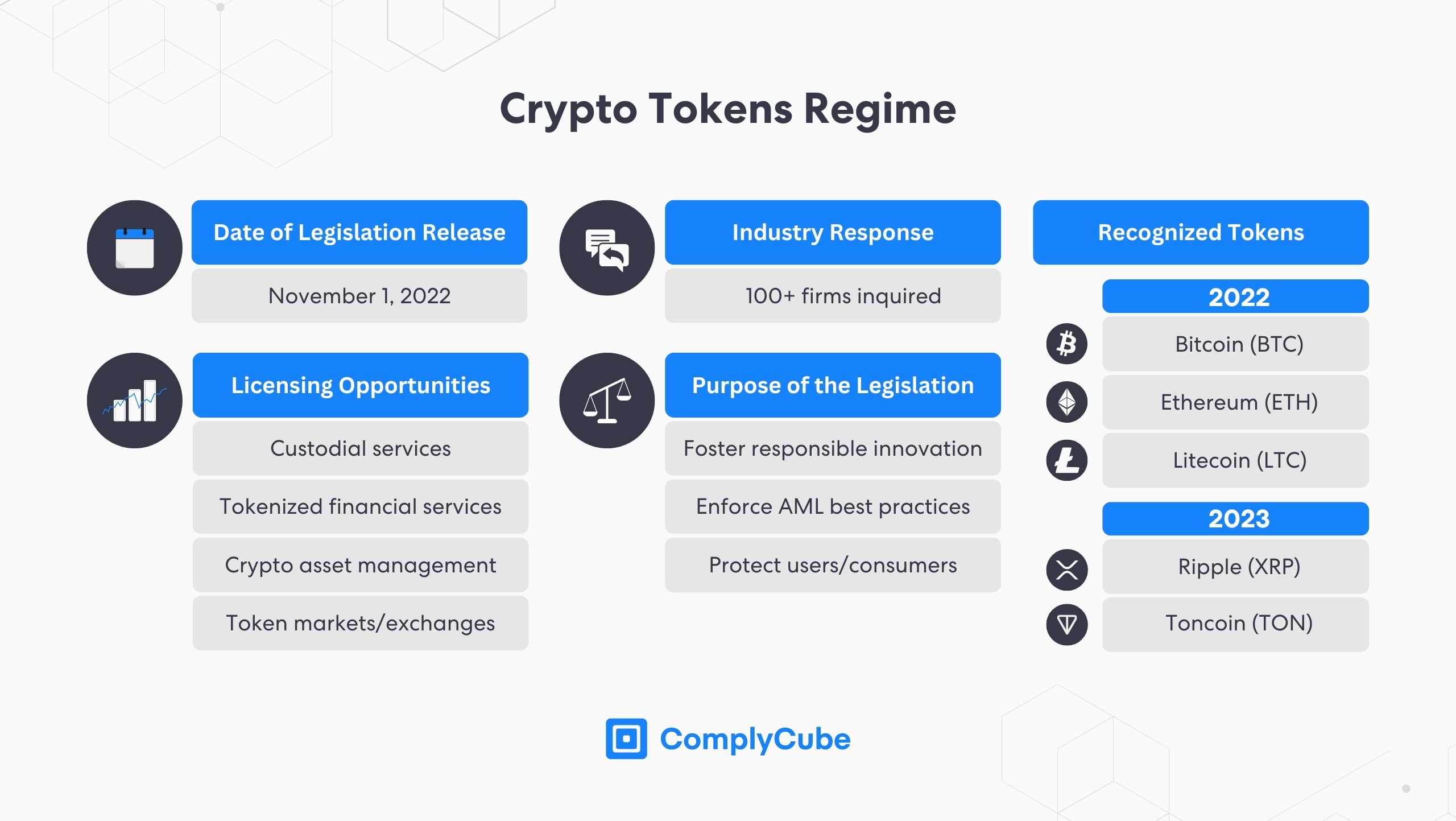
## Gaining a license with the DFSA
The regulator has created a list of modules for businesses looking for a license to adhere to; firms must also meet the specifications established in their comprehensive [GEN modules](https://dfsaen.thomsonreuters.com/rulebook/gen-3a34) (their regulatory rule book.) The list includes:
- Business model and strategy
- Corporate governance and management
- Senior management
- Ownership and corporate structure
- Financial and relevant operational resources
- Business conduct and approach to AML
As the Regime relates to multiple financial sectors, the fees for gaining a license can vary significantly, [between $2,000 and $70,000](https://www.dfsa.ae/application/files/9915/8385/1306/APPLYING_FOR_AUTHORISATION_Final_Nov_2011.pdf), notably paid in USD. These regulations exemplify Dubai’s progressive stance on the future of finance and fintech, positioning itself as a leader by example for other financial hubs.
The Dubai International Financial Centre has become a cornerstone of the Emirate’s economy. 2023 alone witnessed the development of over [500 global AI and Web3 start-ups](https://www.difc.ae/whats-on/news/difcs-20th-anniversary-takes-flight-with-strong-contribution-to-dubais-economy). Of course, the Dubai VA sector extends far beyond the jurisdiction of only the DFSA.
## The Virtual Assets Regulatory Authority
VARA has significant autonomy from all other UAE federal regulators. This is one of the core components behind the region’s success. There are some parallels between VARA and DFSA; however, there is no jurisdictional overlap.
The Virtual Assets Regulatory Authority is the leading regulatory voice of Onshore Dubai and was established in 2022 under [Law No. 4 of 2022.](https://rulebooks.vara.ae/sites/default/files/en_net_file_store/VARA_EN_338_VER1.pdf) This law was passed to give VARA total authority over the crypto industry’s legislation in the region.
> To promote the Emirate as a regional and international hub for Virtual Assets.
VARA was the world’s first independent crypto regulator, intending to provide legal clarity for crypto in Dubai. Every Virtual Asset Service Provider (VASP) in Onshore Dubai must be licensed with VARA. The following requirements must be met to [obtain a license](https://www.mayerbrown.com/en/insights/publications/2023/03/varas-new-regulations-for-virtual-assets):
- The firm must have sufficient financial resources to operate its business securely.
- Risk assessments must be done, and remedial processes must be staged for associated VA risk.
- Robust AML and KYC systems must be in place.
- The VASP must demonstrate rigorous Customer Due Diligence (CDD) measures.
- Management and governance controls are required.
- Sufficiency training for managers to ensure individuals are fit to carry out their roles.
- VASPs must comply with the regulations and obtain a license from any external jurisdiction.
There are some professional exemptions, such as lawyers and accountants, where firms come into contact with VAs under a professional practice. Furthermore, VARA may decide if certain institutions are exempt due to particular circumstances. This is entirely up to VARA’s discretion.
## Scope of VARA’s Authority
As the only cryptocurrency-focused regulator, [VARA has full responsibility](https://rulebooks.vara.ae/rulebook/b-rules-directives-and-guidance) for providing detailed digital asset regulation to support an active and regulated crypto industry. This gives the institution the power to:
- Create and dismantle rules pertaining to the operation of the crypto industry.
- Direct particular (or groups of) VASPs to take or refrain from taking a particular action or policy.
- Issue guidance that is non-binding and portrays the feelings of the regulator on particular topics.
- Modify specific policies or regulations at any point.
- Apply regulations with a case-by-case approach with general supplementary powers.
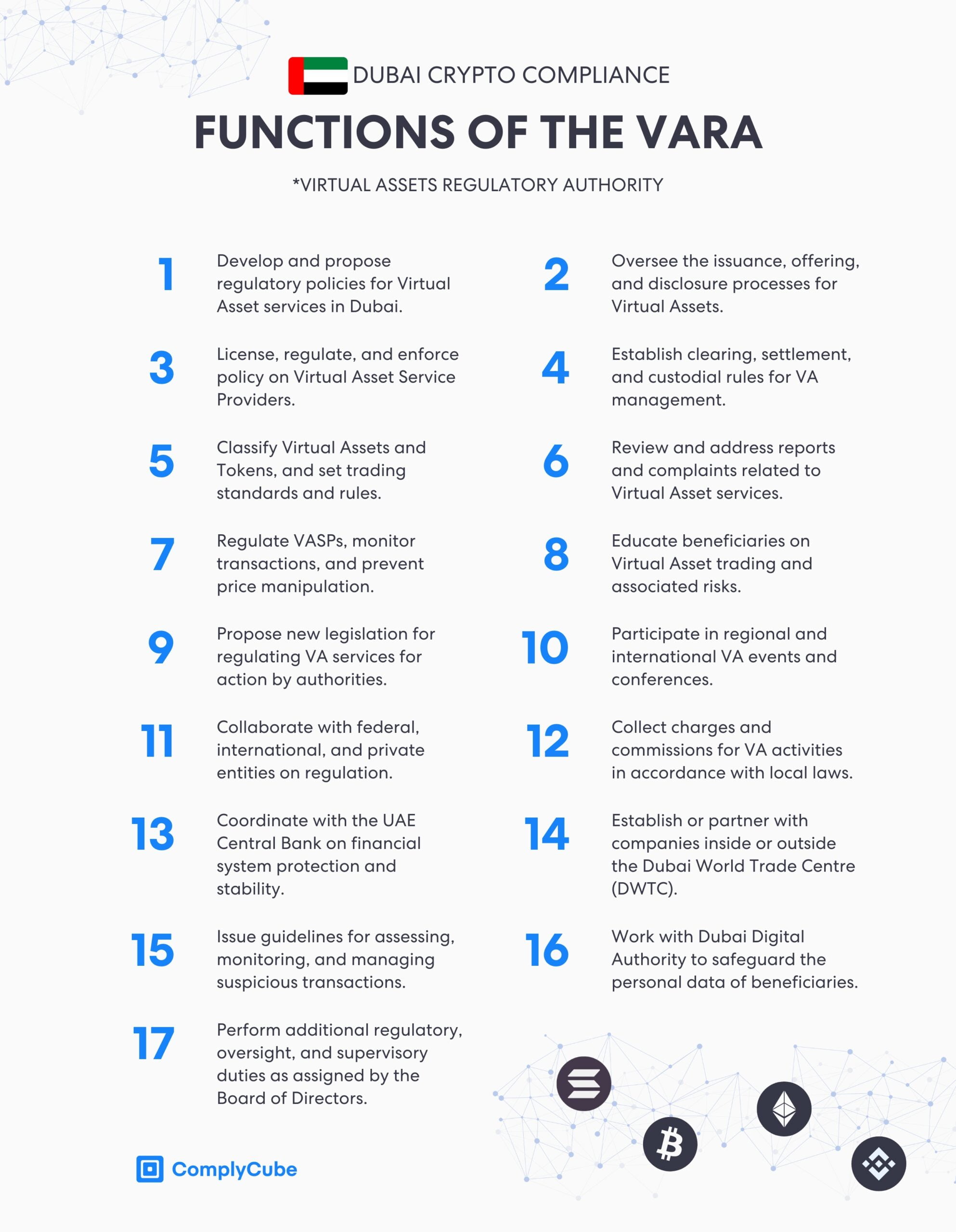
## The Virtual Asset Framework
The VA Framework consists of two elements: the 4 Compulsory Rulebooks and the [Virtual Assets and Related Activities Regulations (2023)](https://rulebooks.vara.ae/rulebook/va-activity-and-other-rulebooks). The 4 Rulebooks are:
**The Company Rulebook** dictates the structuring and management of a VASP, including its board, senior management, and staff. It demands the perpetual maintenance of internal management structures, including staff training, processes, and best practices regarding environmental and social responsibilities.
**The Compliance & Risk Management Rulebook** outlines the core principles for regulatory compliance coupled with the implementation of a compliance management system, including the appointment of Compliance Officers. VASPs must comply with all Federal Tax Authority reporting responsibilities (such as the Internal Revenue Service in America), regulations, rules, and international best practices, such as the United States Foreign Account Tax Compliance Act (FATCA).
**The Technology & Information Rulebook** provides VASPs with a framework for technology governance, controls, security, and cybersecurity. Personal data protection and general compliance programs, such as AML solutions, must be installed.
**The Market Conduct Rulebook** informs VASPs how they are permitted to market and advertise their services to clients in and outside of the jurisdiction. Market conduct is a growing regulatory trend in multiple hot spots around the globe.
The VA-specific Rulebooks pertain to:
1. Advisory services
2. Broker-dealer services
3. Custody services
4. Exchange services
5. Lending and borrowing services
6. VA management and crypto investment firms
7. VA transfer and settlement services
8. VA issuance
The Virtual Asset Regulatory Authority is permitted to inspect and audit the implementation of its regulations as it deems necessary, and this extends to the adoption of its four Rulebooks.
## VARA’s AML/CFT Policies
The Virtual Asset Regulatory Authority is the Supervisory Authority for Dubai Emirate in all VA respects and is fundamental in preventing money laundering via digital currencies. Therefore, it is entirely responsible for creating and enforcing AML policies for all VASPs in its jurisdiction.
All VASPs, such as crypto trading platforms, must adhere to the national federal AML/CFT regulations mandated by the Securities and Commodities Authority, which includes conducting business according to a Risk-Based Approach (RBA). The SCA implemented this in 2018 with Federal Law No. 20 and Cabinet Resolution No. 10.
> \[Crypto companies must\] [identify crime risks within (their) scope of work](https://www.sca.gov.ae/en/regulations/working-group-aml-counter-terrorism.aspx).
UAE Financial Institutions (FIs) must enact a compliance program appropriate to the associated risks their sector presents. Crypto assets are well known for their anonymity and, thus, connections with illicit finance. VARA also significantly endorses the crypto travel rule, both inside its own jurisdiction and internationally. For more information on what the rule involves, read [The Crypto Travel Rule](https://www.complycube.com/en/the-crypto-travel-rule-and-the-need-for-aml-compliance-software/).
The enhanced enforcement of these policies further strengthens the holism of international regulatory legislation, as recommended by the Financial Action Task Force (FATF). Ahead of the 2025 Mutual Evaluations, it is expected that global regulations will become increasingly holistic to achieve compliance with FATF AML Recommendations.

To mitigate these risks, VARA enforces substantial AML practices upon licensed crypto exchanges and other VASPs. Learn more about KYC and AML compliance solutions by reading [How KYC Crypto Regulations Safeguard the Industry](https://www.complycube.com/en/how-kyc-crypto-regulations-safeguard-the-industry/).
## Central Bank Digital Currency (CBDC) Policies
In January 2024, the UAE made the first-ever cross-border transaction with a digital currency using the **mBridge** infrastructure. [4 leading central banks developed this innovative technology](https://finance.yahoo.com/news/uae-completes-first-cross-border-121427265.html): the Hong Kong Monetary Authority, the Central Bank of the UAE, the Digital Currency Institution of the People’s Bank of China, and the Bank of Thailand.
The value of the payment was AED 50 million (around $13.6 million) and was sent by the chairman of the board of the UAE’s central bank to China. mBridge aims to revolutionize wholesale international payments using a cooperative and shared CBDC platform. For more information on CBDCs in Hong Kong, read [Hong Kong Crypto Regulation in 2024](https://www.complycube.com/blog/hong-kong-crypto-regulation-in-2024).
The UAE’s developments with this technology further evidence the country’s commitment—on a national scale—to digitally transform itself. Dubai has undoubtedly been built to foster and attract fintech and blockchain innovations; however, there is a concerted national effort to institutionalize crypto and blockchain payments.
The UAE has a more forward-thinking approach to crypto regulation, including stablecoin and CBDC adoption, than other parts of the world. This typifies many Asian crypto hubs, including Hong Kong and Singapore.
Western regulators, including the Financial Conduct Authority (FCA) in the United Kingdom and the Securities and Exchange Commission (SEC) in America, are notably behind Asian jurisdictions in stablecoin and CBDC legislation.
## About ComplyCube
ComplyCube provides an award-winning SaaS compliance solution to firms globally. The RegTech 100 Ai platform offers solutions that are tailored towards flexibility without compromising comprehensive coverage. Due to this, its crypto KYC and AML solutions can be leveraged to comply with international regulations for a plethora of cryptocurrency utilities.
If your firm is facing regulatory challenges from international expansion plans or any other business activities, we can help. Start a conversation with our team of compliance experts [here](https://www.complycube.com/en/contact/contact-sales/), or follow us on [LinkedIn](https://www.linkedin.com/company/complycube/) or [X (formerly Twitter)](https://x.com/ComplyCube) for more information.
**Categories:** Guides
**Tags:** Crypto Regulations
---
### [The Pertinence of Proof of Address Verification](https://www.complycube.com/the-pertinence-of-proof-of-address-verification/)
**Published:** June 7, 2024
**Author:** Andreea Balasa
**Excerpt:** Proof of Address Verification is a core component of a KYC strategy. This guide looks at the pertinence of PoA verification in various regions and why businesses must verify Proof of Address Documents to prevent money laundering.
**Content:**
**TL;DR:** **Proof of address verification** (**PoP** or **PoA verification**) confirms **proof of address** to strengthen KYC. Modern **address verification** and **address validation** check applicant data against **proof of address documents**. By standardising which **proof of address documents** you accept, you can scale **PoA verification** while keeping onboarding fast and compliant.
## What is Proof of Address Verification?
Proof of Address (PoA) verification is a core component that authenticates an individual’s residential address via official documentation. Proof of Address documents typically consist of utility bills, bank statements, invoices, and rent/contract agreements, and more.
Verifying user address documents is a vital part of a Know Your Customer (KYC) strategy to:
1. Provide further identity assurance and;
2. Ensure the authenticity of an individual’s supposed address.
Today, PoA aims to enhance the security and reliability of business transactions. Verifying customers’ physical locations is essential for different industries such as financial institutions, telecommunications companies, e-commerce platforms, fintechs, crypto platforms, and many more. Therefore, this process helps mitigate risks associated with fraud, identity theft, and money laundering.
Importantly, regulatory frameworks demand PoA checks to comply with international Anti-Money Laundering (AML) laws and other legal frameworks. These frameworks include the [Financial Action Task Force’s (FATF)](https://www.fatf-gafi.org) Recommendations, which safeguard the integrity of the international financial system.
### Advantages of Proof of Address Verification
The advantages of [PoA verification](https://www.complycube.com/en/solutions/identity-assurance/address-verification/) are substantial. It provides an additional layer of security which reduces the risk of fraudulent activities. Accurate address verification ensures that services and products are delivered correctly, minimizing errors and associated costs.
Furthermore, by implementing rigorous PoA checks, businesses demonstrate a commitment to thorough and responsible verification practices. This builds greater trust with their customers. In summary, PoA is an indispensable tool for ensuring the legitimacy and security of customer interactions and transactions. For more information, read a [Robust Guide to Proof of Address Checks](https://www.complycube.com/en/proof-of-address-documents-poa-checks-for-address-verification/).
## Automated Proof of Address
Users can submit physical documents or a paper copy online to verify addresses. These can include a mobile phone bill, utility bill, bank or credit card statement, and many more. The most vital aspect of a Proof of Address document is that it must include user address data.

These days, modern Proof of Address verification uses advanced AI technologies to perform 3 types of analysis on a document instantly.
1. Fundamental client data analysis, matching the submitted information during the client acquisition phase to the information on the document.
2. Content analysis, confirming whether the information on the page is within the required data (i.e., 3 months).
3. Geolocation analysis, determining whether the client’s IP address used to upload the document is within a reasonable distance from their residency.
The information attained in this process can be ratified with a multi-bureau verification process, which compares the information obtained from partner databases, including those of a postal service credit union.

## Regional Proof of Address Verification and Accepted Documents
Proof of Address Verification follows similar standards globally; however, there are minute discrepancies in policy and accepted documents between national jurisdictions. Always check with your local regulator for contemporary information on Proof of Address best practices.
## Proof of Address Verification in the UK
Proof of Address verification is governed by the [Financial Conduct Authority (FCA)](https://www.fca.org.uk) regulations. The FCA requires banks and other FIs operating in the UK to implement stringent Know Your Customer (KYC) procedures. These regulations prevent fraud, money laundering, and other financial crimes, thus safeguarding both the institutions and their clients.
### **Accepted Forms of Proof of Address**
To comply with these regulations, institutions must ask their users to present valid proof of address when opening a credit or bank account or engaging in various other financial activities. Accepted documents for verifying proof of address include:
- A recent bank statement from the applicant’s current bank.
- Bills for services like gas, electricity, water, or internet that are linked to the property.
- Letters from recognized public authorities or public servants.
- Current rental agreements with signatures from both the landlord and tenant.
- Recent credit card statements showing the applicant’s address.
- A document from an employer confirming the employee’s address.
Typically, any form of PoA document you receive should be no more than 3 months old to ensure institutions comply with the highest compliance standards. This is generally a global standard but can vary depending on circumstance and local jurisdiction.
### Extenuating Circumstances
There are certain instances when banks and FIs accept alternative documents; these may include:
- Individuals claiming benefits: An entitlement letter or identity confirmation issued by the government or local authority can be used by individuals claiming benefits.
- Students: A passport accompanied by a university acceptance letter may suffice for students.
- Travelers: A letter from a local authority can be provided and used instead.
- Homeless individuals: A letter from a warden or homeless shelter.
- Asylum Seekers: An application registration card issued to asylum seekers can be used.
### **Case Study: Mule Accounts Opened Using PoA-style documents**
**Problem**
In India, police reported a cyber-fraud scheme where a suspect obtained victims’ personal documents. They used them to open bank accounts that were later misused to route illicit funds. The issue surfaced when a victim received a notice about suspicious transactions.
**Solution**
If the bank had used stronger PoA verification at onboarding, the fraud likely would have failed. This would be due to mismatched details, tampered documents, or an IP/location mismatch. It could have flagged the application before the account was opened.
**Outcome**
- Fewer accounts opened with **misused PoA documents** (e.g., electricity bills supplied without genuine customer control).
- Stronger onboarding decisions through **data + content + geolocation** verification layered together.
- Improved defensibility with **tamper detection** and clearer evidence trails for review.
## Proof of Address Validation in the British Virgin Islands
Firms operating in the British Virgin Islands (BVI) must be licensed with the [BVI Financial Services Commission](https://www.bvifsc.vg/) (FSC). Licensed firms must comply with the FSC’s regulations to help mitigate illicit financial activity such as money laundering. Registered firms acknowledge the following as [acceptable proof of address documents](https://offshorebvi.com/wp-content/uploads/2022/12/BVI-Due-Diligence-Requirements-2022.pdf):
- Utility and mobile phone bills: Bills for services like water, electricity, or gas, provided they are no older than three months.
- Bank statements: Recent bank statements indicating the individual’s residential address.
- Credit card statements: Statements that clearly show the individual’s residential address.
- Mortgage or credit union statements: Documents indicating the individual’s address.
- Local authority documents: Local authority tax bills or council rent cards.
- Municipality Statements: Statements of the residential address issued by the local municipality, notary, or banker.
- National identity card or driving license: If these documents include the residential address and are not already used for identity verification.
## Proof of Address in Hong Kong
In Hong Kong, PoA verification is an essential step. It enables compliance with the Hong Kong Monetary Authority’s (HKMA) and the Securities and Futures Commission’s (SFC) AML regulations.
The Hong Kong government strongly advocates for rigorous KYC processes, including adherence to its Proof of Address policy. [Acceptable proof of address documents include](https://www.dbs.com.hk/personal/cn-eidv/resdential-address-proof.page):
- Utility Bills
- Communicational Services
- Bank Statements
- Government Documents
- Tenancy Agreement
- Employment Documents
- Property Ownership Documents
- Government-Issued ID
Ultimately, the HKMA established its own criteria for Hong Kong firms to relay to individuals when they submit their PoA documents.
- The name and address must be consistent between the claimed residential address and the information on the document.
- The document must be within the established timeliness threshold.
- Documents must be fully legible and untampered; AI-powered verification tools detect pixel tampering in seconds.
- The document must originate from an authorized entity, such as a government agency, Financial Institution or creditor, utility service, or employer.
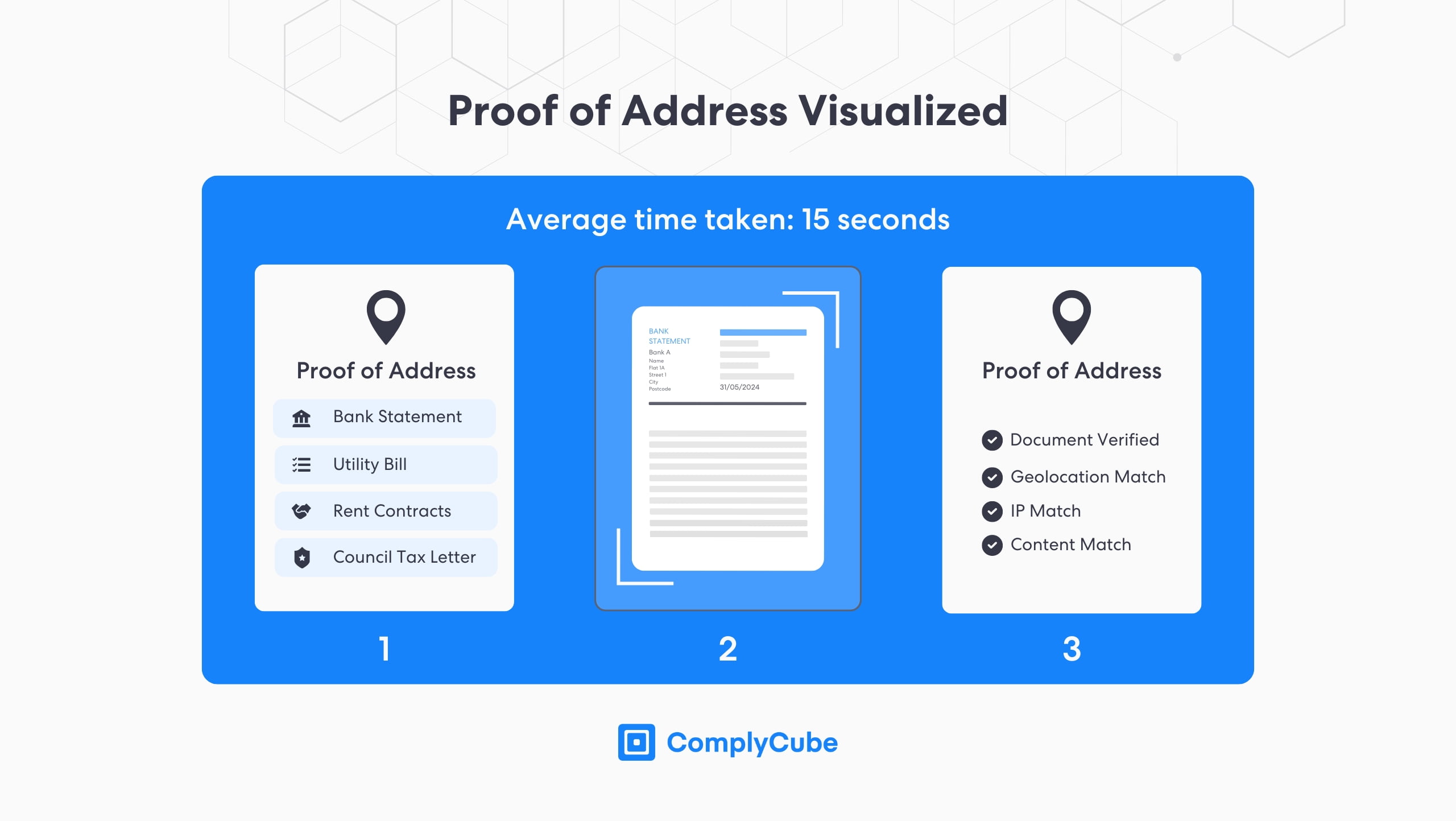
## PoA Verification in Singapore
Similarly to Hong Kong, the UK, and the BVI, PoA verification is a vital compliance component across many industries. In fact, it enables businesses to comply with the AML regulations established by the Monetary Authority of Singapore (MAS).
### Acceptable Proof of Address documents in Singapore
- [National Registration Identity Card](https://www.pdpc.gov.sg/guidelines-and-consultation/2020/02/advisory-guidelines-on-the-personal-data-protection-act-for-nric-and-other-national-identification-numbers/nric-faqs) (NRIC) of Singapore residents.
- Passports provided they are updated
- Bank or credit card statements
- Public authority letters
- Mortgage agreements
- Car registration documents
- Insurance policies
- Utility bills
- Employer or similar institutional letters
At present, acceptable documents share the same features. They are typically connected with a federal or trusted institution with a strong compliance record. In other words, PoA verification is designed to instill trust; therefore, compliant firms will only accept documents providing the same degree of trust.
### Key Takeaways
- **Strong PoA supports KYC** by confirming a customer’s true residence and reducing fraud.
- **Most programmes expect recent PoA documents** (often within ~3 months).
- **The UK, BVI, Hong Kong, and Singapore** each have different acceptable PoA criteria.
- **Automated PoA** can combine data matching, content checks, and geolocation matches for faster decisions.
- **Reliable PoA depends on legible, untampered documents** from trusted issuers.
## About ComplyCube’s Proof of Address Verification Service
Library cards, photocopied papers, and documents not issued by a verified government or trusted authority don’t qualify as proof of address. At the same time, criminals use AI to create convincing fakes that can slip past legacy checks and undermine financial system security.
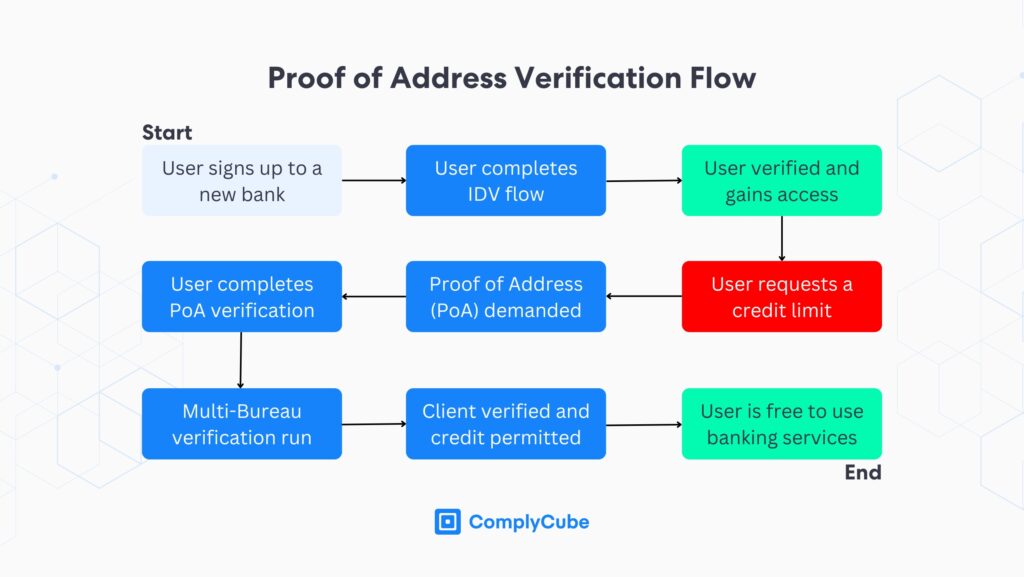
As a result, AI-powered verification tools such as ComplyCube’s Proof of Address check play a central role in safeguarding today’s financial industry. Regulators and industry guidance often point to AI and automation as essential for stopping money laundering at the onboarding stage
Criminals increasingly use AI-driven tools to bypass traditional security controls in the financial industry. As this issue continues to gain notoriety, it has garnered increasing interest from international law enforcement and national regulatory agencies.
ComplyCube’s Proof of Address solution is also customizable. It can be used alongside Know Your Customer services and can be integrated into one seamless workflow. Focusing on customizability and excellent customer satisfaction, they have received numerous user experience awards in 2024 alone. For more information, [contact one of their KYC and AML experts today](https://www.complycube.com/en/contact/contact-sales/).
## Frequently Asked Questions
In the UK, why do banks use proof of address verification during KUC, and what does the FCA expect?
In the United Kingdom (UK), proof of address verification is governed by Financial Conduct Authority (FCA) regulations. It is used when customers open bank/credit accounts or perform certain financial activities, because FCA-aligned KYC helps prevent fraud, money laundering, and other financial crimes. It protects both financial institutions and their customers by providing additional identity assurance and confirming the authenticity of a claimed UK residential address.
Across the UK, Hong Kong, Singapore, and the BVI, how recent must proof of address documents be for address verification?
Proof of address requirements follow similar global standards but differ slightly by jurisdiction. It highlights the common compliance expectation that a proof of address document should be no more than ~3 months old. For the purpose of businesses operating across these regions, they should apply local rules all while maintaining a consistent recency threshold for PoA verification/address validation.
In Hong Kong, what criteria should businesses follow to validate proof of address documents under HKMA/SFC-style expectations?
For Hong Kong, PoA verification supports compliance with Hong Kong Monetary Authority (HKMA) and Securities and Futures Commission (SFC) AML regulations. The criteria includes that name and address must match between the claimed residence and the document, the document must be within the timeliness threshold, it must be fully legible and untampered, and it must come from an authorized entity such as a government agency, financial institution/creditor, utility provider, or employer. Together, it forms a practical framework for Hong Kong proof of address validation.
How does automated proof of address verification work for global address verification (UK, BVI, Hong Kong, Singapore)?
Modern automated PoA verification uses AI to instantly run three checks on proof of address documents. The three checks are fundamental client data analysis (matching onboarding-submitted details to the document), content analysis (confirming required parameters such as recency, e.g., “3 months”), and geolocation analysis (assessing whether the upload IP address is within a reasonable distance of the claimed residency). Results can be ratified through a multi-bureau verification process using partner databases supporting scalable address validation across multiple jurisdictions.
How does ComplyCube support proof of address verification for businesses operating in the UK, Hong Kong, Singapore, and the BVI?
ComplyCube’s Proof of Address check is an AI-powered verification tool that helps businesses validate proof of address documents (rejecting low-trust evidence like library cards or photocopied papers). It can be customized alongside ComplyCube’s wider Know Your Customer services and integrated into one seamless workflow.
**Categories:** Guides
**Tags:** Know Your Customer
---
### [KYC and AML Software For Accountants](https://www.complycube.com/aml-software-for-accountants/)
**Published:** June 14, 2024
**Author:** Sofia Daley
**Excerpt:** AML software for accountants plays a vital role in ensuring accounting compliance. This blog explores AML checks for Accountants and why KYC and AML compliance and an Anti-Money Laundering checklist are important for accountants.
**Content:**
Ensuring AML compliance is more important than ever. Choosing the right AML software for accountants plays a pivotal role in ensuring accounting compliance and helps to safeguard against illicit activities. Implementing AML checks for accountants is vital for the security of the broader financial system. This guide explores KYC and AML software and introduces an Anti-Money Laundering checklist for accountants.
## Money Laundering in the Accounting Industry
Accountants hold the keys to audit trails and financial records, making them fundamental pillars of financial security. Their proximity to the financial ecosystem makes them a prime target for money laundering activity, whether unwittingly facilitated or intentionally executed.
This vulnerability to money laundering activities makes the Accounting industry of paramount importance to ensure adequate safeguard measures are in place. However, a recent report from December 2023 displayed concerning developments in the industry.
### Accounting Compliance Struggles
Inspections by accountancy sector supervisors are declining. Major industry bodies, including the [Institute of Chartered Accountants in England & Wales](https://www.icaew.com/) (ICAEW) and the [Association of Chartered Certified Accountants](https://www.accaglobal.com/uk/en.html) (ACCA), have reported significant declines in supervisory activity.
Furthermore, coupled with the declining supervision rates, the rates of non-compliance with core [Anti-Money Laundering](https://www.complycube.com/en/solutions/due-diligence-compliance/anti-money-laundering/) (AML) regulations are increasing.
> [Non-compliance across the sector has risen to nearly a third (31%)](https://www.spotlightcorruption.org/regulating-the-accountancy-profession/#:~:text=Non%2Dcompliance%20across%20the%20sector,19.4%25%20in%202018%2F19.) of the supervised accountancy population in 2022/23, compared to 19.4% in 2018/19.
This is an industry-standard figure. Certain individual supervisory bodies, notably the Institute of Certified Bookkeepers (ICB), witnessed non-compliance rates rise to 81% in 2022/23. The rate at which these figures have risen suggests something in the industry is amiss.
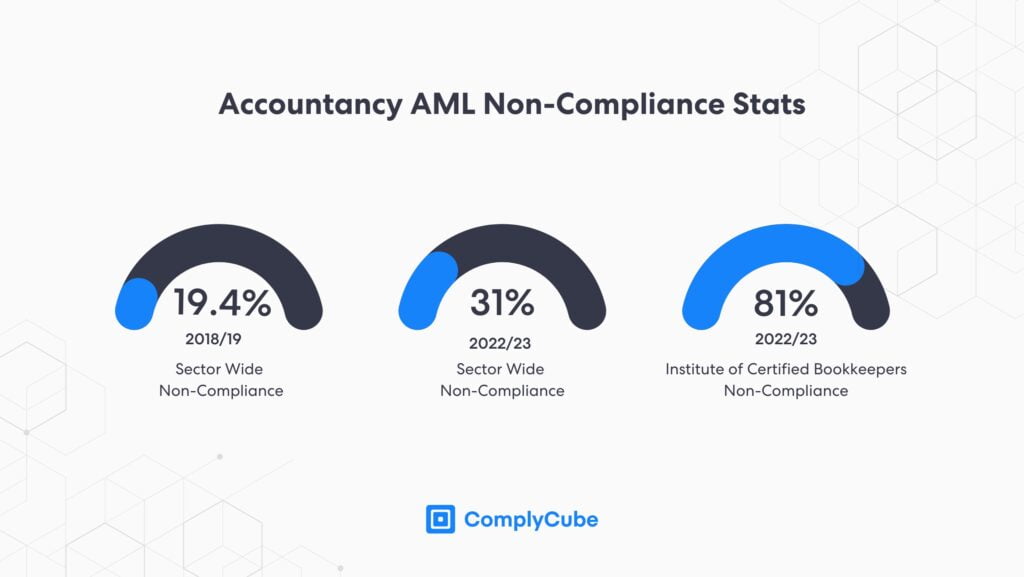
The UK Economic Crime Plan (2023-2026) aims to ‘[reduce money laundering and recover criminal assets](https://assets.publishing.service.gov.uk/media/642561ca60a35e00120cb19a/6.8300_HO_Economic_Crime_Plan_Data_Annex_v6_Web.pdf)‘, but the current rate of AML non-compliance does not suggest this has been a success thus far. Furthermore, the UK’s AML compliance program will be under scrutiny in 2025 when the [Financial Action Task Force](https://www.fatf-gafi.org/en/home.html) (FATF) conducts its Mutual Evaluations.
### Slow Adoption of AML Compliance Software for Accountants
Despite these challenges, research shows that the accounting industry, in particular, is slow to adopt or adapt to new technologies, including [Know Your Customer](https://www.complycube.com/en/solutions/due-diligence-compliance/know-your-customer/) (KYC) solutions.
> A report by accountingWEB showed that [60% of accountants grapple with the challenge of using tech to automate administrative tasks](https://www.accountingweb.co.uk/community/industry-insights/is-artificial-intelligence-ai-the-end-of-accountancy-as-we-know-it#:~:text=Our%20recent%20study%20revealed%20a,only%20ones%20reluctant%20to%20change.).
While fines for financial misconduct are reportedly low in the industry, the limited use of compliance technologies suggests that an industry-wide tech gap fosters these issues. Despite Accounting firms having some of the greatest needs for automated AML and KYC checks, they are some of the last Financial Institutions (FIs) to begin adopting automation, AI, and compliance solutions.
## AML Compliance Checklist
Accounting firms and other FIs must conduct a sufficient risk assessment of their clients to adhere to their AML obligations. This involves a set of KYC and AML procedures used to identify clients, perform the necessary background checks on them, and continually monitor them in real-time to ensure the acquired information does not change.
These regulations were initially determined by the [Financial Crimes Enforcement Network](https://www.fincen.gov/resources/statutes-and-regulations/bank-secrecy-act) (FinCEN) via the Bank Secrecy Act (BSA) of 1970 in America. This policy required FIs to help the American government identify and prevent money laundering. FIs, such as accountancy firms, banks, and many other financial services, were required to file a Currency Transaction Report (CTP). These reports are used to increase the transparency around large transactions that are more likely to be affiliated with suspicious activity.
### Identity Verification (IDV)
When accountancy firms wish to onboard new clients in the financial sector, they must obtain personal information to comply with KYC and AML regulations. IDV forms the basis of a Know Your Customer and client acquisition process.
Modern Identity Verification is typically completed in two stages:
1. [Document Verification](https://www.complycube.com/en/solutions/identity-assurance/document-verification/) captures an image of a new client’s government-issued ID, such as a passport, and verifies the image in seconds. Leveraging high-grade AI technologies, the verification process is extremely reliable and takes a fraction of the time of traditional methods.
2. [Biometric Verification](https://www.complycube.com/en/solutions/identity-assurance/biometric-verification/) adds an extra level of identity assurance. Users take a live selfie or video during the onboarding and a similar verification and matching engine scores for likeness between the two images. Biometric authentication takes an average of 5 seconds.
This process covers a comprehensive yet frictionless IDV procedure granting firms a high level of assurance (LOA). This leaves the client satisfied with a streamlined onboarding experience and the firm content that the information they’ve received is accurate. Some institutions do not require the same LOA and can customize their IDV processes accordingly.

### Customer Due Diligence (CDD)
CDD is a pivotal AML procedure in combating money laundering and terrorist financing. For the Accounting sector, the process ensures that new clients are not involved in suspicious activity that could compromise the institution’s compliance with its regulatory obligations.
Customer Due Diligence takes many forms, but the result is always to mitigate the risks of fraud and money laundering. Due diligence tools include [Proof of Address](https://www.complycube.com/en/solutions/identity-assurance/address-verification/) (PoA) authentication and multi-bureau verification.
- [Sanctions and PEP screening](https://www.complycube.com/solutions/global-screening/sanctions-pep-screening/) give FIs global coverage of sanctioned and Politically Exposed Persons (PEPs), including sanctioned institutions and terrorists. This helps firms build up an extensive risk profile for new clients.
- [Adverse media checks](https://www.complycube.com/solutions/global-screening/adverse-media-checks/) cover thousands of news and media outlets worldwide, ensuring companies are aware of potential threats or risks clients may pose.
- [Watchlist screening](https://www.complycube.com/solutions/global-screening/watchlist-screening/) provides global coverage from institutional and AML watchlists. Data is updated daily, ensuring responses are reliable in real time.
CDD solutions are easy to integrate and typically installed via powerful SDKs or an API to a firm’s existing tech stack. For more information about what these processes involve, read [What is Customer Due Diligence?](https://www.complycube.com/en/what-is-customer-due-diligence/)
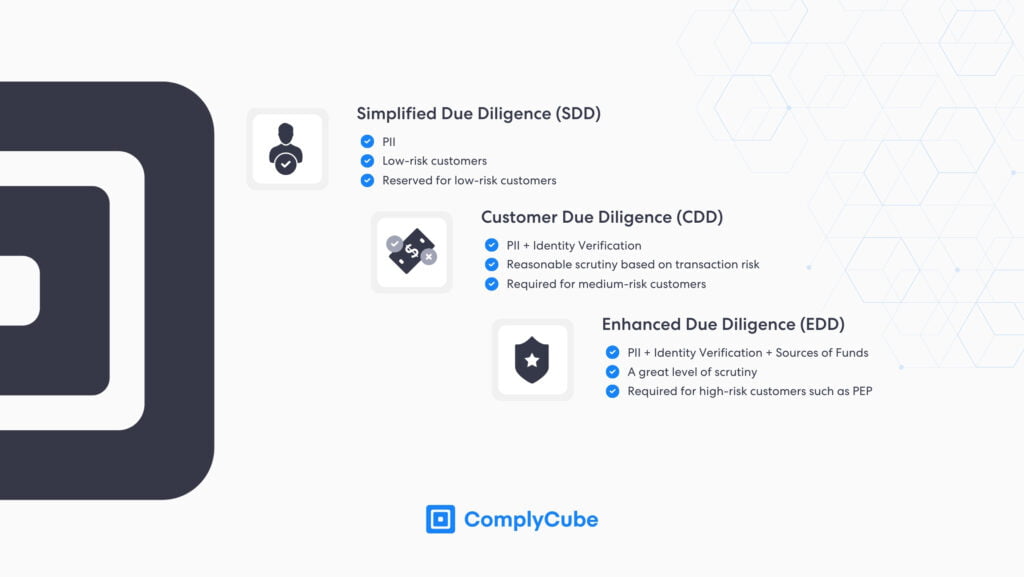
### Ongoing Monitoring
[Continuous Monitoring](https://www.complycube.com/en/solutions/global-screening/continuous-monitoring/) combines a chosen set of CDD solutions and performs consistent, around-the-clock monitoring. Ongoing monitoring is key for modern-day risk management. For example, if an accountancy firm verifies a new high-net-worth individual client, there is greater scope for that individual to gain political affiliations through a variety of charitable or sponsorship deals.
If such a development were to occur, it would not be spotted without the application of a continuous monitoring program. In turn, the accountant would not have a contemporary risk score for the client, and there would be a possibility of noncompliance with unique corporate risk tolerances or, more severely, national regulators.

## ComplyCube’s KYC and AML software for accountants
ComplyCube is an award-winning compliance SaaS firm that provides solutions to firms worldwide in the technology, finance, and telecoms, among many other sectors.
### Customer Experience
ComplyCube provides a flawless user experience to its clients, ensuring that new business and customer relationships get off to a strong start. Client relationships in the Accounting industry are an intimate affair, and the first user experience (UX) can determine the success of the relationship.
ComplyCube’s AML solutions are seamless, providing a swift UX without compromising the value of the data obtained. This ensures a win-win for the user and institution. Furthermore, workflows can be personalized to match a firm’s brand, or use ComplyCube’s branding to further enforce a symbol of credibility.
### Data Orientated
Once verified, client data is stored in the ComplyCube platform. Full audit trails are available for each check, ensuring compliance analysts and accountants can be sure where and when client data comes from. The platform centralizes all data in one place, maximizing efficiency and data accessibility.
This platform is also where automation and flexibility toggles can be adjusted to increase or decrease friction thresholds. Usually, these are dictated by a company’s risk tolerances and its Risk-Based Approach (RBA).
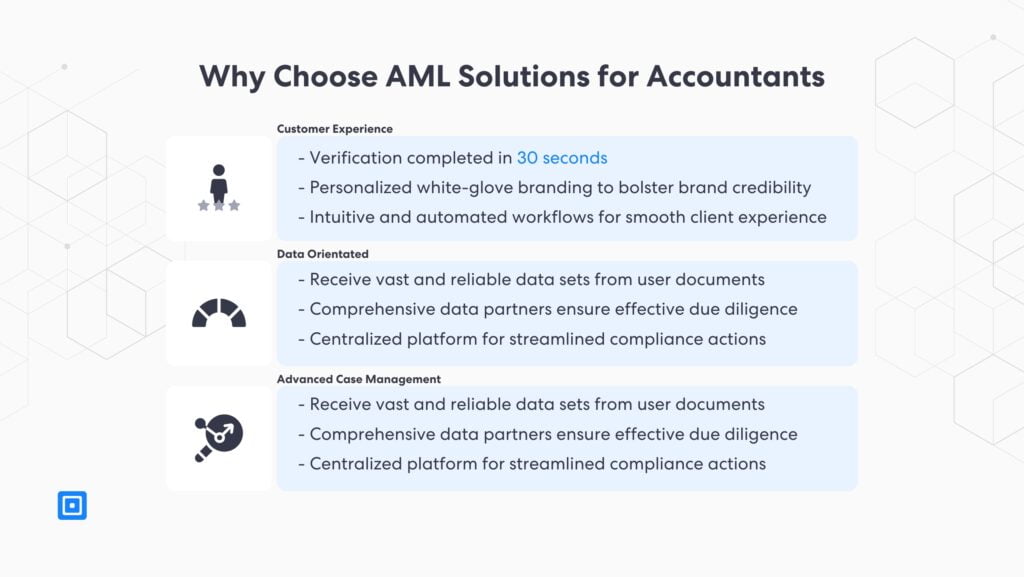
### Advanced Case Management
[Customer Due Diligence](https://www.complycube.com/en/solutions/due-diligence-compliance/customer-due-diligence/) is about more than vetting users. Sometimes, a case-by-case approach is the best methodology to ensure every client complies with jurisdictional Anti-Money Laundering regulations. To do this, compliance platforms must be malleable.
ComplyCube’s case management function gives direct access to particular compliance teams and enables the orchestration of CDD flows, from basic to Enhanced Due Diligence (EDD). This allows for total control over client acquisition and AML compliance.
If your accountancy firm or other FI is looking to streamline its client acquisition process or faces challenges with its current KYC and AML compliance program, [schedule a call with a ComplyCube specialist to learn more](https://www.complycube.com/en/contact/contact-sales/).
**Categories:** Guides
**Tags:** Anti-Money Laundering
---
### [Cryptocurrency Regulation in India in 2024](https://www.complycube.com/cryptocurrency-regulation-in-india-in-2024/)
**Published:** June 17, 2024
**Author:** Andreea Balasa
**Excerpt:** Cryptocurrency regulation in India includes the modernization of existing legislation to incorporate cryptocurrencies. Therefore, KYC crypto regulation in India is still emerging, leaving a gap for new crypto AML policies.
**Content:**
Cryptocurrency regulation in India has not been subjected to crypto-specific legislation. What the government has done, however, is modernize existing policy to incorporate financial technologies, such as cryptocurrencies. Therefore, KYC crypto regulation in India is still emerging. While there is sufficient crypto AML and related policy, there is a lack of specific legislation designed for Virtual Digital Assets (VDAs).
This crypto guide digests the regulatory landscape of the Indian blockchain industry, providing clarity on some of the core regulations and how they have shaped the nature of the crypto industry in India.
## Is Cryptocurrency Regulated in India?
In 2021, India’s central bank, the Reserve Bank of India (RBI), updated its policy on the National Strategy on Blockchain to lay the groundwork for a national blockchain infrastructure. Such an infrastructure was to facilitate “production grade applications of national interest” relating to streamlining payments and settlements for businesses and individuals across the nation.
The Indian government recognized the value of the underlying technology and its applications early on, which spurred this primary legislation. The National Strategy on Blockchain was written to foster a digital platform and enable the country’s academic research into blockchain and AI.
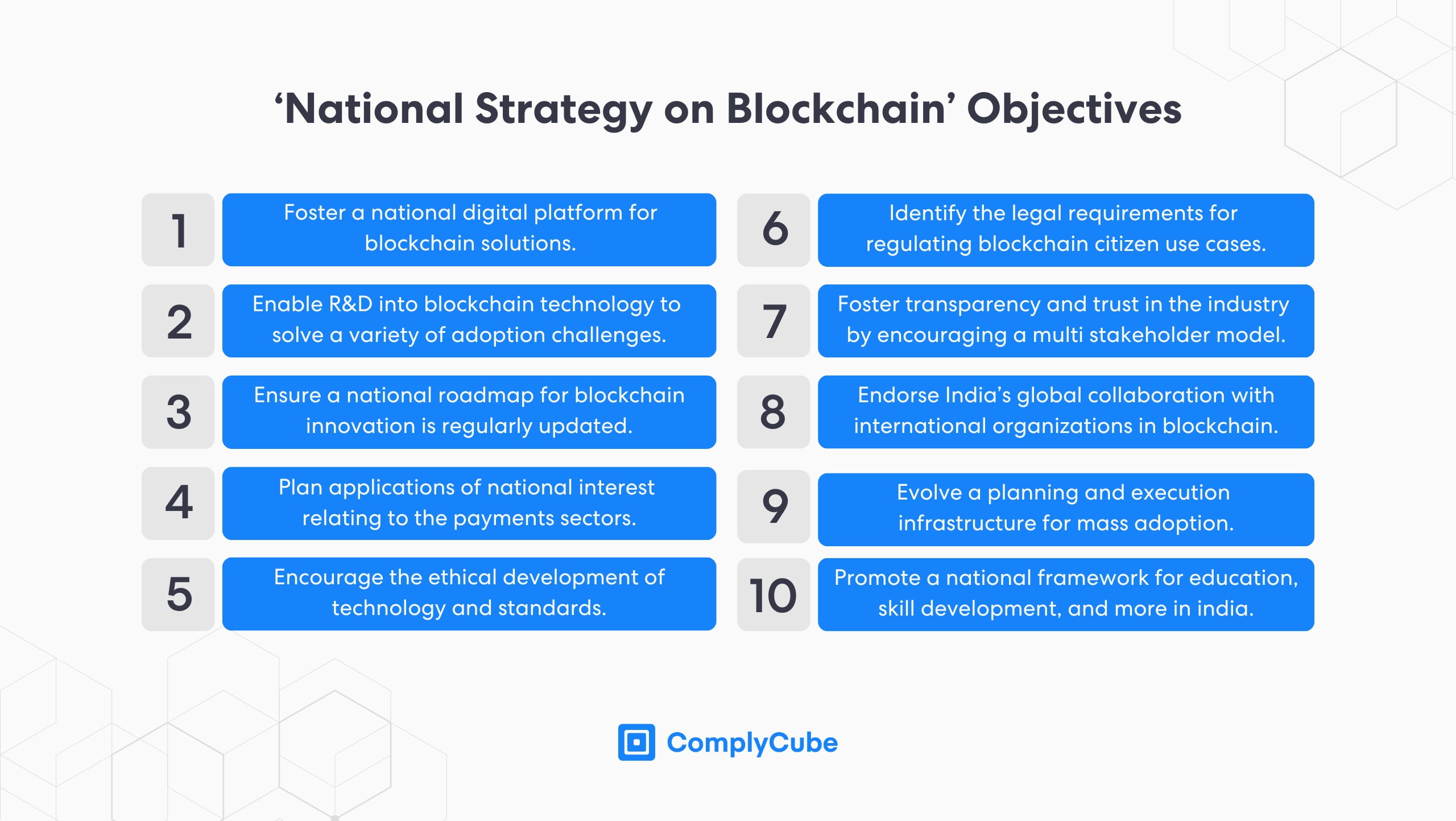
June 2023 witnessed an increased federal recognition of digital currencies, or Virtual Currencies (VCs). The RBI addressed the growing dangers and associated risks of VDAs under its “[Regulatory Initiatives in the Financial Sector](https://rbi.org.in/scripts/PublicationReportDetails.aspx?ID=1239)” report.
Indian regulators saw the greatest threat in the further adoption of crypto assets as the negative connotations they could have on monetary policy. The greater the use of cryptocurrency exchanges and cryptocurrencies themselves, the less leverage the RBI has over its currency.
The [Securities and Exchange Board of India](https://www.sebi.gov.in/) (SEBI) believes that crypto regulation should come under the jurisdiction of multiple national and international regulators. The regulatory body took the issue of cryptocurrency regulations to a government panel tasked with convincing the authorities that crypto legislation should be a democratic affair between multiple regulators.
This shows continuity with the RBI’s thinking, which believes that it would take the international cooperation of multiple major financial regulators to provide an enforceable regulatory framework, with a particular focus on taxable crypto income.
Such an initiative, in theory, would work well:
- The SEBI could monitor crypto assets that behave similarly to that of traditional securities
- The RBI could monitor asset-backed cryptocurrencies, including stablecoins
- The Insurance Regulatory and Development Authority of India could regulate pension-related Virtual Assets (VAs), and so on
Despite this, and despite the view that blockchain technology is innovative, the crypto regulatory landscape in India is cautious. Although they are not explicitly banned, there is not a complementary set of rules that is catalyzing the industry. This has led to a tumultuous time for crypto firms operating in the country.
## Indian Crypto Regulations
The Cryptocurrency and Regulation of Official Digital Currency Bill was initially introduced in 2021 by the RBI to create a favorable industry environment with regulatory clarity. However, the Bill never made it through parliament, leaving India lacking a purposefully written set of legislation for crypto.
However, the Official Digital Currency Bill is still a significant mark of policy development on a federal level and aligns India’s VDA domestic policies with international standards. While the bill has not been passed, industry leaders and policymakers expect it to emerge in the future, possibly in 2025.
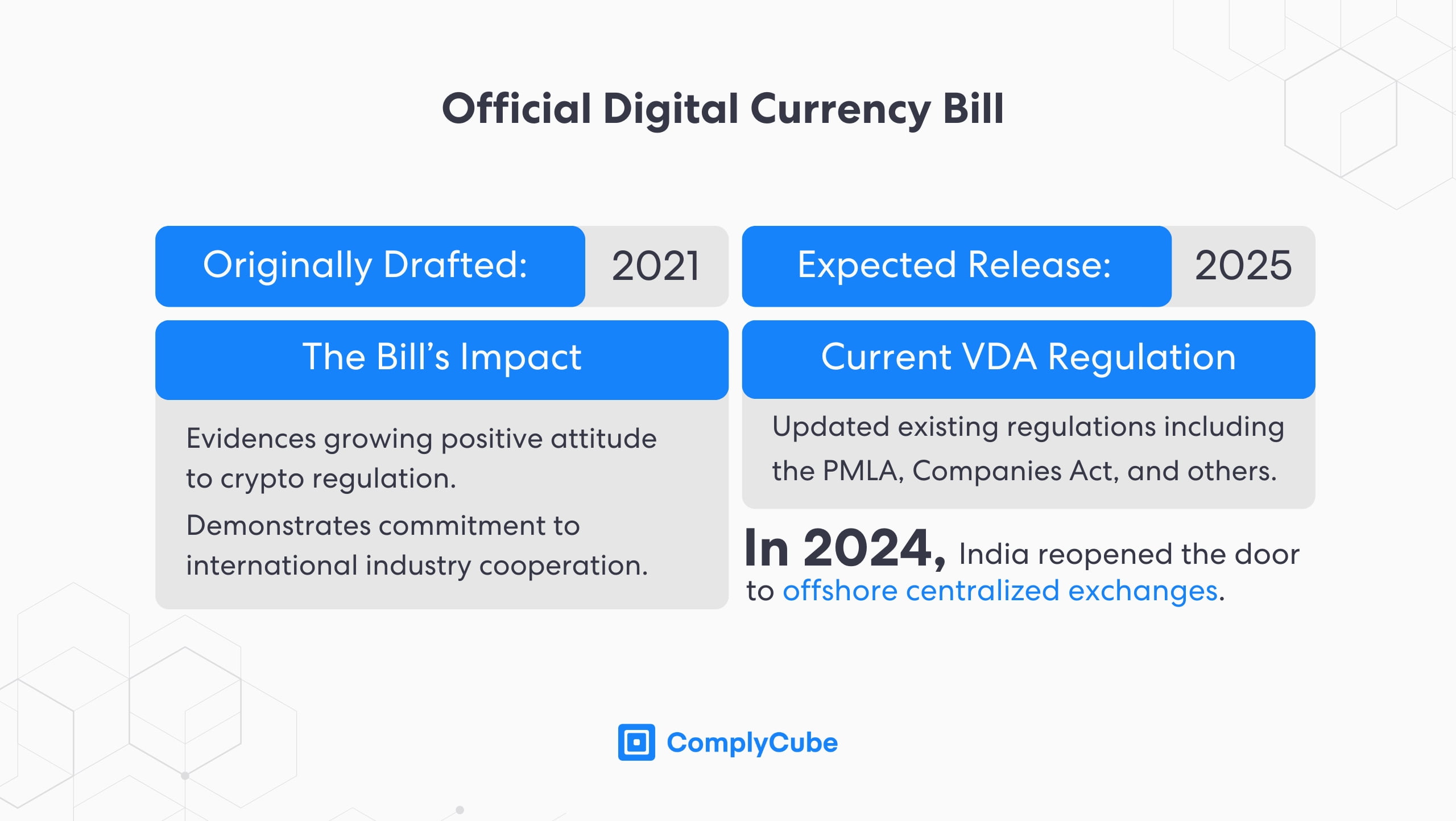
Therefore, despite a delayed launch, it represents a development towards a more globally holistic sector. When the Bill is live, it should catalyze India’s VDA sector. For more information on the significance of crypto regulation, read [The Dangers a No KYC Crypto Exchange Can Bring](https://www.complycube.com/en/the-dangers-a-no-kyc-crypto-exchange-can-bring/).
### The Prevention of Money Laundering Act
The Prevention of Money Laundering Act (PMLA) was initially drafted in 2002 and came into full effect in 2005. The Act created clear [Anti-Money Laundering](https://www.complycube.com/en/solutions/due-diligence-compliance/anti-money-laundering/) (AML) obligations for banks, Financial Institutions (FIs), and intermediaries to [verify clients’ identities, maintain records, and furnish information to FIU IND](https://fiuindia.gov.in/files/AML_Legislation/pmla_2002.html).
The act defined money laundering as any of the following acts that were engaged with the illicit proceeds connected to crime:
- Concealment
- Possession
- Acquisition
- Use
- Projecting as untainted property
- Claiming as untainted property
The Act also requires FIs and related services to verify the Aadhaar identification numbers of individuals and perform the necessary [Customer Due Diligence](https://www.complycube.com/en/solutions/due-diligence-compliance/customer-due-diligence/) (CDD) on users and beneficial owners. This is a similar regulatory framework to the [Financial Crimes Enforcement Network](https://fincen.gov/) (FinCEN) in America. FinCEN endorses a Customer Identification Program (CIP) for all American FIs, a regulation that has now been adopted by the [Financial Action Task Force](https://www.fatf-gafi.org/en/home.html) (FATF) and across the globe.
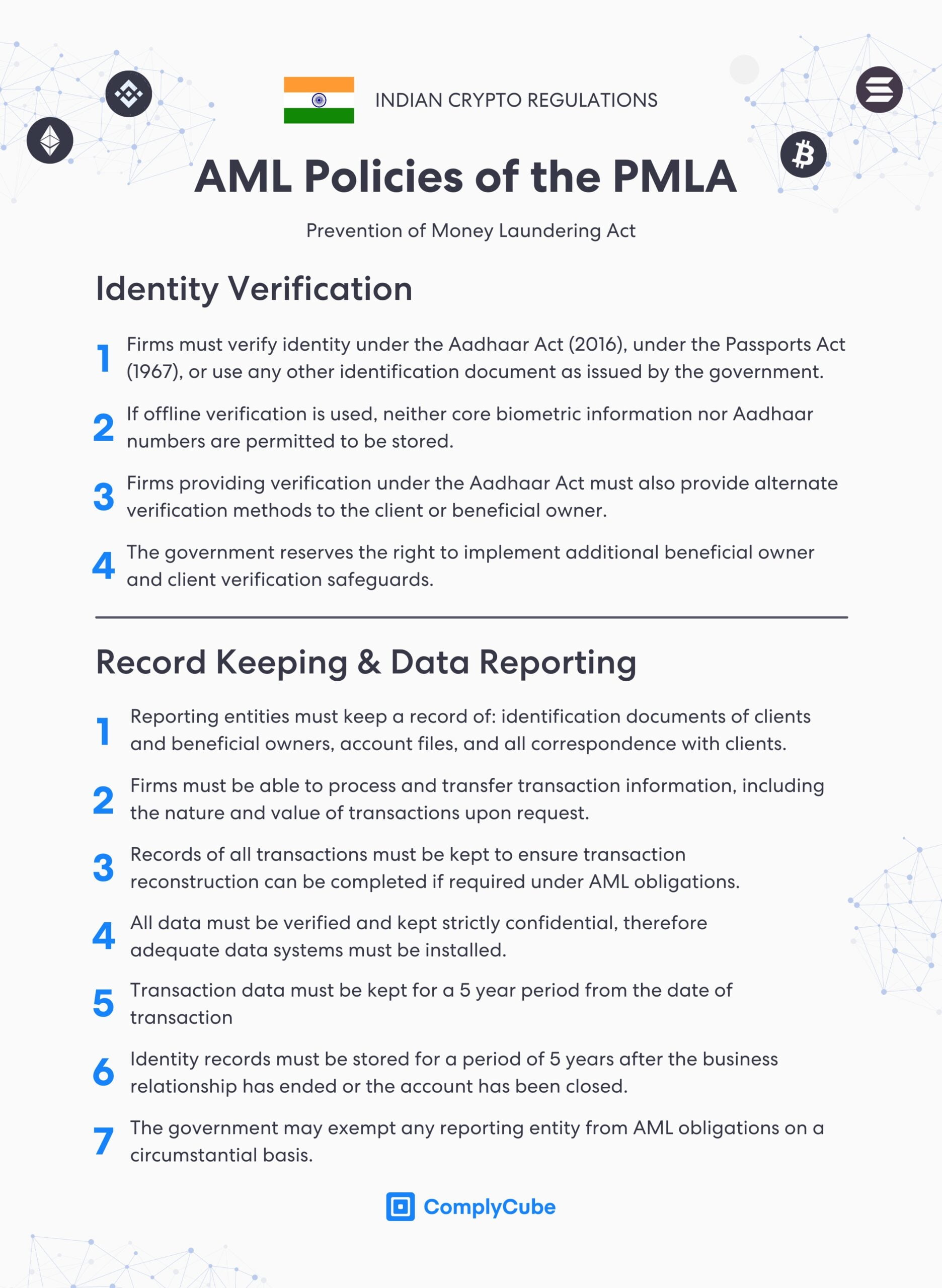
In March 2023, the Finance Ministry extended the PMLA to the use of VDAs, fostering a new wave of crypto AML legislation. This gave authorities greater influence to enforce [Know Your Customer](https://www.complycube.com/en/solutions/due-diligence-compliance/know-your-customer/) (KYC) crypto rules to help prevent money laundering.
Under this amended Act, all crypto businesses must now obtain a license with FIU IND and comply with its AML policies. This involves substantial verification of users’ identities and maintaining reporting records.
### India’s Consumer Protection Act
The original Consumer Protection Act (1986) provided a regulatory framework for safeguarding consumer rights in India. It is designed to regulate how businesses operate and provide goods and services to consumers or users.
This Act was reintroduced in 2019 to address new market dynamics in the 21st century. It now provides legislation around digital and crypto transactions with enhanced enforcement mechanisms to ensure that crypto platforms are not misleading their users and to protect users from fraud and malicious practices.
The Consumer Protection Act of 2019 now plays a vital role in the [country’s policies for crypto investor grievances](https://www.coindesk.com/policy/2024/05/16/indias-market-regulator-suggests-shared-crypto-oversight-even-as-rbi-seeks-stablecoin-ban-reuters/) and ensures that crypto exchanges, along with other VDA services, are being transparent to their users.
## Crypto Pension and Tax Regulations
There is a 1% tax deduction at source on crypto transactions over ₹50,000 or ₹10,000 ($600 or $120) in certain cases. Furthermore any [profits made on trading cryptocurrencies are taxed at 30%](https://cleartax.in/s/cryptocurrency-taxation-guide), regardless of an individual’s profession or salary.
### Is Transferring Crypto a Taxable Event in India?
Any typical crypto transaction, including purchasing goods and services, swapping crypto assets on centralized or decentralized exchanges, receiving crypto in return for a service, and mining cryptocurrencies, is taxed at 30%.
The Indian government does not support the use of cryptocurrencies as a substitute for fiat currency and has long believed that crypto poses a threat to federal monetary policy. This could change in the future as the country begins adopting more favorable legislation.
### Is India Pursuing a Pension Fund Regulatory Framework?
The original bill to block crypto assets (in 2021) suggests such a framework could be on the cards, with SEBI suggesting that independent regulators should create policies that pertain to their fields of expertise.
This initiative has since been disbanded as the region looks to adopt more favorable regulations to endorse the industry’s growth. Such a pivot since 2021 has brought about moderate success so far, but such a significant shift in attitude will always take time.
## Regulating Cryptocurrency Exchanges in India
The Indian government has two core concerns about regulating Virtual Asset Service Providers (VASPs): non-compliance with AML, KYC, and tax regulations and concerns about customer protection.
### AML and KYC Non-Compliance
India’s crypto regulation has been turbulent, with Centralized Exchanges (CEXs), VASPs, and other VDA services finding it hard to forge a way through the regulatory fog. However, a leading voice in the Indian crypto industry believes it will not be long before there is a cleaner regulatory framework.
> They want to make sure that the laws of the land are being followed, including [AML, KYC and CFT guidelines, if they are followed, they are very bullish on the industry](https://www.coindesk.com/policy/2023/12/28/india-issues-compliance-show-cause-notices-to-9-offshore-exchanges-including-binance-and-kucoin/).
Sumit Gupta, the co-founder and CEO of the [CoinDCX](https://coindcx.com/) CEX, believes that the AML and KYC regulation that the government is working on ‘now’ is fundamental to the industry’s success. Mr Gupta stated that “India is trying to unify that \[the regulations\] right now” to standardize a set of guidelines to follow.
In the same interview, the CEX founder reiterated his core belief that the only way to succeed in this industry was to abide by federal regulations. Notably, he referenced [Coinbase](https://www.coinbase.com/) as the leader in this regard.
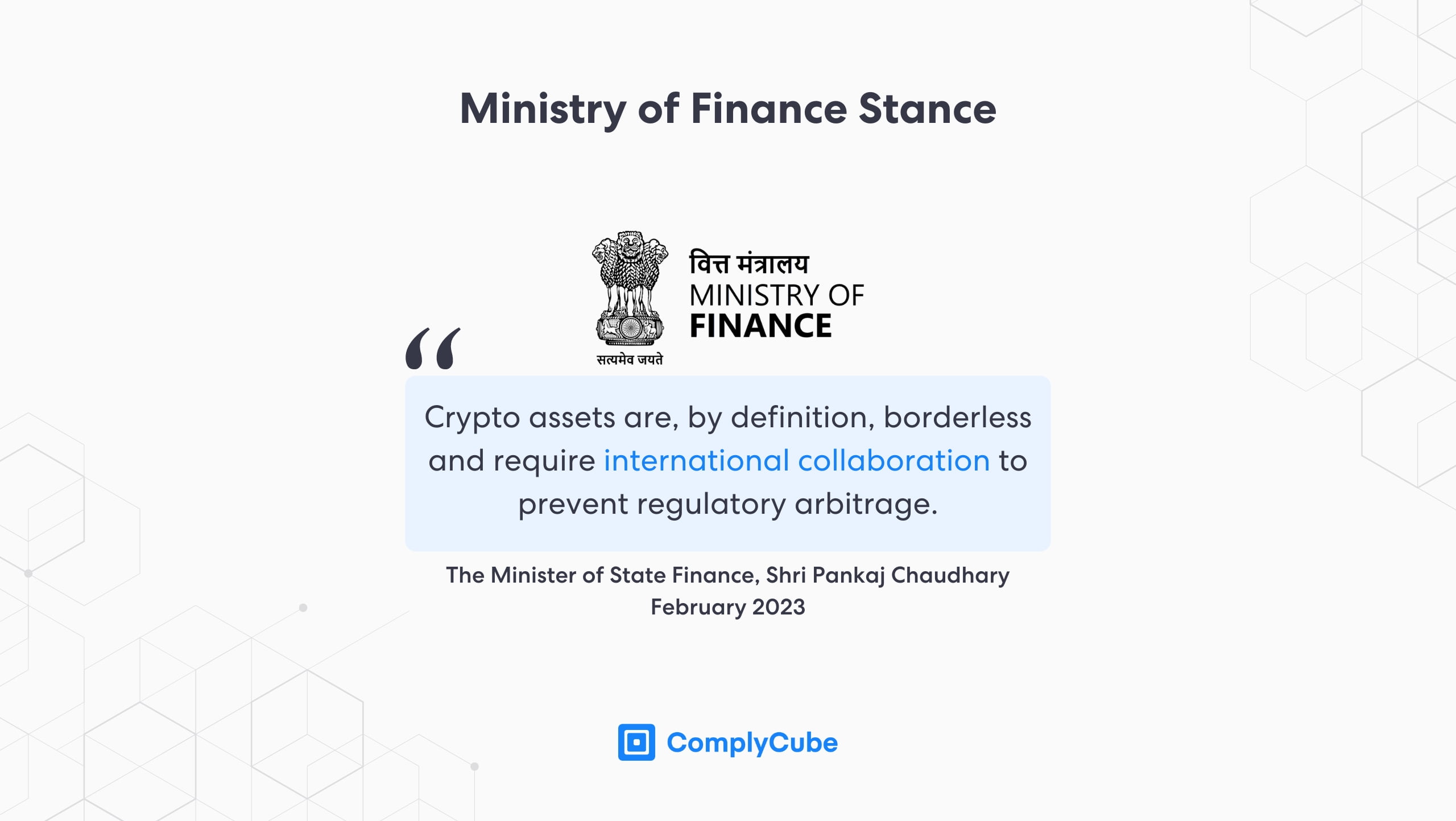
When asked about the cost of AML and KYC solutions, he stated that it was negligible as they enabled compliance with federal regulations and provided a methodology for ensuring longevity in the industry. For more information on the kinds of Crypto KYC solutions he was talking about, read [How KYC Crypto Regulations Safeguard the Industry](https://www.complycube.com/en/how-kyc-crypto-regulations-safeguard-the-industry/).
### 9 CEXs Banned in December 2023 for AML Breaches
The [Financial Intelligence Unit](https://www.fiuindia.gov.in/) India (FIU IND) blocked the URLs of 9 leading offshore crypto exchanges, including Binance, Kucoin, Huobi, Kraken, Gate.io, Bittrex, Bitstamp, MEXC Global, and Bitfinex. All exchanges were reported to be operating illegally without “[complying with the provisions of the PML Act in India.](https://pib.gov.in/PressReleasePage.aspx?PRID=1991372)“
All Virtual Digital Asset Service Providers (VDA SPs) must be licensed with the FIU IND and, therefore, adhere to its regulatory framework. [In 2024, both Binance and KuCoin received licenses from the FIU](https://www.techinasia.com/binance-kucoin-approval-operate-india), allowing them to re-enter the market, evidencing a growing positive attitude towards the industry.
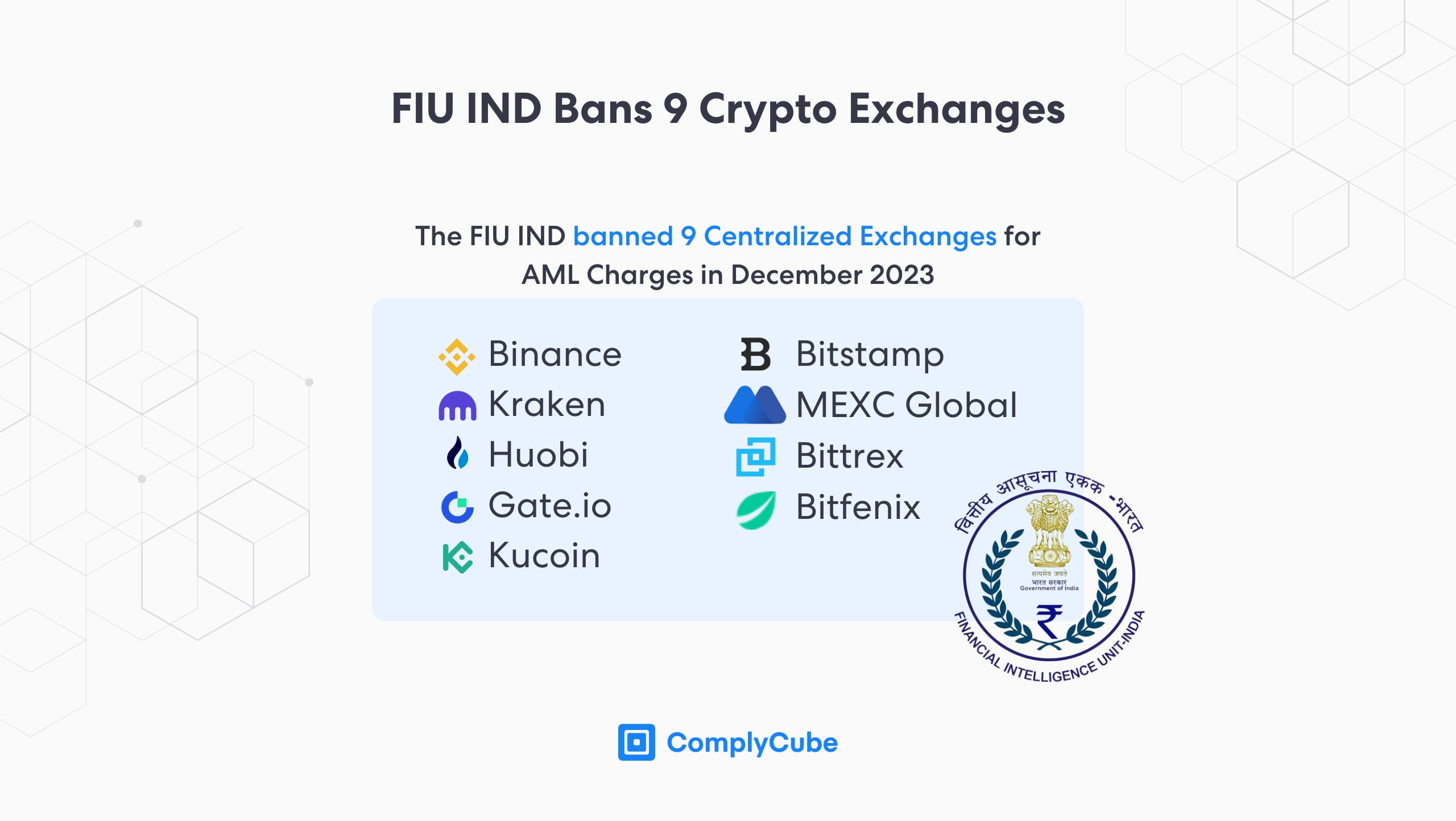
## How to Comply with Indian Crypto Regulations
Compliance with Indian crypto regulations starts with obtaining a license from the FIU IND. All VDA SPs must register with the Financial Intelligence Unit and, therefore, comply with its increasingly comprehensive crypto AML regulations.
As displayed above, this involves the regular reporting of crypto transactions and adherence to KYC requirements:
1. Identity Verification: Firms must implement stringent KYC processes involving the collecting and verifying of identification information such as Aadhaar numbers and other authorized information. Digital Identity Verification can significantly streamline this process, ensuring compliance while minimizing friction for new users.
2. AML Checks: Crypto exchanges and other VASPs must conduct thorough Anti-Money Laundering checks to ensure users are not going to take part in malicious and illicit activities. This includes verifying the sources of funds, conducting risk assessment and Customer Due Diligence (CDD) checks, and verifying this information in real time. AML protocols should align with the Prevention of Money Laundering Act (PMLA) to avoid legal repercussions
3. Transaction Screening and Monitoring: VDA services must have an infrastructure in place to screen and monitor transactions as mandated by the PMLA. ComplyCube’s *Trust Node Level 2* provides a one-stop shop for all AML, VASP, and transaction due diligence.
4. Ongoing Monitoring: Crypto platforms must continuously monitor users to track user activities and transactions. This helps identify and mitigate risks as they emerge. Regular audits and compliance checks should be conducted to ensure all regulatory requirements are consistently met, and this can be done from the comfort of the ComplyCube compliance platform.
## Choosing ComplyCube for KYC Cryptocurrency Regulation in India
ComplyCube is a leading provider of crypto KYC and AML solutions. With clients worldwide in banking, crypto, financial services, telecoms, and many other industries, it has become a distinguished compliance leader.
If your crypto exchange, VDA platform, or other financial institution lacks the infrastructure to comply with Indian or international regulations, ComplyCube can help. [Get in touch](https://www.complycube.com/en/contact/contact-sales/) with one of their experts today to find out how.
**Categories:** Guides
**Tags:** Crypto Regulations
---
### [2FA and Identity Authentication vs KYC Identity Verification](https://www.complycube.com/2fa-and-identity-authentication-vs-kyc-identity-verification/)
**Published:** June 25, 2024
**Author:** Andreea Balasa
**Excerpt:** Identity authentication ensures that only authorized users can access an account, while Identity Verification (IDV) is a KYC and AML solution that verifies user identities and is fundamental in regulatory compliance.
**Content:**
2-Factor Authentication (2FA) is a common method of identity authentication that proves the current user is the individual who should have access to the account. Identity Verification (IDV) is a Know Your Customer (KYC) and Anti-Money Laundering (AML) solution that verifies a user’s credentials so firms know who they are engaging in a business relationship with.
This guide assimilates the use cases for both processes, identifying their key differences and establishing how they should best be used together.
## What is Identity Verification?
IDV is the first process in a KYC strategy and is fundamental to businesses’ Anti-Money Laundering (AML) compliance obligations. Multiple methods of verifying user identity exist, and the technique employed is typically dictated by a firm’s Risk-Based Approach (RBA).
Identity Verification is becoming increasingly vital for FIs in the traditional finance (TradFi) sector and emerging financial sectors, such as Centralized Exchanges (CEXs) and Decentralized Finance (DeFi) services in the crypto industry.
The Financial Crimes Enforcement Network (FinCEN) introduced the Customer Identification Program (CIP) in 2003. It[ is the pivotal first stage](https://www.fincen.gov/sites/default/files/guidance/finalciprule.pdf) in a new client-business relationship that precedes Customer Due Diligence (CDD).
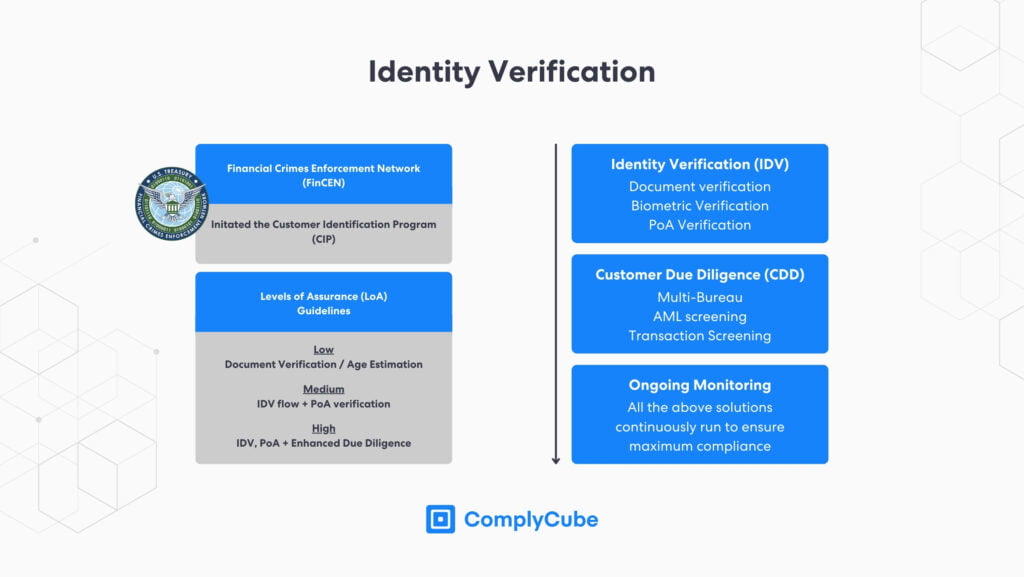
Different industries require different Levels of Assurance (LoA). For example, firms in the cryptocurrency industry require a far higher level of identity assurance than those in the e-commerce industry due to the regulatory nuances that different sectors and their regulators mandate. Digital IDV solutions, or eIDV, are fast becoming the go-to method for financial institutions due to their cost efficiency and reliability.
### Document Verification
Verifying a new client’s identity starts with authenticating their KYC documents. The most common documents used are government-issued IDs, such as driver’s licenses or passports. These documents possess a national ID number and various security elements designed to make them challenging to replicate.
[Document verification](https://www.complycube.com/en/solutions/identity-assurance/document-verification/) analyzes these security elements while digesting the data on the document to gain basic customer information. Modern document verification leverages advanced AI technologies to verify documents in 15 seconds, fostering a streamlined client acquisition process with limited friction.
### Biometric Verification
Most Financial Institutions (FIs) use biometric verification as the next step. Biometric authentication involves matching the image in the ID provided in the document verification process against a selfie or video. Typically, this selfie or video is taken live during acquisition to create a higher LoA.
[Biometric verification](https://www.complycube.com/en/solutions/identity-assurance/biometric-verification/) leverages a machine learning algorithm to verify clients in seconds alone, contributing to enhanced identity assurance. The speed at which verification is completed ensures that the customer onboarding process remains frictionless and mitigates client churn.

### Proof of Address
[Proof of Address](https://www.complycube.com/en/solutions/identity-assurance/address-verification/) (PoA) is a core IDV process. Digital PoA verification gives businesses a wealth of information beyond where a client lives. One key example is matching the document upload event’s IP address to the document’s geolocation.
This is a vital step, particularly for modern fintechs, as it ensures that users access your service from regions where your business is licensed to operate. Many cryptocurrency exchanges have received significant fines for AML breaches by permitting users to use particular services in unlicensed territories.
Hong Kong, in particular, has been cracking down on unlicensed crypto exchanges, notably against [ByBit](https://www.coindesk.com/policy/2024/03/14/hong-kongs-markets-regulator-issues-warning-against-crypto-exchange-bybit/?_gl=1%2A1vdzffb%2A_up%2AMQ..%2A_ga%2AMTQxMjM0NjkzOC4xNzE5MzA1NzE4%2A_ga_VM3STRYVN8%2AMTcxOTMwNTcxNy4xLjAuMTcxOTMwNTcxNy4wLjAuMjcyNjg3OTQ5) and [MEXC](https://www.coindesk.com/policy/2024/03/15/hong-kong-regulator-says-crypto-exchange-mexc-has-been-operating-without-a-license/) recently. These exchanges have been charged with operating in the region without a license from the Securities and Futures Commission, the key financial regulatory force for businesses dealing with securities or security-like assets.
Address verification would be a sure methodology to ensure that exchanges only onboard clients from regions they are licensed in. For more information on the region’s crypto policies, read our guide on [Hong Kong’s Crypto Regulations in 2024](https://www.complycube.com/en/hong-kong-crypto-regulation-in-2024/).
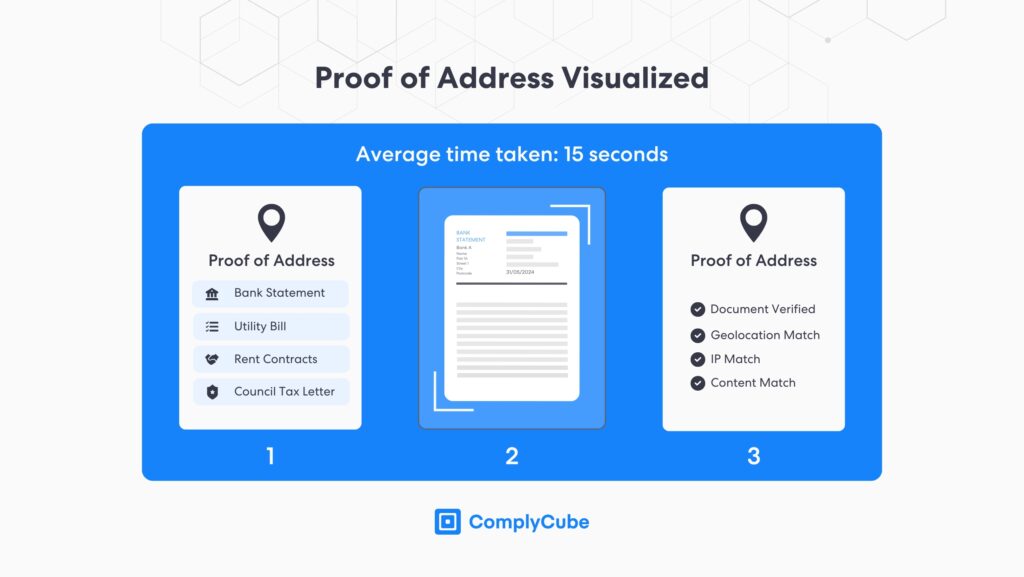
### Multi-Bureau Verification
Multi-bureau verification compares the information obtained during the IDV stage against partner databases, such as credit bureaus, postal offices, and many others. These checks create an additional layer of security, as firms are informed that there is a track record of a particular user’s details.
## IDV in a nutshell
Identity Verification is the process a business uses to establish that a new customer is who they say they are. IDV processes differ drastically based on varying RBAs and industry-specific compliance requirements.
- Meeting regulatory compliance obligations is critical for centralized crypto exchanges, as it enables international expansion while mitigating the possibility of AML fines.
- A DEX operating with tokenized Real World Assets (RWAs) must also initiate a CIP and IDV process if it wishes to gain compliance with local regulators.
- Decentralized crypto exchanges that provide P2P trading of cryptocurrencies do not currently require any KYC solution. As they offer seamless transfers of digital assets, there is currently no legal obligation to verify its users. This could change as the world swiftly endorses further crypto regulation.
- Typical fintech firms must also verify their users with the most stringent IDV processes, including document and biometric verification and AML monitoring.
## Identity Authentication
Identity authentication is best used as an additional safeguard for accounts that have already been verified through a KYC process. It ensures that the person accessing an account at that moment is somebody who should have access. 2-factor authentication is the most common iteration of this.
Some client acquisition processes only use identity authentication; however, this process alone is not adequate to comply with rigorous financial regulations such as the [Financial Action Task Force Recommendations](https://www.fatf-gafi.org/en/publications/Fatfrecommendations/Fatf-recommendations.html).
### Two-Factor Authentication
2FA requires 2 different codes or sets of information before a user can access a platform. Typically, the second set of information will be requested after entering a password. 2FA can take many forms.
- Single-use email verification code
- Single-use SMS code
- Regenerative code via an authenticator app, such as Google Authenticator
- A hardware device that generates a single-use code
2FA significantly reduces the chances of an unauthorized entity or individual gaining access to an account; therefore, it is a valuable fraud prevention tool. However, it lacks the depth that Identity Verification processes provide. Furthermore, it still permits someone to fraudulently create a new account if, for example, an email account has been compromised.
### Multi-Factor Authentication

This process is very similar to 2FA, however, the verification process consists of more than 2 factors, or data sets. Multi-factor authentication could consist of a password, a single-use SMS code, and a code from an authenticator app.
### Biometric 2FA
Most modern smartphones are built with biometric verification capabilities. Mobile devices can use this biometric passkey as the second data set, offering the most streamlined signing-in process, as authorized users do not need to wait to gain access.
Apple stated that the likelihood of fraud or biometric failure with its Face ID technology is 1 in 1,000,000. FaceIF technology generates a great deal of security when users try to sign in again after they have verified their account with a KYC process.
### Knowledge-Based Authentication
Similarly to 2FA, knowledge-based authentication uses a preset question to authenticate if a user has access to an account. These are usually basic but personal questions, including:
- What is your mother’s maiden name?
- What was the name of your first pet?
- What town/city were you born in?
This process can be iterated further using dynamic information. A banking app, for example, could be programmed to ask the user questions about the account’s recent activity and payment history, among other information only the account user would know.
## Coinbase Case Study
Most CEXs use Identity Verification as part of their KYC process and identity authentication when users sign in. Together, they form a secure yet frictionless methodology for users from the point of client acquisition to returning to sign in.
Coinbase is [one of the largest crypto exchanges by users and trading volume](https://www.coingecko.com/en/exchanges) and is known as a leader in crypto compliance. The American exchange makes use of the following IDV workflow:
- Document upload
- Selfie upload
- PoA upload (if required)
[Coinbase doesn’t allow ](https://help.coinbase.com/en/coinbase/getting-started/getting-started-with-coinbase/id-doc-verification)individuals to use its platform without completing this program, a leading factor behind its compliance-first strategy. The exchange then leaves it up to the user’s discretion to implement a 2FA strategy.
## Limitations of Identity Authentication
Identity authentication does not add any identification value to the new account that is created. If an email or SMS number has been compromised, the chance of a bad actor creating the account for malicious purposes is far higher.
Therefore, 2FA does not help prevent identity theft at the point of client acquisition and does not enable adherence to local or global Anti-Money Laundering regulations. KYC processes are pivotal for businesses that want to meet stringent and evolving regulations.
For example, many identity verification packages are paired with CDD and Ongoing Monitoring solutions, enabling a continuous risk assessment and helping firms understand which clients require Enhanced Due Diligence (EDD).
> To realize the benefits of responsible technological innovation in the United States by supporting the use of new mechanisms for private sector compliance [and utilizing automation and innovation to find novel ways to combat illicit finance](https://home.treasury.gov/news/press-releases/jy2346).
Many key regulators worldwide endorse technology-based and automated compliance solutions to help fight money laundering. These include the FATF and the US Department of the Treasury, which is featured above. Financial services that employ an identity authentication process over a rigorous AML and KYC solution will likely be scrutinized by regulators in 2024 and beyond.

## ComplyCube’s IDV Solutions
ComplyCube is an award-winning SaaS provider of AML and KYC solutions across a wide spectrum of sectors, including TradFi, fintech, crypto, telecoms, and many others. Firms can integrate with their infrastructure in various ways.
- Via a powerful API
- By coding their SDKs into your existing mobile tech stack
- Or using their infrastructure from the comfort of an all-in-one compliance platform.
### Get in Touch with a Specialist Today
If your fintech firm or related business is looking to integrate compliance solutions that enable growth while meeting compliance requirements, get in touch with a [ComplyCube specialist](https://www.complycube.com/en/contact/contact-sales/) today to find out how they can help.
**Categories:** Guides
**Tags:** Identity Verification
---
### [What is NFC ID Verification in KYC and AML?](https://www.complycube.com/what-is-nfc-id-verification/)
**Published:** June 27, 2024
**Author:** Sofia Daley
**Excerpt:** Near-field communication (NFC) is a technology used in document verification to increase the security of Identity Verification and Know Your Customer process. This guide answers the questions about what is NFC ID Verification?
**Content:**
**TL;DR:**NFC ID supports identity verification by **enabling document verification** through **WiFi-free, short-range chip** reading on ePassports/ID cards. If you’re asking what is nfc is, it’s the near-**field connection** that uses BAC/PACE to access the chip, then runs cryptographic checks. NFC ID verification can also add biometric matching using the chip’s **high-quality portrait**.
## What is NFC Technology?
Near-field communication (NFC) is a type of identity verification used to wirelessly connect devices over short distances. NFC is conducted over a range of no more than a couple of inches. It also enables seamless data transfer to the highest available precision. In ID verification, this lets an NFC-enabled phone read data directly from the chip in an ePassport or ID card in seconds.
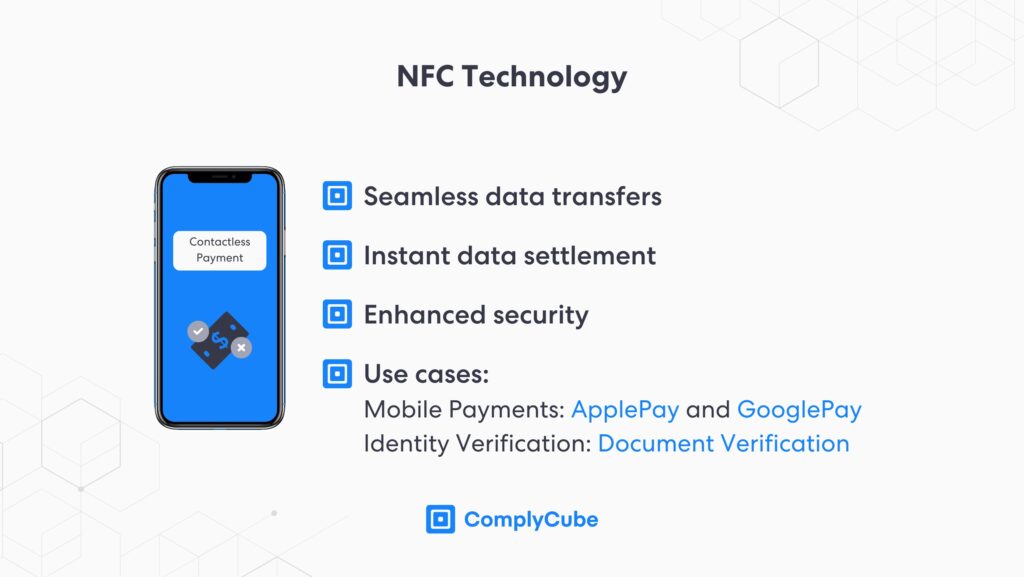
If readers are unfamiliar with the name, they will know the concept. NFC technology powers everyday transactions such as Apple Pay, Google Pay, contactless payment cards, and many other scanning events in multiple industries. The same “tap-and-go” interaction is what makes NFC useful for fast, secure identity checks.
### RFID Chips
Previously, Radio Frequency Identification (RFID) chips were the means through which wireless data was shared. This technology enabled information sharing and reading specifically via radio waves. These radio waves are transmitted via wave propagation and can travel without fading for extremely large distances.
NFC chips, however, use a different frequency of waves to create an environment for short-range data sharing. [It transmits data via magnetic field induction, corresponding to a wavelength of 22 meters](https://www.techtarget.com/searchmobilecomputing/definition/Near-Field-Communication), with a frequency of 13.56MHz. This short-range behaviour is what makes NFC well suited to secure “tap-to-read” document checks.
Typically, NFC waves fade out far quicker than radio waves, making them far more secure. During an NFC data transfer, the proximity at which any device must be in of the event is a couple of inches, making attempts at data compromization futile.This close-range requirement also reduces the chance of interception in busy public spaces.
NFC technology strengthens security by using [cryptography](https://squareup.com/gb/en/townsquare/nfc). It encrypts chip data, so only NFC-enabled devices can view it after they cryptographically verify the information. This encryption ensures that even if the data is intercepted, it remains unreadable without proper authentication.
## How NFC ID Verification Works
[Document verification](https://www.complycube.com/en/solutions/identity-assurance/document-verification/) is the verification of government-issued electronic identity documents, including biometric national identity cards such as passports and driver’s licenses. Modern verification methods use advanced verification systems to verify and validate client information through an uploaded image. This provides a baseline level of assurance before adding stronger verification methods.
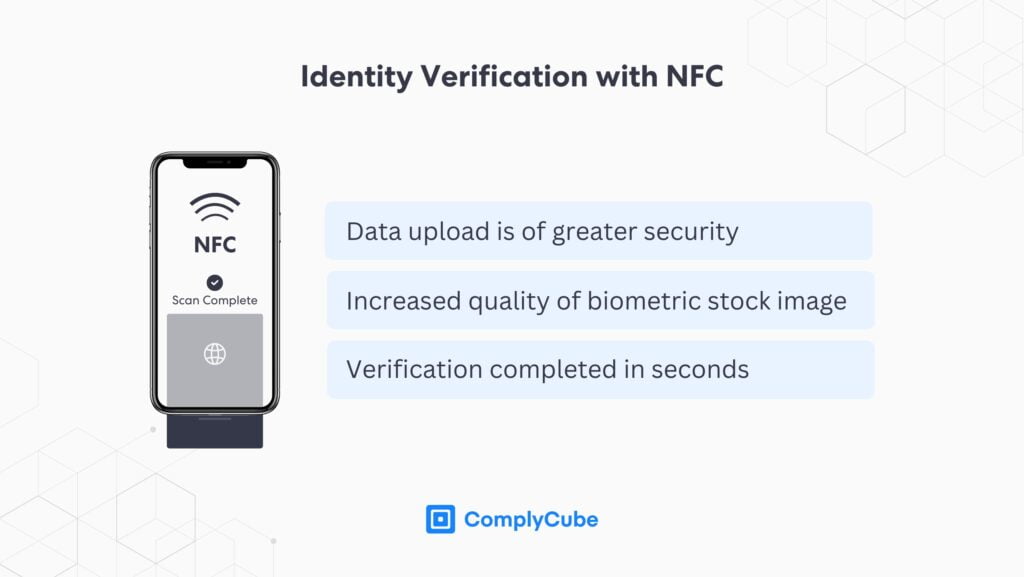
NFC identity document verification adds an additional layer of security. This ensures secure data transfer for identity verification. From a document to an enabled device in seconds, NFC provides a frictionless onboarding process while maximizing security. It also helps organisations increase confidence in the document’s authenticity without adding extra steps for the user.
## Data Extraction in NFC ID Verification
The NFC identity verification flow involves two processes. The processes are data extraction and cryptographic validation. Once a user places an NFC document near an enabled device, the 4-step NFC verification begins. This makes it easier to strengthen assurance while keeping the onboarding journey fast and intuitive.
### Secure Data Access
NFC verification typically starts in one of two ways: Basic Access Control (BAC) or Password Authenticated Connection Establishment (PACE). Both methods help establish a secure session before the device reads data from the chip.
- BAC verifies passports using three MRZ details: the document number, date of birth, and expiry date. The system combines these values to create a session key. It then uses that key to decrypt the NFC chip data and start secure identity verification.
- PACE works slightly differently for national ID cards. The user scans a 6-digit code from the front of the document. The system uses that code to create a secure connection to the NFC chip and begin processing.
Once the device establishes the connection, it reads and extracts data from the NFC chip**,** including the ID document details and a high-resolution biometric portrait**,** of the individual. The system can then use this chip-sourced data to support downstream verification checks.
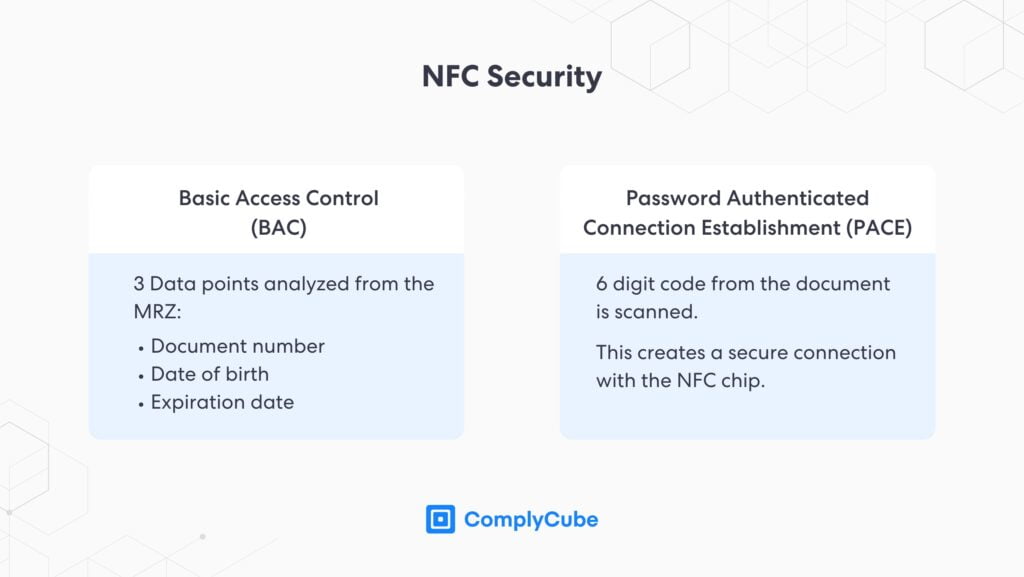
### Cryptographic Verification with NFC Technology
The verification process begins with passive authentication, ensuring the chip has not been tampered with since issuance. It cryptographically verifies each data element using the private key. This ensures the integrity of the data before proceeding with further checks.
Following this, the NFC chip undergoes active authentication, which sends the NFC chip a challenge-response test. Assuming the chip is genuine and not a replica, it will generate a response with its private key to verify its authenticity. This step adds an additional layer of security to confirm the chip’s legitimacy.
### Biometric Matching
When a high Level of Assurance (LoA) is required, IDV must involve a [biometric verification](https://www.complycube.com/en/solutions/identity-assurance/biometric-verification/) step. Biometric verification involves a user taking a live selfie or video for even stronger results, which is analyzed for liveness, and tampering along with many other compliance specifications. The supplied image or video is compared with the stock photo from the ID document for similarities. For more information on biometric verification, read [the Advantages of Biometric Authentication](https://www.complycube.com/en/the-advantages-of-biometric-authentication/).
NFC-based ID verification pulls a higher-quality stock image from the chip than a smartphone photo of the document. That gives the verification engine a clearer reference image. It can then compare faces more consistently and produce more reliable match results. This improves match confidence, especially when camera lighting or image sharpness varies.
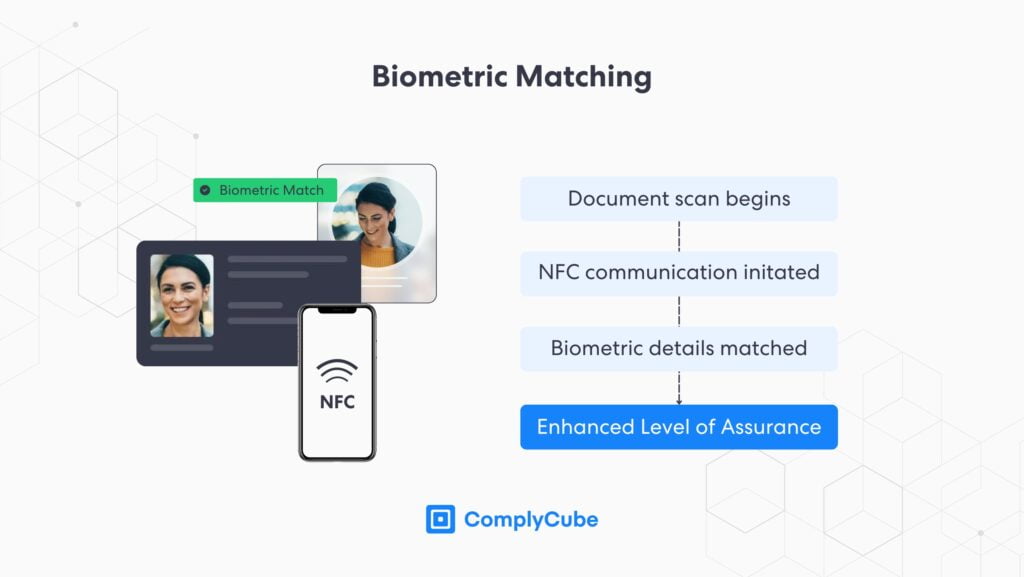
### **Case Study: UKVI’s e-Visa expansion and NFC-based identity confirmation**
In late 2025, UK Visas and Immigration (UKVI) was accelerating its move away from physical documents and visa vignettes toward a digital record of identity and immigration status (an eVisa). UKVI positioned this as a phased transition to manage scale, while keeping the experience practical for applicants to need to prove status at the border and to third parties.
##### **Expand e-Visa coverage and use UK Immigration ID Check App**
On 11 November 2025, UKVI confirmed the shift to eVisas, with physical evidence reduced some routes moved from 30 October 2025, and some work/study applicants stopped receiving vignettes from 15 July 2025. To support these digital journeys, the UK Immigration: ID Check app lets applicants prove identity online and set up eVisa access.
##### **Outcomes**
- From 30 October 2025, some approved applicants no longer receive a vignette and must use a UKVI account/eVisa.
- UKVI positioned eVisas as more secure than physical documents and faster for proving status (border, employers, and landlords).
- From 1 September 2025, UKVI funded 25 community organisations (up to £400k to 31 March 2026) to support vulnerable users.
## Benefits of Using NFC ID Verification
An NFC verification process strengthens a company’s IDV tech stack without reducing the User Experience (UX). Enhancing the UX is a fundamental practice in modern-day client acquisition processes and is one of the leading factors behind customer churn. A faster, smoother onboarding flow can also reduce drop-offs during sign-up.
### Frictionless UX
Near-field communication technology can transmit data in seconds between NFC-enabled biometric passports or ID cards and NFC-enabled smartphones. NFC-based verification allows new customers to sign up with contactless technology, contributing to an institution or company’s commitment to customer excellence.
A 2024 report found that the [median churn rate in the financial services industry was 19%](https://customergauge.com/blog/average-churn-rate-by-industry), a direct consequence of poor customer experience (UX). Traditional Financial Institutions (FIs) have been disrupted over the past few years primarily due to the gap in customer understanding. Neobanks have been leading this disruption.

### Deter Fraudsters
NFC verification makes it hard to forge documents that still pass an NFC reader. That directly reduces successful identity fraud attempts. The NFC chip protects biometric data and only allows decryption in specific cases. Fraudsters can’t easily copy or alter the chip and reuse it. This raises the effort and cost for bad actors. It also lowers the payoff for criminals who try to scale forgery.
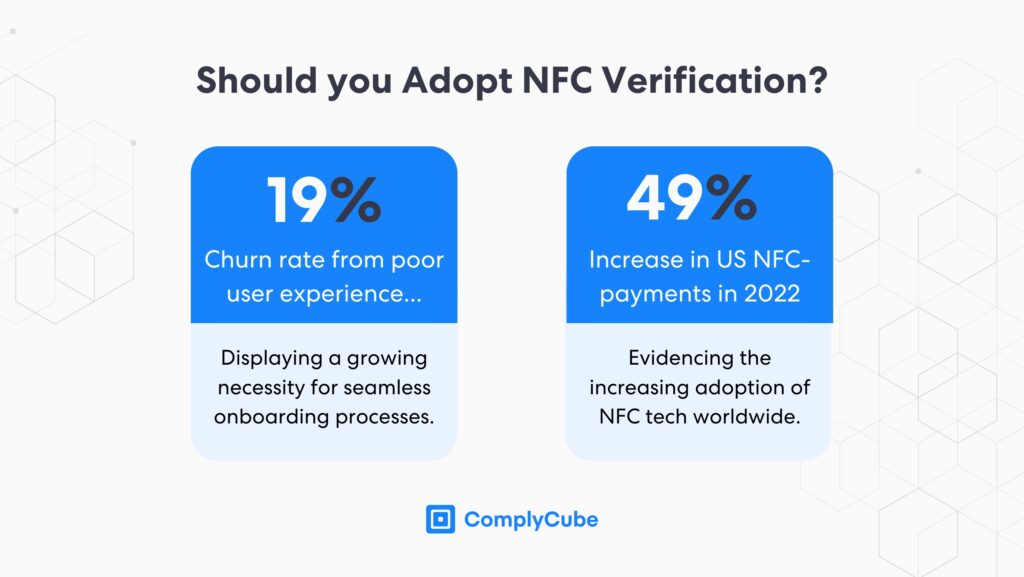
### NFC ID Security
NFC verification protects identity documents by transferring data over a short, close-range connection instead of longer-range methods, which reduces interception risk and keeps the exchange secure end to end. This is why businesses have widely adopted NFC for contactless payments. In 2022, US mobile payments increased from 29% to 43.2%, displaying a growth of 49% in the sector.
Compliance solutions should strengthen security without forcing businesses to trade off customer experience. Adopting NFC technology enables institutions to maximize security while prioritizing UX.
### Key Takeaways
- **NFC chip-reading** upgrades document checks from “looks real” to “cryptographically proven.”
- **BAC/PACE is the gatekeeper** step that enables secure chip access (passport vs. national ID).
- **Passive + active authentication** helps detect tampering and cloned chips.
- **Biometric matching is stronger** when the portrait comes from the chip (higher quality) vs. a photo of the document.
- **NFC can improve** fraud resistance without sacrificing UX.
## About ComplyCube
ComplyCube is an award-winning SaaS compliance platform. It provides solutions to empower FIs, crypto platforms, telecom firms, and many others with regulatory adherence. With an intuitive, all-in-one dashboard, firms can take total control over the IDV process. The platform does this by setting personalized risk scenarios according to their unique Risk-Based Approach (RBA).
ComplyCube provides a suite of Anti-Money Laundering (AML) and Know-Your-Customer (KYC) solutions. This is in addition to its IDV services, making it a one-stop shop for modern compliance. For further queries about NFC ID verification or AML solutions, start a conversation with a[ specialist today](https://www.complycube.com/en/contact/contact-sales/).
## Frequently Asked Questions
What is NFC ID verification?
NFC ID verification is a method of identity verification that uses Near-Field Communication to read the encrypted chip inside ePassports and electronic ID cards. This enables secure data extraction plus cryptography validation of the document.
How is NFC different from RFID for identity verification?
RFID (Radio Frequency Identification) can work over much longer ranges via radio waves. NFC is designed for very short-range transfers (a few inches), which reduces interception risk and supports encrypted, device-verified reads for ID checks.
How can crypto businesses stay compliant with AML regulations?
BAC (Basic Access Control) typically uses MRZ (Machine Readable Zone) data (document number, DOB, expiry) to create a session key to unlock the chip, while PACE uses a card access code (often a 6-digit number) to establish a secure channel – common for national ID cards.
What is passive and active authentication in NFC document verification?
Passive authentication verifies chip data integrity (detects tampering since issuance), and active authentication adds a challenge-response test to help confirm the chip is genuine rather than a replica.
How does ComplyCube use NFC in identity verification?
ComplyCube can add NFC ID verification as an extra layer in the identity verification flow – using chip data extraction plus cryptographic checks, and supporting biometric matching using the higher-quality portrait retrieved from the NFC chip to strengthen confidence in the verified identity.
**Categories:** Guides
**Tags:** Identity Verification
---
### [The UK Online Safety Act and Age Assurance](https://www.complycube.com/the-uk-online-safety-act/)
**Published:** July 2, 2024
**Author:** Andreea Balasa
**Excerpt:** The Online Safety Bill and the UK Online Safety Act are two sides of the same coin. The former laid the legislative groundwork for the latter's online identity verification, age assurance, and age verification system policies.
**Content:**
The Online Safety Bill (OSB) and the UK Online Safety Act (OSA) are two sides of the same coin. The former laid the legislative groundwork for the latter’s online identity verification and age assurance policies. This guide informs readers of the Act’s significance and why a sophisticated age verification system must be established to safeguard the online world.
## What is the UK Online Safety Bill?
The UK Online Safety Bill was a parliamentary brief that opened the discussions on the Act’s contents. The discussions were to confirm how harmful content should be regulated online, including content pertaining to minors and explicit material, and establish adequate safeguards to protect all internet users, particularly the young.
The Bill’s discussions also established regulatory expectations and the key regulating bodies that would enforce the decisions. The OSB opened talks around implementing age verification methods as a barrier to age-gated content and user empowerment tools where owners of online accounts could set their own safeguards.
## What is the UK Online Safety Act?
The UK OSA finalized these discussions into enforceable law. The Act details the responsibilities of major regulatory bodies and the institutions that must adhere to their policies, collaborating with [Ofcom](https://www.ofcom.org.uk/about-ofcom/) as the lead regulatory force for the digital UK.
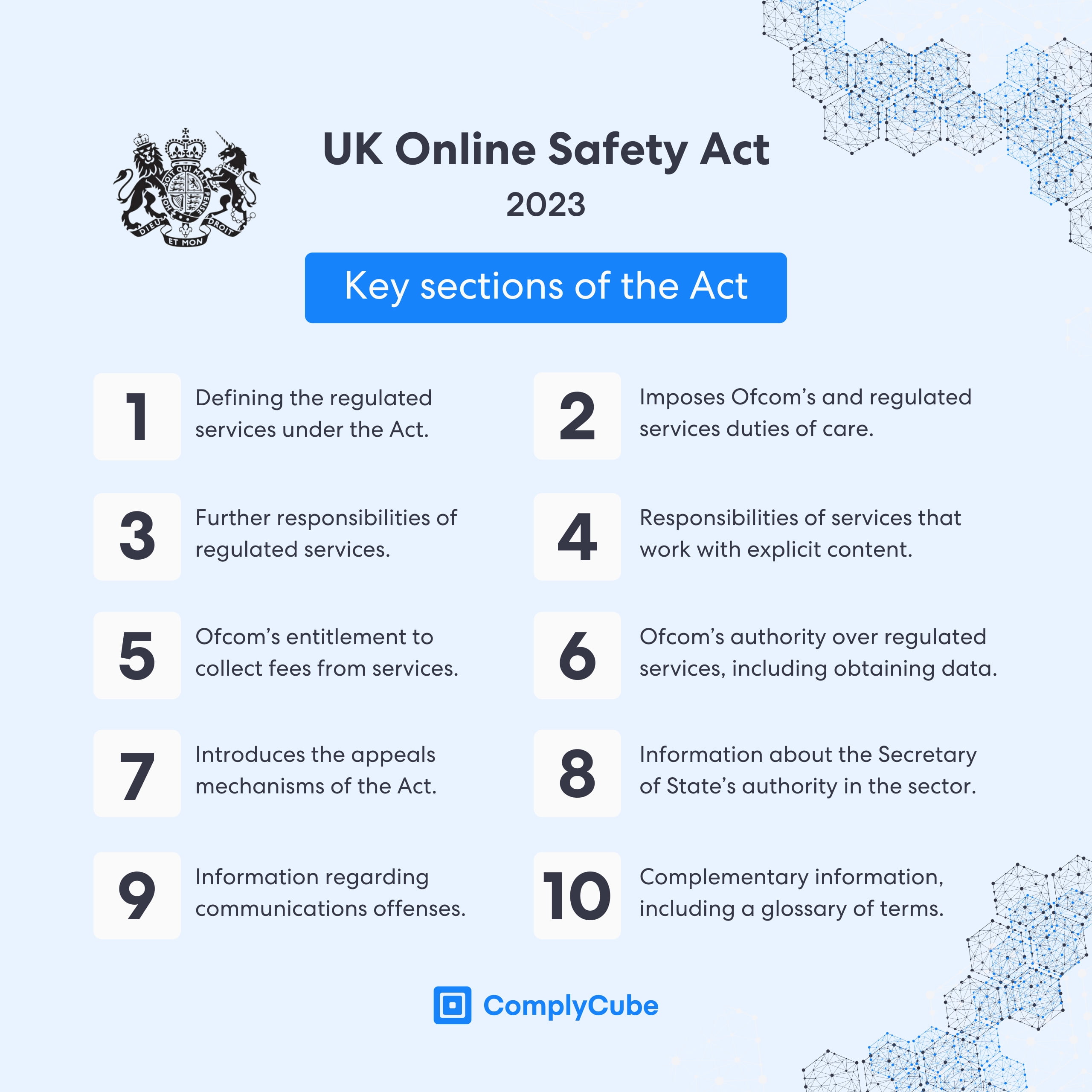
## What are the Key Principles of the Online Safety Act?
[The Act is broken down into 11 key parts](https://www.legislation.gov.uk/ukpga/2023/50) (12 including an introduction.) They are:
1. The key definitions relevant to the Act include user-to-user services, search services, Part 3 services, and regulated services.
2. The impositions of duties of care on the providers to user-to-user services and search services and Ofcom’s responsibility of issuing codes of practice.
3. Further impositions of the duties of user-to-user and search services.
4. The imposition of duties on providers of internet services that publish explicit content, including user-to-user and search services.
5. Introduces the policy where Ofcom collects fees from providers of regulated services.
6. Explains Ofcom’s authority and obligations in relation to regulated services, including the power to obtain information from service providers.
7. Clarifies the appeals and complaints policy in relation to regulated services.
8. Reveals the new power the Secretary of State has over the industry, courtesy of this Act.
9. Contains communications offenses.
10. The final two sections contain supplementary information, including an index.
## Definitions of the UK Online Safety Act
The Online Safety Act applies to applicable companies that provide two key regulated services: user-to-user services and search services.
### User-to-User Servicers
If a platform facilitates the creation and sharing of user-generated content that can be accessed by other users, it is subject to the UK Online Safety Act. This includes a wide range of user-to-user services such as:
- Social media platforms, such as X (Twitter)
- Online dating sites, such as Tinder
- Discussion forums, such as Reddit
- Online gaming providers, such as Steam
- Adult/Explicit websites
### Search Services
Any online business that provides a search engine or a means to search things on the internet is defined as a search service. However, the criteria for what constitutes a regulated search engine are nuanced. According to the Act, any search engine that allows users to search multiple websites or databases (essentially all websites or databases) falls under the law’s jurisdiction.
In contrast, search engines that only allow searches within a single website or database are not regulated by this law. Typical regulated search services are:
- Google Chrome
- Mozilla Firefox
- Bing
- Yahoo
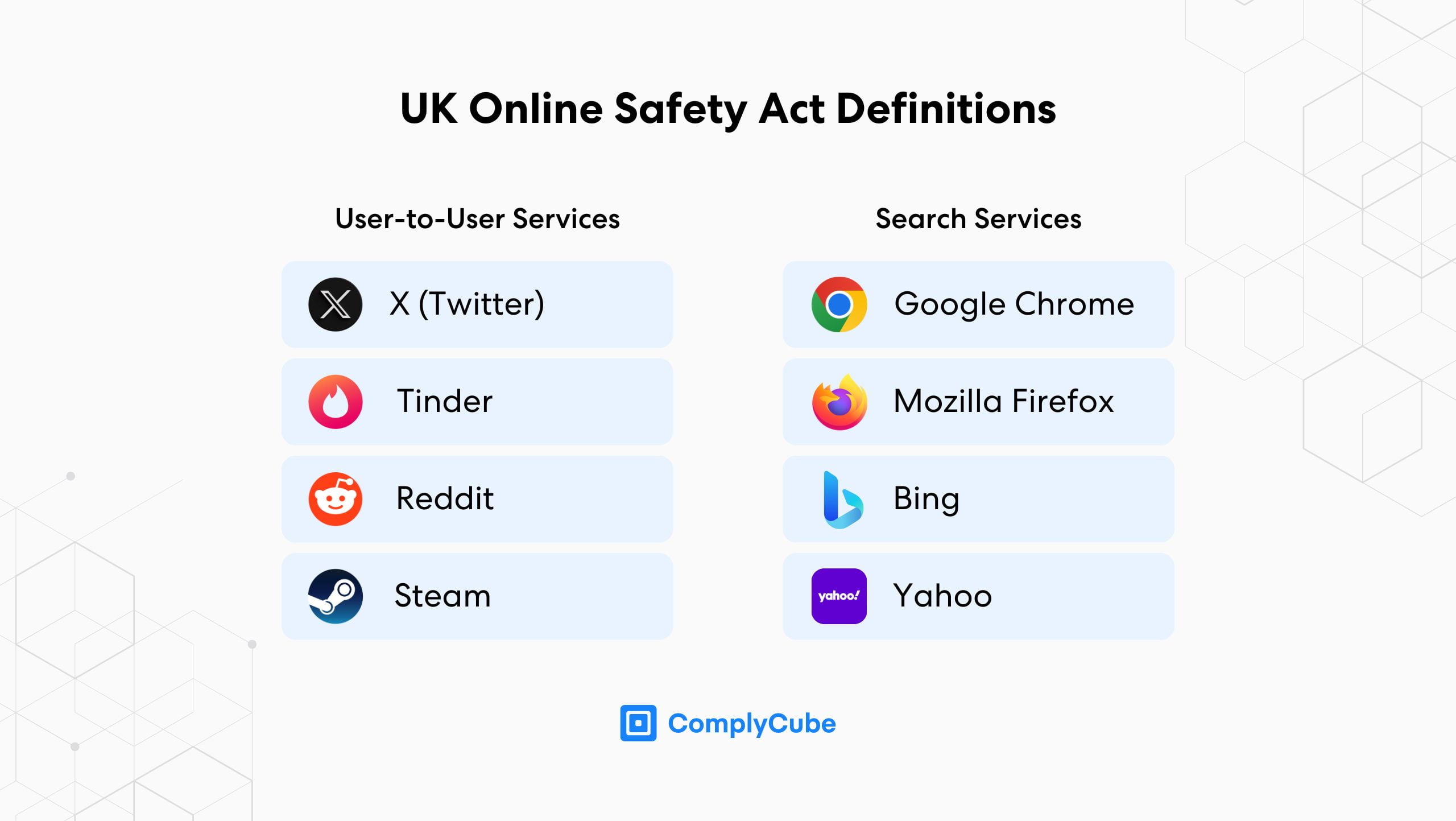
## User Verification: What Does the Act Suggest?
Although the Act has not issued the exact age verification specification yet, it is strongly advised that firms operating in this industry begin integrating with an Identity Verification (IDV) and age verification service. This will ensure that they are best prepared for the demands when they are released and can remain competitive.
### Kids Online Safety
In the UK, data privacy regulations stipulate that users must be at least 13 years old to join a social media platform without parental consent. The Online Safety Act enhances these protections. Online platforms must implement mechanisms to estimate or verify a user’s age to prevent children from accessing inappropriate content.
> [Over 80% of children](https://onlinesafetydata.blog.gov.uk/about-us/#:~:text=62%25%20of%20adult%20internet%20users,safety%20of%20children%20%2D%20is%20unacceptable.) have experienced harmful content online.
This figure displays a horrifying truth about current online internet safety. While ‘harmful content’ is left open to interpretation, it is clear that current measures are not satisfactory, and the UK Online Safety Act is a pivotal step in creating stronger safeguards.
However, the OSA does not immediately specify any methods for achieving age assurance. Instead, Ofcom was given the responsibility of developing these regulations. [As per the draft guidance published in May 2024](https://www.ofcom.org.uk/online-safety/protecting-children/our-proposed-measures-to-improve-childrens-online-safety/), age assurance processes must be technically accurate, robust, reliable, and fair.
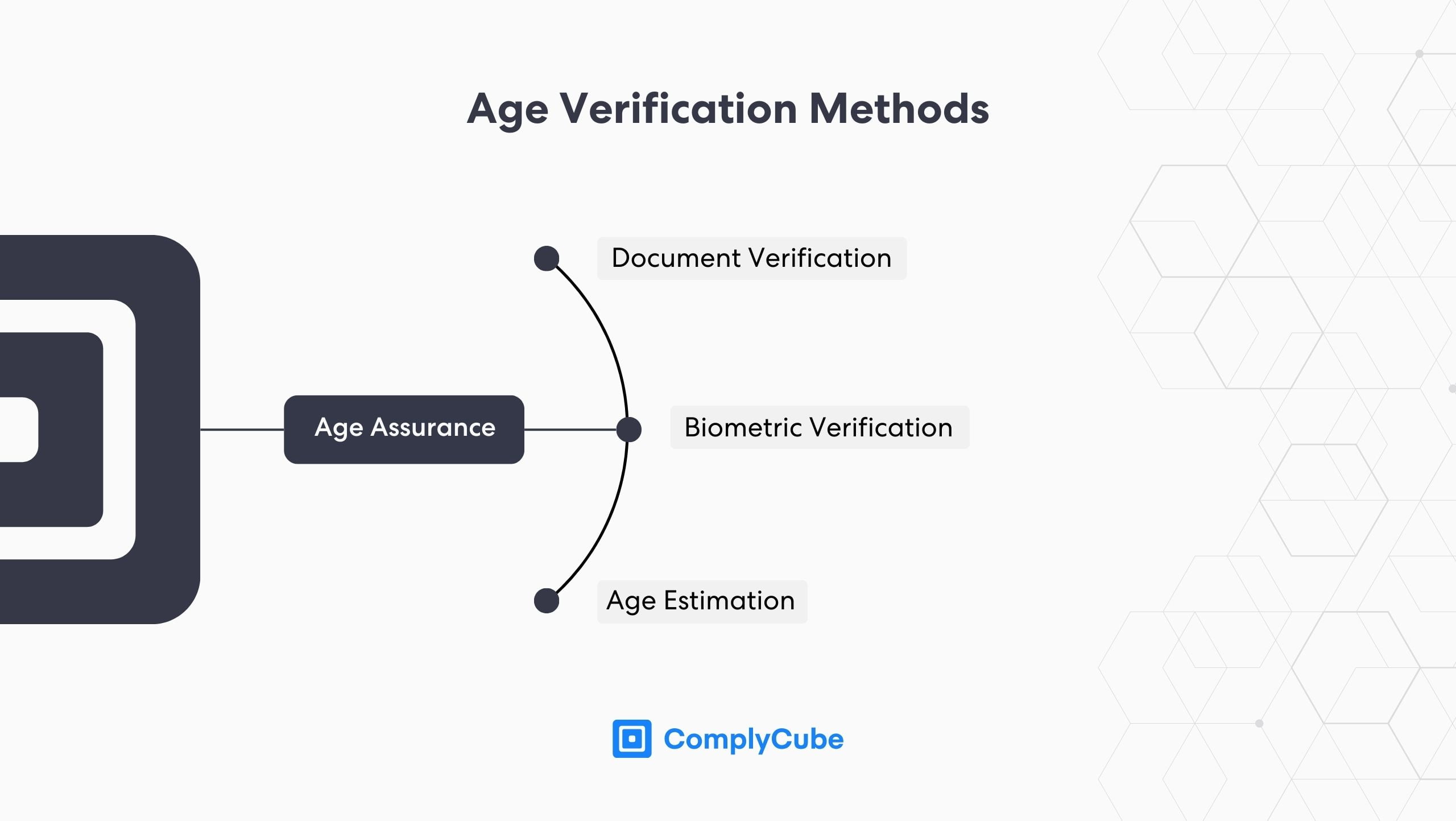
Acceptable methods include photo-ID matching, facial age estimation, and reusable digital identity services. Conversely, methods like self-declaration of age and general contractual age restrictions are deemed ineffective. However, digital IDV services are not currently enforced. For more information about achieving age assurance, read [Picking Digital Identity Verification Solutions](https://www.complycube.com/en/picking-digital-identity-verification-solutions/).
Ofcom’s 2024 Spring update to the Act included 3 key takeaways.
1. Regulated firms must introduce robust age verification methods to ensure they know which of their users are children.
2. Institutions must implement and develop safer algorithms. This includes personalizing algorithms, so if children do not like what they see, they can let the app or website know.
3. Ofcom stated that moderation must be ramped up and its efficacy increased. This includes swift action on harmful content and the enablement of safe search modes.
### UK Online Safety Act for Adults
Businesses providing a user-to-user service must give adults the option to verify their identity. This is to give adult users who have verified their identity to filter out those who have not. However, this policy is currently mild in its effectiveness.
Most online platforms that pursue this policy still lack adequate age verification safeguards and, therefore, still allow children to access their services. For this reason, age verification systems upon signup are the most pivotal application of the Act, yet remain relatively poor in adoption.
Although the Bill does not prescribe the exact nature of this filtering process, it does require that it effectively:
1. Prevents unverified users from interacting with content shared or generated by verified users who have opted to filter out unverified users.
2. Reduces the likelihood that verified users will encounter content from non-verified users.
## The UK Online Safety Act: at a Glance
While the Act does not wish to restrict free speech, a balance must be struck between permitting harmful content online and users’ ability to create or write anything they wish. For this reason, the UK government decided the Act was a necessity for private companies, large entities, and public institutions that provide digital services.
The British government, along with the European Union (EU) in its [Digital Services Act](https://commission.europa.eu/strategy-and-policy/priorities-2019-2024/europe-fit-digital-age/digital-services-act_en) (DSA), is among the first movers to implement a comprehensive framework for the protection of minors from harmful and adult content as well as regulate the protective measures on age-restricted products.

The Act also defines safeguarding minors as tracking and preventing child sexual abuse material. This involves monitoring messages and content [irrespective of the technology social media platforms use](https://www.gov.uk/government/publications/end-to-end-encryption-and-child-safety/end-to-end-encryption-and-child-safety#:~:text=The%20Online%20Safety%20Bill%20and%20E2EE,-The%20Online%20Safety&text=It%20sets%20out%20a%20legal,use%2C%20including%20services%20using%20E2EE.), including end-to-end encryption.
Many of the regulations defined by the Act are also witnessed in other key online regulators, including the Electronic Frontier Foundation (EFF), the Children’s Online Privacy Protection Act (COPPA), among many others. All of which champion similar digital rights, particularly to the safeguarding of minors from adult websites, content, and sexual abuse.
## About ComplyCube’s Identity Verification Solutions
ComplyCube is a global leader in Know Your Customer (KYC) and Anti-Money Laundering (AML) products, including a comprehensive suite of IDV solutions to encompass digital firms’ regulatory obligations.
Boasting smart document verification technology, ComplyCube captures user information such as birth date, ID number, expiry and issuance dates, and many other crucial data and security points. This typically forms half of the IDV process, followed by biometric verification, which enhances the identification result.

Biometric verification matches the image in the ID to a selfie or video taken during the acquisition process. Such a pairing creates an extremely high Level of Assurance (LoA) in a client’s real identity. ComplyCube has designed these processes to be as frictionless as possible, and both can be completed together in one seamless workflow in less than 30 seconds.
However, in some instances, firms do not require the same LoA in client identity. On these occasions, ComplyCube’s age estimation technology offers an even more streamlined UX and can accurately estimate a user’s age from a selfie only.
This works well when businesses require an age-gating system but do not want users to give their personal information or create an unnecessarily time-consuming acquisition process. Age estimation can be completed accurately in 5 seconds.
### Integrate with an Age Verification System Today
[Contact a ComplyCube specialist today](https://www.complycube.com/en/contact/contact-sales/) for more information on how the UK Online Safety Act affects your business or to learn more about integrating with ComplyCube’s digital identity and age verification system.
**Categories:** Guides
**Tags:** Regulations
---
### [Generative AI Fraud and Identity Verification](https://www.complycube.com/generative-ai-fraud-and-identity-verification/)
**Published:** July 15, 2024
**Author:** Rithu Jagannath
**Excerpt:** Generative AI fraud detection is crucial to combat document fraud. Robust Identity Verification processes can stop ID fraud at its root, but finding the right solution can be challenging for many businesses.
**Content:**
**TL;DR:** **Generative AI fraud** is making **synthetic identities**, **document fraud**, and **ID fraud** easier to scale, while many businesses still rely on outdated **identity verification** checks. This guide explores how modern **generative AI fraud detection**, combining **live document capture, biometric liveness, NFC**, and **device intelligence**, helps prevent **online fraud** and keep **identity attacks** in check.
## What is Generative AI?
Gen AI is a technology that can create new text, images, videos, and other content. It’s powered by advanced models trained on huge volumes of real-world data. From a few written or visual prompts, it can generate content that looks highly realistic. Fraudsters exploit this to produce convincing fake IDs and supporting documents at scale.
Generative models learn patterns in the data they’re fed and then generate new variations. This is often called [data augmentation](https://openai.com/index/efficient-training-of-language-models-to-fill-in-the-middle/) through machine learning. In a fraud context, it means endlessly tweaking documents and faces until something passes checks. As a result, AI-enabled fraud is faster, cheaper, and harder to spot with legacy controls.
## What is Document Fraud?
Document fraud is when someone uses falsified or tampered documents to pass themselves off as someone they’re not. The goal is to deceive a business, institution, or individual. These forged documents can support a wide range of illegal activities. They are widely used across the modern economy, from finance to employment and immigration.
- Financial fraud – using falsified documents (including financial information such as a credit report) to acquire a loan or for tax-related identity theft or credit card theft.
- Employment fraud – tampering with documents or VISA records or records to attain a job you are unqualified for or are not legally allowed to do.
- Immigration fraud – using false documents to gain immigration rights, cross borders, or claim certain benefits.
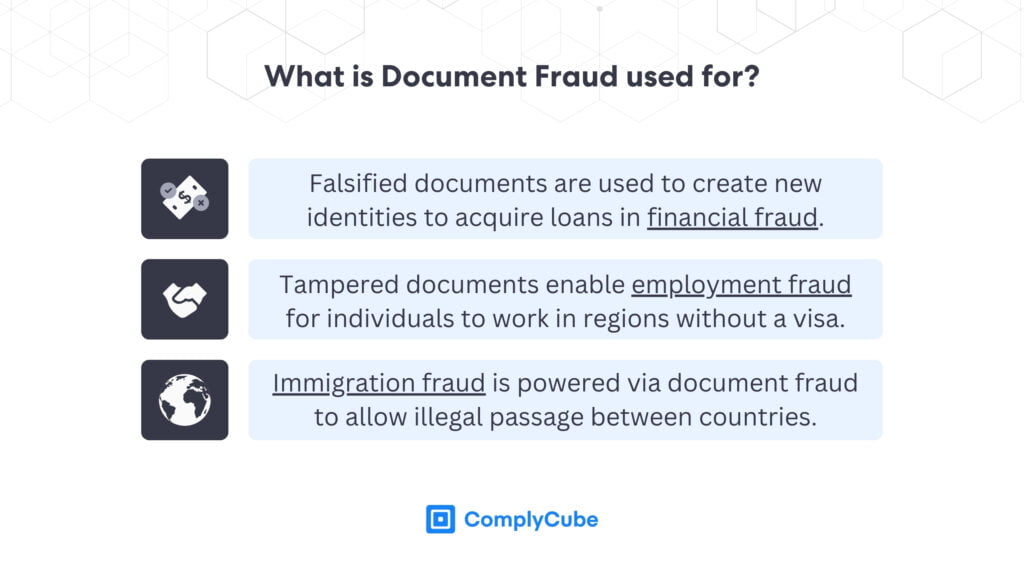
Victims of any type of fraud should file a report with the Federal Trade Commission (FTC). Reporting identity theft, impersonation scams, or document fraud helps authorities understand how widespread these crimes really are. This information allows the FTC to spot emerging patterns, target enforcement, and coordinate with other agencies. In turn, it supports stronger consumer protections, remedial action, and future legislation designed to reduce fraud.
Fraud can be conducted in many ways. We’ve all seen *Catch Me If You Can*, where a young Leonardo Di Caprio makes a fool out of a Tom Hanks detective. In the 1960s, it was far simpler to create counterfeit personal or financial information in the form of IDs, bank statements, or even bank checks.
In the era of digitalization, data scraping and basic photo editing tools already made it easier to create counterfeit documents. Fraudsters could copy logos, reuse stolen data, and adjust images just enough to fool basic checks. Now, with the rise of Gen AI, the barrier has dropped even further. Anyone can produce highly realistic fake IDs and supporting documents with just a few prompts.
## What is Generative AI Fraud?
Generative AI fraud is the use if Gen AI tools to create counterfeit documents, images, or identities. The aim is to bypass security systems that rely on visual checks, template matching, or basic biometrics. Fraudsters generate or manipulate IDs, selfies, and supporting documents until something slips through. An example of the Gen AI fraud process can be seen in the illustration below:

As displayed above, Generative AI fraud can be used alongside identity theft for synthetic data generation to create what apear like genuine accounts. Leveraging fraudulently generated images, bad actors can create convincing new accounts with a different individual’s identification documents and bypass security systems used by Financial Institutions (FIs) across the world.
This Deloitte report suggests that the adoption of compliance technologies is giving criminals the advantage over firms when it comes to leveraging Gen AI to circumvent compliance security programs. If this development continues past 2024, the global financial system could be at risk of exceeding today’s volume of money laundering.
The solution to not only preventing this figure from rising but actively reducing it, is adopting compliance solutions that make use of the same advanced technologies that attempt to breach FIs. This is made clear through many national and international regulatory bodies, such as:
- The US Department of the Treasure (DoT)
- The Financial Conduct Authority (FCA).
- The Monetary Authority of Singapore (MAS).
- The Financial Action Task Force (FATF).
### **Case Study: Hong Kong: Deepfake “Selfies” Open Accounts at 30 Banks**
### Problem: Deepfakes Bypass KYC Across Hong Kong Banks
In April 2025, the Israeli Money Laundering and Terrorist Financing Prohibition Authority (IMPA) reported a case where a fraud network used deepfake technology to replace criminals’ faces with images taken from stolen IDs. Using these manipulated selfies, fraudsters **successfully opened accounts at 30 different banks in Hong Kong**, then used those accounts to launder **over USD 1.2 million**.
### Solution: How ComplyCube Could Have Helped
ComplyCube’s stack could have added multiple lines of defence here: advanced **liveness and presentation attack detection (PAD)** to detect deepfake artefacts in selfie streams, **document and selfie cross-checks** with NFC chip data where available, and **device intelligence** to expose patterns such as the same devices, IP ranges, or emulators being reused across “different” customers and banks.
### Outcomes: Likely Impact With ComplyCube in Place
With ComplyCube in the flow, many of those 30 applications would have raised a high-risk score due to repeated devices, abnormal onboarding, or inconsistencies between document, chip and selfie. That would have limited the number of accounts opened, reduced the total amount laundered, and generated richer signals for suspicious activity reports (SARs), helping both the banks and local FIUs intervene earlier.
## Generative AI Fraud Detection
##
Detecting Gen AI fraud requires advanced machine learning to leverage similar data sets that are used to create fraudulent documents and images. When verification systems utilize the same – or similar – data sets, they can identify the patterns that Generative AI fraud technologies would create to bypass traditional methods. These tools significantly increase a firm’s fraud detection capabilities.

### Document Verification
###
For the most reliable results, document verification processes must be conducted live and during the client acquisition process. Document liveness ensures that the uploaded image will not have been tampered with, as it must have come from a user’s smartphone camera to be completed. The process then examines all available data spots from the ID.

- Visual Inspection Zone (VIZ)
- Machine Readable Zone (MRZ)
- RFID chip
- Barcodes
Near-Field Communication (NFC) verification takes this process even further by reading an embedded chip inside the document that provides an immutable data transfer. NFC verification captures the stock image of a document in far greater quality than an image upload ever could, permitting greater biometric matching and assurance of unadulterated documents. For more information, read [What is NFC ID Verification?](https://www.complycube.com/en/what-is-nfc-id-verification/)
### Biometric Verification
###
Biometric verification, or selfie verification, is used to add a secondary layer of identity assurance for businesses. Following the data capture and verification from the document, biometric verification is used to match for similarities between the stock image in the ID, and the facial biometrics in the selfie.

Again, liveness is crucial, as it ensures that the image has not been edited with or generated by AI. PAD verification builds digital 3D structures around the face to analyze skin tones and micro-expressions, check for masks, and detect pixel alteration. For more information, read [Liveness Detection: Best Practices for Anti-Spoofing Security.](https://www.complycube.com/en/liveness-detection-best-practices-for-anti-spoofing-security/)
ComplyCube’s selfie verification engine can also be used as an age estimation solution. It provides accurate yet frictionless security for age-gated goods while preventing fraudulent individuals from gaining access.
### Device Intelligence
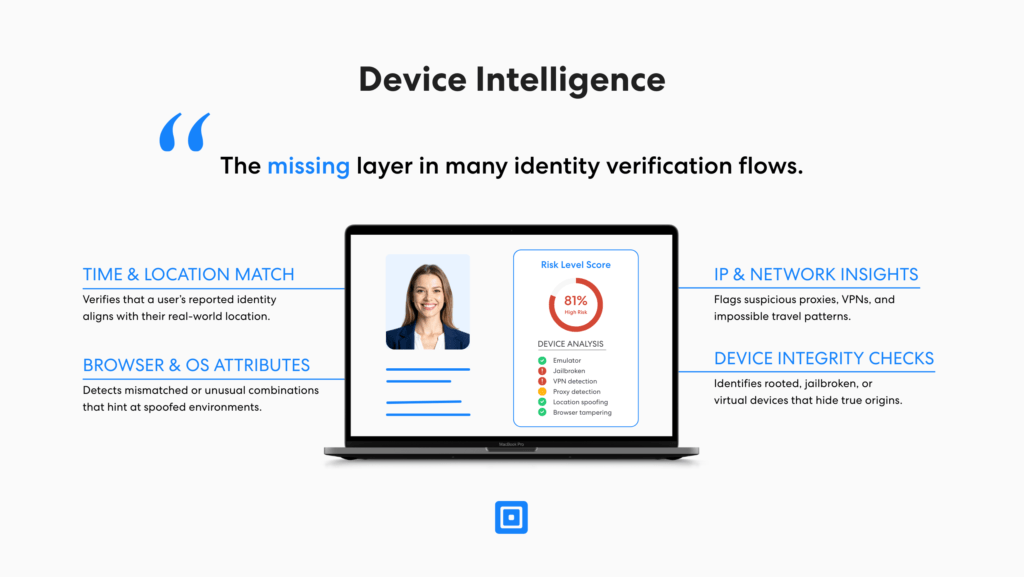
Even with strong document and biometric checks, some synthetic identities still slip through, especially when they’re orchestrated by well-coordinated fraud networks. This is where device intelligence becomes the missing layer in many IDV flows, adding context about *how* a user is accessing your platform, not just *who* they claim to be.
Device intelligence looks at signals from the user’s device and network: the hardware and operating system, browser attributes, IP address, and whether the time zone and geolocation make sense for the claimed identity. It also detects riskier setups such as emulators, virtual machines, or rooted/jailbroken devices, and spots automated behaviour like scripted form fills or unnaturally fast, repetitive interactions.
When these signals are correlated across sessions and accounts, businesses can start to see fraud rings rather than isolated incidents. High-risk onboarding attempts can be flagged before completion, and step-up checks can be applied only when the device risk is elevated. In combination with Gen AI fraud detection and advanced IDV, device intelligence turns identity verification from a static document check into a dynamic, risk-based assessment of the person, their device, and their behaviour over time.
### Key Takeaways
- **Gen AI lowers the barrier to document fraud**: Anyone can generate realistic IDs and supporting documents, making fraud more scalable.
- **Document-only checks are no longer enough**: Visual inspection, MRZ, and even basic liveness can be fooled by sophisticated attackers.
- **Biometrics need strong liveness (PAD)**: 3D face maps, micro-expression analysis, and pixel-level checks are vital to stop deepfakes and replay attacks.
- **Device intelligence is a crucial “third signal”**: Device fingerprinting, reputation, and behavioral patterns help link seemingly separate applications and highlight fraud rings.
- **Use device re-authentication when users log back in** to confirm it’s the original device (and not a new device in a remote location), reducing the risk of account takeover.
## Is Your Platform Protected from Generative AI Fraud?
##
Generative AI has fundamentally changed document fraud. It’s no longer enough to check a single ID and selfie at onboarding and hope for the best. As this article has shown, modern attacks blend AI-generated documents, deepfakes, synthetic identities, and coordinated device use to slip past legacy controls and then exploit your platform through credit card fraud, mule activity, and complex money flows.
To keep pace, businesses need layered, continuously adaptive defenses. That means combining live document checks, NFC reads, biometric liveness, device intelligence, and machine-learning anomaly detection to monitor behavior across many channels over time. When these signals work together, fraud rings become visible, false positives fall, and genuine customers move through your flows with far less friction.
If you’re rethinking your fraud strategy in light of Gen AI, our team at ComplyCube can help you design and implement a verification stack that matches your risk profile, products, and markets. **[Get in touch with our team](https://www.complycube.com/en/contact/contact-sales/)** to explore how ComplyCube can help protect your platform from Generative AI-driven document fraud.
**Categories:** Guides
**Tags:** Identity Verification
---
### [The UK Digital Securities Sandbox (DSS)](https://www.complycube.com/the-uk-digital-securities-sandbox/)
**Published:** July 17, 2024
**Author:** Andreea Balasa
**Excerpt:** The UK Digital Securities Sandbox is a policy ideation initiative for tokenization and UK Security Token Offering (STO) compliance. These dynamic crypto KYC and AML policies are designed to foster innovation.
**Content:**
The UK Digital Securities Sandbox (DSS) is the UK government’s policy for gradually implementing a framework for tokenizing traditional financial instruments, such as securities like company equity. This framework requires relevant firms to adhere to crypto KYC (Know Your Customer) regulations, and simultaneously, it supplies a degree of flexibility for achieving UK Security Token Offering (STO) compliance.
This guide dives into the DSS specifications, the regulations firms must abide by, and the future of STOs in the UK and around the world.
## What are Digital Securities?
Digital securities are virtual representations of traditional securities; however, they are issued, stored, and traded on a Distributed Ledger Technology (DLT) or a blockchain.

The Bank of England (BoE) describes the following assets as examples of financial instruments that could be issued and traded under the DSS:
1. Equities,
2. Emissions allowances,
3. Corporate and government bonds,
4. Units in collective investment undertakings, used in index funds,
5. Money market instruments, such as commercial paper (debt for short-term liabilities).
Digital securities and tokenized Real-World Assets (RWAs) are rapidly growing topics. As blockchain technology continues to grow around the world, tokenization of Real World Assets has been described as its’ killer use case’. Learn more about Security Token Offerings and RWAs by reading [Security Token Offering (STO) Compliance](https://www.complycube.com/en/security-token-offering-sto-compliance/).
## What is the UK Digital Securities Sandbox?
The DSS is the UK’s first initiative to integrate Distributed Ledger Technology (DLT), or blockchain technology, into its financial markets. The comprehensive Bank of England consultation paper can be found [here](https://www.bankofengland.co.uk/paper/2024/cp/digital-securities-sandbox-joint-bank-of-england-and-fca-consultation-paper).
### Purpose and Goals
First and foremost, the DSS is designed to foster innovation by giving firms the ability to experiment with new financial utilities that the technology enables. However, it does so in a regulatory flexible environment displaying the government’s attitude to managing financial stability risks.
This flexibility enables the technology’s swift adoption into the market. DLT technology increases the efficiency of value transfers, reducing post-trade settlement time and increasing transaction integrity and security.
### Regulatory Framework
The DSS was established under the Financial Services and Markets Act (FSMA) of 2023, giving the Bank of England (BoE) and the Financial Conduct Authority (FCA) regulatory authority over participating firms.
Commencing on January 8, 2024, these regulators have the power to oversee and modify tokenized Real World Asset (RWA) rules and regulations for market participants. The DSS regulations enabled 3 business model opportunities.
1. Undertaking the activities of a Central Securities Depository (CSD) by being a Digital Securities Depository (DSD).
2. Operating a trading platform or venue, such as a recognized investment exchange (must not be an overseas investment exchange).
3. Combining both into one Financial Market Infrastructure (FMI) to create a hybrid structure.
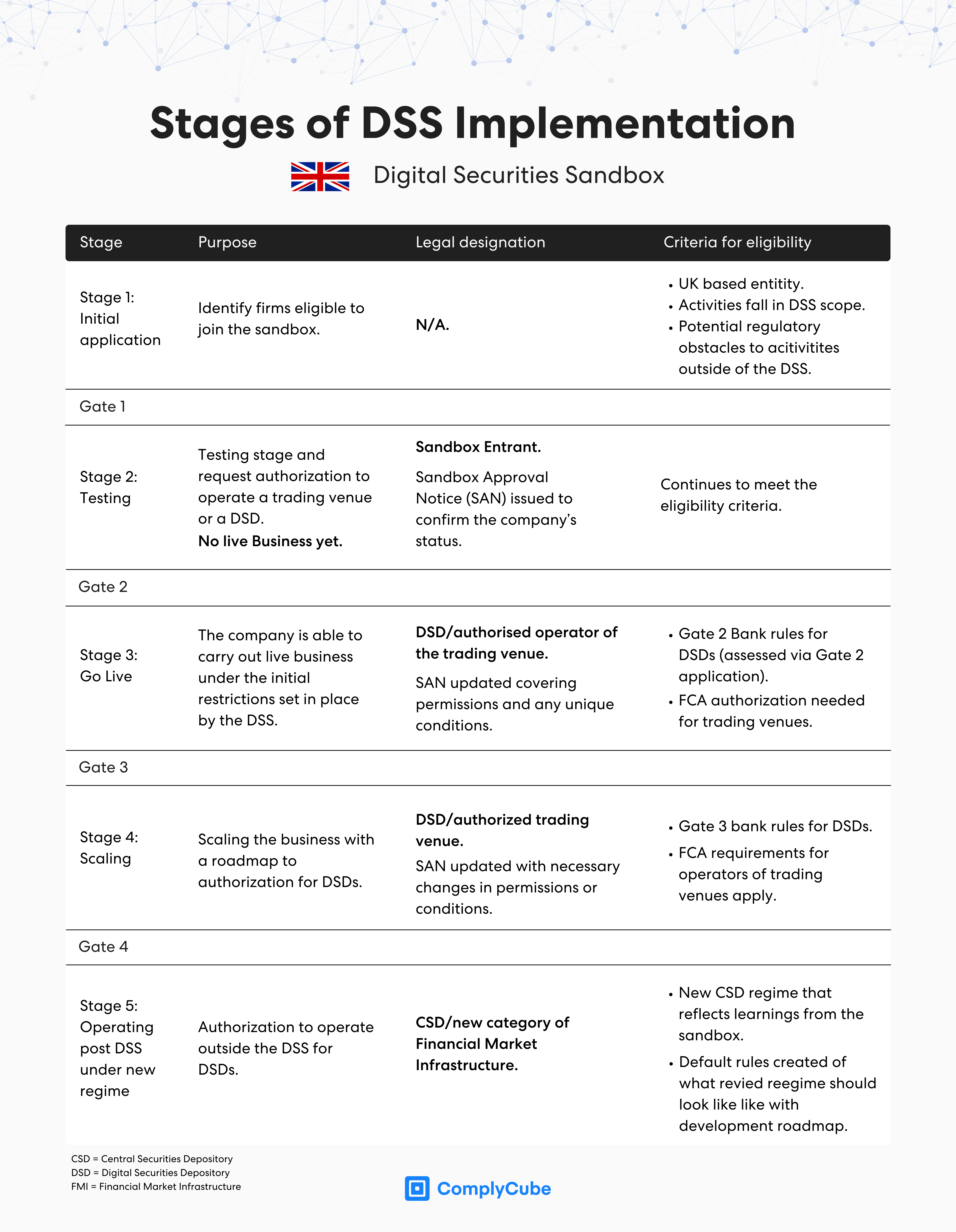
### Implementation
The FCA and BoE will establish a suitable application process according to the DSS for firms wishing to participate. They will jointly oversee and supervise applications and grant permissions to relevant applications.
Both regulators are responsible for performing due diligence and ensuring that participating firms are doing so with the intention of contributing to the sandbox rather than abusing its regulatory flexibility. The DSS is designed to be flexible and accommodate various business models, so long as there is sufficient oversight for the potential for misuse.
### Testing and Adaptation
The DSS is a living policy, meaning that the regulators have the authority to amend the sandbox when necessary to accommodate the greater adoption of digital assets.
> The adoption of new technology in this area, if done safely, [could lead to a technological transformation,](https://www.reuters.com/world/uk/bank-england-sets-out-conditions-digital-sandbox-2024-04-03/) fostering greater efficiency in the financial system.
The Digital Securities Sandbox serves as a test for regulatory sandboxes in other financial domains. If it is successful, the UK will endorse sandboxes as a more commonly practiced integration method for new policies.
### Key Features of the Digital Securities Sandbox
The sandbox is highly flexible and a testament to the DSS’s regulatory oversight, attracting a diverse array of Financial Market Infrastructures. Each sandbox entrant has a unique pathway to develop their product in line with the regulatory framework to transition outside of the DSS’s jurisdiction to a new and permanent regime.
The DSS creates a safe environment for real and live commerce, allowing businesses to get hands-on experience with blockchain utilities without fear of regulatory compromise. However, there are limits to the activities FMIs may participate in while under the scrutiny of the sandbox. This is to reduce financial stability risks and maintain market integrity.
### Long-Term Goals
The ultimate ambition is to foster a tried-and-tested formula for regulating digital securities. The sandbox’s regulatory flexibility should ensure that the final policy not only works but also encourages more firms to participate.
It should be noted, however, that there is no guarantee that firms accepted into the program will be granted permission to operate outside of the Digital Securities Sandbox. Firms must always meet all relevant standards and display a willingness (and capability) to continue adhering to those standards.
The DSS is itself a regulatory sandbox for similar initiatives. Should the trial succeed, this methodology will likely be used across the board. Regulatory sandboxes are already used in financial regulation in Hong Kong and Singapore, as well as numerous other Asian regions. Learn more about Singapore’s stablecoin sandboxes by reading [Hong Kong Crypto Regulation in 2024](https://www.complycube.com/en/hong-kong-crypto-regulation-in-2024/).
### Complementary Developments
The UK is actively pursuing a strategy to develop a world-leading and on-chain Real-Time Gross Settlement (RTGS) integration between blockchains (ledgers). [Project Rosalind](https://quant.network/news/quant-collaborates-with-bis-and-the-bank-of-england-on-project-rosalind/), the UK’s Central Bank Digital Currency (CBDC) initiative, works in parallel with the DSS to merge instant settlement systems with the innovations happening in the blockchain industry.
## How Does Crypto KYC Impact This?
[Crypto KYC](https://www.complycube.com/en/use-cases/industry/crypto/) and AML (Know Your Customer and Anti-Money Laundering) are vital processes in the tokenization of financial instruments. Just as with traditional securities, digitized financial instruments require the same investor screening process to ensure individuals are not abusing the financial system.

KYC for crypto can take many forms, and different platforms will require different processes based on their unique Risk-Based Approach (RBA). A strong KYC flow for a tokenized platform would consist of:
- A robust Identity Verification (IDV) flow, including document and biometric verification.
- Customer Due Diligence (CDD) and AML checks run continuously in the background.
- If required, on-chain transaction screening and monitoring to identify where transferred funds originated from.
This workflow is one example of the customizability that ComplyCube offers its crypto clients. The AML industry leader built its suite of solutions to offer the most flexible array of services on the market. If your platform requires specific AML, KYC, or IDV checks, [reach out to a specialist today](https://www.complycube.com/en/contact/contact-sales/).
## What is the Future of Tokenization?
The world is catching on to the possibilities tokenization brings. Greater market liquidity, 24/7 access to markets, instant settlement, and financial inclusion are only some of the innovations that DLT technology enables.
> Tokenised markets could potentially be worth as much as [USD24 trillion by 2027](https://www.gbm.hsbc.com/en-gb/insights/innovation/potential-of-tokenisation).
HSBC estimates that the tokenized asset market could reach $2 trillion by 2027, a behemoth compared to today’s tokenized market size of only a few billion dollars. Given these estimates, it’s not surprising that the UK has opted for a sandbox approach to regulating this new market.
Such large-scale growth is only possible with effective and adequate regulation that lacks loopholes. The UK Digital Securities Sandbox should provide exactly that.
**Categories:** Guides
**Tags:** Crypto Regulations
---
### [Outcomes of the FATF Plenary, 26-28 June, 2024](https://www.complycube.com/outcomes-of-the-fatf-plenary-26-28-june-2024/)
**Published:** July 25, 2024
**Author:** Andreea Balasa
**Excerpt:** The Financial Action Task Force (FATF) held its sixth and final FATF Plenary meeting from June 26-28, 2024, under the presidency of T. Raja Kumar of Singapore. Read on to learn more about the recent FATF updates from June.
**Content:**
The Financial Action Task Force (FATF) held its sixth and final FATF Plenary meeting from June 26-28, 2024, under the presidency of T. Raja Kumar of Singapore. This significant event gathered delegates from over 200 jurisdictions and observers from various international organizations where FATF updates were discussed.
The three-day discussions covered critical issues related to money laundering, terrorism financing, and proliferation financing. Find a comprehensive overview of the FATF’s expectations, evaluations, and efforts of this session below:
- Changes to country monitoring.
- Updates on high-risk jurisdictions.
- Renewed ICRG criteria.
- 5th round of Mutual Evaluations.
- Increasing international cooperation.
- Evaluations of India and Kuwait.
- The New FATF Presidency.
- Women in the FATF.
- The Russian Federation’s suspension.
- Technical compliance.
- Virtual Assets.
## Updates on Country Monitoring
One of the key outcomes of the FATF Plenary was the new list of jurisdictions under increased scrutiny and monitoring. Jamaica and Türkiye were congratulated for their substantial progress in addressing the regulatory deficiencies previously identified in their Anti-Money Laundering (AML) regimes. Both countries completed their Action Plans within the agreed timeframes and were thus removed from the FATF’s increased monitoring list.
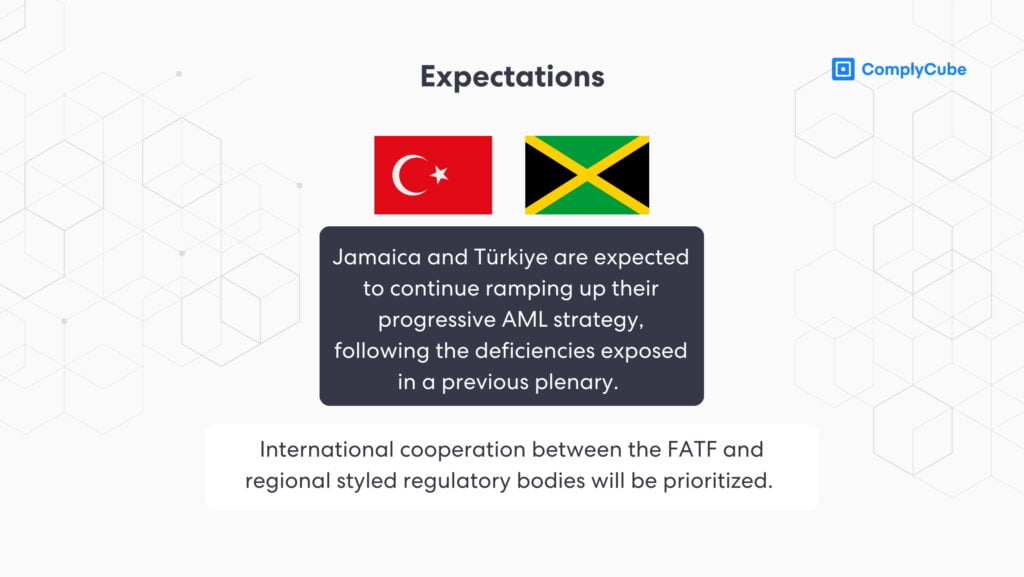
However, this does not mark the end of their responsibilities. Both countries will continue to collaborate with the FATF and their respective local regulatory bodies to strengthen their AML and CFT frameworks further.
Monaco and Venezuela, however, were added to the increased monitoring list. These countries have now committed to implementing Action Plans to resolve the strategic deficiencies that were identified during the Plenary. This addition highlights the ongoing global efforts to ensure all jurisdictions meet the FATF standards for combating financial crimes.
## High-Risk Jurisdictions
The [FATF Plenary meeting](https://www.fatf-gafi.org/en/publications/Fatfgeneral/outcomes-fatf-plenary-june-2024.html) reiterated its increased concerns regarding the Democratic People’s Republic of Korea (DPRK). Despite frequent requests for action, the DPRK continues to exhibit significant deficiencies in its [Anti-Money Laundering](https://www.complycube.com/en/solutions/due-diligence-compliance/anti-money-laundering/) (AML) and Combating the Financing of Terrorism (CFT) regimes.
The DPRK’s illicit activities relate to the proliferation of weapons of mass destruction and pose serious threats to international security. Furthermore, the region has multiple connections with the international financial system, which heightens proliferation financing risks. During the Plenary, the FATF called for heightened vigilance and the renewed implementation and enforcement of countermeasures when trading with the DPRK.
## Successful Revision of ICRG Criteria
The FATF achieved a milestone regarding the revision of the criteria used in the International Cooperation Review Group (ICRG) process. The process is now more understanding of the challenges lesser developed countries face regarding the scope and capacity for money laundering. The revision was completed to ensure that the FATF’s grey and blacklists specifications remain effective and fair in comprehending AML deficiencies that could pose a threat to the security of the global financial system.
## 5th Round of Mutual Evaluations
The Plenary found common ground on how countries will be assessed for the upcoming 5th Round of Mutual Evaluations, revising FATF standards. These standards now focus more on asset recovery and international cooperation to prevent the proceeds of illicit activity.
Therefore, in the future, countries must show a commitment to prioritizing asset recovery, confiscating criminal assets, and collaborating globally. Learn more about these Mutual Evaluations by reading [FATF Recommendations in 5th Mutual Evaluations.](https://www.complycube.com/en/fatf-recommendations-the-mutual-evaluations/)
## International Cooperation
T. Raja Kumar met with the leads of other FATF-style regional bodies to discuss progress and set priorities for the upcoming year. These partnerships are crucial for the success of international financial regulation, and the key priorities were found to be:
- Increase the value and voice of FATF-style regional bodies.
- Prepare for the new round of [Mutual Evaluations](https://www.fatf-gafi.org/content/dam/fatf-gafi/methodology/5th-Round-Revised-Methodology.pdf.coredownload.inline.pdf).
- Strengthen AML/CFT expertise on a local level.
## Mutual Evaluations of India and Kuwait
Discussions involved the joint FATF, Asia Pacific Group (APG), and Eurasian Group (EAG) mutual evaluation report on India and the joint FATF-MENAFATF (Middle East and North Africa Financial Action Task Force) report on Kuwait.
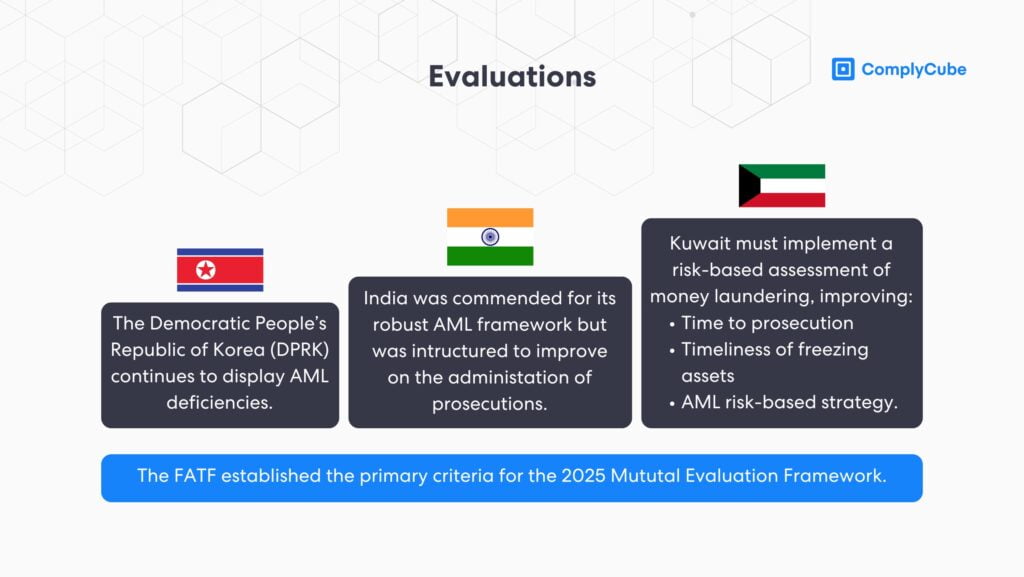
### India
India was commended for its high level of technical compliance with FATF requirements and its effective AML regime. However, the evaluation discovered shortcomings in areas such as preventative measures in various non-financial sectors and delays in prosecutions relating to money laundering and terrorist financing.
### Kuwait
The report on Kuwait detailed that there was a reasonable legal and supervisory framework to address issues around money laundering, but there are issues in producing strong outcomes. Therefore, the Plenary evaluated that Kuwait must enhance its comprehension of money laundering risks, improve prosecutions, and ensure assets linked to malicious finance are frozen in a timely manner.
## FATF Plenary Priorities Under the New President
The new President, Elisa de Anda Madrazo, outlined her priorities as chair of the FATF for the coming years. Financial inclusion through a heavily endorsed Risk-Based Approach (RBA) was at the top of her list. She also wishes to embark on a successful round of Mutual Evaluations. Her focus will be on supporting and implementing the newly revised FATF standards for the next 2 years, notably in asset recovery, beneficial ownership, and Virtual Assets (VAs).
## Celebrating Women in the FATF
In the wake of a woman being appointed as President of the organization, the FATF took another step towards promoting gender equality, launching a multicultural mentoring program and an e-book, *Breaking Barriers: Inspiring the Next Generation of Women Leaders*. The FATF is fully committed to empowering women and promoting gender equality in the regulatory and AML sector.
## FATF Continues its Suspension of the Russian Federation
The continued suspension of the Russian Federation displays the FATF’s solidarity against the Russian Federation’s invasion of Ukraine, contravening international law. This continued suspension since March 2022 serves as a reminder for jurisdictions to remain vigilant against emerging risks, threats, and crimes following the sanctions and impositions made against Russia.
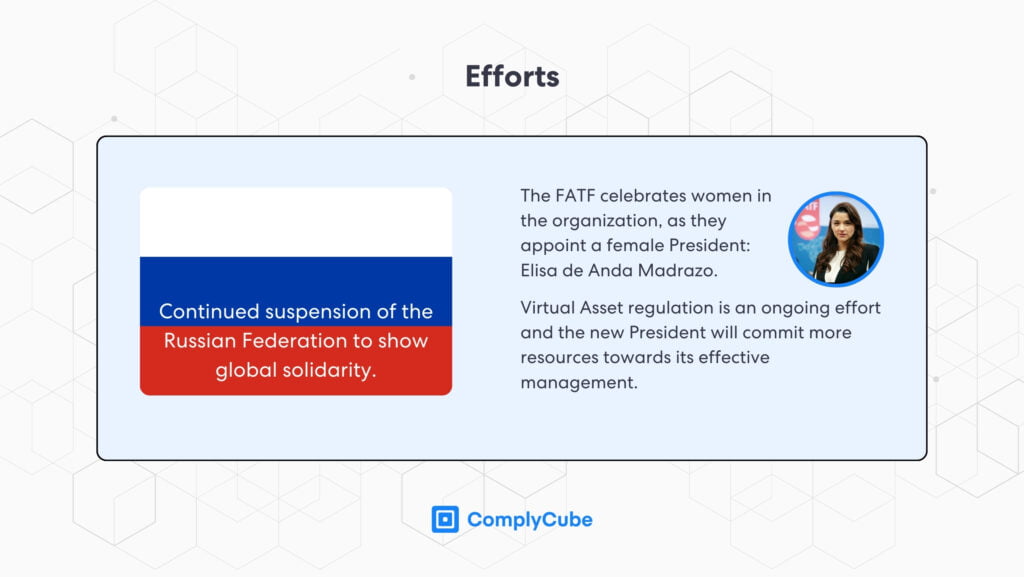
## Technical Compliance and Corruption Standards
During the Plenary, reviews were made to ensure adequate safeguards were in place for financial system gatekeepers, including accountants, lawyers, real estate agents, and trust and company service providers. These updated safeguards are designed to ensure individuals carrying out these roles cannot abuse their position for malicious financial activity or be blackmailed into doing so.
## Regulation of Virtual Assets
The FATF agreed to announce its 5th annual update of the implementation of FATF standards on VAs and Virtual Asset Service Providers (VASPs). Many regions still remain non-compliant or partially compliant, enabling the sector’s misuse in proliferation financing and money laundering.
Furthermore, the organization is developing legislation that accurately reflects the growing infrastructures that are used to facilitate cross-border transactions. This should make cross-border payments faster, cheaper, more transparent, and inclusive of AML/CFT regulations.
## About ComplyCube
ComplyCube is a market-leading SaaS AML provider. These FATF updates are an example of the global forces that sway international regulation. If your business is looking for a solution that enables compliance with FATF recommendations as well as regulatory bodies in local jurisdictions, ComplyCube can help.
[Get in touch with a specialist today](https://www.complycube.com/en/contact/contact-sales/) to learn more about their suite of Anti-Money Laundering, Know Your Customer, and Identity verification services.
**Categories:** News
**Tags:** Regulations
---
### [Digital Document Verification and eKYC](https://www.complycube.com/digital-document-verification-and-ekyc/)
**Published:** August 14, 2024
**Author:** Andreea Balasa
**Excerpt:** Identity Verification and eKYC solutions, such as digital document verification and biometric verification (selfie verification), protect firms against fraud. Read on to learn how ComplyCube's IDV platform streamlines compliance.
**Content:**
Identity Verification (IDV) and eKYC solutions have streamlined multiple business processes, from client onboarding to ongoing compliance. Digital document verification and biometric verification (selfie verification) are the first layer of protection for businesses against fraud, money laundering, and other financial crimes.
This guide discusses the contemporary issues that have demanded a process for verifying KYC documents digitally, securely, and swiftly.
## What is a Digital Document Verification Process?
Online document verification processes involve the methodical analysis of an identity document, such as a driver’s license, passport, or any other official government-issued document. Digital verification via eKYC processes far exceeds the utility of manual document verification.
Automated KYC solutions can verify identity documents with a higher level of accuracy than traditional methods, doing so in a fraction of the time. This creates huge benefits for businesses that require the authentication of new customers and the detection of fraudulent documents.
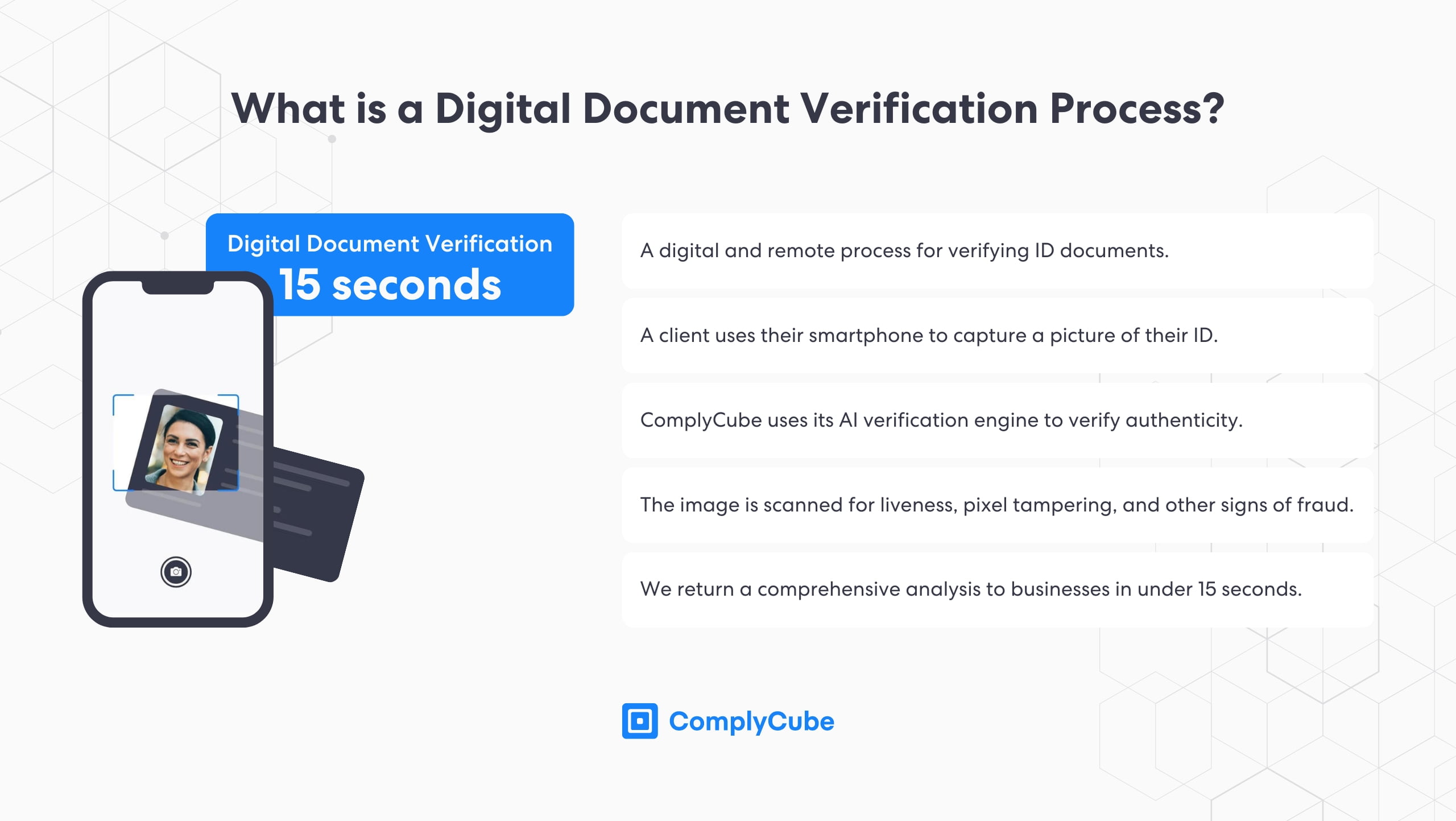
## Why is Digital Document Verification Relevant Today?
The internet has transformed how we interact with each other and revolutionized global economies through the introduction of e-commerce. The coronavirus pandemic catalyzed this transfer to a digital socioeconomic culture, forcing digital transformation among many businesses.
Identity Verification solutions were critical to this shift, and firms that adapted quickly benefited from being able to onboard users digitally and remotely from anywhere in the world.
> The coronavirus pandemic increased the [rate at which businesses are developing and adopting remote and digital technologies by 7 years](https://www.mckinsey.com/capabilities/strategy-and-corporate-finance/our-insights/how-covid-19-has-pushed-companies-over-the-technology-tipping-point-and-transformed-business-forever).
This dramatic shift is here to stay and infers the significance of digital technologies that empower remote communications between users and businesses alike.
## Digital Transformation
Almost overnight, companies had to find digital transformation solutions to enable continued business operations. This event catalyzed the rate at which companies had to embrace digital commerce, processes, and administration.
In Barclays’ 2023 annual report, the company highlighted how the development of digital utilities will boost their competitiveness and, importantly for the consumer, continue to break down financial barriers.
> \[We are\] creating an enhanced digital customer experience to [build a more efficient business](https://home.barclays/content/dam/home-barclays/documents/investor-relations/reports-and-events/annual-reports/2023/Barclays-PLC-Annual-Report-2023.pdf).
eKYC solutions, such as digital document validation, are now essential tools for enabling businesses to adapt to and succeed in today’s fast-paced digital world. They ensure secure and seamless customer interactions while breaking down traditional accessibility barriers.
## Battling Improved Fraudulent Methodologies
A more recent development since the advent of Generative Artificial Intelligence (Gen AI) is highly sophisticated fraud attacks using powerful AI technology. The most famous instance is known as a deepfake, which is an attack on an individual’s identity by creating an image or video of their face.
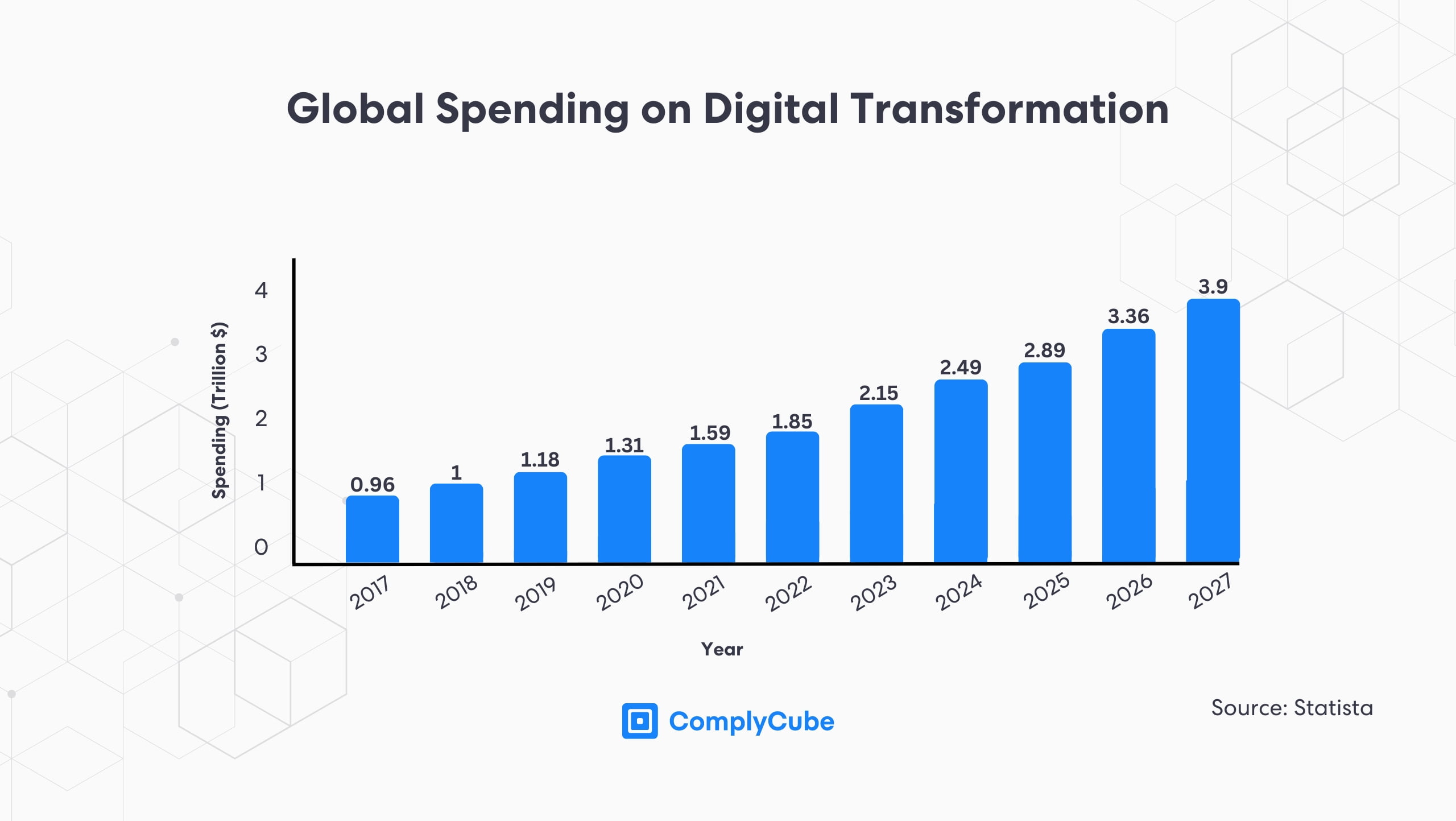
These attacks can be carried out on anyone and are one of the greatest threats that Gen AI poses to business security.
> Only [20% of insurance firms have taken action against deepfake threats](https://eftsure.com/statistics/deepfake-statistics/).
Deepfakes pose a substantial threat to all kinds of financial institutions. This is how an attack might play out against an insurance firm.
1. A fraudster obtains the details of a legitimate policyholder and submits a claim for a large life insurance payout.
2. As part of the insurance eKYC process, the individual claiming must complete a video to verify their identity and confirm outstanding details.
3. The fraudster creates a hyper-realistic video of the individual who is insured, detailing all the information required.
4. Because the deepfake is so realistic, the insurance company passes the claim and pays out the claim, resulting in a profitable deepfake attack.
Mitigating deepfake attacks is an utmost priority for all financial institutions. However, there has been limited adoption of sophisticated KYC and fraud detection tools, particularly in the insurance sector.
## Enhanced Security and Compliance
These fraudulent innovations are making advanced KYC tools a necessity for modern businesses. Manual verification of client details is proven to be far less accurate than an AI-powered verification system.
### Digital Document Verification
AI, Machine Learning (ML), and Optical Character Recognition (OCR) technologies have significantly advanced digital [document verification](https://www.complycube.com/en/solutions/identity-assurance/document-verification/). Together, these create a powerful verification engine that extracts and analyzes a large amount of document data in a very short period of time.
Common document checks include ID Verification, which confirms an individual’s identity using official government-issued KYC documents, and Proof of Address (PoA) Checks, which validate addresses through documents like utility bills.
For ID verification, [Near-Field Communication](https://www.complycube.com/en/solutions/identity-assurance/document-verification/nfc-verification/) (NFC) technology adds further layers of security by accessing encrypted data on ID chips with an NFC-enabled device, such as modern smartphones. Read more about ComplyCube’s document verification solution by reading [What is Document Verification?](https://www.complycube.com/en/what-is-document-verification/)

### Selfie Verification
[Biometric verification](https://www.complycube.com/en/solutions/identity-assurance/biometric-verification/) uses facial biometrics and features to verify a user’s identity and detect fraudulent methodologies as they are carried out, such as deepfake frauds. Selfie verification uses a state-of-the-art technology called Presentation Attack Detection (PAD), which builds 3D face maps, analyzes skin tone and micro expressions, detects pixel tampering, and ensures that the selfie image has not been tampered with in any way.
If your business is looking for a solution, ensure that the provider is [ISO-certified with PAD level 2 liveness detection](https://trust.complycube.com/) to ensure you are partnering with a market-leading solution. This ensures that your business has maximum protection against any kind of fraudulent attack, ensuring compliance requirements around the world are met. Learn more by reading [The Advantages of Biometric Verification.](https://www.complycube.com/en/the-advantages-of-biometric-authentication/)

### Regulatory Recommendations
In its report on the [ISO-certified with PAD level 2 liveness detection](https://trust.complycube.com/), the Basel Committee on Banking Supervision (BCBS) discusses while digitalization brings plenty of innovations and perks to the banking industry, it also creates certain vulnerabilities for frausters to exploit.
Major regulators worldwide endorse compliance technologies as a holistic Anti-Money Laundering (AML) remedy to these vulnerabilities. From the BCBS to the [Financial Action Task Force](https://fatf-gafi.org/en/home) (FATF) and local and national regulators, compliance technologies are heavily advocated to empower compliance in the face of increasing digital fraud.
> Many banks are investing heavily to improve their own digital capabilities and to improve their overall cost efficiency.
This quote comes from BCBS’s report on the digitalization of finance and relates to how digital systems are improving efficiency throughout financial institutions’ operations, particularly in providing a sleek User Experience (UX), reducing Client Acquisition Costs (CAC), and enhancing regulatory compliance.
Therefore, regulators are not just thinking about how digital technologies can help streamline compliance efforts but also come together as an all-in-one solution for increasing margins, productivity, and UX.
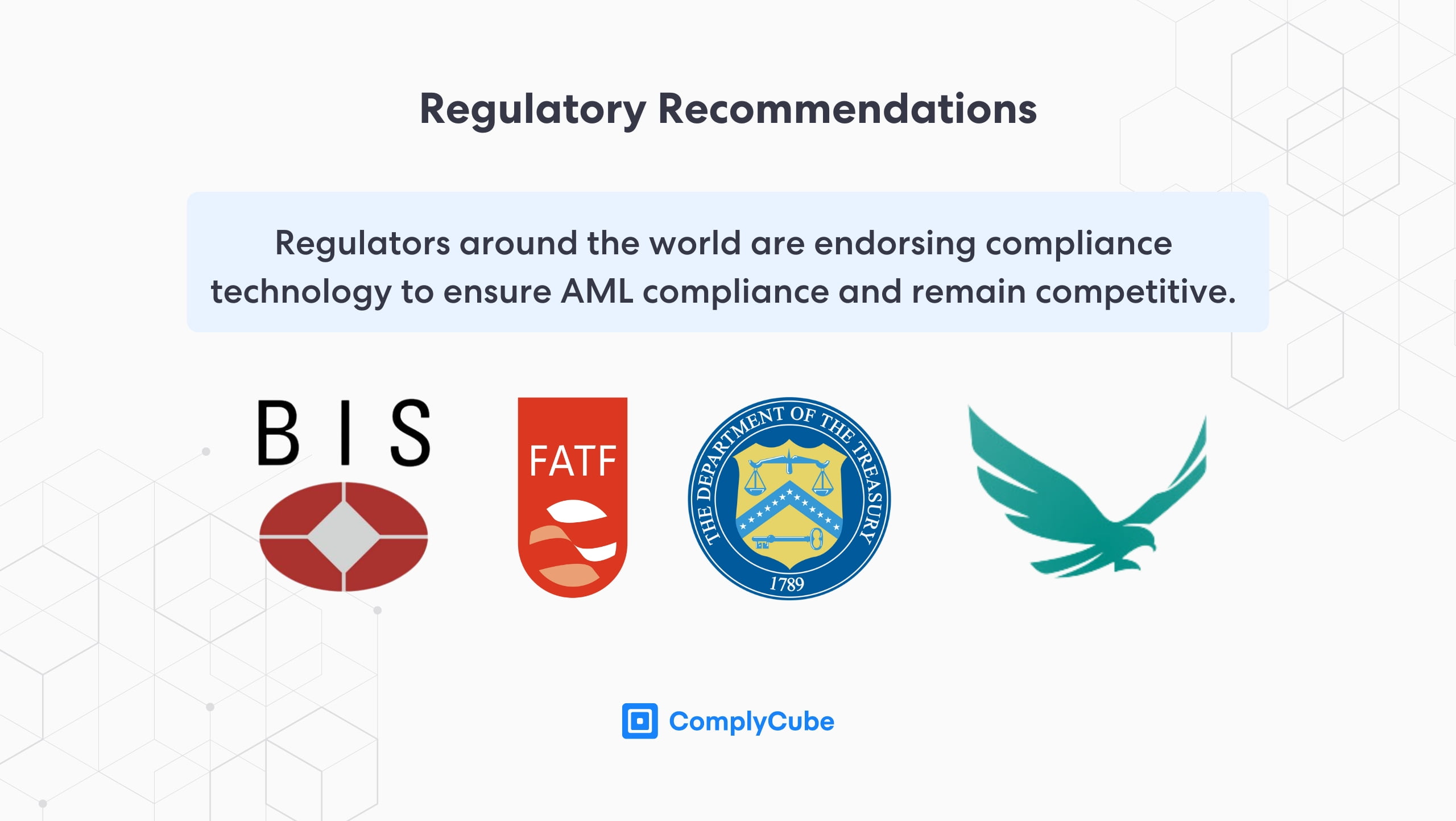
## Cleaner UX and Streamlined Customer Onboarding Process
Digital identity verification helps mitigate human error, increasing the accuracy of checks. The verification is also completed multiple times quickly, resulting in a superior onboarding process for new clients.
A standout feature of electronic Identity Verification (eIDV) is that it can be completed in less than 30 seconds, reducing the time spent onboarding new users from multiple days to less than 1 minute. Furthermore, automated processes can be customized to suit your business’s Risk-Based Approach (RBA).
For firms dealing with large quantities of associated risk, automation settings can be tweaked to send new users to an Enhanced Due Diligence (EDD) process if their risk score is below a configurable threshold. This allows partnered businesses to take the initiative when it comes to their compliance arrangements.
## About ComplyCube’s Digital Document Verification Solutions
If your business is looking to verify documents online, contact ComplyCube today. With industry-leading verification solutions, unbeatable scalability and precision, and configurable compliance settings, they are becoming the go-to solution for regulatory adherence.
Providing services worldwide, they operate in 220+ regions and accept over 13,000 KYC documents, giving an unmatched level of AML and KYC coverage. If these are challenges your business faces, [get in touch with a regulatory specialist today.](https://www.complycube.com/en/contact/contact-sales/)
**Categories:** Guides
**Tags:** Know Your Customer
---
### [The CryptoCubed Newsletter: 20 August 2024](https://www.complycube.com/cryptocubed-newsletter-20-august-2024/)
**Published:** August 20, 2024
**Author:** Andreea Balasa
**Excerpt:** Our crypto newsletter from August brings you insights from the crypto industry around the world, focusing on new regulations and crypto licenses in Turkey, the EU's MiCA, Thailand politics, and how crypto could shape US politics!
**Content:**
The CryptoCubed newsletter for August brings you key insights into AML crypto regulations from around the world. Tuck in as we go through key crypto compliance changes from Turkey, the EU, and more!
### The month’s news and regulatory updates from around the crypto world. Featuring:
- Turkish license applications
- New Thailand PM
- MiCA entries and exits
- Coinbase x SEC drama
- Harris vs Trump and crypto’s impact on the US election
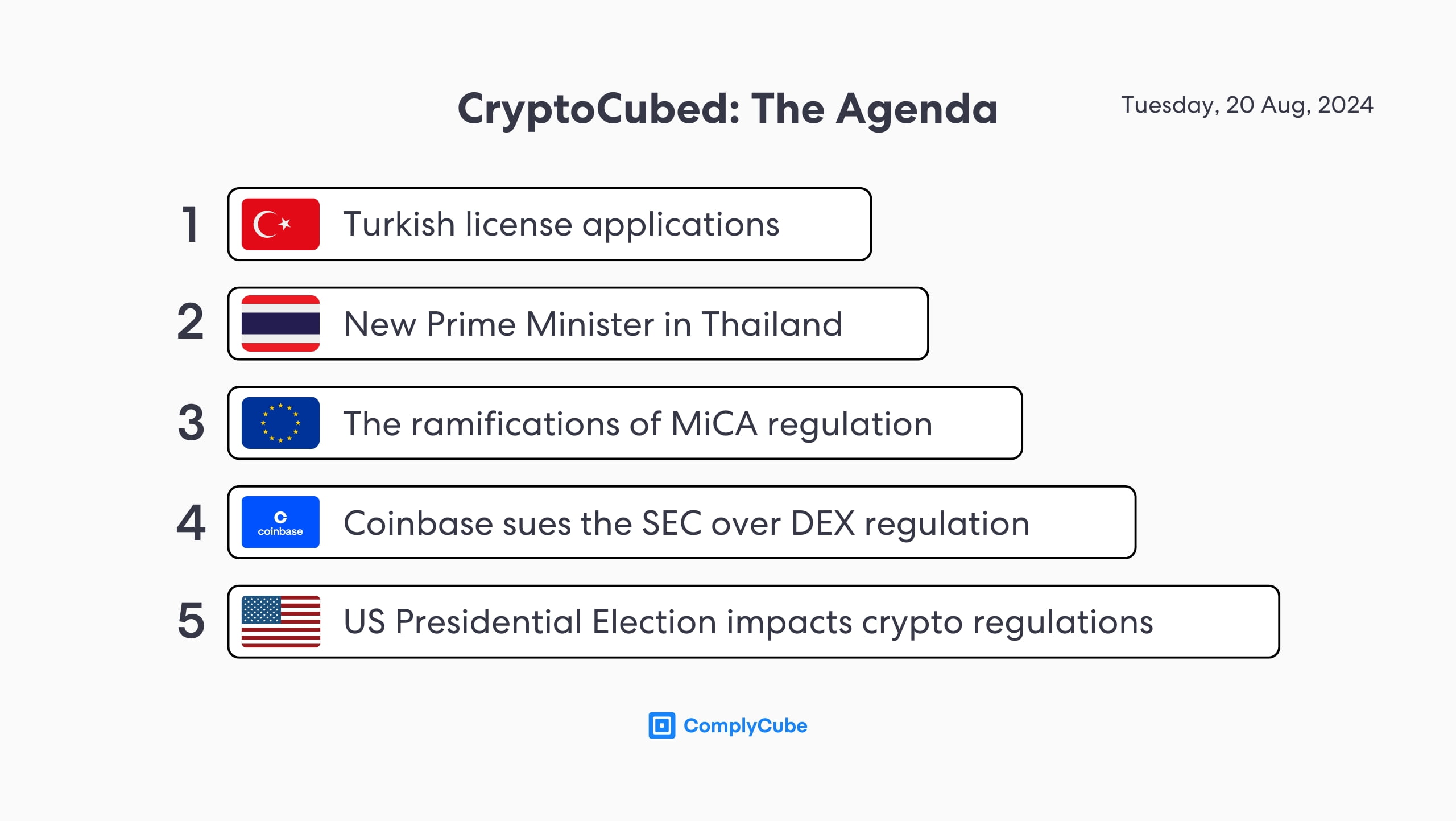
## 76 Companies Pursue Turkish Licenses Under New Regulatory Framework
Over the last 3 years, the population of Turkey that holds cryptocurrencies has risen from 16% to 40%, placing Turkey near the top of the list for both growth and adoption rates. The country’s trading volume is now ranked 4th, trading an estimated $170 billion in 2023.
In response to the sector’s growth, Turkey’s Capital Markets Board (CMB) has taken significant steps to fine-tune its crypto regulation and infrastructure. [76 crypto service providers are now seeking licenses ](https://cointelegraph.com/news/turkey-crypto-license-surge-regulations)under the newly established “Law on Amendments to the Capital Markets Law.”
This law, signed into effect by President Recep Tayyip Erdoğan in July 2024, marks a critical turning point in Turkey’s approach to digital assets. Among the companies on the CMB’s list are industry giants like Binance, OKX, Coinbase, and KuCoin, each vying for a foothold in what is rapidly becoming a key crypto hub.
Turkey’s accelerated adoption of cryptocurrencies can be inextricably linked to its economic context. With the Turkish lira having [lost more than 95% of its value against the US dollar over the past 16 years,](https://www.tradingview.com/chart/46OvWNED/?symbol=CAPITALCOM%3AUSDTRY) digital assets offer an attractive alternative for both investors and ordinary citizens seeking to protect their wealth.
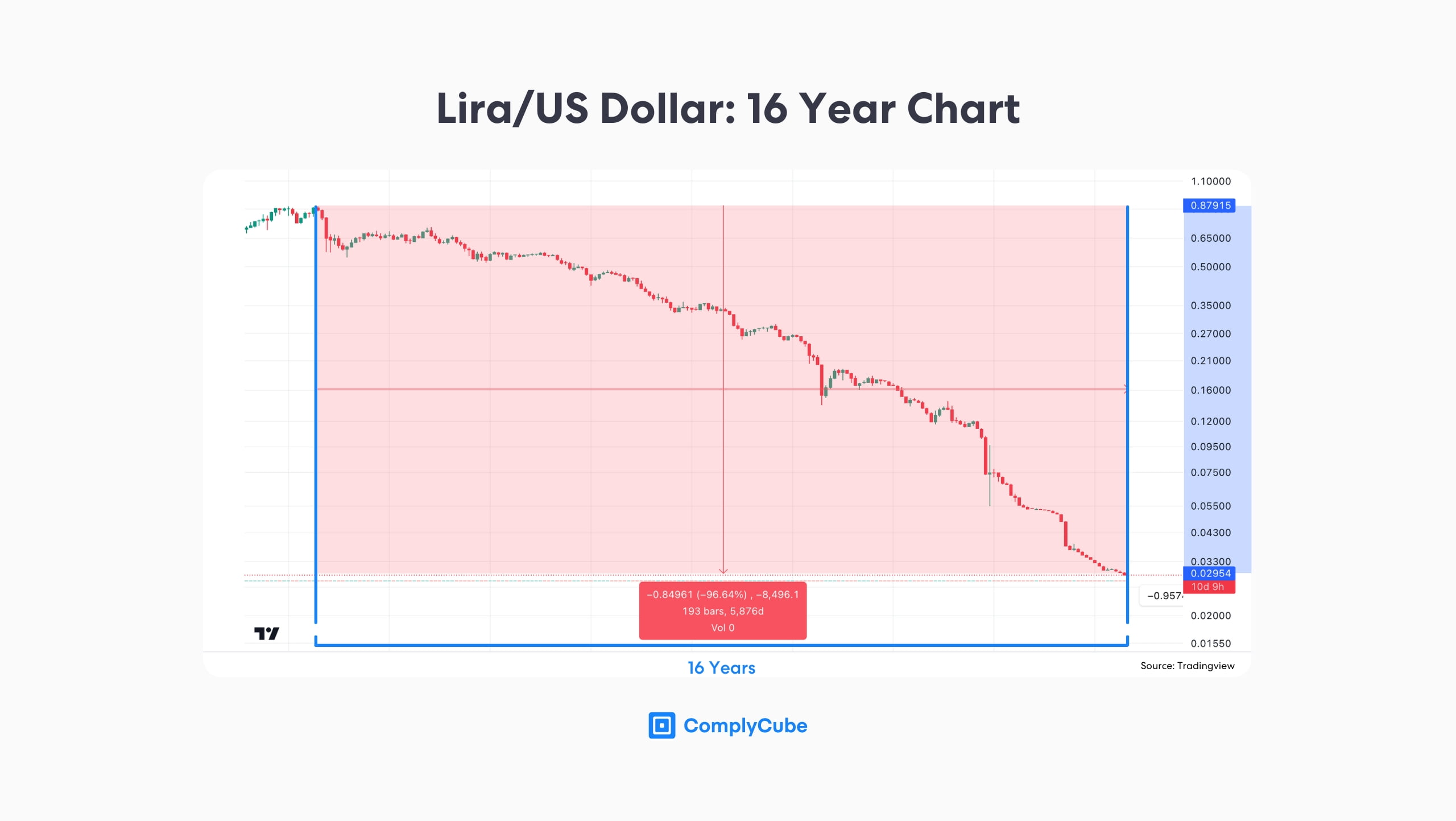
This surge in demand has made Turkey a critical market for global crypto exchanges to win, as depicted through the booming applications for licenses in the region. In Turkey, as is true in many other countries, digital assets are increasingly seen as a safe haven for individuals and investors to protect their wealth against inflation.
Regulatory compliance is of utmost importance, as exemplified through Binance’s recent changes. The global exchange has enhanced its operational transparency in Turkey, limiting marketing efforts, and Turkish language options will be phased out to ensure regulatory compliance in the local jurisdiction. This also exemplifies the importance of winning market share in this particular country to capitalize on the revenue available from rapidly increasing trading volumes.
## Secondary legislation
The next set of regulations is expected to define some of the key industry terms to reduce ambiguity in the industry. These include typical terms such as:
- Crypto assets
- Crypto wallets
- Crypto Asset Service Providers (CASPs)
There is likely to be a grace period until this legislation is in effect, giving exchange firms time to develop the infrastructure to comply with these regulations. For firms looking to gain a crypto license in Turkey, time is of the essence.
The Turkish government’s proactive approach to crypto regulation, coupled with the significant interest from major players, serves as great evidence.
## New Thailand Prime Minister Aims to Strengthen the Thai Crypto Industry
Paetongtarn “Ung Ing” Shinawatra, the leader of the Pheu Thai Party, has just become the country’s 31st Prime Minister. Her vote saw 319 in favor, 145 against, with 27 abstentions, evidencing a significant majority in her favor.
Immediately after her win, she declared her commitment to the country’s continued digital policies, [particularly its digital wallet initiative](https://www.ccn.com/news/crypto/thailands-new-prime-minister-crypto-legal-tender/). Regulators in Thailand have advocated for the crypto sector for many years, most notably the Thai SEC, who have endorsed the industry regardless of which party was running the country. The SEC recently launched a sandbox policy for crypto-related businesses.
Such developments continue to aid the industry’s growth in the continent of Asia. For more information on crypto regulations in Asia, read:
- [Hong Kong Crypto Regulation](https://www.complycube.com/en/hong-kong-crypto-regulation-in-2024/#:~:text=The%20SFC%20regulates%20the%20securities,Cryptocurrencies%20are%20traded%20like%20securities.)
- [Singapore Crypto Regulation](https://www.complycube.com/en/how-successful-is-singapore-crypto-regulation/)
- [Dubai and UAE Crypto Regulation](https://www.complycube.com/en/uae-and-dubai-crypto-regulations-in-2024/)
- [Indian Crypto Regulation](https://www.complycube.com/en/cryptocurrency-regulation-in-india-in-2024/)
## Will MiCA Force Tether out of the EU?
Markets in Crypto Assets (MiCA) is now complete. This European Union (EU) policy has caused a slight shift in stablecoin bragging rights, with Circle, the issuer of USD Coin (USDC) taking the first win. The two largest stablecoins, by far, are Circle’s USDC and Tether’s USD Tether (USDT).
On July 1st, Circle announced that it was the first stablecoin issuer to meet MiCA’s compliance demands, [being granted an Electronic Money Institution (EMI) license from French banking regulator Autorité de Contrôle Prudentiel et de Résolution (ACPR)](https://coingeek.com/circle-celebrates-mica-stablecoin-first-as-tether-eyes-eu-exit/).
This development brings about the first major Euro-backed stablecoin for mass use across the EU zone. Tether, on the other hand, looks doubtful regarding achieving MiCA compliance, primarily due to its supposed ill-reported details on its reserve assets.
A fundamental aspect of the MiCA stablecoin policy is ensuring that issued stablecoins are backed by sufficient reserve assets, with regular reporting to maintain transparency. Without adequate reserves, a stablecoin cannot be effectively supported or trusted.
## Coinbase Challenges the SEC on DEX Regulation
The Securities and Exchange Commission (SEC) has attempted to pass a new regulation that regulates Decentralized Exchanges (DEXs) according to the same rules as traditional financial exchanges. Ultimately, a DEX would require a license to operate as a trading system under the SEC.
While this displays some movement in American crypto policy, Coinbase executive Paul Grewal (Chief Legal Officer) expressed major concerns over the SEC’s ambitions and intentions. Labeling the regulatory move as a ‘[poorly researched](https://coinmarketcap.com/community/articles/66bb4bc813ba2f69bb3696b9/)’ proposal, he requested that the SEC withdraw it and conduct further research into the logistics of DEX regulation.
This move further strengthens Coinbase’s position as a regulatory thought leader, suggesting that industry players should be consulted and included in policy creation rather than excluded from discussions.
Tether’s lack of transparency has already cost them dear, with Bitstamp delisting their Euro-backed stablecoin due to noncompliance with MiCA regulations. It appears this could become an increasingly common pain for the world’s largest stablecoin issuer in the Eurozone.
## The American Presidential Election & Crypto Regulation
American crypto policy has been a pivotal narrative for some time. The US election battle, now between Donald Trump and Camala Harris, could prove to be the decisive focal point in American policy.
The Biden administration, through the SEC and Gary Gensler, has taken a tough stance on the industry, deciding that further regulation was not necessary. As the election approaches, however, Donald Trump has made it extremely clear that if elected President, he will pass further regulation, ensure regulatory clarity, and make America a ‘crypto hub.’ Whether Trump truly believes in the crypto sector is neither here nor there. Even if his advocation for the sector is purely a political tool, it has given him a clear USP versus his opposition in the Democratic party.
Quite contrary to the Republican stance, Democratic opinion remains ambivalent. Major Democrats are endorsing a stance similar to Trump’s, but the Democratic presidential nominee, Harris, has not publicly or definitively taken a stance.
This is best depicted through the discourse around the [Financial Innovation and Technology for the 21st Century Act](https://financialservices.house.gov/news/documentsingle.aspx?DocumentID=409277) (FIT21). FIT21 is the first time a major crypto bill has been cleared in a Congressional chamber. The US Senate must now decide whether or not to pass this into an official Act. However, the odds for its approval remain low.
Views on the bill in the Democratic party remain murky and divided. Senator Elizabeth Warren continues to believe that digital assets are a danger to the US economy, but others are beginning to turn and see the benefits that a thriving American digital asset sector could bring. Congressman Brad Sherman also retains his stance that FIT21 could endorse increased competition for the US dollar as the global reserve currency and that criminals could exploit the policy.
It’s clear that crypto policy in America remains a divisive topic, with no clear conclusion and certainly no immediate respite in sight.
For more information about our range of crypto AML, KYC, and IDV solutions, [get in touch with a regulatory specialist today](https://www.complycube.com/en/contact/contact-sales/) to find out how we can help.
**Categories:** News
**Tags:** Crypto Regulations
---
### [What Do Turkey Crypto Regulations Look Like?](https://www.complycube.com/what-do-turkey-crypto-regulations-look-like/)
**Published:** August 28, 2024
**Author:** Andreea Balasa
**Excerpt:** Turkey crypto regulations shifted in 2024, fostering a wave of AML crypto compliance rules. Enhanced Turkish crypto regulation should help stabilize the industry's growth, fostering in new KYC crypto rules, and protecting users.
**Content:**
Turkish crypto regulation shifted in 2024, fostering a wave of new AML crypto compliance rules. However, Turkey crypto regulations have a history of vulnerabilities. These vulnerabilities necessitated remedial legislation, such as KYC crypto laws and further cryptocurrency regulations.
This guide examines the state of the Turkish crypto industry, evaluating some of the historic vulnerabilities and digesting the fresh legislation that came to fruition in June 2024.
## An Overview of The Turkish Crypto Industry
Turkey has rapidly emerged as one of the global leaders in cryptocurrency adoption, driven by a combination of socioeconomic factors. Over the past few years, Turkey has seen a significant surge in crypto adoption, usage, and trading volumes, positioning itself as a major player going forward in the global crypto scene.
This rise in cryptocurrency adoption can be attributed to several key factors. First and foremost, economic instability has played a crucial role. The Turkish lira is experiencing severe devaluation, with inflation rates soaring to unprecedented heights. Many citizens have turned to digital assets as a hedge against these economic challenges and to protect their wealth.
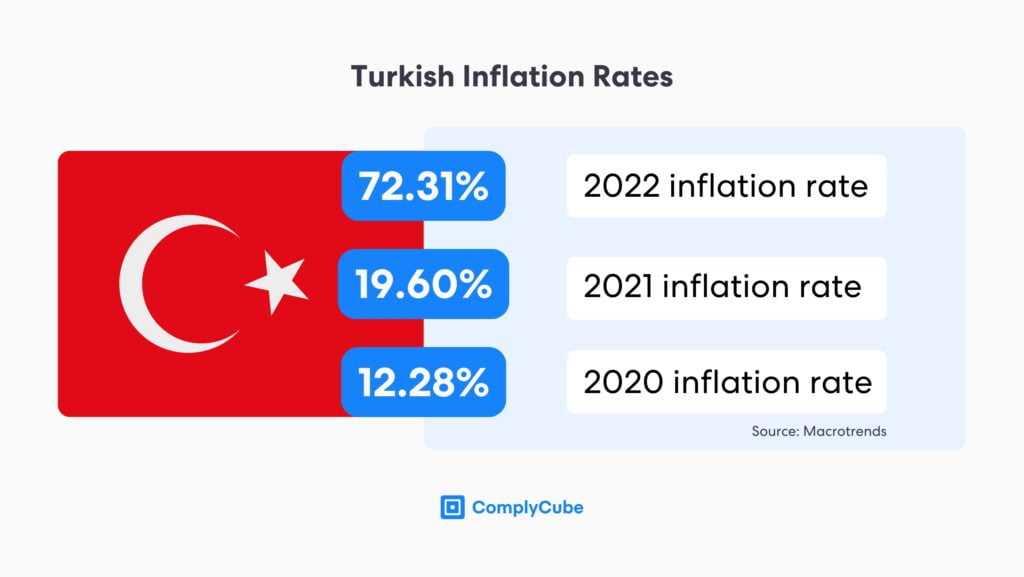
Additionally, Turkey boasts a young, tech-savvy population that is open to embracing new technologies. This demographic is naturally inclined to explore and invest in digital assets, contributing to the country’s high rate of crypto adoption. The appeal of decentralized finance, coupled with the desire for financial autonomy, has further fueled this trend.
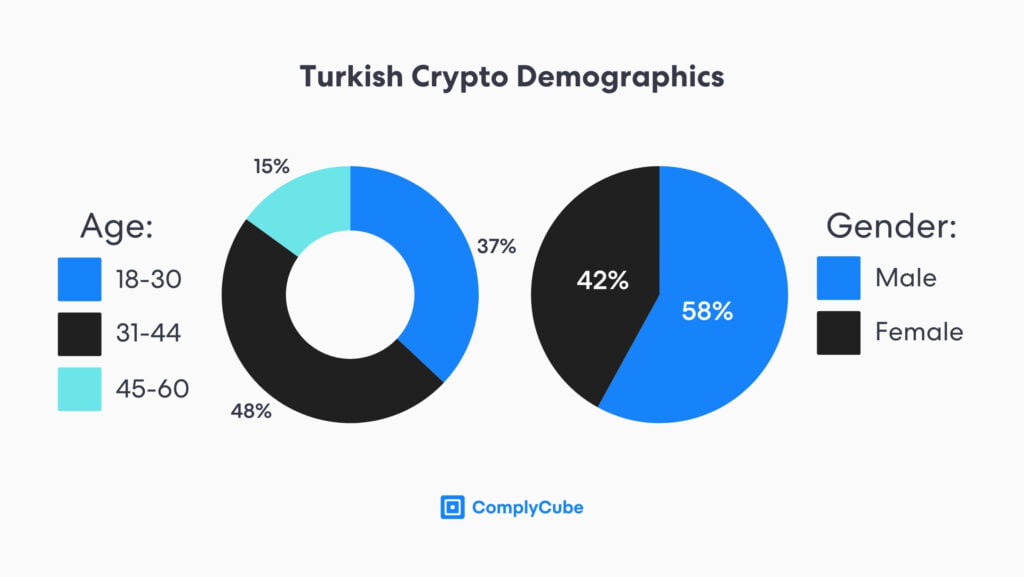
As Turkey’s population continued to adopt cryptocurrencies, the country lacked sufficient legislation to facilitate a growing industry safely and securely. Without a robust regulatory framework, it was far too easy to conduct crypto scams and fraudulent activity in the region.
### The Thodex Scam
Thodex was a leading Turkish crypto exchange. It used certain marketing strategies to entice users onboard, garnering around 400,000 users in a short period of time. In April 2021, the exchange suddenly stopped all trading and withdrawal operations for its users, ultimately sealing off all funds held by a [minimum of 390,000 traders on the exchange](https://www.cnbc.com/2021/04/23/bitcoin-btc-ceo-of-turkish-cryptocurrency-exchange-thodex-missing.html).
It was revealed that Faruk Fatih Özer, the 27-year-old CEO and founder of Thodex, had fled the country, reportedly taking with him around $2 billion in investors’ assets. Faruk didn’t escape, however. Turkish authorities swiftly investigated operations at Thodex, issuing an international arrest warrant for him.
In September 2023, he was found in Albania and arrested on charges of fraud, money laundering, and founding a criminal organization. Faruk was sentenced to 11,196 years, acting as a national symbol for the severity of his crimes and setting an example for other crypto criminals.
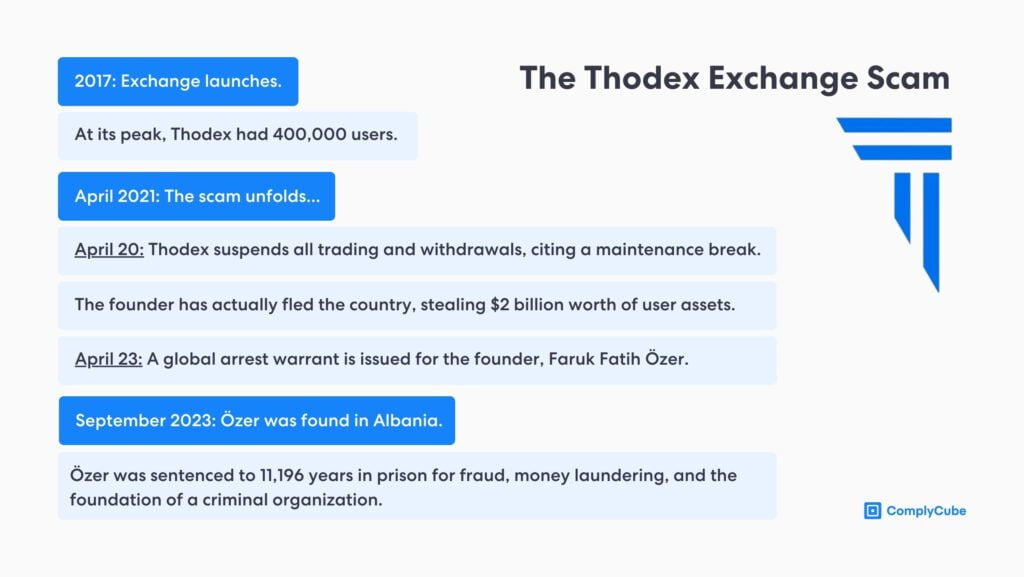
This scandal exposed critical vulnerabilities in the Turkish crypto industry, leading to a significant upgrade in Turkish crypto legislation. The new regulations introduced in 2024, which include stringent licensing requirements and checks from independent audit firms, are direct responses to the lessons learned from Thodex and represent a significant step forward in securing Turkey’s burgeoning crypto market.
## Turkey Crypto Regulations
Following the Thodex exchange scam, government officials have taken serious action to remedy some of the exposed vulnerabilities. However, various laws were put in place around the same time that the scam emerged.
### Prohibiting Payments with Crypto Assets (2021)
The Central Bank of Turkey (CBRT) outlawed the use of digital assets as a means of payment, ultimately declaring that cryptocurrencies could not be used as legal tender. This act also barred electronic money institutions from supplying services that could directly or indirectly facilitate crypto payments.
The “Regulation Prohibiting Payments Through Crypto Assets” defined crypto assets as the following.
> Intangible assets that are created virtually using distributed ledger technology or similar technologies, distributed over digital networks, [and are not qualified as money, registered money, electronic money, payment instruments, security, or any other capital markets instruments](https://moral.av.tr/en/legal-updates/payments-with-crypto-currencies-are-banned-in-turkey-400).
Such regulation was undertaken due to the anonymity that cryptocurrencies granted. The real concern was that transactions could be miscellaneous, fostering criminal activity and being used as a vehicle for money laundering.
### AML Regulations Extended to Digital Assets (2021)
The ‘Regulation on Measures Regarding the Prevention of Laundering Proceeds of Crime and Financing of Terrorism’ was passed on January 1st, 2008, as part of Turkey’s broader efforts in combatting money laundering and terrorist financing. These were to bring the country more in line with the [Anti-Money Laundering](https://www.complycube.com/en/solutions/due-diligence-compliance/anti-money-laundering) (AML) recommendations of the Financial Action Task Force (FATF) recommendations.
In May 2021, the regulation was expanded to include the regulation of Crypto Asset Service Providers (CASPs), which were now legally seen as obliged entities. This change was prompted by the growing use of cryptocurrencies in Turkey and the associated risks highlighted by incidents like the Thodex scandal.
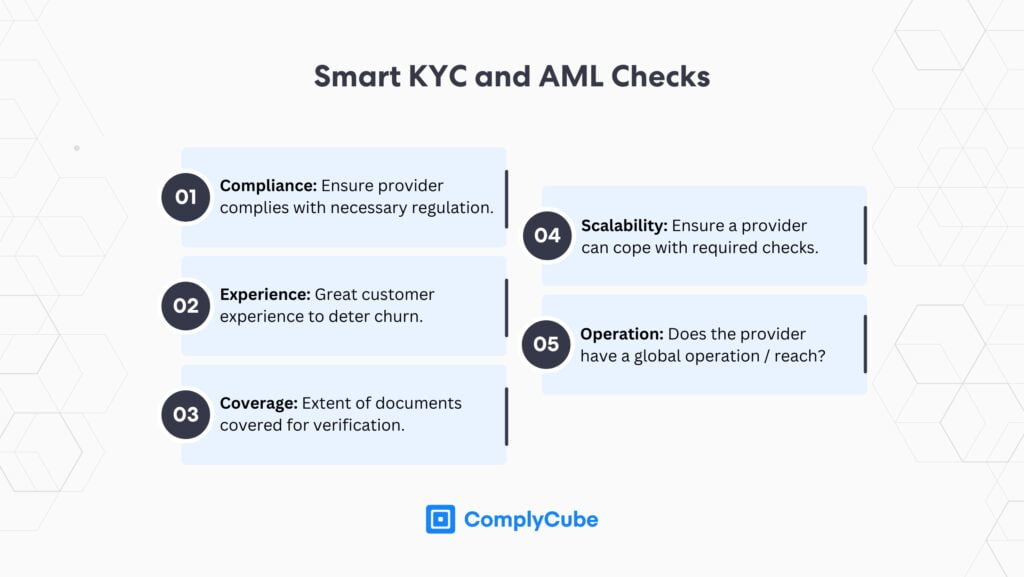
## 2024 Regulatory Updates
2024 has become the year of transformation for Turkey’s cryptocurrency industry, with a comprehensive set of legislation emerging to help stabilize the market.
## The Crypto Asset Law (July 2024)
On July 2, 2024, Turkey introduced its most comprehensive crypto regulation. Amending the Capital Markets Law No. 6362, this policy produced a framework for licensing and regulating all CASPs operating in Turkey.
### Turkish Crypto Regulations and Licensing Requirements
Any Crypto Asset Service Provider who wishes to operate in Turkey must obtain a license from the Capital Markets Board (CMB). A grace period and deadline for obtaining a license were created to ensure there was sufficient time for organizations to be compliant. The CMB also requires all CASP activities to have a reasonable and economic justification behind them, or else the institution could be subject to penalization.
Titled the *Transitional provisions regarding crypto asset service providers*, Article 17 of the Amendment Law mandated that a [CASP operating license have been obtained by the 2nd of August, 2024](https://www.mondaq.com/turkey/financial-services/1488992/requirement-for-crypto-asset-service-providers-to-apply-to-the-cmb-by-2-august-2024), or face penalization.
Since this regulation, major exchanges have ducked out of operations to remain compliant and avoid fines, showing great aptitude for adhering to regulations and playing by the rules. A key example in this is Binance.
[Binance, along with 73 other crypto-related businesses, has applied for a CASP license in Turkey](https://dailyhodl.com/2024/08/20/coinbase-binance-bitfinex-and-73-other-firms-apply-for-crypto-asset-service-provider-license-in-turkey/), according to the latest news from Turkey’s CMB. Binance has also reduced its marketing presence in the region and has ceased certain Turkish language options in-app.
These developments are significant as they demonstrate a willingness to operate completely legally, compliantly, and above board, something that has been lacking even from major CASPs in recent years. They also demonstrate the significance of the Turkish crypto region as a major area for growth, offering chances of increased revenues from tall trading volumes.
Turkish crypto trading volume totaled [$34.9 billion in H1 of 2023](https://www.coingecko.com/research/publications/turkey-crypto-exchanges), averaging around $70-$75 billion by year-end. According to Chainalysis, 2024’s trading volume is estimated to reach $170 billion for the year. This displays a growth of $100 billion in crypto trading volume YoY and far exceeds a 100% growth rate.
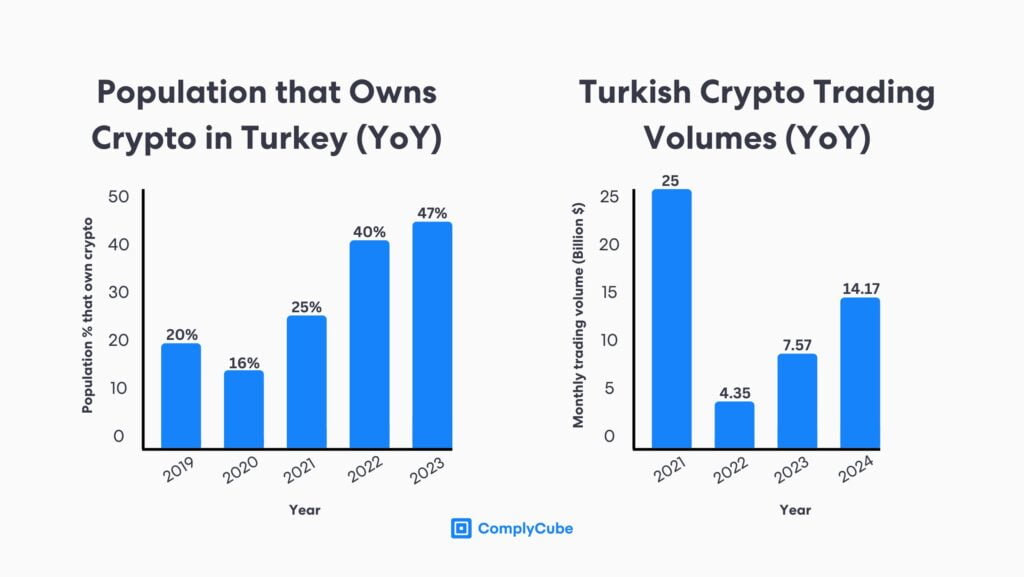
### Further CASP Regulations
Due to previous national-scale fraudulent activities, ownership structures of CASPs must be extremely transparent, and new regulations were brought in to ensure this. Partners or senior executives of a Crypto Asset Service Provicer must not:
- Own 10% or more of any financial institution where the operating license has been revoked.
- Be bankrupt and must have the financial strength to operate the business.
- Have a criminal record for property crimes or crimes against the state.
- Be banned under the Capital Markets Law.
- Create a complex ownership structure of the business; the Ultimate Beneficial Owners must be easy to identify.
### The Role of TÜBİTAK
As a result of these 2024 amendments, the Scientific and Technological Research Council of Turkey (TÜBİTAK) has a new authority over the Turkish crypto market. [Their responsibilities are primarily twofold:](https://cms-lawnow.com/en/ealerts/2024/07/turkiye-enacts-long-awaited-regulations-on-cryptoassets)
1. To establish principles and directives for conducting CASP audits.
2. CASP platforms must pay an annual fee (1% of its total annual income) to both the CMB and TÜBİTAK, resulting in a grand total of 2%.
## Why is Turkey a Key Region for Crypto?
As this guide has already established, crypto trading volumes continue to skyrocket in Turkey as a direct result of the Country’s economic and inflation crisis. [The “Turkish Economic Slowdown” has been in effect since 2018](https://www.csis.org/analysis/turkish-economic-slowdown-2018) and has resulted in a severe devaluation of the Turkish Lira.
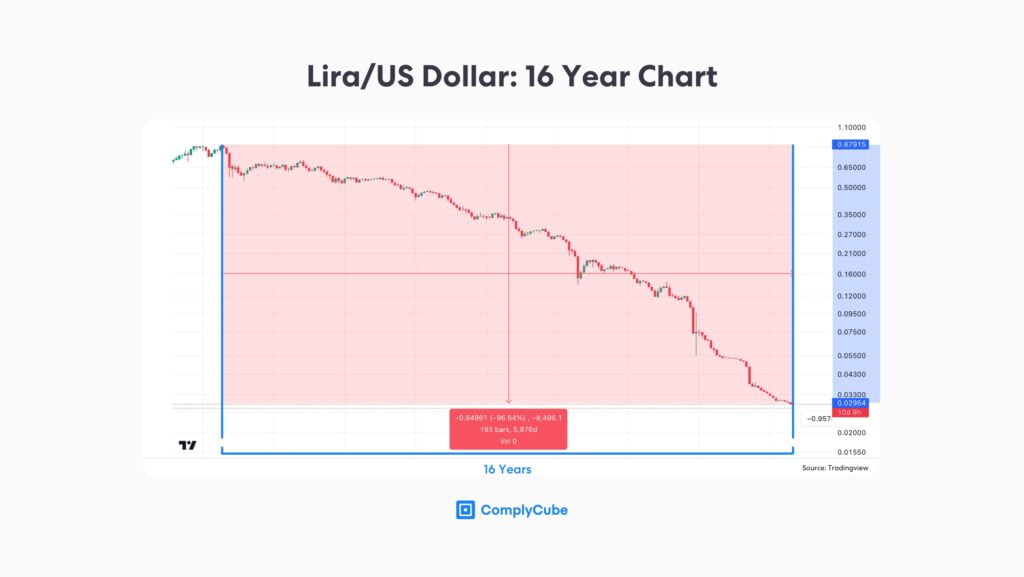
A currency that cannot maintain its value against other local or international currencies has left many individuals, businesses, and other institutions to flock to crypto assets in an attempt to secure or at least maintain their wealth.
This is a common trend for countries facing hyperinflation, as seen in South American regions such as Argentina, which have historically struggled with high inflation rates. [Argentina, alongside Brazil, is a key region in the global cryptocurrency economy.](https://www.chainalysis.com/blog/latin-america-cryptocurrency-adoption)
Just as crypto exchanges critically fought over South American regions for market dominance, the market in Turkey will likely be no different. Crypto asset trading platforms that are looking to compliantly expand into the region must employ swift and accurate onboarding processes to meet the increasing demand for such services.
## Crypto AML and Onboarding Processes
Crypto firms or companies supplying infrastructure to facilitate crypto asset transactions must adhere to all of these regulatory demands. This includes the existing Turkish AML legislation that, as of 2021, encompasses the crypto market and that the Financial Crimes Investigation Board of Turkey (MASAK) endorses.
### Know Your Customer and Customer Identification
[Know Your Customer](https://www.complycube.com/en/solutions/due-diligence-compliance/know-your-customer/) (KYC) is a vital process for all financial institutions, providing comprehensive details about new users to help mitigate risk and prevent bad actors from abusing your platform or service. Crypto KYC processes include:
- Identity Verification (IDV)
- Customer Due Diligence (CDD)
- Ongoing Monitoring
[Crypto KYC ](https://www.complycube.com/en/use-cases/industry/crypto/)and AML processes must go one step further, however, including the monitoring of crypto transactions and further due diligence of various wallets, CASPs, and other financial institutions to adhere to the crypto travel rule. For more information about the FATF’s Recommendation 16, read [The Crypto Travel Rule](https://www.complycube.com/en/the-crypto-travel-rule-and-the-need-for-aml-compliance-software/).

ComplyCube’s crypto AML and KYC solution provides comprehensive coverage for CASP compliance in over 220 countries for any digital asset-related service, including crypto asset custody services, exchanges, payment services, and more.
## Crypto Expansion Solutions
If your firm or exchange is expanding overseas and looking to remain compliant with new Turkish AML crypto regulations, ComplyCube’s powerful AML and KYC solutions can help. With industry-leading technology, simple integrations, and powerful SDKs and APIs, their crypto compliance solutions are market-leading.
[Get in touch with one of their specialists today](https://www.complycube.com/en/contact/contact-sales/) to learn how they can streamline your onboarding process and ensure you meet rigorous local and overseas regulatory demands.
**Categories:** Guides
**Tags:** Crypto Regulations
---
### [FCA Compliance for UK Cryptoasset Firms](https://www.complycube.com/fca-compliance-for-uk-cryptoasset-firms/)
**Published:** August 30, 2024
**Author:** Andreea Balasa
**Excerpt:** The Financial Conduct Authority is the UK's primary regulatory body. Crypto firms must achieve FCA compliance to operate in the UK. This guide dissects what crypto AML compliance and FCA crypto registration looks like in the UK.
**Content:**
The Financial Conduct Authority (FCA) is the UK’s leading regulatory body for financial institutions. Crypto firms must achieve FCA compliance if they want to operate in the UK. This guide dissects what FCA crypto registration looks like and the kinds of crypto AML compliance processes that are expected of firms.
## What is Financial Conduct Authority (FCA) Compliance?
The Financial Conduct Authority is the principal regulatory body overseeing financial markets and firms in the UK. They are tasked with ensuring that these markets operate with integrity and transparency, protecting consumers from financial crimes such as money laundering and terrorist financing.
The FCA’s regulations cover a wide range of financial services, from traditional banking, investment firms, and fiat currency payment solutions to the fast-growing crypto market. It is responsible for setting compliance standards and fostering a safe and stable financial environment that deters money laundering, tax evasion, fraud, and many other criminal offenses.
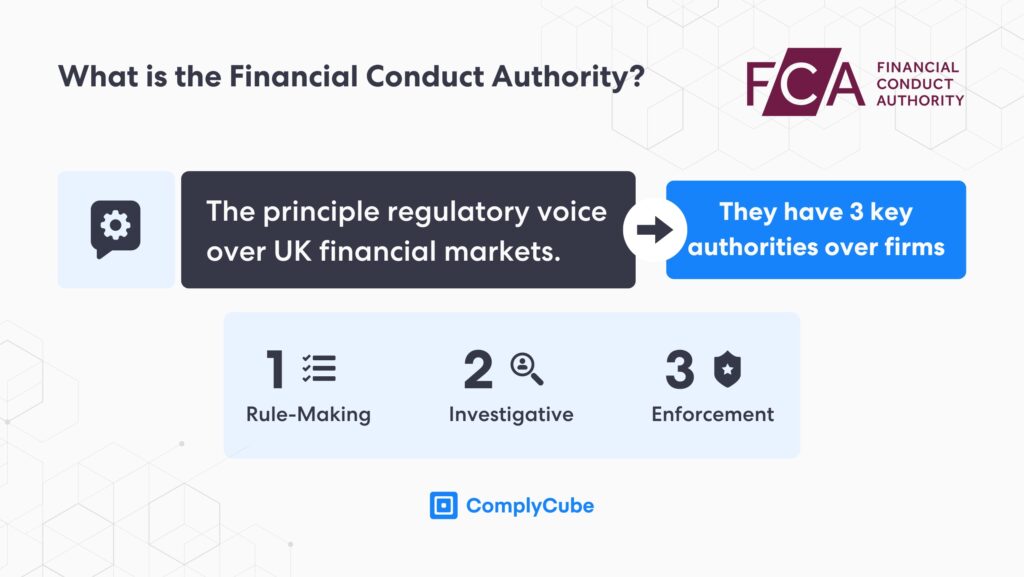
## Cryptoasset Regulations for FCA Compliance
The Financial Conduct Authority is the chief regulator of the cryptocurrency market in the UK, and remains the sole regulatory authority to provide guidance on how institutions should operate safely. Its key policies can be found below.
## FCA Registration
All firms supplying financial products to the UK market must seek registration with the FCA; it is no different for firms operating in the crypto markets. Firms must be compliant with the rules of the FCA’s Money Laundering Regulations (MLRs) to obtain this license. If you are a Money Laundering Reporting Officer (MLRO), details of the regulations can be [found on their website](https://www.fca.org.uk/firms/financial-crime/cryptoassets-aml-ctf-regime).
FCA crypto registration does not imply that the regulatory body endorses or recommends the institution. It acts simply as compliance formality and testifies that the service is a regulated institution and that the Ultimate Beneficial Owners (UBOs) have been reasonably vetted for malicious behaviors.
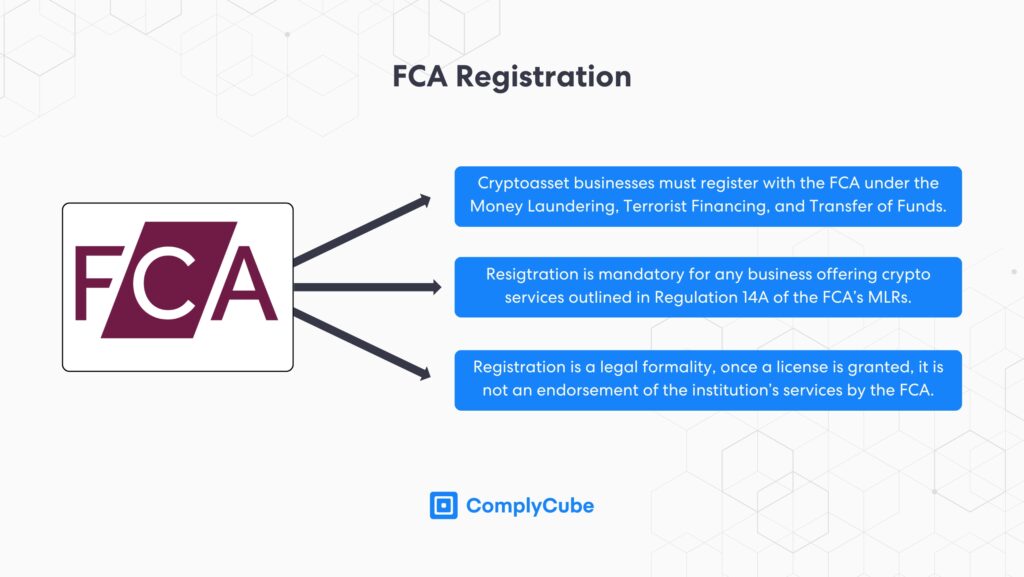
## Enforcement Rules
Under the FCA’s Enforcement Guide, the regulator uses a Risk-Based Approach (RBA), meaning that crypto firms or Virtual Asset Service Providers (VASPs) posing higher threats (or risks) will receive specialized or enhanced regulatory scrutiny. This allows the regulator to impose penalties, fines, or sanctions if necessary. Through its supervision responsibilities, the FCA can request that the MLRO or a similarly authorized person draft a compliance report detailing certain matters covered by the MLRs.
## Consumer Protection
As digital assets are currently not specified investments under the Financial Services and Markets Act (FSMA) of 2000, investors/consumers do not have access to the Financial Services Compensation Scheme (FSCS).
The FCA’s role is limited to regulating finance proliferation and money laundering, supervision, and enforcement. However, under these responsibilities, the regulatory body ensures that adequate consumer safeguards are in place, such as clear notices to users that they are not protected by such consumer rights. The FCA does provide guidance on which firms operating in the crypto industry fall under the remit of the Consumer Protection Act. However, this line remains relatively undefined in 2024.
## Anti-Money Laundering Regulations for FCA Compliance
Digital asset services must comply with the FCA’s MLRs, which entails adopting robust AML and Counter-Terrorist Financing (CTF) technologies and procedures to detect and prevent financial system abuse.
Businesses are obliged to operate under an RBA and take appropriate caution with business activities to identify and assess AML/CTF risks. Enhanced Due Diligence (EDD) is mandatory for customers who pose a substantial risk, which could include factors such as political exposure and country of origin, amongst others. Learn more about differentiating between due diligence levels by reading [what is Customer Due Diligence?](https://www.complycube.com/en/what-is-customer-due-diligence/)
Additional risk management controls, such as mandatory reports, can be enforced upon cryptoasset firms regarding AML/CTF procedures. These might include annual financial crime reports that are sent directly to the FCA with the relevant information.

## The Financial Promotions Regime for High-Risk Investments
The Financial Conduct Authority tightened its grasp on financial promotion rules to further protect consumers investing in high-risk assets like digital currencies. The body identified that most consumers who participated in crypto investing were not fully aware of the risks involved, which led to investments that did not align with their risk tolerances.
Consequentially, new rules have been implemented to ensure that financial promotions for digital currencies are transparent and not misleading. This is a vital FCA crypto regulation that firms must comply with.
Crypto firms must provide stronger risk warnings, improve client categorization upon signup, and ban investment inducements. These developments aim to ensure that consumers fully comprehend the level of risk involved with crypto asset investments and educate those who do not, mitigating unpalatable levels of investment risk.
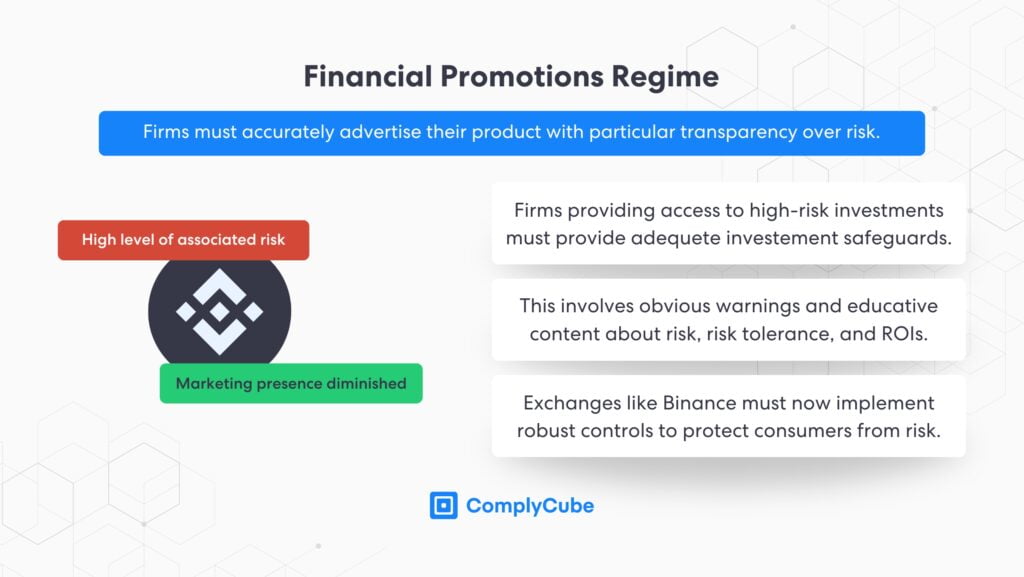
## Which Institutions Currently Have an FCA Crypto License?
FCA regulations are designed to sustain and increase market integrity while ensuring that consumers do not come to unwarranted harm. All crypto firms should review their activities and processes to ensure they are compliant or face penalization. [Coinbase was fined £3.5 million for facilitating activities related to financial crime ‘repeatedly’.](https://www.fintechfutures.com/2024/07/coinbases-cb-payments-unit-fined-3-5m-by-fca)
As of August 2024, [only 44 institutions](https://register.fca.org.uk/s/search?predefined=CA) are licensed by the Financial Conduct Authority to provide cryptoasset services in the UK. [The latest crypto license was granted to Portofino Technologies UK Ltd](https://register.fca.org.uk/s/search?predefined=CA) in February 2024, marking a six-month break in the FCA’s granting of new crypto operation authorities.
### Is FCA Compliance a British Financial Services-Wide Issue?
The FCA, however, [cited poor sector-wide AML standards](https://www.dlnews.com/articles/regulation/uk-crypto-firm-approvals-stall-as-fca-defends-denials/) as the core reason behind the agency’s lack of license grants, suggesting that stronger AML processes and technologies are required. These inadequate controls could potentially be indicative of a financial-services-wide compliance issue; however, the FCA granted an e-money license [to Zen-UK Ltd on August 9, 2024](https://register.fca.org.uk/s/firm?id=0014G00003BZp4RQAT).
Therefore, the FCA must witness less effective AML controls from cryptocurrency applications to Traditional Finance (TradFi) license applications. What this tells us is that despite best efforts, crypto firms remain less compliant than other financial services.
## About ComplyCube’s Crypto AML Compliance Technologies
ComplyCube’s [Crypto KYC ](https://www.complycube.com/en/use-cases/industry/crypto/)and AML solutions provide firms around the world with high-specification AML/CFT solutions. The Know Your Customer process is pivotal in crypto compliance as it detects and prevents bad actors with malicious intent from gaining access to your platform. It also prevents unlawful access to existing accounts via powerful identity re-authentication checks.

Their AML solutions consist of powerful Customer Due Diligence checks, including PEP screening, sanctions screening, and adverse media checks, among many others. These checks are conducted in real-time through ongoing monitoring and automated technology.
If your VASP, crypto services firm, or relevant company is challenged by crypto regulatory compliance, ComplyCube can help. Providing its services to major blockchain institutions around the world, the compliance company both enables compliance and empowers growth. For more information, [reach out to one of its](https://www.complycube.com/en/contact/contact-sales/)[ compliance specialists today](https://www.complycube.com/en/contact/contact-sales/).
**Categories:** Guides
**Tags:** Crypto Regulations
---
### [The CryptoCubed Newsletter: 20 September, 2024](https://www.complycube.com/the-cryptocubed-newsletter-20-september-2024-featuring-new-crypto-regulations/)
**Published:** September 20, 2024
**Author:** Andreea Balasa
**Excerpt:** September's crypto newsletter brings fresh updates from the crypto compliance world, featuring new crypto regulations and discourse from America to Kazakhstan! Read through to learn more about global blockchain developments.
**Content:**
New crypto regulations continue to divide economies, nations, and families. The ever-increasing narrative, however, or should we call it reality, is that new crypto compliance and regulations are beginning to proliferate everywhere. Read more in our latest edition of CryptoCubed.
It wasn’t long ago that Centralized Exchanges (CEXs) could onboard new users with nothing but an email, bypassing most of the then poorly administrated Anti-Money Laundering (AML) regulations – in fact, some still probably are. However, the gap between Virtual Asset Service Provider (VASP) operational capacity and crypto compliance is closing. Fast.
This month’s newsletter dives into the nuances of regulation from around the world. From renowned crypto hubs to ‘I didn’t know Khazakstan had a crypto scene’, this update has got something for everyone!
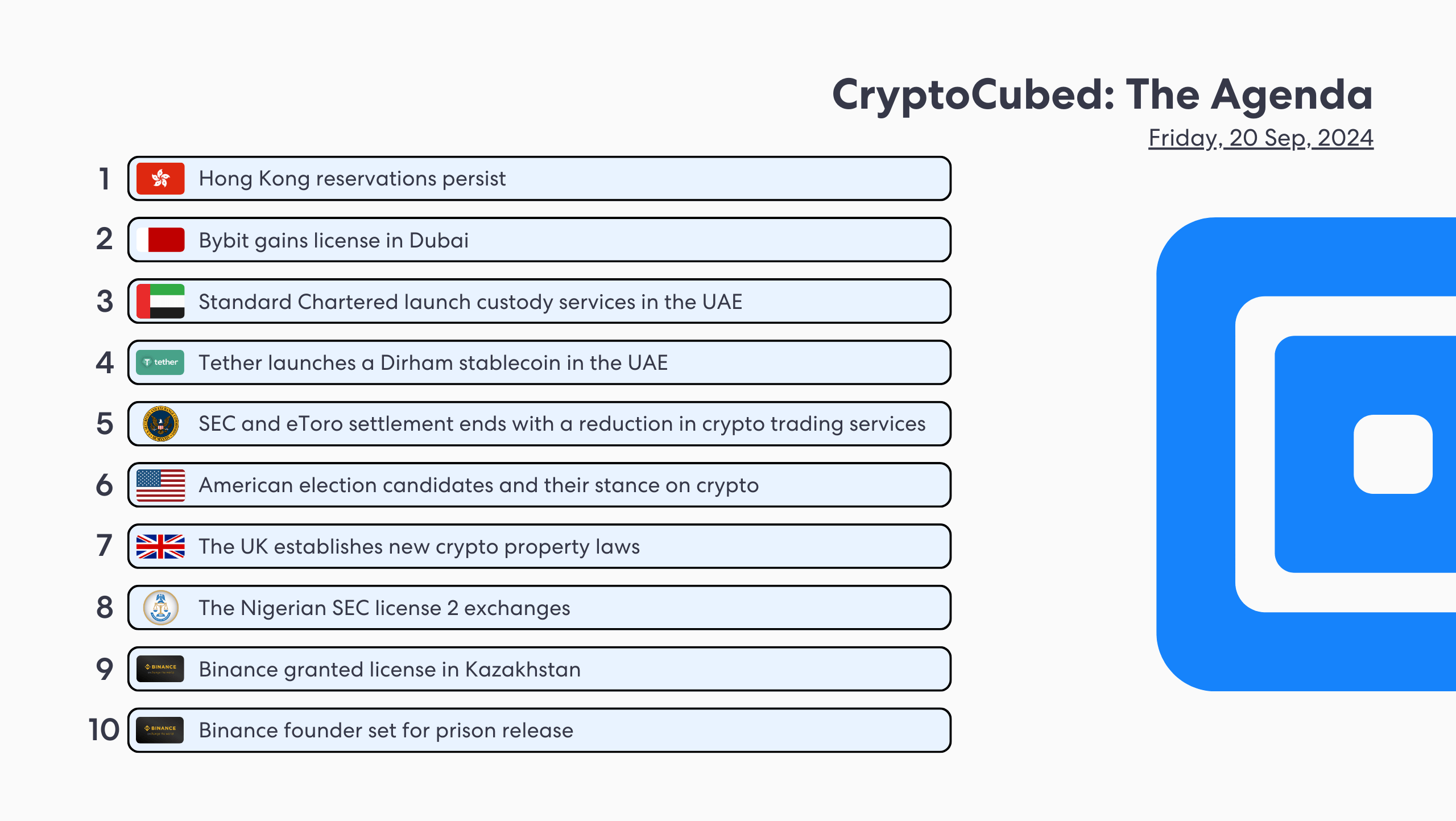
## Hong Kong reservations persist: Will the region’s regulatory caution inhibit industry leadership?
*First Digital Trust* believes that Hong Kong’s cautious and slow-moving regulatory framework could [hinder its growth ](https://cryptonews.com/news/experts-warn-slow-regulatory-moves-may-stifle-crypto-growth-in-hong-kong/)and prevent its industry leadership in the digital asset space. This regulatory caution is evidenced by the number of licenses the Securities and Futures Commission (SFC) has granted—a mere two: OSL Exchange and HashKey Exchange.
Obtaining an SFC license to operate a Virtual Asset Trading Platform (VATP) surmounts millions of dollars in legal fees and internal audits, amongst many other contributions. The region’s series of comprehensive, yet rather complex, regulations also makes the reality of adhering to these rules an expensive endeavour too.
The SFC has a rather large backlog of VATPs waiting for an answer to their license submission; the regulator has promised that all institutions currently waiting to hear back from them will do so by the end of 2024.
While it’s true that Hong Kong’s legislative landscape is fiddly, it is not its undoing. The province boasts strong stablecoin adoption, regarding both the technology’s applications, and real world utility. The Hong Kong Dollar is poised to receive its own stablecoin, pegged 1:1, via Jingdong Coinlink Technology Hong Kong Limited, a subsidiary of JD Technology Group. This being said, Hong Kong faces stiff competition.
## Bybit obtains its provisional license from the VARA
Bybit established its HQ in Dubai 2 years ago, obtaining a provisional license to operate in Dubai in September. So, what does this tell us? Well, despite it taking the firm 2 years to obtain this license, Dubai and the Virtual Asset Regulatory Authority (VARA) move faster than other key regions, notably Hong Kong. Last year, Bybit obrained its Minimum Viable Product (MVP) license in Dubai, beginning its journey towards a fully licensed company in Dubai.
> Dubai’s strategic location, progressive policies, and innovation-driven environment offer [unparalleled opportunities](https://www.financemagnates.com/cryptocurrency/bybit-gains-provisional-crypto-license-in-dubai/) for businesses and investors in the cryptocurrency sector.
*Helen Liu*, COO at ByBit.
That is not to say that Dubai and its native digital asset regulator, VARA, cut any corners; this is far from the truth. Dubai (and the UAE at large) has some of the most contemporary and comprehensive crypto legislation, making the region a front-runner in attracting talent and adoption.

### Bybit Growth Statistics
ByBit has experienced a notable uptick in market share volume, rising from 8% to 16% from October 2023. This exemplifies the value that taking a compliance-first approach has on growth in the crypto exchange industry, following Coinbase as a regulatory leader.
As of September 2024, [Bybit’s trading volume is roughly 35% of Binance’s](https://www.coingecko.com/en/exchanges) and generates around the joint second-highest 24-hour volume of any centralized exchange, matching crypto.com’s volumes.
## Standard Chartered starts custody services for digital assets in the UAE
Standard Chartered Bank has always held a slightly more amenable attitude towards disruptive technology, particularly blockchain. It should come as no surprise, then, that the American giant has [begun offering digital asset custody services in the United Arab Emirates](https://www.reuters.com/business/finance/standard-chartered-starts-custody-services-digital-assets-uae-2024-09-10/) (UAE).
The bank has taken on Brevan Howard Digital, the crypto digital asset segment of the British-based hedge fund, as its first client. The bank reported, in a somewhat familiar score, that the UAE was chosen due to its ‘well-balanced approach to digital asset adoption and financial regulation.’ This rhymes heavily with Helen Liu’s comments on Dubai.
These developments mark an extraordinary development for the bank’s move into the digital asset sector. Standard Chartered will have to adhere to the Virtual Asset Rulebooks, mandated by the VARA upon all cryptoasset companies, as well as other pertinent regulations for the UAE at large. For more information on UAE and Dubai crypto regulations, [read our guide here](https://www.complycube.com/en/uae-and-dubai-crypto-regulations-in-2024/).
## Tether launches a stablecoin in the UAE
The largest distributor of stablecoins, Tether, will release a stablecoin paired to the United Arab Emirates Dirham (AED). Tether’s CEO discussed the UAE’s significance in the global economy.
> \[This\] [stablecoin will cater to businesses and individuals seeking secure and efficient transactions in AED, including cross-border payments and asset diversification](https://finance.yahoo.com/news/tether-launch-stablecoin-pegged-uae-055042575.html).
This new Dirham stablecoin will strengthen Tether’s existing suite of tokens, which include coins tied to the US Dollar, Euro, Chinese Yuan, and Mexican Peso. It also continues to suggest that Dubai, the UAE at large, and the Middle East are emerging as the key hotspots for the cryptocurrency market.
With favorable regulatory environments, forward-thinking leadership, and strategic location, the UAE is certainly in a dominant position to continue innovating in the industry and attract key players, like Bitget, to its borders.
## SEC vs eToro: US crypto trading services to significantly drop
Following a settlement with the Securities and Exchange Commission (SEC) and a $1.5 million payout, popular trading platform eToro will shut down many of its crypto trading services and offer only Bitcoin, Bitcoin Lightning, and Ethereum positions.
The charges made against the platform were that they had operated as an ‘[unregistered broker and unregistered clearing agency in connection with its cryptocurrency offerings.’](https://www.reuters.com/technology/etoro-shut-down-nearly-all-crypto-trading-settlement-with-us-sec-2024-09-12/) This incident brings up previous contentious discussions around how the SEC regulates crypto assets, with the securities regulator claiming many decentralized infrastructures and their tokens share common traits with traditional American securities.
Importantly, the settlement only affects users in the US; users elsewhere in the world will continue to have access to the firm’s full range of crypto trading services. That feature, in particular, sheds light on where the SEC continues to stand in the crypto regulatory battle.
The American regulator remains locked in discussions with many digital asset companies, including exchanges and developers of decentralized infrastructures like Ethereum. While this is nothing new, the SEC’s continuation of its hardened stance under Gary Gensler’s leadership raises certain questions.
*How will the attitude of US election candidates towards cryptocurrencies impact the outcome of this political event?*
## American election candidates don’t find common ground on crypto
While we seem to cover this topic every month, it is for good reason. [America remains the largest crypto market in 2024 ](https://www.statista.com/outlook/fmo/digital-assets/cryptocurrencies/united-states)and, as such, is a vital geopolitical region for the crypto industry. 2 months on from Kamala Harris taking over from Joe Biden as the Democratic nominee, she is yet to deliver a decisive opinion on crypto policy.
### Kamala Harris Position
There has been no mention of digital assets, Bitcoin mining or any related industries in her election campaign policy positions. While name-dropping AI and various other innovative industries, there was no specific mention of crypto or blockchain, leaving some of her supporters who are also blockchain advocates on something of a political tightrope.
However, there have been indirect links between Team Harris and the crypto sector. The CEO of Circle, the issuer of the USDC stablecoin, has ‘[commended Kamala Harris’s campaign for showing a “concerted effort” to understand digital assets.](https://finance.yahoo.com/news/kamala-harris-releases-policy-platform-064602724.html)‘
Mark Cuban has also discussed that her political advisors have reached out to him regarding the administration of crypto regulations. Potentially, Harris’s current silence on matters of crypto is due to a lack of comprehensive understanding.
### Donald Trump Position
Quite conversely, Trump has jumped onto the crypto bandwagon, promising hugely bullish regulatory changes. Promising a new crypto exchange called World Liberty Financial and declaring that America should hasten to mine all remaining Bitcoin inside its jurisdiction, it is clear for which side the former President bats.
Trump has always been an advocate for building strong financial markets, sometimes at the expense of other economic policies. It’s possible that his intention to back crypto and its favorable regulation is to onboard many key players in the industry as Republican voters. However, it’s likely much of this will change before the November election!
## UK new property laws on digital assets
On the other side of the pond, new rules have just been set in the UK regarding the legal definitions of cryptocurrencies. Now, Bitcoin, Ethereum, USDT, and other digital assets are considered personal property, signifying a vast development in the legal adoption of digital assets.
> Bitcoin and other digital assets can be considered [personal property](https://x.com/ComplyCube/status/1834541881411117249) under \[this\] new draft law.
This new Bill is designed to protect holders of cryptocurrencies under British law, particularly in regard to events such as divorce and consumer protection rights in the wake of fraudulent crypto schemes and scams.
Justice Minister, **Heidi Alexander**, said:
> It is essential that the law keeps pace with evolving technologies and this legislation will mean that the sector can maintain its position as a global leader in cryptoassets.
This is a significant step forward for the UK in its ambition of making the UK a digital asset hub, a feat that only further regulatory developments will enable. While this ruling will have no direct impact on many Virtual Asset Service Providers (VASPs), it exemplifies the British government’s progress and current thinking. Learn more about current UK and FCA crypto compliance legislation by reading our latest guide [here](https://www.complycube.com/en/fca-compliance-for-uk-cryptoasset-firms/).
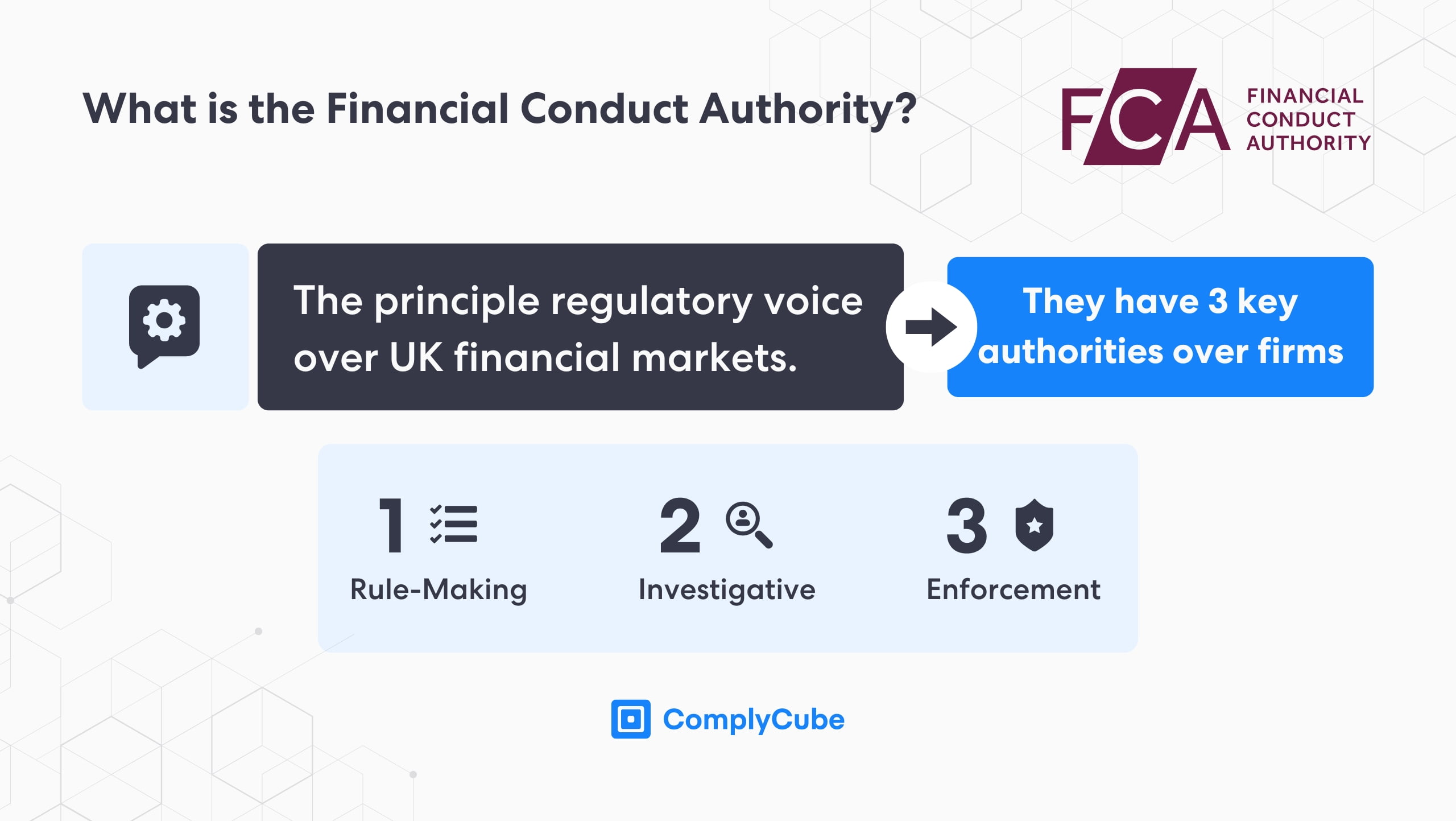
## Nigerian SEC licenses 2 exchanges under new regulations
The Nigerian Securities and Exchange Commission has announced that it granted [2 crypto exchanges a license under its Accelerated Regulatory Incubation Program (ARIP)](https://sec.gov.ng/press-release-update-on-the-secs-accelerated-regulatory-incubation-program-and-regulatory-incubation-program/), with 5 other VASPs moving into its Regulatory Incubation (RI) program.
These preliminary licenses are designed to precede a full license from the regulator to [ensure proper transparency and protection for each supervised product and service](https://www.forbes.com/sites/digital-assets/2024/08/31/nigerian-sec-grants-approval-in-principle-to-two-crypto-exchanges/).
### A history of crypto policy in Nigeria
In 2021, the Central Bank of Nigeria (CBN) banned Bitcoin due to the lack of regulation to protect consumers and prevent issues of money laundering and finance proliferation. However, at the turn of the year, in December 2023, the CBN overturned this, marking 2024 a watershed moment for digital assets in the country.
The regulatory authority has licensed 2 Centralized Exchanges:
- Busha Digital Limited
- Quidax Technologies Limited
And granted 5 other digital asset firms into its RI program:
- Trovotech Ltd
- Wrapped CBDC Ltd
- Housing Exchange Ltd
- Dream City Capital
Blockvault Custodian Ltd
## Binance granted consent for a full regulatory license in Kazakhstan
Binance, the leading global exchange by users, volume, and pretty much every other metric, has just been granted a license in Kazakhstan. The CEX leader has to undergo an [external financial audit, internal audits, and regulatory inspections](https://www.finextra.com/newsarticle/44686/binance-kazakhstan-gains-consent-for-full-regulatory-license) to ensure the digital asset firm complies with Kazakhstan’s regulations.
Once in effect, this license will evidence Binance’s reversal of noncompliance over the last couple of years. The firm was found to be wittingly permitting money laundering and finance proliferation, among other financial crimes. These developments ultimately led to the arrest of its founder, Changpeng Zhao (known in the crypto community as CZ).
Binance’s license will also be the first license granted to any digital asset company in the country, marking a significant milestone for Kazakhstan. Cryptocurrencies have long been touted as a tool for granting financial freedom and breaking down barriers to finance. This move from Kazakhstan demonstrates the region’s desire to stimulate economic growth.
## Binance founder, CZ, set for release on September 29
While we are on the topic of CZ, his release date is scheduled for September 29th. While the ex-CEO has been banned from ever managing the exchange again, this could serve as a catalyst for the sector’s growth. Changpeng Zhao has long advocated for enhanced crypto regulations, and his renewed voice from outside the prison cell could enable these developments.
That wraps up this month’s crypto regulations highlights. Make sure to come back next month for more key news and discourse around global crypto compliance! Head over to our [crypto regulations blog](https://www.complycube.com/en/tag/crypto-regulations/) page for more sources on crypto regulations from around the world and how they might impact you. Alternatively, get in touch with one of our [compliance specialists](https://www.complycube.com/en/contact/contact-sales/) to learn more about the ComplyCube crypto solutions!
**Categories:** News
**Tags:** Crypto Regulations
---
### [How Effective is FCA Crypto Regulation?](https://www.complycube.com/how-effective-is-fca-crypto-regulation/)
**Published:** September 27, 2024
**Author:** Andreea Balasa
**Excerpt:** FCA crypto regulation is the leading voice in UK crypto compliance today. This guide thoroughly assesses its current crypto AML and KYC crypto regulations and discusses the future of successfully achieving FCA crypto compliance.
**Content:**
Financial Conduct Authority (FCA) crypto compliance is imperative in the United Kingdom, and firms must adhere to FCA crypto regulation and its crypto AML policies to operate in the region. This guide examines the challenges the UK faces with FCA crypto regulations and advocates for integrating with KYC crypto solutions to help with FCA crypto registration.
In the UK, cryptocurrency adoption has begun to exceed regulatory developments, creating a vacuum between crypto firms and federal regulation. This makes the legislative landscape in the UK extremely dynamic, open to change, and, inevitably, hard to predict.
## Crypto Compliance Challenges in the UK
These factors have created a somewhat challenging environment for cryptoasset firms, leading many to actually evacuate the region. This is partly because the FCA, Britain’s leading regulatory authority, is the only body that creates rules for digital asset firms to follow.

The FCA ultimately has too much financial ground to cover to enact a comprehensive set of crypto regulations, particularly regulations that will attract firms ashore rather than usher them out.
> A Digital Finance Agency is needed to shepherd the UK into a leadership position.
Gilbert Verdian, founder and CEO of Quant Network, has stated that [the UK needs an independent digital asset regulatory authority](https://www.ledgerinsights.com/uk-needs-new-regulator-to-take-the-lead-in-the-age-of-digital-finance/). A regulatory body that only focuses on the administration of cryptocurrency regulation to ensure the UK keeps pace with other major powers and can become a digital asset hub.
Such a move would mimic the UAE and Dubai and likely contribute to, as it has done in Dubai, more comprehensive legislation. The Virtual Asset Regulatory Authority (VARA) was created in the independent state of Dubai and given sole authority to regulate digital assets in the Emirate. For more information on this, read [UAE and Dubai Crypto Regulations in 2024](https://www.complycube.com/en/uae-and-dubai-crypto-regulations-in-2024/).
### FCA Crypto Regulation
The FCA has a customer-centric regulatory domain, meaning the body is most interested in consumer-side issues of compliance. This includes:
- Know Your Customer (KYC) and Anti-Money Laundering (AML)
- Correctly licensing compliant firms
- Marketing strategies and approving cryptoasset financial promotions
- False advertisement of risks involved
- Other consumer protection initiatives
Adhering to consumer-side regulations is extremely important in the cryptocurrency industry. Digital assets can be extremely volatile, and the incorrect description or marketing of crypto services can lead to UK consumers investing in assets beyond their risk tolerances.

The Consumer Duty sets the standard for consumer protection across the UK’s financial services industries, including the crypto market. The FCA is responsible for approving financial promotions relating to how retail consumers are sold cryptoasset services, known as financial promotion rules, as well as adhering to payment services regulations.
Furthermore, cryptoasset firms must employ rigorous KYC and AML processes to help mitigate the use of digital assets in terrorist financing, money laundering, and other malicious financial activities. For more information about the Financial Conduct Authority’s rules and regulatory regimes, including specific information about FCA crypto registration and the financial promotions regime, read [FCA Compliance for UK Cryptoasset Firms](https://www.complycube.com/en/fca-compliance-for-uk-cryptoasset-firms/).
## The Significance of FCA Crypto AML Policies
Under the regulations cited in the UK’s [Money Laundering, Terrorist Financing and Transfer of Funds (Information on the Payer) Regulations 2017](https://www.legislation.gov.uk/uksi/2017/692/contents/made), firms must register with the FCA, and thus comply with its crypto AML and KYC regulations. These regulations are designed to mitigate the association of cryptocurrencies with money laundering and general misuse of digital assets.
### Crypto AML Legislation
The Financial Conduct Authority strongly endorses the use of a Risk-Based Approach (RBA), which is creating a suitable compliance program that aligns with the associated risk your company holds in your industry. An RBA must mitigate risks of money laundering, terrorist financing, and other financial crimes through thorough identification and due diligence on consumers conducted around the clock.
This includes Enhanced Due Diligence (EDD) on higher-risk individuals, which could take the form of Politically Exposed Person screening (or PEP screening), adverse media checks, and sanctions screening. These AML processes are known more broadly as a Know Your Customer workflow and are vital in safeguarding the national and international financial systems.
### KYC Crypto Process
As discussed, a robust KYC workflow is a vital component of a firm’s AML compliance program and should produce a high level of assurance in a user’s identity and level of risk. The FCA’s crypto AML regulations align with the Financial Action Task Force’s (FATF) Recommendations, particularly around conducting an RBA, Identity Verification (IDV), and Customer Due Diligence (CDD).
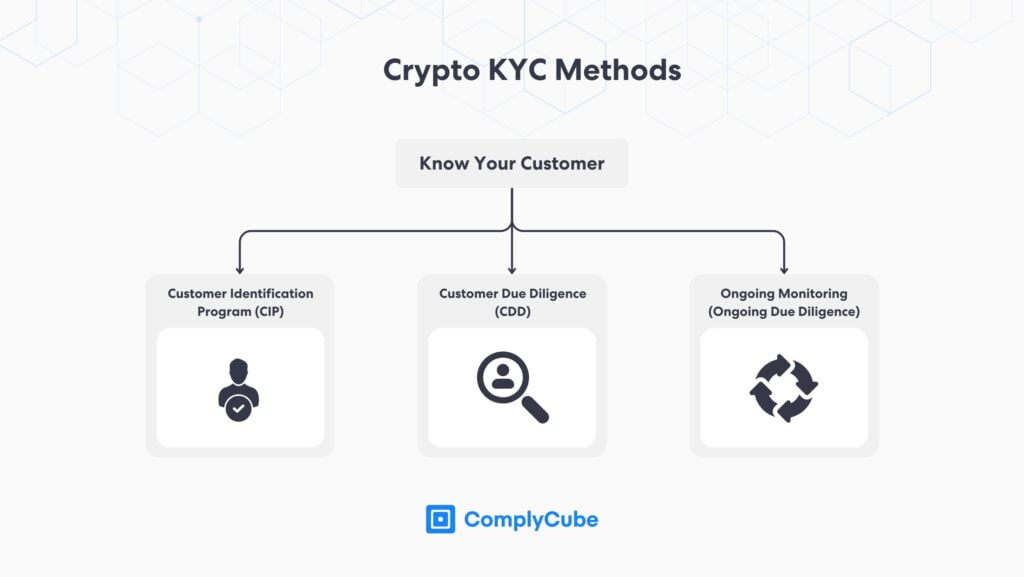
Integrating with a KYC solution provider is the most assured method of obtaining an FCA crypto registration, and the regulatory authority strongly advises using these kinds of technologies. Able to automate the client acquisition process, crypto KYC services greatly reduce the cost spent on customer onboarding, reduce regulatory probing, and generate a heightened sense of customer security with users.
KYC solutions are now internationally recognized as the leading compliance enabler. A large reason behind this is the development of fraudulent methodologies, particularly related to Generative AI. For more information on why, read [Online Fraud Prevention with IDV Solutions](https://www.complycube.com/en/online-fraud-prevention-with-idv-solutions/).
## The Future of FCA Crypto Regulation
Crypto regulations are likely to significantly evolve over the coming years, potentially exceeding the current jurisdiction of the Financial Conduct Authority. Below are key areas that will likely be iterated.
### Enhanced Consumer Duty and Protection Rules
The FCA’s Consumer Duty will likely expand into enhanced transparency that prioritizes consumer protection even further. This will likely involve clear communication of the risks associated with using certain services.

One key issue is the poor permissions controls associated with particular crypto trading services. For example, the futures market in crypto relates to perpetual and fixed-date contracts on regulated Centralized Exchanges (CEXs).
Futures trading enables the use of [margins and leverage](https://economictimes.indiatimes.com/markets/cryptocurrency/crypto-news/what-are-crypto-futures-how-do-they-work/articleshow/111731653.cms?from=mdr), and there is very little regulation as to which users are granted access to these features. Crypto futures are a highly volatile market and, on an exchange like finance, can [account for over triple the trading volume of the spot market](https://www.coingecko.com/en/exchanges/binance_futures). They can be likened to standard trading with no advanced finance tools.
### Expansion into Decentralized Utilities, such as DeFi
As Decentralized Finance (DeFi) becomes less volatile as the world adopts blockchain, the FCA is likely to expand its regulatory oversight into this emerging sector. DeFi presents unique challenges for regulators because it operates without intermediaries, often relying on smart contracts to facilitate financial transactions.
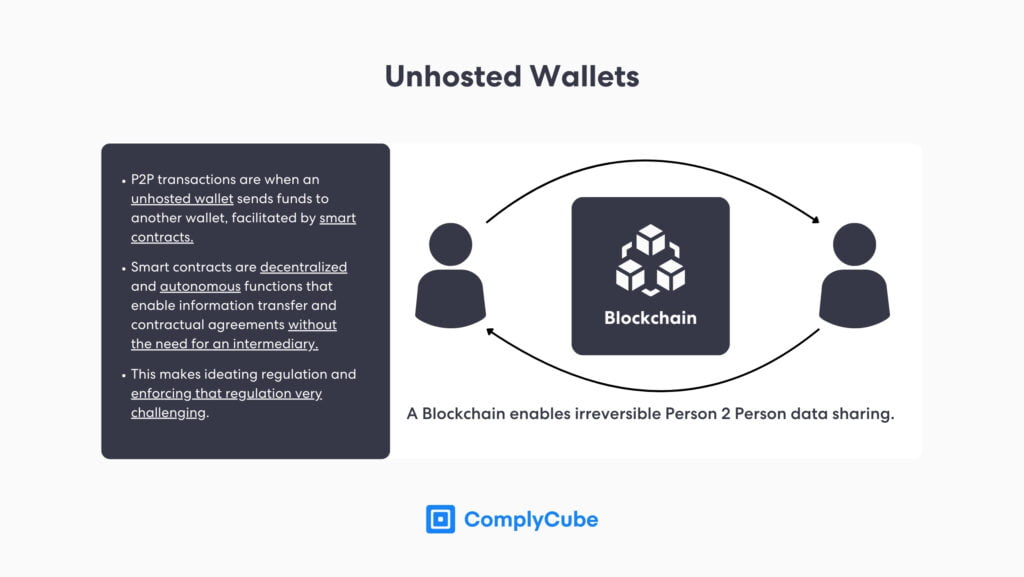
The decentralized nature of these platforms can make traditional regulatory approaches ineffective, prompting the need for new frameworks to govern lending, staking, and liquidity provision. The FCA may seek to enhance consumer protections in DeFi by focusing on smart contract auditing and ensuring AML/KYC compliance across DeFi protocols, such as Decentralized Exchanges (DEXs).
### Continued alignment with global standards set by the FATF
The FATF remains the global regulator for AML and CTF policies, and the FCA has consistently aligned its crypto regulations with FATF guidelines. One key rule is the FATF’s Travel Rule, which requires crypto firms to share information about transactions and is increasingly being adopted worldwide.
As the FATF refines its guidelines to address new challenges in the crypto space, the FCA is expected to follow suit, ensuring that UK regulations remain consistent with international standards. This will help mitigate risks related to money laundering and terrorist financing.

## FCA Crypto Regulation at a Glance
Adhering to FCA crypto regulations is a must for digital asset services. Noncompliance with the body’s regulations will result in (and has already resulted in) significant AML fines, along with potential barring of operation in the region.
Certain firms’ responses to the FCA rules have been to leave the region completely until further notice, something which is actually a negative consequence for the UK. If Britain wants to develop its digital asset sector, it wants to attract the industry heavyweights ashore. It seems that the most sure way to ensure this happens is to create regulatory certainty through the creation of a sector-specific digital asset regulatory authority.
For 2024 onwards, however, firms wishing to obtain a crypto license with the FCA must adhere to its set of regulations. For cryptoasset services and businesses that are looking to obtain such a license, [contact ComplyCube](https://www.complycube.com/en/contact/contact-sales/) to ascertain how its range of compliance solutions can help.
**Categories:** Guides
**Tags:** Crypto Regulations
---
### [MiCA Regulation and the Future of RWAs ](https://www.complycube.com/mica-regulation-and-the-future-of-rwas/)
**Published:** October 3, 2024
**Author:** Andreea Balasa
**Excerpt:** The EU's new MiCA regulation has established a tokenization regulatory rulebook for firms to follow; it is anticipated that this will set the new global benchmark. Read on to learn more about MiCA crypto regulation.
**Content:**
Tokenization, especially the tokenization of Real World Assets (RWAs), has been enjoying a resurgence in the blockchain space recently, thanks to increasing adoption by financial institutions and MiCA regulation. Goldman Sachs, for instance, recently announced plans to launch three tokenization projects by the end of 2024. But what exactly are tokenized RWAs, and how does new regulation, like MiCA crypto regulation, impact the industry?
## **Understanding RWAs and their Tokenization**
Think of RWAs as tangible and intangible assets from the physical world that we can now represent as digital tokens on a blockchain. These RWAs can be anything from commodities and real estate titles to intellectual property and even art. Tokenization is the process of converting these assets into digital tokens, making them easier to trade, granting increased liquidity, and reducing transaction costs.
## **What is MiCA Regulation?**
The Markets in Crypto Assets (MiCA) regulation is a move by the European Union to introduce a comprehensive framework to regulate the blockchain industry. The EU has brought about this framework to increase financial stability, reduce the risk the crypto industry could potentially pose to the broader financial system, increase consumer protection, and create an environment that encourages innovative growth in the crypto industry.
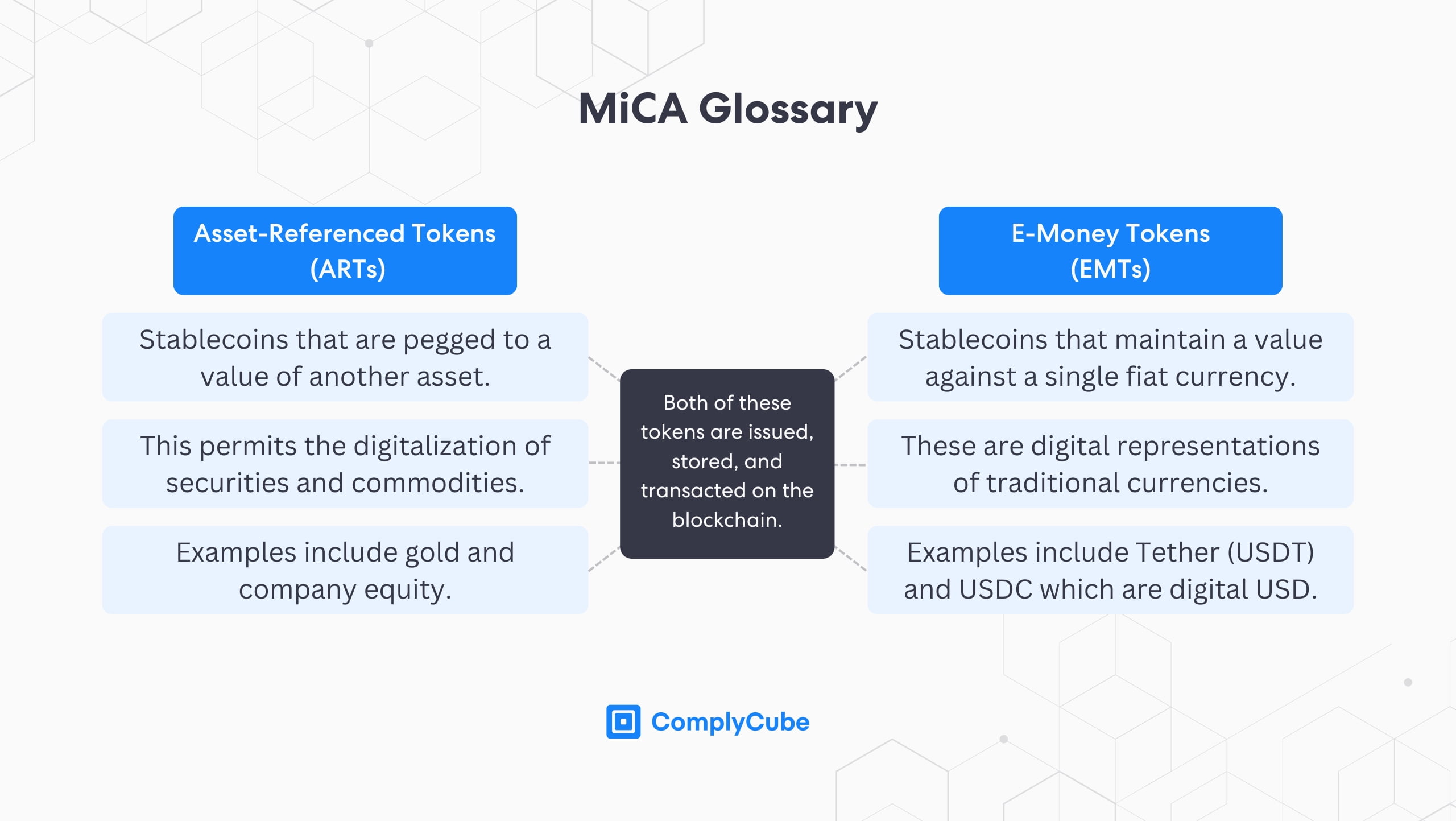
## **Impact of MiCA and RWA Tokenization**
Within the MiCA regulation, specific considerations have been made for the Tokenization of RWAs to coincide with their increasing popularity. The first of which is how tokens resulting from the tokenization of RWA’s are categorised. This is because each categorization has slightly different regulatory requirements:
**Asset Referenced Tokens (ARTs)** – These are crypto assets that have a stable value as they are associated with the value of one or several commodities. Under MiCA, ARTs must comply with strict rules including publishing a detailed whitepaper, obtaining approvals from the competent authorities, and maintaining a robust governance structure. This ensures that these ARTs meet high standards of both transparency and security.
**Electric Money Tokens (EMTs)** – These are crypto assets which are a digital representation of traditional fiat currency, which are designed to be used for everyday transactions, very similar to electric money. EMTs are also highly regulated and must adhere to even stricter standards than ARTs. As well as having to produce whitepapers, obtain approvals and have a robust governance structure, EMTs must maintain full fiat reserves and ensure liquidity for redemption.
**Other Tokens** – Tokens such as utility tokens that do not fall under ARTs or EMTs have a significantly lighter regulatory framework. Although these tokens still require a whitepaper and have marketing communication provisions to protect consumers, there are no requirements for internal governance, minimal capital or fit and proper management.
The categorization of tokenized RWAs under MiCA brings regulatory clarity and legitimacy to the industry. This unified regulatory landscape will boost investor confidence and build trust, making tokenized RWAs a more attractive utility.
Furthermore, the regulatory guidebook of MiCA will likely cause a tidal-like shift in global attitudes towards the regulation of stablecoins, digital securities, and cryptocurrencies generally. Notably, the United Kingdom launched a regulatory sandbox for the tokenization of securities. You can learn more about this development by reading the [UK Digital Securities Sandbox](https://www.complycube.com/en/the-uk-digital-securities-sandbox/).
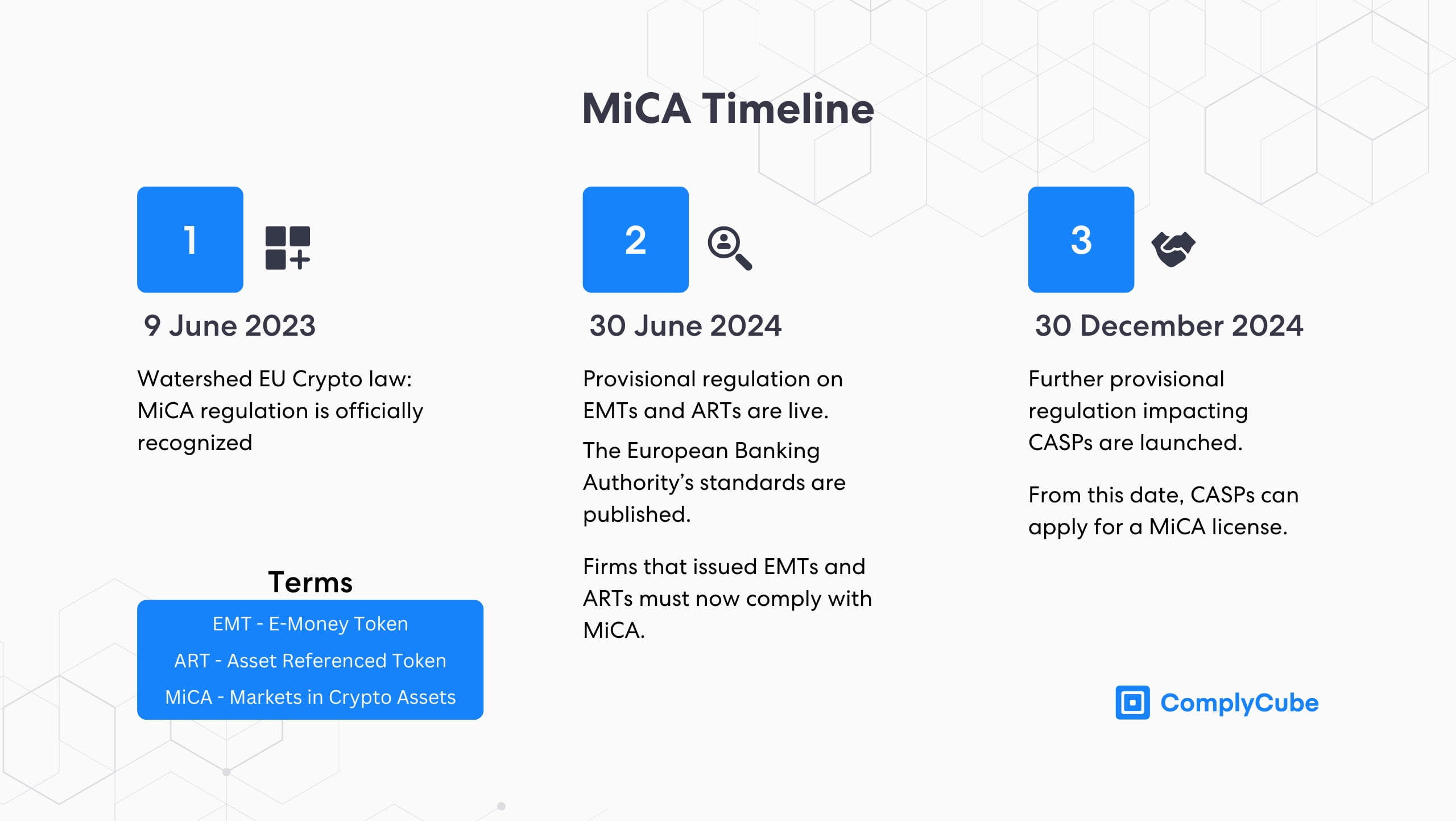
## What Impact Could MiCA Regulation Have?
MiCA regulation clearly positions the EU as one of the global leaders in the digital assets market by providing a clear and comprehensive regulatory framework. This framework enhances the legitimacy and security of tokenized assets, paving the way for greater adoption and innovation in the tokenization of RWAs.
What will be interesting to see now is how other regions react. The new Labour Government in the UK has previously stated in the lead-up to the general election that if victorious, Labour would transform the UK into a global centre for tokenized assets.
It is likely that the US will also follow suit should Donald Trump win the Presidential election. America’s current regulatory approach to digital assets has been fragmented, with the SEC cracking down on the industry more harshly than other local securities regulators.
Many regions worldwide have been slowly integrating some kind of regulatory oversight for digital assets and tokenized traditional assets. However, until now (in the West, at least), there has not been a regulatory rulebook for firms to follow.
Ultimately, the successful implementation of MiCA could set a global benchmark for regulating digital assets, driving the industry forward and fostering a more secure and innovative financial ecosystem.
**Categories:** Guides
**Tags:** Crypto Regulations
---
### [The Impact of Facial Recognition Identity Verification Software](https://www.complycube.com/the-impact-of-facial-recognition-identity-verification-software/)
**Published:** November 7, 2024
**Author:** Andreea Balasa
**Excerpt:** Facial recognition identity verification systems power the digital world, creating digital trust. This guide discusses how the technology behind facial recognition systems counters fraud and why these KYC solutions are key.
**Content:**
Facial recognition Identity Verification systems power the digital world. Whether you’re logging into your crypto exchange, signing up for a new credit card, or signing a contract for a new job, Identity Verification software (also known as IDV solutions) is pivotal in building trust in the digital economy.
This is particularly important in 2024, as fraudulent methodologies have embraced Artificial Intelligence (AI) to create convincing but fake online identities. AI-powered IDV solutions are now an imperative tool for businesses that wish to protect themselves and their users against these threats.
This guide discusses how the technology behind facial recognition systems counters fraudulent attacks and why these Know Your Customer (KYC) solutions are a modern must. It will also elaborate on the difference between facial recognition technology and IDV solutions.
## What is Identity Verification?
Identity Verification is the process of establishing a person’s identity. Multiple methods can be used to verify that someone is who they say they are, the most common of which include document verification and biometric verification.

Document and biometric verification work in tandem to create an ultra-high level of identity assurance. Leveraging cutting-edge AI, KYC documents can be verified and matched to selfies to ensure that the user is who they say they are. For more information on document verification, read [What is Document Verification](https://www.complycube.com/en/what-is-document-verification/)?
### What are Facial Recognition and IDV Solutions?
Identity Verification solutions are digital tools used by businesses worldwide to verify and authenticate their users. Facial recognition technology is fundamental in this recurring process and fosters an unparalleled level of identity assurance by analyzing and verifying key facial features.
Usually, biometric verification is paired with document verification, and these facial biometrics are matched for similarity with a stock image of a KYC document. Together, these processes take an average of 30 seconds.
### How Does Facial Recognition Work?
Facial recognition works by verifying biometric data with advanced machine learning technology and is the process used in biometric authentication. Once a user has signed up for a service, such as a crypto exchange, their facial data will have been saved in the exchange’s database for compliance and authentication purposes.
When a user goes through facial authentication to sign in, say a week later, this biometric information is used to compare against the data extracted from the authentication process. Ultimately, the same technology is used in both facial recognition software and biometric verification systems.

## Biometric Verification Technology
Digital [biometric verification](https://www.complycube.com/en/solutions/identity-assurance/biometric-verification/) enables the secure verification of anyone from anywhere. Sometimes known as selfie verification, it utilizes advanced machine learning and facial recognition algorithms to detect presentation attacks.
Presentation attacks are a fraudulent methodology used by malicious individuals to try to impersonate others. ComplyCube’s biometric verification uses its proprietary Presentation Attack Detection (PAD) technology to build 3D facial maps and analyze expressions, pixels, and skin texture to ensure that the selfie image is genuine.
### Advanced Liveness Detection
PAD technology, or liveness detection technology, ensures that even the most meticulously crafted fraud attacks can be detected. This technology helps build trust in the digital and global economy, but it cannot be adopted quickly enough.
> [10x increase in deepfakes](https://eftsure.com/statistics/deepfake-statistics/) detected globally across all industries in 2023.
While this figure is alarming, it is far worse in certain specific sectors. Shocking statistics from the crypto industry suggest that deepfake fraud scams are set to rise by over 200% in 2024 alone. Read [Why Identity Verification AI is crucial](https://www.complycube.com/en/why-identity-verification-ai-is-crucial/).

These statistics denote a growing necessity every year for the adoption of advanced face recognition technology in IDV solutions. In 2024, deepfakes are so convincing that the only plausible method to verify new accounts and authenticate users who sign in is with an automated Identity Verification process.
## Benefits of Selfie Verification Software
The benefits of adopting a facial recognition system are numerous and far outweigh not searching for a state-of-the-art solution. A robust identity verification software will directly contribute towards business growth and detect and prevent fraud.
Facial recognition solutions vastly improve a business’s **security against fraud.** By adopting biometric verification technology, businesses can improve the rate of fraud detection while improving their customers’ safety. In the context of crypto exchanges, certain accounts have been drained in minutes due to poor IDV controls and deepfake detection software.
Businesses can also enhance their **KYC onboarding process** through biometric verification. [Selfie checks take an average of 5 seconds to complete,](https://docs.complycube.com/documentation/checks/identity-check) contributing to a sleek, reliable, and fast KYC process.
A swift KYC onboarding process significantly **improves the User Experience** (UX), resulting in a higher satisfaction rate with customers. Long and drawn-out client acquisition processes are the leading factor in customer churn. Efficient onboarding will mitigate user attrition.
Furthermore, a face recognition system **enhances KYC scalability**. These solutions can onboard new users with a high level of precision in under 30 seconds, allowing firms to facilitate the demanding volumes that modern-day services experience.

Selfie verification empowers **global compliance**. These solutions verify users in seconds and are typically entirely cloud-based. Running on a software-as-a-service (SaaS) business model, Identity Verification solutions can be distributed worldwide, meaning the same solution can be used by the same company worldwide.
Lastly, facial recognition offers **greatly reduced business costs**, particularly the Cost of Client Acquisition (CCA) and Customer Due Diligence (CDD). CDD, a wider part of an Anti-Money Laundering (AML) process, could historically take business hours per customer. Automated KYC solutions, however, reduce the time and cost of these business operations.
## ComplyCube’s Facial Recognition Identity Verification Solution
By employing advanced biometric methods, IDV solutions streamline the verification process, significantly reducing the risk of fraud while providing a first-class and seamless experience for legitimate users.
Servicing a range of sectors, including telecoms, e-commerce, crypto, fintech, traditional finance, and many more around the world, the firm is helping businesses transition into a secure and digitally entrusted society.
ComplyCube is committed to innovating the compliance and security industry, helping businesses build trust at scale. This is a particularly pertinent mission in the face of increasing fraudulent technologies, such as AI-driven deepfakes.
If your business faces challenges identifying these threats or simply requires a new KYC onboarding process, [contact](https://www.complycube.com/en/contact/contact-sales/)[ a ComplyCube compliance specialist to learn more.](https://www.complycube.com/en/contact/contact-sales/)
**Categories:** Guides
**Tags:** Identity Verification
---
### [New UK Digital Wallet in 2025](https://www.complycube.com/new-uk-digital-wallet-in-2025/)
**Published:** February 11, 2025
**Author:** Sofia Daley
**Excerpt:** A new digital wallet will be introduced in 2025, enabling UK citizens to hold digital identification documents on their mobile phones, such as driving licenses. Learn how this will fortify transactions and prevent identity fraud.
**Content:**
A new UK digital wallet is set to be introduced in Britain in 2025, enabling UK citizens to hold digital identification documents, such as driving licenses, on their mobile phones. This implementation will drastically simplify everyday transactions, reducing the need for physical documents and providing enhanced security. Whilst the app will not be able to replace passports, which will be needed for international travel, digital identification will become the norm within domestic identification processes. The introduction of this wallet is part of a much wider movement towards efficiency by embracing digitization. However, participation is voluntary, and some have voiced concerns regarding potential future mandates and data protection. This guide will dive into how digitized documents may change the UK’s identification processes and how this will play into KYC and AML national and international mandates.
## What is a Digital ID?
A digital ID refers to a digital version of an individual’s identification documents, which can be securely stored and accessed through a smartphone app. Digital IDs serve the same function as physical documents, such as driving licenses, but are convenient and secure as the app utilizes advanced smartphone security features. Facial recognition can be used to protect personal data, making it far more difficult for fraudsters to access or manipulate an identity document. Additionally, the app will allow for immediate access to identity documents, reducing the possibility of theft or loss that might occur with a physical document.
## Increased Security with a UK Digital Wallet
The UK’s new digital wallet app will help reduce the risk of identity fraud in several key ways. By allowing individuals to hold critical documents digitally, the app can leverage biometric security checks using facial recognition to ensure accurate biometric verification. This means that if a fraudster successfully stole someone’s phone and held their digital documents, the fraudster could not use these documents to commit identity fraud. Additionally, with fewer physical documents circulating, the risk of fraudulent use of IDs is also minimized. Apart from the threat of identity fraud, the digital format also ensures that identity information stays up-to-date, further preventing the potential for fraud using outdated or forged documents.
## Harnessing Technology for the Greater Good
The UK Government has created an expansive blueprint for how the Department for Science, Innovation and Technology (DSIT) will now house a revamped Government Digital Service (GDS). Using the Digital Service is planned to save taxpayers £45 billion in efficiency savings, which is part of the government’s “Plan for Change.”
> The UK government is launching a [GOV.UK Wallet and App](https://www.gov.uk/government/news/digital-driving-licence-coming-this-year) to simplify access to services and documents like digital driver’s licences, alongside reforms to public sector technology to save £45 billion and drive efficiency and growth.
The Government’s “Plan for Change” also includes ending hospital backlogs, securing home-grown energy, raising living standards, building 1.5 million homes, supporting children, and putting increased police officers in place. With several new public-sector objectives, such as these, the Government must respond to the rapid advances in technology and leverage them to enable seamless operations at scale. Rt Hon Peter Kyle MP, Secretary of State for Science, Innovation, and Technology, states, “We’re still a long way from building a truly digital state – one where services work across institutional boundaries, and where digital credentials enable a more timesaving, personalized user experience. It’s not enough for government to just ‘keep up’ with the scale of change happening all around us. We have to understand it, use it, and shape it. And we must grasp every opportunity to drive greater value for money for the taxpayer.”
> We’re still a long way from building a truly [digital state.](https://www.gov.uk/government/publications/a-blueprint-for-modern-digital-government/a-blueprint-for-modern-digital-government-html)
The GDS blueprint highlights that the government will “harness the power of AI for the public good. ” One of the first steps towards this form of digitization will be the mobile driver’s license. This will allow citizens to prove their age from their phones in shops or online.
> Trustworthy digital identities can improve people’s lives by making transactions more simple and secure, from collecting a parcel to renting a flat or starting a new job.
In speaking with the UK Government’s Office for Digital Identities and Attributes, Hannah Rutter, Chief Executive Office for Digital Identities and Attributes, stated that “trustworthy digital identities can improve people’s lives by making transactions more simple and secure, from collecting a parcel to renting a flat or starting a new job. These faster and more secure checks can create huge efficiency savings for businesses. Subsequently, the use of secure digital identities could generate £701 million per year in economic benefits in the UK.”
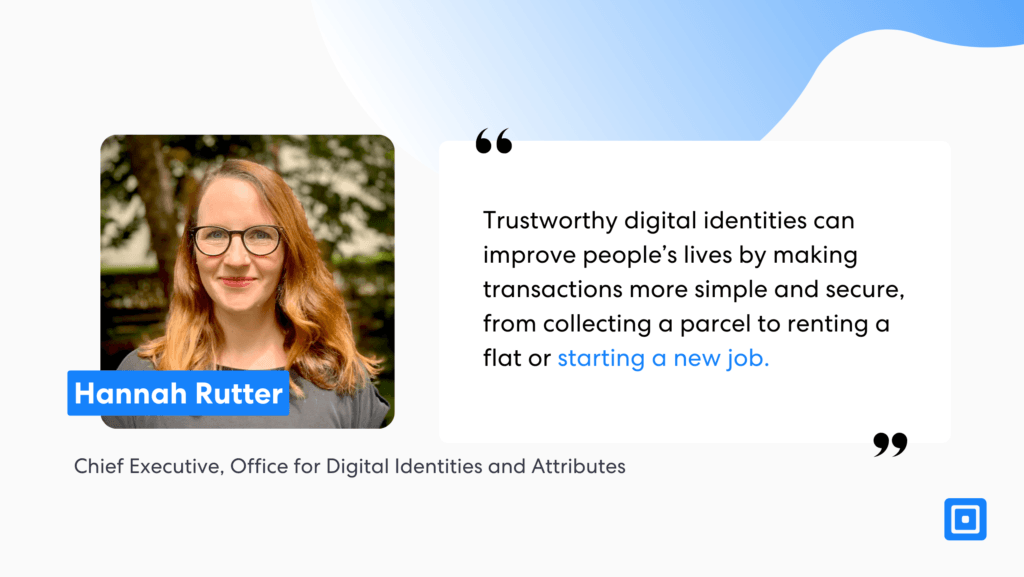
## Introducing the Mobile Driver’s License
The UK government’s launch of mobile driver’s licenses is expected in 2025 as an initial step within the new GDS. This mobile driver’s license will allow people to store and use it securely on their smartphones, making it easier to prove their age when buying age-restricted items and verify their right to drive. The digital license will be one of the first government-issued documents available in the wallet, which will use advanced security features like facial recognition to ensure safe access. Piloting will begin in 2025, with the full rollout expected by 2027, alongside other government credentials like Veteran Cards.
The government is reportedly exploring the possibility of incorporating additional services into the app, including tax payments and benefits claims. Other forms of identification, like national insurance numbers, may also be included. However, it is unlikely that physical identification will be completely replaced.
## The Importance of Accurate Identity Verification
Accurate Identity Verification is crucial as the UK adopts digital IDs, especially for industries like finance and healthcare. Digital IDs can streamline KYC processes, enabling faster, more secure identity checks. This improves customer experience and reduces fraud risks. For AML compliance, digital IDs enhance transaction tracking and suspicious activity detection.
While the benefits are clear, challenges remain around cybersecurity and privacy. The government must ensure robust protections and address data-sharing concerns, especially as digital IDs expand to include more services like medical records or academic credentials. Balancing convenience with privacy will be essential to maintaining public trust as the system evolves. Ultimately, the move to digital identification promises greater efficiency but requires ongoing security measures and public dialogue to be successful.
For more information on the importance of secure Identity Verification, get in touch with one of our [compliance experts.](https://www.complycube.com/en/contact/contact-sales/)

**Categories:** Guides
**Tags:** Identity Verification
---
### [Understanding UK Crypto Regulation in 2025](https://www.complycube.com/uk-crypto-regulation-in-2025/)
**Published:** January 28, 2025
**Author:** Sofia Daley
**Excerpt:** Crypto adoption has increased in the UK, with FCA reporting that 12% now own cryptocurrency. Let’s dive into what we can expect from UK crypto regulation in 2025, and how recent political changes might impact upcoming measures.
**Content:**
As the US spearheads the global crypto surge, the future of UK crypto regulation remains uncertain. Tulip Siddiq, the U.K. Treasury Minister and a prominent advocate for cryptocurrency regulation has resigned, leaving the nation with questions over the future of crypto in Britain. Meanwhile, the FCA reports that 12% of UK adults now own cryptocurrency, a clear indication that Britain is eager to avoid being sidelined as America embraces its new financial frontier. With the U.S. gearing up for Trump’s crypto era, let’s dive into how Britain might follow and what we can expect from 2025 crypto regulation in the UK.
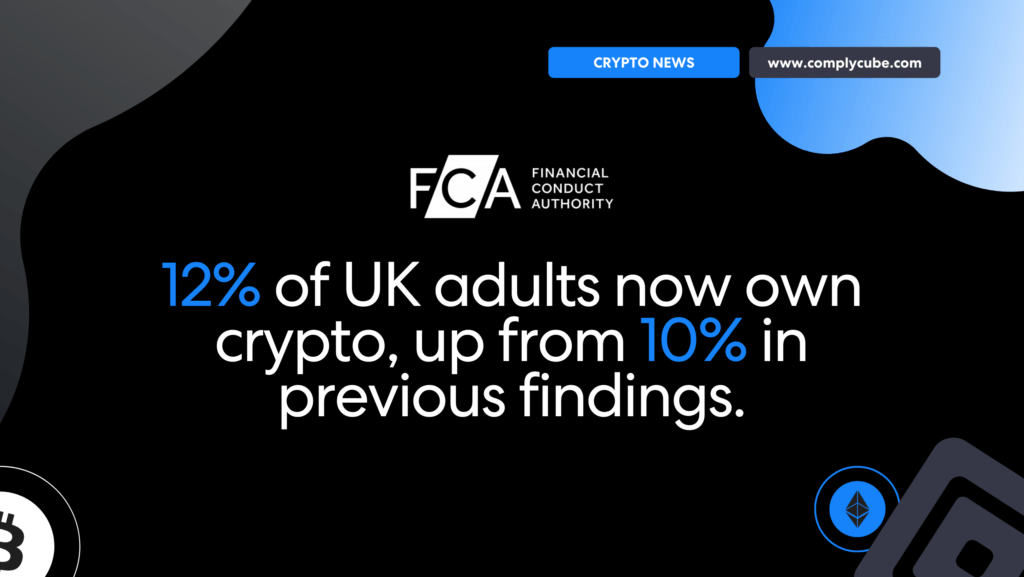
## Uncertainty After Tulip Siddiq’s Resignation
The [resignation of Tulip Siddiq](https://www.theguardian.com/politics/2025/jan/14/tulip-siddiq-resigns-as-treasury-minister-over-alleged-bangladeshi-financial-links), the U.K. Treasury Minister and a prominent advocate for cryptocurrency regulation, has cast a shadow over the future of digital asset oversight in the country. Siddiq stepped down amidst allegations of illegal ties to an anti-corruption investigation in Bangladesh. Her departure raises concerns about the continuity of the U.K.’s regulatory ambitions for digital assets, which had been gaining momentum under her leadership.
Siddiq formed a key part of the Treasury’s crypto regulatory stance, including plans to regulate stablecoins and staking services in early 2025. Her ambitions included pushing London as a global crypto capital, hoping to re-establish its position as a leading hub for digital finance. Yet, her resignation leaves the nation questioning whether the Treasury will carry out these plans.
## The Growing Urgency for Crypto Regulation in the U.K.
While Siddiq’s resignation casts uncertainty on the UK’s crypto regulatory future, the growing public interest in digital assets cannot be ignored. The FCA’s findings show that [12% of U.K. adults now own crypto](https://www.fca.org.uk/news/press-releases/fca-finds-crypto-ownership-continues-rise-it-delivers-plans-regulate-crypto#:~:text=According%20to%20the%20FCA's%20latest,£1%2C595%20to%20£1%2C842.), a 10% increase from previous findings. General awareness of crypto also rose from 91% to 93%, and the average value of cryptocurrencies held by UK citizens increased from £1,595 to £1,842. These statistics provide critical insight into public interest and demand for this growing sector as America continues to push crypto in campaigns with global reach.
> [12% of UK adults](https://www.fca.org.uk/news/press-releases/fca-finds-crypto-ownership-continues-rise-it-delivers-plans-regulate-crypto#:~:text=According%20to%20the%20FCA's%20latest,£1%2C595%20to%20£1%2C842.) now own crypto, up from 10% in previous findings.
The clear increase in UK crypto demands the right regulatory framework to avoid fraudulent practices and structured growth. Despite Siddiq’s resignation, the FCA remains committed to its roadmap for crypto regulation, with plans to finalize a comprehensive framework by 2026.
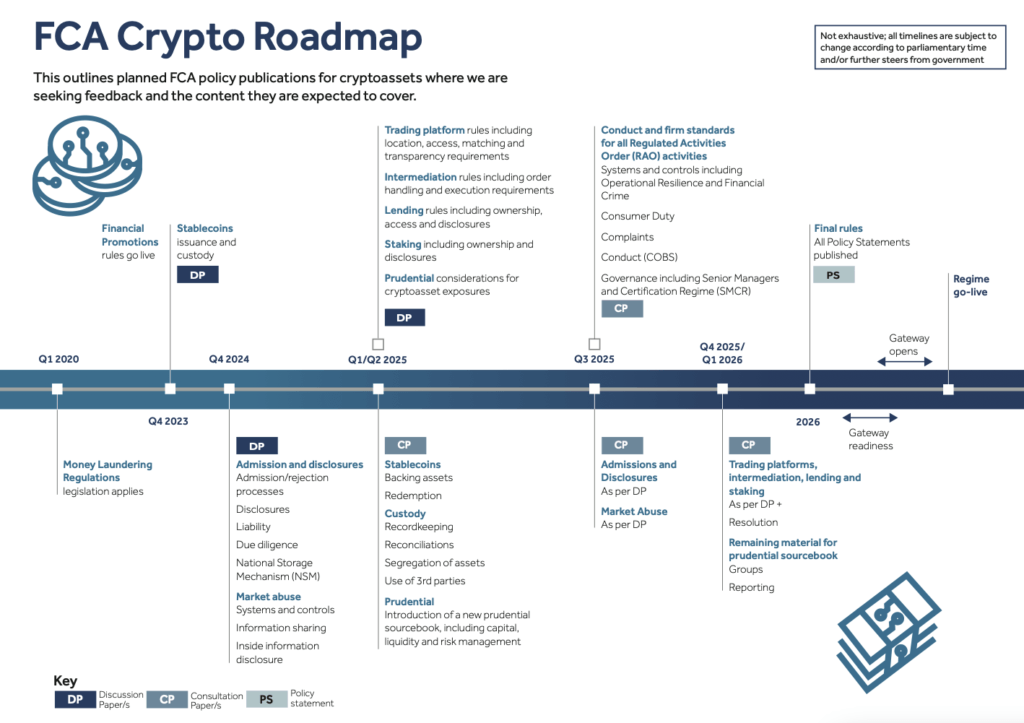
The [FCA’s crypto roadmap](https://www.fca.org.uk/publication/documents/crypto-roadmap.pdf) was first released in 2023, marking the regulator’s approach to stabilizing the sector’s growth. The roadmap outlines some clear focuses for the FCA, including consumer protection, market integrity, and Anti-money Laundering (AML) measures.
However, critics argue that the U.K. risks falling behind global competitors if it does not accelerate the implementation of these regulations. As one recent opinion piece in The Fintech Times pointed out, the pace of regulatory development is critical as nations like the U.S. and the European Union push ahead with their own crypto frameworks.
## Emma Reynolds Takes Over as the New Economic Secretary to the Treasury
Following Siddiq’s resignation, Emma Reynolds has been appointed as the new Economic Secretary to the Treasury, taking on the responsibility of overseeing the U.K.’s approach to cryptocurrency regulation. Reynolds, a Member of Parliament for Wolverhampton North East, assumes this role at a crucial moment for the digital asset sector. She brings a wealth of experience, having previously served as shadow international trade secretary, which will be instrumental in navigating the complexities of digital currencies, blockchain technology, and the broader financial ecosystem.

Reynolds will lead the U.K.’s regulatory approach through this phase of growth, implementing the needed frameworks to balance innovation efforts with consumer protection. The Treasury’s focus is on providing the sector with a clear rulebook that will outline the treatment of stablecoins and the possibility of a central bank digital currency (CBDC).
## What Might We Expect from UK Crypto Regulation in 2025?
### 1. Increased Focus on Consumer Protection
As the crypto market matures, consumer protection will become a primary concern for UK regulators. The government is expected to introduce more stringent rules around the disclosure of risks for retail investors, especially as cryptocurrencies remain highly volatile. This could include clearer warnings about the speculative nature of crypto assets, mandatory risk assessments for investors, and stronger transparency requirements from crypto exchanges and service providers. Expect further tightening of advertising guidelines to avoid misleading or overly-promising campaigns that could attract uninformed investors.
### 2. Enhanced AML/CTF Compliance
The UK is likely to implement even more robust Anti-Money Laundering (AML) and Counter-Terrorist Financing (CTF) measures specific to the crypto sector. In line with the EU’s recent developments and global trends, crypto businesses will likely be required to comply with the same AML obligations as traditional financial institutions, such as implementing enhanced due diligence for high-risk customers, regular audits, and real-time transaction monitoring. Expect increased scrutiny on firms’ Know Your Customer (KYC) practices.
### 3. Crypto Derivatives and Lending Regulation
The booming crypto derivatives market, including futures and options based on cryptocurrencies, will likely face tighter regulation. More specific rules could be designed to protect investors from the risks involved in crypto derivatives trading. The Financial Conduct Authority (FCA) may introduce clearer guidelines for crypto margin trading, ensuring that customers understand the risks involved in leveraging cryptocurrency positions.
“For now, [cryptoassets are largely unregulated in the UK.](https://www.grantthornton.co.uk/insights/whats-next-for-uk-cryptoassets-regulation/#:~:text=For%20now%2C%20cryptoassets%20are%20largely,definition%20of%20'specified%20investments'.) Only a few crypto asset activities have needed authorization under the Financial Services and Markets Act 2000 (FSMA).'”
Similarly, the rising popularity of crypto lending platforms, which offer high-interest returns on crypto deposits, will likely face increased scrutiny. Regulators may require lending platforms to hold sufficient capital reserves to protect customer funds and impose transparency requirements about the interest rates being offered and the risks involved.
### 4. Institutional Adoption and Regulation
As institutional investors increasingly enter the crypto space, with firms like hedge funds, investment banks, and pension funds looking to add digital assets to their portfolios, the UK is likely to introduce more regulation to accommodate and guide institutional adoption.
> “Access to investing in digital access [and regulation is improving](https://www.fidelitydigitalassets.com/research-and-insights/institutional-adoption-digital-assets). These are encouraging signs that digital assets could, like commodities, be coming into its own as an asset class.”
Fidelity Digital Assets has pointed out that “access to investing in [digital assets](https://www.fidelitydigitalassets.com/research-and-insights/institutional-adoption-digital-assets) and regulation is improving,” signaling that digital assets could soon mature into a standalone asset class, much like commodities. Fidelity further draws parallels between the digital asset market today and the evolution of other alternative asset classes. Just as commodities eventually became their own distinct asset class, digital assets may follow suit, bringing increased institutional interest.
This interest could bring forth clearer frameworks for institutional custody solutions, ensuring that large-scale investors can store crypto assets securely and comply with industry standards. Provisions for asset-backed securities (ABS) and other forms of crypto-backed financial instruments may also be included, which will likely undergo closer scrutiny.
### 5. Taxation Clarity and Reporting Obligations
As the UK government looks to balance fostering innovation with securing tax revenue, crypto taxation is expected to become more streamlined and transparent. Businesses and individuals will likely face clearer reporting requirements to ensure they pay the correct amount of tax on crypto transactions, including capital gains tax and income tax on crypto assets. This could involve real-time reporting systems integrated directly with crypto exchanges, reducing the likelihood of tax evasion and ensuring more compliance with HMRC guidelines.
## **The Role of Crypto Firms in Ensuring Industry Stability**
While regulation remains essential for the safe growth of the crypto sector, experts emphasize that crypto firms also have the responsibility to protect consumers and maintain market integrity. Ensuring the right processes are in place in order to protect consumers is critical, including the right AML and KYC infrastructure to detect fraud quickly and accurately.
> Crypto firms are not just gatekeepers of financial transactions—they are custodians of trust. As the UK seeks to finalize its regulatory framework, these firms have the opportunity to lead by example, demonstrating that a secure, transparent, and compliant ecosystem.
[Joshua Vowles-Dent](https://www.linkedin.com/in/joshua-vowles-dent/), Business, Strategy, and Partnerships Manager at ComplyCube, highlights the need for the sector to take responsibility for ensuring consumer protection. “The integrity of the crypto sector hinges on the ability of individual firms to continually assess their shortcomings, act swiftly, and integrate the necessary advanced technologies to prevent fraud before it happens. Crypto firms are not just gatekeepers of financial transactions—they are custodians of trust. As the UK seeks to finalize its regulatory framework, these firms have the opportunity to lead by example, demonstrating that a secure, transparent, and compliant ecosystem is not just a regulatory necessity but the bedrock for sustainable growth and long-term investor confidence in the digital asset space.”
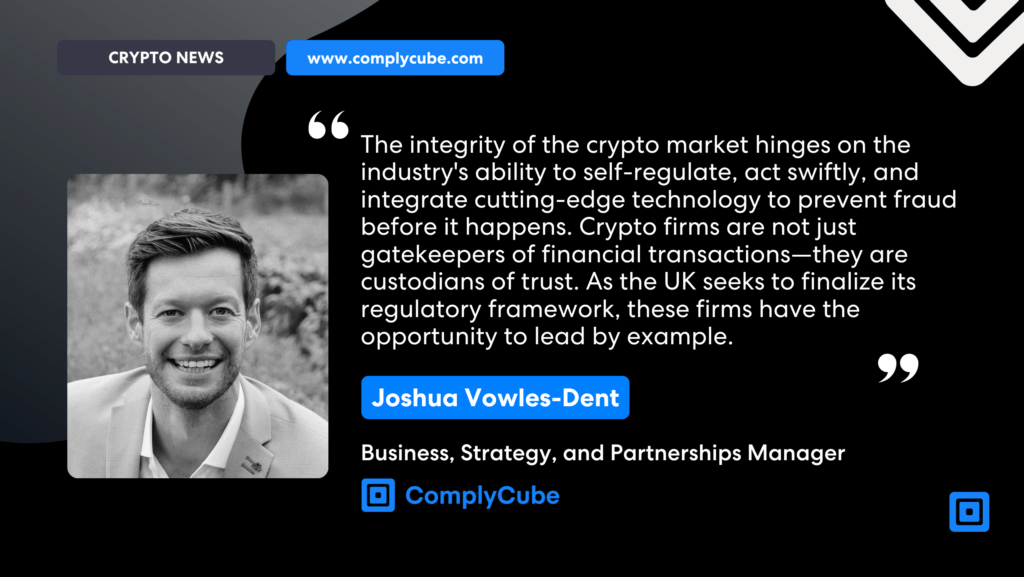
## Fortifying Crypto Compliance
As the Treasury continues to work towards providing the necessary regulatory frameworks, crypto firms must also take on the responsibility of ensuring a secure sector. Rising crypto adoption means that KYC and AML practices must be at the forefront of the crypto agenda, and the coming years will be critical for crypto giants to position themselves as reputable and compliance-focused digital asset leaders.
Reynolds’ leadership will be crucial in ensuring that the country develops a regulatory framework that is both forward-thinking and adaptable to emerging technologies. For more information on how to safeguard your crypto firm with the necessary AML and KYC processes, contact ComplyCube’s [expert compliance ](https://www.complycube.com/en/contact/contact-sales/)team.

**Categories:** Guides
**Tags:** Crypto Regulations
---
### [Companies House Introduces IDV Checks in 2025](https://www.complycube.com/companies-house-introduces-idv-checks-in-2025/)
**Published:** February 3, 2025
**Author:** Sofia Daley
**Excerpt:** For years, fraudsters have been able to set up fraudulent companies in the UK without any barriers to entry. Companies House will now introduce IDV checks within the business registration process to prevent identity fraud.
**Content:**
For years, fraudsters have been able to set up fraudulent companies on company houses without any barriers to entry. A lack of stringent identity verification processes (IDV checks) led to a surge in business identity theft in 2024, with fraudsters “cloning” existing businesses on Companies House to fraudulently take out loans. Many leading UK restaurants were “cloned” as part of this emerging scam. The BBC reported that more than 750 fake firms had been registered within a 6 week period in early 2024, often with misspelled names.
However, it seems as though change is finally on the horizon, with the Economic Crime and Corporate Transparency Act (ECCTA) set to enforce necessary Identity Verification checks in 2025. ECCTA’s new regulations will be especially pressing for Authorised Corporate Service Providers (ACSPs), businesses or individuals that offer corporate services such as company formation or administrative support. From the 25th of February 2025, solicitors, accountants, and other ACSPs carrying out ID checks on behalf of Companies House will need to register as ACSPs to increase the oversight of Identity Verification (IDV) practices.
## Early 2024: Business Identity Theft On The Rise
Business identity theft became a serious issue in the UK in early 2024 after hundreds of incidents of “company cloning” scams occurred. Several media giants, including BBC News, reported on these incidents.
> For only a small sum, scammers can [register a business online](https://www.bbc.co.uk/news/uk-68156910) with Companies House – usually within 24 hours.
A piece from BBC News, written in February of 2024, stated, “For only a small sum, scammers can [register a business online](https://www.bbc.co.uk/news/uk-68156910 "https://www.bbc.co.uk/news/uk-68156910") with Companies House – usually within 24 hours. After that, they are then able to steal overdraft money from bank accounts set up in the name of the fake company they have cloned and order high-value goods from suppliers keen to fulfill lucrative orders from a new, high-profile client. Goods are then delivered and invoices left unpaid.”
This was labeled as scandalous, with fraud expert Graham Barrow stating to the BBC that getting a library ticket from your local council was more difficult and required increased verification than registering a business on Companies House. A wide variety of UK restaurants, from Zizzis to the Ritz, have been targeted by these scams, resulting in costly losses.
Business identity fraud can have devastating financial consequences for both the targeted company and its stakeholders. When fraudsters “clone” a legitimate business, they gain access to the company’s name, credit, and sometimes its entire operational profile, allowing them to take out loans, open bank accounts, and place fraudulent orders under the guise of an established business.
The financial losses can be significant, especially when criminals use the stolen identity to order high-value goods from suppliers or rack up overdraft debt in the company’s name. These activities can lead to financial institutions holding legitimate businesses responsible for unpaid debts, damaging credit ratings, and making it more difficult for the business to secure financing in the future. In some cases, the damage is so severe that it leads to insolvency.
In addition to the direct financial costs, business identity fraud can also result in reputational harm. For instance, if a business’s name is associated with fraud or criminal activity, customers, partners, and investors may lose trust in the brand. This can cause long-term damage to relationships with suppliers, clients, and the wider market. The cost of re-establishing trust and restoring a damaged reputation can be astronomical, often requiring extensive public relations campaigns, legal efforts, and significant time to rebuild consumer confidence. The cumulative effects of financial losses and reputational harm can cripple a business, sometimes irreparably.
## Change On the Horizon? Identity Checks in 2025
An article from July 2024 by Samantha Bowley, a UK solicitor, underlined that movement was on the horizon. Bowley outlined that the Economic Crime and Corporate Transparency Act 2023 (ECCTA) amended the Companies Act of 2006 in 2023. However, these changes could not yet be implemented as secondary legislation was needed. Bowler stated in her piece that “The identity verification requirements are intended to improve the [reliability of the information](https://taylorwalton.co.uk/insights/new-identity-verification-rules-for-uk-registered-companies/ "https://taylorwalton.co.uk/insights/new-identity-verification-rules-for-uk-registered-companies/") on the register at Companies House, as well as to make it challenging for individuals to create a fictitious identity, or fraudulently use another person’s identity, to set up or run a company. Companies House has indicated an intention for these measures to come into force from early 2025.”
Bowley was correct, as The Economic Crime and Corporate Transparency Act (ECCTA) is about to drastically change the identity verification process involved in setting up a limited company on Companies House. By the spring of 2025, Companies House will run comprehensive identity checks on Authorised Corporate Service Providers (ACSPs). ACSPs are businesses that offer corporate services, including company formation or administrative support, such as accountants or solicitors. Starting February 25, 2025, third-party providers conducting identity checks for Companies House on behalf of clients must register as ACSP.
> Companies House will introduce a new[ identity verification process](https://changestoukcompanylaw.campaign.gov.uk/identity-verification/ "https://changestoukcompanylaw.campaign.gov.uk/identity-verification/") to help deter those wishing to use companies for illegal purposes. Anyone setting up, running, owning, or controlling a company in the UK must verify their identity to prove they are who they claim to be.
Looking ahead to summer 2025, Companies House will also introduce the ability to grant access to specific trust information from the Register of Overseas Entities upon request, providing greater transparency for those seeking to verify corporate structures and ownership. Then, by autumn 2025, more significant changes will take place. Identity verification will become a mandatory part of the incorporation process for new companies and for new appointments of directors and Persons with Significant Control (PSCs). Furthermore, Companies House will initiate a 12-month transition phase requiring over 7 million existing directors and PSCs to verify their identity, which will be done as part of the annual confirmation statement filing.

These changes are part of a broader effort to enhance corporate transparency and combat economic crime. As the regulations evolve, companies and individuals will need to stay informed and prepared for the upcoming requirements.
## The Importance of IDV Checks
Identity verification checks are necessary for all kinds of onboarding and registration processes, whether setting up a business on Companies House or onboarding a new customer onto your platform. For accountants, solicitors, and other corporate service providers, staying informed and adapting to these changes will be critical. Ensuring that customers are who they claim to be is critical for deterring fraud.
Expert identity checks must include both advanced document checks that leverage AI technology such as Optical Character Recognition (OCR) and biometric facial verification. Biometric verification that uses liveness detection technology can provide the highest level of security against identity fraud when onboarding customers, analyzing subtle microexpressions and skin textures to confirm that the user is not a deepfake or using another sophisticated spoof to bypass security measures.
Organizations are also required to conduct RFID (Radio-Frequency Identification) analysis as part of the document verification process to ensure the highest levels of assurance in the UK. This advanced feature leverages NFC (Near-Field Communication) technology for more secure and accurate identity verification.
If you’re an ACSP, Accountant, Solicitor, or any other regulated company that needs to safeguard against identity fraud, comply with the new ECCTA bill, or keep up to date with the UK’s latest AML policies, contact one of our [compliance experts](https://www.complycube.com/en/contact/contact-sales/ "https://www.complycube.com/en/contact/contact-sales/") for more information.

**Categories:** Guides
**Tags:** Identity Verification
---
### [Fighting Fraud with Document Verification](https://www.complycube.com/fighting-fraud-with-document-verification/)
**Published:** January 23, 2025
**Author:** Sofia Daley
**Excerpt:** Document checks are a core element of Know Your Customer (KYC) compliance, a regulatory framework requiring businesses to verify customer identities to prevent forgery and other financial crimes such as identity fraud cases.
**Content:**
Identity fraud is driven by increasingly advanced techniques used to forge documents and exploit gaps within verification systems. These falsified documents serve as gateways for financial fraud, illicit transactions, and even terrorism financing. The December 2025 Fraudscape report by CIFAS underlines critical concerns regarding the increase in quality of false documentation (including synthetic identities) in the UK. As AI tools become more widespread, fraud attacks increase in sophistication and quality, meaning that organisations must have the necessary tools to identify these attacks. This guide examines how organizations can strengthen their document verification and identification processes within their Know Your Customer (KYC) frameworks. It also explores the technologies and strategies essential for staying compliant with global regulations while effectively using data extraction to reduce risks.
## What Are Document Checks?
[Document checks](https://www.complycube.com/en/solutions/identity-assurance/document-verification/) are a core element of Know Your Customer (KYC) compliance, a regulatory framework requiring businesses to verify customer identities to prevent forgery and other financial crimes. With identity-related crimes having increased by 23%, now accounting for [68% of all reported fraud](https://www.cifas.org.uk/newsroom/fraudscape23-release#:~:text=The%20report%20reveals%20that%20last,attention%20to%20targeting%20older%20consumers.) cases, businesses that overlook these measures risk severe financial and reputational damage.
By validating user identity through document checks, document verification helps organizations ensure accuracy, reduce fraudulent activity, and strengthen secure operational processes. These processes typically involve verifying:
- Government-issued IDs: Passports, driver’s licenses, and national identity cards.
- Proof of Address Documents: Utility bills, bank statements, and lease agreements.
- Company Registration Documents: Certificates of incorporation and business licenses.

## Why Document Verification is Vital for KYC Compliance
Falsified documents remain a key enabler of financial crimes, allowing bad actors to manipulate systems, execute scams, and bypass security protocols. These activities undermine business assets, disrupt operations, and erode customer trust. As fraud tactics grow more advanced, financial institutions (such as banks) and other high-risk sectors are turning to automated document verification methods to stay ahead. These tools provide a scalable and reliable way to validate identities and verify documents online, minimising gaps for fraudsters to exploit vulnerabilities.
### Avoiding Severe Financial Consequences
The financial consequences of failing to address such vulnerabilities are immense. A [2024 Deloitte report](https://www2.deloitte.com/us/en/insights/industry/financial-services/financial-services-industry-predictions/2024/deepfake-banking-fraud-risk-on-the-rise.html) shows how advancements in AI, including tools used to create hyper-realistic fake documents, contribute to the growing scale of financial scams.
> Fraud-related losses could grow from $12.3 billion in 2023 to [$40 billion by 2027.](https://www2.deloitte.com/us/en/insights/industry/financial-services/financial-services-industry-predictions/2024/deepfake-banking-fraud-risk-on-the-rise.html)
The report predicts that fraud-related losses could grow from [$12.3 billion in 2023 to $40 billion](https://www2.deloitte.com/us/en/insights/industry/financial-services/financial-services-industry-predictions/2024/deepfake-banking-fraud-risk-on-the-rise.html) by 2027, representing an annual growth rate of 32%. These rising costs urge businesses to adopt robust document verification measures to mitigate fraud and counter advanced fraud tactics.
## Anti-Money Laundering (AML) Regulations and Document Verification
Regulatory frameworks such as the [Financial Action Task Force (FATF)](https://www.fatf-gafi.org/en/home.html) ensure that national bodies, such as the [Financial Conduct Auth](https://www.fca.org.uk/)[o](https://www.fca.org.uk/)[rity (FCA)](https://www.fca.org.uk/) act according to AML mandates. These standards require businesses to implement stringent identity document verification methods to prevent illicit financial activities, such as money laundering and terrorism financing.

Additionally, regulations like the [General Data Protection Regulation (GDPR)](https://gdpr-info.eu/) verify that personal data collected during the identity verification process is handled securely and transparently. While AML focuses on detecting and preventing financial crime, GDPR safeguards how customer data is managed and stored. Together, these frameworks create a comprehensive structure where document verification not only helps businesses meet legal obligations but also verifies operational integrity and data privacy.
## Reinforcing Customer Loyalty and Credibility
Transparent document verification builds customer confidence by demonstrating a clear commitment to privacy and security. [Research by FasterCapital](https://fastercapital.com/content/Document-Verification-Customer-Segment--The-Power-of-Document-Verification-in-Building-Trust-with-Customers.html) shows that reliable document verification systems not only reduce risks but also strengthen trust in a business’s data-handling practices. This proactive approach reassures customers that their information is protected, reinforcing long-term credibility and loyalty.
## Document Verification Contributes to Risk Mitigation in Financial Institutions
One of the world’s most prominent examples is the [2012 HSBC Holdings (HSBC) scandal](https://www.investopedia.com/stock-analysis/2013/investing-news-for-jan-29-hsbcs-money-laundering-scandal-hbc-scbff-ing-cs-rbs0129.aspx), where inadequate AML controls and poor document verification procedures allowed Mexican drug cartels and other criminal organizations to launder approximately $881 million through the bank’s U.S. branches undetected. Since then, many cases just like this one have taken place, with increasingly sophisticated attacks. These gaps in oversight exposed the vulnerabilities of banks with weak compliance manual verification systems and proved the critical role of robust checks in preventing financial crimes on a global scale.
## AI-Powered Document Verification Encourages Streamlined Onboarding
AI-powered document verification tools simplify customer onboarding by automating identity checks. This reduces manual workloads and accelerates approval times without compromising security protocols. This form of advanced document verification works by leveraging machine learning technology to analyze and authenticate various document types, such as passports and social security cards, in real time.
The system cross-references extracted data with trusted databases, detecting anomalies and ensuring accuracy. Whether a user takes a photo with their phone or manually submits a scanned photo or document, the process delivers fast and reliable verification results.
With the exploitation and automation of AI-generated content and advanced forgery techniques to produce fake documents, traditional verification methods have become far less reliable. Additionally, stolen personal documents circulating on black markets continue to fuel scams and other illicit activities.
## Tools & Technologies That Enhance Identity Document Verification
### Biometric Verification
[Biometric verification](https://www.complycube.com/en/solutions/identity-assurance/biometric-verification/) uses tools such as facial recognition, fingerprint scanning, and other unique biological identifiers to validate and determine an individual’s identity. This tool verifies that individuals presenting identity documents – such as driver’s licenses, ID cards, and passports – match the information recorded in the associated databases. By relying on physical characteristics rather than traditional credentials, ID verification becomes significantly more secure and less prone to manipulation.
### Optical Character Recognition (OCR) Technology
[Optical Character Recognition (OCR)](https://www.complycube.com/en/solutions/due-diligence-compliance/know-your-customer/optical-character-recognition/) plays a vital role in identity document verification by converting printed text on documents – for instance, bank statements, utility and phone bills – into digital formats. This enables automated data extraction from scanned documents, allowing businesses to cross-reference extracted information with official databases in real time.

When verifying an ID card, OCR can quickly detect the expiration date and validate and verify the document and user‘s authenticity. Additionally, OCR can identify inconsistencies or discrepancies in details such as names, addresses, and dates of birth, flagging them for further manual verification if needed.
Machine learning algorithms are often integrated with OCR systems, enhancing their ability to detect patterns and anomalies in ID documents. By analyzing historical data, these algorithms improve the accuracy of identity verification processes and adapt to new types of scamming attempts over time.
### Adverse Media Checks, PEP Screening, and Sanctions Screening
Adverse media checks, Politically Exposed Person (PEP) screening, and sanctions screening are essential components of document verification frameworks. These tools go beyond analyzing the document itself and look into the background and potential risks associated with the individual presenting the identity document.
- [Advanced Media Checks:](https://www.complycube.com/en/solutions/global-screening/adverse-media-checks/) These scans search public records, news articles, and media databases to uncover associations with financial crimes or illegal activities.
- [PEP Screening:](https://www.complycube.com/en/solutions/global-screening/sanctions-pep-screening/) Identifies individuals in politically influential roles who may present higher risks of involvement in corruption or financial fraud.
- [Sanctions Screening](https://www.complycube.com/en/solutions/global-screening/sanctions-pep-screening/): Cross-references data from ID verification processes against international sanctions lists, such as those maintained by the Office of Foreign Assets Control (OFAC).
### Machine Learning for Fraud Prevention
Machine Learning has revolutionized identity document verification by automating complex data analysis processes and increasing accuracy. When paired with OCR, it can predict malicious attempts based on identification patterns in scanned images of utility bills, bank statements, and ID documents.
## Conduct Identity Verification Checks with ComplyCube’s OCR Technology
With the world’s most complete KYC platform tailored to businesses of all sizes, ComplyCube helps you streamline compliance, prevent fraud, and build customer trust with [cutting-edge OCR technology](https://www.complycube.com/en/solutions/due-diligence-compliance/know-your-customer/optical-character-recognition/).
ComplyCube achieves this through advanced automation, seamless integration, and AI-driven anomaly detection for accurate verification across various document types. Whether a user takes a photo with their phone or submits documents for manual review, ComplyCube’s solution delivers reliable results in real-time. This approach reduces errors, accelerates onboarding, and improves overall customer experience.
Reach out to a [compliance expert](https://www.complycube.com/en/contact/contact-sales/) and explore how our tools can safeguard your operations.

**Categories:** Guides
**Tags:** Identity Verification
---
### [The Price of Identity Fraud in the UK ](https://www.complycube.com/the-price-of-identity-fraud-in-the-uk/)
**Published:** January 21, 2025
**Author:** Sofia Daley
**Excerpt:** Identity fraud in the UK has escalated over the past few years, recently predicted in December of 2024 to cost the UK government a shocking £1.8 billion per year. Businesses must protect themselves with IDV and KYC checks.
**Content:**
Identity fraud in the UK has continued to escalate over the past few years, enabled by advanced technologies, including artificial intelligence, that have allowed the development of sophisticated deepfakes. A report by CIFAS in December of 2024 unveiled that identity fraud now costs the UK an estimated £1.8 billion each year, a shocking statistic that urges change in onboarding processes for increased identity fraud protection.
Modern digital attacks are almost impossible for standard software or manual checks to detect, and deepfakes are often undetectable to the naked eye. Businesses across all industries must find a way to prevent identity theft to protect their revenue streams and customer data. This guide will explore the fraud risks you face before your clients or your business becomes a victim of identity fraud.
## What is Identity Fraud?
Identity fraud occurs when one party uses another person’s information, such as the other person’s name, social security number, address, or other personal or financial information, to commit fraud. Fraudsters then leverage stolen or artificial data for various nefarious reasons. These could include opening bank accounts, lines of credit or taking on the identity of an unsuspecting victim.
Any business that collects sensitive personal data must take steps to negate the risk that their customers, partners, or other stakeholders’ personal identification and data will remain safe. Such data breaches have both a direct and indirect impact. Organisations face risks from identity fraud in the UK, including:
- Non-compliance fines and losses
- Customer churn and loss
- Reputational damage
Without effective mitigation strategies, stolen documents, hacked accounts, or fraudulent bank accounts could cause significant financial loss for organizations of all types.
Consider that the [financial implications](https://blog.giantgroup.com/giant-blog/identity-verification-rising-identity-fraud#:~:text=The%20financial%20implications%20of%20identity,costs%20are%20not%20just%20financial.) to businesses in the UK equate to about £4 billion directly related to identity theft. Data clearly indicates that [nearly 40% of all businesses](https://www.business-reporter.co.uk/technology/identity-theft-the-cost-of-losing-yourself) face some level of fraud related to data theft each year. Act quickly to mitigate these risks.
## **The State of Identity Fraud in the UK** Since Covid
Data provided by [CIFAS](https://www.cifas.org.uk/about-cifas/annual-reports/annual-report-2020#:~:text=Cifas%20member%20organisations%20recorded%20nearly,fraud%20totalling%20%C2%A31.4bn.), a non-profit membership association in the United Kingdom focused on fraud prevention, in their Fraudscape report shows that member organizations indicated that 310,000 cases of fraudulent conduct were added to the National Fraud Database (NFD) in 2020. About 82% of those cases were directly related to fraud or misuse of identity.
The report takes a deep dive into the underlying cause, noting that COVID-19 played a prominent role in this process as more consumers in the UK turned to credit cards to support their day-to-day living expenses. Consumers invested heavily into online purchases to meet basic needs, creating an increased risk for digital identity theft.
> Fraudsters were using the pandemic as an opportunity to[ steal personal and financial information](https://www.cifas.org.uk/about-cifas/annual-reports/annual-report-2020#:~:text=Cifas%20member%20organisations%20recorded%20nearly,fraud%20totalling%20£1.4bn.) from the public.
As noted by CIFAS, “Key to this was fraudsters using the pandemic as an opportunity to steal personal and financial information from the public.” The report also noted a 23% increase in companies being impersonated, which drove misuse of company accounts by an increase of 26%. These factors are likely attributed to the stimulus packages provided to UK businesses.
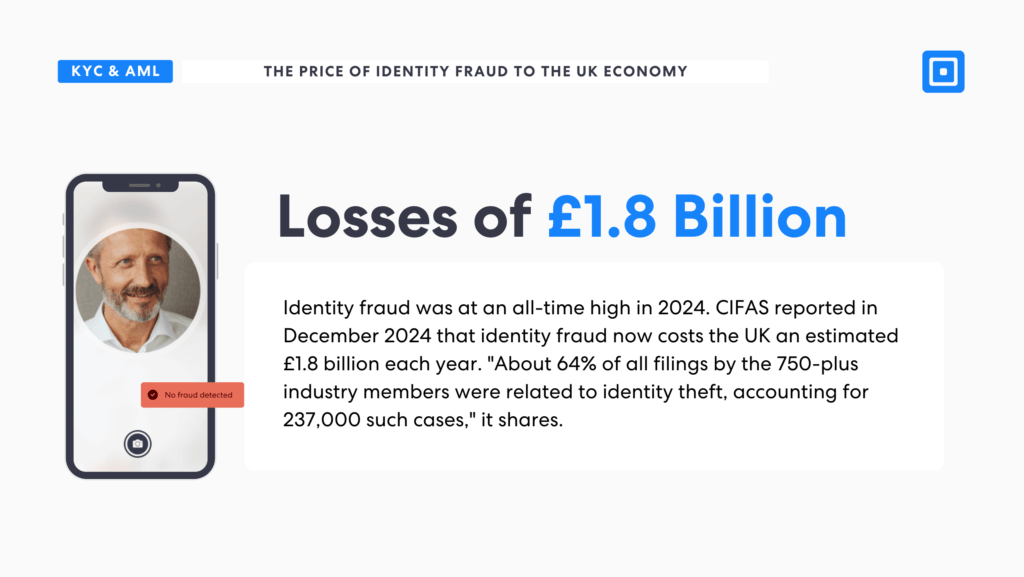
By 2022, the National Fraud Database (NFD) reported an even higher increase in fraudulent conduct, reaching 409,000 cases, the highest number ever reported. This was about a 14% increase from 2021 figures. Worryingly, another 12% increase drove figures up again in 2023.
## A Look at 2024
Identity fraud was at an all-time high in 2024. CIFAS reported in December 2024 that identity fraud now costs the UK an estimated [£1.8 billion each year](https://www.cifas.org.uk/newsroom/cifas-rusi-growing-id-fraud-threat). “About 64% of all filings by the 750-plus industry members were related to identity theft, accounting for 237,000 such cases,” it shares.
> Identity fraud now costs the UK an estimated [£1.8 billion each year](https://www.cifas.org.uk/newsroom/cifas-rusi-growing-id-fraud-threat).
The Insurance Fraud Bureau (IFB) has taken aggressive steps to warn the public about the risks of the ever-increasing number of identity thefts occurring in everyday transactions. The agency notes that fraud cases stemming from stolen identities “have nearly doubled in the past 12 months.”
While anyone could be a victim, about 64% of those who suffer identity attacks are people over 61 years of age, yet [CIFAS](https://www.insurancefraudbureau.org/media-centre/ifb-news/2024/public-warned-of-rise-in-identity-theft#_ftnref2) also notes an increase in the number of younger people sharing sensitive data across social media. CIFAS Director of Intelligence Stephen Dalton states, “[Identity fraud](https://www.insurancefraudbureau.org/media-centre/ifb-news/2024/public-warned-of-rise-in-identity-theft) continues to be a favored tactic for many criminals while exploiting innocent people to steal their identities and use personal details to fraudulently open and abuse financial products and services.”
The UK is not alone in this battle. In the US, over [1 million reports](https://www.ftc.gov/news-events/news/press-releases/2024/02/nationwide-fraud-losses-top-10-billion-2023-ftc-steps-efforts-protect-public) of identity theft streamed into the Federal Trade Commission in 2023, with more than $10 billion worth of fraudulent actions. That’s 14% higher than the previous year reported by the FTC identity theft report.
## The Rise of Synthetic Identities
Many people report identity theft when they see suspicious credit applications and unusual transactions on bank statements. They may also receive bills or letters from debt collectors. However, synthetic identities amplify risks. These identities are created with one bit of authentic information, such as an accurate social security number.

Fraudsters create these identities so that they seem like real customers. The identities are “real enough” to allow fraudsters to pass Know Your Customer (KYC) verification processes. A fraudster creates a new name, identity, and profile for them. Some create social media accounts to prevent a fraud department check on their identification. No fraud alert goes out because the person is not real, and no one’s credit report suffers directly. As a result, the fraudsters can perpetrate the fraud over time.
## UK Watchdogs Fighting Identity Fraud
Educating consumers and businesses about such risks is the best strategy for reducing ongoing fraudulent activity. With fraud cases growing, it has become imperative for third-party organizations to create robust plans. The following organizations are providing further advice and guidance to mitigate these risks:
- **Financial Conduct Authority:** The FCA, the main financial services regulator in the UK, is working to ensure companies in the financial sector comply with all anti-money laundering rules.
- **Information Commissioner’s Office (ICO):** The ICO regulates the methods of processing personal data, which is critical to minimizing further risk growth. This includes developing more accurate identity verification.
- **HM Revenue & Customs (HMRC):** HMRC regulates operations outside traditional financial services, including accountancy, real estate, and high-value dealers. It also enforces stringent guidelines to alleviate identity theft.
- **The National Crime Agency (NCA):** The NCA continues to focus on organized crime, including money laundering and those behind the identity theft scams.
- **Office of Financial Sanctions Implementation (OFSI):** As a component of the HM Treasury, this organization is working to enforce financial sanctions throughout the UK.
However, is there enough regulation and advice in place to stop fraudsters? While beneficial, it does not alleviate the strain on businesses faced with the ongoing need to mitigate identity fraud in the UK. More advanced identity fraud protection, including secure KYC and AML processes, are needed to safeguard businesses and individuals alike.
## Why Do Regulators Induce Regulations to Combat Identity Fraud?
Reducing identity fraud has true value for global economies, businesses, and individuals alike. Regulation offers protection and a stable framework for businesses to grow securely. Regulators aim to achieve this by applying and adopting increasingly robust strategies:
- Financial losses: Identity theft leads to significant financial losses for both consumers and businesses.
- Customer protection: Regulations aim to safeguard consumer personal information. Strategies are in place to protect consumers from unauthorized access and misuse. Without such strategies, the risk of financial devastation and the inability to prove losses is increasingly challenging.
- Public trust: Another fallout from identity theft risks is irreparable damage to an institution’s reputation. The regulatory framework clarifies the organization’s focus on minimizing risks and building public trust with customers and stakeholders.
- Limit criminal activity: Fraudsters use this information to commit crimes, often exploiting the most vulnerable of victims to years of financial loss and difficulty. On a much grander scale, regulators aim to apply rules that minimize money laundering and terrorism-related activities, which could be directly funded through such gaps.
- Facilitate fair competition: Standards ensure that all organizations have the same requirements and a level playing field. This can help with compliance-related matters that lead to an unfair advantage, such as by creating lax security.
## Combating Identity Fraud With ComplyCube
ComplyCube’s advanced platform empowers organizations to prevent fraudulent practices within their businesses’ digital walls, offering needed customer protection. With advanced identity verification methods, including biometric verification that leverages liveness detection technology, onboarding processes are fortified, and businesses are secured.
Contact one of ComplyCube’s [compliance experts](https://www.complycube.com/en/contact/contact-sales/) for more information on how to protect your business from identity fraud.

**Categories:** Guides
**Tags:** Identity Verification
---
### [Understanding User Risk From Identity Fraud](https://www.complycube.com/understanding-user-risk-from-identity-fraud/)
**Published:** January 21, 2025
**Author:** Sofia Daley
**Excerpt:** In 2023, 1.9 million British consumers fell victim to financial account misuse. These shocking statistics clearly point to the need for increased measures against these fraudulent practices, starting with advanced biometrics.
**Content:**
Identity fraud involves either stealing or creating an identity for fraudulent gain. The Bureau of Justice Statistics in the US states that, in 2021, 23.9 million US residents aged 16 or older fell victim to identity theft of some type. In the UK, the Fraud, Identity, and Digital Banking Consumer Survey for 2023 from FICO revealed that 1.9 million British consumers fell victim to financial account misuse. Without the implementation of robust identity verification processes, including biometric verification that leverages liveness detection, digital platform users are at risk of identity fraud. With digital strategies becoming increasingly complex, identity fraud poses potentially devastating losses to any business, consumer, or even government organization.
## What is Identity Fraud?
Bad actors can commit identity fraud by either stealing or creating an identity for personal gain. Identity theft is the unauthorized use of a person’s sensitive information, such as Social Security numbers, names, addresses, or other personal information, such as bank details. Fraudsters obtain this personally identifiable information and use it for illegal activity, financial gain, or to sell it on the dark web so others can do the same.

Victims of identity theft often experience financial theft, account takeovers, and stolen identities. Identity thieves then use this information to open accounts or credit cards or apply for loans with financial institutions or digital services without the intention of repayment. Some may even use it to apply for employment or for evidence of Right to Rent. For more on Right to Rent fraud, read [“UK DIATF-Certified Right to Rent Checks.”](https://www.complycube.com/en/uk-diatf-certified-right-to-rent-checks/)
## How Does Identity Theft Take Place?
Numerous strategies exist for obtaining fraudulent identities. Utilizing stolen information, bad actors can then open new accounts by applying directly for credit using that data. However, gone are the days when theft required physically stealing a person’s actual driver’s license or other government-issued credentials. Instead, they need just one piece of data, such as a Social Security number, around which they can build a full identity with fictional attributes. This process, which consists of building a synthetic identity, is one of today’s fastest-growing and hardest-to-detect threats for businesses in most sectors.
> An estimated [3 million high-risk identities](https://www.paymentscardsandmobile.com/3-million-uk-consumers-may-be-synthetic-identity-fraud-creations/) could be circulating in the UK alone right now.
An estimated [3 million high-risk identities](https://www.paymentscardsandmobile.com/3-million-uk-consumers-may-be-synthetic-identity-fraud-creations/) could be circulating in the UK alone right now. With blended accurate and inaccurate details, these identities simulate authentic and credible credit history, making them challenging to detect.
## A Global Problem with Expanding Risks
Numerous regulatory bodies and government efforts aim to reduce the risks associated with identity theft. CIFAS, a non-profit organization, continues to shed light on these risks through educational resources. Members of [CIFAS](https://www.cifas.org.uk/about-cifas/what-is-cifas) report fraud and risk in an effort to collaborate and reduce fraudulent activities. The National Crime Agency (NCA) reports fraud accounts for [40% of crime in England and Wales](https://www.nationalcrimeagency.gov.uk/what-we-do/crime-threats/fraud-and-economic-crime), four-fifths of which are cyber-enabled, pointing to the issue of digital enablement. The NCA works to pursue fraudsters through public, private, and third-party sectors.
In the US, various organizations aim to educate and combat such efforts, including the [Federal Trade Commission](https://www.identitytheft.gov/), which provides businesses and consumers with a step-by-step recovery plan. The [Internal Revenue Service](https://www.irs.gov/identity-theft-central) (IRS) and the [Social Security Administration](https://www.ssa.gov/fraud/) (SSA) continue to adopt increasingly robust strategies to mitigate risks within their organizations.
These organizations aim to reduce and control identity theft and stop it from occurring at such a rapid pace. Yet, each individual company and consumer must play their role in mitigating this risk as they stand to lose the most in such events. It’s, therefore, critical that businesses have the necessary KYC processes in place to verify whether customers and users are who they claim to be. The only way to do this securely is to leverage state-of-the-art technologies such as biometric verification and liveness detection.
## Identity Fraud in Banking
One sector most significantly impacted by ID theft is the finance sector, specifically the banking sector. In the UK, ID theft [grew by 14% in 2023](https://www.thebanker.com/Card-ID-theft-on-the-rise-in-the-UK-1716551037), with criminals targeting consumers directly. Yet another high-risk area focuses heavily on the opening of bank accounts and banking services. With nearly [2 million Brits](https://www.infosecurity-magazine.com/news/brits-victims-financial-id-fraud/) suffering fraud through the opening of new accounts in their name in 2023, this is a growing and concerning problem.
> [73% of consumers](https://www.fico.com/en/latest-thinking/ebook/fraud-identity-and-digital-banking-consumer-survey-2023-united-kingdom) looking to open a new account rated fraud protection strategies as one of their top priorities in the organization they select.
Such activities create noteworthy reputational damage within sectors. Data from [FICO research](https://www.fico.com/en/latest-thinking/ebook/fraud-identity-and-digital-banking-consumer-survey-2023-united-kingdom) shows that 73% of consumers looking to open a new account rated fraud protection strategies as one of their top priorities in the organization they select. However, one in five consumers will abandon the opening of a bank account when identity checks are time-consuming or too difficult. This demonstrates the incredible importance of finding balance.

## How Are Regulators Protecting Businesses and Consumers?
The Financial Services and Markets Act (FSMA) was introduced in the UK in 2000, long before such digital identity theft risks existed. Over time, increased strategies aim to strengthen this premise. Specifically, the UK financial regulatory framework from the Financial Conduct Authority (FCA) and Prudential Regulation Authority (PRA) aims to mitigate risks. The Know Your Customer (KYC) and Anti-Money Laundering (AML) efforts are at the heart of this. As a watchdog for consumers, FCA and PRA face an uphill battle as fraudsters quickly overcome defense strategies.
## Why Do Regulators Induce Regulations to Combat Identity Fraud?
Reducing identity fraud has true value for global economies, businesses, and individuals alike. Regulation offers protection and a stable framework for businesses to grow securely. Regulators aim to achieve this by applying and adopting increasingly robust strategies:
- Financial losses: Identity theft leads to significant financial losses for both consumers and businesses.
- Customer protection: Regulations aim to safeguard consumer personal information. Strategies are in place to protect consumers from unauthorized access and misuse. Without such strategies, the risk of financial devastation and the inability to prove losses is increasingly challenging.
- Public trust: Another fallout from identity theft risks is irreparable damage to an institution’s reputation. The regulatory framework clarifies the organization’s focus on minimizing risks and building public trust with customers and stakeholders.
- Limit criminal activity: Fraudsters use this information to commit crimes, often exploiting the most vulnerable of victims to years of financial loss and difficulty. On a much grander scale, regulators aim to apply rules that minimize money laundering and terrorism-related activities, which could be directly funded through such gaps.
- Facilitate fair competition: Standards ensure that all organizations have the same requirements and a level playing field. This can help with compliance-related matters that lead to an unfair advantage, such as by creating lax security.
## Biometric Systems For Effective Fraud Prevention
The FCA’s efforts for identity theft prevention are notable. Their handbook provides good practice examples or steps organizations can take to mitigate risks associated with identification risk. That includes, for example, using electronic verification checks or PEP databases to verify identities. It may also mean creating strategies that meet the needs of consumers who may not have common forms readily available. Firms must work consistently to protect customers and stakeholders through robust—and ever-increasing—strategies that ensure identification is made thoroughly and authentically.
An additional layer of protection using biometric information could be even more important. A user’s biometrics are very difficult for fraudsters to falsify. Other strategies that could facilitate improved ability to verify identity online include biometric data verification, such as biometric identification through a robust authentication process.
## KYC with Expert Identity Checks
There’s still value to passive biometric verification. It is convenient, scalable, and frictionless, improving customer experience. These are key customer retention strategies for nearly all fintech companies. For those in digital services, the passive liveness detection technology provides numerous benefits:
### 1. Seamless User Experience
Automated checks are much faster than outdated manual processes, as well as being far more accurate. Businesses can decide between passive and active identity checks, which require more or less intervention from the end user. Passive identity verification checks are conducted in the background and don’t require any action from users, which benefits organizations that are worried about interference with customer experience from incorporating sophisticated checks. However, active checks offer the highest possible level of security, leveraging sophisticated liveness detection and biometric technology, ensuring accuracy at all times.
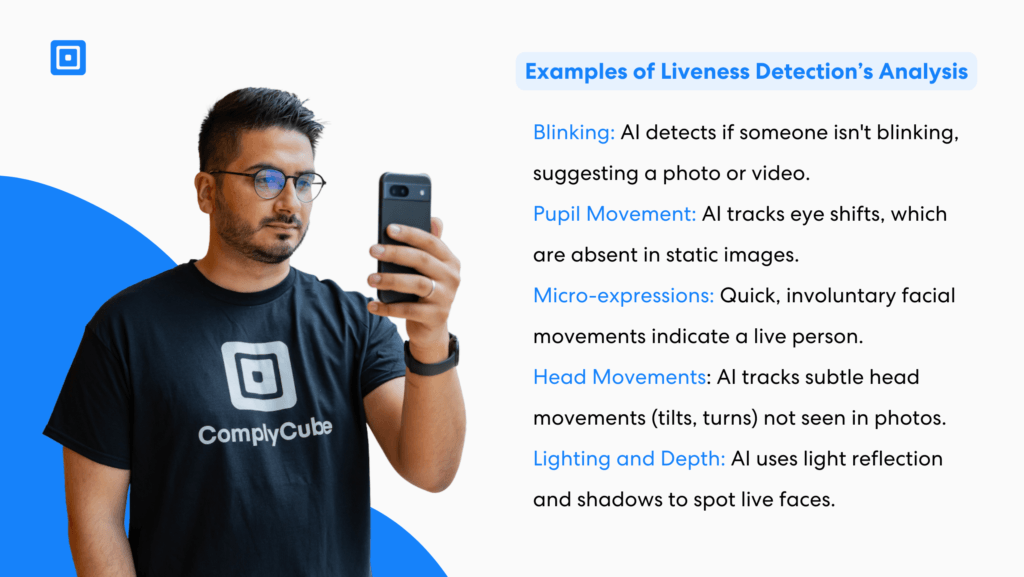
### 2. Reduced Drop-Off Rates
The reduction in friction minimizes the risk that customers will pause and not come back to the onboarding and verification process. This leads to fewer abandoned sign-ups or online transactions for individuals, satisfying more customers. Online identity verification is a critical component for organizations offering services on a mobile device, and a reliable but fast verification process is needed.
### 3. Scalability for High Transaction Volumes
Passive systems can navigate larger user groups simultaneously without demanding users to engage in more laborious tasks. As a fintech platform scales operations, they are more cost-effective. They can onboard new customers quickly, ensuring compliance and minimizing presentation attacks and other fraudulent activities across numerous people at one time. Incorporating these checks, therefore, empowers organizations to scale quickly and seamlessly, allowing for secure growth and powering global economies.
Behavioral biometrics (like analyzing patterns of typing or device navigation) can passively monitor online banking sessions for fraud while enhancing user experience by maintaining seamless transitions between tasks. More elaborate methods, such as voice recognition and facial recognition, enable organizations to capture customers’ likenesses against previous data. This can happen within seconds, providing quick access to apps and tools.
## Utilization of the Biometric Check: A Critical Move Forward as an Identity Verification Method
Biometrics, where active identity verification is used for the most robust and sensitive transactions, or passive identity verification is used for large-scale results, can create a far more advanced and effective level of security for companies throughout the fintech industry.
ComplyCube offers biometric check solutions that are leading the way from face recognition to behavioral biometrics. Designed to provide both active and passive strategies, including [cutting-edge liveness detection](https://www.complycube.com/en/solutions/identity-assurance/biometric-verification/), ComplyCube enables fintech companies to meet customer experience needs with compliance requirements and fraud reduction.
For more information on ComplyCube’s services, reach out to their [expert compliance team](https://www.complycube.com/en/contact/contact-sales/).

**Categories:** Guides
**Tags:** Identity Verification
---
### [The CryptoCubed Newsletter: January Edition](https://www.complycube.com/the-cryptocubed-newsletter-january-edition/)
**Published:** January 20, 2025
**Author:** Sofia Daley
**Excerpt:** This month, we’re tracking the rise of the $Trump meme coin, which has gained serious traction. Turkey sharpened its crypto regulations, Malaysia cracked down on unlicensed exchanges, and lots more in January's CryptoCubed.
**Content:**
In this month’s CryptoCubed, we’re tracking the rise of the $Trump meme coin, which has gained serious traction ahead of the inauguration. Meanwhile, Turkey sharpened its crypto regulations, Malaysia cracked down on unlicensed exchanges, and the U.S. Securities and Exchange Commission (SEC) continued to hold firms accountable. It’s a busy time in the world of digital assets—let’s dive in.

## Price of New Trump Meme Coin Soars Ahead of Inauguration
Donald Trump has unveiled a new cryptocurrency, the $Trump meme coin, ahead of his second-term inauguration as US president. Announced on social media platforms, the coin has seen its value skyrocket from $20 to over $70 per token, with $24bn in trading volume and a $14bn market cap by Sunday morning. Meme coins, which are often based on internet trends with little to no intrinsic value, are prone to volatile price swings, as seen with other recent meme coin failures.

Trump’s move into crypto comes as the community anticipates a more favorable regulatory environment under his leadership. The president-elect has promised to make the US the “crypto capital of the planet.” He has nominated crypto advocate Paul Atkins to head the SEC and plans an executive order to create a crypto advisory council once in office. Despite these promises, concerns persist about the speculative nature of cryptocurrencies, with some fearing the market could be heading towards a bubble.
A key detail is that CIC Digital LLC, a Trump-owned company, controls 80% of the 200 million $Trump coins in circulation, which is expected to grow to 1 billion over the next three years. This move follows Trump’s previous successful releases of crypto trading cards and his son’s involvement in the crypto industry. Some have raised red flags over potential conflicts of interest.
The $Trump[ coin’s website ](https://gettrumpmemes.com/#tokenomics)claims its purpose is to express support for Trump’s ideals rather than be an investment vehicle, distancing itself from any political campaign. Despite these disclaimers, its launch has triggered significant interest and investment from major crypto firms.

While the $Trump meme coin soars through its obvious initial success, this coin further strengthens the ties between the crypto sector and political agendas in the United States like never before, as this shortly follows the rise of Dogecoin. For more on Musk’s coin, read[ “Dogecoin Rises, With Crypto Fraud Set to Follow.”](https://www.complycube.com/en/dogecoin-rises-with-crypto-fraud-set-to-follow/)
Learn more about the rise of Trump’s new meme coin [here](https://www.theguardian.com/us-news/2025/jan/19/trump-crypto-meme-coin).
## Crypto Regulation Back On the Cards? US Senator Unveils Congressional Strategy
Senator Tim Scott, Chairman of the U.S. Senate Committee on Banking, Housing, and Urban Affairs, has outlined his priorities for the 119th Congress, with a focus on creating clear and effective regulations for cryptocurrencies. Scott criticized the previous administration’s lack of clarity, particularly under SEC Chair Gary Gensler, which he argued led to cryptocurrency projects moving abroad.
Scott’s legislative agenda aims to develop a tailored regulatory framework for digital assets, ensuring consumer protection, financial education, and compliance with relevant laws, such as the Bank Secrecy Act. At the same time, he stresses the need for flexibility to allow innovation in emerging financial technologies like stablecoins while maintaining U.S. competitiveness in the global crypto market.

Beyond regulation, Scott also intends to integrate digital asset oversight into national security policies, ensuring financial technologies support U.S. economic strength. His overarching goal is to drive financial inclusion and create economic opportunities, building on past successes to strengthen America’s position both domestically and globally.
Find more information [here](https://news.bitcoin.com/us-senator-outlines-congress-goals-to-reshape-crypto-regulation-framework/).
## MiCA in Action – Crypto.com Leads the Way
Crypto.com has become the first major global cryptocurrency exchange to secure an in-principle Markets in Crypto-Assets (MiCA) license, enabling it to operate in the European Union. The MiCA framework, which aims to enhance transparency, consumer protection, and market integrity, requires crypto firms to adhere to strict rules on governance, transparency, anti-money laundering protocols, and stablecoin reserve requirements.
Eric Anziani, Crypto.com’s President and COO, expressed strong support for MiCA, believing it will improve confidence in the crypto industry across the EU. The move follows last month’s approval of MoonPay under the same regulation, marking a significant milestone for the European digital asset market.
While the approval highlights Crypto.com ‘s commitment to compliant growth, the company is also under scrutiny by the Commodity Futures Trading Commission (CFTC) for allowing betting on major football games like the Super Bowl. For more information on MiCA and its effect on the crypto sector, read [“MiCA Regulation and the Future of RWAs.”](https://www.complycube.com/en/mica-regulation-and-the-future-of-rwas/)
Read more on [Crypto.com](http://crypto.com/)’s recent story [here](https://www.blockhead.co/2025/01/20/crypto-com-becomes-first-exchange-to-secure-eus-mica-license/).
## BitMEX Fined $100 Million For Violating Bank Secrecy Act
BitMEX, a global cryptocurrency exchange, has been fined $100 million for violating the Bank Secrecy Act by failing to implement an adequate Anti-Money Laundering (AML) and Know Your Customer (KYC) program. The company was found to have willfully ignored U.S. regulations despite serving U.S. customers. BitMEX executives knowingly allowed U.S. traders to use their platform without proper verification, undermining national security and financial integrity.
> It is critical that all financial institutions, including [cryptocurrency exchanges](http://justice.gov/usao-sdny/pr/global-cryptocurrency-exchange-bitmex-fined-100-million-violating-bank-secrecy-act "cryptocurrency exchanges"), comply with these rules to protect our country’s economy and national security.
Attorney for the United States Matthew Podolsky said: “Anti-money Laundering and Know Your Customer rules protect [Americans from fraud](https://www.justice.gov/usao-sdny/pr/global-cryptocurrency-exchange-bitmex-fined-100-million-violating-bank-secrecy-act), combat money laundering, and prevent the financing of terrorist activity. It is critical that all financial institutions, including cryptocurrency exchanges, comply with these rules to protect our country’s economy and national security. Today’s sentence sends a clear message that companies that willfully violate these rules and refuse to implement AML/KYC programs will face consequences.”
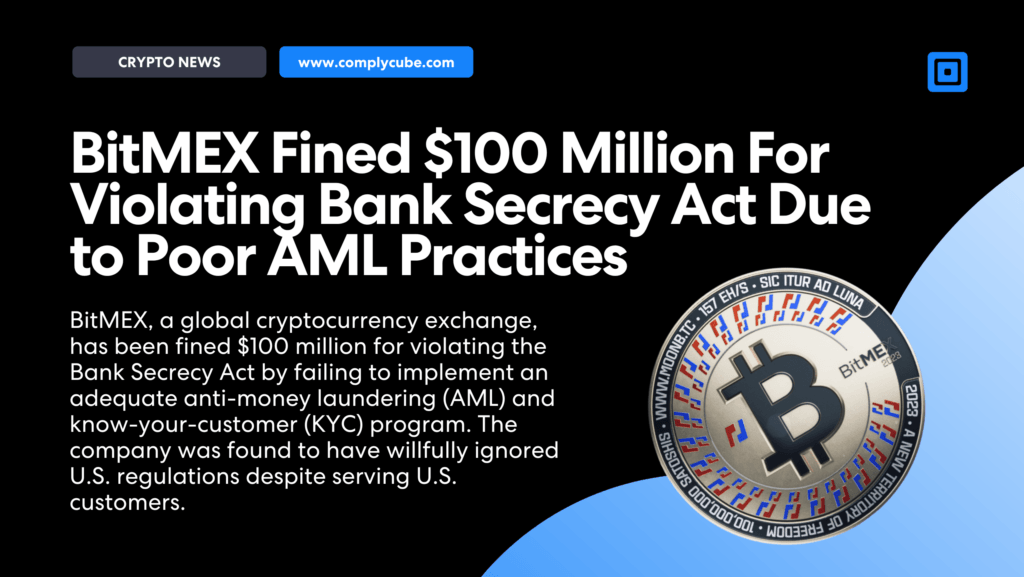
In addition to the fine, BitMEX was sentenced to two years of probation. The company’s founders and executives had previously pled guilty in 2022 to similar violations. The FBI’s New York Money Laundering Investigation Squad investigated the case.
This settlement highlights the importance of compliance with AML and KYC laws, especially for financial institutions operating internationally. The Justice Department has emphasized that such violations will not be tolerated.
Find more on this story [here](https://www.justice.gov/usao-sdny/pr/global-cryptocurrency-exchange-bitmex-fined-100-million-violating-bank-secrecy-act).
## SEC Slaps Digital Currency Group with $38 Million Fine for Negligence
The U.S. SEC has imposed a $38 million fine on Digital Currency Group (DCG), accusing the company of negligence in misleading investors about the financial health of its subsidiary, Genesis Global Capital (GGC). The SEC’s findings, released on January 17, 2025, claim DCG misrepresented GGC’s stability during a critical time in 2022, following the default of a $2.4 billion loan by GGC’s largest borrower, Three Arrows Capital. Despite mounting losses, GGC made public statements portraying financial stability, which the SEC now deems misleading.
DCG also issued a $1.1 billion promissory note to GGC to present positive equity, though the lack of transparency around this note further obscured the true financial situation. This culminated in GGC’s bankruptcy filing in January 2023 after suspending withdrawals.
The penalty highlights ongoing challenges in regulating the rapidly evolving crypto market, especially as the incoming Trump administration signals potential reforms. Critics argue that the SEC’s reactive approach fails to address broader regulatory issues, with the cryptocurrency sector still facing uncertainties and systemic risks. Despite the fine, DCG expressed relief that the matter is now resolved.
Read more about the SEC’s fine [here](https://news.bitcoin.com/sec-imposes-38-million-penalty-on-digital-currency-group-for-negligence/).
## Turkey Strengthens Crypto Regulations as New Framework Takes Effect
Turkey is tightening its digital asset regulations with a new framework that will come into force in February 2025. This update, aimed at reducing illicit financial activity, follows the European Union’s Markets in Crypto-Assets (MiCA) regulation and introduces stricter Anti-Money Laundering (AML) measures.
The new law requires individuals to share identifying information with Virtual Asset Service Providers (VASPs) for transactions over 15,000 Turkish liras ($425) and when opening new wallets. If VASPs cannot verify users’ identities, they must flag transactions as “risky” or even terminate the business relationship.
> Our main goal with [crypto asset regulation](https://coingeek.com/turkey-steps-up-crypto-aml-rules-malaysia-targets-bybit/ "https://coingeek.com/turkey-steps-up-crypto-aml-rules-malaysia-targets-bybit/") is to make this area safer.
Treasury and Finance Minister Mehmet Şimşek stated, “Our main goal with crypto asset regulation is to make this area safer and to eliminate the risks that may arise. Our approach is not restrictive but based on eliminating uncertainties and controlling possible risks.”
The regulations also set licensing and operational requirements for VASPs, including capital, staffing, cybersecurity, and organizational standards. The Capital Markets Board will oversee the sector.
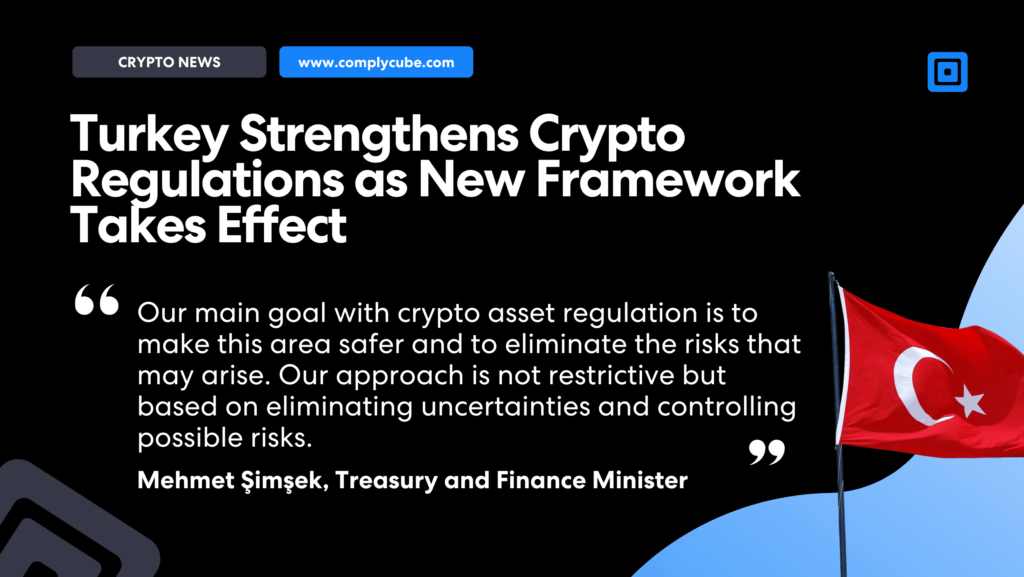
With Turkey’s thriving crypto market, this move is expected to increase legitimacy and attract more investors, reinforcing Turkey’s position as a regional crypto hub.
Read more on Turkey’s new crypto regulations [here](https://coingeek.com/turkey-steps-up-crypto-aml-rules-malaysia-targets-bybit/ "https://coingeek.com/turkey-steps-up-crypto-aml-rules-malaysia-targets-bybit/").
## **Bybit Ends Operations in Malaysia following an order from the Securities Commission Malaysia (SC)**
In Malaysia, the Securities Commission has taken a tough stance on unlicensed crypto operators. It ordered Bybit, a global crypto exchange, to cease operations in the country for failing to comply with local regulatory requirements and flagged Atomic Wallet as operating illegally.
Atomic Wallet, which is also embroiled in a hacking incident linked to North Korean cybercrime group Lazarus, is among several unregistered VASPs in Malaysia facing action. The regulator’s crackdown aims to protect investors and ensure compliance with capital market laws.
Bybit was also ordered to disable its website, mobile apps, and social media channels in Malaysia, marking another significant move in the ongoing global effort to enforce stricter crypto regulations.
Read more on Malaysia’s crackdown [here](https://coingeek.com/turkey-steps-up-crypto-aml-rules-malaysia-targets-bybit/).
## Time for Some Light-Hearted Creative Criticism?
So you’ve made it to the end of our newsletter. It’s time to enjoy a little satire, worthy reader, you’ve earned it.
### 🔥THE CRYPTO CUBED POEM: JANUARY🔥
Trump’s meme coin skyrockets, a political twist,
With 80% in his pocket— he just couldn’t resist.
Senator Scott states new rules, loud and clear,
While crypto giants read them, sweating in fear.
A couple of corporates faced hefty fines,
As the market keeps pushing the regulatory lines.
Back to the drawing board, they scramble with haste,
To ensure they’re compliant—before it’s too late.
### Stay tuned for our January newsletter, and have a great month!

**Categories:** News
**Tags:** Crypto Regulations
---
### [Securing Fintech: Active Identity Verification](https://www.complycube.com/securing-fintech-active-identity-verification/)
**Published:** January 16, 2025
**Author:** Sofia Daley
**Excerpt:** A biometric identity verification solution is crucial for organizations across all sectors, especially in the finance sector. Biometric identity verification is efficient and far more effective than error-prone manual methods.
**Content:**
A biometric identity verification solution is crucial for organisations across all sectors, especially in finance, an industry heavily prone to fraud. Biometric identity verification is far more effective than error-prone manual methods, for both achieving compliance and for preventing fraud. Both active and passive biometric identity verification methods offer significant value to organizations by enhancing security and improving user experience. However, it is essential to understand both of their strengths and limitations to leverage them effectively. This article will look at some of the key benefits and potential challenges that each approach offers, providing insight into their role in modern security systems and explaining why a balanced, informed strategy is crucial for optimal implementation.
## The Benefits of Biometric Identity Verification
Biometric identity verification uses users’ physical and behavioural characteristics to verify identification and limit identity fraud. It is far more reliable than simple verification methods like knowledge based questions or passwords which can be easily hacked to prevent fraud. Biometric security technologies are fascinating and expansive, ranging from 3D facial recognition to fingerprint recognition.
> By 2026, more than 4 billion people will use global biometric payment solutions, transacting [$5.8 trillion.](https://www.goodeintelligence.com/report/biometrics-payments-market-technology-analysis-adoption-strategies-and-forecasts-2021-2026/)
In the fintech sector, behavioural biometrics and facial recognition software offer a depth of understanding unlike any other. Data from [Juniper Research](https://www.juniperresearch.com/press/biometrics-to-secure-over-3-trillion-in-mobile) indicates biometrics will authenticate more than $3 trillion of transactions in 2025, a 650% increase from 2020. Another survey conducted by [Goode Intelligence](https://www.goodeintelligence.com/report/biometrics-payments-market-technology-analysis-adoption-strategies-and-forecasts-2021-2026/) states that by 2026, more than 4 billion people will use global biometric payment solutions, transacting $5.8 trillion through the digital economy.
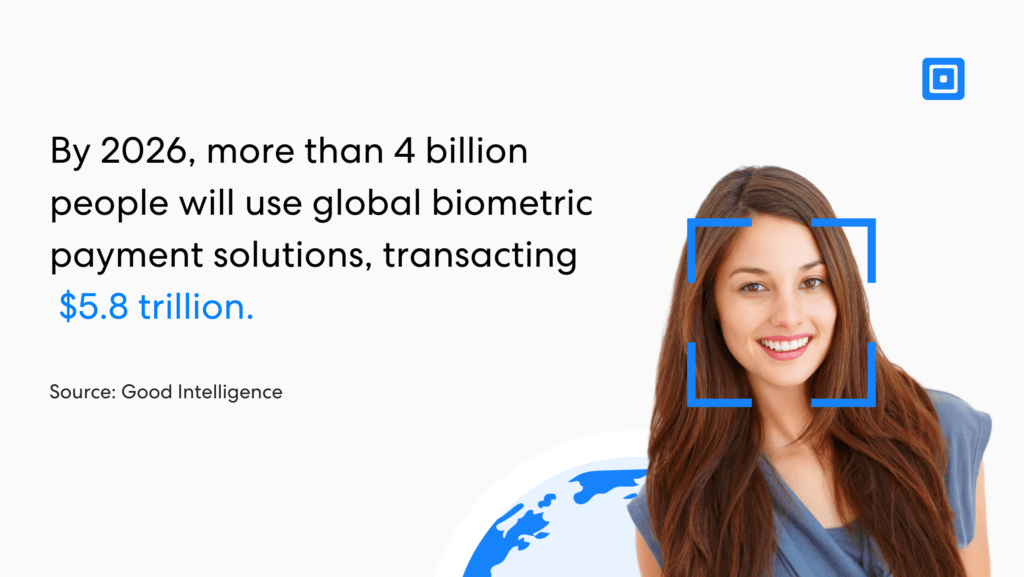
Biometric identity verification offers several benefits over traditional verification processess, such as:
- Enhanced security that eliminates fraudulent attempts to open accounts or other fraudulent attempts to gain access to sensitive data.
- More accurate in determining if the applicant is a real person to provide fraud protection, especially with the use of facial biometrics.
- Security in minimising personal data sharing, ensuring compliance with all government agencies.
- Difficult, if not impossible, to replicate, much like having a person physically present for.
Utilising an identity verification solution, such as live detection or a process that uses passive authentication, can streamline organisational safety. Businesses must decide between implementing active or passive biometric verification methods, as each offers varying benefits.
## What is Active Biometric Identity Verification
Active biometric checks, such as liveness tests, require a user to perform a specific action in front of the camera. This active authentication proves the user’s identity and demonstrates that they are really present when signing a document or agreement to a loan. Tasks might include following a dot on the screen with their eyes or turning their head in a specific direction. The technology follows the user’s face and actions to provide an extra layer of protection.
A relevant [Forbes](https://www.forbes.com/sites/frankmckenna/2024/09/26/rise-of-ai-face-clones-could-trigger-a-fintech-identity-crisis/) article shares that, “There are advertisements for AI that can turn a single photo of an AI-generated face into a convincing video that can fool liveness checks used by fintechs and banks for selfies and driver’s license verification during the Know Your Customer process.”
This is no longer possible with active biometric identification, which uses liveness detection software. An AI-generated “person” cannot interact with a biometric verification system in the way technologies such as liveness detection require. Fortified digital services are critical to businesses within the financial sector, and liveness detection is one of the most important IDV technologies for companies to leverage when ensuring that they meet the highest standard of regulatory compliance and reduce costly identity fraud attempts.

## What Is Passive Authentication and Identity Verification
Passive biometric identity verification still requires uniqueness testing and data verification but eliminates the “live” part of the process. These methods can use facial features or identify a person’s identity based on their physical characteristics.
The demand for facial biometrics is growing, with an [Allied Market Research](https://www.prnewswire.com/news-releases/facial-recognition-market-is-expected-to-reach-96-billion-worldwide-by-2022-584841741.html) report indicating this market reached $9.6 billion in demand in 2022. [Forbes](https://www.forbes.com/councils/forbestechcouncil/2022/08/25/biometric-authentication-and-ids-why-faces-are-becoming-essential-for-the-security-of-data/) states,”Currently, facial biometrics already provides users with a secure, quick way of verifying and validating their identity. It is now also possible to know, from submitting a document number or a selfie, if the biometric data received is connected to that person. This can make the identity validation and verification process much simpler, quicker and more efficient.”
## Active vs. Passive Biometric Identity Verification in Fintech: Use Cases & Benefits
Biometric verification has dramatically changed the fintech and financial services industries by providing a seamless and secure method that maintains requirements for user-friendly functionality. More transactions are taking place online than ever before, increasing the need for more advanced security solutions. Traditional PINs and passwords do not prevent security breaches, but biometric identity verification can. Biometric data, such as fingerprints, behavioural traits, and facial patterns, are more reliable at combating the very real threat of identity theft.
In the fintech sector, active biometric verification and passive biometric verification are two critical methods that financial organisations deploy. While both reduce fraud and improve accuracy, they function differently and serve distinct purposes. Active methods are often applied in high-risk or high-security financial situations:
- **Secure Login & High-Value Transactions** : Banks and payment providers use facial recognition or fingerprint scans to ensure that transactions are genuine and secure.
- **Onboarding**: New customers might need to actively verify their identity by scanning their fingerprints or facial features as part of account setup.
- **Multi-Factor Authentication (MFA)**: Financial companies can integrate facial scans or fingerprint scans as a second verification step for sensitive transactions.
Active biometrics detect fraud more accurately because they require the person to act deliberately. These liveness checks are far more advanced than just security questions. Bypassing these systems, which rely on sophisticated liveness detection technology, is next to impossible for a fraudster.
## How Financial Organisations Use Passive Biometric Verification
Despite being slightly less accurate that active biometric verification, passive biometric verification still offers global fintechs a high level of security without compromising on user experience. Passive verification does not require any action from the end user, making it a seamless process for all parties. Passive systems monitor user activity for anomalies—e.g., changes in typing patterns or behaviours—to flag potential fraud. These liveness checks are hard to beat. Some of passive biometric verification’s key features include:
- **Continuous Authentication**: Monitoring user presence throughout a financial session without requiring frequent re-entry speeds up the process and ensures ongoing support as information changes.
- **Streamlined Mobile & Online Banking**: Passive facial recognition or behavioural tracking allows users to access apps or make transactions with minimal effort, offering a smooth identity verification solution.
Passive biometric methods create a seamless, frictionless experience for the customer because they do not apply additional layers of live verification. This makes tasks such as logging into a payment app quick and easy.
## Advantages of Active Biometric Verification in Fintech
Financial institutions looking for superior verification of data and identity verification benefit the most from active biometric verification, as it is extremely accurate due to the use of liveness detection. Active methods require user engagement, reducing impersonation attacks, such as a fraudster using a spoofed or AI-generated identity by quickly spotting subtle inconsistencies in markers such as skin texture or subtle micro expressions. With this method of biometric authentication, financial institutions engaging in customer onboarding can safely offer remote identity verification.
Active biometric methods provide proven protection for organisations that need high-security measures, such as government-backed payments or financial lenders. These emerging technologies that apply a person’s biometrics can quickly verify customers, even for high-risk encounters such as high-value loans. Two-factor authentication and facial verification work well as an anti-money laundering solution.
### How Active Identity Verification Minimises Identity Fraud
When logging into a mobile banking application, a bank might prompt users with both facial recognition and fingerprint scanning as part of the authentication process, ensuring no unauthorised access. Another example is establishing a meeting with a financial advisor to discuss sensitive information. Liveness identity verification, such as moving the head in a specific direction, can help establish a secure conversation with an authentic party around the globe.
## Advantages of Passive Biometric Verification in Fintech
There’s still value to passive biometric verification. It is convenient, scalable, and frictionless, improving customer experience. These are key customer retention strategies for nearly all fintech companies. For those in digital services, the passive liveness detection technology provides numerous benefits:
### 1. Seamless User Experience
Passive methods work in the background, minimising the need for repetitive actions and ensuring a fast identity verification process. This leads to faster payment checkouts, faster login times, and a more seamless overall process. Passive methods are a verification solution that does not interfere with customer service.
### 2. Reduced Drop-Off Rates
The reduction in friction minimises the risk that customers will pause and not come back to the onboarding and verification process. This leads to fewer abandoned sign-ups or online transactions for individuals, satisfying more customers. Online identity verification is a critical component for organisations offering services on a mobile device, and a reliable but fast verification process is needed.
### 3. Scalability for High Transaction Volumes
Passive systems can navigate larger user groups simultaneously without demanding users to engage in more laborious tasks. They are more cost-effective as a fintech platform scales operations. Onboard new customers quickly, ensuring compliance and minimising presentation attacks and other fraudulent activities across numerous people at one time.
### Passive Verification: Use Case Example
Behavioural biometrics (like analysing patterns of typing or device navigation) can passively monitor online banking sessions for fraud while enhancing user experience by maintaining seamless transitions between tasks.
More elaborate methods, such as voice recognition and facial recognition, enable organisations to capture customers’ likenesses against previous data. This can work within seconds, providing access to apps and tools quickly.
## Utilisation of the Biometric Check: A Critical Move Forward as an Identity Verification Method
Biometrics, where active identity verification is used for the most robust and sensitive transactions or passive identity verification is used for large-scale results, can create a far more advanced and effective level of security for companies throughout the fintech industry.
ComplyCube offers biometric check solutions that are leading the way from face recognition to behavioural biometrics. Designed to provide both active and passive strategies, including [cutting-edge liveness detection](https://www.complycube.com/en/solutions/identity-assurance/biometric-verification/), ComplyCube enables fintech companies to meet customer experience needs with compliance requirements and fraud reduction. For more information on ComplyCube’s services, reach out to their [expert compliance team](https://www.complycube.com/en/contact/contact-sales/).
**Categories:** Guides
**Tags:** Identity Verification
---
### [Deepfake Detection For The Modern Media Threat](https://www.complycube.com/deepfake-detection-for-the-modern-media-threat/)
**Published:** January 16, 2025
**Author:** Sofia Daley
**Excerpt:** The rise of deepfakes has introduced new risks for businesses, eroding the foundations of digital trust. AI-generated deepfakes are capable of mimicking speech, facial expressions, and gestures with startling accuracy.
**Content:**
The rise of deepfake fraud has introduced a new dimension of risk for businesses, eroding the foundations of digital trust. These AI-generated manipulations – capable of mimicking speech, facial expressions, and gestures with startling accuracy – are no longer confined to skilled experts. Open-source tools have democratised deepfake creation, allowing even those with minimal technical expertise to produce convincing fake videos and fake images, amplifying their threat across social media platforms. For businesses, the consequences of deepfake attacks are far-reaching, from financial fraud and data breaches to reputational damage and loss of stakeholder trust. As these threats evolve, deepfake detection tools have become indispensable. This guide examines how such tools help businesses protect operations, secure stakeholder trust, conduct comprehensive assessments, and stay resilient against emerging threats.
## What are Deepfakes?
Deepfakes are artificially created or altered videos, images, or audio recordings designed to look and sound completely real. They’re generated using advanced artificial intelligence (AI) techniques, allowing fraudsters to manipulate a person’s appearance, voice, or even behavior in digital content. Unlike simple AI-generated and innocently manipulated images, deepfakes can create entirely new identities and falsify real world scenarios by replacing one person’s face or voice with another’s.
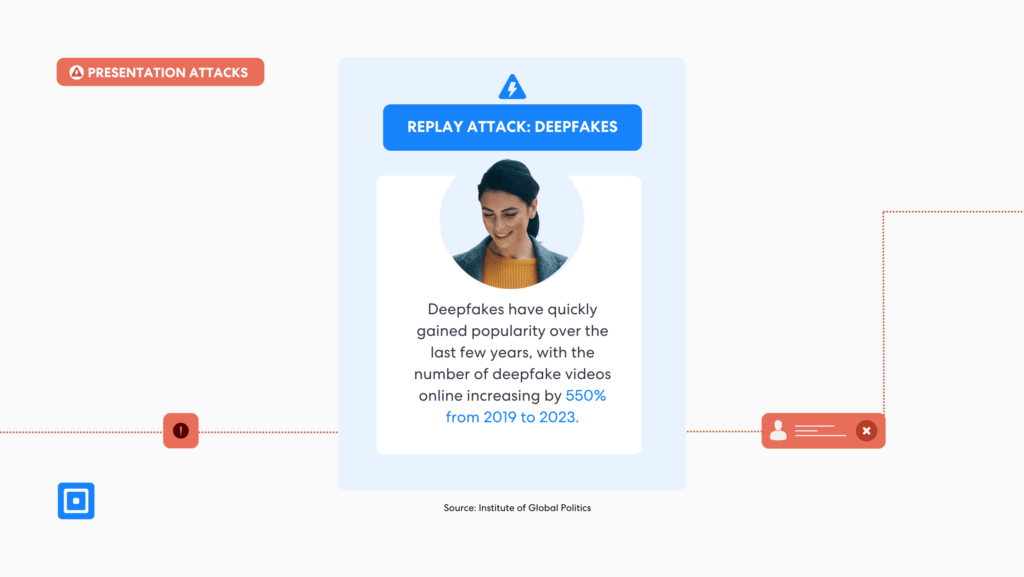
What makes deepfakes especially dangerous is their connection to [synthetic identity fraud](https://www.complycube.com/en/what-is-synthetic-identity-fraud/). In these schemes, fraudsters blend real and fake information – such as combining a real social security number with fabricated personal details or fake name – to create a false identity. This synthetic profile can then be used to bypass security checks, open deceitful accounts, or carry out financial crimes, making deepfake detection extremely challenging without specialized tools.
> [46% of organisations](https://www.securitymagazine.com/articles/99268-46-percent-of-organizations-faced-synthetic-identity-fraud-in-2022) globally faced synthetic identity fraud in 2022.
As many as 46% of organizations globally faced synthetic identity fraud in 2022, and that number continues to grow, costing companies exorbitant amounts of money and compromising sensitive information from unsuspecting victims.
From fraudulent financial transactions to reputational sabotage, deepfakes have evolved into a powerful tool for malicious bad actors. As noted by the [Northwestern Buffett Institute for Global Affairs](https://buffett.northwestern.edu/documents/buffett-brief_the-rise-of-ai-and-deepfake-technology.pdf), *“*In a world rife with misinformation and mistrust, AI provides ever-more sophisticated means of convincing people of the veracity of false information that has the potential to lead to greater political tension, violence, or even war.” This sobering reality reveals not just the new threat of the technical threat posed by deepfakes, but their broader societal impact.
### Deepfake Manipulation on Social Media Platforms
The hyper-realistic quality of deepfakes often deceive viewers and slip past traditional detection methods. As these manipulations grow more convincing, advanced technologies are necessary for identifying the subtle markers of deepfake videos and content.
## The Employment of AI and Machine Learning in Deepfake Creation
At their core, deepfakes are created using advanced and deep machine learning techniques, primarily Generative Adversarial Networks (GANs) and neural networks. These systems are designed to replicate and manipulate human features, expressions, and speech with remarkable precision. To simplify, a GAN operates like an ongoing competition between two artificial intelligence (AI) systems: the generator and the discriminator.
The generator acts like a highly skilled artist, using machine learning methods to create fake images, videos, or audio. It does this by analyzing massive datasets filled with examples of real-world facial features, voice patterns, and lip movements. For instance, it studies how mouths move when certain words are spoken, how skin texture appears under different lighting conditions, and how facial muscles shift during expressions. Over time, the generator learns to mimic these details with increasing accuracy.
The discriminator, on the other hand, serves as a meticulous critic. It evaluates the content created by the generator, analyzing every detail—down to subtle inconsistencies in lip movements, skin tone transitions, or eye reflections—to determine if the output is authentic or synthetic. The discriminator’s job is to flag anything that seems out of place.
The generator keeps refining its work based on the feedback it gets from the discriminator. Over time, this back-and-forth process improves the generator’s ability to produce content so convincing that even the discriminator struggles to tell if it’s fake content. This ongoing cycle is what makes deepfakes increasingly realistic and hard to detect without specialized tools.
## Face Swapping Techniques and Their Implications for Deepfake Detection
One of the most recognizable uses of deepfake technology is face swapping, where a person’s face is superimposed onto another’s in video content. These manipulations can make it appear as though someone has said or done things they never actually did, making them a powerful tool for disinformation campaigns. However, the implications extend far beyond disinformation.
This new technology has also given rise to deepfake phishing, a particularly insidious form of cybercrime. According to [Stu Sjouwerman](https://www.forbes.com/councils/forbestechcouncil/2024/01/23/deepfake-phishing-the-dangerous-new-face-of-cybercrime/), an industry expert and Forbes contributor on internet security, “Phishers are known to evolve their tactics in line with the evolution of technology. In recent years, phishing has shape shifted again, using a technology that some experts call the most dangerous form of AI-fuelled cybercrime in the world.”
> Deepfakes are one of the most serious emerging [risks](http://techhq.com/2020/08/deepfakes-ranked-by-experts-as-most-serious-ai-crime-threat/).
This assessment is supported by [a study](https://techhq.com/2020/08/deepfakes-ranked-by-experts-as-most-serious-ai-crime-threat/) conducted by University College London (UCL), where 31 experts ranked the most significant threats posed by AI-driven crime. The research, funded by UCL’s Dawes Centre for Future Crime, highlighted deepfakes as one of the most serious emerging risks. Among the 20 nefarious uses of AI identified, deepfakes stood out for their potential to cause widespread harm over the next 15 years.
## The Accessibility of Deepfake Detection Technology and Its Risks
The proliferation of open-source deepfake creation tools has made this technology accessible to a broader audience. Even individuals with minimal technical expertise can now produce deepfakes using software such as [DeepFaceLab](https://github.com/iperov/DeepFaceLab), a system which powers over 95% of deepfake creations. This accessibility means that deepfake threats are no longer confined to highly skilled developers or well-funded cybercriminal organizations, but they’re now a widespread cyber threat that can emerge from virtually anyone with a computer and an internet connection.
Gartner has commented on the risks deepfakes are presenting for businesses globally, stating, “In the past decade, several inflection points in fields of AI have occurred that allow for the creation of synthetic images. These artificially generated images of real people’s faces, known as deepfakes, can be used by malicious actors to undermine biometric authentication or render it inefficient,” said [Akif Khan](https://www.gartner.com/en/newsroom/press-releases/2024-02-01-gartner-predicts-30-percent-of-enterprises-will-consider-identity-verification-and-authentication-solutions-unreliable-in-isolation-due-to-deepfakes-by-2026), VP Analyst at Gartner. “As a result, organizations may begin to question the reliability of identity verification and authentication solutions, as they will not be able to tell whether the face of the person being verified is a live person or a deepfake.”
### Viral Spread of Deepfakes: Social Media’s Role
Once created, deepfakes can spread rapidly on various social media platforms, leveraging emotionally charged or controversial narratives to gain traction. This virality exacerbates the challenge of mitigating their impact, as they can influence public perception before detection.
## **Financial Fraud and Deepfake-Enabled Schemes**
Deepfakes are increasingly being weaponized, creating significant risks for businesses. Fraudsters have used deepfake audio and video to impersonate executives, deceiving employees into transferring funds or divulging sensitive information.
[One notable case](https://edition.cnn.com/2024/02/04/asia/deepfake-cfo-scam-hong-kong-intl-hnk/index.html) occurred in Hong Kong, where a finance worker at a multinational firm was tricked into transferring $25 million. According to Hong Kong police, the attackers used deepfake technology to convincingly impersonate the company’s CEO during a video conference call.
Manipulated media can severely damage a company’s brand image. A deepfake video portraying a CEO in a compromising situation, for instance, could lead to public backlash and erode trust among stakeholders.
## Challenges and Future Directions in Combating Deepfakes
Unfortunately, many subpar detection algorithms face challenges such as high false-positive rates and the evolving sophistication of deepfake creation technologies. Continuous updates and collaboration between businesses and tech developers are essential to staying ahead of these threats.
> To detect deepfakes in real time, acquiring and analysing a large and [unbiased dataset](https://link.springer.com/article/10.1007/s10462-024-10810-6) is necessary.
As noted in the study ‘Deepfake Video Detection: Challenges and Opportunities’ ([Kaur et al., 2024](https://doi.org/10.1007/s10462-024-10810-6)),“Despite the significant progress in deepfake video and detection algorithms, several crucial challenges remain unsolved for present deepfake video detection methods. To detect deepfakes in real time, acquiring and analysing a large and unbiased dataset is necessary. Collecting real-time data is one of the Deep Learning (DL)-based method’s primary limitations. Unfortunately, many real-time application areas cannot access large amounts of new data.”
This shows a key issue with most deepfake detection systems: tools are only as effective as the datasets they’re trained on. Without access to diverse, up-to-date data, even advanced AI detection models struggle to keep pace with increasingly sophisticated deepfakes. Businesses must not only invest in reliable deepfake detection technologies but also support better data-sharing practices and collaboration across industries to address this gap.
## Deepfake Detection Tools for Safeguarding Digital Trust
To address the challenge of manipulation from deepfakes, businesses need to adopt advanced deepfake detection tools and software. These systems rely on a combination of deep learning techniques and machine learning algorithms to meticulously analyze digital media (including images, video, and audio) for signs of generated or manipulated content.
> [95% of all ](https://legal.thomsonreuters.com/blog/how-to-detect-synthetic-identity-fraud-before-it-becomes-a-problem/)standard customer onboarding processes fail to detect the presence of fake identification.
One innovative deepfake detection platform in this space is ComplyCube. The platform’s [liveness detection technology](https://www.complycube.com/en/solutions/due-diligence-compliance/know-your-customer/liveness-detection/) sets a new benchmark in biometric verification, verifying that biometric data originates from a real, live person rather than static images, pre-recorded videos, or AI-generated deepfakes.

Powered by advanced AI and machine learning algorithms, it analyzes micro-expressions, skin texture, facial recognition patterns, and environmental interactions in real-time. Through a multi-modal approach—combining active checks, like guided head movements, with passive analysis that operates silently in the background—ComplyCube seamlessly detects sophisticated spoofing attempts, including printed photos, 3D masks, and video replays. This robust system delivers highly accurate, secure, and frictionless identity verification, empowering businesses to confidently prevent fraud.
## Building Resilience Against Deepfake Threats with Deepfake Detection Tools
Deepfakes represent a formidable challenge to digital trust, particularly for businesses striving to maintain secure and reliable operations. By adopting advanced deepfake detection tools and integrating them into comprehensive cybersecurity frameworks, organizations can mitigate the risks posed by manipulated media.
ComplyCube is a powerful platform designed to address the growing deepfake detection challenge by leveraging advanced machine learning techniques and deep learning technologies. By combining face recognition, document analysis, and anti-spoofing measures, the platform ensures secure and reliable identity verification, even in an era where detecting deepfake videos is becoming increasingly difficult.
[Robust Face Recognition](https://www.complycube.com/en/solutions/identity-assurance/biometric-verification/) and Similarity Analysis: ComplyCube utilizes ISO 30107-3 and PAD Level 2-certified biometric liveness detection to ensure accurate face recognition. By comparing real videos and biometric data samples, the tool effectively distinguishes genuine users from manipulated identities. Its deepfake detection capabilities are enhanced by analyzing facial features, behavioral patterns, and other unique biological signals, creating an additional layer of verification assurance.
[Advanced Document Verification](https://www.complycube.com/en/solutions/identity-assurance/document-verification/)**:** Using a blend of advanced machine learning techniques and human expertise, ComplyCube analyzes a wide range of ID documents—such as passports, driver’s licenses, national ID cards, residence permits, and visa stamps. This verification process involves cross-referencing documents with trusted data sets to identify signs of tampering, forgery, or blacklisting, ensuring they are authentic and unaltered.
[Cutting-Edge Liveness Detection Technology](https://www.complycube.com/en/solutions/due-diligence-compliance/know-your-customer/liveness-detection/): With AI-powered PAD-Level 2 liveness detection, ComplyCube can detect deepfake videos and prevent impersonation attempts. This system uses anti-spoofing algorithms to identify subtle discrepancies between real videos and manipulated media, safeguarding against increasingly sophisticated deepfake detection challenges.
Seamless Biometric Onboarding: ComplyCube offers a guided face capture experience, streamlining the biometric onboarding process for industries such as finance, telecommunications, travel, and enterprise services. By focusing on high-quality data set integration and continuous system optimization, the tool delivers a smooth and accurate authentication process.
In the face of rising threats from AI-generated fake content, a partner like ComplyCube plays an essential role in strengthening digital trust. Its comprehensive approach to face recognition, document verification, and deepfake detection helps organizations stay ahead of challenges while ensuring the integrity of their identity verification processes.
Contact one of ComplyCube’s [compliance experts](https://www.complycube.com/en/contact/contact-sales/) today for more information on how to safeguard your organisation.

**Categories:** Guides
**Tags:** Identity Verification
---
### [Use Cases For Biometric Identity Verification](https://www.complycube.com/use-cases-for-biometric-identity-verification/)
**Published:** January 6, 2025
**Author:** Sofia Daley
**Excerpt:** With global fraud risks escalating at an alarming rate, which sectors need to implement biometric identity verification? Biometric verification has never been more critical to safeguard all sectors than in this digital era.
**Content:**
Fraud risks are escalating at an alarming rate, with advanced AI technologies like deepfakes posing significant threats across industries. Biometric Identity Verification (IDV) work has never been more critical as businesses face challenges from fraudsters who exploit weak Know Your Customer (KYC) processes to bypass security measures. This article explores the role of a biometric check in mitigating fraud risks and dives into its applications across various industries.
## **What is Biometric Identity Verification?**
Biometric Identity Verification leverages a person’s biometrics, such as fingerprint, facial, and voice recognition, to confirm an individual’s identity during critical processes such as account creation, transaction authorization, and secure system access.
AI and [machine learning algorithms](https://identityweek.net/the-future-of-identity-verification-ai-powered-biometrics-explained/) play a crucial role in IDV tools. They enhance data processing speed, improve accuracy, and detect fraudulent patterns, making these systems indispensable in combating modern fraud tactics.

One of the standout features of biometric verification systems is [liveness detection](https://www.complycube.com/en/solutions/due-diligence-compliance/know-your-customer/liveness-detection/), which identifies presentation attacks, such as deepfakes or spoofed identities, in real time. This ensures that only genuine individuals can pass through verification, providing businesses with an effective defense against sophisticated fraud attempts. Liveness detection pulls facial biometric data, analyzing subtle micro-expressions, movements, and even skin texture to verify liveness.
## **How Does Biometric Verification Work?**
Biometric IDV involves capturing a user’s unique biometric features—such as facial features, fingerprint scanning, or voice recognition—and comparing them against government-issued identity documentation.
- **Biometric Capture:** A selfie or video is taken and compared against government-issued IDs. Liveness detection is able to analyze facial biometrics and assure liveness, spotting deepfakes or spoof attempts quickly.
- **Verification Result:** If the data that is pulled from the selfie or video capture matches that of the government-issued ID, the person gains access. If not, the system flags it for review.
This process ensures that only legitimate, verified individuals can gain access to sensitive systems or resources. Liveness detection and facial biometric analysis ensure that deepfakes and other presentation attacks are identified quickly. For more on liveness detection, read [“Liveness Detection: Best Practices for Anti-Spoofing Security.”](https://www.complycube.com/en/liveness-detection-best-practices-for-anti-spoofing-security/)
## **Advantages of Biometric Identity Verification Over Traditional Methods**
Traditional methods of identity verification, such as passwords or personal questions, have become increasingly vulnerable to fraud. Unlike passwords, biometric verification relies on a person’s unique characteristics, making it significantly harder for fraudsters to bypass security systems.
- **Improved Accuracy:** Biometrics obtained during verification are far more accurate than knowledge-based authentication methods.
- **Convenience:** Users no longer need to remember complex passwords or carry physical documents for verification.
- **Real-Time Results:** Biometric authentication systems offer instant verification, enhancing customer experience and operational efficiency.
This combination of accuracy, convenience, and real-time processing sets biometric technologies apart from other methods. Tools to carry out fraud, such as websites that allow for the creation of deepfakes, are becoming increasingly readily available. Furthermore, an increasing amount of sensitive information is being exchanged on the black market as synthetic profiles are created and traded. Biometric verification is critical to deterring these practices, as well as for achieving national and international compliance.
## **Sector Use Cases for Biometric Identity Verification**
### Financial Services and Banking
Biometric identity verification is transforming [KYC compliance](https://www.complycube.com/en/critical-kyc-requirements-for-customer-loyalty/) in financial services. KYC refers to the regulatory standard security procedures that financial institutions must follow to verify the identities of their customers. By ensuring businesses know exactly who their customers are, KYC aims to prevent identity fraud, money laundering, and other financial crimes such as terrorist financing.
Banks and fintech companies use biometric verification to streamline the customer onboarding process. This ensures a secure and efficient identity verification process during account creation, reducing the risk of fraudulent accounts being opened under false identities.
> Biometric technologies offer a more secure and reliable way to [verify user identities](https://brilliancesecuritymagazine.com/cybersecurity/the-future-of-biometric-authentication-in-fintech/#:~:text=This%20added%20layer%20of%20security,it%20essential%20in%20strengthening%20security.).
Additionally, biometric authentication ensures that only authorized individuals can execute high-value transactions, significantly reducing the chances of fraud in real-time. As highlighted by Brilliance Security Magazine, “Biometric technologies offer a more secure and reliable way to [verify user identities](https://brilliancesecuritymagazine.com/cybersecurity/the-future-of-biometric-authentication-in-fintech/#:~:text=This%20added%20layer%20of%20security,it%20essential%20in%20strengthening%20security.). This added layer of security helps prevent fraud and identity theft. It enhances user convenience, especially when integrated into multi-factor authentication (MFA) systems.”
The importance of these technologies becomes even clearer when considering the scale of identity theft. According to a FICO report, [nearly 2 million Brits](https://www.bitdefender.com/en-gb/blog/hotforsecurity/nearly-2-million-brits-say-they-fell-victim-to-identity-theft-crimes-in-2023) fell victim to identity theft crimes in 2023, underscoring the urgent need for robust KYC processes that incorporate advanced biometric solutions. For more on identity verification within financial services, read “[Biometric Verification: Elevating Security in Banking](https://www.complycube.com/en/biometric-verification-elevating-security-in-banking/).”
## **Telecommunications & Online Marketplaces**
Telecommunications companies, digital services, and e-commerce platforms face unique challenges in verifying customers, including operational bottlenecks, workflow disruptions, and [regulatory compliance issues](https://metavshn.com/the-future-of-digital-identity-verification-in-telecoms-challenges-and-opportunities/). Biometric Identity Verification addresses these challenges by securing user accounts during login and payment processes, reducing the risk of unauthorized access.
Telecom companies often deal with large volumes of customer accounts and need to ensure that the right person is accessing or modifying an account (for example, during customer service interactions or account logins). Furthermore, biometrics streamline transactions by removing traditional authentication barriers, such as passwords or security questions, which are often time-consuming and prone to user error. Instead, customers can authenticate themselves instantly using biometric data like facial recognition. According to [Stripe](https://stripe.com/resources/more/what-are-biometric-payments-a-quick-guide-for-businesses), this reduces friction during checkout, eliminates interruptions caused by forgotten credentials, and speeds up the payment process. As a result, it may lead to increased sales and higher customer satisfaction.
For instance, [Mastercard](https://newsroom.mastercard.com/news/latin-america/en/newsroom/press-releases/pr-en/2024/november/mastercard-reinvents-checkout-with-password-and-number-free-payments/) has been working towards eliminating manual card entry and passwords by combining tokenization with biometric authentication to create a seamless checkout experience. Similar companies should follow suit to stay competitive and ahead of fraud risk.
## **Healthcare**
Biometric identity verification is crucial for patient safety and data security in healthcare. Misidentification can lead to severe consequences, including incorrect treatments and medication errors. Healthcare providers are increasingly turning to biometric identification checks to ensure accurate patient identification.
For instance, [Novant Health](https://www.rightpatient.com/novant-health-case-study/) implemented iris verification, successfully reducing identity-related mistakes and ensuring patients receive accurate diagnoses and appropriate care. Beyond patient identification, biometric verification strengthens data protection measures. By integrating biometric technologies into their systems, healthcare providers can secure sensitive patient records and comply with privacy regulations such as [GDPR](https://gdpr-info.eu/).
### **Cryptocurrency Exchanges**
Cryptocurrency platforms are frequent targets of cyberattacks. A notable example is the hacking of [FixedFloat](https://decrypt.co/218077/fixedfloat-hack-26-million-bitcoin-ethereum) in a non-KYC exchange back in February 2024, which resulted in the loss of over $26 million in Bitcoin and Ethereum. Exchanges can prevent unauthorized access during customer onboarding and high-value withdrawals by using biometric verification tools, such as face recognition and fingerprint verification.
> KYC helps confirm the person opening an account is exactly who they say they are. [Identity theft](https://www.binance.com/en-GB/blog/leadership/how-kyc-helps-keep-users-safe-in-the-uk-421499824684903788) and fraud affect millions of people worldwide.
As [Binance](https://www.binance.com/en-GB/blog/leadership/how-kyc-helps-keep-users-safe-in-the-uk-421499824684903788), one of the world’s largest cryptocurrency exchanges, points out: “KYC helps confirm the person opening an account is exactly who they say they are. Identity theft and fraud affect millions of people worldwide, and KYC is a direct way to fight them. Better KYC procedures mean that your funds are even safer.”
## **Government and Border Security Applications**
### **Border Control and Homeland Security**
Government agencies rely heavily on biometric authentication tools for border security and homeland security purposes. Technologies such as iris verification and face recognition are used to quickly and accurately verify a person’s identity at checkpoints. These systems reduce the reliance on identity documents, which can be forged or stolen, and ensure the person presenting an ID is indeed the rightful owner.
### **National ID Programs**
Several countries have implemented biometric identification programs to issue national identity cards linked to biometric data, such as fingerprint scanning and facial recognition. These systems play a critical role in reducing identity fraud, improving security systems, and streamlining verification processes in various public services.
## How Leading Solutions Enable Biometric Identity Verification
Tech scams have [skyrocketed 400% since 2022](https://blogs.microsoft.com/on-the-issues/2024/10/15/escalating-cyber-threats-demand-stronger-global-defense-and-cooperation/), highlighting the need for sophisticated biometric checking solutions to counter equally sophisticated fraud schemes.
Solutions like ComplyCube offers state-of-the-art facial recognition for Biometric Identity Verification, providing businesses with a secure, fast, and frictionless way to authenticate customers. Their platform is designed to meet the evolving needs of modern industries, ensuring both safety and compliance without compromising user experience.
### Key Features of IDV Solutions
Advanced [Liveness Detection](https://www.complycube.com/en/solutions/due-diligence-compliance/know-your-customer/liveness-detection/): With ISO 30107-3 and PAD Level 2-certified technology, ComplyCube detects genuine customer presence while safeguarding against advanced spoofing techniques like face recognition and 3D masks. This ensures that the individual presenting an identity document is the same person in real-time.
Expert [Document Check](https://www.complycube.com/en/solutions/identity-assurance/document-verification/): ComplyCube’s document verification supports over 13,000 types of documents, ensuring that all identities can be securely verified.
Protect your business with a trusted partner – [contact a compliance expert ](https://www.complycube.com/en/contact/contact-sales/)at ComplyCube today to explore how their biometric verification solutions can safeguard your business from identity fraud.

**Categories:** Guides
**Tags:** Identity Verification
---
### [Detecting Synthetic Identity Fraud in 2025](https://www.complycube.com/detecting-synthetic-identity-fraud-in-2025/)
**Published:** January 6, 2025
**Author:** Sofia Daley
**Excerpt:** Synthetic identity fraud is on the rise, and it poses a real threat to every business. Facial biometric analysis, AML risk scoring, and other advanced fraud detection solutions can help quickly spot synthetic identity fraud.
**Content:**
Imagine a customer applying for a loan with stellar credentials and a desire to invest quickly. Identity manipulation, including the use of synthetic identities to obtain credit, is a very common threat that often goes unperceived. In this situation, a business could suffer financial ramifications unless it takes the necessary steps, such as facial biometrics and AML screening, to ensure that the applicant is not committing synthetic identity fraud.
Synthetic identity fraud is on the rise, and traditional digital security software is no longer enough to protect businesses. Facial biometric analysis, AML risk-scoring, and other advanced fraud detection solutions can help avoid synthetic identity theft, avoiding severe financial consequences for businesses.
Unlike traditional identity theft, synthetic identities contain just enough accurate information to make them plausible, surpassing past basic level identity checking resources. Mastercard reports synthetic identity fraud stands to have cost businesses an estimated US $5 billion in 2024. As these deceitful identities are so difficult to detect, it is very common for organizations to believe their verification strategies are sufficient. Yet, data points to the very real, undeniable risks that these identities pose and their ability to surpass verification systems. As AI-driven fraud continues to gain momentum in 2025, businesses must implement the necessary defenses.
## What Is a Synthetic Identity?
Synthetic identity fraud is a sophisticated but growing threat to businesses in all sectors. It occurs when a fraudster uses personally identifiable information, such as a Social Security Number (SSN) or mailing address, to create a new identity. It contains some fabricated credentials not associated with a real person that is accurate or plausible enough to bypass traditional identity theft detection software. Fraudsters use these fake digital identities to build digital footprints for fictitious people. They can, therefore, apply for a loan using a stolen SSN along with the fake identity they’ve built.
> [46% of organisations](https://www.securitymagazine.com/articles/99268-46-percent-of-organizations-faced-synthetic-identity-fraud-in-2022) globally faced synthetic identity fraud in 2022.
Synthetic IDs are one of the fastest-growing tools for identity theft, used for laundering money, terrorist financing, or grand-scale theft. As many as 46% of organizations globally faced synthetic identity fraud in 2022, and that number continues to grow, costing companies exorbitant amounts of money and compromising sensitive information from unsuspecting victims.
## Types of Fraudulent Identities
Fraudulent identities, also known as manufactured identities, come in numerous forms but fall into three main categories:
### Fully Fictitious Identities
These have no actual verifiable information. Rather, the fraudster creates an entirely new persona with a name, address, and other data. There is no link to any other person, and the identity does not exist. These false identities can remain undetected for long periods of time. For more on fully fictitious identities, read [“The Catfishing Crisis and Social Media Identity Verification.”](https://www.complycube.com/en/the-catfishing-crisis-and-social-media-identity-verification/)
### Identity Theft
Digital identity theft occurs when a real person’s online identity—such as login credentials, financial details, or personal information—is stolen and used without their consent. This can involve hacking into accounts, phishing scams, or data breaches to gain access to sensitive information.
### Hybrid Identities (Synthetic Identity Fraud)
Synthetic identities are fabricated profiles created using a combination of real and fake information. They can include elements like a legitimate Social Security number paired with a false name or entirely invented details. These identities are used by criminals for fraud, such as opening fake accounts, obtaining credit, or committing financial crimes without detection.
## Financial Losses Caused By Synthetic Identity Fraud
With fraudulent information, the bad actor can engage in one or more fraudulent practices. Some examples include:
- Opening a credit card account to apply for a loan and using their new credit and credit scores to fund nefarious activities without suspicious activity noted on the credit file for some time.
- Opening a demand deposit or checking account. One report from [Aite Novarica](https://aite-novarica.com/report/application-fraud-how-do-you-solve-problem-identity) notes that invented identities were one of the most common fraudulent activities in bank account opening in 2022.
- Applying for loans or a line of credit and using the credit to commit financial fraud. Synthetic ID fraud through loans funds illegal acts as identity thieves may use multiple synthetic identities to obtain dozens of loans.
- Evading law enforcement or regulatory detection, since the specific consumer victim often does not know what has been occurring for some time and the previous history is now noted.
- Committing fraud through online services or e-commerce platforms using a fictitious identity for phishing attempts or unexpected communications with innocent victims.
With a new credit history, thanks to the synthetic identity created, the fraudster can engage in anything that a real person with an authentic credit profile and legitimate SSN can do. They gain access to sensitive information and funds using fake names so effectively that it is extremely difficult for anyone to pinpoint the false information.
## Why Synthetic Identities Are Hard to Detect
In the UK, the Financial Conduct Authority (FCA) mandates that all businesses in the financial service sector verify their customers before opening accounts or providing funds. Specifically, the FCA handbook states that firms should conduct electronic verification checks or PEP database inquiries and take extra provisions when common ID forms are unavailable.
That is because synthetic identities are complex and hard to detect through traditional measures. These accounts offer just enough detail to make them seem legitimate, and because fraudsters can create dozens of accounts quickly thanks to AI technology, posing a real risk. Synthetic identities often do not make a person’s records. This makes it challenging for traditional Know Your Customer (KYC) and Anti-Money Laundering (AML) systems to identify them.
## Examples of Synthetic Identity Uses
Fraudsters can use synthetic identities for a wide range of fraudulent activities. Assume, for example, that an 85-year-old senior’s Social Security number is compromised. The theft could lead to a new account being opened that enables fraudsters to engage in money laundering for years to come, with no real detection, likely because of the person’s age. Address and name changes make it hard for any link to fraud to initially occur.
A criminal may develop a new identity using sophisticated AI-enabled technology that makes it highly credible. The identity may even incorporate elements such as personal preference questions. Although it represents no real person, there is enough online to make it seem authentic.
## The Impact of Synthetic Identities on Businesses
It’s estimated that [95% ](https://legal.thomsonreuters.com/blog/how-to-detect-synthetic-identity-fraud-before-it-becomes-a-problem/)of all standard customer onboarding processes fail to detect the presence of fake identification. This can lead to a direct average loss of US $15,000 per incident for organizations, and in some situations, this is far more.
> [95% of all ](https://legal.thomsonreuters.com/blog/how-to-detect-synthetic-identity-fraud-before-it-becomes-a-problem/)standard customer onboarding processes fail to detect the presence of fake identification.
Simple KYC methods do not spot these fake identities, creating a prolonged risk of loss. Yet, as the [Deloitte Center](https://www2.deloitte.com/us/en/insights/industry/financial-services/financial-services-industry-predictions/2023/financial-institutions-synthetic-identity-fraud.html) for Financial Services notes, synthetic identity fraud will generate as much as $23 billion worth of cost—paid by companies themselves through various losses—by 2030.

The black market, or dark web, as it is often referred to, is one key area where fraudsters can gain access to sensitive information. The creation of synthetic identities offers lucrative rewards for bad actors, enabling these fraudsters to tap into reserves and funds directly and sell that information to more prolific criminals who could use the data to harm others, launder money from various illegal activities, and even fund terrorist activities across the globe.
> By 2028, the global [dark web market](https://scoop.market.us/dark-web-statistics/), which includes identity theft risks, could reach $1.3 billion, with a compound annual growth rate of 22.3%.
Dark web data is increasingly worrisome. By 2028, the global [dark web market](https://scoop.market.us/dark-web-statistics/), which includes identity theft risks, could reach $1.3 billion, with a compound annual growth rate of 22.3%. A [TransUnion report](https://newsroom.transunion.com/transunion-analysis-finds-synthetic-identity-fraud-growing-to-record-levels/) details just how far-reaching this type of threat is and how it impacts nearly every business today. As a whole, auto loans and the auto lending industry were projected to have been exposed to synthetic identities at a rate of $1.8 billion. The highest suspected digital fraud attempt rates in 2023 include retail at 10.6%, video gaming at 8%, and telecommunications at 5.3%. Online gaming, such as sports betting, accounted for 4.7% of the total, and financial services accounted for 4.3%.
## Finding the Synthetic Identity Fraud Solution
ComplyCube offers a failsafe, a solution that eliminates the risk of such risks. The KYC solutions offered by [ComplyCube eliminate the risk](https://www.complycube.com/en/solutions/) of non-detection of synthetic identity fraud by combining a number of highly speed tools designed to target these high-risk losses. Those solutions include:
**[Identity Verification (IDV)](https://www.complycube.com/en/solutions/identity-assurance/biometric-verification/)**: This process verifies user identities by matching biometric data and government-issued ID documents, detecting tampering or mismatches. It uses facial recognition and liveness detection to confirm identity and prevent the use of pre-recorded images or synthetic identities.
**[AML Screening with Continuous Monitoring](https://www.complycube.com/en/solutions/due-diligence-compliance/anti-money-laundering/):** AML screening identifies unusual financial activity linked to synthetic identities by cross-referencing global watchlists. ComplyCube’s AML screening analyses various attributes to calculate a customer’s risk score, including their country, political exposure, sanction screening, adverse media mentions, and occupational risks.
Utilization of these KYC solutions reduces risk and ensures no delay in providing consumers with fast access to digital resources. ComplyCube offers advanced KYC solutions that help businesses safeguard customers and their platforms from fraudulent attempts. ComplyCube’s platform supports a company’s need to offer compliance-approved strategies to mitigate risk while still enabling companies to grow through their digital reach.
For more information on how to protect your business from fraud, reach out to one of ComplyCube’s [compliance experts](https://www.complycube.com/en/contact/contact-sales/).

**Categories:** Guides
**Tags:** Identity Verification
---
### [Digital Crime to Watch Out For in 2025](https://www.complycube.com/digital-crime-to-watch-out-for-in-2025/)
**Published:** December 30, 2024
**Author:** Sofia Daley
**Excerpt:** Digital crime is on the rise on a worldwide scale, as presentation attacks using AI-generated deepfakes become increasingly advanced. With 2025 on the horizon, learn how businesses can fortify defences and safeguard operations.
**Content:**
**TL;DR:** Digital crime is becoming more scalable and convincing as f**raudsters use generative AI** to automate phishing, **impersonate trusted individuals**, and manipulate identity verification systems. Businesses must prepare for increasingly sophisticated **presentation attacks and deepfakes**. Layered identity verification is essential for detecting fraud.
2024 has seen a global spike in digital fraud. Businesses and individuals alike facing an evolving threat that has begun to snowball out of control. AI has empowered fraudsters to create highly deceptive false identities. They also leverage technologies such as deepfakes to commit sophisticated presentation attacks during customer onboarding processes. This leads to often severe financial consequences. With 2025 on the horizon, what kinds of digital crime must businesses brace themselves for? What can they do to fortify their defenses?
Several key forms of digital crime will dominate fraud attempts in the year to come. This includes increasingly sophisticated deepfakes, social media fraud, generative AI-led phishing attacks, compromised identities, and more. In addition, as technologies like generative AI become simpler to use, the number of bad actors continues to increase. The barrier to entry in terms of committing fraudulent attacks has substantially lowered, with tools like DeepFakeLab publicly available for anyone to create a chosen deepfake.
## Digital Crime with Sophisticated Presentation Attacks: Deepfakes
Deepfake presentation attacks are no longer a rare occurrence. Several tools are available online that anyone can use to create one. However, their prevalence online has drastically increased over the past few years. Deloitte reported a [700% increase](https://eftsure.com/statistics/deepfake-statistics/#source-wrapper) in deepfake incidents in fintech in 2023 alone.
> By 2026, [30% of organizations](https://www.gartner.com/en/newsroom/press-releases/2024-02-01-gartner-predicts-30-percent-of-enterprises-will-consider-identity-verification-and-authentication-solutions-unreliable-in-isolation-due-to-deepfakes-by-2026) will view their existing authentication or digital ID systems as insufficient for combating deepfake threats.
A 2024 Ofcom report revealed that [60% of people](https://www.ofcom.org.uk/online-safety/illegal-and-harmful-content/deepfakes-demean-defraud-disinform/ "https://www.ofcom.org.uk/online-safety/illegal-and-harmful-content/deepfakes-demean-defraud-disinform/") in the UK have come across at least one deepfake. Additionally, Gartner predicts that by 2026, [30% of organizations](https://www.gartner.com/en/newsroom/press-releases/2024-02-01-gartner-predicts-30-percent-of-enterprises-will-consider-identity-verification-and-authentication-solutions-unreliable-in-isolation-due-to-deepfakes-by-2026 "https://www.gartner.com/en/newsroom/press-releases/2024-02-01-gartner-predicts-30-percent-of-enterprises-will-consider-identity-verification-and-authentication-solutions-unreliable-in-isolation-due-to-deepfakes-by-2026") will view their existing authentication or digital ID systems as insufficient for combating deepfake threats.
Akif Khan, VP Analyst at Gartner, states “In the past decade, several inflection points in fields of AI have occurred that allow for the creation of synthetic images. These artificially generated images of real people’s faces, known as deepfakes, can be used by malicious actors to undermine biometric authentication or render it inefficient,. As a result, organizations may begin to question the reliability of identity verification and authentication solutions, as they will not be able to tell whether the face of the person being verified is a [live person or a deepfake.](https://www.gartner.com/en/newsroom/press-releases/2024-02-01-gartner-predicts-30-percent-of-enterprises-will-consider-identity-verification-and-authentication-solutions-unreliable-in-isolation-due-to-deepfakes-by-2026 "https://www.gartner.com/en/newsroom/press-releases/2024-02-01-gartner-predicts-30-percent-of-enterprises-will-consider-identity-verification-and-authentication-solutions-unreliable-in-isolation-due-to-deepfakes-by-2026")”
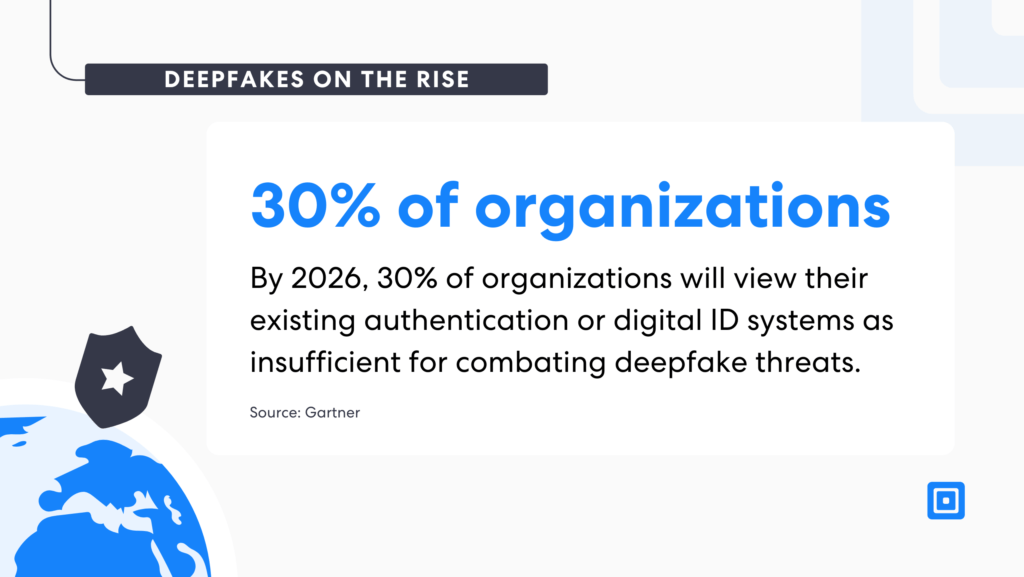
Today, humans are already often unable to differentiate a deepfake from a live person. This is why organisations must begin to heavily invest in state-of-the-art liveness detection software. [Liveness detection technologies](https://www.complycube.com/en/solutions/due-diligence-compliance/know-your-customer/liveness-detection/ "https://www.complycube.com/en/solutions/due-diligence-compliance/know-your-customer/liveness-detection/") can identify deepfakes. They do this by analysing skin texture, subtle micro expressions, and more that are undetectable to the human eye or to simple identity verification processes.
## Social Media Platforms As The New Playground For Cyber Crime
Beyond streamlining identity verification practices, the eID scheme also lays a strong foundation. It’s already common knowledge that social media platforms are where many modern crimes begin. For example, Facebook admitting to having removed 700 million fake social media accounts in the fourth quarter of 2023. This was after having removed 827 million in the previous quarter. Undoubtedly, in 2025, this trend will continue as the amount of social media users continues to increase.
As a result, generative AI tools will also enable fraudsters to carry out impersonation attacks to a higher standard. This puts social media users at a higher risk of becoming victims of practices such as catfishing and pig-butchering scams. Advanced language models like Chat GPT can generate text that mimics someone’s writing style, enabling fraudsters to impersonate an individual over messages or posts. Similarly, AI can be utilised to automatically create a large number of fake accounts on social media platforms, using profiles with realistic-sounding names, pictures and backgrounds.
> Almost [80% of scams](https://www.decisionmarketing.co.uk/news/labour-to-force-tech-giants-to-cough-up-for-online-scams#:~:text=A%20Lloyds%20Banking%20Group%20spokesperson,ready%20to%20play%20our%20part.) start online.
A Lloyds spokesperson recently spoke to The Sunday Times, stating that “Almost 80% of scams start online, and we have long called for social media and tech companies to do more to [protect their users](https://www.decisionmarketing.co.uk/news/labour-to-force-tech-giants-to-cough-up-for-online-scams#:~:text=A%20Lloyds%20Banking%20Group%20spokesperson,ready%20to%20play%20our%20part.) and help refund innocent victims.”
So far, we have not seen social media platforms fully implement the necessary safety controls. It couldn’t be any easier to set up an Instagram or Facebook account under a false identity. However, if these platforms implemented tighter registration processes with proof of identity as a requirement, then fraud cases would decline.
### **Case Study: Deepfake Videos Impersonate the Bank of England Governor**
In June 2026, fraudulent videos circulated online depicting Bank of England’s Andrew Bailey in fabricated scenes involving political figures. Bailey confirmed that the videos were fake and warned that they were being used to defraud members of the public.
##### Public Verification and Layered Identity Controls for Digital Crime Attacks
The Bank of England publicly confirmed that the content was fraudulent and encourage people with relevant information to report it. They also acknowledged that identifying those responsible was difficult. For businesses, the incident shows why video, images, and voices should not be treated as standalone proof of identity.
##### **Outcomes**
- The videos were publicly identified as fake.
- The incident promuted an official warning about presentation attacks and deepfake-enabled fraud.
- The case exposed the difficulty of identifying perpetrators.
## Generative AI-Supporting Phishing Attacks
AI-enhanced phishing threats take many forms. Examples include emails generated with flawless grammar and inclusion of personal details to highly adaptive malware that can learn and evade detection systems. This next generation of phishing attacks will leverage AI’s ability to learn from real-time data. They can adapt in response to evolving security measures, thus making detection even more challenging.
As well as the quality of phishing attacks increasing, the quantity of these attacks is also bound to increase with the help of generative AI. Generative AI will allow for thousands of targeted phishing attacks to be carried out simultaneously without compromising the targeted customization for maximum effect. Large-scale operations will be carried out by fraudsters, with much higher chances of success. Furthermore, as committing fraud becomes easier with the help of AI and less technical expertise is needed, more fraudsters will begin to emerge.
> [Research we published earlier this year showed](https://ieeexplore.ieee.org/document/10466545) that 60% of participants fell victim to artificial intelligence (AI)-automated phishing, which is comparable to the success rates of non-AI-phishing messages created by human experts. ~ Harvard Business Review
Harvard Business Review published research in early 2024 that highlighted the far higher success rate of AI-enhanced phishing emails, with 60% of participants falling victim to these scams. They state, “Perhaps even more worryingly, our new research demonstrates that the entire phishing process can be automated using LLMs, which reduces the costs of phishing attacks by [more than 95%](https://hbr.org/2024/05/ai-will-increase-the-quantity-and-quality-of-phishing-scams) while achieving equal or greater success rates.” This suggests that phishing attacks will improve not just in quality but in quantity, with a vast quantity of attacks carried out worldwide across all industries.
## Digital Crime Attacks on Supply Chains:
As we move into 2025, supply chain attacks are expected to become more sophisticated. Cybercriminals are targeting smaller, less secure vendors to gain access to larger organizations. These attacks may involve AI-driven fraud, ransomware, data exfiltration, and even disrupting critical infrastructure. The National Cyber Security Centre in the UK states, “In recent years, there’s been a significant increase in the number of cyber attacks[resulting from vulnerabilities within the supply chain](https://www.ncsc.gov.uk/collection/supply-chain-security/supply-chain-attack-examples). These attacks can result in devastating, expensive, and long-term ramifications for affected organizations, their supply chains, and their customers.”
### **Key Trends in Supply Chain Attacks:**
- **AI-Powered Attacks**: Fraudsters will use AI tools to create fake communications, phishing, and deepfakes, making detection harder.
- **Targeting Smaller Vendors**: Cybercriminals will exploit weaker links in the supply chain to infiltrate larger organizations.
- **Ransomware & Data Theft**: Attackers may hold systems hostage or steal sensitive data to demand ransom.
- **Disruption of Critical Infrastructure**: Supply chain attacks may target sectors like energy or healthcare to cause widespread damage.
### Key Takeaways
- **Digital crime and presentation attacks** are becoming easier to scale.
- **Deepfakes** are only one part of the threat.
- **A facial match** does not prove that a genuine person is present.
- Static checks** can leave businesses exposed after onboarding.
- **Layered fraud prevention** is stronger than a single detection tool.
## Fortifying Operations Against Digital Crime with Robust KYC
KYC (Know Your Customer) processes can be pivotal in mitigating many of the emerging digital fraud threats businesses will face in 2025, such as deepfakes, social media fraud, AI-powered phishing, and supply chain attacks.
**Combating Deepfakes**: KYC can strengthen identity verification by ensuring that individuals undergoing onboarding are who they claim to be. By integrating [liveness detection](https://www.complycube.com/en/solutions/due-diligence-compliance/know-your-customer/liveness-detection/) with KYC, businesses can prevent deepfake-based fraud during account creation or financial transactions, making it harder for fraudsters to impersonate legitimate customers. For more information on the rise of deepfakes, read “[Deepfake Detection Software: Preventing Fraudulent Content.](https://www.complycube.com/en/deepfake-detection-software-preventing-fraudulent-content/)“
**Preventing AI-Driven Phishing**: KYC data helps ensure that communications (emails, messages, etc.) involving sensitive actions, such as wire transfers or account changes, are authenticated. By verifying the identity of the individual behind each request, businesses can better identify AI-generated phishing attempts, which rely on mimicking human communication patterns.
**Securing the Supply Chain**: KYC can be used to verify the legitimacy of third-party vendors and suppliers, ensuring they are not linked to fraudulent or criminal activities. By performing thorough due diligence on all suppliers, businesses can reduce the risk of supply chain attacks that exploit weaker links to infiltrate larger organizations.
In summary, for more information on how to strengthen your operations against presentation attacks with state-of-the-art KYC infrastructure, reach out to one of ComplyCube’s [compliance experts](https://www.complycube.com/en/contact/contact-sales/ "https://www.complycube.com/en/contact/contact-sales/") today.

## Frequently Asked Questions
what is digital crime?
Digital crime refers to illegal activity carried out through computers, mobile devices, online platforms, or digital communication systems. It includes identity fraud, phishing, account takeover, deepfake impersonation, synthetic identity fraud, ransomware, social media scams, and attacks against online verification processes.
How are deepfakes used to commit digital crime?
Fraudsters use deepfakes to imitate a person’s face or voice during video calls, biometric checks, account recovery, and social-engineering scams. A deepfake may be presented to a physical camera or injected directly into a verification system using virtual-camera software.
What is a presentation attack in identity verification?
A presentation attack occurs when a fraudster presents fake or manipulated biometric material to a capture device. Examples include printed photographs, masks, replayed videos, images displayed on another screen, and livestreams designed to appear like a genuine person completing a verification check.
Can liveness detection prevent deepfakes and presentation attacks?
Advanced liveness detection can help identify whether a real, physically present person is completing a biometric check. The strongest systems combine liveness analysis with presentation attack detection, deepfake detection, device intelligence, capture-channel analysis, and behavioural risk signals rather than relying on one control alone.
How does ComplyCube help businesses prevent digital crime?
ComplyCube helps businesses prevent digital crime through document verification, biometric liveness checks, presentation attack detection, deepfake detection, device intelligence and ongoing monitoring. By combining these controls in a risk-based verification process, ComplyCube enables organisations to identify manipulated identities, suspicious users and high-risk activity before fraudsters gain access to their services.
**Categories:** Guides
**Tags:** Identity Verification
---
### [KYC Checks For a Secure Onboarding Process](https://www.complycube.com/kyc-checks-for-secure-scalable-onboarding/)
**Published:** January 2, 2025
**Author:** Sofia Daley
**Excerpt:** The potential cost of losing just a small percentage of potential new customers due to timely, complex manual KYC processes is now as much as €10 million a year. Learn how automated KYC checks can fortify business operations.
**Content:**
**TL;DR:** Know Your Customer (KYC) checks are necessary for secure, scalable onboarding. KYC checks **help verify users**, reduce fraud and **meet compliance obligations** without slowing growth. Choosing the **best KYC solution** means finding a platform that supports real-time verification, risk-based decisioning, and ongoing monitoring.
Financial institutions must adhere to stringent regulatory requirements to combat money laundering, terrorism financing, and other financial crimes. This is as outlined by the Bank Secrecy Act, the Financial Industry Regulatory Authority (FINRA), and the Financial Crimes Enforcement Network (FinCEN).
The use of Know Your Customer (KYC) checks allows organizations to obtain regulatory compliance within their sector and jurisdiction. However, KYC checks also enable businesses to strengthen their customer onboarding processes. They can analyze customer risk and carry out appropriate due diligence measures and KYC procedures. A risk-based approach ensures that enhanced due diligence can then be carried out only when necessary. This further supports efficiency in customer onboarding.
This strategic approach to KYC helps prevent financial crimes and fosters stronger, more transparent relationships between institutions and their clients. By focusing resources where they are most needed, financial institutions can maintain compliance, mitigate risk, and improve operational efficiency. They do this all while contributing to the broader goal of safeguarding the global financial ecosystem from illicit activities.
## Scalable Onboarding with KYC Checks
Many businesses still lack automated KYC processes. Secure and effective onboarding of new customers can slow down growth and constrain operations. As businesses scale, they must implement KYC solutions that allow them to do so easily.
“Last year, the fallout of Silicon Valley Bank and Signature Bank underscored the importance of onboarding experiences. The aftermath saw a seismic shift in deposit patterns. Larger banks found themselves [grappling with an unexpected influx of business](https://www.forbes.com/councils/forbestechcouncil/2024/05/23/how-ai-can-impact-onboarding-at-financial-institutions/), overwhelming their operational capacities. One way for banks and FIs to address these challenges is through digital onboarding.”
Onboarding processes must be able to support a fast influx of new customers. They still must ensure every customer’s identity is verified. This is in accordance with KYC regulations to avoid money laundering and other types of financial crime.
### The Price of Foregoing KYC Checks
An article from the Business Reporter effectively quantified what losses can look like when onboarding processes are unable to handle large amounts of KYC checks. It highlights the risks businesses take when not adequately investing in KYC verification. “According to [research](https://www.business-reporter.co.uk/finance/why-kyc-automation-matters-and-how-it-helps-fintech-companies-prevent-fraud) conducted by Mitek and Consult Hyperion, KYC compliance costs banks €50 million a year. The potential cost of losing just a small percentage of potential new customers to complex manual KYC processes is now as much as €10 million a year. After five years, the cumulative lost opportunity could cost banks in excess of €150 million.”
> 
>
> KYC compliance costs banks [€50 million a year](https://www.business-reporter.co.uk/finance/why-kyc-automation-matters-and-how-it-helps-fintech-companies-prevent-fraud). The potential cost of losing just a small percentage of potential new customers to complex manual KYC processes is now as much as €10 million a year.
This is a key point that organizations must consider, as whilst investing in a robust KYC process might seem costly, the loss of potential business could be far more substantial. Furthermore, there is also the cost of financial penalties which might be received, which must also be considered.
## Proactive Risk Management
Fraud risk management is a key reason why a customer might choose a different financial institution. A recent study found that [69% of consumers ](https://www.securitymagazine.com/articles/100488-69-of-financial-services-consumers-prioritize-fraud-protection)now prioritize fraud protection when deciding between financial institutions. This highlights the importance of a secure customer identification program and ongoing monitoring for any risk factors.
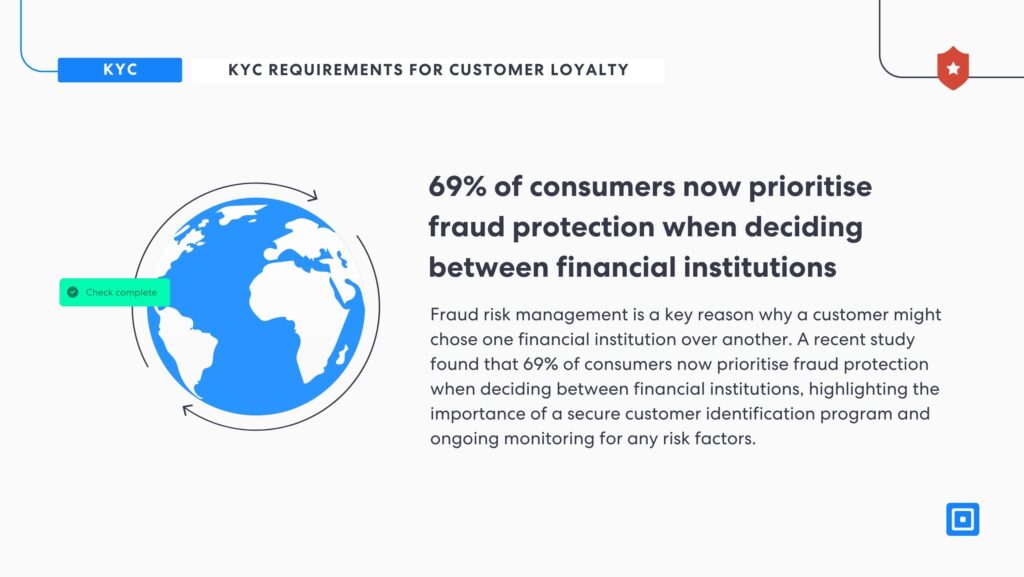
There are many kinds of scams that take place on financial platforms, including the creation of new accounts using a false or stolen identity, account takeovers, unauthorized credit or loan applications, and more. Some of the critical protections needed to instill loyalty and trust among customers might include:
- Safeguarding accounts with biometric authentication makes account takeovers much more difficult to carry out.
- A secure identity verification process that leverages liveness detection technology to quickly and effectively identify synthetic identities, stolen identities, or false identities. This allows businesses to quickly stop fraudsters from applying for credit or loans and stop them from opening an account in someone else’s name.
- The use of ongoing monitoring with fraud alerts and notifications. Giving customers real-time alerts when potentially fraudulent activities are detected on their accounts is crucial to building customer trust.
In addition, strict AML screening includes sanctions screening, PEP screening, and adverse media checks. Moreover, watchlist screening, and continuous monitoring also ensure full AML compliance, fostering increased digital trust.
## Advanced Fraud Detection
Fraud detection has come a long way with new AI-powered technologies. Powering KYC processes with market-leading AI tools helps build a trustworthy global reputation. Some of the latest technologies include:
### Liveness Detection
Liveness detection can identify stolen or false identities. It uses AI to pull biometric data from a submitted video during customer onboarding to verify whether or not the individual is a real person. Leveraging liveness detection ensures that businesses spot deepfake technologies during these onboarding processes, analyzing subtle micro-expressions and skin texture to ensure liveness. The customer’s identity is verified effectively, meeting KYC regulations when used with an advanced document verification check. For more on liveness detection, read [“Liveness Detection: Best Practices for Anti-Spoofing Security.”](https://www.complycube.com/en/liveness-detection-best-practices-for-anti-spoofing-security/)
### Optical Character Recognition
Optical Character Recognition (OCR) helps extract data from images of KYC documents quickly and effectively, verifying a client’s identity. OCR technology extracts key data points (e.g., name, date of birth, address) from identity documents, ensuring no manual errors or inconsistencies occur.
This extracted information can then be cross-checked against databases, such as sanctions lists, politically exposed persons (PEP) lists, and watchlists, to identify high-risk individuals. OCR can identify anomalies within images of government-issued KYC documents, which might indicate fraudulent tampering. Find more information on OCR [here](https://www.complycube.com/en/solutions/due-diligence-compliance/know-your-customer/optical-character-recognition/).
## KYC Requirements as a Competitive Advantage
In the past couple of years, sophisticated KYC compliance processes within financial institutions to prevent fraud have become a clear competitive advantage. Customers look for platforms that can protect them at all times, especially since so many financial institutions have recently been victims of large-scale scams.
> [45% of all adverse contributions](https://fintech.global/2024/03/11/id-fraud-dominates-uk-financial-sector-with-a-45-surge/) in the finance sector in 2023 were linked to stolen identities and identity fraud.
The banking sector has emerged as a key target for identity theft and synthetic identity fraud. According to Synectics Solutions, which manages the UK’s largest syndicated risk intelligence database, [45% of all adverse contributions](https://fintech.global/2024/03/11/id-fraud-dominates-uk-financial-sector-with-a-45-surge/) in the finance sector in 2023 were linked to stolen identities and identity fraud. Fraudsters leverage falsified or stolen identities to drain funds from accounts, make unauthorized purchases, or fraudulently secure loans.
### Differentiating Through Compliance
Between 2023 and 2024, fraud reports surged across major financial institutions, with HSBC receiving 5,467 reports, Revolut 9,793, Lloyds 7,395, and Barclays 7,874. These figures highlight the pervasive and sophisticated nature of modern fraudulent practices, underscoring the urgent need for financial institutions to reassess their priorities in order to win over customer trust and loyalty. For more information on identity fraud within UK financial institutions, read [“Revolut Falls Victim to Identity Fraud.”](https://www.complycube.com/en/revolut-falls-victim-to-identity-fraud/)
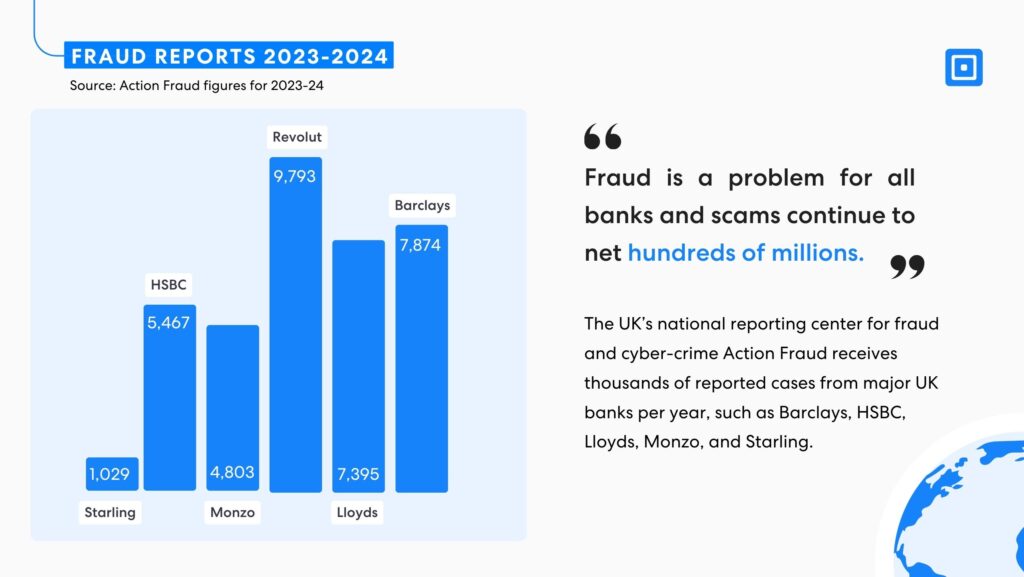
Stringent KYC processes will also enable businesses to operate in highly regulated markets, supporting global market expansion. This positions organisations as reliable international players, providing reassurance for investors and instilling confidence in customers and stakeholders.
Therefore, businesses that can differentiate themselves through reliable fraud defenses will continue to hold a competitive advantage as customers continue to prioritize security. An organisation that remains compliant with worldwide KYC and AML regulations, maintaining a strong reputation of security, is far more likely to win over a customer.
### **Case Study: ABN AMRO Deepfake Onboarding Fraud**
In March 2026, DutchNews reported that prosecutors told an Amsterdam court a man had opened 46 ABN AMRO bank accounts in other people’s names using deepfake technology and stolen bank identity details. The reported accounts were allegedly created through remote onboarding flows that relied on identity document uploads and facial recognition.
##### **Strong Onboarding Models Have Layered KYC**
A strong onboarding model has layered KYC checks instead of a single selfie-to-ID match. With document authenticity, biometric verification, device signals, and trusted data-source checks, teams could verify if an applicant genuinely matched the identity being used. Any mismatch would have triggered Enhanced Due Diligence (EDD) or escalation.
##### **Outcomes**
- 46 fraudulent ABN AMRO bank accounts were reportedly identified.
- This exposed how deepfakes can undermine weak or static remote onboarding.
- It reinforced the need for continuous, risk-based KYC that adapts to AI-enabled fraud.
## What Does a Comprehensive KYC Process Look Like?
As a result, for a KYC process to be a robust defense against fraud and ensure compliance, several key steps must be implemented. Some of these include:
[Advanced Document Check](https://www.complycube.com/en/solutions/identity-assurance/document-verification/): A document check will verify a government-issued identity document, checking for signs of tampering and extracting key information with OCR technology.
[Biometric Verification with Liveness Detection](https://www.complycube.com/en/solutions/identity-assurance/biometric-verification/): Biometric verification will quickly identify presentation attacks, such as those using deepfake technology. Biometric data samples are pulled from submitted images and videos to be examined, and details such as skin texture and subtle involuntary movements are analyzed.
[Multi-Bureau Checks](https://www.complycube.com/en/solutions/identity-assurance/multi-bureau-checks/): With a Multi-Bureau Check, businesses can verify customer details, such as name, address, date of birth, and social security numbers, against trusted, authoritative sources such as government and credit bureaus.
### Key Takeaways
- **KYC supports both compliance and growth** by helping firms meet regulatory duties while keeping onboarding efficient and scalable.
- **Manual onboarding can become a commercial bottleneck**, especially when customer volumes spike or when verification processes are too slow.
- **Risk-based KYC improves efficiency** because enhanced due diligence can be reserved for higher-risk customers rather than applied uniformly.
- **Fraud prevention is now a customer-trust issue**, not just a back-office compliance concern.
- **Layered verification is essential**, combining identity checks, liveness detection, authoritative data checks, AML screening, risk scoring, and ongoing monitoring.
## Compliance with ComplyCube
In summary, ComplyCube offers state-of-the-art KYC solutions to help businesses safeguard their customers and their platforms from fraud. Achieving compliance across complex regulatory structures enables businesses to scale quickly and seamlessly, which ComplyCube’s platform supports.

For more information on fortifying your business with a robust KYC process, get in touch with one of our [compliance experts](https://www.complycube.com/en/contact/contact-sales/).
## Frequently Asked Questions
What are KYC checks in customer onboarding?
KYC checks are identity verification and due diligence measures used to confirm who a customer is, assess their risk level, and help businesses prevent money laundering, fraud, terrorist financing, and other financial crimes.
Why are KYC checks important for scalable onboarding
KYC checks help businesses onboard more customers without sacrificing compliance or security. Automated KYC reduces manual review, speeds up verification, and allows companies to grow while maintaining regulatory controls.
How does risk-based KYC improve onboarding efficiency?
A risk-based KYC approach scores customers according to risk signals, so low-risk users can move through onboarding faster while higher-risk users receive enhanced due diligence.
What types of fraud can KYC checks help prevent?
KYC checks can help prevent new account fraud, stolen identity use, synthetic identity fraud, unauthorized credit or loan applications, account misuse, and money laundering.
How does ComplyCube support secure and scalable KYC checks?
ComplyCube helps businesses run automated KYC checks by combining identity verification, biometric checks, AML screening, risk scoring, and ongoing monitoring. This makes onboarding faster, safer, and easier to scale.
**Categories:** Guides
**Tags:** Know Your Customer
---
### [How AI Powers Biometric Identity Verification](https://www.complycube.com/how-ai-powers-biometric-identity-verification/)
**Published:** January 2, 2025
**Author:** Sofia Daley
**Excerpt:** Stronger defenses must be implemented to ensure the safety of customers and businesses alike from the risk of fraud. Advanced biometric identity verification systems leverage AI-powered liveness detection to ensure security.
**Content:**
As new forms of fraud continue to unravel security processes at major financial institutions, stronger defenses must be implemented to ensure the safety of customers and businesses alike. Traditional methods like passwords, PINs, and security questions are no longer sufficient to protect sensitive data and prevent identity theft in an increasingly digital world. To stay ahead of fraudsters, businesses must adopt more advanced, robust, and user-friendly security technologies—this is where biometric identity verification comes in.
Advanced biometric identity verification systems leverage AI-powered liveness detection. Through AI models that analyze subtle eye movements, blinking, head shifts, micro-expressions, depth perception, and changes in lighting, these systems can differentiate between a real, living person and a fake or spoofed input. Liveness detection ensures that identities are verified with the highest accuracy. AI-powered 3D face maps are also used for secure identity authentication. These systems use AI and machine learning to analyze the unique contours and features of a person’s face in three dimensions. By capturing detailed depth information, 3D face recognition technology creates a 3D map of the face, which is then used to compare and verify identities.
## Understanding AI-Powered Facial Liveness Detection
Facial [liveness detection](https://www.complycube.com/en/solutions/due-diligence-compliance/know-your-customer/liveness-detection/) refers to the process of ensuring that a person presenting their face for biometric authentication (e.g., in face recognition systems) is a real, living person rather than a static image, video, or other spoof. Spoofing attempts, like using a photo, 3D mask, or video playback, have become more common as face recognition technology has grown. To counter this, liveness detection techniques rely heavily on AI-driven models that can detect subtle cues indicating life and genuine human interaction.

## Biological Indicators of Liveness
Human faces exhibit a variety of natural, involuntary biological behaviors that are extremely difficult to replicate in photos or videos. AI models use these cues to detect liveness, identifying deepfakes or spoofed images quickly. Some biological indicators of liveness include:
**Blinking**: Humans blink automatically and regularly. An AI model trained on facial features can identify the rhythmic movement of eyelids. For example, if a person faces the camera for a long time without blinking, this is an indicator that the face might be a photo or a video because it does not blink or respond as a live person would.
**Pupil Movement**: In the context of liveness detection, some systems also track pupil movement or eye movement patterns. People look around, shift focus, and exhibit small eye movements. AI can detect any anomalies in these behaviors, as static images or videos do not have the same depth or range of eye motion.
**Micro-expressions**: These are rapid, involuntary facial expressions that often occur in response to emotional stimuli. These small movements are difficult to mimic convincingly with photos or videos. AI models can detect subtle shifts in the face, such as muscle contractions or slight changes in facial features (like a corner of the mouth twitching, a brow furrowing, etc.), which indicate a live, reactive human being.
**Head Movements and Orientation:** Live humans also perform subtle head movements invisible to the naked eye. These movements are especially carried out when interacting with a face recognition system. They might consist of tilting or turning their heads. AI systems track movements of key facial landmarks such as someone’s eyes or nose, helping to track subtle motion detection and speed of head movement.
**Lighting and Depth Perception:** AI models can also use light reflection and shadows to detect liveness. Human faces reflect light differently than a flat photo or video would.
## The Growing Threat of Identity Fraud
AI-powered liveness detection has become a needed advancement due to growing cases of identity fraud. In 2023, nearly [two million people](https://www.infosecurity-magazine.com/news/brits-victims-financial-id-fraud/) in Britain had their identities stolen, which were then used to open fraudulent financial accounts.

Fraud is evolving rapidly, and financial institutions are a prime target. According to the latest statistics, identity theft remains one of the most common and costly forms of fraud, with criminals leveraging stolen personal data to access financial accounts, make unauthorized transactions, and establish fake identities.
## Biometric Verification Technology
Digital [biometric verification](https://www.complycube.com/en/solutions/identity-assurance/biometric-verification/) enables the secure verification of anyone from anywhere. Facial biometric checks utilize advanced machine learning and facial recognition algorithms to quickly detect presentation attacks. In these attacks, bad actors attempt to impersonate others to gain access to financial accounts.
### How is Identity Fraud Affecting Businesses?
For businesses, this growing threat presents a risk not just to their customers’ safety but also to their own financial stability and reputation. As digital transactions and online services become the norm, ensuring that only legitimate users can access financial accounts and sensitive data is essential. Traditional methods of verification, such as SMS codes or static passwords, have proven vulnerable to breaches and exploitation. This is where biometric identity verification offers a revolutionary solution.
> Criminals managed to [bypass facial-recognition](https://www.bbc.co.uk/news/articles/cj6epzxdd77o) software to gain access to his account on their device. If an account is set up on a new device, Revolut asks for a selfie, which Jack says he did not provide.
A recent example highlighting the significant risks of inadequate biometric verification is a BBC article about a scam involving Revolut. The report details a case where fraudsters stole £165,000 from a Revolut business account.

The victim revealed that the criminals managed to bypass the identity verification process, gaining unauthorized access to his account and stealing the funds. This incident underscores the critical importance of robust biometric security measures to prevent such fraudulent activities.
The article reads, “Criminals managed to [bypass facial-recognition](https://www.bbc.co.uk/news/articles/cj6epzxdd77o) software to gain access to his account on their device. If an account is set up on a new device, Revolut asks for a selfie, which Jack says he did not provide.” For more on this case, read [“Revolut Falls Victim to Identity Fraud.”](https://www.complycube.com/en/revolut-falls-victim-to-identity-fraud/)
## The Benefits of Biometric Identity Verification in Fraud Prevention
Implementing facial biometric verification for robust security has several key benefits. These include compliance with regulatory standards, increased security, a drastic reduction in fraud risk, and a seamless user experience.
### Enhanced Security
Biometric identity verification with liveness detection significantly strengthens security by analyzing facial biometric data. With traditional authentication methods like passwords, attackers can use brute force methods or phishing techniques to gain access. In contrast, biometrics are linked directly to an individual’s physical characteristics, making it exponentially harder for fraudsters to gain unauthorized access.
### Reduced Fraud and Identity Theft
Financial institutions can drastically reduce the risk of identity theft by incorporating biometric checks into the verification process. Biometric solutions can detect fake identities by checking for signs of tampering or a mismatch between physical traits and stored data. This helps prevent fraudsters from impersonating legitimate users, making it harder for them to gain access to sensitive information or make fraudulent transactions.
### **Seamless User Experience**
Biometric authentication offers a seamless, frictionless experience for customers. Instead of having to remember complex passwords or PIN codes, users can simply use their face, fingerprint, or voice for secure access. This reduces the likelihood of customers abandoning transactions or struggling with password resets—issues that are common with traditional authentication methods. As the demand for a frictionless user experience grows, biometric authentication provides a practical solution that ensures security without compromising convenience.
Selfie verification empowers global compliance. These solutions verify users in seconds and are typically entirely cloud-based. Running on a software-as-a-service (SaaS) business model, Identity Verification solutions can be distributed worldwide, meaning the same solution can be used by the same company worldwide.
Lastly, facial recognition offers greatly reduced business costs, particularly the Cost of Client Acquisition (CCA) and [Customer Due Diligence (CDD)](https://www.complycube.com/en/solutions/due-diligence-compliance/customer-due-diligence/). CDD, a wider part of an Anti-Money Laundering (AML) process, can take business hours per customer when manual methods are used. Automated KYC solutions, however, reduce the time and cost of these business operations.
## ComplyCube: A Leader in Biometric Verification
ComplyCube’s advanced liveness detection technology ensures that the individual presenting an identity is physically present, effectively reducing the risk of AI-generated or spoofed identities. Their solution cross-checks identity details by combining facial recognition with document verification to prevent fabrication. Through seamless integration of biometric, document, and behavioral analysis, ComplyCube’s platform detects synthetic identities early, helping prevent fraudsters from gaining unauthorized access.
### Key features of ComplyCube’s solution include:
Advanced [Facial Recognition](https://www.complycube.com/en/solutions/identity-assurance/biometric-verification/): ComplyCube’s cutting-edge biometric [liveness detection](https://www.complycube.com/en/solutions/due-diligence-compliance/know-your-customer/liveness-detection/), certified to [ISO 30107-3 and PAD Level 2 standards](https://complycube.com/en/company/security-compliance-center/), ensures that the person presenting an identity document matches the details provided. The Identity Verification (IDV) system leverages both biometric and behavioral analysis, offering robust protection against fraudulent or synthetic identities.
Comprehensive [Document Verification](https://www.complycube.com/en/solutions/identity-assurance/document-verification/): Combining AI-powered technology with expert reviews, ComplyCube meticulously verifies identity documents to ensure they are genuine and unaltered. This process checks for expired, forged, blacklisted, or tampered documents and covers a wide range of document types, including passports, driver’s licenses, national IDs, residence permits, visa stamps, and travel documents—providing extensive protection against identity fraud.

For more information on how to protect your business from fraud, reach out to one of ComplyCube’s [compliance experts](https://www.complycube.com/en/contact/contact-sales/).
**Categories:** Guides
**Tags:** Identity Verification
---
### [The Evolution Of The Risk Based Approach in AML](https://www.complycube.com/the-evolution-of-the-risk-based-approach-in-aml/)
**Published:** January 3, 2025
**Author:** Sofia Daley
**Excerpt:** Assessing customer risk is key to preventing crime within the finance sector. Learn how financial services organizations use a risk based approach with Customer Due Diligence (CDD) to mitigate fraud-related risk specifically.
**Content:**
**TL;DR:** A **risk based approach** helps firms apply **customer due diligence** in proportion to actual exposure, instead of treating every customer the same. As AML frameworks have matured, regulators have pushed businesses to assess **customer risk** using factors such as geography, product type, transaction behaviour, and ownership complexity.
Assessing customer risk is key to preventing crime within the finance sector. Many financial services organizations use a risk based approach with Customer Due Diligence (CDD) to mitigate fraud-related risk specifically. A risk based approach is beneficial for most businesses, especially when watchdog organizations, such as the Financial Action Task Force (FATF) and the Financial Conduct Authority (FCA), openly support this approach.
Financial institutions must consider how to meet regulatory compliance requirements to improve the accuracy and safety of financial transactions. The Know Your Customer (KYC) and Anti Money Laundering (AML) frameworks clearly assign businesses, organizations, and financial service providers the responsibility of verifying the authenticity and accuracy of customer identities.
In doing so, they must also assess each customer’s risk profile and carry out necessary measures. This guide will dive into the history and evolution of the risk based approach within AML processes, as well as how you can safeguard your organisation.
## The Evolution of the Risk Based Approach
The earliest AML frameworks were developed in the 1970s. These implemented a “one size fits all” approach. It required organizations to adhere to rules to mitigate money laundering activities. However, creating a single set of compliance requirements to be upheld proved insufficient and ineffective.
Not all businesses are equally susceptible to money laundering or terrorism financing. Some are more likely to be a risk than others, requiring a higher level of due diligence. Furthermore, not all customers or sectors possess the same risk. Politically Exposed Persons (PEPs), for example, required far more attention and focus than others. Some transactions were also higher risk than others, and pinpointing those was critical.
The UK’s [Financial Services Authority](https://www.fca.org.uk/about/what-we-do/the-fca) (now the FCA) established the proportionality concept, which encouraged institutions to focus their attention (and money) on mitigating the most expensive risks. In 2007, the [FATF created a set of standards](https://home.treasury.gov/system/files/246/RBA-guidance-casinos-102008.pdf) to follow, including 40 recommendations in its Risk Based Approach (RBA). Specifically, it required financial institutions to have specific but more flexible measurements to utilize their resources more effectively at true targets to their operations. Instead of blanket statements, they enabled organizations to focus on those areas of risk most likely to impact their course of business.
In 2012, the [FATF updated this approach again](https://digitalcommons.law.uw.edu/cgi/viewcontent.cgi?article=1164&context=wjlta), incorporating it as the foundation of AML compliance mandates. Jurisdictions around the world adopted the risk-based approach, leading to many organizations across financial services integrating this approach into their KYC processes. At this time, the FATF
“The risk-based approach is central to the effective implementation of the FATF Recommendations. A risk-based approach means that countries, competent authorities, and banks identify, assess, and understand the money laundering and terrorist financing risk to which they are exposed, and take the appropriate mitigation measures in accordance with the level of risk,” states [FATF](https://www.fatf-gafi.org/en/publications/Fatfrecommendations/Risk-based-approach-banking-sector.html).
## What Does a Risk Based Approach Look Like?
Customer risk management is complex but essential. A robust and effective KYC approach is essential to reducing costs while meeting regulatory requirements. However, such methods can be time-consuming and can drain customer experience expectations.
### Risk Profiling
Risk profiling is one form of verification of a customer’s identity. It considers customer risk scoring based on customer behavior. Risk profiling focuses on a full assessment of each customer, transaction, and business relationship based on factors identified as potential risks. It categorizes those customers based on their assigned level of risk based on their behavior, nature of the activity, and other risk profile factors.

Some of the most common components of a risk-based analysis include:
- **Geographical factors**: High-risk countries or jurisdictions with well-recognized AML/CFT concerns, such as terrorism-heavy locations.
- **Customer type**: PEPs, non-resident customers, complex business structures, or cash-intensive operations can also factor into risk assessment.
- **Transaction patterns**: Unusual, complex, or high-frequency transactions could signal risks, such as a sudden shift in account usage..
- **Source of funds**: Known high-risk sources or unexplained income streams, often those that are on the perceived watchlist.
- **Industry or occupation**: Certain sectors (e.g., cryptocurrency, gaming, or import/export) carry higher risks and must be considered.
- **Lighting and Depth Perception:** AI models use light reflection and shadows to detect liveness. Human faces reflect light differently than a flat photo or video.
The [Council of Europe](https://www.coe.int/en/web/moneyval/implementation/risk-based-approach#:~:text=A%20risk%2Dbased%20approach%20therefore,ensure%20an%20effective%20mitigation%20thereof.) states in their Committee of Experts on the Evaluation of Anti-Money Laundering Measures and the Financing of Terrorism implementation stated that a risk based approach means nations, governments, and the private sector should be well aware of money laundering and terrorist financing threats.
Additionally, the Council states that the FATF Recommendations promote a [risk-based approach](https://www.coe.int/en/web/moneyval/implementation/risk-based-approach#:~:text=A%20risk%2Dbased%20approach%20therefore,ensure%20an%20effective%20mitigation%20thereof.) at three levels:
1. **National Level**: Countries should assess and share ML/TF risks with authorities and the private sector.
2. **State Authorities**: Supervisors should focus on specific risks and allocate resources efficiently.
3. **Private Sector**: Businesses should tailor AML/CFT measures to their own risks and client profiles.
## Customer Due Diligence
[Customer Due Diligence](https://www.complycube.com/en/solutions/due-diligence-compliance/customer-due-diligence/) (CDD) focuses specifically on applying a higher level or enhanced security based on the risk level of the customer, utilizing, for example, the data within their risk profile. There are two types of CDD that could be applicable:
Standard CDD: The most common standard for customer due diligence is basic customer due diligence, which involves limited identification and verification. This standard applies to nearly all accounts and customers within the financial industry and is the baseline measurement. It is applied for low-risk customers.
Enhanced Due Diligence (EDD): Applied for high-risk customers or situations, enhanced due diligence goes further. It involves more in-depth background checks, interviews, or third-party verification to mitigate risks because there is some level of concern present.
CDD can be flexible in terms of application and function. The scope of CDD typically includes the following:
- Verification of an identity through government-issued ID checks.
- Understanding the occupation or the business purpose of the relationship being established.
- Assessing the ownership structures or financial interests of the customer or company.
- Determining the intended use of services or accounts if approved.
Each of these factors helps build a risk profile and provides more customer risk management strategies. CDD is a common and flexible method for scrutinizing risky customers more thoroughly. Understanding a customer’s risk profile allows a financial institution to better understand their risks to business applications. For more on Customer Due Diligence, read [“What is Customer Due Diligence (CDD)?” ](https://www.complycube.com/en/what-is-customer-due-diligence/)
## Ongoing Monitoring
It is a mistake to believe that risk assessment ends once an account is opened and transactions begin. Continuously monitoring customer activity is essential to identifying what is “normal” for that customer and what is not. This enables improved reaction to suspicious activity or non-compliant transactions. This enhanced due diligence and customer risk assessment protects financial institutions and other businesses in the long term.
Monitoring is a process that requires organizations to adapt to changes in customer behavior. For example, if a customer has numerous large transactions coming in and going out that are new to them, it may be wise to investigate those transactions. A sudden change in the customer’s financial situation can also be notable.
One of the best resources for ongoing monitoring is the inclusion of automated transaction monitoring tools. While many organizations continue to use manual processes, these methods are largely prone to errors. Automated transaction monitoring tools also speed up the process, enabling more real-time responses.
> One area of opportunity that could substantially increase efficiency gains is in the automated trigger-based [Ongoing Due Diligence (ODD)](https://www.deloitte.com/nl/en/services/financial-advisory/perspectives/automated-odd-as-the-only-solution-in-a-risk-based-aml-approach.html) of clients.
“One area of opportunity that could substantially increase efficiency gains is in the automated trigger-based Ongoing Due Diligence (ODD) of clients. In practice, most FIs are conducting manual client reviews on a periodic basis. These manual reviews are time-consuming, provide (relatively) limited added value to mitigating money laundering risks, and negatively impact client satisfaction and data privacy,” shares [Deloitte](https://www.deloitte.com/nl/en/services/financial-advisory/perspectives/automated-odd-as-the-only-solution-in-a-risk-based-aml-approach.html). Learn more about the benefits of ongoing monitoring in our blog, [“What is an Ongoing Monitoring Process?”](https://www.complycube.com/en/what-is-an-ongoing-monitoring-process/)
### **Case Study: FinCEN’s 2026 Shift Toward Risk-Based Customer Due Diligence**
Before 2026, firms had to re-identify and re-verify beneficial owners each time an existing legal entity customer opened a new account. For many low-risk customers, this created extra work without adding meaningful value. It also weakened the risk based approach by forcing the same level of customer due diligence regardless of actual customer risk.
##### **Shifts Toward Trigger-Based Review**
FinCEN allowed firms to stop repeating beneficial ownership checks for every new account. Instead, businesses can rely on existing records unless new risk indicators appear or current data becomes unreliable. This is a more proportionate risk based approach, where customer due diligence responds to real customer risk.
##### **Outcomes**
- Less duplication in customer due diligence for existing lower-risk customers
- Better alignment between AML controls and actual customer risk
- Stronger support for a flexible, event-driven risk based approach
## The Benefits of a Risk Based Approach
A risk-based approach is sensible and effective for most financial institutions, especially when it relates to AML processes and customer risk. Some of its key benefits include:
- Improved customer due diligence experience, alleviating frustrating steps from non-risk-based clients.
- Efficient allocation of resources, allowing financial and human resources to be applied to truly high-risk concerns.
- Enhanced financial crime detection because there are better resources and more accurate and timely actionable steps taken.
- Alignment with regulatory requirements, reducing the risk of costly fines.
- Scalability and flexibility allow institutions to adjust their focus as new risks emerge or circumstances change, enabling them to “stay ahead” of threats.
- Improved reputation with fewer compliance-related or highly visible fraudulent attempts.
> Higher-risk customers may require additional verification procedures.
“The Know Your Customer risk-based approach enables a better customer onboarding compliance program by adjusting verification levels based on risk factors. Low-risk customers are accepted more quickly, whereas higher-risk customers may require additional verification procedures,” shares [Financial Crime Academy](https://financialcrimeacademy.org/the-risk-based-approach-to-kyc/).
### Key Takeaways
- The risk based approach helps apply AML controls in line with actual exposure.
- Strong customer due diligence starts with accurate assessment of customer risk.
- Regulators favour proportionate, intelligence-led compliance over repetitive checks.
- Ongoing monitoring is central to keeping the risk based approach effective.
- Modern AML programmes use technology to scale customer due diligence.
## Implementing ComplyCube’s Solutions
ComplyCube’s platform can power organizations with a strong risk-based AML process. If your organization is not assigning resources based on risk-based strategies, now is the time to learn how to do so efficiently. ComplyCube is ideally positioned to provide companies with the tools to facilitate robust, accurate, time-efficient, and cost-effective risk-based solutions for mitigating customer risk. For more information on ComplyCube’s services, reach out to their [expert compliance team](https://www.complycube.com/en/contact/contact-sales/).
## Frequently Asked Questions
What is a risk based approach in AML?
A risk based approach means applying AML controls in proportion to identified exposure. Firms assess customer risk using factors such as geography, behaviour, and ownership structure, then tailor customer due diligence accordingly. This improves both efficiency and regulatory alignment.
How do firms assess customer risk effectively?
Firms assess customer risk by analysing identity data, transaction patterns, jurisdiction, and business activity. Risk scoring models combine these signals to determine whether standard or enhanced customer due diligence is required, ensuring controls match real exposure.
Why is customer due diligence evolving?
Customer due diligence is evolving to become more dynamic and proportionate. Regulators now expect firms to rely on ongoing monitoring and trigger-based reviews, rather than repetitive checks, to better reflect changes in customer risk over time.
What changed in the risk based approach in 2025–2026?
Recent updates from FATF and FinCEN emphasise proportionality and flexibility. Firms are encouraged to reduce unnecessary checks and focus on real-time indicators of customer risk, strengthening the effectiveness of the risk based approach.
How does ComplyCube support a risk based approach?
ComplyCube enables a risk based approach through configurable workflows, real-time risk scoring, and continuous monitoring. Its unified platform supports adaptive customer due diligence, helping firms respond to evolving customer risk with precision and scale.
**Categories:** Guides
**Tags:** Anti-Money Laundering
---
### [The CryptoCubed Newsletter: 21 October, 2024](https://www.complycube.com/the-cryptocubed-newsletter-for-crypto-compliance/)
**Published:** October 21, 2024
**Author:** Sofia Daley
**Excerpt:** October’s crypto newsletter brings critical global updates from the crypto compliance world. Read through to learn more about global blockchain developments and the world of crypto compliance.
**Content:**
## The World Economic Forum (WEF) supports a Sandbox-first approach to DeFi adoption.
The WEF has formally recommended adopting regulatory sandboxes to help foster decentralized finance (DeFi) adoption in the greater financial system. Regulatory sandboxes are a legislative apparatus granting firms the ability to operate around flexible regulations. Continue reading our October edition of CryptoCubed and learn more below.
The **WEF** believes [this approach](https://cointelegraph.com/news/wef-recommends-sandbox-approach-defi-regulation) is a good way to introduce DeFi into the world’s financial systems because it allows companies to **innovate** without being held back by the strict rules that usually apply to traditional banks. Regulators can see how these new DeFi systems work, fix issues, and make better rules to protect people as they go.
Sandboxes have become a winning solution for implementing financial regulation, particularly regarding blockchain utilities. Notable instances include tokenization of Real-World Assets (RWAs) such as securities and stablecoins programs; see below for more information.
- [The Digital Securities Sandbox (DSS)](https://www.complycube.com/en/the-uk-digital-securities-sandbox/)
- [Singapore Crypto Regulations](https://www.complycube.com/en/how-successful-is-singapore-crypto-regulation/)
- [Security Token Offering Compliance](https://www.complycube.com/en/security-token-offering-sto-compliance/)
The WEF noted that 9% of all jurisdictions in its study had tied existing financial regulation to digital assets, with only the UK, Hong Kong, and Singapore having created a curated regulatory framework.
## WEF Highlights AML and KYC as Global Industry Concerns
The WEF cited the growing necessity of [technology-enhanced compliance solutions](https://www.weforum.org/agenda/2024/10/different-countries-navigating-uncertainty-digital-asset-regulation-election-year/) to curb the use of digital assets in illicit financial activity. Without advanced automated compliance solutions, the organization envisions it will be difficult to cultivate a secure digital asset ecosystem.
## Horns Remain Locked: Coinbase vs SEC
In what feels like a lifelong struggle, Coinbase has urged the court to [reconsider its recent interlocutory appeal](https://cointelegraph.com/news/coinbase-urges-court-consider-interlocutory-appeal-cites-appeal-ripple-case) in regard to the Securities and Exchange Commission (SEC’s) lawsuit against Coinbase. The American-based crypto exchange was accused of selling unregistered securities, mimicking a previous notorious case where Ripple (issuer of XRP tokens and creators of the XRP ledger) was sued on the very same criteria.
Coinbase argues that the Howey Test (which is used to ascertain whether a transaction qualifies as an investment contract and, therefore, a security) is not definitive enough. If this were the case, there would be more serious ramifications for the entire industry, as new industry standards and definitions would be required in America.
## Hong Kong Grants its 3rd Crypto Exchange
Hong Kong Virtual Asset Exchange (HKVAX) has just become [the third cryptocurrency exchange to receive a full operational license in Hong Kong](https://www.scmp.com/tech/blockchain/article/3281159/hong-kong-grants-fresh-licence-hkvax-operate-citys-third-cryptocurrency-exchange). HKVAX has expertise in Security Token Offerings (STOs) and Real-World Assets (RWAs), marking this license as evidence of Hong Kong’s commitment to spearheading the digital asset industry. The firm wishes to supply Over-the-Counter (OTC) trading, exchange services, as well as custody services.
> HKVAX aims to establish Hong Kong as [the STO and RWA centre for Asia and beyond.](https://finance.yahoo.com/news/hong-kong-grants-fresh-licence-093000641.html)
These developments make HKVAX the third out of nearly 30 companies that have applied for a Hong Kong crypto exchange license. The license and application process was formed in 2022 as part of the city’s digital asset reformation to aid the industry’s growth in the region.

HKVAX’s license marks a critical step in Hong Kong’s ambition to solidify itself as a hub for digital assets. The Securities and Futures Commission (SFC) has already reviewed 11 more applicants, signaling that more approvals are expected by the end of 2024, further boosting the region’s crypto ecosystem.
## UAE Updates Crypto Tax Laws: Transactions are now Exempt
The UAE’s Federal Tax Authority (FTA) has licensed a new Value-Add Tax (VAT) exemption for crypto transactions and conversions, beginning on November 15th, 2024. Previously, the UAE had implemented a 5% VAT on all cryptocurrency transactions.
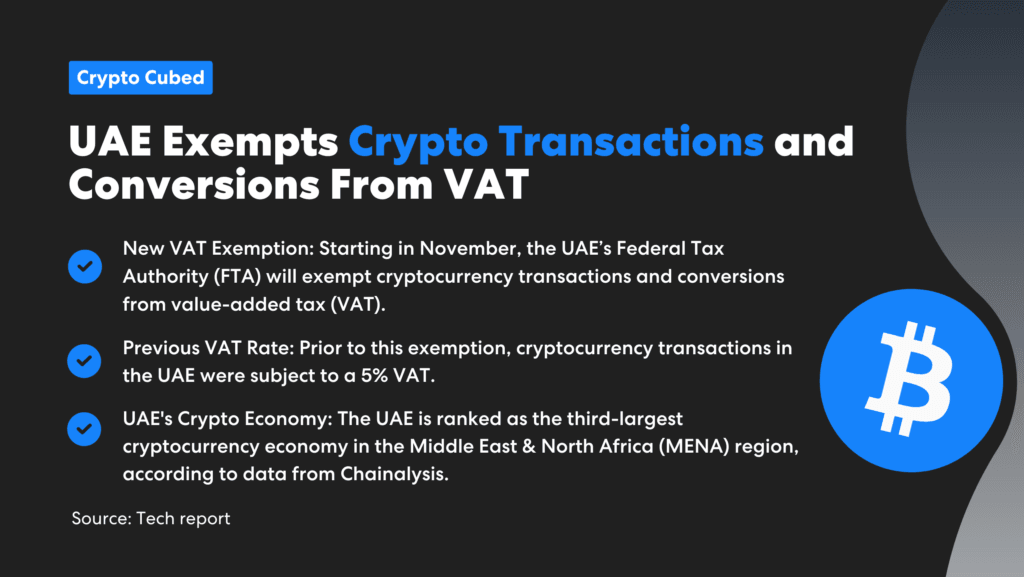
This new policy aims to break down any barriers existing in the region that might prevent newcomers from entering the market and attract further investment to what is already a thriving sector. Research has shown that [the UAE is the 3rd largest crypto economy in the Middle East and North Africa (MENA) region](https://techreport.com/crypto-news/uae-exempts-crypto-transactions-and-conversions-from-vat/). This displays a continued effort by UAE authorities to create a hospitable environment for digital asset adoption beyond just the state of Dubai.
## Q3 Crypto Scam Figures Released: $753 Million
The latest Q3 crypto scam figures paint a worrying picture for the industry, with over [**$753 million** stolen across **155 security incidents**](https://indd.adobe.com/view/a2b865c7-3f51-4515-89f3-ed3117b579d2). This represents an approximate **9.5% increase in lost value** compared to Q2, despite 27 fewer incidents. A significant portion of these losses stemmed from **phishing scams**, which accounted for **$343 million** in losses over **65 incidents**, making it the most damaging scam channel.
> Phising scams accounted for **$343 million** in losses over **65 incidents**.
Ethereum (ETH) continues to be the primary target for attackers, likely due to its central role in **Decentralized Finance (DeFi)**. As the chain with the largest on-chain asset volumes and widespread adoption in the DeFi space, it presents a lucrative opportunity for malicious actors. The high level of funds circulating in Ethereum-based applications, coupled with the complexity of smart contracts, creates an environment where vulnerabilities can be exploited at a large scale.
These figures highlight the evolving sophistication of crypto-related scams and the need for enhanced security protocols, particularly for decentralized platforms. The focus remains on educating users about phishing and tightening smart contract security, but the trend points to increasing threats as the crypto ecosystem grows.
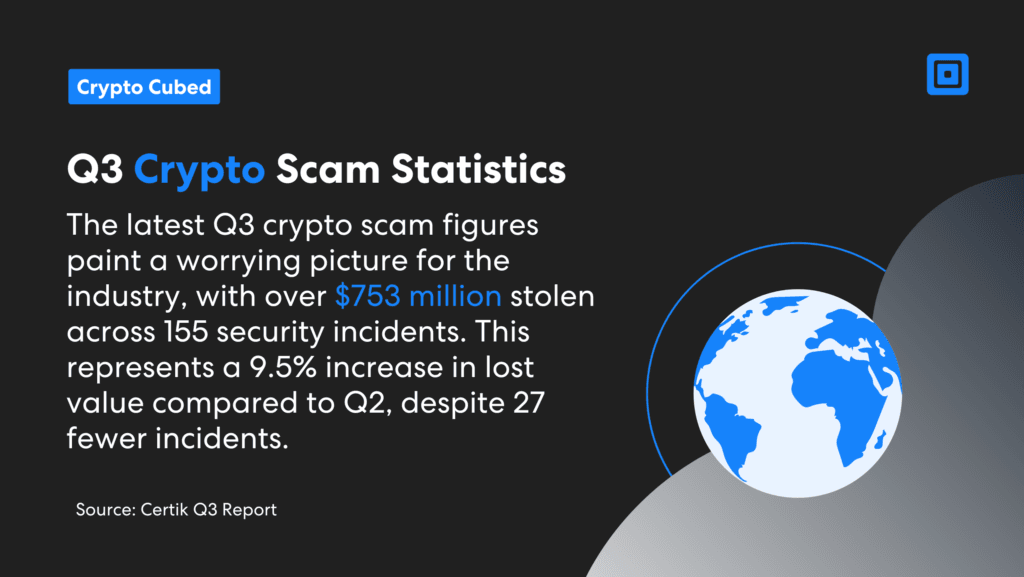
That wraps up this month’s crypto highlights. Make sure to come back next month for more key news and discourse around global crypto compliance! Head over to our [crypto regulations blog](https://www.complycube.com/en/tag/crypto-regulations/) page for more sources on crypto regulations from around the world and how they might impact you.
Alternatively, get in touch with one of our [compliance specialists](https://www.complycube.com/en/contact/contact-sales/) to learn more about ComplyCube’s crypto compliance solutions.
**Categories:** News
**Tags:** Crypto Regulations
---
### [UK DIATF-Certified IDSP Delivering A Real-Time Driver License Check](https://www.complycube.com/uk-diatf-certified-idsp-delivering-real-time-driver-license-checks/)
**Published:** October 21, 2024
**Author:** Sofia Daley
**Excerpt:** ComplyCube has become the first UK DIATF-certified Identity Service Provider (IDSP) to offer real-time checks of driver entitlements, endorsements, and disqualifications through the DVLA.
**Content:**
[ComplyCube](https://www.complycube.com/en/), a global RegTech100 solution, is proud to announce that it has become the first UK DIATF-certified Identity Service Provider (IDSP) to offer a real-time driver license check of driver entitlements, endorsements, and disqualifications through the [Driver and Vehicle Licensing Agency](https://www.gov.uk/government/organisations/driver-and-vehicle-licensing-agency) (DVLA) API.
This innovative integration enhances the platform’s capability to deliver precise and secure driver credential verification services, particularly benefiting industries such as [Mobility as a Service (MaaS)](https://www.complycube.com/en/use-cases/industry/mobility-as-a-service-maas/), where comprehensive driver background checks are essential.
## The Mobility as a Service (MaaS) Sector
In 2023, the transportation sector was identified as one of the top five industries most impacted by identity fraud, underscoring the critical need for effective identity verification and Know Your Customer (KYC) processes. Addressing this challenge, ComplyCube’s integration with the DVLA API allows businesses to instantly verify driving license validity directly from the DVLA’s authoritative database. This real-time access ensures that the data is accurate and current and significantly enhances services operating in the Mobility as a Service (MaaS) sector.
The DVLA, a UK government organization responsible for maintaining driver and vehicle records, provides a crucial service through its API by enabling the authentication of key driver data points. With this integration, ComplyCube allows businesses to confirm the validity of driving licenses, check for records of infractions and penalties, and assess any restrictions on the types of vehicles a driver is permitted to operate. This comprehensive driver assurance process is vital for ensuring both the competency and the authenticity of the drivers’ credentials and information.
> With real-time DVLA checks, we deliver unmatched accuracy and security in up-to-date driver assurances.
Mohamed Alsalehi, Chief Technology Officer at ComplyCube, emphasized the importance of this development, stating, “With real-time DVLA checks, we deliver unmatched accuracy and security in up-to-date driver assurances. This integration showcases our dedication to providing top-tier security by leveraging the most reliable sources to combat fraud and ensure full compliance for our clients.”
## Precise Driver License Check Screening
ComplyCube’s driver authentication solution, now enhanced by the DVLA integration, facilitates rapid and precise driver screening. This is particularly crucial for sectors such as MaaS, vehicle hire, fleet management, logistics, delivery, and ride-hailing, where driver suitability and competence are critical for safety and compliance. The integration allows for a full background check, including verifying the driver’s credentials, such as license validity and driving history, to ensure that only qualified and legitimate drivers are cleared, thereby enhancing safety and trust in the industry.
> Our integration with the DVLA API is transformative for the Mobility industry
“Our integration with the DVLA API is transformative for the Mobility industry,” said Harry Varatharasan, Chief Product Officer at ComplyCube. “By enabling real-time checks, we empower businesses to make quick, informed decisions, which in turn enhances safety and builds customer trust. This advancement aligns perfectly with our mission to build trust at scale by providing robust identity verification solutions that help our clients safeguard their operations and customers.”
As a UK DIATF-certified IDSP, ComplyCube continues to lead the way in offering advanced identity verification solutions that meet the evolving needs of various industries. By integrating with authoritative sources like the DVLA and expanding its coverage in the US with the AAMVA, ComplyCube strengthens its commitment to protecting businesses against fraud and ensuring regulatory compliance globally.
With capabilities ranging from advanced document verification and biometric checks to Right to Work, DBS checks, and AML screening, ComplyCube’s platform stands out as a reliable and comprehensive solution for businesses seeking secure and reliable driver credential verification. The integration with the DVLA API is the latest enhancement to its suite of services, reinforcing ComplyCube’s position as the market leader for companies looking to build trust online.
As ComplyCube expands its global footprint, its AI-powered SaaS platform remains at the forefront of the identity verification industry, helping businesses navigate complex regulatory environments and protect against fraud.
**Categories:** Product
**Tags:** Announcements
---
### [TD Bank Fails Anti Money Laundering Compliance](https://www.complycube.com/td-bank-fails-anti-money-laundering-compliance/)
**Published:** October 28, 2024
**Author:** Sofia Daley
**Excerpt:** Toronto-Dominion (TD) Bank was hit with one of the biggest AML fines in history, over $3 billion, due to AML failures. AML compliance must be a priority to protect banks from non-compliance penalties. Learn how AML solutions can help.
**Content:**
This month, Toronto-Dominion (TD) Bank was hit with one of the biggest AML fines in history, over $3 billion, due to AML failures. Labeling this as simply a “failure” might even be considered to be sugarcoating the story, as three money laundering networks collectively transferred more than $670 million through TD Bank accounts from 2019 to 2023. Whilst organizations might think they can’t afford to invest in state-of-the-art AML software solutions, can they really afford not to when fines can reach $3 billion? Anti money laundering compliance frameworks and AML tools cannot be overlooked, as this often ends in financial ruin, with otherwise respectable organizations unnecessarily incriminating themselves.
Unfortunately, TD Bank is now paying a hefty price for possible naivety. Many businesses might not imagine that not adequately funding an AML program may very well be the first step to pleading guilty to serious financial crimes, such as money laundering conspiracy. TD Bank is now set to pay $1.8 billion to the Justice Department, $1.3 billion to the Financial Crimes Enforcement Network, and $450 million to the Office of the Comptroller of the Currency.
## What is AML Regulation?
Anti-Money Laundering (AML) refers to a set of laws, regulations, and procedures designed to prevent criminals from disguising illegally obtained funds as legitimate income. These regulations are applied primarily to financial institutions but extend to a range of industries, requiring them to detect, prevent, and report suspicious activity.
AML programs focus on identifying and monitoring suspicious transactions, implementing due diligence procedures such as Know Your Customer (KYC) requirements, and filing Suspicious Activity Reports (SARs) with authorities. The goal is to combat financial crimes, including money laundering, terrorist financing, corruption, and fraud. Key features of AML software might include:
- **Customer Due Diligence (CDD):** This involves gathering data on customers to ensure they’re not involved in illegal activities. For more on CDD, read [“What is Customer Due Diligence?”](https://www.complycube.com/en/what-is-customer-due-diligence/)
- **Know Your Customer (KYC):** KYC similarly looks at risks posed by new customers, often verifying their identities, background checks, and more.
- **Sanctions Compliance:** AML also includes [sanctions](https://www.complycube.com/en/what-is-a-sanctions-screening/) screening, which are tools used by countries or organizations to impose restrictions on regions, entities, or individuals. Regulated businesses must carry out sanctions risk screening as a required practice for sanctions compliance.
AML regulations are globally influenced by organizations such as the Financial Action Task Force (FATF), which provides international standards to ensure countries have effective systems in place. Financial institutions are required to continuously monitor transactions, maintain records, and enforce compliance through internal controls. Non-compliance with AML regulations can lead to severe penalties, loss of reputation, and even legal action for the institutions involved.
## TD Bank Pleads Guilty to the Bank Secrecy Act
TD Bank is the sixth-largest bank in North America and has been operating since 1852. It is, in fact, the largest bank to have ever pled guilty to Bank Secrecy Act program failures and the first bank in US history to plead guilty to “conspiracy to commit money laundering”.
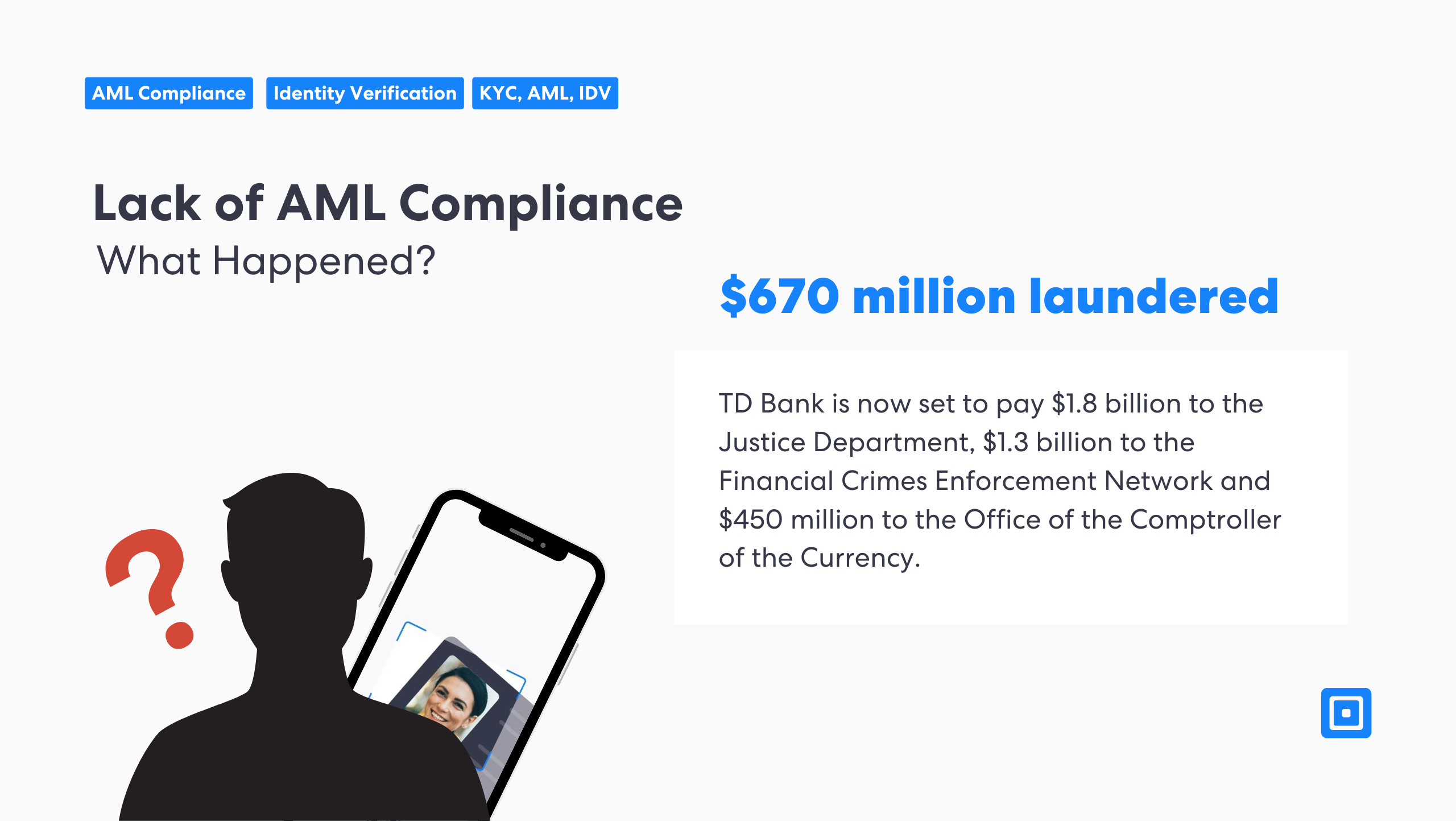
> First bank in US history to plead guilty to “conspiracy to commit [money laundering](https://www.justice.gov/opa/pr/td-bank-pleads-guilty-bank-secrecy-act-and-money-laundering-conspiracy-violations-18b#:~:text=“Today%2C%20TD%20Bank%20also%20became,conspiracy%20to%20commit%20money%20laundering.).”
Attorney General Merrick B. Garland stated, “Today, TD Bank also became the[ largest bank in U.S. history to plead guilty](https://www.justice.gov/opa/pr/td-bank-pleads-guilty-bank-secrecy-act-and-money-laundering-conspiracy-violations-18b) to Bank Secrecy Act program failures, and the first US bank in history to plead guilty to conspiracy to commit money laundering.” Attorney General Garland’s statement underlines the seriousness of this case by emphasizing that it marks a historic level of accountability. TD Bank’s plea is significant not just because of the scale of the institution but because it’s the first time a U.S. bank of this size has acknowledged such failures in compliance under the Bank Secrecy Act (BSA) and money laundering conspiracy.
> The[ largest bank in U.S. history to plead guilty](https://www.justice.gov/opa/pr/td-bank-pleads-guilty-bank-secrecy-act-and-money-laundering-conspiracy-violations-18b) to Bank Secrecy Act program failures.
The bank’s AML fine stems from a deeply embedded and systematic problem within the organization – a lack of adequate prioritization. Investing in sophisticated internal mechanisms to detect and report suspicious transactions and customers can often seem like a hindrance to an organization due to the costs and time invested. Yet, in the long term, it becomes clear that AML controls and comprehensive compliance strategies should always remain at the heart of a company’s culture and operations – a preventative measure that could save the business an insurmountable amount.
### What Caused Non-Compliance?
The US Department of Justice argued that TD Bank chose profits over compliance with the law—a decision that is now costing the bank billions of dollars in penalties. Forbes states that TD Bank’s U.S. arm ‘failed to appropriately [fund and staff](https://www.justice.gov/opa/pr/td-bank-pleads-guilty-bank-secrecy-act-and-money-laundering-conspiracy-violations-18b#:~:text=“Today%2C%20TD%20Bank%20also%20became,conspiracy%20to%20commit%20money%20laundering.)‘ its anti-money laundering program.
Relying on generic or outdated software for AML tools that don’t provide adequate detection of complex money-laundering schemes is a massive gamble for financial institutions like TD Bank. Some companies adopt a “checkbox compliance” approach, with software or policies that do not offer best-in-class AML protection but rather are solely created to avoid non-compliance. These protocols will often fall short in an audit or investigation, so businesses must make sure they partner with proactive platforms that are able to stay ahead of advances in digital fraud.
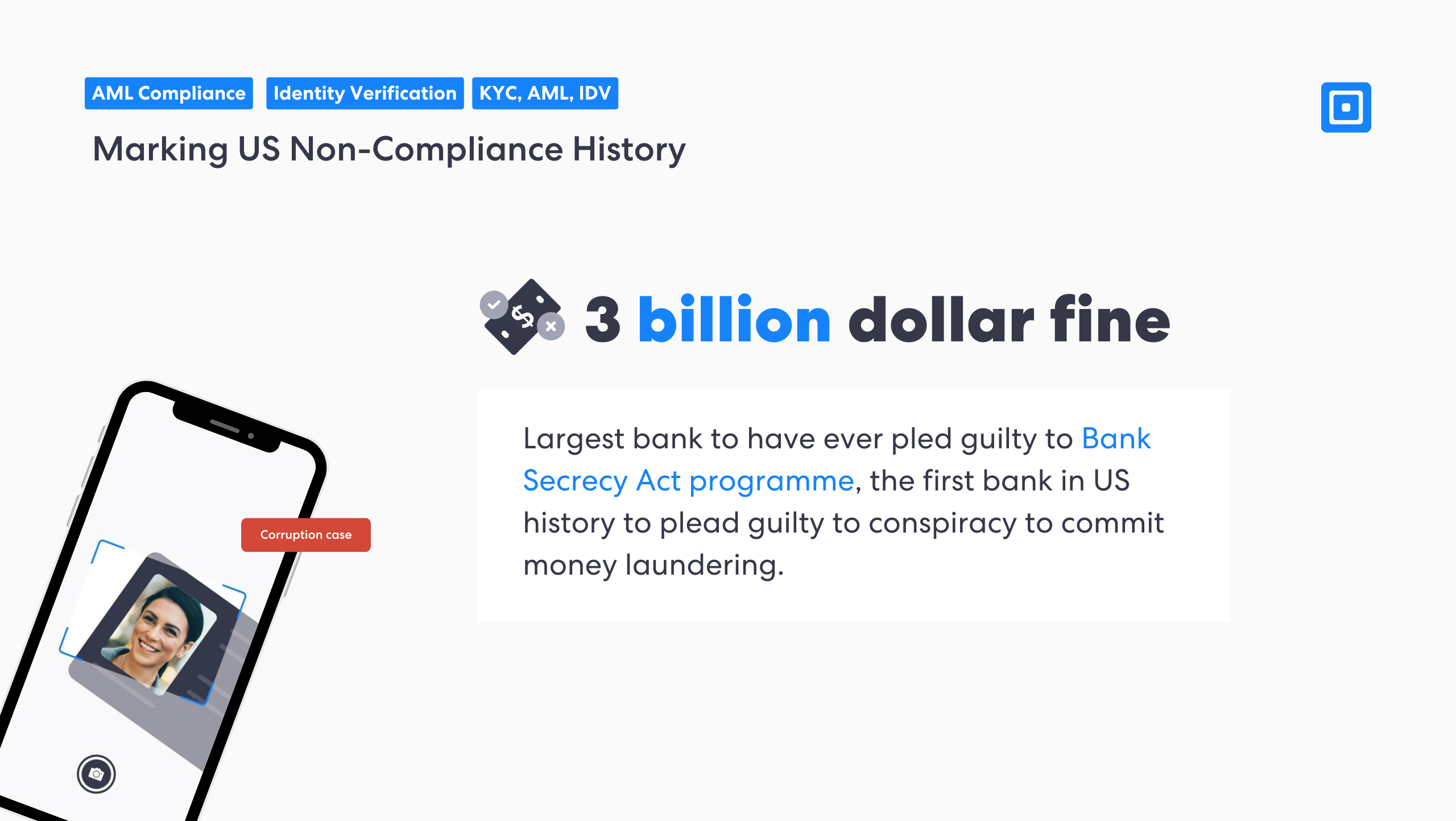
## Anti Money Laundering Compliance for Financial Institutions
AML software is critical for all financial institutions, as it ensures legal compliance with mandates issued by national and international watchdogs. Regulatory requirements differ globally, so choosing a solution that can achieve compliance in different jurisdictions is critical.
AI and machine learning are some of the newest technologies to have entered the AML space, offering key features that can identify potential risks and suspicious activity. Decision-making around compliance efforts must be fortified by thorough research into money laundering AML software that can ensure regulatory compliance and prevent illicit activities like terrorist financing.
### AML software that can help businesses fortify their AML infrastructure includes:
- **Know Your Customer (KYC) and Enhanced Due Diligence (EDD):** The use of advanced KYC solutions, including thorough identity verification and ongoing customer screening, would have helped identify clients who are high-risk quickly, fortifying AML efforts. This can then trigger an Enhanced Due Diligence (EDD) process to further assess customer risk. Customer onboarding processes should always be fortified by a KYC process, which identifies politically exposed persons and analyses customer information with scrutiny. For more on risk-based AML approaches, read [“What is a Risk-Based Approach (RBA)?”](https://www.complycube.com/en/what-is-a-risk-based-approach/)
- **Automated Suspicious Activity Reporting (SAR):** Automated AML workflows, combined with alerts for compliance teams, would ensure quick escalation of critical information to prevent money laundering activities from continuing undetected.
- **Real-Time Transaction Monitoring:** One key AML failure was the bank’s inability to monitor over 90% of transactions on its network, allowing billions of dollars in suspicious activity to go unchecked. Implementing robust, real-time transaction monitoring with AI-driven analytics could have flagged irregular patterns, such as the daily $1 million cash deposits that went unreported. A system utilizing behavioral analytics could have detected abnormal deposit patterns and high-risk activities.
## AML Solutions with ComplyCube
ComplyCube offers state-of-the-art AML software solutions, including sophisticated AML screening to lower financial crime risks. Combat money laundering with one of the best AML software solutions on the market, leveraging AI-powered risk assessment, adverse media screening tools, and more to ensure compliance.
Work with a global provider that can fortify your compliance framework with solutions powered by artificial intelligence. Ensure security in each customer journey with the right software, allowing businesses to onboard new customers quickly and safely.
For more information on ComplyCube’s AML software, reach out to one of their [compliance experts](https://www.complycube.com/en/contact/contact-sales/).

**Categories:** Guides
**Tags:** Anti-Money Laundering
---
### [Unlocking Trust with Electronic Identity Verification Tools](https://www.complycube.com/unlocking-digital-trust-with-electronic-identity-verification-tools/)
**Published:** November 7, 2024
**Author:** Sofia Daley
**Excerpt:** Electronic Identity Verification tools are a great way to fortify Know Your Customer (KYC) practices. Learn what AI-powered identity verification tools can strengthen your eidv solution to prevent fraud and stay compliant.
**Content:**
Electronic Identity Verification tools have become a common solution for Know Your Customer (KYC) practices. Combining a robust online document checker and biometric Identity Verification (IDV) powered by state-of-the-art Artificial Intelligence (AI), IDV solutions are pillars of modern compliance.
However, there is a wide variety of providers to choose from for such an important compliance process. This guide examines the traits to look for when choosing an Identity Service Provider (IDSP), as well as the benefits of integrating with an IDV solution.
## What Digital Identity Verification Tools are Available?
Identity Verification is now crucial for both businesses and consumers. Customer verification is a vital part of any onboarding process, ensuring that the individuals signing up for services are who they claim to be.
> Identity verification is a [critical safeguard](https://fintech.global/2024/10/10/how-artificial-intelligence-is-redefining-identity-verification-processes/) in the digital age, serving as a primary defence against fraud and ensuring that only genuine customers access services.
Digital identity verification tools are designed to streamline the customer onboarding process while mitigating fraud risks. These tools range from document authentication to sophisticated biometric verification and other fraud detection mechanisms. By integrating these tools into your compliance framework, institutions significantly reduce the risk of fraudulent activity while improving user experience.

### Document Verification
Document verification is the cornerstone of most identity verification processes. Using electronic verification systems, businesses can swiftly authenticate a wide range of documents, such as driver’s licenses and other forms of physical identification.
By automating this part of the process, companies not only speed up verification times but also increase accuracy, protecting themselves from potential identity fraud. For more on how digital document verification fortifies eKYC, read “[Digital Document Verification and eKYC](https://www.complycube.com/en/digital-document-verification-and-ekyc/).”
### Biometric Verification
Biometric verification is rapidly becoming an essential component of electronic identity verification (eIDV) systems. Incorporating advanced technologies like facial recognition, this method goes beyond static document checks.
For adequate Anti-Money Laundering (AML) compliance, biometric verification provides an added layer of security by ensuring that the person submitting the documents is the rightful owner. Liveness detection features, which verify whether a person is physically present during the identity check, further enhance the security of these systems, preventing identity spoofing or other forms of fraud. To learn more about the advantages of biometric verification, read [“The Advantages of Biometric Authentication.”](https://www.complycube.com/en/the-advantages-of-biometric-authentication/)

### Enhanced Identity Verification
Companies must adopt enhanced identity verification techniques as fraud schemes grow more sophisticated. This involves going beyond basic document and biometric checks to validate customer identities using multiple layers of due diligence processes.
Enhanced verification typically includes scrutinizing the customer’s digital footprint and comparing data across various trusted sources to ensure a comprehensive assessment. By investing in enhanced identity verification solutions, businesses can better protect themselves from high-risk users, including fraudsters and money launderers.
### Proof of Address Verification
Proof of address is another critical aspect of identity verification. With eIDV solutions, verifying a customer’s address is streamlined through cross-checks against private databases and public records.
This approach helps eliminate the need for manual submission of utility bills or bank statements, speeding up the verification process while maintaining a high level of accuracy. A reliable proof of address system enhances the integrity of your customer records and reduces the chances of address-related fraud.
### Age Estimation
In some industries, age verification is essential, particularly for services that have age restrictions. Age estimation technology can help businesses comply with legal requirements without causing friction in the onboarding process. By using AI-powered analysis, businesses can quickly estimate a customer’s age, adding an extra layer of compliance and protection for both the company and the end-user.
## The Benefits of Online Identity Verification Tools
The advantage of these systems lies in their ability to instantly cross-reference details against multiple databases, making it easy to spot discrepancies in the extracted data. Using key AML checks alongside Electronic Identity Verification (eIDV), digital compliance solutions create a swifter onboarding process, screening for Politically Exposed Persons (PEPs) and appearances in adverse media, alongside other metrics.
- [Multi-bureau screening](https://www.complycube.com/en/solutions/identity-assurance/multi-bureau-checks/)
- [Politically Exposed Person (PEP) screening](https://www.complycube.com/en/solutions/global-screening/sanctions-pep-screening/)
- [Adverse media checks](https://www.complycube.com/en/solutions/global-screening/adverse-media-checks/)
- [Sanctions and watchlist screening](https://www.complycube.com/en/solutions/global-screening/watchlist-screening/)
- [Other AML checks](https://www.complycube.com/en/solutions/due-diligence-compliance/anti-money-laundering/)
Streamlining the customer identity verification process is essential for businesses that aim to stay competitive while keeping verification costs manageable. By leveraging advanced Identity Verification tools, financial institutions, and other regulated entities can ensure they are not only compliant but also safeguarding customer data.
Ultimately, this contributes to enhanced fraud prevention controls, reducing the risk of identity theft and fraud across the board. The ability to verify identity accurately and quickly is no longer a luxury—it’s a necessity for businesses looking to build trust with their customers. Effective verification also ensures that customer information remains secure, a critical factor in today’s data-driven financial landscape.
## About ComplyCube’s eIDV solutions
ComplyCube is a leading provider of Electronic Identity Verification (eIDV) solutions, designed to help businesses meet their compliance obligations and protect against fraud. ComplyCube offers a comprehensive suite of tools that combine document verification, biometric identity verification, and advanced Anti-Money Laundering (AML) checks to create a robust, user-friendly, and secure identity verification process.
### Choosing ComplyCube as an IDSP
ComplyCube’s market-leading and award-winning compliance solutions can be integrated in a number of ways. Using their user-friendly platform, consumer data can be tracked, exported, and used for compliance decisions easily. Larger firms wishing to integrate only the check and export data to their own platform can integrate it via a powerful API or SDK.
- **Compliance**: Stay compliant with the latest KYC, AML, and global data protection regulations, including GDPR and eIDAS.
- **Fraud Prevention**: Advanced fraud detection mechanisms reduce the risk of identity theft and financial crime.
- **Speed and Efficiency**: Automated processes ensure rapid verification without sacrificing accuracy.
- **User-Friendly Experience**: Offer your customers a frictionless onboarding experience with instant verification capabilities.
- **Security**: Protect sensitive customer data with robust encryption and secure data handling protocols.
Reach out to a [compliance specialist](https://www.complycube.com/en/contact/contact-sales/) to learn more about how ComplyCube is building trust at scale.

**Categories:** Guides
**Tags:** Identity Verification
---
### [The Cost of Pig Butchering Crypto Scams in 2023](https://www.complycube.com/americans-lost-5-6b-to-pig-butchering-crypto-scams-in-2023-what-about-the-uk/)
**Published:** December 5, 2024
**Author:** Sofia Daley
**Excerpt:** Americans lost $5.6B to Crypto scams, often referred to as “pig butchering,” in 2023, yet this doesn’t seem to have been the wake-up call we might have expected it to be. Read our guide and learn more about cryptocurrency fraud.
**Content:**
Americans lost $5.6B to crypto scams, often referred to as “pig butchering crypto scams,” in 2023, yet this doesn’t seem to have been the wake-up call we might have expected it to be. Over 50,000 investment scams were reported in America in the first half of 2023, costing consumers $2.5B. These investment scams mostly revolved around investing in cryptocurrencies with the promise of obtaining a large return. The median loss for investment scam victims in the first half of 2024 was $9,000 – a $1,000 increase from last year. With the U.S. facing mounting losses, it begs the question: has the UK managed to steer clear of this form of cryptocurrency fraud, or is it on the verge of a similar costly reckoning?
## How Crypto Chaos and Romance Scams Go Hand-in-Hand
In 2023, cryptocurrency scams in the United States surged to unprecedented levels, leaving Americans with a staggering [$5.6 billion in losses](https://fortune.com/2024/09/09/americans-scammed-5-billion-2023-crypto-fraud-45-percent-spike-fbi/), according to a report by the FBI. This form of fraud is often referred to as “pig butchering scams” due to the notion of fraudsters “fattening up” their victims by building trust through friendly conversations on social media or dating platforms. This grooming phase often involves scammers skillfully creating credible profiles and building up their victim’s confidence, enticing them to want to start investing.
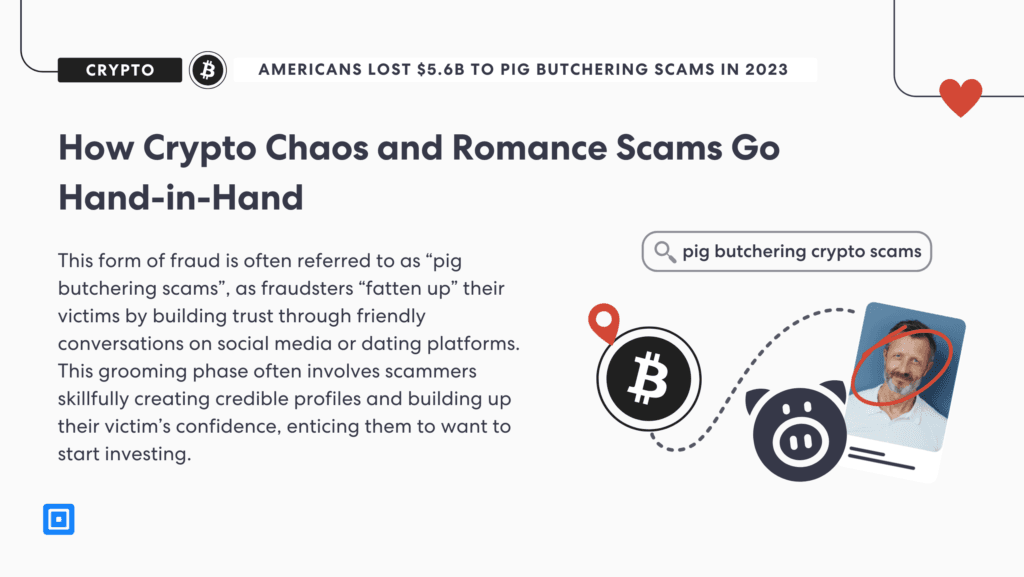
Pig butchering is very similar to [romance scams](https://staysafeonline.org/online-safety-privacy-basics/romance-scams/ "https://staysafeonline.org/online-safety-privacy-basics/romance-scams/"), which have been around for decades, and other [cryptocurrency](https://staysafeonline.org/online-safety-privacy-basics/security-privacy-tips-cryptocurrency-holders/ "https://staysafeonline.org/online-safety-privacy-basics/security-privacy-tips-cryptocurrency-holders/") scams that sprouted as crypto became mainstream over the past 10 years. These scams typically involve fraudsters luring victims into crypto investments with promises of massive returns, only to drain their accounts.
The impact was so severe that although crypto-related complaints made up just 10% of the FBI’s total financial fraud cases, they accounted for nearly half of the total monetary losses, underscoring the outsized effect of these schemes.
> Crypto scams are skyrocketing in [severity and complexity](https://www.businessinsider.com/crypto-scams-surged-billions-in-losses-fbi-warns-investors-bitcoin-2024-9 "https://www.businessinsider.com/crypto-scams-surged-billions-in-losses-fbi-warns-investors-bitcoin-2024-9").
The nature and intensity of these scams have grown increasingly sophisticated, with perpetrators leveraging complex techniques to deceive both individual investors and businesses. FBI Director Christopher Wray highlighted this worrying trend, noting that crypto scams are “skyrocketing in severity and complexity.” Those most affected were older adults, with individuals over 60 reporting losses totaling $1.6 billion in 2023. For many, these scams represented a significant financial blow and a deep erosion of trust in the promises of cryptocurrency as a profitable investment avenue.

> The scams can hit anyone. Criminals will strike up an online friendship with the victim and encourage them to make a [crypto investment](https://fortune.com/2024/09/11/cryptocurrency-fraud-2023-fbi/ "https://fortune.com/2024/09/11/cryptocurrency-fraud-2023-fbi/") via an app or website that’s a scam. (Romance scams, where scammers woo lonely people on dating services, are also a primary tool.)
The first half of 2024 has shown little relief, with Americans losing another [$2.5 billion](https://www.fool.com/research/crypto-investment-scams/ "https://www.fool.com/research/crypto-investment-scams/") across more than 50,000 reported investment scams, most of which are crypto-related. The median loss per victim rose to $9,000, an increase from $8,000 the previous year, indicating that scammers are succeeding in extracting even larger sums per incident.
## Is the UK Holding Its Own Against Crypto Scams?
Data from Action Fraud revealed that the UK has already faced losses of £146,22,332 to cryptocurrency fraud since the beginning of 2024. While this figure might seem small relative to the vast losses in the US, it is dramatically high for the smaller nation of the UK, with almost a third more lost than in the whole of 2020.
> Unlike many other offenses, cyber-enabled crime does not have a [physical footprint](https://www.london.gov.uk/who-we-are/what-london-assembly-does/questions-mayor/find-an-answer/crypto-currency-fraud#:~:text=Unlike%20many%20other%20offences%2C%20cyber,fraud%20and%20cyber%20enabled%20crime. "https://www.london.gov.uk/who-we-are/what-london-assembly-does/questions-mayor/find-an-answer/crypto-currency-fraud#:~:text=Unlike%20many%20other%20offences%2C%20cyber,fraud%20and%20cyber%20enabled%20crime."), and as such, any strategic response is best driven at a national level.
City of London Police revealed that more than £612 million was lost to investment fraud in the UK last year, which is a lot for a population of about 68.35 million. As was the case in the US, cryptocurrency scams were the main kind of investment fraud carried out, signaling key weaknesses within the crypto sector.
> Investment fraud [destroys lives](https://www.cityoflondon.police.uk/news/city-of-london/news/2024/april/city-of-london-police-reveals-more-than-612-million-was-lost-to-investment-fraud-in-the-uk-last-year/ "https://www.cityoflondon.police.uk/news/city-of-london/news/2024/april/city-of-london-police-reveals-more-than-612-million-was-lost-to-investment-fraud-in-the-uk-last-year/").
Temporary Detective Superintendent Oliver Little, from the Lead Force Operations Room at the City of London Police, stated: “Investment fraud destroys lives and is of particular concern to the older demographic of the UK public. Victims who are being targeted are those with a healthy amount of savings who have put their hard-earned money away for a rainy day or to help support family and have been robbed of those opportunities.”
Lloyds Bank reported towards the end of 2023 that these victims often make an average of three payments before realizing that they have [been scammed](https://www.lloydsbankinggroup.com/media/press-releases/2023/lloyds-bank-2023/lloyds-bank-issues-warning-over-crypto-scams.html "https://www.lloydsbankinggroup.com/media/press-releases/2023/lloyds-bank-2023/lloyds-bank-issues-warning-over-crypto-scams.html"), taking around 100 days from the date of the very first payment until they decide to report it to their bank. Fraudsters will go to great lengths to lure and deceive victims, setting up fake companies, social media profiles, and websites that clone real organizations.
## What Action Needs to be Taken?
National and international watchdogs had increased crypto regulation drastically since 2018 when the FATF started to push this agenda. However, a vast amount of crypto scams start on social media platforms and dating sites. In sight of this, these platforms need to address the large quantities of fake profiles that are being used to lure in victims, with Facebook having reported having 1.5 million fake accounts in only the second half of 2023. Similarly, with companies being registered in Companies House that imitate legitimate organizations, increased vigilance needs to be implemented in the registration process. For more on fraudulent company registrations in Companies House, read [“UK Business Identity Theft: Balancing the Blame.”](https://www.complycube.com/en/uk-business-identity-theft-balancing-the-blame/ "https://www.complycube.com/en/uk-business-identity-theft-balancing-the-blame/")
> Social media platforms are the main breeding ground for this type of scam.
Liz Ziegler, Fraud Prevention Director at Lloyds Bank, states: “Predictably, [social media platforms](https://www.lloydsbankinggroup.com/media/press-releases/2023/lloyds-bank-2023/lloyds-bank-issues-warning-over-crypto-scams.html "https://www.lloydsbankinggroup.com/media/press-releases/2023/lloyds-bank-2023/lloyds-bank-issues-warning-over-crypto-scams.html") are the main breeding ground for this type of scam, with a mix of bogus ads, fake endorsements and cloned accounts being key to fraudsters’ methods. It’s time these tech firms took responsibility for protecting their customers, stopping scams at source, and contributing to refunds when their platforms are used to defraud innocent victims.”
Social media platforms need to implement secure identity verification methods to end the ever-growing fraudulent practices that begin with their digital walls. In the fourth quarter of 2023, Facebook removed nearly [700 million fake accounts, following the 827 million](https://www.statista.com/statistics/1013474/facebook-fake-account-removal-quarter/ "https://www.statista.com/statistics/1013474/facebook-fake-account-removal-quarter/") removed in the previous quarter. Despite these efforts, new suspicious accounts continue to emerge, highlighting a fundamental issue with the sign-up process. Platforms like Instagram and Twitter allow anyone to create an account quickly without verifying their identity, which leaves users vulnerable to potential risks.
## Defending the Sector From Pig Butchering Scams
The tactics used in pig butchering scams—where fraudsters lure victims into fake investments through crafted trust-building techniques—require sophisticated defenses. ComplyCube’s solutions provide critical protection at every step of this scam lifecycle, empowering platforms to safeguard their users and assets against manipulation and deception.
1. **[Biometric Verification](https://www.complycube.com/en/solutions/identity-assurance/biometric-verification/) and [Liveness Detection](https://www.complycube.com/en/solutions/due-diligence-compliance/know-your-customer/liveness-detection/)**: Pig butchering scams often rely on fake profiles and stolen identities to gain victims’ trust. ComplyCube’s biometric verification and advanced liveness detection differentiate between real users and fraudsters using deepfake technology, effectively blocking synthetic and imposter accounts before they can even initiate contact.
2. **[Document Fraud Detection](https://www.complycube.com/en/solutions/identity-assurance/document-verification/)**: Fraudsters use forged or manipulated documents to appear credible and reliable. ComplyCube’s document verification capabilities analyze uploaded IDs for authenticity, cross-referencing data points to catch fake documents. This helps prevent fraudsters from completing account setups and from gaining a foothold on platforms.
3. **[Enhanced KYC](https://www.complycube.com/en/solutions/due-diligence-compliance/know-your-customer/) and [AML Screening](https://www.complycube.com/en/solutions/due-diligence-compliance/anti-money-laundering/)**: ComplyCube’s customizable KYC/AML screening ensures that high-risk users are identified and reviewed in real-time. By assessing risk factors associated with users’ backgrounds, such as known scam associations or financial irregularities, the system can block high-risk profiles proactively and minimize exposure to these threats.
Contact one of our [compliance experts](https://www.complycube.com/en/contact/contact-sales/ "https://www.complycube.com/en/contact/contact-sales/") for more information on how to safeguard your platform from pig-butchering crypto scams.
**Categories:** Guides
**Tags:** Crypto Regulations
---
### [Dogecoin Rises, With Crypto Fraud Set To Follow](https://www.complycube.com/dogecoin-rises-with-crypto-fraud-set-to-follow/)
**Published:** December 9, 2024
**Author:** Sofia Daley
**Excerpt:** Trump’s recent victory has marked a turning point within the global crypto market, with the price of Bitcoin surging above $80,000. The president-elect pledged that if elected, he would make the US the “crypto capital of the planet."
**Content:**
Trump’s recent victory has marked a key turning point within the global crypto market, with the price of Bitcoin surging above $80,000 for the first time in history. The president-elect pledged that if elected, he would make the US the “crypto capital of the planet,” easing crypto regulations to foster growth and innovation. What remains to be decided is whether this is an example of practical, forward-thinking economic policy anchored on hedging against inflation and promoting global liquidity or a last-minute scramble to win over corporate America, which will ultimately lead to not just a bullish Bitcoin market but a bullish crypto fraud one too.
## Conveniently Forgetting Trump’s Crypto Skepticism
Trump famously called Bitcoin “a scam [against the dollar](https://www.bbc.co.uk/news/business-57392734),” which seems to have been conveniently forgotten by what is supposedly soon be “the crypto capital of the planet.” Funnily enough, that very line may ring a bell – it’s remarkably similar to Trump’s 2021 pledge that the dollar would be “the currency of the world.”

Back then, Trump blamed the rise of ‘scams’ like Bitcoin on figures such as Elon Musk. According to Trump, Musk was ‘behaving stupidly’ by encouraging public belief in the authenticity of these cryptocurrencies.
> A scam against the dollar.
This prior context, which seems to have disappeared from our newsfeeds, certainly makes current headlines seem somewhat laughable, with Musk now continuing his “stupid behaviour” in a government entity named after a cryptocurrency. Of course, flip-flopping is common amongst politicians, but this points to a lack of real conviction from the president-elect, suggesting he may very well have decided to align himself with the crypto sector to ensure an easier win.
## What Does This Mean For Crypto?
The crypto sector has been booming ever since Trump’s victory, with Bitcoin having risen by more than 80% this year. Other cryptocurrencies, including Dogecoin, which is being heavily promoted by Trump-supporter Musk, are making large gains.
In the run-up to his election, Trump stated that he would stockpile bitcoin and sack Gary Gensler, the current chair of the Securities and Exchange Commission (SEC). Gensler has been a key part of the crypto crackdown that has taken place under Biden. Matt Simpson, Market Analyst at StoneX Financial, stated to the BBC that, “If the Trump administration does [deregulate crypto](https://www.bbc.co.uk/news/articles/c89v1w5lxxqo), it’s hard to see how it is not bullish for the sector.”
> If the Trump administration does [deregulate crypto](https://www.bbc.co.uk/news/articles/c89v1w5lxxqo), it’s hard to see how it is not bullish for the sector.
The Biden administration, of which Harris is Vice President, has carried out a period of increasing regulation and cracking down on fraud in the crypto sector. Some recent examples include:
- In March, FTX founder Sam Bankman-Fried was sentenced to 25 years in prison for fraud after misappropriating billions of dollars from customers worldwide, leaving many still attempting to recover their funds.
- The following month, Changpeng Zhao, founder of Binance—the largest cryptocurrency exchange globally—received a four-month prison sentence. Binance also faced a $4.3 billion (£3.2 billion) fine after Zhao admitted to enabling money laundering on the platform, including transactions linked to criminals, child exploitation, and terrorism. The U.S. Department of Justice addressed the case.
Trump’s newfound enthusiasm for crypto puts him in a position to undo much of the recent regulatory progress. This could potentially create a breeding ground for money laundering practices, terrorist financing, and more. However, with international entities such as the Financial Action Task Force (FATF) watching from afar, the rule book cannot be thrown completely out the window.
## The Current Landscape of Crypto Fraud
Americans lost close to $6Bn last year to investment scams, most of which were carried out within the digital walls of crypto platforms. Several high-profile cases over the past year, such as Binance’s $4.3 dollar fine in November 2023, have demonstrated a lack of internal governance within crypto exchanges.
The FATF only began regulating the crypto sector in 2018 – 2019, at which point crypto was still a buzzword without stabilisers. Yet, as its threat became clear, the FATF imposed new legislation, such as the Crypto Travel Rule.
Crypto regulation has since slowly tightened, bringing the sector in line with finance and banking. However, even with said regulation, the crypto sector is still by far the most fraudulent, signaling a need for increased vigilance rather than the government taking its hands off the wheel.
> There is an elevated risk for cryptocurrency transactions being linked to[ illicit activity](https://kpmg.com/no/nb/home/tjenester/radgivning/gransking-og-forebyggende-tjenester/virtuell-valuta/the-rise-of-cryptocurrency-and-the-risk-for-fraudulent-activities.html).
Numerous well-known publications and organizations have voiced their concerns regarding the industry’s fraudulent practices, with CBS News reporting earlier this year that “Cryptocurrency is an [unregulated investment space](https://www.cbsnews.com/news/crypto-scam-risk-bbb-report/) that federal regulators and consumer advocates have long said makes it ripe for fraud. Crypto investors have reported losing billions of dollars due to hacks or scams.” This is a worrying thought – a sector that was already bubbling up with fraud might now lose some of the regulatory frameworks that were offering needed protections.
## What Should Crypto Exchanges and Businesses Do?
Crypto-related businesses should be fully aware of the reputational and financial damage that fraud within their platform poses. Just because regulatory pressures may be somewhat alleviated does not mean that they should not continue to protect their platform to the very best of their ability.
Investing in the best defenses for fraud includes keeping KYC processes up-to-scratch with technologies such as biometric liveness detection for identity verification that can detect sophisticated presentation attacks. Including a wide range of AML checks, including sanctions and PEP screening, adverse media checks, multi-bureau checks, and more, can also prevent bad actors from gaining access to their platform, drastically reducing the risk of fraud and scams.
ComplyCube works closely with several businesses within the crypto sector, helping ensure their platform stays fraud-free and compliant at all times. For more information on how to safeguard your crypto business, get in touch with one of their [compliance experts](https://www.complycube.com/en/contact/contact-sales/).

**Categories:** Guides
**Tags:** Crypto Regulations
---
### [Comprehensive Guide to the UK DIATF Framework](https://www.complycube.com/comprehensive-guide-to-the-uk-diatf-framework/)
**Published:** December 12, 2024
**Author:** Sofia Daley
**Excerpt:** With online fraud at an all-time high, organisations must provide their customers with safety and security within their digital confines of their platforms. Read our latest guide on KYC for customer loyalty for key insights.
**Content:**
The Digital Identity and Attributes Framework (UK DIATF) was set up by the UK government to support digital identity services and prevent fraud. The UK DIATF initiative allows individuals to use their digital identities across various industries seamlessly by simplifying how they share verified attributes with other organisations and individuals. In addition, digital identity service providers can now be UK DIATF certified, establishing them as a government-certified IDSP (Identity Service Provider), securing their reputation as trustworthy partners.
## Introducing the UK DIATF Framework
The [UK DIATF framework](https://www.gov.uk/government/publications/uk-digital-identity-and-attributes-trust-framework-beta-version/uk-digital-identity-and-attributes-trust-framework-beta-version) prioritises privacy, transparency and user autonomy regarding personal data protection. Individuals are able to manage their digital identities, having full control over what personal data is shared and with whom. Users may also withdraw consent at any point, which proves highly useful for time-sensitive transactions.
Businesses can become UK DIATF Certified by undergoing an independent assessment to verify whether they are compliant with the standardised frameworks outlined for IDSPs. This certification process is controlled by the Department for Science, Innovation and Technology DSIT) and the office for Digital Identities and Attributes (OfDIA).
A DIATF Certification underlines an organisation’s services are secure, reliable, and compliant. The digital identity and attributes trust framework certification is a great way to verify whether an identity service provider follows high operational standards including compliance with established critical standards such as ISO 17065.
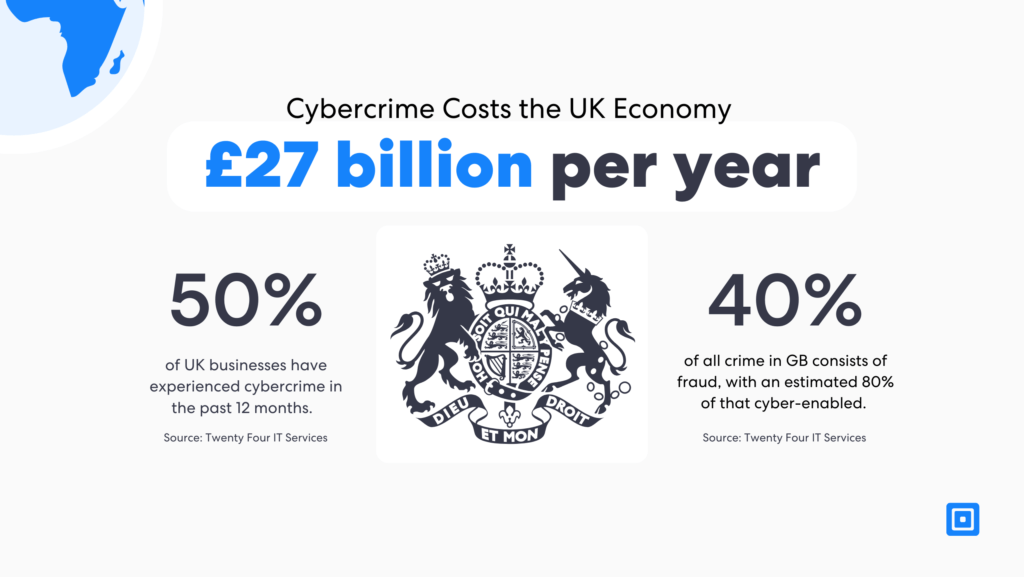
## UK’s Digital Identity & Fraud Landscape
The UK DIATF framework was launched in response to the growing and dynamic threat of digital fraud. Since the COVID-19 pandemic, the shift toward online business operations and advances in technology have driven demand for robust identity verification (IDV) and anti-money laundering (AML) solutions. Valued at [$10.45 billion in 2023](https://www.fortunebusinessinsights.com/identity-verification-market-106468), the global IDV market is expected to grow significantly, reaching $11.97 billion in 2024 and an impressive $39.82 billion by 2032, with a projected compound annual growth rate (CAGR) of 16.2%.
> [50% of UK businesses](https://www.gov.uk/government/statistics/cyber-security-breaches-survey-2024/cyber-security-breaches-survey-2024#:~:text=Cyber%20security%20breaches%20and%20attacks%20remain%20a%20common%20threat.,in%20the%20last%2012%20months.) experienced a cyberattack or security breach in the past 12 months.
This significant growth is directly linked to the surge in digital fraud and cyberattacks. According to the UK government’s Cyber Security Breaches Survey, [50% of UK businesses](https://www.gov.uk/government/statistics/cyber-security-breaches-survey-2024/cyber-security-breaches-survey-2024#:~:text=Cyber%20security%20breaches%20and%20attacks%20remain%20a%20common%20threat.,in%20the%20last%2012%20months.) experienced a cyberattack or security breach in the past 12 months. Cybercrime now imposes an annual cost of £27 billion on the UK economy.
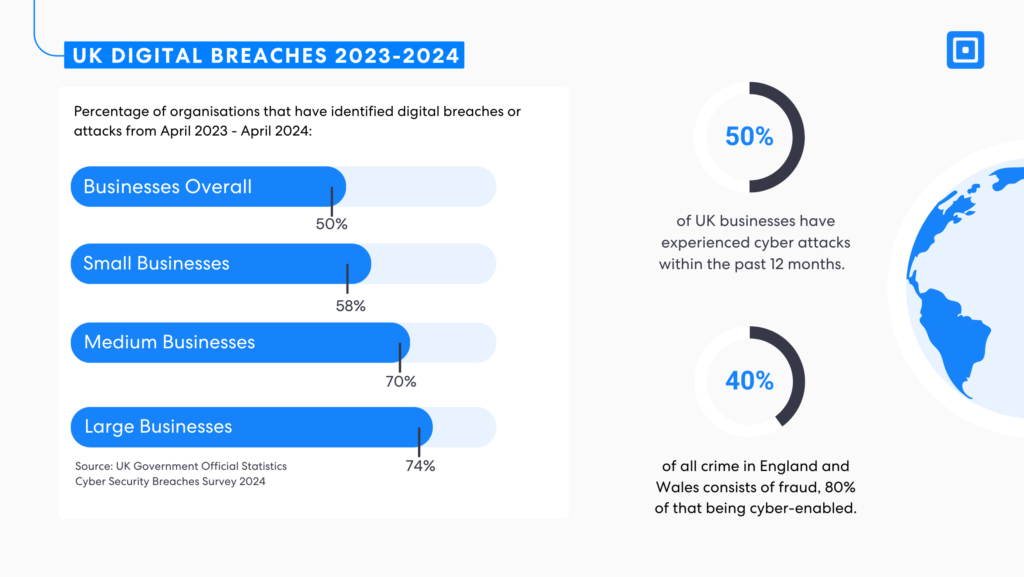
## The Creation of UK DIATF (Digital Identity and Attributes Trust Framework)
The UK Digital Identity and Attributes Trust Framework (DIATF) was created as part of the government’s wider initiative to establish a secure digital ecosystem for identity verification. Before its implementation, the UK’s approach to digital identities, identity verification and preventing identity fraud was extremely fragmented. Lack of consistency was a hallmark across identity verification practices across various sectors. Matt Warman, Minister for Digital Infrastructure, highlighted the critical objectives of the new framework in his [Ministerial foreword in 2021](https://www.gov.uk/government/publications/the-uk-digital-identity-and-attributes-trust-framework/the-uk-digital-identity-and-attributes-trust-framework), in which he lists the following:
- A clear framework of rules that underpin what “good” digital identities look like. This enhances standards across the country to protect individuals from fraud and helps to safeguard privacy.
- The need for established oversight and governance of these rules, updating them over time depending on new threats and needs.
- Creating proposals to address existing legislation which might unintentionally prevent or complicate the use of digital identities (e.g requirements for physical documents in identity verification processes.)
## Unravelling the DIATF Framework: Use Cases
Under the UK Digital Identity and Attributes Trust Framework (UK DIATF), organisations must be certified under specific use cases, as each use case possesses its own regulatory and operational requirements that differ from other use cases. This ensures that Identity Service Providers (IDSPs) meet the necessary standards for each unique service that they might be offering, such as Right to Work, Right to Rent or DBS checks.
Different degrees of compliance by IDV providers with the framework’s mandates result in varying levels of confidence. For Right-to-Rent and Right-to-Work checks, the Home Office mandates that IDSPs achieve at least a medium level of confidence as the minimum standard.
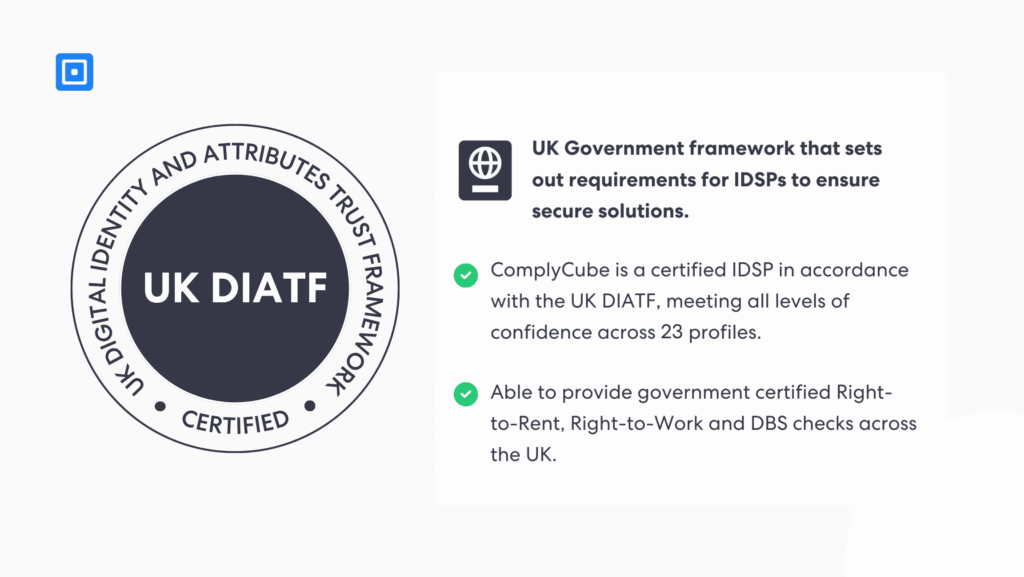
## Right to Rent Checks
Fraudulent tenancy applications have increased in the UK, posing a significant challenge to landlords. Records of false job titles, as well as hidden criminal records, are examples of fraudulent practices that are often carried out within these applications. Verifying that tenants are who they claim, and that they have the right to rent, protects landlords and letting agencies from the risk of fraud.
> The surge in[ rental fraud](https://www.forbes.com/councils/forbesbusinesscouncil/2024/08/23/surging-rental-fraud-and-how-to-avoid-it/) reflects not only the challenges within the housing market but also the ingenuity of fraudsters exploiting systemic vulnerabilities.
Currently, British and Irish citizens only need to present an identity document to prove their legal right to rent. However, keeping the verification process so minimal drastically increases risks of fraud. Cases of non-payment of rent, legal issues, property damage and more occur with increased frequency when fraudulent tenants are able to rent property illegally.
Digital Identity Service Providers (IDSPs) can be certified under the DIATF framework, with a medium level of confidence required by HMRC.
## Right to Work and DBS Checks
Candidates have been found to often hide criminal records or their lack of a legal right to work in the UK from prospective employers, leading to a need for comprehensive checks. Digital Right to Work checks and DBS checks allow employers across the UK to carry out necessary employee screening.
> As a UK employer, you have a legal obligation to comply with the [prevention of illegal working legislation](https://www.davidsonmorris.com/prevention-of-illegal-working/). This requires you to conduct a Right to Work check on every UK-based employee to verify they have the requisite permission to perform the work on offer.
The effective prevention of illegal working relies on right to work checks being comprehensive and effective. To become a DIATF-certified Right to Work or DBS provider, a medium level of confidence required.
## DIATF-Certified Services With ComplyCube
ComplyCube has been recognized by the UK government’s Digital Identity and Attributes Trust Framework (UK DIATF) as a Certified Digital Identity Service Provider (IDSP) of Right to Rent Checks, Right to Work Checks and DBS Checks. Our bespoke solutions enable employers, landlords and rental agencies across the UK to conduct enhanced checks for employees and tenants whilst remaining compliant with government standards.
For more information on UK DIATF-Certified Right to Rent, Right to Work and DBS Checks, reach out to one of our [compliance experts](https://www.complycube.com/en/contact/contact-sales/).

**Categories:** Guides
**Tags:** Identity Verification
---
### [The CryptoCubed Newsletter: December Edition](https://www.complycube.com/the-cryptocubed-newsletter-december-edition/)
**Published:** December 20, 2024
**Author:** Sofia Daley
**Excerpt:** This month’s crypto news is a masterclass in how to turn nothing into millions by combining internet trends, speculation, and a complete disregard for fundamental value. Buckle up for crypto chaos, welcome back to CryptoCubed!
**Content:**
This month’s crypto news is a masterclass in how to turn nothing into millions by combining internet trends, speculation, and a complete disregard for fundamental value. Welcome back to CryptoCubed!
Fartcoin is on the rise with NBC News comparing it to 2023’s Peanut the Squirrel meme coin (a coin named after a dead squirrel) which experienced turbo growth last year. Meanwhile, the HAWK meme coin launched by TikTok influencer “HAWK TUAH” girl crashes and burns, and a crypto trader has turned $27 into $52M with meme coin Pepe token investment.

We’ll let you know when you can invest in reality again. For now, buckle up and enjoy how meme coin investors throw their money into the wind and walk away multi-millionaires.
## 💰 Bitcoin Soars Above $106,000 After Trump’s Latest “Announcement”
Bitcoin climbed to an all-time high, [surpassing $106,000](https://www.channelnewsasia.com/business/bitcoin-powers-above-105000-first-time-4808351) on Monday, following President-elect Donald Trump’s indication that he intends to establish a U.S. bitcoin strategic reserve akin to the country’s strategic oil reserve. This announcement fuelled optimism among cryptocurrency enthusiasts.

Bitcoin has experienced a significant price increase of over 50% since the November 5th election, which resulted in Trump’s victory and the success of numerous pro-crypto candidates. This surge has contributed to the cryptocurrency market nearly doubling in value this year, reaching an all-time high of [over $3.8 trillion](https://www.reuters.com/markets/currencies/bitcoin-powers-above-105000-first-time-2024-12-15/ "https://www.reuters.com/markets/currencies/bitcoin-powers-above-105000-first-time-2024-12-15/"), according to CoinGecko data.
## 📈 “Hawk Tuah” Girl’s Potential Pump and Dump of HAWK Meme Coin
Hailey Welch, known as the viral “Hawk Tuah” TikTok star, faces backlash after her newly launched meme coin value crashes within only a few hours of its release. This has led to allegations of having carried out a “pump and dump” or “rug pull” scheme, arguing that her team may have profited by artificially hyping the coin before selling off their holdings.
> Meme coins such as this have been booming in popularity due to their jokey, [cheap appeal](https://www.bbc.co.uk/news/articles/c89xvjkzzyvo) for investors.
Welch has denied these claims, stating her team hasn’t sold any tokens. However, investors remain skeptical, with some accusing her team of misleading them. Experts highlight the risks of meme coins like Hawk, which are often volatile and risky despite their popularity. This situation mirrors other controversies involving influencers promoting cryptocurrencies without full transparency, such as Kim Kardashian’s $1.26 million fine in 2021.
Read the whole story on [BBC News.](https://www.bbc.co.uk/news/articles/c89xvjkzzyvo)
## 🪙 Do StableCoins Undermine The Euro? The Last Phase of MiCA is Here
The next stage of MiCA (Markets in Crypto Assets) has taken effect this December. Although the crypto industry has had ample opportunity to get ready, the new rules will still require adjustments to how crypto businesses operate.
The initial phase of the EU’s crypto regulation began in June, but its full implementation will be finalized in December. The most significant change is the requirement for all Crypto Asset Service Providers (CASPs) to secure authorization to operate within the EU. This includes adhering to stringent security, governance, and compliance standards. While this will impose additional responsibilities on crypto firms, they’ve had sufficient time to prepare, and the purpose behind the legislation is widely regarded as positive.
Stablecoins are at the centre of MiCA’s (Markets in Crypto Assets) most drastic changes. New rules effective since June limit the volume of stablecoins that can circulate over a set period—reflecting concerns about stablecoins, especially USD-pegged ones, potentially undermining the Euro.
The situation will become even more challenging for stablecoin issuers starting in December. They will now need an e-money authorization in at least one EU country to continue operating. While stablecoins are relatively stable, well-regulated, and low-risk compared to other crypto assets, the EU’s stance may seem disproportionately strict. However, aside from these stablecoin requirements, MiCA generally lays out a balanced path for blockchain innovation, aiming to support growth while managing oversight.
Read more on MiCA [here](https://www.forbes.com/sites/digital-assets/2024/12/03/what-you-should-know-about-the-latest-mica-regulations-coming-december/).
## ⚠️ Memecoins Like Fartcoin Riding Trump’s Victory Tidal Wave
It seems as though crypto valuations and absolute mockery now go hand in hand, as major news outlets report on Fartcoin’s drastic jump in valuation.
> Yes, it’s called Fartcoin. Yes, it is totally useless. And yes, it has nevertheless tripled in value over the past week to a market capitalization of more than [$700 million.](https://www.nbcnews.com/business/personal-finance/memecoins-what-are-they-why-are-they-popular-cryptocurrency-rcna184223 "https://www.nbcnews.com/business/personal-finance/memecoins-what-are-they-why-are-they-popular-cryptocurrency-rcna184223")
NBC News argues that buyers and sellers of meme coins such as Fartcoin are betting on the “greater fool”, counting on the fact that despite the coin being worthless and having no underlying driver of value, people will still buy it anyway arguably due to virality, momentum and excitement. However, this makes the often short-lived lifespan of viral internet memes one of the greatest risks in training meme coins.
However, in a very select few cases, investing in memecoins based on viral incidents has been extremely lucrative. An example is the Peanut the Squirrel (PNUT) meme coin incident, a based on a squirrel who died. Coinbase agreed to add the token to its listing roadmap, leading to a 20% price surge and a market cap of $1.34 billion. This continued to increase until hitting an all-time high in November 2023.
Find more information [here](https://www.nbcnews.com/business/personal-finance/memecoins-what-are-they-why-are-they-popular-cryptocurrency-rcna184223 "https://www.nbcnews.com/business/personal-finance/memecoins-what-are-they-why-are-they-popular-cryptocurrency-rcna184223").
## 🇬🇧 UK’s FCA Asks For Feedback
Last month, the U.K. government announced its intention to propose legislation in order to bring the crypto sector under the Financial Conduct Authority’s (FCA) oversight. The FCA said that its goal is to develop, “a balanced regime that addresses market risks without stifling growth.”
> The regime will look to reduce and [prevent financial crime](https://www.investmentexecutive.com/news/from-the-regulators/fca-launches-crypto-regime-consultation/#:~:text=“The%20regime%20will%20look%20to,and%20competitiveness%2C”%20it%20said.), protect and put consumers’ needs first \[and\] maintain market integrity while supporting the use of technology to help strengthen the U.K.’s growth and competitiveness. ~ FCA
The Financial Conduct Authority (FCA) is now seeking feedback on new proposed rules as part of the U.K.’s strategy to create a comprehensive regulatory framework for the crypto industry. The latest discussion paper outlines potential registration, disclosure, and conduct requirements to combat market abuse in the sector.
These proposals include implementing robust internal controls and encouraging information sharing among registered crypto trading platforms to identify and address market misconduct.
> We encourage industry to share its expertise and [help us shape the rules](https://www.investmentexecutive.com/news/from-the-regulators/fca-launches-crypto-regime-consultation/#:~:text=“The%20regime%20will%20look%20to,and%20competitiveness%2C”%20it%20said.). We want industry to take the lead in developing new ways of disclosing important information to make sure people understand the risks before purchasing crypto. ~ FCA
Learn more about the story [here](https://www.fca.org.uk/news/statements/fca-seeks-feedback-plans-improve-transparency-uks-crypto-markets "https://www.fca.org.uk/news/statements/fca-seeks-feedback-plans-improve-transparency-uks-crypto-markets").
## 💰 Turning $27 into $52M
A cryptocurrency trader is said to have transformed a $27 investment in the Pepe meme coin into an astonishing $52 million, according to blockchain analytics firm Lookonchain.
> An extraordinary [1,900,000x](https://www.tradingview.com/news/cointelegraph:88d6253b5094b:0-crypto-trader-turns-27-into-52m-with-savvy-pepe-token-investment/) return.
Memecoins have emerged as some of the top-performing cryptocurrencies this year, thanks to their impressive returns. Hao Yang, Head of Financial Products at Bybit, argues this is a symptom of the younger generation’s “disappointment in the financial system”. “The success of memecoins can be seen, like punk rock, as a symptom of disillusioned young investors who have seen the opportunities afforded to their parents disappear,” Yang stated to Cointelegraph.
Read the full story [here](https://www.tradingview.com/news/cointelegraph:88d6253b5094b:0-crypto-trader-turns-27-into-52m-with-savvy-pepe-token-investment/).
## Time for Some Light-Hearted Creative Criticism?
So you’ve made it to the end of our newsletter. It’s time to enjoy a little satire, worthy reader, you’ve earned it.
### 🔥THE CRYPTOCUBED POEM: DECEMBER🔥
Fartcoin rose on a viral breeze,
$700M banked with laughable ease,
Has the sector just gone mad?
Or must all meme coin names be bad?
Donald Trump, the Crypto King,
He hasn’t really said anything,
“Yeah, I think so” – is that a concrete plan?
Meanwhile every newspaper, “What a strategic man!”
The crypto sector explodes into brawl,
and CrypoCubed is here to tell all.
### Stay tuned for our January newsletter and have a great month!

**Categories:** News
**Tags:** Crypto Regulations
---
### [Social Media KYC: Bot-Driven Fraud on Your Feed](https://www.complycube.com/social-media-kyc-bot-driven-fraud-on-your-feed/)
**Published:** September 17, 2024
**Author:** Sofia Daley
**Excerpt:** Implementing social media KYC is now more critical than ever. ID verification and biometric identity checks that leverage liveness detection technology must detect fraudulent profiles before it’s too late, as online fraud skyrockets.
**Content:**
Almost half of all internet traffic in 2023 was driven by bots. Despite interacting with bots on a daily basis, most people remain unaware of this startling fact. Our naivety is not due to ignorance but rather because modern bots can mimic human interactions with alarming accuracy. Undoubtedly, this makes bots extremely dangerous, as we’re left unable to distinguish authenticity from artifice. Without the necessary Know Your Customer (KYC) measures, we’re at risk of the content we consume being a product of artificial interference. Social media KYC needs to include Identity Verification (IDV) checks that leverage liveness detection technology and ID verification needed to detect fraudulent profiles before attacks occur.
Recent stats call for urgent action from online platforms. Users are currently vulnerable to fraudulent attacks on social media and dating sites, which, in 2023, resulted in losses [averaging at £8,234](https://www.lloydsbankinggroup.com/media/press-releases/2023/lloyds-bank-2023/criminals-turn-to-romance-scams-as-reports-soar-by-30-per-cent.html) per victim. Bots are increasingly dominating the internet, and predictions suggest that they will soon carry out most internet traffic. Their influence not only results in online scams but also shapes society by tapping into political and socioeconomic events and rewriting critical narratives.
## A Fight Between Bots
One example of this is a case that took place in early 2024, in which armies of bots fought on social media over the Chinese spy balloon incident. Researchers from Carnegie Mellon University examined [1.2 million tweets](https://www.newscientist.com/article/2414259-armies-of-bots-battled-on-twitter-over-chinese-spy-balloon-incident/) related to the incident, finding some interesting results. The Chinese tweets were mainly artificial, with 64% of the tweets written by bots. However, the US also used bots to try and shift the blame, with 35% of their tweets coming from bots.
This case points to the fact that many of the narratives we consume every day through online platforms such as Twitter or Facebook are not to be trusted. While no organization or entity is necessarily to blame for enabling the outcomes of bot-driven traffic, it seems that increased accountability may be necessary in order to address the lack of stringent user checks.
Platforms like Facebook are open about the number of accounts that they have to delete each quarter in order to stay on top of fraudulent accounts. It is certainly positive that Meta prioritizes removing these accounts and is transparent about doing so. However, perhaps the focus should shift to preventing these users from signing up for the platform in the first place.
In the fourth quarter of 2023, Facebook removed nearly [700 million fake social media accounts](https://www.statista.com/statistics/1013474/facebook-fake-account-removal-quarter/) after removing 827 million in the previous quarter. Yet, no matter how many suspicious users are removed, more undoubtedly reappear. This heavily indicates that the issue lies with the sign-up process. On Instagram or Twitter, anyone can create a social media account very quickly without needing to verify their identity, putting all users at risk.
## What Does This Mean For Fraud?
Most cases of fraud actually do start online, as social media platforms are a great place for fraudsters to hide behind a fake name and profile picture. For this reason, interactions on social media sites are often fraudulent, with several kinds of attacks, such as investment or romance scams, being carried out.
> Almost [80% of scams](https://www.decisionmarketing.co.uk/news/labour-to-force-tech-giants-to-cough-up-for-online-scams#:~:text=A%20Lloyds%20Banking%20Group%20spokesperson,ready%20to%20play%20our%20part.) start online, and we have long called for social media and tech companies to do more to protect their users.
A Lloyds spokesperson recently spoke to The Sunday Times, stating that “Almost 80% of scams start online, and we have long called for social media and tech companies to do more to [protect their users](https://www.decisionmarketing.co.uk/news/labour-to-force-tech-giants-to-cough-up-for-online-scams#:~:text=A%20Lloyds%20Banking%20Group%20spokesperson,ready%20to%20play%20our%20part.) and help refund innocent victims.” Lloyds and other banking groups understand the burden of these victims, as they’re often required to compensate victims for cases of online fraud. These losses are continually affecting the UK economy, whether it’s individuals or banks taking the hit, affecting national GDP.
## Is It Too Late For Social Media KYC?
If social media platforms don’t change their stance on sign-up processes, we might soon find that bots control most of our social media feeds. While this will add some complexity to signing up, a positive user experience can still be maintained with the right AI-powered tools that can carry out IDV checks in a matter of seconds.
> Automated bots will soon surpass the proportion of internet traffic coming from humans.
Nanhi Singh, GM of application security at Imperva, stated in a recent news piece that “Automated bots will soon surpass the proportion of internet traffic coming from humans, changing how organizations approach building and protecting their websites and applications. As more AI-enabled tools are introduced, [bots will become omnipresent](https://www.marketingtechnews.net/news/how-bad-bots-are-dominating-internet-traffic-in-2024/). Organizations must invest in bot management and API security tools to manage the threat from malicious, automated traffic.”
In light of this forecast, it’s critical that online platforms reconsider their priorities and implement sophisticated IDV infrastructure to protect users and safeguard their sites. With the new Labour government in the UK, they could also be vulnerable to having to reimburse fraud victims from October 2024. For more information on upcoming changes in the accountability of online fraud, read our piece on[ Labour Holding Big Tech Accountable](https://www.complycube.com/en/fraud-checks-big-tech-to-be-held-accountable/).
## Next Steps for Safer Sites
IDV software offers a sophisticated approach to mitigating bot-driven traffic on social media by enforcing stringent user authentication and IDV measures. These platforms can implement:
[**Document Checks**](https://www.complycube.com/en/solutions/identity-assurance/document-verification/)**:** These checks verify that the presented identity is authentic and valid by examining official documents such as passports to confirm their legitimacy and unaltered.
[Biometric Identity Checks](https://www.complycube.com/en/solutions/identity-assurance/biometric-verification/): Biometric identity verification analyses subtle micro-expressions and ensures the identity document presented matches the user. It leverages liveness detection technology to determine whether the user is alive and physically present during the process.
[**Age Verification**](https://www.complycube.com/solutions/identity-assurance/document-verification/): Ensuring that users are not minors is also critical to maintaining the safety of these online sites. Age verification should be carried out to reduce the risk of children being subjected to any kind of online abuse.
By integrating these methods, IDV platforms can effectively reduce bot traffic and protect social media platforms from exploitation. These measures ensure that new accounts belong to real individuals, preventing bots from spreading spam or misinformation.
## Social Media KYC Services
Robust IDV and eKYC infrastructure are more crucial than ever to effectively meet the challenges of increasing online fraud. Implementing advanced document verification, biometric checks, and liveness detection is needed to protect users from fraudulent attacks.
[ComplyCube](https://www.complycube.com/en/) is renowned for its state-of-the-art identity verification (IDV) checks, leveraging advanced ISO 30107-3 and PAD Level 2-certified biometric liveness detection technology to check whether the person presenting the identity document is the same individual.

Contact their [expert compliance team](https://www.complycube.com/en/contact/contact-sales/) to learn more about protecting your online platform from fraud.
**Categories:** Guides
**Tags:** Know Your Customer
---
### [Achieving Compliance: UK AML Regulation](https://www.complycube.com/achieving-compliance-uk-aml-regulation/)
**Published:** October 9, 2024
**Author:** Sofia Daley
**Excerpt:** UK AML regulation places a strong focus on risk-based approaches, requiring businesses to assess the unique risks they face and implement tailored measures to prevent fraud. Learn how to achieve compliance in the UK.
**Content:**
International regulatory frameworks protect global organizations and individuals from fraud as financial crime increases with the development of AI-powered tools. Organizations like the FATF serve as international watchdogs, ensuring that nations remain compliant with critical standards and values that serve global economies and individuals. In the United Kingdom, several regulatory bodies ensure compliance within different sectors, working together to enable faster detection and disruption of illicit financial activities. UK AML regulation places a strong focus on risk-based approaches, requiring businesses to assess the unique risks they face and implement tailored measures to prevent fraud.
The Financial Conduct Authority (FCA) focuses primarily on businesses within the finance sector, while His Majesty’s Revenue & Customs (HMRC) watches real estate firms or accountancies, ensuring all UK industries are aligned with both national and international expectations. The FCA, HMRC, and National Crime Agency (NCA) work together very closely to ensure a cohesive, unified approach to crimes, including money laundering, identity fraud, and terrorist financing.
## Core UK AML Regulation
In the UK, **[The Proceeds of Crime Act 2002 (POCA)](https://www.legislation.gov.uk/id/ukpga/2002/29)** and **[The Money Laundering Regulations 2017 (MLR 2017)](https://www.legislation.gov.uk/id/uksi/2017/692)** are enforced and overseen by various regulatory bodies. These regulations form the core of the UK’s Anti-Money Laundering (AML) framework.
1. **The Proceeds of Crime Act 2002 (POCA)**:
- **HM Treasury** and the **National Crime Agency (NCA)** play key roles in overseeing compliance with POCA. The NCA also operates the Suspicious Activity Reporting (SAR) regime, where institutions report suspicious financial activity that may relate to money laundering or other crimes.
2. **The Money Laundering Regulations 2017 (MLR 2017)**:
- **HM Treasury** is responsible for the regulations, but enforcement is carried out by multiple supervisory authorities, including the **FCA**, **HMRC** and **The Office for Professional Body Anti-Money Laundering Supervision (OPBAS)**.
- Under MLR 2017, businesses must conduct customer due diligence (CDD) which includes comprehensive identity verification practices. Maintaining ongoing monitoring of business relationships and keeping records of CDD and transactions is also required. Suspicious activities must be reported, and risk-based approaches to AML are implemented.
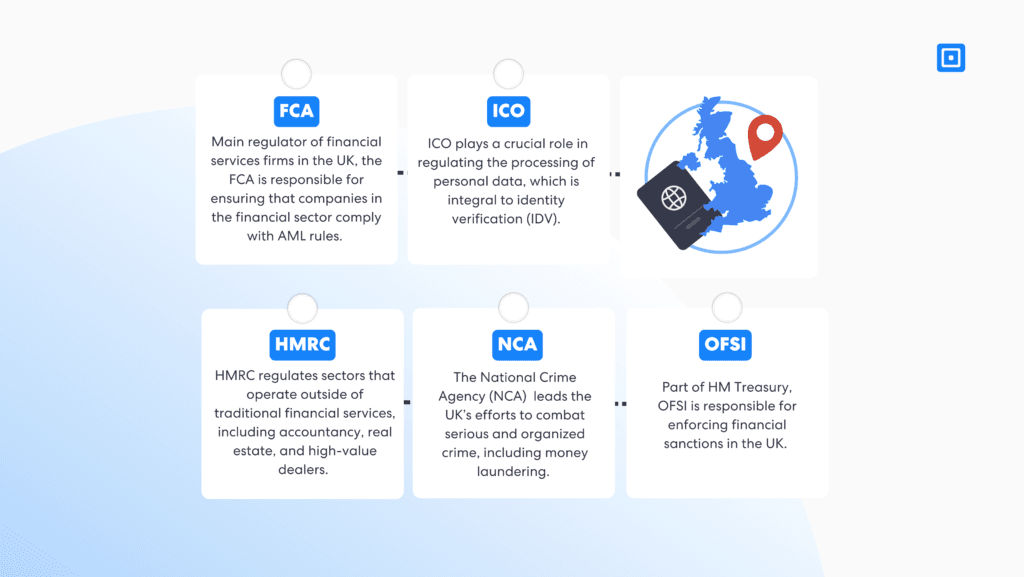
The [**Sanctions and Anti-Money Laundering Act**](https://www.gov.uk/government/publications/further-strengthening-hmrcs-ability-to-implement-financial-sanctions/strengthening-legislation-to-implement-financial-sanctions) granted the UK government the authority to create regulations and impose financial sanctions in 2018 after Brexit. Before SAMLA, these sanctions were largely governed by EU law. SAMLA outlines several regulations that businesses must comply with, particularly concerning financial sanctions. The framework outlines that businesses must ensure they do not engage in transactions with Designated Persons (DPs) or entities owned or controlled by DPs who are on sanctions lists. Companies also have a duty to report suspected sanctions breaches and freeze assets when necessary.
## UK Regulators
The enforcement of AML, IDV, and KYC regulation in the UK is not carried out solely by one organization but rather is pushed forth by several leading bodies, some of which include:
- **[Financial Conduct Authority (FCA)](https://www.fca.org.uk)**: As the main regulator of financial services firms in the UK, the FCA is responsible for ensuring that companies in the financial sector comply with AML rules. It sets out the requirements for AML controls, conducts supervisory reviews, and can impose penalties for non-compliance. Financial entities such as banks, insurance providers, and investment firms fall under the FCA’s jurisdiction for enforcement.
- **[HM Revenue & Customs (HMRC)](https://www.gov.uk/government/organisations/hm-revenue-customs)**: HMRC regulates sectors that operate outside of traditional financial services, including accountancy, real estate, and high-value dealers. It ensures these businesses adhere to AML and IDV regulations by conducting inspections, offering guidance, and taking enforcement actions where necessary. Additionally, HMRC collaborates with other law enforcement bodies to investigate and prosecute cases of money laundering.
- **[National Crime Agency (NCA)](https://www.nationalcrimeagency.gov.uk)**: The NCA leads the UK’s efforts to combat serious and organized crime, including money laundering. It plays a critical role in identifying, investigating, and dismantling illicit financial operations. The NCA analyzes suspicious activity reports from businesses, law enforcement, and international partners, conducts in-depth investigations into money laundering schemes, and seizes illegal assets, working closely with both domestic and global entities in the fight against financial crime.
- **[The Office of Financial Sanctions Implementation (OFSI)](https://www.gov.uk/government/organisations/office-of-financial-sanctions-implementation)**: Part of HM Treasury, OFSI is responsible for enforcing financial sanctions in the UK. Financial sanctions are an important tool in combatting money laundering and terrorist financing.
- **[The Information Commissioner’s Office (ICO)](https://ico.org.uk)**: While not directly involved in AML or KYC, the ICO plays a crucial role in regulating the processing of personal data, which is integral to identity verification (IDV) procedures. It ensures that organizations comply with data protection regulations, such as GDPR when collecting and storing information for KYC purposes.
## Who is Subject to AML Regulation in the UK?
The FCA reports that there are over [100,000](https://www.fca.org.uk/about/what-we-do/the-fca) businesses in the UK that are subject to AML regulations. This includes, but isn’t limited to:
- Financial institutions such as banks, building societies, and credit institutions
- Crypto exchanges and businesses
- High-value dealers (jewelers, art dealers, auctioneers, car dealers)
- Accountancies and law firms
- Money service businesses such as currency exchanges or money transfer services
- Real estate agents
- Crowdfunding platforms and fintechs
- Tax advisors
## Resources For AML Regulatory Compliance
[**FCA Handbook**](https://www.handbook.fca.org.uk/handbook/FCG/3/?view=chapter#:~:text=Customer%20due%20diligence%20(CDD)%20checks&text=Firms%20must%20identify%20their%20customers,and%20then%20verify%20their%20identities.)**:** The FCA provides a handbook that outlines expectations regarding customer verification and necessary checks, as well as further expectations such as ongoing monitoring. The handbook states, “Firms must identify their customers and, where applicable, their beneficial owners and verify their identities. They must also understand the purpose and intended nature of the customer’s relationship with the firm and collect information about the customer and, where relevant, the beneficial owner. This should be sufficient to obtain a complete picture of the risk associated with the business relationship and provide a meaningful basis for subsequent monitoring.”
> Firms [must identify their customers](https://www.handbook.fca.org.uk/handbook/FCG/3/?view=chapter) and, where applicable, their beneficial owners and verify their identities.
**[JMLSG Guides](https://jmlsg.org.uk/guidance/current-guidance/):** This guide lays out expectations regarding how businesses should prevent and approach money laundering and terrorist financing. It outlines expectations for firms to prevent financial crime while offering flexibility on how they apply these rules based on their specific products, services, transactions, and customer base.
**[HMRC’s notices](https://www.gov.uk/search/all?order=updated-newest&organisations%5B%5D=hm-treasury)** can also be helpful for monitoring AML, KYC, and IDV updates and expectations.
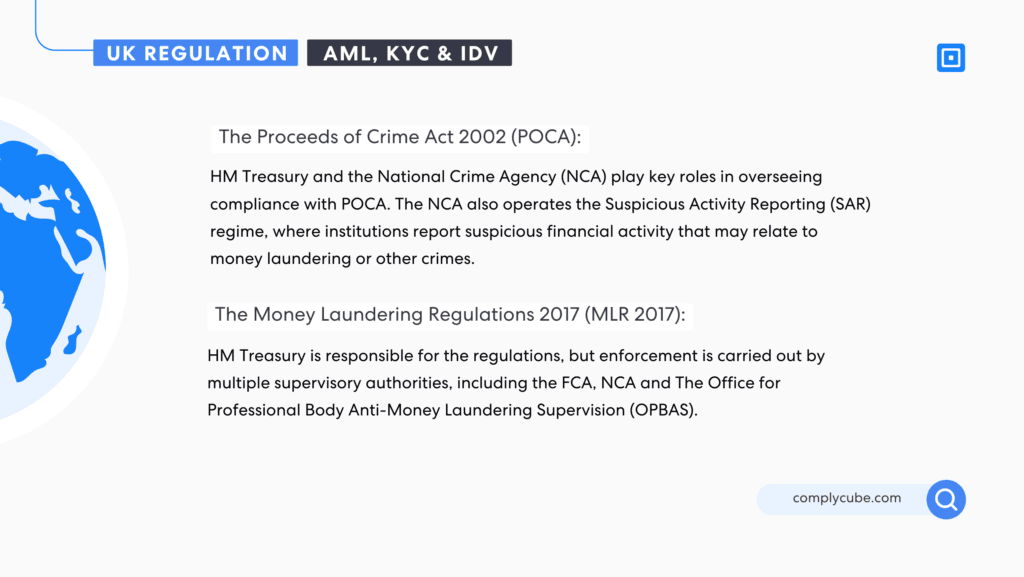
## Navigating Compliance in the UK
Ensuring that your business is able to stay compliant with national and international watchdog regulatory mandates is critical for scalable growth, global reputation, and avoidance of hefty fines. As fraud continually becomes more sophisticated, regulations will continue to tighten to ensure businesses take accountability for financial crime occurring on their doorstep.
Recent updates in the space include the world’s first scam reimbursement rule, which went live on the 7th of October in the UK. The FCA now requires banks, building societies, payment institutions, and e-money institutions to reimburse victims for their losses to digital fraud, paying up to £85,000 per case. This will surely increase the individual accountability of every business within the sector, making fraud prevention even more of a priority.
Partnering with a reliable IDV, AML, and KYC platform has now become critical to most businesses across the UK in ensuring regulatory compliance and preventing digital fraud. For more information on protecting your business from fraud, contact one of ComplyCube’s [compliance experts](https://www.complycube.com/en/contact/contact-sales/).

**Categories:** Guides
**Tags:** Anti-Money Laundering
---
### [Crypto AML Compliance: Securing the Sector](https://www.complycube.com/crypto-aml-compliance-securing-the-sector/)
**Published:** October 15, 2024
**Author:** Sofia Daley
**Excerpt:** Crypto AML compliance has become a central focus for both regulators and crypto businesses to ensure industry transparency and protect the financial system. However, crypto compliance still remains a widely debated topic.
**Content:**
Crypto AML compliance has become a central focus for both regulators and crypto businesses to ensure industry transparency and protect the financial system. However, crypto compliance remains a widely debated topic, as issues of money laundering, terrorist financing, and other financial crimes remain prevalent. This has led regulatory authorities to continue to impose stringent crypto KYC and AML measures on virtual asset service providers (VASPs), such as crypto exchanges.
This guide examines the crypto AML regulatory requirements that VASPs must follow according to regional and international policies.
## Money Laundering Saturates a Vulnerable Sector
The crypto sector presents fraudsters with the perfect environment to integrate illicit funds, due to the anonymity, global reach and decentralisation of the sector. Transactions are difficult to trace, taking place within networks that are decentralized and therefore increasingly difficult to regulate when compared to traditional banking. Fees for international transfers are relatively low, allowing for easy movement of illicit funds without standard levels of monitoring that are experienced within other sectors.
> In 2024, money laundering in crypto encompasses [all crime](https://www.chainalysis.com/blog/money-laundering-cryptocurrency/).
The sector’s rapid growth has also, at times, left regulators behind. Difficulty keeping up with new technologies, tokens, and platforms has been experienced by many of these watchdogs. Some specific technologies that have been difficult for regulators to keep up with include privacy coins, such as Monero or Zcash, which were created to enhance user privacy. This has made them increasingly difficult to monitor, creating a viable loophole for fraudsters to exploit.
> Since 2019, almost [$100 billion](https://www.cnbc.com/2024/07/16/crypto-is-increasingly-being-used-for-money-laundering-chainalysis-says.html#:~:text=Since%202019%2C%20almost%20%24100%20billion,was%20%2430%20billion%20in%202022.) in funds have been transferred from known illicit wallets to conversion services – where crypto is converted to fiat currency. The highest amount identified was $30 billion in 2022.
The staggering figure of nearly $100 billion transferred from known illicit wallets since 2019 underscores the urgent need for enhanced regulatory measures in the crypto sector. The reliance on conversion services to transform crypto into fiat currency provides a critical vulnerability that fraudsters exploit, taking advantage of the relatively low oversight in these transactions.
## The Rise of Regulations for Crypto AML Compliance
Anti-money laundering (AML) and Know Your Customer (KYC) regulations have long been present in Traditional Financial (TradFi) institutions. These regulations are designed to accurately identify users in the financial system and monitor their status. Doing this gives firms the best opportunity to prevent money laundering, ensuring that financial institutions are not being exploited to launder illicit funds or contribute to malicious activities.
It is no surprise, then, that a financial ecosystem that hinges on decentralization has warranted robust AML legislation as well. Initially, the lack of regulatory oversight in the crypto industry created opportunities for illicit activities such as money laundering and terrorist financing. This prompted the [Financial Action Task Force (FATF](https://www.fatf-gafi.org/en/home.html)) to call for tighter regulations, leading to the introduction of new comprehensive crypto AML regulations, such as the travel rule.
In 2019, FATF introduced the crypto travel rule, requiring VASPs to collect and share personal information of both senders and receivers of crypto transactions. The rule helps authorities monitor transactions, detect suspicious movements of money, and curb the flow of illicit funds through cryptocurrencies. For more information on FATF’s crypto travel rule, read [The Crypto Travel Rule](https://www.complycube.com/en/the-crypto-travel-rule-and-the-need-for-aml-compliance-software/).

## Key Crypto AML Compliance Procedures
For crypto firms, including cryptocurrency exchanges and crypto companies, adhering to AML compliance means implementing several key measures. These include:
### Crypto KYC
A cornerstone of AML compliance, the crypto KYC process requires crypto businesses to verify the identities of their customers. The customer identification program (CIP) is designed to ensure that companies can identify individuals conducting transactions.
> Non-KYC exchanges are more vulnerable to being [shut down or blacklisted](https://cointelegraph.com/explained/are-non-kyc-exchanges-riskier-understanding-legal-implications) by regulatory authorities, potentially leading to loss of access to funds.
Lack of adequate KYC measures leaves crypto exchanges vulnerable to being blacklisted or even shut down. Historical examples of this include:
- Derbit (2020): Derbit was forced to leave the Netherlands in 2020 after not complying with mandates of the Fifth Anti-Money Laundering Directive (5AMLD).
- BTC-e (2017): BTC-e was infamously shut down by U.S. authorities for lack of AML infrastrucutre.
- BitMEX (2020): While BitMEX was not completely shut down, the exchange faced significant legal difficulty for failing to implement sufficient KYC/AML procedures. U.S. regulators charged BitMEX’s founders with violating anti-money laundering rules.
> In 2022, after admitting guilt to AML violations in a case brought by the US Commodity Futures Trading Commission, the three founders were [collectively ordered to pay a $30 million civil penalty](https://www.bitdegree.org/crypto/news/grvt-introduces-new-hybrid-security-model-for-defi-enthusiasts)**.**
In 2022, after admitting to AML violations in a case brought by the U.S. Commodity Futures Trading Commission, the three BitMEX founders were collectively fined $30 million in civil penalties and received probation sentences. BitMEX’s guilty plea underscores the critical need for crypto exchanges to comply with U.S. financial regulations to maintain market integrity.
KYC processes involve customer identification and screening for politically exposed persons (PEPs) to mitigate terrorist financing risks. Learn more about the KYC process in the crypto industry by reading [How Crypto KYC Regulations Safeguard the Industry](https://www.complycube.com/en/how-kyc-crypto-regulations-safeguard-the-industry/).
### Transaction Screening and Monitoring
Effective transaction monitoring is essential for crypto and compliance. Crypto businesses must set up systems to monitor and flag suspicious transactions. This includes identifying patterns of behaviour that suggest potential money laundering or other financial crime. Such systems allow firms to report suspicious activity to the relevant authorities.
### Ongoing Monitoring
Ongoing Monitoring is an essential component of AML programs, ongoing monitoring ensures that firms continuously track customers and virtual currency transactions. This helps crypto exchanges spot suspicious activity that may occur even after the initial KYC screening.
When crypto transactions trigger red flags, companies are required to report them to the appropriate agencies. This process of reporting suspicious activity ensures that relevant law enforcement agencies can take timely action against individuals seeking to use crypto assets for money laundering purposes.
## Challenges and Opportunities in Crypto AML Compliance
Implementing crypto AML measures poses significant challenges for crypto firms and regulators. Ultimately, crypto regulation is looked at from two perspectives.
- On-chain regulation
- Off-chain regulation
Centralized Exchanges (CEXs) operate in a similar way to TradFi trading platforms, where an institution acts as a custodian on behalf of its users and holds crypto assets off-chain. These trading platforms then implement market-making mechanisms and other key trading infrastructures to facilitate trading actions and price movements.
Decentralized Exchanges (DEXs) are on-chain utilities where users buy and sell cryptocurrencies without an intermediary (i.e., a CEX). These actions are facilitated through smart contracts and are fulfilled on the blockchain. The decentralized and anonymous nature of these cryptocurrency transactions makes decentralized applications very challenging to regulate.
However, it is not just the industry itself that makes it hard to regulate. The digital asset space is an emerging market, meaning that there is a significant lack of standardization across jurisdictions, making it challenging for firms to ensure compliance.
Having said this, regulatory pressure is increasing, and major authorities are beginning to crack down on the application of crypto regulation with more vigor. This has led to the development of innovative solutions, such as cryptocurrency transaction monitoring tools, automated crypto KYC and AML processes, and on-chain analytics tools.
These tools help crypto businesses meet their regulatory requirements and protect the financial system from exploitation by criminals. Furthermore, financial institutions are now working alongside crypto businesses to develop integrated AML programs that align with both traditional and digital financial ecosystems.
## The Future of Crypto AML Compliance
Looking ahead, crypto AML compliance will only become more critical as the crypto industry matures. The ongoing dialogue between regulators and crypto firms will shape the future of AML compliance in the space. As AML measures become more sophisticated, businesses will need to leverage technology to meet AML requirements while maintaining customer privacy and operational efficiency.
Furthermore, the role of regulatory authorities such as FATF, along with increased cooperation between traditional financial institutions and crypto exchanges, will be key in ensuring a secure, transparent, and compliant crypto ecosystem.
By adopting appropriate measures, such as enhanced KYC programs and advanced transaction monitoring systems, the industry can not only meet AML compliance standards but also foster trust and legitimacy in the eyes of both regulators and consumers.
Crypto compliance in the virtual assets space is an essential component in the fight against money laundering and terrorist financing. As AML regulations continue to evolve, crypto businesses must stay proactive in implementing AML procedures, ensuring that they are not only complying with the law but also playing an active role in combating money laundering and safeguarding the integrity of the global financial system. The future of the crypto market depends on it.
For more information on how to fortify your crypto business with the right AML, KYC and IDV infrastructure, contact one of ComplyCube’s [compliance experts](https://www.complycube.com/en/contact/contact-sales/).

**Categories:** Guides
**Tags:** Crypto Regulations
---
### [Crypto Fraud Detection: Germany Dumps its Stash](https://www.complycube.com/crypto-fraud-detection-germany-dumps-its-stash/)
**Published:** October 3, 2024
**Author:** Sofia Daley
**Excerpt:** The need for crypto KYC is underlined once again as Germany is forced to shut down 47 exchanges as it sells its crypto stash due to a lack of crypto aml and KYC measures. KYC verification in crypto is critical for the crypto sector.
**Content:**
Germany has dumped its $3 billion crypto stash and shut down 47 exchanges that were being “used for criminal purposes” due to a lack of appropriate crypto KYC measures. This marks one of the biggest exchange enforcements in history, with large-scale crypto fraud detection having taken place. The worry after cases such as this is stifled innovation and growth of what was an emerging crypto sector in Germany, as startups or exchanges may now be discouraged – but this should certainly not be the case, as this could have been quite easily avoided with comprehensive crypto AML and KYC verification.
The crypto sector continues to be a prime target for fraudsters. Last month, Crypto News reported that it was the second most targeted industry for ID scams. CEXs attract bad actors as they hold large amounts of crypto in custody, making them lucrative targets for large-scale fraud attempts. To counter this, crypto exchanges must implement strong KYC systems, which not only enhance trust with users but also ensure compliance with regulatory bodies, helping to mitigate risks and maintain legitimacy in the industry. This guide will uncover the regulatory action imposed by BaFin and the German government on the Crypto sector, highlighting key downfalls and the road ahead.
## So, what happened?
Germany’s BTC stash was dumped over the summer, from June through July, until all 50,000 bitcoins had been sold. This quickly escalated uncertainty in the crypto sector—BTC prices took a hit while Germany’s hands were tied.
In a report from late March, the International Monetary Fund (IMF) stated that Germany is facing [economic challenges](https://www.imf.org/en/News/Articles/2024/03/27/germanys-real-challenges-are-aging-underinvestment-and-too-much-red-tape). It was the only G7 country to experience an economic contraction in 2023. The IMF also forecasts that Germany will continue to have the slowest growth among the G7 nations this year. A shrinking economy could very well be driving stricter regulatory enforcement in an attempt to stabilize the financial system by reducing the risks that come with unregulated markets.
> The crackdown was aimed at weakening and smashing the infrastructure of [cybercriminals](https://coingeek.com/global-authorities-tighten-screws-on-digital-asset-scams/) who had taken funds from the underground economy.
However, Germany’s central criminal investigation agency, the BKA, stated that the crackdown was aimed at “weakening and smashing the infrastructure of cybercriminals” who had taken funds “from the underground economy.” Illicit operations were leading to illegal funds circulating within unregulated crypto exchanges, making the exchanges a prime regulatory target in order to comply with several key financial regulations:
- **[EU Anti-Money Laundering Directive](https://www.lseg.com/en/risk-intelligence/financial-crime-risk-management/eu-anti-money-laundering-directive) (AMLD5 and AMLD6):** This directive enforces crypto exchanges and wallet providers to implement stringent KYC and AML processes to prevent money laundering and terrorist financing.
- **[Markets in Crypto-Asset Regulation](https://www.esma.europa.eu/esmas-activities/digital-finance-and-innovation/markets-crypto-assets-regulation-mica) (MiCA):** This directive has already been passed by the EU but has not yet been implemented as legislation. The regulation will focus on the implementation of a comprehensive framework to monitor crypto assets for consumer protection and financial stability.
- **[Financial Action Task Force ](https://www.fatf-gafi.org/en/home.html)(FATF):** The FATF is an international watchdog that prevents financial crime globally. Germany follows FATF guidelines to prevent the misuse of cryptocurrencies.
For more information on key crypto regulations across the globe, have a look at ComplyCube’s [Crypto Guides](https://www.complycube.com/en/?s=crypto).
## Crypto as a Prime Target
Despite regulatory pressures from watchdogs, the sector’s nature also makes enforcement inconsistent, creating gaps for fraudsters to exploit where a lack of adequate KYC is present. With exchanges offering a lucrative ROI on fraud, they must implement measures to ensure their own protection.
> Nearly [29% of global identity fraud](https://cryptonews.com/news/crypto-industry-is-the-second-most-targeted-for-id-scams-in-2024-report-shows/) attempts are targeted at crypto-related platforms.
[Crypto News](http://cryptonews.com/news/crypto-industry-is-the-second-most-targeted-for-id-scams-in-2024-report-shows/ "Crypto News") released a report in mid-September that highlighted the shocking amount of fraud within the crypto sector. The piece reads, “Nearly [29% of global identity fraud](https://cryptonews.com/news/crypto-industry-is-the-second-most-targeted-for-id-scams-in-2024-report-shows/ "Crypto News") attempts targeted crypto-related platforms, posing significant risks to the sector as criminals exploit the privacy inherent in blockchain transactions.”

The rise in fraud within the sector is largely driven by the evolution of the technology leveraged by bad actors, such as deepfakes. In June, the [crypto exchange Bitget reported a 245% increase in deepfake scams](https://cryptonews.com/news/deepfake-crypto-scams-to-double-surpassing-25b-in-2024/), predicting that global losses will surpass a shocking $25 billion in 2024.
> Global losses will surpass $25 billion in 2024.
Bitget’s report highlighted that the most affected countries are the United States, China, Germany, the United Kingdom, Ukraine, and Vietnam. A [recent report from the FBI](https://cryptonews.com/news/fbi-reports-5-6b-lost-to-crypto-fraud-45-increase-in-loss-since-prev-year/) similarly revealed that $5.6 billion was lost to crypto fraud in 2023, with nearly 69,000 complaints filed in the United States.
Crypto exchanges must prioritize implementing comprehensive KYC measures within their platforms. Without AML and KYC infrastructure, they risk not only severe regulatory enforcement, as we’ve seen in Germany, but also the loss of user trust in the platform.
## AML & KYC for Crypto Fraud Detection
It’s well known that the Crypto sector attracts money laundering practices and other illicit activities due to anonymity at scale and the lack of financial institutions supervising transactions. The need for KYC and AML measures is, therefore, higher than in other sectors. Implementing KYC processes reduces risks of crimes such as terrorist financing and aligns with global standards.
Identity verification can help Virtual Asset Service Providers (VASPs) prevent money laundering and other financial crimes by increasing individual accountability. With a robust KYC framework, exchanges can quickly identify and report suspicious activities to regulatory authorities, which can lead to timely investigations and interventions. Learn more about the dangers of a no-KYC crypto exchange in ComplyCube’s recent [guide](https://www.complycube.com/en/the-dangers-a-no-kyc-crypto-exchange-can-bring/).
By verifying identities, exchanges can also reduce the likelihood of account takeovers, phishing scams, and other forms of identity fraud that are rampant in the crypto space. However, robust KYC now goes far beyond only implementing Identity Verification (IDV). Market-leading providers offer an all-in-one solution that ensures adherence to global AML and KYC guidelines.

While the recent crackdown in Germany highlights the challenges facing the crypto sector, it also underscores the critical importance of robust KYC and AML measures. By prioritizing these systems, exchanges can not only comply with regulatory requirements but also protect their users and the integrity of the broader financial ecosystem. As the industry matures, embracing these practices will be essential for fostering innovation while ensuring a secure environment for all participants.
If you’re facing compliance challenges safeguarding your platform with AML and KYC measures, contact our [expert compliance team](https://www.complycube.com/en/contact/contact-sales/).
**Categories:** Guides
**Tags:** Crypto Regulations
---
### [Deepfakes vs. Biometric Liveness Detection](https://www.complycube.com/deepfakes-vs-biometric-liveness-detection/)
**Published:** September 23, 2024
**Author:** Sofia Daley
**Excerpt:** Deepfake technologies are subverting facial authentication processes. As fraud becomes increasingly sophisticated, organizations must protect themselves with biometric liveness detection to quickly identify presentation attacks.
**Content:**
In today’s digital landscape, it’s almost impossible to distinguish a deepfake video from an authentic one. The rise of new AI-powered attacks leaves organizations struggling to find the proper security infrastructure to fight back. The most powerful tool is certainly biometric liveness detection technology, allowing for secure biometric verification processes and enhanced security. Liveness detection provides a sophisticated facial authentication process that can examine subtle micro-expressions, skin texture, and more – stopping presentation attacks through the analysis of biometric data. This guide will explore how deepfake technologies are subverting facial authentication processes, the new threats they pose, and how organizations can protect themselves with liveness detection.

## How Does Liveness Detection Work?
Liveness detection is an AI-powered tool that leverages advanced algorithms to differentiate presentation attacks from authentic users, such as spoofed images or deepfakes. It is the primary defense against evolving attacks.
These solutions work by processing large amounts of data in real time, often using 3D scanning. When running a facial scan, the system creates a 3D face map of facial features that can be compared against existing data. Liveness detection then analyzes movements, helping the facial recognition system confirm the existence of a live person.
## How Deepfakes Subvert Facial Recognition Technology
While many might be aware of deepfakes existing amongst mainstream media, many organizations don’t realize just how realistic they are becoming. Recent data showed that “human subjects identified high-quality deepfake videos only [24.5%](https://eftsure.com/statistics/deepfake-statistics/#:~:text=Human%20detection%20of%20deepfake%20images,only%2024.5%25%20of%20the%20time.) of the time.” Without the right tools, businesses cannot spot deepfakes 75% of the time, proving the urgent need for liveness detection.
## Key Deepfake Statistics:
- Human subjects identified high-quality deepfake videos only [24.5%](https://eftsure.com/statistics/deepfake-statistics/) of the time.
- [1 in 4](https://eftsure.com/statistics/deepfake-statistics/) leaders are not aware of deepfakes or the threat that they pose.
- [1 in 10](https://eftsure.com/statistics/deepfake-statistics/) executives have already experienced security threats from deepfakes.
- In 2023, the number of deepfakes across all industries [multiplied by 10](https://eftsure.com/statistics/deepfake-statistics/).
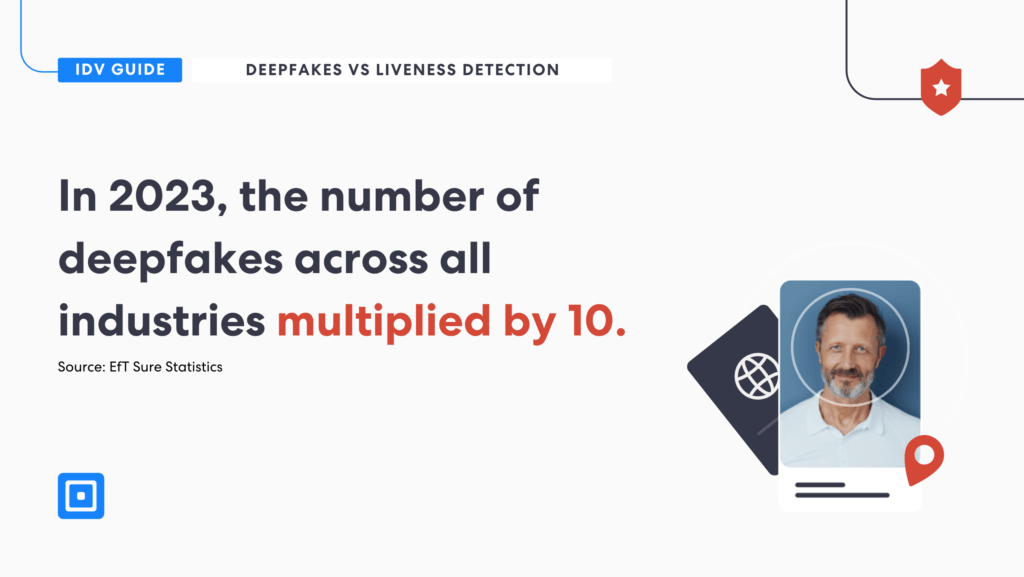
The market is slowly adopting liveness detection as businesses confront the threat of deepfake technology. Bret Kinsella, CEO and founder of Voicebot.ai, argues that while deepfake detection is currently still considered a novelty, its time as such is limited. Earlier this year, Kinsella stated,” While deepfake detection is essentially a novelty for companies in their call centers today, it will become widely adopted and increasingly be viewed as standard security hygiene over the [next five years](https://synthedia.substack.com/p/the-surprising-tactics-of-deepfakes).”
Just about anyone can now create deepfakes using accessible software such as DeepFaceLab, which is used to create over [95% of deepfakes](https://eftsure.com/statistics/deepfake-statistics/). Videos that explain how to create deepfakes can now be found on YouTube, with in-depth tutorials that are globally accessible.
## Biometric Liveness in the Digital Age
Identity verification should be a requirement for every online platform, but a standard document check can be coupled with biometric authentication for optimal security. A biometric system can perform a liveness check, using a facial scan to ensure a live human being is presenting the identity. Biometric traits are analyzed, with an active liveness check prompting users to conduct motion analysis. Biometric liveness detection work is critical for ensuring fraud prevention within onboarding processes.
> Without [liveness detection](https://www.biometricupdate.com/202409/outdated-biometric-liveness-tests-create-false-sense-of-security-facetec-argues), and 3D liveness in particular, presentation attack detection (PAD) technologies may not perform as advertised.
Biometric Update, a leading industry news platform focused on biometric technology and digital identity, states, “Biometrics are replacing legacy knowledge-based authentication for remote and unsupervised authentication scenarios. But the latest liveness detection report from FaceTec argues that without [liveness detection](https://www.biometricupdate.com/202409/outdated-biometric-liveness-tests-create-false-sense-of-security-facetec-argues), and 3D liveness in particular, presentation attack detection (PAD) technologies may not perform as advertised.”
> Standard facial recognition systems fail to detect [spoof attacks](https://www.forbes.com/councils/forbesbusinesscouncil/2024/02/09/a-guide-to-liveness-detection-enhancing-facial-recognition-security/), which include high-quality 3D silicone masks or deep fakes.
Liveness detection is critical, as systems are unable to detect signs of fraud without analyzing a biometric sample. Liveness detection algorithms enhance security and effectively prevent fraudsters, and checks with user interaction (active liveness detection) provide the highest level of security.
## Active Liveness Detection Technology
Active liveness detection consists of prompting user actions in real time. Users are guided through the prompts and are often required to perform movements such as blinking, smiling, turning their heads, or nodding.
Real-time feedback allows the liveness detection technology system to examine facial features and behavioral subtleties, tracking subtle natural expressions. These might include muscle movement or slight head shifts. Again, micro-expressions are very difficult to replicate within a fraudulent attempt.
## Passive Liveness Detection Technology
Passive biometric checks don’t require the user to perform real-time actions as they don’t analyze movement. AI-powered machine learning software runs checks swiftly, with minimal user interaction. With users and potential fraudsters unaware that an identity verification check is occurring, the check is more spoof-proof.
Unlike active liveness, passive liveness is much quicker and offers a smoother experience since users don’t need to perform several actions in front of the camera. Both liveness checks are highly effective in helping organizations detect and prevent fraud.
## Biometric Liveness Detection with ComplyCube
ComplyCube offers a state-of-the-art biometric check that leverages liveness detection technology. The solution analyses facial biometric data samples and examines the validity of documentation in conjunction. Some of the features of their solutions include:
[**Robust facial recognition and similarity**](https://www.complycube.com/en/solutions/identity-assurance/biometric-verification/)**:** ComplyCube’s advanced ISO 30107-3 and PAD Level 2-certified biometric liveness detection technology ensure that the individual presenting an identity document matches the submitted details. Their Identity Verification (IDV) technology offers a thorough analysis by combining biometric and behavioral factors, providing the highest level of verification assurance.
[**Advanced document verification**](https://www.complycube.com/en/solutions/identity-assurance/document-verification/)**:** ComplyCube combines AI with skilled experts to perform thorough checks on ID documents, ensuring they haven’t been tampered with, forged, copied from the internet, expired, or blacklisted. Supported documents include passports, travel documents, driver’s licenses, national ID cards, residence permits, and visa stamps.
[**Expert liveness detection**](https://www.complycube.com/en/solutions/due-diligence-compliance/know-your-customer/liveness-detection/)**:** Their AI-powered PAD-Level 2 liveness detection software can determine genuine customer presence and identify imposters. ComplyCube leverages anti-spoofing detection that protects businesses from sophisticated attacks.
[**Seamless biometric enrolment**](https://www.complycube.com/en/solutions/identity-assurance/customer-authentication/)**:** A top-tier guided face capture technology that ensures seamless authentication for accessing Finance, Telecommunications, Travel, Enterprise Services, and more.

Contact their [expert compliance team](https://www.complycube.com/en/contact/contact-sales/) today and safeguard your business from identity fraud.
**Categories:** Guides
**Tags:** Identity Verification
---
### [Securing Your Business with Identity Proofing](https://www.complycube.com/securing-your-business-with-identity-proofing/)
**Published:** September 6, 2024
**Author:** Sofia Daley
**Excerpt:** Identity proofing is the process of verifying a user’s identity. It is a critical component of a business's security infrastructure, as digital identity verification solutions can accurately identify fraudulent presentation attacks.
**Content:**
Identity proofing is the process of verifying a user’s identity, confirming that they are who they claim to be. It is a critical component of a business’s security infrastructure, as digital identity verification solutions can accurately identify fraudulent presentation attacks. With the development of new technologies, such as deepfakes, businesses must fortify their authentication processes before they face the inevitable losses that identity fraud entails.
## The Evolving Threat of Identity Fraud for Businesses
In 2023, a study by KPMG found that the majority of businesses in the US were at risk of presentation attacks, [with only 29% of organizations](https://kpmg.com/kpmg-us/content/dam/kpmg/pdf/2023/deepfakes-real-threat.pdf) having implemented the necessary PAD measures, including a biometric authentication process.
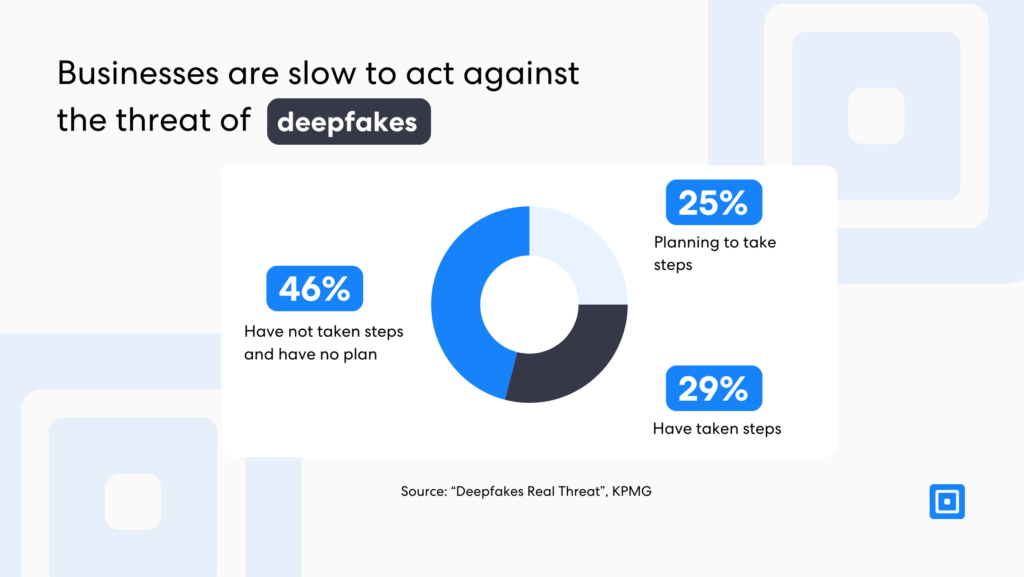
As deepfakes emerge in mainstream media, businesses must prepare themselves for sophisticated presentation attacks that can only be counteracted with robust liveness detection practices. Synthetic identities are also on the rise, with data in the US pointing to serious economic losses due to Synthetic Identity Fraud (SIF). These consist of fictitious identities that combine real and fabricated information and prove highly deceptive.
> The Federal Trade Commission data shows that consumer-reported fraud reached over [$10 billion in 2023.](https://www.fiverity.com/resources/sif-report-2024) That marks a new level of losses, and a good portion of this statistic comes from Synthetic Identity Fraud (SIF).
This quote provides a stark reminder of the vulnerabilities that businesses face. A significant portion of these losses is attributed to the creation of synthetic identities. This rise in synthetic identities and attacks involving deepfakes underscores the urgent need for businesses to enhance their defenses.
Fiverity’s 2024 Identity Fraud Report states that “The total loss due to SIF can be estimated at [$31.8 billion for a mature identity](https://www.fiverity.com/resources/sif-report-2024) with an average of 7 accounts and an average loss amount of $3,000 per account and $30.3 billion under assumptions of 5 accounts per identity with an average loss of $4,000 per account.”
For businesses, these losses represent not only direct financial damage but also a broader risk to their operational integrity and reputation. The fact that synthetic identities are proving highly deceptive means that many companies might unknowingly be onboarding fraudulent customers, exposing them to further financial losses, potential regulatory penalties, and reputational harm.
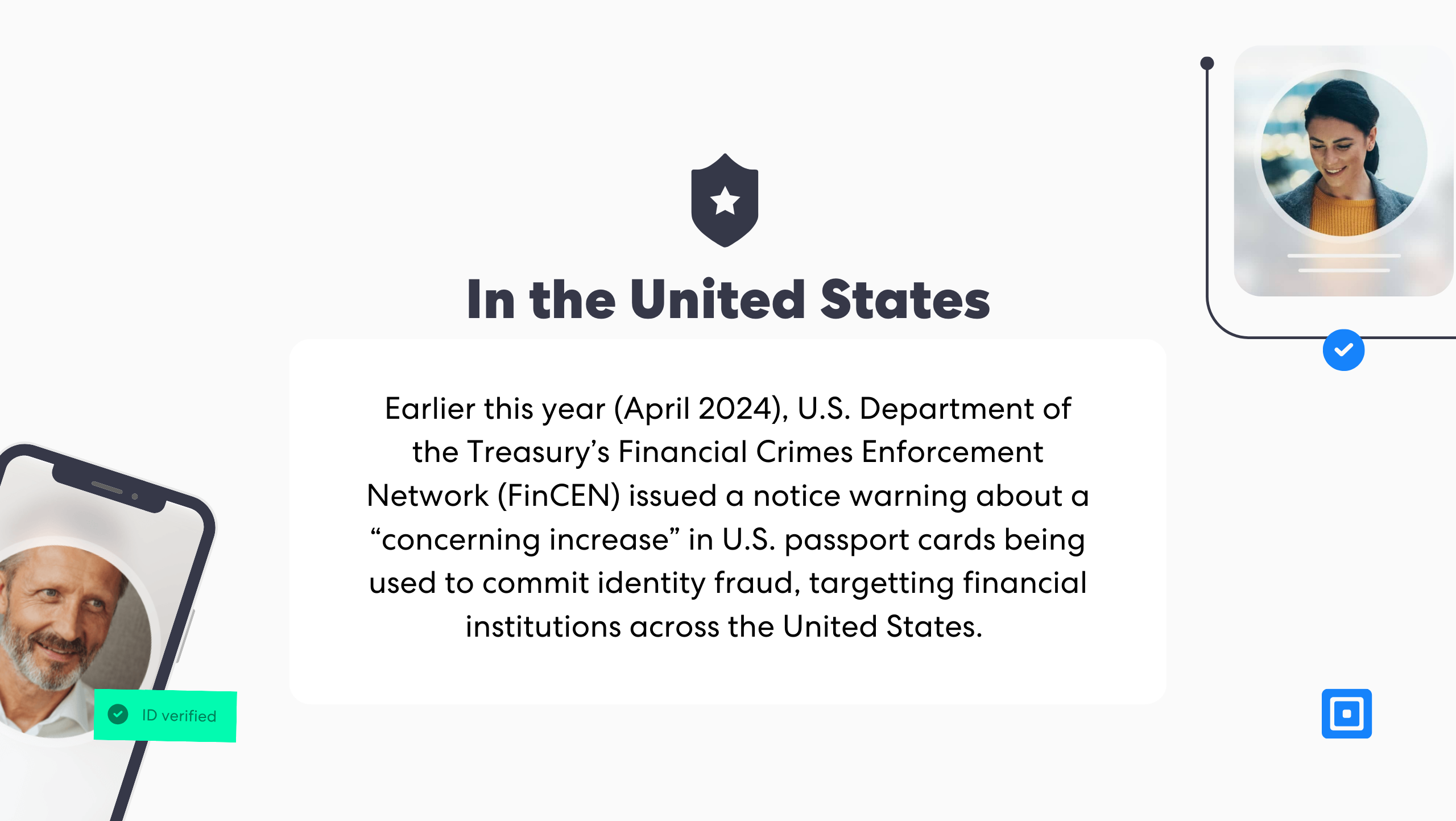
The US Department of the Treasury’s Financial Crimes Enforcement Network (FinCEN) issued a notice in April of this year warning that there had been a “concerning increase” in US passport cards being used to commit identity fraud, targeting financial institutions across the United States. Therefore, the need for sophisticated document and identity checks is continually increasing as national bodies identify an undeniable growing threat.
## How Identity Proofing Works
Identity proofing allows for the verification of a user’s identity through sophisticated solutions, including biometric identity verification, document checks, and more. The right identity-proofing system can automatically perform this work, gathering information about the user, verifying their claimed identity, and approving their registration or access request without margin for error.
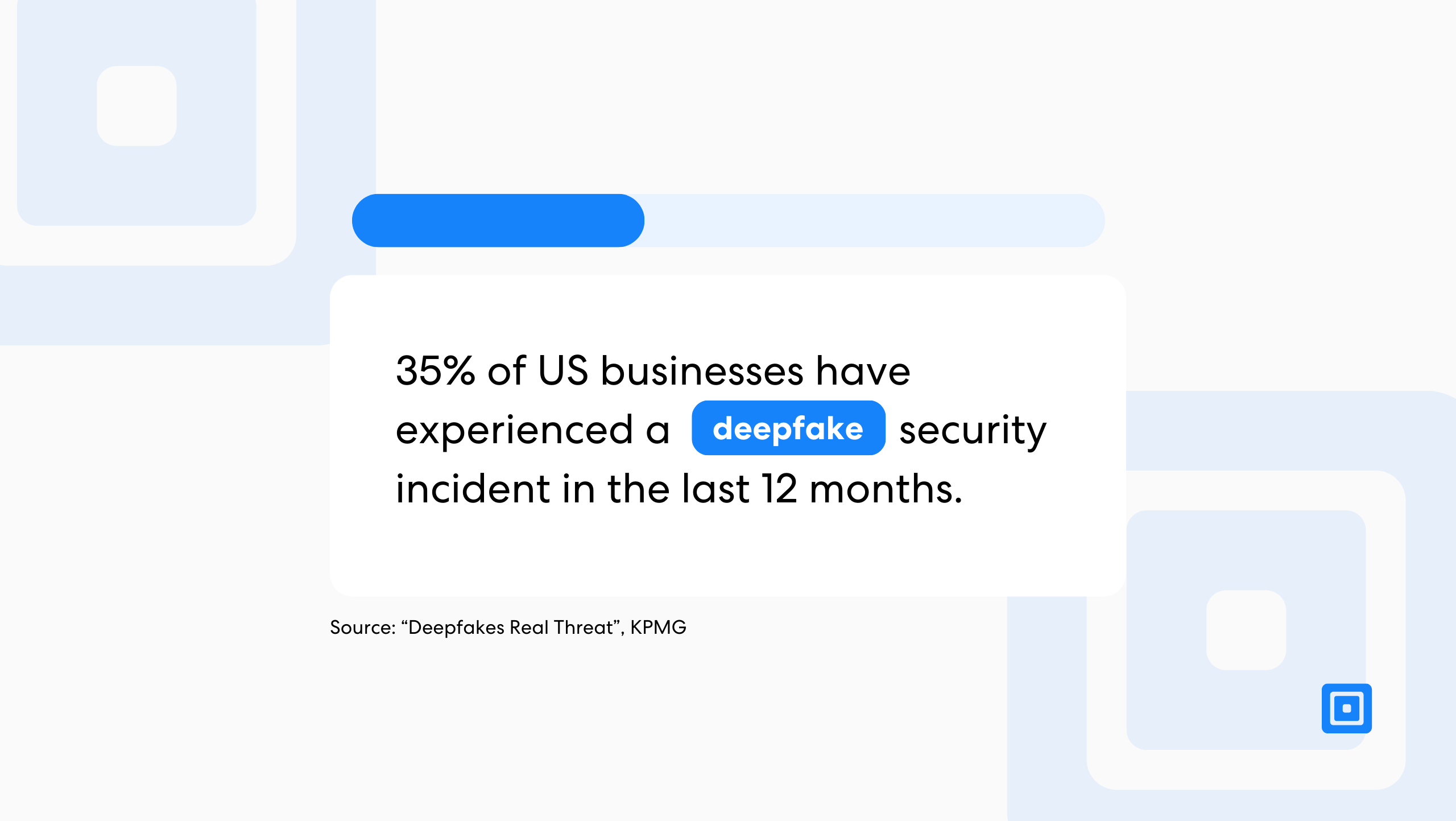
Identity proofing plays an important role in both new account opening and authentication scenarios. Verifying the identity of new customers and authenticating existing customers over the lifecycle of their relationship with a business protects the company from fraud.
## Identity Verification: Use Cases
In reality, most businesses would benefit from some form of identity verification process, as most systems and databases contain sensitive data that could be breached. However, some examples of potential ‘use cases’ include:
**Financial Institutions:** Banks, fintechs, and payment processors need identity proofing to prevent fraud, comply with KYC and AML regulations, and secure customer accounts during new account openings and transactions.
**Healthcare Providers:** Hospitals, clinics, and telehealth services use identity proofing to protect sensitive patient data and ensure compliance with privacy regulations like HIPAA.
**Telecommunications Companies:** Mobile and internet service providers use identity proofing to verify user identities, prevent unauthorized access, and protect customer data.
**E-commerce and Retail:** Online retailers need identity proofing to prevent fraudulent transactions and protect both customers and the business from unauthorized access and fraud.
**Social Media Platforms:** Social networks utilize identity proofing to verify users, enhance security, and prevent issues like catfishing and impersonation.
**Mobility as a Service Companies:** Ride-sharing and other transportation services rely on identity proofing for driver verification to ensure safety and security for all users.
**Crypto Exchanges and Wallets:** Cryptocurrency platforms use identity proofing to verify users, prevent fraud, and comply with regulatory requirements to secure digital assets and transactions.
## Identity Proofing Solutions: Liveness Detection
Liveness detection is a security feature used in biometric identity verification systems that ensures biometric data (such as a fingerprint, face, or iris scan) belongs to a live, present individual rather than a spoof or fake representation (like a photo, video, 3D mask or deepfake).
> Nearly 8 in 10 [Brits want banks to adopt the latest technology to keep their accounts safe](https://www.miteksystems.com/press-releases/survey-reveals-tech-trust-gap-amongst-uk-bank-customers). Citizens even ranked security as a priority over ease of access or account opening.
Liveness detection offers the highest level of security when it comes to identity verification, which is now being demanded by users. With 9 in 10 attacks on IDV systems being presentation attacks, liveness detection must be implemented to secure authentication processes from being hacked.
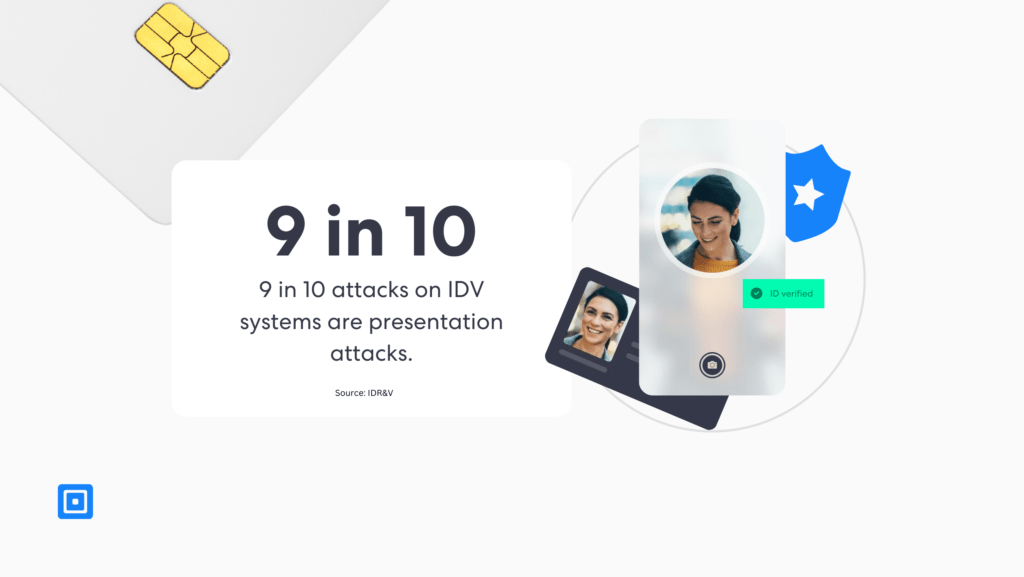
A recent study on 1,000 UK bank users conducted by FICO underlines that [73% of people ](https://www.fico.com/en/newsroom/fico-uk-research-finds-fraud-protection-bank-s-secret-advantage)consider comprehensive fraud protection a primary concern when creating their accounts. This concern is to be expected, with news on how deepfakes are being used to open accounts fraudulently circulating worldwide media platforms. Using liveness detection to spot subtle signs of fraud in micro-expressions, skin texture, and more is essential to differentiating a presentation attack from that of a live person.
## The Rise of Deepfakes
Deepfakes and the misuse of synthetic content pose a clear, present, and evolving threat to the public across national security, law enforcement, financial, and societal domains.In 2023 alone, the use of deepfakes to bypass facial authentication [systems in the U.S. increased by 704%.](https://www.forbes.com/councils/forbestechcouncil/2024/06/18/navigating-the-perils-of-deepfakes/)

The U.S. Department of Homeland Security warned that “deepfakes and the misuse of synthetic content pose a clear, present, and evolving threat to the public across national security, law enforcement, financial and societal domains.”
With the growing demand for strong fraud prevention in new account openings, advanced presentation attack detection systems are more than just a security measure—they offer businesses a distinct competitive edge. As James Roche, a principal consultant at FICO, emphasizes, “Customers are looking for [providers they can trust](https://www.fico.com/en/newsroom/fico-uk-research-finds-fraud-protection-bank-s-secret-advantage), so institutions should shout about the excellent fraud protection they provide.”
## Digital Identity Verification with ComplyCube
ComplyCube offers a state-of-the-art identity proofing solution that analyses biometric data efficiently in a matter of seconds, as well as examines the validity of documentation. Some of the features of their solutions include:
**[Robust facial recognition and similarity](https://www.complycube.com/en/solutions/identity-assurance/biometric-verification/):** ComplyCube’s advanced ISO 30107-3 and PAD Level 2-certified biometric liveness detection technology can verify whether the person presenting the identity document matches the documentation submitted. Their IDV technology provides a comprehensive analysis, leveraging biometric and behavioral vectors to give you the highest level of assurance.
**[Advanced document verification](https://www.complycube.com/en/solutions/identity-assurance/document-verification/):** ComplyCube leverages the optimal blend of AI and trained human experts to conduct various checks on ID documents, ensuring they haven’t been compromised, forged, copied from the internet, expired, or blacklisted. Supported identification includes passports, travel documents, driver’s licenses, national ID cards, residence permits, and visa stamps.
**[Expert liveness detection](https://www.complycube.com/en/solutions/due-diligence-compliance/know-your-customer/liveness-detection/):** Their AI-powered PAD-Level 2 liveness detection software can determine genuine customer presence and identify imposters. ComplyCube leverages anti-spoofing detection that protects businesses from sophisticated attacks.
**[Seamless biometric enrolment](https://www.complycube.com/en/solutions/identity-assurance/customer-authentication/):** Technology that provides the best-in-class guided face capture to deliver frictionless authentication to access Finance, Telecommunications, Travel, Enterprise Services, and much more.
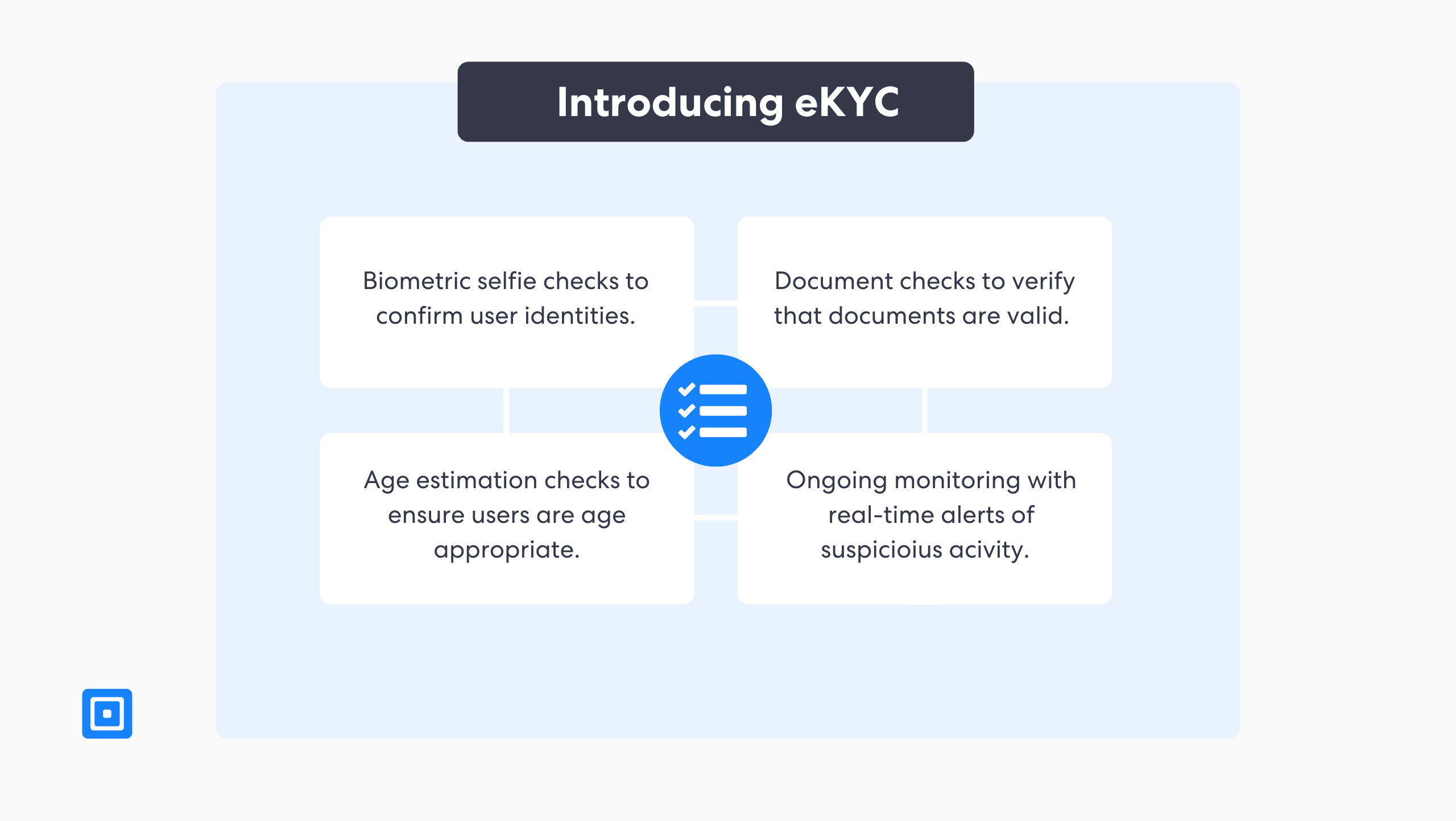
## Identity Proofing Services
ComplyCube is renowned for its state-of-the-art identity verification (IDV) and anti-money laundering (AML) checks, offering advanced security measures alongside a seamless user experience. The platform streamlines onboarding processes to under 30 seconds while maintaining precise IDV, AML, and KYC compliance.
Reach out to ComplyCube’s [expert compliance team](https://www.complycube.com/en/contact/contact-sales/) to explore how liveness detection can be implemented to protect against sophisticated fraud attempts.

**Categories:** Guides
**Tags:** Identity Verification
---
### [ComplyCube Elevates GRVT Crypto Onboarding for Millions](https://www.complycube.com/complycube-powers-grvt-crypto-onboarding-for-millions/)
**Published:** October 2, 2024
**Author:** Andreea Balasa
**Excerpt:** ComplyCube has partnered with GRVT, the next-gen hybrid derivatives exchange, to onboard users at scale while ensuring compliance with international crypto regulations, delivering secure, compliant, and seamless crypto onboarding.
**Content:**
London, October 2, 2024 — [ComplyCube](https://www.complycube.com/en/ "https://www.complycube.com/en/"), the RegTech100 global leader in Anti-Money Laundering (AML) and Know Your Customer (KYC) solutions, has partnered with [GRVT](https://grvt.io/ "https://grvt.io/"), the next-generation hybrid derivatives exchange, to redefine the global financial system through blockchain technology. Together, they will onboard users at scale while ensuring compliance with international crypto regulations, delivering secure, compliant, and seamless crypto onboarding for millions of users eager to sign up.
## Rising Cyber Threats and the Role of Compliance Technology
With deepfake attacks on crypto exchanges projected to [rise by 245% in 2024](https://www.complycube.com/en/why-identity-verification-ai-is-crucial/ "https://www.complycube.com/en/why-identity-verification-ai-is-crucial/"), cybercriminals are increasingly utilizing advanced methods to bypass financial safeguards. As a result, innovative compliance technology is now a cornerstone in the fight against money laundering and illicit crypto activities.
## A Trailblazer in the Crypto Space
Founded in 2022, GRVT is a hybrid derivatives exchange that combines off-chain order matching with on-chain settlements at an impressive speed of 600,000 TPS. Ahead of its Q4 Mainnet launch, GRVT has already secured commitments from 16 leading market makers and a monthly volume of $3.3 billion, backed by over 40 institutional clients including notable names such as Galaxy Trading Asia Limited, Ampersan, Amber Group, IMC, Flow Traders, Pulsar, QCP, and Selini.
In today’s volatile crypto landscape, the importance of robust [AML and KYC solutions](https://www.complycube.com/en/solutions/due-diligence-compliance/anti-money-laundering/?_gl=1%2A1juz0jb%2A_up%2AMQ..%2A_ga%2AMTQyOTA2MTEzOC4xNzI3Nzc5NjM5%2A_ga_1DN1ERTT4P%2AMTcyNzc3OTYzOC4xLjAuMTcyNzc3OTYzOC4wLjAuMA.. "https://www.complycube.com/en/solutions/due-diligence-compliance/anti-money-laundering/?_gl=1*1juz0jb*_up*MQ..*_ga*MTQyOTA2MTEzOC4xNzI3Nzc5NjM5*_ga_1DN1ERTT4P*MTcyNzc3OTYzOC4xLjAuMTcyNzc3OTYzOC4wLjAuMA..") cannot be overstated. GRVT is set to become the first regulated decentralized exchange (DEX) to settle directly on the blockchain, pioneering greater compliance from day one. This move aims to attract a broader range of traders, including those from traditional finance sectors and crypto-native participants.
## Building Trust with Robust KYC & AML Crypto Compliance
As GRVT seeks to redesign the global financial system through blockchain, the exchange requires a KYC provider capable of matching its commitment to providing a seamless user experience. It needed to ensure instant onboarding, zero downtime, and unmatched accuracy in data extraction to handle the expected surge of new users in the coming years.
> Having a robust technology partner like ComplyCube ensures that we can offer a secure and scalable trading environment.
GRVT’s Co-Founder and CEO, Hong Yea, remarked, “At GRVT, we understand that AML and KYC compliance is essential for building trust in the digital assets space. In such a fast-evolving market, maintaining high compliance standards is crucial for protecting both our users and the broader financial system. Having a robust technology partner like ComplyCube ensures that we can offer a secure and scalable trading environment.”
## Meeting Global Scale with Advanced Solutions
Given the scale of GRVT’s ambitions, the chosen KYC/AML solution had to be capable of processing millions of transactions simultaneously across global markets. With over 2.5 million users ready to join the hybrid exchange, a [cost-effective and globally scalable solution](https://www.complycube.com/en/pricing/ "https://www.complycube.com/en/pricing/") was essential. ComplyCube emerged as the perfect partner, offering automated enhanced due diligence checks that allow GRVT to onboard users in less than a minute while maintaining the highest levels of identity verification.
> We’re proud to support GRVT in building a secure, compliant, and innovative trading environment for users around the world.
Dr. Tarek Nechma, CEO of ComplyCube, commented, “Partnering with GRVT showcases the global applicability and reliability of our AML and KYC solutions. We’re proud to support GRVT in building a secure, compliant, and innovative trading environment for users around the world.”
## Seamless, Secure, and Scalable Solutions for a Global User Base
ComplyCube’s advanced user verification solutions power GRVT’s automated onboarding process, providing a seamless and secure user experience without compromising on data accuracy. This capability is vital for adhering to rapidly evolving regulatory requirements while giving GRVT a competitive edge. Superior data integrity ensures faster compliance decisions, reinforcing the trust between GRVT and its growing user base.
As key regulatory bodies, such as the Financial Action Task Force and Basel Committee, increasingly [advocate for the use of technology to combat financial crime](https://www.complycube.com/en/tag/crypto-regulations/ "https://www.complycube.com/en/tag/crypto-regulations/"), ComplyCube is well-positioned to continue its mission of building trust on a global scale.
> Crypto exchanges like GRVT need robust tools to detect and prevent illicit activities. ComplyCube’s IDV and AML solutions empower GRVT to achieve this, adding a crucial layer of trust to the digital financial ecosystem.
“Advanced technologies are not only reshaping the financial industry but also being exploited for laundering vast sums of money. Crypto exchanges like GRVT need robust tools to detect and prevent illicit activities. ComplyCube’s IDV and AML solutions empower GRVT to achieve this, adding a crucial layer of trust to the digital financial ecosystem,” said Mohamed Alsalehi, CTO of ComplyCube.
## Driving Growth and Trust with Crypto Onboarding for GRVT
ComplyCube has played a pivotal role in supporting GRVT as it continues to gain momentum in the crypto space. Unlike other providers, ComplyCube’s solutions are adaptable, customizable, and tailored to GRVT’s specific needs, allowing the exchange to onboard thousands of users from day one and accelerate its growth trajectory.
## About ComplyCube
[ComplyCube](https://www.complycube.com/en/) is an industry leader in Identity Verification (IDV), Anti-Money Laundering (AML), and Know Your Customer (KYC) compliance solutions. Renowned for its reliable offerings across multiple sectors, the company’s solutions are programmable via powerful SDKs and APIs. ISO-certified, ComplyCube is dedicated to helping businesses navigate the complexities of compliance and client acquisition in the financial sector.
## About GRVT
Founded in 2022, [GRVT](https://grvt.io/ "https://grvt.io/") (pronounced “gravity”) is a hybrid derivatives exchange offering off-chain order matching and on-chain settlements at a remarkable speed of 600,000 TPS. GRVT’s mission is to transform the global financial system using blockchain technology, empowering individuals to create and fully control their wealth. Dubbed the “Goldman Sachs of blockchain,” GRVT combines institutional expertise with the potential of decentralized finance. GRVT’s vision is to create an open, scalable marketplace—similar to the “Amazon of DeFi”—where users can easily access a variety of financial products.
### Disclaimer
*Disclaimer: Cryptocurrencies carry high risks. This content is not a distribution of, or an offer or solicitation to provide, financial services or products, nor a representation as to their suitability or legality for you. GRVT is not a regulated entity and your funds are not subject to regulatory protection. Before making any decision based on this content, please seek financial and legal advice, and carefully review GRVT’s* [*Risk Disclosure and Disclaimer*](https://help.grvt.io/en/articles/9614731-risk-disclosure-disclaimer) *in full.*
***UK users:** GRVT is not licensed or regulated by the Financial Conduct Authority in any capacity, and does not engage with any authorised firms in the United Kingdom. GRVT is not intended to be accessed by persons in the United Kingdom. GRVT does not solicit business or transactions in crypto assets from residents or entities operating in the United Kingdom. Neither GRVT nor investments in crypto assets are covered by the Financial Ombudsman Service or subject to protection under the Financial Services Compensation Scheme.*
**Categories:** News
**Tags:** Announcements
---
### [UK DIATF-Certified Right to Rent Checks ](https://www.complycube.com/uk-diatf-certified-right-to-rent-checks/)
**Published:** September 30, 2024
**Author:** Sofia Daley
**Excerpt:** Tenancy fraud is on the rise. Screening and verifying tenants should always include comprehensive Right to Rent checks carried out by a UK government DIATF-certified Digital Identity Service Provider (IDSP).
**Content:**
With rental accommodation in short supply across the UK, landlords have experienced increasing difficulty with fraudulent tenancy applications. Faking jobs or hiding criminal records are just a couple of examples of common fraudulent practices. Screening and verifying tenants should always include comprehensive Right to Rent checks carried out by a UK DIATF-certified Digital Identity Service Provider (IDSP).
Tenancy fraud has quadrupled over the past couple of years in the UK as spoofed documents have become increasingly sophisticated with AI tools. Letting agents should ensure tenants have the right immigration status and a legal right to rent property in the United Kingdom by partnering with a certified IDSP that can ensure presented documents are legitimate. Prospective tenants cannot be verified without undergoing a sophisticated document and biometric check to ensure not just the legitimacy of documentation but also that the identity presented is not fraudulent.
> The surge in[ rental fraud](https://www.forbes.com/councils/forbesbusinesscouncil/2024/08/23/surging-rental-fraud-and-how-to-avoid-it/) reflects not only the challenges within the housing market but also the ingenuity of fraudsters exploiting systemic vulnerabilities.
Currently, British and Irish citizens must prove their legal right to rent within the country by just showing an identity document, such as a British passport. However, with cases of tenancy fraud on the rise, landlords are left vulnerable to a long list of possible threats without sufficient checks, such as non-payment of rent, legal issues, property damage, and more.
## Tenancy Fraud in the UK and Ireland
Landlords in the UK are held accountable for allowing renters to live in a property without a legal right. Shelter England, a well-known UK housing and homelessness charity, states, “the landlord might face civil or [criminal penalties](https://england.shelter.org.uk/professional_resources/legal/housing_options/private_renting/right_to_rent_immigration_checks) if they let to someone without a right to rent or allow them to remain after their right to rent has expired.” With the recent surge of fraudulent practices within the UK rental market, such as a reported increase in council homes being illegally sub-let, landlords and rental agencies must act to protect themselves.
>
Tom Entwistle, a recognized writer in the UK on the subject of residential and commercial property, wrote in early 2024 that there has been a “[four-fold increase](https://www.landlordzone.co.uk/news/desperation-is-driving-tenants-to-make-fake-claims-on-rental-applications) in fraudulent tenancy applications over the past two years, which included doctoring bank statements exaggerating income, faking jobs and job references, and hidden criminal records.”
> From fabricated pay stubs and tampered credit histories to [falsified background checks](https://www.forbes.com/councils/forbesbusinesscouncil/2024/08/23/surging-rental-fraud-and-how-to-avoid-it/), applicants are going to great lengths to appear as attractive tenants.
However, the sudden increase in rental fraud is not limited to just the UK. Forbes reported in August that the US’s National Apartment Association (AA) and National Multifamily Housing Council (NMHC) survey showed that nearly 94% percent of residential property operators reported that they had experienced rental fraud in the past year.
## Rental Risks Involved
Right-to-rent checks exist to protect landlords. Without them, landlords face several risks. A lack of transparency around credit history, financial stability, criminal activities, and more can leave landlords vulnerable to the following consequences:
**Non-payment of Rent**: Unverified tenants may have poor credit histories or insufficient financial stability. This increases the risk of the landlord not being paid adequately or in a timely manner.
**Property Damage**: Without sufficient identity verification and, therefore, accountability for the individual, there’s no guarantee that the tenant will respect the property, leading to significant damage that could be costly to repair.
**Legal Issues**: The landlord may be vulnerable to penalties if a tenant is involved in illegal activities (e.g., drug production or dealing) within the rental property.
**Eviction Difficulties**: Evicting a problematic tenant can be costly and time-consuming, especially if they are not properly vetted before signing a lease. Legal proceedings for eviction can take months.
**Increased Turnover Costs**: Problematic tenants cause issues like wanting to vacate the property early, increasing turnover costs. Turnover costs might include paying for repairs, having the property cleaned, and advertising for new tenants.
**Fraud and Identity Theft**: An unverified tenant could use false or stolen identity documents to secure a lease, making it difficult to track them down if they cause issues.
Landlords can mitigate these risks by conducting thorough tenant screenings, including credit checks, background checks, income verification, and references.
## The UK Government’s DIATF Initiative
The [UK Government’s Digital Identity and Attributes Trust Framework (DIATF)](https://www.gov.uk/government/publications/the-uk-digital-identity-and-attributes-trust-framework/the-uk-digital-identity-and-attributes-trust-framework) aims to modernize Identity Verification practices by introducing reusable certified IDs as an alternative to traditional documents such as passports. To establish trust, the scheme sets new standards for Digital Identity Service Providers (IDSPs). To mitigate the risk of fraud, the UK DIATF published standardized confidence levels that IDSPs must meet to be certified Right to Rent check providers.
ComplyCube is a leading UK DIATF-certified IDSP. All of their products are independently vetted, allowing for tailored solutions, including bespoke Right to Rent checks.
## Implement Right to Rent Checks with ComplyCube
Choosing a certified IDSP is key when implementing a robust [Right to Rent check](https://www.complycube.com/en/use-cases/process/government-certified-right-to-rent-check-uk-diatf/). ComplyCube’s platform leads the UK market with state-of-the-art solutions that can protect landlords and rental agencies across the country.
### Tenant Document Authentication
Tenant documents can be efficiently verified using ComplyCube’s AI-powered [document verification](https://www.complycube.com/en/solutions/identity-assurance/document-verification/) engine. Their checks include advanced cryptographic validation, such as scanning RFID chips via Near-Field Communication (NFC), confirming passport authenticity with Optical Character Recognition (OCR) and Machine Readable Zone (MRZ) analysis, and conducting forensic, structural, and consistency reviews to ensure accuracy and legitimacy.
### AI-Powered Biometrics
ComplyCube is certified at PAD Level 2 for advanced [liveness detection](https://www.complycube.com/en/solutions/due-diligence-compliance/know-your-customer/liveness-detection/) and facial recognition technology. Their tools offer high-precision facial similarity and liveness scores, combined with anti-spoofing image analysis, to accurately detect fraudulent attempts. Using 3D face mapping, the ComplyCube platform can recognize individuals even if they attempt to re-enroll with altered or false information.
### UK Identity Fraud Check
The [UK Identity Fraud Check](https://www.complycube.com/en/solutions/identity-assurance/uk-identity-verification-and-fraud-prevention/) leverages the SIRA network, the UK’s largest cross-sector database for customer risk intelligence, drawing data from over 170 institutions. In addition, ComplyCube’s additional access to Amber Hill and the Disclosure of Death Registration Information (DDRI) allows for the swift detection of sophisticated synthetic fraud.
For more information on implementing a Right to Rent check, contact ComplyCube’s [expert compliance team](https://www.complycube.com/en/contact/contact-sales/).
**Categories:** Guides
**Tags:** Identity Verification
---
### [How KYC Crypto Regulations Safeguard the Industry](https://www.complycube.com/how-kyc-crypto-regulations-safeguard-the-industry/)
**Published:** March 1, 2024
**Author:** Andreea Balasa
**Excerpt:** KYC crypto compliance is an issue of top priority for numerous Web3 and blockchain businesses. As global legislation continues to find its feet, companies providing a KYC crypto service will become fundamental to industry growth.
**Content:**
The cryptocurrency market has been met with years of pushback from various frameworks, including UK crypto regulation and the SEC crypto trials. This has made KYC crypto compliance an issue of top priority for numerous Web3 and blockchain-based businesses. As global legislation continues to find its feet in this dynamic industry, companies providing a KYC crypto service will become fundamental to the growth and success of cryptocurrency institutions.
This guide digests the dynamic regulations this notoriously volatile industry faces, including how crypto projects are adjusting to new regulations implemented by the UK, US, and EU in response to the rising adoption of cryptocurrencies.
## What is KYC?
[Know Your Customer](https://www.complycube.com/en/solutions/due-diligence-compliance/know-your-customer/) (KYC) is the process that encompasses the strategies used to verify a user’s identity and give institutions a better understanding of who their clients really are. This involves performing the necessary vetting checks to ensure customers are who they say they are and do not threaten a business’s operations and reputation. KYC measures have been implemented to prevent bad actors from accessing financial platforms to perform illicit activity. However, KYC procedures are more commonly being implemented in industries beyond just finance.
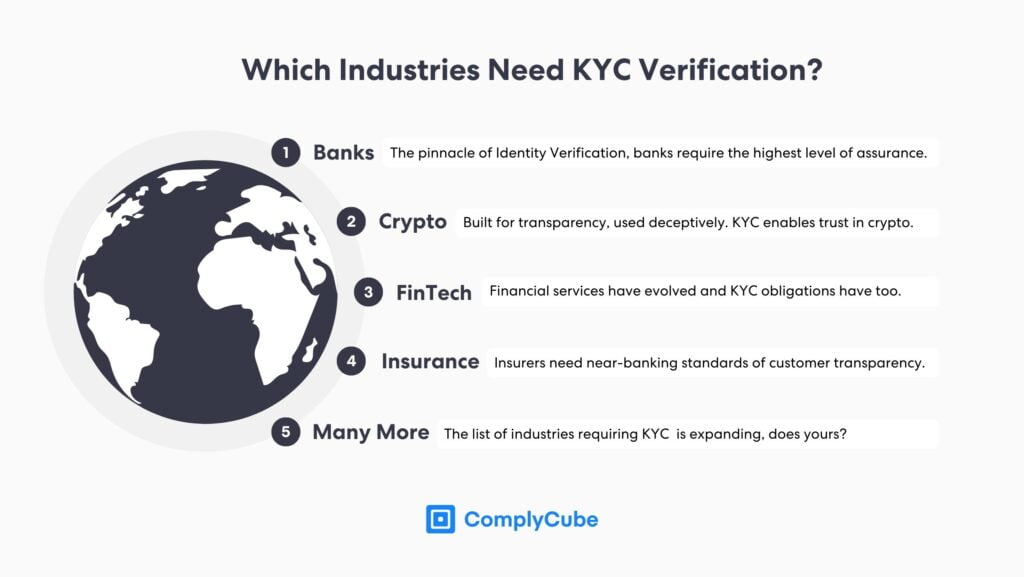
KYC strategies are an evolving phenomenon, and as financial technologies have flourished, so have the adaptations of KYC and related solutions.
- [The Banking Secrecy Act](https://www.investopedia.com/terms/b/bank_secrecy_act.asp), established in 1970, requires all US banks to assist the American Government in detecting, monitoring, and preventing financial crimes, such as money laundering and terrorist financing.
- [The USA Patriot Act](https://www.justice.gov/archive/ll/highlights.htm) and the Financial Crimes Enforcement Network’s (FinCEN) Final Rule require financial institutions to form a reasonable belief that they know who their customers are. This mandate implored financial services to introduce the strongest Identity Verification (IDV) measures to their operations.
The EU Council’s latest decree states that Crypto Asset Service Providers (CASPs) now hold a similar level of authority over the protection of the financial system to banks. This calls for enhanced regulatory requirements and stricter KYC strategies, including increased identity verification measures and enhanced CDD on individuals transacting over €1,000.
## What Does Crypto KYC Look Like?
Cryptocurrencies are designed to be anonymous and permissionless, making customers’ identities hard to trace. The concept of Bitcoin, designed by Satoshi Nakamoto, was to deliver a framework to enable person-to-person transactions, where anyone can buy crypto without requiring an intermediary, such as a bank. This is very much the current status quo.
The reason behind it was to empower and give ownership to the user in the financial industry. This concept gave rise to the digital currency ecosystem we know today, one powered by decentralized mechanisms but whose anonymous transactions are abused for financial crimes such as money laundering.
KYC requirements for Web3 applications, such as a crypto trading platform, are extending under the pressure of global regulatory changes. To reach the required level of KYC compliance, crypto wallets, cryptocurrency exchanges, and other similar projects are integrating KYC measures including:
### Document and Biometric Verification
Leveraging a state-of-the-art verification engine, eKYC services can authenticate a document in seconds. This process analyzes up to 25 data points in real-time, promoting an enhancement in scalability from manual verification.
Using a similar machine learning technology, biometric verification scans for liveness and any potential image spoofing in the KYC process. Utilizing Presentation Attack Detection (PAD) technology, this check builds 3D facial maps to analyze for liveness, pixel tampering, micro-expressions, and much more.
For more information on liveness detection, read [ComplyCube Bolsters ID Verification with Liveness Layer.](https://www.complycube.com/en/complycube-strengthens-document-authentication-services-with-id-liveness-layer/)
### Customer Due Diligence (CDD)
CDD ensures that crypto exchanges know what crypto transactions will likely be used for. This process goes beyond just establishing the customer’s identity but ratifies their profile against various vetting services including adverse media checks, AML monitoring, and watchlist and PEP screening. This is a vital step in assigning a customer a risk profile.
### Ongoing Monitoring
Ongoing Monitoring of a client’s credentials is a further barrier to mitigating client risk. This process ensures that users are not likely to abuse financial transactions for malicious purposes by continually monitoring them against the same checklists as in the CDD process.

## Crypto Assets Money Laundering Figures
Digital assets have become one of the leading contributors to laundering activities due to their anonymity. Net laundering volumes in 2022 were $31.5 billion, and in 2023 they were $22.2 billion. While this shows a reasonable response to the issue’s prevalence, these figures remain too high.
> Net laundering volumes in [2022 were $31.5 billion, and in 2023 they were $22.2 billion.](https://www.chainalysis.com/blog/2024-crypto-money-laundering/)
Interestingly, the concentration of money laundered through the same 5 off-ramping services (platforms that facilitate monetizing crypto funds into fiat currency) has increased over the same time period, from 68.7% to 71.7%. This suggests that major crypto institutions require stricter KYC and AML processes to curb financial and related crimes.
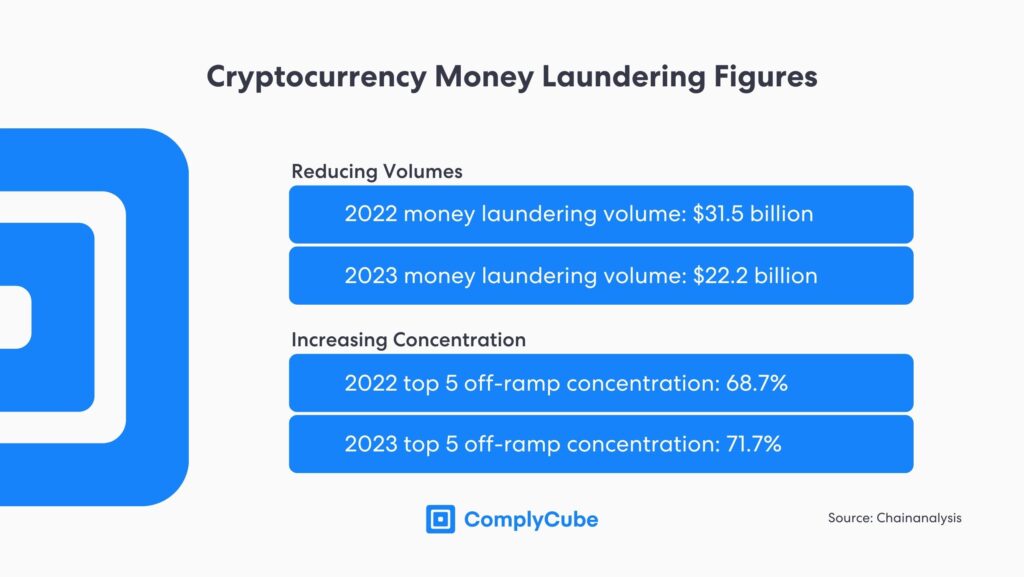
## Why the Crypto Industry Needs a KYC Process
As expressed above, the financial crime risks on crypto trading platforms and crypto exchanges are exceptional. This is one of the reasons the industry has received so much pushback in recent years. Proper KYC regulations, coupled with sufficient identity verification measures, will lead to reduced bad actors accessing crypto services.
However, further compliance regulations administered to the industry will require an equal response in AML, KYC, and IDV services. This is where KYC solutions provide a breath of fresh air to businesses’ crypto KYC efforts. Adhering to regulatory compliance in this industry is paramount to success for numerous reasons.
- The fines surrounding AML breaches can be astronomical, as exemplified in 2023.
- The competition is fierce, and there is always a competitor looking to take market share.
- By its nature, crypto is leveraged for malicious activities. This means regulators always monitor businesses for shortcuts a business or project might have taken.
Even regulated exchanges are commonly abused for facilitating financial criminal activity and lead market reputation into disrepute. For this reason, most crypto exchanges are expected to significantly strengthen their KYC strategies over the coming years. This typically involves a mixture of document verification and biometric verification as a new client signs up and continuous monitoring of their risk profiles.
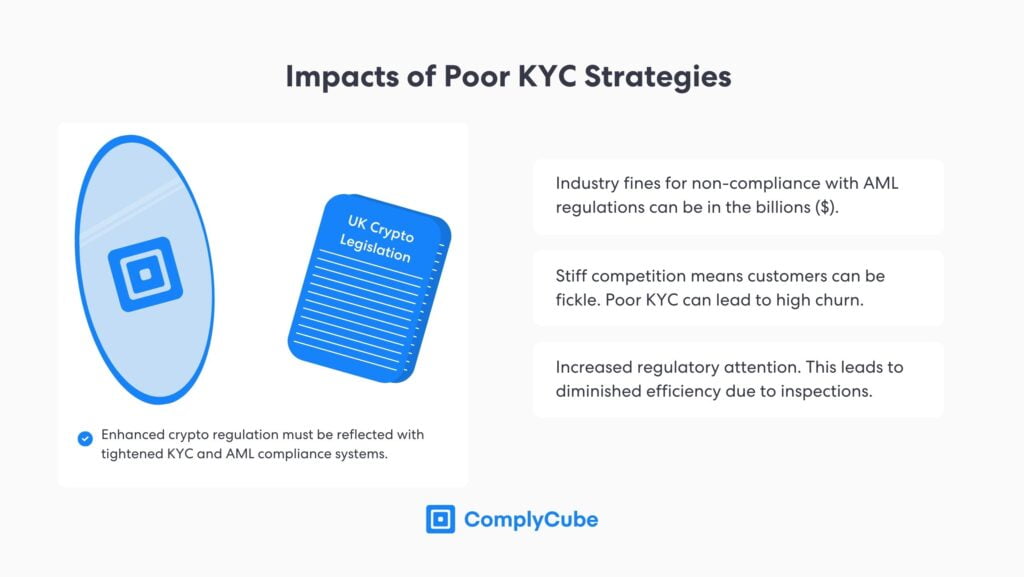
### Regulations are Coming to Ensure Crypto Compliance
Cryptocurrency exchanges have had it easy, however. 2022 and 2023 witnessed an unfortunate plethora of scandals protruding primarily from supposed regulated centralized exchanges (CEXs). Certain CEXs were found to be contributing billions of dollars towards global money laundering efforts due to poor due diligence processes; these scandals put the industry in major doubt.
These scandals have led to a significant change in global attitudes towards crypto exchange KYC regulations. A PWC whitepaper suggests that all services relating to digital assets must be ready for [harsher cryptocurrency regulations than the current ones](https://www.pwc.com/gx/en/new-ventures/cryptocurrency-assets/pwc-global-crypto-regulation-report-2023.pdf).
However, it outlined that the timeframe for this would be hard to define. Crypto exchanges are hard to regulate; while they might be headquartered in one country, they will likely operate in multiple different regions, all of which take contradictory approaches to cryptocurrency regulation. This makes providing a suitable framework that can significantly reduce fraudulent activity and related criminal activity very difficult. If your crypto firm is struggling to identify money laundering patterns, read [How to Spot the Red Flags of Crypto Money Laundering](https://www.complycube.com/en/how-businesses-can-spot-crypto-money-laundering-red-flags/).
Furthermore, KYC processes can differ vastly from region to region, and even the most minute discrepancy in processes, such as ongoing monitoring logistics, can require different software workflows. This being said, as the industry evolves and matures, KYC compliance is likely to become more holistic across the world. However, like with any emerging industry, correct policies and regulations take time.
For example, a decentralized cryptocurrency exchange, such as [Uniswap](https://app.uniswap.org/), acts as a P2P trading platform and requires smart contracts to facilitate trades. This makes it nearly impossible to analyze the user identities that leverage the platform from their crypto wallets. These non-custodial wallets, as well as their corresponding private keys, are a string of letters and numbers. This means it can be very difficult to prevent fraud and stop bad actors from endorsing scams.
The graph below demonstrates that while there was a significant reduction in cryptocurrency money laundering volume in 2023, the long-term trend from 2019 suggests that 2024 and 2025 could see another dramatic increase. This theory is supported by the expected wave of liquidity and users coming to the market over the next few years.
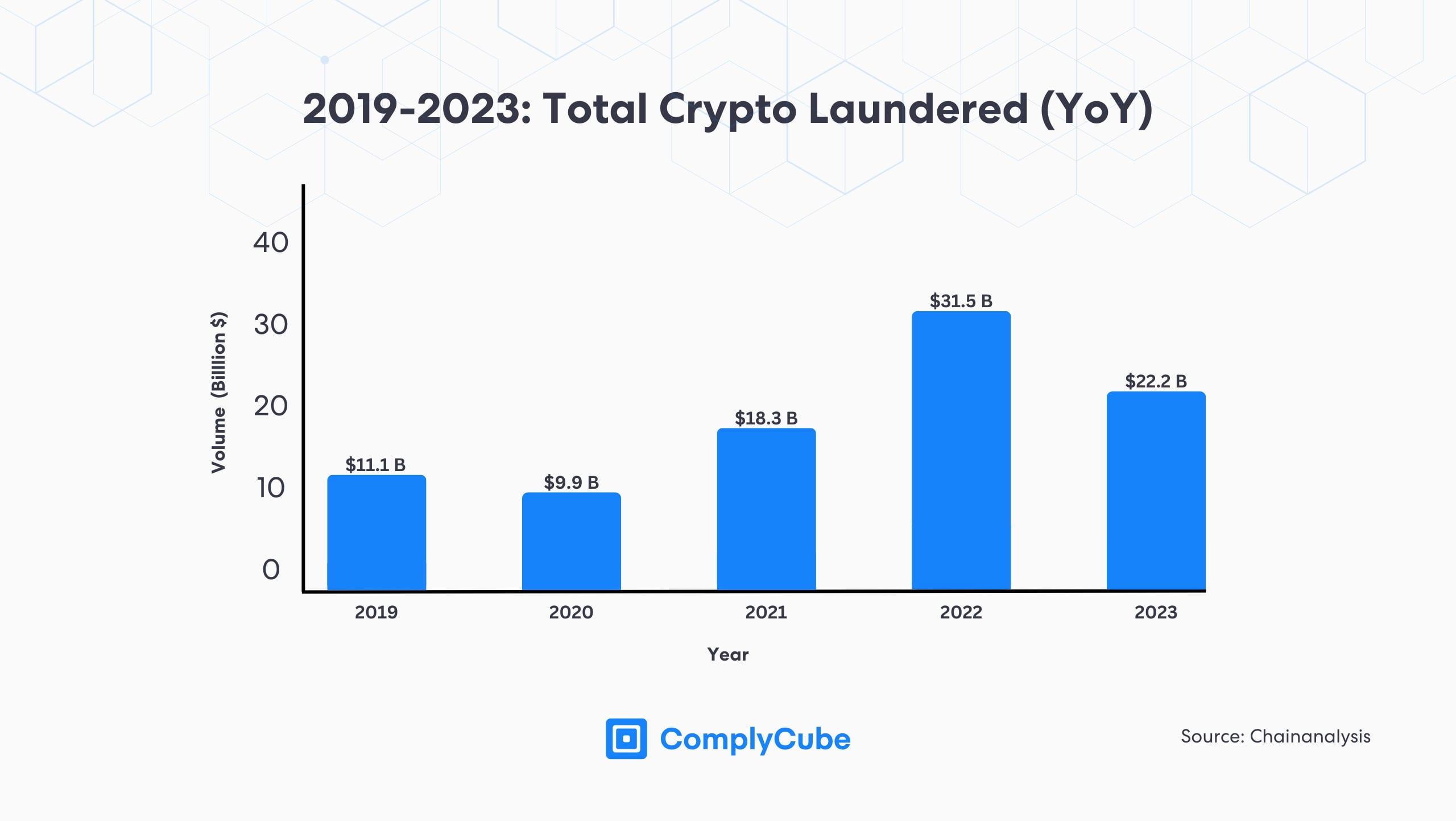
### Why Crypto Exchanges Require KYC
Omitting KYC from cryptocurrency exchanges will dramatically increase the financial crime risk to which your platform is exposed. [Crypto KYC](https://www.complycube.com/en/use-cases/industry/crypto/) strategies should not work against your business but should contribute towards the prevention of financial crimes. KYC processes should be a compliance enabler, ensuring businesses meet the required legal frameworks while creating a streamlined user experience with smooth customer acquisition solutions.
Failing to introduce KYC for crypto providers will:
- **Increase the risk of criminal activity:** This will lead to reputational damage, offsetting numerous revenue streams that crypto exchanges typically enjoy, such as listing fees from new tokens.
- **Result in non-compliance with AML regulations:** Legal requirements must be adhered to. As seen in 2023, crypto non-compliance fees can be in the billions of dollars and hold the power to seriously threaten the ongoing operation of providers.
- **Generate unwanted attention from regulators:** Exhibiting a weak KYC strategy will likely attract further attention from jurisdictional regulators. This is because it may seem a platform is purposefully not performing the required due diligence on users, facilitating the transfer of illicit funds, and leading to challenges in ensuring compliance.
- **Reduced trust:** Now more than ever, crypto platforms require stringent KYC processes. Trust in the industry, or lack of it, has been the largest repellent of institutional investors. Platforms not adhering to AML regulations will likely get left behind in this fast-paced industry.
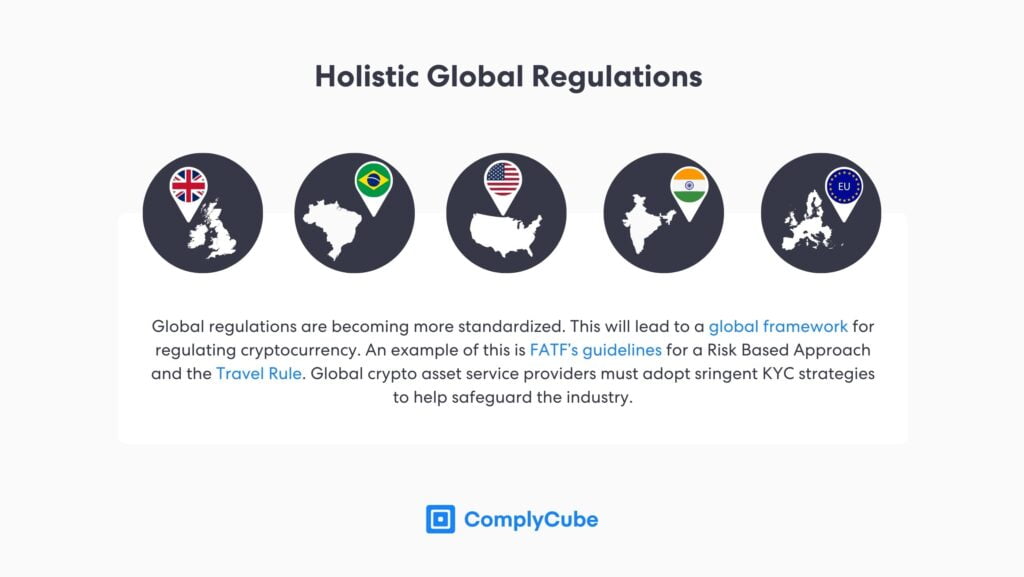
## EU Crypto Regulations
The European Union has slowly introduced legislation regulating cryptocurrency exchanges and related industry platforms. In June 2023, it released a framework for Markets in Crypto Assets (MiCA), [with a particular focus on the application of stablecoins](https://www.europarl.europa.eu/RegData/etudes/BRIE/2023/753930/EPRS_BRI(2023)753930_EN.pdf). The policy will come into full effect in December 2024.
This regulatory framework has been established to ensure that regions inside the EU do not fall behind in the digital asset revolution. In January 2024, the EU Council issued new definitions around the types of institutions with a natural responsibility to safeguard the financial system against crime, money laundering, and terrorist financing.
> “The new rules will cover most of the crypto sector, [making all crypto-asset service providers (CASPs) conduct due diligence on their customers](https://www.consilium.europa.eu/en/press/press-releases/2024/01/18/anti-money-laundering-council-and-parliament-strike-deal-on-stricter-rules/).”
Regarding KYC-specific regulations, the same ruling mandates that all transactions over the value of €1,000 must be subject to thorough due diligence measures. Crypto firms will only be able to adhere to these new regulations if they are partnered with an eKYC service that can perform these KYC checks at the scale demanded by users in the crypto space.
## US and SEC Crypto Regulations
The SEC (Securities and Exchange Commission) has been the barrier to a thriving cryptocurrency ecosystem in America, rendering tough federal regulations on the industry. Chaired by Gary Gensler, the organization has been thwarting cryptocurrencies at every turn, labeling multiple key altcoins as US securities. However, while this has been the talk of the town for many years, the tide seems to have turned.
> Today, the Commission approved the listing and trading of [a number of spot bitcoin exchange-traded product (ETP) shares.](https://www.sec.gov/news/statement/gensler-statement-spot-bitcoin-011023)
This exemplifies a major U-turn in federal American cryptocurrency policy and the attitude towards crypto compliance and regulations in the US. This suggests that further legislation will come into place as the year progresses.
## UK Crypto Regulations
The Financial Conduct Authority (FCA) is currently limited to ensuring that [crypto companies that operate in the UK are FCA-registered](https://www.fca.org.uk/news/speeches/regulation-digital-assets-uk) and adhere to the UK’s Anti-Money Laundering and Counter-Terrorist Financing (CTF) legislation.
For years, the UK has been a hub of financial innovation, but the global cryptocurrency revolution threatens this status. The UK government has declared they are committed to making the UK a global hub for cryptocurrency innovation; developments in early February suggest they are sticking to this plan.
### Staking and Stablecoins
The Secretary to the Treasury of the United Kingdom declared that legislation around staking and stablecoins [should be expected within 6 months](https://www.bloomberg.com/news/articles/2024-02-19/uk-s-afolami-says-expects-rules-on-stablecoins-crypto-staking-within-six-months). This would put an expectation on August 2024 for conclusive policies around staking and stablecoins.
Global efforts in the cryptocurrency markets are only heading in one direction – towards a more regulated industry. Further regulation will serve to bolster the sector’s strength with fresh liquidity, fresh users, and increased revenues for services in the industry.
This, however, is a double-edged sword for crypto exchanges and related providers. Further regulation will necessitate more stringent compliance efforts, particularly in areas of AML, KYC, and IDV. These developments will make KYC solutions vital to the scalability of the industry.
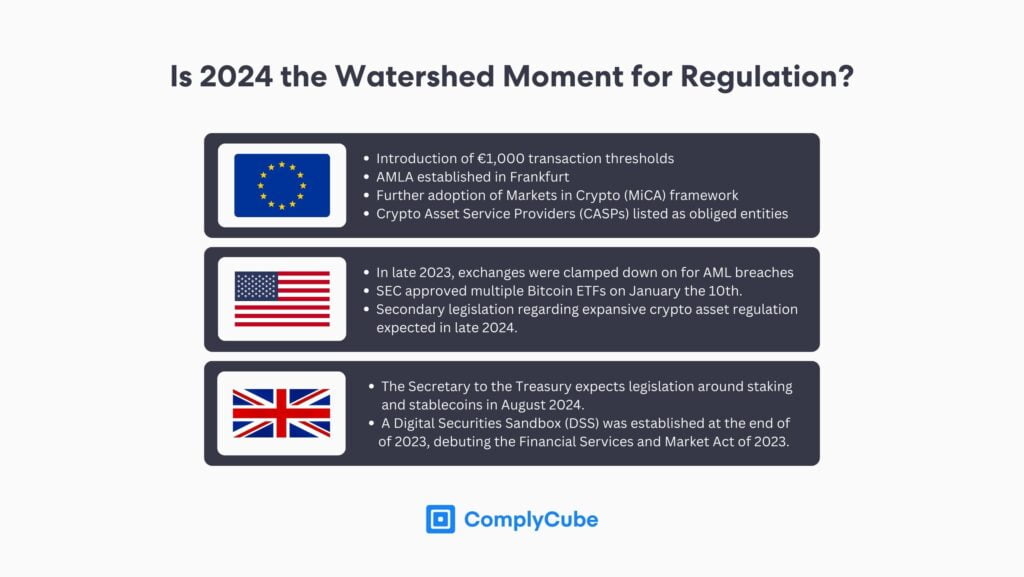
## Global Crypto Regulations
A Financial Action Task Force (FATF) report from 2023 found that global jurisdictions continue to be challenged with core regulatory requirements. These include enacting a risk assessment, and acting upon the legislation that regulates Crypto Asset Service Providers (CASPs). The report found that only [75% of jurisdictions only partially comply with FATF’s requirements](https://www.fatf-gafi.org/en/publications/Fatfrecommendations/targeted-update-virtual-assets-vasps-2023.html).
This leaves a huge sector of the market whose regulatory compliance is not accounted for. The report also established that there had been a poor implementation, or none at all, of the Travel Rule in over half of the jurisdictions involved in the report.
> All crypto companies must screen, record and communicate the information of both sender and recipient for [crypto transactions that exceed $1,000](https://fintech.global/2022/11/23/what-is-the-travel-rule-for-crypto/).
The exact figure threshold varies from region to region. However, the FATF’s report suggests this policy is not being followed. This might stem from the complexity of the task, conducting enhanced due diligence on users, as well as monitoring their transactions, can be a laborious challenge.
KYC solutions, however, address this issue by automating the task in its entirety. Upon customer signup, a risk profile is created based on their Customer Due Diligence checks. This information is monitored in real time, meaning CASPs can investigate and perform timely due diligence on their users when there is a suspicious-looking transaction. For more information on the crypto travel rule, read [The Crypto Travel Rule and the Need for AML Compliance Software](https://www.complycube.com/en/the-crypto-travel-rule-and-the-need-for-aml-compliance-software/).
## Choosing KYC Crypto Programs
Crypto platforms now have a huge responsibility to safeguard the financial system. As crypto ecosystems grow year on year, more capital inflows are expected in 2024 and 2025 than ever before. Ensuring the customer acquisition process is optimized to help transition potential customers into active users and that the same process adheres to consumer protection standards is essential.
If your client acquisition process is proving a challenge to scale or if you are seeking solutions in AML, KYC, and IDV, [get in touch with one of ComplyCube’s specialists today](https://www.complycube.com/en/contact/contact-sales/).
**Categories:** Guides
**Tags:** Crypto Regulations
---
### [Information Warfare: Political Bots on Social Media](https://www.complycube.com/bots-on-social-media-information-warfare/)
**Published:** September 25, 2024
**Author:** Sofia Daley
**Excerpt:** Deepfake technologies are subverting facial authentication processes. As fraud becomes increasingly sophisticated, organizations must protect themselves with biometric liveness detection to quickly identify presentation attacks.
**Content:**
Global politics are hinged on shifting narratives that are rewritten by millions of people each day, as our opinions are reshaped by the last thing we read on Twitter. When what we’re reading are real people’s views from all walks of life, then we are certainly reaping the benefits of freedom of speech, a clearly democratic use of technology. However, when what we’re reading is the consequence of a lack of needed identity checks and fraudulent bots on social media, it’s anything but democratic – it’s an attempt to control a space that should be ours. The lack of social media verification practices across online platforms has enabled bad actors to steer global discussions, often spreading false information to achieve a specific political agenda. The implementation of fake social media account detection has, therefore, become critical.
Fake accounts and bots have been closely tied to international politics for a long time, causing worldwide controversy for the past decade. Hundreds, if not thousands, of news articles, have reported on increased bot activity on social platforms ahead of elections. Ahead of the 2024 UK elections, articles such as Global Witness’s piece, “Investigation reveals content posted by bot-like accounts on X has been seen [150 million times](https://www.globalwitness.org/en/campaigns/digital-threats/investigation-reveals-content-posted-bot-accounts-x-has-been-seen-150-million-times-ahead-uk-elections/) ahead of the UK elections”, highlighted how opinions held by the general public would not be the sole deciding factor.
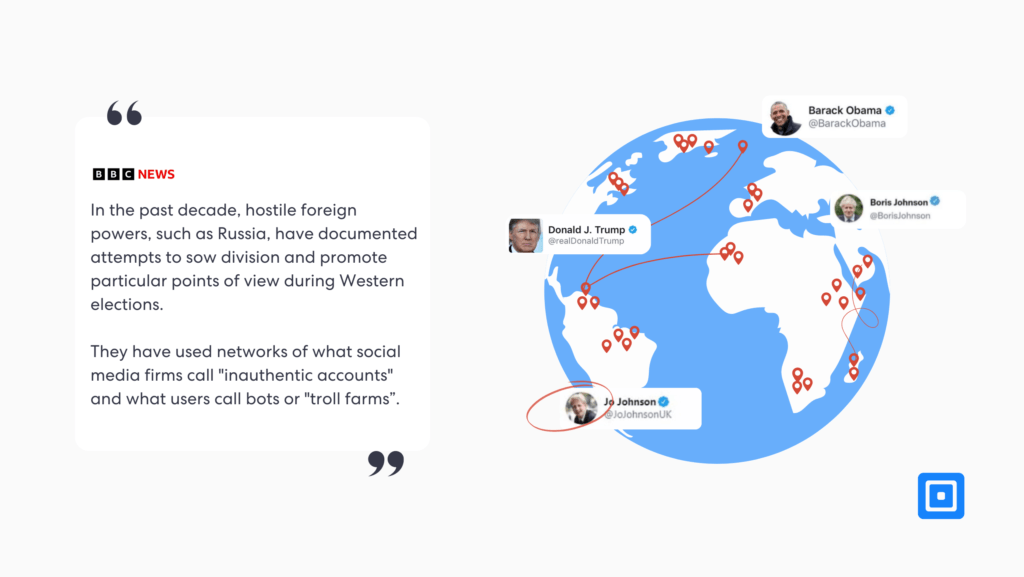
Interestingly, it’s not only media platforms that have spoken out about bot-driven political traffic, but academics have also taken this matter into their own hands over the past 20 years. In the early discussions of malicious bot software, T. Holz wrote a critical piece in 2005, “A Short Visit to the Bot Zoo.” This was one of the first pieces to address bot attacks online, which at the time were primarily used for mass identity theft, distributed denial-of-service (DDoS) attacks, or sending spam.
Holz managed to capture the key characteristics of these bots, outlining their traits and behaviors. He also created a structure that could categorize different kinds of bots. Cambridge academics took Holz’s work in 2020, as well as many other leading papers and studies on bot behavior since 2005, and similarly created their own classification, focusing specifically on the online activity of political bots.
## A Zoo of Political Bots
Academics at Cambridge University Press have written extensively on the use and threats of political bots. Samuel C. Woolley was able to make real strides in his 2020 paper, “Bots and Computational Propaganda: [Automation for Communication and Control](https://www.cambridge.org/core/books/social-media-and-democracy/bots-and-computational-propaganda-automation-for-communication-and-control/A15EE25C278B442EF00199AA660BFADD).” He states in this paper that “The presence \[of\] social bots in online political discussion can create three tangible issues: first, influence can be redistributed across suspicious accounts that may be operated with malicious purposes; second, the political conversation can become further polarized; third, the spreading of misinformation and unverified information can be enhanced.”
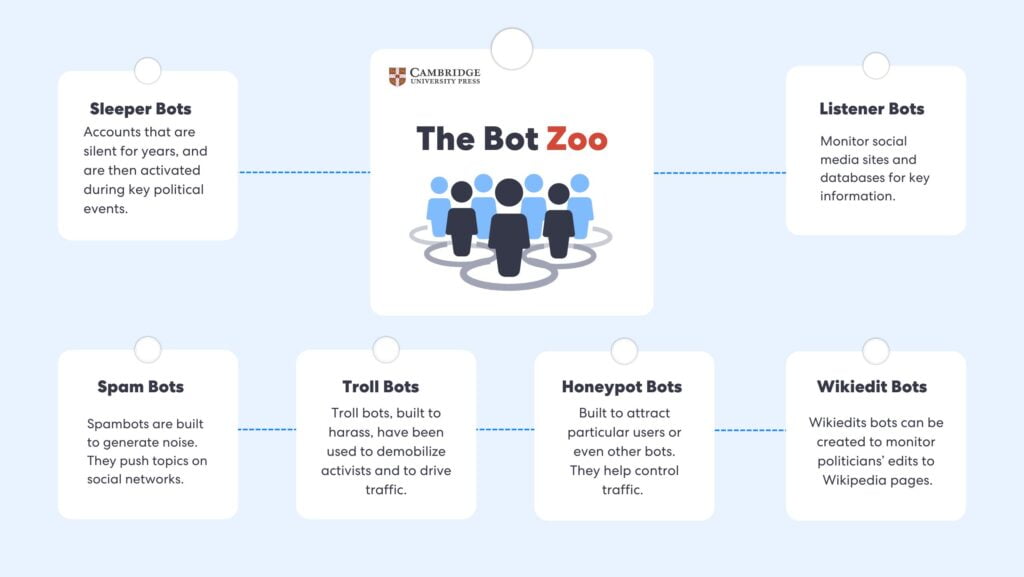
He goes on to replicate Holz’s original Bot-Zoo classification but applies the concept to [political bots](https://www.cambridge.org/core/books/social-media-and-democracy/bots-and-computational-propaganda-automation-for-communication-and-control/A15EE25C278B442EF00199AA660BFADD#REFe-r-5_020), identifying the following categories:
- **Listener Bots:** Can monitor social media sites and databases for key information but also track and communicate what they find.
- **Spambots:** Spambots, conversely, are built to generate noise.
- **Wikiedit bots:** Wikiedit bots can be created to monitor politicians’ edits to Wikipedia pages.
- **Sleeper bots:** Sleeper bots are social media accounts that sit on a site like Twitter, all but unused for years, to generate a more realistic online presence. They are then activated during key political events.
- **Troll bots:** Troll bots, built to harass, have been used to troll activists trying to organize and communicate on Twitter but can also drive traffic from one cause, product, or idea to another.
- **Honeypot bots:** Built to attract particular users or even other bots.
## Modern-Day Politics
Modern politics have become increasingly intertwined with social media platforms, where the battle for public opinion is often influenced by malicious actors rather than genuine discourse. The proliferation of bots and fake accounts has shifted the landscape of political engagement, allowing for misinformation to spread at unprecedented speeds.
## The Chinese Spy Baloon Incident (2024)
One example of this is a case that took place in early 2024, in which armies of bots battled on social media over the Chinese spy balloon incident. Researchers from Carnegie Mellon University examined [1.2 million tweets](https://www.newscientist.com/article/2414259-armies-of-bots-battled-on-twitter-over-chinese-spy-balloon-incident/) related to the incident, finding some interesting results.
The Chinese tweets were mainly artificial, with 64% of the tweets written by bots. However, the US also used bots to try and shift the blame, with 35% of their tweets coming from bots. This case highlights that much of the content we encounter daily on platforms like Twitter or Facebook may not be trustworthy, as it’s becoming harder to distinguish between real and fabricated information.
## Brexit Referendum (2016)
Dr. Marco Bastos uncovered a network of social media bots that were used to saturate Twitter with electoral messages during the 2016 Brexit referendum campaign. The research found that 13,493 accounts tweeted within the two weeks before and after the referendum.
> These false online identities voiced opinions and attempted to [manipulate public opinion](https://www.city.ac.uk/research/impact/case-studies/social-media-bots-used-to-boost-political-messages-during-brexit-referendum) through rapid cascade tweets.
Unsurprisingly, these profiles disappeared after the voting was over. City University’s research on this case states that “these false online identities voiced opinions and attempted to manipulate public opinion through rapid cascade tweets.”
## Bots on Social Media Promoting Reform UK (2024)
A recent [BBC news article](https://www.bbc.co.uk/news/articles/c1335nj316lo) reported that Reform UK has seen a rise in the polls following repeated posts that are suspected to have been engineered by malicious bots. The BBC decided to look into this further, getting in touch with the people behind accounts clearly trying to exaggerate Reform UK’s popularity. Following concerns about foreign interference in other elections, the investigation concluded that many of these accounts were inauthentic.
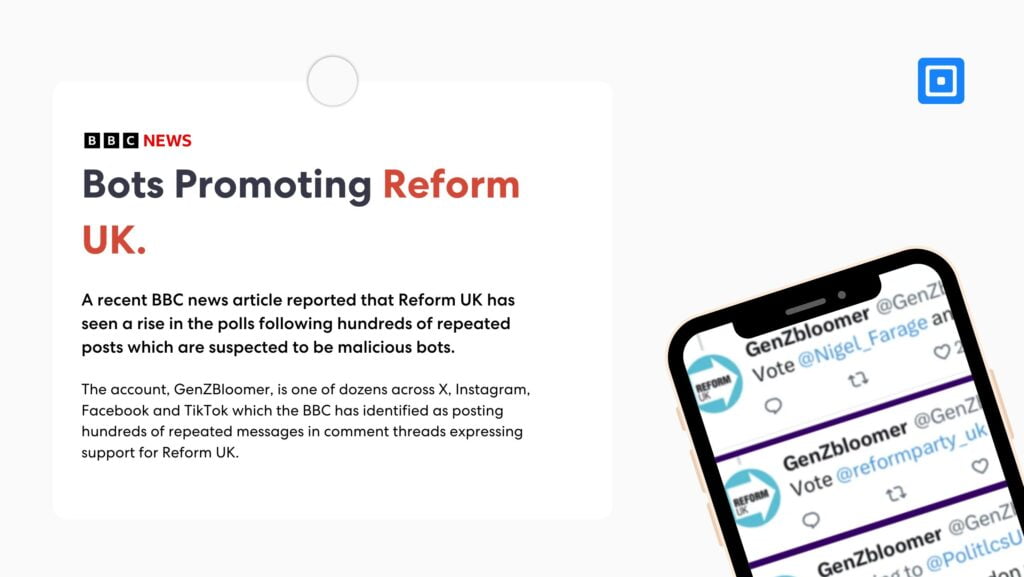
The BBC article states, “In the past decade, hostile foreign powers, such as Russia, have documented attempts to sow division and promote particular points of view during Western elections. They have used networks of what social media firms call ‘inauthentic accounts’ and what users call bots or ‘troll farms.’”
> Researchers have catalogued political bot use in massively bolstering the social media metrics of politicians and political candidates from [Donald Trump](https://www.cambridge.org/core/books/social-media-and-democracy/bots-and-computational-propaganda-automation-for-communication-and-control/A15EE25C278B442EF00199AA660BFADD) to Rodrigo Duterte.
It’s difficult to identify the extent of influence achieved by these forms of manipulation, yet many journalists and academics have come to the conclusion that it is certainly meaningful. Academics at Cambridge University Press report that “researchers have cataloged political bot use in massively bolstering the social media metrics of politicians and political candidates from [Donald Trump](https://www.cambridge.org/core/books/social-media-and-democracy/bots-and-computational-propaganda-automation-for-communication-and-control/A15EE25C278B442EF00199AA660BFADD) to Rodrigo Duterte.”
## Getting the Situation Under Control
What needs to be considered is whether online platforms are doing enough to curb the spread of malicious bot-driven content. In particular, election periods seem to trigger an increase in such activity, pointing to a lack of robust identity verification systems.
Many social media platforms seem to try to address the problem by removing fake accounts. In the last quarter of 2023, Facebook removed nearly [700 million fake social media accounts](https://www.statista.com/statistics/1013474/facebook-fake-account-removal-quarter/) after removing 827 million in the previous quarter. Yet, no matter how many suspicious users are removed, more undoubtedly reappear. The problem clearly lies with the sign-up process.
More stringent measures, such as identity verification, may help drastically reduce the number of these fraudulent accounts. Ultimately, ensuring the integrity of political discussions online will require a collaborative effort between governments, tech companies, and users themselves.
## Next Steps for Safer Platforms
Identity Verification (IDV) software provides a secure solution to fight bot-driven traffic online by enforcing strict user authentication and identity verification protocols. These platforms can implement several key measures:
[**Document Checks**](https://www.complycube.com/en/solutions/identity-assurance/document-verification/)**:** These checks verify that the presented identity is authentic and valid by examining official documents such as passports to confirm their legitimacy.
[**Biometric Verification**](https://www.complycube.com/en/solutions/identity-assurance/biometric-verification/): Biometric checks go a step further by analyzing subtle facial micro-expressions to ensure the person presenting the document is the rightful owner. Liveness detection technology also verifies that the user is physically present and not a bot or recording.
[**Age Verification**:](https://www.complycube.com/en/solutions/identity-assurance/facial-age-estimation/) Safeguarding minors is crucial for creating safer online environments. Age verification helps ensure that users meet age requirements, reducing the risk of exploitation or exposure to harmful content.

By integrating these techniques, IDV platforms can significantly reduce bot activity, safeguarding social media spaces from misuse. These measures ensure that only real users create accounts, curbing the spread of spam, misinformation, and other malicious activities.
For more information on how to safeguard your online platform from bot-driven fraud, contact our [expert compliance team](https://www.complycube.com/en/contact/contact-sales/).
**Categories:** Guides
**Tags:** Identity Verification
---
### [Document Fraud Detection Needed in the UK](https://www.complycube.com/document-fraud-detection-needed-in-the-uk/)
**Published:** September 20, 2024
**Author:** Sofia Daley
**Excerpt:** Organizations are unable to detect fraudulent documents due to the use of manual document verification methods. With AI-powered tools, organizations can verify documents seamlessly, ensuring accurate document fraud detection.
**Content:**
Document fraud has become a mainstream offense in the UK, with both the Insurance Fraud Bureau and the City of London Police having spoken out over the past year. Cifas, a leader in fraud prevention, was able to pinpoint that 64% of all UK fraud-related offenses are, in fact, identity fraud cases. The UK Insurance Fraud Bureau warned the nation this year that insurance fraud has nearly doubled in the UK over the past 12 months solely due to stolen identities. Many organizations are unable to detect fraudulent documents due to the use of error-prone manual document verification methods. With the right AI-powered tools, organizations can verify documents seamlessly, ensuring accurate document fraud detection.
Presentation attacks are now targeting most industries across the country, often subverting authentication systems. Fraudulent documents containing either stolen or false information are used to commit credit card fraud, employment fraud, insurance fraud, healthcare fraud, and more.
## Identity Fraud Spikes
Identity fraud accounts for a large proportion of the UK’s overall fraud-related crimes. [64% of all fraud-related cases](https://www.insurancefraudbureau.org/media-centre/ifb-news/2024/public-warned-of-rise-in-identity-theft) in the nation are now identity fraud, and most victims of these attacks were found to be over the age of 61.
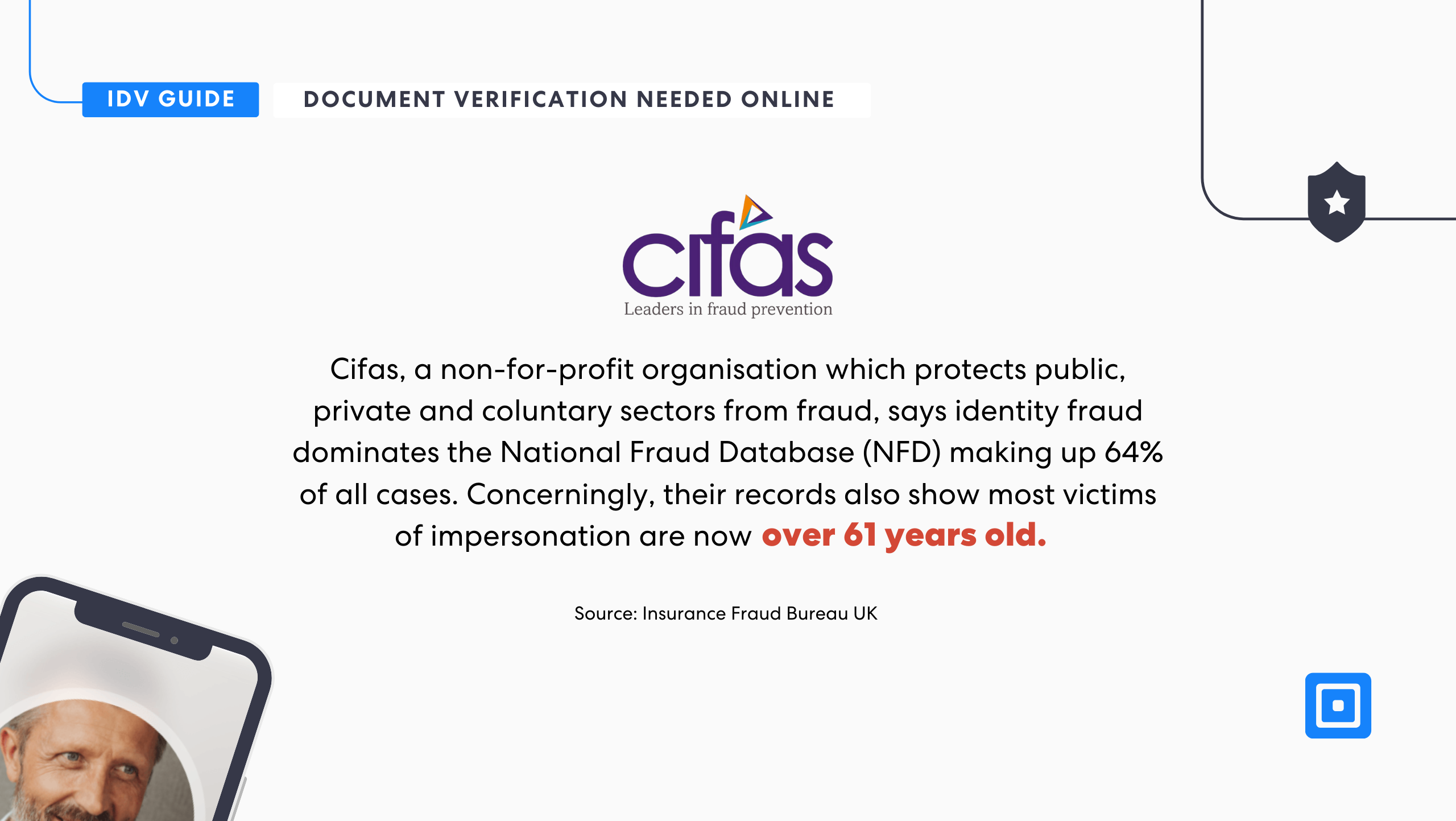
## How Fraudulent Documents Affect Different Sectors
Document fraud affects almost every sector, each facing unique challenges due to the nature of their operations and how document fraud can be carried out. Here’s a closer look at how different industries are affected:
## Financial Institutions
Financial institutions are often targeted by document fraud, with fake documents passing as legitimate documents by human reviewers. Several kinds of illegal activities are therefore carried out, as fraudsters are able to replicate ID cards, including passports and driver’s licenses, or use stolen documents.
### **Credit Card Scams – Account Creation Fraud**
Bad actors often use false identities or stolen identities to open new credit card accounts. They’ll often steal another person’s data, providing a name, address, or social security number. In many cases, the card will be approved due to the bank’s insufficient document fraud detection practices. The fraudster can then make purchases or withdraw large amounts of money, leaving the victim responsible for all of these expenses.
### **Loan Fraud**
Fraudsters often use identities that have been stolen to apply for loans. To do this, bad actors also need to provide fake information, such as falsified employment and financial details, to receive a loan. Again, the victim is left with the burden of the repayment. Mortgage fraud is a specific kind of loan fraud that has become quite common, as fraudsters use these stolen identities to receive a home mortgage. This kind of scam can go unnoticed for a very long period of time due to the nature of mortgages being long-term payments that are often not immediately due.
### **Bank Account Takeover**
In this form of identity fraud, the fraudster can hack into an existing bank account through the use of someone else’s credentials. Stolen identity documents, which can be bought on places such as the black market, are often used for these attacks.
### **Investment Fraud**
False identities are used to open accounts within a brokerage platform. These accounts carry out illicit trading schemes, like attempting to manipulate stock prices or draining an account by purchasing stocks and selling them without the victim’s knowledge.
## Insurance Fraud
Synthetic and stolen identities are used to commit insurance fraud, a type of scam that has risen in popularity quite alarmingly. This was noted by the UK’s Insurance Fraud Bureau, as well as the City of London Police, underlining the sudden increase in crimes.
Ursula Jallow, Director of the Insurance Fraud Bureau, recently underlined the Bureau’s shock at increased crimes regarding identity fraud. She states, “We’ve seen a worrying rise in insurance fraud made possible by [identity theft](https://www.insurancefraudbureau.org/media-centre/ifb-news/2024/public-warned-of-rise-in-identity-theft#_ftn1). Stolen personal information can be used for every financial crime imaginable, and victims of impersonation who are often elderly or vulnerable face devastating consequences.”
> We’ve seen a worrying rise in insurance fraud made possible by [identity theft](http://insurancefraudbureau.org/media-centre/ifb-news/2024/public-warned-of-rise-in-identity-theft#_ftn1).
In June 2023, a piece by the City of London Police stated that “The City of London Police’s Insurance Fraud Enforcement Department (IFED) is urging the public to know the risks associated with committing insurance fraud, after reported cases of opportunistic fraud from March 2022 to April 2023 rose by [61 percent](https://www.insurancetimes.co.uk/news/warning-as-bogus-insurance-claims-rise/1444868.article) from the previous period.”
> Reported cases of insurance fraud in the UK from March 2022 to April 2023 rose by [61 percent](https://www.insurancetimes.co.uk/news/warning-as-bogus-insurance-claims-rise/1444868.article) from the previous period.
The increase in insurance fraud, mainly driven by the use of falsified and stolen identities, underscores a broader trend of increasingly complex financial crimes. Ursula Jallow’s observations highlight a key point: identity theft has now become a major foundation for online fraud. For the victims of these crimes, the repercussions go beyond purely financial damage, such as legal battles, damaged credit, and emotional distress.
## Healthcare Fraud
**Medical Identity Theft:** This form of fraud involves using someone’s identity to gain medical insurance, prescription coverage, or other benefits. Medical insurance can be expensive, so it’s a key target for fraudsters. In some cases, criminals can access prescription drugs or medical procedures, which also leaves the victim with an erroneous medical record.
**Medical Insurance Fraud:** Using falsified identities to submit fake claims regarding medical procedures or treatments is a common form of healthcare fraud. Fraudsters can receive compensation for procedures that they might not have actually had.
**Prescription Drug Fraud:** Stolen identities can be leveraged to get hold of substances such as opioids. This form of fraud can be dangerous, as criminals can sell medications to vulnerable people or abuse them themselves. Meanwhile, the patients who need them face difficulty accessing medicines.
## Government and Social Services
**Benefits Fraud:** Benefit fraud consists of accessing welfare benefits that you’re not entitled to, such as a pension, unemployment benefits, or disability payments. Claiming government aid under a false identity depletes victims of needed government assistance and is a serious crime.
**Tax Fraud:** Fraudsters might use a stolen identity to claim illicit refunds from tax authorities. In addition to scamming tax authorities, the true holder of the stolen identity will then experience difficulties when filing legitimate returns.
## Document Fraud Detection with ComplyCube
Implementing advanced document fraud detection processes is crucial for organizations to protect themselves from fraud. AI-powered technology can quickly spot stolen documents, fake documents, and synthetic identities. Manual verification has become outdated when it comes to detecting document fraud.
[ComplyCube](https://www.complycube.com/en/) provides expert document authenticity checks, leveraging the best combination of AI and trained human experts. Their advanced document checks quickly verify whether provided documents have been compromised, forged, or copied from the internet and if they’ve been blacklisted or they’ve expired.
Their [Optical Character Recognition](https://www.complycube.com/en/solutions/due-diligence-compliance/know-your-customer/optical-character-recognition/) (OCR) engine accurately extracts data from documents, reducing the risk of human error associated with using a manual review. [Near Field Communication (NFC)](https://www.complycube.com/en/solutions/identity-assurance/document-verification/nfc-verification/) is also offered, providing RFID analysis, biometric verification, visual checks, and PAD-Level 2 certified liveness detection, as well as the examination of security features.

Contact one of their [compliance experts](https://www.complycube.com/en/contact/contact-sales/) and implement smart document checks today.
**Categories:** Guides
**Tags:** Identity Verification
---
### [Liveness Detection Software for Digital Trust](https://www.complycube.com/liveness-detection-software-for-digital-trust/)
**Published:** August 16, 2024
**Author:** Sofia Daley
**Excerpt:** Without a biometric presentation attack detection system that leverages liveness detection software, facial authentication systems can be subverted by deepfakes, spoofed images, 3D masks, and more. Protect your business from fraud.
**Content:**
It might seem like the risk of identity fraud is a small threat to your organization, with many individuals and businesses believing that these crimes only affect a small percentage of businesses – a simple misconception that could cost you millions. Almost two million people in Britain were victims of identity theft in 2023, with many of their identities being stolen to open fraudulent financial accounts. Without a sophisticated biometric presentation attack detection process in place that leverages liveness detection software, there’s no way of knowing whether your customers are who they claim to be, and there’s no way of finding out before it’s too late.
Sophisticated presentation attacks often bypass biometric systems, leaving firms vulnerable to fraud. Businesses must protect themselves with liveness detection software to ensure intelligent biometric presentation attack detection processes as we enter an age in which deepfakes infiltrate the internet and become more accessible than ever.
## The Growing Threat of Identity Theft
Each year, the identity theft and fraud statistics become more alarming than the last, and the latest are no exception. 552,000 identity theft cases were reported in the first half of 2024 in the United States, with forecasts expecting the overall 2024 count to exceed the number reported in 2023.
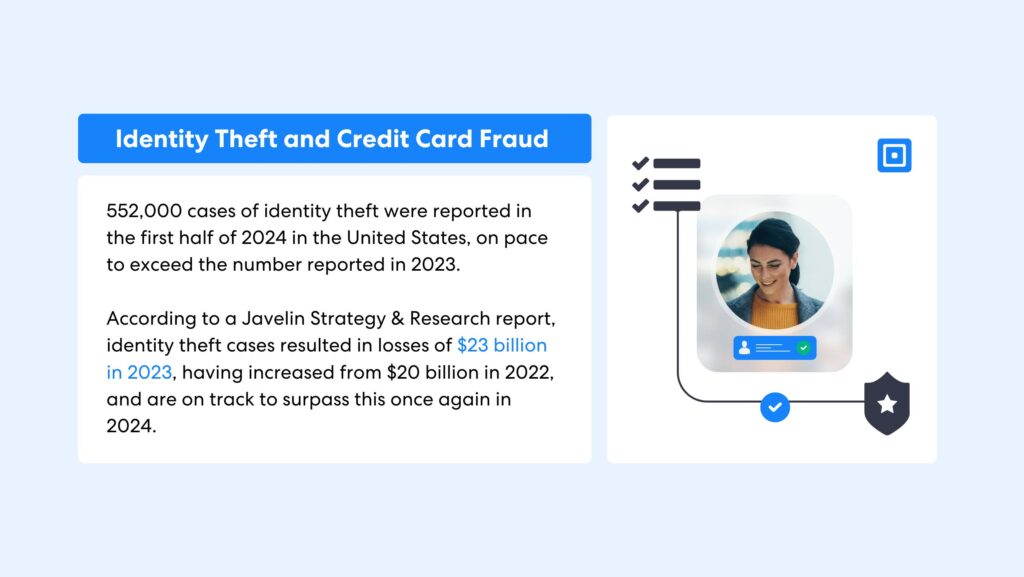
According to a Javelin Strategy & Research report, identity theft cases resulted in losses of [$23 billion in 2023](https://www.fool.com/the-ascent/research/identity-theft-credit-card-fraud-statistics/), having increased from $20 billion in 2022, and are on track to surpass this once again in 2024. The reason that identity theft keeps creeping up on a global scale is simply the fact that it has become easier and easier to steal an identity. The use of the internet and the proliferation of the dark web have certainly enabled these practices. The dark web has become a marketplace for sensitive identity information stolen during data breaches. Scammers can then create synthetic identities leveraging this stolen information in order to subvert authentication processes.
> The anonymity offered by the dark web makes it attractive to [malicious actors](https://www.acronis.com/en-gb/) who use it to carry out criminal activities such as identity theft and fraud.
A piece written earlier this year by the cybersecurity company Acronis stated that “The anonymity offered by the dark web makes it attractive to malicious actors who use it to carry out criminal activities such as identity theft and fraud. [Criminals can steal personal data](https://www.acronis.com/en-gb/) such as credit card numbers, passwords, and Social Security numbers without being detected or traced. This type of activity can be extremely damaging to both individuals and businesses alike.”
However, while the dark web offers a great way of accessing sensitive data, it certainly isn’t the only available source for fraudsters. Social media is full of information regarding personal identities, with many users divulging information regarding their full name, address, and close relationships online. A fraudster only really needs to open Instagram to find what they need, as has been the case with the company cloning scandal in the UK.
Both businesses and individuals are at risk of identity fraud, with the [company cloning scandal regarding Companies House](https://www.complycube.com/en/uk-business-identity-theft-balancing-the-blame/) in the United Kingdom having shone a light on the prevalence of business identity fraud. This consists of a form of fraud in which fraudsters register a false company, cloning an existing business. Information on the identities of key stakeholders is often taken from social media.

Due to a lack of stringent checks, hundreds of fraudulent companies are registered each month. The scammers then take out loans, receive investments, and more in order to monetize their scams. With all businesses at risk and reports of these fraudulent practices have gone on for several years now, a necessary next step is the implementation of a sophisticated biometric check that includes liveness detection to be carried out while anyone registers a company. While there might be an initial cost to setting this up, the return on the money and time invested would be insurmountable. It would be the integrity of the British entrepreneurial economy.
## Identity Theft and Credit Card Fraud
A leading motive for identity theft is credit card fraud, with [roughly 215,000 cases reported](https://www.fool.com/the-ascent/research/identity-theft-credit-card-fraud-statistics/) to the FTC in the United States in the first half of 2024. Worryingly, this figure is 6% higher than the last 6 months of 2023, showing a continual rise in these practices.
The two main types of credit card fraud include a fraudster opening a new credit card in the victim’s name or using a credit card that the victim had already opened. The latter involves stealing credit card details as well as personal information. 90% of the cases involve new account fraud, although existing account fraud is also on the rise.
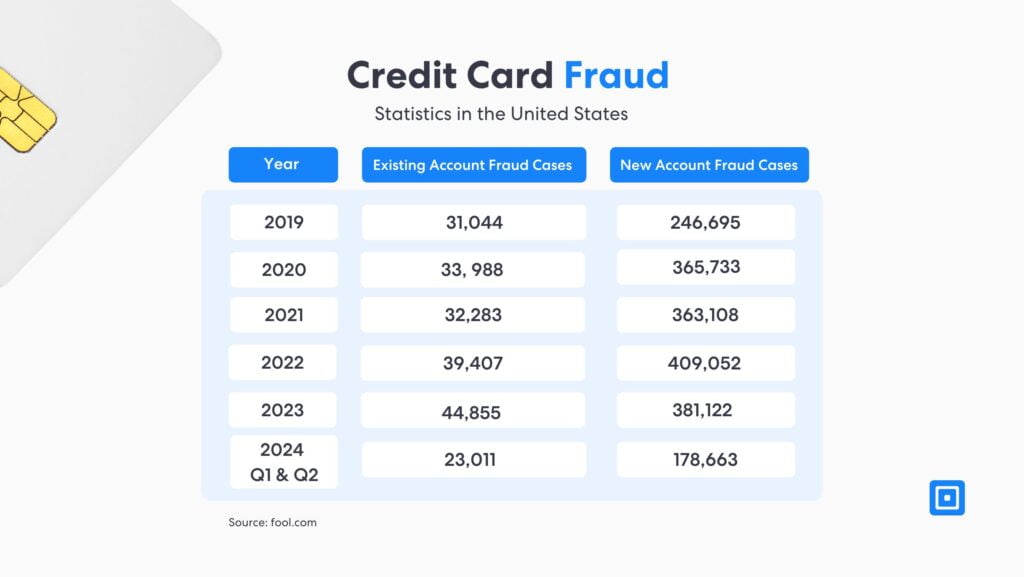
Biometric verification and liveness detection can be implemented to end these criminal practices. For existing account fraud, these solutions ensure that only legitimate cardholders can perform sensitive actions, such as changing account information, requesting a new card, or approving transactions. For new account fraud, biometric liveness detection would check whether the person attempting to create the account is physically present and that their biometric identity matches results from a document check, ensuring submitted information is accurate.
## New Research Conducted in the UK by FICO
Liveness detection technology has become increasingly demanded by consumers when considering opening a new bank account. A new study conducted by FICO underlines that 73% of people consider comprehensive fraud protection a primary concern when creating their accounts.
> Fraud protection isn’t just a safety measure; it’s a [competitive advantage](https://www.fico.com/en/newsroom/fico-uk-research-finds-fraud-protection-bank-s-secret-advantage).
The study found that the kind of fraud that British citizens worry about most is their identity being stolen to create a fraudulent account. This concern is certainly understandable, as identity theft can lead to significant financial loss and long-term damage to one’s credit history. This growing demand for liveness detection offers organizations the chance to secure a competitive advantage, as by offering it as part of their security processes, they can set their offering apart from their competition.
## Data Suggests Deepfakes on the Rise
Deepfakes have become an increasing threat to businesses, as biometric authentication systems are often unable to detect these presentation attacks unless liveness detection is leveraged. While this is a concern for all industries with sensitive information, governments and the financial sector have been heavily targeted.
In 2021, fraudsters in China purchased high-quality photographs of faces through the internet. They then created deepfakes that tricked the Chinese government’s facial recognition technology. The group stole [$175 million USD through fake tax invoices](https://www.scmagazine.com/news/deepfakes-will-hurt-30-of-organizations-trust-in-biometrics-by-2026).
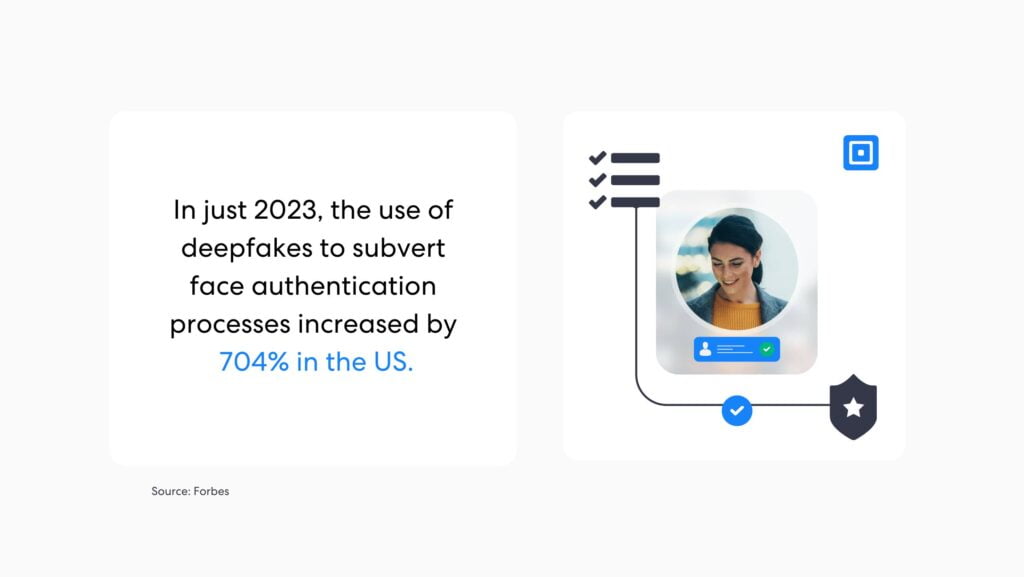
Since then, these attacks have only increased. In just 2023, the use of deepfakes to subvert face authentication processes increased by [704% in the US.](https://www.forbes.com/consent/ketch/?toURL=https://www.forbes.com/councils/forbestechcouncil/2024/06/18/navigating-the-perils-of-deepfakes/) The US Department of Homeland Security warned that “deepfakes and the misuse of synthetic content pose a clear, present, and evolving [threat to the public](https://www.forbes.com/councils/forbestechcouncil/2024/06/18/navigating-the-perils-of-deepfakes/) across national security, law enforcement, financial and societal domains.”
## Liveness Detection Software in Demand
With the high demand for robust fraud prevention when opening new accounts, state-of-the-art presentation attack detection processes are not just a safety net for users but should be seen by businesses as a competitive advantage. James Roche, a principal consultant at FICO, states, “Customers are looking for providers they can trust, so institutions should shout about the excellent [fraud protection](https://www.fico.com/en/newsroom/fico-uk-research-finds-fraud-protection-bank-s-secret-advantage) they provide.”
However, 18% of people answered that they would abandon opening a current account if identity checks were too difficult or time-consuming. Liveness detection and sophisticated processes must, therefore, be balanced with a positive user experience.
## Choosing the Right Provider
At ComplyCube, we pride ourselves on our state-of-the-art IDV and AML checks, offering both advanced checks and positive user experiences. We streamline onboarding processes to less than 30 seconds while ensuring accurate IDV, AML, and KYC checks.
Get in touch with our [expert compliance team](https://www.complycube.com/en/contact/contact-sales/) to learn more about how you can implement liveness detection and protect your organization from sophisticated attacks.

**Categories:** Guides
**Tags:** Identity Verification
---
### [Driver Verification: Who's Driving You Home?](https://www.complycube.com/driver-verification-whos-driving-you-home/)
**Published:** September 4, 2024
**Author:** Sofia Daley
**Excerpt:** What if you could be assured that your driver was exactly who they claimed to be? Mobility as a Service (MaaS) needs robust passenger and driver verification processes to enhance safety and foster greater trust in transportation.
**Content:**
We’ve all stepped into an unknown vehicle at 12 o’clock at night in a foreign location and had to remind ourselves that it’s perfectly safe, despite natural intuition warning us otherwise. Yet, as with almost any decision we make in our daily lives, there’s always some element of risk involved. But what if that risk could be drastically minimized? What if you had assurance that your driver was exactly who they claimed to be? The Mobility as a Service (MaaS) sector could provide this assurance by implementing robust passenger and driver verification processes, fostering greater trust and confidence in on-demand transportation services.
The tendency to assume that only the passenger is at risk is also a naive one, as Seattle News’ recent piece highlighting how a taxi driver was killed in the US by passengers clearly points out. The passengers had used fake profiles on the app and paid with a card under a fraudulent identity. The truth is, without extensive verification processes in place, none of us know who we’re in a vehicle with. Safety cannot be assured whether you’re a passenger or a driver. So – what needs to be done?
## **Convenience Is the Name of the Game**
The mobility sector has been drastically growing over the past few years, as we can have a car pick us up in a matter of minutes. Almost everything can be delivered to our doorstep. Businesses like Deliveroo began offering solely takeaway meals, and yet now you can even order pharmaceutical products from Boots through their app. Convenience is the name of the game, as remote lifestyles demand goods and services brought to our homes on wheels.

This shift has given rise to the concept of Mobility on Demand (MOD), a new way of thinking about mobility anchored on the newfound ability to move people and goods whenever and wherever they are needed. The rise of autonomous vehicles and electric cars is further transforming MOD by making these services safer, more convenient, and more efficient. As these technologies become more widespread, they enhance MOD’s capabilities, allowing for more seamless integration into daily life.
When combined with Mobility as a Service (MaaS), MOD becomes even more powerful. MaaS integrates various mobility services into a single platform, often offering subscription packages that provide unlimited access to transportation on demand. This combination ensures that convenient mobility services are always within reach. However, as these platforms become more mainstream, we must constantly re-evaluate the safety measures in place as we risk them becoming outdated.
## **Neither Passengers Nor Drivers Are Safe**
The US’s Government Accountability Office shared some statistics earlier this year (February 2024) that highlight the need for increased regulation of ride-sharing services.
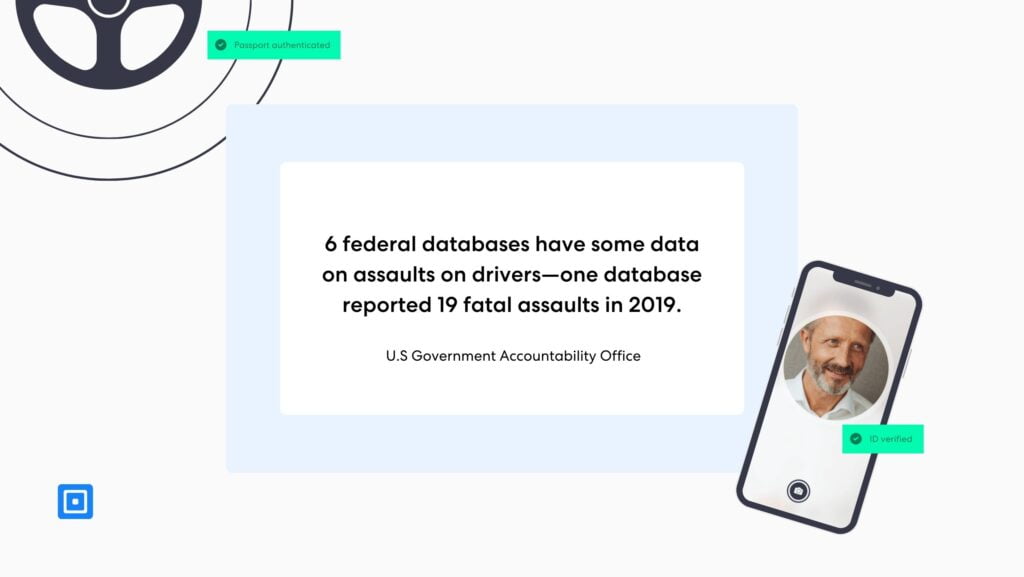
- 6 federal databases have some data on assaults on drivers—one database reported 1 fatal [assault in 2019](https://www.gao.gov/products/gao-24-106742).
- [3 ridesharing companies](https://www.gao.gov/products/gao-24-106742) publicly report on fatal physical assaults and the most serious types of sexual assaults, reporting about 4,600 such sexual assaults in 2019.
- [Five taxi companies](https://www.gao.gov/products/gao-24-106742) that were spoken to collect but do not publicly share incident data, which can include assault data.
This last point cannot go unnoticed. It opens our eyes to exactly what lurks beneath the facade of safety within these vehicles, as incident data being hidden from the general public is extremely worrying. But interestingly, these statistics also point to a safety risk for drivers when driving unverified passengers in their cars.
In considering this safety risk, we can look at the recent news piece shared by the Seattle Times highlighting a [new court ruling](https://www.seattletimes.com/seattle-news/law-justice/divided-federal-court-says-uber-owed-murdered-wa-driver-duty-of-care/) to protect Uber and Lyft drivers from passenger attacks. The 9th U.S. Circuit Court of Appeals has ruled, in a 2-1 decision, that rideshare companies are required to conduct thorough background checks on customers. The case originates from a lawsuit filed by the family of an Uber driver who was fatally stabbed in Issaquah in 2020 by the passengers in his vehicle. The 9th Circuit ruled that Uber had failed to warn the driver that these passengers had opened an account using a fake name and an unverified form of payment. Attorneys argued that Uber had “failed to employ basic identity-verification technology,” pointing to a lack of robust checks on passengers.
## What Kinds of Checks Are Needed for Driver Verification?
Driver and passenger verification processes are an important next step in the future of [Mobility-as-a-Service](https://www.complycube.com/en/use-cases/industry/mobility-as-a-service-maas/). Verification needs to be streamlined with accurate, efficient checks, including:
- [Document Checks](https://www.complycube.com/en/solutions/identity-assurance/document-verification/): Verifying the validity of their driving licenses and any other essential government-issued documentation.
- [Biometric Identity Checks](https://www.complycube.com/en/solutions/identity-assurance/biometric-verification/): They use a biometric facial recognition engine to examine biometric data from a provided selfie and compare it with government-issued documentation.
- [DBS Checks](https://www.complycube.com/en/use-cases/process/government-certified-enhanced-dbs-checks/): Running a background check on whether drivers have committed criminal offenses.

## The Future of the MaaS Sector
The safety of ride-sharing is not just the responsibility of MaaS companies but also a matter of public concern. Uber and other ride-sharing platforms must implement comprehensive verification systems for both drivers and riders, using advanced automated solutions to prevent tragic incidents and build trust.
ComplyCube provides top-tier driver verification services, featuring integration with the DVLA in the United Kingdom and the AAMVA in the United States. This enables highly thorough identity verification, document validation, and background checks for drivers.
Their extensive driver verification and competency assessments for the Mobility as a Service (MaaS) industry include connections with the Driver and Vehicle Licensing Agency (DVLA) in the UK and the American Association of Motor Vehicle Administrators (AAMVA) in the US.
To learn more, reach out to one of their [compliance experts](https://www.complycube.com/en/contact/contact-sales/).
**Categories:** Guides
**Tags:** Identity Verification
---
### [Driver Verification with AAMVA and the DVLA](https://www.complycube.com/driver-verification-with-aamva-and-the-dvla/)
**Published:** August 6, 2024
**Author:** Sofia Daley
**Excerpt:** The Mobility as a Service sector requires driver verification in order to achieve compliance with international regulations, as well as to safeguard businesses. Learn how implementing driver screening can help mitigate risk.
**Content:**
If you’re a business in the Mobility as a Service (MaaS) sector and you haven’t extensively verified who your drivers are, you might have a real problem on your hands. Not only are you putting passengers in danger, risking illicit activities such as underage driving, and possibly employing individuals who pose a security threat to your business, but you’re also running a massive compliance risk. Let’s dive into how putting in place a comprehensive driver verification and driver’s license check can set you up for success in the MaaS sector.
As more products and services are delivered to our doorsteps, driver screening has never been more important. For MaaS businesses to continue to scale quickly, numerous new drivers must be onboarded every day. Despite being prone to error, many businesses continue to rely on manual verification methods when carrying out driver identification, resulting in inefficiency and inaccuracy. In addition, driver competency continues to go unchecked, leaving businesses blind to potential risks.
At ComplyCube, our latest product update focuses on addressing this growing challenge for growing MaaS businesses. We’ve introduced comprehensive [Driver Verification](https://www.complycube.com/en/solutions/identity-assurance/enhanced-driver-verification/) checks for the [Mobility as a Service (MaaS)](https://www.complycube.com/en/use-cases/industry/mobility-as-a-service-maas/) sector, featuring integrations with the [Driver and Vehicle Licensing Agency (DVLA)](https://www.gov.uk/government/organisations/driver-and-vehicle-licensing-agency) in the UK and with the[ American Association of Motor Vehicle Administrators (AAMVA)](https://www.aamva.org) in the US.
## The Reputational Risk: Illegal Practices Under Scrutiny
Lacking the right driver verification process can result in a substantial reputational risk, as several food delivery companies experienced in late 2023. At the time, Britain’s interior ministry told Uber Eats, Deliveroo, and Just Eat that they needed to tighten their rider account controls. Account sharing had become a familiar practice among drivers, often resulting in underage or illegally working drivers. These stories of illicit practices gained global news coverage, exposing these organizations and the effects of their inadequate security measures.
“Unchecked account sharing places the public at risk, enables – and therefore encourages – illegal migration, and [leads to the exploitation of workers](https://economictimes.indiatimes.com/tech/technology/uk-tells-uber-eats-deliveroo-and-just-eat-to-tighten-rider-account-controls/articleshow/105214417.cms?from=mdr),” Immigration Minister Robert Jenrick stated at the time to the India Times.
A [BBC news piece](https://www.bbc.co.uk/news/uk-67371473) similarly highlighted child exploitation in the sector in late 2023, with children working as riders for several food delivery apps. They found that legitimate accounts were being rented to minors on social media. The publication decided to undergo an experiment, creating a 16-year-old AI-powered fake profile and attempting to get one of these “vendors” to rent them an account for a supposedly 16-year-old to carry out illegal work. It wasn’t long before they succeeded.
> No one checks [anything](https://www.bbc.co.uk/news/uk-67371473).
The BBC article states the following; “When we told one seller offering Deliveroo accounts that he was speaking to a 16-year-old, he replied: ‘I want to help you; age does not matter.’ Another said he would rent us his Uber Eats account for £70 per week, adding: ‘[They don’t check age](https://www.bbc.co.uk/news/uk-67371473); it’s more like you are using my account.’ Just Eat accounts were also available, but this seller told us, ‘no one checks anything'”.
These findings were only investigated late last year, proving that the industry has not managed to scale needed security measures alongside growth. This must become a priority for any business in the MaaS sector that wishes to remain competitive.
## Regulations Across The Globe
The MaaS sector is subject to several key regulations worldwide, meaning that stringent driver verification is essential to achieve compliance. Whether you’re an employer in the UK, EU, or the USA, driver verification is mandated for any employees whose employment requires them to drive. All employers have a responsibility and[ duty of care to ensure that any employees](https://smartcompliance.descartes.com/resources/driving-licence-verification/#:~:text=All%20employers%20have%20a%20responsibility,also%20invalidate%20your%20company%20insurance.) required to drive on behalf of the organization is correctly licensed and entitled to drive.
The DVLA states in the UK that “All employers have a responsibility and duty of care to ensure that any [employee required to drive on behalf of the organization is correctly licensed](https://smartcompliance.descartes.com/resources/driving-licence-verification/#:~:text=All%20employers%20have%20a%20responsibility,also%20invalidate%20your%20company%20insurance.) and entitled to drive. Ignorance is no defense. Employees driving without a valid license may also invalidate your company insurance.”
This standard outlined by the DVLA is due to two specific laws that apply to UK residents:
[The Corporate Manslaughter Act 2007: ](https://www.legislation.gov.uk/ukpga/2007/19/contents)Mandates that organizations that require employees to drive as part of their work must monitor their employees’ entitlement to drive and verify driving licenses.
[Section 87 (2) of the Road Traffic Act 1988:](https://www.legislation.gov.uk/ukpga/1988/52/section/87) This regulation makes it a crime for someone to allow another person to drive a vehicle of any type on a road if that other person does not hold a license that authorizes them to drive a motor vehicle of that class.
Similarly, European legislation marked in their “Most Serious Infringements” (MSI), which were introduced in [Regulation (EC) No 1071/2009 and came into force in 2011.](https://www.dhlicencecheck.co.uk/who-needs-to-check-and-why/the-law/) These regulations clearly underline that permitting an employee to drive without a valid driving license is a serious crime.
## Our Integrated Authoritative Sources
Comprehensive driver verification checks should include authoritative sources that can corroborate data on driver identities, verify license validity, and authenticate driver competency by checking previously acquired penalty points, offenses, and more. Our integrations with the DVLA and AAMVA, alongside our flagship[ Biometric Identity Check](https://www.google.com/search?client=safari&rls=en&q=complycube+biometric+check&ie=UTF-8&oe=UTF-8), [Document Verification](https://www.complycube.com/en/solutions/identity-assurance/document-verification/), and [DBS check](https://www.complycube.com/en/use-cases/process/government-certified-enhanced-dbs-checks/), allow us to provide an extremely comprehensive screening process.
## The DVLA
The Driver and Vehicle Licensing Agency ([DVLA](https://www.gov.uk/government/organisations/driver-and-vehicle-licensing-agency)) is a UK government organization responsible for maintaining records of drivers and vehicles. It issues driving licenses, collects vehicle excise duties, and ensures that drivers and vehicles meet safety and environmental standards.
Our integration into the DVLA enables the verification of driver competency by providing a comprehensive overview of driver records, highlighting received offenses, restrictions, or penalty points. Accessed data can help you validate whether your drivers may pose a risk to your business. The integration with the DVLA can also retrieve details regarding which vehicles drivers hold permission to drive, in addition to any mandated speed limits.
The DVLA integration can also verify driver identity and check driver’s license validity quickly. The integration provides identity data on the driver, including gender, date of birth, address, postcode, and much more.
## AAMVA
The American Association of Motor Vehicle Administrators ([AAMVA](https://www.aamva.org/)) is a non-profit organization in the US that aims to develop highway safety and vehicle administration policies. The organization includes motor vehicle and law enforcement administrators and executives from 50 states, the District of Colombia, and parts of Canada.
> AAMVA develops and maintains many information systems that facilitate the electronic exchange of identity information between [organizations such as verifying driver licenses](https://www.aamva.org/), state-issued identification cards, passport information, social security numbers, lawful status, and vital events.
This US organization is a great authoritative source, helping to verify driver identities and license checks.
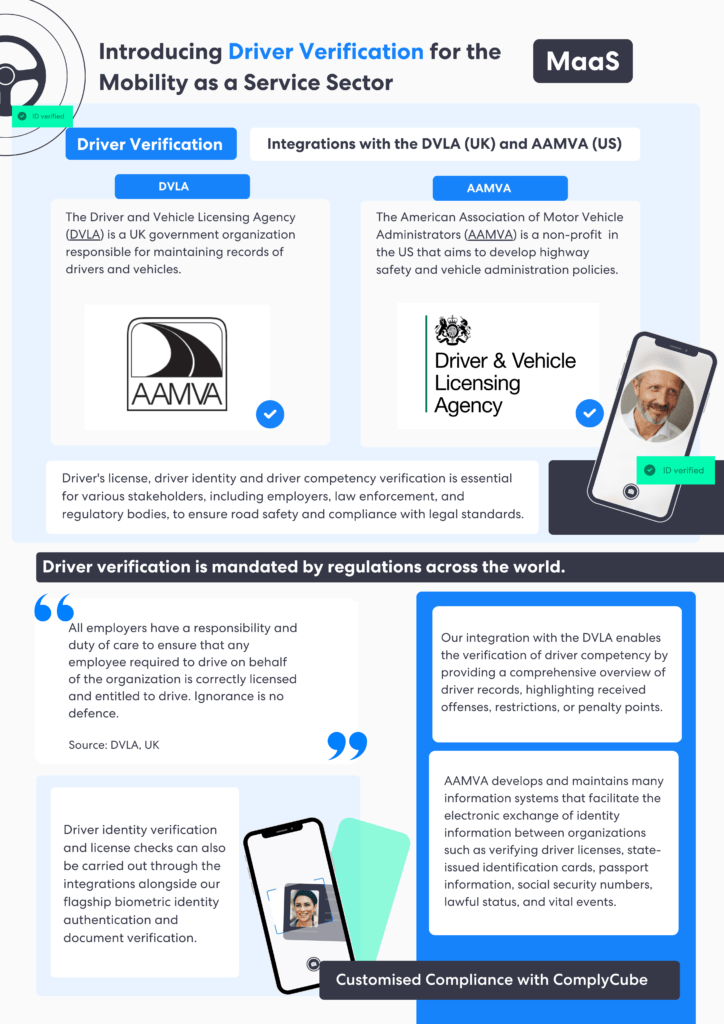
## The Importance of Driver Verification
Driver’s license verification is essential for various stakeholders, including employers, law enforcement, and regulatory bodies, to ensure road safety and compliance with legal standards. This process helps prevent accidents caused by unqualified drivers and ensures that companies comply with industry regulations.
By confirming the validity and authenticity of a driver’s license and a driver’s identity, businesses can protect their reputations, avoid fraud, and avoid legal liabilities in case of accidents or incidents involving their drivers. Continuous monitoring and digital record-keeping are essential for the timely identification of penalties or changes. Driver license verification is the best way to ensure that every one of your drivers is [eligible to drive specific categories ](https://www.hgvc.co.uk/knowledgebase/driver-licence-verification-what-you-need-to-know/#:~:text=Understanding%20the%20Importance%20of%20Licence,categories%20and%20types%20of%20vehicles.)and types of vehicles.
[Running DBS](https://www.complycube.com/en/use-cases/process/government-certified-enhanced-dbs-checks/) and [Right to Work checks](https://www.complycube.com/en/use-cases/process/certified-digital-right-to-work-checks/) are similarly useful when it comes to driver verification. Employers can carry out extensive background checks on drivers to check for criminal records and ensure they have the right to work in the country.[ ComplyCube is a DIATF-certified provider](https://www.complycube.com/en/company/security-compliance-center/uk-diatf-certified-idsp/) of these checks, providing unparalleled levels of confidence.
## Implement Driver Checks with ComplyCube
ComplyCube is a RegTech100 all-in-one platform for automating Identity Verification (IDV), Anti-Money Laundering (AML), and Know-Your-Customer (KYC) compliance. It has global customers in legal, telecoms, financial services, healthcare, e-commerce, cryptocurrency, travel, and more.

Our full suite of AI-powered KYC/AML solutions enhanced with automatic workflows is highly tailored to fit our customers’ compliance requirements. Utilizing machine learning technologies developed and owned by our team, our solutions streamline data extraction while providing a smooth user onboarding experience.
For more information on setting up a comprehensive driver verification process, contact [our expert team](https://www.complycube.com/en/contact/contact-sales/) today.
**Categories:** News
**Tags:** Identity Verification
---
### [Deepfake Fraud: The Ferrari Scandal](https://www.complycube.com/deepfake-fraud-the-ferrari-scandal/)
**Published:** July 31, 2024
**Author:** Sofia Daley
**Excerpt:** Learn how deepfake fraud is infiltrating global companies in this case study on Ferrari. Dive into why identity verification software is needed to stop fraud and protect global businesses. Uncover the threat of deepfakes.
**Content:**
Bloomberg reported a story on July 26th that shook the media and alerted businesses across the world to the threat of AI-powered deepfake fraud. The story outlined how a high-powered executive at Ferrari almost fell victim to a sophisticated deepfake scam in which a caller was able to replicate the voice of Benedetto Vigna, Ferrari’s CEO. With global businesses standing to lose millions, this piece of news has underlined the importance of implementing advanced Identity Verification software and protocols within all operations.
## Deepfake Fraud and the Ferrari Case Study: What Happened?
On a Tuesday morning like any other, a high-level executive at Ferrari started to receive several text messages that were seemingly from CEO Benedetto Vigna. The messages were coming from an unusual number. One of the messages read, “Hey, did you hear about the big acquisition we’re planning? I could need your help.”
The impersonator then stated he would need the executive to “be ready to sign the Non-Disclosure Agreement our lawyer is set to send you asap.” He continued, “Italy’s market regulator and Milan stock exchange have been already informed. Stay ready and [please utmost discretion.](https://fortune.com/2024/07/27/ferrari-deepfake-attempt-scammer-security-question-ceo-benedetto-vigna-cybersecurity-ai/)”
While these messages may fail to seem convincing, the voice call that then followed was far more deceiving. The fraudsters managed to replicate Vigna’s voice, as the impersonation perfectly echoed Vigna’s Italian accent and tone of voice.
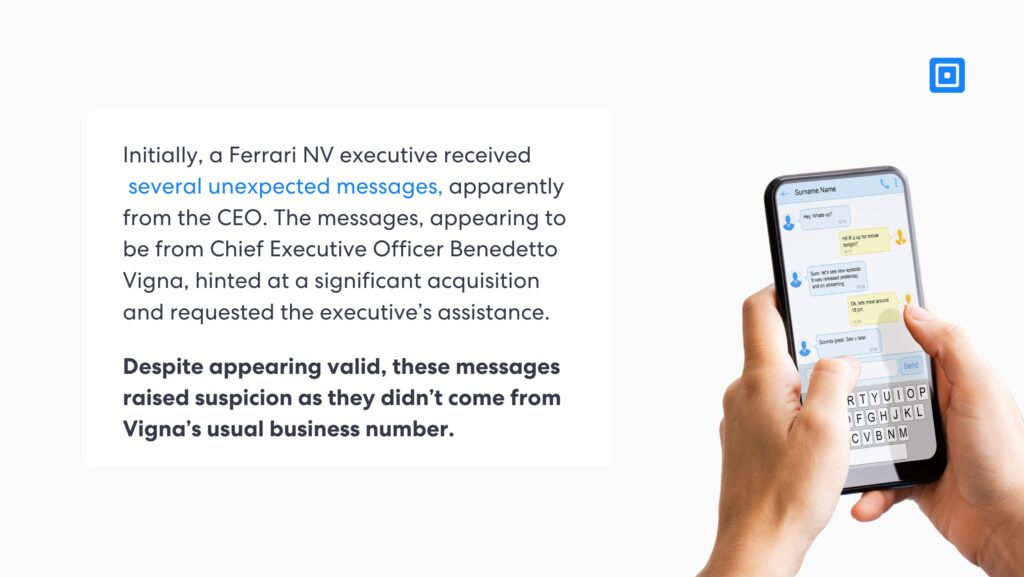
The impersonator attempted to explain why he was, in fact, calling from a different phone number, as the nature of the conversation was incredibly confidential, with potential repercussions for China and requiring an unspecified currency-hedge transaction to be done.
> “Sorry, Benedetto, but [I need to identify you](https://fortune.com/2024/07/27/ferrari-deepfake-attempt-scammer-security-question-ceo-benedetto-vigna-cybersecurity-ai/),” the executive said. He asked a question: “What was the title of the book you recommended a few days ago?”
After this verification question, the fraudster was quick to give up on the scheme and ended the call. The incident then led to an internal investigation within Ferrari, but representatives have decided not to comment on the matter.
## How Deepfake Fraud Infiltrates Businesses
While this case is alarming, it’s certainly not the first of its kind. Deepfakes have been increasing their reach for several years now, with the number of deepfake videos online increasing [by 550% from 2019 to 2023](https://www.securityhero.io/state-of-deepfakes/#:~:text=In%202023%2C%20our%20research%20indicates,integration%20into%20our%20online%20experience.).
> Astonishingly [over a third of businesses](https://www.darkreading.com/cyberattacks-data-breaches/deepfakes-rank-as-the-second-most-common-cybersecurity-incident-for-us-businesses#) across the US have experienced a deepfake security incident in the last 12 months.
In May, news outlets reported that the CEO of the advertising corporation WPP Plc, Mark Read, was targeted in a very similar scam. An elaborate deepfake was used to imitate the CEO on a Microsoft Teams call. As these AI-powered scams become more accurate, it becomes easier for teams to become victims and stand to lose millions.
Stefano Zanero, a Cybersecurity professor at Italy’s Politecnico di Milano, stated in an interview with Fortune Magazine that,
> “It’s just a matter of time and these AI-based deepfake sophistication tools are expected to become incredibly accurate.”
The most likely scenario today for[ threat actors to use deepfakes is in business email compromise (BEC) attempts.](https://www.darkreading.com/cyberattacks-data-breaches/deepfakes-rank-as-the-second-most-common-cybersecurity-incident-for-us-businesses#) Attackers can then use AI-powered voice and video-cloning technology to trick recipients into making corporate fund transfers.
Unfortunately, many businesses have already fallen victim to these types of scams. One example was reported by the South China Morning Post in February after scammers tricked employees using deepfakes, and an unnamed company faced a[ loss of HK$200 million](https://www.bloomberg.com/news/articles/2024-02-04/deepfake-video-call-scams-global-firm-out-of-26-million-scmp) ($26 million USD).
## Reactions To Deepfakes Around The Globe
In the United Kingdom, the sharing of deepfakes was made illegal under the Online Safety Act, which was passed last year. This decision came about due to the widespread creation of sexually explicit deepfakes.
The EU released the EU AI Act, adopted by the European Parliament on the 13th of March 2024, specifically addresses how deepfakes should be regulated in the EU, stating, ”Users of an AI system that generates or manipulates image, audio or video content that appreciably resembles existing persons, objects, places or other entities or events and would falsely appear to a person to be authentic or truthful (‘deep fake’), [shall disclose that the content has been artificially generated](https://www.herbertsmithfreehills.com/notes/tmt/2024-05/criminalising-deepfakes-the-uks-new-offences-following-the-online-safety-act) or manipulated.”
Though deepfakes are not banned in the EU, the AI Office is preparing codes of practice that will provide further advice on the classification of deepfakes. Whether the UK will follow this initiative or not is yet to be seen, however responses to the government’s AI Whitepaper pushed for increased transparency.
China has adopted specific regulations to target deepfakes directly after several major scandals, leading to the deepfake app ZAO being banned from app stores. This sharply contrasts with the USA’s stance on AI regulation, with no federal laws regarding the creation or sharing of deepfakes. Yet, change might be around the corner, with bills such as the US Senate’s [NO FAKES Act](https://www.coons.senate.gov/imo/media/doc/no_fakes_act_draft_text.pdf) being proposed.
## Why We Need To Act Now
Despite the fact that scams such as this one are highly publicized online, many organizations remain oblivious to the threat of AI-powered fraud attacks. However, there are technologies that can identify these forms of deepfakes, and every business must leverage them.
[Biometric Identity Verification (IDV)](https://www.complycube.com/en/solutions/identity-assurance/biometric-verification/) software with liveness detection examines facial features and subtle expressions in images or videos, analyzing whether they show signs of life. Deepfakes can, therefore, be spotted, yet not enough organizations leverage these technologies. You can learn more here: [How Deepfake Detection Can Empower Businesses](https://www.complycube.com/en/deepfake-detection-software-preventing-fraudulent-content/).

## Benefits of AI-Powered eKYC for Businesses
eKYC solutions that leverage AI are needed to safeguard organizations. There have been many cases of deepfakes bypassing identity verification methods, leading to scammers managing to infiltrate all kinds of businesses.
> In 2019, a deep-fake video was used to scam a CEO into [wiring $243,000 to a bank account](https://www.easycomply.ai/blog/can-ekyc-survive-ai-generated-deep-fakes#:~:text=The%20main%20benefits%20of%20eKYC,Reduced%20costs%20of%20customer%20onboarding). Similarly, in 2021, a criminal gang used deepfakes to bypass eKYC authentication and access bank accounts containing millions of dollars.
In 2019, a deepfake video tricked a CEO into sending $243,000 to a bank account. Similarly, in 2021, a gang of criminals bypassed eKYC authentication with deepfake videos and images, accessing bank accounts containing millions of dollars. As a result, many companies have become aware of the need to invest in advanced AI technologies to detect and prevent deepfakes from being used within authentication processes. eKYC can offer:
- **Bespoke Solutions:** Automatic workflows that can be highly tailored to fit different compliance requirements. Utilizing machine learning technologies, eKYC solutions can streamline data extraction while providing a smooth user onboarding experience.
- **Streamlined Onboarding:** Implementing a robust eKYC process allows you to verify customers quickly and efficiently, enabling organizations to scale safely.
- **Enhanced Security:** eKYC is far more effective at protecting organizations from identity fraud and financial crime. The use of advanced biometric verification, as well as AI-driven fraud detection, allows organizations to minimize fraud risk.
- **Improved Customer Experience:** The streamlined onboarding process also results in a more positive user experience, reducing friction and increasing customer satisfaction.
- **Global Reach:** eKYC solutions enable businesses to operate globally, quickly verifying many customers and supporting multiple languages and various international regulations.
## eKYC with ComplyCube
ComplyCube is a RegTech100 all-in-one platform for automating Identity Verification (IDV), Anti-Money Laundering (AML), and Know-Your-Customer (KYC) compliance. It has global customers in legal, telecoms, financial services, healthcare, e-commerce, cryptocurrency, travel, and more.

Our full suite of AI-powered KYC/AML solutions enhanced with automatic workflows is highly tailored to fit our customers’ compliance requirements. Utilizing machine learning technologies developed and owned by our team, our solutions streamline data extraction while providing a smooth user onboarding experience.
Contact [our expert team](https://www.complycube.com/en/contact/contact-sales/) today.
**Categories:** News
**Tags:** Identity Verification
---
### [Choosing a UK DIATF-Certified IDSP](https://www.complycube.com/choosing-a-uk-diatf-certified-idsp/)
**Published:** July 26, 2024
**Author:** Sofia Daley
**Excerpt:** Discover why DIATF Certified IDSPs are the right partner for comprehensive Right-to-Work, Right-to-Rent and DBS checks. As fraud increases on a global scale, certified IDSPs offer solutions that meet stringent standards.
**Content:**
Regulatory bodies must tighten the standards for identity service providers to ensure that IDV solutions can robustly counteract fraudulent practices. The UK government’s Department of Science, Innovation and Technology (DSIT) has therefore published the UK DIATF initiative, which sets out requirements for Identity Service Providers (IDSP) to ensure secure solutions.
## The Need for Stringent Standards
The initiative was implemented due to the ever-evolving threat of digital fraud. Demand for comprehensive IDV and AML solutions has consistently grown since the COVID-19 pandemic, with many businesses pivoting online and technological advancements lending themselves to sophisticated fraud. The global IDV market (having been valued at $10.45 billion in 2023) is now projected to increase from $11.97 billion in 2024 to an impressive $39.82 billion in 2032, with a CAGR of 16.2%.
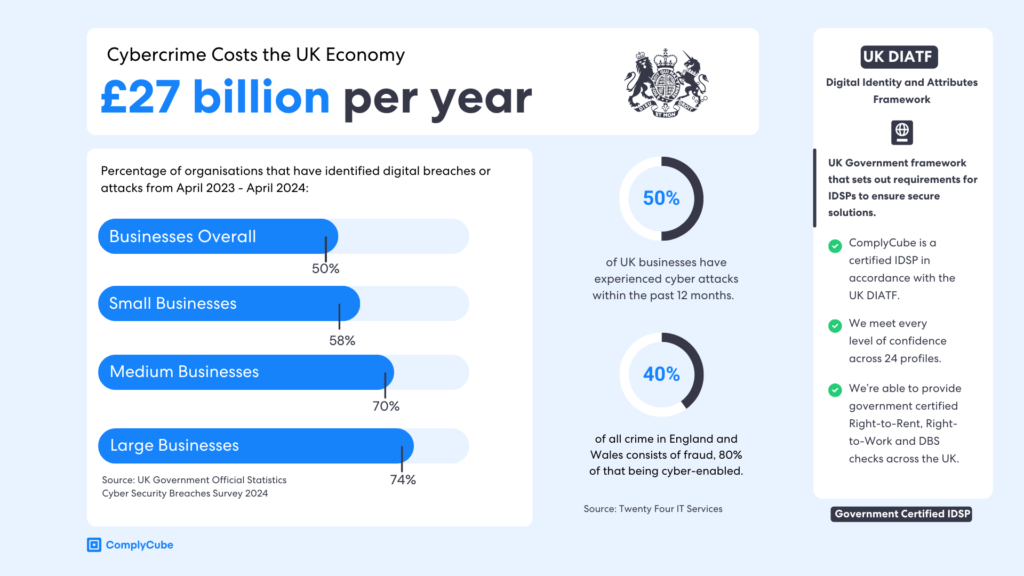
This substantial increase is inherently tied to the rise of digital fraud and cyber attacks. The UK government’s Cyber Security Breaches Survey recently revealed that 50% of UK businesses have suffered a cyber-attack or security breach in the previous 12 months. Cybercrime amounts to a hefty annual cost of £27 billion [for the UK economy. ](https://assets.publishing.service.gov.uk/media/5a78e882e5274a2acd18ab84/THE-COST-OF-CYBER-CRIME-SUMMARY-FINAL.pdf)
The DIATF initiative represents the dawn of a modernized approach to identity verification in the UK, introducing the concept of certified reusable digital IDs. In doing so, the framework also sets out requirements for IDSPs to follow that ensure both single-use and reusable digital identities enhance privacy and security beyond traditional, physical forms of identification such as passports. Varying levels of compliance from IDV providers with the framework’s mandates translate into differing levels of confidence, with the Home Office requiring a medium level of confidence as a minimum for IDSPs providing Right-to-Rent or Right-to-Work checks.
The UK government’s DIATF initiative follows a wider global movement to promote digital trust. It is also backed by existing schemes like the EU’s Electronic Identification, Authentication, and Trust Services (eIDAS), an established initiative that similarly aims to promote confidence in digital identities across Europe.
## 5 Reasons to Choose ComplyCube’s DIATF-Certified Checks
Finding the right partner can be challenging, but choosing a certified IDSP provider comes with many benefits. Government-backed right-to-rent, right-to-work, and DBS checks that are provided by a certified IDSP are subject to mandated standards that ensure their security. ComplyCube’s DIATF-certified checks offer the following benefits:
### 1. Integration with Risk Intelligence Networks
ComplyCube’s DIATF-certified Right-to-Work, Right-to-Rent, and DBS checks include the UK Identity Fraud check, which has access to the high-intelligence SIRA network, Amber Hill, and the Disclosure of Death and Registration Information (DDRI).
The SIRA network is the largest cross-sector syndicated database of customer risk intelligence in the UK, leveraging data from over 170 UK institutions. Similarly, access to Amber Hill and the DDRI enables the quick identification of synthetic fraud. Leveraging these databases allows for the corroboration of critical information, ensuring the highest level of accuracy.
### 2. Trusted Tailored Solutions
ComplyCube is proudly certified across every confidence level under the DIATF, meeting 23 profiles. Their products are independently government-certified, so they’re uniquely positioned to provide highly tailored services, including bespoke Right-to-Rent, Right-to-Work, and Disclosure and Barring Service (DBS) checks.
Other than the key components of the Right-to-Rent, Right-to-Work, and Disclosure and Barring Service (DBS) checks (which are Document Verification, Identity Verification, and the UK Identity Fraud Check), additional features can be leveraged to customize solutions. These include extensive AML Screening, electoral roll registration, Credit Bureau Check, or Proof of Address Check.
### 3. Advanced Fraud Prevention
Being DIATF-certified means that IDSPs must have robust measures in place to prevent fraud. ComplyCube’s solutions include sophisticated Document Checks that leverage Optical Character Recognition (OCR), which accurately extracts details such as names, birth dates, and other information from identity documents. This significantly reduces data entry errors and operational risk while enhancing UX and CX. ComplyCube also extracts signatures, ID photos, and MRZ details.
ComplyCube’s AI-powered ISO 30107-3 and PAD-Level 2 liveness detection software can differentiate authentic customer presence from sophisticated presentation attacks like deepfakes.
### 4. UK Government Certified DBS, Right-to-Rent and Right-to-Work Checks
Certified IDSPs provide government-certified solutions that enable employers and landlords across the UK to conduct enhanced DBS and Right-to-Work checks for employees and Right-to-Rent checks for tenants while remaining compliant with government standards.
ComplyCube leverages digital identity verification software, including an expert Document Check with OCR and MRZ analysis, a Biometric Identity Check with advanced Liveness Detection technology, and the UK Identity Fraud Check. Additional optional solutions, such as a Proof of Address Check or AML screening, are also available.
### 5. Regulatory Adherence
Partnering with a DIATF-certified provider means offering solutions that meet the stringent standards of the UK Government. Prioritizing regulatory compliance is critical for businesses to avoid hefty fines and penalties. Choosing a certified IDSP, therefore, ensures adherence to the latest and most rigorous regulatory requirements.
## ComplyCube’s IDSP-Certified Commitment to Compliance
Complying with both eIDAS and UK DIATF regulations, ComplyCube’s commitment to enhancing trust online has earned them five new certifications in 2024 alone, including UK DIATF, ISO 9001, Age Check Systems, ISO 27001:2022 upgrade, and PAD Level 2. Their rigorous compliance with global standards reinforces their position as a reputable market leader within the IDV sector, making them an ideal provider to partner with.
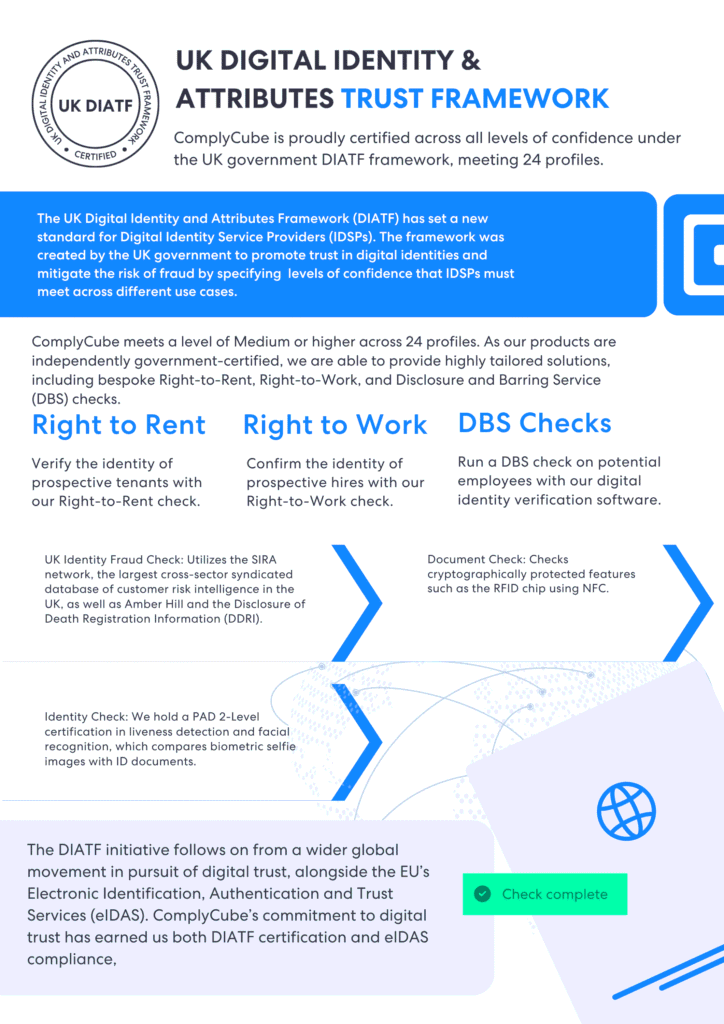
### About ComplyCube
ComplyCube is a leading SaaS & API platform, offering an all-in-one solution for Identity Verification (IDV), Anti-Money Laundering (AML), and Know Your Customer (KYC) compliance on a global scale. Having recently been named “RegTech Partner of the Year” by the British Bank Awards, they’ve certainly made their mark on the identity verification sector. ComplyCube boasts the fastest omnichannel integration within the market, proudly offering Low/No-Code solutions, API, Mobile & Web SDKs, Client Libraries, and CRM Integrations.
For more information, contact one of [our compliance experts](https://www.complycube.com/en/contact/contact-sales/).
**Categories:** News
**Tags:** Regulations
---
### [Fortifying Venture Capital Due Diligence](https://www.complycube.com/fortifying-venture-capital-due-diligence/)
**Published:** July 24, 2024
**Author:** Sofia Daley
**Excerpt:** VCs invest capital in high-risk investments, with venture capital due diligence processes being essential. The need for founder and investor due diligence checks requires venture capital compliance solutions with AML and KYC checks.
**Content:**
VC funds invest large amounts of capital into high-risk deals, with venture capital due diligence processes forming a critical part of the success of these investments. Without a doubt, risk is the name of the game. However, what many VCs overlook is not the risk of failing to bet on a unicorn but rather the risk of betting on a fraudster instead. Similarly, the risk of accepting illicit funds from an unverified Limited Partner (LP) is also often present. Implementing stringent founder and investor due diligence processes is therefore essential, with adequate venture capital compliance solutions requiring comprehensive AML and KYC checks.
Investors partaking in high-risk investments need to feel assured not just of the product-market fit or of the identified gap in the market, but also that they know exactly who they are investing in. Similarly, they must have full transparency of who their investors are. In accepting investment from LPs, VCs can become vulnerable to illicit capital injections, with bad actors attempting to disguise laundered money with legitimate capital.
The U.S. Federal Bureau of Investigation believes firms in the nearly $10-trillion private investment funds industry are being used as vehicles for laundering money at scale, stating that this allows for the reintegration of “[dirty money](https://www.reuters.com/article/business/fbi-concerned-over-laundering-risks-in-private-equity-hedge-funds-leaked-docu-idUSKCN24F1TE/) into the legitimate global financial system.”
## Risks Encountered
Venture Capital investors face several risks when making and receiving investments due to the lack of KYC and AML checks. Some include investing in founders who pose a reputational or compliance risk for the VC, the risk of laundered capital being invested into the fund, and investing or receiving investment from politically exposed individuals or individuals facing tax sanctions.
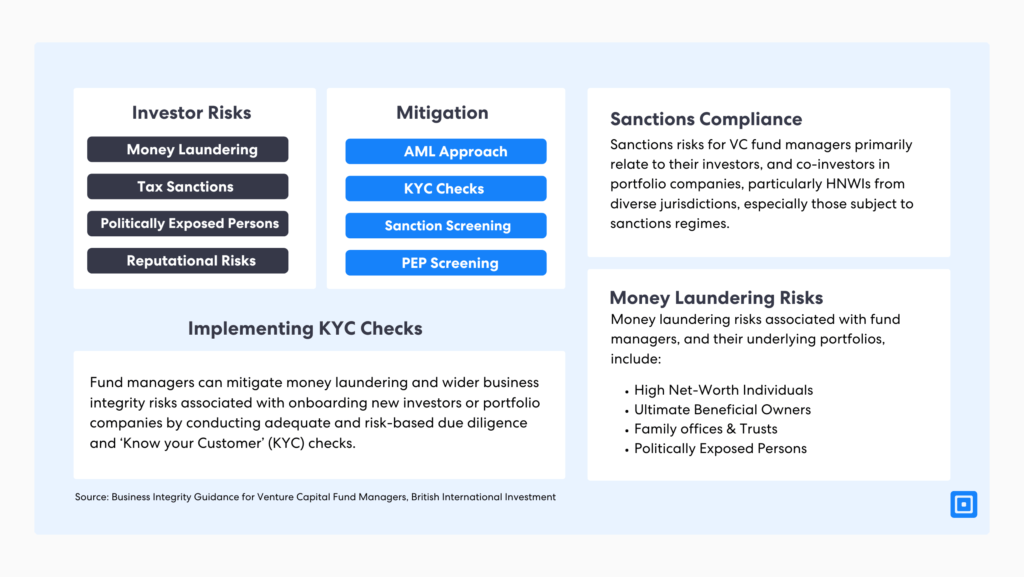
The Journal of Financial Crime’s paper “Fraud in Startups: What Stakeholders Need to Know” states, “The pressure of keeping the startup growing and consistently raising new funds is therefore crucial for both the entrepreneurs and the existing VC investors. Therefore, startups oftentimes resort to questionable or fraudulent activities to achieve these [milestones in the pursuit of growth.](https://www.emerald.com/insight/content/doi/10.1108/JFC-12-2021-0264/full/html)”
> Startups oftentimes resort to [questionable or fraudulent activities](https://www.emerald.com/insight/content/doi/10.1108/JFC-12-2021-0264/full/html) to achieve these milestones in the pursuit of growth.
Some of the risks commonly faced by investors include:
**Money Laundering:** VC deals involve investing large amounts of capital, which can be particularly attractive for those carrying out money laundering activities. A bad actor may act as an LP and invest illicit funds with a VC fund. As the VC then invests in many portfolio companies, the origin of the funds becomes extremely obscure. False identities may also be used to bury the true origin of the funds further.
**Politically Exposed Persons (PEP) Risk**: The PEP risk for VCs involves investing in a political figure and being subjected to legal implications, reputational damage, increased compliance standards, increased sanctions risk, and more. PEPs usually experience more dangers of corruption and more regulatory scrutiny.
> Sanction risks for VC fund managers primarily relate to[ their investors and co-investors](https://assets.bii.co.uk/wp-content/uploads/2021/11/10112327/Business-Integrity-guidance-for-VC-fund-managers.pdf) in portfolio companies, particularly High Net-Worth Individuals (HNWIs) from diverse jurisdictions.
**Tax Sanctions:** Sanctions are imposed by governments and supranational organizations (such as the United Nations) to counter terrorism and criminal activity. They usually enforce restrictions on designated persons. Sanctioned individuals are subject to restrictions on financial transactions and business operations and an increased compliance risk.
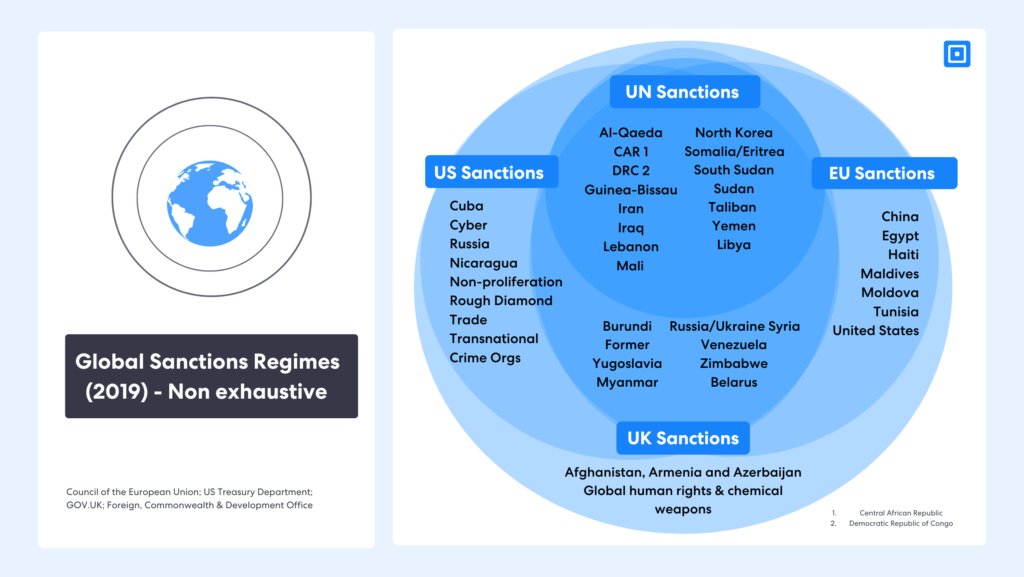
## Limited Partners and Other Investors
Many of the risks associated with investing or accepting the wrong investment can be counteracted with robust and stringent KYC and AML solutions. All portfolio companies and LPs should undergo an onboarding process in which AML and KYC checks are carried out. According to British International Investment, [checks on LPs must include](https://assets.bii.co.uk/wp-content/uploads/2021/11/10112327/Business-Integrity-guidance-for-VC-fund-managers.pdf):
**Identity Verification:** Investors should be verified by obtaining a Proof of Identity and Proof of Address. The identities of the ultimate beneficiaries of trusts/complex structures involved in a fundraising round should also be verified.
**Carrying out sanctions and international PEP screening:** Associating with sanctioned investors can damage the reputation of a VC, as well as risk non-compliance, which can result in severe legal consequences. The risk of money laundering, corruption, and other illicit activities is also drastically decreased when these checks are carried out.
**Meeting with LPs and their representatives where possible:** Supports a comprehensive assessment of LPs.
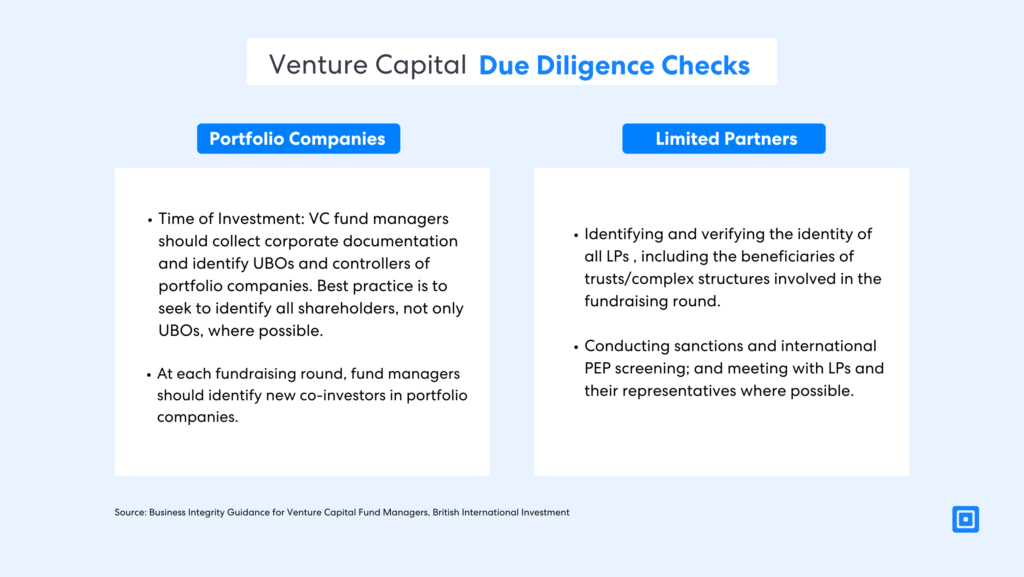
## Portfolio Companies
The British International Investment Society states that [KYC checks should be completed for all portfolio companies](https://assets.bii.co.uk/wp-content/uploads/2021/11/10112327/Business-Integrity-guidance-for-VC-fund-managers.pdf) at the following times:
**Verification at time of investment:** VC fund managers should collect corporate documentation and identify UBOs and controllers of portfolio companies. It’s important to identify all key shareholders.
**At each fundraising round:** New co-investors and portfolio companies should be verified.
> Due diligence [must be continuous](https://www.forbes.com/sites/forbesfinancecouncil/2023/01/18/the-importance-of-due-diligence-and-key-takeaways-going-forward/) and not just conducted at the investment stage. The best practice is to[ seek to identify all shareholders](https://assets.bii.co.uk/wp-content/uploads/2021/11/10112327/Business-Integrity-guidance-for-VC-fund-managers.pdf), not only UBOs, where possible.
**Identity Verification (IDV) and Anti-money Laundering (AML)**: Checks must be carried out to ensure regulatory, sanction and global trade compliance, secure investments, and reputational risk management.
## AML Compliance in Venture Capital
UK private equity and venture capital firms all face stringent regimes to counter money laundering and terrorist financing. The Financial Action Task Force (FATF) sets international standards.
Within the European Union, the fifth anti-money laundering directive (AMLD V/5MLD) came forth in early 2020, building on the fourth AMLD, which was put in place to prevent the funding of criminal activity and strengthen transparency rules. The fifth version of this directive also clarified PEPs, ensuring that individuals who are potential PEPs must be identified for monitoring.
Other distinctions, such as enhanced due diligence when establishing partnerships across high-risk borders, were also implemented. Currently, the cost of AML compliance in venture capital is higher than expected, with most of the cost being derived from manual tasks.
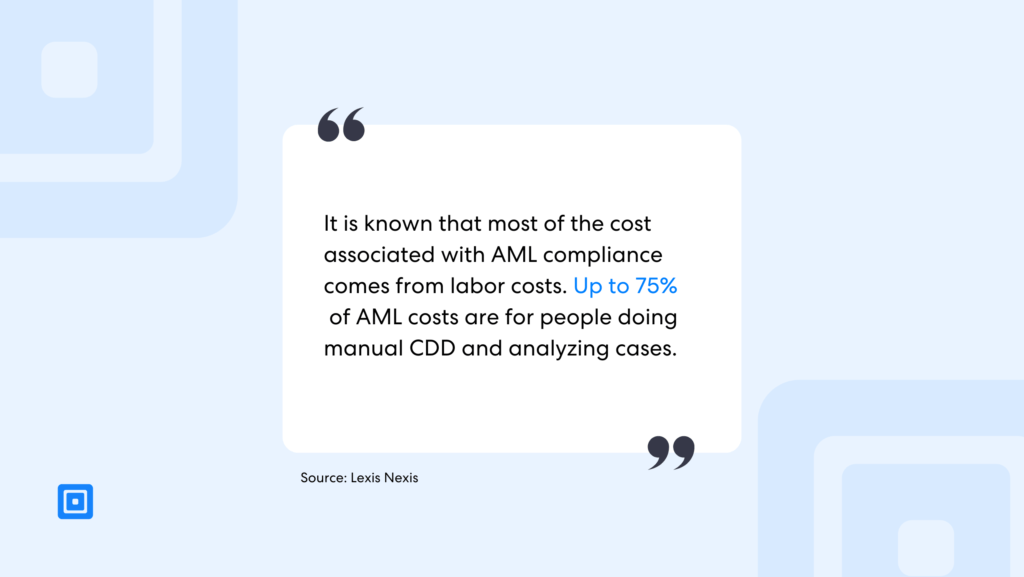
Research carried out by LexisNexis concluded that verifying an LP can result in over [25 hours of work for a team of 3-4 people](https://risk.lexisnexis.co.uk/insights-resources/white-paper/kyc-sanctions-remediation-the-impact-of-inefficiency). Considering that VCs often have several hundreds of LPs, the amount of work regarding AML verification can be alarming.
> It is known that most of the cost associated with AML compliance comes from labor costs. [Up to 75% of AML costs](https://vespia.io/blog/navigating-the-aml-maze-a-guide-for-venture-capital-funds-compliance-and-best-practices) are for people doing manual CDD and analyzing cases.
Therefore, the implementation of automated, AI-powered AML and KYC solutions is critical for these organizations to achieve compliance while maintaining a reasonable budget.
## Robust Venture Capital Due Diligence and AML Compliance with ComplyCube
ComplyCube is a RegTech100 all-in-one platform for automating Identity Verification (IDV), Anti-Money Laundering (AML), and Know-Your-Customer (KYC) compliance. It has global customers in legal, telecoms, financial services, healthcare, e-commerce, cryptocurrency, travel, and more.
Our full suite of AI-powered [KYC](https://www.complycube.com/en/solutions/due-diligence-compliance/know-your-customer/)/[AML](https://www.complycube.com/en/solutions/due-diligence-compliance/anti-money-laundering/) solutions enhanced with automatic workflows is highly tailored to fit our customers’ compliance requirements. Utilizing machine learning technologies developed and owned by our team, our solutions streamline data extraction while providing a smooth user onboarding experience.
For more information, get in touch with our [expert compliance team](https://www.complycube.com/en/contact/contact-sales/).
**Categories:** Guides
**Tags:** Identity Verification
---
### [Liveness Detection: Best Practices for Anti-Spoofing Security](https://www.complycube.com/liveness-detection-anti-spoofing-practices/)
**Published:** July 2, 2024
**Author:** Sofia Daley
**Excerpt:** Biometric liveness detection is a key part of stopping presentation attacks, making it an essential part of security for any organisation. With presentation attacks on the rise, it's time to implement liveness kyc.
**Content:**
Biometric liveness detection is a key part of stopping presentation attacks, strengthening facial authentication systems across the world by identifying spoofing attacks, deepfake videos, and other forms of identity fraud. This guide will explain how liveness detection is safeguarding businesses worldwide with liveness KYC that analyses biometric data samples and identifies even the most subtle signs of fraud.
## What is Biometric Liveness Detection?
Biometric liveness detection is used to strengthen facial biometric systems, making it harder for fraudsters to get away with presentation attacks and gain illicit access through instruments such as printed photos, 3D masks, and other forms of spoof attacks.
## Strong Security and Facial Recognition Systems
The facial recognition market revenue is [forecasted to reach $19.3B by 2032](https://photoaid.com/blog/facial-recognition-statistics/#:~:text=Over%20176M%20Americans%20use%20facial%20recognition%20technology%2C%20with%20131M%20using,common%20use%20of%20facial%20recognition.), with phones and electronic device protection being its most common use. However, [7 in 10 governments](https://photoaid.com/blog/facial-recognition-statistics/#:~:text=Over%20176M%20Americans%20use%20facial%20recognition%20technology%2C%20with%20131M%20using,common%20use%20of%20facial%20recognition.) are heavily reliant on facial recognition technology, using it to protect extremely sensitive data.
Biometric recognition has come a long way since Touch ID was first introduced in September of 2013, with these systems now commercially using iris and facial recognition technology, which is considered infallible by many.
Research on the use of facial verification technology across 99 countries found that 70% of police forces use facial recognition technology, as well as 60% of airports, 20% of schools and [almost 80% of banking and financial institutions](https://www.comparitech.com/blog/vpn-privacy/facial-recognition-statistics/#:~:text=7%20in%2010%20governments%20are,facial%20recognition%20in%20some%20schools).
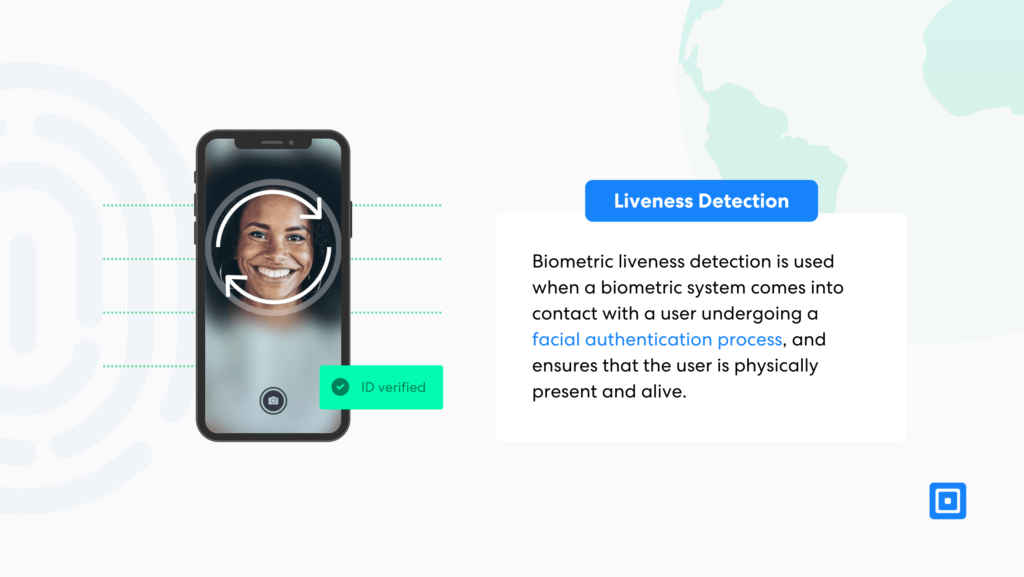
## Biometric Sample Analysis
Liveness detection works by analysing biometric samples from selfies or videos submitted by users and enhances the security of identity verification methods. Several different aspects are examined during these checks, including motion analysis, which analyses movements to identify signs of life, or texture analysis, which involves examining minute details from either a person’s face or finger.
## Machine Learning and Fraud Prevention
Machine learning AI is leveraged within liveness detection to identify signs of a presentation attack, like pixel tampering, a lack of subtle facial expressions or inauthentic skin texture on the user’s face that suggest the user is not physically present.
> These subtle textural differences are often completely invisible to the human eye, yet can be spotted with artificial intelligence.
Liveness detection algorithms are able to employ both active liveness detection and passive liveness detection methods, depending on the needs of the organisation.
## Active Liveness Detection
Active liveness detection relies on user interaction with the authentication system, requiring users to perform specific movements, or say specific words. These challenge-response tasks prove that the user is a real person by showing signs of life. However, this can be a less positive user experience, as the process requires interaction from the user.
The cornerstone of active liveness detection solutions is that they look for signs of life that cannot be easily replicated by fraud. Using several modalities, like voice recognition, keystroke analysis, and examining subtle movements of the mouth or face can help spot signs of life – but this all requires user interaction.
This kind of biometric authentication process ensures safe and robust[ identity verification](https://www.complycube.com/en/solutions/identity-assurance/biometric-verification/) by using both movement analysis and AI, and will often examine more than one image.
## Key Characteristics of Active Liveness Detection
- Active liveness checks require a lot more from the user, which makes the facial liveness check much more precise and therefore secure.
- These checks can include challenge-response tasks, ensuring security against deepfake attacks.
- Combination of movement study and artificial intelligence, creating a more comprehensive check by often looking at more than one image.
- Best for organisations that would like to focus on data safety.
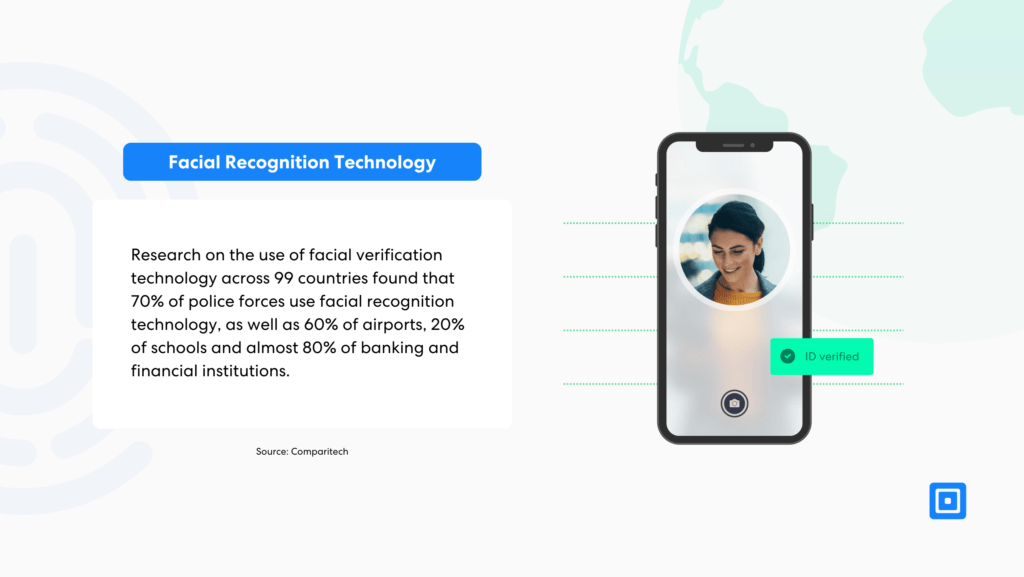
## Passive Liveness Detection
Passive liveness detection does not require any kind of movements or interaction from the user, as algorithms look for key signs of spoofs when analysing an image. They do also often look for signs of liveness, but are able to do this less comprehensively as no user interaction is implemented.
> With passive liveness detection, AI often analyses only one picture and can work without the user even being aware of the process, requiring no specific actions.
This form of liveness check is great for providing positive user experiences whilst strengthening biometric system integrity.
## Key Characteristics of Passive Liveness Detection
- No action required from the user, creating a positive user experience easily.
- These checks primarily rely on AI, usually studying only one picture.
- Faster checks than with active liveness checks.
- A better choice for organisations that need to carry out a vast quantity of checks quickly.
## Deepfakes and Presentation Attack Detection Work
In 2023, roughly 500,000 video and voice deepfakes were circulating on social media worldwide. By 2025, it is predicted that there will be around [8 million deepfakes shared online](https://www.openfox.com/deepfakes-and-their-impact-on-society/), suggesting the number of deepfakes will continue to double every 6 months. Biometric authentication processes can be subverted by deepfake videos, with studies having officially proved this.
## Deepfakes Subverting APIs
Researchers at Sungkyunkwan University in Suwon, South Korea were able to prove that APIs from both Microsoft and Amazon can be easily fooled with the use of sophisticated deepfakes. In one case, one of the APIs — Microsoft’s Azure Cognitive Services — was fooled by up to [78% of the deepfakes the coauthors fed it.](https://arxiv.org/pdf/2103.00847) However, the research study concluded that all of the APIs could be deceived by deepfakes.
Azure Cognitive Services mistook a deepfake for a target celebrity 78% of the time, while Amazon’s Rekognition mistook it [68.7% of the time. Rekognition misclassified deepfakes of a celebrity as another real celebrity 40% of the time and gave 902 out of of 3,200 deepfakes](https://arxiv.org/pdf/2103.00847) higher confidence scores than the same celebrity’s real image. Moreover, in an experiment with Azure Cognitive Services, the researchers successfully impersonated 94 out of 100 celebrities in one of the open source datasets.

## Liveness KYC with ComplyCube
Leverage our AI-powered liveness detection to establish genuine customer presence and deter imposters. Our anti-spoofing detection will safeguard your business from sophisticated presentation attacks, such as 3D masks or deepfakes without adding any friction for users. Advanced checks, including face depth analysis, micro-expressions detection, occlusion recognition, skin texture analysis, anti-spoofing checks, are leveraged within our Liveness Detection solution.
For an extremely comprehensive identity verification solution, we provide Active Liveness fraud deterrence in addition to our standard Passive Liveness checks. We guide customers to record videos completing random challenges through frictionless journey.
Implement an expert [liveness detection solution ](https://www.complycube.com/en/solutions/identity-assurance/biometric-verification/)by getting [in touch with our expert team today.](https://www.complycube.com/en/contact/contact-sales/)
**Categories:** News
**Tags:** Identity Verification
---
### [ComplyCube Wins Best Compliance as a Service Solution](https://www.complycube.com/complycube-wins-best-compliance-as-a-service-solution-for-2024/)
**Published:** May 30, 2024
**Author:** Andreea Balasa
**Excerpt:** ComplyCube was awarded the "Best Compliance as a Service Solution" at the RegTech Insight Awards Europe 2024. This accolade celebrates the SaaS platform's innovation and excellence in delivering comprehensive compliance solutions
**Content:**
London, May 30, 2024 — [ComplyCube](https://www.complycube.com/en/), the leading KYC/AML SaaS provider, has been awarded the prestigious “Best Compliance as a Service Solution” at the RegTech Insight Awards Europe 2024. This accolade celebrates ComplyCube’s innovation and excellence in delivering comprehensive compliance solutions.
## Elevating KYC/AML Standards with Best Compliance as a Service Solution
The RegTech Insight Awards, organized by A-Team Group, recognize the most innovative and effective solutions for solving regulatory challenges in the financial industry. ComplyCube’s recognition in this category is a testament to its cutting-edge platform, which streamlines identity verification (IDV) processes and fortifies Anti-money Laundering (AML) and Know Your Customer (KYC) protocols.
Financial fraud and money laundering pose significant threats to global economies. Global illicit financial flows are estimated at [$3.1 trillion annually](https://www.nasdaq.com/), including $485 billion from fraud scams and bank fraud schemes. ComplyCube’s solutions help mitigate these risks by offering sophisticated tools that detect and prevent fraudulent activities, safeguarding both institutions and their clients.
> Our goal is to continually [push the boundaries of innovation to offer secure and efficient compliance solutions.](https://www.complycube.com/en/company/aml-kyc-research-and-development/)
**Dr. Tarek Nechma, CEO of ComplyCube**, stated, “Winning the ‘Best Compliance as a Service Solution’ award affirms our team’s dedication to providing top-tier regulatory technology. Our goal is to continually push the boundaries of innovation to offer secure and efficient compliance solutions.”
## Leadership in Regulatory Technology
ComplyCube has established itself as a go-to RegTech provider, offering a comprehensive suite of solutions that simplify compliance and enhance security for financial institutions worldwide. By leveraging AI and machine learning, ComplyCube’s platform ensures robust [fraud prevention](https://www.complycube.com/en/use-cases/process/fraud-prevention/) and seamless regulatory adherence.
The company’s collaborative approach has made it a trusted partner for numerous institutions, from emerging fintech startups to established global brands such as AXA, Citi Bank, Lyca Mobile, and more. ComplyCube’s solutions not only meet but exceed the compliance needs of its partners, fostering operational efficiency, scalable growth, and enhanced customer trust.
## Vision for a Secure Future
ComplyCube’s success underscores its mission to [build trust at scale](https://www.complycube.com/en/company/about-us/) and drive technological advancements in the regulatory landscape. The company’s continuous efforts to innovate are reflected in its robust and adaptable compliance solutions, which are crucial in navigating the increasingly complex regulatory environment.
As regulatory requirements continue to grow in complexity, the role of RegTech solutions like those provided by ComplyCube will become increasingly critical. The recognition from the RegTech Insight Awards highlights the importance of leveraging technology to ensure compliance, reduce risks, and enhance operational efficiency.
## About ComplyCube
[ComplyCube](https://www.complycube.com/en/) specializes in delivering state-of-the-art AI-driven solutions for identity verification and regulatory compliance. Its automation-first SaaS platform is designed to enhance operational efficiency and protect against financial crimes, solidifying its role as a key player in the RegTech field.
## About RegTech Insight Awards Europe
The [RegTech Insight Awards Europe](https://a-teaminsight.com/app/uploads/2024/05/A-Team-Group-RegTech-Insight-Awards-Europe-2024-Special-Report.pdf), hosted by A-Team Group, celebrate the outstanding achievements of leading RegTech firms in delivering effective solutions to meet regulatory demands. The awards spotlight companies that are driving innovation and excellence in the regulatory technology space.
**Categories:** News
**Tags:** Announcements
---
### ['RegTech Partner of the Year' Win at 2024 British Bank Awards](https://www.complycube.com/regtech-partner-of-the-year-win-at-2024-british-bank-awards/)
**Published:** May 10, 2024
**Author:** Andreea Balasa
**Excerpt:** ComplyCube, the leading KYC/AML SaaS provider, has been honored with the "RegTech Partner of the Year" award at the British Bank Awards 2024, celebrating exceptional achievements in enhancing banking regulatory processes.
**Content:**
London, May 10, 2024 – [ComplyCube](https://www.complycube.com/en/ "https://www.complycube.com/en/"), the leading KYC/AML SaaS provider, has been honored with the prestigious “RegTech Partner of the Year” award at the[ British Bank Awards 2024](https://smartmoneypeople.com/british-bank-awards "https://smartmoneypeople.com/british-bank-awards"), hosted by Smart Money People. This award celebrates ComplyCube’s exceptional achievements in enhancing banking regulatory processes through its comprehensive compliance and fraud prevention technology.
## Excellence in Innovation and Security
The British Bank Awards, organized annually by Smart Money People, aims to highlight the [best products, innovations, and partnerships](https://smartmoneypeople.com/british-bank-awards/winners "https://smartmoneypeople.com/british-bank-awards/winners") that contribute to transforming the UK’s banking and financial services landscape. The “RegTech Partner of the Year” category specifically recognizes a company that has made significant contributions to the field of regulatory technology with effective solutions that optimize compliance and improve security measures in the financial services sector.
> ComplyCube stands out as a partner that can help its customers harness its pioneering verification technology to ultimately [keep people’s money safe](https://www.complycube.com/use-cases/industry/fintech/ "https://www.complycube.com/use-cases/industry/fintech/").
Jacqueline Dewey, CEO of Smart Money People, highlighted the importance of ComplyCube’s contributions, stating that “Adopting the latest technology is an important part for banks to remain relevant for their customers. ComplyCube stands out as a partner that can help its customers harness its pioneering verification technology to ultimately keep people’s money safe. Congratulations to the team at ComplyCube.”
## RegTech Partner Leading Transformation in Financial Services
As a recognized leader in the RegTech space, ComplyCube provides a [comprehensive suite of solutions](https://www.complycube.com/en/solutions/ "https://www.complycube.com/en/solutions/") that streamline Identity Verification (IDV) processes and enhance Anti-money Laundering (AML) and Know Your Customer (KYC) protocols. These solutions facilitate safer and more efficient transactions, ensuring compliance with evolving regulatory requirements and delivering an improved customer experience.
As the financial industry faces increasingly complex regulations, ComplyCube has positioned itself at the forefront of the RegTech sector. The company offers a sophisticated platform that simplifies the implementation of KYC and AML protocols, enabling [banks and other financial institutions](https://www.complycube.com/en/use-cases/industry/financial-services/ "https://www.complycube.com/en/use-cases/industry/financial-services/") to achieve compliance with ease and precision.
ComplyCube’s partnership model focuses on collaborative success, working closely with banks of all sizes, from emerging fintechs to established global entities. Its impact extends beyond compliance, influencing broader strategic goals such as operational efficiency, scalable growth, customer trust, and long-term loyalty.
## Vision for a Secure Future
[Dr. Tarek Nechma, CEO of ComplyCube,](https://www.linkedin.com/in/tarek-nechma/ "https://www.linkedin.com/in/tarek-nechma/") responded to the award, remarking that “Receiving the ‘RegTech Partner of the Year’ award at the British Bank Awards is a testament to our team’s dedication to innovation and excellence in the regulatory technology sector. At ComplyCube, we are committed to delivering solutions that not only meet but exceed the compliance needs of our partners. This recognition fuels our continued efforts to drive technological advancements and shape a more secure, compliant, and efficient financial services environment.”
> Receiving the ‘RegTech Partner of the Year’ award at the British Bank Awards is a testament to our team’s dedication to [innovation and excellence in the regulatory technology](https://www.complycube.com/en/company/aml-kyc-research-and-development/) sector.
The company’s collaboration with various banks and financial institutions globally, including prominent names such as Citi Bank, Al Baraka, and HSBC, highlights its capacity to adapt and deliver comprehensive solutions that address the rigorous identity assurance and fraud prevention level required within the financial industry.
## About ComplyCube
[ComplyCube](https://www.complycube.com/en/ "https://www.complycube.com/en/") specializes in leveraging cutting-edge AI and machine learning technologies to provide industry-leading solutions for identity verification and regulatory compliance. Its automation-first SaaS platform offers robust tools designed to enhance operational efficiency and protect against financial crimes, reinforcing its status as a trusted partner in the RegTech field.
## About Smart Money People
[Smart Money People](https://smartmoneypeople.com/british-bank-awards "https://smartmoneypeople.com/british-bank-awards") is a leading financial services review and insight company that focuses on providing transparent and reliable information across the banking and financial sectors. The firm hosts the British Bank Awards annually to recognize and commend the outstanding achievements within the industry, promoting innovation and customer-focused services.
**Categories:** News
**Tags:** Announcements
---
### [ComplyCube and Emigreat Partner to Lead Global HR Compliance](https://www.complycube.com/complycube-and-emigreat-partner-for-global-hr-compliance/)
**Published:** April 4, 2024
**Author:** Andreea Balasa
**Excerpt:** In an era where the HRM market is booming and internal security threats are on the rise, ComplyCube, the leader in IDV solutions, has partnered up with Emigreat, an emerging risk management tool for global HR compliance.
**Content:**
London, April 04, 2024 – In an era where the Human Resource Management (HRM) market is booming and internal security threats such as employee theft are on the rise, [ComplyCube](https://www.complycube.com/en/), the leader in Identity Verification solutions, has partnered up with [Emigreat](https://emigreat.io), an emerging risk management tool for global HR compliance.
This strategic partnership is set to redefine international workforce management by offering enhanced security and efficiency in compliance processes tailored to the needs of a rapidly evolving global HR landscape.
## Addressing Market Growth and Security Challenges
The HRM sector is anticipated to grow at a compound annual growth rate (CAGR) of 14.63%, reaching USD 69618.53 million by 2028. This rapid growth highlights the increasing need for innovative solutions that address both the complexities of global workforce management and the security challenges posed by internal threats, such as the [74% increase in employee theft](https://www.cifas.org.uk/newsroom/insiderthreatfraudscape23) from employers and customer accounts reported by Cifas in its latest Fraudscape update.
> The HRM sector is anticipated to reach a market value of [USD 69618.53 million by 2028](https://www.linkedin.com/pulse/human-resource-management-market-latest-x6ncf/).
## Cutting-Edge IDV Tech for Enhanced Global HR Compliance Operations
The collaboration responds to the growing need for streamlined, secure, and efficient management of international employees’ legal requirements. ComplyCube’s cutting-edge [ID verification technology](https://www.complycube.com/en/solutions/identity-assurance/document-verification/) will play a pivotal role in enhancing Emigreat’s offerings, allowing HR departments to automate identity verification processes seamlessly. This is particularly crucial for the accurate and timely management of new recruitments and permit renewals for international employees.
Emigreat, which was part of the [Techstars](https://www.techstars.com/) ’23 cohort, provides a vital service in simplifying the complexities of international employee compliance. With the addition of ComplyCube’s technology, Emigreat will empower HR departments with enhanced ID verification capabilities, automated data extraction, and a secure platform to manage the legal compliance of their international workforce efficiently.
## Setting New Standards in HR Compliance Technology
“Against the backdrop of a growing HRM market and heightened internal security concerns, our partnership with Emigreat represents a significant step forward. ComplyCube’s verification technology will enhance Emigreat’s capabilities, enabling businesses to address the dual challenges of managing a global workforce and mitigating internal fraud risks,” stated Dr. Tarek Nechma, CEO of ComplyCube.
“This collaboration comes at a critical time, as companies face not only the challenge of managing a global workforce but also the increased risk of internal fraud,” commented Saaya Sorrells-Weatherford, co-founder of Emigreat. “Through our partnership with ComplyCube, we’re setting a new standard for security and compliance in HR management, providing our clients with the tools they need to protect their businesses and their customers.”
> We’re setting a new standard for [security and compliance](https://www.complycube.com/en/use-cases/process/identity-verification/) in HR management.
In light of the dynamic HRM market and increasing internal security challenges, the strategic partnership between ComplyCube and Emigreat marks a significant advancement in compliance technology, setting new standards for security and efficiency in global workforce management.
## About ComplyCube
[ComplyCube](https://www.complycube.com/en/), the leading platform for Identity Verification (IDV), Anti-Money Laundering (AML), and Know Your Customer (KYC) compliance, is renowned for its rapid omnichannel integration and innovative solutions across various sectors. With an ISO-certified platform, ComplyCube is dedicated to simplifying and securing compliance, aiding businesses in navigating the evolving challenges of global workforce management.
## About Emigreat
[Emigreat](https://emigreat.io) streamlines the management of international employees’ immigration requirements for HR departments. Its comprehensive suite of services supports companies in ensuring their international workforce’s legal compliance with streamlined processes, deadline notifications, audits, requirement assessments, and automated updates.
**Categories:** News
**Tags:** Announcements
---
### [Global KYC Verification Process in 3 Steps](https://www.complycube.com/global-kyc-verification-process-in-3-steps/)
**Published:** March 20, 2024
**Author:** Andreea Balasa
**Excerpt:** Know Your Customer Verification has become integral to safeguarding against financial system abuse and money laundering. Adopting a streamlined and global KYC verification process helps to gain and retain a competitive advantage.
**Content:**
Know Your Customer (KYC) Verification has become increasingly integral to safeguarding against financial system abuse, money laundering, and many other practices that could be detrimental to the operation and reputation of a business. Adopting a streamlined and global KYC verification process helps to retain a competitive advantage.
This guide will dive into the 3 critical steps of the KYC process, underlining the importance of verifying a [Customer’s Identity](https://www.complycube.com/en/solutions/identity-assurance/document-verification/), completing thorough [Customer Due Diligence](https://www.complycube.com/en/solutions/due-diligence-compliance/customer-due-diligence/) checks, and committing to [Ongoing Monitoring](https://www.complycube.com/en/use-cases/process/ongoing-due-diligence/).
## What is KYC Verification?
Worldwide, financial institutions, alongside other businesses, must thoroughly understand who their clients are. This necessity, mandated by regulations such as the [Bank Secrecy Act](https://www.occ.treas.gov/topics/supervision-and-examination/bsa/index-bsa.html) and the [USA Patriot Act](https://www.fincen.gov/resources/statutes-regulations/usa-patriot-act) in the United States, aims to identify and prevent money laundering, fraud, financing of terrorism, and other financial crimes. The strategies and procedures businesses implement to meet relevant regulations are collectively recognized as [Know Your Customer (KYC)](https://www.complycube.com/en/solutions/due-diligence-compliance/know-your-customer/).
The KYC process involves a series of 3 steps, including a Customer Identification Program (CIP), Customer Due Diligence (CDD), and Ongoing Monitoring. These steps are fundamental in verifying the client’s identity, understanding their behavior, and continuously monitoring their associated risks.
This comprehensive approach is a risk mitigation strategy, ensuring that the financial institution remains vigilant against illegal activities while maintaining accurate information about their customer’s identity. Through KYC verification, these institutions comply with legal requirements and secure their operations against potential threats.
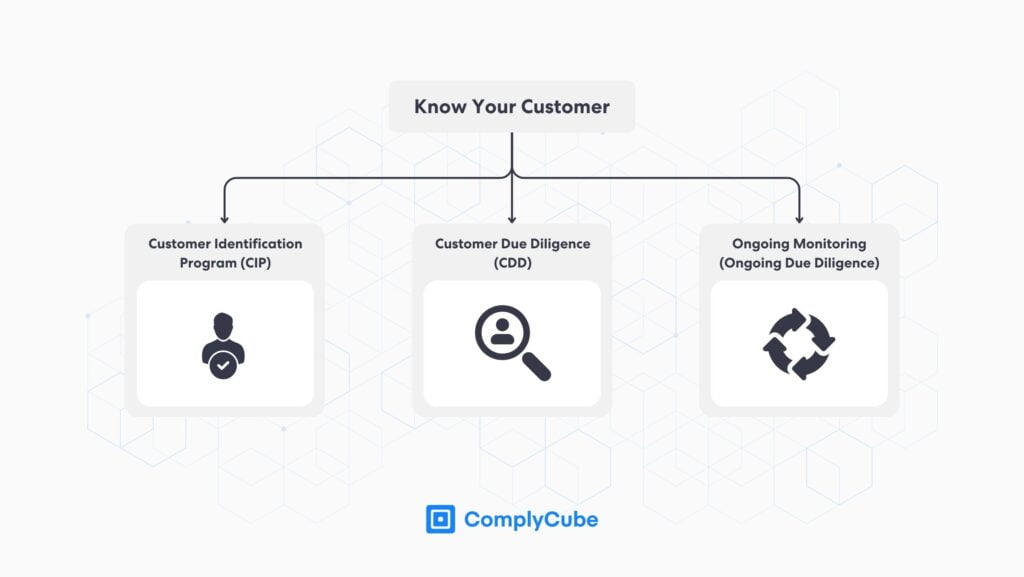
Thus, with an increasingly global economy augmented by the proliferation of digital interactions, a business must meet its KYC requirements to avoid non-compliance with the relevant financial industry regulatory authority. The necessity for KYC compliance has led firms to outsource solutions that provide a smooth customer onboarding experience. KYC solutions help businesses maximize client signups with an integrated KYC procedure that identifies the potential risk factors of new customers.
[KYC](https://www.complycube.com/en/solutions/) solution providers offer effective services across a wide range of industries that require customer transparency. These involve financial services that require high levels of identity assurance, as well as enterprises that require more basic customer due diligence.
## The 3 Steps to Know Your Customer Verification
There are 3 steps in a KYC verification journey: Customer Identification Program (CIP), Customer Due Diligence (CDD), and Ongoing Monitoring.
### Customer Identification Program (CIP)
A CIP is a set of procedures that financial institutions and other businesses execute to verify the identity of their customers. This is a critical process for confirming the accuracy of client information and ensuring the individual in question is actually who they say they are.
The fundamentals of implementing a rigorous set of identity verification methods in a Customer Identification Program are:
- Full Name, as displayed on a user’s passport
- Date of Birth (DoB)
- Residential address, found on a utility bill
- Government-issued identification number, i.e. passport number

### Customer Due Diligence (CDD)
A Customer Due Diligence Process dives deeper into a customer verification check. Done correctly, CDD will prove identity and help prevent money laundering and other financial crimes. This process uses KYC document verification and acquired user data, which is ratified against 3rd party databases and other consumer reporting agencies. The more an institution knows about who it is dealing with the higher chance it has of avoiding abuse of the financial system.
A robust CDD procedure will allow the company to make accurate predictions about the nature of a client’s business. This will enable the company to diagnose any suspicious activity the user might perform. For example, politically exposed persons (PEPs) require greater scrutiny as the risk of engaging in an illicit activity is higher. Once the customer’s due diligence is complete, a customer is assigned a risk level. Learn more about Customer Due Diligence here: [What is Customer Due Diligence?](https://www.complycube.com/en/what-is-customer-due-diligence/)
An enhanced due diligence (EDD) process occurs when a higher risk of money laundering or terrorist financing is detected. This could be alerted by the region and jurisdiction the individual is in, the individual themself, such as a PEP, or the industry-specific products they are accessing.

Businesses must adopt a risk-based approach (RBA) to determine customer risk factors such as the nature of their transactions, their behavior, and other factors. RBAs help companies make decisions on allocating resources to higher-risk areas, which increases the efficacy of Anti-Money Laundering (AML) and counter-terrorism financing (CTF) procedures.
### Ongoing Monitoring
Ongoing Monitoring, or [Continuous Monitoring](https://www.complycube.com/en/solutions/global-screening/continuous-monitoring/), is the real-time verification of an account’s integrity. In essence, it is a perpetual risk assessment. AML regulations require businesses to frequently check and verify the identity of their users to ensure their risk assessment is up to date. Continuous monitoring is one of the key components of a fully compliant KYC verification strategy.
Money laundering and other financial crime methodologies are constantly evolving. An individual can become involved in illicit financial behaviors very quickly. The ongoing monitoring of clients, particularly those requiring enhanced due diligence such as PEPs, ensures that financial institutions remain alert to potential risks and unusual patterns in behavior.

## The Benefits of Opting for a KYC Verification Service
Signing up for a service is the beginning of a customer’s journey, and first impressions count. KYC solutions, or eKYC (electronic KYC), facilitate the smooth transition from potential to actual customers. They verify customers’ identity, KYC documents, and multiple other customizable screening measures in the due diligence and onboarding process.
Signing up for a service is the beginning of the customer’s journey and sets a crucial first impression. eKYC (electronic Know Your Customer) solutions facilitate the conversion of potential customers into actual customers. These systems confirm the identity of customers by authenticating their KYC documents along with performing multiple other tailored screening measures. Learn more about eKYC here: [What is eKYC (electronic Know Your Customer)?](https://www.complycube.com/en/what-is-ekyc-electronic-know-your-customer/)

### Increased Operational Efficiency
Efficient KYC providers automate the entire KYC verification process, supporting tens of thousands of instantly verifiable documents. Measures such as [Biometric Verification](https://www.complycube.com/en/use-cases/process/customer-onboarding/) reduce the client acquisition process from weeks to seconds. These automated processes eliminate the middleman, eradicate human error from Know Your Customer verification, and increase efficiency and margins.
### Ease of Integration
State-of-the-art KYC solutions offer a variety of methods to integrate smoothly into a business technological stack. These include web and mobile SDKs, powerful APIs, hosted platforms, low and no-code solutions. Customer data can be easily monitored on a friendly UI, automatically alerting potential client risks and when KYC documents need rechecking. You can learn more here: [KYC API Pricing](https://www.complycube.com/a-guide-to-kyc-api-pricing/).
### Streamlined Customer Onboarding
87% of customers believe companies could improve their customer onboarding experience. Inadequate onboarding processes often fail to convert prospects into customers, affecting businesses at a crucial juncture. First impressions count, and a streamlined KYC verification procedure is critical. An excellent user experience leads to loyalty, which in turn, reduces churn.
> [87% of customers](https://www.custify.com/blog/saas-customer-onboarding-and-retention-statistics/) believe companies could improve their customer onboarding experience.
A 2022 survey, which included 79 SaaS companies, found that the average conversion rate for their onboarding process was[ less than 37%](https://www.helpscout.com/blog/customer-onboarding/). With the help of the right KYC provider, customer onboarding rates can be [as high as 98%](https://www.complycube.com/en/contact/).
### Malleable Data with eKYC
The digitalization of client data makes information tracking and transfers seamless. Before eKYC solutions, banks and other financial institutions manually carried out KYC procedures and stored data on paper. Automated Know Your Customer solutions ensure data is not lost or misplaced and accessible immediately digitally.
## Corporate KYC verification
Known as [Know your Business (KYB)](https://www.complycube.com/en/use-cases/process/know-your-business/), Corporate KYC verification is the identification and due diligence process required when establishing new business relationships. They are designed to:
- Validate the authenticity of a new business partner and ensure that entering a business relationship is safe. For example, in the UK, checking that a company has been registered with [Companies House](https://www.gov.uk/government/organisations/companies-house) is a bare minimum, where official data can be extracted.
- Ensure that the ultimate beneficial owners and individuals running the company, such as directors and chief executives, are not involved in malicious activities such as money laundering. These checks are much like the typical KYC processes discussed throughout this article.
Corporate clients need just as strict KYC requirements to verify the integrity of new business relationships. This involves checks that qualify for proper registration with the necessary authoritative body and ensure they are not connected to illicit activity.
Institutions involved in money laundering will build layers to attempt to hide from regulators and authorities. The intention behind layering is to make money tracking between each company segment much harder to achieve.

## Which Industries Need KYC Verification?
The need for Know Your Customer (KYC) verification isn’t only crucial for financial services companies aiming to curb money laundering risks. It’s essential for any organization that introduces customers via an onboarding process to have a means of authenticating user identity. KYC is designed to protect financial institutions, real estate firms, hospitality providers, and many others. You can learn more here: [Best KYC Software for 2025.](https://www.complycube.com/en/best-kyc-software-for-2025/)
This underscores the importance of providing various identity assurance options, as different businesses can opt for more stringent screening processes based on their industry, security needs, and the company’s risk tolerance. A valuable KYC service will supply a range of KYC solutions, allowing businesses the flexibility to select a package that best aligns with their specific requirements.
For example, a Bank will require a far higher level of identity assurance than an e-commerce site selling age-restricted products.
- An e-commerce site might only require an[ age estimation check](https://www.complycube.com/en/complycube-unveils-no-id-ai-age-estimation-solution/) to verify a new user’s identity.
- A bank would require far stricter levels of assurance, including but not limited to: document and biometric verification, proof of address checks, and multi-bureau verification.
### KYC Verification in Banking
KYC verification in the banking industry requires the highest level of identity assurance. Banks must assess money laundering risks and exposure to terrorist financing when opening new accounts – particularly with higher-risk clients or [Politically Exposed Persons (PEPs)](https://www.complycube.com/en/solutions/global-screening/sanctions-pep-screening/).
Customer identity data must then be stored, archived, and monitored in case any illicit activity is flagged. If this were to occur, a full report could be commissioned and sent to a suitable authority, such as the Financial Crimes Enforcement Network in the US.
KYC in banking also provides informational clarity between the banking provider and the customer. This enables a more efficient and relevant service.
### KYC Verification in FinTech
The Bank Secrecy Act of 1970 requires all financial institutions to help the US government in deterring and preventing money laundering activities. This used to only relate to established financial services such as banks and insurance brokers. However, developments over the last few decades have forced a reappraisal.
The rise of [FinTech](https://www.mckinsey.com/featured-insights/mckinsey-explainers/what-is-fintech) services and associated technologies has forced this re-evaluation, and this policy now includes a much wider array of financial services. FinTechs are frequently targeted as money laundering vehicles, meaning now, any company that operates in the financial industry must adhere to strict KYC verification requirements.
### KYC Verification in Crypto
[Cryptocurrency](https://www.coinbase.com/en-gb/learn/crypto-basics/what-is-cryptocurrency) and blockchain technology were designed to build transparency, ownership, and anonymity in the financial industry. Like any new global innovation however, malicious individuals embarked on manipulating this unregulated technology for illicit purposes.
The risks associated with cryptocurrency are much higher due to this anonymity. For each new user, it’s essential to evaluate the money laundering and terrorism financing risks through a thorough KYC process complemented by continuous transaction monitoring.
Following 2 turbulent years of trust in the industry between 2021 and 2023, cryptocurrency is looking to bounce back. KYC verification services will be paramount in building trust at scale in this fast-paced industry. For more information on KYC for Crypto, read [How KYC Crypto Regulations Safeguard the Industry](https://www.complycube.com/en/how-kyc-crypto-regulations-safeguard-the-industry/).
### KYC Verification in Insurance
Similarly to banking, insurance relies on trust. Trust that the user who is purchasing a policy is who they say they are. Plainly, KYC verification helps an insurer identify the individual, ensuring they truly know who is on the other side of the transaction.
Integrated KYC solutions equip businesses with the capability to onboard new policyholders instantly with reliable, accurate, and immediate verification across the globe. This allows insurers to scale into new markets and expand in existing ones without fear of compromising compliance.
## Time to Choose a KYC Partner?
The security of financial transactions has a lot of moving parts. KYC processes should help bridge the growing gap between operation and regulation. ComplyCube’s industry-leading AML and KYC solutions ensure businesses are successful in their compliance strategies and remove the headache of onboarding new and higher-risk customers.
Standardizing successful client acquisition at up to 98% onboarding rate in less than 30 seconds, ComplyCube is gaining traction amongst financial services, financial technology, and a wealth of other markets. This is also due to their comprehensive AML solution toolkit, which not only acts as an enabler but significantly cuts operational costs by streamlining compliance workflows.
If you are looking for a new provider or are new to this market, [get in touch with ComplyCube’s team of IDV, KYC & AML specialists.](https://www.complycube.com/en/contact/contact-sales/)
**Categories:** Guides
**Tags:** Know Your Customer
---
### [ComplyCube Achieves ACCS Certification for Age Verification](https://www.complycube.com/accs-certification-age-verification-idv/)
**Published:** January 24, 2024
**Author:** Andreea Balasa
**Excerpt:** ComplyCube achieved the ACCS Certification for Age Check Systems and Data Protection and Privacy. This certification, awarded by the Age Check Certification Scheme, cements the AI platform's dedication to protecting minors online.
**Content:**
LONDON, JAN 23, 2024 — [ComplyCube](https://www.complycube.com/en/ "https://www.complycube.com/en/"), a global leader in Identity Verification (IDV) solutions, has received the ACCS Certification for Age Check Systems and Data Protection and Privacy Certification, incorporating PAS 1296:2018 Code of Practice for Age Check Systems. This certification, awarded by the Age Check Certification Scheme ([ACCS](https://www.accscheme.com/ "https://www.accscheme.com/")), cements ComplyCube’s dedication to protecting minors across various online sectors.
## Navigating Global Regulatory Landscapes
In an era of increasing regulatory demands and online safety challenges, the milestone is more relevant than ever. The [FTC’s hefty $170 million fine for COPPA violations](https://www.ftc.gov/news-events/news/press-releases/2019/09/google-youtube-will-pay-record-170-million-alleged-violations-childrens-privacy-law) in the US highlights the critical need for compliance in safeguarding minors. In the UK, with 45% of young internet users encountering inappropriate content, the necessity for effective age controls is evident. Further, Brazil’s burgeoning sports betting market, expected to reach [$1.70bn by 2028](https://es.statista.com/outlook/dmo/eservices/online-gambling/online-sports-betting/brazil#:~:text=The%20Online%20Sports%20Betting%20market,%E2%82%AC1.57bn%20by%202028.), underscores the importance of robust age verification in the online gaming sector.
> In the UK, with [45% of young internet users encountering inappropriate content](https://www.ofcom.org.uk/__data/assets/pdf_file/0025/217825/children-and-parents-media-use-and-attitudes-report-2020-21.pdf), the necessity for effective age controls is evident.
ComplyCube passed with zero non-conformities, a testament to the AI platform’s strict adherence to the highest standards in age verification and data protection. This achievement is particularly noteworthy amidst strict global regulations such as the UK Online Safety Bill, EU GDPR and Digital Services Act, and California Age-Appropriate Design Code Act (COPPA).
## Commitment to Ethical Compliance and Trust Building
“Regulatory compliance in age-restricted industries is a moral obligation, not just a legal requirement,” stated Joshua Dent, Business Strategy Manager at ComplyCube.
> Our certification by ACCS, with zero non-conformities, shows our market-leading capability to help partners meet expectations and [build trust at scale](https://www.complycube.com/en/company/about-us/).
“Our steadfast dedication to innovation and adherence to compliance standards has been crucial in reaching this milestone,” Dr. Tarek Nechma, CEO of ComplyCube, further explained. “This certification serves as a proof of our firm commitment to delivering top-tier age verification solutions. We ensure that online platforms are secure and only accessible to suitable age groups, all while maintaining a strong focus on protecting user privacy and data security.”
## ACCS Certification Reinforcing Trusted Age Verification Solutions
ComplyCube’s [Age Verification](https://www.complycube.com/en/use-cases/process/age-verification/) technology, equipped with [advanced liveness detection](https://www.complycube.com/en/solutions/due-diligence-compliance/know-your-customer/liveness-detection/) and dynamic automation rules, empowers partner businesses to authenticate the genuine presence of customers and adhere to diverse age restriction standards while delivering a seamless user experience.
The platform’s AI-driven system adeptly customizes verification thresholds to match specific age requirements. In line with its privacy-centric [PII Redaction](https://www.complycube.com/en/solutions/due-diligence-compliance/know-your-customer/pii-sensitive-data-redaction/) feature, only essential information is being disclosed in accordance with local legal mandates. For businesses requiring less stringent age assurance, ComplyCube offers a low-friction [Age Estimation](https://www.complycube.com/en/solutions/global-screening/facial-age-estimation/) solution.
As ComplyCube broadens its international reach, this certification further solidifies its status as a frontrunner in the identity verification arena, promoting secure and compliant digital interactions across a multitude of industries and geographical regions.
## About ComplyCube
[ComplyCube](https://www.complycube.com/en/) is a leading SaaS & API platform for Identity Verification (IDV), Anti-Money Laundering (AML), and Know Your Customer (KYC) compliance. Catering to a global market across various sectors, it boasts an ISO-certified platform noted for rapid omnichannel integration. ComplyCube offers a range of user-friendly solutions including Low/No-Code options, APIs, Mobile SDKs, and CRM Integrations, making it a top choice in age verification and online security.
**Categories:** News
**Tags:** Announcements
---
### [ComplyCube Achieves 3 TrustRadius Best Of Awards 2023 in IDV](https://www.complycube.com/complycube-trustradius-best-of-awards-2023-idv/)
**Published:** January 9, 2024
**Author:** Andreea Balasa
**Excerpt:** ComplyCube secured 3 more awards to add to its set of accolades as it heads into the new year. The TrustRadius Best Of awards denote the IDV industry leaders across 3 metrics: Value for Price, Best Relationship, and Feature Set.
**Content:**
London, January 9, 2024 – [ComplyCube](https://www.complycube.com/en/), the leading IDV SaaS platform, secured 3 more awards to add to its already impressive set of accolades as it heads into the new year. The TrustRadius Best Of awards denote the Identity Verification industry leaders over 3 metrics: Value for Price, Best Relationship, and Feature Set.
TrustRadius awards simplify B2B commerce by identifying the industry champions. The review platform’s CEO commented that their prestigious awards [“ease the growing challenges in today’s purchase process and facilitate informed purchase decisions.”](https://www.prnewswire.com/news-releases/trustradius-announces-the-best-of-award-winners-for-2023-301981065.html#:~:text=AUSTIN%2C%20Texas%2C%20Nov.,Feature%20Set%2C%20and%20Best%20Relationship.) Securing three out of three awards, ComplyCube demonstrates significant strides as a prominent AI-powered platform in IDV, AML, and KYC.
Dr. Tarek Nechma, CEO of ComplyCube, described the recent win as a perfect reflection of the high standards the team consistently aims for.
> ‘These awards strengthen our trajectory in becoming [the industry go-to in Identity Verification](https://www.complycube.com/en/solutions/),’ he commented. The recognition underscores the company’s commitment to excellence and innovation in the field.
Dr. Nechma reiterated ComplyCube’s core mission of building trust at scale. Emphasizing the importance of reliable and secure verification processes, he hinted to reaching additional milestones and expanding the company’s impact in the near future.
## TrustRadius Best of Awards 2023 and the Significance of Each Award
The TrustRadius Best Of awards promote an industry’s best services, with ComplyCube being recognized for its excellence in Identity Verification.
- **The Best Value for Price Award** weighs the price of the service against the quality and the Return on Investment (ROI) it provides.
- **The Best Relationship Award** values customer satisfaction through 3 key metrics: ‘Would Buy Again’, Implementation Expectations’, and ‘Sales and Marketing Promises’.
- **The Best Feature Set Award** rewards a company’s distinction in building innovative solutions that provide great user experience.
## Feature Rich Solutions
Rich compliance features are paramount to customer security and acquisition and to avoid hefty fines or potential sanctions, especially when a highly regulated bank is in question.
> [Our previous vendor’s solution lacked many of the enterprise features we required. ComplyCube was able to address all of these deficiencies.](https://www.trustradius.com/reviews/complycube-2023-02-21-06-37-18) Not only did it provide us with the enterprise-level features we required, but it also proved to be more compliant.
ComplyCube’s mature solutions with ‘detailed reporting’ act as the bridge between compliance and healthy banking.
## Industry Leading Know-How
Carolina, Managing Director at Accenture, attests that ComplyCube provides solutions with the highest degree of [compliance know-how.](https://www.complycube.com/en/aml-for-fintechs-comply-with-regulations/)
> Having searched extensively for a suitable partner, I can confidently attest to the fact that the [ComplyCube team demonstrated a greater degree of compliance awareness than their peers](https://www.trustradius.com/reviews/complycube-2023-03-17-13-09-19).
The solutions provided by the state-of-the-art KYC/AML platform are designed to prevent businesses from being hindered by the ever-changing regulations in their respective industries and aim to eliminate downtime. Carolina also noted ComplyCube’s vast global coverage and detail-centric PEP watchlist as crucial USPs.
## Streamlined Operational Efficiency
The IDV provider’s solutions positively impact every level of a business, from the tech team to newfound customers and operating margins.
> ComplyCube has simplified things for us by reducing the number of vendors we need to use, which has saved us time and money. In short, [it helped us meet our compliance obligations while improving our operational efficiency](https://www.trustradius.com/reviews/complycube-2023-03-13-08-19-43).
Providing services across the globe in start-up to enterprise-grade packages, clients can rest assured that they are keeping up with compliance and customer onboarding processes through one automated workflow.
## About ComplyCube
[ComplyCube ](https://www.complycube.com/en/)is a global leader in Identity Verification (IDV), Know Your Customer (KYC), and Anti-money Laundering (AML). Harnessing powerful modern technologies such as Machine Learning (ML) and Artificial Intelligence (AI), the SaaS solution with an automation-first approach delivers powerful tools for streamlining compliance workflows, improving operational productivity, and protecting against financial crimes.
## About TrustRadius
[TrustRadius](https://www.trustradius.com) is a noted review website connecting future purchasers of services to the right provider. Their reputable list of verified users provides professionals with peace of mind when it comes to making and informed purchasing decisions faster.
**Categories:** News
**Tags:** Announcements
---
### [ComplyCube listed in the 2024 RegTech100](https://www.complycube.com/complycube-regtech100-2024-list/)
**Published:** December 6, 2023
**Author:** Andreea Balasa
**Excerpt:** ComplyCube was included in the RegTech100 2024 list for contributions to compliance, risk management, and fraud prevention, reflecting ComplyCube's impact in transforming regulatory compliance with technology-first processes.
**Content:**
**London, December 6, 2023** – [**ComplyCube**](https://www.complycube.com/en/), the leading KYC/AML SaaS, was included in the prestigious **[RegTech100 list for 2024](https://fintech.global/regtech100/?gclid=EAIaIQobChMI9tWPzdr6ggMVvJJQBh1erwHKEAAYAiAAEgK2gPD_BwE)**. This recognition marks the AI platform’s outstanding contributions to the field of regulatory technology in the areas of compliance, risk management, and fraud prevention.
## RegTech100 The Global Benchmark of Excellence
The RegTech100 list, now in its seventh year, is a comprehensive guide to the world’s most innovative RegTech companies. A group of experienced analysts and industry specialists evaluated an extensive list of almost 1,400 companies, compiled by RegTech Analyst. It serves as a benchmark for businesses seeking reliable and effective solutions in regulatory technology.
Mariyan Dimitrov, the director of research at RegTech Analyst, emphasized the significance of this year’s list, stating,
> This year’s RegTech100 list highlights the [leading companies in areas such as information security, compliance, risk management, and fraud prevention](https://www.einpresswire.com/article/672787363/seventh-annual-regtech100-shines-a-light-on-the-movers-and-shakers-in-the-regulatory-technology-sector) working on the forefront of innovation and new AI implementations which have demonstrated a strong track record delivering regulatory and operational improvements in financial services.
## ComplyCube’s Pioneering Role
ComplyCube has established itself as a leader and the next-gen trust platform for the internet, with a comprehensive suite of solutions designed to streamline and enhance identity verification and compliance processes. The AI-powered platform’s fully-managed KYC as a service simplifies scaling AML and KYC compliance for businesses, ensuring a balance between stringent security measures and user-friendly experiences, making it an ideal partner for businesses seeking efficient, reliable, and scalable regulatory compliance tools.
Selected for its seamless [customer verification](https://www.complycube.com/en/solutions/due-diligence-compliance/customer-due-diligence/), [onboarding](https://www.complycube.com/en/use-cases/process/customer-onboarding/), and [ongoing monitoring](https://www.complycube.com/en/use-cases/process/ongoing-due-diligence/) solutions, ComplyCube has partnered with [businesses of varying sizes across the globe](https://www.complycube.com/en/use-cases/), from promising startups and fast-growing scaleups to listed multi-nationals such as Lyca Mobile, Citi Bank, AXA, HSBC, and more.
This recognition by RegTech Analysts underscores the IDV platform’s pivotal role in enhancing operational efficiencies and regulatory compliance across [various industries](https://www.complycube.com/en/use-cases/), including, but not limited to, telecom, fintech, recruitment, insurance, banking, gaming, and more.
## A Future Shaped by Innovation
ComplyCube’s selection for the RegTech100 2024 list reflects its vital impact in transforming regulatory compliance with technology-first processes. This accolade serves as a testament to ComplyCube’s dedication to developing cutting-edge solutions that address the evolving needs of the regulatory and economic landscape.
Dr Tarek Nechma, CEO of ComplyCube, commented on the inclusion:
> Being listed in the RegTech100 is a testament to our unwavering commitment to innovate in the regulatory technology sector. At ComplyCube, we do more than develop advanced, inclusive AI solutions. Our remarkable team is working towards [crafting a more secure, streamlined, and compliant future](https://www.complycube.com/en/company/about-us/), directly benefiting our valued partners and their customers. This recognition affirms our forward-thinking approach and further motivates us to persist in our pursuit of excellence across all of our services.
## About ComplyCube
[ComplyCube](https://www.complycube.com/en/solutions/) specializes in providing state-of-the-art solutions for identity verification and regulatory compliance, focusing on leveraging advanced technologies such as AI and machine learning. The automation-first IDV SaaS offers robust tools to streamline compliance processes, enhance operational efficiency, and safeguard against financial crimes.
## About RegTech Analyst
RegTech Analyst provides in-depth research, analysis, and insights in the field. As the curator of the [RegTech100 list](https://fintech.global/regtech100/?gclid=EAIaIQobChMI9tWPzdr6ggMVvJJQBh1erwHKEAAYAiAAEgK2gPD_BwE), they identify and showcase the most innovative companies transforming regulatory compliance through technology.
**Categories:** News
**Tags:** Announcements
---
### [ComplyCube Unveils no-ID AI Age Estimation Solution](https://www.complycube.com/complycube-no-id-ai-age-estimation-solution/)
**Published:** October 3, 2023
**Author:** Andreea Balasa
**Excerpt:** Tapping into advanced biometric technology, ComplyCube's age estimation tool can swiftly show reliable age estimations in seconds using just one selfie. The AI-powered solution is bias-tested and actively checks for liveness.
**Content:**
LONDON, AUG 30, 2023 – [ComplyCube](https://www.complycube.com/en/), the leading Identity Verification (IDV) provider, announced the release of AI [Age Estimation](https://www.complycube.com/en/solutions/global-screening/facial-age-estimation/), a no-ID verification solution that streamlines UX for age-gated products while shielding the vulnerable online. This feature supplements its existing [Age Verification](https://www.complycube.com/en/use-cases/process/age-verification/) capabilities, a seamless selfie check option for entities seeking a less stringent form of identity assurance.
## 1-Step Verification Process
Tapping into advanced biometric technology, ComplyCube’s age estimation tool can swiftly show reliable age estimations in seconds using just one selfie. The AI-powered solution is equipped with a bias-tested engine that actively checks for genuine [liveness](https://www.complycube.com/solutions/due-diligence-compliance/know-your-customer/liveness-detection/) signals, guarding against potential threats such as deepfakes, 3D masks, and screen replays.
> ComplyCube’s age estimation tool can swiftly show [reliable age estimations in seconds using just one selfie](https://www.complycube.com/en/solutions/global-screening/facial-age-estimation/).
## Privacy-Centric Design for Global Age-Gating
Incorporating a privacy-focused design, the feature streamlines compliance with the help of automatic selfie redaction, adjustable to specific regional rules and use cases. This flexibility enhances global age-gating processes while providing an extra barrier against spoofing.
Harry Varatharasan, ComplyCube’s Chief Data Scientist, remarked, “Our comprehensive data-focused strategy allows us to address variances in ethnicity, genetics, age, and gender, providing our partners with a reliable age estimation.”
## Tackling Digital Safety Concerns
The rollout of the Age Estimation solution is timely, given the rising apprehension surrounding minors’ easy access to unsuitable online content. Current verification methods, which often rely on mere date of birth entries or are susceptible to VPN workarounds, are becoming alarmingly ineffective.
> Data reveals that [23% of minors can effortlessly bypass VPN](https://www.cnil.fr/en/online-age-verification-balancing-privacy-and-protection-minors) restrictions, while [56% of children aged 11 to 16 have stumbled upon explicit content online](https://www.internetmatters.org/issues/inappropriate-content/learn-about-it/).
Amid escalating concerns, multiple jurisdictions are rolling out stringent regulations to mandate enhanced age verification processes, ensuring online safety for minors. Notable legislative initiatives include the [UK’s Online Safety Bill](https://www.gov.uk/guidance/a-guide-to-the-online-safety-bill), the [European Union’s Digital Services Act](https://commission.europa.eu/strategy-and-policy/priorities-2019-2024/europe-fit-digital-age/digital-services-act-ensuring-safe-and-accountable-online-environment_en), and [California’s Age-Appropriate Design Code Act](https://leginfo.legislature.ca.gov/faces/billTextClient.xhtml?bill_id=202120220AB2273). These regulations seek to set tighter standards and responsibilities for digital platforms.
ComplyCube’s CEO, Dr. Tarek Nechma, comments, “Our Age Estimation tool underscores our commitment to curate a safer online space for minors while enhancing the overall user journey and building trust at scale.”
## Universal AI Age Estimation IDV Applications
Beyond online safety, the feature offers multiple advantages to businesses in sectors with lower scrutiny than financial institutions. Whether it’s dating, e-commerce, gaming, or other age-gated products and services, businesses can now:
- **Optimize User Journey:** The feature facilitates quicker age verification, leading to quick onboarding.
- **Easier Regulatory Compliance:** Businesses can seamlessly adhere to age-based regulations, preserving their brand image and minimizing legal pitfalls.
- **Prioritize Data Safety:** Age estimation prevents excessive data gathering, aligning with top-tier data privacy norms.
ComplyCube’s Age Estimation feature provides a seamless method for age verification. By minimizing user barriers and boosting conversion rates, it harmoniously merges efficiency with reliability.
## About ComplyCube
[ComplyCube](https://www.complycube.com/en/) is a leading award-winning SaaS platform offering a wide range of Identity Verification (IDV), Anti-Money Laundering (AML), and Know Your Customer (KYC) solutions. The AI platform caters to a diverse spectrum of industries and [use cases](https://www.complycube.com/use-cases/ "KYC & AML Use cases"), including financial services, telecommunications, transportation, healthcare, e-commerce, cryptocurrency, FinTech, among others.
The ISO-certified platform provides a quick omni-channel integration facilitated by Low/No-Code tools, API, Mobile SDKs, Client Libraries, and CRM Integrations.
**Categories:** Product
**Tags:** Announcements
---
### [ComplyCube's New PII Redaction Tackles Data Privacy Concerns](https://www.complycube.com/complycube-pii-redaction-reduce-data-risk/)
**Published:** August 30, 2023
**Author:** Andreea Balasa
**Excerpt:** This function efficiently obscures sensitive Personal Identifiable Information (PII) such as the Dutch BSN, aiding businesses in adhering to international data privacy regulations without compromising user experience.
**Content:**
LONDON, AUG 30, 2023 – [ComplyCube](https://www.complycube.com/en/), the leading AML & KYC SaaS platform, upgraded its [Document Checks](https://www.complycube.com/en/solutions/identity-assurance/document-verification/) solution to include automated Field Redaction. This function efficiently obscures sensitive Personal Identifiable Information (PII) such as the Dutch BSN, aiding businesses in adhering to international data privacy regulations without compromising user experience.
## Examples of Key Sensitive Fields Eligible for PII Redaction
Typical Redactable Sensitive Fields Include, but are not limited to:
- **Dutch** *Burgerservicenummer* (BSN) or *Dutch Citizen Service Number*
- **Singaporean** *National Registration Identity Card Number* (NRIC)
- **Korean** *Resident Registration Number* (RRN)
The National Registration Identity Card serves as the primary ID for those residing in Singapore, concealing sensitive information ranging from financial to criminal records. Each individual has a unique nine-digit [NRIC Number](https://www.spic.com.sg/national-identification-numbers-and-the-nric/), which is required for several services, such as the opening of a bank account. In the Netherlands, the [Dutch BSN](https://www.netherlandsworldwide.nl/bsn) acts as a unique personal code, streamlining the interaction between its citizens and the government. During customer onboarding, businesses may face delays as users have to manually conceal such sensitive markers.

## Balancing Privacy and Compliance
According to a Deloitte study, 71% of businesses anticipate stricter data protection regulations next year. With growing worries about sensitive data, it’s clear that companies should shift from classic encryption techniques to advanced approaches such as redaction for complete compliance.
> According to a Deloitte study, [71% of businesses anticipate stricter data protection regulations](https://blog.gitnux.com/data-privacy-statistics/) next year.
Sensitive field redaction balances individual privacy with the need to fulfill global compliance requirements. While regulations such as the Dutch “Wet bescherming persoonsgegevens” (Wbp) and France’s “Loi Informatique et Libertés” emphasize citizen data protection, organizations like FINRA and MiFID mandate thorough record-keeping. By redacting sensitive data, businesses can keep key records, seamlessly merging the objectives of privacy and compliance.
The state-of-the-art AI platform mentioned that document snapshots are immediately subjected to field redaction and data obfuscation upon capture. This means that any instances within the document, even within QR codes, are eliminated or masked. This includes elements such as the Visual Inspection Zone (VIZ), Machine Readable Zone (MRZ), and barcodes. For tailored data management, businesses have the option to set their own field masking guidelines.
## Commitment to Excellent UX and Compliance
“Understanding and serving our clients’ diverse requirements is at our core,” emphasizes Tarek Nechma, ComplyCube’s CEO. “Our Premium and Enterprise packages come with superior customization features, allowing users to easily broaden their redaction scope. Our devoted Support and Account Management teams are always ready to guide and fine-tune these processes, ensuring a balance of stringent yet flexible compliance.”
Mohamed Alsalehi, ComplyCube’s CTO, comments, “In our relentless drive for an optimal user experience and unwavering compliance, we ensure that sensitive fields aren’t stored or processed by ComplyCube. This approach not only refines user experience but also makes customer integration smoother, all in line with current privacy standards.” During the Document Check processing, redacted text is masked within the API, Web Portal, and reports.
> [Redaction of PII data](https://docs.complycube.com/documentation/checks/document-check/redaction) not only refines user experience but also makes customer integration smoother, all in line with current privacy standards.
Following the recent [Document Liveness](https://www.prnewswire.com/news-releases/complycube-unveils-enhanced-id-document-security-with-advanced-liveness-detection-301894608.html) enhancement, ComplyCube’s latest update to its Document Checks solution marks another substantial step in reinforcing user privacy and efficiency. The leading IDV platform asserts that partner businesses can now anticipate an even smoother and more secure experience.
## About ComplyCube
[ComplyCube](https://www.complycube.com/en/company/about-us/) is a leading SaaS platform for Identity Verification (IDV), Anti-Money Laundering (AML) & Know Your Customer (KYC) compliance, with a global customer base across financial services, transport, healthcare, e-commerce, cryptocurrency, FinTech, telecoms, and more.
ComplyCube’s ISO-certified platform boasts the fastest omnichannel integration turnaround in the market with Low/No-Code solutions, API, Mobile SDKs, Client Libraries, and CRM Integrations.
**Categories:** Product
**Tags:** Announcements
---
### [ComplyCube wins Tech Cares Award for Corporate Social Responsibility](https://www.complycube.com/corporate-social-responsibility-tech-cares/)
**Published:** August 10, 2023
**Author:** Andreea Balasa
**Excerpt:** In recognition of the IDV leader’s consistent efforts and innovative approach in the tech sector, ComplyCube has been presented with the Tech Cares Award by TrustRadius for Corporate Social Responsibility.
**Content:**
LONDON, August 10, 2023 – ComplyCube, the global verification platform, has been presented with the Tech Cares Award by TrustRadius in recognition of its consistent, innovative, and responsible corporate approach in the tech sector. This accolade underscores the company’s commitment to driving technological advancement, fostering positive community engagement, and upholding ethical standards in the AML industry.
## Commitment to Corporate Social Responsibility
The Tech Cares Award is a seal of trust for consumers in the tech landscape. It signifies a company’s steadfast commitment to corporate social responsibility, instilling confidence in its products and services. The primary facets examined in the selection process included:
- Community service and volunteer efforts ✨
- Effective diversity, equity, and inclusion initiatives 🌈
- Philanthropic contributions and fundraising activities 💰
- Positive workplace environment supporting both on-site and remote staff 🏢
- Tangible commitment to environmental sustainability 🌿
- Community impact ➕
- Support for women in technology ♀
- Education support 📖
“ComplyCube’s 2023 Tech Cares award is a testament to their multifaceted commitment to Corporate Social Responsibility,” said Megan Headley, VP of Research at TrustRadius. “From prioritizing diversity, equity, and inclusion to embedding AI bias measures and empowering businesses through tailored pricing and partnership programs, ComplyCube exemplifies a holistic CSR approach. Their commitment to inclusivity, AI ethics, and partnership programs showcases a profound impact on businesses and the regulatory environment.”
> Their commitment to inclusivity, AI ethics, and partnership programs showcases [a profound impact on businesses and the regulatory environment.](https://www.complycube.com/en/company/about-us/)
“I believe that our responsibilities extend far beyond our core services. Embracing corporate social responsibility and DEI is not just about ticking boxes; it’s about genuinely valuing our colleagues, understanding our community, and actively seeking impactful ways to align with our mission,” says Dr. Tarek Nechma, CEO of ComplyCube. He adds, “Every day, we challenge ourselves to do more, to be better, and to create a positive, lasting change in the world. For ComplyCube, it’s about creating a legacy of purpose, progress, and profound impact.”
> For ComplyCube, it’s about creating a legacy of [purpose, progress, and profound impact](https://www.complycube.com/en/company/careers/).
## Nurturing an Inclusive Work Culture
ComplyCube’s success hinges on addressing multiple facets. A foundational pillar is Diversity, Equity, and Inclusion (DEI). Recognizing the importance of diverse viewpoints in fostering innovation, the company champions each individual’s uniqueness and promotes a culture of belonging. The AI platform’s DEI [initiatives](https://www.complycube.com/en/company/careers/) encompass bias training, inclusive hiring, and mentorship. ComplyCube strives for a workspace where everyone can excel and contribute their best.
Work-life balance is central to the organization’s culture. Whether in-office or remote, the company offers flexible work setups, supports personal commitments, and fosters empathy. Through open communication, wellness programs, and professional development resources, ComplyCube aims for a harmonious work-life blend, promoting team happiness and success.
## Focus on Bias-mitigating Product Strategies
From a [product](https://www.complycube.com/en/solutions/) perspective, the AML & KYC provider prioritizes the integration of AI bias measures into its development practices, placing end-users at the forefront. The company’s bias mitigation strategies ensure representation across demographics, with ongoing development efforts centered on reducing bias and enhancing accuracy.
By leveraging independent validation, team collaboration, and the leadership’s strong ethical AI stance, the IDV leader champions transparency, accuracy, and fairness, establishing a foundation for a just AI landscape.
“Prioritizing our end-users, valuing transparency, and forging a path towards a just AI ecosystem is at the heart of what we do,” states Mohamed Alsalehi, CTO of ComplyCube.
> Prioritizing our end-users, valuing transparency, and [forging a path towards a just AI ecosystem](https://www.biometricupdate.com/202308/complycube-integrates-id-document-liveness-detection-to-boost-fraud-protection) is at the heart of what we do.
## Flexible Pricing Models for SMB Growth
Beyond taking care of its own, the AI platform recognizes the unique needs of small and medium-sized businesses (SMBs). The company acknowledges these businesses’ significant role in the global economy, with SMBs accounting for approximately 40% of emerging economies’ national income and showing remarkable growth in developed regions, as noted by the World Bank.
With these insights, ComplyCube has introduced a [revamped pricing model](https://www.prnewswire.com/news-releases/complycube-revamps-saas-pricing-to-target-the-growing-smb-market-301643660.html) explicitly tailored for SMBs. The AML/KYC leader aims to offer accessible and scalable solutions that enable SMBs to meet their AML compliance needs within their budgetary framework. As a team, ComplyCube remains dedicated to equipping SMBs with the necessary tools and resources to navigate the evolving regulatory environment confidently.
## Fostering Growth and Transparent Partnerships
Guided by a deep-rooted sense of corporate social responsibility, ComplyCube has initiated a program to [support startups](https://www.complycube.com/en/company/startup-program/) by offering up to $50,000 in credit allowances. This effort facilitates the implementation of solid Know Your Customer (KYC) and Anti-Money Laundering (AML) systems, ensuring startups can expand responsibly while maintaining compliance.
In addition to startup support, ComplyCube has introduced the ARC ([Accelerate Revenue with ComplyCube](https://www.complycube.com/en/company/partner-program/)) program. This scheme is crafted to bolster revenue for partners without compromising AML standards. The initiative underscores ComplyCube’s dedication to fostering ethical, transparent, and mutually beneficial partnerships across the board by providing access to cutting-edge technology and industry expertise.
Cultivating an inclusive culture, supporting team member well-being, empowering businesses, and integrating AI bias measures are central to ComplyCube’s mission to positively influence and establish trust in the internet at scale.
The company remains steadfast in its dedication to these principles, aiming to foster a safe and compliant environment where everyone can prosper.
## About ComplyCube
[**ComplyCube**](https://www.complycube.com/) is a market-leading verification platform for AML and KYC compliance automation. The one-stop shop IDV provider combines cutting-edge Artificial Intelligence, trusted data sources, and expert human reviewers to enable businesses to effortlessly achieve global AML/CTF compliance, convert more customers, prevent fraud, and cut costs.
## About TrustRadius
[**TrustRadius**](https://www.trustradius.com/products/complycube/reviews?qs=pros-and-cons#overview) is a reputable online platform that serves as a trusted hub for enterprise software reviews and insights. Through its comprehensive database of software products, detailed user feedback, and expert analysis, TrustRadius facilitates transparent discussions and authentic feedback, enabling organizations to make informed decisions and select the most suitable software solutions for their specific needs.
**Categories:** News
**Tags:** Announcements
---
### [ComplyCube Boosts Document Authentication Services with Liveness](https://www.complycube.com/document-authentication-services-and-liveness/)
**Published:** August 7, 2023
**Author:** Andreea Balasa
**Excerpt:** ComplyCube has fortified its Document Authentication service to tackle “screen replay attacks”, in which fraudsters present ID documents displayed on monitors, smartphones, or tablets screens.
**Content:**
LONDON, AUG 7, 2023 — [ComplyCube](https://www.complycube.com/), the global KYC and IDV platform, has fortified its Document Authentication services to tackle “screen replay attacks” where liveness is used. This is an example of identity theft in which fraudsters present ID documents displayed on monitors, smartphones, or tablets screens to gain access to products and services illegally.
This announcement about document authentication services comes amidst an increase in identity fraud incidents. In the US, there is a new identity theft incident every 22 seconds. Similarly, approximately 70% of UK [cases submitted](https://www.cifas.org.uk/newsroom/fraudscape23-release) to the National Fraud Database (NFD). In fact, most of these cases are due to identity fraud. These shocking numbers show the immediate need to bolster ID verification systems. It is the next step in combating the extraordinary escalation in identity fraud cases.
> In the US, there is a new identity theft [incident](https://identitytheft.org/statistics/) every 22 seconds.

## Leveraging cutting-edge Presentation Attack Detection (PAD)
ComplyCube presents passive (still photo) and active (action-based) [biometric checks](https://www.complycube.com/en/solutions/identity-assurance/biometric-verification/). For this reason, it allows more flexible verification. As a result, businesses can recognize real customers and deter bad actors. In addition, it uses Presentation Attack Detection (PAD) technology. In other words, this software uses 3D face maps and other proprietary techniques. For example, it looks at screen-photo fraud, printed photo attacks, video-replay attacks, and 3D mask attacks.
“For years, we’ve been studying, building, and launching AI models to detect customers correctly. This established us as a leading liveness detection service provider. Today, the largest organizations in the world heavily rely on us.“, says Harry Varatharasan, Chief Data Scientist of ComplyCube. “Now, we extend our proven technology to detect liveness on ID documents. We boast an identity assurance level our award-winning platform already provides.”
## New Standards in Liveness Detection in Document Authentication Services
Presently, the AI company says that **Document Liveness Detection** now powers the [Document Checking Service](https://www.complycube.com/en/solutions/identity-assurance/document-verification/). As such, it is open to all users across different channels, including SDKs, no-code solutions, and its outreach platform. Now, users can ensure the document is present and held by their rightful owner.
> Based on trial runs with select businesses, it has proven to [thwart over 80% of fraudulent attempts](https://www.complycube.com/en/use-cases/).
“Spoofed documents are often spotted later on in the customer lifecycle. It can hurt a business’s reputation, lead to fines, and complicate their internal processes”, added Mohamed Alsalehi, Chief Technology Officer at ComplyCube. “Some solutions offer liveness detection, but they fall short when it comes to ID documents. We’re confident that our latest solution will set the bar.”
ComplyCube blends thousands of data points, a Machine Learning (ML) stack, and expert human reviewers to create a new AML and KYC compliance standard. So, its globally compliant products include Biometric Verification, Document Authentication, Address Verification, AML Screening, and Multi-Bureau Checks.
## About ComplyCube
[ComplyCube](https://www.complycube.com/en/company/about-us/) is a market-leading SaaS platform for Identity Verification (IDV), Anti-Money Laundering (AML) & Know Your Customer (KYC) compliance with customers across financial services, transport, healthcare, e-commerce, cryptocurrency, FinTech, telecoms, and more.
ComplyCube’s ISO-certified and award-winning platform boasts the fastest omnichannel integration turnaround in the market with Low/No-Code solutions, API, Mobile SDKs, Client Libraries, and CRM Integrations.
**Categories:** Product
**Tags:** Identity Verification
---
### [Boost Revenue with the ARC Partnership Program](https://www.complycube.com/scale-with-complycube-arc-partnership-program/)
**Published:** July 5, 2023
**Author:** Andreea Balasa
**Excerpt:** ComplyCube has officially unveiled ARC™ (Accelerate Revenue with ComplyCube), a multifaceted partnership initiative designed to level the playing field in the Anti-money Laundering sector.
**Content:**
London, Jul 5, 2023 – ComplyCube, globally recognized for its identity verification solutions, has officially unveiled **ARC™** (**Accelerate Revenue with ComplyCube**), a multifaceted [partnership program](https://www.complycube.com/en/company/partner-program/) designed to level the playing field in the Anti-money Laundering (AML) sector. The initiative empowers partners to speed up their go-to-market strategies, capitalize on their networks’ revenue-generating capabilities, and engage with a vast, worldwide audience.
## Accelerate Revenue with ComplyCube
ARC™ exhibits ComplyCube’s commitment to fostering trust at scale, as CEO Dr. Tarek Nechma expressed.
> Our team has invested significant effort to ensure that ARC™ stands out as the most beneficial partner program. It’s crafted to catalyze members’ growth at an unparalleled speed while upholding stringent global compliance standards.
The initiative offers a variety of collaborative avenues, providing options to engage as a Technology Reseller, Referral Partner, Software House, or System Integrator, contingent on the partner’s business model and market strategy.
## The Benefits of Joining ComplyCube’s ARC Partnership Program
ARC™ provides members with an opportunity to unlock an impressive array of advantages. At its core, the program features an enticing referral scheme designed to reward collaboration while presenting partners with opportunities for global expansion, an invaluable asset in today’s increasingly interconnected business landscape. Complementing these opportunities, the initiative delivers access to consultations with industry specialists, promising insights and guidance from seasoned professionals.
Moreover, ARC™ supports partners’ business architecture, helping to streamline operations and augment efficiency. A vital feature of the program is the provision of an all-in-one, secure, and GDPR-compliant KYC solution that simplifies due diligence. The effortless integration, first-class support, and highly scalable, resilient, and enterprise-grade security system further reinforce the promise of growth and security for partners.
## Partner Focus
ComplyCube’s Commercial Director, Benjamin Davies, points out that their comprehensive verification platform is a critical tool for partners. It elevates the customer experience, ensures regulatory compliance, and fuels revenue growth.
> Our partners depend on us to add value to their brands, products, and services, opening up fresh pathways for expansion.
He also underscores the indispensable contribution of partner insights in sculpting ARC™, a purpose-built scheme designed to accelerate growth and optimize return on investment.
Following closely on the successful rollout of ComplyCube’s competitive Startup Program — a scheme offering qualifying companies up to [$50,000 in credit](https://www.complycube.com/en/company/startup-program/) — this new partnership initiative reinforces the company’s steadfast dedication to nurturing and bolstering businesses across the board. This move showcases the SaaS platform’s unwavering support towards enterprises of varying sizes. For further details and to benefit from this opportunity, visit [www.complycube.com/partner-program](https://www.complycube.com/partner-program).
## About ComplyCube
ComplyCube is an award-winning SaaS & API platform that offers innovative solutions for Identity Verification (IDV), Anti-Money Laundering (AML), and Know Your Customer (KYC) compliance. Its broad customer base covers multiple sectors, including financial services, transport, healthcare, e-commerce, cryptocurrency, FinTech, telecoms, and beyond, positioning ComplyCube as a frontrunner in the global IDV arena.
The ISO-certified platform stands out for its speed in omnichannel integration and the breadth of its services. It offers a suite of Low/No-Code solutions, robust API, Mobile SDKs, Client Libraries, and seamless CRM integrations.
Learn more at [www.complycube.com](https://www.complycube.com/ "Online Identity Verification & KYC Solutions").
**Categories:** News
**Tags:** Announcements
---
### [ComplyCube Shines as Top-Rated AML in TrustRadius Awards](https://www.complycube.com/top-rated-aml-kyc-awards-trustradius/)
**Published:** May 16, 2023
**Author:** Andreea Balasa
**Excerpt:** ComplyCube has won three TrustRadius Top-Rated Awards, recognizing its expertise in Identity Verification, AML, and Mobile Identity and securing its spot as a top-rated AML/KYC solution.
**Content:**
**London, May 16, 2023** – ComplyCube, the market-leading identity verification platform, has earned three TrustRadius awards. This achievement cements the company’s remarkable track record of excellence and customer-focused service, further securing its spot as a top-rated AML/KYC solution.
TrustRadius, the highly-regarded B2B technology decisioning platform, has recently unveiled the recipients of the 2023 Top-Rated Accolades. These distinctions are driven exclusively by customer sentiment and reviews, an authentic testament to their satisfaction and trust in the winning products and services.
## Top-Rated AML Software Across Three Categories
ComplyCube has won three TrustRadius Top-Rated Badges, recognizing its expertise in Identity Verification, Anti-Money Laundering (AML), and Mobile Identity. The badges are awarded to high-performing organizations that excel in their fields. The AI-powered platform distinguishes itself as the exclusive winner across the first two categories, showcasing outstanding excellence and high performance.
As for the top-rated badge for Mobile Identity, ComplyCube shares the recognition with industry leader Okta. The organization finds itself in a great company, as past winners include notable enterprises such as Amazon Web Services. This acknowledgment reflects the platform’s exceptional performance and its ability to compete on par with established powerhouses, delivering impressive compliance solutions and driving innovation in the AML/KYC industry.
## Driving Excellence in Compliance
Dr. Tarek Nechma, CEO of ComplyCube, shared his thoughts on the company’s success. He highlighted that the awards further validate the organization’s devotion to delivering pioneering solutions that empower institutions to enhance compliance practices and safeguard against financial crime.
> We remain steadfast in our mission to [enable trust in the internet at scale](https://www.complycube.com/company/about-us/) and drive positive change in the industry
As Dr. Nechma points out, prioritizing clients is paramount for the organization. Driven by a passion for customer success, ComplyCube’s efforts are focused on building long-term partnerships and ensuring exceptional customer experiences at every touchpoint.
## Relentless Customer Focus
ComplyCube continues to demonstrate a relentless client-centricity in all aspects of its operations. From the initial engagement to ongoing support, the identity verification platform takes proactive measures to understand and meet its customers’ unique requirements, consistently prioritizing their needs and expectations.
> It’s a lifesaver when it comes to handling a large volume of data related to customer onboarding and [**KYC verification**](https://www.complycube.com/en/solutions/due-diligence-compliance/know-your-customer/)
– [Director in Product Management, Financial Services](https://www.trustradius.com/reviews/complycube-2023-03-13-08-19-43)
The comprehensive AI platform serves as a one-stop shop, providing flexible solutions specifically designed to tackle the ever-changing compliance challenges encountered by organizations of all sizes. Whether it’s startups or enterprises, the platform caters to diverse businesses spanning various industries, such as financial services, healthcare, telecoms, e-commerce, and more. This wide-reaching coverage extends globally, enabling companies across the world to benefit from its expansive capabilities.
ComplyCube also offers a highly competitive [**startup program**](https://www.complycube.com/en/company/startup-program/) aimed at supporting early-stage and growing businesses. Qualifying startups receive substantial credit allowances worth up to $50,000, enabling them to enhance customer onboarding and KYC flows. With cutting-edge technology and personalized support, the AML/KYC leader empowers startups to focus on their core mission while achieving compliance excellence and sustainable growth.
> We were impressed by their extensive [**cross-industry**](https://www.complycube.com/en/use-cases/) knowledge and the flexibility of their solution
– [Managing Director, Management Consulting](https://www.trustradius.com/reviews/complycube-2023-03-17-13-09-19)
ComplyCube’s commitment to championing customer experience shines through in the reviews, highlighting its timely responses, personalized interactions, and deep understanding of the industries served. The positive feedback underlines the organization’s customer-centricity and its credentials as a trusted SaaS platform for delivering comprehensive compliance solutions.
The global AML leader continues to set the benchmark in modern compliance solutions, empowering businesses of all sizes to implement streamlined processes, onboard more customers, and stay ahead of fraudsters.
To learn more about ComplyCube’s award-winning solutions and how they benefit organizations, [contact the team here](https://www.complycube.com/en/contact/contact-sales/?utm_source=marketing&utm_medium=blog&utm_campaign=trustradius_win_2023).
## About ComplyCube
[**ComplyCube**](https://www.complycube.com/ "Online Identity Verification & KYC Solutions") is an award-winning identity verification platform for AML and KYC compliance automation. The one-stop shop IDV provider combines cutting-edge Artificial Intelligence, trusted data sources, and expert human reviewers to enable businesses to effortlessly achieve global AML/CTF compliance, convert more customers, prevent fraud, and cut costs.
## About TrustRadius
[**TrustRadius**](https://www.trustradius.com/products/complycube/reviews?qs=pros-and-cons#overview) is a reputable online platform that serves as a trusted hub for enterprise software reviews and insights. Through its comprehensive database of software products, detailed user feedback, and expert analysis, TrustRadius facilitates transparent discussions and authentic feedback, enabling organizations to make informed decisions and select the most suitable software solutions for their specific needs.
**Categories:** News
**Tags:** Announcements
---
### [ComplyCube Celebrates with Third Consecutive Win at British Bank Awards](https://www.complycube.com/complycube-wins-at-british-bank-awards-2026/)
**Published:** May 27, 2026
**Author:** Rithu Jagannath
**Excerpt:** ComplyCube has been named RegTech Partner of the Year at the British Bank Awards 2026, marking its third consecutive win and reinforcing its role in helping banks tackle fraud, compliance, and digital onboarding.
**Content:**
London, May 26, 2026 – [ComplyCube](https://www.complycube.com/ "ComplyCube"), a leading provider for global Know Your Customer (KYC), Anti-Money Laundering (AML), and Identity Verification (IDV) solutions, has been named RegTech Partner of the Year at the [British Bank Awards (BBA)](https://smartmoneypeople.com/british-bank-awards "British Bank Awards (BBA)") for the third year running. This accolade recognises ComplyCube’s work with banks and financial institutions to improve customer onboarding, strengthen fraud prevention, and support scalable compliance operations in an increasingly digital banking environment.
## Raising the Bar for Fraud Prevention and Anti-Money Laundering (AML)
The British Bank Awards 2026, organised by Smart Money People, celebrates excellence across the UK banking and financial services ecosystem. For ComplyCube, winning RegTech Partner of the Year at BBA 2026 marks the third year in a row. It demonstrates and highlights industry recognition and is indicative of sustained trust from financial institutions. This feedback comes from companies that depend on secure, scalable, and intelligent compliance infrastructure.
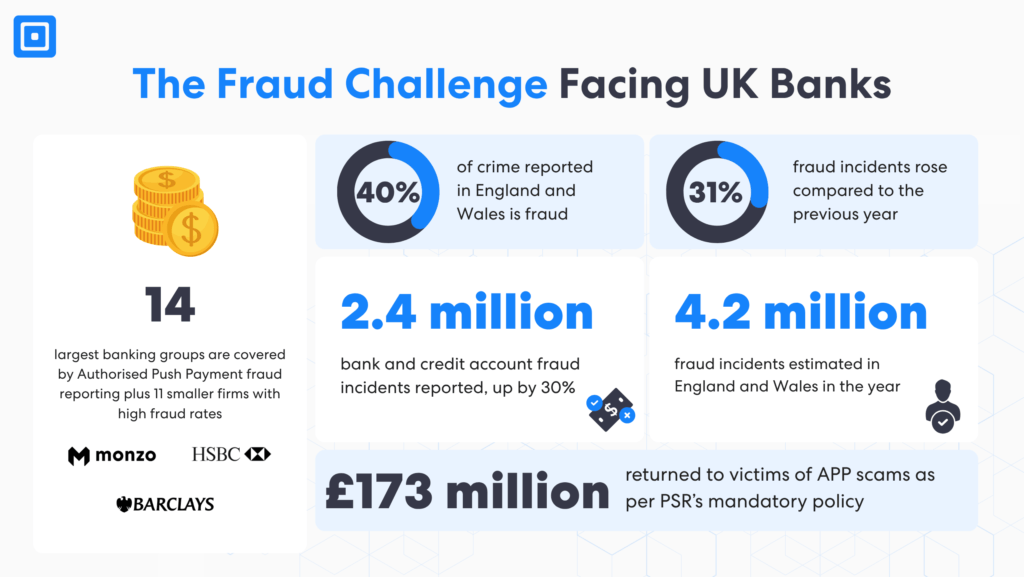
However, fraud remains a major challenge for UK financial institutions. In fact, [The Office for National Statistics](https://www.ons.gov.uk/peoplepopulationandcommunity/crimeandjustice/articles/natureoffraudandcomputermisuseinenglandandwales/yearendingmarch2025) estimated 4.2 million fraud incidents in England and Wales in the year ending March 2025. They also reported a 31% increase compared with the previous year. This rise was mainly driven by a 30% increase in bank and credit account fraud, which reached around 2.4 million incidents. As a result, ComplyCube helps financial institutions respond to these risks with identity verification, AML screening, and configurable onboarding workflows.
> Congratulations to ComplyCube for winning RegTech partner of the year for the third year running.
Chief Executive Officer of Smart Money People, [Peer Jelendorf](https://www.linkedin.com/in/jelendorf/) also said, “Following feedback in this year’s British Bank Awards, clients say that ComplyCube continues to demonstrate excellence in regulatory technology, delivering innovative solutions that help organisations stay compliant while strengthening the safety and integrity of customer interactions. This year, firms are facing increasing regulatory scrutiny and growing focus on digital identity and fraud prevention, so ComplyCube’s approach to streamlined and scalable compliance is more important than ever”.
## Powering Modern Banking Compliance
Today, digital banking has raised customer expectations for [fast, seamless onboarding](https://www.complycube.com/en/use-cases/process/customer-onboarding/). Yet, firms must also meet strict obligations around customer due diligence, fraud monitoring, and identity assurance. The FCA states that firms are an important line of [defence against financial crime](https://www.fca.org.uk/news/speeches/working-together-against-financial-crime). This sentiment reinforces the need for effective systems that help protect customers, markets, and the wider financial system.
ComplyCube’s platform enables banks and regulated businesses to build risk-based onboarding journeys that are secure, scalable, and adaptable. Its no-code workflow engine, global identity verification, and AML capabilities help compliance teams move quickly without weakening controls.
> Winning RegTech Partner of the Year for a third year running is a real milestone for the team.
CEO and Founder of ComplyCube, [Tarek Nechma](https://www.linkedin.com/in/tarek-nechma/), stated, “Fraud is becoming more sophisticated, regulatory expectations are rising, and customers expect onboarding to be seamless. Our job is to give financial institutions the tools to meet all three at once, without compromise. This recognition is a credit to our customers, our partners and a team that refuses to stand still”.
## About ComplyCube
ComplyCube is a global leader in KYC, AML, and identity verification solutions. Its all-in-one platform helps regulated organisations verify customers and detect fraud using flexible APIs, SDKs, and no-code workflows. ComplyCube’s compliance posture includes recognised standards and certifications such as UK DIATF, ISO 27001:2022, and ACCS certification for age check systems. Its wider industry recognition includes the TechCares, RegTech100, and FinCrimeTech50.
## About Smart Money People
Smart Money People is a UK financial services review and insight platform. They use customer feedback to help consumers make more informed decisions and financial services firms better understand customer experience. Their work spans across banking, insurance, credit, savings, mortgages, investments, and fintech. As organiser of the British Bank Awards, Smart Money People recognises organisations delivering strong customer outcomes, trust, and value across the UK banking and financial services ecosystem.
**Categories:** News
**Tags:** Announcements
---
### [What is Mobile Intelligence?](https://www.complycube.com/what-is-mobile-intelligence/)
**Published:** May 28, 2026
**Author:** Dini Habib
**Excerpt:** Mobile intelligence, or mobile check solution, verifies that a customer's or a business's phone number is real, active, and authentic. It uses a wide variety of user risk signals to ensure that a phone number is not compromised.
**Content:**
**TL;DR:** Mobile intelligence detects suspicious activity tied to a customer or business mobile number. It aggregates a **phone risk score** by gathering behavioral signals, including previous abuse and account takeovers. A mobile check **strengthens fraud prevention,** onboarding, and KYC decisions.
## Mobile Phones Have Become a New Fraud Battleground
Mobile phones have become critical in accessing services, including opening a bank account, sending money, and renting a flat. Additionally, it provides a secure way to send and receive important text messages, such as an authentication code.
Although it led to convenience, it also created gaps for scammers to exploit. Fraudsters increasingly make use of compromised or stolen phone numbers for identity fraud, scams, and account takeover attempts.
> Criminals are exploiting vulnerabilities in the system to assume control of victims’ mobile identities, with terrible results.
According to Cifas, unauthorized SIM swaps have increased by [1,055% in 2024](https://www.cifas.org.uk/newsroom/huge-surge-see-sim-swaps-hit-telco-and-mobile), along with identity fraud in the telco sector rising by 87% in the last 12 months. As such, mobile intelligence has turned into a critical fraud intelligence layer, turning deep risk insights into trust.
Simon Miller, the Director of Policy, Strategy, and Communications at Cifas, echoes this urgency, “Criminals are exploiting vulnerabilities in the system to assume control of people’s mobile identities, with devastating consequences.”
## What is Mobile Intelligence?
Mobile intelligence or phone intelligence assesses the risk linked to a phone number using of a variety of signals, including carrier, abuse analysis, network status, and number hygiene. It goes one step further than normal phone verification to determine if a phone number is real, trustworthy, and active.
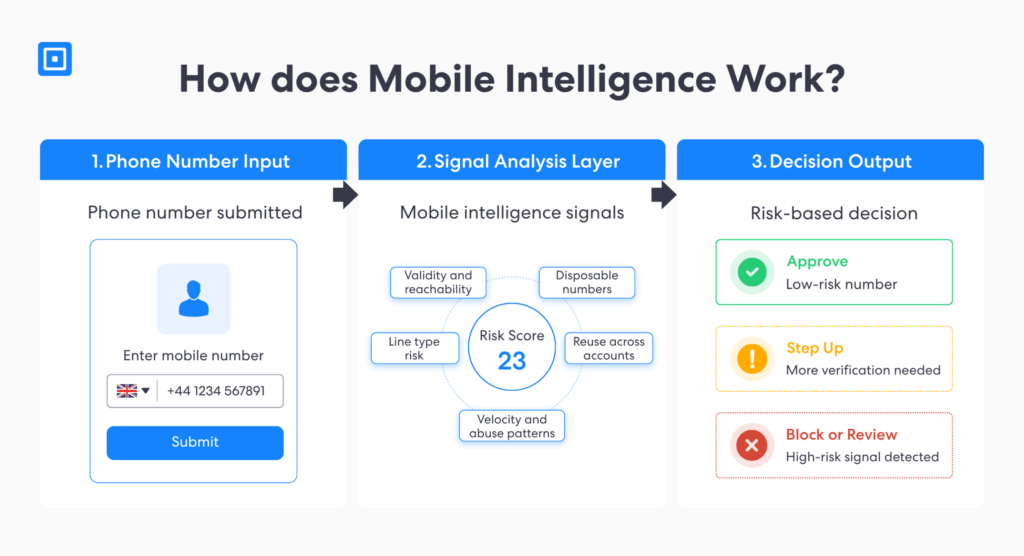
### Mobile intelligence can detect common red flags, including:
- Phone lines that become invalid or unreachable
- High-risk line types, such as disposable or recycled numbers
- Carrier or country mismatches
- Recently changed or ported numbers
- Repeated numbers across unrelated accounts
- Numbers linked to unusual velocity patterns
Typically, mobile intelligence aggregates a phone risk score based on these contextual and behavioral signals to block, approve, or step up verification, simplifying compliance decision-making. Many organizations make use of mobile intelligence solutions to support Identity Verification (IDV).
Since a phone number is typically the first information a user provides, a mobile check can accelerate sign-ups without making onboarding complex. As such, businesses can reduce fraud earlier in the onboarding process without adding friction to the customer journey.
## Why Traditional Phone Verification is Not Enough
While traditional phone verification can be useful, it can have several blindspots. For example, a One-Time Passcode (OTP) verification flow can show that a customer has access to their number at a single moment. However, it does not show that the number is authentic or belong to the right person.
The [Federal Bureau of Investigation (FBI)](https://www.ic3.gov/PSA/2024/PSA240411) warns consumers and businesses alike on the increasing exploitation of phone numbers to commit identity fraud and scams. Social engineering techniques enable criminals to hijack a phone number, steal one-time passcodes, and bypass authentication.
The UK Finance reports [£213.7 million](https://www.gsma.com/solutions-and-impact/industries/connected-fintech/gsma_resources/mobile-and-banking-industries-join-forces-to-fight-fraud/) losses to Authorised Push Payment (APP) fraud, with 35% initiated through telecom channels. As such, the need for mobile intelligence solutions in preventing fraudulent phone calls and SMS can no longer be ignored.
### Mobile Intelligence vs Phone Verification
Phone verification checks whether a customer has possession of a device at a point in time, typically via OTP. On the other hand, mobile intelligence confirms whether a phone number in itself is real and safe by analyzing carrier and network signals in the background.
### Mobile Intelligence vs Device Intelligence
Mobile intelligence specifically looks at phone number signals to assess risk and verify identity. Device intelligence instead looks at the device itself to assess session risk and spot fraud. Device signals include browser session, VPN usage, and IP location.
## How does Mobile Intelligence Work?
When performing [mobile intelligence verification](https://www.complycube.com/en/solutions/fraud-intelligence/phone-intelligence-verify-phone-number/), data sources from telecom providers, carrier signals, and network data are extracted. Next, artificial intelligence and machine learning models use this data to learn whether it is reliable by analysing behavioral indicators and historical events such as SIM swaps and port-outs.
### A [simple flow](https://docs.complycube.com/documentation/product-guides/digital-fraud-intelligence/mobile-intelligence-check) typically replicates the following:
1. A person enters a phone number during login, signup, or payment.
2. The system checks phone numbers, carrier status, device, location, and account history.
3. The model creates a risk assessment and returns a risk score.
4. The app allows access, asks for stronger authentication, or blocks the request.
For compliance teams, mobile check adds an early risk signal, supporting quicker decision-making before an onboarding journey starts. Advanced mobile intelligence solutions provide additional context on user intent, helping teams spot suspicious patterns, such as using the same numbers across multiple accounts.
## Key Use Cases for Mobile Intelligence
Regulated companies make use of mobile intelligence in their flows where the phone number is a core identifier. For example, when clients open a savings account via a banking app, mobile intelligence flags potential inconsistencies before they escalate to fraudulent checks or fake check claims.
As a result, mobile check can protect funds and support secure contact by phone or in-app calls. Additionally, with strong data encryption, businesses can assess a wide range of risk signals without compromising personal data. Some examples of key use cases in different sectors include:
### 1. FinTech and Digital Mobile Banking
[Financial services](https://www.complycube.com/use-cases/industry/financial-services/) use mobile intelligence to verify that a phone number is genuine and active during account opening, enriching [Know Your Customer (KYC)](https://www.complycube.com/solutions/due-diligence-compliance/know-your-customer/) processes. A phone risk score is generated by confirming line type, carrier, and fraudulent history to reduce fake account creation and prevent account takeover. As a result, it solidifies verification for fund transactions, credit decisions, and client communications.
### 2. Insurance Companies
Insurers use mobile checks to confirm identity consistency during insurance claims. Mobile intelligence supports insurance firms in detecting common fraudulent patterns in staged-accident claims or duplicate claim submissions, where the same number is used across multiple policies or claims under different names. By identifying high-risk numbers, insurers can prevent identity takeover during policy servicing and stop fraudsters from exploiting mobile channels to submit false claims.
### 3. Cryptocurrency Providers
Crypto exchanges and Virtual Asset Providers (VASPs) face increasing losses to fraud every year, with the [FBI’s Internet Crime Report](https://www.ic3.gov/AnnualReport/Reports/2025_IC3Report.pdf) noting over 181,565 complaints costing more than $11 billion in 2025. Mobile intelligence supports these platforms by detecting SIM swap attacks, number recycling, and accounts tied to known fraud operations. When layered with one-time password (OTP), it reduces unauthorized fund transfers from intercepted SMS codes and strengthens account security.
### 4. Healthcare and Medical Industry
[Healthcare providers](https://www.complycube.com/use-cases/industry/healthcare/) use mobile check to verify a patient’s phone number before sharing medical record downloads, sending appointment reminders, or processing medical claims. In the medical industry, common fraud can include using stolen personal phone numbers to bill for services or collect prescription drugs. Mobile intelligence can detect previous fraud claims, recent port-outs, or multiple identities across different patient records. Thus, sensitive patient records are safeguarded.
### 5. Telecommunications
Modern mobile intelligence solutions can flag high-risk registrations in real-time. This is crucial, especially in [telecom firms](https://www.complycube.com/en/use-cases/industry/telcoms/), where fraudsters open large prepaid accounts with synthetic identities to route premium-rate calls or bypass interconnect fees. For telcos, mobile check can also prevent number spoofing and fake account abuse. Consequently, this prevents targeted social engineering attacks on susceptible victims, lured by fake phone numbers.
### Key Takeaways
- **Mobile intelligence** uses risk signals, including carrier and user behavior, to verify identity and assess fraud risk.
- **Automated mobile checks** use these signals to aggregate a phone risk score in real-time, streamlining decision-making.
- **While mobile phones** have led to convenience in accessing digital services, it also caused the rise in identity fraud.
- **Banks, fintechs,** **and e-commerce** companies use mobile intelligence to reduce fraud risks in onboarding and payments.
- **Mobile intelligence** provides a security layer before onboarding, preventing fraud before full KYC verification.
## Reduce Fraud and Enhance Customer Experience
In summary, mobile intelligence helps businesses strengthen fraud prevention by verifying legitimate phone numbers. However, the important thing to note is that mobile intelligence is not a standalone solution. Instead, it is combined with other verification solutions for a multi-layered KYC process. This includes, but is not limited to, OTP verification, proof of address checks, ongoing monitoring, and strong case management to meet reporting requirements.
[Contact a member](https://www.complycube.com/contact/contact-sales/) of the ComplyCube team if you are interested in learning more about our award-winning KYC and Fraud Intelligence solutions.

## Frequently Asked Questions
Which companies need mobile intelligence solutions?
Businesses that regularly work with digital, remote customer interactions, transactions, and connected devices use mobile intelligence to verify identity and prevent fraud. Common examples include banks, insurers, telecommunications, marketplaces, and fintechs.
How does mobile intelligence prevent fraud?
Mobile intelligence prevents fraud by verifying that a phone number is real, authentic, and active. It uses risk signals related to a customer’s phone number, such as the line type and carrier, to detect suspicious behavior intent or prior fraudulent history.
Does phone intelligence replace SMS one-time passwords?
Not always. OTP verification and phone intelligence are used together to strengthen fraud prevention. OTP verifies that a user is who they say they are through real-time authentication codes. On the other hand, phone intelligence runs in the background to verify behavior intent and historical usage.
Can phone intelligence help with KYC compliance?
Yes. Mobile intelligence supports KYC compliance by enhancing customer authentication and identity assurance before full onboarding. When layered with other checks, including sanctions screening and document checks, it offers a robust method to verify genuine users.
What risk signals does ComplyCube’s mobile intelligence use?
ComplyCube’s mobile check analyzes multiple risk indicators to identify inactive or spoofed numbers. This includes usage activity and abuse history, number formatting, and carrier and network reputation. Next, the signals are used to generate a phone risk score of 0 to 100, to indicate the potential of it being inactive or linked to fraudulent behavior.
**Categories:** Guides
**Tags:** Fraud Prevention
---
### [What is Device Risk Assessment?](https://www.complycube.com/what-is-device-risk-assessment/)
**Published:** May 29, 2026
**Author:** Rithu Jagannath
**Excerpt:** Device risk assessment uses device intelligence and device risk scoring to create a device risk score, helping firms detect risky devices before fraud escalates and access is trusted across onboarding and login flows safely now.
**Content:**
**TL;DR:** Device risk assessment evaluates device integrity, network signals, and behavior. Behind each and **every digital session**, device risk scoring looks at signals and turns it into an actionable device risk score. From there, teams can **approve, challenge, or block access**.
## What is Device Intelligence?
Device intelligence refers to the technology layer that reviews a device in its entirety. In 2025, Cifas reported more than 444,000 fraud cases to the UK National Fraud Database, reinforcing the need for stronger device intelligence and fraud controls. The report refers to the connection and session behind a single digital interaction. Analyzing device integrity, network behavior, and usage patterns allows compliance teams to determine whether or not the device environment is real or fake.
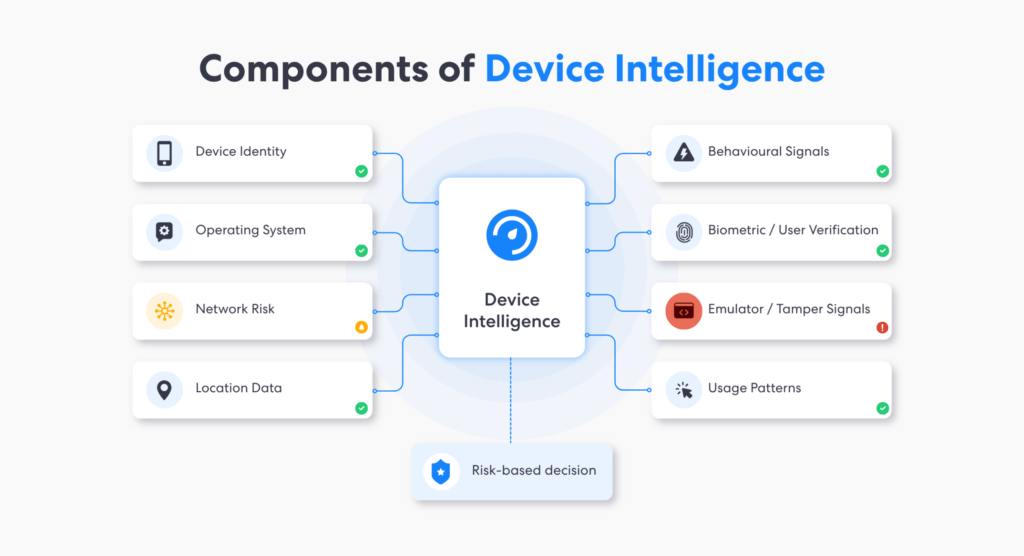
[Device intelligence](https://www.complycube.com/en/solutions/fraud-intelligence/device-intelligence/) provides a significantly clearer view of the session before it continues for security teams. It checks for any device fingerprint mismatches, emulator use, and VPNs. It can also point to any automation, suspicious connection patterns, and signs that a device has. This is especially relevant when devices are compromised, modified, or exposed to vulnerabilities.
## Why Device Risk Assessment Matters
Device risk assessment is important because fraud does not always begin with a fake identity document. It can begin with factors such as an unknown device, a masked connection, or [stolen credentials](https://www.proofpoint.com/uk/threat-reference/credential-theft#:~:text=Stolen%20credentials%20provide%20attackers%20with,would%20typically%20have%20access%20to.). Even a tampered operating system or an emulator design to imitate a real user’s journey is a type of fraud.
> Device fraud is not just a login problem, it is a device trust problem.
Chief Technical Officer, [Mohamed Alsalehi](https://www.linkedin.com/in/malsalehi/) goes on to say, “When firms assess device integrity, connection signals, and behavioral patterns together, device intelligence can spot suspicious sessions earlier and stop fraud before it reaches sensitive systems”.
These risk factors can create gaps and expose customer data, internal resources, and regulated onboarding processes. For example, if firms only rely on passwords or basic user authentication, they may miss the difference in device-level warning signs that appear before fraud succeeds.
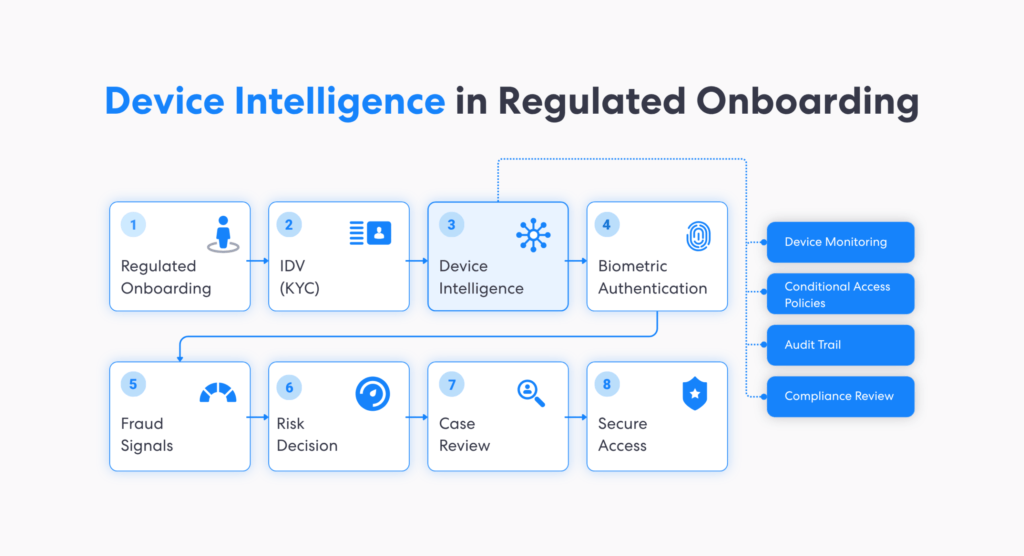
A strong risk management process focuses on likelihood or suspicious activities and the severity of its potential impact. For instance, a login attempt from a new browser may be low risk, while a session from a [rooted device](https://www.avast.com/c-rooting-android "rooted device") using a VPN and unusual location data may be considered more critical.
This is where device risk assessment becomes useful. It supports organizations by providing a structured way to evaluate device vulnerabilities, connection patterns, and session behavior. This can help define criteria of what allows a journey to complete, request further checks, or restrict access based on threats displayed.
## How Device Risk Scoring Works
Device risk scoring turns signals into a clear risk output. That is why a risk engine can evaluate device integrity, known vulnerabilities, and suspicious connection activity. This is based on a set of defined criteria. Each signal is scored for likelihood, severity, and potential impact. The device risk score is then calculated against set thresholds, helping teams classify a session as low, medium, or high risk. You can learn more here: [The Evolution of the Risk-Based Approach in AML](https://www.complycube.com/en/the-evolution-of-the-risk-based-approach-in-aml/).
Often, the risk scores are deployed as a percentage, range, or a simple status. Administrators, fraud teams, and security personnel have a visible way to compare device trust across different sessions without relying on credentials alone.
When compared with password-based authentication, device risk scoring provides a stronger description of session trust. Teams can verify whether the device presents normal behavior, suspicious indicators, or enough evidence to trigger alerts, extra checks, or access restrictions.
## Device Monitoring and Conditional Access for IT Teams
However, sometimes a device may appear low risk during onboarding and become suspicious later on. Device monitoring helps IT teams, security teams, and administrators evaluate how device trust changes across repeated sessions, login attempts, and account activity.
Instead of relying on a one-time device validation check, teams can review changes in device integrity, location data, and network access. Additionally, they can look into usage patterns and permissions-based activity for more changes. These changes can reveal credential theft, phishing attempts or suspicious access from unknown devices.
[Conditional access polices](https://cyberhusky.io/blog/conditional-access-policy-best-practices/ "Conditional access polices") can then use the latest device risk score to decide whether to maintain, challenge, or block access. For example, an administrator may be able to set default thresholds that trigger alerts when a device moves from low risk to high risk. This helps firms keep trusted journeys and gives teams clearer documentation, stronger feedback loops, and better control over access decisions across sensitive systems.
### Key Takeaways
- **Device intelligence** helps firms assess risk before a suspicious session becomes fraud.
- **New-device activity** is a critical risk moment that needs stronger controls.
- **Real-time device risk scoring** can support faster and smarter fraud decisions.
- **Device monitoring** strengthens onboarding, login, and high-risk transaction security.
- **Strong device intelligence** reduces fraud exposure while keeping trusted journeys smoother.
## Explore Device Intelligence with ComplyCube
Regulated businesses such as e-commerce platforms, fintechs, and financial services firms can strengthen device risk assessment with ComplyCube’s real-time Device Intelligence. Device risk scoring, device integrity checks, and device monitoring help teams detect suspicious sessions, reduce false positives, and protect onboarding, login, and high-risk account activity. [Get in touch with ComplyCube](https://portal.complycube.com/signup) to learn more how you can benefit from our fraud intelligence solutions.
[](https://www.complycube.com/contact/contact-sales/)
## Frequently Asked Questions
What is device risk assessment?
Device risk assessment evaluates if a device or session can be trusted before access continues. It checks device integrity, usage patterns, and vulnerabilities to detect suspicious activity before fraud happens.
How does device risk scoring work?
Device risk scoring turns device intelligence signals into a measurable risk output. A risk engine compares device integrity, network, and behavioral signals against defined criteria. From that they calculate a device risk score based on likelihood, severity, and potential impact.
What is a device risk score?
A device risk score is the calculated result of a device risk assessment powered by device intelligence. It shows whether a device or session appears low risk, suspicious, or critical, helping teams approve, challenge, restrict, or block access.
Why is device risk assessment important?
Device risk assessment is important because device intelligence helps firms detect risky devices before they reach sensitive systems. It can identify emulator use, tampering, and exposed vulnerabilities linked to fraud or account takeover.
How does ComplyCube support device risk assessment?
ComplyCube supports integration of device risk assessment through real-time Device Intelligence. Companies will look to device integrity checks and monitoring. This risk score calculation helps firms detect suspicious sessions, reduce false positives, and protect trusted onboarding.
**Categories:** Guides
**Tags:** Fraud Prevention
---
### [What is Email Intelligence?](https://www.complycube.com/what-is-email-intelligence/)
**Published:** June 5, 2026
**Author:** Rithu Jagannath
**Excerpt:** Explore how email intelligence uses email risk scoring and email risk assessment to detect suspicious users, prevent fraud, reduce onboarding friction, and help businesses respond to email-related threats earlier with confidence.
**Content:**
**TL;DR:** Email intelligence, also known as email risk scoring or email risk assessment, assesses email data to find out whether an email address is **linked to a real user**, suspicious profile, or fraud attempt. Email intelligence can help businesses improve conversion, strengthen security, and **protect against risk** across the customer journey.
## What is Email Risk?
Today, most online journeys start with an email address. People often use it to create social media accounts, confirm access, receive updates, or communicate with businesses and individuals. [With over 4.7 billion email users globally](https://www.statista.com/statistics/456500/daily-number-of-e-mails-worldwide/?srsltid=AfmBOopFxnfmnZx9qWXiUm1JwP8Htv9WGA8qTako9K2VKtSQTUFzCiLT), email is one of the most common identifiers. However, email goes beyond just the address. For many fraud, compliance, and security teams, it offers insights or additional context about the person, account or business behind a transaction. Email risk measures how likely an email address is in connection to suspicious, fraudulent, or high-risk activity.
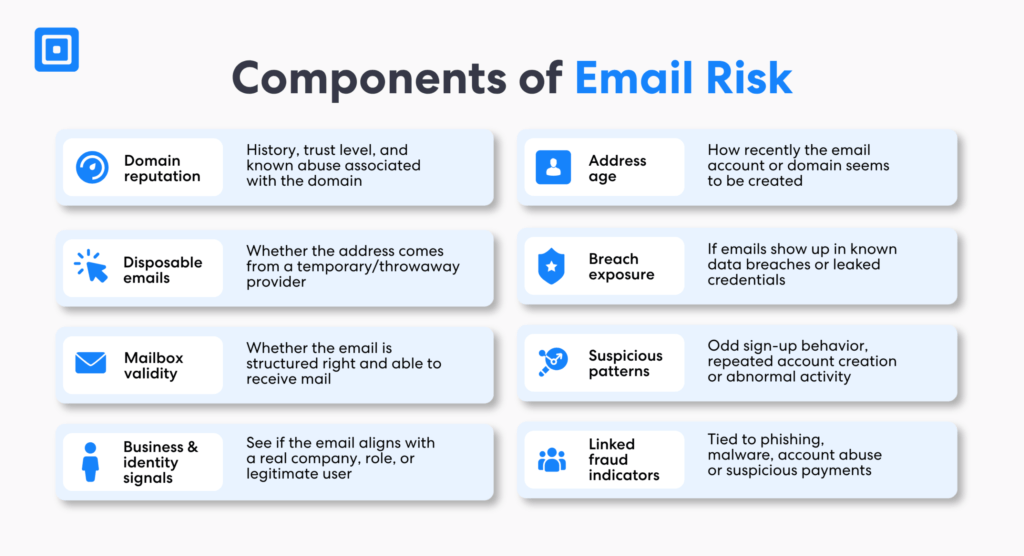
For instance, risky emails can come from a disposable inbox, a domain with less history, or a business email with weak signals. These addresses may also connect to phishing, malware, account abuse, or suspicious access attempts. However, this does not mean every odd email is fraud. A new domain may belong to a valid company or job title, while a low profile online for a user may simply indicate that they value privacy. It is important to make a commitment to not judge risks from one data point, but rather a fuller picture from behind the email.
## Learning More about Email Identity
This is where [email intelligence](https://www.complycube.com/en/solutions/fraud-intelligence/email-risk-score/) comes in. It is the practice of implementing data analysis and collection specific to email addresses, mail activity, and other wider fraud indictors. It determines if an email log should be trusted. So, instead of looking into whether an email is valid, an email risk assessment asks about the information revealed about the user, account, or businesses behind it.
This includes information about domain reputation, suspicious usage patterns, and breach exposure. Additionally, email intelligence helps teams understand if a company domain, recipient pattern, or communication network looks consistent with legitimate activity. This is especially important for providers handling onboarding, payments, or regulated services. If a business can determine email risk early, they can prevent fraud right away.
## The Email Fraud Environment Has Changed Email Security
In the past, most users associated email risk to clicking on the wrong link in chain mail or other obvious spam from fake accounts. Now, email sits at the centre of many different threats such as account takeover, ransomware, and payment fraud.
> Email is not just a communication channel, it’s a common thread.
Solutions Consultant at ComplyCube, Milosh Caunhye, states, “The same email can be used to make fake accounts, launch phishing attempts, or redirect payments”. This makes email one of the earliest risk signals for businesses everywhere. Moreover, people are also more susceptible of fake account creation and business email compromise. [Some examples](https://www.proofpoint.com/uk/threat-reference/email-scams) of email fraud are:
- **Disposable inboxes:** Fraudsters use a disposable inbox setup to create “throwaway” email addresses to conduct scams anonymously.
- **Bots:** Automated programs are used to test stolen credentials from legitimate users to use across multiple platforms and trick people out of money or data.
- **Malicious links:** Employees and customers alike are targeted by phishing emails where criminals pretend to be trusted organizations or individuals.
- **Ransomware:** Software that blocks access to your device or data using encryption and in turn demands a payment or threaten to leak data.
## How Email Risk Scoring Reduces Risk
To reduce risk and vulnerabilities, companies must implement email risk scoring. Today, an email address is an early fraud signal. Email risk scoring assigns a risk level based on many different signals instead of relying on a single check.
Fraud prevention services assess transaction risks associated with email addresses before a user are subject to the more sensitive aspects of the customer journey. For example, with email risk scoring, a low-risk email can go through a streamlined onboarding flow. Teams can route higher-risk emails into monitoring, manual review, or blocked access.
According to a report by AtData, [disposable email domain rates](https://atdata.com/press-releases/report-email-indicators-driving-payments-fraud/) had fraud rates that exceeded 70% across several industries. Email addresses created just days before a transaction were 25 times more likely to be linked to fraud. These email risk scoring signals are powerful indicators when looked at alongside wider risk analysis.
## Email Verification vs. Email Intelligence
There is an important distinction between email verification and email intelligence. Often confused, they solve completely different issues. Verification looks at whether or not an email is valid where email intelligence goes even further. Email intelligence assesses whether an email address deserves trust by analyzing suspicious behavior and possible links to abuse.
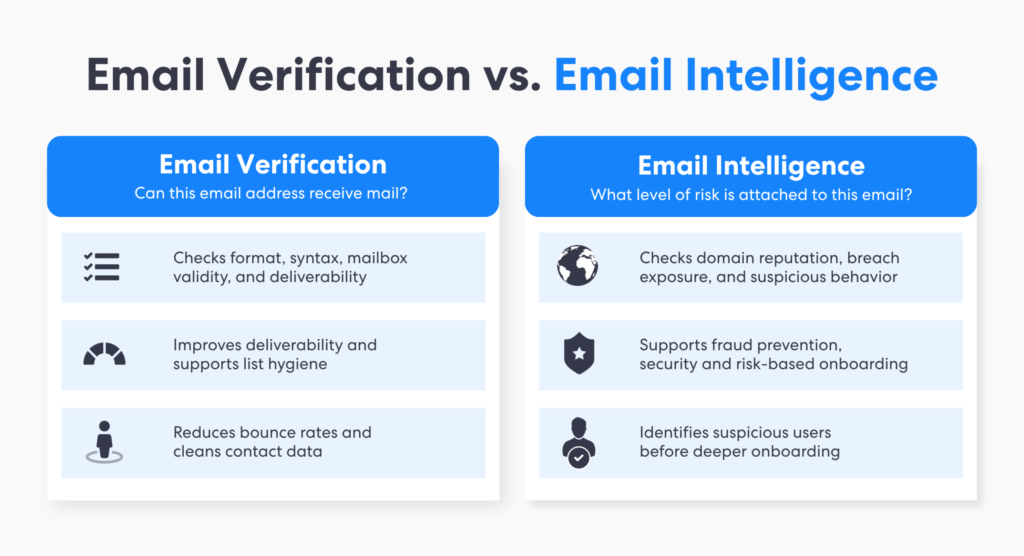
This matters due simply to the fact that a fraudster does not need an invalid email address to add friction. They only need an email that helps them move through onboarding, claim a promotion, test stolen credentials or get access to something before the business has enough context to respond.
## Prevent Fraud in Email Intelligence Use Cases
However, email intelligence is only valuable when companies need to learn about user risk at an early stage. For example, in [fintech](https://www.complycube.com/en/use-cases/industry/fintech/) and [payments](https://www.complycube.com/en/use-cases/industry/payments/), this solution can help find fake accounts and search for suspicious activity before users access high-risk services.
Similarly in [crypto](https://www.complycube.com/en/use-cases/industry/crypto/), email risk assessments support onboarding by flagging emails, domains or risky accounts before a user can trade, deposit, or remove funds. On the other hand, in [marketplaces and digital platforms](https://www.complycube.com/en/use-cases/industry/ecommerce/), email risk scoring can help find repeat offenders, fake sellers, fraudulent buyers, or users looking to return under new account details.
## How The Right Tools Improve Email Intelligence
In regulated industries such as fintech, crypto, and marketplaces, using the right tools can improve email security. By using artificial intelligence or machine learning, email intelligence can analyze large volumes of addresses, domains, account, and behavioral data. You can learn more here: [Why Identity Verification AI is Crucial](https://www.complycube.com/en/why-identity-verification-ai-is-crucial/)
These types of technology can find patterns or attacks that are far too difficult for human teams or analysts to find through manual review. It matters because fraud changes fast. Rules that are in place now, might not work tomorrow. AI can improve accuracy, speed up response, and help more efficient risk decisions.
## How Email Intelligence Builds Email Data Security
The most important component here is that email intelligence helps build email data security. It supports businesses make better decisions earlier in the onboarding process. Not only can it confirm if an email address is valid, but it can determine if emails carry risk.
Additionally, it helps businesses avoid two common mistakes, under-screening and over-screening. The first easily allows risky users to move through the journey before being flagged. The second forces every customers including low-risk users through a [friction-heavy](https://www.complycube.com/en/step-by-step-know-your-customer-process/) process. Putting in email intelligence controls helps teams find the right balance between both. Trusted users will be able to move faster, while suspicious individuals receive added checks.
### Key Takeaways
- **The purpose of email intelligence** is to turn an email address into an early risk signal for fraud prevention.
- **Email risk scoring** supports businesses with approving, challenging, monitoring, or blocking a user.
- **Email risk assessment** looks deeper into disposable emails, fake account abuse, and phishing risks.
- **Using artificial intelligence and machine learning** can help with pattern analysis and detecting risk at scale.
- **ComplyCube’s email intelligence** helps prevent fraud earlier while keeping onboarding seamless.
## Verify Email Identities with ComplyCube
Organizations need email intelligence in order to assess risk as part of a larger identity verification and fraud prevention strategy. By analyzing various signals such as domain validity, disposability, and digital risk indicators, they generate and assign an email risk score. Email risk assessments and scoring provides clear insight into if an email is linked to a real user. From here, businesses can build much smarter workflows depending on risk level. To learn how ComplyCube can help verify email identities, get in touch with [our team](https://www.complycube.com/en/contact/contact-sales/) today to learn the value of email intelligence.

## Frequently Asked Questions
What is email intelligence?
Email intelligence analyzes email addresses by looking at their domain signals, breach history, and other related data points such as date of opening to country of origin to assess trustworthiness and overall fraud risk.
What is email risk scoring?
Email risk scoring or email risk assessment assigns a risk level to an email address based on factors such as domain reputation, address age, breach exposure, disposability, and suspicious behavior.
What is email risk assessment used for?
Email risk assessments are often used to find out whether an email address may be linked to fake account creation, account takeover, phishing, bonus abuse, payment fraud, or other malicious activity.
How does AI improve email intelligence?
Artificial Intelligence (AI) improves email intelligence by analyzing large volumes of email, domain, account, and behavioral data to identify patterns, predict risk, and trigger automated actions during signup.
How does ComplyCube’s Email Intelligence help businesses?
ComplyCube’s email intelligence software solution helps businesses assess email risk in real time. It looks at signals such as domain validity, breach history, disposability, and other digital risk indicators to prevent fraud.
**Categories:** Guides
**Tags:** Fraud Prevention
---
### [What is Database Verification?](https://www.complycube.com/what-is-database-verification/)
**Published:** June 12, 2026
**Author:** Dini Habib
**Excerpt:** Database verification, also known as multi-bureau checks, supports non-document KYC processes. It enables companies to verify a customer's identity securely and rapidly without any document uploads, lowering onboarding friction.
**Content:**
**TL;DR:** Database verification supports businesses in verifying an individual without requesting for document uploads. It relies on **trusted external sources** to verify that a customer is legitimate. This guide explores how identity database checks work and how an automated bureau check helps **fast-track secure** customer onboarding.
## Why is Database Verification Important?
Database verification, also known as multi-bureau verification, is critical because it verifies that a customer or business is genuine. It works by cross-referencing key identity attributes, such as full name or date of birth, against authoritative databases, including credit bureaus and government records. As businesses shift to the digital world, the importance of identity database checks cannot be overlooked.
> Database check accelerates time to onboard without sacrificing a high standard of identity assurance.
According to the World Bank’s Global Findex Report, [79% of adults](https://www.worldbank.org/en/publication/globalfindex) have an account with a bank, financial institution, or mobile money provider. To further illustrate the scale of online services, the GSMA noted over [2 billion](https://www.mobileworldlive.com/gsma/mobile-money-accounts-surpass-2b) registered accounts and 500 million monthly active users of mobile-first financial services in 2024.
As such, companies require remote identity verification methods to verify users more quickly, consistently, and remotely. The Chief of Product at ComplyCube, Harry Varatharasan, echoes this statement. He notes, “Multi-bureau database verification supports this need by remotely validating identity attributes across more than one trusted source. This accelerates time to onboard without sacrificing a high standard of identity assurance.”
## How Database Verification Lowers Identity Fraud Risks
While the move towards the digital world has increased convenience and access to online services, it has also seen a negative rise in fraud. For example, the U.S. FBI’s Internet Crime Complaint Center notes the exponential growth of cyber-enabled crime as our lives become more digitally integrated. In 2024, it saw over [$16.6 billion](https://www.ic3.gov/AnnualReport/Reports/2024_IC3Report.pdf) in losses, particularly in fraud and ransomware.
Additionally, UK Finance reports a [12% increase](https://www.ukfinance.org.uk/system/files/2025-05/UK%20Finance%20Annual%20Fraud%20report%202025.pdf) in fraud case volumes to 3.31 million in 2024. These statistics highlight the significant scale and impact of fraud across various markets. As a result, firms are increasingly feeling the pressure to strengthen identity checks while maintaining a frictionless online experience for users.
> With today’s technology, it can take [mere taps](https://www.ic3.gov/AnnualReport/Reports/2024_IC3Report.pdf) on a keyboard to hijack networks, cripple water systems, or even rob virtual exchanges.
Since identity database checks do not require document submission, it also supports inclusion. According to the World Bank, [over 800 million](https://id4d.worldbank.org/global-dataset) people do not have official proof of identity. Database verification supports flexible onboarding flows as it reduces over-reliance on document checks during identity verification. As a result, those excluded from essential online services due to document requirements can instead access them in an alternative, secure manner.
## How does Database Verification Work?
[Database verification](https://www.complycube.com/en/solutions/identity-assurance/multi-bureau-checks/) processes involve several core components to cross-check submitted information against these external data sources. The key steps include data collection, matching, and risk-scoring. Modern identity database checks include the use of artificial intelligence and machine learning for an automated process.
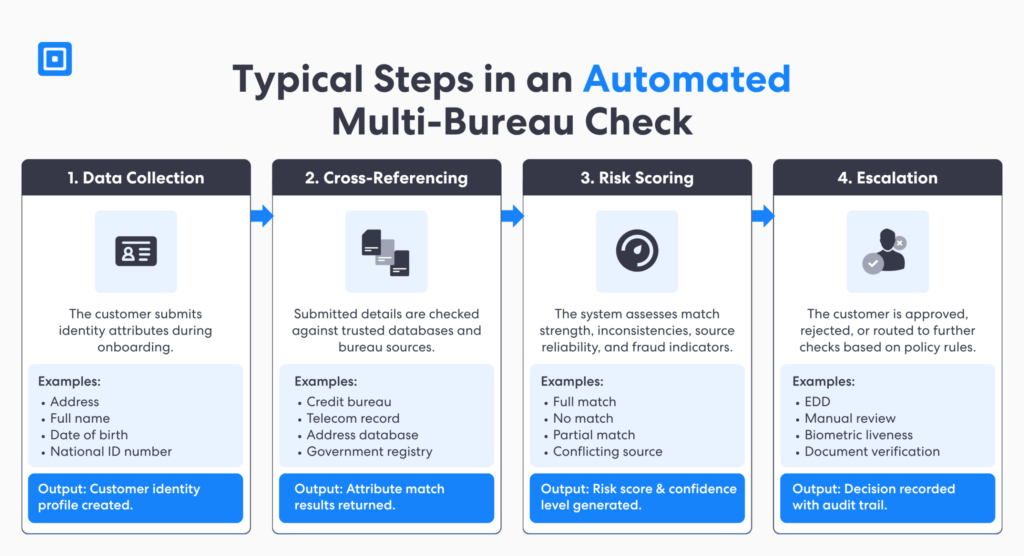
### 1. Data collection
During the first stage, a customer or entity will submit the relevant identity details required, typically via a form. For customers, common personal identifiers are full name, date of birth, nationality, or address. As for businesses, this may include details such as the company registration number, tax code, or registered address.
### 2. Cross-Referencing
Next, the verification system will run the submitted information through independent, trusted data sources. Some examples are utility or mail agencies, government registries, and credit bureaus. At this stage, hundreds of risk signals are analyzed to identify any inconsistencies in the submission phase that may indicate that an identity is not genuine.
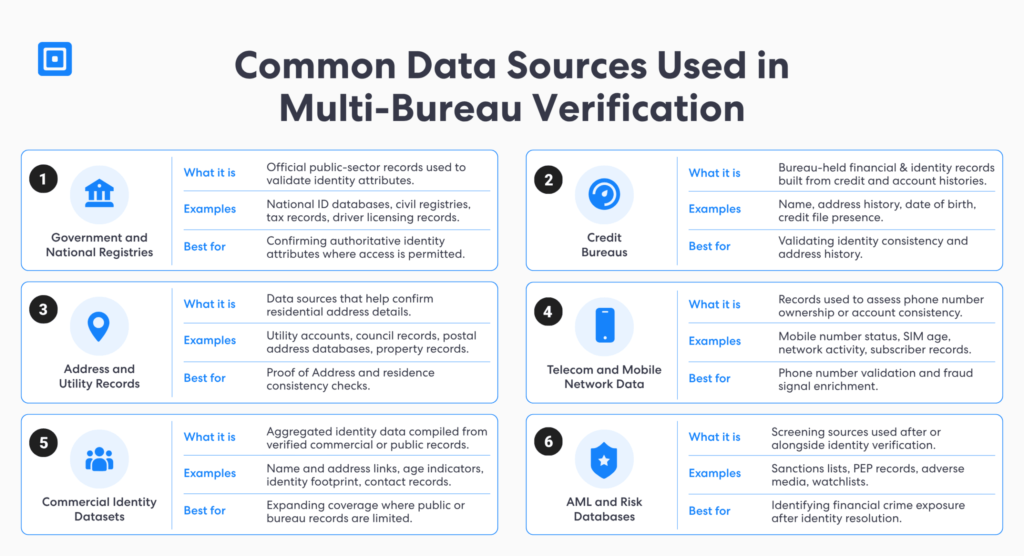
### 3. Risk-Scoring
According to a business’s risk appetite, match logic will determine the relevance and severity of potential matches identified during screening. This logic includes exact, partial, and fuzzy matching rules that will point to whether a match is a true positive, possible match, or false positive. Based on this assessment, each alert will then be assigned a risk score.
### 4. Escalation
Lastly, this stage determines the next steps for compliance teams. Alerts that meet predefined risk thresholds are typically escalated for further verification. However, this largely depends on a company’s escalation logic, which details whether an alert will route to human review, enhanced due diligence, or immediate regulator reporting.
In practice, automated database verification offers a streamlined way to reduce customer drop-offs, lower manual effort, and enhance operational efficiency. For example, vendors such as ComplyCube offer businesses the ability to run an accurate, secure, and automated bureau check in [under 3 minutes](https://docs.complycube.com/documentation/product-guides/identity-verification/multi-bureau-check).
## Does Database Verification Support AML and KYC Compliance?
Multi-bureau database verification enables businesses to strengthen Know Your Customer (KYC) and Anti-Money Laundering (AML) compliance obligations. For instance, the Financial Action Task Force (FATF) explains how digital IDV can support [Customer Due Diligence (CDD)](https://www.complycube.com/en/what-is-customer-due-diligence/) when they are sufficiently reliable, independent, and use a risk-based approach.
> A reliable [digital ID](https://www.fatf-gafi.org/en/publications/Financialinclusionandnpoissues/Digital-identity-guidance.html) can make it easier, cheaper, and more secure to identify individuals in the financial sector.
In the U.S., the [Customer Identification Program (CIP) rule](https://www.ecfr.gov/current/title-31/subtitle-B/chapter-X/part-1020/subpart-B/section-1020.220) permits non-document verification, in which customer information is comprehensively cross-referenced against trusted data sources. However, database verification works best as a layered identity verification strategy. For example, firms can expect to detect suspicious mismatches through multi-bureau checks, while biometric verification helps prevent deepfakes. It can also support higher-risk cases, where Enhanced Due Diligence (EDD) is required.
> Technological developments and progress in digitalisation can facilitate the remote performance of customer due diligence.
In the EU, [Re](https://eur-lex.europa.eu/eli/reg/2024/1624/oj/eng)[g](https://eur-lex.europa.eu/eli/reg/2024/1624/oj/eng)[ulation (EU) 2024/1624](https://eur-lex.europa.eu/eli/reg/2024/1624/oj/eng) recognizes eIDV solutions in secure remote or electronic identification and verification of prospective and existing customers. As such, leading companies integrate other electronic identity verification (eIDV) methods to further support secure, remote, and compliant onboarding. These methods include biometric and liveness checks, device intelligence, and document verification.
## Multi-Bureau Verification versus Single-Source Checks
Unlike single-source checks, where a customer’s details are cross-verified against only one data source, multi-bureau checks verify identity attributes across multiple other trusted data sources. As a result, multi-bureau verification increases data coverage and can return higher risk accuracy and security.
Multi-bureau verification also creates a resilient approach to IDV. For instance, if a data source has an outage or is temporarily taken down, multi-bureau can route to other data sources. This eliminates single-source dependency and strengthens risk-based logic.
### 1+1 versus 2+2 verification
A 2+2 check is a popular term to describe a type of match logic whereby at least two or more identity attributes are compared with at least 2 or more separate data sources. For instance, a customer’s name and address are cross-verified against a telecom agency and government registry. In a 1+1 check, only one identity attribute is matched to one data source.
Why and when to use a 2+2 check?
- **Pros:** Reduces fraud risks by making it harder for bad actors to falsify two identity details across two unique data sources.
- **Cons:** Might lead to higher friction during onboarding as it requires more identity data from a customer.
- **When to use:** Suitable for higher-risk scenarios, such as for regulated businesses or stricter jurisdictions
Why and when to use a 1+1 check?
- **Pros:** Creates a quicker and more cost-effective onboarding journey due to lower data collection and higher pass rates.
- **Cons:** Can lead to less defensible fraud controls due to weak evidence, especially if the second identity attribute has been altered.
- **When to use:** Suitable for lower-risk situations, including opening and accessing low-value accounts or services.
## Database Verification versus Electronic Identity Verification Services
Database verification is not a substitute for every eIDV method. Rather, these methods should complement one another. To do this, businesses must map each eIDV method to a firm’s CDD policy. This must include when each method is required, what match thresholds apply, what evidence is retained, and which outcomes trigger EDD or manual review.
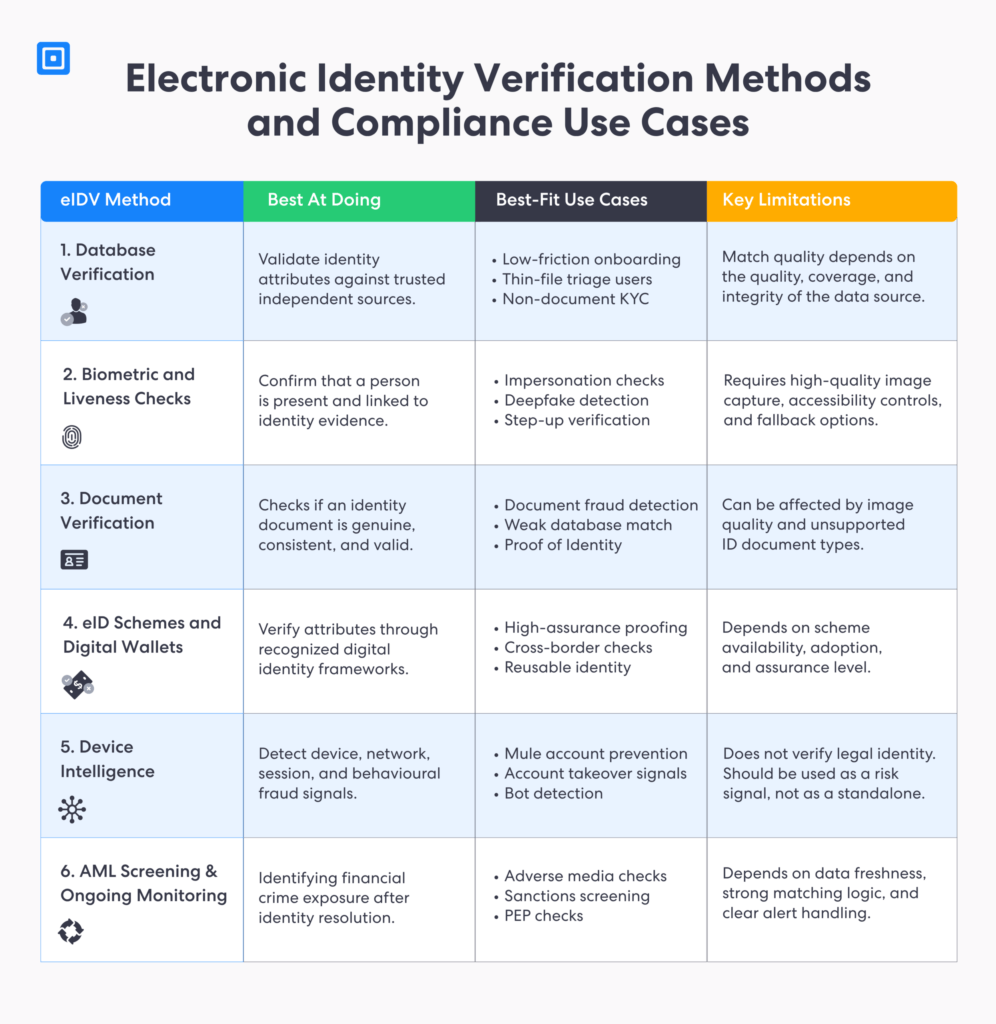
Some of the common eIDV methods and when they should be used include:
### 1. Biometric and liveness
Biometric checks match a selfie or video against a trusted image, typically in an identity document. [Liveness detection](https://www.complycube.com/en/solutions/due-diligence-compliance/know-your-customer/liveness-detection/) confirms that a person is physically present during a session. This includes passive and active liveness checks that distinguishes if a capture is a deepfake, synthetic, or replayed video.
### Best used for:
[Biometric](https://www.complycube.com/en/solutions/identity-assurance/biometric-verification/) and liveness verification are crucial in combatting the scale of deepfakes, replayed video, and synthetic identity fraud. It proves that a customer submitting information or accessing a service is a legitimate holder. It addresses the possession and presence risk in remote onboarding.
You can learn more here: [Liveness Detection Software for Digital Trust](https://www.complycube.com/en/liveness-detection-software-for-digital-trust/)
### 2. Document verification
Next, [document verification](https://www.complycube.com/en/solutions/identity-assurance/document-verification/) combines authenticity, consistency, and template validation to confirm that a document is valid and genuine. It uses advanced technology, including Near Field Communication (NFC) chip reading, to identify tampered, forged, expired, or synthetic documents.
### Best used for:
Document fraud represents the backbone of most identity fraud. Document verification can identify tampering of fonts, layouts, and formats in crucial documents, such as bank statements, driver’s licenses, and passports, providing identity evidence beyond self-declared data.
You can learn more here: [Document Verification in the End-to-End KYC Process](https://www.complycube.com/en/identity-document-verification-in-kyc-process/)
### 3. eID schemes and digital wallets
[Electronic Identification (eID)](https://www.complycube.com/en/solutions/identity-assurance/eid-verification-service/) schemes are a government-backed form of IDV. It enables firms to authenticate and verify identity attributes through a nationally recognised digital identity framework. Some of the popular schemes include India’s Aadhaar, MitID in Denmark, and BankID in the Nordics.
### Best used for:
In the EU, the Electronic Identification, Authentication and Trust Services (eIDAS) is recognized for secure and trusted customer identification. It provides recognized Levels of Assurance (LoA), empowering a risk-based approach to remote CDD.
You can learn more here: [A Digital Europe: Introducing the EUDI Wallet](https://www.complycube.com/en/a-digital-europe-introducing-the-eudi-wallet/)
### 4. Device intelligence
[Device intelligence](https://www.complycube.com/solutions/fraud-intelligence/device-intelligence) analyzes multiple risk signals such as session velocity, browser integrity, and IP address to identify fraud risks that identity documents might miss. This is particularly crucial for risk detection, ensuring that an onboarding session looks consistent with a genuine customer journey.
### Best used for:
For compliance teams, device intelligence solutions detect suspicious patterns and activity linked to a user’s device. A customer may pass a database check using real stolen details, but with device intelligence, it can distinguish if a customer’s device, IP, velocity, or behavioural pattern suggests fraud.
You can learn more here: [What is Device Risk Assessment?](https://www.complycube.com/en/what-is-device-risk-assessment/)
### 5. AML screening and ongoing monitoring
While eIDV confirms identity attributes, AML screening goes beyond to detect if a customer presents a financial crime risk. This includes checking verified customers against sanctions, Politically Exposed Person (PEP), and adverse media lists. [Ongoing monitoring](https://www.complycube.com/solutions/global-screening/continuous-monitoring/) detects changes in risks beyond onboarding.
### Best used for:
For businesses across regulated markets, a strong AML program must be treated as a separate control to IDV. It focuses on the prevention of money laundering and terrorism financing by analyzing deeper risk signals that can change well after a user or entity onboards.
You can learn more here: [The best AML software solution for compliant firms](https://www.complycube.com/en/best-aml-software-in-2025-comparison-and-insights/)
### **Case Study: Barclays Scrutinized for Weak AML Controls**
In 2025, the UK’s Financial Conduct Authority (FCA) investigated the UK unit of Barclays and whether the bank had violated Anti-Money Laundering (AML) laws. This followed a prior two-year enforcement examination, where authorities reviewed its transaction monitoring controls.
##### **Historical Oversight and Continued Scrutiny**
Regulators focused on historical oversight and looking into how high-risk customers were being verified and screened. Later that year, the bank faced enforcement action, amounting to £42 million in fines for financial crime risk management failures.
##### **Outcomes**
- The case highlights the importance of strengthening and connecting identity verification with AML controls.
- Barclays was fined a combined £42 million, with Barclays Bank PLC fined £39.3 million and its UK unit penalized £3.1 million
- A strong KYC and AML program combines robust database verification solutions with other eIDV methods, such as PEP screening and ongoing monitoring.
## How to Choose the Best Multi-Bureau Verification Solutions?
While database verification can contribute to stronger KYC and AML controls, it largely depends on the quality, breadth, and coverage of the data sources. Additionally, auditability and configurability of risk scoring mechanisms are critical to supporting regulatory reporting needs and a risk-based CDD process.
In practice, the best multi-bureau verification solution also depends on an organization’s specific business needs and risk profile. The technical capabilities to look out for include customizable matching and 2+2 match logic. On the other hand, some features to consider to ensure the solution aligns with the business goals are risk appetite and scalability.
### Technical factors to consider when choosing the best multi-bureau solution:
- **Multiple trusted sources:** Use a service with various authoritative data sources, which can include but should not be limited to government registries, commercial databases, and telecom agencies.
- **Country and data coverage:** Solution must support the jurisdiction where your business operates and where your customers are to remove blind spots.
- **False positive reduction:** Exact, partial, and fuzzy name matching supports customizable risk tuning thresholds to reduce false positives.
- **2+2 match logic:** Offers stronger identity assurance and evidence by verifying two distinct identity details, supporting stronger fraud detection.
- **Auditability:** Real-time decision logs support stronger and transparent evidence, decisions, and timestamps to meet regulatory reporting needs.
### Business factors to consider when choosing the best multi-bureau solution:
- **Costs:** Map out the cost of automation, budgeting, and how it can reduce long-term manual review in the long-term.
- **Risk appetite:** Evaluate sector-specific and product risks to indicate what type of risk threshold to tune to.
- **Scalability:** The solution should be equipped to manage volume spikes or expansion across borders without requiring complex add-ons or weakening risk scoring mechanisms.
- **Data privacy rules:** To ensure complete compliance, decide to invest in a solution that aligns with high standards of data privacy laws, such as EU GDPR and U.S. NIST.
- **Regulatory compliance:** Choose the service according to the specific jurisdiction your business requires, as CDD and AML obligations can vary across different markets.
### Key Takeaways
- **Database verification** is the process of identity verification by cross-checking a customer’s identity attributes against external, trusted data sources.
- **The benefits of multi-bureau** identity database checks include quicker remote onboarding without the need for document uploads.
- **A layered electronic identity** verification process strengthens KYC compliance by detecting potential fraud via seamless digital methods.
- **Automated bureau check** accelerates cross-verification with multiple data sources, protecting legitimate customers from complex steps.
- **High-growth businesses** across e-commerce, fintech, and banking use identity database checks to reduce drop-offs and enhance customer satisfaction.
## Database Verification for Financial Institutions and Regulated Businesses
For companies spanning regulated markets, the benefits of multi-bureau database services cannot be disregarded. It enhances fraud prevention controls while streamlining the onboarding process for customers. Unlike manual IDV, eIDV layers various methods to provide faster and stronger identity confidence. Reach out to ComplyCube to explore the benefits of automated bureau check today.

## Frequently Asked Questions
Is database verification the same as a credit check?
No. Database verification is broader than credit checks. Credit checks use credit bureau data to analyze a user’s financial history and creditworthiness. However, database verification focuses on analyzing whether a user is genuine using a broader range of external trusted data sources, not just financial databases.
Can database verification work for customers with no credit history?
Yes. Identity database checks can work for customers with no credit history, as they can use other sources, such as utility files, telecom records, and address databases, for identity verification. Strong database verification sources will depend on country coverage, sources, and data integrity.
Why do regulated companies use multi-bureau checks?
Regulated businesses use multi-bureau checks because they create a stronger defense against AI-powered fraud and account takeover beyond document or biometric verification alone. It validates whether a customer’s identity details exist and are consistent across independent sources.
Does database verification replace document and selfie checks?
No. Database verification, document, and selfie checks should be layered together, rather than treated as substitutes. Identity database checks if a customer’s details exist and if they are consistent across multiple data sources. Document verification helps determine if a document is valid and genuine, while selfie checks confirm a user presenting the identity is present.
How does ComplyCube’s multi-bureau database check support KYC and AML?
ComplyCube’s automated multi-bureau solutions support KYC/AML compliance via secure and trusted identity verification. The company is a certified Identity Service Provider under the UK DIATF framework and aligns with global regulators, such as the FATF, UK FCA, US FinCEN, and UAE TRA. Its database services empower non-document verification, streamlining onboarding.
**Categories:** Guides
**Tags:** Identity Verification
---
### [What is AML Risk? ](https://www.complycube.com/what-is-aml-risk/)
**Published:** June 23, 2026
**Author:** Dini Habib
**Excerpt:** Anti-Money Laundering (AML) risk has become a pervasive challenge for authorities and businesses worldwide. This is in part due to the rise of AI-enabled technology. This guide explores common AML risks and how to prevent them.
**Content:**
**TL;DR: Anti-Money Laundering risks** can manifest as criminal activity, sanctions evasion, or the financing of terrorism. For compliance teams, AML risk can be **particularly damaging** to a business’s financial system and reputation. This guide explores the different types of AML red flags and how to build strong defenses against them.
## Why Has AML Risk Become a Pervasive Challenge?
Over the years, Anti-Money Laundering (AML) risk has become a widespread challenge for authorities, businesses, and consumers alike. According to the Gambling Commission, there has been a sharp rise in the volume and sophistication of attempts to bypass security controls using AI-enabled tools. This includes fraudulent documents, deepfake videos, and more.
> Accounts [created with AI](https://www.nationalcrimeagency.gov.uk/who-we-are/publications/739-sars-in-action-issue-30/file) are more likely to be used for criminal activity, such as money laundering or terrorist financing.
Aside from AI-driven tools, digital innovation has also intensified the scalability of AML risks. Rapid digital payments, global transactions, and the rise of cryptoassets and decentralized finance (DeFi) channels have created avenues for criminals to layer illicit funds undetected. In 2025, money launderers moved [$82 billion](https://www.reuters.com/legal/government/crypto-money-laundering-hit-82-billion-2025-researchers-say-2026-01-27/) in cryptocurrencies, a sharp increase from $10 billion in 2020.
## What is AML Risk?
Anti-Money Laundering risks refer to the possibility that a company or service may be used for illicit activity, such as money laundering, terrorist financing, or other financial crimes. Typically, criminals exploit products, business relationships, or customers to funnel illicit funds via drugs, trafficking, sanctions evasions, and more.
> The United Nations estimates that money launderers move between [$800 billion and $2 trillion](https://www.unodc.org/unodc/en/money-laundering/overview.html) annually. In the UK itself, this exceeds over [$436 billion](https://www.theguardian.com/business/2026/may/24/dirty-money-through-uk-corruption-tax-evasion) annually.
AML risk requires its own compliance framework, and compliance teams must treat it appropriately to meet regulatory requirements. Global authorities, such as the Financial Action Task Force [(FATF)](https://www.fatf-gafi.org/en/publications/Fatfrecommendations/Fatfguidanceontherisk-basedapproachtocombatingmoneylaunderingandterroristfinancing-highlevelprinciplesandprocedures.html), require firms to use a risk-based model to continuously identify, understand, and mitigate risks. The impact of AML risk can be staggering. It spans three dimensions:
1. **Regulatory Enforcement:** Million-dollar fines, sanctions, business closure, license revocation.
2. **Financial Losses**: Fraud losses, seized funds, and consumer compensation.
3. **Reputational Damage:** Erodes client, partner, investor, and customer trust for years.
## Common Anti-Money Laundering Risks
It is critical for compliance and Know Your Customer (KYC) teams to understand common AML risk factors. This supports a targeted, risk-based approach, in which compliance teams allocate resources and due diligence controls where potential risks are greatest. You can learn more here: [The Evolution of the Risk-Based Approach in AML.](https://www.complycube.com/en/the-evolution-of-the-risk-based-approach-in-aml/)
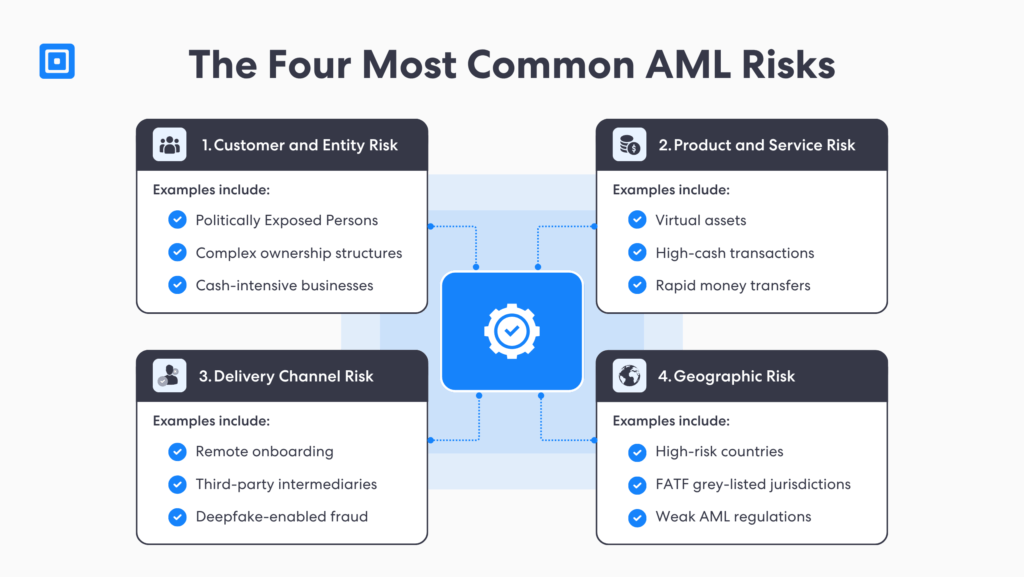
Additionally, Key Risk Indicators (KRIs) help assess money-laundering vulnerabilities by tracking metrics such as the volume of high-risk customer onboarding, sanctions-screening hit rates, and alert-escalation trends. Anti-money laundering risks typically fall into four core dimensions: customer, product, channel, and geographic risk.
- **Customer and third-party entity risk:** Includes customers and businesses that pose a higher risk due to their likelihood of money laundering and other fraudulent activity. Examples are [Politically Exposed Persons (PEPs)](https://www.complycube.com/en/what-is-a-politically-exposed-person/), complex beneficial ownership structures, and cash-intensive businesses.
- **Product and service risk:** Refers to product or service-specific risks. For instance, it covers virtual assets and transactions involving cash amounts over $10,000. Additionally, services that enable fast, global transfers may provide criminals with greater anonymity and reduce the risk of detection.
- **Delivery channel risk:** This can include risks associated with the methods or intermediaries used to deliver a product or service. For example, remote onboarding is considered a high-risk channel because it allows users to falsify or hide their identities using fake documents or deepfakes.
- **Geographic risk**: These risks relate to countries that pose high-risk threats due to significant money-laundering risks in the area. The FATF and the EU countries list these countries on grey and blocklists due to weaknesses identified in their AML and CFT programs.
### **Case Study: Ikano Bank Devastating $15 M AML Fine**
On June 17, 2026, the Swedish financial institution Ikano Bank was fined SEK 140 million by the Swedish watchdog, Finansinspektionen, for significant weaknesses in its Anti-Money Laundering (AML) risk assessment processes.
##### **AML Risk Assessment Failure**
Regulators noted that the bank had a significant knowledge gap regarding the AML risks associated with its products and clients. For instance, Ikano Bank failed to document and examine the risk exposure of its financial services and its corporate clients.
##### **Outcomes**
- The regulator fined the company [SEK 140 million (USD 15 M)](https://www.complycube.com/en/ikano-bank-fined-sek-140-million-in-sweden-for-major-aml-failures/), underscoring the financial and reputational consequences of its compliance failures.
- Ikano Bank’s incomplete risk assessments suggest that the firm missed multiple AML red flags that should have been triggered.
- Without a comprehensive mapping of AML risk factors, a high-risk customer can access services without being routed to the appropriate customer due diligence flow.
## Understanding Anti-Money Laundering Risk for Compliance
Regulators are increasingly demanding robust AML risk assessments, requiring businesses to identify where their exposure is highest and to document clear, proportionate controls to combat it. These assessments need to inform decision-making in Customer Due Diligence (CDD), Enhanced Due Diligence (EDD), and additional screening steps.
> No customer type presents a [single](https://www.fincen.gov/system/files/2022-07/Joint%20Statement%20on%20the%20Risk%20Based%20Approach%20to%20Assessing%20Customer%20Relationships%20and%20Conducting%20CDD%20FINAL.pdf), uniform risk or a particular risk profile related to money laundering, terrorist financing, or other illicit financial activity.
Leading regulatory frameworks, such as the [UK Money Laundering Regulations (MLR2017)](https://www.gov.uk/hmrc-internal-manuals/economic-crime-supervision-handbook/ecsh31555), require financial institutions and regulated organizations to assess the risks of money laundering and terrorist financing and document them in written risk assessments. Jurisdictions across the world share the same obligations.
In the US, the [Bank Secrecy Act](https://bsaaml.ffiec.gov/manual/BSAAMLRiskAssessment/01) emphasizes risk-based CDD, using risk assessments to support the identification of ML/TF and other illicit finance risks and to inform mitigation steps. In Singapore, the [Monetary Authority of Singapore (MAS)](https://www.mas.gov.sg/-/media/mas/news-and-publications/monographs-and-information-papers/monograph---mas-framework-for-impact-and-risk-assessment_revised-nov-2023.pdf) emphasizes the need to comprehensively identify and assess ML/TF risks.
### The three components that all compliance officers must understand are:
- **Inherent risk**: Total risk exposure that is present before any mitigating controls are placed.
- **Control effectiveness**: Measures how well AML controls, such as sanctions screening and CDD, perform in practice.
- **Residual risk**: Remaining risk that persists and must be included within a firm’s documented risk appetite.
Modern AML risk assessment should combine qualitative expert judgment from compliance officers with quantitative indicators. To support regulatory reporting requirements, these decisions must be clearly delivered with audit trails, logs, and timestamps.
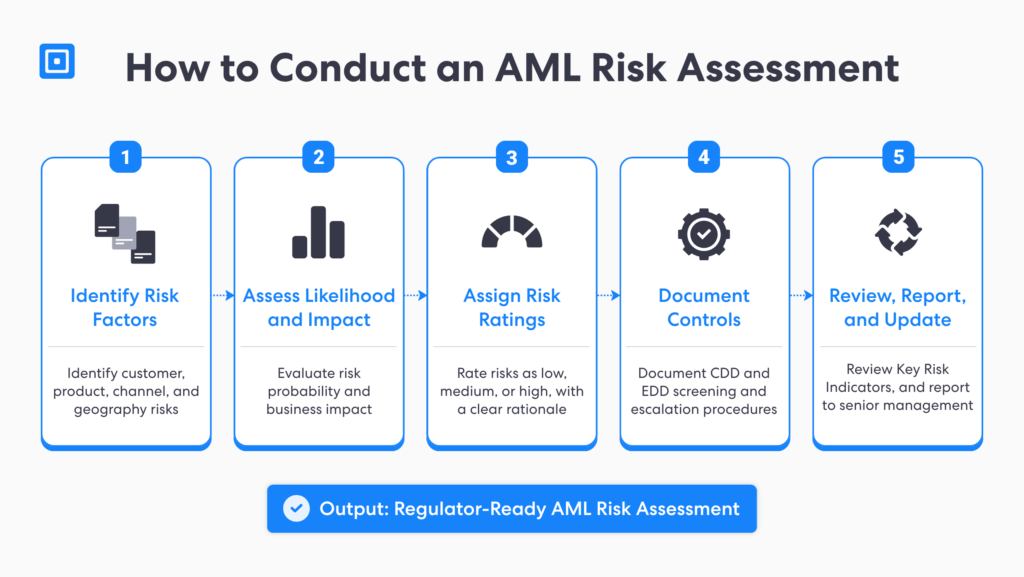
## How to conduct an AML risk assessment:
1. **Document all risk factors:** Identify the total risk factors across customers, products, channels, geography, and governance.
2. **Assess likelihood:** Evaluate and quantify risk based on their likelihood of occurring and business impact for each factor.
3. **Assign risk ratings:** Determine the risk ratings, i.e., low, medium, or high, and ensure they’re backed up by clear decision rationale.
4. **Document controls:** Map out the required and existing policies and processes in place to combat these risks, including CDD and [ongoing monitoring](https://www.complycube.com/en/solutions/global-screening/continuous-monitoring/) steps.
5. **Review, report, and update:** Monitor key risk indicators and periodically update your framework. Additionally, keep these records up to date with senior management approval.
## The Role of Technology and Integrated Systems in Financial Crime Compliance
To effectively combat counter terrorism financing and signs of money laundering, businesses require a unified, automated workflow. Milosh Caunhye, Solution Consultant at ComplyCube, further notes, “Manual anti-money laundering risks assessments cannot outpace the large and rapid nature of digital transactions today. Additionally, it is not enough to get ahead of the risks posed by evolving technology used in criminal methods.”
An automated AML risk management process uses machine learning and AI for anomaly detection, the identification of suspicious transactions, and the detection of sudden changes in current and new customers. It has the power to surface risks that a manual, rule-based system alone could miss. Moreover, integrated systems unify customer data, monitoring alerts, and each customer’s risk ratings into a single view. You can learn more here: [AML Compliance Checklist: What Most Firms Still Get Wrong.](https://www.complycube.com/en/aml-compliance-checklist/)
An all-in-one, advanced AML platform streamlines regulatory obligations and lowers false positives, improving both operational efficiency and investigative quality. Common features include:
1. **Sanctions and PEP screening:** Scan customers against global sanctions lists and PEP registries to identify and prevent dealing with high-risk users.
2. **Adverse media checks:** Screen for [negative news coverage](https://www.complycube.com/en/solutions/global-screening/adverse-media-checks/) and reputational risk indicators that may connect to illicit activity.
3. **Smart KYC forms:** Collect relevant information, including source of funds, customer consent, and e-signatures to support CDD decisions. You can learn more here: [What are Smart Forms?](https://www.complycube.com/en/what-are-smart-forms/)
4. **Risk scoring:** Achieve automated, explainable risk ratings based on a customer, product, and jurisdiction.
5. **Ongoing monitoring:** Detect any changes in a customer’s risk profile at any time to comply and support continuous risk assessment.
6. **Case management:** Centralize compliance decisions and maintain [audit-ready reports ](https://www.complycube.com/en/solutions/due-diligence-compliance/case-management/)to meet regulatory obligations.
### Key Takeaways
- **AML risk** is the possibility that a business may be used for criminal activity, such as money laundering and terrorist financing.
- **Understanding AML risk** enables businesses to create policies and controls to prevent money laundering and protect the financial system.
- **AML risks** are typically derived and vary by a specific product or service, delivery channel, jurisdiction, or customer.
- **Leading jurisdictions** mandate a risk-based approach to AML red flags, rather than a uniform checklist.
- **Automated AML software** integrates multiple checks, high-quality data, and ongoing monitoring to keep pace with evolving money-laundering risks.
## Meet Evolving Anti-Money Laundering Regulations
For compliance teams, understanding AML red flags and risks helps focus resources where threat exposure is highest. A strong AML risk framework supports regulatory compliance and helps firms identify suspicious activity earlier. An automated AML program that combines PEP and sanctions screening, ongoing monitoring, and risk scoring creates a proactive, risk-based workflow. To learn more about how you can build your own AML risk assessment, [contact a member](https://www.complycube.com/en/contact/contact-sales/) of the team.

## Frequently Asked Questions
How often should an AML risk assessment be updated?
AML risk assessments should be reviewed every 12 to 18 months. Crucial updates, such as new products, entering new markets, or regulatory changes, will typically require a refresh. To keep pace with regulatory expectations and evolving threats, regulated businesses should opt for semi-annual or quarterly reviews.
What is the difference between fraud versus anti-money laundering risks?
Fraud risks involve direct deception, such as stealing another person’s identity for financial gain. On the other hand, AML risk refers to the use of the financial system to launder illicit funds. These two risks are increasingly converging to inform a strong AML program; however, they still require different controls for detection and prevention.
Are all customers from high-risk jurisdictions automatically risky and blocked?
Regulated businesses use multi-bureau checks because they create a stronger defense against AI-powered fraud and account takeover beyond document or biometric verification alone. It validates whether a customer’s identity details exist and are consistent across independent sources.
How to measure AML risk management effectiveness?
To measure the effectiveness of Anti-Money Laundering (AML) risk management, several metrics are used. This includes the number of Suspicious Activity Reports (SARs), alert-to-SAR conversion rates, timeliness of investigations, and trends in customer risk scores. As such, compliance teams can support ongoing calibration on the warning signs of money laundering.
Does ComplyCube offer AML risk management?
ComplyCube offers an all-in-one Anti-Money Laundering (AML) risk management platform. It supports automated Politically Exposed Person (PEP) and sanctions screening, adverse media, watchlist checks, and ongoing monitoring. Additionally, the platform supports Enhanced Due Diligence (EDD) with real-time risk scoring and case management to meet AML compliance.
**Categories:** Guides
**Tags:** Anti-Money Laundering
---
### [How CIP Requirements Impact U.S. Banks](https://www.complycube.com/cip-requirements/)
**Published:** June 29, 2026
**Author:** Rithu Jagannath
**Excerpt:** Explore what CIP requirements mean for banks, why basic data matching is no longer enough, and how risk-based identity verification helps prove trust, detect fraud, handle exceptions, and retain audit-ready evidence for audits.
**Content:**
**TL;DR:** Customer Identification Program requirements known as **CIP requirements** outline how U.S. banks must **collect, verify, and keep** customer data before starting a business relationship. Under U.S. Bank Secrecy Act (BSA), strong CIP includes identity data collection, customer verification, and recordkeeping. CIP compliance relies more on **risk-based Identity Verification (IDV)**.
## The First Trust Decision in Banking
A customer opens a banking app and enters their name, date of birth, address, and identification number. Then, they tap submit to end their journey. For most customers, this is an everyday occurrence. However, for the bank, this is the first major risk decision in the onboarding process.
According to the 2026 National Money Laundering Risk Assessment from the United States Department of the Treasury, fraud and drug trafficking generated hundreds of billings of dollars in illicit proceeds each year. Moreover, cybercrime, human trafficking, and corruption generated billions more, making the stakes higher than ever.
Often, a customer is genuine. In other instances, bad actors may be using stolen data, a synthetic identity. or a manipulated document. They can also use a mule account profile to move illicit funds from money laundering or terrorism financing. Unfortunately, at account opening, banks have no transaction history, long-term behavior pattern, or similar formal banking relationships to rely on. provided by:
That is where a Customer Identification Program (CIP) begins. Beyond a compliance form, it is the point at which a bank decides whether identity evidence is strong enough. With the right information, bank accounts can be opened, applications can be escalated, or new accounts can be declined. You can learn more: [Customer Identification Program: What is CIP?](https://www.complycube.com/en/customer-identification-program-what-is-cip/)
## What are CIP Requirements?
CIP requirements are the legal and operational rules that require banks and other financial institutions to verify customer identities. This is a part of a wider Anti-Money Laundering (AML) compliance program that the bank establishes. Under [31 CFR 1020.220](https://www.ecfr.gov/current/title-31/subtitle-B/chapter-X/part-1020/subpart-B/section-1020.220), a bank must maintain an AML program. Banks must implement a written CIP as needed for the bank’s size and the type of business.
CIP must not be treated as a formality. The data is only useful when it is verified. The process typically checks customer risk, the account type, as well as any additional evidence that is available at the time of onboarding.
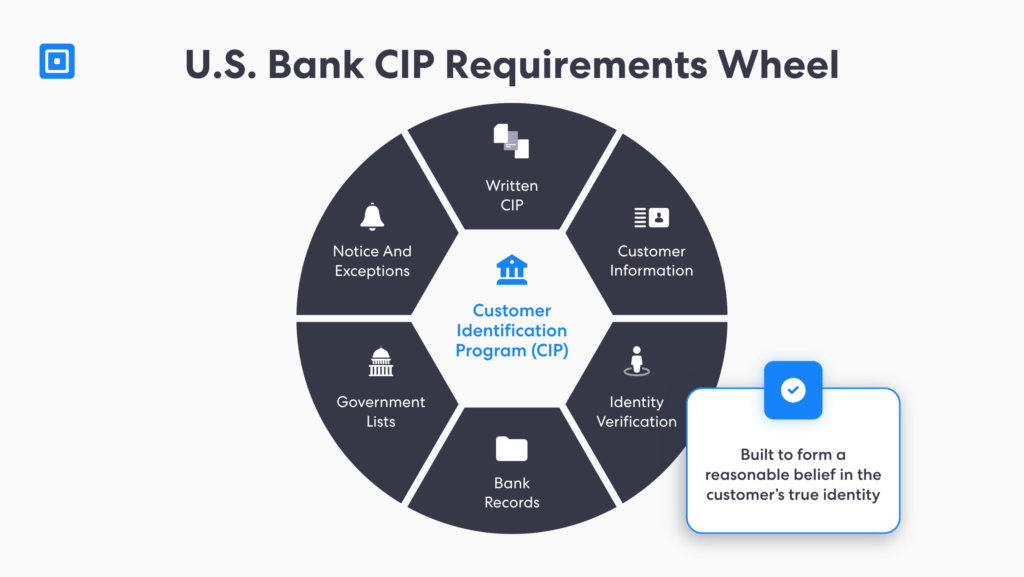
The CIP Rule requires risk-based procedures for checking customer identity. They must allow banks to form a reasonable belief around the customer’s true identity. They do this through methods such as gathering identifying information, applying verification methods, and handling exceptions. Most banks collect information such as name, date of birth, address, and an identification number such as a taxpayer identification number, passport number, or details from another government-issued document.
### Evaluating Strong CIP Frameworks
A strong CIP framework is where customer experience, fraud prevention, and financial crime control first meet. This helps genuine customers move through onboarding while giving higher-risk applications the scrutiny they deserve. Banks must also retain CIP records. Banks must retain customer identifying information for five years after the account closes, while records showing the verification method, results, and supporting evidence are generally kept for five years from the date the record is created.
The [FFIEC BSA/AML Examination Manual](https://bsaaml.ffiec.gov/manual) frames CIP as an area examiners use to assess compliance with Bank Secrecy Act regulatory requirements. Banks need clear procedures that teams can follow, internal controls can test, and federal functional regulators can review and evidence. For example, in 2025, [Hatch Bank](https://dfpi.ca.gov/enforcement_action/hatch-bank/) was required to review and revise due diligence procedures, including its Customer Identification Program.
These minimum requirements should reflect the bank’s size, customer base, accounts maintained, credit card accounts, products, account-opening methods, legal entities, and potential risks identified in the bank’s risk assessment. The harder challenge is making that structure work where customers expect speed and fraudsters look for weak points.
## Why CIP Requirements Are Necessary For Financial Crime Prevention
Today, a bank’s front door could be virtually anything. For many customers, it could be a mobile app, an onboarding flow, or even an embedded finance journey. As a result, these onboarding methods can welcome a genuine customer or admit risky actors into the financial ecosystem.
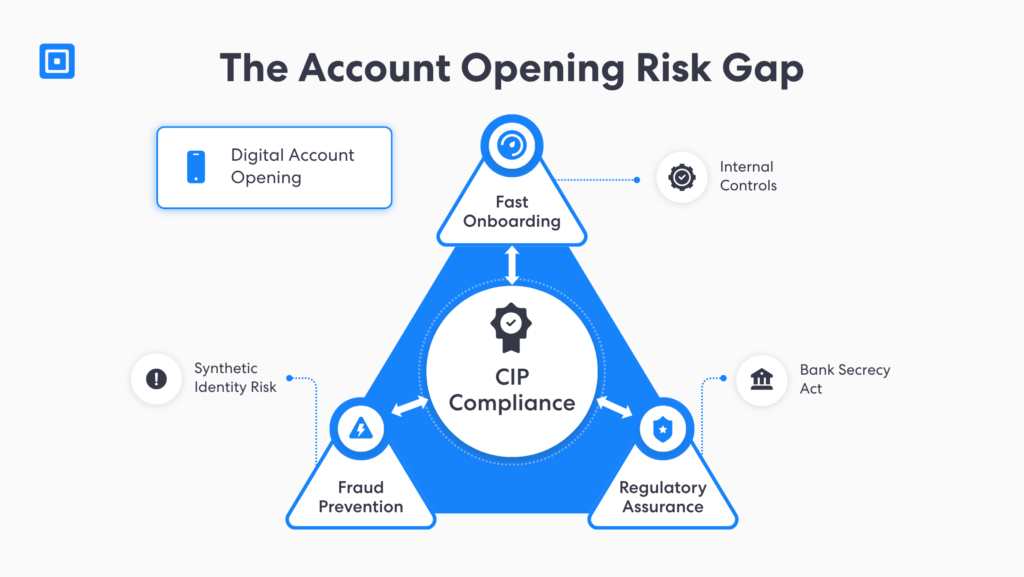
The Bank Secrecy Act and USA PATRIOT Act framework made [customer identification](https://www.sec.gov/files/bsa-1-fact-sheet.pdf) an essential part of the fight against money laundering, terrorist organizations, and other financial criminal activity. Section 326 of the USA PATRIOT Act laid the foundation for today’s CIP regulations, asking financial institutions to implement thorough procedures for verifying customer identities.
When a financial institution has a weak CIP, it can leave huge gaps in its controls. As a result, banks, credit unions, and other major financial institutions are more exposed to risks such as mule activity, fraud, and suspicious transactions. In practice, this creates a lot of downstream risk when clients try to move funds across products, channels or counter parties. This makes it harder to spot unusual behavior early.
CIPs are now a front-door safeguard. They must balance speed, internal controls, and auditability in one account-opening journey. Though CIP is rooted in bank account opening, the regulatory direction is much broader. With digital payment models growing, customer identification expectations are moving into products and partnerships that look less like traditional bank accounts. They still carry a lot of financial crime risk.
### **Case Study: StableCoin CIP Proposal**
Today, payment stablecoins support fast digital financial transactions. That speed creates major exposure to money laundering, sanctions evasion, and terrorist financing when customer IDV is weak or inconsistent.
### Incorporating CIP Requirements
The Financial Crimes Enforcement Network (FinCEN), Federal Reserve, and FDIC as well as other regulatory bodies, proposed CIP requirements applying to [payment stablecoin issuers](https://www.mcguirewoods.com/client-resources/alerts/2026/6/fincen-proposes-full-cip-regime-for-stablecoins-comment-period-open-to-issuers/) under the GENIUS Act. These new requirements states that issuers to maintain written, risk-based CIPs.
### Outcomes
- CIP standards are considering both traditional account openings as well as digital models.
- Permitted payment stablecoin issuers need written, risk-based procedures.
- Evidence-led identity controls are important across partnerships, payments, and account-like financial products.
## Fraud Has Changed the CIP Requirements Conversation
As fraud becomes increasingly more complicated, building trust with identity evidence is more challenging. Banks need to verify that the client identity is genuine, ensuring the person presenting it is its rightful owner, and identify any signs of organized fraud throughout the whole customer onboarding journey.
The [2026 National Money Laundering Risk Assessment](https://counteringfinancialcrime.im/reports-and-assessments/key-assessments/money-laundering-report/) describes fraud, cybercrime, drug trafficking, human trafficking, human smuggling, and corruption as major illicit finance threats. For banks, these threats make customer verification at account opening a financial crime control, not just a legal requirement.
These trends change how banks should think about verification methods. A basic data match may confirm that identity attributes exist, but it cannot verify that the applicant is the genuine individual, prove that the identity document is authentic, or detect whether fraudsters have manipulated the journey using a synthetic identity, mule account, or coordinated fraud network.
The solution is not to add more friction to every application, but to apply intelligent, risk-based verification that strengthens trust without compromising the customer experience. The answer is to apply the right verification depth based on the customer, the evidence, the measures undertaken, and the risk signals present.
## How U.S. Banks Can Build a Risk-Based CIP Workflow
A risk-based CIP workflow turns the regulation into an operational decision path. Instead of treating every customer the same, the bank adapts verification based on the strength of the evidence, the customer’s risk profile, and the signals present during onboarding.
> The best CIP compliance processes go above and beyond in checking boxes.
[Milosh Caunhye](https://www.linkedin.com/in/milosh-caunhye/ "Milosh Caunhye"), Solutions Consultant at ComplyCube, says, “Decisions need to be appropriately proportionate and banks need to be able to explain their choices. They must show what evidence they used to arrive at that particular decision.”
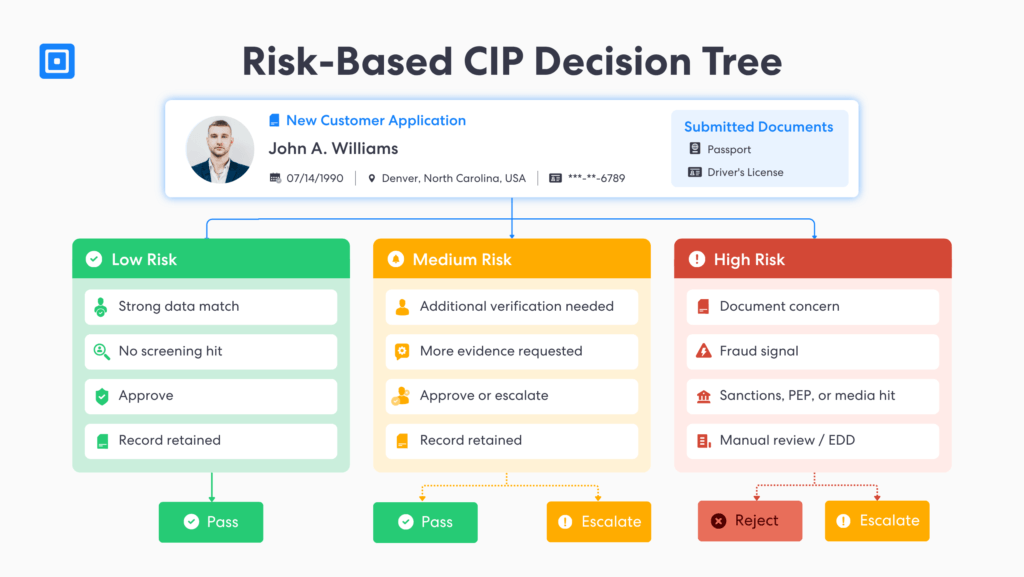
A strong workflow begins with collecting strong identifying information from the customer prior to opening accounts. Then, they must apply documentary or non-documentary methods. Documentary verification may include a driver’s license, passport number, alien identification card number, or other government-issued document. Non-documentary verification methods may include database checks, address verification, or other alternative methods. These methods can act as a safeguard when documents are unavailable, inconsistent, or insufficient.
## What Strong CIP Compliance Looks Like in Practice
Even the strongest workflow is only as useful as the evidence it leaves behind. When an examiner, auditor, or internal reviewer looks back at an account-opening decision, the question is not only whether the bank had a CIP policy. It is whether the bank can prove what happened.
[Customer Identification Programs](https://www.fdic.gov/news/financial-institution-letters/2021/fil21012b.pdf) should clearly demonstrate what customer information was collected, which verification methods were applied, whether required [government list checks](https://www.complycube.com/en/solutions/global-screening/sanctions-pep-screening/) were completed, and why the customer was approved, rejected, or escalated. It should also document how exceptions were managed and retain the required records for the mandatory five-year retention period.
A federal functional regulator will expect the bank’s compliance requirements, internal controls, and evidence to align with the regulatory framework. The FFIEC manual is designed to help examiners assess whether banks comply with BSA regulatory requirements, including the Customer Identification Program.
A bank can test its CIP when records are linked correctly. This enables organizations to test CIPs as a complete control environment rather than a set of disconnected compliance checks. While a policy says what should happen, evidence proves what actually did happen.
## CIP Checklist for U.S. Banks
Banks must collect the right information, apply the right identification protocols, and handle any exceptions consistently. Additionally, they need to retain the evidentiary support needed for regulatory scrutiny in future audit conversations. A strong CIP process must have:
- A written CIP within the existing AML framework.
- Defined information requirements for individuals and legal entities.
- Documentary and non-documentary verification methods.
- Processes for identities that cannot be verified within a reasonable time.
- Government lists checks which include controls for known or suspected terrorists.
- Recordkeeping for identifying information, verification evidence, and decision logs.
- Escalation rules for mismatches, suspected terrorists, fraud indicators, and high-risk cases.
- Ongoing monitoring where customer risk or regulatory expectations require review.
- Vendor governance where third-party data or technology providers are used.
Teams must follow customer journeys from application to decision. If a bank can explain that journey clearly, it is closer to having a CIP program that works well in practice. On the other, if the story is hard to follow, the CIP workflow might need more work. With additional documentation, further system integration, or stronger governance, banks can build a better CIP.
### Key Takeaways
- **CIP requirements** marks the first trust decision in a banking relationship.
- **Banks must verify** identities using risk-based and auditable procedures.
- **A strong CIP connects** IDV, AML screening, and recordkeeping.
- **CIP speed, accuracy, and evidence** is important for all digital onboarding journeys.
- **Effective CIP** reduces money laundering, terrorist financing, and financial crime risk.
## Customer Verification That Meets CIP Requirements
In short, CIP compliance involves smarter onboarding that connect IDV, non-documentary checks, and fraud intelligence. Moreover, adding AML screening and audit-ready workflows further reduce friction for real customers. Smarter CIP requirements strengthen the compliance controls that protect banks and financial institutions. Learn how [ComplyCube](https://www.complycube.com/contact/)’s onboarding solutions can transform your customer identification program requirements compliance.
[](https://portal.complycube.com/signup)
## Frequently Asked Questions
What Are CIP Requirements?
CIP requirements also known as Customer Identification Program Requirements are U.S. banking rules that require financial institutions to verify customer identities before opening accounts. They help banks form a reasonable belief that they know each customer’s true identity.
What Information Is Required for CIP?
CIP usually requires a customer’s name, date of birth, address, and identification number. Banks may also use documents, database checks, or non-documentary verification methods based on risk.
Is CIP the Same as KYC?
No. CIP verifies customer identity at account opening. Know Your Customer (KYC) is broader and includes Customer Due Diligence (CDD), screening, risk assessment, and ongoing monitoring.
Why Does CIP Matter for Digital Banking?
CIP matters for digital banking because remote onboarding increases identity fraud risk. Strong CIP helps banks verify customers quickly, reduce fraud exposure, and keep audit-ready compliance records.
How Can ComplyCube Help With CIP Compliance?
ComplyCube helps banks meet CIP requirements with Identity Verification (IDV), document checks, biometric liveness, non-documentary verification, AML screening, workflow orchestration, and audit-ready reporting.
**Categories:** Guides
**Tags:** Identity Verification
---
### [Merrill Lynch Fined $7.5M Over AML Failures](https://www.complycube.com/merrill-lynch-fined-7-5m-over-aml-failures/)
**Published:** June 30, 2026
**Author:** Rithu Jagannath
**Excerpt:** Merrill Lynch was fined US$7.5M by the SEC over AML reporting failures, adding to a wider history of regulatory penalties across SAR filings, trade reporting, derivatives reporting, governance gaps, and investor protection issues.
**Content:**
In June 2026, Wealth Management firm, Merrill Lynch, agreed to pay $7.5 million to settle charges from the U.S. Securities and Exchange Commission (SEC). The firm’s apparent Anti-Money Laundering (AML) failures add to its long-standing history of consistent regulatory penalties.
The SEC stated that the firm did not file numerous Suspicious Activity Reports (SARs) in the period of April 2020 and September 2024. Unfortunately, the firm leaned on Bank of America’s group-level AML program, which was simply not enough. It did not fully satisfy their AML obligations as a registered entity.
## What Happened to Merrill Lynch in June 2026?
Merrill Lynch broke reporting and record keeping requirements as they failed to file SARs as per the [Bank Secrecy Act (BSA)](https://www.fincen.gov/resources/statutes-and-regulations/bank-secrecy-act) rules. As a result, the firm accepted the cease-and-desist order, censure, and civil penalty without admitting or denying the SEC findings.
This case is centered on critical AML controls around reporting. If there is even a hint of suspicious activity, it becomes the firm’s responsibility to find, review, and escalate the risk within the required framework. For financial institutions, they need to be able to put policy into practice with real customer activity.
## Why Does the Merrill Lynch SEC Fine Matter?
The [Merrill Lynch SEC fine](https://cryptobriefing.com/merrill-fined-sec-sar-failures/) is important because regulators want entity-specific AML controls. This is especially important when a firm operates inside a larger financial group. Even though a parent-company’s AML framework may provide structure, regulated entities under it need controls that reflect their own customers, products, and risk exposure.
Moreover, they must have their own reporting rules and supervisory expectations. The SEC’s findings focused on the gap between group-level AML reliance and broken-dealer-specific obligations.
However, this enforcement shows a regulatory trend across several jurisdictions. For example, the Central Bank UAE placed a [$5.4 million AML fine](https://www.complycube.com/central-bank-uae-fines-foreign-bank-5-4m-over-aml-failures/) on the branch of a foreign bank and their money laundering reporting officer (MLRO) over similar failures in their compliance processes.
## A Recent Fine With a Longer Penalty History
This fine is one in a series of regulatory penalties that Merrill Lynch has faced over the years. Their previous AML fine cases were due to SARs, trade reporting, derivatives reporting, and investor protection issues.
These multiple fines were due to enforcement actions spanning across different regulators, jurisdictions, business lines, and time periods. Yet, the latest SEC AML fine adds to a much broader pattern of significant penalties.
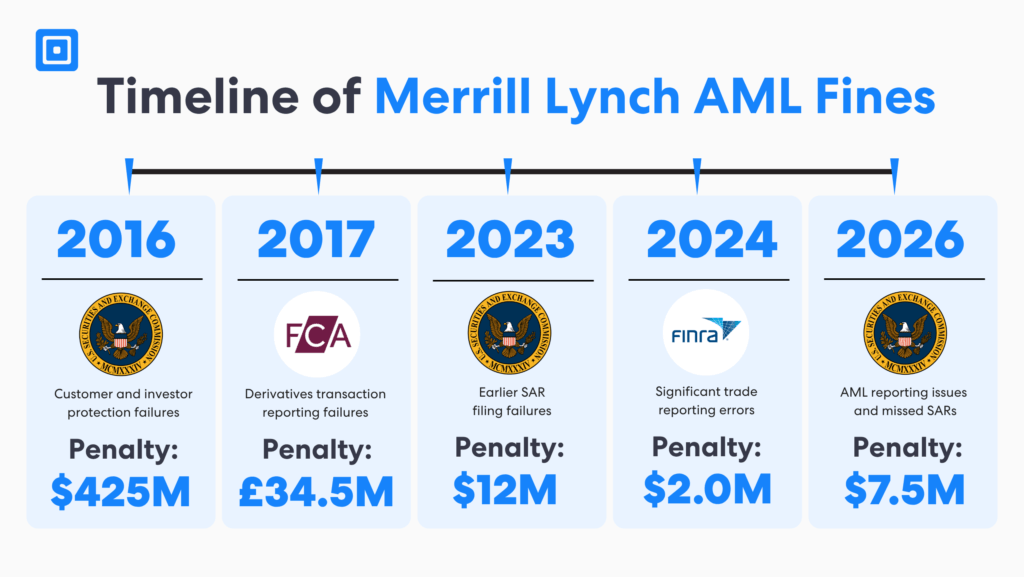
In summary, AML compliance must be operational, tailored, and audit-ready. Financial institutions must connect [customer due diligence](https://www.complycube.com/en/what-is-customer-due-diligence/), sanctions, PEP, and many more AML solutions into one singular process. Today, written policies are not enough if teams cannot evidence how risks were detected, investigated, and reported.
[](https://portal.complycube.com/signup)
Find out more AML news in ComplyCube’s [Trust Edition newsletter](https://www.linkedin.com/newsletters/the-trust-edition-7103022355722981376/). We explore the latest in developments across identity verification and AML globally.
**Categories:** News
**Tags:** Anti-Money Laundering
---
### [Alibaba and AUS Merchant Services Pay $600M to U.S. Regulators](https://www.complycube.com/alibaba-and-aus-merchant-600-m-penalty/)
**Published:** July 2, 2026
**Author:** Dini Habib
**Excerpt:** On 1st July, Alibaba and AUS Merchant Services entered into a non-prosecution agreement with the U.S. Department of Justice, paying $600 million for failing to stop merchants from selling and importing illicit and controlled items.
**Content:**
On 1st July, 2026, Alibaba and AUS Merchant Services Inc. agreed to pay the U.S. Department of Justice (DOJ) a $600 million settlement after allegations that they did not stop over 80,000 unlawful product sales between 2016 and 2024. Both companies entered into a non-prosecution agreement and accepted responsibility for strengthening their compliance programs.
## Undetected Illegal Transactions
Alibaba Group Holding Limited is a China-based marketplace that connects U.S. consumers to international sellers, and AUS, formerly known as Alipay, operates as the primary payment processor for their platform. The alleged illicit transactions amounted to over $200 million, which U.S. watchdogs uncovered across more than 40 undercover investigations.
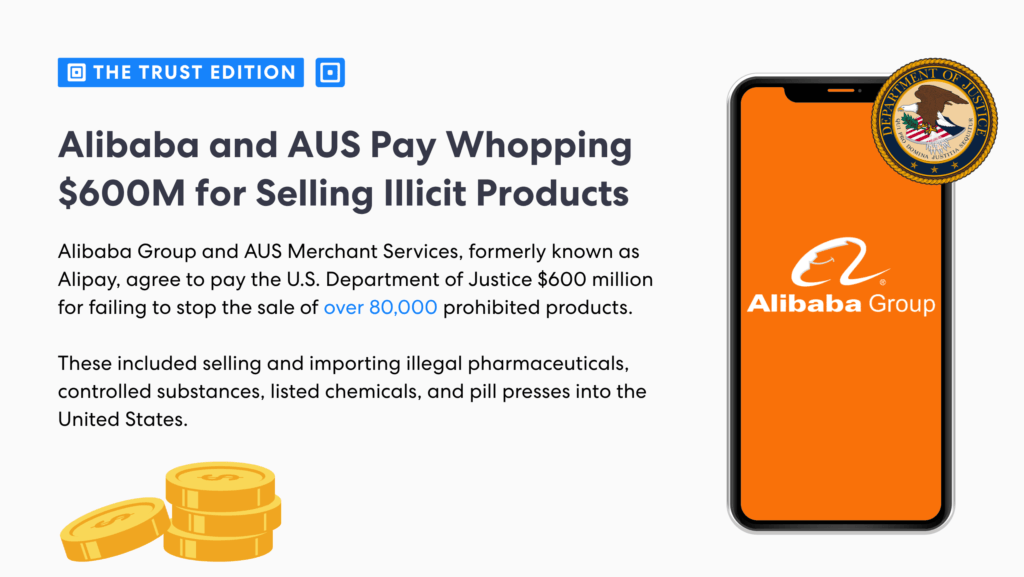
The items sold on Alibaba included illegal pharmaceuticals, controlled substances, and regulated chemicals. Under the Federal Food, Drug, and Cosmetic Act (FDCA) and other federal laws, the sale of these products is prohibited.
The DOJ accused Alibaba and AUS, noting that their Anti-Money Laundering (AML) controls were weak and unable to fully prevent merchants from engaging in illegal activity. Moreover, despite multiple employees raising concerns about deficiencies in the company’s identity verification and AML framework, Alibaba failed to act on them.
## Financial Crime in the Marketplace and Payments Industry
The rise of criminal activity in the marketplace and payments industry poses a huge risk to consumers, businesses, and financial systems. The global eCommerce market is projected to exceed [$3.88 trillion](https://www.statista.com/outlook/emo/ecommerce/worldwide/) in 2026, accounting for 56% of global sales. With this, almost 3.2% of annual eCommerce revenue is lost to payment fraud globally.
> [3.2%](https://merchantriskcouncil.org/learning/mrc-exclusive-reports/global-payments-and-fraud-report) of total annual eCommerce revenue is lost to payment fraud globally.
Despite the scale and convenience of these digital marketplaces, a portion of this revenue still leaks into criminal activity. Alibaba is one of the biggest marketplaces in the world, generating over [$148 billion](https://www.statista.com/statistics/225614/net-revenue-of-alibaba/) at the end of its fiscal year in March 2026. At the outset, this is a large sum, however, it still highlights the small fraction of the vast marketplace economy.
> Without active compliance, [criminals use eCommerce](https://www.justice.gov/opa/pr/alibaba-group-and-aus-merchant-services-agree-pay-600-million-resolve-allegations-they) sites to carry on and profit from illicit activity.
The risks are not limited to just Alibaba or AUS. According to the 2026 Global eCommerce Payments & Fraud Report, [45% of merchants](https://www.visaacceptance.com/en-us/insights/fraud-report.html) say real-time payment fraud is a significant form of fraud attack. Additionally, 80% identify technological infrastructure as one of their biggest fraud challenge. This case was not only an eCommerce moderation challenge but also a failure in payments and AML controls, highlighting the dangers of fragmented monitoring.
Tysen Duva, the Assistant Attorney General of the Justice Department’s Criminal Division, notes, “Without active compliance, criminals use eCommerce sites to carry on and profit from illicit activity.” In this Alibaba and AUS case alone, over four enforcement bodies, including the Federal Deposit Insurance Corporation (FDIC) and the Internal Revenue Service Criminal Investigation (IRS-CI), were involved. Authorities are now treating platform-enabled illegal activity as a multi-agency issue, highlighting how quickly marketplace compliance failures can escalate into a coordinated federal matter.
## What Should Have Happened Instead?
Despite multiple warnings from internal employees, Alibaba and AUS had deep failures in their compliance infrastructure. From eCommerce moderation to identity verification and transaction monitoring, both firms failed to detect high-risk activity at every layer.
The penalty spoke for itself: Alibaba paid a criminal monetary penalty of $125 million and forfeited $200 million, while AUS agreed to pay a criminal monetary penalty of $85 million and forfeit $190 million. A strong prevention framework could have prevented these costly consequences:
### **1. Risk-tiered merchant onboarding**
Segment merchants by geography, product category, and transaction behavior. Ensure increased scrutiny of higher-risk merchants through beneficial ownership checks, source-of-funds verification, and more. You can learn more here: [The Risk-Based Approach in AML.](https://www.complycube.com/en/the-evolution-of-the-risk-based-approach-in-aml/)
### **2. Product risk review**
Review products on an ongoing basis. Listings that include controlled or restricted items must automatically trigger re-screening, manual investigations, and senior management approval before products are listed again.
### **3. Sanctions and watchlist screening**
Perform AML screening on merchants and associated parties against sanctions, watchlist, Politically Exposed Persons (PEPs), and adverse media data sources. Run it on an ongoing basis to detect new risks. You can learn more here: [Global Sanctions Check Guide.](https://www.complycube.com/en/global-sanctions-check-2025-essential-updates/)
### **4. Ongoing monitoring**
Ensure that risk scoring, alert generation, and case management run [continuously](https://www.complycube.com/solutions/global-screening/continuous-monitoring) throughout the entire customer lifecycle. This ensures that any merchant who displays suspicious patterns after onboarding will be identified early.
### **5. Control testing and internal audit**
Continually review and test if existing controls can actually catch sophisticated prohibited listings, suspicious merchant behavior, and payment anomalies. All compliance decisions must be logged clearly and timely.
Marketplaces and payment processors alike must demonstrate end-to-end accountability from onboarding through post-sale monitoring. A layered friction model can make off-platform migration harder and easier to catch before dirty money moves. The cost of non-compliance cannot be overlooked, stay ahead, or risk million-dollar penalties and trust erosion.
[](https://portal.complycube.com/signup)
Find out more AML news in ComplyCube’s [Trust Edition newsletter](https://www.linkedin.com/newsletters/the-trust-edition-7103022355722981376/). We explore the latest in developments across identity verification and AML globally.
**Categories:** News
**Tags:** Anti-Money Laundering
---
### [Australia Forces Gambling Firm Bet365 to Improve AML Program](https://www.complycube.com/austrac-gambling-firm-bet365-aml-program-overhaul/)
**Published:** July 6, 2026
**Author:** Dini Habib
**Excerpt:** Australia's Financial Intelligence Unit, AUSTRAC, forces Bet365 into a legally binding AML remediation plan. During investigations, AUSTRAC discovered that the gambling firm had significantly violated the country's AML and CTF Act.
**Content:**
On 6th July 2026, the Australian Transaction Reports and Analysis Center (AUSTRAC), issued a legally binding mandate to the gambling firm Bet365 to strengthen its Anti-Money Laundering (AML) processes after finding “serious gaps” in its risk assessments and suspicious activity reporting.
## Bet365 Significant AML Violations
Bet365 is a British online bookmaker, founded in 2000, offering sports betting and online casino services to consumers. During an independent audit of Bet365’s operations, it was found that the firm had several compliance weaknesses, prompting AUSTRAC to launch its own investigation into the business.
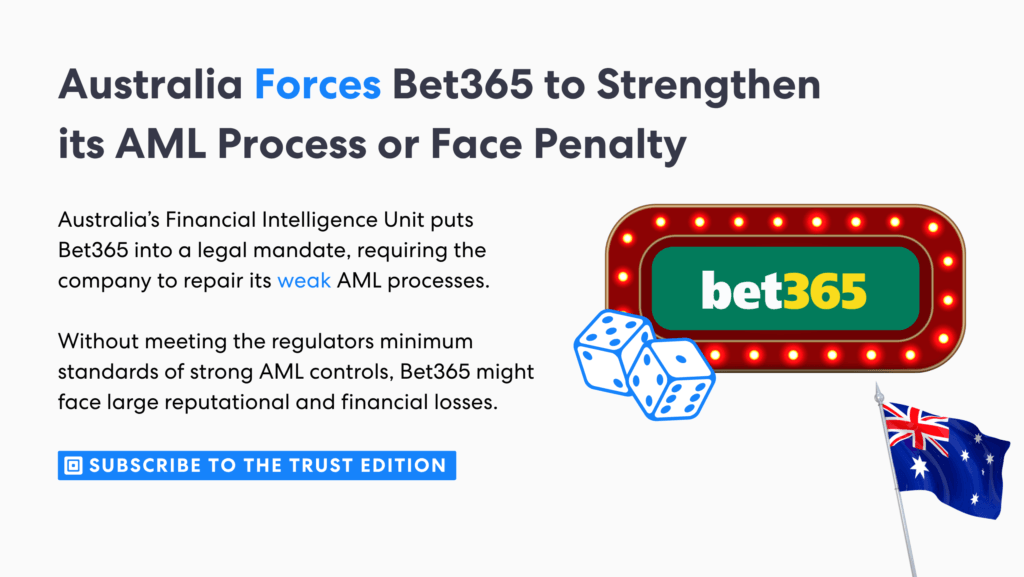
Under AUSTRAC’s mandate, Bet365 is required to overhaul its AML and Counter-Terrorist Financing (CTF) processes. The company has to implement an updated, comprehensive, and ongoing risk assessment, backed with clear methodology. Additionally, the company must document and prove how it can effectively combat suspicious transactions as risks evolve. The message to Bet365 is straightforward: implement the required standards or face civil penalties.
## Unique AML Risk in the Gambling Industry
Global regulatory standards deem the gambling and casino sector as highly vulnerable to money laundering and terrorist financing risks. This is due to several factors, including the [cash-intensive nature](https://www.fatf-gafi.org/en/publications/Methodsandtrends/Vulnerabilitiesofcasinosandgamingsector.html) and rapid speed of transfers. AUSTRAC’s CEO, Brendan Thomas, echoes this message, “The gambling industry processes large volumes of money at high speed, often through anonymous digital channels. This creates opportunities that criminals look to exploit.”
According to the National Crime Agency’s 2025 Annual Suspicious Activity Report (SAR), gambling firms submitted over [7000](https://www.nationalcrimeagency.gov.uk/who-we-are/publications/786-sars-annual-report-2025/file) SARs, pointing to the industry’s ongoing exposure to suspected money laundering risks. Furthermore, in the same year, the Gambling Commission took enforcement action against 24 operators, resulting in regulatory fines totaling up to [£4.2 million](https://assets.publishing.service.gov.uk/media/6888b5d8e1a850d72c409159/E03341179_HC_759_Gambling_Commission_ARA_2024-25_Accessible.pdf).
> The gambling industry processes large volumes of money at [high speed](https://www.austrac.gov.au/news-and-media/news/bet365-overhaul-aml-systems-under-austrac-enforceable-undertaking), often through anonymous digital channels.
The level of enforcement indicates that AML weaknesses remain a challenge for many firms. Additionally, these cases show how regulators are slowly moving gambling companies under banking compliance standards. As such, strong [Customer Due Diligence (CDD)](https://www.complycube.com/en/solutions/due-diligence-compliance/customer-due-diligence/), ongoing monitoring, and risk assessments are no longer optional or a “quarterly task.”
## How to avoid this scenario
For compliance teams in the gambling sector, non-compliance now carries legal, financial, and reputational risks. [Harry Varatharasan](https://uk.linkedin.com/in/harryvaratharasan), Chief Product Officer at ComplyCube, mentions, “Global regulators are not holding back on applying an aggressive enforcement model on those that cannot prove the resilience of their compliance infrastructure against today’s risks.”
Bet365’s AUSTRAC enforcement shows what happens when risk assessment and governance do not align with sectoral risks. To avoid the critical, systematic failures in Bet365, businesses must take the following into account:
### 1. Deficient Risk Assessments
**Compliance Failure:** Bet365 failed to maintain an ongoing risk assessment approach. This meant its underlying AML and CTF infrastructure did not evolve alongside changing money-laundering risk across its services, channels, geography, and customer types.
**How to Avoid:** In practice, AML teams must review risk assessments periodically, document clear decisions, and define clear triggers where risks change. Additionally, obtain senior management sign-off to demonstrate auditable controls. You can learn more here: [What is AML Risk?](https://www.complycube.com/what-is-aml-risk/)
### 2. Ineffective Reporting Mechanism
**Compliance Failure:** Under Australia’s AML/CTF Act, businesses must submit Suspicious Matter Reports (SMRs) within 24 hours to 3 days according to the level of risk present. Bet365 failed to detect and escalate high-risk transactions to AUSTRAC.
**How to Avoid:** Gambling firms should tailor their monitoring rules to specific high-risk gaming patterns. Common examples include rapid deposit and withdrawal behavior or the use of multiple accounts. A clear SMR escalation path, including for alert review, decision, and submission, is critical for compliance.
### 3. Weak Compliance Governance
**Compliance Failure:** According to AUSTRAC, Bet365’s compliance processes did not evolve with the business. As such, criminals can exploit certain gaps to bypass controls. This mirrors the 2024 UK Gambling Commission £582,120 (USD $777,112) fine for ineffective Enhanced Due Diligence (EDD) and Know Your Customer (KYC) triggers, pointing to deeper governance challenges.
**How to avoid:** Businesses should implement clear oversight and accountability for AML risk reporting, monitoring, and SMR quality. KYC and AML controls should be continuously stress-tested so it can scale with business growth or change. You can learn more here: [When is Enhanced Due Diligence Needed?](https://www.complycube.com/enhanced-due-diligence-requirements-guide/)
## Building Resilient Gambling AML Program
Regulatory authorities are increasing oversight of online bookmakers, with leading firms such as Entain Group and Sportsbet currently undergoing similar overhauls of their AML and CTF frameworks. Given the unique nature of this industry, compliance teams must continuously maintain clear, strong audit trails that keep pace with today’s risks.
[](https://portal.complycube.com/signup)
Find out more AML news in ComplyCube’s [Trust Edition newsletter](https://www.linkedin.com/newsletters/the-trust-edition-7103022355722981376/). We explore the latest in developments across identity verification and AML globally.
**Categories:** News
**Tags:** Anti-Money Laundering
---
### [CFTC Fine Exposes $14M Crypto Pool Fraud](https://www.complycube.com/cftc-fine-exposes-14m-crypto-pool-fraud/)
**Published:** July 8, 2026
**Author:** Rithu Jagannath
**Excerpt:** The Commodity Futures Trading Commission (CFTC) action against Argent Capital Management goes beyond alleged investor fraud. Explore what the $14 million case reveals about crypto compliance, controls and financial crime risk.
**Content:**
The U.S. Commodity Futures Trading Commission (CFTC) filed a suit against Argent Capital Management and its founder, Trevor Vernon, for crypto fraud. The CFTC fine came about due to allegations that $14 million was fraudulently raised from investors through a commodity pool trading futures, options, and crypto assets.
Though the case initially focuses on investor deception, there is a much larger lesson for the crypto industry. It is rare for illicit funds to remain within one singular business. However, once bad actors get access to the digital asset system, they can easily move through wallets, exchanges, and counterparties. As a result, real firms are at risk of financial crime exposure across the market.
## What Happened?
On July 8th, 2026, the [CFTC](https://crypto.news/cftc-sues-crypto-pool-operator-over-alleged-14m-fraud/) reported that Vernon and Argent Capital Management allegedly solicited money from at least 60 investors between March 2022 and February 2026. They promoted a commodity pool, an investment fund where multiple investors combine their funds so that a professional fund manager can trade on them. In this case, the CFTC is referring to Bitcoin, Ether, and other crypto derivatives.
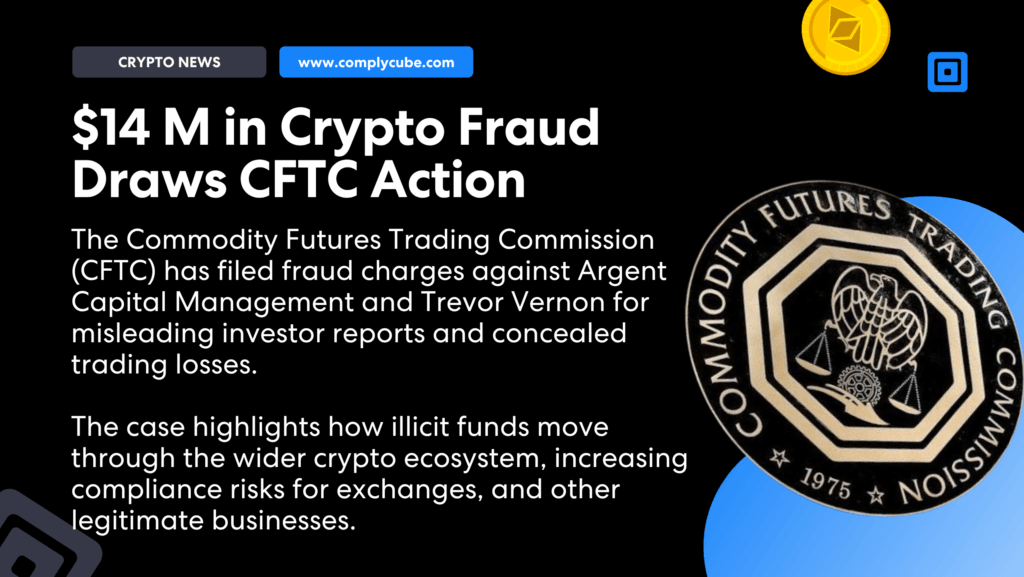
They reported the investors received several account statements that showed profits despite the fund suffering some significant trade losses. Additionally, the money was also used to make payments to existing participants while losses were concealed and false statements were made during the regulator’s investigation.
The [CTFC fine](https://finance.yahoo.com/markets/options/articles/argent-capital-founder-faces-cftc-035900722.html) is one form of restitution for their fraudulent behavior. They also want to place injunctions to stop future violations of the Commodity Exchange Act. At this time, the allegation is with the courts and the defendants will have the chance to respond in defense.
## Why This Matters Beyond Argent Capital Management
The real implications of this case extend beyond Argent Capital Management. This example demonstrates that money can move within minutes and finding suspicious activity becomes much more difficult without an effective [Anti-Money Laundering (AML)](https://www.complycube.com/en/solutions/due-diligence-compliance/anti-money-laundering/) system, transaction monitoring, or blockchain analytics. Moreover, clients should seek to do work with crypto firms with strong AML practices as well.
Fraudulent proceeds cause a significant downstream risk for legitimate crypto businesses. Many exchanges, payment providers, or virtual asset service providers might accidentally process funds linked to fraud. This is only a problem if the right controls are not in place.
It was Argent Capital Management’s responsibility to find and mitigate risks instead of reacting before a CFTC fine or intervention.This case is also an indicator that digital assets are not a separate category needing new enforcement rules. In fact, regulators can apply long-established investor protection principles and financial crime obligations to businesses that operate within the crypto industry.
## What Compliance Professionals Can Learn
With the Argent Capital Management legal proceedings taking off, the CFTC fine and allegations showcase many practical lessons for compliance professionals within the crypto industry. The key learnings include:
### Governance is just as important as technology
It is common for many enforcement actions to come out of failures in oversight, transparency, and internal controls. However, these issues happen well before the intricacies of financial crime techniques come into play. To avoid this, teams must conduct independent reviews of investor communications, maintain a clear breakdown of duties, and implement a thorough audit process as important, basic safeguards.
>
### Transaction monitoring must go beyond onboarding
Customer Due Diligence (CDD) at account creation is only the beginning. Ongoing monitoring of transactions and changing customer behavior helps find suspicious activity before illicit funds become embedded within legitimate financial flows. You can learn more here: [What is Customer Due Diligence (CDD)?](https://www.complycube.com/en/what-is-customer-due-diligence/)
### Transparency is the expectation
Whether operating a traditional investment vehicle or a fund that is more crypto-focused, firms need to have accurate reporting, disclose risks, and keep investors in the loop to show actual financial performance.
## The Bigger Crypto Regulatory Signals
The Argent Capital Management case reflects an increasingly consistent message from financial regulators around the world. For crypto businesses, compliance goes beyond one function. They need to implement layered controls. Moreover, they need to have strong blockchain transaction analysis, source of funds assessments, and ongoing customer risk reviews. Businesses that struggle to keep track of where funds come from and where they move to face operational and reputational risk.
### Key Takeaways
- The CFTC fine against Argent Capital Management alleges more than $14M in fraud.
- The regulator seeks restitution, civil monetary penalties and permanent trading bans.
- The Argent case shows how illicit proceeds can cause wider financial crime risks.
- Crypto firms need strong compliance processes in place to find odd fund flows.
- The enforcement shows a broader regulatory focus on governance, transparency, and proactive financial crime prevention.
## Final Thoughts and Observations
These claims against Argent Capital Management are subject to upcoming legal proceedings. The courts will ultimately decide on the outcome of this battle. However the verdict pans out, the CFTC fine and [enforcement action](https://www.cftc.gov/PressRoom/PressReleases/9264-26) showcase an important reality for the digital asset sector.
In summary, when funds move across wallets, it is the responsibility of the exchanges and financial intermediaries to find any suspicious activity to protect the wider crypto ecosystem. Regulators such as the CFTC are asking firms to not only detect fraud but also check up on governance processes, visibility, and controls to stop its impact from spreading further into the crypto sector.
[](https://portal.complycube.com/signup)
Find out more AML news in ComplyCube’s [Trust Edition newsletter](https://www.linkedin.com/newsletters/the-trust-edition-7103022355722981376/). We explore the latest in developments across identity verification and AML globally.
**Categories:** News
**Tags:** Crypto Regulations
---
### [Netherlands Fines Financial Company CCV €2.65M for Monitoring Gaps](https://www.complycube.com/netherland-fines-ccv-2-65m-for-monitoring-gaps/)
**Published:** July 14, 2026
**Author:** Dini Habib
**Excerpt:** The Netherland's regulatory authority, the DNB fined financial services company, the CCV €2.65 million for historical lapses in its customer due diligence and monitoring system. CCV failed to adequately comply with the Wwft rules.
**Content:**
On 13th July 2026, the Netherlands’ regulatory body, the De Nederlandsche Bank (DNB), penalized the financial services company CCV Netherlands B.V. (CCV) with €2.65 million (USD $3M) for prolonged gaps in its compliance program. More on what happened below.
## What Caused the CCV €2.65M Fine?
During examinations, the DNB found that CCV had inadequate Customer Due Diligence (CDD) and transaction monitoring. In particular, it breached Section 3(2) of the country’s Anti-Money Laundering (AML) and Terrorist Financing Act (Wet ter voorkoming van witwassen en financieren van terrorisme or Wwft for short).
The language used in the DNB’s published [enforcement statement](https://www.dnb.nl/en/general-news/enforcement-measures-2026/administrative-fine-imposed-on-ccv-for-inadequate-customer-due-diligence/) was clear. The regulator explicitly pointed out how CCV’s system failed, not just that it failed. Why DNB fined CCV:
- CCV’s transaction monitoring solution failed for over two years, highlighting a broader governance failure.
- The firm failed to fully load over 4200 merchant’s transaction profiles into their monitoring system for 23 months, showing that controls were not consistent.
- CCV has inadequate ongoing monitoring of alerts, with no explanation of why they were closed or handed over to other teams, meaning the company cannot evidence its decision-making.
## CCV’s Historic AML and Sanctions Violations
This is not the first time CCV faced enforcement action for similar violations. Back in 2019, the DNB issued a formal instruction (aanwijzing), mandating that the company take specific actions to improve its monitoring policies and procedures. In July 2021, DNB confirmed that CCV complied.
> DNB seeks to [safeguard financial stability](https://www.dnb.nl/en/about-us/mission-tasks-and-strategy/) and thus contributes to sustainable prosperity in the Netherlands.
However, just years later, in 2024, the firm was fined €1.1 million for prior AML and sanctions breaches found from 2015 to 2018. Despite its historic failures and remediation, DNB imposed this new fine for controls that were not continuous. What does this mean for regulated businesses?
Regulatory bodies are emphasizing “not continuous” as a regulatory red line, with higher expectations on sustainable and continuous control performance, not just a point in time fix.
## Netherlands Customer Due Diligence and Ongoing Monitoring Requirements
In the Netherlands, the Wwft requires regulated businesses to perform robust CDD and [ongoing monitoring](https://www.complycube.com/en/what-is-an-ongoing-monitoring-process/). This includes documenting when they are triggered and how they enable continuous compliance.
### What must CDD achieve under Section 3(2) of the Wwft?
Under AML and CTF laws, businesses must meet four aspects for compliance. These are to perform identity verification on a customer or client, identify the [Ultimate Beneficial Owner (UBO)](https://www.complycube.com/what-is-ultimate-beneficial-ownership-ubo/), establish the nature and purpose of a relationship or transaction, and, lastly, continuously monitor the said relationship and transactions over time.
### What must ongoing monitoring achieve under Section 3(2) of the Wwft?
Section 3(2) explicitly calls businesses to run ongoing monitoring. This is a baseline obligation required by all organizations. These mandates echo leading regulatory frameworks, such as Singapore’s MAS, Australia’s AUSTRAC, and the UK’s MLR2017. Authorities increasingly expect proactive monitoring systems with clear risk-based triggers, escalation, and decision-making.
## How to Build a Scalable AML Program in the Netherlands and Beyond?
A key lesson from CCV’s case is that AML and CTF compliance must do more than just pass a point-in-time remediation plan. It must be resilient and continue to operate effectively as business volume, customers, and regulatory obligations evolve.
According to [Milosh Caunhye](https://www.linkedin.com/in/milosh-caunhye/), Solutions Consultant at ComplyCube, “Businesses can face enforcement action despite using the best AML technology. Instead, an effective, end-to-end AML program should go further and be able to demonstrate strong and consistent evidence of outcomes.”
### 1. Automated monitoring platform
Leverage real-time AML screening, including automated [Politically Exposed Persons (PEPs) verification](https://www.complycube.com/en/solutions/global-screening/sanctions-pep-screening/), sanctions check, and adverse media coverage on a unified platform. Use risk-based rules, customer profiles, and behavioral patterns to trigger escalation to senior management for review.
### 2. Robust case management
Centralize case management to record alert reviews, compliance officer reasoning, approvals, and escalation decisions in real-time. With a clear audit trail, businesses can strengthen accountability and enhance trust with demonstrable evidence to support compliance decisions.
### 3. Connect customer risk directly to monitoring
Use robust APIs and integrations to feed CDD, UBO, and other related risk data into the controls applied throughout the customer journey. As a result, companies can identify emerging risks earlier, better allocate compliance resources, and enforce more proportionate controls.
[](https://portal.complycube.com/signup)
Find out more AML news in ComplyCube’s [Trust Edition newsletter](https://www.linkedin.com/newsletters/the-trust-edition-7103022355722981376/). We explore the latest in developments across identity verification and AML globally.
**Categories:** News
**Tags:** Anti-Money Laundering
---
### [How Singapore's MariBank Dismantled a Money Laundering Network](https://www.complycube.com/singapore-maribank-cracks-money-laundering-network/)
**Published:** July 22, 2026
**Author:** Dini Habib
**Excerpt:** Singapore's money laundering network case shows why KYC does not end at onboarding. Learn how MariBank helped authorities break down this notorious crime network through sharing critical financial crime intelligence information.
**Content:**
On 21 July 2026, Malaysian authorities detained a 28-year-old man at Kuala Lumpur International Airport for his alleged involvement in a money laundering network that targeted Singaporean bank accounts.
According to the Singapore Police Force (SPF), MariBank shared crucial information with authorities, which contributed to disrupting the illicit network and making the arrests. This arrest did not happen overnight. Uncover the full details below.
## The Backstory of the Notorious Illegal Network
The SPF noted that intelligence sharing from MariBank and the Anti-Scam Center contributed to Operation FRONTIER+ III, a coordinated alliance involving both Singaporean and Malaysian authorities.
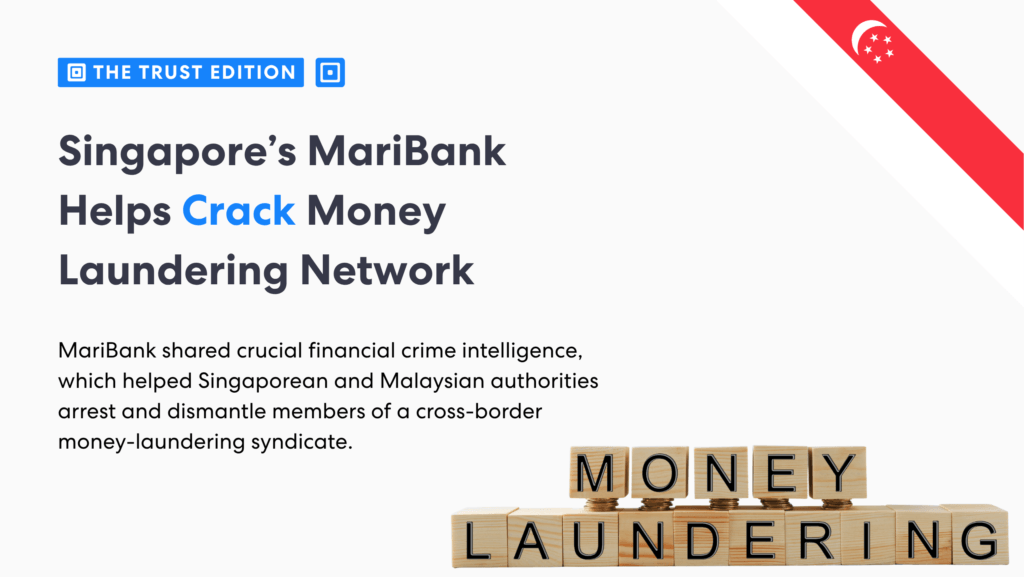
With part of this information, the joint alliance was able to expose a Malaysian-based syndicate that supplied mule accounts to funnel illicit flows. In March this year, Malaysian authorities raided the syndicate’s property and seized 83 mobile phones, 45 bank security tokens, and a computer containing operating software used by the syndicate.
> The private industry is an important partner in [this fight](https://www.police.gov.sg/Media-Hub/News/2026/07/20270721_male_malaysian_believed_to_be_member_of_money_laundering_syndicate) against scams.
The items seized gave an insight into how the syndicate operated. It allowed them to operate multiple bank accounts registered under different identity credentials. MariBank’s role was significant and highlighted the difference between AML alerts and demonstrable financial crime intelligence.
Senior Assistant Commissioner of Police (SAC) Justin Wong said, “The private industry is an important partner in this fight against scams. I commend MariBank for their proactive cooperation with the SPF, which allowed Singapore and Malaysian authorities to dismantle the syndicate.
## Correct Identity Doesn’t Mean Legitimate Control
Traditional Know Your Customer (KYC) processes enable businesses to answer one question: “Did we verify the customer details correctly?” Modern financial crime intelligence is where current regulatory authorities want businesses to move to. It answers, “Is the customer the same person controlling the account?”
> Verifying whether a customer is who they claim to be may not be enough on its own.
Your KYC infrastructure may seem effective from the outset. It means a customer’s passport is genuine, their facial biometrics match their documents, and they pass sanctions and adverse media screening. However, that same customer can be part of a money laundering network long after.
The Chief Product Officer of ComplyCube, [Harry Varatharasan](https://www.linkedin.com/in/harryvaratharasan/) mentions, “Verifying whether a customer is who they claim to be may not be enough on its own. Regulated entities require ongoing controls to evidence that a customer is still the rightful controller of an account.”
## Fraud Intelligence as the Next Growing AML Requirement
Modern KYC and [Anti-Money Laundering (AML)](https://www.complycube.com/en/solutions/due-diligence-compliance/anti-money-laundering/) programs have to combine identity verification, ongoing monitoring, and fraud intelligence into a single workflow. The SPF did not disclose what information MariBank shared.
However, the outcome suggests that the bank was able to do more than flag an isolated suspicious account. For AML and KYC teams, the goal should therefore be to move beyond asking whether a single customer or transaction appears suspicious.
## What AML and KYC Teams Should Do Next
The MariBank case shows that effective AML is no longer measured by how many alerts or suspicious activity is reported. To strengthen financial crime controls, here are the three key pillars AML and KYC teams should implement next.
### 1. Introduce Device Intelligence Controls
The case saw the syndicate using different mobile phones and bank security tokens to perform illegal activities. This highlights the need for [device intelligence](https://www.complycube.com/solutions/fraud-intelligence/device-intelligence) solutions, as customer names and date of birth cannot verify if an account is being used on the same device, IP address, and browser. These device signals can reveal mule-account networks that traditional monitoring may overlook.
### 2. Map Behavioral KYC Risk Indicators
Identity verification should not stop at onboarding. In reality, a customer’s risk profile can evolve well beyond that stage. As such, compliance teams must map behavioral deviations to a customer’s [risk score](https://www.complycube.com/en/the-evolution-of-the-risk-based-approach-in-aml/), with automated enhanced review where required. Some examples of this include exceeding specific transaction values and rapid pass-through transactions.
### 3. Connect AML, Fraud and Cybersecurity Teams
Customer risks can be fragmented across different functions. For instance, cybersecurity teams identify compromised devices, while fraud teams manage victim handling. This can create data sharing gaps. Compliance teams should instead adopt integrated financial crime solutions, with robust APIs, SDKs, and webhooks to support seamless information sharing and unified case management.
[](https://portal.complycube.com/signup)
Find out more AML news in ComplyCube’s [Trust Edition newsletter](https://www.linkedin.com/newsletters/the-trust-edition-7103022355722981376/). We explore the latest in developments across identity verification and AML globally.
**Categories:** News
**Tags:** Anti-Money Laundering
---
### [How to Choose the Best ID Verification API for Real-Time KYC](https://www.complycube.com/real-time-id-verification-api-buyer-guide/)
**Published:** July 10, 2026
**Author:** Rithu Jagannath
**Excerpt:** Learn how to choose the correct identity verification API provider for real-time Know Your Customer (KYC). Learn about how providers can help with fraud prevention and biometric checks to webhooks, compliance evidence, uptime, and the need for API buying criteria.
**Content:**
**TL;DR:** The right **real-time identity (ID) verification API** helps firms verify users fast. They keep any Know Your Customer (KYC) related decisions auditable. This **buyer guide explains** how to choose the best ID verification API by looking into **various factors** such as speed, webhooks, SDKs, and more.
## Real-Time Onboarding Is Now a Fraud Target
Identity verification (IDV) is one of the most important steps in the digital onboarding process in 2026. Many financial institutions and global companies across various sectors such as healthcare providers, marketplaces, and gaming firms rely on real-time verification. They need this solution to onboard customers, reduce fraud risk, and give users access right away.
However, criminals are using stolen data, artificial intelligence, and synthetic identities to move fraud faster and attack the onboarding process. It is becoming increasingly commonplace for fraudsters to take advantage of systems with fake identity documents and AI-manipulated selfies. The Business Information Industry Association (BIIA) reported that 62% of banks are seeing digital onboarding as most likely to be impacted by synthetic fraud. They also found that identity-related losses in financial services hit $12.5 billion in 2024, an increase of 25% from 2023.
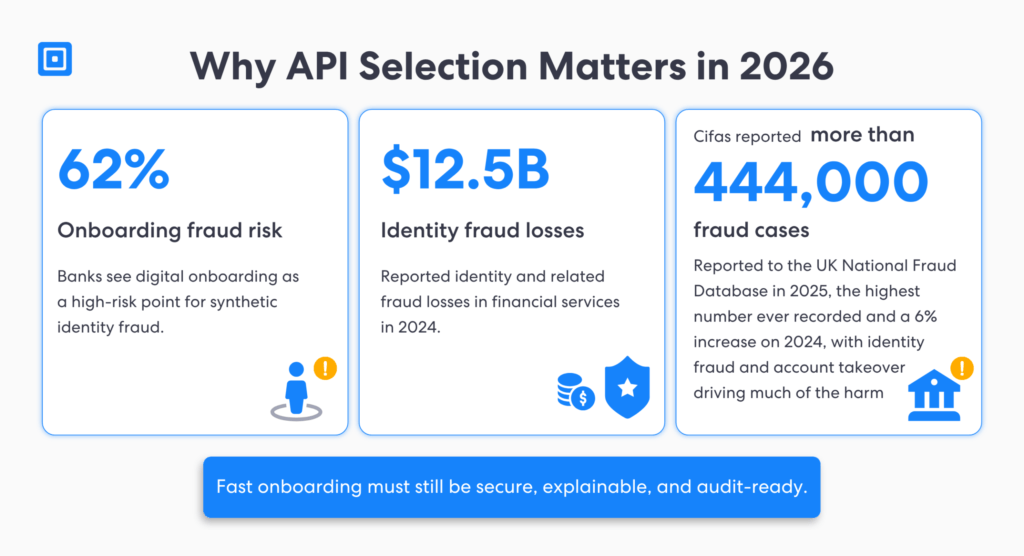
Yet, how do teams verify the user identity data fast without letting criminals get through? This is the question that buyers need an answer to. They also need to understand how they can reduce drop-off rates and keep the verification smooth while meeting regulatory compliance requirements, specifically around Anti-Money Laundering (AML).
This question is why deciding on the right ID verification API is a hugely important decision for the operational infrastructure of a business. The wrong choice can slow down growth, increase manual workloads, and raise costs. Most important of all, this provider could expose the business to several risks and fraudulent activities.
## What is an ID Verification API?
An [identity verification API](https://www.complycube.com/en/what-is-an-identity-verification-api/) links a business system, app, or onboarding flow to automated identity checks. It lets a customer create a verification session, collect provided data, and check identity documents. Additionally, it can perform biometric verification and arrive at a decision through an API request. Financial technology and banking sectors use these APIs for KYC compliance.
In practice, an ID verification API may support document verification, ID document verification, and facial recognition. Some may help with biometric matching, liveness detection, and AML screening. It can also help with data collection, workflow rules, and connect with existing systems through an [external API](https://docs.complycube.com/documentation/api-reference), SDK, hosted flow, or webhook.
## Know Your Customer (KYC) Buying Criteria
Any real-time [KYC process](https://www.complycube.com/en/step-by-step-know-your-customer-process/) relies on the right decision being made at the right time. For instance, a weak API function may verify a document at one point, but fail when it has to handle edge cases. Then, it may return unclear errors and make manual reviews much harder than it needs to be.
On the other hand, a strong ID verification API will support the entire process. Teams will be able to verify users, prevent fraud, and satisfy regulatory requirements day-to-day. A strong system reduces human error, and protects customer relationships.
The Financial Action Task Force (FATF) guidance states that digital ID systems can support Customer Due Diligence (CDD) under Recommendation 10. However, firms need to understand how the system works and apply a strong risk-based approach. You can learn more here: [What is a Risk-Based Approach (RBA)?](https://www.complycube.com/en/what-is-a-risk-based-approach/)
## Basic ID Verification vs. Real-Time ID Verification API
Basic ID verification looks to see if a user is a match to an existing identity document or data record. Where real-time identity verification goes further is that it combines document authentication, facial biometrics, and fraud prevention. They also incorporate workflow rules and compliance evidence into one live digital onboarding process.
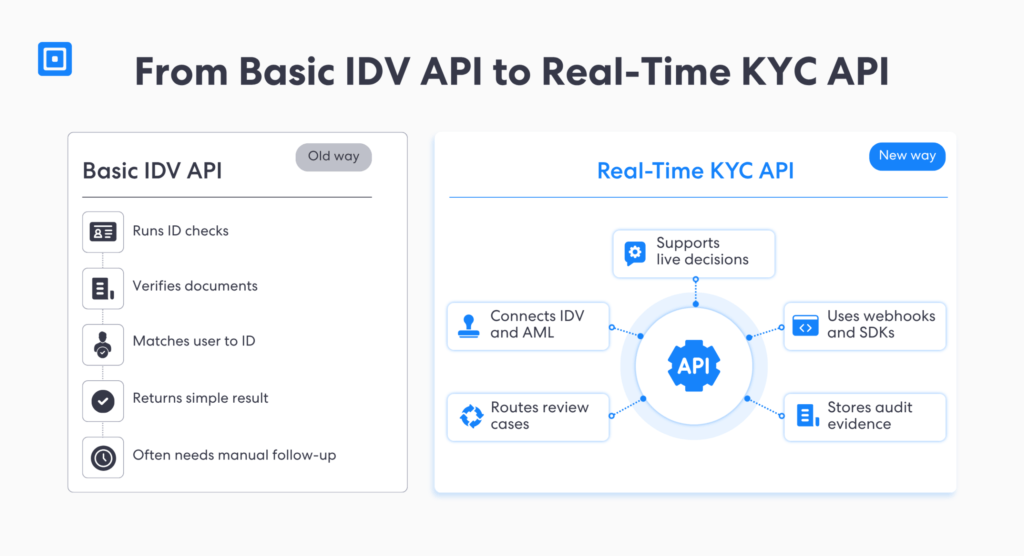
This difference between basic [ID verification](https://www.identity.org/the-identity-verification-process-comprehensive-guide/) and real-time ID verification is incredibly important. Having the capability to have the uptime, clear documentation, and sandbox testing could make a huge difference for some firms. Additionally, having rate limits and better webhook reliability needed for production can set an incredible ID verification API apart from a good one. The key thing to remember is that the best API is the one that works when real users, fraud, and compliance duties intersect well.
### **Case Study: Saxo Bank’s $50M AML Fine**
Denmark’s Financial Supervisory Authority [fined Saxo Bank](https://www.financemagnates.com/forex/saxo-bank-fined-nearly-50-million-by-danish-watchdog-in-largest-penalty-in-two-years/) DDK 313M ($50M USD) for breaching Denmark’s Money Laundering Act. The bank did not collect data on the purpose and intended nature of several legitimate customer relationships. These ongoing monitoring requirements were not met for many white-label clients from January 2021 to May 2023.
### Real-Time KYC and Basic Identity Checks
An API-led onboarding process needs IDV, CDD, and AML screening to prove that customer identities are accurate. These features show that risk profiles and review decisions are actually handled in accordance with relevant and applicable regulations. With workflow rules, ongoing monitoring, and auditable evidence, a strong provider will easily stand out.
### Outcomes
- Weak monitoring controls cause a lot of major financial and reputational risk.
- API buyers must review evidence, workflows, and monitoring readiness as well as speed.
- Real-time KYC processes help firms confirm, risk-score, escalate, and audit client relationships.
## How to Evaluate an ID Verification API Vendor
Cases like the Saxo Bank AML fine show why API buying criteria is a crucial and necessary function. It needs to go beyond basic speed and document capture functions. Some providers may offer fast ID checks, but might not support key benefits such as real-time KYC, CDD, and AML controls where important. This is where vendor evaluation comes into play. Buyers need to learn how to properly compare each identity verification API against a rubric set to a high standard.
> The best ID verification API is one that helps businesses make fast, explainable, and audit-ready KYC decisions.
Solutions Consultant at ComplyCube, [Milosh Caunhye](https://www.linkedin.com/in/milosh-caunhye/), states, “The best API verifies users the fastest. This is incredibly important when fraud, compliance, and customer experience are all on the line.”
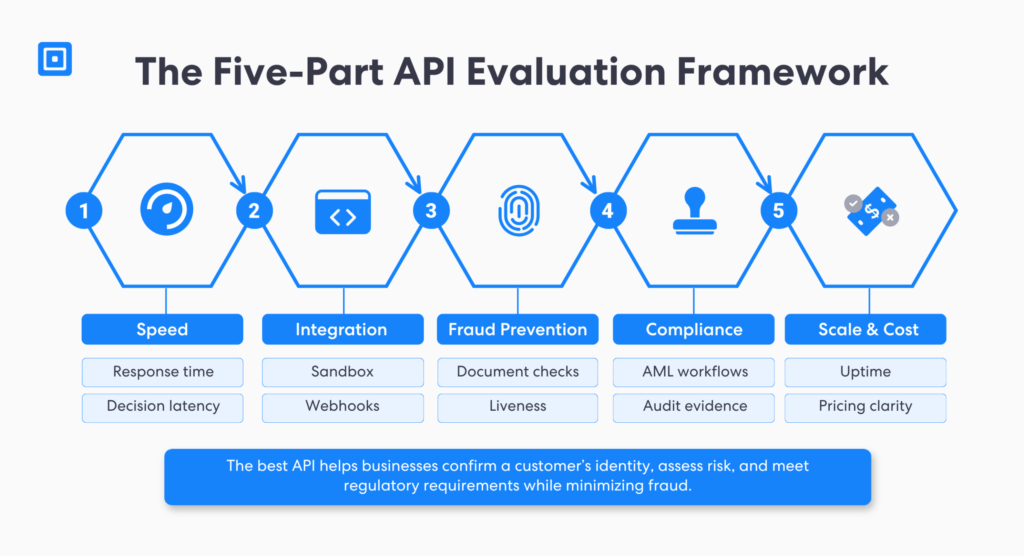
Such a rubric would allow compliance teams, product managers, engineers, and operations teams to assess risks for new users from several different viewpoints. The five criteria below focus on what is most important in the production phase. In vendor evaluation, buyers must look at speed, integration, fraud prevention, compliance evidence, and scalability. With this in mind, any firm can find the right [ID verification API](https://learn.g2.com/best-identity-verification-software) for their needs.
### API Speed and Decision Latency for Enhanced Security
Real-time verification APIs are able to confirm identities in seconds. However, buyers must not accept a broad “real-time” claim without detail. It is important to ask which checks are instant and which ones are happening in the background. For example,[document verification](https://www.complycube.com/en/solutions/identity-assurance/document-verification/) and database checks might not have the same response times. In this situation, a strong vendor should be able to explain timeouts, retries, decision delays, and review triggers. As a result, product and engineering teams can better design onboarding flows.
### Sandbox Quality and API Integration
A strong signal of API maturity is a [sandbox feature](https://support.complycube.com/hc/en-gb/articles/9169035670813-How-do-I-use-the-test-or-sandbox-account). Teams need to be able to test approved and rejected users for immediate access. They must be able to look through a variety of data points such as expired documents, poor images, and failed facial recognition. Moreover, systems must factor AML hits, duplicated users, and abandoned journeys for enhanced security.
Another important feature to look into is webhooks. They tell systems when a verification status is updated. Useful events to be accounted for include if a verification is completed, failed, or review is required. They also note when a document has been rejected, an AML match is found, and manual review has been completed. A strong provider must support direct API integration well.
### Document Authentication, Biometrics, and Liveness
A strong identity verification process works to use document authentication to inspect identity documents. They need to detect tampering, compare the provided data with the user’s submission, and extract data with [Optical Character Recognition (OCR)](https://www.complycube.com/en/solutions/due-diligence-compliance/know-your-customer/optical-character-recognition/).
Similarly, biometric verification checks if the person presenting the ID matches the document image. All of these features, such as facial recognition, biometric matching, and liveness detection, help confirm that the user is real and present. These fraud prevention methods matter more in 2026 as [AI-generated documents](https://www.complycube.com/en/document-fraud-detection-software-guide/), synthetic identities, and face swaps are making fraud even harder to detect. Basic identity checks will not work on their own.
### Anti Money Laundering Audit Evidence
For regulated businesses to stay compliant, the best identity verification API works to support more than pass or fail decisions. Teams must be able to evidence identity checks, CDD, and [AML screening](https://www.complycube.com/en/aml-compliance-software-solutions/). Moreover, they must be able to prove manual review decisions, risk-based workflows, and ongoing monitoring triggers on a case-by-case basis.
This is particularly relevant for regulated industries such as fintechs, healthcare providers, and marketplaces that must meet relevant regulations. The best ID verification API should help compliance teams understand why a user passed, failed, or was escalated for manual review.
### Scalability for Growing Fraudulent Activities
One of the biggest business problems that buyers run into around ID verification APIs is operational efficiency and downtime. It is important for them to look into how retry rules work and global coverage support for automated ID verification.
Moreover, pricing needs to be reviewed beyond the cost per check. Instead, organizations should evaluate the total cost of ownership, including implementation, maintenance, manual intervention, and the long-term operational impact of the solution. As a result, the best provider reduces operational costs over time. They lower false positives, cut manual review time, and improve automation for supporting smoother onboarding.
## How Teams Should Compare ID Verification API Vendors
Teams must focus on regulatory compliance. With strong audit evidence, [AML alignment](https://www.complycube.com/en/anti-money-laundering-software-evaluation/), and a case study, firms will have the ability to stay compliant with changing expectations and regulations from governing bodies locally and globally. Product teams need to look at speed, usability, and drop-off rate. On the other hand, engineering teams must assess webhook reliability, SDKs, and [API integration](https://docs.complycube.com/documentation/api-reference/integration). Operations teams need to keep a close eye on false positives, manual verification, escalation pathways, and case resolution speed.
For example, a provider may look cheaper, but in practice, that ID verification API might create more manual review. Similarly, another brand may look strong on their features, but lack when it comes to compliance certifications needed by buyers governed by AML regulations. This is where a dedicated [compliance suite](https://www.complycube.com/solutions/compliance-suite/kyc-workflow/) can help connect KYC, AML, risk-based workflows, and audit evidence into one structured operating model.
## Common Red Flags with ID Verification API Vendors
When vendors claim to have high speed or just vague speed claims in general, alarm bells must go off for buyers. Real-time does not mean much unless the vendor explains which verification checks return instantly and which do not. Similarly, any hint of poor documentation is a red flag to consider. If the engineering team struggles to understand the ID verification API fast and clearly, risk rises for launch time.
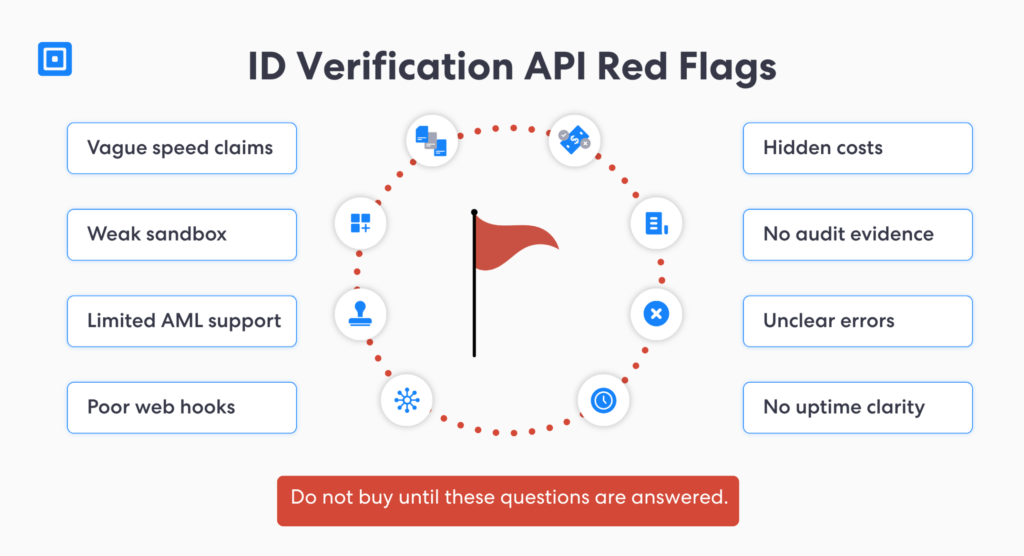
Another red flag is weak error handling. Examples of this include unsupported document types, expired verification sessions, and poor images. Additionally, any duplicate users and rate limits should be easy for people to understand. Finally, arguably the most important red flag is weak evidence. If compliance teams do not have information around why a user passed, failed, or was escalated, the ID verification API will create [audit risk](https://www.complycube.com/en/aml-compliance-checklist/).
### Key Takeaways
- **The best ID verification API** must be judged by production readiness and features.
- **Real-time KYC** needs fast decisions, strong webhooks, and clear documentation.
- **Financial crime prevention** depends on a strong AML system with various solutions.
- **Having a strong ID verification API** provides strong auditable evidence.
- **ID verification APIs** must consider manual review, false positives, failed journeys, and support load.
## Find The Right ID Verification API with ComplyCube
When comparing identity verification API providers, ComplyCube can help build a faster, safer, and more compliant onboarding process for overall customer satisfaction. Get in touch with Comply to learn how IDV, AML screening, and biometric checks can work together to ensure authenticity. All of these features together can support your KYC needs at scale. [Get in touch with our team today](https://www.complycube.com/contact/contact-sales/).
[](https://portal.complycube.com/signup)
## Frequently Asked Questions
How should businesses choose an ID verification API?
Businesses need ID verification APIs that speak to real-time performance, fraud prevention controls, and auditable compliance evidence. The right API provider also needs to support machine learning, reliable webhooks, and checks across credit bureaus and various government databases.
What makes real-time identity verification important?
To verify users fast during onboarding, real-time identity verification is necessary. It can check a government-issued ID, gather biometric data through a device’s camera, and use active liveness to lower manual checks or knowledge-based authentication.
How does biometric verification help prevent fraud?
Biometric verification helps prevent fraud by confirming that the person presenting the ID matches the document image. Active liveness detection, facial recognition, and advanced AI can help find any spoofing attempts using photos, videos, or deepfakes.
Is knowledge-based authentication important for KYC?
Knowledge-based authentication is important because it can support low-risk checks. However, they should not be the main control because the best KYC workflow has strong document verification, biometric verification, and strong risk signals for fraud prevention.
How does ComplyCube support KYC with its ID verification API?
Support real-time KYC through an API-first platform such as ComplyCube. It is built with fast onboarding, fraud prevention, and audit-ready evidence at top of mind. It combines document verification, biometrics, and active liveness detection. Moreover, it provides AML screening, workflow automation, and evidence capture.
**Categories:** Guides
**Tags:** Know Your Customer
---
### [Top 5 Biometric Fraud Detection Platforms of 2026](https://www.complycube.com/biometric-fraud-detection-platforms/)
**Published:** July 14, 2026
**Author:** Rithu Jagannath
**Excerpt:** Compare the top biometric fraud detection platforms for 2026 in this guide. Learn how liveness detection, behavioural biometrics, and biometric spoofing detection help organizations stop deepfakes, identity fraud, and account takeover.
**Content:**
**TL;DR:** Biometric fraud detection is necessary for businesses that use **digital identity verification**. Today, AI-driven attacks make fake faces, spoofed documents, and synthetic identity data incredibly **hard to detect**. This guide compares the best biometric fraud prevention platforms using biometric spoofing detection to **stop fraud in its tracks**.
## Why Biometric Fraud Detection Matters
In 2026, biometric fraud is becoming a common security concern. Financial institutions, fintechs, and crypto platforms are facing fraud that looks real, moves like a legitimate user, and is primarily powered by artificial intelligence (AI).
With the Credit Industry Fraud Avoidance System (CIFAS) reporting more than [444,000 fraud cases](https://www.cifas.org.uk/newsroom/fraudscape2026) in the UK National Fraud Database in 2026, the urgency for a better security posture is clear. That number is the highest annual figure recorded to date, with identity fraud and account takeover making up most of the data. It is clear now more than ever that traditional authentication methods are not enough to prevent financial fraud.
> Today, identity verification answers who someone claims to be.
[Harry Varatharasan](https://www.biometricupdate.com/202605/stop-treating-identity-as-a-compliance-step-its-infrastructure-now), Chief Product Officer of ComplyCube, goes on to say, “Biometric fraud detection answers whether that identity can be trusted.” The growth of biometric technology also increases the size of the target. With biometric systems becoming more commonplace across various regulated sectors such as healthcare, telecoms, and digital services as well, fraudsters have more motivation to attack biometric data. They also target biometric identifiers and stored biometric templates.
## What is Biometric Fraud Detection?
The role of biometric fraud detection is to find attempts to spoof, alter, or abuse biometric fraud prevention systems. Typically, these attempts happen during Identity Verification (IDV) or biometric authentication. These biometric security systems confirm that data comes from a real person rather than a deepfake video, synthetic face, or injected camera feed.
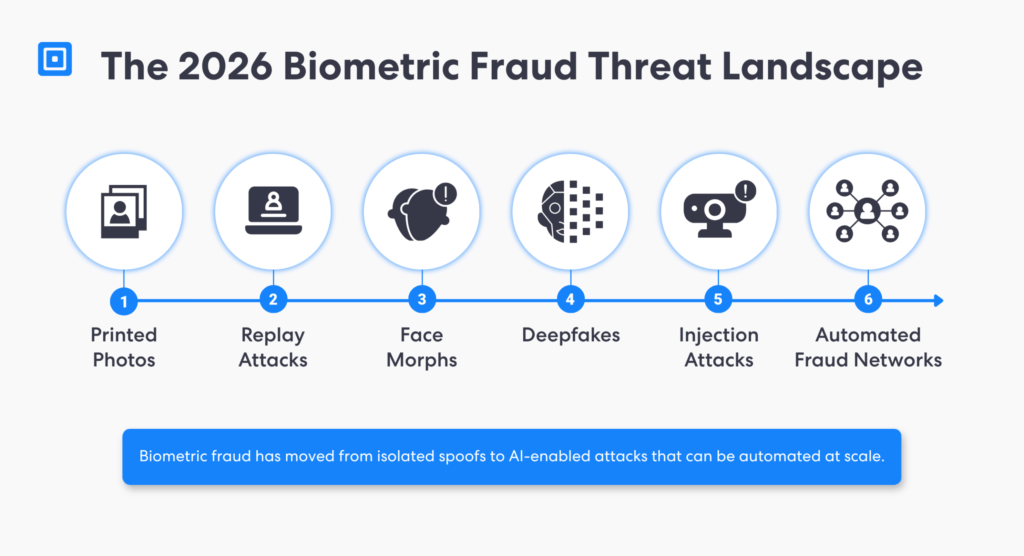
Where traditional biometric authentication focuses on comparing whether a user’s face matches an identity document, modern biometric fraud detection goes above and beyond. They provide enhanced security to determine if certain biometric features are authentic. Additionally, a strong biometric system provides information on whether a device can be trusted or if user behavior shows signs of fraud. You can learn more here: [What is Device Risk Assessment?](https://www.complycube.com/what-is-device-risk-assessment/)
Strong authentication systems are important as biometric data does not act like a typical password. Even if there is a data breach and complex passwords are stolen, they can be reset. However, it is hard to protect sensitive information such as stored biometric templates. Once that data is compromised, a person cannot simply change their face, fingerprint, or voice.
The best biometric fraud prevention systems use a combination of liveness detection, facial detection, and fingerprint recognition. They also use behavioral biometrics, document verification, and continuous monitoring to prevent identity theft and spoofing attacks. The goal is to confirm identity, detect anomalies, and stop fraudsters in their tracks before they gain unauthorized access.
## Traditional Biometric Systems Are Not Enough
Traditional [biometric authentication systems](https://www.complycube.com/biometrics-identity-verification-system/) were built around something the user understands. For example, that could be a password or a mobile device. These traditional methods have been improved upon by incorporating approaches that use biometric traits such as facial features, fingerprints, vocal patterns, and iris recognition systems.
Yet, biometric spoofing has changed the risk equation because fraudsters are deceiving recognition systems with fake multimodal biometrics such as silicone or latex fingerprints and AI-generated faces. This type of deepfake technology has made spoofing methods more convincing and easier to scale.
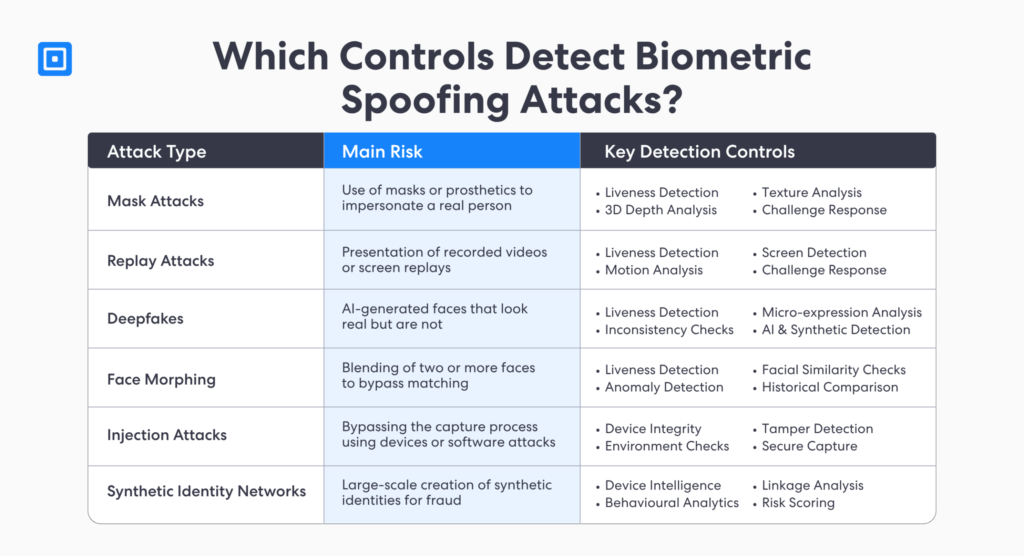
The more advanced liveness detection algorithms use multispectral imaging, texture analysis and camera integrity to detect fraud. By adding a layer of security that facial recognition systems cannot provide, criminals use AI to create realistic physical biometrics.
Additionally, while biometric authentication raises the barrier for attackers, users could still be at risk. Fraud can still happen through social engineering, [Authorized Push Payment (APP)](https://www.complycube.com/crypto-fraud-detection-software/) scams, or [One-Time Password (OTP)](https://support.complycube.com/hc/en-gb/sections/32771038215581-OTP-One-Time-Passcode) interception. This is why it is important to build in multiple compliance layers on top of a traditional biometric system.
## Behavioral Biometrics and Continuous Authentication
However, biometric security is not just about physical biometrics. Though face authentication, fingerprints, and iris recognition technology are incredibly important, the next layer of security must consider behavioral characteristics in their authentication factors. The key advantage of behavioral biometrics focuses on how a person uses a device, application, or session over time.
Moreover, [behavioral biometrics](https://www.ibm.com/think/topics/behavioral-biometrics) uses AI to review user behaviors such as typing patterns, mouse movements, swipe pressure, and navigation speed, to name a few. Looking at these behavioral analytics will allow teams to conduct continuous monitoring and authentication after the first login. This security process helps detect fraud that appears after a session is underway.
For example, a user may pass biometric verification at onboarding and later on act in a way that indicates that an account takeover is in process. Other red flags such as mule activity or social engineering can be detected with behavioral biometrics. It helps prevent fraud well after secure access has been granted to the user.
This extra layer of biometric fraud prevention reduces false positives, provides enhanced security measures, and stronger fraud prevention efforts without adding more friction. When physical biometric checks, behavioral analytics, and other authentication factors such as device intelligence work together as one security process, it ensures stronger protection in safeguarding sensitive information.
## Evaluating Biometric Technology
Having the most features is not the prerequisite for whether a biometric fraud detection platform is the best. Today, buyers must know whether each provider can protect the full identity journey from the document to the final risk decision. Linking the right verification features alongside risk scoring, auditability, and workflow automation is key. It must also protect stored data, lower false positives, and support real users without making customer onboarding difficult.
Typically, the strongest biometric fraud prevention providers provide four important layers. These layers include identity integrity, biometric authenticity, [fraud intelligence](https://www.complycube.com/solutions/fraud-intelligence/), and overall operational trust. Where identity integrity looks at the document and the identity being real, biometric authenticity confirms whether the person is real and present in the flesh. On the other hand, fraud intelligence adds device signals, duplicate detection, and continuous authentication. These three factors, alongside operational trust, ensure that a platform can scale.
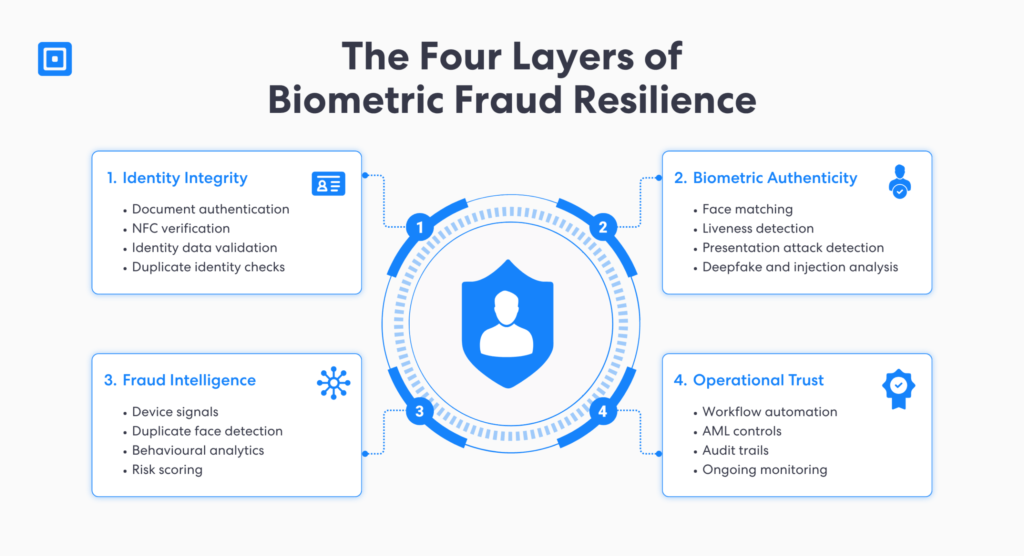
Buyers are looking for platforms that support compliance, provide strong audit trails, and improve the organization’s security compared to their previous program. As biometric spoofing attacks evolve, how biometric verification works has to improve too.
## Top 5 Biometric Fraud Detection Platforms in 2026
The biometric fraud prevention platform comparison guide below differentiates based on their strongest practical use case rather than giving them a simple rating out of 10. Each provider has several capabilities instead of its assigned niche.
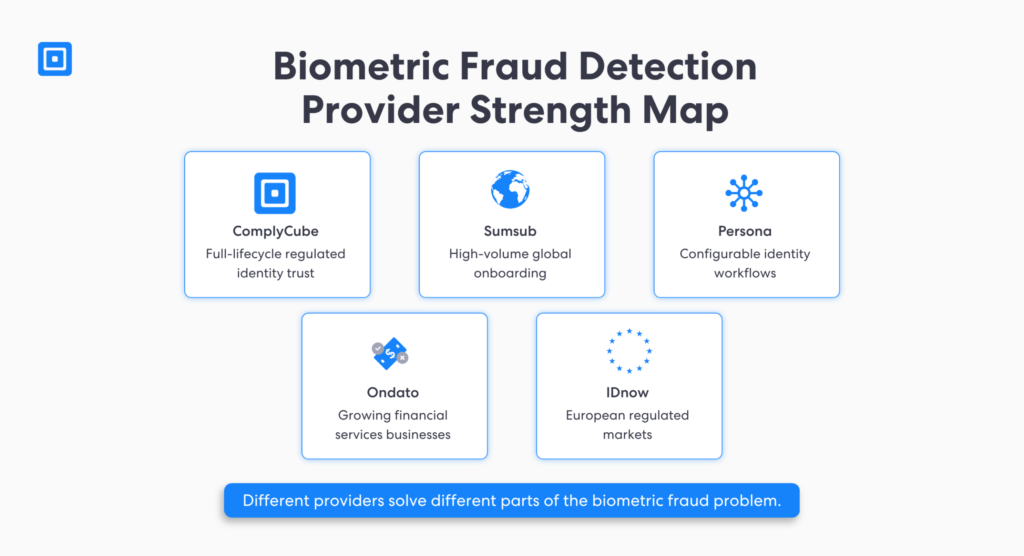
However, this comparison format allows buyers across various sectors to find which option best matches their level of need. From regulatory exposure to operational model, these biometric fraud detection platforms cover a multitude of fraud risks.
### ComplyCube: Best End-to-End Biometric Fraud Prevention and Compliance
[ComplyCube](https://www.complycube.com) acts as the strongest overall option as a biometric fraud prevention platform for regulated organizations. This is best for teams looking for more than a standalone check. They link many compliance features such as document authentication, biometric verification, and passive liveness. Additionally, they cover biometric spoof detection, Anti-Money Laundering (AML) screening, Know Your Customer (KYC), and Know Your Business (KYB) controls.
Moreover, they offer configurable rules and audit-ready workflows all within one platform, making them one of the most modular systems in this round-up. Though some of the other providers may be especially strong in one area, ComplyCube offers a breadth of controls that can be implemented across customer onboarding, user authentication, and compliance risk decisioning.
- **Best fit:** Regulated businesses needing multiple compliance features to operate well together.
- **Why it stands out:** A modular IDV system linking biometrics with wider compliance and risk controls.
- **Buyer consideration:** Teams looking for basic selfie-to-document comparison may not need the platform’s full compliance breadth.
### Sumsub: Best Mid-Volume Generalist Onboarding
Sumsub is most interesting for companies with high volumes of onboarding across various markets. This covers user and business verification as well as fraud prevention, case management, and transaction monitoring. It gives organizations the ability to manage identity risk across the full customer lifecycle. Sumsub is best for businesses such as crypto platforms, marketplaces, and international fintechs. Typically, they prioritize geographic breadth and operational scale.
- **Best fit:** International platforms with high onboarding rates and transaction volumes.
- **Why it stands out:** Full lifecycle coverage, global deployment, and integrated transaction monitoring, making it right for complex cross-border operations.
- **Buyer consideration:** Those who need tightly connected, compliance-led identity journeys must compare how easily its broad product set maps to their specific risk rules and workflows.
### Persona: Highly Configurable Data Assets
Differentiated by flexible identity orchestration, Persona combines identity checks, reports, and cases. They also incorporate accounts, transaction signals, and third-party data to build tailored customer journeys. Typically, this is a strong choice for technology-led businesses with mature internal teams that want granular controls, especially when friction comes into play.
- **Best fit:** Product-led organizations building highly customized identity and risk journeys.
- **Why it stands out:** Workflow flexibility allows teams to adapt verification steps according to user, account, or transaction risk.
- **Buyer consideration:** Even though configurability is valuable, buyers who want identity, AML, biometrics, and auditability pre-connected may want a compliance-led platform.
### IDnow: Human in Loop Fallback Video Conferences
IDnow is well aligned for European entities that need to combine biometric verification with regional identity methods, eIDs, and electronic signatures. They can also verify EUDI wallet credentials and local compliance expectations. IDnow also covers document checks, authentication, and trust services. This makes it particularly relevant when regulatory acceptance of specific European ID methods is key to making a buying decision.
- **Best fit:** Regulated businesses that are operated and are concentrated in European markets.
- **Why it stands out:** Strong regional expertise across eIDs, wallet credentials, biometrics, and signatures.
- **Buyer consideration:** Globally operating organizations must compare its European specialism with platforms that give consistent identity and compliance structures across many regions.
### Ondato: Best for Startups
Ondato blends automated and video IDV, biometric authentication, and KYC. They also provide AML screening, KYC, and lifecycle tools. Their agent-assisted verification can be useful for growing banks, lenders, fintechs, insurers, and crypto businesses. Ondato aims to support different assurance levels while building a more structured compliance operation.
- **Best for:** Growing financial services firms formalizing KYC, AML, and customer lifecycle controls.
- **Why it stands out:** A connected compliance suite with automated verification, video identification, screening, authentication, and business verification.
- **Buyer consideration:** Larger international organizations should assess whether its global scale, fraud intelligence, and orchestration depth match their longer-term operating requirements.
### **Case Study: Live Facial Recognition Moves Into Operational Policing**
The Metropolitan Police during a six-month facial recognition pilot program were able to conduct 170 arrests with deployments that helped find wanted criminals. However, this case sparked a debate around governance, accuracy, and responsible biometric use.
### Biometric Verification is the Future
The pilot shows that biometric technology is becoming incredibly valuable to various sectors when supported by the right oversight and human review. These principles could also apply to financial services, where biometric fraud detection can combine automation with explainable risk decisioning.
### Outcomes
- Demonstrated the growing operational role of facial recognition.
- Highlighted the importance of governance alongside automation.
- Reinforced the need for transparent, risk-based biometric decisioning.
## Choosing the Right Biometric Authentication
Organizations are looking for platforms that build trust at scale across the full identity lifecycle. It is important to establish trust from onboarding to authentication through continuous fraud monitoring and regulatory compliance.
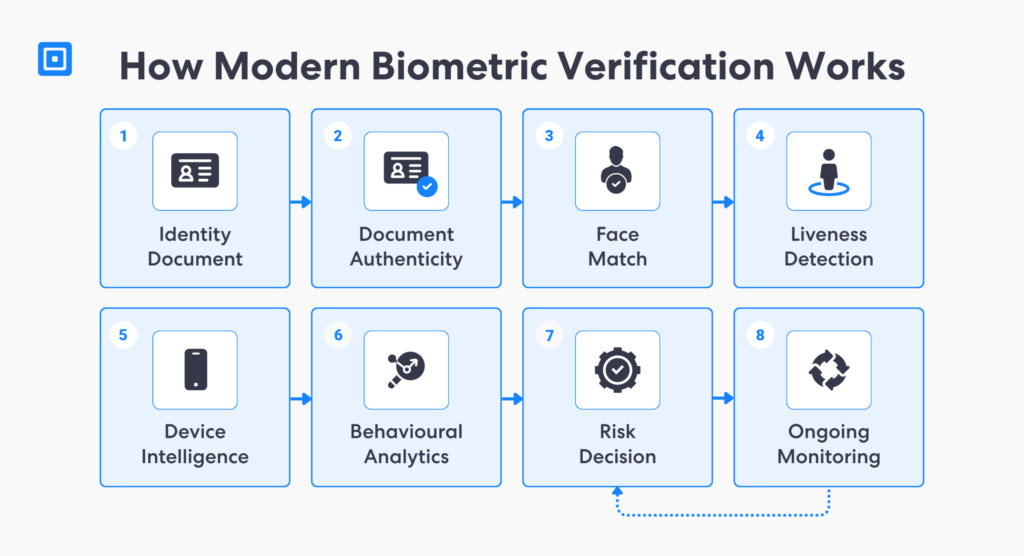
Buyers must evaluate how each biometric verification platform uses other compliance features such as document authentication, data collection, and configurable risk scoring. Additionally, they are looking to consider future compliance requirements with the rise of AI-dependent biometric fraud. For regulated businesses and firms, the strongest choice is often the provider that reduces operational fragmentation.
### Key Takeaways
- **Biometric fraud detection** is a core requirement for strong identity verification.
- **Deepfakes, biometric spoofing**, and injection attacks can target the biometric data itself.
- **Liveness detection** verifies real human presence to prevent unauthorized access.
- **Behavioral biometrics** supports fraud detection by monitoring user behavior after verification.
- **ComplyCube is the strongest overall** for regulated businesses that need biometric fraud prevention, IDV, AML, and workflow automation, all in one platform.
## Building Biometric Fraud Prevention Systems with ComplyCube
With biometric fraud becoming more automated and harder to detect, ComplyCube helps businesses stay ahead of the curve. Their award-winning all-in-one platform strengthens biometric fraud prevention, protects sensitive information, and verifies users to build the most thorough and compliant IDV process across onboarding and ongoing monitoring. [Get in touch with ComplyCube](https://www.complycube.com/contact/contact-sales/) to see how a unified identity trust platform can support your fraud prevention efforts.
[](https://portal.complycube.com/signup)
## Frequently Asked Questions
How do biometric fraud detection platforms find deepfake attacks?
Biometric fraud detection uses liveness analysis, presentation attack detection (PAD), and secure capture controls. They also use device signals, and image integrity checks to decide a face belongs to a live person. A strong system evaluate several signals together.
What is the difference between biometric verification and biometric fraud detection?
Where biometric verification looks at if a face or biometric trait matches a verified document, biometric fraud detection goes further to see if the sample is live, authentic, and securely captured. Biometric fraud detection also confirms if this came from a trustworthy session.
What features matter the most in a biometric fraud detection platform?
Buyers should prioritize document authentication, face matching and independently tested liveness. Additionally, they must account for Presentation Attack Detection (PAD) within their chosen platform. Regulated organizations should look into how AML integration works.
Can biometric fraud detection reduce identity theft and account takeover?
Biometric fraud detection can strengthen fraud prevention by detecting stolen identity documents, impersonation attempts, and repeat fraud. However, biometrics should form part of layered security rather than being treated as a complete defence on their own.
Why choose ComplyCube for biometric fraud detection?
ComplyCube is right for regulated organizations that need biometric fraud detection to work alongside other compliance initiatives such as document verification, KYC, KYB, and AML screening. Teams that are also looking for customer authentication, risk rules, and audit-ready workflows would benefit from ComplyCube’s all-in-one platform.
**Categories:** Guides
**Tags:** Biometrics
---
### [How to Build Customer Onboarding KYC for Banks](https://www.complycube.com/customer-onboarding-kyc-for-banks/)
**Published:** July 16, 2026
**Author:** Rithu Jagannath
**Excerpt:** Discover how customer onboarding KYC for banks can use adaptive verification, fraud signals and risk-based workflows. Learn how to speed up account opening, reduce friction and strengthen compliance across the customer lifecycle.
**Content:**
**TL;DR:** Customer onboarding KYC for banks help institutions **verify real customers**. Banks typically need to meet regulatory requirements and prevent fraud without forcing all applicants through **the same checks**. This guide is for **banking compliance** leaders looking to understand how onboarding KYC software for banks can improve risk journeys.
## Customer Onboarding is a Compliance Priority
In 2026, the challenge around customer onboarding KYC for banks centres around completing the process fast to meet rising expectations. This must be done without weakening Anti-Money Laundering (AML) controls.
Industry research suggests that one in five onboarding applications are abandoned primarily due to Know Your Customer (KYC) and AML friction. Additionally, the average KYC review took 95 days in 2023, up from 84 days in 2022. These types of delays are often associated with repeated data collection, manual data entry, and disconnected systems.
However, compliance teams want to identify the applications needing more intense scrutiny and review. On the other hand, product and operations leaders want to create a seamless digital onboarding journey that is fast. That way real customers can move through easily and more rigorous protocols can be triggered for when crime risk signals appear.
## What is Customer Onboarding KYC for Banks?
Customer onboarding KYC for banks is the process where a bank gathers customer data, verifies their identity, and decides if starting a business relationship creates a great deal of financial crime risk. This process involves risk assessment and Customer Due Diligence (CDD) and ultimately leads to an account-opening decision. However, when risks are high, Enhanced Due Diligence (EDD) may be the next step.
These protocols are important for compliance across various regulatory bodies as they help prevent fraud, identity theft, money laundering, and terrorist financing. This also allows banks to determine who they are serving and why the customer needs a certain product.
## Establishing the Customer’s Identity
The first stage of customer onboarding KYC for banks is to establish a reliable identity profile using information and evidence proportionate to the product, channel, and customer. Every verification method provides a different type of assurance, so banks should assess the combined evidence rather than rely on a single result.
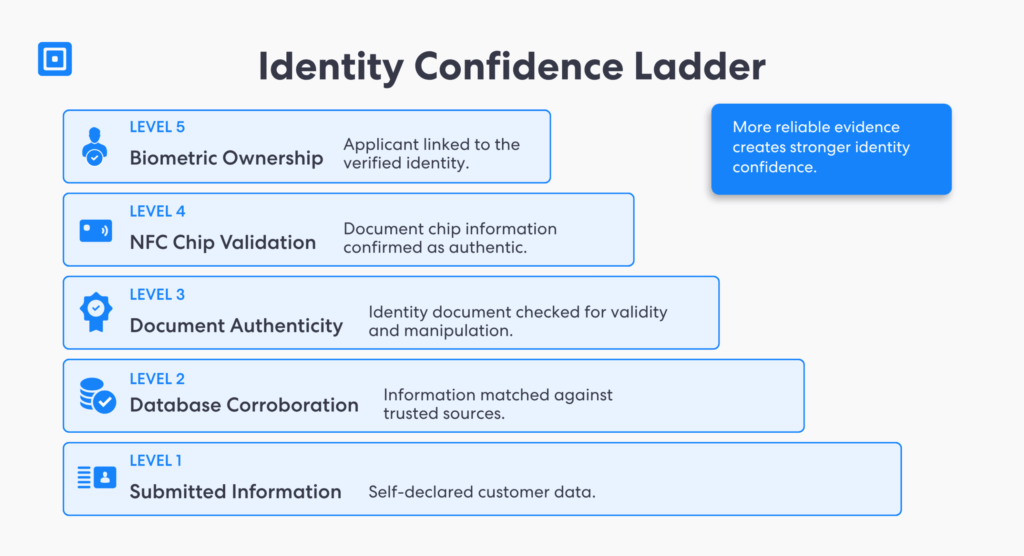
### Customer Data Collection
At first, most banks start by gathering a customer’s legal name, date of birth, residential address, contact details, and identification number. In the US, Customer Identification Programs (CIPs) may need specific identity information before an account can be opened. You can learn more here: [How CIP Requirements Impact U.S Banks](https://www.complycube.com/en/cip-requirements/)
That data collected should be enough to build the customer’s identity and support the overall compliance process. Moreover, collecting unnecessary data can, in turn, create more friction without improving the quality of the risk decision. The correct onboarding data is also important after account opening. Incomplete client data can lead to false alerts, repeated requests, and costly remediation throughout the customer lifecycle.
### Identity Verification
Identity Verification (IDV) determines if the supplied identity data relates to a real person and if the applicant is actually in control of that identity. Typically, a digital customer can be identified in authoritative databases using official proof of identity, document verification, or a combination of these methods. Other accepted evidence could be a passport, national identity card, or driver’s license.
The right method of data verification also depends on the product, region, customer type, and required assurance level. Banks should typically not assume that a single IDV route will work equally well across all regulatory frameworks and for every applicant.
### Document Verification
For document verification, KYC onboarding platforms must assess the security features, expiry dates, data consistency, and signs of physical or digital tampering. It is also important to note that a readable document image does not prove that the document is genuine or that it belongs to the person presenting it.
By combining checks with facial comparison, liveness detection, or biometric authentication, banks can ensure thorough KYC compliance. Additionally, [Near Field Communication (NFC)](https://www.complycube.com/solutions/identity-assurance/document-verification/nfc-verification/) chip data can strengthen data verification. They help compare information stored in the document with its visible identity data. You can learn more here: [What is NFC ID Verification in KYC and AML?](https://www.complycube.com/what-is-nfc-id-verification/)
### Biometric Verification
Similarly, biometric verification links the person completing the application to the identity document or trusted identity record. Facial comparison allows teams to determine whether a bank account applicant resembles the portrait on the document.
On the other hand, liveness and [Presentation Attack Detection (PAD)](https://www.complycube.com/presentation-attack-detection-pad-guide/) help differentiate a real-life person from a photograph, a replay, a mask, or an injected image. The level of biometric authentication should be right for the user. A strong electronic identity match may be sufficient for one journey, while a higher-risk application may require both document and biometric evidence.
## Connecting Identity with Fraud Prevention
The next step is for the bank to verify whether the person submitting the application is the real identity holder. They also need to check if the application environment contains signs of manipulation. For example, a person committing identity fraud may use real stolen information, an authentic identity document, or a synthetic profile assembled from several sources. Fraud prevention should assess both how the application is submitted and what information it contains.
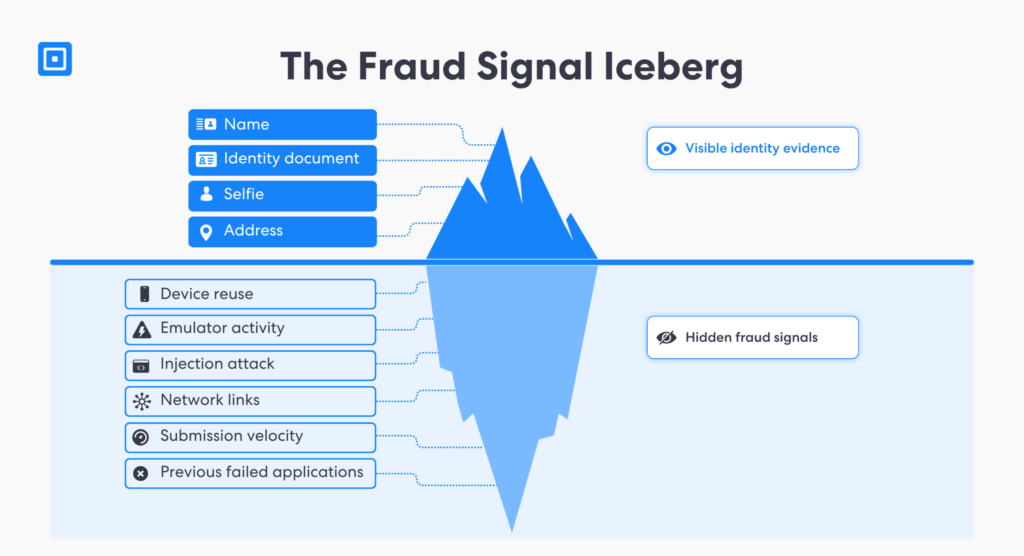
Another way to prevent fraud with new customers is device intelligence. This solution can examine IP location, device integrity, and emulator use. Moreover, they can decipher if bad actors are using virtual cameras, submission velocity, and links to previous applications. These device risk signals allow teams to determine if any suspicious behavior is taking place. Unfortunately, this is not normally visible in customer data or identity documents.
Yet, not every failed verification attempt is linked to fraud. Sometimes, due to poor lighting, a damaged page, or an unreliable internet connection, a legitimate customer may struggle to complete a full verification.
As a result, the onboarding journey should be able to understand the difference between a technical failure and real identity fraud. Real customers must receive a clear recovery route, while material fraud indicators should trigger stronger verification workflows or manual review instead of passing straight through.
## Applying Customer Due Diligence
Another important aspect of customer onboarding KYC for banks is ensuring that, once identity has been verified, financial institutions are responsible for the financial crime risks that may arise from the customer and the proposed business relationship.
That is where CDD comes into the equation. This compliance check looks at why commercial clients may want the account, how the product or service will be used, and whether the customer relationship increases the risk of money laundering, sanctions, corruption, or terrorist financing.
### Building the Digital Customer Risk Assessment
It first starts with a strong customer risk assessment. This process reviews customer information, such as occupation, residence, nationality, and more. From this check, banks are in a position to evaluate if the applicant is linked to a higher-risk jurisdiction, unusual commercial activity, or an existing internal risk record.
The Financial Action Task Force (FATF) places the risk-based approach at the epicenter of AML controls. As a result, financial services must understand their risks and implement appropriate regulatory compliance measures to ensure safety and prevent fraud. It allows banks to balance KYC compliance and customer experience.
### Screening Sanctions and Politically Exposed Persons
Then, banks must screen potential customers in the KYC onboarding process against sanctions lists and identify politically exposed persons. Regulatory frameworks and risk policies require this. Similarly,, adverse media can provide more context about any alleged corruption, fraud, organized crime, and other relevant activities for KYC compliance requirements.
### Enhanced Due Diligence
Finally, EDD is necessary when a customer, product, ownership structure, or jurisdiction creates elevated risks. Additional checks include determining the source of someone’s wealth, verifying that their funds come from a legitimate source, and requesting further evidence of ownership or obtaining senior approval.
This extra due diligence for banks should address any concerns that were due to case escalation. Asking every higher-risk customer for the same set of documents can increase workload for compliance teams, without necessarily resolving the underlying risk.
## Client Onboarding for Companies
Client onboarding is becoming more complex with every passing day, especially when the customer is a company rather than an individual. Banks and other financial institutions must establish their identities and conduct entity and identity verification for the people who own or control them.
Business verification involves checking incorporation information, trading status, registered addresses, directors, and the organization’s stated commercial activities. As a result, the banks must also determine whether the relevant owners and ultimate beneficial owners are subject to the compliance requirements applicable to that specific relationship.
Complex ownership structures and dynamics should influence the course of risk assessment. However, it should not make a customer unacceptable. The goal here is to learn who controls the entity and whether the structure presents risks that require a more thorough KYC process.
Those organizations with cross-border operations, layered ownership, or higher-risk activities require EDD, senior leadership approval, or more frequent continuous monitoring that flags updates immediately.
## Static Customer Onboarding Underperforms
To this day, many customer onboarding KYC for banks processes are static. Applicants are also receiving the same sequence of checks, broadly speaking, even if they carry varying levels of risk. Though it is consistent and aligned with customer onboarding best practices for their institution, it creates two problems.
Real customers experience significant friction even when strong identity evidence is already available. On the other hand, complex or higher-risk applicants may still receive insufficient scrutiny. Assuming friction ensures compliance is a misconception.
Applying every possible check to every person could damage overall customer satisfaction without improving the bank’s understanding of its own risks and risk appetite. A strong risk-based approach will allow banks to modify the onboarding journey based on identity confidence, product exposure, individual customer characteristics, and institutional risk appetites.
## How Adaptive Digital Onboarding Works
Adaptive digital onboarding solves the problem of underperforming customer onboarding KYC for banks. It uses the information gathered during a banking application process to determine the next step. So, instead of following a single fixed sequence, the journey responds to the available identity evidence, fraud indicators, and AML risk.
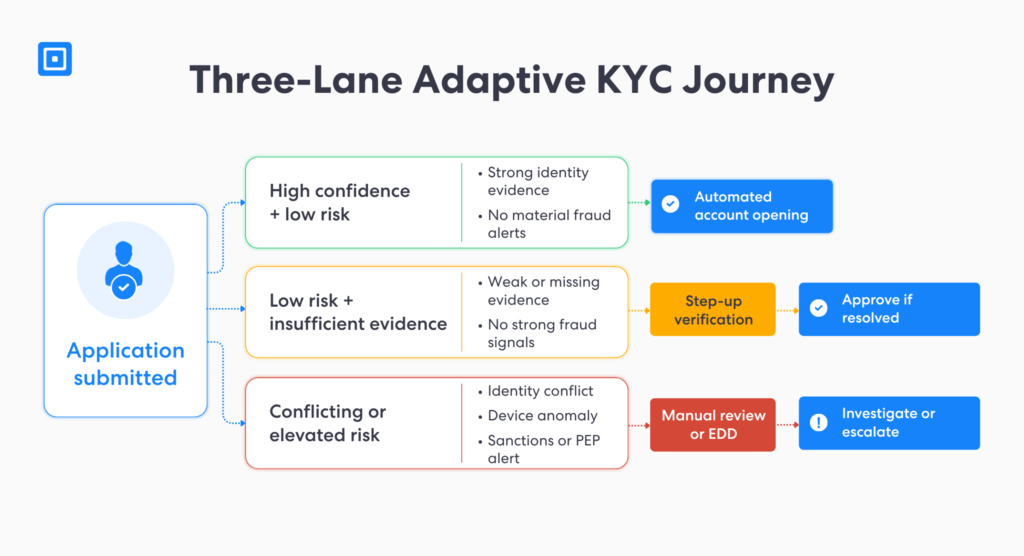
A straightforward applicant will likely experience a straightforward process with no hurdles. However, someone with insufficient identity evidence may enter step-up verification. Any conflicting information or elevated risks can trigger manual review from a compliance officer, or EDD.
### High Confidence and Low Risk
A high-confidence and low-risk customer is the easiest type for banks to deal with. Imagine a new customer applies for a standard bank account. If their identity matches with reliable sources, there are no device risk signals, and compliance checks pass KYC rules resulting in no relevant alerts, they are good to pass through. The customer can easily open an account. Asking for more documentation or biometric checks adds friction without adding any information to strengthen the compliance decision.
### Low Risk But Insufficient Evidence
The next type of customer presents as low risk, but doesn’t have enough evidence to support that claim. For example, an applicant may have recently moved, possess a limited credit history, or live in a market with restricted database coverage.
Though the initial data verification is inconclusive, the application does not show any actual strong fraud indicators. The verification workflow can request an identity document and biometric verification. If this additional evidence resolves any uncertainty, the customer can return to automated approval without entering a manual queue.
### Conflicting or Elevated Risk
Finally, if an applicant submits information that directly conflicts with the document or uses a device associated with repeated applications, the bank should consider pausing the account opening. They need to require further evidence that addresses the specific concern or risk in the application.
This evidence could come from enhanced screening, biometric authentication, source-of-funds evidence, entity verification, or review by trained compliance teams. The purpose of adaptive onboarding is to implement checks that mitigate risk.
## Customer Experience And Effective Recovery Routes
It is incredibly important to provide real customers with a clear way to recover if or when a check fails. Instances where a check could fail are poor lighting, damaged documentation, or unsupported devices, any of which can interrupt digital onboarding.
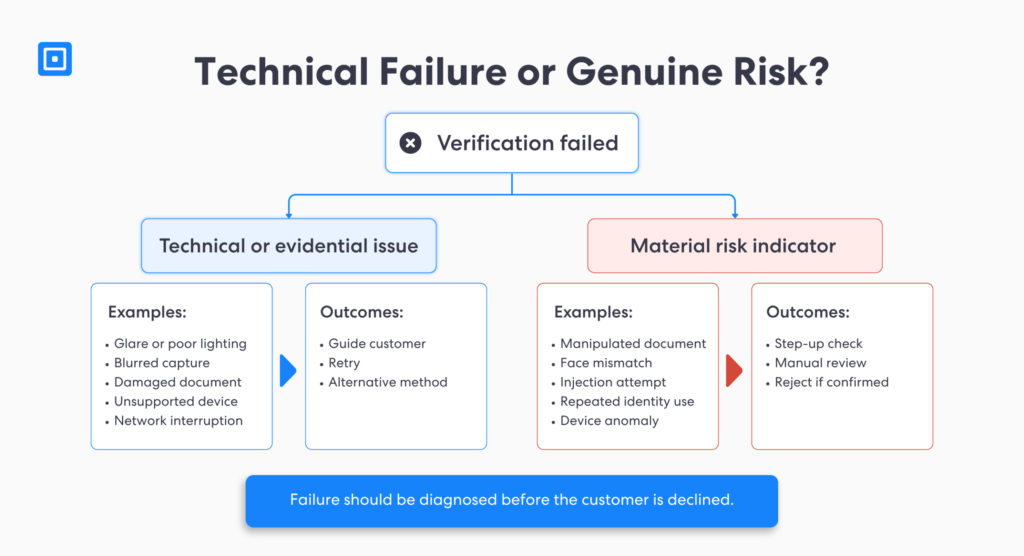
However, this is where a generic rejection email or message turns a technical issue into a lost customer. The best verification workflows allow users to explain what happened, allow another retry, and offer a different verification method if or when the policy allows it.
This greatly supports customer acquisition and experience without weakening KYC compliance requirements. Banks are now better able to distinguish between genuine risk and operational failure. This reduces unnecessary manual review for the compliance teams.
## Onboarding Software And Operational Inefficiencies
Strong onboarding KYC software for banks must do more than conduct individual checks. They should interlink IDV, fraud prevention, CDD, and account opening into a single process. Financial institutions must be able to configure workflows based on product, customer, country, risk appetite, and risk signals. Effective onboarding software should support:
- Electronic identity checks
- Document and biometric verification
- Sanctions, PEP, and adverse media screening
- Business and entity verification
- Automated step-up checks
- Manual-review routing
- Decision records and audit trails
- Ongoing monitoring
- APIs, SDKs, and webhooks
Building out an automated onboarding process is what makes integration particularly important. Manual data entry creates several operational inefficiencies and inconsistent customer records. Additionally, KYC automation can help prevent [$3.3 billion](https://thefinancialbrand.com/banking-webinars/ongoing-kyc-in-banking-and-the-power-of-automation?) in annual losses from abandoned applications.
### **Case Study: Bank of London Onboarding Process Updates**
In March 2026, The Bank of London made an arrangement with the UK Financial Conduct Authority (FCA) on formalizing restrictions on the bank accepting new customers without prior consent. The Bank of London paused its onboarding processes to improve its financial crime prevention controls.
### Strengthening Financial Crime Controls for Digital Banking
The pilot shows that biometric technology is becoming incredibly valuable to various sectors when supported by the right oversight and human review. These principles could also apply to financial services, where biometric fraud detection can combine automation with explainable risk decisioning.
### Outcomes
- New-client onboarding restricted while control enhancements were undertaken.
- Existing customer accounts and services were reported as continuing.
- The FCA arrangement formalized the limitation on accepting new clients.
## Account Opening is the Beginning of the KYC Lifecycle
Once a customer receives access to an account, the customer onboarding KYC process does not stop. What was discovered during onboarding must establish the basis for how the client relationship is managed over time.
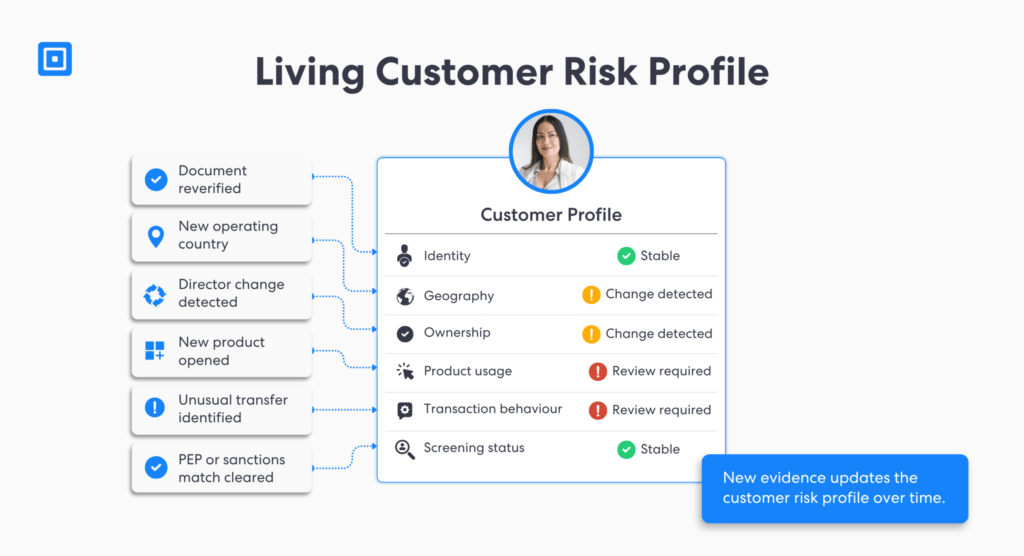
Ongoing monitoring supports financial institutions in identifying changes in financial transactions, sanctions exposure, adverse media, and ownership structures. For example, a new director or ultimate beneficial owner may alter the risk associated with the business relationship.
Perpetual KYC uses event-driven information to support near real-time risk monitoring rather than leaning on fixed review dates. Whether it be a new sanctions entry or a pattern of unusual financial transactions, it can trigger customer reassessment, further due diligence, or enhanced monitoring. This system allows banks to manage customer relationships based on the most current information rather than relying indefinitely on the decisions made during account opening.
## Measuring the Digital Customer Onboarding Process
Speed is important, but it should not be the only metric to consider when onboarding customers for KYC at banks. Teams should look across customer experience, operational performance, fraud prevention, and regulatory compliance all at once.
### Metrics Banks Should Monitor
The right measures to consider for a strong customer onboarding KYC for banks include application completion, abandonment, and straight-through processing. Moreover, teams must consider step-up verification rates and manual review volumes. Banks should also track false positives, confirmed fraud after account opening, and average decision time by customer or risk segment.
Another important data point is the recovery rate after an initial verification failure. This is valuable because it shows whether real customers stay after any technical or evidentiary problems. Having a fast customer onboarding KYC process for banks that admits fraud is not successful. A secure process that needlessly rejects customers is not either. There needs to be a balance. The goal is to improve decision quality and customer satisfaction at the same time.
### Key Takeaways
- **Customer onboarding KYC** for banks must include adaptable checks.
- **IDV, fraud prevention, and CDD** should support one explainable risk decision.
- **Digital customer onboarding** gives legitimate customers clear recovery routes.
- **Onboarding software** lowers data entry and links verification with existing systems.
- **Ongoing monitoring** extends the initial risk assessment across the customer lifecycle.
## Customer Onboarding Best Practices at ComplyCube
In short, ComplyCube helps banks and other financial institutions connect IDV, document and biometric checks. They tackle AML screening, business verification, and ongoing monitoring all through configurable workflows. To learn how to build adaptive customer onboarding KYC for banks, [get in touch](https://www.complycube.com/contact/contact-sales/) with ComplyCube today.
[](https://portal.complycube.com/signup)
## Frequently Asked Questions
How can banks reduce KYC abandonment during customer onboarding?
Banks can lower KYC abandonment by asking for the evidence needed based on the customer’s risk level. Adaptive workflows allow real customers to move forward with weakening KYC compliance.
What information is collected during a bank KYC onboarding process?
Typically, banks collect a customer name, date of birth, address, and other identification information. Based on product and risk profile, teams may collect employment data, expected activity, and beneficial ownership information.
When should Enhanced Due Diligence be used during account opening?
Enhanced due diligence (EDD) is when the customer, product, region, or ownership structure or screening result creates elevated risk. Any additional evidence that is considered must speak to specific concerns that arose during account opening.
How does Ongoing Monitoring support Anti Money Laundering compliance?
Ongoing monitoring finds changes in client behavior, sanctions information, and other important risk factors. This allows banks to update the customer profile and apply further due diligence when circumstances change.
How does ComplyCube support customer onboarding KYC for banks?
ComplyCube’s award-wining platform links IDV, AML screening, workflow orchestration and ongoing monitoring. Banks can build onboarding journeys and escalation pathways around their regulatory requirements and risk appetite.
**Categories:** Guides
**Tags:** Biometrics
---
### [AML KYC Platform Comparison for Accounting, 7 Companies to Consider](https://www.complycube.com/aml-kyc-platform-comparison-for-accounting-companies/)
**Published:** July 17, 2026
**Author:** Dini Habib
**Excerpt:** Accountancy firms require tailored AML KYC solutions due to specific transactional and behavioral risks present in the sector. As such, accountants need to perform a targeted AML KYC platform comparison to select the best solution.
**Content:**
**TL;DR:** Accounting firms need to **compare AML KYC** vendor effectively to support frictionless onboarding and compliance obligations. This AML KYC platform comparison guide looks at the **top 7** vendors for accountants. It evaluates key features and workflows, as well as client reviews, for accounting firms to use in their AML KYC software comparison matrix.
## What is an AML KYC Platform Comparison?
An AML KYC platform comparison is the methodology used to choose the best Anti-Money Laundering (AML) and Know Your Customer (KYC) for a business. It involves evaluating vendors according to specific feature offerings, verification coverage, and reporting capabilities to ensure compliance.
Today, modern compliance systems have evolved significantly. Vendors not only build these KYC and AML technology solutions to prevent money laundering and financial crime risk. Instead, they are designing a unified compliance ecosystem to make ongoing compliance simpler and smarter.
As such, while many AML and KYC solutions may seem similar to those used by many regulated institutions at first, key differences will emerge in terms of scalability, flexibility, and automation. This guide jumps straight into comparison criteria and specific platforms. It supports accountants actively seeking top AML software vendors for their business.
## KYC and AML Compliance Processes for Accountants
The UK’s 2025 National Risk Assessments deem accountancy services high risk due to their broad exposure to money laundering. This is because accounting firms are often exploited through [complex corporate structures](https://www.austrac.gov.au/industry-and-business/education-and-resources/publications-and-resources/risk-insights-and-indicators-suspicious-activity-accountants), trusts, and cross-border transactions used to layer and integrate illicit funds.
> Accounting businesses, together with payroll, bookkeeping, insolvency, and tax advice are [attractive](https://www.gov.uk/government/publications/anti-money-laundering-guidance-for-the-accountancy-sector/risks-common-to-accountancy-service-providers) spaces for money laundering.
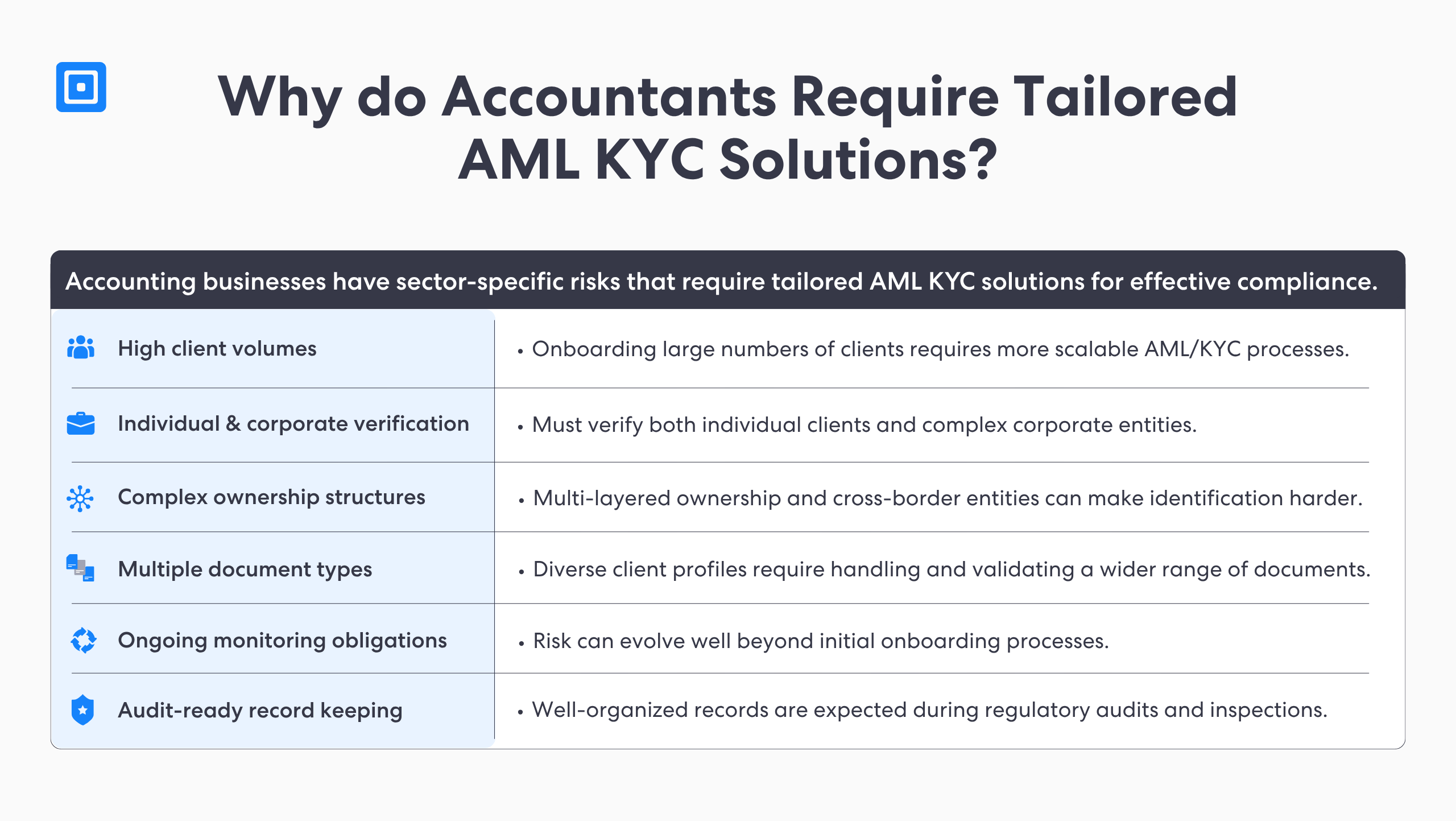
As a result, regulators are expecting accountants to perform financial institution-style due diligence. A comprehensive solution should thus streamline compliance, meet local regulatory requirements, and integrate with existing systems. This includes strong mechanisms for fraud detection and ensuring compliance teams can evidence regulatory compliance. You can learn more here: [KYC and AML Software For Accountants.](https://www.complycube.com/en/aml-software-for-accountants/)
## Criteria used to Compare AML KYC Vendor for Accountants
Unlike banks, accountancy services work with thousands of clients, each with varying ownership structures. Additionally, they manage hundreds of document types, including tax return forms, invoices, and other paperwork. Because of this, accounting businesses must take a targeted approach during AML KYC software comparison.
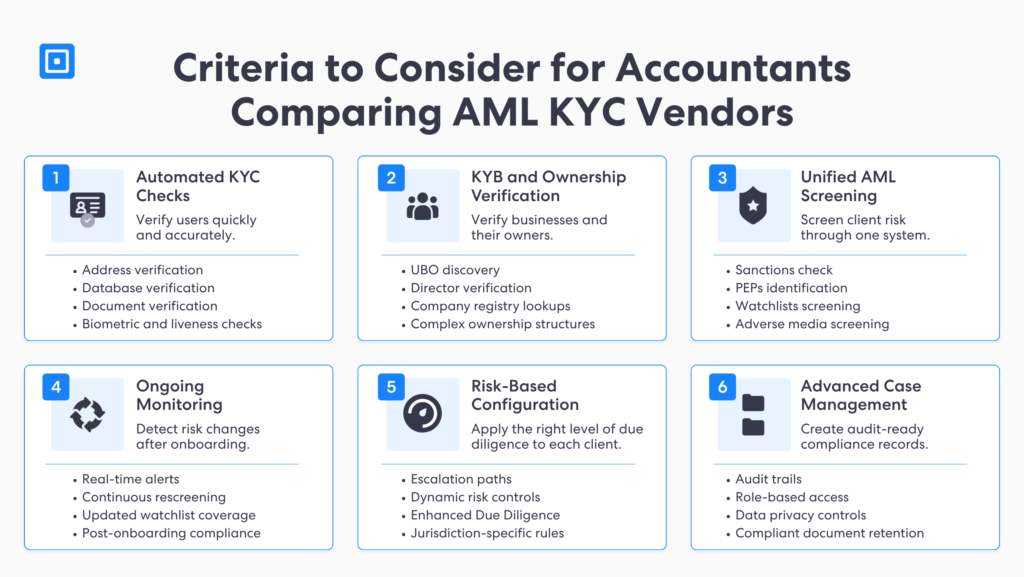
The right solution should fit their specific workflows and meet sector‑specific regulatory obligations. This section explores the most crucial solutions, features, and capabilities that accounting firms should consider when choosing KYC and AML systems.
### Automated KYC Checks
When performing KYC checks, [automation](https://www.complycube.com/the-importance-of-automated-kyc-verification/) can make customer identification faster, more secure, and accurate. Modern accounting businesses use AI-powered identity verification to streamline KYC processes across large and diverse client bases. It combines document verification, biometric authentication with liveness detection, and address verification to authenticate a client’s identity.
Furthermore, it is critical to prioritize global identity verification solutions and non-document checks, such as [database verification](https://www.complycube.com/en/solutions/identity-assurance/multi-bureau-checks/). This ensures accountants can verify customers or clients with varying identification needs, enhancing user experience, without compromising KYC compliance. As a result, accounting firms can speed up verified onboarding while reducing false positives and manual reviews.
### KYB or Business Verification Depth
While KYC verifies customer identities to assess risk, Know Your Business (KYB) focuses on verifying corporate clients. Focus on vendors that have multiple, authoritative data sources for registry lookups, director and shareholder analysis, and Ultimate Beneficial Ownership (UBO) discovery. You can learn more here: [What is UBO?](https://www.complycube.com/what-is-ultimate-beneficial-ownership-ubo/)
### Unified AML Screening
To support compliance with AML regulations, accountants should focus on all-in-one software with robust Politically Exposed Persons (PEPs) and sanctions screening, [adverse media monitoring](https://www.complycube.com/importance-of-adverse-media-checks/), and watchlist screening. Consolidating these tools on one platform makes AML compliance consistent and simple to evidence in reporting.
### Ongoing Monitoring
The most important feature when performing AML KYC platform comparison is [ongoing monitoring](https://www.complycube.com/what-is-an-ongoing-monitoring-process/) capability. Ongoing monitoring is crucial in every compliance program. It enables continuous compliance with AML and KYC regulations, preventing financial fraud beyond the onboarding stage. You can learn more here:
### Risk-Based Configuration
Global standards, such as the EU’s AML Directives and [UK Money Laundering Regulations (MLR)](https://www.jmlsg.org.uk/wp-content/uploads/2022/11/Board-approved_Part-I-Ch-4_Nov-2022.pdf) recommend a risk-based approach to compliance. Accountants should prioritize software with flexible risk scoring, dynamic controls, and clear escalation paths, enabling them to efficiently focus on high‑risk clients and support Enhanced Due Diligence (EDD).
### Advanced Case Management
To meet reporting obligations, accounting firms must use software with transparent audit trails and robust document retention. Ideally, regulators must easily understand every decision and reviews taken. Furthermore, leading AML platforms support [Role‑Based Access (RBAC)](https://docs.complycube.com/documentation/product-guides/due-diligence-tools/advanced-case-management) and comply with global data privacy laws to protect sensitive customer data and boost trust.
## Top 7 AML KYC Software for Accountants in 2026
The following platforms address different parts of the accounting lifecycle. Some provide niche features, such as sanctions screening and suspicious activity reporting for accountancy practices, while others focus on broader identity verification or enterprise support.
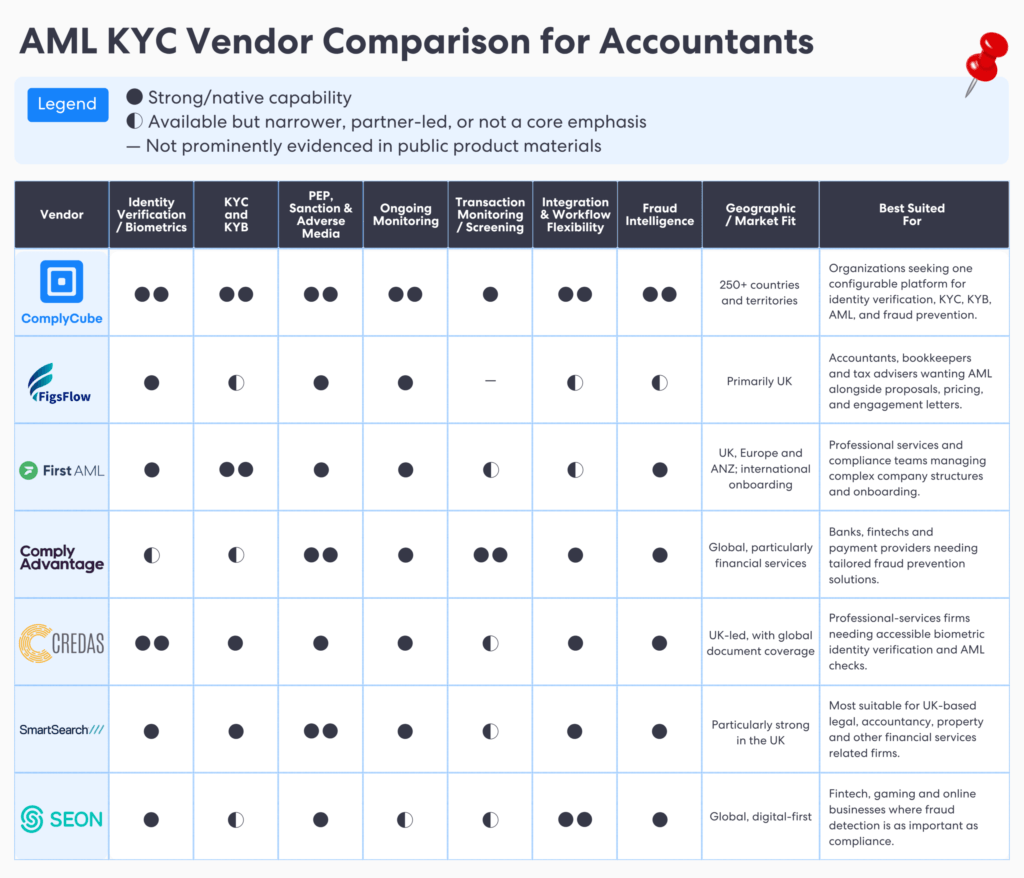
Accounting firms should also look for verified reviews from similar clients who already use this software. To support that, we include verified user feedback from each company’s G2 profile, the leading marketplace for software buying decisions based on active user reviews. We encourage accountancy firms to compare this feedback with reviews on other platforms, including Trustpilot and Capterra.
### 1. ComplyCube
[ComplyCube](https://www.complycube.com/en/complycubes-g2-summer-2026-wins-tell-a-bigger-story/) is built for accountancy firms that want a simple, configurable system for automated identity verification, AML screening, ongoing monitoring, and risk assessment. As such, [accountants](https://www.complycube.com/en/use-cases/industry/accounting-compliance/) reduce duplicate records, fragmented audits, and operational inefficiencies from moving between different tools.
The software uses a no-code configuration with deep API and SDK integration, making it straightforward to deploy and setup. Its risk controls and workflows have in-depth customization that can tailor to different client types, jurisdiction, and ownership structure.
> **Verified client review:** I appreciate ComplyCube’s [efficient](https://www.g2.com/products/complycube/reviews) AML screening and document verification processes, which allow us to verify clients quickly and securely. The platform’s user-friendly interface and responsive support team have made our experience exceptional.
### Advantages
- Unified platform: Combines KYC, KYB, AML, and ongoing monitoring in one dashboard.
- Reduces false positives: Easily create and tailor onboarding workflows with risk-based controls.
- Regulator trust: Ready-made policy assurance templates and time-stamped records for reporting.
- Global coverage: Offers one of the largest jurisdiction scope, with over 250+ territories covered.
### Potential consideration
ComplyCube appeals to accountants that want to automate and consolidate a meaningful part of their compliance process. Firms looking for a basic check in one country may not need its full breadth.
### 2. FigsFlow
FigsFlow is usually adopted due to operational convenience. Its platform is tailored for UK businesses, introducing identity verification and AML screening into the wider onboarding process. Firms can manage accounting proposals and engagement letters without needing another third-party vendor.
This means a large part of accounting practices can be combined with regular compliance activities. As such, the platform can appeal to smaller companies that want compliance checks integrated into other familiar accountancy-related activities.
> **Verified client review:** I was looking for MTD ITSA & Identity verification engagement letter & pricing templates, and FigsFlow had them built-in. I am impressed with the volume of pre-built templates for our services, and also up to date with regulatory changes.
### Advantages
- Familiar practices: Compliance processes sit atop existing administrative accounting workflows.
- Reduce operational fragmentation: Combine proposals and onboarding into a single dashboard.
- UK-specific: Made specifically for accounting firms in the UK.
### Potential consideration
While FigsFlow can enhance day-to-day accounting operations, it may be less suitable for firms that require large global coverage, complex KYC workflows, or advanced risk controls.
### 3. First AML
First AML simplifies ownership and relationship identification. This can appeal to businesses that need to understand complex ownership structures and entity relationships. First AML offers rule-based verification, where businesses can apply different types of checks to diverse risk profiles.
As a result, First AML is useful for accounting firms that manage multiple trusts, corporate groups, or clients with many beneficial owners. A strong use case for First AML is likely for corporate onboarding and case management.
> **Verified client review:** The integration of a single platform for all AML needs is a huge bonus. Their AML software automates a wide range of processes, including customer identification and verification, as well as continuous monitoring.
### Advantages
- Reduce complexity: Focus on understanding corporate onboarding and ownership structures.
- Centralized data: Combines AML records and case information in one system.
- Align internal policies: Translates internal compliance policies into workflows.
### Potential consideration
Accountants should assess whether the platform offers the depth of document, biometric, fraud, and identity verification alongside its corporate AML offerings.
### 4. ComplyAdvantage
ComplyAdvantage is known for its financial crime intelligence, helping accountants deter common challenges such as identity theft. Its software prioritizes the prevention of money laundering and terrorist financing, with features such as sanctions screening and PEP screening.
Its platform’s main advantage is access to risk intelligence and flexible risk controls. This is typically applicable for firms with established onboarding processes that are looking to strengthen financial crime detection in the accounting space.
> **Verified client review:** Easy-to-use interface, with good communication and solid problem-solving. The rule logic is straightforward to understand and isn’t cluttered with unnecessary information.
### Advantages
- Risk Intelligence: A large ecosystem to break down sophisticated financial crime activity.
- AML heavy focus: Offers sanctions, PEP, and adverse media screening.
- Enterprise firms: May be more suitable for large businesses in high-risk or complex environments.
### Potential consideration
Accountancy firms seeking an end-to-end onboarding platform and corporate verification may need to consider additional providers for identity verification, document checks, and KYB.
### 5. Credas
Credas supports remote onboarding by combining biometric verification, document validation, and sanctions checks. Its user-friendly approach may appeal to smaller accounting firms that lack large technical implementation teams or complex global compliance needs.
The platform is simple to use for firms that require UK compliance without overly technical features. Buyers should consider how well the platform supports cross-border verification, configurable risk models, and integration with broader AML. Additionally, number of supporting documents can be limited.
> **Verified client review:** Credas offered us exactly what we needed and the software is so simple and user friendly. Our business development manager is friendly, knowledgeable and sorted everything out for us.
### Advantages
- Seamless onboarding: Simple remote onboarding experience for non-technical teams.
- UK-focused: Aligned with UK professional-services workflows and compliance.
- Quick deployment: Can be set up and introduced quickly for smaller firms.
### Potential consideration
While Credas offers straightforward UK verification needs, buyers may need to compare it with highly configurable, international, or API-led compliance programs requirements.
### 6. SmartSearch
SmartSearch is known for its electronic identity verification solutions. It offers biometric authentication, document verification, and multi-bureau checks designed to support compliance in the UK. Its platform also offers individual and business checks across regulated professional services.
Thus, the platform is typically used by accountants who prefer remote database verification and access to large, multi-bureau data. Buyers are recommended to consider whether the platform can support flexible global document verification, developer tools, or more advanced fraud detection.
> **Verified client review:** SmartSearch is easy to use and provides all the information we need. Auditing is now simple, their reports are laid out in a straightforward way and we’ve had great customer service.
### Advantages
- Large presence in the UK: Used particularly by UK-regulated industries.
- Access to multi-bureau data: Strong database-led identity verification.
- Familiarity: Can be an easier option for professional-services firms that want familiar workflows.
### Potential consideration
For accountancy firms with large global clients, consider whether SmartSearch can meet complex digital onboarding requirements or provide sufficient flexibility in API workflows and geographic coverage.
### 7. SEON
SEON provides AI-driven tools for AML and KYC compliance. The company focuses on fraud and financial crime prevention by helping businesses detect suspicious users and transactions. It’s an AML compliance solution that combines screening, transaction monitoring, and case management.
The platform is most useful for companies where fraud detection is as important as regulatory onboarding. It supports large organizations in reducing the need for additional systems to combat fraud and money laundering easily.
> **Verified client review:** SEON enables businesses to access all the required features and information in one place. It’s also beneficial to have anti-fraud features and AML combined in the same platform.
### Advantages
- Fraud intelligence infrastructure: Deters fraud from the customer lifecycle journey.
- High-risk support: Can be especially useful for firms with high-volume, cross-border transactions.
- Breadth of risk indicators: Uses digital and behavioral signals to assess diverse risk.
### Potential consideration
SEON might be broader than the typical needs of smaller accounting practices. Firms should confirm that their corporate onboarding and accountancy-specific workflows meet the required standards.
## Compare AML KYC Vendors Beyond Features
Aside from product features, accounting firms should consider ease of setup, the integration process, platform interface, pricing, and vendor support. These elements are important because they help accountants determine whether a solution can be adopted successfully or abandoned due to poor support.
- **Regulatory Coverage:** Ensure the vendor you choose explicitly supports the AML/KYC rules your firm must follow in the jurisdiction you cover now and in the future.
- **Integration Process:** Ensure the vendor offers API, SDKs, and other integration tools that fit your accounting and CRM tools, with a written estimate of integration time and effort.
- **Platform Interface:** Choose a system where teams can run checks and review results easily, such as vendors that offer a no/low-code workflow which can reduce manual effort and extensive training.
- **Pricing:** Get a full breakdown of per-check fees, platform fees, maintenance, and coverage rules, and confirm how costs change if your client volume grows to avoid hidden fees.
- **Security & Data Residency:** Verify if the software offers end-to-end encryption, independent security certifications, including ISO 27001, and where your client data is stored and backed up.
- **Vendor Support:** Require a named account manager, clear response times for compliance issues, and documented help with rule tuning, audits, and regulatory updates.
This approach helps accounting firms pick a solution that will work day-to-day rather than a feature-rich tool that becomes too costly or complex to use. It supports seamless onboarding, business expansion, and operational efficiency in the long-term. You can learn more here: [Hidden Fees in AML Compliance](https://www.complycube.com/en/aml-check-cost-hidden-fees-in-compliance/).
### Key Takeaways
- **ComplyCube, SmartSearch, and ComplyAdvantage** are vendors commonly cited for robust AML/KYC offering.
- **Prioritize automated** identity verification and AML screening to reduce manual reviews and accelerate onboarding.
- **A unified platform** combining KYC, KYB, and ongoing AML simplifies and supports continuous compliance.
- **Workflow automation**, global coverage, and depth of integration ensures scalability with business growth.
- **Beyond feature quantity**, accounting firms should ultimately choose a vendor based on operational fit.
## Accelerate Customer Onboarding with Accounting KYC and AML Solutions
An effective AML KYC platform comparison framework supports accounting firms in choosing the best software for their operations and regulatory requirements. By following a structured evaluation framework, firms can strengthen money laundering and fraud prevention, effectively protecting today’s financial system. [Get started](https://www.complycube.com/en/contact/contact-sales/) with ComplyCube’s real-time AML and KYC platform today.
[](https://portal.complycube.com/signup)
## Frequently Asked Questions
What should accountants prioritize when they compare AML KYC vendor?
Accounting firms should prioritize software based on operational fit rather than the number of features. To reduce compliance complexity and support end-to-end compliance, accountants should choose a unified platform with automated identity verification, ongoing AML screening, and case management.
What are the top 5 companies for accounting AML KYC platform comparison?
The top 5 companies that are often mentioned for their accounting AML KYC solutions are SmartSearch, FigsFlow, ComplyCube, First AML, and ComplyCube. This is due to the platform’s depth of feature, global coverage, and level of customization made for frictionless onboarding and scalable compliance.
What is the difference between an AML KYC platform and standalone AML software?
An AML KYC platform consolidates identity verification, customer due diligence, PEP and sanctions screening, ongoing monitoring, and risk scoring on a single platform. It uses APIs to integrate these systems, supporting the full customer journey. Standalone AML software focuses mainly on AML screening, with little to no KYC features.
Do accountants need ongoing or just onboarding checks?
Accountants need ongoing KYC, not just a one-off identity check during onboarding. Leading regulators, such as the UK’s HMRC, the EU AML Authority (AMLA), Canada’s FINTRAC, and Singapore’s MAS, mandate updated client information and risk assessments. This means accounting firms must perform ongoing monitoring with documented steps when risk changes.
Is ComplyCube’s AML/KYC solution tailored to accountants?
ComplyCube provides tailored KYC and AML solutions for accounting businesses of all sizes. The platform offers automated PAD-Level 2-certified liveness checks, document verification, and address verification. Additionally, it provides real-time AML screening and risk scoring. These solutions align with global accounting-specific regulations.
**Categories:** Guides
**Tags:** Know Your Customer
---
### [FinCEN Exposes Digital Asset Investment Scam Network](https://www.complycube.com/fincen-exposes-digital-asset-investment-scam-network/)
**Published:** September 4, 2026
**Author:** Rithu Jagannath
**Excerpt:** FinCEN linked approximately $12.7B to digital asset investment scams run through overseas scam centers. See how these networks move illicit funds and what the findings mean for KYC, AML, and ongoing monitoring.
**Content:**
The US Department of the Treasury’s Financial Crimes Enforcement Network (FinCEN) found approximately $12.7 billion in financial crime activity. It linked the activity to suspected digital asset investment scams operated through several overseas scam centers.
FinCEN reviewed 33,904 Bank Secrecy Act (BSA) reports filed between September 2023 and December 2025. Victims that were impacted were found across all 50 US states and many territories. The regulator said digital asset investment scams are one of the most significant fraud threats facing Americans in today’s economy. These FinCEN findings point to a much greater issue than simple isolated online fraud. Scam networks rely on digital asset investment scams to receive, move, and disguise illicit proceeds.
## How Digital Asset Investment Scams Operate
Digital asset investment scams often start with social engineering instead of an obvious suspicious financial transaction. FinCEN says criminals often use assumed identities to pose as romantic partners, new friends, or potential business contacts. As a result, victims are then encouraged to transfer money into fraudulent digital asset investment opportunities. They do this through websites or mobile applications designed to imitate real investment services.
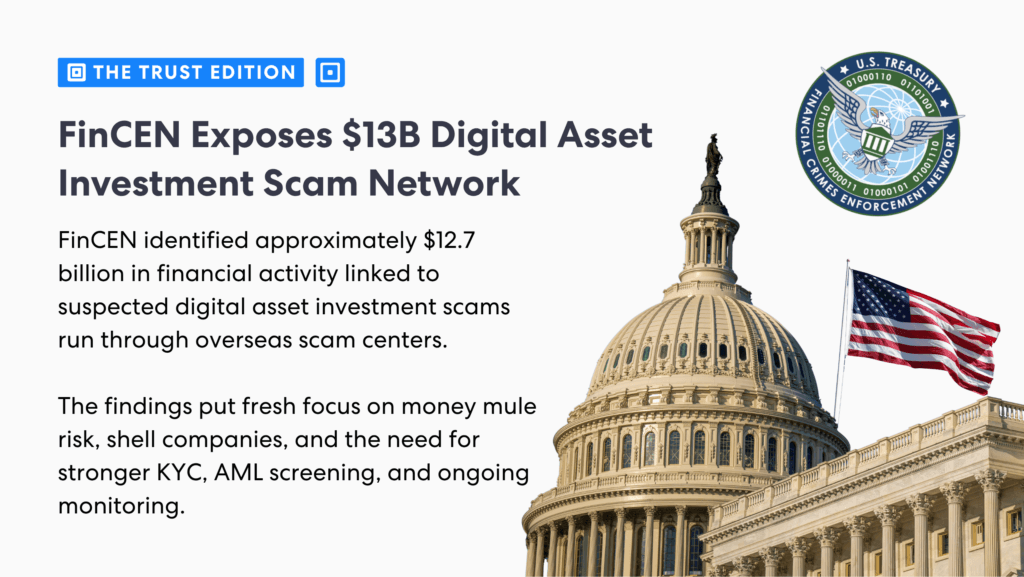
These investment scams are largely linked to transnational criminal organizations that are operating industrial-scale scam compounds across Southeast Asia. The networks use large groups of criminal actors and supporting service providers to target victims and scale their operations. However, targeting victims is only one part of the operation. Overseas scam centers depend on wider criminal infrastructure capable of moving and laundering the proceeds.
## The Criminal Infrastructure Behind Overseas Scam Centers
The most shocking part of [FinCEN’s findings](https://www.fincen.gov/news/news-releases/fincen-identifies-nearly-13-billion-linked-suspected-digital-asset-scams) was the infrastructure supporting overseas scam centers. Operators have been using so-called guarantee marketplaces. These are online markets where criminal groups can purchase services such as account creation, phishing, and money laundering support. These services allow scam networks to outsource key parts of their operations and function more like organized commercial ecosystems than isolated fraud groups.
As a result, professional money launderers play a particularly important role by establishing financial accounts and shell companies to move funds through wider laundering networks. These proceeds are then integrated into the formal financial system through money mule networks, stablecoin transfers, and digital asset exchanges outside the United States. This laundering stage is where scam activity can begin to intersect with regulated financial institutions, making the detection of connected risk indicators increasingly important.
## FinCEN Flags New Scam Center Risk Indicators
The regulator also issued an alert to financial institutions alongside its analysis. It urged firms to find, stop, and report any suspicious activities associated with overseas scam centers. This is crucial as there is rarely one transaction or customer characteristic that effectively proves criminal activity.
When multiple signals appear together, suspicious activity becomes clearer. This includes any unusual relationships with digital asset platforms, fast movement of funds, use of shell companies, possible money mule behavior, or transfers connected to jurisdictions and entities associated with scam operations.
The lesson is that digital asset investment scams require firms to look for patterns rather than individual transactions. This guidance emphasizes combinations of behaviors, jurisdictions, and transaction patterns rather than relying on a single indicator of suspicious activity.
## Why Identity Checks Cannot Capture The Full Risk
The issue is also the assumption that any successful [identity verification](https://docs.complycube.com/documentation/product-guides/biometric-and-liveness-verification/identity-check) immediately means that a customer is low risk. Scam networks thrive on stolen or synthetic identities, genuine individuals acting as money mules, or real-looking corporate structures to move funds. An account holder can be real, while the purpose of the account remains illicit.
Identity verification can figure out who a person is. It cannot determine what risk that person or business might present later on. This is why ongoing customer due diligence is essential, particularly when an initially legitimate account later becomes connected to suspicious activity.
## Digital Asset Investment Scams and AML Are Converging
Fraud prevention and [Anti-Money Laundering (AML)](https://www.complycube.com/en/solutions/due-diligence-compliance/anti-money-laundering/) controls are virtually impossible to separate. Though digital asset investment scams generate the initial proceeds, the funds still largely depend on real financial infrastructure to be moved.
Fraud teams may find the initial scam, while AML teams find the accounts, entities, and transactions used to move the proceeds. Both teams may be observing different stages of the same criminal network.
For regulated businesses, fragmented controls are hard to justify. More importantly, recent enforcement and regulatory cases much like this one from FinCEN reinforced the same theme. Regulators are more interested in whether firms can connect risk information and act on it effectively. Recent enforcement and regulatory cases have reinforced the same theme that regulators expect firms to connect risk information well and act on it effectively.
## What Compliance Teams Can Learn from FinCEN’s Findings
FinCEN says digital asset investment scams show that identity assurance must sit alongside risk-based due diligence, AML screening, and ongoing monitoring across the full customer lifecycle. Several practical lessons stand out:
- Treat onboarding as the start of the risk assessment process, as customer risk profiles can change over time after an account is opened.
- Look for a mix of risk signals such as identity, transaction patterns, and exposure, as they are much more valuable when assessed together.
- Do not overlook money mule risk because overseas scam centers can exploit genuine people and real accounts.
- Use ongoing monitoring to detect any new information, changes, or exposure emerging after onboarding.
Moreover, FinCEN strongly encourages financial institutions to participate in voluntary information sharing under Section 314 (b) of the USA PATRIOT Act, which allows institutions to share information regarding activities that may involve money laundering or terrorist activity while receiving safe harbor protections from liability.
[](https://portal.complycube.com/signup)
Find out more AML news in ComplyCube’s [Trust Edition newsletter](https://www.linkedin.com/newsletters/the-trust-edition-7103022355722981376/). We explore the latest in developments across identity verification and AML globally.
**Categories:** News
**Tags:** Anti-Money Laundering
---
### [Ukrainian Crypto Scam Network Shut Down By Authorities](https://www.complycube.com/ukrainian-crypto-scam-network-shut-down-by-authorities/)
**Published:** September 7, 2026
**Author:** Rithu Jagannath
**Excerpt:** Ukrainian criminal authorities dismantled a crypto scam spanning 20+ countries, exposing how fake KYC, wallet drainers, stolen identity data, and fragmented fraud controls can combine to exploit trust across the customer journey.
**Content:**
Authorities have busted an alleged Ukrainian crypto scam network targeting victims across over 20 countries. The scam investment operation used platforms, returns, identity-data collection and wallet draining technology to steal cryptocurrency.
On 7 September 2026, The Security Service of Ukraine (SSU) reported this scam network generated a monthly turnover of about $1 million during their peak periods. To date, the investigators have found 62 victims with more than 46 Ukrainian citizens recruited into the operation as alleged perpetrators.
## How the Crypto Investment Scam Worked
This Ukrainian crypto scam first began on Telegram. Some channels that were seemingly promoting profitable cryptocurrency investments were leading victims into an enticing trap. They were directed to fraudulent websites that were mimicking real investment platforms. People could still register, deposit funds, and monitor their apparent returns.
According to investigators, operators were manually creating fake transactions and apparently increased the balances that were displayed to users in their accounts. This built up the confidence of users in the platform before they tried to withdraw their “profits”.

It was at the withdrawal stage that victims were most compromised. Police found that at that point, users were asked to connect their main [cryptocurrency](https://www.complycube.com/en/use-cases/industry/crypto/) wallet to approve a small test transaction. Shortly after, a hidden crypto drainer took the opportunity to transfer assets to wallets that were controlled by the alleged operators.
This is where linking multiple signals can become incredibly valuable. For example, a single customer action may look okay in isolation, but with additional context flag for greater risk. As a result, an exchange or financial provider could flag any transfers to wallet addresses already connected to drainer activity, odd transaction speed, or any other abnormal patterns on receiving accounts.
The Ukrainian crypto scam demonstrates how some investment fraud systems can build trust instead of relying on an immediate suspicious transaction. Before the victims were asked to approve a small wallet transaction, they had already seemingly seen returns and expected to receive money.
## Fake KYC Added Another Layer of Risk
The biggest standout from the Ukrainian crypto scam was how modern crypto can exploit both identity and transaction flows. Its strong imitation of real [Know Your Customer (KYC)](https://www.complycube.com/en/step-by-step-know-your-customer-process/) and Identity Verification (IDV) processes reinforces the value of combining document, biometric, device, behavioral, and financial risk signals.. The National Police says that these fraudulent platforms gathered passport information, photographs, and other sensitive information during the whole registration and verification process.
For some customers, an identity check can make a service appear much more credible. These [crypto scam networks](https://blockchainreporter.net/ukrainian-police-take-down-crypto-scam-1m-month/) seemingly exploited that expectation by creating the appearance of a familiar, regulated onboarding journey while gathering personal information.
This fake KYC process potentially exposes victims to subsequent identity theft or account takeover. Ukrainian authorities have not yet confirmed if the information was reused later. However, its collection creates a strong identity-fraud risk.
## A Cross-Border Ukrainian Crypto Scam Network
The Ukrainian [crypto scam](https://www.complycube.com/en/crypto-money-laundering-red-flags/) also had the baseline structure of an organized fraud network. For example, the police reported that a 25-year old IT specialist was able to recruit over 46 people to do web development, victim communication, office administration, and security.
Victims were found all over the world in countries such as Germany, Latvia, the UK, and Canada. This case shows how quickly online investment fraud can cross jurisdictions with operators, infrastructure, victims, and cryptocurrency flows located in different countries. Thus far, the Ukrainian authorities carried out 34 searches and seized computers, phones, documents, cash, and vehicles are part of the wider investigation.
## What Crypto Firms Can Take From The Case
Today, fraudsters are increasingly copying processes that make real financial services look trustworthy. Fraudulent investment returns establish credibility and [fake verification](https://www.complycube.com/en/crypto-fraud-detection-software/) mirrors regulated onboarding. That is how a routine-looking wallet request becomes a mechanism to steal assets.
Businesses need to be able to assess identity information alongside wider fraud signals. Passing an identity check should not be enough evidence that all activity is low risk. Moreover, identity information needs to be protected as a high-value asset. Teams must combine document, biometric, device, and behavioral signals where needed. The biggest lesson from the Ukrainian crypto scam for real firms is to ensure that authentic verification journeys be clearly differentiated from fraudulent ones.
[](https://portal.complycube.com/signup)
Find out more AML news in ComplyCube’s [CryptoCubed newsletter](https://www.complycube.com/en/cryptocubed-august-newsletter-2-2m-crypto-seizure-and-binance-arrest/). We explore the latest in developments across identity verification and AML globally.
**Categories:** News
**Tags:** Crypto Regulations
---
### [India Blocks 15 Crypto Exchanges for AML Violations](https://www.complycube.com/india-blocks-15-crypto-exchanges/)
**Published:** September 9, 2026
**Author:** Dini Habib
**Excerpt:** 15 crypto exchanges are under India's FIU scrutiny as the country aims to step up AML enforcement. The case shows what offshore crypto firms risk if they serve customers in India without meeting local AML and CDD compliance rules.
**Content:**
India’s Financial Intelligence Unit (FIU) has issued non-compliance notices to 15 crypto exchanges, specifically, Virtual Digital Asset Service Providers (VDASPs) under the country’s Anti-Money Laundering (AML) law. The notice includes shutting down their apps and URLs from public access in India.
## The Origin Story
In India, VDASPs must comply with the [Prevention of Money Laundering Act, 2002 (PMLA)](https://en.wikipedia.org/wiki/Prevention_of_Money_Laundering_Act,_2002) regulations. Businesses offering services such as crypto-to-fiat exchanges, virtual-asset transfers, or digital asset administration typically fall within the PMLA reporting-entity framework.
The case centers on Section 13 of the PMLA, which allows India’s FIU Director to impose fines. It can also enforce disciplinary action on companies that fail to meet full AML obligations. Notably, the 15 companies involved in the case do not all necessarily have physical offices in India. Most operate across several jurisdictions and serve global customer bases.
As such, crypto firms face a clear warning. India’s AML and Counter-Terrorism Financing (CTF) rules apply, regardless of any physical presence. Any crypto exchange that provides services to customers in India must comply with local laws or could face potential enforcement action.
## Details on the 15 Crypto Exchanges Involved
The notice covers 15 different exchanges and how their existing compliance framework satisfied India’s PMLA. However, the authorities did not explicitly state the exact violations. The companies involved spanned derivatives platforms, centralized exchanges, and other virtual-asset services..
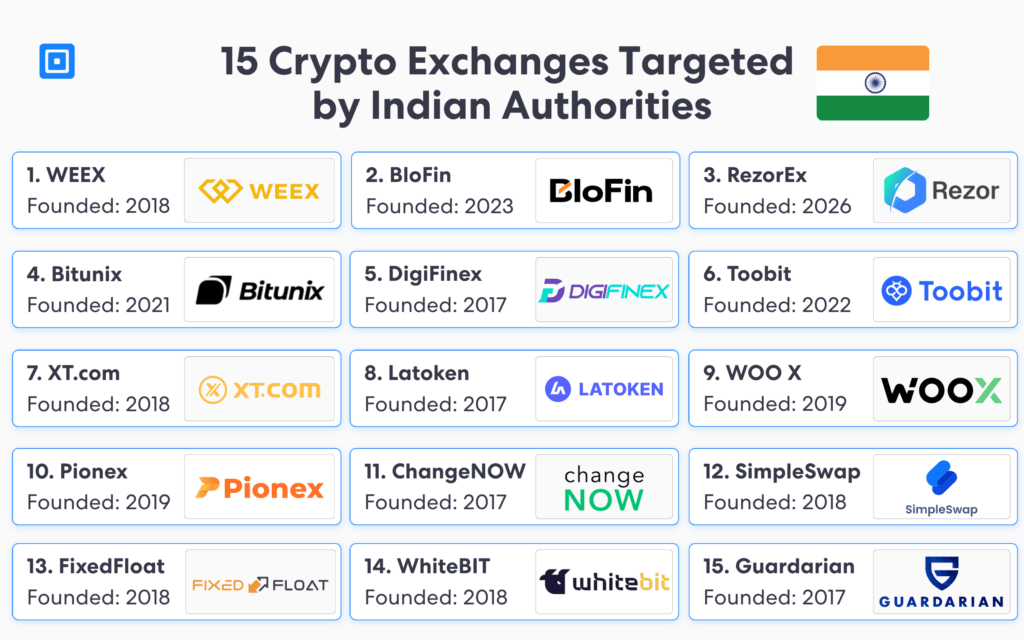
The range of businesses the FIU targets tells a compelling story. Authorities are focusing not only on the label a company uses to describe its operations, but also on the actual activities or services it offers. You can learn more here: [Cryptocurrency Regulation in India](https://www.complycube.com/en/cryptocurrency-regulation-in-india-in-2024/).
## India’s Stringent Stance Around Crypto
India’s latest crackdown on 15 crypto platforms is easier to understand when viewed as part of a broader regulatory campaign. Indian authorities have progressively [broadened](https://www.complycube.com/en/cryptocubed-may-newsletter-binance-iran-crypto-news-and-mica-crypto-rules-review/) the AML perimeter around Virtual Digital Assets (VDAs).
However, the government takes an unusually clear position on one point: a crypto company’s AML obligations depend on its activity, not its jurisdiction. That matters to international compliance teams. Over the last 20 months, India has shown that this stance is not just theory.
In 2025, India’s FIU updated its VDA-registration framework twice. First on 20 January and the next on 15 September. This happened before it targeted 25 more offshore crypto providers on 1 October 2025 and issued notices to take down their apps and URLs.
On January 8, 2026, the regulator took another step by issuing updated AML guidelines for businesses providing VDA-related services. The framework is not just telling an exchange to register. It covers key regulatory mandates on governance, [Customer Due Diligence (CDD)](https://www.complycube.com/en/solutions/due-diligence-compliance/customer-due-diligence/), ongoing monitoring, the crypto Travel Rule, and higher-risk areas such as unhosted wallets and anonymity-enhancing products.
## What Happens Next?
The 15 platforms named by the FIU will likely prioritize regulatory engagement and remediation. India’s previous reaction to offshore VDASP suggests the way ahead may be to respond to FIU notices, assess whether registration as a reporting entity is necessary, correct flaws in [AML controls](https://www.complycube.com/en/solutions/due-diligence-compliance/anti-money-laundering/), and pay financial penalties if violations are proven.
The commercial risk is immediate market access. If takedown notices are implemented, affected platforms could find it harder for Indian users to access their websites or apps while proceedings continue.
## Avoiding Scrutiny from India’s Financial Intelligence Unit
The importance for compliance teams at international [crypto businesses](https://www.complycube.com/en/use-cases/industry/crypto/) extends far beyond these 15 companies. The first question should be: Are we serving Indian customers even if we don’t have a legal entity, office, or staff in India? Here are the three key takeaways all AML teams must learn from this case:
**1. Localize AML controls for every jurisdiction:** Regulations can evolve quickly and vary drastically from country to country. Businesses must tailor every workflow, policy, and monitoring process to each jurisdiction’s requirements. Combining ongoing monitoring and policy assurance solutions equips firms to identify regulatory changes early and assess whether existing controls still meet local laws.
**2. Technology only works when backed by strong governance:** Sophisticated AML and monitoring tools cannot compensate for weak oversight or poor compliance culture. Companies need clear ownership, effective escalation processes, regular testing, and evidence that controls are working. Additionally, firms should test compliance controls continuously against evolving risks.
**3. Regulators look at what you do, not simply where you are based**: The FIU’s action reinforces that regulatory exposure can be driven by the services a company provides and the customers it serves. For crypto firms operating across borders, this means assessing obligations market by market rather than assuming that a lack of physical presence removes local compliance responsibilities.
[](https://portal.complycube.com/signup)
Find out more AML news in ComplyCube’s [Trust Edition newsletter](https://www.linkedin.com/newsletters/the-trust-edition-7103022355722981376/). We explore the latest in developments across identity verification and AML globally.
**Categories:** News
**Tags:** Anti-Money Laundering
---
### [Revolut Cyber Attack Exposes The Limits of Trust](https://www.complycube.com/revolut-cyber-attack-exposes-the-limits-of-trust/)
**Published:** September 14, 2026
**Author:** Rithu Jagannath
**Excerpt:** The Revolut Cyber Attack exposed how trusted channels can be manipulated to obtain sensitive customer data, highlighting the need for stronger fraud intelligence, contextual checks, and protection of high-value KYC records today.
**Content:**
A seemingly normal request for Revolut sent through a legitimate government email domain resulted in passports, verification selfies, and financial records being sent to an unauthorized third party. The Revolut cyber attack that became public on 12 September 2026, involved attackers exploiting a built-in trusted information-request process. These criminals used an email account associated with a genuine government agency domain to obtain sensitive customer data.
This affected customers, as many began sharing data breach notifications from Revolut. By 14 September 2026, Revolut confirmed that it was a “sophisticated external impersonation scam”. However, it added that its systems, databases, customer accounts, and funds were not compromised. Serving over 80 million customers globally, the cyber attack case raised a much wider fraud problem.
## How the Revolut Cyber Attack Unfolded
Revolut did not reveal which agency was involved in their cyber attack, or which country it belonged to. In fact, they did not even share how many customers were affected. They said that a “limited” number of people were impacted. Customers reported receiving notification emails on Friday, 11 September.
Once they discovered the suspicious activity, Revolut seemingly blocked the email address and immediately notified the involved government agency. They also contacted relevant enforcement agencies, data protection authorities, and financial regulators. The key distinction is that an attacker did not gain access to Revolut’s database to extract information. The information was released because the request looked authentic enough to be processed.
Financial institutions such as Revolut, regularly receive legally binding requests for customer records from governments and law enforcement. [A source close to Revolut told City A.M](https://www.cityam.com/revolut-facing-ransom-request-after-hackers-obtain-customers-data/) that communications arriving from previously verified addresses can be processed as mandatory legal demands. The trust that was attached to that process became an inherent part of the attack.
## Passports, Selfies, and Transaction Histories Were Exposed
This small impersonation scam turned into a significant Revolut data breach. Notifications sent to affected customers show that the disclosed information included sensitive data such as names, dates of birth, postal addresses, and even telephone numbers. Copies of passports and driving licenses may also have been included.
Even worse, the financial information went further. Account statements could contain IBANs, account status, account-opening dates, and wallet reference numbers. That means that withdrawal records and complete transaction histories, including Bitcoin transactions, may also have been disclosed. Verification selfies were impacted although Revolut said biometric facial telemetry was not compromised.
City A.M also reported that a group calling itself “Revolut Smilik” has threatened on Telegram to release additional customer information unless it received payment. Revolut declined to confirm the ransom request, so the group’s claims remain unverified.
## Revolut Cyber Attack as a Social Engineering Incident
The 2026 incident is not the first for Revolut. Almost four years ago, in 2022, Revolut disclosed a separate social engineering attack in which, again, an unauthorized third party gained access to sensitive customer information. At the time, Revolut claimed that incident affected 0.16% of customers. A breach disclosure filed in Lithuania later put the figure at 50,150 people, including 20,687 customers in the European Economic Area and 379 in Lithuania.
Both attacks exposed the same underlying vulnerability. Fraudsters are targeting the human and operational processes surrounding technology instead of simply attacking the technology itself. That distinction is becoming much harder for financial institutions to ignore.
## Stolen KYC Data and Fraud Intelligence
The immediate concern is the disclosure of customer records. The longer-term concern is what those records can be used for next. [Know Your Customer (KYC)](https://www.complycube.com/en/solutions/due-diligence-compliance/know-your-customer/) data is designed to establish who someone is. When criminals obtain the same information, it can give them the material needed to make future impersonation attempts considerably more convincing.
A scammer with only an email address has limited context. A scammer with someone’s name, telephone number, home address, passport image, verification selfie, IBAN, and genuine transaction history has a far richer profile. That information can potentially support targeted phishing, fraudulent account recovery, SIM swapping, impersonation, and social engineering. Transaction histories can also reveal patterns about how a victim moves money, the services they use and, in some cases, their cryptocurrency activity.
The concern therefore isn’t limited to whether money was stolen during the original Revolut cyber attack. Revolut says customer funds remained safe. The greater risk is that data released during one fraud event becomes intelligence for another.
## Why Financial Firms Need Fraud Intelligence Beyond Authentication
The defining feature of the Revolut case is that one of the strongest apparent trust signals was genuine. The government domain was legitimate. This challenges security models that rely too heavily on binary authentication. A sender may pass technical checks while the behaviour surrounding the request remains unusual.
Fraud intelligence adds that missing context. It can assess whether the requester has an established history, whether the requested data volume is unusual, whether multiple requests have appeared within an unexpected period, or whether the request differs from previous legitimate interactions.
You can also evaluate device, identity, network, behavioral, and historical signals together. One unusual characteristic may have an innocent explanation. Several appearing at the same time justify additional verification or escalation.
The same principle applies through financial services. Passing an Identity Verification (IDV) check does not prove that every future action is legitimate. A valid credential does not prove intent. An authenticated communication channel does not remove the need to understand the behavior occurring through it.
The Revolut cyber attack shows why modern fraud controls increasingly need to ask, is this interaction authentic, and does the activity itself make sense? For financial institutions handling sensitive KYC records, these three lessons stand out:
- Authentication is a signal, not the entire decision. Higher-risk data request may require additional independent validation.
- Connect multiple fraud indicators. Identity, request history, device information, behavior, and context become more powerful when analyzed together.
- Treat KYC information as high-value data. Identity documents and financial records can become valuable inputs for subsequent fraud if they are exposed.
The story began with what seemed like an ordinary government request. It ended with passports, selfies, and transaction histories reportedly in the hands of an unauthorized third party. This is what makes the Revolut cyber attack significant.
Fraudsters did not necessarily have to defeat the security system. They had to understand what the system trusted. Attacks exploit legitimate accounts, identities, and communication channels, effective fraud intelligence depends on recognizing the difference between something that looks trustworthy and behavior that genuinely is.
[](https://portal.complycube.com/signup)
Find out more AML news in ComplyCube’s [Trust Edition newsletter](https://www.linkedin.com/newsletters/the-trust-edition-7103022355722981376/). We explore the latest in developments across identity verification and AML globally.
**Categories:** News
**Tags:** Anti-Money Laundering
---
### [The UK's Anti-Money Laundering and Asset Recovery Strategy](https://www.complycube.com/uk-aml-and-asset-recovery-strategy/)
**Published:** September 16, 2026
**Author:** Dini Habib
**Excerpt:** The UK's latest Anti-Money Laundering and Asset Recovery Strategy 2026-2029 aims to strengthen its response to evolving financial crime risk. The strategy calls for smarter compliance systems and governance over the next 3 years.
**Content:**
On 15 September 2026, the UK launched its latest Anti-Money Laundering (AML) and Asset Recovery Strategy 2026-2029. The publication aims to set the direction for the country’s AML infrastructure over the next 3 years. It emphasizes the need for smarter compliance controls amid evolving threats.
## What is the Anti-Money Laundering and Asset Recovery Strategy 2026–2029?
The Home Office and HM Treasury developed the UK’s AML and Asset Recovery Strategy to intensify the country’s response to financial crime. The strategy sets out a three-year roadmap to achieve three main objectives. Namely, to strengthen the UK’s AML defenses, disrupt high-risk money laundering networks, and recover criminal assets.
> Financial crime is a [corrosive threat](https://assets.publishing.service.gov.uk/media/6aa950402f29b388848184ee/Anti-money_laundering_and_asset_recovery_strategy_2026-2029__web__v2.pdf) that harms our communities and economy.
The program is backed by £520 million from the Economic Crime Levy, a further £30m from the high streets package announced at Budget 2025, and more than 500 new officers. Sal Melki, the Deputy Director at the National Crime Agency (NCA), emphasizes the need for this scale. She notes, “Financial crime is a corrosive threat that harms our communities and economy. It undercuts legitimate business, deprives our public services and furthers the interests of nations hostile to the UK and our way of life.”
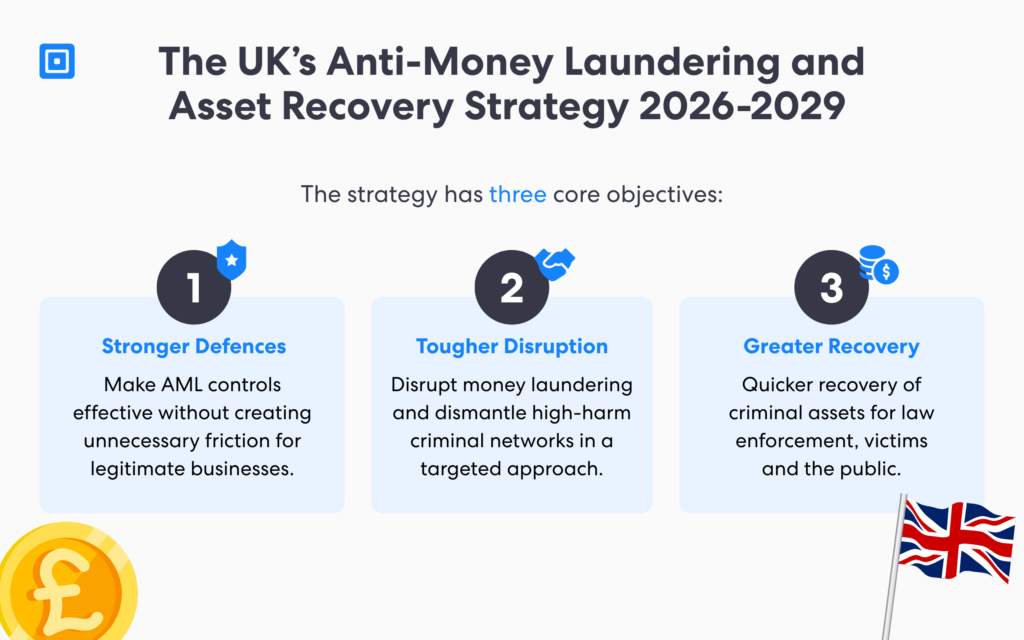
Delivery will be structured via three pillars:
- **Empower:** Covers the people, technology, and legal powers needed to act on that intelligence.
- **Target:** Focus resources on the highest-risk activity rather than low-value compliance work.
- **Integrate:** Connect intelligence and organizations for a unified approach.
## Why Did The UK Publish a New AML Strategy?
The new strategy aims to combine stronger enforcement with more proportionate regulation. The 2025 [National Risk Assessment](https://assets.publishing.service.gov.uk/media/6877be59760bf6cedaf5bd4f/National_Risk_Assessment_of_Money_Laundering_and_Terrorist_Financing_2025_FINAL.pdf) still classifies the UK as a country with high money-laundering risk. While the government reports improving outcomes, it argues that criminal threats continue to evolve.
During 2025/26, authorities disrupted more than 3,158 illicit finance systems, and recovered over £345.3 million in assets while returning £26.1 million to victims. Moreover, criminal cash-intensive businesses have resulted in over £10.7 million in suspected criminal funds seized or restrained.
Moving forward, the government aims to harmonize intelligence systems and sharing, as well as speed up asset-recovery processes. The government expects businesses to shift away from low-value activity. They must strengthen unified AML and fraud prevention controls.
## What do Compliance Officers Need to Know Right Now?
It’s important to note that the strategy is not a new AML regulation in itself. Businesses can expect more consultations, guidance, and legislation in the upcoming months. Existing obligations under the Money Laundering Regulations 2017 (MLR2017), as amended in 2026, the Proceeds of Crime Act 2002 (POCA), and sector-specific rules still remain.
However, there are several developments businesses should be tracking:
### 1. Re-check your high-risk-country logic
From [30 June 2026](https://www.gov.uk/government/publications/money-laundering-advisory-notice-high-risk-third-countries--2/money-laundering-advisory-notice-high-risk-third-countries--2), Enhanced Due Diligence (EDD) obligations have been narrowed to the Financial Action Task Force (FATF) “High-Risk Jurisdictions subject to a Call for Action” list. This means jurisdictions under the previous “Increased Monitoring” list will not mandate EDD immediately. However, this does not mean a grey-listed jurisdiction is automatically low-risk.
**What this means:** Firms should amend country controls to differentiate between a regulatory trigger and a firm-specific risk trigger. AML teams must consider geographic risk, FATF evaluations, and their own customer and transaction risk assessment, with clear rules and an auditable reason for [EDD escalation](https://www.complycube.com/en/enhanced-due-diligence-edd-insights-challenges/).
### 2. Turn “risk-based” into something you can evidence
The strategy specifically calls out the need to focus on [high-impact risks](https://www.complycube.com/en/what-is-aml-risk/), without excessive compliance effort spent on low-risk customers or entities. Additionally, it encourages supervisors to discourage blanket or excessive controls and instead move to proportional measures.
**What this means:** An effective AML process should use the level of risk present to decide whether to route a customer to a particular journey. All escalation rules and compliance decisions must therefore trace back to the risk signal identified. This means more risk mapping and documentation on how the customer’s risk was determined, why a check is proportionate, and what decision followed.
### 3. Get ahead of AI governance
The Financial Conduct Authority (FCA) is due to publish its [framework](https://committees.parliament.uk/committee/158/treasury-committee/news/211401/current-approach-to-ai-in-financial-services-risks-serious-harm-to-consumers-and-wider-system/) around good and poor practice for AI in 2026/27 and update its Financial Crime Guide with these examples. However, firms should not just wait for that guidance before establishing basic governance.
**What this means:** Mentioning that an AML provider “uses AI” will not translate to effective oversight. Where AI or machine learning is deployed in identity verification, fraud detection, and AML workflows, firms must understand and provide information on what data informs the system, how thresholds are controlled, where human intervention occurs, and whether decisions can be reconstructed.
[](https://portal.complycube.com/signup)
Find out more AML news in ComplyCube’s [Trust Edition newsletter](https://www.linkedin.com/newsletters/the-trust-edition-7103022355722981376/). We explore the latest in developments across identity verification and AML globally.
**Categories:** News
**Tags:** Anti-Money Laundering
---
### [Hong Kong IA Fines FWD HK$19.5M for AML Failures](https://www.complycube.com/hong-kong-ia-fines-fwd-hk19-5m-for-aml-failures/)
**Published:** September 24, 2026
**Author:** Rithu Jagannath
**Excerpt:** Hong Kong’s Insurance Authority fined FWD HK$19.5 million over AML failures spanning third-party payments, PEP screening, transaction monitoring, and high-risk customer controls, signalling closer scrutiny of insurers.
**Content:**
On 24 September 2026, the Hong Kong Insurance Authority (IA) announced a disciplinary action under Hong Kong’s Anti-Money Laundering and Counter-Terrorist Financing (AML/CTF) Ordinance. They fined FWD Life Insurance Company (Bermuda) Limited HK$19.5M (~$2.49M USD) after finding many issues with its AML controls. The Hong Kong IA found failures that involved third party payments, suspicious transaction monitoring, Politically Exposed Person (PEP) screening, and Customer Due Diligence (CDD).
This inspection covered various periods between April 2012 and September 2024. Though a penalty applies to one insurer, the findings lead to a much broader issue. Having weaknesses in payment verification, customer data, screening, and transaction monitoring can quickly become connected instead of isolated compliance failures.
## How Hong Kong IA Learned About FWD’s AML Failures
They investigated and found four major areas of concern. However, these findings were significant when looked at together. Each and every control was responsible for answering different questions. Some answered who the customer was and where the money was from, and others answered if the activity matched the risks.
These problems came up when FWD was trying to verify third-party premium payments. Shortly after, it extended into transaction monitoring where suspicious cash activity was not properly reviewed. Separately, incomplete customer and beneficial-owner data impacted PEP screening, while some higher-risk relationships did not receive timely senior-management approval.
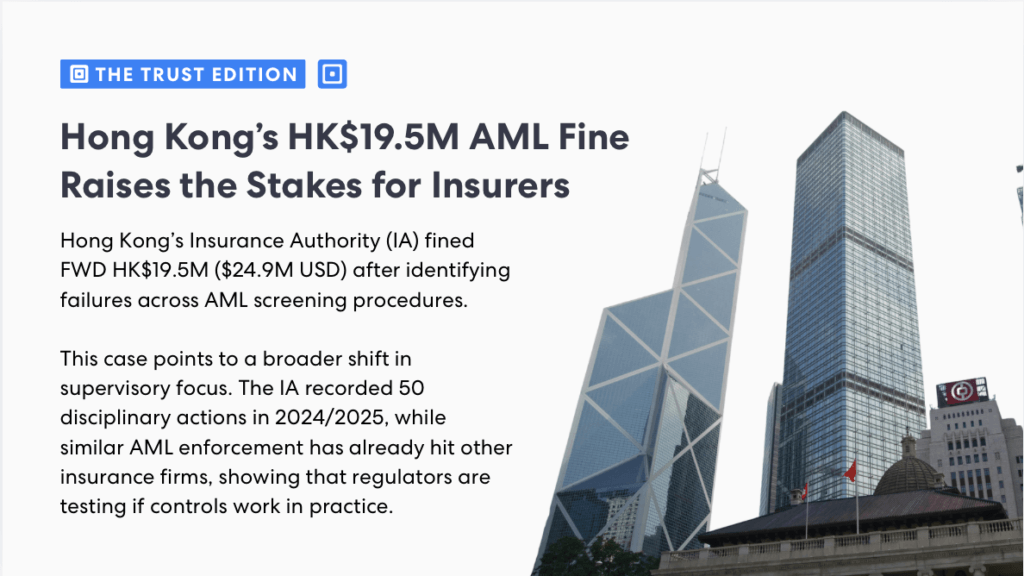
This case is incredibly relevant for insurance compliance teams. It is rare that a control failure is confined to just one point in the whole customer journey. For example, if payer information is incomplete, it impacts the understanding of a transaction. Or if the beneficial owner’s information is missing, screening quality suffers. In some cases, if monitoring rules do not connect related payments, risky activity may not reach manual review.
## Third-Party Payments Exposed a Verification Gap
The Hong Kong IA looked through [129 bank drafts worth up to HK$4.7M](https://asiainsurancereview.com/News/View-NewsLetter-Article/id/97015/type/eDaily/FWD-Life-fined-US-2-49m-over-AML-counter-terrorist-financing-control-shortcomings) (~$599,000 USD), three of which had no supporting documentation. The remaining 126 policyholders submitted Premium Payment Declarations which stated that they had purchased the bank drafts themselves.
Instead, they found out during the investigation that 68 of the bank drafts had not been purchased by the policyholder, insured person, or settler named on the declaration form. Additionally, FWD did not have an effective threshold at which comprehensive verification of the payer’s identity became mandatory in practice.
Third-party payments can also carry additional money-laundering risk. This is because they introduce another person into the transaction process. The payer’s identity, relationship with the customer, and reason for funding the policy all become relevant in understanding if the activity is consistent with the expected customer profile. The FWD case shows why payment controls need to extend beyond collecting forms. High-value or unusual payments must trigger verification protocols proportionate to the risk presented.
## Transaction Monitoring Missed HK$23.8M in Split Cash Payments
These payment issues became more relevant when the Hong Kong IA looked at how FWD monitored activity after a transaction entered the system. In 2022, FWD did not have any procedures that were designed to examine split cash premium payments.
When they conducted a review later at IA’s request, it found 306 policies involving $HK23.8M (~$3.03M USD), in split cash payments made by unidentified parties. A suspicious transaction report was subsequently filed with [Hong Kong’s Joint Financial Intelligence Unit](https://www.jfiu.gov.hk/en/). The IA also found a completely separate system design flaw that prevented more than 100 transaction monitoring alerts from being generated.
Their findings point to a familiar challenge in automated AML monitoring. Individual payments look normal when assessed separately, but their risk is much clearer when a system links repeated payments, common funding sources, unusual transaction timing, or attempts to divide a larger amount into smaller transactions.
Having a transaction monitoring system is only part of the control. Firms also need to test if their scenarios, thresholds, and data flows find the behaviour that the system was designed to detect. In this case, the missed alerts show how a technical weakness is also a compliance weakness. Moreover, if the system does not create the alert, the compliance team may not get the chance to investigate any of the underlying behavior.
## PEP Screening Added Another Layer of Risk
The Hong Kong IA also found gaps in how FWD collected and screened information on PEPs. The data gaps between 2012 and 2020 showed beneficial owners of trusts and legal-entity policyholders were not consistently screened for PEP status. This was not done during onboarding or on an ongoing basis. FWD failed to identify 58 customers or beneficial owners as PEPs.
Seven of those PEPs were foreign or non-Hong Kong. Since they were not identified, the required [Enhanced Due Diligence (EDD)](https://www.complycube.com/en/solutions/due-diligence-compliance/customer-due-diligence/) and senior-management approvals were not applied to those relationships. This highlights an important limitation of screening technology as it can only assess the identities provided to it.
When a policy involves a trust or legal entity, the relevant risk may sit behind the named customer. Trustees, settlers, shareholders, controllers, and beneficial owners may all need to form part of the compliance picture. That is also the reason that ongoing monitoring is important because PEP status is not static.
Someone who presents no political exposure at the time of onboarding can acquire it later. This means the customer risk profile can change without the customer opening a new account or buying another product. You can learn more here: [What is a Politically Exposed Person?](https://www.complycube.com/en/what-is-a-politically-exposed-person/)
## Senior Management Became Part of the Control Failure
The Hong Kong IA findings did not stop with technology and customer data. It also extended to senior-management oversight. FWD failed to get approval from senior management before establishing business relationships with 19 high-risk policyholders during 2022. The regulator’s findings placed responsibility beyond the compliance function itself. This is where risk-based compliance moves from finding risk to acting on it.
A firm can find a high-risk customer, but that achieves very little unless it changes the onboarding or monitoring process. A higher-risk result may need to trigger EDD, source-of-funds checks, a manual review, or senior-management approval before the relationship proceeds.
Information always needs to lead somewhere. A suspicious payment must trigger investigation. A [PEP match](https://www.complycube.com/en/solutions/global-screening/sanctions-pep-screening/) should trigger enhanced checks. A high-risk classification should trigger the right approvals. If those steps operate as separate manual processes, the possibility of delay or missed escalation increases.
## Hong Kong IA’s Wider AML Enforcement Push
The FWD penalty is easier to understand as part of a wider enforcement pattern across Hong Kong. In 2024, the IA also fined AIA International Ltd. HK$23M (~$2.93M USD) after an AML inspection that found issues involving PEP screening and suspicious transaction monitoring. Similarly, three licensed broker firms were later fined a combined HK$429,000 (~$54,700 USD) for AML deficiencies that included PEP screening and third-party arrangements.
The [Hong Kong IA 2024-2025 Annual Report](https://www.timothyloh.com/insights/latest-news/insurance-authority-publishes-its-annual-report-2024-25-20251022) recorded eight on-site insurer inspections, 85 concluded investigation cases, and 50 disciplinary actions. Hong Kong’s next Financial Action Task Force (FATF) mutual evaluation is due in the second half of 2029, placing continued attention on AML supervision and enforcement. The direction is important for insurers and intermediaries.
Regulators will not be checking if an AML policy contains the right wording. Enforcement increasingly examines whether the operational controls under policies actually work. They assess whether the correct people are screened, if payment information is verified, and whether transaction patterns generate alerts. They look at if higher-risk relationships are actually escalated within investigations and reviews.
> *FWD acknowledges the findings of the routine AML inspection.*
FWD went on to say, “With regulatory compliance as our top priority, remediation is substantially complete for the areas identified for improvement. This included a thorough review of customers who were onboarded during the relevant period and we can confirm there had been no onboarding of non-eligible customers. FWD cooperated closely with the IA and is fully committed to making ongoing investments in people, systems, and processes to ensure we meet the high standards expected of us.”
## What Insurers Can Take from Hong Kong IA’s FWD Case
The significance of the HK$19.5M fine extends beyond FWD. For insurance companies, brokers, and other regulated financial businesses, the case shows how AML weaknesses can build up when controls responsible for different parts of the customer journey do not share the same information. Three lessons stand out:
- **Verify the person behind the payment:** Find and assess third-party payers where high-value or unusual transactions are involved.
- **Test whether monitoring works in practice:** Regularly confirm that transaction monitoring rules detect risk patterns and generate the right alerts.
- **Connect customer data to ongoing risk:** Ensure PEP status, ownership data, transaction behaviour, and risk scores continuously inform due diligence and escalation.
The FWD and Hong Kong IA case ultimately shows that AML effectiveness is not determined by the number of controls a firm has. It depends on whether those controls exchange the right information, identify changing risk, and trigger action at the right time.
[](https://portal.complycube.com/signup)
Find out more AML news in ComplyCube’s [Trust Edition newsletter](https://www.linkedin.com/newsletters/the-trust-edition-7103022355722981376/). We explore the latest in developments across identity verification and AML globally.
**Categories:** News
**Tags:** Anti-Money Laundering
---
### [Biometric Verification API: A Buyer’s Guide](https://www.complycube.com/biometric-verification-api-guide-for-compliance-and-engineering/)
**Published:** September 24, 2026
**Author:** Rithu Jagannath
**Excerpt:** Learn how to choose the best biometric verification API for your company. Choose one that balances face matching, liveness, fraud prevention, compliance, privacy, integration, and cost for both Compliance and Engineering teams.
**Content:**
**TL;DR:** A biometric verification API links biometric checks such as **face matching and liveness** to a much wider identity verification journey. This guide shows how compliance and engineering teams can request evidence, **understand what to test**, and learn the warning signs before **selecting a provider** for a biometric check.
## Trusting in a Biometric Verification API
An account can be opened from anywhere. A customer can take a picture of their document, take a quick selfie, and get approval just moments later. To them, the experience is effortless. Yet behind that interaction, there are many difficult questions being answered by the system.
A biometric verification system assesses document authenticity, facial features, and liveness. They check for clear signs of manipulation. Once those signals are reviewed, compliance and engineering teams need to decide if there is enough confidence to allow the customer to move to account creation or account recovery.
A flashy presentation about feature availability can say a lot of things. It can show an API returns a result, but it does not show why that result can be trusted. For compliance officers, they need to understand if the decision can be understood, governed, or defended during an audit. Engineering teams need to understand if the technology can be integrated securely, operate reliably, and recoverable when something goes wrong.
Industry leaders must not buy biometrics APIs based on a polished demonstration from any one provider because it is incredibly risky. The best place to start is by understanding what a biometric verification API does and what it proves.
## What Is a Biometric Verification API?
A biometric verification API helps an application compare [biometric characteristics](https://www.complycube.com/en/the-advantages-of-biometric-authentication/) such as face images, voice recognition, or other biometric modalities with a trusted reference point. The purpose is to establish that they belong to the same person. For remote facial verification, a trusted reference often looks like a portrait that is extracted from an identity document. Facial verification is common because most users can provide a facial sample using a camera-equipped device.
In identity and access-control contexts, biometric verification refers to a one-to-one comparison between a live biometric sample and a previously provided reference. The system is often trying to determine if the person who filled out the application is the same as the one whose identity is being presented.
## Face Verification vs Face Recognition API
It is important to note that the terminology around biometric verification APIs is often confusing. Face verification is not the same as face recognition even though they are used broadly. There are two types of facial biometric identification:
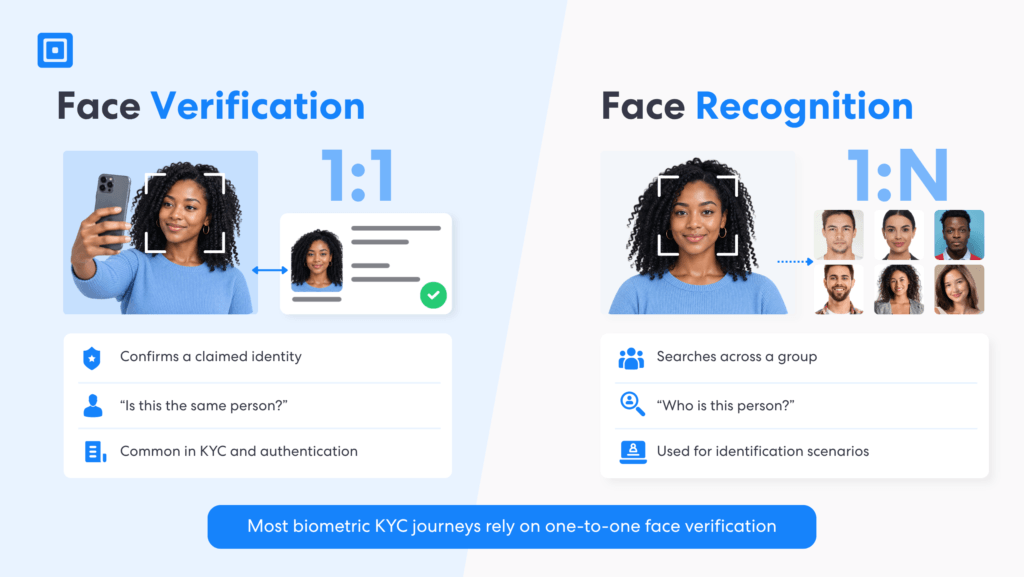
- **Verification:** A live capture might be compared with the portrait contained in the passport supplied.
- **Recognition:** A live capture is checked against various biometric templates from the larger population.
Though both sit under cloud-based face recognition, they help with completely different problems. Identification and verification often lead to the wrong technology being assessed together. Additionally, there is another distinction between authentication and verification. Though verification is associated with establishing someone’s identity, authentication is about re-establishing if a returning person is the same as the person who was previously enrolled.
A biometric verification API can support both types of journeys, but it is only one part of identity assurance. There are many points at which fraud can happen. For example, someone’s face could match a document portrait, but the document could be fraudulent. This is why biometric verification is much more useful when considered as a connected set of controls instead of a one-time face-matching event.
## How Does a Biometric Verification API Work?
There is no such thing as an “isolated” biometric check between the user opening their phone camera all the way through to receiving a decision. There are many processes that would likely happen sequentially or in parallel.
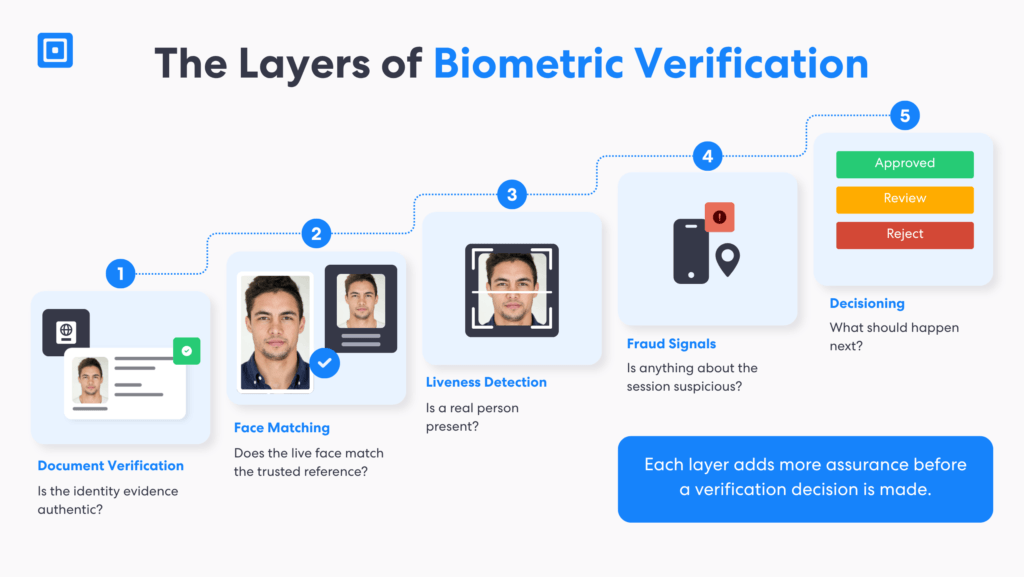
### Reference and Capture
Often, verification needs something trusted to compare against. During identity onboarding processes, systems extract an image from a passport, driving license, or identity card. In biometric authentication, the reference point may come from a previously verified enrollment. The user then provides a new biometric sample such as a selfie or video.
### Quality Assessment and Feature Extraction
However, before matching begins, the biometric verification system needs to understand if the sample is usable. There are many factors that can impact the sample such as poor lighting, unusual positioning, obstruction, and low image quality. The process behind these advanced algorithms is much more intricate than comparing two pictures pixel by pixel.
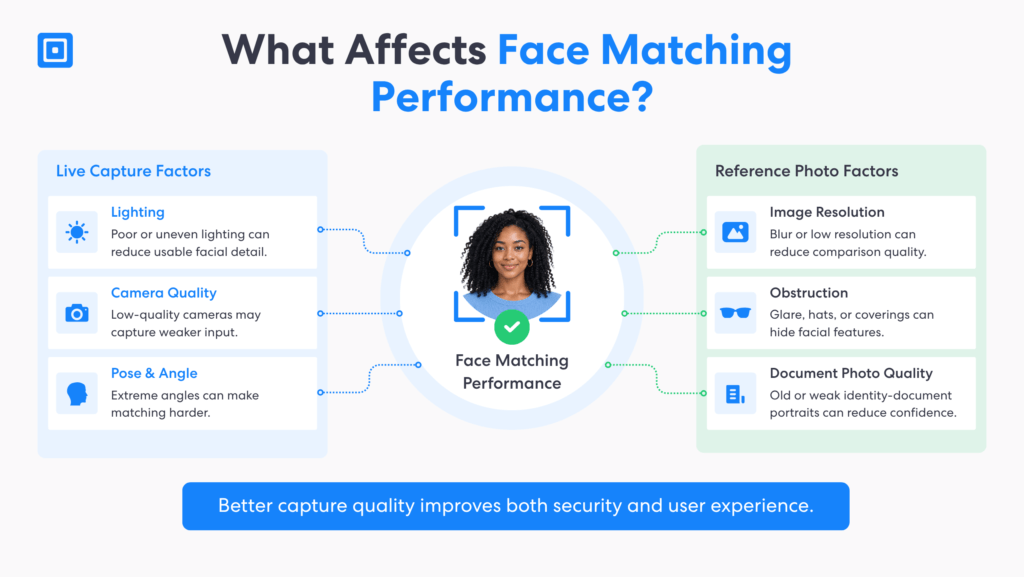
Many biometric recognition systems extract specific characteristics from the capture and create a machine-readable representation that can be compared with the reference. The UK’s[ Information Commissioner’s Office (ICO)](https://ico.org.uk) describes biometric recognition as automated recognition using biological or behavioral characteristics. Where biometric data is processed to uniquely identify someone, the ICO treats it as special-category biometric data under UK data-protection rules.
### Face Matching and Thresholds
At this point, the live biometric sample will be compared with the trusted reference. The system then At this point, the live biometric sample will be compared with the trusted reference. The system then generates a similarity score. Also known as a confidence score, it assesses the score against an operating threshold.
This threshold is incredibly important because biometric matching is not binary.
### Liveness and Capture Integrity
A high facial similarity is not certifiable proof that a real person is physically taking part in the onboarding journey. Attackers and fraudsters can attempt to use a printed photo, screen replay, or mask. In some cases, they also use sophisticated spoofing attempts with synthetic videos or other manipulated input.
This is where liveness and Presentation Attack Detection (PAD) play a crucial role. It helps assess if an attack is being presented to the capture sensor. These techniques help find defined presentation attacks, and depending on the system and test scope, certain forms of manipulated or artificially generated input.
### Decisioning
The last step is arriving at a decision once the verification results come through. One organization might automatically approve a strong result. Another might blend biometrics with document, device, or other fraud signals to meet compliance requirements before arriving at a decision.
Many uncertain customer journeys will be retried, escalated for additional verification, or referred for manual review. The biometric verification API’s real value is not just returning a face-match score. It is enabling a business to make a controlled identity decision from multiple pieces of evidence.
## What Each Identity Verification API Check Proves
Every check must be assessed based on what it actually establishes and what is outside of the scope. This is one of the most important considerations in biometric procurement for secure and seamless verification.
This is why face matching on its own is not true identity verification. The Financial Action Task Force (FATF) [digital identity guidance](https://www.fatf-gafi.org/en/publications/Financialinclusionandnpoissues/Digital-identity-guidance.html) makes a similar point at a broader level. They believe that regulated organizations must understand whatever assurance is given by a digital identity system.
Similarly for EU financial institutions, the European Banking Authority (EBA) [expects firms](https://www.eba.europa.eu/legacy/regulation-and-policy/regulatory-activities/anti-money-laundering-and-countering-financing-4) that use remote onboarding to review the reliability of all of the tools that they choose. They must understand how well each tool performs. Once customers understand what each check is meant to do, the next step is to understand how those controls stand up against the attacks they are designed to detect.
## Evaluating Liveness and Presentation Attack Resistance
The next hurdle is understanding whether the camera is capturing the person in real time. That is the point of liveness detection. According to the European Network and Information Security Agency (ENISA), photo attacks, user-video replay, and 3D masks, as well as [deepfake](https://www.complycube.com/en/deepfakes-vs-biometric-liveness-detection/) or replay attacks, are the most serious threats that face remote facial identity-proofing systems.
Liveness detection helps determine the difference between a real-life capture and a presentation attack. For Know Your Customer (KYC) and remote onboarding, it plays an important role. High accuracy in face matching does not provide assurance if an attacker can control what the system sees. There are [two common approaches](https://www.complycube.com/en/what-are-active-and-passive-biometric-checks/) to liveness detection:
### Active Liveness Detection
Active liveness detection needs intentional interaction from the user. People may need to do specific actions such as turn their head, blink, or follow another instruction. Some processes need users to alter their expression or complete another type of challenge.
These techniques provide additional evidence that someone is physically interacting with the whole capture process. However, every instruction brings in a layer of friction. If the journey becomes incredibly difficult for no reason, legitimate users may abandon verification, especially if they have difficulties because of their device, environment, or accessibility requirements.
### Passive Liveness
On the flip side, passive liveness works without needing the customer to deliberately complete a challenge. This analysis happens during the whole capture process, allowing an experience closer to ordinary selfie verification. This makes passive liveness detection incredibly helpful for high-volume customer journeys where seamless experiences matter.
However, passive does not automatically mean secure. Buyers must ask which attacks have been tested and how biometric verification API technology performs in various environments. Verification platforms need to show what happens if their processes cannot arrive at a confident conclusion.
### What Does ISO/IEC 30107-3 Establish?
[ISO/IEC 30107-3:2023](https://www.iso.org/standard/79520.html) sets out principles and methods for testing or reporting a system’s PAD protocols as well as their performance. This is valuable evidence. It is incredibly important to understand its limits.
This ISO focuses on presentation attacks that occur at the biometric capture device. A great example is when an attacker presents a photograph, replayed video, or mask to the sensor. Any other system-level assessment and other attack routes will sit outside the scope. This makes the next part of the buyer assessment critical.
## Injection Attacks, Deepfakes, and Capture Integrity in Facial Biometrics
If at any point, content is being injected into the camera during the capture process, it is considered an injection attack. This includes any case where attackers bypass cameras, or introduce a recorded or generated stream that appears to come from that camera. Typically, a presentation attack takes place in front of the sensor. On the other hand, an injection attack manipulates what enters the verification pipeline.
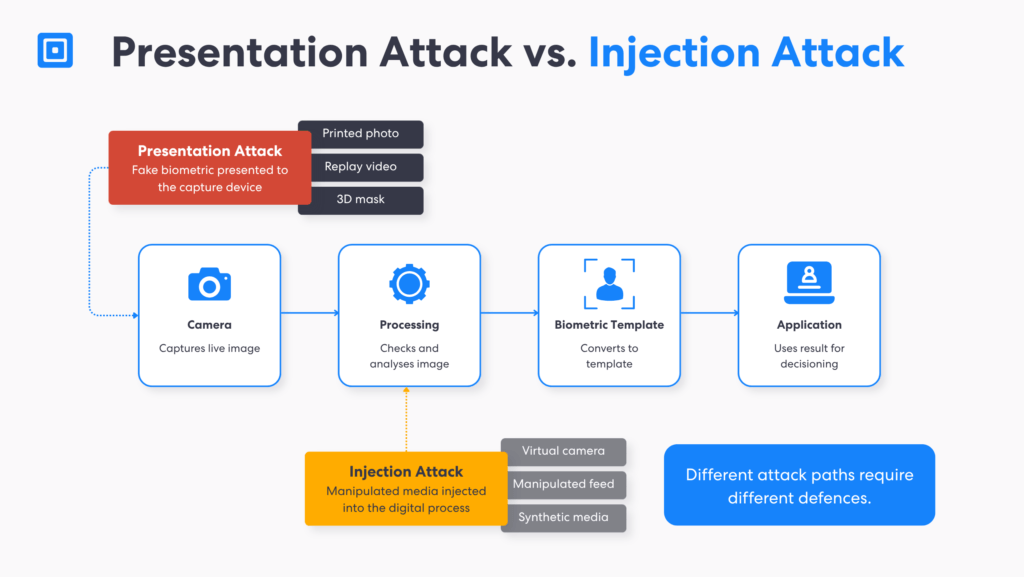
This distinction is important because PAD testing gives evidence about defined presentation attacks within the tested configuration. It should not be treated as evidence that the wider capture pipeline is protected against all injection, malware, deepfake, emulator, or account takeover scenarios.
The specification from the [European Telecommunications Standards Institute (ETSI)](https://www.etsi.org/deliver/etsi_ts/119400_119499/119461/02.01.01_60/ts_119461v020101p.pdf) distinguishes presentation attacks from injection attacks. It also includes requirements related to recorded or AI-generated video streams.
## Evidence to Request for Secure and Seamless Verification
It is important to ask providers of identity verification APIs what evidence they can provide. Asking questions about an SDK, capture source, and session integrity helps enhance security and fraud detection. It helps confirm how suspicious signals can influence the final identity decision. Teams must look for evidence about:
- Presentation attacks
- Injection attacks
- Recorded and artificially generated media
- Capture-source integrity
- The SDK or product version that is being tested
- How suspicious signals impact downstream decisioning
Here is where a Presentation Attack Detection (PAD) test is incredibly valuable. It should not be stretched beyond the deployment model that it actually tests. This helps detect deepfakes and provide robust security in the Biometric Verification API process. You can learn more here: [Presentation Attack Detection: A Comprehensive Guide](https://www.complycube.com/en/presentation-attack-detection-pad-guide/)
## Biometric Verification APIs for Compliance Teams
Compliance teams need not understand the mathematics inside every biometric model or liveness checks. They must know if the organization can rely on the evidence provided and understand if it supports the identity decision.
For many UK organizations, biometric data that has been processed to identify a person receives special protection under UK data-protection laws. They need to identify a lawful basis under Article 6 and a separate condition under Article 9 of the UK General Data Protection Regulation (GDPR). This means they must be able to assess data residency or location, international transfers, retention, access, and deletion as separate governance considerations.
The [UK Digital Verification Services (DVS) Trust Framework](https://www.gov.uk/government/collections/uk-digital-verification-services-trust-framework) requires relevant providers to explain which [Good Practice Guide (GPG) 45](https://www.gov.uk/government/publications/identity-proofing-and-verification-of-an-individual) requirements that their service must support. They also need to outline how the service communicates failure reasons. Buyers must ask for evidence instead of relying on a general statement that a platform is just “GPG 45” compliant.
Compliance teams must understand which biometric data is collected, why it is needed, and where it is processed or stored. They also need to outline who can access it, any applicable subprocessors, as well as retention and deletion controls. This is crucial when auditability becomes important.
For example, if a customer challenges an identity decision six months later, the compliance team should be able to reconstruct what happened. The product configuration should enable compliance teams to see exactly which checks happened, what their outcomes were, and if a journey was approved, failed, or escalated to manual review. For most compliance teams, the ability to explain their decision-making is a practical buying criterion instead of a technical luxury item.
## Biometric Verification APIs for Engineering Teams
For engineering teams, their journey begins when many product demos end. Today, a strong biometric match says little about what happens when technical issues arise. For example, what is the protocol when a network disappears halfway through a sample capture process?
The integration of biometric verification APIs can vary depending on the model that the developers are putting in place. Implementation time can depend on many variables and can change based on deployment model. Buyers must ask biometric verification API providers for a realistic timeline for a thorough rollout.
Most product demos do not explain how the verification retries will work or what happens when a webhook fails. Many engineering teams are also keen to understand how biometric verification API versions are managed. Strong integrations need predictable responses with clear error handling and secure authentication. Engineers want to understand more about observability, versioning, and rate controls.
The [Open Worldwide Application Security Project](https://owasp.org), also known as OWASP, highlights many risks for engineering teams such as broken authentication, broken object-level authorization, unrestricted resource consumption, and improper API inventory management. Security cannot begin and end with the biometric algorithm.
## How to Assess Customer Experience and Operational Performance
Security is often only half of a remote identity journey. The system needs to let real customers prove who they are. This means that compliance, engineering and product teams must evaluate operational performance together. It is important to measure the entire journey and understand some useful metrics such as completion rate, verification time, and abandonment.
If these metrics are measured against representative users and realistic operating conditions, teams will have a good sense of the key features of a biometric verification API. The verification experience that is seamless on the newest smartphone may look and act completely differently on older hardware, poor connectivity or difficult lighting.
Another part to assess is the recovery process. At some point during the onboarding process, users might experience a loss of connection, move out of frame, or upload a poor image resulting in a failed first attempt. Some users may even close the journey and return later on. This is a regular part of the verification process. It is important then for systems to have four types of journeys:
- **Successful:** Does the standard journey work well?
- **Failed:** Is there a next step for a real failure?
- **Interrupted**: Can the user recover without any additional friction?
- **Suspicious:** Are risk controls responding when the behavior needs it?
### **Case Study: Remote Identity Verification in the UK**
Most applicants to the [EU Settlement Scheme](https://questions-statements.parliament.uk/written-questions/detail/2019-09-02/284214) need to confirm their identity remotely for the UK Home Office. Their goal is to be able to confirm their identity without routinely posting identity documents or travelling to an office. Their service needs to work across many consumer devices while keeping any other alternative routes accessible for users.
##### **Reading Biometric Identity Documents to Access Control**
Some apps, such as the EU Exit: ID Document Check app, allow applicants to use Near-Field-Communication (NFC) enabled devices to access certain supported biometric documents. This allows users to prove their identity completely remotely. These systems validates supported documents remotely, while post and in-person processes remain available.
##### **Outcomes**
- 95% of users successfully used the EU Exit App to prove their identity remotely.
- 75% were able to complete the identity proofing process in under 10 minutes.
- These document checks came from 987 devices across 92 different manufacturers.
## What Does a Biometric Verification API Really Cost?
The price of a REST API only tells part of the story of KYC flows. A usage-based commercial model may charge per biometric verification, face authentication, completed workflow, or individual checks. However, operational costs can add up through retries, additional customer support, manual review, and alternative verification routes.
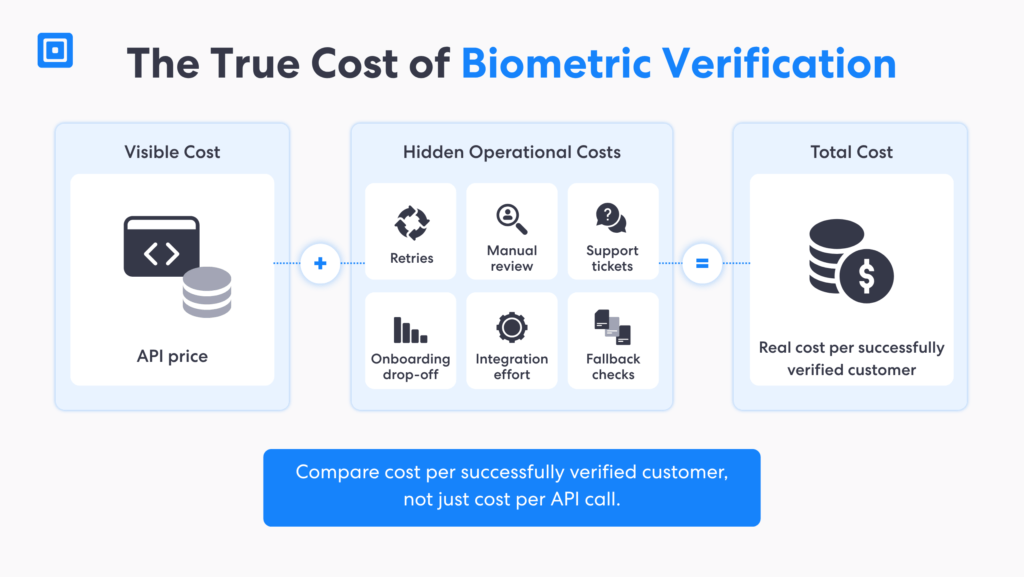
It is necessary to start with the visible charges, then look at implementation, and finally consider operations. Each one of those parts of the journey can change the economics of a biometric verification API. Both compliance and engineering teams must look at what it takes to successfully verify a customer. You can learn more here: [Top 5 Biometric Fraud Detection Platforms of 2026](https://www.complycube.com/en/biometric-fraud-detection-platforms/)
A better measure of success is the cost per successfully verified customer. The verification should also meet the assurance level required for the organization’s use case. It is important to include lost conversion, because the value of a lost customer can vary dramatically between businesses.
## Biometric Verification API Buyer Checklist
Before the whole procurement process closes, it is the responsibility of the compliance and engineering teams to be able to answer a couple of questions about their biometric verification API. They need to have these in place before granting access to users in the verification process. They need to be able to answer the following:
- **Facial biometrics and face matching:** How does biometric performance hold up? What thresholds are they measured at for your company or organization? What similarity or confidence thresholds are they matched at? What false-positives and false-negative rates are readily available?
- **Liveness detection in fraud prevention:** Does this platform offer active liveness, passive liveness, or both? Which manipulation risks is the provider’s security architecture able to manage?
- **Document verification for identity evidence:** In what ways does document verification link to selfie verification and face comparison? Can the system show if a person has the same credentials as the real holder?
- **API and onboarding deployment:** Are the necessary APIs, SDKs, hosted, and webhook options available to us? How do authentication, retries, and duplicate events work? Does the system consider user timeouts, process versioning, and abrupt service interruptions?
- **Biometric data, security, and compliance:** Where is data stored, and how does it move from the capture stage all the way through to deletion? Which retention tools, safeguards, and restrictions are available to us? Where does the data reside, and what are the platform’s audit capabilities? Does it meet international data protection standards?
- **Operational performance:** How does the platform support genuine customers who cannot complete a biometric check? What does the retry process look like? Can they move to another verification or enter a review process without starting their session all over again?
The whole objective for engineering and compliance teams is not to buy the strongest biometric algorithm, but rather to build a strong verification process. They want to make fraudulent access virtually impossible without making real users hard to verify. The pilot version of the system must try to break the journey by testing every possible issue. Only considering successful users is not truly testing the product capabilities.
### Key Takeaways
- **A biometric verification API** must show identity similarity and genuine presence.
- **The wider security model** looks at manipulations across the data capture chain.
- **Face matching** must account for false matches, image quality, and performance.
- **Biometric data needs controls** for processing, security, retention, and deletion.
- **The best identity verification** has compliance assurance, controls, fraud prevention and a seamless customer experience.
## Biometric Verification APIs Built for Real-World Identity Risk
In short, biometric verification APIs work best when many different processes such as document verification, face matching, security, and decisioning operate as one connected process. ComplyCube is designed around that same principle. ComplyCube’s web SDK supports document and selfie capture, including biometric liveness capabilities, and capture-quality checks on the biometric samples that users take.
If you are evaluating biometric verification for your own onboarding or authentication journey, explore ComplyCube’s biometric verification API. [Get in touch with our team](https://www.complycube.com/en/contact/contact-sales/) to discuss assurance, fraud, and integration requirements that your team needs to solve.
[](https://portal.complycube.com/signup)
## Frequently Asked Questions
What makes biometric verification reliable for KYC?
Strong biometric verification blends trusted identity evidence, facial matching, and liveness detection. Systems also look at capture integrity and the appropriate fraud controls. Teams need to understand thresholds and what happens when verification is not clear. No singular biometric score must carry the entire KYC process.
Why is liveness detection important?
Liveness detection can help determine whether a biometric capture comes from a real person instead of a photo, replay, or any other form of presentation attack. Active methods include user interaction, and passive methods happen behind the scenes of a normal capture. It also must address manipulation elsewhere in the capture chain.
What is the difference between face verification and face recognition?
Face verification is normally a one-to-one comparison between a current biometric sample and a previously known reference template. On the other hand, face recognition describes a one-to-many comparison across a larger subset of biometric templates. Remote KYC uses one-to-one verification to figure out if the person presenting matches their claimed identity.
How should biometric data be protected?
Any collected biometric data must be securely transmitted, protected in storage, and retained for a specific purpose and period of time. Biometric verification API buyers need to examine their protocols around data deletion, access controls, sub-processors, and auditability. Any applicable privacy requirements completely depend on their respective jurisdiction and processing purpose.
How does ComplyCube support biometric verification?
ComplyCube’s award-winning biometric verification API brings facial biometrics, liveness detection, and document verification. Today, businesses can build biometric verification into a much wider KYC workflow instead of treating facial comparison as a standalone check. It allows teams to have a connected approach to secure remote verification.
**Categories:** Guides
**Tags:** Biometrics
---
### [The Biggest Right to Work Changes in 2026](https://www.complycube.com/2026-right-to-work-changes/)
**Published:** October 1, 2026
**Author:** Rithu Jagannath
**Excerpt:** Right to Work changes are now live in the UK. See what changed on 1 October 2026 with Home Office guidance, who may fall within scope, how digital verification checks are affected, and what UK employers should review.
**Content:**
As of 1 October 2026, the new right to work changes are live across the UK. The Home Office published 83 pages of employer guidance about how organisations must conduct Right to Work checks under the revised framework.
These changes go beyond traditional employee onboarding. They impact businesses that use contractors, flexible workers, and digital identity services. Employers must review who they check, how the checks are completed, and whether the chosen verification route can give the necessary statutory protections.
## What Are The New Right to Work Changes?
The biggest right to work change is who falls within the revised framework and how digital verification works with it. The updated rules broaden the relevance of right to work checks across many different working arrangements.
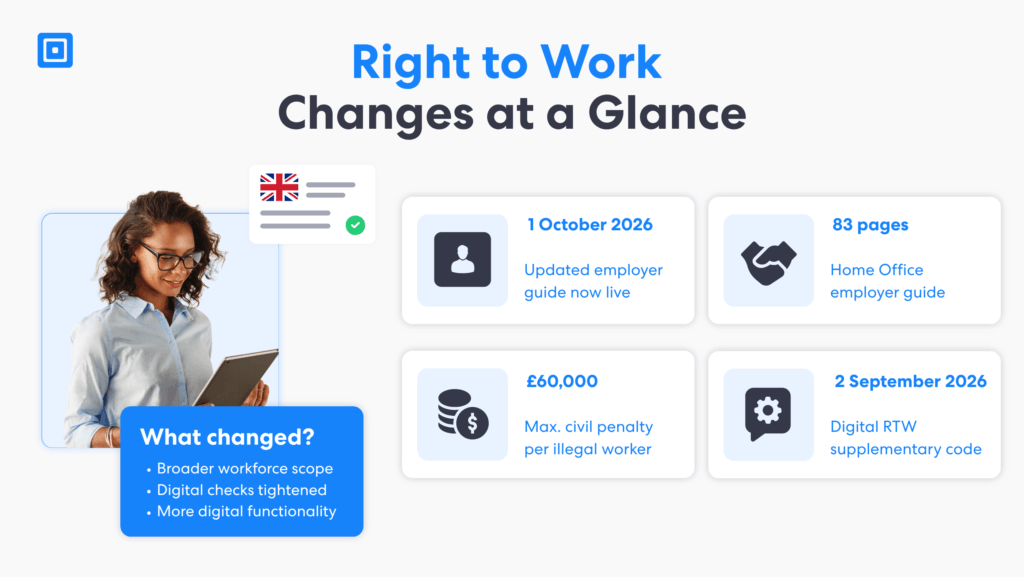
Along with the updated guidance from the Home Office, version 1.1 of the supplementary code for digital right to work checks sets out specific requirements for digital verification providers. It supports employers with Right to Work checks.
## Right to Work Rules Extend Beyond Traditional Employees
There is also an increased focus on relevant worker contracts, individual subcontractors, and some online matching services. This means that businesses with flexible or platform-based workforce models must look [beyond their traditional employees](https://www.complycube.com/en/verify-right-to-work-checks-for-contractors/).
That makes workforce classification an important part of risk management. Businesses need to find out which types of workers sit within the right to work scope. They must ensure that the correct checks take place during onboarding instead of assuming that contractors and other non-employees simply fall outside the rules.
## The Cost of Getting Right to Work Changes Wrong
There are huge consequences for incorrect checks. [According to GOV.UK](https://www.gov.uk/penalties-for-employing-illegal-workers), employers can face a civil penalty of up to £60,000 for each illegal worker where they cannot show that the prescribed checks were completed. That is also why the audit trail for each check is important. Digital verification lowers manual friction. Employers must ensure they carry out the appropriate checks and retain the evidence needed to establish a statutory excuse.
## What Hasn’t Changed for Employers?
However, [digital verification](https://www.morganlewis.com/pubs/2026/08/expansion-of-uk-right-to-work-rules-part-3-digital-verification-identity-matching-and-onboarding) does not mean that every right to work process needs to be digital. Moreover, using technology does not transfer the employer’s underlying responsibility to the provider. The updated right to work changes in the Home Office guidance show how employers must conduct initial checks and follow-ups using the correct routes.
The purpose is still to establish that a candidate is permitted to perform the work. Home Office needs assurance that the prescribed requirements have been followed to establish a statutory excuse against a civil penalty. Employers need both the right technology and internal processes.
## What Should Employers Do Following 1 October 2026?
Three [immediate areas of right to work changes](https://www.complycube.com/en/what-changed-in-the-2026-right-to-work-legislation/) require team review. Teams must look at workforce scope, verification providers, and any internal processes. Those companies using contractors, subcontractors, or any other flexible workforce models should understand if their existing Right to Work policy covers everyone falling within the updated scope from 1 October 2026.
Employers using digital checks must confirm that their providers meet the applicable certification and registration requirements. They should also review how they manage evidence, follow-up checks, and re-verification. For those managing onboarding at scale, the new right to work framework makes a [consistent verification process](https://www.complycube.com/en/top-5-right-to-work-compliance-software-for-uk-employers-in-2026/) important.
[](https://portal.complycube.com/signup)
Find out more AML news in ComplyCube’s [Trust Edition newsletter](https://www.linkedin.com/newsletters/the-trust-edition-7103022355722981376/). We explore the latest developments across identity verification and AML globally.
**Categories:** News
**Tags:** Regulations
---
### [7 Digital Right to Work Mistakes HR Teams Make](https://www.complycube.com/7-digital-right-to-work-mistakes/)
**Published:** October 1, 2026
**Author:** Rithu Jagannath
**Excerpt:** Read how HR teams can avoid these seven common digital right to work mistakes. Learn how to strengthen right to work in UK processes, and improve every HR right to work check within your teams' existing onboarding flow.
**Content:**
**TL;DR:** HR teams and recruitment agencies are exposed if they use **poor workflows** for their **digital right to work checks**. Most issues are operational and to build a compliant right to work check in UK, teams need the correct check for the right person, at the right time with the proper evidence retained. Learn how to **avoid these seven mistakes for HR** right to work checks.
## Digital Right to Work Is Becoming A HR Problem
As hiring in the UK becomes more digital, recruitment needs to be fast and accessible. Recruitment processes need to be built for remote identity verification especially as more teams use digital onboarding.
According to GOV.UK, [89% of employers](https://www.onrec.com/news/news-archive/one-in-five-uk-recruitment-agencies-has-not-heard-of-the-right-to-work-changes) were confident they were carrying out Right to Work checks correctly. Conducting a check may seem simple, but it is so much more than filling out some paperwork. It is ensuring all of the correct checks are happening to the right person at the exact point that the hiring team expects.
With 1st October 2026 changes in place, it expands the Right to Work scheme to encompass contractors, gig workers, and freelancers. Failing to conduct digital right to work checks to obtain statutory excuses can result in serious civil penalties from the government or result in a prison sentence. Therefore, it is of utmost importance for an employer’s HR team to understand where most failures occur and at what point in time to prevent illegal working.
## Seven Digital Right to Work Mistakes HR Teams Make
Although digital right to work checks make the hiring process faster and more consistent, risks sit outside the check itself. It completely depends on how HR teams route employees or candidates, interpret results, and keep evidence. It is also incredibly important to manage exceptions and follow up when a [worker’s status](https://www.business.gov.uk/support/employment-skills/worker-types-and-employment-status/) changes.
> Right to Work issues rarely happen during the check.
Billy Baird, Account Executive at ComplyCube, says, “They’re more likely to happen in the workflow gaps between verification, HR review, evidence, and follow-ups.” These operational gaps are important to close before they turn into full compliance failures. These are seven common mistakes HR teams must address.
### 1. Putting Every Candidate Through The Same Right to Work Checks
No journey is one and the same especially when it comes to verifying someone’s right to work in the UK. Depending on immigration status, human resource teams may use an original document check. [A good example](https://www.schofieldsweeney.co.uk/knowledge/right-to-work-checks-british-and-irish-nationals/) might be a British or Irish citizen using a valid British or Irish passport. Other examples include qualifying nationality identity documents such as passport cards.
Another way to conduct a digital right to work check is through a UK Home Office service. This applies to non-UK citizens or those in the EU settlement scheme. Here, HR teams can check online immigration status or a share code which is valid for 90 days. [Share codes](https://lawsentis.com/articles/uk-share-codes-explained-2026/) are typically generated by the candidate with their UKVI account especially for folks with digital immigration status.
If neither option works for their prospective applicant, they could use an eligible digital verification agency. However, it still does not take away the responsibility of work compliance from the employer hiring the candidate or sub contract. It is their job to show they carried out the prescribed check to ensure that their candidate is not an illegal worker.
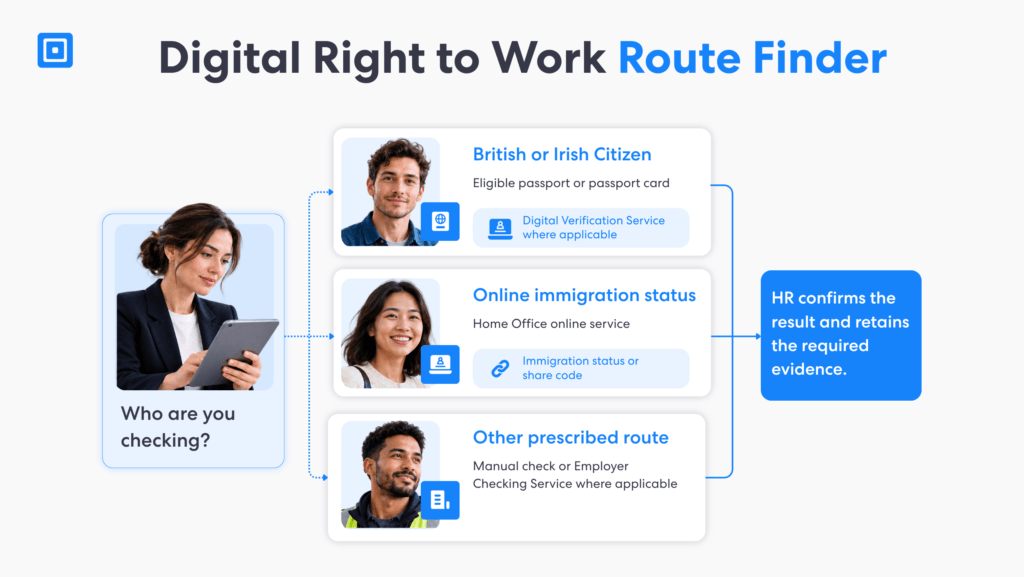
In a [Home Office employer research study](https://www.gov.uk/government/publications/employer-awareness-of-right-to-work-checks/employer-awareness-of-and-self-reported-compliance-with-right-to-work-checks), 79% used manual checks, compared to 37% that used the Home Office online service, and 23% using an Identity Service Provider (IDSP). A strong digital right to work flow must identify the candidate’s correct routing before even starting the verification process. Otherwise, the automation can make the wrong check happen faster. It is important to automate the decision tree, not just the check itself.
### 2. Treating Identity Verification as Proof of Right to Work in the UK Permission
[Identification Document Validation Technology](https://www.vettinggateway.com/post/digital-right-to-work-checks), also known as IDVT, is a digital system that can scan, identify, and authenticate data from passports, licenses, and biometric residence permits to detect fraud. It verifies identity evidence, but it does not satisfy every immigration-status requirement. Providers are allowed to check, providers must also check across several key categories:
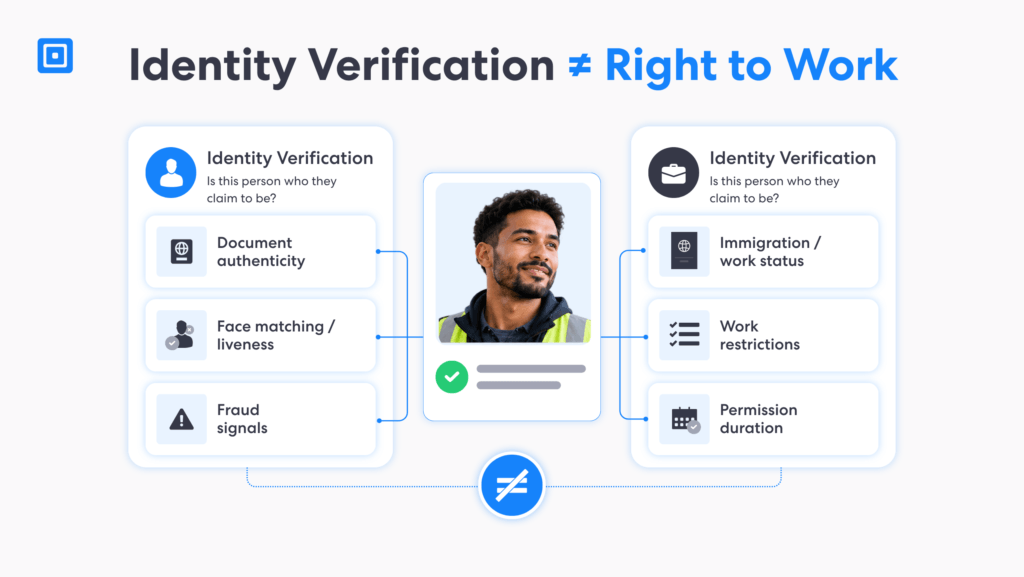
It is the responsibility of HR to differentiate who the person is from whether they can legally perform the work. A real identity could still have restrictions and rules in place on the work that an individual can perform. Identity and right to work status need to connect, but they are not interchangeable.
### **Case Study: Document Checks Mistaken for Right to Work Checks**
In 2025, a [fish-and-chip shop](https://www.bbc.co.uk/news/articles/c8e40rree3zo) hired a worker who presented several records linking to false identities. This included a photocopy of a page from a British passport. Unfortunately, the employer did not conduct the digital right to work check correctly. As a result, the Home Office issued a £40,000 civil penalty.
##### **Structured Digital Right to Work Flow**
HR teams need a strong workflow instead of leaning on documents that merely appear credible. A strong process would route the candidate through the correct prescribed checking method. It would verify identity evidence, retain records, and create a clear audit trail to show how and when the digital right to work check was completed.
##### **Outcomes**
- Was issued £40,000 in civil penalties, but later paid £28,000.
- Many documents did not provide a strong statutory excuse for the worker.
- It is the responsibility of HR teams to verify eligibility and identity the right way.
### 3. Using a Provider Does Not Outsource Extended Liability
To add to the list of responsibilities, HR also must verify if the identity during the digital [right to work check](https://www.ukimmigration.law/uk-immigration/business-corporate/right-to-work-checks/) corresponds with the person that turns up for work at the office. The employer needs to keep the required evidence and proof of statutory excuse for their records.
Employers that [choose a Digital Verification Service (DVS)](https://www.gov.uk/guidance/find-registered-digital-verification-services) path need a UK DIATF-certified service to get the statutory excuse details through that route. Technology should help with compliance, but not transfer accountability.
### 4. Losing the Candidate Between Verification and Hiring
A lot of the time, remote recruitment processes result in a continuity issue specifically around identity. The reason this is particularly important is that [identity fraud, impersonation, and substitution](https://www.complycube.com/en/solutions/identity-assurance/uk-identity-verification-and-fraud-prevention/) play a huge role in contractor and platform work. The [new supplementary code](https://www.gov.uk/government/publications/supplementary-code-for-digital-right-to-work-checks-1-1/supplementary-code-for-digital-right-to-work-checks-1-1) as of 2026, expressly addresses services that are used to confirm that a person carrying out work or services is the same worker on whom the Right to Work check was conducted.
This is where biometric matching or liveness detection can strengthen a remote onboarding workflow for organisations and businesses. Passing the initial check should not result in a blind spot between the verification and work commencing.
### 5. Treating Flexible Workers Like Employees
From[ 1 October 2026](https://www.complycube.com/en/right-to-work-digital-identity-checks/), specified subcontracting arrangements for workers, agency staff, and supply chain workers. It also applies to online matching-service arrangements. These contracts are becoming part of digital right to work checks. The extended liability requirements also impacts relevant [contractual arrangements](https://www.complycube.com/en/verify-right-to-work-checks-for-contractors/). Businesses must know who owns the check across the whole onboarding process. As a result, contracts and onboarding responsibilities must align.
### 6. Completing the Check But Losing the Evidence
[Automation is necessary](https://www.complycube.com/en/compliance-automation-software/), but more importantly, it must produce a retrievable digital record. HR should not rely on random screenshots, emails, or records that sit in someone’s downloads folder. Required evidence must flow into a company’s HR or compliance record. It is the employer’s responsibility to keep prescribed information for the duration of employment plus two years.
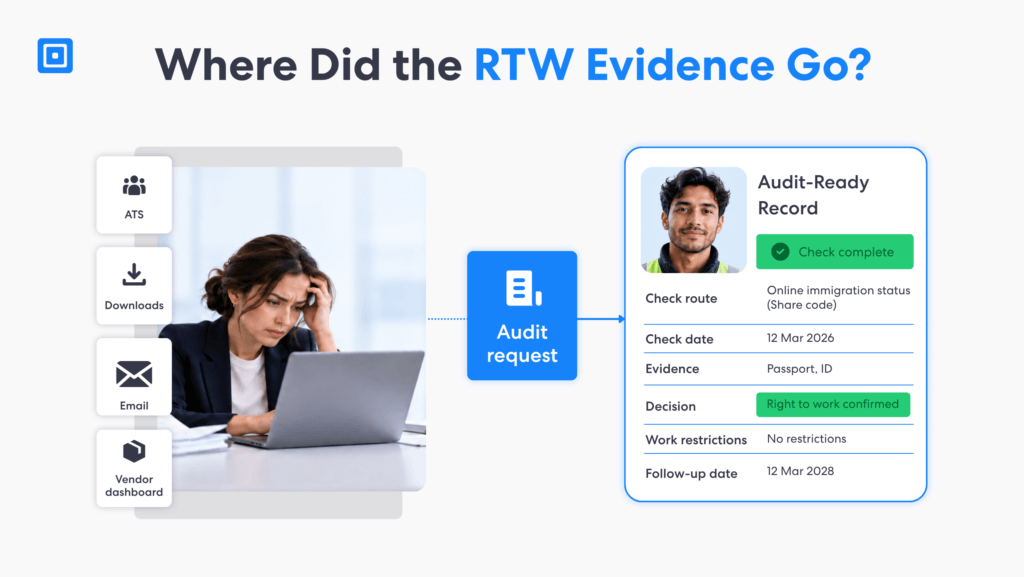
However, retention does come with its own privacy obligations. Keeping everything forever is not considered good compliance. [UK General Data Protection Regulation (GDPR)](https://www.legislation.gov.uk/eur/2016/679/contents) guidance and advice sets the baseline for how employers should retain data. Best practice is to build systems for a future audit, not just initial onboarding.
### 7. Treating Digital Right to Work as a One-Time Onboarding Task
Some workers only have a time limit on their permission to work. As a result, HR teams must demonstrate reviews and follow up checks to prove that they still have permission to work in the UK. As a result, it is important for [HR workflows](https://monday.com/blog/productivity/hr-workflow/) to establish expiry dates and status information. Workflows must also trigger follow up actions on candidates and employees instead of relying on someone’s physical calendar. A workflow must prepare for verification to be ongoing.
## How to Secure Digital Right to Work for HR Teams
A secure process for HR teams must guide prospective candidates or existing employees through the correct route. The program must link identity and work authorisation checks. It must ensure results reach the right HR system with a clear audit trail. You can learn more here: [Top 5 Right to Work Compliance Software for UK Employers in 2026](https://www.complycube.com/en/top-5-right-to-work-compliance-software-for-uk-employers-in-2026/)
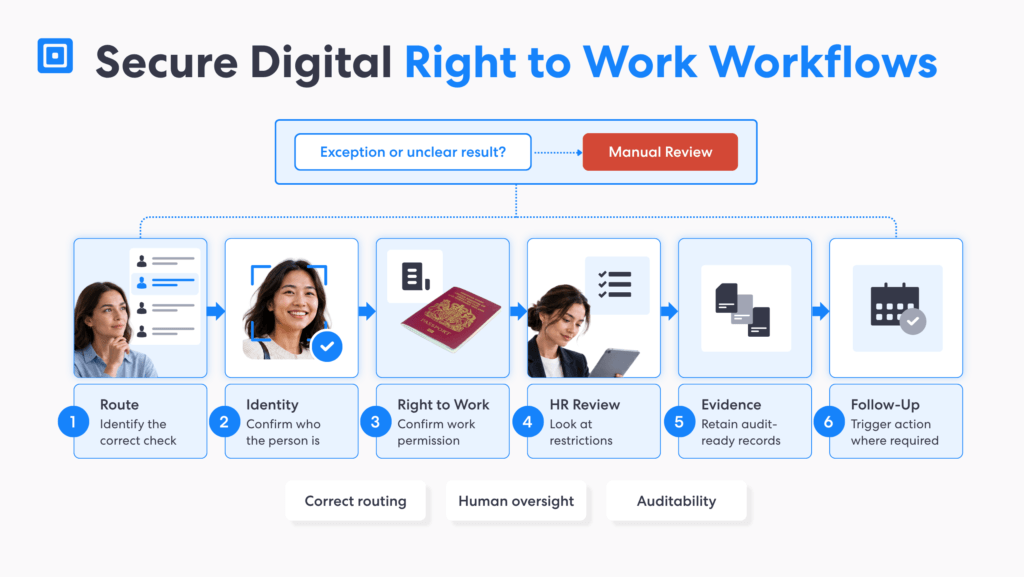
The goal is to remove any manual admin work without removing the human oversight or judgement. Automation helps HR teams see patterns or spot exceptions and lets them demonstrate how quickly each hiring decision was made.
### Questions HR Teams Must Ask About Their Workflows
To be clear, [HR teams](https://www.complycube.com/en/complycube-and-emigreat-partner-for-global-hr-compliance/) do not need more checks for their workflow. They just need to feel confident that the systems they have in place are performing checks consistently. The following three questions help poke holes in HR’s existing workflows:
- Are candidates being sent down the correct Right to Work route?
- Can we prove who was checked, when, and on what basis?
- Does the workflow know when HR needs to act again?
If any of those answers are unclear, this is a huge indicator that the workflow is the main issue and not the verification technology itself. Digital right to work frameworks are meant to prevent exploitation and ensure basic labour standards. They must also aim to balance efficiency with employee privacy and data protection. These [1 October 2026 changes](https://www.complycube.com/en/what-changed-in-the-2026-right-to-work-legislation/) mean that businesses must review contracts for compliance with new regulations.
### Key Takeaways
- Digital Right to Work** goes beyond a single check.
- **Every potential candidate** should not follow the same route.
- **Using a digital Right to Work provider** does not remove employer responsibility.
- Good audit trails** are just as important as speed.
- **Right to Work** requires ongoing action and should not end at onboarding.
## Build Digital Right to Work Into Your Workflow
In summary, HR teams looking to build a digital Right to Work process into a wider onboarding workflow can build it with ComplyCube. Our solution helps link identity verification, work eligibility, and audit-ready evidence in one journey.
Teams can reduce manual gaps in review while keeping control of compliance decisions for HR teams. [Book a demo](https://www.complycube.com/en/contact/contact-sales/) and find out how ComplyCube’s digital Right to Work solution builds a more secure, and consistent hiring process.
[](https://portal.complycube.com/signup)
## Frequently Asked Questions
Can employers complete Right to Work checks remotely?
Yes. Specific Right to Work checks can be done remotely using the UK Home Office online service or an eligible DVS. Employers must follow the prescribed digital right to work check process and they must confirm that the person presenting for work matches the verified identity of the candidate.
How should HR teams choose the correct Right to Work checking route?
HR teams must determine the worker’s immigration status with any available evidence before deciding on what check they must complete. This allows them to route people into the right prescribed check according to UK Home Office guidance. Different candidates may need a manual document check, a Home Office online check, or an eligible DVS.
What records should employers keep after a Digital Right to Work check?
Employers are required to keep evidence that shows who was checks, when it was complete, and the final result. They also must retain any documents that were relied upon during the verification. These records are stored safely and remain easy to gather for any audit purposes. They are also held for a certain period of time as determined by UK GDPR.
Do employers need to repeat Right to Work checks?
Sometimes. Repeat Right to Work checks are needed where a worker has a specific time limit for the permission to work in the UK. HR teams are responsible for tracking any relevant expiry dates, and status changes. They are responsible for ensuring that repeat checks take place before the current Right to Work permission expires.
How can ComplyCube help HR teams with Digital Right to Work checks?
HR teams can embed Digital Right to Work checks into client’s onboarding workflows with ComplyCube. They can combine identity verification, biometric checks, and configurable routing with audit-ready records. Platforms like these can reduce manual work, improve consistency, and make it easier for HR teams to manage evidence and follow-ups.
**Categories:** Guides
**Tags:** Regulations
---
### [AUSTRAC Warns Businesses Against Blanket De-Risking](https://www.complycube.com/austrac-warns-against-blanket-de-risking/)
**Published:** October 1, 2026
**Author:** Dini Habib
**Excerpt:** AUSTRAC has warned firms against blanket de-risking, reinforcing a global shift toward risk-based AML. Debanking can inadvertently increase financial crime risks and cause widespread financial exclusion for vulnerable customers.
**Content:**
On 30 September 2026, the Australian Transaction Reports and Analysis Center (AUSTRAC) cautioned financial institutions against indiscriminately closing or restricting accounts for entire groups of customers deemed “high risk”. This act is referred to as de-risking.
The regulator is urging companies to conduct individual assessments, apply proportionate controls, and adopt a Risk-Based Approach (RBA) to Anti-Money Laundering (AML) and Counter-Terrorism Financing (CTF). The message is clear: greater risk does not necessarily mean restricting customers.
## AUSTRAC Draws a Line on Blanket De-Risking
AUSTRAC’s message is especially pertinent to sectors often affected by debanking, such as remittance providers, Virtual Asset Service Providers (VASPs), fintech companies, not-for-profit organizations, and businesses that rely heavily on cash.
Debanking, also known as de-risking, happens when financial institutions refuse or limit their services because it regards a customer or a group of customers as “too risky”. A higher-risk rating does not automatically justify suspending or terminating user access or a business relationship.
Instead, the regulator expects more [proportionate controls](https://www.austrac.gov.au/news-and-media/article/risk-based-approach-customers-you-assess-be-higher-risk). In particular, businesses should evaluate other risk signals. These include the customer’s jurisdiction, the nature of the transaction, and delivery channels before reaching a decision.
## Why Indiscriminate Debanking Can Increase Financial Crime Risk
At first glance, removing high-risk customers might seem to lower [AML risk](https://www.complycube.com/en/what-is-aml-risk/) exposure. However, widespread debanking can have the reverse effect. For example, excluding legitimate businesses can increase activity towards less regulated services and channels. Additionally, it can make customers less transparent about the nature of their activities if they believe they might lose access to banking services.
> We discourage indiscriminate or widespread account closures across entire sectors.
As such, having full visibility over transactions and suspicious activity will be harder to detect and monitor. Furthermore, debanking can worsen financial inclusion. A registered business may be denied access without justification of a money-laundering threat. This can occur simply because it operates in a high-risk sector.
Most importantly, sector-wide exclusion can weaken a risk-based AML framework. Effective AML compliance requires knowing when to apply step-up verification and enhanced due diligence, and when a customer’s risk is genuinely too high to manage.
## Regulators Are Converging Around the Risk-Based Approach
AUSTRAC’s warning is not unique. In fact, leading regulators have repeatedly advocated the risk-based approach, bringing the focus away from blanket de-risking. Across EMEA, APAC, and AMER, supervisors are echoing the same message: higher risk should trigger investigation, not automatic exclusion.
> Businesses must ensure customers have access to the financial services they need to fully participate in society and are not [denied](https://www.eba.europa.eu/publications-and-media/press-releases/eba-issues-guidelines-challenge-unwarranted-de-risking-and) this access.
The European Banking Authority (EBA) notes that rejecting groups of users without considering individual risk profiles is a telling indication of ineffective AML and CTF risk management. It also emphasizes the negative implications of unsubstantiated de-risking for vulnerable customers and organizations.
> Enforcing [overly](https://brdr.hkma.gov.hk/eng/doc-ldg/docId/getPdf/20160908-1-EN/20160908-1-EN.pdf) stringent CDD processes prevents many legitimate businesses and individuals from opening or maintaining accounts.
Hong Kong mirrors a similar approach. The Hong Kong Monetary Authority (HKMA) stresses the importance of risk differentiation. It notes that effective Customer Due Diligence (CDD) measures must ensure customers and businesses are treated fairly, with transparent and reasonable documentation of compliance decisions.
> De-risking [threatens](https://www.fic.gov.za/wp-content/uploads/2023/09/2017.6-GN-Draft-guidance-on-the-implementation-of-the-amendment-act.pdf) financial integrity and the risk-based approach by creating opacity and eliminating the ability to manage ML/TF risks.
In South Africa, the Financial Intelligence Center (FIC) states that wholesale de-risking to avoid risk goes against the RBA. A proper risk assessment does not require complete risk avoidance. It enables addressing ML and TF risks instead.
> The FATF Standards do not envisage de-risking, or [cutting-off](https://www.fatf-gafi.org/en/publications/High-risk-and-other-monitored-jurisdictions/increased-monitoring-june-2026.html) entire classes of customers.
FATF, the body that sets global standards for fighting ML, TF, and financial crime, has repeatedly warned about de-risking. The regulator emphasizes the need to identify, assess, and understand financial crime risk before making decisions. It also states that jurisdictions under increased monitoring should not invite indiscriminate Enhanced Due Diligence (EDD).
## Implement Effective Risk-Based Approach
While it is crucial to avoid wholesale de-risking, it is equally important to identify, prevent, and mitigate ML and TF risk effectively. As such, the answer is not weaker compliance. Rather, the approach demands precise compliance. It distinguishes entities and users needing scrutiny from risks that cannot be managed entirely.
For an effective, risk-based approach, businesses must identify risk accurately. They should apply proportionate controls and explain why each decision was made.
- **Ongoing risk assessment:** Customer risk can evolve over time. [Ongoing monitoring](https://www.complycube.com/en/solutions/global-screening/continuous-monitoring/) enables businesses to detect changes in a customer’s risk rating in real time. This includes listings across sanctions, adverse media, and Politically Exposed Persons (PEPs) data sources. Continuous monitoring supports AML compliance by providing instant risk alerts, speeding case investigation and regulatory reporting when required.
- **Build strong risk intelligence:** To build a clearer picture of a customer or business’s risk profile, gather robust due diligence and risk intelligence from the outset. Companies should perform Know Your Customer (KYC) checks, including identity verification, liveness detection, and document checks to establish who a customer is. Additionally, fraud intelligence tools, including [device](https://www.complycube.com/en/solutions/fraud-intelligence/device-intelligence/) and email verification, can surface hidden risk indicators and strengthen compliance decision-making.
- **Enhanced due diligence workflows:** Businesses must map higher-risk relationships to proportionate EDD checks, rather than flat-out rejection. Depending on the risk identified, this can include deeper beneficial ownership checks and source-of-funds verification. [KYC smart forms](https://www.complycube.com/en/solutions/compliance-suite/smart-forms/) can give businesses a comprehensive view of a business or customer by capturing intended purpose, expected activity, and supporting documents.
[](https://portal.complycube.com/signup)
Find out more AML news in ComplyCube’s [Trust Edition newsletter](https://www.linkedin.com/newsletters/the-trust-edition-7103022355722981376/). We explore the latest in developments across identity verification and AML globally.
**Categories:** News
**Tags:** Anti-Money Laundering
---
## Pages
### [Homepage](https://www.complycube.com/)
**Published:** October 27, 2021
**Author:** CC
**Content:**
GlOBAL IDV, KYC & AML Platform
# One Platform for Identity Verification, KYC, KYB & AML
Verify identities, prevent fraud, and streamline KYC, KYB, and AML compliance through a single certified platform trusted by regulated and high-growth businesses worldwide. Scale globally with confidence.
[  ](https://www.g2.com/products/complycube/reviews)
[ Start free trial ](https://portal.complycube.com/signup)
[ Get a demo ](https://www.complycube.com/contact/contact-sales/)










GLOBAL Coverage
Know Your Customer
Automate customer due diligence, KYC verification, and onboarding across global markets.
[Explore](/solutions/due-diligence-compliance/know-your-customer/)

POWERFUL Checks
Identity Verification
Verify customers with document checks, eID verification, biometrics, and fraud intelligence.
[Explore](https://www.complycube.com/solutions/identity-assurance/biometric-verification/)

Complete solution
Anti-Money Laundering
Screen customers against sanctions, PEPs, adverse media, fraud databases, and AML watchlists.
[Explore](https://www.complycube.com/solutions/due-diligence-compliance/anti-money-laundering/)
## Build trust, fight fraud, and grow with confidence
Explore how identity verification, KYC, AML, and fraud prevention solutions help businesses reduce risk, strengthen compliance, and scale across industries and use cases.
Process Industry Roles
[KYC Verification](https://www.complycube.com/use-cases/process/know-your-client/) 
### KYC Verification
Streamline customer due diligence with identity verification, risk assessment, sanctions screening, and ongoing monitoring to support compliance across global markets.
[Customer Onboarding](https://www.complycube.com/use-cases/process/customer-onboarding/) 
### Customer Onboarding
Build fast, compliant onboarding journeys with identity verification, risk scoring, and automated decisioning to reduce friction while maintaining trust and compliance at every stage.
[Age Verification](https://www.complycube.com/use-cases/process/age-verification/) 
### Age Verification
Protect age-restricted products and services with document verification, biometric checks, and age estimation that helps prevent underage access across digital channels.
[Financial Services](https://www.complycube.com/use-cases/industry/financial-services/) 
### Financial Services
Streamline customer onboarding, identity verification, KYC checks, AML screening, and ongoing monitoring across banking, payments, lending, and investment services.
[Crypto](https://www.complycube.com/use-cases/industry/crypto/) 
### Crypto
Support compliant onboarding for crypto exchanges, digital asset platforms, and Web3 businesses with identity verification, KYC, AML screening, fraud prevention, and risk monitoring.
[Telecoms](https://www.complycube.com/use-cases/industry/telcoms/) 
### Telecoms
Verify subscribers, support SIM registration requirements, and reduce identity fraud through fast, compliant onboarding and identity verification workflows across telecom networks.
[MLROs](https://www.complycube.com/use-cases/profession/money-laundering-officers/) 
### MLROs
Give MLROs a real-time view of customer risk, AML screening results, ongoing monitoring alerts, and compliance workflows to support effective financial crime oversight.
[Fraud Analysts](https://www.complycube.com/use-cases/profession/fraud-analysts/) 
### Fraud Analysts
Investigate suspicious activity, monitor risk signals, analyze fraud patterns, and manage alerts through configurable fraud prevention and investigation workflows.
[UX Specialists](https://www.complycube.com/use-cases/profession/ux-specialists/) 
### UX Specialists
Create seamless onboarding experiences with flexible SDKs, embedded workflows, and low-friction identity verification journeys that improve conversion and user satisfaction.
[Explore all use cases](https://www.complycube.com/use-cases/)
Numbers that back it up
## Why ComplyCube?
Trust is often won or lost in the first customer interaction. Yet many businesses still face a trade-off between growth, compliance, and fraud prevention.
ComplyCube eliminates that trade-off by bringing identity verification, KYC, KYB, AML screening, and fraud prevention together in a single platform built for growth. The result is faster onboarding, higher conversion rates, and simplified compliance.
10+ million
Transactions processed week in, week out across global markets.
220+
Countries and territories supported for seamless global onboarding.
3,000+
Data sources and risk signals for smarter identity and compliance decisions.
98%
Onboarding success rate that maximizes conversion and reduces friction.
## Setting the Standard for Digital Identity & Trust
Recognized by leading industry bodies, independent review platforms, and technology communities for innovation and excellence in digital identity, KYC, AML compliance, fraud prevention, and trust for regulated businesses worldwide.






## Security & Compliance, Independently Verified
Trust is the foundation of every identity decision. ComplyCube is independently certified against globally recognized standards for security, privacy, digital identity, and biometric assurance, providing the governance and resilience required to support trusted customer interactions in regulated industries.
Whether verifying identities, onboarding customers, meeting KYC and AML obligations, or combating fraud, organizations rely on ComplyCube to deliver secure, compliant, and scalable trust infrastructure for the digital economy.
[Security & Compliance Center](https://www.complycube.com/en/company/security-compliance-center/)
## Built with developer productivity in mind
Bring identity verification, KYC, and AML into your products without adding unnecessary complexity. ComplyCube is designed to fit naturally into existing workflows and technology stacks.
With flexible APIs, mobile SDKs, hosted workflows, webhooks, and out-of-the-box integrations, engineering teams can get up and running quickly, reduce implementation effort, and accelerate time to production.
[Explore integrations](https://www.complycube.com/developers/ "Explore APIs & SDKs")
## Latest resources
[FlexAML and ComplyCube Tackle Compliance Gaps ](https://www.complycube.com/flexaml-and-complycube/) 
- [News](https://www.complycube.com/category/news/)
### FlexAML and ComplyCube Tackle Compliance Gaps
- [Announcements](https://www.complycube.com/tag/announcements/)
ComplyCube partners with FlexAML to help UK TCSPS tackle growing Anti-Money Laundering through automated business verification, individual authentication, tailored risk assessments and compliance-driven onboarding workflows....
- [ Read more ](https://www.complycube.com/flexaml-and-complycube/)
[What Are Dynamic Workflows?](https://www.complycube.com/what-are-dynamic-workflows/) 
- [Guides](https://www.complycube.com/category/guides/)
### What Are Dynamic Workflows?
- [Know Your Customer](https://www.complycube.com/tag/know-your-customer/)
Discover how Dynamic Workflows transform KYC onboarding with tailored verification journeys, conditional routing, and no-code automation. Learn how businesses reduce friction, improve efficiency, and maintain compliance controls....
- [ Read more ](https://www.complycube.com/what-are-dynamic-workflows/)
[KYC Risk Assessment for Crypto Businesses](https://www.complycube.com/kyc-risk-assessment-for-crypto/) 
- [Guides](https://www.complycube.com/category/guides/)
### KYC Risk Assessment for Crypto Businesses
- [Know Your Customer](https://www.complycube.com/tag/know-your-customer/)
KYC risk assessment is a key process in an effective AML program. It identifies, assesses, and classifies customer and business risk. They are crucial for cryptocurrency businesses to prevent financial crime and ensure compliance....
- [ Read more ](https://www.complycube.com/kyc-risk-assessment-for-crypto/)
[See all resources](https://www.complycube.com/resources/blog/)
---
### [Contact Sales](https://www.complycube.com/contact/contact-sales/)
**Published:** March 23, 2022
**Author:** CC
**Content:**
# Contact our sales team
Our team is happy to answer your sales questions.
Fill out the form and we’ll be in touch as soon as possible.
First name
Last name
Work email
Contact number
Company name
Website
Country
Please select... Afghanistan Albania Algeria Andorra Angola Antigua & Deps Argentina Armenia Australia Austria Azerbaijan Bahamas Bahrain Bangladesh Barbados Belarus Belgium Belize Benin Bhutan Bolivia Bosnia Herzegovina Botswana Brazil Brunei Bulgaria Burkina Burundi Cambodia Cameroon Canada Cape Verde Central African Rep Chad Chile China Colombia Comoros Congo Congo {Democratic Rep} Costa Rica Croatia Cuba Cyprus Czech Republic Denmark Djibouti Dominica Dominican Republic East Timor Ecuador Egypt El Salvador Equatorial Guinea Eritrea Estonia Ethiopia Fiji Finland France Gabon Gambia Georgia Germany Ghana Greece Grenada Guatemala Guinea Guinea-Bissau Guyana Haiti Honduras Hungary Iceland India Indonesia Iran Iraq Ireland {Republic} Israel Italy Ivory Coast Jamaica Japan Jordan Kazakhstan Kenya Kiribati Korea North Korea South Kosovo Kuwait Kyrgyzstan Laos Latvia Lebanon Lesotho Liberia Libya Liechtenstein Lithuania Luxembourg Macedonia Madagascar Malawi Malaysia Maldives Mali Malta Marshall Islands Mauritania Mauritius Mexico Micronesia Moldova Monaco Mongolia Montenegro Morocco Mozambique Myanmar, {Burma} Namibia Nauru Nepal Netherlands New Zealand Nicaragua Niger Nigeria Norway Oman Pakistan Palau Panama Papua New Guinea Paraguay Peru Philippines Poland Portugal Qatar Romania Russian Federation Rwanda St Kitts & Nevis St Lucia Saint Vincent & the Grenadines Samoa San Marino Sao Tome & Principe Saudi Arabia Senegal Serbia Seychelles Sierra Leone Singapore Slovakia Slovenia Solomon Islands Somalia South Africa South Sudan Spain Sri Lanka Sudan Suriname Swaziland Sweden Switzerland Syria Taiwan Tajikistan Tanzania Thailand Togo Tonga Trinidad & Tobago Tunisia Turkey Turkmenistan Tuvalu Uganda Ukraine United Arab Emirates United Kingdom United States Uruguay Uzbekistan Vanuatu Vatican City Venezuela Vietnam Yemen Zambia Zimbabwe
Expected volume
Please select... 0 to 100 checks per annum 101 to 1,000 checks per annum 1,001 to 10,000 checks per annum 10,001 to 100,000 checks per annum 100,001 to 1,000,000 checks per annum 1,000,000+ checks per annum
How did you hear about us?
Please select... Search Engine (Google, Yahoo etc.) Advert - Social Media Advert - Search Engine ComplyCube Email Word of mouth / recommendation Event Blog or Publication Referral Trustradius G2 Capterra Sourceforge Gartner Twitter Instagram Facebook YouTube ChatGPT Perplexity Other AI Tool Github Not Applicable
Message
I understand my personal data will be processed in line with our [Privacy Policy](/privacy-policy/).
Send message
## General questions
---
### [Smart Security Starts with Document Verification](https://www.complycube.com/solutions/identity-assurance/document-verification/)
**Published:** October 27, 2021
**Author:** CC
**Content:**
# Smart security starts with document verification
Safeguard your business leveraging our fast and accurate document verification service. Supporting over 14,000 types of documents, our solution enables global expansion.
[ Start now ](https://portal.complycube.com/signup)
[ Contact us ](https://www.complycube.com/contact/contact-sales/)


### Global coverage
Unrivalled support of over 14,000 document types from 250+ territories.

### Smart checks
Our hybrid strategy merges AI technology with expert human review.

### Minimize friction
Streamline document submission with our UX-optimized components.
DOCUMENT VERIFICATION
## Advanced document verification software
Using the best combination of AI and trained human experts, ComplyCube runs multiple types of checks on ID documents to verify whether they have been compromised, forged, copied from the internet, expired, or blacklisted. Supported IDs include passports, travel documents, driving licenses, national identity cards, residence permits, and visa stamps.
[Learn more](https://www.complycube.com/en/solutions/due-diligence-compliance/know-your-customer/document-authenticity/)



Data extraction
## Streamline processes by auto-filling your customer details
Our OCR engine accurately extracts details, such as names, date of birth, and other information from your customers’ ID documents. This significantly reduces data entry errors and operational risk while enhancing UX and CX. ComplyCube also extracts signatures, ID photos, and MRZ details.
[Learn more](https://www.complycube.com/en/solutions/due-diligence-compliance/know-your-customer/optical-character-recognition/)
BIOMETRIC CHECK
## Combine biometrics for enhanced protection
Our state-of-the-art ISO 30107-3 and PAD Level 2-certified biometric liveness detection technology verifies identities quickly and accurately. Ensure the person presenting the identity document is the same individual. The check provides a comprehensive analysis leveraging biometric and behavioral vectors to give the highest level of assurance.
[Learn more](https://www.complycube.com/en/solutions/due-diligence-compliance/know-your-customer/biometric-facial-recognition/)




NFC VERIFICATION
## Secure, instant and accurate NFC-Based ID Verification
Our NFC verification system integrates RFID analysis, biometric verification, visual checks, PAD-Level 2 certified liveness detection, and security feature validation for robust fraud prevention. This multi-layered approach ensures accurate data extraction, inspects document integrity, and minimizes manipulation risks, providing strong protection and confidence in your onboarding process.
[Learn more](https://www.complycube.com/en/solutions/identity-assurance/document-verification/nfc-verification/)
## Leverage intelligent document verification service today
ComplyCube delivers robust policy assurance, enabling seamless cross-border compliance. Backed by leading financial institutions, ComplyCube provides multi-layered verification with selfie checks, NFC screening, and real-time risk screening, shifting compliance from reactive to proactive.
Exceed FATF and global KYC standards with no-code workflows engineered to simplify and strengthen compliance operations.
[ Start now ](https://portal.complycube.com/signup)


### Global verification
We use Deep Learning and advanced analytics to perform up to 25 analysis points on ID documents, including detailed checks on visual security elements. Our expert human forensics teams complement our AI engine to give you the highest level of confidence.

### Advanced liveness detection
Our platform offers a simple liveness score that is easy to understand. Under the hood, it conducts a multitude of checks, including face depth analysis, micro-expressions detection, occlusion recognition, skin texture analysis, anti-spoofing checks, and more.

### Omni-channel
Our AML & KYC services are available across all major systems, including iOS, iPad OS, Android, Chrome, Firefox, Safari, and Edge. Our SDKs and hosted solutions offer UX-optimized capture components that can be dropped into your application in a matter of minutes.

### Enterprise-ready
Powering publicly listed companies across the globe, ComplyCube meets stringent security, data privacy, and risk management requirements. Data is encrypted at rest and in motion, with a rich audit trail and Roled-based Access Controls (RBAC) available out-of-the-box.
## Trusted by big names






Understanding Document Verification Service
Discover how enhanced Document Verification Software can prevent identity theft and sophisticated fraud in real-time. Explore the mechanics behind document verification solutions today.
[ Go to Guide ](https://www.complycube.com/en/what-is-document-verification/)
[Explore other solutions](https://www.complycube.com/solutions/due-diligence-compliance/know-your-customer/)
## Explore other solutions
[Biometric Verification](https://www.complycube.com/en/solutions/identity-assurance/biometric-verification/) 
### Biometric Verification
Use smart onboarding to seamlessly ensure your customers are genuine. Keep your business safe with ongoing biometric authentication
[View solution](https://www.complycube.com/en/solutions/identity-assurance/biometric-verification/ "Watchlist screening")
[Multi-bureau checks](https://www.complycube.com/en/solutions/identity-assurance/multi-bureau-checks/) 
### Multi-bureau checks
Verify your customer details, such as name, address, DOB, and Social Security Number (SSN) against a wide range of trusted sources.
[View solution](https://www.complycube.com/en/solutions/identity-assurance/multi-bureau-checks/ "Continuous monitoring")
[Sanctions & PEP Screening](https://www.complycube.com/en/solutions/global-screening/sanctions-pep-screening/) 
### Sanctions & PEP Screening
Our Sanctions & PEP Screening solution mitigates bad actors from accessing your service. Global coverage ensures your business scales compliantly.
[View solution](https://www.complycube.com/en/solutions/global-screening/sanctions-pep-screening/ "Adverse media checks")
[View all solutions](https://www.complycube.com/solutions/)
## Frequently asked questions
What types of documents can ComplyCube verify?
ComplyCube supports over 14,000 document types from 250+ regions, including passports, driving licenses, national identity cards, residence permits, and visa stamps.
How does ComplyCube verify the authenticity of documents?
ComplyCube uses a hybrid approach combining AI and expert human reviewers to check for compromises, forgeries, internet copies, expirations, and blacklist status. OCR ensures accurate data extraction.
Is ComplyCube’s document verification software compliant with global regulations?
Yes, ComplyCube meets stringent security and risk management requirements, making it compliant with global regulations, including the EU’s 6AMLD, US Bank Secrecy Act, Australia’s AUSTRAC, and more.
What integration does ComplyCube's document verification service support?
ComplyCube provides one of the largest integration options in the market. It features REST APIs, no-code solutions, web SDKs, CRMs, and rapid deployment via Zapier. Businesses can expect higher time-to-value and quicker testing and deployment cycles.
How does ComplyCube ensure compliance with data privacy laws?
ComplyCube meets high security and data privacy standards. Data processed adheres to global rules, including the EU’s GDPR, US CCPA, and ISO standards. Additionally, the platform offers layered, end-to-end encryption, offering maximum protection from breaches and unathorized access.
---
### [Powerful and smart KYC checks](https://www.complycube.com/solutions/due-diligence-compliance/know-your-customer/)
**Published:** October 27, 2021
**Author:** CC
**Content:**
# Complete KYC Checks for Full Compliance
Achieve global, risk-based compliance with smarter and configurable Know Your Customer (KYC) tools.
Unify identity verification, CDD, AML screening, and ongoing monitoring in one native platform with consistent, traceable, and actionable customer risk decisions.
[ Start now ](https://portal.complycube.com/signup)
[ Contact us ](https://www.complycube.com/contact/contact-sales/)





### Global KYC screening
Verify customers across 250+ territories using global identity, database, and screening coverage.

### Biometric fraud detection
Detect sophisticated spoofing and impersonation attacks with biometric face matching and liveness checks.

### Document authenticity checks
Assess over 3000+ data analysis points to identify tampering, inconsistencies, and fraudulent documents.
BIOMEtric Check
## PAD Level 2 certified biometric and liveness detection
ComplyCube’s ISO 30107 PAD Level 2 biometric checks confirms that a person onboarding is the genuine document holder.
Detect deepfakes, replay attacks, printed photos, and masks with clear biometric confidence signals. Route high-risk users to Enhanced Due Diligence flows with instant risk scoring.
[Learn more](https://www.complycube.com/solutions/identity-assurance/biometric-verification/)






DOCUMENT VERIFICATION
## Global document checks for reliable KYC
Verify over 14,000 document types, including passports, visa stamps, and national ID cards across 250+ regulated territories.
Identify forged, expired, or compromised IDs with advanced OCR data extraction, MRZ analysis, and NFC verification for electronic documents.
[Learn more](https://www.complycube.com/solutions/identity-assurance/document-verification/)
Identity assurance
## Multi-bureau KYC solutions
Instantly verify customer names, DOB, and identity numbers against credit agencies, government authorities, and other trusted data sources.
Apply detailed level of identity assurance via single-source or 2+2 bureau checks according to your risk-based Know Your Customer policy.
[Learn more](https://www.complycube.com/solutions/identity-assurance/multi-bureau-checks/)




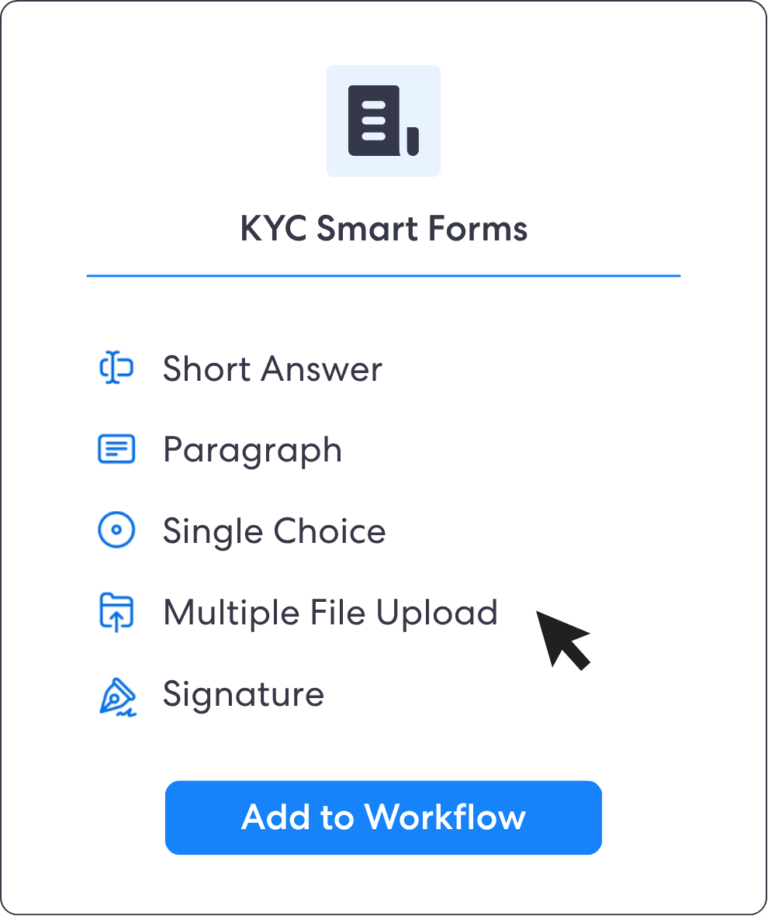
kyc questionnaires
## Capture rich customer details in a single view
Collect source of funds, UBO details, e-signatures, declarations, and more within one KYC workflow to support enhanced due diligence and audit reporting.
[Learn more](https://www.complycube.com/en/solutions/compliance-suite/smart-forms/)
## KYC risk screening for ongoing customer due diligence
Identify changing risks throughout the customer lifecycle by screening customers against global sanctions, watchlists, PEPs, and regulatory sources.

### Global watchlists
Screen against international & local sanctions, exclusion, & watchlists from trusted authorities such as the UN, OFAC, HM Treasury, DFAT, FinCen, FCA, & more.

### Law enforcement
Identify individuals linked to criminal activity through national and international law enforcement sources, including Europol, Interpol, and the FBI.

### Regulatory bodies
Comply with evolving regulatory, enforcement, and financial crime risk indicators that require manual review or Enhanced Due Diligence.
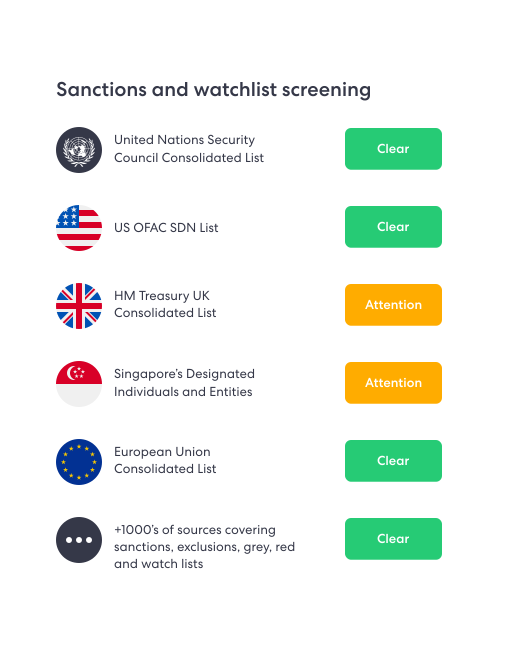
## Certified Know Your Customer (KYC) Solution You Can Trust
Leverage compliant AML and KYC tools internationally recognized with security, quality, and identity assurance certifications.
Automate KYC checks with clear decision records for audit and review, supported by ISO 27001, ISO 9001, and ISO 30107-3 PAD Level 2 assurance.




[ Start now ](https://portal.complycube.com/signup)

### Reduce false positives
ComplyCube’s proprietary matching algorithm accounts for name variations, sequences, transliterations, phonetic similarities, and more so you can identify relevant matches with precision.
Eliminate irrelevant alerts, reduce manual review, and focus your compliance resources on genuine risks that require investigation or Enhanced Due Diligence.

### Global screening coverage
Screen customers against verified global, regional, and local sources with ongoing Know Your Customer solution:
- 3000+ sanctions, PEP, watchlist, and adverse media sources.
- Millions of verified media articles, structured with source details and supporting evidence.
- Clear audit records for investigation and reporting.

### Omni-channel
Embed ComplyCube’s AML & KYC tools across all major systems, including iOS, Android, Chrome, Firefox, Safari, and Edge using APIs, SDKs, or hosted verification flows.
Consistently deliver seamless customer experiences without rebuilding identity checks for each channel.

### Enterprise-ready
ComplyCube meets exceptional standards of security, data privacy, and risk management requirements, so regulated businesses are empowered to operate at scale.
Protect sensitive customer data with encryption in transit and at rest, role-based access controls, and rich audit trails.
## Trusted by big names






How to Choose the Right KYC Provider?
Selecting the right Know Your Customer verification partner can be challenging. Usee this guide to assess KYC providers with confidence and avoid costly gaps in compliance.
[ Go to Guide ](https://www.complycube.com/en/choosing-the-right-automated-kyc-verification-service/)
[Explore other solutions](https://www.complycube.com/solutions/due-diligence-compliance/know-your-customer/)
## Explore other solutions
[Sanctions and PEP screening](https://www.complycube.com/solutions/global-screening/sanctions-pep-screening/) 
### Sanctions and PEP screening
Comply with global AML regulations by screening users against sanctions, PEP, watchlist, and adverse media sources.
[View solution](https://www.complycube.com/solutions/global-screening/sanctions-pep-screening/)
[Real-time continuous monitoring](https://www.complycube.com/solutions/global-screening/continuous-monitoring/) 
### Real-time continuous monitoring
Detect changes and get notifications in real-time when a customer’s risk profile changes with ongoing monitoring.
[View solution](https://www.complycube.com/solutions/global-screening/continuous-monitoring/)
[Document verification](https://www.complycube.com/solutions/identity-assurance/document-verification/) 
### Document verification
Verify identity documents and detect sophisticated anomalies, such as forged, altered, expired, or compromised IDs.
[View solution](https://www.complycube.com/solutions/identity-assurance/document-verification/)
[Biometric verification](https://www.complycube.com/solutions/identity-assurance/biometric-verification/) 
### Biometric verification
Confirm an applicant is the genuine document holder with advanced face matching and liveness detection.
[View solution](https://www.complycube.com/solutions/identity-assurance/biometric-verification/)
[Address verification](https://www.complycube.com/solutions/identity-assurance/address-verification/) 
### Address verification
Verify customer residential address using Proof-of-Address (PoA) documents, databases, and geolocation signals.
[View solution](https://www.complycube.com/solutions/identity-assurance/address-verification/)
[Multi-bureau checks](https://www.complycube.com/solutions/identity-assurance/multi-bureau-checks/) 
### Multi-bureau checks
Match customer identity data against trusted government agencies, credit bureau, and proprietary data sources.
[View solution](https://www.complycube.com/solutions/identity-assurance/multi-bureau-checks/)
## Comparison table
Feature
ComplyCube
Mainstream Solutions
Legacy Solutions
Global PEP and Sanctions


Structed and rich Adverse Media


Real-time monitoring


Advanced biometrics


Customer authentication


Accurate passive liveness


Low-friction active livenes


Multi-bureau checks


Address verification


Scalable API Support


Feature-rich no-code solutions


Flexible low-code solutions


## Feature Highlights
- Global PEP and Sanctions
- Structued adverse media
- Real-time monitoring
- Advanced biometrics
- Customer authentication
- Liveness detection
- Address verification
- Scalable API
- No-code solutions
- Low-code solutions
## Frequently asked questions
How does ComplyCube's Know Your Customer (KYC) solution reduce false positive?
ComplyCube combines multilingual matching, entity resolution, configurable rules, and risk-based automation to return accurate, actionable matches. Its advanced [AI-powered AML screening](https://docs.complycube.com/documentation/product-guides/watchlist-pep-and-adverse-media/aml-screening-check) accounts for transliterations, phonetic similarities, non-latin scripts, and more. As such, compliance teams can prioritize genuine matches, escalate real risks, and significantly remove redundant manual reviews.
Can ComplyCube replace multiple AML KYC solution and vendors?
Yes, ComplyCube can replace multiple third-party Anti-Money Laundering (AML) and Know Your Customer (KYC) solutions and vendors within one platform. Consolidating ComplyCube’s identity verification, fraud, due diligence checks, and reporting into one workflow reduces fragmentation across customer data and supports consistent decision-making.
How does ComplyCube's configurable KYC screening work?
ComplyCube’s configurable KYC screening enables regulated businesses to build risk-based verification workflows tailored to their customers, jurisdictions, products, and compliance requirements. Its screening controls can be adjusted to match the organization’s risk appetite with customizable AML name-match thresholds, fuzzy or precise name matching, match-exclusion rules, minimum-age requirements, and document-capture attempt limits.
Can I integrate ComplyCube's KYC tools quickly?
Yes, ComplyCube’s solutions are built to be [integrated](https://docs.complycube.com/documentation/integration-resources/postman) into your current systems quickly through its API, SDKs, hosted verification flows, and web hooks. Its no/low-code workflows can deploy identity checks, AML screening, KYC questionnaires rapidly within a single customer journey.
How does ComplyCube's KYC solution support compliance?
ComplyCube’s AML and KYC solution supports policies aligned with leading global and regional frameworks, including the Financial Action Task Force (FATF), the U.S FinCEN, Canada’s FINTRAC, the Monetary Authority of Singapore (MAS), Australia’s AUSTRAC, the Dubai Financial Services Authority (DFSA), and more. Businesses can further create bespoke internal policies that work alongside external regulations for full compliance.
---
### [Accounting](https://www.complycube.com/use-cases/industry/accounting-compliance/)
**Published:** June 27, 2024
**Author:** Andreea Balasa
**Excerpt:** AML accounting compliance is at a multi-year low due to the slow adoption of tech. AML software for accountants enables growth and international expansion and gives firms that integrate a KYC solution solution a competitive edge.
**Content:**
# AML and KYC Solutions Built for Accountants
Simplify accounting compliance with AML software for accountants built to automate client onboarding, identity verification, screening, due diligence, and ongoing monitoring. Digitize manual AML accounting services while keeping clear, audit-ready records across the full client lifecycle.


## 1 in 5 accountancy firms reviewed were not fully AML compliant, highlighting the need for automated accounting compliance.
## Trusted by big names






### Faster Client Onboarding
Seamless client acquisition is imperative to new client relationships. Build new client relationships that last with our frictionless solutions.

### Audit-Ready AML Records
Our malleable compliance platform combines accountability with data accessibility. Make smart decisions with the help of intuitive client data.

### Risk-Based Workflows
Firms that employ innovative solutions witness accentuated growth. Lead the pack and set the new standard for accounting compliance.
Revolutionized Client Acquisition
## Accelerate Client Onboarding with KYC
Give new clients a smoother digital onboarding journey while gathering data needed for identity verification, due diligence, and AML screening.
ComplyCube’s hosted and branded workflows help accountancy firms reduce manual document collection, avoid email-heavy onboarding, and create a better first impression.
[View solution](https://www.complycube.com/en/use-cases/process/customer-onboarding/)







Advanced Case Management
## Build Risk Workflows for Every Client Type
Not every client needs the same level of due diligence. ComplyCube helps accountancy firms create configurable AML workflows for various individuals, traders, and companies.
Teams can apply standard CDD, trigger enhanced due diligence where required, and escalate cases for manual review, through one central case management workflow.
[View solution](https://www.complycube.com/en/solutions/due-diligence-compliance/case-management/)
Feature Rich KYC Solutions
## Automate AML Checks for Accountancy Compliance
ComplyCube helps accountancy firms strengthen AML controls across onboarding, sanctions and PEP screening. They also support with adverse media checks, risk scoring, case management and ongoing monitoring.
Automate key checks while keeping clear records of client risk decisions. Smart risk scoring helps teams identify high-risk clients, prioritize enhanced due diligence, and document why a client was approved, escalated, or rejected.
[View solution](https://www.complycube.com/en/solutions/due-diligence-compliance/risk-scoring/)



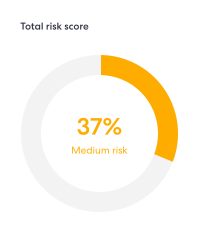

KYC and AML Software for Accountants
Ensuring AML compliance is crucial. Selecting the right AML software for accountants is key to maintaining compliance and protecting against illicit activities. Learn more in our recent guide.
[ Go to Guide ](https://www.complycube.com/en/aml-software-for-accountants/)
[Recommended solutions](https://www.complycube.com/solutions/due-diligence-compliance/know-your-customer/)
## Recommended solutions
[Know Your Customer](https://www.complycube.com/solutions/due-diligence-compliance/know-your-customer/) 
### Know Your Customer
Verify your clients and deter suspicious individuals without adding unnecessary friction levels. Onboard new clients with the knowledge that your firm’s regulatory obligations are protected.
[View solution](https://www.complycube.com/solutions/due-diligence-compliance/know-your-customer/)
[Sanctions and PEP Screening](https://www.complycube.com/solutions/global-screening/sanctions-pep-screening/) 
### Sanctions and PEP Screening
Our global coverage of AML watchlist sources and customizable automation settings empowers compliance with the most rigorous regulations across the world.
[View solution](https://www.complycube.com/solutions/global-screening/sanctions-pep-screening/)
[Ongoing Monitoring](https://www.complycube.com/solutions/global-screening/continuous-monitoring/) 
### Ongoing Monitoring
Maintain your ongoing monitoring requirements easily with our continuous monitoring solution. Our platform feeds you real-time information of your clients’ circumstances.
[View solution](https://www.complycube.com/solutions/global-screening/continuous-monitoring/)
Numbers that back it up
## Why ComplyCube?
ComplyCube gives accountancy firms the tools to automate AML checks, verify clients, and screen for financial crime risk. From small practices to multi-office firms, ComplyCube helps teams standardize client onboarding and reduce manual compliance work.
10+ million
Transactions are processed week in and week out across the globe.
200+
Countries and territories supported for a greater peace of mind.
3,000+
Data points from trusted sources and partners across the world, giving you the highest coverage.
95%
Client onboarding rate, helping you convert more customers and grow your business.
## Frequently asked questions
What is AML software for accountants?
AML software for accountants helps firms automate client due diligence, identity verification, sanctions screening, PEP checks, adverse media screening, risk scoring, and ongoing monitoring. It reduces manual admin while helping firms keep audit-ready records for accounting compliance.
How can accounting firms automate client due diligence?
Accounting firms can automate client due diligence by using digital workflows to verify clients, collect required information, screen for financial crime risk, and route higher-risk cases for review. ComplyCube supports checks for individuals, directors, beneficial owners, and corporate clients.
Do accountants need to screen clients for sanctions and PEPs?
Yes. Accounting firms should identify whether clients, directors, beneficial owners, or connected parties appear on sanctions, PEP, watchlist, or adverse media sources. Automated screening helps firms detect higher-risk relationships earlier and apply appropriate due diligence.
How does ongoing monitoring help accountancy firms?
Ongoing monitoring helps accountancy firms detect changes in client risk after onboarding, such as new sanctions exposure, PEP status, adverse media, or watchlist matches. This supports ongoing due diligence and helps firms maintain stronger AML accounting services over time.
How does ComplyCube support accounting compliance?
ComplyCube supports accounting compliance by combining digital identity verification, AML screening, risk scoring, case management, ongoing monitoring, and audit trails in one configurable platform. This helps accountancy firms replace manual AML processes with faster, more consistent compliance workflows.
---
### [Global Sanctions and PEP Screening](https://www.complycube.com/solutions/global-screening/sanctions-pep-screening/)
**Published:** October 27, 2021
**Author:** CC
**Content:**
# Global Sanctions and PEP Screening
Screen customers against global sanctions lists, PEP screening data, and related-party risk indicators to support customer due diligence and ongoing monitoring. ComplyCube’s sanctions screening software helps compliance teams identify relevant exposure earlier, review matches more efficiently, and apply a more consistent risk-based approach.
[ Start now ](https://portal.complycube.com/signup)
[ Contact us ](https://www.complycube.com/contact/contact-sales/)





### Global PEP screening
Screen against global PEP data across 250+ countries and territories, including foreign, domestic, and international-organization PEPs.

### Reduce false positives
With structured matching, entity context, and risk-based review logic, teams can focus on genuinely relevant sanctions, and PEP matches.

### Automate checks
Automate through APIs, SDKs, and hosted workflows to support consisted checks across onboarding and ongoing monitoring.
Worldwide PEP Checks
## Extensive PEP Screening
Identify politically exposed persons across foreign, domestic, and international roles, together with relevant relatives and close associates, to support proportionate risk-based review.
### Intuitive workflow
Integrate structured PEP screening into your customer due diligence workflow, review potential matches with greater context, and support more consistent escalation decision through:
- Structured profiles
- Broad global coverage
- Linkages to associates and relatives
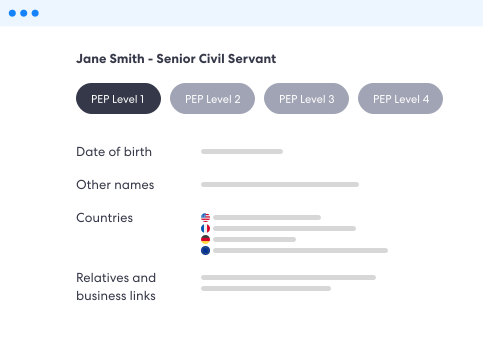


Best Sanctions Screening Software
## New PEP and sanctions profiles are added on an ongoing basis
ComplyCube’s sanctions screening software combines official lists, global screening sources, and structured research inputs to support broader sanctions and PEP coverage. Profiles are normalized into a consistent format and reviewed to support more reliable screening outcomes across sanctions, PEP, and related-party checks.
Unlock insights
## Relationship mapping for deeper sanctions and PEP review
Our graph network helps compliance teams identify direct and indirect business, family, and close-association links that may be relevant to sanctions and PEP risk reviews. This supports informed customer due diligence and stronger risk-based review.



Reduce false positives
## Built to reduce screening noise and support faster match review
ComplyCube combines structured matching, automation, and configurable business rules to help reduce false positives. This helps MLROs and compliance teams review alerts more efficiently and apply decisions more confidently.
## Best PEP Screening and Sanctions Screening Software
We actively screen and monitor your clients against all official lists, such as the UN, EU, OFAC, and OFSI, as well as local and regional lists. Additionally, we monitor against all PEP levels (from head of states to local public officials) and their associations. This helps you stay compliant regardless of your industry or geography.




### Global sanction search
ComplyCube supports sanctions screening across 250+ countries and territories using official regional, local, and commercial sources to help businesses manage screening requirements as they scale.

### Custom lists
Extend sanctions screening and PEP screening checks with your own internal lists of persons, entities, and higher-risk subjects. Custom list ingestion supports faster updates and more consistent internal policy enforcement.

### Omni-channel
Deploy sanctions screening software consistently across web, mobile, API, and hosted workflows. This helps teams maintain a unified screening process across onboarding, due diligence, and ongoing monitoring.

### Enterprise-ready
Designed for high-growth businesses, ComplyCube supports secure and scalable PEP screening and sanctions screening workflows with encryption in transit and at rest, audit trails, and role-based access controls.
## Trusted by big names






Fortifying AML Controls
Sanctions screening and PEP screening can strengthen customer due diligence, support ongoing monitoring and help teams respond to emerging exposure more consistently. Read our guide for more on building a stronger risk-based screening framework.
[ Go to Guide ](https://www.complycube.com/en/what-is-a-sanctions-screening/)
[Explore other solutions](https://www.complycube.com/solutions/due-diligence-compliance/know-your-customer/)
## Explore other solutions
[Watchlist screening](https://www.complycube.com/solutions/global-screening/watchlist-screening/) 
### Watchlist screening
ComplyCube’s comprehensive coverage of global AML watchlist sources and flexible automation features ensures that you comply with the most stringent regulations.
[View solution](https://www.complycube.com/solutions/global-screening/watchlist-screening/ "Watchlist screening")
[Adverse media screening](https://www.complycube.com/solutions/global-screening/adverse-media-checks/) 
### Adverse media screening
Protect your business reputation by screening customers using our AI-powered and highly trusted adverse media service before onboarding them.
[View solution](https://www.complycube.com/solutions/global-screening/adverse-media-checks/ "Adverse media checks")
[Ongoing monitoring](https://www.complycube.com/solutions/global-screening/continuous-monitoring/) 
### Ongoing monitoring
Keep on top of your Ongoing Due Diligence (ODD) obligations with ease, using our continuous monitoring service. You’ll get notified in real-time should your customers’ status change.
[View solution](https://www.complycube.com/solutions/global-screening/continuous-monitoring/ "Continuous monitoring")
[View all solutions](https://www.complycube.com/solutions/)
## Frequently asked questions
What does ComplyCube's PEP screening software cover?
ComplyCube’s PEP screening checks customers against global PEP data to identify politically exposed persons, as well as relevant relatives and close associates. Results are presented in structured profiles with relationship context, helping compliance teams review exposure faster and apply the right level of due diligence.
What does ComplyCube's sanctions screening software cover?
ComplyCube’s sanctions screening software supports checks against official sanctions lists, including sources such as the UN, EU, OFAC, and OFSI, alongside relevant regional and local lists. This helps businesses screen customers across jurisdictions and maintain a broader view of sanctions exposure.
How does ComplyCube reduce false positives in sanctions screening?
ComplyCube reduces false positives through structured matching, entity context, and configurable business rules that helps teams focus on more relevant sanctions screening results. This makes alert review faster, more consistent, and easier to manage to scale.
Can ComplyCube integrate with my existing onboarding or compliance systems?
Yes. ComplyCube can be integrated through APIs, SDKs, and hosted workflows. Businesses can embed PEP screening and sanctions screening into existing onboarding, KYC, AML, and ongoing monitoring processes. This supports faster deployments and a more consistent compliance workflow across channels
Why do businesses choose ComplyCube's sanction screening software?
Businesses choose ComplyCube’s sanctions screening software because it combines official sanctions list coverage, global PEP screening, relationship mapping, and ongoing monitoring in one platform. This helps compliance teams manage screening more efficiently, reducing manual review effort, and supporting risk-based decision-making at scale.
---
### [Security & Compliance Center](https://www.complycube.com/company/security-compliance-center/)
**Published:** May 28, 2024
**Author:** Andreea Balasa
**Content:**
# Security & Compliance Center
ComplyCube combines **identity assurance**, privacy, security, and compliance into a single platform designed for regulated industries. Backed by internationally recognized certifications and trust frameworks, we help organizations reduce risk, protect customer data, strengthen customer onboarding, and meet regulatory requirements across global markets **with confidence**.


### Robust Compliance
Ensure adherence to regulations effortlessly with our multi-certified range of compliance solutions.

### Enhanced Privacy
Safeguard user information with stringent privacy measures and transparent data practices.

### State-of-the-art Security
Experience peace of mind with ComplyCube’s stringent security measures and advanced data protection practices.
## Compliance & Certifications
ComplyCube’s commitment to excellence is reinforced by certifications from multiple esteemed bodies. Our **Trust Center** emphasizes our dedication to top-tier data security and privacy.
Information and Privacy Protection
## ISO/IEC 27001:2022
The world’s most widely recognised standard for **Information Security Management Systems (ISMS)**, our certification to this standard recognizes the robustness of our controls regarding the security of your data.
[Learn more](https://trust.complycube.com/)


Quality Management Systems
## ISO/IEC 9001:2015
This globally recognized standard for **quality management** demonstrates our focus on constantly adapting to meet evolving customer needs and fostering a culture of continuous improvement and excellence.
[Learn more](https://trust.complycube.com/)
CYBER THREAT PROTECTION
## UK Cyber Essentials
In a world where organizations face increasing risks from cyber attacks, certification to this **UK Government-backed Cyber Essentials scheme** demonstrates ComplyCube’s commitment to protecting against such threats.
[Learn more](https://trust.complycube.com/)


Certified Identity Service Provider
## UK DIATF
The **United Kingdom’s Digital Identity and Attributes Trust Framework** outlines best practices and requirements for digital identity providers to meet stringent technical and security standards and protect users’ privacy and data. By adhering to the DIATF, **ComplyCube is certified as a UK Identity Service Provider (IDSP)**.
[Learn more](https://www.complycube.com/en/company/security-compliance-center/uk-diatf-certified-idsp/)
PRESENTATION ATTACK DETECTION
## ISO/IEC 30107-3
ComplyCube’s PAD Level 2 **face-matching and liveness detection system** was tested to assess its reliability in positively identifying spoofed and genuine presentations. The system successfully met the threshold requirements and passed the standards-based test.
[Learn more](https://trust.complycube.com/)


Certified Identity Service Provider
## ACCS 4:2020 Technical Requirements for Age Check Systems
ComplyCube was independently certified by the Age Check Certification Scheme (ACCS) to ACCS 4:2020 for Age Check Systems and ACCS 2:2021 for Data Protection and Privacy, incorporating PAS 1296:2018, with **zero non-conformities**. This underscores ComplyCube’s commitment to **protecting minors online** across various sectors.
[Learn more](https://trust.complycube.com)
## Privacy-first Compliance
ComplyCube adheres to international privacy laws, including the **UK GDPR**, **EU GDPR** and US Data Privacy laws such as the **CCPA**. This ensure the privacy and security of our customers’ data. We continue to monitor and improve our processes, controls and privacy frameworks on an ongoing basis. For more information, please see our [Privacy Policy](https://www.complycube.com/en/privacy-policy/).
### EU GDPR Compliance
ComplyCube’s policies, procedures, and controls for processing EU residents’ personal data fully comply with EU GDPR requirements. Annual external and internal evaluations ensure ongoing compliance.
### UK GDPR and DPA 2018 Compliance
ComplyCube has embedded UK GDPR and DPA 2018 requirements throughout its data protection framework. Regular internal and external assessments help ensure ongoing compliance with UK data protection standards.
### ACCS 2:2021 Technical Requirements for Data Protection and Privacy
ComplyCube has been independently audited and certified to meet ACCS 2:2021 Data Protection and Privacy requirements, approved by the ICO under Articles 57(1)(n) and 58(3)(f) pursuant to Article 42(5) of the UK GDPR.

## Robust Security
The digital age necessitates stringent security and privacy measures. Every byte of data is valuable, and every interaction must be safeguarded. At ComplyCube, our proprietary technology is designed with this principle at its core, providing unmatched security to our customers. Our commitment to **building trust** starts with a steadfast dedication to **privacy**, **security**, and **quality** in all aspects of our organization.
Information Security Management
ComplyCube has clearly defined security principles, policies, and procedures, which management approves before being communicated and agreed to by employees. Separate information security roles and responsibilities ensure duties are distributed across all security domains.
Employee Vetting
ComplyCube has clearly defined security principles, policies, and procedures, which management approves before being communicated and agreed to by employees. Separate information security roles and responsibilities ensure duties are distributed across all security domains.
Development Security
Access to the code repository is managed via an Identity Provider with SSH key authentication. Every code commit triggers automated testing through Continuous Integration (CI), alerting the team to issues like build failures or security vulnerabilities. Releases require explicit initiation by a senior staff member and must pass pre- and post-deployment checks. Rollbacks to specific infrastructure versions can be performed at any time.
Network and Infrastructure Security
ComplyCube’s platform is firmly anchored in Cloud-Native methodologies, adopting industry-leading standards and recommendations, including NIST, DSOMM, CIS Benchmarks, and OWASP. Deployments are released into a dedicated serverless environment, which is protected by multiple layers of security, including Network Firewalls, Web Application Firewalls, and Virtual Private Clouds (VPCs).
Platform Security
ComplyCube’s cloud-first services can be built and deployed to multiple targeted availability zones (AZs) for additional redundancy, resiliency, and improved disaster recovery. ComplyCube uses Amazon Web Services, Inc. (AWS) to host databases, applications, Application Programming Interfaces (APIs), and internal tools.
Data Storage and Backups
ComplyCube does not store data on its premises and has no technical dependency on office networks or locations. Production data is backed up daily, with backups encrypted, stored redundantly across multiple Availability Zones, and secured by our cloud service provider.
Encryption
ComplyCube encrypts data following industry-accepted encryption standards while at rest and in transit to ensure effective protection against unauthorized or unlawful processing. All web traffic through the ComplyCube website is encrypted via HTTPS and every request to the platform goes over a secure TLS channel. Stored data is encrypted using AES-256 encryption.
Authentication
Our platform supports Single Sign-On (SSO), allowing customers to use their existing Identity Provider when logging in. Each request made by an authenticated user undergoes verification against an active session. User sessions are securely maintained within a host cookie exclusive to our platform’s domain.
Authorization
The platform supports the use of multiple roles and access rights to ease access management and least privilege. Members can be assigned specific access rights according to their roles.
All employee platform access is also granted on a “least required access*‘“* principle, and access rights are reviewed at regular intervals.
Incident Response
The platform supports the use of multiple roles and access rights to ease access management and least privilege. Members can be assigned specific access rights according to their roles.
All employee platform access is also granted on a “least required access*‘“* principle, and access rights are reviewed at regular intervals.
## Cross-border Compliance
ComplyCube is certified to the **UK Digital Identity and Attributes Trust Framework (DIATF)** and compliant with both **eIDAS** in Europe and **NIST** standards in the US, ensuring the highest levels of identity assurance and cross-border compliance.
Leveraging the EU-US Digital Identity Mapping Exercise, ComplyCube’s certified DIATF **Levels of Confidence (LoC)** can be mapped to the **Levels of Assurance (LoA)** in Europe and **Identity Assurance Levels (IAL)** in the US.
This alignment demonstrates ComplyCube’s ability to meet the stringent requirements of Very High LoC under DIATF, High LoA under eIDAS, and IAL2 under NIST, providing robust, secure, and interoperable identity verification solutions that facilitate cross-border business and consumer relationships and transactions.

### Committed to Quality
We have established a Quality Governance Structure to ensure adherence to ISO standards and to continually maintain and enhance the performance of our management system.

### Striving for Superior Service
We are dedicated to providing industry-leading services by continuously assessing and improving our processes while fostering a culture of respect, innovation, and stewardship.

### Security & Privacy Training
From their first day, all employees undergo comprehensive GDPR, CCPA, and Information Security Awareness training, which is continuously updated to keep their knowledge current and effective.
SECURITY & COMPLIANCE TRUST CENTER
## ComplyCube Trust Center
For detailed insights into ComplyCube’s commitment to security and compliance, visit our Trust Centre. Explore our robust measures and ongoing initiatives to maintain the highest standards of data protection and regulatory adherence.
[ Learn more ](https://trust.complycube.com)

[Explore our solutions](https://www.complycube.com/solutions/due-diligence-compliance/know-your-customer/)
## Explore our solutions
[Sanctions & PEP screening](/solutions/global-screening/sanctions-pep-screening/) 
### Sanctions & PEP screening
Our screening capability offers comprehensive coverage of sanctioned individuals and companies, as well as Politically Exposed Persons (PEPs).
[View solution](/solutions/global-screening/sanctions-pep-screening/)
[Address Verification](https://www.complycube.com/solutions/identity-assurance/address-verification/) 
### Address Verification
Deliver outstanding customer experiences by confidently and accurately verifying your global customers’ locations in seconds.
[View solution](https://www.complycube.com/solutions/identity-assurance/address-verification/)
[Multi-bureau checks](https://www.complycube.com/solutions/identity-assurance/multi-bureau-checks/) 
### Multi-bureau checks
Instantly confirm customer details like name, address, date of birth, and social security numbers against trusted sources, minimizing user friction.
[View solution](https://www.complycube.com/solutions/identity-assurance/multi-bureau-checks/)
[View all solutions](https://www.complycube.com/solutions/)
## Frequently asked questions
What is identity assurance and why is it important?
Identity assurance refers to the degree of confidence that an individual is genuinely who they claim to be. It helps organizations determine whether identity verification processes are appropriate for the level of risk involved and supports trusted digital interactions.
Strong identity assurance reduces the risk of fraud, impersonation, and identity misuse while helping organizations meet regulatory and customer due diligence requirements. ComplyCube supports multiple internationally recognized identity assurance frameworks, enabling organizations to build trusted onboarding journeys while maintaining security, compliance, and user experience across global markets.
What are identity assurance levels?
Identity assurance levels measure the degree of confidence that a verified identity genuinely belongs to the person claiming it. They help organizations determine whether identity verification processes are appropriate for the level of risk involved.
Higher assurance levels typically require more rigorous verification checks and provide greater protection against fraud, impersonation, and identity misuse. While terminology varies across jurisdictions, the concept is similar. The UK Digital Identity and Attributes Trust Framework (DIATF) uses **Levels of Confidence (LoC)**, Europe’s **eIDAS** framework uses **Levels of Assurance (LoA)**, and the United States **NIST** framework uses **Identity Assurance Levels (IAL)**.
By aligning with recognized assurance frameworks, organizations can strengthen customer onboarding, support customer due diligence requirements, reduce fraud risk, and meet regulatory expectations across different markets and jurisdictions.
What identity assurance standards does ComplyCube support?
ComplyCube aligns with internationally recognized identity assurance frameworks, including the UK Digital Identity and Attributes Trust Framework (DIATF), eIDAS assurance requirements in Europe, and NIST identity assurance standards in the United States.
This enables organizations to deploy identity verification processes with confidence across multiple jurisdictions while maintaining consistent levels of trust, security, and compliance. ComplyCube’s certified identity verification capabilities help organizations satisfy regional requirements without the complexity of managing different providers for different markets.
What is a Certified Identity Service Provider (IDSP)?
A Certified Identity Service Provider (IDSP) is an organization that has demonstrated compliance with recognized digital identity standards and trust frameworks for securely verifying identities.
ComplyCube is certified under the UK [Digital Identity and Attributes Trust Framework (DIATF)](https://trust.complycube.com) across all Levels of Confidence and supports 23 certified profiles. This places ComplyCube among a select group of providers capable of supporting specialized use cases such as Right to Work, Right to Rent, and Disclosure and Barring Service (DBS) checks, while delivering high levels of identity assurance, security, and compliance.
How does ComplyCube support secure cross-border identity verification?
ComplyCube aligns with recognized identity assurance frameworks across multiple jurisdictions, including DIATF in the UK, eIDAS in Europe, and NIST standards in the United States. This enables organizations to implement identity verification processes that meet local expectations while maintaining a consistent global onboarding experience.
ComplyCube’s approach is supported by internationally recognized [security, privacy, and quality certifications](https://trust.complycube.com), helping organizations safeguard customer data, meet regulatory obligations, and support digital identity compliance requirements across different regions. This allows businesses to scale internationally without compromising trust, security, or compliance.
How does ComplyCube demonstrate its commitment to privacy and data protection?
Privacy and data protection are embedded throughout ComplyCube’s platform, operational processes, and governance framework. ComplyCube adheres to international privacy requirements, including UK GDPR, EU GDPR, and applicable U.S. privacy regulations, while maintaining independently audited controls and certifications.
The company combines privacy-focused practices with robust security controls, employee training, documented policies, and continuous compliance monitoring. This helps organizations protect customer data, support regulatory obligations, and maintain trust throughout the identity verification process.
Why do certifications matter when choosing an identity verification provider?
Independent certifications provide objective evidence that an identity verification provider has been assessed against recognized standards for security, privacy, quality, and identity assurance. They help organizations perform vendor due diligence and reduce the risk associated with selecting a critical compliance partner.
ComplyCube maintains certifications and independent validations including, but not limited to, ISO/IEC 27001, ISO 9001, Cyber Essentials, UK DIATF certification, ISO/IEC 30107-3 testing, and ACCS certifications. These credentials demonstrate ComplyCube’s commitment to maintaining high standards across security, privacy, operational excellence, and digital identity assurance.
Why do regulated organizations choose ComplyCube?
Regulated organizations choose ComplyCube because it combines identity verification, compliance, fraud prevention, and identity assurance capabilities within a single platform backed by internationally recognized standards and certifications.
By aligning with frameworks such as DIATF, eIDAS, and NIST, while maintaining strong privacy, security, and quality credentials, ComplyCube helps organizations onboard customers with confidence, reduce fraud, support regulatory compliance, and scale across multiple jurisdictions. This combination of trust, compliance, and global capability makes ComplyCube a preferred partner for organizations operating in highly regulated industries.
---
### [Improve KYC with real-time AML monitoring](https://www.complycube.com/solutions/global-screening/continuous-monitoring/)
**Published:** October 27, 2021
**Author:** CC
**Content:**
# Ongoing Risk Detection with AML Monitoring
Customer risk can change long after onboarding. Anti-Money Laundering (AML) monitoring helps teams stay informed by screening customers against sanctions, Politically Exposed Person (PEP), watchlist, and adverse media data. ComplyCube’s AML monitoring software uses continuous monitoring alerts to support ongoing monitoring across the customer lifecycle.
[ Start now ](https://portal.complycube.com/signup)
[ Contact us ](https://www.complycube.com/en/contact/contact-sales/)





### Real-time risk alerts
Our platform allows you to receive alerts when a customer’s sanctions, PEP, watchlist or adverse media status changes.

### Configurable AML rules
Tailor screening logic, risk thresholds, and escalation flows to your Risk-Based Approach (RBA).

### Fast setup options
Launch AML monitoring through APIs, hosted flows, or no-code tools with minimal engineering effort.
Live Customer Screening
## Screen Customer Risk at Scale
ComplyCube’s AML monitoring software helps teams screen customers against sanctions, Politically Exposed Person (PEP), watchlist, and adverse media data at scale.
With continuous monitoring, teams receive email and webhook alerts when a customer’s risk status changes, helping them review updates faster and take action when needed.







Custom Policy Logic
## Set Smarter Rules for AML Risk
Every business has its own Risk-Based Approach (RBA). ComplyCube lets teams configure screening rules, alert thresholds, and review workflows to reflect their compliance policies.
Use ongoing monitoring to keep customer risk profiles current, reduce avoidable false positive, and focus review teams on changes that need attention.
Quick Implementation
## Launch AML Monitoring in Minutes
Start AML monitoring through hosted flows, low-code tools, no-code configuration, or developer-friendly APIs. Complycube is designed to fit into existing compliance operations without heavy engineering work.
Replace manual batch checks without automated screening, alerts, and case workflows that help teams manage ongoing customer reviews more efficiently.


## Start AML Monitoring Without Manual Batch Checks
Use ComplyCube to automate customer screening, receive risk-change alerts, and route reviews into your compliance workflow.
[ Start now ](https://portal.complycube.com/signup)



### Always-on coverage
Monitor customers across global and local data sources with screening designed to support around-the-clock risk visibility.

### Secure by design
Protect customer data through privacy-first verification and due diligence workflows built for regulated businesses.
## Trusted by big names






The Risk-Based Approach
Discover why the risk-based approach is critical for AML controls. Read our recent guide for more information on how your business can effectively identify risks.
[ Go to Guide ](https://www.complycube.com/en/the-evolution-of-the-risk-based-approach-in-aml/)
[Recommended solutions](https://www.complycube.com/solutions/due-diligence-compliance/know-your-customer/)
## Recommended solutions
[Adverse Media Checks](https://www.complycube.com/solutions/global-screening/sanctions-pep-screening/) 
### Adverse Media Checks
Identify relevant negative news and reputational risk signals from trusted global sources. Use adverse media checks to strengthen AML monitoring and support customer risk reviews.
[View solution](https://www.complycube.com/en/solutions/global-screening/adverse-media-checks/)
[Sanctions & PEP Screening](https://www.complycube.com/solutions/global-screening/continuous-monitoring/) 
### Sanctions & PEP Screening
Screen customers against sanctions and Politically Exposed Person (PEP) data to detect exposure changes and support ongoing monitoring obligations.
[View solution](https://www.complycube.com/en/solutions/global-screening/sanctions-pep-screening/)
[Watchlist Screening](https://www.complycube.com/solutions/identity-assurance/document-verification/) 
### Watchlist Screening
Monitor customers against global, regional, and internal watchlists to help identify risk indicators across regulated workflows and customer lifecycle reviews.
[View solution](https://www.complycube.com/en/solutions/global-screening/watchlist-screening/)
## Frequently asked questions
What does ComplyCube's AML monitoring software do?
ComplyCube’s Anti-Money Laundering (AML) monitoring software screens against sanctions, Politically Exposed Person (PEP), watchlist, and adverse media. Compliance teams can detect customer risk changes, receive alerts, and manage review workflows more efficiently.
How does continuous monitoring help compliance teams?
Continuous monitoring helps compliance teams identify customer risk changes as they happen, instead of relying on scheduled review or manual batch checks. It supports faster decisions, clearer audit records, and stronger risk management.
Can ComplyCube support ongoing monitoring after onboarding?
Yes. ComplyCube support ongoing monitoring after onboarding by keeping customer risk profiles across the customer lifecycle. Teams can configure alerts, review rules, and escalation workflows around their Risk-Based Approach (RBA).
Which risk sources can ComplyCube monitor?
ComplyCube can monitor customers against sanctions lists, Politically Exposed Person (PEP) data, watchlists, and adverse media sources. These checks help teams find financial crime, regulatory, and reputational risk signals as customer circumstances change.
How quickly can teams deploy AML monitoring?
Teams can deploy AML monitoring through hosted flows, no-code configuration, low-code tools, or developer-friendly APIs. This gives compliance and product teams flexible setup options based on their technical resources and operational requirements.
---
### [Verify clients with proven multi bureau checks](https://www.complycube.com/solutions/identity-assurance/multi-bureau-checks/)
**Published:** October 27, 2021
**Author:** CC
**Content:**
# Proven Multi Bureau Database Verification Check
With ComplyCube’s Multi Bureau Database Verification check, you can instantly confirm a customer’s identity details against trusted sources and meet KYC/AML requirements.
Digitally verify a customer in seconds without any documents today.
[ Start now ](https://portal.complycube.com/signup)
[ Contact us ](https://www.complycube.com/contact/contact-sales/)





### Reputable sources
Detect any mismatches and suspicious patterns by verifying against multiple, credible data sources.

### Boost onboarding
Significantly reduce false positives and manual review with broader identity database sources.

### Unified platform
Resolve fragmented identity data while reducing reliance on document uploads and selfie checks.
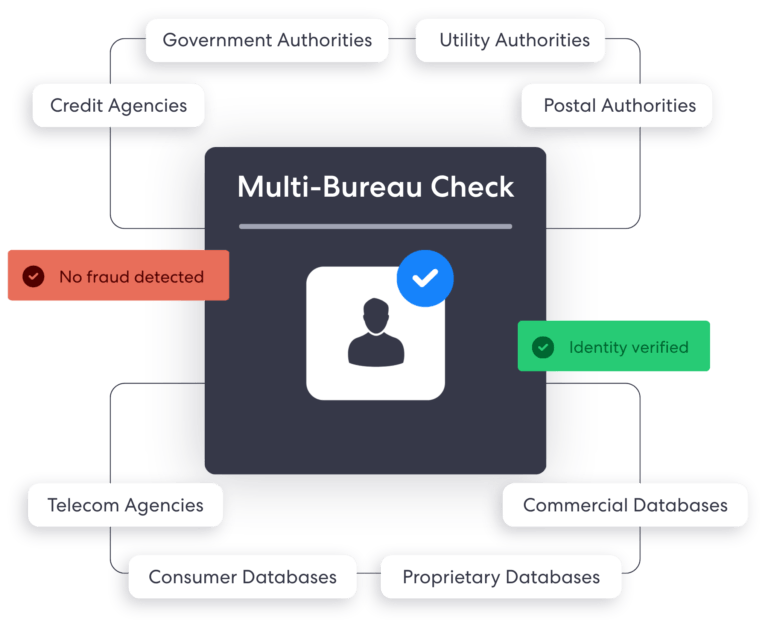
Document-free verification
## Increase verified onboarding rates
Our multi-bureau check corroborates customer details across [trusted](https://docs.complycube.com/documentation/product-guides/identity-verification/multi-bureau-check) credit bureaus, government, utility, commercial, and proprietary databases to verify genuine customers faster.
Use advanced matching engine with fuzzy matching and source data deduplication to detect inconsistencies, duplicate records, and suspicious patterns that a single source may miss.
Global verification
## Strengthen identity confidence with 2+2 checks
Verify customer details with accuracy, speed, and precision in over 250+ territories.
Achieve greater identity confidence with customizable verification rules, from single-source checks to stronger 2+2 verification.





resilient kyc infrastructure
## Business continuity, no disruptions
Reduce reliance on a single data source with robust multi bureau database verification.
ComplyCube’s waterfall mechanism routes checks to alternative sources when one database becomes unavailable, so you can maintain a defensible KYC and AML programme 24/7.
#### Services online
#### 100% uptime
#### downtime
#### Multi-bureau service
100% uptime for the last 90 days
-
-
-
-
-
-
-
-
-
-
-
-
-
-
-
-
-
-
-
-
-
-
-
-
-
-
-
-
-
-
-
-
-
-
-
-
-
-
-
-
-
-
-
-
-
-
-
-
-
-
-
-
-
-
-
-
-
-
-
-
-
-
-
-
-
-
-
-
-
-
-
-
-
-
-
-
-
-
-
-
-
-
-
-
-
-
-
-
-
-
-
-
-
-
-
-
-
-
-
-
#### Web portal
100% uptime for the last 90 days
-
-
-
-
-
-
-
-
-
-
-
-
-
-
-
-
-
-
-
-
-
-
-
-
-
-
-
-
-
-
-
-
-
-
-
-
-
-
-
-
-
-
-
-
-
-
-
-
-
-
-
-
-
-
-
-
-
-
-
-
-
-
-
-
-
-
-
-
-
-
-
-
-
-
-
-
-
-
-
-
-
-
-
-
-
-
-
-
-
-
-
-
-
-
-
-
-
-
-
-
#### Check services
100% uptime for the last 90 days
-
-
-
-
-
-
-
-
-
-
-
-
-
-
-
-
-
-
-
-
-
-
-
-
-
-
-
-
-
-
-
-
-
-
-
-
-
-
-
-
-
-
-
-
-
-
-
-
-
-
-
-
-
-
-
-
-
-
-
-
-
-
-
-
-
-
-
-
-
-
-
-
-
-
-
-
-
-
-
-
-
-
-
-
-
-
-
-
-
-
-
-
-
-
-
-
-
-
-
-
## Exceed regulatory expectations with secure database verification
Leading, regulated businesses use ComplyCube’s multi bureau checks to strengthen customer due diligence and maintain clear risk-based evidence for KYC/AML.
Support secure electronic identity verification (eIDV) aligned with leading regulatory requirements, such as the EU’s AMLD6 CDD, the UK’s risk-based KYC onboarding, the FinCEN’s CIP and SSN/TIN verification, and more.
[ Start now ](https://portal.complycube.com/signup)
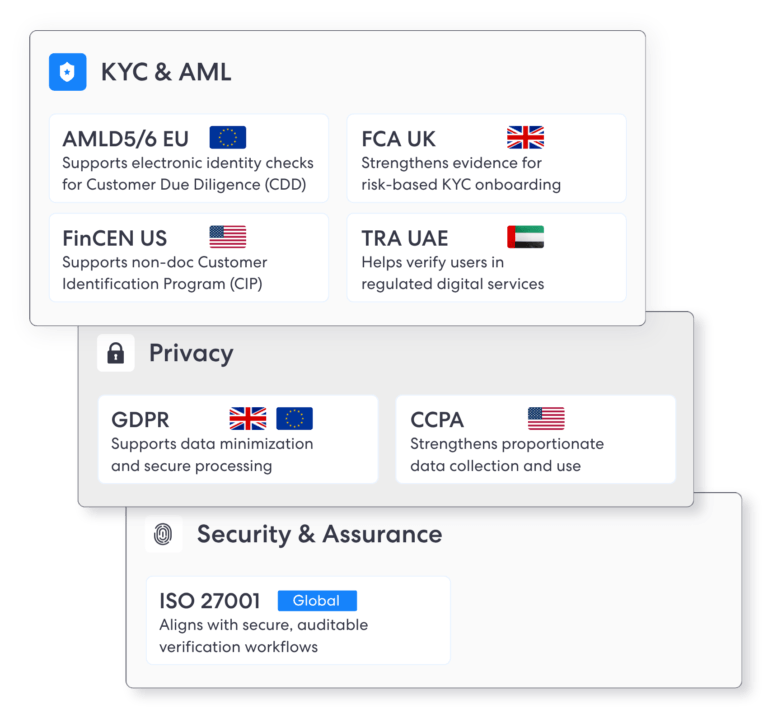

### Omni-channel
Perform KYC and AML checks across all major systems, including iOS, iPad OS, Android, Chrome, Firefox, Safari, and Edge. Our SDKs and hosted solutions offer UX-optimized capture components with minimal friction.

### Enterprise-ready
ComplyCube meets stringent security, data privacy, and risk management requirements. Data is encrypted at rest and in motion, with a rich audit trail and Roled-based Access Controls (RBAC) available out-of-the-box.
## Real-time Global Data Sources
Tier 1 companies across various regulated markets use ComplyCube’s cutting-edge multi bureau database verification check to onboard customers in as little as 3 seconds. Reduce manual paperwork, block fraud risks, and lower abandonment rate with award-winning electronic identity verification (eIDV) solutions.

[FinTech](https://www.complycube.com/use-cases/industry/fintech/)
Assess risk for e-wallets, neobanks, and credit platforms for instant approval and low drop-offs.

[crypto](https://www.complycube.com/use-cases/industry/crypto/)
Perform secure and quicker KYC verification without requiring ID uploads, especially for low-risk users.

[mobility](https://www.complycube.com/en/use-cases/industry/mobility-as-a-service-maas/)
Reliably verify drivers, riders, and fleet partners while preventing false or duplicated accounts.

[healthcare](https://www.complycube.com/use-cases/industry/healthcare/)
Increase trusted access to critical services for patients and clinicians with minimal human error.

[telecom](https://www.complycube.com/use-cases/industry/telcoms/)
Detect and block suspicious and synthetic identities across SIM registration and account opening.

[e-commerce](https://www.complycube.com/use-cases/industry/ecommerce/)
Fast-track BNPL onboarding and reduce fraud risks by verifying high-risk buyers, sellers, and merchants.
## Trusted by big names






Fortify KYC with Multi Bureau Checks
Discover how to prevent fraud on your platform and ensure national and international compliance with expert KYC. Read our recent guide on critical requirements within KYC processes.
[ Go to Guide ](https://www.complycube.com/en/critical-kyc-requirements-for-customer-loyalty/)
[Recommended solutions](https://www.complycube.com/solutions/due-diligence-compliance/know-your-customer/)
## Recommended solutions
[Biometric Verification](https://www.complycube.com/en/solutions/identity-assurance/biometric-verification) 
### Biometric Verification
Our proprietary selfie verification service is PAD level 2 certified, ensuring your platform receives the highest level of identity assurance possible.
[View solution](https://www.complycube.com/en/solutions/identity-assurance/biometric-verification)
[Age Estimation](https://www.complycube.com/en/solutions/identity-assurance/facial-age-estimation/) 
### Age Estimation
We use the same technology to power our age estimation solution, providing a frictionless yet accurate safeguard for age-gated products or services online.
[View solution](https://www.complycube.com/en/solutions/identity-assurance/facial-age-estimation/)
[Document Verification](https://www.complycube.com/solutions/identity-assurance/document-verification/) 
### Document Verification
Our document verification service offers a market leading time to completion and reliability. Instructions are concise and can be followed in 15 seconds.
[View solution](https://www.complycube.com/solutions/identity-assurance/document-verification/)
## Frequently asked questions
Can I verify customers without documents?
Yes. You can verify customers without requesting document uploads with electronic identity verification (eIDV). This includes multi bureau database verification, where identity attributes can be verified without submitting documents, lowering onboarding friction.
Which data sources do you work with?
We draw information from a range of partners, including credit agencies, government authorities, commercial databases, consumer databases, utility authorities, postal authorities, telecoms agencies, proprietary databases, and many other third party sources. You can learn more about how we do this by clicking [here](https://docs.complycube.com/documentation/product-guides/identity-verification/multi-bureau-check).
How long does a multi bureau check take?
According to industry reports, multi bureau verification typically takes 5 seconds to complete. However, regtech providers, such as ComplyCube, can return results in under 3 seconds due to broader API integrations.
How does a 2+2 check work?
A 2+2 verification is an electronic identity verification method that verifies two unique identity details across two or more distinct databases, such as credit bureaus, utility registries, and government authorities. It strengthens identity assurance by verifying that a customer’s details are accurate across several reliable records.
Is eIDV compliant with KYC regulations?
Yes. Electronic identity verification supports compliance with KYC regulations. Leading regulators, such as the FCA, FinCEN, and MAS, require businesses to verify customer information with trusted, authoritative sources. ComplyCube’s multi-bureau database verification solution supports these requirements.
---
### [Anti Money Laundering Solutions](https://www.complycube.com/solutions/due-diligence-compliance/anti-money-laundering/)
**Published:** October 27, 2021
**Author:** CC
**Content:**
# Smart Anti Money Laundering Solutions
Our sophisticated and easy-to-integrate Anti Money Laundering solutions satisfies regulators, prevents Financial Crime (FinCrime), and counters proliferation financing. Our configurable solution empowers businesses’ to implement a Risk-Based Approach.
[ Start now ](https://portal.complycube.com/signup)
[ Contact us ](https://www.complycube.com/contact/contact-sales/)






### Universal compliance
Robust AML check software to satisfy the highest international compliance standards.

### Build trust
Demonstrate your commitment to safeguarding the financial ecosystem with trusted checks.

### Automate checks
Reduce time and cost spent on due diligence with configurable anti money laundering solutions.
Identity verification
## Verify documents and biometrics in seconds
Run multiple types of checks on ID documents to mitigate compromised or forged documents, internet copies, expired IDs, or blacklisted individuals.
Our AI-powered matching algorithms ensure the ID stock image reflects the user signing up to your service with our live selfie biometric verification.
[Learn more](https://www.complycube.com/en/solutions/identity-assurance/biometric-verification/)






Customer Due Diligence
## Premium AML controls to verify user credentials
Use various attributes to calculate a customer’s risk score, including country, political exposure, sanction screening, adverse media, and occupation risks.
Our risk engine applies proprietary algorithms to calculate an AML risk score for your customer profile and presents you with a simple low, medium, or high score to determine if Enhanced Due Diligence (EDD) is required.
[Learn more](https://www.complycube.com/en/solutions/due-diligence-compliance/customer-due-diligence/)
Complete Compliance
## 24/7 global AML coverage
Our automated solution ensures your AML/KYC system experiences zero downtime, and the user experience is flawless every time.
Quickly adapt to the changing global regulatory landscape and expand into new and existing jurisdictions without re-engineering your processes.



[  ](https://www.un.org/en/)
[  ](https://finance.ec.europa.eu/financial-crime/anti-money-laundering-and-countering-financing-terrorism-eu-level_en)
[  ](https://home.treasury.gov/)
[  ](https://www.gov.uk/government/organisations/office-of-financial-sanctions-implementation)
## Real-time screening with automated Anti Money Laundering solutions
Actively screen and monitor your clients against all official lists, such as the UN, EU, OFAC, and OFSI, as well as local and regional lists.
Additionally, we monitor against all PEP levels (from head of states to local public officials) and their associations. This helps you stay compliant regardless of your industry or geography.

### Identity assurance
Our advanced document and biometric checks enable instant verification while promoting a streamlined user experience. We perform a comprehensive analysis leveraging biometric and behavioral data points to ensure the highest level of assurance.

### Total coverage
Our AML checks & KYC services are available across 250+ regions and major operating systems, including iOS, iPad OS, Android, Chrome, Firefox, Safari, and Edge. Our SDKs and APIs offer UX-optimized capture components that can be integrated in seconds.
## Trusted by big names






Understanding AML Compliance in the UK
Learn more about UK AML regulations and how your business can achieve national and international compliance. Read our latest guide and uncover the UK’s risk-based approach.
[ Go to Guide ](https://www.complycube.com/en/achieving-compliance-uk-aml-regulation/)
[Explore other solutions](https://www.complycube.com/solutions/due-diligence-compliance/know-your-customer/)
## Explore other solutions
[Sanctions and PEP screening](https://www.complycube.com/solutions/global-screening/sanctions-pep-screening/) 
### Sanctions and PEP screening
ComplyCube’s comprehensive coverage of global AML watchlist sources, PEP screening, and flexible automation features ensures that you comply with the most stringent regulations.
[View solution](https://www.complycube.com/solutions/global-screening/sanctions-pep-screening/)
[Real-time Continuous monitoring](https://www.complycube.com/solutions/global-screening/continuous-monitoring/) 
### Real-time Continuous monitoring
Keep on top of your Customer Due Diligence (CDD) obligations easily using our ongoing monitoring service. We notify our customers instantly should your customers’ status change.
[View solution](https://www.complycube.com/solutions/global-screening/continuous-monitoring/)
[Address Verification](https://www.complycube.com/solutions/identity-assurance/address-verification/) 
### Address Verification
Strengthen the quality of user data with our address capture solution. Extract more information with our Proof of Address (PoA) IP and geolocation technologies.
[View solution](https://www.complycube.com/solutions/identity-assurance/address-verification/)
## Frequently asked questions
How quickly can I integrate with ComplyCube?
You can choose from our hosted solution, no-code, low-code, or full API and SDK integration methods. This gives you control over the complexity of your integration with us.
What sanctions vertices do you check for?
We check your users against sanctions lists, official international lists, war crimes, terror attacks, sanctions control & ownership, among many other exclusion lists.
What is an AML risk profile?
Our AML Risk Profile is designed to provide you with the crucial client attributes and information that will help you manage AML risk and apply the correct level of due diligence: Customer Due Diligence (CDD) or Enhanced Due Diligence (EDD).
What is a PEP?
A Politically Exposed Person (PEP) is an individual with authority or power that could be misused or used against them in blackmail. Learn more on our [documentation](https://docs.complycube.com/documentation/checks/aml-screening-check#standard-and-extensive-aml-screening-differences) page.
What jurisdiction does ComplyCube's Anti Money Laundering Solutions cover?
ComplyCube supports multi-jurisdiction compliance with tools designed to meet global and local AML obligations. Its AML offering covers screening against global watchlists, sanctions, PEPs, and adverse media. Additionally, the platform offers policy workflow templates to match jurisdiction-specific requirements. Businesses can leverage our no-code workflows and layer multiple checks in one unified dashboard.
---
### [Smart, simple, secure. Trusted biometric checks](https://www.complycube.com/solutions/identity-assurance/biometric-verification/)
**Published:** October 27, 2021
**Author:** CC
**Content:**
# Smart, simple, secure. Trusted biometric checks.
Use our robust biometric checks to seamlessly ensure your customers are genuine and present during transactions. Keep your business safe with our fast and easy-to-use biometric authentication.
[ Start now ](https://portal.complycube.com/signup)
[ Contact us ](https://www.complycube.com/contact/contact-sales/)




### Fast customer onboarding
Deter criminals while onboarding legitimate customers in under a minute.

### Prevent identity fraud
Our platform uses adaptive AI to detect spoofing, tampering, and stop fraudsters.

### Global customer reach
Our global document database lets you match customer biometrics from all over the world.
BIOMETRIC CHECK
## Robust facial recognition and similarity
Use our advanced ISO 30107-3 and PAD Level 2-certified biometric liveness detection technology to check whether the person presenting the identity document is the same individual. We perform a comprehensive analysis leveraging biometric and behavioral vectors to give you the highest level of assurance.
[Learn more](https://www.complycube.com/en/solutions/due-diligence-compliance/know-your-customer/biometric-facial-recognition/)






Liveness checks
## Cutting-edge liveness detection
Leverage our AI-powered PAD-Level 2 liveness detection to establish genuine customer presence and deter imposters. Our anti-spoofing detection will protect your business from advanced presentation attacks, such as 3D masks, without additional user friction.
[Learn more](https://www.complycube.com/en/solutions/due-diligence-compliance/know-your-customer/liveness-detection/)
Biometric Authentication
## Seamless biometric enrolment and authentication
Use best-in-class guided face capture to deliver frictionless authentication to access Finance, Telecommunications, Travel, Enterprise Services, and much more.
[Learn more](https://www.complycube.com/en/solutions/due-diligence-compliance/know-your-customer/liveness-detection/)


## Start protecting your business with biometric verification.
Safeguard your business against multiple attack vectors, from physical masks to digital tampering. Our guided customer journey protects your business without risking customer retention.
[ Start now ](https://portal.complycube.com/signup)





### Advanced liveness detection
We give you a simple liveness score that is easy to understand. Under the hood, it conducts a multitude of checks, including face depth analysis, micro-expressions detection, occlusion recognition, skin texture analysis, anti-spoofing checks, and more.

### Multiple levels of assurance
For greater identity assurance, we provide Active Liveness fraud deterrence in addition to our standard Passive Liveness checks. We guide customers to record videos completing random challenges through frictionless journey.

### Frictionless customer onboarding
Our SDKs and guided capture components are language agnostic, providing clear localized biometric authentication instructions. The combination of localization and inclusive design ensures more successful biometric checks, smoother customer acquisition, and greater customer retention.

### End-to-end fraud detection
By enrolling biometrics for your customer, we enable you to provide ongoing protection of high-value items and critical services. Not only are you protected from thousands of known bad actors, but you can flag your own, which our machine learning models will alert you to.
## Trusted by big names






Implementing Biometric Verification
Biometric Verification can fortify KYC processes with AI-powered technology, analyzing subtle micro-expressions, skin textures, and more. Read our recent guide for more information.
[ Go to Guide ](https://www.complycube.com/en/how-ai-powers-biometric-identity-verification/)
[Explore other solutions](https://www.complycube.com/solutions/due-diligence-compliance/know-your-customer/)
## Explore other solutions
[Sanctions and PEP screening](https://www.complycube.com/en/solutions/identity-assurance/biometric-verification/) 
### Sanctions and PEP screening
ComplyCube’s comprehensive coverage of global AML watchlist sources and flexible automation features ensures that you comply with the most stringent regulations.
[View solution](https://www.complycube.com/solutions/global-screening/sanctions-pep-screening/ "Watchlist screening")
[Multi-bureau checks](https://www.complycube.com/en/solutions/due-diligence-compliance/case-management/) 
### Multi-bureau checks
Verify your customer details such as name, address, date of birth, and Social Security Number (SSN) against a wide range of trusted sources.
[View solution](https://www.complycube.com/en/solutions/identity-assurance/multi-bureau-checks/ "Continuous monitoring")
[Watchlist screening](https://www.complycube.com/en/solutions/global-screening/sanctions-pep-screening/) 
### Watchlist screening
ComplyCube’s comprehensive coverage of global AML watchlist sources and flexible automation features ensures that you comply with the most stringent regulations.
[View solution](https://www.complycube.com/solutions/global-screening/watchlist-screening/ "Adverse media checks")
[View all solutions](https://www.complycube.com/solutions/)
## Frequently asked questions
What types of documents can ComplyCube verify?
ComplyCube supports over 13,000 document types from 220+ regions, including passports, driving licenses, national identity cards, residence permits, and visa stamps.
How does ComplyCube verify the authenticity of documents?
ComplyCube uses a hybrid approach combining AI and expert human reviewers to check for compromises, forgeries, internet copies, expirations, and blacklist status. OCR ensures accurate data extraction.
Is ComplyCube’s document verification compliant with global regulations?
Yes, ComplyCube meets stringent security, data privacy, and risk management requirements, making it compliant with global regulations such as GDPR, CCPA, and ISO standards.
---
### [Partner program](https://www.complycube.com/company/partner-program/)
**Published:** October 27, 2021
**Author:** CC
**Excerpt:** /*! elementor - v3.7.8 - 02-10-2022 */
**Content:**
# Partner Program
Join our Partner Program to **Accelerate Revenue with ComplyCube** **(ARC**) and grow trust on the internet.
## Why partner with ComplyCube?
**ARC™** aims to help partners build engaging identity verification and customer onboarding experiences, launch faster, and reach more customers with out KYC service. Through our Partner Program, referral partners can monetize their network and support ComplyCube’s mission to build trust at scale on the internet.
- Attractive referral scheme
- Space for global growth
- Access to consultations
- Business architecture support
- All-in-one KYC compliance
- Secure and GDPR compliant
- Effortless integration
- First-class support
- Global solution
- Highly scalable and resilient
- Enterprise-grade security
- Smart workflows
[ Apply today ](https://www.complycube.com/company/partner-program/application-form/)
## Who Partners with ComplyCube
Choose the right partnership for you.

## Technology Reseller
Resell ComplyCube products as your own and utilize our AI-powered solutions to enhance your product offerings.

## Referral Partner
Refer or market our products to send us leads and earn healthy commissions on every successful close.

## Software House
Use ComplyCube’s products and services to meet AML, IDV, and KYC requirements and earn a generous commission.

## System Integrator
Upgrade your products. Combine ComplyCube’s products with your existing portfolio and sell them to your clients.
## Platform partners
Partnering with ComplyCube is the fastest way to let businesses or individuals who use your platform meet their KYC obligations. Whether you build software for retailers, accountants, or financial institutions, partnering with ComplyCube helps you create new revenue streams and scale internationally.
### Industry-leading documentation
Our documentation and client libraries contain everything a business needs to build an integration in a fraction of the time.
### API-first Approach
The ComplyCube ecosystem is built on top of the very same API which developers have access to.
### Powerful SDKs
ComplyCube provides several feature-rich SDKs that let you get up and running faster than ever.

### Integration Guide
Follow our step-by-step guides to build and test your first ComplyCube integration in under 10 minutes!
[ Get started ](https://docs.complycube.com/)
## General questions
How do I become a partner?
Please fill out [our partnership application form](https://www.complycube.com/company/partner-program/application-form/), and we’ll get back to you.
What is your referral structure?
Depending on geographies and target markets, we have very attractive referral incentives.
Are your referral schemes global?
Absolutely, yes. Our current partners span 5 continents and 26 countries.
Do you offer a white-label KYC solution?
Yes, we do.
Are all identity verification and KYC services available to partners?
Yes, they are. Moreover, we have several offerings tailored to specific partner use cases.
[Explore our solutions](https://www.complycube.com/solutions/due-diligence-compliance/know-your-customer/)
## Explore our solutions
[Sanctions and PEP screening](https://www.complycube.com/solutions/global-screening/sanctions-pep-screening/) 
### Sanctions and PEP screening
ComplyCube’s comprehensive coverage of global AML watchlist sources and flexible automation features ensures that you comply with the most stringent regulations.
[View solution](https://www.complycube.com/solutions/global-screening/sanctions-pep-screening/)
[Real-time continuous monitoring](https://www.complycube.com/solutions/global-screening/continuous-monitoring/) 
### Real-time continuous monitoring
Keep on top of your Ongoing Due Diligence (ODD) obligations with ease, using our continuous monitoring service. You’ll get notified in real-time should your customers’ status change.
[View solution](https://www.complycube.com/solutions/global-screening/continuous-monitoring/)
[Document Verification](https://www.complycube.com/solutions/identity-assurance/document-verification/) 
### Document Verification
Our document verification service offers a best-in-class user experience. Your users will love the clear instructions as they are guided through our fast verification process.
[View solution](https://www.complycube.com/solutions/identity-assurance/document-verification/)
[View all solutions](https://www.complycube.com/solutions/)
---
### [Elevate eKYC with Advanced Address Verification](https://www.complycube.com/solutions/identity-assurance/address-verification/)
**Published:** October 27, 2021
**Author:** CC
**Content:**
# Advanced Address Verification for Smart eKYC
Deliver exceptional customer experiences by confidently and accurately verifying the location of your global customer base with our address verification service.
[ Start now ](https://portal.complycube.com/signup)
[ Contact us ](https://www.complycube.com/contact/contact-sales)





### Proof of address verification
Extract data from utility bills and bank statements and verify them against your customers’ details.

### Data verification
Verify customers’ address details against trusted sources, such as government and credit bureaus.

### Address capture
Instantly check, verify and correct your customers’ addresses.
Proof of address Verification
## Accurately verify your customer's Proof of Address (POA) documents
Enhance and automate your KYC controls by dropping in our POA verification service to extract your customer’s address, among other details, and verify them against their provided details and geolocation data.







Address Data verification
## Access trusted global data sources to verify your customer's address
Leverage ComplyCube’s global and extensive data points to match and verify your customer’s address and details against multiple trusted bureaus, including credit agencies, government authorities, utility companies, and commercial databases. Our customizable service only takes a few seconds to perform the verification.
Address CAPTURE
## Enhance address data structures and deliverability with our real-time address lookup service
Parse, standardize, verify, cleanse, and format addresses using a single, simple-to-integrate API. Instantly verifying any address in over 240 countries is made easy by combining proprietary technology with the most comprehensive databases.



## Get started with digital address verification today
Our address verification suite is available through all our channels and can be used to verify your customers immediately.
[ Start now ](https://portal.complycube.com/signup)





### Smart capture flow
Our localized and UX-optimized smart capture flows will guide your customers through the necessary steps to acquire their consent and capture their data and relevant POA documents.

### Global coverage
Regardless of your industry or location, our solution, with a global coverage spanning over 240 countries and territories, can be implemented quickly to ensure your verification processes operate smoothly.

### Omni-channel
Our AML & KYC services are available across all major systems, including iOS, iPad OS, Android, Chrome, Firefox, Safari, and Edge. Our SDKs and hosted solutions offer UX-optimized capture components that can be dropped into your application in a matter of minutes.

### Enterprise-ready
Powering publicly listed companies across the globe, ComplyCube meets stringent security, data privacy, and risk management requirements. Data is encrypted at rest and in motion, with a rich audit trail and Roled-based Access Controls (RBAC) available out-of-the-box.
## Trusted by big names






Advanced Address Verification
Provide outstanding customer experiences by reliably and accurately verifying the locations of your global customers with our address verification service. Learn more in our recent guide.
[ Go to Guide ](https://www.complycube.com/en/the-pertinence-of-proof-of-address-verification/)
[Explore other solutions](https://www.complycube.com/solutions/due-diligence-compliance/know-your-customer/)
## Explore other solutions
[Customer Authentication](https://www.complycube.com/solutions/global-screening/watchlist-screening/) 
### Customer Authentication
Safely and accurately verify your customers’ identities before granting them access to your services.
[View solution](https://www.complycube.com/en/use-cases/process/age-verification/ "Watchlist screening")
[Document Verification](https://www.complycube.com/solutions/global-screening/adverse-media-checks/) 
### Document Verification
Safeguard your business using our global, fast, and accurate documents checks.
[View solution](https://www.complycube.com/solutions/global-screening/facial-age-estimation/ "Adverse media checks")
[Multi-bureau Checks](https://www.complycube.com/solutions/global-screening/continuous-monitoring/) 
### Multi-bureau Checks
Instantly verify customer details, such as name, address, DOB, and social security numbers, against trusted sources.
[View solution](https://www.complycube.com/en/solutions/identity-assurance/customer-authentication/ "Continuous monitoring")
[View all solutions](https://www.complycube.com/solutions/)
## Frequently asked questions
What is address verification?
Address verification is a process used to confirm that a provided address is valid and accurate. It ensures that the address exists and matches official records, reducing the risk of fraud and improving compliance.
Why is address verification important for eKYC?
Address verification is crucial for eKYC (electronic Know Your Customer) processes because it helps verify the identity of customers, ensures compliance with regulatory requirements, and mitigates the risk of fraudulent activities.
Can address verification be integrated with other eKYC processes?
Absolutely. ComplyCube’s address verification can be seamlessly integrated with other eKYC processes, such as identity verification and document verification, providing a comprehensive solution for customer onboarding.
---
### [Apply to ComplyCube's Partner Program](https://www.complycube.com/company/partner-program/application-form/)
**Published:** January 4, 2023
**Author:** CC
**Content:**
# Apply to ComplyCube's partner program
Fill out the form to start the registration process for a win-win partnership
First name
Last name
Work email
Contact number
Company name
Website
Parnership type
Please select... Technology Reseller Referral Partner Software House System Integrator
Country
Please select... Afghanistan Albania Algeria Andorra Angola Antigua & Deps Argentina Armenia Australia Austria Azerbaijan Bahamas Bahrain Bangladesh Barbados Belarus Belgium Belize Benin Bhutan Bolivia Bosnia Herzegovina Botswana Brazil Brunei Bulgaria Burkina Burundi Cambodia Cameroon Canada Cape Verde Central African Rep Chad Chile China Colombia Comoros Congo Congo {Democratic Rep} Costa Rica Croatia Cuba Cyprus Czech Republic Denmark Djibouti Dominica Dominican Republic East Timor Ecuador Egypt El Salvador Equatorial Guinea Eritrea Estonia Ethiopia Fiji Finland France Gabon Gambia Georgia Germany Ghana Greece Grenada Guatemala Guinea Guinea-Bissau Guyana Haiti Honduras Hungary Iceland India Indonesia Iran Iraq Ireland {Republic} Israel Italy Ivory Coast Jamaica Japan Jordan Kazakhstan Kenya Kiribati Korea North Korea South Kosovo Kuwait Kyrgyzstan Laos Latvia Lebanon Lesotho Liberia Libya Liechtenstein Lithuania Luxembourg Macedonia Madagascar Malawi Malaysia Maldives Mali Malta Marshall Islands Mauritania Mauritius Mexico Micronesia Moldova Monaco Mongolia Montenegro Morocco Mozambique Myanmar, {Burma} Namibia Nauru Nepal Netherlands New Zealand Nicaragua Niger Nigeria Norway Oman Pakistan Palau Panama Papua New Guinea Paraguay Peru Philippines Poland Portugal Qatar Romania Russian Federation Rwanda St Kitts & Nevis St Lucia Saint Vincent & the Grenadines Samoa San Marino Sao Tome & Principe Saudi Arabia Senegal Serbia Seychelles Sierra Leone Singapore Slovakia Slovenia Solomon Islands Somalia South Africa South Sudan Spain Sri Lanka Sudan Suriname Swaziland Sweden Switzerland Syria Taiwan Tajikistan Tanzania Thailand Togo Tonga Trinidad & Tobago Tunisia Turkey Turkmenistan Tuvalu Uganda Ukraine United Arab Emirates United Kingdom United States Uruguay Uzbekistan Vanuatu Vatican City Venezuela Vietnam Yemen Zambia Zimbabwe
Expected volume
Please select... 0 to 100 checks per annum 101 to 1,000 checks per annum 1,001 to 10,000 checks per annum 10,001 to 100,000 checks per annum 100,001 to 1,000,000 checks per annum 1,000,000+ checks per annum
Message
I agree to receive the latest updates and relevant offers. Your personal data will be processed in line with our [Privacy Policy](/privacy-policy/).
Send message
## General questions
---
### [Lending](https://www.complycube.com/use-cases/industry/lending-compliance/)
**Published:** April 22, 2024
**Author:** Andreea Balasa
**Content:**
# Lending
**Lending compliance** regulations mandate that credit and BNPL firms must adhere to stringent **KYC lending** policies. We enable a seamless approach to financial regulatory compliance.


## Credit and lending fraud cases have dramatically increased since the pandemic. The FTC reported over 1 million counts of identity theft in 2023.
## Trusted by big names






### Credible Results
Our IDV solutions maximize trust between you and your users, empowering regulatory adherence.

### Continuous Compliance
Our leading continuous monitoring platform provides clients with the tools to make timely decisions to minimize risk exposure.

### Maximize resource allocation
Reduce false positives with our customizable thresholds and optimize operational efficiency by eradicating mundane tasks.
Assure Document Authenticity
## Precise Analysis of All Document Data Points
Our KYC document capture and authentication engine brings a heightened level of precision to document verification.
This process is not only more precise than manual verification but significantly streamlines both client acquisition and internal operational efficiency.
[View solution](https://www.complycube.com/en/solutions/identity-assurance/document-verification/)






Prevent Money Laundering
## Around-the-clock verification
Automate your client acquisition processes with banking-grade Identity Verification solutions.
Autonomously verify user credentials with our partner data sources and monitor their profiles behind the scenes with our continuous AML monitoring solution.
[View solution](https://www.complycube.com/en/solutions/global-screening/continuous-monitoring/ "Protect your business with powerful ID verification")
Enable Global Expansion
## Break down global barriers to entry
Complex foreign jurisdictional regulations shouldn’t restrict growth. Employ the resources to expand across borders without limits.
We can help you onboard customers in over 220+ regions, giving your business the tools to capitalize on fresh markets.
[View solution](https://www.complycube.com/en/use-cases/process/customer-onboarding/)




Understanding KYC and AML in Finance
Discover how you can remain compliant with AML and KYC regulations internationally. Read our guide on how partnering with an advanced KYC platform can reduce fraud and ensure compliance.
[ Go to Guide ](https://www.complycube.com/en/navigating-kyc-vs-aml-compliance-in-finance/)
[Recommended solutions](https://www.complycube.com/solutions/due-diligence-compliance/know-your-customer/)
## Recommended solutions
[Multi-bureau checks](https://www.complycube.com/solutions/global-screening/sanctions-pep-screening/) 
### Multi-bureau checks
Confirm customer information, including name, address, date of birth, and Social Security Number (SSN), by cross-referencing with reliable sources.
[View solution](https://www.complycube.com/en/solutions/identity-assurance/multi-bureau-checks/)
[Customer due diligence](https://www.complycube.com/solutions/global-screening/watchlist-screening/) 
### Customer due diligence
Whether you require Customer Due Diligence (CDD) or Enhanced Due Diligence (EDD), our onboarding services ensure thorough vetting and safety.
[View solution](https://www.complycube.com/en/solutions/due-diligence-compliance/customer-due-diligence/)
[Watchlist screening](https://www.complycube.com/solutions/due-diligence-compliance/case-management/) 
### Watchlist screening
Our watchlist services offer extensive coverage, ensuring you can conduct thorough background checks and maintain security and compliance.
[View solution](https://www.complycube.com/en/solutions/global-screening/watchlist-screening/)
[View all solutions](https://www.complycube.com/solutions/)
Numbers that back it up
## Why Complycube?
The ComplyCube platform offers **the most complete and flexible** KYC tools to help you build trust in your business. Whether you’re a startup or a multinational enterprise, we’ve got you covered.
10+ million
Transactions are processed week in and week out across the globe.
220+
Countries and territories supported for a greater peace of mind.
3,000+
Data points from trusted sources and partners across the world, giving you the highest coverage.
98%
Client onboarding rate, helping you convert more customers and grow your business.
---
### [Remittance](https://www.complycube.com/use-cases/industry/remittance-compliance/)
**Published:** April 4, 2024
**Author:** Andreea Balasa
**Content:**
# Remittance
As global hostilities and human displacement rise, reliance on international money transfers has never been higher. Our **Remittance compliance services** enable security in transactions and safeguard your operations.


## Remittance solutions enabled the industry to exceed its annual projections for $650 billion in net transactions to low or middle-income countries.
## Trusted by big names






### Minimize False Positives
Maximize efficiency and Streamline internal operations. Cut costs by reducing false positives by up to 81%.

### Smooth Client Acquisition
We deliver a seamless onboarding process to increase customer satisfaction, minimize failed signups, and reduce churn.

### Reduce Customer Acquisition Costs
Reduce customer acquisition costs by up to 73% and cut down KYC onboarding time from days to minutes.
Anti-Money Laundering Compliance
## AML Tools to Validate Compliant Users
Our continuous monitoring technologies enable around-the-clock protection from threats of fraud, money laundering, and related financial crime.
We boast a comprehensive suite of ongoing AML monitoring tools, providing you with security and information on users from around the globe.
[View solution](https://www.complycube.com/en/solutions/due-diligence-compliance/anti-money-laundering/)






Unlock New Money Markets
## Expand Your Reach Without Limits
Take command of remittance compliance in new and existing markets with our expansive suite of global tools.
Operating in 220+ regions and accepting 13,000+ KYC documents, we facilitate seamless expansion into new markets, ensuring you can work with clients anywhere.
[View solution](https://www.complycube.com/solutions/identity-assurance/document-verification/ "Protect your business with powerful ID verification")
Precise Biometric Verification
## Instant Identity Authentication
Bolster your identity authentication process with an instant and reliable biometric service for remittance solutions. Increase precision and reduce customer acquisition costs.
We leverage proprietary face-matching AI technologies to identify similarities between KYC documents and selfies in one smooth process.
[View solution](https://www.complycube.com/solutions/identity-assurance/biometric-verification/)




Navigating KYC and AML Compliance
Learn how your business can navigate maintaining compliance with national and international AML and KYC regulations. Fortify your operations with an AI-powered platform.
[ Go to Guide ](https://www.complycube.com/en/navigating-kyc-vs-aml-compliance-in-finance/)
[Recommended solutions](https://www.complycube.com/solutions/due-diligence-compliance/know-your-customer/)
## Recommended solutions
[Sanctions & PEP Screening](https://www.complycube.com/solutions/global-screening/sanctions-pep-screening/) 
### Sanctions & PEP Screening
Our advanced screening service prevents bad actors, covering individuals and entities under sanctions, Politically Exposed Persons (PEP), companies, and associations.
[View solution](https://www.complycube.com/en/solutions/global-screening/sanctions-pep-screening/)
[Customer due diligence](https://www.complycube.com/solutions/global-screening/watchlist-screening/) 
### Customer due diligence
Whether your requirements call for Customer Due Diligence (CDD) or Enhanced Due Diligence (EDD), ensure safety with our top-tier onboarding.
[View solution](https://www.complycube.com/en/solutions/due-diligence-compliance/customer-due-diligence/)
[Continuous monitoring](https://www.complycube.com/solutions/due-diligence-compliance/case-management/) 
### Continuous monitoring
Stay ahead of your ODD responsibilities with our continuous monitoring service. Receive real-time alerts if there’s any change in your customers’ status.
[View solution](https://www.complycube.com/en/solutions/global-screening/continuous-monitoring/)
[View all solutions](https://www.complycube.com/solutions/)
Numbers that back it up
## Why Complycube?
The ComplyCube platform offers **the most complete and flexible** KYC tools to help you build trust in your business. Whether you’re a startup or a multinational enterprise, we’ve got you covered.
10+ million
Transactions are processed week in and week out across the globe.
220+
Countries and territories supported for a greater peace of mind.
3,000+
Data points from trusted sources and partners across the world, giving you the highest coverage.
98%
Client onboarding rate, helping you convert more customers and grow your business.
---
### [FinTech](https://www.complycube.com/use-cases/industry/fintech/)
**Published:** October 27, 2021
**Author:** CC
**Content:**
# FinTech
As a FinTech digital service provider, you must implement KYC and AML best practices and a fully compliant frictionless user journey to remain competitive.



## Fraudsters are increasingly targeting FinTech. A single FinTech service provider had over 4 million synthetic accounts created on their platform.
## Trusted by big names






### Omni-channel
Our AML & KYC services are available across all major systems, including iOS, iPad OS, Android, Chrome, Firefox, Safari, and Edge.

### Digital security
We offer KYC checks that help safeguard your organization from ever-evolving methods of fraud to provide a truly secure FinTech experience.

### Worldwide compliance
Digital borderless service providers can use ComplyCube to meet global regulatory obligations.
Identity Document Verification
## Digital and instant document authentication
FinTech customers are digital by definition. They expect instant access with real-time updates as they go through your customer journey.
Our AI-powered document verification services secure your onboarding journey with the rapid response times demanded by your customers.
[View solution](https://www.complycube.com/solutions/identity-assurance/document-verification/)







trusted source Data Verification
## Instance access to reference agencies
In an industry where systematic scripted attacks are common. Seamless robust KYC and ongoing data verification are key to securing your customer journey.
Our service enables you to complete enhanced due diligence (EDD) and continuous due diligence (CDD) over global data sources to verify your customer’s name, address, date of birth, etc with trusted data sources.
[View solution](https://www.complycube.com/solutions/identity-assurance/multi-bureau-checks/)
case management workflows
## Advanced fraud management
Any serious FinTech’s focus must be more than the customer. You must facilitate operational excellence to meet regulator obligations while taking market share.
Our world-class investigation platform provides vast datasets at your analyst’s fingertips. Rich client profiles and network relationship visuals make discounting simple.
[View solution](https://www.complycube.com/solutions/due-diligence-compliance/case-management/)






### Application fraud prevention
We promote application fraud prevention in banks, helping to reduce losses. This is all done without impacting customer experience.
[View solution](#)

### Transactional fraud and monitoring
Anti-money laundering in banking is essential. Flag and monitor inconsistent and potentially criminal financial activity in real time.
[View solution](#)

AML Regulations for Fintechs
Learn more about what AML regulations for Fintechs consist of and how you can ensure compliance within your organisation. Read our guide on AML for Fintechs.
[ Go to Guide ](https://www.complycube.com/en/aml-for-fintechs-comply-with-regulations/)
[Recommended solutions](https://www.complycube.com/solutions/due-diligence-compliance/know-your-customer/)
## Recommended solutions
[Know Your Customer](https://www.complycube.com/solutions/due-diligence-compliance/know-your-customer/) 
### Know Your Customer
Deter fraudsters without adding unnecessary friction to genuine customers using our smart and configurable identity verification checks
[View solution](https://www.complycube.com/solutions/due-diligence-compliance/know-your-customer/)
[Sanctions and PEP screening](https://www.complycube.com/solutions/global-screening/sanctions-pep-screening/) 
### Sanctions and PEP screening
ComplyCube’s comprehensive coverage of global AML watchlist sources and flexible automation features ensures that you comply with the most stringent regulations.
[View solution](https://www.complycube.com/solutions/global-screening/sanctions-pep-screening/)
[Real-time continuous monitoring](https://www.complycube.com/solutions/global-screening/continuous-monitoring/) 
### Real-time continuous monitoring
Keep on top of your Ongoing Due Diligence (ODD) obligations with ease, using our continuous monitoring service. You’ll get notified in real-time should your customers’ status change.
[View solution](https://www.complycube.com/solutions/global-screening/continuous-monitoring/)
Numbers that back it up
## Why Complycube?
The ComplyCube platform offers **the most complete and flexible** KYC tools to help you build trust in your business. Whether you’re a startup or a multinational enterprise, we’ve got you covered.
10+ million
Transactions are processed week in and week out across the globe.
200+
Countries and territories supported for a greater peace of mind.
3,000+
Data points from trusted sources and partners across the world, giving you the highest coverage.
95%
Client onboarding rate, helping you convert more customers and grow your business.
---
### [Payments](https://www.complycube.com/use-cases/industry/payments/)
**Published:** October 27, 2021
**Author:** CC
**Content:**
# Payments
You must comply with Know Your Customer (KYC) and Anti-Money Laundering (AML) payments regulations or risk not meeting your mandated merchant compliance requirements and losing your license.



## Payment fraud has tripled in the last ten years, topping $30 billion. This number is set to increase by 25% within the next ten years.
## Trusted by big names






### Scale to high volume
Our checks execute in seconds and can scale up to any transaction count.

### Secure transactions
Reauthenticate transacting parties in seconds with secure biometrics.

### Fully compliant
Meet your CTF/AML obligations worldwide with our KYC/AML checks.
Combat identity theft
## Biometrics combat identity theft
Make sure the customer is truly present at the time of the transaction and combat identity theft transactions.
With just a selfie we are able to protect you from spoof customers with high-resolution pictures and even masks.
[View solution](https://www.complycube.com/solutions/identity-assurance/biometric-verification/)






third party data verification
## Approve clients using government data
In an industry with so many competitors but rife with regular attacks. Achieving a robust customer profile is no longer sufficient. It needs to be revalidated and achieved quickly to compete.
With instant access to global data sources, ongoing KYC can be completed securely for both you and your customers.
[View solution](https://www.complycube.com/solutions/identity-assurance/multi-bureau-checks/)
Identity Document Verification
## Worldwide document coverage
Customers executing digital payments expect instant access to their services as soon as they have transacted.
Our cutting edge document verification enables you to meet those expectations while verifying over 10,000 document types world wide.
[View solution](https://www.complycube.com/solutions/identity-assurance/document-verification/)




Implementing Identity Verification
Discover how advanced Identity Verification checks can ensure compliance with payments regulations, as well as helping to prevent fraud on your platform.
[ Go to Guide ](https://www.complycube.com/en/the-essentials-guide-for-robust-identity-verification/)
[Recommended solutions](https://www.complycube.com/solutions/due-diligence-compliance/know-your-customer/)
## Recommended solutions
[Global Screening](https://www.complycube.com/solutions/global-screening/sanctions-pep-screening/) 
### Global Screening
Leverage our advanced screening capabilities to prevent bad actors from accessing your platform and performing illegal activities.
[View solution](https://www.complycube.com/solutions/global-screening/sanctions-pep-screening/)
[Watchlist Screening](https://www.complycube.com/solutions/global-screening/watchlist-screening/) 
### Watchlist Screening
ComplyCube’s comprehensive coverage of global AML watchlist sources and flexible automation features ensures that you comply regulations.
[View solution](https://www.complycube.com/solutions/global-screening/watchlist-screening/)
[Case Management](https://www.complycube.com/solutions/due-diligence-compliance/case-management/) 
### Case Management
Effortlessly review cases, perform thorough investigations, document your findings, view audit logs, and advance through a workflow
[View solution](https://www.complycube.com/solutions/due-diligence-compliance/case-management/)
Numbers that back it up
## Why Complycube?
The ComplyCube platform offers **the most complete and flexible** KYC tools to help you build trust in your business. Whether you’re a startup or a multinational enterprise, we’ve got you covered.
10+ million
Transactions are processed week in and week out across the globe.
200+
Countries and territories supported for a greater peace of mind.
3,000+
Data points from trusted sources and partners across the world, giving you the highest coverage.
95%
Client onboarding rate, helping you convert more customers and grow your business.
---
### [Crypto Compliance](https://www.complycube.com/use-cases/industry/crypto/)
**Published:** October 27, 2021
**Author:** CC
**Content:**
# The Trust Node: Crypto Compliance
Deploy the ComplyCube **Trust Node**, block illicit transfers at every turn, and scale with confidence. Comprehensive continuous **on-chain KYC** services enable **crypto compliance** and builds trust in every transaction.

## Over $20 billion was laundered through cryptocurrencies in 2023, and data suggests this trend will continue into 2024 and beyond.

### Account acquisition
Robust identity verification and rapid screening maximizes conversions with instant client acquisition to catalyze competitiveness.

### Ongoing compliance
Advanced on-chain tools mitigate malicious transactions and deter fraudsters at every possible turn.

### International growth
Flexible KYC strategies enable overseas expansion under one service. An all-in-one tech stack for crypto compliance.
## Trusted by big names




Trust Node Level 1
## Crypto AML Coverage
Reduce costs of acquisition and mitigate fraud in real-time with Trust Node Level 1’s complete suite of Know Your Customer tools. Our flexible KYC package includes:
- Identity verification flows
- Ongoing Monitoring
- AML screening
- Proof of Address Verification
- User Risk Scoring
- KYB verification
[View Trust Node level 1](https://www.complycube.com/use-cases/industry/crypto/trust-node-level-1-crypto-kyc)

Trust Node Level 2
## On-Chain KYC
Our most comprehensive package ensures crypto compliance, including all of Level 1’s features with additional preemptive fraud detection tools. Safeguard your platform every step of the way with our intuitive on and off-chain analysis. Trust Node Level 2 includes:
- VASP Risk Scoring
- On-chain VASP Screening
- Transaction Screening
- Transaction Monitoring
[View Trust Node Level 2](https://www.complycube.com/use-cases/industry/crypto/trust-node-level-2-on-chain-kyc)
[Explore other solutions](https://www.complycube.com/solutions/due-diligence-compliance/know-your-customer/)
## Explore other solutions
[Watchlist screening](https://www.complycube.com/solutions/global-screening/watchlist-screening/) 
### Watchlist screening
Our comprehensive coverage of global AML watchlist sources, instant results, and flexible automation features ensure that you comply with all regulations.
[View solution](https://www.complycube.com/solutions/global-screening/watchlist-screening/)
[Continuous Monitoring](https://www.complycube.com/solutions/global-screening/continuous-monitoring/) 
### Continuous Monitoring
Monitor your customers against our sanctions, watchlists, PEP, and adverse media databases after you have onboarded them.
[View solution](https://www.complycube.com/solutions/global-screening/continuous-monitoring/)
[Anti-money laundering](https://www.complycube.com/solutions/due-diligence-compliance/anti-money-laundering/) 
### Anti-money laundering
Our easy-to-integrate AML platform to satisfy regulators, prevent financial crime (FinCrime) and counter-terrorist financing (CTF).
[View solution](https://www.complycube.com/solutions/due-diligence-compliance/anti-money-laundering/)
[View all solutions](https://www.complycube.com/solutions/)
Numbers that back it up
## Why Complycube?
The ComplyCube platform offers **the most complete and flexible** KYC tools to help you build trust in your business. Whether you’re a startup or a multinational enterprise, we’ve got you covered.
10+ million
Transactions are processed week in and week out across the globe.
220+
Countries and territories supported for a greater peace of mind.
3,000+
Data points from trusted sources and partners across the world, giving you the highest coverage.
98%
Client onboarding rate, helping you convert more customers and grow your business.
---
### [Financial Compliance Solutions](https://www.complycube.com/use-cases/industry/financial-services/)
**Published:** October 27, 2021
**Author:** CC
**Content:**
# Financial Compliance Solutions
Implement **financial compliance solutions**, such as sophisticated KYC checks for financial fraud prevention. **AI-powered KYC solutions** for banks and financial services.



## 40% of people abandon onboarding, citing time and complexity as impediments. We increase your conversion rates by helping you streamline your processes using our fast and user-friendly platform.
## Trusted by big names






### Fully compliant
Meet global and local regulatory requirements, including but not limited to FATF, FINMA, FCA, HKMA, FinCen, and MAS.

### Fast Onboarding
Onboard your customers in under 30 seconds with our UX-optimised and beautiful UIs, without compromising due diligence.

### Secure Transactions
Increase your level of assurance with our financial compliance solutions, which detect spoofing and minimize false positives.
Advanced Document Check
## Financial compliance solutions with ID check
Your customers expect instant access to your offerings as soon as they complete the onboarding process. Our document verification service offers a best-in-class user experience. Implement expert financial compliance solutions for financial fraud prevention.
[View solution](https://www.complycube.com/solutions/identity-assurance/document-verification/)






Financial Fraud Prevention
## Client data corroboration
With our multi-bureau checks, seamlessly verify your customer details such as name, address, date of birth, Tax Identification Number, and Social Security Number (SSN) against against a wide range of trusted sources such as government agencies, credit bureaus, and proprietary databases.
[View solution](https://www.complycube.com/solutions/identity-assurance/multi-bureau-checks/)
Proof of address
## Structured address information
Improve the quality of your customer information by using our smart capture solutions. Our solutions can help you extract relevant details from Proof of Address (PoA) documents and verify them against client-provided details and geolocation.
[View solution](https://www.complycube.com/solutions/identity-assurance/address-verification/)





### Sansctions and PEP Screening
Perform AML screening to check a client against over 2,000 global, regional, and local lists covering PEPs, Sanctions, OFAC and watchlists.
[View solution](https://www.complycube.com/solutions/global-screening/sanctions-pep-screening/)

### Adverse Media Checks
Check whether your customers have been negatively mentioned by reputable media sources or barred or disqualified by competent authorities.
[View solution](https://www.complycube.com/solutions/global-screening/adverse-media-checks/)

Understanding KYC Requirements for Banks
KYC and AML solutions are becoming more vital for banks in the fight against money laundering and terrorist financing. Learn how the right KYC platform can ensure compliance and security.
[ Go to Guide ](https://www.complycube.com/en/modern-kyc-requirements-for-banks/)
[Recommended solutions](https://www.complycube.com/solutions/due-diligence-compliance/know-your-customer/)
## Recommended solutions
[Continous Monitoring](https://www.complycube.com/solutions/global-screening/continuous-monitoring/) 
### Continous Monitoring
Receive real-time notifications as and when new AML data becomes becomes available.
[View solution](https://www.complycube.com/solutions/global-screening/continuous-monitoring/)
[Biometric Verification](https://www.complycube.com/solutions/identity-assurance/biometric-verification/) 
### Biometric Verification
Protect your business from spoofing and presentation attacks using our state-of-the-art biometric checks.
[View solution](https://www.complycube.com/solutions/identity-assurance/biometric-verification/)
[Risk Scoring](https://www.complycube.com/solutions/due-diligence-compliance/risk-scoring/) 
### Risk Scoring
Enhance your KYC compliance with our AML risk indicators to help you apply the required level of due diligence.
[View solution](https://www.complycube.com/solutions/due-diligence-compliance/risk-scoring/)
[View all solutions](https://www.complycube.com/solutions/)
Numbers that back it up
## Why Complycube?
The ComplyCube Platform offers **the most complete and flexible** KYC tools to help you build trust in your business. Whether you’re a new start-up or a multinational enterprise, we’ve got you covered.
10+ million
Transactions processed every day, with virtually infinite scale.
220+
Countries and territories supported for a greater peace of mind.
3,000+
Data points from trusted sources and partners across the world, giving you the highest coverage.
98%
Client onboarding rate, helping you convert more customers and grow your business.
---
### [Effortless customer due diligence solutions](https://www.complycube.com/solutions/due-diligence-compliance/customer-due-diligence/)
**Published:** October 27, 2021
**Author:** CC
**Content:**
# Effortless customer due diligence solutions
Whether you need to perform customer due diligence (CDD) or enhanced due diligence (EDD), ComplyCube offers best-in-class onboarding flows, an extensive array of KYC checks, and real-time monitoring capabilities to give the greatest peace of mind.
[ Start now ](https://portal.complycube.com/signup)
[ Contact us ](https://www.complycube.com/contact/contact-sales/)





### Fast customer onboarding
Onboard your customers with our cutting-edge solution in under 30 seconds.

### Trusted identity verification
Our due diligence solutions detect spoofing, tackle fraud, and minimise false-positives.

### Advanced document checks
Up to 25 analysis points on ID documents, including checks on visual security elements.
DOCUMENT VERIFICATION
## Global and fast document verification
Using the best combination of AI and trained human experts, ComplyCube runs multiple types of checks on ID documents to check whether they have been compromised, forged, copied from the internet, expired, or blacklisted. Supported IDs include passports, travel documents, driving licenses, national identity cards, residence permits, and visa stamps.
[Learn more](https://www.complycube.com/solutions/identity-assurance/document-verification/)






Liveness checks
## Cuttin-edge biometric verification and liveness detection
Deter and detect fraud with the power of AI and neural networks. Trust that you’ve established a genuine presence by undertaking active and passive liveness checks without disrupting the customer’s onboarding experience.
[Learn more](https://www.complycube.com/solutions/identity-assurance/biometric-verification/)
Identity Assurance
## Seamless Address verification
Instantly verify customer details, such as name, address, DOB, and social security numbers, against trusted sources like government and credit bureaus. You can specify whether customer data sets are verified against a single source or at least two unique sources – commonly known as “2+2 verification”.
And improve the quality of your customer information by using our intelligent capture solutions to extract relevant details from Proof of Address (PoA) documents and verify them against client-provided details and geolocation.
[Learn more](https://www.complycube.com/solutions/identity-assurance/multi-bureau-checks/)




## Get up and running with digital document verification today
Our ‘No code’ and ‘Low Code’ offerings enable you to start creating customer identity verification journeys in a matter of minutes.
[ Start now ](https://portal.complycube.com/signup)





### Custom lists
Use custom lists to expand and enhance the scope of our screening checks to include your internal lists of persons and companies. Our ingestion technology is capable of updating and propagating these lists in real-time.

### Global verification
ComplyCube’s coverage spans 220 countries and territories. With thousands of global, regional, and local public and commercial lists, you can seamlessly scale and expand into markets.

### Omni-channel
Our AML & KYC services are available across all major systems, including iOS, iPad OS, Android, Chrome, Firefox, Safari, and Edge. Our SDKs and hosted solutions offer UX-optimized capture components that can be dropped into your application in a matter of minutes.

### Enterprise-ready
Powering publicly listed companies across the globe, ComplyCube meets stringent security, data privacy, and risk management requirements. Data is encrypted at rest and in motion, with a rich audit trail and Roled-based Access Controls (RBAC) available out-of-the-box.
## Trusted by big names






Comprehensive Customer Due-Diligence
Discover the complexities of CDD checks including common challenges and technological advancements, with a focus on digital customer due diligence solutions.
[ Go to Guide ](https://www.complycube.com/en/what-is-customer-due-diligence/)
[Explore other solutions](https://www.complycube.com/solutions/due-diligence-compliance/know-your-customer/)
## Explore other solutions
[Sanctions and PEP screening](https://www.complycube.com/solutions/global-screening/sanctions-pep-screening/) 
### Sanctions and PEP screening
ComplyCube’s comprehensive coverage of global AML watchlist sources and flexible automation features ensures that you comply with the most stringent regulations.
[View solution](https://www.complycube.com/solutions/global-screening/sanctions-pep-screening/)
[Real-time continuous monitoring](https://www.complycube.com/solutions/global-screening/continuous-monitoring/) 
### Real-time continuous monitoring
Keep on top of your Ongoing Due Diligence (ODD) obligations with ease, using our continuous monitoring service. You’ll get notified in real-time should your customers’ status change.
[View solution](https://www.complycube.com/solutions/global-screening/continuous-monitoring/)
[Document Verification](https://www.complycube.com/solutions/identity-assurance/document-verification/) 
### Document Verification
Our document verification service offers a best-in-class user experience. Your users will love the clear instructions as they are guided through our fast verification process.
[View solution](https://www.complycube.com/solutions/identity-assurance/document-verification/)
[Biometric Verification](https://www.complycube.com/solutions/identity-assurance/biometric-verification/) 
### Biometric Verification
Use our advanced biometric checks to verify the person presenting the identity document is the same individual. Our comprehensive analysis uses biometric and behavioral vectors to give you the highest level of assurance.
[View solution](https://www.complycube.com/solutions/identity-assurance/biometric-verification/)
[Address verification](https://www.complycube.com/solutions/identity-assurance/address-verification/) 
### Address verification
Improve the quality of your customer information by using our smart capture solutions and extract relevant details from Proof of Address (PoA) documents and verify them against client-provided details and geolocation.
[View solution](https://www.complycube.com/solutions/identity-assurance/address-verification/)
[Multi-bureau checks](https://www.complycube.com/solutions/identity-assurance/multi-bureau-checks/) 
### Multi-bureau checks
Verify your customer details such as name, address, date of birth, and Social Security Number (SSN) against against a wide range of trusted sources such as government agencies, credit bureaus, and proprietary databases.
[View solution](https://www.complycube.com/solutions/identity-assurance/multi-bureau-checks/)
## Comparison table
Feature
ComplyCube
Mainstream Solutions
Legacy Solutions
Global PEP and Sanctions


Structed and rich Adverse Media


Real-time monitoring


Advanced biometrics


Customer authentication


Accurate Passive Liveness


Low-friction Active Liveness


Multi-bureau checks


Address verification


Scalable API Support


Feature-rich no-code solutions


Flexible low-code solutions


## ComplyCube Highlights
- Global PEP and Sanctions
- Structued adverse media
- Real-time monitoring
- Advanced biometrics
- Customer authentication
- Liveness detection
- Address verification
- Scalable API
- No-code solutions
- Low-code solutions
---
### [Customer onboarding specialists. Bring joy to journeys.](https://www.complycube.com/use-cases/profession/customer-onboarding-specialists/)
**Published:** October 27, 2021
**Author:** CC
**Content:**
# Customer onboarding specialists. Bring joy to journeys.
Onboard new customers in seconds with our customer onboarding solutions while remaining compliant with worldwide regulations, keeping client data safe and competitive with your market.



## 51% of consumers will abandon online products or services within the first month due to bad onboarding strategies.
## Trusted by big names






### Reduce lost customers
Our solutions allow for a quick, easy, and frictionless user experience. Enabling your business to achieve greater conversion and lower abandonment rates.

### Secure privacy centric flows
It’s vital to collect client information securely, safely, and according to local data rules and regulations. Let us help you achieve this with our onboarding flows.

### Automated follow-ups
Our API allows the orchestration of complex onboarding flows with fine-grained automated customer interaction. Minimize your human touchpoints with ComplyCube.
Identity Document Verification
## Zero friction document capture
The average digital customer today expects a higher standard for their journeys. The need to include intelligent guidance on small mobile real estate is now mandatory. That’s why we provide a suite of tools that enable smart document capture. Ultimately our guided capture provides clearer document data that the AI and operations can use.
[View solution](https://www.complycube.com/solutions/identity-assurance/document-verification/)






Identity Data Verification
## Complete multiple reference checks in moments
In one journey, corroborate your customer details against our vast network of partners, including credit reference agencies, government bureaus, utility authorities, and commercial and proprietary databases, without compromising the integrity of your AML/KYC controls.
Our intelligent matching engine uses fuzzy matching and source data deduplication to ensure that details are matched uniquely against our sources.
[View solution](https://www.complycube.com/solutions/identity-assurance/multi-bureau-checks/)
Address verification
## Verify addresses in one flow
Create a single flow that captures your customer identity document, selfie and proof of address. Then immediately run our check to check the validity of your address document and it’s match to the customers geolocation.
[View solution](https://www.complycube.com/solutions/identity-assurance/address-verification/)





### Application fraud prevention
We promote application fraud prevention in banks, helping to reduce losses. This is all done without impacting customer experience.
[View solution](#)

### Transactional fraud and monitoring
Anti-money laundering in banking is essential. Flag and monitor inconsistent and potentially criminal financial activity in real time.
[View solution](#)
[Recommended solutions](https://www.complycube.com/solutions/due-diligence-compliance/know-your-customer/)
## Recommended solutions
[Real-time continuous monitoring](https://www.complycube.com/solutions/global-screening/continuous-monitoring/) 
### Real-time continuous monitoring
Keep on top of your Ongoing Due Diligence (ODD) obligations with ease, using our continuous monitoring service. You’ll get notified in real-time.
[View solution](https://www.complycube.com/solutions/global-screening/continuous-monitoring/)
[Customer authentication](https://www.complycube.com/solutions/identity-assurance/customer-authentication/) 
### Customer authentication
Limit user access and ensure your products and other customers are secure without adding friction that risks losing your current customers.
[View solution](https://www.complycube.com/solutions/identity-assurance/customer-authentication/)
[Customer due diligence](https://www.complycube.com/solutions/due-diligence-compliance/customer-due-diligence/) 
### Customer due diligence
Whether you need to perform customer due diligence (CDD) or enhanced due diligence (EDD), stay safe with our best-in-class onboarding flows
[View solution](https://www.complycube.com/solutions/due-diligence-compliance/customer-due-diligence/)
Numbers that back it up
## Why Complycube?
The ComplyCube platform offers **the most complete and flexible** KYC tools to help you build trust in your business. Whether you’re a startup or a multinational enterprise, we’ve got you covered.
10+ million
Transactions are processed week in and week out across the globe.
200+
Countries and territories supported for a greater peace of mind.
3,000+
Data points from trusted sources and partners across the world, giving you the highest coverage.
95%
Client onboarding rate, helping you convert more customers and grow your business.
---
### [KYC & AML Use cases](https://www.complycube.com/use-cases/)
**Published:** October 27, 2021
**Author:** CC
**Content:**
# KYC & AML Use cases
Find the best AML compliance solutions based on your use case
## Process
Detect fraud, protect your brand, manage regulatory risk, and satisfy your customers by integrating the ComplyCube KYC/AML services into your business processes.
[Customer Onboarding](https://www.complycube.com/use-cases/process/customer-onboarding/) 
### Customer Onboarding
Deter fraudsters without adding unnecessary friction to genuine customer journeys using our smart and configurable identity verification checks.
[View use case](https://www.complycube.com/use-cases/process/customer-onboarding/)
[Age Verification](https://www.complycube.com/use-cases/process/age-verification/) 
### Age Verification
Provide age-restricted goods and services by combining document verification and biometric liveness to confidently sell your products while protecting the vulnerable.
[View use case](https://www.complycube.com/use-cases/process/age-verification/)
[Fraud Prevention](https://www.complycube.com/use-cases/process/fraud-prevention/) 
### Fraud Prevention
Secure your business relationships through innovative customer onboarding, robust re-authentication techniques, and biometrics.
[View use case](https://www.complycube.com/use-cases/process/fraud-prevention/)
[Identity Verification](https://www.complycube.com/use-cases/process/identity-verification/) 
### Identity Verification
Reduce financial crime risk through extensive global anti-money laundering screening and rapid identity verification.
[View use case](https://www.complycube.com/use-cases/process/identity-verification/)
[Ongoing Due Diligence](https://www.complycube.com/use-cases/process/ongoing-due-diligence/) 
### Ongoing Due Diligence
Let us monitor customers according to and empower your risk-based approach, so you achieve maximum compliance and automation.
[View use case](https://www.complycube.com/use-cases/process/ongoing-due-diligence/)
[Customer Verification](https://www.complycube.com/use-cases/process/user-verification/) 
### Customer Verification
Securely and accurately authenticate customers before accessing your services using our multi-point biometric verification technology.
[View use case](https://www.complycube.com/use-cases/process/user-verification/)
[Know Your Client](https://www.complycube.com/use-cases/process/know-your-client/) 
### Know Your Client
Protect yourself against fraud, corruption, money laundering, and terrorist financing. Our KYC services assure customer identity.
[View use case](https://www.complycube.com/use-cases/process/know-your-client/)
[Know Your Business](https://www.complycube.com/use-cases/process/know-your-business/) 
### Know Your Business
Our complete business screening, registry lookup, disqualified directors search, and UBO verification speeds up the KYB process.
[View use case](https://www.complycube.com/use-cases/process/know-your-business/)
[Right to Work Check](https://www.complycube.com/en/use-cases/process/certified-digital-right-to-work-checks/) 
### Right to Work Check
Enhance employee screening with sophisticated automated solutions, ensuring a smooth and efficient onboarding process.
[View use case](https://www.complycube.com/en/use-cases/process/certified-digital-right-to-work-checks/)
[Right to Rent Check](https://www.complycube.com/en/use-cases/process/government-certified-right-to-rent-check-uk-diatf/) 
### Right to Rent Check
We empower UK landlords and rental agencies to conduct essential checks with the perfect balance of flexibility and compliance.
[View use case](https://www.complycube.com/en/use-cases/process/government-certified-right-to-rent-check-uk-diatf/)
[DBS Check](https://www.complycube.com/en/use-cases/process/government-certified-enhanced-dbs-checks/) 
### DBS Check
Our solution enables employers across the UK to conduct enhanced DBS checks for employees whilst remaining compliant .
[View use case](https://www.complycube.com/en/use-cases/process/government-certified-enhanced-dbs-checks/)
[Learn more](https://www.complycube.com/en/use-cases/process/government-certified-enhanced-dbs-checks/)
## Industry
See how our services can be applied across sectors. We enable industries from Telco to Crypto to achieve global compliance.
[Financial Services](https://www.complycube.com/use-cases/industry/financial-services/) 
### Financial Services
Streamline client onboarding processes, automate KYC checks, and execute ongoing due diligence to comply with AML/CTF regulations, with our intelligent platform.
[View use case](https://www.complycube.com/use-cases/industry/financial-services/)
[Telecoms](https://www.complycube.com/use-cases/industry/telcoms/) 
### Telecoms
ComplyCube platform enables mobile network operators (MNOs) to meet their subscriber registration regulatory commitments and achieve the compliance required for mobile money operations.
[View use case](https://www.complycube.com/use-cases/industry/telcoms/)
[Healthcare](https://www.complycube.com/use-cases/industry/healthcare/) 
### Healthcare
We help you achieve strict compliance, detect drug frauds and provide a potentially life-changing user experience.
[View use case](https://www.complycube.com/use-cases/industry/healthcare/)
[Crypto](https://www.complycube.com/use-cases/industry/crypto/) 
### Crypto
As the world rapidly embraces virtual asset service providers (VASPs). Crypto regulation follows quickly behind. Our AML/KYC services keep you ahead of the curve.
[View use case](https://www.complycube.com/use-cases/industry/crypto/)
[Property](https://www.complycube.com/use-cases/industry/property/) 
### Property
Regulations require estate agents and real estate consultants to complete KYC/AML checks on prospective buyers/sellers.
[View use case](https://www.complycube.com/use-cases/industry/property/)
[Payments](https://www.complycube.com/use-cases/industry/payments/) 
### Payments
Streamline your onboarding processes through PCI compliant smart capture data techniques, while also successfully detecting fraud, preventing money laundering and remaining 100% secure.
[View use case](https://www.complycube.com/use-cases/industry/payments/)
[FinTech](https://www.complycube.com/use-cases/industry/fintech/) 
### FinTech
ComplyCube’s comprehensive coverage of global AML watchlist sources and flexible automation features ensures that you comply with the most stringent regulations.
[View use case](https://www.complycube.com/use-cases/industry/fintech/)
[eCommerce](https://www.complycube.com/use-cases/industry/ecommerce/) 
### eCommerce
Monitor transacting parties in real-time to rapidly detect and prevent fraud. Stop synthetic accounts and fraudulent transactions impacting your revenue with our KYC/AML solutions.
[View use case](https://www.complycube.com/use-cases/industry/ecommerce/)
[Remittance](https://www.complycube.com/en/use-cases/industry/remittance-compliance/) 
### Remittance
With global displacement at an all time high, Remittance compliance is crucial in ensuring continued operational security and fraud prevention.
[View use case](https://www.complycube.com/en/use-cases/industry/remittance-compliance/)
[Lending](https://www.complycube.com/en/use-cases/industry/lending-compliance/) 
### Lending
Ensure your business doesn’t facilitate financial crime or corroborate money laundering activities. Our compliance solution enables trust in your users’ interactions.
[View use case](https://www.complycube.com/en/use-cases/industry/lending-compliance/)
[Social Media](https://www.complycube.com/en/use-cases/industry/social-networks-and-social-media-kyc/) 
### Social Media
Enhance safety with social media KYC. Verify identities quickly and eliminate fake social media profiles. Protect users with social media identity verification.
[View use case](https://www.complycube.com/en/use-cases/industry/social-networks-and-social-media-kyc/)
[Accounting](https://www.complycube.com/en/use-cases/industry/accounting-compliance/) 
### Accounting
Increase compliance with industry regulations without introducing laborious onboarding processes. Initiate client relationships the right way with our seamless UX.
[View use case](https://www.complycube.com/en/use-cases/industry/accounting-compliance/)
[Mobility as a Service (MaaS)](https://www.complycube.com/en/use-cases/industry/mobility-as-a-service-maas/) 
### Mobility as a Service (MaaS)
Our solution allows for the MaaS sector to verify the identities of drivers quickly and accurately, reducing fraud .
[View use case](https://www.complycube.com/en/use-cases/industry/mobility-as-a-service-maas/)
[Insurance](https://www.complycube.com/en/use-cases/industry/kyc-insurance-aml-compliance-for-insurers/) 
### Insurance
Protect your portfolio and strengthen trust with automated policyholder verification, AML screening, and ongoing monitoring.
[View use case](https://www.complycube.com/en/use-cases/industry/kyc-insurance-aml-compliance-for-insurers/)
## Profession
AML/KYC services impact roles across the business. From affecting the user experience design to proving the data that allows the day to day of a fraud analyst. Explore how our services ca enable you tp achieve career success.
[Money Laundering Reporting Officer](https://www.complycube.com/use-cases/profession/money-laundering-officers/) 
### Money Laundering Reporting Officer
ComplyCube enables digital financial service firms to meet their KYC/AML regulatory obligations quickly and efficiently. We give MLROs the confidence to face regulators and time to investigate actual cases.
[View use case](https://www.complycube.com/use-cases/profession/money-laundering-officers/)
[Compliance Manager](https://www.complycube.com/use-cases/profession/compliance-managers/) 
### Compliance Manager
Throughout the customer experience, our end-to-end fraud and compliance risk management platform provide quick and precise judgments.
[View use case](https://www.complycube.com/use-cases/profession/compliance-managers/)
[Customer Onboarding Specialists](https://www.complycube.com/use-cases/profession/customer-onboarding-specialists/) 
### Customer Onboarding Specialists
We enable you to identify the effectiveness of all your journeys with detailed channel tracking MI. Ensure your user journeys are compliant and frictionless.
[View use case](https://www.complycube.com/use-cases/profession/customer-onboarding-specialists/)
[Fraud Analysts](https://www.complycube.com/use-cases/profession/fraud-analysts/) 
### Fraud Analysts
Detect, monitor, and report money laundering. Our industry-leading platform gives you detailed insights, configurable rules, and best practice guidance in line with regulators worldwide.
[View use case](https://www.complycube.com/use-cases/profession/fraud-analysts/)
[Developers](https://www.complycube.com/use-cases/profession/developers/) 
### Developers
Build for any channel with our SDKs. Automate at the highest level with our advanced API. Get to market in no time with our low-code/no-code solutions.
[View use case](https://www.complycube.com/use-cases/profession/developers/)
[Product Managers](https://www.complycube.com/en/use-cases/profession/product-managers/) 
### Product Managers
Build in Ongoing Due Diligence (ODD) obligations, using our continuous monitoring and smart capture techniques, for accurate verification and automation.
[View use case](https://www.complycube.com/en/use-cases/profession/product-managers/)
[Chief Technical Officers](https://www.complycube.com/use-cases/profession/chief-technical-officers/) 
### Chief Technical Officers
Our cloud-based services are offered through APIs, SDKs, and hosted solutions that allow you to meet your business’s target architecture, customer journey, and commercial needs.
[View use case](https://www.complycube.com/use-cases/profession/chief-technical-officers/)
[UX Specialists](https://www.complycube.com/use-cases/profession/ux-specialists/) 
### UX Specialists
Build the perfect journey that prevents user abandonment without compromising your compliance requirements.
[View use case](https://www.complycube.com/use-cases/profession/ux-specialists/)
---
### [Dynamic Workflows](https://www.complycube.com/solutions/compliance-suite/kyc-workflow/dynamic-workflows/)
**Published:** September 14, 2026
**Author:** Rithu Jagannath
**Excerpt:** Create flexible KYC journeys with Dynamic Workflows. ComplyCube’s onboarding workflow software helps teams tailor verification paths, reduce friction, and support more adaptable digital onboarding software experiences.
**Content:**
# Dynamic Workflows
Create flexible KYC and customer onboarding workflows without code. ComplyCube’s Dynamic Workflows let you tailor verification journeys by customer, risk, and market. Adaptive workflows help automate compliance, reduce friction, and onboard customers faster.
[ Start now ](https://portal.complycube.com/signup)
[ Contact us ](#)
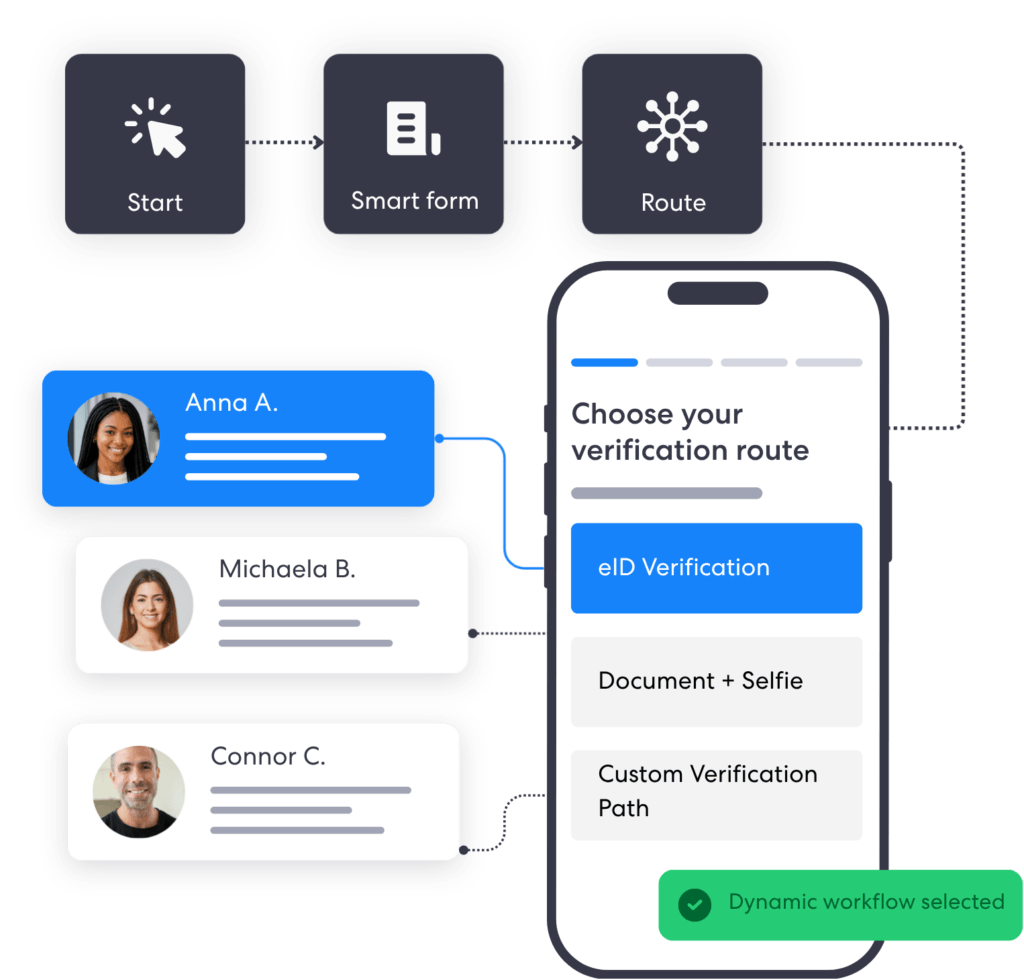
## 84% of adults say speed matters when choosing a digital identity provider
For onboarding teams, this highlights a persistent challenge. Fixed journeys can create unnecessary steps when users have different evidence, circumstances, or available verification methods. Dynamic Workflows help apply an appropriate predefined path while keeping policy controls consistent across the customer journey.

### Policy-aligned journeys
Apply predefined onboarding paths across varying customer types, market, and requirements while maintaining consistent compliance controls.

### Right-sized assurance
Align customers with verification journeys that reflect the level of assurance required by policy, without any additional unnecessary steps.

### Scalable digital onboarding
Manage multiple customer journeys in one workflow environment to support growth across markets without fragmenting compliance operations.
## Apply the right journey to each customer
Different customers may require different onboarding controls based on their profile, market, or business policy. Custom workflows use structured customer information to direct users into predefined journeys, helping teams apply the right controls consistently without maintaining separate onboarding processes.
[View use case](https://www.complycube.com/en/use-cases/process/customer-onboarding/)
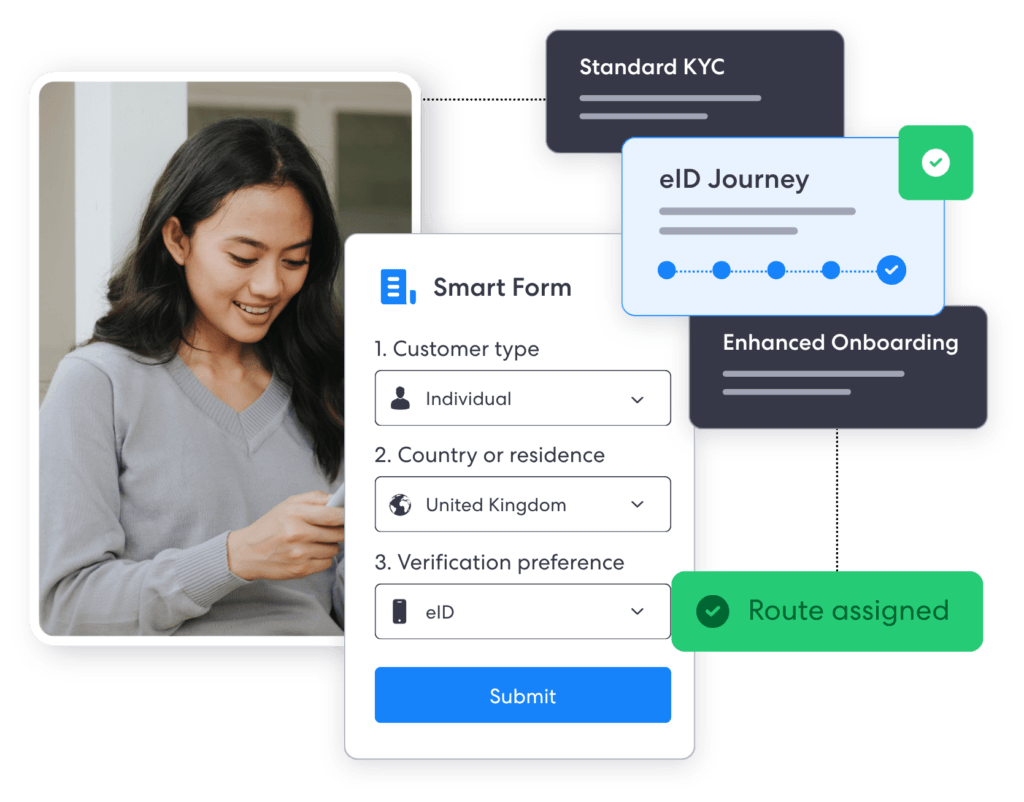
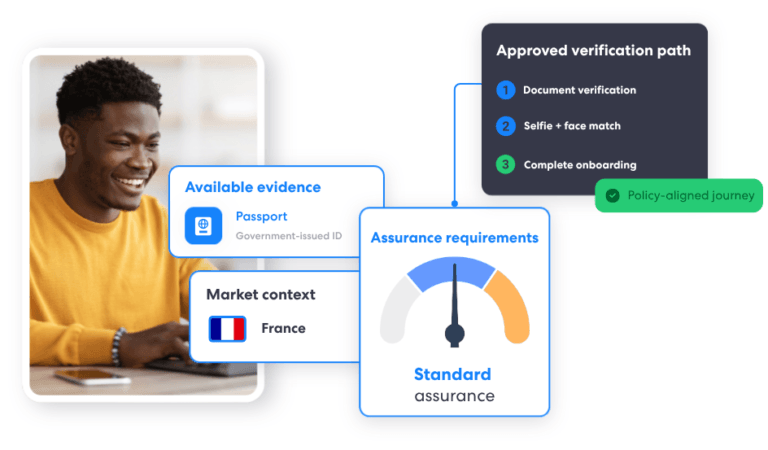
## Match verification to available evidence
Customers can arrive with different government-issued identity evidence. Dynamic Workflows can use confirmed document information and customer context to guide users into predefined journeys aligned with onboarding policy. This reduces repeated data capture and helps teams apply the appropriate level of assurance.
## Reduce friction with customer choice
When more than one approved verification method is available, customers can choose routes that fit what they have available, such as eID or document plus selfie. This helps remove avoidable blockers and supports completion while keeping every option within predefined compliance controls.
[View documentation](https://docs.complycube.com/documentation/guides/web-sdk-quick-guide/integration-guide)
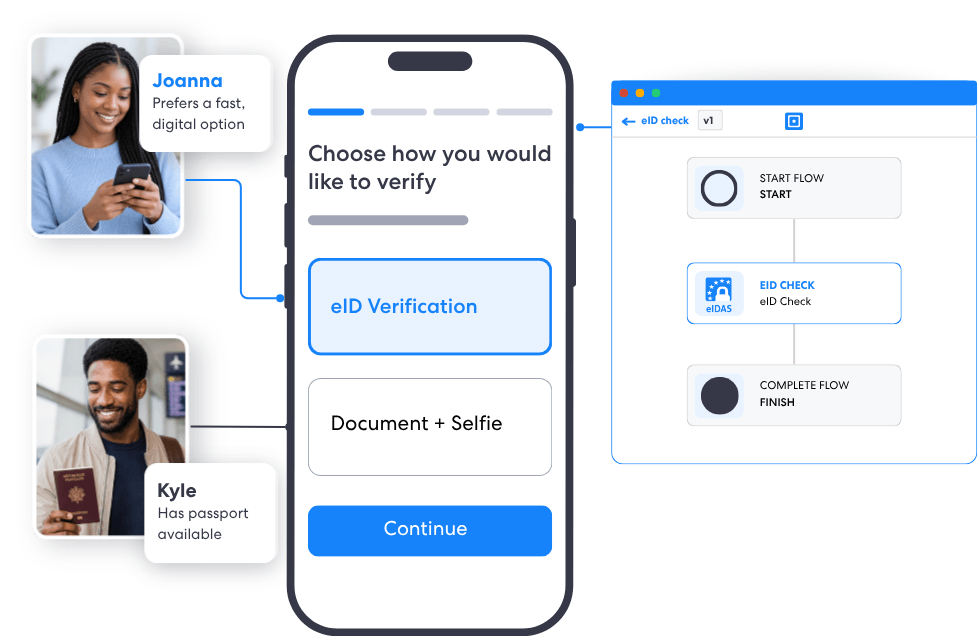
Numbers that back it up
## Flexible identity journeys support better access
UK government research shows that identity verification does not fail for one reason alone. 60% of digital identity services that track unsuccessful checks cited a lack of necessary identity evidence, while 52% of services using biometrics provide an alternative route for users who do not want biometric verification.
[ Contact us ](#)
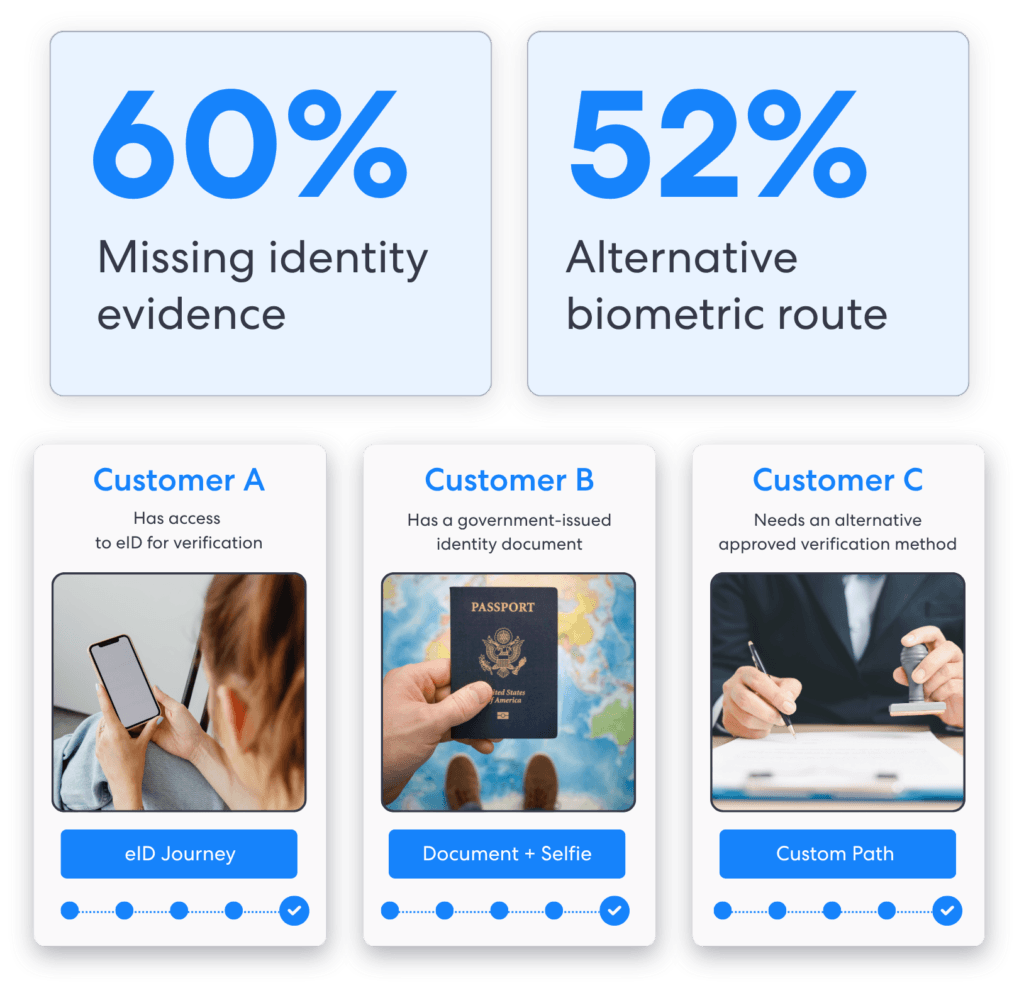

### Faster workflow changes
Give compliance teams direct control over onboarding logic, verification steps, and workflow structure through a no-code visual environment.

### Unified compliance orchestration
Bring Identity Verification, biometrics, AML screening, registry checks, fraud signals, Smart Forms, and workflow logic together within one platform.

### Regulatory assurance routing
Support different assurance requirements with predefined onboarding flows. Teams can apply the right level of due diligence for different regulatory contexts.

### Global onboarding flexibility
Scale journeys across more than 250 countries and territories using localized onboarding, national registry connections, and multi-bureau verification.
## Frequently Asked Questions
What are Dynamic Workflows?
Dynamic Workflows are configurable onboarding journeys that direct customers into different predefined paths based on the information and choices they provide. ComplyCube uses Dynamic Workflows to help businesses tailor Know Your Customer (KYC) and digital onboarding experiences without creating a separate process for every customer type.
How do ComplyCube's Dynamic Workflows work?
ComplyCube’s Dynamic Workflows use information collected during onboarding to determine which predefined workflow a customer follows. Routing can be based on Smart Form responses, confirmed data extracted from an identity document, or a verification option selected by the customer, such as eID or document and selfie verification.
Can Dynamic Workflows be created without coding?
Yes. ComplyCube’s onboarding workflow software includes a visual no-code Workflow Canvas that lets compliance and operations teams create, configure, and update verification journeys without writing code. Teams can combine Smart Forms, document verification, biometrics, registry checks, AML screening, and other compliance services within the same workflow environment.
What are the benefits of Dynamic Workflows for customer onboarding?
Dynamic Workflows help businesses create more relevant onboarding journeys for customers with different information, identity documents, and available verification methods. Instead of forcing every user through the same fixed process, businesses can offer predefined paths that better match each customer’s circumstances while maintaining structured KYC controls.
Can Dynamic Workflows route customers based on verification results?
No. Dynamic Workflows currently route customers based on information collected during onboarding, document-derived data, or choices made by the user. Verification check outcomes cannot currently be used to automatically redirect a customer into another workflow.
[Explore other solutions](https://www.complycube.com/solutions/due-diligence-compliance/know-your-customer/)
## Explore other solutions
[Biometric Verification](https://www.complycube.com/en/solutions/identity-assurance/biometric-verification/) 
### Biometric Verification
Instantly verify user’s facial biometrics using our advanced machine learning technology. Our engine scores for similarities between the uploaded selfie and the document image.
[View solution](https://www.complycube.com/en/solutions/identity-assurance/biometric-verification/ "Watchlist screening")
[Case Management](https://www.complycube.com/en/solutions/due-diligence-compliance/case-management/) 
### Case Management
Conduct Customer Due Diligence from the comfort of one centralized platform. All customer KYC data is stored securely and our case management feature allows for streamlined remedial actions.
[View solution](https://www.complycube.com/en/solutions/due-diligence-compliance/case-management/ "Continuous monitoring")
[Sanctions & PEP Screening](https://www.complycube.com/en/solutions/global-screening/sanctions-pep-screening/) 
### Sanctions & PEP Screening
Our Sanctions & PEP Screening solution mitigates bad actors from accessing your business’s services. Global coverage ensures your business remains compliant wherever it expands.
[View solution](https://www.complycube.com/en/solutions/global-screening/sanctions-pep-screening/ "Adverse media checks")
[View all solutions](https://www.complycube.com/solutions/)
---
### [eSignature](https://www.complycube.com/solutions/compliance-suite/esignature/)
**Published:** August 25, 2026
**Author:** Dini Habib
**Excerpt:** Create, personalize, and sign agreements within the same KYC onboarding flow. Connect verified customer data to tamper-evident signatures, reduce manual errors and maintain a clear compliance audit trail for regulatory trust.
**Content:**
# Collect eSignature Within One KYC Workflow
Bring verification, customer declarations, and signing into one defensible workflow with ComplyCube’s eSignature software.
Capture secure electronic signatures linked to verified identities, with tamper-evident records built to meet the EU’s eIDAS framework.
[ Start now ](https://portal.complycube.com/signup)
[ Contact us ](https://www.complycube.com/contact/contact-sales/)
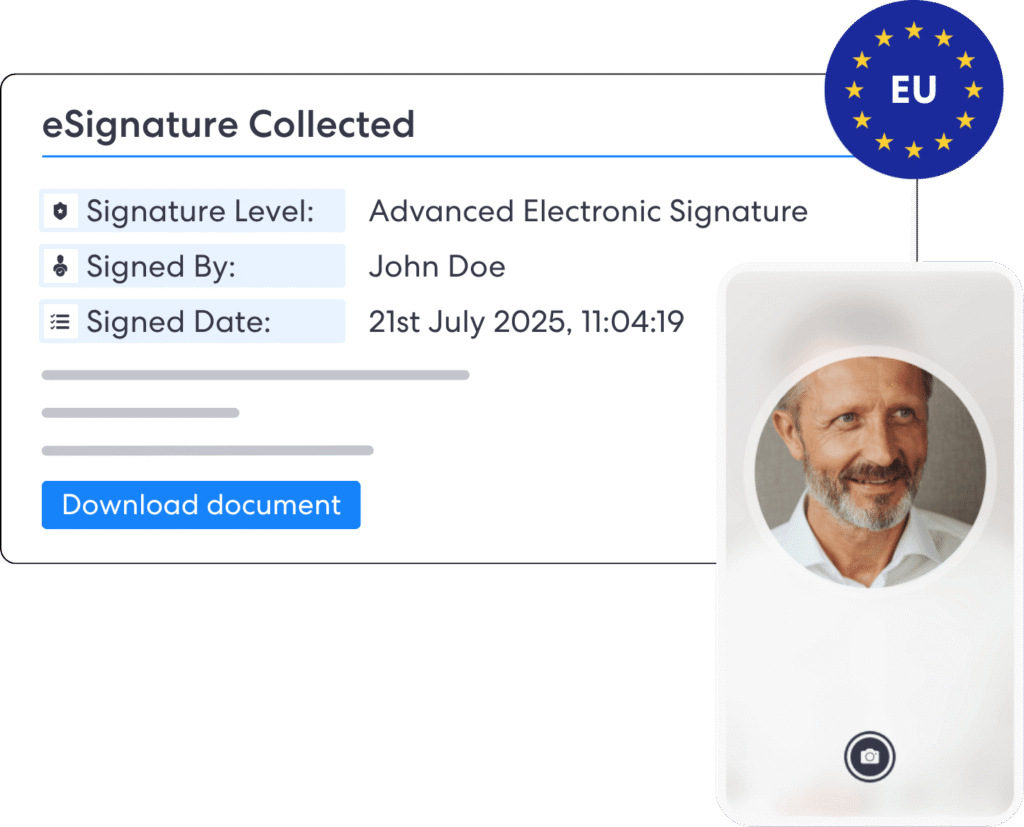

### Frictionless onboarding
Keep verification, declarations, document generation, and signing in one flow, so users avoid switching tools or repeating steps.

### Remove fragmentation
Collect eSignatures directly within the same KYC journey instead of relying on separate providers and disconnected workflows.

### eIDAS assurance
Support SES, AES, and QES assurance levels, with each cryptographically protected eSignature linked to a verified user.
verified esignatures
## Create stronger evidence for every signature
ComplyCube’s eSignature solution offers cryptographic protection to detect document tampering. Capture what a customer agreed to with timestamped records that support non-repudiation.
Ensure you meet the appropriate level of identity assurance for every use case, with configurable SES, AES, and QES workflows.
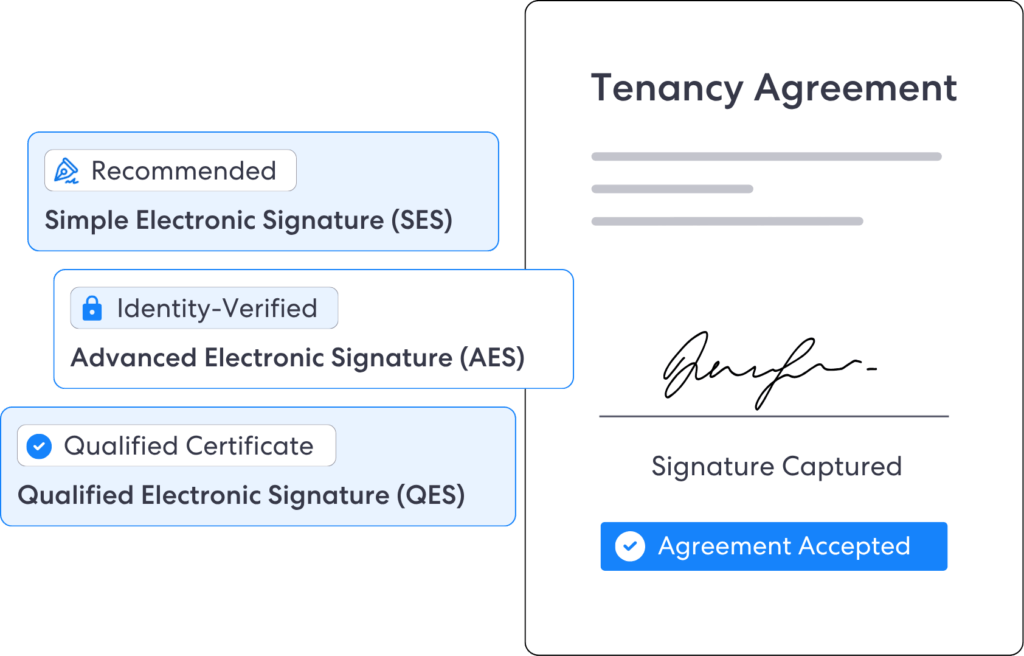
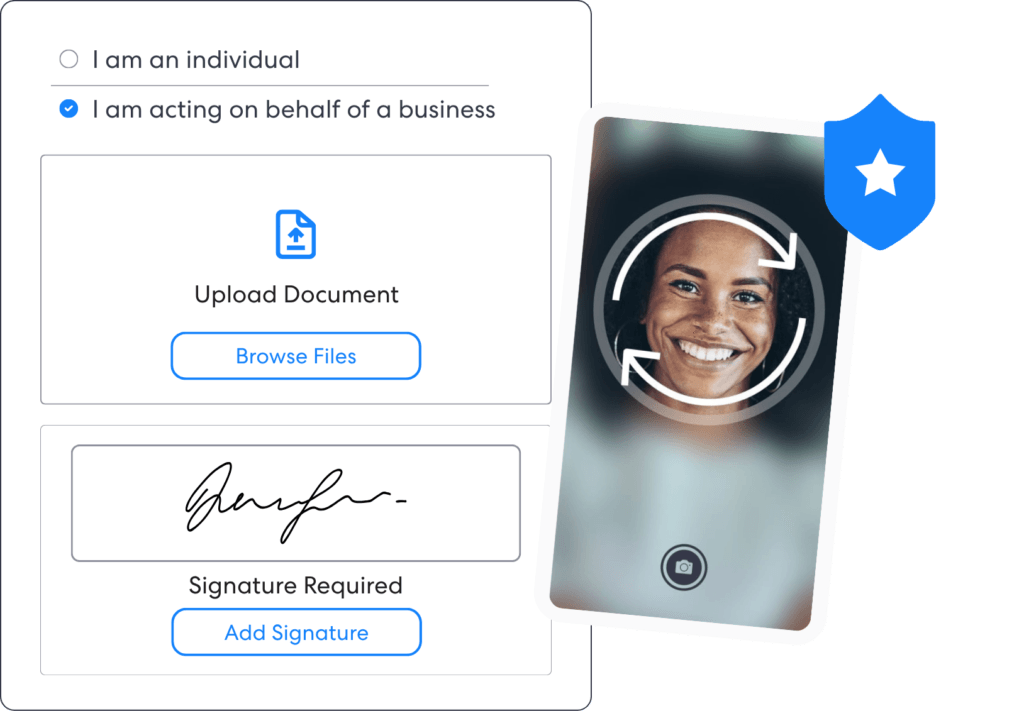
accelerate onboarding
## Keep onboarding in one seamless flow
Collect electronic signatures for declarations, policy acknowledgments, and consent records within the same customer journey.
Speed up secure onboarding and reduce manual handoffs by keeping customer responses, supporting documents, and eSignatures in one secure workflow.
[Learn more](https://www.complycube.com/en/solutions/compliance-suite/smart-forms/)
customizable agreements
## Create agreements built around every customer
Eliminate repetitive data entry by turning your existing documents into seamless, ready-to-sign agreements within the verification journey.
Upload your own documents and automatically populate each field with verified customer data. Or, build tailored agreement templates from scratch.
[Learn more](https://www.complycube.com/en/solutions/identity-assurance/document-verification/)
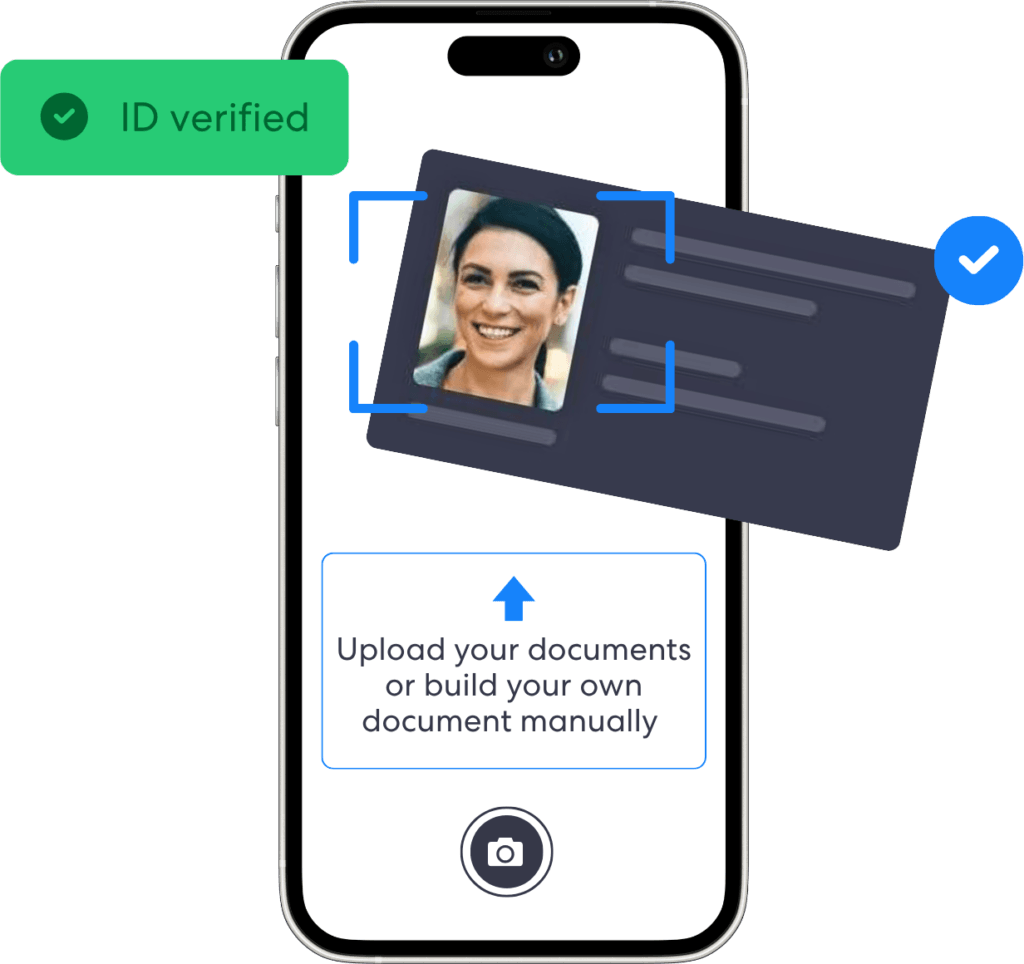
## Trusted by big names





## Meet Every Level of Assurance with Secure, eIDAS Compliant eSignatures
ComplyCube’s eSignature solution offers Simple, Advanced, and Qualified Electronic Signatures. Capture legally binding electronic signatures with the level of identity assurance, security, and legal certainty that each use case demands.
Simple Electronic Signature (SES) Advanced Electronic Signature (AES) Qualified Electronic Signature (QES)
Simple Electronic Signature (SES)
SES offers ease and speed of signing, typically used for low-risk agreements. Record who signed and the surrounding transaction details with clear audit trails.
Advanced Electronic Signature (AES)
Strengthen identity assurance for higher-risk agreements. Protect against alterations by linking signatures to verified signers and maintain high document integrity.
Qualified Electronic Signature (QES)
Satisfy the highest eIDAS signature standard for transactions or business relationships that require maximum identity assurance and legal certainty.
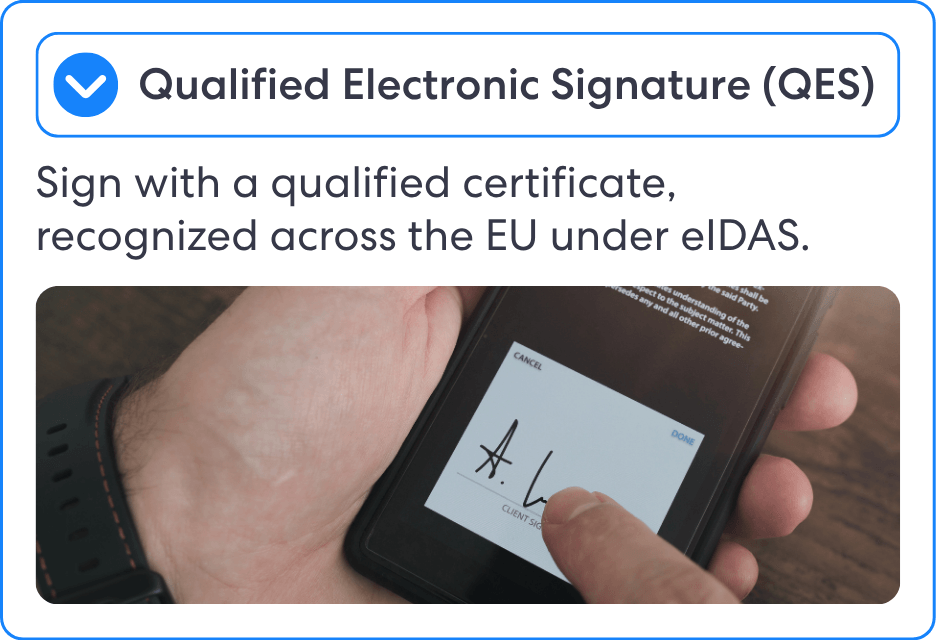
## One Electronic Signature Flow, Built for Every Agreement
Regulated businesses across finance, telecommunications, fintech, accounting, and more use ComplyCube’s eSignature software for trusted, **everyday** agreements.
From tenancy contracts and employment documents to insurance applications, healthcare consent forms, and supplier contracts, match each workflow to the **appropriate** level of identity assurance.
[ Start Now ](https://portal.complycube.com/signup)
## Bespoke eSignature Solution Tailored for Every Industry
Enhance customer satisfaction, reduce cost, and support every signing use case with ComplyCube’s unified KYC platform.

[Financial services](https://www.complycube.com/use-cases/industry/financial-services/)
Terms and conditions, lending agreements, and investor declarations.

[FinTech](https://www.complycube.com/use-cases/industry/fintech/)
Onboarding forms, platform terms, consent records, and customer agreements.

[Payments](https://www.complycube.com/use-cases/industry/payments/)
Payment authorizations, merchant agreements, and direct debit mandates.

[crypto & trading](https://www.complycube.com/use-cases/industry/crypto/)
Token sale agreements, transaction authorization, and risk acknowledgments.

[real estate](https://www.complycube.com/use-cases/industry/property/)
Rental agreements, tenancy documents, lease contracts, and property disclosures.

[healthcare](https://www.complycube.com/use-cases/industry/healthcare/)
Patient consent forms, medical declrations, and prescription records.

[employment & HR](https://www.complycube.com/en/contact/contact-sales/)
Contractor agreements, employment contracts, and employee declarations.

[insurance](https://www.complycube.com/en/use-cases/industry/kyc-insurance-aml-compliance-for-insurers/)
Billing and insurance claims, policy applications, and consent records.
[Explore other solutions](https://www.complycube.com/solutions/due-diligence-compliance/know-your-customer/)
## Explore other solutions
[AML Screening](https://www.complycube.com/solutions/global-screening/sanctions-pep-screening/) 
### AML Screening
Detect high-risk customers before they sign by screening against sanctions, PEP, watchlist, and adverse media data sources in real time.
[View solution](https://www.complycube.com/solutions/global-screening/sanctions-pep-screening/ "Watchlist screening")
[Smart Forms](https://www.complycube.com/en/solutions/compliance-suite/smart-forms/) 
### Smart Forms
Capture source of funds, tax residency, employment details, declarations, and other risk-based responses with KYC smart forms.
[View solution](https://www.complycube.com/en/solutions/compliance-suite/smart-forms/ "Continuous monitoring")
[Policy Assurance](https://www.complycube.com/en/solutions/compliance-suite/policy-assurance/) 
### Policy Assurance
Keep workflows aligned with evolving AML and KYC obligations, tailored to each jurisdiction without constant manual updates.
[View solution](https://www.complycube.com/en/solutions/compliance-suite/policy-assurance/ "Adverse media checks")
[View all solutions](https://www.complycube.com/solutions/)
## Frequently asked questions
What is an electronic signature?
An electronic signature, also known as an eSignature, enables a customer to declare, acknowledge, or agree to a document remotely. Businesses use eSignature solutions to capture consent and agreements securely and create an auditable record of the signing process.
Does ComplyCube's eSignature support KYC compliance?
Yes. ComplyCube’s eSignature combines identity verification, document collection, customer declarations, and electronic signing within the same workflow, enhancing compliance. Additionally, real-time audit records can be retained securely to demonstrate how and when a customer completed an agreement or declaration.
How do I embed eSignature in my workflow?
An eSignature step can be added to a workflow with [one click](https://docs.complycube.com/documentation/product-guides/compliance-studio/e-signatures). Businesses can create a signing document via an uploaded PDF or build their own configurable document. When a customer reaches the signing stage, ComplyCube automatically generates the document, presents it for review, captures the signature, and retains the evidence as a completed record within a single user session.
How to choose the best eSignature software?
The best eSignature software provides your business with the required level of identity assurance, regulatory support, and customer experience. For high-trust, regulated onboarding, it is crucial to choose software that can connect and retain signatures to a verified customer identity. Support for eIDAS compliance with SES, AES, and QES provides stronger audit records for regulatory review.
Why do I need an electronic signature solution?
Firms use an electronic signature solution to capture clear, legal evidence of what a customer reviewed without face-to-face signing. It offers a quicker, more secure way of collecting recorded customer approval. Regulated businesses use ComplyCube to ensure that an eSignature is linked to a verified identity, thereby strengthening the evidence associated with KYC workflows.
---
### [Custom Risk Engine](https://www.complycube.com/solutions/due-diligence-compliance/risk-scoring/custom-risk-engine/)
**Published:** September 9, 2026
**Author:** Dini Habib
**Excerpt:** Use Face Blocklist to prevent repeated fraudsters from attempting to use your service. ComplyCube's Facial Blocklist feature uses advanced facial analysis to flag a user if their facial biometrics match a face on your banned list.
**Content:**
# Custom Risk Engine Aligned to Your Own Policy
Define risk factors, weightings, and thresholds around your own compliance framework with ComplyCube’s custom risk engine.
Replace rigid customer risk assessment software with **configurable** and **automated** customer risk scoring. Apply your policy consistently at scale while keeping every rating transparent and explainable.
[ Start now ](https://portal.complycube.com/signup)
[ Contact us ](https://www.complycube.com/contact/contact-sales/)

## Build a Bespoke Customer Risk Scoring Model Tailored to Your Risk Appetite
Automate your custom risk model so customer risk scores **continuously reflect** your own factors, weightings and thresholds as data changes. Reduce manual reassessment and enable your teams to identify and act on changing risk.

### Explainable Decisions
Customer risk scoring is recalculated in real time as information changes, with all underlying evidence retained for regulators.

### Tailored Precision
Our custom risk engine enables you to apply the same risk methodology consistently across every customer, market, and use case.

### Risk-Based Onboarding
Automate routine scoring so low-risk customers can onboard faster and enhanced due diligence is focused where needed.
## Automate Compliance Decisions at Scale
ComplyCube’s custom risk engine reduces manual, spreadsheet-based scoring and applies the same methodology consistently.
Adjust individual ratings when needed without losing the original risk score or evidence, and choose whether new rules should automatically reassess existing customers.

extensive model depth
## Sophisticated customer risk assessment software
Not every risk indicator should be treated **equally**.
ComplyCube’s custom risk engine solution establishes a granular risk model that can reflect complex internal methodologies without forcing every risk indicator through the same scoring approach.
This means high-impact signals, such as a sanctions match, are not diluted by several lower-risk indicators.

[ Start Now ](https://portal.complycube.com/signup)

### Unified AML Software
Strengthen AML infrastructure by combining custom risk engine alongside biometric verification, ongoing monitoring, PEP, and sanctions screening. Enforce consistent risk decisions and fast-track onboarding.

### End-to-End Encryption
ComplyCube offers an enterprise-grade data protection, aligned to leading data and privacy rules, such as the EU GDPR and US NIST. Safeguard sensitive customer attributes within a trusted compliance environment.

## Keep Risk Scores Current and Fully Explainable
When customer information changes, our custom risk engine recalculates ratings automatically, so they stay accurate and up to date.
Achieve defensible, fully explainable audit trails, with every result traceable to the rule, factor, and source record behind it.
## Turn Your Risk Policy Into a Working Model
Build detailed scoring logic that mirrors exactly how your internal company’s risk policy actually works, rather than relying on a vendor’s fixed framework.
With four levels of model depth (low, medium, high, and very high risk), teams can define precise risk factors, weighting, and thresholds that reflect their own risk appetite and approved methodology.

[Explore other solutions](https://www.complycube.com/solutions/due-diligence-compliance/know-your-customer/)
## Explore other solutions
[Policy Assurance](https://www.complycube.com/en/solutions/compliance-suite/policy-assurance/) 
### Policy Assurance
Stay aligned with the latest AML/KYC compliance obligations in your jurisdiction with ready-to-use policy templates.
[View solution](https://www.complycube.com/en/solutions/compliance-suite/policy-assurance/ "Watchlist screening")
[Sanctions & PEP Screening](https://www.complycube.com/en/solutions/global-screening/sanctions-pep-screening/) 
### Sanctions & PEP Screening
Detect sanctioned individuals, companies, and Politically Exposed Persons (PEPs) with extensive, global data sources.
[View solution](https://www.complycube.com/en/solutions/global-screening/sanctions-pep-screening/ "Adverse media checks")
[Continuous Monitoring](https://www.complycube.com/en/solutions/global-screening/continuous-monitoring/) 
### Continuous Monitoring
Get real-time alerts when a customer’s risk profile changes, so you can act quickly and stay ahead of financial crime risks.
[View solution](https://www.complycube.com/en/solutions/global-screening/continuous-monitoring/ "Continuous monitoring")
[View all solutions](https://www.complycube.com/solutions/)
## Frequently asked questions
What is a customer risk assessment software?
Customer risk assessment software helps businesses assess the level of financial crime risk a customer or client poses. It analyses a customer against several [risk factors](https://www.complycube.com/en/what-is-aml-risk/), including geographic (low/high risk jurisdiction), customer type (PEPs), industry, and others, to provide a rating and determine whether a business relationship or customer should be onboarded.
What is the difference between custom risk engine versus static risk scoring?
Static risk scoring produces a rating, typically from 0-100, based on a fixed set of rules or a specific point in time. A custom risk engine adapts to a business’s own methodology, including its risk factors and the weight assigned to them. This rating can be recalculated when relevant customer information changes, ensuring that risk scores stay up to date.
Why do I need a custom risk engine solution?
A custom risk engine ensures your customer is assessed against the specific risk methodology your business uses, rather than a vendor’s default generic risk matrix. It replaces manual spreadsheet-based assessments, applies the same consistent rules across customers, and keeps risk ratings from becoming outdated after onboarding.
How do I use ComplyCube's custom risk engine?
ComplyCube’s custom risk engine works according to your own risk methodology. Businesses can provide the risk framework they want to apply, including the relevant factors, scoring logic, and rating thresholds. ComplyCube then [configures](https://docs.complycube.com/documentation/product-guides/due-diligence-tools/risk-profile) the model around those requirements. Firms can also choose to recalculate ratings for existing customers when they add a new version of rules.
What are the benefits of a custom risk engine?
The benefits of a custom risk engine includes greater control, consistent assessments, and clear regulatory evidence. Firms can align scoring with their own policies, automate assessments that might otherwise be handled manually, keep ratings current throughout the customer lifecycle, and trace decisions back to the underlying data and rules. It also helps focus enhanced due diligence on customers whose risk level actually warrants it.
---
### [Solutions](https://www.complycube.com/solutions/)
**Published:** October 27, 2021
**Author:** CC
**Content:**
# Solutions
Find out more about our wide array of KYC and AML solutions.
## Customer screening
Our customer screening service boasts global coverage, smart technology, and comprehensive data sources, giving the greatest peace of mind.
[Sanctions & PEP screening](https://www.complycube.com/solutions/global-screening/sanctions-pep-screening/) 
### Sanctions & PEP screening
Our screening capability provides extensive coverage of sanctioned, Politically Exposed Persons (PEP) individuals and companies
[View solution](/solutions/global-screening/sanctions-pep-screening/)
[Adverse media checks](https://www.complycube.com/en/solutions/global-screening/adverse-media-checks/) 
### Adverse media checks
Protect your reputation by screening customers using our AI-powered adverse media service before onboarding them.
[View solution](https://www.complycube.com/solutions/global-screening/adverse-media-checks/)
[Watchlist screening](https://www.complycube.com/solutions/global-screening/watchlist-screening/) 
### Watchlist screening
ComplyCube’s comprehensive coverage of global AML watchlist sources and flexible automation features ensures that you comply with the most stringent regulations.
[View solution](https://www.complycube.com/solutions/global-screening/watchlist-screening/)
[Continuous monitoring](https://www.complycube.com/solutions/global-screening/continuous-monitoring/) 
### Continuous monitoring
Keep on top of your Ongoing Due Diligence (ODD) obligations, using our continuous monitoring service. You’ll get notified in real-time should your customers’ status change.
[View solution](https://www.complycube.com/solutions/global-screening/continuous-monitoring/)
## Identity assurance
Our comprehensive identity verification suite enables you to quickly and reliably establish the right Level of Assurance (LoA) for your use case.
[Document verification](https://www.complycube.com/solutions/identity-assurance/document-verification/) 
### Document verification
Our document verification service offers a best-in-class user experience. Your users will love the clear, guided fast verification process.
[View solution](https://www.complycube.com/solutions/identity-assurance/document-verification/)
[Customer authentication](https://www.complycube.com/solutions/identity-assurance/customer-authentication/) 
### Customer authentication
Limit user access and ensure your products are secure without adding friction for your customers.
[View solution](https://www.complycube.com/solutions/identity-assurance/customer-authentication/)
[Address verification](https://www.complycube.com/solutions/identity-assurance/address-verification/) 
### Address verification
Our smart capture solutions extract relevant details from Proof of Address (PoA) documents and verify them against client and location data.
[View solution](https://www.complycube.com/solutions/identity-assurance/address-verification/)
[Biometric verification](https://www.complycube.com/solutions/identity-assurance/biometric-verification/) 
### Biometric verification
Use our advanced biometric checks to verify the person presenting the identity document is the same individual.
[View solution](https://www.complycube.com/solutions/identity-assurance/biometric-verification/)
[Multi-bureau checks](https://www.complycube.com/solutions/identity-assurance/multi-bureau-checks/) 
### Multi-bureau checks
Verify your customer details such as name, address, date of birth, and Social Security Number (SSN) against a range of trusted sources.
[View solution](https://www.complycube.com/solutions/identity-assurance/multi-bureau-checks/)
[Age Estimation](https://www.complycube.com/en/solutions/identity-assurance/facial-age-estimation/) 
### Age Estimation
Our low-friction Age Estimation engine can streamline age-gated products and show reliable results in seconds using one selfie.
[View solution](https://www.complycube.com/en/solutions/identity-assurance/facial-age-estimation/)
[UK Identity and Fraud Verification](https://www.complycube.com/en/solutions/identity-assurance/uk-identity-verification-and-fraud-prevention/) 
### UK Identity and Fraud Verification
Leverage the UK’s leading ID&V and anti-fraud solution for precise customer risk assessment. Base decisions on our DIATF profile scores.
[View solution](https://www.complycube.com/en/solutions/identity-assurance/uk-identity-verification-and-fraud-prevention/)
[Driver Verification](https://www.complycube.com/en/solutions/identity-assurance/enhanced-driver-verification/) 
### Driver Verification
Verify the identity, competency and license validity of your drivers through our integration with AAMVA and the DVLA.
[View solution](https://www.complycube.com/en/solutions/identity-assurance/enhanced-driver-verification/)
[eID Hub](https://www.complycube.com/en/solutions/identity-assurance/eid-verification-service/) 
### eID Hub
Utilize global eID schemes, such as India’s Aadhaar, Norway’s BankID, Denmark’s MitID, and more for secure identity verification.
[View solution](https://www.complycube.com/en/solutions/identity-assurance/eid-verification-service/)
[SSN check](https://www.complycube.com/en/solutions/identity-assurance/ssn-verification-service/) 
### SSN check
Validate US customers rapidly against authoritative data sources with our advanced Social Security Number (SSN) checks
[View solution](https://www.complycube.com/en/solutions/identity-assurance/ssn-verification-service/)
## Due diligence & compliance
Our advanced global compliance platform allows you to investigate and proceed with business relationships worldwide in seconds.
[Know your customer](https://www.complycube.com/solutions/due-diligence-compliance/know-your-customer/) 
### Know your customer
Deter fraudsters without adding unnecessary friction to genuine customer journeys using our smart and configurable identity verification checks.
[View solution](https://www.complycube.com/solutions/due-diligence-compliance/know-your-customer/)
[Anti-money laundering](https://www.complycube.com/solutions/due-diligence-compliance/anti-money-laundering/) 
### Anti-money laundering
Use our innovative, easy-to-integrate AML platform to satisfy regulators, and stop financial crime (FinCrime) and counter-terrorist financing (CTF).
[View solution](https://www.complycube.com/solutions/due-diligence-compliance/anti-money-laundering/)
[Customer due diligence](https://www.complycube.com/solutions/due-diligence-compliance/customer-due-diligence/) 
### Customer due diligence
Whether you need to perform customer due diligence (CDD) or enhanced due diligence (EDD), stay safe with our best-in-class onboarding flows
[View solution](https://www.complycube.com/solutions/due-diligence-compliance/customer-due-diligence/)
[Risk scoring](https://www.complycube.com/solutions/due-diligence-compliance/risk-scoring/) 
### Risk scoring
Our risk engine applies proprietary algorithms to calculate an AML risk score for your customers and presents you with a simple low, medium, or high score.
[View solution](https://www.complycube.com/solutions/due-diligence-compliance/risk-scoring/)
## Fraud prevention
Our intelligent fraud prevention suite offers robust risk signals to identify and block sophisticated fraud threats at the point of entry.
[Device intelligence](https://www.complycube.com/solutions/fraud-intelligence/device-intelligence) 
### Device intelligence
Assess robust risk analysis, such as behavioral and network signals in real-time, to detect high-risk sessions and block fraudulent activity.
[View solution](https://www.complycube.com/solutions/fraud-intelligence/device-intelligence)
[Phone intelligence](https://www.complycube.com/solutions/fraud-intelligence/phone-intelligence-verify-phone-number) 
### Phone intelligence
Analyze phone number indicators such as carrier, line type, and recent abuse to block risky numbers at the point of entry.
[View solution](https://www.complycube.com/solutions/fraud-intelligence/phone-intelligence-verify-phone-number)
[Email intelligence](https://www.complycube.com/solutions/fraud-intelligence/email-risk-score) 
### Email intelligence
Evaluate email age, domain, and risk signals to distinguish trusted users from disposable or high-risk email addresses.
[View solution](https://www.complycube.com/solutions/fraud-intelligence/email-risk-score)
[Learn more](https://www.complycube.com/solutions/identity-assurance/biometric-verification/)
## Compliance suite
Deliver a single, streamlined process for seamless customer onboarding, KYC/AML, and audit preparedness across global jurisdictions.
[Workflow builder](https://www.complycube.com/solutions/compliance-suite/kyc-workflow) 
### Workflow builder
Build customizable, drag-and-drop workflows aligned to sector-specific regulations and your risk appetite without writing code.
[View solution](https://www.complycube.com/solutions/compliance-suite/kyc-workflow)
[Smart Forms](https://www.complycube.com/en/solutions/compliance-suite/smart-forms/) 
### Smart Forms
Use adaptive KYC Smart Forms to build compliant customer risk profiles. Seamlessly gather EDD information for regulatory trust.
[View solution](https://www.complycube.com/en/solutions/compliance-suite/smart-forms/)
[Policy Assurance](https://www.complycube.com/en/solutions/compliance-suite/policy-assurance/) 
### Policy Assurance
Reflect the latest regulatory obligations with ready-to-use and submit policy reports aligned with cross-border jurisdictions.
[View solution](https://www.complycube.com/en/solutions/compliance-suite/policy-assurance/)
[eSignature Verification](https://www.complycube.com/en/solutions/compliance-suite/esignature/) 
### eSignature Verification
Capture legally binding electronic signatures linked to a verified customer. Meet the right level of assurance under the EU eIDAS framework.
[View solution](https://www.complycube.com/en/solutions/compliance-suite/esignature/)
---
### [ComplyCube's Pricing](https://www.complycube.com/pricing/)
**Published:** October 29, 2025
**Author:** Dini Habib
**Content:**
# Pricing plans
Flexible **KYC**, **fraud prevention**, and **identity verification** pricing that scales with your business.

## Starter
Get started quickly with KYC using our essential tools. Your monthly fee converts into usage credits you can use on any check, and you’re only charged for successful verifications completed.
### What you get:
- Global AML screening and identity verification
- Workflows and case management with audit trails
- API and dashboard for easy integration
- Roles, permissions, and access controls
- [Go over the full feature list here](#all_features)
$99
/mo
[ Start now ](https://portal.complycube.com/signup)

## Core
Scale your KYC with lower per-check pricing and advanced features like multi-bureau checks, age estimation, and ongoing monitoring. Your monthly balance works across all verification types.
### All in Starter, plus:
- Integrated policies for regulatory compliance
- Fraud intelligence for proactive risk prevention
- PoA checks with actionable insights
- Batch processing and custom branding
- [Go over the full feature list here](#all_features)
$299
/mo
[ Start now ](https://portal.complycube.com/signup)

## Growth
Integrate our market-leading compliance and fraud prevention platform to grow and govern at scale, with advanced features, controls, support, and commercial flexibility for global businesses.
### All in Core, plus:
- eID authentication and global database checks
- Biometric enrolment and NFC chip verification
- Custom pricing and premium support
- Bespoke solutions co-built with experts
- [Go over the full feature list here](#all_features)
Let’s talk
[ Contact us ](https://www.complycube.com/en/contact/contact-sales/)

## Enterprise
Enterprise-grade compliance and fraud prevention for regulated organizations operating at scale. Built on the same trust, privacy and security standards adopted by leading financial institutions and regulatory bodies.
- Advanced case management with configurable risk controls.
- Dedicated infrastructure with SLA-backed uptime and customizable data governance.
- White-glove compliance guidance, system design and support for tailored solutions.
- Unlimited white-labeled workflows and organizational partitioning for data segregation.
[ Learn more about Enterprise ](https://www.complycube.com/en/pricing/enterprise/)
## Trusted by big names





## 98%
### Onboarding Rate
Acquire more customers in seconds and focus on building trust at scale.
## 6.2x
### Average ROI
We work hand-in-hand to unlock the highest possible return on investment.
## 100%
### Service Uptime
Count on us for unwavering service continuity around the clock.
## All features
[ Starter ](https://portal.complycube.com/signup)
[ Core ](https://www.complycube.com/en/contact/contact-sales/)
[ Growth ](https://www.complycube.com/en/contact/contact-sales/)
### Watchlist, PEP, and Adverse Media Screening
Standard AML screening (individuals and businesses)
AML, Sanctions, and Level 1 PEPs
$0.50/check
$0.35/check

Extensive AML screening (individuals and businesses)
AML, Sanctions, PEPs, and Adverse Media
$1.05/check
$0.85/check

Continuous real-time monitoring

$0.03/month

Custom screening lists


[Enterprise](https://www.complycube.com/en/pricing-cc/enterprise/)
### Government ID Verification
Document verification check
\+ Extraction of all data fields
$1.05/check
$0.75/check

Document verification check using NFC


### Biometric and Liveness Verification Suite
Liveness and facial similarity check (photo)
$0.35/check
$0.20/check

Liveness and facial similarity check (video)


Age estimation

$0.25/check

Face enrolment and known faces


Banned faces


Face-based authentication


### Compliance Studio
Workflows
Up to 2 workflows
Up to 5 workflows
8+ workflows
Advanced dynamic workflows


Compliance policies


Custom policy assurance


Verification decision rules


Smart forms (Dynamic Questionnaires)


### Digital Fraud Intelligence
Mobile intelligence

$0.11/check

Email intelligence

$0.11/check

Device intelligence

$0.07/check

### Database Checks
Multi-bureau check (including credit agencies) – US

$0.85/check

Multi-bureau check (including credit agencies) – UK

$1.25/check

Multi-bureau check (International)


Multi-bureau check (2+2)


Driving license check


SSN check
This service only verify users with a US-issued SSN


Identity fraud check
This service is available only for UK data sources


### eSignatures
Simple Electronic Signatures (SES)


Advanced Electronic Signatures (AdES)


Qualified Electronic Signatures (QES)


### eID Verification
Aadhaar – India


BankID – Czech Republic, Finland, Norway, Sweden


Buypass – Norway


CPF – Brazil


Digidentity – Netherlands


Freja eID – Sweden


iDIN – Netherlands


itsme – Belgium


MitID – Denmark


MobileID – Slovakia


mojeID – Czech Republic


NIN/ BVN – Nigeria


Personalausweis – Germany


UAE Pass – United Arab Emirates


Verimi – Germany


### KYC Automation Services
Proof of address check

$0.65/check

Email verification (OTP)
$0.03/ verification
$0.03/ verification

SMS verification (OTP)

**Tier 1**: $0.08/SMS
**Tier 2**: $0.13/SMS
**Tier 3**: $0.23/SMS
**Tier 4**: $0.30/SMS
**Tier 5**: $0.41/SMS
[Learn more](https://docs.complycube.com/documentation/product-guides/kyc-automation-services/sms-verification)

Company lookup & insights (KYB)


Document autofill


### Due Diligence Tools
Case management


Advanced case management


[Enterprise](https://www.complycube.com/en/pricing/enterprise/)
AML risk scoring


Custom risk engine


[Enterprise](https://www.complycube.com/en/pricing/enterprise/)
### Web Portal
Team members
2
8
$30/month per addition

Roles & permissions


PDF reports


Bulk imports & exports


Bulk processing checks


Custom roles & permissions


[Enterprise](https://www.complycube.com/en/pricing/enterprise/)
### Configuration
Automation and business rules


Support for languages


PII redaction


Webhooks


IP whitelisting


Branding


Access restriction lists


Multi-organization accounts


Single sign-on (SSO) and SAML


Custom PII redaction


Custom data retention policy


White-labeling


[Enterprise](https://www.complycube.com/en/pricing/enterprise/)
Dedicated infrastructure


[Enterprise](https://www.complycube.com/en/pricing/enterprise/)
### Integrations
REST API


Hosted page


Web widget SDK (including cross-device flow)


Mobile SDKs


Native libraries (Node, PHP, and more)


AI agent integration (MCP)


Zapier


Salesforce


[Enterprise](https://www.complycube.com/en/pricing/enterprise/)
### Extras
Sandbox environment


Email notifications


Media download and upload


Full-audit trail


AI help assistant


Service level agreement (SLA)


Custom data controls


Dedicated account manager


Monthly quota limit
1,000
8,000
Unlimited
Support Channels
Self-serve
Tickets
Call + tickets + email
Support Level
Standard
Enhanced
Premium
Data retention
12 Months
Indefinite
Indefinite
Guided platform training


Solution architect integration support


[Enterprise](https://www.complycube.com/en/pricing/enterprise/)
Custom development


[Enterprise](https://www.complycube.com/en/pricing/enterprise/)


[Learn more](https://www.complycube.com/en/top-rated-aml-kyc-awards-trustradius/) 



[Learn more](https://www.g2.com/products/complycube/reviews) 

## Frequently asked questions
Are you an existing customer? Talk to our [customer support](https://www.complycube.com/contact/) team or your Account Manager.
Do you offer a free trial?
Yes, we offer a 14-day free trial with 50 free checks upon completion of account activation from Test to Live mode.
Do you charge for failed or incomplete verifications?
No, we don’t charge for failed or incomplete verifications or customer journeys. You’ll only be charged for successfully completed verifications.
Can my monthly fee be used across all verification types?
Yes. Your monthly fee can be used across all ComplyCube services and verification types, giving you flexibility in how you allocate your usage.
Will I be charged if I exceed my monthly credits or minimum commitment?
Yes. Once you’ve used your monthly allocation, any additional verifications will be billed at the standard rates specified in your plan.
Are there any setup fees?
No, there are no setup fees or hidden costs associated with our standard plans.
Do you offer annual billing or volume/committed-use discounts for KYC/AML?
Yes, we offer annual billing options at a reduced rate and volume and committed-use discounts for larger verification volumes. Please contact our [sales](https://www.complycube.com/contact "https://www.complycube.com/contact") team to discuss a tailored plan based on your needs.
Can I upgrade or downgrade my plan?
Yes, you can upgrade your plan at any time. To downgrade, please get in touch with our [customer support](https://support.complycube.com/hc/en-gb/requests/new) team for help selecting the plan that best meets your needs.
What payment methods do you accept?
All major payment cards, including Visa, Mastercard, Discover, American Express, and UnionPay, can be used to pay for our standard plans.
We also accept payments in USD, EUR, GBP, CAD, NZD, AUD, SGD, or AED for **Growth and Enterprise plans**.
Can I resell your services with your Starter or Core Plan?
No, resellers need to apply to become a ComplyCube partner. Please check out our [partnership program](https://www.complycube.com/company/partner-program/) page for more details.
Do you have a startup program?
Yes, depending on your stage and eligibility, startups can receive up to $50,000 in total benefits through our Startup Program.
Learn more on our [Startup Program](https://www.complycube.com/company/startup-program/ "https://www.complycube.com/company/startup-program/") page for details on how to apply.
---
### [Optical Character Recognition](https://www.complycube.com/solutions/due-diligence-compliance/know-your-customer/optical-character-recognition/)
**Published:** July 5, 2024
**Author:** Sofia Daley
**Excerpt:** ComplyCube’s Optical Character Recognition (OCR) solution optimizes and fortifies your document management processes by converting various types of printed and handwritten text into machine-readable data.
**Content:**
# Optical Character Recognition (OCR)
ComplyCube’s optical character recognition (OCR) extracts structured data from identity and address documents. It supports faster KYC onboarding, document verification, and fraud checks. OCR software captures information from passports, driving licenses, and many other official identity documents to turn it into machine-readable data for compliance KYC workflows.
[ Start now ](https://portal.complycube.com/signup)
[ Contact us ](#)



## Advanced Optical Character Recognition Software for KYC Data Extraction
Leveraging expert machine-learning models, our OCR software excels in accuracy and efficiency. It provides seamless integration into your existing systems and allows for automated data extraction from IDs, passports and other forms of documentation. Optical character recognition speeds up document verification and eliminates error-prone manual data entry methods. It provides real-time processing and anomaly detection in documents.

### Accelerate Workflows
Significantly reduce manual keying by automatically extracting and structuring identity data during onboarding.

### Enhance Data Security
Protect sensitive identity data with enterprise controls, audit trails, and certified security practices across verification workflows.

### Increased Scalability
Scale OCR software across markets, channels, and user volumes with hosted flows, APIs, SDKs, and no-code workflow configuration.
## Multi-Language OCR for Global Onboarding
ComplyCube’s OCR software supports global onboarding by extracting structured data across structured data across supported languages, alphabets, and document layouts. This helps teams serve customers across jurisdictions while maintaining consistent capture, validation, and review standards.



Numbers that back it up
## Why Complycube?
The ComplyCube platform offers **the most complete, flexible, and top-rated** KYC solutions to help you build trust in your business. Whether you’re a startup or a multinational enterprise, we’ve got you covered.
[ Contact us ](#)
10+ million
Transactions are processed week in and week out across the globe.
220+
Countries and territories supported for a greater peace of mind.
3,000+
Data points from trusted sources and partners across the world, giving you the highest coverage.
98%
Client onboarding rate, helping you convert more customers and grow your business.

### Fraud-Aware Extraction
Quickly detect signs of tampering, template manipulation, image anomalies, and inconsistent document data during capture.

### AI-Powered OCR Software
Capture structured fields from supported identity documents and proofs of address with advanced AI-powered OCR software.


## Document Processing and Verification
The OCR engine can analyze and identify over 14,000 types of identity documents across 250+ countries and territories. By extracting machine-readable data from utility bills, bank statements, and other official forms of documentation, OCR can verify if the information provided matches the extracted data samples.
## OCR for Audit-Ready KYC Workflows
OCR supports Customer Due Diligence (CDD) by helping teams collect, validate, and evidence identity attributes from reliable source documents. For regulated firms, this supports audit-ready KYC workflows and a risk-based approach to onboarding.


[Explore other solutions](https://www.complycube.com/solutions/due-diligence-compliance/know-your-customer/)
## Explore other solutions
[Customer Authentication](https://www.complycube.com/solutions/global-screening/watchlist-screening/) 
### Customer Authentication
Safely and accurately verify your customers’ identities before granting them access to your services with our cutting-edge multi-point biometric matching technology.
[View solution](https://www.complycube.com/en/use-cases/process/age-verification/ "Watchlist screening")
[Age Estimation](https://www.complycube.com/solutions/global-screening/adverse-media-checks/) 
### Age Estimation
Optimize access to age-restricted services with our seamless age estimation. We empower you to confidently serve your customers, protect minors, and eliminate the need for ID documents.
[View solution](https://www.complycube.com/solutions/global-screening/facial-age-estimation/ "Adverse media checks")
[Multi-Bureau Checks](https://www.complycube.com/solutions/global-screening/continuous-monitoring/) 
### Multi-Bureau Checks
Authenticate customer information, including name, date of birth, and social security number, by cross-referencing them with reliable sources like government records and credit bureaus.
[View solution](https://www.complycube.com/en/solutions/identity-assurance/customer-authentication/ "Continuous monitoring")
[View all solutions](https://www.complycube.com/solutions/)
## Frequently asked questions
Why choose ComplyCube's OCR solution?
ComplyCube combines AI-powered OCR with a complete identity verification platform. Businesses can extract document data, verify document authenticity, perform biometric checks, and automate KYC workflows through a single API or hosted solution, reducing operational complexity and improving conversion rates.
How does ComplyCube's OCR improve customer onboarding?
ComplyCube’s AI-powered OCR automatically extracts customer information from identity documents, eliminating manual data entry and reducing onboarding time. Combined with document verification, biometric authentication, and fraud detection, it helps businesses deliver faster, lower-friction KYC journeys while maintaining compliance.
Can ComplyCube's OCR integrate with existing KYC systems?
Yes. ComplyCube provides developer-friendly APIs, SDKs, hosted verification flows, and low-code integration options, allowing businesses to add OCR capabilities to existing onboarding journeys with minimal development effort.
What types of identity documents does ComplyCube's OCR support?
ComplyCube’s OCR supports passports, driving licences, national identity cards, residence permits, and proof of address documents from more than 220 countries and territories. This enables organisations to onboard customers globally using a single verification platform.
What makes ComplyCube's OCR different from standalone OCR software?
Unlike standalone OCR tools that only extract text, ComplyCube combines OCR with document verification, biometric authentication, sanctions screening, fraud detection, and workflow automation in one unified compliance platform. This enables businesses to automate the entire customer verification journey rather than just document data capture.
---
### [Biometric Facial Recognition](https://www.complycube.com/solutions/due-diligence-compliance/know-your-customer/biometric-facial-recognition/)
**Published:** October 2, 2023
**Author:** Andreea Balasa
**Excerpt:** Our advanced Liveness Detection system verifies the genuine presence of a user by distinguishing real individuals from fraudulent attempts, ensuring secure authentication and identity verification.
**Content:**
# Biometric Facial Recognition
Our biometric facial recognition engine conducts cutting-edge selfie verification. The facial recognition software deters spoofing attacks through an in-depth face-check analysis of biometric and behavioral vectors. All you need is a selfie or a quick video. Aligned with global safety protocols, our technology ensures high levels of assurance.
[ Start now ](https://portal.complycube.com/signup)
[ Contact us ](#)



## Combat identity spoofing with advanced face recognition technology
Amid the growing complexity of identity spoofing attack scenarios, the call for robust biometric authentication methods becomes ever more pressing. Our selfie identity verification solution, fortified with advanced AI mapping analysis and liveness detection, stands at the forefront of this challenge. This powerful blend of technology not only thwarts deceptive attempts but also upholds stringent global security benchmarks, preserving trust in an ever-evolving digital age.

### Selfie-based Onboarding with Quick Integration
Integrate online face recognition quickly and securily with low to no-code solutions, APIs, web & mobile SDKs, and more.

### State-of-the-art AI-based Facial Verification
Our cutting-edge engine uses ML & facial recognition AI to analyze and authenticate biometric features in real-time.

### No-document ID Facial Recognition Technology
Our customer onboarding process offers low-friction, no-document facial recognition, ensuring swift and secure identity verification.
## Tailored Facial Verification Adaptability
Facial recognition plays a pivotal role in numerous sectors. In the **banking** sector, it offers an added layer of security during onboarding and ongoing monitoring. For **gambling**, it assists in age verification and promotes responsible gaming. **Car ride hire** companies employ it for continuous monitoring of drivers to ensure passenger safety.
The technology can be either **selfie-based** or **video-based**. Depending on the level of assurance required, it can be integrated alongside other identity verification techniques, such as document checks, or used as a primary standalone feature.



Numbers that back it up
## Why Complycube?
The ComplyCube platform offers **the most complete, flexible, and top-rated** KYC solutions to help you build trust in your business. Whether you’re a startup or a multinational enterprise, we’ve got you covered.
[ Contact us ](#)
10+ million
Transactions are processed week in and week out across the globe.
220+
Countries and territories supported for a greater peace of mind.
3,000+
Data points from trusted sources and partners across the world, giving you the highest coverage.
98%
Client onboarding rate, helping you convert more customers and grow your business.

### Advanced Security
We routinely conduct comprehensive penetration tests, using advanced security measures and protocols, to guarantee protection against potential threats.

### Privacy-centric
Our platform efficiently obscures sensitive information, tailoring selfie redaction according to jurisdictional laws, balancing data protection and compliance.


## Liveness Enhanced Selfie Check
Our advanced Liveness Detection system seamlessly discerns genuine users from deceptive attempts such as manipulated photos or deepfakes, ensuring secure face authentication and robust identity verification.
ComplyCube offers AI-powered solutions that automatically enforce different types of liveness detection for selfie authentication:
- **Active Liveness:** action-based video guidance
- **Passive Liveness:** still image multi-point analysis
## Age Estimation Checks
Enhance age-gated products and services using ComplyCube’s integrated age estimation solutions. Leveraging face check assessment and liveness detection from just one selfie, we empower you to serve your customers with assurance, safeguarding minors without the need for ID documents.
Boost your data security with our adjustable age thresholds. Incorporate auto-redaction effortlessly to shield sensitive data, thereby strengthening your adherence to compliance and privacy standards.
[View solution](https://www.complycube.com/en/solutions/identity-assurance/document-verification)






## Biometric Verification
Achieving the best customer experience means merging efficient interactions with deep data insight. This vision fuels our design, making our biometric liveness detection exceptionally effective with merely a selfie.
While our approach is streamlined, our guard remains high. From sophisticated photo manipulations to 3D masks or deepfakes, our system stands strong against spoofing, underpinned by the precision of our online facial recognition.
[View solution](https://www.complycube.com/solutions/identity-assurance/biometric-verification/)
[Explore other solutions](https://www.complycube.com/solutions/due-diligence-compliance/know-your-customer/)
## Explore other solutions
[Document Verification](https://www.complycube.com/solutions/global-screening/watchlist-screening/) 
### Document Verification
Swiftly scan, analyze and validate IDs using our proprietary AI technology. Our engine supports various documents including passports, licenses, identity cards, and visa stamps.
[View solution](https://www.complycube.com/en/solutions/identity-assurance/document-verification/ "Watchlist screening")
[Multi-bureau Checks](https://www.complycube.com/solutions/global-screening/continuous-monitoring/) 
### Multi-bureau Checks
Cross-reference customer details, including name, date of birth, and social security number, with reliable sources such as government records and credit bureaus to ensure accuracy.
[View solution](https://www.complycube.com/en/solutions/identity-assurance/customer-authentication/ "Continuous monitoring")
[Customer Authentication](https://www.complycube.com/solutions/global-screening/adverse-media-checks/) 
### ### Customer Authentication
Authenticate your customers’ identities with confidence using our advanced multi-point biometric verification technology before granting them access to your products or services.
[View solution](https://www.complycube.com/en/solutions/identity-assurance/customer-authentication/ "Adverse media checks")
[View all solutions](https://www.complycube.com/solutions/)
## Frequently asked questions
How does ComplyCube's biometric facial recognition work?
ComplyCube’s biometric facial recognition verifies whether a user’s face matches a trusted identity source. That could be an ID document portrait or an existing profile image. It combines face matching, liveness detection, and fraud signals to confirm that the person is genuine, present, and linked to the submitted identity.
Can ComplyCube detect deepfakes, masks, and spoofing attempts?
Yes. ComplyCube helps detect spoofing attempts such as printed photos, screen replays, masks, and manipulated data. Its active and passive liveness detection capabilities confirm real user presence, helping businesses reduce impersonation, synthetic identity fraud, and deepfake-enabled attacks.
Can biometric facial recognition be added to an existing KYC flow?
Yes. ComplyCube’s biometric facial recognition can be added to existing Know Your Customer (KYC) workflows using APIs, SDKS, hosted flows, or low-code modules. Teams can combine biometrics with document verification, Anti-Money Laundering (AML) screening, and risk-based rules without rebuilding their onboarding journey.
Does ComplyCube support passive and active liveness detection?
Yes. ComplyCube supports passive liveness detection through still image analysis and active liveness detection through guided user actions. Businesses can choose the right method based on fraud risk, conversion goals, regulatory requirements, and the level of assurance needed for each customer journey.
How does ComplyCube protect biometric data?
ComplyCube protects biometric data using enterprise-grade security controls, encryption, audit trails and privacy-by-design principles. The platform supports regulated organizations with compliance-aligned controls and recognized certifications including ISO 27001:2022, and ISO 9001:2015.
---
### [Insurance](https://www.complycube.com/use-cases/industry/kyc-insurance-aml-compliance-for-insurers/)
**Published:** June 15, 2026
**Author:** Tee
**Excerpt:** Insurers face complex regulations and costly onboarding delays. ComplyCube streamlines compliance with advanced AML and KYC insurance compliance solutions to detect fraudulent claims and ensure global regulatory alignment in real-time.
**Content:**
# Smart KYC Insurance & AML Compliance
ComplyCube delivers advanced KYC insurance and AML insurance compliance solutions that enable insurers to detect fraudulent claims in real time. With **automated policyholder verification**, AML screening, and continuous monitoring, insurers can protect portfolios and strengthen trust.
Our proprietary AI streamlines insurance AML compliance, cuts costs, and delivers **seamless onboarding** for individuals and corporate clients.
## 74% of insurers report facing stagnant or rising fraud cases, underscoring urgent need for smarter **AML** **insurance compliance** solutions.
## Trusted by leading insurers






### Outsmart Fraud
Leverage smart KYC and AML checks to stop fake claims and high-risk policyholders. Adjust your risk-appetite based on insurance type or underwriting process.

### Streamline Compliance
Stay compliant, reduce risk, and simplify operations. Our AML and KYC insurance tools integrate with claims, underwriting, and policy systems.

### Accelerate Onboarding
Reduce KYC delays and drop-offs. Deliver frictionless policyholder onboarding, faster approvals, and higher conversion rates while lowering compliance costs.
Faster CUstomer Onboarding
## Accelerate Policyholder Onboarding
Speed up policy issuance with automated KYC onboarding. Use workflows customized to meet business needs and regulatory requirements.
Collect accurate claimant and policyholder documents to cut approval delays, reduce drop-offs, and boost conversions across your insurance portfolio.
[View solution](https://www.complycube.com/en/solutions/identity-assurance/document-verification/)








Simplify Compliance Processes
## Make KYC Insurance Compliance Easy
Embed powerful AML and KYC insurance compliance solutions directly into underwriting and claims processes. Choose the intuitive no/low-code integration options in the market for the fastest integration.
Utilize bespoke eKYC insurance tools to streamline workflows and make confident compliance decisions at every customer lifecycle stage.
[View solution](https://www.complycube.com/en/solutions/due-diligence-compliance/know-your-customer/)
Advanced AML Solutions
## Complete AML Insurance Solutions
Maintain 100% AML insurance compliance with the highest international standards, including the FATF, the US NAIC, and EU AML directives. Add real-time monitoring, enhanced due diligence, and dedicated risk-scoring models.
Detect suspicious claims early, safeguard portfolios, and build trust at scale with both corporate and individual policyholders.
[View solution](https://www.complycube.com/en/solutions/due-diligence-compliance/anti-money-laundering/)



## Tailored AML & KYC Insurance Compliance Solutions
Harness advanced compliance solutions to prevent insurance fraud and onboard with precision, speed, and scale.
### Financial Cover
Protect against fraudulent claims and safeguard financial agreements with automated KYC. Our AML insurance checks are designed to support financial protection policies.
### Life Insurance
Prevent fraudulent payouts and strengthen trust by applying KYC insurance and insurance AML compliance to verify policyholders and beneficiaries with precision and speed.
### Business Liability
Screen directors, UBOs, and policyholders effectively with tailored KYC insurance and AML insurance tools, ensuring complete insurance AML compliance across all business policies.
### Health Cover
Secure patient data, detect inflated medical claims, and stay compliant through streamlined KYC insurance onboarding and automated AML insurance monitoring solutions.
### Home Insurance
Protect portfolios against false or inflated claims using automated KYC insurance verification and continuous insurance AML compliance checks to ensure regulatory integrity.
### Motor Insurance
Authenticate driver identities, detect staged accidents, and prevent false claims with robust KYC insurance verification and seamless insurance AML compliance for motor policies.
### Travel Insurance
Prevent fraudulent travel claims and verify identities quickly with KYC insurance and AML insurance checks, ensuring full insurance AML compliance for global policies.
## The Leader in Security & Compliance for Insurers
ComplyCube is certified to globally recognised standards such as **ISO 9001, ISO 27001, and ISO 30107-2**, and is fully compliant with the **UK DIATF**, the **EU’s eIDAS**, and **US NIST** security requirements. Our holistic framework delivers multi-layered protection for policyholder and claimant data across the insurance lifecycle.







[Security & Compliance Center](https://www.complycube.com/en/company/security-compliance-center/)
## Achieve AML & CFT Compliance for Insurance Companies
ComplyCube helps insurers meet AML and CFT requirements worldwide by aligning KYC insurance, ID verification, sanctions screening, and due diligence with leading regulatory frameworks.
These include EU AMLD6, UK FCA, US NAIC, AUSTRAC, MAS, UAE DFSA, and Saudi SAMA. Together, they ensure compliance with the world’s toughest standards.
With a 98% onboarding rate across 250+ markets, our AML insurance compliance solutions strengthen fraud prevention, streamline policyholder journeys, and ensure consistent global regulatory adherence.
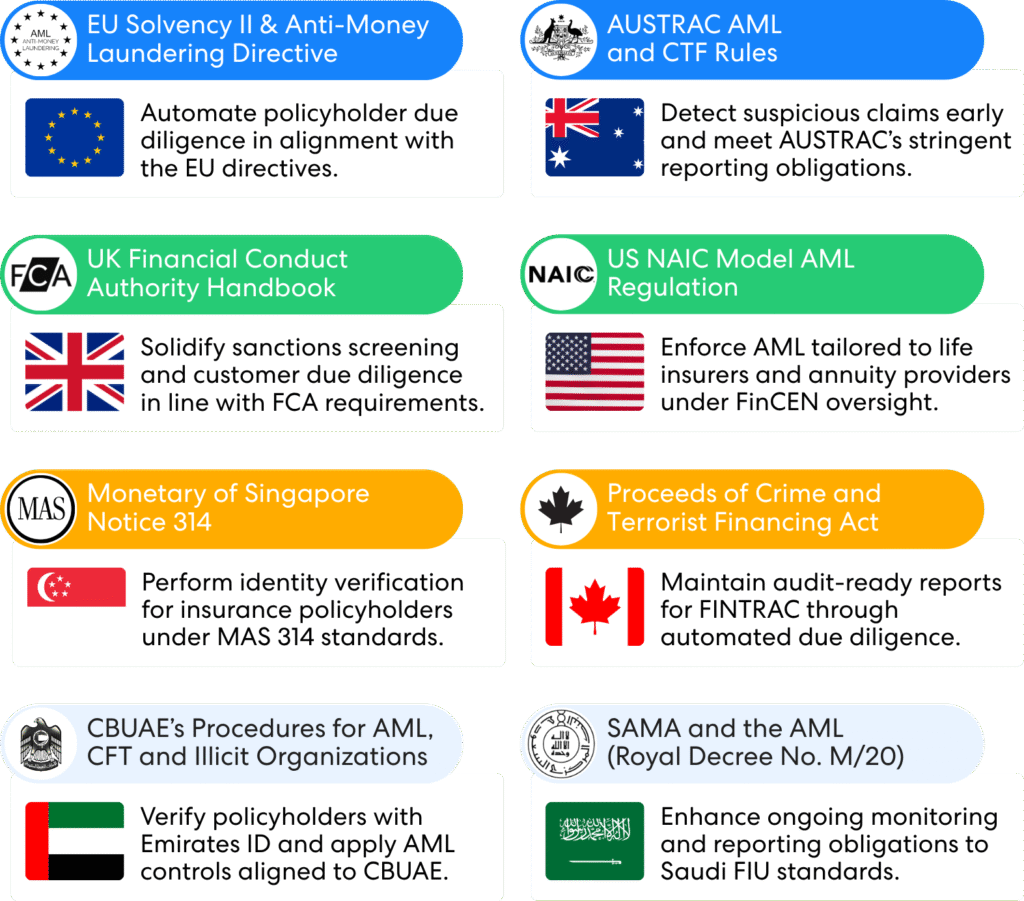
[ Start Now ](https://portal.complycube.com/signup)

### Sanction screening
Run global KYC insurance and AML insurance checks across 220+ countries. Stay ahead of fraud and meet strict insurance AML compliance standards.

### Custom lists
Build and update your own watchlists of claimants, brokers, or companies. Enhance KYC insurance and AML insurance processes with tailored compliance.

### Omni-channel
Deliver seamless KYC insurance and AML insurance checks across web, mobile, and apps. Accelerate onboarding while meeting insurance AML compliance needs.

### Enterprise-ready
Designed for global insurers, ComplyCube ensures reliable KYC insurance and insurance AML compliance with enterprise-grade security and audit controls.

How to Safeguard Your Firm Against Insurance Fraud
Insurers face increasing demands to implement robust KYC and AML insurance measures. ComplyCube’s **exclusive** insurance fact sheet reveals the critical steps insurers must take to stay compliant and protect against **insurance fraud**.
[ Download Guide ](https://www.complycube.com/en/insurance-regulatory-compliance/)
[Explore KYC Insurance Solutions](https://www.complycube.com/solutions/due-diligence-compliance/know-your-customer/)
## Explore KYC Insurance Solutions
[Customer Due Diligence](https://www.complycube.com/en/solutions/due-diligence-compliance/customer-due-diligence/) 
### Customer Due Diligence
Tailor customer due diligence to each policyholder’s risk profile, ensuring targeted scrutiny where it’s needed most. Seamlessly adopt a risk-based approach aligned to FATF AML insurance guidelines.
[View solution](https://www.complycube.com/en/solutions/due-diligence-compliance/customer-due-diligence/)
[Biometric Verification](https://www.complycube.com/en/solutions/identity-assurance/biometric-verification/) 
### Biometric Verification
Utilize ComplyCube’s smart and advanced biometric checks built for the KYC customer onboarding process in insurance. Verify claimant authenticity and secure every insurance transaction.
[View solution](https://www.complycube.com/en/solutions/identity-assurance/biometric-verification/)
[Real-time Monitoring](https://www.complycube.com/solutions/global-screening/continuous-monitoring/) 
### Real-time Monitoring
Maintain continuous compliance with automated sanctions, PEP, and adverse media screening solution. Receive instant, real-time notifications of changes to policyholder risk profiles.
[View solution](https://www.complycube.com/solutions/global-screening/continuous-monitoring/)
[View all solutions](https://www.complycube.com/solutions/)
## Frequently asked questions
What types of fraud are common in insurance?
Common types of insurance fraud include policyholders inflating or faking claims, such as overstating damage to property or exaggerating injuries in auto accidents. Fraud can also involve submitting claims for accidents or losses that never occurred, and premium fraud where applicants lie to get lower rates. As such, insurers should implement robust identity verification, biometric authentication, and ongoing AML monitoring to detect suspicious behavior and prevent fraudulent claims effectively.
Does ComplyCube support regional insurance regulations?
ComplyCube supports region-specific compliance in over 250+ territories for insurers to confidently navigate local and global regulations. The platform includes risk-based monitoring, identity verification, and beneficial ownership checks tailored to various jurisdictions such as the UK’s FCA, the EU 6AMLD, the US FinCen, Australia’s AUSTRAC, and more. As a UK DIATF-certified Identity Service Provider, ComplyCube supports insurers to meet evolving KYC and AML requirements with tailored, regulation-ready compliance solutions.
What are the AML requirements for insurance companies?
Insurance companies must comply with strict AML insurance requirements. This includes verifying customers’ identities, monitoring transactions for suspicious activity, screening for sanctions, and regularly reassessing policyholder risk, especially at renewal or termination.
ComplyCube provides compliance support and operational alignment with worldwide AML/KYC standards. This includes the FATF’s Risk-Based Approach for Life Insurance, the UK’s FCA guidelines for enhanced due diligence and fraud detection in the insurance market, and the EU 6AMLD’s predicate offences and corporate liability requirements.
Can ComplyCube integrate with existing claims or underwriting systems?
ComplyCube can seamlessly integrate with existing claims or underwriting systems through its flexible, API-driven platform. It offers easy integration options, including REST APIs, mobile and web SDKs, and client libraries, allowing insurance companies to embed ComplyCube’s AML insurance compliance solutions directly into their premium calculations and claims workflows. This enables insurers to verify the identity of claimants before payouts and stop fraud at the first source without disruption, enhancing efficiency and accuracy across the policy lifecycle.
How does KYC differ between health, motor, life, and business insurance?
KYC requirements in insurance vary across jurisdictions and lines such as health, motor, life, and business, due to the unique risks in each case.
- In **Health Insurance**, a large emphasis is placed on verifying individual policyholders while maintaining foolproof protection over sensitive medical data. Compliance officers in insurance firms must run identity verification and continuous monitoring to mitigate false or inflated medical claims. Multi-factor authentication (MFA) and liveness detection are highly recommended to make verification seamless and more secure.
- **Motor Insurance** is the most targeted area for exaggerated fraud claims. Insurers are recommended to implement multi-layered identity verification with advanced solutions such as document authentication and Optical Character Recognition (OCR) technology to avoid human error and maintain rapid payouts to legitimate customers. Additionally, automation streamlines KYC verification through real-time risk scoring and insights.
- **Life Insurance** fraud includes beneficiary scams, underwriting, claims, and account takeover fraud. Due to high-value policies and long-term cash flows, life insurance faces the strictest AML rules. Under the NAIC and FATF insurance AML regulations, insurers must perform additional verification checks on top of standard KYC procedures. For example, perpetual KYC, adverse media, and sanctions screening are highly recommended.
- In **Business Insurance**, illicit funds can occur easily through premiums and claims, especially if the AML framework has no ongoing oversight and periodic reporting mechanisms. Insurers must verify client relationships, corporate policyholders, and ultimate beneficial owners (UBOs) through robust due diligence processes and upholding end-to-end risk management and assessment.
ComplyCube enables insurers to meet these requirements with no-code and low-code workflows, providing fast, secure onboarding and delivering an average [6.2x average ROI increase](https://www.complycube.com/en/pricing/).
---
### [Pioneering identity verification and KYC](https://www.complycube.com/company/about-us/)
**Published:** October 27, 2021
**Author:** CC
**Content:**
# Our mission is to enable trust in the internet at scale
Digital businesses rely on trusted identity and compliance infrastructure to grow securely. ComplyCube helps teams automate onboarding, prevent fraud, and meet evolving regulatory requirements at scale.
## 10+ million
Transactions are processed every week across international markets, industries, and jurisdictions.
## 220+
Countries and territories supported for greater cross-border compliance confidence.
## 3000+
Data points from trusted global sources and partners, delivering deeper identity & risk intelligence.
## 98%
High onboarding success rates that help businesses convert more customers worldwide.
## Global Platform for Digital Identity and Trust
ComplyCube is an award-winning platform helping businesses automate identity verification, KYC, KYB & AML compliance through intelligent workflows, flexible APIs, and real-time risk intelligence.
Leading businesses across fintech, banking, telecoms, marketplaces, and crypto use ComplyCube to streamline customer onboarding, reduce fraud, and navigate evolving regulatory requirements worldwide.
Built for modern digital businesses, ComplyCube combines enterprise-grade compliance, security, and user experience in one seamless platform.




## Enabling trust across the
digital economy
As digital businesses expand across markets and jurisdictions, identity, fraud, and compliance challenges become harder to manage at scale. ComplyCube helps organizations build trusted digital experiences with automated verification, real-time risk intelligence, and flexible compliance workflows.
Supporting businesses across **220+ countries and territories**, ComplyCube provides the infrastructure to onboard customers securely, reduce fraud, and navigate evolving regulatory requirements with confidence.
## Built for Modern Compliance
ComplyCube combines AI-powered verification, real-time risk intelligence, and a multi-layered architecture to deliver a unified platform for identity verification, KYC, KYB, AML screening, and fraud prevention.

##### Verification & Screening
Verify identities, automate KYC & KYB checks, and streamline screening workflows through one unified platform.

##### Fraud & Risk Intelligence
Leverage real-time monitoring, proprietary knowledge graphs, and intelligent scorecards to strengthen fraud detection and compliance decision-making.

##### AI Risk Engine
Apply AI-driven risk models and intelligent decisioning workflows tailored to your compliance and fraud prevention requirements.

##### Workflow Automation
Automate onboarding and compliance workflows through configurable journeys designed to reduce friction and improve user experience.
## Designed for developers
ComplyCube combines developer-first APIs, powerful SDKs, client libraries, and AI-driven automation to help businesses accelerate integration, streamline compliance, and scale globally.
### Developer Platform
Comprehensive documentation, code samples, client libraries, and developer resources designed to help teams integrate faster and accelerate deployment.
### API-First Architecture
Every ComplyCube capability is powered by flexible, API-first infrastructure designed for developers, partners, and enterprise teams at global scale.
### Powerful SDKs
Feature-rich SDKs for web and mobile platforms help businesses accelerate onboarding and launch verification workflows with minimal engineering effort.

### Integration Guide
Follow step-by-step guides to build, test, and launch your first ComplyCube workflow in minutes.
[ Get started ](https://docs.complycube.com/)
## The leader in compliance as a service
ComplyCube has industry-leading [uptime](https://status.complycube.com/) and performance and adheres to the highest compliance and security standards. We are continuously rolling out improvements to our infrastructure to ensure it keeps up with the ever-increasing demand. We currently handle millions of business-critical API requests every day.
If you ever need assistance, we offer enterprise support options – including 24×7 phone, email, and chat – along with integration and architecture advice and personalized recommendations for your business.
#### All services are online
October 22, 2026 10:36 am
#### 100% uptime
#### partial degradation
#### downtime
#### API
100% uptime for the last 90 days
-
-
-
-
-
-
-
-
-
-
-
-
-
-
-
-
-
-
-
-
-
-
-
-
-
-
-
-
-
-
-
-
-
-
-
-
-
-
-
-
-
-
-
-
-
-
-
-
-
-
-
-
-
-
-
-
-
-
-
-
-
-
-
-
-
-
-
-
-
-
-
-
-
-
-
-
-
-
-
-
-
-
-
-
-
-
-
-
-
-
-
-
-
-
-
-
-
-
-
-
#### Web portal
100% uptime for the last 90 days
-
-
-
-
-
-
-
-
-
-
-
-
-
-
-
-
-
-
-
-
-
-
-
-
-
-
-
-
-
-
-
-
-
-
-
-
-
-
-
-
-
-
-
-
-
-
-
-
-
-
-
-
-
-
-
-
-
-
-
-
-
-
-
-
-
-
-
-
-
-
-
-
-
-
-
-
-
-
-
-
-
-
-
-
-
-
-
-
-
-
-
-
-
-
-
-
-
-
-
-
#### Check services
100% uptime for the last 90 days
-
-
-
-
-
-
-
-
-
-
-
-
-
-
-
-
-
-
-
-
-
-
-
-
-
-
-
-
-
-
-
-
-
-
-
-
-
-
-
-
-
-
-
-
-
-
-
-
-
-
-
-
-
-
-
-
-
-
-
-
-
-
-
-
-
-
-
-
-
-
-
-
-
-
-
-
-
-
-
-
-
-
-
-
-
-
-
-
-
-
-
-
-
-
-
-
-
-
-
-
[Explore our solutions](https://www.complycube.com/solutions/due-diligence-compliance/know-your-customer/)
## Explore our solutions
[Sanctions and PEP screening](https://www.complycube.com/solutions/global-screening/sanctions-pep-screening/) 
### Sanctions and PEP screening
Screen customers against global sanctions, PEPs, and watchlists with real-time monitoring and flexible automation.
[View solution](https://www.complycube.com/solutions/global-screening/sanctions-pep-screening/)
[Real-time monitoring](https://www.complycube.com/solutions/global-screening/continuous-monitoring/) 
### Real-time monitoring
Automate ongoing due diligence with real-time monitoring and instant alerts for customer risk changes.
[View solution](https://www.complycube.com/solutions/global-screening/continuous-monitoring/)
[Document verification](https://www.complycube.com/solutions/identity-assurance/document-verification/) 
### Document verification
Verify identity documents through fast, AI-powered checks designed to reduce fraud and onboarding friction.
[View solution](https://www.complycube.com/solutions/identity-assurance/document-verification/)
[Biometric verification](https://www.complycube.com/solutions/identity-assurance/biometric-verification/) 
### Biometric verification
Use advanced biometric verification and liveness detection to strengthen identity assurance and reduce fraud.
[View solution](https://www.complycube.com/solutions/identity-assurance/biometric-verification/)
[Address verification](https://www.complycube.com/solutions/identity-assurance/address-verification/) 
### Address verification
Verify customer addresses and extract proof-of-address data through intelligent document analysis.
[View solution](https://www.complycube.com/solutions/identity-assurance/address-verification/)
[Multi-bureau checks](https://www.complycube.com/solutions/identity-assurance/multi-bureau-checks/) 
### Multi-bureau checks
Cross-check customer identity data against trusted government, credit bureau, and proprietary data sources.
[View solution](https://www.complycube.com/solutions/identity-assurance/multi-bureau-checks/)
[View all solutions](https://www.complycube.com/solutions/)
## Frequently asked questions
What is ComplyCube?
ComplyCube is an award-winning global identity verification, KYC, KYB, AML, and fraud prevention platform helping businesses automate onboarding, reduce fraud, and build trusted digital experiences at scale. Through powerful APIs, SDKs, AI-driven automation, and real-time risk intelligence, ComplyCube enables organisations to streamline compliance and customer verification worldwide
What solutions does ComplyCube provide?
ComplyCube provides [a unified suite](https://docs.complycube.com/documentation/product-guides) of identity verification and compliance solutions, including document verification, biometric verification, KYC, KYB, AML screening, sanctions and PEP checks, ongoing monitoring, proof of address verification, fraud detection, and risk intelligence. Businesses can access these capabilities through flexible APIs, SDKs, hosted workflows, and no-code automation tools.
Does ComplyCube support global KYC, KYB, and AML compliance?
Yes. ComplyCube supports businesses operating across 220+ countries and territories through global identity verification, AML screening, sanctions monitoring, and compliance automation capabilities. The platform is designed to help organisations meet evolving regulatory requirements while delivering fast, secure, and frictionless onboarding experiences worldwide.
Does ComplyCube offer APIs and SDKs?
ComplyCube offers developer-first [APIs](https://docs.complycube.com/documentation/api-reference), [SDKs](https://docs.complycube.com/documentation/sdks), client libraries, and integration guides designed to help teams integrate identity verification and compliance workflows quickly. Developers can build custom onboarding journeys, automate KYC and AML processes, and launch global verification capabilities across web and mobile applications with minimal engineering effort.
How does ComplyCube help prevent fraud?
ComplyCube combines AI-powered verification, biometric authentication, liveness detection, real-time monitoring, intelligent risk scoring, and fraud detection technologies to help businesses identify suspicious activity and reduce fraud throughout the customer lifecycle. The platform enables organizations to strengthen trust, improve compliance decision-making, and protect digital onboarding experiences at scale.
---
### [Cookie policy](https://www.complycube.com/cookie-policy/)
**Published:** October 27, 2021
**Author:** CC
**Content:**
## HOW WE USE COOKIES
1. Our site (https://www.complycube.com) uses cookies to distinguish you from other users of our site. A cookie is a small file which asks permission to be placed on your computer’s hard drive. Once you agree, the file is added and the cookie helps analyse web traffic or lets you know when you visit a particular site. Cookies allow web applications to respond to you as an individual, therefore providing a good experience whilst at the same time allowing us to improve our site. The web application can tailor its operations to your needs, likes and dislikes by gathering and remembering information about your preferences.
2. We use traffic log cookies to identify which pages are being used. This helps us analyse data about web page traffic and improve our website in order to tailor it to customer needs. We only use this information for statistical analysis purposes and then the data is removed from the system.
3. Overall, cookies help us provide you with a better website, by enabling us to monitor which pages you find useful and which you do not. A cookie in no way gives us access to your computer or any information about you, other than the data you choose to share with us. By accessing our site, you are consenting to us using cookies on your system. Most web browsers automatically accept cookies, but you can usually modify your browser setting to decline cookies if you prefer. This will prevent you from taking full advantage of the website.
## TYPES OF COOKIES
Cookies fall into any of four categories:
- Strictly necessary, which are required for the site’s essential functions to work properly.
- Performance cookies, which allow us to analyse how the site is used in order to improve it. These cookies contain no personal information that identifies a visitor, and all information collected is aggregated and therefore anonymous. By using our site, you agree that we can place these types of cookies on your device.
- Functionality necessary, which allow the website to remember choices that you make, such as user name, language, etc. These cookies do not allow your browsing activity on other sites to be tracked by ComplyCube. When you choose to allow your browser to remember your login details, you agree that we can place these types of cookies on your device.
- Targeting necessary, which are used to deliver adverts more relevant to the user and their interests. For logged in users, there are no ads served at all, so these cookies only apply to logged-out visitors.
## CONTROL OVER COOKIES
You can block cookies by activating the setting on your browser that allows you to refuse the setting of all or some cookies. However, if you use your browser settings to block all cookies (including essential cookies) you may not be able to access all or parts of our site.
You can review and update your cookie preferences at any time by clicking
[ Manage Cookie Preferences](#).
---
### [Enterprise](https://www.complycube.com/pricing/enterprise/)
**Published:** August 10, 2022
**Author:** Simon
**Excerpt:** /*! elementor - v3.7.4 - 31-08-2022 */
**Content:**
# Enterprise
Unlock advanced identity verification tools for enterprises with flexible Know Your Customer pricing. Access custom-made, high-volume operational efficiency with complete AML pricing transparency for **multi-market growth**.
## Premium compliance infrastructure
For organizations with large volumes, bespoke requirements, or unique business models:
Full white labelling
Single Sign-On (SSO)
Customizable scorecards
Seamless API integration
Limitless workflow design
Custom-built development
Intelligent case management suite
Dedicated enterprise infrastructure
[ Contact us ](https://www.complycube.com/contact/contact-sales/)
[ See all plans ](https://www.complycube.com/en/contact/)

## Trusted by big names





## Advanced identity verification tools for enterprises

### Tailored Workflows
Operate across multiple jurisdictions with fully customizable workflows that adapt to your risk level and regulatory context.

### Volume-Based Model
Unlock superior, measurable cost optimization with scalable infrastructure and clear Know Your Customer pricing.

### Security & Governance
Gain regulatory confidence with single sign‑on (SSO), granular Role‑based Access Control, and real‑time audit logs.

### First-class Support
Receive dedicated account manager support, including digital transformation and country expansions.

### Advanced Monitoring
Access ongoing risk screening, adaptive rules engines, and enhanced due diligence with transparent AML pricing.

### Omni-channel
Leverage AML & KYC services across all major systems, including iOS, iPad OS, Android, Chrome, Firefox, Safari, and Edge.
[Get a custom price](https://www.complycube.com/en/contact/contact-sales/)
## Frequently asked questions
Are you an existing customer? Talk to our [customer support](https://www.complycube.com/contact/) team or your Account Manager.
Where is the data usually hosted?
Data hosting is flexible and fully tailored to your business requirements. ComplyCube can manage and store data on your behalf while ensuring full access, security, and compliance with regional data regulations such as the EU GDPR.
What level of support is included with ComplyCube’s Enterprise solutions?
ComplyCube’s Enterprise solutions include premium-level support, with dedicated technical assistance, proactive guidance, and ongoing optimization to meet your evolving compliance needs.
Can ComplyCube’s solutions integrate with my existing systems?
Yes. ComplyCube’s Enterprise model ensures seamless, custom-built integration, supporting APIs and bi-directional connections with CRM, ERP, and core systems to enable end-to-end compliance workflows.
When do I need to move from Growth to Enterprise?
You should consider moving from Growth to Enterprise when your compliance needs become more complex or require greater scalability. For instance, higher onboarding volumes, more advanced workflow automation, stricter access controls, deeper system integrations, or operating across multiple jurisdictions would require enterprise-grade support.
How can I upgrade my current AML pricing package?
Moving between pricing models is designed to be seamless. As your requirements evolve, you can upgrade from Growth to Enterprise without disrupting existing workflows, integrations, or data. [Contact a member](https://www.complycube.com/en/contact/contact-sales/) of the support team here.
---
### [UK Identity Verification and Fraud Prevention](https://www.complycube.com/solutions/identity-assurance/uk-identity-verification-and-fraud-prevention/)
**Published:** April 24, 2024
**Author:** Andreea Balasa
**Content:**
THE HIGHEST LEVEL OF IDENTITY ASSURANCE IN THE UK
# UK Identity Verification and Fraud Prevention
ComplyCube helps UK businesses strengthen UK Identity Verification, assess fraud risk, and meet digital identity assurance requirements through a UK DIATF-certified platform. Its real-time workflow unifies the essential identity, biometric, fraud and assurance checks needed to support faster, more confident onboarding decisions.
[ Start now ](https://portal.complycube.com/signup)
[ Contact us ](https://www.complycube.com/contact/contact-sales/)





### Identity assurance
Verify customer attributes against trusted UK data sources to support risk-based onboarding and GPG45-aligned identity profiles.

### Fraud prevention
Detect stolen, synthetic, and high-risk identities through fraud intelligence, biometric assurance, and configurable risk checks.

### Real-time checks
Run identity and fraud checks through APIs, SDKs, hosted flows, or no-code modules for faster onboarding decisions.
Anti-fraud prevention
## Combat UK identity fraud with collaborative fraud intelligence
ComplyCube helps businesses detect high-risk identities by combining trusted UK data sources, biometric assurance, and fraud risk signals in one workflow. This approach from the UK Digital Identity and Attributes Trust Framework (UK DIATF) supports stronger onboarding decisions, clearer audit trails and earlier detection of stolen, synthetic, or suspicious identity patterns.







Comprehensive identity assurance
## Build a more unified view of each customer's identity risk
A single identity profile gives compliance teams the context needed to make faster, better-evidenced decisions. ComplyCube brings together identity, biometric, database, and fraud signals to support Customer Due Diligence (CDD), and Enhanced Due Diligence (EDD) and audit-ready reviews.
UK DIATF certified approach
## Verify customers through a UK DIATF-certified platform
As a certified Identity Service Provider (IDSP) under the UK DIATF, ComplyCube supports high-trust digital identity checks. Its GPG45-aligned workflows help businesses assess identity confidence, fraud exposure, and person-to-identity binding for regulated onboarding journeys.

## Get started with our UK identity and fraud checks today
Our ‘No code’ and ‘Low code’ solutions enable you to get started with quick and effective UK customer onboarding in minutes.



### Intelligent fraud defense
Identify risky identities earlier using fraud intelligence, biometric checks, and assurance signals designed for secure, high-confidence UK customer onboarding.

### Optimized approval journeys
Move genuine customers through verification faster with risk-based checks that balance conversion, compliance confidence, and fraud prevention from the first interaction.

### Trust framework certified
Rely on a UK DIATF-certified IDSP, with workflows and modules that support GPG45 identity checking principles and regulated onboarding requirements.

### Secure enterprise infrastructure
Protect sensitive identity data with certified controls, audit-ready records, configurable access, and privacy-first infrastructure built for regulated organizations.
## Trusted by big names






Comprehensive UK Identity Fraud Checks
Leverage the UK’s most complete IDV and anti-fraud protection solution to assess customer risk precisely. Learn more about the UK DIATF in our recent guide.
Go to Guide
[Explore other solutions](https://www.complycube.com/solutions/due-diligence-compliance/know-your-customer/)
## Explore other solutions
[Biometric Verification](https://www.complycube.com/solutions/global-screening/watchlist-screening/) 
### Biometric Verification
Confirm that the person completing onboarding is present, live, and linked to the claimed identity using face matching and liveness detection.
[View solution](https://www.complycube.com/en/solutions/identity-assurance/biometric-verification/ "Watchlist screening")
[Document Verification](https://www.complycube.com/solutions/global-screening/adverse-media-checks/) 
### Document Verification
Verify passports, driving licenses, residence permits, and other identity documents using AI-powered document checks, NFC, and fraud detection.
[View solution](https://www.complycube.com/en/solutions/identity-assurance/document-verification/ "Adverse media checks")
[Watchlist Screening](https://www.complycube.com/solutions/global-screening/continuous-monitoring/) 
### Watchlist Screening
Screen customers against sanctions, Politically Exposed Person (PEP), adverse media, and internal watchlists to support Anti-Money Laundering (AML) controls.
[View solution](https://www.complycube.com/solutions/global-screening/watchlist-screening/ "Watchlist screening")
[View all solutions](https://www.complycube.com/solutions/)
## Frequently asked questions
How does ComplyCube verify UK customer identities?
For UK identity verification, ComplyCube checks customer details against trusted data sources to confirm key identity attributes. It can also combine document verification, biometric assurance, and fraud signals in one workflow. This helps teams make accurate, risk-based onboarding decisions with clearer evidence and stronger protection against identity misuse.
How does ComplyCube support UK DIATF requirements?
As a UK DIATF-certified Identity Service Provider (IDSP), ComplyCube supports workflows aligned with GPG45 identity checking principles. Businesses can asses identify confidence, fraud exposure, and person-to-identity binding through structured checks. This helps regulated teams apply consistent identity assurance controls during high-trust onboarding, account opening, and customer verification journeys.
What fraud risks can ComplyCube help detect?
Stolen, synthetic, deceased, and suspicious identities are common risks in UK customer onboarding. ComplyCube helps detect these risks through fraud intelligence, biometric checks, document analysis, and structured risk indicators. This gives businesses a clearer view of high-risk profiles before users complete verification, access services, or create financial exposure.
How can ComplyCube reduce onboarding friction?
In customer onboarding, risk-based workflows help genuine users complete identity checks with less friction. ComplyCube can route lower-risk customers through faster verification while escalating higher-risk profiles to stronger checks, manual review, or additional assurance. This helps businesses balance conversion, fraud control, compliance confidence, and operational efficiency.
Which teams benefit from ComplyCube's UK identity verification?
For compliance, product, and operations teams, ComplyCube centralises UK identity verification in one configurable platform. Teams can manage checks, evidence decisions, handle exceptions, and maintain audit-ready onboarding records. This supports faster customer journeys, clearer governance, and more consistent verification standards across high-volume UK onboarding operations.
---
### [UK DIATF Certified IDSP](https://www.complycube.com/company/security-compliance-center/uk-diatf-certified-idsp/)
**Published:** June 7, 2024
**Author:** Andreea Balasa
**Content:**
Certified IDSP under the UK DIATF
# UK DIATF Certified IDSP
ComplyCube is a certified **Identity Service Provider (IDSP)**, built to power **UK DIATF**-aligned identity verification for **Right to Work**, Right to Rent, Disclosure and Barring Service (DBS), and **digital onboarding checks**. Independently vetted under the framework, ComplyCube helps organisations meet confidence-level requirements across **23 certified identity profiles** with secure, configurable, and audit-ready verification workflows.
[ Start now ](https://portal.complycube.com/signup)
[ Contact us ](https://www.complycube.com/contact/contact-sales/)





### Certified IDSP Workflows
Verify tenants, employees, and applicants through UK DIATF-aligned identity checks that support regulated onboarding.

### Confidence-Level Coverage
Meet required identity assurance levels with certified profiles, audit-ready evidence, and configurable verification flows.

### Flexible Integration Options
Deploy IDSP checks through APIs, SDKs, hosted flows, and low-code modules built for faster implementation.
Trusted Tenant Verification
## Right to Rent Checks
Verify prospective tenants faster with Right to Rent checks powered by ComplyCube’s certified IDSP workflows. Document Check, Identity Check, and UK Identity Fraud Check helps property teams confirm tenant identities with less manual effort.
Property teams can tailor checks to tenancy risk by adding Proof of Address (PoA), Electoral Roll Registration, Credit Bureau Checks, or Anti-Money Laundering (AML) screening where stronger evidence is needed.
[Learn more](https://www.complycube.com/en/use-cases/process/government-certified-right-to-rent-check-uk-diatf/)





EFFORTLESS EMPLOYEE oNBOARDING
## Right to Work Checks
Bring the same digital speed to employee onboarding. ComplyCube supports Right to Work checks through secure IDSP workflows that combine identity evidence, document validation and UK fraud signals in one structured journey.
Every result is designed to support clearer internal review, helping hiring teams keep identity evidence organised, consistent, and ready for compliance checks.
[Learn more](https://www.complycube.com/en/use-cases/process/certified-digital-right-to-work-checks/)
STREAMLINED IDENTITY SCREENING
## Disclosure and Barring Service (DBS)
For background screening, identity confidence matters before the check begins. ComplyCube supports Disclosure and Barring Service (DBS) identity checks through certified IDSP workflows built around reliable applicant evidence.
Document Check, Identity Check, UK Identity Fraud Check, and Proof of Address create a stronger foundation for DBS screening, with additional checks available for more sensitive or higher-assurance journeys.
[Learn more](https://www.complycube.com/en/use-cases/process/government-certified-enhanced-dbs-checks/)

## About UK Digital Identity and Attributes Framework (DIATF)
The UK Digital Identity and Attributes Trust Framework, referred to as UK DIATF, sets rules for certified digital identity services in the UK. It supports trusted digital identity verification by defining how providers should prove identity, protect users, and meet recognized assurance requirements.
For organisations choosing an IDSP, the framework helps create a clearer benchmark for privacy, security, and identity assurance. It also supports consistent confidence levels across use cases such as Right to Work, Right to Rent, and DBS checks.
The DIATF helps certified identity service providers deliver digital identity checks that can reduce reliance on manual document review. This gives organisations a more consistent way to assess identity evidence, manage risk, and support secure digital onboarding.



### Scalable IDSP Infrastructure
Scale identity checks across tenants, employees, applicants, and customers with secure workflows built for high-volume verification.

### Fraud-Resistant Identity Checks
Detect suspicious identity evidence using document analysis, biometric verification, device signals, and fraud risk indicators.

### Advanced Liveness Detection
Reduce spoofing and impersonation risk with face matching, passive liveness, active liveness, and biometric risk analysis.

### Automat4ed Risk Monitoring
Support ongoing review with automated alerts, configurable workflows, case management tools, and structured audit evidence.
## Trusted by leading organisations






Choosing a Certified IDSP for UK DIATF Checks
Learn how to choose an IDSP for UK DIATF-aligned Right to Work, Right to Rent, and Disclosure and Barring Service (DBS) checks. Explore certification, confidence levels, and key criteria in our expert guide.
[ Go to Guide ](https://www.complycube.com/en/choosing-a-uk-diatf-certified-idsp/)
[Explore other solutions](https://www.complycube.com/solutions/due-diligence-compliance/know-your-customer/)
## Explore other solutions
[Document Verification](https://www.complycube.com/solutions/global-screening/watchlist-screening/) 
### Document Verification
Verify identity documents with automated checks that support certified IDSP workflows and reduce manual review during onboarding.
[View solution](https://www.complycube.com/en/solutions/identity-assurance/document-verification/ "Watchlist screening")
[UK Identity Fraud Check](https://www.complycube.com/solutions/global-screening/adverse-media-checks/) 
### UK Identity Fraud Check
Assess UK identity risk with fraud signals, profile scoring, and evidence checks for DIATF-aligned verification workflows.
[View solution](https://www.complycube.com/en/solutions/identity-assurance/uk-identity-verification-and-fraud-prevention/ "Adverse media checks")
[Biometric Verification](https://www.complycube.com/solutions/global-screening/continuous-monitoring/) 
### Biometric Verification
Match users to identity documents with liveness detection, face matching, and biometric checks that reduce impersonation risk.
[View solution](https://www.complycube.com/en/solutions/identity-assurance/biometric-verification/ "Continuous monitoring")
[View all solutions](https://www.complycube.com/solutions/)
## Frequently asked questions
What is an Identity Service Provider (IDSP)?
An IDSP, or Identity Service Provider, verifies that a person is who they claim to be. It does this using trusted identity checks such as document verification, biometric matching, liveness detection, fraud analysis, and identity evidence review.
Is ComplyCube a certified IDSP?
Yes. ComplyCube is a certified IDSP using the UK DIATF, supporting digital identity verification across Right to Work, Right to Rent, Disclosure and Barring Service (DBS), and other regulated onboarding workflows. ComplyCube helps meet confidence-level requirements under the framework.
Which organisations need a certified IDSP?
A certified IDSP is useful for employers, landlords, background screening providers, financial services, and other regulated platforms that need reliable identity checks. It helps teams verify users digitally while maintaining consistent evidence, security controls, and audit-ready workflows.
How can teams integrate ComplyCube's IDSP workflows?
Teams can integrate ComplyCube to APIs, SDKs, hosted onboarding flows, and low-code modules. This gives product, compliance, and operations teams flexible ways to launch identity checks without rebuilding their onboarding stack.
What makes ComplyCube different from a standard identity service provider?
ComplyCube combines document verification, liveness detection, UK identity fraud checks, Anti-Money Laundering (AML) screening, workflow automation, and enterprise controls. This helps organisations manage identity assurance, fraud risk, and compliance review from one platform.
---
### [Banned Faces](https://www.complycube.com/solutions/identity-assurance/face-blocklist/)
**Published:** May 29, 2026
**Author:** Dini Habib
**Excerpt:** Use Face Blocklist to prevent repeated fraudsters from attempting to use your service. ComplyCube's Facial Blocklist feature uses advanced facial analysis to flag a user if their facial biometrics match a face on your banned list.
**Content:**
# Face Blocklist for Repeat Fraudster Detection
Automatically flag or reject customers during Identity Checks when their facial biometrics match a face on your banned list. Use ComplyCube’s Face Blocklist feature to prevent repeat fraud attempts and identify users already known to your organization, ensuring consistent policy enforcement at every touchpoint.
[ Start now ](https://portal.complycube.com/signup)
[ Contact us ](https://www.complycube.com/contact/contact-sales/)
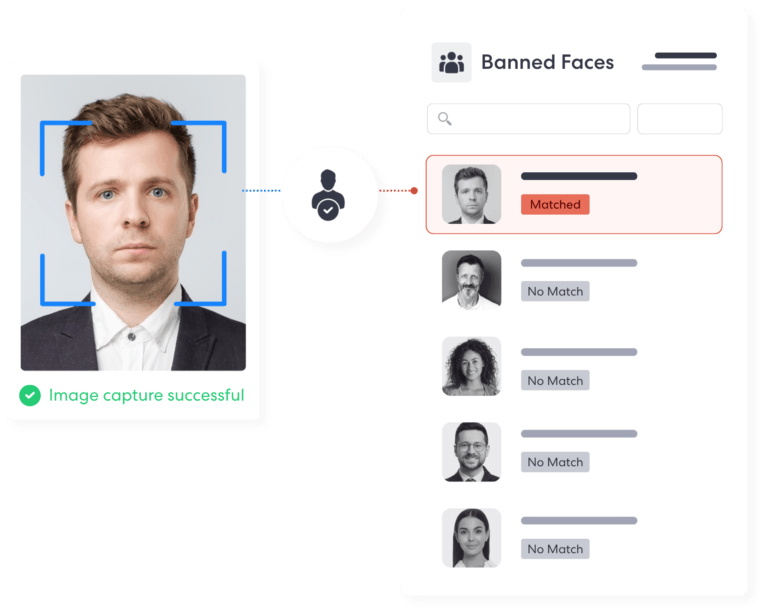
## Reduce Risk and Maintain Audit-ready Evidence.
Turn known fraud intelligence into automated, auditable onboarding decisions with Face Blocklist, built for regulated businesses. Gain greater control over risk decisions by adding known banned faces to your list.

### Risk-based Decisioning
Achieve a clear risk signal from a blocked face that you can use to approve, reject, or escalate an Identity Check.

### Reduce Manual Review
Automatically detect potential matches and compare repeat offenders without manual cross-referencing.

### Improved Auditability
Evidence why a customer was flagged or rejected, with clear, instant case notes and check outcomes.
## Prevent Repeat Fraud Attempts Faster
Identify known bad actors earlier in the identity verification process by screening customers against your Facial Blocklist.
Block known attackers or high-risk individuals from attempting to re-enter onboarding with different personal details.
precise identity checks
## Safeguard your business with independently certified biometric verification
ComplyCube’s ISO-certified PAD Level 2 face-matching and liveness detection system verifies identity with layered biometric checks that validate liveness, confirm facial similarity, and detect spoofing or tampering signals.
This includes facial similarity scoring, banned faces analysis, previously enrolled face detection, spoofed image analysis, and liveness checks to ensure the image is suitable for reliable verification.

[ Start Now ](https://portal.complycube.com/signup)

### All-in-One Platform
Achieve a multi-layered fraud prevention infrastructure by layering Facial Blocklist alongside KYC checks, including ongoing monitoring, PEP, and sanctions screening. Streamline onboarding and enforce consistent risk decisions across the customer journey.

### Safeguard Sensitive Data
ComplyCube offers a comprehensive data protection framework aligned to leading data and privacy rules, such as the EU GDPR and US NIST. Safeguard biometric and identity data within a trusted compliance environment and build regulatory trust.
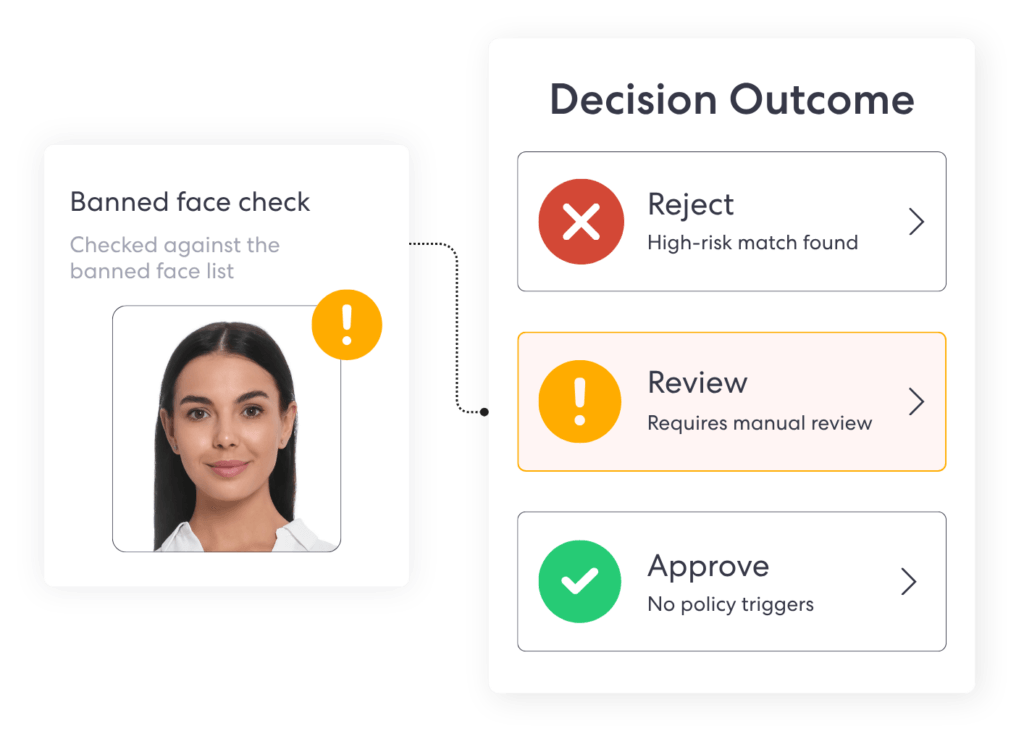
## Streamline Internal KYC Decisions
Customize how blocked face matches are handled in line with your internal risk policies.
ComplyCube’s automated Facial Blocklist feature enables compliance teams to instantly flag, review, or reject an attempt, providing greater control over KYC decisions.
## Strengthen Auditability and Governance
With Face Blocklist, businesses can add another layer of defence beyond names, emails, devices, phone numbers, and documents.
Strengthen oversight across high-risk onboarding decisions and maintain the evidence needed to support internal reviews and compliance audits.
[Explore other solutions](https://www.complycube.com/solutions/due-diligence-compliance/know-your-customer/)
## Explore other solutions
[Document Verification](https://www.complycube.com/solutions/identity-assurance/document-verification/) 
### Document Verification
Perform advanced document verification with support for over 14,000 document types. Scale globally while maintaining strong KYC compliance.
[View solution](https://www.complycube.com/solutions/identity-assurance/document-verification/ "Watchlist screening")
[Device Intelligence](https://www.complycube.com/solutions/fraud-intelligence/device-intelligence) 
### Device Intelligence
Block suspicious, high-risk customers with Device Intelligence. Analyze risks through network and behavioral signals without disrupting user experience.
[View solution](https://www.complycube.com/solutions/fraud-intelligence/device-intelligence "Adverse media checks")
[Watchlist Screening](https://www.complycube.com/solutions/global-screening/watchlist-screening/) 
### Watchlist Screening
Automate global AML compliance and cut false positives with our watchlist screening solution. Reduce risks and lower manual reviews.
[View solution](https://www.complycube.com/solutions/global-screening/watchlist-screening/ "Continuous monitoring")
[View all solutions](https://www.complycube.com/solutions/)
## Frequently asked questions
How does Face Blocklist work?
Face Blocklist compares a customer’s facial biometrics captured during identity verification against faces stored on your team’s internal banned list. When a potential match is found, the customer is automatically flagged, allowing compliance teams to reject the customer or escalate it for further review.
What is Facial Blocklist feature used for?
The Facial Blocklist feature is used to prevent known high-risk individuals, repeat fraudsters, or previously blocked customers from passing identity verification again. It helps businesses strengthen fraud prevention, enforce internal KYC policies, and maintain strong evidence for regulatory reporting.
How do I integrate Face Blocklist?
You can integrate ComplyCube’s Face Blocklist into your identity verification workflow by enabling banned-face screening as part of your identity verification process. Once configured, you can upload new faces and enable face captures to be screened against your banned list during onboarding.
Can Face Blocklist support KYC and customer due diligence?
Yes. A Face Blocklist can support KYC and customer due diligence by helping businesses identify individuals who have previously been linked to suspicious or high-risk onboarding activity. It adds another security layer to support risk-based onboarding, enhanced due diligence, repeat fraud prevention, and more consistent decision-making.
Can a customer be removed from the banned list?
Yes. A customer can be removed from the banned list when a business determines that the original listing is no longer valid, was added in error, or should be reversed following an internal review. Businesses should document why a customer was added, reviewed, or removed from the Facial Blocklist to maintain auditability.
---
### [NFC Verification](https://www.complycube.com/solutions/identity-assurance/document-verification/nfc-verification/)
**Published:** May 28, 2024
**Author:** Andreea Balasa
**Excerpt:** Leverage ComplyCube’s NFC ID Verification to optimize your customer onboarding. Our NFC Verification uses RFID analysis for real-time, 100% accurate data extraction from ICAO 9303-compliant NFC chips.
**Content:**
# Near-Field Communication (NFC) Verification
Leverage ComplyCube’s NFC ID Verification to optimize your customer onboarding. This method uses NFC verification technology for real-time, 100% accurate data extraction from ICAO 9303-compliant NFC chips. Our automated process enhances security, eliminates document fraud, and simplifies compliance, ensuring a secure and seamless user experience.
[ Start now ](https://portal.complycube.com/signup)
[ Contact us ](https://www.complycube.com/contact/contact-sales/)




## Future-Proof Your Business with NFC-based Identity Verification
Poised to become a cornerstone in **digital identity security,** NFC ID Verification enables you to verify customers reliably and achieve a high level of identity assurance. ComplyCube leverages this technology to ensure precise and instant data extraction from NFC-enabled documents such as e-Passports and e-ID cards, enhancing both security and user experience while preparing your business for future growth and compliance demands.

### Advanced RFID Analysis
Achieve the highest identity assurance with RFID analysis, using NFC for secure and precise smartphone-based verification.

### Instant Data Extraction
Experience real-time, 100% accurate data extraction. This technology reduces errors and verifies document authenticity.

### Advanced Fraud-Deterrence
Enhance security with Passive verification for chip authenticity and Active cryptographic challenges for robust fraud protection.
## Multi-layered Verification with NFC Technology
Our multi-layered verification combines RFID analysis with visual checks, liveness detection, and security feature validation for robust fraud prevention.
RFID analysis ensures accurate data extraction, while visual checks meticulously inspect documents for authenticity and integrity.
This comprehensive approach provides robust protection and confidence in your onboarding process, minimizing the risk of manipulation.
Global Identity Assurance Standards
## Proven NFC Assurance at Global Scale
Built for regulated businesses, ComplyCube’s ICAO 9303-aligned NFC checks read and validate chip data from supported ePassports and eIDs using globally recognized eMRTD standards.
Start detecting fraud patterns that visual inspection alone can miss, including cloned chips, invalid signatures, manipulated chip data, and a mismatch between chip, document, and biometric evidence.
[ Contact Us ](https://portal.complycube.com/signup)

### Enhanced Fraud Protection
We empower financial firms and regulated businesses to combat fraud effectively, reducing financial losses while ensuring a seamless customer journey.

### Privacy-Centric Verification
Our fully hosted and secure remote verification service validates customers without using unsafe methods, such as email, to handle sensitive PII data.


## Fraud Protection
NFC verification employs **ICAO Doc. 9303 standards** to authenticate identity document chips using both Active and Passive verification techniques. This detects manipulated or duplicated chips in seconds, deterring fraudulent attempts.
Our NFC verification flags sophisticated forgery techniques, including but not limited to:
- Manipulated Chip Data
- Cloned RFID Chips
- Fake Digital Signatures
- Counterfeit Physical Documents
## Document Verification
Using cutting-edge AI technology, ComplyCube meticulously examines over 14,000 types of ID documents to detect issues such as forgery, compromise, duplication, expiration, and blacklisting.
Our document liveness detection system ensures the authenticity of various documents, including passports, travel documents, licenses, identity cards, permits, and visa stamps
[View solution](https://www.complycube.com/en/solutions/identity-assurance/document-verification)



## Biometric Verification
Our biometric authentication solution prioritizes a seamless customer journey, striking the perfect balance between minimal user interaction and comprehensive data extraction with just one selfie.
Our system actively detects and prevents fraud, including high-resolution photo deceits and mask impersonations. Advanced liveness detection for face recognition ensures secure and reliable identity verification, enhancing user trust and system integrity.
[View solution](https://www.complycube.com/en/solutions/identity-assurance/biometric-verification/)
[Explore other solutions](https://www.complycube.com/solutions/due-diligence-compliance/know-your-customer/)
## Explore other solutions
[Continuous Monitoring](https://www.complycube.com/en/solutions/global-screening/continuous-monitoring/) 
### Continuous Monitoring
Stay ahead of your Ongoing Due Diligence (ODD) requirements with our continuous monitoring service. Receive real-time notifications whenever there is a change in your customers’ status.
[View solution](https://www.complycube.com/en/solutions/global-screening/continuous-monitoring/ "Adverse media checks")
[Customer Authentication](https://www.complycube.com/en/solutions/identity-assurance/customer-authentication/) 
### Customer Authentication
Ensure secure and precise identity verification for your customers with our state-of-the-art multi-point biometric matching technology before granting access to your services.
[View solution](https://www.complycube.com/en/solutions/identity-assurance/customer-authentication/ "Watchlist screening")
[Multi-bureau Checks](https://www.complycube.com/en/solutions/identity-assurance/multi-bureau-checks/) 
### Multi-bureau Checks
Confirm customer details, including name, date of birth, and social security number, by cross-referencing with reputable sources such as government databases and credit agencies.
[View solution](https://www.complycube.com/en/solutions/identity-assurance/multi-bureau-checks/ "Continuous monitoring")
[View all solutions](https://www.complycube.com/solutions/)
## Frequently asked questions
Is your solution global?
Yes, it is and you are able to screen your clients against our worldwide data coverage spanning 250+ territories.
What is NFC-based document verification?
NFC document verification uses your phone to read the chip in biometric IDs or e-passports, confirming the data is real and untampered.
How does NFC verification work?
NFC verification uses our Mobile SDKs to detect RFID chips in documents like e-passports or modern ID cards. If a chip is found, the user is prompted to scan it, enabling fast, secure, and automated data extraction for reliable identity checks.
Is NFC verification secure?
Yes. NFC verification uses cryptographic checks to detect tampering, clones, or fake documents, ensuring high security and authenticity.
How does NFC verification support compliance?
NFC verification involves extracting encrypted data from the cryptographic chips embedded in e-documents, such as passports and national ID cards. This chip is government-authorized, enabling compliance teams to confidently prove a user’s document is genuine. It strengthens AML and KYC compliance by supporting businesses in identifying and blocking cases of tampered documents, identity theft, and forgery.
---
### [Face Authentication](https://www.complycube.com/solutions/due-diligence-compliance/know-your-customer/face-authentication/)
**Published:** July 12, 2024
**Author:** Sofia Daley
**Excerpt:** Biometric enrollment for fast face authentication. Our face verification ensures identities match previously enrolled faces. Reduce fraud risk and scale securely with advanced facial recognition technology.
**Content:**
# Face Authentication
Authenticate customers quickly against their previously enrolled face with ComplyCube’s Face Authentication feature. Facilitate effective and efficient facial verification for passwordless authentication, periodic re-verifications, account reactivations, and more.
[ Start now ](https://portal.complycube.com/signup)
[ Contact us ](https://www.complycube.com/en/contact/contact-sales/)


## Fast Verification with Face Authentication
Verify the identity of your clients quickly with our robust facial recognition engine. Biometric data samples from provided selfies are compared against a previously enrolled face, ensuring seamless security with fast verification.

### Scale Securely
Our biometric facial recognition engine will ensure accuracy at all times, ensuring security for your business with every authentication.

### Omni-channel Integration
Integrate effortlessly via SDKs, no-code solutions, or the web platform, to ensure high security with biometric enrolment.

### Streamline Operations
Allow customers to quickly achieve verification without any hassle. Enable streamlined periodic re-verifications.
## Biometric Data Analyzed
Our biometric enrollment examines unique faces by pulling biometric data samples and analyzing them in comparison to previously enrolled faces.
The facial recognition engine will look at biometric data samples and analzse subtle micro-expressions, skin texture, and facial landmarks to match a unique faceprint quickly and accurately.


Numbers that back it up
## Why Complycube?
The ComplyCube platform offers **the most complete, flexible, and top-rated** KYC solutions to help you build trust in your business. Whether you’re a startup or a multinational enterprise, we’ve got you covered.
[ Contact us ](#)
10+ million
Transactions are processed week in and week out across the globe.
250+
Countries and territories supported for a greater peace of mind.
3,000+
Data points from trusted sources and partners across the world, giving you the highest coverage.
98%
Client onboarding rate, helping you convert more customers and grow your business.

### AI-Powered Biometrics
Enhance the security of your services through an AI-powered biometric check that ensures accuracy and efficiency.

### Comprehensive Compliance
Ensure your organization is compliant with national and international regulations with state-of-the-art compliance solutions.


## Unlock Passwordless Authentication
Ensure that customer verification is safe and secure whilst enabling passwordless authentication.
Our face authentication allows your customers to verify their identities seamlessly without needing to provide identity document.
Eliminate the need for documentation with our face matching engine, that will recognize faces that have been previously enrolled.
## Re-Verification Enabled
Periodically re-verify your customers to ensure optimized security.
Our face authentication checks if the scanned face matches a previously captured photo of the client, allowing for swift identity verification.


[Explore other solutions](https://www.complycube.com/solutions/due-diligence-compliance/know-your-customer/)
## Explore other solutions
[Document Verification](https://www.complycube.com/en/solutions/identity-assurance/document-verification/) 
### Document Verification
Verify your customers’ identities accurately and efficiently before granting them access to your services with our cutting-edge document verification solutions.
[View solution](https://www.complycube.com/en/solutions/identity-assurance/document-verification/ "Watchlist screening")
[Multi-bureau Checks](https://www.complycube.com/en/solutions/identity-assurance/multi-bureau-checks/) 
### Multi-bureau Checks
Corroborate critical customer information, including name, date of birth, and social security number, against authoritative sources like government records and credit bureaus.
[View solution](https://www.complycube.com/en/solutions/identity-assurance/multi-bureau-checks/ "Continuous monitoring")
[Age Estimation](https://www.complycube.com/en/solutions/identity-assurance/facial-age-estimation/) 
### Age Estimation
Protect access to age-restricted services with our expert age estimation. We enable you to confidently serve your customers, protect minors, and eliminate the need for ID documents.
[View solution](https://www.complycube.com/en/solutions/identity-assurance/facial-age-estimation/ "Adverse media checks")
[View all solutions](https://www.complycube.com/solutions/)
## Frequently asked questions
What is face authentication and how does it work?
Face authentication works by comparing a customer’s new selfie or facial scan against a previously enrolled face. This helps businesses verify that the returning user is the same person without asking them to resubmit identity documents every time, enhancing customer experience and fraud prevention.
Is face authentication suitable for KYC compliance?
Yes. Face authentication supports KYC compliance by enabling businesses to automatically verify returning customers and perform periodic re-verification in line with regulatory requirements. As a result, it reduces fraud risk and supports ongoing customer due diligence.
What are the benefits of face authentication solutions?
Customers should not have to resubmit identity documents multiple times. Face authentication allows businesses to verify returning users against their original biometric enrollment, helping prevent account takeover, streamline account recovery, and support compliance without adding unnecessary friction.
Which companies use face authentication services?
Regulated, high-growth organizations such as financial institutions, FinTechs, and insurers use face authentication to support customer due diligence while streamlining compliance operations. Face authentication offers automated customer re-verification, passwordless authentication, account reactivation, and secure customer access to digital services. As a result, firms can scale their operations efficiently while maintaining strong fraud prevention controls.
How does ComplyCube's face authentication solutions support compliance?
ComplyCube’s AI-powered face authentication solutions supports compliance by allowing businesses to authenticate returning customers against their previously enrolled biometric profile. This helps support periodic KYC re-verification, account reactivation, and customer due diligence while significantly reducing repeat document checks and user friction.
---
### [Government-Certified Right to Rent Check](https://www.complycube.com/use-cases/process/government-certified-right-to-rent-check-uk-diatf/)
**Published:** June 7, 2024
**Author:** Andreea Balasa
**Content:**
# Government-Certified Right to Rent Check
Regulations for Digital Identity Service Providers (IDSP) continue to tighten, ensuring that only robust solutions capture the market. ComplyCube is a **UK DIATF certified IDSP** and is fully compliant with eIDAS regulations for identity service providers. Our bespoke solution enables landlords and rental agencies across the UK to conduct a comprehensive Right to Rent check.



## 74% of landlords and property managers believe that the current measures in place are insufficient to prevent rental fraud, highlighting the need for more robust identity verification processes.
## Trusted by big names






### Automated efficiency
Streamline operations with our advanced automated solutions, saving time and cutting out costly manual processes.

### Adaptive fraud prevention
Implement our solutions to counteract new forms of fraud, monitoring threats in real time to keep your data and transactions safe.

### Global document support
Our solution handles over 13,000 document types, ensuring comprehensive KYC compliance.
Document Fraud Detection
## Document authentication with unrivaled insights
Verify prospective tenant documentation with our market-leading identity verification software. Our document checks include verifying cryptographically protected features such as the Radio Frequency Identification (RFID) chip using Near-Field Communication (NFC), authenticating passport validity through Optical Character Recognition (OCR) and Machine Readable Zone (MRZ) inspection, and forensic, format, and consistency analysis.
[View solution](https://www.complycube.com/en/solutions/identity-assurance/document-verification/)






Advanced Identity Verification
## Top-grade biometric check
We hold a PAD 2-Level certification in liveness detection and facial recognition, which compares biometric selfie images with ID documents. Our facial similarity and liveness percentage scores and spoofed image analysis tools help us identify fraudulent images effectively. The solution uses 3D face maps to recognize users who might have previously enrolled using different details.
[View solution](https://www.complycube.com/en/solutions/identity-assurance/biometric-verification/)
Tenants Screened in Seconds
## Comprehensive UK identity fraud check
Our UK Identity Fraud Check utilizes the SIRA network, the largest cross-sector syndicated database of customer risk intelligence in the UK, which leverages data from over 170 UK institutions. Additionally, our access to Amber Hill and the Disclosure of Death Registration Information (DDRI) enables us to identify sophisticated synthetic fraud quickly.
[View solution](https://www.complycube.com/en/solutions/identity-assurance/uk-identity-verification-and-fraud-prevention/)



## Unlocking Tailored Solutions
Create a bespoke Right to Rent process, leveraging our additional features, including an extensive AML Screening, Electoral Roll Registration, Credit Bureau Check, and Proof of Address Check. Implement a process that suits your business needs.
### [AML Screening](https://www.complycube.com/en/solutions/due-diligence-compliance/anti-money-laundering/)
Our AML check provides an overall risk score for a prospective tenant derived from several types of risk profiling. Our PEP screening forms a key part of this solution, highlighting tenants that may carry a threat of political exposure.
### [Electoral Roll Registration and Credit Bureau Check](https://www.complycube.com/en/solutions/identity-assurance/multi-bureau-checks/)
These global and extensive checks form part of our Multi-Bureau solution. We use authoritative sources such as government and credit bureaus to verify tenant identities against multiple trusted bureaus.
### [Proof of Address](https://www.complycube.com/en/solutions/identity-assurance/address-verification/)
Our Proof of Address check ensures that the prospective tenant’s identity has existed over time. Our decision engine extracts relevant data from Proof of Address (POA) documents and verifies them against the provided details and geolocation.


Choosing a UK DIATF-Certified IDSP
Discover why a DIATF Certified IDSP is the right partner for comprehensive Right-to-Work, Right-to-Rent, and DBS Checks in the UK. Learn more about the DIATF framework in our expert guide.
[ Go to Guide ](https://www.complycube.com/en/choosing-a-uk-diatf-certified-idsp/)
[Explore other solutions](https://www.complycube.com/solutions/due-diligence-compliance/know-your-customer/)
## Explore other solutions
[Continuous monitoring](/solutions/global-screening/sanctions-pep-screening/) 
### Continuous monitoring
Stay on top of your Ongoing Due Diligence (ODD) obligations with our continuous monitoring service. Receive real-time notifications if there are any changes in your customers’ status.
[View solution](/solutions/global-screening/sanctions-pep-screening/)
[Address verification](https://www.complycube.com/solutions/identity-assurance/address-verification/) 
### Address verification
Provide outstanding customer experiences by swiftly and accurately verifying the locations of your global customer base within seconds with a proof of address (PoA) document.
[View solution](https://www.complycube.com/solutions/identity-assurance/address-verification/)
[Multi-bureau checks](https://www.complycube.com/solutions/identity-assurance/multi-bureau-checks/) 
### Multi-bureau checks
Quickly and efficiently verify customer detail such as name, address, DOB, and social security numbers against trusted sources, while keeping user friction to a minimum.
[View solution](https://www.complycube.com/en/solutions/identity-assurance/multi-bureau-checks/)
[View all solutions](https://www.complycube.com/solutions/)
## About UK Digital Identity and Attributes Framework (DIATF)
The UK government’s Digital Identity and Attributes Trust Framework (DIATF), aims to modernize Identity Verification practices by introducing reusable certified IDs as an alternative to traditional documents such as passports. To establish trust, the scheme sets new standards for Digital Identity Service Providers.
To mitigate the risk of fraud, the UK DIATF has published standardized confidence levels that IDSPs must meet across different use cases, referred to as profiles. The Home Office requires a medium level of confidence as a minimum for IDSPs who provide Right to Rent or Right to Work checks.
ComplyCube meets a level of Medium or higher across 23 profiles. Our products are independently government-certified, so we can provide highly tailored solutions, including bespoke Right to Rent, Right to Work, and Disclosure and Barring Service (DBS) checks.



## Frequently asked questions
What are Right to Rent checks?
Right to Rent checks are legal requirements for landlords and letting agents in the UK to verify that prospective tenants are legally able to rent in the country. They involve verifying the tenant’s identity and immigration status.
Why are Right to Rent checks important?
Right to Rent checks help protect landlords and rental agencies from leasing their properties to individuals who might be involved in illegal activities, protecting themselves from encountering issues such as damaged property. Lack of compliance with government Right to Rent regulations can also result in hefty fines and legal penalties.
How is the UK DIATF related to Right to Rent checks?
The [DIATF](https://www.gov.uk/government/publications/the-uk-digital-identity-and-attributes-trust-framework/the-uk-digital-identity-and-attributes-trust-framework) is an initiative created by the UK Government to promote digital trust. The framework outlines standards for adherence to Digital Identity Service Providers (IDSPs). ComplyCube is DIATF-certified, meaning that our Right to Rent checks adhere to the Government’s standards for IDSPs.
What types of documents does ComplyCube verify?
Our platform supports over 13,000 documents, including passports, biometric residence permits, and other identification documents.
Can ComplyCube verify international tenants?
Yes, we can verify documents from all over the world. Our platform verifies international documents within seconds, streamlining operations for rental agencies and landlords.
[Customer stories](https://www.complycube.com/solutions/due-diligence-compliance/know-your-customer/)
## Customer stories
[](https://www.complycube.com/solutions/due-diligence-compliance/know-your-customer/) [iParametrics](https://www.complycube.com/customer/iparametrics/) 
### iParametrics
[ Read more ](https://www.complycube.com/customer/iparametrics/)
[Turo](https://www.complycube.com/customer/turo-strengthens-car-sharing-compliance/) 
### Turo
Turo partnered with ComplyCube to strengthen driver verification, reduce fraud risk, and improve marketplace trust, achieving lower verification costs, higher checkout conversion, and fewer support contacts.
[ Read more ](https://www.complycube.com/customer/turo-strengthens-car-sharing-compliance/)
See all case studies
---
### [Government-Certified Enhanced DBS Checks](https://www.complycube.com/use-cases/process/government-certified-enhanced-dbs-checks/)
**Published:** June 7, 2024
**Author:** Andreea Balasa
**Content:**
# Government-Certified Enhanced DBS Checks
ComplyCube has been recognized by the UK government’s Digital Identity and Attributes Trust Framework (UK DIATF) as a **Certified Digital Identity Service Provider (IDSP) of Disclosure and Barring Service (DBS) checks**. Our bespoke solution enables employers across the UK to conduct enhanced DBS checks for employees whilst remaining compliant with government standards.



## 60% of UK employers agree that current DBS screening processes are not able to effectively detect fraudulent practices.
## Trusted by big names






### Streamlined employee screening
Automate prospective employee background checks with market-leading solutions that quickly and effectively verify identities. Streamline your employee onboarding.

### End-to-end compliance
Opt for fast-paced screening that remains compliant with government standards. Our solutions ensure end-to-end compliance whilst effectively preventing fraud.

### Precision-engineered solutions
Implement a flexible but comprehensive solution with optional features depending on your use case. Our products are independently-government certified.
AI-Powered Document Analysis
## Robust document check
Utilize our market-leading identity verification platform to verify a prospective employee’s documentation and confirm their right to work.
Our verification process ensures document validity through Optical Character Recognition (OCR) and Machine Readable Zone (MRZ) inspection. It also authenticates cryptographically protected features like the Radio Frequency Identification (RFID) chip using Near-Field Communication (NFC), along with performing forensic, format, and consistency analysis.
[View solution](https://www.complycube.com/en/solutions/identity-assurance/document-verification/)






Identities Screened in Seconds
## Effortless biometric check
We possess a PAD 2 Level certification in facial recognition and liveness detection, enabling us to compare biometric selfie images with ID documents.
Our system uses facial similarity and liveness percentage scores, along with a spoofed image analysis tool, to effectively identify fraudulent actors. By analyzing 3D face maps and other metrics, the solution can detect users who may have previously enrolled with different details.
[View solution](https://www.complycube.com/en/solutions/identity-assurance/biometric-verification/)
Specialist Fraud Detection Services
## UK identity fraud check
Our UK Identity Fraud Check leverages the SIRA network, the largest cross-sector customer risk intelligence database in the UK, incorporating data from over 170 institutions. Additionally, by accessing Amber Hill and the Disclosure of Death Registration Information (DDRI), we can swiftly identify and address sophisticated synthetic fraud.
[View solution](https://www.complycube.com/en/solutions/identity-assurance/uk-identity-verification-and-fraud-prevention/)






Proof of Address Verification
## Proof of address (PoA)
Our Proof of Address check verifies that a prospective employee’s identity has a verifiable history. Our decision engine extracts pertinent data from Proof of Address (POA) documents and cross-checks it with the provided details and geolocation. This thorough process ensures the authenticity and continuity of the individual’s identity.
[View solution](https://www.complycube.com/en/solutions/identity-assurance/address-verification/)
## Unlocking Bespoke Solutions
Enhance your DBS check by implementing an extensive AML Screening or Electoral Roll Registration and Credit Bureau Check. Implement a custom employee screening process that works for you.
### [AML Screening](https://www.complycube.com/en/solutions/due-diligence-compliance/anti-money-laundering/)
Our AML check delivers an overall risk score for prospective employees, derived from multiple risk profiling methods. An essential component of this solution is our PEP screening, which accurately identifies employees who may pose a risk.
### [Electoral Roll Registration and Credit Bureau Check](https://www.complycube.com/en/solutions/identity-assurance/multi-bureau-checks/)
These checks are an integral part of our Multi-Bureau solution. By utilizing authoritative sources like government databases and credit bureaus, we verify the identities of potential employees against multiple trusted bureaus.


Choosing a UK DIATF-Certified IDSP
Discover why a DIATF Certified IDSP is the right partner for comprehensive Right-to-Work, Right-to-Rent, and DBS Checks in the UK. Learn more about the DIATF framework in our expert guide.
[ Go to Guide ](https://www.complycube.com/en/choosing-a-uk-diatf-certified-idsp/)
[Explore other solutions](https://www.complycube.com/solutions/due-diligence-compliance/know-your-customer/)
## Explore other solutions
[Multi-bureau checks](https://www.complycube.com/solutions/identity-assurance/multi-bureau-checks/) 
### Multi-bureau checks
Efficiently and swiftly verify customer details, including name, address, date of birth, and social security numbers, against trusted sources, while minimizing user friction.
[View solution](https://www.complycube.com/en/solutions/identity-assurance/multi-bureau-checks/)
[Risk scoring](https://www.complycube.com/solutions/identity-assurance/address-verification/) 
### Risk scoring
Our risk engine utilizes proprietary algorithms to generate an AML risk score for your customers, providing you with an easy-to-understand rating of low, medium, or high.
[View solution](https://www.complycube.com/en/solutions/due-diligence-compliance/risk-scoring/)
[Continuous monitoring](/solutions/global-screening/sanctions-pep-screening/) 
### Continuous monitoring
Keep up with your Ongoing Due Diligence (ODD) obligations using our continuous monitoring service. Get real-time notifications of any changes in your customers’ status.
[View solution](https://www.complycube.com/en/solutions/global-screening/continuous-monitoring/)
[View all solutions](https://www.complycube.com/solutions/)
## About UK Digital Identity and Attributes Framework (DIATF)
The UK government’s Digital Identity and Attributes Trust Framework (DIATF), endorsed by DSIT, aims to innovate Identity Verification practices by implementing reusable certified IDs as an alternative to traditional documents like passports.
To ensure trust in these identities, the framework establishes new standards for digital identity service providers (IDSPs). To prevent fraud, the UK DIATF has defined standardized confidence levels that IDSPs must meet for various use cases, referred to as profiles. For Right to Rent or Right to Work checks, the Home Office requires IDSPs to achieve at least a medium level of confidence.
ComplyCube meets and exceeds the required confidence levels across 23 profiles. Our products are independently certified by the government, allowing us to provide highly customized solutions, including tailored Right to Rent, Right to Work, and Disclosure and Barring Service (DBS) checks.



## Frequently asked questions
What is a DBS check?
Disclosure and Barring Service (DBS) checks are background checks often carried out by employers to ensure that prospective employees are suitable for specific roles. The screening provides employers with information on candidates’ criminal records, often including checks against barred lists.
Why are DBS checks important?
DBS checks allow employers to identify potential hires who might threaten workplace safety and other colleagues. They also help employers mitigate the risk of misconduct by checking whether prospective employees have a criminal record.
How is the UK DIATF related to DBS checks?
The [DIATF](https://www.ukas.com/accreditation/about/developing-new-programmes/development-programmes/uk-digital-identity-and-attributes-trust-framework/) is an initiative created by the UK government to promote digital trust. The framework outlines standards for adherence to Digital Identity Service Providers (IDSPs). ComplyCube is DIATF-certified, meaning that our DBS checks adhere to the government’s standards for IDSPs.
What types of documents does ComplyCube verify?
Our platform accommodates more than 13,000 types of documents, including passports, residence permits, driver’s licenses, visa stamps, and various other identification forms.
Can ComplyCube verify international tenants?
Absolutely, our platform can verify international documents in seconds, significantly streamlining operations for employers.
[Customer stories](https://www.complycube.com/solutions/due-diligence-compliance/know-your-customer/)
## Customer stories
[](https://www.complycube.com/solutions/due-diligence-compliance/know-your-customer/) [iParametrics](https://www.complycube.com/customer/iparametrics/) 
### iParametrics
[ Read more ](https://www.complycube.com/customer/iparametrics/)
[Turo](https://www.complycube.com/customer/turo-strengthens-car-sharing-compliance/) 
### Turo
Turo partnered with ComplyCube to strengthen driver verification, reduce fraud risk, and improve marketplace trust, achieving lower verification costs, higher checkout conversion, and fewer support contacts.
[ Read more ](https://www.complycube.com/customer/turo-strengthens-car-sharing-compliance/)
See all case studies
---
### [Certified Digital Right to Work Checks](https://www.complycube.com/use-cases/process/certified-digital-right-to-work-checks/)
**Published:** June 7, 2024
**Author:** Andreea Balasa
**Content:**
# Certified Digital Right to Work Checks
Regulations for Digital Identity Service Providers (IDSPs) continue to tighten, ensuring that only robust solutions capture the market. At ComplyCube, we’re a **UK DIATF-certified IDSP** and fully comply with **eIDAS** regulations for identity service providers. Our digital Right to Work checks enable employers across the UK to conduct necessary employee screening while remaining compliant with government standards.



## 67% of employers state that current Right to Work screenings are unable to prevent illegal forms of working, pointing to the need for advanced automated solutions.
## Trusted by big names






### Enhanced employee onboarding
Streamline employee screening with advanced automated solutions, resulting in a seamless onboarding process that balances UX and compliance.

### Mitigate your fraud risk
Implement sophisticated solutions that can mitigate your risk of fraud by accurately verifying the identities of prospective employees.

### Precision-engineered solutions
Verify international documents with forensic precision, ensuring accurate identity verification and comprehensive KYC compliance.
Advanced Document Analysis
## Precise document check
Verify a prospective employee’s documentation with our market-leading identity verification platform, checking an applicant’s right to work.
Our check authenticates document validity through Optical Character Recognition (OCR) and Machine Readable Zone (MRZ) inspection, verifying cryptographically protected features such as the Radio Frequency Identification (RFID) chip using Near-Field Communication (NFC), and forensic, format, and consistency analysis.
[View solution](https://www.complycube.com/en/solutions/identity-assurance/document-verification/)






Verify Employee Identities
## Facial biometric check
We hold a PAD 2 Level certification in liveness detection and facial recognition, which compares biometric selfie images with ID documents.
Our facial similarity and liveness percentage scores and our spoofed image analysis tool effectively identify bad actors. The solution analyzes 3D face maps and more to recognize users who might have previously enrolled using different details.
[View solution](https://www.complycube.com/en/solutions/identity-assurance/biometric-verification/)
State-of-the-art Employee Screening
## UK identity fraud check
Our UK Identity Fraud Check taps into the SIRA network, the most extensive cross-sector database of customer risk intelligence in the UK, drawing from over 170 UK institutions. Furthermore, by utilizing Amber Hill and the Disclosure of Death Registration Information (DDRI), we can promptly identify and combat sophisticated synthetic fraud.
[View solution](https://www.complycube.com/en/solutions/identity-assurance/uk-identity-verification-and-fraud-prevention/)



## Unlocking Tailored Solutions
Create a tailored Right to Work process by leveraging our additional features, including comprehensive AML Screening, Electoral Roll Registration, Credit Bureau Check, and Proof of Address Check. Develop a solution that aligns with your business requirements.
### [AML Screening](https://www.complycube.com/en/solutions/due-diligence-compliance/anti-money-laundering/)
Our AML check delivers an overall risk score for prospective employees, derived from multiple risk profiling methods. An essential component of this solution is our PEP screening, which accurately identifies employees who may pose a risk.
### [Electoral Roll Registration and Credit Bureau Check](https://www.complycube.com/en/solutions/identity-assurance/multi-bureau-checks/)
These checks are an integral part of our Multi-Bureau solution. By utilizing authoritative sources like government databases and credit bureaus, we verify the identities of potential employees against multiple trusted bureaus.
### [Proof of Address](https://www.complycube.com/en/solutions/identity-assurance/address-verification/)
Our Proof of Address check confirms that the identity of the prospective employee has a verifiable history. Our decision engine extracts relevant data from Proof of Address (POA) documents and cross-verifies them with the provided details and geolocation.


Choosing a UK DIATF-Certified IDSP
Discover why a DIATF Certified IDSP is the right partner for comprehensive Right-to-Work, Right-to-Rent, and DBS Checks in the UK. Learn more about the DIATF framework in our expert guide.
[ Go to Guide ](https://www.complycube.com/en/choosing-a-uk-diatf-certified-idsp/)
[Explore other solutions](https://www.complycube.com/solutions/due-diligence-compliance/know-your-customer/)
## Explore other solutions
[Address verification](https://www.complycube.com/solutions/identity-assurance/address-verification/) 
### Address verification
Deliver exceptional customer experiences by using proof of address (PoA) documents to swiftly and accurately verify the locations of your global customer base in seconds.
[View solution](https://www.complycube.com/solutions/identity-assurance/address-verification/)
[Continuous monitoring](/solutions/global-screening/sanctions-pep-screening/) 
### Continuous monitoring
Keep up with your Ongoing Due Diligence (ODD) obligations using our continuous monitoring service. Get real-time notifications of any changes in your customers’ status.
[View solution](/solutions/global-screening/sanctions-pep-screening/)
[Multi-bureau checks](https://www.complycube.com/solutions/identity-assurance/multi-bureau-checks/) 
### Multi-bureau checks
Efficiently and swiftly verify customer details, including name, address, date of birth, and social security numbers, against trusted sources, while minimizing user friction.
[View solution](https://www.complycube.com/en/solutions/identity-assurance/multi-bureau-checks/)
[View all solutions](https://www.complycube.com/solutions/)
## About UK Digital Identity and Attributes Framework (DIATF)
The UK government’s Digital Identity and Attributes Trust Framework (DIATF), endorsed by DSIT, seeks to innovate Identity Verification methods by implementing reusable certified IDs as an alternative to traditional documents like passports.
To ensure trust in these identities, the framework sets new standards for Digital Identity Service Providers (IDSPs). To combat fraud, the UK DIATF has established standardized confidence levels that IDSPs must achieve across various use cases, known as profiles. For IDSPs conducting Right to Rent or Right to Work checks, the Home Office mandates a minimum medium level of confidence.
ComplyCube adheres to all levels of confidence across 23 profiles. Our products are independently certified by the government, enabling us to offer highly customized solutions, including specialized Right to Rent, Right to Work, and Disclosure and Barring Service (DBS) checks.



## Frequently asked questions
What are Right to Work checks?
Right to Work checks are legally required processes used by employers to verify the identity and immigration status of prospective employees, ensuring that they can work legally within the UK.
Why are Right to Work checks important?
Right to Work checks help protect employers from hiring individuals who might not have a legal right to work in the UK. Failure to comply with government Right to Work regulations can also result in legal consequences and fines.
How is the UK DIATF related to Right to Work checks?
The [DIATF](https://www.gov.uk/government/publications/the-uk-digital-identity-and-attributes-trust-framework/the-uk-digital-identity-and-attributes-trust-framework) is an initiative created by the UK government to promote digital trust. The framework outlines standards for adherence to Digital Identity Service Providers (IDSPs). Our DIATF certification means that our Right-to-Work checks adhere to the government’s standards for IDSPs.
What types of documents does ComplyCube verify?
Our platform supports over 13,000 documents, including passports, residence permits, drivers licenses, visa stamps, and other identification documents.
Can ComplyCube verify international identities?
Yes, our platform can verify international documents within seconds, streamlining operations for employers.
[Customer stories](https://www.complycube.com/solutions/due-diligence-compliance/know-your-customer/)
## Customer stories
[](https://www.complycube.com/solutions/due-diligence-compliance/know-your-customer/) [iParametrics](https://www.complycube.com/customer/iparametrics/) 
### iParametrics
[ Read more ](https://www.complycube.com/customer/iparametrics/)
[Turo](https://www.complycube.com/customer/turo-strengthens-car-sharing-compliance/) 
### Turo
Turo partnered with ComplyCube to strengthen driver verification, reduce fraud risk, and improve marketplace trust, achieving lower verification costs, higher checkout conversion, and fewer support contacts.
[ Read more ](https://www.complycube.com/customer/turo-strengthens-car-sharing-compliance/)
See all case studies
---
### [Global Fraud Checks](https://www.complycube.com/solutions/due-diligence-compliance/global-fraud-checks/)
**Published:** August 2, 2024
**Author:** Sofia Daley
**Excerpt:** Protect your organization from sophisticated fraud with our advanced global fraud checks. Our solutions ensure identity fraud protection and provide comprehensive risk profiling of your customers. Implement a fraud check today.
**Content:**
Advanced Fraud Protection
# Global Fraud Checks
Implement our advanced global fraud checks and safeguard your organization. Our fraud check provides identity fraud protection alongside a deep understanding of customer risk profiles. Tap into authoritative sources, such as the SIRA network, where critical customer data points can be accessed.
[ Start now ](https://portal.complycube.com/signup)
[ Contact us ](https://www.complycube.com/contact/contact-sales/)




### Identity authentication
Verify if your customers are who they claim to be with advanced facial biometric checks, document authentication, and corroboration with authoritative sources.

### Fraud prevention
Protect your organization from fraud with granular customer risk profiling. Access comprehensive data on your customers to ensure safety.

### Authoritative sources
Find a comprehensive customer profile to minimize fraud risk. Leverage government databases, such as the SIRA network in the UK, to access critical data.
Identity Fraud Protection
## Protect your orgainzation from identity fraud
Our advanced ISO 30107-3 and PAD 2-Level certified biometric liveness detection compares selfie images with ID documents, providing facial similarity and liveness percentage scores to identify fraudulent identities.
Spoofed image analysis tools are leveraged to verify whether images have been manipulated. Implement a sophisticated fraud check with accurate and efficient biometric verification.
[View solution](https://www.complycube.com/en/solutions/identity-assurance/document-verification/#:~:text=Advanced%20document%20authenticity%20checks,internet%2C%20expired%2C%20or%20blacklisted.)





Authoritative Source Access
## Tap into our authoritative sources, including the SIRA network
Gain critical customer data and risk insights by leveraging access to authoritative sources, including national databases. In the UK, this includes the SIRA network.
The SIRA network is the largest cross-sector syndicated database of customer risk intelligence in the UK, harnessing data from 160+ UK institutions. Additionally, our access to Amber Hill and the Disclosure of Death Registration Information (DDRI) enables us to identify sophisticated synthetic fraud quickly.
Certified Fraud Checks
## Our certified platform provides unparalleled confidence
Align with the highest regulatory standards through our DIATF-certified fraud check. We implement rigorous compliance measures in assessing fraud risks and verify customers across all assurance levels.
Our platform also complies with eIDAS regulations, ensuring market-leading services.
[View solution](https://www.complycube.com/en/company/security-compliance-center/uk-diatf-certified-idsp/)


## Fraud checks with the SIRA network
The [SIRA](https://www.synectics-solutions.com/what-we-do/national-sira) network is a widely recognized authoritative source that provides advanced cross-sector customer risk intelligence, the go-to solution for businesses to mitigate risk and prevent fraud.
SIRA supports the global fight against financial crime by utilizing syndicated data that helps provide deeper insights and improved outcomes against fraud.



### Customer cross-referencing
Cross-references your customer data against mortality lists and national and syndicated fraud databases, preventing the onboarding of bad actors and safeguarding your business’s reputation and integrity. Protect your business from identity fraud.

### DIATF certified IDSP
Leverage advanced solutions that meet government standards. ComplyCube is a UK DIATF-certified IDSP, fully compliant with eIDAS regulations for identity service providers. Trust in regulated solutions that ensure unparalleled security for global businesses.

### Enhanced customer onboarding
Access to comprehensive profile attributions to assess any associated risks of a claimed identity. These continuous checks enhance and expedite the onboarding process for legitimate customers. Ensure secure onboarding.

### Powering global enterprises
Integrate solutions that support publicly listed companies globally while meeting stringent security standards with end-to-end encryption for data at rest and in transit, comprehensive audit trails, and built-in Role-Based Access Controls (RBAC).
## Trusted by big names





[Explore other solutions](https://www.complycube.com/solutions/due-diligence-compliance/know-your-customer/)
## Explore other solutions
[Biometric verification](https://www.complycube.com/solutions/global-screening/watchlist-screening/) 
### Biometric verification
Verify customer identities with our advanced liveness detection solution. Safeguard your business with continuous biometric authentication.
[View solution](https://www.complycube.com/en/solutions/identity-assurance/biometric-verification/ "Watchlist screening")
[Document verification](https://www.complycube.com/solutions/global-screening/adverse-media-checks/) 
### Document verification
Our document verification service offers a best-in-class user experience. Ensure document authenticity and identify fraudulent entries.
[View solution](https://www.complycube.com/en/solutions/identity-assurance/document-verification/ "Adverse media checks")
[Watchlist screening](https://www.complycube.com/solutions/global-screening/continuous-monitoring/) 
### Watchlist screening
ComplyCube’s comprehensive global AML watchlist sources and flexible automation features ensure your compliance with stringent regulations.
[View solution](https://www.complycube.com/solutions/global-screening/watchlist-screening/ "Watchlist screening")
[View all solutions](https://www.complycube.com/solutions/)
## Frequently asked questions
What is the UK DIATF?
The UK DIATF is a government-led initiative to promote trust online. In order to mitigate the risk of fraud, the UK DIATF has published standardized confidence levels that IDSPs must meet across different use cases, referred to as profiles. The Home Office requires a medium level of confidence as a minimum for IDSPs. ComplyCube meets a level of Medium or higher across 23 profiles.
What is identity fraud protection?
Biometric verification uses facial recognition technology to compare a customer’s selfie image with their ID documents. Our solution provides facial similarity and liveness percentage scores, along with spoofed image analysis, to detect and prevent fraudulent identity claims.
How does ComplyCube support global enterprises?
Our platform is designed to support publicly listed companies worldwide by meeting stringent security, data privacy, and risk management standards. We provide global fraud checks, continuous biometric authentication, and enhanced customer onboarding to safeguard international businesses.
What types of documents does ComplyCube verify?
Our platform supports over 13,000 documents, including passports, biometric residence permits, and other identification documents.
---
### [Startup program](https://www.complycube.com/company/startup-program/)
**Published:** October 27, 2021
**Author:** CC
**Content:**
Build Fast with Startup Compliance Infrastructure
# Startup Program
The ComplyCube Startup Program helps early-stage and growth startups deploy Identity Verification (IDV), Know Your Customer (KYC), and Anti-Money Laundering (AML) capabilities faster. Eligible startups can **receive up to $50,000** in platform credits, discounted pricing, and onboarding.
Trusted by startups backed by **Y Combinator, Techstars, Entrepreneur First,** and **500 Global**, ComplyCube provides the infrastructure needed to support customer verification, fraud prevention, and evolving regulatory requirements.
[ Apply today ](https://www.complycube.com/company/startup-program/application-form/)

## Trusted by high-growth startups






## Deploy our award-winning identity verification and AML faster
ComplyCube’s award-winning platform helps startups launch identity verification, biometric authentication, AML screening, and business onboarding through one unified API. Flexible integrations and hosted onboarding flows support secure customer journeys across regions and devices.
Whether validating an MVP or expanding globally, startups use ComplyCube to reduce onboarding friction, improve conversion, and simplify operational growth while meeting regulatory expectations.
## Supporting startup AML compliance at every stage
From MVP to global scale, we’ll support you with the credits, tools, and expert guidance you need to grow faster and stay compliant. You’ll be matched to a track tailored to your stage, funding, and growth goals.

### Builder Track
Designed for founders shaping an MVP or preparing for launch. This track helps startups build onboarding foundations early, establish trust with users, and avoid costly compliance rework as products evolve.

### Launch Track
Built for startups gaining traction through funding, accelerator programs, or early customer growth. Teams receive support to strengthen onboarding operations and prepare for structured scale.

### Scale Track
Designed for high-growth startups expanding internationally, increasing transaction activity, or preparing for enterprise partnerships. This track supports more advanced operational and regulatory requirements.
## Built with Startups in Mind
Startups are at the core of what we do at ComplyCube. We work closely with ambitious founders building onboarding, identity, fintech, and compliance products across global markets.
Beyond technology, startups receive practical onboarding guidance, integration support, and operational insight tailored to their stage of growth. Whether refining workflows or preparing for expansion, our team helps founders move faster with confidence.
From early-stage teams to rapidly growing scaleups, ComplyCube supports startups building secure customer journeys, reducing fraud risk, and navigating evolving regulatory expectations.

## Benefits of Using ComplyCube
ComplyCube gives you the tools to verify identities, fight fraud, and stay compliant at any scale. From breakout startups to ambitious scaleups, teams trust our platform for flexible pricing, expert support, and seamless integration.

### Dedicated assistance
Access onboarding guidance, technical support, and compliance expertise throughout implementation and growth.

### Discounted rates
Eligible startups receive discounted pricing and platform credits to help reduce upfront infrastructure costs as they scale.

### Global compliance
Verify users and businesses across 220+ countries and territories through one unified verification platform.

### Enterprise-ready
Support high-growth startups with enterprise-grade security, privacy controls, and scalable infrastructure trusted globally.

### Omni-channel
Our AML & KYC services are across all major systems, including iOS, iPad OS, Android, Chrome, Firefox, Safari, and Edge.

### Unlimited scale
Flexible workflows and KYC automation tools help startups manage onboarding volumes without increasing overhead.
[Explore our solutions](https://www.complycube.com/solutions/due-diligence-compliance/know-your-customer/)
## Explore our solutions
[Sanctions and PEP screening](https://www.complycube.com/solutions/global-screening/sanctions-pep-screening/) 
### Sanctions and PEP screening
Screen customers and businesses against sanctions lists, Politically Exposed Person (PEP) databases, and adverse media sources through automated AML.
[View solution](https://www.complycube.com/solutions/global-screening/sanctions-pep-screening/)
[Real-time continuous monitoring](https://www.complycube.com/solutions/global-screening/continuous-monitoring/) 
### Real-time continuous monitoring
Monitor customer onboarding risk, sanctions exposure, and client information status changes through real-time AML and ongoing due diligence.
[View solution](https://www.complycube.com/solutions/global-screening/continuous-monitoring/)
[Document Verification](https://www.complycube.com/solutions/identity-assurance/document-verification/) 
### Document Verification
Verify over 14,000 identity documents across 220+ countries and territories using AI-powered document verification and guided onboarding KYC workflows.
[View solution](https://www.complycube.com/solutions/identity-assurance/document-verification/)
[View all solutions](https://www.complycube.com/solutions/)
## General questions
What are the eligibility requirements?
To join the program, your company must:
- **Be less than 5 years old**
- **Have raised under $5 million USD** in total funding
- **Operate a public-facing product or company website**
- Not be an educational institution, dev shop, consultancy, or crypto-mining firm
- Be committed to building or scaling AML/KYC or identity verification capabilities in line with FATF’s guidelines
Each startup is matched to one of three tailored tracks based on maturity, traction, and funding:
- **Builder Track**: For pre-launch or MVP-stage startups **less than 3 years old**, with limited funding (typically under $500K) and small teams.
- **Launch Track**: Designed for startups **less than 3 years old**, with early momentum. Most have raised $500K–$5M and have small to mid-sized teams.
- **Scale Track**: Geared toward scaleups **less than 5 years old**, with live products, strong market traction, and backing from top-tier investors or accelerators.
These tracks help us tailor credits, tools, and compliance support to your specific stage and needs.
What benefits do startups receive in the program?
Startups accepted into the ComplyCube Startup Program receive tailored benefits based on their assigned track: **Builder**, **Launch**, or **Scale**. These benefits are designed to help you integrate compliance early, reduce onboarding friction, and grow securely.
- **Monthly platform credits,** up to **$50,000 total**, depending on your track
- **Discounted plan pricing** on key services like document and identity checks, watchlist screening, and risk profiling
- **Access to private APIs**, multi-environment setups, and advanced features
- **Guided onboarding** and technical support to help you go live faster
- **Strategic compliance guidance**, especially for scaleups navigating regulated industries or international expansion
Your benefits scale with your business. As you grow, you may be eligible for increased credits, new features, and deeper support.
How do I apply for the ComplyCube Startup Program?
Applying to the ComplyCube Startup Program is quick and straightforward. Startups from around the world are welcome to apply.
Teams should provide clear evidence that they meet the eligibility criteria and are building or scaling AML/KYC capabilities. Strong applications typically include product links, funding milestones, and traction signals.
1. Complete the short [**application form**](https://www.complycube.com/company/startup-program/application-form/) with details about your product, team, traction, and funding.
2. Our team reviews your eligibility, stage, and alignment with our platform.
3. If accepted, you’ll be assigned to a track and receive onboarding steps, credits, and technical access.
The program is **highly competitive**. We encourage founders to provide thoughtful, specific responses. Generic or AI-generated content without meaningful detail may reduce your chances of acceptance.
Most decisions are made within **5 to 10 business days**. In some cases, we may request additional information or invite you to a short discovery call.
What KYC and AML tools are included in the program?
Startups in the ComplyCube Startup Program get access to advanced KYC and AML capabilities tailored to their stage of growth. Depending on your track—Builder, Launch, or Scale, you’ll receive tiered credits, technical guidance, and access to key features such as:
- ID and document verification
- Biometric and liveness checks
- Sanctions and PEP screening
- Adverse media monitoring
- Business verification and KYB tools
You’ll also benefit from **integration support**, **compliance best practices**, and **onboarding optimization tips** to help you meet regulatory obligations with confidence.
How competitive is the application process?
The ComplyCube Startup Program is **highly competitive**, with strong interest from early-stage and fast-growing startups globally. Our review process is designed to identify companies with a clear use case for KYC, AML, or identity verification technologies.
Most applications receive a decision within **5 to 10 business days**. In some cases, we may request additional information or invite you to a short discovery call to better understand your team and goals
To improve your chances of acceptance:
- Submit answers that are thoughtful, specific, and aligned with your startup’s real needs.
- Avoid vague, generic, or AI-generated content—we value clarity and authenticity.
- Clearly show that your company meets the **eligibility requirements** and has intent to build or scale compliance capabilities.
Can I reapply if my application was rejected?
Yes. If your startup was previously not accepted into the program, you’re welcome to reapply after addressing the feedback we provided. We encourage teams to reapply once they’ve made meaningful progress, such as improving product maturity, securing new funding, or clarifying compliance needs.
When reapplying, clearly highlight what has changed since your last application. Strong, evidence-based responses improve your chances in this highly competitive program.
---
### [Know your business](https://www.complycube.com/use-cases/process/know-your-business/)
**Published:** October 27, 2021
**Author:** CC
**Content:**
# Know Your Business (KYB)
Know Your Business (KYB) verification helps organizations identify companies, directors and Ultimate Beneficial Owners (UBOs) to reduce fraud, shell company abuse, and Anti-Money Laundering (AML) risk.
ComplyCube automates business verification, company registry checks, director screening, and UBO identification through a unified compliance platform.
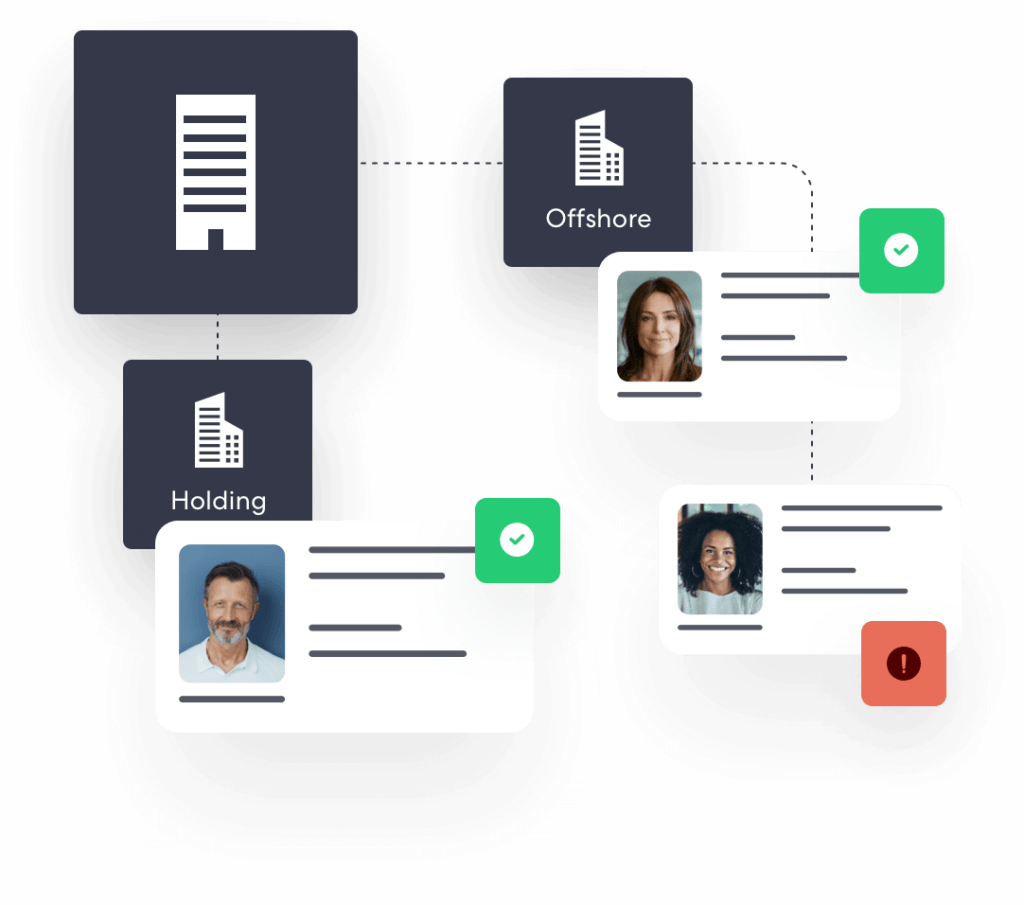
## Global financial crime is estimated to grow past $2 trillion annually, increasing pressure on organizations to strength KYB controls.
## Trusted by financial institutions






### Reduce manual reviews
Automate your KYB workflows to reduce manual compliance reviews, accelerate onboarding, and improve efficiency.

### Global registry data
Access global company registries, credit bureaus, and trusted data providers to support business verification.

### Full regulatory compliance
Support AML compliance requirements that are strongly aligned with FATF, FinCEN, and OFAC guidance.




GLOBAL IDENTITY VERIFICATION
## Verify shareholders, directors, and UBOs
Validate ownership records and identity attributes against trusted registries, credit bureaus, and third-party data sources during business onboarding.
ComplyCube helps teams corroborate company information across jurisdictions while reducing manual checks and review delays.
[View solution](https://www.complycube.com/solutions/identity-assurance/multi-bureau-checks/)
director document verification
## Automate director identity verification
Complex ownership structures can make document collection slow and inconsistent. ComplyCube guides relevant parties through secure capture flows to simplify evidence collection.
AI-powered document verification supports upwards of 14,000 identity document types across 220+ countries and territories. This helps reduce fraud and accelerate onboarding.
[View solution](https://www.complycube.com/solutions/identity-assurance/document-verification/)








case management workflow
## Centralize KYB and AML case management
Streamline complex business onboarding reviews with configurable risk rules, automated decisioning, and unified investigation tools.
Detailed ownership insights, risk breakdowns, and workflow controls help teams make faster, more consistent compliance decisions.
[View solution](https://www.complycube.com/solutions/due-diligence-compliance/case-management/)
Numbers that back it up
## Why ComplyCube?
The ComplyCube platform offers the most complete and flexible KYC tools to help you build trust in your business. Whether you’re a startup or a multinational enterprise, we’ve got you covered.
10+ million
Transactions are processed week in and week out across the globe.
220+
Countries and territories supported for a greater peace of mind.
3,000+
Data points from trusted sources and partners across the world, giving you the highest coverage.
95%
Client onboarding rate, helping you convert more customers and grow your business.

### Application fraud prevention
We promote application fraud prevention in banks, helping to reduce losses. This is all done without impacting customer experience.
[View solution](#)

### Transactional fraud and monitoring
Anti-money laundering in banking is essential. Flag and monitor inconsistent and potentially criminal financial activity in real time.
[View solution](#)

Understanding Ulitmate Beneficial Ownership (UBO)
Learn how Ultimate Beneficial Ownership (UBO) checks help uncover ownership risk and support Know Your Business (KYB) compliance. Read the guide to learn more.
[ Go to Guide ](https://www.complycube.com/en/what-is-ultimate-beneficial-ownership-ubo/)
[Explore other solutions](https://www.complycube.com/solutions/due-diligence-compliance/know-your-customer/)
## Explore other solutions
[Know Your Customer](https://www.complycube.com/solutions/due-diligence-compliance/know-your-customer/) 
### Know Your Customer
Verify customer identities using automated Identity Verification (IDV), biometric authentication, and configurable onboarding workflows designed to reduce fraud while maintaining conversion rates.
[View solution](https://www.complycube.com/solutions/due-diligence-compliance/know-your-customer/)
[Sanctions and PEP screening](https://www.complycube.com/solutions/global-screening/sanctions-pep-screening/) 
### Sanctions and PEP screening
Screen businesses and individuals against global sanctions lists, Politically Exposed Person (PEP) databases, watchlists, and adverse media sources to support ongoing AML compliance obligations.
[View solution](https://www.complycube.com/solutions/global-screening/sanctions-pep-screening/)
[Ongoing Monitoring](https://www.complycube.com/solutions/global-screening/continuous-monitoring/) 
### Ongoing Monitoring
Monitor customers, businesses, directors, and UBOs for sanctions updates, ownership changes, adverse media, and emerging compliance risks through continuous AML monitoring workflows.
[View solution](https://www.complycube.com/solutions/global-screening/continuous-monitoring/)
## Frequently asked questions
Can ComplyCube automate KYB checks?
Yes. ComplyCube automates business verification, director checks, and Ultimate Beneficial Ownership (UBO) identification through one platform. It also supports AML screening and ongoing monitoring, helping compliance teams reduce manual reviews and onboard business customers faster.
How fast is business verification?
Automated workflows help teams verify company information, ownership records, and associated individuals in near real time where trusted data is available. ComplyCube also uses guided onboarding flows to reduce delays caused by incomplete submissions.
Which KYB risks can ComplyCube detect?
ComplyCube helps identify shell company exposure, hidden ownership structures, and sanctions matches during onboarding. Configurable rules also allow teams to flag higher-risk profiles and escalate cases based on internal risk policies.
Can ComplyCube scale global KYB?
Yes. ComplyCube supports KYB coverage across 220+ countries and territories, helping organisations verify businesses across multiple jurisdictions. Teams can combine registry checks, bureau data, and document verification within a single workflow.
Why choose ComplyCube for Know Your Business (KYB) verification?
Teams choose ComplyCube to unify business verification, Know Your Customer (KYC), and AML screening in one configurable platform. APIs, SDKs, and hosted flows help teams deploy faster while maintaining control over the onboarding journey.
[Customer stories](https://www.complycube.com/solutions/due-diligence-compliance/know-your-customer/)
## Customer stories
[](https://www.complycube.com/solutions/due-diligence-compliance/know-your-customer/) [iParametrics](https://www.complycube.com/customer/iparametrics/) 
### iParametrics
[ Read more ](https://www.complycube.com/customer/iparametrics/)
[Turo](https://www.complycube.com/customer/turo-strengthens-car-sharing-compliance/) 
### Turo
Turo partnered with ComplyCube to strengthen driver verification, reduce fraud risk, and improve marketplace trust, achieving lower verification costs, higher checkout conversion, and fewer support contacts.
[ Read more ](https://www.complycube.com/customer/turo-strengthens-car-sharing-compliance/)
See all case studies
---
### [Transaction Screening Software](https://www.complycube.com/solutions/due-diligence-compliance/anti-money-laundering/transaction-screening-software/)
**Published:** April 7, 2026
**Author:** Rithu Jagannath
**Excerpt:** Document authentication is a key step in protecting the digital world. Document verification is used to ensure KYC documents are genuine and not forged. This is typically paired up with biometric (selfie) for a robust verification.
**Content:**
# Transaction Screening Software
Detect suspicious transactions in real time and prevent financial crime before funds move. Our transaction screening software helps financial institutions identify risk, reduce false positives, and meet global compliance requirements. As a result, transaction screening solutions play a critical role in AML compliance by checking transactions against sanctions lists, risk indicators, and regulatory rules.
[ Start now ](https://portal.complycube.com/signup)
[ Contact us ](#)
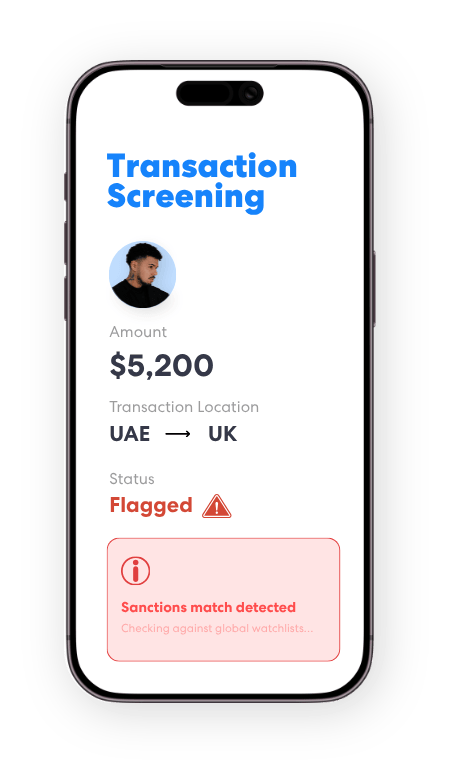
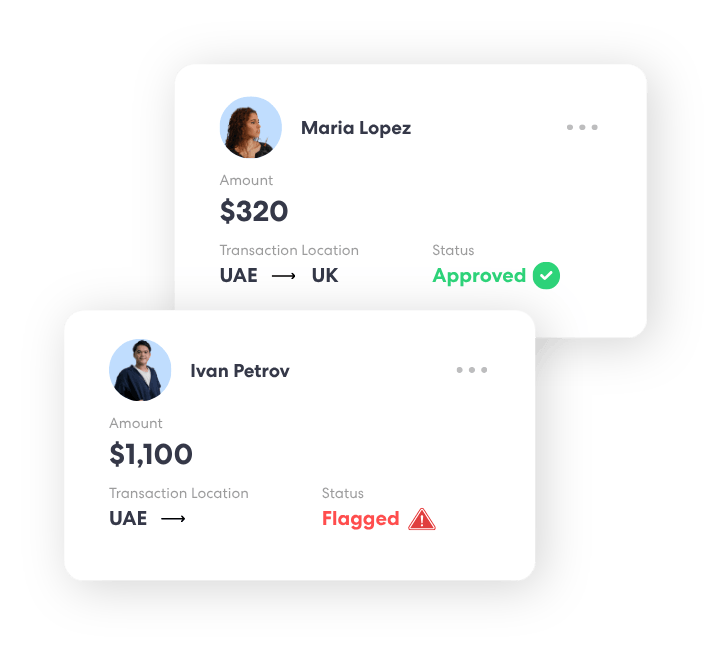
## An estimated 2% to 5% of global GDP is laundered each year, equal to roughly $800 billion to $2 trillion.
That scale shows why payment screening software must operate as a core control, not a secondary check. ComplyCube helps firms strengthen transaction screening with real-time decisioning, lower manual effort, and stronger coverage across global payment flows.

### Real-time decisioning
Screen transactions instantly and stop suspicious activity before processing, without disrupting legitimate payments.

### Comprehensive screening
Cover sanctions lists, PEPs, and high-risk entities with transaction screening solutions designed for global compliance.

### Efficient investigations
Equip compliance teams across industries with alerts and workflows to review and fix flagged transactions fast.
## Stop transaction risk before processing
Firstly, screen transactions at the point of initiation to detect suspicious or prohibited activity before funds move. Given that, real-time transaction screening software is essential for preventing financial crime, especially in environments handling instant payments and high transaction volumes.
[View solution](https://www.complycube.com/en/solutions/identity-assurance/document-verification)
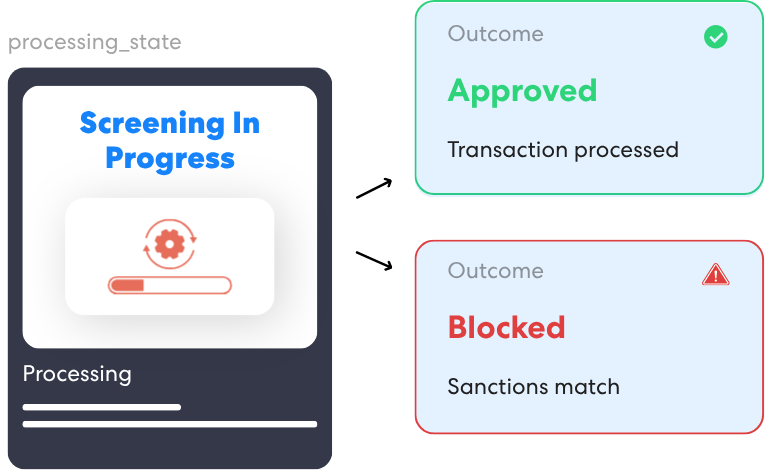
Numbers that back it up
## Why Complycube?
The ComplyCube platform offers **the most complete, flexible, and top-rated** KYC solutions to help you build trust in your business. Whether you’re a startup or a multinational enterprise, we’ve got you covered.
[ Contact us ](#)
10+ million
Transactions are processed week in and week out across the globe.
220+
Countries and territories supported for a greater peace of mind.
3,000+
Data points from trusted sources and partners across the world, giving you the highest coverage.
98%
Client onboarding rate, helping you convert more customers and grow your business.

### Contextual risk detection
Identify risky transactions by analyzing behavior, geography and transaction attributes together. This allows compliance teams to detect suspicious activity beyond basic list matching.

### Consistent screening outcomes
Apply standardized screening logic across all transactions to ensure consistency. Reduce variability in decision-making and strengthen compliance across teams and regions.

## Screen against global risk sources
Ensure every transaction is screened against global sanctions lists, politically exposed persons, and high-risk entities. Comprehensive transaction screening solutions help organizations prevent exposure to sanctioned individuals and jurisdictions while meeting regulatory obligations.
[View solution](https://www.complycube.com/en/solutions/identity-assurance/customer-authentication/)
## Detect real risk without overwhelm
Effective transaction screening depends on accuracy as much as coverage. Traditional systems create false positives, resulting in unnecessary workload for teams and slowing down operations.
As a matter of fact, by finding real risk signals, organizations can look into real threats without increasing operational burden.
[View documentation](https://docs.complycube.com/documentation/guides/web-sdk-quick-guide/integration-guide)
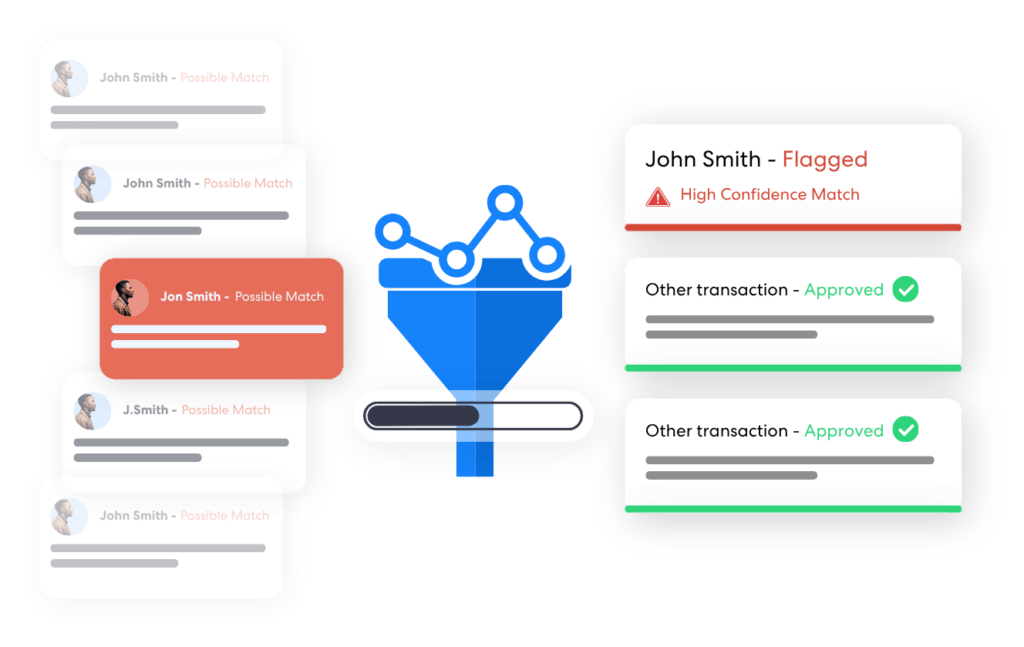

## Act on risk with clear, prioritized alerts
Transaction screening helps quickly detect risks. Clear and structured alerts allow compliance teams to prioritize high-risk transactions and respond without delay.
In addition, this allows teams to review flagged transactions, escalate when necessary, and maintain full visibility across the entire screening process.
[View use case](https://www.complycube.com/en/use-cases/profession/compliance-managers/)
## Frequently Asked questions
What is transaction screening software?
Transaction screening software evaluates transactions in real time against sanctions lists, watchlists, and risk indicators to detect suspicious or prohibited activity. Consequently, it helps financial institutions prevent financial crime before funds are transferred and supports consistent, accurate compliance decisions.
How does transaction screening work in real time?
Transaction screening solutions work by analysing transaction data such as names, locations, and payment details at the point of initiation. Therefore, this system compares this information against global sanctions lists and risk databases, generating alerts when risks are detected before transactions are completed.
What is the difference between transaction screening and transaction monitoring?
Transaction screening evaluates individual transactions in real time before they are processed to prevent risk exposure. On the other hand, transaction monitoring analyses historical transaction patterns to identify suspicious behaviour over time, supporting ongoing detection, investigation, and broader anti money laundering compliance.
How can transaction screening reduce false positives?
In short, transaction screening solutions reduce false positives by applying advanced matching logic and contextual analysis across transaction data. Additionally, it distinguishes between true matches and irrelevant similarities, allowing compliance teams to focus on genuine risks while improving efficiency and reducing unnecessary alerts.
How does ComplyCube support transaction screening?
ComplyCube provides transaction screening solutions that enable real time risk detection, global sanctions coverage, and structured alert management across payment flows. The platform integrates with existing systems and helps organisations improve accuracy, reduce false positives, and maintain strong regulatory compliance.

What Makes Transaction Screening Powerful
Transaction screening strengthens compliance by detecting risk in real time, supporting ongoing monitoring, and helping teams respond to threats more consistently. Read our guide to build a more effective, risk-based screening framework.
[ Go to Guide ](https://www.complycube.com/transaction-screening-check/)
[Explore other solutions](https://www.complycube.com/solutions/due-diligence-compliance/know-your-customer/)
## Explore other solutions
[Sanctions & PEP Screening](https://www.complycube.com/en/solutions/global-screening/sanctions-pep-screening/) 
### Sanctions & PEP Screening
Screen customers and counterparties against sanctions lists and PEP data to strengthen compliance beyond individual payments and support broader risk detection.
[View solution](https://www.complycube.com/en/solutions/global-screening/sanctions-pep-screening/ "Watchlist screening")
[Adverse Media Checks](https://www.complycube.com/en/solutions/global-screening/adverse-media-checks/) 
### Adverse Media Checks
Identify negative news linked to customers or counterparties to add external risk context and strengthen transaction screening decisions across high-risk cases.
[View solution](https://www.complycube.com/en/solutions/global-screening/adverse-media-checks/ "Continuous monitoring")
[Continuous Monitoring](https://www.complycube.com/en/solutions/global-screening/continuous-monitoring/) 
### Continuous Monitoring
Track changes in customer risk over time with continuous screening against updated sanctions, PEP, and adverse media data to support stronger controls firmwide.
[View solution](https://www.complycube.com/en/solutions/global-screening/continuous-monitoring/ "Adverse media checks")
[View all solutions](https://www.complycube.com/solutions/)
---
### [Policy Assurance](https://www.complycube.com/solutions/compliance-suite/policy-assurance/)
**Published:** May 8, 2026
**Author:** Dini Habib
**Excerpt:** ComplyCube's Policy Assurance Suite ensures your company's internal and external policies are aligned with the latest regulatory requirements at all times. Eliminate the compliance guesswork and accelerate user onboarding today.
**Content:**
# Policy Assurance
Stay ahead of regulatory changes with ComplyCube’s bespoke Policy Assurance feature. Make confident compliance decisions and cut manual effort with real-time updates and built-in compliance logic.
Ensure your AML and KYC infrastructure reflects the latest regulatory standards 24/7.
[ Start now ](https://portal.complycube.com/signup)
[ Contact us ](https://www.complycube.com/contact/contact-sales/)
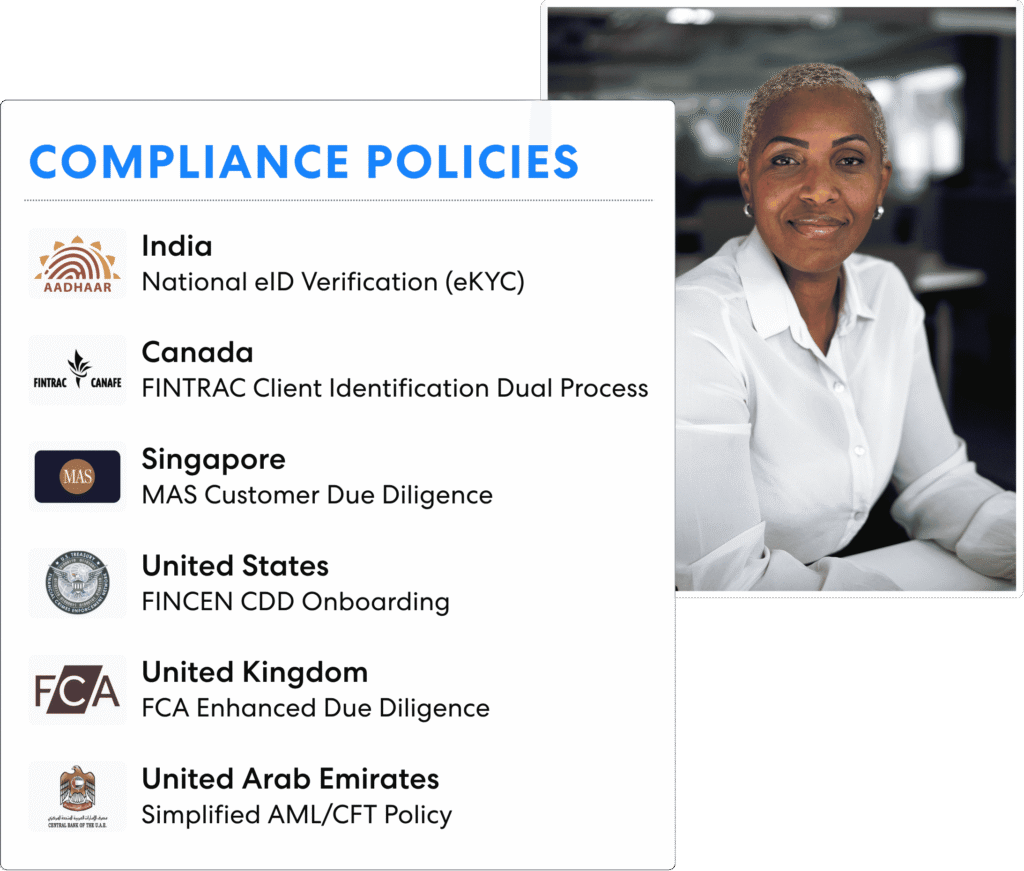

### Ready-to-use
Translate new regulatory requirements into clear user journeys across multiple jurisdictions.

### Regulatory assurance
Meet the highest compliance standards globally with structured, regulator-aligned expertise.

### Quicker decisions
Fast-track onboarding with confidence while maintaining ongoing KYC and AML compliance.
Pre-built customer journeys
## Unlock regulatory trust worldwide
Access AML and KYC-compliant customer journeys at a global scale. Fully align with leading regulatory frameworks, such as FATF, FinCEN, FINTRAC, and more.
Use ready-to-submit policy reports and demonstrate compliance to regulators with ComplyCube’s Policy Assurance, saving time and increasing credibility.
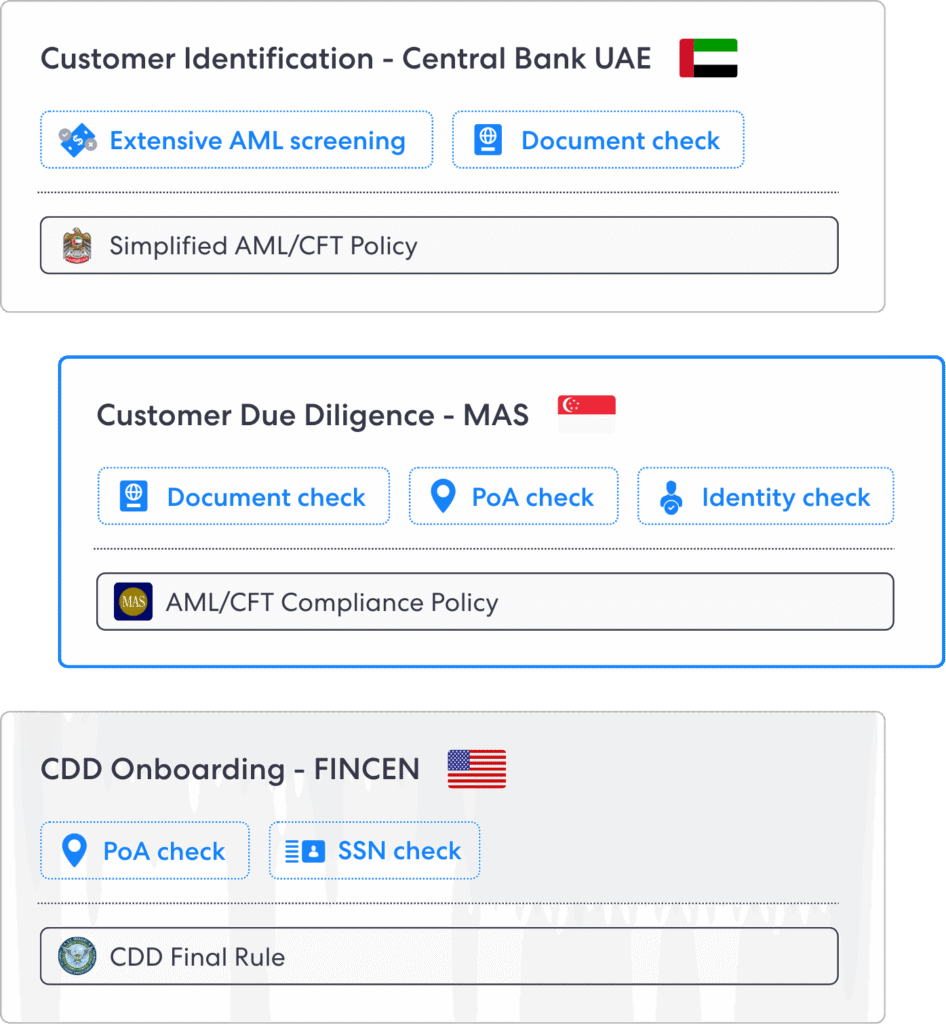
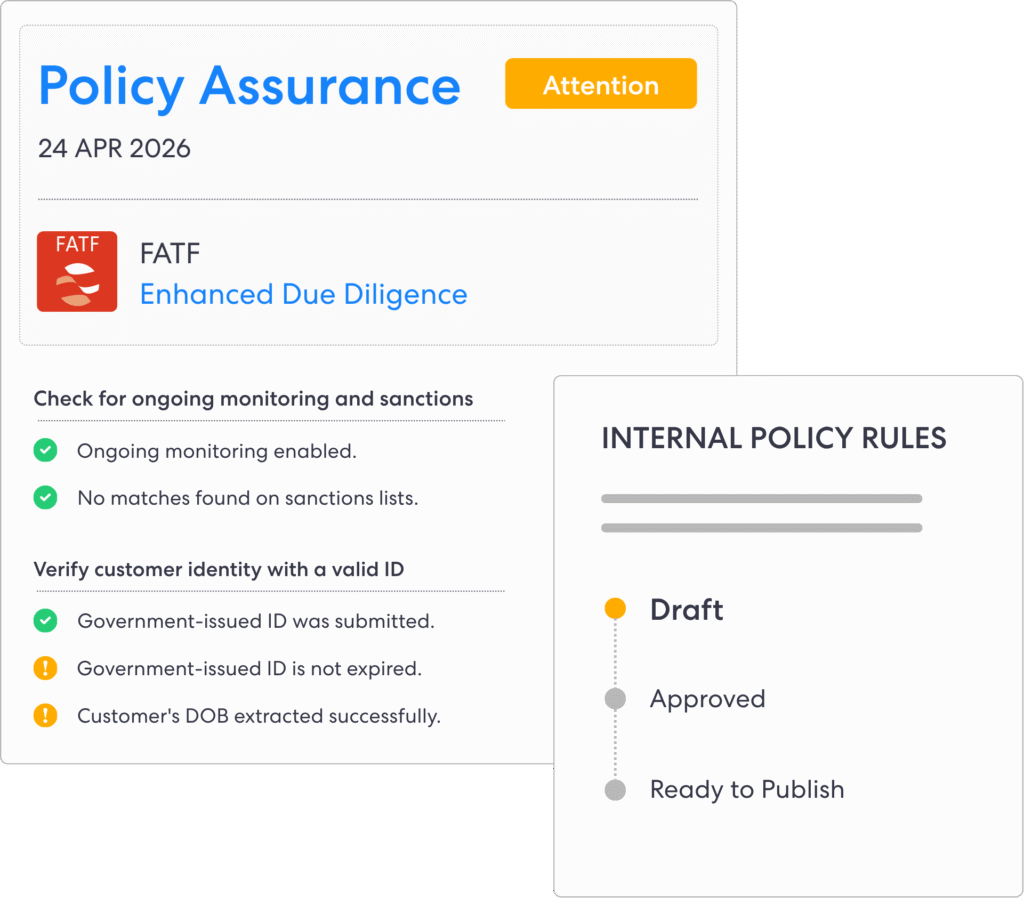
policy compliance
## Tailored checks to meet your regulatory needs
Create your own policy infrastructure to reflect your exact operational and regulatory needs. Track each decision and follow-up actions with real-time audit logs.
Whether you’re setting age restrictions, adjusting onboarding thresholds, or refining risk controls, you stay fully in control.
no code workflows
## Smarter workflows for every risk level
Make use of dynamic verification journeys tailored by country, customer type, or risk level with zero coding required.
Layer document checks, AML screening, and monitoring rules to deliver regulatory assurance and meet the expectations of each jurisdiction.
[Learn more](https://www.complycube.com/solutions/compliance-suite/kyc-workflow)

## Built for regulatory trust at global scale
ComplyCube helps regulated businesses map identity verification, CDD, and monitoring workflows to the expectations of regulators worldwide.
Satisfy the requirements of leading regulators, including the **FCA**, **FinCEN**, **FINTRAC**, **AUSTRAC**, **MAS**, **CBUAE**, and **VARA,** without the guesswork.
With UK DIATF and eIDAS-backed assurance, our platform gives you the coverage, evidence, and flexibility to launch and scale faster across jurisdictions.
[ Start now ](https://portal.complycube.com/signup)
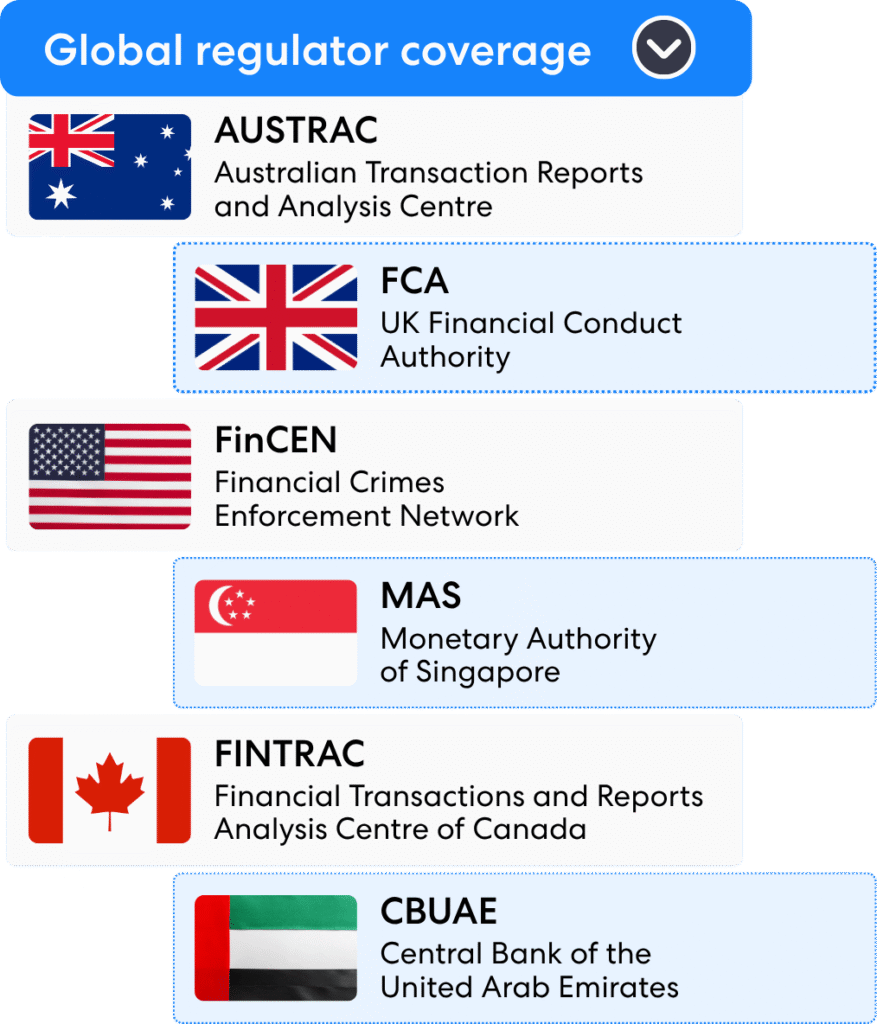

### Regulatory expertise
Remove uncertainty in the rapidly changing regulatory space with minimal manual updates. Maintain ongoing adherence with current regulations grounded in deep regulatory expertise.

### Global compliance
ComplyCube offers policy compliance that dynamically adapts to local and international standards. Satisfy region or sector specfic obligations with access to deep localization capabilites.

### Transparent audit
Achieve full visibility into every compliance action or decision made. Have oversight on detailed logs, evidence, and policy updates in real-time so you stay 100% prepared for regulator reviews.

### Enterprise-ready
ComplyCube’s multi-layered AML and KYC solution scales with your operations. Integrate any solutions seamlessly into your existing infrastructure with zero hidden fees and a dedicated support team.
## Trusted by big names





[Recommended solutions](https://www.complycube.com/solutions/due-diligence-compliance/know-your-customer/)
## Recommended solutions
[Ongoing monitoring](https://www.complycube.com/solutions/global-screening/continuous-monitoring/) 
### Ongoing monitoring
Receive instant notifications of changes in your customer’s risk profile, so you always stay ahead of evolving threats.
[View solution](https://www.complycube.com/solutions/global-screening/continuous-monitoring/)
[Smart forms](https://www.complycube.com/en/solutions/compliance-suite/smart-forms/) 
### Smart forms
Create bespoke KYC forms and capture additional customer information to meet enhanced due diligence requirements.
[View solution](https://www.complycube.com/en/solutions/compliance-suite/smart-forms/)
[eID verification](https://www.complycube.com/en/solutions/identity-assurance/eid-verification-service/) 
### eID verification
Verify customer identity with popular, government-backed eID schemes, including BankID, Aadhaar, and MitID.
[View solution](https://www.complycube.com/en/solutions/identity-assurance/eid-verification-service/)
[View all solutions](https://www.complycube.com/solutions/)
## Frequently asked questions
What is AML policy compliance?
AML policy compliance is the process of following an organization’s anti-money laundering rules, controls, and procedures to detect, prevent, and report financial crime. The process typically includes risk-based customer due diligence, ongoing monitoring, and escalation of suspicious activity in line with regulatory obligations.
How do policies map to customer onboarding controls?
ComplyCube maps regulatory requirements and internal compliance policies directly to your onboarding journey controls, such as identity verification, sanctions screening, and document checks. As customers complete verification journeys, Policy Assurance automatically evaluates whether required compliance controls have been satisfied.
What are the benefits of ComplyCube’s Policy Assurance?
ComplyCube’s Policy Assurance feature automates compliance workflows so businesses can maintain ongoing AML and KYC compliance more efficiently. As a result, firms can cut down manual effort, improve the speed of compliance decisions, and support consistent scaling based on risk level.
How can I automate my compliance checks?
When Policy Assurance is enabled, ComplyCube automatically evaluates customer onboarding and verification journey steps against your compliance policies in real time. The platform identifies controls that pass automatically, flags exceptions requiring review, and helps compliance teams reduce manual checks while maintaining oversight and audit readiness.
How do I convert my regulatory obligations into policy controls?
ComplyCube has already converted common AML and KYC regulatory guidance, including frameworks such as JMLSG and CBUAE guidance, into machine-readable compliance controls. Organizations can also map their own internal compliance policies into automated workflow rules for consistent and scalable compliance evaluations.
---
### [Blog](https://www.complycube.com/resources/blog/)
**Published:** October 27, 2021
**Author:** CC
**Content:**
# Blog
Get the latest insights into identity verification & AML and KYC best practices
- [View all](https://www.complycube.com/resources/blog/)
- [News](https://www.complycube.com/category/news/)
- [Guides](https://www.complycube.com/category/guides/)
- [Product](https://www.complycube.com/category/product/)
- [View all](https://www.complycube.com/resources/blog/)
- [News](https://www.complycube.com/category/news/)
- [Guides](https://www.complycube.com/category/guides/)
- [Product](https://www.complycube.com/category/product/)
Search
[FlexAML and ComplyCube Tackle Compliance Gaps ](https://www.complycube.com/flexaml-and-complycube/) 
- [News](https://www.complycube.com/category/news/)
### FlexAML and ComplyCube Tackle Compliance Gaps
- [Announcements](https://www.complycube.com/tag/announcements/)
ComplyCube partners with FlexAML to help UK TCSPS tackle growing Anti-Money Laundering through automated business verification, individual authentication, tailored risk assessments and compliance-driven onboarding workflows....
- [ Read more ](https://www.complycube.com/flexaml-and-complycube/)
[What Are Dynamic Workflows?](https://www.complycube.com/what-are-dynamic-workflows/) 
- [Guides](https://www.complycube.com/category/guides/)
### What Are Dynamic Workflows?
- [Know Your Customer](https://www.complycube.com/tag/know-your-customer/)
Discover how Dynamic Workflows transform KYC onboarding with tailored verification journeys, conditional routing, and no-code automation. Learn how businesses reduce friction, improve efficiency, and maintain compliance controls....
- [ Read more ](https://www.complycube.com/what-are-dynamic-workflows/)
[KYC Risk Assessment for Crypto Businesses](https://www.complycube.com/kyc-risk-assessment-for-crypto/) 
- [Guides](https://www.complycube.com/category/guides/)
### KYC Risk Assessment for Crypto Businesses
- [Know Your Customer](https://www.complycube.com/tag/know-your-customer/)
KYC risk assessment is a key process in an effective AML program. It identifies, assesses, and classifies customer and business risk. They are crucial for cryptocurrency businesses to prevent financial crime and ensure compliance....
- [ Read more ](https://www.complycube.com/kyc-risk-assessment-for-crypto/)
[ComplyCube Puts Businesses in Control with Custom Risk Scoring Engine](https://www.complycube.com/custom-risk-scoring-engine/) 
- [News](https://www.complycube.com/category/news/)
### ComplyCube Puts Businesses in Control with Custom Risk Scoring Engine
- [Announcements](https://www.complycube.com/tag/announcements/)
ComplyCube launches its Custom Risk Scoring Engine, empowering businesses to automate risk assessments, apply tailored scoring models, and make explainable, auditable decisions as customer risks evolve over time....
- [ Read more ](https://www.complycube.com/custom-risk-scoring-engine/)
[Bank of America $1.2bn Fine Exposes Years of AML Failures](https://www.complycube.com/bank-of-america-1-2bn-fine-aml-failures/) 
- [News](https://www.complycube.com/category/news/)
### Bank of America $1.2bn Fine Exposes Years of AML Failures
- [Anti-Money Laundering](https://www.complycube.com/tag/anti-money-laundering/)
Bank of America’s $1.2 billion fine follows years of unresolved AML and sanctions compliance failures. Despite prior warnings, the bank had failed to implement sufficient remediation, amounting to the scale of the penalty imposed....
- [ Read more ](https://www.complycube.com/bank-of-america-1-2bn-fine-aml-failures/)
[AMEX Fined $350M For Systemic AML Failures](https://www.complycube.com/amex-fined-350m-for-aml-failures/) 
- [News](https://www.complycube.com/category/news/)
### AMEX Fined $350M For Systemic AML Failures
- [Anti-Money Laundering](https://www.complycube.com/tag/anti-money-laundering/)
AMEX faces a $350M fine after regulators uncovered systemic AML failures linked to $13B in suspected money laundering activity. Discover how compliance gaps persisted for over a decade and what financial institutions can learn....
- [ Read more ](https://www.complycube.com/amex-fined-350m-for-aml-failures/)
[A Developer’s Guide to MRZ Verification for KYC](https://www.complycube.com/developers-guide-to-mrz-verification/) 
- [Guides](https://www.complycube.com/category/guides/)
### A Developer’s Guide to MRZ Verification for KYC
- [Identity Verification](https://www.complycube.com/tag/identity-verification/)
A developer-focused guide to MRZ verification. This guide covers what it takes to have successful checksums, data mismatches, passport fraud, NFC chip data, and biometrics to demonstrate why MRZ by itself cannot prove identities....
- [ Read more ](https://www.complycube.com/developers-guide-to-mrz-verification/)
[Identity Document OCR for KYC Compliance](https://www.complycube.com/identity-document-ocr-kyc/) 
- [Guides](https://www.complycube.com/category/guides/)
### Identity Document OCR for KYC Compliance
- [Identity Verification](https://www.complycube.com/tag/identity-verification/)
Identity document optical character recognition solutions automates KYC data extraction, reduces manual errors, and supports faster, accurate customer onboarding. It uses advanced technologies to support precise data recognition....
- [ Read more ](https://www.complycube.com/identity-document-ocr-kyc/)
[Rank Group £5M Settlement Exposes AML Gaps](https://www.complycube.com/rank-group-5m-settlement-exposes-gaps/) 
- [News](https://www.complycube.com/category/news/)
### Rank Group £5M Settlement Exposes AML Gaps
- [Anti-Money Laundering](https://www.complycube.com/tag/anti-money-laundering/)
Rank Group’s £5M settlement case has put land-based casino Anti-Money Laundering controls under the spotlight. Learn how this settlement exposed serious gaps in risk scoring, source-of-funds checks and Enhanced Due Diligence....
- [ Read more ](https://www.complycube.com/rank-group-5m-settlement-exposes-gaps/)
[AUSTRAC Warns Businesses Against Blanket De-Risking](https://www.complycube.com/austrac-warns-against-blanket-de-risking/) 
- [News](https://www.complycube.com/category/news/)
### AUSTRAC Warns Businesses Against Blanket De-Risking
- [Anti-Money Laundering](https://www.complycube.com/tag/anti-money-laundering/)
AUSTRAC has warned firms against blanket de-risking, reinforcing a global shift toward risk-based AML. Debanking can inadvertently increase financial crime risks and cause widespread financial exclusion for vulnerable customers....
- [ Read more ](https://www.complycube.com/austrac-warns-against-blanket-de-risking/)
[7 Digital Right to Work Mistakes HR Teams Make](https://www.complycube.com/7-digital-right-to-work-mistakes/) 
- [Guides](https://www.complycube.com/category/guides/)
### 7 Digital Right to Work Mistakes HR Teams Make
- [Regulations](https://www.complycube.com/tag/regulations/)
Read how HR teams can avoid these seven common digital right to work mistakes. Learn how to strengthen right to work in UK processes, and improve every HR right to work check within your teams' existing onboarding flow....
- [ Read more ](https://www.complycube.com/7-digital-right-to-work-mistakes/)
[The Biggest Right to Work Changes in 2026](https://www.complycube.com/2026-right-to-work-changes/) 
- [News](https://www.complycube.com/category/news/)
### The Biggest Right to Work Changes in 2026
- [Regulations](https://www.complycube.com/tag/regulations/)
Right to Work changes are now live in the UK. See what changed on 1 October 2026 with Home Office guidance, who may fall within scope, how digital verification checks are affected, and what UK employers should review....
- [ Read more ](https://www.complycube.com/2026-right-to-work-changes/)
[ Load More ](https://www.complycube.com/resources/blog/?page=2)
---
### [Open roles](https://www.complycube.com/company/careers/open-roles/)
**Published:** March 31, 2022
**Author:** CC
**Content:**
# Open roles
Search
LocationAll locationsLondon
### [ Product Manager ](https://www.complycube.com/role/product-manager/)
December 5, 2024 No Comments
We are seeking a hands-on Product Manager to join our team and play a pivotal role in shaping and delivering products that get ahead of
[ Read More » ](https://www.complycube.com/role/product-manager/)
### [ Senior Marketing Associate ](https://www.complycube.com/role/senior-marketing-associate/)
November 10, 2023 No Comments
Must-have: Right to work in the UK & London-based At ComplyCube, we’re building trust at scale with our suite of digital KYC, IDV, and AML
[ Read More » ](https://www.complycube.com/role/senior-marketing-associate/)

### A growth enivronment
We’re committed to investing in all the areas you might expect, including leadership and soft and technical skills.

### Flexible working
We appreciate that you’ve got a life outside the office. That’s why we have excellent and flexible arrangements to help our teams get the best of both worlds.

### Healthcare
All colleagues have access to subsidised and comprehensive Private Medical Insurance and Funded eye tests and annual health assessment.

### Wellbeing-focused
We offer benefits that promote positive physical, emotional and financial wellbeing.

### Incentive schemes
We offer a generous bonus, with high achievers rewarded with regular incentives such as trips away, fine dining experiences, spa breaks and more.

### Membership bodies
We offer subscriptions to professional membership bodies.
---
### [Watchlist Screening](https://www.complycube.com/solutions/global-screening/watchlist-screening/)
**Published:** October 27, 2021
**Author:** CC
**Content:**
# High-precision AML watchlist screening
Automate global AML watchlist screening with instant results and stronger risk detection. Reduce manual reviews and cut false positives across sanctions, PEP, and adverse media in one unified platform.
[ Start now ](https://portal.complycube.com/signup)
[ Contact us ](https://www.complycube.com/contact/contact-sales/)




### Global watchlist screening
Screen against 2,000+ global, regional, and local watchlists to support full compliance across jurisdictions.

### Real-time and accurate lists
Achieve instant screening results with intelligent matching to lower false positives and fast-track decision-making.

### Simple & quick integration
Accelerate deployment time with our powerful SDKs and APIs built for seamless integration into your systems.
Global Compliance
## Watchlist screening built for every market
Use our proprietary graph network to screen individuals and businesses against trusted watchlist sources from 250+ countries and territories.
ComplyCube’s data points are updated every day to ensure your team can detect risk earlier and scale into new markets with confidence.






Simple but powerfuL
## Powerful AI and neural networks for lower false positives
Designed by linguistic experts, our AI-powered engine matches your client data across any language and script with speed and accuracy.
It uses advanced fuzzy-matching techniques, phonetic analysis, patronymics, cultural name variations, and common misspellings to find relevant matches while reducing false positives.
[Learn more](https://docs.complycube.com/documentation/api-reference/check-types/aml-screening-check)
fully customizable
## Automate risk-based AML watchlist screening
Tailor screening workflows with configurable rules, thresholds, and review paths aligned with your risk-based approach.
Reduce manual workload by automatically approving, rejecting, or escalating matches while preserving a full audit log of every event.
[Learn more](https://www.complycube.com/solutions/compliance-suite/kyc-workflow)

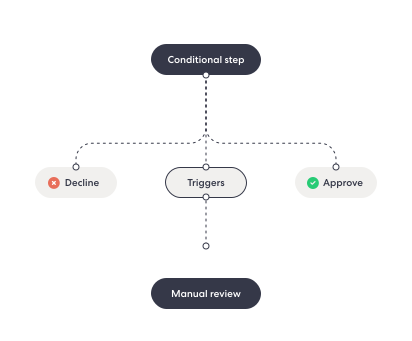

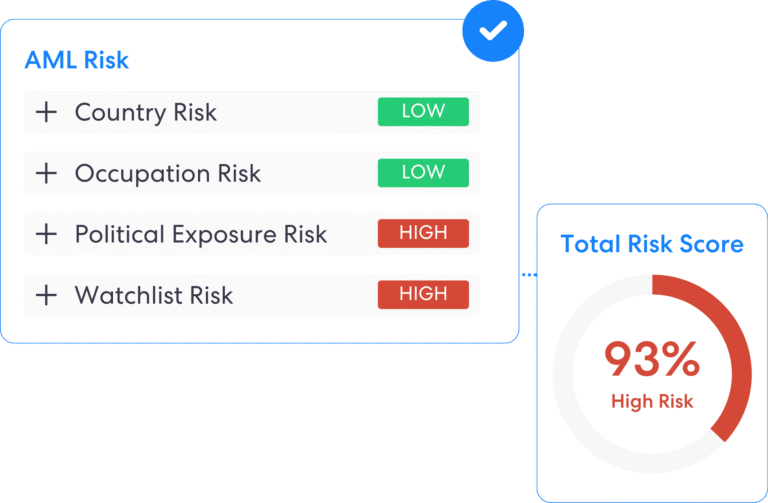
Accelerate decision making
## Turn screening results into clear decisions
Automatically receive a risk score based on screening results, behavior, and risk signals, so your team can focus on what matters most.
Turn screening data into a unified risk score that adapts to evolving threats. Cut manual reviews and take action faster.
[Learn more](https://www.complycube.com/en/solutions/due-diligence-compliance/risk-scoring/)
## Detect risk instantly with trusted AML watchlist screening
Our no-code and low-code screening offerings enable you to align customer checks with global AML and KYC requirements.
Access pre-built policy templates, so you can tailor your workflows according to specific regulatory requirements, such as the FATF, the EU’s AML Directives, the U.S. OFAC, Canada’s FINTRAC, and more.
[ Start now ](https://portal.complycube.com/signup)





### Screen customers globally
Run checks using thousands of trusted global, regional, local, public, and commercial data lists. Scale into over 250+ territories with confidence.

### Access custom lists
Upload your own internal lists of individuals and entities for enhanced screening coverage. Manage and screen against these lists in real-time.
## Trusted by big names






Catch Fraud Risk Early with Smart Watchlist Screening
Most compliance teams are doing AML watchlist screening wrong. See how leading teams use watchlists to identify threats while cutting false positives. Discover the blind spots most teams overlook today.
[ Go to Guide ](https://www.complycube.com/global-watchlist-screening-for-enhanced-aml/)
[Recommended solutions](https://www.complycube.com/solutions/due-diligence-compliance/know-your-customer/)
## Recommended solutions
[Multi Bureau Checks](https://www.complycube.com/en/solutions/identity-assurance/multi-bureau-checks/) 
### Multi Bureau Checks
Access a list of proprietary, partnered, and government data sources for the highest screening coverage across jurisdictions.
[View solution](https://www.complycube.com/en/solutions/identity-assurance/multi-bureau-checks/ "Watchlist screening")
[Sanctions & PEP Screening](https://www.complycube.com/en/solutions/global-screening/sanctions-pep-screening/) 
### Sanctions & PEP Screening
Screen individuals and businesses against global sanctions and PEPs list with actionable risk scoring insights your business needs.
[View solution](https://www.complycube.com/en/solutions/global-screening/sanctions-pep-screening/ "Continuous monitoring")
[Continuous Monitoring](https://www.complycube.com/en/solutions/global-screening/continuous-monitoring) 
### Continuous Monitoring
Receive instant alerts when there are changes to a customer or entity’s risk profile so you can take action before threats escalate.
[View solution](https://www.complycube.com/en/solutions/global-screening/continuous-monitoring "Adverse media checks")
[View all solutions](https://www.complycube.com/solutions/)
## Frequently asked questions
Is ComplyCube's AML watchlist screening solutions global?
Yes, ComplyCube’s watchlist screening solutions are available worldwide across 250+ regions. It also supports global AML sanctions, PEP, and adverse media screening on a unified platform.
Which watchlists does ComplyCube work with?
Our partnered watchlists are exhaustive, boasting over 3,000 daily updated lists. These include: UK HM Treasury, US Department of the Treasury, OFAC, FBI & CIA. Find more information about sources [here](https://docs.complycube.com/documentation/api-reference/static-data/screening-lists).
How quickly can I integrate with ComplyCube's watchlist screening?
Integration can be completed in minutes with our no/low-code solution. ComplyCube offers developer-friendly APIs and SDKs, empowering compliance teams to layer or make changes to verification workflows easily. Reach out to one of our specialists to [learn more](https://www.complycube.com/en/contact/contact-sales/).
How does ComplyCube's watchlist screening reduce false positives?
ComplyCube’s watchlist screening solutions are engineered with precision. Its configurable screening thresholds, including fuzzy name matching and exclusion rules, enable businesses to set sensitivity levels and route stronger potential matches for review. Thus, teams cut down on irrelevant alerts and manual investigations.
Does ComplyCube update global watchlists frequently?
ComplyCube updates its watchlists, sanctions, PEP, and adverse media databases in real-time, with ongoing monitoring capturing new changes as soon as they are reflected in the lists.
## Features
- Screen against publicly available lists
- Screen against commercial lists
- Screen against custom uploaded lists
- Perform bulk screenings
- Return very granular match details
- Customizable search mode
- Real-time continuos monitoring
- Case management for match validation
- Role-based access and audit logs
- API and SDKs
---
### [Smart Forms](https://www.complycube.com/solutions/compliance-suite/smart-forms/)
**Published:** March 20, 2026
**Author:** Dini Habib
**Excerpt:** ComplyCube's Smart Form empowers teams to collect the right questions for onboarding customers and businesses compliantly. Embed data capturing within workflows and use intelligent conditional logic that adapts to user responses.
**Content:**
# Boost Onboarding with Adaptive Smart Forms
Automate and centralize standardized question sets for frictionless onboarding. Eliminate third-party questionnaires with ComplyCube’s embedded Smart Forms and capture customer details directly within workflows.
Gather enhanced due diligence details, such as source of funds and tenancy history, or capture formal agreements, such as terms and policies, in one secure process to meet full audit compliance.
[ Start now ](https://portal.complycube.com/signup)
[ Contact us ](https://www.complycube.com/contact/contact-sales/)

### Seamless EDD capture
Integrate due diligence forms and collect relevant answers directly in one workflow, eliminating manual or separate follow-ups.

### Enrich risk profiles
Gather granular customer details such as employment history and tax residency for precise onboarding and AML risk profiling.

### Regulatory readiness
Automate mandated periodic attestations, CRS/FATCA revalidations, and non-PEP declarations with full audit traceability.
MAXIMIZE CONVERSIONS
## Intelligent conditional logic tailored to precision
ComplyCube’s dynamic conditional logic empowers compliance teams to adapt Smart Forms according to each customer or entity’s risk profile. Built risk-based compliance questions that accelerate completion and reduce abandonment rates.
Whether collecting source of funds declarations, right to work evidence, or PEP disclosures, ComplyCube’s Smart Forms delivers precise, real-time follow-ups based on each user’s answer for seamless AML data capture.
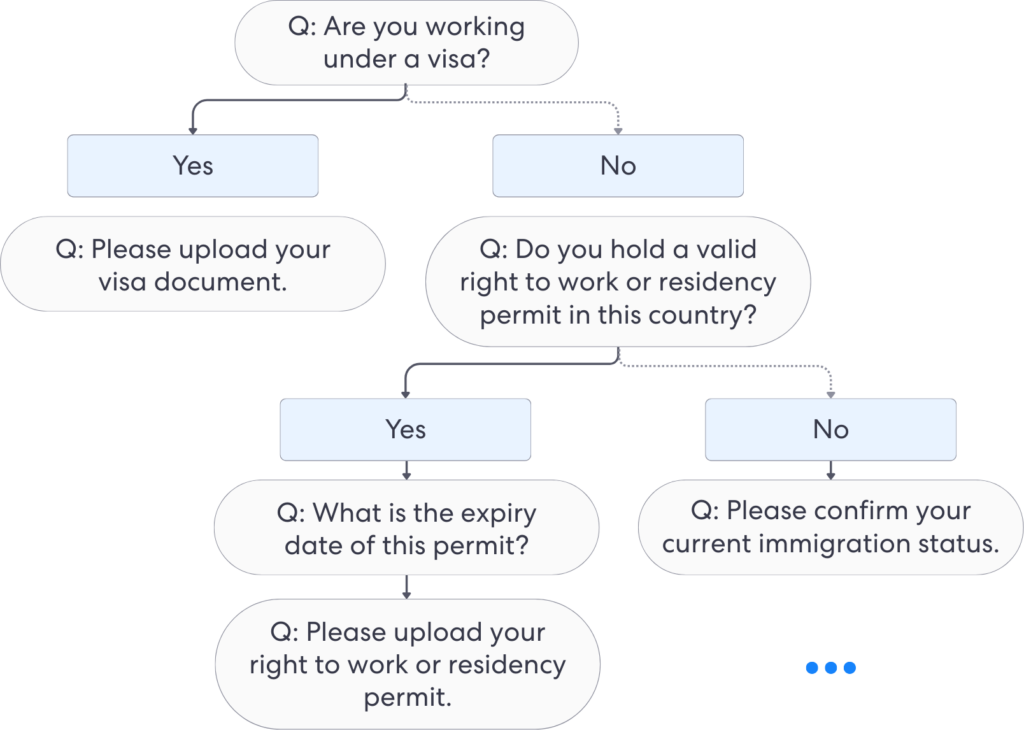
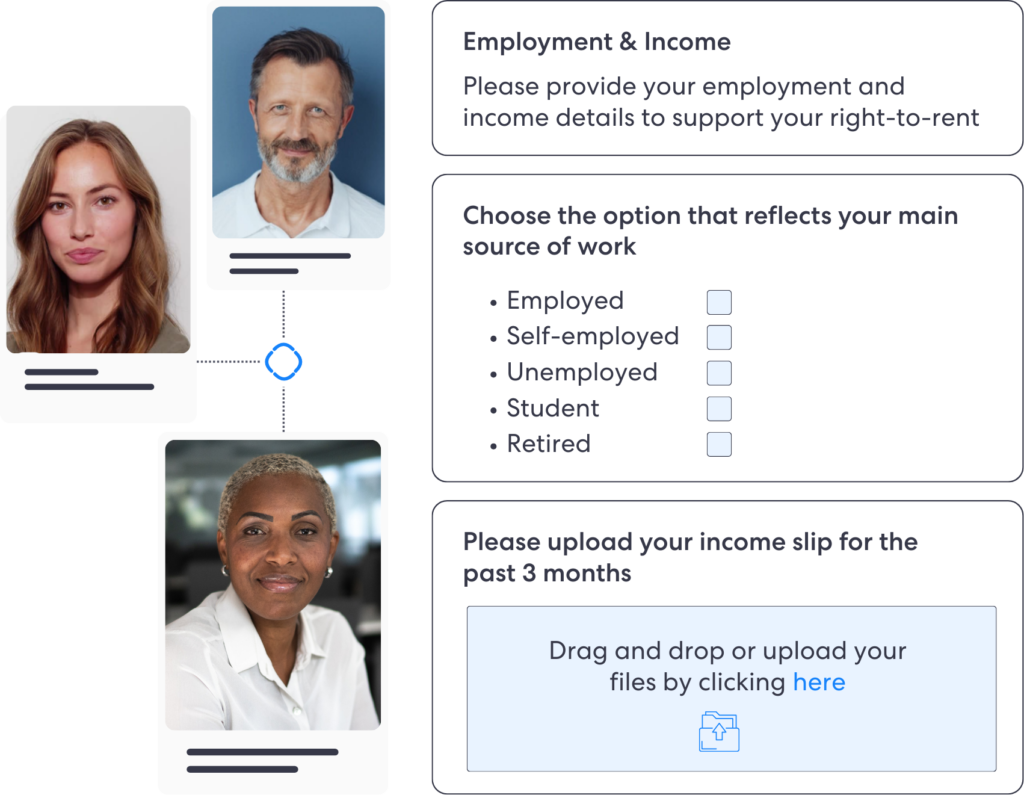
ROBUST PROFILE DETAILS
## Complete profile with multiple question types
Support every data capture required with over 15 question types, including text fields (short/long), multiple choice, boolean (yes/no) questions, and more.
Collect single or multiple supporting documents, such as payslips, bank statements, or proof of address, within the KYC flow. Additionally, capture quality e-signatures for policy acknowledgements, risk warnings, and truthfulness declarations that meet regulatory standards.
WORLDWIDE COMPLIANCE
## Scale globally with full localization support
Create frictionless, compliant onboarding with clear compliance messaging across 100+ languages and 300+ territories. ComplyCube’s KYC Forms deliver complete localization with customizable labels, placeholders, and tooltips.
Supoport translations for local dialects, localize risk warnings with jurisdiction-specific terminology, and adapt self-certification language to match regional tax authority requirements seamlessly.
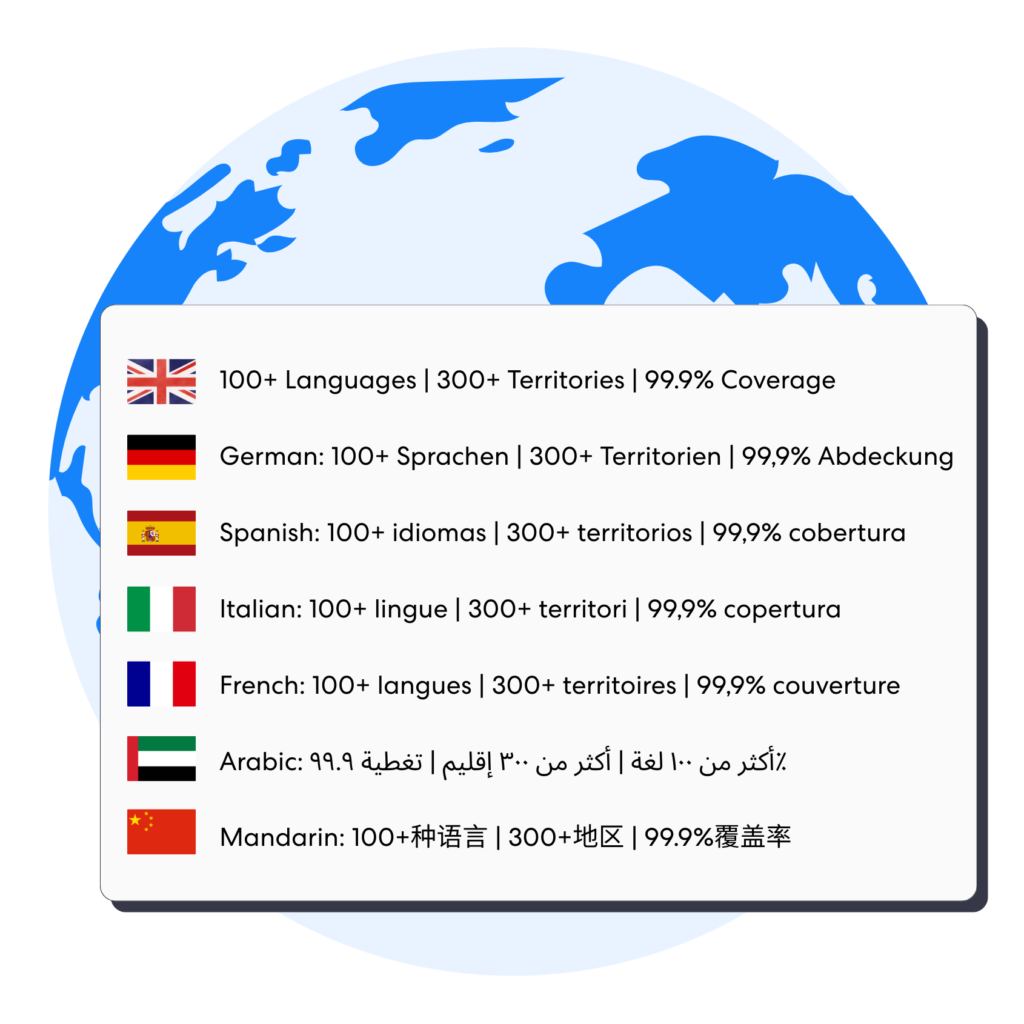
## Scale Customer Trust with Secure Data Compliance Vault
Store every Smart Form response in one secure repository. Link timestamped, transparent records directly to customer profiles for instant regulatory reporting and customer trust.
Leverage granular access controls and automated retention policies aligned with international laws, such as EU GDPR and US NIST.
Partner with an independently certified provider, armed with ISO/IEC 27001:2022, ISO/IEC 9001:2015, UK DIATF, and eIDAS. Use our SOC 2 Type II and NIST-compliant infrastructure for enterprise-grade security.

[ Start Now ](https://portal.complycube.com/signup)
## Smart KYC Forms for Compliant Data Capture
ComplyCube delivers flexible, scalable Due Diligence Forms that meet the unique needs of your industry. Whether you’re in finance, fintech, or beyond, we help you streamline onboarding, fight fraud, and stay compliant.
Healthcare Ecommerce Insurance FinTech Accounting Financial Services Cryptocurrency Property Mobility Gambling
Healthcare
Gather right-to-work status, insurance declarations, and patient data consent forms during onboarding to satisfy GDPR and HIPAA compliance.
[Explore](https://www.complycube.com/en/use-cases/industry/healthcare/)

Ecommerce
Capture business registration, source of funds, and payment processing acknowledgements to avoid marketplace money laundering.
[Explore](https://www.complycube.com/en/use-cases/industry/ecommerce/)

Insurance
Earn regulatory trust via life and medical insurance suitability assessments and investment risk acknowledgements during policyholder onboarding.

FinTech
Understand expected usage patterns, monthly transfer limits, and business vs personal declarations to prevent unauthorized account misuse.
[Explore](https://www.complycube.com/en/use-cases/industry/fintech/)

Accounting
Build complete risk profiles and automate OECD CRS and FATCA reporting requirements with tax residency self-certification and UBO disclosures.
[Explore](https://www.complycube.com/en/use-cases/industry/accounting-compliance/)

Financial Services
Meet global FATF CDD standards with source of funds declarations and expected transaction volumes, eliminating manual data collection.
[Explore](https://www.complycube.com/en/use-cases/industry/financial-services/)

Cryptocurrency
Comply with EU 6AMLD requirements for VASPs through trading wallet profiling aligned with specific jurisdictions, such as the EU’s MiCA.
[Explore](https://www.complycube.com/en/use-cases/industry/crypto/)

Property
Check customer’s right to rent and buy, including funding source verification (mortgage, investment etc) and PEP disclosures to comply with 5AMLD rules.
[Explore](https://www.complycube.com/en/use-cases/industry/property/)

Mobility as a Service
Perform income verification, driver history assessment, and employment stability verification to support secure, scalable, and rapid driver onboarding.
[Explore](https://www.complycube.com/en/use-cases/industry/mobility-as-a-service-maas/)

Gaming
Gather source of funds information, financial vulnerability assessments and player consent to comply with online gaming codes of practice.

## Trusted by big names





[Explore other solutions](https://www.complycube.com/solutions/due-diligence-compliance/know-your-customer/)
## Explore other solutions
[No-Code Workflows](https://www.complycube.com/solutions/compliance-suite/kyc-workflow) 
### No-Code Workflows
Build a layered verification flow with drag-and-drop checks based on risk, customer type, or regional rules without coding dependency.
[View solution](https://www.complycube.com/solutions/compliance-suite/kyc-workflow "Watchlist screening")
[Sanctions & PEP screening](https://www.complycube.com/en/solutions/global-screening/sanctions-pep-screening/) 
### Sanctions & PEP screening
Cross-reference customer details against global sanctions lists and PEP databases to trigger enhanced due diligence escalation for compliance.
[View solution](https://www.complycube.com/en/solutions/global-screening/sanctions-pep-screening/ "Continuous monitoring")
[Device Intelligence](https://www.complycube.com/solutions/fraud-intelligence/device-intelligence) 
### Device Intelligence
Analyze network and geolocation during KYC to find and block synthetic identities, VPN usage, and high-risk sessions before full data capture.
[View solution](https://www.complycube.com/solutions/fraud-intelligence/device-intelligence "Adverse media checks")
[View all solutions](https://www.complycube.com/solutions/)
## Frequently asked questions
What are Due Diligence Forms?
Due Diligence Forms are used to collect customer or client information beyond basic KYC. This involves information such as source of funds, beneficial ownership structures, and tax residency in order to build granular risk profiles during onboarding and periodic reviews to meet compliance.
Do ComplyCube’s Smart Forms support compliance?
Yes. ComplyCube’s Smart Forms are built to meet compliance requirements across jurisdictions. It captures clear, audit-ready data, including policy acknowledgements and consent to risk warnings with timestamped storage, aligned with international data privacy laws.
Which companies require KYC Forms?
Businesses managing customer funds, high-value transactions, or cross-border activities that require periodic attestations need KYC forms. For example, regulated and non-regulated verticals alike, including FinTech, real estate, gig platforms and banks, use dynamic smart forms for structured data capture and rapid, compliant onboarding.
How can I check the responses submitted through Smart Forms?
All Smart Forms responses can be accessed via your ComplyCube portal dashboard. The information gathered is linked to each user profile with timestamps, conditional paths, and attached files in one single view. Businesses can retrieve structured JSON responses through an API endpoint.
What types of questions do ComplyCube Smart Forms support?
ComplyCube’s Smart Forms support dynamic question types including text inputs, dropdowns, date and numeric fields, signatures, and secure document uploads. With built-in conditional logic, forms adapt in real time to collect key compliance data such as Source of Funds (SoF), Source of Wealth (SoW), and Ultimate Beneficial Owner (UBO) details, trigger enhanced due diligence for higher-risk users, and tailor KYC/KYB flows
---
### [The easiest way to authenticate your customers](https://www.complycube.com/solutions/identity-assurance/customer-authentication/)
**Published:** October 27, 2021
**Author:** CC
**Content:**
# The easiest way to authenticate your customers
Securely authenticate your customers before they access your services by matching their live biometric data against enrolled identity profiles using multi-point biometric matching.
[ Start now ](https://portal.complycube.com/signup)
[ Contact us ](https://www.complycube.com/contact/contact-sales)




### Accurate face authentication
Authenticate your customers by matching their live facial capture against enrolled face profiles, with a secure and consistent process.

### Trusted identity verification
Detect spoofing attempts, reduce fraud, and minimise false positives using biometric matching and liveness detection.

### Simple & quick integration
Reduce integration time and effort with SDKs and APIs designed for faster deployment across web and mobile.
Face Authentication
## Deliver seamless customer authentication in seconds
ComplyCube uses proprietary face maps to verify a customer’s live facial capture against their enrolled face profile, enabling secure repeat-access authentication.
Our solution is intuitive, secure, and works across devices, unlike traditional methods such as SMS, phone calls, and two-factor authentication (2FA), which can introduce friction and operational overhead.






Liveness checks
## Benefit from an added layer of biometric protection
Deter and detect fraud using AI and neural networks. Establish a genuine user presence with active and passive liveness checks without disrupting the customer onboarding experience.
Our ISO 30107-3 and PAD Level 2-certified biometric liveness detection technology can also detect presentation attacks, helping ensure that the user is physically present.
Trusted Digital Experience
## An expertly crafted flow designed for a seamless customer experience
The entire authentication process takes only a few seconds. Device type, camera quality, and internet speed do not impact the integrity of the authentication process. This helps deliver a consistent user experience while reducing operational workload.






## Integrate face-based authentication across all your channels
Our low-code hosted pages, web, and mobile SDKs can be integrated into your solution to deliver a secure and consistent authentication flow.
[ Start now ](https://portal.complycube.com/signup)

### Accurate liveness detection
Our platform provides a clear and easy-to-understand liveness score. It performs multiple checks, including face depth analysis, micro-expression detection, and anti-spoofing controls.

### Global compliance
Our solution supports remote identity verification requirements across multiple regions. This helps you maintain compliance as you expand into new markets and regulatory environments.

### Omni-channel
Our services are available across major platforms, including iOS, Android, and web browsers. SDKs and hosted solutions enable fast integration across devices and environments.

### Enterprise-ready
ComplyCube support organisations with strict security and data privacy requirements. Data is encrypted in transit and at rest, with audit trails and role-based access controls available.
## Trusted by big names






Expert Customer Authentication
Learn how to securely authenticate customers before they access your services using multi-point biometric matching. Explore the full guide.
[ Go to Guide ](https://www.complycube.com/en/2fa-and-identity-authentication-vs-kyc-identity-verification/)
[Explore other solutions](https://www.complycube.com/solutions/due-diligence-compliance/know-your-customer/)
## Explore other solutions
[Biometric Verification](https://www.complycube.com/solutions/global-screening/watchlist-screening/) 
### Biometric Verification
Best-in-class identity verification (IDV) service that helps ensure customers are who they claim to be while protecting your organisation.
[View solution](https://www.complycube.com/solutions/identity-assurance/biometric-verification/ "Watchlist screening")
[Document Verification](https://www.complycube.com/solutions/global-screening/sanctions-pep-screening/) 
### Document Verification
Verify identities using fast and accurate document checks. OCR technology extracts data from document images quickly and reliably.
[View solution](https://www.complycube.com/solutions/identity-assurance/document-verification/ "Sanctions & PEP screening")
[Real-time Continuous Monitoring](https://www.complycube.com/solutions/global-screening/continuous-monitoring/) 
### Real-time Continuous Monitoring
Stay on top of ongoing due diligence (ODD) requirements with continuous monitoring and real-time alerts.
[View solution](https://www.complycube.com/solutions/global-screening/continuous-monitoring/ "Continuous monitoring")
[View all solutions](https://www.complycube.com/solutions/)
## Frequently asked questions
What is customer authentication using biometrics?
Customer authentication using biometrics verifies a user’s identity by comparing their live biometric data, such as a facial capture, against a previously enrolled identity profile. In Complycube, this typically follows identity verification, enabling businesses to securely re-authenticate returning users without relying on passwords or one-time codes.
How does face authentication work in ComplyCube?
ComplyCube authenticates users by capturing a live facial image and matching it against the face previously enrolled during identity verification. This process uses biometric matching and liveness detection to confirm that the same person is present, enabling secure repeat access to accounts or services.
What role does liveness detection play in authentication?
Liveness detection ensures that a real person is present during the authentication process. ComplyCube performs both active and passive liveness checks, analysing signals such as face depth, micro-expressions, and skin texture to detect spoofing attempts like photos, masks, or replay attacks.
Can ComplyCube authentication replace passwords or OTPs?
ComplyCube’s biometric authentication can reduce reliance on passwords, SMS codes, and other traditional methods by providing a secure way to verify returning users. Instead of relying on knowledge-based or possession-based factors, authentication is tied directly to the user’s enrolled biometric identity.
How is customer authentication integrated into existing systems?
ComplyCube can be integrated using mobile and web SDKs, hosted, flows, or APIs. This allows businesses to embed authentication into their existing onboarding, login, or step-up verification flows while maintaining a consistent user experience across devices.
---
### [Document Authenticity](https://www.complycube.com/solutions/due-diligence-compliance/know-your-customer/document-authenticity/)
**Published:** July 4, 2024
**Author:** Andreea Balasa
**Excerpt:** Document authentication is a key step in protecting the digital world. Document verification is used to ensure KYC documents are genuine and not forged. This is typically paired up with biometric (selfie) for a robust verification.
**Content:**
# Document Authenticity
Verifying document authenticity is crucial to safeguarding the digital world and preventing fraud. Document verification is the process used to determine which KYC documents are genuine and which are forged. We leverage cutting-edge AI to provide a fast, frictionless, and foolproof document authentication service.
[ Start now ](https://portal.complycube.com/signup)
[ Contact us ](#)



## 12.5% of high school students have a fake ID, and over 32% of American college students under 21 also possess one.
This underscores the widespread prevalence of fraudulent ID documents and the critical need for robust verification tools. Age-gated goods and services require stringent safeguards to ensure compliance with regulations. Document verification is a key component in upholding these globally recognized standards.

### Flexible thresholds
Create personalized verification thresholds based on your business’s unique risk-based approach.

### Worldwide compliance
We give you global coverage, with over 13,000 documents from 220+ regions supported.

### Intuitive data
All verification data is stored in once centralized platform, empowering compliance actions.
## 7 Analysis Points
Leveraging powerful AI verification technology, we analyze 25 data points from 7 parts of a document, including MRZ and RFID data.
This creates a result that businesses around the world rely on every day. Fraudulent KYC documents are increasingly harder to detect, and IDs must be subject to a comprehensive analysis.
[View solution](https://www.complycube.com/en/solutions/identity-assurance/document-verification)


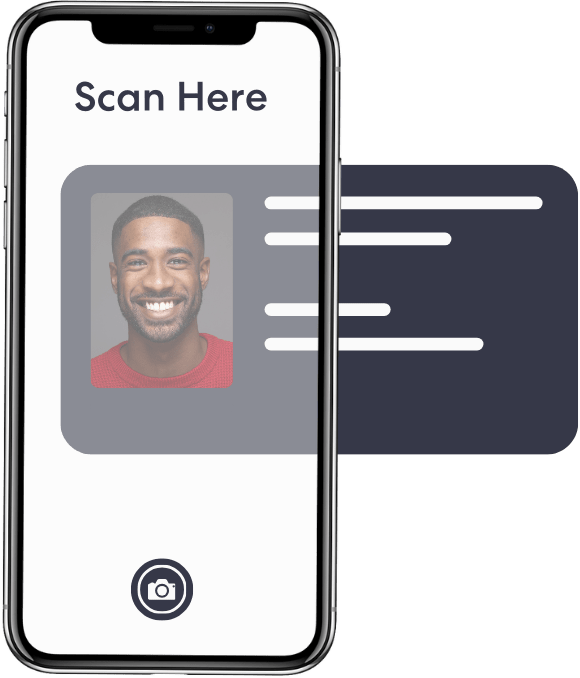
Numbers that back it up
## Why Complycube?
The ComplyCube platform offers **the most complete, flexible, and top-rated** KYC solutions to help you build trust in your business. Whether you’re a startup or a multinational enterprise, we’ve got you covered.
[ Contact us ](#)
10+ million
Transactions are processed week in and week out across the globe.
220+
Countries and territories supported for a greater peace of mind.
3,000+
Data points from trusted sources and partners across the world, giving you the highest coverage.
98%
Client onboarding rate, helping you convert more customers and grow your business.

### Tamper proof
Our advanced verification engine detects pixel tampering and spoofing, along with many other fraudulent methodologies.

### Instant results
Document authentication takes 15 seconds, and results are delivered to you instantly, emboldening a swift client acquisition process.

## Handle high volumes with ease
Modern client acquisition strategies must be able to process thousands of transactions every day. Document authentication technology enables businesses to meet the demands of modern user volumes.
By automating the verification process, firms can eradicate wait times for new accounts and significantly enhance the user experience.
[View solution](https://www.complycube.com/en/solutions/identity-assurance/customer-authentication/)
## Integrate into your existing stack
Implement our document verification solution via powerful SDKs or our API into your existing tech stack. An easy integration ensures that the service works for businesses, and minimal coding is needed.
Alternatively, use our no-code hosted solution for comprehensive coverage with no development required.
[View documentation](https://docs.complycube.com/documentation/guides/web-sdk-quick-guide/integration-guide)





## Empower compliance decisions quickly
KYC document data is processed instantly and reported back to the platform for smart compliance decisions. If there are compliance concerns, they are immediately flagged with a smart traffic light risk scoring system.
Every uploaded picture is stored on our platform, and sensitive PII information or images of minors are redacted where necessary.
[View use case](https://www.complycube.com/en/use-cases/profession/compliance-managers/)
## Frequently asked questions
[Explore other solutions](https://www.complycube.com/solutions/due-diligence-compliance/know-your-customer/)
## Explore other solutions
[Biometric Verification](https://www.complycube.com/en/solutions/identity-assurance/biometric-verification/) 
### Biometric Verification
Instantly verify user’s facial biometrics using our advanced machine learning technology. Our engine scores for similarities between the uploaded selfie and the document image.
[View solution](https://www.complycube.com/en/solutions/identity-assurance/biometric-verification/ "Watchlist screening")
[Case Management](https://www.complycube.com/en/solutions/due-diligence-compliance/case-management/) 
### Case Management
Conduct Customer Due Diligence from the comfort of one centralized platform. All customer KYC data is stored securely and our case management feature allows for streamlined remedial actions.
[View solution](https://www.complycube.com/en/solutions/due-diligence-compliance/case-management/ "Continuous monitoring")
[Sanctions & PEP Screening](https://www.complycube.com/en/solutions/global-screening/sanctions-pep-screening/) 
### Sanctions & PEP Screening
Our Sanctions & PEP Screening solution mitigates bad actors from accessing your business’s services. Global coverage ensures your business remains compliant wherever it expands.
[View solution](https://www.complycube.com/en/solutions/global-screening/sanctions-pep-screening/ "Adverse media checks")
[View all solutions](https://www.complycube.com/solutions/)
---
### [Ultimate screening solution for adverse media](https://www.complycube.com/solutions/global-screening/adverse-media-checks/)
**Published:** October 27, 2021
**Author:** CC
**Content:**
# Ultimate screening solution for adverse media
Build comprehensive risk profiles of your customers with our adverse media screening service. It covers more than 50,000 globally curated and highly trusted news sources. Anticipate risks before they grow with our advanced adverse media check software.
[ Start now ](https://portal.complycube.com/signup)
[ Contact us ](https://www.complycube.com/contact/contact-sales/)




### Credible sources
Sources are selected and reviewed by ComplyCube’s specialists and research analysts using relevance, credibility and regional coverage data.

### Structured profiles
Structured entity profiles consolidate aliases, related articles, risk themes, and screening context to reduce overall manual review time.

### Simple & quick integration
Integrate adverse media screening with ComplyCube’s APIs and SDKs. Reduce effort while maintaining a consistent and audit-ready process.
## Adverse media in high quality news articles
Identify reputational risk early with adverse media screening across vetted global news and risk intelligence sources. Structured entity matching and regularly refreshed data help businesses detect material concerns before they appear on official lists.
Our media screening service helps businesses anticipate risk, identify bad actors, and support stronger compliance decision-making.

### Credible news sources
Screen against vetted global news and risk intelligence sources that are chosen for credibility, relevance, and breadth of coverage. Regularly refreshed data helps businesses better detect material adverse information.

### Enriched live profiles
Access structured profiles that bring together relevant adverse media, entity context, and risk signals in one place. This helps compliance teams review findings more efficiently and make more consistent risk decisions.








STRUCTURED PROFILES
## Database screening of structured individuals and company profiles
Access millions of profiles from thousands of data sources in a standardized format, helping MLRO and compliance teams review entity matches, aliases, and related media more efficiently and with greater consistency.
EXTENSIVE COVERAGE
## Immediately learn if potential customers appear negatively
Coverage is mapped across core adverse media risk themes, including corruption, financial crime, trafficking, sanctions-related exposure, director disqualifications, disbarments, and organized crime.
Categories are designed to support customer risk profiling, enhanced due diligence, and ongoing monitoring workflows.
## Adverse Media Screening Requirements
As AML/CFT expectations evolve through to 2026, firms are under increasing pressure to maintain stronger customer risk profiling and more effective ongoing monitoring. Adverse media screening supports these requirements by surfacing potentially material negate information from credible sources as part of a risk-based compliance approach.
Used alongside customer due diligence and ongoing monitoring controls, adverse media checks help businesses assess reputational and financial crime risk more consistently, escalate concerns earlier, and support more defensible compliance decisions.
[ Start now ](https://portal.complycube.com/signup)
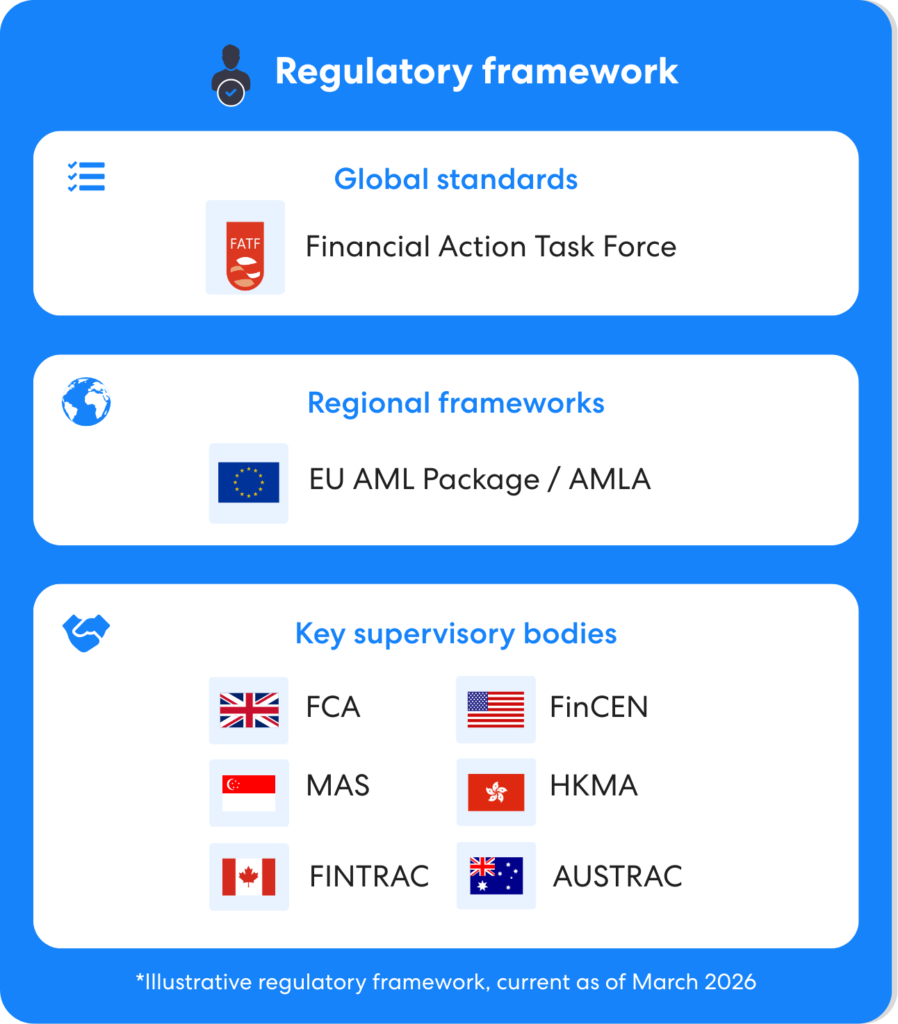

### Global customer screening
ComplyCube’s adverse media check spans 220 countries and territories. With global, regional, and local public and commercial lists, you can scale and expand into markets.

### Quality assured
Our adverse media check framework is supported by ongoing source review and data quality controls, helping teams work from reliable and relevant information.

### Omni-channel
Deploy adverse media checks across digital channels to maintain a consistent compliance process across onboarding and ongoing monitoring journeys.

### Enterprise-ready
ComplyCube is built to support scalable compliance operations, giving businesses the reliability and control needed for complex and high-volume environments.
## Adverse media types
Different types of media may highlight a variety of risks relevant to customer screening, enhanced due diligence, and ongoing monitoring. So, clear classification helps businesses interpret negative news more effectively and assess whether a finding may have compliance, reputational, or operational significance.
As a result, these risks can include business and financial misconduct, environmental issues, regulatory failings, and social or labour-related concerns. In short, categorising adverse media in this way helps compliance teams prioritise reviews, support consistent decision-making, and build more complete customer risk profiles.

### Business risks
- Anti-competitiveness
- Association risk
- Information rights
- Intellectual property
- Financial difficulty
- Management issues
- Ownership issues

### Environmental
- Environmental issues
- Product issues
- Service issues
- Production issues
- Supply chain issues
- Trafficking

### Regulatory
- Corruption
- Fraud Issues
- Regulatory
- Sanctions
- Disbarments
- Organized crime
- Terrorism

### Social & labor
- Health & safety
- Discrimination
- Workforce rights
- Human rights
- Workforce disputes
- Tax Crime

The Importance of Adverse Media
Adverse media screening fortify KYC and AML processes, quickly identifying potential customer risks. Read our latest guide for more information.
[ Go to Guide ](https://www.complycube.com/en/importance-of-adverse-media-checks/)
[Explore other solutions](https://www.complycube.com/solutions/due-diligence-compliance/know-your-customer/)
## Explore other solutions
[Watchlist Screening](https://www.complycube.com/solutions/global-screening/watchlist-screening/) 
### Watchlist Screening
ComplyCube’s comprehensive coverage of global AML watchlist sources and flexible automation features ensures that you comply with the most stringent regulations.
[View solution](https://www.complycube.com/solutions/global-screening/watchlist-screening/ "Watchlist screening")
[Sanctions & PEP Screening](https://www.complycube.com/solutions/global-screening/sanctions-pep-screening/) 
### Sanctions & PEP Screening
Our market-leading screening capability provides extensive coverage on sanctioned and Politically Exposed Persons (PEP) individuals, companies, and associations.
[View solution](https://www.complycube.com/solutions/global-screening/sanctions-pep-screening/ "Sanctions & PEP screening")
[Continuous Monitoring](https://www.complycube.com/solutions/global-screening/continuous-monitoring/) 
### Continuous Monitoring
Keep on top of your Ongoing Due Diligence (ODD) obligations with ease, using our continuous monitoring service. You’ll get notified in real-time should your customers’ status change.
[View solution](https://www.complycube.com/solutions/global-screening/continuous-monitoring/ "Continuous monitoring")
[View all solutions](https://www.complycube.com/solutions/)
## Frequently asked questions
Does ComplyCube's Adverse Media Screening cover both individuals and businesses?
ComplyCube’s adverse media screening covers both individuals and companies through structured entity profiles. These are designed to support customer risk profiling and compliance reviews. The page also states that profiles consolidate aliases, related articles, risk themes, and screening context to help reduce manual review time.
What sources does ComplyCube user for adverse media checks?
ComplyCube uses a combination of proprietary sources, governing bodies, research bureaus, trusted data brokers, and vetted global news, and risk intelligence sources. Our solution covers more than 50,000 globally curated and highly trusted news sources, and that source selection is reviewed using relevance, credibility, and regional coverage data.
Can ComplyCube run adverse media checks in real time during onboarding?
ComplyCube can run adverse media checks in real time during onboarding helping businesses identify risk as part of the customer screening journey. Continuous monitoring sends real-time notifications when a customer appears in a relevant media source or when their screening status changes.
How often is ComplyCube's adverse media screening database updated?
ComplyCube’s adverse media screening database is updated multiple times a day to help teams work from current information. Regularly refreshed data supports earlier detection of material adverse information and more consistent compliance decision-making.
---
### [ComplyCube for Business Privacy Policy](https://www.complycube.com/complycube-app-privacy-policy/)
**Published:** February 24, 2026
**Author:** Harry
**Content:**
Updated on January 12, 2026
This ComplyCube for Business Privacy Policy (“**Policy**”) explains how ComplyCube (as defined below) collects, uses, discloses, and otherwise processes information when you use the ComplyCube for Business application (the “**App**”) in connection with identity verification, Know Your Customer (“**KYC**”), Anti-Money Laundering (“**AML**”), sanctions screening, fraud prevention, and related compliance workflows (the “**Services**”).
**Key role clarification:** The App is activated using a Client API key. The organisation that asks you to complete a verification check using this App (the “**Client**”) is the **data controller** for personal data processed in connection with that check. ComplyCube acts as a **data processor/service provider** and processes personal data **only on the Client’s documented instructions**.
## 1. DEFINITIONS
- **“Client”** means the organisation (e.g., business, bank, fintech, marketplace, employer, or other entity) that provides you with access to the App or requests that you complete a verification check.
- **“Client Data”** means personal data and other information that the Client (or you on the Client’s behalf) submits to the Services for processing as part of KYC/AML or related workflows.
- **“ComplyCube,” “we,” “us,” “our”** means TEEMO TECHNOLOGY LTD (trading as ComplyCube), Company No. 12392069, registered address: Crown House, 27 Old Gloucester Street, London, WC1N 3AX, United Kingdom.
- **“Personal Data”** means information that identifies, relates to, describes, is reasonably capable of being associated with, or could reasonably be linked to an identified or identifiable individual, including “personal information” as defined by certain U.S. state laws.
- **“Sensitive Personal Data / Sensitive Personal Information”** includes, where applicable, biometric information and other categories treated as sensitive under GDPR/UK GDPR and/or U.S. state privacy laws.
## 2. SCOPE AND WHO THIS POLICY APPLIES TO
This Policy applies to personal data processed through the App in connection with verification checks initiated by a Client. This Policy does not replace or override the Client’s privacy policy. The Client is responsible for providing you with appropriate notices about its processing activities and for determining the lawful basis for processing.
## 3. CONTROLLER/PROCESSOR AND SERVICE PROVIDER STATUS
For verification checks, the Client is the **Data Controller** (or “Business” under certain U.S. laws). ComplyCube processes Client Data as:
- a **Data Processor** (GDPR/UK GDPR terminology), and/or
- a **Service Provider/Processor** (CCPA/CPRA terminology),
and will not use Client Data for purposes other than providing the Services, improving security, preventing fraud, complying with law, and other purposes permitted under applicable processor/service-provider frameworks and our agreements with Clients.
## 4. PERSONAL DATA WE PROCESS THROUGH THE APP
Depending on the workflow chosen by the Client, we may collect and process the following categories of Personal Data:
### 4.1 Identity and Contact Data
- Name
- Date of birth
- Residential address
- Email address
- Telephone/mobile number
- Nationality and/or residency status (where required)
### 4.2 Identity Document Data
- Images of identity documents (e.g., passport, national ID card, residence permit, driver’s licence)
- Document number, expiry date, issuing authority
- Machine Readable Zone (MRZ) data
- Barcode data (where applicable)
- NFC chip data and associated security checks (where supported and enabled by the Client)
### 4.3 Biometric Data (Sensitive / Special Category)
- Selfie images and/or video captured for liveness detection
- Facial geometry templates (biometric identifiers) derived from images/video for face matching and liveness purposes
### 4.4 Device, Network, and Technical Data
- IP address
- Device model, manufacturer
- Operating system and version
- App version
- Device identifiers and device signals (e.g., device ID, advertising identifier where applicable and permitted, integrity signals)
- Language/locale, time zone
- Network and connection metadata
### 4.5 Verification, Security, and Fraud-Prevention Data
- Verification attempt timestamps
- Session and audit logs
- Fraud signals, risk indicators, and integrity checks
- Approximate location derived from IP address (not precise GPS, unless explicitly enabled by the Client and you grant permission)
### 4.6 Communications and Support Data
- Support requests and correspondence with ComplyCube (if you contact us directly)
- Technical diagnostics shared to troubleshoot issues
### 4.7 One-Time Passcodes (OTP)
Where enabled by the Client, we may send functional, non-marketing OTP messages to facilitate authentication in the Client’s workflow. Standard messaging rates may apply.
## 5. HOW THE APP USES PERMISSIONS (iOS & ANDROID)
The App may request access to the following device features:
- **Camera:** to capture identity documents and facial images/video for verification and liveness detection.
- **Microphone (optional):** if the Client enables video liveness that requires audio.
- **Local storage (limited):** temporary storage/processing of captured images/video prior to secure transmission. Upload from device
- **Network access:** to transmit verification data securely and retrieve workflow instructions/results.
Permissions are used solely for providing the Services. You can manage permissions in your device settings; however, disabling certain permissions may prevent the verification workflow from completing.
## 6. PURPOSES OF PROCESSING
ComplyCube processes personal data through the App strictly to provide the Services on behalf of the Client. Typical purposes include:
- Identity verification and document authenticity checks
- Biometric liveness detection and face matching
- Fraud detection and prevention, risk assessment, and platform security
- Audit logging and compliance recordkeeping (as instructed by the Client and/or required by law)
- Customer support, troubleshooting, and incident response
- Service reliability, performance monitoring, and security improvements
ComplyCube does not use Client Data for advertising or for selling personal data.
## 7. LEGAL BASES (GDPR/UK GDPR)
The Client is responsible for determining and communicating the lawful basis for processing under GDPR/UK GDPR. Depending on the workflow and jurisdiction, lawful bases may include:
- performance of a contract
- compliance with a legal obligation
- legitimate interests (e.g., fraud prevention, security)
- consent, including **explicit consent** where required for biometric processing
Where biometric data constitutes special category data, processing is typically based on **explicit consent** (Article 9(2)(a) GDPR/UK GDPR) or another applicable exception determined by the Client.
## 8. DISCLOSURE OF PERSONAL DATA
We may disclose personal data as follows:
- **To the Client:** the organisation that requested the verification and is the data controller/business.
- **To Subprocessors/Service Providers:** trusted vendors that support hosting, infrastructure, security, fraud prevention, analytics limited to operational performance, and related services. They are bound by contractual confidentiality and data protection obligations.
- **For legal reasons:** to comply with applicable laws, lawful requests, court orders, or to protect rights, safety, and security.
- **Corporate transactions:** in connection with a merger, acquisition, financing, reorganisation, insolvency, or sale of assets, subject to appropriate confidentiality and data protection safeguards.
We do not sell Client Data. We do not share Client Data for cross-context behavioural advertising.
## 9. INTERNATIONAL DATA TRANSFERS
Where personal data is transferred outside the UK/EEA, we use appropriate safeguards such as Standard Contractual Clauses and/or other lawful transfer mechanisms, and we require subprocessors to implement appropriate security measures.
## 10. DATA RETENTION
Retention is determined by the Client and applicable legal requirements. ComplyCube retains personal data only:
- for as long as necessary to provide the Services and maintain audit/security records,
- as instructed by the Client, and
- as required or permitted by law (e.g., to resolve disputes, enforce agreements, or comply with legal obligations).
## 11. YOUR RIGHTS (GDPR/UK GDPR AND OTHER REGIONS)
Subject to applicable law, you may have rights such as access, correction, deletion, restriction, objection, portability, and withdrawal of consent.
Because ComplyCube acts as a processor/service provider for verification checks, requests relating to Client Data should be directed to the Client that initiated the verification. If you contact ComplyCube, we may refer your request to the Client or assist the Client in fulfilling the request as required by law.
## 12. U.S. STATE PRIVACY NOTICE (INCLUDING CALIFORNIA CCPA/CPRA)
This section applies to residents of certain U.S. states with privacy laws, including California (CCPA as amended by CPRA). For verification checks, the Client is typically the “Business” and ComplyCube is a “Service Provider”/“Processor” with respect to Client Data.
### 12.1 Categories of Personal Information Collected
Within the past 12 months, personal information processed through the App may include:
- **Identifiers:** name, email, phone number, IP address, device identifiers
- **Customer Records:** address, date of birth, identity document details
- **Biometric Information (Sensitive):** facial images and biometric templates for face matching and liveness
- **Internet/Network Activity:** app usage logs, technical events, session identifiers
- **Geolocation Data:** approximate location derived from IP address (unless otherwise enabled)
- **Sensitive Personal Information:** biometric information, and identity document data (where treated as sensitive under applicable law)
### 12.2 Purposes of Collection/Use
- To provide identity verification and compliance screening services to the Client
- To maintain security, prevent fraud, debug, and perform quality assurance
- To comply with legal obligations and enforce our agreements
### 12.3 Sale/Sharing of Personal Information
ComplyCube does not “sell” personal information and does not “share” personal information for cross-context behavioural advertising, as those terms are defined under CCPA/CPRA.
### 12.4 Disclosure of Personal Information
We may disclose personal information to:
- the Client (Business) that requested the verification,
- service providers/subprocessors that assist in delivering the Services, and
- authorities or other parties where required by law or permitted under CCPA/CPRA.
### 12.5 Consumer Rights
Depending on your state, you may have rights such as:
- Right to know/access
- Right to delete
- Right to correct
- Right to data portability
- Right to opt out of sale/sharing (where applicable)
- Right to limit use and disclosure of sensitive personal information (where applicable)
- Right to non-discrimination for exercising privacy rights
Because the Client is the Business/Controller for verification checks, you should submit requests to the Client in the first instance. If you submit a request to ComplyCube, we may redirect it to the Client or process it as a service provider as permitted by law.
### 12.6 Authorized Agents (California)
California residents may use an authorized agent to submit requests. We (or the Client) may require verification of the agent’s authority and your identity.
## 13. CHILDREN
The App is not intended for use by individuals under 18 unless the Client explicitly authorises such use and it is permitted by applicable law.
## 14. CHANGES TO THIS POLICY
We may update this Policy from time to time. The “Last Updated” date indicates when this Policy was last revised. Where required by law, we will provide additional notice of material changes.
## 15. CONTACT US
If you have questions about this Policy or ComplyCube’s privacy practices:
- Email: **privacy@complycube.com**
- Data Protection Officer: **dpo@complycube.com**
## BIOMETRIC CONSENT NOTICE (APP)
This Biometric Consent Notice explains how biometric data may be collected and used when you complete an identity verification workflow in the App.
## 1. WHAT BIOMETRIC DATA MAY BE PROCESSED
Depending on the workflow, the App may capture a selfie image and/or a short video of your face for liveness detection. From this, biometric identifiers (such as facial geometry templates) may be created to compare your face to the photo on your identity document and to confirm you are a live person.
## 2. PURPOSE OF BIOMETRIC PROCESSING
- To verify your identity
- To perform face matching between your selfie and identity document
- To perform liveness detection and detect spoofing attempts
- To prevent fraud and protect the security of the verification process
## 3. EXPLICIT CONSENT
By proceeding with the biometric step in the App and following the on-screen instructions, you provide your **explicit consent** to the processing of your biometric data for the purposes described above, where such consent is required by applicable law (including Article 9(2)(a) GDPR/UK GDPR).
## 4. WHO RECEIVES BIOMETRIC DATA
Biometric data is processed on behalf of the Client that requested your verification. The Client is the data controller/business. ComplyCube acts as a data processor/service provider. Biometric data may be disclosed to the Client and to ComplyCube’s authorised subprocessors strictly as necessary to deliver the verification workflow, and subject to contractual safeguards.
## 5. RETENTION
Retention of biometric data is determined by the Client based on regulatory requirements and the Client’s policies. ComplyCube retains biometric data only for as long as instructed by the Client and as permitted/required by law.
## 6. WITHDRAWING CONSENT
You may withdraw consent by discontinuing the verification process or by contacting the Client that requested the verification. Please note that withdrawing consent may prevent completion of the verification check requested by the Client.
## 7. QUESTIONS
For questions about why biometric processing is required for your verification, contact the Client that asked you to complete the check. You may also contact ComplyCube at **privacy@complycube.com**.
---
### [Careers](https://www.complycube.com/company/careers/)
**Published:** October 27, 2021
**Author:** CC
**Content:**
# Become part of the revolution
Join us in our journey to build the next-gen verification platform, increase trust online, and stop fraud before it happens.
[ View open roles ](https://www.complycube.com/company/careers/open-roles/)

## 4
Locations
## 1
mission
## 0
boring days and no two days are same
## 100%
commitment to personal growth and talent nurturing
## A culture that values people
People matter at ComplyCube. They make us who we are. Every team member across our locations makes a difference, and everyone has something to contribute. We all add our personal touch. And you, too, could be part of our team and start making a difference from day one.
We value spending time with one another and host regular team gatherings and social events. We host team socials once a quarter, which are a fantastic chance to unwind and get to know your coworkers.
You won’t just be helping build the next unicorn. You’ll also work alongside exceptional talent who pride themselves in the highest quality work and endeavor to make people’s lives better. People with unrelentingly high standards who inspire others to do more and go further.


## Learning & Development
At ComplyCube, we want you to grow and develop as the company grows and develops. We provide a variety of training programs and company-sponsored learning activities geared toward career development, such as our in-house new management training program, and others that promote broader personal development, such as weekly Spanish lessons.
We value your wellness and actively promote healthy activities such as taking short breaks during the working day to recharge, playing a game of pool, or reading a book in our library.

### A growth enivronment
We’re committed to investing in all the areas you might expect, including leadership and soft and technical skills.

### Flexible working
We appreciate that you’ve got a life outside the office. That’s why we have excellent and flexible arrangements to help our teams get the best of both worlds.

### Healthcare
All colleagues have access to subsidised and comprehensive Private Medical Insurance and Funded eye tests and annual health assessment.

### Wellbeing-focused
We offer benefits that promote positive physical, emotional and financial wellbeing.

### Incentive schemes
We offer a generous bonus, with high achievers rewarded with regular incentives such as trips away, fine dining experiences, spa breaks and more.

### Membership bodies
We offer subscriptions to professional membership bodies.

From our team

I really enjoy working for a company that values career development as much as revenue generation. And the founders are so friendly and approachable that it genuinely feels like our company, and everyone gets to learn more with ComplyCube’s success – no two days are the same!
Cristina Martinez – Business Manager
## We are a global team

Join the team
## The story to be told
ComplyCube is for the agile, the caring, the obsessively curious, and most of all, the passionately customer-focused. You’ll be joining us in the first chapter of our epic story, and you’ll be expected to play a leading role in shaping how it evolves.
[ View open roles ](https://www.complycube.com/company/careers/open-roles/)
---
### [One-Time Password (OTP) Verification](https://www.complycube.com/solutions/fraud-intelligence/otp-service/)
**Published:** January 16, 2026
**Author:** Dini Habib
**Excerpt:** Utilize an advanced OTP service that delivers reliable email and SMS OTP verification to enhance security standards and meet regulatory standards. Integrate and layer OTP verification to existing workflows and CRM stacks easily.
**Content:**
# Seamless One Time Password (OTP) Service
ComplyCube’s OTP service adds a crucial, instant layer of authentication to block account takeovers without extra steps for customers. Verify a customer’s current access to their phone number and email with reliable email and SMS verification today.
[ Start now ](https://portal.complycube.com/signup)
[ Contact us ](https://www.complycube.com/contact/contact-sales/)

## Authenticate Users And Prevent Fraud With ComplyCube's Instant OTP Service
ComplyCube’s enhanced OTP service acts as an effective layer to prevent credential-stuffing, brute force, and phishing attacks. With email and SMS OTP verification, firms can leverage advanced **multi-factor authentication** aligned to PSD2 in Europe, HIPAA (healthcare), and PCI DSS (payment) standards.

### Quick Identity Validation
Verify that an email address or phone number belongs to a customer or business by confirming current access in real-time.

### Real-time Risk Signals
Unlock a quick and easy verification method that provides fraud risk insights without documents when used with other checks.

### Low Friction Onboarding
Email and SMS OTP verification offer a one-step, frictionless signup and login method, significantly reducing customer drop-offs.
## Detect and block fraud at the point of entry
ComplyCube’s SMS verification significantly enhances security by blocking high-impact fraud such as account takeovers, SIM swap scams, and phishing attempts.
With dynamic, time-limited codes, businesses can verify an individual’s real-time access to their phone number or email with minimal intervention.

MEET MFA STANDARDS
## Adhere to high multi-factor authentication standards
ComplyCube’s bespoke email and SMS OTP verification can serve as a possession factor within global MFA requirements. When layered with additional checks, OTP supports firms in designing controls aligned with the EU’s PSD2 Strong Customer Authentication (SCA) framework, HIPAA’s Security Rule, and the PCI DSS “something you have” factor.
[ Start Now ](https://portal.complycube.com/signup)

### Comprehensive Integration
Deploy workflows and add OTP service seamlessly. ComplyCube provides complete integration with robust APIs, web and mobile SDKs, and CRM libraries.

### Trusted Data Integrity
Enhance security and trust with end-to-end encryption while complying with global authentication and data privacy requirements such as GDPR, NIST and SOC 2.

## Complete Risk Assessments and Reporting
Leverage a unified compliance approach by combining ComplyCube’s OTP service with other checks in one workflow, including device intelligence, SMS, and email verification.
Build comprehensive risk profiles in a less invasive way and unlock compliance-ready logs critical for regulatory audits and risk assessments.
## Build Trust With Customers at Scale
Our email and SMS verification ensures businesses remain compliant, guaranteeing that credentials are stored securely and aligned with international compliance standards.
ComplyCube is a UK DIATF-certified partner, providing compliance with the EU’s GDPR, the US CCPA, and more. Build customer confidence at the very beginning and maximize conversions.
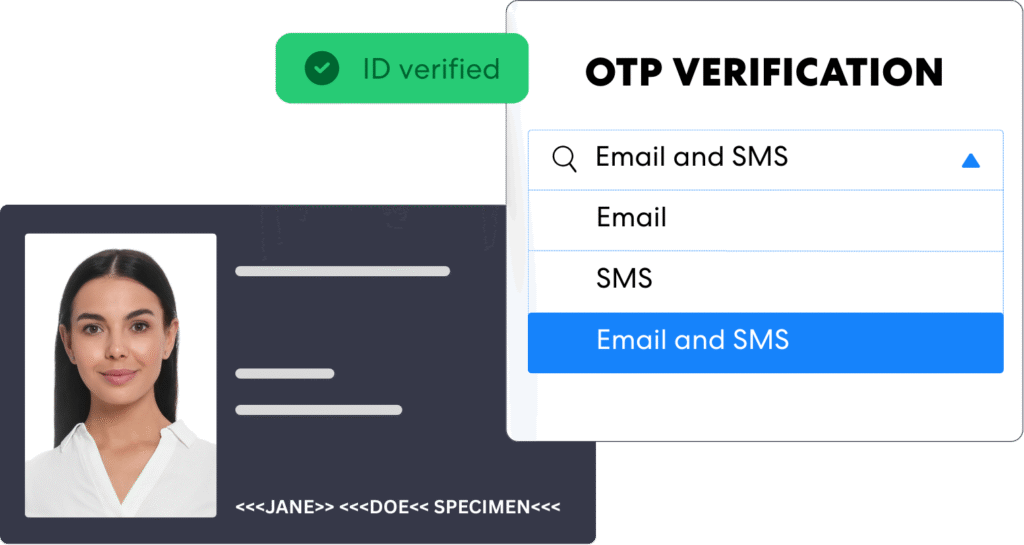
[Explore other solutions](https://www.complycube.com/solutions/due-diligence-compliance/know-your-customer/)
## Explore other solutions
[Phone Intelligence](https://www.complycube.com/en/solutions/fraud-intelligence/phone-intelligence-verify-phone-number/%20) 
### Phone Intelligence
View risk and fraud indicators through line type, carrier, and geographic analysis. Confirm that a number is valid and protect against account takeover and synthetic identities.
[View solution](https://www.complycube.com/en/solutions/fraud-intelligence/phone-intelligence-verify-phone-number/ "Watchlist screening")
[Email Intelligence](https://www.complycube.com/en/solutions/fraud-intelligence/email-risk-score/) 
### Email Intelligence
Verify if an email matches a customer’s claimed identity. Detect disposable and high-risk email addresses from the beginning and achieve faster onboarding and conversion for real users.
[View solution](https://www.complycube.com/en/solutions/fraud-intelligence/email-risk-score/ "Adverse media checks")
[Device Intelligence](https://www.complycube.com/en/solutions/fraud-intelligence/email-risk-score/) 
### Device Intelligence
Assess network and behavioral signals without disrupting customer experience. Block suspicious, high-risk customers by flagging anomalies, including VPN usage or recent abuse.
[View solution](https://www.complycube.com/en/solutions/fraud-intelligence/device-intelligence/ "Continuous monitoring")
[View all solutions](https://www.complycube.com/solutions/)
## Frequently asked questions
How does ComplyCube's email and SMS OTP verification work?
ComplyCube’s One-Time Password (OTP) verification enables businesses to remotely confirm a user’s mobile number or email address. Organizations can enable SMS and/or email OTPs on any chosen workflow via the advanced settings. When enabled, customers are prompted to enter their phone number and/or email address. ComplyCube then sends a 6-digit code from a ComplyCube email address via SMS or email, which the user inputs through the SDK.
Can OTP service be integrated into my business?
ComplyCube’s OTP service can be easily integrated through flexible, developer-friendly APIs and SDKs. You start by creating a client profile in your backend, then generate a secure SDK token used to mount the OTP verification interface within your onboarding or authentication workflows. The integration requires minimal backend setup and supports popular languages such as Node.js, PHP, .NET, and Python. With ComplyCube’s no-code workflows and RESTful API, you can seamlessly combine OTP verification with other checks, reducing compliance complexity and operational overhead.
What is SMS verification used for?
SMS verification confirms a user’s identity by sending a bespoke, time-sensitive code to their phone via text message. It provides an additional layer of authentication against common fraud types such as identity theft and account takeovers. Businesses leverage ComplyCube’s OTP service because it provides a low-friction way to verify user identity during account logins and transactions.
How much does OTP service cost?
ComplyCube offers tiered pricing for OTP. Businesses can select a plan tailored to their volume and regional needs, optimizing costs as they scale. For exact tier pricing by country or volume, contacting ComplyCube sales or check our [pricing page](https://www.complycube.com/en/pricing/).
What is the difference between ComplyCube's OTP service and other providers?
Poorly designed OTP verification workflows can disrupt users, cause frustration, and increase abandonment rates. ComplyCube addresses these challenges by providing flexible, no-code workflows that allow seamless integration of OTP with other verification methods within an all-in-one portal. As a certified Identity Service Provider (IDSP) under the UK DIATF, ComplyCube enables firm to adopt a risk-based approach aligned with the FATF standards. With simple drag-and-drop checks, firms can layer risk intelligence, liveness detection, and ongoing monitoring while adhering with global regulations.
---
### [Privacy policy](https://www.complycube.com/privacy-policy/)
**Published:** October 27, 2021
**Author:** CC
**Content:**
## OVERVIEW
This Privacy Policy (“Policy”) describes the information that we gather on or through the Service, how we use and disclose such information, and the steps we take to protect such information. By visiting the Website, or by purchasing or using the Service, you accept the privacy practices described in this Policy.
This Policy applies to the ComplyCube owned and operated website available at https://www.complycube.com and its subdomains (“Website(s)”). ComplyCube (“we,” or “us”) knows that you care how information about you is used and shared. This Privacy Policy explains what information of yours will be collected by ComplyCube when you access the Websites and ComplyCube Service, how the information will be used, and how you can control the collection, correction and/or deletion of information. It also details the steps we take to protect your information.
Policy is incorporated into, and is subject to, the ComplyCube Terms of Service. Capitalized terms used but not defined in this Policy have the meaning given to them in the ComplyCube Terms of Service.
## DEFINITIONS AND INTERPRETATION
1. **“Client”** means a customer of ComplyCube.
2. **“Client Data“** means personal data, reports, addresses, and other files, folders or documents in electronic form that a User of the Service stores within the Service.
3. “**GDPR**” means Regulation (EU) 2016/679 of the European Parliament and of the Council of 27 April 2016 on the protection of natural persons with regard to the processing of personal data and on the free movement of such data, and repealing Directive 95/46/EC (General Data Protection Regulation).
4. **“Personal Data”** means any information relating to an identified or identifiable natural person.
5. **“Public Area”** means the area of the Site that can be accessed both by Users and Visitors, without needing to log in.
6. **“Restricted Area”** means the area of the Site that can be accessed only by Users, and where access requires logging in.
7. “**Service**” means collectively any online facilities, tools, services or information that we make available through the Website either now or in the future.
8. **“User”** means an employee, agent, or representative of a Client, who primarily uses the restricted areas of the Site for the purpose of accessing the Service in such capacity.
9. **“Visitor”** means an individual other than a User, who uses the public area, but has no access to the restricted areas of the Site or Service.
10. **“We/Us/Our”** means ComplyCube, the trading name and a registered trademark of TEEMO TECHNOLOGY LTD, with company number: 12392069, whose registered address is at Crown House, 27 Old Gloucester St, London, UK, WC1N 3AX.
## THE INFORMATION WE COLLECT ON THE SERVICE
We collect different types of information from or through the Service from the following categories of data subjects:
1\. Customers of ComplyCube (**“Client(s)”**);
2\. Employees, agents, or representatives of Clients, who primarily use the Restricted Areas of the Website for the purpose of accessing the Service in such capacity (**“User(s)”**); and
3\. Individuals other than Users, who use the Public Area, but have no access to the Restricted Areas of the Website or Service (**“Visitor(s)”**); hereinafter, each separately or collectively referred to as “**you**” or “**your**”.
The legal bases for ComplyCube’s processing of personal data are primarily that the processing is necessary for providing the Service in accordance with ComplyCube’s Terms of Service and that the processing is carried out in ComplyCube’s legitimate interests, which are further explained in the section “How We Use the Information We Collect” of this Policy. We may also process data upon your consent, asking for it as appropriate.
1. **User-provided Information.** When you use the Service, as a User or as a Visitor, you may provide, and we may collect Personal Data. Examples of Personal Data include name, email address, mailing address, mobile phone number, and credit card or other billing information. Personal Data also includes other information, such as geographic area or preferences, when any such information is linked to information that identifies a specific individual. You may provide us with Personal Data in various ways on the Service. For example, when you register for an Account, use the Service, post Client Data, interact with other users of the Service through communication or messaging capabilities, or send us customer service-related requests.
2. **Information Collected by Clients.** A Client or User may store or upload into the Service Client Data. ComplyCube has no direct relationship with the individuals whose Personal Data it hosts as part of Client Data. Each Client is responsible for providing notice to its customers and third persons concerning the purpose for which Client collects their Personal Data and how this Personal Data is processed in or through the Service as part of Client Data.
3. **“Automatically Collected” Information.** When a User or Visitor uses the Service, we may automatically record certain information from the User’s or Visitor’s device by using various types of technology, including cookies, “clear gifs” or “web beacons.” This “automatically collected” information may include IP address or other device address or ID, web browser and/or device type, the web pages or sites visited just before or just after using the Service, the pages or other content the User or Visitor views or interacts with on the Service, and the dates and times of the visit, access, or use of the Service. We also may use these technologies to collect information regarding a Visitor or User’s interaction with email messages, such as whether the Visitor or User opens, clicks on, or forwards a message. This information is gathered from all Users and Visitors.
4. **Integrated Services.** You may be given the option to access or register for the Service through the use of your user name and passwords for certain services provided by third parties (each, an “Integrated Service”), such as through the use of your Google account, or otherwise have the option to authorize an Integrated Service to provide Personal Data or other information to us. By authorizing us to connect with an Integrated Service, you authorize us to access and store your name, email address(es), date of birth, gender, current city, profile picture URL, and other information that the Integrated Service makes available to us, and to use and disclose it in accordance with this Policy. You should check your privacy settings on each Integrated Service to understand what information that Integrated Service makes available to us, and make changes as appropriate. Please review each Integrated Service’s terms of use and privacy policies carefully before using their services and connecting to our Service.
5. **Information from Other Sources.** We may obtain information, including Personal Data, from third parties and sources other than the Service, such as our partners, advertisers, credit rating agencies, and Integrated Services. If we combine or associate information from other sources with Personal Data that we collect through the Service, we will treat the combined information as Personal Data in accordance with this Policy.
6. **OTP Messages.** At a Client’s request, we may deliver one-time passcodes or comparable authentication credentials (“OTP Messages”) to the Client’s end users as part of the identity-verification or access-control workflows the Client has elected to use. OTP Messages are functional in nature and are sent solely to facilitate the Client’s security and authentication processes. They are not marketing communications. Standard network charges may apply. In issuing OTP Messages, we act strictly on the Client’s instructions and process any related personal data only in accordance with our role as the Client’s service provider. It remains the Client’s responsibility to ensure that its own end users have been provided with all necessary notices and consents permitting the use of their mobile number for this purpose. We rely on the mobile number provided to us by the Client or the end user (as applicable). End users who wish to amend their communication preferences should contact the Client directly, noting that disabling OTP Messages may affect the Client’s chosen verification or access steps.
## HOW WE USE THE INFORMATION WE COLLECT
We use the information that we collect in a variety of ways in providing the Service and operating our business, including the following:
1. **Operations:** We use the information – other than Client Data – to operate, maintain, enhance and provide all features of the Service, to provide the services and information that you request, to respond to comments and questions and to provide support to users of the Service. We process Client Data solely in accordance with the directions provided by the applicable Client or User.
2. **Improvements:** We use the information to understand and analyze the usage trends and preferences of our Visitors and Users, to improve the Service, and to develop new products, services, feature, and functionality. Should this purpose require ComplyCube to process Client Data, then the data will only be used in anonymized or aggregated form.
3. **Communications:** We may use a Visitor’s or User’s email address or other information – other than Client Data – to contact that Visitor or User (i) for administrative purposes such as customer service, to address intellectual property infringement, right of privacy violations or defamation issues related to the Client Data or Personal Data posted on the Service or (ii) with updates on promotions and events, relating to products and services offered by us and by third parties we work with. You have the ability to opt-out of receiving any promotional communications as described below under “Your Choices.”
4. **Cookies and Tracking Technologies:** We use automatically collected information and other information collected on the Service through cookies and similar technologies to: (i) personalize our Service, such as remembering a User’s or Visitor’s information so that the User or Visitor will not have to re-enter it during a visit or on subsequent visits; (ii) provide customized advertisements, content, and information; (iii) monitor and analyze the effectiveness of Service and third-party marketing activities; (iv) monitor aggregate site usage metrics such as total number of visitors and pages viewed; and (v) track your entries, submissions, and status in any promotions or other activities on the Service. You can obtain more information about cookies by visiting [https://www.allaboutcookies.org](http://www.allaboutcookies.org/).
5. **Analytics:** We use Google Analytics to measure and evaluate access to and traffic on the Public Area of the Site, and create user navigation reports for our Site administrators. Google operates independently from us and has its own privacy policy, which we strongly suggest you review. Google may use the information collected through Google Analytics to evaluate Users’ and Visitors’ activity on our Site. For more information, see [Google Analytics Privacy and Data Sharing](https://support.google.com/analytics/answer/6004245).. We take measures to protect the technical information collected by our use of Google Analytics. The data collected will only be used on a need to know basis to resolve technical issues, administer the Site and identify visitor preferences; but in this case, the data will be in non-identifiable form. We do not use any of this information to identify Visitors or Users.
## TO WHOM WE DISCLOSE INFORMATION
Except as described in this Policy, we will not intentionally disclose the Personal Data or Client Data that we collect or store on the Service to third parties without the consent of the applicable Visitor, User or Client. We may disclose information to third parties if you consent to us doing so, as well as in the following circumstances:
1. **Unrestricted Information** Any information that you voluntarily choose to include in a Public Area of the Service, such as a public blog comment, will be available to any Visitor or User who has access to that content.
2. **Service Providers** We work with third party service providers who provide website, application development, hosting, maintenance, and other services for us. These third parties may have access to, or process Personal Data or Client Data as part of providing those services for us. We limit the information provided to these service providers to that which is reasonably necessary for them to perform their functions, and our contracts with them require them to maintain the confidentiality of such information.
3. **Non Personally Identifiable Information** We may make certain automatically-collected, aggregated, or otherwise non-personally-identifiable information available to third parties for various purposes, including (i) compliance with various reporting obligations; (ii) for business or marketing purposes; or (iii) to assist such parties in understanding our Clients’, Users’ and Visitors’ interests, habits, and usage patterns for certain programs, content, services, and/or functionality available through the Service.
4. **Law Enforcement, Legal Process and Compliance** We may disclose Personal Data or other information if required to do so by law or in the good-faith belief that such action is necessary to comply with applicable laws, in response to a facially valid court order, judicial or other government subpoena or warrant, or to otherwise cooperate with law enforcement or other governmental agencies. We also reserve the right to disclose Personal Data or other information that we believe, in good faith, is appropriate or necessary to (i) take precautions against liability, (ii) protect ourselves or others from fraudulent, abusive, or unlawful uses or activity, (iii) investigate and defend ourselves against any third-party claims or allegations, (iv) protect the security or integrity of the Service and any facilities or equipment used to make the Service available, or (v) protect our property or other legal rights, enforce our contracts, or protect the rights, property, or safety of others.
5. **Change of Ownership** Information about Users and Visitors, including Personal Data, may be disclosed and otherwise transferred to an acquirer, successor or assignee as part of any merger, acquisition, debt financing, sale of assets, or similar transaction, as well as in the event of an insolvency, bankruptcy, or receivership in which information is transferred to one or more third parties as one of our business assets and only if the recipient of the User or Visitor Data commits to a Privacy Policy that has terms substantially consistent with this Privacy Policy. Client Data may be physically or electronically transferred to an acquirer, or successor or assignee as part of any merger, acquisition, debt financing, sale of assets, or similar transaction, as well as in the event of an insolvency, bankruptcy, or receivership in which information is transferred to one or more third parties as one of our business assets, for the sole purpose of continuing the operation of the Service, and only if the recipient of the Client Data commits to a Privacy Policy that has terms substantially consistent with this Privacy Policy.
6. Transfer of Personal Data. In case your Personal Data is provided to service providers outside the EEA/UK, and where applicable, we will implement appropriate safeguards to protect your Personal Data, including Standard Contractual Clauses as adopted by the European Commission. Please contact us if you want further information on the specific mechanism used by us when transferring your Personal Data out of the EEA/UK. Moreover, ComplyCube requires its service providers to implement appropriate security measures to ensure the protection of your Personal Data in accordance with applicable data protection legislation.
## YOUR CHOICES
1. **Access, Correction, Deletion**
We respect your privacy rights and provide you with reasonable access to the Personal Data that you may have provided through your use of the Services. If you wish to access or amend any other Personal Data we hold about you, or to request that we delete or transfer any information about you that we have obtained from an Integrated Service, you may contact us as set forth in the “How to Contact Us” section. At your request, we will have any reference to you deleted or blocked in our database.
You may update, correct, or delete your account information and preferences at any time by accessing your account settings page on the Service. Please note that while any changes you make will be reflected in active user databases instantly or within a reasonable period of time, we may retain all information you submit for backups, archiving, prevention of fraud and abuse, analytics, satisfaction of legal obligations, or where we otherwise reasonably believe that we have a legitimate reason to do so.
You may have the following rights: right to obtain confirmation from us as to whether we process your Personal Data, right of access, right to withdraw consent, right to restriction of processing, right to object to processing and right to data portability as well as right to lodge a complaint with the relevant data protection authority.
This provision does not apply to Personal Data that is part of Client Data. In this case, the management of the Client Data is subject to the Client’s own Privacy Policy, and any request for access, correction or deletion should be made to the Client responsible for the uploading and storage of such data into the Service. You may decline to share certain Personal Data with us, in which case we may not be able to provide to you some of the features and functionality of the Service.
2. **Navigation Information** You may opt out from the collection of navigation information about your visit to the Site by Google Analytics by using [the Google Analytics Opt-out feature ](https://tools.google.com/dlpage/gaoptout).
3. **Opting out from Commercial Communications**
If you receive commercial emails from us, you may unsubscribe at any time by following the instructions contained within the email or by sending an email to the address provided in the “How to Contact Us” section.
Please be aware that if you opt-out of receiving commercial email from us or otherwise modify the nature or frequency of promotional communications you receive from us, it may take up to ten (10) business days for us to process your request. Additionally, even after you opt-out from receiving commercial messages from us, you will continue to receive administrative messages from us regarding the Service.
ComplyCube has no direct relationship with the Client’s customers or third party whose Personal Data it may process on behalf of a Client. An individual who seeks access, or who seeks to correct, amend, delete inaccurate data or withdraw consent for further contact should direct his or her query to the Client or User they deal with directly. If the Client requests ComplyCube to remove the data, we will respond to its request within thirty (30) days. We will delete, amend or block access to any Personal Data that we are storing only if we receive a written request to do so from the Client who is responsible for such Personal Data, unless we have a legal right to retain such Personal Data. We reserve the right to retain a copy of such data for archiving purposes, or to defend our rights in litigation. Any such request regarding Client Data should be addressed as indicated in the “How to Contact Us” section, and include sufficient information for ComplyCube to identify the Client or its customer or third party and the information to delete or amend.
## THIRD-PARTY SERVICES
The Service may contain features or links to web sites and services provided by third parties. Any information you provide on third-party sites or services is provided directly to the operators of such services and is subject to those operators’ policies, if any, governing privacy and security, even if accessed through the Service. We are not responsible for the content or privacy and security practices and policies of third-party sites or services to which links or access are provided through the Service. We encourage you to learn about third parties’ privacy and security policies before providing them with information.
## DATA SECURITY
We follow generally accepted industry standards to protect the information submitted to us, both during transmission and once we receive it. We maintain appropriate administrative, technical and physical safeguards to protect Personal Data against accidental or unlawful destruction, accidental loss, unauthorized alteration, unauthorized disclosure or access, misuse, and any other unlawful form of processing of the Personal Data in our possession. This includes, for example, firewalls, password protection and other access and authentication controls. We use SSL technology to encrypt data during transmission through the public Internet, and we also employ application-layer security features to further anonymize Personal Data.
However, no method of transmission over the Internet, or method of electronic storage, is 100% secure. We cannot ensure or warrant the security of any information you transmit to us or store on the Service, and you do so at your own risk. We also cannot guarantee that such information may not be accessed, disclosed, altered, or destroyed by breach of any of our physical, technical, or managerial safeguards. If you believe your Personal Data has been compromised, please contact us as set forth in the “How to Contact Us” section.
If we learn of a security systems breach, we will inform you and the authorities of the occurrence of the breach in accordance with applicable law.
## DATA RETENTION
We only retain the Personal Data collected from a User for as long as the User’s account is active or otherwise for a limited period of time as long as we need it to fulfill the purposes for which we have initially collected it, unless otherwise required by law. We will delete our clients’ data upon their request when tell us when they no longer require us to store the information we’ve collected on their behalf.
We may also store information for longer than described above where we have a legitimate legal reason for so doing, for example, where we are under a binding legal order not to destroy information. The Client may choose the location of personal data processing (including storage) to comply with the applicable laws.
## DATA CONTROLLER AND DATA PROCESSOR
ComplyCube does not own, control or direct the use of any of the Client Data stored or processed by a Client or User via the Service. Only the Client or Users are entitled to access, retrieve and direct the use of such Client Data. ComplyCube is largely unaware of what Client Data is actually being stored or made available by a Client or User to the Service and does not directly access such Client Data except as authorized by the Client, or as necessary to provide Services to the Client and its Users.
Because ComplyCube does not collect nor determine the use of any Personal Data contained in the Client Data and because it does not determine the purposes for which such Personal Data is collected, the means of collecting such Personal Data, or the uses of such Personal Data, ComplyCube is not acting in the capacity of a data controller in terms of the GDPR and does not have the associated responsibilities under the GDPR. ComplyCube should be considered only as a processor acting on behalf of its Clients and Users as to any Client Data containing Personal Data that is subject to the requirements of the GDPR. Except as provided in this Privacy Policy, ComplyCube does not independently cause Client Data containing Personal Data stored in connection with the Services to be transferred or otherwise made available to third parties, except to third party subcontractors who may process such data on behalf of ComplyCube in connection with ComplyCube’s provision of Services to Clients. Such actions are performed or authorized only by the applicable Client or User.
The Client or the User is the data controller under the GDPR for any Client Data containing Personal Data, meaning that such party controls the manner such Personal Data is collected and used as well as the determination of the purposes and means of the processing of such Personal Data. Under the GDPR, we rely on Article 6.1(a)(b)(c) as the lawful basis for processing this information. Processing is therefore lawful as ComplyCube only processes personal data in the following instances:
1. 1. the data subject has given consent to the processing of his or her personal data for one or more specific purposes;
2. to perform a contract to which the data subject is party or in order to take steps at the request of the data subject prior to entering into a contract;
3. to comply with a legal obligation to which the controller is subject.
The Article 9.2(a) GDPR exception applies for biometric Special Category Data as you have explicitly consented to the processing.
ComplyCube is not responsible for the content of the Personal Data contained in the Client Data or other information stored on its servers (or its subcontractors’ servers) at the discretion of the Client or User nor is ComplyCube responsible for the manner in which the Client or User collects, handles disclosure, distributes or otherwise processes such information.
## YOUR RIGHTS
Depending on where you live and subject to applicable data protection law, you may have the following rights, right to obtain confirmation from us as to whether we process your Personal Data; right of access, right to rectification, right to withdraw consent, right to erasure, right to restriction of processing, right to object to processing and right to data portability. If you would like to exercise these rights please contact the relevant Client that carried out your related check or contact us at privacy@complycube.com. Please be aware that for most requests, ComplyCube will need to notify the Client so the Client can fulfil the request. This is necessary where ComplyCube is acting on the Client’s behalf.
You are not required to pay any charge for exercising your rights unless a reasonable cost is to be charged where requests are unfounded or excessive, or repetitive in nature.
You may also have a right to lodge a complaint with your local data protection authority or regulator.
## HOW WE USE COOKIES
Our site (https://www.complycube.com) uses cookies to distinguish you from other users of our site. A cookie is a small file which asks permission to be placed on your computer’s hard drive. Once you agree, the file is added and the cookie helps analyse web traffic or lets you know when you visit a particular site. Cookies allow web applications to respond to you as an individual, therefore providing a good experience whilst at the same time allowing us to improve our site. The web application can tailor its operations to your needs, likes and dislikes by gathering and remembering information about your preferences.
We use traffic log cookies to identify which pages are being used. This helps us analyse data about web page traffic and improve our website in order to tailor it to customer needs. We only use this information for statistical analysis purposes and then the data is removed from the system.
Overall, cookies help us provide you with a better website, by enabling us to monitor which pages you find useful and which you do not. A cookie in no way gives us access to your computer or any information about you, other than the data you choose to share with us. By accessing our site, you are consenting to us using cookies on your system. Most web browsers automatically accept cookies, but you can usually modify your browser setting to decline cookies if you prefer. This will prevent you from taking full advantage of the website.
## TYPES OF COOKIES
Cookies fall into any of four categories:
- Strictly necessary, which are required for the site’s essential functions to work properly.
- Performance cookies, which allow us to analyse how the site is used in order to improve it. These cookies contain no personal information that identifies a visitor, and all information collected is aggregated and therefore anonymous. By using our site, you agree that we can place these types of cookies on your device.
- Functionality necessary, which allow the website to remember choices that you make, such as user name, language, etc. These cookies do not allow your browsing activity on other sites to be tracked by ComplyCube. When you choose to allow your browser to remember your login details, you agree that we can place these types of cookies on your device.
- Targeting necessary, which are used to deliver adverts more relevant to the user and their interests. For logged in users, there are no ads served at all, so these cookies only apply to logged-out visitors.
## CONTROL OVER COOKIES
You can block cookies by activating the setting on your browser that allows you to refuse the setting of all or some cookies. However, if you use your browser settings to block all cookies (including essential cookies) you may not be able to access all or parts of our site.
## CHANGES AND UPDATES TO THIS POLICY
Please revisit this page periodically to stay aware of any changes to this Policy, which we may update from time to time. If we modify the Policy, we will make it available through the Service, and indicate the date of the latest revision, and will comply with applicable law. Your continued use of the Service after the revised Policy has become effective indicates that you have read, understood and agreed to the current version of the Policy
If this Policy is going to be changed due to ComplyCube’s intention to further process the Personal Data for a purpose other than that for which the Personal Data were collected, it will provide you prior to that further processing with information on that other purpose and with any relevant further information.
## HOW TO CONTACT US
If you have questions about this Policy or our privacy practices, or if you are seeking to exercise any of your rights, you may contact us at: privacy@complycube.com.
You can also reach out to our Data Protection Officer by email: dpo@complycube.com
---
### [eID Verification](https://www.complycube.com/solutions/identity-assurance/eid-verification-service/)
**Published:** November 28, 2025
**Author:** Dini Habib
**Excerpt:** 51% of customers abandon onboarding due to the lengthy process. eID verification service can save 110 billion hours and cut costs by 90%. Leverage ComplyCube's compliant, multi-scheme eID service and achieve quicker onboarding.
**Content:**
# Scalable eID Verification Service
**Unlock customer trust** and security at onboarding with ComplyCube’s advanced eID verification service, delivering full compliance with global electronic identification standards such as eIDAS 2.0 and data privacy laws.
Connect multiple government-backed eID schemes with a single API and verify users to **regional Levels of Assurance** **(LOA)**. Simplify complex cross-border compliance, boost conversions, and cut costs with scalable eID service.
[ Start now ](https://portal.complycube.com/signup)
[ Contact us ](https://www.complycube.com/contact/contact-sales/)
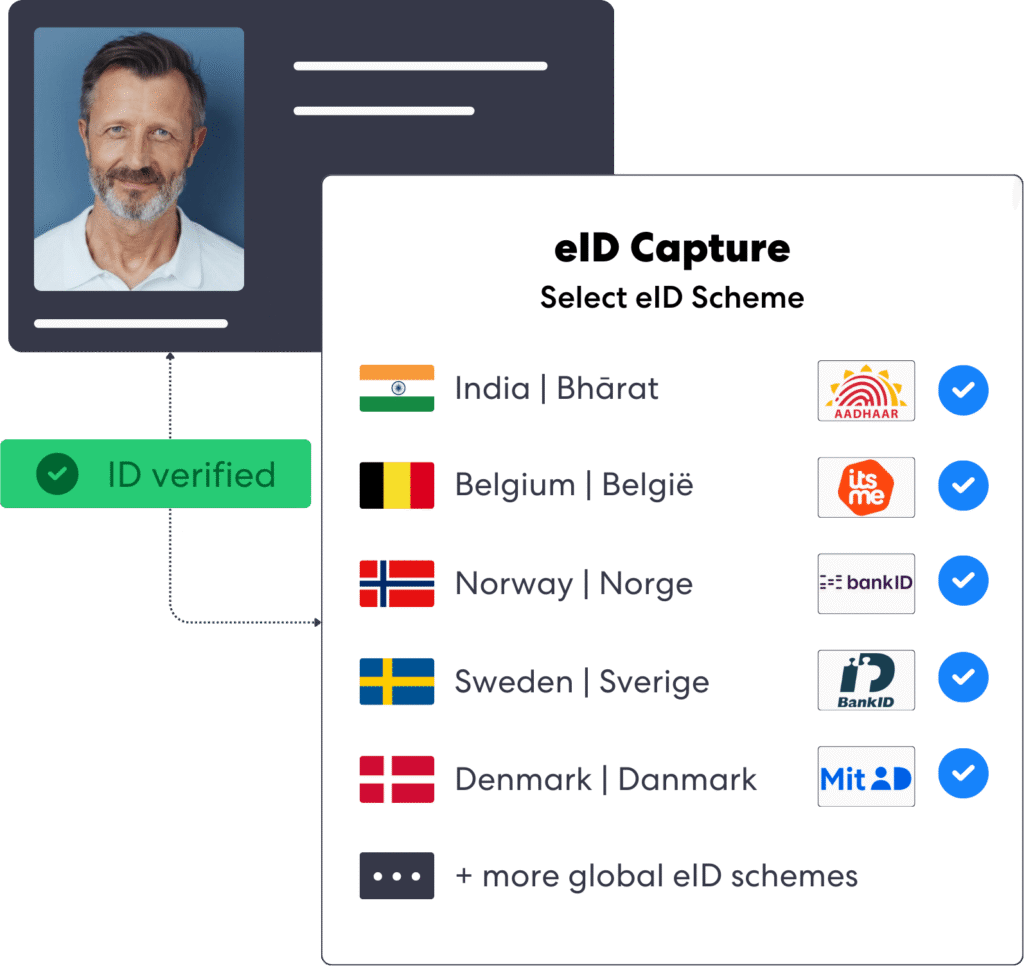

### Future-Proof Scalability
Eliminate multi-vendor complexity and seamlessly adopt new eID schemes and EUDI wallets on a single, unified platform.

### Cross-Border Compliance
Fully align with global eID and AML requirements with configurable LoA. Reduce fraud and strengthen interoperability.

### Maximize Conversions
Significantly boost customer onboarding rates while aligning with the highest trust, security, and data privacy standards.
## Trusted by big names





fast-track onboarding
## One-Step eID Service for Instant Trust and Zero Fraud
ComplyCube’s eID verification service enables customers to verify identities instantly, eliminating the hassle of document uploads and selfie scans.
With government-backed, pre-verified digital identity credentials, businesses can trust the authenticity of each customer. Approve genuine customers while blocking complex fraud, including synthetic identities and forged documents.

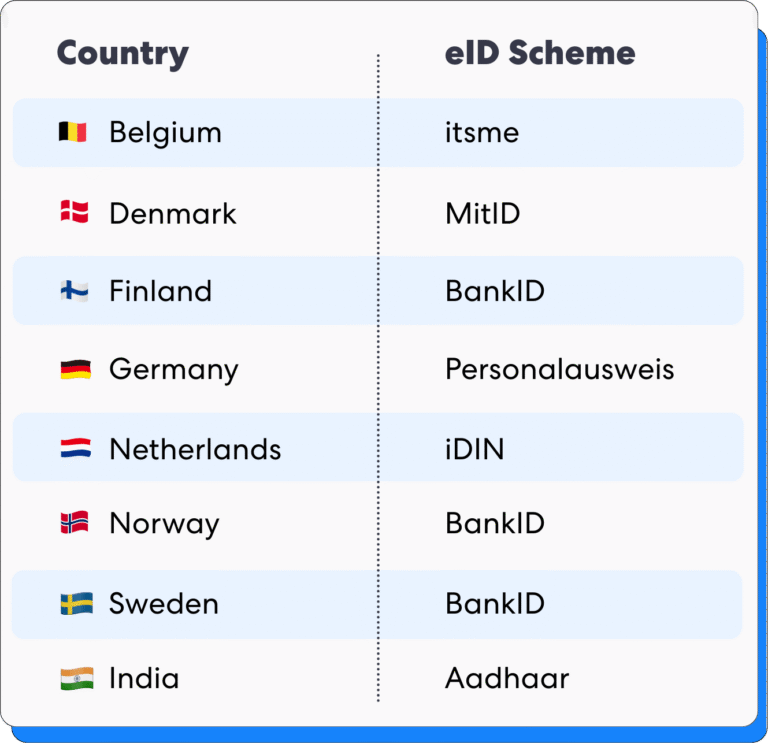
multi-jurisdiction compliance
## Robust Security with Global Regulatory Confidence
Establish unwavering trust with both customers and regulators with a reliable eID verification provider. Integrate extensive eID schemes and ensure ongoing compliance with international and local directives.
ComplyCube upholds rigorous security, encryption, and compliance standards, aligning fully with GDPR, eIDAS 2.0, ISO 27001, and ISO 9001.
[Learn more](https://www.complycube.com/en/company/security-compliance-center/)
## Global eID Verification Provider
By 2030, the European Commission projects **100% adoption** of digital identity wallets across the EU, with countries like the UAE, Singapore, and India also advancing national eID initiatives. Offer customers more verification options and capitalize on high adoption rates by partnering with ComplyCube as your **trusted eID verification provider.**

[itsme](https://www.complycube.com/en/contact/contact-sales/)
Belgium
80% of Belgian adults use the itsme eID service, processing up to 1 million verifications a day.

[bankid](https://www.complycube.com/en/contact/contact-sales/)
Sweden
Most trusted digital identity tool with over 99.9% of Swedish users using it for daily transactions.

[mitid](https://www.complycube.com/en/contact/contact-sales/)
Denmark
5.6 million of Danes use MitID to verify their identities, covering 96.95% of its adult population.

[bankid](https://www.complycube.com/en/contact/contact-sales/)
Finland
Over 8.6 million users actively use BankID. It has the highest adoption rate in the EU at 98%.

[personalausweis](https://www.complycube.com/en/contact/contact-sales/)
Germany
The Personalausweis eID is under major reforms to boost adoption, with 35% of Germans actively using it.

[idin](https://www.complycube.com/en/contact/contact-sales/)
Netherlands
Dutch citizens have a strong digital maturity, with 94% of the population adopting iDIN for ID checks.

[bankid](https://www.complycube.com/en/contact/contact-sales/)
Norway
97% of Norwegians adopt eIDs as a preferred way to verify their identity online securely.

[aadhaar](https://www.complycube.com/en/contact/contact-sales/)
India
94.2% of the Indian population uses Aadhaar, with transactions surpassing over 150 billion.
## Enhance privacy and trust with ComplyCube's eID Verification Service
ComplyCube meets global eID regulatory benchmarks, including eIDAS 2.0 and UK DIATF. The platform equips firms to confidently build automated, multi-layered KYC workflows with end-to-end encryption.
Compliance teams can leverage granular access controls and user privacy features, such as access restriction lists and configurable LoA. These tools enhance oversight, compliance, and customer journeys.
As digital identity ecosystems evolve, ComplyCube leads in interoperability by supporting open standards and cross-border compatibility, helping firms build privacy-focused, compliant digital identity solutions.
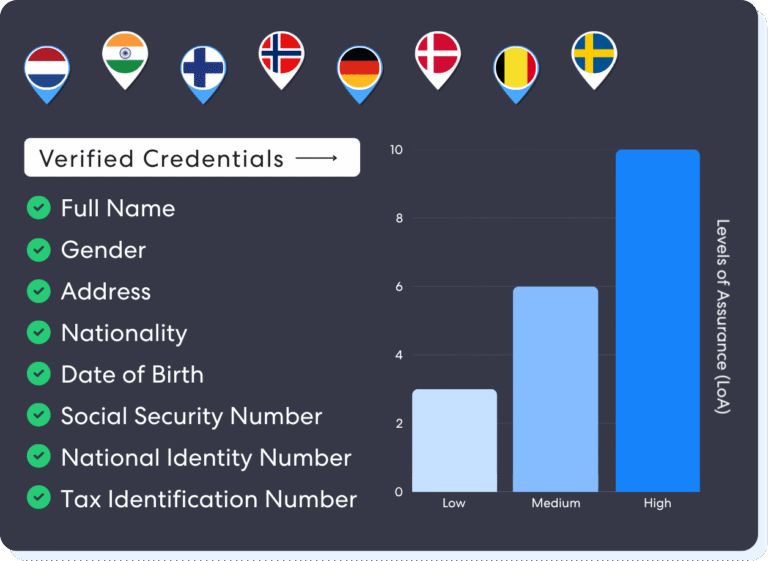
[ Start Now ](https://portal.complycube.com/signup)

### Robust integration
Our platform provides robust integration with strong APIs and SDKs, enabling organizations to easily embed identity checks into their existing systems with minimal friction. As a certified eID verification provider, ComplyCube empowers firms to scale seamlessly alongside their business needs.

### Data and security
ComplyCube provides full data encryption, along with rich, granular verification results and comprehensive audit trails. Businesses can achieve risk-based, transparent decisions aligned with global standards and prevent sophisticated fraud methods in real-time.
## eID Verification Service For Any Industry
Leverage a trusted eID verification provider to simplify KYC and Customer Identification Program (CIP) processes across varying sectors.
### Financial Services
Rapidly verify and onboard customers for high LoA under global AML and KYC rules, including FATF, eIDAS 2.0, and EU AMLD. Replace manual steps and boost compliance efficiency.
### FinTech
Automatically trigger the eID verification service once a customer reaches a transaction or deposit threshold. Maximize efficiency without disrupting user experience.
### Crypto
Manage high-volume customer onboarding with minimal friction. Achieve rapid identity verification and meet crypto-specific rules, including MiCA and the FATF Travel Rule.
### Telecoms
Prevent SIM-swap fraud and meet real-time subscriber verification for remote SIM registrations. Reduce manual processes and comply with global anti-fraud regulations.
### Insurance
Leverage ComplyCube’s eID verification service to satisfy jurisdiction-specific identity check mandates, such as validating policyholders and beneficiaries in the UAE’s eID ecosystem.
### Travel
Enable secure digital check-ins and remote booking validation when verifying traveler identities. Enhance customer travel experiences and combat booking fraud effectively.
### Gambling
Prevent underage gambling and detect suspicious behavior by authenticating genuine customers who meet specific age requirements. Support responsible gambling.
### Accounting
Validate Ultimate Beneficial Owners (UBOs) and company directors easily. Enable rapid onboarding aligned with localized AML and Customer Due Diligence requirements.
### Government
Ensure only eligible citizens have access to public services, tax systems, and voting platforms. Enable remote verification and align with local data protection standards.
### eCommerce
Authenticate high-value transactions and sellers in real-time without physical checks. Reduce account takeovers, chargebacks, and fraudulent listings effectively.
### Recruitment
Validate a candidate’s identity and right to work through a one-step eID verification service. Screen candidate eligibility while meeting data protection regulations.
### Healthcare
Remotely verify patient identities to ensure secure access to sensitive personal and medical records. Reduce impersonation, identity theft, and unauthorized access.
[Get started today](https://www.complycube.com/en/contact/contact-sales/)

Enhance Cross-border Compliance with eID Service
Learn how to integrate eIDAS-compliant workflows and the European Digital Identity Wallet (EUDI) to achieve secure, interoperable, and privacy-aligned digital identity verification across Europe.
[ Go to Guide ](https://www.complycube.com/en/a-digital-europe-introducing-the-eudi-wallet/)
[Explore other solutions](https://www.complycube.com/solutions/due-diligence-compliance/know-your-customer/)
## Explore other solutions
[Biometric Verification](https://www.complycube.com/en/solutions/identity-assurance/biometric-verification/) 
### Biometric Verification
ComplyCube’s advanced ISO 30107-3 and PAD Level 2-certified biometric liveness detection technology enables businesses to detect and block deepfakes and identity spoofing.
[View solution](https://www.complycube.com/en/solutions/identity-assurance/biometric-verification/ "Watchlist screening")
[Adverse Media Check](https://www.complycube.com/en/solutions/global-screening/adverse-media-checks/) 
### Adverse Media Check
Scan customers against over 50,000 trusted news data sources. Identify and prevent high-risk customers from accessing your services while minimizing false positives.
[View solution](https://www.complycube.com/en/solutions/global-screening/adverse-media-checks/ "Continuous monitoring")
[Sanctions & PEP Screening](https://www.complycube.com/en/solutions/global-screening/sanctions-pep-screening/) 
### Sanctions & PEP Screening
Screen and monitor customers against all PEP levels and official lists, including OFSI, UN, EU, and OFAC. Prevent bad actors and sanctioned entities from bypassing your AML controls.
[View solution](https://www.complycube.com/en/solutions/global-screening/sanctions-pep-screening/ "Adverse media checks")
[View all solutions](https://www.complycube.com/solutions/)
## Frequently asked questions
How does ComplyCube's eID check work?
ComplyCube integrates with eIDAS-certified platforms and government-backed schemes, providing a single point of access to major European and APAC eID schemes, including MitID, BankID, iDIN, and Aadhaar. The eID verification process consists of three steps: the customer selects an eID scheme, shares the required data attributes, and ComplyCube verifies them. Businesses can enhance compliance by layering additional checks into the same workflow, such as PEP, watchlists, and adverse media screening, as well as ongoing monitoring and device intelligence.
When should an eID verification provider be used?
A wide range of industries utilize eID verification to ensure secure and seamless onboarding while minimizing fraud risk. The most common use cases for eID service include opening a bank account, accessing government services online, and purchasing age-restricted goods. Organizations rely on eID verification because it provides a quicker way to authenticate a customer’s identity while complying with global and regional AML and digital identification laws, including EU AMLD, FATF, NIST, and eIDAS 2.0. Furthermore, eID solutions can reduce manual processing and cut costs by up to 90%.
How does ComplyCube's eID verification service differ from legacy KYC?
ComplyCube’s eID service offers businesses an automated and straightforward way to meet AML and KYC compliance. Traditional KYC often requires manual review, physical user verification, and document uploads, making it prone to error and fraud. ComplyCube’s eID service leverages pre-verified IDs through trusted national eID schemes. Its platform supports three levels of assurance (LoA), enabling firms to select the required LoA based on the specific use case. Unlike legacy KYC, businesses can verify a customer’s identity in real-time, enhancing user satisfaction while cutting compliance costs.
Is ComplyCube's eID service secure and compliant with eIDAS 2.0?
ComplyCube leverages eID integrations with eIDAS-certified Trust Service Providers in the EU, ensuring the eID process is compliant with EU identity and AML regulations. ComplyCube is certified as a trustworthy Identity Service Provider (IDSP) under the UK Digital Identity and Attributes Trust Framework (DIATF). It meets security and trust standards of data and privacy laws, such as the EU’s GDPR, the US CCPA, and Singapore’s PDPA, with certifications including the ISO 27001, ACCS 2:2021 for Data Protection and Privacy, and ISO 30107, reflecting robust compliance. You can learn more here: [ComplyCube’s Security and Compliance Centre.](https://www.complycube.com/en/company/security-compliance-center/)
How do I integrate ComplyCube's eID service?
Businesses can utilize ComplyCube’s eID verification service by simply dragging and dropping their chosen eID scheme into a workflow. Customers will then undergo eID verification, and ComplyCube will validate their data attributes on the backend. Once an eID check has been completed, firms can analyze the result on one unified portal, with zero coding required. You can learn more here: [API Reference \| eID Check.](https://docs.complycube.com/api-reference/check-types/device-intelligence-check)
---
### [G2 Deals Offer](https://www.complycube.com/resources/g2-deals-offer/)
**Published:** January 6, 2026
**Author:** Joshua Dent
**Excerpt:** ComplyCube is the complete identity verification, KYC and AML compliance platform for regulated organizations. Secure your business against fraud, onboard customers faster, and streamline KYC & AML compliance all in one place.
As an independently certified identity service provider, ComplyCube is officially authorised to enhance credibility and trust so you can focus on growth.
Secure your 14-day free trial and 20% discount now.
**Content:**
# Exclusive 20% discount for G2 users
ComplyCube is the **complete identity verification, KYC and AML compliance platform** for regulated organizations. Secure your business against fraud, onboard customers faster, and streamline KYC & AML compliance all in one place.
As an **independently** **certified** identity service provider, ComplyCube is officially authorised to enhance credibility and trust so you can focus on growth.
**Secure your 14-day free trial and 20% discount now.**
[ Claim Deal ](#Form)

### Future-Proof Scalability
**Grow your business with a platform that scales** as fast as you do. Achieve AML compliance automation with a single, unified platform.

### Simplified Compliance
**Build globally-compliant workflows in seconds** without any code or integrate easy-to-use APIs and SDKs into seamless customer journeys.

### Maximize Conversions
**Onboard customers in less than 30 seconds** and maximize revenue growth whilst adhering to the highest trust, security, and privacy standards.
## Get started with ComplyCube
Please complete the form below to receive a unique discount code for either our Core or Growth plan and access your 14-day free trial today.
First name
Last name
Work email
Contact number
Company name
How did you hear about us?
Please select... SeedLegals Marketplace G2 Deals Other Partner Referral
Additional Information
ComplyCube is committed to protecting and respecting your privacy, and we’ll only use your personal information to administer your account and to provide the products and services you requested from us. From time to time, we would like to contact you about our products and services, as well as other content that may be of interest to you. If you consent to us contacting you for this purpose, please tick below to say how you would like us to contact you: I agree to receive communications from ComplyCube.
In order to provide you the content requested, we need to store and process your personal data. If you consent to us storing your personal data for this purpose, please tick the checkbox below. I agree to allow ComplyCube to store and process my personal data.
Send message
## What will I get from my G2 Deals perk?
A perk designed to support early-stage teams preparing for growth:
- **14-Day Free Trial** to test real flows, integrate with your product, and validate solutions with live data.
- **20% Off Your First 12 Months** when you sign up to either a Core or Growth plan.
- **Free KYC/AML Workflow Consultancy Session** enabling you to customize the right solutions for your use case, build compliant onboarding journeys, configure automation settings and answer setup questions.
[Explore our solutions](https://www.complycube.com/solutions/due-diligence-compliance/know-your-customer/)
## Explore our solutions
[Biometric Verification](https://www.complycube.com/en/solutions/identity-assurance/biometric-verification/) 
### Biometric Verification
ComplyCube’s advanced ISO 30107-3 and PAD Level 2-certified biometric liveness detection technology enables businesses to detect and block deepfakes and identity spoofing.
[View solution](https://www.complycube.com/en/solutions/identity-assurance/biometric-verification/ "Watchlist screening")
[Adverse Media Check](https://www.complycube.com/en/solutions/global-screening/adverse-media-checks/) 
### Adverse Media Check
Scan customers against over 50,000 trusted news data sources. Identify and prevent high-risk customers from accessing your services while minimizing false positives.
[View solution](https://www.complycube.com/en/solutions/global-screening/adverse-media-checks/ "Continuous monitoring")
[Sanctions & PEP Screening](https://www.complycube.com/en/solutions/global-screening/sanctions-pep-screening/) 
### Sanctions & PEP Screening
Screen and monitor customers against all PEP levels and official lists, including OFSI, UN, EU, and OFAC. Prevent bad actors and sanctioned entities from bypassing your AML controls.
[View solution](https://www.complycube.com/en/solutions/global-screening/sanctions-pep-screening/ "Adverse media checks")
[View all solutions](https://www.complycube.com/solutions/)
---
### [Phone Intelligence](https://www.complycube.com/solutions/fraud-intelligence/phone-intelligence-verify-phone-number/)
**Published:** November 28, 2025
**Author:** Dini Habib
**Excerpt:** ComplyCube's phone intelligence flags high-risk numbers in real time, performing metadata checks to filter out suspicious registrations and fraudulent numbers. Rapidly analyze phone number risk without adding additional steps.
**Content:**
# Detect fraud in seconds with Phone Intelligence
Verify phone number and assess risk signals in real-time with ComplyCube’s phone intelligence. Gain deep risk insights, reveal user intent, and perform instant phone number identity verification to detect fraud in real time using SIM and carrier data, format analysis, and recent abuse analysis.
[ Start now ](https://portal.complycube.com/signup)
[ Contact us ](https://www.complycube.com/contact/contact-sales/)
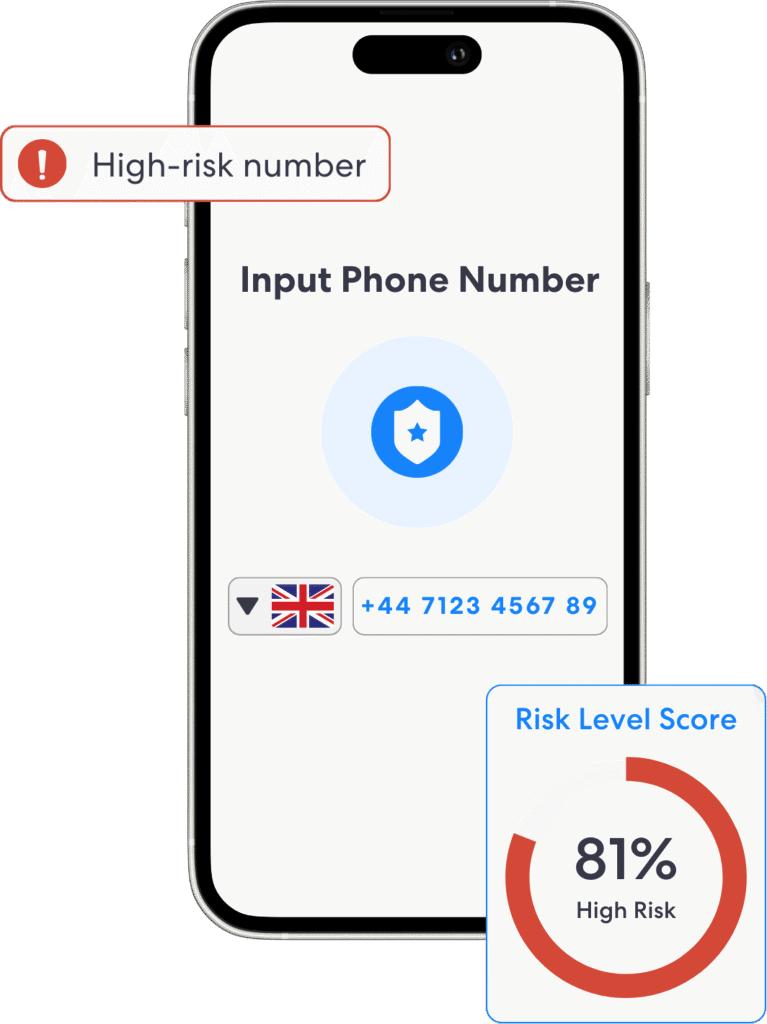

### Accelerate sign-up
Replace manual checks with phone intelligence insights that blocks fraudsters and approves legitimate users faster.

### Detect fraud earlier
Deter fraud by identifying and blocking high-risk numbers during onboarding, preventing synthetic identities and account takeovers.

### Deep risk analytics
Leverage full risk analytics, including insights on recent abuse and virtual numbers, to accelerate smarter decision-making.
Robust risk signals
## Onboard low-risk customers easily
Enhance phone number identity verification with granular insights, including carrier risk, number hygiene, porting history, and geolocation consistency. Achieve aggregated risk scores to detect suspicious patterns and identify fraudulent numbers quickly. Instantly evaluate fraud likelihood, boost conversions and reduce costs.
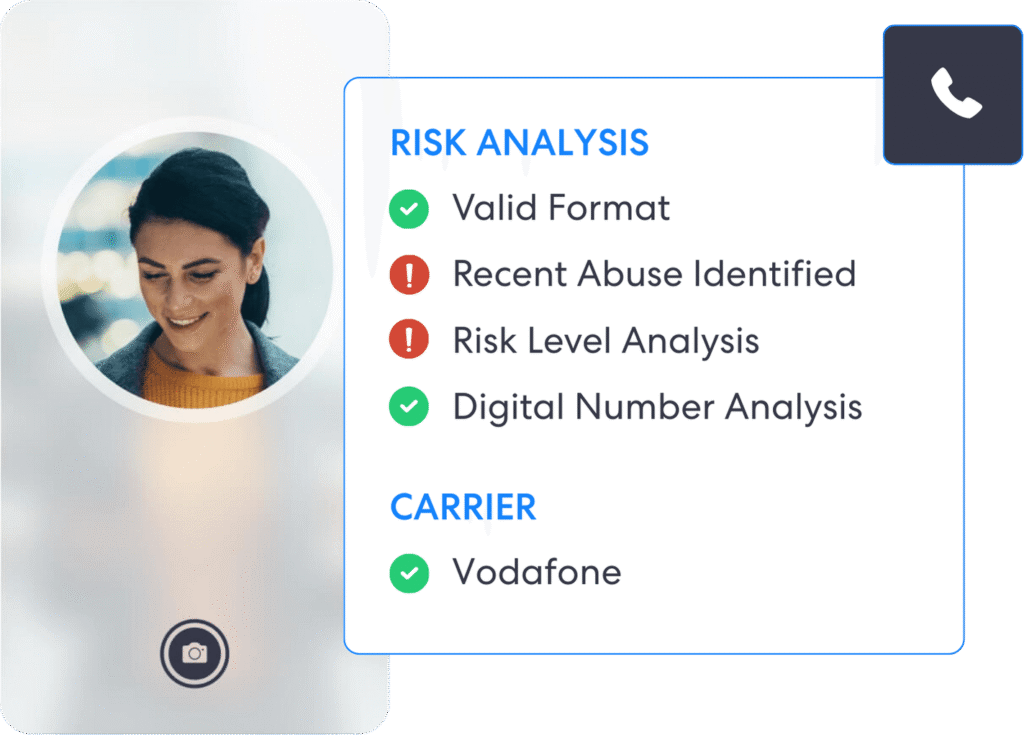

multi-layered fraud detection
## Verify phone number authenticity and location
Validate that a customer’s number is real, active, and locally legitimate while filtering out synthetic, virtual, and recently ported lines. Combine geolocation with carrier data seamlessly to confirm a number’s claimed origin to enforce country-specific onboarding. Enable early risk filtration and turn every onboarding decision into a clear, compliant verdict that reduces fraud exposure and accelerates trust.
phone number validation
## Identify fraudulent and abused phone numbers
Ensure an individual or businesses phone number is genuine and verifiable, ensuring every interaction starts from a trusted source. Detect discrepancies early to block credential stuffing, SIM-swap attempts, and account takeovers remotely. Strengthen your compliance infrastructure with a multi-layered defense to deliver frictionless experiences for real users while seamlessly identifying risky numbers.
[Learn more](https://www.complycube.com/en/solutions/fraud-intelligence/otp-service/)
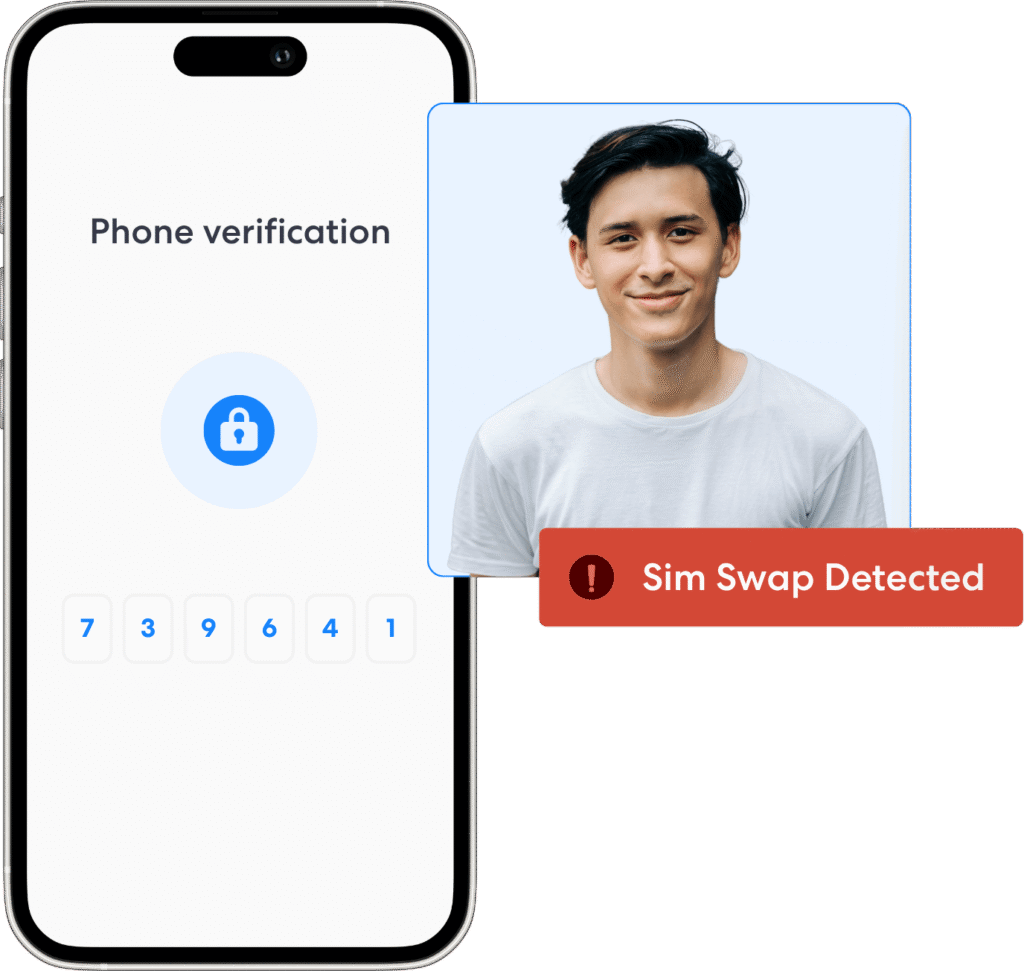
## Instant Phone Number Identity Verification with Zero Set-Up Fees
ComplyCube’s phone intelligence enables firms to avoid costly fraud reimbursement obligations, particularly in the UK, under regulations such as the Failure to Prevent Fraud. It helps prevent common phone-based fraud, including SIM swap fraud, account takeovers, and spoofing through advanced risk analysis tools.
Businesses can easily integrate ComplyCube’s service with robust SDKs, APIs, and no-code workflows that run alongside existing verification setups.
Join leading companies in fintech, banking, and insurance, and **onboard 98% of customers in less than 30 seconds.**
[ Start Now ](https://portal.complycube.com/signup)

### Global verification
ComplyCube operates in 230+ territories, enabling firms to perform phone number identity verification in any country code. With a flexible access restriction list, firms can further block or permit specific numbers, email domains, and country codes during onboarding.

### Real-time fraud detection
Our AI-driven platform offers flexible, no-code automation rules that reduce false positives and block 92% of fraud in real-time. We deliver the fastest omnichannel integration turnaround, utilizing APIs, mobile, and web SDKs to enable firms to verify phone number rapidly.

### Long-term cost savings
ComplyCube’s platform delivers long-term cost savings with up to 6.2x ROI for businesses of all sizes. By replacing manual tasks with advanced automation and customization, companies cut costs by up to 63%, all while streamlining AML and KYC compliance.

### Rapid deployment
Firms can easily drag and drop checks using ComplyCube’s workflow builder, enhancing security without coding. With pre-built workflow templates available to choose from, firms can easily align with global regulations, such as those from the FATF, FCA, and FinCEN.
## Trusted by big names





[ Go to Guide](https://www.complycube.com/en/online-fraud-prevention-with-idv-solutions/) 
Detect and Prevent AI-Driven Fraud Effectively
Sophisticated fraud threats have taken over the digital world, with deepfakes and account takeovers rising significantly. This guide examines the most effective identity verification solutions for preventing fraud.
[ Go to Guide ](https://www.complycube.com/en/online-fraud-prevention-with-idv-solutions/)
[Explore other solutions](https://www.complycube.com/solutions/due-diligence-compliance/know-your-customer/)
## Explore other solutions
[Email Intelligence](https://www.complycube.com/solutions/fraud-intelligence/email-risk-score) 
### Email Intelligence
Improve risk visibility early by detecting compromised or disposable emails, domain impersonation, and suspicious patterns. Prevent fake accounts from bypassing KYC and AML controls.
[View solution](https://www.complycube.com/solutions/fraud-intelligence/email-risk-score "Watchlist screening")
[No-Code Workflows](https://www.complycube.com/solutions/compliance-suite/kyc-workflow) 
### No-Code Workflows
Accelerate compliance deployment with customizable, no-code workflows. Reduce time to implementation and get ahead of evolving regulations without any coding knowledge required.
[View solution](https://www.complycube.com/solutions/compliance-suite/kyc-workflow "Continuous monitoring")
[Device Intelligence](https://www.complycube.com/solutions/fraud-intelligence/device-intelligence) 
### Device Intelligence
Gather detailed insights, such as a customer’s device and network signal, to block devices that have been exposed to data breaches and hacking. Reduce fraud risk with a simple check.
[View solution](https://www.complycube.com/solutions/fraud-intelligence/device-intelligence "Adverse media checks")
[View all solutions](https://www.complycube.com/solutions/)
## Frequently asked questions
How can businesses verify phone number with mobile intelligence?
When using phone intelligence, businesses can run a check on a given number by a customer or entity to retrieve signals such as carrier, geolocation, line type, and recent activity. This confirms the number is real and not associated with abuse or fraud, providing an easy onboarding path for low-risk customers without adding extra steps. ComplyCube’s phone intelligence solution aggregates a risk score by providing a value between 0 and 100 based on multiple risk signals, streamlining decision-making.
Is ComplyCube's phone number identity verification secure?
ComplyCube strictly follows data privacy laws worldwide, including the EU’s GDPR and the US CCPA. Our platform employs end-to-end encryption, role-based access controls, and comprehensive reporting to ensure transparency and security throughout verification. We uphold the highest security standards through independent verification, attaining certifications such as ISO/IEC 27001:2022 and ISO 9001 to demonstrate our commitment to protecting your data. You can learn more about how we store data here: [ComplyCube \| Security & Compliance Center](https://www.complycube.com/en/company/security-compliance-center/)
What countries does ComplyCube's phone intelligence cover?
ComplyCube enables firms to verify phone numbers in over 230 countries and territories, supporting high-volume onboarding with configurable solutions. Our phone intelligence provides comprehensive risk signals, including number formatting accuracy, provider activity, and whether the line is mobile or VOIP/digital. This comprehensive coverage enables scalable onboarding across diverse markets. You can learn more here: [ComplyCube \| API Reference – Mobile Intelligence](https://docs.complycube.com/api-reference/check-types/mobile-intelligence-check)
How effective is phone intelligence for fraud detection?
Phone intelligence is a highly effective tool for fraud detection due to its ability to verify the historical usage of phone numbers and identify potential fraud risks, such as number porting and suspicious behavioral patterns. Reports indicate a 1055% surge in SIM swap fraud as the telecom sector becomes the primary target for fraud. Phone intelligence, when combined with email and OTP verification, serves as a critical layer in protecting against phone-related fraud threats that include account takeovers and identity theft.
What is the difference between phone number identity verification and OTP?
Phone number identity verification utilizes signals from the network and device context to establish ownership and trust for the number remotely, eliminating the need for additional verification. OTP provides an additional, time-limited factor to confirm that a user currently holds the expected device or channel.
---
### [Email Intelligence](https://www.complycube.com/solutions/fraud-intelligence/email-risk-score/)
**Published:** November 28, 2025
**Author:** Rithu Jagannath
**Excerpt:** ComplyCube’s email intelligence delivers a real-time email risk score to detect fraud at the point of capture. Integrated via a flexible email verification API, it helps teams identify suspicious sign-ups and automate decisions with zero user friction.
**Content:**
# Spot risky users instantly with an email risk score
Verify emails and get a r**eal-time email risk score** to detect fraud at the first touchpoint. ComplyCube’s **email verification API** integrates seamlessly into any KYC verification email workflow for fast, **frictionless user checks**.
ComplyCube’s API goes beyond basic format checks by analysing **domain validity, email reputation,** and **breach history.** This analysis allows teams to automate decisions, **reduce manual reviews**, and keep onboarding smooth.
[ Start now ](https://portal.complycube.com/signup)
[ Contact us ](https://www.complycube.com/contact/contact-sales/)
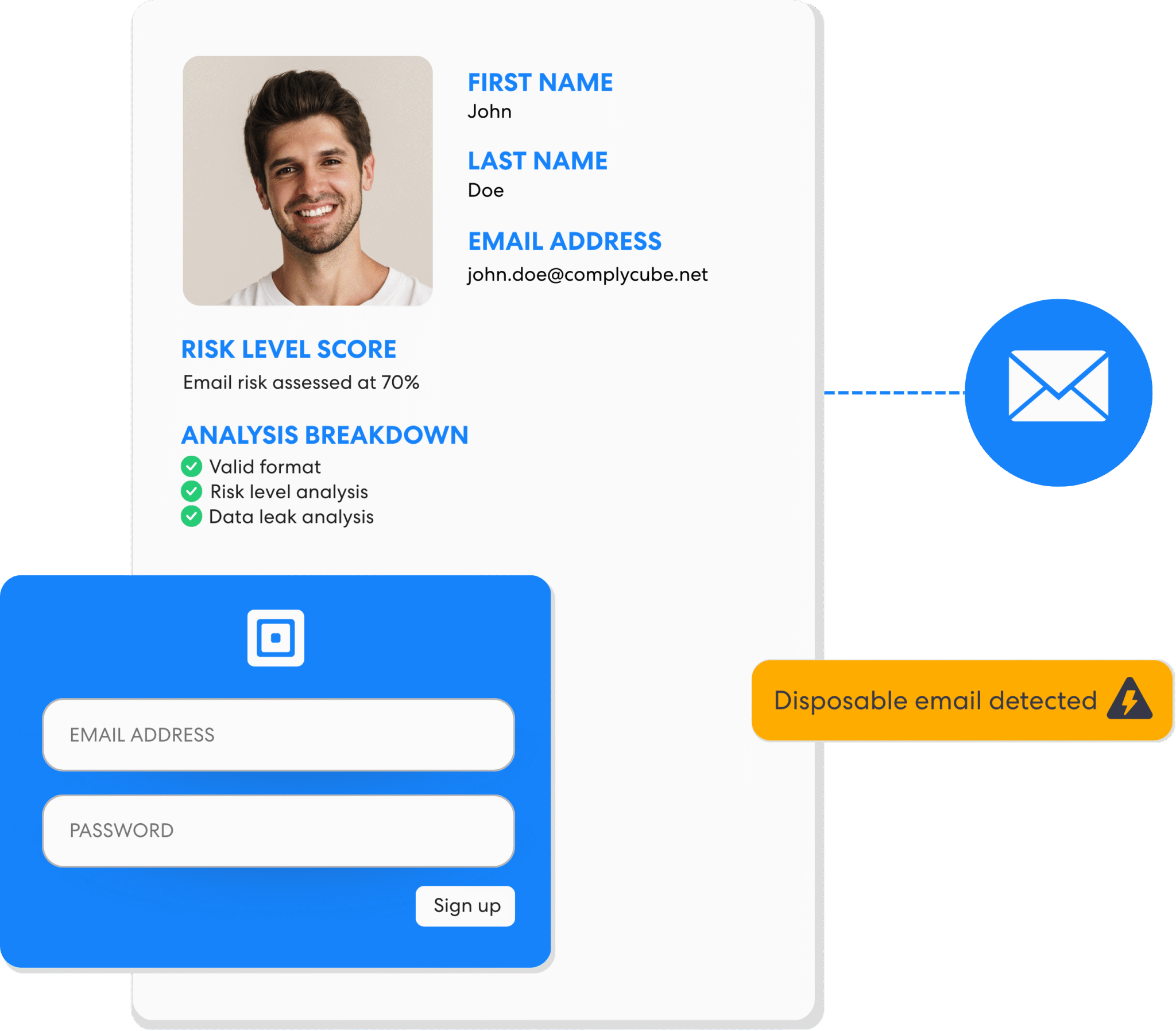

### Sign up customers faster
Verify emails before clients enter KYC processes without adding additional layers of friction or manual reviews.

### Flag risky users early
Get a real-time email risk score to spot fraud signals early before users reach higher friction checks.

### Automate risk decisioning
The email verification API analyzes domains, format, and links to data leaks to validate email legitimacy at the point of entry.
## Trusted by big names





REAL-TIME EMAIL INTELLIGENCE
## Get fraud risk insights from emails in seconds
ComplyCube’s email intelligence solution enables instant user risk evaluation through a single input. By analysing key indicators such as domain validity, breach history, and disposability, the system delivers a real-time email risk score. Integrated via our flexible email verification API, it fits seamlessly into onboarding flows and helps teams assess fraud likelihood without collecting documents or biometric data.
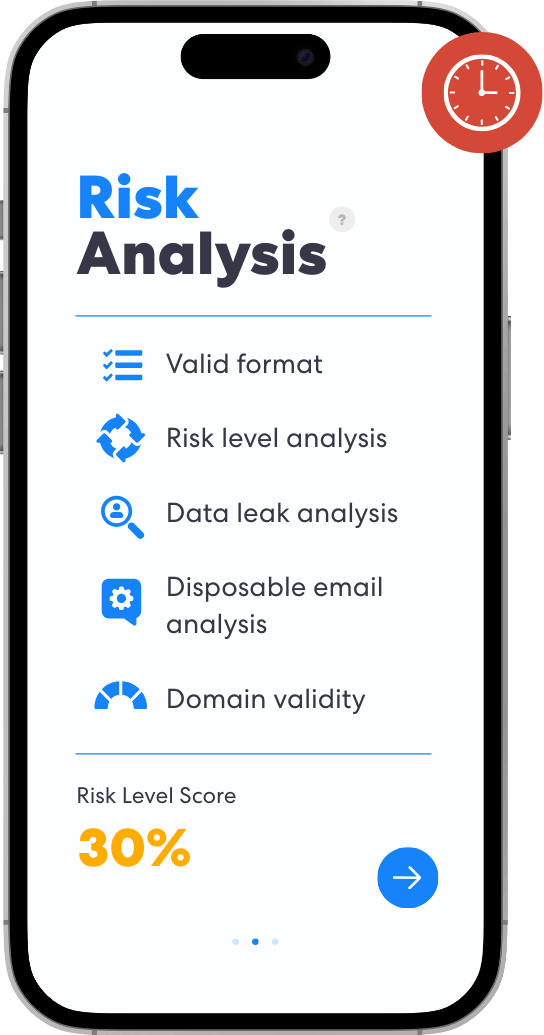
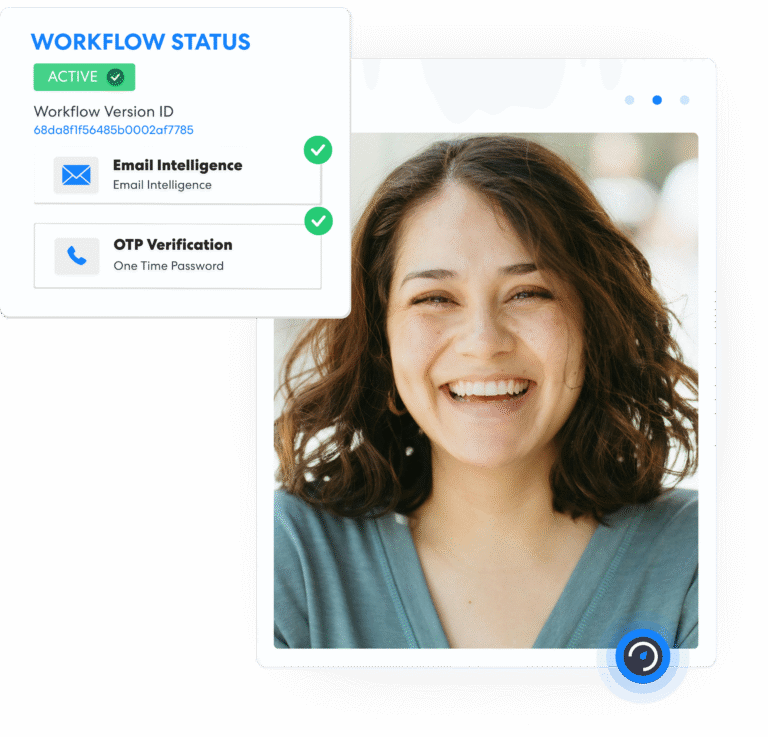
FRICTIONLESS OTP VERIFICATION
## Lightweight identity verification with real impact
By pairing ComplyCube’s email intelligence with a one-time password, you can verify email ownership while minimizing friction. This streamlined check enhances your KYC verification email process and reduces early reliance on a document-based IDV. It also enables dynamic onboarding flows where a user’s email risk score helps determine whether to proceed, flag, or bypass more intensive checks, supporting fast, compliant user experiences across use cases.
[Learn more](https://www.complycube.com/en/solutions/fraud-intelligence/otp-service/)
## Trusted Email Intelligence Backed by Global Compliance
ComplyCube’s **email intelligence** solution adheres to the highest international security standards, including **ISO 27001.** Our platform is designed to meet **trust and data protection requirements** set by the **UK’s DIATF, EU’s eIDAS,** and the **US’s NIST,** ensuring your email risk score and verification workflows are **secure, auditable, and compliant.** With layered encryption and **real-time threat detection**, we safeguard every email check from input to insight.







[Security & Compliance Center](https://www.complycube.com/en/company/security-compliance-center/)
## The Hidden Cost of Skipping Email Risk Checks
Operational costs increase sharply as a user moves through the onboarding funnel. However many organizations overlook verifying email addresses, treating it as a neutral input rather than a potential threat. Disposable inboxes, spoofed domains, and breached credentials often slip through this early stage, leading to downstream manual reviews and compliance costs.
ComplyCube’s email verification API intercepts fraud early by delivering a real-time email risk score at the point of email capture. This allows teams to embed email checks seamlessly into any KYC verification email process and triage users before steps with increased friction start.
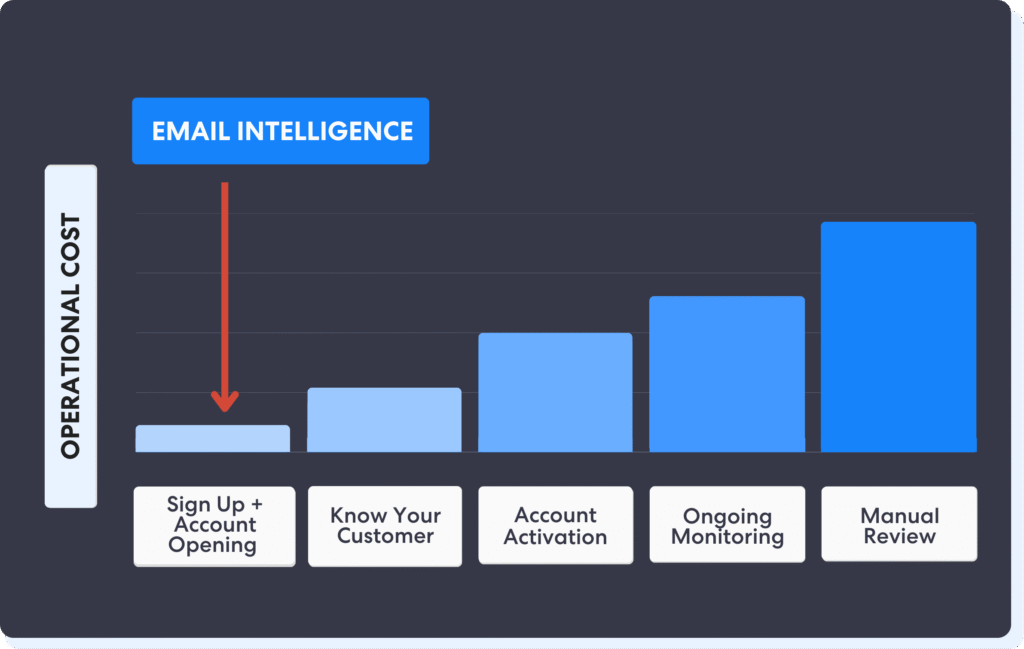
[ Start Now ](https://portal.complycube.com/signup)

### Smarter risk escalation
With intelligent decisioning in workflows, use ComplyCube’s real-time email risk score to automatically escalate risky users. By implementing document or biometric checks, allow low-risk profiles to proceed streamlining verification without compromising control.

### Compliance-ready signals
ComplyCube aligns with regulatory standards such as GDPR, ISO 27001:2022, and the UK DIATF, ensuring data security at every layer. Our email risk score helps teams detect fraud early and act decisively, flagging high-risk signals before they escalate.

### Flexible integration
ComplyCube supports flexible deployment across any environment via API, SDKs, or no-code workflows. Whether you’re scaling fast or integrating with existing systems, our platform makes it easy to adopt email intelligence through a secure, reliable verification API.

### Built to scale
Built for growth, ComplyCube’s email intelligence keeps your email verification API responsive and dependable at any scale. When paired with device and phone insights, it forms a unified fraud layer that powers faster, smarter and more secure onboarding decisions.

Online Fraud Prevention with IDV Solutions
Explore how real-time IDV tools can stop fraud before it starts. This guide breaks down techniques for catching deepfakes, spoofing and synthetic IDs. It shows how features like biometric liveness, NFC, and multi-bureau checks reduce risk at onboarding.
[ Go to Guide ](https://www.complycube.com/en/online-fraud-prevention-with-idv-solutions/)
[Explore other solutions](https://www.complycube.com/solutions/due-diligence-compliance/know-your-customer/)
## Explore other solutions
[Phone Intelligence](https://www.complycube.com/solutions/fraud-intelligence/phone-intelligence-verify-phone-number) 
### Phone Intelligence
Verify phone number legitimacy and fraud risk with real-time carrier, SIM swap, and line type analysis. Combine with email verification API results to strengthen onboarding flows, flag burner numbers, and reduce OTP abuse.
[View solution](https://www.complycube.com/solutions/fraud-intelligence/phone-intelligence-verify-phone-number "Adverse media checks")
[Device Intelligence](https://www.complycube.com/solutions/fraud-intelligence/device-intelligence) 
### Device Intelligence
Detect spoofed devices, emulators, and anonymized environments the moment a session starts. Use email risk score outcomes to trigger deeper device checks, enabling silent risk detection before a user submits personal data.
[View solution](https://www.complycube.com/solutions/fraud-intelligence/device-intelligence "Continuous monitoring")
[Document Verification](https://www.complycube.com/en/solutions/identity-assurance/document-verification/) 
### Document Verification
Verify user IDs, passports, and licenses with tamper checks, face match, and NFC chip reading. Decide when to escalate users with email verification results, reducing friction, and strengthening compliance for high-risk cases.
[View solution](https://www.complycube.com/en/solutions/identity-assurance/document-verification/ "Watchlist screening")
[View all solutions](https://www.complycube.com/solutions/)
## Frequently asked questions
What is an email risk score and why does it matter in identity verification?
An email risk score is a fraud risk signal that evaluates the legitimacy of an email address based on multiple data points such as format, domain history, breach exposure and disposability. This score plays an important role in fraud prevention globally, especially in digital onboarding, where email is often the first and only input. In regions like the EU and UK, where GDPR and eIDAS compliance is required, using risk scoring helps maintain data minimization while still applying a risk-based approach.
How does email risk scoring help prevent fraud at scale?
Email risk scoring allows businesses to identify and filter out potentially fraudulent users at the very beginning of a user journey. By analyzing patterns tied to fake emails, data breaches, and known fraud indicators, ComplyCube’s solution prevents malicious activity before it impacts operations, reducing fake signups, synthetic accounts, and bot-driven attacks.
What types of fraud can an email risk score help detect?
Email risk scoring is highly effective in identifying fraud types. This includes synthetic identity fraud, fake signups, phishing, and OTP abuse in high-growth region. The score can flag signals like use of disposable email services, mismatched domain data, and high-risk patters that are especially relevant to telecoms, fintech, and e-Commerce businesses expanding globally.
Can email intelligence integrate with other onboarding checks?
Yes. Complycube’s email verification API integrates alongside document checks, biometrics, device intelligence, and phone number validation. The email risk score feeds into a unified risk engine to power smarter, real-time decisions across your entire onboarding process.
How does ComplyCube's email intelligence differ from basic email validation?
Unlike simple syntax or deliverability checks, ComplyCube’s solution uses advanced fraud signals such as data breach exposure, domain spoofing and known fraud patterns to generate a real-time email risk score. It integrates directly into your onboarding flow via our secure, scalable email verification API, supporting robust fraud detection across all channels.
---
### [SeedLegals Offer](https://www.complycube.com/resources/seedlegals/)
**Published:** January 6, 2026
**Author:** Joshua Dent
**Excerpt:** ComplyCube is the complete identity verification, KYC and AML compliance platform for start-ups. Detect and prevent fraud, verify customers in seconds, and automate compliance, so you can focus on growth. As a UK Government-certified identity service provider, ComplyCube is officially authorised to enhance credibility and trust for start-ups.
**Content:**
# Exclusive 20% discount for SeedLegals users
ComplyCube is the complete identity verification, KYC and AML **compliance platform for start-ups.** Detect and prevent fraud, verify customers in seconds, and **automate compliance**, so you can focus on growth.
As an **independently certified** identity service provider, ComplyCube is officially authorised to enhance credibility and trust for start-ups.
**Secure your 14-day free trial and 20% discount now.**
[ Claim Deal ](https://2yhcw.share.hsforms.com/22GQGIQQlRUucBAnK25xwCQ)


### Future-Proof Scalability
**Grow your business with a platform that scales** as fast as you do. Achieve AML compliance automation with a single, unified platform.

### Simplified Compliance
**Build globally-compliant workflows in seconds** without any code or integrate easy-to-use APIs and SDKs into seamless customer journeys.

### Maximize Conversions
**Onboard customers in less than 30 seconds** and maximize revenue growth whilst adhering to the highest trust, security, and privacy standards.
## Get started with ComplyCube
Please complete the form below and someone from our team will be in touch with access to a 14-day free trial and your unique discount on either our Core or Basic plan.
First name
Last name
Work email
Contact number
Company name
How did you hear about us?
Please select... SeedLegals Marketplace G2 Deals Other Partner Referral
Additional Information
ComplyCube is committed to protecting and respecting your privacy, and we’ll only use your personal information to administer your account and to provide the products and services you requested from us. From time to time, we would like to contact you about our products and services, as well as other content that may be of interest to you. If you consent to us contacting you for this purpose, please tick below to say how you would like us to contact you: I agree to receive communications from ComplyCube.
In order to provide you the content requested, we need to store and process your personal data. If you consent to us storing your personal data for this purpose, please tick the checkbox below. I agree to allow ComplyCube to store and process my personal data.
Send message
## What will I get from my SeedLegals perk?
A perk designed to support early-stage teams preparing for growth:
- **14-Day Free Trial** to test real flows, integrate with your product, and validate solutions with live data.
- **20% Off Your First 12 Months** when you sign up to either a Core or Growth plan.
- **Free KYC/AML Workflow Consultancy Session** enabling you to customize the right solutions for your use case, build compliant onboarding journeys, configure automation settings and answer setup questions.
[Explore our solutions](https://www.complycube.com/solutions/due-diligence-compliance/know-your-customer/)
## Explore our solutions
[Biometric Verification](https://www.complycube.com/en/solutions/identity-assurance/biometric-verification/) 
### Biometric Verification
ComplyCube’s advanced ISO 30107-3 and PAD Level 2-certified biometric liveness detection technology enables businesses to detect and block deepfakes and identity spoofing.
[View solution](https://www.complycube.com/en/solutions/identity-assurance/biometric-verification/ "Watchlist screening")
[Adverse Media Check](https://www.complycube.com/en/solutions/global-screening/adverse-media-checks/) 
### Adverse Media Check
Scan customers against over 50,000 trusted news data sources. Identify and prevent high-risk customers from accessing your services while minimizing false positives.
[View solution](https://www.complycube.com/en/solutions/global-screening/adverse-media-checks/ "Continuous monitoring")
[Sanctions & PEP Screening](https://www.complycube.com/en/solutions/global-screening/sanctions-pep-screening/) 
### Sanctions & PEP Screening
Screen and monitor customers against all PEP levels and official lists, including OFSI, UN, EU, and OFAC. Prevent bad actors and sanctioned entities from bypassing your AML controls.
[View solution](https://www.complycube.com/en/solutions/global-screening/sanctions-pep-screening/ "Adverse media checks")
[View all solutions](https://www.complycube.com/solutions/)
---
### [Device Intelligence](https://www.complycube.com/solutions/fraud-intelligence/device-intelligence/)
**Published:** December 1, 2025
**Author:** Rithu Jagannath
**Excerpt:** Boost onboarding security with device intelligence. Detect threats early with device risk check and stay protected with continuous device risk monitoring.
**Content:**
# Catch fraud early with real-time device intelligence
Boost onboarding security with ComplyCube’s multi-layered device intelligence solution. Detect threats early and prevent successful attacks with device tampering analysis, VPN, bot detection, and geolocation insights.
By linking device behaviour with identity and risk signals, ComplyCube helps uncover fraud patterns invisible to traditional checks. Whether it’s a stolen device, emulator, or hidden proxy, our solution flags anomalies in real time, keeping your onboarding flow secure and compliant.
[ Start now ](https://portal.complycube.com/signup)
[ Contact us ](https://www.complycube.com/contact/contact-sales/)


### Stop AI-driven fraud
Use passive device, network, and behavioral signals to block bots, deepfakes, and synthetic identities in real time.

### Shield against attacks
Fingerprint devices and IP addresses to identify spoofing and risky devices while keeping trusted users moving fast.

### Prevent account takeovers
Identify suspicious logins on VPNs, tampered devices and remote access tools to keep legitimate customers in control.
## Trusted by big names





NETWORK DATA INTELLIGENCE
## Spot hidden threats in network risk signals
ComplyCube’s device intelligence inspects every session for anomalies in network data, including IP mismatches, proxy use, VPN tunneling, and geolocation tampering. By surfacing threats at the network layer before the user accesses their account, organizations gain a proactive shield that filters out high-risk traffic from the start.


FRAUD RISK SIGNALING
## Detect fraud before onboarding begins
Go beyond basic device fingerprinting with ComplyCube’s layered fraud risk detection. The platform identifies signals like emulator use, account cycling, jailbreaks, and environment spoofing, silently, in session. This enables fraud teams to act earlier in the funnel, decreasing attack success rates, reducing false positives, and lowering reliance on post-KYC remediation.
DEVICE DATA ANALYSIS
## Get deep device insights for secure, trusted sign-ups
Every device leaves a footprint. ComplyCube collects holistic runtime data from operating systems and browsers to detect emulators, tampering and spoofing. It also helps distinguish between legitimate users and devices configured to bypass detection or inject attacks. By using a multi-layered approach, organizations gain a deeper, more resilient understanding of user behavior.


BOT DEFENCE AND DETECTION
## Stop automated bot attacks at the source
Bots don’t behave like humans and ComplyCube knows the difference. By analyzing navigation patterns, input behavior, and interaction speed, the platform detects and stops automation tools before they reach signup or ID verification stages. This real-time protection defends against fake account creation, mass testing and replay attacks, all while preserving a seamless experience for legitimate users.
## Certified Security for Every Sign-Up
ComplyCube delivers device intelligence with compliance built in. Certified to **ISO 27001:2022** and aligned to **SOC 2 and NIST frameworks**, our solution protects every device risk check with **audit-ready encryption**, ensuring end-user, claimant, and policyholder data remains secure, from session **start to fraud decision**.







[Security & Compliance Center](https://www.complycube.com/en/company/security-compliance-center/)
## Device Intelligence is Compliance's First Line of Defense
Regulators no longer see fraud as a technology problem, but a compliance imperative. With frameworks like NIST and ISO 27001 emphasizing pre-verification controls, and new KYC mandates pushing for earlier risk detection, ComplyCube’s device intelligence provides the proactive signal layer modern compliance teams need.
Running silently in the background, it evaluates each session’s device and network behavior, identifying rooted phones, emulators, session farming, and hidden threats. Every device risk check is logged, encrypted and fully auditable to support compliance reviews, internal risk audits, or regulator oversight. When combined with ComplyCube’s document and biometric flows, it forms a defensible, end-to-end onboarding stack aligned with global trust standards.

[ Start Now ](https://portal.complycube.com/signup)

### Audit-friendly fraud controls
Log every device risk check with clear, timestamped records from rooted phones to spoofed setups. ComplyCube captures and encrypts signals silently, creating exportable logs for fraud review, QA, or audits without adding operational friction.

### Real-time threat outcomes
ComplyCube’s device intelligence flags risk as a session begins, detecting bots, tampering, and session abuse instantly. It blocks fraud early, removes friction for trusted users, and enables real-time decisions across fintech and digital platforms.

### Cross-platform visibility
Deploy device intelligence seamlessly across multiple channels such as iOS, Android, Chrome, Firefox, Safari, and more. Whether via SDK, API, and hosted flow, ComplyCube fits your existing stack and ensures consistent risk detection with no extra dev effort required.

### Enterprise-ready protection
Trusted by global vendors, ComplyCube’s platform delivers encrypted, compliant device intelligence at enterprise scale. With support for ISO 27001, SOC 2, and NIST, it ensures secure signal processing and audit trails with zero trade-offs in performance.
[ Go to Guide](https://www.complycube.com/generative-ai-fraud-and-identity-verification/) 
Generative AI Fraud and Identity Verification
Discover how fraudsters use generative AI to create fake documents and bypass ID checks, and how to stop them. Learn how biometric liveness, NFC, and advanced ID fraud check solutions can protect your onboarding flow from synthetic identities.
[ Go to Guide ](https://www.complycube.com/generative-ai-fraud-and-identity-verification/)
[Explore Other Solutions](https://www.complycube.com/solutions/due-diligence-compliance/know-your-customer/)
## Explore Other Solutions
[Phone Intelligence](https://www.complycube.com/solutions/fraud-intelligence/phone-intelligence-verify-phone-number) 
### Phone Intelligence
Confirm phone ownership and detect number spoofing by combining device intelligence with phone checks. Block mismatched or risky mobile signals, such as SIM swaps, VOIP usage, or spoofed environments to stop synthetic fraud before it reaches step-up verification.
[View solution](https://www.complycube.com/solutions/fraud-intelligence/phone-intelligence-verify-phone-number "Adverse media checks")
[Email Risk Score](https://www.complycube.com/solutions/fraud-intelligence/email-risk-score) 
### Email Risk Score
Analyze email reputation in context with real-time device signals. ComplyCube flags disposable domains, mismatched metadata, and high-risk patterns linked to session emulators or automation, helping prevent mass account creation and OTP abuse in the future.
[View solution](https://www.complycube.com/solutions/fraud-intelligence/email-risk-score "Continuous monitoring")
[Biometric Verification](https://www.complycube.com/en/solutions/identity-assurance/biometric-verification/) 
### Biometric Verification
Use biometric identity verification only when needed by layering biometric checks with passive device intelligence. Flag risky sessions, such as spoofed phones or jailbroken devices and escalate to face match when risk appears, reducing friction for trusted users.
[View solution](https://www.complycube.com/en/solutions/identity-assurance/biometric-verification/ "Watchlist screening")
[View all solutions](https://www.complycube.com/solutions/)
## Frequently asked questions
What is device intelligence and how does it detect fraud?
Device intelligence is a security measure that monitors the technical and behavioral traits of a user’s device and network in real time. It passively collects data like IP integrity, device fingerprint, OS configuration, and emulator detection the moment a session starts, all without interrupting the user. This intelligence is used to spot fraud tactics such as device spoofing, session farming, bot automation, and VPN obfuscation. By identifying these signs early, organizations can block high-risk access before a user ever interacts with your platform, keeping fraud out without adding friction.
What are the fraud prevention guidelines in the UK, US, and EU?
Regulators and industry bodies across the UK, US, and EU increasingly expect businesses to take a proactive stance on fraud detection. In the UK, the FCA highlights the need to identify unusual access patterns and malicious behavior at login. In the EU, GDPR-compliant fraud tools must operate passively, and in the US, NIST’s Digital Identity Guidelines emphasize device-level risk signals as part of trust frameworks. Device intelligence helps meet these expectations. It flags potential threats early, such as tampered phones or cloaked IP addresses before they evolve into costly fraud events. This early intervention is especially valuable in high-volume digital environments where speed, scale, and compliance are critical.
How does device intelligence reduce false positives in fraud detection?
False positive, where genuine users are flagged due to overly aggressive rules, can cause drop-offs, wasted analyst time, and reputational damage. Device intelligence reduces these by applying context to each risk decision. It assesses whether the device and network behavior is normal for that user, even if it is technically unusual. Instead of triggering alerts for every new device or location, intelligent models assess signals such as returning device IDs, behavioral rhythm, or passive trust markers. This approach cuts unnecessary friction while maintaining high fraud detection accuracy, helping businesses act decisively on true threats without delaying legitimate customers.
Can device intelligence integrate with my existing fraud stack?
Yes, ComplyCube’s device intelligence is built to plug into any existing fraud stack. It’s deployable via API, mobile SDKs, or no-code modules, and works seamlessly across desktop, mobile and hybrid apps. This makes it ideal for scaling fraud protection across diverse customer touchpoints. It doesn’t require new workflows or added steps for your users. Instead, it runs silently in the background, augmenting existing tools like email risk detection, phone number validation, or behavioral analytics. This allows fraud teams to spot layered threats, close detection gaps, and scale early warning signals without starting from scratch.
How does ComplyCube's device intelligence stand out?
ComplyCube’s device intelligence engine offers a high-fidelity, low-friction way to identify hidden threats before they escalate. It goes beyond surface-level checks to uncover emulators, session manipulation, root-level tampering, and bot-driven abuse in real-time. Every device risk check is logged, encrypted, and audit-ready for internal reviews, fraud case management or external oversight. ComplyCube ensures fraud prevention doesn’t come at the cost of privacy or compliance. It’s trusted by enterprises and scale-ups alike to keep threats out, and trusted users flowing.
---
### [Compliance Suite](https://www.complycube.com/solutions/compliance-suite/)
**Published:** December 22, 2025
**Author:** Dini Habib
**Content:**
# Compliance suite
Swiftly adapt to changing regulations and boost conversions with our integrated compliance suite.
## Compliance suite
Deliver a single, streamlined process for seamless customer onboarding, KYC/AML, and audit preparedness across global jurisdictions.
[Workflow builder](https://www.complycube.com/solutions/compliance-suite/kyc-workflow) 
### Workflow builder
Build customizable, drag-and-drop workflows aligned to sector-specific regulations and your risk appetite without writing code.
[View solution](https://www.complycube.com/solutions/compliance-suite/kyc-workflow)
[Learn more](https://www.complycube.com/solutions/due-diligence-compliance/risk-scoring/)
---
### [Workflows](https://www.complycube.com/solutions/compliance-suite/kyc-workflow/)
**Published:** December 5, 2025
**Author:** Rithu Jagannath
**Excerpt:** Build, adapt, and optimize KYC workflows in minutes without coding. ComplyCube’s no-code orchestration empowers compliance teams to meet AML, eIDAS, and FATF requirements with real-time flexibility.
**Content:**
# Build KYC workflows in minutes
Streamline compliance with flexible, policy-aligned **workflow orchestration**. ComplyCube’s no-code **KYC workflow builder** helps you stay compliant and **adapt instantly** to changing regulations.
Built for compliance teams, the **drag-and-drop interface** lets you configure risk-based flows, trigger custom actions, and apply decision logic **without writing code**. From escalating high-risk cases to bypassing low-risk checks, you’re always in control.
[ Start now ](https://portal.complycube.com/signup)
[ Contact us ](https://www.complycube.com/contact/contact-sales/)

### Launch verification flows faster
Build and launch multi-step verification journeys in minutes, reducing manual work and speeding up onboarding.

### Automate policy compliance
Ensure every customer is assessed consistently with a powerful policy engine that enforces regulatory and internal rules.

### Improve customer experience
Deliver seamless, end-to-end flows that adapt to each customer and minimise friction and manual intervention.
## Trusted by global industry leaders





VISUAL FLOW BUILDER
## Create and control no-code workflows
ComplyCube’s no-code workflow builder empowers compliance and operations teams to create, test, and deploy their KYC workflow without writing a single line of code. Using a drag-and-drop flow editor, teams can configure verification flows with document checks, biometric liveness, registry lookups, sanctions screening, and more.
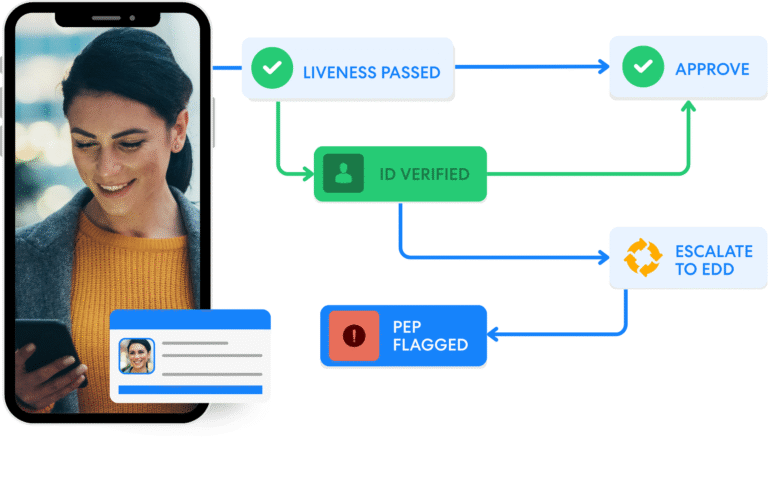
COMPLIANT VERIFICATION FLOWS
## Preconfigure checks for risk and policy
Manual decisioning often results in inconsistent onboarding, human error, and regulatory exposure. ComplyCube’s no-code workflow builder allows teams to use workflow templates that support policy compliance across different risk levels, jurisdictions and customer types. Each verification flow is pre-configured to ensure users are processed consistently and in line with internal policies, local regulations and broader compliance assurance standards.
REAL-TIME POLICY CHANGES
## Update workflows without developer input
Unlike conventional environments that depend on engineering releases and QA cycles, ComplyCube’s KYC automation tools let teams update automation rules instantly. With no code policy automation, teams can make real-time changes to verification steps, risk logic and compliance checks. This enables faster responses to regulatory shifts, reduces bottlenecks, and ensures audit-ready workflows at scale.
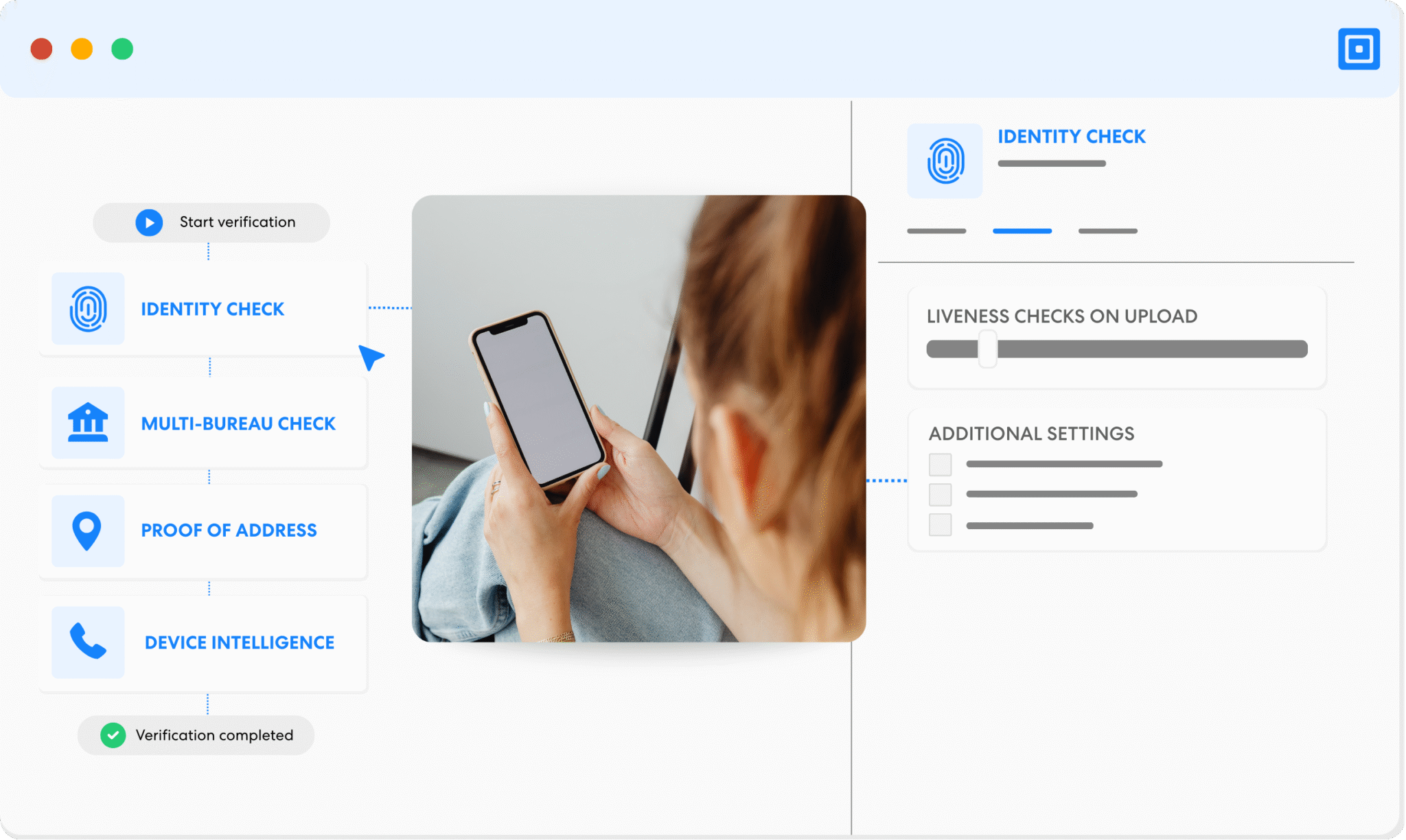
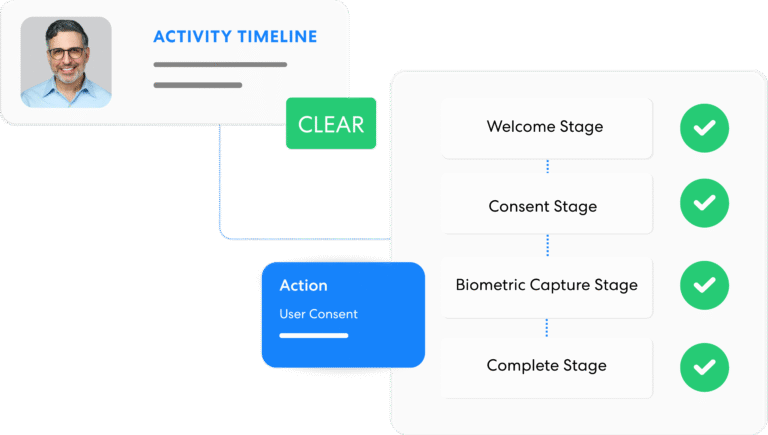
SESSION INSIGHTS & OPTIMISATION
## Optimise with real-time session data
ComplyCube’s activity timeline captures user behaviour across every step of the workflow, from document upload to approval. This delivers powerful customer journey analytics and actionable KYC user insights. Track time spent at each stage, uncover drop-off points, and identify where users hesitate or abandon their journey.
## The Leader in Security & Compliance
**ComplyCube** adheres to internationally recognised standards, including **ISO 9001 and ISO 30107-2.** It meets security and trust requirements set by the **UK DIATF, EU eIDAS, and US NIST.** Our end-to-end security framework **safeguards sensitive identity data** with layered protections throughout the **verification lifecycle.**







[Security & Compliance Center](https://www.complycube.com/en/company/security-compliance-center/)
## Seamlessly Align with Local, Regional and Global Policies
In 2025, synthetic identity fraud surged by 300% across North America, while global sanctions designations surpassed 80,000 entities. Regulatory bodies such as FATF, FinCEN, and the eIDAS now expect real-time, risk-sensitive verification powered by multi-source checks including biometrics, registry data, and device intelligence.
With ComplyCube’s workflow orchestration, you can instantly deploy regulator-ready templates for frameworks like the UAE Central Bank, FCA, or FATF guidance or configure bespoke flows for internal compliance rules. Define tailored journeys for different sectors, jurisdictions, or customer types across low, medium, and high-risk categories. This ensures your onboarding processes stay globally aligned, locally compliant, and audit-ready without engineering support.
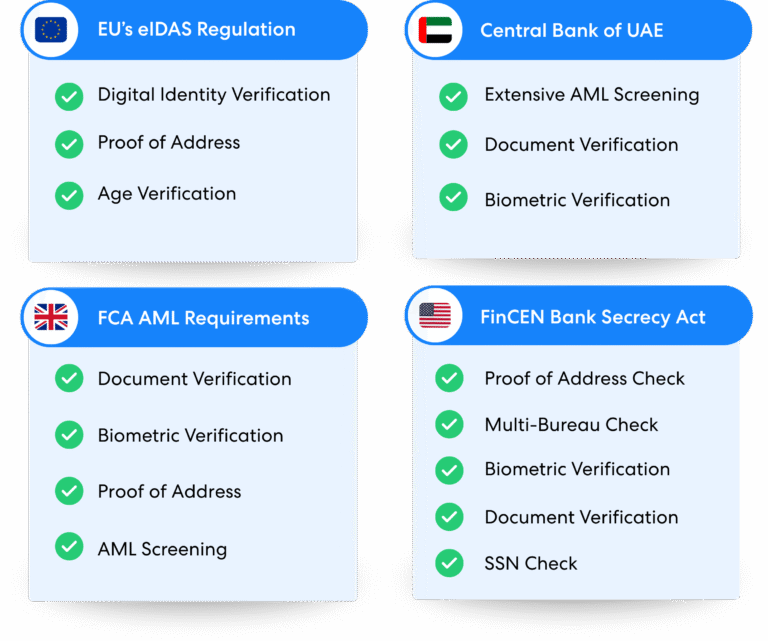
[ Start Now ](https://portal.complycube.com/signup)

### Flexible integration
ComplyCube’s workflow builder works seamlessly across iOS, iPad OS, Android, Chrome, Firefox, Safari, and Edge. Teams can deploy and adapt quickly with no long dev cycles required.

### Enterprise-ready
ComplyCube’s workflow data is encrypted at rest and in transit, with controls aligned to ISO, NIST, and eIDAS standards. Every verification and logic path is logged for full traceability, governance, and internal oversight.

### Audit-ready compliance
Generate time-stamped workflow logs and verification outcomes that align with AML/CFT regulations and internal audit standards. Every change is tracked, helping teams demonstrate policy adherence during reviews.

### Real-time updates
Our platform allows publishing of workflow changes instantly without code or deployment delays. Compliance teams can respond fast to evolving regulations, risk models, or operational needs without disrupting service.
[ Go to Guide Go to Guide](https://www.complycube.com/en/build-a-strong-kyc-due-diligence-checklist-uk/)
Build a Strong KYC Due Diligence Checklist UK
Explore how the KYC Due Diligence Checklist UK supports AML compliance, reduces fraud, and improves onboarding. Learn how to apply risk-based SDD, CDD, and EDD measures effectively, using digital workflows to automate checks and protect business relationships.
[ Go to Guide ](https://www.complycube.com/en/build-a-strong-kyc-due-diligence-checklist-uk/)
[Explore Other Solutions](https://www.complycube.com/solutions/due-diligence-compliance/know-your-customer/)
## Explore Other Solutions
[Document Verification](https://www.complycube.com/en/solutions/identity-assurance/document-verification/) 
### Document Verification
Integrate document checks into your no-code KYC workflows. Validate over 13,000 ID types using ComplyCube’s AI-powered OCR and NFC capabilities, enabling fast, accurate identity capture without coding.
[View solution](https://www.complycube.com/en/solutions/identity-assurance/document-verification/ "Watchlist screening")
[Biometric Verification](https://www.complycube.com/solutions/identity-assurance/biometric-verification/) 
### Biometric Verification
Enhance workflow security with certified passive liveness detection and facial matching. ComplyCube detects deepfakes and spoofing, all configurable via the no-code builder.
[View solution](https://www.complycube.com/solutions/identity-assurance/biometric-verification/ "Continuous monitoring")
[Sanctions & PEP Screening](https://www.complycube.com/en/solutions/global-screening/sanctions-pep-screening/) 
### Sanctions & PEP Screening
Use integrated sanctions and PEP screening in your workflows. ComplyCube checks global watchlists, political exposure databases, and adverse media sources to flag high-risk individuals early.
[View solution](https://www.complycube.com/en/solutions/global-screening/sanctions-pep-screening/ "Adverse media checks")
[View all solutions](https://www.complycube.com/solutions/)
## Frequently Asked Questions
How does ComplyCube's no-code KYC workflow solution work?
ComplyCube allows teams to visually build onboarding flows tailored to local markets, regulatory requirements, or regional policies. Whether you’re verifying a French passport to meet eIDAS or a UAE ID card to meet Central Bank of UAE requirements, the builder lets you customise every step, no code required.
What makes ComplyCube's workflow orchestration unique?
ComplyCube’s workflow orchestration solution is designed to meet the demands of cross-border compliance and regulatory reporting. You can route users based on EU AML requirements, U.S. sanctions exposure, or APAC document types, all within one orchestration layer. The results of sessions can then be cross-verified with company policies to demonstrate adherence to policy and regulatory requirements as part of the reporting process. That means fewer tools, fewer gaps, and faster localisation.
Can ComplyCube's workflow builder support regional compliance requirements?
Yes. You can leverage pre-built regulator-specific flows that align with regional rules, such as AMLD and eIDAS in Europe, FinCEN in the US, or DIATF standards in the UK. Multiple workflows can be active in parallel for varying use cases, customer types and jurisdictions, helping you maintain compliance at scale.
How can I customize risk logic within ComplyCube's KYC workflows?
Risk-based controls and automations can be applied across different workflows. For example, you might escalate users from a low-risk to a high-risk flow per FATF guidelines, or bypass document checks in EU states with high eID adoption. The platform’s workflow orchestration lets you enforce regional risk policies without engineering support.
Does ComplyCube provide visibility into workflow performance and outcomes?
Yes. You can track workflow performance and policy compliance for each session. This is especially useful for regulated industries needing to prove compliance with local onboarding laws or regional regulators such as the European Banking Authority (EBA), the Monetary Authority of Singapore (MAS), or the Financial Conduct Authority (FCA).
---
### [Fraud intelligence](https://www.complycube.com/solutions/fraud-intelligence/)
**Published:** December 22, 2025
**Author:** Dini Habib
**Content:**
# Fraud intelligence
Achieve stronger, real-time global fraud prevention with our AI-powered fraud intelligence suite.
## Fraud prevention
Our intelligent fraud prevention suite offers robust risk signals to identify and block sophisticated fraud threats at the point of entry.
[Device intelligence](https://www.complycube.com/solutions/fraud-intelligence/device-intelligence) 
### Device intelligence
Assess robust risk analysis, such as behavioral and network signals in real-time, to detect high-risk sessions and block fraudulent activity.
[View solution](https://www.complycube.com/solutions/fraud-intelligence/device-intelligence)
[Phone intelligence](https://www.complycube.com/solutions/fraud-intelligence/phone-intelligence-verify-phone-number) 
### Phone intelligence
Analyze phone number indicators such as carrier, line type, and recent abuse to block risky numbers at the point of entry.
[View solution](https://www.complycube.com/solutions/fraud-intelligence/phone-intelligence-verify-phone-number)
[Email intelligence](https://www.complycube.com/solutions/fraud-intelligence/email-risk-score) 
### Email intelligence
Evaluate email age, domain, and risk signals to distinguish trusted users from disposable or high-risk email addresses.
[View solution](https://www.complycube.com/solutions/fraud-intelligence/email-risk-score)
[Learn more](https://www.complycube.com/solutions/identity-assurance/biometric-verification/)
---
### [AML screening](https://www.complycube.com/solutions/global-screening/)
**Published:** October 27, 2021
**Author:** CC
**Content:**
# AML screening
Find out more about our individual AML screening solutions.
## Global screening
Our customer screening service boasts global coverage, smart technology, and comprehensive data sources, giving the greatest peace of mind.
[Sanctions & PEP screening](https://www.complycube.com/solutions/global-screening/sanctions-pep-screening/) 
### Sanctions & PEP screening
Our screening capability provides extensive coverage of sanctioned, Politically Exposed Persons (PEP) individuals and companies
[View solution](https://www.complycube.com/solutions/global-screening/sanctions-pep-screening/)
[Adverse media checks](https://www.complycube.com/solutions/global-screening/adverse-media-checks/) 
### Adverse media checks
Protect your reputation by screening customers using our AI-powered adverse media service before onboarding them.
[View solution](https://www.complycube.com/solutions/global-screening/adverse-media-checks/)
[Watchlist screening](https://www.complycube.com/solutions/global-screening/watchlist-screening/) 
### Watchlist screening
ComplyCube’s comprehensive coverage of global AML watchlist sources and flexible automation features ensures that you comply with the most stringent regulations.
[View solution](https://www.complycube.com/solutions/global-screening/watchlist-screening/)
[Continuous monitoring](https://www.complycube.com/solutions/global-screening/continuous-monitoring/) 
### Continuous monitoring
Keep on top of your Ongoing Due Diligence (ODD) obligations, using our continuous monitoring service. You’ll get notified in real-time should your customers’ status change.
[View solution](https://www.complycube.com/solutions/global-screening/continuous-monitoring/)
---
### [Identity assurance](https://www.complycube.com/solutions/identity-assurance/)
**Published:** October 27, 2021
**Author:** CC
**Content:**
# Identity assurance
Get advanced identity assurance with our suite of identity verification solutions
## Identity assurance
Our comprehensive identity verification suite enables you to quickly and reliably establish the right Level of Assurance (LoA) for your use case.
[Document verification](https://www.complycube.com/solutions/identity-assurance/document-verification/) 
### Document verification
Our document verification service offers a best-in-class user experience. Your users will love the clear, guided fast verification process.
[View solution](https://www.complycube.com/solutions/identity-assurance/document-verification/)
[Customer authentication](https://www.complycube.com/solutions/identity-assurance/customer-authentication/) 
### Customer authentication
Limit user access and ensure your products are secure without adding friction for your customers.
[View solution](https://www.complycube.com/solutions/identity-assurance/customer-authentication/)
[Address verification](https://www.complycube.com/solutions/identity-assurance/address-verification/) 
### Address verification
Our smart capture solutions extract relevant details from Proof of Address (PoA) documents and verify them against client and location data.
[View solution](https://www.complycube.com/solutions/identity-assurance/multi-bureau-checks/)
[Biometric verification](https://www.complycube.com/solutions/identity-assurance/biometric-verification/) 
### Biometric verification
Use our advanced biometric checks to verify the person presenting the identity document is the same individual.
[View solution](https://www.complycube.com/solutions/identity-assurance/biometric-verification/)
[Multi-bureau checks](https://www.complycube.com/solutions/identity-assurance/address-verification/) 
### Multi-bureau checks
Verify your customer details such as name, address, date of birth, and Social Security Number (SSN) against a range of trusted sources
[View solution](https://www.complycube.com/solutions/identity-assurance/multi-bureau-checks/)
[Age Estimation](https://www.complycube.com/solutions/identity-assurance/address-verification/) 
### Age Estimation
Our low-friction Age Estimation engine can streamline age-gated products and show reliable results in seconds using one selfie.
[View solution](https://www.complycube.com/en/solutions/global-screening/facial-age-estimation/)
[UK Identity and Fraud Verification](https://www.complycube.com/en/solutions/identity-assurance/uk-identity-verification-and-fraud-prevention/) 
### UK Identity and Fraud Verification
Leverage the UK’s leading ID&V and anti-fraud solution for precise customer risk assessment. Base decisions on our DIATF profile scores.
[View solution](https://www.complycube.com/en/solutions/identity-assurance/uk-identity-verification-and-fraud-prevention/)
[Driver verification](https://www.complycube.com/en/solutions/identity-assurance/enhanced-driver-verification/) 
### Driver verification
Verify the identity, competency and license validity of your drivers through our integration with AAMVA and the DVLA.
[View solution](https://www.complycube.com/en/solutions/identity-assurance/enhanced-driver-verification/)
[eID Hub](https://www.complycube.com/en/solutions/identity-assurance/eid-verification-service/) 
### eID Hub
Utilize global eID schemes, such as India’s Aadhaar, Norway’s BankID, Denmark’s MitID, and more for secure identity verification.
[View solution](https://www.complycube.com/en/solutions/identity-assurance/eid-verification-service/)
[SSN check](https://www.complycube.com/en/solutions/identity-assurance/ssn-verification-service/) 
### SSN check
Validate US customers rapidly against authoritative data sources with our advanced Social Security Number (SSN) checks
[View solution](https://www.complycube.com/en/solutions/identity-assurance/ssn-verification-service/)
---
### [SSN Verification](https://www.complycube.com/solutions/identity-assurance/ssn-verification-service/)
**Published:** November 28, 2025
**Author:** Rithu Jagannath
**Excerpt:** Protect onboarding with SSN verification. ComplyCube’s ssn verification service validates issuance and mortality fast, reduces fraud and manual reviews, and provides precise ssn validation for U.S. CIP/KYC compliance.
**Content:**
# Cut friction for U.S Customers with SSN Verification
With ComplyCube’s **SSN verification service,** businesses can verify customers with the least amount of friction in real time. Our SSN verification checks **issuance patterns**, **structural validity**, and **mortality records** to cut identity fraud and accelerate **compliant onboarding**.
The service instantly flags mismatched, invalid, or deceased Social Security numbers, enabling automated case handling and reducing manual reviews. By integrating directly into your onboarding workflow, it strengthens trust signals without slowing down genuine users.
[ Start now ](https://portal.complycube.com/signup)
[ Contact us ](https://www.complycube.com/contact/contact-sales/)


### Streamline reviews
Cut manual reviews with instant pass or fail decisions. ComplyCube delivers verified SSN results in seconds, with clear reason codes your team can trust.

### Stop fraud
Stop fraud with ComplyCube’s SSN verification check. ComplyCube verifies the social security number to block synthetic, recycled, or invalid identities before they are onboarded.

### Strengthen compliance
Meet U.S. onboarding requirements with a SSN verification service backed by authoritative sources and audit-ready results. Ensure every user passes a compliant identity check.
## Trusted by big names





SEAMLESS CUSTOMER ONBOARDING
## Verify social security in seconds
Run a focused SSN verification that returns outcomes in seconds. Collect the SSN within your flow, validate structure and issuance instantly. ComplyCube automates the check end to end, keeping users in flow and reducing queue backlogs during peak volumes. The result is faster decisions, fewer retries and a smoother path to approval.


REFERENCE GOVERNMENT DATA
## Validate against authoritative sources
Use a social security number verification service to confirm against government-sourced issuance and mortality records to ensure the number is real, correctly structured and not linked to deceased identities. ComplyCube’s matching logic checks information, flags patterns and produces an audit-ready trail for policy reviews.
BIOMETRIC CHECK
## Plug SSN verification into every workflow
Deploy the standalone SSN verification where you need it, or connect it seamlessly with Document Verification, Biometric Verification or Sanctions & PEP Screening for a complete compliance flow. Choose to use ComplyCube’s check for single purpose, rapid verification, or combine outcomes when the use case requires higher assurance.
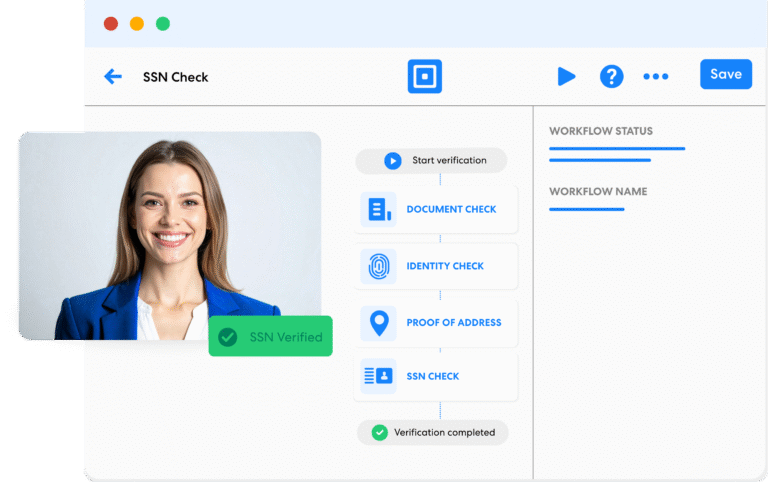
## The Leader in Compliance for U.S. Based Companies
ComplyCube is certified to **ISO/IEC 27001:2022** and **ISO 9001:2015**, maintains **SOC 2** attestation, and aligns its controls with **NIST Digital Identity** Guidelines. Our **multi-layer security**, including encryption in transit and at rest, role-based access, and full audit trails protects **sensitive customer data** across the U.S.







[Security & Compliance Center](https://www.complycube.com/en/company/security-compliance-center/)
## Where SSN Checks Deliver The Most Value
SSN verification checks deliver the most value immediately after collecting basic PII in high-impact U.S. onboarding journeys such as bank account opening, credit decisions, tax and accountancy onboarding, renting, utilities, and payroll.
In 2025, industry reporting linked roughly **$3.3 billion** in exposure to synthetic identities at U.S. lenders, underscoring the ROI of this early control.
With tighter Customer Identification Program (CIP) and Know Your Customer (KYC) scrutiny, supported by **FATF recommendations** and escalating enforcement, clear, auditable SSN outcomes provide examiner-ready evidence. They also connect seamlessly to step-up checks such as Document Verification and Biometric Verification & Liveness when higher assurance is required.

[ Start Now ](https://portal.complycube.com/signup)

### Audit-friendly compliance
Produce clear, timestamped Social Security Number outcomes that map to Customer Identification Program (CIP) and Know Your Customer (KYC) requirements. Export evidence for QA reviews, helping teams demonstrate consistent, risk based controls across U.S. programs.

### Real-time outcomes
Our platform returns decisions in seconds after collecting basic customer information, keeping qualified applicants moving along without extra steps. Early filtering reduces manual reviews and prevents avoidable rework across banking, credit, payroll, renting and utilities flows.

### Omni-channel
All of ComplyCube’s AML & KYC services, including our SSN verification service are available on all major systems. This includes iOS, iPad OS, Android, Chrome, Firefox, Safari, and Edge. Integrate quickly via APIs, SDKs, or hosted flows so product and operations teams can launch updates fast.

### Enterprise-ready
ComplyCube’s SSN verification service meets stringent security, data privacy, and risk management standards to protect SSN data. Data is encrypted at rest and in motion, with a rich audit trail and aligned to recognized standards to support security reviews and vendor assessments.

How SSN Validation Works: A Practical Guide
Curious how an SSN verification service reduces fraud and speeds approvals across banking, credit, and payroll journeys? Click here to read full guide to understand how the process works.
[ Go to Guide ](https://www.complycube.com/en/ssn-validation-check/)
[Explore other solutions](https://www.complycube.com/solutions/due-diligence-compliance/know-your-customer/)
## Explore other solutions
[Document Verification](https://www.complycube.com/en/solutions/identity-assurance/document-verification/) 
### Document Verification
Verify passports, IDs, and licenses with automated authenticity checks, tamper detection, and face match. Check details against your SSN verification service to step up only when needed, supporting a risk-based approach aligned to FATF guidance.
[View solution](https://www.complycube.com/en/solutions/identity-assurance/document-verification/ "Watchlist screening")
[Biometric Verification](https://www.complycube.com/solutions/identity-assurance/biometric-verification/) 
### Biometric Verification
Verify the right person is present with face capture, match, and liveness checks. Pair results with your SSN verification service to step up only when risk appears, reducing impersonation while supporting a risk-based approach for U.S. onboarding.
[View solution](https://www.complycube.com/solutions/identity-assurance/biometric-verification/ "Continuous monitoring")
[Sanctions & PEP Screening](https://www.complycube.com/en/solutions/global-screening/sanctions-pep-screening/) 
### Sanctions & PEP Screening
Screen any customers against OFAC, PEP, and adverse media lists in real time. Combine alerts with SSN verification outcomes to triage user risk quickly, maintain continuous compliance, and keep regulatory reviews targeted and auditable.
[View solution](https://www.complycube.com/en/solutions/global-screening/sanctions-pep-screening/ "Adverse media checks")
[View all solutions](https://www.complycube.com/solutions/)
## Frequently asked questions
What is an U.S. SSN verification?
A U.S. SSN verification service confirms that a Social Security Number is real, correctly structured, and consistent with U.S. issuance patterns. It also screens for mortality matches to help prevent the use of deceased or recycled numbers.
ComplyCube returns a clear pass or fail outcome in seconds, with timestamps and reason codes that map to your Customer Identification Program policies across all 50 states, Washington, D.C., and relevant U.S. territories. This provides defensible evidence for internal QA and examiner reviews, while keeping onboarding fast and predictable.
How does ComplyCube check Social Security Numbers?
ComplyCube validates the SSN’s format, issuance year, and issuance geography, then cross-references authoritative, U.S. government–sourced datasets, including mortality records. The service also highlights reuse patterns and inconsistencies that are commonly associated with synthetic identity activity in U.S. markets.
Clients may standardize inputs to United States Postal Service (USPS) formats to improve match quality. Every result is delivered with a decision, reason codes, and an exportable audit trail, so your operations, risk, and compliance teams can follow a consistent, well-documented process.
How accurate and reliable is SSN verification across U.S. states and territories?
Accuracy comes from layered checks rather than a single signal. ComplyCube corroborates structure, state or territory issuance metadata, and mortality screening, then applies consistency rules to reduce false positives. Results are deterministic and repeatable, and each decision is logged with the data points that drove it.
Trust is reinforced by enterprise controls such as encryption in transit and at rest, role-based access, audit logs, and alignment with recognized standards, including ISO 27001:2022, ISO 9001:2015, and SOC 2. These practices support reliable outcomes that stand up to scrutiny in U.S. regulatory contexts.
How fast are SSN verification results for U.S. applicants?
ComplyCube verifies SSNs and returns a decision for end users across all **U.S. states and territories** within **a few seconds.** Programs benefit from predictable SLAs across time zones, with each outcome delivered alongside **U.S. focused reason codes**, timestamps, and an exportable audit trail.
In practice, this means faster throughout during regional peaks, fewer back-and-forth requests to applicants, and cleaner evidence packs for QA and examiner reviews without sacrificing speed for customers in any U.S. location.
Is the SSN verification service compliant and privacy-safe for U.S. programs?
Yes. SSN verification checks are widely used to support U.S. CIP and KYC obligations. ComplyCube processes data under strict security and privacy controls, including encryption, role-based access, and configurable retention aligned to your records policies.
Outputs are designed for examiner-friendly reviews, with minimal data exposure and exportable logs that show the decision path. ComplyCube’s broader posture includes globally recognized certifications and compliance with CCPA and SOC2, which demonstrates robust governance even when operating in U.S. environments. This combination of technical safeguards, procedural controls, and clear documentation helps you evidence trust end to end.
---
### [Advanced fraud prevention tools to combat fraud](https://www.complycube.com/use-cases/process/fraud-prevention/)
**Published:** October 27, 2021
**Author:** CC
**Content:**
# Advanced fraud prevention tools to combat fraud
Secure your business relationships through innovative customer onboarding, robust reauthentication techniques, and advanced biometrics while preventing money laundering and remaining 100% compliant.





## 46% of surveyed organisations reported experiencing fraud, corruption, or other economic crimes in the last 24 months.
## Trusted by big names






### Stay ahead of fraudsters
Our evolving models, continual monitoring, and advanced controls over risk profiles and thresholds allow you to adapt just as quickly as the fraudsters.

### Protect your brand reputation
The cost of a breach goes far beyond the tangible as your brand and reputation are lost. Customers feel greater comfort when asked to be verified.

### Fully compliant
Privacy-aware KYC processes are critical in combating cybercrime. That’s why we offer expert-backed fully compliant KYC checks to secure your flows.
fraud detection by design
## Document authentication with unparalleled insights
High-value transaction customers demand secure but instant execution of their transactions. Our document verification services provide detailed insights and clear guidance for operational staff.
This accelerates the KYC assessment and your potential acceptance of the transacting parties. It ultimately creates a smooth, uninterrupted user experience that retains customer interest and promotes further business.
[View solution](https://www.complycube.com/solutions/identity-assurance/document-verification/)






Identity Data Verification
## Bureau based verification is seamlessly part of the user journey
User experience is critical in any sector. New customers are more inclined to terminate their journey and go elsewhere if there are any barriers to entry.
Digital onboarding with government data checks has made it quick, straightforward, and safe for you and your clients to transact. By combining our access to various extensive global data sources and bureaus and document verification, you can seamlessly secure the journey in seconds.
[View solution](https://www.complycube.com/solutions/identity-assurance/multi-bureau-checks/)
Address verification
## Smart proof of address verification
With our API, you can provide an end-to-end journey that requests customer proof of address. Checks the authenticity and validity of the document provided. Extracts the necessary address, name, and issue dates, to enhance your client records. Before finally corroborating all this information with a third party.
All this is executed with a handful of API calls, completed in seconds, and can scale infinitely as your business grows.
[View solution](https://www.complycube.com/solutions/identity-assurance/address-verification/)





### Application fraud prevention
We promote application fraud prevention across sectors, helping to reduce losses. This is all done without impacting the customer experience.
[View solution](#)

### Transactional fraud and monitoring
Anti-money laundering in finance is essential. Flag and monitor inconsistent and potentially criminal financial activity in real-time.
[View solution](#)

Preventing Fraud Globally
Digital fraud is on the rise, with new technologies increasing the sophistication and reach of fraudulent practices. Learn how the right solutions can protect your business.
[ Go to Guide ](https://www.complycube.com/en/online-fraud-prevention-with-idv-solutions/)
[Explore other solutions](https://www.complycube.com/solutions/due-diligence-compliance/know-your-customer/)
## Explore other solutions
[Biometric Verification](https://www.complycube.com/solutions/identity-assurance/biometric-verification/) 
### Biometric Verification
Use our advanced biometric checks to verify the person presenting the identity document is the same individual. Our comprehensive analysis uses biometric and behavioral vectors to give you the highest level of assurance.
[View solution](https://www.complycube.com/solutions/identity-assurance/biometric-verification/)
[Global Screening](https://www.complycube.com/solutions/global-screening/sanctions-pep-screening/) 
### Global Screening
Leverage our advanced screening capabilities to prevent bad actors from accessing your platform and performing illegal activities.
[View solution](https://www.complycube.com/solutions/global-screening/sanctions-pep-screening/)
[Real-time continuous monitoring](https://www.complycube.com/solutions/global-screening/continuous-monitoring/) 
### Real-time continuous monitoring
Keep on top of your Ongoing Due Diligence (ODD) obligations with ease, using our continuous monitoring service, you’ll get notified in real-time.
[View solution](https://www.complycube.com/solutions/global-screening/continuous-monitoring/)
Numbers that back it up
## Why Complycube?
The ComplyCube platform offers **the most complete and flexible** KYC tools to help you build trust in your business. Whether you’re a startup or a multinational enterprise, we’ve got you covered.
10+ million
Transactions are processed week in and week out across the globe.
200+
Countries and territories supported for a greater peace of mind.
3,000+
Data points from trusted sources and partners across the world, giving you the highest coverage.
95%
Client onboarding rate, helping you convert more customers and grow your business.
[Customer stories](https://www.complycube.com/solutions/due-diligence-compliance/know-your-customer/)
## Customer stories
[](https://www.complycube.com/solutions/due-diligence-compliance/know-your-customer/) [iParametrics](https://www.complycube.com/customer/iparametrics/) 
### iParametrics
[ Read more ](https://www.complycube.com/customer/iparametrics/)
[Turo](https://www.complycube.com/customer/turo-strengthens-car-sharing-compliance/) 
### Turo
Turo partnered with ComplyCube to strengthen driver verification, reduce fraud risk, and improve marketplace trust, achieving lower verification costs, higher checkout conversion, and fewer support contacts.
[ Read more ](https://www.complycube.com/customer/turo-strengthens-car-sharing-compliance/)
See all case studies
---
### [How can Compliance Managers avoid devastating fines](https://www.complycube.com/use-cases/profession/compliance-managers/)
**Published:** October 27, 2021
**Author:** CC
**Content:**
# How can Compliance Managers avoid devastating fines
Throughout the customer experience, our end-to-end fraud and compliance risk management platform provide quick and precise judgments for Compliance Managers.


## In a single year, a staggering $2.7 billion dollars of fines have been issued for breaching anti-money laundering (AML) regulations.
## Trusted by big names






### Global compliance leader
Every day, compliance managers worldwide rely on our enterprise technology to coordinate tiered defenses against financial crimes.

### Regulation centric reporting
Show your regulators how your business is fighting money laundering worldwide. Showcase how you’re doing everything possible to protect your customers.

### Seamless user journeys
Detect risks quickly and react immediately to suspicious behaviors. Enable your actual customers to transact in a safe environment without adding friction.
compliance centric investigation
## Investigative insights at your fingertips
ComplyCube’s investigative portal provides at a glance insight into your customers. They allow you to pivot quickly to combat dynamic fraud and compliance attacks.
Our platform surfaces insights in an easy-to-consume fashion. You are presented data from thousands of data points in a form that allows operational decisions to be made. You can tailor your risk profile and views to optimize your operational workflow and compliance processes.
[View solution](https://www.complycube.com/solutions/due-diligence-compliance/risk-scoring/)






Trigger based workflows
## Design a flow to optimally achieve compliance
As a compliance manager, you must enforce compliance without harming commercial effectiveness. Your customer journey is vitally important. If there are prolonged customer reviews or disproportionate checks you stand to lose business.
With access to global data sources, robust AI, and fine-grain control over thresholds and alerts. Achieving compliance is quick, easy, and incredibly secure for both you and your customers.
[View solution](https://www.complycube.com/solutions/due-diligence-compliance/case-management/)
Compliance by design
## Multiple checks in a matter of seconds
The importance of shortening the client journey has never been greater. With the help of our automated data capture solutions, you can increase the accuracy and quality of the information extracted and stored in your databases and the user experience during the onboarding process.
Our cloud-based solutions can rapidly verify client information with governments and bureaus, complete AML screening and verify the authenticity of identity documentation. The multitude of checks done seamlessly dramatically lowers customer dropout while retaining complete compliance.
[View solution](https://www.complycube.com/solutions/identity-assurance/multi-bureau-checks/)





### Application fraud prevention
We promote application fraud prevention in banks, helping to reduce losses. This is all done without impacting customer experience.
[View solution](#)

### Transactional fraud and monitoring
Anti-money laundering in banking is essential. Flag and monitor inconsistent and potentially criminal financial activity in real time.
[View solution](#)
[Explore other solutions](https://www.complycube.com/solutions/due-diligence-compliance/know-your-customer/)
## Explore other solutions
[Real-time continuous monitoring](https://www.complycube.com/solutions/global-screening/continuous-monitoring/) 
### Real-time continuous monitoring
Keep on top of your Ongoing Due Diligence (ODD) obligations with ease, using our continuous monitoring service, you’ll get notified in real-time.
[View solution](https://www.complycube.com/solutions/global-screening/continuous-monitoring/)
[Global Screening](https://www.complycube.com/solutions/global-screening/sanctions-pep-screening/) 
### Global Screening
Leverage our advanced screening capabilities to prevent bad actors from accessing your platform and performing illegal activities.
[View solution](https://www.complycube.com/solutions/global-screening/sanctions-pep-screening/)
[Watchlist Screening](https://www.complycube.com/solutions/global-screening/watchlist-screening/) 
### Watchlist Screening
ComplyCube’s comprehensive coverage of global AML watchlist sources and flexible automation features ensures that you comply regulations.
[View solution](https://www.complycube.com/solutions/global-screening/watchlist-screening/)
Numbers that back it up
## Why Complycube?
The ComplyCube platform offers **the most complete and flexible** KYC tools to help you build trust in your business. Whether you’re a startup or a multinational enterprise, we’ve got you covered.
10+ million
Transactions are processed week in and week out across the globe.
200+
Countries and territories supported for a greater peace of mind.
3,000+
Data points from trusted sources and partners across the world, giving you the highest coverage.
95%
Client onboarding rate, helping you convert more customers and grow your business.
---
### [ComplyCube 2.0 Webinar](https://www.complycube.com/resources/complycube-2-0-webinar/)
**Published:** October 13, 2025
**Author:** Rithu Jagannath
**Excerpt:** In this webinar, we’ll unveil how ComplyCube 2.0 elevates identity and compliance automation, featuring smarter liveness detection, enhanced document fraud detection, and no-code workflows that deliver secure, scalable onboarding at global scale.
**Content:**
# ComplyCube 2.0 Webinar
In this webinar, we’ll unveil how ComplyCube 2.0 elevates identity verification and AML compliance automation, featuring enhanced fraud detection, user analytics, and no-code workflows that deliver scalable and secure customer onboarding.
[ Register interest ](https://2yhcw.share.hsforms.com/2TxZsYp95SsqmTpjGUbEacg)
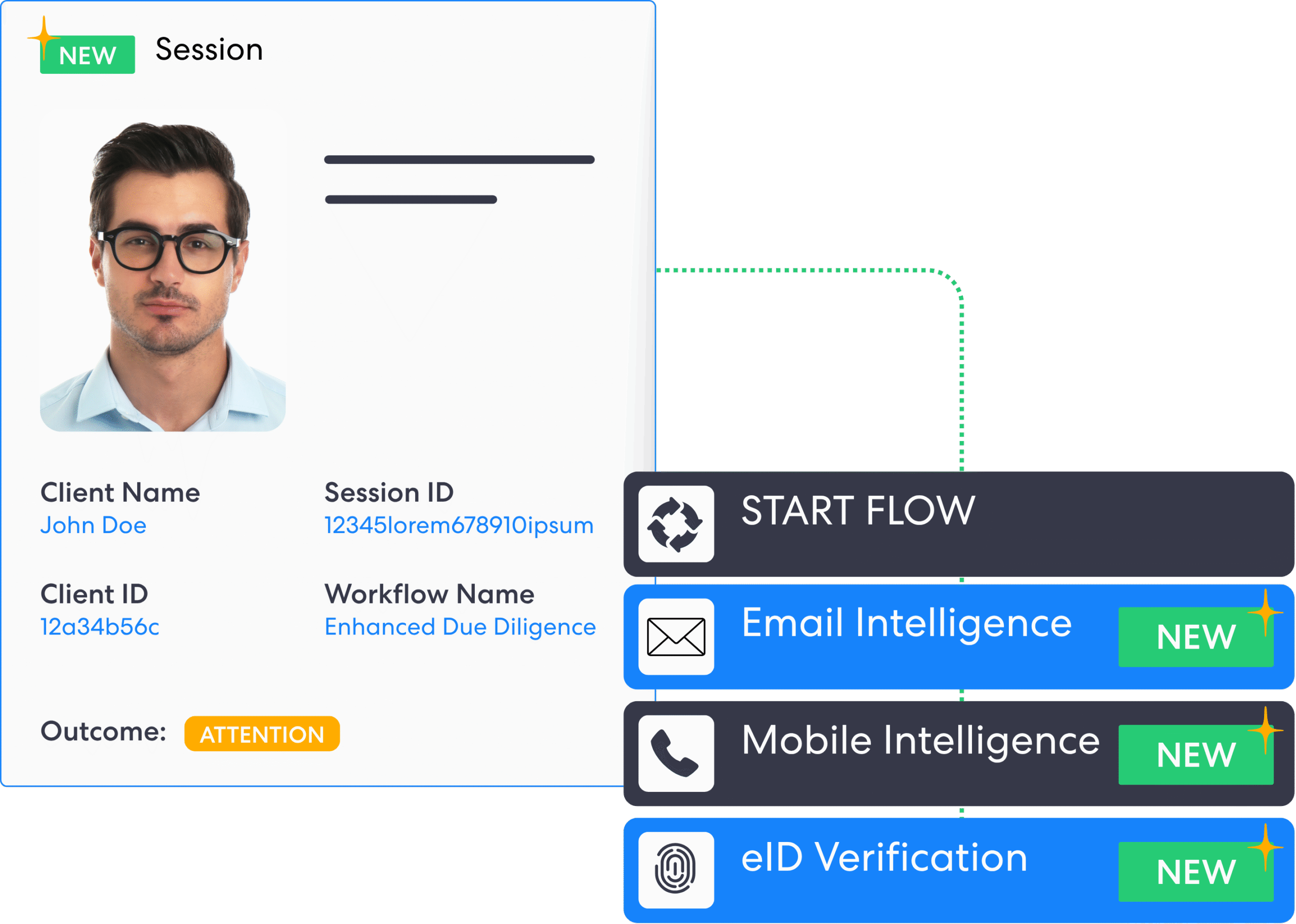
## See ComplyCube 2.0 in Action Below
Our latest platform upgrade enables customers to build their own identity verification, fraud detection, KYC and AML workflows in one place.
## What will I learn at the ComplyCube 2.0 demo?
In the “Innovation in Action: ComplyCube 2.0” webinar, we will cover:
- The new look and feel of the ComplyCube portal, including navigation and user experience enhancements.
- How you can leverage **customizable and pre-built workflows** for real-life use cases to meet local and global compliance obligations.
- How our new checks such as the **Device and Fraud Intelligence Suite** can help protect your business from fraudsters.
- How to utilize **behavior analytics and insights** to optimize workflows and maximize ROI.
- How additional features such as **access restriction list** and **banned faces** can be utilized to have more control over who accesses your services.
## Frequently Asked Questions
When will the ComplyCube 2.0 webinar take place?
We will be delivering a series of webinars for various audiences over the next few weeks. Dates and times of each will be shared via email very soon, so please register interest above and keep a lookout for further information.
Will the ComplyCube 2.0 webinar session be recorded?
Yes, the ComplyCube 2.0 webinar session will be recorded and we will be sending the recording after it concludes to those who register on our webinar registration form.
Will I receive a confirmation email for the ComplyCube 2.0 webinar session?
Yes, you will receive a confirmation email upon registration and a reminder email prior to the webinar date.
What platform will the ComplyCube 2.0 webinar session be hosted on?
The ComplyCube 2.0 webinar session will be hosted on Microsoft Teams.
Will there be a live chat or interaction with the speakers?
You can submit your questions and topics of discussion through the webinar registration form as well as ask them live during the webinar session.
Is there a registration fee for the ComplyCube 2.0 webinar session?
No, the webinar is free to all attendees.
---
### [Social Media](https://www.complycube.com/use-cases/industry/social-networks-and-social-media-kyc/)
**Published:** June 18, 2024
**Author:** Sofia Daley
**Excerpt:** Implement social media KYC to eliminate fake social media profiles. Learn how social media identity verification can strengthen your reputation online and protect your users. Make your social network a safe space online.
**Content:**
# Social Media
Enhance safety and security on your platform by implementing market-leading social media identity verification solutions. IDV and KYC processes can **verify users in seconds** and **eliminate fake social media profiles** from your platform, drastically reducing cyber fraud and strengthening your reputation amongst competitors. Implement social media KYC and uplevel your social network in today’s attention economy.



## Consumers Have Lost Over $2.7 Billion to Social Media Scams Since 2021.
## Trusted by big names






### Global Verification
Detect fake social media profiles with our advanced document check, supporting over 13,000 different types of documents.

### Seamless Scanning
Verify users in seconds to prevent catfishing and anonymity-related fraud on your platform.

### Omni-channel Integration
Experience consistent, high-quality performance and accessibility across all major systems and devices.
Instant Document Verification
## Document Checks for Safety Online
Our AI-powered document verification solution can accurately verify over 13,000 types of documents. Ensure that users possess valid government-issued IDs to help fight the creation of fake profiles.
We run several checks on ID documents to ensure they have not been compromised, forged, expired, blacklisted, or copied from the internet. Increase accountability online, creating a more safe and respectful community for your users.
[View solution](https://www.complycube.com/en/solutions/identity-assurance/document-verification/)






Biometric Identity Check
## Identity Verification to Halt Online Catfishing
Using our state-of-the-art identity check, our solution compares a selfie with images from government-issued documentation to verify identities accurately. Enhance user trust by preventing impersonation online.
Our advanced liveness detection ensures user authenticity, checking that they are not using a mask or a printout and detecting presentation attacks. Prevent catfishing on your platform.
[View solution](https://www.complycube.com/en/solutions/identity-assurance/biometric-verification/ "Protect your business with powerful ID verification")
Advanced Age Estimation
## User Age Assurance with Secure Selfie Checks
Ensure age compliance with our biometric facial recognition engine, which examines biometric samples of provided selfies, such as subtle microexpressions, skin texture, and more. Accurately verify whether your users meet age requirements, providing the needed protection for your platform.
Demonstrate your commitment to user safety and responsible online practices by helping to prevent minors from being victimized online. Provide a platform that protects its users.
[View solution](https://www.complycube.com/en/solutions/global-screening/facial-age-estimation/)





Identity Checks For Social Media
Most cases of identity fraud begin on social media. Discover how biometric identity verification with liveness detection could identify fraudulent profiles before attacks happen.
[ Go to Guide ](https://www.complycube.com/en/social-media-kyc-bot-driven-fraud-on-your-feed/)
[Recommended solutions](https://www.complycube.com/solutions/due-diligence-compliance/know-your-customer/)
## Recommended solutions
[Continuous monitoring](https://www.complycube.com/solutions/due-diligence-compliance/case-management/) 
### Continuous monitoring
Stay ahead of your ODD responsibilities with our continuous monitoring service. Receive real-time alerts if there’s any change in your customers’ status.
[View solution](https://www.complycube.com/en/solutions/global-screening/continuous-monitoring/)
[Customer due diligence](https://www.complycube.com/solutions/global-screening/watchlist-screening/) 
### Customer due diligence
Best-in-class onboarding flows with an extensive array of KYC checks, for either Customer Due Diligence (CDD) or Enhanced Due Diligence (EDD).
[View solution](https://www.complycube.com/en/solutions/due-diligence-compliance/customer-due-diligence/)
[Sanctions & PEP Screening](https://www.complycube.com/solutions/global-screening/sanctions-pep-screening/) 
### Sanctions & PEP Screening
Advanced PEP & Sanctions screening solutions to prevent bad actors from evading your AML controls. Identify politically exposed persons effortlessly.
[View solution](https://www.complycube.com/en/solutions/global-screening/sanctions-pep-screening/)
[View all solutions](https://www.complycube.com/solutions/)
Numbers that back it up
## Why Complycube?
The ComplyCube platform offers **the most complete and flexible** KYC tools to help you build trust in your business. Whether you’re a startup or a multinational enterprise, we’ve got you covered.
10+ million
Transactions are processed week in and week out across the globe.
220+
Countries and territories supported for a greater peace of mind.
3,000+
Data points from trusted sources and partners across the world, giving you the highest coverage.
98%
Client onboarding rate, helping you convert more customers and grow your business.
---
### [Manage AML risks with our proven scoring engine](https://www.complycube.com/solutions/due-diligence-compliance/risk-scoring/)
**Published:** October 27, 2021
**Author:** CC
**Content:**
# Manage AML risks with our proven scoring engine
Our AML risk scoring engine applies proprietary algorithms to calculate a score in accordance with your AML Risk-Based Approach (RBA), presenting you with a low-high risk of money laundering score.
[ Start now ](https://portal.complycube.com/signup)
[ Contact us ](https://www.complycube.com/contact/contact-sales/)



### Simplified risk
Our intuitive traffic-light system provides actionable risk scoring analysis.

### Fully configurable
Configure our AML risk scoring solution to set your own rules according to your Risk-Based Approach.

### Integrate overnight
Cut down on risk today with multiple integration options available, including a no-code solution.
Customer Due Diligence
## Onboard users securely and without friction
Our Identity Verification (IDV) flows accurately vet every user to mitigate document fraud and deep fake attacks, among other malicious behaviors to ensure every client is genuine, reducing risk.
We then perform continuous AML monitoring on your client profiles to ensure our risk scoring is up-to-date and accurate. This empowers your business to decide which customers require standard Customer Due Diligence (CDD) or Enhanced Due Diligence (EDD).
[Learn more](https://www.complycube.com/en/solutions/due-diligence-compliance/know-your-customer/document-authenticity/)







KYC & AML Compliance
## Automate AML processes according to your Risk-Based Approach
Automate your AML risk thresholds to adhere to the most stringent regulations and legal procedures from across the globe.
Our risk scoring solution provides MLROs and FinCrime specialists the tools and flexibility that enable them to better protect their business against fraud, money laundering, and terrorism financing.
Spot AML red flags
## Spot money laundering red flags as they emerge
ComplyCube’s risk scoring algorithm aggregates all available data on a customer to detect potential risk, be it a business entity or an individual customer (KYB or KYC). These include high-risk findings on their location, political exposure, sanctions, adverse media status, and many others.
Configure your own thresholds to align with company policy, your Risk-Based Approach, and local and international regulations.




## Get started with AML risk profiling and eKYC immediately
Our ‘No code’ and ‘Low Code’ offerings enable you to start onboarding and verify your customers in a matter of minutes.
[ Start now ](https://portal.complycube.com/signup)



### Custom lists
Import custom lists to expand and enhance the scope of our screening checks to include your internal lists of persons and companies. Our ingestion technology can integrate with, update, and propagate these lists in real-time.

### Global risk analysis
ComplyCube’s coverage spans over 220 countries and territories, accepting 13,000+ documents. Scale seamlessly into new markets with thousands of global, regional, and local public & commercial AML lists.
## Trusted by big names






Understanding the Risk-Based Approach
Learn more about the importance of risk monitoring and implementing the right AML controls. Our AML risk scoring engine utilizes proprietary algorithms to generate a score aligned with your AML Risk-Based Approach (RBA).
[ Go to Guide ](https://www.complycube.com/en/what-is-a-risk-based-approach/)
[Recommended solutions](https://www.complycube.com/solutions/due-diligence-compliance/know-your-customer/)
## Recommended solutions
[Sanctions & PEP screening](https://www.complycube.com/solutions/global-screening/sanctions-pep-screening/) 
### Sanctions & PEP screening
We provide extensive coverage of sanctioned individuals and entities as well as determining client risk through political exposure.
[View solution](https://www.complycube.com/solutions/global-screening/sanctions-pep-screening/)
[Document Verification](https://www.complycube.com/solutions/global-screening/continuous-monitoring/) 
### Document Verification
Our AI document verification solution creates an ultra-high level of identity assurance, taking just 15 seconds to complete.
[View solution](https://www.complycube.com/solutions/identity-assurance/document-verification/)
[Adverse media checks](https://www.complycube.com/solutions/identity-assurance/document-verification/) 
### Adverse media checks
Spanning thousands of trusted media and news outlets across the world, we ensure you are informed immediately should a client appear negatively in the press.
[View solution](https://www.complycube.com/solutions/global-screening/adverse-media-checks/)
## Frequently asked questions
How much does continuous risk and AML monitoring cost?
Prices are determined by multiple variables. Contact one of our [AML, KYC, and IDV specialists](https://www.complycube.com/en/contact/contact-sales/) to learn more.
What risk vectors do you use to attribute client risk score?
We create an overall risk score from various sources, including: country risk, political exposure risk, occupation risk, watchlist risk, among others.
What happens when a check is completed?
Once a check is validated, if client details need updating, we instantly update the corresponding profile, updating its risk score.
Do I have to use the ComplyCube platform?
No, our solutions can be integrated in many ways, including a full API and SDK integration, or a no-code, low-code and hosted solution.
---
### [Developers](https://www.complycube.com/developers/)
**Published:** October 27, 2021
**Author:** CC
**Content:**
# Developers
Whether your developers are working for a startup or a global enterprise, learn how to integrate with ComplyCube to meet your AML and KYC regulations.
## Get started
Explore the different ways you can intergate ComplyCube verification in your flows and apps
[Documentation](https://docs.complycube.com/documentation/) 
### Documentation
Explore how to get started with ComplyCube with our easy-to-follow documenation and guides.
[Explore](https://docs.complycube.com/documentation/)
[Web SDK](https://docs.complycube.com/documentation/guides/web-sdk-quick-guide) 
### Web SDK
Leverage our cross-device and UX-optimized Javascript SDK to create engaging web experiences.
[Explore](https://docs.complycube.com/documentation/guides/web-sdk-quick-guide/)
[Mobile SDKs](https://www.complycube.com/solutions/global-screening/watchlist-screening/) 
### Mobile SDKs
Effortlessly drop our native SDKs into your mobile and tablet apps to create seamless customer journeys.
[Explore](https://docs.complycube.com/documentation/)
[Hosted verification page](https://docs.complycube.com/documentation/guides/hosted-solution-quick-guide) 
### Hosted verification page
Use our hosted solution to offload some of the heavy lifting to us and remove the need to worry about infrastcutre and scaling.
[Explore](https://docs.complycube.com/documentation/guides/hosted-solution-quick-guide/)
[Codeless solution](https://docs.complycube.com/documentation/guides/web-portal-quick-guide) 
### Codeless solution
Start using ComplyCube to verify your customers and protected your business without writing any code.
[Explore](https://docs.complycube.com/documentation/guides/web-portal-quick-guide/)
## API Guides
Follow our step-by-step AML & KYC APIs guides to get started quickly
[Perform AML screenings](https://docs.complycube.com/documentation/guides/api-quick-guide/run-an-aml-screening-check) 
### Perform AML screenings
Intergate our extenstive AML screening service which includes Sanctions, Watchlist, PEP, and Adverse Media checks.
[Explore](https://docs.complycube.com/documentation/guides/api-quick-guide/run-an-aml-screening-check/)
[Check ID documents](https://docs.complycube.com/documentation/guides/api-quick-guide/run-a-document-check) 
### Check ID documents
Use our document check API to quickly authenticate IDs from all over the world and enrich customer records with verified data.
[Explore](https://docs.complycube.com/documentation/guides/api-quick-guide/run-a-document-check/)
[Verify customer identities](https://docs.complycube.com/documentation/guides/api-quick-guide/run-an-identity-check) 
### Verify customer identities
Establish the real identity of your customers using a simple and intuitive API that leverages best-in-class biometrics and liveness checks.
[Explore](https://docs.complycube.com/documentation/guides/api-quick-guide/run-an-identity-check/)
[Perform Proof of Address checks](https://docs.complycube.com/documentation/guides/api-quick-guide/perform-proof-of-address-check) 
### Perform Proof of Address checks
Extract data from utility bills and bank statements and verify them against your customers’ details.
[Explore](https://docs.complycube.com/documentation/guides/api-quick-guide/perform-proof-of-address-check/)
[Run a multi-bureau check](https://docs.complycube.com/documentation/guides/api-quick-guide/perform-multi-bureau-check) 
### Run a multi-bureau check
Verify client details, such as name, address, DOB, and SSN, against trusted sources like government and credit bureaus.
[Explore](https://docs.complycube.com/documentation/guides/api-quick-guide/perform-multi-bureau-check/)
## Reference
Check our comprehensive suite of reference materials
[Full API reference](https://docs.complycube.com/api-reference/) 
### Full API reference
Get detailed how to get started with ComplyCube with our easy-to-follow documenation and guides.
[Explore](https://docs.complycube.com/api-reference/)
[API Status](https://status.complycube.com) 
### API Status
Subcribe to our Status Page to get updates on our service health, planned maintenance, and any incidents (if any).
[Explore](https://status.complycube.com/)
[API change log](https://docs.complycube.com/api-reference/versioning#changelog) 
### API change log
Check our log for API changes, including new functionality, backward compatibility, and break changes.
[Explore](https://docs.complycube.com/api-reference/versioning#changelog/)
[Intergation checklist](https://docs.complycube.com/documentation/guides/integration-checklist) 
### Intergation checklist
Use this checklist to to confirm you have covered all the critical steps and ensure a smooth transition from Sandbox to Live.
[Explore](https://docs.complycube.com/documentation/guides/integration-checklist/)
[Support](https://support.complycube.com/) 
### Support
Submit a ticket to get help with your technical issues and queries.
[Explore](https://support.complycube.com/)
---
### [Healthcare](https://www.complycube.com/use-cases/industry/healthcare/)
**Published:** October 27, 2021
**Author:** CC
**Content:**
# Healthcare
The accelerating adoption of telemedicine has revolutionized access to medicine, but it also introduces new challenges around security and compliance. Through advanced Healthcare identity verification solutions, you can maintain strict compliance, detect drug fraud, and deliver seamless patient experience.





## A National Money Laundering Risk Assessment (NMLRA) found that healthcare fraud generated over $110 billion in proceeds each year.
## Trusted by big names






### Accessible customer experience
Healthcare spans all demographics. This is why our hosted user journey has been thoughtfully designed to be accessible and inclusive to all patients.

### Orchestrate for recurring clients
With ongoing access to highly sensitive patient data and costly medications, robust reauthentication and verification are essential. However, these measures must be seamless.

### Easy outreach
In healthcare, operational effectiveness in times of need can make a critical difference. Analysts have tools at their fingertips to rapidly engage with patients and staff.
Tackle medical Identity theft
## Combat fraudsters targeting health insurance
In countries where medical insurance is mandatory for access to healthcare. There are organized systematic impersonation frauds in place to claim medical costs, access medical services, and steal expensive drugs.
It is only by applying fraud prevention measures in the form of document verification and biometrics liveness. That healthcare providers can truly protect themselves.
[View solution](https://www.complycube.com/solutions/identity-assurance/biometric-verification/)






Identity Data Verification
## Verify identities without impacting user experience
In such a long-standing industry, user experience is vitally important. If there are hurdles, it dissuades staff and patients and slows the modernization and operational efficiencies that stand to be gained.
As healthcare providers move away from physical records, the ease with which they can collect data, and more importantly, the security with which it is stored defines how quickly they will be adopted.
[View solution](https://www.complycube.com/solutions/due-diligence-compliance/case-management/)
client data extraction
## Accurately verify customer data
Maintaining accurate and up-to-date records of healthcare clients is fundamental to providing a good level of service. Client information can easily become stale and we prove you the tools to be able to quickly re-request and verify their information.
Our services provide advanced robust document verification and extraction techniques that can be sent to third parties like governments for corroboration.
[View solution](https://www.complycube.com/solutions/identity-assurance/address-verification/)





### Application fraud prevention
We promote application fraud prevention in banks, helping to reduce losses. This is all done without impacting customer experience.
[View solution](#)

### Transactional fraud and monitoring
Anti-money laundering in banking is essential. Flag and monitor inconsistent and potentially criminal financial activity in real time.
[View solution](#)

Fighting Document Fraud
Identity fraud is driven by increasingly advanced techniques to forge documents and exploit gaps within verification systems. Learn more about how you can prevent document fraud.
[ Go to Guide ](https://www.complycube.com/en/fighting-fraud-with-document-verification/)
[Recommended solutions](https://www.complycube.com/solutions/due-diligence-compliance/know-your-customer/)
## Recommended solutions
[Address Verification](https://www.complycube.com/solutions/identity-assurance/address-verification/) 
### Address Verification
Deliver exceptional customer experiences by confidently and accurately verifying the location of your customer base with our address verification suite of services.
[View solution](https://www.complycube.com/solutions/identity-assurance/address-verification/)
[Sanctions and PEP screening](https://www.complycube.com/solutions/global-screening/sanctions-pep-screening/) 
### Sanctions and PEP screening
ComplyCube’s comprehensive coverage of global AML watchlist sources and flexible automation features ensures that you comply with the most stringent regulations.
[View solution](https://www.complycube.com/solutions/global-screening/sanctions-pep-screening/)
[Real-time continuous monitoring](https://www.complycube.com/solutions/global-screening/continuous-monitoring/) 
### Real-time continuous monitoring
Keep on top of your Ongoing Due Diligence (ODD) obligations with ease, using our continuous monitoring service. You’ll get notified in real-time should your customers’ status change.
[View solution](https://www.complycube.com/solutions/global-screening/continuous-monitoring/)
Numbers that back it up
## Why Complycube?
The ComplyCube platform offers **the most complete and flexible** KYC tools to help you build trust in your business. Whether you’re a startup or a multinational enterprise, we’ve got you covered.
10+ million
Transactions are processed week in and week out across the globe.
200+
Countries and territories supported for a greater peace of mind.
3,000+
Data points from trusted sources and partners across the world, giving you the highest coverage.
95%
Client onboarding rate, helping you convert more customers and grow your business.
---
### [Resources](https://www.complycube.com/resources/)
**Published:** October 27, 2021
**Author:** CC
**Content:**
# Resources
## Resources
Explore valuable ComplyCube resources that you will find helpful for integrating and learning more about the eKYC landscape.
[Blog](https://www.complycube.com/en/resources/blog/) 
### Blog
Get the latest insights and best practices in the AML, KYC, and identity verification space.
[Explore](https://www.complycube.com/resources/blog/)
[FAQs](https://support.complycube.com/hc/en-gb/categories/360003399998-General) 
### FAQs
Get answers to frequently asked questions.
[Explore](https://support.complycube.com/hc/en-gb/categories/360003399998-General)
[Support center](https://support.complycube.com/hc/en-gb) 
### Support center
Submit a ticket, and our team will swiftly assist you with your support inquiries.
[Explore](https://support.complycube.com/hc/en-gb)
---
### [Selfie-based Age Estimation Check](https://www.complycube.com/solutions/identity-assurance/facial-age-estimation/)
**Published:** October 2, 2023
**Author:** Andreea Balasa
**Excerpt:** Leveraging facial age estimation and sophisticated likeness detection from a simple selfie, we empower you to confidently serve your customers, safeguard minors, and eliminate the need for ID documents.
**Content:**
SECURE & RELIABLE AGE ESTIMATION CHECKS
# Selfie-based Age Estimation Check
Streamline your **age-restricted offerings** with ComplyCube’s low-friction age check. Leveraging facial age estimation and liveness detection from a simple selfie, we empower you to confidently serve your customers, safeguard minors, and eliminate the need for ID documents for age detection.
[ Start now ](https://portal.complycube.com/signup)
[ Contact us ](https://www.complycube.com/contact/contact-sales/)







### Sensitive Data Protection
Define customizable age thresholds and automatically integrate data redaction.

### Effortless User Experience
Ensure maximum protection with minimal disruption to your age-restricted user flow.

### Global Compliance
Navigate global regulations and ensure age-sensitive compliance with facial age estimation.
SELFIE CHECk
## Verify user age with quick & secure selfie checks
Our state-of-the-art biometric facial recognition engine offers the best user experience while keeping your organization secure and compliant.
Use guided face capture to deliver low-friction access to your gaming, e-commerce, gambling, dating, and other age-protected services.
[Learn more](https://www.complycube.com/en/solutions/due-diligence-compliance/know-your-customer/biometric-facial-recognition/)





liveness check
## Rely on AI-powered liveness detection
With the help of our age detection software, age-gated websites can leverage AI-powered liveness detection to prevent underage access.
Our authenticity analysis checks the selfie for liveness signals, protecting your business from advanced presentation attacks, including 3D masks, while minimizing user friction.
[Learn more](https://www.complycube.com/solutions/due-diligence-compliance/know-your-customer/liveness-detection/)
privacy control
## Use privacy-by-design redaction capabilities
Our best-in-class age checker allows you to stay compliant with global regulations, letting you adjust age thresholds and redact selfies to comply with the **UK Online Safety Bill**, **EU Digital Services Act**, **California Age-Appropriate Design Code Act**, and beyond.
Each regulation may require different privacy rules, such as not storing underage children’s selfies. The AI age estimation system auto-redacts sensitive data to align with jurisdictional demands.
[Learn more](https://www.complycube.com/solutions/due-diligence-compliance/know-your-customer/pii-sensitive-data-redaction/)



## Discover the 1-Step Age Estimation Process
## Get started with no-ID age estimation now
Ensure age compliance without ID documents. The AI-powered Age Estimation software caters to users who value privacy, offering a seamless experience. Our ‘No Code’ to ‘Low Code’ solutions enable you to start verifying your customer’s ages in a matter of minutes.
[ Start now ](#)



### Increase user conversion
Offer an excellent user experience that yields results in seconds. This swift, user-friendly approach boosts engagement, fostering trust and higher conversion rates.

### Expand globally with ease
Our fully hosted, secure verification service streamlines the process: users snap a selfie, and our age detection API takes the lead. Expand internationally with no effort.
## Our Commitment
ComplyCube is committed to supporting and implementing best practices to reduce the access children have to age-restricted goods, content and services. ComplyCube puts in robust controls to ensure conformity with its commitments, and supports clients and partners to do the same.
## Trusted by big names






Age Estimation for Online Safety
Using biometric technology, ComplyCube’s age estimation tool can swiftly show reliable age estimations in seconds using just one selfie. Learn more in our recent guide.
[ Go to Guide ](https://www.complycube.com/en/what-is-an-online-age-verification-system/)
[Explore other solutions](https://www.complycube.com/solutions/due-diligence-compliance/know-your-customer/)
## Explore other solutions
[Age Verification](https://www.complycube.com/solutions/global-screening/watchlist-screening/) 
### Age Verification
Streamline your onboarding processes through smart capture data techniques that verify Identity Documents in seconds.
[View solution](https://www.complycube.com/en/use-cases/process/age-verification/ "Watchlist screening")
[Biometric Verification](https://www.complycube.com/solutions/global-screening/adverse-media-checks/) 
### Biometric Verification
Guarantee your customer is genuinely there when transacting using our certified liveness assurance.
[View solution](https://www.complycube.com/en/solutions/identity-assurance/biometric-verification/ "Adverse media checks")
[Customer Authentification](https://www.complycube.com/solutions/global-screening/continuous-monitoring/) 
### Customer Authentification
Limit user access and ensure your products are secure without adding friction for your customers.
[View solution](https://www.complycube.com/en/solutions/identity-assurance/customer-authentication/ "Continuous monitoring")
[View all solutions](https://www.complycube.com/solutions/)
## Frequently asked questions
Why choose age estimation over traditional age verification methods?
Age estimation offers a frictionless experience, requiring only a selfie, without the need for users to share personal ID documents. This increases user trust, streamlines onboarding, and can lead to higher conversion rates.
Is the age estimation technology compliant with global privacy regulations?
We’ve designed our age estimation product to align with key global privacy regulations including the **UK Online Safety Bill**, **EU Digital Services Act**, **California Age-Appropriate Design Code Act**, and beyond.
How quick is an age estimation check?
An Age Estimation Check takes **a few seconds** to complete.
Can the age estimation system be integrated into my existing platform?
Absolutely. Our age estimation technology is designed for seamless integration into various platforms, ensuring a consistent user experience and minimal integration effort. We suggest running the check through our Hosted Solution, Web SDK, or native Mobile SDKs. These SDKs assist your clients during the capture process, ensuring a smooth and successful completion with the least resistance.
---
### [eCommerce](https://www.complycube.com/use-cases/industry/ecommerce/)
**Published:** October 27, 2021
**Author:** CC
**Content:**
# eCommerce
Monitor transacting parties in real-time to rapidly detect and prevent fraud, leveraging AI-powered eCommerce fraud detection. Stop synthetic accounts and fraudulent transactions from impacting your revenue with our expert eCommerce fraud solution.




## Adult content, counterfeits, and drugs account for over 50% of transaction laundering. Fake merchants have laundered over $350 billion.
## Trusted by big names






### Scalable fraud detection
Our checks execute in seconds and can scale up to any transaction count.

### Secure data capture
We provide secure local data-regulation capture components.

### Global coverage
Expand your business worlwide, we have your AML and KYC checks covered.
adaptive risk profiles
## Leveraging risk profiling for unparalleled insights
eCommerce is a fast-paced industry in which AML and counter-terrorist financing (CTF) measures must take priority. The line between effective controls and lost revenue needs constant readjustment and evaluation.
Our eCommerce fraud solution offers customizable thresholds and dynamic risk profiles that allow you to find the right balance. Meet regulatory obligations without forgoing profit.
[View solution](https://www.complycube.com/solutions/due-diligence-compliance/risk-scoring/)






third party Data Verification
## Customer onboarding with eCommerce fraud solution
Instantly verify customer details, such as name, address, DOB, and social security numbers, against trusted sources like government and credit bureaus at onboarding.
Our global and extensive data points will verify your customer details accurately and instantaneously. You can specify whether customer data sets are verified against a single source or at least two unique sources – commonly known as “2+2 verification”.
[View solution](https://www.complycube.com/solutions/identity-assurance/multi-bureau-checks/)
customer Address verification
## Enhanced data for expert fraud detection
An eCommerce CRM is only as good as the data it holds. Give yourself a greater chance to reach your customers by storing verified contact information.
Our address verification services allow you to both sanitize client-provided data and request proof of addresses before your dispatch anything priceless.
[View solution](https://www.complycube.com/solutions/identity-assurance/address-verification/)





Fighting Document Fraud Online
Fighting document fraud is essential for businesses to remain compliant and prevent fraud on their platform. Learn how advanced KYC checks can fortify your business operations.
[ Go to Guide ](https://www.complycube.com/en/fighting-fraud-with-document-verification/)
[Recommended solutions](https://www.complycube.com/solutions/due-diligence-compliance/know-your-customer/)
## Recommended solutions
[Know Your Customer](https://www.complycube.com/solutions/due-diligence-compliance/know-your-customer/) 
### Know Your Customer
Deter fraudsters without adding unnecessary friction to genuine customers using our smart and configurable identity verification checks
[View solution](https://www.complycube.com/solutions/due-diligence-compliance/know-your-customer/)
[Sanctions and PEP screening](https://www.complycube.com/solutions/global-screening/sanctions-pep-screening/) 
### Sanctions and PEP screening
ComplyCube’s comprehensive coverage of global AML watchlist sources and flexible automation features ensures that you comply with the most stringent regulations.
[View solution](https://www.complycube.com/solutions/global-screening/sanctions-pep-screening/)
[Real-time continuous monitoring](https://www.complycube.com/solutions/global-screening/continuous-monitoring/) 
### Real-time continuous monitoring
Keep on top of your Ongoing Due Diligence (ODD) obligations with ease, using our continuous monitoring service. You’ll get notified in real-time should your customers’ status change.
[View solution](https://www.complycube.com/solutions/global-screening/continuous-monitoring/)
Numbers that back it up
## Why Complycube?
The ComplyCube platform offers **the most complete and flexible** KYC tools to help you build trust in your business. Whether you’re a startup or a multinational enterprise, we’ve got you covered.
10+ million
Transactions are processed week in and week out across the globe.
200+
Countries and territories supported for a greater peace of mind.
3,000+
Data points from trusted sources and partners across the world, giving you the highest coverage.
95%
Client onboarding rate, helping you convert more customers and grow your business.
[Customer stories](https://www.complycube.com/solutions/due-diligence-compliance/know-your-customer/)
## Customer stories
[](https://www.complycube.com/solutions/due-diligence-compliance/know-your-customer/) [iParametrics](https://www.complycube.com/customer/iparametrics/) 
### iParametrics
[ Read more ](https://www.complycube.com/customer/iparametrics/)
[Turo](https://www.complycube.com/customer/turo-strengthens-car-sharing-compliance/) 
### Turo
Turo partnered with ComplyCube to strengthen driver verification, reduce fraud risk, and improve marketplace trust, achieving lower verification costs, higher checkout conversion, and fewer support contacts.
[ Read more ](https://www.complycube.com/customer/turo-strengthens-car-sharing-compliance/)
See all case studies
---
### [Real Estate Compliance](https://www.complycube.com/use-cases/industry/property/)
**Published:** October 27, 2021
**Author:** CC
**Content:**
# Real Estate Compliance
Regulations require estate agents and real estate consultants to complete KYC/AML checks on prospective buyers/sellers. Secure high-value transactions with checks that ensure real estate compliance with aml and kyc in real estate.



## In recent times 5.5 billion dollars worth of investment in UK real estate has come from foreign, politically exposed persons in high-risk jurisdictions
## Trusted by big names






### Easy real estate compliance
Our guided tools make integrating global KYC and AML checks into all your sales channels easy.

### Secure high value transactions
We offer continual KYC checks that protect your conveyance from dynamic methods of fraud.

### Global checks
Screen your clients against our worldwide data coverage spanning 220+ territories with KYC & AML in real estate.
Real Estate compliance
## Homebuyer document authentication
Digital real estate now demands live progress updates, fast money transfers, and trendy design. Our cutting-edge document verification delivers an easy and accessible user experience while meeting your regulatory obligations.
[View solution](https://www.complycube.com/solutions/identity-assurance/document-verification/)






Reference bureau verification
## Upfront reference checks for real estate compliance
There is nothing worse than a long-running deal falling through due to the insufficient data on the client at the time of reference checks. Protect yourself from lost deals with our multi bureau checks.
At the point of onboarding, you can verify all their personal details (name, address, date of birth, tax number) and relax as you progress any deals.
[View solution](https://www.complycube.com/solutions/identity-assurance/multi-bureau-checks/)
AML & KYC in real estate
## Automate AML & KYC investigations
Automate your policies to adhere to the most stringent regulations and legal procedures in your jurisdiction. Our solution provides your compliance managers with the tools and flexibility to better protect their business against fraud, money laundering, and terrorism financing.
[View solution](https://www.complycube.com/solutions/due-diligence-compliance/case-management/)





### Application fraud prevention
We promote application fraud prevention in banks, helping to reduce losses. This is all done without impacting customer experience.
[View solution](#)

### Transactional fraud and monitoring
Anti-money laundering in banking is essential. Flag and monitor inconsistent and potentially criminal financial activity in real time.
[View solution](#)

UK DIATF Right-to-Rent Checks
Discover why a DIATF Certified IDSP is the right partner for comprehensive Right-to-Rent and DBS Checks in the UK. Learn more about the DIATF framework in our expert guide.
[ Go to Guide ](https://www.complycube.com/en/choosing-a-uk-diatf-certified-idsp/)
[Explore our solutions](https://www.complycube.com/solutions/due-diligence-compliance/know-your-customer/)
## Explore our solutions
[Watchlist screening](https://www.complycube.com/solutions/global-screening/watchlist-screening/) 
### Watchlist screening
Our comprehensive coverage of global AML watchlist sources and flexible automation ensures that you comply with the most stringent regulations.
[View solution](https://www.complycube.com/solutions/global-screening/watchlist-screening/)
[Sanctions & PEP screening](https://www.complycube.com/solutions/global-screening/sanctions-pep-screening/) 
### Sanctions & PEP screening
Our screening capability provides extensive coverage of sanctioned, Politically Exposed Persons (PEP) individuals and companies
[View solution](/solutions/global-screening/sanctions-pep-screening/)
[Adverse media checks](https://www.complycube.com/solutions/global-screening/adverse-media-checks/) 
### Adverse media checks
Protect your reputation by screening customers using our AI-powered adverse media service before onboarding them.
[View solution](https://www.complycube.com/solutions/global-screening/adverse-media-checks/)
Numbers that back it up
## Why Complycube?
The ComplyCube platform offers **the most complete and flexible** KYC tools to help you build trust in your business. Whether you’re a startup or a multinational enterprise, we’ve got you covered.
10+ million
Transactions are processed week in and week out across the globe.
200+
Countries and territories supported for a greater peace of mind.
3,000+
Data points from trusted sources and partners across the world, giving you the highest coverage.
95%
Client onboarding rate, helping you convert more customers and grow your business.
---
### [Telecom Compliance Services](https://www.complycube.com/use-cases/industry/telcoms/)
**Published:** October 27, 2021
**Author:** CC
**Content:**
# Telecom Compliance Services
The ComplyCube platform provides AI-powered AML and KYC telecom compliance services for telcos and mobile network operators (MNOs) to meet their subscriber registration regulatory commitments and achieve the compliance required for mobile money operations. Ensure telecom fraud prevention and secure your operations with expert checks.





## Over a five year period, SIM swap fraud has led to bank customers world wide losing more than 11.9 million dollars.

### Frictionless customer experiences
Provide a fast and easy registration experience at the point of sale or home for new and returning subscribers.

### Know your subscriber
Ensure your subscriber is present at the time of transaction so you are confident you have met your regulatory commitments.

### Fast and easy integration
Our range of SDKs allows you to integrate our checks and services into all your channels in no time at all.
## Trusted by big names





Identity Document Verification
## ID verification for expert telecom compliance services
Verify your subscriber using our fast and accurate document authenticity checks. With support for over 10,000 types of documents, you are primed for a global expansion.
Using the best combination of AI and trained human experts, ComplyCube runs multiple types of checks on ID documents to check to ensure telecom fraud prevention. These checks verify whether documents have been compromised, forged, copied from the internet, expired, or blacklisted.
Implement expert telecom compliance services with ID document authentication.
[View solution](https://www.complycube.com/en/solutions/identity-assurance/document-verification/)






Biometric Data Verification
## Ensure your subscriber is present for telecom fraud prevention
Using our advanced biometrics matching, you can achieve remote sim registration without worrying about fraudulent activations.
Our [liveness detection technology](https://www.complycube.com/en/solutions/due-diligence-compliance/know-your-customer/liveness-detection/) affirms the person is real and not wearing a mask, or a printout to ensure telecom fraud prevention. This will provide an accurate analysis of whether your subscriber is present when you activate their service.
Fortify your solutions with expert telecom compliance service including biometric liveness detection.
[View solution](https://www.complycube.com/solutions/identity-assurance/biometric-verification/)
Address verification
## Improved experiences with verified customer details
Once your client has subscribed, you can obtain and validate their [proof of address (PoA)](https://www.complycube.com/en/solutions/identity-assurance/address-verification/) before anything is shipped. We provide you with a configurable set of screens with easy instructions for your customer to follow.
Once submitted, we can check the PoA document provided for its authenticity and cross-reference the extracted information with your subscriber’s device location data.
Leverage expert telecom compliance services that quickly verify customer details such as PoA.
[View solution](https://www.complycube.com/solutions/identity-assurance/address-verification/)





Resolving Identity Verification Challenges
Learn some of the key customer Identity Verification (IDV) challenges that all businesses face, including Telecoms, and how these issues can be addressed with the right KYC platform.
[ Go to Guide ](https://www.complycube.com/en/top-5-customer-identity-verification-challenges/)
[Recommended solutions](https://www.complycube.com/solutions/due-diligence-compliance/know-your-customer/)
## Recommended solutions
[Watchlist Screening](https://www.complycube.com/solutions/global-screening/watchlist-screening/) 
### Watchlist Screening
ComplyCube’s comprehensive coverage of global AML watchlist sources and flexible automation features ensures that you comply regulations.
[View solution](https://www.complycube.com/solutions/global-screening/watchlist-screening/)
[Global Screening](https://www.complycube.com/solutions/global-screening/sanctions-pep-screening/) 
### Global Screening
Leverage our advanced screening capabilities to prevent bad actors from accessing your platform and performing illegal activities.
[View solution](https://www.complycube.com/solutions/global-screening/sanctions-pep-screening/)
[Real-time continuous monitoring](https://www.complycube.com/solutions/global-screening/continuous-monitoring/) 
### Real-time continuous monitoring
Keep on top of your Ongoing Due Diligence (ODD) obligations with ease, using our continuous monitoring service, you’ll get notified in real-time.
[View solution](https://www.complycube.com/solutions/global-screening/continuous-monitoring/)
Numbers that back it up
## Why Complycube?
The ComplyCube platform offers **the most complete and flexible** KYC tools to help you build trust in your business. Whether you’re a startup or a multinational enterprise, we’ve got you covered.
10+ million
Transactions are processed week in and week out across the globe.
200+
Countries and territories supported for a greater peace of mind.
3,000+
Data points from trusted sources and partners across the world, giving you the highest coverage.
95%
Client onboarding rate, helping you convert more customers and grow your business.
---
### [User verification](https://www.complycube.com/use-cases/process/user-verification/)
**Published:** October 27, 2021
**Author:** CC
**Content:**
# User verification
Biometric enrollment allows customers to register with physical traits that cannot be forged. This allows you to use our customer verification services to re-authentication customers seamlessly.




## In recent times 84% of financial institutions have experienced account takeovers (ATO), costing up to 8.3% of their annual revenue!
## Trusted by big names






### Seamless UX
Smart camera capture and real-time interactive guidance let customers re-authenticate themselves in seconds without long, complex passwords.

### Privacy-focused components
User verification requires biometric enrollment. We enable you to achieve this securely with privacy in mind. Our services allow you to meet all local data regulations.

### Easy integration
Our AML & KYC services are available across systems, including iOS, iPad OS, Android, Chrome, and more. Our SDKs and hosted solutions can be integrated in minutes.
biometric enrollment
## Replace passwords with biometrics.
With just a selfie at the point of customer onboarding, you can enroll their biometrics. At this point, we verify the liveness (not a mask-wearing imposter) and their similarity to their identity document.
Once stored you can re-authenticate your customer using their biometrics, which is faster easier, and more secure.
[View solution](https://www.complycube.com/solutions/identity-assurance/address-verification/)






External data verification
## Enroll customers with data verified by third parties
When enrolling your customer biometrics for later authentication, you need to know who they are. Our services let you seamlessly verify your customer’s information with trusted third parties like governments and credit bureaus at the point of enrollment.
This way, you can be confident the biometric you have just enrolled does belong to the customer record you have registered.
[View solution](https://www.complycube.com/solutions/identity-assurance/multi-bureau-checks/)
Identity Document authenticity
## Smart document verification
To remain competitive, you must be able to provide an accessible journey. Our advanced document capture services offer step-by-step guidance for the perfect capture. This ensures you get the highest quality for your KYC processes, and your product is accessible to all demographics.
[View solution](https://www.complycube.com/solutions/identity-assurance/document-verification/)




Advanced Customer Verification
Discover how an advanced KYC process can fortify your operations and minimize client risk. With automated verification, businesses can scale seamlessly and securely.
[ Go to Guide ](https://www.complycube.com/en/choosing-the-right-automated-kyc-verification-service/)
[Recommended solutions](https://www.complycube.com/solutions/due-diligence-compliance/know-your-customer/)
## Recommended solutions
[Know Your Customer](https://www.complycube.com/solutions/due-diligence-compliance/know-your-customer/) 
### Know Your Customer
Deter fraudsters without adding unnecessary friction to genuine customers using our smart and configurable identity verification checks
[View solution](https://www.complycube.com/solutions/due-diligence-compliance/know-your-customer/)
[Sanctions and PEP screening](https://www.complycube.com/solutions/global-screening/sanctions-pep-screening/) 
### Sanctions and PEP screening
ComplyCube’s comprehensive coverage of global AML watchlist sources and flexible automation features ensures that you comply with the most stringent regulations.
[View solution](https://www.complycube.com/solutions/global-screening/sanctions-pep-screening/)
[Real-time continuous monitoring](https://www.complycube.com/solutions/global-screening/continuous-monitoring/) 
### Real-time continuous monitoring
Keep on top of your Ongoing Due Diligence (ODD) obligations with ease, using our continuous monitoring service. You’ll get notified in real-time should your customers’ status change.
[View solution](https://www.complycube.com/solutions/global-screening/continuous-monitoring/)
Numbers that back it up
## Why Complycube?
The ComplyCube platform offers **the most complete and flexible** KYC tools to help you build trust in your business. Whether you’re a startup or a multinational enterprise, we’ve got you covered.
10+ million
Transactions are processed week in and week out across the globe.
200+
Countries and territories supported for a greater peace of mind.
3,000+
Data points from trusted sources and partners across the world, giving you the highest coverage.
95%
Client onboarding rate, helping you convert more customers and grow your business.
[Customer stories](https://www.complycube.com/solutions/due-diligence-compliance/know-your-customer/)
## Customer stories
[](https://www.complycube.com/solutions/due-diligence-compliance/know-your-customer/) [iParametrics](https://www.complycube.com/customer/iparametrics/) 
### iParametrics
[ Read more ](https://www.complycube.com/customer/iparametrics/)
[Turo](https://www.complycube.com/customer/turo-strengthens-car-sharing-compliance/) 
### Turo
Turo partnered with ComplyCube to strengthen driver verification, reduce fraud risk, and improve marketplace trust, achieving lower verification costs, higher checkout conversion, and fewer support contacts.
[ Read more ](https://www.complycube.com/customer/turo-strengthens-car-sharing-compliance/)
See all case studies
---
### [How to provide simple identity verification](https://www.complycube.com/use-cases/process/identity-verification/)
**Published:** October 27, 2021
**Author:** CC
**Content:**
# How to provide simple identity verification
Protect your business and clients from identity fraud. Stop illegal service access and data theft. Use the latest biometric and vision technology to assure customer presence and authenticity in line with regulatory guidelines.



## There are over 15 billion sets of stolen credentials available online. These range from banking details to social media usernames/passwords.
## Trusted by big names






### Stop fraudsters immediately
Tackle application fraud and synthetic account creation as part of your onboarding process. Save countless hours of operational review by rejecting at the door.

### Fair unbiased verification
We ensure fair and unbiased access to your goods and services using cutting-edge techniques. We also provide clear and intelligible responses for operational review.

### Fully compliant
Compliant processes are critical when implementing verification procedures. By using our services, you ensure you meet local regulations for data handling and processing.
VAST id document coverage
## Authenticate customers worldwide with thousands of ID types.
Safeguard your business and customers using our fast and accurate document authenticity checks. With support for over 10,000 types of documents, you are primed for a global expansion.
Using the best combination of AI and trained human experts, ComplyCube runs multiple types of checks on ID documents to check whether they have been compromised, forged, copied from the internet, expired, or blacklisted.
[View solution](https://www.complycube.com/solutions/identity-assurance/document-verification/)






Multi point identity verification
## Verify a customer over multiple data points
Fortify an algorithmic document check with a certified liveness check to ensure the presence of your customer. Then you can automatically request their proof of address for more data points, in a single flow.
Finally, after storing all this verified client data, you can request the corroboration of this information from governments/trusted authorities. All this has happened in just a few seconds.
[View solution](https://www.complycube.com/solutions/identity-assurance/multi-bureau-checks/)
Advanced customer view
## All customer information in one place
ComplyCube’s investigative portal provides at a glance insight into your customers. All the data collected is securely stored and easily accessible and searchable. This provide an instant single source of truth customer record with verified supporting documentation for audit and compliance.
[View solution](https://www.complycube.com/solutions/due-diligence-compliance/case-management/)





Implementing Expert Identity Verification
With increasingly sophisticated fraud practices, businesses must ensure that their Identity Verification practices ensure global compliance and prevent fraud. Learn more in our recent guide.
[ Go to Guide ](https://www.complycube.com/en/the-essentials-guide-for-robust-identity-verification/)
[Explore other solutions](https://www.complycube.com/solutions/due-diligence-compliance/know-your-customer/)
## Explore other solutions
[Risk scoring](https://www.complycube.com/solutions/due-diligence-compliance/risk-scoring/) 
### Risk scoring
Our risk engine applies proprietary algorithms to calculate an AML risk score for your customers and presents you with a simple low, medium, or high score.
[View solution](https://www.complycube.com/solutions/due-diligence-compliance/risk-scoring/)
[Anti-money laundering](https://www.complycube.com/solutions/due-diligence-compliance/anti-money-laundering/) 
### Anti-money laundering
Use our innovative, easy-to-integrate AML platform to satisfy regulators, and stop financial crime (FinCrime) and counter-terrorist financing (CTF).
[View solution](https://www.complycube.com/solutions/due-diligence-compliance/anti-money-laundering/)
[Customer authentication](https://www.complycube.com/solutions/identity-assurance/customer-authentication/) 
### Customer authentication
Continually verify your customer access and ensure your products and services are secure without adding friction for your customers.
[View solution](https://www.complycube.com/solutions/identity-assurance/customer-authentication/)
Numbers that back it up
## Why Complycube?
The ComplyCube platform offers **the most complete and flexible** KYC tools to help you build trust in your business. Whether you’re a startup or a multinational enterprise, we’ve got you covered.
10+ million
Transactions are processed week in and week out across the globe.
200+
Countries and territories supported for a greater peace of mind.
3,000+
Data points from trusted sources and partners across the world, giving you the highest coverage.
95%
Client onboarding rate, helping you convert more customers and grow your business.
[Customer stories](https://www.complycube.com/solutions/due-diligence-compliance/know-your-customer/)
## Customer stories
[](https://www.complycube.com/solutions/due-diligence-compliance/know-your-customer/) [iParametrics](https://www.complycube.com/customer/iparametrics/) 
### iParametrics
[ Read more ](https://www.complycube.com/customer/iparametrics/)
[Turo](https://www.complycube.com/customer/turo-strengthens-car-sharing-compliance/) 
### Turo
Turo partnered with ComplyCube to strengthen driver verification, reduce fraud risk, and improve marketplace trust, achieving lower verification costs, higher checkout conversion, and fewer support contacts.
[ Read more ](https://www.complycube.com/customer/turo-strengthens-car-sharing-compliance/)
See all case studies
---
### [Secure your business with ongoing due diligence (ODD)](https://www.complycube.com/use-cases/process/ongoing-due-diligence/)
**Published:** October 27, 2021
**Author:** CC
**Content:**
# Secure your business with ongoing due diligence (ODD)
Regularly reviewing clients, accounts, and transactions provides the ongoing evaluation of your business’s compliance metrics. We can aid you in making compliance an integrated BAU task rather than an afterthought with our due diligence solutions.



## In 2021 alone fines by the FCA for AML failures topped a staggering 350 million pounds
## Trusted by big names






### Streamlined ongoing KYC
Regulators worldwide have begun to require more frequent reviews of your customer records. We enable you to complete this without suffering huge overheads.

### Advanced identity assurance
It’s vital to know your customer throughout your business relationship. We offer dyanmic KYC checks that safeguard you from evolving method of fraud.

### Global news coverage
Build comprehensive risk profiles of your customers with our adverse media screening service. It covers more than 50,000 globally curated and highly trusted news sources
Confirm client information
## Third party data checks
ComplyCube’s global and extensive data points will verify your customer details accurately and instantaneously. You can specify whether customer data sets are verified against a single source or at least two unique sources – commonly known as “2+2 verification”.
[View solution](https://www.complycube.com/solutions/identity-assurance/multi-bureau-checks/)








Global sanctions and watchlists
## Use realtime data updates
Customer details will change continually throughout your business relationship. As you foster this relationship, you will need to depend on your client to provide you with these updates.
We give you access to global services to ensure customer data matches with third-party sources like government and bureaus, so you are immediately aware the customer profile needs to be updated.
[View solution](https://www.complycube.com/solutions/identity-assurance/multi-bureau-checks/)
advanced document analysis
## Secure document requests
As client information is updated you need to ensure you are requesting documentation to support these updates. This is why we provided several solutions to allow easy outreach and collection of customer data using guided document capture screens. Our solutions help the customer submit their details so (our AI) and you are always working with the best possible copy.
[View solution](https://www.complycube.com/solutions/identity-assurance/document-verification/)




### Application fraud prevention
We promote application fraud prevention in banks, helping to reduce losses. This is all done without impacting customer experience.
[View solution](#)

### Transactional fraud and monitoring
Anti-money laundering in banking is essential. Flag and monitor inconsistent and potentially criminal financial activity in real time.
[View solution](#)

Understanding Customer Due Diligence (CDD)
Learn how Customer Due Diligence (CDD) can protect your organization from fraud and how ongoing due diligence ensures compliance at all times. Read our CDD guide.
[ Go to Guide ](https://www.complycube.com/en/what-is-customer-due-diligence/)
[Explore other solutions](https://www.complycube.com/solutions/due-diligence-compliance/know-your-customer/)
## Explore other solutions
[Sanctions & PEP Screening](https://www.complycube.com/solutions/global-screening/sanctions-pep-screening/) 
### Sanctions & PEP Screening
Deter fraudsters without adding unnecessary friction to genuine customers using our smart and configurable identity verification checks
[View solution](https://www.complycube.com/solutions/global-screening/sanctions-pep-screening/)
[Adverse Media Screening](https://www.complycube.com/solutions/global-screening/adverse-media-checks/) 
### Adverse Media Screening
Build comprehensive risk profiles of your customers with our adverse media screening service. It covers more than 50,000 globally trusted news sources.
[View solution](https://www.complycube.com/solutions/global-screening/adverse-media-checks/)
[Watchlist Screening](https://www.complycube.com/solutions/global-screening/watchlist-screening/) 
### Watchlist Screening
ComplyCube’s comprehensive coverage of global AML watchlist sources and flexible automation features ensures that you comply with regulations.
[View solution](https://www.complycube.com/solutions/global-screening/watchlist-screening/)
Numbers that back it up
## Why Complycube?
The ComplyCube platform offers **the most complete and flexible** KYC tools to help you build trust in your business. Whether you’re a startup or a multinational enterprise, we’ve got you covered.
10+ million
Transactions are processed week in and week out across the globe.
200+
Countries and territories supported for a greater peace of mind.
3,000+
Data points from trusted sources and partners across the world, giving you the highest coverage.
95%
Client onboarding rate, helping you convert more customers and grow your business.
[Customer stories](https://www.complycube.com/solutions/due-diligence-compliance/know-your-customer/)
## Customer stories
[](https://www.complycube.com/solutions/due-diligence-compliance/know-your-customer/) [iParametrics](https://www.complycube.com/customer/iparametrics/) 
### iParametrics
[ Read more ](https://www.complycube.com/customer/iparametrics/)
[Turo](https://www.complycube.com/customer/turo-strengthens-car-sharing-compliance/) 
### Turo
Turo partnered with ComplyCube to strengthen driver verification, reduce fraud risk, and improve marketplace trust, achieving lower verification costs, higher checkout conversion, and fewer support contacts.
[ Read more ](https://www.complycube.com/customer/turo-strengthens-car-sharing-compliance/)
See all case studies
---
### [Money laundering officers](https://www.complycube.com/use-cases/profession/money-laundering-officers/)
**Published:** October 27, 2021
**Author:** CC
**Content:**
# Money laundering officers
Achieve automation with maximum controls and fine-grained configurability by implementing your anti-money laundering (AML) procedures using ComplyCube’s services.



## Breaching money laundering regulations could lead to fines in the millions, and if you are the MLRO, a prison sentence of up to 14 years
## Trusted by big names






### Built by compliance experts
ComplyCube is built by a team of ICA-qualified professionals from financial services. We understand regulatory expectations, operational overheads, and the jurisdictional challenges faced by an MLRO.

### Regain lost operational hours
Directly contribute to the bottom line with reduced operational overheads using strong automated technical controls. AZ AI/Human approach improves accuracy and speeds up false-positive discounting.

### Less fraud, more trust, joint gains
Establish your brand as the trusted go-to in your industry. Customers feel more secure when digital channels have verification built-in. Our services help you catch more fraud and ultimately gain more business.
Easily layerd verification
## Reform your processes with multiple KYC/AML services
Overhaul the many disparate and disjointed KYC/AML processes you have today into an integrated customer-centric flow.
By implementing your KYC framework leveraging our workflows and risk score-based triggers, you can achieve CDD/EDD by design in your core business workflows.
[View solution](https://www.complycube.com/solutions/due-diligence-compliance/anti-money-laundering/)






Global anti-money laundering checks
## Stop money laundering worldwide
Be part of the solution. Prevent illegal activity by implementing effective anti-money laundering checks, stopping the flow of criminal gains.
ComplyCube’s comprehensive checks cover thousands of sources, including adverse media, international PEPs, and real-time sanctions detection. We provide the confidence that your clients are safe and trustworthy.
[View solution](https://www.complycube.com/solutions/global-screening/sanctions-pep-screening/)
corroborate your client data
## Corroborate client information with trusted third parties
Corroborate identity document verified information provided by your client in seconds with access to trusted third parties (governments, bureaus, reference agencies) worldwide.
Configure your checks to complete 2+2 / 1+1 verifications. Or trigger these checks only when EDD is required. Our dynamic workflows allow you to configure our services to align with your risk-based approach.
[View solution](https://www.complycube.com/solutions/identity-assurance/multi-bureau-checks/)





### Application fraud prevention
We promote application fraud prevention in banks, helping to reduce losses. This is all done without impacting customer experience.
[View solution](#)

### Transactional fraud and monitoring
Anti-money laundering in banking is essential. Flag and monitor inconsistent and potentially criminal financial activity in real time.
[View solution](#)

Staying Ahead of UK Regulation
MLROs are empowered by the ComplyCube platform in businesses of every size. Stay ahead of worldwide regulations. Read our recent guide on achieving UK compliance.
[ Go to Guide ](https://www.complycube.com/en/achieving-compliance-uk-aml-regulation/)
[Recommended solutions](https://www.complycube.com/solutions/due-diligence-compliance/know-your-customer/)
## Recommended solutions
[Case Management](https://www.complycube.com/solutions/due-diligence-compliance/case-management/) 
### Case Management
Effortlessly review cases, perform thorough investigations, document your findings
[View solution](https://www.complycube.com/solutions/due-diligence-compliance/case-management/)
[Continuous Monitoring](https://www.complycube.com/solutions/due-diligence-compliance/customer-due-diligence/) 
### Continuous Monitoring
Receive real-time notifications as and when new AML data becomes becomes available.
[View solution](https://www.complycube.com/solutions/due-diligence-compliance/customer-due-diligence/)
[Address Verification](https://www.complycube.com/solutions/identity-assurance/address-verification/) 
### Address Verification
Deliver exceptional customer experiences by confidently and accurately verifying the location of your global customer base
[View solution](https://www.complycube.com/solutions/identity-assurance/address-verification/)
Numbers that back it up
## Why Complycube?
The ComplyCube platform offers **the most complete and flexible** KYC tools to help you build trust in your business. Whether you’re a startup or a multinational enterprise, we’ve got you covered.
10+ million
Transactions are processed week in and week out across the globe.
200+
Countries and territories supported for a greater peace of mind.
3,000+
Data points from trusted sources and partners across the world, giving you the highest coverage.
95%
Client onboarding rate, helping you convert more customers and grow your business.
[Customer stories](https://www.complycube.com/solutions/due-diligence-compliance/know-your-customer/)
## Customer stories
[](https://www.complycube.com/solutions/due-diligence-compliance/know-your-customer/) [iParametrics](https://www.complycube.com/customer/iparametrics/) 
### iParametrics
[ Read more ](https://www.complycube.com/customer/iparametrics/)
[Turo](https://www.complycube.com/customer/turo-strengthens-car-sharing-compliance/) 
### Turo
Turo partnered with ComplyCube to strengthen driver verification, reduce fraud risk, and improve marketplace trust, achieving lower verification costs, higher checkout conversion, and fewer support contacts.
[ Read more ](https://www.complycube.com/customer/turo-strengthens-car-sharing-compliance/)
See all case studies
---
### [Find Fraud. Stop Fraud. Beat Fraud.](https://www.complycube.com/use-cases/profession/fraud-analysts/)
**Published:** October 27, 2021
**Author:** CC
**Content:**
# Find Fraud. Stop Fraud. Beat Fraud.
**Find fraud fast** with detailed association analysis and clear breakdowns for risk scores. **Make decisions faster** and protect your customers from nefarious actors.




## The number of cases of remote banking fraud shot up by 68% in the United Kingdom alone.
## Trusted by big names






### Frictionless customer experiences
Our AML & KYC services are available across all major systems, including iOS, iPad OS, Android. Our SDKs and hosted solutions offer UX-optimized capture

### Global watchlists
United Nations Security Council directives available on the ComplyCube platform. You’ll also get access to OFAC, DFAT, HM Treasury, OSFI, Fincen, FCA and more.

### Faster investigation
With our PEP and Sanction checks, false positives are quickly discounted without the need for copious, expensive manual intervention.
Customer ID Verification
## Forensic document analysis
Using the best combination of AI and trained human experts, We run multiple types of checks on ID documents to check whether they have been compromised, forged, copied from the internet, expired, or blacklisted. Supported IDs include passports, travel documents, driving licenses, national identity cards, residence permits, and visa stamps.
[View solution](#)






Identity Data Verification
## High accuracy biometrics
When fighting fraud being able to count on something unique and unforgeable is the holy grail.
Our service checks and compares a potential customer’s ID with their actual characteristics and physical measurements so you can trust they are who they say they are.
[View solution](https://www.complycube.com/solutions/identity-assurance/biometric-verification/)
multi bureau verification
## Leverage trusted third parties
We enable enhanced due diligence with our multi bureau checks. You can request to check client information (name, date of birth, address, financial number) against trusted third parties. These include governments, credit reference agencies, etc.
As a fraud analyst, the outcome of this check can be tailored to only check a single source, or cross-reference two independent sources.
[View solution](https://www.complycube.com/solutions/identity-assurance/multi-bureau-checks/)





### Application fraud prevention
We promote application fraud prevention in banks, helping to reduce losses. This is all done without impacting customer experience.
[View solution](#)

### Transactional fraud and monitoring
Anti-money laundering in banking is essential. Flag and monitor inconsistent and potentially criminal financial activity in real time.
[View solution](#)

Detecting Sophisticated Fraud
Discover how you can empower your organisation to detect sophisticated forms of fraud, such as identity fraud. Read our guide on the risks associated with digital fraud.
[ Go to Guide ](https://www.complycube.com/en/understanding-user-risk-from-identity-fraud/)
[Explore other solutions](https://www.complycube.com/solutions/due-diligence-compliance/know-your-customer/)
## Explore other solutions
[Anti-money Laundering](https://www.complycube.com/solutions/due-diligence-compliance/anti-money-laundering/) 
### Anti-money Laundering
Our easy-to-integrate AML platform satisfies regulators to prevent financial crime (FinCrime) and counter-terrorist financing (CTF).
[View solution](https://www.complycube.com/solutions/due-diligence-compliance/anti-money-laundering/)
[Continuous Monitoring](https://www.complycube.com/solutions/global-screening/continuous-monitoring/) 
### Continuous Monitoring
Monitor your customers against our sanctions, watchlists, PEP, and adverse media databases after you have onboarded them.
[View solution](https://www.complycube.com/solutions/global-screening/continuous-monitoring/)
[Risk Scoring](https://www.complycube.com/solutions/due-diligence-compliance/risk-scoring/) 
### Risk Scoring
Our risk engine applies proprietary algorithms to calculate an AML risk score for your customers and presents you with a simple low, medium, or high score.
[View solution](https://www.complycube.com/solutions/due-diligence-compliance/risk-scoring/)
Numbers that back it up
## Why Complycube?
The ComplyCube platform offers **the most complete and flexible** KYC tools to help you build trust in your business. Whether you’re a startup or a multinational enterprise, we’ve got you covered.
10+ million
Transactions are processed week in and week out across the globe.
200+
Countries and territories supported for a greater peace of mind.
3,000+
Data points from trusted sources and partners across the world, giving you the highest coverage.
95%
Client onboarding rate, helping you convert more customers and grow your business.
---
### [Mobility as a Service](https://www.complycube.com/use-cases/industry/mobility-as-a-service-maas/)
**Published:** July 1, 2024
**Author:** Sofia Daley
**Excerpt:** Driver background verification checks must be conducted to protect passengers and the Mobility as a Service (MaaS) sector. Implement driver screening solutions to scale without compromising on safety.
**Content:**
# Mobility as a Service (MaaS)
The increasing dependence on Mobility as a Service (MaaS) platforms has reshaped urban mobility, providing accessible and convenient forms of transport. However, increased industry growth comes with a heightened risk of fraud. Driver background verification checks must be conducted to protect passengers and safeguard the industry. Implement driver screening solutions to scale your business without compromising safety or compliance.


## In 2023, the transportation industry was one of the top five sectors most affected by identity fraud, highlighting the critical need within the sector for robust identity verification and KYC procedures.
## Trusted by big names






### Easily Scalable
Scale your organization while remaining compliant with international regulations. Verify the identities of drivers, vehicle renters, and passengers accurately and efficiently.

### AI-Powered Automation
Implement a screening process with AI-powered accuracy, eliminating the need for manual data entry. Implement driver identity checks to streamline your onboarding process.

### Effortless Integration
Integrate our solutions with your existing tech stack easily. Our range of SDKs allows for a straightforward integration process. Protect your passengers and your organization.



**Driving License Verification**
## AI-Powered Precision
With our advanced document check, you can accurately verify the authenticity and validity of a driver’s license.
Our state-of-the-art AI and advanced analytics are able to examine visual security elements with unfaltering precision, quickly identifying signs of potential tampering or manipulation.
Protect your organization by ensuring key personnel, such as vehicle renters or drivers, possess valid documentation, drastically reducing the risk of fraud.
[View solution](https://www.complycube.com/en/solutions/identity-assurance/document-verification/)
**Biometric Identity Verification**
## Biometric Identity Checks for Drivers
Leverage our biometric verification to provide secure driver registration, eliminating the risk of fraudulent entries.
We extract and analyze biometric samples from selfies, such as skin texture and subtle micro expressions, comparing them to government-issued identity document images.
Our ISO 30107-3 and PAD Level 2-certified biometric liveness detection technology can also detect presentation attacks, ensuring that your drivers are physically present during registration
[View solution](https://www.complycube.com/en/solutions/identity-assurance/biometric-verification/ "Protect your business with powerful ID verification")





**Age Estimation Engine**
## Driver Screening and Age Verification
Ensure that your organization complies with employment regulations by implementing age verification checks. Verify the age of your drivers and key personnel within your transportation service effortlessly.
Our cutting-edge biometric face recognition and liveness detection engine can verify driver age from just one selfie. Safeguarding minors, as well as your organization, without needing traditional ID documents for age verification.
[View solution](https://www.complycube.com/en/solutions/identity-assurance/facial-age-estimation/ "Protect your business with powerful ID verification")
**Right to work**
## UK DIATF-Certified Right to Work Checks
Our UK DIATF-compliant Right to Work checks enable employers across the UK to conduct necessary team member screening while remaining compliant with government standards.
Our Right to Work check is powered by our advanced biometric identity and document checks and our UK Identity Fraud check, which taps into the SIRA network and draws employee intelligence from over 170 UK institutions. Integration with Amber Hill and the DDRI will also help identify signs of synthetic fraud among driver identities. Streamline driver onboarding by implementing our Right to Work verification.
[View solution](https://www.complycube.com/en/use-cases/process/certified-digital-right-to-work-checks/ "Protect your business with powerful ID verification")



**DISclosure and barring service**
## UK DIATF-Certified DBS Checks
The UK government’s DIATF initiative recognizes us as a Certified Digital Identity Service Provider (IDSP) for **Disclosure and Barring Service (DBS) checks**.
Our bespoke solution allows employers across the UK to carry out enhanced DBS checks for employees whilst remaining compliant with government standards. Ensure potential drivers have the right to work in the UK and assess their suitability for your organization.
[View solution](https://www.complycube.com/en/use-cases/process/government-certified-enhanced-dbs-checks/ "Protect your business with powerful ID verification")

Understanding Driver Verification
The MaaS sector faces key global regulations, making strict driver verification crucial for compliance. Learn more about identity verification checks within the MaaS sector in our recent guide.
[ Go to Guide ](https://www.complycube.com/en/driver-verification-with-aamva-and-the-dvla/)
[Recommended solutions](https://www.complycube.com/solutions/due-diligence-compliance/know-your-customer/)
## Recommended solutions
[Customer due diligence](https://www.complycube.com/solutions/global-screening/watchlist-screening/) 
### Customer due diligence
Whether your requirements call for Customer Due Diligence (CDD) or Enhanced Due Diligence (EDD), ensure safety with our top-tier onboarding.
[View solution](https://www.complycube.com/en/solutions/due-diligence-compliance/customer-due-diligence/)
[Sanctions & PEP Screening](https://www.complycube.com/solutions/global-screening/sanctions-pep-screening/) 
### Sanctions & PEP Screening
Identify Politically Exposed Persons (PEP) and stop bad actors with our advanced screening service, covering individuals and entities under sanctions.
[View solution](https://www.complycube.com/en/solutions/global-screening/sanctions-pep-screening/)
[Continuous monitoring](https://www.complycube.com/solutions/due-diligence-compliance/case-management/) 
### Continuous monitoring
Stay ahead of your ODD responsibilities with our continuous monitoring service. Receive real-time updates if there’s a change in the status of a customer.
[View solution](https://www.complycube.com/en/solutions/global-screening/continuous-monitoring/)
Numbers that back it up
## Why Complycube?
The ComplyCube platform offers **the most complete and flexible** KYC tools to help you build trust in your business. Whether you’re a startup or a multinational enterprise, we’ve got you covered.
10+ million
Transactions are processed week in and week out across the globe.
220+
Countries and territories supported for a greater peace of mind.
3,000+
Data points from trusted sources and partners across the world, giving you the highest coverage.
98%
Client onboarding rate, helping you convert more customers and grow your business.
---
### [Know your client](https://www.complycube.com/use-cases/process/know-your-client/)
**Published:** October 27, 2021
**Author:** CC
**Content:**
# Know your client
Know your client **(KYC)** regulations and standards are designed to protect your business. We enable you to establish the identity of your customer and evaluate the intention behind their transactions.




## The US economy has lost over $50 billion due to digital ID fraud, with new account fraud more than doubling year-on-year.
## Trusted by big names






### Global coverage
Match your customer details using a host of highly trusted global sources.

### Increased onboarding
Our frictionless solution increases the onboarding rates without compromise.

### Fully compliant
ComplyCube’s global and extensive data points will verify your customer details accurately and instantaneousl
biometric Identity Verification
## KYC with robust unique biometrics
Take digital identity verification to the next level by verifying the person presenting the identity document with the identity.
Complycube checks and compares a potential customer’s ID with their actual characteristics and physical measurements so you can trust they are who they say they are.
[View solution](https://www.complycube.com/solutions/identity-assurance/document-verification/)






document Verification
## Worldwide document verification
Using the best combination of AI and trained human experts, ComplyCube runs multiple types of checks on ID documents to check whether they have been compromised, forged, copied from the internet, expired, or blacklisted. Supported IDs include passports, travel documents, driving licenses, national identity cards, residence permits, and visa stamps.
[View solution](https://www.complycube.com/solutions/identity-assurance/document-verification/)
Advanced customer outreach
## Revolutionise your customer interactions
By modernising your KYC customer outreach operations with ComplyCube’s Flow™, you improve your customer onboarding experience.
ComplyCube Flow™ automates previously manual communications and provides customers with guided outreach to close case inquiries (e.g. submitting additional documentation) quickly and efficiently.
[View solution](https://www.complycube.com/solutions/due-diligence-compliance/case-management/)





Choosing the Right KYC Provider
The growing complexity of KYC regulations has created difficulty within the regulatory landscape. Learn more about how to choose the right provider, and what features your business might benefit from.
[ Go to Guide ](https://www.complycube.com/en/choosing-the-right-automated-kyc-verification-service/)
[Explore our solutions](https://www.complycube.com/solutions/due-diligence-compliance/know-your-customer/)
## Explore our solutions
[Know Your Customer](https://www.complycube.com/solutions/due-diligence-compliance/know-your-customer/) 
### Know Your Customer
Deter fraudsters without adding unnecessary friction to genuine customers using our smart and configurable identity verification checks
[View solution](https://www.complycube.com/solutions/due-diligence-compliance/know-your-customer/)
[Sanctions and PEP screening](https://www.complycube.com/solutions/global-screening/sanctions-pep-screening/) 
### Sanctions and PEP screening
ComplyCube’s comprehensive coverage of global AML watchlist sources and flexible automation features ensures that you comply with the most stringent regulations.
[View solution](https://www.complycube.com/solutions/global-screening/sanctions-pep-screening/)
[Real-time continuous monitoring](https://www.complycube.com/solutions/global-screening/continuous-monitoring/) 
### Real-time continuous monitoring
Keep on top of your Ongoing Due Diligence (ODD) obligations with ease, using our continuous monitoring service. You’ll get notified in real-time should your customers’ status change.
[View solution](https://www.complycube.com/solutions/global-screening/continuous-monitoring/)
Numbers that back it up
## Why Complycube?
The ComplyCube platform offers **the most complete and flexible** KYC tools to help you build trust in your business. Whether you’re a startup or a multinational enterprise, we’ve got you covered.
10+ million
Transactions are processed week in and week out across the globe.
200+
Countries and territories supported for a greater peace of mind.
3,000+
Data points from trusted sources and partners across the world, giving you the highest coverage.
95%
Client onboarding rate, helping you convert more customers and grow your business.
---
### [Reliable age verification service to protect the vulnerable](https://www.complycube.com/use-cases/process/age-verification/)
**Published:** October 27, 2021
**Author:** CC
**Content:**
# Reliable age verification service to protect the vulnerable
If you provide **age-restricted** goods and services, ComplyCube’s age verification service combines document authenticity verification and biometric likeness so you can confidently sell your products.





## Age verification legislation is expanding. We can ensure you are compliant without impacting your customer journey.
## Trusted by big names






### Provide digital security
Protect clients of any age. With customizable rules and alert-based workflows. Integrate age verification protection directly into your customer journeys.

### Seamless customer jouney
Give your clients an intuitive journey when they access age-restricted goods and services. Maximize your protection with minimal user friction.

### Fully compliant
Let us keep track of the rapidly evolving regulations around the world for age verification. Secure your restricted goods and services with document and identity checks.
Identity Document Verification
## Fast, global document authentication
Our state-of-the-art document verification technologies offer the best user experience while keeping your organization secure and compliant.
We help you prevent fraudulent documents from being used to gain access to your age-restricted goods and services.
[View solution](https://www.complycube.com/solutions/identity-assurance/document-verification/)






Client identity assurance
## Combat identity theft and fraud
Businesses with age restrictions such as alcohol delivery or e-scooters are a lure for fraudsters. It is vital to your business reputation that you can keep them at bay without impacting your actual customers.
With just a selfie, our biometric multi-vector liveness ensures the customer is truly present and is who they say they are—providing you with the comfort to complete the transaction.
[View solution](https://www.complycube.com/solutions/identity-assurance/)
SEAMLESS age ESTIMATION
## Enhance security with low-friction age checks
Elevate your age-restricted services using ComplyCube’s seamless age estimation solution. With the help of cutting-edge biometric face recognition and liveness detection from just one selfie, we equip you to serve your customers confidently, safeguarding minors without needing traditional ID documents for age verification.
Boost your data security with our adjustable age threshold settings. Integrate auto-redaction effortlessly to shield sensitive data, strengthening your commitment to compliance and privacy.
[View solution](https://www.complycube.com/en/solutions/global-screening/facial-age-estimation/)




### Achieve global compliance
With support for over 10,000 documents from 195 countries. Our verification services enable you to achieve global compliance in seconds.
View solution

### Privacy centric customer outreach
Our fully hosted, secure remote verification service lets you complete customer verification without using unsafe channels like email for customer PII data.
View solution
## Our Commitment
ComplyCube is committed to supporting and implementing best practices to reduce the access children have to age-restricted goods, content and services. ComplyCube puts in robust controls to ensure conformity with its commitments, and supports clients and partners to do the same.

Achieving Security Online
Implementing our age verification engine ensures security online, especially critical for businesses distributing age-restricted products. Learn more about our age estimation engine.
[ Go to Guide ](https://www.complycube.com/en/what-is-an-online-age-verification-system/)
[Recommended solutions](https://www.complycube.com/solutions/due-diligence-compliance/know-your-customer/)
## Recommended solutions
[Document Verification](https://www.complycube.com/solutions/identity-assurance/document-verification/) 
### Document Verification
Streamline your onboarding processes through smart capture data techniques that verify Identity Documents in seconds.
[View solution](https://www.complycube.com/solutions/identity-assurance/document-verification/)
[Biometric Verification](https://www.complycube.com/solutions/identity-assurance/biometric-verification/) 
### Biometric Verification
Guarantee your customer is genuinely there when transacting using our certified liveness assurance.
[View solution](https://www.complycube.com/solutions/identity-assurance/biometric-verification/)
[Customer Authentication](https://www.complycube.com/solutions/identity-assurance/customer-authentication/) 
### Customer Authentication
Limit user access and ensure your products are secure without adding friction for your customers.
[View solution](https://www.complycube.com/solutions/identity-assurance/customer-authentication/)
Numbers that back it up
## Why Complycube?
The ComplyCube platform offers **the most complete and flexible** KYC tools to help you build trust in your business. Whether you’re a startup or a multinational enterprise, we’ve got you covered.
10+ million
Transactions are processed week in and week out across the globe.
200+
Countries and territories supported for a greater peace of mind.
3,000+
Data points from trusted sources and partners across the world, giving you the highest coverage.
95%
Client onboarding rate, helping you convert more customers and grow your business.
---
### [Safe and secure customer onboarding](https://www.complycube.com/use-cases/process/customer-onboarding/)
**Published:** October 27, 2021
**Author:** CC
**Content:**
# Safe and secure customer onboarding
Gain **more real customers** with a fast automated customer onboarding process that allows your compliance team to **focus on actual suspicious cases**.



## 87% of customers think that companies are not putting in enough effort to deliver a consistent onboarding experience
## Trusted by big names






### Frictionless onboarding in seconds
Execute a series of checks completely automatically with our drop in solutions.

### Secure real-time onboarding
Truly know your customer without compromising their personal data with our secure services.

### Global KYC reach
With support for over 10,000 documents, we perform forensic analysis, including security elements.
secure journeys with biometrics
## Instant biometric onboarding
A customer journey that takes minimal interaction but gains maximum data is the ideal scenario. That’s why our biometric liveness solution is designed to be able to execute against just a selfie.
Yet with only a selfie we are able to protect you from spoof customers with high-resolution pictures and even masks.
[View solution](https://www.complycube.com/solutions/identity-assurance/biometric-verification/)






Identity Data Verification
## Guided document capture
To remain competitive, you must be able to provide an accessible journey. Our advanced document capture services offer step-by-step guidance for the perfect capture. This ensures you get the highest quality for your KYC processes, and your product is accessible to all demographics.
[View solution](https://www.complycube.com/solutions/identity-assurance/document-verification/)
Advanced case management
## Fast and accurate onboarding decisions
An excellent customer journey requires equally good operational tooling. You must empower your operation teams to meet regulator obligations while delivering on onboarding timelines.
Our world-class investigation platform provides vast datasets at your analyst’s fingertips. Rich client profiles and network relationship visuals to make onboarding decisions quickly.
[View solution](https://www.complycube.com/solutions/due-diligence-compliance/case-management/)






### Fraud prevention
We promote fraud prevention in banks and regulated businesses, helping to reduce losses. This is all done without impacting the customer experience.
[View solution](#)

### Ongoing monitoring
Real-time monitoring of customer profiles is vital in flagging and tracking potential money laundering and criminal behavior.
[View solution](#)

Discover Seamless Onboarding
With the right KYC and AML solutions, onboarding can be reduced to less than a minute per customer, empowering your business to scale seamlessly. Learn more in our guide.
[ Go to Guide ](https://www.complycube.com/en/kyc-checks-for-a-secure-and-scalable-onboarding-process/)
[Explore other solutions](https://www.complycube.com/solutions/due-diligence-compliance/know-your-customer/)
## Explore other solutions
[Sanctions & PEP screening](/solutions/global-screening/sanctions-pep-screening/) 
### Sanctions & PEP screening
Our screening capability provides extensive coverage of sanctioned, Politically Exposed Persons (PEP) individuals and companies
[View solution](/solutions/global-screening/sanctions-pep-screening/)
[Address Verification](https://www.complycube.com/solutions/identity-assurance/address-verification/) 
### Address Verification
Deliver exceptional customer experiences by confidently and accurately verifying the location of your global customer base in a matter of seconds.
[View solution](https://www.complycube.com/solutions/identity-assurance/address-verification/)
[Multi-bureau checks](https://www.complycube.com/solutions/identity-assurance/multi-bureau-checks/) 
### Multi-bureau checks
Instantly verify customer details, such as name, address, DOB, and social security numbers, against trusted sources and keep user friction at a minimum.
[View solution](https://www.complycube.com/solutions/identity-assurance/multi-bureau-checks/)
[View all solutions](https://www.complycube.com/solutions/)
Numbers that back it up
## Why Complycube?
The ComplyCube platform offers **the most complete, flexible, and top-rated** KYC solutions to help you build trust in your business. Whether you’re a startup or a multinational enterprise, we’ve got you covered.
10+ million
Transactions are processed week in and week out across the globe.
220+
Countries and territories supported for a greater peace of mind.
3,000+
Data points from trusted sources and partners across the world, giving you the highest coverage.
98%
Client onboarding rate, helping you convert more customers and grow your business.
[Customer stories](https://www.complycube.com/solutions/due-diligence-compliance/know-your-customer/)
## Customer stories
[](https://www.complycube.com/solutions/due-diligence-compliance/know-your-customer/) [iParametrics](https://www.complycube.com/customer/iparametrics/) 
### iParametrics
[ Read more ](https://www.complycube.com/customer/iparametrics/)
[Turo](https://www.complycube.com/customer/turo-strengthens-car-sharing-compliance/) 
### Turo
Turo partnered with ComplyCube to strengthen driver verification, reduce fraud risk, and improve marketplace trust, achieving lower verification costs, higher checkout conversion, and fewer support contacts.
[ Read more ](https://www.complycube.com/customer/turo-strengthens-car-sharing-compliance/)
See all case studies
---
### [Powerful and intuitive AML case management](https://www.complycube.com/solutions/due-diligence-compliance/case-management/)
**Published:** October 27, 2021
**Author:** CC
**Content:**
# Powerful and intuitive AML case management
Effortlessly review cases, perform thorough investigations, document your findings, view audit logs, and advance through customized monitoring systems using our Anti-Money Laundering (AML) case management solution.
[ Start now ](https://portal.complycube.com/signup)
[ Contact us ](https://www.complycube.com/contact/contact-sales/)






### Onboarding in seconds
Make onboarding decisions faster with automation and clear risk visualization.

### Keep regulators happy
Satisfy your regulators with enterprise touchpoint reporting and comprehensive audit trails.

### Intelligent workflows
Use smart custom rules and role-based workflows to streamline your operations.
Agent first design
## Our single customer view enables rapid investigations
ComplyCube’s industry-leading investigation platform augments all your customer data with our knowledge graph insights and puts it at your investigative or compliance team’s fingertips.
By providing clear risk score breakdowns, suggestions for further investigation, and allowing feedback to be recorded, agents can onboard confidently and identify potential risks quickly.






Smart KYC orchestration
## Completely transparent, secure, and efficient case management
Business rules applied and thresholds used are always front and center. Our AML case management system allows you to set rules to assign cases to different team members or automatically accept when specified criteria are met.
A detailed audit trail and tracked collaboration tools ensure cross-team traceability while meeting regulatory requirements.
Streamlined customer outreach
## Transformative customer communications
By modernising your KYC customer outreach operations with ComplyCube’s Flow™, our AML case management software improve your customer onboarding experience.
ComplyCube Flow™ automates previously manual communications and provides customers with guided outreach to close case inquiries (e.g. submitting additional documentation) quickly and efficiently.




## Serve more clients by automating your operations today.
We’ll swiftly mobilize you with our no-code/low code solutions, using best practice workflows that are tweaked to meet your risk-based approach.
[ Start now ](https://portal.complycube.com/signup)





### Automate your workflows
Our Customer Success team can provide ongoing assistance and optimize KYC operations as business needs change.
We will also enable your team to make real-time changes to align with your policies and risk appetite.

### Secure customer outreach
Configure your workflows to reach out to clients using our secure, branded, fully customizable, hosted KYC and identity verification solution ComplyCube Flow™
Ensure your data collection is GDPR compliant as you verify your clients quickly, with minimal code

### Visualize investigation data
The way in-depth KYC data sets are presented impacts how effective investigations are. Especially when indirect associations and interactions over time are identified.
Our visual entity association and detailed check breakdowns. Provide the explainability required by regulators and operational analysts alike.

### Enterprise-ready
Our enterprise audit and role-based access controls (RBAC). Provide you with the investigation traceability expected by the most stringent regulators.
All business rules, trigger thresholds, and collaborator notes are presented, allowing operations across large multi-team organizations.
## Trusted by big names






Understanding AML Pricing
Explore the costs of manual and automated AML checks, uncover hidden expenses, and find guidance on selecting the best AML platform for your needs.
[ Go to Guide ](https://www.complycube.com/en/aml-check-cost-hidden-fees-in-compliance/)
[Explore other solutions](https://www.complycube.com/solutions/due-diligence-compliance/know-your-customer/)
## Explore other solutions
[Sanctions and PEP screening](https://www.complycube.com/solutions/global-screening/sanctions-pep-screening/) 
### Sanctions and PEP screening
ComplyCube’s comprehensive coverage of global AML watchlist sources and flexible automation features ensures that you comply with the most stringent regulations.
[View solution](https://www.complycube.com/solutions/global-screening/sanctions-pep-screening/)
[Real-time continuous monitoring](https://www.complycube.com/solutions/global-screening/continuous-monitoring/) 
### Real-time continuous monitoring
Keep on top of your Ongoing Due Diligence (ODD) obligations with ease, using our continuous monitoring service. You’ll get notified in real-time should your customers’ status change.
[View solution](https://www.complycube.com/solutions/global-screening/continuous-monitoring/)
[Document Verification](https://www.complycube.com/solutions/identity-assurance/document-verification/) 
### Document Verification
Our document verification service offers a best-in-class user experience. Your users will love the clear instructions as they are guided through our fast verification process.
[View solution](https://www.complycube.com/solutions/identity-assurance/document-verification/)
[Biometric Verification](https://www.complycube.com/solutions/identity-assurance/biometric-verification/) 
### Biometric Verification
Use our advanced biometric checks to verify the person presenting the identity document is the same individual. Our comprehensive analysis uses biometric and behavioral vectors to give you the highest level of assurance.
[View solution](https://www.complycube.com/solutions/identity-assurance/biometric-verification/)
[Address verification](https://www.complycube.com/solutions/identity-assurance/address-verification/) 
### Address verification
Improve the quality of your customer information by using our smart capture solutions and extract relevant details from Proof of Address (PoA) documents and verify them against client-provided details and geolocation.
[View solution](https://www.complycube.com/solutions/identity-assurance/address-verification/)
[Multi-bureau checks](https://www.complycube.com/solutions/identity-assurance/multi-bureau-checks/) 
### Multi-bureau checks
Verify your customer details such as name, address, date of birth, and Social Security Number (SSN) against against a wide range of trusted sources such as government agencies, credit bureaus, and proprietary databases.
[View solution](https://www.complycube.com/solutions/identity-assurance/multi-bureau-checks/)
---
### [Driver Verification](https://www.complycube.com/solutions/identity-assurance/enhanced-driver-verification/)
**Published:** July 3, 2024
**Author:** Sofia Daley
**Excerpt:** Onboard and screen drivers against global authoritative sources, ensuring regulatory compliance and assurance of driver competency. Driver verification through DVLA and AAMVA integration, providing critical data points.
**Content:**
# Driver Verification
Our Driver Verification solution screens drivers quickly and accurately, bringing security to the Mobility as a Service sector. Our integration with the DVLA in the UK and AAMVA in the US allows for a comprehensive background check including driver competency screening, credential verification including a driver’s license check, and other key permissions.
[ Start now ](https://portal.complycube.com/signup)
[ Contact us ](https://www.complycube.com/contact/contact-sales/)



### Real-time notifications
Stay up-to-date with changes in your driver’s status with real-time notifications.

### Boost driver onboarding
Our frictionless driver checks increase onboarding rates without compromising safety.

### Simple & quick integration
Cut down integration time and effort with our powerful SDKs & APIs.
Driver Competency Verification
## Access Critical Driver Data Points
Access to the DVLA (UK) enables the verification of driver competency, providing critical data points on records of received offences, restrictions, or penalty points.
Details regarding what vehicles drivers hold permission to drive, as well as mandated speed limits, can also be retrieved. Verify whether your drivers meet all necessary criteria.






Driver’s License Check
## Ensure Driver’s License Validity
Verify the validity of the driver’s license through our DVLA and AAMVA integration, which allows you to corroborate the information provided on the license against these authoritative sources.
Obtain information, including license issue numbers, license dates, license status codes, entitlement information codes, ADD message codes, license categories, and more.
Driver Identity Check
## Verify Your Driver's Identity
Alongside our DVLA and AAMVA integration, leverage our market-leading [biometric identity check](https://www.complycube.com/en/solutions/identity-assurance/biometric-verification/) integration to authenticate identity details provided on the driver’s license.
Our document verification technology ensures your drivers are who they say they are in order to safeguard your organization and strengthen the [MaaS sector](https://www.complycube.com/en/use-cases/industry/mobility-as-a-service-maas/).


## DVLA and AAMVA
The Driver and Vehicle Licensing Agency ([DVLA](https://www.gov.uk/government/organisations/driver-and-vehicle-licensing-agency)) is a UK government organization responsible for maintaining records of drivers and vehicles. It issues driving licenses, collects vehicle excise duties, and ensures that drivers and vehicles meet safety and environmental standards.
The American Association of Motor Vehicle Administrators ([AAMVA](https://www.aamva.org/)) is a non-profit organization in the US which aims to develop highway safety and vehicle administration policies. The organisation includes motor vehicle and law enforcement administrators and executives from 50 states, the District of Colombia and parts of Canada.






### Instant screening
These integrations further our ability to provide comprehensive and conclusive verification of driver credentials with instant data retrievals. This gives MaaS businesses the tools to scale and remain competitive.

### Enterprise-ready
Powering publicly listed companies across the globe, with the capacity to handle complex, large-scale operations. Data handled by us is encrypted both at rest and in motion, protecting sensitive information at all times.
## Trusted by big names






Understanding Driver Verification
Learn more about how driver verification checks can help increase safety within the MaaS sector. Read our recent guide and understand how you can streamline driver onboarding.
[ Go to Guide ](https://www.complycube.com/en/driver-verification-whos-driving-you-home/)
[Explore other solutions](https://www.complycube.com/solutions/due-diligence-compliance/know-your-customer/)
## Explore other solutions
[Customer Authentification](https://www.complycube.com/solutions/global-screening/continuous-monitoring/) 
### Customer Authentification
Restrict user access and secure your products without introducing additional friction for your users.
[View solution](https://www.complycube.com/en/solutions/identity-assurance/customer-authentication/ "Continuous monitoring")
[Biometric Verification](https://www.complycube.com/solutions/global-screening/adverse-media-checks/) 
### Biometric Verification
Ensure real customer presence during transactions with our certified liveness assurance for biometric checks.
[View solution](https://www.complycube.com/en/solutions/identity-assurance/biometric-verification/ "Adverse media checks")
[Age Verification](https://www.complycube.com/solutions/global-screening/watchlist-screening/) 
### Age Verification
Optimize onboarding processes with advanced data capture techniques that verify customer age in seconds.
[View solution](https://www.complycube.com/en/use-cases/process/age-verification/ "Watchlist screening")
[View all solutions](https://www.complycube.com/solutions/)
---
### [Process](https://www.complycube.com/use-cases/process/)
**Published:** October 27, 2021
**Author:** CC
**Content:**
# Process
Find out how our KYC & AML solutions can deliver for you for a given business process
## Process
By using our services, you can power up any business process. Whether by increased automation or more detailed investigative tooling, ComplyCubes platform will improve your compliance and onboarding function.
[Customer onboarding](https://www.complycube.com/use-cases/process/customer-onboarding/) 
### Customer onboarding
Streamline your onboarding processes through smart capture data techniques, while also successfully detecting fraud, preventing money laundering and remaining 100% compliant.
[View solution](https://www.complycube.com/use-cases/process/customer-onboarding/)
[Age verification](https://www.complycube.com/use-cases/process/age-verification/) 
### Age verification
If you provide age restricted goods and services. ComplyCube’s age verification combines document verification and biometric likeness so you can confidently sell your products.
[View solution](https://www.complycube.com/use-cases/process/age-verification/)
[Fraud prevention](https://www.complycube.com/use-cases/process/fraud-prevention/) 
### Fraud prevention
Secure your business relationships through innovative customer onboarding, robust reauthentication techniques, and advanced biometrics while preventing money laundering
[View solution](https://www.complycube.com/use-cases/process/fraud-prevention/)
[Identity verification](https://www.complycube.com/use-cases/process/identity-verification/) 
### Identity verification
Protect your business and clients from identity fraud. Stop illegal service access and data theft. Use the latest biometric and vision technology to assure customer presence and authenticity in line with regulatory guidelines.
[View solution](https://www.complycube.com/use-cases/process/identity-verification/)
[Ongoing due diligence](https://www.complycube.com/use-cases/process/ongoing-due-diligence/) 
### Ongoing due diligence
Regularly reviewing clients, accounts, and transactions provides the ongoing evaluation of your business’s compliance metrics. We make compliance BAU.
[View solution](https://www.complycube.com/use-cases/process/ongoing-due-diligence/)
[User verification](https://www.complycube.com/use-cases/process/user-verification/) 
### User verification
Streamline your onboarding processes through smart capture data techniques, while also successfully detecting fraud, preventing money laundering and remaining 100% compliant
[View solution](https://www.complycube.com/use-cases/process/user-verification/)
[Know your client](https://www.complycube.com/use-cases/process/know-your-client/) 
### Know your client
**KYC** regulations and standards are designed to protect your business. We enable you to establish the identity of your customer and evaluate the intention behind their transactions.
[View solution](https://www.complycube.com/use-cases/process/know-your-client/)
[Know your business](https://www.complycube.com/use-cases/process/know-your-business/) 
### Know your business
Regulations are rapidly evolving for KYB and UBO identification. ComplyCube can help you achieve these standards across disparate global datasets and with minimal user friction.
[View solution](https://www.complycube.com/use-cases/process/know-your-business/)
---
### [Due diligence & compliance](https://www.complycube.com/solutions/due-diligence-compliance/)
**Published:** October 27, 2021
**Author:** CC
**Content:**
# Due diligence & compliance
Find out more about our individual solutions for your due diligence and compliance needs.
## Due diligence & compliance
Our advanced global compliance platform allows you to investigate and proceed with business relationships worldwide in seconds.
[Know your customer](https://www.complycube.com/solutions/due-diligence-compliance/know-your-customer/) 
### Know your customer
Deter fraudsters without adding unnecessary friction to genuine customer journeys using our smart and configurable identity verification checks.
[View solution](https://www.complycube.com/solutions/due-diligence-compliance/know-your-customer/)
[Anti-money laundering](https://www.complycube.com/solutions/due-diligence-compliance/anti-money-laundering/) 
### Anti-money laundering
Use our innovative, easy-to-integrate AML platform to satisfy regulators, and stop financial crime (FinCrime) and counter-terrorist financing (CTF).
[View solution](https://www.complycube.com/solutions/due-diligence-compliance/anti-money-laundering/)
[Customer due diligence](https://www.complycube.com/solutions/due-diligence-compliance/customer-due-diligence/) 
### Customer due diligence
Whether you need to perform customer due diligence (CDD) or enhanced due diligence (EDD), stay safe with our best-in-class onboarding flows
[View solution](https://www.complycube.com/solutions/due-diligence-compliance/customer-due-diligence/)
[Risk scoring](https://www.complycube.com/solutions/due-diligence-compliance/risk-scoring/) 
### Risk scoring
Our risk engine applies proprietary algorithms to calculate an AML risk score for your customers and presents you with a simple low, medium, or high score.
[View solution](https://www.complycube.com/solutions/due-diligence-compliance/customer-due-diligence/)
---
### [Company](https://www.complycube.com/company/)
**Published:** October 27, 2021
**Author:** CC
**Content:**
# Company
## Our company
Learn about our AML & KYC company and explore career opportunities at ComplyCube.
[About us](https://www.complycube.com/company/about-us) 
### About us
ComplyCube is building the next-gen trust platform for the internet. Businesses of every size use our platform to verify and onboard customers in seconds.
[Explore](https://www.complycube.com/company/about-us)
[Careers](https://www.complycube.com/company/careers/) 
### Careers
Join us in our journey to build the next-gen verification platform, increase trust online, and stop fraud before it happens.
[Explore](https://www.complycube.com/company/careers/)
[Security & Compliance](https://www.complycube.com/en/company/aml-kyc-research-and-development/) 
### Security & Compliance
Our Compliance and Trust Center are fundamental to ensuring we sustain the highest standards in all our operations. Check our full compliance posture.
[Explore](https://www.complycube.com/en/company/security-compliance-center/)
[Learn more](https://www.complycube.com/company/careers/)
## Under the spotlight
Check out our press coverage and get in touch with us.
[Press](https://www.complycube.com/company/press/) 
### Press
Check out the latest global news and articles about ComplyCube.
[Explore](https://www.complycube.com/company/press/)
[Contact us](https://www.complycube.com/contact/) 
### Contact us
Get in touch for sales, support, or technical inquiries, and we’ll be happy to help.
[Explore](https://www.complycube.com/contact/)
[Research and development](https://www.complycube.com/company/press/) 
### ### Research and development
Our AML and KYC research and development enhance our fraud prevention solutions, protect privacy, and drive innovation in digital identity verification.
[Explore](https://www.complycube.com/en/company/aml-kyc-research-and-development/)
[Learn more](https://www.complycube.com/contact/)
## Partner with us
Learn about how you can partner with ComplyCube or join our Startup program.
[Affiliate program](https://www.complycube.com/company/partner-program/) 
### Affiliate program
Let’s grow trust on the internet together and bring more businesses online.
[Explore](https://www.complycube.com/company/partner-program/)
[Startup program](https://www.complycube.com/company/startup-program/) 
### Startup program
Join our Startup program and jumpstart your onboarding process.
[Explore](https://www.complycube.com/company/startup-program/)
---
### [Identity Hack Lab](https://www.complycube.com/identity-hack-lab-complycube-graduate-scheme/)
**Published:** July 10, 2024
**Author:** Andreea Balasa
**Content:**
# Identity Hack Lab
Ready for your next challenge? Apply for our Identity Hack Lab below. We’re excited to read your submissions!
Preferred contact email
Undergraduate Degree
Expected / Achieved Grade (Undergraduate)
Please select First-Class Honours (1st) Upper Second-Class Honours (2:1) Lower Second-Class Honours (2:2) Third-Class Honours (3rd) Pass
Please share a link to your GitHub
For any projects you do no have a GitHub link for please share the app/website link (each link on a newline)
Programming Languages (Please select all that apply) Python Java JavaScript C++ C# PHP Ruby Swift Kotlin Go (Golang) R SQL TypeScript Perl Scala React Angular Vue.js Django Flask Spring (Java) Node.js Ruby on Rails ASP.NET Express.js Laravel Symfony TensorFlow Other (please specify below)
Other (Programming Languages/Frameworks)
What are your areas of interest? Algorithms API Design Biometrics Component Design Computer Vision Cybersecurity Data Modelling DevOps Distributed Computer Game Design Human Compter Interaction IOT Development Language Design Large Language Models Low Latency APIs Mobile Responsive Design Robotics Software Engineering User Experience Web Development
What are your package expectations?
Why are you interested in working for ComplyCube?
What do you hope to gain from working with our team?
What is your work status?
Please select British Citizen European Economic Area (EEA) or Swiss National Indefinite Leave to Remain (ILR) Settled Status Pre-settled Status Tier 4 (General) - Post-Study Work Rights Tier 4 - Dependent Work Rights Tier 5 (Youth Mobility Scheme) Visa
Please attach your CV here
I understand my personal data will be processed in accordance with ComplyCube's [Privacy Policy](/privacy-policy/).
Send message
---
### [Liveness Detection](https://www.complycube.com/solutions/due-diligence-compliance/know-your-customer/liveness-detection/)
**Published:** October 2, 2023
**Author:** Andreea Balasa
**Excerpt:** Our advanced Liveness Detection system verifies the genuine presence of a user by distinguishing real individuals from fraudulent attempts, ensuring secure authentication and identity verification.
**Content:**
# Liveness detection
Our advanced Liveness Detection system verifies the genuine presence of a user by distinguishing real individuals from spoofed attempts, such as tampered images or injected videos, ensuring secure authentication and identity verification.
[ Start now ](https://portal.complycube.com/signup)
[ Contact us ](#)




## Real-time liveness checks for business protection
In the face of **increasing identity fraud incidents** propelled by AI-powered image and video alteration tools, ensuring the confident onboarding of genuine customers and managing high-risk entities is crucial. Our AI-powered solutions provide both **passive** (involving still photos) and **active** (involving action-based) **biometric verification** checks in order to confirm customer presence and discourage malicious individuals.

### Omni-channel Integration for Smooth Onboarding
Integrate with ease via SDKs, no-code solutions, and the web platform, to enable secure customer onboarding.

### Leveraging AI for Enhanced Liveness Verification
Our cutting-edge algorithm uses ML & AI to analyze biometric traits and patterns against recognized liveness indicators in real-time.

### Seamless UX & Reduced False Positives
Deliver a seamless user experience with minimal friction while significantly reducing false positives for optimal accuracy.
## Multi-modal liveness verification
We provide a tailored approach to authentication with **active**, **passive**, and **hybrid models**, ensuring flexible and thorough liveness checks.
Our solutions incorporate active liveness checks, **prompting users to take guided actions** such as head movement or voice recognition to confirm real-time presence.
The passive liveness checks operate silently. We **capture and analyze biometric data** without requiring any explicit action from the user, ensuring a seamless and nonintrusive verification experience.


Numbers that back it up
## Why Complycube?
The ComplyCube platform offers **the most complete, flexible, and top-rated** KYC solutions to help you build trust in your business. Whether you’re a startup or a multinational enterprise, we’ve got you covered.
[ Contact us ](#)
10+ million
Transactions are processed week in and week out across the globe.
220+
Countries and territories supported for a greater peace of mind.
3,000+
Data points from trusted sources and partners across the world, giving you the highest coverage.
98%
Client onboarding rate, helping you convert more customers and grow your business.

### Fraud prevention
We support banks and regulated businesses in their fight against fraud, mitigating financial losses without compromising the customer journey.

### Privacy First
Our completely hosted and secure remote verification service enables customer validation without resorting to unsafe methods such as email for sensitive PII data.


## Anti-Spoofing Software
The AI-powered liveness detection employs **ISO/IEC 30107-3** **certified biometric** **Presentation Attack Detection (PAD) technology.** This tech constructs 3D facial maps, analyzes skin textures, studies micro-expressions, identifies pixel alterations, detects masks, and uses several other proprietary methods.
Our Liveness Detection algorithm flags sophisticated spoofing techniques, including but not limited to:
- Printed Photo
- Printed Mask
- Video Replay
- 3D Mask
- Deepfakes
## Biometric Verification
The optimal customer journey strikes a balance between minimal interaction and maximum data extraction. This philosophy drives our design, allowing our biometric liveness detection solution to operate effectively on just a selfie.
Despite its streamlined approach, our system remains vigilant against fraudulent attempts. From high-resolution photo deceits to mask impersonations, we ensure a fortified line of defense against spoofing with the help of liveness detection for face recognition.
[View solution](https://www.complycube.com/solutions/identity-assurance/biometric-verification/)




## Enhanced ID Verification
ComplyCube employs AI technology and, optionally, human expertise to assess various ID documents rigorously. We check for potential issues such as compromise, forgery, internet duplication, expiration, and blacklisting.
ComplyCube uses document liveness detection to ensure authenticity across a range of documents like passports, travel documents, licenses, identity cards, permits, and visa stamps.
[View solution](https://www.complycube.com/en/solutions/identity-assurance/document-verification)
[Explore other solutions](https://www.complycube.com/solutions/due-diligence-compliance/know-your-customer/)
## Explore other solutions
[Customer Authentication](https://www.complycube.com/solutions/global-screening/watchlist-screening/) 
### Customer Authentication
Safely and accurately verify your customers’ identities before granting them access to your services with our cutting-edge multi-point biometric matching technology.
[View solution](https://www.complycube.com/en/use-cases/process/age-verification/ "Watchlist screening")
[Age Estimation](https://www.complycube.com/solutions/global-screening/adverse-media-checks/) 
### Age Estimation
Optimize access to age-restricted services with our seamless age estimation. We empower you to confidently serve your customers, protect minors, and eliminate the need for ID documents.
[View solution](https://www.complycube.com/solutions/global-screening/facial-age-estimation/ "Adverse media checks")
[Multi-bureau Checks](https://www.complycube.com/solutions/global-screening/continuous-monitoring/) 
### Multi-bureau Checks
Authenticate customer information, including name, date of birth, and social security number, by cross-referencing them with reliable sources like government records and credit bureaus.
[View solution](https://www.complycube.com/en/solutions/identity-assurance/customer-authentication/ "Continuous monitoring")
[View all solutions](https://www.complycube.com/solutions/)
---
### [Trust Node Level 1: Crypto KYC](https://www.complycube.com/use-cases/industry/crypto/trust-node-level-1-crypto-kyc/)
**Published:** July 2, 2024
**Author:** Andreea Balasa
**Content:**
# Trust Node: Level 1 Crypto KYC
Our proprietary suite of **crypto KYC** solutions ensures operational continuity by preventing bad actors and illicit financial activities from plaguing your platform. Create your own **crypto KYC** thresholds with our flexible **AML crypto compliance** platform.

## Global crypto users are expected to reach 1 billion by 2025. Nearly a 100% increase from today. Compliance solutions must be built to scale.

### Robust KYC Solutions
Our industry-leading verification technology
deters bad actors and fraudsters without adding arduous onboarding steps.

### Automated Customer Onboarding
IDV workflows are autonomous, cutting the cost of client acquisition while enabling growth.

### Growth Enabler
Our solutions allow you to focus on international expansion initiatives without worrying about compliance.
## Trusted by big names





Global Identity Verification
## Automated IDV Flows
Using AI-powered verification engines, we instantly analyze and match a document with a selfie to check for similarities.
Our automated and easy-to-follow user experience means users are verified in under 30 seconds and can begin depositing.
- Immediate verification
- Reliable results
- Prevent churn
[View solution](https://www.complycube.com/solutions/identity-assurance/document-verification/)


Thorough AML Screening
## Crypto Due Diligence
Go further with Proof of Address and Multi-Bureau verification to capture deep client data. Confirm users’ addresses with our in-house geolocation and IP matching system.
Our vast range of institutional partners gives you access to global databases, allowing you to ratify user information and reveal potentially suspicious connections.
[View solution](https://www.complycube.com/solutions/identity-assurance/multi-bureau-checks/)
Manage Associated Risks
## AML Risk Scoring
Our smart traffic-light risk scoring provides clear results that empower swift action with a full audit trail. Configure your unique compliance thresholds based on your crypto platform’s Risk-Based Approach.
Continuous AML monitoring ensures risk scores are always updated as soon as new information is available.
[View solution](https://www.complycube.com/en/solutions/due-diligence-compliance/risk-scoring/)
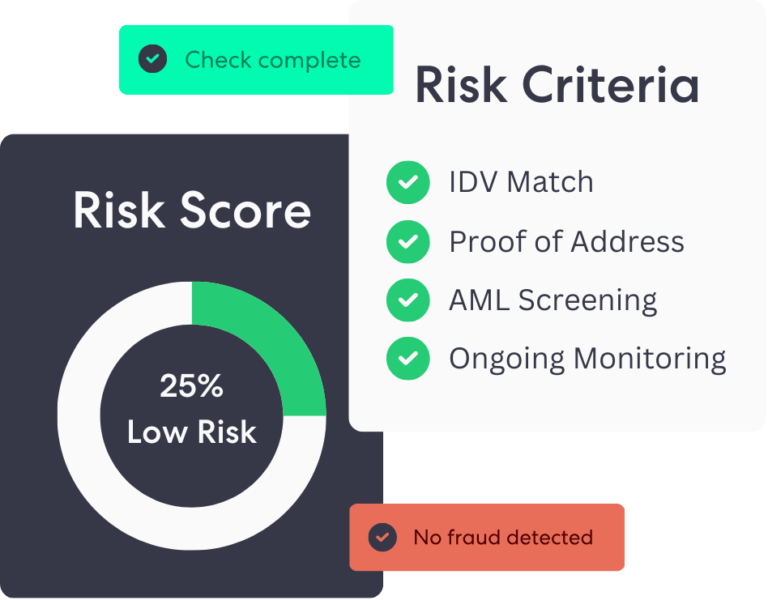

Know Your Business Verification
## Launchpad and Fund Due Diligence
Instill trust in new crypto ventures and validate executives, founders, and investors reliably with our robust suite of KYC and KYB solutions. Ensure compliance and mitigate risks by leveraging our advanced verification technology tailored for launchpads and crypto funds.
For enhanced coverage, including on-chain AML monitoring, transaction screening, and more, view Trust Node Level.
[View Level 2](https://www.complycube.com/en/use-cases/industry/crypto/trust-node-level-2-on-chain-kyc/)
[Recommended solutions](https://www.complycube.com/solutions/due-diligence-compliance/know-your-customer/)
## Recommended solutions
[Real-time continuous monitoring](https://www.complycube.com/solutions/global-screening/continuous-monitoring/) 
### Real-time continuous monitoring
Keep on top of your Ongoing Due Diligence (ODD) obligations with ease, using our continuous monitoring service. You’ll get notified in real-time.
[View solution](https://www.complycube.com/solutions/global-screening/continuous-monitoring/)
[Customer authentication](https://www.complycube.com/solutions/identity-assurance/customer-authentication/) 
### Customer authentication
Limit user access and ensure your products and other customers are secure without adding friction that risks losing your current customers.
[View solution](https://www.complycube.com/solutions/identity-assurance/customer-authentication/)
[Customer due diligence](https://www.complycube.com/solutions/due-diligence-compliance/customer-due-diligence/) 
### Customer due diligence
Whether you need to perform customer due diligence (CDD) or enhanced due diligence (EDD), stay safe with our best-in-class onboarding flows
[View solution](https://www.complycube.com/solutions/due-diligence-compliance/customer-due-diligence/)
[View all solutions](https://www.complycube.com/solutions/)
Numbers that back it up
## Why Complycube?
The ComplyCube platform offers **the most complete and flexible** KYC tools to help you build trust in your business. Whether you’re a startup or a multinational enterprise, we’ve got you covered.
10+ million
Transactions are processed week in and week out across the globe.
200+
Countries and territories supported for a greater peace of mind.
3,000+
Data points from trusted sources and partners across the world, giving you the highest coverage.
95%
Client onboarding rate, helping you convert more customers and grow your business.
---
### [Trust Node Level 2: On-chain KYC](https://www.complycube.com/use-cases/industry/crypto/trust-node-level-2-on-chain-kyc/)
**Published:** July 11, 2024
**Author:** Andreea Balasa
**Content:**
# Trust Node: Level 2 On-chain KYC
Our most complete suite of **crypto KYC solutions**. Comprehensive coverage, from client acquisition to VASP and wallet **transaction screening**. Our **on-chain KYC** package gives your platform the tools to detect fraudulent activity, whatever form it may take.

## Over 70% of laundered crypto funds run through the same 5 exchanges. Prevent your VASP from being a target with on-chain KYC solutions.

### Core Identity Verification
Our robust IDV technologies streamline customer onboarding while producing precise results.

### On-chain AML monitoring
Transaction and VASP screening ensures
users are perpetually vetted at every step of a transfer.

### Comprehensive compliance
Uninterrupted security from every
country, ID, and transaction. Scale with confidence.
## Trusted by big names





Frictionless Client Onboarding
## Autonomous Identity Verification
The crypto market moves fast, and drawn-out client acquisition deters the value your business provides. Our system instantly matches selfies with documents according to customized similarity thresholds, giving you total control over compliance.
- Verification in seconds
- Dependable outcomes
- Minimized client attrition
[View solution](https://www.complycube.com/solutions/identity-assurance/document-verification/)


Powerful AML Checks
## Advanced Customer Due Diligence
Leveraging our suite of AML services, such as Proof of Address with IP verification, geolocation matching, and network spoofing, you can be sure users are accessing your platform in the regions you’re truly licensed in.
Our extensive list of institutional partnerships empowers compliance executives to uncover suspicious individuals quickly.
[View solution](https://www.complycube.com/en/solutions/due-diligence-compliance/customer-due-diligence/)
React to associated risks
## AML Customer Risk Scoring
An intelligent traffic light-inspired risk system delivers clear results that are imperative for punctual responses. Verified data is available with an accompanying audit trail to ensure maximum data accessibility.
- Immediate results
- Actionable insights
- Tailored remedies
[View solution](https://www.complycube.com/en/solutions/due-diligence-compliance/risk-scoring/)


Comprehensive Corporate Verification
## Launchpad and KYB Due Diligence
Build confidence in new projects and investment relationships by validating executives, founders, and investors with our leading **crypto KYC** and KYB solutions.
Contribute to the global crypto economy without fear of non-compliance with our expansive industry coverage.
Advanced VASP Risk Analysis
## Enhanced Risk Scoring
Identify the potential risks associated with communicating with other providers with our VASP and wallet risk scoring infrastructure. By providing a nuanced and holistic risk analysis, get the data necessary to make timely and tailored decisions.
This information is provided in real-time and is continuously on high alert. Our system updates user risk scores as new information becomes available, ensuring your compliance analysts are always one step ahead.


Screen Transactions Around the Clock
## Crypto Transaction Screening
Real-time transaction screening flags transactions that seem suspicious in intent to prevent Anti-Money Laundering breaches.
Global AML regulations are dynamic; flexibility maintains competitiveness. With personalized risk scenarios, your crypto platform can be sure to juggle competitiveness with regulatory compliance.
Monitor On-chain Transactions
## Blockchain Transaction Monitoring
Trust Node Level 2’s robust transaction monitoring infrastructure looks for anomalies, malicious activity, and patterns that suggest dubious behavior, so you can spot the signs of fraud that typical methodologies might miss.
This gives your platform the tools to identify, investigate and take action on users who don’t comply with your risk tolerance or compliance policies.

[Recommended solutions](https://www.complycube.com/solutions/due-diligence-compliance/know-your-customer/)
## Recommended solutions
[Sanctions & PEP screening](https://www.complycube.com/solutions/global-screening/continuous-monitoring/) 
### [Sanctions & PEP screening](https://www.complycube.com/en/solutions/global-screening/sanctions-pep-screening/)
Ensure you know exactly who your users might be transferring to with our advanced sanctions and PEP screening engine.
[View solution](https://www.complycube.com/solutions/identity-assurance/document-verification/)
[Proof of address verification](https://www.complycube.com/solutions/identity-assurance/customer-authentication/) 
### [Proof of address verification](https://www.complycube.com/en/solutions/identity-assurance/address-verification/)
Increase security with frictionless address verification. Ensure that users are using your VASP and related services from licensed regions only.
[View solution](https://www.complycube.com/solutions/identity-assurance/customer-authentication/)
[AML risk scoring](https://www.complycube.com/solutions/due-diligence-compliance/customer-due-diligence/) 
### [AML risk scoring](https://www.complycube.com/en/solutions/due-diligence-compliance/risk-scoring/)
Advanced AML risk scoring is the most sure way of comprehending associated client risks. Make use of every ounce of data available.
[View solution](https://www.complycube.com/solutions/due-diligence-compliance/customer-due-diligence/)
[View all solutions](https://www.complycube.com/solutions/)
Numbers that back it up
## Why Complycube?
The ComplyCube platform offers **the most complete and flexible** KYC tools to help you build trust in your business. Whether you’re a startup or a multinational enterprise, we’ve got you covered.
10+ million
Transactions are processed week in and week out across the globe.
200+
Countries and territories supported for a greater peace of mind.
3,000+
Data points from trusted sources and partners across the world, giving you the highest coverage.
95%
Client onboarding rate, helping you convert more customers and grow your business.
---
### [AML & KYC Research and Development](https://www.complycube.com/company/aml-kyc-research-and-development/)
**Published:** April 24, 2024
**Author:** Andreea Balasa
**Content:**
# Research and development
At ComplyCube, we believe that AML & KYC research and development (R&D) form the bedrock of advancements in digital identity technologies. Our R&D initiatives are geared towards improving our fraud deterrence solution stack, ensuring privacy, and promoting innovation to address the intricate challenges presented by today’s digital landscape.
[ Join us ](https://www.complycube.com/en/company/careers/)





## Our research philosophy
Our approach to research is based on ethical data usage and a dedication to using technology to benefit society. Our goal is to promote innovation in digital identity solutions by merging advanced research with practical applications that prioritize accurate results, user experience, security, and privacy.
## Current projects
We run multiple project streams that cover a variety of areas, from improving biometric verification systems to creating algorithms that minimize bias in identity verification and ensure consistency across different global identity verification schemes. These projects reflect our dedication to setting new standards in the digital identity field.


## Impact and outcomes
Discover the tangible impacts of our research efforts, including improved fraud detection rates, enhanced user experience, and increased trust and safety online. We also highlight how our research contributes to regulatory compliance and influences industry standards.
[Explore our solutions](https://www.complycube.com/solutions/due-diligence-compliance/know-your-customer/)
## Explore our solutions
[Sanctions and PEP screening](https://www.complycube.com/solutions/global-screening/sanctions-pep-screening/) 
### Sanctions and PEP screening
ComplyCube offers extensive access to global anti-money laundering (AML) watchlist resources and adaptable automation tools, making it easier to meet even the toughest regulatory requirements.
[View solution](https://www.complycube.com/solutions/global-screening/sanctions-pep-screening/)
[Real-time continuous monitoring](https://www.complycube.com/solutions/global-screening/continuous-monitoring/) 
### Real-time continuous monitoring
Maintain your Ongoing Due Diligence (ODD) responsibilities effortlessly with our continuous monitoring tool. Receive instant alerts when there’s any change in your customers’ status.
[View solution](https://www.complycube.com/solutions/global-screening/continuous-monitoring/)
[Document Verification](https://www.complycube.com/solutions/identity-assurance/document-verification/) 
### Document Verification
Our document verification service provides a top-tier user experience. Customers love the straightforward instructions and the speed of our verification process.
[View solution](https://www.complycube.com/solutions/identity-assurance/document-verification/)
[Biometric Verification](https://www.complycube.com/solutions/identity-assurance/biometric-verification/) 
### Biometric Verification
Use our biometric checks to confirm that the individual presenting the identity document is present and, indeed, the same person. Our thorough evaluation incorporates both biometric and behavioral metrics to provide the utmost assurance.
[View solution](https://www.complycube.com/solutions/identity-assurance/biometric-verification/)
[Address verification](https://www.complycube.com/solutions/identity-assurance/address-verification/) 
### Address verification
Enhance the quality of your customer data by utilizing our intelligent capture solutions to extract and verify essential information from Proof of Address (PoA) documents, comparing it with client-supplied details and geolocation data.
[View solution](https://www.complycube.com/solutions/identity-assurance/address-verification/)
[Multi-bureau checks](https://www.complycube.com/solutions/identity-assurance/multi-bureau-checks/) 
### Multi-bureau checks
Verify your customer’s data, such as their name, address, date of birth, and identity number, by cross-referencing it with reliable data from government sources, credit reporting agencies, and private databases.
[View solution](https://www.complycube.com/solutions/identity-assurance/multi-bureau-checks/)
---
### [Terms of service](https://www.complycube.com/terms-of-service/)
**Published:** October 27, 2021
**Author:** CC
**Content:**
## OVERVIEW
ComplyCube has developed services (the “Services”), including, without limitation: (a) certain data and software services; (b) the ComplyCube website at: <https://www.complycube.com/>, user interface and documentation as well as any programming fixes, modifications, enhancements, improvements, updates, additions, derivative works and related material (the “Website”); and (c) data, including without limitation third party data, which is made available via the Website (the “Data”).
ComplyCube’s privacy and cookies policies, which are updated from time to time, set out the terms on which ComplyCube uses cookies and processes any personal data it collects from you or that you provide to ComplyCube.
These Terms together with the Privacy and Cookies Policies are the “Agreement”.
By accessing or using the Services, you acknowledge and agree to be bound by the Agreement. If you do not agree to the Agreement you must not use or access the Services.
## DEFINITIONS AND INTERPRETATION
1. Account: means collectively the personal information, Payment Information and credentials used by Users to access Paid Content and / or any communications System on the Website.
2. Content: means any text, graphics, images, audio, video, software, data compilations and any other form of information capable of being stored in a computer that appears on or forms part of this Website;
3. Goods: means any products that ComplyCube advertises and / or makes available for sale through this Website
4. Service: means collectively any online facilities, tools, services or information that we make available through the Website either now or in the future
5. Payment Information: means any details required for the purchase of Goods from this Website. This includes, but is not limited to, credit / debit card numbers, bank account numbers and sort codes;
6. Premises: means Our places of business located at Crown House, 27 Old Gloucester Street, London, United Kingdom, WC1N 3AX;
7. System: means any online communications infrastructure that we make available through the Website either now or in the future. This includes, but is not limited to, web-based email, message boards, live chat facilities and email links;
8. User / Users: means any third party that accesses the Website and is not employed by us and acting in the course of their employment;
9. Website: means the website that you are currently using www.complycube.com
10. We/Us/Our: means ComplyCube, a company registered in England and Wales, whose registered office is at Crown House, 27 Old Gloucester Street, London
## INTELLECTUAL PROPERTY
Unless otherwise expressly indicated, all Intellectual Property rights including, but not limited to, © and Trademarks, in product images and descriptions belong to the manufacturers or distributors of such products as may be applicable.
Subject to the fair use of intellectual property you may not reproduce, copy, distribute, store or in any other fashion re-use such material unless otherwise indicated on the Website or unless given express written permission to do so by the relevant manufacturer or supplier.
## THIRD PARTY INTELLECTUAL PROPERTY
Material from the Website may be re-used without written permission where any of the exceptions detailed in Chapter III of the © Designs and Patents Act 1988 apply.
## FAIR USE OF INTELLECTUAL PROPERTY
Material from the Website may be re-used without written permission where any of the exceptions detailed in Chapter III of the © Designs and Patents Act 1988 apply.
## LINKS TO OTHER WEBSITES
This Website may contain links to other sites. Unless expressly stated, these sites are not under the control of ComplyCube or that of Our affiliates. We assume no responsibility for the content of such websites and disclaim liability for any and all forms of loss or damage arising out of the use of them. The inclusion of a link to another site on this Website does not imply any endorsement of the sites themselves or of those in control of them.
## USE OF COMMUNICATIONS FACILITIES
When using System on the Website you should do so in accordance with the following rules. Failure to comply with these rules may result in your Account being suspended or closed:
1. You must not use obscene or vulgar language;
2. You must not submit Content that is unlawful or otherwise objectionable. This includes, but is not limited to, Content that is abusive, threatening, harassing, defamatory, ageist, sexist or racist;
3. You must not submit Content that is intended to promote or incite violence;
4. It is advised that submissions are made using the English language as We may be unable to respond to enquiries submitted in any other languages;
5. The means by which you identify yourself must not violate these Terms and Conditions or any applicable laws;
6. You must not impersonate other people, particularly employees and representatives of ComplyCube or Our affiliates;
7. You must not use Our System for unauthorised mass-communication such as “spam” or “junk mail”;
8. You acknowledge that we reserve the right to monitor any and all communications made to Us or using Our System;
9. You acknowledge that we may retain copies of any and all communications made to Us or using Our System.
10. You acknowledge that any information you send to Us through Our System may be modified by Us in any way and you hereby waive your moral right to be identified as the author of such information. Any restrictions you may wish to place upon Our use of such information must be communicated to Us in writing, in advance and We reserve the right to reject such terms and associated information.
## PRIVACY
Use of the Website is also governed by our privacy policy which is incorporated into these Terms and Conditions by this reference. To view the Privacy and Cookie Policy, please click on the link above. The Website uses the following cookies. These cookies are used for the purposes described herein. By accepting these Terms and Conditions, you are giving consent to ComplyCube to place cookies on your computer or device. Please read the information contained in the Privacy and Cookie Policy prior to acceptance. Strictly necessary cookies. These are cookies that are required for the operation of Our Website. They include, for example, cookies that enable you to log into secure areas of each of Our Websites, to use our services. Analytical/performance cookies. They allow us to recognise and count the number of visitors and to see how visitors move around Our Website when they are using it. This helps us to improve the way in which Our Website work, for example, by ensuring that users are finding what they are looking for easily. Functionality cookies. These are used to recognise you when you return to any of Our Websites. This enables us to personalise our content for you, greet you by name and remember your preferences (for example, your choice of language or region). Targeting cookies. These cookies record your visit to each of Our Websites, the pages you have visited and the links you have followed. We will use this information to make Our Website more relevant to your interests. If you wish to opt-out of Our placing cookies onto your computer or device, please adjust your internet browsers settings to restrict cookies as detailed in your internet browsers help menu. You may also wish to delete cookies which have already been placed. For instructions on how to do this, please consult your internet browser’s help menu.
## HOW WE USE YOUR PERSONAL INFORMATION (DATA PROTECTION)
All personal information that We may collect (including, but not limited to, your name and address) will be collected, used and held in accordance with the provisions of the Data Protection Act 1998 and your rights under that In order to operate the Services and Site, the Company may collect personally identifiable information from users in a variety of ways. Personally identifiable information may include, without limitation: (i) contact data; or (ii) other information requested by the Company. If you communicate with the Company by e-mail or otherwise, transmit information to the Site, provide information outside of the account registration process, or otherwise interact with or use the features on the Site, any information you provide may be collected by the Company. The Company collects personally identifiable information that both individuals and entities choose to provide to us, as permitted by law and necessary to perform our Services and prepare Reports.
## MONETIZATION STATEMENT
As the data processor, ComplyCube does not charge end users for its services. This is the responsibility and at the discretion of the data controller.
## DISCLAIMERS
We make no warranty or representation that the Website will meet your requirements, that it will be of satisfactory quality, that it will be fit for a particular purpose, that it will not infringe the rights of third parties, that it will be compatible with all systems, that it will be secure and that all information provided will be accurate. We make no guarantee of any specific results from the use of Our services. No part of this Website is intended to constitute advice and the Content of this Website should not be relied upon when making any decisions or taking any action of any kind. No part of this Website is intended to constitute a contractual offer capable of acceptance. Whilst We use all reasonable endeavours to ensure that the Website is secure and free of errors, viruses and other malware, you are strongly advised to take responsibility for your own internet security, that of your personal details and your computers.
## CHANGES TO THE SERVICE AND THESE TERMS AND CONDITIONS
We reserve the right to change the Website, its Content or these Terms and Conditions at any time. You will be bound by any changes to the Terms and Conditions from the first time you use the Website following the changes. If We are required to make any changes to these Terms and Conditions pertaining to the sale of Goods by law, these changes will apply automatically to any orders currently pending in addition to any orders placed by you in the future.
## AVAILABILITY OF THE WEBSITE
The Website and any Service provided therein is provided “as is” and on an “as available” basis. We give no warranty that the Website or any Service will be free of defects and / or faults. To the maximum extent permitted by the law We provide no warranties (express or implied) of fitness for a particular purpose, accuracy of information, compatibility and satisfactory quality. We accept no liability for any disruption or non-availability of the Website resulting from external causes including, but not limited to, ISP equipment failure, host equipment failure, communications network failure, power failure, natural events, acts of war or legal restrictions and censorship.
## LIMITATION OF LIABILITY
To the maximum extent permitted by law, We accept no liability for any direct or indirect loss or damage, foreseeable or otherwise, including any indirect, consequential, special or exemplary damages arising from the use of the Website or any information contained therein. You should be aware that you use the Website and its Content at your own risk. Nothing in these Terms and Conditions excludes or restricts our liability for death or personal injury resulting from any negligence or fraud on the part of us. Nothing in these Terms and Conditions excludes or restricts our liability for any direct or indirect loss or damage arising out of the incorrect delivery of Goods or out of reliance on incorrect information included on the Website. In the event that any of these terms are found to be unlawful, invalid or otherwise unenforceable, that term is to be deemed severed from these Terms and Conditions and shall not affect the validity and enforceability of the remaining Terms and Conditions. This term shall apply only within jurisdictions where a particular term is illegal.
## NO WAIVER
In the event that any party to these Terms and Conditions fails to exercise any right or remedy contained herein, this shall not be construed as a waiver of that right or remedy.
## PREVIOUS TERMS AND CONDITIONS
In the event of any conflict between these Terms and Conditions and any prior versions thereof, the provisions of these Terms and Conditions shall prevail unless it is expressly stated otherwise.
## COMMUNICATIONS
All notices / communications shall be given to Us either by post to Our Premises (see address above). Such notice will be deemed received three days after posting if sent by first class post, the day of sending if the email is received in full on a business day and on the next business day if the email is sent on a weekend or public holiday. We may from time to time, if you opt to receive it, send you information about Our products and/or services. If you do not wish to receive such information, please click on the Unsubscribe link on any email you receive from us.
## LAW AND JURISDICTION
These Terms and Conditions and the relationship between you and us shall be governed by and construed in accordance with the Laws of the United Kingdom and both we and you agree to submit to the exclusive jurisdiction of the Courts of the United Kingdom.
## HOW WE USE COOKIES
Our site (http://www.complycube.com) uses cookies to distinguish you from other users of our site. A cookie is a small file which asks permission to be placed on your computer’s hard drive. Once you agree, the file is added and the cookie helps analyse web traffic or lets you know when you visit a particular site. Cookies allow web applications to respond to you as an individual, therefore providing a good experience whilst at the same time allowing us to improve our site. The web application can tailor its operations to your needs, likes and dislikes by gathering and remembering information about your preferences.
We use traffic log cookies to identify which pages are being used. This helps us analyse data about web page traffic and improve our website in order to tailor it to customer needs. We only use this information for statistical analysis purposes and then the data is removed from the system.
Overall, cookies help us provide you with a better website, by enabling us to monitor which pages you find useful and which you do not. A cookie in no way gives us access to your computer or any information about you, other than the data you choose to share with us. By accessing our site, you are consenting to us using cookies on your system. Most web browsers automatically accept cookies, but you can usually modify your browser setting to decline cookies if you prefer. This will prevent you from taking full advantage of the website.
## TYPES OF COOKIES
Cookies fall into any of four categories:
- Strictly necessary, which are required for the site’s essential functions to work properly.
- Performance cookies, which allow us to analyse how the site is used in order to improve it. These cookies contain no personal information that identifies a visitor, and all information collected is aggregated and therefore anonymous. By using our site, you agree that we can place these types of cookies on your device.
- Functionality necessary, which allow the website to remember choices that you make, such as user name, language, etc. These cookies do not allow your browsing activity on other sites to be tracked by ComplyCube. When you choose to allow your browser to remember your login details, you agree that we can place these types of cookies on your device.
- Targeting necessary, which are used to deliver adverts more relevant to the user and their interests. For logged in users, there are no ads served at all, so these cookies only apply to logged-out visitors.
## CONTROL OVER COOKIES
You can block cookies by activating the setting on your browser that allows you to refuse the setting of all or some cookies. However, if you use your browser settings to block all cookies (including essential cookies) you may not be able to access all or parts of our site.
---
### [Sensitive Data Redaction](https://www.complycube.com/solutions/due-diligence-compliance/know-your-customer/pii-sensitive-data-redaction/)
**Published:** October 2, 2023
**Author:** Andreea Balasa
**Excerpt:** Our advanced Liveness Detection system verifies the genuine presence of a user by distinguishing real individuals from fraudulent attempts, ensuring secure authentication and identity verification.
**Content:**
# Sensitive Data Redaction
Our PII Redaction engine diligently scans and shields Personal Identifiable Information (PII) by automatically masking sensitive data fields and images. Designed to comply with international privacy standards, our data redaction technology ensures that sensitive information remains confidential, reinforcing trust and compliance across diverse jurisdictions.
[ Start now ](https://portal.complycube.com/signup)
[ Contact us ](#)



## Align data privacy with regulatory standards using data redaction
As the digital sphere grapples with nuanced data vulnerabilities and intricate cyber-attacks, safeguarding PII data fields such as the Dutch BSN number and Singaporean NRIC is essential. Leveraging the prowess of our AI redaction layer, we obscure sensitive identifiers, enhancing data confidentiality. This rigorous data redaction approach ensures adherence to international mandates and minimizes exposure to cyber risks.

### Seamless Onboarding with Omni-channel Integration
Easily integrate through our SDKs, no-code solution, and Web Portal to ensure a secure customer onboarding process.

### Harnessing AI for Advanced Data Redaction
Our state-of-the-art algorithm employs ML & AI to scan and redact sensitive personal data, ensuring its protection in real time.

### Flawless UX & Efficient Data Redaction
Offer a great user experience with minimal friction, ensuring sensitive data is concealed without compromising usability.
## Tailored Redaction Capabilities
We offer flexible redaction solutions, covering face and document redaction for comprehensive data protection.
For **face redaction**, our system automatically ensures compliance by concealing sensitive content, whether it’s for age verification or other regulatory requirements. The redacted image is not stored.
**Document redaction** operates seamlessly in the background, automatically masking critical data based on jurisdictional regulations, ensuring compliance while safeguarding data privacy.



Numbers that back it up
## Why Complycube?
The ComplyCube platform offers **the most complete, flexible, and top-rated** KYC solutions to help you build trust in your business. Whether you’re a startup or a multinational enterprise, we’ve got you covered.
[ Contact us ](#)
10+ million
Transactions are processed week in and week out across the globe.
220+
Countries and territories supported for a greater peace of mind.
3,000+
Data points from trusted sources and partners across the world, giving you the highest coverage.
98%
Client onboarding rate, helping you convert more customers and grow your business.

### Fraud mitigation
We partner with banks and regulated industries to combat fraud, safeguarding financial assets while preserving a seamless customer experience.

### Privacy Focus
Our secure and fully hosted remote verification service prioritizes privacy, eliminating the need for risky practices like sharing PII data via email for customer onboarding.


## Automated Image Redaction software
We implement field redaction and data masking during document image capture, ensuring that all representations of fields, even when encoded within QR codes, are redacted from the document. This includes the **Visual Inspection Zone (VIZ)**, **Machine Readable Zone (MRZ)**, and **barcodes**.
ComplyCube automatically enforces end-to-end redaction to ensure global compliance. Examples of sensitive fields include but are not limited to:
- **Dutch BSN:** Burgerservicenummer or Dutch Citizen Service Number
- **Singaporean NRIC:** National Registration Identity Card Number
- **Korean RRN:** Resident Registration Number
## ID Document Verification
ComplyCube rigorously assesses various ID documents using AI-powered technology, checking for potential issues such as compromise, forgery, internet duplication, expiration, and blacklisting.
Additionally, our document redaction tool employs cutting-edge techniques to protect sensitive data within our list of supported document types such as passports, travel documents, licenses, identity cards, permits, and visa stamps.
[View solution](https://www.complycube.com/en/solutions/identity-assurance/document-verification)




## Age Estimation Checks
Optimize age-restricted services with ComplyCube’s seamless age estimation checks. By harnessing facial age estimation and liveness detection from a single selfie, we provide you with the tools to confidently cater to your customers, ensuring the protection of minors, all without the necessity of ID documents for age verification.
Enhance your data protection with our customizable age threshold configuration. Seamlessly integrate automatic redaction to safeguard sensitive information, further fortifying your compliance and privacy measures.
[View solution](https://www.complycube.com/en/solutions/identity-assurance/document-verification)
## Frequently asked questions
[Explore other solutions](https://www.complycube.com/solutions/due-diligence-compliance/know-your-customer/)
## Explore other solutions
[Biometric Verification](https://www.complycube.com/solutions/global-screening/watchlist-screening/) 
### ### Biometric Verification
Leverage our powerful biometric verifications to effortlessly confirm the authenticity and presence of your customers during transactions. Secure your business effortlessly.
[View solution](https://www.complycube.com/en/solutions/identity-assurance/biometric-verification/ "Watchlist screening")
[Customer Authentication](https://www.complycube.com/solutions/global-screening/adverse-media-checks/) 
### ### Customer Authentication
Securely and reliably validate your customers’ identities prior to granting them access with our state-of-the-art multi-point biometric matching technology.
[View solution](https://www.complycube.com/en/solutions/identity-assurance/customer-authentication/ "Adverse media checks")
[Multi-bureau Checks](https://www.complycube.com/solutions/global-screening/continuous-monitoring/) 
### Multi-bureau Checks
Verify customer details such as name, date of birth, and social security number by cross-checking them against trustworthy databases like government archives and credit agencies.
[View solution](https://www.complycube.com/en/solutions/identity-assurance/customer-authentication/ "Continuous monitoring")
[View all solutions](https://www.complycube.com/solutions/)
---
### [Contact](https://www.complycube.com/contact/)
**Published:** October 27, 2021
**Author:** CC
**Content:**
# Contact us
Get in touch and let us know how we can help.

## Sales
We’d love to talk to you about how we can work together.
[ Contact sales ](https://www.complycube.com/contact/contact-sales/)

## Support
We’re here to help with any questions, API, or code queries.
[ Get support ](https://support.complycube.com/hc/en-gb/requests/new)

## Press & Media
Press/media inquiries
<media@complycube.com>
Non-media inquiries
<hello@complycube.com>
## General questions
---
### [UX specialists](https://www.complycube.com/use-cases/profession/ux-specialists/)
**Published:** October 27, 2021
**Author:** CC
**Content:**
# UX specialists
Design the perfect journey with accessibility and user experience (UX) at the forefront of our component design. At ComplyCube we work with you to create the right KYC journey for your customers using our AML tools stack.




## 70% of customers abandon journeys due to bad UX. Companies lose $62 billion every year due to poor customer service.
## Trusted by big names






### Customisable KYC components
We provide a customizable KYC solution that you can tailor to your business needs.

### Omni-channel
Our AML & KYC services are available across all major systems, including iOS, iPad OS, and Android.

### Fully compliant
Trust our integration to meet your business’s compliance requirements globally.
Document capture for all
## Guided document verification
Our services have been designed to be accessible to all. Using our components, you will be able to create user journeys that guide your customers step-by-step for the perfect document capture.
Not only do your customers enjoy a better user experience by using our assisted capture components. But your compliance teams will have fewer false positives to review.
[View solution](https://www.complycube.com/solutions/identity-assurance/document-verification/)







third party data verification
## Multiple checks completed in seconds
Once your customers have completed registering with your business. You can verify all the information provided by your customer with third parties instantly. The results of these third party checks, allow you to orchestrate different enhanced due diligence paths for your customer.
[View solution](https://www.complycube.com/solutions/identity-assurance/multi-bureau-checks/)
compliance user journeys
## Improve operational user experiences
The customer journey is not the only journey that needs to be streamlined. Not only does our no-code solution provides an easy-to-use investigative platform. We also expose all the APIs we use to allow you to orchestrate operational investigations from within your compliance team’s tool of choice.
[View solution](https://www.complycube.com/solutions/due-diligence-compliance/case-management/)





[Recommended solutions](https://www.complycube.com/solutions/due-diligence-compliance/know-your-customer/)
## Recommended solutions
[Know Your Customer](https://www.complycube.com/solutions/due-diligence-compliance/know-your-customer/) 
### Know Your Customer
Deter fraudsters without adding unnecessary friction to genuine customers using our smart and configurable identity verification checks
[View solution](https://www.complycube.com/solutions/due-diligence-compliance/know-your-customer/)
[Sanctions and PEP screening](https://www.complycube.com/solutions/global-screening/sanctions-pep-screening/) 
### Sanctions and PEP screening
ComplyCube’s comprehensive coverage of global AML watchlist sources and flexible automation features ensures that you comply with the most stringent regulations.
[View solution](https://www.complycube.com/solutions/global-screening/sanctions-pep-screening/)
[Real-time continuous monitoring](https://www.complycube.com/solutions/global-screening/continuous-monitoring/) 
### Real-time continuous monitoring
Keep on top of your Ongoing Due Diligence (ODD) obligations with ease, using our continuous monitoring service. You’ll get notified in real-time should your customers’ status change.
[View solution](https://www.complycube.com/solutions/global-screening/continuous-monitoring/)

### Application fraud prevention
We promote application fraud prevention in banks, helping to reduce losses. This is all done without impacting customer experience.
[View solution](#)

### Transactional fraud and monitoring
Anti-money laundering in banking is essential. Flag and monitor inconsistent and potentially criminal financial activity in real time.
[View solution](#)
Numbers that back it up
## Why Complycube?
The ComplyCube platform offers **the most complete and flexible** KYC tools to help you build trust in your business. Whether you’re a startup or a multinational enterprise, we’ve got you covered.
10+ million
Transactions are processed week in and week out across the globe.
200+
Countries and territories supported for a greater peace of mind.
3,000+
Data points from trusted sources and partners across the world, giving you the highest coverage.
95%
Client onboarding rate, helping you convert more customers and grow your business.
---
### [Chief technical officers](https://www.complycube.com/use-cases/profession/chief-technical-officers/)
**Published:** October 27, 2021
**Author:** CC
**Content:**
# Chief technical officers
Strong KYC/AML controls without operational overhead need innovative technical solutions. Achieve regulatory compliance without sacrificing your commercial effectiveness with the ComplyCube AML/KYC compliance software.



## An estimated $37 billion is spent globally on AML/KYC technology and operations. With this number set to grow by over 10% year on year.
## Trusted by big names






### Accessible user experience
We offer drop-in components, which are accessible by all to streamline your KYC journeys.

### Omni-channel
Our AML & KYC services are available across all major systems, including iOS, iPad OS, Android, and Chrome.

### Fully compliant
Our solutions give you information security and global data regulation peace of mind.
state of the art biometrics
## Forget passwords, embrace biometrics
As the owner of your firm’s technical strategy, you are responsible for staying ahead of the curve. With large hacks and data breaches becoming commonplace, secure biometrics gives you that edge.
Secure your customer journeys while reducing drop-out and fraud by integrating our highly accurate face matching and certified liveness.
[View solution](https://www.complycube.com/solutions/identity-assurance/biometric-verification/)






Identity Data Verification
## Collect and verify customer details
For any business, speed is critical in beating the competition. How fast your services respond can dictate your business agility. Build verified customer profiles using our real-time checks to verify a client’s name, address, date of birth, tax number (SSN etc) and more with trusted third parties.
[View solution](https://www.complycube.com/solutions/identity-assurance/multi-bureau-checks/)
Seamless CRM integration
## Client Relationship Management Integration
The customer journey is not the only journey that needs to be streamlined. Not only does our no-code solution provides an easy-to-use investigative platform. We also expose all the APIs we use to allow you to orchestrate operational investigations from within your compliance team’s tool of choice.
[View solution](https://www.complycube.com/solutions/due-diligence-compliance/case-management/)






### Application fraud prevention
We promote application fraud prevention in banks, helping to reduce losses. This is all done without impacting customer experience.
[View solution](#)

### Transactional fraud and monitoring
Anti-money laundering in banking is essential. Flag and monitor inconsistent and potentially criminal financial activity in real time.
[View solution](#)
[Explore other solutions](https://www.complycube.com/solutions/due-diligence-compliance/know-your-customer/)
## Explore other solutions
[Real-time continuous monitoring](https://www.complycube.com/solutions/global-screening/continuous-monitoring/) 
### Real-time continuous monitoring
Keep on top of your Ongoing Due Diligence (ODD) obligations with ease, using our continuous monitoring service, you’ll get notified in real-time.
[View solution](https://www.complycube.com/solutions/global-screening/continuous-monitoring/)
[Global Screening](https://www.complycube.com/solutions/global-screening/sanctions-pep-screening/) 
### Global Screening
Leverage our advanced screening capabilities to prevent bad actors from accessing your platform and performing illegal activities.
[View solution](https://www.complycube.com/solutions/global-screening/sanctions-pep-screening/)
[Watchlist Screening](https://www.complycube.com/solutions/global-screening/watchlist-screening/) 
### Watchlist Screening
ComplyCube’s comprehensive coverage of global AML watchlist sources and flexible automation features ensures that you comply regulations.
[View solution](https://www.complycube.com/solutions/global-screening/watchlist-screening/)
Numbers that back it up
## Why Complycube?
The ComplyCube platform offers **the most complete and flexible** KYC tools to help you build trust in your business. Whether you’re a startup or a multinational enterprise, we’ve got you covered.
10+ million
Transactions are processed week in and week out across the globe.
200+
Countries and territories supported for a greater peace of mind.
3,000+
Data points from trusted sources and partners across the world, giving you the highest coverage.
95%
Client onboarding rate, helping you convert more customers and grow your business.
---
### [Product managers](https://www.complycube.com/use-cases/profession/product-managers/)
**Published:** October 27, 2021
**Author:** CC
**Content:**
# Product managers
Design your product from the ground up with **compliance built-in**. **Reduce overheads** and **catch fraud** by embedding our AML/KYC tools and services as part of your core flows.



## Over 1 in 3 customers abandon onboarding processes out of sheer frustration. The most cited cause is the number of steps required.
## Trusted by big names






### Frictionless products
Execute a series of checks completely automatically with our drop in solutions.

### Fully configurable
Configure our AML risk scoring solution to fit your use cases.

### Privacy centric
We provide tools that adhere to local data regulations worldwide.
Identity Document Verification
## Assisted document capture
To remain competitive, you must be able to provide an accessible journey. Our advanced document capture services provide step-by-step guidance for the perfect capture. This ensures you get the highest quality for your KYC processes and your product is accessible to all demographics.
[View solution](https://www.complycube.com/solutions/identity-assurance/document-verification/)






Advanced biometrics
## Accessible, easy and secure biometrics
Take digital identity verification to the next level by verifying the person presenting the identity document with the identity.
Complycube checks and compares a potential customer’s ID with their actual characteristics and physical measurements so you can trust they are who they say they are.
[View solution](https://www.complycube.com/solutions/identity-assurance/biometric-verification/)
Address verification
## Biometric customer reauthentication
Build the product of the future. Ditch passwords and activation codes. Secure your services using the physical and behavioral characteristics of your customer’s biometrics.
We provide you with a suite of tools that let you enroll customer biometrics at onboarding and seamlessly reuse their biometrics for access throughout their business relationship with you.
[View solution](#)





### Application fraud prevention
We promote application fraud prevention in banks, helping to reduce losses. This is all done without impacting customer experience.
[View solution](#)

### Transactional fraud and monitoring
Anti-money laundering in banking is essential. Flag and monitor inconsistent and potentially criminal financial activity in real time.
[View solution](#)
[Explore other solutions](https://www.complycube.com/solutions/due-diligence-compliance/know-your-customer/)
## Explore other solutions
[Risk Scoring](https://www.complycube.com/solutions/due-diligence-compliance/risk-scoring/) 
### Risk Scoring
Our risk engine applies proprietary algorithms to calculate an AML risk score for your customers and presents you with a simple low, medium, or high score.
[View solution](https://www.complycube.com/solutions/due-diligence-compliance/risk-scoring/)
[Know Your Client](https://www.complycube.com/solutions/due-diligence-compliance/know-your-customer/) 
### Know Your Client
Deter fraudsters without adding unnecessary friction to genuine customers using our smart and configurable identity verification checks
[View solution](https://www.complycube.com/solutions/due-diligence-compliance/know-your-customer/)
[Multi-bureau checks](https://www.complycube.com/solutions/identity-assurance/multi-bureau-checks/) 
### Multi-bureau checks
Instantly verify customer details, such as name, address, DOB, and social security numbers
[View solution](https://www.complycube.com/solutions/identity-assurance/multi-bureau-checks/)
Numbers that back it up
## Why Complycube?
The ComplyCube platform offers **the most complete and flexible** KYC tools to help you build trust in your business. Whether you’re a startup or a multinational enterprise, we’ve got you covered.
10+ million
Transactions are processed week in and week out across the globe.
200+
Countries and territories supported for a greater peace of mind.
3,000+
Data points from trusted sources and partners across the world, giving you the highest coverage.
95%
Client onboarding rate, helping you convert more customers and grow your business.
---
### [Easy KYC API for rapid delivery](https://www.complycube.com/use-cases/profession/developers/)
**Published:** October 27, 2021
**Author:** CC
**Content:**
# Easy KYC API for rapid delivery
Our KYC API, SDKs, and hosted solutions give you the tools to deliver the most effective integration for your technology stack. Automate your processes with webhooks and our asynchronous events.



## Financial institutions can take up to 24 days to complete manual processes for customer onboarding.
## Trusted by big names






### Omni-channel support
Despite implementing more comprehensive identity and bank validation checks, our solutions allow for a quick, easy and frictionless user experience.

### Fast and easy integration
We provide SDKs, no-code, and low-code solutions so you can quickly and easily integrate our services into any tech architecture your use.

### Fully compliant
Trust our integration to meet your business’s compliance requirements and deliver on your business’s information security needs.
selfie biometric analysis
## Camera SDKs for Selfies
A customer journey that takes minimal interaction but gains maximum data is the ideal scenario. That’s why our biometric liveness solution is designed to be able to execute against just a selfie.
We provide SDKs that give you optimised camera capture screens with popup guidance.
[View solution](https://www.complycube.com/solutions/identity-assurance/biometric-verification/)








government Data Verification
## Corroborate customer data
Not only do we have drop-in SDKs these are backed by our easy-to-use API. On creating a client record you can immediately request client data (name, date of birth, address, SSN) corroboration with third parties (governments, bureaus, reference agencies).
Our event-based platform then informs your webhooks letting you execute the enhanced due diligence process you would like to do based on the responses provided.
[View solution](https://www.complycube.com/solutions/identity-assurance/multi-bureau-checks/)
Identity Data Verification
## Guided document capture
To remain competitive, you must be able to provide an accessible journey. Our advanced document capture services offer step-by-step guidance for the perfect capture. This ensures you get the highest quality for your KYC processes, and your product is accessible to all demographics.
[View solution](https://www.complycube.com/solutions/identity-assurance/document-verification/)




### Application fraud prevention
We promote application fraud prevention in banks, helping to reduce losses. This is all done without impacting customer experience.
[View solution](#)

### Transactional fraud and monitoring
Anti-money laundering in banking is essential. Flag and monitor inconsistent and potentially criminal financial activity in real time.
[View solution](#)
[Explore other solutions](https://www.complycube.com/solutions/due-diligence-compliance/know-your-customer/)
## Explore other solutions
[Real-time continuous monitoring](https://www.complycube.com/solutions/global-screening/continuous-monitoring/) 
### Real-time continuous monitoring
Keep on top of your Ongoing Due Diligence (ODD) obligations with ease, using our continuous monitoring service. You’ll get notified in real-time should your customers’ status change.
[View solution](https://www.complycube.com/solutions/global-screening/continuous-monitoring/)
[Sanctions and PEP screening](https://www.complycube.com/solutions/global-screening/sanctions-pep-screening/) 
### Sanctions and PEP screening
ComplyCube’s comprehensive coverage of global AML watchlist sources and flexible automation features ensures that you comply with the most stringent regulations.
[View solution](https://www.complycube.com/solutions/global-screening/sanctions-pep-screening/)
[Biometric Verification](https://www.complycube.com/solutions/identity-assurance/biometric-verification/) 
### Biometric Verification
Use our advanced biometric checks to verify the person presenting the identity document is the same individual. Our comprehensive analysis uses biometric and behavioral vectors to give you the highest level of assurance.
[View solution](https://www.complycube.com/solutions/identity-assurance/biometric-verification/)
Numbers that back it up
## Why Complycube?
The ComplyCube platform offers **the most complete and flexible** KYC tools to help you build trust in your business. Whether you’re a startup or a multinational enterprise, we’ve got you covered.
10+ million
Transactions are processed week in and week out across the globe.
200+
Countries and territories supported for a greater peace of mind.
3,000+
Data points from trusted sources and partners across the world, giving you the highest coverage.
95%
Client onboarding rate, helping you convert more customers and grow your business.
---
### [Industry](https://www.complycube.com/use-cases/industry/)
**Published:** October 27, 2021
**Author:** CC
**Content:**
# Industry
Find out more about our individual AML & KYC solutions.
## For your sector
Our services provide assurances across multiple regulated sectors. Thanks to our in-house industry specialists, we can help you achieve complete compliance without compromising commercial effectiveness.
[Financial Services](https://www.complycube.com/use-cases/industry/financial-services/) 
### Financial Services
Onboard your customers in under 30 seconds with our UX-optimised and beautiful UIs, without compromising due diligence.
[View solution](https://www.complycube.com/use-cases/industry/financial-services/)
[Telcoms](https://www.complycube.com/use-cases/industry/telcoms/) 
### Telcoms
ComplyCube enables mobile network operators (MNOs) to meet subscriber registration regulatory commitments in no time.
[View solution](https://www.complycube.com/use-cases/industry/telcoms/)
[Healthcare](https://www.complycube.com/use-cases/industry/healthcare/) 
### Healthcare
With distanced medical access comes more significant challenges. We help you achieve strict compliance, detect drug frauds and provide a potentially life-changing user experience,
[View solution](https://www.complycube.com/use-cases/industry/healthcare/)
[Crypto](https://www.complycube.com/use-cases/industry/crypto/) 
### Crypto
As the world rapidly embraces virtual asset service providers (VASPs), crypto regulation follows quickly behind. Use our AML/KYC services to legitimize your business ahead of the curve.
[View solution](https://www.complycube.com/solutions/global-screening/continuous-monitoring/)
[Property](https://www.complycube.com/use-cases/industry/property/) 
### Property
Regulations require estate agents and real estate consultants to complete KYC/AML checks on prospective buyers/sellers. A smooth transaction translates to client recommendations.
[View solution](https://www.complycube.com/use-cases/industry/property/)
[Payments](https://www.complycube.com/use-cases/industry/payments/) 
### Payments
Streamline your onboarding processes through PCI compliant smart capture data techniques, while also successfully detecting fraud, preventing money laundering and remaining 100% secure
[View solution](https://www.complycube.com/use-cases/industry/payments/)
[FinTech](https://www.complycube.com/use-cases/industry/fintech/) 
### FinTech
ComplyCube’s comprehensive coverage of global AML watchlist sources and flexible automation features ensures that you comply with the most stringent regulations.
[View solution](https://www.complycube.com/use-cases/industry/fintech/)
[eCommerce](https://www.complycube.com/use-cases/industry/ecommerce/) 
### eCommerce
Monitor transacting parties in real-time to rapidly detect and prevent fraud. Stop synthetic accounts and fraudulent transactions impacting your revenue with our KYC/AML solutions.
[View solution](https://www.complycube.com/use-cases/industry/ecommerce/)
---
### [Apply to ComplyCube's Startup Program](https://www.complycube.com/company/startup-program/application-form/)
**Published:** May 17, 2022
**Author:** CC
**Content:**
# Apply to ComplyCube's startup program
Fill out the form, and we’ll be in touch as soon as possible.
First name
Last name
Position
Contact number
Company name
Incorporation date
Funding status
Please select... None VC-backed Accelerator-backed Angel investors Government grant Founder-bootstrapped Mixed
Country
Please select... Afghanistan Albania Algeria Andorra Angola Antigua & Deps Argentina Armenia Australia Austria Azerbaijan Bahamas Bahrain Bangladesh Barbados Belarus Belgium Belize Benin Bhutan Bolivia Bosnia Herzegovina Botswana Brazil Brunei Bulgaria Burkina Burundi Cambodia Cameroon Canada Cape Verde Central African Rep Chad Chile China Colombia Comoros Congo Congo {Democratic Rep} Costa Rica Croatia Cuba Cyprus Czech Republic Denmark Djibouti Dominica Dominican Republic East Timor Ecuador Egypt El Salvador Equatorial Guinea Eritrea Estonia Ethiopia Fiji Finland France Gabon Gambia Georgia Germany Ghana Greece Grenada Guatemala Guinea Guinea-Bissau Guyana Haiti Honduras Hungary Iceland India Indonesia Iran Iraq Ireland {Republic} Israel Italy Ivory Coast Jamaica Japan Jordan Kazakhstan Kenya Kiribati Korea North Korea South Kosovo Kuwait Kyrgyzstan Laos Latvia Lebanon Lesotho Liberia Libya Liechtenstein Lithuania Luxembourg Macedonia Madagascar Malawi Malaysia Maldives Mali Malta Marshall Islands Mauritania Mauritius Mexico Micronesia Moldova Monaco Mongolia Montenegro Morocco Mozambique Myanmar, {Burma} Namibia Nauru Nepal Netherlands New Zealand Nicaragua Niger Nigeria Norway Oman Pakistan Palau Panama Papua New Guinea Paraguay Peru Philippines Poland Portugal Qatar Romania Russian Federation Rwanda St Kitts & Nevis St Lucia Saint Vincent & the Grenadines Samoa San Marino Sao Tome & Principe Saudi Arabia Senegal Serbia Seychelles Sierra Leone Singapore Slovakia Slovenia Solomon Islands Somalia South Africa South Sudan Spain Sri Lanka Sudan Suriname Swaziland Sweden Switzerland Syria Taiwan Tajikistan Tanzania Thailand Togo Tonga Trinidad & Tobago Tunisia Turkey Turkmenistan Tuvalu Uganda Ukraine United Arab Emirates United Kingdom United States Uruguay Uzbekistan Vanuatu Vatican City Venezuela Vietnam Yemen Zambia Zimbabwe
Website
Work email
Total money raised
Expected volume
Please select... 0 to 100 checks per annum 101 to 1,000 checks per annum 1,001 to 10,000 checks per annum 10,001 to 100,000 checks per annum 100,001 to 1,000,000 checks per annum 1,000,000+ checks per annum
About your business
Sign me up to receive news, product updates, event information, and special offers from ComplyCube. I understand my personal data will be processed in accordance with ComplyCube's [Privacy Policy](/privacy-policy/).
Send message
## General questions
---
### [Thank you](https://www.complycube.com/contact/contact-sales/thank-you/)
**Published:** March 28, 2022
**Author:** CC
**Content:**
# Contact our sales team
Our team is happy to answer your sales questions.
Fill out the form and we’ll be in touch as soon as possible.
**Thank you for contacting us!**
We will reach out soon.
## General questions
---
### [Thank you](https://www.complycube.com/company/startup-program/application-form/thank-you/)
**Published:** May 18, 2022
**Author:** CC
**Content:**
# Apply to ComplyCube's startup program
We’ve received your application form.
**Thank you for contacting us!**
We will reach out soon.
## General questions
---
### [Profession](https://www.complycube.com/use-cases/profession/)
**Published:** October 27, 2021
**Author:** CC
**Content:**
# Profession
Find out more about our individual solutions.
## Built for you
Our services boast global coverage, innovative technology, and comprehensive data sources, giving the best peace of mind whatever your role.
[Money Laundering Reporting Officer](https://www.complycube.com/use-cases/profession/money-laundering-officers/) 
### Money Laundering Reporting Officer
Achieve automation with maximum controls and fine-grained configurability by using our services for our anti-money laundering (AML) procedures.
[View role](https://www.complycube.com/use-cases/profession/money-laundering-officers/)
[Compliance Manager](https://www.complycube.com/use-cases/profession/compliance-managers/) 
### Compliance Manager
Throughout the customer experience, our end-to-end fraud and compliance risk management platform provide quick and precise judgments.
[View role](https://www.complycube.com/use-cases/profession/compliance-managers/)
[Customer onboarding specialists](https://www.complycube.com/use-cases/profession/customer-onboarding-specialists/) 
### Customer onboarding specialists
Streamline your onboarding processes through smart capture data techniques, while also successfully detecting fraud, preventing money laundering and remaining 100% compliant.
[View role](https://www.complycube.com/use-cases/profession/customer-onboarding-specialists/)
[Fraud Analysts](https://www.complycube.com/use-cases/profession/fraud-analysts/) 
### Fraud Analysts
Find fraud fast with detailed association analysis and clear breakdowns for risk scores. Make decisions faster and protect your customers from nefarious actors.
[View role](https://www.complycube.com/use-cases/profession/fraud-analysts/)
[Developers](https://www.complycube.com/use-cases/profession/developers/) 
### Developers
Our APIs, SDKs, and hosted solutions give you the tools to deliver the most effective integration for your technology stack. Automate your processes with async webhook events.
[View role](https://www.complycube.com/use-cases/profession/developers/)
[Product Managers](https://www.complycube.com/use-cases/profession/product-managers/) 
### Product Managers
Build in Ongoing Due Diligence (ODD) obligations, using our continuous monitoring and smart capture techniques, for accurate verification and automation.
[View role](https://www.complycube.com/use-cases/profession/product-managers/)
[Chief Technical Officers](https://www.complycube.com/use-cases/profession/chief-technical-officers/) 
### Chief Technical Officers
Strong KYC/AML controls without operational overhead need innovative technical solutions. Achieve regulatory compliance without sacrificing your commercial effectiveness.
[View role](https://www.complycube.com/use-cases/profession/chief-technical-officers/)
[UX Specialists](https://www.complycube.com/use-cases/profession/ux-specialists/) 
### UX Specialists
Streamline your onboarding processes with UX-optimized data components and highly accessible workflows that provide a best in class customer journey.
[View role](https://www.complycube.com/use-cases/profession/ux-specialists/)
---
### [Legal](https://www.complycube.com/company/legal/)
**Published:** October 27, 2021
**Author:** CC
**Content:**
# Legal
[Privacy policy](https://www.complycube.com/privacy-policy/) 
### Privacy policy
[View policy](https://www.complycube.com/privacy-policy/)
[Cookie policy](https://www.complycube.com/cookie-policy/) 
### Cookie policy
[View policy](https://www.complycube.com/cookie-policy/)
[Learn more](https://www.complycube.com/solutions/global-screening/continuous-monitoring/)
[Terms of service](https://www.complycube.com/terms-of-service/) 
### Terms of service
[View terms](https://www.complycube.com/terms-of-service/)
---
### [Press](https://www.complycube.com/company/press/)
**Published:** October 27, 2021
**Author:** CC
**Content:**
# Press
Check out the latest global KYC, IDV & AML news and articles about ComplyCube.
[](https://globalfintechseries.com/finance/complycube-fortifies-ixo-worlds-decentralized-web-of-trust-for-global-impact-initiatives-with-advanced-kyc-and-aml-tech/) 
ComplyCube Fortifies IXO World’s Decentralized Web of Trust for Global Impact Initiatives with KYC & AML Tech
[](https://www.wjhl.com/business/press-releases/ein-presswire/751910182/investax-commits-to-scaling-rwa-asset-tokenization-securely-with-complycubes-aml-solutions/) 
InvestaX Commits to Scaling RWA Asset Tokenization Securely with ComplyCube’s AML Solutions
[](https://coinmarketcap.com/community/articles/66fd3ca5d7724e009d5a3e4c/) 
ComplyCube Powers GRVT’s Secure, Self-Custodial, and Compliant Derivatives Exchange Onboarding for Millions
[](https://regtechtimes.com/how-complycube-is-shaping-the-future-of-regtech/) 
How ComplyCube is Shaping the Future of RegTech
[](https://www.biometricupdate.com/202409/complycube-integrations-to-strengthen-uk-and-us-driver-license-verification) 
ComplyCube integrations to strengthen UK and US driver license verification
[](https://globalfintechseries.com/finance/complycube-launches-trust-center-with-the-most-complete-compliance-posture-in-the-market/) 
ComplyCube Launches Trust Center with the Most Complete Compliance Posture in the Market
[](https://seekingalpha.com/pr/19599711-complycube-sets-standard-in-age-verification-compliance-zero-non-conformities) 
ComplyCube Sets the Standard in Age Verification Compliance with Zero Non-conformities
[](https://fintech.global/regtech100/homepage-2024/) 
ComplyCube Listed as a RegTech100 Company for 2024
[](https://www.silicon.co.uk/press-release/accelerate-revenue-with-arc-complycubes-new-global-partnership-program) 
Accelerate revenue with ARC, ComplyCube’s New Global Partnership Program
[](https://www.techtimes.com/articles/289567/20230602/top-5-best-identity-verification-software-2023.htm) 
Discover the Top 5 Identity Verification Providers in 2023
[](https://ibsintelligence.com/ibsi-news/complycube-and-capital-pilot-partner-to-provide-kyc-verification-for-boost-fund-i/) 
ComplyCube and Capital Pilot partner to provide KYC verification for Boost Fund I
[](https://thepaypers.com/digital-identity-security-online-fraud/complycube-unveils-improved-support-for-arabic-ids--1258317) 
ComplyCube unveils improved support for Arabic IDs
[](https://findbiometrics.com/complycube-uses-face-authentication-fight-synthetic-identity-fraud-062201/) 
ComplyCube Uses Face Authentication to Fight Synthetic Identity Fraud
[](https://news.fintechnexus.com/complycube-and-capital-pilot-enhance-startup-access-to-funding/) 
ComplyCube and Capital Pilot enhance startup access to funding
[](https://financialit.net/news/digital-identity/complycube-enhances-saas-platform-codeless-kyc-outreach) 
ComplyCube unveils improved support for Arabic IDs
[](https://www.helpnetsecurity.com/2022/06/22/complycube-face-authentication/) 
ComplyCube’s face authentication combats fake signups and synthetic identities
[](https://www.pymnts.com/identity/2021/complycube-saas-platform-fights-id-fraud-with-multi-bureau-checks/) 
ComplyCube SaaS Platform Fights ID Fraud With Multi-Bureau Checks
[](https://www.biometricupdate.com/202111/biometric-liveness-detection-updated-by-complycube-tests-passed-by-idemia) 
Biometric liveness detection updated by ComplyCube, tests passed by Idemia
[](https://techbullion.com/fighting-financial-crime-with-artificial-intelligence/) 
Fighting Financial Crime With Artificial Intelligence
[](https://www.startup-weekly.com/UK-startup-ComplyCube-boosts-SaaS-offering-with-multi-bureau-checks-to-tackle-identity-fraud/) 
UK startup ComplyCube boosts SaaS offering with multi bureau checks to tackle identity fraud
[](https://lentrepreneur.co/innovation/intelligence-artificielle/les-gouvernements-mettent-davantage-la-biometrie-a-contribution-dans-la-lutte-contre-le-blanchiment-dargent-11092021) 
Les gouvernements mettent davantage la biométrie à contribution dans la lutte contre le blanchiment d’argent
[](https://www.biometricupdate.com/202109/governments-bringing-more-biometrics-to-bear-in-aml-fight) 
Governments bringing more biometrics to bear in AML fight
[](https://grcoutlook.com/complycube/) 
ComplyCube: Building Trust at Scale
[](https://identityweek.net/complycube-reveals-kyc-solution/) 
ComplyCube reveals KYC solution
[](https://www.azorobotics.com/News.aspx?newsID=12466) 
Global Acceleration of Digital Transformation Drives Unprecedented Growth for Complycube
[](https://thepaypers.com/reports/financial-crime-and-fraud-report-2022/r1255829) 
Financial Crime and Fraud Report 2022
[](https://www.startupcity.com/news/ai-startup-complycube-witnesses-staggering-500-percent-growth-spurred-by-the-pandemic-nwid-2444.html) 
AI Startup Complycube Witnesses Staggering 500 Percent Growth, Spurred by the Pandemic
[](https://www.biometricupdate.com/202110/digital-identity-verification-market-set-to-surpass-17b-by-2026-providers-partner-up) 
Digital identity verification market set to surpass $17B by 2026, providers partner up
[](https://datatechvibe.com/news/complycube-enhances-saas-offering-with-a-kyc-solution/) 
ComplyCube Enhances SaaS Offering With A KYC Solution
[](https://www.biometricupdate.com/202109/complycube-reports-500-percent-growth-of-biometric-kyc-business) 
ComplyCube reports 500 percent growth of biometric KYC business
[](https://finance.yahoo.com/news/complycube-rolls-enhanced-spoof-detection-133200740.html?soc_src=social-sh&soc_trk=ma&guccounter=1&guce_referrer=aHR0cHM6Ly93d3cuZ29vZ2xlLmNvbS8&guce_referrer_sig=AQAAAM44O3FYujydLfzSb6gVhBZuxWdMuoGEIxDRLiSoG95gLsgtLhJfEQKO5WY89euw6u1sBRn95n1Q-0a00aae-bTwFV2h6Nml2JoVytCJc6CPqWESz0B0Dph2Cb3OSFp9r4g5KJwBoxqEhf4piydb2wwn0BzSsaafH49ZbpXyzE1Z) 
ComplyCube Rolls Out Enhanced Spoof Detection Amid Bullish Crypto Market
[](https://ai-techpark.com/complycube-boosts-saas-offering-for-tackling-identity-theft/) 
ComplyCube Boosts SaaS Offering for tackling identity theft
[](https://www.digitaltransactions.net/biometric-id-checks-swell-as-digital-payments-grow-and-other-digital-transactions-news-briefs-from-9-3-21/) 
Biometric ID Checks Swell as Digital Payments Grow
[](https://aithority.com/security/ai-startup-complycube-sees-staggering-500-growth-spurred-by-the-pandemic/) 
AI Startup ComplyCube Sees Staggering 500% Growth, Spurred By The Pandemic
[Learn more](https://ai-techpark.com/complycube-boosts-saas-offering-for-tackling-identity-theft/)
[Learn more](https://www.digitaltransactions.net/biometric-id-checks-swell-as-digital-payments-grow-and-other-digital-transactions-news-briefs-from-9-3-21/)
---
### [Thank you](https://www.complycube.com/company/partner-program/application-form/thank-you/)
**Published:** January 4, 2023
**Author:** CC
**Content:**
# Apply to ComplyCube's partner program
We’ve received your partner application.
**Thank you for contacting us!**
We will reach out soon.
## General questions
---
## Case studies
### [iParametrics](https://www.complycube.com/customer/iparametrics/)
**Published:** August 5, 2026
**Author:** Dini Habib
**Content:**

[iParametrics](https://www.iparametrics.com) is U.S.-based management consulting firm specialising in emergency management, homeland security, program management, cost engineering, and risk mitigation. Since 2003, the firm has supported federal, state, and local agencies, as well as private-sector with complex programs. Its broader experience includes disaster response and recovery, critical infrastructure protection, data analytics, grants management, and program delivery. iParametrics has also helped administer American Rescue Plan Act (ARPA) assistance programs, creating a need for reliable grant verification and fraud prevention.
Working with government agencies and partners, iParametrics helps communities prepare for, respond to, and recover from disruption. The firms combines field experience with data-informed strategies to support complex public sector initiatives with defensible delivery, compliance oversight, and measurable value.
## The Challenge
When COVID-19 created widespread economic and social disruption, the U.S. federal government introduced the [American Rescue Plan Act (ARPA)](https://home.treasury.gov/system/files/136/American-Rescue-Plan-Six-Month-Report.pdf). This included the Coronavirus State and Local Fiscal Recovery Funds program. The program delivered approximately $350 billion to state, territorial, and tribal governments. It was an effort to support response and recovery from the public health emergency.
For public agencies, the challenge was not only deciding how relief funding should be allocated, but also ensuring that funds reached eligible people, businesses, and organizations. Fraud prevention for ARPA programs has always been a critical priority, but even more so once jurisdictions opened applications quickly. They needed to remain accountable for the responsible use of public resources. Recipients of [State and Local Fiscal Recovery Funds](https://home.treasury.gov/policy-issues/coronavirus/assistance-for-state-local-and-tribal-governments/state-and-local-fiscal-recovery-funds/reporting-and-compliance "State and Local Fiscal Recovery Funds") were subject to compliance and reporting requirements designed to support transparency, responsibility, and equity in the use of public resources.
> Our clients needed to move quickly with applications needing grant verification. However, speed should not come at the expense of accountability. ComplyCube helped us strengthen identity verification across ARPA programs while keeping the application process efficient for real applicants.
Many jurisdictions needed support operating assistance programs for individuals, nonprofits, and businesses affected by economic uncertainty. These public assistance programs were built to move fast, helping constituents facing financial pressure, job loss, and operational disruption.
iParametrics helped government clients administer these ARPA programs. However, once applications opened, a glaring issue emerged. How could iParametrics verify that funds were going to the right people, businesses, and organizations? Additionally, they did not want to create unnecessary friction for legitimate applicants.
The team needed a reliable grant application verification software solution that could reduce risk. The goal was to lower fraudulent, duplicate, ineligible, or unverifiable applications while supporting identity verification for ARPA programs.
## The Solution
While looking for a scalable way to verify applicants, iParametrics identified ComplyCube as a strong fit. They needed a product that could support public assistance workflows across multiple jurisdictions and program types. ComplyCube stood out for fraud prevention for ARPA programs for three big reasons, scalability, flexibility, and ease of use.
Program volumes changed quickly. Some months, iParametrics supported multiple assistance programs at once, with application demand rising or falling depending on funding windows, public awareness, and jurisdictional needs.
ComplyCube gave iParametrics the ability to start with a simple setup, scale as needs evolved, and adapt its plan over time. That flexibility made the platform a practical fit for assistance programs where application volumes could change quickly, but verification standards still needed to remain consistent.
Ease of adoption was equally important. The platform was intuitive enough for team members to become familiar with it quickly, helping iParametrics add applicant verification into operational workflows without lengthy training or technical complexity.
For a U.S.-based company working with government clients, data handling was another important consideration. iParametrics had to be careful about how applicant data was managed and where it was stored. ComplyCube provided a secure [identity verification](https://www.complycube.com/en/what-are-identity-verification-solutions/ "identity verification") solution that complies with NIST standards and ISO 27001. This gave the team confidence to support sensitive public assistance programs without worrying about fraud or risk.
---
### [Turo](https://www.complycube.com/customer/turo-strengthens-car-sharing-compliance/)
**Published:** April 20, 2026
**Author:** Rithu Jagannath
**Excerpt:** Turo partnered with ComplyCube to strengthen driver verification, reduce fraud risk, and improve marketplace trust, achieving lower verification costs, higher checkout conversion, and fewer support contacts.
**Content:**

[Turo](https://turo.com/gb/en/about) is the world’s leading peer-to-peer car-sharing company, reinventing freedom on the road for drivers and passengers. Driven by community, Turo empowers car owners to share their vehicles with confidence and gives drivers the flexibility to explore rides on their own terms.
Founded in 2010, the company has grown across the US, UK, Canada, Australia, and France, enabling millions of journeys rooted in independence and trust. Known as the Airbnb of cars, Turo’s intuitive app connects guests and hosts through a seamless process that includes booking, payment, insurance, and dedicated support. Whether it’s a weekend escape in a sporty convertible or a daily commute in a compact sedan, Turo is transforming the way people experience mobility on the road.
## The Challenge
The car rental market size is projected to exceed [$23 billion by 2035](https://www.sphericalinsights.com/reports/united-kingdom-car-rental-market), with an annual compounding growth of 10.97% from 2025. Digital-based rentals make up 60% of the market, reflecting the importance of convenience in the mobility space. The most influential aspect driving the adoption of car-sharing includes [trust in the service](https://www.emerald.com/emjb/article/20/5/234/1267133/Individuals-behavioral-intention-to-use-car) and seamless experiences.
Maintaining this trust is essential in a fast-evolving landscape where digital tools, including document and identity technologies, are becoming more accessible. In the UK alone, over 50 million people own a driver’s license, and more than 40 million vehicles are licensed. In 2024 alone, almost [20,000 customers](https://www.gov.uk/government/news/dvlas-top-tips-for-avoiding-scams) contacted the Driver and Vehicle Licensing Agency (DVLA) to report fraudulent activity.
> At Turo, we are committed to implementing innovative solutions that enhance the trust and security of our marketplace. Our integration with ComplyCube has delivered significant gains across the board: we’ve seen a 34% reduction in driver license check costs and a 15% boost in checkout conversion. Beyond the metrics, we have found a partner we trust to stay ahead of the evolving fraud landscape.
Furthermore, adjacent mobility and [privacy research](https://www.emerald.com/jic/article-abstract/21/2/145/210887/The-effects-of-voluntary-GDPR-adoption-and-the) indicates that strong data-governance practices increase trust and willingness to share data. In ride-sharing, this suggests that transparent GDPR compliance and secure DVLA-based UK driver’s license verification will support adoption by strengthening trust and perceived safety.
For Turo, partnering with a high-calibre regulatory technology provider was a strategic step to reinforce security while advancing its vision of empowerment, trust, and confidence as a leader in the car-sharing marketplace.
## The Solution
Turo partnered with ComplyCube to build a secure, end-to-end car-sharing customer verification lifecycle, enabling seamless driver verification and post-booking fraud checks. ComplyCube’s fraud intelligence suite, including its mobile, email, and device risk checks, can swiftly detect account takeovers, stolen devices, suspicious email patterns, and mobile fraud signals throughout driver onboarding. Additionally, its cutting-edge document verification, [PAD Level 2-certified liveness biometrics](https://www.complycube.com/en/solutions/identity-assurance/biometric-verification/), and driving licence checks deliver precise UK driver licence verification tailored to Turo’s needs.
> Our partnership with ComplyCube demonstrates our commitment to invest in the trust and security of our marketplace. This partnership has helped us to unlock growth whilst ensuring the trips we facilitate are with safe and trusted guests.
Moving away from traditional ‘black box’ AI, ComplyCube empowers [Mobility as a Service (MaaS) platforms](https://www.complycube.com/en/use-cases/industry/mobility-as-a-service-maas/) with clear, actionable verification results. Armed with over 23 Certified Identity Profiles under the UK DIATF, more than any provider, the platform provides a government-approved way for businesses to verify identity for work, rent, and criminal background checks.
For Turo, this partnership steers itself as the driving force behind trusted mobility, acting as a strategic advantage to accelerate growth. By integrating ComplyCube’s platform, Turo elevates precision and secure verification into its core, propelling its position as a global leader for independent, fearless driving across borders.
---
### [TrustVerifi](https://www.complycube.com/customer/trustverifi-automated-onboarding-for-secure-trust-verification/)
**Published:** November 24, 2025
**Author:** Dini Habib
**Excerpt:** TrustVerifi is a global verified reputation platform that helps users build credibility through secure IDV. TrustVerifi aims to accelerate onboarding as it expands its operations. Learn more about their partnership with ComplyCube.
**Content:**

[TrustVerifi](https://trustverifi.com) is an innovative SaaS company revolutionizing trust and authenticity in user and business testimonials, identity, and achievements. As a global verified reputation platform, TrustVerifi empowers job seekers, freelancers, startups, and enterprises to establish their credibility by securely confirming their identity and authenticating their online testimonials.
Individuals and businesses can earn dynamic trust badges and bespoke live scores through trust verification, unlocking genuine connections and opportunities. TrustVerifi aims to become the world’s most trusted verified reputation platform for professionals and businesses.
## The Challenge
Despite heightened regulatory oversight, false accounts and identities are abundant. Individuals are bypassing traditional identity checks, undermining digital trust and reputation. According to [Gartner Research](https://www.gartner.com/en/documents/6343879), candidate and document fraud surged as users adopt GenAI to submit fake documents and cloak their location. Additionally, LinkedIn disclosed that [over 70.1 million](https://www.linkedin.com/pulse/rise-fake-linkedin-profiles-risks-red-flags-how-protect-sultan-s7age/) fake accounts were removed in 2024, further highlighting the global scale of this problem. This trend erodes the credibility of users and businesses alike, threatening the integrity of online ecosystems.
As TrustVerifi expanded to diverse markets and increased its verification volume, the need for quicker, reliable, and precise checks was critical in maintaining customer trust and security on its platform. As a fast-scaling startup with clients worldwide, creating a customizable and automated onboarding process was vital for quick conversion and compliance with various jurisdictions.
> Before integrating ComplyCube, we were limited by manual verification, inconsistent regional compliance rules, and fragmented workflows, which slowed our activation rates. These issues created onboarding friction, especially as our user base expanded.
A study by CIFAS reveals that [one in five applicants](https://www.cifas.org.uk/newsroom/1-in-5-lie-about-uni-degree-cv-fraud) has lied about their University degree or CV to secure a job. However, simply adding more manual identity checks to combat fraud can be counterproductive. Research shows that complex and lengthy onboarding can lead to up to [75% of users abandoning](https://cloudcoach.com/blog/51-statistics-you-need-to-know-the-state-of-saas-onboarding-and-implementation/) the process. It became evident that TrustVerifi required a unified platform capable of offering Know Your Customer (KYC), Know Your Business (KYB), and Anti-Money Laundering (AML) solutions to streamline compliance and create a secure, automated onboarding process.
## The Solution
To meet both their short-term and long-term business goals, TrustVerifi partnered with ComplyCube to develop a compliance infrastructure capable of processing and onboarding thousands of users and businesses daily. ComplyCube’s comprehensive integration tools, including APIs, mobile, and web SDKs, enabled TrustVerifi to adopt and fully implement the platform, achieving a high level of automation, precision, and regulatory compliance.
> At TrustVerifi, accuracy, global reach, and developer efficiency were non‑negotiable. We required a provider that could offer us reliability, speed, and a compliance‑ready infrastructure to verify individuals and businesses instantly.
Recognized as an award-winning, [UK DIATF-certified](https://www.complycube.com/en/company/security-compliance-center/uk-diatf-certified-idsp/) Identity Service Provider (IDSP), ComplyCube eliminates the hassle of manual verification and compliance for businesses of all sizes. Its no/low-code workflows enable firms to tailor their onboarding according to the type of individual and business they are verifying. As a leader in KYC and AML, ComplyCube delivers multi-layered verification with ongoing monitoring, Politically Exposed Person (PEP), sanctions, and adverse media screening.
Like ComplyCube, TrustVerifi shares a common vision of safeguarding trust and security. With end-to-end data encryption and alignment with global data privacy laws, such as the EU’s GDPR, ComplyCube provides an essential foundation for reliable, privacy-first user verification. Together, this shared vision enables both firms to uphold the highest standards in compliance while delivering a seamless user experience.
---
### [Onboarding GRVT's Next Million Crypto Users](https://www.complycube.com/customer/onboarding-grvts-next-million-crypto-users/)
**Published:** April 7, 2025
**Author:** Dini Habib
**Excerpt:** GRVT is a cutting-edge hybrid derivatives exchange, empowering a new era of cryptocurrency trading. GRVT aims to usher in the next wave of users to the cryptocurrency industry. Learn more about their partnership with ComplyCube.
**Content:**
[GRVT](https://grvt.io/ "https://grvt.io/") is a cutting-edge hybrid derivatives exchange, empowering a new era of cryptocurrency trading. Welding together the simplistic UX of a Centralized Exchange (CEX) with the self-custody environment of a Decentralized Exchange (DEX), GRVT aims to usher in the next wave of users to the cryptocurrency industry. To do that, they needed a secure, scalable, and equally streamlined onboarding mechanism that enabled AML crypto compliance and comprehensive crypto KYC.
## The Challenge
[Deepfake attacks on crypto exchanges are expected to surge by 245% in 2024](https://www.complycube.com/en/why-identity-verification-ai-is-crucial/) as cybercriminals increasingly employ sophisticated techniques to circumvent financial safeguards. In response, advanced compliance technology is emerging as a crucial tool in combating money laundering and illicit crypto activities.
In this climate, GRVT required an Anti-Money Laundering (AML) crypto provider capable of delivering both top-notch security and a seamless user experience. This task called for zero downtime, maximum data extraction precision, and a wide range of best-in-class AML solutions.
> At GRVT, we recognize that compliance with AML and KYC is essential to building trust in the digital assets ecosystem. Having a strong technology partner is crucial, and we are thrilled to collaborate with ComplyCube to deliver a secure and scalable trading environment.
With millions of users ready to join the exchange, a solely accurate onboarding process would fall short of meeting needed security requirements. The selected Know Your Customer (KYC) solution needed to be scalable, offering cost-effective and comprehensive global coverage to support user onboarding worldwide.
## The Solution
As the first regulated DEX to settle directly on the blockchain, GRVT’s focus on implementing KYC and AML screening from day one marks a pivotal step toward compliance and security. This initiative aims to attract a diverse range of traders, including traditional finance professionals, and solidify their reputation in the evolving crypto landscape.
To support their ambitious compliance goals, GRVT has partnered with ComplyCube to provide cutting-edge KYC and AML solutions. As a cornerstone of GRVT’s security framework, ComplyCube’s technology ensures the highest standards of security and reliability.
ComplyCube delivers a leading [crypto KYC and AML solution](https://www.complycube.com/en/use-cases/industry/crypto/) to cryptocurrency firms worldwide, supporting their expansion into new markets. The providers’s state-of-the-art Identity Verification (IDV) solutions offer a seamless yet highly reliable client onboarding experience. Utilizing advanced AI-powered verification and matching engines, they can verify clients’ documents and facial biometrics in less than 25 seconds, ensuring an exceptional level of identity assurance.
This assurance is further strengthened by comprehensive Anti-Money Laundering (AML) checks, which include screening for Politically Exposed Persons (PEP), adverse media, and sanctions and watchlists. Once a user signs up for GRVT through ComplyCube’s IDV process, these AML checks are automatically run in the background, identifying any irregularities or potential risks.
GRVT was particularly impressed with the cost-effectiveness of ComplyCube’s solutions. Since ComplyCube’s technologies are proprietary and don’t rely on third parties, the AI-powered provider can offer best-in-class solutions at competitive rates while minimizing downtime.
By mid-2024,[ the number of crypto users was approximately 560 million](https://nairametrics.com/2024/04/29/analyst-predicts-crypto-industry-could-hit-1-billion-users-by-2025/#:~:text=The%20Cryptocurrency%20industry%20could%20hit,to%20Bitcoin%20Analyst%20Willy%20Woo.), and this figure is projected to exceed 1 billion by the end of 2025.
The rapid expansion of the cryptocurrency market is undeniable, and GRVT’s own data reflects this momentum. With over 2.5 million users ready to onboard even before the platform’s official launch, the scale of GRVT’s impact is already evident. This immense influx of users highlights the importance of ComplyCube’s cost-effective solutions, ensuring seamless and secure onboarding for a global audience.
Like ComplyCube, GRVT has a new business model in the crypto exchange sector. Working with zero-knowledge (zk) technology (via zkSync’s infrastructure), GRVT facilitates secure, decentralized trading without disclosing trade details to the public, a controversial facet of typical DEX trading.
---
### [BOTS](https://www.complycube.com/customer/bots/)
**Published:** November 25, 2021
**Author:** Dini Habib
**Excerpt:** Lorem ipsum dolor sit amet, consectetur adipiscing elit. Curabitur dictum in sem et tincidunt. Mauris at mauris molestie, dignissim ipsum sit amet, malesuada metus. Morbi vehicula nisl vitae odio molestie faucibus.
**Content:**
## The Challenge
BOTS is an innovative bot-powered, cross-asset trading platform operating globally. The app allows users to invest by leveraging nuanced AI-driven investment strategies. It offers automatic investing with distinctive characteristics such as tailored stock, stability, crypto strategies, and a 0% fee on bitcoin. The platform is also widely known for offering some of the lowest costs on the market, priding itself on its price transparency. However, with a fast-growing customer base of over 100,000 users, BOTS’ manual onboarding process had become a serious constraint for the ambitious team, often leading to onboarding delays and hindering growth. In addition, the burden and complexity of adhering to regulations regarding the Identity Verification (IDV) of their customers had also increased as they continued to scale. Their need for Digital Identity Verification software to scale seamlessly and ensure AML compliance became critical.
With many worldwide regulatory bodies, such as the Financial Action Task Force (FATF) or the General Data Protection Regulation (GDPR), standardizing compliance requirements for financial institutions, an automated platform that closes the gap of compliance risk is becoming essential for many worldwide businesses. Learn more about how these regulations affect business operations [here](https://www.complycube.com/en/achieving-compliance-uk-aml-regulation/).
BOTS’ onboarding process could not cope with the rapid growth of its user base, and its lack of a comprehensive IDV platform made it susceptible to non-compliance risk. Both of these factors quickly became a major hindrance to the business’s scalability.
The BOTS team became aware of the lack of operational efficiency in their onboarding process when they noticed that meeting the required AML, KYC, and data protection regulations while also maintaining a fast enough onboarding process had become an unattainable goal.
> Compliance standards were becoming difficult to adhere to as our customer base grew, and essentially, we needed a platform that could allow us to scale at ease.
The BOTS team stated, “As the business continued to scale, we needed a faster onboarding process that could also improve the accuracy of our checks. We knew that being prone to manual errors was a risky game to play. Compliance standards were becoming difficult to adhere to as our customer base grew, and essentially, we needed a platform that could allow us to scale at ease. We wanted to screen our users in seconds and onboard as many as we could efficiently and accurately.”
## The Solution
BOTS decided to speak to the team at ComplyCube, the leading all-in-one platform for automating IDV, KYC, and AML compliance. ComplyCube is known for having the fastest omnichannel integration turnaround within the sector and for its easy-to-use, no-code solutions and mobile and web SDKs.
After speaking with the ComplyCube team, the solution for BOTS quickly took form. Their team needed to implement a comprehensive platform to support a faster onboarding process and regulatory compliance and enable seamless growth.
> The ComplyCube team considered our needs as a business when creating our solution rather than handing us a one-size-fits-all approach. Their team understood our pain points when it came to onboarding and provided us with a solution that precisely targeted them.
BOTS required extensive AML screening and [document checks](https://www.complycube.com/en/what-is-document-verification/), including biometric selfie checks and Proof of Address [(POA) checks.](https://www.complycube.com/en/the-pertinence-of-proof-of-address-verification) ComplyCube created a solution that enabled them to carry out these verifications in seconds, replacing costly manual processes with advanced automation.
Speed and efficiency were significantly improved, drastically reducing onboarding time. The operational cost reduction was also notable, and the onboarding process could seamlessly handle vast quantities of new users. Improved adherence to regulations regarding AML and KYC was a clear point of success in implementing the new solution, mitigating the risk of penalties due to lack of compliance.
---
## Roles
### [Senior Marketing Associate](https://www.complycube.com/role/senior-marketing-associate/)
**Published:** November 10, 2023
**Author:** CC Media
**Content:**
### Must-have: Right to work in the UK & London-based
At ComplyCube, we’re building trust at scale with our suite of digital KYC, IDV, and AML solutions. Our team is at the heart of this mission. As we continue to grow, we’re looking for a Senior Marketing Associate who will bring a blend of creativity, strategic drive, and a passion for video storytelling to our vibrant team.
This is an opportunity to be at the heart of our brand’s narrative and growth. You’ll collaborate with a group of sharp minds, contributing directly to projects that elevate our brand, forge meaningful client relationships, and drive our message to a global audience.
## **You will:**
- Lead end-to-end content creation processes, ensuring content aligns with product positioning and brand voice.
- Ensure clear communication of product value propositions and features across all content channels.
- Evaluate video and webinar performance metrics, deriving actionable insights to refine our video content strategies.
- Collaborate with the product team to craft and execute content-centric go-to-market plans for product launches.
- Identify potential growth areas and propose innovative content strategies to amplify product adoption and market penetration.
- Leverage analytics tools like Google Analytics to make data-driven decisions regarding content initiatives.
- Work closely with other departments, including sales and product, to ensure that content strategies align with company-wide objectives.
## **We’re looking for someone who has:**
- 3+ years working in project/program management within a cross-functional capacity.
- Deep understanding of SEO optimization strategies and tools.
- Experience working with content professionals (writers and editors.)
- Working knowledge of analytics tools (Google Analytics, Tableau, etc.)
- Experience integrating a new CMS and migrating a content library.
## The Perks
- We’re remote-flexible, although we have a great London location for those who prefer it!
- Health & Dental Insurance.
- A MacBook.
- A pension scheme.
- Free access to mental health services
## You should include these in your application:
- A resume and LinkedIn profile.
- Include a portfolio or links to examples of your work.
- Salary Expectations.
---
### [Product Manager](https://www.complycube.com/role/product-manager/)
**Published:** December 5, 2024
**Author:** CC Media
**Content:**
We are seeking a hands-on Product Manager to join our team and play a pivotal role in shaping
and delivering products that get ahead of client’s needs. This is an individual contributor role,
ideal for someone who thrives on end-to-end product ownership and is eager to roll up their
sleeves to make an impact.
As a Product Manager, you will work closely with cross-functional teams—engineering, customer
success, marketing, and sales—to define and execute product strategies that drive business
outcomes and customer satisfaction. Your contributions will directly influence our product’s
success and customer experience.
If you are passionate about identifying and solving customer pain points, delivering measurable
results, and working in a dynamic, fast-paced environment, this role is for you!
## **You will:**
- Collaborate with cross-functional stakeholders to prioritize product requirements together, translating business goals and customer needs into clear and actionable user stories and acceptance criteria.
- Define and maintain a detailed product roadmap, ensuring alignment with the company’s overall strategy and customer objectives.
- Work closely with engineering teams to ensure timely and high-quality product enhancements and new feature delivery.
- Conduct market research and competitive analysis to inform product decisions and identify new opportunities.
- Act as the voice of the customer by regularly collecting and analysing customer feedback to refine the product roadmap.
- Design and create intuitive and user-friendly interfaces and workflows in Figma.
- Work with marketing and sales teams to define go-to-market strategies, including product
positioning, pricing, and messaging.
- Produce and update documentation used by customers, end-users and partners
## **We’re looking for someone who has:**
- 3+ years of experience in product management, preferably in a B2B SaaS environment.
- Strong analysis skills able to translate customer and business needs into actionable product
requirements.
- Hands-on experience with JIRA and Agile methodologies, including backlog grooming, sprint
planning and writing user stories.
- Strong experience with Figma or similar design tools.
- Knowledge of APIs, SDKs, integrations, or other technical aspects of SaaS platforms.
- Data-driven mindset with experience using tools such as Google Analytics, Mixpanel, or
similar to track performance and inform decisions.
- Excellent communication skills and attention to detail with the ability to articulate complex
ideas to both technical and non-technical audiences.
## The Perks
- Health & Dental Insurance.
- A MacBook.
- A pension scheme.
- Free access to mental health services
## You should include these in your application:
- A resume.
- Your LinkedIn profile.
---
## Categories
### [News](https://www.complycube.com/category/news/)
**Description:** Visit this page for the latest news about ComplyCube, industry trends in the AML & KYC space, and best practices for a robust compliance framework. Read now!
---
### [Guides](https://www.complycube.com/category/guides/)
**Description:** Are you ready to learn more about IDV & KYC? ComplyCube can help. Browse through our guide article collection to broaden your understanding. Learn today!
---
### [Product](https://www.complycube.com/category/product/)
**Description:** Do you want to know more about AML products? Visit our product blog page for up-to-date information & discover the world of IDV & KYC compliance. Learn here!
---
### [Insights](https://www.complycube.com/category/insights/)
**Description:** Explore expert insights on compliance, KYC, AML, and digital identity. Stay ahead with ComplyCube’s thought leadership and industry updates
---
## Tags
### [Know Your Customer](https://www.complycube.com/tag/know-your-customer/)
**Description:** Explore KYC compliance resources. Learn how businesses verify customers, reduce fraud, and meet global AML and regulatory requirements.
---
### [Anti-Money Laundering](https://www.complycube.com/tag/anti-money-laundering/)
**Description:** Your hub for AML compliance insights. Explore articles on transaction monitoring, fraud prevention, and global anti-money laundering regulations.
---
### [Biometrics](https://www.complycube.com/tag/biometrics/)
**Description:** Discover insights on biometric verification, liveness detection, and digital identity security to strengthen compliance and user trust.
---
### [Counter-Terrorist Financing](https://www.complycube.com/tag/counter-terrorist-financing/)
**Description:** Follow us to get the latest on Counter-Terrorist Financing (CTF), also known as Combating the Financing of Terrorism (CFT)
---
### [Identity Verification](https://www.complycube.com/tag/identity-verification/)
**Description:** Explore identity verification resources and learn how businesses use ComplyCube’s identity verification capabilities to fight fraud and build digital trust.
---
### [Announcements](https://www.complycube.com/tag/announcements/)
**Description:** Catch up on ComplyCube announcements, product updates, and compliance industry news. Stay informed with the latest company developments.
---
### [Age Verification](https://www.complycube.com/tag/age-verification/)
**Description:** Your hub for age verification solutions in gaming, gambling, and online services. Ensure compliance while protecting younger audiences.
---
### [Crypto Regulations](https://www.complycube.com/tag/crypto-regulations/)
**Description:** Stay ahead of crypto compliance. Explore insights on AML, KYC, and regulatory challenges facing crypto exchanges and digital asset platforms.
---
### [Social Networks](https://www.complycube.com/tag/social-networks/)
**Description:** Explore resources on fraud prevention and identity verification in social platforms. Learn how to build digital trust and ensure compliance.
---
### [Regulations](https://www.complycube.com/tag/regulations/)
**Description:** Your go-to hub for compliance regulations. Discover insights on KYC, AML, and fraud prevention requirements across industries and regions.
---
### [Know Your Business](https://www.complycube.com/tag/know-your-business/)
**Description:** Explore KYB compliance resources. Learn how to verify businesses, directors, and UBOs to prevent fraud and meet global regulations.
---
### [Fraud Prevention](https://www.complycube.com/tag/fraud-prevention/)
**Description:** Explore expert insights, case studies, and strategies on stopping fraud in real time. Stay ahead with the latest in fraud prevention, KYC, and risk management.
---